I’ve been having a lot of great adventures here in Korea, but I’ve also had to deal with some more mundane aspects of living in a new country. When I first arrived here, I got the flu rather badly and had to learn about the healthcare system much faster than I expected. Also, I had to open a Korean bank account and learn the details of online banking. One of these is awesome and the other is overly cumbersome. Can you guess? Sorry there aren’t any beautiful pictures in this one, but I hope you’ll enjoy it anyway.
Korean Banking
I was generally advised to wait until my ARC (alien registration card) arrived to open a bank account, but due to my illness, we got a late start on the ARC process and so my school’s accounting office was a bit desperate for me to open an account before my first payday. So my co-teacher and I headed out one afternoon after classes to do just that. I did some research on Korean banks and found that the Korean Exchange Bank was reviewed well for it’s service to foreigners, especially international money transfers, so I opted to open my account there. Recently, KEB merged with Hana Bank, so we went to a Hana branch to do the actual opening. I was able to open the account using my passport and US social security number, but it was going to be a somewhat limited account, and we would have to return to update the paperwork once the ARC was complete.
I thought at the time that it went smoothly. Although the bank clerks didn’t speak English, I was there with my co-teacher who helpfully translated and patiently got all my questions answered. I had to sign a thick pile of paperwork, on every page, sometimes twice. I deposited a small amount of cash just to open the account, and we were even able to make my bank card act as my public transport card as well. This was a clever option so I don’t have to worry about refilling my T-Money card, and the month’s bus/subway bill gets withdrawn on a scheduled day. We also filled out the paperwork for internet banking and international transfers, so I thought I was golden!
Nope.
I left the account alone for a while, since there wasn’t much money in it anyway, and then on payday, I tried to log on to see if my deposit had gone through ok, and that’s when the trouble started. Internet security in Korea is intense. First, I tried to look up the KEB website and log in using the username and password we’d created at the bank for the express purpose of online banking. This was an abject failure. After several attempts, with the bank telling me that my user name didn’t exist, I finally asked my co-teacher to call the bank and ask what was going on. We discovered that the merger isn’t actually complete yet, and so I had to go to the Hana Bank website instead. Ok.
Next problem. I usually use Chrome as my browser, and have avoided IE since there was an alternate browser to choose from. However, when I opened the Hana Bank website in Chrome, I was informed that I could only access the website from Internet Explorer. So I lauch IE and try again. Then I’m informed that I must install special security software on my computer to access the website. Ok. Three separate pieces of security software, all of the instructions for which are in Korean. This is one of the reasons I like Chrome, because it has a translate option for websites which is (while not perfect) a really huge help in navigating foreign language sites. Fortunately, I have Google Translate on my phone, so I was able to use the photo option to take a picture of my monitor and translate the messages. Finally, I got all the software installed, managed to log in and see my bank balance. It turned out the deposit hadn’t shown up by the time we left school for the day (a Friday), so I went through the whole process again later that night from my home computer. Saw the money had arrived and decided to pay my entry fee for Holi Hai via internet transfer.
Nope.
I hit the transfer button, went through the process of entering all the information: my account number, my pin number, the name of the receiving bank, and the receiving account number, the amount of money, then I was asked to verify via phone or certificate. I still didn’t have my Korean phone number when we opened the bank account, so my co-teacher used hers to fill out the forms. But I was at home and couldn’t just walk into the next office to ask for her help. It was Friday, the fee was due the next day, and we wouldn’t be back at school together until Monday, so I texted her to ask for help.
After a whole lot of back and forth, including her calling the hosts of Holi Hai because she thought they were Korean (nope, Indian) and that I might be having trouble communicating with them about the due date, we discovered that it was effectively not possible for me to do the transfer myself, so she agreed to send them the money herself and let me bring her cash the next day. I do love my co-teacher.
I spent a chunk of that weekend trying to figure out the certification process, because it seemed to indicate that once a computer (or other device) was registered with the bank, then the phone verification step would not be necessary. Several frustrating hours and more translation work later, I discovered that the certificate also would require phone verification, and so I gave up until Monday. I brought my laptop into the office because I didn’t want the school computer being the only one I could do my banking from, and managed to get online with my phone’s mobile hotspot (since my school has restricted internet access). My co-teacher and I painstakingly went through the website so I could show her the steps I had taken, but something had changed! My weekend of research was useless and we had to try to figure it out all over again.
Usually, Koreans use their national ID, and foreigners use their ARC ID for secure identification. I opened the bank account with my passport and US national ID, so when the website asked for my national ID number, I tried both of those with no success. We finally called the bank and got someone to explain what my temporary ID was (according to them), but they also told us that if I created this security certificate with that ID, then I would have to do it all over again when we changed the bank account to my ARC ID. So we decided to wait.
The next day, we headed over to a local government office that would print out a temporary paper that would have my real ARC number on it so we could give that to the bank, and we made plans to go to the bank later in the week where we could both change my account to my ARC number and figure out the certificate issue.
On the very day we were to go to the bank, my actual ARC card arrived at the school, so at least we never had to find out if the temporary certificate would have worked. We trundled over to the nearest Hana branch with my laptop in tow because we weren’t going to leave the bank without the certificate complete. We got the ID number changed with little trouble, and then asked more questions about the online certificate before we sat down in the waiting area to make it work. In order to apply for the certificate, I still had to go through the rigmarole of entering my account number, my pin number, the set of numbers requested from my security card –
*oh I forgot to mention this part. When I got my bank account, I was given a card full of numbers: two long numbers along the top and rows and rows of four digit numbers filling the card. Whenever you do anything online, you have to enter the numbers from the card that are requested, so it’s not just a pin code or password that you can memorize, you have to pull out the card and squint at the tiny numbers to find the one being asked for.
AND the phone verification (which at least was easier to do since my co-teacher was sitting next to me. Unlike other SMS verifications that text a code you enter on a website, this one actually voice (computer recording) called her phone (remember it’s the number linked to my account at this point) and requested we enter a number from the website into the phone.
The certificate had to be downloaded onto my computer and also requested yet another password (distinct from my password to log onto the website, or my pin number) which, I was informed, were I to forget, would necessitate physically returning to a branch to get a new one. Did I mention banks are only open during school hours, so I’m taking PTO from my vacation to get this stuff done?
Certificate complete, we then decided to test it by paying one of my bills online. In the US, when you want to pay a bill online, you can go to the company’s website and log in, see your bill, then pay it by credit card or by your bank account. The point is, you go to the company website. (Sure, banks have bill pay options online, I’ve never set mine up because it’s a hassle to enter all the data). I’m not saying our way is better (non-sarcastic), but you do take certain things for granted when they are all you’ve ever known. Even when I paid my phone bill in Saudi, I did it with the phone company, not with my bank. Korea is a bit different. The bill shows a bank name and account number where you transfer your payment to.
This took us a little tinkering because my co-teacher has all her bills set on auto-pay and hadn’t actually paid a bill by transfer in many years and I’d never done it this way at all. The first screen you come to when you select the transfer option has you enter your account number, your pin number, the bank and account number you’re transferring to, and the amount of money plus a brief description.
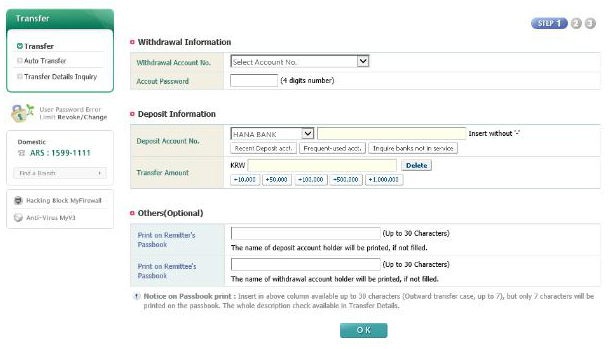
I had no idea how to indicate to the company which bill I was paying since my name isn’t actually on the internet, gas or utility bills that were set up before I ever arrived. I tried entering the customer information in the description field, and I hit “OK”. I was shown a summary of the transfer including my banking information and the name of the account I was sending to (which is nice so you can catch it if you mistyped the long account number). Then if that’s all in order, you enter the selected numbers from your security card:

hit “run transfer” again and have to enter —

your certificate password! Bearing in mind, we’ve already gone through all this trouble just to register my computer as safe to do bank stuff on, but every time I do a transfer (read “pay a bill”) I have to go through three passwords (log on password, pin number, and certificate password) and a security card number dance to prove I’m really really really really me.
Once we did the transfers, I noticed that the description field had not worked as I expected and the customer account information was not showing up to the recipient. How are they supposed to know what bill the money is for? Tomorrow. The next day, we called around to the places I’d paid bills to and had the hardest time finding a real person to speak to (some things are truly international?). One place told us they’d simply matched the amount to the bill and figured it out. The internet company however said they couldn’t look up the account without the national ID number of the person who opened it. We didn’t even know who opened this account, it’s just been with the apartment for as long as anyone remembered. In the end, we were told, we could read the MAC address off the router as ID, so I took a photo when I got home and we called once more the next day. The good news is, companies here issue unique transfer account numbers. So the bank account number that’s on my bill is *just for me*, and that’s how they know what bill it is.
After more than a week of hair pulling, I finally figured out the process for online bill paying. I still haven’t tried the international transfer option because I want to send the maximum transfer when I do to get the most for my transfer fee. Nor have I been able to change the phone number linked to my own Korean one (still linked to my co-teacher’s). I’ll let you know how that goes in a couple more weeks/months.
Another really important point here: I did not do this alone. I had a cheerful, friendly, bilingual Korean person with me most of the way. I can’t even imagine trying to do this by myself. I’d probably be trying to pay my bills in person or by ATM (apparently that’s an option) and sending money home by Western Union. I bought my co-teacher a chocolate cake.
I’m all in favor of security for banking, and internet security in general, but Korea takes it to a whole new potentially tinfoil hat level of paranoia. My US bank account asks me security questions if I log in from a new computer, which is nice. But I CAN log in from a different computer, which is also nice, especially when I had to do things like log in from a public computer at a hostel in China to transfer money on the fly. I don’t think that would even be possible with my Korean bank.
On top of that, the internet security isn’t just for banking. I finally figured out how to order food for delivery online. Yogiyo is a really popular website, but they required me to register my phone and authenticate it with an SMS to place an order. I went to the Papa John’s website and tried to register, and only after half an hour of futzing with the security protocols, installing another security program, and trying to legally verify my real name did I give up and place my order as a “guest”. Why do they need to legally verify my name for a pizza? On the plus side, I’ll never have to worry about someone ordering a pizza and claiming to be me.
Korean Healthcare
The EPIK Orientation was ground zero for a very virulent flu minidemic. Later I found out some 40% of the new teachers missed part or all of their first week of teaching due to this outbreak. I got to my new apartment on a Friday evening, feeling tired from the long week, but otherwise ok. I bought some necessities from the local grocery and some soup from a restaurant and settled in to enjoy my weekend. A few hours later, I wasn’t feeling so great. I started coughing and having some breathing distress. I was suddenly gripped by fear that the pollution in my new home was worse than I expected, that I might experience the smog-induced nightmare of China all over again and be unable to stay here and be healthy. The next day was worse. I’d developed a fever and many flu symptoms, which was actually a relief because it meant my breathing trouble wasn’t caused by smog. I was hoping that it was just a short cold and I’d be at least slightly functional by the time I was expected at work on Monday, but alas, it was not to be. I texted my co-teacher (who at the time I had met just briefly on my ride from the orientation to my apartment) and told her I was feeling very ill. I didn’t want to be sick for my first day of work, but it was bad.
I finally managed to get the point across, and we started talking about doctor options. She tried to tell me about a place I could walk to or take the subway to, but this was my first weekend in my new place and I’d had zero time to learn the location of anything before falling ill. And even now that I know where the hospital is in relation to me, there was NO way I could have made it there in my condition at the time. She finally agreed to come pick me up and take me to the hospital. It turned out her husband and son had just recovered from the flu, so she was more sympathetic than I had feared. We got to the ER and checked in. Yep, ER, emergency room. It was after 8pm on a Sunday night so that was all we had, but my coughing/ breathing trouble had become too severe for me to wait any longer.
There was perhaps one person ahead of us in line to check in, so that was done quite quickly, and we were ushered into a large area where I was questioned and examined politely and professionally. We talked about my history of asthma, and about my other symptoms. They took a swab to test for influenza, then set me up in a cot with an IV for fluids (I don’t doubt I was dehydrated by this time) while we waited for the results. Being tested for the flu was a new one on me. In the US, healthcare is so expensive and doctors are so overburdened that it’s just not done. I might have expected a nebulizer treatment for my breathing, and I probably would have been sent home and told to rest and take some Tylenol for the fever, maybe a prescription cough syrup to help me sleep.
The test came back positive for influenza A, a more severe and less common strain that is highly contagious. I was ordered 5 days “quarantine” (basically don’t go anywhere unless you absolutely have to, and wear a face mask if you do) and given a prescription for anti-viral medication as well as a cocktail of vitamins and decongestants. We went out to pay for the visit, but my ARC was not in yet (or even applied for) so I wasn’t in the national Health Insurance registry and had to pay out of pocket. It was about 80$. That was it. For an ER visit. Blew my mind. We walked around the corner to the pharmacy, me coughing all the way, forcing my co-teacher to slow her normal pace to one that wouldn’t destroy me. The medication too, I paid for out of pocket and it was something like 10-12$ for all of it.
After my week of medication and bed rest, I was feeling much better. No more fever or aches, but my cough was lingering on fiercely. I showed up to work the second Monday, and we made arrangements to go to a doctor during regular hours to avoid the ER expense. My co-teacher was delighted to learn the English word “pulmonologist”, because here you don’t need to see a general practitioner to be referred to a specialist if you already know what kind of specialist you need. I couldn’t breathe, so we clearly needed a pulmonologist. You can’t actually make an appointment. It’s first come first serve, but that day we didn’t wait long, maybe 15 minutes, before we got in to see the doctor.
This kind of lingering breathing distress after a serious bout of flu is not unknown to me and that flu had been a doozy. I explained my history (with help translating) to the doctor and he listened attentively. He asked his own questions about my symptoms, and seemed ill at ease with some of my answers. When I asked why, he told me that it didn’t really fit with a “typical” diagnosis. So, I got even more into my history and explained the issues in more detail. This is also totally new to me, since US doctors just want you in and out as fast as possible and hardly ever want to listen to a patient’s own information about their illness or history except for short yes or no answers to specific questions. This doctor had done the specific questions, but when my answers didn’t fit, he kept looking for more information! He did insist on an x-ray just to be sure there wasn’t another problem (which I’m ok with, although it was clear as I expected) and then we talked about medicine.
Now, if this was new, I’d want to take the doctor’s word. But I spent years dealing with this after my return from China. Years of doctors who didn’t believe me or insisted it was something else, or kept giving me medicine that didn’t work or had bad side effects. And although I did eventually get one who listened and helped, it was an uphill battle. So, when it comes to my breathing, I know what works and what doesn’t. He wanted to give me a type of medicine that was awful for me in the past. I was on it for 2 years, and I hate it. I countered with a different option (which, to be honest I also hate but at least it’s over faster, and has always kicked the breathing problem in the butt before). We talked about risks and side effects, when had I last used the medication, how often I’d used it at what dose. Eventually he was satisfied that I understood what I was asking for and prescribed the medication. The visit and prescription out of pocket cost was less than 30$ total, which is what I could expect for a co-pay (what you pay after insurance) in the US (if my prescription was generic).
So– no appointment, short wait times, respectful doctor who both listened to me about my symptoms, history and preferences, and cross checked me to make sure he wasn’t just giving me whatever I asked for without sufficient knowledge, comfortable, professional, dignified, and cheap. Wow.
At a follow up appointment a week later, we had a longer wait. The nurse at the check in desk explained that Saturdays and Mondays were the busiest days. We waited for about an hour that day. My co-teacher was beside herself with the long wait, and I tried to explain that in the US, you can have an appointment to see a doctor made well ahead of time and still have to wait an hour or more in the waiting room before getting in. She was aghast.
The doctor clearly remembered me (although foreigners might stand out a little) and we were able to pick up our discussion easily, and decided to continue another round of treatment. We both agreed that this would be the last of this medication, as it’s meant to be a short term fix, so if this didn’t kick my cough, we would change tactics. At the final follow up, my cough was much improved but not gone. Although he seemed to think it might be normal activity induced asthma, he believed me when I told him I hadn’t had that as a regular symptom in years. We talked again about the original medication he had suggested, and I told him, no I had a different option in mind instead. His face clouded up with concern, but when I showed him the picture of what I was asking for on my phone, he recognized it at once, relaxed and immediately agreed. He gave me a month’s supply and said to come back if it wasn’t better at the end.
Compared to the US and Saudi (the other countries I’ve seen doctors in) the health care I received here was amazing. I have argued with so many doctors in the US who refuse to listen to me talk about my own body and health. I’m not suggesting they should blindly take my word, but to have a doctor listen and critically analyze my self reports was so awesome. I felt like a human being who was heard, respected and cared for in contrast to the US where I’m often made to feel like I’m being a nuisance or a silly girl who is making it up or someone whose health problems would all be solved by losing some weight. And believe me, I’m not the only one. The internet is full of stories of people who have seriously bad experiences with US doctors because they are poor, or women, or people of color, or possibly anyone that isn’t a medical cadaver.
About a week ago, my health insurance card arrived and we finally got some answers about reimbursement. My contract stipulates that I’m covered from the last day of orientation, so even my first ER visit should have been included in that coverage. We didn’t have the insurance card or national ID number at the time, so I paid in full and wanted to know how to go about getting the portion that should have been covered by insurance back. I was sort of committed to the idea that it wouldn’t really happen (getting money out of an insurance company in the States is like blood from a stone), and the bills weren’t that bad, so I knew it would be ok either way, but I decided to try. It turned out to be so easy.
All we had to do was go down to the hospital and pharmacy where the original purchases were made and show them my insurance card. The hospital took the credit card I’d used to pay with and refunded all the charges, then billed the new lower amount instead. The pharmacy simply handed me about 50$ in cash so they didn’t have to go through the paperwork process of reversing bank charges. It was done on the same day we asked for it, and it took less than an hour for both locations together.
The Korean health insurance system is a public service. All Korean citizens are automatically a part of it, and foreign residents are covered once we’re registered with our employer or immigration. But even without it, the health costs are low and the health care is good and speedy. The next time someone tries to tell you universal health care can’t work without insanely high taxes, poor quality care or long waiting lists, point them at Korea and ask them what part of this system is a problem for them.
So there it is, banking and healthcare, two systems required for long term existence in any country broken down in Korea. Although the banking system is far more cumbersome and complex than I personally feel it needs to be, I should point out that the customer care was really good and the fee structure is quite reasonable. I’ve had no problems with the bank itself or anything there other than simply navigating the obstacle course of security protocols. It’s really amazing when you remember this country was razed to the ground by war in the early 1950s and then look around at everything they’ve built since, not just in terms of skyscrapers or subway systems, but the social infrastructure that provides for it’s citizens and guests. I’m really grateful to have the opportunity to live in this uniquely fast paced country, modern that hasn’t yet lost it’s sense of social responsibility to the siren call of greed.
 In India, the Hindu people ring in the spring with a festival known as Holi. It is often called the festival of love or the festival of colors. The main activity is throwing colored powders at each other until we all look like crazy rainbows. There is a huge mythological background involving gods/goddesses and heroes, and it seems like various regions within India each attribute some slightly different details to the history, but you can
  A group of Indian expats organized the event to take place at Haeundae beach. They set up a stage, a DJ, and tents where we could collect our colors, store our bags, and enjoy some delicious samosas. They started setting up at 9am, but since it takes me about an hour to get to the beach from my place, I opted to join a little later on. It was supposed to rain that day, so we had a lot of clouds in the sky, but when I showed up the beach was still dry. To abide by the Indian tradition, we were all asked to wear white to the event, and most people complied. In India, everyone would be wearing all white versions of their traditional styles, but we had to make do with what we could find here. Some girls were wearing white sundresses, and lots of guys (ok and me too) were wearing cheap white men’s undershirts.
 When the announcer reached one, everyone threw handfuls of powder up in the air, creating a sandalwood scented rainbow haze above us that settled down on our hair and shoulders. After a few minutes of ecstatic throwing of colors, people got down to the more serious dancing. It seemed another major part of the ritual involved hand painting people with paint or powder as you wish them a Happy Holi, so my face and shoulders quickly started to acquire more colors. All of the revelers were very respectful of body space, so the most popular targets for strangers were cheeks and arms/shoulders to avoid any uncomfortableness.
 I went through two such countdowns while staying in the core of the dancing area, I didn’t have my powder yet for the first one, so I made sure to be in the middle for the second one. Then I started wandering around the rest beach area to see what else people were up to. Some folks had built a sandcastle and decorated it with colors. Some had decided to take a dip in the ocean, causing their colors to take on the gentle fading effect of watercolor paintings. Lots of people had broken out bottles of beer and soju, and everyone was getting more and more colorful, happy, friendly and generally frenetic.
 I hadn’t actually had anything to drink at all at this point, but the atmosphere of excitement and the music combined to make me feel like I was floating through some kind of happy dream land. I met tons of new people, in addition to running into familiar faces, and I got more and more colorful as the afternoon wore on. Some folks had found the face paint and started making paint splatters and dribbles on one another, while others coated their hands and left hand-prints on their fellow revelers. Even as those hand-prints started drifting away from just shoulders and upper backs, I noticed that consent was always obtained. Lots of people of both genders turned up with hand-prints on butts and breasts, but every time I saw someone touch or get touched it was with respect, consent and Happy Holi. This was even more amazing, since such a party with free flowing booze and an excuse to touch people would have likely ended up with a good deal more unwanted groping in other places. And who knows, maybe someone here did experience that, but I tend to be aware of such things, so at least I can say the overall mood was of respect and not abuse.
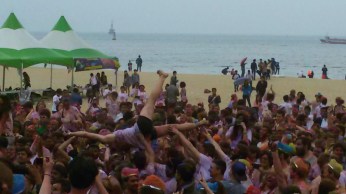 People started conga lines, crowd surfing, or just lifting and tossing each other up in the air. I headed up to the grass line above and behind the stage to try to get some pictures of the crowd and hopefully to see the countdown color throw from outside, now that I’d seen and participated from in on the inside. While up on the sidewalk area, I noticed a fair number of locals out for a Sunday stroll who gave us a wide range of interesting looks from curious to downright horrified. Some stopped to take pictures, and I was even asked to pose a couple times. Plus, although we were several hours into the event, it had not rained even a little bit.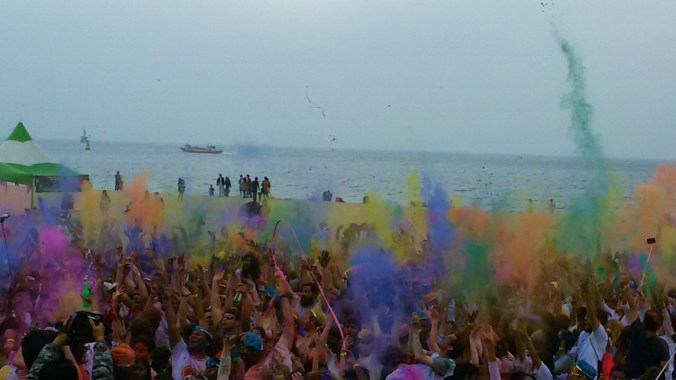
 After the last countdown, we gradually started winding down. The music didn’t stop, but the announcers asked everyone to help clean up the beach, which had become littered with empty plastic bottles and empty color packets. At the risk of sounding like a jaded broken record, pretty much everyone still there at this time did as they were asked and began gathering the rubbish in to large piles where it could be picked up by staff more easily. I’m not sure when I stopped believing that masses of young partying people could be polite and respectful, but I am really glad to have been so pleasantly proven wrong. The event coordinators must have had a ton of food leftover, or they just brought extra because they were also giving away free delicious Indian food at the end of the event as well.
 Some of my new friends and I lingered around the beach for a while, and it eventually did begin to rain and get colder, so we headed back inland to the Wolfhound, an infamous Irish Pub where we proceeded to drink some very large pitchers of ale and dance to some of the best top 40 hits from the 80s and 90s. I headed home only slightly after dark, and despite my best efforts (not drinking any booze while on the beach and going home at a reasonable hour) I still woke up the next day with a magnificent hangover. Inhaling lots of powdered colors, forgetting to drink enough water, and not eating enough did me in and I got a chance to try my very first Korean hangover cure (sold at convenience stores everywhere). And, although I washed everything else, my Holi shirt now hangs on my wall as souvenir art of the wonderful day.
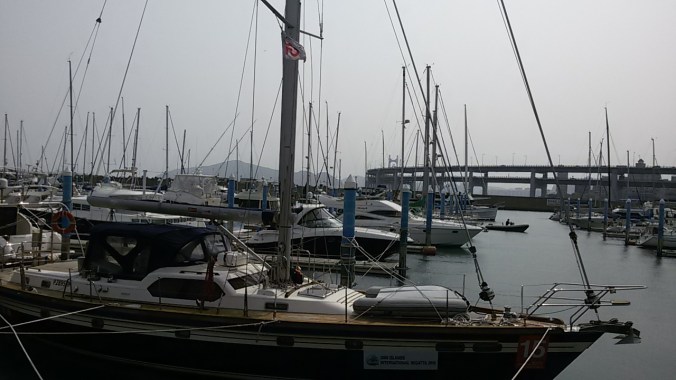
 Armed with Naver, I headed down to the marina at Gwangalli to meet up with the sailing group. It was a good mix of the more experienced sailors (the crew) and first time sailors. Everyone was friendly and happy to be there, and once the whole group arrived, we got a short safety lecture and headed to the slip where our boat awaited. We were in for a great sailing day with clear skies and winds up to 17 knots. There were some issues getting the sails up, so we motored around the bay and under the bridge, getting some fantastic views before we finally got under way.
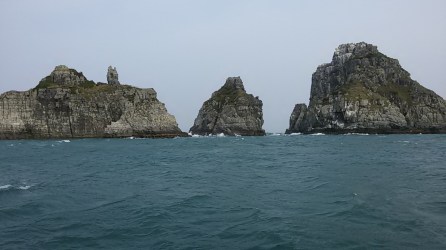 We sailed out past the small islands nearby before tacking for our return trip. Because of the strong winds, it was important for us to sit on the side of the boat that would be in the air, and we all had to change sides before the tack, while avoiding the boom. I let some of the first time sailors go ahead of me, figuring they would have a more difficult time, but this meant I was still on the port side when the boat tacked, and I got half dunked when the boat tipped up the other way before I could clamber up into the middle.The trip out had left most of us soaked, and several people started shivering in the high winds. We brought out some blankets from the hold, but in the end a some had to go below decks to get warm. I was chilly, but wasn’t about to miss a minute of the great weather and views.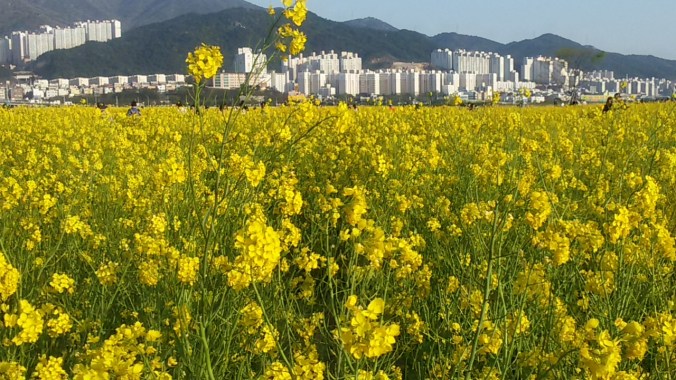
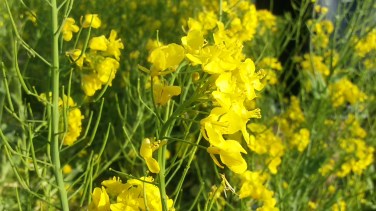 The girl I met on the bus back from Jinhae invited me to come with her to the festival and we decided to meet up Friday after work and head over. It was a long and winding subway ride, but we arrived with plenty of late afternoon sunshine to enjoy the flowers. The plants grow about 1-1.5 meters and there were little trails through the fields where visitors could walk among them, often chest high in yellow. Busan is a beautiful city, surrounded by mountains where it isn’t bordered by water, and as we crested the hill and the fields came into view, my breath was taken away by the expanse of brilliant yellow, bounded by the low mountains and a bright blue sky above.
 uring the weekends, and possibly earlier in the day, the festival has a variety of events and booths, but by the time we got there at 5pm on a Friday, there were only a few food vendors left. I didn’t mind this too much, since my primary goal was to see the flowers anyway. The fair food on offer wasn’t as interesting as what I encountered in Jinhae, but there were still some spiral potatoes and a tremendous amount of kebab vendors, as well as the sculpted candy floss. After a brief survey of the vendors, we headed into the flowers and were soon immersed in a fairy world. It reminded me of a sort of reverse horror scene. You know the movies where people are lost in a field of crops until the monster leaps out at them. But instead of monochrome crops by night, we were amidst the brightly colored blooms in glorious sunshine, and I felt that instead of a monster, we should expect a unicorn to leap out at us.
 Korean apartments are tiny little studios, comfortable for one, cozy for two and not actually terribly well suited for a party. On top of this, our host had set up his racing track which took up nearly the entire floor in the sitting area. We had to carefully step around and between the loops of the track to move across the room and there were only 6 of us. We watched the guys race while we ate, and then we got a crash course in how to use the track. It was a little like Hot Wheels on steroids. The cars were about three times the size of the Hot Wheels, and the track was equally sized up, which is why it took up the whole floor. In addition, it was linked into a video game system that measured our laps as well as our “fuel” so we had to not only drive the mini-cars, but pull into a pit stop when our fuel was running low or risk losing the race by running out and getting stranded.
 I’m also spoiled rotten by the UW campus quad which boasts 40 old and giant cherries that put on a spectacular show for the students every spring. It seems, however, that large portions of the Western population have simply never experienced the joy of standing in a huge grove of cherry trees in full bloom as the wind teases the frail petals loose and swirls them through the air around you. I am sad for these people because as beautiful as the paintings and photographs are, they cannot do the experience justice. So please, find your nearest cherry blossom viewing spot and GO.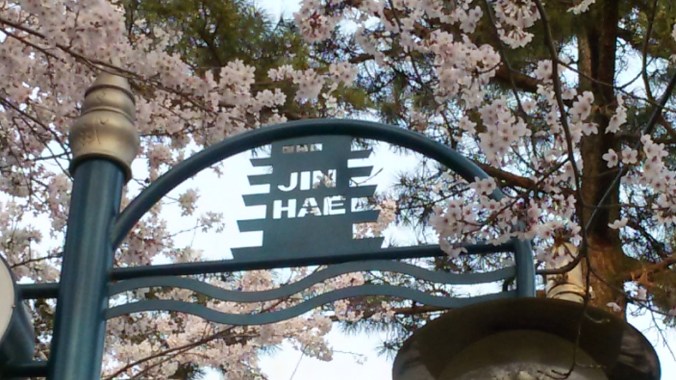

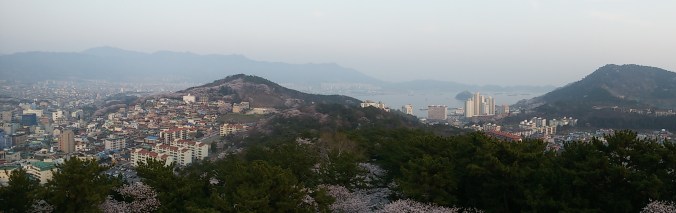
 for the day. As the bus drew nearer to Jinhae, our windows became filled with blossoms, as the roadside and mountains were simply covered in the blooming trees. And once we arrived, I began to get an understanding of what 340,000 cherry trees might actually look like. Every street we walked on was lined by trees, planted every 3-4 meters on both sides. No matter where we turned, we were walking under a blossom bower. The main festival stage isn’t a far walk from the bus terminal and soon we were greeted with streets closed to traffic and covered with tents offering traditional fair foods and souvenirs. Lucky me, my companion was just as interested in sampling all the unique foods as I was. The first thing we were greeted with was a whole pig roasting on a spit, and we resolved to try that for sure, but he had ice cream on his mind first, so we kept looking.
 Following the sound of some flute music, we turned a corner and were greeted by a most unexpected sight. Two men in what seemed to be traditional Native American dress. Lucas had no idea what they were dressed as, and I had to try to explain while being totally bewildered myself as to why Koreans would kit out in feathered headdresses. I’ve since done a little research and it could be one (or a mix) of two things: 1) Korea really enjoys using other cultures’ stereotypes in pop-culture and they aren’t always sensitive about it, and/or 2) they were actually trying to honor the culture because Native Americans did help to defend Korea during the Korean War and have gone largely unappreciated for it. Either way, it was quite a shock for me to see these costumes at a cherry blossom festival, and further on I noticed that the souvenirs in that area consisted of a lot of dream catchers and other stereotypical Native American tribal art and jewelry (although in a real hodgepodge of tribal styles).
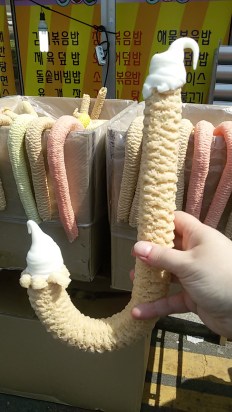 As we made our way toward the stream, we finally found our ice cream vendor. I’d done some reading on the Jinhae experience before I went, so I had a few things to look out for and this was one of them. This odd confection is a “J” shaped corn crisp shell that’s filled to both brims with soft serve vanilla ice cream. The flavor is about what you’d expect, although the cone was a serious improvement on the standard American cake cone, it’s also a far cry from those waffle cones I got in Prague. But the experience is the thing, and as soon as he spotted the vendor, Lucas swept down and bought us two. The man at the booth was having fun clowning around, pretending to drop the ice cream, and in the end, he turned both cones upside down to form a heart with the two of them for us. Korean culture is big on dating and romance, and he had no way to know Lucas and I had only just met a few hours ago, but it was cute and we took it in good humor.


 After a little bit, Lucas became enamored with the grapefruit drinks we had seen other tourists enjoying, so we found a vendor and ordered two of those. We watched, fascinated as the vendor cut a neat hole in the top of the fruit, then held it up to a machine which quickly reduced the insides to pulpy juice. Finally, he popped in a straw, and set the sticky globe into a plastic drink top to keep our hands clean. Ah, fair food. I love grapefruit juice, but nowhere else do I know anyone who would say, “sure, let’s drink that right out of the peel!”. I felt 5 and it was awesome.
 On our way back through the streets alongside the stream, we were lucky enough to get caught in a strong gust of wind that tugged thousands of petals loose from the trees above us, covering us in pink, soft snow. Everyone there burst into surprised and happy cheers and gasps as we felt the warm wind and watched the whirlwind of flowers in awe.
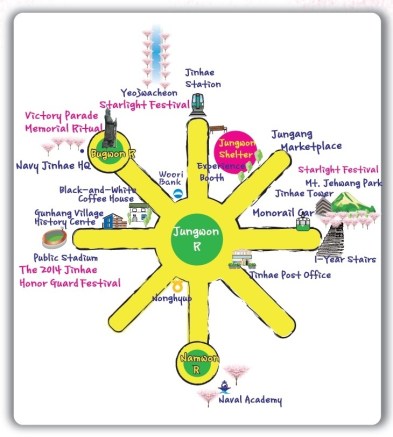 By this point we were starting to sense the layout of the festival (plus we’d seen a map) which had the central stage at it’s hub in the largest roundabout in town. Streets came off the roundabout like bicycle spokes, each one lined with blossoms and tents, and each one leading to a different destination for viewing and exploring. Out of the 8 possible directions, we probably only went in 4-5 and I missed out on at least half of the festival’s activities and sites even though I spent nearly 9 hours there that day. Taking a look at our options, we headed back toward the center of the festival to try to find the mountain observatory.
 You may remember that upon arriving, one of the first foods of interest we saw was this whole roasting pig? Well, that was what we wanted for lunch. Thus we hiked back towards the center of the festival, scanning the booths around us for that telltale swine-flesh until we found one. Neither Lucas nor I had any real amount of Korean language ability, but pointing works well enough, and it turns out “Barbecue” sounds the same in Korean as it does in English. Lucas tried to order some soup to go with it, but through the hilarity of charades and cultural differences, we actually ended up with a bowl of local rice wine instead. Yes, a bowl. It turns out that dongdongju is served this way traditionally and is a common fair drink alongside the barbecue, so our server can certainly be forgiven for assuming we wanted the popular choice.
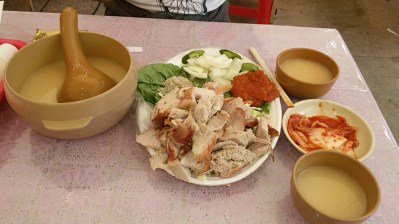 Despite it’s somewhat dubious opacity, the wine was tasty and refreshing after our long walk. And when the single dish of barbecue showed up, suddenly my erstwhile companion understood why I hadn’t ordered a second dish myself. The heaping pile of pig had been cut into chopstick friendly cubes and was served alongside a piquant chili sauce, some tiny brined shrimp, sliced onions, mixed salt and pepper, and green hot peppers (and of course there was kimchi). We were free to mix and mingle the flavors as we pleased from there, and I quite enjoyed the experience. Even the brined shrimp went well with the pork, much to my surprise. We chatted, ate and drank for almost an hour but were unable to finish either the pork or the wine between just the two of us.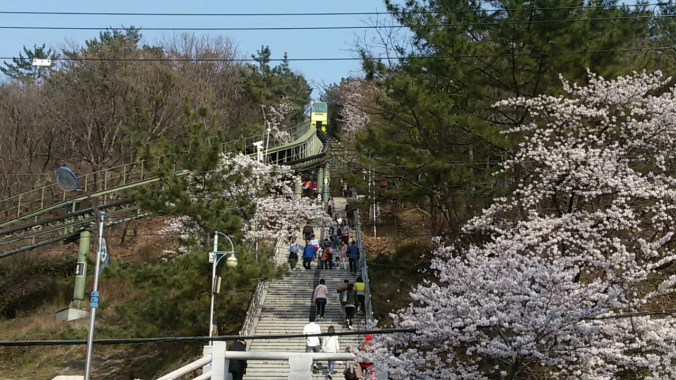

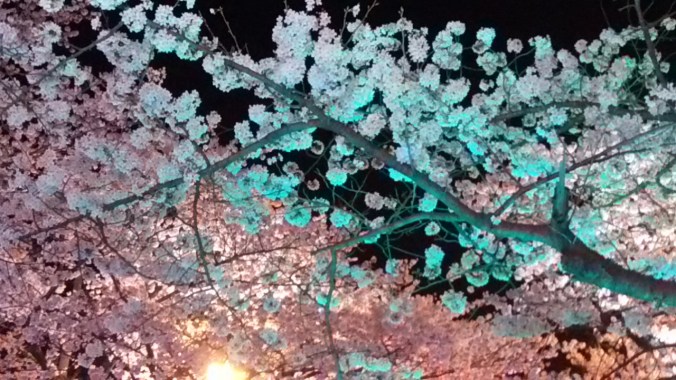
 LED cherry blossoms in shifting colors. Despite my rush to see the real flowers, I took a quick detour to watch the light show. When I got to the road by the stream I was overwhelmed by the number of people. During the day, I had to wait my turn to get up onto the bridges for photos, but now the bridges were so crammed that even people trying to get away from the railings to make way for the next visitors had to push their way physically through the crowd. It wasn’t a lack of politeness, just the sheer volume of humans in such a tiny space made it impossible to get out of someone’s way without pushing into another person. At one point someone backed into me and leaned on me, and only realized I wasn’t the railing when I moved. They were, of course, apologetic, but that’s how crowded it was!
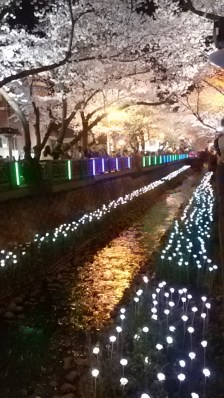 The area of the yellow flowers and fake white roses was first. Although we’d spotted the roses were fakes, I had thought at the time it was just about making a pretty pattern, which is harder to do with living flowers. Now at night I realized that each false flower was connected to a hidden wire because they glowed magnificently, casting a pure white light up on the blossoms above them.


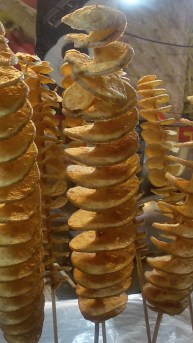 This was another tempting snack I’d read about online and decided I wanted to try. Plus, it had been 4 hours since lunch and I knew I had a few more hours of standing in line and bus riding before I would be back in Busan. It was time to grab a snack anyway. On my way through the stalls, I came across these clear glass-like treats. They were served with a kind of powder that stuck to them, and many Koreans seemed quite taken with them. I decided to pass because I have an aversion to all things gelatin (there is no room for Jell-o), and the Asian desert culture is heavy on foods that have a gelatinous, jellyfish kind of texture. Which is not to say that I don’t have love for other Asian desserts. I enjoy the glutinous rice and sweet red bean paste concoctions. You can see from the picture this stuff looks like it could go either way: gelatinous or glutinous, and in a situation where I had more time, I might
  have given it a shot just to find out, but as it was already after 8pm and I was not yet near the bus station, I had to forgo the mystery in favor of a more well known potato based snack. This turned out to be dusted with cheese powder and was a lot like eating very thick cut, fresh potato chips, yum!
 Gallivantrix