There are a seemingly endless number of tiny beaches on the island of Panglao, and each one has pros and cons. I wanted to look at several to get a good idea of the best beaches for my tastes. While only the paid beaches (resort run) are “clean” in the sense of pristine sand and crystaline waters, the other beaches aren’t what I would think of as dirty. They do have natural debris, tree branches, leaves, seaweed, driftwood, etc, but I didn’t feel like any of them were trashed by human junk, a few pieces of litter sometimes. If you’re looking for a postcard beach, it’s better to pay the entrance fee for a resort. If you don’t care so much, just get a decent pair of water shoes and have fun!
Momo Beach

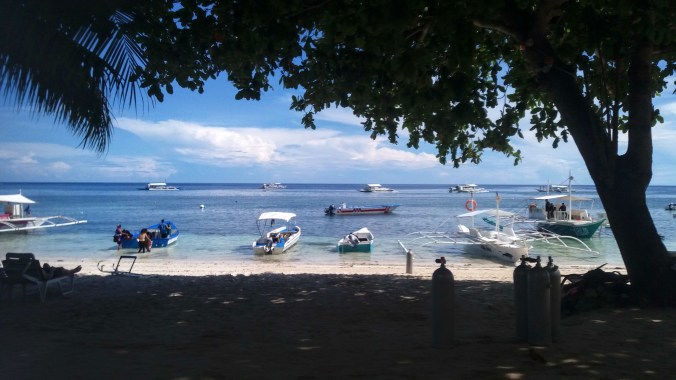
Momo was my first beach visit mostly because it was between two other stops we were making on Sunday, and it had decent reviews online. Momo was almost eerily quiet. Despite the fact that it was Golden Week in East Asia and it felt like half of China had come to the Philippines, Momo’s only tourists besides ourselves were a diving class practicing in the shallows. There isn’t any deep swimming off the beaches of Panglao; it’s all shallow for a long way out, making it great for kids or weak swimmers, and it’s full of life which is fun for everyone.
The water at Momo was dark with the sea grass growing just beneath the surface, but it was so clear I could see all the creatures who lived there… including lots of spiky sea urchins. I waded out carefully, working to avoid stepping on anyone sharp, and tested out my underwater camera apparatus. In preparation of snorkeling, I’d purchased a phone bag that was water-safe, and a floater in case the phone strap broke. Although a cursory test of waterproofness had been done before, this was my first chance to try to take pictures underwater. It was harder than it sounds.

The touch screen worked great through the plastic above water, but went nuts as soon as the sea surrounded it. It took a while to get all the settings under control so I could launch the camera and take photos with buttons instead of touchscreen. In the end, I never did figure out how to get it to focus on what I wanted, so my underwater shots are a little hit or miss, but it was nice being able to take any at all. Along with the fields of sea grass and myriad urchins, I found a beautiful brown starfish, colored like a pointed Siamese, and managed to get a single focused photo without having to lift the creature out of the water, yay!
Alona Beach
Also on Sunday, we headed over to the famous Alona Beach. I had read that it was once a paradisaical white sands tropical beach which has become overrun with tourism and is no longer so pleasant, but I wanted to look anyway. Alona certainly is beautiful, but there is none of the quaint island charm that I found at Momo. The beach was better tended and the water cleared of sea grass and urchins, but other than a tiny marked off swimming area no larger than a pool, the ocean was covered in boats. Just above the high tide line, the beach is lined with restaurants, souvenir shops and diving shops.

Since we were on bikes, we had to park in a lot just off the main circumferential road and walk the rest of the way to the beach. (parking was only 5p, btw). I don’t think this is as bad as the blogs I read made it sound as long as you know what you’re getting into. We passed every kind of food, drink, cultural market, and tour group set up you can imagine. I didn’t want to join any tour groups myself, but if you need a tour experience, you’ll find it on Alona beach. Ok, that’s not totally true, I did want to join one group at least to get myself out to the island with all the turtles for some snorkeling, and I found that there too.
Once I hit the beach, I walked all the way to the right, scoping out the options for dive groups. It’s not a huge place, so within a few minutes I’d reached the end. Vendors were constantly calling out, selling tours, drinks, food, pearls… so many random guys selling pearls out of a box on the beach. They may be fakes or they may be cultured pearls, but I’d say if you like them, just don’t pay more than you would for costume jewelry. I have my grandmother’s pearls, so I’m set. I did cave in and buy from one street vendor: an older lady selling fresh mangoes. It was 20p, probably more than it cost at the market, but she peeled and sliced it for us on the spot and it was ripe and delicious.

I headed back the other direction, trying to figure out which of the diving shops I wanted to patronize. I wasn’t planning on diving (I’m not licensed and also it’s super expensive), but after some internet research and asking people who’ve lived/traveled there, I found the best bet for good snorkeling without being ripped off is to join a dive group and just snorkel from the boat while they dive.
At one point, I thought about doing a tour over to swim with the whale sharks (because how cool would that be?), but as I read more about it, I came to realize that the tours at Oslob are damaging to the environment, and to the animals. Although the sharks are rarely harmed directly (though sometimes by thoughtless tourists or bad guides), the fact is that the Filipinos feed the sharks to keep them there year round as a tourist attraction which interferes with their migration, breeding, and feeding habits. It also teaches the sharks that humans are safe, which is not true outside of Oslob, and it puts them at greater risk elsewhere in the ocean. Whale sharks are gentle giants who eat only krill and plankton and have no teeth to hurt humans. As much as I would love the opportunity to swim among them, I cannot do it in a way that endangers their future as a species.

However, while I was learning about this tourism tragedy, I found a dive shop in Alona that felt the same way and offered all kinds of conservation based dive classes for advanced learners. Even more hilariously, it turned out to be the same dive shop that an old high school buddy who moved to Manila an age ago had recommended, although he’d given me the name of an instructor rather than the shop at first, so I didn’t realize until later. With all that coincidence it felt like fate. This ecologically sound dive shop is called Sierra Madre Divers (on Alona).
Inside I found a very frazzled young man running the front. I explained the desire to join a dive as snorkelers, but it turned out that every spot on every boat was filled for the entire duration of my stay in the Phillipines… by Chinese tourists. One day I’m going to get back on a holiday schedule that is not the same as a billion other people. However, he was kind enough to recommend another company. I figure all these dive shops have to know each other at least a little on such a small island, and I was more than willing to take his suggestion rather than try to filter through internet reviews searching for another by myself. He called over another young man who introduced himself as Rafi (short for Rafael) and told us he’d be happy to take us out the day after tomorrow, just show up at 8:30am.

We paused on the way back up the beach for milkshakes and as I sat on the bench overlooking the water, the most adorable tiny little girl came up to me with a ukulele and began to sing “I Wanna Be a Millionaire”. I’ve been on the receiving end of a lot of money scams in my travels. I still remember the little girl in Petra who gave me postcards “as a gift” but wanted money in return. I like supporting the locals who are trying to make a living from the tourism trade by doing things like making and selling goods or food (the totally grown up women in Petra I made sure to buy handmade jewelry from, or even the mango seller earlier that day). I also like busking as a way to earn money, though I’m hesitant to give money to bad performers. Not only was this girl so adorable she could be on a cereal box, she was a very talented musician. Her uke work wasn’t complex, but it was solid and her voice was very nice. I am big sucker and I only wish I’d thought to pull out my camera, but she was so close, she was nearly in my lap, and I was genuinely enjoying the song so I didn’t think about filming until it was too late. Of course I gave her money, don’t be silly.
White Beach

The last beach of Sunday was another locals only kind of place. Despite being just up the coast from Alona, it was far less developed and by late afternoon it was occupied by Filipino families doing evening barbecues on the beach. The sand beneath the water was much less infested with urchins than Momo,and we waded out into a clear sandy patch where we could play around in the warm water that came only up to our hips. Some of the locals came by to make conversation, and I felt obligated in the growing darkness to lie once more about my marital status.
I haven’t done that since the Middle East, and I have to wonder if I would have done it in the daylight, but the sun was behind the trees and it was getting quite dark. I felt exposed in the sea, even with another American woman beside me, as a man I didn’t know asked about my age and my husband. I want to believe he was just being friendly. I’ve learned that in many places the standard questions are “Where are you from?, What do you do?, How old are you?, and Are you married?” I want to be a proud single traveler. I want to scream from the mountain tops that I don’t need a man to do this. And yet, from time to time I feel less than safe admitting to my spinsterhood, as though by admitting I’m single it will become an invitation for attention I do not want, or worse be taken as an admission of promiscuity. So until the day women are safe and independent all over the world, I may sometimes have an imaginary husband in the US military to scare away unwanted male attention. Sigh.
We splashed around in the shallow water, trying to take selfies in the dark and watching the lightening pop in the distance until it got so dark we couldn’t see our bags on the beach. Looking back on it, I need not have been worried about the bags on a local beach, but at the time I didn’t know yet how things were, and although there wasn’t too much in the bags (phones and keys were with in the waterproof bags with us, money in the wallet was minimal, important ID was in the hotel,etc) it would have been a bad first day to end with them stolen. Plus we were getting more looks from the men as women and children became scarcer in the water. I still don’t think anyone would have hurt us there, but there’s never a need to take chances, and I wasn’t sure how long that lightening would stay in the distance before the thunderstorms hit. I did NOT want to be on a motorbike in the dark and the rain.
Dumaluan Beach
After getting a monumental sunburn while snorkeling on Tuesday, I figured a rest day would be in order and decided that Wednesday would be a great time to check out the “semi-private” beach at Dumaluan that had been recommended by both the hotel hostess and the taxi driver. Panglao has three types of beaches: public, private, and semi-private. Most of the very public ones are not what anyone would put on a post card, the sand has debris from the jungle and the sea, and the water has things growing in it that show it’s clean and healthy, but do not promote a turquoise tropical beach vibe. I personally find these places worth visiting, but there is also something deeply luxurious about the postcard beach experience.
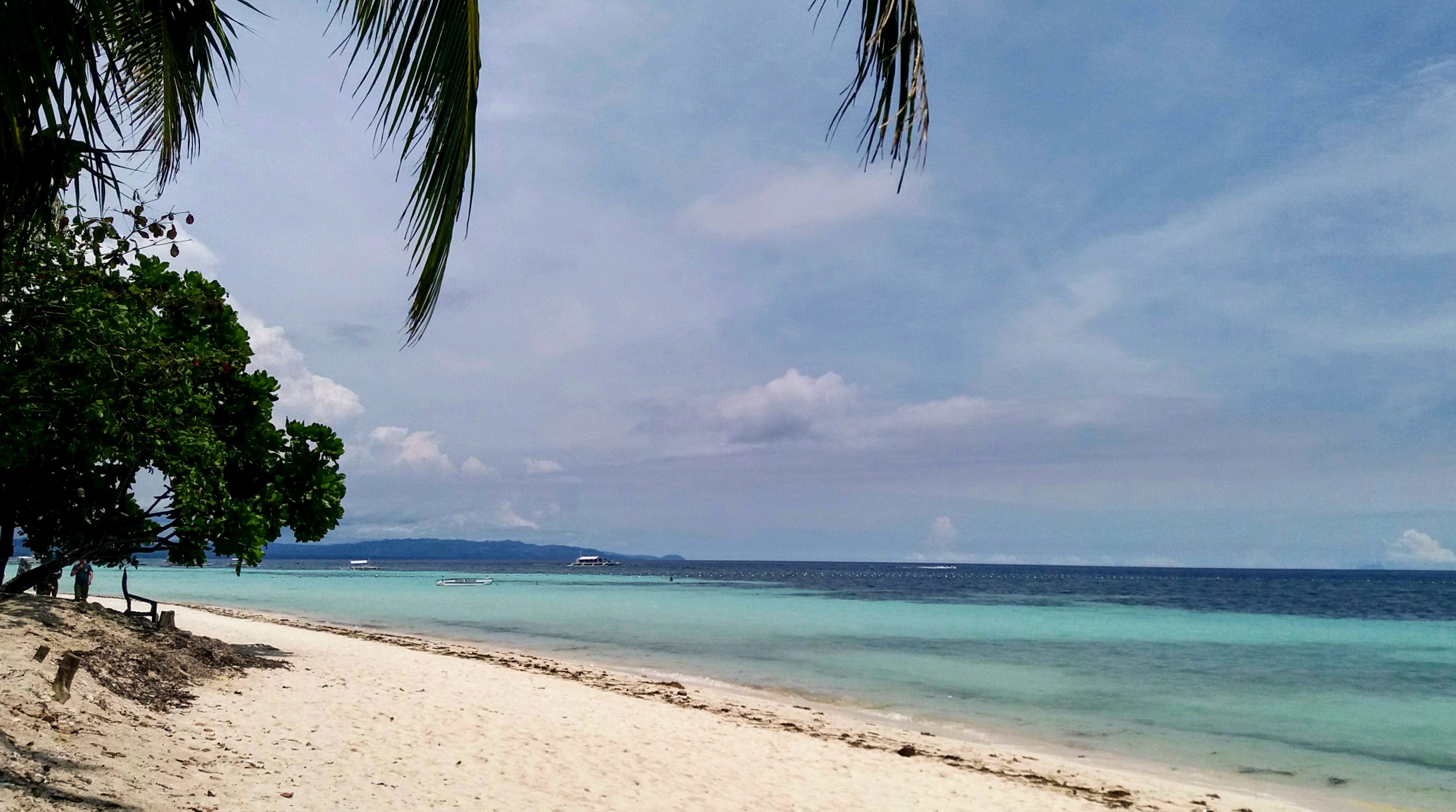
There are a couple of hoity toity resorts with private beaches, and some of them will let non-guests use the beach for a day fee. Unfortunately, I found zero information on what that fee is, or which resorts do and don’t allow, or if there’s a limit, or anything really because all their websites are geared toward getting people to stay in the resort, not just stop by for the amenities. The Bohol Beach Club is supposed to be right up on the top of that list, and I had been thinking about checking it out, but when the locals told me about Dumaluan instead, I decided that was a better option.
Dumaluan is semi-private, meaning that it’s tended to and cleaned up, and there’s a small fee for use, but anyone can go. It’s attached to the Dumaluan Resort, but not exclusive to guests. The fee to enter the beach area is only 25p (about 0.50 US) and the parking fee for motor bikes is the same. Plus, there are little cabin/picnic areas you can rent out for the day. Ours was a “B” and cost 350p for the day. I only saw the B and C cabins; the B were granted an unobstructed view of the water, while the C were set farther back. I presume the A were possibly somewhere nicer and the D somewhere less desirable? I looked but never found them. The cabin area included bathrooms, showers, some entertainment options like volleyball and a karaoke room, as well as a little grill serving light meals, fruit shakes, and cocktails.
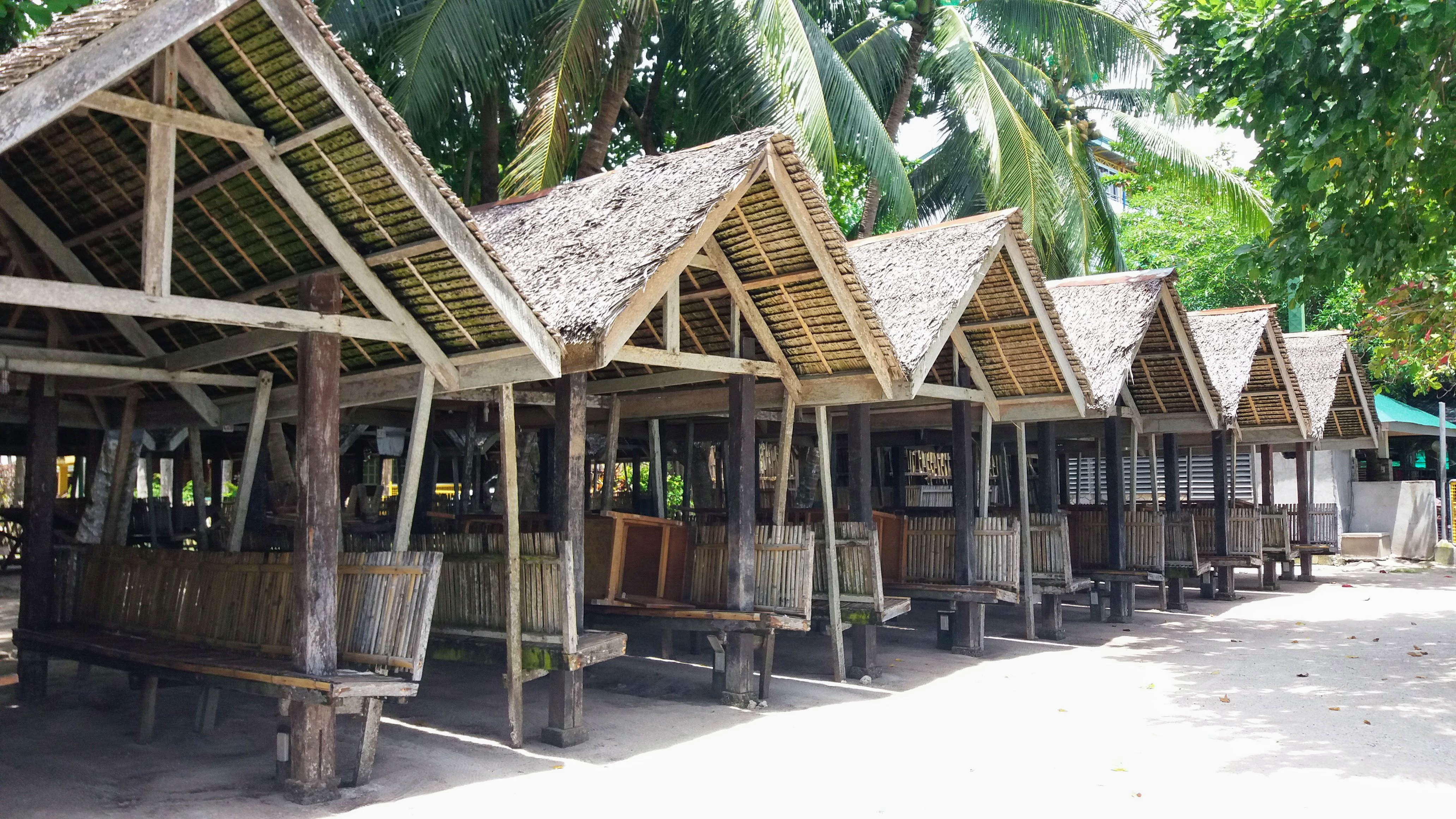 The cabin had one long table between two benches, and was covered by a thatched roof, making sure guests would have plenty of shade. There were also lots of trees around which helped keep the area shaded and cooler. Although the sun on the beach was bright, making the sand and sea pop in white and azure, there was a nice breeze and I felt comfortable in my shady seat. It seemed once again we were the only tourists there. There were people at the restaurant, in the karaoke room, and in a few other cabins, but as far as I could tell they were all Filipinos. The cabin next to ours was having a big family birthday party for one of the kids and they’d arranged to have a whole roast pig delivered in for their picnic! We were generally surrounded by (but not crowded by) happy families and playing children throughout the day.
And dogs. So many dogs. In Thailand, there was a profusion of semi-wild street dogs which (other than on Koh Lipe where an animal shelter works to keep them safe and healthy) they are generally scrawny, sick, diseased, injured, and very shy of humans. It’s sad. When I got to Bohol and saw dogs everywhere I was worried it was going to be a similar situation, but as I got settled in, I found that most of the dogs here were better cared for and while collarless, seemed to have good relationships with the humans. Someone told us that they were really family dogs who just wandered around at will. I guess they’d have to be well trained or the chickens and baby goats that also wander around unattended wouldn’t last long. Either way, however many dogs I saw, I never saw a single leash.
Many times throughout the day, a dog would wander over and hop up on a bench to lay down in the cabin. I don’t want to judge, some people might like that. I don’t hate dogs, but I am allergic, and I also had no idea if these were trained, well behaved, or just thought they owned the park. There are safety concerns with unknown dogs when no owners are nearby. I tried to shoo them off with great difficulty several times until finally one of the Filipino neighbors noticed our predicament and told me what to say. For all the world it sounded like “sit” to me, perhaps with a less aspirated “t”? And when I said it the dog obeyed at once getting down from the bench and moving on, so it was clearly a well understood command and a well trained dog. Later on, I found a list of Tagalog dog commands, but none of them seemed phonetically similar, and the island dialect Boholano is too small to be well documented or have a Google Translate option, so I’m afraid I can’t accurately relay the “go away dog” command for I was taught that day.
The beautiful sun made the water more attractive, but I didn’t want to risk worsening my burn, so I hid under the cabin and partook of the snack bar, which was decent, but not really on par with the amazing food I had elsewhere on the island. Finally the sun retreated behind some clouds or trees, and the beach was no longer quite the burn threat. By this time the tide was in full retreat and it was amazing to see the huge swaths of land revealed. The beaches around Panglao are all very shallow for a long way out, so when the tide goes out, it really goes. I got up to have a walk around the beach and try to take some nice pictures. The clouds there are basically stunning all day, so that helps.
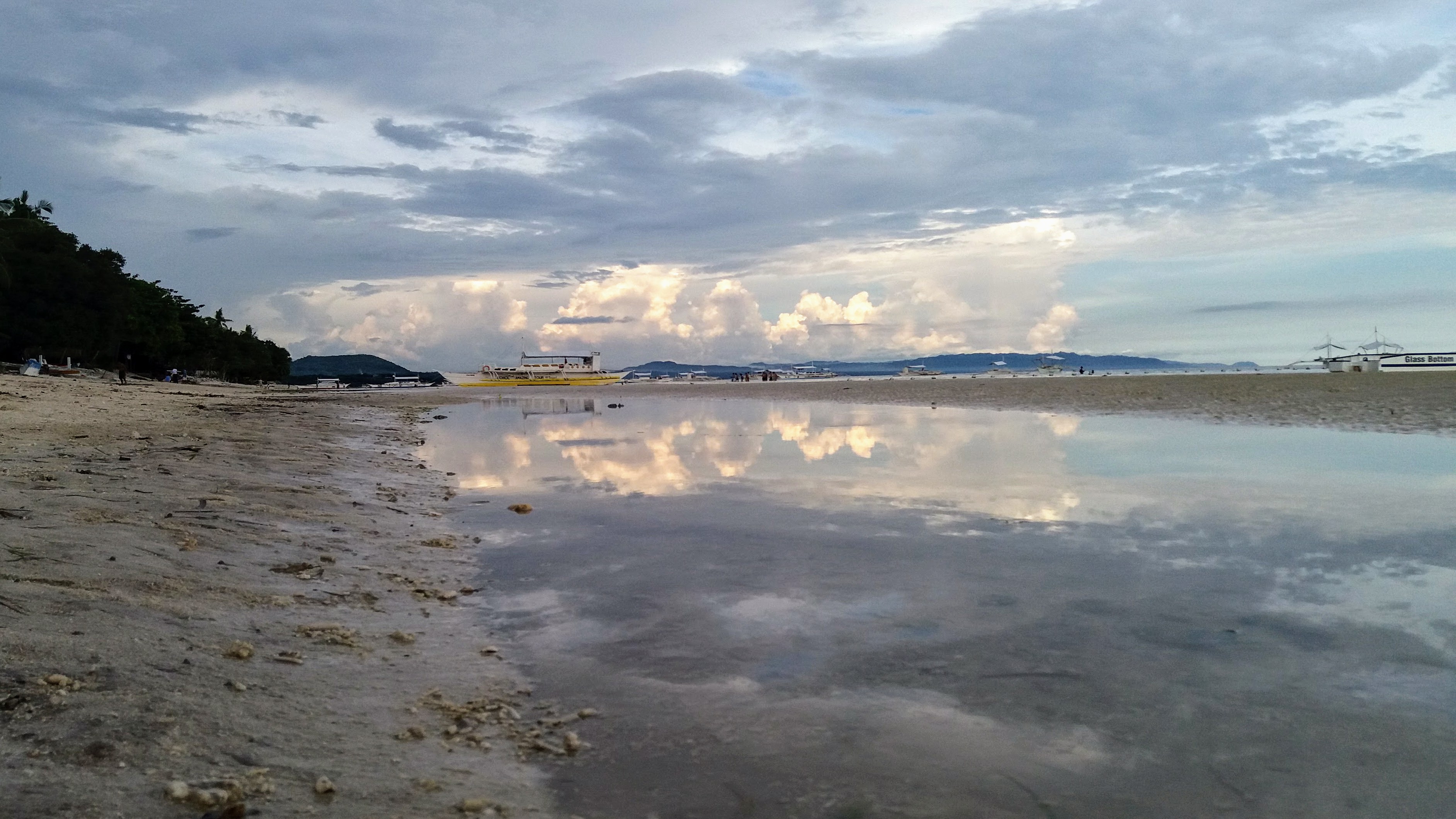 Kids and families played around in the wet sand, hunting down clams and other critters that had dug down during the tidal retreat. There were places where the sand was a little deeper and the water hadn’t gone out with the rest of the sea, creating miniature ponds replete with tiny fish who were trapped until the next tide returned. I waded around the shallows, but had avoided wearing my swimsuit that day to let the burn work on healing. Instead I contented myself looking at the textures in the sand, the piles left behind by digging clams and the ribbons left by the retreating waves. I found a few places where cool water came from under the sand, including one where it emerged with such pressure it almost seemed to be boiling, but it was ice cold.
There were resort workers out raking the piles of debris to keep the sands clean and white. I played a little game of how far out can you walk before the water hits your knees (quite far), and had some fun taking pictures in the glassy reflections of the tiny pools left behind.

Doljo Beach
The last beach I visited was a quick stop I made between two other stops on Thursday just to see if it was a beach I wanted to return to a different day. Doljo is another small, local, free beach that’s far away from the resorts. By the time I made it there, the tide was out, leaving a fleet of boats stranded on the wet sand, but I could tell it was still a pretty place. There wasn’t much around, a couple of huts that were falling apart and some guys selling fresh coconuts to a family of Chinese tourists. It’s small, and a little out of the way. I gather there is at least one resort over there which gets good reviews, but I would have been happy to go there when the water was higher, or even stayed with the low tide to see the sunset. It was amazingly quiet and private. However, sunset wasn’t an option for that day, since I’d already booked an evening activity, and I never did make it back, opting instead to spend my final day of holiday chasing waterfalls.

Conclusion
I think a person could easily visit 3 beaches a day for a week and not see them all. Choosing a beach on Panglao depends a lot on your goals, but regardless of your plans, I would advise:
- looking at a tide chart because the water goes far far away at low tide and although it is still fairly shallow at high tide, it is much more beautiful and easier to swim in
- getting water shoes because only the pay to play beaches are safe for tender bare feet (although the locals might have Hobbit blood because they don’t seem to mind)
- using more sun protection than you think you need because you will burn. Double up, sun screen and covering clothes. The locals swim in street clothes, only tourists go in only swimsuits, so you’ll actually stand out more in a bikini than you will in a covering, skin-saving shirt.
Don’t forget to go over to my Facebook page to see more beautiful sunny beaches! Why? Because WordPress charges more for photo storage than Facebook, and I’m putting off the day I have to beg for money to supplement this blog. Enjoy!
It’s hard to reminisce about beaches in December with below freezing temperatures outside. I’ve been busy job hunting for my next posting, and while I know the responsible thing is to try to get hired for the spring semester, a tiny beach bum part of my brain can’t help but wish for a fall start and the chance to spend 5 months living on a beach in SE Asia while I wait. It seems like I’ll be ok either way, but no out of country trip this January  I’ll have to make do with a winter wonderland weekend in the snow instead.
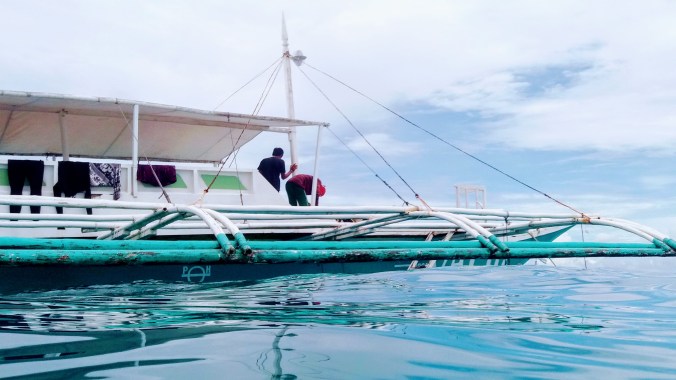
 Regardless of who you choose to go with, make sure you ask about any extra fees for Balicasag. Some activities do require paying the national park fee and others don’t. It’s never fun to be caught by surprise once your in the ocean. Valm Dive wasn’t planning to go to any of the pay areas, and so we were only on the hook for our ride and equipment (mask and snorkel only, no fins. I think they would have let us use them if they had extra, but they had to supply the divers first and ran out). Total cost: 500p or about 10$ USD.
 That morning was one of the few rains that happened during our active times. On any other morning, we could have just waited for it to stop, but Rafi had told us to be at the dive shop at 8:30 and we didn’t want to be late and run the risk of losing our spot on the boat. We waited as long as possible, and it didn’t take long for the downpour to become a drizzle. Driving on the wet roads wasn’t nearly as difficult as I feared, but getting a face full of rain made seeing a little challenging. I thought again about what kind of gear to use to prevent that if I ever had to drive a real distance in the rain, but it seemed like all the locals, in addition to shunning helmets, only wore ponchos while driving in the rain, leaving their faces, and eyes, open to the wet.
 The Wall
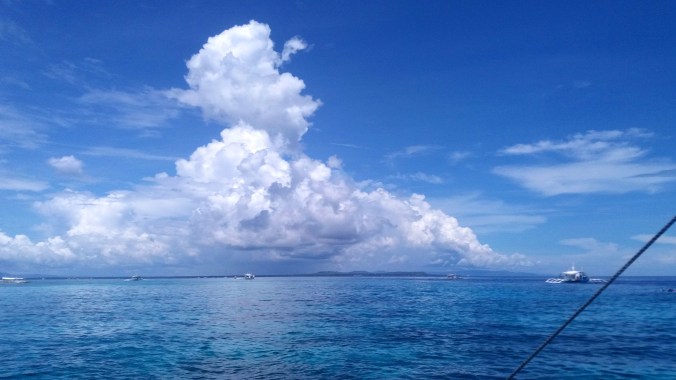
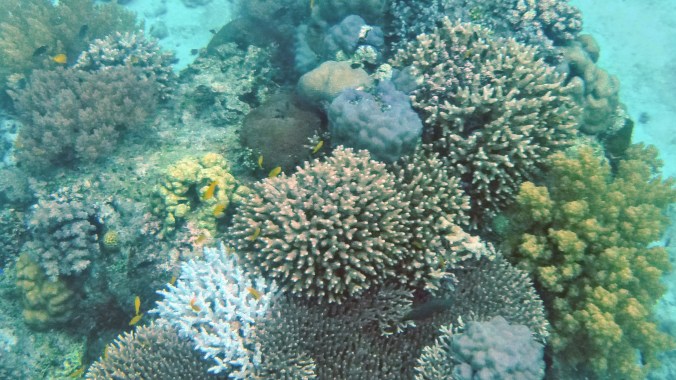 The corals were lovely, and I wasn’t in a hurry to get anywhere in particular. It was my first real chance to play around with my new underwater photo taking capability. Almost as soon as we got in the water, I spotted my first turtle hugging the edge of the drop off. I did my best to keep pace with him, but especially swimming against the current, I had no real hope of catching up to a turtle, no matter how lazily he seemed to be swimming. Finally, I had to give up. I swam using as little energy as possible, but it was hard going because the current was much stronger than I was used to and it was impossible to hold still while taking a picture.
 I wove back and forth above the stunning coral shapes, trying to get my camera to focus when I was spotted by a little rainbow wrasse, maybe 5 inches long. It was clearly watching me, swimming back and forth in front of me in quick zipping lines, and once it was sure it had my attention too, it swam straight at my face. I was honestly worried it was going to hit my mask, not for my safety, it was a small harmless fish, but worried that it might hurt itself bashing into the plastic. Fortunately at the last moment it turned aside.
 It seemed like a strange behavioral anomaly, but the fish came back and did it several more times. As I got used to the pattern I tried to get a picture. I wish I could have done a video, but I hadn’t quite figured out the trick I needed for that with the waterproof cover.

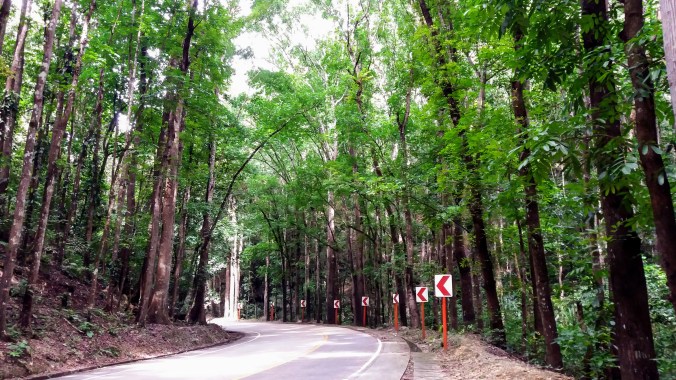

 After 2 and a half hours of driving, we finally made it to the Chocolate Hills Lookout (sometimes called the Chocolate Hills Complex). There was a line of cars and vans stopping at something on the way, but they all looked like tourist groups and there were no clear signs, so we just drove around them and on up to the parking lot at the top. Motorbikes always have a separate parking area from cars here, so we pulled in and were asked for our tickets… which we didn’t have. I’m not sure if that was what we should have done in that long line of cars or not, but it didn’t seem to bother anyone, we just gave an attendant the money for the parking and tickets and she returned with our passes and receipt. We left the bikes there, and although we had to leave them unlocked, the lot was watched so we weren’t too worried.
 When going to view the Chocolate Hills, there are two main scenic points, the one I went to, and another on the opposite side called Sagbayan Peak. The descriptions I’d read online make Sagbayan seem like a great place to go with kids, with a water park and giant animal sculptures and other places to play, but after a 2.5 hour drive to the Complex in Carmen, I opted not to drive to Sagbayan as well. There are other places to get a view, and there are some ATV rental places you can do an off road drive in the area, but it seems like the best way to be sure of getting a nice look is to go to one of these two peaks for a high ground advantage.
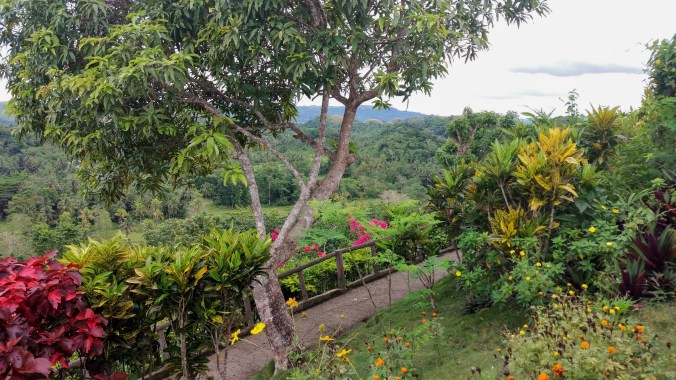 Once we completed the survey of the base level, we headed over to the stairs. I’m not a champion stair climber, but there were lots of places to stop, and a few side paths for extra sights. It’s not too much of a climb for all that it’s the tallest of the hills. Part way up is the turn off to see the “Our Lady of Lourdes” Grotto. The Philippines are mostly Catholic, a holdover from the Spanish colonization. There are churches and shrines everywhere, but I don’t mind too much as Catholic art tends to be beautiful, and no one was trying to convert me.
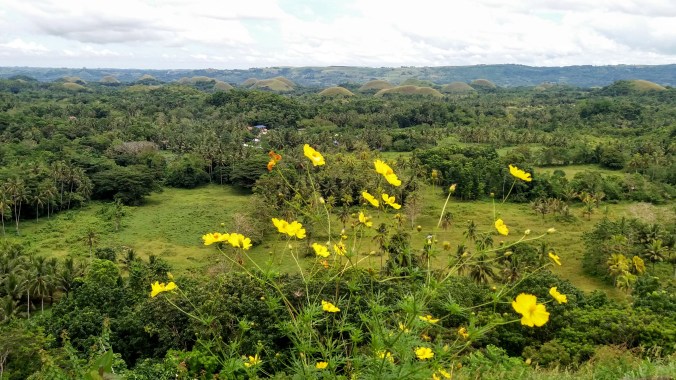 I took about a million pictures of beautiful flowers and the shifting view on our way to the top. And when I finally reached the peak, took obligatory selfies from the viewing platform. I also went to find the not-actually-famous-at-all well with a a bell to ring the bell and make a wish. There was also a cute little backdrop on one side for people who like to pose with man-made scenery. I liked it despite or perhaps because of it’s total kitsch, but I’m glad it was off to one side and not covering the whole viewing platform.
 Even as the week continued, we experienced very little rain. I am told that the rainy season is short but has strong showers every day, and the hotel hostess did say that the weather was a little unusually dry for my visit, so maybe I just got lucky? Anyway, not wanting to be caught on the very top of the highest peak around if a thunderstorm hit, we began to descend the stairs.
 One of the many things I found online about Bohol was the prevalence of adventure parks. We have these in Korea too, and for some reason I still haven’t ziplined. The Chocolate Hills Adventure Park advertised a kind of zip bike, where you pedal a special bike (with a safety harness) along a zip line between two chocolate peaks. I have nothing against ziplining, it just doesn’t seem like a great way to actually see anything, so I keep putting it off in favor of taking in sights until I manage to find one in a place I’ve thoroughly explored. But this bike thing seemed unique and slow enough to get a great view with plenty of time to look around and admire the scenery instead of zipping through it.
 I read online that the park had a weight limit, but we decided try anyway and see how much they actually meant it and how much was just a liability disclaimer. It turned out to be sort of both. We were each a few kilos over the weight limit, but instead of telling us straight up “no”, the staff advised us to head on up to the zip bike area and try on the harness with the safety guide to see if it would fit anyway. In retrospect, I’m not sure if this was their way of shifting the responsibility or not. I think if we’d been WAY over the limit they would have turned us away, but since we were close?
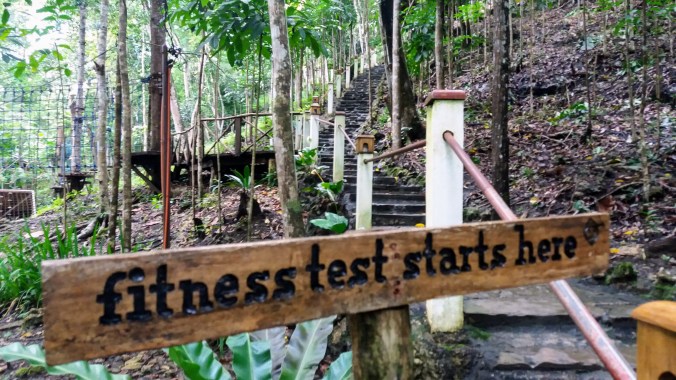 We headed further in, following signs to the zip bike and were led to a steep stone stairway with the sign “fitness test starts here” at the bottom. I theorized that anyone who couldn’t climb the stairs to the starting point wasn’t fit enough for the activity, and we began the ascent. Whatever your opinions of stairs are, know that the jungle makes it harder. Humidity. Nonetheless, we persevered and made it to the top and were rewarded with a breathtaking view and a less than stellar ride attendant. I do try to give people the benefit of the doube, and maybe she was annoyed with her coworker on the radio or something else we couldn’t even see and not with us at all, but it was clear she was annoyed with something.
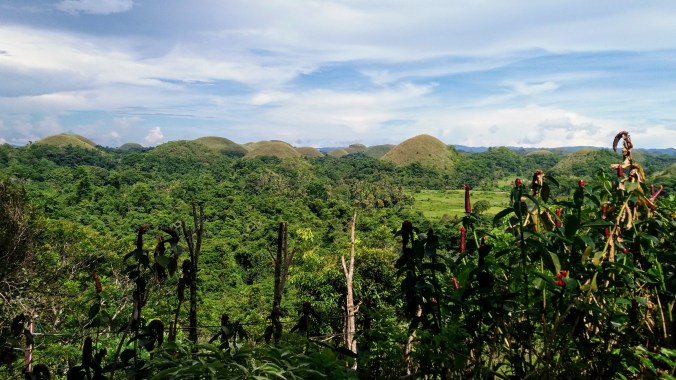 We waited on the viewing platform, and I have to say that even though we’d just come from the tallest peak in the hills, the Adventure Park’s view was stunning. I don’t think I would have gone there only for the view, but it was certainly a nice perk. We also watched a few more tourists take the bikes out and back on the lines from the tower above us to the hill next door. The attendant at first told us that we had to wait due to lightning (the storm that had just passed us?), but then we saw people riding anyway? I’m not sure what was the deal there. I also accidentally got doused in ants trying to take a picture of the hanging trellis flowers. The ants really liked the flowers too, and when I bumped into one, they transferred from the petals to me. Thankfully, they were just small black ones, and I was able to brush them off with no bites, but it reminded me to keep an eye out for what I touch or lean on in the jungle.


 If you’re going to the Adventure Park anyway, go ahead and visit their butterflies, but don’t go out of your way for this display. We were accompanied by a guide who had been trained to take lots of pictures for us (with our phones, they weren’t trying to sell them back to us or anything, but Asian tourists especially love appearing in their own travel photos in a way I never will) and move people through. She showed us a display on the life-cycle of a butterfly, and we got to hold a caterpillar. Then we walked through a path in a netted off part of the forest. We only saw a couple butterflies and at one point our guide threw a rock in an attempt to get on up on the top net to fly. We quickly stopped her from continuing that and said we were fine with the way things were. She said the butterflies were inactive because of the rain, but I felt like I’d seen half a dozen just climbing down the stairs from the zip bike.
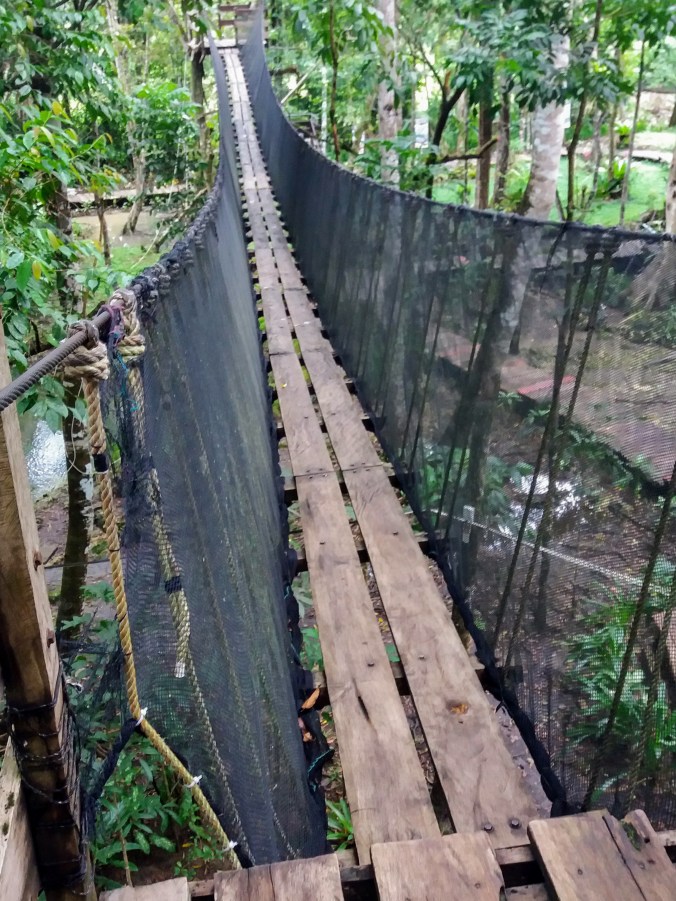 After the butterfly enclosure, we were guided over to the suspension bridge which is included in the park entrance fee already. This kind of bridge through the canopy is another very common tourist must do in Bohol, available at multiple locations. Even though I may not deliberately go looking for the silliest touristy things to do, I’m hardly going to turn it down if it’s right there in front of me. We had fun, and got a nice view of the park from the air before descending the stairs on the far side and heading back to the bikes.
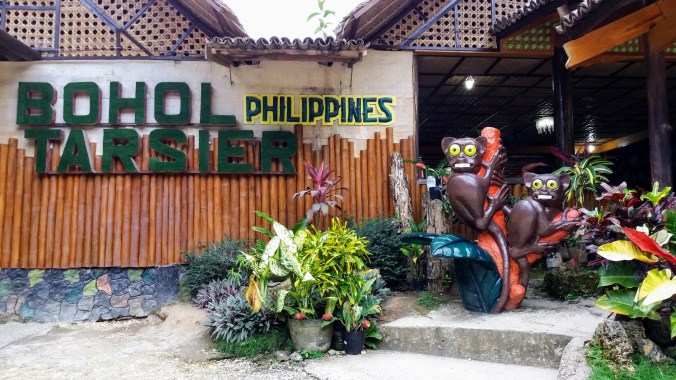 Following a delightful and refreshing stop for some locally sourced buffalo milk ice cream, we headed back down the main road where were would be able to find the Tarsier Conservation Area (not to be confused with the “Philippine Tarsier Sanctuary”). Bohol is also famous as the home of the world’s smallest primate, the tarsier. There are two tarsier spots near the Chocolate Hills, and it was worth it to me to visit both, since I was already planning other road trips near each one. I’ll say now, if you can only do one, do the Sanctuary, but seeing both was nice.
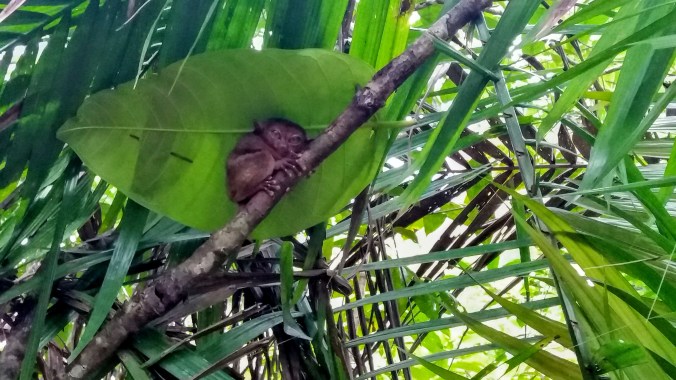 I can’t be sure if they are placed at these viewing stations or if the park simply made attractive bowers in good places and hoped. I did see one little guy hanging out in a not great viewing spot with no guide to point him out, so at least a few must be slightly rogue. We were also told they are territorial, and tend to stay in or near one tree as adults.
 Whether we like it or not, tourism is the main reason species like these will survive. In fact, the growing interest in ecotourism is a big part of what’s paying for conservation in developing countries. It can be hard to draw the line between exploitation and preservation, but I think the Conservatory is leaning on the right side. Of course, the park dumps you back into a souvenir shop between the exit and the parking lot which was full of tarsier themed everything, and one shelf of wooden phallus ashtrays for no discernible reason at all.
 Several days later on my way to a lunch cruise on the Loboc river, I started out extra early to make time for the Philippine Tarsier Sanctuary to see how it compared to the Conservation Area. I tried to get there as close to opening as possible to beat the crowds of tourists, and I think I very well may have been the first customer of the day since cashiers had to be found, then change had to be found. It’s not an expensive tour, but like every little adventure in Bohol, it does cost a small amount to go in. I got a personal guide who walked me through a kind of netting air lock into the forest beyond.
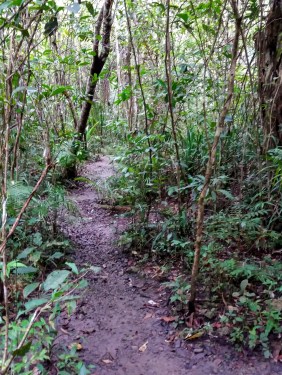
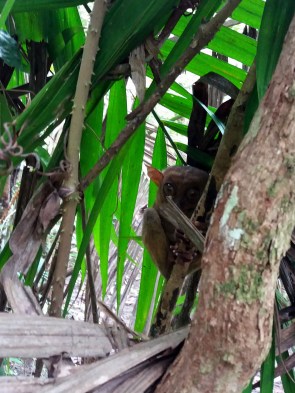 While the Conservation center had been paved paths with guides stationed at each Tarsier, the Sanctuary was much more a natural jungle with mud paths through the trees. I doubt I would have gotten lost in the small area behind the building, but I certainly wouldn’t have seen as many tarsiers without my guide. The Sanctuary is closed in, but the fence and netting are very unobtrusive, designed more to keep predators out than to restrict the tarsiers. I also felt like the tarsier perches here were probably man made to encourage the critters to good viewing sites, and to make sure they were visible from the paths while being sheltered from the sun. However, where the Conservatory perches were obviously man-made, the Sanctuary perches looked far more natural, drawing less attention to themselves and who knows, maybe being more comfortable.
 My guide quietly and confidently led me through the tangle of muddy paths, stopping every few minutes to point out a tiny sleeping primate. I was surprised at how close they were to the path after my experience at the Conservation center. While I’d been hard pressed to get any decent photos at the Conservation center, I had merely to hold up my phone to be close enough for great detail here at the sanctuary. I was worried about disturbing the little critters, so I tried to keep a reasonable distance, although more than once they were close enough for me to have reached out and touched, I know that would have been dangerous and damaging for them, so I resisted the urge. My guide was in no rush, and was happy to stand by while I got a good look at each one, and until I was satisfied with my photos. I can’t say I always had a good photo before I decided to move on, since I was keenly aware that simply by watching me back, I was keeping them awake and didn’t want to become a source of greater stress. I probably stayed at each spot between 2-5 minutes before moving on.
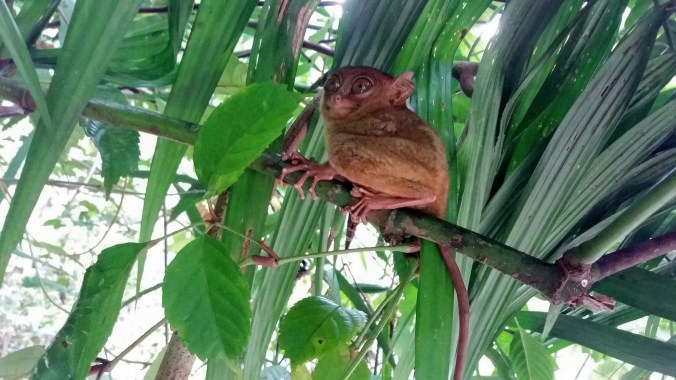 The Sanctuary jungle was also the hottest thing I did on this vacation. The trees were so close together and the netting caught the breezes, so even at 9:30 am it was sweltering hot and I was drenched in sweat the whole time. It was entirely worth it.
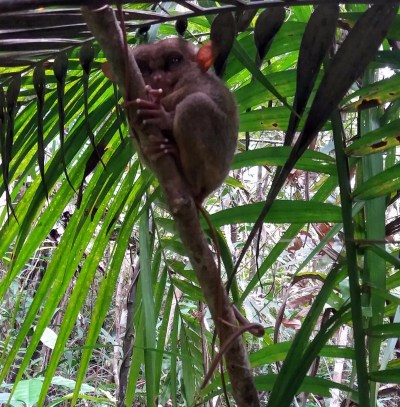 It was so peacefully quiet and there were no other visitors in the park so I felt very special getting to have this beautiful jungle and adorable creatures all to myself. I talked to them in soft reassuring tones like I was trying to sooth a scared kitten, and I have no idea if that was effective at all or just my own human oddness, but it was so obvious that they were watching me back, I couldn’t help but wonder how many myths of goblins or fairies these peculiarly shaped animals inspired. Their eyes are so large in comparison with their heads and yet the gaze is penetrating. Their hands are smaller than a newborn, but their fingers long and deft with large pads at the tips like a lizard or a frog.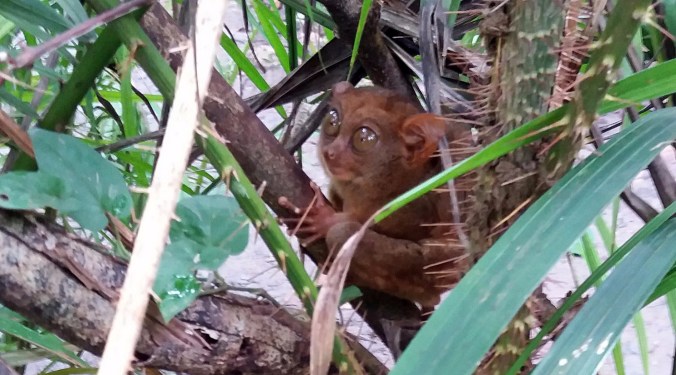




 After the exams I went to lunch and enjoyed some hot soup, then came home to grade papers, not really thinking much of the day. The school sent over a cute little cake which i decided to hold on to until I could share it with some folks at dinner tomorrow. I graded papers, looked at more evil forms and watched some X-files, all the while becoming more icky feeling and more cold.







 Gallivantrix