Here in Korea, the insanity of the first month of school is winding to a close, the root canal adventure goes on with no end in sight, and the first cherry blossoms have burst forth, promising at least two weekends of magical pink snow beauty and wonder. In the mean time, here’s the story of my second day in Singapore exploring the famous temples in Chinatown.
After an incredibly full first day in Singapore, I had a much lighter day of temple viewing planned before I hopped on the bus to Kuala Lumpur in the afternoon. It’s never hard to wake up in a dorm hostel, since everyone else is waking up, too. After packing up and enjoying another cup of teh tarik, I headed out to catch the sights. The night before, I’d run across a giant rooster in the street (in anticipation of the impending lunar new year holiday), so I did a quick rerouting to pass back by in the light of day. Chinatown was already putting on a decorative show two weeks before the holiday; I can only imagine how crazy it was on the actual holiday weekend. In addition to the stunning decorations, I passed by a street artist sitting in the shade of an overpass and working on the beginning of a painting of the festivities. He was kind enough to let me take a photo and we wished each other a happy new year in parting.
I found the Buddha Tooth Relic Temple in the middle of a sprawling street market. One major advantage to backpacking is the space restrictions prevent you from picking up souvenirs. Otherwise, I might have been in danger (I love the red paper cut art!). After locating the temple, I ducked into a little food court and wrangled some dumplings and fresh lime juice for breakfast. I seriously dig the Singaporian food court concept, using a larger space to allow a multitude of different cultural food shops to share a common dining area. We have them in malls in the US, but they are usually terrible food and not a wide variety (plus embedded in a shopping mall, ew). In Korea there are dozens of tiny restaurants with very small seating areas, so you can get variety, but if one place is more popular, seating is limited. None of the food courts in Singapore were top notch restaurants, but they were all several steps above corporate fast food. Just in case anyone is looking for a new business model.
The Love of Money…
After breakfast, I headed into the temple. I generally don’t wear short shorts, and while I go wear sleeveless in heat sometimes, since my plan for the day was temples, I was dressed appropriately. However, for the tourists who weren’t, a staff of firm but polite people arranged for them to wear long skirts or shoulder wraps from a shared bin. Once past the main entrance, I walked into a smaller room where two monks were performing a blessing on a couple donating to the temple in a red envelope (traditional for money gifting at the new year). As I watched, I realized people around me were taking photos and video and I was surprised. I looked around for any signs about cameras, but there were none. It seemed that the temple allowed visitors to take pictures. It felt very strange taking pictures in a temple, and in the end I could only take a few before my sense of unease overcame me.
The main hall on the ground floor was an ode to opulence. I’m used to Buddhist temples being ornate. Wood and stone carvings with intricate detail are common (though never boring). Paintings or works in colorful semi-precious stones, and even the occasional gold paint or gilt covering to add some shine. The point is, that I’m used to temples being about effort and time and skill, rather than about blatant displays of wealth. In fact, a common art form is the sand mandala, which is made over weeks or months of painstaking hand work, then wiped out to represent the impermanence of reality. I don’t have an issue with beauty in a temple, I go to temples in part because they are beautiful, but something about this temple and it’s over the top gold, it’s donation jars every few feet, and it’s designated VIP seating for supplicants just did not sit well with me.
I found the elevator and went all the way to the roof to see the orchid garden. That at least was in keeping with temple life as I think of it. Although orchids are rare in the world, they are common in Singapore and the difficulty of their cultivation reflects the work that monks and nuns put in as part of their practice. Below the gardens, the top floor contained the relic for which the temple is named, a fragment of the Buddha’s tooth. It was also the only room in the building where shoes and cameras were prohibited. There were dedicated meditation mats along the windows where a few people were sitting in silent contemplation, and there was another large gold display.
I don’t actually believe in holy relics. I did not come to the temple to be close to a piece of the body of the Buddha. Aside from the fact that it’s extremely unlikely that this bone was really from the human being known as Siddhartha Gautama, if one embraces the ideals of Buddhism, one would know that the body is not the person, and even beyond that, the idea of separate person-hood or individual ego identity is an illusion. I almost understand Christians who seek holy relics because they are thought to be touched by the divine, but I scratch my head at Buddhists who think that enlightenment may somehow be transmitted through dead tissue.
A sign next to the relic boasted that the shrine housing it was made of solid gold (not merely gold plated) and went on to say that offering gold to the Buddha (meaning of course the temple) was a high honor and was greatly encouraged. I nearly gagged.
I’ve seen American “mega-churches” that have gold plated elevators and preachers with 5 cars and 3 houses and a minimum annual income requirement for membership. These also disgust me and I often wondered how any Christian could justify that kind of obvious money-grubbing and wealth favoring within their doctrine. This was the first time I’d ever seen a Buddhist “mega-temple”, and it was awful. It made me feel ashamed to be associated with the faith. It made me want to run around to tourists and exclaim “that’s not what Buddhism is about!”. It made me want to drag out some scripture and ask the people praying there if they’d even read it. And for just a moment, it made me think about Terry Pratchett’s Yen Buddhists, whose main theological argument is that:
excess money and valuables are a drain on one’s spiritual welfare and an active impediment on achieving dharma and oneness with the universe. Therefore, the monks make the world the selfless offer that they will undertake, at the risk of their own union with the godhood, to take away this impediment to other people achieving consciousness and the opening of the Third Eye. They accept the spiritual tarnish that comes with being one of the richest religious sects on the Disc so that you don’t have to.
Sadly, I don’t think that the Buddha Tooth Relic temple had such altruistic motives in collecting wealth.
I headed down to the third floor to see the museum, which was a worthwhile collection. It was a nice museum of Buddhist art and man-made relics that included a sort of “intro to the Buddha” story on signs around the displays. Like the rooftop garden, it felt far more authentic and enjoyable. The relics were primarily stone, clay, bronze or wooden and had clearly been the result of effort and craftsmanship. Although the extraordinary focus on Guan Yin and the Maitreya was a little overwhelming, it did point to the fact that the temple’s own branch of Buddhism was a salvific form that relies on Bodhisattvas and future Buddha’s to save the world, rather than on the practice of self cultivation for individual enlightenment.
The second floor had a nice place to rest, which I desperately needed. Adjusting to the heat and extra walking was taking a toll. It was such a great contrast to my energy level in New Zealand where the weather was cool. Just minimum exertion in a hot humid climate seems to drain me like a marathon! After a rest and a look through the last floor of displays, I made my way back to the ground floor, once more shaking my head at the ostentation, this time walking past the VIP seats they were filled with supplicants who had paid I’m not sure what to get past the velvet ropes. All in all, I’m still glad I went to see it, because I learned something about the corrupting properties of money. All temples ask for donations to help feed the monastic population, pay the basic bills, and to provide services to the community. Money is, in this world, unavoidable. However, when a house of faith relies on wealth or doles out blessings for cash or claims that the donation of great wealth is a higher holy act than living a good life, that’s corruption.
Count your deities, count your blessings…
After the Buddhist temple, I took the short walk two streets over to see the oldest Hindu temple in Singapore: Sri Mariamman. This humble wooden structure was not a display of wealth, but was still anything but plain. Wooden carvings covered every inch of the outer facade and were brightly painted besides. Anyone was welcome to enter, leaving their shoes behind on racks on the sidewalk. There were saris for anyone who felt inadequately dressed, and while we were free to wander around the grounds barefoot, the main areas of worship were cordoned off, not for a fee, but for the faithful. I am not a Hindu, so I contented myself with observing from behind the lines. The interior of the temple is a large courtyard with smaller buildings, each one dedicated to a different divinity. There are over 330 million gods in the umbrella of Hindu faith, and while only a couple dozen are among the most popular, it can be hard for a layperson to know which altar is for who. I found 10 names of deities for this temple on it’s Wikipedia page. There might be more. In addition to the colorful decor and variety of spots to worship, there appeared to be a large hall at the back used for everything from yoga classes to wedding ceremonies.
On my way out and back to grab my bag from the hostel, I passed by one more religious building, a famous mosque. It struck me then that within only a couple city blocks, I had passed 3 major religious buildings, and I knew from the map that a Christian church was not far off. Curious, I looked around the map for a synagogue and found one a little over 3km away, and it was neighbored with another church, Hindu temple, and Buddhist temple. It seemed that it wasn’t hard to find a spot in Singapore where at least 4 out of the 5 major world religions shared a small space and yet no one was getting blown up, shot or even harassed on the street! While I’m sure that Singapore’s strict legal code has something to do with the lack of violence, I like to think that pluralism in the culture helps everyone to get along. People of other faiths or cultures seem less scary when they are our neighbors and not “those others”.
Please check out the rest of the photos in the Facebook albums: Around Singapore and Singapore Temples, and stay tuned for the next installment where I leave the clean and ordered city-state of Singapore and experience a mighty dose of culture shock in Kuala Lumpur (Malaysia). As always, I hope you enjoyed, and thanks for reading!
March Madness does not just apply to basketball anymore. I missed it last year in part because I had the horrible avian death flu and in part because I was totally new to Korea and insulated from the madness. However, I’m getting it double this year, since I’m no longer the (complete) outsider. March is the start of the new school year, when every single bit of bureaucracy must be done while you’re trying to get to know new students and new co-workers! I used to have an hour or two of “me time” in the afternoons after all the work was done, but recently, it’s been a non-stop Alice in Wonderland style caucus race. So forgive me – the blog has fallen behind. Here’s the second installment of January’s adventure that made me rethink zoos forever.
Bad Tourist, Bad!
The day at the Gardens by the Bay kept me walking for the better part of 7 hours, more than half of that in the sunny, humid outdoors. I suppose I could have hustled over to see more of the heritage gardens, but since my night was going to be full of 5 more hours of walking around outside, I decided to hold still for a while and sip some more of the unique coffee. While I was sitting in a nearly empty (indoor and AC’d) food court, I watched an abomination of tourism. In stark contrast to the fun, kind folks I’d been meeting all day, this man walked up to the coffee shop and demanded to know if they had a flat white or skinny latte. They did not, since it was a traditional Malaysian style coffee shop. The man then went on to berate the poor employees along the lines of how can they be a “coffee shop” if they don’t even serve a flat white or skinny latte. He was rude, angry, and belligerent to the staff, and seemed to have zero interest in finding out what the cafe did have (awkward since they totally serve coffee with milk, they just don’t call it “flat white”). I can understand the desire for something familiar when travelling. I personally think it’s important to try new things, but I know that if you’ve had new things out your ears for days, there is value in the familiar. But there is just no reason ever to get mad at a shop in another country for not being like a shop in yours. And yes, I did talk to the staff afterward and told them I thought that guy was being a jerk and that visitors should be more willing to try the local way. Don’t be that guy.
Taxi Driver History Lessons
I left the SuperTree grove around 6:15 and took a taxi on the long trek across the city. Although I hear the public transit system is spectacular, the distance I had to travel would have still taken about 90 min, so I opted for taxi instead. I ended up having a great chat with the taxi driver who was a Singapore native and rather older gentleman, so he was able to talk with me about some of the changes that had occurred in the city over the last couple decades. The biggest one seemed to be the land reclamation. Every bit of land I’d been on during the day was actually reclaimed from the ocean and the road that now lay inland called “beach road” was so named because it literally used to be a beach!
I also discovered that Singapore has no minimum wage, although while he was complaining about the low wages that fast food level employees made, he did let slip a number that was rather higher than the US minimum wage. It makes me wonder about the economics of a situation that, without government enforcement, and with access to cheap immigrant labor, the average low end employee is still making more than the US burger flipper. I am willing to bet it’s related to the small size of the nation, and the fact that it is nearly all city.
And lastly, I discovered that there is a severely classist system for immigrant workers, with no wage regulation and heavy taxes. Inexperienced foreign workers from say… Bangladesh or the Philippines can end up taking home as little as 18-20$ a day. It’s not as bad as the situation in Dubai as far as exploiting foreign labor goes, but I have to say I was a little disappointed that Singapore, a model for environmentalism and safety, did not have sufficient laws in place to protect workers.
We drove through more animal conservation lands, and the driver pointed out to me a land-bridge that had been built to help animals move safely from one side of the highway to the other, as well as the area abutting the zoo where the wild sanctuary animals and captive zoo animals would occasionally encounter one another through the fence.
Zoo Shows
As I got out of the taxi, I walked past a peacock that had either escaped, or was deliberately placed at the entrance for effect. The bird seemed unperturbed by the traffic. Even though I was a little early, the courtyard was packed full of tour groups and I had trouble pushing my way through to an info counter just to find out where to go. I stood in a long line as we all had our tickets scanned and everyone streamed into the Night Safari like the opening bell at Disney.
The Singapore zoo has, as far as I can tell, four separate parks. The main zoo, a rivers of the world event, a bird event, and the Night Safari. At first, I thought it was simply a night time version of the main zoo, but later I realized that it is a separate park that simply doesn’t open until 7pm. It is entirely filled with nocturnal creatures and kept at a low light level so the animals are not much disturbed. It’s designed to be as open and natural as possible, allowing the visitors and animals to get as close as is safe, and is filled with hundreds of creatures that are almost always asleep during regular zoo hours.
I had missed the first fire show at the opening, but since it happened every hour until 9pm, I wasn’t too worried. I headed instead for the animal show at the advice of one of the zoo staff. This was just as well because the lines for the tram were insane. Being a lone traveler is sometimes advantageous, like when trying to find a seat in a crowded theater. I wedged myself in between two families in a fairly good spot and sat down to watch what I fervently hoped would not be an exploitative performing animal show. I was not disappointed. The “show” was largely animals being brought forward while the main announcer talked about the species being shown. There was humor and a few animal tricks, but these involved a large cat leaping, a raccoon going through a “garbage can”, and an otter doing some recycling (which may be one of the cutest things I’ve ever seen). The last one led into a great discussion of what happens when urbanization encroaches on animals habitat and on what we as humans can do to help better preserve the environment. I know some people might think it’s a little preachy, but I was personally gratified to see the zoo using it’s platform of animal entertainment to help educate visitors on conservation and preservation.
After the animal show, I headed back out to the main plaza to take in the fire show. Although the zoo website makes it seem as though this is some kind of traditional tribal fire dance, in reality it is a modern dance with a totally made up tribal sounding name. It was still fun and pretty, just not particularly traditional or historically accurate.
Walking with the Animals
Next, I decided to do a walking path or two. There are several walking path sections in the safari and each one highlights a different environment of animal. I started out on the “Fishing Cat Trail”, the primary attraction of which was a fishing cat that uses it’s claws to hook fish out of the river for dinner. The main area of the plaza is loud and bright with shops and restaurants and the waiting line for the tram, but once you get out of the main area and onto the walking paths, the zoo becomes dark, quiet and peaceful. Quite often, I was the only person on the path, or was only sharing it with a couple other people. From time to time, larger noisier groups would pass through and glance at the brush, then seeing no animals would complain loudly and move on. I just waited for them to go.
Not the fishing cat. Just a cool leopard with better than average lighting.
The animals aren’t “on display”. The environments are designed to be natural while still giving the humans a good view. Plus, it’s dark, cause well, night safari. While I was shocked at the number of people who simply couldn’t get the idea, it didn’t take long to realize that all it took to have a good experience was a little patience. The animals would often retreat from large noisy crowds and only return to their normal nighttime activity after things had calmed down. I stood next to the fishing cat stream for several minutes trying to spot the cat, and finally my patience was rewarded as a medium sized feline came out from behind some trees and began to stalk fish in the small stream next to the path. I don’t know how long I stayed and watched. It was amazing. There was hardly any distance between myself and the fishing cat and yet his environment was so natural, he was comfortably hunting his dinner.
Still not the fishing cat. Pelicans enjoying a night swim.
The vast majority of the displays were like that, close and open and natural making you feel like you’d just wandered into their home rather than like you were viewing a caged animal. The most dangerous animals were separated by a larger gap, and the tiniest animals were in display boxes (although we still couldn’t always find them). I didn’t get to see every animal. Most were completely hidden when I walked up and only came out after a few minutes. A few were on grand display, like the pelicans and otters. At one point, while crossing a bridge over a small stream, I looked down and spotted an enormous crocodile. He could easily have blocked the stream if he’d lain sideways across it. It was a bit terrifying to be so close with nothing between us, even though the bridge was well above his reach and the sides of the stream were too steep for him to climb. Many animals were hidden, but could be found with some searching like a hidden picture puzzle. And a few I never saw at all.
I’m not sure I believe that flamingos are nocturnal, but they are pretty at night.
After walking about half the trails, I decided to catch the tram ride. The tram goes on a different route from the walking trails and afforded me a chance to sit down and relax for a little while. I think my favorite part of the tram ride was the rhinos, but it was an overall pleasant experience with light narration and continued reminders about environmental conservation and poaching. At one point the narratress asked us to make a pledge never to buy rhino horn products again, which isn’t usually an issue for Americans, but there are a lot of Chinese and other Asian tourists who come to Singapore who might need the reminder. Side bonus, since I’d waited a couple hours, the tram crowd thinned out and I got a bench to myself, which meant I could move to the left or right and get the best view of the animals.
We could hear the lions everywhere, but only got to view them from the tram.
After the tram circuit, I finished up the walking trails, passing through a free flying bat house(!) and a sort of wallaby ranch. The bat house was easily my favorite thing in the zoo. I’ve only ever seen zoo bats behind glass and here these were flying around my head! The big fruit bats hung lazily from branches that had been strategically placed close to the path and hung with fruit to entice them, while the smaller bats zipped in an out of the trees. One flew so close past my ear, I felt the breeze from his wing as I heard the leathery flapping and sonic skittering. In the flying squirrel walk through, I didn’t get to see any fly, but I did play a fun game of hide and seek with a little tree dweller who was clearly curious about me too. And in the wallaby enclosure, the little hoppers were free to roam around the ground, including onto the path if they felt like it. None did, but even when I knelt down to their level to get a closer look, no one ran away either.
The last place I got to explore was a cave environment with all the little dark cave dwellers on display in a sort of Pirates of the Caribbean-esque themed man-made cave environment. Plenty of spiders and other creepy crawlies, including some black light glowing scorpions.
I have not mentioned even a 10th of the animals I got to see and hear. The lions were roaring throughout the night and could be heard from nearly anywhere in the park. The hardest part about the Night Safari is the low lighting. I have good night vision, but a lot of guests were struggling to see the animals, and I was a little bit sad that I had no way to take pictures of these experiences. The Night Safari is not just another zoo, it’s the closest encounter you’re likely to have with any of these animals that isn’t directly exploitative the way that zoos in China and Thailand are. The Night Safari won’t force animals to do tricks or pose with guests. And it’s the only night zoo that specializes in showing off nocturnal animals at their natural time of day. It’s clean, well organized, clearly focused on the animal welfare both within and without the zoo grounds and has dozens of totally unique animal encounters. If you find yourself in Singapore with an evening open, I highly recommend spending the full 5 hours there.
Dinner in Chinatown
It was minutes before closing time when i made my way back to the main plaza. I had no hope of catching the bus back to Chinatown and ended up summoning an Uber, which I then shared with another visiting couple who had been trying to get their hotel concierge to get an Uber to pick them up with very limited success. We had a pleasant conversation on the drive and I found myself back in Chinatown after midnight and famished. The night safari had restaurants, but I didn’t have time to sit down and eat and still see everything. My hostel had cup noodles for sale, but I needed something more substantial after my long day of sightseeing.
I took off toward some bright lights and soon found a tiny Chinese restaurant open late. After a few minutes of hopelessly perusing a picture menu, I asked about my all time favorite Chinese dish 西红柿炒鸡蛋 (fried egg and tomato) and got a surprised yes. This may be because I asked in Chinese, but was more likely because my favorite Chinese food is a common ‘peasant’ dish that is not usually on the menu in western restaurants (though it had been on the menu here). Hanging out in Singapore’s Chinatown felt like being in a very clean version of China without the ubiquitous Chinese litter and smog. Most Chinatowns are a sort of fusion of the immigrant and local culture, but Singapore itself is a blend of Malay and Chinese cultures, so I guess it stands to reason that the extra Chinese part would be very authentic.
Stay tuned for installment 3 where I go back to Chinatown in the daytime to check out the famous temples! Sadly, the Night Safari is not conducive to photography so there’s no album accompanying this post, but feel free to check out the Facebook, Twitter or Instagram for more daily tidbits of life between posts. Thanks for reading! 🙂
This was not an idyllic holiday in sunny weather full of umbrella drinks and relaxing by the sea. It could have been, and maybe one day I’ll take one of those, but this was not that vacation. As I wrote this, sitting in my cold office the day before students returned from winter break, I could not help but feel a little nostalgia for the warm evenings I enjoyed a walk after my shower, but the twinge in my foot and the weakness in my limbs reminded me that this adventure was a physically and emotionally taxing one. Which is not to say I did not have amazing times or enjoy myself, but the trekking nature of my plan meant that I was forced to push myself in new ways, to absorb not only beautiful and wonderful new experiences, but also painful, difficult, and challenging ones. Then again, I suppose that’s why I call myself an adventurer and not a vacationer. Whatever the holiday looks like later on, I hope you’ll find the first installment to be as wistful and enchanting as I did.
Singapore
I decided to model my holiday after a tour package I found online but was unable to join due to conflicting dates. Their schedule was only 10 days and covered more places, I had 12 days and was doing (theoretically) less, so I figured I had plenty of time. My starting point was Singapore. Coming from winter in Busan with temperatures often below freezing, the shock of Singapore weather was something else. Even dressed in light, summer clothes, I was sweating the minute I stepped out of the AC. The first morning in the hostel, just walking from my dorm room to the lobby gave me a stark reminder that equatorial temperatures are no joke. Although I set off in search of coffee, the hostel’s beverage dispenser included something called Teh Tarik, which I decided to try instead and immediately fell in love with. It’s a strong hot, sweet milk tea but despite being made of common ingredients, I had never had anything like it before.
After my tea, I headed out to try to catch the tram to the Gardens by the Bay, a popular and beautiful botanical garden area that also includes the Super Trees (one of my top to-dos while in Singapore). While I was staring at my map app trying to figure out the best way to go, a nice man asked if I needed help. He turned out to work for the Nigerian Embassy in Singapore and helped me find my way toward the gardens, walking and chatting with me until he had to turn off the main road. I love friendly people!
One of the nice things about walking in Singapore (and indeed most of Malaysia) are the plethora of covered walkways that help keep the sun (and rain) off of the pedestrians. I had my “sunbrella” but found I didn’t need it very often.
Shortly after parting ways with the helpful Nigerian, I walked past what appeared to be a large open air food court. There was a roof and fans circulating air, but the entryways were wide open. There were dozens of food stalls from different nationalities, and tables to sit at between them. I went to one stall to get a fried oyster omelette and another for an iced coffee, then sat down to enjoy them. The omelette was a bit odd. In addition to eggs, vegetables and oysters, it turns out this dish is cooked with a variable amount of tapioca, potato, and/or rice starch. This just goes to prove I should have read more about the food before going, because the gooey texture combined with the heavy oil meant that I only ate about ¼ of the dish before I couldn’t eat any more. The coffee, on the other hand, was intense and amazing. I didn’t know it at the time, but Malaysian style coffee is different from other coffees around the world. I’ll explain more when I get to Ipoh, but for now, suffice it to say I was pleasantly surprised.
After breakfast, I passed by all the tall financial buildings and came to the Marina. This beautiful stretch of waterfront goes on for ages with a wide and clean walking path. I came across a shopping mall on my way and decided to head inside for the AC and maybe a restroom. The Nigerian man I’d met advised me that if I ever felt too hot in Singapore, I could just walk inside any building to get some cold air. The mall was nearly empty, which is not surprising for a weekday morning, and I managed to find a 7-11 to get a cheap sim card (less than half of the airport prices). I also got called in to have a sample at two separate skin care shops. The first was a supernaturally charming young man who probably got nearly every woman he met to spend too much money on his skin care products. We chatted and tried out the product and eventually I had to demure from purchase, but he was gracious about it and said he’d had fun talking with me. The second shop was a Malaysian woman who was wonderful and gracious and kind until it became clear to her that I had really meant it when I said I wasn’t buying anything, and then she turned rather sour. Both shops products were in the hundreds of dollars range. It was somewhere around here that Singapore started to remind me of Dubai.
Cloud Forest
I walked more dockside paths and came across a science museum, more flowers than you can sneeze at, and finally some signs pointing to the garden path that was lined with sculpture, topiary and colorful blossoms. Although the Super Trees were my main goal, by the time I arrived at the park’s center, I was hot and tired. I noticed a cool breeze coming from the doors of one particular building and resolved to go inside that. The building was one of the two indoor gardens, this one called Cloud Forest (the other was closed for renovations). It was a massive greenhouse designed to house the ecosystem of a cloud forest, and so not only had pathways winding through beautiful flowers at ground level, it had a miniature mountain in the center that one could ascend and walk around via a series of skywalks that simulated viewing the forest from cloud level and treetop level.
The cool air was not freon induced air conditioning, but a creative cooling system that involved the movement of water and air. The whole thing is designed to be as ecologically conservative as possible. Nonetheless, when I stepped inside from the intense January heat, it was a blissful release to walk in cool air. I expected to spend an hour or so inside, but ended up spending 3! The waterfall that greeted us at the entrance was a major photo point, but by no means the only one. Spectacular tropical flowers were in bloom all around, and driftwood sculptures of dragons hid among the foliage making for an interesting game of find the dragon. After walking all around the base, I headed up the mini mountain. At the very top was another tropical garden with a reflecting pond as well as the highest skywalk. At set times, this skywalk produces “clouds” that help water the fragile orchids, and provide a magical mist through which to view the scenery below. It was not cloud time when I set out, so I enjoyed a clear view both down the mountainside and out to the grounds beyond the glass. Descending further, there were more walkways inside the mountain structure, another skywalk, and a kind of cave reconstruction where stalactites and stalagmites had been installed around the room with mirrors and informative signs. I hope that given the conservation efforts of the park that these were already broken by some quarrying effort that predated the preservation laws.
The time of clouding was approaching by then, and although the main path did not lead back upward, it wasn’t crowded, so I hopped into the elevator and rode back to the top. I get the impression that in more crowded times, the elevators might be more strictly regulated for the disabled, and the paths through the greenhouse lead firmly one way, but it wasn’t crowded and no one seemed to care if we went the opposite direction. Shortly after 2pm, the skywalk began to issue forth a mist as I set out for my second walk on the sky bridge and was able to enjoy the altogether different view as the fog enshrouded the walkway and the mountainside below.
I thought then I must have seen everything there was to see inside, and so I headed back down through the other skywalk and cave room, but instead of letting us back out at ground level, the path led even further down into a large screening room that played a movie about the dangers of climate change, and an interesting 3-d display of the engineering behind the cloud forest, super trees and other aspects of the gardens. After the educational displays, there was one more “secret garden” where a smaller waterfall cooled the air and tiny micro orchids were on display behind magnifying lenses. I took more pictures in that garden than any 2-3 other places combined on the rest of the trip. The flowers were so stunning, and because of the cooling process, the air is comfortable and it’s easy to lose track of time.
Otters? I had intended to see more of the outdoor gardens, but it was after 3pm by the time I left the Cloud Forest, and my tiny breakfast had completely worn off. Although there were many restaurants near the center of the park, they all seemed somewhat pricey, and so I struck out for the one food area that was described in the park brochure/map as “affordable”. It was another of the “many food stalls under one roof”, but was a bit of a trek from the cloud forest. Nonetheless, the entire area of the marina is beautiful to walk through. I spotted some otter crossing signs, which are apparently no joke. The environmental reconstruction along the marina has enabled the local otter population to bounce back and they are often seen on the shores near the walking paths in the evenings. Sadly, I didn’t get to see any that day. I also walked past the Children’s garden, which was a playful garden with animal sculptures and topiary along with a large outdoor fountain/mini water park. Scouting for places to take my niece and nephew that aren’t just another amusement park and this one seemed to pass the grade.
SuperTree Grove
After lunch, I decided i should go find the super trees. It was getting on in the afternoon, and I still had to get across town to the Night Safari for my 7:15 ticket. Although the tall and unique structures can be seen from nearly anywhere in the park, it took a little effort to find the right walking paths to get to them. There are two groves of supertrees, the smaller has only three, which at the time were undergoing a pre-lunar new year makeover.
Eventually, I found the main grove and purchased my ticket for the sky walk. This is a little walkway that is accessed through an elevator in the “trunk” of the trees and lets you walk around the super trees at a good height to both admire them and the overall view of the gardens below. I had a nice walk and an even better view as well as some pleasant conversation with another traveler. No matter how nice the view is, I think my favorite part of traveling is meeting cool people.
The super trees aren’t really trees. They’re man-made structures that sort of look like giant alien trees. They run on solar power and support a large amount of plant and animal life. Plus they light up at night, which is pretty. The super trees are urban art, but more than that, they are a way of combining city and nature and of providing a space for the plants and animals that would otherwise have been disrupted, or even endangered by the urbanization of their homes to have a place. The super tree grove helps to act as a greenspace, cooling and cleaning the air naturally, as well as collecting solar energy and rainwater that are used in running the indoor gardens. It’s basically a big experiment to see if a city can be a modern urban environment AND maintain a natural ecosystem in an economically sustainable way. I hope it catches on. More cities should have giant trees, beautiful flowers, and river otters.
This is but the first of many installments in the Malay Peninsula adventure of 2017. I took so many pictures that day, I can’t possibly hope to show them all off here. Please check out the albums (yes, plural) on Facebook for all the beauty: Around Singapore, Cloud Forest, Flowers of Singapore, and Supertree Grove. Enjoy, and as always, thanks for reading! 🙂
There’s been some radio silence on the blog since the New Year began. I thought setting 2016 free would herald the great and wonderful 2017, but like many of you, I am discovering the sad reality that the change in date does not magically change the world. I don’t want to be the writer who complains, but I would be lying if this blog was all sweetness and light. I saw an article online the other day that said that our overall unhappiness is greatly contributed to by watching only the most perfect parts of others’ lives online. The fact is, everyone has bad patches, but most social media mavens only show the sunshiny parts, leaving the rest of us thinking that there is something wrong with us if we can’t achieve that level of perfection and happiness. Well, I am going to dispel that illusion. It’s only the Ides of March, and yet I am fully ready for another, more actual, holiday.
January
The first half of January was the bi-annual English Camp. Actually, these are pretty fun because for two weeks, I get a tiny class of kids who volunteered to be there, and I get to run the whole curriculum without the textbook or school goals. This winter, I did superhero camp. The kids got to choose superpowers (from a list), design their superhero costumes (paper dolls), and make their superhero names using a handy 5 point chart I made up of titles, colors, powers, animals, and gender endings. I took pictures of them and added superpower effects, and made a video of them singing and introducing their superhero alter-egos (which I unfortunately cannot share with you because of my teacher confidentiality agreement). It was fun, it was all in English, and I only had to call the Korean teacher once when some boys decided to draw penises on their superhero paper dolls(*sigh). On the last day we made chocolate cake in paper cups in the microwave and had balloon races. Overall, it was a good start to the new year.
The second half of January was my 2 week winter vacation. I decided to go to the Malay Peninsula and do a whirlwind tour of Singapore, Malaysia, and Thailand (but only the peninsular parts). I’m working my way through writing, editing and adding photos to the whole 12 day adventure which will go out to the blog and FB page soon, so I won’t try to summarize it here. Suffice it to say that the vacation may have foreshadowed more ominous things, since it too started out with so much promise and enjoyment, yet ended in a total emotional breakdown of epic proportions.
February
…was boring. So boring. I got back from my holiday wounded and limping (yes, literally) just in time to come back for the most useless time in the Korean school calendar. The kids all took their end of year exams before the winter break began on Jan. 1. Although my co-teachers had saved some material from the book to stretch out over the remaining few classes, the students were entirely uninterested. As subject teachers we had maybe 7 days of these lessons, although I had even less because the 6th graders did High School Musical marathons for the last few days. The Graduation ceremony was on the 17th and then there was another week of “spring break”, during which I got to sit in my office doing very little. I couldn’t do anything to plan for the lessons starting in March because no one knew what anyone would be doing!
I enjoyed my first year in Korea and working in the public school system. There were a few hiccups to be sure, but overall, it was probably the best (maybe second best) teaching gig I’ve had. Plus, there’s so much going on in Korea, I felt like I missed out on at least half the events last year. So, I decided to renew my contract here rather than seeking out a new country to work in and explore. But February brought me back to shades of Saudi Arabia. No answers, everything changing all the time, and a sense of hopeless isolation that brought on existential dread. With no students to brighten my day, and no future to plan for, the days at the office became a long, cold, gray stream of Dostoyevskian blah.
I decided to take advantage of the lack of students to visit a dentist and see about the slight occasional pain in one molar. I don’t love dentists, but I know ignoring problems in your teeth never makes them go away on their own, so off I went. Only to be told I needed a root canal and an inlay in two different teeth, and that the root canal would take 4-5 visits to the dentist to complete. Thus began my endless dentist torment.
On top of that, Korea flat up failed me in providing it’s normal endless stream of festivals and activities. There was one lone festival to celebrate the first full moon of the new lunar year, which was marked by the building of a massive bonfire on the beach where people could toss their complaints and woes of 2016 to be burned as well as their wishes and hopes for the next year to rise up to the heavens. I’m not sure how the gods/ancestors tell the difference, but it was a big beautiful fire on the beach and that was fun.
I had my first experiment with “crazy color” hair dye in Korea in February (probably inspired by the endless boredom and need for color in my life). I managed to negotiate a conversation in a beauty supply shop to get myself some bleach and a shade of purple that was pretty if somewhat pastel. I should have known better, but hair dyeing is a source of rebirth and stress relief for me, so I charged ahead. The end result was.. subtle. The lightest parts were indeed a pale purple-ish, but nearly everything else turned brown. Not even a pretty brown, just ashy. This led to my first experiment ordering from the infamous G-Market, a sort of Amazon/Ebay website for Korea. Although I had seen many Koreans around downtown (and even a few students at the school) with colors in their hair as ombre or even whole hair dyes, it seems that the only thing available in most shops are the very pastel colors, including a shade of green called “khaki”, which I can imagine no westerner ever saying, yes, please, let’s dye my hair khaki.
February also brought home the reality that most of the people I know, including my besties, were leaving Korea. International life is full of the tides of expats moving in and out with the job market. I think many seasoned expats avoid making close friends among the first years because of this very thing. But since I was a first year last year, that meant that most of my friend pool were other first years. I had thought they were going to stick around, but events conspired in such a way that meant I spent the end of February going to/throwing farewell events and helping my friend pack/get rid of stuff.
I spent the whole second half of February feeling somehow both bored and exhausted, telling myself over and over that things would get better in March when the students came back, when the festival season began again with cherry blossoms, and when the weather was finally nice enough for me to play Pokemon Go without wearing 3 layers of clothes and freezing my fingers solid.
March
As March drew near, I was finally given some slight insight into the shape of my new school year. I was to get a second school, splitting my time between two schools. Plus, it turns out no one in the whole city wants to teach at my main school, so in the complex bidding war that the Korean teachers engage in to switch schools every 3 years, someone who had the horrible misfortune of not getting any of their top 10 choices was to replace my wonderful and amazing first ever Korean co-teacher. Plus, she doesn’t speak much English and hasn’t taught English in a decade. Plus the new school isn’t just going to have me for a day or two, but one and a half days a week. Every Thursday I get to start at one school and move to another. Plus plus, that teacher has also never taught English before. Oh goody.
I had barely an opportunity to say hello to the new teacher at my main school and none at all to visit the second school. Despite the fact that classes would commence March 2, the new teachers avoided talking with me about lessons, or goals, or expectations. I began to get anxious, and reminded myself that newly arrived EPIK teachers wouldn’t meet their co-teachers until the new school year began, but I also had to wonder how many fresh off the boat foreign teachers would be paired with inexperienced Korean teachers. Was I getting extra newbies because of my experience or was it really random?
School finally started, but I found myself with a lot more nothing for a while while we waited for subject classes to start and while we waded through the first day of class orientation lessons to help the new students and teachers meet one another. Finally getting started I began to realize the daunting task ahead of me that involves balancing a crazy schedule and teaching 2 new teachers how to do the job. I mean, I guess I could just sit back and let them flail around until they work it out, but I can’t really let the students suffer like that, so this is me, doing my best to manage. It’s somehow harder than if I just had a class myself, because I have little to no influence over what happens in the classroom on the days I’m not with a given group of students (since I’m spread thin over 2 schools and 4 classes of 4 grades, I basically see each class 1 time a week, except for the 6th graders I see twice). I now understand why it is that so many Koreans can study English from the third grade and yet not be able to speak it.
Then at long last, a much anticipated event which I had spotted back in January finally arrived. A glorious yoga retreat at a spa resort in the mountains! What could be a better way to ease my stress and restore my resilience than such a wondrous weekend. The day before the retreat, I woke up with a cold… sore throat, stuffed sinuses, whole 9 yards. With little sleep and much mucus, I arose early Saturday and set off anyway, hoping that some meditation and spa therapy would at least help a little. And it might have, had not absolutely everything been a crazy misrepresentation, mistake, flake, or flat out disappointment. I haven’t even decided if I want to blog about this trip because it was so awful, I can’t find a way to spin it for the “life lesson” or “silver lining” even though that was the name of the organization that presented the event.
Amid the highlights were the totally not delivered as promised vegetarian Indian buffet (the vegetarians were served Korean food, and a tofu steak that had pork in it); the 4 hour/seven instructor yoga and meditation session that was missing one instructor and also completely failed to do things like adequately warm up the participants for challenging poses or to present alternate poses or instructions for beginners (many of whom had their first and possibly last exposure to yoga that weekend); and the 2 drunk male staff members (one shirtless) showing up in my hotel room at 2am waking me up and trying to touch me even after I asked them to go (still not sure why they were there in the first place).
Did I mention that during all this time, my tooth, the one that I’m getting this infernally long root canal done on, is in pain? The dentist has twice left me in pain for over a week with no medication, leaving me to struggle on through life with a dull throbbing ache in my left lower jaw and the total inability to chew anything on that side. Even now that the root canal is supposedly “over” (4 sessions later) and the process to install a crown can begin (minimum 3 sessions), my tooth hurts day and night and I have to wait to find out if it will be treated or not until my next appointment. But hey, my hair dye arrived, and it’s a smash hit.
And Holi Hai is coming, which is the Indian festival of colors where we all dance around and throw colored powder and paint on our white clothes while rocking out to Boli-rock or Indo-pop on the beach. I did it last year and it was awesome, so I was really excited to go again this year. And yet somehow, people are trying to ruin that too. Two factions of the local Indian expat community have started a turf war over the holiday and who gets to throw the party. They’re trashing each other on social media and trying to drag all of us as well as the local Korean government into their feud. I’m still planning to go, but I will have an escape plan in case they start physically fighting over the microphone or DJ station. I don’t know what they were trying to do, but all they’ve really succeeded in doing is demonstrating their total lack of Holi spirit. Festival of love, guys.
Next?
So there it is. My life is not lollipops and rainbows all the time, despite the fact that I am so amazingly lucky to be able to live abroad and travel to exotic destinations and meet new people and try new things. And I am amazingly lucky. And I do have gratitude for the opportunities in my life. I sometimes describe culture shock as living on a roller coaster, and by and large what I share with the world is the highs, but when you don’t hear from me for a while, it’s not because I’ve forgotten to write, it’s because I keep trying to live up to the maternal advice, “If you can’t say something nice, don’t say anything at all.”
I release my sadness, woe and frustration. I do not want to carry it with me, so I give it a home here. I bid farewell to the winter within and without. I welcome the arrival of Spring and the rebirth of the year and it’s promise of new growth. I strive each day to find the beauty and wonder that keeps me going in the dark times.
Happy Pi Day Happy White Day (it’s about candy, not race) Happy St. Patrick’s Day Happy Holi Hai Bless
How to make a ten day vacation last 6 months? Write a blog! With one week left before my Malay Peninsula holiday, I’m finally publishing the last of my adventures in the Land of the Long White Cloud. There are several smaller adventures that I enjoyed around New Zealand that didn’t make it into their own full post, so I have assembled them here along with the story of my last day in New Zealand. Odds: Onehunga & Shopping (Auckland), Kuirau Park & Wai-o-tapu Geothermal Wonderland (Rotorua), Narnia (Whangarei), Stargazing (Waitomo). Ends: Planetarium & Cornwall Park, a farewell to Aotearoa.
Onehunga, Auckland: Cute Shopping & Best Bacon Ever
I wanted to try to find some items that are rare/impossible to find in Korea, so I decided to check out the premier outlet shopping center on my first morning in NZ before leaving civilization. The Dress Smart outlet is in Onehunga, so I set my GPS and headed over early so I could snag a parking spot and some breakfast before the shops opened. In the States, Outlet malls are often far from the cities or even the suburban sprawl and exist as sort of concrete islands in what is otherwise quite unattractive farmland. Imagine my surprise when the GPS led me to an adorable little neighborhood, streets lined with tiny cafes, boutiques and thrift stores. Onehunga is adorable.
I parked the car and wandered over to find breakfast where I discovered New Zealand bacon for the first time. I’m familiar with US style bacon (cured belly meat, thinly sliced), and what we call “Canadian” bacon (from the pork loin, more like cured ham), but this was the first time I had ever been served this unique blend. “Middle bacon” served in NZ and Australia comes from a middle area of the pig so as to include some of the back (common in English bacon), some of the loin (Canadian) AND some of the belly fat (American), so it’s basically the best of all bacony worlds combined and explains why it both looks and tastes like US bacon and Canadian bacon were fused together in some kind of mad-biology experiment went right. If you are a bacon fan and you are unable to get yourself down under, I highly recommend making friends with a butcher to see if you can persuade them to sell you some of this stuff.
After breakfast I walked back to explore the mall. Although I didn’t end up buying much, it did give me a really good idea of the types of shops and clothing that are available and popular in NZ. Shoes are clearly the most expensive basic clothing item in NZ. It’s interesting to see what’s expensive and cheap from place to place. The Converse outlet store was selling hightops (my preferred shoe) for 100NZD (about 73USD). I can buy the same shoe on the website for 55USD. I also looked for some better weatherproof shoes for my journey through the bush (and I plan on doing more hiking in Korea when the weather cools off), but there just weren’t any shoes that came close to being an improvement on my Chucks that were less than 200$… at the outlet mall! Conclusion: Onehunga is adorable and worth the visit. Dress Smart is probably best for shoppers who are looking for nicer clothes and not so much camping/hiking gear.
Whangarei: Breakfast in Narnia
Whangarei was a quick stop over between Bay of Islands and the Coromandel Peninsula where I planned to check out the Waipu Caves and the Whangarei Waterfall. I got one more fun surprise there when I set out to find breakfast. This trip wasn’t really about food, but I couldn’t resist the opportunity to visit a place calling itself Narnia.
It turned out to be a simple cafe with a standard range of NZ cafe food. This is much superior to US cafe food and may include things like Eggs Benedict, or smoked salmon omelettes. The portions are generous, the food is fresh and often free range, and it tastes as good as a promo picture looks. There were of course posters of the Narnia movies and copies of the books around the place, and some artwork on the walls by local artists. It wasn’t until my meal was finished and I went to find the restroom that I stumbled upon the most Narnian feature of the cafe. The back seating area (and restrooms) were through a hallway that had been hung on either side with fur coats so that you had to push past them in order to enter. It was very subtle, because even though I had seen things hanging in the hallway, I had not really realized what it was until I felt the fur on my hands as I pushed my way through to the other room. The strange and sudden realization that the otherwise very ordinary cafe had worked in a hidden-in-plain-sight magic wardrobe made my whole breakfast even better.
Rotorua: Kuirau Park & Wai-o-Tapu
While I was in Rotorua, I had planned to take a lazy walk around the Saturday Market and Kuirau Park (a free park that has geothermal activity). The market was a cute little local flea market kind of affair with folks selling used clothes and books, antique jewelry and dishes, and a whole lotta food stalls selling Kiwi and Maori foods. I had been hoping for more handmade goods, but it was still fun to wander around and I picked up my souvenir gifts there from the one handmade stand I found: a lady who made skin balm from the native medicinal kawakawa plant.
Kuirau park is interesting. It’s got lots of mud pools and a hot lake that are all gated off to keep kids or drunks from wandering into them. It also has public foot baths using the thermal waters so people can come by and have a nice warm foot soak. I suspect the park is nicer in any season besides winter because there are a lot of trees and flowerbeds as well that were bare, and what looked like fountains that were turned off for the season. However, it’s free, so I do recommend at least stopping by if you’re in Rotorua, especially if you’re thinking of doing other geothermal parks. Several other blogs I read recommended this as an alternative to Hell’s Gate unless the mud bath is on your bucket list.
Wai-o-Tapu, Geothermal Wonderland
Wai means “water” and tapu means “sacred”. This area is known in Maori as the sacred waters. In addition to the free hot springs, there is also a free to view mud pool and gyser (the Lady Knox). The only pay to play activity is the colorful geothermal park. In fact, it is the most colorful in Rotorua and in my view, ranks up there with Yellowstone. Most of Rotorua is shades of gray and brown (mud), but I’d seen some stunning photos of Champagne Lake and decided it was worth the 23$US to check it out. Waiotapu has 3 trails that cover multiple types of geothermal activity. I found the shortest trail to be the least interesting because the craters are just large holes in the ground. The outer trails are where the magic happens, so don’t get discouraged. Go all the way around the park. The map says it’s 75 minutes to walk all three trails, but if you stop to admire the view and take photos it’s quite a bit longer, 3 hrs in my case. The park is so colorful because the various mineral deposits along with resident bacteria create a stunning palette. Unlike the considerably more neutrally toned hot springs I was soaking up the day before, the mud and waters in the park here can reach boiling temperatures (100C/212F) so don’t think about dipping your toes in!
The walk starts with a series of craters that can display different shades based on the mineral content of the gases escaping, but the first exciting view comes in at stop #5: the Artist’s Palette. This stunning body of water does indeed look like a giant paint palette with different colors scattered around. It is followed by a series of soft jade colored pools and above ground mineral deposit formations. It’s hard enough to describe these and not entirely effective to capture them in photographs. There are shades of blue and green that are almost milky or opalescent. There are bright splashes of sulfur yellow and dark inky black mini-pools. Some of the pools are still, but others bubble with heat and escaping gases. The ground formations look like they belong in caves but are out in the open, creating textures and color delights that range from the tiny few cm across to the large petrified waterfall.
The third part of the trail leads steeply upward through a forested area. There are lovely vistas of the colored pools, and if you’re willing to make the extra hike all the way out to the Lake Ngakoro Vista, you will be rewarded with a stunning panorama and a long distance view of Mt. Doom (Ngauruhoe). I have to admit, realizing my whole hot spring adventure was “in the shadow of Mt. Doom” made my inner geek girl squee and I may have taken a few dozen photos from this spot.
As you come back down the trail, it rejoins the second loop at the Champagne pool. This dazzling body of water is the one you see on all the websites, brochures and billboards for Waiotapu because it’s deep blue water and vivid orange shoreline are such a visually striking image. Combine that with the meandering edge of the built up lip of the lake and you are just left gaping at the majesty and variety of nature. I also discovered the reason it’s called Champagne. There are teeny weeny bubbles effervescing around the pool giving it the distinct appearance of champagne in a wide glass sending a constant stream of tiny bubbles out into the world. The extreme heat of the pool combined with the cool late winter air meant that there were great plumes of steam rising up from the water and obscuring the far shore. It made for a dramatic landscape, but I did get dosed with some intensely sulfur smelling fumes when the wind shifted. Other than that, the park didn’t have much of an odor.
The Champagne pool may be the star of the park, but it’s not the last surprise on the trail. After passing by a few more craters, you reach the final stop, “The Devil’s Bath”, which is a deep sided pool of the most florescent neon toxic waste movie effect from the 1980s colored water you will ever see. I’m sure you’re looking at the photos going “no way”, but yes way, Ted. A few more sight seers came around the corner while I was staring at it and were equally blown away. My best guess for what causes the crazy green shade? Bacteria, chlorophyll loving bacteria. Weather the colors of Waiotapu come from animal, mineral or vegetable, it’s a great way to spend a few hours in between hot springs. Check out the full photo album on FB, here.
Waitomo: Stargazing in the Southern Sky
I had such a good experience with the YHA in Rotorua, I decided to go ahead and book with the same company again in Waitomo. Despite being part of a chain, the two hostels could not have been more different. Rotorua YHA was a giant multi story, multi building complex akin to a college dormitory. It was also walking distance from lots of amenities including food, banking and entertainment.
The Waitomo YHA, however, was more like a farmhouse. There were maybe a dozen rooms, and a large wood-burning stove/fireplace in the middle of the common room, plus a baby sheep and baby goat on the premises in addition to the farm dog. It was clean and warm, so I’m in no way complaining, but it was a much bigger difference than I had anticipated. I even saw an advertisement for a horse exerciser position that offered room/board/caving and a little cash, clearly intended to attract backpackers to the job. The hostel was walking distance from the main tour company that offered trips into the caves, but not much else. Because of the isolation, a local cafe did a pick up service to bring guests over for a meal and a beer.
After dinner it couldn’t have been later than 8:30 at night, but the moon wasn’t up yet and the sky was clear as glass. I could see more stars than I’ve seen anywhere except some remote mountains and deserts. I remarked on the view to the driver, but he said that it wasn’t really much compared to the “real” views of stars they get, and that he’d come to take the whole thing for granted. He forgot people in the city couldn’t see it every night. Despite the chill in the air (aka, winter), I couldn’t just go back inside, so I turned off the back porch light of the hostel and lay down in a hammock where I could look up without straining my neck. It was awe-inspiring and disorienting to see so many stars, but recognize none of them. I’m not an astronomer, but I went to my share of planetarium shows as a kid and I can pick out the big dipper and Orion easily enough. But even if I don’t know the names of all the stars in the northern hemisphere, I know the patterns as familiar.
Imagine you go to the same Starbucks every day, then one day you walk in and the whole shop has been rearranged. You couldn’t say where everything used to be, but you know that it’s different now. These were stars, the same lights and shades of color I was used to, but sprinkled unfamiliarly around the sky. What’s more, there was a patch of milky space that was clearly not a cloud but something much farther away. I’ve seen an arm of the Milky Way once or twice, it’s hard to see in the US anymore because of the huge amount of light pollution everywhere, but if you go far enough into a dark zone you can see it. This had a similar quality, but the shape was completely wrong. I couldn’t tell if I was looking at a part of the Milky Way or some other nebula deep in space. Either way, it was entrancing.
The only constellation I’d heard of for the southern hemisphere was the Southern Cross, featured on the NZ flag. I looked for it, but at the time, I wasn’t totally sure if what I saw was the constellation or my wishful thinking. After all, how many patches of 4 stars can look like a cross if you’re trying to find one? I stayed outside until my fingers got numb, soaking in the interstellar beauty and realizing once more, NZ had granted my wish. Before I came, I thought about how much I was looking forward to seeing the night sky from the south, yet until that moment, every night I’d been outside there had been either cloud cover or a bright full moon, making the stars invisible. Yet here on my last night in the bush, the night sky collaborated to put on just one more show.
Auckland Take 2: French Food, Planetarium & One Tree Hill
From Waitomo I drove back to Auckland. I found that driving away from the twisting, unlit roads that had so vexxed me just 9 days ago was sad and difficult. As the roadways became wider, straighter and streetlights appeared at regular intervals I began to feel that my time in wonderland was over as I drove back into the land of the urban and the mundane. I managed to negotiate a parking place at my hostel in the city and decided that if I was going to be urban, I might as well enjoy the city for what cities have to offer and I took myself out for a lovely meal at a nearby French restaurant. Although there were many amazing looking things on the long menu, I decided to go with a set out of some nostalgia for my all too brief visit to France. I got a marrow bone with toast for an entree (appetizer), a duck confit for the main dish, and an apple tarte tartin for desert. I also found a type of wine on the menu that I was unfamiliar with called a Viognier and decided to try that.
The marrow bone was a huge bone, cut in half longways and sprinkled with a crust of herbs and sharp white cheese (perhaps a parm or asiago). If you’ve never had bone marrow, and are not a vegetarian, I would like to recommend it. It’s basically like meat butter, which is to say it’s rich rich rich like the best butter you can imagine but instead of tasting like cream, it tastes like the meat of the animal from whence it came. You will not ever have a cut of meat, however well marbled, that is as rich and decadent as bone marrow. As I scooped the marrow from the bone and spread it on the toast, I wondered briefly if I’d made a mistake in ordering so much food when the first dish was so intense. I drank water with the bone marrow dish. Only after it was cleared away did I taste the wine for the first time. It was a light and pleasant white. The internet tells me Viognier is similar to Chardonnay, which I can see, although this particular bottle (no idea) was to my mind, neither especially sweet nor dry and certainly not oaky (a common way to age Chardonay). It was a good match for the meal and highly drinkable. I’m not a sommelier so I’m not going to get much more descriptive than that about the wine, but it’s my new second favorite white (Gewurztraminer is still number one).
The duck confit on the other hand is something I could talk about at great length. This magical way of preparing duck in it’s own fat produces some of the most tender and flavorful results you could hope for, but on top of the “regular” process, this restaurant had decided to serve the duck in a spiced candied orange sauce. The duck rested atop some caramelized onions and roasted potatoes which were themselves drowned in the heavenly sweet and spiced sauce. Atop the duck rested the candied and stewed orange slice and a small tomato, the sweet and tart qualities of which were complimentary to the sauce. At first glance I thought it was a version of orange duck, but then as the spices reached my nose and soon my tongue, Christmas exploded inside my head.
It was decadent, and the crisp Viognier was a good break for the sweetness of the sauce and richness of the duck itself. It took me a long time to work my way through the meal, not just because I wanted to savor each bite to combine different layers of ingredient in different ways and experience all the flavor combinations, but because I had to pause and wait for my stomach to make more room. When the waiter with his thick French accent came by to check on me, I told him I hadn’t had food like that since the last time I was in France he smiled demurely. I don’t know how many Kiwi’s have a chance to try real French cuisine, but he was clearly pleased that I made the comparison between the homeland and his little restaurant down under. I’d had duck confit in France, but it was lightly seasoned and focused mainly on the flavor of the duck. This warm citrus holiday spiced version just about blew my mind!
Finally, I considered myself conquered and had to leave some of the veggies behind to save space for my tarte tartin. This is a sort of upsidedown caramelized apple pie with ice cream on top. It was wonderfully soft and well flavored without being overly sweet. The caramelization left a light and pleasant bitterness, and the apples themselves brought a bit of tartness. In the end, I couldn’t manage more than a few bites and felt horribly guilty for letting such a culinary treasure go to waste. I apologized to the waiter, trying to assure him the tarte’s taste was not to blame for so much of it being left behind. I finished off the evening with a digestive (because boy did I need one by then) of green Chartreuse which is a fabulous herbal infusion made by French monks that is basically like Absinthe’s grown up, more erudite older brother.
Planetarium
I took advantage of my last day in the city to pick up items that aren’t readily available in Korea (deodorant, peanut butter cups, jeans my size), and as my shopping came to a close, I realized I still had several hours before I had to drop the car off. I began to think about some very sage advice I’d read about vacations: the first and the last thing you do set the tone of the whole trip because the first sets your expectations for the trip itself and the last seals in your memories.
I decided to have one more glance at Google Maps to see what was around me and noticed a little spot marked “planetarium” only a short drive away. I stared in disbelief. One more time, New Zealand had heard and answered my wishes. Just two nights before I had lay in that hammock under the unfamiliar stars wishing I could learn more about them and here was the planetarium practically right next to me! Of course I had to go.
It turns out that the Stardome Observatory & Planetarium is inside Cornwall Park, which is famous for One Tree Hill, one of the two main (natural) high points in Auckland to get a panorama of the city from and highly recommended on the short list of free things to do. The Stardome itself has a free gallery exhibit as well. I looked on the website to try to find times for the planetarium shows, but all I could find were things about Pink Floyd.
I decided to go in person and find out what I could, hoping that they had regular shows on the hour or something similar that I could at least use to get a general idea of what I’d been looking at the other night. As I was waiting for the lady at the counter to finish helping someone else, a young woman in employee garb came out from the back and started talking in a clearly North American accent. When I had my chance, I asked her where she was from and how she came to be working at the planetarium in NZ so far from home. It turned out she was also from my mom’s hometown! After our chit chat, I remembered to ask about the shows. I told her I wanted to learn more about the southern night sky. She pulled out a brochure with the show times, but the next one would sadly not start until after I had to be at the airport. I explained my predicament, thinking maybe I could have a look around the gallery or have a few specific questions answered when suddenly she said, “do you have a little time now?”
It turned out that she didn’t just work there, but ran the planetarium shows for the school trips that came through. Since the school day was over and the evening shows had yet to start, the viewing room was totally unoccupied and she offered to provide a private mini-show!
She went through a hasty review of the northern hemisphere, comparing Seattle and Busan for me before moving on to Auckland. It was great to be able to review my little bit of astronomy and get to ask questions as they popped into my head and the relevant images were on the screen. The Auckland night sky was much less impressive than what I’d seen in Waitomo. She pointed out a few familiar northern constellation inverted. It hadn’t even occurred to me to look for any, let alone to turn them upside down to see them from the southern perspective. She filled my head with facts and tidbits on star names, distances ages and whole new southern constellations.
Finally, we left Auckland for a night sky that she said was probably more like what I got in Waitomo and sure enough, the distinctive milky glow was right there. It turns out that it is part of the Milky Way, but not an arm like we see in the northern hemisphere. It is the center of the Milky Way itself. And if that wasn’t cool enough, there’s a void in the milky light caused by dark dust in the way that the Maori people identified as a type of constellation by negative space rather than connecting the dots. It’s an emu.She also taught me how to find the Southern Cross and use it and the Pointers to find due South. It’s not quite as convenient as having Polaris, but it was fun to see it in action.
The whole thing was much shorter than a show would have been, but it was absolutely a highlight of my visit to be able to get a personal tutor and starshow to help me better understand the southern skies. We stood around chatting outside the theater area for a good long while afterward about astronomy, science, history, neuropsychology and a plethora of other fun learning topics. I got the impression she’s a person I could easily be friends with if we had the chance.
The Last Farewell From One Tree Hill
I left the planetarium feeling wholly reassured that my final memories of New Zealand would help make a great last impression. I didn’t have time left to walk around the park. The airport was only 15 minutes away, but I had to fill up the tank and navigate traffic. Pulling out of the parking lot, however, I noticed a map of the park and decided I did have enough time to drive around the loop road and go look at the famous One Tree Hill.
Cornwall park is a large green space in the middle of a fairly urban area, but it’s not just any old inner city park. I drove down tree lined roads with daffodils in bloom. I passed a hillside of sheep and lambs as well as a field of cows. There were even a few chickens wandering around. As a final farewell, it brought back the pastoral beauty of the previous week’s travels. The view from the top was a complete 360 of Auckland starting with the wide greenbelt of the park itself, and ending with the sea and distant mountains with the bustling metropolis a tiny strip of urbanization in between. I watched the sun sink low and turn the blue-white sky into shades of gold and gray. Then I got back into the car and drove off to the airport. I could not have asked for a better farewell from Aotearoa.
The experiences and memories from this very brief trip are now woven into the fabric of who I am. Every trip, every new place, person or experience changes us, some more than others. New Zealand may be one of the most magical places I’ve had the chance to experience and for whatever reason, my entire trip there felt like I was really connecting with the spirits of the land through the soles of my feet as the Maori myths imply. Ten days is too short a time to know if it is a place I could call home, but I know that Aotearoa and I are not finished with each other yet. I will be back someday, to walk more paths and breathe more forests and bask in the gifts of beauty and serendipity that are offered.
As the year drew to an end (finally), I found myself in the land of festivals (Korea) for some super holiday times. While nothing on Earth is likely to oust the Dubai December for birthday/Christmas spectaculars, I have to say that I had a pretty good December here in Busan. Commence countdown to 2017: T minus 2 weeks.
Two Weeks Till 2017: Boseong Tea Fields
Starting with my birthday (also known as Saturnalia), we decided to take a day trip down to the Boseong Tea Feilds. I personally didn’t put tea fields high on my to do list but there was a big ol’ light festival going on and that sounded like fun. So we piled onto the bus around noon for a three hour drive. It’s not as agonizing as it sounds. I had good company and the seats are comfy. When we arrived, it was still light and although we could see the framework of part of the light show, it wasn’t quite time yet, so we headed into the tea field area first. This area is a small farm that was about half shut down for the winter (the fountains were drained and many of the shops were closed), but once we got past the tourist buildings and onto the path, it was far more beautiful than I ever could have expected. Green tea looks like very well kept English hedge,.
and because Korea is 70% mountains, the tea bushes are grown up the side of steep hills, creating a beautiful terraced landscape. As we wandered up one side of the hill, I had the chance to munch a tea leaf right off the branch. It was a robust flavor and while different from the drink that it makes, still pleasant. I even found one lone tea flower to admire in the winter greenery. We found a small waterfall on the way up, but the winter dry season meant it was barely a trickle. The best part turned out to be that since we’d gone up the opposite side from nearly everyone else we had the shaded little path to ourselves. A rare treat in Korea! When we emerged onto the main path across the hill, I was totally swept away by the view of the tea around us. I admit that from the bottom looking up, it had been.. well ok, but not spectacular, and even from the high points looking down it was only so-so, but right there in the middle of the hill, with the winding, whirling rows of green tea hedges making patterns all around us, the sun barely above the line of trees and mountains to the west casting long golden rays into the valley, it was breathtaking.
Of course we took our turn to stand on the picture spot (which did have an amazing view), but it wasn’t too crowded. We had plenty of time to admire the scenery and take lots of silly selfies. We passed a wide variety of blossoming fruit trees (that is to say, fruit trees with beautiful blossoms in the spring), so I can only imagine how beautiful the scene is when both the trees and the tea are in bloom. In addition, we were surrounded by tall evergreens similar to the cedars of the PNW makingj us feel a little more like we were in the Cascades and a little more Christmassy, since pines and firs are scarce in Busan. We stopped in at the local Green Tea restaurant, where every dish is made with green tea in some way. I had a bowl of jajangmyeon with green tea noodles, and a friend got some bibimbap with green tea rice, but my other poor companion is allergic to caffeine and couldn’t eat anything there! (don’t worry, she didn’t starve).Even though it was cold, and even though I’ve had it more times than I could count, I still got myself some green tea ice cream, cause why not?
On our way back to the main entrance we took a quick side detour to the bamboo forest. After a short walk through some more evergreens, we emerged into an open space facing a dark and mysterious bamboo forest. The sun was low and the shadows were long so we couldn’t see far into the mass of stalks. Once we entered, it was as though a twilight had encompassed us, the lush leaves cutting out nearly all the late afternoon sunlight. The birds went bananas, screaming like jabber jays, making us feel as though we were in an arena from the Hunger Games or at very least in an ominous Korean horror movie. I wasn’t sure if we should expect kung fu masters or monsters. (click for more pictures of Boseong tea fields and lights)
A Beam of Hope
We left the tea fields behind and headed back down to the main parking lot that would lead to the lights. There were plenty of stalls with a wide variety of food (green tea added and regular) so my allergic friend was able to find something tasty, too. The light show wasn’t quite as spectacular as Taean (seriously that light show), but it was loads of fun. There were animal shapes, dragons and dinosaurs. There were scenes depicted on the hillside. There was a cupid’s arrow that when “fired” by guests shot a beam of light up the wires to the distant target. There was a beautiful rainbow display of that year’s theme, “A Beam of Hope”, and my favorite was the tunnel of lights that went from the bottom to the top of the whole shebang. We wandered up through the smaller displays, posing with dragons and hatching out of giant glowing eggs along the way. Like most lantern displays here, everything was meant to be posed with and interacted with, so it was easy to walk up to any set and play around. It’s a small and childlike pleasure, but after so long in the US being forced to stay behind the railing, it is fun to get a little more hands on. On the way back down, we took the tunnel of lights, pausing every time the colors shifted to take more pictures and pose in the rainbow glows. We didn’t feel rushed at all, and got back to the bottom in time to grab a hot drink and warm up by the fire before hopping on the bus to our third location. A word on keeping warm in Korea in the winter. It gets cold, not Canada cold, but often around freezing temperatures. The buses and subways are super warm, but office buildings and of course outdoor festivals don’t get so much heat. Koreans rely on the “hot-pak” to solve this problem. This is a chemical warmer that last for about 15 hours once activated. There are small ones you can tuck in a pocket (I like to slip one in a glove or under a sleeve just over my wrist where all the blood flowing to my fingers gets warm), and there are ones you can put in your shoes, or stick to your inner layer of clothing. I bought a 6 pack for about 5$, it was an absolute life saver for enjoying the wintry outdoors after dark.
Our third and final location was near the beach where another tunnel of lights and light decorations had been put up. One large tree had been colored in white and green to make it look like it still had leaves. There were reindeer and Christmas trees, but also a giant chicken floating just off shore. I’m not sure why a chicken, but I saw another similar giant chicken in the sea back in Busan the next day.
(Eventually I realized that the next animal on the zodiac is Rooster, so it’s less a Christmas Chicken and more a New Year’s Cock.)
We oohed and aaaahed some more, posing with giant glowing horses, and peeking out from between light wrapped branches. There was a light maze, but it was only about a foot off the ground, so we didn’t get lost. Finally we popped back into the food tents one last time before calling it a night and heading back. One Week Till 2017: Christmas Eve
The next Saturday was Christmas Eve, and we decided we needed to do a blending of American and Korean activities. We spent the afternoon inside making eggnog and gingerbread houses. I have never made eggnog before. I thought about it a lot, especially when I wasn’t doing dairy. I thought there had to be a better tasting nog than Silknog. But somehow, I never got around to it. This year, although I seem to have no health issues with milk here, there was a complete absence of nog… everywhere… Koreans either have never heard of it, or they are all in the hate eggnog camp.
I turned to Alton Brown, my culinary hero, who provided me with a super simple recipe. It took me about 15 minutes to make, and I added a leeetle bit more brandy, but it was quite possibly the best nog I have ever put in my face. The secret is separating the eggs and beating the yolks and whites separately, then adding the whites at the very end to a cold mixture.
Btw, based on past non-dairy culinary experiments, I’d say if you’re a dairy free nog fan go with unsweetened almond milk and coconut milk– the stuff in the can that is dense and creamy, not the stuff that is a regular milk sub.– Use 2c almond milk to 1 c coconut milk, otherwise just follow Alton’s instructions. If you’re a vegan who wants eggnog… well, one of us is confused about what those words mean. May I suggest a Brandy Alexander made with non-dairy milk or some vegan Irish Cream? (I have some recipes for those if you ask).
Anyway, eggnog which is fresh, creamy, rich and frothy is my new best thing about Christmas Eve.
While we imbibed our culinary delight, we worked on assembling a gingerbread house. Every month here in Busan there is a foreigner’s market where expats sell things they make (or sometimes import) to give us all a taste of “home”. During November and December, one lovely lass was selling her homemade gingerbread cookies and gingerbread house kits. That’s right, no factory made house kit for us, but a local small business! #supportlocal #smallbusinesssaturdays The kit was originally meant to be just a house, but my friend decided to turn the foil wrapped base into a frozen lake and make some green corn-flake treat trees to decorate the grounds, so our house turned into a cabin by the lake before we knew it. Who says you need kids to do fun Christmas crafts?
Christmas Dinner
After our crafting, we headed out to find the French restaurant we’d made dinner plans for. Both of us looooove French food (still trying to figure out how to live there!), and decided that we were ok bypassing “traditional” Christmas dinner (which was exactly the same as Thanksgiving dinner) in favor of a nice restaurant. We opted for Le Jardin which is a small French place near KSU. They had some extra set menus for the holiday and were very accommodating about my friend’s allergies. They were quick to respond to emails and both the service and the food were excellent. We also splurged on a bottle of Viognier since there were 3 of us. I got to try this nice little white for the first time in a French restaurant in NZ this summer and fell in love. I’m not a sommelier or anything. I’m not going to try to describe it, but it’s distinctive and delicious. I recommend if you have a chance to try it. In addition to our delightful wine, I enjoyed pumpkin soup, a goat cheese/bacon/honey pastry for entree, a superbly well cooked slice of salmon with a light lemon flavor and a unique mushroom risotto which had been made into a breaded patty and lightly fried, and finally a chocolate pear cake that tasted more like it was a ganache or very dense ice cream rather than a cake, too decadent! Nothing will compare to the food in France, but Le Jardin made an admirable effort and gave us all a taste of Western flavors with just a hint of haute cuisine that was perfect for a holiday feast.
More Lights! Although we lingered perhaps too long over the meal, we made it out in time to get to our final Holiday outing: the Busan Christmas Tree Festival. This year’s theme was the Three Wise Men, and many in Korea felt it turned the holiday tradition “too religious”, which is a marked contrast from the US’s annual war on the Starbuck’s holiday cup not being religious enough. The highlight of the tree festival is a tiered wedding cake looking tree made of thousands of LED lights changing to different colors and patterns as we watched. The main streets were overhung with a veritable river of lights and fun Christmas themed decorations adorned the street waiting for passersby to pose for photos or tie paper wishes for the coming year on them.
Toward one end of the festival, I found an old man with a traditional candy game called ppopgi. It’s a simple candy made from sugar and baking soda, but a shape is pressed into the candy. Kids (and a few adults) can use a little pin to try to break the candy around the shape without shattering the brittle sugar. If they succeed, they win a prize (often more candy). The vendor was using a tiny copper pot to melt sugar over an open flame, adeptly pouring out the steaming satiny brown concoction, pressing it flat onto a popsicle stick and letting his fares choose their shape before pressing a cookie cutter down on the hot surface. I noticed that while adults had to be perfect to win, the little kids were often awarded a prize for a good effort.
After a few hours of glowing fun, we made our way home and fell asleep to the less spectacular but still very holidayesque glow of my own modest 2d Christmas tree. (click here for more pictures of the Busan Christmas Tree Festival)
Christmas day abroad is always an interesting challenge. Traditions that hinge around friends and family must be abandoned or at least altered, but this year I was fortunate to have one friend from home here with me and our Christmas adventures enabled us to both enjoy some of the traditions our host country had to offer while still enjoying our own cultural holiday.
One Day to 2017: New Year’s Eve A mere week later, the New Year celebrations were upon us. I had done some research and found that here in Busan there is a bell ringing ceremony in Yongdusan Park at the large bell at the foot of the Busan Tower. It’s a big event with musical performers and guest speakers that is televised much the way that the New York Time’s Square ball drop is. Yongdusan park is nowhere near as big as Time’s Square, and the majority of people don’t ascend the multiple flights of stairs until 11pm. Knowing we had plenty of time, we spent the day reveling in some seasonal sulbing, a screening of Rogue One, and a totally accidental Japanese dinner.
Nonetheless, it was a wonderful day and at 5 minutes before 11, we found ourselves in a long line of people patiently trudging up the stairs to the peak of Yongdu Mountain. Normally, this pathway has a series of escalators going up so that anyone can access the park, but tonight the escalator had been closed down and reserved as a dedicated emergency access stairwell. When we arrived at the top, we saw many TV vans and we shuffled with the crowd into the standing space behind the VIP seating. To my surprise, through crowd motion, we soon found ourselves close enough to the bell to get a decent view of the proceedings, and there was a jumbo-tron screen off to one side that allowed us to view the performances.
Despite the bitter cold of the night air, the press of bodies meant that I was soon warm enough to take off my jacket, and we joined in the crowd enjoyment of the music. Koreans are a very reserved people and it was strange to be in such a large crowd that greeted each song with polite applause rather than raucus cheering, but as the musical numbers progressed from Annie’s “Tomorrow” through some Korean favorites and the ever popular “Uptown Funk”, more of the people around us began dancing in place and singing along while holding up phones to snap pictures of the bell and of course lots of selfies. As the minutes drew to a close, the announcer came back to guide the crowd in the traditional countdown (which I almost managed in Korean, it’s hard to count backwards in a foreign language). At the stroke of midnight, the crowd erupted in cheers and hundreds of golden balloons with wishes written on them were released into the night sky. The bell began it’s 33 tolls, 11 strikes for each of the 3 blessings. As we quite literally rang in the new year, confetti cannons blasted the crowd with fluttering white squares, reminiscent at once of snow and cherry blossoms. My compatriots popped a bottle of bubbly (the benefits of an open container country) and we toasted the New Year with pink ‘champagne’, the cheers of the crowd ringing in our ears even louder than the blessing bell. When the tolling finally fell silent, the MC directed our attention behind us where we were treated to a stunning fireworks display.
Welcome to 2017
The final Korean tradition we decided to indulge in was to head down to the beach to watch the first sunrise of the new year over the eastern sea. After a few hours of sleep, we woke in the pre-dawn dark and walked down to the shore where tents and stages had been set up for the sunrise celebrations. Although the beach was crowded, we managed to get down to the water line where we could sit in the chilly sand and watch the sky redden behind the beautiful Gwangan Bridge. Many in the crowd were holding colorful balloons in anticipation of the first sign of the sun, and several floating lanterns already drifted through the blue and pink sky out over the ocean. ( I know that releasing balloons results in an unfortunate amount of damage to animals and birds as well as litter in the environment. I myself did not partake in the release and I hope that one day soon Korea will find a way to celebrate these events with less environmental impact)
All eyes were on the horizon when I heard a series of ooohs and gasps ripple through the crowd. The first deep red sliver of light had crested the sea and as we watched the rising orb, the sky was flooded with the colorful array of wishes for the new year floating on hundreds of multi-colored orbs. We scampered along the shoreline following the arcing rise of the sun as it bloomed into a full sphere and soon laced through the steel cables of the gracefully arching bridge. A drum performance welcomed the new day and the crowd surged from the sea to long and twisting lines to partake of the traditional Korean new year soup. (click here for more pictures of the first sunrise)
My first year in Korea has been full of adventure, lights, festivals and new experiences. Although I didn’t expect it, and despite the country’s recent political upheaval, I am not ready leave. With the signing of my new contract, I look forward to another year of adventure in “Creative Korea”. Happy New Year, and may your 2017 be full of hope, peace and joy.
Glowworms are one of the most unique and beautiful secrets of wildlife in Aotearoa. Although various bio-luminescent insects exist throughout the world (I used to chase and catch fireflies in the New England area of the US when I was a child -releasing them after an hour or so of intense admiration), and however fascinating these glowing bugs are, there is nothing quite like the underground galaxies in the caves of New Zealand. My trip could not have been complete without a visit. As a bonus, I got to try my first black water rafting experience, too!
While I originally hoped to do the caves before the Hobbits, it turned out to be a good thing that my plans got swapped. Sunday had been beautiful and sunny as I wandered through Hobbiton, but I woke up Monday to a grey sky and light rain. Weather that would have put a damper (pun intended) on Hobbiton became wholly irrelevant to my enjoyment for the day since I would be spending it underground. Prior to my arrival in NZ, I had been under the impression that the glowworms only lived in caves, so I scheduled some time for myself to explore underground. My foray unsupervised into Waipu had been a wipe out, so to speak, but Waitomo offered plenty of guided tours that also included all the special caving equipment. As happy as I had been to learn that glowworms could also be seen in the bush, as magically fairy dusted as I was to have been able to find them not once, but twice above ground, I was still eager to see them in the caves where I was told their numbers were greatly increased, and where we would view them with no other light source but their own bio-luminescence. There are several companies running a variety of tours in the caves at Waitomo, so feel free to shop around. I didn’t realize how many there were until I arrived at the hostel and saw the wall of brochures. Most of the companies don’t do a whole lot of online advertising, but if the options you find online don’t make you happy, rest assured there are more. The main types of tours are simple walking tours (no equipment needed), gentle boat tours (a group in a boat floating through the caves), adventurous caving/black water rafting (gear supplied, reasonable fitness required, clambering around and getting wet), and insanely adventurous caving (gear supplied, good fitness, zip-lines, fox-lines, rappelling, wall climbing, etc). Each of the companies offers some variety of these and everyone’s camera policy is different, so it’s just a matter of finding the one that fits you. I went with a winter sale that gave me one walking tour and one black water rafting tour. Ultimately, despite the fact that there were three caves to go through, I chose to to both tours in the same cave, Ruakuri.
Entering Ruakuri I scheduled my walking tour first. I arrived at the tour center in time to get registered and check out what would be my lunch options later in the day. We didn’t need any special gear for the walking tour, so when the guide showed up, I just hopped in the van with her and we rode off to collect the other guests. (there are multiple pick up spots, too). We had a small group, just 6 of us including our guide, so it was a nice private feeling tour.
Ruakuri means “two dogs” in Maori and as we stood in an entirely fake made-of-concrete cave entrance, our guide explained that the cave was so named because one day the local tribe spotted a pair of dogs in the mouth of the cave. Dogs were rare, as only the kuri that the migrating Maori had brought with them from Polynesia lived in NZ before the British came. Kuri were valued for fur and meat (not necessarily as companion animals the way we think of dogs today), and the fur was reserved for those with the highest standing. So it was that when this tribe found the dogs, they killed them and made their fur into a cloak for the chief. Whenever he would win a great battle, he would go to the cave and lay the cloak down on the ground in thanks. It became known as two-dog cave, or Ruakuri.
The reason we were standing in a concrete cave instead of a limestone one for this speech is that the Maori also believe that caves are entryways to the underworld and would often place the bodies of the dead in cave mouths to help their spirits on the way. The original British invaders didn’t really care, but since then the Kiwis have developed some cultural sensitivity (and laws) about Maori ancestral burial sites, and a new entrance had to be constructed. Given the context, I don’t mind in the least. Once inside, we passed through a very James Bond Villain sort of airlock tunnel that was part of the system to help regulate air, temperature and moisture within the cave. We emerged at the top of a spiral of softly glowing lights. When the new entrance was built, the owners of the land decided that they wouldn’t just make do with a stairwell or switchback, and instead installed a rather stunning ramp that gently wraps around the wide cylindrical shaft, making Ruakuri the only wheelchair accessible cave in New Zealand (and several other countries, I’m sure). From the ceiling above us came a thin but constant stream of water, beating down upon a worn stone below. When we reached the bottom, we were offered the opportunity to use the stone basin where the falling water collected to wash our hands, a symbolic act I have encountered in Buddhist and Shinto temples that is also present in Maori beliefs that cleanses the impurities of the world from one before entering a sacred space.
A Cave Walk
Once inside the cave, we were treated to chamber after chamber of beautiful limestone growths and formations. I’m lucky enough to have explored several of the best limestone caves in the US and I still found this one to be both beautiful and worthwhile. Like everything in NZ, the cave could not just be one type of landscape, but changed continuously as we traveled. In addition to the stunning stalagmites and stalactites, we saw curtain formations, several alternate types of mineral formations I don’t know all the names of because I’m not a geologist, some fossil seashells, some heavily layered rock, at least one natural chimney in addition to the man-made tube used to pipe in the concrete for the wheelchair safe pathways, and of course the glowworms. I should mention that anywhere a concrete path would have damaged formations, they instead used metal catwalks, sometimes bolstered from the floor, sometimes the walls, and at least once, suspended from the ceiling. They did everything possible to keep the cave intact while also making it accessible to everyone. Seeing the glowworms up close in the cave was definitely a treat. Our guide shone her lamp askance onto a wall full of the little bugs, causing the feeding strings to become visible. Although I knew they must be there, when I was in the bush, I hadn’t wanted to shine a light directly onto the worms, and so didn’t really see the webs. But here, because of the shape of the wall, she was able to side-light the webs while still leaving most of the worms in darkness, meaning we could see both at the same time. My camera almost captures what that looked like, and certainly gives a clear view of the feeding lines. While only a few of the brightest bugs show up in the black portion of the photo here, to the naked eye, that space was covered in tiny blue dots of light.
Glowworms are larval insects who secure themselves to something dark and damp like the cave wall, then lower a strand of sticky silk. When some poor unsuspecting flying insect thinks their little glow is the moon and gets trapped in the web, the glowworm can then reel in the line and dine on the trapped flier’s brains. They are also quite territorial, so we were warned to be careful not to move the strands lest they become entangled with one another and cause a fight to the death to ensue between neighbors. It’s a little dichotomous to think of these beautiful serene lights as emanating from violent brain eaters, but then again, the fairies they are so often likened to are said to be beautiful yet cruel as well, so perhaps that metaphor is not so far off.
The cave was nicely lit for the walking tour, and you can see the rest of my photos over on Facebook here.
Black Water Rafting After lunch, I had my second cave trip planned for a higher level of adventure. Black water rafting is so named because in the cave there is no light, so the water is black. It’s not merely an underground version of whitewater rafting, which is done in multi-person boats down exciting rapids and involves lots of coordinated paddle maneuvering to avoid rocks and whirlpools. In caves the water does not flow so predictably in a space where we can be assured of having air all the time, and there is certainly not enough light to see obstacles far ahead. So black water rafting is instead a kind of wet spelunking with an inner-tube.
We started off by changing into some cave climbing wet-suits. These weren’t just regular SCUBA suits; they had special padding on the knees and bottom to help prevent injuries as we crawled and scooted around in the small tunnels. These suits were also 2 pieces, an overall style pants part and a long jacket. I am a short, round person and no neoprene suits were designed to my measurements even a little bit, so by the time I get something that fits my shoulders, bust and hips, its about 6 inches too long everywhere else, legs arms and torso (and rather unfortunately, it pushed up on my neck and chin so I had to unzip the first 5 inches of the jacket just to be able to breathe). In addition, the material is very stiff, so I felt like I was wearing a suit of armor built for someone 6 inches taller than me. I was suddenly very glad I’d decided on the less extreme version of the extreme adventuring.
Training Time
Despite feeling like a sausage in a tin suit, I was excited for the journey and waddled along after the taller and more lithe members of the group toward the inner tubes for our training. There were 6 people (7 with guide) in this group, which was a good size. We learned how to use our helmet lights, and how to link together in an inner-tube chain so we wouldn’t loose each other in the dark float, and finally we learned how to jump off a waterfall backwards. Yep, backwards.
I had read in the description of this adventure that it would include 2 waterfall jumps. I’m not sure what I had in my head, there were pictures on the website of people in inner-tubes floating along, perhaps I though we would just go over that way, or jump feet first with the tubes around our waists, but the reality was much more ridiculous. We went to a short pier over a day-lit portion of the stream to learn the proper backwards waterfall jumping technique. It is this: stand firmly at the very edge of the jumping platform, hold your inner tube to your bottom and resist the urge to bend your waist or knees too much. Kick off and out from the platform into the empty space behind you, splash butt first into icy river water which then floods up your sinus cavity and trickles into parts of your wet suit that were previously warm.
Wet Spelunking Once we finished our brief training, we headed over to a totally different entrance of Ruakuri than the walking tour had taken. Within the cave, the river was often not deep enough or wide enough for us to float on the inner tubes, so we spent a significant portion of the adventure carrying them or passing them around. However, the river was always underfoot which meant that walking involved keeping our balance in various intensities of rushing water and finding footing under water we could not see the bottom of (not because it was cloudy, but because of the lack of light and/or the white water foam). We often had to sit and scoot or sit and jump to get down steep ledges. Our guide knew the terrain well, however, and in difficult passages would tell us all exactly where to put which foot, knee, hand or elbow for the best way through.
In one section of the cave, we were getting ready to enter a passage that required us to crawl hands and knees, but it was up from the main passage. The guide pointed to two divots in the rock and told us to put a right foot in one and the left knee in the other to get up. The step was about mid thigh height on me (another advantage you tall people have) which is something that is a little challenging but realistically achievable for me in “normal” clothes. However, at this point the overlong legs of my wet-suit became more than merely foolish looking because the stiff extra fabric was preventing me from lifting my leg high enough to reach the step! I felt like I was trying to lift my foot with a 40lb resistance band on my leg. I couldn’t even get my foot past mid-calf height and one of the other adventurers had to help by grabbing my foot and putting it up into the step. It was pretty embarrassing not to be able to do it for myself, but I was glad to be with people who so readily lent a hand. Once I got in the tunnel, I had the advantage over the taller folks, though, and I wiggled on through getting nice and warm in the process.
We came out back into the same chamber we had left our inner-tubes in. It turned out the crawling tunnel wasn’t strictly necessary but rather a fun part of the caving experience that we could do without loosing our floaties. After all, it’s not really caving if you haven’t had to wiggle through a tight fit, right?
Waterfall Jumping We were scheduled to be underground for a little more than 2 hours, and quite a bit of that was spent making our way through the shallow but fast running water. When we came upon our first waterfall I hung back a little to try and get an idea of what the whole thing looked like. Our helmet lights weren’t very powerful (probably good so we didn’t blind one another) Even standing near the edge of the fall, I couldn’t get a sense of how far below the water was. When the first brave volunteer took the plunge, it became obvious it was only a short drop and was really no different from flopping down backwards onto a bean bag. Even knowing it was totally safe, knowing hundreds of people had done it before me and that the guide knew the space well enough to help me place my feet in just the right place, I still got some serious tummy butterflies. Unlike the pier, which is flat, dry and made of wood, we had to stand on an uneven rock ledge with water rushing past our feet… backwards. At one point my guide asked me to step a little closer to the edge to prepare for my jump and I think that tiny step was actually more nerve-wracking than the actual leap.
The water got less predictable and less shallow as we progressed. There was a churning whirlpool of doom that was called something like the concrete mixer or the meat grinder, but basically don’t fall in it because it will suck you under and batter you blue. The floor became more uneven so I would go from ankle deep water into knee deep water in one step. I spent a lot of time with one hand on the wall trying to keep my feet from being swept out from under me by the fast moving water, while my other hand held the light but cumbersome inner-tube. I had a blast. I’ve been caving in places that you had to bring your own light, the Ape Caves and Guler Ice Caves near Seattle were like that, but they were merely damp and required no special equipment beyond a light. I went spelunking ages ago with my father in a place that gave us overalls and had us rappelling down walls and wiggling through tiny tunnels. This was the first time I’d been able to do more than just look at an underground river and despite the nerves. It was a beautiful and rewarding climb.
A Galaxy of Glowworms The true prize at the end of the tunnel were the two spots of deep slow water where we could lay in the tubes we’d dragged all this way and relax as we looked up at the cave roof. It’s a prize because here is where the glowworms live in large numbers, occupying much more space than any of the passages we had walked through up until then. For the first segment our guide had us link up, holding the shoes of the person behind us to form a chain, and then he grabbed on to my boots (I was in front at this point) and towed us all along behind him as he waded forward. We all turned our lights off to have the best possible view of the glowworms, which also means that while we were all going oooh aaah and floating along, our guide was pulling us along by memory in pitch blackness, so kudos to that guy.
It’s hard to describe the actual sensation. It helps if you’re not claustrophobic, I suppose, but the cave is fairly open at this point. Once the lights go out you have the very unique physical sensation of floating, because you are, with almost no visual reference at all. The water is ice cold, but the suits were doing their job and I wasn’t cold. I was not alone because I had the reassuring grip of the guide’s hand on my toes and my own grip on the boots behind me. And all at once I had no butterflies at all. It was the safest most peaceful feeling floating in the blackness with these people hundreds of feet under the earth.
Then I look up and it is nearly as though I am outside staring up at a night sky free of light pollution. The ceiling is covered in tiny glowing blue lights. It doesn’t look like the photographs. Those photographs are low light exposure or even time lapse and they make the bugs look like LED lights or computer animations from Avatar. I don’t mean to suggest the reality is a let down at all, just that I can’t show you what it looks like in a photograph. When you see a sunset, or the starry sky, or the full moon at dusk and you know that there is no way any photograph will ever capture that moment, it’s like that. As I lay on my inner tube floating in complete blackness, my only cues of movement coming from my inner ear and the slowly shifting perspective of this underground galaxy above me. I realized soon that the bugs weren’t evenly distributed across the ceiling like stars, but rather following a path like the river itself, winding and bending, widening and narrowing as it led us forward.
The Total Ecosystem Experience
With no lights, no watch and no way to tell how long I had stared hypnotized by this phenomenon, I felt both like an eternity had passed and that it had passed too quickly. Soon it came time to turn our lights back on and navigate our way to the next goal. After a bit more climbing, wading and one more waterfall jump, we came to what our guide called the lazy river. The current was strong enough to keep us moving forward and this time we did not link our tubes to float, but set off as individuals. The sensation was different.
Firstly because I had to put my hands in the water from time to time to paddle, and since I had no inner tube behind mine, when I tilted my head back for the best view, my hair dunked into the water as well, giving me quite the chill, though not unpleasantly so. Also, as we were at the mercy of the currents, I often drifted into walls that I had to push off, while not pushing so hard as to throw myself into the opposing wall. This meant that I was more engaged with the cave itself than the first float, but I was also not engaged with the other people except when we bumped into one another. The experience was no less intense or amazing for that, but instead of feeling an almost outer space quality of the first float, I was tangibly aware of the water and the rock through my bare hands, connecting the river, the cave and the beautiful but carnivorous lights above me into one ecosystem.
Wrapping Up & Moving On
I probably could have lay and stared at that view forever, but too soon it was over and we headed to the exit. It was a good level of adventure, physically challenging enough to make me feel like I’d done something and to make me ok with only doing the 3 hour version, but not so grueling as to make me not able to enjoy the calm and peaceful portions. The backward jumping waterfalls were a new type of face your fears activity that really helped remind me of the joy of leaping into the unknown. And the slow floats under the gentle blue glow of the unique little bugs are an image I hope to treasure for many years to come.
When we got back to the base, we took a final victory picture, doing our best to imitate the Olympic rings for the Rio Olympics. Then we peeled off the wet suits and ran shivering in our bathing suits into the hot showers to warm up and clean off before getting into dry clothes. They also had some hot soup and toasted bagels for us in the cafe when we came in so we could replenish some calories and get warm from the inside too. Our guide did his best to take photos of us in the cave, but was by himself that day and often had his hands full helping one or more of us find the foothold or handhold we needed to get through. Nonetheless, they did show the photos of our group up on big TVs for us to see while we sipped our soup. Most of the pictures were of us outside the cave or in the cave mouth, so it’s not especially great at capturing the in cave experience visually. Hopefully I painted a picture with my words. I spent a long time lingering in the cafe and ended up chatting with two Chinese ladies returning from their own caving trip. We had a good talk about Buddhism and how to look for the teachers the universe sends us outside the temple as well as how to find and follow the path that’s set out for us in each life. This is something I give a lot of thought to, as I tend to spend more time in the world than in the temple. One of the girls said she hoped I could help more Westerners understand Buddhism better, which is a pretty lofty goal. When I found out they were going to Rotorua next, I gave them all my Google Map data for the hot springs there. I may not be destined to spread the Dharma to the West, but I can at least help a fellow traveler find some hidden treasures.
Waitomo was my last full day in the Land of the Long White Cloud. I drove back to Auckland that evening in preparation for departing the next day. It was hard to watch the rural roads return to urban highways, knowing that I would bid farewell to this land that had greeted me so warmly, but the stories aren’t quite over yet. There’s one more post coming after this one, filled with the odds and ends of smaller precious experiences that didn’t fit into any of the larger narratives so far. As always, thanks for reading and please check out my Facebook and Instagram for everyday updates in my travels! ❤
Possibly the most anticipated blog from my New Zealand adventure has finally arrived. Hobbits! If you’re an avid Tolkein fiend, Jackson junkie or Frodo follower, this post is for you. Come with me into the magical lands of Middle Earth as brought to life in the Land of the Long White Cloud.
I Love Hobbits
I remember having some picture books as a kid about Bilbo and Frodo Baggins. They were highly simplified versions of the stories in The Hobbit and The Lord of the Rings, but my mother loved those stories so much, she made sure I got started early. The books had read along audio cassettes that I could play in my own little cassette player (because digitial music didn’t exist yet, that’s why). I learned about Golum and the One Ring while I was learning to read. It’s safe to say that the stories of Middle Earth are embeded in my foundation.
In high school, we used to use Dwarven runes to write secret notes and one of my friends even learned basic Elvish. In 1999 or 2000, my mother and I were walking out of some movie or other and saw a poster on the wall of the theater with Elijiah Wood and my mother immediately exclaimed, “It’s Frodo!” without even reading the text on the poster. It was indeed Frodo, and the poster was the first advertisement for Peter Jackson’s film rendition of the epic stories. Now the books have spawned a movie franchise, sharing Tolkien’s work with a whole new group of fans with 6 movies so far, and I hear more in the works. So, when I found out that the Hobbiton movie set was still alive and well in New Zealand, I of course fantasized about going there. And, when I found my travels taking me down under this year, I finally got my chance.
The Movie Set
The Hobbiton movie set is on private land. Jackson and his team chose from among several farms in NZ, finally selecting this one for the combination of the Party Tree (that giant tree Bilbo stands under at his 111th birthday party), and the natural hillside that enabled them to build Bag End in such a way that matched the physical description in the books. Jackson’s attention to the detail in the books was demanding, sometimes to an insane level, but it made the movies match the mental image so many readers and artists had carried for years after reading the tales. When Jackson asked permission to use the land, the farmer agreed with the proviso that the land be returned to exactly the way it was after filming. However, when Jackson returned to film the Hobbit movies, the farmer saw an opportunity, and this time demanded the set be built to last a minimum of 50 years so that tourists could come to visit after the filming was done. Visiting Hobbiton is not an inexpensive proposition. It costs a little over 50$ US for the tour, but this goes into maintaining the amazing detail of the set, a full time staff of gardeners and repairpersons as well as guides and staff at the Green Dragon to brew ale and cook Hobbit food. It’s so much more than a movie set left behind, it’s a very nearly living village that makes one believe the Hobbits have just ducked out for a moment but will be right back. Also there is no way to view the Shire from the public roads, so if you want to see Hobbit holes, this is it.
The Tour Begins
The tour is 2 hours long and starts at the visitors center where a massive car park surrounds a quaint gift shop and cafe. I was truly surprised at the number of cars in the lot when I arrived. The movie set is outside Matamata, and is quite remote. I had seen more sheep than people my whole drive over, and the nearest petrol station was more than 10 minutes away. When I turned into the car park, however, it was like a shopping mall on a Black Friday, I nearly didn’t find a parking spot. I did go on a Sunday, which may have accounted for the higher turn out, but there is no doubt that Hobbiton is a prime attraction. There is a fleet of green buses (the color of Bag End’s front door) emblazoned with the Hobbiton logo that drive visitors from the car park over to the movie set itself. On the way, the guide, Sam (our guide was named Sam, he swears it’s his real name and just a coincidence) told us that originally there had been no road into the farm this way. The New Zealand Army was contracted to come in and build the road so that all the set and filming equipment could be moved in. The farmer himself was under a non-disclosure agreement, so when one of his neighbors asked why the army was on his farm, all he could say was that they had been selected for a random road building exercise. Deep in the farm, past many more sheep and the now empty fields that once once housed the set construction, make up tents, cast trailers and craft services hall, we finally caught our first glimpse of the Shire, the water mill and the Inn of the Green Dragon on the lake. The excitement on the bus was palpable. Despite the huge numbers of tourists visiting each day, it seemed that very few were idle viewers and most were just as happy as was to be arriving at the real, physical, 3D version of Bilbo’s home town. We piled out of the bus to begin our walking portion of the tour next to some last minute bathrooms. I hadn’t had a chance to go at the visitor’s center so I decided to do so here. The outside looks like nothing so much as a rustic gardener’s shed, and I rather expected the inside to be about the same. Instead was surprised to encounter one of the cleanest and most well appointed restrooms I’ve ever seen outside a formal restaurant. So that’s one more thing the entrance fee is covering, well done.
Welcome to Hobbiton There is a sign at the entrance with old drawings of the Shire and an overgrowth of ivy. It welcomed us to Hobbiton and marks the real edge of where Earth becomes Middle Earth. As we continued on, we came through a narrow path with a high stone wall, the exact path that Gandalf uses to enter Hobbiton in his first appearance. Sam did a great job of pointing out all the details from the movie, as well as the books as we passed by, including many interesting stories of how and why the sets were built the way they were. The scene with Frodo and Gandalf on the cart uses forced perspective to make Elijia Wood seem Hobbit sized, so the path itself is very long and narrow to aid in the cinematic illusion.
As we continued into the town, we encountered a few differently sized Hobbit holes. Each set was built based on whether it would be used as background for a “normal” sized actor playing a human or a Hobbit, or a smaller actor playing a Hobbit, or simply as background, all to create the forced perspective illusion that Hobbits and their homes are small in comparison with the visiting wizard. After each explanation, we had time to wander around the immediate area and take pictures. Apparently the record for most pictures on one tour is over 3,000 and I’m happy to say I didn’t come anywhere near that. The detail on the sets was incredible. Tiny windows set into the mounds of earth with even tinier window dressings. Knickknacks, tools, tiny Hobbit sized clothing out on a line to dry in the sun, stacks of firewood, jars of honey, fish out to smoke, picnic tables set for second breakfast, the garden bursting with real produce, as though we were intruders in a life still lived.
We circled around the gardens, the frog pond, up the hill past the baker’s house, taking in the sweeping view of the Shire as we slowly ascended the Hill toward a familiar oak tree and the distant shadow of a green door. Most of the sets are closed off by gates, and Sam asked us to leave them shut, but there are a few without gates, where we could get much closer, and even one with an open door to give us the chance to stand inside the traditional round portal. There is nothing inside, of course, the interior of the Hobbit holes were only filmed in the studio, but it makes for a unique and fun photo opportunity to place yourself in the role of a Hobbit. I didn’t have time on this trip, but when I get the chance to go back and stay in NZ longer, I’d love to dress up and get some photos in cosplay on this set. I’d also love to bring my niece and nephew before they get too big (Gnome, Squidgette, I’m talking to you) because so many of the Hobbit sized sets are perfect child size and include a lot of props that are not hidden behind gates. There was a Chinese family in our group and watching the little ones pose in front of the smallest Hobbit holes was a cuteness overload.
Up the Hill
The higher we got up the Hill, the more amazing the view became. I had to present my vacation to my students (learn English so you can do this too!) and I used a clip from the beginning of the Fellowship to show off the Shire before starting and it really made me appreciate just how very much like walking through the movie this place was. Jackson’s attention to detail and commitment to the book was so intense that during the filming, he was unable to find plum trees in the right size to match a written description of Hobbit children sitting under plum trees, so instead he brought in pear and peach, but stripped them of their fruit and leaves to replace it with plum foliage, each leaf wired on by hand. The scene is only in the extended edition and only visible for about 2 seconds.
Other examples of his eccentric dedication include the frog pond which had such an abundance of loud frogs that staff had to be employed to catch and move the frogs before filming each day because they were too loud to work around and managed to return each night. Finally, the famous oak tree above Bag End. New Zealand does not have oak trees, so the entire tree was built from steel and plaster, with real (although dead) tree branches for the outer boughs to imitate the movement of wood in wind. The leaves were made in Taiwan and shipped in, then stitched or wired onto the tree frame one by one. On the actual day of filming, the leaves had faded and were no longer the right color, so Jackson sent a team up the tree to paint them.
Bag End
When we finally reached that oh so familiar green door and the sign on the gate reminding us that there were to be no visitors except on party business, it was as though a piece of my childhood had stepped from the pages of a book and come to life in front of me.
The gate was closed, and our tour was not there on party business, so we remained just below the entryway, but we could still see through the partially opened door, the hallway decorations of Bilbo’s house. Because Bag End was filmed from both the outside looking in and the inside looking out, the entryway of Bilbo’s house needed to be correctly decorated, unlike the open door we’d been able to stand in for photo ops earlier in the tour. Additionally, while that opening door concealed a small space that only 2-3 people could stand in, the interior of Bag End can hold about 30 people and film equipment. The all-interior shots were filmed in a sound stage, but anything that showed Bilbo or Frodo framed against the open door with the Shire in the background had to be filmed there on site.
The Party Tree
It was very hard to leave behind the house on the the Hill, but our next stop was the party tree and the green field where Bilbo’s 111th birthday party was held. However magestic the party tree looked from afar, it was even more imposing up close. It wasn’t so big as Tane Mahuta, but it was taller and still an impressive girth. Unlike the oak tree, the party tree is a real and living tree that was one of the main reasons this piece of land was selected to be the Shire. Within the meadow, there were party decorations and Hobbit games for people to try out including a maypole, some stilts, a game of ring-toss and some see-saws. Children and adults alike had fun testing out the various activities and admiring the detail of the design. Even the fence, which looked old and overgrown with lichen was artistically aged with plaster and paint, but indistinguishable even after we knew what to look for. Before we left the meadow, we stopped off at Samwise Gamgee’s own yellow round door where you could just imagine Rosy and the children playing in the garden.
Around the Lake From the party tree, we could see the Inn of the Green Dragon across the lake, but still needed to walk a fair way to come to it around the water. We passed yet more Hobbit holes, which is hardly a surprise because there are 44 total home fronts in the Shire (up from 39 for the Lord of the Rings), crossed a tiny bridge and came to a signpost dividing the path between Hobbiton and the Green Dragon. The path went into the forest as we left the town behind and I suddenly realized why so much of my time in New Zealand had reminded me so strongly of Middle Earth (you know, aside from the fact that nearly everything outdoors was filmed here). The forest path we were on, taking us around the lake, may or may not have been in any of the scenes, but it so clearly belonged there and just as clearly echoed so much of the landscape I’d been tromping through for the last week. There is something familiar yet otherworldly about the unique flora of New Zealand that must only seem familiar to the Kiwis themselves. For the rest of us, it is just different enough from what we are used to that it provides a sense of otherness, of the fantasitcal and created without being so foreign as to seem alien. The main context that I (and probably many of you) have become familiar with these plants unique qualities is in the films themselves, so it is no surprise that more than just the buildings here make me feel like I am walking in the footsteps of Bilbo himself.
The Inn of the Green Dragon As we emerge from the woods, we come to the stone bridge that leads us past the Mill and into the waiting arms of the Inn. This is possibly the only part of the tour that I have any complaints about and it is only because there is simply too much to do and see in the amount of time we are given here. The exterior is amazing enough, with the same level of detail and attention as every part of the set. There are places to pose, things to climb on, and shadowed alcoves to investigate, but inside is, if anything, even more intense. The indoor scenes of the Green Dragon were not filmed here (like all indoor scenes, they were done on a sound stage far away), but the Inn here at Matamata has been designed to replicate the indoor set in every way with the understandable exception of the small area that serves food and the modern plumbing. Once inside, visitors are greeted with a pint (yes, Pippin, it comes in pints) of locally brewed (for the brave and true) ale but there is much, much more. There are comfy armchairs by the fire, and artwork all over the walls. You can have a taste of Hobbit food if you fancy a light snack (I tried the steak and ale pie, it was yummy), you can try on Hobbit clothes, wield Gandalf’s staff, and explore room after room reading the local Hobbit bulletin board, peeking at the range of knickknacks on shelves, visiting the Inn’s cat (not in the movies, but, you know, cats), or just admiring the large wooden carving that gives the Inn it’s namesake. I tried my best to multi-task, to take it all in, but I felt like I’d only begun to scratch the surface when Sam gathered us up to continue our trek.
Farewell Shire
Walking past the pavilion (used for the Hobbit feast if you’re up for the price tag, and for private events like weddings and birthdays), we continued around the lake back toward the path we had entered from. The weather that afternoon was a brilliant blue sky dotted with fluffy white clouds that reflected so perfectly on the face of the still water along with the Mill, the trees and the few water front Hobbit holes. Although these photos aren’t movie accurate, they were still some of my favorite images of the day.
Our bus back may well have been a magic box that transported us from Middle Earth back to the land of car parks and gift shops. The gift shop itself is nothing special. About the only unique thing there is the beer and wine brewed for the movies and now for the tourists. There is a better selection of LOTR merch online, but that’s ok, this isn’t about the gift shop. Just expect that your souvenirs of Hobbiton will be your photos and your memories.
Despite it’s potential for crass commercialization, I enjoy movie magic. I’ve been to Universal Studios (still have to do the Harry Potter exhibit, but..) Hobbiton is different. It isn’t the costumes, actors or creatures that make Middle Earth come to life here, it’s the land itself. The majesty of the Party Tree, the sweeping vista visible from the front of Bag End that, as you stand there makes you feel that it is indeed a dangerous business, going out that front door, stepping onto that road because there really is no telling where it will take you…but you’re sure it will be one heck of a ride
I have so many wonderful photos and memories of this day. I sincerely hope you’ll take a moment to go and see the full album on Facebook. If you’re a Hobbit fan, it’s worth it. May the hair on your toes never fall out!
Part 1 ended in the middle of the performance, just after some lovely songs and dances. The second half of the story continues with insight into Maori tattoos, weapons, gender roles, and economic preservation in the form of a glowworm hike.
Tattoos / Moko
In between the musical performances, the chief spent some time explaining the traditional tattoos. In older times, the tattoos were done by cutting deep grooves in the skin and filling the wound with ink over and over so that it created a combination of ink and scar tissue for the design. Although the cheif joked that now they have a tattoo gun, he still pointed out that rarely do Maori get facial tattoos these days, and that the performers were all wearing make-up. Bear in mind the Maori tattoos may be the closest thing to a written language they developed and are just about as complex as any other ideographic language, so I’m only going to get the tip of the iceberg here.
The Moko (Maori style tattoo) was a way of denoting a person’s rank, lineage, and achievements in life. No two people would ever have the exact same moko. The face alone is divided many times to show parents, rank, marriage, and other important representation of identity. The legs carried symbols of strength and speed for running through the bush, arms or shoulders may tell stories of loved ones or life experiences, and it seems the buttock tattoo was mainly sensual. The Mitai chief spoke to us mostly of their facial tattoos and of the four birds that the tattoos represented. This has been driving me a little bonkers, because I can’t find any reference anywhere to these birds in Maori moko except in other blogs about the Mitai Maori Village. I don’t think they made it up, but it does demonstrate how unique and regional the moko and their myths are not only to each of the seven main tribes, but to each family. So, what they told us, as far as I can tell, is true for their family, but not necessarily anyone else’s. Each moko is entirely unique, combining common symbols and ideas to weave a story of a person’s past and current life.
The basic legend: Mataora was a great chief who fell in love with and married a spirit from the underworld (Rarohenga) named Niwareka. One day Mataora struck her in a rage and she fled back to her father’s home in the underworld. Mataora felt remorse for his actions and decended to Rarohenga to find her. There he met her father instead who laughed at his painted face, wiping away the designs drawn there to show how useless they were. Mataora saw the permanent ta moka on his father-in-law’s face and asked him to mark his own face the same way. The pain was such that Mataora fell ill and his suffering softened Niwareka’s heart, so that when he recovered she agreed to return with him, and he promised never to hit her again as long as the markings on his face did not fade (so never). His father in law then granted him the knowledge of te moko and the Maori people have used it ever since.
The Mitai Version: This version is very similar, but when Mataora asks to have the ta moko, his father-in-law scoops up the four birds and uses them and their gifts to adorn / punish his son-in-law. These four birds are the bat (go with it), the parrot, the owl and the kiwi. The bat represents knowledge. The head of the bat rests in the center of the foread and the wings spread out to either side. The parrot is situated along the nose, particularly the beak on either sideof the nose. The parrot is a talkative bird and this represents oratory skills and is very important in an oral culture. The owl sits on the chin (the only facial tattoo typically available to women) and represents protection. Finally the kiwi, envision it’s long beak open, rests on the lower cheeks, meeting the chin moko in a fluid design. The kiwi represents stewardship of the earth.
Like I said, I cannot find any corroborating reports of the Mitai story that are not self-referential, so take it for what it’s worth and know that these four birds are probably not the symbols found on other tribes’ and families’ facial moko. I can tell you that everyone agrees the face is divided into 8 main regions and the ones the Mitai described are 4 of those 8. However, the facial regions all represent things like lineage, rank, job, responsibilities, marital status and prestige, so it’s hard to say why the Mitai describe these four birds as being so central to their moko.
Them’s Fightin’ Words
The next main topic of the presentation were traditional Maori weapons. These are mostly long weapons, a fighting staff, a pointed fighting staff and an axe-like fighting staff, along with the spear. The main difference is that spears are thrown but staffs are held and used for beating, stabbing, or blocking. The men came down and gave us short demonstrations of the techniques for each weapon. The only real hand to hand weapon is the club, or patu. The patu can be made from wood, bone or stone and resembles a paddle being narrow at the edges although not sharp enough to be a true bladed weapon. In addition to being carried to war like the long weapons, the patu were also used by women who remained at the village when the men were away hunting or fighting so that they could defend themselves against any hostile raiders. Women were expected to be skilled enough with the patu to kill their attackers. The chief pointed out that due to the shape of the patu, if one hit the skull of an enemy with the edge and twisted, it would pop the top of the head right off, handily combining village defense and dinner. Yes, the Maori used to be cannibals, too, but don’t worry, he told us “now we have McDonald’s”.
Following the introduction of the weapons, there was a short demonstration of fighter training activities that included an obstacle course of sticks that was meant to imitate the protruding roots of trees in the bush so warriors could practice running without tripping, then a sparring match between two young men using the fighting staffs. I do believe it was actually sparring and not a choreographed fight.
May I Have This Dance?
After the sparring, came one final dance of the men and women together, a cute little song expressing the women’s appreciation of the men. In the video I managed to take, the cheif actually translates their words, including “look at this handsome man, he’s so handsome he is almost ugly, but he has stolen my heart, so let’s dance”.
Finally, the warriors came together to perform the haka or war dance. This was a ritual designed to build courage and confidence and get the fighters riled up before a battle. The haka involves the same kind of intimidating face our potential chiefs had to make earlier that night, opeing the eyes as wide as possible and sticking out the tounge. There is lots of foot stomping and thigh and chest slapping, as well as a variety of lyrics that are fairly similar to modern day sports chants in other languages on a general theme of “we are awesome and you will die”. Nowadays, there are no battles, but the Maori use the haka before sports matches to psych themselves up and intimidate the other team.
We applauded our hosts, but I couldn’t keep myself from more mixed feelings as we went back into the dining hall to eat. The songs and dances were stylized and modernized and the chief had used any number of references to modern Western culture to crack jokes. I’m still torn between my fascination, my happiness that they have some way of sharing their culture and history and my total devastation that most of the visitors in that room were treating that culture and history like a theme park or a dinner theater. I’m not trying to sound like an elitist, I just want visitors to have enough interest and respect that sharing sacred land and legends doesn’t have to seem like vaudeville.
Dinner
Dinner was simple, chicken, lamb, potatoes, kumara (sweet potatoes), stuffing, some kind of seafood chowder, garlic bread and lasagna. The meat, potatoes and kumara were all cooked in the traditional method in the ground as we had seen earlier, but the other food made no pretense at all at being anything other than imported tastes. Dessert gave me a chance to try, if not Maori dishes, at least some traditional Kiwi dishes including steamed pudding and pavlova. Pudding in this sense is like the British word that equates to the American term “dessert” and in this case was a gingerbread style cake that had been steamed rather than baked and was served with a warm custard. Pavlova was a dessert that by it’s name made me assume it was from some Slavic country, but the natives at my table told me firmly it was invented in New Zealand, no matter what lies the Australians are spreading. The pavlova is named after a Russian ballerina, which explains why I thought it seemed linguistically Slavic. It’s like a merenge but more complicated, having a crispy exterior and fluffy interior. It’s also supposed to be very tricky to make and prone to collapse if it’s cooled too quickly. It’s traditionally served with whipped cream and fresh fruit. I found it unique and delightful.
Groups were put together at long tables during dinner. I found myself seated next to several different folks, some native Kiwis, one student from Norway and one lady from the UK. We exchanged some stories about where we’d been and what we’d done and I settled into seriously picking the brains of the two locals which is how I came to learn about the water laws in New Zealand, some of the history of the Maori treaties, the origin of the pavlova and other interesting local tidbits.
As the meal wound down, our guide came back to give us a chance to ask questions, anything we wanted. The first time I read Harry Potter and Hermione raised her hand, I knew right away she was like me. I am an incessant class participant. In my later years I did learn to share the classroom stage with others, but it was an uphill battle. So when it became clear no one was asking, I raised my hand to break the ice. One other person did ask a question after mine, but as the silence drew out, I couldn’t help but ask again and again, until it started becoming obvious no one else was really into it.
Q&A
How are the tribes delineated and what are the differences between them?
I already described the first part, the seven waka that came from Polynesia became the seven main tribes, but our guide went on to elaborate about some of the linguistic differences between the tribes. The “wh” that I had so recently learned was pronounced “f”? It turns out some tribes pronounce it “w” or “h” instead of “f”. Additionally, the “ng” sound can be pronounce as a “k” or “n” in certain tribes. I later found this handy map that shows the tribes by geography.
What are the gender roles in Maori culture, historically?
I had noticed during some of the talks that there were some unfamiliar gender roles being described. For example, the chief had to be male, and it was possible for a man to take more than one wife, but women were the landholders. Pre-colonial Maori gender roles appear to have been definitive, but not derisive. That is to say, women had very clear roles and responsibilities, but they were not thought of as lesser than men’s roles, nor were women seen as belonging to men. A woman did not take her husband’s name nor relinquish her membership to her own family or tribe at marriage. Women were seen as the progenitors of life, responsible for childrearing and the home. The main difference is that these roles were not seen as lesser to men’s roles.
The Maori believed in balance and had a very holistic view, meaning that all parts were essential to the health of the whole. War was the purview of men. Women did not go to war, not because they were incapable but because their role in the balance was peace. Women did learn weapons (mainly the patu), but only to defend the village. Women also carried out song, dance and storytelling except for the war dance, making them the main guardians of history. The house itself is seen as a woman, the peak of the roof being the spine, and the four corners the arms and legs, while the doorway represented the womb.
The women also all work together to raise all children and the Maori relied heavily on the village or family collective model until they were forced into a nuclear family model by the British. The guide tried to describe Maori culture as matriarchal, but I think he may have used the word incorrectly out of a desire to contrast Maori to the western patriarchal cultures. What I have read since indicates that the culture may have been a little weighted towards men, but it was one of the more egalitarian societies I’ve read about. Of course, that was before the Christian missionaries showed up and started treating the Maori women as inferior. If you want to read more about that history, check out this site.
If the moko (tattoos) on the faces are no longer done, what about the tattoos on other places such as arms?
The two main reasons modern Maori no longer wear traditional facial tattoos are the painful physical process and the social stigma. As I described earlier, the moko isn’t done with a needle, but by carving grooves into the skin and coloring the wound. This process is both painful and dangerous, and although could be replaced with a tattoo gun, there remains the second issue. Even as the moko mark them like each other, they also mark the Maori as separate and other from the British colonials. Due to years of colonial mistreatment and outdated ideas of “savages” that boil down to little more than racism, the presence of Maori tribal tattoos can still be cause for discrimination in modern day New Zealand.
Many societies consider facial tattoos especially to be unprofessional at best or representative of criminal behavior at worst. Because of this the Maori stopped the practice of facial tattooing in younger generations, but continued to use traditional symbols and art to make personal moko they could wear elsewhere on the body, trying to adapt their history to the demands of a western society. Unfortunately, there are still people in NZ who will discriminate on the basis of these moko, and not because they don’t want to hire people with tattoos. They will hire whites with tattoos of knives or skulls or whatever on their arms, but will not hire Maori with their traditional tribal art in the same place.
How do you (directed to my guide and his family) feel about cultural appropriation?
Because someone in the audience had just gotten a new tattoo in Maori style, I waited until after the groups broke up to ask this one. There is some difficult talk in the US about people using Native art and dress for sports, fashion or advertising. There’s no doubt that the stereotypes are less prevalent than they were, but since “Sexy Indian” is still a Halloween costume, it’s clearly not over yet. One of the things that happens is non-native people getting tattoos of Native symbols without really understanding what they’re doing simply because it’s cool or trendy or pretty. But since arriving in NZ, I’d seen several adverts for tattoo shops that specialize in Maori styles and I wasn’t sure if this was for everyone, or just to serve the Maori themselves.
My guide said that he generally felt fine with other people getting Maori tattoos or wearing their art or jewelry as long as it was respected. These Maori tattoo artists won’t just put any old design you want on your skin, they will listen to your story and make something unique to you using the traditional Maori symbols and styles. So, while I suppose it is possible to print something off the internet and go to a non-Maori tattoo artist to replicate it, that doesn’t seem to be what’s going on in NZ and so it’s far less an issue of misappropriation and more a way of sharing and honoring. Later research revealed that the name for Maori style tattoos for non-Maori (Pakeha) is kirituhi and so most Maori don’t even see the kirituhi as being the same as the moko (even if it appears similar in design) because it lacks the spiritual and familial connections of a true ta moko.
Although the Maori have survived colonialism far more intact and with greater rights than nearly anyone else the British invaded, it is obvious that colonialism has done some damage in terms of women’s roles, the family collective, and the lingering prejudice for non-conformity. Many Maori around NZ struggle to fit in or get by, often suffering from the issues that plague many colonized peoples such as alcoholism, abuse, and crime that stem from living a purgatorial existence, neither able to fully embrace their own culture nor fully integrate into the dominant culture around them. At least these families in Rotorua are doing their best to revitalize the old ways and spread awareness and acceptance of the Maori to Kiwis and foreign visitors alike.
A Walk in the Bush
After dinner and the q&a were all finished, we were invited back into the bush for another walk to go and see the glow worms that lived in the area. To limit the light, they only gave a small flashlight to every other person, asking us to stay in pairs. At this point, I noticed several people actually complaining about having to go back into the woods, it was too cold or too dark. I couldn’t help wondering why they’d come if they felt that way.
Before beginning the glowworm hunt, we passed by an outdoor village replica so that we could get a better look at the housing construction and village arrangement. This picture is in daylight, but when I was there it was night. It was a little hard to see in the dark, but the guide gave a good description of the house (as a body) and of the general village construction on a hillside that allowed for greater protection. Before we moved on, he reminded everyone not to shine the lights on the glowworms and also, to cup the lights in our hands and point them only at the ground, so we could see where we were walking without obstructing the night view. I think about 5% of the group listened to this, because most people were busily shining their lights all over the woods.
I abandoned my “partner” with the light and dropped back to the rear of the group where I was able to find some glowworms. I pointed them out to a Japanese tourist and her daughter, but it took me a few minutes to get across to her that she had to turn her light off to see them. She did seem appreciative once she figured it out and got a good view of the little fairy lights under the bush, but quickly moved up to rejoin the main group. A couple of early 20s Americans were also interested so I got to help them find a few more clusters of glowworms and answer some questions about the little bugs. I have decent night vision, so I wasn’t worried about treading a well beaten path without my light (plus I had a phone if I really needed it) and I managed to find several more patches of twinkling insects while I caught up to the group who had arrived at Fairy Springs.
Fairies
Patupaiarehe is the Maori name that is translated into English as “fairy”. They were a tribe of supernatural beings that lived deep in the forest, ate their food raw and shunned the light. They were described as having pale skin and red hair, and it is thought that the red-haired Maori are descendants of a union between Patupaiarehe and Maori women. The gloworms are sometimes said to be they eyes of the Patupaiarehe, since they can be seen only in the dark places. They were not spread evenly around New Zealand, but seem to be concentrated in certain areas including Rotorua where they are rumored to have come down from the mountains to drink from the pure waters of this spring. The spring puts out more than 24 million litres of water each day. The dark spots in the photos at the bottom of the pool are not rocks, it is the constant billowing of the seditment as it is churned by ever arising spring water from the bottom.
While the floodlight was on, showing off the clarity of the spring, we saw one of the native fish swimming around, but after the light was turned off and people started moving on, the freshwater eel resident of the spring came out. The second guide who was bringing up the rear tried to turn the light back on so I could see it better, but the light sadly drove it back into the rocks. However, having realized that I was more interested in the land than the majority of the tourists who were rushing ahead to get back to the halls, he stayed a little behind with me and started pointing out various interesting things around the bush.
He tried to find some of the river fish for me, but they were all hiding, and we talked a bit about the uniqueness of NZ flora and fauna. He told me about a kind of mud-skipper fish they have, and about some of the extinct land birds. He left his flashlight off and we found many more glowworms. I tried to show some of the other tourists on the walk, but they were too busy chatting to stop and look. The Mitai tribe has been watering their forest areas in order to boost the glow worm population. They aren’t seen above ground in great numbers because the atmosphere is often too dry, but a hydration program was having a profound effect on the local population and I saw probably hundreds throughout the walk all along the rock-sides sheltered by roots and leaves.
Reflection
I’m glad I went to the village. I learned a lot and it opened the door for me to learn even more about who and what the Maori people are and what the land of Aotearoa is all about. Nonetheless, when I returned to my room that night, my feelings were all over the map. Too many times I saw someone be impatient, ignore what was being offered, or flat up say out loud that they weren’t interested. There was too much focus on diner and boozing (because there was a bar in the dining hall) and too much modern western humor added to the performance to placate the guests.
Our hosts told us that the spirit of a person mingles with the spirit of the land through their feet, and by setting foot on the Mitai ancestral land, we mingled our spirits with it. They performed the hongi with our elected chief, making us more than visitors. They shared food, history and hospitality that was deeply meaningful, and yet so many treated it like nothing more than entertainment. It left me feeling profoundly saddened.
The Maori culture is no longer practiced day to day the way it once was and these villages are a way not only for us to see into the past, but for the modern Maori to reconnect with their ancestors and the spiritual values that shaped them before the influx of Christian missionaries. It is beautiful and interesting and fun, but it is not a theme park. If you visit them, remember their space is sacred, like a temple or church, and treat it accordingly. Enjoy their intimacy and openness, their delicious food and beautiful singing. Take delight in their wilderness, their spring and it’s wildlife. But most importantly, take a moment away from your regular life to reflect on what makes this place tapu, special and scared, and let the spirit of the land touch you through your feet before you wander on.
Ever wonder about the aboriginal people of New Zealand? I had the opportunity to visit a Maori village in Aotearoa and it inspired me to learn a lot more about them. Not everything I have written about the Maori was something I learned in New Zealand. I did a lot of follow up research after I got home to help me understand what I had seen and to put the experiences into a greater context. For the purpose of this blog, I will be mixing the information I found afterward with the descriptions of the experiences to help make the connections clearer.
Feelings & History
When I found myself suddenly spending an extra night in Rotorua, the girls at the reception desk of my hostel recommended the Maori villages as a good activity. This was something I had some strong yet mixed feelings about while I was researching the trip. A lot of websites put one or another village in the top 10 experiences of New Zealand, to the point where it felt like an integral part of the national experience. The issue for me, however, was a leftover white guilt for the way that First People are treated in the US, now and historically. As I write this, tribes are coming together for one of the biggest united protests in our shared history in order to draw attention to a planned oil pipeline that is questionably off their land but would have serious impact on their water. (#NODAPL) Native American reservations already have some of the worst land and water in the continent and are rarely heard when they try to talk about the pollution, the violence against them that still pervades, the lack of access to healthcare or the justice system (only federal courts can hear their cases). Nevermind all the insane horrific murder, rape and mistreatment they suffered for centuries at the hands of European colonialists.
Then, there’s the fact that as a child, I traveled around the American west. It’s not a frontier anymore, but people like to pretend, like to see a show or visit a replica old west frontier town. I went to these and a lot of them are about cowboys and famous historical figures like Wild Bill or Calamity Jane, or Annie Oakley where you can see replicas of the shootout at the OK corral or a modern version of the Wild Bill show. That’s ok, I guess, not that different from going through replicas of colonial villages in New England, it’s a glorified version of history. But I also went to shows about the “Indians”. I watched an outdoor play one night, I don’t remember the story, but I know there were white characters and Native characters, and I remember being riveted. I got a rabbit skin from the souvenir shop and had the whole cast sign it for me… I don’t think I was more than 10 years old.
You can’t go anywhere in the US without being on some tribe’s ancestral land, though. I learned about the tribes as we moved around the country. I learned their words in each new place because white settlers used the names the Natives gave to things long after the people were relegated to reservations, forced to wear western clothes, speak English and go to church. And in the few places where they are reclaiming their place, they are still only known for 2 things: casinos and tourist attractions. Casinos because crazy sovereign land rights make gambling legal on reservations. These buildings are decked out in the tackiest stereotypes of Native imagery with wooden carved Indians in giant feather headdresses adorning the entryways and sacred patterns hanging on the walls, using the images of their culture to draw in suckers. Only slightly less crass are the informational tourism spots where descendants of colonialists can come and see an authentic teepee or wigwam or rain dance. Sometimes they even sell sweat lodge experiences. And as much as I want to learn about the people and the culture, because that is maybe my greatest passion in this life, it feels cheap and tawdry whenever I see these displays outside of museums. This is not to say they shouldn’t live their own culture, but there is a difference between living your lifestyle and putting on a show.
Why I decided to go anyway
With all of this heavy history in my head and my heart, it was not an easy decision to visit a Maori village, to cross onto someone’s sacred ancestral land and be… “infotained”. Several factors helped to bring me around.
One, I really like to learn. It’s hard to separate me from an opportunity for knowledge, even if it is uncomfortable.
Two, it turns out the Maori are not “native” to New Zealand. It is believed that the Moriori were actually there when the Maori arrived from Polynesia and were gradually driven South and out (by the Maori) until they finally died off in the 1930s. Unlike the Native Americans who are believed to have travelled to the continent about 10-12000 years ago when there was a land-bridge from Russia to Alaska, the Maori are believed to have arrived in New Zealand only 1000 years ago. I don’t think it gives them less claim to the land, but it does mean that they have more in common with the European colonists than the Native American tribes.
Three, the Maori have not been nearly so hard done by as I had feared. This is not to say they did not suffer at the hands of the British colonists or that new European diseases did not ravage their population, but overall, there was nothing quite like the Trail of Tears or the massive amount of betrayal and backstabbing that went on during the colonization and westward expansion in the US. Captain Cook didn’t even land on Aotearoa until 1769, and for nearly the next hundred years, New Zealand was sparsly colonized, new British arrivals consisting mainly of whalers, seal hunters and missionaries eager to convert the trouserless heathens. Possibly the most damage done to the Maori during this time was the introduction of the gun to their intertribal warfare so that they could kill each other more efficiently.
Fun Facts:
Maori Colonization: The explorer Kupe took a really big boat and ventured across the ocean, leaving his home in search of new land. It’s believed that colonization of NZ from Polynesia was deliberate and slow after this. It took several hundred years of ocean faring boats going back and forth bringing more and more Maori. In fact, the seven main tribes now identify by which boat (waka) their ancestors arrived on. For those who have been wondering about why I keep using other names to refer to NZ, Kupe named the land Aotearoa which roughly translates to “land of the long white cloud”. There are a few legends on why, but no consensus. The seven waka hourua (ocean going boats) and later the seven tribes, are called Tainui, Te Arawa, Matatua, Kurahaupo, Tokomaru, Aotea and Takitimu.
The Treaty of Waitangi was basically an agreement the Maori signed with the British crown stating that New Zealand was under British sovereignty, but that the Chiefs and tribes would keep their own land (selling only to British settlers, no filthy French or Dutch here, please), and that the Maori would have the same rights as British citizens. Of course they’ve been arguing over the terms and ignoring the details since it was signed in 1840, land was stolen anyway and wars broke out, but it was a big deal that the warring tribes came together to deal with the colonists (which did not happen in America) and that they never completely lost the power to leverage this document (also unlike every treaty the US government ever made with Native tribes). I actually passed by the treaty grounds when I was in Piahia, although at the time, I didn’t understand the true historical significance, as I had only US/Tribal treaties as a reference point.
Modern Maori: Are there arguments about land rights, water rights, fishing and hunting rights… and every other aspect of sovereignty? Of course, but it’s much more like an argument between people of (nearly) equal footing than in the US where we’re still ignoring the fact that our reservations don’t have safe drinking water or can’t fish their own streams/ coastlines for a food source. I found lots of news articles about the modern issues between the Maori and the State and the general tone is much more like dealing with a neighboring country or even another political party than anything else. Nowadays Maori language is taught in schools and there are a guaranteed number of Maori seats in parliament based on the numbers of Maori who are enrolled to vote. Meanwhile, Native Americans are struggling to regain their languages from the time the colonists forbade their use, tribes like the Haida in Alaska no longer have any members who can speak the old tongue and the last recordings of their language were made almost 100 years ago. And while there are people of Native descent in congress, they must run as representatives for their state, not for their Tribes.
Of course the Maori need to keep working to preserve their heritage and the colonial injustices are bad. I don’t want to say their issues are somehow less because other people have it worse. But, it did go a long way toward helping me see that these Maori villages that were offering shows and dinner to visitors were not being exploited or financially trapped into feeling like turning their culture into a show was the only way to earn a living. Rather that they were more like our Native Hawaiian population than our mainland Natives and, so far, I don’t feel guilty about luaus.
I met many Maori in New Zealand. I was surprised, actually at how not white the country is. It’s still about 70% European descent, but the census reckons about 15% of the population is Maori and the remaining 15% a mix of various Asian and non-Maori South Pacific. (In the US, only 2% are Native, and more than half of that greatly mixed.) I gave a ride to a Maori farmer who’s car had broken down and he talked about wanting to do something with his farm to bring in tourists like offering horseback riding tours and lessons. He told me how they used to use Maori language as a secret code when they were kids. Once I learned to recognize the features and not just the tattoos, I saw Maori integrated into every part of New Zealand, often displaying traditional jewelry or smaller tribal tattoos in more discreet places, keeping their culture close, but not ostentatious.
Visiting the Mitai
Armed with a better understanding of the history and a strong desire to learn more, I booked myself a table at the Mitai Maori Village for that evening. The Rotoua area tribes (iwi) are said to all be part of the Te Arawa iwi from the original seven. There are at least 4 villages offering tours, shows, and dinners around Rotorua. I didn’t really do a lot of research into each one because initially I had not planned to go at all. When I did decide to go, I went with the Mitai Village because the hostel I was at was able to get a substantial discount from their regular price. Sometimes we make decisions for very practical reasons.
During my visit to the Mitai ancestral land, two main things happened to me: I learned a lot about Maori which was awesome, and I watched a whole bunch of obviously materialistic tourists treat the whole thing with the respect and solemnity you might expect from a Medieval Times Restaurant, that is to say, none, which was sad.
You’re Saying It Wrong
Now that I’m about 2000 words in, let me start from the beginning. The first thing I learned was that I’ve been pronouncing the word “Maori” wrong my whole life. I don’t know if it was from some well meaning documentary or just some assumptions about the transliteration, but I always said may-oh-ri, with three distinct sylables. I was wrong. It’s a two syllable word that sounds more like maw-ri or mow-ri, the vowel sound is actually about half way between ma and mo and not common in English sounds. It was more like the Korean vowel ㅓ, and the r is more of a flap than a glide with the tip of the tounge tapping the roof of the mouth gently. I had already learned about the strange wh=f issue and now I encountered my first major dipthong (“ao”). I have no idea who Anglisized their language. The Maori had no written language and all of their words are now written using the English/Roman alphabet that is clearly unsuited for the sounds they make, so much so that I didn’t always realize words I heard that night were words I’d seen written on signs around New Zealand as I traveled.
We were greeted at the entrance by a woman in traditional dress and (makeup) tattoo with the Maori greeting “Kia Ora” (key-or-ah) and escorted through to the dining hall for our introductions. Here, our host greeted us again and taught us to say kia ora then proceeded to offer introductions in the native language of every visitor there (although he did have to ask about a few). I thought this was a good idea because it felt like an exchange and not a lecture, and seemed like a good way of engaging the audience and personalizing the experience as much as you can in a group of 50. He told us a little about what to expect for the evening and taught us a few more Maori words, nearly all of which I have subsequently forgotten, but it was fun and as an amateur linguist I really liked having the opportunity to hear and practice the Maori phonology.
The Quick Tour
Next we broke into smaller groups and bundled outside to see some of the village. Our group first visited the boat displayed by the front gate. Our guide explained to us about the word “waka” (boat) and the three most common types of waka for daily use (fishing and transporting goods), for war, and for long ocean journeys. She pointed out to us the way in which this particular waka was made using planks and that was how we could tell it was a replica and not a traditionally made waka. In fact it was the prop from the movie The Piano. I appreciated the fact that they were so upfront about the fact it was a replica, using the movie prop to point out the similarities and differences between the prop and a traditional waka. It felt honest. Film and museum replicas are great for showing off history, but should never be passed off as originals. After admiring the waka, we headed over to the cooking pit. Here, our hosts had dug a deep pit in the earth which was filled with hot coals. The food was carefully wrapped and lowered on a tray into the pit, then covered with blankets to keep in the heat, cooking what would soon be our dinner. This is one of two historically traditional methods the Maori used for cooking, the other being to use the geothermal heat of the region to steam the food instead of a manmade fire. I understand at least one village in the area still has access to a nearby hot pool they use to prepare dinner for guests with, but the Mitai lived with a vibrant freshwater spring rather than a geothermal one. Our guide told us that although the Maori cooked this way in the past, that mostly what they ate were the native ground birds which are now all extinct or protected and so the only traditional food in the meal would be the sweet potatoes (kumara) and that the rest of the chicken, lamb, potatoes and stuffing were all brought in from the British settlers. I suppose to some, this revelation may have been a disappointment, finding that our Hangi feast was really made of familiar food, but again, I appreciated the honest discussion of history and the unique way that a living culture had adapted to the changing times far more than any fake recreation of an imaginary past. Our guide said a prayer in Maori over our meal, before covering it back up and leading us once more into the dining hall. Here he went more into details about Maori culture, language and history. He asked us to choose a “chief” from among ourselves to represent us as a visiting tribe. He told us the Maori called foreigners “the tribe of the four winds” or Ngā Hau e Whā, to represent that we come from everywhere. There were more than 21 different countries represented in the audience that night. Women are not allowed to be chiefs or you can be sure I would have raised my hand, but two men both volunteered and the guide decided to have a contest between them. He taught them how to make the traditional war face which involves opening one’s eyes as wide as possible, sticking out the tongue toward the chin and doing an aggressive war cry. One of the men took this task quite seriously, doing his best to make an intimidating face and sound as he was shown, buy the other (and younger) was too cool for school and sadly sought audience attention by laughing at the process and doing a poor imitation of the war face, perhaps unwilling to look foolish, but in the end failing. We were asked to vote by applause and the man who went all out won by a landslide, which was nice, because I felt like he would at least take his duties as our chief for the night seriously and not treat it like some kind of opportunity for laughs.
Maori Greetings
The guide then explained that when we went into the meeting hall (performance hall too), their chief would meet our chief. When two families or tribes meet, one puts a small offering on the ground (often a silver fern leaf). If the visiting chief picks it up, it is a sign that they are peaceful and pleasantries, trading, or feasting can commence. If the visiting chief refuses to pick it up, it is a declaration of the intent for war, and fighting promptly ensues. The next thing he showed us was the Maori greeting. We had already learned how to say kia ora (key-oh-ra), which means not only hello, but also goodbye and is a general well wishing like “be well” or “good health to you”. If someone says kia ora to you, it is polite to say it back. Next he taught us the body language that goes with it. In the west, we shake hands, and in Asia, people bow, but when the Maori meet they touch foreheads and noses at the same time. Called the hongi (not to be confused with hangi, our dinner), it is an intimate greeting that breaks down the barriers of personal space immediately. The touch is done twice. On first touch, you do not breathe. This stillness is for the dead, for those who have come before and gone beyond. On the second touch you breathe, mingling the breath of life (ha) which can also be seen as a co-mingling of spirits. It is a representation of the creation of the first human. Tane (the giant tree who separated his parents to make room for life) created a woman (yeah, first human is a woman here) from the earth and breathed life into her. Once this is done, visitors are considered part of the village for the duration of the visit and share in all rights and duties that the villagers themselves do.
River Raid With our chief prepared to meet the Mitai chief, we headed out into the bush to watch the warriors paddle their waka down the stream in a recreation of a traditional war party. This waka was made in the traditional manner, unlike the movie set replica at the front gate. Perhaps in the summer, this part of the performance is more visible. I’ve seen some pictures online that look like they are happening in daylight, but during August, the sun was setting around 6pm every night and it was quite dark by the time we were led down to the stream. Nonetheless, the warriors in the waka had torches (fire, not electric) and it was impressive to see them coming down the stream, chanting and going back and forth between paddling and using the oars in a type of dancing display.
Sadly, my cameras are really lousy at low light. Maybe one day I’ll run a go-fund-me for a new one, but somehow every time I come face to face with the choice of spending my money on a new camera or on a new country experience… there is no actual competition. As a result, I have pretty old cameras. I usually am able to share my own photos of the places I’ve seen, but in low light the best I can do is share the photos of people with expensive cameras who went to the same places to give you a better idea of what we saw.
Show Time
After the outdoor display, we headed into the performance hall. It was somewhere during this time that I started getting flashbacks to my childhood wild west/cowboys and Indians shows. The stage was set up to look like a Maori village, and once again, the guide was quite clear that it was a set and not real. The performance started with singing and dancing, then the cheif came out and gave a speech in Maori that of course none of us understood. While all the Maori performers were wearing traditional costumes, it struck me at once how different the cheif’s clothing was, especially the white fur cloak he wore. New Zealand has only one native land mammal, which is the bat, so where did this fur come from? It turns out that the Maori brought dogs, kuri, with them from Polynesia. The dogs were rare and their fur was prized as one of the elite materials for chieftain cloaks (along with fur seal skin), and because white was a common kuri coloring, I expect this was meant to represent a white kuri skin cloak and was quite prestigious indeed. He presented the peace offering as we were told to expect, and our “cheif’ picked it up accepting the peace. He introduced us (his tribe) and thanked the Mitai chief for hosting us on their land. Then they performed the hongi (touching nose and forhead) and our chief was able to return to his seat. Following the formal introductions, the Mitai chief switched to English and gave a brief introduction of himself and the tribe, reminding us all that the Maori now live in modern houses, wear regular clothes and enjoy using facebook, and that all of that night’s show was a way of demonstrating their history and traditions that are no longer practiced except for purposes of historical preservation or special significance. He was easygoing and had a good sense of humor that kept the audience engaged, but it was still sad to me to see the fact that their history was being almost Disneyfied for our consumption.
The Action Song
The performance is known as waiata a ringa, or action song. In the early 1900s, there was a movement to revive traditional Maori music that added dancing and the guitar to the traditional singing, and eventually developed into a standard performance used all over Rotorua today that includes a sung entrance, poi, haka (“war dance”), stick game, hymn, ancient song and/or action song, and sung exit. Our performers (kapa haka) did not do it in exactly that order, but really close, and nowadays the action song is used in competitions between iwi (tribes) around New Zealand; it’s not just a tourist attraction.
After the sung entrance and the chief’s introductions, they introduced traditional Maori instruments of which there are two main kinds: melodic and percussive. Melodic instruments (rangi) include flutes made from wood or bone, gourd instruments that are blown into or filled with seeds and shaken, and trumpet instruments made from shells. These are considered the domain of the Sky Father but each group and specific instrument has it’s own god/goddess or spirit associated with it. Percussive instruments (drums, sticks, poi -the white flaxen balls on strings, and a type of disc on a cord) are considered the heartbeat of the Earth Mother. They showed us how some of the percussive instruments like the poi and the sticks had started out as training activities to strengthen the warriors, but had quickly been adapted as games and dances by the women. The poi were used in dances, but also to imitate sounds the Maori people heard around them, including the more modern sounds of the imported English horses and the railway. The short sticks were used in group dances combining rhythm and agility as the men and women tossed the sticks around the circle while singing and beating out the time (the stick game).
They also performed some beautiful songs that included the hymn and the ancient song as well as some lighter-hearted love songs. One of the cuter love songs included the lyrics, “hey pretty lady, your boyfriend he’s no good, so come with me instead”. The hymns were not translated for us, so I’m not sure exactly which gods they were honoring, but at least one of the ancient songs was a sort of Maori “Romeo and Juliet” about a pair of star crossed lovers named Hinemoa and Tūtānekai. They lived in villages in Rotorua, across the lake from one another, and their families forbade their marriage. Unlike Shakespeare’s famous couple, however, Hinemoa and Tutanekai had a happily ever after, because after his family had taken Tutanekai’s waka to stop him, Hinemoa swam across the lake to reach him instead.
The performance is far from over, but this post is reaching my self imposed limit for avoiding TLDR syndrome. I hope you’ve enjoyed what you’ve learned so far. I’m not posting an album on Facebook for this experience because my photos are too dark, but you can find my YouTube Channel if you want to see more videos of this and other travels. Part 2 is coming soon!
 After an incredibly full first day in Singapore, I had a much lighter day of temple viewing planned before I hopped on the bus to Kuala Lumpur in the afternoon. It’s never hard to wake up in a dorm hostel, since everyone else is waking up, too. After packing up and enjoying another cup of teh tarik, I headed out to catch the sights. The night before, I’d run across a giant rooster in the street (in anticipation of the impending lunar new year holiday), so I did a quick rerouting to pass back by in the light of day. Chinatown was already putting on a decorative show two weeks before the holiday; I can only imagine how crazy it was on the actual holiday weekend.
  In addition to the stunning decorations, I passed by a street artist sitting in the shade of an overpass and working on the beginning of a painting of the festivities. He was kind enough to let me take a photo and we wished each other a happy new year in parting.
 After breakfast, I headed into the temple. I generally don’t wear short shorts, and while I go wear sleeveless in heat sometimes, since my plan for the day was temples, I was dressed appropriately. However, for the tourists who weren’t, a staff of firm but polite people arranged for them to wear long skirts or shoulder wraps from a shared bin. Once past the main entrance, I walked into a smaller room where two monks were performing a blessing on a couple donating to the temple in a red envelope (traditional for money gifting at the new year). As I watched, I realized people around me were taking photos and video and I was surprised. I looked around for any signs about cameras, but there were none. It seemed that the temple allowed visitors to take pictures. It felt very strange taking pictures in a temple, and in the end I could only take a few before my sense of unease overcame me.
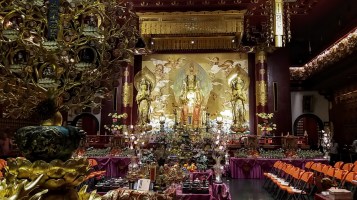 The main hall on the ground floor was an ode to opulence. I’m used to Buddhist temples being ornate. Wood and stone carvings with intricate detail are common (though never boring). Paintings or works in colorful semi-precious stones, and even the occasional gold paint or gilt covering to add some shine. The point is, that I’m used to temples being about effort and time and skill, rather than about blatant displays of wealth. In fact, a common art form is the sand mandala, which is made over weeks or months of painstaking hand work, then wiped out to represent the impermanence of reality. I don’t have an issue with beauty in a temple, I go to temples in part because they are beautiful, but something about this temple and it’s over the top gold, it’s donation jars every few feet, and it’s designated VIP seating for supplicants just did not sit well with me.
 I found the elevator and went all the way to the roof to see the orchid garden. That at least was in keeping with temple life as I think of it. Although orchids are rare in the world, they are common in Singapore and the difficulty of their cultivation reflects the work that monks and nuns put in as part of their practice. Below the gardens, the top floor contained the relic for which the temple is named, a fragment of the Buddha’s tooth. It was also the only room in the building where shoes and cameras were prohibited. There were dedicated meditation mats along the windows where a few people were sitting in silent contemplation, and there was another large gold display.
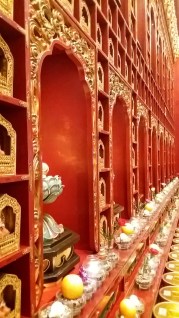 I’ve seen American “mega-churches” that have gold plated elevators and preachers with 5 cars and 3 houses and a minimum annual income requirement for membership. These also disgust me and I often wondered how any Christian could justify that kind of obvious money-grubbing and wealth favoring within their doctrine. This was the first time I’d ever seen a Buddhist “mega-temple”, and it was awful. It made me feel ashamed to be associated with the faith. It made me want to run around to tourists and exclaim “that’s not what Buddhism is about!”. It made me want to drag out some scripture and ask the people praying there if they’d even read it. And for just a moment, it made me think about Terry Pratchett’s Yen Buddhists, whose main theological argument is that:
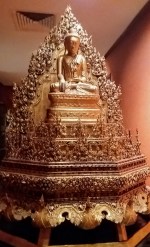 I headed down to the third floor to see the museum, which was a worthwhile collection. It was a nice museum of Buddhist art and man-made relics that included a sort of “intro to the Buddha” story on signs around the displays. Like the rooftop garden, it felt far more authentic and enjoyable. The relics were primarily stone, clay, bronze or wooden and had clearly been the result of effort and craftsmanship. Although the extraordinary focus on Guan Yin and the Maitreya was a little overwhelming, it did point to the fact that the temple’s own branch of Buddhism was a salvific form that relies on Bodhisattvas and future Buddha’s to save the world, rather than on the practice of self cultivation for individual enlightenment.
 The second floor had a nice place to rest, which I desperately needed. Adjusting to the heat and extra walking was taking a toll. It was such a great contrast to my energy level in New Zealand where the weather was cool. Just minimum exertion in a hot humid climate seems to drain me like a marathon! After a rest and a look through the last floor of displays, I made my way back to the ground floor, once more shaking my head at the ostentation, this time walking past the VIP seats they were filled with supplicants who had paid I’m not sure what to get past the velvet ropes. All in all, I’m still glad I went to see it, because I learned something about the corrupting properties of money. All temples ask for donations to help feed the monastic population, pay the basic bills, and to provide services to the community. Money is, in this world, unavoidable. However, when a house of faith relies on wealth or doles out blessings for cash or claims that the donation of great wealth is a higher holy act than living a good life, that’s corruption.
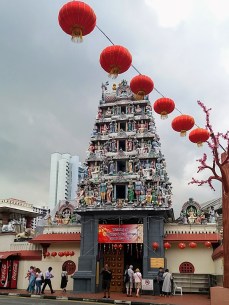 After the Buddhist temple, I took the short walk two streets over to see the oldest Hindu temple in Singapore: Sri Mariamman. This humble wooden structure was not a display of wealth, but was still anything but plain. Wooden carvings covered every inch of the outer facade and were brightly painted besides. Anyone was welcome to enter, leaving their shoes behind on racks on the sidewalk. There were saris for anyone who felt inadequately dressed, and while we were free to wander around the grounds barefoot, the main areas of worship were cordoned off, not for a fee, but for the faithful. I am not a Hindu, so I contented myself with observing from behind the lines. The interior of the temple is a large courtyard with smaller buildings, each one dedicated to a different divinity. There are over 330 million gods in the umbrella of Hindu faith, and while only a couple dozen are among the most popular, it can
  be hard for a layperson to know which altar is for who. I found 10 names of deities for this temple on it’s Wikipedia page. There might be more. In addition to the colorful decor and variety of spots to worship, there appeared to be a large hall at the back used for everything from yoga classes to wedding ceremonies.
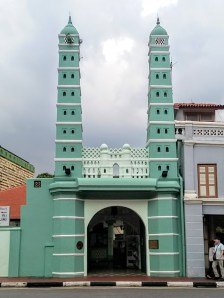 couple city blocks, I had passed 3 major religious buildings, and I knew from the map that a Christian church was not far off. Curious, I looked around the map for a synagogue and found one a little over 3km away, and it was neighbored with another church, Hindu temple, and Buddhist temple. It seemed that it wasn’t hard to find a spot in Singapore where at least 4 out of the 5 major world religions shared a small space and yet no one was getting blown up, shot or even harassed on the street! While I’m sure that Singapore’s strict legal code has something to do with the lack of violence, I like to think that pluralism in the culture helps everyone to get along. People of other faiths or cultures seem less scary when they are our neighbors and not “those others”.
 As I got out of the taxi, I walked past a peacock that had either escaped, or was deliberately placed at the entrance for effect. The bird seemed unperturbed by the traffic. Even though I was a little early, the courtyard was packed full of tour groups and I had trouble pushing my way through to an info counter just to find out where to go. I stood in a long line as we all had our tickets scanned and everyone streamed into the Night Safari like the opening bell at Disney.
 I had missed the first fire show at the opening, but since it happened every hour until 9pm, I wasn’t too worried. I headed instead for the animal show at the advice of one of the zoo staff. This was just as well because the lines for the tram were insane. Being a lone traveler is sometimes advantageous, like when trying to find a seat in a crowded theater. I wedged myself in between two families in a fairly good spot and sat down to watch what I fervently hoped would not be an exploitative performing animal show. I was not disappointed. The “show” was largely animals being brought forward while the main announcer talked about the species being shown. There was humor and a few animal tricks, but these involved a large cat leaping, a raccoon going through a “garbage can”, and an otter doing some recycling (which may be one of the cutest things I’ve ever seen). The last one led into a great discussion of what happens when urbanization encroaches on
  animals habitat and on what we as humans can do to help better preserve the environment. I know some people might think it’s a little preachy, but I was personally gratified to see the zoo using it’s platform of animal entertainment to help educate visitors on conservation and preservation.
 ake in the fire show. Although the zoo website makes it seem as though this is some kind of traditional tribal fire dance, in reality it is a modern dance with a totally made up tribal sounding name. It was still fun and pretty, just not particularly traditional or historically accurate.
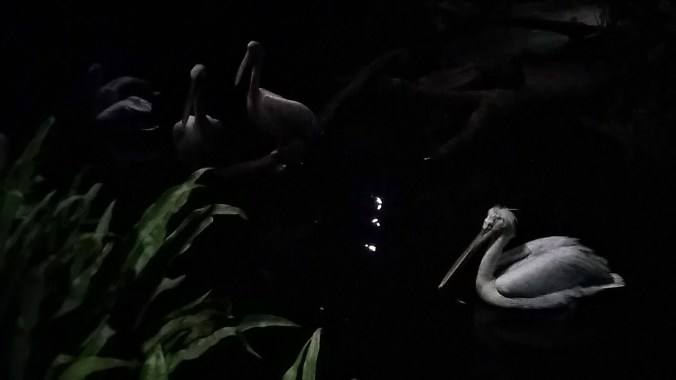


 Shortly after parting ways with the helpful Nigerian, I walked past what appeared to be a large open air food court. There was a roof and fans circulating air, but the entryways were wide open. There were dozens of food stalls from different nationalities, and tables to sit at between them. I went to one stall to get a fried oyster omelette and another for an iced coffee, then sat down to enjoy them. The omelette was a bit odd. In addition to eggs, vegetables and oysters, it turns out this dish is cooked with a variable amount of tapioca, potato, and/or rice starch. This just goes to prove I should have read more about the food before going, because the gooey texture combined with the heavy oil meant that I only ate about ¼ of the dish before I couldn’t eat any more. The coffee, on the other hand, was intense and amazing. I didn’t know it at the time, but Malaysian style coffee is different from other coffees around the world. I’ll explain more when I get to Ipoh, but for now, suffice it to say I was pleasantly surprised.
 After breakfast, I passed by all the tall financial buildings and came to the Marina. This beautiful stretch of waterfront goes on for ages with a wide and clean walking path. I came across a shopping mall on my way and decided to head inside for the AC and maybe a restroom. The Nigerian man I’d met advised me that if I ever felt too hot in Singapore, I could just walk inside any building to get some cold air. The mall was nearly empty, which is not surprising for a weekday morning, and I managed to find a 7-11 to get a cheap sim card (less than half of the airport prices). I also got called in to have a sample at two separate skin care shops. The first was a supernaturally charming young man who probably got nearly every woman he met to spend too much money on his skin care products. We chatted and tried out the product and eventually I had to demure from purchase, but he was gracious about it and said he’d had fun talking with me. The second shop was a Malaysian woman who was wonderful and gracious and kind until it became clear to her that I had really meant it when I said I wasn’t buying anything, and then she turned rather sour. Both shops products were in the hundreds of dollars range. It was somewhere around here that Singapore started to remind me of Dubai.
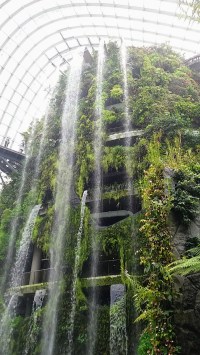 I walked more dockside paths and came across a science museum, more flowers than you can sneeze at, and finally some signs pointing to the garden path that was lined with sculpture, topiary and colorful blossoms. Although the Super Trees were my main goal, by the time I arrived at the park’s center, I was hot and tired. I noticed a cool breeze coming from the doors of one particular building and resolved to go inside that. The building was one of the two indoor gardens, this one called Cloud Forest (the other was closed for renovations). It was a massive greenhouse designed to house the ecosystem of a cloud forest, and so not only had pathways winding through beautiful flowers at ground level, it had a miniature mountain in the center that one could ascend and walk around via a series of skywalks that simulated viewing the forest from cloud level and treetop level.
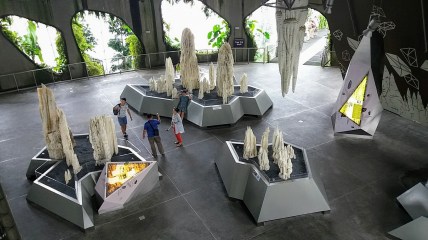
 The time of clouding was approaching by then, and although the main path did not lead back upward, it wasn’t crowded, so I hopped into the elevator and rode back to the top. I get the impression that in more crowded times, the elevators might be more strictly regulated for the disabled, and the paths through the greenhouse lead firmly one way, but it wasn’t crowded and no one seemed to care if we went the opposite direction. Shortly after 2pm, the skywalk began to issue forth a mist as I set out for my second walk on the sky bridge and was able to enjoy the altogether different view as the fog enshrouded the walkway and the mountainside below.
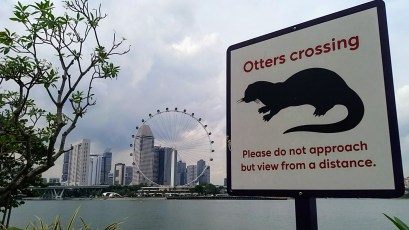 Nonetheless, the entire area of the marina is beautiful to walk through. I spotted some otter crossing signs, which are apparently no joke. The environmental reconstruction along the marina has enabled the local otter population to bounce back and they are often seen on the shores near the walking paths in the evenings. Sadly, I didn’t get to see any that day.
 After lunch, I decided i should go find the super trees. It was getting on in the afternoon, and I still had to get across town to the Night Safari for my 7:15 ticket. Although the tall and unique structures can be seen from nearly anywhere in the park, it took a little effort to find the right walking paths to get to them. There are two groves of supertrees, the smaller has only three, which at the time were undergoing a pre-lunar new year makeover.
 Eventually, I found the main grove and purchased my ticket for the sky walk. This is a little walkway that is accessed through an elevator in the “trunk” of the trees and lets you walk around the super trees at a good height to both admire them and the overall view of the gardens below. I had a nice walk and an even better view as well as some pleasant conversation with another traveler. No matter how nice the view is, I think my favorite part of traveling is meeting cool people.
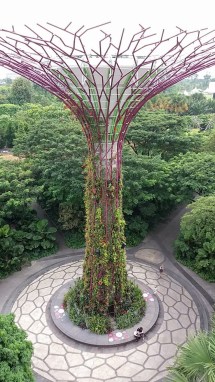 The super trees aren’t really trees. They’re man-made structures that sort of look like giant alien trees. They run on solar power and support a large amount of plant and animal life. Plus they light up at night, which is pretty. The super trees are urban art, but more than that, they are a way of combining city and nature and of providing a space for the plants and animals that would otherwise have been disrupted, or even endangered by the urbanization of their homes to have a place. The super tree grove helps to act as a greenspace, cooling and cleaning the air naturally, as well as collecting solar energy and rainwater that are used in running the indoor gardens. It’s basically a big experiment to see if a city can be a modern urban environment AND maintain a natural ecosystem in an economically sustainable way. I hope it catches on. More cities should have giant trees, beautiful flowers, and river otters.
 costumes (paper dolls), and make their superhero names using a handy 5 point chart I made up of titles, colors, powers, animals, and gender endings. I took pictures of them and added superpower effects, and made a video of them singing and introducing their superhero alter-egos (which I unfortunately cannot share with you because of my teacher confidentiality agreement). It was fun, it was all in English, and I only had to call the Korean teacher once when some boys decided to draw penises on their superhero paper dolls(*sigh). On the last day we made chocolate cake in paper cups in the microwave and had balloon races. Overall, it was a good start to the new year.
 The second half of January was my 2 week winter vacation. I decided to go to the Malay Peninsula and do a whirlwind tour of Singapore, Malaysia, and Thailand (but only the peninsular parts). I’m working my way through writing, editing and adding photos to the whole 12 day adventure which will go out to the blog and FB page soon, so I won’t try to summarize it here. Suffice it to say that the vacation may have foreshadowed more ominous things, since it too started out with so much promise and enjoyment, yet ended in a total emotional breakdown of epic proportions.
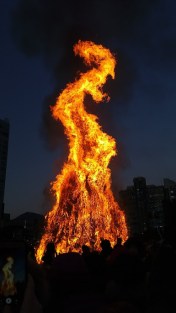 nd an inlay in two different teeth, and that the root canal would take 4-5 visits to the dentist to complete. Thus began my endless dentist torment.
 year, that meant that most of my friend pool were other first years. I had thought they were going to stick around, but events conspired in such a way that meant I spent the end of February going to/throwing farewell events and helping my friend pack/get rid of stuff.
 I had barely an opportunity to say hello to the new teacher at my main school and none at all to visit the second school. Despite the fact that classes would commence March 2, the new teachers avoided talking with me about lessons, or goals, or expectations. I began to get anxious, and reminded myself that newly arrived EPIK teachers wouldn’t meet their co-teachers until the new school year began, but I also had to wonder how many fresh off the boat foreign teachers would be paired with inexperienced Korean teachers. Was I getting extra newbies because of my experience or was it really random?
 Then at long last, a much anticipated event which I had spotted back in January finally arrived. A glorious yoga retreat at a spa resort in the mountains! What could be a better way to ease my stress and restore my resilience than such a wondrous weekend. The day before the retreat, I woke up with a cold… sore throat, stuffed sinuses, whole 9 yards. With little sleep and much mucus, I arose early Saturday and set off anyway, hoping that some meditation and spa therapy would at least help a little. And it might have, had not absolutely everything been a crazy misrepresentation, mistake, flake, or flat out disappointment. I haven’t even decided if I want to blog about this trip because it was so awful, I can’t find a way to spin it for the “life lesson” or “silver lining” even though that was the name of the organization that presented the event.
 Did I mention that during all this time, my tooth, the one that I’m getting this infernally long root canal done on, is in pain? The dentist has twice left me in pain for over a week with no medication, leaving me to struggle on through life with a dull throbbing ache in my left lower jaw and the total inability to chew anything on that side. Even now that the root canal is supposedly “over” (4 sessions later) and the process to install a crown can begin (minimum 3 sessions), my tooth hurts day and night and I have to wait to find out if it will be treated or not until my next appointment. But hey, my hair dye arrived, and it’s a smash hit.
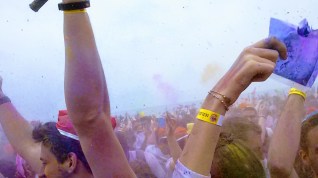 And Holi Hai is coming, which is the Indian festival of colors where we all dance around and throw colored powder and paint on our white clothes while rocking out to Boli-rock or Indo-pop on the beach. I did it last year and it was awesome, so I was really excited to go again this year. And yet somehow, people are trying to ruin that too. Two factions of the local Indian expat community have started a turf war over the holiday and who gets to throw the party. They’re trashing each other on social media and trying to drag all of us as well as the local Korean government into their feud. I’m still planning to go, but I will have an escape plan in case they start physically fighting over the microphone or DJ station. I don’t know what they were trying to do, but all they’ve really succeeded in doing is demonstrating their total lack of Holi spirit. Festival of love, guys.
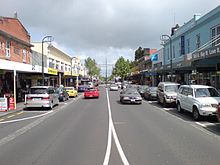 nd headed over early so I could snag a parking spot and some breakfast before the shops opened. In the States, Outlet malls are often far from the cities or even the suburban sprawl and exist as sort of concrete islands in what is otherwise quite unattractive farmland. Imagine my surprise when the GPS led me to an adorable little neighborhood, streets lined with tiny cafes, boutiques and thrift stores. Onehunga is adorable.
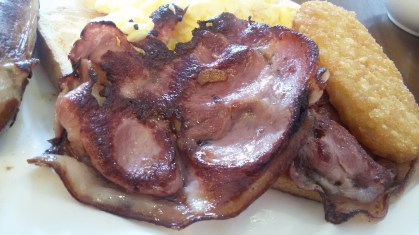 combined and explains why it both looks and tastes like US bacon and Canadian bacon were fused together in some kind of mad-biology experiment went right. If you are a bacon fan and you are unable to get yourself down under, I highly recommend making friends with a butcher to see if you can persuade them to sell you some of this stuff.
 There were of course posters of the Narnia movies and copies of the books around the place, and some artwork on the walls by local artists. It wasn’t until my meal was finished and I went to find the restroom that I stumbled upon the most Narnian feature of the cafe. The back seating area (and restrooms) were through a hallway that had been hung on either side with fur coats so that you had to push past them in order to enter. It was very subtle, because even though I had seen things hanging in the hallway, I had not really realized what it was until I felt the fur on my hands as I pushed my way through to the other room. The strange and sudden realization that the otherwise very ordinary cafe had worked in a hidden-in-plain-sight magic wardrobe made my whole breakfast even better.
 While I was in Rotorua, I had planned to take a lazy walk around the Saturday Market and Kuirau Park (a free park that has geothermal activity). The market was a cute little local flea market kind of affair with folks selling used clothes and books, antique jewelry and dishes, and a whole lotta food stalls selling Kiwi and Maori foods. I had been hoping for more handmade goods, but it was still fun to wander around and I picked up my souvenir gifts there from the one handmade stand I found: a lady who made skin balm from the native
  Kuirau park is interesting. It’s got lots of mud pools and a hot lake that are all gated off to keep kids or drunks from wandering into them. It also has public foot baths using the thermal waters so people can come by and have a nice warm foot soak. I suspect the park is nicer in any season besides winter because there are a lot of trees and flowerbeds as well that were bare, and what looked like fountains that were turned off for the season. However, it’s free, so I do recommend at least stopping by if you’re in Rotorua, especially if you’re thinking of doing other geothermal parks. Several other blogs I read recommended this as an alternative to Hell’s Gate unless the mud bath is on your bucket list.
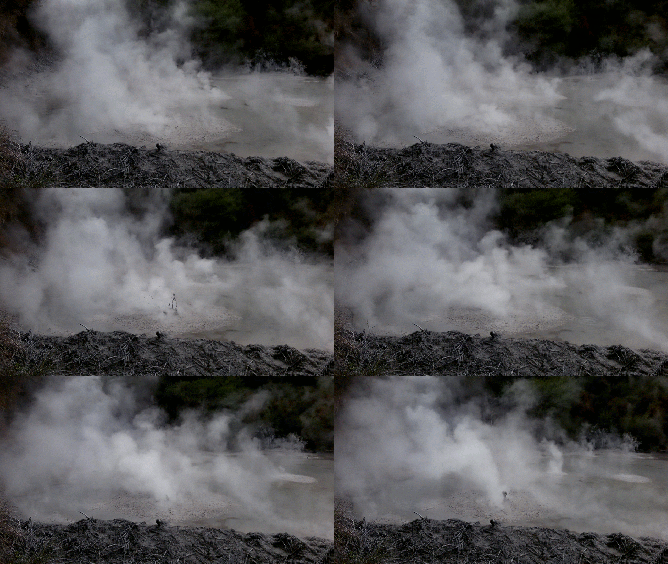 Wai means “water” and tapu means “sacred”. This area is known in Maori as the sacred waters. In addition to the

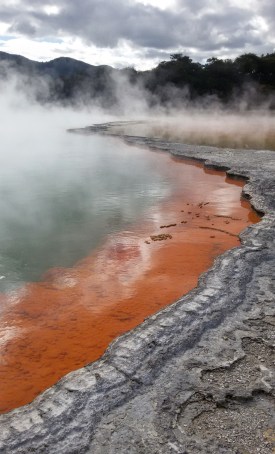 dazzling body of water is the one you see on all the websites, brochures and billboards for Waiotapu because it’s deep blue water and vivid orange shoreline are such a visually striking image. Combine that with the meandering edge of the built up lip of the lake and you are just left gaping at the majesty and variety of nature. I also discovered the reason it’s called Champagne. There are teeny weeny bubbles effervescing around the pool giving it the distinct appearance of champagne in a wide glass sending a constant stream of tiny bubbles out into the world. The extreme heat of the pool combined with the cool late winter air meant that there were great plumes of steam rising up from the water and obscuring the far shore. It made for a dramatic landscape, but I did get dosed with some intensely sulfur smelling fumes when the wind shifted. Other than that, the park didn’t have much of an odor.
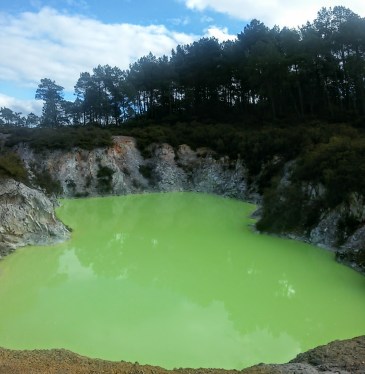 The Champagne pool may be the star of the park, but it’s not the last surprise on the trail. After passing by a few more craters, you reach the final stop, “The Devil’s Bath”, which is a deep sided pool of the most florescent neon toxic waste movie effect from the 1980s colored water you will ever see. I’m sure you’re looking at the photos going “no way”, but yes way, Ted. A few more sight seers came around the corner while I was staring at it and were equally blown away. My best guess for what causes the crazy green shade? Bacteria, chlorophyll loving bacteria. Weather the colors of Waiotapu come from animal, mineral or vegetable, it’s a great way to spend a few hours in between hot springs. Check out the
  bigger difference than I had anticipated. I even saw an advertisement for a horse exerciser position that offered room/board/caving and a little cash, clearly intended to attract backpackers to the job. The hostel was walking distance from the main tour company that offered trips into the caves, but not much else.
  The only constellation I’d heard of for the southern hemisphere was the Southern Cross, featured on the NZ flag. I looked for it, but at the time, I wasn’t totally sure if what I saw was the constellation or my wishful thinking. After all, how many patches of 4 stars can look like a cross if you’re trying to find one? I stayed outside until my fingers got numb, soaking in the interstellar beauty and realizing once more, NZ had granted my wish. Before I came, I thought about how much I was looking forward to seeing the night sky from the south, yet until that moment, every night I’d been outside there had been either cloud cover or a bright full moon, making the stars invisible. Yet here on my last night in the bush, the night sky collaborated to put on just one more show.
 The marrow bone was a huge bone, cut in half longways and sprinkled with a crust of herbs and sharp white cheese (perhaps a parm or asiago). If you’ve never had bone marrow, and are not a vegetarian, I would like to recommend it. It’s basically like meat butter, which is to say it’s rich rich rich like the best butter you can imagine but instead of tasting like cream, it tastes like the meat of the animal from whence it came. You will not ever have a cut of meat, however well marbled, that is as rich and decadent as bone marrow. As I scooped the marrow from the bone and spread it on the toast, I wondered briefly if I’d made a mistake in ordering so much food when the first dish was so intense.
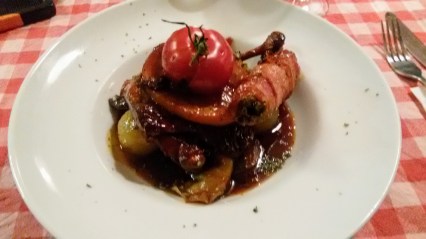 The duck rested atop some caramelized onions and roasted potatoes which were themselves drowned in the heavenly sweet and spiced sauce. Atop the duck rested the candied and stewed orange slice and a small tomato, the sweet and tart qualities of which were complimentary to the sauce. At first glance I thought it was a version of orange duck, but then as the spices reached my nose and soon my tongue, Christmas exploded inside my head.
 Finally, I considered myself conquered and had to leave some of the veggies behind to save space for my tarte tartin. This is a sort of upsidedown caramelized apple pie with ice cream on top. It was wonderfully soft and well flavored without being overly sweet. The caramelization left a light and pleasant bitterness, and the apples themselves brought a bit of tartness. In the end, I couldn’t manage more than a few bites and felt horribly guilty for letting such a culinary treasure go to waste. I apologized to the waiter, trying to assure him the tarte’s taste was not to blame for so much of it being left behind. I finished off the evening with a digestive (because boy did I need one by then) of green Chartreuse which is a fabulous herbal infusion made by French monks that is basically like Absinthe’s grown up, more erudite older brother.

 e milky light caused by dark dust in the way that the Maori people identified as a type of constellation by negative space rather than connecting the dots. It’s an emu.She also taught me how to find the Southern Cross and use it and the Pointers to find due South. It’s not quite as convenient as having Polaris, but it was fun to see it in action.


 Green tea looks like very well kept English hedge,.
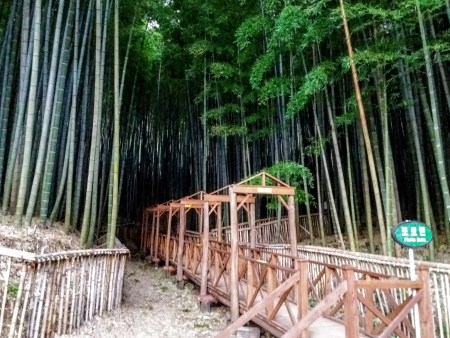 On our way back to the main entrance we took a quick side detour to the bamboo forest. After a short walk through some more evergreens, we emerged into an open space facing a dark and mysterious bamboo forest. The sun was low and the shadows were long so we couldn’t see far into the mass of stalks. Once we entered, it was as though a twilight had encompassed us, the lush leaves cutting out nearly all the late afternoon sunlight. The birds went bananas, screaming like jabber jays, making us feel as though we were in an arena from the Hunger Games or at very least in an ominous Korean horror movie. I wasn’t sure if we should expect kung fu masters or monsters. (click for more pictures of Boseong
  We left the tea fields behind and headed back down to the main parking lot that would lead to the lights. There were plenty of stalls with a wide variety of food (green tea added and regular) so my allergic friend was able to find something tasty, too. The light show wasn’t quite as spectacular as
  dragons and hatching out of giant glowing eggs along the way. Like most lantern displays here, everything was meant to be posed with and interacted with, so it was easy to walk up to any set and play around. It’s a small and childlike pleasure, but after so long in the US being forced to stay behind the railing, it is fun to get a little more hands on. On the way back down, we took the tunnel of lights, pausing every time the colors shifted to take more pictures and pose in the rainbow glows.
 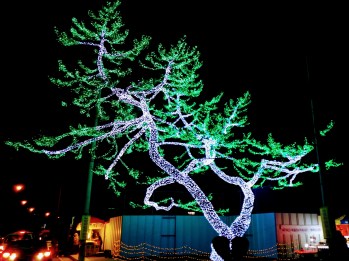 Our third and final location was near the beach where another tunnel of lights and light decorations had been put up. One large tree had been colored in white and green to make it look like it still had leaves. There were reindeer and Christmas trees, but also a giant chicken floating just off shore. I’m not sure why a chicken, but I saw another similar giant chicken in the sea back in Busan the next day.
 The next Saturday was Christmas Eve, and we decided we needed to do a blending of American and Korean activities. We spent the afternoon inside making eggnog and gingerbread houses. I have never made eggnog before. I thought about it a lot, especially when I wasn’t doing dairy. I thought there had to be a better tasting nog than Silknog. But somehow, I never got around to it. This year, although I seem to have no health issues with milk here, there was a complete absence of nog… everywhere… Koreans either have never heard of it, or they are all in the hate eggnog camp.
 based on past non-dairy culinary experiments, I’d say if you’re a dairy free nog fan go with unsweetened almond milk and coconut milk– the stuff in the can that is dense and creamy, not the stuff that is a regular milk sub.– Use 2c almond milk to 1 c coconut milk, otherwise just follow Alton’s instructions. If you’re a vegan who wants
  While we imbibed our culinary delight, we worked on assembling a gingerbread house. Every month here in Busan there is a
  In addition to our delightful wine, I enjoyed pumpkin soup, a goat cheese/bacon/honey pastry for entree, a superbly well cooked slice of salmon with a light lemon flavor and a unique mushroom risotto which had been made into a breaded patty and lightly fried, and finally a chocolate pear cake that tasted more like it was a ganache or very dense ice cream rather than a cake, too decadent! Nothing will compare to the food in France, but Le Jardin made an admirable effort and gave us all a taste of Western flavors with just a hint of haute cuisine that was perfect for a holiday feast.
 Toward one end of the festival, I found an old man with a traditional candy game called ppopgi. It’s a simple candy made from sugar and baking soda, but a shape is pressed into the candy. Kids (and a few adults) can use a little pin to try to break the candy around the shape without shattering the brittle sugar. If they succeed, they win a prize (often more candy). The vendor was using a tiny copper pot to melt sugar over an open flame, adeptly pouring out the steaming satiny brown concoction, pressing it flat onto a popsicle stick and letting his fares choose their shape before pressing a cookie cutter down on the hot surface. I noticed that while adults had to be perfect to win, the little kids were often awarded a prize for a good effort.
 A mere week later, the New Year celebrations were upon us. I had done some research and found that here in Busan there is a bell ringing ceremony in Yongdusan Park at the large bell at the foot of the Busan Tower. It’s a big event with musical performers and guest speakers that is televised much the way that the New York Time’s Square ball drop is. Yongdusan park is nowhere near as big as Time’s Square, and the majority of people don’t ascend the multiple flights of stairs until 11pm. Knowing we had plenty of time, we spent the day reveling in some seasonal sulbing, a screening of Rogue One, and a totally accidental Japanese dinner.
  Nonetheless, it was a wonderful day and at 5 minutes before 11, we found ourselves in a long line of people patiently trudging up the stairs to the peak of Yongdu Mountain. Normally, this pathway has a series of escalators going up so that anyone can access the park, but tonight the escalator had been closed down and reserved as a dedicated emergency access stairwell. When we arrived at the top, we saw many TV vans and we shuffled with the crowd into the standing space behind the VIP seating. To my surprise, through crowd motion, we soon found ourselves close enough to the bell to get a decent view of the proceedings, and there was a jumbo-tron screen off to one side that allowed us to view the performances.


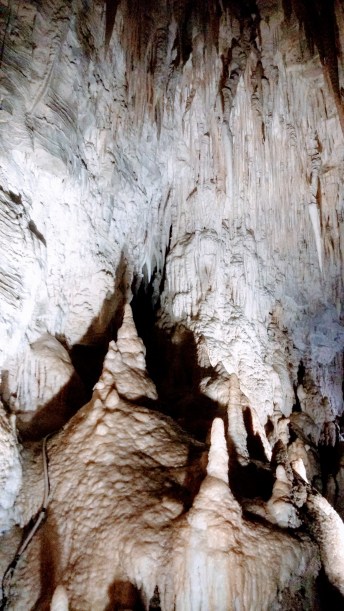 Once inside the cave, we were treated to chamber after chamber of beautiful limestone growths and formations. I’m lucky enough to have explored several of the best limestone caves in the US and I still found this one to be both beautiful and worthwhile. Like everything in NZ, the cave could not just be one type of landscape, but changed continuously as we traveled. In addition to the stunning stalagmites and stalactites, we saw curtain formations, several alternate types of mineral formations I don’t know all the names of because I’m not a geologist, some fossil seashells, some heavily layered rock, at least one natural chimney in addition to the man-made tube used to pipe in the concrete for the wheelchair safe pathways, and of course the glowworms. I should mention that anywhere a concrete path would have damaged formations, they instead used metal catwalks, sometimes bolstered from the floor, sometimes the walls, and at least once, suspended from the ceiling. They did everything possible to keep the cave intact while also making it accessible to everyone.
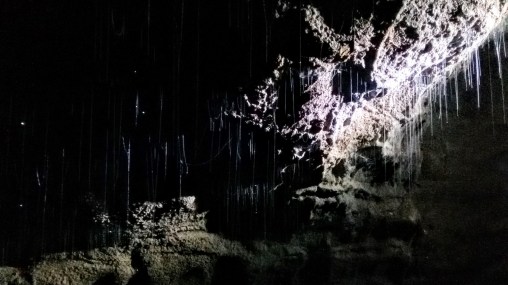 Glowworms are larval insects who secure themselves to something dark and damp like the cave wall, then lower a strand of sticky silk. When some poor unsuspecting flying insect thinks their little glow is the moon and gets trapped in the web, the glowworm can then reel in the line and dine on the trapped flier’s brains. They are also quite territorial, so we were warned to be careful not to move the strands lest they become entangled with one another and cause a fight to the death to ensue between neighbors. It’s a little dichotomous to think of these beautiful serene lights as emanating from violent brain eaters, but then again, the fairies they are so often likened to are said to be beautiful yet cruel as well, so perhaps that metaphor is not so far off.
 We started off by changing into some cave climbing wet-suits. These weren’t just regular SCUBA suits; they had special padding on the knees and bottom to help prevent injuries as we crawled and scooted around in the small tunnels. These suits were also 2 pieces, an overall style pants part and a long jacket. I am a short, round person and no neoprene suits were designed to my measurements even a little bit, so by the time I get something that fits my shoulders, bust and hips, its about 6 inches too long everywhere else, legs arms and torso (and rather unfortunately, it pushed up on my neck and chin so I had to unzip the first 5 inches of the jacket just to be able to breathe). In addition, the material is very stiff, so I felt like I was wearing a suit of armor built for someone 6 inches taller than me. I was suddenly very glad I’d decided on the less extreme version of the extreme adventuring.

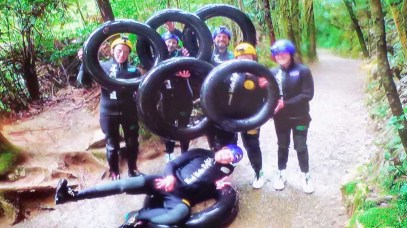 When we got back to the base, we took a final victory picture, doing our best to imitate the Olympic rings for the Rio Olympics. Then we peeled off the wet suits and ran shivering in our bathing suits into the hot showers to warm up and clean off before getting into dry clothes. They also had some hot soup and toasted bagels for us in the cafe when we came in so we could replenish some calories and get warm from the inside too. Our guide did his best to take photos of us in the cave, but was by himself that day and often had his hands full helping one or more of us find the foothold or handhold we needed to get through. Nonetheless, they did show the photos of our group up on big TVs for us to see while we sipped our soup. Most of the pictures were of us outside the cave or in the cave mouth, so it’s not especially great at capturing the in cave experience visually. Hopefully I painted a picture with my words.
 I remember having some picture books as a kid about Bilbo and Frodo Baggins. They were highly simplified versions of the stories in The Hobbit and The Lord of the Rings, but my mother loved those stories so much, she made sure I got started early. The books had read along audio cassettes that I could play in my own little cassette player (because digitial music didn’t exist yet, that’s why). I learned about Golum and the One Ring while I was learning to read. It’s safe to say that the stories of Middle Earth are embeded in my foundation.
 In high school, we used to use Dwarven runes to write secret notes and one of my friends even learned basic Elvish. In 1999 or 2000, my mother and I were walking out of some movie or other and saw a poster on the wall of the theater with Elijiah Wood and my mother immediately exclaimed, “It’s Frodo!” without even reading the text on the poster. It was indeed Frodo, and the poster was the first advertisement for Peter Jackson’s film rendition of the epic stories. Now the books have spawned a movie franchise, sharing Tolkien’s work with a whole new group of fans with 6 movies so far, and I hear more in the works. So, when I found out that the Hobbiton movie set was still alive and well in New Zealand, I of course fantasized about going there. And, when I found my travels taking me down under this year, I finally got my chance.
 The tour is 2 hours long and starts at the visitors center where a massive car park surrounds a quaint gift shop and cafe. I was truly surprised at the number of cars in the lot when I arrived. The movie set is outside Matamata, and is quite remote. I had seen more sheep than people my whole drive over, and the nearest petrol station was more than 10 minutes away. When I turned into the car park, however, it was like a shopping mall on a Black Friday, I nearly didn’t find a parking spot. I did go on a Sunday, which may have accounted for the higher turn out, but there is no doubt that Hobbiton is a prime attraction. There is a fleet of green buses (the color of Bag End’s front door) emblazoned with the Hobbiton logo that drive visitors from the car park over to the movie set itself. On the way, the guide, Sam (our guide was named Sam, he swears it’s his real name and just a coincidence) told us that originally there had been no road into the farm this way. The New Zealand Army was contracted to come in and build the road so that all the set and filming equipment could be moved in. The farmer himself was under a non-disclosure agreement, so when one of his neighbors asked why the army was on his farm, all he could say was that they had been selected for a random road building exercise.
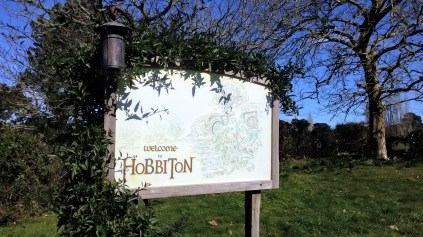


 and even one with an open door to give us the chance to stand inside the traditional round portal. There is nothing inside, of course, the interior of the Hobbit holes were only filmed in the studio, but it makes for a unique and fun photo opportunity to place yourself in the role of a Hobbit. I didn’t have time on this trip, but when I get the chance to go back and stay in NZ longer, I’d love to dress up and get some photos in cosplay on this set. I’d also love to bring my niece and nephew before they get too big (Gnome, Squidgette, I’m talking to you) because so many of the Hobbit sized sets are perfect child size and include a lot of props that are not hidden behind gates. There was a Chinese family in our group and watching the little ones pose in front of the smallest Hobbit holes was a cuteness overload.
 Jackson’s attention to detail and commitment to the book was so intense that during the filming, he was unable to find plum trees in the right size to match a written description of Hobbit children sitting under plum trees, so instead he brought in pear and peach, but stripped them of their fruit and leaves to replace it with plum foliage, each leaf wired on by hand. The scene is only in the extended edition and only visible for about 2 seconds.
  Other examples of his eccentric dedication include the frog pond which had such an abundance of loud frogs that staff had to be employed to catch and move the frogs before filming


 It was very hard to leave behind the house on the the Hill, but our next stop was the party tree and the green field where Bilbo’s 111th birthday party was held. However magestic the party tree looked from afar, it was even more imposing up close. It wasn’t so big as Tane Mahuta, but it was taller and still an impressive girth. Unlike the oak tree, the party tree is a real and living tree that was one of the main reasons this piece of land was selected to be the Shire. Within the meadow, there were party decorations and Hobbit games for people to try out including a maypole, some stilts, a game of ring-toss and some see-saws. Children and adults alike had fun testing out the various activities and admiring the detail of the design.
  Even the fence, which looked old and overgrown with lichen was artistically aged with plaster and paint, but indistinguishable even after we knew what to look for. Before we left the meadow, we stopped off at Samwise Gamgee’s own yellow round door where you could just imagine Rosy and the children playing in the garden.
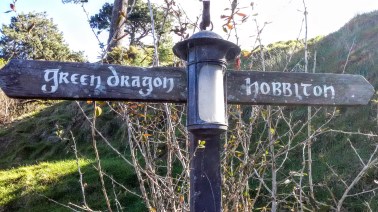 There is something familiar yet otherworldly about the unique flora of New Zealand that must only seem familiar to the Kiwis themselves. For the rest of us, it is just different enough from what we are used to that it provides a sense of otherness, of the fantasitcal and created without being so foreign as to seem alien. The main context that I (and probably many of you) have become familiar with these plants unique qualities is in the films themselves, so it is no surprise that more than just the buildings here make me feel like I am walking in the footsteps of Bilbo himself.
 There are comfy armchairs by the fire, and artwork all over the walls. You can have a taste of Hobbit food if you fancy a light snack (I tried the steak and ale pie, it was yummy), you can try on Hobbit clothes, wield Gandalf’s staff, and explore room after room reading the local Hobbit bulletin board, peeking at the range of knickknacks on shelves, visiting the Inn’s cat (not in the movies, but, you know, cats), or just admiring the large wooden carving that gives the Inn it’s namesake. I tried my best to multi-task, to take it all in, but I felt like I’d only begun to scratch the surface when Sam gathered us up to continue our trek.


 the tattoos were done by cutting deep grooves in the skin and filling the wound with ink over and over so that it created a combination of ink and scar tissue for the design. Although the cheif joked that now they have a tattoo gun, he still pointed out that rarely do Maori get facial tattoos these days, and that the performers were all wearing make-up. Bear in mind the Maori tattoos may be the closest thing to a written language they developed and are just about as complex as any other ideographic language, so I’m only going to get the tip of the iceberg here.
 The basic legend: Mataora was a great chief who fell in love with and married a spirit from the underworld (Rarohenga) named Niwareka. One day Mataora struck her in a rage and she fled back to her father’s home in the underworld. Mataora felt remorse for his actions and decended to Rarohenga to find her. There he met her father instead who laughed at his painted face, wiping away the designs drawn there to show how useless they were. Mataora saw the permanent ta moka on his father-in-law’s face and asked him to mark his own face the same way. The pain was such that Mataora fell ill and his suffering softened Niwareka’s heart, so that when he recovered she agreed to return with him, and he promised never to hit her again as long as the markings on his face did not fade (so never). His father in law then granted him the knowledge of te moko and the Maori people have used it ever since.
 These four birds are the bat (go with it), the parrot, the owl and the kiwi. The bat represents knowledge. The head of the bat rests in the center of the foread and the wings spread out to either side. The parrot is situated along the nose, particularly the beak on either sideof the nose. The parrot is a talkative bird and this represents oratory skills and is very important in an oral culture. The owl sits on the chin (the only facial tattoo typically available to women) and represents protection. Finally the kiwi, envision it’s long beak open, rests on the lower cheeks, meeting the chin moko in a fluid design. The kiwi represents stewardship of the earth.
 The only real hand to hand weapon is the club, or patu. The patu can be made from wood, bone or stone and resembles a paddle being narrow at the edges although not sharp enough to be a true bladed weapon. In addition to being carried to war like the long weapons, the patu were also used by women who remained at the village when the men were away hunting or fighting so that they could defend themselves against any hostile raiders. Women were expected to be skilled enough with the patu to kill their attackers. The chief pointed out that due to the shape of the patu, if one hit the skull of an enemy with the edge and twisted, it would pop the top of the head right off, handily combining village defense and dinner. Yes, the Maori used to be cannibals, too, but don’t worry, he told us “now we have McDonald’s”.
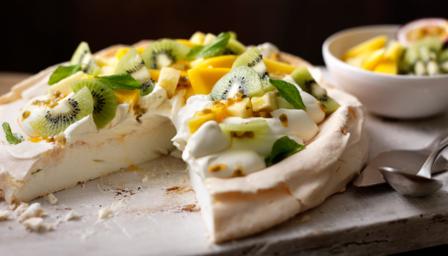 Pavlova was a dessert that by it’s name made me assume it was from some Slavic country, but the natives at my table told me firmly it was invented in New Zealand, no matter what lies the Australians are spreading. The pavlova is named after a Russian ballerina, which explains why I thought it seemed linguistically Slavic. It’s like a merenge but more complicated, having a crispy exterior and fluffy interior. It’s also supposed to be very tricky to make and prone to collapse if it’s cooled too quickly. It’s traditionally served with whipped cream and fresh fruit. I found it unique and delightful.
 How are
  I had noticed during some of the talks that there were some unfamiliar gender roles being described. For example, the chief had to be male, and it was possible for a man to take more than one wife, but women were the landholders. Pre-colonial Maori gender roles appear to have been definitive, but not derisive. That is to say, women had very clear roles and responsibilities, but they were not thought of as lesser than men’s roles, nor were women seen as belonging to men. A woman did not take her husband’s name nor relinquish her membership to her own family or tribe at marriage. Women were seen as the progenitors of life, responsible for childrearing and the home. The main difference is that these roles were not seen as lesser to men’s roles.
 The two main reasons modern Maori no longer wear traditional facial tattoos are the painful physical process and the social stigma. As I described earlier, the moko isn’t done with a needle, but by carving grooves into the skin and coloring the wound. This process is both painful and dangerous, and although could be replaced with a tattoo gun, there remains the second issue. Even as the moko mark them like each other, they also mark the Maori as separate and other from the British colonials. Due to years of colonial mistreatment and outdated ideas of “savages” that boil down to little more than racism, the presence of Maori tribal tattoos can still be cause for discrimination in modern day New Zealand.
 My guide said that he generally felt fine with other people getting Maori tattoos or wearing their art or jewelry as long as it was respected. These Maori tattoo artists won’t just put any old design you want on your skin, they will listen to your story and make something unique to you using the traditional Maori symbols and styles. So, while I suppose it is possible to print something off the internet and go to a non-Maori tattoo artist to replicate it, that doesn’t seem to be what’s going on in NZ and so it’s far less an issue of misappropriation and more a way of sharing and honoring. Later research revealed that the name for Maori style tattoos for non-Maori (Pakeha) is kirituhi and so most Maori don’t even see the kirituhi as being the same as the moko (even if it appears similar in design) because it lacks the spiritual and familial connections of a true ta moko.
 Before beginning the glowworm hunt, we passed by an outdoor village replica so that we could get a better look at the housing construction and village arrangement. This picture is in daylight, but when I was there it was night. It was a little hard to see in the dark, but the guide gave a good description of the house (as a body) and of the general village construction on a hillside that allowed for greater protection. Before we moved on, he reminded everyone not to shine the lights on the glowworms and also, to cup the lights in our hands and point them only at the ground, so we could see where we were walking without obstructing the night view. I think about 5% of the group listened to this, because most people were busily shining their lights all over the woods.
 They were a tribe of supernatural beings that lived deep in the forest, ate their food raw and shunned the light. They were described as having pale skin and red hair, and it is thought that the red-haired Maori are descendants of a union between Patupaiarehe and Maori women. The gloworms are sometimes said to be they eyes of the Patupaiarehe, since they can be seen only in the dark places. They were not spread evenly around New Zealand, but seem to be concentrated in certain areas including Rotorua where they are rumored to have come down from the mountains to drink from the pure waters of this spring. The spring puts out more than 24 million litres of water each day. The dark spots in the photos at the bottom of the pool are not rocks, it is the constant billowing of the seditment as it is churned by ever arising spring water from the bottom.
 we saw one of the native fish swimming around, but after the light was turned off and people started moving on, the freshwater eel resident of the spring came out. The second guide who was bringing up the rear tried to turn the light back on so I could see it better, but the light sadly drove it back into the rocks. However, having realized that I was more interested in the land than the majority of the tourists who were rushing ahead to get back to the halls, he stayed a little behind with me and started pointing out various interesting things around the bush.
 He told me about a kind of mud-skipper fish they have, and about some of the extinct land birds. He left his flashlight off and we found many more glowworms. I tried to show some of the other tourists on the walk, but they were too busy chatting to stop and look. The Mitai tribe has been watering their forest areas in order to boost the glow worm population. They aren’t seen above ground in great numbers because the atmosphere is often too dry, but a hydration program was having a profound effect on the local population and I saw probably hundreds throughout the walk all along the rock-sides sheltered by roots and leaves.
 You can’t go anywhere in the US without being on some tribe’s ancestral land, though. I learned about the tribes as we moved around the country. I learned their words in each new place because white settlers used the names the Natives gave to things long after the people were relegated to reservations, forced to wear western clothes, speak English and go to church. And in the few places where they are reclaiming their place, they are still only known for 2 things: casinos and tourist attractions. Casinos because crazy sovereign land rights make gambling legal on reservations. These buildings are decked out in the tackiest stereotypes of Native imagery with wooden carved Indians in giant feather headdresses adorning the entryways and sacred patterns hanging on the walls, using the images of their culture to draw in suckers. Only slightly less crass are the informational tourism spots where descendants of colonialists can come and see an authentic teepee or wigwam or rain dance. Sometimes they even sell sweat lodge experiences. And as much as I want to learn about the people and the culture, because that is maybe my greatest passion in this life, it feels cheap and tawdry whenever I see these displays outside of museums. This is not to say they shouldn’t live their own culture, but there is a difference between living your lifestyle and putting on a show.
 Maori Colonization: The explorer Kupe took a really big boat and ventured across the ocean, leaving his home in search of new land. It’s believed that colonization of NZ from Polynesia was deliberate and slow after this. It took several hundred years of ocean faring boats going back and forth bringing more and more Maori. In fact, the seven main tribes now identify by which boat (waka) their ancestors arrived on. For those who have been wondering about why I keep using other names to refer to NZ, Kupe named the land Aotearoa which roughly translates to “land of the long white cloud”. There are a few legends on why, but no consensus. The seven waka hourua (ocean going boats) and later the seven tribes, are called Tainui, Te Arawa, Matatua, Kurahaupo, Tokomaru, Aotea and Takitimu.
 The Treaty of Waitangi was basically an agreement the Maori signed with the British crown stating that New Zealand was under British sovereignty, but that the Chiefs and tribes would keep their own land (selling only to British settlers, no filthy French or Dutch here, please), and that the Maori would have
  Modern Maori: Are there arguments about land rights, water rights, fishing and hunting rights… and every other aspect of sovereignty? Of course, but it’s much more like an argument between people of (nearly) equal footing than in the US where we’re still ignoring the fact that our reservations don’t have safe drinking water or can’t fish their own streams/
 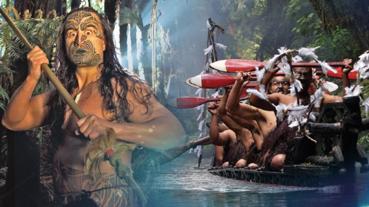 Armed with a better understanding of the history and a strong desire to learn more, I booked myself a table at the
  We were greeted at the entrance by a woman in traditional dress and (makeup) tattoo with the Maori greeting “Kia Ora” (
 Next we broke into smaller groups and bundled outside to see some of the village. Our group first visited the boat displayed by the front gate. Our guide explained to us about the word “waka” (boat) and the three most common types of waka for daily use (fishing and transporting goods), for war, and for long ocean journeys. She pointed out to us the way in which this particular waka was made using planks and that was how we could tell it was a replica and not a traditionally made waka. In fact it was the prop from the movie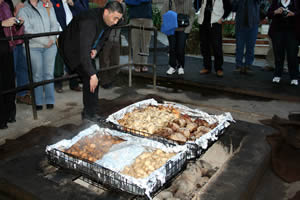
 He taught them how to make the traditional war face which involves opening one’s eyes as wide as possible, sticking out the tongue toward the chin and doing an aggressive war cry. One of the men took this task quite seriously, doing his best to make an intimidating face and sound as he was shown, buy the other (and younger) was too cool for school and sadly sought audience attention by laughing at the process and doing a poor imitation of the war face, perhaps unwilling to look foolish, but in the end failing. We were asked to vote by applause and the man who went all out won by a landslide, which was nice, because I felt like he would at least take his duties as our chief for the night seriously and not treat it like some kind of opportunity for laughs.

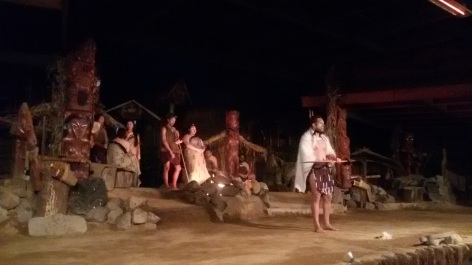 After the outdoor display, we headed into the performance hall. It was somewhere during this time that I started getting flashbacks to my childhood wild west/cowboys and Indians shows. The stage was set up to look like a Maori village, and once again, the guide was quite clear that it was a set and not real. The performance started with singing and dancing, then the cheif came out and gave a speech in Maori that of course none of us understood. While all the Maori performers were wearing traditional costumes, it struck me at once how different the cheif’s clothing was, especially the white fur cloak he wore. New Zealand has only one native land mammal, which is the bat, so where did this fur come from? It turns out that the Maori brought dogs, kuri, with them from Polynesia. The dogs were rare and their fur was prized as one of the elite materials for chieftain cloaks (along with fur seal skin), and because white was a common kuri coloring, I expect this was meant to represent a white kuri skin cloak and was quite prestigious indeed.
  After the sung entrance and the chief’s introductions, they introduced traditional Maori instruments of which there are two main kinds: melodic and percussive. Melodic instruments (rangi) include flutes made from wood or bone, gourd instruments that are blown into or filled with seeds and shaken, and trumpet instruments made from shells. These are considered the domain of the Sky Father but each group and specific instrument has it’s own god/goddess or spirit associated with it. Percussive instruments (drums, sticks, poi -the white flaxen balls on strings, and a type of disc on a cord) are considered the heartbeat of the Earth Mother.
 Gallivantrix