Having spent the last few days recovering from the cold I managed to give myself at the end of my trip, I’m now feeling much better and ready to tackle the slightly overwhelming task of writing about these 10 awe inspiring, action packed days and the truly daunting goal of winnowing down the over 2000 photos I took into something that is beautiful and interesting rather than something that resembles the family holiday slide show from hell. As you can imagine, this might take me a bit of time. Furthermore, I’m starting school again this week, and I have an upcoming long weekend trip to Jeju Island. I also don’t want to dump a novel on you all at once. So, be patient. The stories will come, and they will be no less wonderful just because you read them a few weeks or even a few months after they happened.
My Route:
I made a little road map to show you the relatively small section of NZ I managed to explore, and here’s the basic itinerary. (As they get written, I’ll be linking the full story to each counterpart in the short list below).

Day 0: Auckland (arrival, rental car, sleep)
Day 1: Auckland (Onehunga), Piha (black sand beach), drove to Dargaville (sleep)
Day 2: Waipoua Forest (giant Kauri trees), drove to Piahia (sleep)
Day 3: Piahia (Bay of Islands, dolphins!, Haruru Falls), drove to Whangarei (sleep)
Day 4: Whangarei Falls, Waipu Caves, drove to Hot Water Beach (midnight low tide)
Day 5: Hot Water Beach, Cathedral Cove, drove to Rotorua (sleep)
Day 6: Wai-O-Tapu – hot springs (Kerosene Creek, Hot & Cold, Waterfall Spout Bath)
Day 7: Rotorua (Saturday market, Kuirau Park), Wai-O-Tapu (geothermal park), Maori
Day 8: Wai-O-Tapu (hot springs), Matamata (Hobbiton), drove to Waitomo (stars!)
Day 9: Waitomo (glowworm caves, black water rafting), drove to Auckland
Day 10: Auckland (shopping, Planetarium, Cornwall Park, One Tree Hill), Airport
It was a jam-packed holiday to be sure. I intend to breakdown the stories based on geographical region and/or type of activity, therefore while it will mostly be in order, it’s not a strict blow by blow of the 10 days. In the remainder of this post, I want to share a few interesting things I learned about New Zealand that are useful if you want to travel there and are just generally neat.
Tipping:
 This bizarrely internationally inconsistent cultural habit changes drastically from country to country and making a mistake while you’re visiting can be awkward or even offensive. Quick guide to NZ tipping is that you don’t. It’s not a tipping culture except…
1) let taxi driver’s keep the small change. It’s not precisely a “tip” it’s just inconvenient to make them dig out exact change.
2) similarly, tip jars if present in cafes are not looking for anything more than the small change (under 1$).
3) exceptional service – if you feel like a waitperson has just gone above and beyond, leaving a tip is a way of thanking them for that, but it is not expected at most restaurants or meals.
4) fancy restaurants – I didn’t go to one, but I hear a 10% is standard at these. Every place I ate at did not have a tip line on the credit card slip, thus it was actually impossible for me to leave a tip if I wasn’t paying in cash. Maybe big fancy places are different, I can’t say.
While I do cough up the cash where tipping is standard (don’t even get me started on tips as wages), I prefer non-tipping cultures because there is no awkward math or trying to judge my server’s performance. I typically find that I get better service when tips aren’t on the line because my servers aren’t busy calculating which of their tables is going to make them the most money. Plus, having done food service before, I’m convinced tip wages are some kind of anxiety induced torture because staff never know how much money they’ll actually make. So just be polite and courteous to your servers, say please and thank you and don’t worry about dangling a financial reward in front of them for doing their job well.
Driving:
 For some reason, despite all the research that I did before going to New Zealand, I did not realize that they drove on the left until the day before I got on the plane. I even read about NZ traffic laws because I planned to rent a car and drive around, but somehow the government sponsored website failed to put that in an obvious place. As a result, when I landed in Auckland and got the shuttle to my rental car company, I was frantically trying to watch the traffic and the driver as closely as possible. On top of that, it was dark by the time I got my car, so I had to navigate my way to my airbnb in this backwards car on the wrong side of the road and in the dark. I do not think I have gripped a steering wheel that hard in years.
It turns out the hardest part of driving on the left isn’t the left lane, it’s the car itself because the driver’s seat is now in the right and everything is backwards. The turn signal and windshield wipers are reversed.  I cannot tell you how many times I accidentally turned on my wipers while trying to signal. The gearshift is on the left. Thankfully, I had an automatic and the only times I was shifting were in parking lots, but I often found myself reaching for a steering column mounted shift that simply wasn’t there because my muscle memory found that to be the default when there was no gearshift to my right. Good news, gas and brake were still the same, otherwise I might have had some nasty accidents.
Driving on the left is mostly just a matter of staying in your lane. If you’ve ever driven in a multi lane highway, you’ll have experience with driving on the left as the passing lane (although here the left is the slow lane and the right is passing only). Oncoming traffic was terrifying for the first two days, and I spent about 4-5 days chanting “left, left, left” to myself every time I made a turn to help me land in the correct lane on the other side of the intersection. NZ doesn’t have many of “highways” as we think of them in America or even Europe. Much of the country is made of tiny winding wooded mountainous treks. It was a relief to get out of Auckland and have less traffic, but it was a whole new challenge to drive down roads that twisted with scant visibility and narrow lanes that ended in cliff-sides or sheer drops. I pulled over frequently. Partly because a line of impatient Kiwi drivers behind me wanted to go faster than I felt safe driving, but largely because the scenery in NZ is incredibly breathtaking, and I needed to stop driving so I could look at it properly.
 There are a preponderance of roundabouts. All the roundabouts. I usually only saw “intersections” in the more pastoral areas. In anywhere with civilization, the preferred interchange was the roundabout. These were quite intimidating at first because there are no stop indicators, only “give way” or yields. You have to check to your right to see if anyone is already there, then go. Then count exits to find yours and trust that everyone else is going to yield to you once you’re in the roundabout. I made several mistakes, but no crashes.
 Lastly: one lane bridges… I don’t know why. Maybe it’s too much infrastructure? Maybe the bridges were built at a time when all the roads were one lane? Maybe kiwis just like driving dangerously? I lost count of how many one lane bridges I crossed. There are helpful signs that tell you which lane has right of way. It’s based on who has better visibility of the bridge. If you can see the bridge, you have to give way. Only once did I have someone fail to yield to me when they should have, I assume another visitor confused by the rules, but I managed to stop in time.
As crazy as all of these things seemed when I started my journey, by the time I got to the end, I was entirely adjusted. I found myself driving at (or just above) the speed limit on those curvy roads. I barely slowed entering roundabouts with no oncoming cars. I learned how to pass the other slow drivers on the road, and was able to confidently navigate Auckland by the time I returned there on day 10. I met other travelers who were busing it, and a few who had rented campers. It became apparent that the busing travelers were highly limited in schedule and in events. They had to rely on tour groups to go anywhere outside the cities. I think the camper might be the best way to go, being able to park in free parking lots (of which there are many) and cheap campsites wherever you like is liberating, but I got turned off RVs when my dad explained the septic tank process. I think for my short trip the car was ideal. There are hostels near every point of interest that are cheap enough and I still had the freedom to track down some out of the way places at some less popular times. Conclusion? Driving on the left is challenging but worth it for New Zealand.
Insurance:

Ok, insurance isn’t exciting or glamorous, but most of us know it’s an important part of travelling because you never want to find yourself far from home with no way to pay for any liability you may incur due to accident or injury. Turns out NZ is one of the most traveler friendly nations in terms of coverage, so if you’re tired of expensive traveler’s insurance, this might be a good alternative.
Fortunately, I did not have any need to visit the healthcare system in New Zealand, but I did learn while I was preparing my travel plans (including insurance) that all accidental injury (regardless of the Darwinian nature of the cause or who is at fault) is 100% covered for anyone in NZ. ‘Anyone in NZ’ doesn’t just mean residents, but literally if you are injured in NZ, the government will pay for the healthcare you need. Obviously there are some limits, like long term care which you would get in your home country if you’re just visiting, but it was still good to know that if I got into a car accident or slipped and fell in a stream and broke my arm or something similar, that at very least the financial side of my imaginary tragedy would not be a burden.
Canadians reading this are probably going ‘well, duh’, because you guys never worry about healthcare costs it seems, but the Americans will get it. Accidental injury is one of the great banes of our existence where a trip to the ER can wind up costing thousands or tens of thousands of dollars. I often get some kind of traveler’s insurance that will keep me from bankruptcy and get me back to my country of residence for real care, but those policies don’t cover too much and can still leave you with poor care choices and large bills.
It’s never fun to have to limit your adventurous activities for fear of medical bills and thanks to the NZ government, I didn’t have to! Of course, I still didn’t want any broken bones. I was careful, but it was a serious relief to know that I was covered.
 Additionally, all rental car companies must provide basic car insurance with every rental. You can’t decline the basic insurance (although you can choose the included basic over the extra cost comprehensive). This matters for a few reasons. One, lots of credit cards offer insurance if you pay for the rental on the card and decline the optional insurance. I spent some time trying to get a manager at Visa to confirm with me that the insurance in NZ isn’t optional and wouldn’t count against my Visa based car insurance (which would then basically cover damage to the car or other property, but not medical bills). Two, because of the accidental medical coverage, car insurance doesn’t need to include medical. Any injury sustained in a car accident will already be covered. Three, if you’re leaving the cities, you will scratch that car. The damage from small scratches from branches on the side of the road or stones thrown up from the car ahead of you are small and easily covered by the basic insurance and because everyone has it, the rental companies don’t stress trying to get a couple hundred extra dollars out of you for a scratch on the paint.
I’m afraid if your stuff gets stolen or broken, NZ doesn’t cover you for that, but I’ve found often renter’s or homeowner’s insurance has an option to cover your belongings while you’re on the road and sometimes the flight insurance will cover belongings for the duration of the holiday.
Water:

Not the drinking water (though that’s fine too), but the ocean, lakes and rivers. The vast majority of water in NZ is considered public. Water doesn’t belong to anyone. This has actually caused some controversy with the Maori population who lay claim to some bodies of water and the rest of the NZ government who say that water cannot be owned. Take a moment to savor the idea that water cannot be owned and then go write a letter to your congressman about Nestle buying up all the clean water in North America so they can sell it back to us in plastic bottles. The issues with Maori are complex and involve things like land use rights, fishing rights, and mineral rights that give them more exclusive access to waterways in some places, but not actual ownership of the water.
In addition, there is a piece of land called the “Queen’s Chain” which exists around most waterways (sometimes it does not due to environmental or safety reasons to restrict public access, and there’s still about 30% of the coastline the government is working to get back in the public domain, again, it’s complicated). The Queen’s Chain is 20m of land on one or both sides of a waterway that are public land, free to access assuming you don’t have to tromp through private property to get there. I’m told sometimes the farmers get stroppy (with shotguns) about backpackers and kayakers who are following a stream or river from a public access point into their land, so it does pay to be aware of where your river goes if that’s your plan. If you want to read more about the laws, you can do so here.
The upshot of all these laws is that there are almost no privately owned resorts, country clubs or homes that get restricted access to a beach, river, lake or hot spring. How cool is that? I’ve been to many coastal areas with beautiful  beaches that have just been developed to death because hotels can charge big bucks for access to their private beach. When I lived in Florida, the small stretch of beach that didn’t cost an arm and a leg to get into was limited and often overcrowded. In tropical paradises in the Caribbean, beaches have become little more than oceanfront bars. In Dubai they are oceanfront dance clubs. In Washington state, when we want to go to a hot spring or waterfall that’s undeveloped, we have to go into a state or national park and hike for several km. In NZ, however, these things are all near roadways with easy public access and safe off road parking. Many of them are even handicapped accessible.
Many of the astonishing places I visited on this holiday were only possible for me to see because of these laws concerning waterways and the land near them. If there were a hot spring on a beach in the US it would be a private resort charging guests hundreds of dollars for the experience, but in NZ it was totally free and natural with no looming 30 story hotels and no one selling margaritas above the high tide line, just a well-heeled campsite on the other side of the highway, a few private homes scattered through the hills, a quaint local cafe, and an art gallery. Similarly, Rotorua has fancy spas that filter the natural mineral water for clean and landscaped soaking experiences, which is fine, but less than 30 minutes out of town I was able to visit 3 natural hot pools in one day and spend a couple hours in each with no rigorous hiking or exorbitant fees.

I support paying reasonable fees to maintain public land (taxes, anyone?). I happily paid my annual public park fee in Washington when I lived there (about 30$ for all access). What I can’t get behind is the total commercialization of natural beauty. I’m not saying visiting cities or man-made wonders isn’t worthwhile too (goodness knows, I go to ancient ruins and modern amenities all the time) but it doesn’t replace a natural experience. The earth is our home and it is full of wonders that we cannot create nor replicate. Of course sometimes that means you’ll get dirty, or get a few bug bites, but it’s worth it and you get to come home to a hot shower after all because that’s the balance. Flushing toilets and hot water can coexist in a world with fresh rain-forests and pristine beaches. New Zealand’s water laws don’t just protect the water, but much of the land around it, preserving the environment and giving us access to nature’s best features. I think a few other countries could take notes.
Lord of the Rings & Hobbits:

All 6 films were made in New Zealand (in case you were living under a rock). Many natural features of the land are now famous Middle Earth landmarks. Most of those beautiful panoramic views were real, and not computer generated. It’s quite popular for Tolkien fans to make a pilgrimage from movie site to movie site. Most of the landscape has been carefully returned to its wild state so you won’t see the Hall of Rohan at Edoras or the Last Homely House at Rivendell. However, walking around the bush in NZ made me feel like an adventurer in Middle Earth more often than not (the rest of the time, I felt like I was in Jurassic Park, more on that later). I also got more excited than I truly care to admit when I realized I could see “Mt. Doom” from the park in Wai-O-Tapu. I didn’t do much LOTR location viewing because most of the sets are actually further south than I ventured on my short trip, but it was fun to go to Hobbiton and see the Shire and I hope that I get to do more of the mountains and forests when I make it back to see the South Island.
Fern Gully:
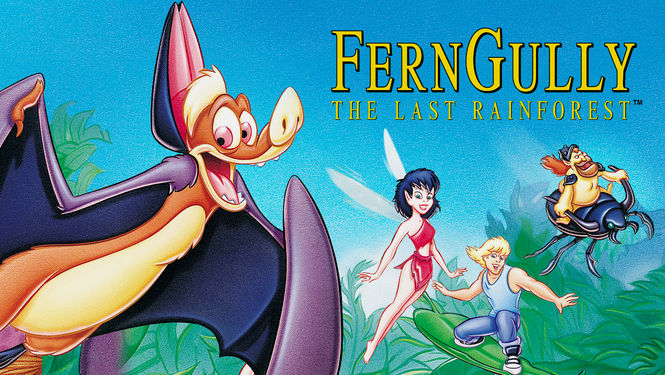
Yes, that tree-hugging animated feature from the early 1990’s was based on the forests of New Zealand. Both the Maori and the British settlers contributed to a massive deforestation of New Zealand. Estimated to have dropped from 80% to 50% under Maori stewardship and then to as low as 20% under British/Kiwi stewardship, the forests of New Zealand have been under attack for nearly 1000 years. Up until 1985 deforestation was actually encouraged and subsidized by the government. However, the Department of Conservation was finally established and now native forests are protected, making up to about 15% of the land, and a further 15% are replanted forests (some of which are still logged for timber, but at a sustainable growth rate that will continue to increase forestation over time).
As a side note, Batty Coda (the insane bat voiced by Robin Williams) represents the only native land mammal in New Zealand. All other land mammals presently there were imported for fur, meat or milk. The Maori people thought of bats as a type of bird that represented knowledge and wisdom and incorporated it into their tattoos. You can see lots of NZ plant life as well as other unique New Zealand creatures in the movie including the large gecko that tries to eat Zack and the cave full of glow worms that Crystal and Jack go to be romantic in.
Whether Kiwi attitudes toward logging and preservation were impacted by Fern Gully or not, conservation has now become a significant part of life and government in NZ. With care and attention, the beautiful forests and natural landscapes that I was privileged to travel through will exist and grow richer in the decades to come.

I hope this whets your appetite for more tales from New Zealand. I’ll be working diligently to get the rest of the posts up in the coming weeks. Thanks for reading 🙂
 Piha is a beach about an hour outside of the city of Auckland, but what makes it special is the sand: it’s black. Most beaches (and in fact most sand) is a kind of pale brownish, yellowish color, but a few places in the world get special treatment. I used to live in Panama City, FL which is famous for it’s white sand. It really is white, like a beach full of sugar. I’d heard of black sands in Hawaii, but still haven’t made it down there, so when I read about this black sand beach that was so conveniently on the way to my first “real” destination in New Zealand, I decided I had to leave Auckland early and make the detour over. This was a good call for two reasons. One, Auckland doesn’t actually have that much to do in the city itself, and two, I ended up with the perfect preview of all the beauty NZ would unfold for me in the coming days.
 This was my first glimpse of the crazy twisting roads that would mark every journey for the rest of my vacation. More than that, however, it was my first interaction with NZ flora. The drive made me feel like I was zooming back into a prehistoric age on earth. Familiar evergreens and less familiar variations of deciduous trees were mixed about with giant ferns and palms. Grasses grew in tufts taller than my car. The pictures don’t really do the forests justice because you just can’t see the enormous scale of these plants that makes you expect to see a triceratops around the next bend in the road. It didn’t take long before I got my first view of the ocean, either. The rugged coastline often included mountains and trees growing right down to the thin strip of sand marking the delineation of land and sea. The sea itself is crystal shades of blue and aquamarine, dotted with rocky islands or jutting peninsulas from further along the coastline. Because of the Queen’s Chain, the beaches remain undeveloped by private enterprise. Even right outside of Auckland, the beautiful, pristine coast just goes on and on.
 The road into Piha has a couple of look out spots to allow drivers to safely pull off the side of the road and take pictures of the view below. The area itself is not highly developed and consists of a car park, a few private structures (well off the beach), a surf shop, a cafe, and the public restrooms.
 black sand at Piha felt like nothing so much as having my feet caressed by bunny fur. The sand was black, but not the shade of black we think of in say, a new iPhone. It was blue and purple from some angles and soft grey from others. There was also some invading tan sand that rested on top, being lighter and coarser, which created interesting effects in the wind and tide as the lighter sand was pulled into patterns above the darker black sand.
  I soon noticed a line of shells along the beach, a tide line of sorts, but instead of seaweed and drift wood it was mainly composed of tiny white spiral shells. The shells were perfect miniature spirals and so delicate, they broke under the slightest pressure (two I took from the beach did not survive). Their former inhabitants had no doubt been dinner to some of the local sea birds, but the fact that the birds had managed to extract their meals without damaging the fragile shells by the dozens was impressive.
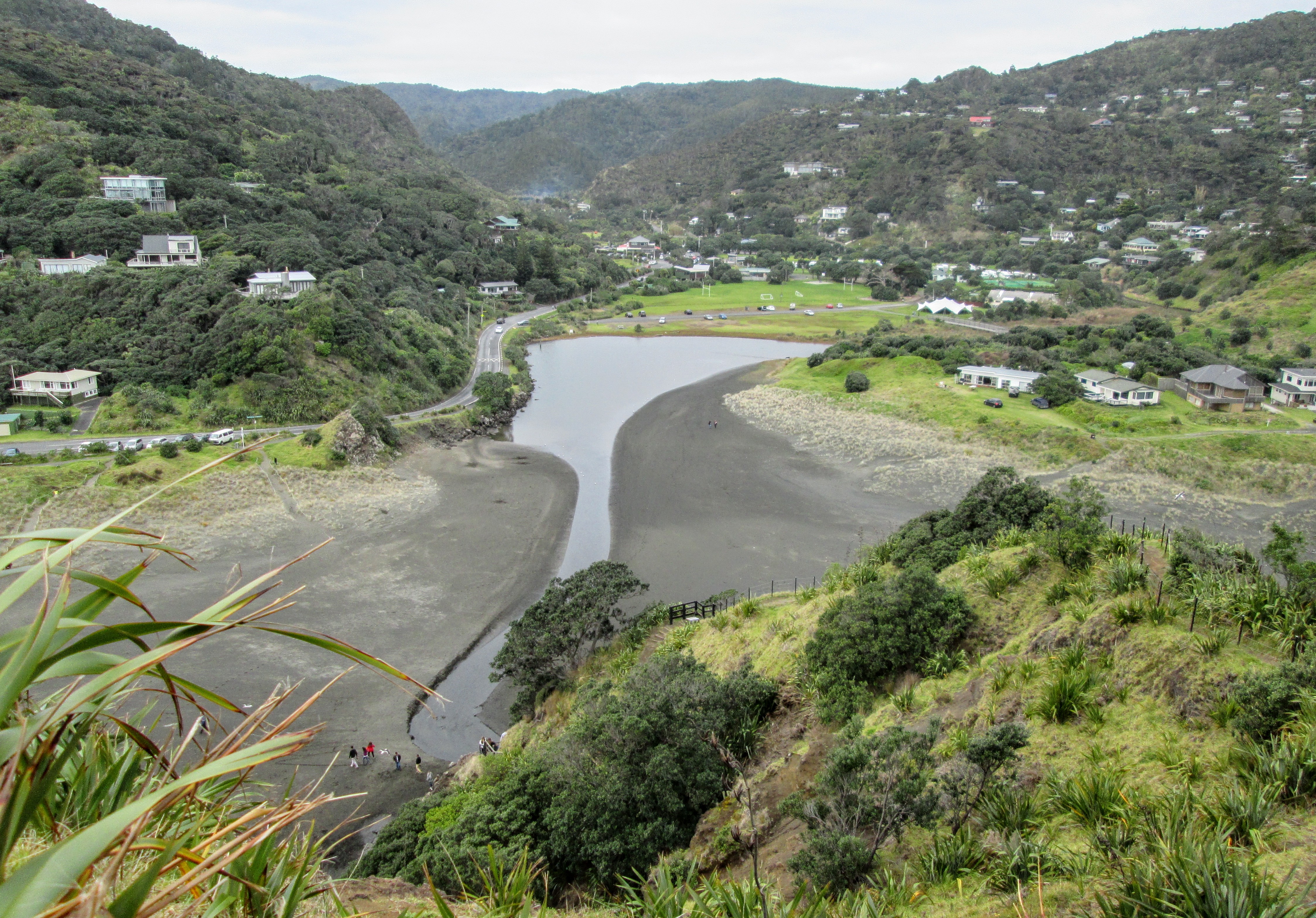 Closer to the stream and the rock, I noticed there were people climbing on it, but I thought to myself, “that looks like a very steep climb, maybe I’ll just enjoy the beach”. I found the lake that the stream was coming from and a larger collection of what looked like private homes up in the foothills further back from the shore.
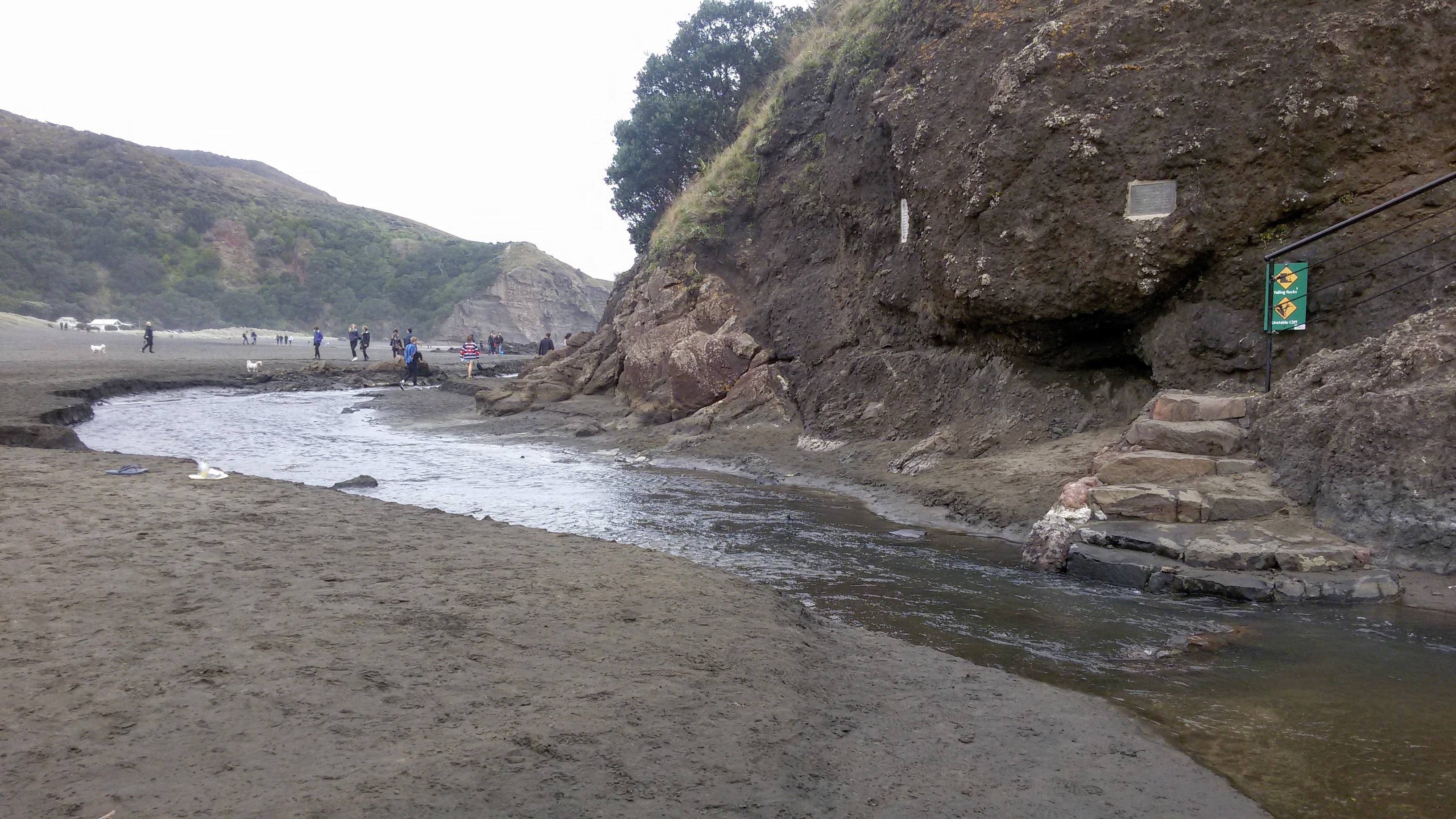 As I rolled up my pants to wade across the stream and explore the other cove, I noticed the base of the stairs that led up Lion Rock. “Perhaps just a few steps up, up to that platform there to get a better view?”, I thought. There must be something strangely wired in my brain because for all that I dislike climbing, I *love* being on top of high places. After I reached that first break in the stairs and took some pictures, I noticed there was another platform looking the other way, so I had to climb to that of course, and soon people coming down were telling me I was more than halfway there, so why not keep going? Next thing I knew, I was as high as the path goes, admiring the not-quite totem pole and the stunning
  view. I hung around the top taking pictures and chatting with other climbers, one of whom took quite possibly my favorite picture of me on the whole trip sitting on the edge staring out at the sea and sand below me.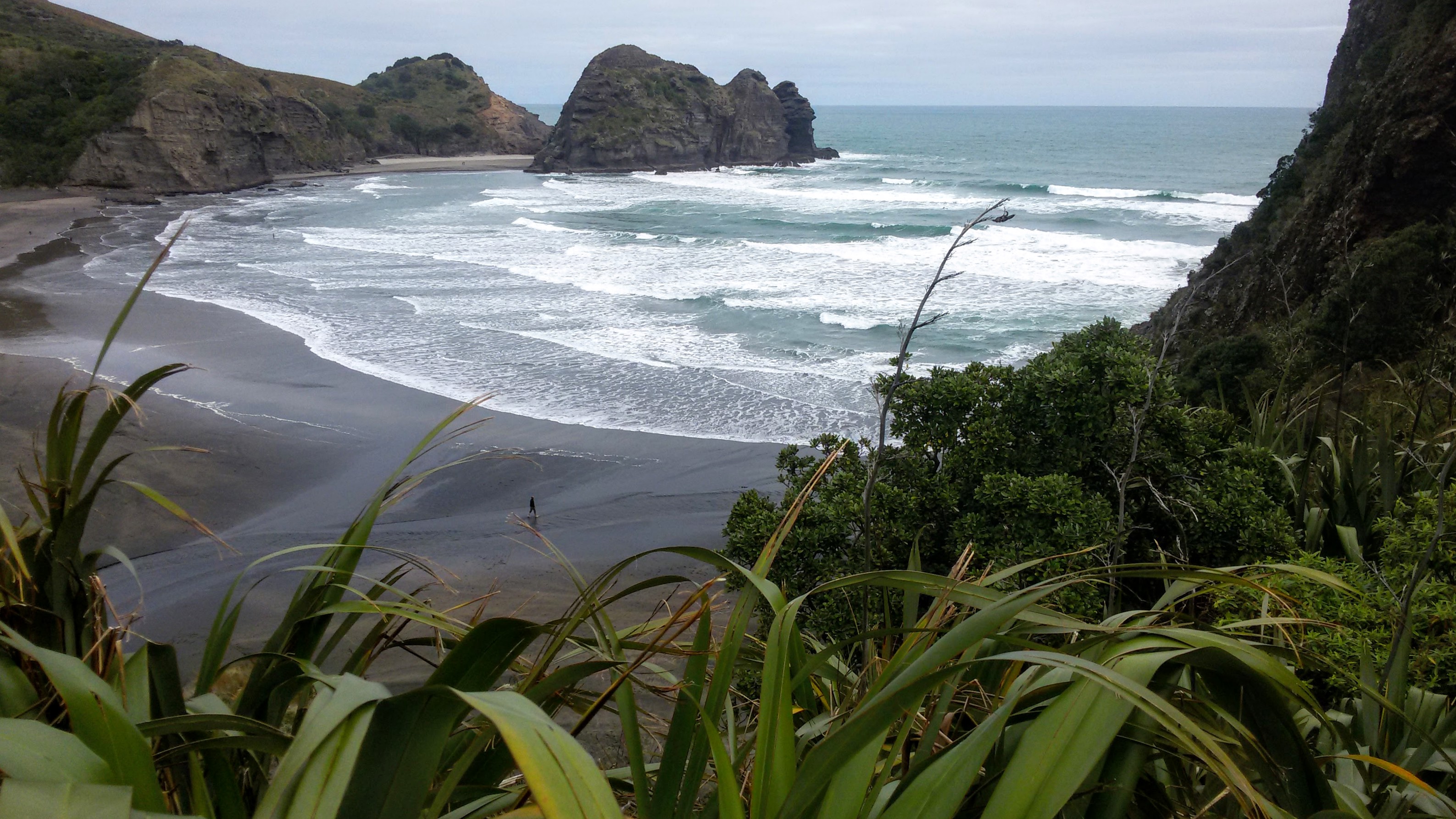




 Gallivantrix