Trauma and Recovery, Judith Lewis Herman

I’m Mad as Hell, and I’m not Gonna Take It Anymore!

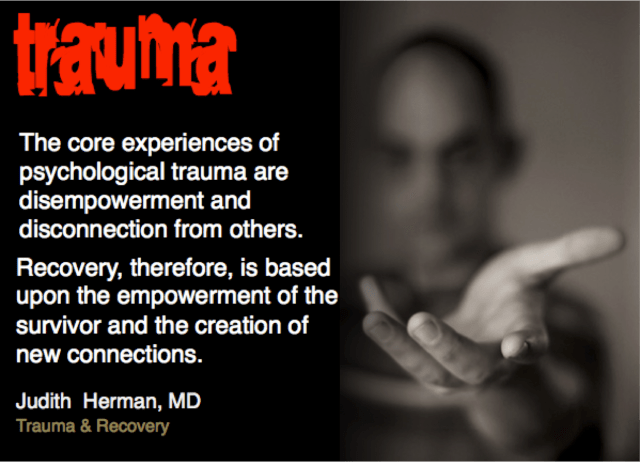
This book made me angry. Like, really angry. Not because it’s a bad book, on the contrary, it’s excellent. It just revealed a lot about our culture and society that infuriated me. This may be the OG source of the “C” in CPTSD, so props to Dr. Herman, but her main point is the rise and fall of realizing as a society that we f*ck over women, children, and powerless minorities inducing horrible trauma, and then we (again as a society) balk at horror of the reality of HOW MANY people are traumatized, abused, raped, assaulted, and systematically wrecked by status quo systems of power and authority and we then collectively decide it can’t actually be that bad, or that maybe it was that bad, but it’s better now, and we don’ have to think about it or look at it ever again. And that we have been doing it every few decades for at least 150 years. She somewhat optimistically follows this dire assessment with the cheerful notion that now we’re having a resurgence in awareness and it’s so good, so maybe we’ll learn something this time… only the book was published in 1992. So she was writing about the collective recognize-outrage-token-change-forget cycle in 1990-91 hoping it might be the last time, and I was reading it in 2020, in the wake of the 2017-8 version of #metoo and #blm (those are older than you think, too) going, “are you f@cking kidding me?! how long have we been doing this bullsh!t?”

She talked about how Freud, Mr. All-Girls-Want-To-Fuck-Their-Daddies-And-Rape-Isn’t-A-Thing-Cause-They-Secretly-Want-It-Freud actually wasn’t a total dickhead when he started. Originally, he worked with a bunch of “hysterical” young women (whoo boy howdy and that is a can of worms because the way those ladies were treated *before* him was even worse! seriously, just read the book). He tried the radical approach of (gasp!) actually talking to the women, an approach no doctor ever tried before. Said ladies revealed a lot of details of abuse and incest, which led Freud originally to begin to crack open the lid on trauma as a cause of both mental and physical ailments, but then he basically went, oh, wait, there’s no way that SO many respected, rich, men are doing this to their daughters and nieces, so they must be seducing these men! *gag*. Some sources imply the decision to change his mind came as a result of serious pressure from the gentlemen in his community. Either way, he recanted and we’re still dealing with that consequence nearly 2 centuries later.

She outlines historical occurrences where we (humans) start to realize what’s going on and then back away in fear and horror from Freud to the 1992 version of #metoo, which I vaguely associate with Grrl Power and Lilith Fair, and angrily singing Alanis Morrissette at the top of my lungs, but no real “movement” and certainly no substantive change. She doesn’t focus only on women or sexual abuse, but also men and the trauma of war. Over and over we’ve come close to understanding combat trauma only to turn away and reject it again. (the details of this cycle are more deeply covered by Van der Kolk in The Body Keeps the Score). Whether it’s sexual assault, domestic violence, street gangs, or war – the people who are hurt over and over are the young: children and young adults. She calls it “the adult conspiracy of violence” and it is a concept that fills me with rage.

The Adult Conspiracy of Violence:

Obviously it’s not a conspiracy in the sense that all the adults got together and decided to do this. It’s more like a set of unspoken and unbreakable rules. I suspect that Herman uses the word “conspiracy” to describe this phenomenon because although no organization exists, most adults are more aware of the violence than they are willing to acknowledge, and few are willing to break those unwritten rules. In my own understanding, it is the cycle in which every generation is abused and traumatized then goes on to grow up and fall into one of 4 categories (although fluidly and on a spectrum):
1) suppress what happened and live in denial
2) recognize what happened to them, but think that it a) is very rare b) doesn’t happen anymore
3) are angry about what happened to them and think everyone should suffer like they did
4) are greedy dickheads who don’t care who they have to hurt to get what they want

As a result, the next generation is subjected to just as much horror, abuse, and trauma by 3&4 while receiving zero support from the 1&2 adults around them who simply refuse to see it. I am infuriated because now that I’m “an adult” I can see it, I can see the whole cycle and the whole “conspiracy”, I can see it and I have no idea how to protect the kids from it. I have a niece and a nephew, I have friends with kids, I have students… I want to find a way to blow the lid off this thing, make a blockbuster movie, get a Greta Thunberg to stage a national school walk out in protest of violence against children, to make a giant statue you can see from space and paint it in Pinkest Pink and Vantablack so everyone has to go “why?” and we can explain the adult conspiracy of violence.

Note 2022: I’ve found that Alice Miller discusses this a lot as well in the two books of hers that I’ve read: The Drama of the Gifted Child, and For Your Own Good. Other authors discuss the effects of this cycle of trauma, but few delve deep into it’s roots as Miller and Herman do.

A good solid part of why this book made me angry is because in 1992 I was 14. I was already well down the path of being consumed by the adult conspiracy of violence. When this book was published, and this information was in the public eye, it did not find me. It did not find my friends, my sister. It faded from view and it’s wisdom was of no help to me in understanding or processing any of the things that happened to me as a child, a teen, and a young adult — when at various times I was neglected, abused, raped and my friends and family refused to see what was done to me. When instead they joined the conspiracy of silence and denial and told me it was nothing: you’re making it up, you’re exaggerating, it was your fault anyway, you must have wanted it, buyers remorse, be grateful anyone wants you that way, you weren’t really hurt, you have it so good, that never happened, I don’t remember it that way, look at how bad it could have been, be grateful it wasn’t worse, be happy, be silent.

She tried to reach people at a time it could have made a real difference in the course of my life, but it didn’t reach anyone close enough to reach me. I can’t help but think of all the 14 year-olds out there who need to hear this, who need to know about the Adult Conspiracy of Violence and be shown a way out.

There may be a fifth category that didn’t have a large enough footprint for Herman to write about 30 years ago: the cycle breakers. I see it more and more online in memes and YouTubes and blogs. The more young adults are normalizing therapy and seeking healing for past trauma, the more they want to break the cycle of intergenerational trauma and abuse. Only time will tell if this movement can truly challenge the Adult Conspiracy of Violence or if it is just another peak in the recognize-outrage-token-change-forget cycle.

Post Trauma Fantasies: False Healing

Aside from the above cycle of violence and suppression, the book had a lot of information that was in line with what I’d already read and served mainly as reinforcement. There was one other stand out concept in this book which was the addition of more types of post-trauma fantasies. I was already whammied by the Healing Fantasy that Dr. Gibson introduced me to in Adult Children of Emotionally Immature Parents, so I was intrigued by the idea that there were more. Dr. Herman talks about the Revenge Fantasy, the Forgiveness Fantasy, and the Compensation Fantasy. Being able to further recognize some of my thinking as fantasy was both hard to hear and somewhat reassuring. It was like being given permission to let those thoughts go.

The Healing Fantasy is the idea that you can make it all better if you just do the right thing. If you can heal enough for both of you, or if you stop doing whatever it is that makes them mad or sad or cold, if you can teach them to be more self-aware, if you can help them heal from their own pain so they stop allowing their own trauma responses to result in abusive or toxic behavior, whatever it is, you take on the responsibility of healing THIER trauma in hopes that it will get them to stop hurting you. Gibson says it’s the idea “that more self-sacrifice and emotional work will eventually transform their unsatisfying relationships” and that the “healing fantasy always involves the idea: It’s up to me to fix this”. If I just find the magic feather, then everything will be ok.

The Revenge Fantasy is where the American justice system and every Spawn fan live. The idea is that by taking revenge on the person or people who caused pain, that the scales will be balanced, the perpetrator will be filled with shame and remorse for their wrongdoings, and your pain will go away. That last part is the key fantasy part. Making someone else hurt doesn’t heal your own pain. On an individual basis, this can lead to a lot of anger and rage, since the fantasies themselves are often violent. On a cultural level, it results in people who are happy to imagine prison rape or delight in police brutality for “those that deserve it”. The preference to punish rather than reform, to see people suffer rather than receive help is, I believe, at the core of the rot in America’s criminal justice system, and as far as I can tell, it comes from a widespread indulgence in the Revenge Fantasy.

The Forgiveness Fantasy is the church route (any church/spirituality), if you let go of your anger and forgive the person who hurt you, then your pain will go away. Forgiveness may or may not be a part of your healing journey, but it’s definitely not the only thing. Forgiving a person without making any other changes will simply result in the pain getting shoved further down, where it will continue to harm you. In many of the forgiveness-fantasy cultures, you are expected to forgive a person who doesn’t apologize or change, and are often blamed/shamed for being unable or unwilling to do so. Some people who cling to this fantasy will also use the continued existence of the pain to prove that you haven’t “really forgiven” your abuser, shifting the blame for your own pain onto your “unwillingness” to forgive.

In another type of forgiveness fantasy you dream you can get the other person, your abuser or toxic partner, to understand what they did is actually hurting you, and then when they understand it, they will apologize and want to change! After all, people who love you don’t hurt you on purpose, an will totally stop when you say ouch. Healthy people and people who are trying to get healthy totally will, but Spoiler Alert: toxic people and abusers will never stop, and any apology they offer is just to get you to stay. I had fallen into trap this many many times before learning about it, and I now know the importance of letting this particular fantasy go.

I’ve also seen a large number of memes and tweets about cutting out toxic people that strike me as woefully unnuanced. Not everyone who hurts you is toxic/abusive, so how do you know when to give someone the chop? To me, the difference between a toxic person and a toxic behavior is the way they approach healing. Every traumatized person has toxic behaviors at some point, but only those who are willing to do the deep work of self reflection and healing will be willing to admit it and work to change. It’s important to communicate when we are hurt. Relationships of all kinds are strengthened by good communication and successful conflict resolution, but there also comes a time when the healing process becomes the Healing Fantasy and we have to let go. Dr. Gibson addresses this in her book, and I also found Conflict Is Not Abuse, by Sarah Schulman has a lot of good advice on how to identify and deal with the distinction between being hurt and being abused.

The Compensation Fantasy was the hardest for me. This says that you deserve good things in life for what you have suffered, that if you get those good things it makes up for the bad things. I realized in one terrible epiphany that I had been holding up my joy as the compensation for all terrible things I’d gone though. In 2012-14 I went through a round of therapy research and practice that focused on positive psychology, and centered around the works of Brené Brown and Martin Seligman. I learned how to be happy, like, really happy, not just wine-mommy happy. Then, it was somehow ok that I had suffered so much, because I had so much joy! The sudden removal of everything that brought me joy due to a global pandemic made me crash very hard. The pandemic had not merely deprived me of some fun trips, or a fulfilling career, it had taken away what I was owed for my pain. Obviously, that’s not true, and now I can work experiencing joy for it’s own sake and not as a trade off for pain.

30 years later

This is a great book that didn’t make it into my top 5 but is definitely in my top 10. Despite being 30 years old, it still has a lot of useful and important information, however it’s no longer the only source for such. I recommend this for older readers (who remember the 90s), for younger people who are interested in the history or may be trying to understand a parent (older relative), and for anyone who is doing a deep dive into their own Trauma and Recovery.
A Trip Inside: Where I Went in 2020 (1/?)

TW: sexual assault, abuse. There are NO graphic details, but I don’t want to take anyone by surprise. I hope that those of you who are able will take the time to read this, and those of you who feel you are not will get help with your own trauma soonest. You deserve to heal, too.

In early 2018 I experienced a(nother) sexual assault. I talked about it to some friends, and I pushed it away so I could start my new job. I thought I was going to be ok. Then, in late 2018 and into 2019 I began to experience panic attacks. I didn’t recognize them as panic attacks at first. They didn’t present like the typical media depiction of a panic attack. I didn’t even see it as a pattern until the third one. When I started to try to understand what was happening to me, I discovered the role of the amygdala in panic attacks including it’s tendency to shut down the prefrontal cortex (the part of your brain where all your thinking lives). I began to understand that I was experiencing an amygdala hijacking of my brain. I tried a few things to help like grounding and meditation exercises, but what I really needed to do was find out what was causing (and triggering) my panic attacks.

I thought seriously about the events that preceded each one and I discovered that it was happening in response to a feeling of having my clearly stated boundaries ignored and trespassed or of feeling trapped in a painful situation with no escape or relief. I thought more about where this was coming from. Where was it rooted? Triggers are events that involuntarily force us to relive past traumatic events, they aren’t the cause of the feeling, merely the catalyst. I realized that I hadn’t properly dealt with the trauma of my assault. Then in working toward a healing process, I uncovered a larger pile of unprocessed trauma relating to previous assaults and an abusive relationship. Although I had spent some time on each of these, I had never finished processing them, and they still had hooks deep in my subconscious, controlling my involuntary fear response and amygdala hijacking.

In 2019, while trying to work through some ongoing conflict with my mother, her behavior induced another panic attack. In the months that followed, I realized (with much pain) that she was unwilling to take any ownership of her role in our conflict and I imposed a cessation of communication with terms. In simpler language: Because she was unable and unwilling to even try to find a mutual solution, I had to stop talking to her until such a time that she would be willing to engage in healing work. As of this post, she has declined to make the effort. I’m not going to go through all the horrible things. You can think I’m a “bad daughter” or that she is a “bad mother”, but reality is rarely that cut and dry. In the present, I can see that we are two hurt people who (without understanding) sometimes have allowed and still allow our pain to cause us to hurt others. The nature of our relationship has changed from parent – dependent child to parent – adult child, which could allow us to examine, understand, and heal if we both work at it. I am working on that in myself, but I can no longer engage with her until she is willing to do the same. I also have to accept that day may never come, and that I have no control over it.

The upshot/side effect of all this is that I was working hard to understand myself, the origin of my trauma and how it was impacting my quality of life and treatment of others by the end of 2019. The advent of Covid-19 and it’s isolating effects have given me a lot of time to read and think. Along the way I have come to understand that it was not only the traumas of assault and abuse I experienced as an adult that were hanging around my neck, but also those of my childhood. I’ve learned a lot about trauma: causes and responses, PTSD/CPTSD, conflict, abuse, toxic behavior, misplaced blame, blame vs responsibility, shame vs understanding, and hopefully … healing. I am by no means finished, but this has been the journey of my last year, and as this is the place I share my travels, I thought I’d write this one too.

I’d like to share a list of the books that have helped me so far, along with a short description of the main ideas each one brought to me. I highly recommend and and all of these book to everyone because even if you yourself are lucky enough to have no trauma, I guarantee you that someone you love is carrying their past around in painful ways, and understanding them may help you both.

(caveat, I read A LOT, and my brain operates on an “absorb information until critical mass causes transmutation of thought” principle, so some of the things that I’ve been thinking/working on are a result of all the things I’ve read, including the 2019 long list of history books, any number of random TED Talks, and the ongoing sci-fi fantasy background reads. I can’t possibly include them all, so this list is very focused on books which I think of as “breakthrough books”)

Educated, Tara Westover

I did not seek this book for help with my trauma. It was recommended by a friend, and since I’m a teacher, I thought that it was about … education. It turns out to be autobiography of a young woman who was raised in a closed off, survivalist minded, fanatically religious family and her process of waking up to what was happening to her. There’s a lot of baggage that gets shoved onto this. When you read the synopsis or reviews you see a lot of focus on the physical abuse (present but not a dominant theme), or on the nature of the religion itself (Mormonism, but also going to Brigham Young University is what helps her), or the “crazy” things her parents believe. A lot of people react with “how could she not know?” and shut it down, preferring to believe that she is lying or exaggerating or anything other than the idea that an intelligent, well loved, and compassionate person might be unable to recognize abuse when they are stewing in it.

When I read it, I was also curious how she could not know, but instead of dismissing that possibility I tried to actually understand the answer. I knew already going into this book that I had been unable to recognize my “bad” relationship as real abuse until a couple years after I was out, some legal battles, and some therapy. I experienced a lot of shame about it, but I’ve come to realize that it’s actually terrifyingly common for intelligent educated people to become trapped in abusive situations. In Tara’s case, it wasn’t the few instances of physical abuse from her brother, or the content of her father’s beliefs that were the real problem. It was the gaslighting, the control, the neglect and the failure to protect.

I was told my whole life what “abuse” looked like and I had been wrong about it in a romantic relationship. Reading Tara’s experience, I knew that the details that happened to us were different, but I began to realize the feelings we had were eerily similar and maybe I needed to take a good hard look at my upbringing. The fact that I was several months into not speaking to my own mother, and many years into an uncomfortable estrangement with my father at the time this book compelled me to have this thought is just more evidence and how good we humans can be at justifying, ignoring, or minimizing the damage caused to us by those we love and who are supposed to love us.

I was unprepared to think about my parents in terms of “abuse”, but I was willing to explore the idea that they had unintentionally damaged me due to their own psychological issues. I was (am) still suffering pretty hard from a pile of trauma related symptoms, and the only way to get at those is to find the roots. I wanted to start trying to understand what had happened to me and how it was affecting my adult life, and I wanted to find some tools to help me communicate with my parents and finally get a healthy, meaningful, and fulfilling adult relationship with one or both of them. This seemed like a good book for that.

The book itself doesn’t focus on what is or isn’t “abuse” which I think was helpful for me where I was. Instead it talks about behaviors that can cause painful feelings and lasting behavioral problems, how to recognize them, how to heal from them, and even how to cope if you are stuck in a situation where you can’t avoid or reconcile with the parent(s) in question. It very much confirmed for me that many of the feelings and thoughts I have that I find damaging are directly connected to my parent’s behavior.

People get hung up on the idea that if you had your needs met, and weren’t being beaten or regularly shouted at/called names, or (worst case) sexually abused as a child, then you are FINE and STOP WHINING. Of course those thing are terrible, and the children who experience them most likely have varying degrees of lasting trauma, and they have very valid feelings of anger. I felt a lot of conflict about coming from a middle class family that provided for me, even above and beyond my basic needs in terms of food, shelter, education, healthcare, and opportunities for creative and intellectual outlet, yet still feeling like there was something wrong, something so bad that it was a dark painful secret I could never talk about, never tell anyone I was hurt from.

This book gave me permission for the first time to acknowledge that what happened was NOT OK. That I (and every child) deserved better. That my feelings were valid, and that my trauma was real. That there are things which happen when a child is totally dependent upon one or two adults for everything in life that do not fit the current social understanding of abuse, and yet do comparable lasting damage which can even be measured with an MRI, or even worse damage because the survivors don’t feel like they can ever get support for their experiences and feelings or even be able to acknowledge the root cause of their pain in later life.

There’s a lot of useful stuff in this book, but one more thing that really dinged for me was the idea of the Healing Fantasy. Dr. Gibson gives some advice on how to interact with such parents after we become adults, and most of it is “avoid/minimize contact”. I really did not want to hear that. I wanted to find a solution. I wanted to fix my relationship with my mother. I missed her and desperately wanted to restore a loving relationship. I needed to know what I could do or say to reach her, to help her, to make things better, and Lindsay told me that I had to let that go.

She told me about the Healing Fantasy: “In addition, [some adult children of emotionally immature parents] are secretly convinced that more self-sacrifice and emotional work will eventually transform their unsatisfying relationships. So the greater the difficulties, the more they try. If this seems illogical, remember that these healing fantasies are based on a child’s ideas about how to make things better. … Their healing fantasy always involves the idea ‘It’s up to me to fix this’. What they can’t see is that they’ve taken on a job nobody has ever pulled off: changing people who aren’t seeking to change themselves.”

There was a lot more on the Healing Fantasy, but this was dead on ME, and the book really made me own the fact that I cannot be responsible for healing my mother, or my father for that matter, because they both insist they do not need to change in any way. I cried a lot. I went through a very real grieving process, I had dreams about my mother the way I have done in the past when someone I love has died, but instead of nice conversations and happy times, these were dreams of my mother behaving as she always has, as I now recognized as unacceptable and damaging, and me standing up to it over and over until I wrenched myself awake as if from a nightmare. I suppose it was. I am pretty sure I’ve gone through all the stages of grief about this multiple times (the acceptance doesn’t reliably stick either). It’s slowly getting better, and I couldn’t have started the rest of my healing journey without the “ah hah” moment offered by this book.

Definition of CPTSD as paraphrased from the book:
a more severe form of PTSD, different from PTSD in 5 main features: emotional flashbacks, toxic shame, self abandonment, a vicious inner critic, and social anxiety.

I stopped writing and went back to read this again because it’s just that good. The main things that I got from this book the first time around were the “four Fs” and “emotional flashbacks”. The second time through felt like a deeper layer, a more nuanced understanding. The basic ideas were no longer a shock, I wasn’t fighting against certain healing concepts anymore the way I had been last year. I don’t know if I’ll reread it every year, but I think it should probably go in a not more than 5 year rotation.

The Four Fs are an expansion on the “fight/flight” premise. All humans (and really most animals) have a response to fear or attack known as “fight/flight”, but more extensive study reveals there are 2 more options: freeze and fawn. Most people are familiar with freeze as “a deer in the headlights”, and fawn is when the being feeling in danger sucks up to a bigger stronger threat to placate it or gain protection, perhaps an example in nature can be seen in dogs who grovel to bigger dogs or their owners when they are being scolded. These 4 Fs can manifest in a LOT of ways in humans that are not super obvious, like fight doesn’t have to mean yelling, screaming, punching walls (although it can). It also manifests as narcissism, passive aggression, and controlling manipulation. Flight may look like perfectionism, workaholism, or OCD. Freeze can be lethargy, daydreaming, reading/playing videogames, or even dissociation. Finally, fawn can look like caretaking, people pleasing, co-dependency, or never expressing one’s own opinions/needs. There’s a longer explanation on his website:
http://pete-walker.com/fourFs_TraumaTypologyComplexPTSD.htm

Walker says that every traumatized person is likely to have one dominant trauma response trait, and one secondary. We can all end up using any of the four depending on the situation, and there are HEALTHY manifestations of all 4 as well, but the book focuses on how they manifest in unhealthy ways and cause us lifelong mental and emotional health issues. I personally recognized the freeze behavior in myself in another “get out of my mind’ moment. The author self identifies as a flight type and I wasn’t really feeling any connection to what he was saying. Then he started describing freezers, and I was like, excuse me but you don’t have to call me out like that! It’s still hard, but now I can see what has been happening to me for so long, I can start to make sense of it and to notice it when it happens in the present. My dissociative episodes were incredibly strong when I was a child and teen, to the point that I drifted well away from reality, even having hallucinations and fantastical delusions. I was petrified of going to a doctor because I knew in my very bones that my mother would use any diagnosis to control me forever, and I’d never be free. The farther away from her I got, the more grounded in reality I became, but I’m still missing huge chunks of my memory both from my time in her home, and my time in my abusive relationship because my “freeze” nature caused me to simply check out from as much as I possibly could.

The other huge lighting bolt moment of this book was the revelation of the emotional flashback. Just like soldiers with PTSD have flashbacks to the war, CPTSD sufferers can also have flashbacks. However, where PTSD flashbacks tend to incorporate a visual element (sufferers report being able to see/smell/hear as though they were back in the moment of trauma), CPTSD emotional flashbacks do not have any context. They’re all emotion, no visual cue. It can be impossible to identify what is happening because you simply start to feel a strong and terrible emotion. We often end up linking it to whatever or whoever is triggering that flashback, but it’s not the case. A trigger causes a flashback, causes a (C)PTSD sufferer to relive a past trauma. It happens in the “experiencing” part of the brain instead of the “remembering” part of the brain, so it feels like it is happening right now. So when we feel a strong negative emotion, it can be very easy to say that it was caused by whatever just happened in the present. But the present action is merely the trigger.

I’ve found that some of my triggers are things that will never be “ok” behavior, like “don’t violate my consent”. Someone who ignores my “no” and keeps going is never in the right, but my flashback will cause me to have a disproportionate emotional response that may result in a laundry list of symptoms and could take days to resolve. Other triggers are behaviors that are genuinely innocent in most people but were at one point weaponized against me by an abuser. These are much harder because the person in the present didn’t do anything wrong, but I’m suddenly having a full amygdala hijacking. The thing is, realizing that my feelings, my fear, anger, suicidal ideation, and my inner & outer critic were all results of an emotional flashback and NOT based on real present dangers or attacks was mind-blowing.

In addition, Walker provides a very helpful 13 step list on how to handle an emotional flashback when you realize you’re in one: http://pete-walker.com/13StepsManageFlashbacks.htm

I can’t recommend this book enough. The author is deeply compassionate in his explanations. He offers vulnerability of his own experience, as well as case studies, and references from other psychiatrists whose work focuses on trauma and recovery. There is so much more here like understanding how emotional neglect causes CPTSD, how CPTSD causes us to minimize or deny our own damage if it wasn’t “as bad as” some others, how anger and crying can be used for good, and how we can manage day to day the long process of coping and healing with an appendix full of tool kits.

Please stay tuned for part 2 and more excellent books.

If you are feeling upset, anxious, or find yourself retreating into a trauma response or emotional flashback, please follow Pete Walker’s 13 steps, practice a 5-4-3-2-1 grounding activity, a parasympathetic breathing activity, or other soothing action such as a hot shower, a hug from a trusted person, or a few episodes of your favorite feel good cartoon. Mine is Steven Universe.