How to make a ten day vacation last 6 months? Write a blog! With one week left before my Malay Peninsula holiday, I’m finally publishing the last of my adventures in the Land of the Long White Cloud. There are several smaller adventures that I enjoyed around New Zealand that didn’t make it into their own full post, so I have assembled them here along with the story of my last day in New Zealand. Odds: Onehunga & Shopping (Auckland), Kuirau Park & Wai-o-tapu Geothermal Wonderland (Rotorua), Narnia (Whangarei), Stargazing (Waitomo). Ends: Planetarium & Cornwall Park, a farewell to Aotearoa.
Onehunga, Auckland: Cute Shopping & Best Bacon Ever
I wanted to try to find some items that are rare/impossible to find in Korea, so I decided to check out the premier outlet shopping center on my first morning in NZ before leaving civilization. The Dress Smart outlet is in Onehunga, so I set my GPS a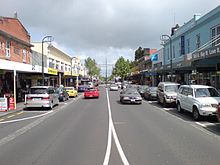 nd headed over early so I could snag a parking spot and some breakfast before the shops opened. In the States, Outlet malls are often far from the cities or even the suburban sprawl and exist as sort of concrete islands in what is otherwise quite unattractive farmland. Imagine my surprise when the GPS led me to an adorable little neighborhood, streets lined with tiny cafes, boutiques and thrift stores. Onehunga is adorable.
I parked the car and wandered over to find breakfast where I discovered New Zealand bacon for the first time. I’m familiar with US style bacon (cured belly meat, thinly sliced), and what we call “Canadian” bacon (from the pork loin, more like cured ham), but this was the first time I had ever been served this unique blend. “Middle bacon” served in NZ and Australia comes from a middle area of the pig so as to include some of the back (common in English bacon), some of the loin (Canadian) AND some of the belly fat (American), so it’s basically the best of all bacony worlds 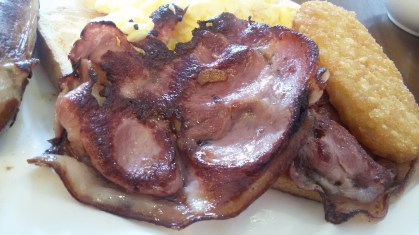 combined and explains why it both looks and tastes like US bacon and Canadian bacon were fused together in some kind of mad-biology experiment went right. If you are a bacon fan and you are unable to get yourself down under, I highly recommend making friends with a butcher to see if you can persuade them to sell you some of this stuff.
After breakfast I walked back to explore the mall. Although I didn’t end up buying much, it did give me a really good idea of the types of shops and clothing that are available and popular in NZ. Shoes are clearly the most expensive basic clothing item in NZ. It’s interesting to see what’s expensive and cheap from place to place. The Converse outlet store was selling hightops (my preferred shoe) for 100NZD (about 73USD). I can buy the same shoe on the website for 55USD. I also looked for some better weatherproof shoes for my journey through the bush (and I plan on doing more hiking in Korea when the weather cools off), but there just weren’t any shoes that came close to being an improvement on my Chucks that were less than 200$… at the outlet mall!
Conclusion: Onehunga is adorable and worth the visit. Dress Smart is probably best for shoppers who are looking for nicer clothes and not so much camping/hiking gear.
Whangarei: Breakfast in Narnia
Whangarei was a quick stop over between Bay of Islands and the Coromandel Peninsula where I planned to check out the Waipu Caves and the Whangarei Waterfall. I got one more fun surprise there when I set out to find breakfast. This trip wasn’t really about food, but I couldn’t resist the opportunity to visit a place calling itself Narnia.

It turned out to be a simple cafe with a standard range of NZ cafe food. This is much superior to US cafe food and may include things like Eggs Benedict, or smoked salmon omelettes. The portions are generous, the food is fresh and often free range, and it tastes as good as a promo picture looks.  There were of course posters of the Narnia movies and copies of the books around the place, and some artwork on the walls by local artists. It wasn’t until my meal was finished and I went to find the restroom that I stumbled upon the most Narnian feature of the cafe. The back seating area (and restrooms) were through a hallway that had been hung on either side with fur coats so that you had to push past them in order to enter. It was very subtle, because even though I had seen things hanging in the hallway, I had not really realized what it was until I felt the fur on my hands as I pushed my way through to the other room. The strange and sudden realization that the otherwise very ordinary cafe had worked in a hidden-in-plain-sight magic wardrobe made my whole breakfast even better.
Rotorua: Kuirau Park & Wai-o-Tapu
 While I was in Rotorua, I had planned to take a lazy walk around the Saturday Market and Kuirau Park (a free park that has geothermal activity). The market was a cute little local flea market kind of affair with folks selling used clothes and books, antique jewelry and dishes, and a whole lotta food stalls selling Kiwi and Maori foods. I had been hoping for more handmade goods, but it was still fun to wander around and I picked up my souvenir gifts there from the one handmade stand I found: a lady who made skin balm from the native medicinal kawakawa plant.
 Kuirau park is interesting. It’s got lots of mud pools and a hot lake that are all gated off to keep kids or drunks from wandering into them. It also has public foot baths using the thermal waters so people can come by and have a nice warm foot soak. I suspect the park is nicer in any season besides winter because there are a lot of trees and flowerbeds as well that were bare, and what looked like fountains that were turned off for the season. However, it’s free, so I do recommend at least stopping by if you’re in Rotorua, especially if you’re thinking of doing other geothermal parks. Several other blogs I read recommended this as an alternative to Hell’s Gate unless the mud bath is on your bucket list.
Wai-o-Tapu, Geothermal Wonderland
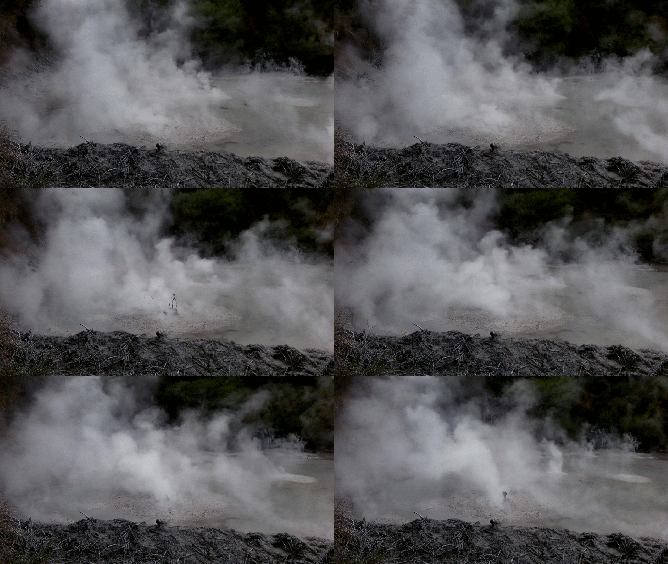 Wai means “water” and tapu means “sacred”. This area is known in Maori as the sacred waters. In addition to the free hot springs, there is also a free to view mud pool and gyser (the Lady Knox). The only pay to play activity is the colorful geothermal park. In fact, it is the most colorful in Rotorua and in my view, ranks up there with Yellowstone. Most of Rotorua is shades of gray and brown (mud), but I’d seen some stunning photos of Champagne Lake and decided it was worth the 23$US to check it out.
Waiotapu has 3 trails that cover multiple types of geothermal activity. I found the shortest trail to be the least interesting because the craters are just large holes in the ground. The outer trails are where the magic happens, so don’t get discouraged. Go all the way around the park. The map says it’s 75 minutes to walk all three trails, but if you stop to admire the view and take photos it’s quite a bit longer, 3 hrs in my case. The park is so colorful because the various mineral deposits along with resident bacteria create a stunning palette. Unlike the considerably more neutrally toned hot springs I was soaking up the day before, the mud and waters in the park here can reach boiling temperatures (100C/212F) so don’t think about dipping your toes in!

The walk starts with a series of craters that can display different shades based on the mineral content of the gases escaping, but the first exciting view comes in at stop #5: the Artist’s Palette. This stunning body of water does indeed look like a giant paint palette with different colors scattered around. It is followed by a series of soft jade colored pools and above ground mineral deposit formations. It’s hard enough to describe these and not entirely effective to capture them in photographs. There are shades of blue and green that are almost milky or opalescent. There are bright splashes of sulfur yellow and dark inky black mini-pools. Some of the pools are still, but others bubble with heat and escaping gases. The ground formations look like they belong in caves but are out in the open, creating textures and color delights that range from the tiny few cm across to the large petrified waterfall.
The third part of the trail leads steeply upward through a forested area. There are lovely vistas of the colored pools, and if you’re willing to make the extra hike all the way out to the Lake Ngakoro Vista, you will be rewarded with a stunning panorama and a long distance view of Mt. Doom (Ngauruhoe). I have to admit, realizing my whole hot spring adventure was “in the shadow of Mt. Doom” made my inner geek girl squee and I may have taken a few dozen photos from this spot.

As you come back down the trail, it rejoins the second loop at the Champagne pool. This 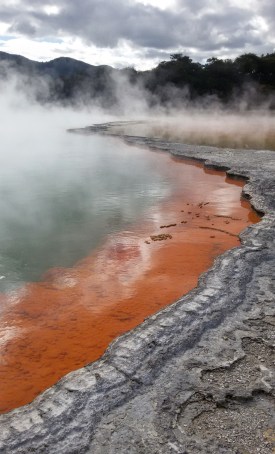 dazzling body of water is the one you see on all the websites, brochures and billboards for Waiotapu because it’s deep blue water and vivid orange shoreline are such a visually striking image. Combine that with the meandering edge of the built up lip of the lake and you are just left gaping at the majesty and variety of nature. I also discovered the reason it’s called Champagne. There are teeny weeny bubbles effervescing around the pool giving it the distinct appearance of champagne in a wide glass sending a constant stream of tiny bubbles out into the world. The extreme heat of the pool combined with the cool late winter air meant that there were great plumes of steam rising up from the water and obscuring the far shore. It made for a dramatic landscape, but I did get dosed with some intensely sulfur smelling fumes when the wind shifted. Other than that, the park didn’t have much of an odor.
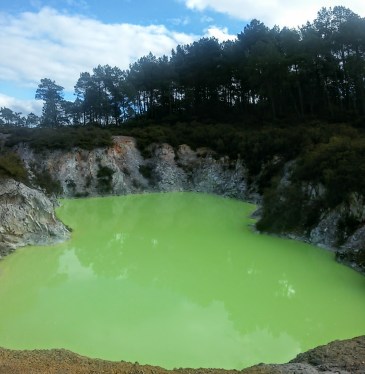 The Champagne pool may be the star of the park, but it’s not the last surprise on the trail. After passing by a few more craters, you reach the final stop, “The Devil’s Bath”, which is a deep sided pool of the most florescent neon toxic waste movie effect from the 1980s colored water you will ever see. I’m sure you’re looking at the photos going “no way”, but yes way, Ted. A few more sight seers came around the corner while I was staring at it and were equally blown away. My best guess for what causes the crazy green shade? Bacteria, chlorophyll loving bacteria. Weather the colors of Waiotapu come from animal, mineral or vegetable, it’s a great way to spend a few hours in between hot springs. Check out the full photo album on FB, here.
Waitomo: Stargazing in the Southern Sky
I had such a good experience with the YHA in Rotorua, I decided to go ahead and book with the same company again in Waitomo. Despite being part of a chain, the two hostels could not have been more different. Rotorua YHA was a giant multi story, multi building complex akin to a college dormitory. It was also walking distance from lots of amenities including food, banking and entertainment.
The Waitomo YHA, however, was more like a farmhouse. There were maybe a dozen rooms, and a large wood-burning stove/fireplace in the middle of the common room, plus a baby sheep and baby goat on the premises in addition to the farm dog. It was clean and warm, so I’m in no way complaining, but it was a much  bigger difference than I had anticipated. I even saw an advertisement for a horse exerciser position that offered room/board/caving and a little cash, clearly intended to attract backpackers to the job. The hostel was walking distance from the main tour company that offered trips into the caves, but not much else. Because of the isolation, a local cafe did a pick up service to bring guests over for a meal and a beer.
After dinner it couldn’t have been later than 8:30 at night, but the moon wasn’t up yet and the sky was clear as glass. I could see more stars than I’ve seen anywhere except some remote mountains and deserts. I remarked on the view to the driver, but he said that it wasn’t really much compared to the “real” views of stars they get, and that he’d come to take the whole thing for granted. He forgot people in the city couldn’t see it every night.
Despite the chill in the air (aka, winter), I couldn’t just go back inside, so I turned off the back porch light of the hostel and lay down in a hammock where I could look up without straining my neck. It was awe-inspiring and disorienting to see so many stars, but recognize none of them. I’m not an astronomer, but I went to my share of planetarium shows as a kid and I can pick out the big dipper and Orion easily enough. But even if I don’t know the names of all the stars in the northern hemisphere, I know the patterns as familiar.
Imagine you go to the same Starbucks every day, then one day you walk in and the whole shop has been rearranged. You couldn’t say where everything used to be, but you know that it’s different now. These were stars, the same lights and shades of color I was used to, but sprinkled unfamiliarly around the sky. What’s more, there was a patch of milky space that was clearly not a cloud but something much farther away. I’ve seen an arm of the Milky Way once or twice, it’s hard to see in the US anymore because of the huge amount of light pollution everywhere, but if you go far enough into a dark zone you can see it. This had a similar quality, but the shape was completely wrong. I couldn’t tell if I was looking at a part of the Milky Way or some other nebula deep in space. Either way, it was entrancing.
 The only constellation I’d heard of for the southern hemisphere was the Southern Cross, featured on the NZ flag. I looked for it, but at the time, I wasn’t totally sure if what I saw was the constellation or my wishful thinking. After all, how many patches of 4 stars can look like a cross if you’re trying to find one? I stayed outside until my fingers got numb, soaking in the interstellar beauty and realizing once more, NZ had granted my wish. Before I came, I thought about how much I was looking forward to seeing the night sky from the south, yet until that moment, every night I’d been outside there had been either cloud cover or a bright full moon, making the stars invisible. Yet here on my last night in the bush, the night sky collaborated to put on just one more show.
Auckland Take 2: French Food, Planetarium & One Tree Hill
From Waitomo I drove back to Auckland. I found that driving away from the twisting, unlit roads that had so vexxed me just 9 days ago was sad and difficult. As the roadways became wider, straighter and streetlights appeared at regular intervals I began to feel that my time in wonderland was over as I drove back into the land of the urban and the mundane. I managed to negotiate a parking place at my hostel in the city and decided that if I was going to be urban, I might as well enjoy the city for what cities have to offer and I took myself out for a lovely meal at a nearby French restaurant.
Although there were many amazing looking things on the long menu, I decided to go with a set out of some nostalgia for my all too brief visit to France. I got a marrow bone with toast for an entree (appetizer), a duck confit for the main dish, and an apple tarte tartin for desert. I also found a type of wine on the menu that I was unfamiliar with called a Viognier and decided to try that.
 The marrow bone was a huge bone, cut in half longways and sprinkled with a crust of herbs and sharp white cheese (perhaps a parm or asiago). If you’ve never had bone marrow, and are not a vegetarian, I would like to recommend it. It’s basically like meat butter, which is to say it’s rich rich rich like the best butter you can imagine but instead of tasting like cream, it tastes like the meat of the animal from whence it came. You will not ever have a cut of meat, however well marbled, that is as rich and decadent as bone marrow. As I scooped the marrow from the bone and spread it on the toast, I wondered briefly if I’d made a mistake in ordering so much food when the first dish was so intense.
I drank water with the bone marrow dish. Only after it was cleared away did I taste the wine for the first time. It was a light and pleasant white. The internet tells me Viognier is similar to Chardonnay, which I can see, although this particular bottle (no idea) was to my mind, neither especially sweet nor dry and certainly not oaky (a common way to age Chardonay). It was a good match for the meal and highly drinkable. I’m not a sommelier so I’m not going to get much more descriptive than that about the wine, but it’s my new second favorite white (Gewurztraminer is still number one).
The duck confit on the other hand is something I could talk about at great length. This magical way of preparing duck in it’s own fat produces some of the most tender and flavorful results you could hope for, but on top of the “regular” process, this restaurant had decided to serve the duck in a spiced candied orange sauce. 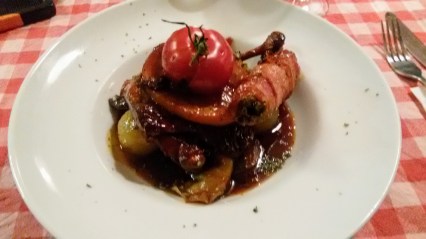 The duck rested atop some caramelized onions and roasted potatoes which were themselves drowned in the heavenly sweet and spiced sauce. Atop the duck rested the candied and stewed orange slice and a small tomato, the sweet and tart qualities of which were complimentary to the sauce. At first glance I thought it was a version of orange duck, but then as the spices reached my nose and soon my tongue, Christmas exploded inside my head.
It was decadent, and the crisp Viognier was a good break for the sweetness of the sauce and richness of the duck itself. It took me a long time to work my way through the meal, not just because I wanted to savor each bite to combine different layers of ingredient in different ways and experience all the flavor combinations, but because I had to pause and wait for my stomach to make more room. When the waiter with his thick French accent came by to check on me, I told him I hadn’t had food like that since the last time I was in France he smiled demurely. I don’t know how many Kiwi’s have a chance to try real French cuisine, but he was clearly pleased that I made the comparison between the homeland and his little restaurant down under. I’d had duck confit in France, but it was lightly seasoned and focused mainly on the flavor of the duck. This warm citrus holiday spiced version just about blew my mind!
 Finally, I considered myself conquered and had to leave some of the veggies behind to save space for my tarte tartin. This is a sort of upsidedown caramelized apple pie with ice cream on top. It was wonderfully soft and well flavored without being overly sweet. The caramelization left a light and pleasant bitterness, and the apples themselves brought a bit of tartness. In the end, I couldn’t manage more than a few bites and felt horribly guilty for letting such a culinary treasure go to waste. I apologized to the waiter, trying to assure him the tarte’s taste was not to blame for so much of it being left behind. I finished off the evening with a digestive (because boy did I need one by then) of green Chartreuse which is a fabulous herbal infusion made by French monks that is basically like Absinthe’s grown up, more erudite older brother.
Planetarium
I took advantage of my last day in the city to pick up items that aren’t readily available in Korea (deodorant, peanut butter cups, jeans my size), and as my shopping came to a close, I realized I still had several hours before I had to drop the car off. I began to think about some very sage advice I’d read about vacations: the first and the last thing you do set the tone of the whole trip because the first sets your expectations for the trip itself and the last seals in your memories.
I decided to have one more glance at Google Maps to see what was around me and noticed a little spot marked “planetarium” only a short drive away. I stared in disbelief. One more time, New Zealand had heard and answered my wishes. Just two nights before I had lay in that hammock under the unfamiliar stars wishing I could learn more about them and here was the planetarium practically right next to me! Of course I had to go.

It turns out that the Stardome Observatory & Planetarium is inside Cornwall Park, which is famous for One Tree Hill, one of the two main (natural) high points in Auckland to get a panorama of the city from and highly recommended on the short list of free things to do. The Stardome itself has a free gallery exhibit as well. I looked on the website to try to find times for the planetarium shows, but all I could find were things about Pink Floyd.
I decided to go in person and find out what I could, hoping that they had regular shows on the hour or something similar that I could at least use to get a general idea of what I’d been looking at the other night. As I was waiting for the lady at the counter to finish helping someone else, a young woman in employee garb came out from the back and started talking in a clearly North American accent. When I had my chance, I asked her where she was from and how she came to be working at the planetarium in NZ so far from home. It turned out she was also from my mom’s hometown! After our chit chat, I remembered to ask about the shows. I told her I wanted to learn more about the southern night sky. She pulled out a brochure with the show times, but the next one would sadly not start until after I had to be at the airport. I explained my predicament, thinking maybe I could have a look around the gallery or have a few specific questions answered when suddenly she said, “do you have a little time now?”

It turned out that she didn’t just work there, but ran the planetarium shows for the school trips that came through. Since the school day was over and the evening shows had yet to start, the viewing room was totally unoccupied and she offered to provide a private mini-show!
She went through a hasty review of the northern hemisphere, comparing Seattle and Busan for me before moving on to Auckland. It was great to be able to review my little bit of astronomy and get to ask questions as they popped into my head and the relevant images were on the screen. The Auckland night sky was much less impressive than what I’d seen in Waitomo. She pointed out a few familiar northern constellation inverted. It hadn’t even occurred to me to look for any, let alone to turn them upside down to see them from the southern perspective. She filled my head with facts and tidbits on star names, distances ages and whole new southern constellations.
Finally, we left Auckland for a night sky that she said was probably more like what I got in Waitomo and sure enough, the distinctive milky glow was right there. It turns out that it is part of the Milky Way, but not an arm like we see in the northern hemisphere. It is the center of the Milky Way itself. And if that wasn’t cool enough, there’s a void in th e milky light caused by dark dust in the way that the Maori people identified as a type of constellation by negative space rather than connecting the dots. It’s an emu.She also taught me how to find the Southern Cross and use it and the Pointers to find due South. It’s not quite as convenient as having Polaris, but it was fun to see it in action.
The whole thing was much shorter than a show would have been, but it was absolutely a highlight of my visit to be able to get a personal tutor and starshow to help me better understand the southern skies. We stood around chatting outside the theater area for a good long while afterward about astronomy, science, history, neuropsychology and a plethora of other fun learning topics. I got the impression she’s a person I could easily be friends with if we had the chance.
The Last Farewell From One Tree Hill
I left the planetarium feeling wholly reassured that my final memories of New Zealand would help make a great last impression. I didn’t have time left to walk around the park. The airport was only 15 minutes away, but I had to fill up the tank and navigate traffic. Pulling out of the parking lot, however, I noticed a map of the park and decided I did have enough time to drive around the loop road and go look at the famous One Tree Hill.


Cornwall park is a large green space in the middle of a fairly urban area, but it’s not just any old inner city park. I drove down tree lined roads with daffodils in bloom. I passed a hillside of sheep and lambs as well as a field of cows. There were even a few chickens wandering around. As a final farewell, it brought back the pastoral beauty of the previous week’s travels. The view from the top was a complete 360 of Auckland starting with the wide greenbelt of the park itself, and ending with the sea and distant mountains with the bustling metropolis a tiny strip of urbanization in between. I watched the sun sink low and turn the blue-white sky into shades of gold and gray. Then I got back into the car and drove off to the airport. I could not have asked for a better farewell from Aotearoa.

The experiences and memories from this very brief trip are now woven into the fabric of who I am. Every trip, every new place, person or experience changes us, some more than others. New Zealand may be one of the most magical places I’ve had the chance to experience and for whatever reason, my entire trip there felt like I was really connecting with the spirits of the land through the soles of my feet as the Maori myths imply. Ten days is too short a time to know if it is a place I could call home, but I know that Aotearoa and I are not finished with each other yet. I will be back someday, to walk more paths and breathe more forests and bask in the gifts of beauty and serendipity that are offered.

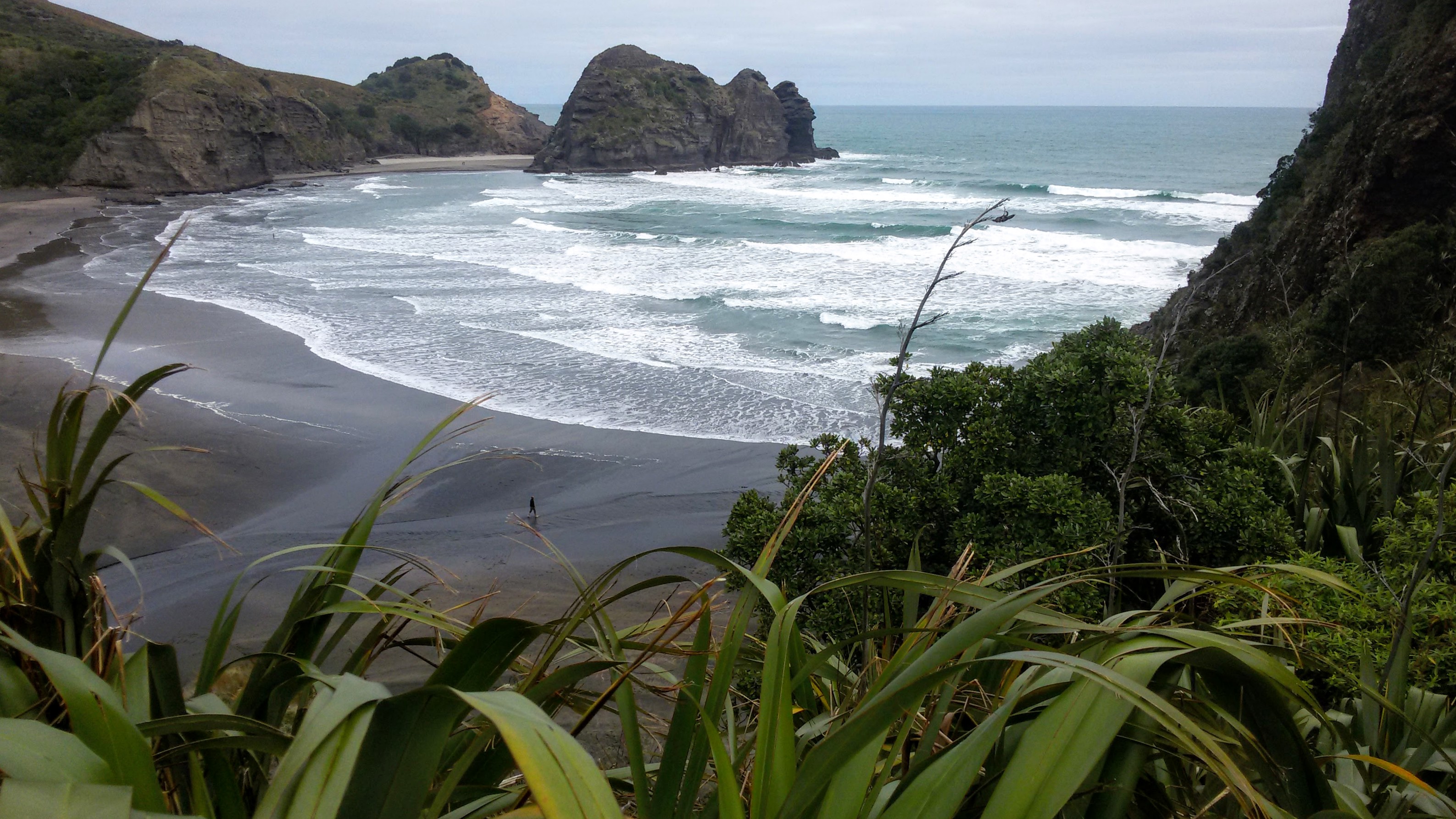
 This was my first glimpse of the crazy twisting roads that would mark every journey for the rest of my vacation. More than that, however, it was my first interaction with NZ flora. The drive made me feel like I was zooming back into a prehistoric age on earth. Familiar evergreens and less familiar variations of deciduous trees were mixed about with giant ferns and palms. Grasses grew in tufts taller than my car. The pictures don’t really do the forests justice because you just can’t see the enormous scale of these plants that makes you expect to see a triceratops around the next bend in the road. It didn’t take long before I got my first view of the ocean, either. The rugged coastline often included mountains and trees growing right down to the thin strip of sand marking the delineation of land and sea. The sea itself is crystal shades of blue and aquamarine, dotted with rocky islands or jutting peninsulas from further along the coastline. Because of the Queen’s Chain, the beaches remain undeveloped by private enterprise. Even right outside of Auckland, the beautiful, pristine coast just goes on and on.





 This bizarrely internationally inconsistent cultural habit changes drastically from country to country and making a mistake while you’re visiting can be awkward or even offensive. Quick guide to NZ tipping is that you don’t. It’s not a tipping culture except…
  For some reason, despite all the research that I did before going to New Zealand, I did not realize that they drove on the left until the day before I got on the plane. I even read about NZ traffic laws because I planned to rent a car and drive around, but somehow the government sponsored website failed to put that in an obvious place. As a result, when I landed in Auckland and got the shuttle to my rental car company, I was frantically trying to watch the traffic and the driver as closely as possible. On top of that, it was dark by the time I got my car, so I had to navigate my way to my airbnb in this backwards car on the wrong side of the road and in the dark. I do not think I have gripped a steering wheel that hard in years.
  I cannot tell you how many times I accidentally turned on my wipers while trying to signal. The gearshift is on the left. Thankfully, I had an automatic and the only times I was shifting were in parking lots, but I often found myself reaching for a steering column mounted shift that simply wasn’t there because my muscle memory found that to be the default when there was no gearshift to my right. Good news, gas and brake were still the same, otherwise I might have had some nasty accidents.
  There are a preponderance of roundabouts. All the roundabouts. I usually only saw “intersections” in the more pastoral areas. In anywhere with civilization, the preferred interchange was the roundabout. These were quite intimidating at first because there are no stop indicators, only “give way” or yields. You have to check to your right to see if anyone is already there, then go. Then count exits to find yours and trust that everyone else is going to yield to you once you’re in the roundabout. I made several mistakes, but no crashes.
 Lastly: one lane bridges… I don’t know why. Maybe it’s too much infrastructure? Maybe the bridges were built at a time when all the roads were one lane? Maybe kiwis just like driving dangerously? I lost count of how many one lane bridges I crossed. There are helpful signs that tell you which lane has right of way. It’s based on who has better visibility of the bridge. If you can see the bridge, you have to give way. Only once did I have someone fail to yield to me when they should have, I assume another visitor confused by the rules, but I managed to stop in time.


 beaches that have just been developed to death because hotels can charge big bucks for access to their private beach. When I lived in Florida, the small stretch of beach that didn’t cost an arm and a leg to get into was limited and often overcrowded. In tropical paradises in the Caribbean, beaches have become little more than oceanfront bars. In Dubai they are oceanfront dance clubs. In Washington state, when we want to go to a hot spring or waterfall that’s undeveloped, we have to go into a state or national park and hike for several km. In NZ, however, these things are all near roadways with easy public access and safe off road parking. Many of them are even handicapped accessible.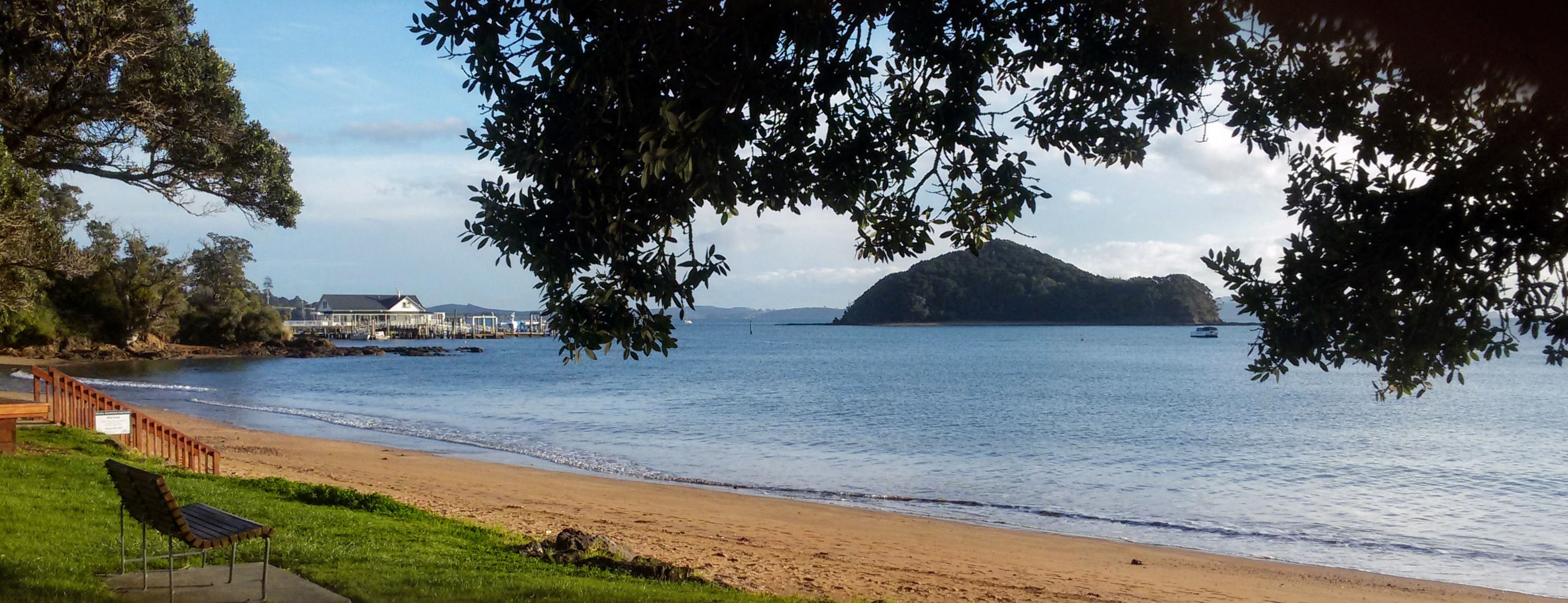


 of bird that represented knowledge and wisdom and incorporated it into their tattoos. You can see lots of NZ plant life as well as other unique New Zealand creatures in the movie including the large gecko that tries to eat Zack and the cave full of glow worms that Crystal and Jack go to be romantic in.
 Gallivantrix