Happy 2023 and year of the Rabbit! I am sad to say my holidays were marred by an illness of unknown cause, a risk of travelling to any new geography where one’s own immune system is naïve to the local microbes. However, I’m bouncing back and getting my new year groove. My first tourist visit for the year was to Le Musée des civilisations noires, and now I’m here to share it with you.
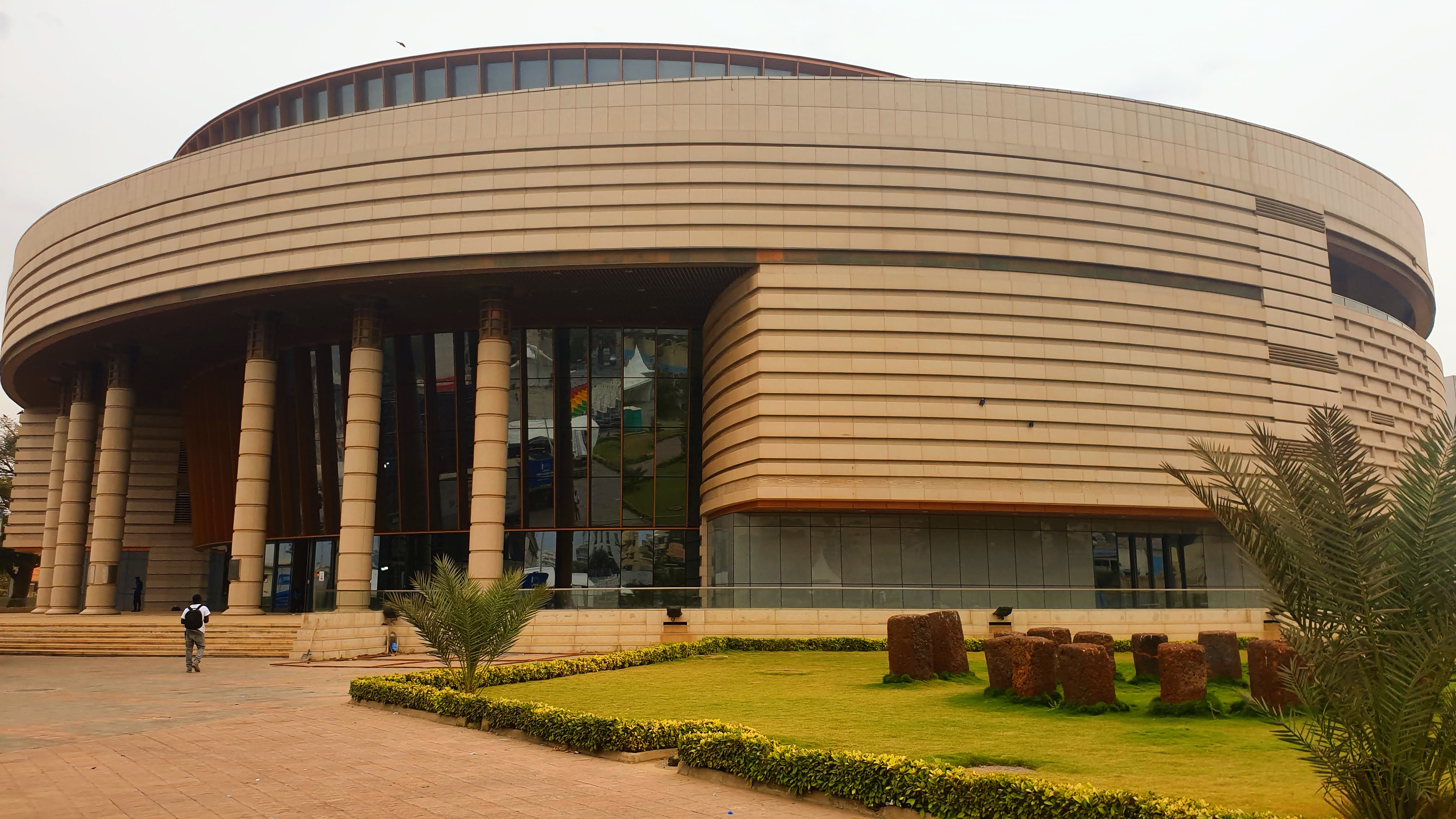
If I could describe the Museum of Black Civilizations after my visit in one word, it would be: aspirational. The museum itself is an enormous building with — as one might say to a child who’s pants need to be rolled up — room to grow. I was initially disappointed with the experience because it has so much hype, but after doing some follow up research online about the history, I’m a little more impressed, and a lot more sad.
It opened in late 2018 with a substantial contribution from China to the tune of $34 million (an especially revealing number since the estimated construction costs were 30mil?) and was built with over 150,000 ft2 (14,000m2) of space over 4 floors to display more than 18,000 exhibits (I have no idea how they reach that number given the varity of size and display needs, but that’s what they say). In 2019 it was hailed on TIME’s list of the World’s 100 Greatest Places.
The museum was built in large part to give a big middle finger to the French (and other colonial countries that … I tried to find a nicer word, but … r*ped the continent). For context, there’s a lot of pushback from European museums about returning the looted treasures and artworks of colonized African cultures. They argue that without sufficient quality display areas like climate controlled museums that it would be irresponsible to return the fragile artworks to the countries they were stolen from. This is a real hot-button issue with lots of discussion about what constitutes ownership and stewardship, especially when discussing artifacts that affect all of humanity like early hominid remains or artifacts that were looted by rival tribes/kingdoms well before they were stolen by colonial masters, but the way I see it, if you just took that thing from someone’s great-grandpa less than 200 years ago and his family is still there, it really should not be a debate.
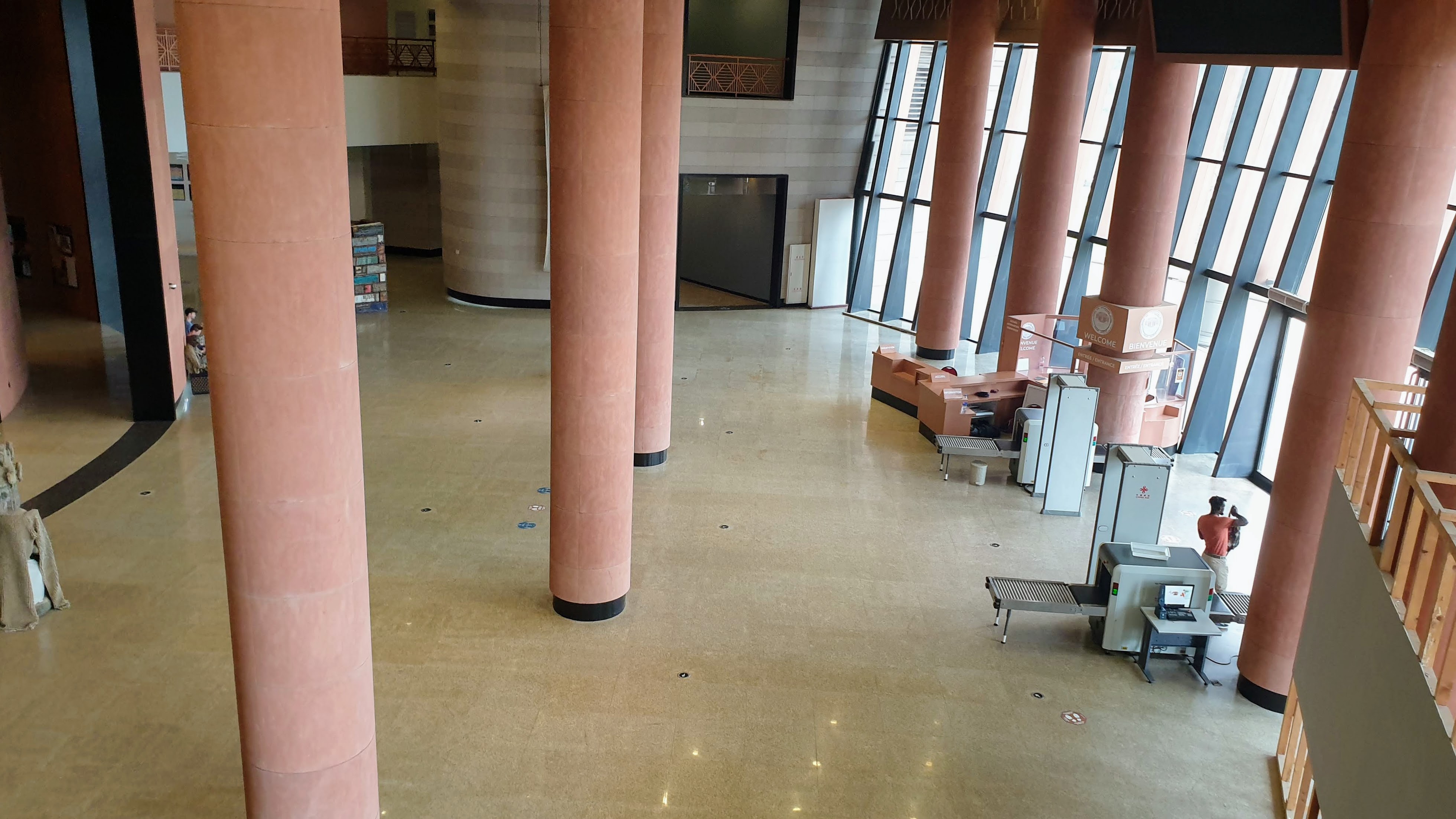
Regardless, the construction of Museum of Black Civilizations was meant to allay all the concerns that the artifacts would not be properly cared for or displayed in Senegalese stewardship, and France made some conciliatory noises that they would work on giving stuff back. Then before that could be finalized, “ohhhh global pandemic, hands are tied, guess we can’t now”. Fast forward to 2023 and that museum is like a grocery store after a storm alert – empty.
The Ground Floor
The first thing you see (aside from the vast empty space) is “The Saga of the Baobab,” a metallic tree by the Haitian artist Edouard Duval-Carrié in the center of a display about the cradle of humanity aka the “Out of Africa” hypothesis which shows strong evidence that modern day humans evolved in and migrated from the African continent something like 300,000 years ago. There’s debate about this too (I don’t mean creationism) because some fossil evidence has been shown that other versions of humans existed in other places around the world as much as 1.8m years ago. I get a headache when I try to follow the scientific debate because all the versions of hominid are based on bone fragments and mitochondrial DNA. I don’t blame the museum for sticking to a single scientific hypothesis in their presentation, but I was a little let down by the presentation itself.
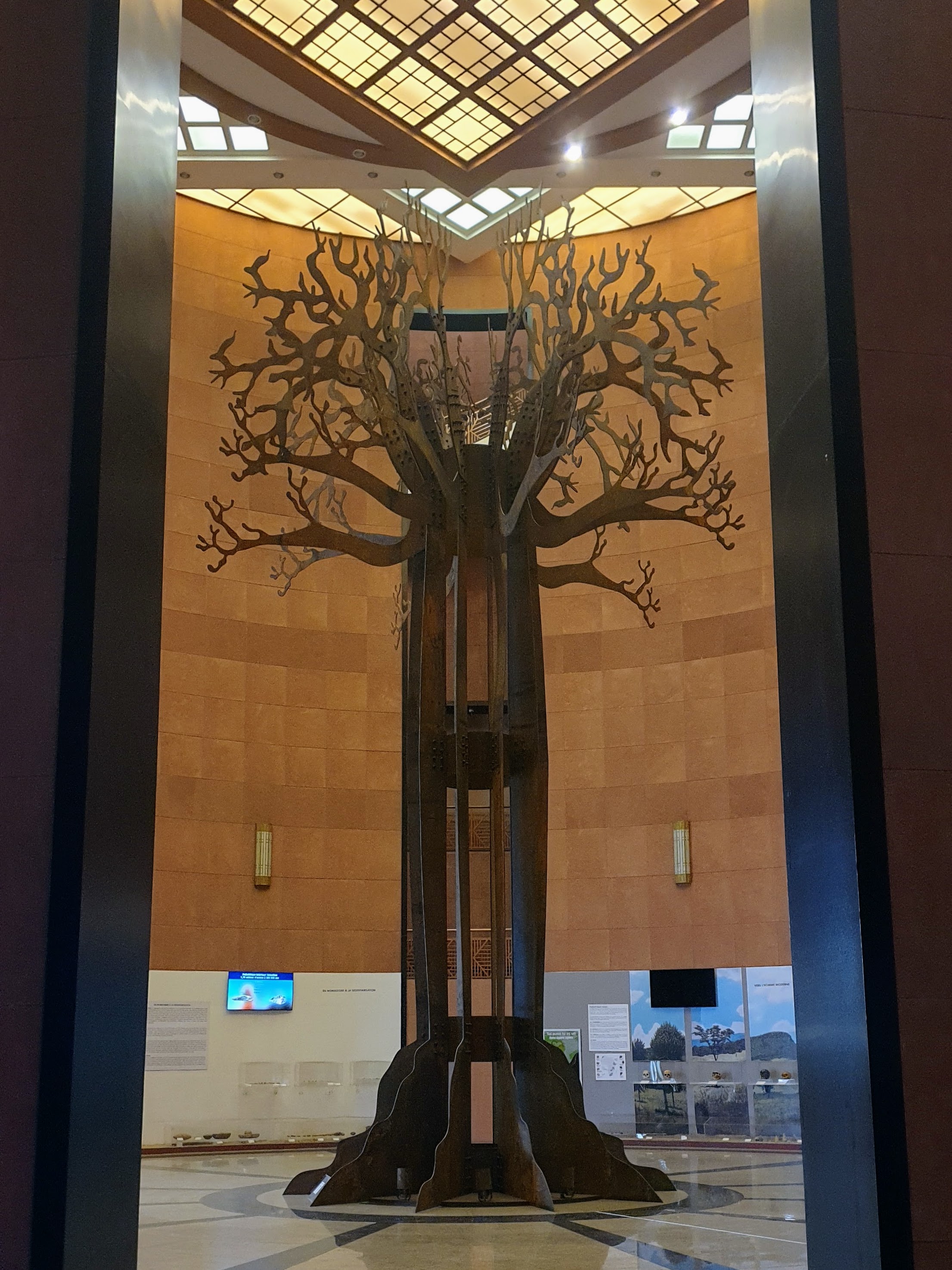

The vast majority of the exhibit is printouts and blocks of text (French only!) on the walls with a few scraps of skeletal remains under glass. I strongly doubt that these are actual remains since it is the standard practice of museums everywhere to put replicas on display because of the delicate nature of the bones. It’s a cool story to tell, from the origin of the first bipedal apes through “Lucy” and on to the Neanderthal and Cro-Magnon, but it didn’t seem especially unique. One thing I was really fascinated by was this Neanderthal skull because it clearly shows that the front teeth are rounded instead of edged. I remember being taught that our front teeth were made for cutting (cone shaped teeth are for puncturing, gripping, tearing hence why all the carnivores have them) and our molars which are more square are for grinding. It made me really curious about the unique tooth shape of the Neanderthal and what that means about their diet. It was neat to see up close.


The other feature(?) of the first floor was the contribution of African cultures to science and technology. When the greeter at the door told me about this I was really excited. I feel like this is a very under-taught area of global history, and I strongly hoped to learn some things. Even after this, I still hope there are things to learn. However, the exhibit was a real let down. While the cradle of humanity section was maybe 60% wall of text and photos, the “science and technology” section was easily 99%. In addition, other than the origin of smelting iron (a huge contribution to human culture, no doubt) most of the rest of it was limited to Egyptian contributions which could be argued to be a part of the Greek Classical world. I stan negritude and black excellence, but I want to see more than “Egypt did a lot of cool stuff” when we talk about the history of African contributions! Also a museum heralded as one of the best in the world and maybe the best on the continent needs more 3d models. Printing a Wikipedia page on the wall does not a museum exhibit make.
The Next Floor
The elevator lets you out at a room full of recovered pan-African artifacts. Which is… cool? I guess? I know it’s the museum of “black civilizations” so all of Africa and the diaspora included, but I am curious as to how many of the countries whose artifacts are on display gave them willingly? With all the controversy about France putting stolen Senegalese artifacts on display in their museums, I expected more Senegalese focus here. I also would have liked to see some “graciously donated by…” or “on loan from…” signs on those foreign artifacts to reflect the value of only displaying other culture’s property with permission. I was also let down by the lack of context for the items on display. Most of them only came with a card saying something like “mask from Nigeria” with the materials and size listed. Nothing about when it was made, what it was used for, how it related to the culture at the time or now or anything. It was fun to look at, but it left me with a bit of an empty feeling.
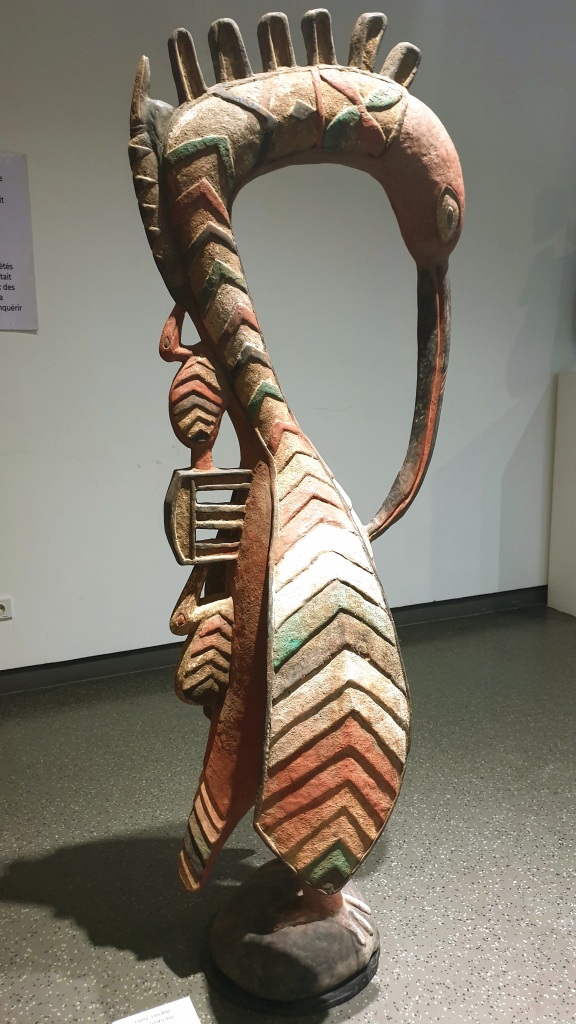
A-bamp (Baga bird) Guinea Conakry, Baga wood, lime, black, red, white pigment Height: 176cm 
Botchio, fon fetish Benin, Porto-Novo Various materials (leather, iron, cowries, fabrics, clay, cow tails, etc.) Height: 70cm 
Nkisi Nkondi Mayombe Region Democratic Republic of the Congo wood, horns, iron, nails, glass, fabric, and vegetable fiber rope Height: 245cm 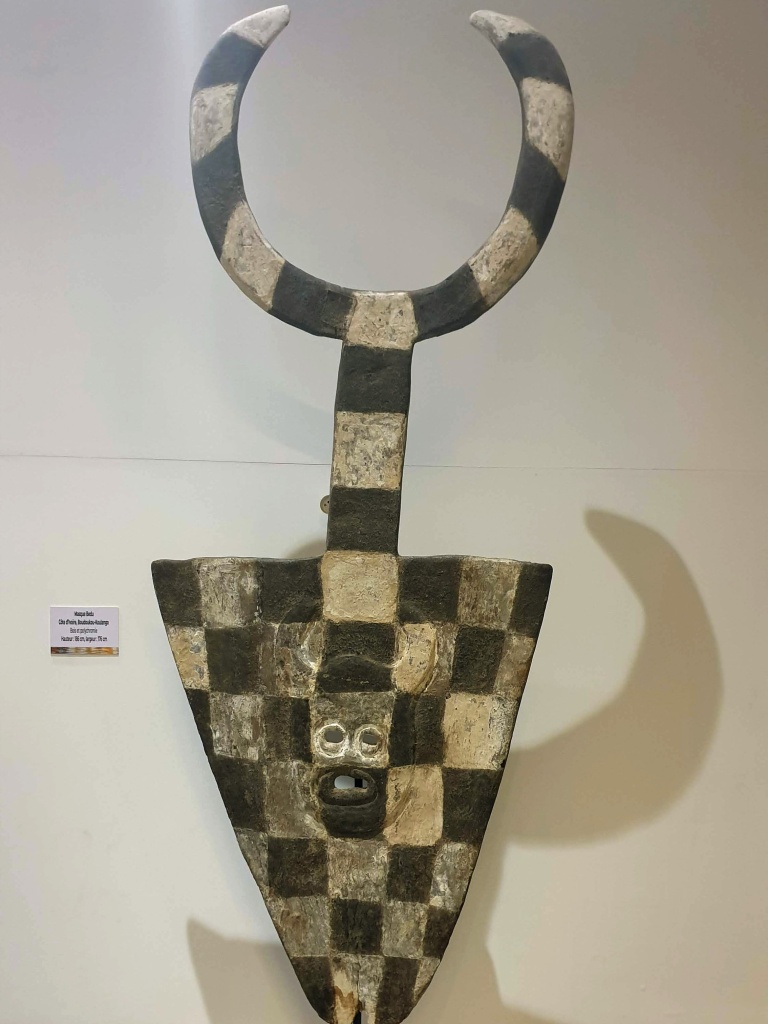
Bedu Mask Ivory Coast, Boudoukou-Koulango wood and polychromy Height: 186cm, width 176cm 
Traditional “Dozo” hunter outfits Mali, bambara Cotton (bogolan), mirror, pearls, skins, charms, horns and cowries Variable size 
Traditional “Dozo” hunter outfits Mali, bambara Cotton (bogolan), mirror, pearls, skins, charms, horns and cowries Variable size 
Traditional “Dozo” hunter outfits Mali, bambara Cotton (bogolan), mirror, pearls, skins, charms, horns and cowries Variable size 
dance crest; Chiwara Mali, bambara wood and iron variable size 
buffalo helmet-mask Cameroon, Bamileke wood, white and red pigments Height: 30cm, length 75cm, width 43cm 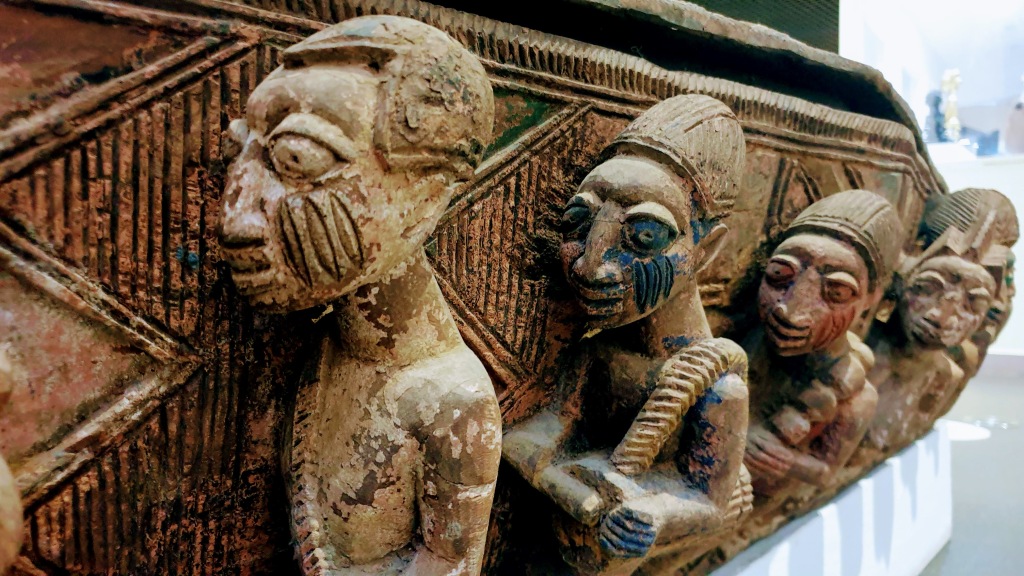
Yoruba coffin Nigeria Wood, lime, black pigment Height 67cm, width 190cm 
Idiok Ibibio Mask Nigeria wood, imported pigments yellow, green, red ocher
The next section was called “Les Appropriations 2022-2023” and was about the presence of monotheism (Judaism, Christianity and Islam) in Africa. I am interested in this kind of thing, but it was hard for me to get through when again 70%+ of the display is a printed a Wikipedia article on the wall in French. The most interesting part of the exhibit on Judaism was a photo of African (black) men in yarmulkes. Christianity was mostly about Egypt (the Coptics) with a few references to the African officiants appointed by the Catholic Church. I was most interested in the Islam section since I know sub-Saharan Islam is quite different from Arabic/North African Islam. I even captured all the French text to peruse at my leisure later with Translate to help me, but it was still really basic. I actually think the Wikipedia entry on Sufism has more information. Also, since Islam is pretty iconoclastic there was an even higher ratio of wall-text to object display in that section. There was a whole wall dedicated to the teachings of Sheik Ahmadou Bamba who is a really fascinating historical figure in the fight for Senegalese independence, but if I had not known that about him before going to the museum, I wouldn’t have figured it out from the display.

ART
The next section was the highlight of my experience at the museum. However disappointing the first floor was, the modern art section made up for it in spades. The “Africa Now 2022-2023” exhibit was stunning. Everything I dreamed of for a beautiful modern African art exhibit was turning it out. Art that really made me feel things and think things and go WOOOOOW.
The very first painting at the entry was just a punch in the gut, but so beautifully done.

I enjoyed a range of colors, materials, styles and subject matters, and as with all modern art, I didn’t “get” all of it. I tried to capture a few of the ones that either reached out to me or just were photogenic. The huge wall mural was only ‘meh’ to me until I got up close and realized it was made of a mix of African print fabric scraps and garbage, which made it suddenly a huge statement about the trash problem I’ve been noticing literally every time I walk outside. Trash isn’t only a local problem. A lot of the “developed” aka rich countries in the world export their trash to poor countries, so basically there are places around the world being paid (not much) to become our landfills. The practice is slowing down mostly because the countries receiving the garbage are saying “no more”.
There was also a field of oversized cotton made of metal and … cotton. I know it’s oversized because I used to live in a place where I drove through cotton fields on the regular, I know how tall it grows. This cotton was enormous and I think the choice of size and material really spoke to the impact of the cotton industry on the slave trade and the decimation of Africa as well as to the diaspora.


“Oldies and Goodies” Olanrewaju TEJUOSO mixed medium encouragement prize from the Minister of Culture Dak’Art 2018 
“Oldies and Goodies” Olanrewaju TEJUOSO mixed medium encouragement prize from the Minister of Culture Dak’Art 2018 
Cotton Field Soly CISSÉ installation (iron and cotton) 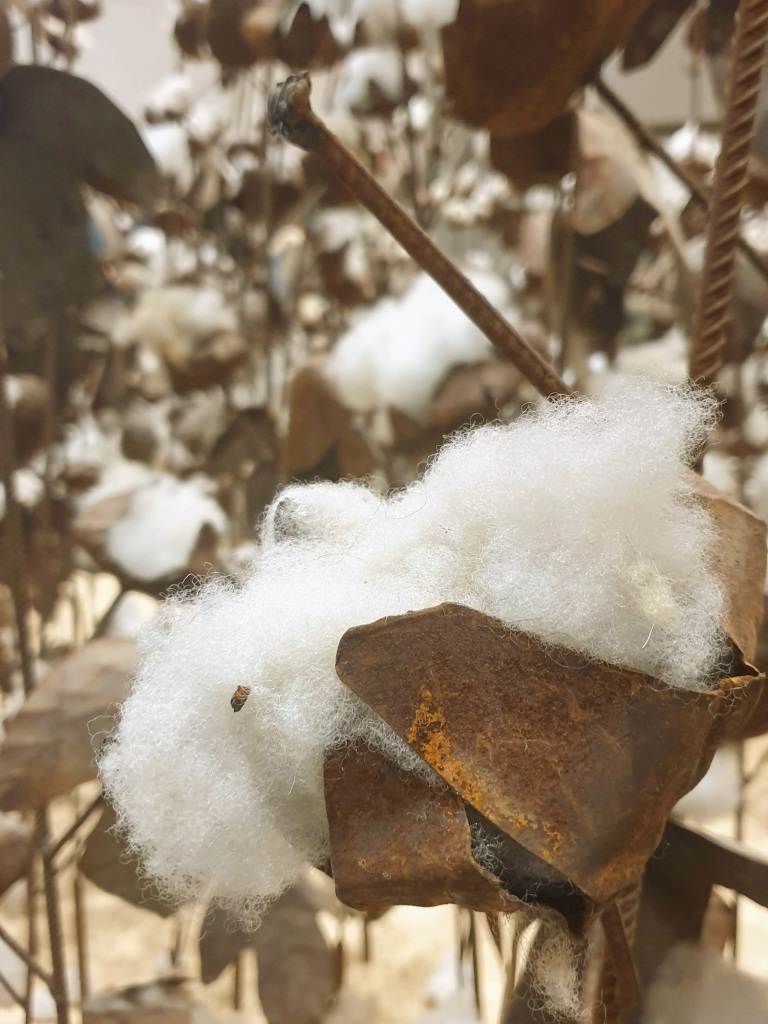
Cotton Field Soly CISSÉ installation (iron and cotton)
If there is ONE artist you look up after reading this let it be Malaika Dotou Sankofa. I don’t know why these jumped into my soul the way they did, but these photographs are amazing. The juxtaposition of African prints and western clothes, the angel in broken and shabby environments, and sure the model is easy on the eyes too.

Environmental Awareness
The last section of the museum was a corner dedicated to environmental awareness called l’incivisme or “incivility” that opened in December of 2022. It had informative displays and photos about environmental preservation projects like the great green wall (a multinational effort to plant trees and ground cover along the border of the Sahara desert to keep it from expanding). There were displays about pollution, garbage, over harvesting lumber, lack of clean water, traffic congestion, noise pollution, and public hygiene. It suggested a strong sense of self-reflection and a desire to improve living conditions in Senegal and on the continent in general. It makes me happy to know that there’s a local movement about it, but also a bit sad that it’s relegated to a tiny space at the top corner of the displays.


I also went up to the third floor just to see if I could. It looked like maybe it was used for meetings or celebrations. It was quite empty, but I could see a stage and risers as well as a lot of blank walls that hoped to receive more art someday. There was a nice balcony with a cute view, but it felt very surreal being in this vast space that remained totally unused 4+ years after the museum opened.

Like most of Dakar, Senegal, and West Africa that I’ve experienced so far, the museum of black civilizations was a mixed bag – I’m glad to have the experience, but most of the feelings I come away with are difficult and heavy. I’ve been to a lot of museums in my life from the Smithsonian to tiny hole-in-the-wall unairconditioned rooms in the backwaters. I know that money can go a long way, but in the end the displays need to be unique, interesting, and educational. I am glad that Dakar has this building because it’s the first step in the reclamation of their historical treasures, but right now, the museum is more a testament about what black civilizations have lost rather than a display of their achievements. Hopefully it will live up to it’s aspirations someday.


 Shortly after parting ways with the helpful Nigerian, I walked past what appeared to be a large open air food court. There was a roof and fans circulating air, but the entryways were wide open. There were dozens of food stalls from different nationalities, and tables to sit at between them. I went to one stall to get a fried oyster omelette and another for an iced coffee, then sat down to enjoy them. The omelette was a bit odd. In addition to eggs, vegetables and oysters, it turns out this dish is cooked with a variable amount of tapioca, potato, and/or rice starch. This just goes to prove I should have read more about the food before going, because the gooey texture combined with the heavy oil meant that I only ate about ¼ of the dish before I couldn’t eat any more. The coffee, on the other hand, was intense and amazing. I didn’t know it at the time, but Malaysian style coffee is different from other coffees around the world. I’ll explain more when I get to Ipoh, but for now, suffice it to say I was pleasantly surprised.
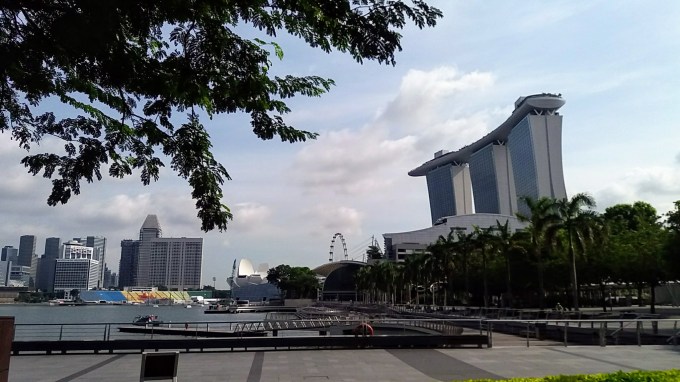 After breakfast, I passed by all the tall financial buildings and came to the Marina. This beautiful stretch of waterfront goes on for ages with a wide and clean walking path. I came across a shopping mall on my way and decided to head inside for the AC and maybe a restroom. The Nigerian man I’d met advised me that if I ever felt too hot in Singapore, I could just walk inside any building to get some cold air. The mall was nearly empty, which is not surprising for a weekday morning, and I managed to find a 7-11 to get a cheap sim card (less than half of the airport prices). I also got called in to have a sample at two separate skin care shops. The first was a supernaturally charming young man who probably got nearly every woman he met to spend too much money on his skin care products. We chatted and tried out the product and eventually I had to demure from purchase, but he was gracious about it and said he’d had fun talking with me. The second shop was a Malaysian woman who was wonderful and gracious and kind until it became clear to her that I had really meant it when I said I wasn’t buying anything, and then she turned rather sour. Both shops products were in the hundreds of dollars range. It was somewhere around here that Singapore started to remind me of Dubai.
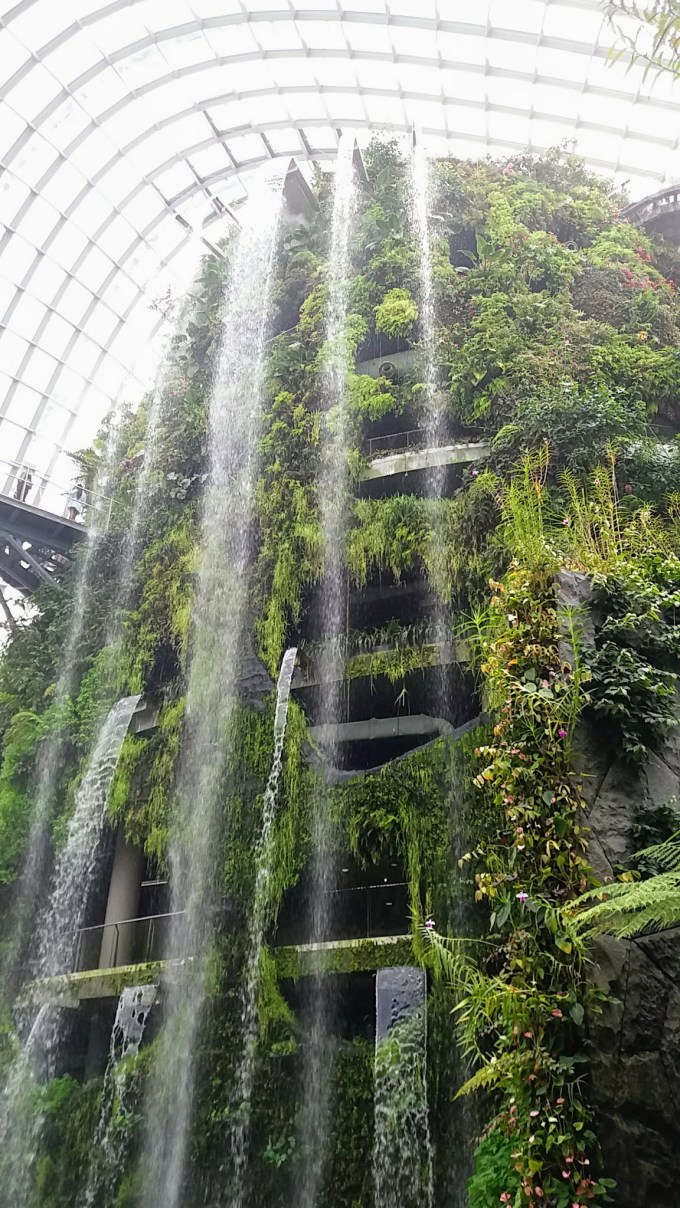 I walked more dockside paths and came across a science museum, more flowers than you can sneeze at, and finally some signs pointing to the garden path that was lined with sculpture, topiary and colorful blossoms. Although the Super Trees were my main goal, by the time I arrived at the park’s center, I was hot and tired. I noticed a cool breeze coming from the doors of one particular building and resolved to go inside that. The building was one of the two indoor gardens, this one called Cloud Forest (the other was closed for renovations). It was a massive greenhouse designed to house the ecosystem of a cloud forest, and so not only had pathways winding through beautiful flowers at ground level, it had a miniature mountain in the center that one could ascend and walk around via a series of skywalks that simulated viewing the forest from cloud level and treetop level.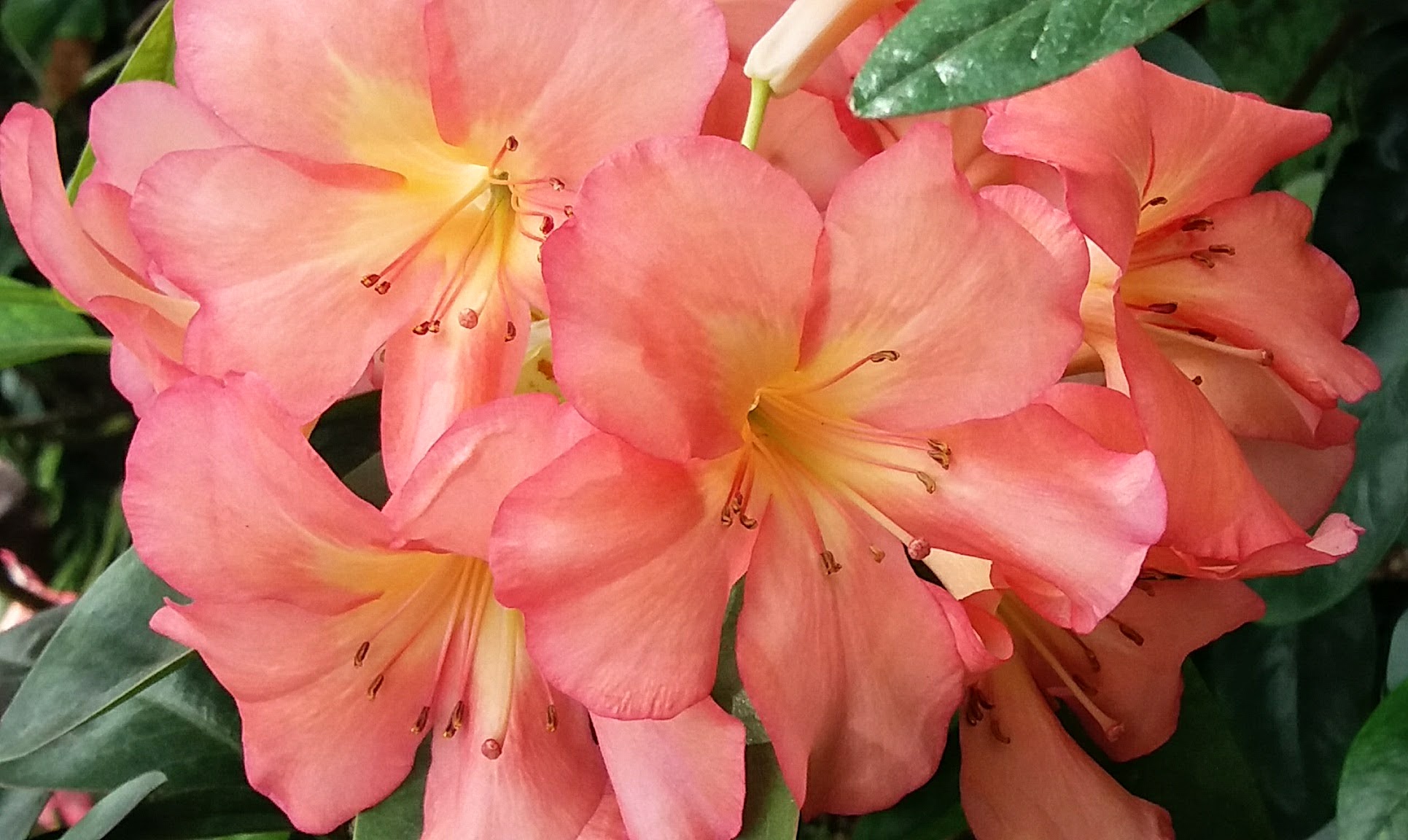

 The time of clouding was approaching by then, and although the main path did not lead back upward, it wasn’t crowded, so I hopped into the elevator and rode back to the top. I get the impression that in more crowded times, the elevators might be more strictly regulated for the disabled, and the paths through the greenhouse lead firmly one way, but it wasn’t crowded and no one seemed to care if we went the opposite direction. Shortly after 2pm, the skywalk began to issue forth a mist as I set out for my second walk on the sky bridge and was able to enjoy the altogether different view as the fog enshrouded the walkway and the mountainside below.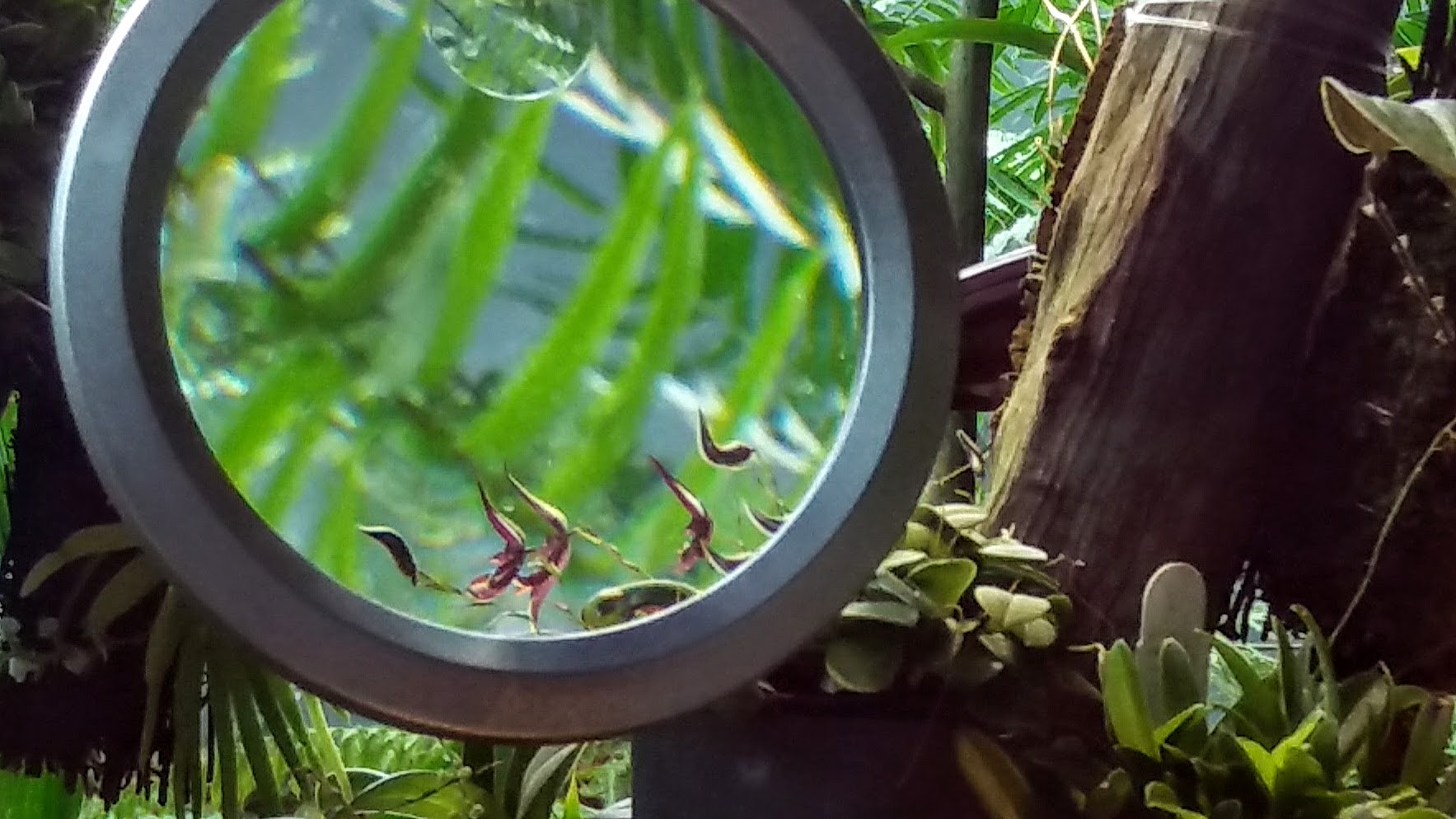
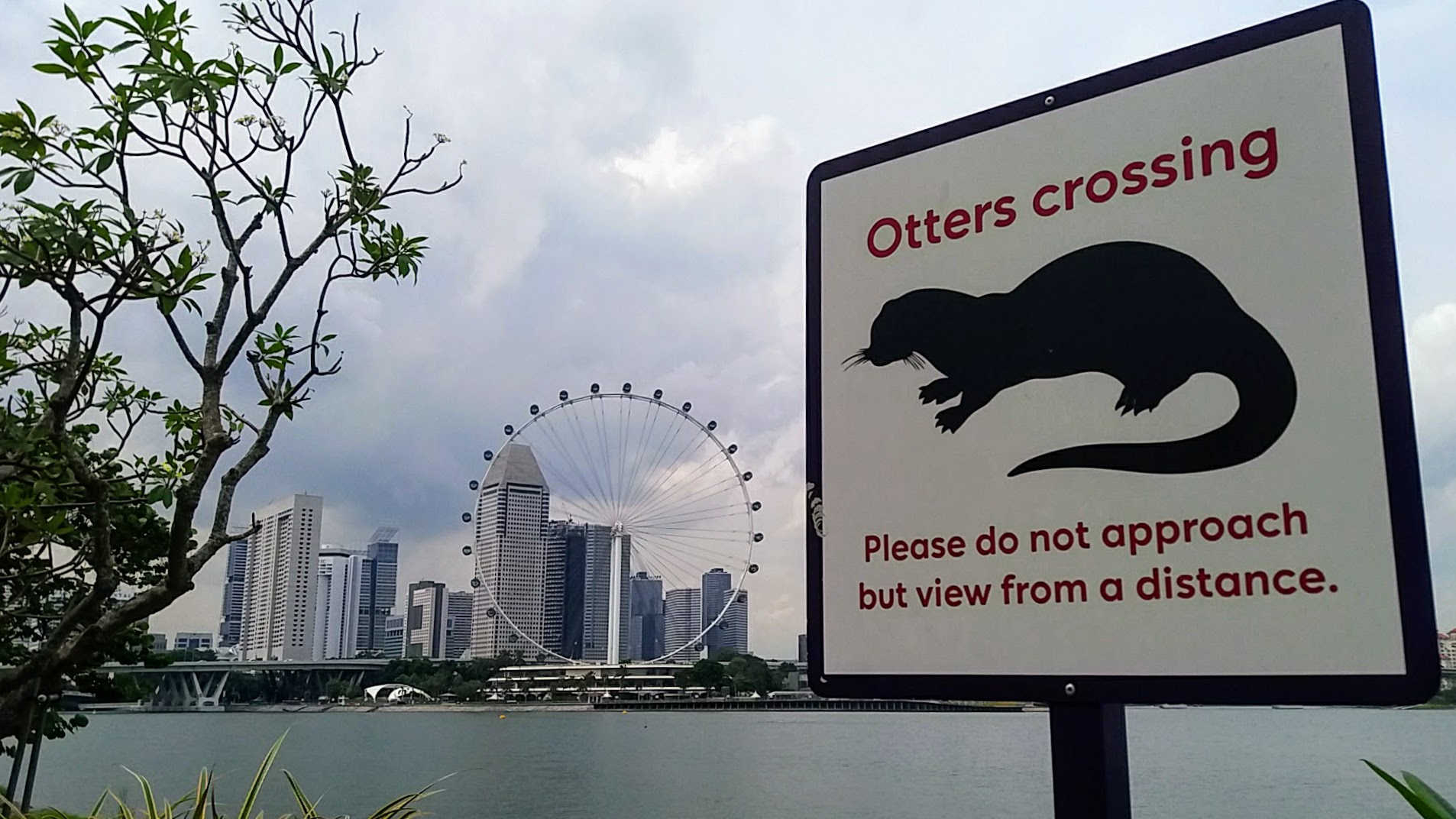 Nonetheless, the entire area of the marina is beautiful to walk through. I spotted some otter crossing signs, which are apparently no joke. The environmental reconstruction along the marina has enabled the local otter population to bounce back and they are often seen on the shores near the walking paths in the evenings. Sadly, I didn’t get to see any that day.
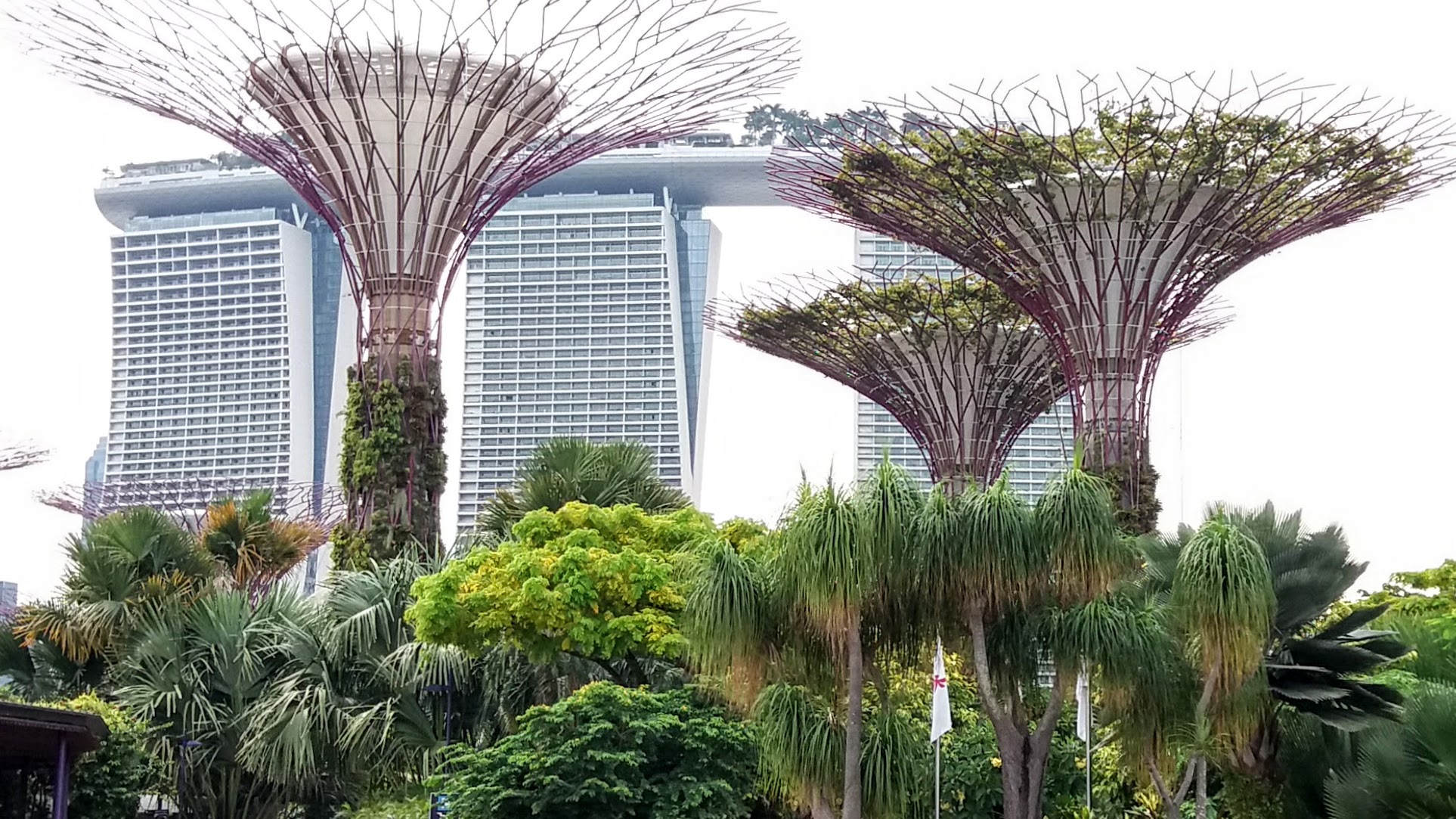 After lunch, I decided i should go find the super trees. It was getting on in the afternoon, and I still had to get across town to the Night Safari for my 7:15 ticket. Although the tall and unique structures can be seen from nearly anywhere in the park, it took a little effort to find the right walking paths to get to them. There are two groves of supertrees, the smaller has only three, which at the time were undergoing a pre-lunar new year makeover.
 Eventually, I found the main grove and purchased my ticket for the sky walk. This is a little walkway that is accessed through an elevator in the “trunk” of the trees and lets you walk around the super trees at a good height to both admire them and the overall view of the gardens below. I had a nice walk and an even better view as well as some pleasant conversation with another traveler. No matter how nice the view is, I think my favorite part of traveling is meeting cool people.
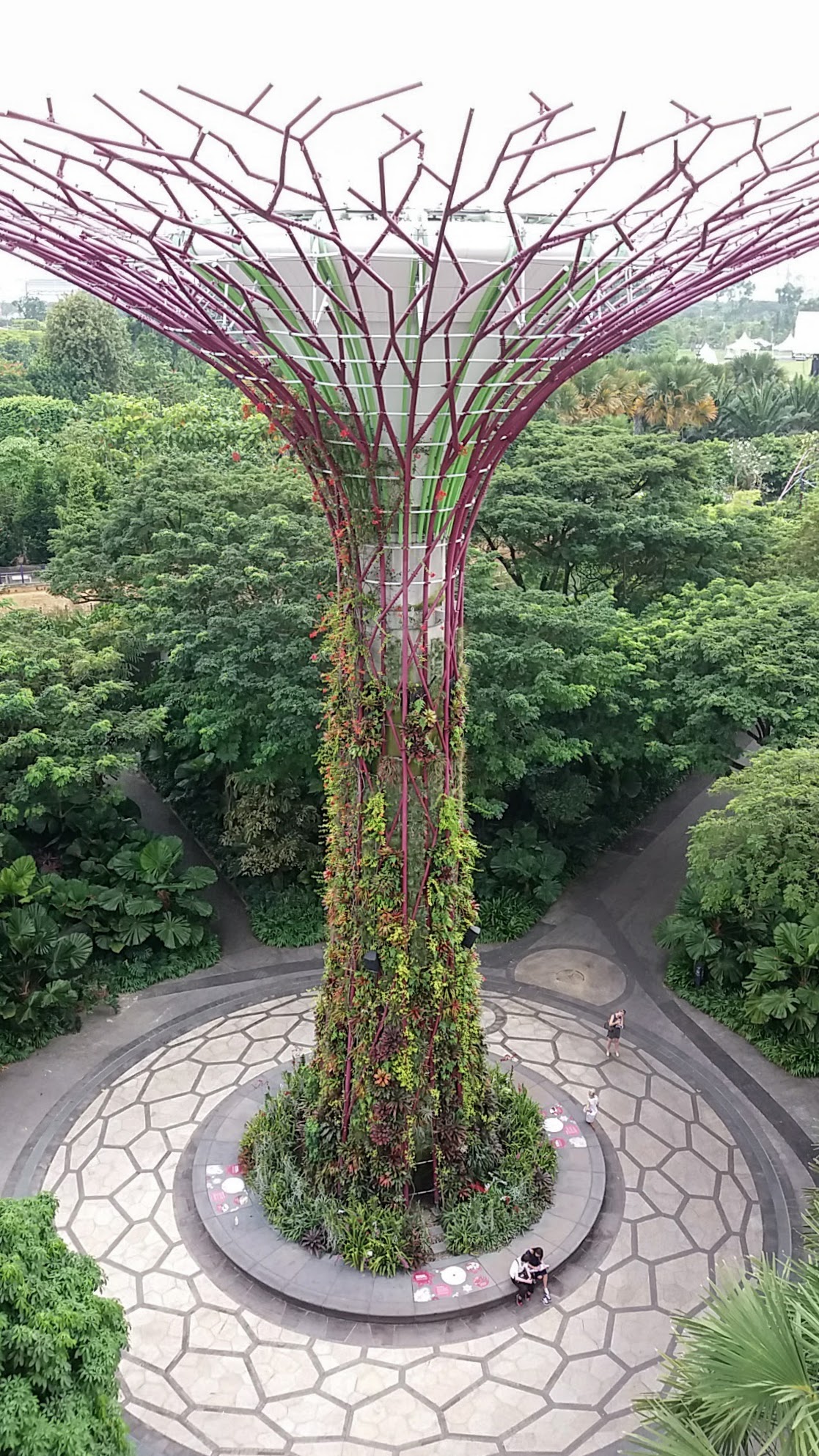 The super trees aren’t really trees. They’re man-made structures that sort of look like giant alien trees. They run on solar power and support a large amount of plant and animal life. Plus they light up at night, which is pretty. The super trees are urban art, but more than that, they are a way of combining city and nature and of providing a space for the plants and animals that would otherwise have been disrupted, or even endangered by the urbanization of their homes to have a place. The super tree grove helps to act as a greenspace, cooling and cleaning the air naturally, as well as collecting solar energy and rainwater that are used in running the indoor gardens. It’s basically a big experiment to see if a city can be a modern urban environment AND maintain a natural ecosystem in an economically sustainable way. I hope it catches on. More cities should have giant trees, beautiful flowers, and river otters.
 Gallivantrix