I Want to Learn the French Art of Living

Why are you going to France?

It was astonishing how many people asked a version of this question. While it is true that I often travel for a job, I’ve visited 5-6x as many countries for pleasure as I have for work, and until this spring when I decided to stop working in order to take my holidays at a nicer time of the year, no one asked me why. “Because I want to”, was the real answer, but it seemed to confuse people. Other times, I told people I was going for the food, but most who have never been to France simply can’t imagine the food here being that much different. I once counted myself among them, but after my first meal in France, I thought that I had died and gone to food heaven. 

Now that I’ve been in France for a couple of weeks, I know that what I was struggling to find the words to say was that I wanted to go to France to learn the French art of living. The French call this “Joie de Vivre” (Joy of Life), but it is perhaps better translated as “The Art of Living Joyfully”, and it’s a very deep rooted value in French culture. Joie de vivre isn’t about parties or euphoric joy, it’s finding happiness through living. Since arriving in Tours, I have been receiving a swift and enlightening crash course.

Musée des beaux-arts – “La Joie de vivre” (Victor Prouvé, 1904)

Practicing Kindness

I will say again that French people in general are more likely to be kind than rude (I’m sure they can be rude when called for, and that there are some percentage of rude people everywhere, but rudeness is not the default way of life). My first week in town, I had to run errands and do shopping while jet lagged and after my 3.5 hour French immersion class which left my brain feeling like a wet noodle. I could barely make comprehensive sentences in English (my native language) let alone in French. Despite my overt disorientation, every shopkeeper was kind and patient with me, most were even happy to use both French and English with me when I explained I was learning, giving me a chance to practice but also helping when the language was outside my skill.

I have not formally studied French since middle school. I came into this language program with a hodgepodge of random vocabulary and grammar that does not conform to standard learning levels in any way. I am not a quiet student, but I also felt that if I asked about everything I didn’t understand, I would derail the whole class. On my second day, I experienced an intense moment of frustration, and the teacher worked very hard to find out what was confusing me. I wanted to shut down and look it up later in private, but she worked it out with me in class. In the moment, I wasn’t happy to be the focus of so much time and attention, but in retrospect, it was a glorious act of kindness and support on her part. I’ve done the same for my own students, and it’s eye-opening to feel it from the other side.

I also had some disappointment in the apartment when I arrived –the washing machine was broken, and there was no Wi-Fi. In most other places I’ve lived, these kinds of problems were dismissed and I was left to handle them on my own or forced to nag the property manager (my last apartment in Korea was a nice exception, those people were great). I didn’t feel any animosity at the lack of amenities. I had of course emailed ahead of my flight to be sure that I would have access to a washing machine and Wi-Fi (among other things), but my response to the absence of promised resources while traveling abroad is less often anger and more often resignation. 

To my surprise and delight, the owner of the school arranged for me to get 120gb of data for the month so I would be able to do things like make video calls, watch YouTube, and write in my blog. His efforts were above and beyond what he needed to do to meet his obligations to me as a paying student. The landlady came the next day with a repair man to fix the washing machine, so it was working again before I had a full load of laundry. While we waited for the repairman to finish his work, she engaged me in conversation, despite not speaking any English, and was patient and kind with my poor French, repeating things more slowly or finding simpler phrasing. She told me about several beautiful tourist attractions around the area that I look forward to exploring.

It’s hard to believe, but even panhandlers on the street here are nicer. I don’t speak French well and in any case have fallen out of the habit of carrying cash. I have nothing to give them, but even after I tell them this, they smile and ask where I’m from, try to speak some English with me, and wish me a good day.

Receiving Kindness

This is all in stark contrast to my experience in Sénégal where I was promised support and given none, treated brusquely by shopkeepers, and viewed as a walking wallet by most. Even in the US, my job had offered support and fallen short, resulting in an overabundance of stress, and my co-workers (who are nice people) still took a couple months to really warm up to me.

My knee-jerk response to this level of kindness and support was shock. For the first several days, every time it happened, I gawped like an idiot, stunned for a moment before a part of my mind went, “it’s ok, relax, trust, let yourself be supported by your fellow humans not because of prior relationships, not because of obligations, but merely because we are humans together.”
Photo Credit:  www.semtrio.com/

It wasn’t until later when I went to write about my experiences that I realized how much I craved this kind of human connection. I love my friends and family, I enjoy forming relationships with my coworkers, but there’s something deeply healing in looking up from our bubbles and saying “hello fellow human, this world is tough enough, so let’s do our best to make it softer for each other while we’re here”.

A Culture of Joyfulness

By the middle of my second week, it was apparent that the effect of joie de vivre is exponential. When everyone is focused on enjoying the little things, it’s easy to be happy and kind which makes everyone happier and kinder. Joie de vivre isn’t at its best when experienced in isolation, it’s something that needs a majority of people to buy into in order to reach its full potential. I can feel it soaking into me, too. I don’t need or want to run around looking for one exiting experience after another because the everyday life here is good. Not ecstatic, or overflowing with awesome, just persistently good.

The other day I gave my seat on the tram to a mother with two younger girls. I enjoyed watching them interact on the trip. The girls were talking about my blue hair, and when they got restless, the mom played “find that body part” (where’s your nose? touch your ears!, etc.) which was also fun for me because I’m not the best at French vocabulary. I was able to relax and enjoy the experience. It made me smile to see their small delights. No one was giving the mom dirty looks for her kids being kids, and the mom didn’t have to be self-conscious about playing with her kids on public transit.

Joy and Other Feelings

Joie de vivre could be compared to the practice of mindfulness, in that one of the goals is to be present in the present. Lingering over a meal, sharing an afternoon with friends, and watching kids on the tram are all wonderful examples of the everyday, but international vacations and once in a lifetime experiences are not excluded. The definition of joie de vivre isn’t what you are doing, but how you are doing it: a lunch without an agenda, a hangout with friends for no reason, an international vacation without the stress of focusing on what could go wrong, or what is waiting for you when you get back.
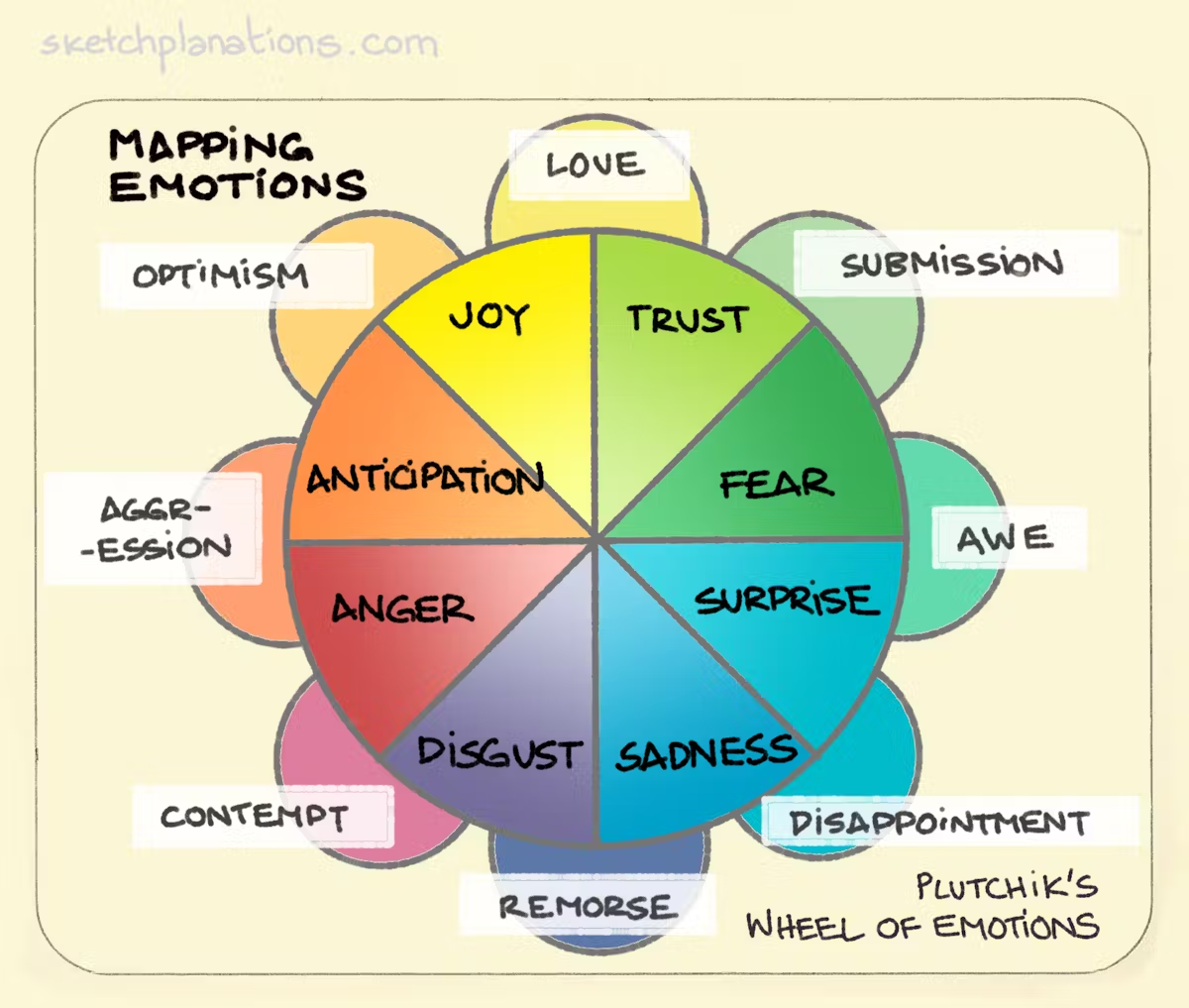
Joie de vivre also isn’t about being happy all the time. Obviously the French have “negative feelings”, I mean, have you read Sartre? But a range of feelings is the normal human experience. The impression I get is that “pretty good” is the baseline here, and feelings of more extreme happiness, sadness, anger, boredom etc. are all coming from and returning to that. In contrast, when I look at people in the US and a few other places I’ve lived, I see them defaulting to a baseline of “meh” (numbness or boredom) or even a baseline of anxiety and sadness. Image Credit: https://sketchplanations.com

Regardless of what culture they are from, people are capable of feeling a full range of emotions, and a normal human will experience most of them in a lifetime, but living in a culture that forwardly values kindness and everyday joy makes a difference in everyone’s quality of life.

Can Americans Live Joyfully?

My initial answer to the question “Why are you going to France?” was often greeted with the suspicion that anyone going to live in a foreign country and not work for a couple of months just to enjoy things was dangerously decadent. This happened so often that I began to become suspicious of myself. Was I leaving my students and co-workers in the lurch? Would they be ok without me? Could I really justify the expense, not only of the vacation but of the time spent not working? The regular messaging of the culture around me made it harder and harder to be sure I was making the right choice.

There is a tendency in (but not exclusive to) American culture to view any action that is not productive (making money) as frivolous (selfish, useless, a drain). For me, joie de vivre is more likely to involve things that make you happy but don’t make money, nor lead to making money in the future. These are things that you do just because you like them (and that don’t hurt anyone else). I rate this kind of joy as sitting from tier 3-5 of the Maslow’s hierarchy. It’s hard to go after it when you don’t have basic needs met, but I would argue that it’s integral to love and belonging, self-esteem, and self-actualization.

When I started telling people instead that I was going to France to study French, they seemed much more comfortable. Once there was a cultivation of skill involved, it wasn’t just frivolous happiness, it was productive, and that was more socially acceptable. One day as I was hand-wringing about whether I needed to justify my trip to France, someone said to me, “Why are you beating yourself up about this? You deserve this. You can do this without going broke or wrecking your life, so go enjoy it.” It was an extremely succinct account of the two most important obstacles to frivolous (non-monetizable) happiness:  Can you afford this? Have you earned this?

Can you afford this?

Credit: FreePix.uk

It’s a valid question, but I don’t think it’s the only hurdle to frivolous joy. There are many people who do not have travel money, or have other challenges to travel such as health and children, and I’m not suggesting (as I have seen other travel bloggers do) that one can simply manifest global travel with enough bootstraps. Maybe they can’t afford a trip to Paris, but what types of joie de vivre can they afford but are held back from doing because they feel guilty about it?

During my experiences in developing countries where almost no one has enough money, the social values writ large tend to be more focused on “slow living” and finding joy in daily experiences such as community, shared meals, nature, children, and expressing creativity – things that don’t cost much if any money. While people in these cultures may feel guilt about spending money on themselves instead of their family or community, they don’t seem to have any trouble enjoying themselves when it’s not a question of money. Even in Japan and Korea, wealthy countries famous for overworking, I still noticed people placing importance on these types of low cost joys.

Have you earned this?

American culture is embedded with an exchange rate of work for pleasure. You must burn x number of calories to “earn” dessert. You must work x hours to “earn” a break. I talked to people in my income bracket and above who can absolutely afford to travel, but felt that they could never possibly, because they haven’t hit the ever-shifting goal post of “enough work” to earn the pleasure.

The earning in question isn’t financial; it’s the unspoken moral economy. Many Americans have internalized the idea that we don’t really deserve to feel good (at least until we’ve suffered enough to “earn it”, which may mean never). But because we are human, we sneak around with minor infractions we call guilty pleasures while lacking the ability to fully feel the delight these activities should bring because we are too busy feeling guilty and wondering how we’ll be judged.

What will people think? If I eat a second slice of cake? If I skip mowing the lawn to have a nap in the afternoon sun? If I take my kids out of school for a day to drive up to the mountains and splash around in a glacial river? If I leave my spouse to feed themself and the kids and they end up eating Cheerios and ice cream while I have a nice dinner with my friends? If I leave the office when there’s a big project (and there’s always a big project) and my co-workers all have to pick up my slack while I’m tasting wine in the Loire Valley?
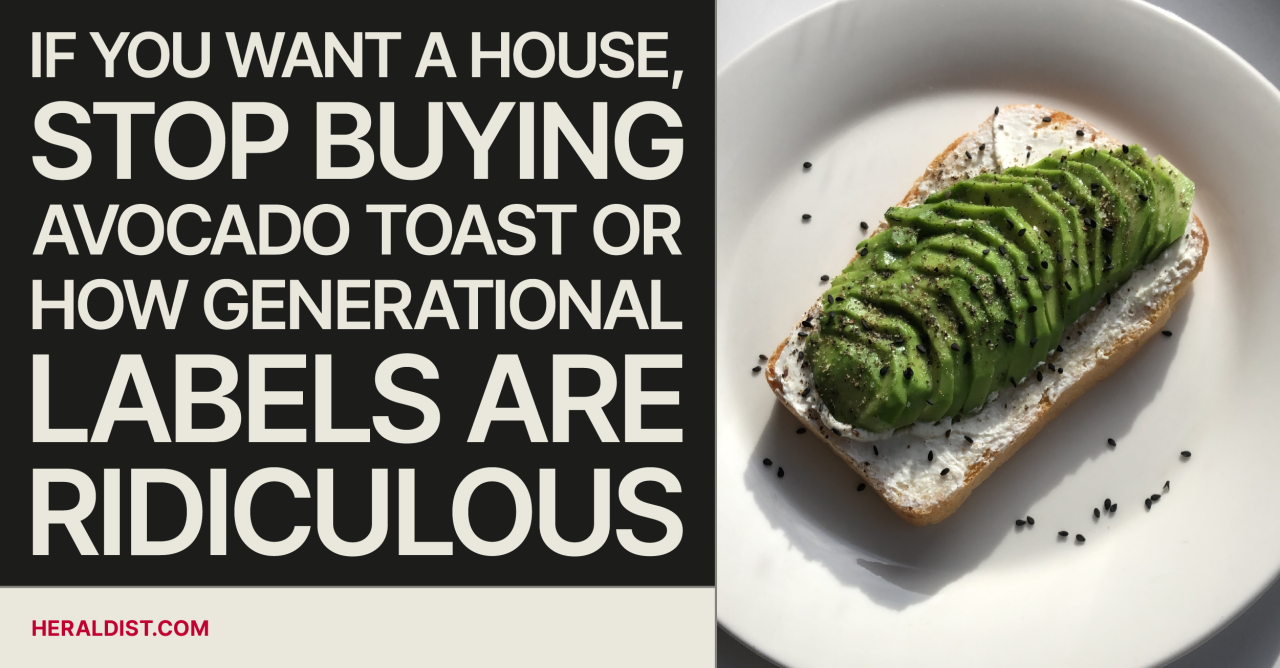
Look at the horrible social media backlash that middle and lower income people get for having nice things deemed by society to be “too luxurious”. When they use food stamps to buy steaks instead of rice and beans, or dare to have a new phone, a nice laptop, play video games, drink frilly coffee, eat avocado toast or anything else that might make life bearable, the internet loves to pile on. Grind culture tells us that the one true path to financial success is to have nothing that brings joy, and only to work as much as possible until you can earn your way to a house, a car, and a (maybe once yearly) family vacation to a theme park.

Let me be clear, none of these examples are likely to result in anything bad actually happening, but the real world consequences are not reflected in the imaginary consequences of people who are held back by these thoughts. The extreme version of this is called “catastrophizing” and people who suffer from this type of anxiety (as you might guess) imagine catastrophic results of actions they perceive as risky. The less extreme version is a bunch of people who don’t critically examine what is likely to happen, they just feel the guilt and shame as a gut-level reaction.

A New Way of Thinking

I don’t take these internalized feelings of guilt and shame lightly. They are deeply ingrained in us from childhood, and can feel like an irrefutable pillar of reality. But they need to go. Maybe in the way black mold or an insidious termite infestation needs to go, or maybe in the way a cavity needs to go: knock down a wall, drill a hole, excavate the rot and repair the damage. It isn’t something a person can just do –wake up one day suddenly be free of the pressure of guilt induced by unproductive pleasure. However, I suggest that everyone reading this start the long and difficult process of releasing the weight of these fears and finding the freedom to do things just for fun. 

“[Joie de vivre is] revolutionary because for work-driven, vacation-and-long-lunch deprived Americans, it almost requires brain surgery. Why? Because to make that lunch a moment with a French touch it has to be just for fun, no rush, no agenda. An American [said] that her French women friends, who are physicians, ‘work long hours but find time to meet their friends, take vacations, and indulge in the life part of life, which is as important or perhaps more important to them than work.'”
— Huffington Post, “What is joie de vivre, and why are the French so good at it?”

This isn’t “run away with the circus” advice. I do not advocate joy at the expense of security or community. We still need to be able to answer the question “Can I afford it” with “yes”. Please do not go into debt chasing a consumerism driven idea of happiness (been there, done that, regretted my financial choices). It’s important to balance joy and responsibility, but until we learn what things are truly our responsibilities and what things are the weight of other’s expectations and demands that we have taken on unnecessarily, we won’t be able to say “yes” when asking “Do I deserve it?”

Once we are able to accept that we deserve to enjoy things without having to earn the moral currency to do so, there is a different way of life ahead. 

They Say You Can Never Go Home

“When I’m talking and someone else is listening, I am invariably left with the uneasy suspicion that I’ve made myself quite tiresome. If one is really bursting with things to say and has no one to say them to, perhaps the only recourse is to go forth and accomplish earth-shattering deeds, so that when the time comes for an autobiography, one need no longer be concerned that no one will take any notice. This is a childish fantasy, of course, of which I have been disabused as I have slowly come to realize that I have scant hope of becoming a celebrated public figure worthy of a best-selling autobiography. Better, then, to write a little about myself and let off some steam, so that I don’t become an insufferable chatterbox when I get old.”

Written on Water by Eileen Chang,  Chinese-born American essayist, novelist, and screenwriter
— written in Japanese occupied Shanghai and first published in 1944.

My last post was more than 8 months ago as I left Senegal to return to the US. I always seem to have a hard time writing when I’m in the US because it doesn’t feel like “travel” or “adventure” to me the way being in other countries does. When I return to Seattle, I focus on enjoying my time with friends and family, having quiet daily experiences of shared meals or parallel play, and even when blog-worthy things do happen, the stories feature people who trust me not to share their private lives online. So, I end up not writing at all.

When I made my plans to return to America in 2023 I told myself and others that I would stay for at least 6 months and not more than 12. I looked forward to it. I felt that I had been away for so long that a quick pass wasn’t going to cut it. I wanted to “water my roots”. I wanted to bask in the everyday mundanities of my friends’ lives, to see the seasons change, to celebrate the holidays of my childhood. Being a long term expat means never giving up on the idea that our country of birth is our true home, while also never quite being as comfortable there as once were.

I wanted to work in the US, not only for income, but also to give my days structure. COVID era Korea and the schedule nightmare of Senegal left me for years in a state of temporal blur where days ran together and there never seemed to be a good enough reason to do anything. During my sojourn in the US, I neither wanted nor needed to work full time. My goal was to soak up my community, not to sink into a daily grind. A part time job would keep me from decimating my savings, and give me a regular routine, but leave me with plenty of free time to enjoy being home.

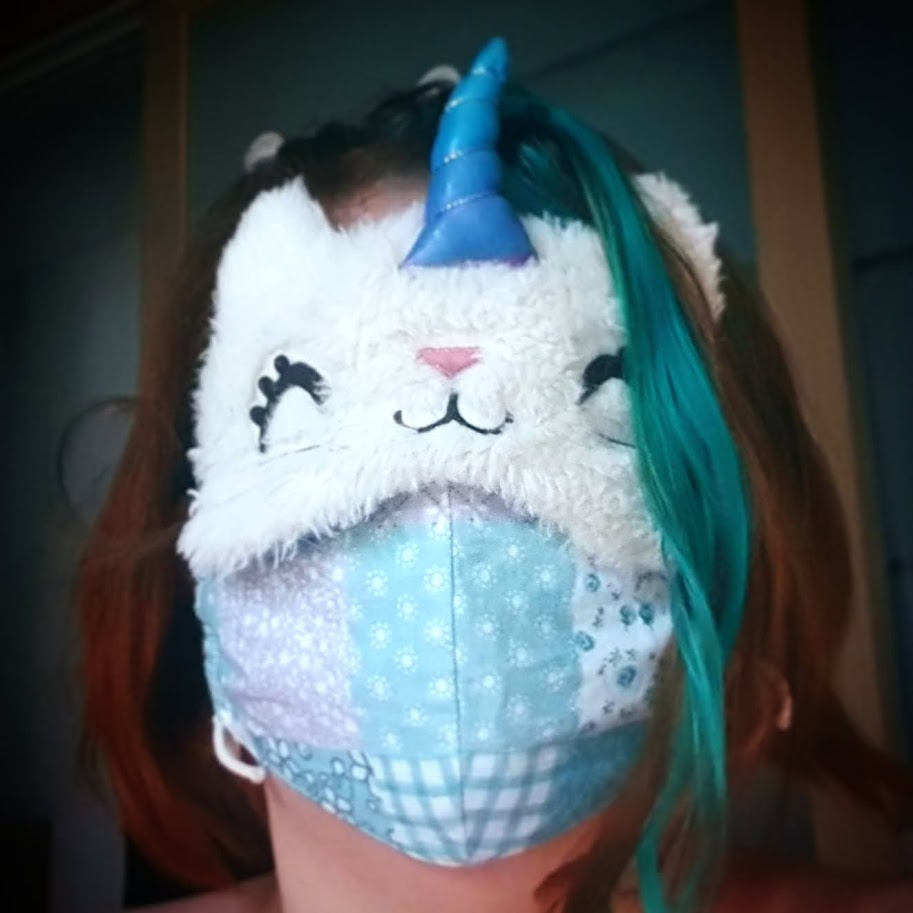
In reality, I accepted a full-time position teaching an English immersion course for immigrants and refugees. The position came with a lot of challenges, but possibly more rewards. Being back in a physical classroom with a regular schedule and the ability to form a relationship with my students was so good. Learning the bureaucracy of the WA state college system… less so. (drawing of me teaching courtesy of a student’s daughter. I was wearing a floral patterned mask, not speaking with a mouthful of marbles, lol)

Meanwhile, when it came to housing, I knew I didn’t want to rent my own apartment since that would mean committing to a full year lease, and likely cost 1500$+ a month. Therefore, I arranged to move into the spare bedroom of a former roommate. After just 3 months of living together, it became clear that whatever had changed for us since our last cohabitation made a reprise totally impossible. I moved in with some other friends of mine who agreed to let me stay at least through my current work commitments. (pic of the backyard below) That beautiful home with a healthy family and 2 bright and loving kids was an absolute balm to my soul after the back to back combo of the pandemic isolation and the Senegal experience.

Nonetheless, it was always destined to be a short term solution, and I had to start seriously considering my options: renew my contract at this reasonably good job and work on finding a place of my own in the USA or bounce?

Reverse Culture Shock

Coming back to a life in the USA isn’t as simple as it sounds, and however much I may love my home and my community, there is no going backward when it comes to the march of time which wreaks changes in both society and personal growth. When you travel, you leave your familiar surroundings and go to a place where you are shaped by different forces and grow into a new version of yourself. While you are gone, the place you left behind also continues to evolve, shaped by local and world events, so when you return, you no longer fit. It is uncomfortable, and often more unnerving than the experience of not fitting in with a foreign culture. Abroad, you know you are the alien, but at home a part of your brain is constantly telling you that you are SUPPPOSED to fit here. It’s a dysmorphia of the whole sense of self.

But Kaine, you’ve been back to America since you left in 2014, you saw the changes as they happened! Yes and no. I saw America during my vacations the same way any tourist might see a country they visit for only a few weeks. I focused on excursions and experiences, the only real difference was that I made excursions of visiting friends and family rather than visiting tourist attractions. I planned sailing days and camping trips and cookouts. I went to house parties and dragged people out to karaoke nights. I didn’t pay a lot of attention to the cost of groceries or what was happening in politics. For those few weeks at a time, America wasn’t my “home” it was my holiday, and it wasn’t until I was back in my home abroad that I returned to viewing the US economy and politics through the lens of the internet.

This is an excellent article about the experiences of long term expats returning home, and honestly reading it made me feel both seen and called out.

“Americans often develop new attitudes, values and perceptions as a result of their travels. These can often cause stress on reentry.

  • I see America through a sharper lens, both its strengths and weaknesses. I no longer take this country for granted and I really resent unbalanced criticism by Americans who haven’t experienced the rest of the world.
  • I see the validity of at least one other culture. That makes me realize that the American way is not always “right” or “best.” I am impatient with people who criticize other countries and blindly accept everything American causing them to never question anything.
  • I have an unclear concept of home now.
  • I place more value on relationships than other Americans seem to. People here are too busy for one another.
  • Everyone in America is always so stressed and frantic. They never relax. I feel like I can’t relate to others

The Economy

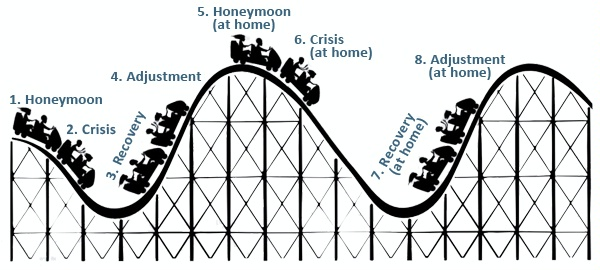
It’s normal to become critical during the second phase of culture shock. I’ve published about these effects before, and the article above is great for explaining how it manifests in reverse culture shock. Nonetheless, even while I was still in the first (honeymoon) phase during August & September, I started feeling the negative impact of some big changes in the US.

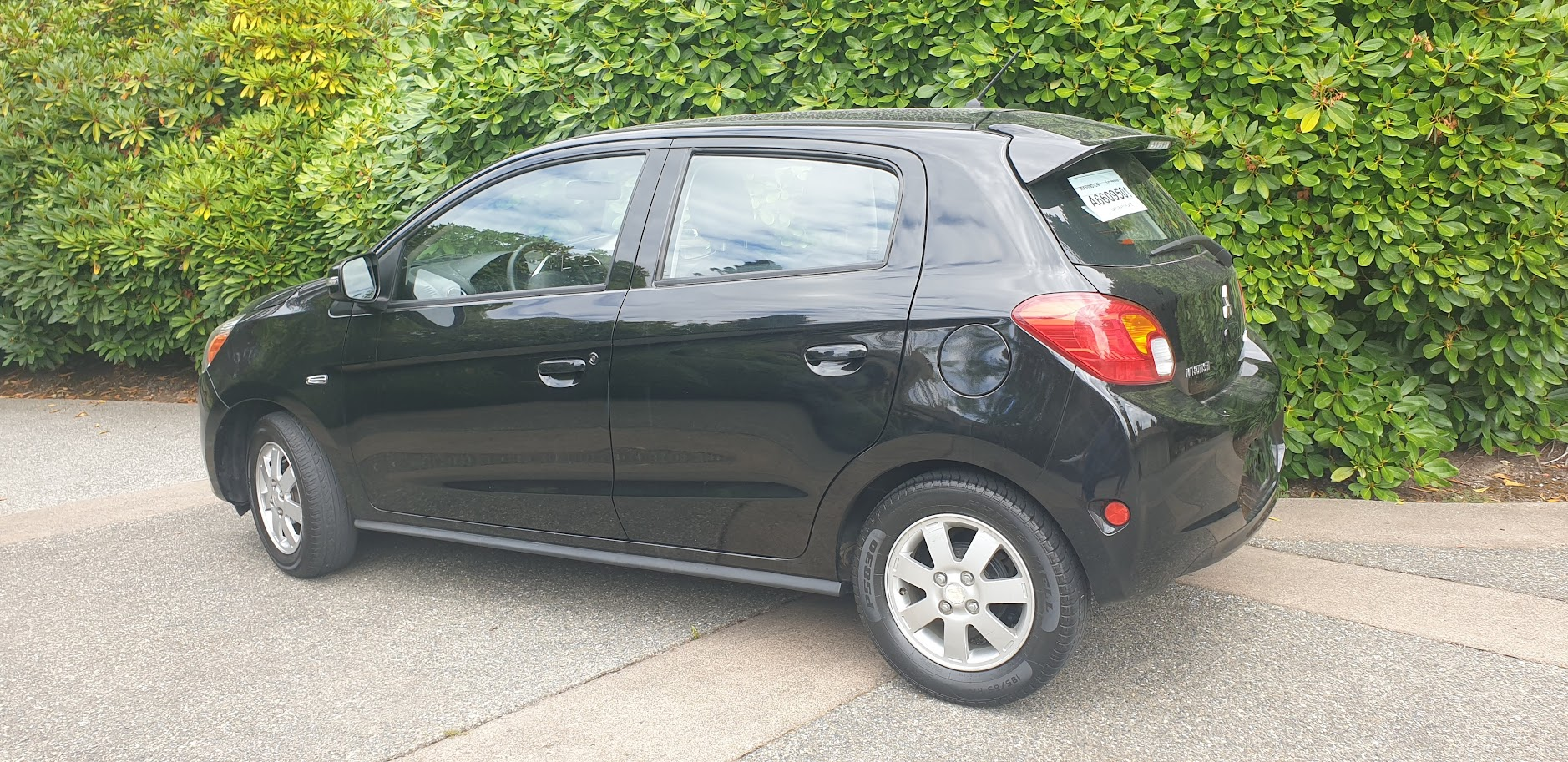
I needed a car because it’s almost impossible to navigate American cities via public transit, but I was absolutely shocked at the prices, even on used cars! In 2015 when I was in the US for a few months doing the paperwork for my Korean work visa, I bought a car for $1,750, drove it while I was in country, then sold it for the purchase price when I left. In late 2023, I couldn’t find a used car for less than about 7k$, and those were very sketchy.

My plan to buy a clunker for under 3k and sell it on to a poor college student went up in smoke. I ended up buying a used car from a dealership and hoping that the good gas mileage makes up for the loss in sticker price when I sell it back.

Then there are the grocery stores. I can’t say exactly why, but sometime after I moved to Korea in 2016, American grocery stores became increasingly overwhelming. I can’t even say it’s the size, because I have successfully gone to large box stores like Home Plus and Carrefour in other countries and not felt the pressure that American stores give me. I remember walking into a Safeway in 2019 and just staring at the wall of ice cream for a full 5 minutes, totally flummoxed by the array of nearly identical products. 

When WA grocery stores became liquor sellers (2012), they had to figure out how to add new products without removing existing ones. The eventual solution was that many stores made the aisles smaller so they could incorporate more shelf space in the same square footage. The aisles got narrower, but stores didn’t replace their shopping carts with smaller versions. By 2023, the sensory overwhelm had gone from merely being too many choices and no way to choose, to a feeling of being totally lost and crowded in by impatient and frustrated shoppers in narrow aisles with giant carts which made passing an Olympic sport.

The products and packaging were unfamiliar, I struggled to assess healthy and frugal choices. Products that I did know had somehow doubled in price, overtaking average inflation at light-speed. In 2008, a person could buy a whole roasted chicken for $5, eat it for several meals AND make soup. An organic bird would be $7-9. Now the conventional chickens are $10+ and the organic/farm raised $12-18. In the end, I found that the only store which didn’t make me want to run away screaming was Trader Joe’s, and I did 99% of my shopping there.

Not only grocery stores, but the nature of in-person shopping had changed across the board. In-store service and options had become extremely limited. Once 24 hour shops had become practically European in their hours, and stores were chronically understocked and underserviced. Several times when I popped into a shop to pick up a small item or to look for something I could touch, measure, handle, or try on before buying, I was told plainly by the clerk that it was out of stock and I should look on Amazon.

Eating out was another huge sticker shock. My favorite Seattle staple food is pho (the Vietnamese noodle soup). At my graduation lunch in 2007, we could get a big filling bowl of rich meaty pho for about $5. Now a bowl of pho is $12-15. I went to a couple of what I would call mid-range independent (not chain) restaurants and dropped $80-100 on a single meal (after taxes and tip). Many places I lived and visited abroad, you could get a high-end meal out for between $25-40 (inclusive of taxes and service).

mahalie from International District, Seattle, Washington, CC BY-SA 2.0 https://creativecommons.org/licenses/by-sa/2.0, via Wikimedia Commons

The Food

Food remained a contentious issue for me the whole time I was in the US. In the past, I have had food intolerances which contributed to chronic inflammation, pain and fatigue. I stopped eating dairy and wheat back in the early 2000s and it made a huge difference. Starting in 2008, I experimented with eating wheat and dairy in other countries as compared to in the US. Country after country, as long as I avoided imported US foods, I could eat what I liked and feel fine. However, in the US, it seemed my body only tolerated organic wheat & dairy products, and conventional ones still resulted in inflammation (a general flu-like bleh feeling all over). I thought as long as I managed my bread and milk, food in the US would be easy enough. My body laughs at me when I think like this.

It has been widely discussed that the quality of food in the US is very different from that of other countries. There are hundreds of articles about pesticides, hormones, preservatives, and processing chemicals out there you can read, and I’m not going to recap that here other than to say it is a well documented issue that food in the USA is problematic and contributing to many health problems for her citizens. (pic below, my first and only experience with Chicago deep-dish pizza)

After a couple of weeks of eating novelty junk treats and processed frozen meals, my body protested loud and clear. I had to be pickier and pickier about what I would eat and eventually, food that was too sugary or over-processed simply stopped tasting like food. I remember taking a slice of a cake that looked so delightful, then on my first mouthful wondering how it tasted so awful. The cake was sugary and vaguely spongy, while the frosting tasted like it was actually made of melted plastic. The people around me seemed to enjoy it. I visited a friend’s house where they made a meal I would have made myself 10 years ago and been happy with. I took a small amount to be polite, but again, my body made sure I knew that what I was eating had only a passing resemblance to food. 

Not only did I feel constantly disgusted by the majority of US food, I felt bad about complaining or even abstaining when others around me were eating, enjoying, and offering to share. Sharing food is one of the most fundamental social bonding activities humans can engage in, and my friends, many of whom are still in financial struggles, wanted to share their food with me. How could I tell them that my body didn’t think what they were eating was food? (pic below, a Thanksgiving “turkey” made of Baskin Robbins ice cream and frosting, just one example of the absurd food-options that abound in the USA)

And, despite my caution around eating, and reintroducing an exercise regimen, I GAINED weight in the US. It is my belief that the food itself was the bigger part of the problem, but I also tend to overindulge in sugar when I am stressed, a condition that pervades the life of any American trying to achieve work-life balance. I don’t know what it would really take for me to be food-healthy in the US long term, but I expect it would require a LOT more work and money than would be required to eat a basically healthy diet almost anywhere else.

The People

I had to confront the feeling of failing to fit not just in the larger cultural sense, but also among my own friend/chosen family community. I changed and grew, and so did they. Most of them for the better, thankfully, but in all cases they weren’t quite sure where to put me in their lives when I was in town for months rather than weeks. When I was only available for 12 days, it made sense for people to rearrange their schedules for a unique event, so vacations were filled with revelry and reunion. However, I feared that living there would make my presence mundane, banal, and that my friends would think there would be time later, so they wouldn’t make time now. Thankfully, that fear did not come to pass. Although some people I saw only once or not at all during the 8 month stay, many others made time for me or invited me to planned events at least once a week. I treasure my community.

“General Challenges

  • People at home aren’t as interested in hearing about your foreign experience as you are in telling them about it . 
  • You aren’t as interested in hearing about what has happened at home as they are in telling you about it. 
  • You miss the tight-knit foreign affairs community you were a part of.

I have learned over the years that people stuck in one country (especially Americans) have strong feelings about listening to my adventures. Some of them love it, they see me as their own personal documentary, and it’s delightful. Others are busy comparing their lives to mine and dislike hearing about what I’m doing abroad. I try to respect everyone’s wishes in this, but it can be hard since 95% of the last 10 years of my life has been abroad and I can’t tell stories about my life experiences without involving travel.

Whichever way it goes, it’s massively different from talking to other expats. I had almost forgotten how much I loved swapping stories among the expat community when I ran into another long-term expat at a party in early April. I realized that it was the first time since coming back to the US that I felt comfortable talking about my life abroad for more than a few minutes or in any detail.

It felt like I was holding my breath around my friends and family. I talked about my American experiences with them all the time, shopping, work, things happening at the home I lived in or with other friends’ lives, but I minimized my expat-self, trying to fit into the shape that was left for me. I don’t think my friends consciously asked me to do this, and many would be shocked or saddened to learn that I had been suppressing a part of myself for their comfort. I know they love me and I chose to change the way I interacted with them to make them comfortable because I love them. Call it masking, call it code switching — choosing to focus on a different part of my life and activities when I’m with different people is normal. However, it has made me realize that I can’t live with ONLY this kind of interaction. I need the expat community too, which makes long term residence in the US challenging.

The other difference I noticed in people was more general, society at large. I don’t mean the blatantly obvious “us vs them” divide in America that you cannot help but see if you follow any news at all, but a quieter and less politically motivated change. The shared trauma of COVID changed everyone in some way. I cannot speak for the whole country, but in and around Seattle, people were more closed off, less trusting, less willing to be open.

It’s part of my mental health journey to notice nice things and to make the world around me better than I found it, so I trained myself in the habit of talking to strangers, offering compliments and help whenever I can. I made a game of my daily commute to see how many drivers I could be nice to each day as a way of fending off road rage. (strangely, the commute was one aspect of American life that didn’t bother me) Yet I found that often my overtures of friendliness toward strangers elicited a mixture of confusion and even suspicion before giving way to acceptance and relief.

I am far from the first or only person to notice this trend. A simple Google search will reveal many think pieces searching for reasons why Americans are becoming less social and more isolated, most stressing the dangers for our collective mental and physical health.

My friends who had regularly exchanged hosting dinner and game nights had stopped during lock-down and never re-started. The feeling I got was that the inertia of staying home was so strong that going out required a more special occasion than “dinner and board games”. I also tried for a little while to make some new friends or even (gasp) date. I met people who seemed nice, who I was happy to spend time with and get to know, but they had no ambition to do anything different in their lives. They wanted a new friend or a partner who would fit seamlessly into their existing lifestyles without necessitating a change of habits or hobbies.

People know they crave connections, but seem unwilling or unable to sacrifice even the tiniest bit of safety and comfort for the privilege. People who have been isolated for long periods of time can absolutely suffer increased social anxiety. When I floated this theory past an expat friend of mine who has been back in the US about 18 months longer than me, she said it wasn’t exactly social anxiety, but that everyone felt “tight”, and I understood exactly what she meant. I sympathize with how difficult and uncomfortable they must feel, but it’s both sad and horrible to see.

The American Dream?

Americans are also feeling a lot of financial anxiety. Almost all my coworkers were working overtime, some as much as double time (two full time class loads!) and felt completely unable to stop, either from the weight of their financial obligations (high cost of living) or from a fear that setting any boundaries for work-life balance would cost their job. I had coworkers who were astonished (and envious) that I simply didn’t read work emails outside the office. Others who fretted and stressed that their quarterly contracts might not be renewed despite the massive teacher shortage and high demand. The insecurity was so strong that even though everyone I talked to had noticed certain problems, no one wanted to speak up about them. (Did I? Yes, but it was neither easy nor consequence free. Still glad I did it.)

It was also hard for me to reconcile the gulf between online calls for social justice with the fear people experienced of getting personally involved. Having watched the struggle for civil rights and equity in the US take place almost entirely online for years, it had seemed to me like more people were getting involved, but after living in the US for a few months, I am concerned that the involvement is performative. People can safely speak out online and issue company memos to make themselves feel involved (or if you’re more pessimistic, to make themselves look better to others), yet when it comes to real practical solutions for enacting these policies, no one seems to want to take action. The college that claimed the top ranking for social justice, equity, and accommodation in the region had completely failed its non-English speaking students in this regard and when it was pointed out, they simply changed the subject. Only one person in the whole administration ever actually admitted to me they were failing in that area, and they still didn’t know what can be done about it.

To me, the fear of getting involved in social issues seems like an extension of the same fear that is preventing people from forming deeper social connections, and that fear feels to me like the fear of a child who has skinned a knee falling off their bicycle and doesn’t want to ever ride again. “No, no, walking or being driven is safe and comfortable, the bike is too risky, too painful, I don’t really need it anyway.” Yet, we tell our children to get back on the bike because we know that the better part of life isn’t about falling, it’s about getting back up, and that while it may not be strictly necessary for a safe and comfortable life, the joy of riding a bike with the wind in your hair, and the feeling of freedom it brings is worth the risk of a skinned knee.

Get Back on the Bike

The decision for to strike out again was unexpectedly difficult. My emotional and mental state had become a mélange of post-Covid insecurity, second-hand PTSD, and of course – reverse culture shock induced depression.

My “secondary trauma” (also called second-hand trauma and compassion fatigue) came close on the heels of all the work I did to process my own primary trauma. Secondary trauma is what happens when you are repeatedly exposed to other people’s primary trauma. It’s usually care providers like doctors and psychiatrists who treat trauma sufferers that get this, but it turns out aid workers in developing countries and teachers of students fleeing violence are 100% exposed to secondary trauma. Oh look, it’s me.

This combo meant that my overall resilience was lower, my anxiety was higher, I was less able to focus on new ideas, got tired more easily, had brain fog, and difficulty generating enthusiasm. Even after I decided that what I needed was to travel for joy (rather than work), I had trouble feeling excited or engaging in research and planning. This was especially devastating since prior to COVID, one of my favorite activities was researching and planning my global vacations. (the color coded spreadsheets brought me joy!)

One of my friends also pointed out that I was likely reluctant to make plans to leave because I was in a safe and comfortable place. There simply wasn’t anything uncomfortable (enough) for me to run away from anymore. What a wild notion. I’ve known for several years (thanks therapy) that when I started this journey I was running away from who I was in the US at least as much as I was running toward adventures and experiences in other countries. On this visit, armed with the new tools of my COVID-isolation induced therapy work, I was better able to be a person that I liked while in America. And due to quirks of fate, I found myself living in a home that had the kind of “good enough” parenting and comfortable easy love that I dreamed of having in my own childhood home. Who would want to give that up?

Yet as I cast my gaze across the sea once more, the idea of going to France for the spring took root in my brain. The lack of enthusiasm and general feelings of ennui made implementing any sort of plan quite challenging. I dragged my feet on making any decisions or booking anything for so long. People would ask me if I was excited to go to France, and I would lie and say “yes”, while inside I had a nightmare vision that I would do all this work and spend all this money and somehow arrive in France but be just as unenthusiastic as I was in Seattle. It was an act of faith on my part that I would do the minimum needed to embark, and that my sense of adventure would catch up to me at some point. And now, here I am in Tours, in the Loire Valley, taking French lessons and eating at a boulangerie every day. 

Although it took weeks (maybe months?) for me to imagine and enact my plan, it only took a few days after my arrival for the fog to lift and my enthusiasm to come rushing back, but I don’t think it was the change of scenery (or quality of food) alone that performed this seeming miracle. Every single person I have met and interacted with in this historical French city has been open, kind, generous, and trusting with me. At first, I too was surprised, suspicious and even resistant, but when I let myself relax into it, I found that I could take joy even in the simple act of ordering lunch.

I may not be able to change the economy or the political landscape of my country, but I do have the power to change myself. I can decide to take risks and to be open to new experiences, even when I don’t feel like it. My favorite part of all my adventures has always been the people, and yet the people I love most are suffering in isolation. Perhaps the way forward is to put in some work towards rebuilding openness, connection, and wonder, and trust that the absence of an instant reward is not indicative of failure. Thanks to a combination of the support of my chosen family, my willingness to work toward a goal in the absence of enthusiasm, and the relentless kindness of a whole bunch of strangers, I’m finally feeling less “tight” and more excited for the future. I hope you can, too.

Aventure en France, me voici!

Alaina Goes to Ghana

My friend who is in pharmacy school had an amazing opportunity to go to Ghana this year with Global Brigades to help set up medical clinics and educate people about healthcare. She says she hates writing, but I’ve managed to convince her to let me compile and edit her Facebook posts into a story to share with you. It is written in her voice and only edited for grammar and clarity.


Day 1

I have arrived safely in Ghana. Our lodge was three hours from the nearest airport. The air was wet and slightly scented, like being in a sauna. On the long drive through the countryside, we got our first glimpses of Ghana, covered in green trees with deep red soil. We drove through countless small villages on the way. Every time we stopped at a traffic light, vibrant people would cluster around and try to sell us treats from the overflowing bowls balanced on their heads.

35427395_10155352333095824_7391464207599796224_oOur lodge is lovely and surprisingly ornate, compared to the small shelters nearby. We are sleeping in rooms of four with bunk beds and private bathrooms with showers. The rooms are air-conditioned and that is heavenly. There is a large common seating area with big windows where we meet to talk and eat the wonderful food they prepare for each meal. Most meals are served buffet style, with a chicken dish, a fish option in rich sauces, grilled veggies, salad, some sort of dessert or bread, and fresh juice made from ginger and pine that tastes like paradise. 

Day 2

This morning we enjoyed an English-style breakfast, with eggs, toast, baked beans, coffee and an Ovaltine-style malty chocolate drink. We spent the morning sorting and repackaging the medical supplies we brought. We counted out one month supplies of vitamins into zip-lock bags using plates and butter knives to hold and sort the pills as we worked. Directions for medications are marked with symbols instead of words: a circle for once daily and two circles for twice daily.

35629170_10155357661450824_4076825258496098304_o

We enjoyed a delicious lunch of chicken, fish, salad, and plantains and then headed to one of the villages. We wanted to get to know some of the people we would be seeing and invite them to join us at the clinic the next day.

The whole village was overrun by adorable animals, wandering in and out of the houses and sleeping in pots and on roofs. Baby goats, cats, and chickens stumbled between our legs. We set out in groups of six plus a translator to meet the members of the community.

Everyone was very welcoming. They have a tradition in Ghana of inviting you into their homes and offering you a seat, water, and food in ritual fashion before asking why you’ve come. We were able to ask lots of questions about their lives and culture, as well as their experiences with healthcare.

I brought a Polaroid camera and took pictures of everyone we visited. The children went crazy about it, running around and posing for us. One family played music for us on their radio and invited me to dance with them. I can’t stop smiling about how wonderful and kind everyone was. 

35490852_10155352402665824_5405476595559301120_o (1)We learned that many of them walk an hour in the hot sun everyday to farm. They can’t find buyers for their crops, so they have food but no money. That means they can eat, but can’t buy basic non-food necessities. The little kids asked us for toothbrushes by miming brushing their teeth with their fingers. I’m glad we brought lots of toothbrushes and supplies to share.

They all seemed happy to have us there and excited to visit the clinic the following day. It was hard not to give them everything I had. They were kind, beautiful, proud, and generous. I’m looking forward to spending more time with them.

35634011_10155352400430824_2850625135008808960_oAfter dinner, we attended a talk from their local doctor, Dr. Cornelius to hear more about the healthcare challenges he faces in the region and the tools they are using to treat people.

Day 3

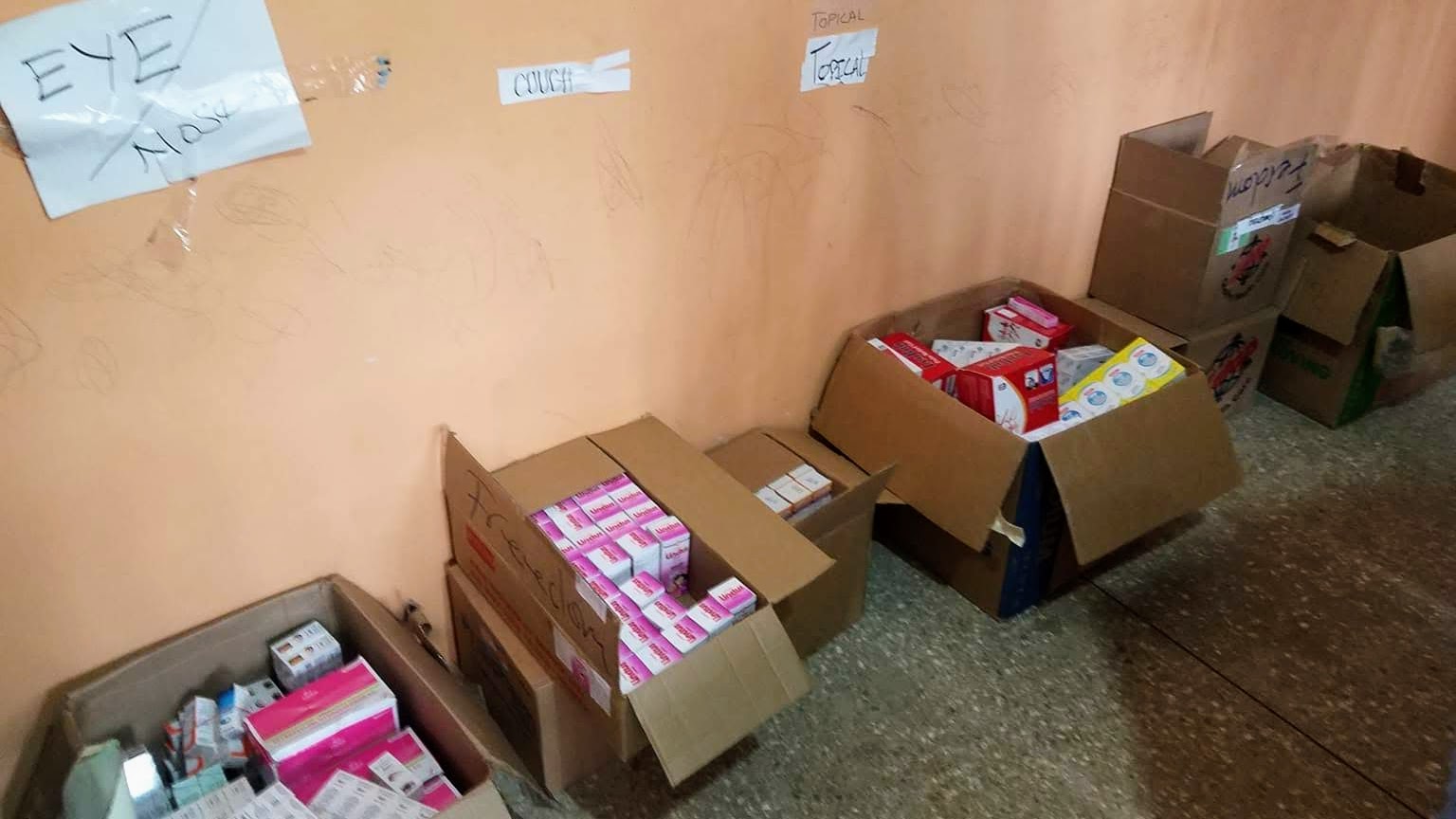
On Monday we set up our first clinic in their local hospital. It was a good building but had almost no medicine or supplies. There were only five hospital beds and otherwise it was mostly empty rooms. We set up a small pharmacy by laying out boxes of medicine on the floor.

35777187_10155357661315824_8270300656225484800_oThis particular village has easier access to medical care than most because it is so close to a facility with trained nurses. People in other villages in Ghana often have to travel on foot long distances to find a clinic with nurses and if they need any prescription medicine, they need to go farther still to reach a regional health center. This typically requires hiring a cab and taking a day off of work, which few of them can afford.

35629056_10155357662225824_2182456922446233600_o.jpgThey rely heavily on yearly medical brigades to bring medical supplies and care, however there have been several years where no aid arrived due to fear of the zika virus. I’m glad we’re here now.

The first village we went to is one that our program has visited before. It’s helpful to see that some of the positive changes brought in previous visits have stuck with them. During the first encounter with this village everyone was cooking inside, which was causing them to have respiratory disorders. We helped them create community outdoor cooking areas which they are still using.

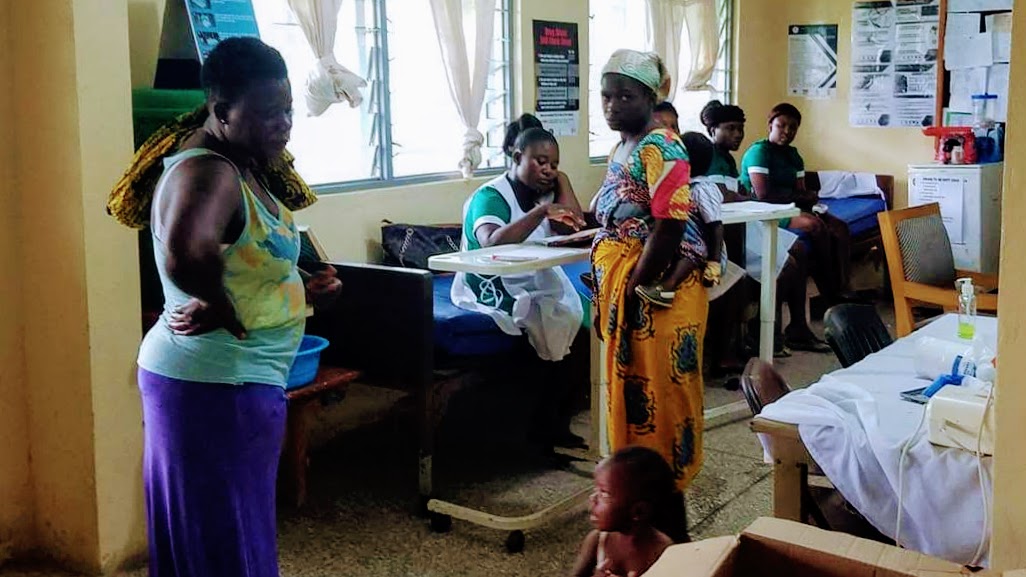
35955080_10155362817785824_8263619722927407104_o.jpgHypertension is still a huge problem and many people came to the clinic with systolic blood pressure far over 200. (Note: below 120 is healthy, above 140 is red alert) Global Brigades has helped many people in the village become enrolled in the national Ghanaian health insurance which makes visits and medicine mostly affordable.

It is difficult to convince people to come to the clinic for chronic care if they’re feeling well. We spent a long time trying to help people understand that high blood pressure can lead to stroke, which they’re familiar with and afraid of. Those who have gotten medication in the past have only taken them sporadically, so a lot of time went into education and motivational interviewing to help people engage in maintenance care and preventative care.

35802247_10155357662475824_3485987004385067008_o.jpgWe are working to help the villages develop systems for chronic disease management, such as having a monthly day where a doctor visits from the regional center to provide care for people with chronic conditions. If we can get funding toward it, this could become a celebratory day with a meal provided to encourage people to attend. Hopefully some of these changes will help people stay healthier.

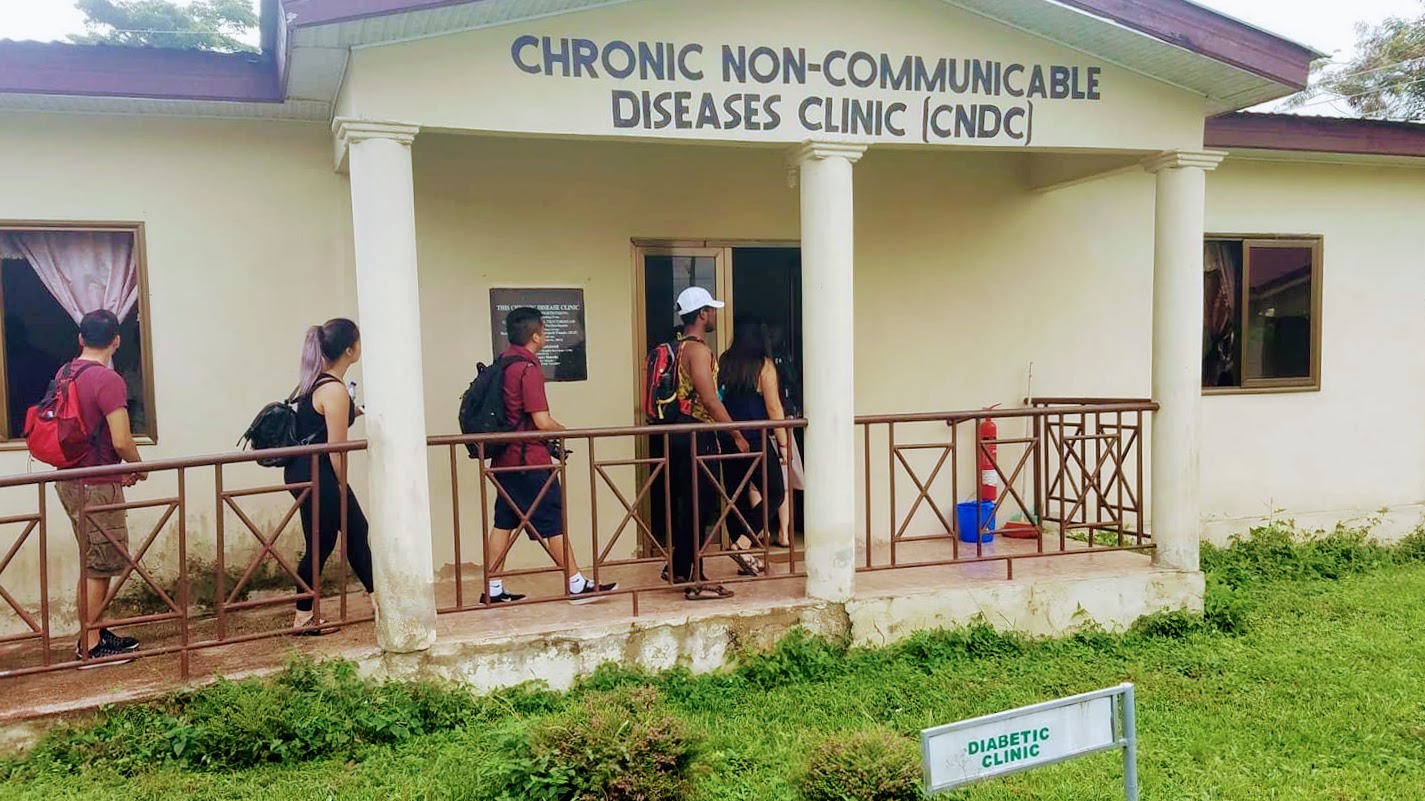
These clinics have been incredible to experience. I can’t get over how patient and grateful everyone has been. The villagers are usually lined up long before we arrive and some wait all day to be seen without complaint. When we spoke in their language or used our Ghanaian names the mothers would light up and smile proudly at us. In Ghana your name is based on the day of the week you were born. My name here is Afua, Friday born.

35894297_10155357685495824_8890960470295445504_o.jpgThe clinics are set up with a number of stations, starting with intake, triage, physician visits, optometrist visits, pharmacy, and counselling/education. We rotate between these different areas and home visits. My favorite station so far has been optometry. The doctor spent a long time teaching us about how to diagnose eye disorders and conduct exams. So many people came in with poor vision, sometimes unable to see the chart at all and restricted to finger counting at 3 meters or light only. It felt wonderful to give these people medicines and glasses and watch the change on their face as they were able to see clearly for the first time in their lives. It felt like we were peddling miracles.

35847113_10155357682330824_1518291520619282432_o.jpg

Day 5

My adventures were mildly paused when I became quite sick for a few days. It seems the food disagreed with me and after eating I had to collapse into bed with painful shivering and fever. Good news about being on a medical brigade is that you’re surrounded by doctors and medicine. After some rest, antibiotics, and restricting myself to just bread, hard boiled eggs, and rice, I’ve made it through and can go back to clinics at last. Looking forward to being back in action and grateful for the wonderful people who took care of me and luxuries I often take for granted like shelter and running water. I feel so lucky to live a life with so many gifts, when so many struggle.

Day 6

36063103_10155366573540824_2358097174769696768_o.jpgWe moved to another village called Otuam. Their health facility was much smaller and patients had to wait outside under tents to be seen. I worked with Dr. Cornelius, testing for malaria and checking blood sugar. In Ghana, Malaria is seen more as a nuisance than a life-threatening sickness. It’s similar to the way people in America relate to the flu. The flu occasionally kills people in the US, but most of us expect to get it at some point. Since we were already on malaria prophylaxis (vaccine), I followed their lead and have been mostly skipping insect repellent. Amazingly I haven’t gotten a single bite all week.

Working with the physicians was wonderful. I learned so much about how to diagnose the common diseases and developed a talent for getting blood from kids without making them cry. I was sad to see how many little ones had swollen bellies. I always associate it with undernourishment, but on our clinic intake form everyone indicated that they were able to eat.

Later in the day we went from home to home taking blood pressures and inviting people to the clinic if they needed additional care. Otuam was close to the sea and many of the houses were made out of palm fronds. There was a quality to the place that felt like Neverland, with forts hidden among the trees and laundry and nets hanging like pirate sails. Hungry cats watched as people cleaned fish and radios dangled from branches. The children were curious and wild as ever and I had fun playing and adventuring with them. It was an incredible day.

Day 7

We visited the large regional hospital that patients are referred to if they can’t be treated in the clinics. If they have Ghanaian health insurance many things are covered, but if they didn’t register or can’t afford it they have to pay cash for services. Registering can be challenging and is already closed for this year because the machine that prints cards is broken.

Getting to the hospital is difficult for people in the villages. Even those who can grow enough food to eat well still may not have any money to pay for a taxi. Those who can’t afford a cab may walk for days under hot sun.

36176328_10155366573850824_2128956022373482496_oThis hospital is rare and unique in Ghana. It has a special team to manage chronic conditions like diabetes and hypertension. We spent some time talking to their director and making plans to work together over the next year to bring their amazing work to more communities. We are also going to try to get them additional funding for important equipment they need, such as the ability to test HbA1c levels (a diabetes blood sugar test). We were able to tour the hospital and were overjoyed to find that, unlike the rural village clinics, they kept medical records and charts on their patients. I’m excited to see teams in Ghana working to initiate chronic condition management and hope other hospitals are inspired by their work.
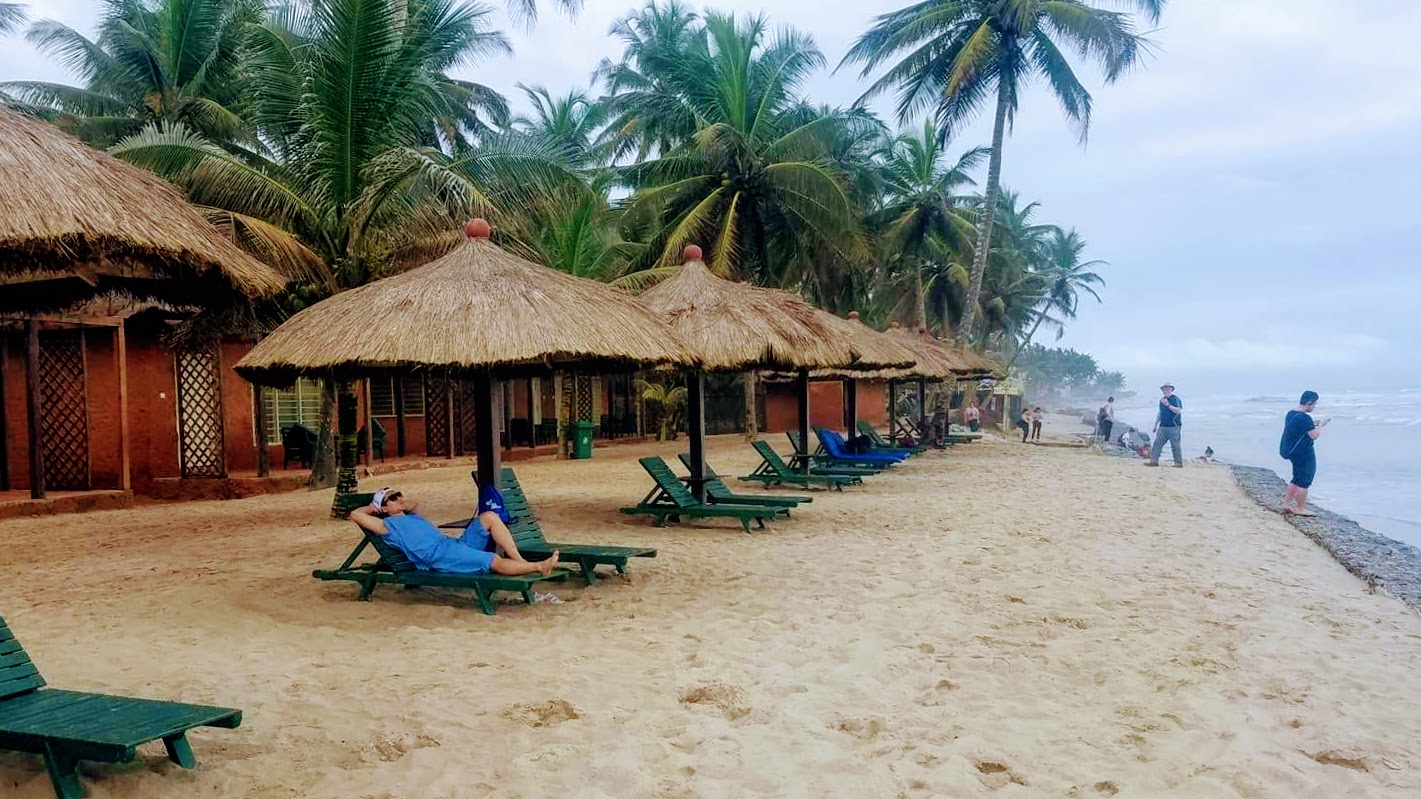
36063908_10155366573485824_3676942903927635968_o.jpgOn the way home from the hospital we took some time to relax at one of the local beaches. It was incredibly beautiful, but parts were covered in litter and we were told the water wasn’t clean enough to swim in. It was nice to listen to the sound of the waves and rest in a place with a cool breeze. Such a lovely day.

Reflections

The best part about Ghana has been the people. The adults are generous, wise, proud, beautiful, sad, and kind and the children are playful, curious, clever, and mischievous. Most people wear beautiful colors and there is a tailor in the community who makes custom clothing for everyone.

While we were setting up the clinic there were always little faces peering in the windows at us or running up when our bus arrived. They were eager to play and quick to ask for treats and supplies. One boy gave me big eyes and mimed brushing his teeth. This broke my heart and caused me to skip the normal process of giving adults all the supplies needed for their family at the end of the visit to sneak a toothbrush for this boy. It was a foolish choice. Soon they were swarmed around me begging for toothbrushes. I tried to stop handing them out and had a nurse translate that their mothers would be getting some for them, but they wouldn’t release their hold on the ones in my fingers. I eventually was able to give them to one of the mothers and escape.

I distracted them further by taking pictures of them using a Polaroid camera I brought. They went wild for the pictures, posing and dancing around. Eventually I decided I had used enough of the film and wanted to save some for the other communities. I started playing with them by showing them dance steps, like the Charleston and the salsa basic and spinning them around. They were thrilled and tried to show me their version of head, shoulders, knees, and toes as well as some local kicking games. We also taught each other different clapping games and high fives.

Whenever I had to go inside to help clean up they would follow and call for “sister Afua” after me. I got lots of hugs and happy bounces whenever I would emerge again. At one point we were finishing up at the clinic and it started pouring with rain. Everyone was huddled under the shelter but the kids were being adventurous and darting into the rain. It seemed refreshing after the hot day in the clinic so I followed and played in the rain with them, spinning around and dancing. It was wonderful and by the time I got to the bus my heart was so full it could have burst.

35889133_10155360507615824_1134829989959565312_o

A Dark Past

Our last full day in Ghana was a cultural day, where we visited a local market and enjoyed Ghanian music and dancing. We also visited Cape Coast Castle, a notorious stronghold of slavery and torture.

36347144_10155376294000824_7797909770412752896_nCape Coast Castle was a trade fortress that was converted for use to house and break the spirit of slaves before they were loaded onto boats. Our visit began wandering around the open air area and looking at the canons over the sea, then into a museum detailing the history of the castle and its role in the slave trade. When I was about halfway through the museum our guide collected us for a tour of the dungeons where the people who were to be slaves were imprisoned.

36393991_10155376293940824_8802817987510796288_n.jpgTo give us a glimpse of the fear they must have felt, he had us initially descend in complete darkness, only turning on lights once we had reached the stone wall on the other side of the male dungeon. He explained that this small underground space held up to a thousand men for months at a time. They were forced into complete darkness where they had to live in their own filth and excrement, packed against their brothers. The floor we were standing on was false, built on top of the human waste that had accumulated there.

36335527_10155376294175824_8162317408808206336_nTo add insult, directly above the slave dungeons where people endlessly suffered was a Christian church. Our guide described the thought process that many slaves went through when they decided to convert to Christianity. To a person experiencing such agony, it would seem like your God had abandoned you or was weak, yet those who followed the Christian faith were clean and happy, prospering above. It must have appeared to many that the Christan god was stronger or better to his worshippers.
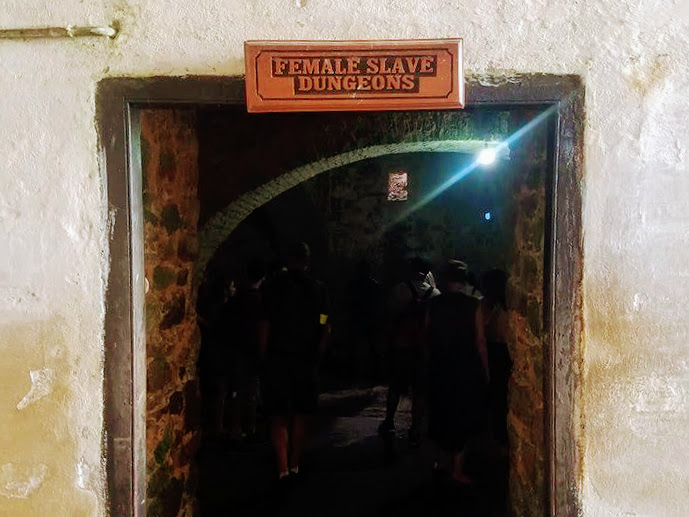
The men in these dungeons would never come out the door the entered again. The governor didn’t want the people of the castle to see the slaves, so they were moved, shackled together and driven forth by other slaves, through an underground tunnel to be loaded onto the ships.

36306542_10155376294415824_4634339883559682048_n.jpgThe women’s cells were similar to the men’s, except that their door was regularly opened so they could be grabbed and raped at will. Sometimes they were bathed before this occurred, and other times drunk soldiers would not even afford them that decency. Women who resisted were beaten or put into a hotter cell where they were locked without food and water and often died if their spirits weren’t quickly broken. Our guide shut us into the boiling confinement cell for about 30 seconds, which was enough to have some of us panicking.

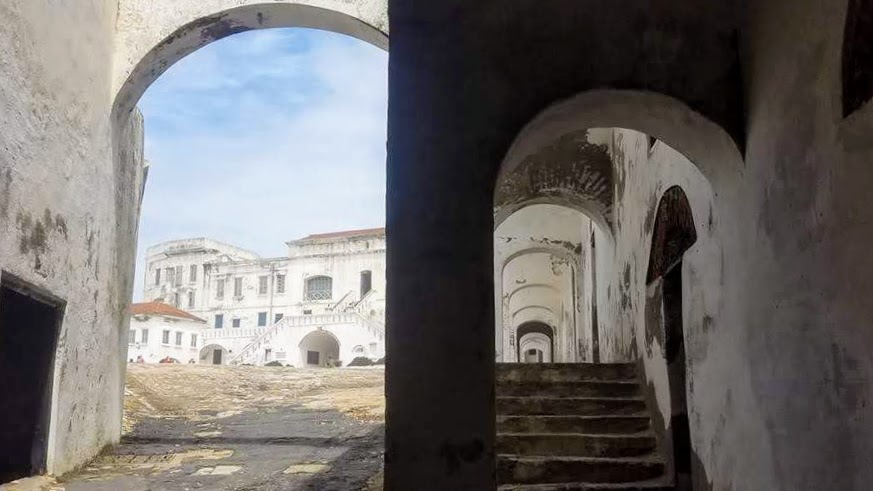
The last they saw of their country was the Door of No Return: a portal that brought them to the water where they were lowered and packed into the ships as cargo. By the time they emerged through that door, they had been in darkness for many months and thus were blinded by the bright sun, unable to fight. Those who did not die at sea lead painful backbreaking lives in slavery.

Immediately after walking back through the Door of No Return, our guide took us up to the airy hall where slave prices were negotiated and then up to the British governor’s chambers. The governor had a beautiful set of airy rooms with large windows that looked out on the picturesque coastline. The dichotomy was so startling I felt shaken and revolted.

36350563_10155376294695824_4792468016619061248_nWe were left with a plea to remember that slavery is not gone from this world. People are still taken against their will and forced into terrible suffering and servitude. He asked us to see, to take a stand, and to remember.

We have so much work to do, in our country alone, to ensure that people are able to lead fair and decent lives. The horror of the atrocities that we do to each other when we dehumanize our brothers and sisters is echoing around in my heart.

These terrible things happen when we group people together and see them as ‘other’. We do this sometimes because we want power or wealth, other times because we don’t understand them or are afraid of them. As we band together to stand against injustice, I urge you all to avoid the slippery road of dehumanizing those you stand against. Fight them with all of your fury, but don’t follow the dangerous path of talking the humanity away from anyone.

It is ideas that we fight, not people. Fight against the idea that anyone can be treated as less than human. Our trustest goal is to stop that idea from spreading, to take it out of the minds of people, and until that is accomplished to stop those people from acting on this deadly idea through any means necessary. Stand together against the heinous crimes happening in our country. Do not let this terrible sickness enter your minds and hearts. Keep fighting.

35883030_10155360504230824_5450899048695332864_o


You can donate to Global Brigades on their website. I don’t work for them or get any kind of kickbacks or sponsorship, I just like charity.