10 Years of Being The Gallivantrix:

At the time of writing, Gallivantrix has 290 posts which average 4000 words each. That’s over a million words or two copies of War and Peace. 

In 2024, I watched as my 10 year achievement flew by. It’s hard to mark a life of gradual change with anniversaries, but a decade is a good amount of time to take stock. I started the blog in May of 2014 while I was preparing to re-launch my international ESL teaching life by heading to Saudi Arabia that September.  As I noticed both of those decade markers fly by in 2024, I thought to myself how nice it would be to sit down and quietly reflect on what the last 10 years has brought and how it has changed me. It is only now, staring down the barrel of the New Year that I finally feel like a quiet sit-down is possible. Still, better late than never. 

A Life Dedicated to Travel

In the last 10 years I have lived and worked in 4 foreign countries, and visited an additional 27. That’s more than ¾ of the international travel I’ve done in my lifetime so far and nearly all of the travel I have done as an adult. But what does it mean to live a life that nomadically?

One of the big things that I encounter when I tell people how I live is envy. I have no illusions about how amazing the experiences of my life have been, nor do I think I live in a way that is accessible to everyone. It can be a bit strange to remind people that I’m not rich, and in fact, have spent chunks of my life being poor, eating from food-banks (charities), and relying on friends for a roof over my head. And, no, I didn’t win the lottery or get an inheritance. Luck, circumstances, and the support of others have played a big role, but also I made a conscious choice to prioritize travel over almost everything else in my life, and then I worked very hard to make that happen.

I found a career that allowed me to work in a variety of countries. I took extra education to gain the necessary credentials. I took terrible jobs to build experience. I reduced my life’s possessions to what would fit in 2 large suitcases and a carry-on. I had no home, no car, no bed, no books, no dishes, no spouse, no children, no pets, no musical instruments, no garden, I gave all my art away, and my sister is keeping the few family heirlooms we treasure. I ate cheaply, used public transit, and wore free, thrifted, or clearance bin clothes. I bought second-hand phones and cheap laptops and used them until they died, relying on my office computer for any big projects. I only got a portable video game system during COVID because I couldn’t go anywhere.

I don’t feel like I’m missing out on these things because I don’t have them, but I think it’s helpful to remember that no one actually “has it all”. The people who envy me usually have stable, local jobs, a lease or a mortgage, a car (and payments), kids and pets, a multi-seasonal wardrobe, hobbies and crafts, new phones and complex computer set-ups, and a lifetime of memories in the form of stuff that has to have a place to exist. They can’t afford all of those things AND prolific travel, but neither can I. I didn’t make that choice all in one go, either. It took years of gradual change to reach a point where I have a 2-suitcase life. I had plenty of chances to change my mind and back out, but I *like* my life. I just want others to understand it isn’t a traditional life + travel, it is a life purpose-built for travel.

From the Inside

10 years is a long time no matter what lifestyle you have, and I hope that everyone grows and changes in that amount of time. It is a well-studied phenomenon that travel has a big impact on the human brain, and sustained travel with its joys, challenges, and culture shocks has forced me to look more closely at myself and my place in the world.

Although therapy didn’t take a starring role in the blog until COVID-times, it’s been an on and off part of my personal journey for a while. In the 2 years leading up to the launch of Gallivantrix and my international life, I dedicated a lot of my free time to researching and practicing positive psychology. TED has a wonderful series of talks on the subject and several practical resources that I still recommend to people like Superbetter and AuthenticHappiness.

I believe it was a direct result of this work that I was able to embark on the journey, but it did more than give me the strength to adventure. From 2015-2019, I gradually changed the way I approached interactions with others. Some of this work resulted in stronger, healthier relationships and some resulted in the end of years-long ties. The people who remain in my life are strong communicators & loyal friends. Those who left were, for the most part, not “bad people”, they simply had their own struggles with trauma and healing that left us incompatible. Perhaps the hardest of all of these was with my mother.

From 2020-2022 I dove back into the world of mental and emotional health, this time with a focus on childhood experiences and generational trauma. You can read through my book list in the archives if you’re interested. Even though I made good progress using these tools, the circumstances of the pandemic meant that by the end of 2021 I needed to make plans to leave Korea and get out in the world around other people in order to keep improving. 

Bouncing off to Senegal after years of isolation may have been a bit like trying to ski black diamond right after recovering from a compound fracture. It hit me hard, and you can see most of it in the essays I wrote during that time. I will be forever grateful for the experience, for what I learned and how it changed me, but it was not the joyful return to global travel that I had been craving. It took me 9 more months of trying various things and eventually moving to France to finally find what I was looking for in myself that I thought I had lost in 2020.

10 years of international living, a global pandemic, and a deep commitment to emotional healing later, and I am now a much more emotionally mature person than I was in the past, capable of identifying and sitting with my feelings to understand what is reasonable, and what is reactionary. I am able to approach conflict resolution with an eye toward responsibility and solution instead of blame. I know my limits mentally and physically and I plan my life, work and travel in such a way as to protect the hard limits while pushing soft ones. I want to make the world around me a better place, and while I’m ok doing that one person at a time, I’m also interested in how I might do more. I have learned so much about the world and the human race, that I will never be able to look at it without that knowledge seeping in. At some times that is beautiful, and at others it is profoundly painful. I have flaws, just like every human, but I am learning to love myself, and to extend grace and compassion inward and outward for flawed humans everywhere. I don’t want to look away.

Accommodating My Needs

Whether you want to call it chronic illness, invisible disability or anything else, there is a growing awareness of this category of health issues that limit what people can do without making us unable to work, travel, and live independently. I received my first couple diagnoses as a late-teen/young adult, so it isn’t new to me, but as I age, not only does the list get longer, my ability to simply push through my limits is sharply diminishing.

Back in 2018, I had a real “come to Jesus” moment during a long summer holiday backpacking across Europe. It made me start rethinking my priorities and what tools I could use to make the most of my travels without destroying my physical and mental health in the process. Over the next three trips, and the pandemic induced therapy-work, I slowly built not only a list of practical tools to make travel easier and more enjoyable, but also the ability to accept my limitations. The second one means I don’t get so tempted to do things which will result in burnout later on, and I get to enjoy things I am able to do without dwelling on regrets, missed opportunities, or generally hating my body.

I am more likely to book larger seats on long haul flights because I know the difference it makes in my recovery time and pain levels. I always check the accessibility options for places I will stay, including distance from transit, number of required stairs, and how far the toilet is from the bed. I take extra time when walking everywhere, usually planning at least double the Google Maps estimate. I carry snacks, meds, and water everywhere. I keep a little extra in the budget for when I need to catch a taxi or ride-share because the walk/transit is too much. I accept that hot weather means I’ll need extra rest and extra painkillers, and I must plan to do very few things. 

That last one continues to boggle the mind. Spending spring in France, I was able to walk longer distances and do things for hours, even spending 12+ hours a day walking around some places! I’m never going to be up for a 5k run, but when the weather is mild-cold, I have so much more energy and mental focus and so much less pain. It has become important for me to keep notes when I am in different climates because it’s easy to forget how dramatically the heat affects me, and I need to be able to reference daily and weekly records of my experiences to hold onto the fact that it’s real and not a trick of memory.

Even knowing this, I still choose to go to hot places sometimes, like India… in August. But I made sure to always keep water and NSAIDs on hand, to walk very slowly, use a sun-shielding umbrella, and crank the AC in the car and the hotels. I was exhausted by the end of it, but I got to see some very amazing cultural and historical sites. I also went to Taiwan for 3 months starting at the tail end of August, knowing that the weather would be too hot until October. For the first 5 weeks, I did almost nothing besides go to class and get food. I knew heading into Taiwan that I would not be able to do a bunch of touristy things, but I still wanted the language study and cultural experience, so it was worth it.

Accepting my limits doesn’t keep me from going places, but it changes the way I go and what I expect to get out of it. I may not get as much out of my trip to India or Taiwan as a more healthy and fit person, but I definitely get more out of it than someone who never goes at all.

From the Outside

When I started the blog, I harkened back to the early days of social networking (Live Journal, My Space, and even bulletin boards!) where everyone who was online in those days was producing what we now call “content”. I know I sound like a get-off-my-lawn antique (and I am GenX), but objectively, it’s not just me that’s changed in the last decade. The internet / blog-o-sphere and the world at large have also undergone some dramatic makeovers in that time, too.

Demographics

It’s always hard to compare the present to memories of childhood, so I can’t say how much of what I recall about the travel I did with my family as a child is accurate, but one thing I think is objectively measurable is just the sheer number of people flooding popular travel destinations.

When we lived near the beautiful white sand beaches of Panama City, Florida, my mom and I joked about buying shirts that said, “I’m not a tourist, I live here.” because we felt like we could hardly go near a beach without being accosted by cheap seashell trinkets (made overseas) and green key-lime pie (it’s supposed to be yellow!). Perhaps because of this formative childhood experience, I have never enjoyed a tourist trap even though I have not always been able to avoid them. Yet, when I lived in Florida, the population of the US was 107 million fewer people than it is today. Not all of them visit Floridian beaches, but it stands to reason that the population rise alone will result in more humans per beach.

This NYT headline said in 1984, 27 million Americans travelled abroad, a new record at the time. By 2014 that number was 68 million, and by 2023 it was 98.5 million. Data on 2024 isn’t out yet, but I would bet it breaks 100 million. And that’s just Americans!

The global population has risen by almost a billion (that’s B) in the last decade, and more and more of them are living higher wage, higher quality lives which include international travel. Over 1.1 billion tourists (15% of the global population) travelled internationally in 2014, in 2019 (just before the pandemic) it rose to 1.5 billion (roughly 19-20% of the global population). Obviously, the pandemic saw a lapse in travel, but most statistical analyses agree that in 2024, international travel levels caught up with and then exceeded 2019 levels.

Also, there’s more people living in most of the popular locations. Only a few countries have been experiencing declining populations. Meanwhile, swift urban development and technological advances mean that a smaller percentage of people are living a rural/agricultural life, choosing instead to flock to cities and suburbs for better schools and higher paying jobs. In many places, migrant workers who come in to do things like drive taxis, work in kitchens, clean homes, and do construction do not show up on official statistics of urban populations, yet they certainly contribute to the body count.

When I arrived in Senegal, many people told me that the city had nearly doubled in size since the start of the pandemic, and that the cost of living was skyrocketing as migrant labor from the villages flooded in. Although official statistics show about a 3% yearly rise in population for that city, that is still much faster than the infrastructure can keep up with. Senegalese citizens and immigrants from less stable West African countries want to live in the city because they can earn more money to send home to their families. The flood of people coming in has resulted in overcrowding, lack of adequate sanitation, lack of housing, lack of food, and lack of employment. 

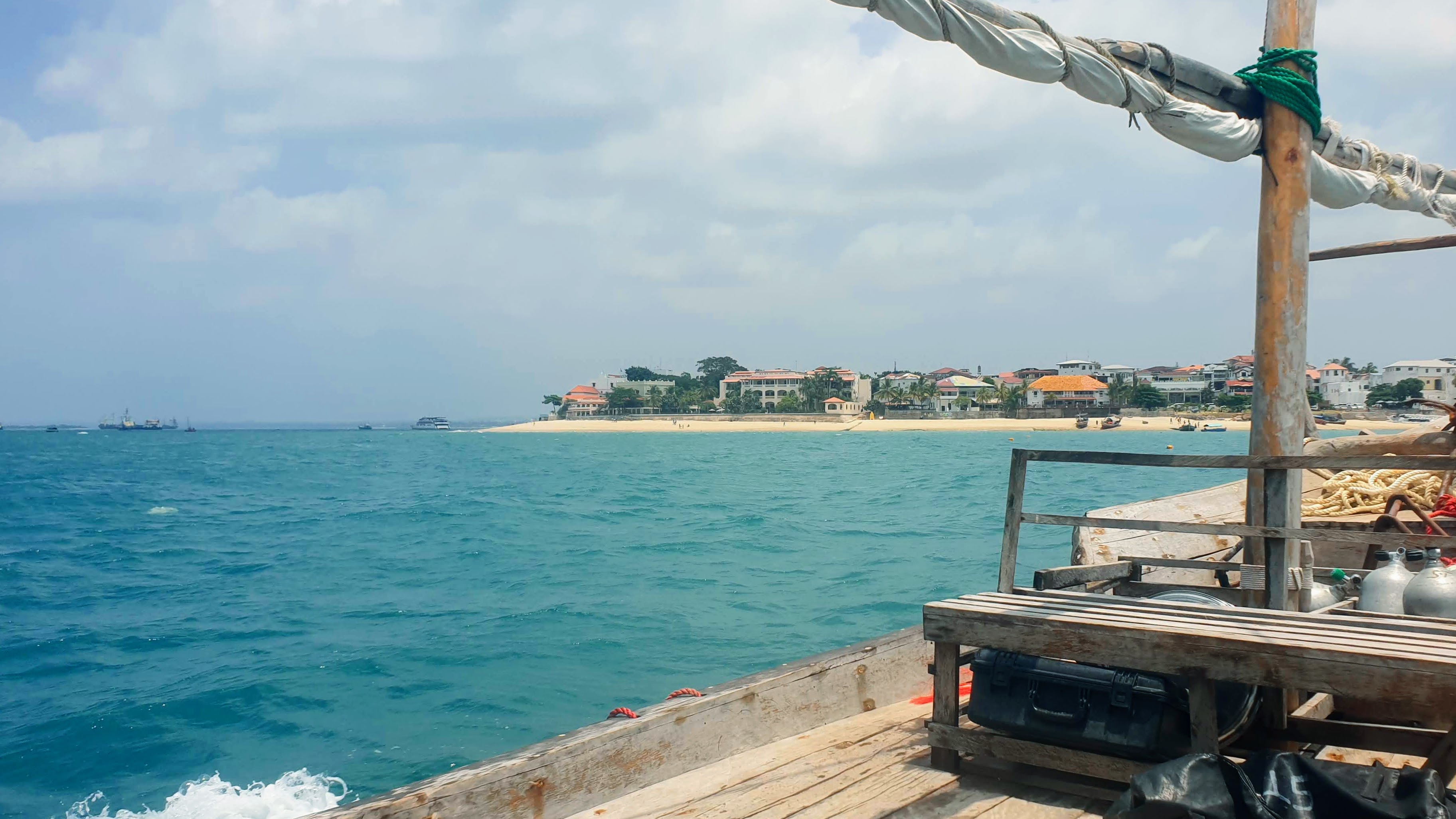
Dakar isn’t a hotspot for tourism, but many developing countries that rely on tourist dollars are experiencing a similar trend, meaning more locals are in the cities we travel to and more of them are struggling to get by. My foray to Zanzibar in East Africa highlighted this most dramatically where I would walk through a neighborhood with no running water to reach the high end resort hotels on the beachfront. As hard as it might be to live in a developing country and see first world lives on TV and the internet, how much harder must it be to see them across the street when you must carry water from the well and dig a hole for a toilet?

Among the expat communities, people who live and work abroad, not just traveling for fun, we have anecdotally noticed an upturn in the tendency to be treated as a “walking ATM”. The rise in the number of locals living in cities but struggling financially has led to a (totally understandable) level of desperation in the competition for foreign dollars that hasn’t always existed. And don’t get me wrong, I feel an enormous amount of compassion for those less fortunate than I who have not had the chances and support or even the citizenship that give me my advantages. However, I cannot singlehandedly change the fortunes of a developing economy with my few thousand dollars. 

Then, when I come back to the US, I am shocked at prices and poverty here, too. 100 million of us may be able to travel internationally this year, but how many of those scrimped and saved to do so? How many are using airline miles they earned buying groceries and gas? How many only go once a decade or once in a lifetime? How many are taking on debt to do it? And of the remaining 235 million, how many are food insecure (47 million), how many are one paycheck away from homelessness (200 million). People shouldn’t travel if they can’t afford it. Please, do not travel on credit! But regardless of how we pay for it, most people can’t afford to go over a carefully planned budget while on holiday.

I want to spend my money on local small businesses when I travel, but it isn’t fair to be treated like a bottomless money pit because we were born in affluent countries. What’s more, it makes for a very unpleasant experience which will only damage the future of their tourist economy. I work hard to avoid these kinds of situations, and have developed tactics over time to deter scammers and hawkers, but it’s exhausting and demoralizing to be walking around a beautiful historical and/or sacred monument only to have to fend off junk-sellers every 5 ft. Many take “no thank you” and move on, but others will follow you around telling sad stories about their kids to try and guilt you into buying some cheap trinket you don’t want.

This experience isn’t new in and of itself, as I recall having had it in China back in 2005, but it feels like the number of such “sellers” and their persistence, willingness to invade personal space, and leverage emotional manipulation has dramatically increased. I think it was one of the big reasons Senegal was so hard for me, as well as the main reason why in places like India and Egypt, I opted to hire local drivers and guides who I can budget a gratuity for in advance, and expect them to act in part as a barrier to the other hands being held out for cash.

The upshot of all of this population growth, demographic change, and economic inequity is that many places are more crowded and fighting harder to extract every penny from the visitors that they can. There are still places in the world that do not have this problem, or at least do not have it in excess, but I feel like it’s much harder now to plan a trip that avoids them, especially if you have any bucket list items that include major historical sites, world-class museums, or unique natural wonders. Maybe it’s easy for me to say because I’ve already gotten to visit quite a few of these, but now when I give travel advice, I tell people to focus on small local experiences rather than grand bucket list ones since you’ll be more likely to have the space and peace to enjoy it.

Going Viral

In addition to the population and economy, there’s one more very large factor that’s changing the face of travel and travel-blogging: the social media revolution. My 5 week stay in Tours France was relaxing, idyllic, and felt almost nothing like tourism at all, but when I left Tours and went on my color-coded-spreadsheet trip of tourist highlights including Disney, Lyon, Marseille, and all the big bucket list spots in Paris I had somehow never gotten around to like the Louvre and Versailles. Although almost every place I went was new to me, the experiences of being a tourist all seemed eerily familiar.

Authors and researchers like Jonathan Haidt have been studying the changes in social media over the last 10-15 years, and there are some fairly strong conclusions about the manner in which content is created and consumed. Other old-fashioned travel bloggers like me who want to share personal content over rubber-stamped listicles are also expressing frustration.

As social media drives attention to ever more similar short-form bucket lists and glam photos, tourist attractions have also started to become homogenized. This isn’t all bad, nor is it fully ubiquitous. I have written before about the fact that cathedrals in western Europe are all kinda the same in the way that roses are all kinda the same, and I still like them both every time. Huge enough attractions like Disney and Versailles don’t need to change too much to keep attracting visitors, and they will always be tourist processing machines filled with photo-happy crowds and overpriced souvenirs. Yet, everything in between seems to be riding a post-Instagram, post-COVID wave of striving to provide travellers with photo-ready experiences that exactly mimic what they have already seen online. Stand in this line to get the perfect photo, order this dish at the restaurant, look for this “hidden gem” that’s now overrun with tourists, and always post your best photos!

I have been going to Angelina’s in Paris since 2015 (that makes it sound like I go a lot. I do go at least once every time I visit, but it’s only like 6-7 times total) and yet sometime between 2019 and 2024 it got internet famous, and for the first time ever, when I went this year, there was a LINE out the door and they were no longer accepting reservations. My patience was rewarded in the end, and when I went back a few weeks later at a better time, there was no line at all. Despite Angelina’s appearing to have handled their newfound fame well, many local restaurants that receive viral treatment do not.

Internet fame can send tourists in droves to small businesses that are unprepared for the volume of new customers which ends up leading to disappointing experiences and bad reviews. Some businesses overextend themselves financially trying to keep up, only to be left with debt when the viral spotlight turns elsewhere. Very few small-scale restaurants survive viral fame, and even fewer benefit from it. Additionally, the desire to have a replica of the online experience leads to long lines at one location while those around it languish. This is bad for both local businesses and for the tourists themselves. The joy of a hidden gem or hole in the wall is that it is unique, different, likely thriving off of local and seasonal ingredients meaning that the dining experience is different from day to day. Meanwhile, viral sensation seekers want to experience what they have seen online and nothing else.

Jerusalem Demas famously wrote, “Tourists are like bees. I don’t want a bunch of them circling around me, but I also don’t want them to disappear.” Developing countries are not the only ones that are both economically dependent on, and simultaneously damaged by increasing tourism. Many large cities in affluent developed nations are experiencing an overdose of tourists that is causing chaos and unhappiness among the locals. This Forbes article goes into more detail of the struggle between reliance on tourism for economic success and the damage that over-tourism brings.

Viral fame hasn’t just damaged food experiences, but also art, music, and nature. One beautiful Mediterranean beach may be edge to edge bodies while a few villages over, a pristine beach boasts only a few locals. The government of the Philippines had to shut down some extremely popular tourist beaches because the sheer number of tourists was damaging the environment, yet there are hundreds of practically empty beaches around the Philippines that no one is going to. Is it because they don’t know about them or because they want to recreate that experience they saw online?

Imitate and Recreate

When “influencer” first became a job, they would try to use clout or ad space to get free meals and accommodations. A very small number of extremely successful ones still can, but remember a billion+ people are traveling every year, so an influencer with a million followers is only 0.1% of the potential market, and most of their followers aren’t actually going to travel, because travel lifestyle influencers are largely aspirational.

Now the issue is less influencers trying to get free stuff and more that a small number of tourists with influencer dreams have their hearts set on recreating a viral photo or video on location. Surveys and polls vary a bit, but generally speaking somewhere between 50-80% of Gen Z consider influencer a desirable and realistic career option, with more than 40% of adults overall feeling the same.

As a result of this, you get people doing choreographed dances in the middle of a UNESCO World Heritage site, or self-employed ‘models’ posing over and over in front of the thing that literally every other tourist there wants a photo of. This has gotten so bad that in many places, the government or local businesses have posted signs banning tripods and costume changes.

I am not criticizing dancing nor taking photos. Normal polite people usually spend a few minutes taking photos, arranging poses, and checking to make sure no one was making funny faces before moving on. On the rare occasion I indulge in a selfie, I tend to take a handful before I get one I don’t hate. I think it’s fair to want to look your best in your photos. But these people will stay for 30 minutes to an hour, taking pose after pose or restarting their dance 17 times, all while blocking everyone else from being able to take photos of the site. Tourists are often on a tight schedule, and will end up missing out on their photo ops for their own memories because a wanna-be influencer can’t share.

Even when they aren’t taking photos, they will often sit or stand in desirable photo-op spots to scroll their phones instead of moving off to the side to allow others a chance. And again, I’m not criticizing wanting to check your phone while at a famous landmark or museum or whatever. They might want to make sure photos turned out; they might be checking their itinerary for the day; they might be reading about the site they are visiting to learn more; they might be trying to contact their group; they might even just be scrolling because it’s so crowded and overwhelming that they need a break. All of these are fine and valid reasons to be on your phone. None of them are reasons to block the view while you do it.

AI photo editing has made it easier to cut out unwanted hordes of tourists, but it can only do so much. Plus, my photos are primarily a gateway to my memory. I can wait for the perfect shot or edit out a stray person in the background, but if I look at the photo and remember the obnoxious influencers and pushy junk-sellers more than I remember the awe and beauty of the place I came to see, then what am I even doing?

What Am I Even Doing?

In 2014 when I started this website, there were (according to Google) hundreds of thousands of travel bloggers across several platforms. Now in 2024, those same estimates place the number of travel bloggers in the millions. Far and away the vast majority of them are just in it for the money. There’s nothing wrong with wanting to a bit of extra cash to support an already expensive hobby, but the current monetization model of social media pays for eyes, for attention, for engagement, and so using keywords and creating short 1 min or less content allows social media influencers to maximize money while minimizing effort. Millions of travel content creators exist, yet the format for a travel blog has been trimmed down to those few most monetizable models on platforms like Instagram and TikTok, meaning everything is starting to look the same while containing less and less original or unique information. 

I have never thought of Gallivantrix as something to monetize, no matter how many times well-meaning people suggest that I turn this hobby into a side hustle. I hoped my blog would primarily serve as a way to connect with my loved ones while I was abroad, give people a deeper perspective of the world, and maybe add a soupçon of helping other travelers. 5 years ago when I checked in about my motivations for writing, I stood by my long-form and intermittent style and I am still drawn to long form essays with no particular schedule, but the content of my writing is changing.

I have always been an essay writer, tending mainly towards narrative essays. I used to call my writing style “narrative nonfiction”. Sometimes, I write descriptively, giving detailed accounts of what an experience is like, to paint a picture that my readers can imagine. Sometimes I involve research and write more informatively to talk about the history or broader context of an experience. Since COVID, my writing has taken a more personal bent, with liberal doses of expository and reflective writing.

Writing narrative essays about my experiences not only allows me to share my adventures, it gives me good motivation to go out and do things and to live mindfully while experiencing those things. By setting myself up to notice things “for the blog”, I’m more likely to have a deeper and richer experience and remain mindfully present. Later, writing the memory allows me to review all the photos and relive the experience vividly in order to record it. I may not want to do this for every single place I visit, but it’s a great tool to have in the box.

During my France holiday, I wrote narratively about Tours, and I meant to do the same for the other places I visited, but over and over I came up against the idea that I could not say anything that was not already said both more succinctly and more informatively. 

It seems now when I’m travelling in places that are inevitably viral, I no longer have any interest in publicizing my journey. I still take photos and share them with my friends, and I write little highlights for myself, things that in the past would be the notes I used to write blog posts from later, but I don’t have any interest in spending hours creating content that a million other people have already created. I found that when I am already in a good headspace mentally and emotionally, I am able to be mindful and present in the experience. It isn’t necessary to try to find ways to make yet another blog about Disney, I could just enjoy it.

When I went to South Asia, I was surprised and inspired by Sri Lanka in part because since the civil war and the earthquake, not a lot of people have focused on tourism and travel there. I never have time to write while travelling, so I tucked it away for later, only to be confronted with the contrasting experience of India, and capping off my South Asian odyssey with a visit to a third wildly different environment in Nepal.

I knew I didn’t want to write a bunch of blogs about sightseeing and history at places which have been endlessly blogged about, but I started to think about how I would like to write about South Asia. Nestled in between my May and September decade markers, the trip made me think about who I want to be in my next decade as Gallivantrix. I thought about the essays I wrote in the pandemic about deep emotional issues, those that I wrote while in Senegal about the social, political and economic impacts of colonialism and white supremacy, and about the essay I wrote in France about finding joy in the everyday. I want to combine my experiences as an expat and tourist with what I have learned about the world, historically, politically, and economically, and how the countries I visit fit within that broader understanding. I don’t intend to fully discard narrative or informative writing, but I want to embrace the personal and the reflective.

Is anyone even interested in reading something like that? Wouldn’t it do better as a podcast? A video-essay? Is my approach too old-fashioned, too long, too nuanced, or just not cute enough? Eeehhhh. There’s millions of travel bloggers out there, but I don’t need an audience of millions. I hope there are a few people in the world who will read and think and share those thoughts with others. In the end, I write what I most need to say in order to process my experiences and ideas in a flow of words that may be only for the void.

If you happen to be here in the void with me, Happy New Year.
The Sights of Tours

Although I only spent 5 weeks in the city of Tours, France, I feel like I managed to squeeze in quite a lot of sightseeing around my French classes and cheese eating. In an attempt to organize my adventures there, this is the 2nd of 4 posts about Tours and it features attractions which are close to the city center, such as museums, gardens and interesting tourist attractions.

Musée Compagnonnage (The Companion Museum)

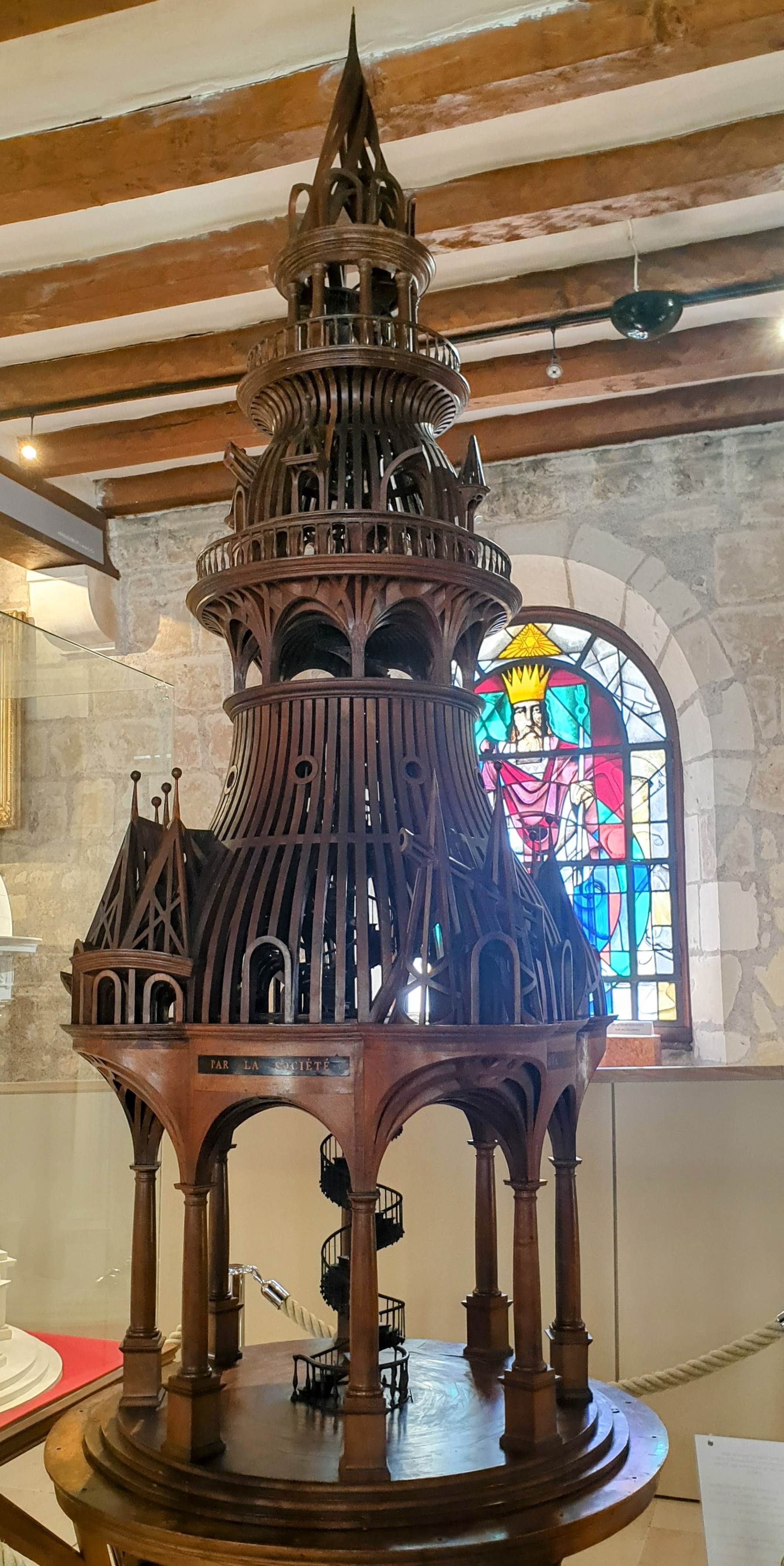
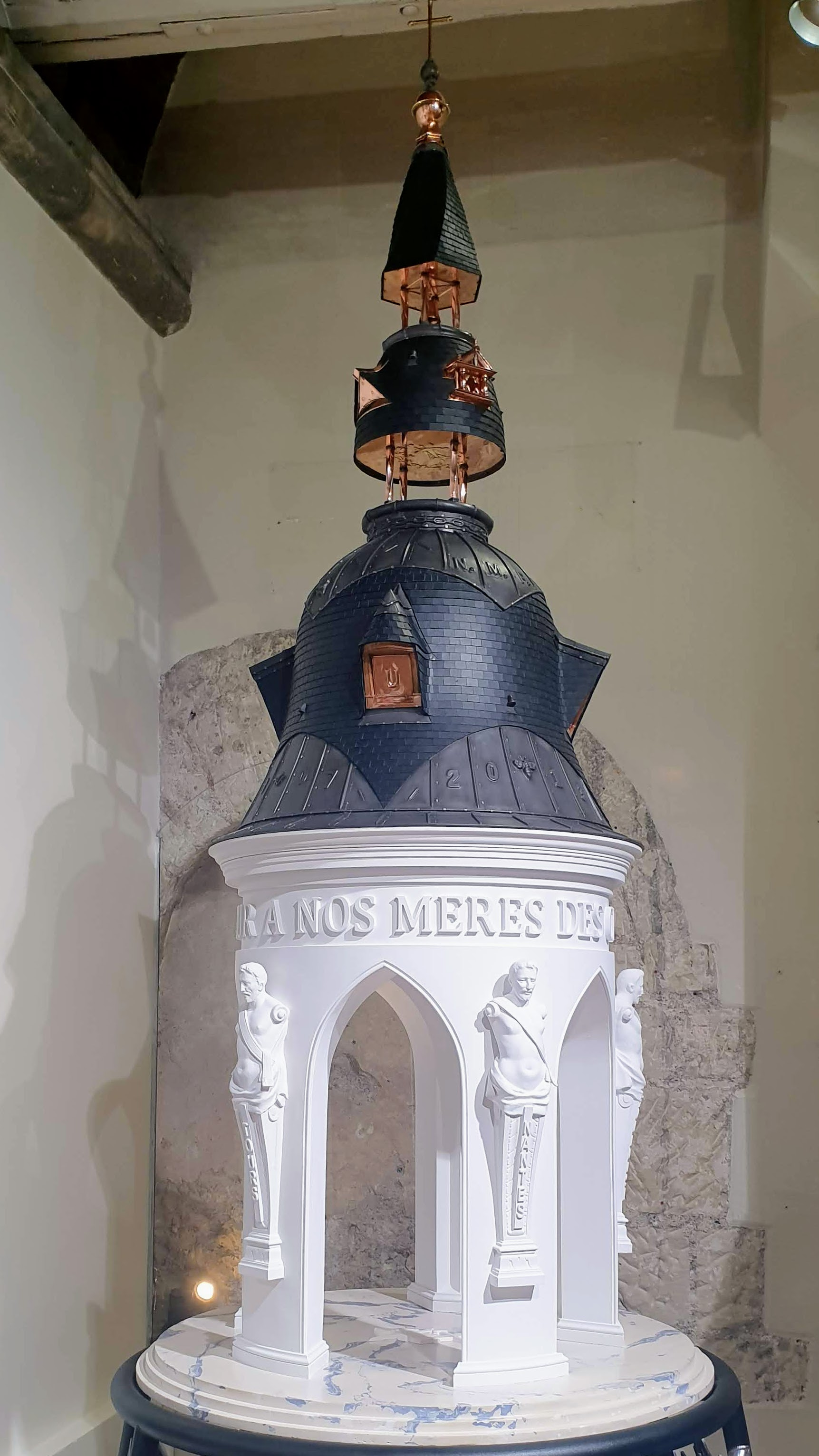
This was the first museum I visited in Tours because it was right next to my tram stop. I don’t know what I expected from a place called the Companion Museum, but this was not it. The Companionship (Compagnonnage) were any and all artisans and craftsmen who made things with their hands and then passed the knowledge of their crafts through apprenticeships. As you may imagine, that’s most of professions. It’s something between a secret society and a very strong union. In fact, given the amount of masonic imagery, I’m surprised to find that the museum denies any connection beyond the coincidence of the compass and square.

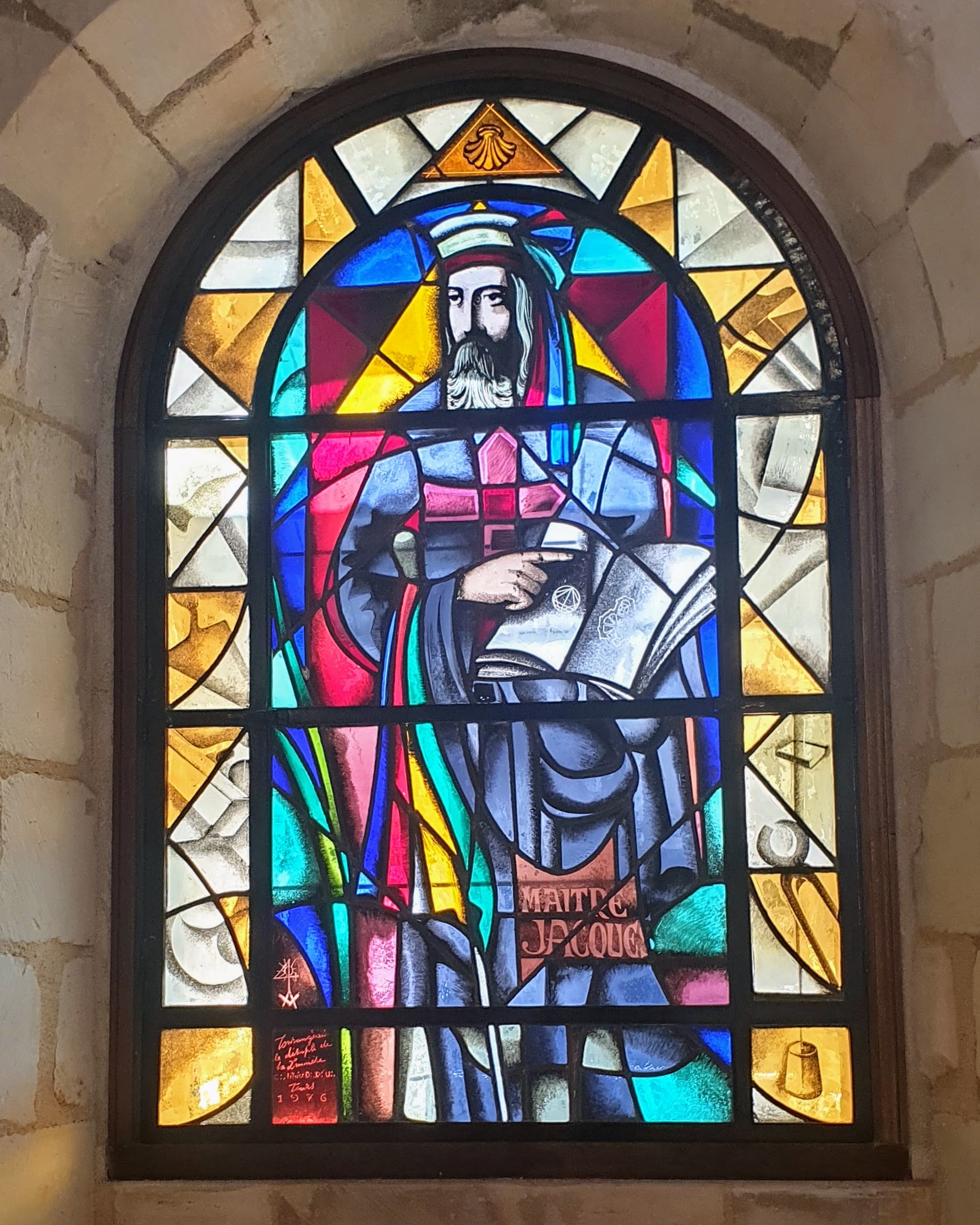
According to their own legends, the Compagnonnage dates back to the construction of the temple in Jerusalem, known as the “Temple of Solomon”, in the 10th century BC. The colossal project, under the direction of the architect Hiram, would have been led by Soubise and Jacques. Different legends also make these last two monastic and chivalrous characters. Salomon, Father Soubise and Maître Jacques are the 3 legendary founders of the Compagnonnage. However, there’s no archaeological evidence of the Compagnonnage until the 13th century. Incidentally, the Free Masons are not found until the 18th century so if they are linked, the French did it first.

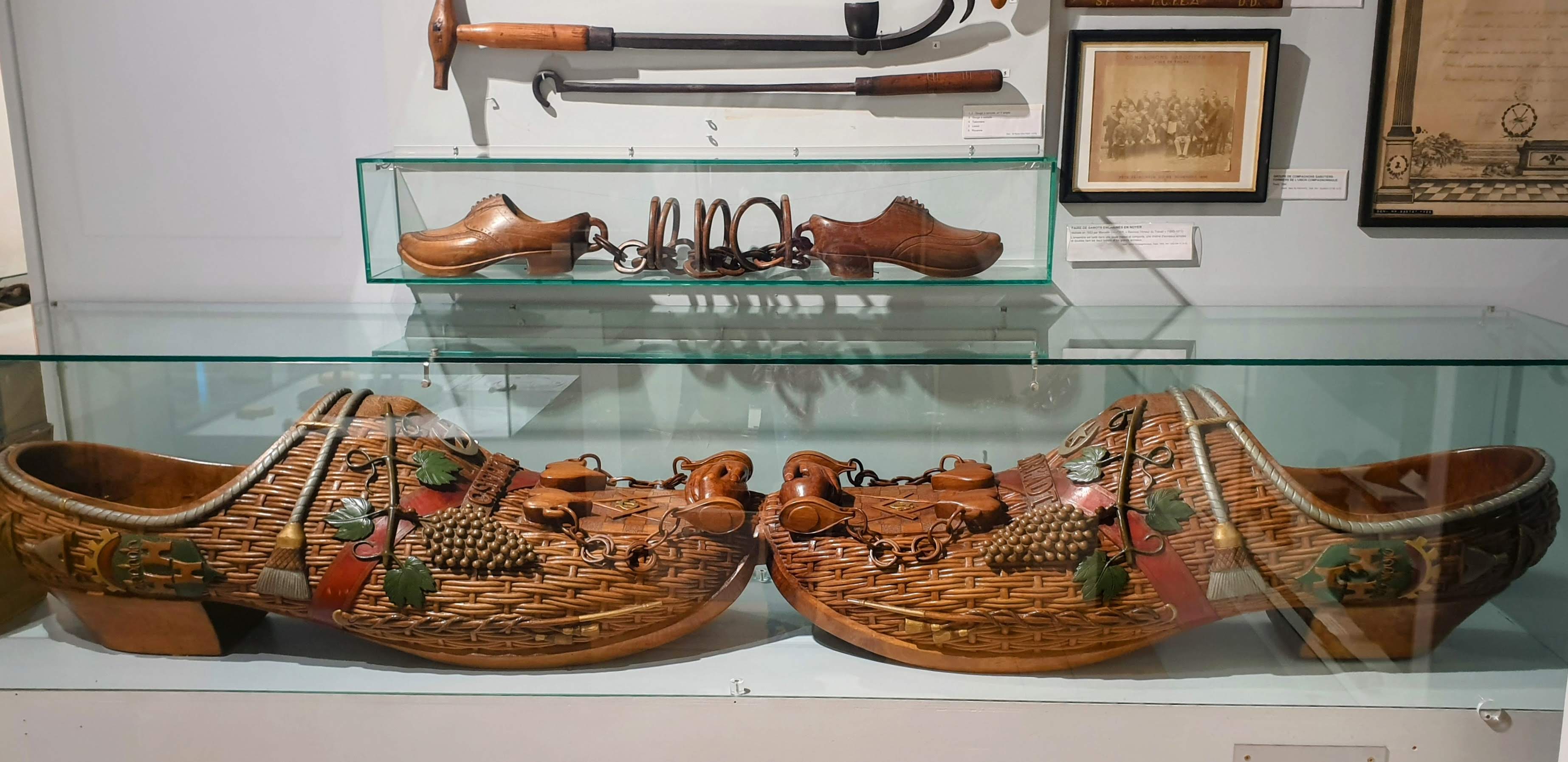
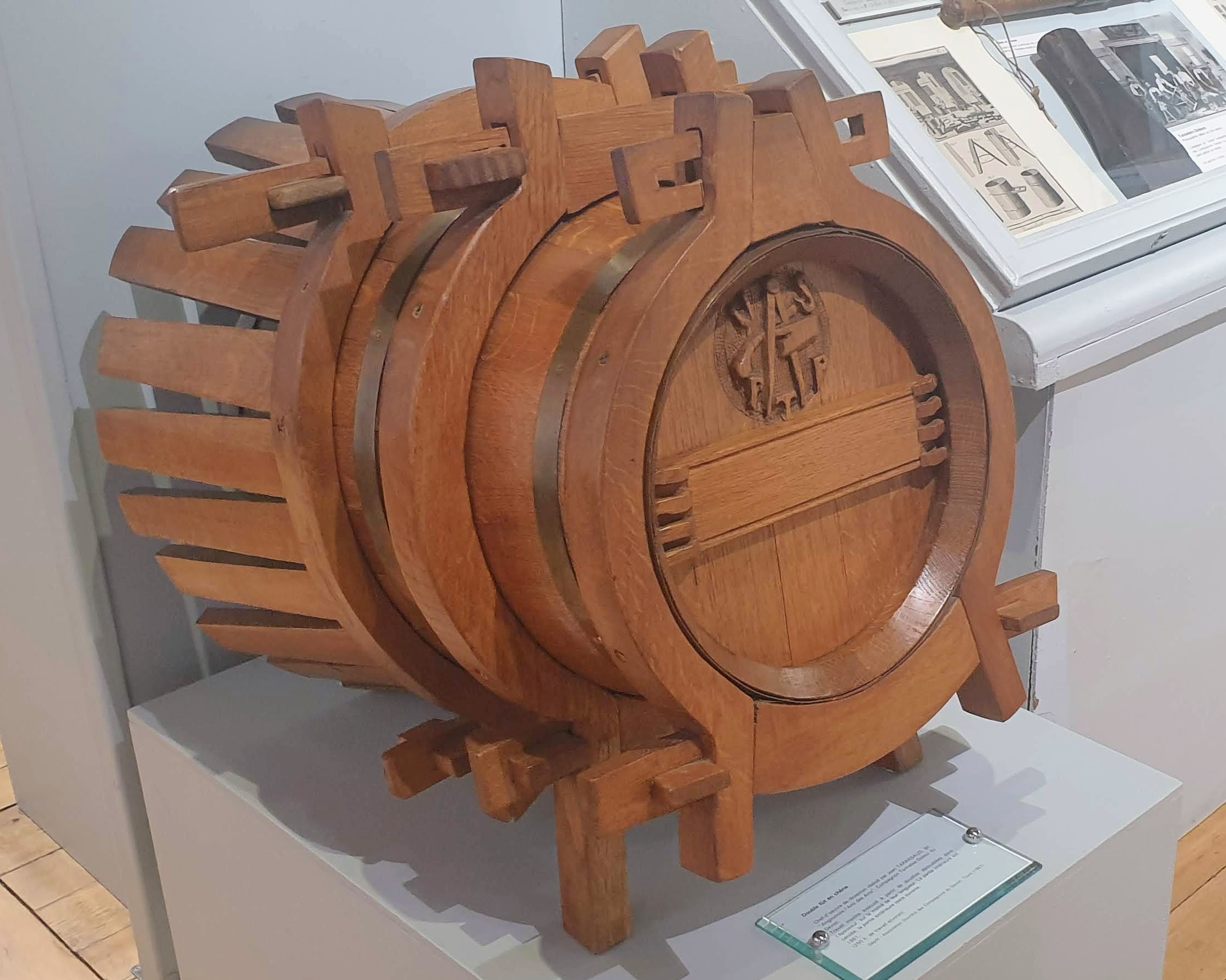
The Compagnonnage includes any industry in which people work with their hands directly to produce things. I was going to try to list them, but the museum website takes a whole page to do so. It’s… a lot. Excluded careers were things like merchants, academics, doctors, architects and engineers (presumably the later because they design things rather than build them. Carpenters and stonemasons, people who implemented architectural and engineering designs, were absolutely included in the Compagnonnage.)

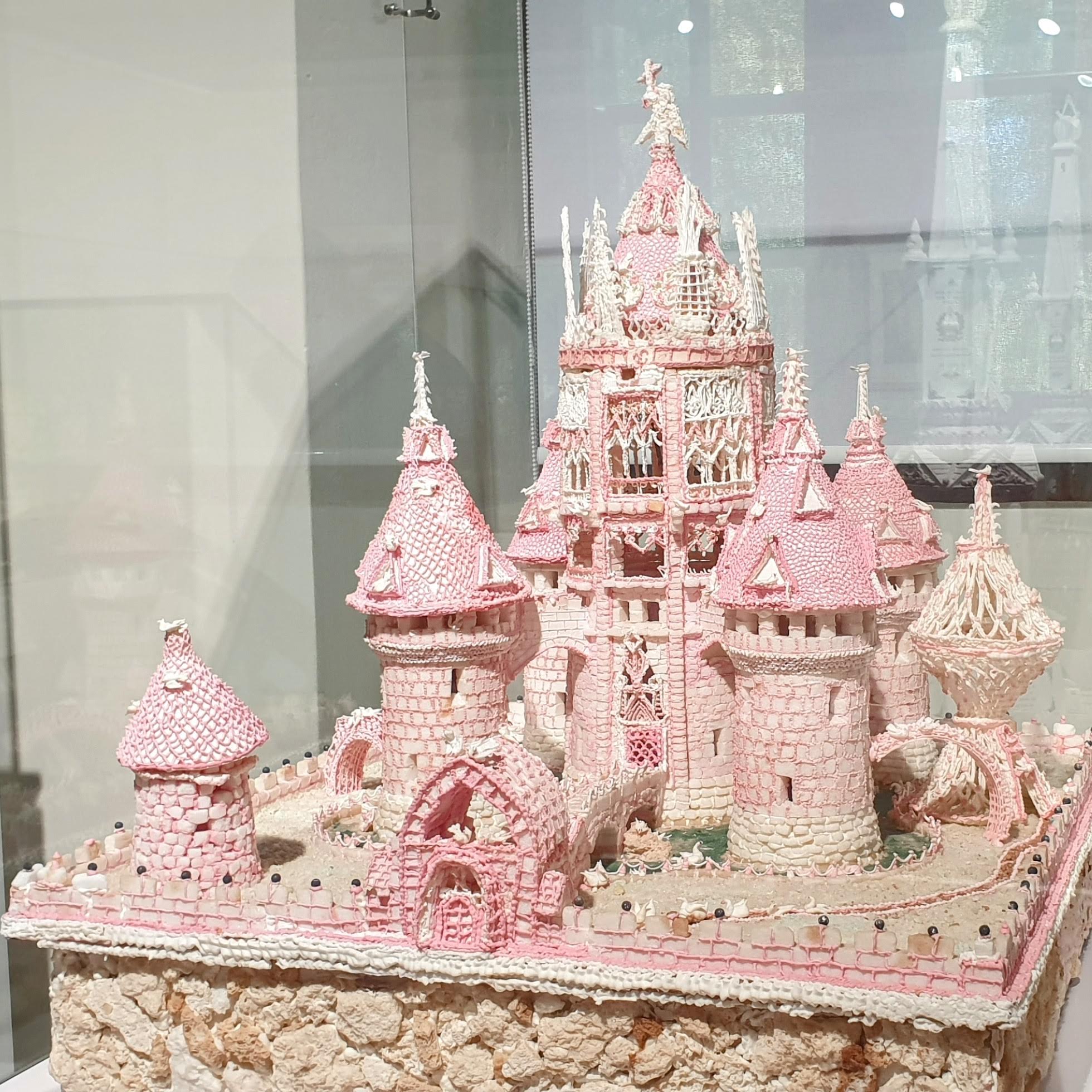
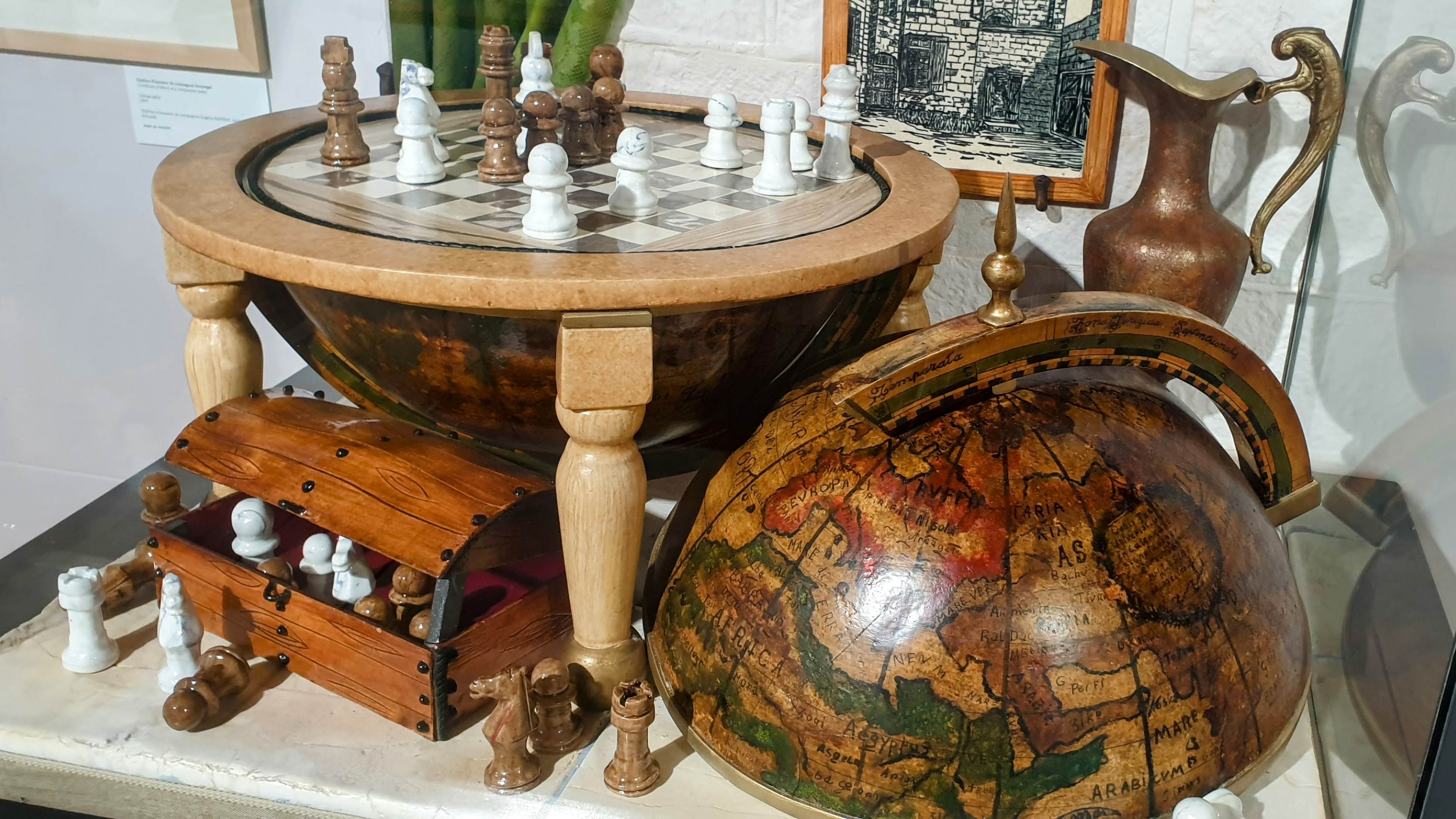
You can read more about the historical ups and downs on the museum website (thanks Google Chrome for auto-translate), but it went fairly strong until WW1 dealt it a near fatal blow. It didn’t really recover until after WW2, and it’s worth mentioning that although they claimed to welcome anyone wishing to improve in their profession, they didn’t agree to admit women until 2004(!) and didn’t actually accept one until 2006. Even though many of the trades historically included into the Compagnonnage were industries which had many women workers including sewing, weaving, laundry, and baking, it seems the society was about more than just teaching skills and protecting workers. Quelle surprise! (by the way, all of the art pieces below are sugar and pastry!)

Despite the overwhelming presence of misogyny throughout the history of Western civilization, I still enjoyed seeing the craftworks and tools of the various trades included in the Compagnonnes. I also believe that the centuries-long tradition of protecting the rights and wages of these workers has likely influenced the French cultural value of workers’ rights and collective bargaining. Did you know that striking is protected under their constitution? That not only can they not lose their jobs for striking, their employers must continue to pay them during the strike? That’s a big accomplishment for the same culture that produced Versailles.

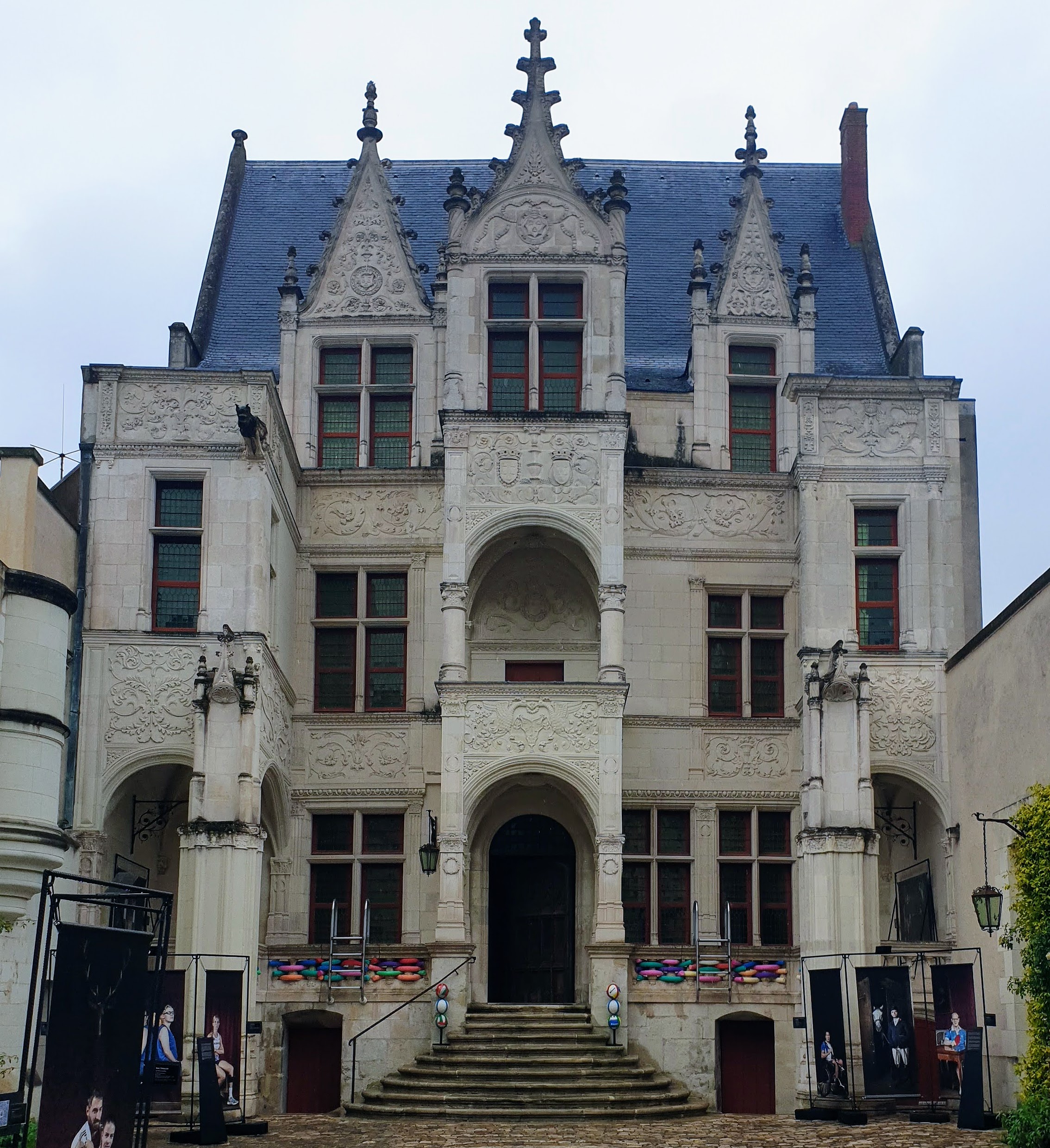
The Hôtel Goüin

This is what happens when you don’t plan in advance and just wing it. You get weird stuff. This hotel is on my walk from the tram stop to my school and I got curious about it, and noticed it’s opening hours were only on Wednesdays and Saturdays. I looked at it very very briefly online and saw that inside was an art gallery with rotating exhibitions. I thought, well I like art galleries, and it’s free, so why not? 

First, let me say, I do think it’s worth it to poke your nose into any free museum in your vicinity. Heck, even any museum under 10$ is likely to be worth a stop to me. I have gone into unexpected museums before, things I ran across that were adjacent to another stop on my journey, and it’s roulette. Also, since I had totally failed in the planning phase of my stay in Tours, I was eventually bound to suffer the slings of ‘wing it”, and only not mind too much because a) it’s 5 weeks, and b) my goal in Tours was not sightseeing – it was French Living.

If you or someone you know is headed to Tours and you happen to be in Old Tours on a Wednesday or Saturday, sure, drop in. However, there’s no need to put it on your bucket list. This summer, the Olympics are being held in Paris, so all of France is in Olympic fever. The Hôtel Goüin being no exception, they decided to offer an exhibition on the Paralympics. In large part, the exhibition was mostly very beautiful and inspiring photographs of paralympic athletes, but the upstairs (no elevator, btw, way to accommodate the athletes being celebrated!) contained not only documentaries, but interactive displays where visitors could “try on” a disability and attempt a sport. … I don’t even know what to write about that, other than, yes, I’m sure that’s what they were for because a museum employee told me about it and smilingly encouraged me to try.

If you are not cringing with me, or are wondering why I am, please check out some videos on YouTube by following this link.

The Musée des Beaux Arts

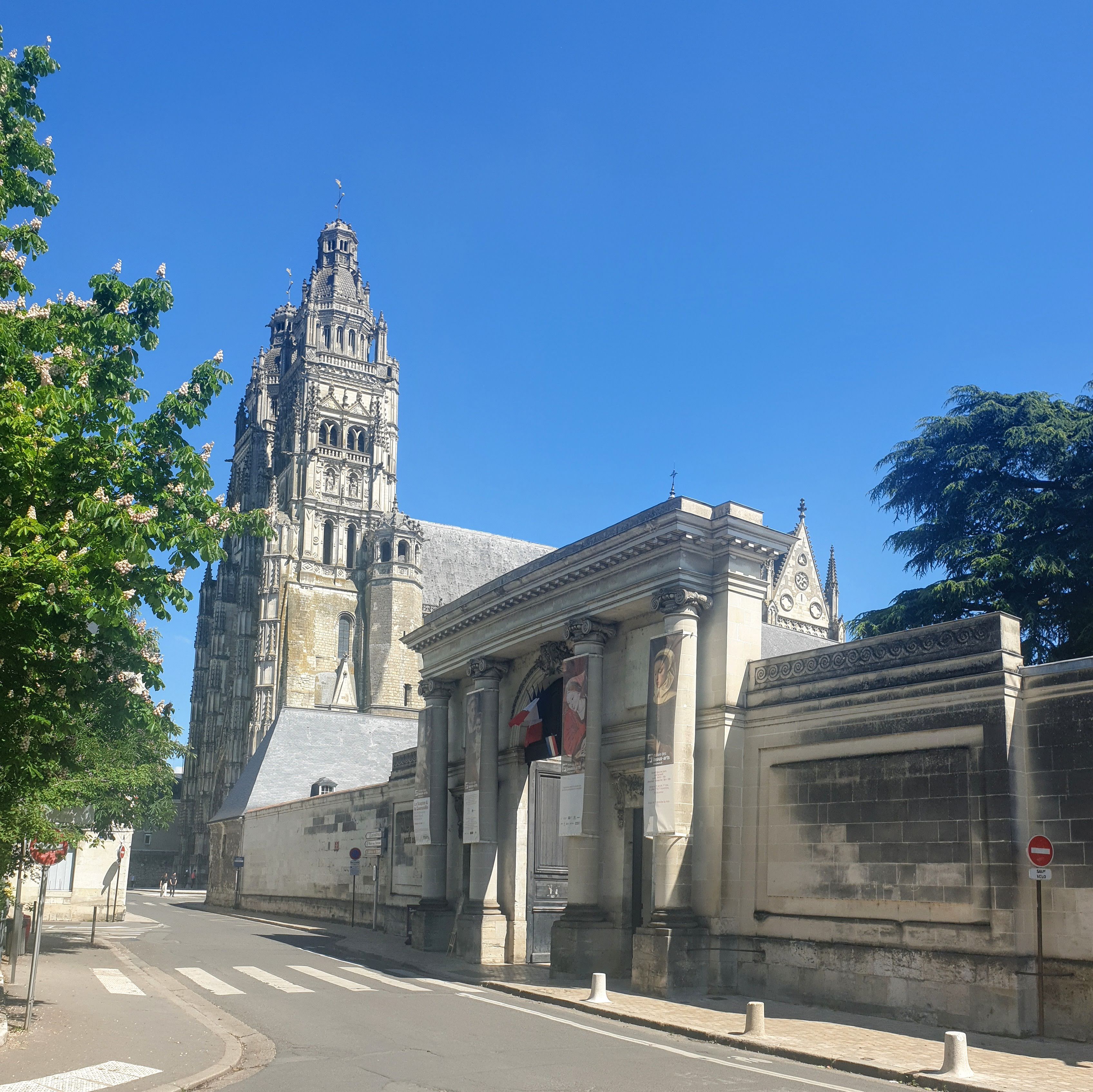
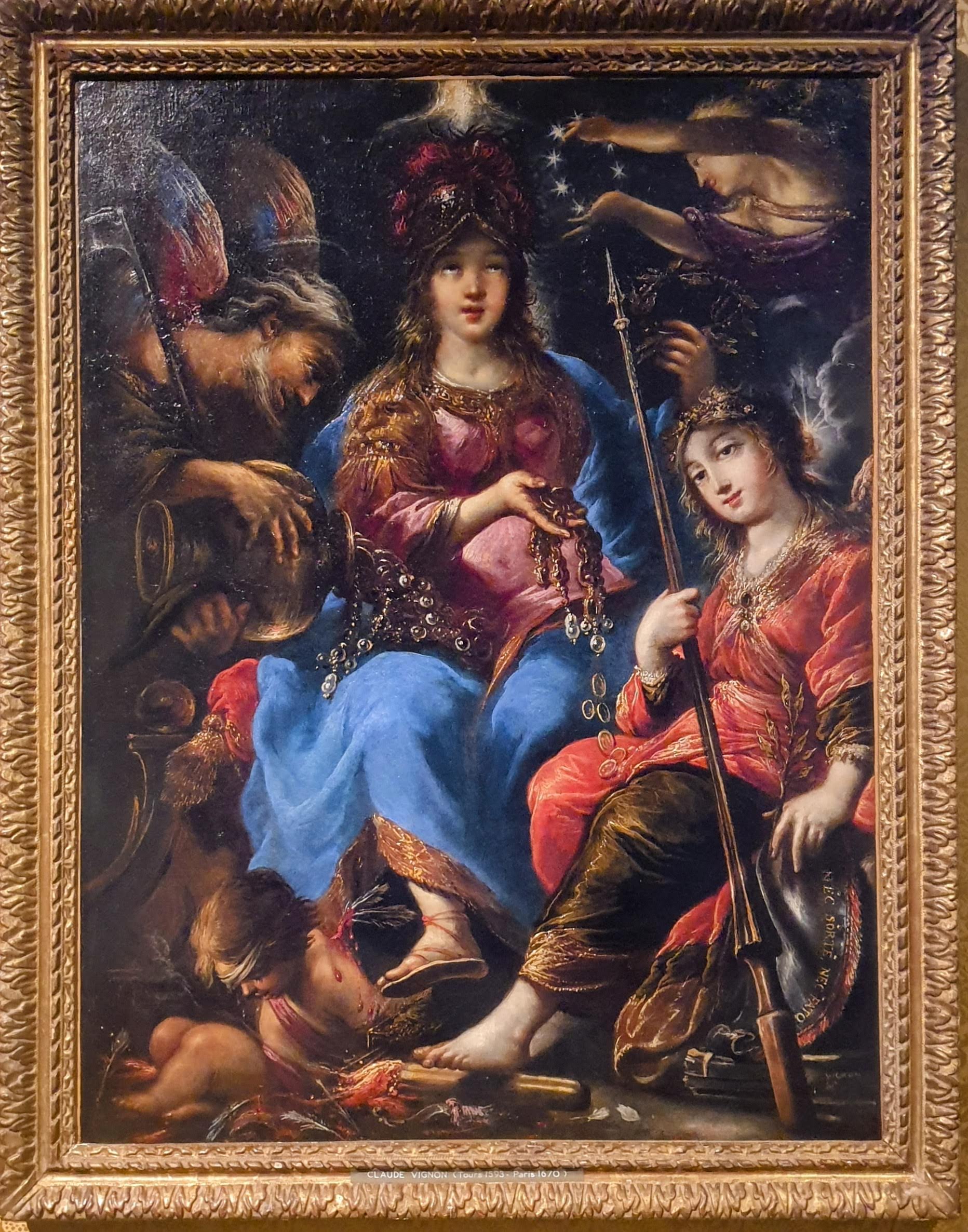
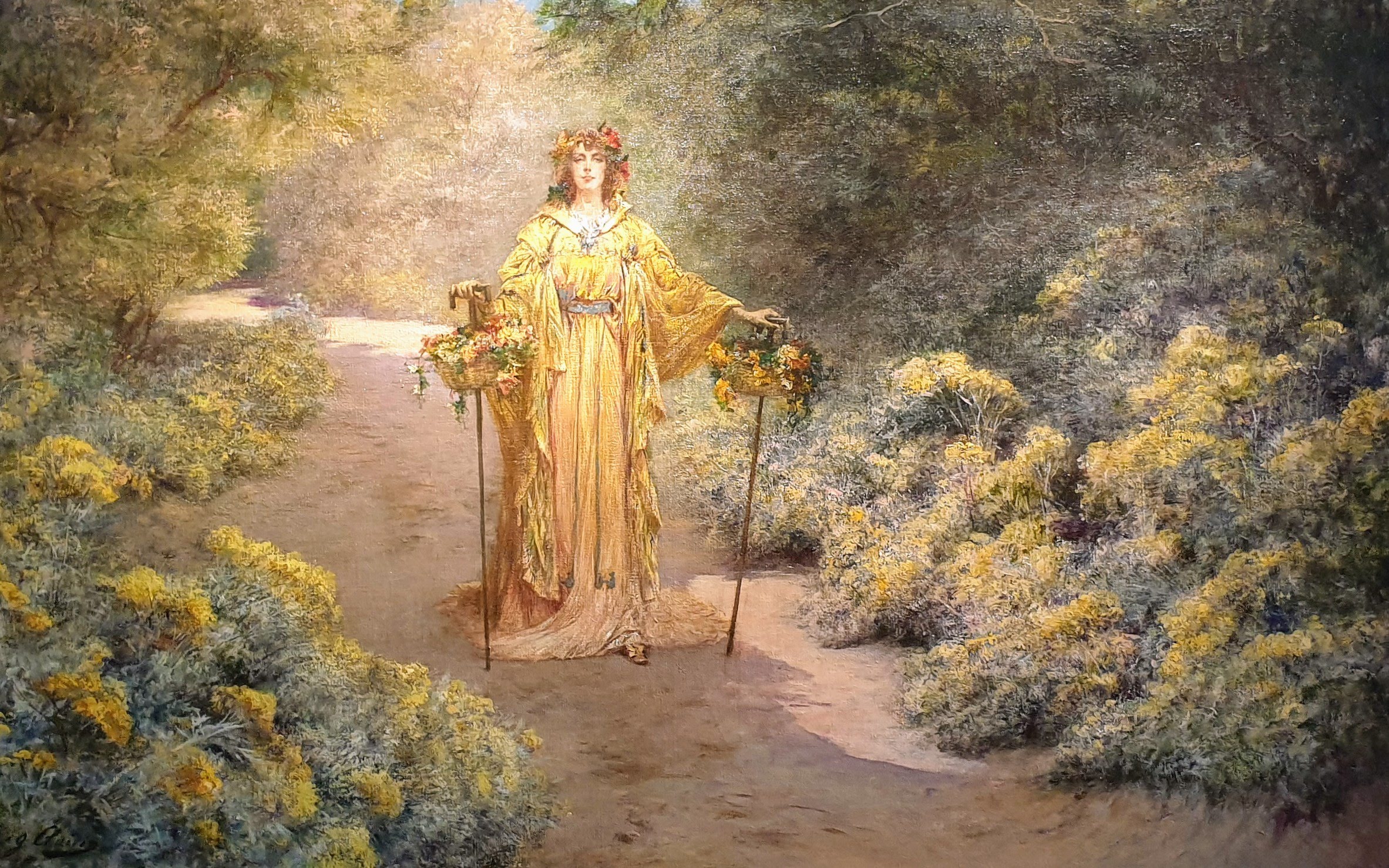
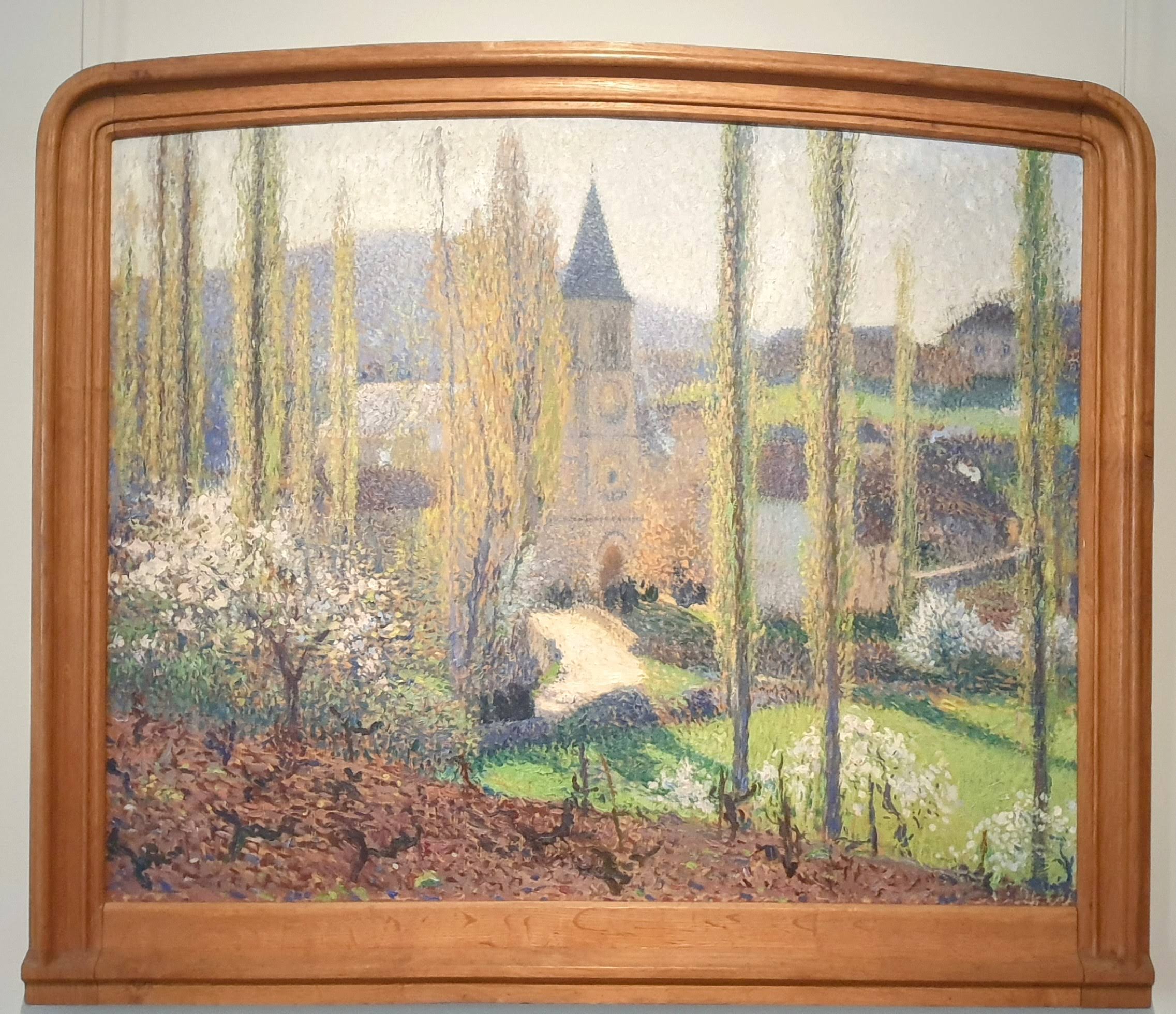
The third and easily most impressive museum I visited was the Tours Museum of Fine Arts. You can go to France and not visit an art museum, but why would you? I spent about 2.5 hours inside the museum of fine arts. I only took photos of things that struck me in particular, but it was room after room of beautiful stuff. I love looking at oil paintings up close. There’s some things that no photograph can ever capture, the quality of light, the ability for a part of a painting to seem like it’s glowing, the way the brush strokes move the eye, the size (both the enormous paintings and the tiny details). Seriously, even gallery-pro photos rarely do them justice, but if you want to see the museum’s own photographic collection, click here

Nonetheless, I cannot paint a picture of a gallery with only words, so I hope you enjoy the pictures I took and that maybe it can inspire you to visit an art gallery in or near your own town. Galleries often have wide collections, and even trade around highly desirable artists so that everyone can get a chance. The Tours museum is not anything so grand as is found in Paris, Lyon, London, or New York, but it still had a Rubens, a Rodin, a Rembrandt, and a Monet alongside many lesser known but still very talented artists from the 14th to 21st centuries.

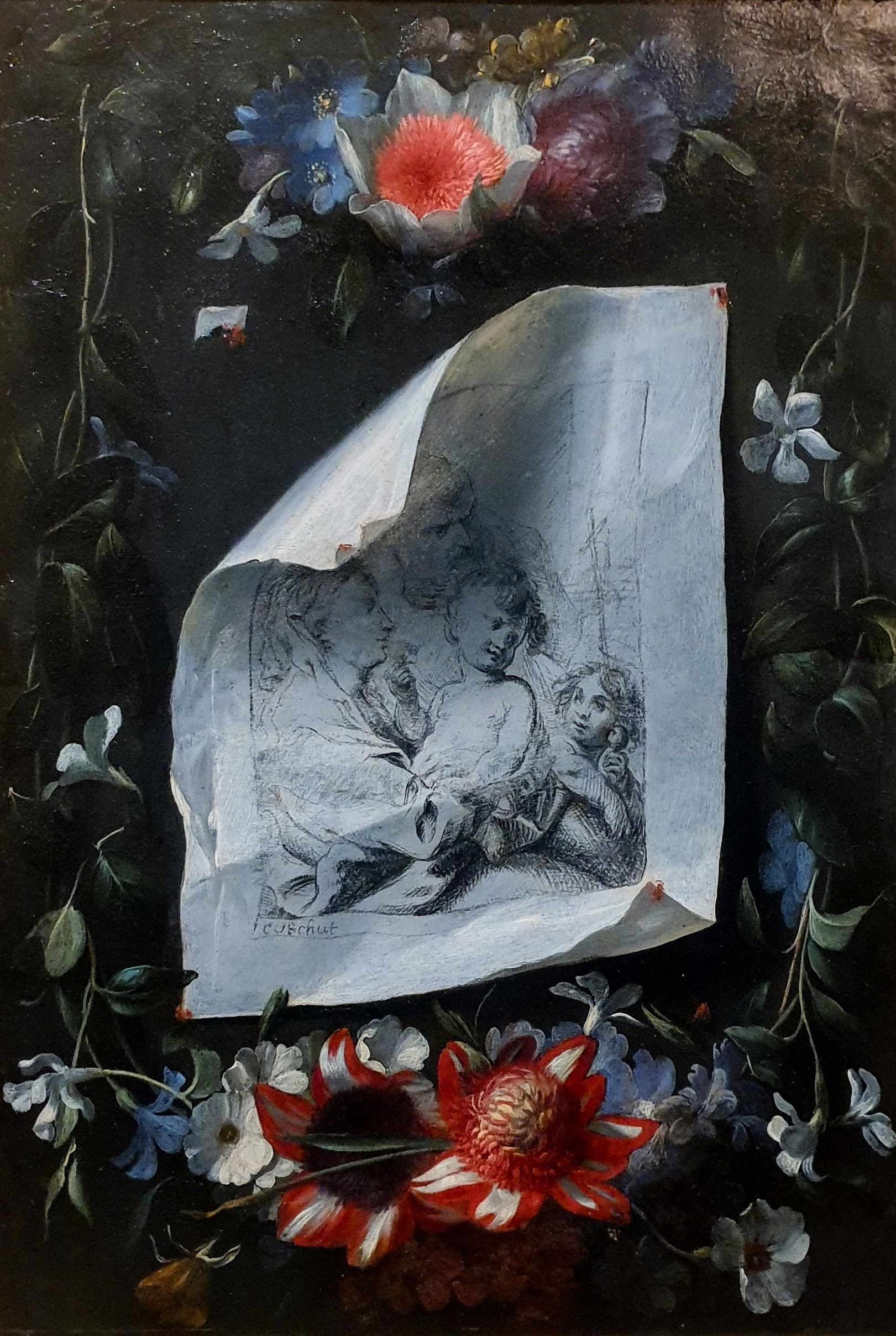
Garland of flowers and trompe l’oeil, Jan-Philips van THIELEN, mid 1600s
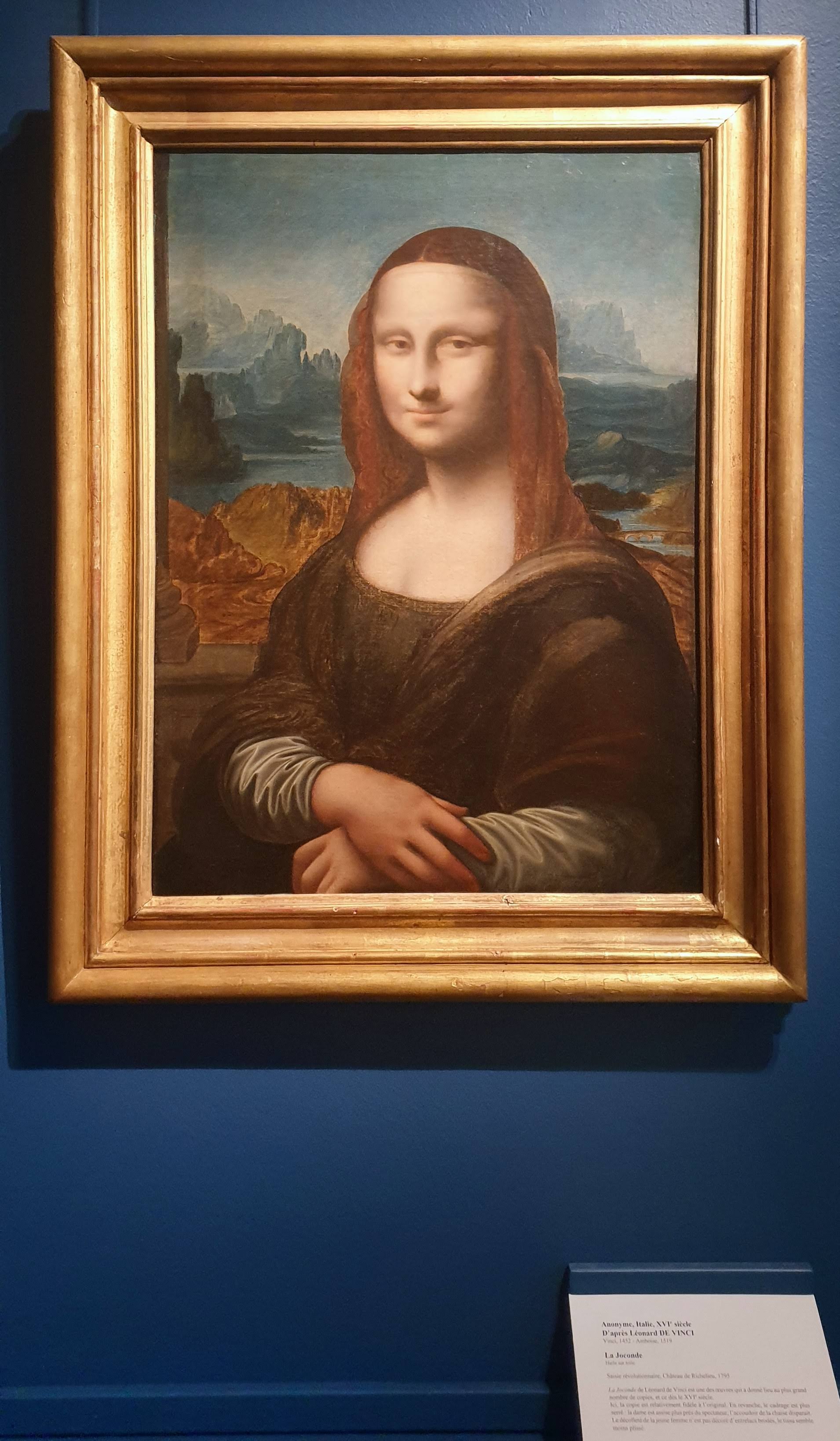
Anonymous copy of the Mona Lisa painted mid 1500s
Mary Magdalene, Matthieu FREDEAU 1642
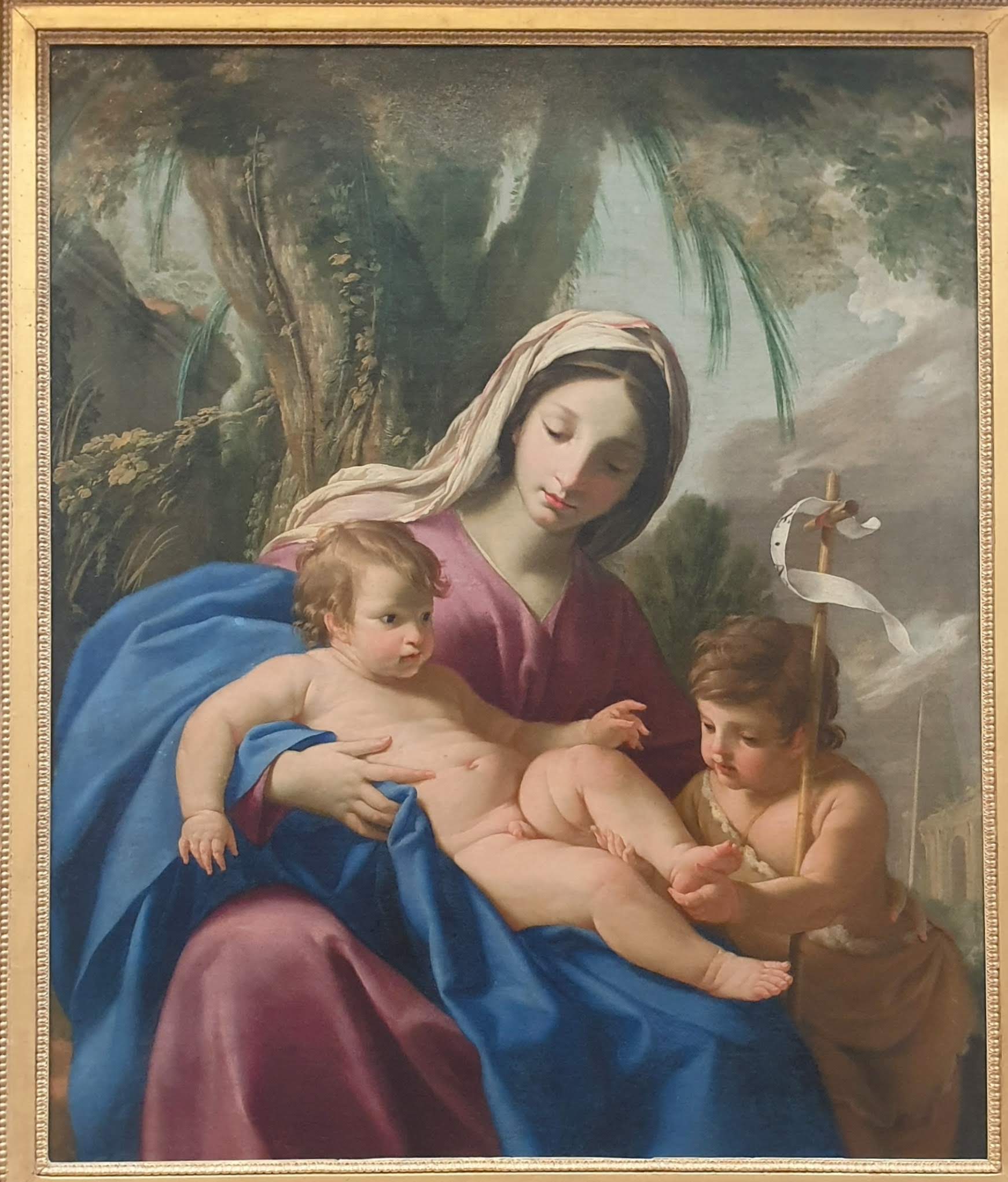
The Virgin, the Child Jesus and Saint John the Baptist, Eustache LE SUEUR, early 1600s
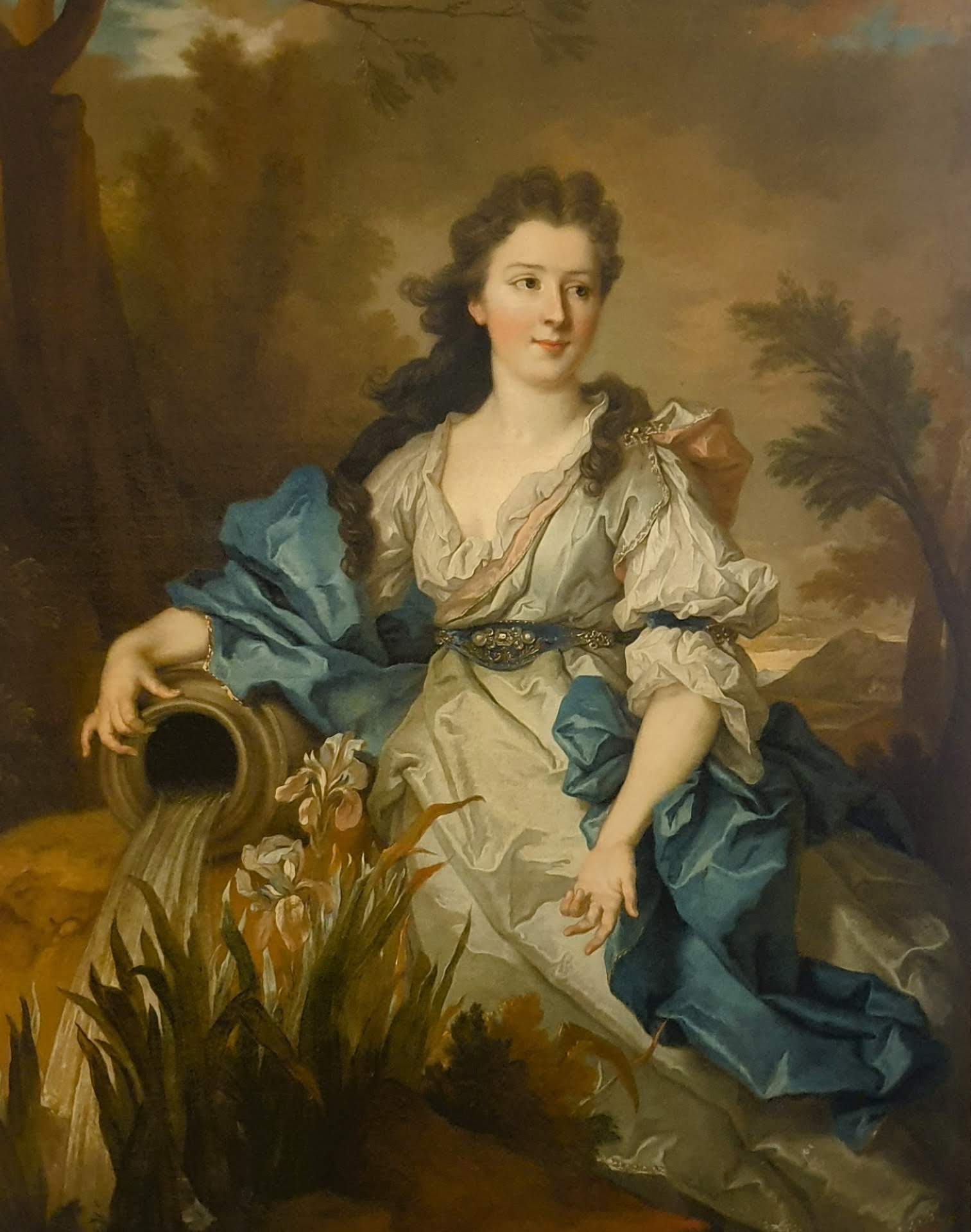
Portrait of a woman in spring, Workshop of Nicolas de LARGILLIERRE, early 1700s
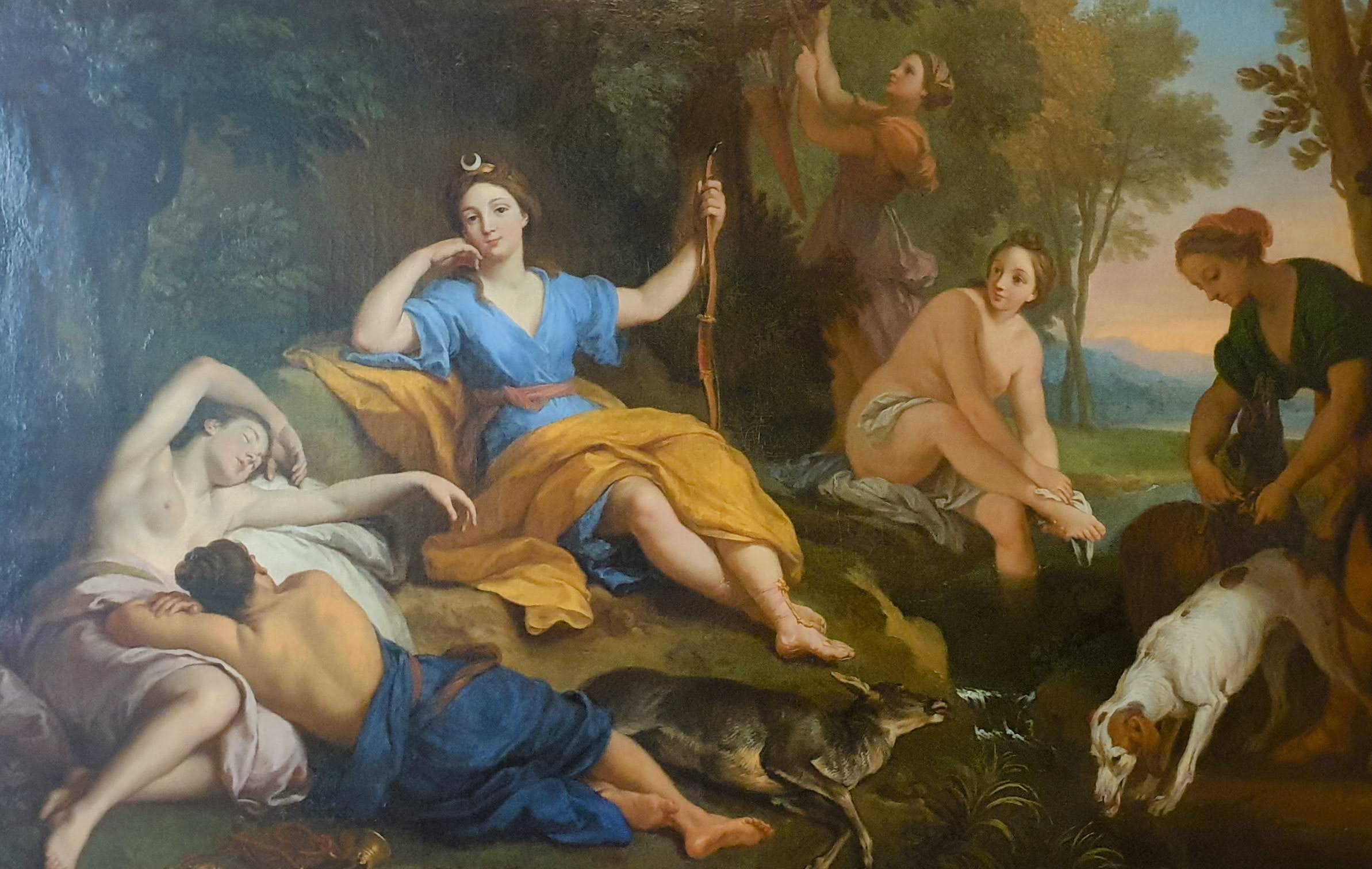
Diana and her companions resting after hunting, Louis of BOULOGNE 1707
Allegory of the Times, Wealth, Power and Love; Claude VIGNON, mid 1600s
Nude study, Léon BELLY, 1857
Sarah Bernhardt in her Belle-Ilea garden, Georges CLAIRIN, late 1800s
Leaving mass on Easter Day in Labastide-du-Vert, Henri MARTIN, 1915

I recently had to try and explain Queer Coding to some folks and I found myself returning to YouTube to shore up my own understanding and references. One of the videos I watched pointed out that a lot of artists who painted under the totalitarian glare of the capital “C” Church used secret signs in their paintings of religious icons, and imagery out of Greco-Roman mythology to be able to portray scenes of queer love, romance, and eroticism that they could otherwise have been turned over to the Inquisition for. It was a perspective that made looking at many of these paintings from the 14-17th centuries much more entertaining.

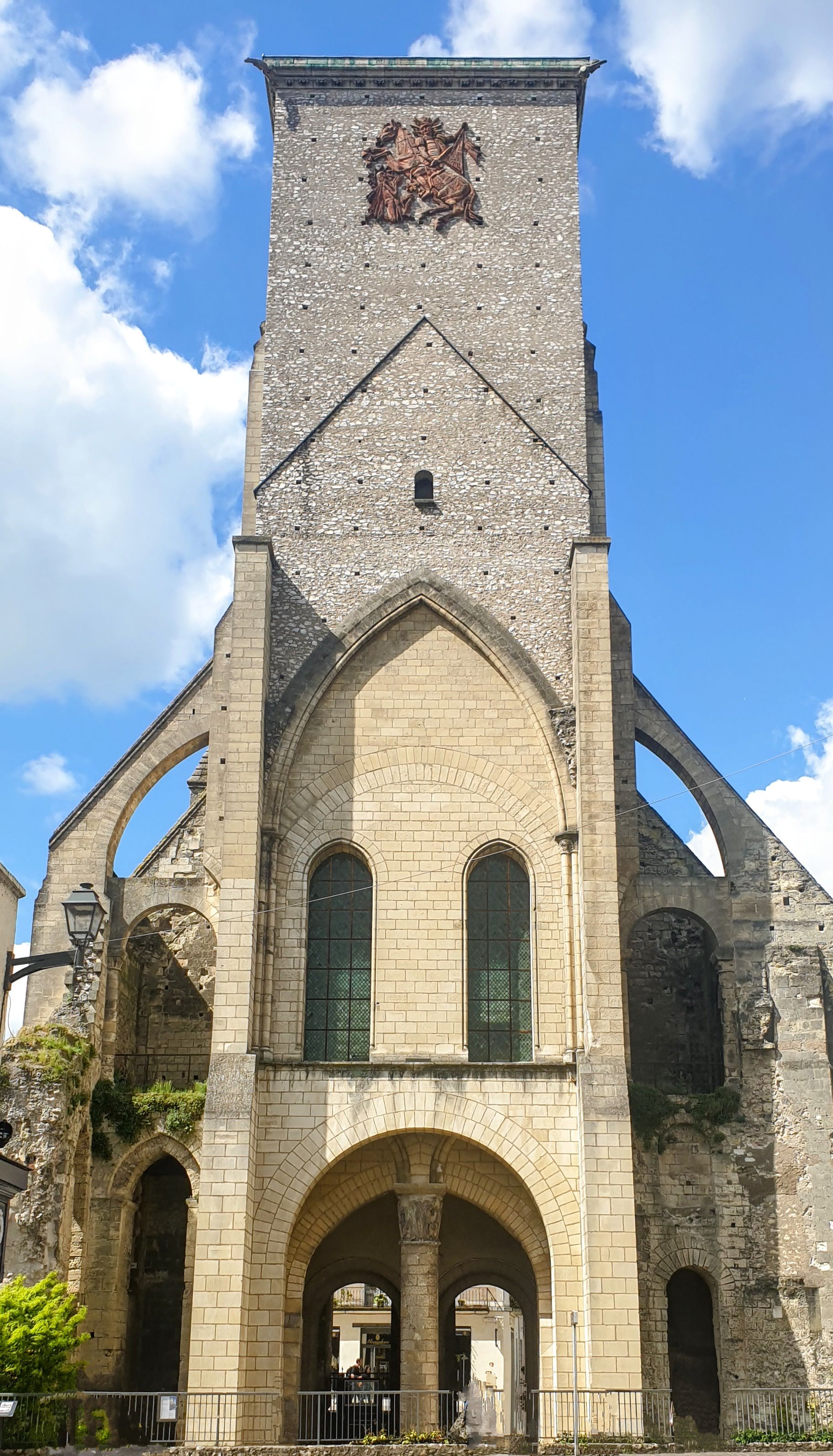
I had to put this painting on its own. This is “Panoramic view of Tours in 1787” by Pierre-Antoine Demachy. When I turned a corner and saw this view, I was absolutely stunned because that’s the bridge I ride the tram over every day too and from school and my apartment. It’s actually fairly easy to regognize the major landmarks like the Cathedral on the left, the large white buildings with black roofs along side the road which is the Rue National (those are still holding shops today), and the Tower of Charlemagne as the tallest structure on the right. The artist was able to make the buildings in the distance look larger than they really are, and there are too many trees and new buildings for me to exactly replicate this view with my camera, but I gave it a go.

The lower floor of the museum is where the rotating and seasonal exhibits live. When I visited, it was an exhibit about the history of women called “THE SCEPTER & THE DISTAFF. BEING A WOMAN BETWEEN THE MIDDLE AGES AND THE RENAISSANCE“. Although it did have some generalizations, it mainly focused on France and it’s neighboring European countries and offered examples of illuminated manuscripts and artistic renditions of women as visual aids to the historical records. Anyone who has studied the history of women in the West will be well aware of the issues, but for those who are not, may I recommend the recent re-translation of Simone de Beauvoir’s eminent work, The Second Sex. If you’re on this website, I assume you like to read and so recommend the book, but there are plenty of YouTube videos reviewing and analyzing it. I don’t claim it’s the authoritative book of feminism (it’s got issues), but she does a very good job of assessing the historical condition of women in Western culture.

After I finished inside the museum, I headed outside to look for the pickup spot of the hippomobile. I didn’t make up that word. “Hippo” isn’t just a big African water mammal, it’s actually the ancient Greek word for “horse”. “Potamus” is Greek for “river”, which is how the hippopotamus got it’s name – river horse. Thus, the hippomobile is simply an ancient Greek way of saying horse-car, or horse drawn carriage. I don’t know why the one in Tours uses this name instead of the wildly more common French word “calèche“, but the first time I saw it on the website, I fell in love with the word and I refuse to relinquish it.

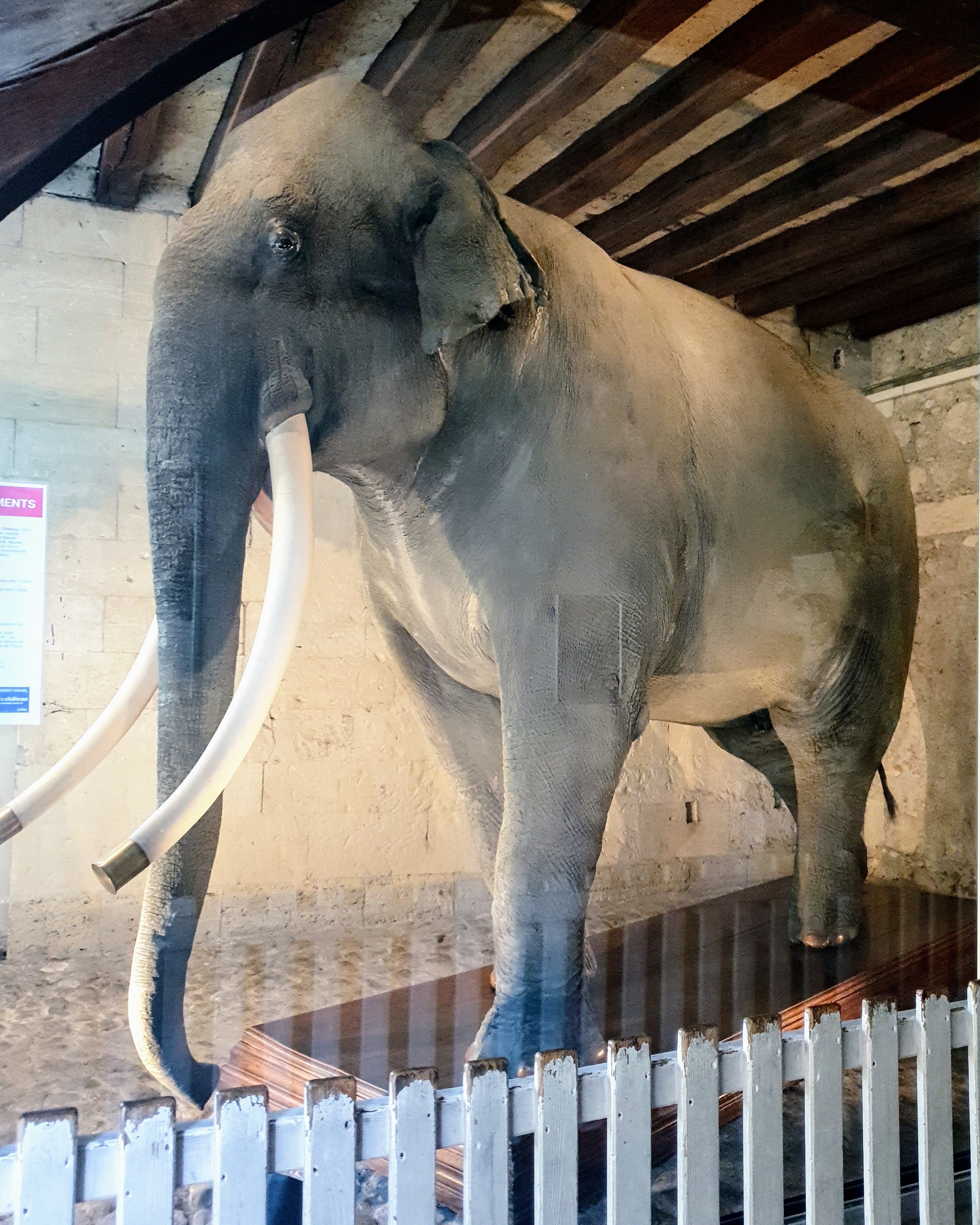
The internet further told me that I should catch this wonderful ride in front of “Fritz the Elephant” outside the Musée des Beaux Arts. When I arrived at the museum, a sign outside advertised the ride as picking people up at Fritz the Elephant as well, yet by the time I finished my museum tour, I still had no idea where (or really what) Fritz the Elephant was.

The Story of Fritz the Elephant

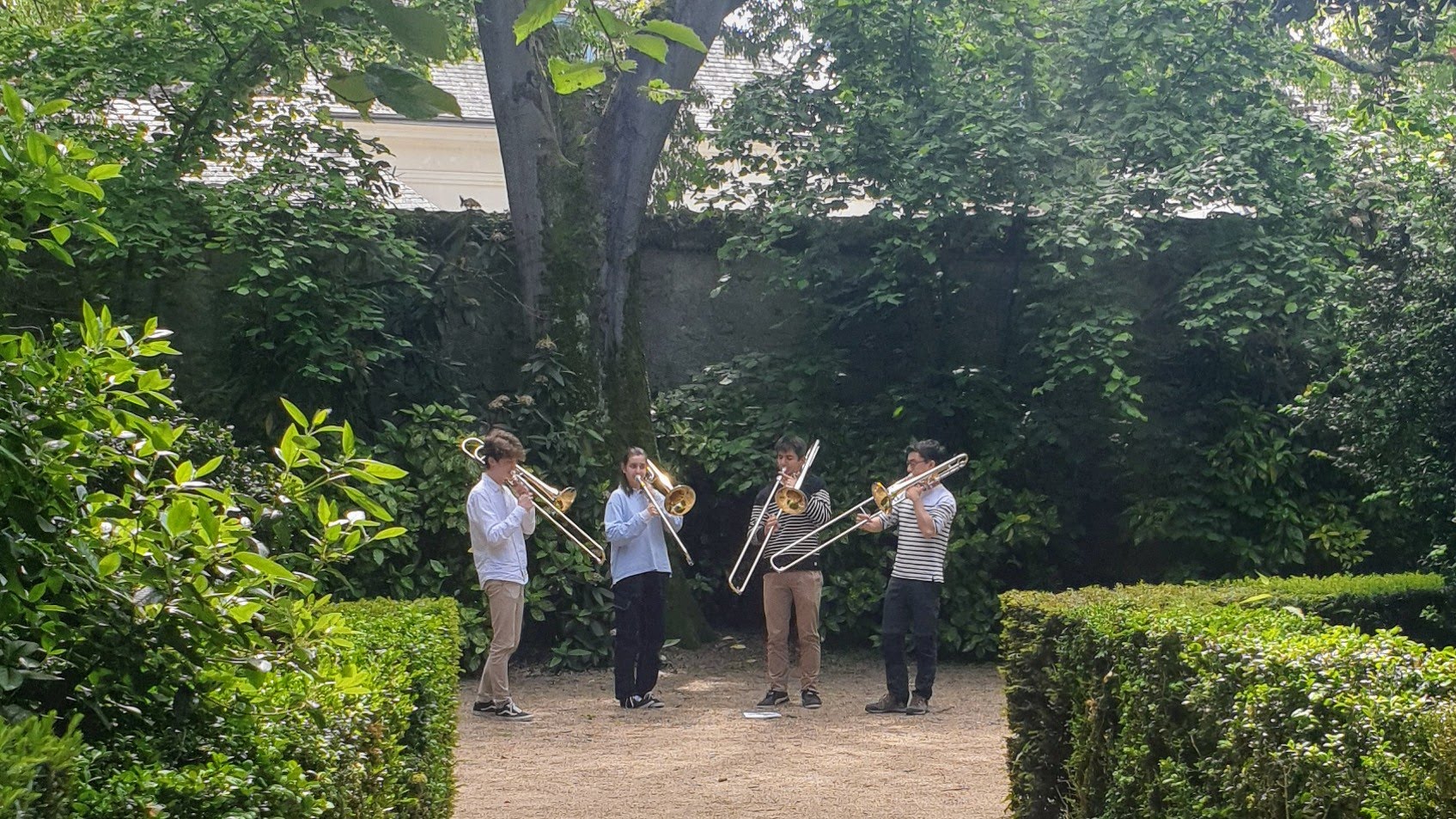
In my mind, Fritz would be a statue, or maybe a mural, adjacent to and clearly visible from the museum. Upon exiting the museum, I took a quick walk around the gardens (lord do I love the way the French put gardens everywhere). I found a little food stall, and a playground, and a trombone quartet (very unexpected), but still no elephant. Finally, I went over to a building off to one side that looked like it had been (or might still be) a stable. Lo and behold, there was Fritz in all his taxidermized glory, sheltered from the elements by a roof and plexiglass.

TW animal cruelty: because western civilization didn’t figure out animals had feelings until really recently and this is a story out of history. But also, there’s a silver lining at the end? If you want to avoid it, skip to the Hippomobile section where the animals are treated with kindness and respect.

Around the turn of the 20th century, the Barnum and Baily’s Circus was at its height. You may have been exposed to a glorified version of this with a singing Hugh Jackman, but the real circuses relied heavily on exotic animal shows, and the treatment and training for those animals, including elephants, was cruel and violent. Fritz was in captivity for 35 years, which would have been most of his life considering Asian elephants only live into their late 40s. He was purchased by Barnum in Germany in 1873 and shipped by sea to the US. Sea voyages were especially hard on animals then, since they took a long time, had terrible conditions, and there was no medication available to help the animals with anxiety or seasickness. Many elephants died on such voyages, including several of Fritz’s companions. 

In 1901, the B&B circus headed over to Europe for a continental tour. While in Bordeaux in May of 1902, Fritz began to show signs of agitation and aggression, and so was chained to two other elephants to keep him in check. When the circus reached Tours in June of the same year, the circus offered a parade through town as a way of attracting visitors to the shows. Though the parades were difficult, they were also often the only time the animals had any real freedom of movement. 

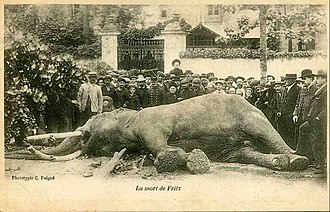
For reasons unknown to history, Fritz became enraged during this parade. 35 years of captivity and violent treatment cannot have been without consequences, and whatever the reason, Fritz freaked out and terrified all the local parade attendees. The handler was able to get Fritz under control and on the ground (laying down), but director on site still ordered the elephant put down. As horrible as that is, the method of execution was worse, and yet it’s inhumanity may have been the reason why Fritz became such an important historical symbol. The method used was strangulation with chains and rope. It took more than three hours for Fritz to pass. 

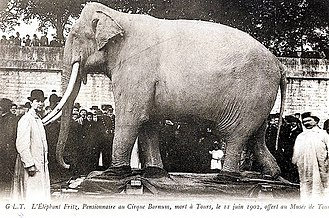
The remains of Fritz were sent off to a naturalist for preservation, and within 8 months the skeleton was installed at the natural history museum, and the taxidermized hide was placed in the former stables at the Musée des Beaux Arts. The press latched on to the story, framing Fritz as a gentle giant and a victim. Wild speculation abounded as to the cause of his rage. Some posited it must have been a lit cigarette burning him, but there is no evidence to support this claim. Regardless, Fritz became a beloved mascot of the city of Tours, and the tragic incident became a pivotal talking point for a growing movement acknowledging animal suffering and animal rights. 

As of my visit, more than 100 French cities ban the use of wild animals in circus shows, and the French government at the federal level has decided to completely ban all use of wild animals in travelling circuses by 2028. If that sounds like a small and late change, you aren’t wrong, but France isn’t behind the times. Most developed (rich) nations are still in the process of passing similar laws, often in patchwork and piecemeal ways, and of course developing nations are struggling enough with human rights, that it is difficult to get them onboard with eliminating animal exploitation which can mean the difference between feeding their own children or not.

I have talked about ethical animal tourism before and how important it is to patronize businesses that prioritize animal welfare because that needs to be seen as a viable economic model in order for more people to follow suit. 122 years have passed since Fritz was strangled to death on the streets of Tours for simply being a wild animal, and that seems like a long time, but we were still going to circuses with mistreated elephants when I was a kid. As short a time ago as 2008 I watched a tiger jump through a ring of fire in China (I didn’t know that would happen when I sat down for the show). Kids on the streets in Africa and SE Asia use baby monkeys they took from the mothers in order to lure tourists into taking and paying for cute selfies. There are still plentiful places that offer swims with captive dolphins or rides on captive elephants as tourist attractions. We love looking at and interacting with animals, but all too often that love is toxic.

Horse-drawn carriages are another great example. I’ve been to developing countries where the horses are near starved, dehydrated, and forced to work without a break in the scorching sun. I recall at one point in Egypt seeing a sign near an area with shade and water troughs that an animal welfare organization had fought to have installed for the horses which carried tourists around the ruins. It’s hard to convince a person who lives in a state of desperate poverty that they need to prioritize an animal when their own children may not have enough. A shorter work-day means less money, and is a big barrier to enforcing any kind of animal rights. Thus it’s up to tourists who take the rides to express a firm requirement that the animals be treated well. Stop paying for rides with badly treated animals and the drivers will change.

Please check your sources. Look for the zoos that have habitats of comfort and preservation (lots of zoos these days are changing their habitats to protect and serve the animals, and they rely more on rescuing animals that wouldn’t have survived in the wild or breeding programs rather than capturing healthy wild animals). Look for animal interactions that protect the animal ambassadors. They exist. Animals that for one reason or another don’t mind interacting with humans on their own terms can be great species ambassadors and inspire humans to better protect the environment, but we have to respect their boundaries and needs. Even the pet cafes can have better treatment of their animals, such as creating spaces where the animals can retreat when they want to, and having highly trained staff around to make sure the animals are safe and comfortable at all times, even if that means disappointing a customer.

We may be past the era of such tragedies as happened to Fritz, but we still have a long way to go to restore the balance between our love for interacting with animals and our ability to respect them.

The Hippomobile

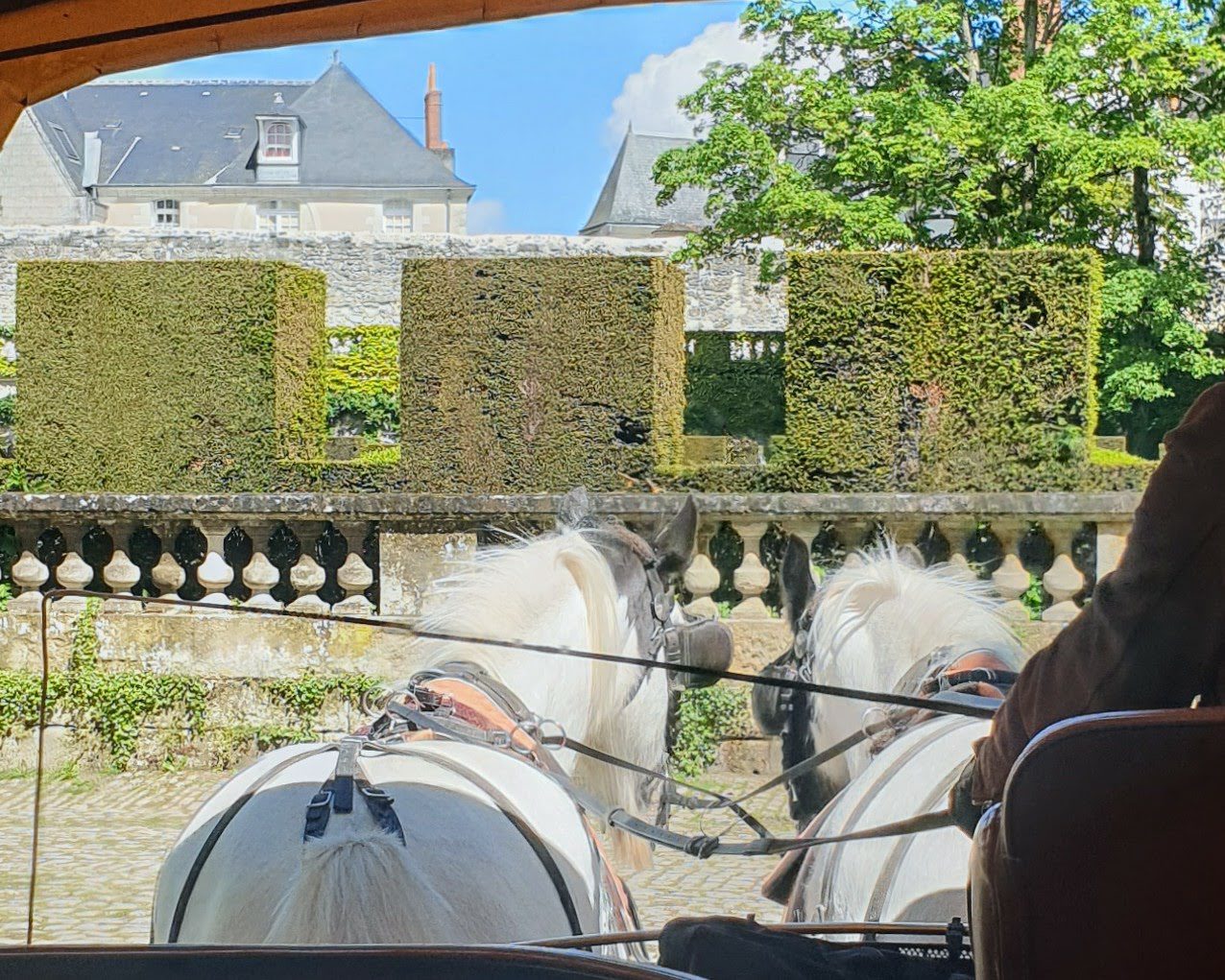
Thankfully, in France, the labor rights are strong, even for horses, and these chevaux have restricted work hours, mandated breaks, days off for extreme weather, and nice digs.

“Our equine friends are given a day off every Monday. The horses that draw carriages in the morning are replaced by another set in the afternoon. The animals take breaks in the shade of the magnificent cedar tree outside the Museum of Fine Arts. The carriage driver decides which route to take depending on the time of day, weather conditions and/or the horses’ energy levels. When the weather is unfavorable to horses, the timetable may be modified or suspended.” — quote from the Filbleu website regarding this service

I joined the first afternoon tour (3:30pm) and although I was a bit disappointed that the weather plastic remained down (it had rained heavily a few days before), I was seated right at the back and could look out the open rear for clear views. I didn’t see a lot of new things because by this time, I’d lived in Tours for over 3 weeks and had done a lot of exploring on my own. However, Old Tours is endlessly charming and the weather that day was simply stunning, so for the price of transit ticket, I happily enjoyed the clip clop of horses hooves while I admired the scenery. 

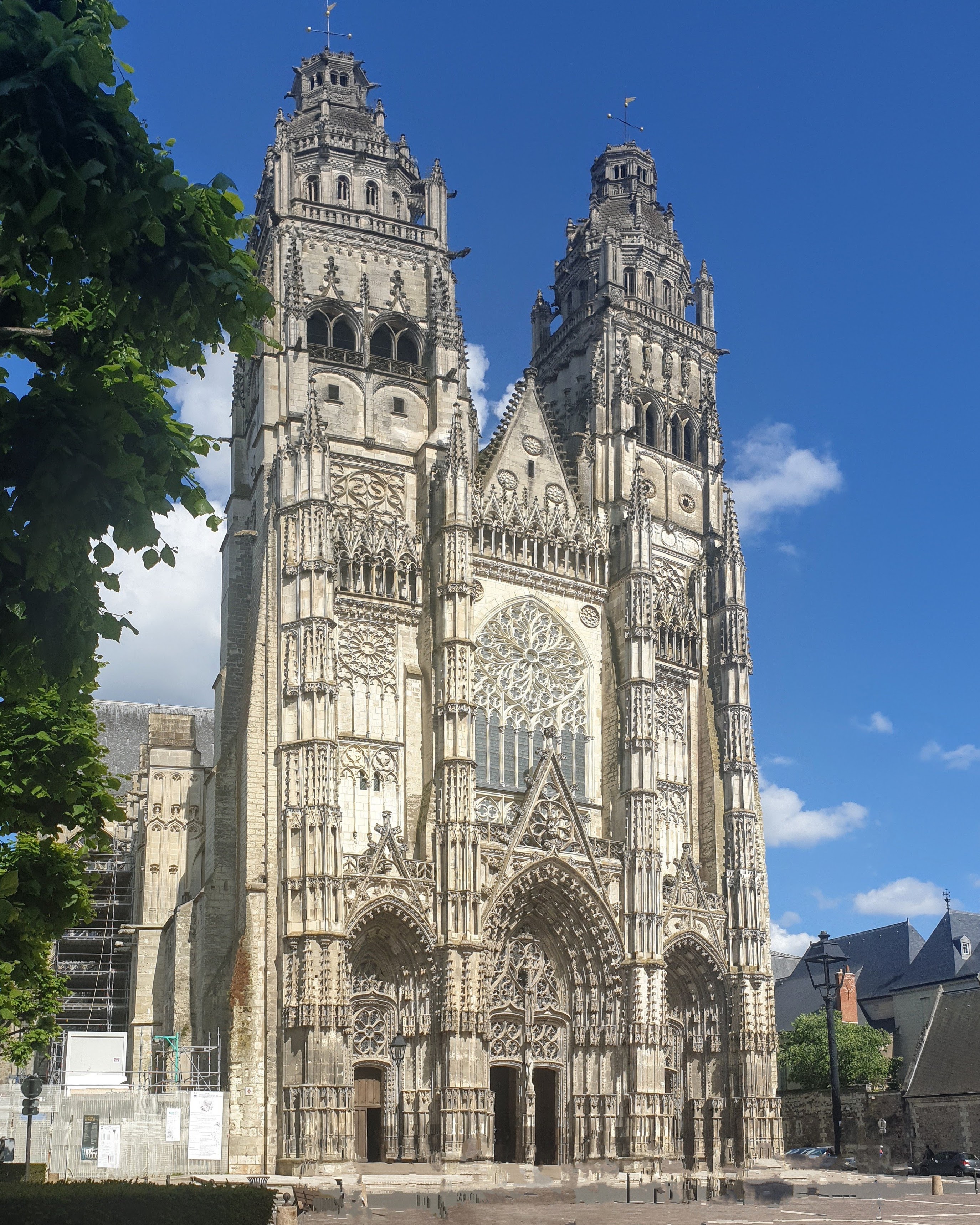
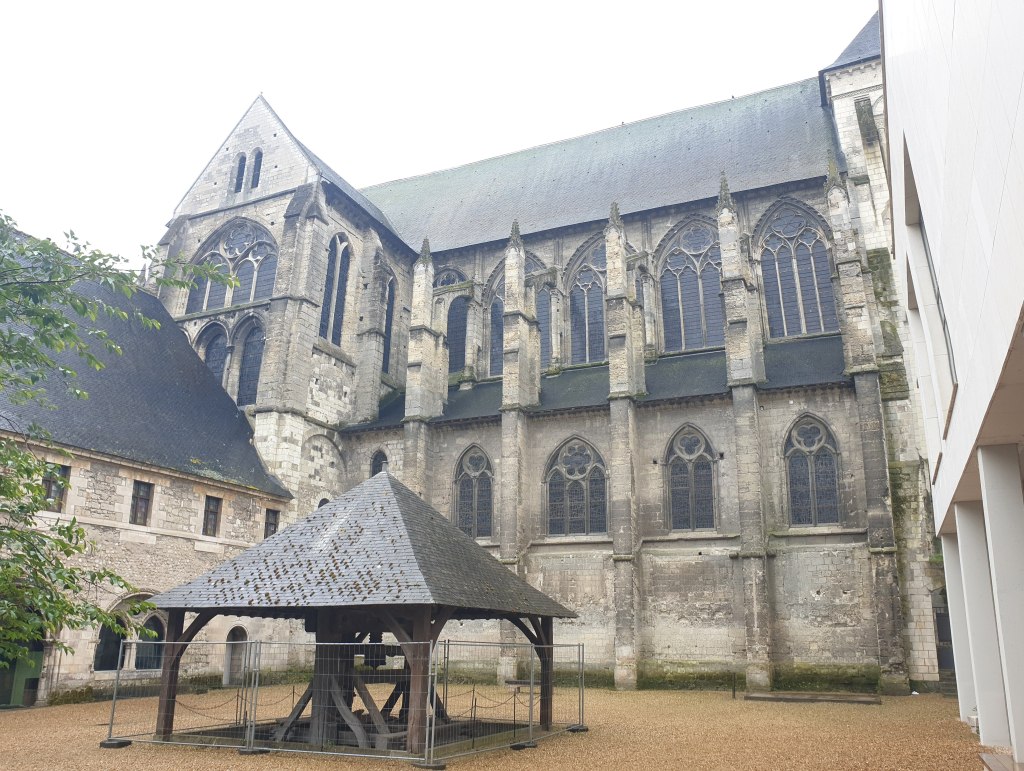
The Cathedral of Saint-Gatien

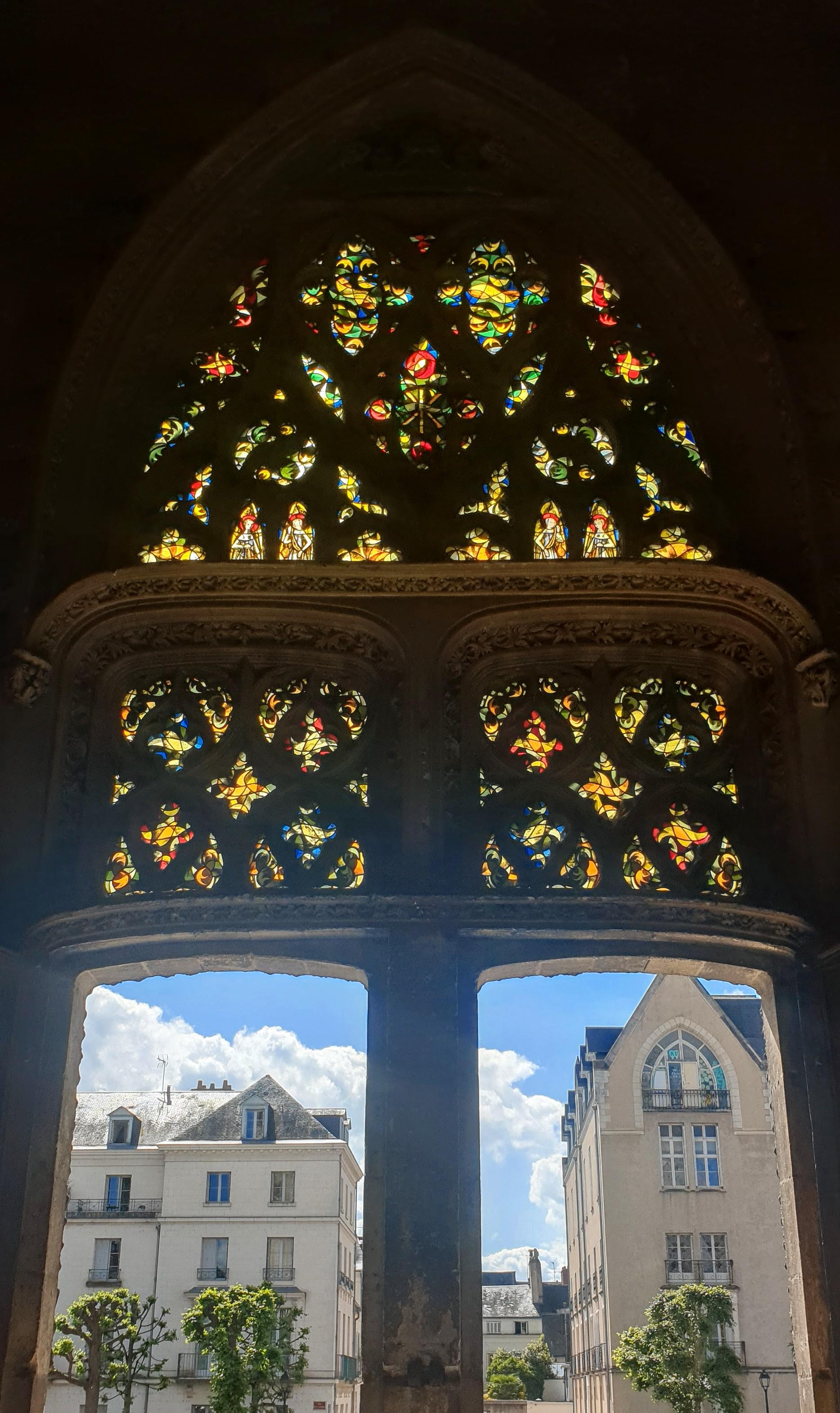
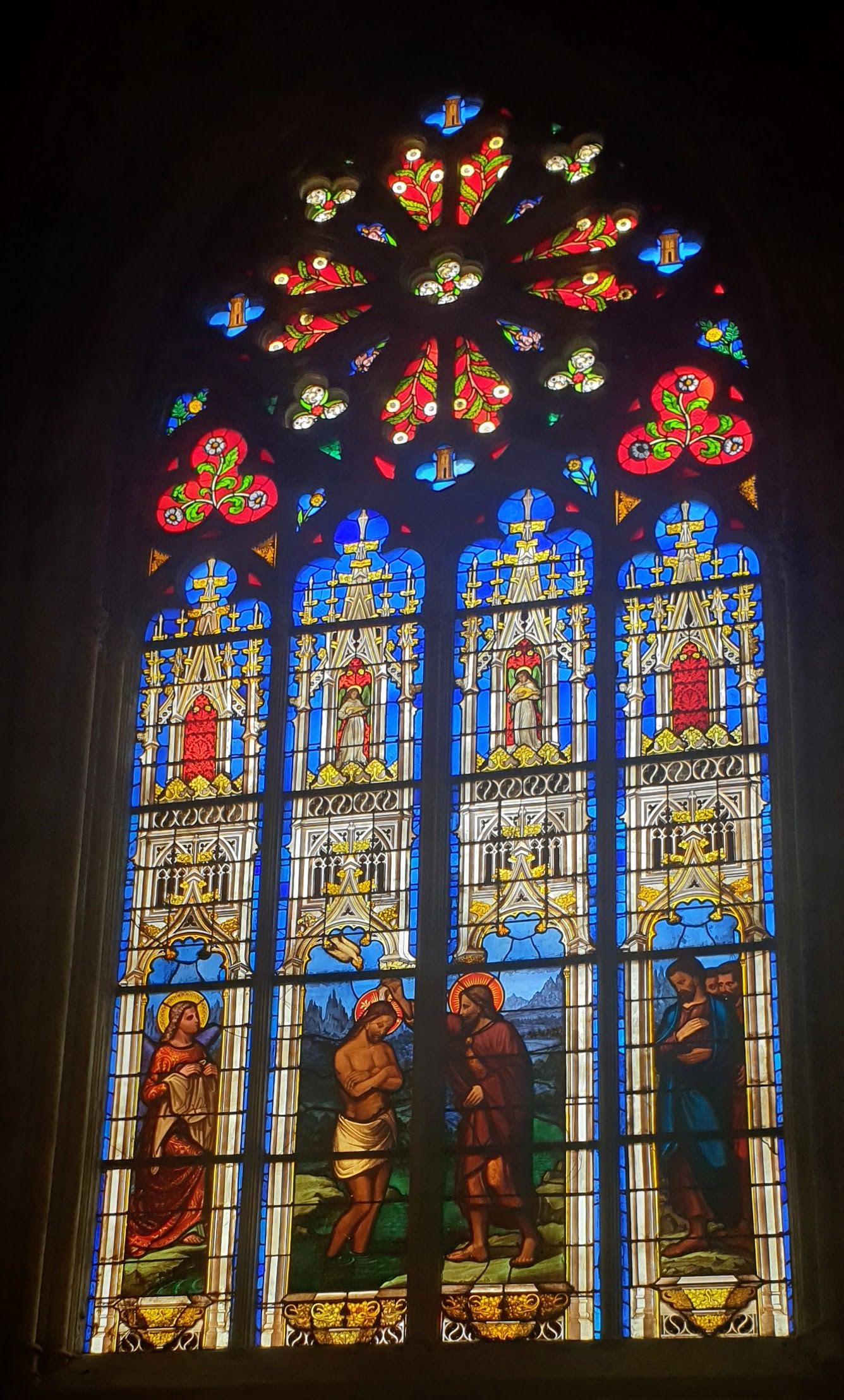
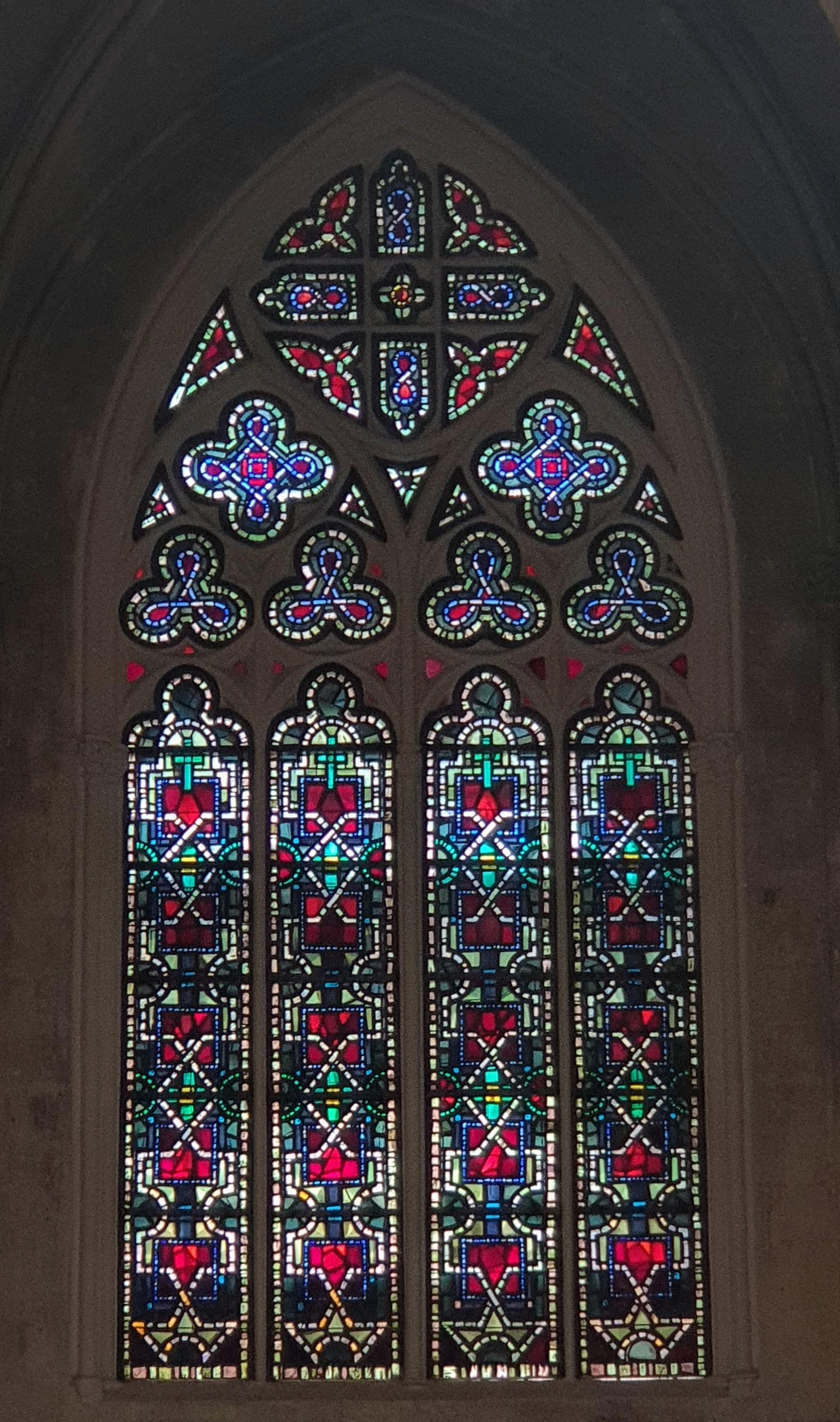
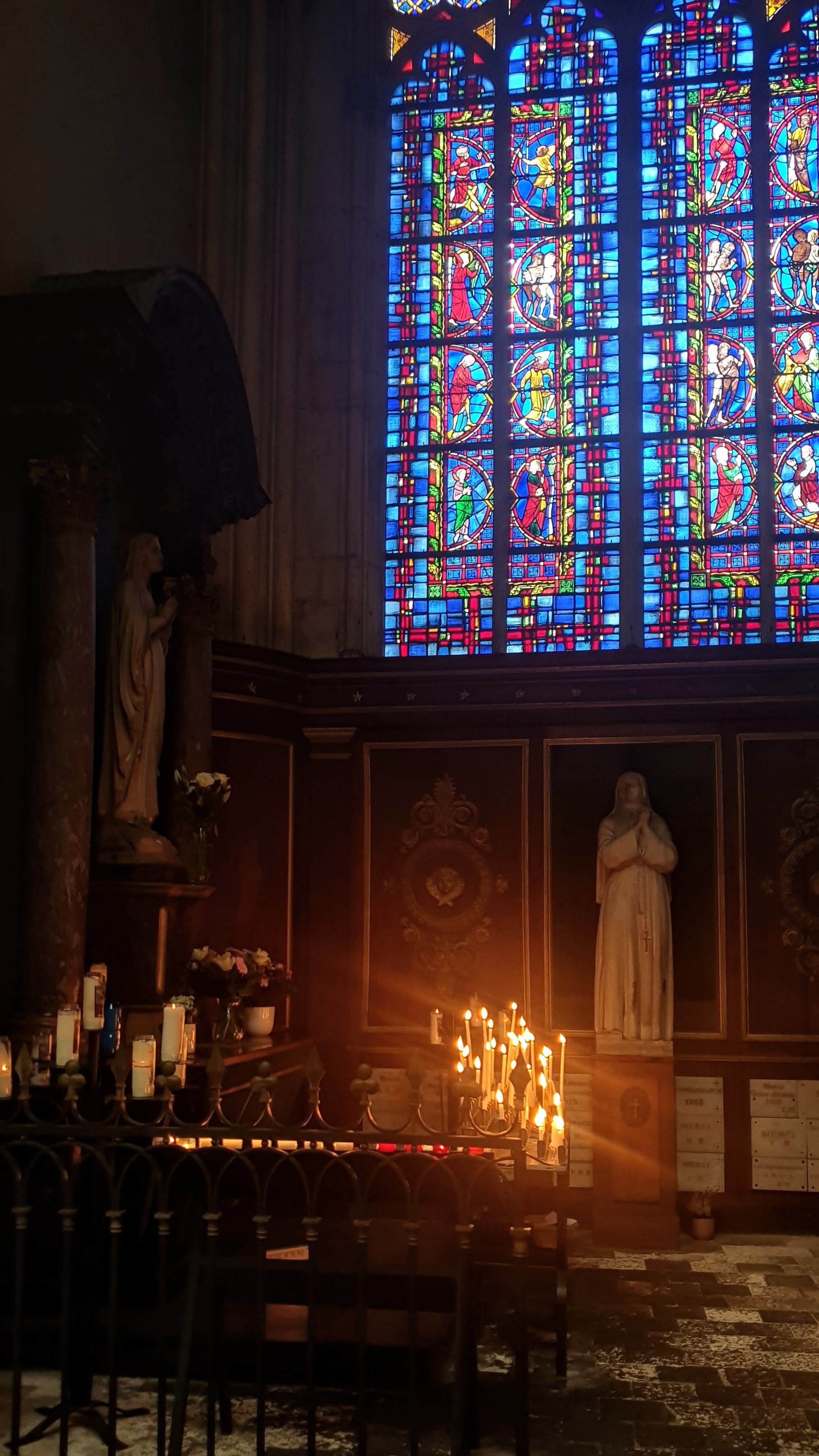
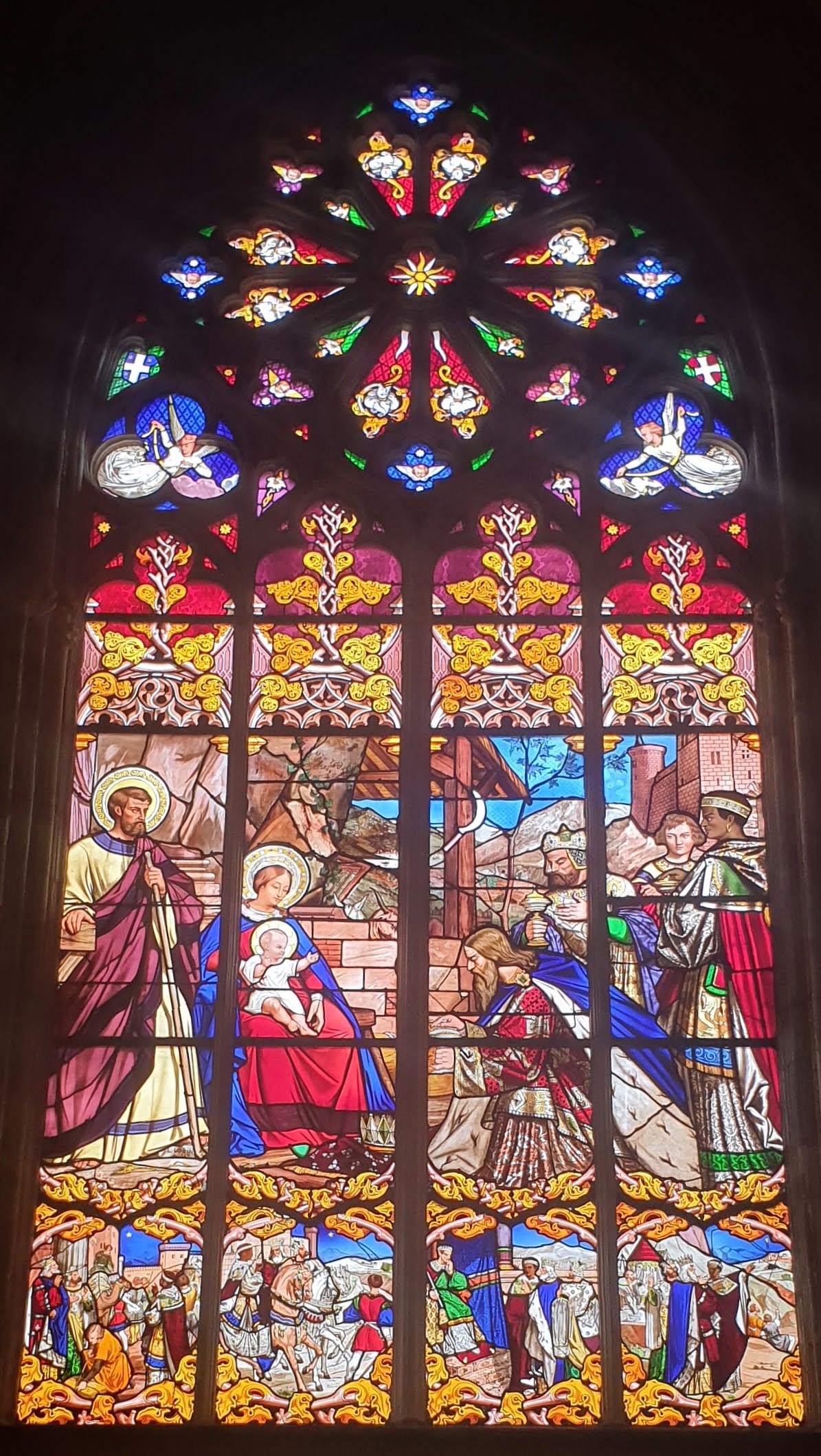
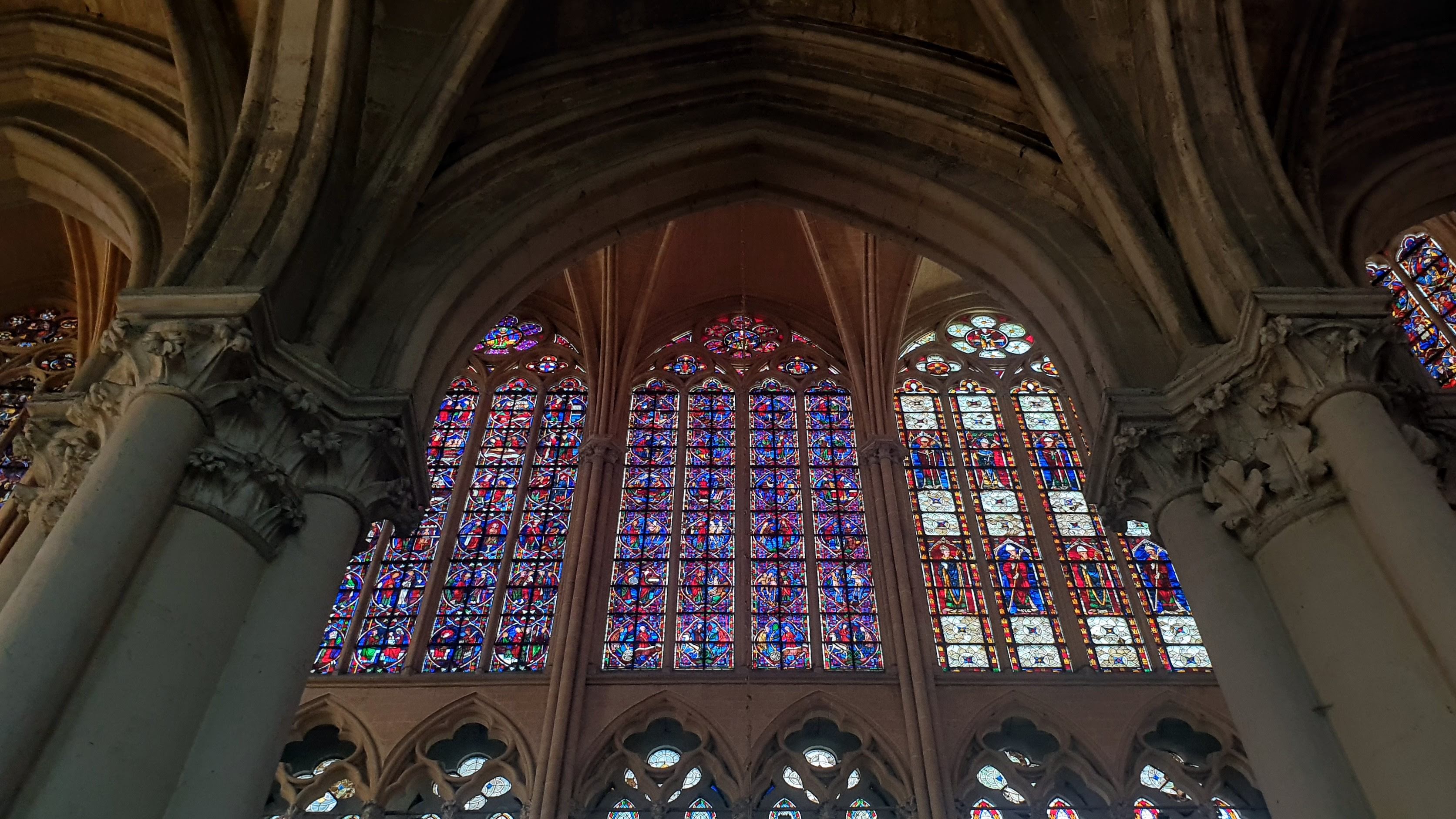
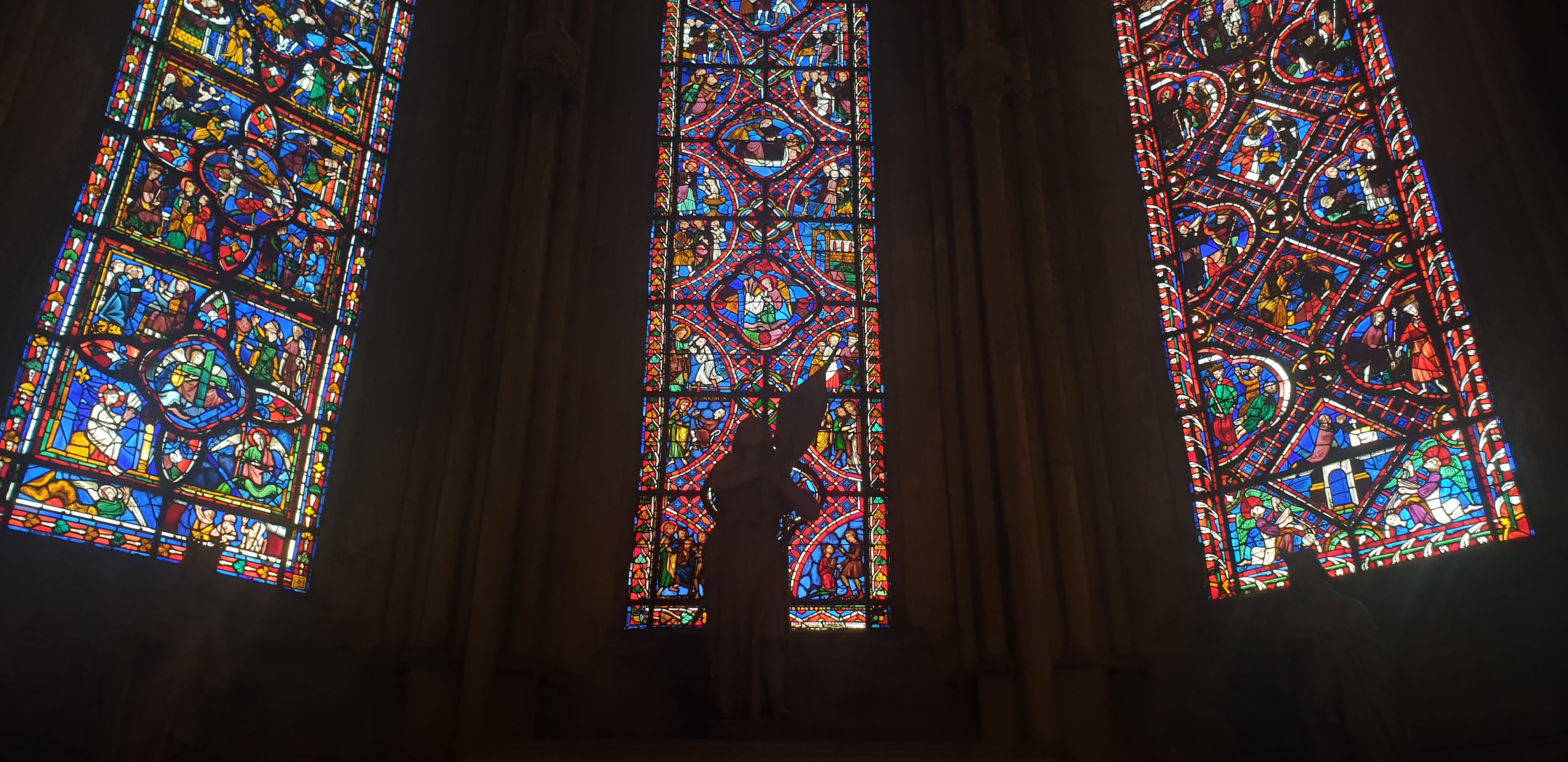
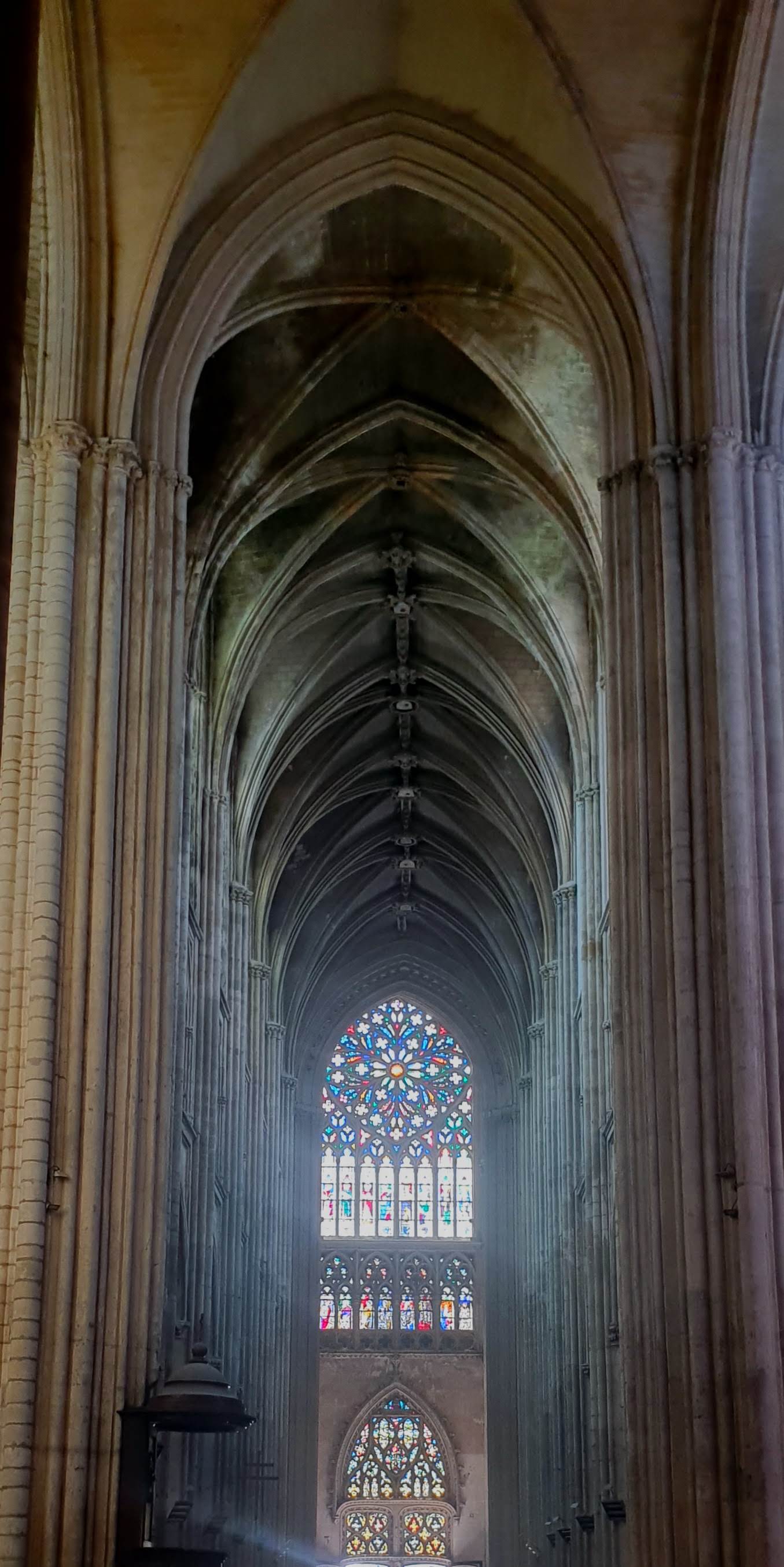
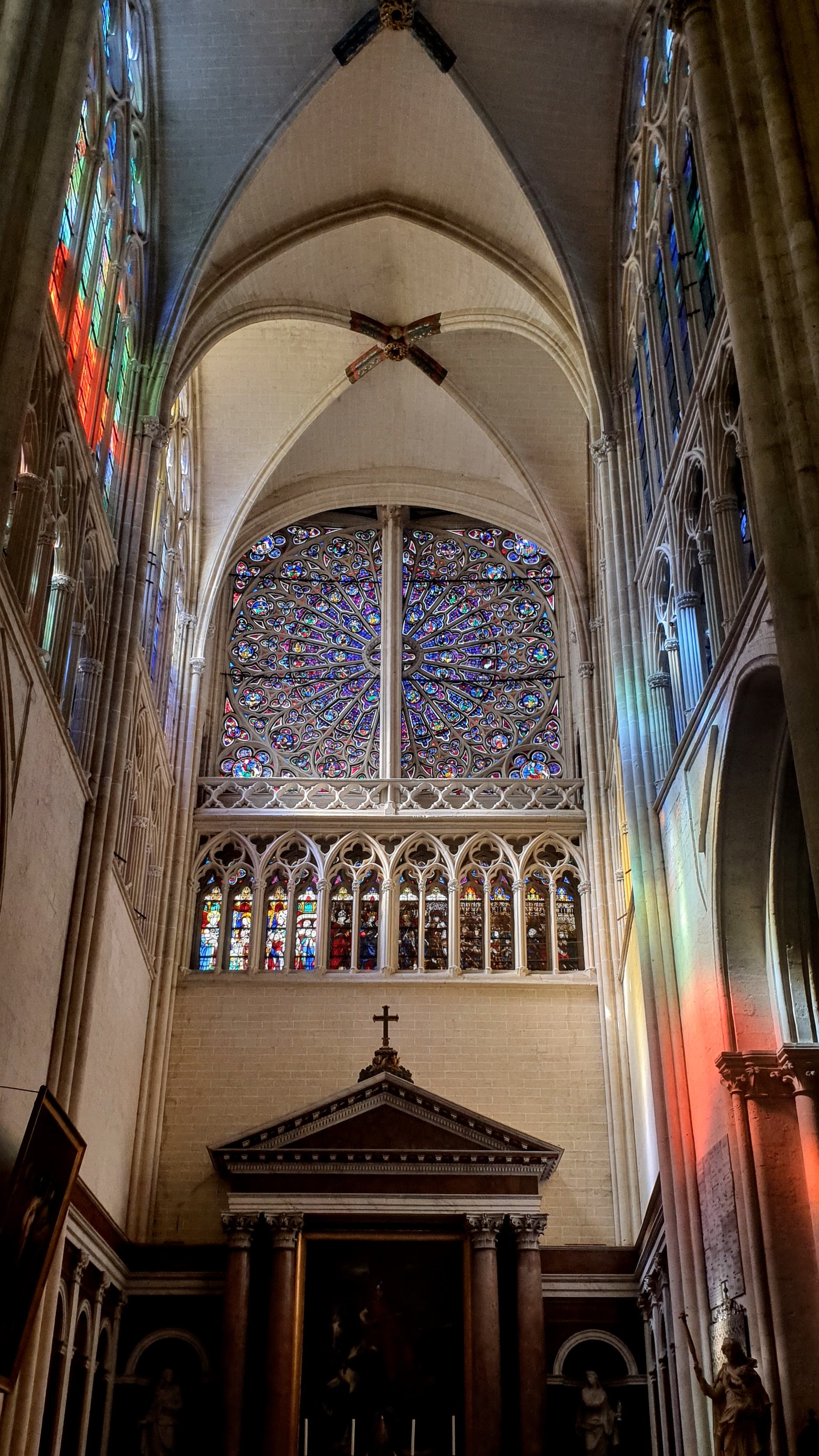
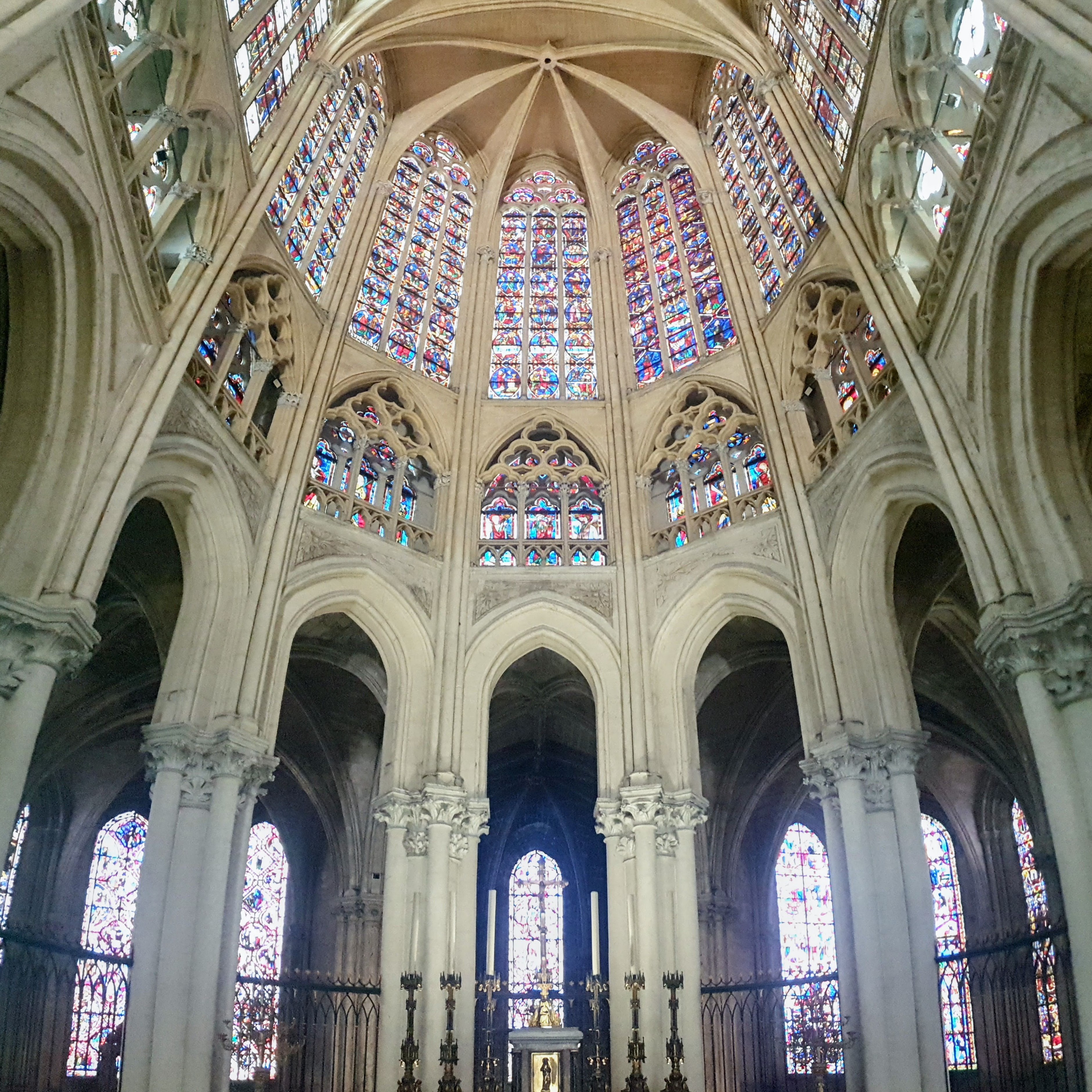
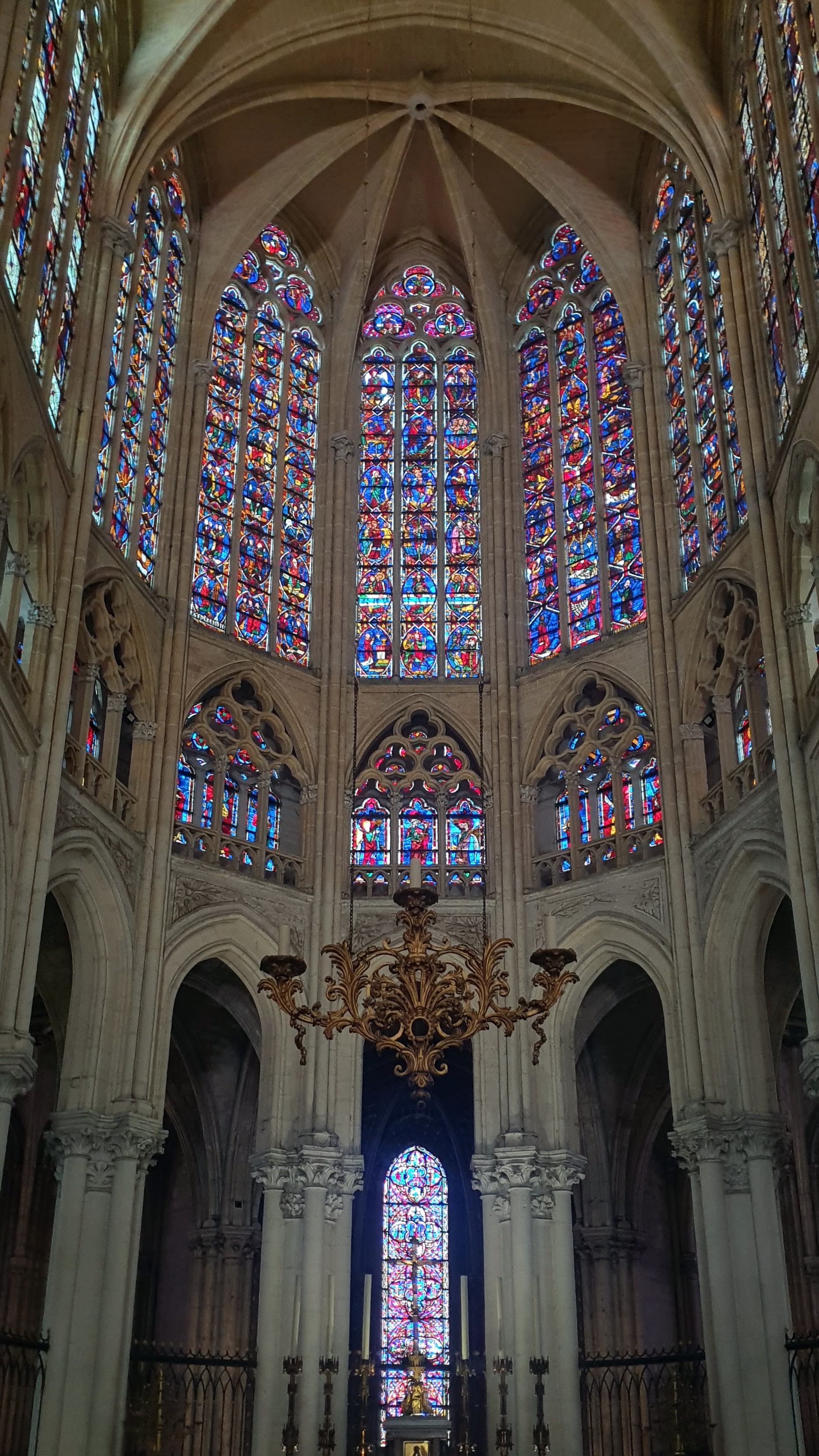
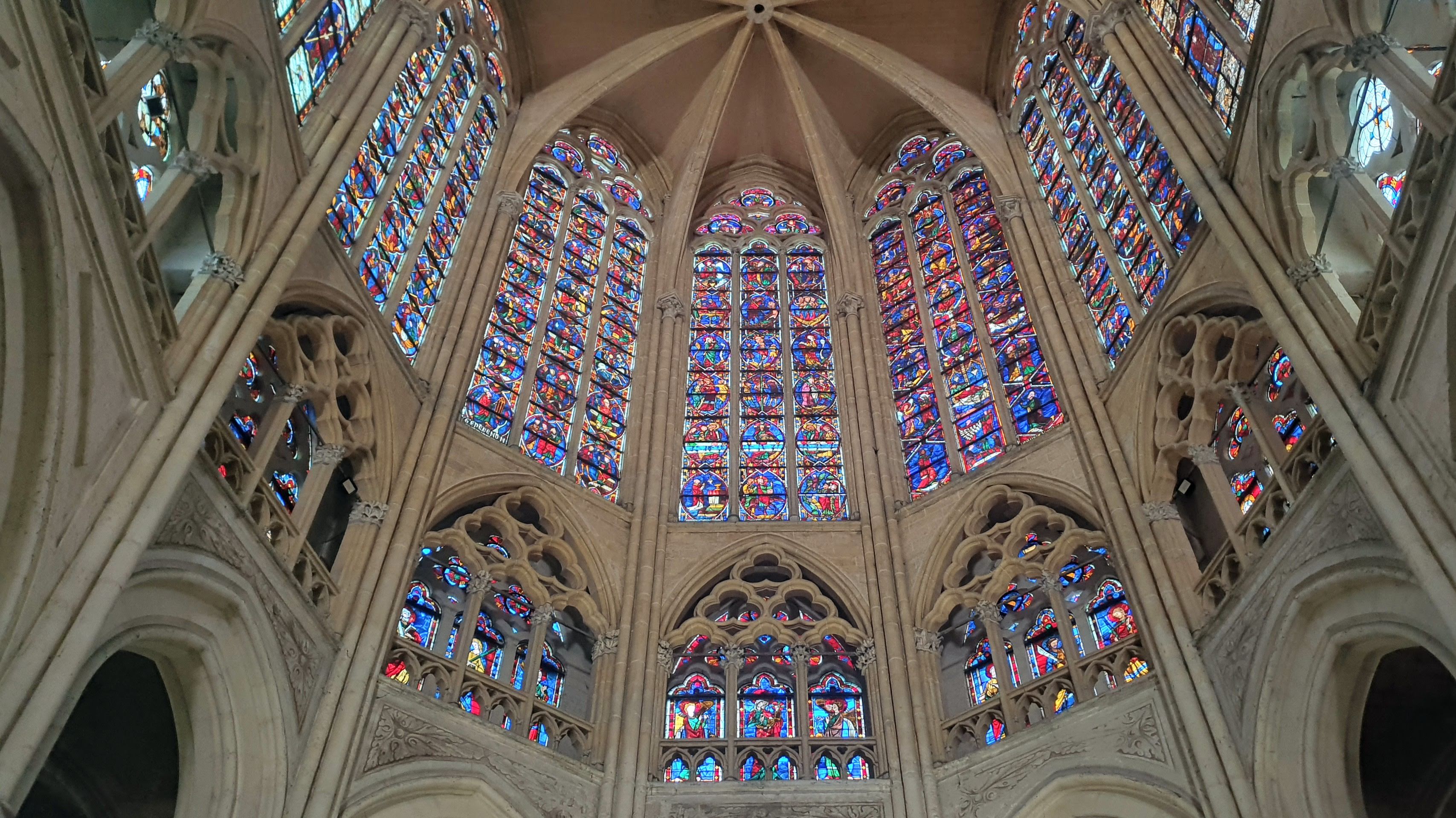
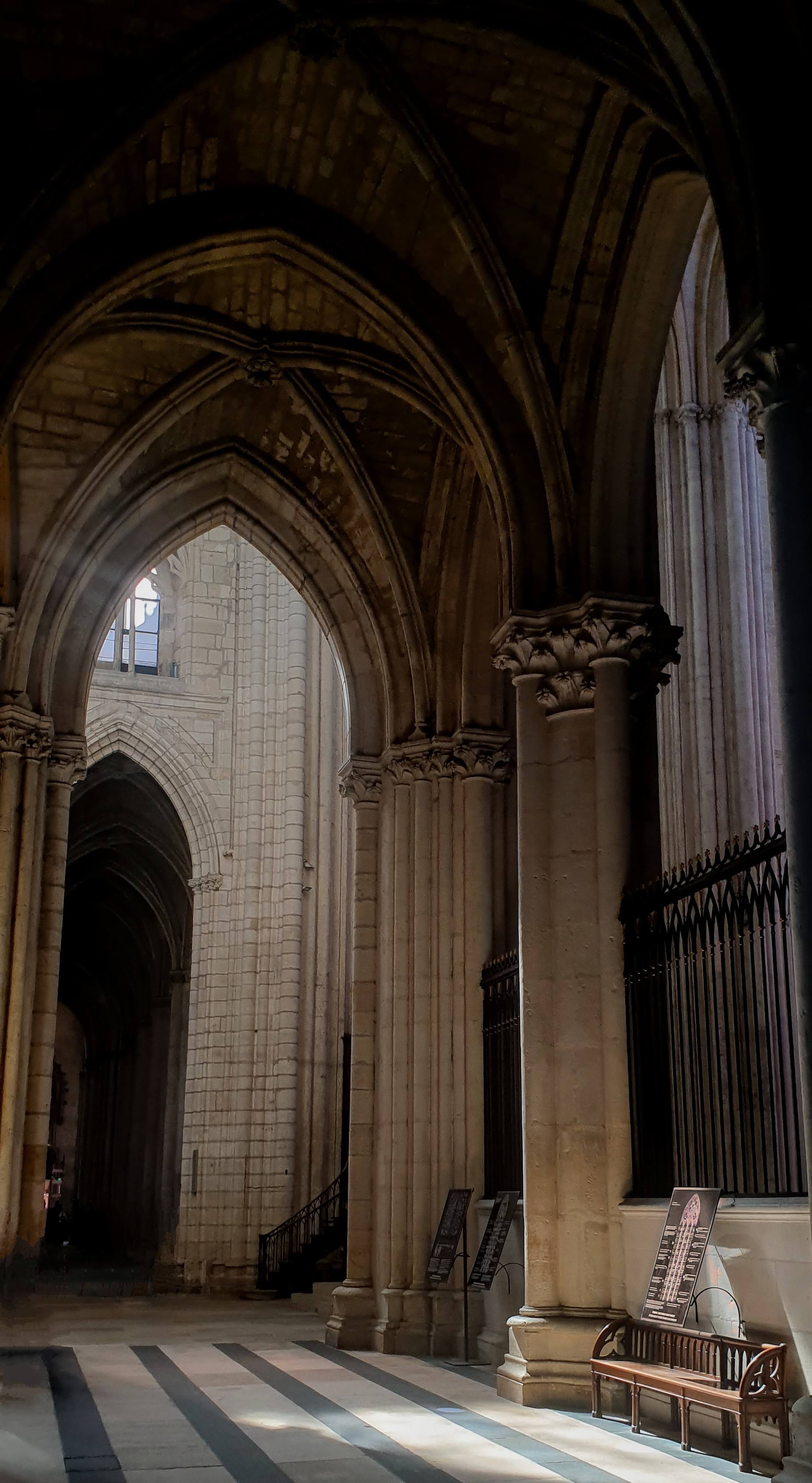
This stunning cathedral is right next door to the museum and makes an easy side trip. I may have a love affair with gothic architecture and stained glass. I can’t seem to stop going into cathedrals which are all generally of a similar blueprint, and staring in wonder at the scale and scope of human achievement in terms of really big, really complex, and emotionally moving buildings. I took far too many photos of the different types of stained glass, but I admit that I’m more interested in the colors and shapes than I am in the catechism represented therein, so I can’t tell you what they are supposed to be depicting (though there were dozens of signs explaining each window inside the church).

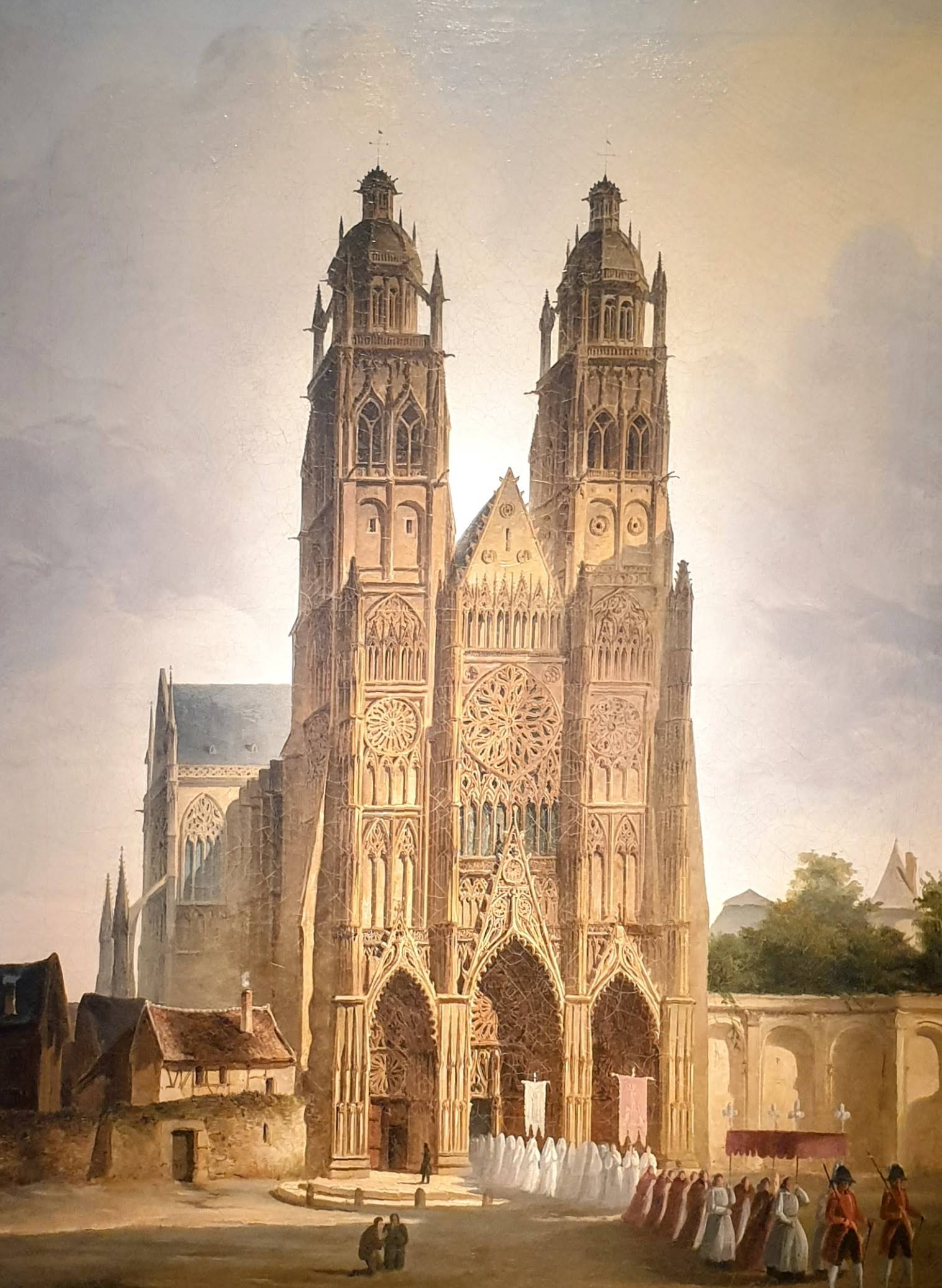
When I was in the Fine Arts Museum, I found a painting of the cathedral, and did my best to replicate the angle in modern photo form. It may be a silly American thing, but we simply aren’t used to buildings which have stood for centuries, and despite knowing how old the building is (800 years), seeing a 200+ year old painting of the cathedral made it’s age somehow more real.

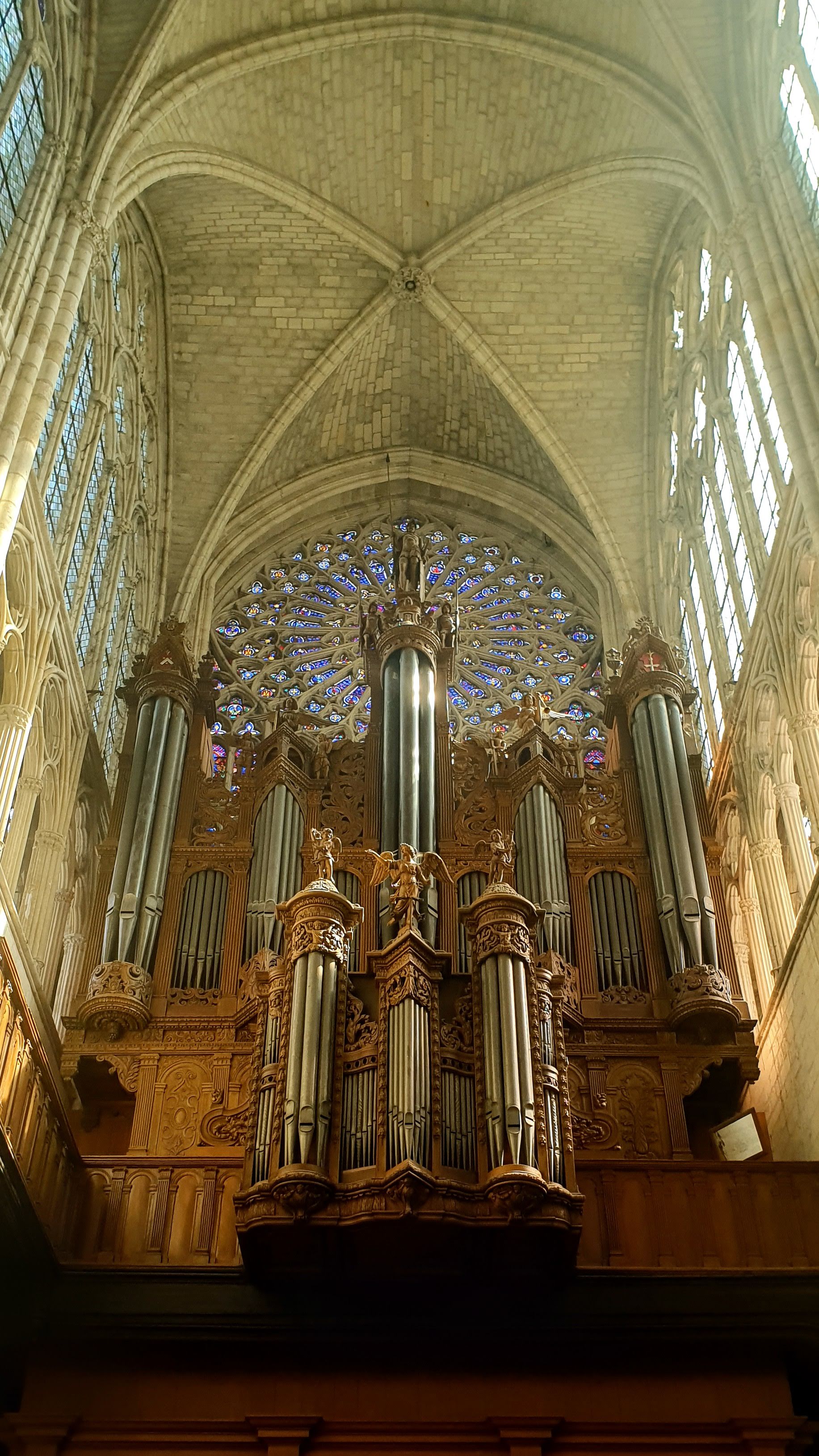
While I was in the church, the trombone quartet that I had found in the gardens outside the museum showed up to practice with the organist. I love listening to the giant pipe organs! It started out quiet enough so you could hear the trombones, then the organist pulled the stops out (that’s where that phrase comes from, right?) and wham!

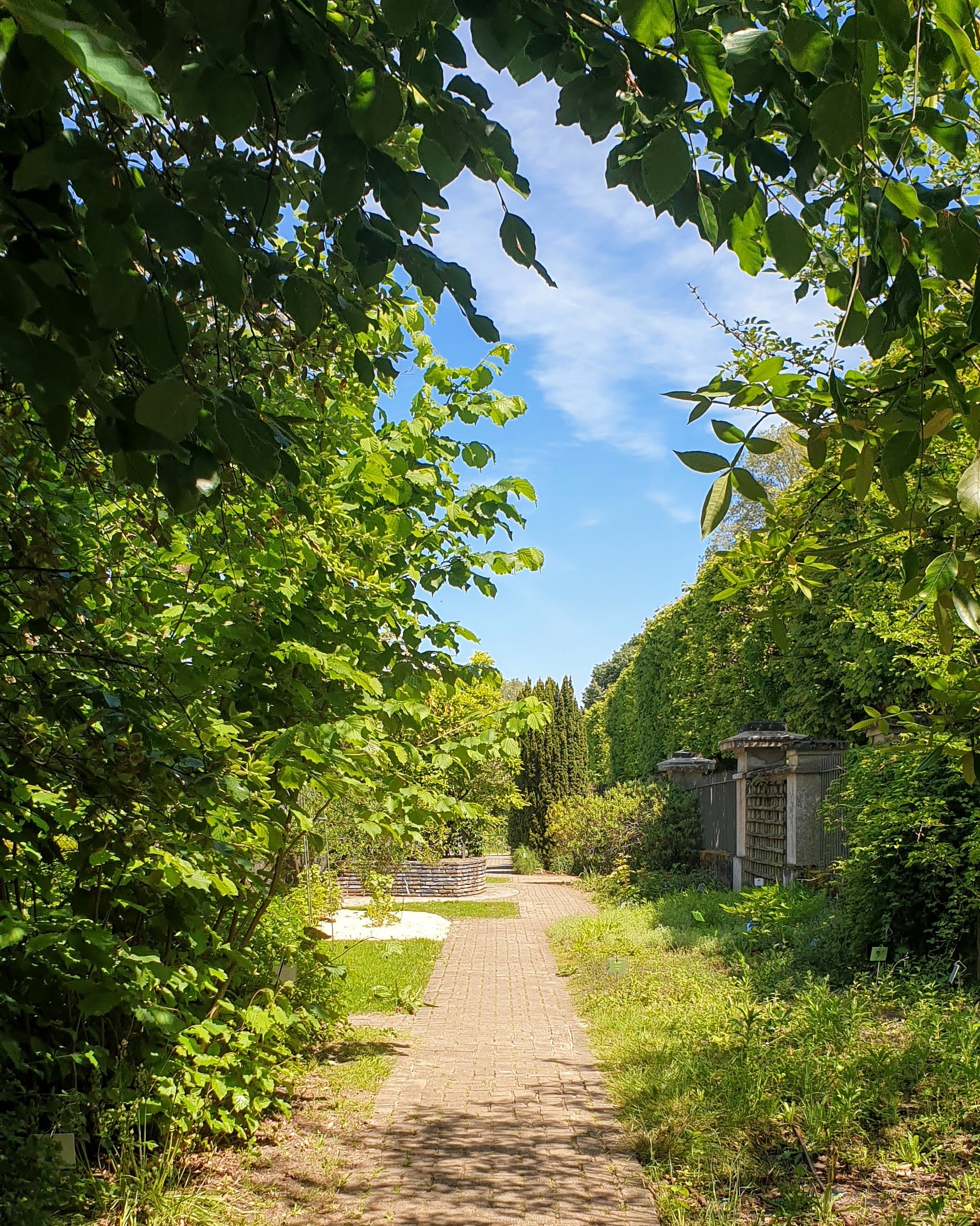
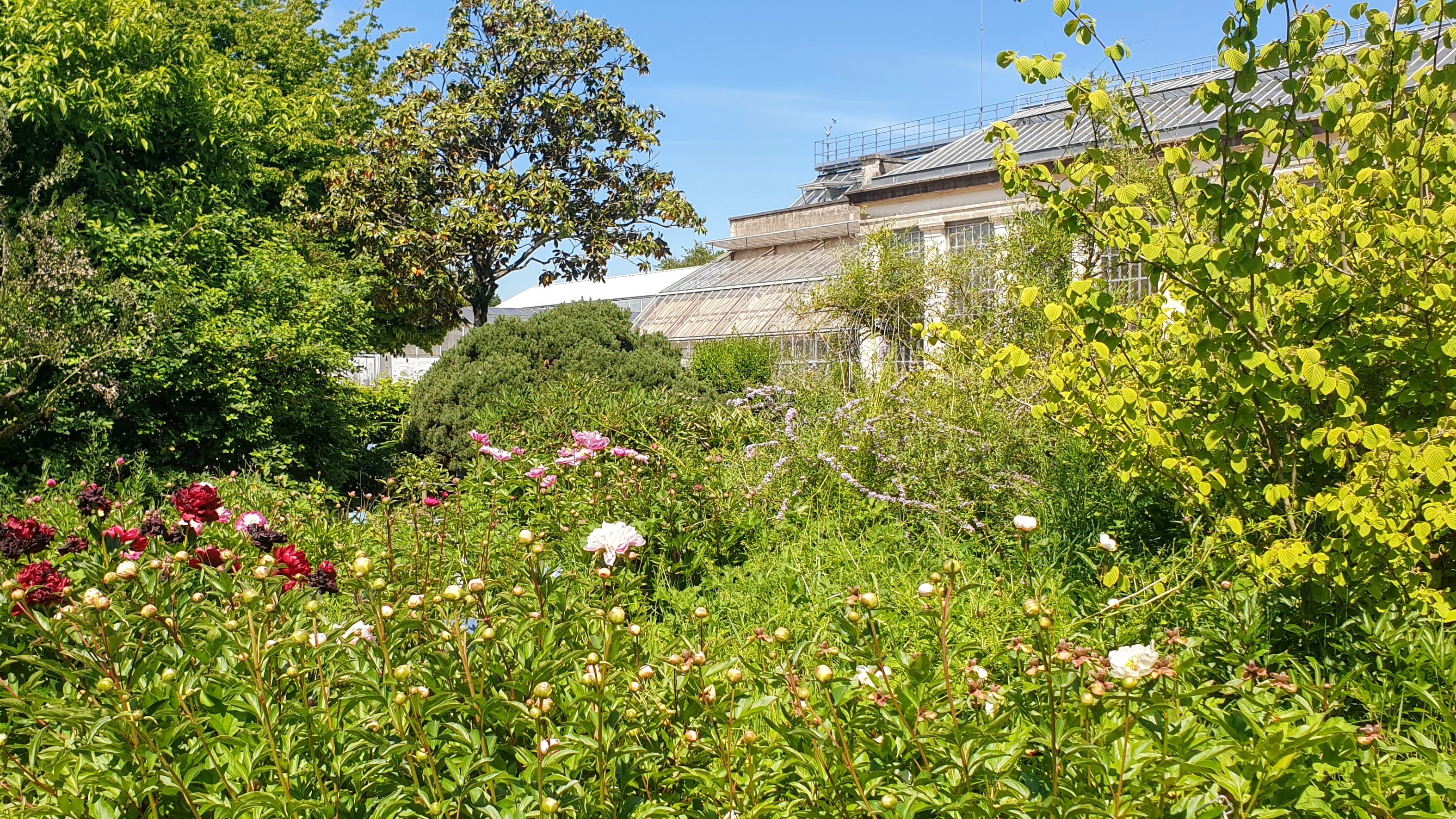
The Botanical Gardens

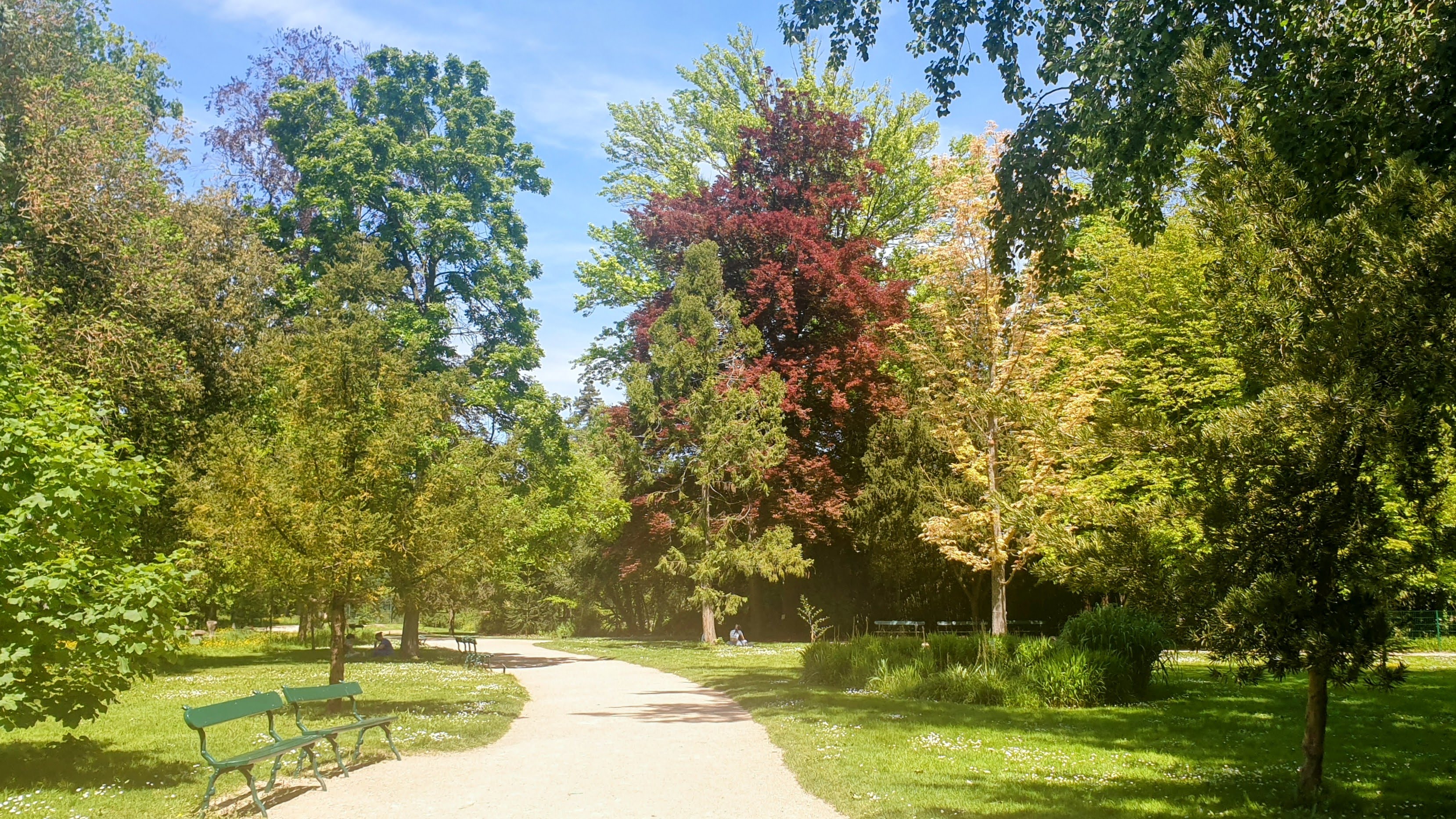
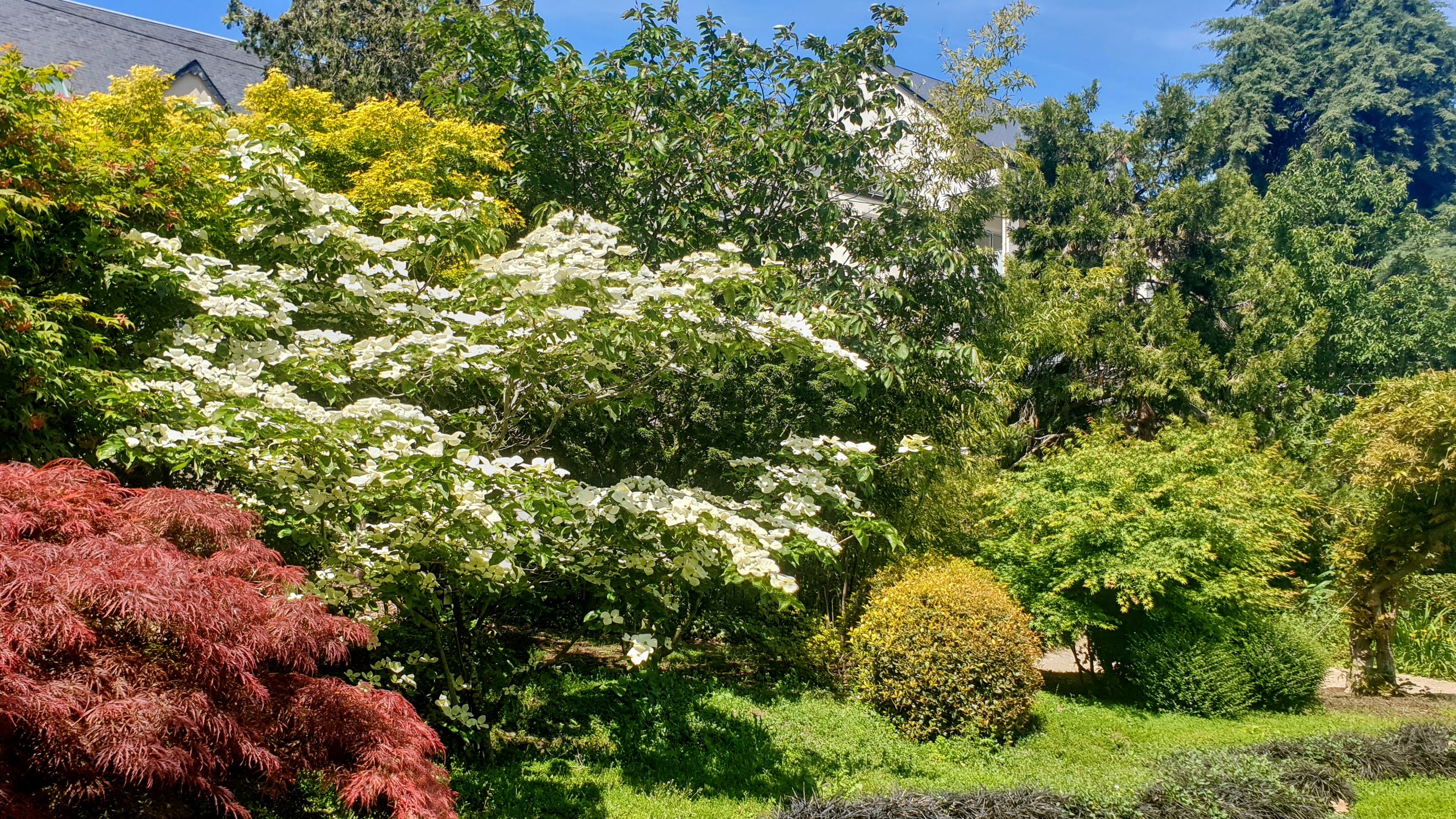
Another thing to love about France is the ubiquitous nature of nature. I mean the public gardens. Although what the French call a garden may be anything from a highly cultivated botanical display to an asthetically designed artistic movement, to a grassy place with a water feature, they are all clean, safe, and well maintained, and above all free to the public.

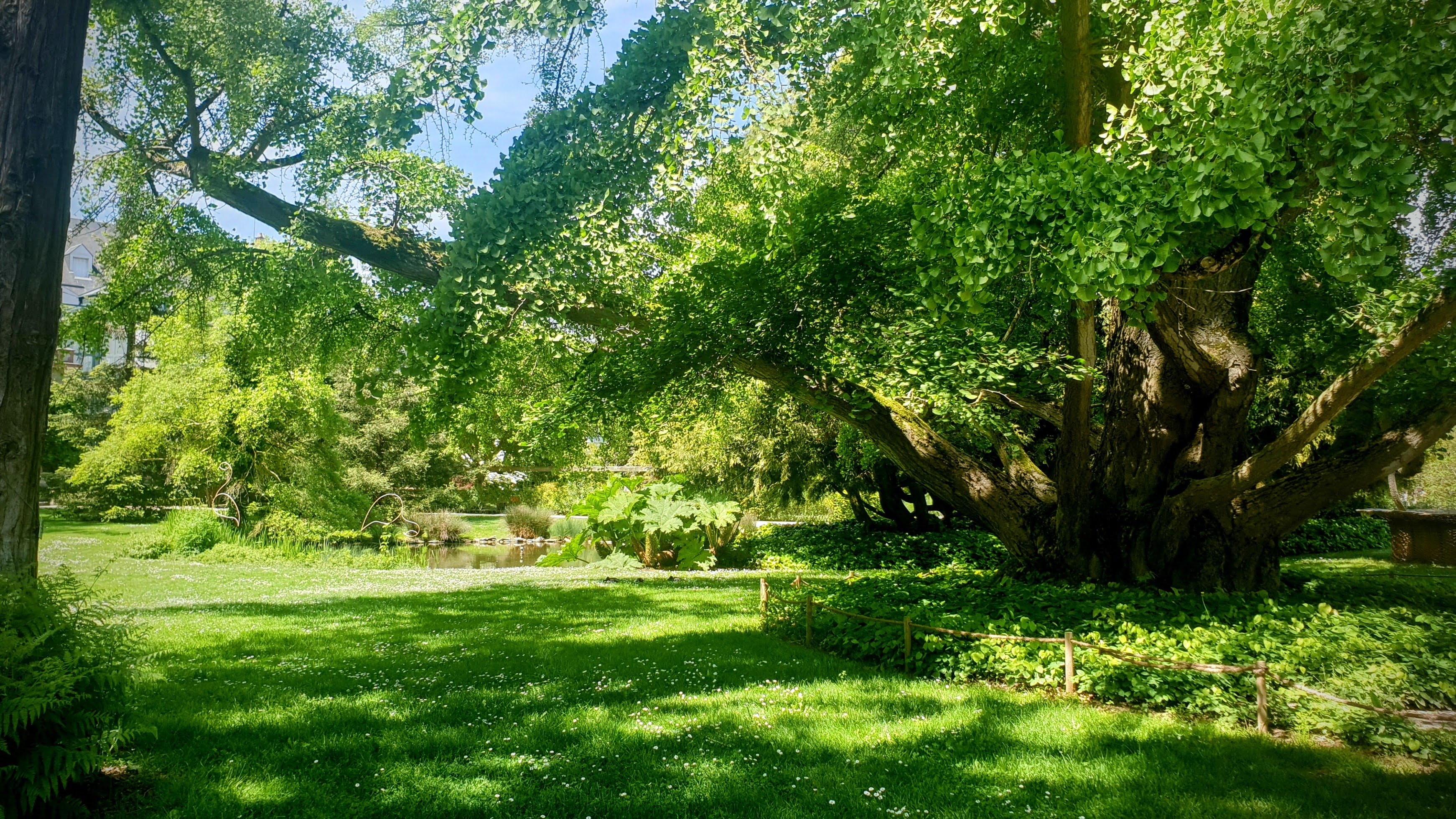
I wrote about my three gardens in Paris earlier this spring, so while experiencing the long weekend and excellent weather in Tours, I decided to pop in to the Botanical Gardens. I was not disappointed. The bus lets passengers off right at the main entrance to the gardens (although there are multiple entrances because it is such a huge area of land). I started by walking to my right into a maze of botanical specimens. The plants are arranged in pleasing beds and trellises and I suspect at least part of it is in bloom in every season except winter. There were three paths with three different points of view and experiences, and at the far end sat a grand glass greenhouse. Unfortunately, that was closed during my visit, but it was a fairly small part of the overall parc.

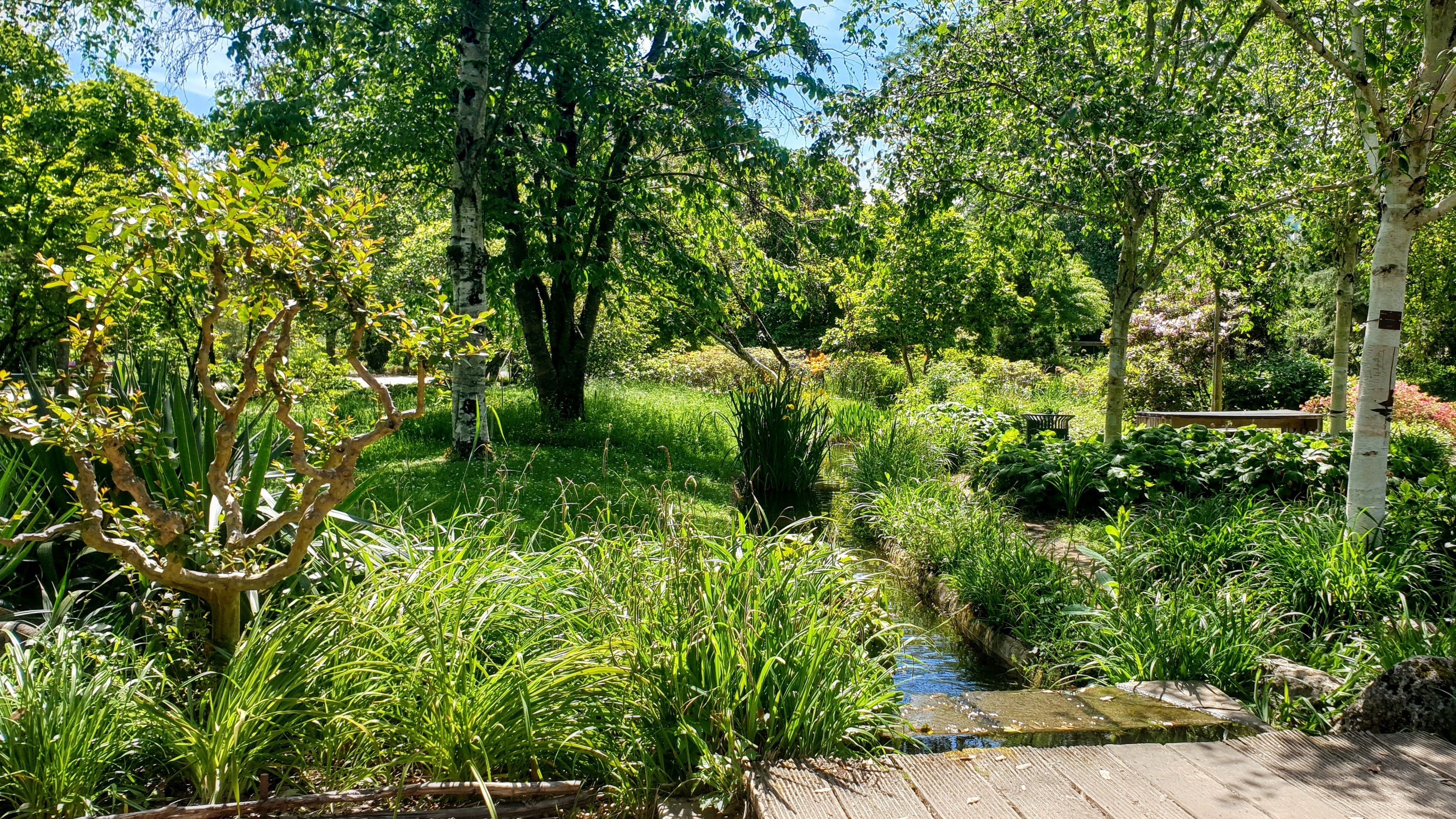
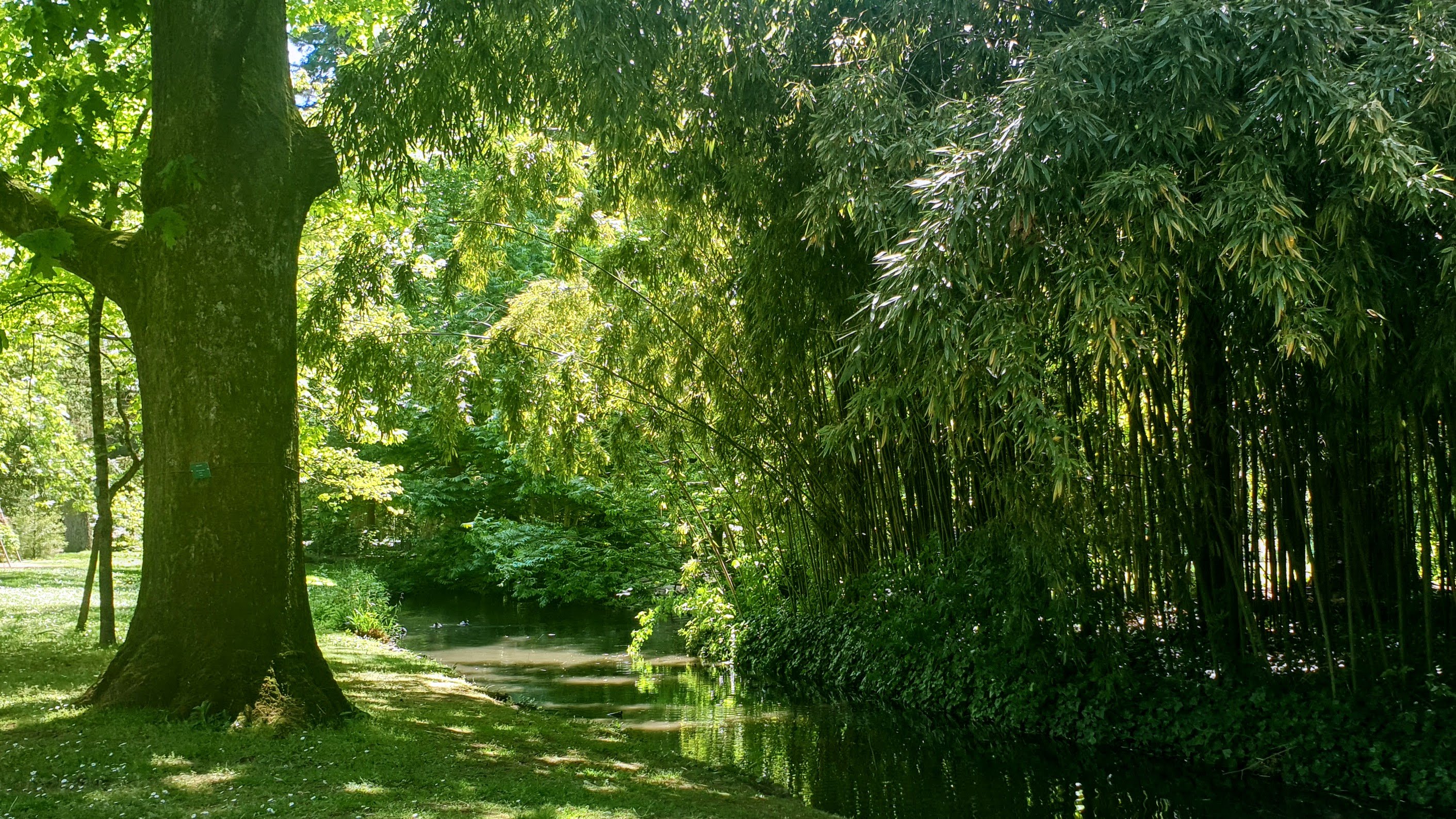
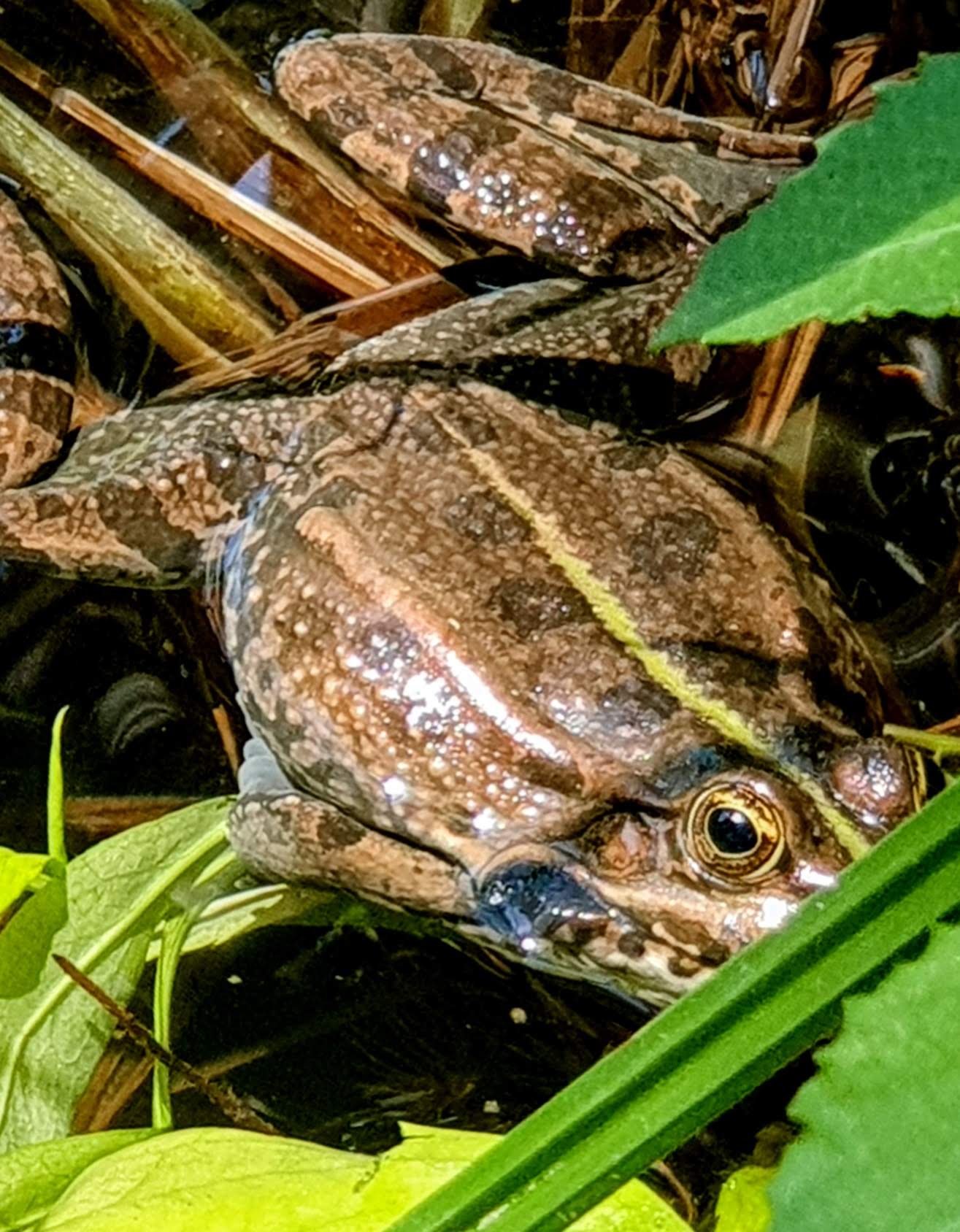
As I turned around and headed back towards my entry point along a different pathway, I was treated to entirely different scenery and the sounds of very vocal frogs. I managed to sneak up on one in the water feature and snap a photo before he plonked into the depths. I walked for a while simply admiring the plants and small streams, watching families and couples enjoying picnics in the grass, and then suddenly I came upon the menagerie. Here in the middle of this garden were a small number of animal habitats. I recall seeing the same thing in the Jardin des Plants in Paris and being generally surprised that any free-to-all style park could afford the staff and upkeep for that. 

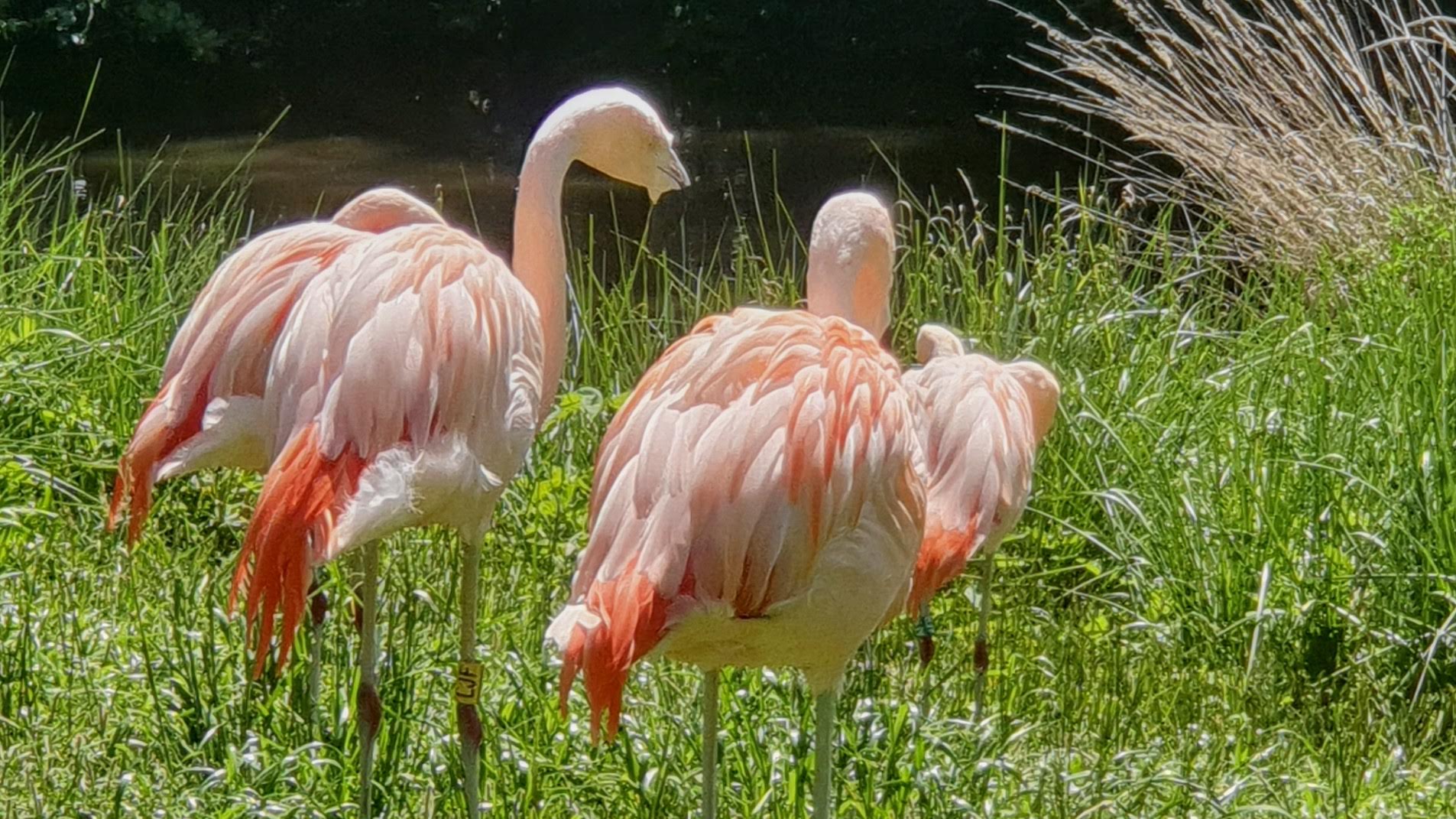
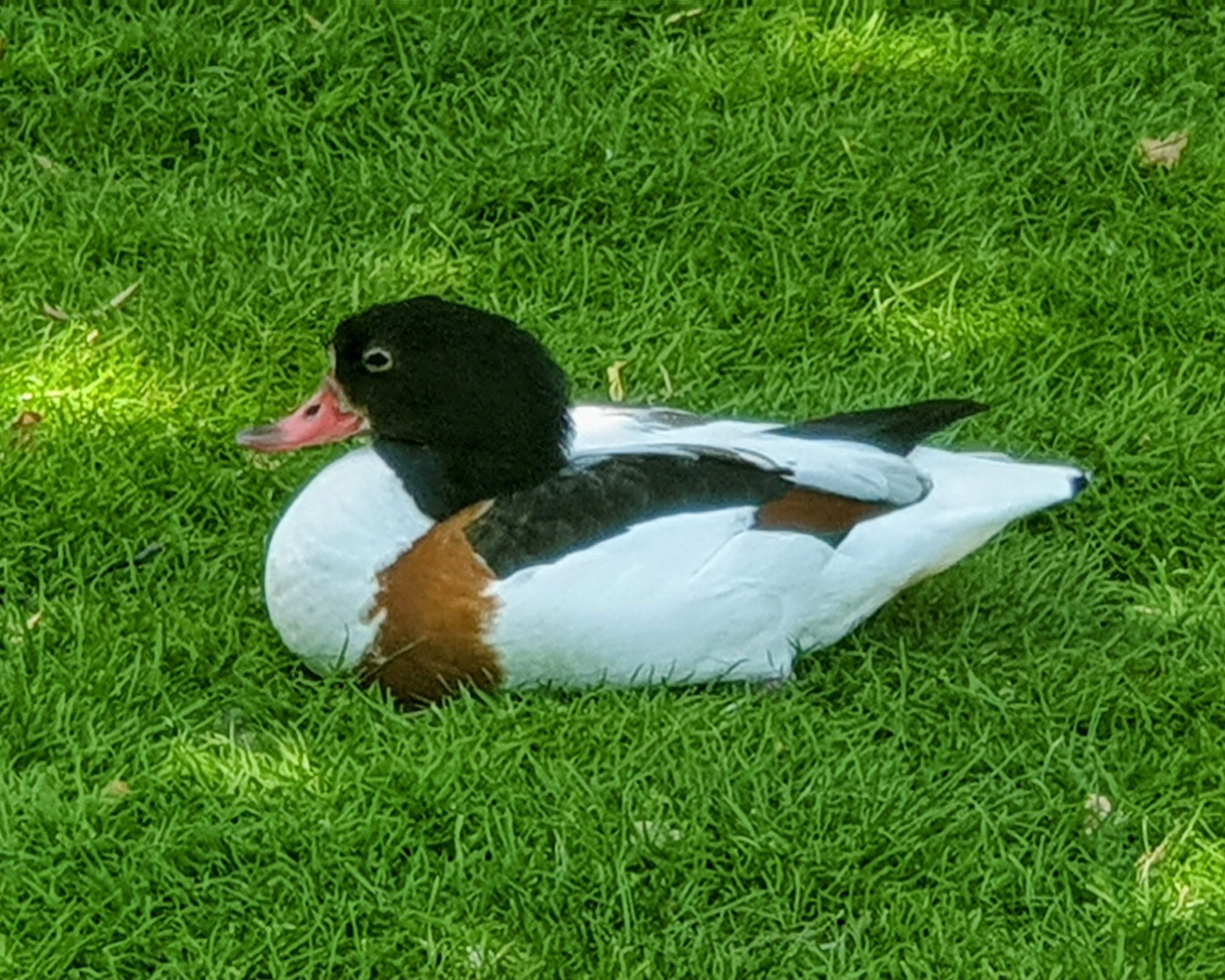
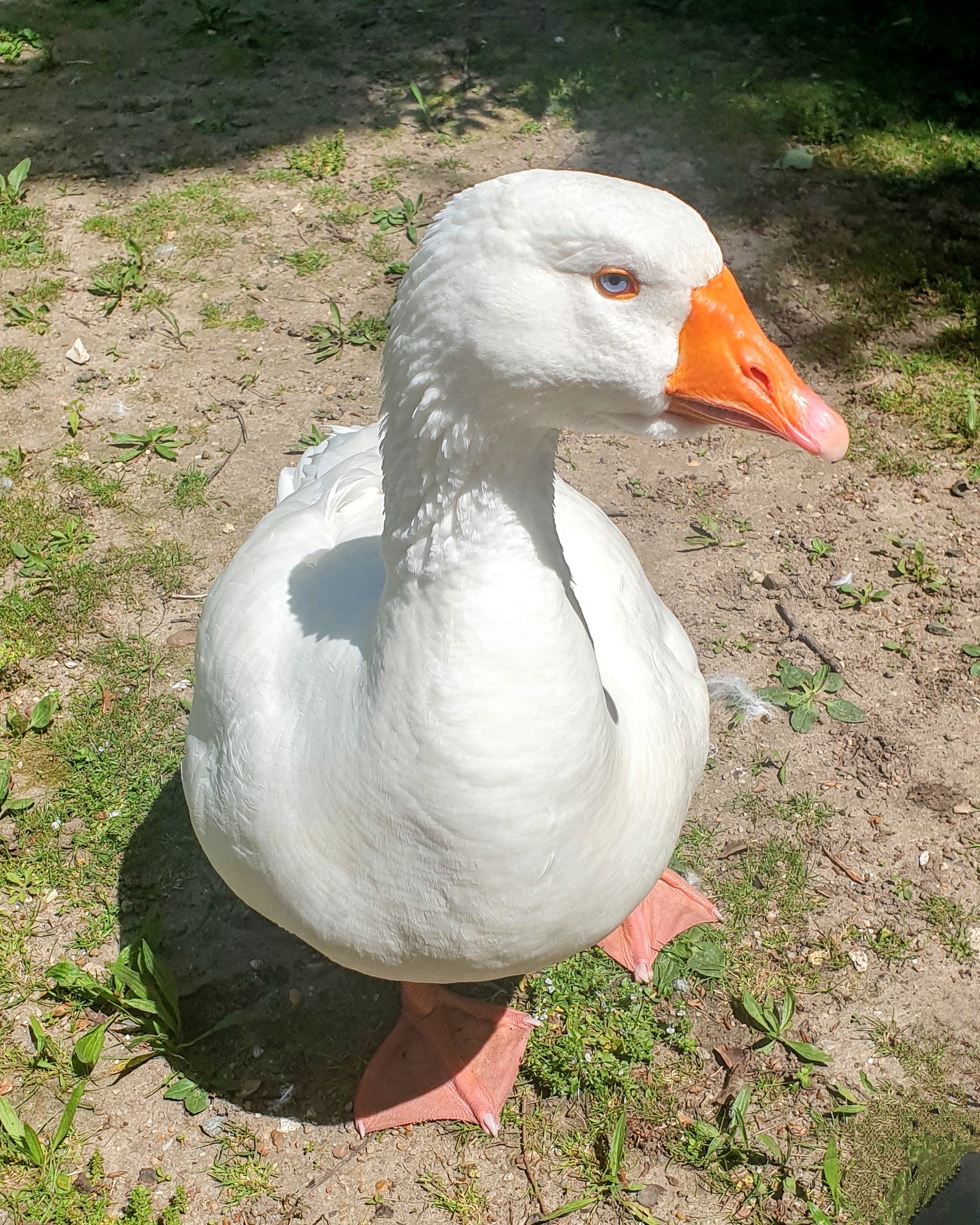
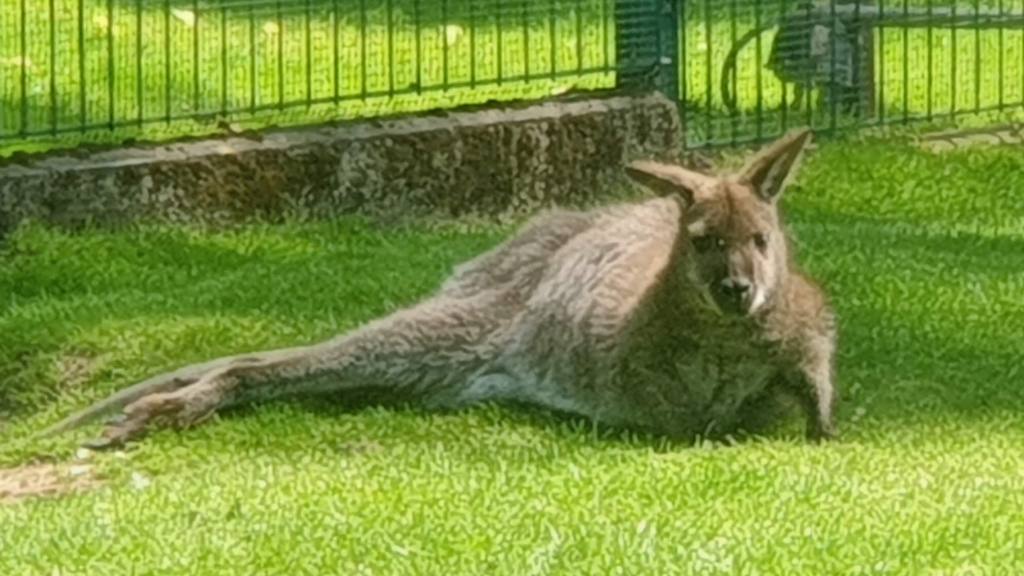
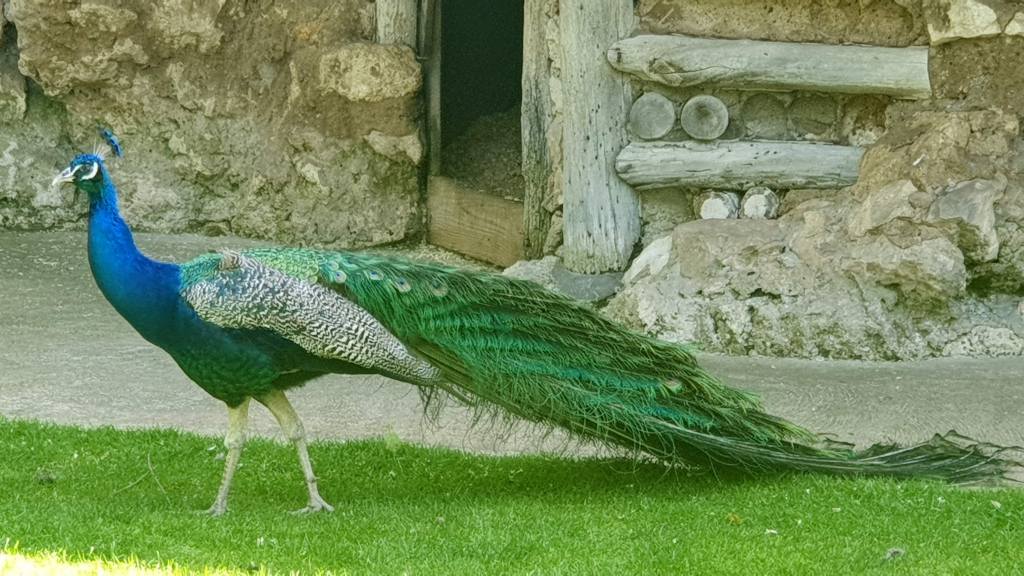
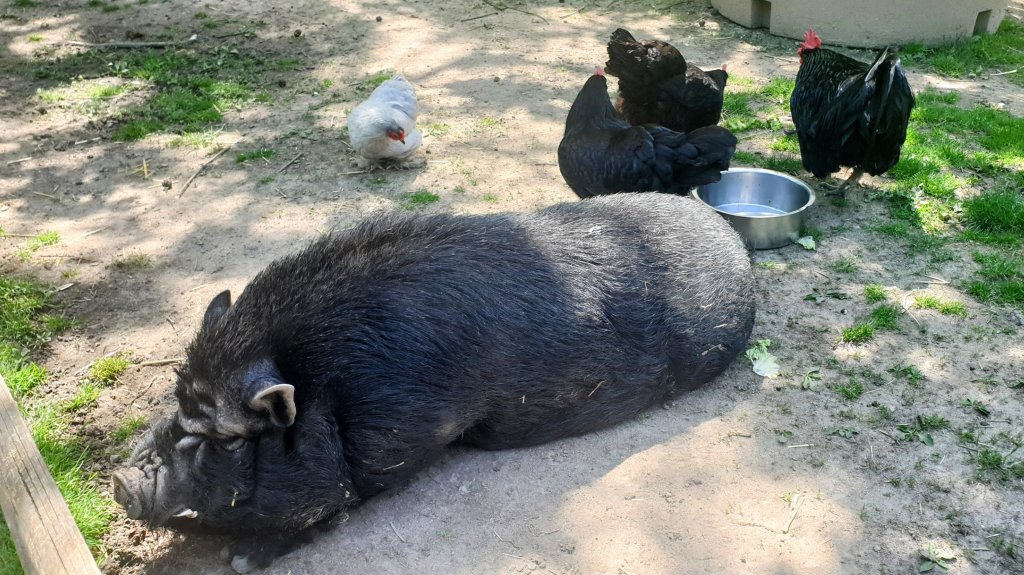
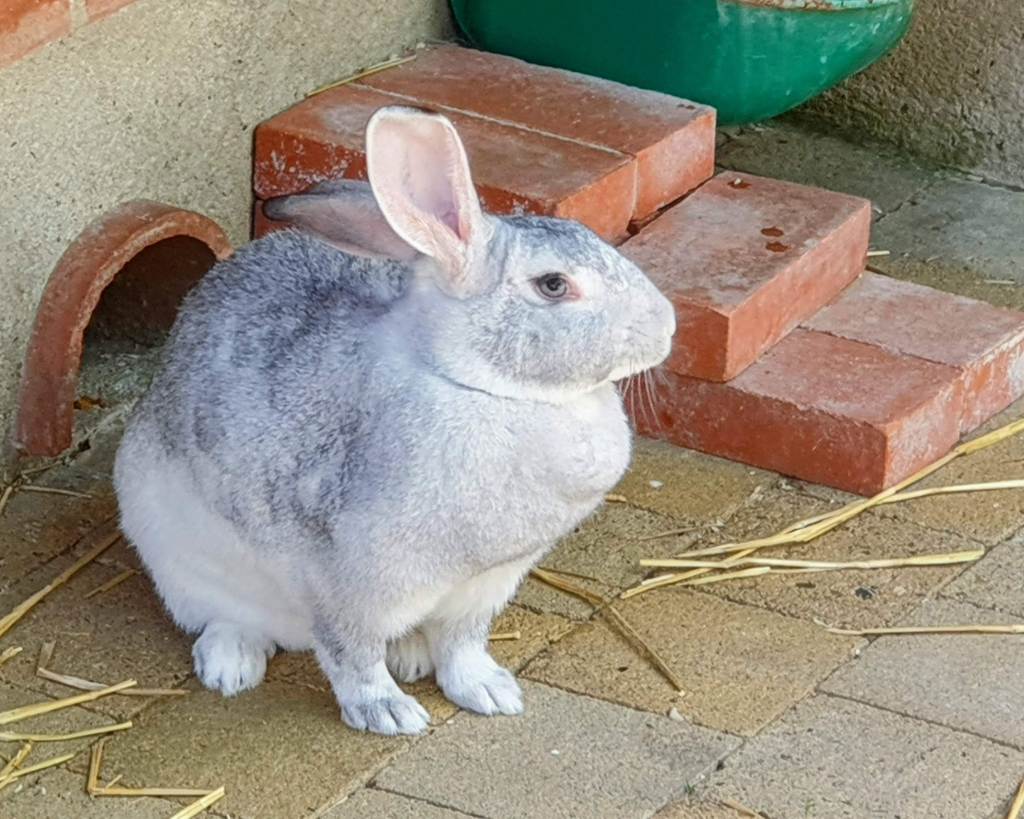
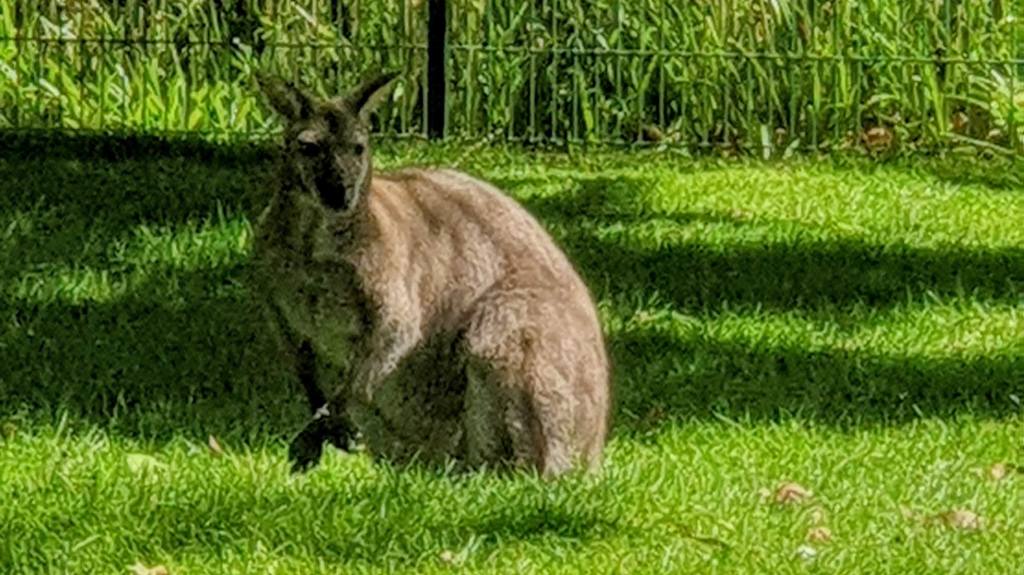
It is by no means a full zoo, but I feel like it added a layer of beauty but also entertainment and diversion (especially for children). There were some wallabies, peacocks, flamingos, turtles, tortoises, and a lot of farm type critters (chickens, geese, ducks goats, rabbits, and even a pig). Most of the animals were fenced away, but there was a mini-farm where people could go in and get a bit closer. 

At the opposite end, there were two playgrounds with equipment for children to climb and play on, and still more beautiful lawns of grass for people to picnic and nap on underneath the enormous sprawling trees. I left the park feeling tranquil and refreshed with the satisfied feeling that my last weekend in Tours was extremely well-spent.

A Brief Introduction to Tours

This is part 1 of a 4 post series about the city of Tours and the 5 weeks I spent there in the spring of 2024. I didn’t set out to come here specifically. At the time I decided what I needed was to go to France, I wasn’t up for the intense labor involved in planning a vacation. Instead, I decided to use French language classes as a way decide where to go and what to do, and then I just searched the internet for a good school with a flexible start date and decent accommodations. That’s how I wound up more or less randomly spending 5 weeks in Tours, France on the banks of the Loire river.

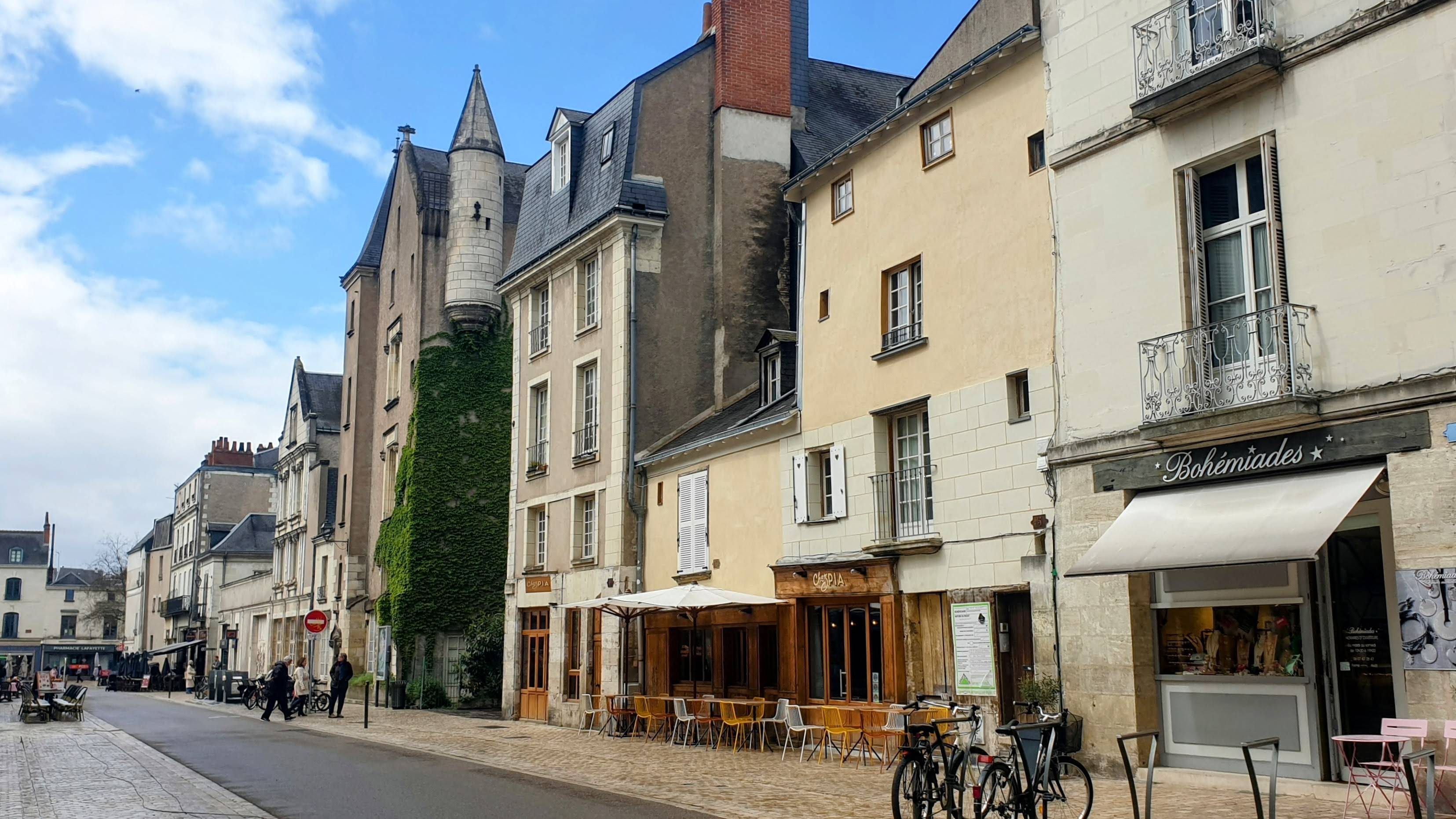
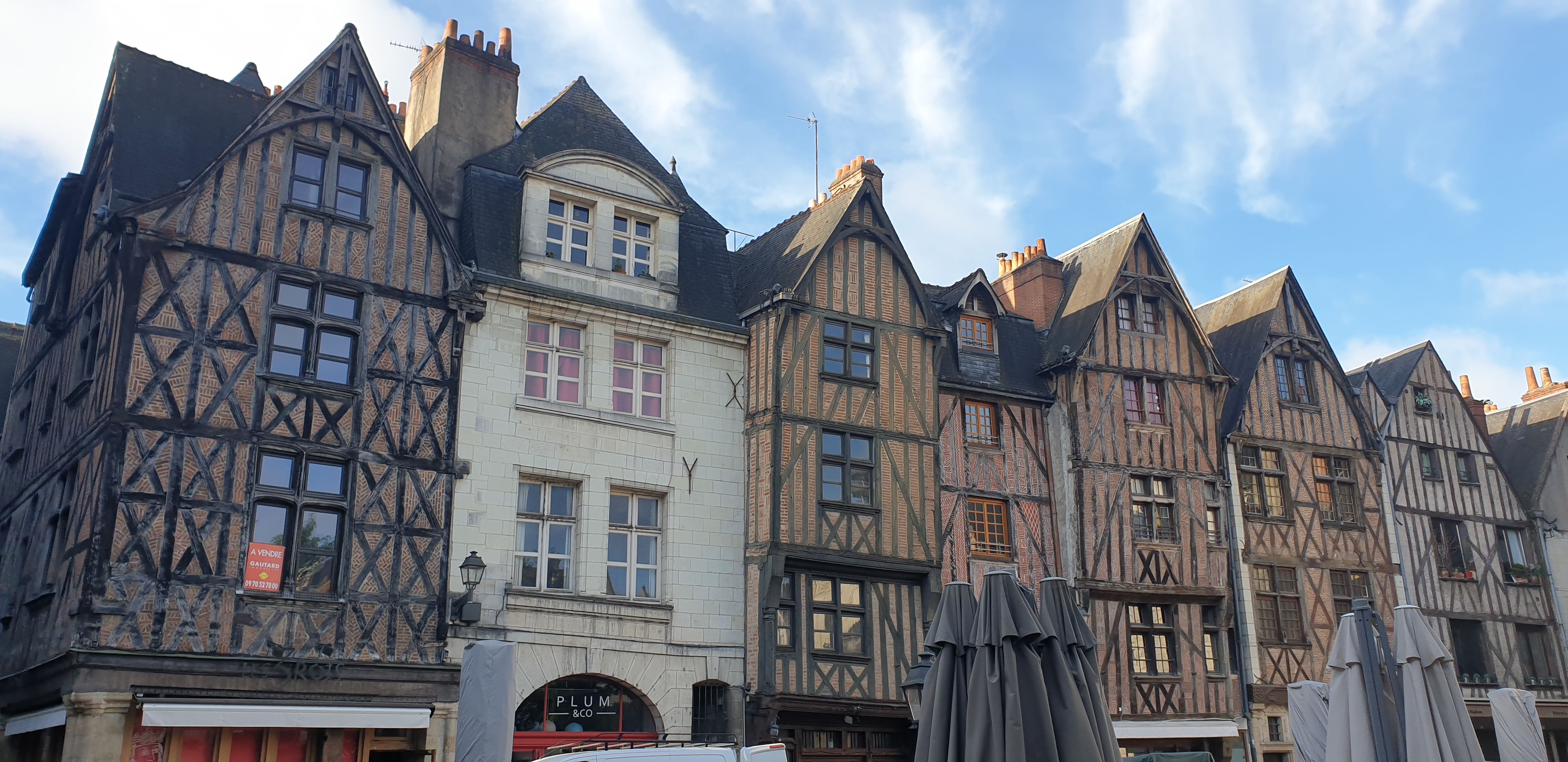
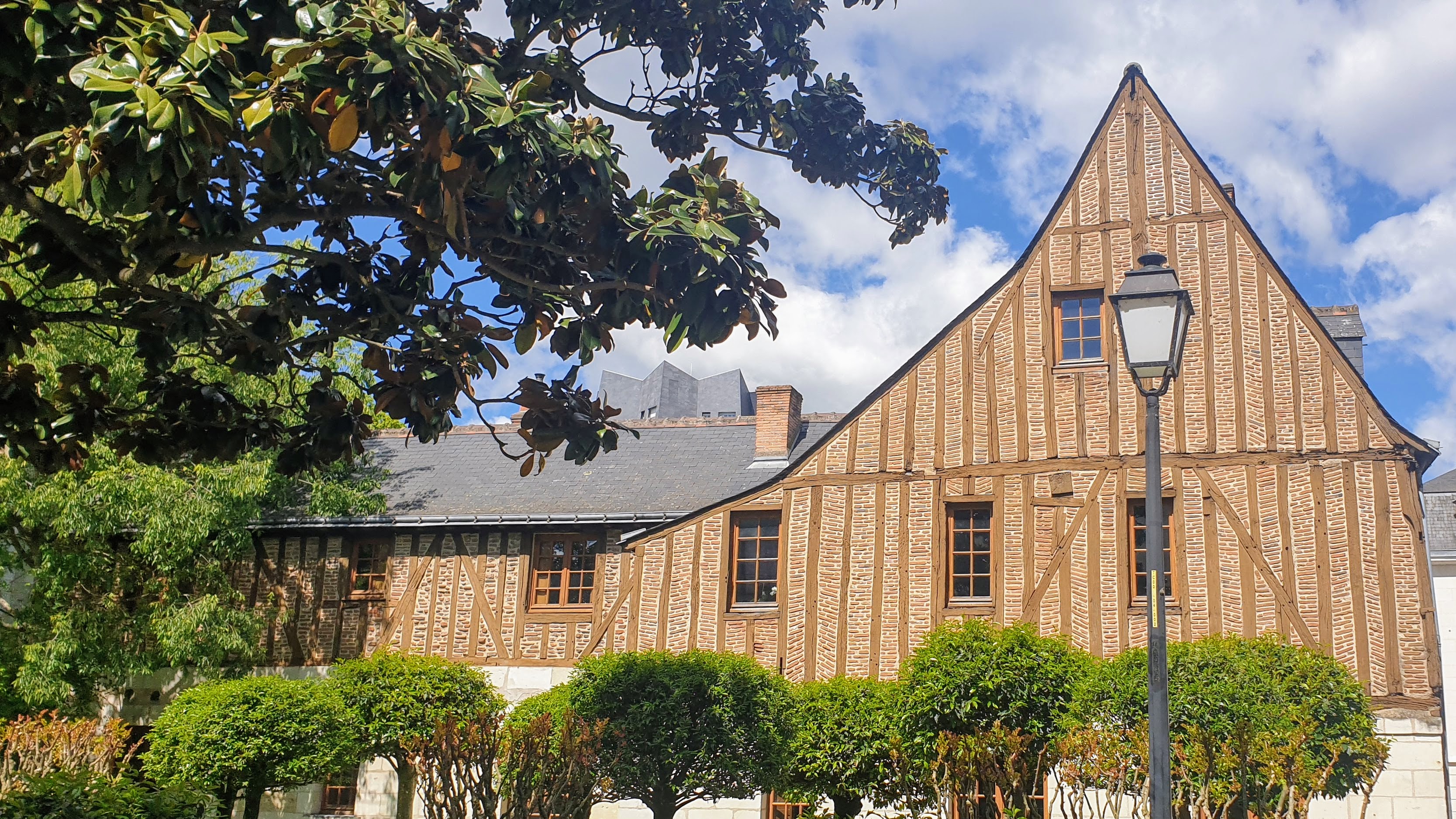
Tours is the largest urban area of the Loire Valley, but even at the most generous standard of counting census, it’s still less than half a million people in the city and all surrounding areas. The city has a well preserved historical district called “Vieux Tours” (old Tours) which is full of old churches and half-timbered buildings giving it a very provincial town / quaint European village aesthetic. Yet, it is also equipped with a very robust and affordable public transit system and a wide array of shops, restaurants, and other entertainments. It even has an IKEA.

On the day I arrived, I went straight from the train station to my accommodation (thanks to my school). The apartment is on a quiet street adjacent to the tram line (convenient), but doesn’t have much around it except other modern blocky apartment buildings. When I looked up the photos on Google maps before arrival, I was very hesitant. I didn’t want to live in an industrial complex, I wanted to experience the quaintness of Vieux Tours! I need not have worried. Although the rows and rows of housing can seem a bit Orwellian at first glance, the reality is that there’s still immense amounts of greenery all over. My balcony overlooks a nice garden and there’s a sports field across the street. The main road is lined with trees and the tram line is grassy. While there isn’t much in a stone’s throw, a quick 10-15 minute ride on the tram drops me in Old Tours, and the lack of restaurants and bars in the neighborhood means it’s quiet when I want to rest.

My first day in Vieux Tours, I was distracted by trying to find the entrance to the school, yet I was still charmed by the half-timber buildings in the Place Plumereau (Plume Square). The building my school is in is actually part of a structure that dates back to the 11th century! Despite the fact that many new additions have been built, you can still clearly see the original masonry and timber in some parts of the classrooms.

This combination of old and new is all over Old Tours. There is a church across the street from my tram stop called Église St-Julien, and although the interior was closed to the public, I was able to walk around to the courtyard and see how the old structure merges with a new shopping complex.

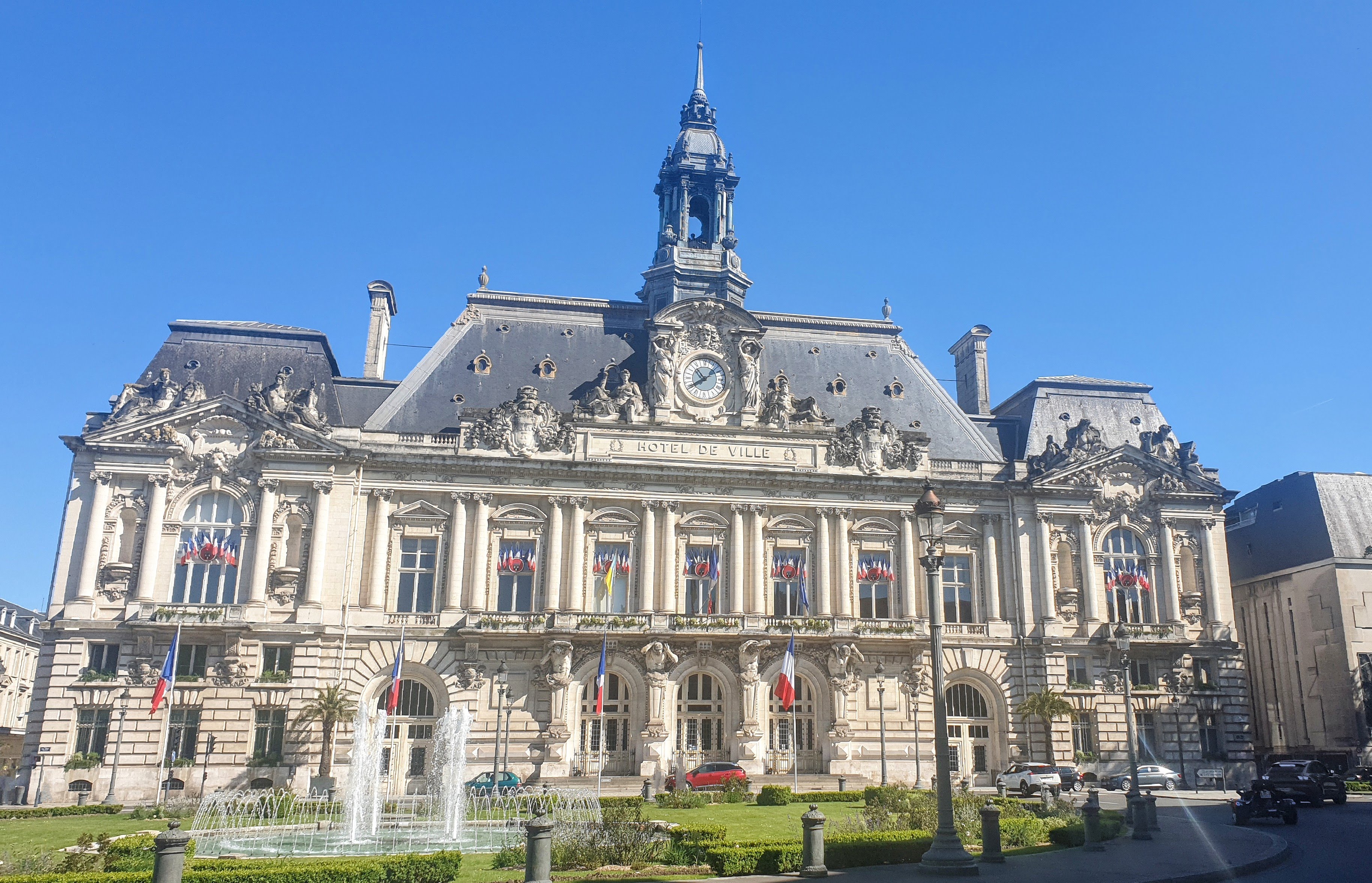
A couple of tram stops down the Rue National from my school stands the Hotel de Ville (the City Hall) and a wonderful place to stroll down tree lined pedestrian avenues. 

Twice, I’ve headed to the outskirts of town, all the way to the IKEA. It was an interesting experience to see the parts of town which are not so quaint and historical as Old Tours, but I still felt like the people living in them could easily head to the cute areas of town for an afternoon whenever they liked. Neighborhoods we passed along the route varied between older building that had been refurbished or repurposed and newer apartment and shopping complexes. Everywhere did a fair job of maintaining green spaces (though perhaps not as lushly as the town center). The demographic changed starkly once I left the touristy areas, but that is hardly surprising. However, at no point did I feel like anything was dirty or unsafe.

One outing, I tried to go to the local fair, but it turned out to simply be too crowded for my liking. On the other, I was heading towards the giant box store complex next to IKEA. I think most countries now have some kind of big box store. The USA has Target and Wal-Mart. South Korea has Home Plus. In many EU places it’s CarreFour. I had been shopping at small local CarreFour Express or CarreFour City shops closer to home and to my mind those shops were plenty big. However, I needed to replace my waterproof phone case in preparation for my visit to Marseille and the only shop in the area that claimed to have any in stock was all the way back IKEA way in the biggest of big boxes. I was honestly shook by how big that store was, and it wasn’t even the only one in the complex, there were restaurants and a home appliance store as well (and the IKEA across the street). It felt like it took 10 minutes to walk from one end to the other without even going up and down any aisles! Yet, there was a bus stop right at the parking lot, which means that you don’t have to have a car to go. A nice touch.

Life in Old Tours felt slow and people seem to focus on enjoying things. Most shops are still closed when I head into my 9am class. Lunch is generally seen as 12-2 when most businesses that aren’t serving food close for at least 90 minutes to allow employees to eat. Every restaurant, cafe, boulangerie, and brasserie has sidewalk seating where people can linger over lunch and a glass of wine. There’s a glacier (ice cream shop) on almost every street. After lunch, businesses reopen between 2-3pm while restaurants close or limit service to drinks only. Dinner hours begin around 7pm when the boulangeries finally close. Even in April the sun wasn’t setting until after 9pm, giving the days a languid summer feeling. There’s simply no need to rush anything.

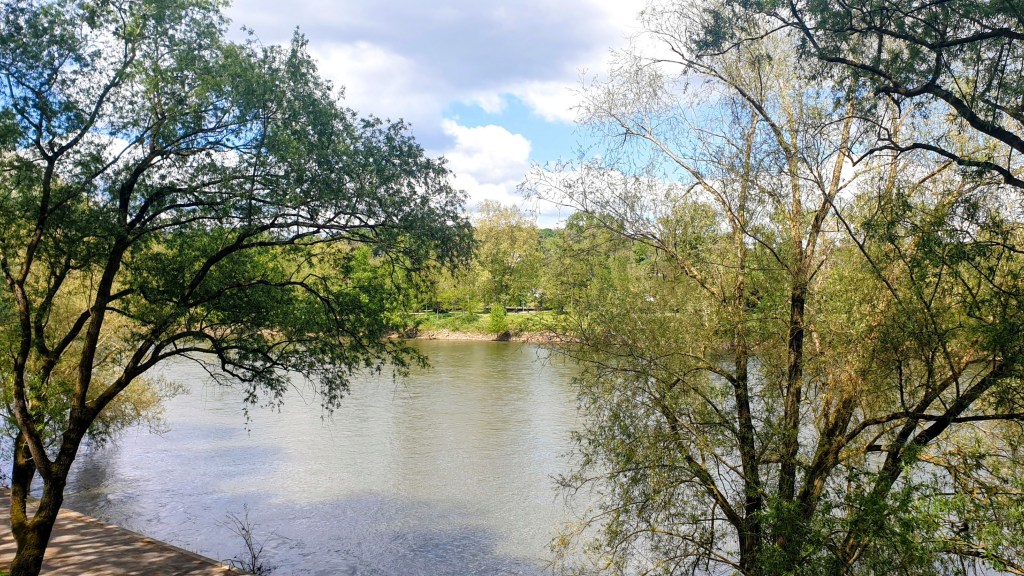
Unlike other tourist destinations in France where people might feel the need to run around to see all the best famous sights, the main attractions in Tours involve ambling around Old Town or strolling along the river. Although just walking through Tours on a sunny day can feel like you’re in a theme park, there’s more!  There are several museums in the town, and several château (castles / really fancy mansions) in the surrounding countryside. (both to be explored in more detail in future blog posts).

My Life in Tours

Since I’m learning the French Art of Living, my life in Tours is slow paced with a focus on relaxing and enjoying. Most days, I woke up early, had some coffee and a pastry, then went to my class at 9am. The classroom lessons were very casual, and frequently we spent more of the class time conversing in French with small side explorations into vocabulary and grammar as the conversation brings them up. There were activities, worksheets, and games, but no one was pressured to “get through a lesson” or hit target learning goals. I don’t know if that’s helpful for the long term students who are trying to pass official French language tests, but for me as a casual learner, it was ideal. My confidence in speaking French increased massively, and as a result I ended up actually using the vocabulary and grammar that I learned in class.

In just a few weeks, I went from being so obviously nervous at speaking French that every shop clerk took pity on me and spoke in English to being able to have detailed conversations about the differences of certain types of bread or cheese in the shops, and place all my orders at restaurants and shops in French without the vendors feeling the need to switch. I’m by no means anywhere near fluent, but it’s been a real boost of achievement to see my progress. Hopefully when I go to other (larger) cities in France, it won’t all fall apart.

I chose to take only the morning classes so as to have my afternoons free. Most places that are not serving food are closed until 2pm, so I tend to linger over lunch and often socialize with other students. After lunch, I wander around town, possibly to run an errand such as shopping for groceries at Les Halles, or visiting a museum or part of town that seems interesting.

In the evenings and on at least one weekend day, I rest at my rented apartment. I assigned myself a YA novel in French with the help of my dictionary for extra “homework”, and I watched Drag Race France on the France national television website, entirely in French with French subtitles. I also had boring maintenance chores like cleaning and laundry, and of course editing my photos from the day, writing in this blog, or just zoning out to YouTube videos because sometimes you need a good zone.

In addition to learning French and enjoying Tours, I have had to take part of my time to plan the rest of my French holiday. Usually I plan vacations before I get on a plane, but this trip has been … unusual. The reason I generally prefer to plan before leaving is that it’s a real struggle to tear myself away from the experiences to sit down at the computer and do research. This may seem ironic since I’m obviously sitting down at my computer to write this, but a written account of my experiences is a big part of how I process the memories and savor them. It’s a wholly different experience than researching and planning for a future adventure.

Planning vacations is hard work, but something I used to enjoy doing before COVID. I started feeling better about things in general within a few days of arriving here, but it took me about a month to be able to sit down with Google and a spreadsheet and really PLAN. Every time I tried it before, it just felt overwhelming. My friends with ADHD tell me this is their life all the time, and I honestly can’t imagine. I’m so used to being able to do what needs doing, especially if it’s also something I want! It was so frustrating, but once the damn broke, I had one 12 hour marathon day at the computer and I got it all done.

I have hotels, trains, busses, and attraction tickets (where needed in advance) for a week in Marseille, Lyon and Paris each. It may sound like a very “entitled person” problem, struggling to make plans for a vacation, but I’ve said before the only reason I can afford the trips I take is that I spend hours and hours searching for deals and researching free/cheap things to do and see. I’ve seen how much “we’ll figure it out when we get there” costs and I don’t make that much. I was watching a YouTube about the economy, and one of the guests was discussing what it was like to be a person who moved economic classes (from poor to middle) and that there’s aspects of her life now that are “normal” to those raised in the middle/upper middle class that she could never have imagined as a poor person, like being able to change your flight plans, or handle even low level emergencies.

Although my parents were middle class by the time I was born, they themselves were raised poor and changed class. And though they were both college educated, doing better than their parents, there were some years of one-step-away-from-the-trailer-park with my mom as a single parent, and some jobless-homeless-sick years for myself after I moved out. There were ups and downs, but in some ways the repeated downs only served to solidify the idea that the ups were not stable. I spent combined decades living hand to mouth, worrying about the ability to pay rent if my car needed work, needing to stand in line at the food bank, and even begging my friends for a place to stay when I lost mine.

I am still shocked at myself when I can just afford something without stressing about it, and even when planning my holidays I still carefully weigh the cost of an activity against my budget goal (perhaps even too critically). I’m getting better at giving myself permission to have nicer things, but I’m still going to be staying in (all girl) dormitory hostels for three weeks because it saves me something like 900-1,200$ total. Planning and budgeting are essential to make your money go as far as it can whether you’re on vacation or at home. 

At the time of writing this, I am hours away from leaving Tours. I feel content that I’ve seen a good amount of the best Tours has to offer, and even a chance to explore what life is like outside the charm of Old Town, providing some contrast and perspective. Stay tuned for my next 3 posts which detail the sites I visited within the city of Tours, the château of the Loire Valley, and the foods and wines of Touraine that I was able to try while staying here. À la prochaine!

I Want to Learn the French Art of Living

Why are you going to France?

It was astonishing how many people asked a version of this question. While it is true that I often travel for a job, I’ve visited 5-6x as many countries for pleasure as I have for work, and until this spring when I decided to stop working in order to take my holidays at a nicer time of the year, no one asked me why. “Because I want to”, was the real answer, but it seemed to confuse people. Other times, I told people I was going for the food, but most who have never been to France simply can’t imagine the food here being that much different. I once counted myself among them, but after my first meal in France, I thought that I had died and gone to food heaven. 

Now that I’ve been in France for a couple of weeks, I know that what I was struggling to find the words to say was that I wanted to go to France to learn the French art of living. The French call this “Joie de Vivre” (Joy of Life), but it is perhaps better translated as “The Art of Living Joyfully”, and it’s a very deep rooted value in French culture. Joie de vivre isn’t about parties or euphoric joy, it’s finding happiness through living. Since arriving in Tours, I have been receiving a swift and enlightening crash course.

Musée des beaux-arts – “La Joie de vivre” (Victor Prouvé, 1904)

Practicing Kindness

I will say again that French people in general are more likely to be kind than rude (I’m sure they can be rude when called for, and that there are some percentage of rude people everywhere, but rudeness is not the default way of life). My first week in town, I had to run errands and do shopping while jet lagged and after my 3.5 hour French immersion class which left my brain feeling like a wet noodle. I could barely make comprehensive sentences in English (my native language) let alone in French. Despite my overt disorientation, every shopkeeper was kind and patient with me, most were even happy to use both French and English with me when I explained I was learning, giving me a chance to practice but also helping when the language was outside my skill.

I have not formally studied French since middle school. I came into this language program with a hodgepodge of random vocabulary and grammar that does not conform to standard learning levels in any way. I am not a quiet student, but I also felt that if I asked about everything I didn’t understand, I would derail the whole class. On my second day, I experienced an intense moment of frustration, and the teacher worked very hard to find out what was confusing me. I wanted to shut down and look it up later in private, but she worked it out with me in class. In the moment, I wasn’t happy to be the focus of so much time and attention, but in retrospect, it was a glorious act of kindness and support on her part. I’ve done the same for my own students, and it’s eye-opening to feel it from the other side.

I also had some disappointment in the apartment when I arrived –the washing machine was broken, and there was no Wi-Fi. In most other places I’ve lived, these kinds of problems were dismissed and I was left to handle them on my own or forced to nag the property manager (my last apartment in Korea was a nice exception, those people were great). I didn’t feel any animosity at the lack of amenities. I had of course emailed ahead of my flight to be sure that I would have access to a washing machine and Wi-Fi (among other things), but my response to the absence of promised resources while traveling abroad is less often anger and more often resignation. 

To my surprise and delight, the owner of the school arranged for me to get 120gb of data for the month so I would be able to do things like make video calls, watch YouTube, and write in my blog. His efforts were above and beyond what he needed to do to meet his obligations to me as a paying student. The landlady came the next day with a repair man to fix the washing machine, so it was working again before I had a full load of laundry. While we waited for the repairman to finish his work, she engaged me in conversation, despite not speaking any English, and was patient and kind with my poor French, repeating things more slowly or finding simpler phrasing. She told me about several beautiful tourist attractions around the area that I look forward to exploring.

It’s hard to believe, but even panhandlers on the street here are nicer. I don’t speak French well and in any case have fallen out of the habit of carrying cash. I have nothing to give them, but even after I tell them this, they smile and ask where I’m from, try to speak some English with me, and wish me a good day.

Receiving Kindness

This is all in stark contrast to my experience in Sénégal where I was promised support and given none, treated brusquely by shopkeepers, and viewed as a walking wallet by most. Even in the US, my job had offered support and fallen short, resulting in an overabundance of stress, and my co-workers (who are nice people) still took a couple months to really warm up to me.

My knee-jerk response to this level of kindness and support was shock. For the first several days, every time it happened, I gawped like an idiot, stunned for a moment before a part of my mind went, “it’s ok, relax, trust, let yourself be supported by your fellow humans not because of prior relationships, not because of obligations, but merely because we are humans together.”

Photo Credit:  www.semtrio.com/

It wasn’t until later when I went to write about my experiences that I realized how much I craved this kind of human connection. I love my friends and family, I enjoy forming relationships with my coworkers, but there’s something deeply healing in looking up from our bubbles and saying “hello fellow human, this world is tough enough, so let’s do our best to make it softer for each other while we’re here”.

A Culture of Joyfulness

By the middle of my second week, it was apparent that the effect of joie de vivre is exponential. When everyone is focused on enjoying the little things, it’s easy to be happy and kind which makes everyone happier and kinder. Joie de vivre isn’t at its best when experienced in isolation, it’s something that needs a majority of people to buy into in order to reach its full potential. I can feel it soaking into me, too. I don’t need or want to run around looking for one exiting experience after another because the everyday life here is good. Not ecstatic, or overflowing with awesome, just persistently good.

The other day I gave my seat on the tram to a mother with two younger girls. I enjoyed watching them interact on the trip. The girls were talking about my blue hair, and when they got restless, the mom played “find that body part” (where’s your nose? touch your ears!, etc.) which was also fun for me because I’m not the best at French vocabulary. I was able to relax and enjoy the experience. It made me smile to see their small delights. No one was giving the mom dirty looks for her kids being kids, and the mom didn’t have to be self-conscious about playing with her kids on public transit.

Joy and Other Feelings

Joie de vivre could be compared to the practice of mindfulness, in that one of the goals is to be present in the present. Lingering over a meal, sharing an afternoon with friends, and watching kids on the tram are all wonderful examples of the everyday, but international vacations and once in a lifetime experiences are not excluded. The definition of joie de vivre isn’t what you are doing, but how you are doing it: a lunch without an agenda, a hangout with friends for no reason, an international vacation without the stress of focusing on what could go wrong, or what is waiting for you when you get back.

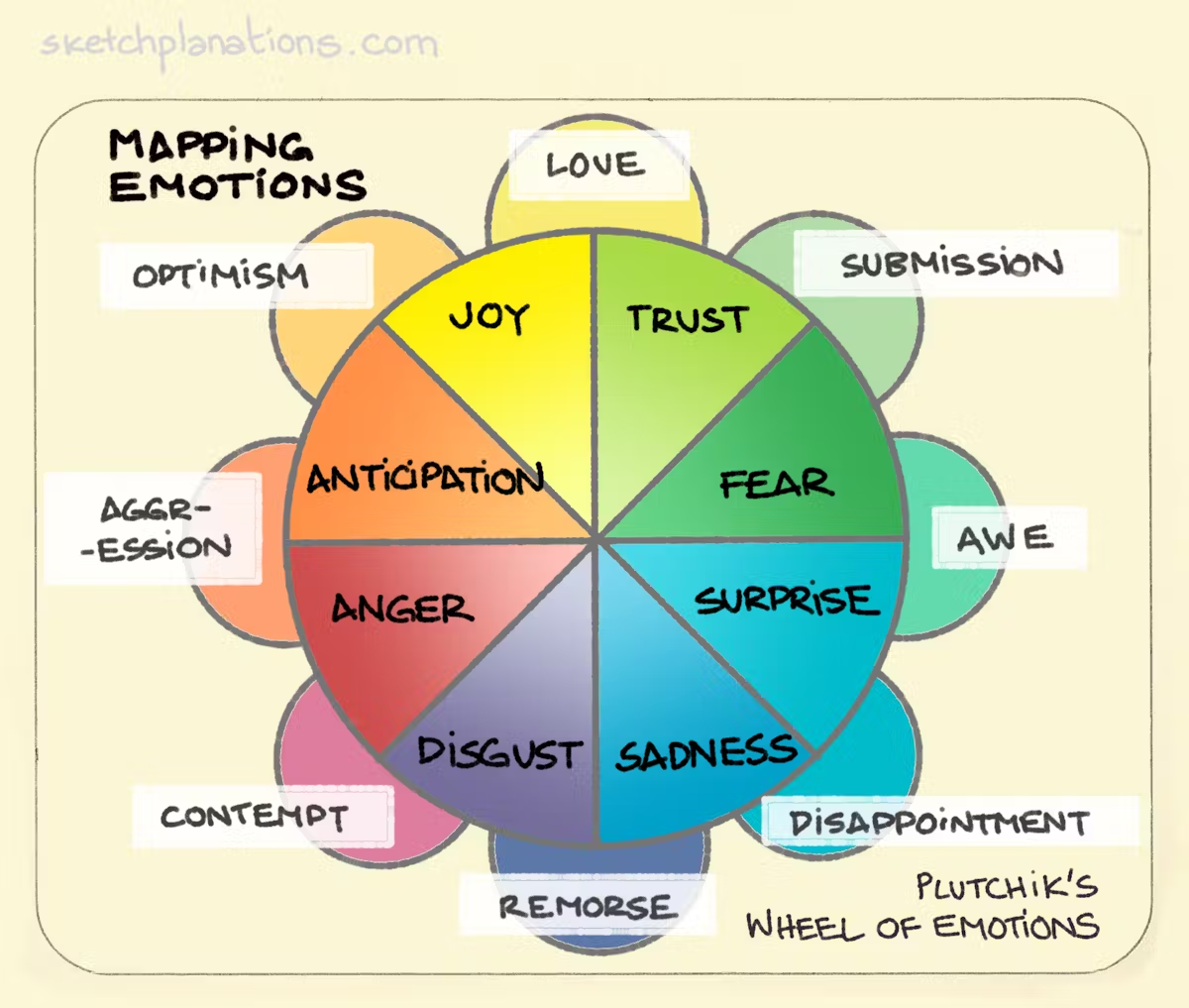
Joie de vivre also isn’t about being happy all the time. Obviously the French have “negative feelings”, I mean, have you read Sartre? But a range of feelings is the normal human experience. The impression I get is that “pretty good” is the baseline here, and feelings of more extreme happiness, sadness, anger, boredom etc. are all coming from and returning to that. In contrast, when I look at people in the US and a few other places I’ve lived, I see them defaulting to a baseline of “meh” (numbness or boredom) or even a baseline of anxiety and sadness. Image Credit: https://sketchplanations.com

Regardless of what culture they are from, people are capable of feeling a full range of emotions, and a normal human will experience most of them in a lifetime, but living in a culture that forwardly values kindness and everyday joy makes a difference in everyone’s quality of life.

Can Americans Live Joyfully?

My initial answer to the question “Why are you going to France?” was often greeted with the suspicion that anyone going to live in a foreign country and not work for a couple of months just to enjoy things was dangerously decadent. This happened so often that I began to become suspicious of myself. Was I leaving my students and co-workers in the lurch? Would they be ok without me? Could I really justify the expense, not only of the vacation but of the time spent not working? The regular messaging of the culture around me made it harder and harder to be sure I was making the right choice.

There is a tendency in (but not exclusive to) American culture to view any action that is not productive (making money) as frivolous (selfish, useless, a drain). For me, joie de vivre is more likely to involve things that make you happy but don’t make money, nor lead to making money in the future. These are things that you do just because you like them (and that don’t hurt anyone else). I rate this kind of joy as sitting from tier 3-5 of the Maslow’s hierarchy. It’s hard to go after it when you don’t have basic needs met, but I would argue that it’s integral to love and belonging, self-esteem, and self-actualization.

When I started telling people instead that I was going to France to study French, they seemed much more comfortable. Once there was a cultivation of skill involved, it wasn’t just frivolous happiness, it was productive, and that was more socially acceptable. One day as I was hand-wringing about whether I needed to justify my trip to France, someone said to me, “Why are you beating yourself up about this? You deserve this. You can do this without going broke or wrecking your life, so go enjoy it.” It was an extremely succinct account of the two most important obstacles to frivolous (non-monetizable) happiness:  Can you afford this? Have you earned this?

Can you afford this?

Credit: FreePix.uk

It’s a valid question, but I don’t think it’s the only hurdle to frivolous joy. There are many people who do not have travel money, or have other challenges to travel such as health and children, and I’m not suggesting (as I have seen other travel bloggers do) that one can simply manifest global travel with enough bootstraps. Maybe they can’t afford a trip to Paris, but what types of joie de vivre can they afford but are held back from doing because they feel guilty about it?

During my experiences in developing countries where almost no one has enough money, the social values writ large tend to be more focused on “slow living” and finding joy in daily experiences such as community, shared meals, nature, children, and expressing creativity – things that don’t cost much if any money. While people in these cultures may feel guilt about spending money on themselves instead of their family or community, they don’t seem to have any trouble enjoying themselves when it’s not a question of money. Even in Japan and Korea, wealthy countries famous for overworking, I still noticed people placing importance on these types of low cost joys.

Have you earned this?

American culture is embedded with an exchange rate of work for pleasure. You must burn x number of calories to “earn” dessert. You must work x hours to “earn” a break. I talked to people in my income bracket and above who can absolutely afford to travel, but felt that they could never possibly, because they haven’t hit the ever-shifting goal post of “enough work” to earn the pleasure.

The earning in question isn’t financial; it’s the unspoken moral economy. Many Americans have internalized the idea that we don’t really deserve to feel good (at least until we’ve suffered enough to “earn it”, which may mean never). But because we are human, we sneak around with minor infractions we call guilty pleasures while lacking the ability to fully feel the delight these activities should bring because we are too busy feeling guilty and wondering how we’ll be judged.

What will people think? If I eat a second slice of cake? If I skip mowing the lawn to have a nap in the afternoon sun? If I take my kids out of school for a day to drive up to the mountains and splash around in a glacial river? If I leave my spouse to feed themself and the kids and they end up eating Cheerios and ice cream while I have a nice dinner with my friends? If I leave the office when there’s a big project (and there’s always a big project) and my co-workers all have to pick up my slack while I’m tasting wine in the Loire Valley?

Look at the horrible social media backlash that middle and lower income people get for having nice things deemed by society to be “too luxurious”. When they use food stamps to buy steaks instead of rice and beans, or dare to have a new phone, a nice laptop, play video games, drink frilly coffee, eat avocado toast or anything else that might make life bearable, the internet loves to pile on. Grind culture tells us that the one true path to financial success is to have nothing that brings joy, and only to work as much as possible until you can earn your way to a house, a car, and a (maybe once yearly) family vacation to a theme park.

Let me be clear, none of these examples are likely to result in anything bad actually happening, but the real world consequences are not reflected in the imaginary consequences of people who are held back by these thoughts. The extreme version of this is called “catastrophizing” and people who suffer from this type of anxiety (as you might guess) imagine catastrophic results of actions they perceive as risky. The less extreme version is a bunch of people who don’t critically examine what is likely to happen, they just feel the guilt and shame as a gut-level reaction.

A New Way of Thinking

I don’t take these internalized feelings of guilt and shame lightly. They are deeply ingrained in us from childhood, and can feel like an irrefutable pillar of reality. But they need to go. Maybe in the way black mold or an insidious termite infestation needs to go, or maybe in the way a cavity needs to go: knock down a wall, drill a hole, excavate the rot and repair the damage. It isn’t something a person can just do –wake up one day suddenly be free of the pressure of guilt induced by unproductive pleasure. However, I suggest that everyone reading this start the long and difficult process of releasing the weight of these fears and finding the freedom to do things just for fun. 

“[Joie de vivre is] revolutionary because for work-driven, vacation-and-long-lunch deprived Americans, it almost requires brain surgery. Why? Because to make that lunch a moment with a French touch it has to be just for fun, no rush, no agenda. An American [said] that her French women friends, who are physicians, ‘work long hours but find time to meet their friends, take vacations, and indulge in the life part of life, which is as important or perhaps more important to them than work.'”
— Huffington Post, “What is joie de vivre, and why are the French so good at it?”

This isn’t “run away with the circus” advice. I do not advocate joy at the expense of security or community. We still need to be able to answer the question “Can I afford it” with “yes”. Please do not go into debt chasing a consumerism driven idea of happiness (been there, done that, regretted my financial choices). It’s important to balance joy and responsibility, but until we learn what things are truly our responsibilities and what things are the weight of other’s expectations and demands that we have taken on unnecessarily, we won’t be able to say “yes” when asking “Do I deserve it?”

Once we are able to accept that we deserve to enjoy things without having to earn the moral currency to do so, there is a different way of life ahead. 

Paris in the Spring

Despite the detour, this is still mainly a travel blog, so without further ado, I bring you a sunny day in April exploring Paris. The romantic ideal of Paris in the spring is perhaps more marketed to lovers, but having been to Paris both in spring and in summer, I can say I have a definite preference. The weather is better, the crowds are fewer, and if you go early enough in the spring, you get cherry blossoms! (For those looking for tips and advice, specific details about transportation and accommodation are at the end).

When I decided that I would spend a couple months in France, I knew I didn’t want to have Paris as my home base for a few reasons. The top being “oh my god it’s expensive”. The next being “it’s full of tourists”, and the last and perhaps most important: I wanted to see other parts of France. Nonetheless, every international flight into France lands in Paris, so although I would start classes in Tours on April 15th, the best price to fly was April 11th (several hundred dollars cheaper than the 12-14th). I decided that I’d rather spend the money in Paris, so I booked a dorm and planned a laid back day of viewing the gardens and eating delicious food.

Breakfast

Refreshed from my flight by a good night’s sleep, I headed into the city center to my favorite breakfast place in Paris: Angelina’s. I have gone to Angelina’s every time I’ve visited Paris for their amazing hot chocolate, even in the worst summer heat wave. For people who have only had packet hot chocolate, I can’t express my sympathies deeply enough. Some of you have been lucky enough to have real hot chocolate made from milk and chocolate (not a powder) and you begin to know the heights to which this beverage can soar. Those of us who have been graced by the chocolat chaud at Angelina’s know the celestial chocolate experience.

The last time I was in Paris in 2019, I made breakfast reservations because we had tickets to the museum and I wanted to make sure we were not rushed to finish eating. It turned out we didn’t need the reservations since most tables were still empty when we arrived. This year, Angelina’s website says they are no longer accepting reservations, and when I arrived, I discovered the otherwise totally empty sidewalk to be teeming with a crowd in line at my favorite breakfast spot. I queued up while I looked on my phone to see if there was some explanation. I was informed by my neighbors in line that the restaurant had recently become TikTok famous, which is why they themselves where there.

I’m never sure how to feel when a restaurant gets influencer famous. Many restaurants have actually been destroyed by fame induced crowds flocking in numbers that their small scale production process simply could not handle. Others have had to reduce the quality of their once famous dishes in order to keep up with the demand. I stood in line thinking that there must be another restaurant in Paris that had really good hot chocolate, and maybe it was time for me to try a new thing, when the line started moving. It only took perhaps 15-20 minutes before I was at my own table. The wait was considerably shorter than I would have expected at a restaurant in Paris. It may be that foreigners are accustomed to eating quickly, and tourists who had made Angelina’s a stop on an otherwise full day of activities were eager to get on.

I was fully prepared to order my breakfast in French (knowing I didn’t need to), and the server was very kind about it. Then I realized that about half the patrons in the dining room were Asian, and were all using English to communicate with the staff. I told my Korean students over and over again that English was the key to world travel, but it strange to see it in action here in Paris after struggling though my bad French on previous visits. Stereotypes about the Parisians persist, yet I have never known them to be anything but kind. It’s possible they appreciate the attempt to speak French more from native English speakers because of the stereotypes about English speakers being monolingual, but they seemed quite content to speak English with me and with every other tourist around.

When my order arrived, I was delighted to discover that despite the newfound TikTok fame, the quality of Angelina’s hot chocolate had not diminished in any way, and that the French cultural value of never rushing a diner at the end of a meal was still going strong. Regardless of the line at the door, everyone seated was fully welcome to spend as long as they liked savoring the thick chocolatey goodness and rich pastries. Bliss!

Jardin des Tuileries

An online search for cherry blossoms in Paris revealed that the largest grove of cherry trees was about 90 minutes on transit from my hostel, and after viewing the blossoms at some of Asia’s biggest collections, I doubted at the mere volume of trees would be a top draw for me in France. Instead, I opted for closer gardens with fewer trees where I could have a lovely stroll with less time in the Metro. My first stop was Jardin des Tuileries, right across the street from Angelina’s.

I like to come to this garden when I’m in Paris no matter what else I’m doing. My first time in Paris (2015), I ended up in Tuileries purely by accident, and ate a glorious sandwich next to a fountain with a view of the Eiffel Tower. It’s a memory that sticks in my mind because I felt in that moment that I had “made it”, that all my repeated struggles towards my dream of global travel and daydream freedom had landed me in this garden, with the best sandwich I’d ever eaten, basking in the sun and watching the Eiffel tower in the distance. I like to come and visit the park and relieve that memory whenever possible.

There were plenty of people, both locals and tourists, enjoying the unseasonably warm sunny spring day in the park. I ambled around and taking photos of the pink blossomed trees, stopping occasionally to take photos for groups who were struggling to use the timer on their phones or get everyone into one selfie. My feet were still swollen from the flight and my back hurt, but none of that could impact the growing sense of ease and contentment I experienced just discovering that I had once again “made it”. I survived the COVID induced lockdowns, I took my years of isolation and I packed them up in a box in the closet and I once again embraced travel for joy.

Jardin des Plantes

The next garden I visited was the Jardin des Plantes, a botanical garden that I had not been to before. It also houses a small zoo, and some indoor exhibits, but I was there for cherry blossoms! Priorities.

When I found the area where the park’s cherry trees grow, I was initially disappointed. It seemed that all the “white” (very pale pink) trees had finished blooming the week before I arrived. There were four darker pink blossomed trees of prodigious size, but they too seemed to be at season’s end. Thankfully, that was an illusion. These enormous trees look full of fading blossoms from a distance, but once you step under the sprawling canopy, you have entered the bower of a magical fairy land. Queen Titania herself might set up a divan there and feel entirely appropriately decorated. 

It was like stepping into a snow globe of pink petals. The branches swept from high above all the way down to the ground, cutting off the view of the outside world. Fallen petals covered the ground as well, resulting in a 360° sphere of pink. I lost track of how much time I spent under just one tree, discovering new delights at every angle I looked or aimed my camera. When the spring breeze came by and the petals fluttered around us like pink snow, everyone stopped their photo posing and gasped in awe.

I visited the other three cherry trees and then branched (haha) outward to look at other plants and flowers. In early spring, there aren’t as many blooming, but I found some other pink trees, some purple irises and a garden with enormous blooms I do not know the name of.

Un Pause

Still jetlagged and walking for hours, I decided to stop at a sidewalk cafe. I couldn’t find any coffee places with seating near the gardens, but I did find a little bistro from which I ordered a delightful craft cocktail. As I sat in the shade of the awning with my drink and watched the daily life of Paris around me, a quote from Anthony Bourdain came to my mind:

“Most of us are lucky to see Paris once in a lifetime. Make the most of it by doing as little as possible. Walk a little, get lost a bit, eat, catch a breakfast buzz, have a nap…Eat again. Lounge around drinking coffee. Maybe read a book. Drink some wine, walk around a bit more, eat, repeat. See? It’s easy.”

― Anthony Bourdain, World Travel: An Irreverent Guide

However much I wish it had not taken me 4 visits to Paris to learn this, I don’t think anyone could have convinced me on my first trip that I shouldn’t be running around trying to see the Arc de Triomphe, the Eiffel Tower, the art museums, the catacombs, the cemeteries, Montmartre, and every other cool thing in Paris. The tourists I talked to in line at Angelina’s and whose photos I helped take in the garden were just as eager to squeeze in as many sights as possible. I can’t blame them, but I’m very grateful that I finally reached a point where I can just enjoy sitting at a sidewalk table with a drink.

Jardin du Luxembourg

My last stop on the way back to my hotel, Jardin du Luxembourg, was also a garden that I had not previously visited. I found it to be much more like a park than a garden with plenty of places to walk and sit and play sports, but fewer flowerbeds or decorative trees. Most of the gardens in Paris have lawns (tapis vert, or green carpets) that are cultivated to within an inch of their lives that no one is permitted to walk or sit on (thank you, Louis XIV). It creates a beautiful landscape, but leaves one yearning to run barefoot in the grass. Luxembourg had many sweeping no-touch lawns, but added a sitting lawn! (There is another good sitting lawn just in front of the Eiffel Tower). Large blocks of soft dark green grass just for lounging around or having picnics on.

Given the beautiful weather that day, all the parks were full, but it was not hard to find a spot to plop down and enjoy the cool green lawn. I watched the people and the pigeons. Every pigeon I had seen all day seemed to be unusually plump and healthy. I’ve seen pictures and videos of show pigeons, but street pigeons are so often sickly and deformed that it’s become a trope, people calling them “rats with wings” or “cooing plague pits”. And yet an animal is only as healthy as it’s ecosystem. If pigeons in New York are malnourished, diseased, and deformed, it is not a result of the natural state of pigeons, but rather a reflection of the life they are forced to live. It really made me think about how much healthier Paris must be as an ecosystem than the vast majority of other dense urban cities I’ve visited. It also gave me a new appreciation for the presence of squab in French cuisine.

La Fin

As the day drew to a close, I realized I had made no plans for dinner, and that the combination of Saturday plus glorious weather meant more people than usual would be going out to eat. From my seat in the grass, I searched online for nearby options and snagged a last minute reservation at a restaurant across the street. Once more, the staff were very friendly and happy to speak in English (where does the stereotype of rude Parisians come from?) I ordered the daily special of duck confit, with a bière picon (a beer mixed with picon, a sweet orange liquor, not available in the US, I’m afraid), and for dessert, a chocolate cake and coffee with bailey’s and Chantilly. I may have gone a little overboard, but it was delightful to sit on the indoor balcony and look out the restaurant’s giant picture window at the garden across the road while dining on top notch food and drink. Not an everyday occurrence, and I think a worthwhile treat to end my day in Paris.

The next day, I repacked my bags and caught the bus to Tours, the small city in the Loire Valley that was to become my home and my school for the next 5 weeks. Stay tuned for more on life in the Loire!

Planes, Trains, & Hotels

If you are interested in the practical side of this trip, this Post Script is for you. Here I have attempted to include some useful information and links about airfare, public transit, and accomodation.

When searching for airfare, I was lucky enough to find an off brand company that didn’t suck called French Bee. Their cheapest package is very similar to Spirit or Ryan (no luggage, no meals, etc.), but the price difference for the upgrade to a more inclusive fare was only about 40$. I ended up with a normal international luggage allowance, an inflight meal, the ability to choose my seats, and the no-fee change policy.

The Paris public transit system is good, but confusing to outsiders. I have an old Navigo card which was still valid and could be topped up, but my research revealed there is now an app which allows you to buy tickets online and scan your phone via RF/NFC rather than having to carry a card and top it up at ticket kiosks. The app for local Paris transit is My Navigo Tickets, and the intercity train system is Bonjour RATP. It is a big improvement since my previous visit. The Navigo app also offers a good trip planner, showing the best transit routes to get from where you are to where you want to be. Sadly, after you find your route, and press the “buy ticket” button, it just takes you to the general ticket page with no indication of what you need for the journey you have planned.

Why does this matter? Paris has 5 zones, and transit tickets are sold in groups of zones. The more zones, the higher the price. I want there to be a way to easily see what zone you and your destination are in, but I haven’t found it. The last time I was in Paris, I just talked to the ticket seller about the places we wanted to go, and she knew what zones I needed. In general, if you’re sticking to the city center, 1-2 is enough, but there are some high demand tourist spots in zone 3. And if you’re staying further out to save on hotels, you may even be in 4-5. Transit to and from the airports and Disney Paris have their own special rates.

Additionally, passes are available by day, week, or month, but the week is Saturday to Sunday, no matter when you purchase it (not 7 days from the day of purchase). Is your head spinning yet? Do you suddenly want a taxi? Well, just remember the taxi rates from the airport are 50$+, but the bus rate is about 12$. Taxis in the city traffic can be difficult to catch, drivers may not speak English, and they may rely on your poor knowledge of fees and laws to overcharge you (this happens everywhere, it’s not unique to Paris). Transit trips cost about 2 each or a day pass of unlimited rides for about 8. I like the unlimited rides because I never have to worry about transfers or having to take extra transit if I get lost (which happens at least once a trip).

On to hotels! Paris is definitely one of the top most expensive places to spend a night. Before COVID, my usual travel budget was 100$ a day split 30/30/30 (hotel/food/entertainment) with a small extra cushion. Even then, I couldn’t find a room in Paris for 30$, I couldn’t find a bed in a dorm for 30$! There are a few youth hostels where, if you happen to be a young man, you can bunk down in a 12-16 bed dorm with other young men for around 35$ a night. If you would like a female-only dorm, be prepared for the pink-tax. All-girls dorms cost on average 10$ more than the male or mixed dorms. I stayed in a mixed dorm in Paris once, and it was fine. I was safe. No one was skeezy or anything. But, the older I get the harder it is for me to spend time in dorms. I find I need a private space to decompress at the end of a long day.

In post-COVID inflation-land, room prices in Paris seem to have risen (although to their credit, not as much as US based inflation). The best deal I found was a bed in an all-girls dorm for 50$ a night. (are there cheaper? Yes, but then you start getting issues with cleanliness, quality, safety, and distance from the transit stations). Hotels and hostels are getting better at tricking the algorithms to promote their place in search engines and reservation websites. It’s important to read real reviews (good and bad), see what people liked and didn’t (it might be things that don’t matter to you), and look at a good map to see not just how far the hotel is from a landmark or transit station, but also, how you can get there. 

It can take hours of searching to find a good price, a good location, and a good quality, but the time you spend in advance is worth it not to have unexpected unpleasant surprises after you arrive. My decision to take a dorm bed at the Eklo also related to factors like the photos of the dorm rooms, the reviews by other guests, and the closeness of the bus stop. I knew it would be hard to be really comfortable in a dorm, but I was willing to take it for just two nights.

I ended up eating at the rooftop restaurant for dinner the night I arrived. I am always skeptical of eating in a place so clearly designed to cater to tourists. High end hotels have amazing restaurants, but hostels tend to focus on alcohol and cheap food. The Eklo partners with a small chain restaurant called French Kiss which had a good looking website, and I was too worn out from the flight to go anywhere else. The view was stunning, and the food surpassed my expectations for hostel restaurant fare, and the staff were all friendly and quite fluent in English.

They Say You Can Never Go Home

“When I’m talking and someone else is listening, I am invariably left with the uneasy suspicion that I’ve made myself quite tiresome. If one is really bursting with things to say and has no one to say them to, perhaps the only recourse is to go forth and accomplish earth-shattering deeds, so that when the time comes for an autobiography, one need no longer be concerned that no one will take any notice. This is a childish fantasy, of course, of which I have been disabused as I have slowly come to realize that I have scant hope of becoming a celebrated public figure worthy of a best-selling autobiography. Better, then, to write a little about myself and let off some steam, so that I don’t become an insufferable chatterbox when I get old.”

Written on Water by Eileen Chang,  Chinese-born American essayist, novelist, and screenwriter
— written in Japanese occupied Shanghai and first published in 1944.

My last post was more than 8 months ago as I left Senegal to return to the US. I always seem to have a hard time writing when I’m in the US because it doesn’t feel like “travel” or “adventure” to me the way being in other countries does. When I return to Seattle, I focus on enjoying my time with friends and family, having quiet daily experiences of shared meals or parallel play, and even when blog-worthy things do happen, the stories feature people who trust me not to share their private lives online. So, I end up not writing at all.

When I made my plans to return to America in 2023 I told myself and others that I would stay for at least 6 months and not more than 12. I looked forward to it. I felt that I had been away for so long that a quick pass wasn’t going to cut it. I wanted to “water my roots”. I wanted to bask in the everyday mundanities of my friends’ lives, to see the seasons change, to celebrate the holidays of my childhood. Being a long term expat means never giving up on the idea that our country of birth is our true home, while also never quite being as comfortable there as once were.

I wanted to work in the US, not only for income, but also to give my days structure. COVID era Korea and the schedule nightmare of Senegal left me for years in a state of temporal blur where days ran together and there never seemed to be a good enough reason to do anything. During my sojourn in the US, I neither wanted nor needed to work full time. My goal was to soak up my community, not to sink into a daily grind. A part time job would keep me from decimating my savings, and give me a regular routine, but leave me with plenty of free time to enjoy being home.

In reality, I accepted a full-time position teaching an English immersion course for immigrants and refugees. The position came with a lot of challenges, but possibly more rewards. Being back in a physical classroom with a regular schedule and the ability to form a relationship with my students was so good. Learning the bureaucracy of the WA state college system… less so. (drawing of me teaching courtesy of a student’s daughter. I was wearing a floral patterned mask, not speaking with a mouthful of marbles, lol)

Meanwhile, when it came to housing, I knew I didn’t want to rent my own apartment since that would mean committing to a full year lease, and likely cost 1500$+ a month. Therefore, I arranged to move into the spare bedroom of a former roommate. After just 3 months of living together, it became clear that whatever had changed for us since our last cohabitation made a reprise totally impossible. I moved in with some other friends of mine who agreed to let me stay at least through my current work commitments. (pic of the backyard below) That beautiful home with a healthy family and 2 bright and loving kids was an absolute balm to my soul after the back to back combo of the pandemic isolation and the Senegal experience.

Nonetheless, it was always destined to be a short term solution, and I had to start seriously considering my options: renew my contract at this reasonably good job and work on finding a place of my own in the USA or bounce?

Reverse Culture Shock

Coming back to a life in the USA isn’t as simple as it sounds, and however much I may love my home and my community, there is no going backward when it comes to the march of time which wreaks changes in both society and personal growth. When you travel, you leave your familiar surroundings and go to a place where you are shaped by different forces and grow into a new version of yourself. While you are gone, the place you left behind also continues to evolve, shaped by local and world events, so when you return, you no longer fit. It is uncomfortable, and often more unnerving than the experience of not fitting in with a foreign culture. Abroad, you know you are the alien, but at home a part of your brain is constantly telling you that you are SUPPPOSED to fit here. It’s a dysmorphia of the whole sense of self.

But Kaine, you’ve been back to America since you left in 2014, you saw the changes as they happened! Yes and no. I saw America during my vacations the same way any tourist might see a country they visit for only a few weeks. I focused on excursions and experiences, the only real difference was that I made excursions of visiting friends and family rather than visiting tourist attractions. I planned sailing days and camping trips and cookouts. I went to house parties and dragged people out to karaoke nights. I didn’t pay a lot of attention to the cost of groceries or what was happening in politics. For those few weeks at a time, America wasn’t my “home” it was my holiday, and it wasn’t until I was back in my home abroad that I returned to viewing the US economy and politics through the lens of the internet.

This is an excellent article about the experiences of long term expats returning home, and honestly reading it made me feel both seen and called out.

“Americans often develop new attitudes, values and perceptions as a result of their travels. These can often cause stress on reentry.

  • I see America through a sharper lens, both its strengths and weaknesses. I no longer take this country for granted and I really resent unbalanced criticism by Americans who haven’t experienced the rest of the world.
  • I see the validity of at least one other culture. That makes me realize that the American way is not always “right” or “best.” I am impatient with people who criticize other countries and blindly accept everything American causing them to never question anything.
  • I have an unclear concept of home now.
  • I place more value on relationships than other Americans seem to. People here are too busy for one another.
  • Everyone in America is always so stressed and frantic. They never relax. I feel like I can’t relate to others

The Economy

It’s normal to become critical during the second phase of culture shock. I’ve published about these effects before, and the article above is great for explaining how it manifests in reverse culture shock. Nonetheless, even while I was still in the first (honeymoon) phase during August & September, I started feeling the negative impact of some big changes in the US.

I needed a car because it’s almost impossible to navigate American cities via public transit, but I was absolutely shocked at the prices, even on used cars! In 2015 when I was in the US for a few months doing the paperwork for my Korean work visa, I bought a car for $1,750, drove it while I was in country, then sold it for the purchase price when I left. In late 2023, I couldn’t find a used car for less than about 7k$, and those were very sketchy.

My plan to buy a clunker for under 3k and sell it on to a poor college student went up in smoke. I ended up buying a used car from a dealership and hoping that the good gas mileage makes up for the loss in sticker price when I sell it back.

Then there are the grocery stores. I can’t say exactly why, but sometime after I moved to Korea in 2016, American grocery stores became increasingly overwhelming. I can’t even say it’s the size, because I have successfully gone to large box stores like Home Plus and Carrefour in other countries and not felt the pressure that American stores give me. I remember walking into a Safeway in 2019 and just staring at the wall of ice cream for a full 5 minutes, totally flummoxed by the array of nearly identical products. 

When WA grocery stores became liquor sellers (2012), they had to figure out how to add new products without removing existing ones. The eventual solution was that many stores made the aisles smaller so they could incorporate more shelf space in the same square footage. The aisles got narrower, but stores didn’t replace their shopping carts with smaller versions. By 2023, the sensory overwhelm had gone from merely being too many choices and no way to choose, to a feeling of being totally lost and crowded in by impatient and frustrated shoppers in narrow aisles with giant carts which made passing an Olympic sport.

The products and packaging were unfamiliar, I struggled to assess healthy and frugal choices. Products that I did know had somehow doubled in price, overtaking average inflation at light-speed. In 2008, a person could buy a whole roasted chicken for $5, eat it for several meals AND make soup. An organic bird would be $7-9. Now the conventional chickens are $10+ and the organic/farm raised $12-18. In the end, I found that the only store which didn’t make me want to run away screaming was Trader Joe’s, and I did 99% of my shopping there.

Not only grocery stores, but the nature of in-person shopping had changed across the board. In-store service and options had become extremely limited. Once 24 hour shops had become practically European in their hours, and stores were chronically understocked and underserviced. Several times when I popped into a shop to pick up a small item or to look for something I could touch, measure, handle, or try on before buying, I was told plainly by the clerk that it was out of stock and I should look on Amazon.

Eating out was another huge sticker shock. My favorite Seattle staple food is pho (the Vietnamese noodle soup). At my graduation lunch in 2007, we could get a big filling bowl of rich meaty pho for about $5. Now a bowl of pho is $12-15. I went to a couple of what I would call mid-range independent (not chain) restaurants and dropped $80-100 on a single meal (after taxes and tip). Many places I lived and visited abroad, you could get a high-end meal out for between $25-40 (inclusive of taxes and service).

mahalie from International District, Seattle, Washington, CC BY-SA 2.0 https://creativecommons.org/licenses/by-sa/2.0, via Wikimedia Commons

The Food

Food remained a contentious issue for me the whole time I was in the US. In the past, I have had food intolerances which contributed to chronic inflammation, pain and fatigue. I stopped eating dairy and wheat back in the early 2000s and it made a huge difference. Starting in 2008, I experimented with eating wheat and dairy in other countries as compared to in the US. Country after country, as long as I avoided imported US foods, I could eat what I liked and feel fine. However, in the US, it seemed my body only tolerated organic wheat & dairy products, and conventional ones still resulted in inflammation (a general flu-like bleh feeling all over). I thought as long as I managed my bread and milk, food in the US would be easy enough. My body laughs at me when I think like this.

It has been widely discussed that the quality of food in the US is very different from that of other countries. There are hundreds of articles about pesticides, hormones, preservatives, and processing chemicals out there you can read, and I’m not going to recap that here other than to say it is a well documented issue that food in the USA is problematic and contributing to many health problems for her citizens. (pic below, my first and only experience with Chicago deep-dish pizza)

After a couple of weeks of eating novelty junk treats and processed frozen meals, my body protested loud and clear. I had to be pickier and pickier about what I would eat and eventually, food that was too sugary or over-processed simply stopped tasting like food. I remember taking a slice of a cake that looked so delightful, then on my first mouthful wondering how it tasted so awful. The cake was sugary and vaguely spongy, while the frosting tasted like it was actually made of melted plastic. The people around me seemed to enjoy it. I visited a friend’s house where they made a meal I would have made myself 10 years ago and been happy with. I took a small amount to be polite, but again, my body made sure I knew that what I was eating had only a passing resemblance to food. 
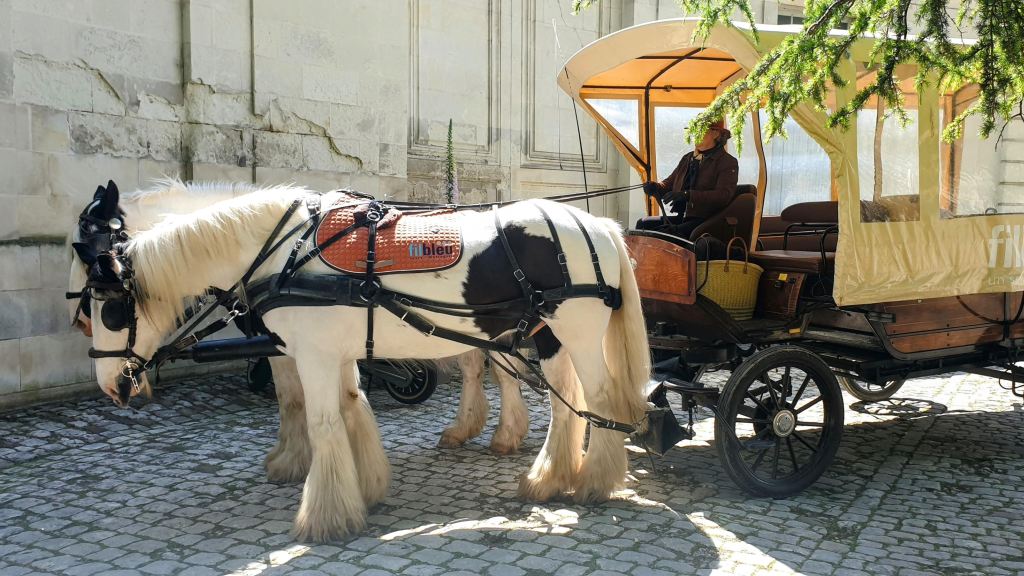
Not only did I feel constantly disgusted by the majority of US food, I felt bad about complaining or even abstaining when others around me were eating, enjoying, and offering to share. Sharing food is one of the most fundamental social bonding activities humans can engage in, and my friends, many of whom are still in financial struggles, wanted to share their food with me. How could I tell them that my body didn’t think what they were eating was food? (pic below, a Thanksgiving “turkey” made of Baskin Robbins ice cream and frosting, just one example of the absurd food-options that abound in the USA)

And, despite my caution around eating, and reintroducing an exercise regimen, I GAINED weight in the US. It is my belief that the food itself was the bigger part of the problem, but I also tend to overindulge in sugar when I am stressed, a condition that pervades the life of any American trying to achieve work-life balance. I don’t know what it would really take for me to be food-healthy in the US long term, but I expect it would require a LOT more work and money than would be required to eat a basically healthy diet almost anywhere else.

The People

I had to confront the feeling of failing to fit not just in the larger cultural sense, but also among my own friend/chosen family community. I changed and grew, and so did they. Most of them for the better, thankfully, but in all cases they weren’t quite sure where to put me in their lives when I was in town for months rather than weeks. When I was only available for 12 days, it made sense for people to rearrange their schedules for a unique event, so vacations were filled with revelry and reunion. However, I feared that living there would make my presence mundane, banal, and that my friends would think there would be time later, so they wouldn’t make time now. Thankfully, that fear did not come to pass. Although some people I saw only once or not at all during the 8 month stay, many others made time for me or invited me to planned events at least once a week. I treasure my community.

“General Challenges

  • People at home aren’t as interested in hearing about your foreign experience as you are in telling them about it . 
  • You aren’t as interested in hearing about what has happened at home as they are in telling you about it. 
  • You miss the tight-knit foreign affairs community you were a part of.

I have learned over the years that people stuck in one country (especially Americans) have strong feelings about listening to my adventures. Some of them love it, they see me as their own personal documentary, and it’s delightful. Others are busy comparing their lives to mine and dislike hearing about what I’m doing abroad. I try to respect everyone’s wishes in this, but it can be hard since 95% of the last 10 years of my life has been abroad and I can’t tell stories about my life experiences without involving travel.

Whichever way it goes, it’s massively different from talking to other expats. I had almost forgotten how much I loved swapping stories among the expat community when I ran into another long-term expat at a party in early April. I realized that it was the first time since coming back to the US that I felt comfortable talking about my life abroad for more than a few minutes or in any detail.

It felt like I was holding my breath around my friends and family. I talked about my American experiences with them all the time, shopping, work, things happening at the home I lived in or with other friends’ lives, but I minimized my expat-self, trying to fit into the shape that was left for me. I don’t think my friends consciously asked me to do this, and many would be shocked or saddened to learn that I had been suppressing a part of myself for their comfort. I know they love me and I chose to change the way I interacted with them to make them comfortable because I love them. Call it masking, call it code switching — choosing to focus on a different part of my life and activities when I’m with different people is normal. However, it has made me realize that I can’t live with ONLY this kind of interaction. I need the expat community too, which makes long term residence in the US challenging.

The other difference I noticed in people was more general, society at large. I don’t mean the blatantly obvious “us vs them” divide in America that you cannot help but see if you follow any news at all, but a quieter and less politically motivated change. The shared trauma of COVID changed everyone in some way. I cannot speak for the whole country, but in and around Seattle, people were more closed off, less trusting, less willing to be open.

It’s part of my mental health journey to notice nice things and to make the world around me better than I found it, so I trained myself in the habit of talking to strangers, offering compliments and help whenever I can. I made a game of my daily commute to see how many drivers I could be nice to each day as a way of fending off road rage. (strangely, the commute was one aspect of American life that didn’t bother me) Yet I found that often my overtures of friendliness toward strangers elicited a mixture of confusion and even suspicion before giving way to acceptance and relief.

I am far from the first or only person to notice this trend. A simple Google search will reveal many think pieces searching for reasons why Americans are becoming less social and more isolated, most stressing the dangers for our collective mental and physical health.

My friends who had regularly exchanged hosting dinner and game nights had stopped during lock-down and never re-started. The feeling I got was that the inertia of staying home was so strong that going out required a more special occasion than “dinner and board games”. I also tried for a little while to make some new friends or even (gasp) date. I met people who seemed nice, who I was happy to spend time with and get to know, but they had no ambition to do anything different in their lives. They wanted a new friend or a partner who would fit seamlessly into their existing lifestyles without necessitating a change of habits or hobbies.

People know they crave connections, but seem unwilling or unable to sacrifice even the tiniest bit of safety and comfort for the privilege. People who have been isolated for long periods of time can absolutely suffer increased social anxiety. When I floated this theory past an expat friend of mine who has been back in the US about 18 months longer than me, she said it wasn’t exactly social anxiety, but that everyone felt “tight”, and I understood exactly what she meant. I sympathize with how difficult and uncomfortable they must feel, but it’s both sad and horrible to see.

The American Dream?

Americans are also feeling a lot of financial anxiety. Almost all my coworkers were working overtime, some as much as double time (two full time class loads!) and felt completely unable to stop, either from the weight of their financial obligations (high cost of living) or from a fear that setting any boundaries for work-life balance would cost their job. I had coworkers who were astonished (and envious) that I simply didn’t read work emails outside the office. Others who fretted and stressed that their quarterly contracts might not be renewed despite the massive teacher shortage and high demand. The insecurity was so strong that even though everyone I talked to had noticed certain problems, no one wanted to speak up about them. (Did I? Yes, but it was neither easy nor consequence free. Still glad I did it.)

It was also hard for me to reconcile the gulf between online calls for social justice with the fear people experienced of getting personally involved. Having watched the struggle for civil rights and equity in the US take place almost entirely online for years, it had seemed to me like more people were getting involved, but after living in the US for a few months, I am concerned that the involvement is performative. People can safely speak out online and issue company memos to make themselves feel involved (or if you’re more pessimistic, to make themselves look better to others), yet when it comes to real practical solutions for enacting these policies, no one seems to want to take action. The college that claimed the top ranking for social justice, equity, and accommodation in the region had completely failed its non-English speaking students in this regard and when it was pointed out, they simply changed the subject. Only one person in the whole administration ever actually admitted to me they were failing in that area, and they still didn’t know what can be done about it.

To me, the fear of getting involved in social issues seems like an extension of the same fear that is preventing people from forming deeper social connections, and that fear feels to me like the fear of a child who has skinned a knee falling off their bicycle and doesn’t want to ever ride again. “No, no, walking or being driven is safe and comfortable, the bike is too risky, too painful, I don’t really need it anyway.” Yet, we tell our children to get back on the bike because we know that the better part of life isn’t about falling, it’s about getting back up, and that while it may not be strictly necessary for a safe and comfortable life, the joy of riding a bike with the wind in your hair, and the feeling of freedom it brings is worth the risk of a skinned knee.

Get Back on the Bike

The decision for to strike out again was unexpectedly difficult. My emotional and mental state had become a mélange of post-Covid insecurity, second-hand PTSD, and of course – reverse culture shock induced depression.

My “secondary trauma” (also called second-hand trauma and compassion fatigue) came close on the heels of all the work I did to process my own primary trauma. Secondary trauma is what happens when you are repeatedly exposed to other people’s primary trauma. It’s usually care providers like doctors and psychiatrists who treat trauma sufferers that get this, but it turns out aid workers in developing countries and teachers of students fleeing violence are 100% exposed to secondary trauma. Oh look, it’s me.

This combo meant that my overall resilience was lower, my anxiety was higher, I was less able to focus on new ideas, got tired more easily, had brain fog, and difficulty generating enthusiasm. Even after I decided that what I needed was to travel for joy (rather than work), I had trouble feeling excited or engaging in research and planning. This was especially devastating since prior to COVID, one of my favorite activities was researching and planning my global vacations. (the color coded spreadsheets brought me joy!)

One of my friends also pointed out that I was likely reluctant to make plans to leave because I was in a safe and comfortable place. There simply wasn’t anything uncomfortable (enough) for me to run away from anymore. What a wild notion. I’ve known for several years (thanks therapy) that when I started this journey I was running away from who I was in the US at least as much as I was running toward adventures and experiences in other countries. On this visit, armed with the new tools of my COVID-isolation induced therapy work, I was better able to be a person that I liked while in America. And due to quirks of fate, I found myself living in a home that had the kind of “good enough” parenting and comfortable easy love that I dreamed of having in my own childhood home. Who would want to give that up?

Yet as I cast my gaze across the sea once more, the idea of going to France for the spring took root in my brain. The lack of enthusiasm and general feelings of ennui made implementing any sort of plan quite challenging. I dragged my feet on making any decisions or booking anything for so long. People would ask me if I was excited to go to France, and I would lie and say “yes”, while inside I had a nightmare vision that I would do all this work and spend all this money and somehow arrive in France but be just as unenthusiastic as I was in Seattle. It was an act of faith on my part that I would do the minimum needed to embark, and that my sense of adventure would catch up to me at some point. And now, here I am in Tours, in the Loire Valley, taking French lessons and eating at a boulangerie every day. 

Although it took weeks (maybe months?) for me to imagine and enact my plan, it only took a few days after my arrival for the fog to lift and my enthusiasm to come rushing back, but I don’t think it was the change of scenery (or quality of food) alone that performed this seeming miracle. Every single person I have met and interacted with in this historical French city has been open, kind, generous, and trusting with me. At first, I too was surprised, suspicious and even resistant, but when I let myself relax into it, I found that I could take joy even in the simple act of ordering lunch.

I may not be able to change the economy or the political landscape of my country, but I do have the power to change myself. I can decide to take risks and to be open to new experiences, even when I don’t feel like it. My favorite part of all my adventures has always been the people, and yet the people I love most are suffering in isolation. Perhaps the way forward is to put in some work towards rebuilding openness, connection, and wonder, and trust that the absence of an instant reward is not indicative of failure. Thanks to a combination of the support of my chosen family, my willingness to work toward a goal in the absence of enthusiasm, and the relentless kindness of a whole bunch of strangers, I’m finally feeling less “tight” and more excited for the future. I hope you can, too.

Aventure en France, me voici!

So Long and Thanks for All the Thieboudienne

This is not a “fun” story of joyous tourism exploits and happy expat life. I had a lot of fun in Zanzibar, and I even had quite a few memorable good times in Senegal, even if most of them never made it into the blog. However, living and traveling in both places, I confronted some things that were hard to see, hear, think about, and know. I am personally both deeply pained and extremely grateful to have been smacked so far out of my comfort zone that it took me most of the year to process through denial, anger, sadness, and bargaining to reach a place of fragile acceptance. I travel to experience and learn, not just to have a good time. Though it is difficult, these aspects of a globetrotting life are just as treasured as my fun memories because they help me to understand the complex world we are all a part of in and to be a more compassionate human being to those around me.

The Stone Town Slave Museum 

Just as every historical tour in Europe has a section about WW2, every historical tour in Africa has a section about the slave trade. Zanzibar was the center of the East African slave trade, where slavers from the interior brought their captives by forced marches overland and a short boat trip to the slave market in Stone Town. The city where I live (Dakar, Senegal) has a similar historical site on Gorée Island, which is the center of the West African slave trade, and has a similar legacy of gathering slaves from the interior in one place to board on ships. Slaves went not only to the new world to work sugar, tobacco, and cotton plantations, but also to the Arabic world. These sites which commemorate the worst of humanity are not fun tourist attractions, but they are worth visiting because they instill a sense of reality that no amount of textbooks and documentary films can convey. You are standing where the people stood, both the boot and the neck. The blood is soaked into the earth and stones.

In the case of the Zanzibari slave trade, there existed a type of slavery before the growth of new world plantations exploded demand for free labor. Intertribal slavery between African (and indeed First Nations people in many parts of the world) was not uncommon, but it was a much smaller part of the economy. Prisoners of war were taken as slaves and although some were treated badly, some were integrated into the new tribe over a period of years. No version of slavery is “nice”, but I think it’s relevant to acknowledge how different slavery was in Africa before the foreigners got involved. Not only my guide, but a few other locals I spoke to there tried to excuse the West saying we wouldn’t have bought slaves if Africans weren’t selling them, and this is a level of internalized shame that I’m not ok with.

The increased demand for millions more slaves to serve in the Arabic peninsula and the new world colonies changed the entire dynamic of slavery and the economy of many places in Africa. The slaves that had previously been taken as prisoners of tribal skirmishes weren’t enough to meet the export demand and so a new industry emerged: to wage wars for the sole purpose of taking slaves. Government leaders also captured and sold their own people when they couldn’t get enough from “enemy” tribes. Slaves were forced on long marches with little to no food or water, and those who fell sick were left to die.

By contrast, the free people in Zanzibar prospered by collecting fees from the inland slavers as well as the foreign traders for every slave sold in their markets. When the West abolished slavery, the leaders in Zanzibar didn’t want to stop because it was too lucrative, even without the Euro-American market! The modern attitudes of hakuna matata and pole pole (no worries, and take it slow) on the island are likely a direct result of the fact that for centuries the islanders had to do very little work for the passive income of slave taxes to make them comfortable. Although they no longer sell anyone directly into slavery, the local governments in many places in Africa continue to exploit their own people in extreme ways in order to preserve the legacy of easy money their ancestors had in the slave trade days.

The slave museum in Stone Town tells not only of the horrors of slavery, but also of Livingstone’s mission of abolition. While some in the West may see Livingstone as an embodiment of the “white man’s burden”, many in Africa still praise his abolitionist efforts. Although it was the British government and navy that did most of the work of stamping out the slave trade, Livingstone’s published accounts of the atrocities of the slave trade in Africa helped spread discontent with the continuation of the practice. In American education, the end of slavery is often taught as something that just happened one day upon the signing of the Emancipation Declaration. Few white Americans know the history of the holiday Juneteenth (June 19th) celebrating the day the last group of confederate forces in Texas were finally uprooted, freeing the remaining slaves almost 2 1/2 years later. Even fewer know that the last slaves weren’t actually freed until 6 months after that with the 13th amendment. Almost no one I talk to knows that the 13th amendment didn’t end slavery for all – it’s still legal as a form of punishment for criminals in the United States.

The museum in Stone Town makes no bones about the lengthy process of eliminating slavery and the challenges newly freed slaves faced with no homes, no money, no family ties, and nowhere to go. Even after the Sultan finally caved to the pressure to stop the practice of selling slaves, he didn’t banish the owning of slaves for some time after. The women were the last to be freed because owners tried to claim them as wives rather than slaves, and the difference wasn’t easy to spot. Freed slaves were taken to “apprentice” at plantations where their lives were little different from they had been before; the only difference being their backbreaking labor was rewarded with meager wages and their food and housing came at a price. Freed children were sent to Christian missionary schools which molded them into “good” colonial citizens and converts. Slowly, the freed slaves were able to use their meager wages to move away from the plantations and missions, some to uncultivated land and others to the city for urban work. The legacy of the slave trade is long lasting for Africans everywhere, and museums like this help us understand not only our history, but our present — and hopefully help us to shape a better future.

The abolishment of slavery in the 19th century only made slavery illegal, yet it still continues to this day. Slavery exists in every country of the world and has dramatically increased in the 21st century. There are more slaves today than were seized during the entire African slave trade. While some countries have larger numbers than others, it is an issue that affects all of us.

Modern day slavery is defined as a relationship in which one person is controlled and exploited by another, usually by the use or threat of violence, for the purpose of profit, sex, servitude or the thrill of domination-deprived of free will, restricted in movement and paid nothing beyond subsistence. A slave may be kidnapped, captured, tricked or born into slavery.

Modern slavery is a hidden crime The International Labor Organization (ILO) estimates the illicit profits of forced labor to be $US150 billion a year. From the Thai fisherman trawling fishmeal, to the Congolese boy mining diamonds, from the Uzbeki child picking cotton, to the Indian girl stitching footballs, from the women who sew dresses, to the cocoa pod pickers, their forced labor is what we consume. Modern slavery is big business.
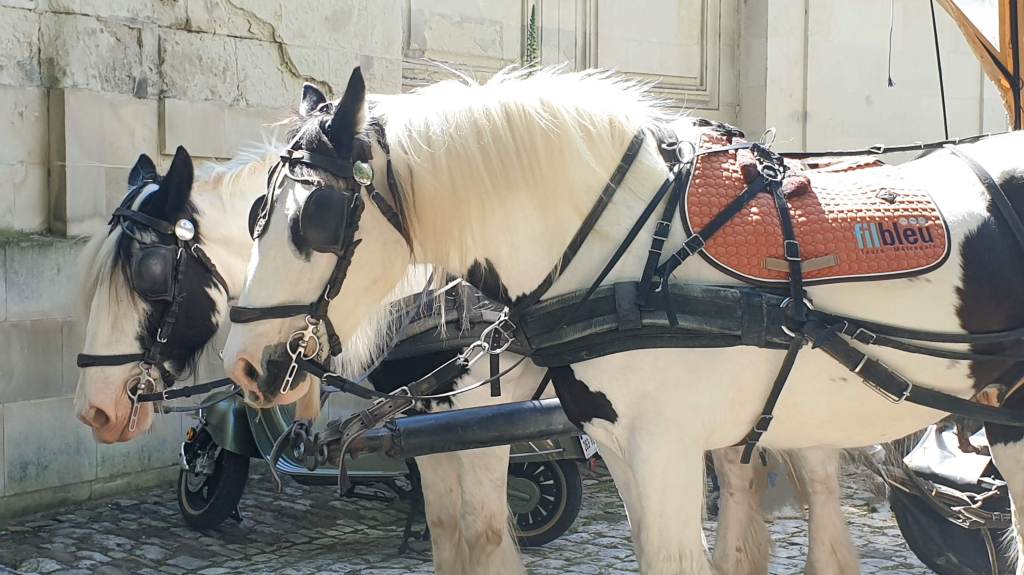
TYPES OF MODERN DAY SLAVERY

BONDED LABOUR
Workers who have received or are tricked into taking a loan and are unable to leave until their debt is repaid. Often times, children of bonded laborers must continue to work off the debts, leading to generations of enslaved families. It is the most common type of slavery today.

FORCED LABOUR
Any work or services which people are forced to do against their will under the threat of some form of punishment. Almost all slavery practices, including trafficking in people and bonded labor, contain some element of forced labor.
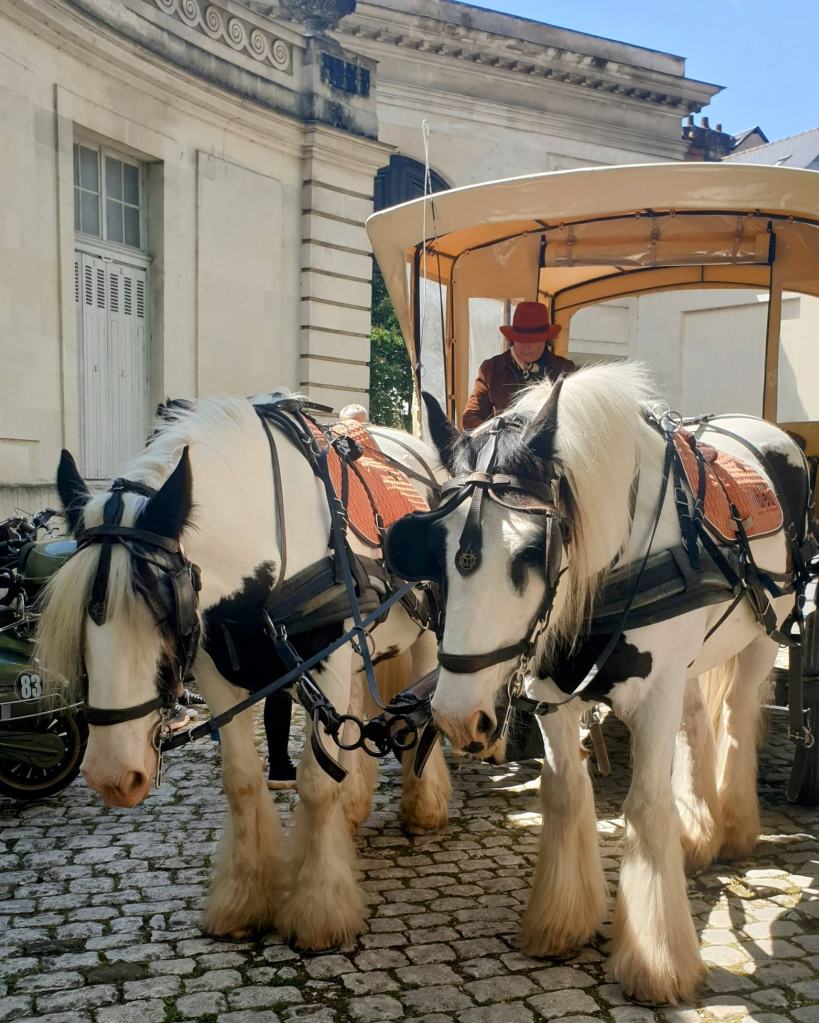
CHILD SLAVERY
Children who are used by others for profit. For example in forced marriage, prostitution pornography begging petty theft, drug tracing, labour, armed fighting or wives’ for soldiers. Usually, child slavery is accompanied with violence, abuse and threats.
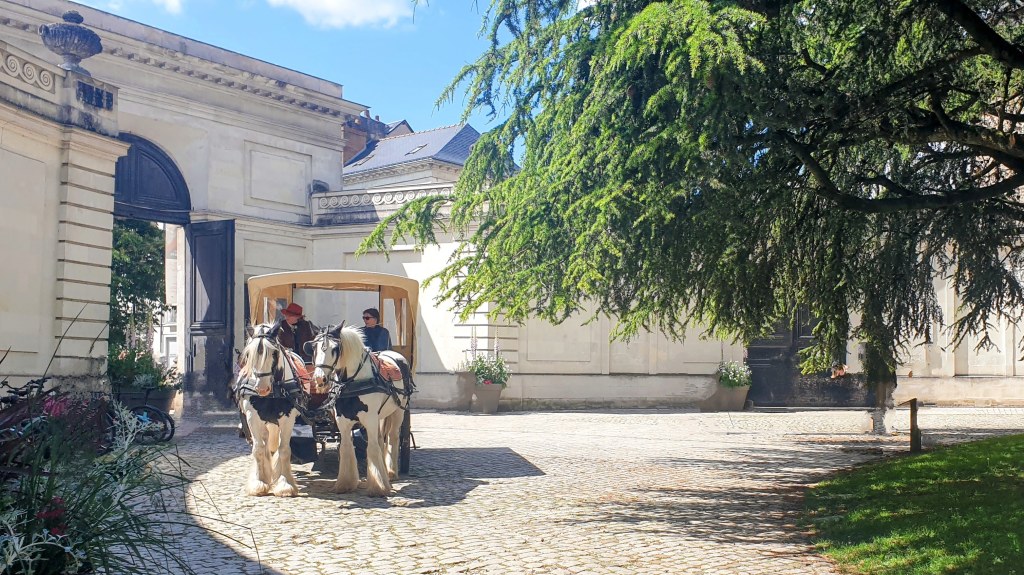
EARLY AND FORCED MARRIAGE
Women and girls entering marriage without choice, forced to live a life of servitude often accompanied by physical violence and with no realistic choice of leaving the marriage.

DESCENT-BASED SLAVERY
The legal ownership of a person by another person or state, including the legal right to buy and sell them as any common object.

Products made by modern day slaves flow into the global supply chain and eventually into our homes leaving most of us unaware of our contribution in supporting it.

From the Slave Museum, Stone Town Zanzibar

A Talk With A Zanzibari Guide

My guide around Stone Town was a young man of mixed Arab and Swahili heritage (his mother is Arabic and his father Swahili) and I think had a unique perspective on Zanzibari culture as a result of living with one foot in two worlds while belonging to neither. When we reached the church at the slave museum, we sat down for a break from all the walking in 33C/UV11 weather and he opened up to me about his life. As with any personal account, I know that it’s his perspective and opinion, and not an objective truth, but I found it to be a fascinating conversation, and I’d like to share some of what he told me.

What he described to me was a life of codependency. I know Americans are extremely independent, and I’ve seen how extended family structures can bind young people in other countries often making them feel like they have no choice in what they study or who they marry. Yet what my guide explained to me of the family networks here, it is not only impossible to survive outside of one, the parents (especially fathers) can be very harsh, and abuse is normal. He shared his opinion that children need to have things explained to them because just hitting them makes them live in fear, so I hope that when he has his own children he will practice this. His parents are less bound by their own families. Both families disapproved of the mixed marriage, so they had to go it more independently. He feels very lucky to not be bound by the familial codependence he sees his peers trapped in.

Women have little freedom. He said most men have 2 wives (though they are allowed up to 4) because the first wife will be who his parents want him to marry, and the second will be who he wants to marry, which seems critically unfair to everyone involved. Women are encouraged to stay at home. Though young girls here are in school, many don’t pursue a degree after high school or have any desire to work outside the home. Parents pressure young women to prepare for marriage and think men will not want a woman who works (or possibly that a woman who earns her own money will put up with less BS from a husband?) My guide told me that many young women watch romantic dramas from around the world and get the impression that marriage will be a better life than getting a job, and are later very disappointed that it’s not true. My guide said hopes to find a wife who wants to work, not because they need more money, but because she wants something for herself.

Men are also trapped into a life decided by others. They must go into the career their fathers choose, marry the woman their parents select, and spend their salary to support their own parents, their wives’ parents, their wives, and their children, meaning a single salary supports up to 7 adults and possibly more than 7 children. Zanzibar is even more economically challenging because people from the mainland come over and do jobs for dirt cheap (140$ a month!). Mainlanders can send home 20$ and it goes a long way to support the family living there, while families that live in Zanzibar need 350$ or more a month just to scrape by. A gift of 100$ from a hardworking son may be seen as a trifle on the island but a fortune on the mainland.

Despite the fact that tourists are paying 100$/night for a hotel room, 100$+/ day on tours and god knows how much on food and trinkets, the average salary for the workers here is around 250-300$/month USD. Where is all this money going? The government takes big cuts in the form of double income taxes (Tanzania and Zanzibar each have taxes that islanders must pay while mainlanders only pay Tanzanian taxes), and licensing fees for anyone who wants to sell, make, display, tour, drive, etc. I saw an actual paddy wagon loaded up with unlicensed street vendors on their way to jail, and my guide said they’ll be right back on the street selling souvenirs as soon as they can. Once the government takes their cut, the owners take the rest, and the owners are mostly foreigners. Several guides throughout my stay told me with bitterness edging their voices about the new development on one of the small islands that was bought up by Indians. Locals never get enough money to invest in property or larger businesses which is a big part of what keeps them trapped in the codependent and often abusive family structures for survival their whole lives.

It reminded me also of a conversation I had with an aid worker who had recently returned from the Congo. The warlords there keep everyone in a state of fear and violence and poverty while reaping the rewards of the mining operations. The mining work gets priority even over subsistence farming, leaving the population without enough food to live on. Many African countries are rich in resources, minerals, fertile land, skilled labor, and yet so often it is mismanaged to benefit only a few while leaving the rest to struggle for less than scraps. There should be enough to go around; the scarcity is artificial. The greed is real.

Final Thoughts in Dakar

As I prepare this post, I am 4 days from leaving Senegal to return to the US. Although I would prefer to end my journey on a high note, I feel that would be disingenuous. Living, working, and traveling in sub-Saharan Africa has been one of the most challenging experience of my life so far, but as such, one that will have a large and lasting impact. In addition to the quality of life challenges, it has been an unending revelation of my own biases and privilege, which is a hard pill to swallow. My friends and family, in a well meaning attempt to offer comfort when I’m so obviously discomforted, have used phrases like “living nightmare” to describe the conditions here while saying they simply can’t imagine how anyone could live this way, and telling me how brave and resilient I am. But. These words are not comforting. I am a guest in a place that may be objectively lower on the international quality of life index (yes that’s a real thing), but millions of people still call it home.

People in Africa are struggling with the legacy of colonial war and exploitation that still colors the culture, language, economy, and even religion today. There is no doubt that centuries of foreign rule and resource theft has left deep wounds and little with which to heal them. However, the human spirit is indominable. The people born into this reality are aware of what they don’t have because one thing they do have is enough TV and internet to see the literal and metaphorical greener grass of the northern hemisphere. Yet, every day, they get up and live.

They collect water from a centralized source when the infrastructure fails. They wash clothes in buckets on the front stoop because washing machines are an expensive luxury. There are orphans begging in the streets who will become adults selling peanuts and candy on the roadside. Families struggle to pay high fees for substandard services offered by corrupt politicians and businesses resulting in unreliable electricity, water, and healthcare in even the most developed and cosmopolitan cities. Schools cram 100 students into a room with 20 desks where they learn without computers or enough books. The government of the most stable democracy in the region violates the human rights of its citizens when they complain too much.

But also. They cook delicious food which they share with friends and family when they celebrate holidays, marriages and births. They create music and art in any available space. They stay out late partying and take naps in the heat of the day. Christians and Muslims exchange gifts of food across faiths on their respective high holy days. People gather at public screenings to cheer wildly for their favorite football (soccer) teams and set up casual matches in any open lot or field. They love their children and help their neighbors. They march and protest for better conditions while carrying their national flags because they have national pride and believe their country is capable of more. They open salons on every street and work out in the evenings along the corniche because they take pride in their appearance and wellbeing. They splash in the ocean and laugh with the sheer joy of it. They bring color to the dry and dusty land with bright fabric prints and billowing swathes of bougainvillea that climb every wall and patio.

It is not a tribute to the bravery or resilience of visitors who temporarily partake in a life which so different from the one we were raised to. It is not a fairy tale of the “noble savage” that lets us imagine some kind of mythical innate goodness and moral superiority of the people who have less, and are making the best of it. It is not a whipping post for white guilt where we come to cry and wring our hands about the horrors of the past in order to feel better when we shop fair trade and have someone tell us how good we are for not being racists. It’s just people. The traumas of life affect everyone: individuals, societies, generations. I want to be able to acknowledge the past and honor the pain of another without turning it into inspiration porn or a hairshirt self-flagellation. What do you see when you look at someone who is living a life that you imagine would break you? What are you living with that might break someone else?

In Wolof, the greeting expression often translated as How are you? is “Nanga def?”, but it literally means Where are you?. In English, we have to answer that question with an adjective of value: fine, ok, great, not good, etc. In Wolof, you answer, “Mangi fi.” I am here. I am here.

Zanzibar South: Menai Bay Bungalows

With just three weeks left in Africa, I realized I hadn’t finished posting about Zanzibar! oops.

For the last leg of my holiday, I wanted to spend a few days at a nice beachfront resort, but I chose to avoid the northern beach area because it’s said to be overdeveloped and overpriced. I found a nice looking place at the southern end of the island that was a little more than I like to spend on a hotel, but I thought it was a reasonable splurge for a resort right on the beach. It just goes to show that photo angles are everything. Sadly, I was fooled once more by stunning ocean photos that only showed high tide, but turned out to be a seaweed covered strand when I arrived a few hours after the low-tide mark.

By my second day at the resort, I came to the conclusion that it wasn’t beach it was a mangrove. The tides on Paje had been a lot, but these were absolutely wild. At high tide, the water came right up to the edge of the hotel property and the steps that would lead to the “beach” led straight into the water. At low tide, the water vanished to the horizon leaving mucky, algae covered wetlands behind. Mangroves are an amazing ecosystem, beautiful in their own way, but it’s not the thing you want to get when you’ve planned for the turquoise blue Indian ocean at your door.

The blissful quiet that greeted me on arrival turned out to be an anomaly, possibly caused by a combination of the heat of the day and low tide. The restaurant played music all day with a very heavy bass like it was trying to be a night club. There was very limited seating around the pool and waterfront, and almost none of it had any shade. In addition, the geography of the bay meant there was almost zero wind, meaning the air was hot, humid, and stagnant.

The fresh ocean breeze had made Stone Town and Paje bearable in the sun and downright pleasant in the shade. The resort didn’t even have fans in the restaurant or public seating areas! All I wanted was to lounge in a chair on the beach and listen to the soothing sounds of waves, but instead I got a burning hot chair in the scorching sun next to a tidal flat and the wannabe club-groove sounds of the empty restaurant.

The resort was very picturesque, but quite off the beaten path. There was nothing around but local homes, I didn’t even see any local shops on the way in where I could buy snacks or water. I had no choice but to eat all my meals in their restaurant or pay the exorbitant fees for local taxis to drive me to a place with other restaurants. I spent the heat of each day in my room. I tried to go for a cooling swim the first afternoon but discovered that the intense sun had warmed the hotel pool to bathwater temperature, so even if I went in using my UV blocking rash guard and parasol, the water was far from refreshing. The ocean was similarly warm, which was nice in the mornings and evenings, but quite unpleasant from about 10am to 6pm.

Despite all these issues, the staff were very kind and attentive, the rooms were clean, they sprayed my room for bugs every evening to make sleeping more comfortable. The restaurant was nothing to write about. I got the impression it was very generic tourist food designed to be palatable to a variety of cultural tastes. It was … palatable. There were cats everywhere! I wish I weren’t so allergic because they were very sweet and social, sometimes to the point of being invasive. They surrounded me at every meal begging for scraps, and one even jumped up on my table to try and get at my food.

There were a lot of local boats just to the right of the resort. I couldn’t find anything there on Google Maps, but obviously a local fishing village. The boats came and went with the tides, and the people spent the evening swimming and enjoying the water. One of the upsides to this remote and isolated resort was it’s lack of tourist marketing. It was the only place I went on the island where locals were just enjoying themselves and not trying to sell, commodify, or perform their culture.

Sunsets are the reason to spend a night in this place. The hours spent watching nature’s light show almost made up for the rest of it. The setting sun made beautiful colors: gold, rose, blue, and lavender. There were scads of little crabs scuttling in the retreating tide and cranes hunting them. The hulls of the fishermen’s dhows became black silhouettes resting in inches of water.

The first video is a time lapse of a single sunset, it’s less than a minute so don’t give up after the sun goes down because there’s more colors coming!

🔊 SOUND ON 🔊 This next video is in real time so as to share the sounds of the sea and wildlife with you.

Souvenir Means “Memory”

As an American/native English speaker, the word “souvenir” has always been associated in my mind with consumerism and with the temporary (and often disrespectful) tourist population. I spent part of my childhood living in Panama City, Florida, which was a huge tourist destination famous for it’s sparkling white sand beaches. Whenever my family would go out to enjoy the seaside, we were beset by sellers of overpriced fake key lime pie and tchotchkes made of seashells (which probably weren’t even from the local beaches). We joked about needing t-shirts that said “I’m not a tourist, I live here.”

I am never going to be the person who buys the shell encrusted picture frame or the novelty coffee mug, but I do like having unique keepsakes of my international homes as well as gifts to bring back for friends and family. For my friends, I’ve been gradually accumulating tidbits made from unique Senegalese materials and ingredients by small local businesses, but for myself I found an ethical, local, environmentally sound silversmithing class which seemed like a perfect way to combine a new experience with a physical representation of my tenure in Senegal.

The Existential Crisis Continues

Before I tell you about my cool souvenir experience, I need to talk some more about the (possibly culture shock induced) ongoing existential crisis that is living face to face with the legacy of the colonial and capitalist systems which benefit some at the expense of many. “Kaine, can you talk about Africa without going on about the ethics of it all? Can’t you just tell us the cool story?”, Nope. At least not yet. I don’t get a break from my brain feeding me moral quandaries, so neither do you. But the cool souvenir experience ties into the ethical discussion, and also I am trying my best to make it more “huh, I never looked at it that way” an less “moral philosophy lecture”, so hang with me.

The Global Supply Chain of Souvenirs

I noticed in Zanzibar that a lot of pan-African tourist goods on offer were not actually Tanzanian, being the same exact tropical island stuff I found in SE Asia complete with “Made in Thailand” tags. Even the more “Africa-centric” items like big 5 safari animal themed goods, and Maasai themed goods were not really helping the local economy since the raw materials and production were almost certainly outsourced, while most of the shops are owned by foreign investors. (the exception seemed to be hand painted artwork, which you can often see the artist create on the street)

It’s harder to tell how much of that is the same here in Senegal because Dakar is so much bigger than Stone Town, but it has been a challenge to find good souvenirs and gifts here that are genuinely unique and local. I’ve found that the majority of markets often only sell staples for living, and that many gift oriented markets offer imported items, while tourist oriented markets offer mass produced “pan-African” souvenirs which may or may not be made in China or by exploited workers in neighboring African countries. (the exception seems to be bespoke clothing and furniture, but these are way outside of my luggage size/budget limits).

Toubab Spaces

I only realized here in Senegal that the French word “souvenir” means memory in English, and I really love it because I am far more interested in a memory than a thing. My collection of physical souvenirs are all attached to stories of the experiences I was on when I got them. I’ve been trying to find memorable experiences in Senegal, to see, learn, touch, taste, listen and do things that help me to understand this place and people, but I have noticed that every time I find myself interested in or excited about a product, place, or event it’s probably actually owned by Toubab (the Wolof word for white people).

For example, I found an artisan chocolate shop which uses local fruits, grains, and spices, then I met the Belgian dude who is the half-owner. The woman who owns the other half is Belgian/Congolese, so at least there’s some Africa in there, but not Senegalese, and most Senegalese people couldn’t afford their chocolates anyway. The bar I go to is run by a French/Lebanese man who is super cool, and very dedicated to Dakar, but a foreigner nonetheless. My favorite restaurants are owned by foreigners (Italian, Mexican, Indian) and not just because I love those foods. I really like Senegalese food, but it’s challenging to eat at their restaurants for practical reasons like language barrier (they may not speak French), portion sizes (Senegalese meals are often cooked for groups to share) and “Senegal time” which means it could take 2 hours from the time you order to the time your food arrives.

It’s almost impossible for me to find products and activities that I want to enjoy which are owned and operated by Senegalese. I love to eat at the Senegalese faculty restaurant on campus because they are patient with my bad French, have single serving plates, and respect the fact that the faculty don’t have 2 hour lunches, but I don’t go there unless I’m already on campus. I suspect that Senegalese own and operate lots of small businesses, like all the corner stores, fruit stands, and small bakeries, as well as hardware stores, dry goods stores, and clothing shops, but with the exception of the occasional corner store run, I don’t shop at those places because I don’t need most of the things they sell other than food. My grocery delivery service specializes in selling from local producers, and it’s nice to be able to support local small businesses, but it’s not a souvenir in either the English or French sense of the word.

Cultural Exchange

When I was preparing to move here, my RELO told me there would be a lot of room for cultural exchange like dance lessons, or learning local music styles, local cooking classes, and so on. I was very excited. I don’t expect people to perform their culture for me, but I have become accustomed to being able to find at least a few people (or a government sponsored program) that want to show and tell, who are overjoyed to find a tourist that takes an interest. In New Zealand, I participated in a Maori tribal tour; in Spain I went on a cookie tour of nunneries; in Ireland I went to a trad music/storytelling night in a local performer’s home; Japanese ladies taught me their summer festival dance, Korean ladies taught me a tea ceremony, one of my Chinese friends taught me how to haggle at the market for the first time ever. In Zanzibar, I got to do a Swahili cooking class with a lovely Tanzanian entrepreneur and enjoyed a tour and history lesson from another local. These experiences are always my favorite parts of a trip, and they are usually not that hard to find.

Here in Dakar, I am better off watching YouTube tutorials if I want to learn how to make attaya or thieboudienne. People seem disappointed that I can’t speak Wolof, but I can’t find a class or really any help (one person sent me a pdf of common Wolof phrases, but no pronunciation guide, so again, better off with YouTube) I didn’t move here just to learn about it from my living room. I learned more Swahili in three weeks by chatting to locals than have learned Wolof in 9 months. I am making music, but it’s with other expats… they aren’t Americans at least, and not native English speakers either which makes it all the funnier that they love playing bluegrass covers of classic American rock songs (no, man, it’s “Tex-Arkana” not ‘Turkish-cana” Texas, not Turkey). I love it, it’s so fun and a wonderful way to feel like I’m part of a community, and although it is cultural exchange of a sort, it’s not with Senegalese, which remains a source of frustration 9/10ths of the way through this adventure.

Aid, Colonialism, or White Savior-ism?

I have been struggling since my arrival with the role of foreign aid in Africa in general and the very difficult to navigate line between aid and neo-colonialism, or help and white-saviorism. I think that while there is no hard and fast rule, the general guidelines are not that different from Maslow’s hierarchy of needs. In my opinion so far, the closer to the bottom (survival) the need is, the fewer qualifiers we should put on giving it. If the man is currently starving, give him a fish. Once he’s well fed, teach him to fish, and so on. As helpers, our long term goal needs to be to help the group achieve self-sufficiency, but we may have to do some things for them on the way.

In addition, because those things cost money in our capitalist hellscape environment, that means we will have to publicize the helping to raise that money. I and every other English Language Fellow write little publicity blurbs every time we do something that improves the lives of locals so that Congress can see where the taxpayer’s money is going. However, we don’t call ourselves out by name, and we focus the story on the achievements of the locals. This is the needle we thread to help just the right amount while learning how to say, “no, we will not do that part for you” and also advertising for funding without exploiting anyone’s suffering for personal gain. Fun fact, Chidi Anagonye, the moral philosopher of The Good Place, was raised in Senegal. I feel like my ongoing moral tummyache honors the writers work.

Green and Pink: The Cool Story

The Pink House (Maison Rose) is run by an older French woman and funded mainly by a French charity organization, but it serves a very real need in the community for women escaping domestic violence and sexual exploitation. They have an embroidery workshop where local Senegalese women are employed at a fair wage to hand embroider designs for (mainly French) fashion houses which are committed to raising the quality of life for women in West Africa. It still sounds slightly like a sweatshop, but I am assured that the women are paid fairly, and that for many if not all of the women who work there, not just the money but also the work itself are a huge part of their recovery and financial independence as survivors.

The Green Wave Jewelry shop has only recently started, but their goal is to provide free 3-month training courses to women from Maison Rose, and to then employ them to make the silver jewelry and “sea plastic” home décor items that they sell. The shop is committed to using natural and recycled materials, so their silver is all recycled, the materials for the molds are washed up from the sea, and they even use ocean trash plastic in a beautiful way (sea plastic, lol). The project is designed to give the women a skill which they can not only parlay into a viable economic opportunity, but also something that can build their self-worth back up.

They told me that although things have been slow going, they are selling enough product to train and hire another round of women this fall, plus they hope to hire one of their trainees as the new workshop manager to run things when they are travelling around Senegal or back to the UK. Finally, the fact that foreign founders don’t put themselves front and center on their social media is a good sign that it’s more about the impact than the image. See, I told you the experience was connected to the ethics. Now, let’s make a cuttlefish ring!

Did You Say “Cuttlefish Ring”?

The silversmithing workshop takes place for 5 hours over two sessions (2.5 x 2), and you get to choose if you want to do the sand technique or something called the “cuttlefish” technique. I looked at examples from the Instagram, and decided the cuttlefish was more my style, but I also was deeply intrigued by why it was named that. I guessed (correctly) that the sand technique was casting in sand, which although I’ve never done personally, I see videos of people making jewelry that way on TikTok and Facebook all the time because the algorithm knows I love watching people craft things in condensed 1-2 minute chunks. I very purposely didn’t investigate this jewelry technique before going because I wanted to be surprised, so everything I’m sharing here, I learned at or after the workshop.

What is a cuttlefish? One of the first questions asked in the workshop was quite reasonable, since although most of us have likely seen these creatures in a nature documentary, we may not know them by name. They are similar to squid, but have a calcium carbonate “bone” (a cuttlebone) that helps them keep their shape and change their buoyancy. When they die, the hard internal structure is left behind and they wash up on shore by the dozens. Cuttlefish have natural predators, but humans enjoy them too for both their high quality ink (that squid ink pasta that looks so pretty in photos?) and for their meat, which is an excellent substitute for calamari. You may have even seen cuttlebone in a pet shop or a parakeet cage before since they are often placed in with the birds to supplement their calcium intake and give them something to gnaw on besides their owners fingers.

Why are we using it to cast metal? The cuttlebone technique may be one of the older metal casting styles around, coming originally from the Mediterranean and traveling upward into Europe. There are examples of belt buckles made in this way in Germany dating back some 1200 years or more, but some antiquarians think the technique could be as much as 5,000 years old.

It’s super easy to carve or press shapes into it, and it’s harder on one side than the other, so the “outside” stays in a solid shape, while the softer “inside” is carved out. But that’s not really it. The way that the layers of calcium carbonate – also called aragonite – form beautiful wave-like patterns in the finished product, not unlike tree-rings. No two are ever alike because it’s an organic process that preserves the life of an organism in precious metal. Neat! The cuttlebone that Green Wave uses is generally that which has washed up on the beaches of Senegal and other neighboring West African countries.

Workshop Session 1

For the casting technique, you need two smaller or one larger (or I guess if you want a Texas sized belt buckle, two larger) cuttlebones. Green Wave had cut ours in half before we arrived. We then learned about the hard and soft side, and how to sand the soft side flat until the two pieces could press together as tightly as possible. That was the basis for our mold. We all sifted through a bowl of rings, mostly made of brass or steel, in order to find the size and style we wanted to use. The model rings were plain and unadorned, just to get the general shape. They told us it’s better to choose a slightly smaller model (foreshadowing) since there will be a later step that files some silver out of the interior. I chose a square ring in a size that would fit well on my index and middle fingers.

With the rings chosen, we learned how to carefully but forcefully press the ring halfway into the newly flattened surface of one of our cuttlebone halves. This is harder than it should be, given how soft the material is. I accidentally broke part of my cuttlebone while pressing in, and thankfully it was a chunk off the larger half towards the top, and we were able to smooth out my initial impression with more sanding and move the placement further down. Unfortunately for me, the narrow end of the cuttlebone is harder and more dense, so instead of a smooth pressing, I had to take the ring out and remove the compressed aragonite dust with a paintbrush like an archaeologist.

Once I got the ring model halfway submerged, I added some ball bearings at two corners (to help align the two sides of the mold) and then gently placed the second half again and pressed some more until the two halves touched and the ring model was completely encased. The dust or powder left behind can also be used to polish jewelry, so doesn’t have to go to waste.

The next step was definitely the most interesting because we took our archeology paintbrushes and went back to the gentle and painstaking work of removing all the powdered remains from the mold. When I first removed my model, the indentation was smooth, and I still hadn’t really realized the link between the cuttlebone and the finished jewelry I’d seen in their shop. Then as I brushed away the compacted dust, the beautiful striations of the cuttlebone began to emerge like layers of sediment in rock. The tiny intricate lines were mesmerizing, and more beautiful than anything I could have thought to carve on my own. The tiny brush was uncovering a lifetime of growth a few grains of powder at a time.

Step 4 was to carve the funnel via which the molten silver would enter the mold. This part was actually the most nerve wracking because we had all spent a painstaking 90 minutes creating the ring mold, and a misstep in the funnel could wreck the whole design. However, our teachers were very patient and kind, encouraging us to take smaller cuts if we felt nervous, and never once made us feel rushed or stressed. The funnel was more technical than I expected since it not only needed to direct the silver into the mold without disrupting the natural cuttlebone pattern, it also had to work with gravity to force the silver all the way to the bottom, and with shape, since silver doesn’t like to flow at sharp angles.

The very last step was to create teeny tiny air vents that would lead from the bottom of the ring mold to the top, once again working with physics. The silver will flow, pushing the air down, meaning the channels have to start at the bottom, but air prefers to go up, so channels that run down or to the side may invite the heavier molten metal, leaving air bubbles in the ring. These final tiny tunnels are made by gently smoothing away a groove that aligns with the existing grooves of the cuttlebone pattern, then arcing it upward once it’s a few mm away from the ring impression. Then end result looks a little like a daddy longlegs spider got smooshed in your cuttlebone. After a final brushing to get any lingering loose powder out, we put our two halves together, assuring perfect alignment with the ball bearings, then taping them together tightly with masking tape.

The Molten Silver

It was a little disappointing to realize I would not be pouring the molten silver myself, but it’s probably for the best. Considering how long it takes to master the act of carefully pouring anything into a tiny space without spilling, the addition of molten to the equation means bulky gloves, long tongs, and heavy protective clothing, not to mention huge liability. Would I have liked to pour it myself? Yes, but I’m also happy knowing that one of the Senegalese trainees will be doing the pouring on my behalf. Also, since it takes a long time to heat the silver to 1000+ degrees Celsius, and then also cool off enough to go in the cooling bath, the employees do this part between the two workshop sessions. They were, however, kind enough to take some unique video and photos of my ring during the process.

I was surprised at how small the workspace actually is. The smelter which heats the silver is no bigger than a Keurig, then they have a small crockpot to keep the food grade acid that is used to cool and clean the silver, and a cake pan full of dirt that holds the mold in place and provides a safe splash zone. They make the pour look so easy, but I am assured it is something which requires a lot of practice not only not to make a molten silver mess, but to make sure no air bubbles mar the finished product.

When the mold comes apart, you can see the scorched cuttlebone and all the excess silver. The large chunk on top is the funnel and gets sawed off (though part of me could not help but think that it might be fun to deliberately make a funnel that could stay as a chunky decoration). The wispy lines are the air vents, which are so thin and delicate, they can be broken off by hand. By the time we all returned for our second and final workshop, the rings had been cooled & sawed, and were ready for the finishing touches.

Workshop Session 2

Disclaimer, I took far fewer photos in the second workshop because it was a lot more intensive and focused work. During the the first workshop I had a lot of breaks and down time where it was easy to grab my phone for some photos, but during the second, my hands were busy busy busy.

The very first thing I noticed was the insane amount of texture that my ring had captured from the cuttlebone. One of the reasons I chose a square ring was that I liked the side pattern more than the top/bottom pattern and I wanted to maximize the texture variety of the finished product.

Next, we learned the 4 stages of the jewelry finishing process: 1) brass brushing, 2) coarse filing, 3) fine filing, 4) polishing. The brass brushing is a way to remove any other bits that stuck to the ring during the molding process or acid bath. It’s the most aggressive scrub brush you could imagine, and it’s very important to keep the ring wet while brushing. It can be done on and off during both the filing stages, but has to be finished before the polishing. I thought my ring was fairly bright silver compared to the others in the pile, but a little brass brush scrub revealed even shinier metal.

The filing is both physically grueling and mentally satisfying. We start off working on the area where the funnel was cut off since it’s the largest. For people with round rings, this was a smaller area, and involved making the cut blend smoothly into the rest of the ring. For me and the other person with a square ring it meant filing one entire side completely smooth. I toyed with the idea of doing just the part that the funnel had attached to, but it didn’t look as good as the examples they showed us of the fully smoothed side. They showed us two methods for filing, one using a wooden brace attached to the table, and the other using your own foot (a more traditional method that probably works better if you have calluses).

Once we had the funnel edge smoothed, we then worked the interior. Again, at first, I thought I might like to leave some texture on the inside, but as I worked the sharp edges down, and slid the ring on to test size and comfort, I realized that the flatter interior was more comfortable. So, in addition to smoothing one whole exterior edge, I did the interior as well.

They had advised us to choose rings which were slightly small for the mold making process since filing would give it extra size, but mine was still a bit snug once the interior was smooth flat, so they offered to put it on the ring stretcher. This when the its-not-a-disaster-its-a-bonus-lesson accident happened. My ring cracked. I didn’t know silver could crack! I knew that things which were forged or joined with solder might crack due to flaws in the material or process where two different things connected, but I thought poured silver would be like poured concrete and just — be all one piece? But something to do with the physics of the liquid metal means that sometimes the spot at the funnel where the two sides of the pour meet can be a bit weak.

In the end, it’s best that the ring showed this flaw before I left the shop because they had all the tools on hand to fix it. I got to watch as she broke out two types of solder and a mini blow torch. I’ve seen and even used (a long time ago) solder for electronics, but no one cares if electronics are pretty, so I associate solder with lumpy grey metal. This silver solder is a copper silver alloy that matches the ring and even with a hairline crack, the heat causes the solder to sort of suck up into the flaw, like a straw, aka capillary action. So when the temperature gets into the goldilocks zone, you can see the lump almost vanish. A cooling acid bath and a little filing, and there’s no sign of the repair.

The fine filing is done with a series of smaller files to work on any tiny edges which might be left from the air vents or an inexact alignment of the two halves of cuttlebone. It’s almost entirely invisible unless you are looking with a zoom lens or magnifier, but taking the very tiny square or sharp edges and making them rounded and smooth has a big impact on the comfort while wearing and keeps the ring from snagging on skin or clothing.

Last but not least is a polishing process that engages 4-6 types of sandpaper at ever increasing fineness from 240 to 3000, ending with a silver polishing cloth. The end result is that your filed areas have a mirror shine, and your textured areas are free of poking-out bits.

I’m happy with my finished product as both a piece of jewelry and a memory. It’s a unique souvenir of my time in Dakar which encapsulates many aspects of my experiences here: the chronic quest for cultural exchange, the inescapability of toubab spaces, the long road to understanding my ethical role in aid-centered activities outside my own country, and my struggle to find meaningful projects. Plus, it’s pretty.

Zanzibar: The Indian Ocean

The Indian Ocean off the coast of Zanzibar is of a deep, brilliant blue that one suspects has been altered in brochure photographs, but is in fact that blue (not every beach every day, but often enough that you are likely to see it at least a few times on a visit). Lounging at a beachfront restaurant while enjoying the sea breeze and insane blueness of it all, is among the top 10 activities recommended to tourists on the island. Snorkeling, diving, surfing, and kitesurfing are also all on offer. I looked into each one, and discovered that three of the four activities were multi-hundred dollar investments (since I am not PADI certified and do not yet have any kind of surfing experience at all). Snorkeling it is, then. Given my lack of planning for this trip, my wishlist simply contained the keyword “snorkeling” and something called “Safari Blue”.

On my first day in town, I happened to spot a PADI certified dive shop that also advertised snorkeling which put me in mind of the trip I’d taken in Bohol where the snorkelers and divers shared a boat. One Ocean Diving is the only PADI certified center in Stone Town and they have a few other boat trips on offer as well. The day I wanted to go was too close for online booking, so I simply walked in and booked an excursion in person.

Safari Blue is on every list of what to do in Zanzibar. Although there is a company by that name, the tour simply refers to the route: a boat trip that departs from Fumba and incorporates the south-western region off the coast with mangrove swimming, snorkeling, a sandbar, (maybe dolphins), and a seafood lunch. I searched online for a good way to take this famous trip without the necessity of being crammed in with heaps of tourists and finally landed on an Airbnb experience with decent ratings.

This is the tale of two sea trips which could not be less alike and still be on the same island.

Safari Blue

When I saw a version listed on Airbnb Experiences, I was excited because I thought I might get a unique local twist on this tourism staple. I was so wrong. The “host” was a tour operator who simply arranged the driver and booked the boat tour for me and the other unsuspecting suckers who thought they were getting a personal experience. It’s normal to join a group on an Airbnb excursion. I recall my Grenada hot springs experience fondly where my hostess drove a group of travelers out to a spring in the mountains and served us a picnic. The whole point of the Airbnb experience is to meet other travelers while a local shows you around in a unique way. This was like booking an Airbnb and discovering it was actually the Best Western all along. It’s not that I wouldn’t stay in a Best Western, I just want to know that’s what I’m signing up for.

Though I would have been happy to meet at the fort, the “host” said the driver would meet me at my hotel and walk me over to the parking lot (Stone Town doesn’t let cars in), which resulted in the driver getting lost, because Stone Town is a maze, and being more than 20 minutes late. There were two other tourists along, which initially, I was pleased about since I had done my previous Zanzibar Airbnb experiences solo. The driver explained he would hand us off to the boat operators at the docks. There we discovered we were joining a group of 6 more on a dhow operated by what seemed to be a very large and well logo’d tour company called Johari.

The boat workers were in a big hurry to get going, and I’m not sure if we were actually late or if it was just the timing of the tides that day, but for the first time in Africa, I felt rushed. We had to get swim fins at the dock and two of the people in my excursion also had to use the tiny brick building to change. This is the location from which all Safari Blue boats leave regardless of which company actually owns one, so it was crowded and busy even in the off season. Once on the boat, we sailed out for a while under scorching sun and finally arrived at the “blue lagoon”. The tour companies definitely put their absolute best photos online for you to view, but what no one tells you about Zanzibar is the way the tides can make or break your experience. Tides don’t happen at the same time every day, but they are predictable. As I learned when visiting the hot spring beaches in New Zealand, tide charts are easy to access online. If you want the brochure photo experience, it’s important to visit Zanzibar at a time of year when the tides are in your favor.

The blue lagoon is advertised as being a refreshing swim in the crystal blue waters of a mangrove pool. Due to the tide being out, it was more like the beige lagoon, and the dhow wasn’t able to get close in the shallow water. We took a smaller motor boat closer to the lagoon entrance where we could see the rocks and mangrove roots laid bare. I imagine it is beautiful at high tide with the lagoon is full to the brim with turquoise blue water, and this was definitely an interesting artistic landscape, but all of us were hot and sweaty and now we were being told we couldn’t even swim, but would get just a few moments for photos before moving on. 

By the time we got back to the dhow, they had put the sail away and erected a shade canopy which was most welcome, even if it meant we would be motoring the rest of the way. They also served a plethora of delicious fresh fruit including young coconut, watermelon, mango, red banana, passion fruit, grapefruit, and the biggest pineapple I have ever seen. Truly nothing compares to eating tropical fruit in the land where it was grown. (or at least the neighboring island).

When we arrived at the snorkeling spot, they handed out life vests, masks and snorkels. I was the only one to pass on the life vest partially because I’m a strong swimmer, but mostly because I am a flotation device. I struggled getting settled in the water, which is no surprise since it has been 4+ years since my last snorkel trip. The strap on my first mask broke. The replacement had a leak that meant I had to surface to drain the water every couple of minutes, and by the time I got the third mask, I was loosing my enthusiasm for the experience. There were a decent number of fish in the water, small tropical standard breeds, but no less beautiful for being common (I like dandelions too). The coral, however, was in a sad state. The cloudy water made it difficult to tell at first. With all the other tour boats in the area running motors and dozens of tourists splashing around, the water was not particularly clear. It was also only partly sunny, which is normally my preferred level of sunny, but clouds cut down on underwater visibility.
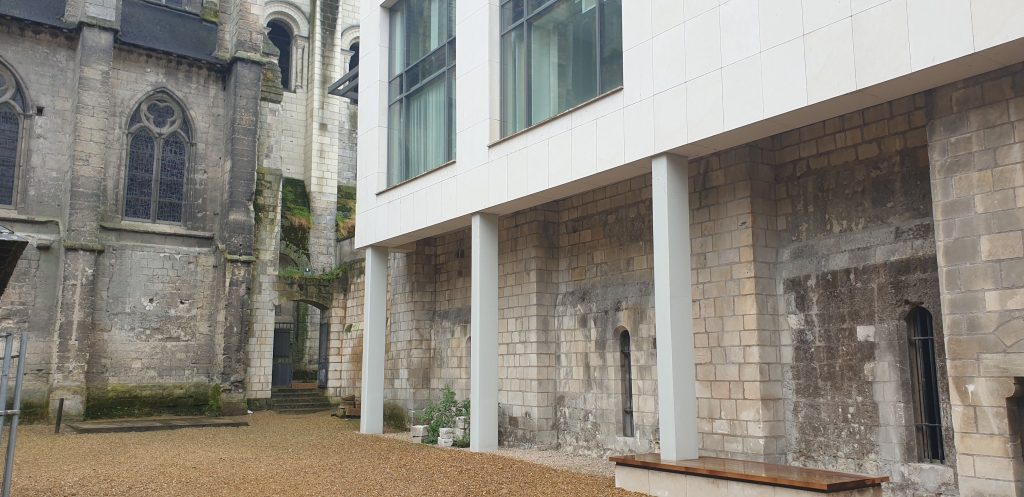
When I got the mask situation sorted and was able to swim around the corals with better control and direction, it was really clear that they were close to 70% bleached. The vast majority of the coral was the dead, lunar surface texture and color of coral which no longer hosts any life. I got the impression that the industry relies on the fact that most of the snorkelers who take this tour are amateurs and don’t know what living healthy reefs look like, because many of the other people in my boat were totally thrilled with the view. Only one other traveler who was just as much of a globe trotter as me agreed, though she said it was still better than the condition of the reefs she’d seen in Egypt. Since my first reef exposure was on a private beach in Jeddah, I may be spoiled. I have seen a healthy reef in full bloom and although there were fish and an anemone or two, the biodiversity was scarce and the coral itself was in bad shape. I left the water early because it was just sad to look at.

I had been under the impression there would be two snorkel stops, but they claimed our gear as we re-boarded and said we were heading to the Kwale sand bar. There are several sandbars around Zanzibar which are visible only at low tide, and get swallowed up as the tide comes in. I think tidal events are cool, but a sandbar at low tide is a kind of goopy beach. When we arrived, the sand bar actually connected to the more stable small island of Kwale to the south, reminding me of the Jindo sea parting I went to in Korea where the land bridge becomes walkable only once a year at the lowest of low tide. I love the ocean, I was happy to be swimming in that gorgeous blue, I just… don’t understand the point of taking the boat all the way over to a piece of sand that doesn’t actually look that different from other pieces of sand. At least in Koh Lipe, the island we stopped at was totally unique being made of ocean polished rocks.

The sand bar was also a parking lot of dozens of dhows taking all the other tourists on the exact same trip. Quite possibly hundreds of white tourist bodies on this little strip of sand made me think of Lilo taking photos of the tourists in Hawaii. I walked across the sand bar just for the experience, and then I sat in the sea contemplating my life choices and being rather sad about the chunks of dead coral mired in the silt and the dead starfish a group of Russian tourists were taking turns posing with behind me. Then we were bundled back into the boat and taken to the Kwale Island, which again because of low tide was a long walk through a bizarre post apocalyptic moonscape under the blazing sun trying not to trip on rocks, slip on algae, or step on sea urchins left exposed by the retreating ocean. 

The wild thing about this is that I also love tidal pools. I adore going to the coast at low tide and looking at the life revealed there. I have done this up and down the west coast of the US. One of my very first blog posts was about Thor’s Well where we admired the natural phenomenon of the low tide creating the illusion of a hole in the ocean. It’s not “low tide” that I dislike, but the contrast of expectations and reality being miles apart. The photos of these places are high-medium high tide and there’s just zero warning about how insanely different it is at low tide. With the high tide, you get the beautiful crystal blue water coming right up to the sparkling sandy beach. At low tide, you get a sort of salty swamp with slippery and pointy bits that no one’s water shoes are really prepared to walk through. We were not there to admire the sea-life or the interestingly shaped rocks, however, and were once more rushed along since we had so much farther to walk at low tide than those who visit at high tide, and the tour guides were anxious to get us to the destination so they could have their break.

When we reached the small tourist village that nestled above the tide line, we continued on past shops and covered seating areas. I thought perhaps each boat had a designated spot where they took their passengers to avoid confusion, but as we passed the last picnic area and continued into the forested interior, I began to suspect something else was going on. This trek into the brush eventually led to a giant baobab tree fallen on it’s side and still growing. There was a short presentation about the baobab, a taste of baobab candy in an attempt to sell some, and then back we trooped to the eating area. The guide was impatient with those who wanted to take photos after the presentation (you know when the guides weren’t in the way anymore). Then we had a very plain but generous seafood buffet. The entire experience was a study in mismanaged expectations.

After lunch we motored directly back to Fumba, the day was over after three largely disappointing stops and a lunch that was in no way superior to the seafood available on the main island. I lost a flip flop, my sunglasses broke, and somehow also my phone case (which was empty in the waterproof bag because my phone itself was it its waterproof case) also cracked. I spent 20$ to replace the sunglasses and shoes, which is probably about what I’d pay at a Walgreens, but it just felt like an extra cost on top of an already overpriced (100$ USD!) and underwhelming experience. 

I think if I’d known what I was getting into it could have been enjoyable. I know that if I hadn’t had a far superior snorkel and island tour at Koh Lipe for ¼ the cost I would not have been so let down. Tourist trap experiences aren’t bad in and of themselves, but once you have done them a few (dozen) times, the novelty wears thin. I’m tired of seeing the same junk in every shop – some of it was literally the same junk I saw in Thailand, Malaysia, and the Philippines (complete with made in Thailand tags!) I’m tired of hordes of tourists crowding the same beach or swimming hole because it was at one time photographed as a paradise and has become entrenched as the go to spot, the name of the destination meaning more than it’s faded commercialized beauty. I thought that Airbnb would be a different take on the standard tour, not merely a different gateway to it. After all, there are a lot of small reefs, islands and sandbars in the area that could easily be reached by boat. Live and learn. 

One Ocean Dive

The next day a very different and much more enjoyable experience. To start with, One Ocean Dive asks people to show up to the shop early enough to leave time for a cup of coffee, picking out equipment, and getting dressed, so I never felt rushed. The cost of the excursion was less than half that of the Safari Blue and guaranteed 2 snorkel spots while skipping the mucky low tide islands and sand bars. The equipment on offer even to me as a snorkeler was immensely superior quality, and in addition to fins, mask and snorkel, they offer each swimmer a springsuit wetsuit (stops above elbows and knees) to help prevent sunburn.

They also request swimmers to only use reef friendly sunscreen. The chemicals in regular sunscreen kill reef life, and it’s probably one of the reasons why the coral I had seen the day before was in such sorry shape. I declined the wetsuit because I have a rather full coverage swimsuit and my own UV blocking rash guard that fully covers my top when closed, a necessary purchase after the last snorkeling induced sunburn, but it was a thoughtful touch since many tourists arrive in skimpy swimsuits which are entirely inadequate protection from the African sun. (sidenote: I was not spared the sunburn despite all my precautions, but the suit would not have covered the area I was burned on, the lower back of my calves, so I guess the next time I go to a tropical paradise, I’ll be bringing swim pants in addition to my long sleeved rash guard)

We had a bit of a walk along the beach to get to the boat. Although initially annoying, I realized this was in our favor since we were leaving the hordes of tourists behind. There were three of us on the boat, myself and another snorkeler, an older gentleman from Germany, and one scuba diver, a younger American man who was deep into the action-adventure life, but not a jerk about it, which was refreshing. We traded stories of our adventures as the boat motored out to the first dive site and I was even able to recommend a hike to him (Goldmeyer, if you’re curious) since his next trip would be Seattle, my home stomping grounds. The water was picture blue, and when we arrived at our first dive site off Bawe Island, we were the only boat in sight.

One of the guides stayed with the boat, one went with the diver, and one came with us snorkelers. He carried a bright orange life ring which made him easy to find and provided an emergency rest stop should a swimmer get tired, cramped or otherwise need a break. We were not in easy swimming distance of land, but I could still see the thin strip of sand and trees on the horizon. The guide led us to the reef and my heart swelled with the waves to see that here the reefs were bright, diverse, and alive! I had feared so much that the damaged reef at Kwale was indicative that climate change and tourism had destroyed enough of the environment that half-dead reefs would be the normal experience in Zanzibar, but this area proved that the impact of tourism (chemicals from motors and sunscreen as well as the churning of water, litter and other human contributions) was the main culprit since just a few miles away the reefs were healthy and thriving.

I struggled a bit with the waves, as we were far enough from land that we weren’t sheltered. What may seem like a gentle swell from the boat can easily roll right over the top of your snorkel if you’re not paying attention because you are gawping in awe at the scenes of natural nautical beauty beneath and around you. I also struggled more with the camera. My previous snorkel excursions had all been in fairly shallow, calm waters. Even in Bohol where we had a strong current, it wasn’t something you felt until you tried to swim against it. In those places, I was able to simply relax and let my natural buoyancy keep me close enough to the surface to breathe while admiring the view. This meant that navigating the stubborn button pushing and touchscreen touchiness of my underwater phone case was the only thing I had to concentrate on. Now, however, I had to kick my fins almost constantly just to stay in place (necessary for taking photos) and I was trying to time my breaths to the waves above so that I didn’t accidentally inhale at the same time a wave was cresting over my snorkel.

I took turns wrestling with the camera and just enjoying the experience because we need both to be mindfully present in the moment and to preserve memories for our future selves. When you view the photos of this day, bear in mind this was taken on my 4+ year old phone in a 10$ waterproof “case” that was basically a plastic bag with an industrial watertight seal. I do not have anything like a high quality underwater rig, but I still really enjoy being able to capture a few random moments of these magical underwater gardens. I thought 45 minutes might be too much given the paucity of life in my earlier swim, but this reef was so expansive and diverse that I was still engrossed with the guide caught my attention and said it was time to head back to the boat.

On the way to the second site, we had a generous snack of samosas, pastries, and fruits. It wasn’t a “meal” in the traditional sense, but it was delicious and plentiful, and allowed us to refuel without diverting away from the focus or getting too full to swim in open water safely. We talked about the life we’d seen below, and I got only slightly jealous of the diver since he’d spotted an eel, but I was thrilled with the variety of sea life, color, and shapes that my own swim contained and I finally felt like I’d found what I had been promised on this island paradise.

The second site was even further from land, the water was a deep dark blue, and the waves even higher. The site wasn’t just a reef, it was a sunken ship which had been overgrown with corals and other sea life. Despite the depth of the water around us, the boat itself was on a raised part of the sea floor, which made it easy to dive to. I wondered at first if the water was simply clear enough that the boat looked closer to the surface than it was, but when I saw the scuba divers below me it provided excellent scale. The ship is the Great Northern which was a British cable laying ship that sank in 1902. If you’re a boat enthusiast, you can see more about it here. Only a small part of the boat remains after extensive salvage operations, but it was absolutely enchanting to see the outlines of the hull and the mast rising from the sea floor towards me at the surface, colonized by it’s own coral and school of fish.
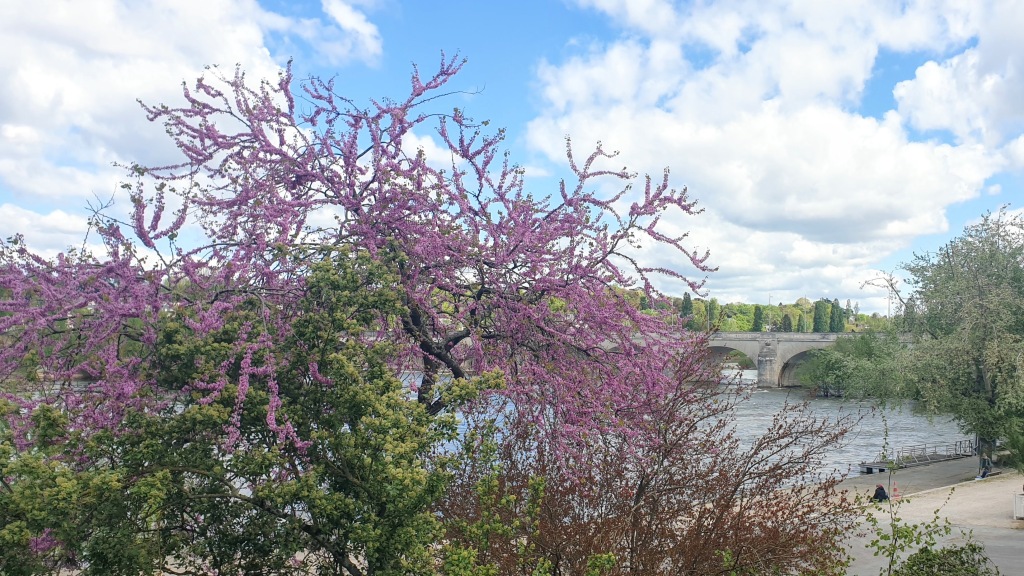
Despite the physical difficulty of the swim, my spirits were not dimmed by mouthfuls of seawater that came down my snorkel whenever an especially high swell coincided with my attention being diverted by the beauty around me. I saw more species than I know the names of including several giant clams and a small school of squid bobbing along near the surface reminiscent of the ones I had cooked on my spice farm tour.

After many years of not being able to travel due to COVID, and having such a terrible experience landing in Dakar and being unable to rekindle my joy of travel, adventure, and new places, I was genuinely starting to fear that I had lost it. That I had become too soft, too indoorsy, too sedate, or worst of all, too old to continue the kind of adventures which I felt I had only just begun to have in the few years before the pandemic took it all away. My experience with Safari Blue had made me even more uncertain — maybe I had become jaded? Was comparing each new place to a better place from my past adventures stopping me from enjoying what was in front of me the way the other tourists certainly appeared to be?

I emerged from the Indian Ocean that day, breathless, sunburnt, and missing my eyebrow ring, sacrificed to the secure grip of the mask and the pressure applied by the waves. I emerged all these and yet grinning ear to ear. My sense of wonder and my ability to ignore discomfort in the pursuit of adventure were intact! My spirit was not broken by isolation, stagnation, or even terrible heat. I radiated a gratitude that buoyed me for the rest of my stay in Zanzibar and refused to fade even as the sunburn became one of the most epic of my life. The blue of the Indian Ocean is the blue I’ve been dying my hair for the last 6 years without knowing. It is the blue that feeds my soul.

Back in West Africa

Since returning to Senegal, I have not been able to parlay this sense of adventure to Dakar or even it’s neighboring region. Before Zanzibar, I was truly worried that the pandemic had taken my joy and adventure away, but knowing that wasn’t the case, I started trying to understand what it was about Dakar that was keeping me from finding it. Some is definitely a result of the infrastructure and culture. Zanzibar was safe to walk in even after dark with cameras all around and locals who had a strong interest in maintaining that safety because tourism is such a huge part of the economy. Dakar remains a place I can only walk at night if I’m in a group and we are walking a short distance on well lit streets. The beach in Zanzibar is full of restaurants, cafes, boats, and walking areas all of which are within walking distance of the hotels. If I want to go to the beach in Dakar I need to take a taxi; I will stand out as a lone foreigner, and should I walk along the corniche, I’ll be walking next to one of the largest arterial roads of the city, which almost cancels out the joy of walking near the ocean. Zanzibar wants people to explore, so there is a a fleet of tourist taxis made of identical and easy to spot Japanese minivans and yes it’s more expensive for one than for a group to split the fare, but it’s easy and not outrageously costly. Whereas I cannot for the life of me find a safe and affordable option to go on my own from Dakar to Pink Lake or Saly.

But more than the differences between the two places, I also thought about the difference between living in a place and traveling to a place. I spent two of my three weeks in Zanzibar just being a tourist. I let myself sit in the hotel AC watching Netflix when I needed a rest from the relentless heat and trinket sellers, but my focus was on having a good experience in the short term. In Dakar, my focus is on a comfortable life in a longer term which means making sure my home is safe and relaxing, making sure I can do my job without going crazy (both are still a moving target 6 months in), and making friends or at least people I am happy to see on a regular basis. These are all the things we do in daily life which are so different from what we do when we are on holiday. Those things take so much of my time and energy in Dakar that I have none leftover to be a tourist here.

I have emerged from the deep dark depths of “rejection” culture shock that I wrote about here a few months ago. I’m slowly learning to enjoy things here, but I’m more likely to play video games in my apartment or go to the local expat bar to see my new friends than I am to go out looking for some “Dakar” experience. A part of me feels like I’m wasting this opportunity, but another part is speaking softly that maybe I can’t be a tourist if I don’t have a home. Dakar cannot be my home, however much I’m adjusting to it’s idiosyncrasies and cultural differences. Korea had become my home while I wasn’t looking by dint of time and familiarity. I could go out and do touristy things while living there and feel confident that there was a comfortable and safe “home” to go back to. For the last 4-5 years, when I said I was going home, I meant my apartment in Korea, not my friend’s houses in Seattle where I stay when I’m visiting. Perhaps a few years in Dakar would make it feel like home, too, but I’m not going to be around long enough to find out. Most of the people participating in this fellowship around the world have a home to go back to, but I left my Korea home for good and I will be moving to a new situation at the end of my 10 months. I’m in home limbo.

I have 4 months left here, and I think that the best thing for me now is to stop trying to “make the most ” of Dakar and find some stillness where I can listen to what I am thinking, feeling, and experiencing by being in this place which is so far from my comfort zone that I cannot hit it with an ICMB. However much I desperately wanted my time here to be all the adventure which was denied to me for 3 years by the pandemic, the reality is different. I found my sense of adventure again in the blue of the Indian Ocean, and that will have to be enough for now.