In October of 2007 I was invited to visit a small village near the university where I was teaching. This remains on of the most unique experiences I’ve had while living and traveling abroad. I was able to see parts of China that foreigners simply don’t visit. I was welcomed into their homes, and allowed not only to observe their way of life, but live it myself for a couple of days. I don’t where Queen is right now, and I don’t even know the name of her hometown, but I hope that she and they are doing well and can understand the impact they had on my life as an early traveler.
Oct 26, 2007 at 3:36pm
This weekend (Oct. 19-21) I went to a small farming village at the invitation of one of my students. Her English name is Queen. She is a sophomore (second year at university). She is 20 years old, and she is one of only 4 people in her generation from her village to go to college. She is also the first person in her family to pursue higher education. Her older brother didn’t even go to high school, and is now the only veterinarian for the whole area. Her family farm grows mainly corn which brings in about 1000$ USD per year. Her family grows its own vegetables and fruits in their yards, things like potatoes, turnips, cabbage, apples, pears, grapes and a kind of date called a jujube, mostly foods that can be stored, dried, pickled etc. There is only one store in the village to buy other goods, and most people simply eat what they produce or buy from each other what they need. They also have their own goats for milk and chickens for eggs, and one of her grandmothers even has bees for honey (they sent me home with coke bottle full).

The Plumbing
The village does not have indoor plumbing, and while this may seem entertaining in an outhouse kind of way, they also don’t have running water indoors. There is a spigot in the yard that only works for one hour a day, since the government is restricting the water in the name of conservation. The northeast of China is very dry. So her family has to collect all the water they will use for the day during that hour. They collect it in a large basin and several buckets, and if they run out there is no way to get more. This means any cooking, washing or drinking they want to do requires them to get a measured amount of water from the daily store to use, heat it over a wood stove (more on that later), use for whatever purpose and then carry it out (no drains in the house either) to dump in the yard (don’t waste water that can help the crops).
In the summer they have a building in the yard they can take showers in (see picture below, its the building next to the doghouse), but since there is no way to heat the water for the shower, they don’t take showers in the winter, but rather heat up some water and use a basin to wash their hands, face and feet. There is a hotel in the village (apparently owned by one of her cousins, it specializes in offering city folk a real rural experience: Dude Ranch Chinese style), and every so often they go there to use the hot water showers in the winter, but it’s a special occasion.

The lack of indoor plumbing extends to toilets as well, in the northwest corner of the yard (the least auspicious area in accordance with feng shui, I kid you not, and so the best place for a toilet). The building is brick (left), and the toilet is a rectangular hole in the ground (right), no porcelain here, that drains into a hole beside the building where the waste is collected for use as fertilizer. We stayed in two different houses the two nights I was there, and the first (her mother’s) had a nice clean toilet area, which I have a picture of, and the second (one of her grandmother’s) was pretty gross, covered in fecal matter and obviously not regularly cleaned (I have spared the world this image and have no photos of it).


The Electricity
There is some, but like the water it is limited. There is power for the lights, and they have TVs, satellite dishes, DVD players etc that they can run. Some of them also have a few electric cooking devices, like a rice cooker or hot plate. However, there are no stoves and no electric heating. The houses have large glass windows that collect and focus sunlight during the winter. People live on the sunny side of the house in the winter and move to the shady side in the summer, so the houses are built in mirror images. The main beds are made of brick. They run from one wall to the other and basically act as a horizontal chimney carrying heat from the wood stove to the real chimney in the outer wall. The bed stays very warm this way, and the whole family gathers in this room in the evening to eat dinner, watch TV, play cards etc where its warm. I was given this room to sleep in as the honored guest, and the family all slept together in another room. The stoves are fire, the fuel is whatever they can find, sticks and twigs from the orchard trees, dried chaff and stalks from the corn or other crops, etc.
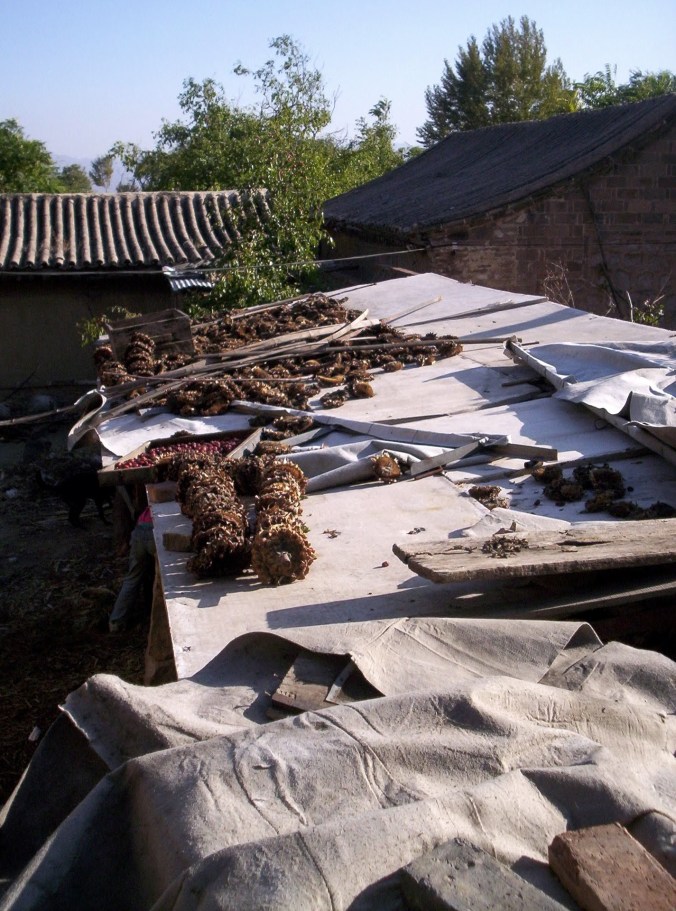
The climate in the northeast of China is very dry and very cold. It’s not the Gobi desert or anything, but it is very dry. The natural vegetation and the rock formations are very similar to the scrub-lands of southwest America, but its not as warm. If you could take a small rural town from the poorest part of Mississippi or Louisiana and move it out of the wetlands into the arid high plateaus of Arizona you might have an idea of what this place was like.
The Journey
We left Yanjiao about 1030 am. We took the 930 bus to the main terminal at Dawanglu, which is in the southeast corner of Beijing, out around the 3rd ring road¹. This is my normal route into Beijing and it takes about 40 minutes. We picked up some breakfast there, something a little like an egg mcmuffin, but fried. Then we got on the subway to go to Jishuitan, which is on the northwest corner of the second line (also the second ring road). This took about 30 minutes. Then we walked over to the bus station, passing one of the many old city gates, and got on the 919 to go to Yan Qiao. The mountains are apparently called the Yan Mountains, so many of the small towns start with “Yan”.

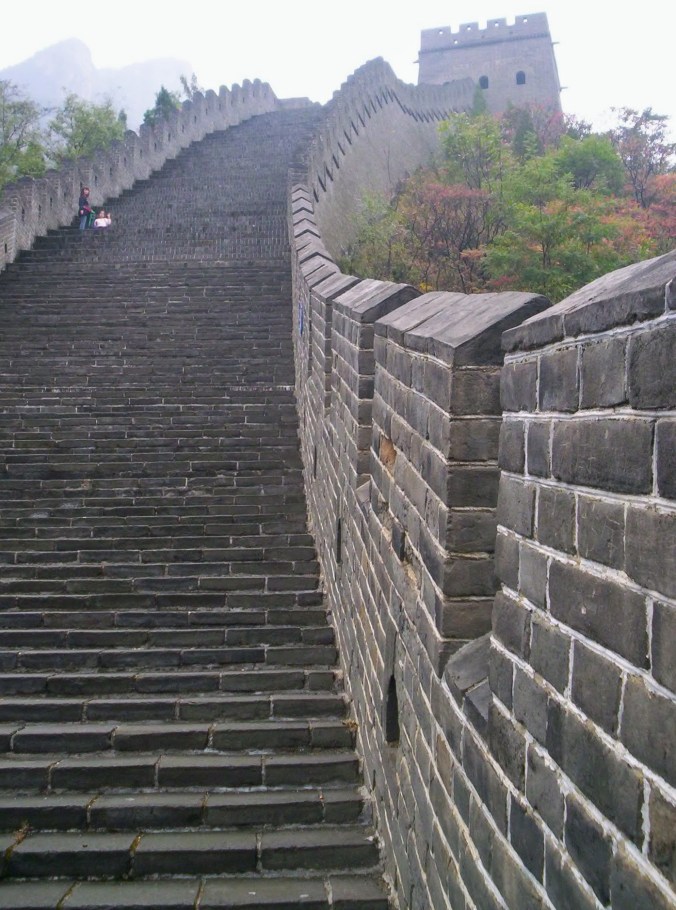
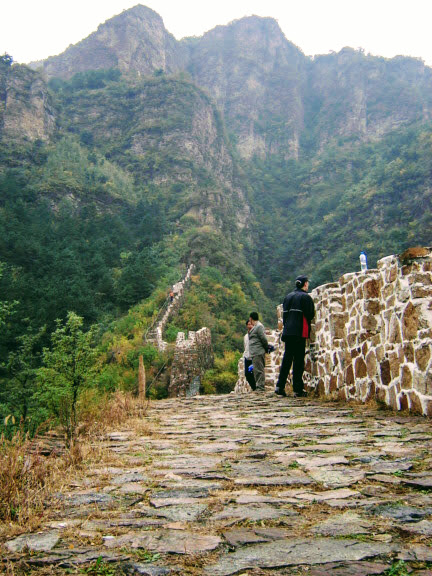
We passed by many sites of the Great Wall, including Badaling, which is the most famous, and we paused for a brief rest stop and I think to change drivers, and I took some more photos of the wall.

After about an hour and a half we arrived at the town, we took a little ride around the town square and went to the park.
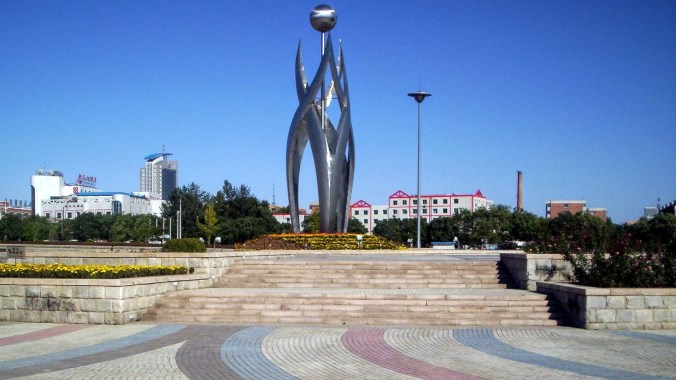
Then we flagged down a private cab (a guy with a van who doesn’t work for any taxi company) and my student negotiated a price for him to drive us to her village. The driver initially offered to take us for 13 Yuan, but later changed his mind, charging us only 3 and telling Queen to “take good care of the foreigner”. It took us about another 20-30 minutes to get to her village gate. As long as we remained in the Beijing zone, the roads were good, but as soon as we crossed the border into Hebei province, the roads became a mess of potholes and bad roadwork.
¹Beijing is an autonomous zone, a city without a province, like Washington D.C. is a city without a state. The city is zoned by the “ring roads“, which are just what they sound like. I only knew 5 at the time, apparently there are 7 now. It basically tells you how far from the city center you are.
Queen’s Family Home
We were dropped off at the gate and walked from there to her mother’s home. The streets within the village were more like dirt alleys, filled with rubble and trash. The homes were fairly old, most having an outer wall, a large yard used as a vegetable garden and a reasonably large home, which often housed 3 generations.

Queen was very eager to show off the brick bed I described earlier, which was in the main bedroom.

There were bright posters in many rooms which I was told are renewed at the spring festival and symbolize good fortune and fertility. I also took a look at the kitchens (both) to see the wood stoves that fed heat into the beds.

Her mother was quite gracious. I was offered grapes and jujubes (the fruit not the candy, it’s a little like a date, but drier) from their garden as well as tea to drink. After a while, Queen wanted to wander over to her Grandmother’s house (for the sake of argument, since I honestly lost track of relatives, we’l just call this one Grandmother 1). It was a short walk, during which I was stared at by everyone we passed. Her grandmother, grandfather, aunt and uncle greeted us and I was plied with apples and haw fruit from their garden. Haw is a small red fruit with soft tart flesh; you might be able to find some candy or tea of that flavor in an Asian import store.
The people in Queen’s village don’t speak “putonghua” the common standard Mandarin Chinese, but rather a local dialect that I couldn’t understand at all. However, she’s a good student and was able to act as a translator for her family and me.
After a visit there, we headed back to her mother’s, stopping at the general store on the way back to pick up some snacks and packaged meat (kind of like Spam, but not in a can). Her mother prepared a nice dinner for us. We had sweet potato and rice porridge, a dish of potatoes and turnips, some candied almonds, and some mild pickled peppers her grandmother had sent back with us. Everything we ate except the meat was grown in her family’s gardens. Oh, and there was fresh goat’s milk from the goats in the back yard as well as a kind of strong clear alcohol that her mother soaked fruit in to make a tasty drink. I swear I ate until I was stuffed and her mother complained that I didn’t eat anything!

Two of her young cousins came over after dinner and we all sat on the brick bed chatting and watching TV. Queen made her cousins speak slowly in putonghua to see if I could translate for myself. This seemed to amuse them for a while. I saw a beautiful show on TV of a troupe of dancers, all deaf and mute, doing a tribute to Guan Yin. They lined up behind one another and made elaborate patterns with their arms to imitate the multi armed statues of the goddess.
When it was time for bed, they set me up with plenty of blankets, made sure I had food and water in case I got hungry or thirsty in the middle of the night, and left a bucket so I wouldn’t have to brave the freezing outdoors to get to the outhouse.
Despite the bitter cold outside, the bed stayed warm, if terribly hard. I slept fairly well, though I woke up a little stiff. Breakfast was more fresh goats milk, some steamed eggs (which by the way had green shells, a nice pale sea-foam green, which I can only attribute to the breed of chicken, since I know the eggs were fresh since the chickens were also in the backyard)…anyway, this means I ate green eggs and spam for breakfast, I told Queen about Dr. Seuss and recited what I could remember of the poem which she seemed very interested in. There was also a nice pickled cabbage dish, almonds leftover from dinner and possibly some other things, it kind of blurs together.

Local Schools
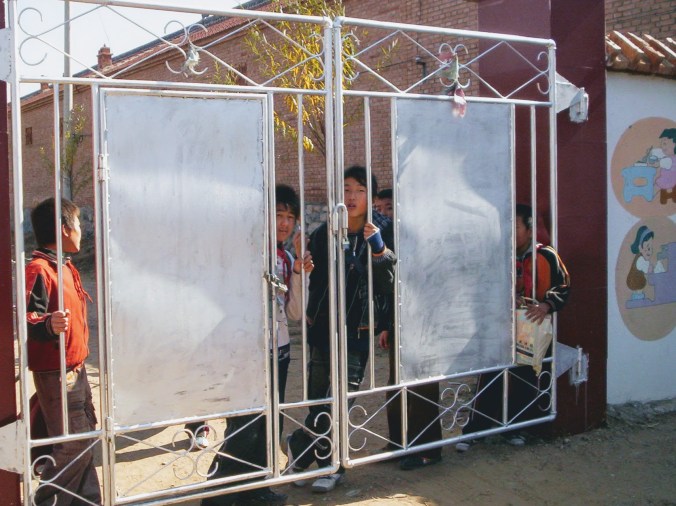
After breakfast we took a walk to the local schools. Queen told me that very few of the students finish middle school. The classes are too crowded and all the good teachers have left for better jobs. Many of the boys wander the streets during the day rather than going to school. Their parents don’t want them to get outside jobs at that age, but don’t make them go to class. When they grow up they will be manual laborers, working in the fields or building roads, earning only a few hundred Yuan a month.

The children in the school were excited to see me, I may not have mentioned, but I was the first foreigner to ever visit this village. Queen herself was bursting with pride to be walking beside me and translating for me. The head of the kindergarten wanted to take pictures of me in his school, I hesitate to imagine that soon there will be pictures of me proudly displayed there, although I did nothing more than walk through it.
It was so strange to see all those bright and curious faces and know that most of them would never leave the 50 mile radius of their increasingly poor and dry county; would never see the world; would never even finish a basic education, and that for many of them, the few minutes that I was in their school was the only time they might ever see someone from another country not on TV.
We returned to her mother’s house where an uncle picked us up in his truck to drive us to grandmother 2’s house a ways away. I will continue the story in another post, since there’s a character limit here. Tune in next time for the continuation of the Village Excusion!
Oct 26, 2007 at 3:57pm
When we left off, an uncle picked us up in his truck to drive us to grandmother 2’s house a ways away. I do believe that the truck had no shocks at all, the roads were bumpy beyond belief, and sometimes there wasn’t a road, at least not what we would call one. There were certainly no traffic laws, and people simply drove wherever they could.

This turned out to be quite a distance. On the way we drove past an interstate under construction, where I was informed that the government had taken up farmland to build a highway for the Olympics. We also passed a large metal statue of a hand holding a wine bottle, seemingly in triumph, a tribute to the wine of the region, which I have still never tried.
The Other Grandparents
Grandmother 2 lived in an older and less orderly village. The amenities were a good deal dirtier. The number of times I silently thanked my mother for teaching me how to be a gracious guest were countless. The yard was sort of a garden, and of course there were goats, fruit trees and even some beehives, well boxes of bees anyway.

We walked around the village a bit, saw the main streets and the aqueduct which also doubles as a washing machine.
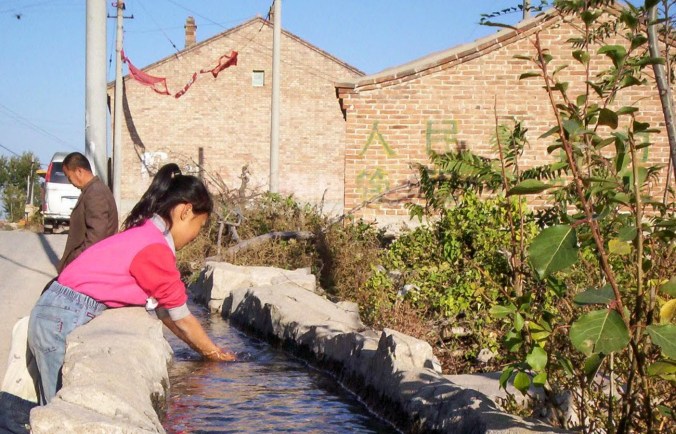
Then her cousin came to pick us up and take us to some of the “sights”. There was a stage that the Beijing (Peiking) Opera apparently performs on during the spring festival.

Is That a Town or a Film Set?
We went next to an old ruined village near the lake that has become a popular site for film directors. Apparently about half the ruin is authentic and the other half has been built over time by various film crews. I walked over a very rickety bridge, and was reassured that in the film, soldiers had run over it, but given what I know about film, this is not actually reassuring.

Hostessing: Chinese Grandmother Style
We returned to her grandmother 2’s house, and the family picked up a chicken to serve with dinner, another nod to the guest of honor, as meat does not usually feature in their diet very much. A small swarm of relatives joined us, and I was ushered in to eat, at first alone, but I expressed they should join me; Queen said they were too shy to, but got them in anyway. They were also constantly pressing food on me, since both before and after dinner they made sure there were always snacks of fruit and bread nearby, and at dinner they constantly urged me to eat more.
They were also constantly worried I was too cold. They were amazed that I could use chopsticks. They were worried that Queen wouldn’t think of things I might need. They were generally very kind if somewhat fussy hosts.
After dinner, we gathered again on the brick bed, the kids worked on homework, I got a chance to look at some of their books. A few more people came and went, including her brother. As I became sleepy, they decided to evacuate to let me sleep. Queen told me that her family thought it might be rude to leave me to sleep alone, since the custom there is for the family to sleep together for warmth, but thankfully she was able to assure them that I would not be offended.
Again, they made sure I had food, tea, blankets and a bucket before leaving, and I headed into a fitful night’s sleep, punctuated by a nocturnal goat and a lonely puppy. I had no idea up until this point that goats were the least bit nocturnal, nor was I aware that any animal not in some kind of serious distress could make noise that constantly for that long.
A Sunday Morning Stroll
I gave up on sleeping around 7am, got dressed and found a corner of the garden to brush my teeth in (remember, no sinks), had a cup of tea and headed out for a pre-breakfast stroll thru the village. On the way we passed a sign, which I was told was put there by the government to entreat people not to follow Falun Gong, and those of you who have talked to me at all in the last 3 years know that this has been a bit of an interest of mine¹, so I was unable to resist the temptation to engage in conversation when I discovered that all the tales I had read of Chinese propaganda were true.

They were told that FLG followers committed suicide and killed people. She was angry that the US wouldn’t turn over Li Hongzhi (the leader) to the Chinese government, and simply seemed to have a block on the idea that the facts might have been distorted. I tried to explain the concept of independent studies, and that thus far the Chinese had not allowed us to conduct one. I told her that FLG practitioners in other countries were peaceful (if a little noisy), and she was amazed there were practitioners in other countries, which just goes to highlight the lack of information available, since in America, one only has to do a google search to find thousands of mentions in the news².
She also told me that prior to the ban, her mother had been a member, though they had renounced it when the government turned against it. All in all, it was illuminating. It took me a long time to convince her that I didn’t like or agree with Li or FLG, but that I respected their right to believe as they wanted. She argued that China had plenty of religious choices; I said 5 is not plenty. She said more religions cause more conflict, I said, no, pluralism decreases violence. It was interesting.
Anywho. There was a lovely breakfast, egg fried rice, more veggies and a kind of spicy mutton stew. Afterward we set out to climb the small mountain behind the house. There was a ladder going partway up the wall in the back, from which you could reach the road at the base of the mountain, and I was much mocked for not wanting to climb the wall, steep and without secure footing as it was, so we walked around.
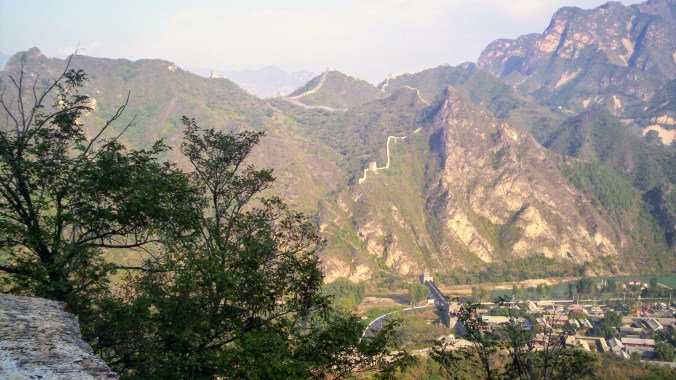
The mountain had some goat trails, but for the main part, we picked our way upwards thru steep shifting gravel and spiky scrub plants. The view from the top, however, was expansive. It’s hard to tell from the photos, but you could make out the main mountain range, the lake and the railroad. Queen told me that when she was a little girl she could often see the Great Wall on those mountains clearly, but the pollution has now become such that you can only occasionally see the mountains at all.

¹When this was written, I had only just finished my MA and my thesis was on the Falun Gong. The upshot is that any of my friends who held still for more than a minute over the last 18 months had been regaled with my research findings. Short version: it’s a cult based in Qi Gong practice (like Tai Chi) started in China in the 90’s, first embraced by the government, but banned in ’99. The leader lives in New York and directs his followers from there. Most people around the world who practice it are only aware of the exercise aspect, not too many people read far enough to get to the aliens with bone noses, the demons who want our bodies, and the leader’s determined efforts to take down the Communist government of China. It’s a major controversy in China. Followers are imprisoned, allegedly tortured and possibly even used as unwilling organ donors for transplant tourism. It’s a mess. You can start with Wikipedia, but the rabbit hole is deep.
²Still. I just looked and there are news articles as recent as a few days old. It looks like the controversy is still on.
Getting Back
Her cousin came back to get us, and drove us to a place where we could catch a ride back to the bus stop. This ride included driving on the still under construction highway, battling non-paved roads and trying to get around construction crews. We stuffed into a van with 8 other people and wended our way on the back roads to avoid the traffic jam caused by the fact that due to some visiting dignitaries in Beijing, trucks were not allowed into the city (makes a motorcade block seem like nothing).
The rest of the trip back was uneventful. I would like to add, however, that throughout the whole weekend, Queen and I had a number of very deep discussions on the differences between China and America. I not only learned a great deal, as she was pleased to tell me the history and conditions of the many places and people we saw, but I was deeply impressed with her mind. It was obvious that even though she had been taught how to feel about certain things by the message of the party, that did not stop her from thinking about other things once they were presented to her.
*(please take a moment to go and look at the photo album, as this is an environment most people will never see in person or even in a National Geographic. My photos may not be travel magazine quality, but this village is off the map, and only seems only to be known to the families who live there. I store my albums on Facebook because the free storage space is limited on WordPress.)
Reflections *(2007)
All in all, the trip had a profound affect on me. What I saw, what I learned, there is nothing to compare with it in all my other experiences and I hope I will never forget it. I know its impossible to relay the depth of the experience, there is nothing you can read or even see in a photograph that compares to being there, but I hope that in some way this sharing of my experience has impacted some of you as well.
That I am living in a country where less than 100 miles from a city that rivals New York there is such amazing poverty, devastatingly poor education and tragically low standards of living is so mind blowing I still don’t think I get it, and this wasn’t anywhere NEAR the poorest part of China. And yet, despite these conditions, the people are kind to foreigners, proud of their achievements and their nation, and hopeful for the future of their children and it was able to produce this girl I met, who is brilliant and motivated. And not only does this girl have the desire and ability to go to college, to get a master’s degree and even to study overseas, her greatest ambition is not to flee to a big city and a high salary job, but to return to her village after all that and help the next generation to produce more people like her.
There is so much I could not include here, and already its 6 pages long, so I’m stopping, but I’ll be putting up the pen pal lists soon, and all I can say is that I encourage you to meet one of these students, not just to enrich their lives, but to enrich your own, because they are amazing.
Reflections 2017
It was and still is one of the best experiences. It opened my eyes to things going on not only in China, but around the world and in my own country too. It’s so easy for people in the cities (or in moderately well-off rural areas) to forget that millions or even billions of people on Earth still live in these conditions or worse. I have seen people around the world struggling to make a living, struggling to get an education, struggling to make a better life for the generation after them. And yet, most of those people have been the kindest and most generous.
As much as I love gaping at the wonders of nature, or history, or even of the modern world, nothing in my travels can ever compare to the simple experience of sharing time with another person, whether it is an hour, a day, or a year. I never want to give up seeking out the wonders of the world, but I never want to forget that one of those wonders is human beings themselves.








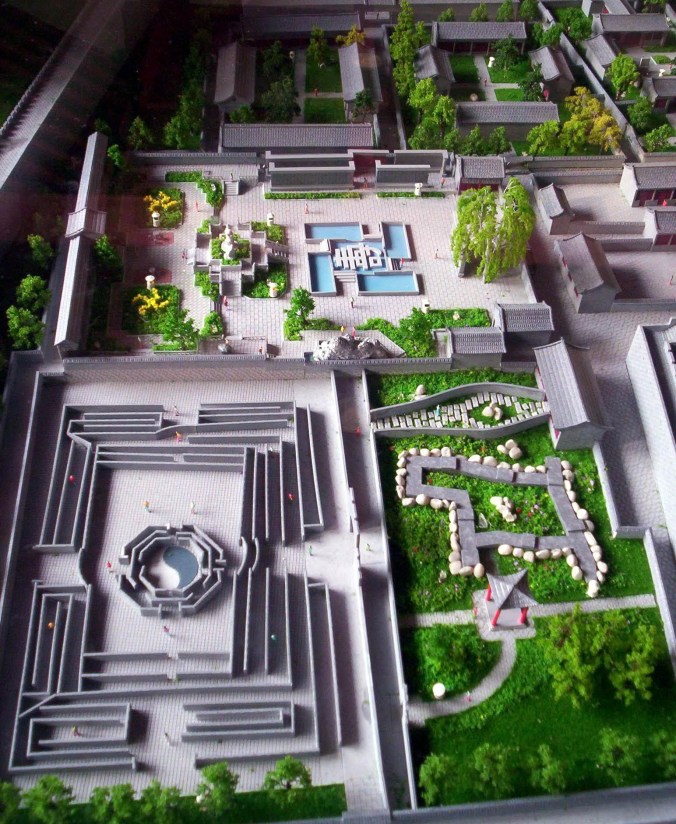 Lastly is the Longevity Garden, which you can see in the second layout model above. It has a nice waterfall, and a reflecting pool in the shape of what may appear to be a swastika, but it really a sacred symbol of Buddhism. And while I’ve seen this figure in a statue before, I’m still not sure who it is, other than it seems to be someone important in Buddhist history.


 Gallivantrix