I am falling right behind on my goal of 1 blog post a week. In a desperate effort to get moving, I went and found the most complete draft on file, also the only one I wrote AFTER vacation instead of quick notes on a bus this summer. Maybe there’s a reason Dostoevsky and Tolstoy wrote such long novels. I was also inspired toward verbosity by my brief visit to mother Russia and I have had to split up the story into 2 parts. In part one: explore the bureaucracy of communism, the truth behind the soviet stereotypes, and an encounter at the Metropol Hotel.
Airports Are Ugly
I have flown through the Moscow SVO airport before. It’s not especially exciting, but their primary state run airline is dirt cheap so I find myself having layovers lasting on average 3-4 hours there. This time I had a 20 hour layover on the return flight. I can’t imagine many airports I would willingly spend 20 hours inside. As Douglas Adams once famously wrote, “There is a reason why no language on earth has ever produced the phrase ‘as pretty as an airport’.” Since the first time I read this I have had the singular experience to be in some of the best and worst airports in the world, and I can say with certainty that the Moscow International Airport is not a place to linger.
There are few places you can sleep inside the airport, like hourly rental sleeping pods, or even the airport’s very own hotel (the one Snowden hid out in). I looked into these and discovered that the prices are almost as much as the plane tickets. Even if you’re willing to camp out on the crowded and uncomfortable airport seats, there is no way to get WiFi unless you have a Russian phone number, so be prepared to be both uncomfortable and bored. In order to take advantage of any less expensive hotel (or WiFi) option, you have leave the airport, but unless you are from a very narrow list of close Russian allied countries, you can’t leave the airport without a visa. And you can’t get a visa at the door, you have to apply for and pay for that visa well in advance of your arrival.
You Need a Visa To Get In
Tourist visas to Russia require a letter of invitation. These are usually arranged by tour guides which seems like a giant scam, but that’s a whole other rant. Transit visas can bypass the letter requirement if you have proof of your ongoing flight. The transit visa can be used for up to 3 days if you’re flying and 10 if you are travelling by train.
Thus, my trip to Moscow actually started in June with the Russian Consulate in Busan, South Korea. Since they weren’t open on my day off, I got up very early in the morning on a Friday and bused into Busan to file my paperwork. I was able to fill out and download the application online and print it at my office, however the application took several hours to fill out because in addition to all the normal information, they wanted the exact dates of all my international travel for the last 10 years. They also wanted complete information on all my secondary education, and on my parents, and to know if I had any education whatsoever about nuclear weapons (I do!). I felt like I was filling out a background check for the CIA.
I nervously handed over the painstakingly researched application form and paid the 100$ fee, hoping that nothing would disqualify me from going and returned to my home to wait a week for the results. I shouldn’t have been worried. Communism loves bureaucracy and to make people jump the hoops and I have become an expert form filler. A week later I made the trek back to the consulate and my passport was returned to me with a shiny new 1 day visa inside. I booked a hostel and an airport shuttle and more or less forgot about it for 2 months.
Midnight Arrival
When I landed in Moscow, it was just after midnight and amid a flood of Chinese tourists, but it didn’t actually take all that long to go through customs and immigration. Since I was technically on a layover with a connecting flight, I had checked one bag through and was only carrying my day pack and a basic change of clothes with me. My visa was scrutinized intensely. This guy busted out a jeweler’s lens to stare at it in minute detail. Eventually, finding nothing wrong, they allowed me to pass out of the international terminal and onto Russian soil.
There is an oddity about the Moscow airport in that the WiFi requires you to give a phone number where they will send you a code to log on. It’s “free WiFi” but you can’t access it if you don’t have a Russian phone number. It’s frustrated me every time I’ve flown through, and I’ve never been able to get it to work. Really, it’s free if you’re Russian, but it’s a taunting WiFi dream to international travelers. Knowing this, while still in Norway, I had downloaded the offline version of the Moscow map in Google maps (which is a lie), and the Russian language on Google translate (which I never actually used) as well as information about my hostel, just in case.
I got some money changed to Rubles, and I found my driver. If my flight had landed during the day, I might have tried out the public transit, but at midnight thirty I was happy to see a man holding a sign with my name on it and ready to take me directly to the hostel, even if the ride did cost more than the room. It was a long and empty ride through Moscow. I’m not sure if it was just the late hour but the roads were empty. And they were huge! City roads, with business and sidewalks, not like highways, just roads that were 10 lanes across, 5 lanes in each direction. I stared at them wondering how people crossed the roads on foot and even more if these behemoths aided in the flow of traffic. Do enough people in Moscow own cars for this to be actually useful or is it just for show?
Hostile Hostel?
Checking into the hostel was another long rigmarole of paperwork: fill this out, sign this, make a copy of my passport and visa, etc. I chose a cheapish hostel thinking since I only was going to get maybe 6 hours of sleep, I didn’t need much but I also carefully selected one that was highly rated with plenty of good reviews and a location that would make it easy to get to Red Square in the morning.
One day… the lesson is going to stick. When travelling in less affluent countries: spend the money on a private room! The hostel bed was around 10$ and a private room would have been about 30$. It’s a big difference and at the time I was thinking about every little penny because I wanted to keep my budget down and Moscow was already costing me 100$ just for stepping out of the airport. I had spent a single night in Paris in a dorm and slept pretty well, but that was Paris.

The hostel itself did not live up to my expectations based on ratings and photos. Looking back I can see those are real photos, but they were clearly taken when the interiors were brand new or at least recently deep cleaned. In reality the place was much more dark, dank, cramped and dirty than the photos represent. Even by the light of day. Now, I’m not saying it was a shithole… it did meet my minimum standards of clean and the staff were very polite in a cold sort of way, but I did not rest well.
Like many hostels in Europe, I was expected to make my own bed. The staff do not consider it their responsibility to put sheets on the bed, nor to remove them. I struggled with this as it was almost 1am and I had a top bunk and everyone else was asleep, so I couldn’t turn on the light. Also, the bedroom door seemed to have no lock at all. The bathrooms were very tiny and when you’re sharing a single bathroom with all the other women in a large hostel, that’s a challenge. One of my roomies snored so loudly that it made my bed actually vibrate. I could feel her snores. I put in earplugs, headphones, and squashed pillows, blankets and towels around my ears to no avail. When I got up to get dressed, there was no place private to do so.
The hostel included WiFi, which did work well, yay, and a free “breakfast”. In the morning I discovered this meant a choice of two sugar cereals, luke-warm milk, watery coffee, and packets of what I really think were yogurt powder. I couldn’t read the Russian labels and I didn’t try to eat it, but they were packets filled with what felt like a powder with pictures of bowls of yogurt and fruit on the front. And somehow this breakfast is rated 7.7 on Booking.com. In fairness, that is the lowest internal rating and every other criteria is rated 8.4 or higher. I don’t know what your life has to be like for this to be a 7.7/10 breakfast, but I never want to live it.

Just, please, if you see me talking about booking a hostel dorm in a developing country or a current/previous communist country STOP ME. I’m not trying to be a snob, but sleeping properly is so important to my well-being and my ability to enjoy waking activities and I just can’t sleep properly in those conditions. I envy the people who can.
Metro Mishaps
Despite these setbacks and the severe lack of sleep, I was still determined to make the most of my day in Moscow. I had a detailed and timed itinerary that I hoped would allow me to see everything I wanted to before it was time to go back to the airport. The first thing I discovered is that the Google Map of Moscow isn’t great, and the offline function doesn’t really do anything. Here’s a pretty building I found while searching for the metro.
 It took me ages to find the Metro station that was meant to be a 5 minute walk from my hostel in part because Google, and in other part because the Metro stations in Moscow don’t have any helpful signs with pictures or symbols to identify them. Maybe they say the name of the station on the outside, but I was looking for a big “M” or an icon of a subway train which has been a constant in every other metro system I’ve used. This is actually the logo for the Moscow metro and it was not on any of the buildings or any signs nearby.
When I finally realized that the big square beige building was the metro station, I had walked past it at least 7 times because I thought it was a government building like a post office or police station. It was much easier every other time because at least they all look the same. Of course I didn’t take a picture at the time, and now looking at stock photos of the building I see that it clearly has a big red M on top and a sign out front, so I can’t explain why it eluded me so. I blame sleep deprivation.
Once I found the entrance, I was happy to learn that the metro system itself is actually very easy to use, and cheap too. Rather than go through the hassle of buying a ticket for every trip, I just bought a 24hr pass for about 3$ US. That’s a whole day pass for less than the cost of a single trip in most EU countries, by the way, and goes a long way to explaining the powdered yogurt situation.
On top of its ease of use and affordability, the Moscow metro is famous for it’s unique and beautiful (on the inside) metro stations . At some point in the soviet era, it was a gift to the people to make each public transit station a work of public art. No one could visit them all in one day, but I tried to get some pictures inside the ones I did use. They are very very Soviet, but amazing works of art nonetheless.
Red Square Obscured
When I emerged from the station at Red Square I was instantly lost. I had expected the world’s largest public square to be visible from the metro station that shared it’s name, silly me. I adopted the time honored method of picking a direction and watching where my GPS dot went on the map. The first landmarks I ran across were actually the Metropol Hotel and the Statue of Marx. I recognized them from my plans as places I had intended to go later in the day, but it did help orient me to find Red Square and St. Basil’s Cathedral which was the top of my list for the day.
 Sadly, I still don’t know what Red Square looks like, since there were about a million white tents set up and a large area blocked off and converted into a stadium for an upcoming festival. I walked slowly and perused the kiosks selling a narrow but colorful array of Russian souvenirs. I didn’t stop to buy, however because it looked mostly mass produced.
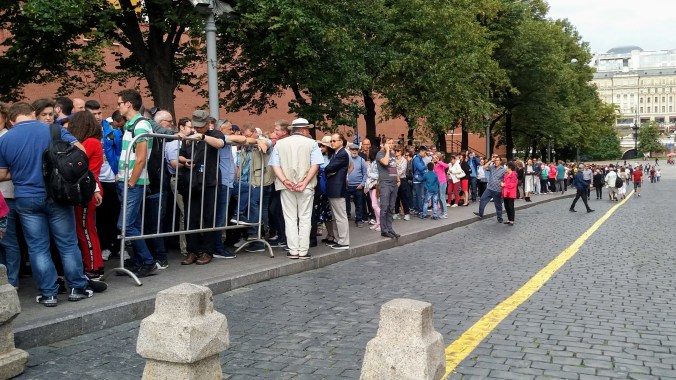
I also walked past the line to Lenin’s tomb, where he is preserved and laid out in a rather grotesque honorarium. Entrance to the monument is free, but there is no way to reserve an entry time, so people queue for hours for a chance to gawk at the dead body. I told myself it would be interesting if the line was short enough, but by the time I arrived around 10am, it was already all the way down the block and didn’t seem to be moving very fast.
Tourist Stuff
St. Basil’s did not disappoint. It was crowded as heck, but it is a fun building. Everyone has seen at least one picture of the iconic colorful onion turrets and it was definitely a treat to see it in person. I wandered around trying to find the best angle for a photo, but since large swaths of the surrounding area were blocked off for the upcoming festival, it was a little challenging.
 It’s possible to go inside for a fee, but online reviews all agreed that the cool part is on the outside. Bonus, there was a marching band practicing in the temporary stadium field nearby, so I got to watch a little bit of counter-marching through the fence and experience some serious cognitive dissonance as they played the 1812 Overture (for non-Americans, that’s because it’s a staple of our own Independence Day celebrations).

Checking the clock, I realized it was time to head over to the gardens and try to find the entrance to the Kremlin. Only, because the entire breadth of Red Square was fenced off with a giant temporary stadium and lots of souvenir booths, I couldn’t follow my pre-planned route and Google maps was turning out to be f*ing useless. Once more I adopted the “pick a direction and walk” method, which resulted in me walking nearly all the way around the Kremlin, which is not a small building. In the middle of my walk, the sky went from a bit overcast to “wrath of Neptune”.
I always have my travel umbrella but it would not have withstood the torrential downpour that issued forth from the skies. Lucky me, at that precise moment, I happened to be passing under the only cover for several blocks in either direction, a bit of scaffolding along one corner of the Kremlin’s outer wall. Even standing under the scaffold with my back to the wall, I could feel the spray from the force of the rain around me. I sat there as other pedestrians scurried to the shelter and wondered if my plans to explore outdoors would be totally rained out, and what I could possibly do instead with no working internet. But before I could even really start to work it out, the rain slowed to a drizzle and I felt confident in resuming my walk armed with my little umbrella.
When I did reach the entrance, I found another huge line for the people who already had tickets, and I continued on through the gardens in search of the ticket office.
What’s With All These Lines?
I know there is a stereotype about lines in Russia. Or at least there was when I grew up in the cold war in America. We were told about how people had to just stand in long lines for hours to get bread, or sometimes not even knowing what was being passed out at the head of the line or if there would still be any by the time you got to the front of the line. They were communism horror stories told to show us how terrible the USSR was and how great America and capitalism were by contrast. I know it was propaganda, but I’m not sure it was untrue. I had already seen the huge line for Lenin’s tomb, but I knew that was a free event, and no way to buy tickets in advance.
Looking at the line to buy tickets to stand in the line to get in at the Kremiln was just insane. I freely admit that I ignored my note to myself in my calendar to book those tickets online in advance. Everything else in Europe I booked before I even left Korea, but Russia only takes reservations for the Kremlin 2 weeks in advance. While I was in Sweden. I made a note to do it, and I saw the note, and I ignored the note. My own fault. However, looking at the lines, I am not sure I would have made it through the “advance ticket line” even with enough time to really see anything.
I am a bit sad I didn’t get to see the Kremlin and especially the museum with the historical art and artifacts of pre-communist Russia. However, if I do make it back to Moscow, I will dedicate a whole day to the Kremiln alone, knowing what I know now.

Fun With Costumes
Instead of sulking about it, I decided to move on and see what other fun things I could find. I was not disappointed. Shortly past the ticket office, the scenery livens up and I found some more public gardens, statues, fountains, and a quite charming pair of street entertainers dressed up in “historical” costumes and posing with tourists for tips. They made me smile and so I probably gave them more money than I should have, even though it was less than they asked for.
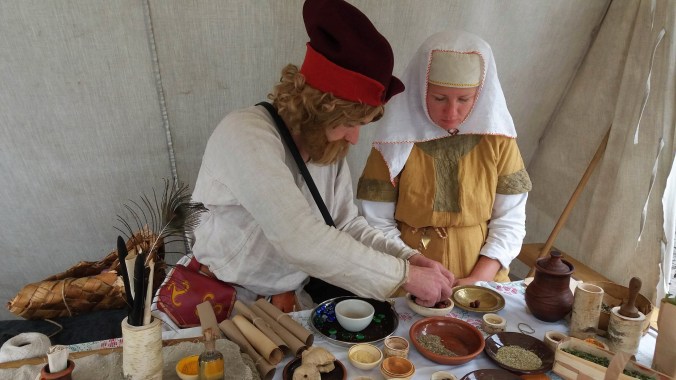
Continuing on I managed to find a slightly more accurate historical costume depiction where it seemed like a professional group was showing off the history of Russia and perhaps it’s trade partners with booths showing different herbs and spices, old astronomical tools and charts, paints and dyes, and other medieval type crafts and pursuits. It was all in Russian, though, so I wasn’t able to glean much from the informative talks the costumed historians were giving to the other folks in the park.
Thwarted at Every Turn
After a quick gander at the statue of Karl Marx and the Bolshoi ballet because I was standing right there,


I headed up to the Metropol Hotel to see what I could find in the way of a fancy lunch. I had found a few places on line that seemed to indicate there was a high tea available, and while the website of the hotel still had it displayed in some places, the actual “high tea” page was not working. Still, I had seen the restaurant menu and knew it would be ok even if I just had lunch.

The very first thing I saw was a bunch of construction and a sign saying the restaurant was CLOSED for repairs and upgrades. My optimism and adventurousness was wearing thin at the edges around now. So far, all of the things I’d set out to do with my very limited time in Moscow had either been harder than expected or totally impossible. I was also VERY hungry since the last meal I ate was a deli sandwich I got in Oslo the night before. I am not counting the bowl of sugar coated flakes at the hostel as a “meal”.
Clinging to the very last shreds of my “lets have a good time anyway” thoughts, I found the main entrance to the hotel to see if they were serving anything anywhere because I really didn’t know what else to do or where else I could go for a much needed lunch.
Although the staff at the hotel bar had no idea what tea ceremony I was talking about, (even though it’s on their website!) they were happy to seat me at a comfy chair in the lobby and bring me a menu. I ordered a “Stranger in Moscow” to drink, and salmon blinis for lunch.
The WiFi Is a Lie
When I went to explore the WiFi options, I discovered that the special nature of the Moscow airport WiFi was actually the rule of thumb for all Russian WiFi. I asked the staff if there was any way to log on, but without a room number or Russian phone number it was impossible. They didn’t even have a guest account available for customers of the bar or restaurant.
The more places I went, the more I realized this is just the way it works. Even Starbucks, a place famous for it’s free WiFi was inaccessible to anyone without a Russian phone number. So, if someone tells you not to bother with a SIM card because there’s plenty of free WiFi, well, they are both right and wrong. The WiFi is free, but you can’t use it without that SIM + Russian phone number. If I had known, I would have made the SIM a higher priority since it seems they are not too hard to find, but by the time I realized that WiFi was going to be impossible, I was more than halfway through my day and had no way to look up where to buy a SIM!
This obstacle was suddenly one straw too many in a morning full of them and I slowly began to leak from the eyes. I try really hard not to sink into despair or self pity when things don’t go my way on a trip, but everyone has a wall, and it gets closer with things like lack of sleep and low blood sugar, both of which I was suffering from at the time. It’s likely that I would have recovered after a some food and a rest, but that day I didn’t have to do it alone. A very kind fellow solo-female traveler sitting one chair over asked if I was ok and invited me to join her. She let me vent a little about my morning and then we quickly moved on to talking about our travels and experiences.
Lunch is Saved!
It did so much to lift my spirits and we chatted all through a leisurely lunch. The blinis were nice, a little sweeter than I was expecting for a seafood pairing, but not really much different from crepes.. maybe a little more oily? but not unpleasantly so. Out of curiosity I looked up the difference, and it’s yeast. Blinis have it, crepes don’t. The smoked salmon was delicious, and even though I had eaten lots of it in Sweden, I don’t think I’ll ever get tired of it. Plus it was served with sour cream and salmon caviar so there was a nice blend of textures and flavors.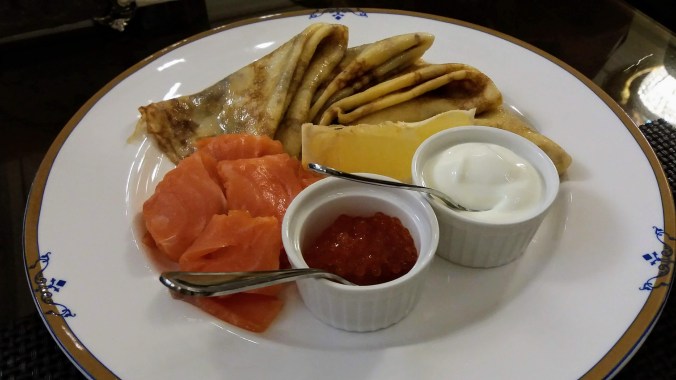
The Stranger in Moscow was a vodka drink made with Campari, ginger, and blackberry syrup. The presentation was stunning. The drink was quite different from the cocktails I have had before. It was more bitter than sweet which is usually a good thing for me and I attribute that to a healthy portion of the Campari, but there was a slight “cough syrup” aftertaste that I associate with Jagermeister or almost any cherry liquor. My best guess is that the type of blackberry syrup they used carried that flavor, which many people find appealing in drinks. It was also served with a tiny bowl of dark chocolate chips which made an excellent compliment to the drink. Quite a unique cocktail experience overall.

My lunch companion told me about the book “Gentleman in Moscow” which is set in the Metropol Hotel and I am now on the wait list to check that out of the library. In case you’re curious, a standard room at the Metropol runs close to 150$ US/night, but my drink and lunch were a much more reasonable yet still high for Russia $27 US together. I still wish I could have found that tea ceremony, but I am happy with the experience I had, especially with company to make it better.
Here’s a little slideshow with more photos from the first half of my day in Moscow. Please pardon the lack of music. I’ve been using YouTube Editor, and recently it’s decided to delete everything good and useful from it’s online service and I haven’t found a replacement yet. Stay tuned for part 2 where I go “off the beaten path”.
 Plan?
Plan? 




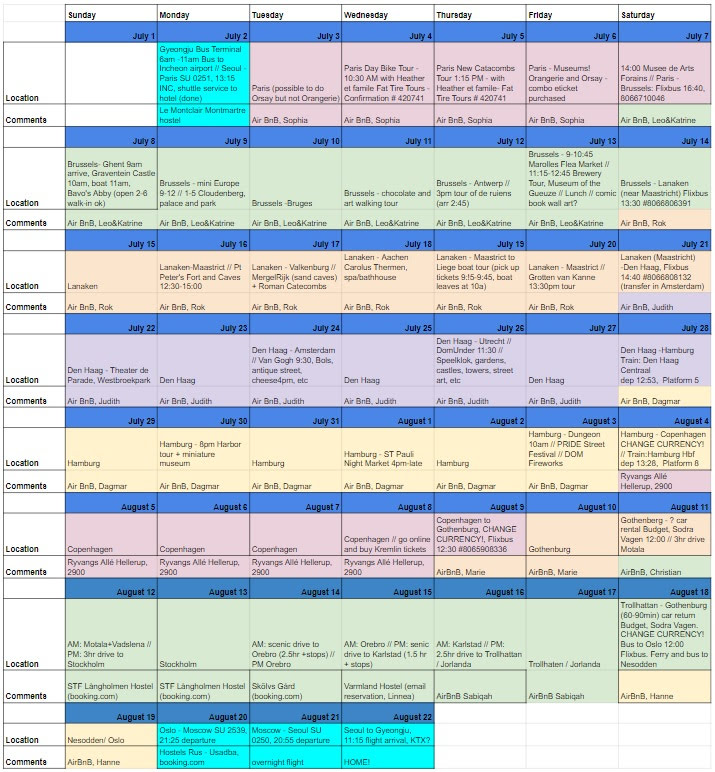



 The only way to get to the small island of Koh Lipe is by boat. I booked online in advance because I didn’t want to worry about tickets selling out. The only reason I was in Langkawi in the first place was to catch this boat to Koh Lipe. After the walking fiasco of the day before, I opted to get one of the islands fixed rate taxis back to the port and arrived 2 hours before the ferry’s departure time, as I was advised to do.
 There are no piers on the island. Instead, the ferries anchor a ways out either at floating piers or just in open water. The one I arrived on docked with a patch of floating platform where we could transfer ourselves and our luggage from the speedboat to the smaller longtail boats that would take us to the island. I was amazed to see people arriving with massive piles of baggage considering the situation and was once more grateful for my decision to keep my luggage under 7kg.
 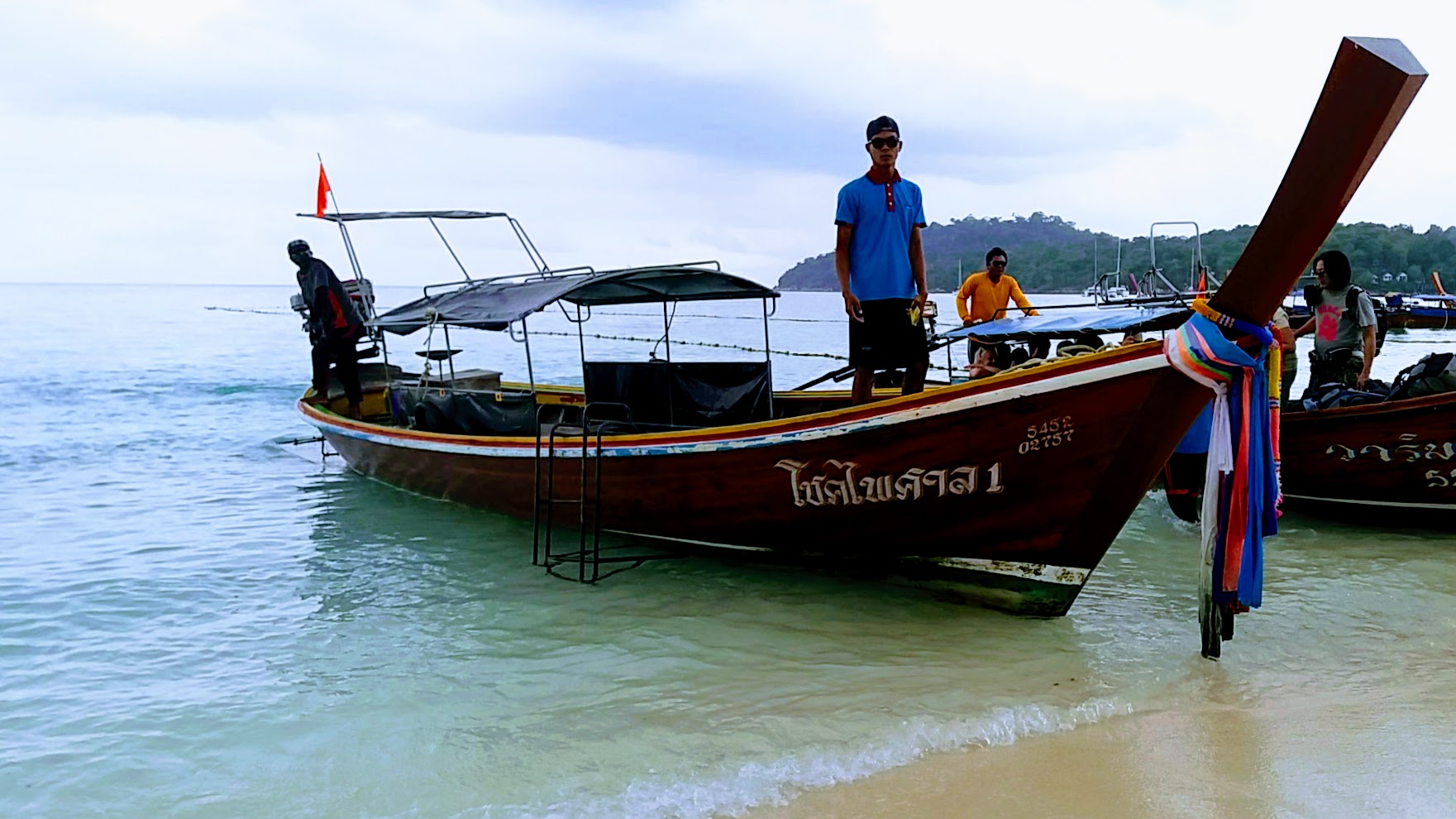 The longtails are small boats, named for the motor at the end of a long pole that juts from the stern and into the water. No more than a dozen people can board a longtail together, so the ferry passengers broke up into smaller clusters. Once the longtail arrived at on land, the local operators would hop out and drag the bow a little way up the beach and tie it to a mooring anchor there. The only way for us to get out was to take a splash in the sea. I quickly shed my socks and shoes and tied the laces to my bag, then rolled up my pants and took my first steps into Thailand through the sparkling turquoise water.

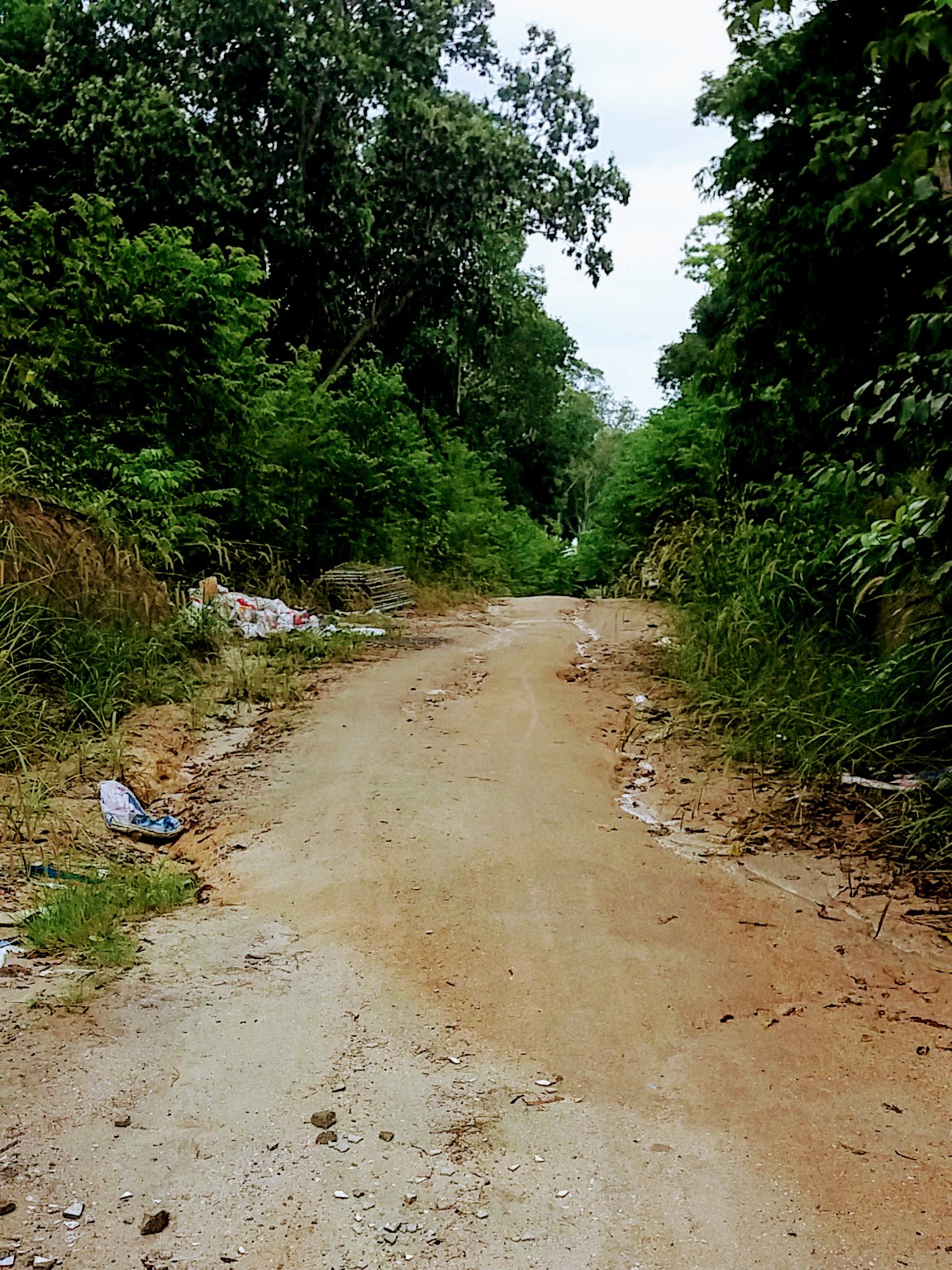
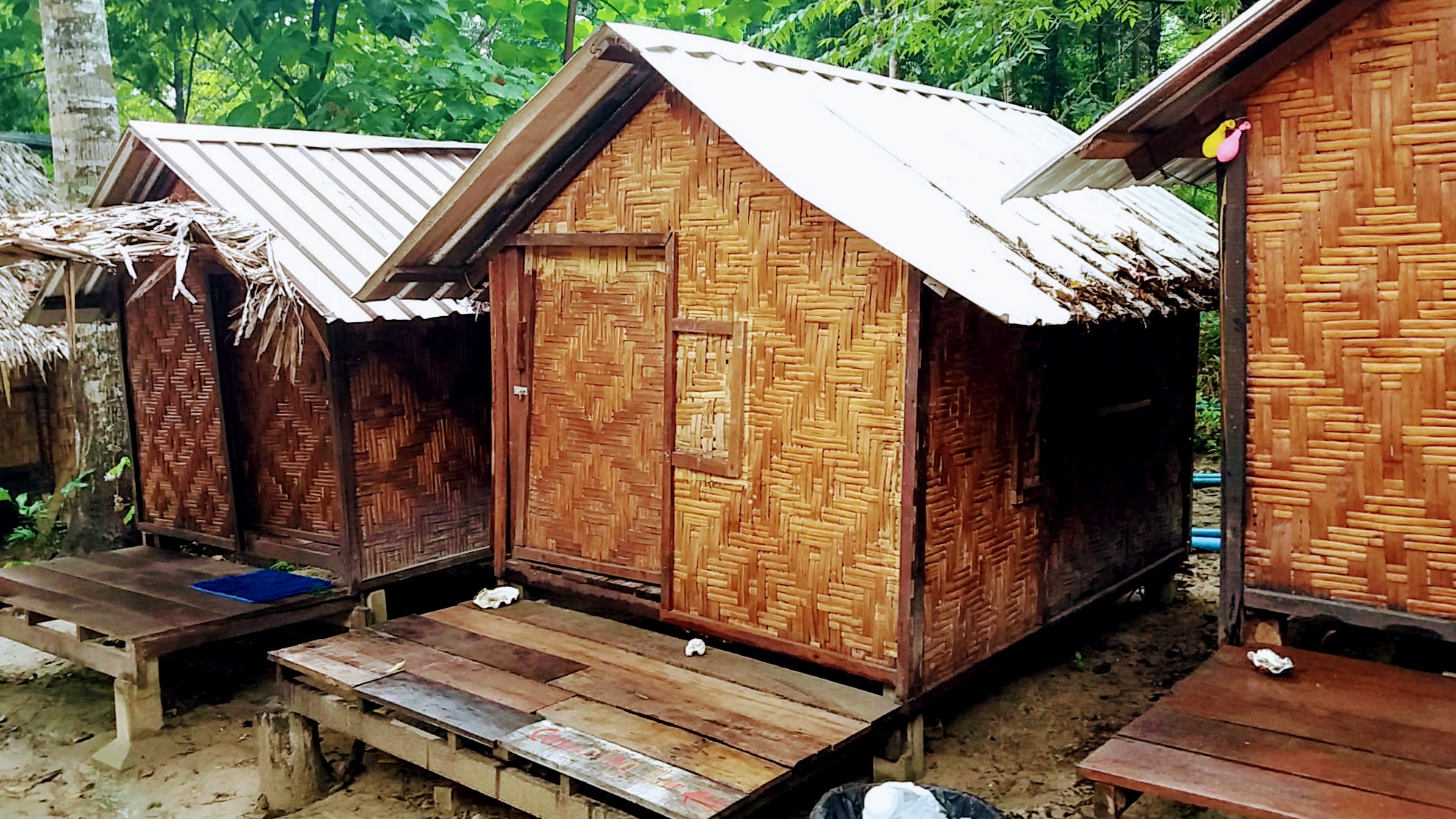
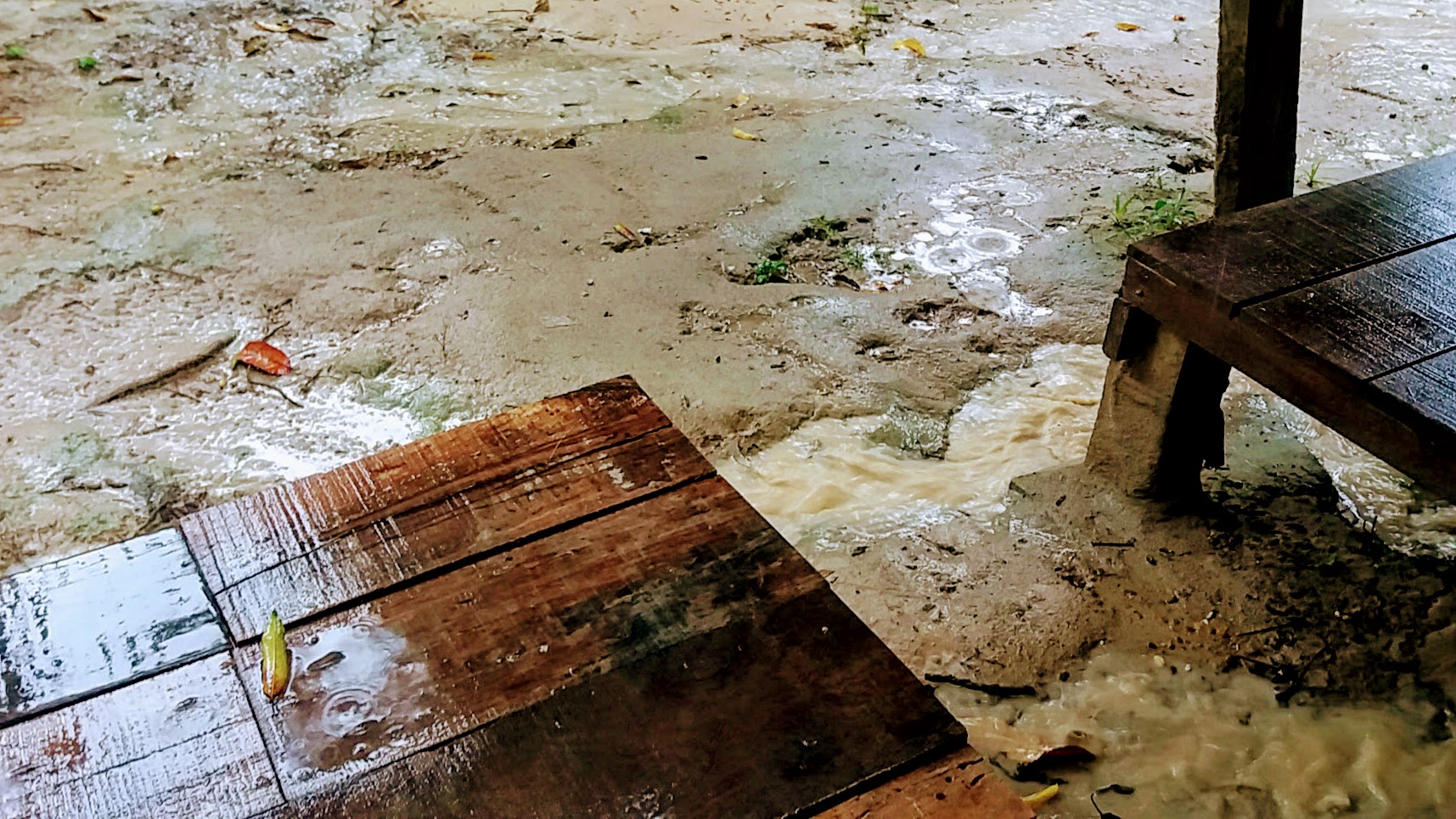 The hostess was wonderful and kind. She brought out some repellent for me even before we finished checking in and got me settled into my cabin. Walking past the tents on the ground, I was extra glad I hadn’t made that choice given the rain. There were no real walkways in the campsite, so I was picking my way carefully down steep slopes and muddy banks. The cabin was equipped with a sort of futon on the floor, a mosquito net, and a fan. While I settled down to check the dryness of my bag and sort out my belongings, the rain began again in earnest. The path in front of my cabin turned into a river. Knowing that tropical rains are often breif, I decided to wait it out. My main activity for the day was written on my itinerary as “beach bum”, so I wasn’t in a particular rush.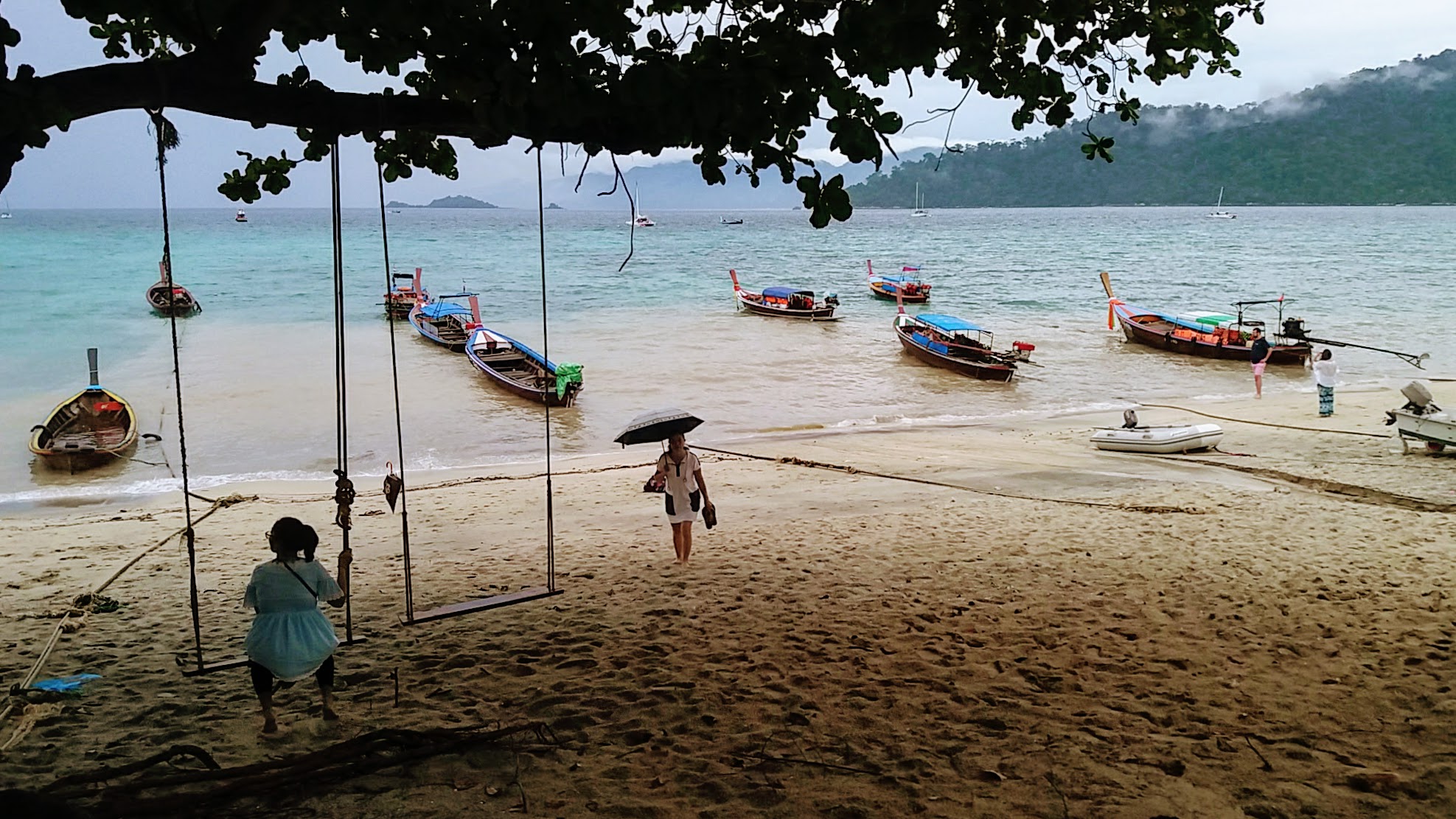


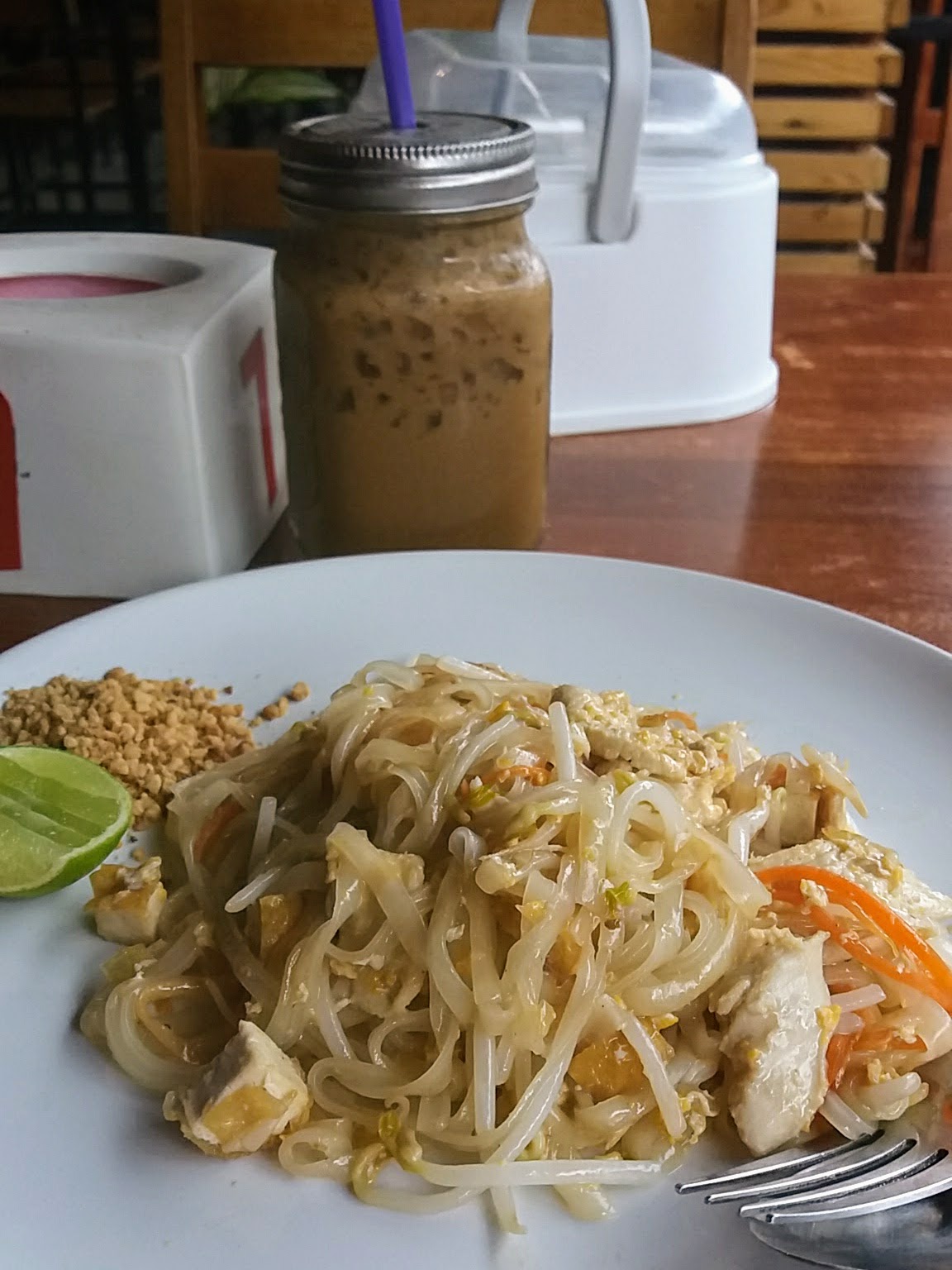
 I managed to order something by playing a sort of 20 questions with the waitstaff, and enjoyed my noodles and mystery meat in a not yet too hot outdoor dining area with views of the neighborhood. There were a startling number of funeral homes nearby and plenty of evidence of the British colonial architecture, although much of it was in disrepair.
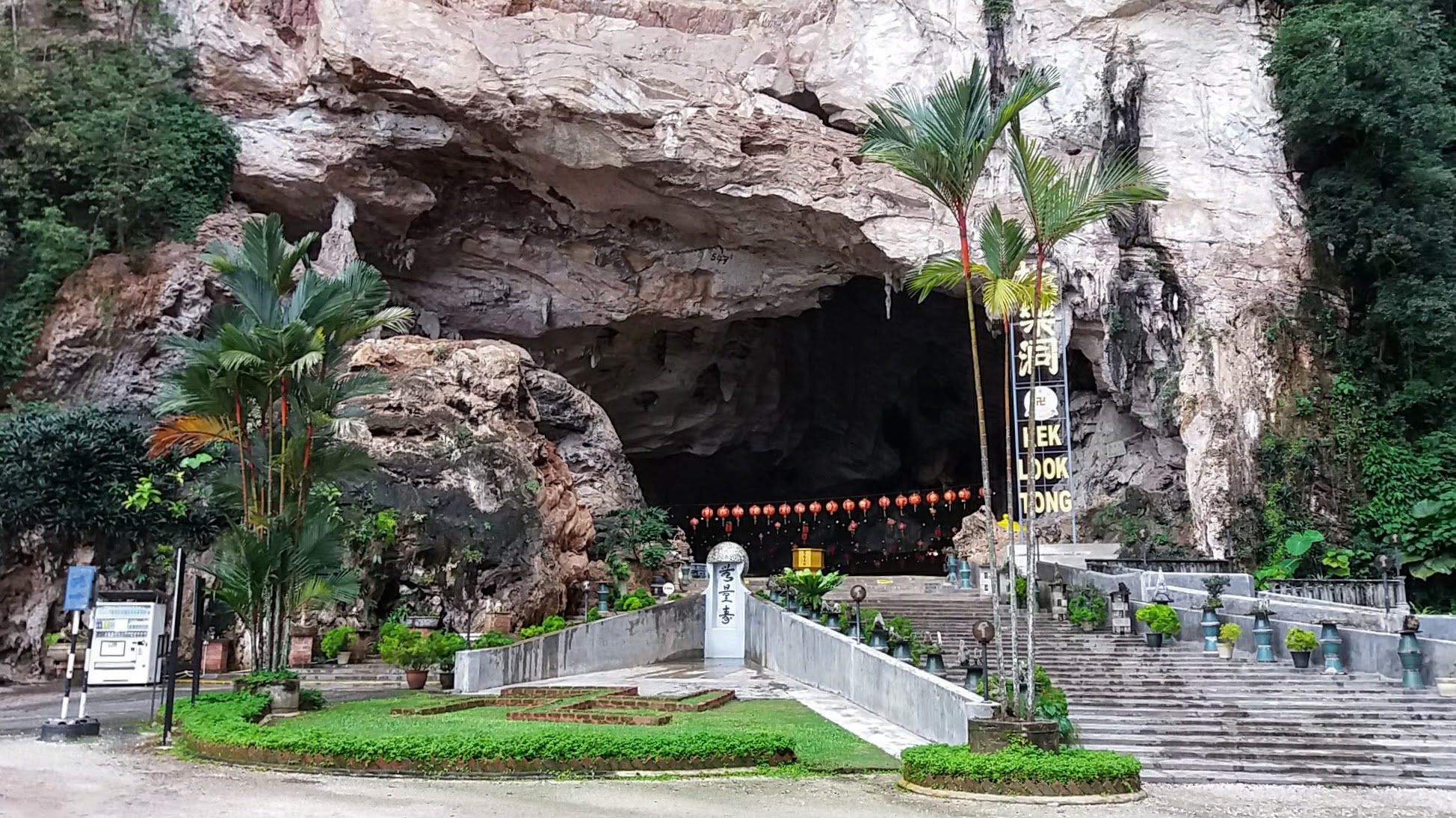

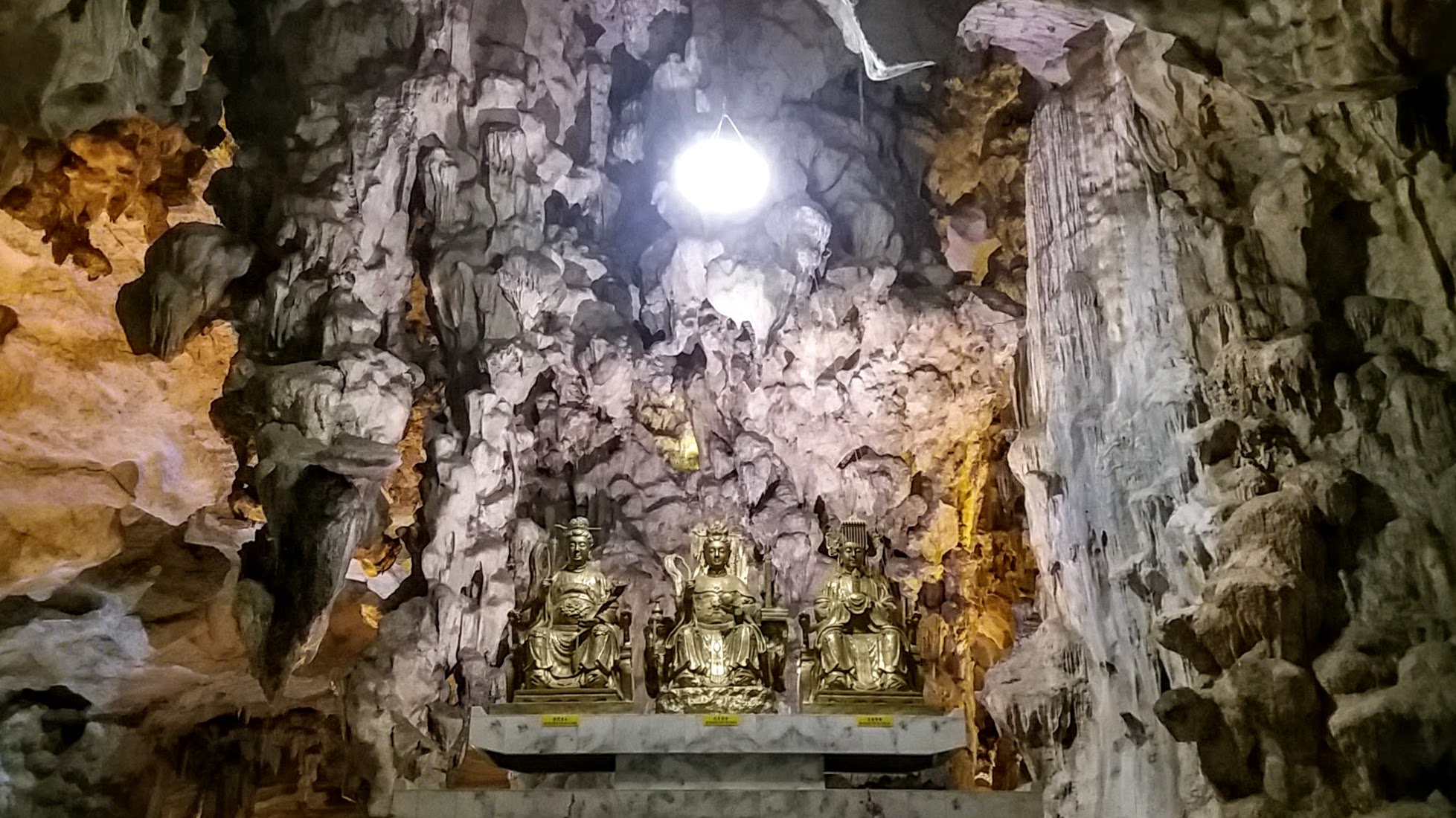
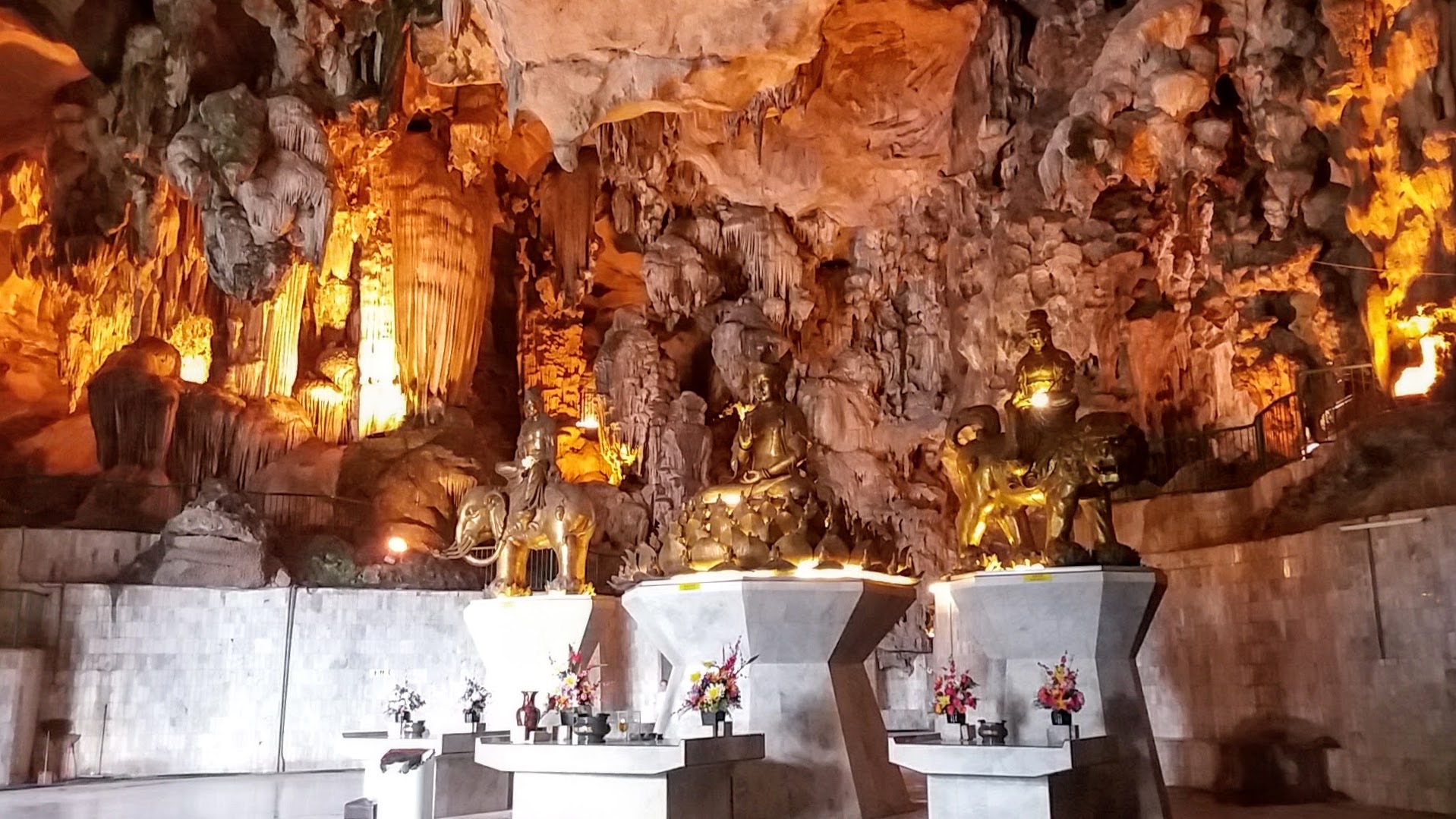


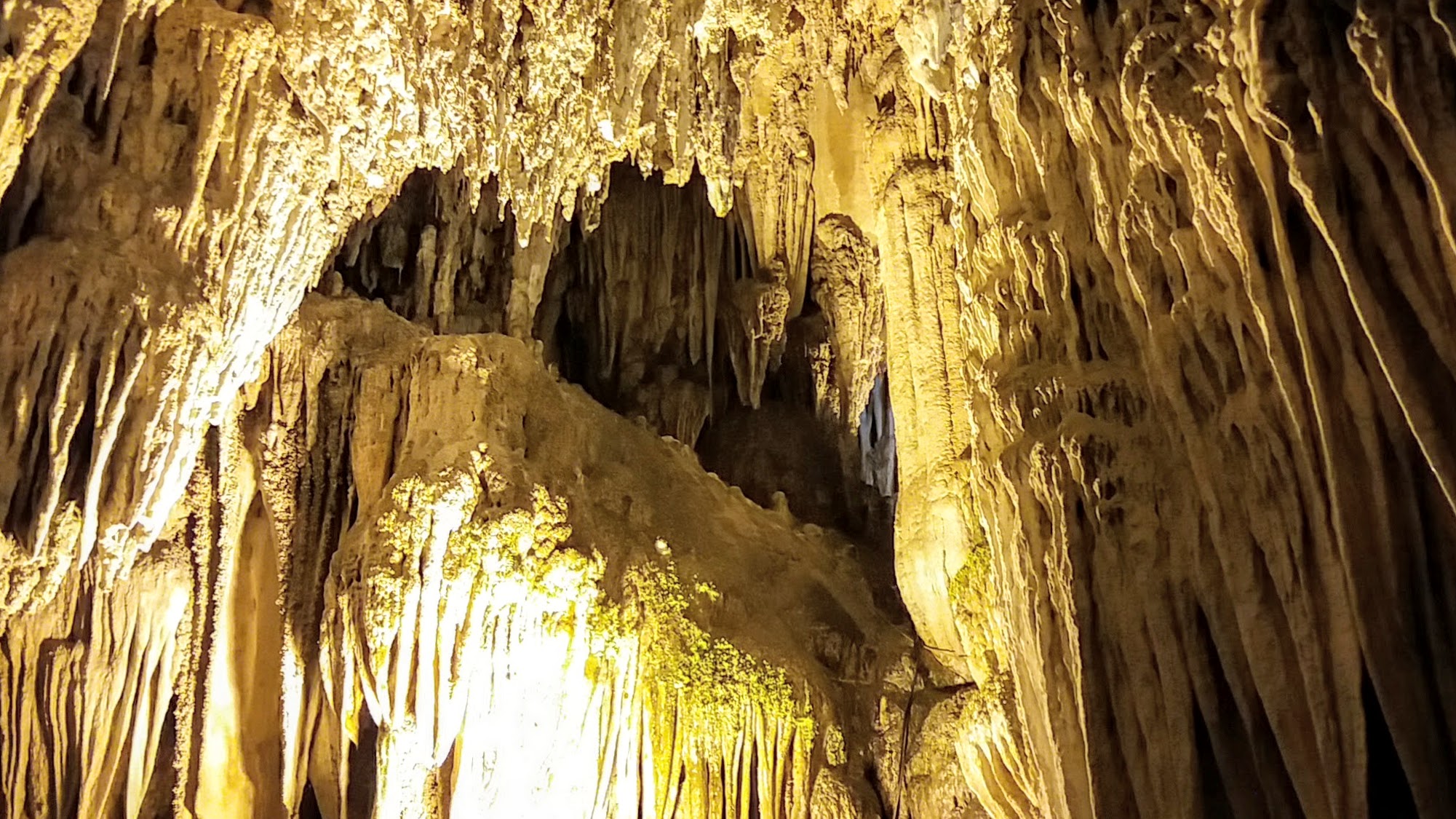


 Sam Poh Tong is also a Buddhist temple and is said to be one of the busiest and most popular in Ipoh. I could tell it was an active temple from the freshly lit incense, but little else gave evidence that it was maintained or cared for. Even so close to such a large holiday, the grounds looked unkempt and abandoned. The huge numbers of underfed and skittish stray dogs was off-putting, but they were not aggressive. The garden in the front was a small lake with tiny “islands” that became miniature mountains holding tiny temples. As I walked around one side of the temple compound, I came upon a building that seemed long empty, covered in dust and bereft of occupation, yet there was incense burning at the dusty altars, observed it seemed only by me and some monkeys on the fence nearby.
 The walls were painted and florescent lights were on the ceiling, while piles of furniture and other stored items crowded the rooms. The floors were finished and there were windows and doors installed into the stone. It felt less like a cave and more like a basement.
 n the other side of the cave was a small enclosed garden. The walls of the garden were more towering limestone formations and the greenery within was Jurassic in scale and seemed to be overgrown with no concern for trimming or arranging, dead leaves carpeting the ground. There was a small turtle pond behind a fence filled with turtles of all sizes that could be fed fresh greens and veggies bought from a
  stand inside the cave. The stand and it’s sales person were some of the only signs of tending I saw. At the back of the garden behind a locked a fence and a forest of unkempt branches was a bright red pagoda that seemed more like something in an abandoned jungle than in a living temple.
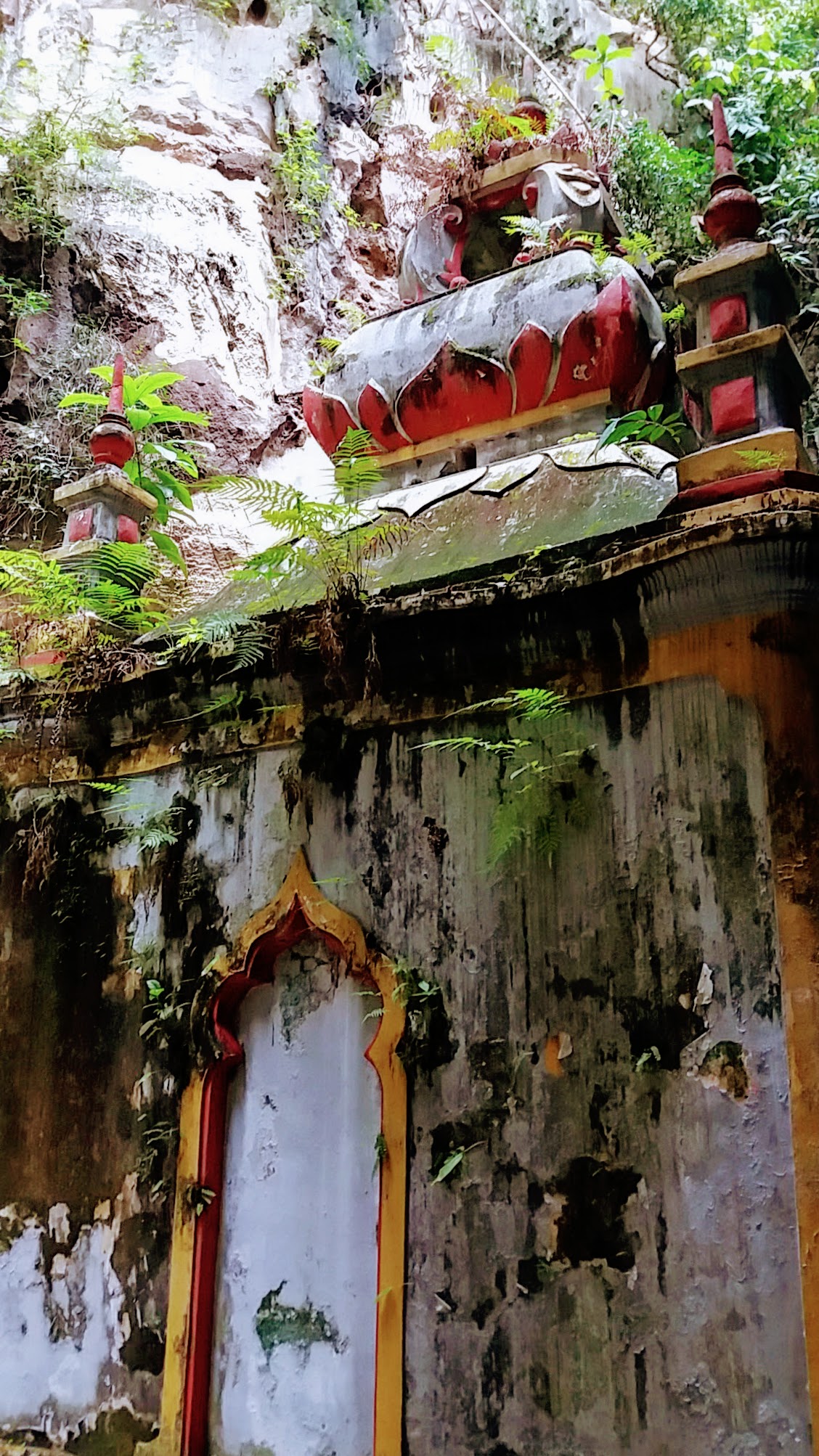 I crept around the cave rooms from one altar to another, plastic cups and cleaning materials lay scattered around, the tile floor was cracked and uneven. I followed a treacherous staircase up a flight, but it ended only in a tiny window and more dust. It was so easy imagine that I was exploring a temple long forgotten, and then I would find a lit candle, or a smoldering joss stick or even a lone employee selling souvenirs. Outside once more, I continued on to the cemetery. In Buddhism, cremation is the norm, so there were small buildings in another alcove that housed the remains. Despite signs requesting that no incense be burned, there were sticks shoved around all the doors and soot marks as well. The buildings were grown over with moss and leaves, the paint peeling and the ground cracking under the pressure of new roots, yet the incense showed me that human presence was recent.
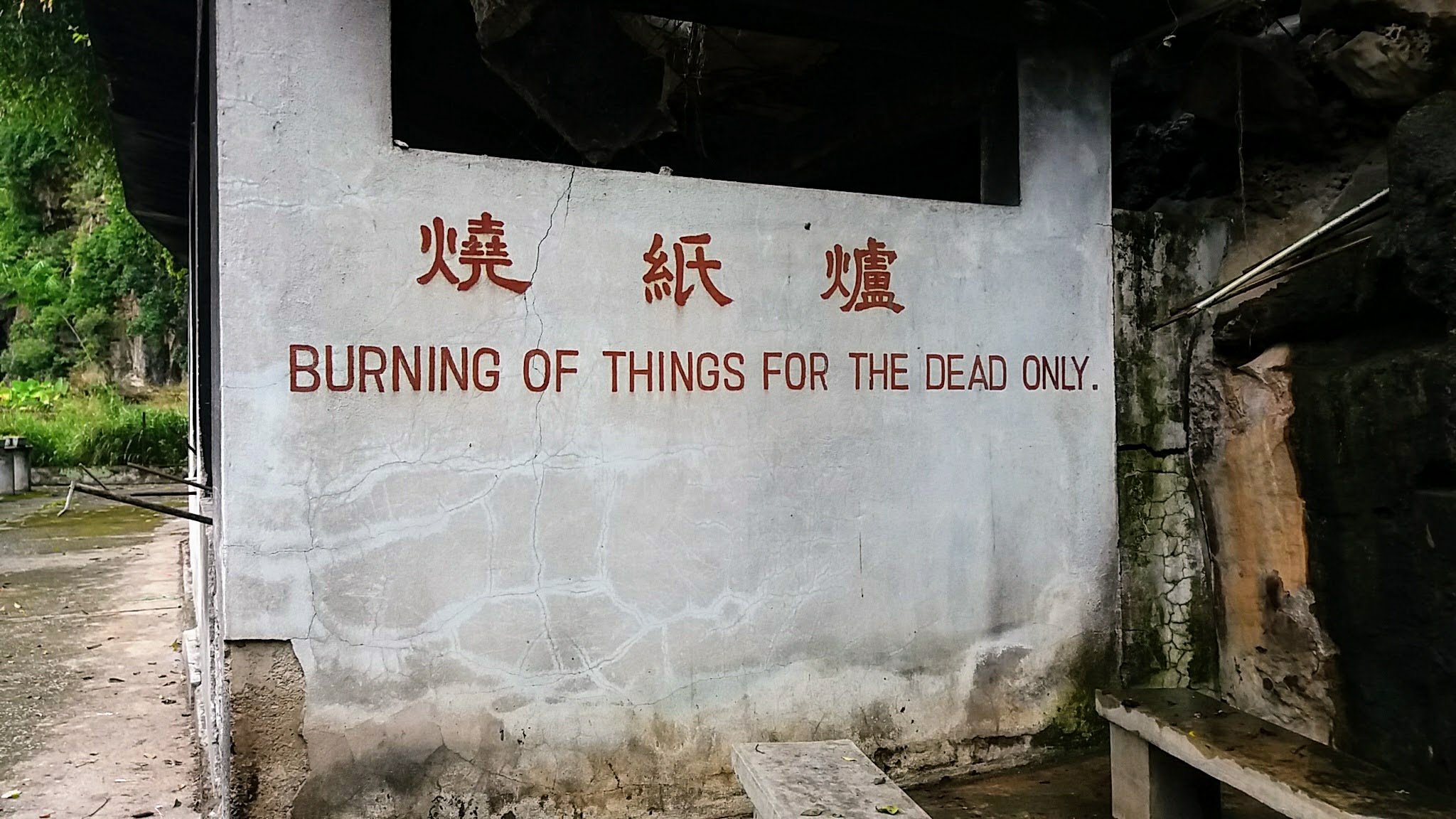 The farthest end of the compound was an area designated for ritual burning and another weedy and overgrown garden that seemed to be turning into a dumping ground. As I made my way past more dogs and tourists, I couldn’t help wondering at how this temple had been so highly rated by so many visitors when Kek Lok Tong was so clean and well cared for. I enjoyed visiting Sam Poh Tong, but it felt like an archaeological excavation rather than a place of worship.

 I looked it up to make sure it wasn’t something too scary, then ordered myself a bowl for lunch. Rojak just means “mixture” but fruit rojak is a common dish made of crisp (less than fully ripe and therefore slightly tart) fruits and veggies. Jicama, cucumber, mango, and apple are standard ingredients. The sauce is the magical part. The recipe gurus of the internet assure me it’s made with shrimp paste, hot chilies, sugar, soy sauce, and lime juice (with some regional variance). To me it tasted for all the world like molasses with chili, ginger and lime. I don’t know if mine was made with molasses or if that’s just what it tastes like when you mix soy sauce, shrimp paste and sugar together, but it was yummy!


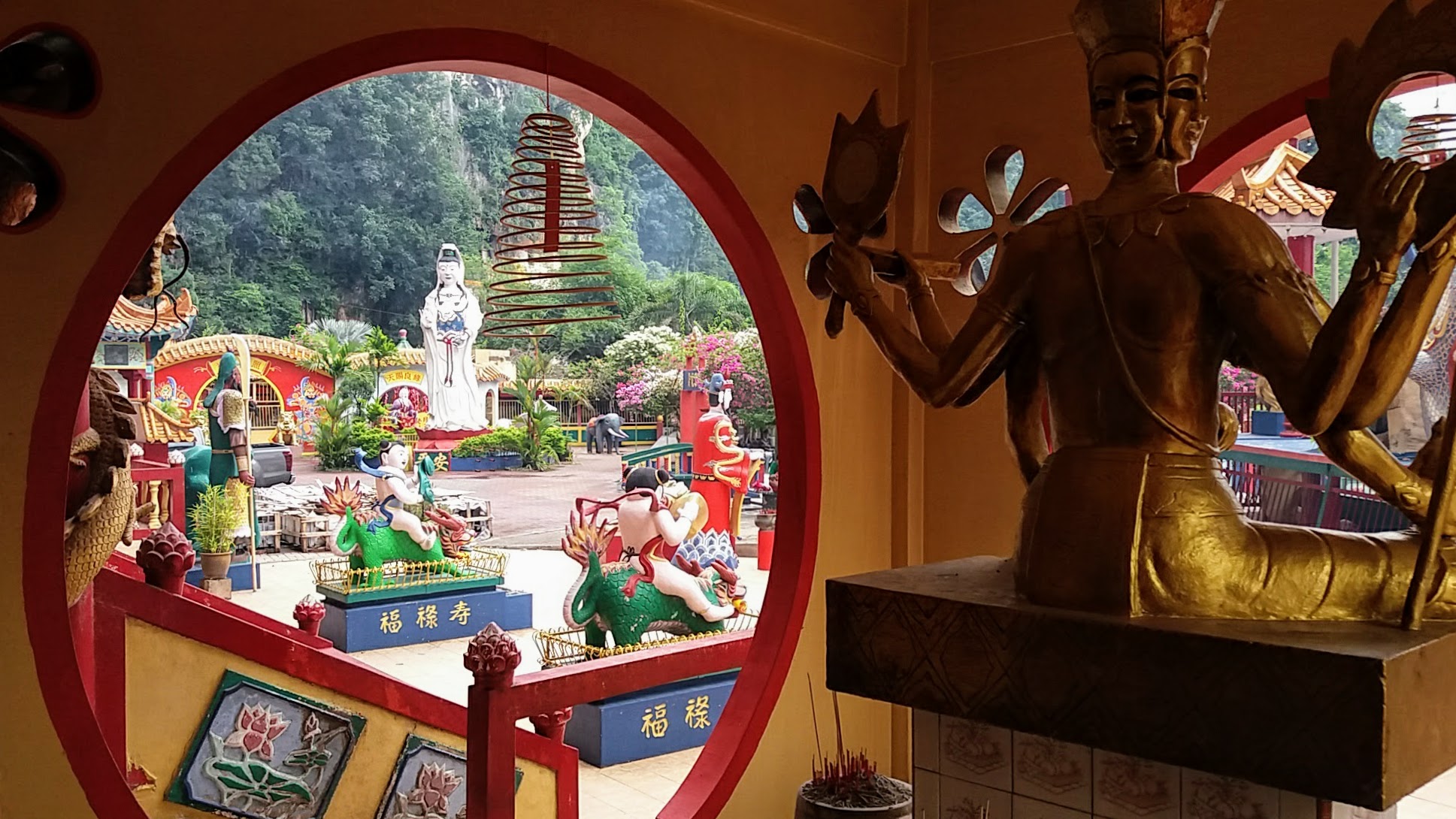 Just one gate over is the third and final temple on this street, Ling Sen Tong. This temple mixes Taoist and Buddhist imagery along with other folklore in a big colorful Chinese melting pot. It is an all singing all dancing color fiesta. There are beautiful facades of buildings and temples, giant statues in fresh bright colors, elaborate scenes of mythology played out, and everything was touchable/climbable so visitors were having a blast posing for photos. There was only one small, dark cave. The ceiling had turned black from years of candle and incense soot, and it was chaperoned by a figure whose offerings exclusively included alcohol (for some reason, especially Guiness…) I enjoyed exploring the many statues and hidden rooms. I even found this one guy who looks like he’s checking his phone in the bath! I’m sure there’s a better explanation for it, but along one wall was a series of statues in sunken pits that had all filled with water. I don’t know if it was meant to be a kind of wishing well or something else entirely, but this one in particular stood out to me.


 Gallivantrix