Spring is brilliant. Cool mornings, sunny afternoons, flowers everywhere, but just enough rain to keep the air from turning into a pollen infused nightmare. Kids are outside preparing for “Sports Day”, a springtime event in Korean public education that gets everyone out in the sunshine after a long, cold winter. Lucky me, while the kids are outside practicing dance routines and the three legged race, classes indoors are cancelled! I’ve used some of my extra time to catch up on my winter holiday stories. Coffee lovers everywhere, this one’s for you.
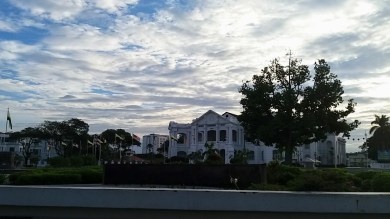 When I woke early that morning, I had only two main goals: to catch the morning train out of town and to track down the famous Ipoh “white coffee”. While chatting with the hostess the night before, she’d recommended a smaller coffee shop for me to try out instead of the main tourist one. She said that the Old Town white coffee shop had become too “Starbucks”, which as a Seattleite, I can totally relate to. (shout out to the refugee and veteran hiring goals tho, SB, good work there). She said I simply had to try their egg tart while I was there. However, because of my train fiasco in KL, I decided to head first to the train station to buy a ticket and then to the coffee shop. It was a piece of cake to catch another Uber and the train station was easy to navigate. I was amused by the herd of taxi drivers who tried to approach me as I got out of a car to enter the train station. Were they hoping to get a fare to another city? Once I had my ticket, I set off to find my breakfast.

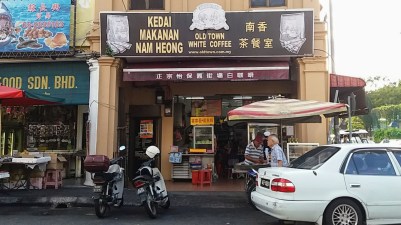 The town was very quiet early Sunday morning, so I enjoyed a leisurely stroll past some beautiful architecture and into the quaint “old town”. I had been advised to seek out a place called Nam Heong. When I found it, I discovered they sell the same brand of coffee as the high tourist cafe, which is simply called “Old Town White Coffee”. I have to infer that my hostess of the night before was referencing the atmosphere of the cafes rather than the coffee itself. Pictures I found online of the famous “Old Town White Coffee” restaurant show that it is a spacious and rather upscale looking place, geared toward the bougie and the Western tourist, while my experience in Nam Heong was a crowded hole in the wall filled with scurrying locals where I was the only white person. There probably is some difference in the drinks, since the brand itself was just the roasted beans, there’s almost certainly a difference in the price tag, and there’s a huge difference in local flavor. I don’t regret my choice for a minute.
What is white coffee?
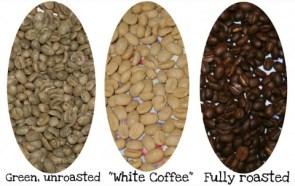
photo credit: Google image search
That’s a weirdly complicated question. The first time I encountered the phrase (as an American) was in a little niche coffee shop in Seattle where all the craziest trends in coffee can be found. In this case, white coffee was defined as coffee that was barely roasted (as opposed to green coffee which is not roasted at all). The slight roasting is just enough to blanch the beans from green to pale ivory, thus giving them the name “white”. The flavor is nothing like what most of us think of as “coffee” since those oils are activated in roasting, and instead has a mild nutty flavor.

photo credit: Russian Wikipedia
But, then I started travelling around where British influenced culture more than American and I came to learn that the term “white coffee” could also simply mean coffee with milk (or some other lightening substance). Although fancy coffee shops tend to use the term “flat white”, nearly any place that instant coffee abides, the term “white coffee” will there also live.
Finally, I got to Malaysia, where coffee leads a unique Southeast Asian lifestyle. Not all coffee is created equal. The Arabic peninsula had a singular, unique style of coffee that I will miss for the rest of my life, and now I fear I have to add the Malaysia to that honored list of beloved and hard to find coffee styles. Malaysian coffee in general is different from even the other SE Asian coffees. Having been to Vietnamese and Thai restaurants, I thought I understood the regional coffees to be strong dark things brewed through muslin bags in special pots and served with sugar and condensed milk, and while this is basically true, it turns out Malaysia goes one giant step further. The roast.

photo credit: Star2
Regular coffee is roasted bare, relying on the oils and sugars within the beans to bring the flavor to the party. However, Malaysians like to roast their coffee using palm oil and sugar, meaning that the extra flavors wind up in the final product. PLUS, they add some wheat into the roast (so if you’re gluten free, avoid coffee in Malaysia!) which gives the whole thing a deep grain flavor that I can only associate with other roasted grain teas that I’ve had in Japan and Korea. And yes, it’s standardly mixed with sugar and condensed milk, but there are always options since it’s made to order and they’ve started learning foreigners only like “a little sweet”.
Ipoh, however, has taken the traditional Malay style coffee and made another twist. It turns out that the name “white coffee” comes from the Chinese character for white (白) which doesn’t just mean the color white, but more often means “plain”, “bare” or “unadulterated”. It was applied to the Ipoh coffee because they chose to roast the beans with only the palm oil and NOT with the sugar and wheat. Thus, compared to the rest of the coffee in Malaysia, the Ipoh coffee is “白” and it has nothing at all to do with the milk that’s added later.
 (a side note on palm oil: don’t buy it. Seriously, I work pretty hard to be a responsible consumer. Palm oil is a product of major controversy right now because of the elephant exploitation in Thailand as well as the deforestation in Indonesia and Malaysia. It’s hard to exclude because it’s often improperly labeled, but please try to buy more sustainable and ethically sourced oils if you can. I was a little put out by eating it there, but in the end, my “locovore senses” took over and reminded me that if the Malaysians just grew enough palm oil for their own needs, then everything would be fine. It’s not an evil crop, but the high demand for it internationally has led farmers to damaging and unsustainable practices that harm the environment, and just so you don’t deride me for valuing orangutans over humans, the unsustainable farming practices are damaging the land and water those farmers and their families rely on, making the human future dim as well. Say no to imported palm oil.)
I ordered my white coffee iced because even though it was still early in the day, I wasn’t quite ready for hot coffee without AC. I had a seat near the kitchen which is normally considered bad, but it let me observe a little of the preparation process, including the long pours that help to churn the ingredients for a smooth and frothy finish. I also observed that they were selling bags of the brand coffee, although I’m not sure if it was beans or an instant mix. (Whatever you may think of instant coffee, I have discovered that in Asia they have it down to a fine science. I can still tell the difference, most of the time, but there are several worthwhile instant brands here).
 My coffee and tart arrived promptly and were very inexpensive. The coffee was smooth and extra creamy (more than just because it was made with milk, I believe the palm oil roasting made the flavor smoother). While other coffee I’d had in Malaysia was aggressive in it’s “coffeeness”, slightly if pleasantly bitter, and coffee I’ve had in the US and Europe tends to have an acidic tang, the Ipoh white coffee was as smooth as coffee ice cream, but not quite as sweet. Also the tart was warm, flaky and not too sweet either. As a recovering HFCS addict, it can be challenging for me to find the balance of sweet that tingles my taste-buds without overloading my synapses, but I was left very satisfied by the experience at Nam Heong that morning. I shall think fondly of the coffee until one day I start my own tour company and make it a stop on the “Coffee of the World” tour package.
There’s not quite enough photos for an album of this morning, so enjoy a few more random sights of Ipoh. Stay tuned for a Golden Week of adventures in Korea next week as well as the next installment of Malay Peninsula where I go to Penang to do laundry and buy pants! Thanks for reading 🙂
 I managed to order something by playing a sort of 20 questions with the waitstaff, and enjoyed my noodles and mystery meat in a not yet too hot outdoor dining area with views of the neighborhood. There were a startling number of funeral homes nearby and plenty of evidence of the British colonial architecture, although much of it was in disrepair.
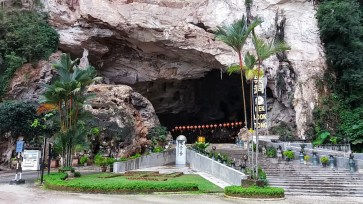


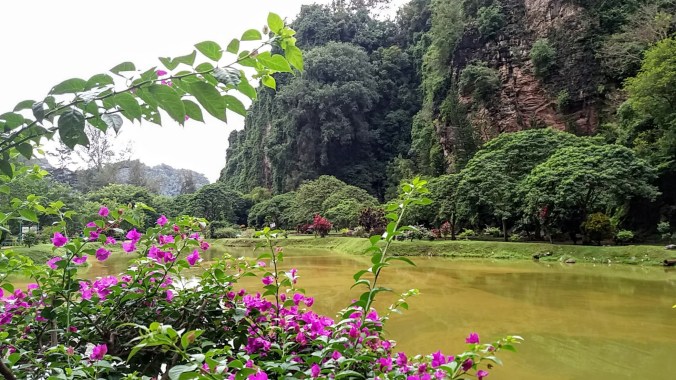


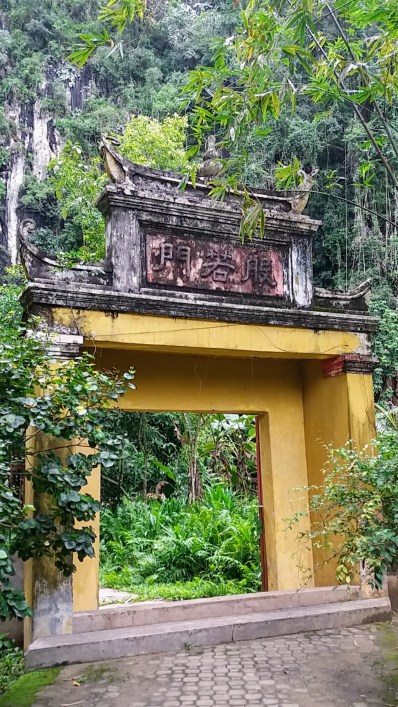 Sam Poh Tong is also a Buddhist temple and is said to be one of the busiest and most popular in Ipoh. I could tell it was an active temple from the freshly lit incense, but little else gave evidence that it was maintained or cared for. Even so close to such a large holiday, the grounds looked unkempt and abandoned. The huge numbers of underfed and skittish stray dogs was off-putting, but they were not aggressive. The garden in the front was a small lake with tiny “islands” that became miniature mountains holding tiny temples. As I walked around one side of the temple compound, I came upon a building that seemed long empty, covered in dust and bereft of occupation, yet there was incense burning at the dusty altars, observed it seemed only by me and some monkeys on the fence nearby.
 The walls were painted and florescent lights were on the ceiling, while piles of furniture and other stored items crowded the rooms. The floors were finished and there were windows and doors installed into the stone. It felt less like a cave and more like a basement.
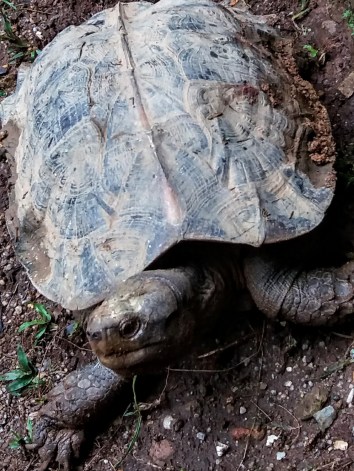
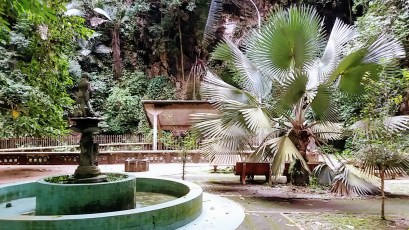 n the other side of the cave was a small enclosed garden. The walls of the garden were more towering limestone formations and the greenery within was Jurassic in scale and seemed to be overgrown with no concern for trimming or arranging, dead leaves carpeting the ground. There was a small turtle pond behind a fence filled with turtles of all sizes that could be fed fresh greens and veggies bought from a
  stand inside the cave. The stand and it’s sales person were some of the only signs of tending I saw. At the back of the garden behind a locked a fence and a forest of unkempt branches was a bright red pagoda that seemed more like something in an abandoned jungle than in a living temple.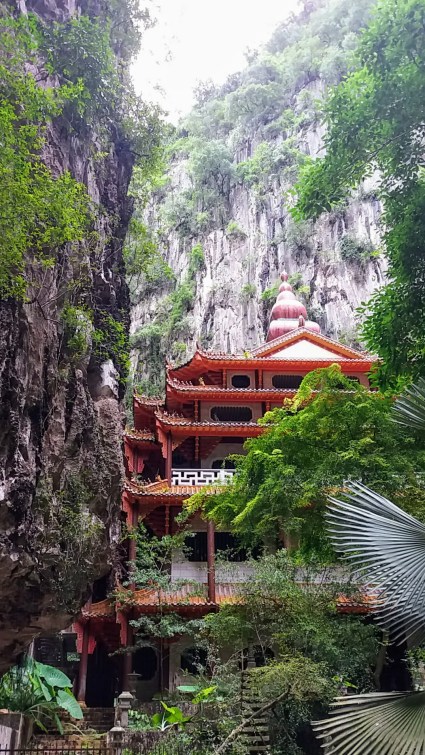
 I crept around the cave rooms from one altar to another, plastic cups and cleaning materials lay scattered around, the tile floor was cracked and uneven. I followed a treacherous staircase up a flight, but it ended only in a tiny window and more dust. It was so easy imagine that I was exploring a temple long forgotten, and then I would find a lit candle, or a smoldering joss stick or even a lone employee selling souvenirs. Outside once more, I continued on to the cemetery. In Buddhism, cremation is the norm, so there were small buildings in another alcove that housed the remains. Despite signs requesting that no incense be burned, there were sticks shoved around all the doors and soot marks as well. The buildings were grown over with moss and leaves, the paint peeling and the ground cracking under the pressure of new roots, yet the incense showed me that human presence was recent.
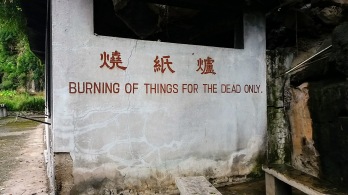 The farthest end of the compound was an area designated for ritual burning and another weedy and overgrown garden that seemed to be turning into a dumping ground. As I made my way past more dogs and tourists, I couldn’t help wondering at how this temple had been so highly rated by so many visitors when Kek Lok Tong was so clean and well cared for. I enjoyed visiting Sam Poh Tong, but it felt like an archaeological excavation rather than a place of worship.

 I looked it up to make sure it wasn’t something too scary, then ordered myself a bowl for lunch. Rojak just means “mixture” but fruit rojak is a common dish made of crisp (less than fully ripe and therefore slightly tart) fruits and veggies. Jicama, cucumber, mango, and apple are standard ingredients. The sauce is the magical part. The recipe gurus of the internet assure me it’s made with shrimp paste, hot chilies, sugar, soy sauce, and lime juice (with some regional variance). To me it tasted for all the world like molasses with chili, ginger and lime. I don’t know if mine was made with molasses or if that’s just what it tastes like when you mix soy sauce, shrimp paste and sugar together, but it was yummy!


 Just one gate over is the third and final temple on this street, Ling Sen Tong. This temple mixes Taoist and Buddhist imagery along with other folklore in a big colorful Chinese melting pot. It is an all singing all dancing color fiesta. There are beautiful facades of buildings and temples, giant statues in fresh bright colors, elaborate scenes of mythology played out, and everything was touchable/climbable so visitors were having a blast posing for photos. There was only one small, dark cave. The ceiling had turned black from years of candle and incense soot, and it was chaperoned by a figure whose offerings exclusively included alcohol (for some reason, especially Guiness…) I enjoyed exploring the many statues and hidden rooms. I even found this one guy who looks like he’s checking his phone in the bath! I’m sure there’s a better explanation for it, but along one wall was a series of statues in sunken pits that had all filled with water. I don’t know if it was meant to be a kind of wishing well or something else entirely, but this one in particular stood out to me.


 Gallivantrix