The three places in today’s stories are real live places in China (and Taiwan) that people visit as modern day tourist attractions. Although, no one is visiting them just now, thanks Covid, there are a plethora of photographs, Wikipedia articles, and travel blogs about all of them. I didn’t get the chance to go to any landmarks myself, but I still think it’s cool that these traditional folk tales were inspired by stunning natural landscapes that still exist today.
The Goddess of Mt. Wu
The Immortal Maiden Yao Ji was Queen Mother Wang Mu’s twenty-third daughter. Not only did she grow up to be beautiful, but also kind-hearted. Wang Mu loved her especially dearly. Yao Ji’s natural disposition was vivacious, and she was never able to remain idle. Every day she would sneak out to go and play. Wang Mu had no way to catch her.
One day, Queen Mother Wang Mu came out to relieve her boredom and saw that Yao Ji looking right into the mortal world. Angrily she said, “Even if Heaven has tasked you to play, what are you looking at the mortal world for, that place can corrupt your eyes!” Yao Ji didn’t believe it, she pointed to a red-crowned crane and said, “That crane is pure white like jade, how could that corrupt my eyes? I want to be like that, to fly everywhere and finally see what the mortal world is like.”
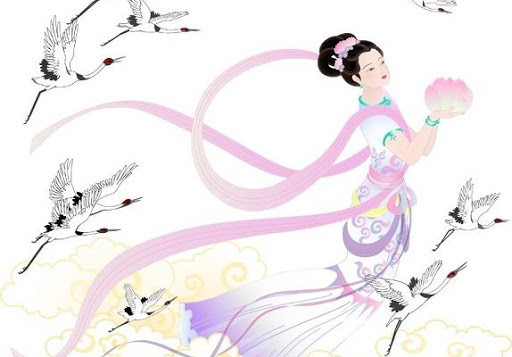
Wang Mu hastily tried to talk her out of it, saying, “The mortal world is a sea of bitterness without end, and you are a royal princess, a golden branch with jade leaves, you simply must not go no matter what!” Yao Ji didn’t listen, she simply sat atop her cloud looking down. She saw many people’s houses were just thatched cottages, their food vegetable husks, and their clothes were damaged and rotten cloth. With a sigh she said, “Oh, truly bitter!” Wang Mu heard this and smiled to herself, then she said, “Still, Heaven is good, we have exotic food without end, and unlimited fine silks and lace to wear…”, but the more Wang Mu talked, the more disgusted Yao Ji became, she resolved to go to the mortal world for a time! Queen Mother Wang Mu defied her, and sent her instead to the Dragon Palace of the Eastern Sea.
The Dragon King of the Eastern Sea had a plan for Yao Ji from an earlier time, only at that time she was still young. Now she came as a guest, the Dragon King received her with special attention. He poured the wine himself, and said happily, “Beautiful maiden, our social position and economic status are in harmony, we are a match made in Heaven!” Yao Ji heard this and her face splotched red. She left the palace in less than the space of one breath, and simply went straight to the human world.
On the road, Yao Ji encountered many people fleeing trouble, leaning on beggars sticks and carrying worn out baskets, pulling along the elderly, carrying the young on their backs, and weeping endlessly. Yao Ji saw this and felt extremely sad. She just wanted to rush forward and ask what happened, so she failed to see the black clouds gathering in the sky. A fierce wind whistled by; twelve evil dragons were in the process of stirring up trouble. Yao Ji hurriedly started steering her rosy clouds. She approached the evil dragons and used sweet words and gracious language to persuade them to not work any more evil deeds. But the evil dragons paid no heed, going so far as to make even more of a ruckus. Yao Ji couldn’t take it anymore. She pulled a jade hairpin from her head, and brandished it at the twelve evil dragons. A ribbon of golden light flashed past, and the evil dragons all dropped dead.
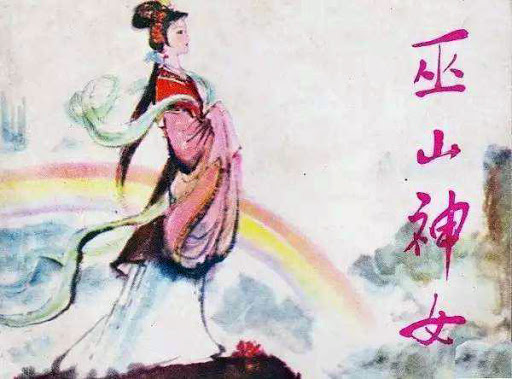
When Queen Mother Wang Mu found out that Yao Ji had gone to the human world and killed twelve dragon princes she became angry and resentful, however when she heard she was staying in the wild mountains, she also felt the pain of love and ordered her other twenty-two daughters to find Yao Ji and bring her back.
The twenty-two Immortal Maidens went down to the human world where they encountered many setbacks and finally found Yao Ji. They said to her, “Little Sister, our mother misses you day and night, with no thought for tea or rice, come back to Heaven with us.” “It isn’t that I heartlessly do not go back. Elder Sisters look, the common people are suffering hardship, how can I not care about that?” Yao Ji said this and at the same time pointed into the distance. There on the mountainside was a wild tiger in the middle of chasing a person, it overtook the person while they watched.
 Elder Sister Cui Ping hurriedly caught up some silt and cast it out. The silt became dozens of arrows that shot the tiger down. Before long, at the foot of the mountain an old grandmother was climbing up, her complexion was pale and wan, she was weak and looked like she had a serious illness. Elder Sister Chao Yun immediately plucked out several hairs from her head, and cast them in front of her. The hairs changed into the reishi mushroom that grants miraculous recovery and saved the old woman’s life. Then, everyone heard a burst of work chanting, and turned their heads to look. In the river, passing by, was a boat floating on the water. The backs of the barge haulers pulling the boat were all almost bent to the ground, but the boat’s progress was still quite slow. Elder Sister Song Luan faced west and blew out a breath, the blow started a favorable sailing wind that pushed the boat forward. The barge haulers straightened up their backs and smiled. Everyone had just heaved a sigh of relief when suddenly they saw in a far off field a patch of dried up yellow, a drought had caused this severe damage, how would the farmers earn their daily living? The Immortal sisters thought and thought; they felt sad and cried. Their tears turned into rain that began to fall with a sound like hua-la-la. Very soon, the field had become a lush green.
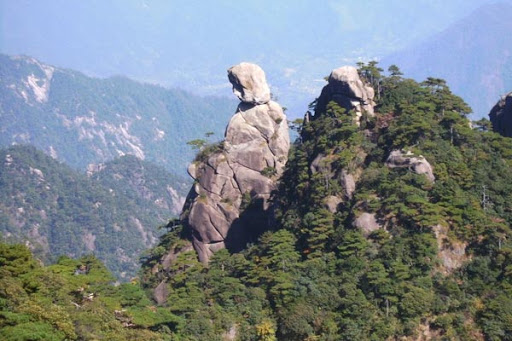
When they had finished these things, the Immortal sisters had a contradiction in their hearts: their mother needed to be taken care of, but the common people also should receive blessing and protection, what to do? Finally, everyone made a unanimous decision, one half would return to Heaven, and the other half would remain in the human world. The eleven elder sisters who stayed behind plus Yao Ji blessed and protected the ordinary people of the human world day and night. Later, they transformed into the twelve mystical and beautiful peaks of Mt. Wu. Included among these, closely overlooking the Yangtze River, reaching through the clouds is the transformed Yao Jin Xian Nu Peak.
Split the Mountain to Rescue the Mother
At the very top of the Western Peak of Mt. Hua there is a giant stone a hundred feet high that has been cut neatly into three parts. In the side of this giant stone is a 7 foot high, 300 pound Crescent Moon Iron Ax. Legend has it that this is the historic place where Chen Xiang split the mountain to rescue his mother. That giant stone is called “Ax Splitting Rock” and the axe is called “Mountain Opening Ax”.

It is said that one year a scholar by the name of Liu Yan Chang went to Chang’an (the ancient city of Xi’an) to take the Imperial examinations. When he passed through Tong Guan (a county in Wei nan, Shan’xi) he climbed Mt. Hua to go sightseeing. He had heard that the goddess San Sheng Mu of the West Peak Temple was absolutely accurate, so he went into the temple to request a Qian bamboo stick to have his fortune told. He wanted to ask about his future prospects. However, that day San Sheng Mu just happened to be away from home attending a feast, and the boy watching the door did not dare to casually grant a Qian fortune stick. Liu Yan Chang even drew three Qian, but they were all blank and he became very angry. He took up his brush and wrote a poem on the wall of the temple reproaching San Sheng Mu.
When San Sheng Mu returned home, she saw the inscribed poem and became ashamed and angry. She found Liu Yan Chang and saw that his appearance was stately and grand, and immediately came to feel admiration towards him. She transformed into a mortal woman and came to Liu Yan Chang’s side. Liu Yan Chang also liked the dignified and elegant San Sheng Mu. The pair of lovers soon became parents. Not long after, Liu Yan Chang passed his exam and became eligible for the highest imperial civil service. San Sheng Mu gave him a son called Chen Xiang, and the whole family lived on blessed and happy.
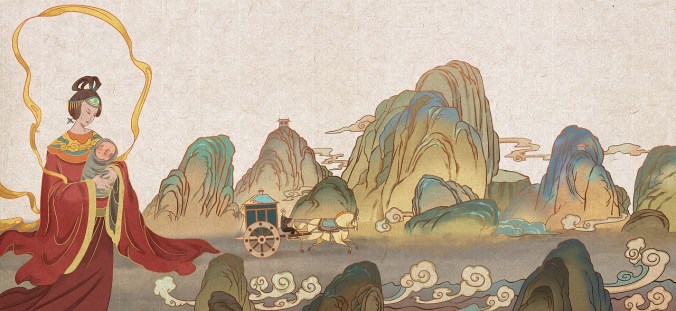
Time flew by, in the blink of an eye Chen Xiang was six years old. One day San Shang Mu’s elder brother Er Lang Shen Yang Jian found out that San Sheng Mu was living a mortal life, even going so far as to bear a son. He was furious. He sent out his spirit eagle to capture little Chen Xiang. Then, in a rage, Yang Jian found San Sheng Mu and yelled at her for having no shame, for violating the law of Heaven, and forced her to hand over her jeweled lotus lantern. The Jeweled Lotus Lantern was her Mountain Guardian Treasure, but in order to save Chen Xiang, San Sheng Mu had no choice but to give it over to Yang Jian.. After Yang Jian took the lantern, he released Chen Xiang, however he pushed San Sheng Mu down under the giant stone at the top of the Western Peak of Mt. Hua.
After nine years Chen Xiang had gradually grown up into a thoughtful young man. One day, his father explained what had happened to his mother. Chen Xiang heard this and was filled with grief and indignation, but at the same time was determined to go to Mt. Hua and rescue his mother.
At that time, one of the Eight Immortals, Lu Dongbin clutched his finger in contemplation, realized that Chen Xiang was going to Mt. Hua to rescue his mother, wanted to help him. He turned into a Daoist Priest and went to the foot of Mt. Hua. When Chen Xiang came to the base of the mountain he ran across the Daoist priest, explained his reason for coming, and asked about the road up the mountain. Lu Dongbin said, “If you go up the mountain like this, you cannot succeed. It would be better to first train with me.”

Chen Xian honored Lu Dongbin as a teacher. Every day he rose early and went to bed late, practicing martial arts, and quickly became proficient in all eighteen styles of martial art. Lu Dongbin saw this and was very pleased, saying, “Very good! Your martial arts training is already complete, you can go up the mountain. The key to open the mountain is at your Uncle Yang Jian’s place. He has a dog and an eagle; they are very fierce. I will give you two small pills, the round one can subdue the spirit dog, and the long one can tame the spirit eagle. I hope you and your mother can be reunited soon.”
Chen Xiang took leave of his master, and carried an iron pestle up the mountain to find Yang Jian. When he got to the Gate of Heaven, he saw a bunch of Celestial Generals escorting a haughty and pure god. Chen Xiang knew that must be Yang Jian, he went firmly up to him and saluted, only to hear Yang Jian sneer and say, “Heh heh, you really came!” saying this he raised a three pointed two edged knife and struck at Chen Xiang’s head. Chen Xiang raised the iron pestle and did his best to resist, there was a sound – ka-cha, and the knife snapped into two pieces. Yang Jian was angry and surprised, he let out a bellow and called forth Xiao Tian Quan, the Barking Celestial Dog. Xiao Tian Quan opened his bloody mouth wide like a sacrificial bowl, rose into the air and pounced. Chen Xiang tossed the round pill, Xiao Tian Quan swallowed it in one bite, and suddenly his jaw was tightly shut, it lay down on the ground in pain and began rolling around. Yang Jian then called forth the spirit eagle. The spirit eagle spread both wings, hid the sky and covered the earth, it spread its talons like knives and pounced. Chen Xiang tossed the long pill, the spirit eagle ate it in one bite, both wings froze in midair. Er Lang Shen saw that the spirit dog and spirit eagle had been defeated, he had no choice but to order the Heavenly Generals to fetch the key to open the mountain — a glittering, shining, crescent moon ax.

Chen Xiang took the crescent moon ax and went up Mt. Hua calling loudly as he went, “Mother! Mother!” Chen Xiang called from the North Peak to the East Peak, he called from the East Peak to the South Peak, but from beginning to end he could not find her in those places, worried he cried out loud. A mountain spirit was moved by this, and said to him, “Oh filial child, your mother is in the West Peak.” Chen Xiang heard this and stopped crying, climbed the Western Peak as if he were flying, soaring into the air with each jump, raised the crescent moon ax high, and did his best to split the peak. There was a loud, earth shattering noise, the peak was split open, San Sheng Mu slowly came out. Mother and son saw one another at last, they embraced one another excitedly and cried bitterly together.
Chen Xiang welcomed his mother back home and the family of three at last resumed their happy and blessed life together.
Notes: I actually climbed Mt. Hua on my 2012 visit to China, but I climbed the Eastern Peak because we wanted to stay the night a the peak and watch the sunrise as is the custom. I say climbed because we did spend about 7-8 hours walking up the endless stairs (no switchbacks here), but only after we took the bus up to the gondola. People in better shape than me climb the whole thing! No matter which peak you visit, it’s a stunning experience and I highly recommend it if you’re going to be in the Xi’an area. This was one of my lovely views.
The Legend of Sun and Moon Lake
In the jewel island of Taiwan, there is a beautiful scenic lake called Sun and Moon Lake. Beside the lake are two towering mountains, one is called Mt. Da Jian, and one is called Mt. Shui She. This is the origin of these names and a beautiful story about them.

A very long time ago, there lived in a large lake, two evil dragons, a male and a female. One day, at noon, when the sun arrived in the sky over the lake, male dragon suddenly leapt up and in one gulp he swallowed the sun into his belly. At night when the moon rose into the sky, the female dragon also flew up and swallowed the moon into her belly. This pair of evil dragons swam to and swam fro in the lake, sometimes swallowing the sun and moon down and sometimes spitting them back out, playing by batting them around. It was as if they were in the middle of a performance, a pair of dragons with trick pearls. They only pursued their own pleasure. They didn’t consider that because the human world had no sun or moon, everywhere was dark. The threes all wilted, birds in the branches no longer sang, nearly ripe sugar cane dried out, cows and sheep couldn’t find grass to eat and nearly all starved to death. Days became unbearable, and the people all cried out in a wailing sigh.
In the village there were a pair of clever and courageous young people – Elder Brother Da Jian and Elder Sister Shui She, they saw this state of affairs and their hearts were filled with worry. They pledged to seize and return the sun and moon. But how could they fight the evil dragons? Brother Da Jian and Sister Shui She arrived outside of the evil dragon’s cliff cave dwelling, and eavesdropped on the two dragons’ conversation. Actually the things that they were most afraid of were the golden ax and golden scissors buried at the foot of Mt. Ali
Having found a way to subdue the evil dragons, Brother Da Jian and Sister Shui She climbed mountains and waded rivers, and arrived at the base of Mt. Ali. With no thought for tiredness they dug and dug until they couldn’t tell how long they dug. A crack in the rock finally showed a ribbon of golden light, they dug again a bit more down, and sure enough they dug out the golden hatchet and golden scissors buried under the mountain.
Carrying these treasures and full of confidence they returned to the side of the big lake. The two evil dragons were in the middle of playing by swallowing and spitting up the sun and moon. Brother Da Jian dashed forward bravely with no personal concern and jumped down into the lake, brandishing the golden axe and chopping fiercely at the evil dragons. Suddenly he chopped the male dragon’s head right off. Sister Shui She saw a timely opportunity, raised the golden scissors in both hands and ka-cha, sheared off the female dragon’s head.
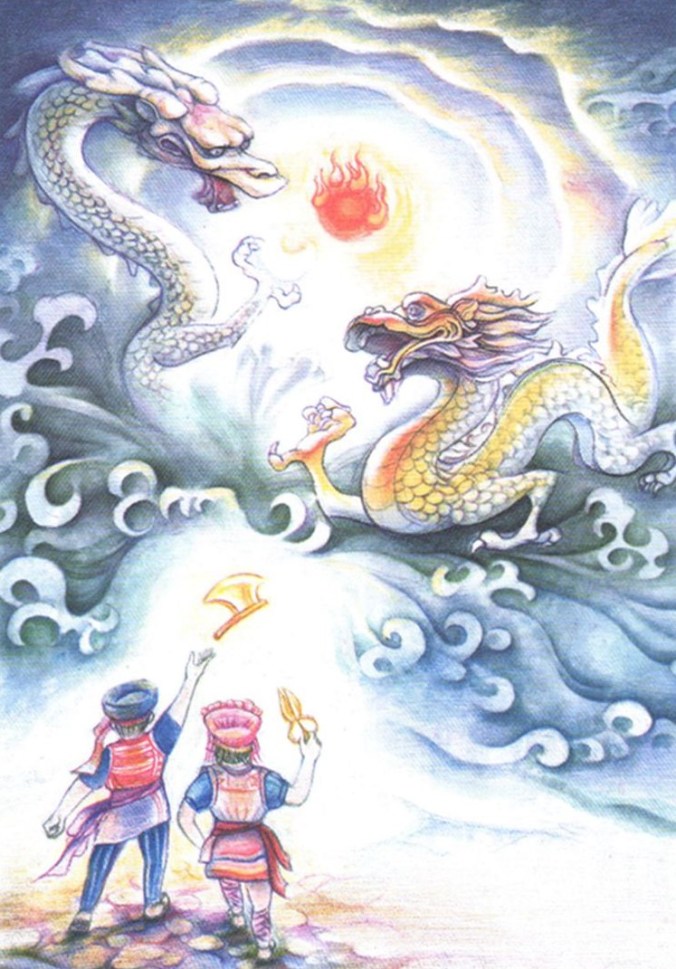
Both dragons were dead; however, the sun and moon were immersed at the bottom of the lake. Brother Da Jian tore down the male dragon’s eyeball and swallowed it; Sister Shui She swallowed female dragon’s eye; and both people instantly turned into giants. Brother Da Jian dredged the sun up from the lake bed, and Sister Shui She pulled up a palm tree from the lakeside propping it upward, and pushed the sun back up to the sky. The sun was once again joyfully hanging high in the blue sky. All living things also glowed with vitality; the people cheered and frolicked with joy. After the sun set behind the mountain, Sister Shui She dredged up the moon from the lake bed, and Brother Da Jian used the palm tree again to push the moon back into the sky. The gentle radiance of the moon once more spilled fully across the earth. The people were extremely happy. They wanted to show their appreciation for Brother Da Jian and Sister Shui She, but it was discovered the two had already transformed into two majestic mountains.
The people arrived at the lakeside where the sun and moon were previously swallowed, they found that the island in the center of the lake had divided it into two halves: one half was like a round sun, and the other half was like a crescent moon, so they named the lake Sun and Moon Lake. In order to commemorate the selfless devotion of Elder Brother Da Jian and Elder Sister Shui She, they named the two mountains separately as Mt. Da Jian and Mr. Shui She.
Notes: I didn’t go to Sun Moon Lake on my 2019 visit to Taiwan. It is a very popular destination, but I was worried it was just going to be a crowded tour group and I also had limited time. I don’t regret my choices, but I may go to the lake if I ever get to go back to Taichung. I was curious about the shape and the mountains so I did some Google Mapping. I found the Shuishe mountain and the trailhead is quite near the lake, but I can’t pin down where Dajian Mountain is (the only one I found was much farther north near Taipei?). I’m not really sold on the idea that the lake looks like a sun and moon. The island is super tiny, I almost missed it because I didn’t zoom in enough on the map! This helpful satellite view from a Chinese source shows us where the sun (right) and moon (left) “shapes” of the lake are, with the line running through the small island of Lalu (拉魯島).





















 Shortly after parting ways with the helpful Nigerian, I walked past what appeared to be a large open air food court. There was a roof and fans circulating air, but the entryways were wide open. There were dozens of food stalls from different nationalities, and tables to sit at between them. I went to one stall to get a fried oyster omelette and another for an iced coffee, then sat down to enjoy them. The omelette was a bit odd. In addition to eggs, vegetables and oysters, it turns out this dish is cooked with a variable amount of tapioca, potato, and/or rice starch. This just goes to prove I should have read more about the food before going, because the gooey texture combined with the heavy oil meant that I only ate about ¼ of the dish before I couldn’t eat any more. The coffee, on the other hand, was intense and amazing. I didn’t know it at the time, but Malaysian style coffee is different from other coffees around the world. I’ll explain more when I get to Ipoh, but for now, suffice it to say I was pleasantly surprised.
 After breakfast, I passed by all the tall financial buildings and came to the Marina. This beautiful stretch of waterfront goes on for ages with a wide and clean walking path. I came across a shopping mall on my way and decided to head inside for the AC and maybe a restroom. The Nigerian man I’d met advised me that if I ever felt too hot in Singapore, I could just walk inside any building to get some cold air. The mall was nearly empty, which is not surprising for a weekday morning, and I managed to find a 7-11 to get a cheap sim card (less than half of the airport prices). I also got called in to have a sample at two separate skin care shops. The first was a supernaturally charming young man who probably got nearly every woman he met to spend too much money on his skin care products. We chatted and tried out the product and eventually I had to demure from purchase, but he was gracious about it and said he’d had fun talking with me. The second shop was a Malaysian woman who was wonderful and gracious and kind until it became clear to her that I had really meant it when I said I wasn’t buying anything, and then she turned rather sour. Both shops products were in the hundreds of dollars range. It was somewhere around here that Singapore started to remind me of Dubai.
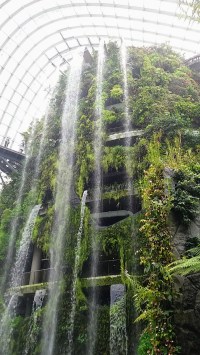 I walked more dockside paths and came across a science museum, more flowers than you can sneeze at, and finally some signs pointing to the garden path that was lined with sculpture, topiary and colorful blossoms. Although the Super Trees were my main goal, by the time I arrived at the park’s center, I was hot and tired. I noticed a cool breeze coming from the doors of one particular building and resolved to go inside that. The building was one of the two indoor gardens, this one called Cloud Forest (the other was closed for renovations). It was a massive greenhouse designed to house the ecosystem of a cloud forest, and so not only had pathways winding through beautiful flowers at ground level, it had a miniature mountain in the center that one could ascend and walk around via a series of skywalks that simulated viewing the forest from cloud level and treetop level.
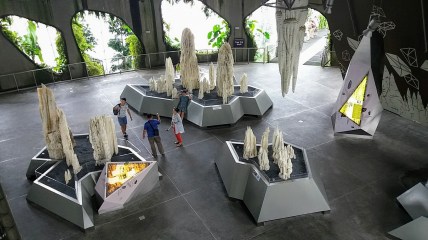
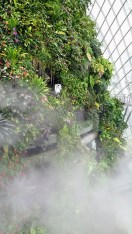 The time of clouding was approaching by then, and although the main path did not lead back upward, it wasn’t crowded, so I hopped into the elevator and rode back to the top. I get the impression that in more crowded times, the elevators might be more strictly regulated for the disabled, and the paths through the greenhouse lead firmly one way, but it wasn’t crowded and no one seemed to care if we went the opposite direction. Shortly after 2pm, the skywalk began to issue forth a mist as I set out for my second walk on the sky bridge and was able to enjoy the altogether different view as the fog enshrouded the walkway and the mountainside below.
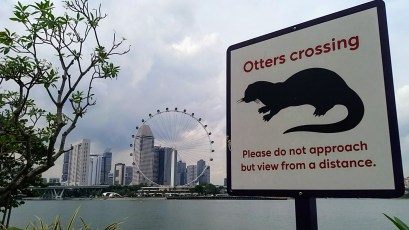 Nonetheless, the entire area of the marina is beautiful to walk through. I spotted some otter crossing signs, which are apparently no joke. The environmental reconstruction along the marina has enabled the local otter population to bounce back and they are often seen on the shores near the walking paths in the evenings. Sadly, I didn’t get to see any that day.
 After lunch, I decided i should go find the super trees. It was getting on in the afternoon, and I still had to get across town to the Night Safari for my 7:15 ticket. Although the tall and unique structures can be seen from nearly anywhere in the park, it took a little effort to find the right walking paths to get to them. There are two groves of supertrees, the smaller has only three, which at the time were undergoing a pre-lunar new year makeover.
 Eventually, I found the main grove and purchased my ticket for the sky walk. This is a little walkway that is accessed through an elevator in the “trunk” of the trees and lets you walk around the super trees at a good height to both admire them and the overall view of the gardens below. I had a nice walk and an even better view as well as some pleasant conversation with another traveler. No matter how nice the view is, I think my favorite part of traveling is meeting cool people.
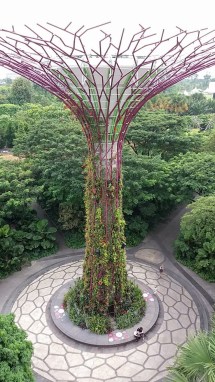 The super trees aren’t really trees. They’re man-made structures that sort of look like giant alien trees. They run on solar power and support a large amount of plant and animal life. Plus they light up at night, which is pretty. The super trees are urban art, but more than that, they are a way of combining city and nature and of providing a space for the plants and animals that would otherwise have been disrupted, or even endangered by the urbanization of their homes to have a place. The super tree grove helps to act as a greenspace, cooling and cleaning the air naturally, as well as collecting solar energy and rainwater that are used in running the indoor gardens. It’s basically a big experiment to see if a city can be a modern urban environment AND maintain a natural ecosystem in an economically sustainable way. I hope it catches on. More cities should have giant trees, beautiful flowers, and river otters.

 After eating and stretching our legs, the buses moved on to Dutayeon. The area of Dutayeon is beyond the Civilian Control Line, was closed to civilians after the Korean War and was only recently reopened to the public in 2006. It’s still necessary for us to register ahead of time with the government in order to visit the area, and for some of our group to wear GPS tracking necklaces around while in the park. Of course I volunteered to wear one for our group. Are you kidding? The Dutayeon Park area also includes the warning: “Not all landmines have been found, so stay within the permitted areas.” It’s not your average hike in the woods.
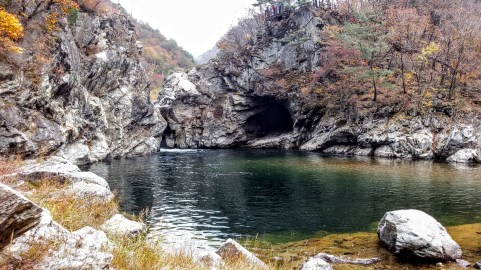 That being said, it is a beautiful area. The river that runs through it ends in a small but powerful waterfall that is the crown jewel of the park, visible across from the pond and from viewing platforms on both sides. There is a loop trail around the park, so it doesn’t matter which way you go from the pond. We headed right and passed by quite a large number of unexploded mine signs on our way toward an outdoor exhibit of mines used in the war,
  as well as other security measures and a mock explosion that demonstrated the sensitivity of the mines by blowing foam bits around in a ball while playing a low volume explosion sound whenever hikers came too close. There were also many happier decorations including party banners between trees, wooden deer and pigs, and a whole wall of paper prayers and wishes.
 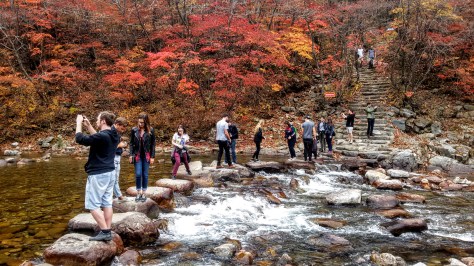 After crossing the brigde, we followed more winding forest paths through beautiful red trees. We climbed up some stairs to get to a viewing platform just above the falls and then continued on further upriver. When it came time to cross again, there was no bridge, but instead a trail of stones that required us to hop across. Most stones were large enough to allow two people at a time, but not all. Some stones could be easily stepped between and others required jumping. Plus, everyone wanted to stop in midstream for a geourgous photo-op. The end result was a long and patient crossing while trying not to get bumped into the water by people crossing the other way. This was mostly acheivable, except for when the Ajuma needed to pass. These are the ladies who wait for no one and push everyone aside to pass. Behavior that is just rude and annoying on the subway suddenly becomes hazardous when trying to balance on river rocks. Oh, Korea.
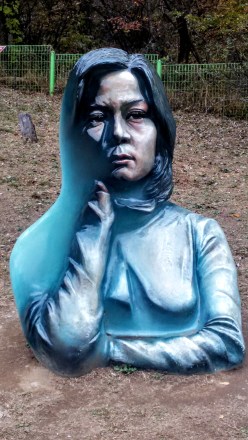 Back on the near bank, we followed the trail up to a gazebo/pagoda hybrid that overlooked the waterfall once more, before following a side trail up and over to a sculpure garden that included various works of outdoor art inspired by the war or the peace as well, as a missile and several tanks that were leftovers from the fighting. One of the most fascinating pieces was a painted sculpture that blended 2d and 3d art. The sculpture was the bust of a young woman, but only half of it was painted realistically, the other half had been painted blue. In addition, the depth was unrealisitc as well. The combination created an illusion of a different perspective of portrait from each angle as you walk around it. There was also a kitchy photo frame where we took a group shot, and a copse of giant eyeballs which was meant to show the sourse of all the tears shed for those lost. There were art pieces made from the objects of war, such as the barbed wire dandilion, and other shapes made from reforged metal. All in all, it was a surreal yet emotional tribute to the history and tragedy.
 From the park, we wended our way over to a small war memorial. Mostly we stopped here because it was necessary to file more paperwork for the Eulji Observatory. The memorial was very artistic and very sad. There were nine pillars representing the nine big battlefields in the area (Dolosan, Daeusan, Bloody Ridge, Baekseoksan Mountain, Punch Bowl, Gachilbong, Danjang Ridge, 949 Hill, and Christmas Hill), as well as statues of soldiers, displays of weapons and a whole room the floor of which was covered in shell casings from the war. Growing amid the barbed wire and destruction were small and beautiful flowers. There was a poem there ending in the stanza:
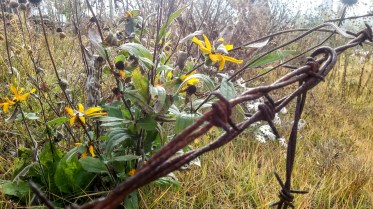 While reading these lines, I stood over the discarded shell casings, and under the helmets of dead soldiers, my camera filled with photos of beautiful flowers growing around the site. Although small and far less grand than the UN Memorial in Busan, the closeness of things these men had touched or died in amid the natural beauty of wildflowers and creeping red ivy brought the tragedy of war far closer to my heart than a cemetery or a statue ever could.
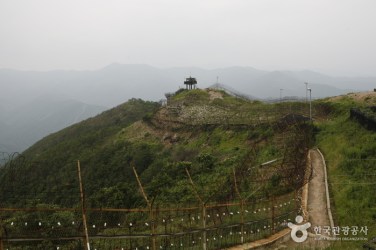 I could see one winding dirt road, some tires stacked and filled with dirt or sand to create a barrier, and a lone watchtower surrounded by more barbed wire fencing. Beyond these decrepit signs of occupation, the land seemed as wild and untouched as though looking back in time to before humans even arrived. Coming from South Korea, where all the land is so thoroughly occupied that wildlife is all but vanished, it was a stunning contrast.
 Inside the observatory, there is an enclosed viewing platform that overlooks the North. A brave soldier who spoke some English decided to read an English presentation to our large group. He was very nervous, but it was a great gesture that he wanted to share information with us, so we filled the small auditorium and listened politiely while staring at the mist shrouded emptiness behind him. He told us about famous battle sites around the observatory including Stalin Hill, where the South lost some land that is now part of North Korea, a radio tower used to block signals traveling into the North, and a distant waterfall called Fairy Waterfall where beautiful North Korean women used to bathe nude to entice South Korean soldiers. He also indicated that North Koreans did use the area nearby for agriculture, although to my eyes it looked completely natural and I cannot imagine that the food they harvested there would be anything more than wild gathering.
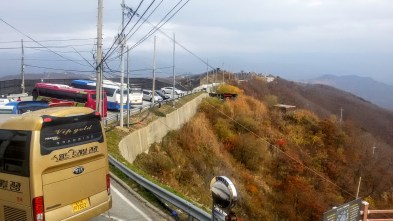 I stepped back outside, feeling disoriented from the whole experience, looking back and forth across the narrow fence from a high vantange point where I could easily see North and South at the same time. (hint, the South is on the right, the North is on the left) Large ravens swooped around the peak, effortlessly gliding between the two countries gripped in cold war, alighting on the Northern watchtower, then returning to our parking lot to scavenge for crumbs left by tourists.
 Our last stop for the DMZ day was the 4th Tunnel. This sounds fairly ominous, because it also implies there are at least 3 other tunnels, which there are. The North has tried on at least 4 occasions to literally tunnel into South Korea to get troops behind the border for a massive attack. Before heading over to the tunnel entrance, we scooted inside the nearby museum for a quick propaganda film. The film was in Korean, but had English subtitiles. They were long, small and hard to read over the video, as well as not being the most accurate gramatically, but I got the gist: North bad, South good, Threat onging. The idea that the Korean War is over is not something that really exists up near the border. To be honest, it doesn’t really exist in Korea at all, but most of the time Korean citizens can ignore their war with the North the same way Americans don’t let the 7 wars their country is involved in affect them on a daily basis. This film was a little startling however, because it didn’t even make an attempt at looking like an “unbiased documentary” and was more in a tone in keeping with propaganda material from the 1950s-60s during the cold war with Russia, or the modern Chinese government propaganda films. I’m not sure how old the film was, but it certainly felt out of time.
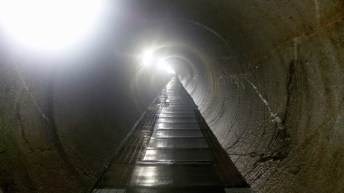 After the film, we filed into a large round tunnel. The tunnel we were walking into was dug with a serious drill by the South Koreans in order to reach the less sophisticated North Korean tunnel. It was a long walk, less than 1km I’m sure, but the tunnel was dim and damp and nearly perfectly circular thanks to the diamond tipped drill the Koreans had used to make it. Hard hats were available at the front, but there were nowhere near enough to accomodate our group size, so we simply left them behind. Inside the tunnel was another no photos zone. Fortunately, the internet provides, so you can see some photos that other people (including authorized tour guides) have taken of the tunnel and equipment.
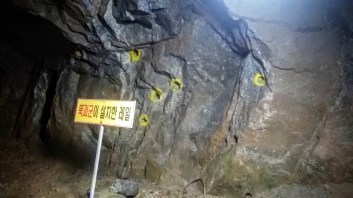 Where the modern and sleek South Korean tunnel ended, there were clear toolmarks in the rock, concentric circles left by the drill. Intersecting our tunnel was a much smaller one, no more than 2 sqare meteres, and rough hewn, carved out with picks and dynamite. A small train awaited us, one seat behind the next as the tunnel was too narrow for two abreast. The seats were low and a transparent panel protected us from the threat of falling rocks above, but the sides remained open. We climbed in, feeling even more like boarding a ride in a theme park, expecting a trek through the rugged rock. After a mere 100 meters, the train came to a stop. We could see tool marks, and holes that had been prepared for the next round of dynamite. I forgot for a moment about the photo ban, but when I snapped a few, the soldiers only politely reminded me not to and I put my phone away again.
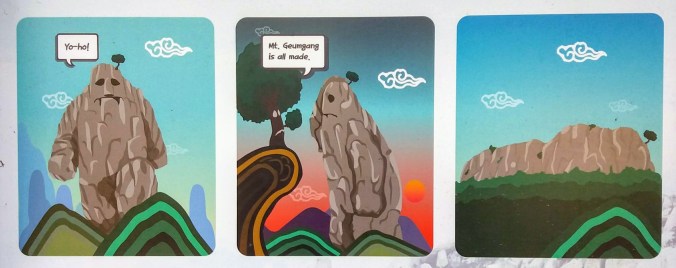
 The parking lot had more tour buses than Disney Land, and when we passed through the main entrance, we were greeted with a wide stone road lined with restaurants, cafes and other businesses catering to park-goers. There are several trails that can take over 12 hours, but we didn’t have that much time. After doing some research, my companions and I decided we would see the big Buddha, then walk the short (2 hr) waterfall trail, and finally take the cable car up to the highest peak for a look around.
 Our tickets in had, we followed the signs toward the temple, passing more and more restaurants, cafes and other buildings of unknown purpose. We rounded a corner and spotted the giant statue from a distance and made a bee line straight for it. The first thing that struck me was how similar it was to the
  Trying to keep ourselves on a decent timeline, we said our farewells to the stunning statue and set off in search of the trail-head to Biryong Falls. We soon joined a stream of Koreans dressed to the nines in their special hiking clothes. For many Koreans, espeically the older ones, outdoor activities are a serious glamour show. All the clothes are brightly colored and brand new looking. Meanwhile, my friends and I were dressed in jeans and hoodies because that’s usually how we walk in the woods at home.
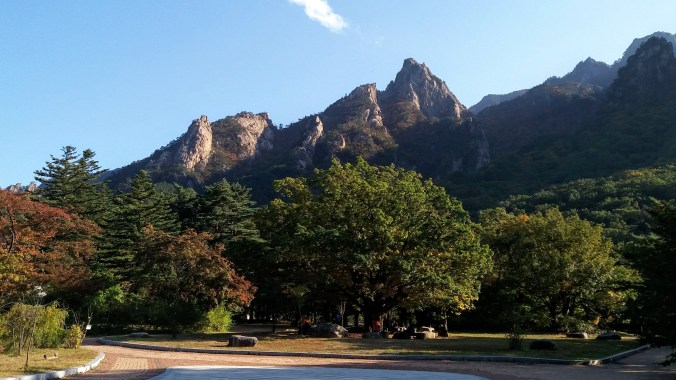
 The path involved some beautiful views of the surrounding mountains. Unlike the Busan mountains which are low and covered in a softening green layer of trees, the Seoraksan mountains burst from the treeline with jagged teeth of bare rock, and this day, the whole thing was wreathed in clouds and mist making it even more haunting. We took a wide bridge over a river and ambled joyfully along the forest path, stopping to admire the trees on a regular basis. The Koreans around us took some pictures, but only at designated picturesque spots. The rest of the time they were in a hurry to get moving. So much of a hurry that we were jostled, bumped and even shoved if we were deemed to not be going fast enough. It was like being in the subway… for several km. We tried to walk on the side of the path, or even just step OFF the path when the hordes of ajuma came barrelling down on us, but it didn’t always work.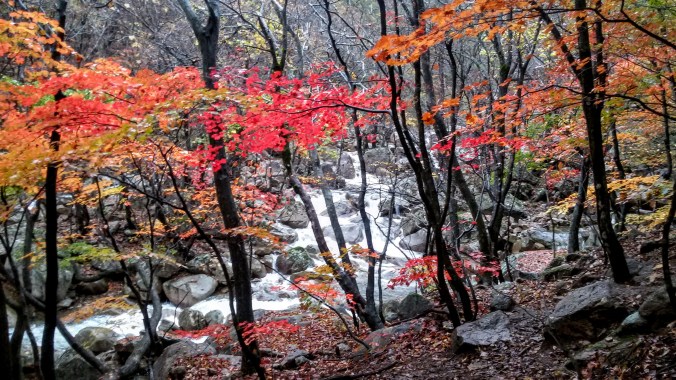
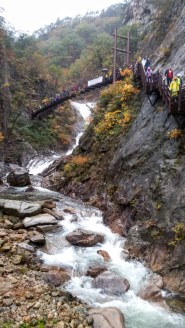 As our path ascended beside the river, we were treated to the kind of views normally reserved for high class calendars and natural beauty screen savers. My computer randomly shows me stunning nature pics every time I log in, and I swear that one of them was actually from Seoraksan. We climbed up the slippery rocks, clinging to the railing and nearby trees until we reached two more bridges crossing the lower Yukdam Falls. The maps and pamphlets all say it’s just a 40 minute hike from the main entrance to these falls, but it had taken us close to 90, proving that 40 minutes was measured by ajuma walking standards rather than beautiful day in the woods standards. I understand that Biryong Falls was only a little farther up the mountain, but in order to make our cable car time, we had to turn back early.
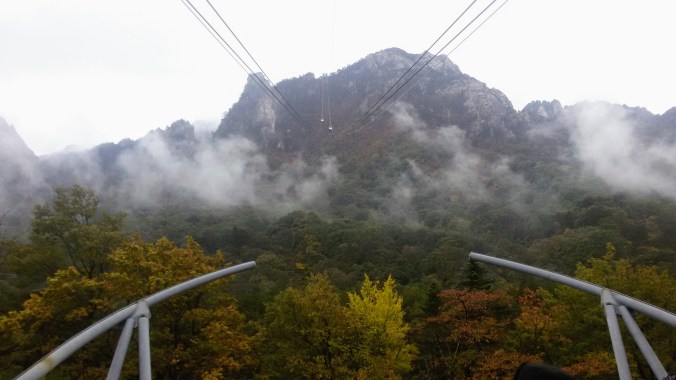
 Our last adventure for the day was to take the cable car up to
 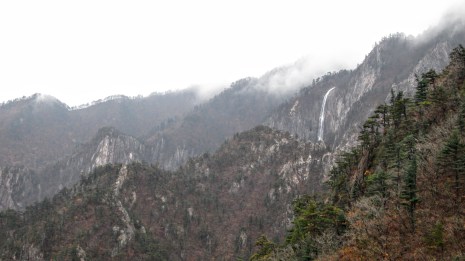 As we rose, the clouds soon fell below us, covering the view of the ground and the sea became visible off to one side. I had known Seoraksan was near the coast, but I had not realized how close to the ocean we actually were until that moment. The cable car stand at the top had more amenities, food and restrooms and coffee shops, but we swept past them and onto the viewing platform. I had read ahead of time that one could walk all the way to the tippy top from here and see an old castle, but after my experience on the waterfall path earlier, I was reticent to follow another stream of hundreds of hikers. We walked around the viewing area and found a distant waterfall, a long streak of white amid the green and brown of the mountains, visible even at this distance it must have been enormous up close.
 While searching for more and better angles to take majestic photos of the panorama around us, we stumbled upon a small path leading downward that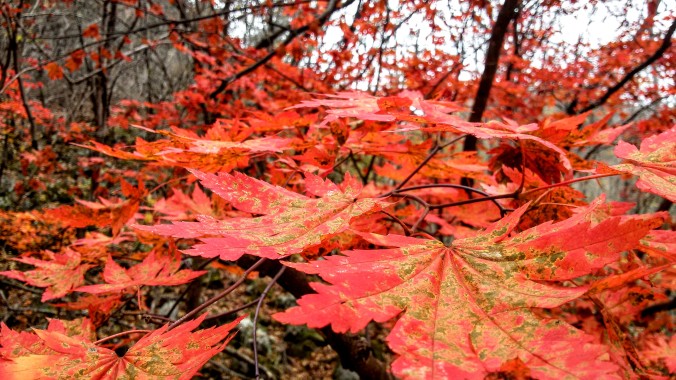


 Gallivantrix