It took me two days to fly from Dakar to Zanzibar in part because Africa is so much bigger than you’d believe and also because there just aren’t as many flights running every day. I will tell the transit tale of my experience with Ethiopian Airlines in another post, but the result of this travel style was that I arrived in Zanzibar in the early afternoon and had the better part of half a day to explore and think about what I would do during my stay. Stone Town is a winding, alley-filled neighborhood where no cars are allowed to enter. It’s easy to get lost, but also easy to get found again because it’s not that big.
While I was wandering, I was approached by at least half a dozen of the local tour sellers. Usually, I find this sort of thing particularly annoying and intrusive, but these men seem to have refined the art of having a pleasant conversation while mentioning but not pressuring a sale. It gave me a chance to get some ideas about what to do, where to go, and how much I might expect to pay for things. Although I declined to book at the time because I was still worried about being pressured into a bad deal by lack of knowledge or experience, I didn’t feel overwhelmed the same way I have in other tourist cities. In hindsight, I think booking with the “captains” on the beach rather than a tour guide or hotel is perfectly fine as long as you are interested in what they are offering.
I also learned the two Swahili phrases that would echo in my ears for the next 3 weeks: “pole pole” which means “go slowly” and “hakuna matata” of Lion King fame. Despite the extreme popularity of the Lion King, locals seemed surprised that I knew the phrase as a first time visitor. It really does mean “no worries”.
Wishlist in hand, back in my blissfully airconditioned room, I hopped online to start booking the next few days adventures. The first thing I decided to do was an Airbnb experience for a spice tour/cooking class. The “spice farm tour” is one of the staples of Zanzibar tourism. There are possibly several dozen spice farms in the island’s interior. I’m sure they all have some unique qualities, but my pre-arrival research did not seem to make any distinction about which one(s) were recommended / avoided, just “go on a spice tour!”. Most bookings include the ride and the tour and possibly a snack. The Airbnb experience appealed to me because it included a trip to the market and a cooking class by a local. I was a bit worried that the night before was not enough time to book, but the hostess was up for it and I went to sleep content that I had a plan.
The Darajani Market
Lutfia met me with her driver at 9:30 am in front of the fortress, which turns out to be the meeting place for almost all tours that drive out of Stone Town because it’s one of the only places that has car access. The hostess was very kind, but also I think she’s more used to taking groups because she and the driver chatted a lot in Swahili all day, checking in with me from time to time to make sure I was ok, hakuna matata. The one thing they did talk with me about on our first drive was what I wanted to cook. They had a list of choices from a set menu, and we agreed on a menu of coconut rice, vegetable curry, fried squid, and coconut candy.
Our first stop was the Darajani Market, a large open air market like many I’ve seen in SE Asia with almost as much Chinese writing randomly scattered around. The market is at the opposite side of Stone Town from the Fortress where we met, and it’s quite easy to walk to from anywhere in Stone Town, but it was a circuitous drive as we had to go out to the main road and around the car-free zone.
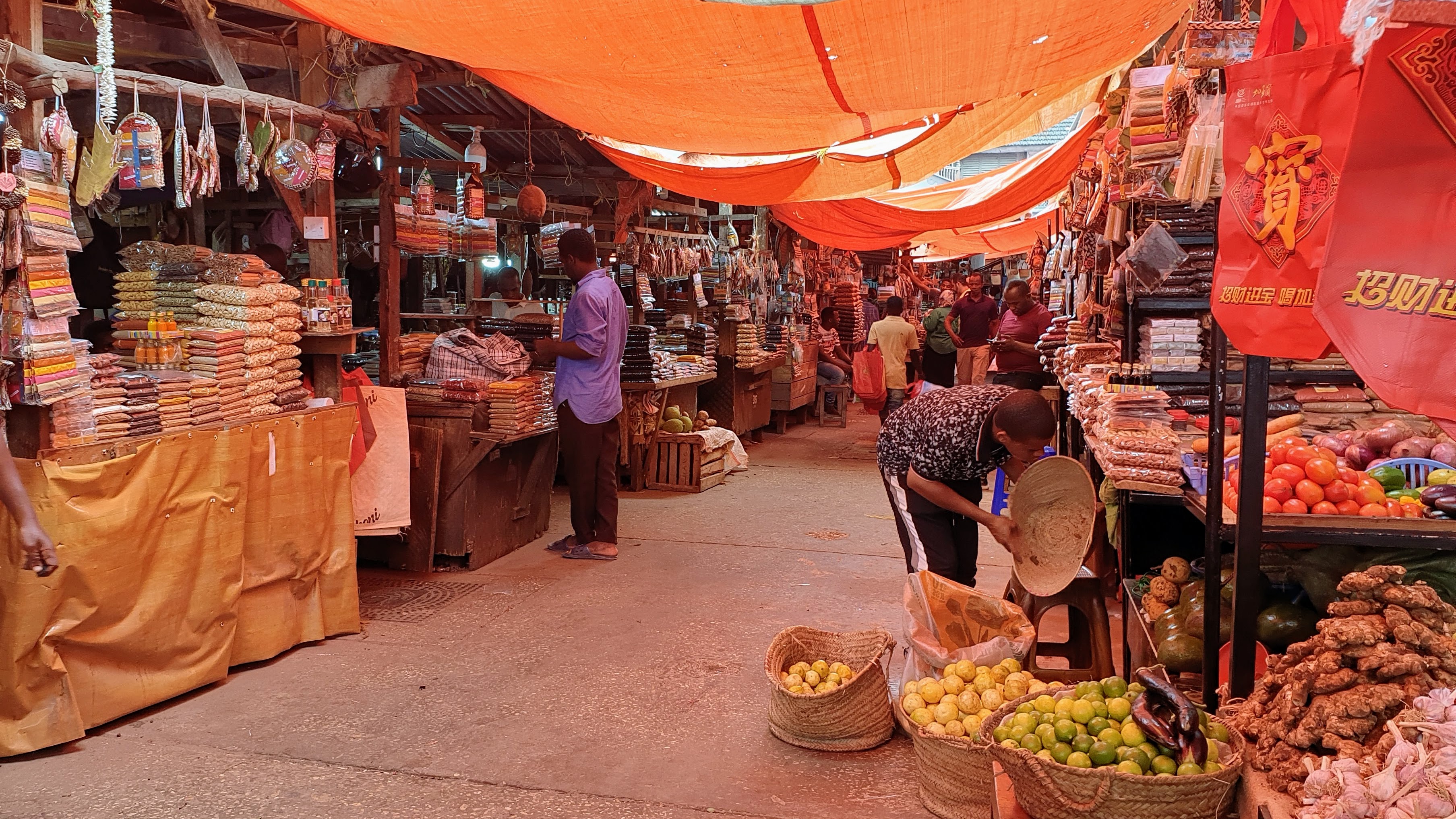
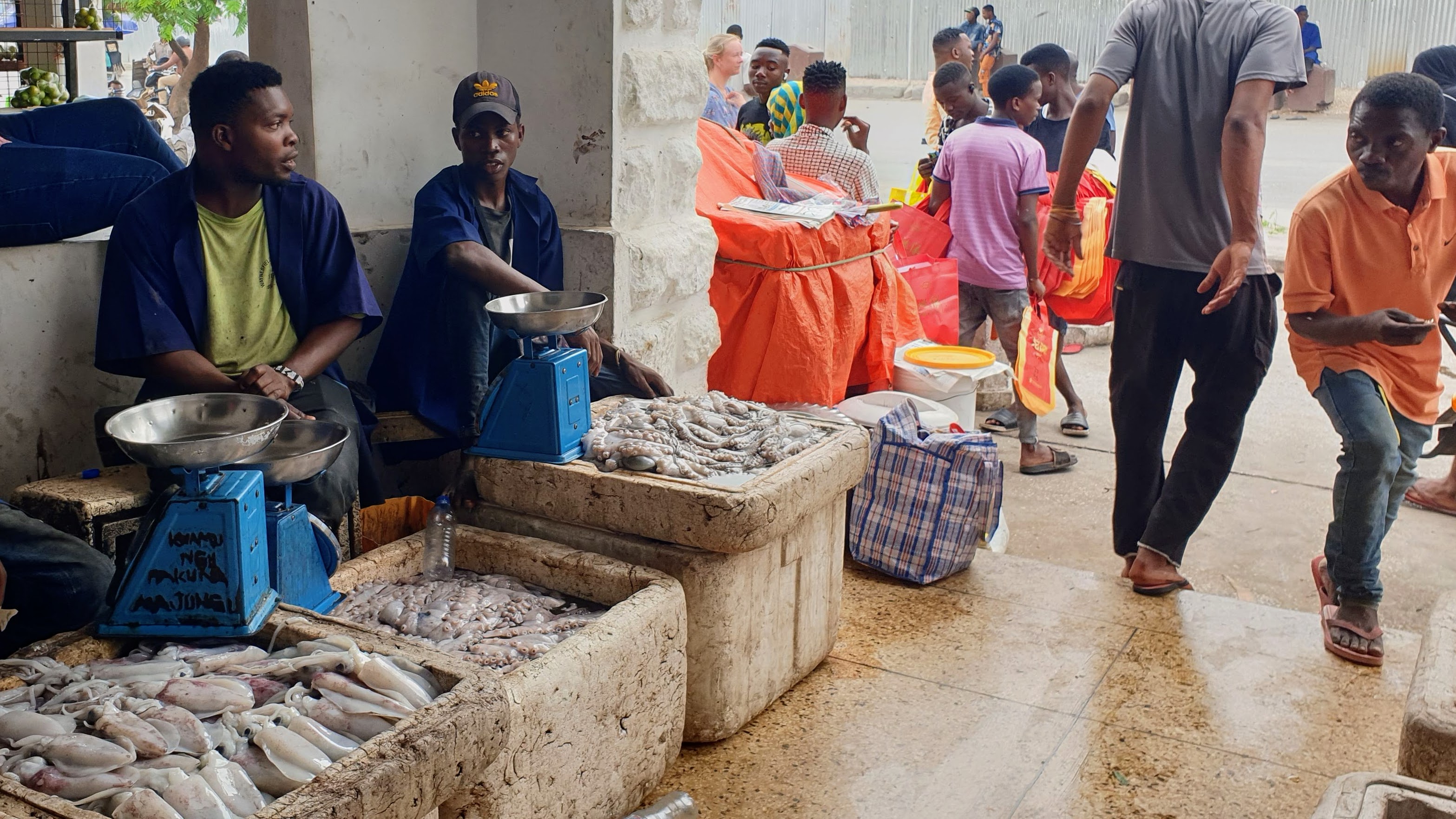
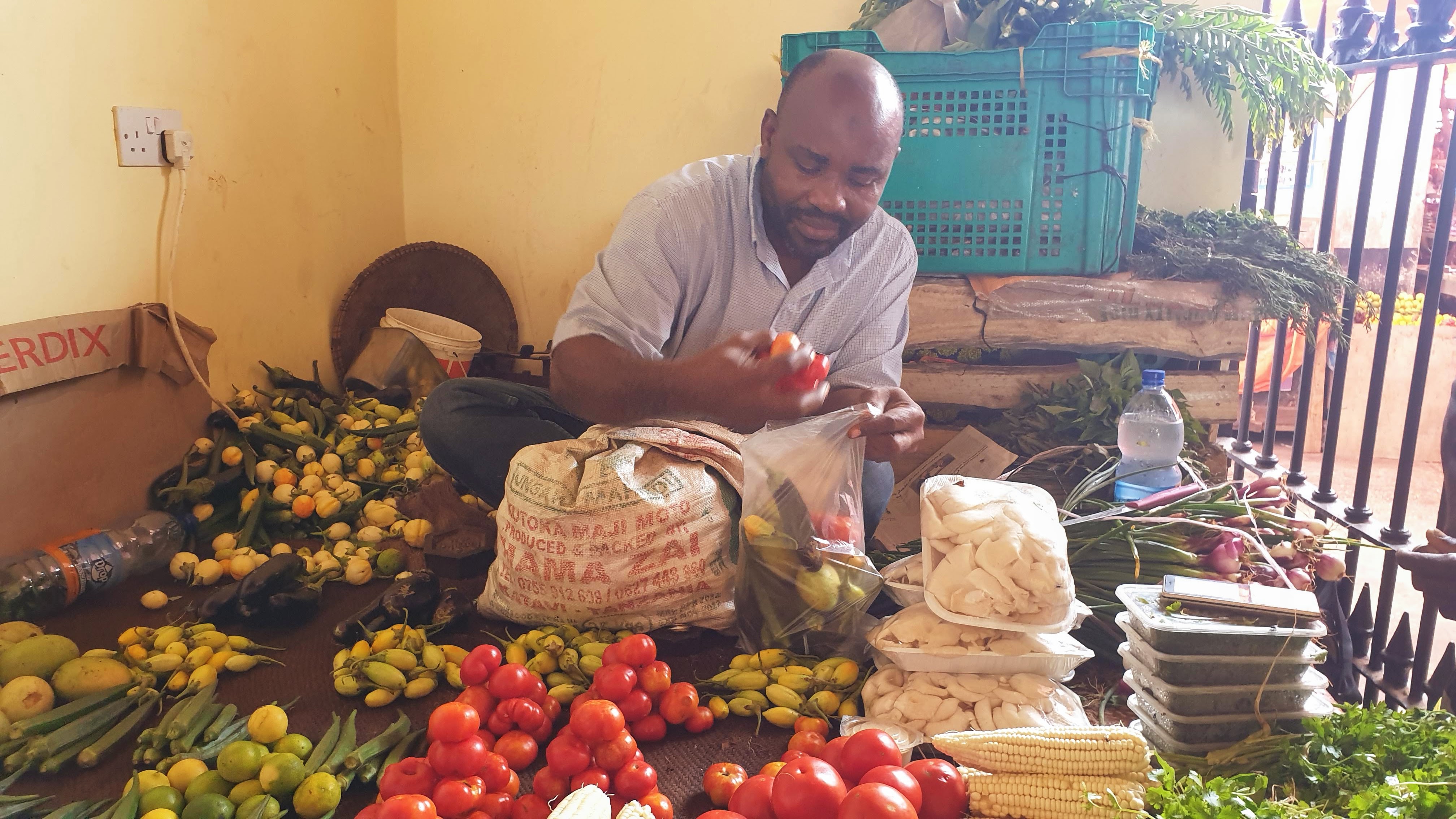
Once at the market, we started at the seafood stalls to get the squid. Zanzibar is famous for it’s fresh local seafood and everything on display had been brought in early that morning by local fishermen. It is, however, an outdoor market in a very hot climate so I was glad our recipe called for a very thorough high heat cooking. They took me through the rest of the fish and meat markets for a photo op and then we went on to get our produce. The veggies were easy enough, but the coconut seemed to be a kind of ritual where two men and my driver took turns holding up coconuts and shaking them. I’m vaguely aware this is a way to test the quality, but they were really into it. The coconut seller was a mute, so all the bargaining took place in sign… I can’t say for sure if it was a type of African sign language or just gestures, but the man was good natured and it seemed that everyone in the market was on board with accommodating his disability which is always nice to see. Finally we got our rice and oil and headed out.


The Drive
It isn’t far from Stone Town on the west coast to the spice farms in the interior, but the drive is “pole pole” because the roads are not in great condition. There were some jokes about the “Zanzibar Ferrari” (a cow drawn cart) which I remarked was similar to the “Senegal Ferrari” (a horse drawn cart) which got a bit of a laugh. Additionally, the driver informed me as we went onto particularly rough patches of roads that I was getting a “Zanzibar massage” – it was both reassuring and a little sad that the jokes made about poverty and lack of infrastructure are standard in the 3 out of 4 regions of the continent I’ve now visited because Egypt and Senegal also have drivers who reference a variation on “African massage” while driving over the roads which are more pothole than pavement.
Lutfia also told me a little about herself, her experiences growing up in Tanzania and being sent away to boarding school in Uganda where she had to learn English by a sink or swim method since the language of instruction there was English (but no English as a foreign language classes were offered) and only a few fellow Tanzanian classmates spoke any Swahili. She also told me that her own children were going to a boarding school, though at their request because they wanted to be around more kids their own age than their home village offered. She has one of the most successful tour experiences in Zanzibar with high ratings on Airbnb and TripAdvisor, but she still wants more. It’s always a joy for me to see women succeeding in the world. Life is still a big struggle for many women in Africa where women’s’ rights and roles are lagging behind the West. Women like Lutfia are perhaps more like my grandmother than myself or my mother in terms of bucking traditions and trailblazing, but it gives me hope that the girls of today are moving towards a better future.
The Spice Farm
Lutfia didn’t conduct the actual spice tour herself, instead leaving me with the farm tour guide while she went off to get the “kitchen” ready. I was the only tourist on that particular tour, although I did see a glimpses of a couple other groups through the trees as we walked. Normally private tours are expensive, but you roll the dice when you book on Airbnb as to whether anyone else has signed up. I almost think I would have preferred a few other visitors with me because being the sole focus of the guide’s attention was daunting at times. It was clear he’d given the tour often enough to have his patter down… pat. Although to my eyes the farm itself was often indistinguishable from a regular forest, he had no trouble identifying all the spices and fruits and finding ripe samples for me to examine and taste.

Spices & Fruits in Order of Appearance:
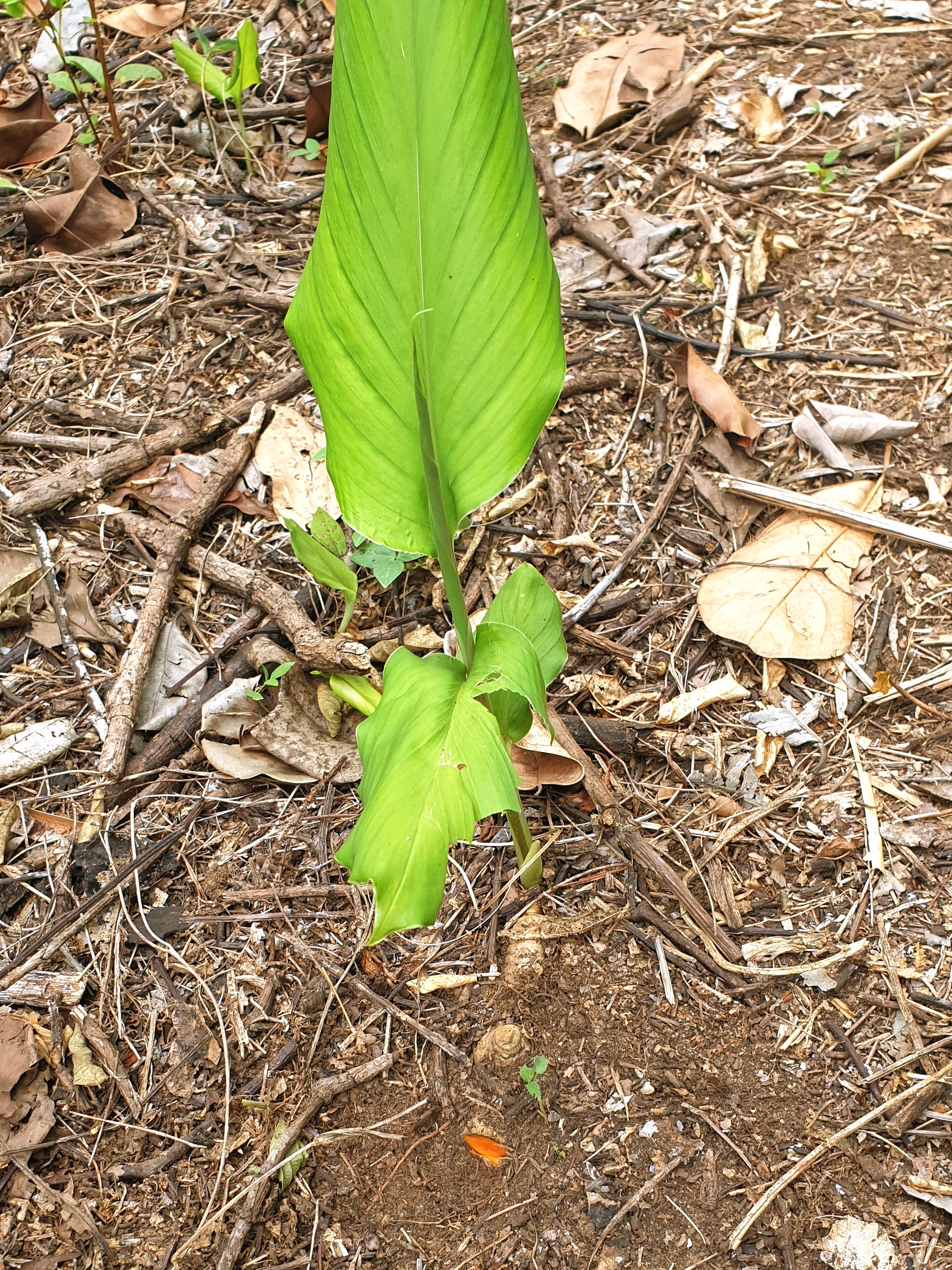
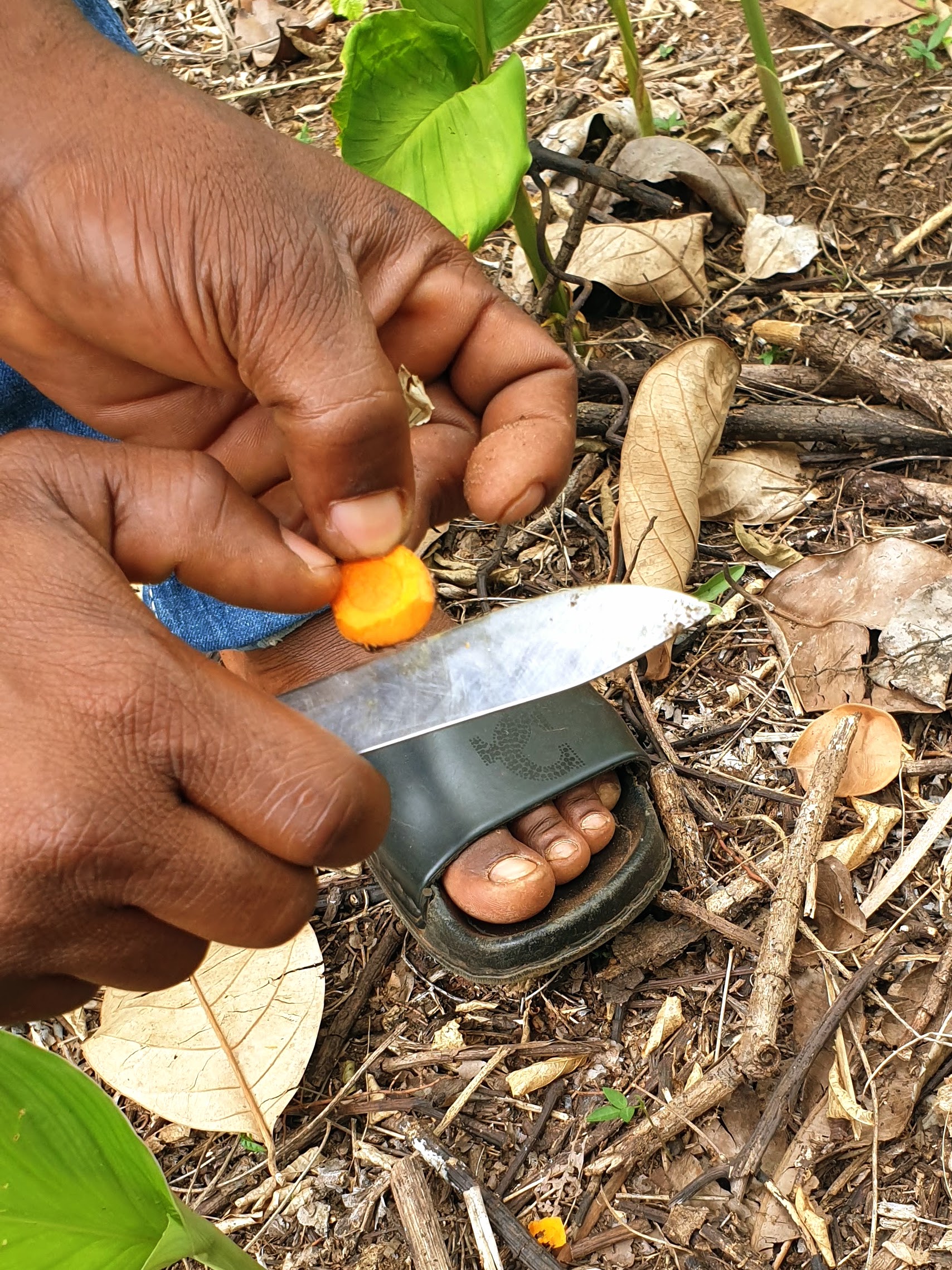
Turmeric: The bright orange spice is sometimes called the poor man’s saffron and is the backbone of almost every curry. I have had the chance to cook with fresh turmeric maybe once in my life before so I know it looks slightly like ginger or galangal, a twisted root, but this was the first time I got to see the plant in the ground. The guide cut a small slice off of a root for me to see and taste. It instantly stained my fingers orange and was both milder and sweeter than I’m used to in the dried version.

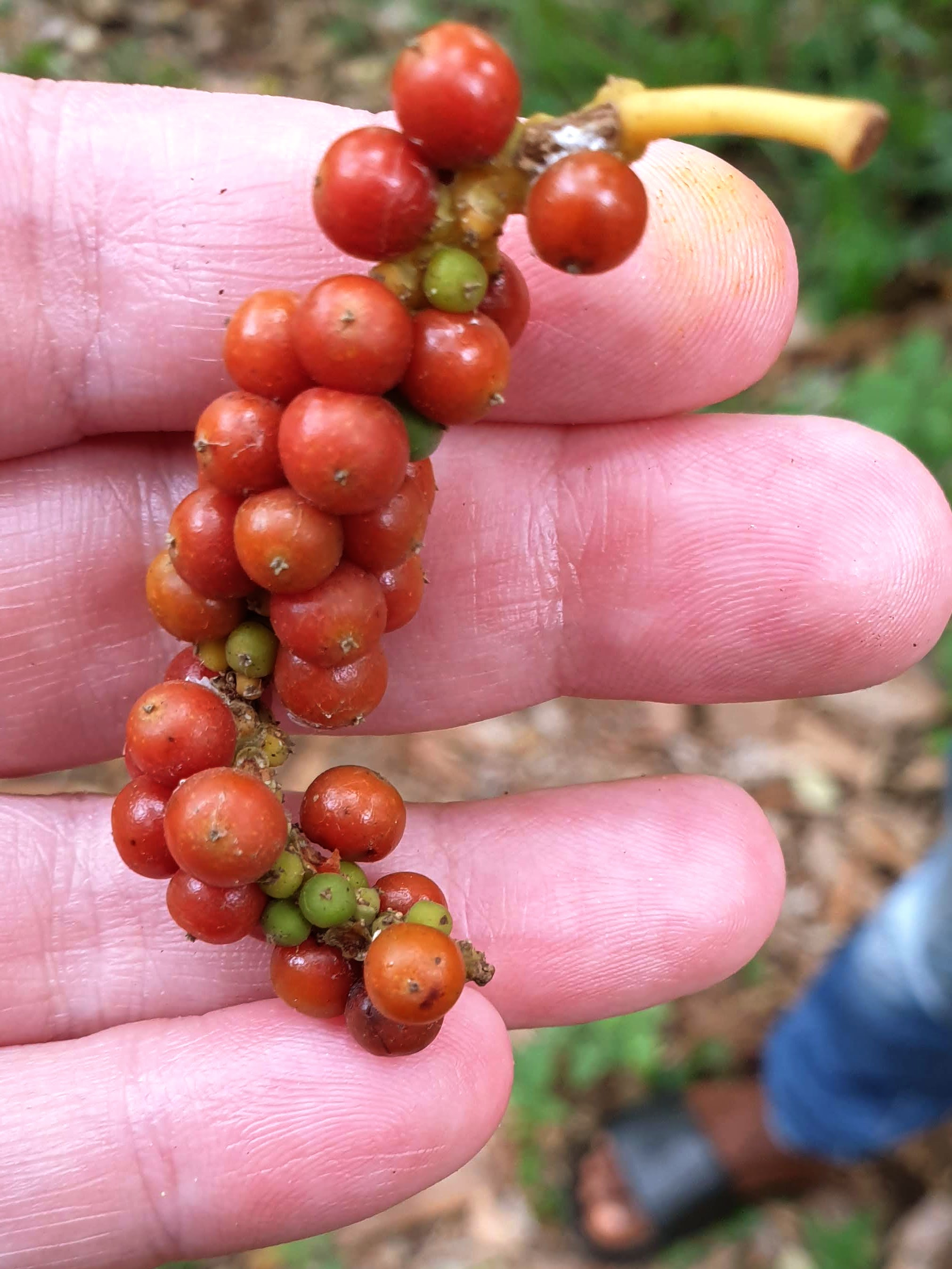
Pepper: Did you know pepper was a parasitic plant? I didn’t. Pepper grows on vines that can only live by climbing a tree and drawing nutrients from it. There weren’t many bunches of pepper berries at this time of year but we found a few and he explained about the 4 colors of pepper and how they happen (black, white, red, green – not to be confused with chili peppers which are a totally different type of plant, but the colonizers who named the spices in European languages basically called anything with a kick “pepper” no matter anything else about it) All 4 are the same plant at different stages of growth and processing. Green is under ripe, red is ripe, black is the sundried version of the red berries, and white – which I found most interesting – is the blanched kernel of the ripe berry, the fleshy red part is boiled away leaving the white hard center which still has a peppery flavor but is much more mild. This explains why white pepper is both more expensive and milder. I ate one of the fresh ripe red ones and honestly, I am amazed that’s not a thing somewhere in haute cuisine. It was like a pepper flavored pomegranate seed. The flesh of the berry has the pop of a pomegranate seed, and there’s a “red berry” flavor essence about it with the unmistakable but still milder and sweeter taste of black pepper.


Cinnamon: The guide informed me it is “the queen of spices” because there is no part of the cinnamon tree that can’t be used. The leaves are used to suppress appetite during the fasting season. The bark of course is the well known cinnamon that dries into the famous curled sticks and is ground for baking all over the world, And the roots are used medicinally to treat cold and flu by grating and boiling then inhaling the steam. I also saw cinnamon seeds for the first time and they are quite pretty. Cinnamon is also a hearty plant. The bark when peeled will grow back in about 2 weeks, and if the trunk is cut, the tree will send out fresh shoots that grow large enough to harvest in a few months!
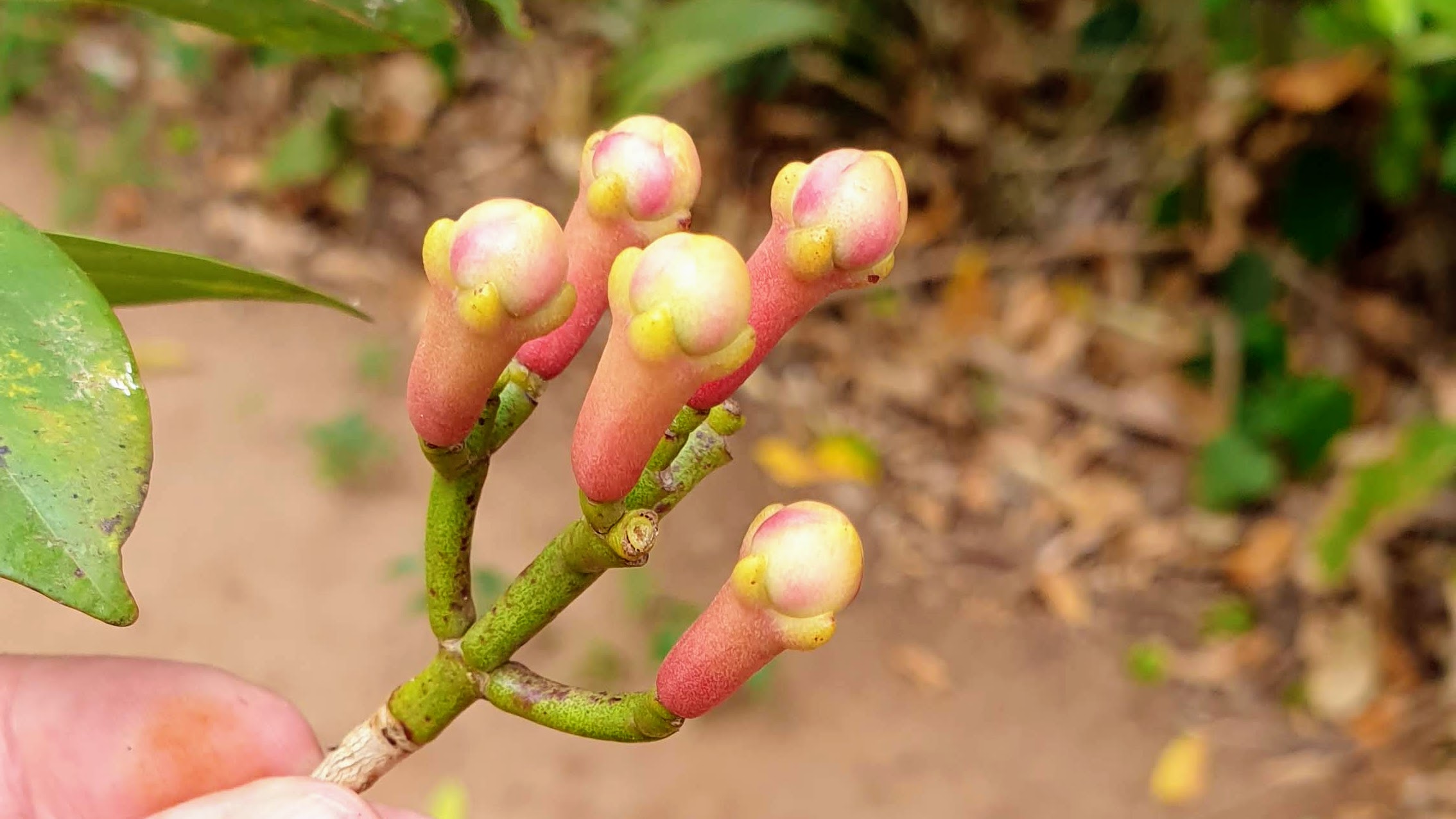
Clove: This is another plant whose fresh form is close to it’s dried. The clove tree bears bundles of tiny pink buds that will pop off when ripe and be ready for drying as is. The whole cloves you can buy in any supermarket bear the same distinctive shape as their fresh origins.


In quick succession: Ginger was one of the few crops growing in any kind of organized way. I’ve prepared loads of fresh ginger, but it was interesting to see the leafy green part, too! There were chilis (in addition to the pepper) and I was informed that in Swahili the name is “pili pili hoho”, “pilipili” being the name of the type of plant and “hoho” being the sound you make when you eat a spicy one. Aloe plants were growing the next plot over but didn’t hold as much interest for me since I used to grow it myself at home. A small plot of pineapples was the next stop. I knew about pineapple plants from the internet and cooking shows, but it was my first time to see them in person. They only produce one fruit per plant per year! Think about that the next time you complain about the price of pineapples.
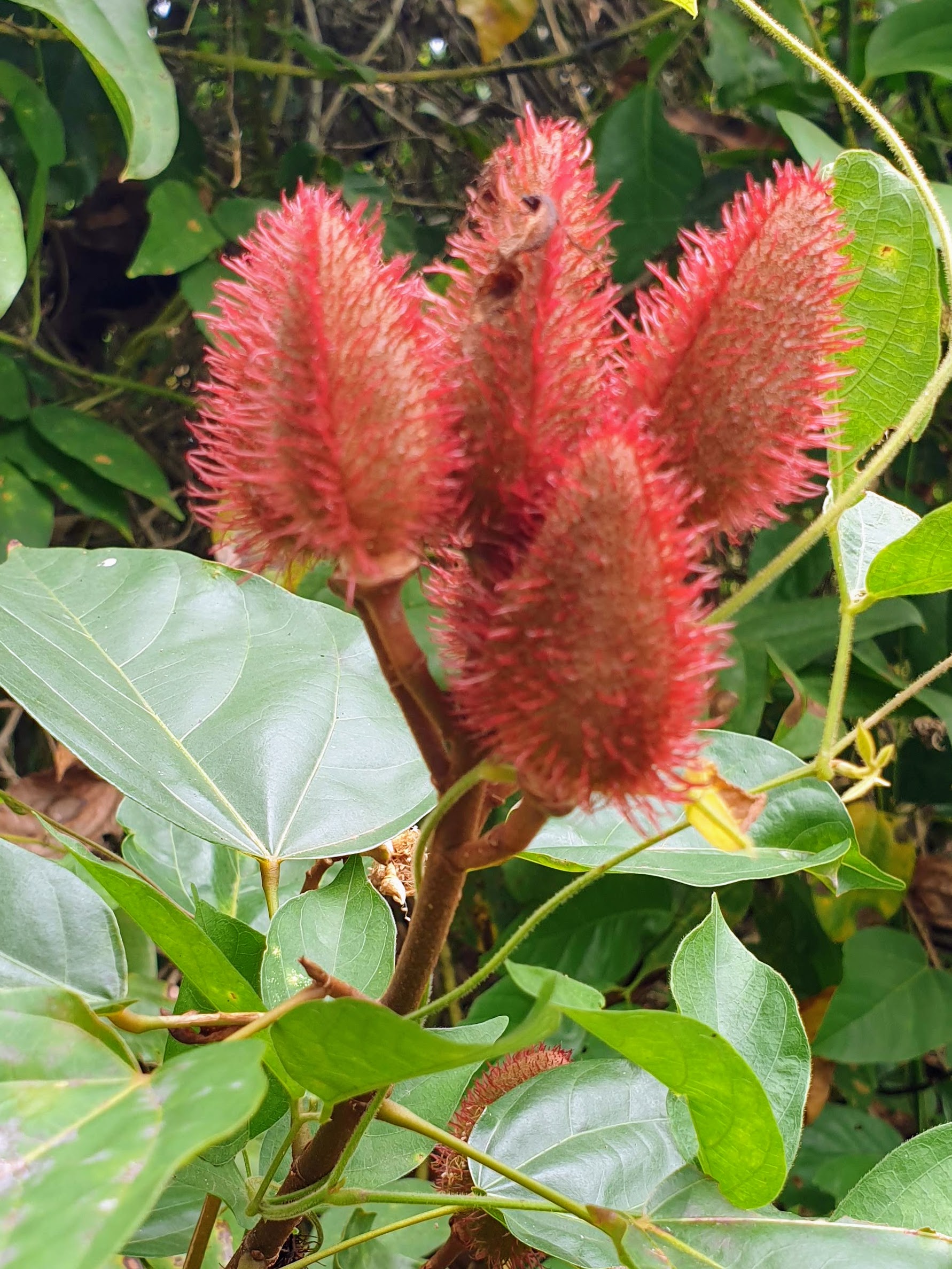

Anato (alt spelling annatto) not to be confused with the Japanese fermented dish “natto”. This is a bright red-orange condiment / coloring. My guide said in the past it was used for cosmetics, but now it’s used to add color to certain foods. His faithful assistant, fruit fetcher, and flower weaver also demonstrated the cosmetic use of the seeds for me. Isn’t he cute?

Passion Fruit: I am ashamed to admit that I had never tried a fresh passion fruit before this day. I had passion fruit in sauces, salads, mixed juices and the like, but had no recognition of the small pale green orb that my guide pulled down from the tree. The insides look disgusting, but taste so good! I imagine it ends up mixed into things because it’s texture is basically a gel with (edible) seeds in. I am sure that imported versions won’t be nearly as flavorful as one right off the tree, but if you ever get the chance to try a nice ripe one whole, do it!

Mystery “hair gel” fruit: I can’t find it’s real name and I had never heard of it before, so this is a bit tricky. The fruit was maybe the size of a large grapefruit, it was vaguely reminiscent of quince being green, lumpy and hard. My guide explained that there was a gel around the seeds that was good for cleaning hair, and that it would be mixed with aloe and other perfumes to make a kind of shampoo. If and when I ever figure out what it was, I’ll update this. Until then it remains a mystery.

Starfruit: This is a classic “exotic fruit” that has become more popular in the US in my lifetime. I won’t say we had it often, but I’ve had it often enough to recognize it’s shape and flavor. These were a little under ripe, so tart but still tasty.


Cardamom: I am a sucker for this spice. I would put it in almost anything. I had experience with the pods before as they are sometimes sold whole in the US and of course commonly seen whole in curry dishes. I also love them in desserts and coffee. It was very interesting to see the plant in person. I had imagined the pods being seeds of a sort that maybe came with a flower or in groups like grapes or peas. Turns out they grow along the exposed root system and the majority of the above ground plant has nothing to do with their production beyond photosynthesis.


Vanilla: It is the second most expensive spice in the world. It takes 3 years to grow a vanilla bean and the plant is extremely picky in terms of light and water. It’s also a parasite like pepper and needs to grow on an existing tree. I had hoped to see a flower since I’ve seen pictures and they are gorgeous, but it was still cool to see the bunch of green pods clustered on the vine.


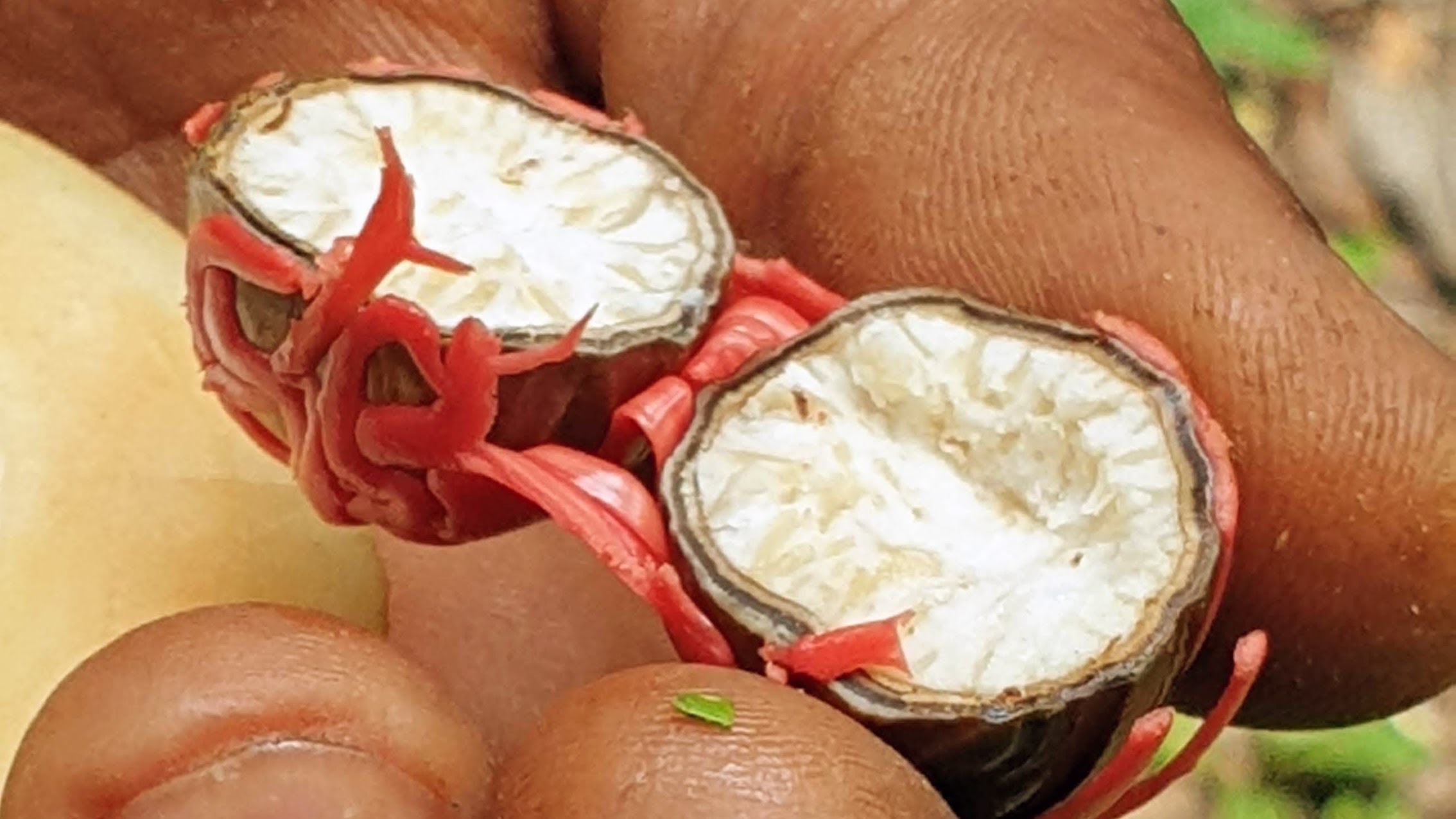
Surprise! The next fruit my guide pulled down looked like a pale yellow-green apricot. It was similar in size and color to the passion fruit, but where the passion fruit had been smooth all around, this had the characteristic divot found in peaches, nectarines and apricots. What could it be? He went on to explain that it was not a fruit at all, and was instead prized for the seed inside. Even more curious, I watched as he opened it to reveal a beautiful seed similar to the pit of the aforementioned fruits, but emblazoned with a flame red pattern. I was captivated. The red portion, he explained, was used to make a kind of local perfume when blended with flowers like ylang ylang, rose, and jasmine, but when I smelled it, it didn’t smell either fruity or floral. Finally, he cut into the seed and offered the flesh for me to taste. It was naggingly familiar, but the fresh spices are just different enough from the dried ones I know that I still couldn’t place it. Then he finally revealed it to me: nutmeg. Mind blown. He gave a rather long explanation of the many uses of nutmeg including its rather infamous drug-like effects (used to conquer shyness, he said) and it’s powers of inciting the female libido. (later research reveals that the red flame-like membrane is also dried and powdered to create the spice “mace” which again, not to be confused, this time with the brand name of a pepper-spray)
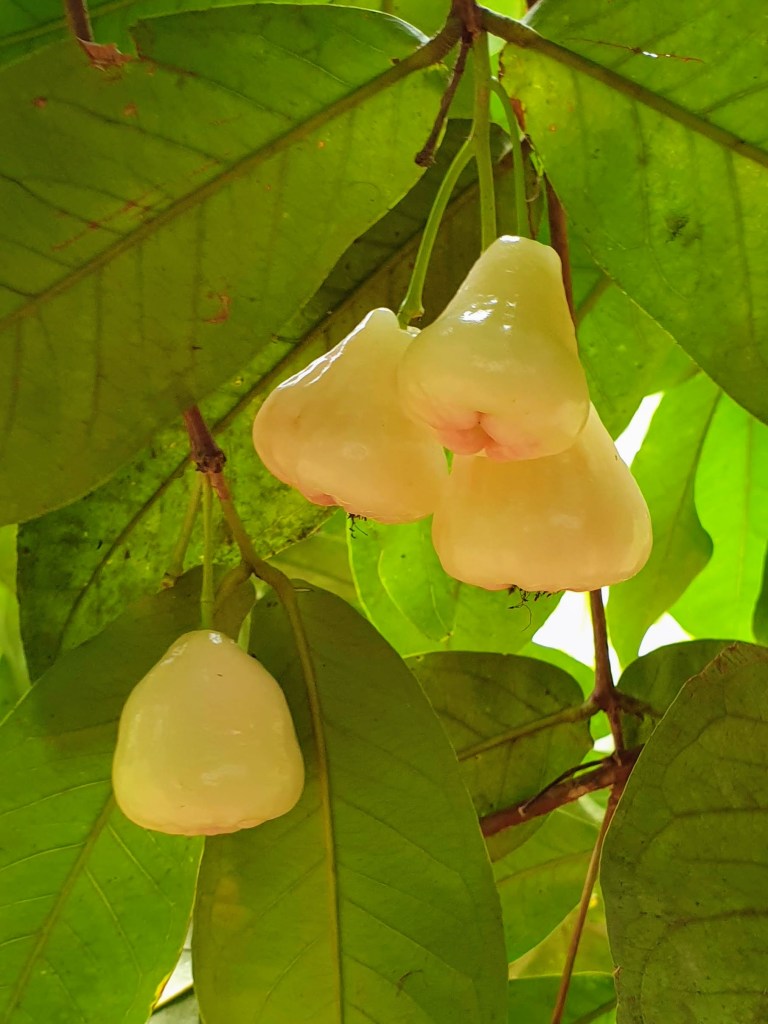
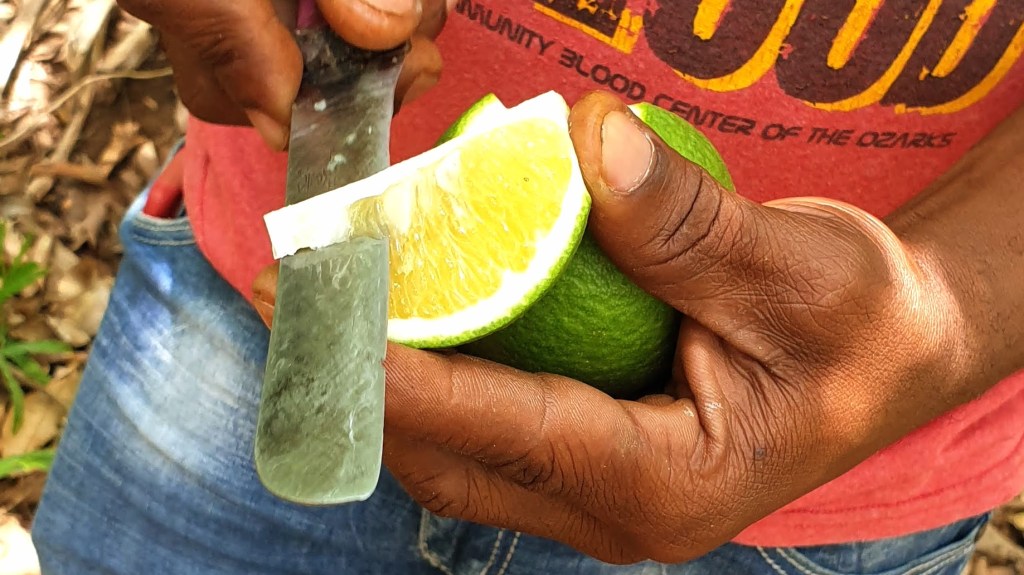
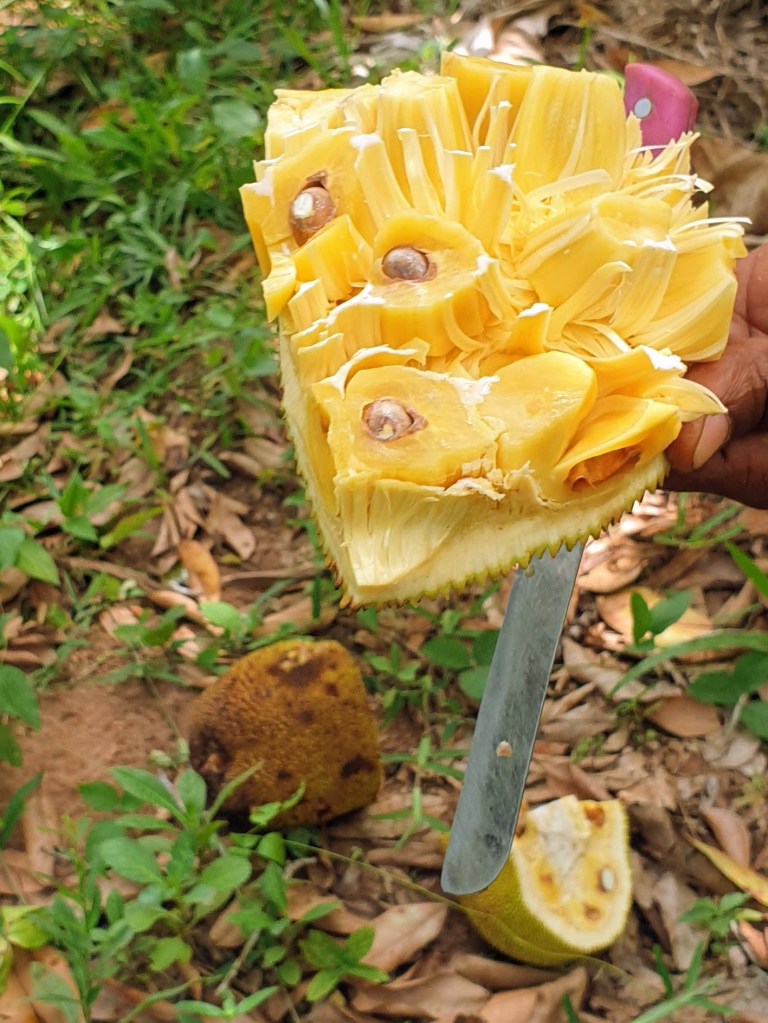
The Fruit Section: I tried mangosteen (another supplement fruit we see as an ingredient all the time, but it was a delight to eat fresh), something I didn’t quite hear the name of, and had never seen before which looked like small white pears and had a taste not unlike the starfruit. I think it may be a water apple (syzygium aqueum)? I tried a sour green skinned, but orange fleshed orange (it seems that lemons, limes and oranges all have green skin in Zanzibar), some jackfruit with tasted almost exactly like a banana and a pineapple got caught in a matter transmitter accident, and finally some young coconut.


The coconut tasting was preceded by a show where a young man demonstrated the traditional coconut tree climbing method and sang “jambo bwana” (a song I heard almost every day while in Zanzibar). I suspect he is used to performing this show for a whole crowd and by this time I was very hot and tired, so although I tried to be an appreciative audience, it was probably less rewarding for him than the big groups. He prepared the young coconut for me to have refreshing drink (much needed) and then to eat the flesh which is not unlike coconut pudding/jello without the artificial ingredients. The assistant guide had been weaving queenly arraignment for me the whole way and I was appointed with a bracelet, necklace and crown decorated with bright red hibiscus to go with the handbag they’d given me at the start to collect my spice samples in. I tipped the young men for their efforts because they really were trying hard, and I could see they were sweating as much if not more than me entertaining tourists all day. I felt a bit bad because they put almost as much effort into my solo tour as they would a whole group, but I couldn’t afford to tip them more than a single person’s worth.


The last stop on the tour was the gift shop of course where I picked up some lemongrass coffee because I can add most any of the other spices like cardamom, cinnamon, ginger or vanilla on offer to my own coffee (and often do, PSL) but the idea of lemongrass coffee was intriguing and not something I’m likely to make at home. I also got a masala mix for tea, which I know I like, but also almost never make at home. I thought it would be supporting the local farm, but later I realized that identical spice packets are sold all over the island. I was also very disappointed in the “coffee” when I finally got home to taste it. The masala mix was nice though. I think if you want to buy spices in Zanzibar, you’re better of at Darajani than at a spice farm, but the farm experience of seeing, smelling and tasting the fresh spices is one hundred percent worth it.
Swahili Cooking
The “kitchen” was a palm thatch shack with half walls that kept the sun out but still let in a fair breeze (a relief in the sweltering heat of the island interior). The only furniture was a shelf where dishes were stacked and the coal burning “stove”. We sat on the floor to do all the food preparation and later for the eating as well. As I was the only tourist and there were 3 locals in the team, they all pitched in to do a lot of prep work while making sure I had a turn to try each station at least once. I was struck most of all by the extremely different methods of preparation. Of course everything was well washed, but the similarities to previous kitchens I’ve cooked in ended there.

I was instructed on how to cut the vegetables “freestyle”, which involved holding the vegetable (tomato, okra, eggplant, etc) in my left hand and slicing random bits off with the knife in my right hand. I’ve never been a huge stickler for uniformity of chop in the French sense of the word, and friends of mine who have taken one or more western style culinary class often cringe at how uneven my mirepoix is, but tend to relent when they taste the end result since stews, curries and casseroles are not all that picky about uniformity of cook. However, I still cut in the general style of the western chef with cutting board and knife, making regular geometric cuts which are only irregular as a lack of refinement of skill rather than a lack of intention of technique. Zanzibar vegetable cutting is just anything goes, hakuna matata.

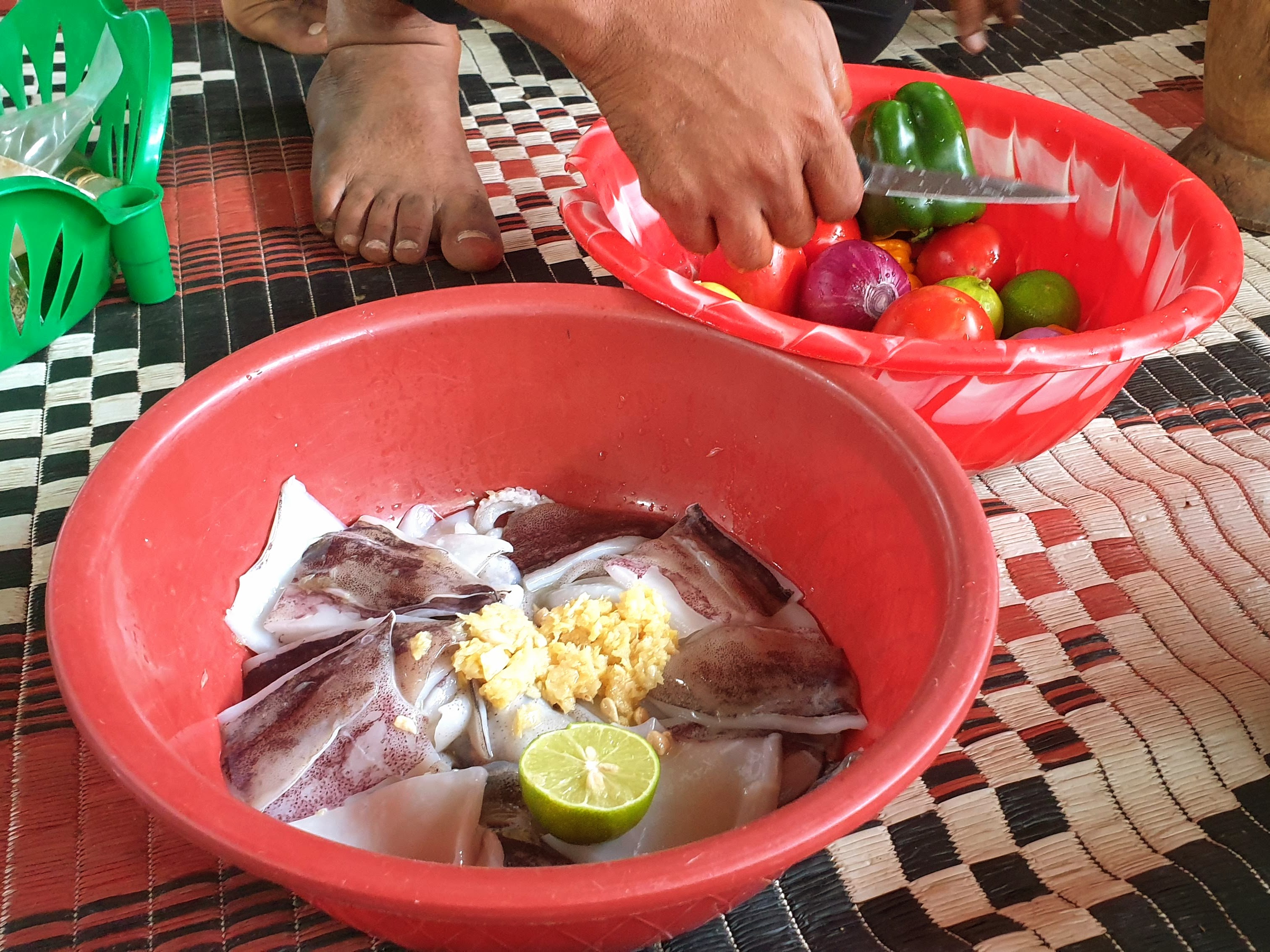

The garlic and ginger were peeled and freestyle cut into a large wooden mortar. I tried my hand at the smash, but my hands were just to small to grip the pestle effectively, and I had to switch jobs. When the young man working on it finished, the end result was something that could have come out of a Cuisinart.
They also had a unique tool for shredding the coconut flesh. I had spend my whole life foolishly chipping coconut out of the shell with paring knives or even flathead screwdrivers, then either chopping the result or tossing it in a food processor/blender. This clever device is a stool with a scraper/grater attached so that your body weight as you sit provides the counter to the pressure you exert on the coconut to shred it. I cut myself twice (papercut style not bad) trying to use it, and I still think it’s better than any method I’ve ever tried before. It was one part of food prep that definitely benefited from a traditional rather than modern method. I completely forgot to take a photo of the stool/shredder device while I was there, so here’s one from the Minneapolis Institute of Art that looks remarkably similar.


We took the shredded coconut flesh and mixed it with water. I got to massage the coconut around which was a surprisingly satisfying textural experience. We dumped out the coconut enriched water into a very fine mesh sieve and squeezed the pulp allowing the fresh coconut milk to join our chopped veg and spices. Two turns at that and we moved on to creating a weaker version to cook the rice in. I thought that was dead clever since coconut milk is too rich to just cook rice in it, but the pulp still had more flavor to give, two dishes for the price of one.
The stove was 4 coal burning braziers along one wall. Real coal, not the bricks you find in suburban backyard barbeques, but made from wood cooked down into coal. The pots and pans were placed directly onto the coals with a few metal prongs to keep them from totally falling over. When the coals were piled too high for the pots to sit straight, my hostess just jammed them down until the coals broke up and the pile was more level. I’m sure you can imagine there is but one heat setting in this kitchen.

The vegetables were mixed with a standard range of curry spices like turmeric, cumin, etc. but we used dry spices despite the proximity to the farm. The cooking method was a one pot boil in the fresh made coconut milk with only occasional stirring. It cooked the longest of any dish, and had reduced in size to less than half it’s starting point, all water lost from the vegetables and coconut milk, reducing it down to a stew that went well on the rice. I felt that the miniature white and green eggplants used were perhaps too bitter, that the dish needed more tomato (acid) or more salt, or both to compensate, but the rice ended up oversalted, so together, they worked out fine.
The rice had to be sorted by hand before it could be cooked. I intellectually know that rice has to be winnowed and sorted between the field and the dinner plate, but everywhere I’ve ever bought uncooked rice this process was handled before it came to market. The rice we bought in Darajani was not “ready to cook” and one of my hosts meticulously sorted through the grains a small handful at a time to remove bad grains, small stones, and possibly bugs. When it was clean and sorted, the rice was put in the weaker coconut milk with some salt. When it was about half cooked, the hostess put a lid on it and transferred the coals from the brazier to the lid of the pot to create an “oven” to finish cooking it. This is definitely a rice recipe I’d like to adapt to use at home, perhaps by mixing store-bought coconut milk into the water and finishing the rice in an oven.


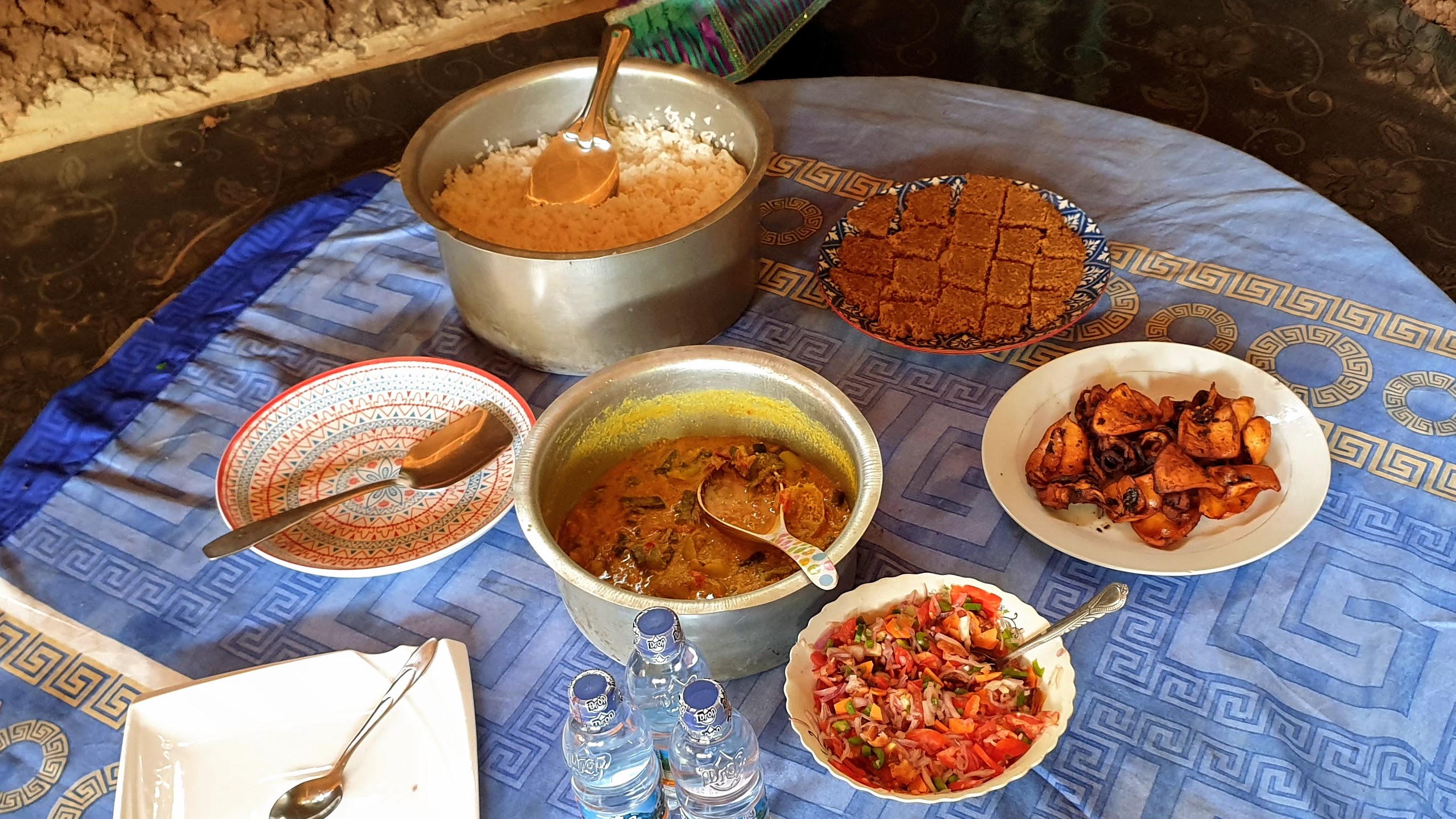
I chose squid for the meat dish, though I was basically free to choose anything at the market. Zanzibar is famous for it’s seafood and I try not to eat octopus because they may be smarter than some humans. Squid is safely chicken level smart, which may not be cucumber level, but at least it’s a level I’ve already morally accepted. Also, I happen to like it. I have had it a variety of ways, but this was a new one for me. The meat was mixed with the garlic/ginger mash, pepper, paprika, and cumin, and a generous portion of fresh lime. When it was ready to go, the hostess heated up at least 2 inches of oil over one of the coal braziers and warned me to stand back as she added the squid. She called it deep frying, but I don’t know if I agree. The meat was never totally submerged, nor was it breaded (not technically a requirement, but fried calamari is a familiar dish). It was left to cook in the boiling oil a good long time ensuring excellent food safety. Nothing lives through boiling in oil. I was not sure how this would turn out but it ended up being my favorite dish. The meat was well flavored and since squid is very lean, the oil cooking didn’t make it greasy, it just kept it moist. It was ever so slightly chewy, but far from the rubbery texture of badly cooked squid. I had seconds.

The coconut candy was made by boiling sugar, water and cardamom pods. Once the syrup was boiling we added the the grated coconut that had been set aside before we made the coconut milk, so it still had all it’s fat and flavor. Like all the dishes, it was boiled with occasional stirring. She told me it would cook until dry and I was doubtful, having made both hard candy and caramel in the past, but she wasn’t kidding. She cooked it with occasional stirring until the water was all boiled off then cooked it with a more constant stirring until the coconut was nice and brown. The whole thing was turned out onto a greased plate and patted down (not unlike the rice crispy treat process), finally it was cut while still warm because I suspect it would be too difficult to cut when cool. The final result was a kind of coconut candy that reminded me of what happened to my peanut brittle when it seized, good on the flavor side, but texturally in a gray area between hard candy and chewy caramel that we are not accustomed to in the west. I have since learned that this is the intentional texture of this particular candy and not a result of unintended sugar seizure but it made me think of how to create a cardamom-coconut caramel which would carry the flavor of this dish with a texture more suited to my palate.


The only dish I played no role in preparing was a fresh salad made by one of the assistants by cutting some leftover vegetables in a fine mince and mixing it with lime. Like an African Pico de Gallo almost.
When everything was ready, Lutfia arranged the dishes on a floor table and passed around plates and flatware to myself and the rest of the hosts. All in all, it was a joyful experience. We worked together while listening to music and dancing. We chopped vegetables in bowls sitting on the floor, and we cooked everything by boiling it over coal, but otherwise it was like any happy kitchen memory I have of family events with multiple dishes and everyone helping out. I don’t think that a spice tour alone or a cooking class alone could have lived up to this combined experience, and I’m happy I chose it.
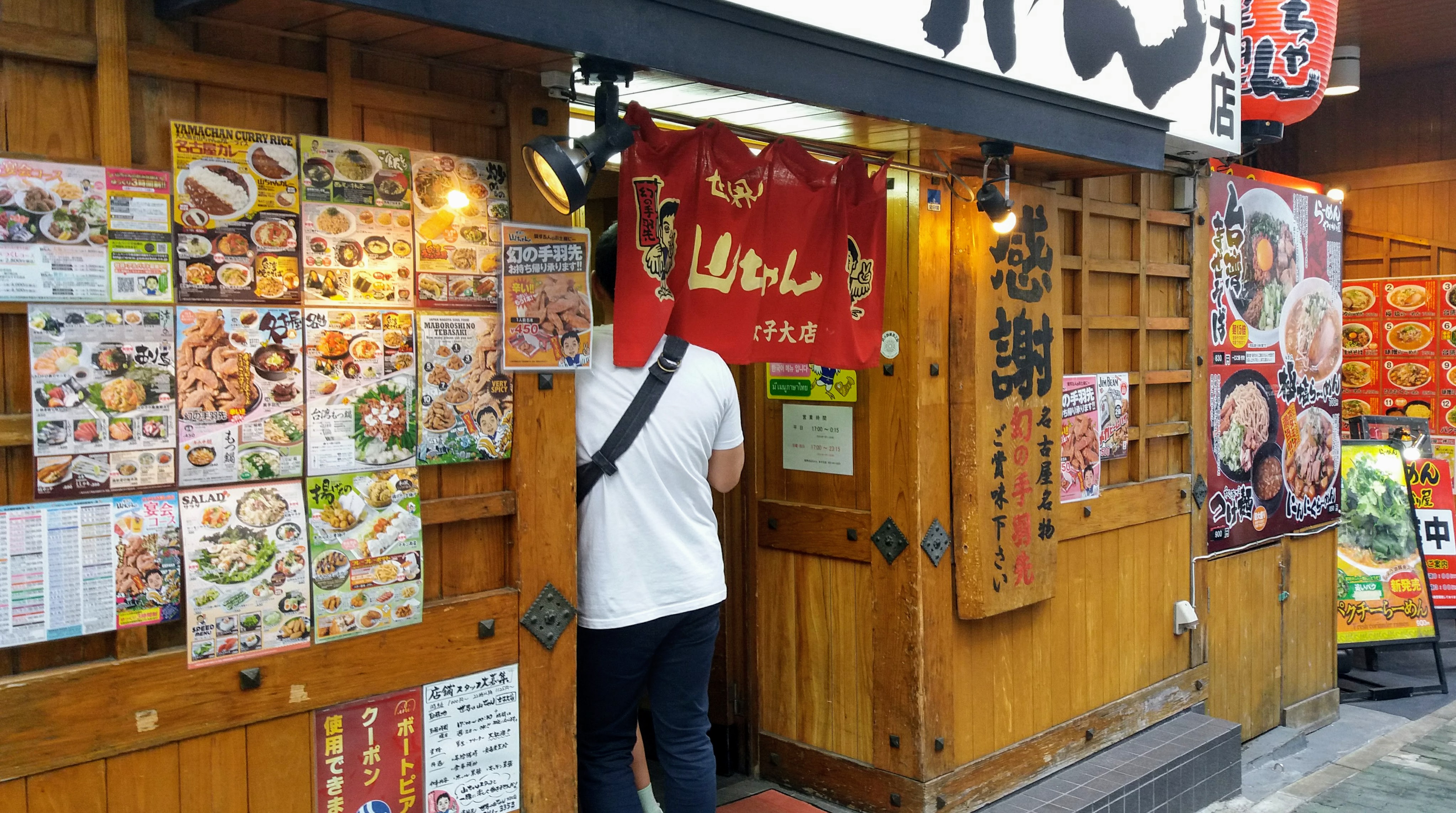 Our first famous food sight was Yamachan, a chicken joint that is usually so popular that wait times can be over an hour. Yamachan is famous for chicken wings. Initially, I was very skeptical since I get plenty of chicken in Korea, but when we arrived we were sufficiently early as to be able to get a table. We had to take the smoking section, but it was still clear air when we were seated.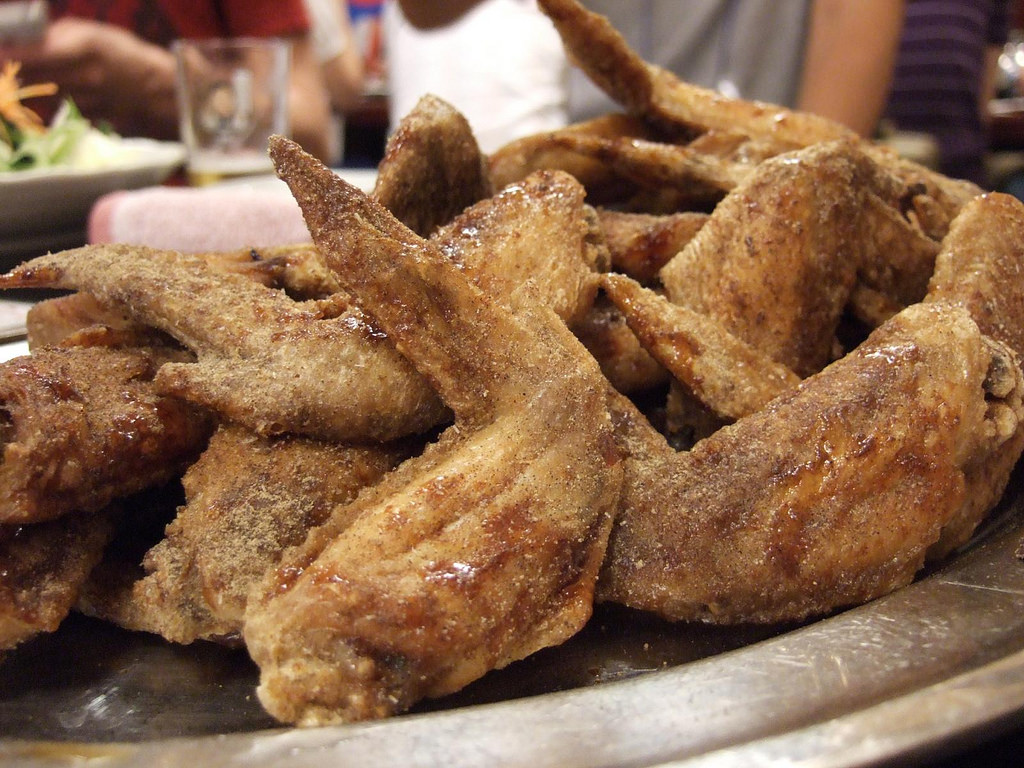
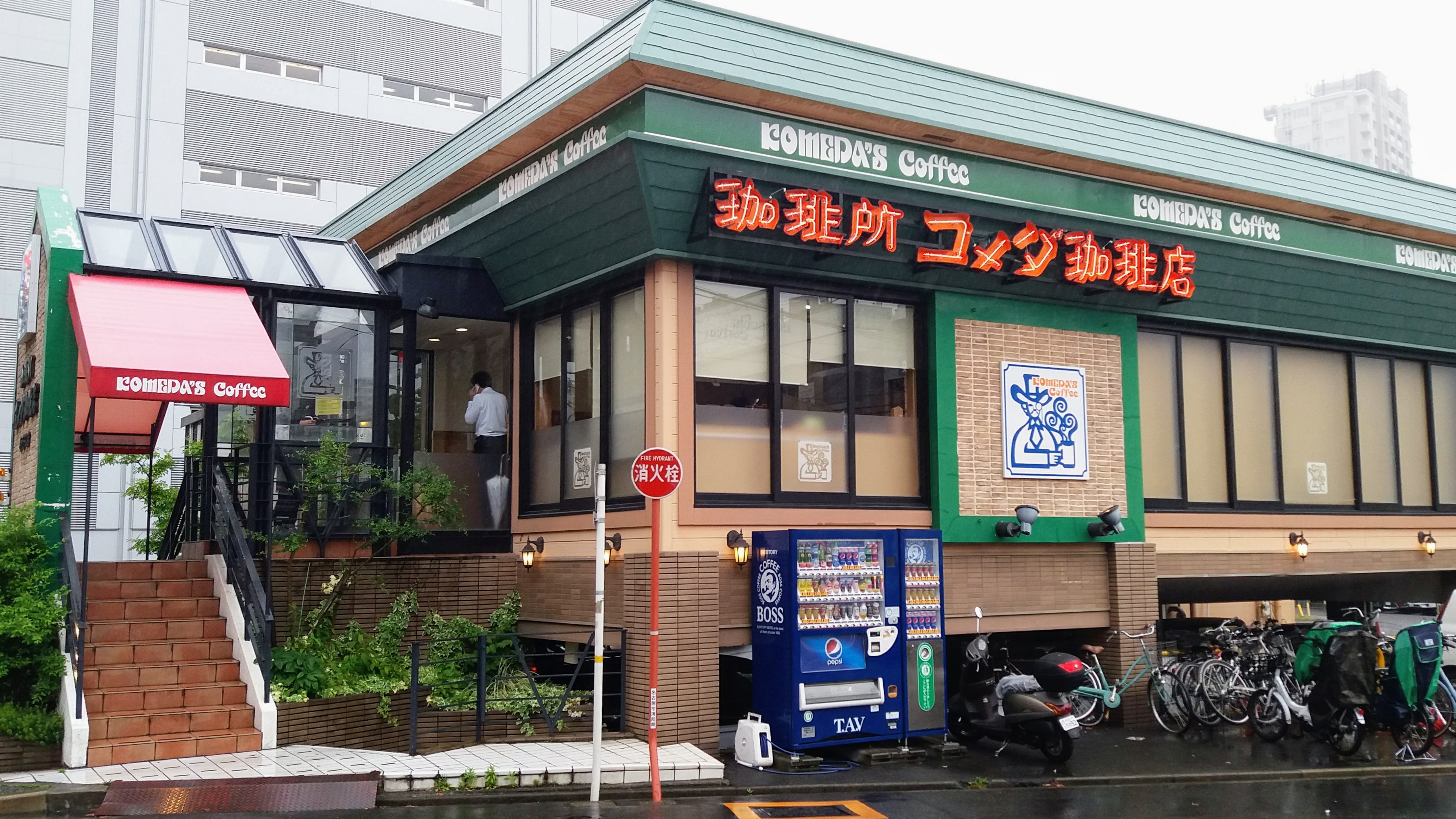 Amid the many things that I found to try while in Nagoya is the “morning service”. Many of the cafes around town have begun to offer a light breakfast (egg and toast or ogura toast) for free (“service” in Japanese) with any order of coffee. Sunday morning my friend and I headed over to Komeda Coffee. This cute little coffee shop is a chain restaurant famous for it’s special morning service of thick, fluffy, buttery toast and red bean paste, also known locally as “ogura toast”. While lots of places in east Asia love sweet red bean paste in pastry (I eat it in Korea all the time), Nagoya got famous for ogura toast by adding… wait for it… margarine! The sweet thick red bean spread with creamy salty margarine creates a unique Nagoya flavor that should definitely be on your “to eat” list. Plus, their coffee is pretty good.


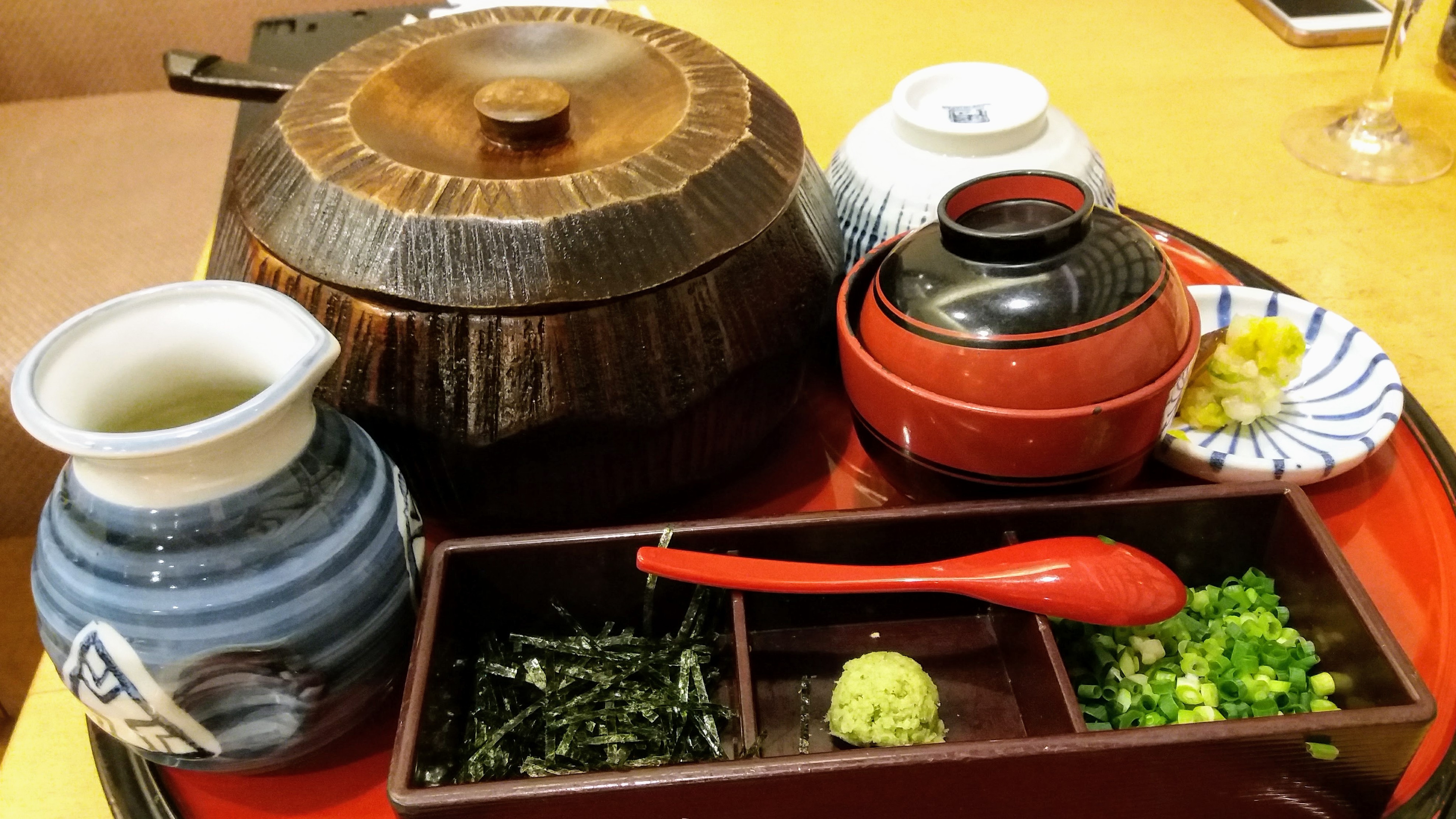
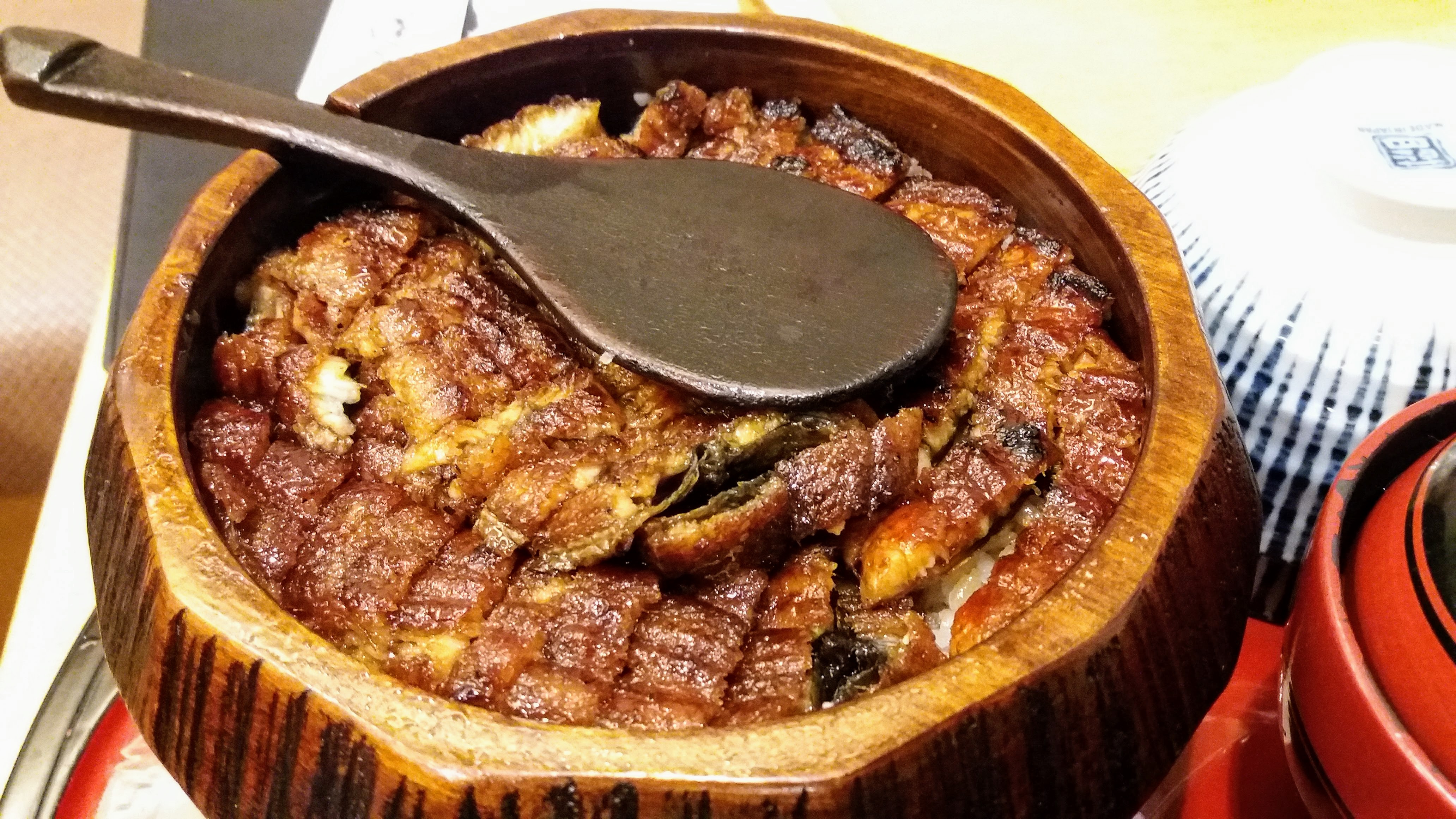
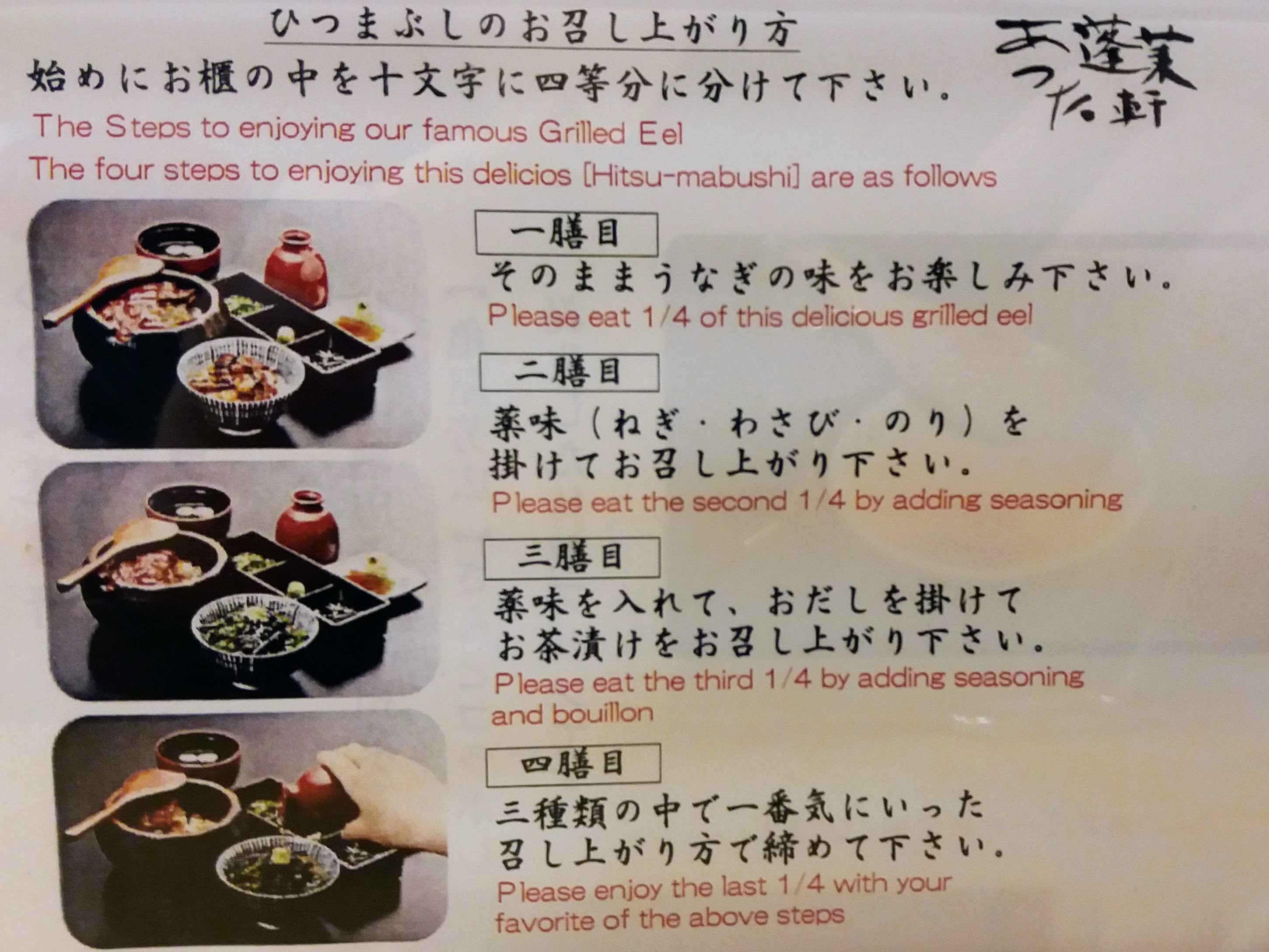 Even in normal restaurants, eel is one of the more expensive dishes. I tend to avoid buying it here in Korea because it’s often not prepared well. Nonetheless, it is one of my all time favorite Japanese foods. The “plain” hitsumabushi still had plenty of flavor. Of course the smokey, fishy unique flavor of the eel itself, but also a lighter version of the sauce it’s cooked with, as well as the vinegar in the rice. It had so much of what I look for in a good meal, I instantly knew the price was well worth it.
 The second ¼ of the dish is meant to be served with the dry fixings provided in the little side box. In our case, we were given small slices of spring onions, thinly shredded nori (seaweed), and what very well may have been fresh wasabi. Most wasabi in the world is fake, sadly, it’s just green horseradish. Now, I love horseradish too, so that doesn’t usually bother me. I’ve learned a little about fresh wasabi from watching cooking shows and documentaries, but I’ve never had any. When I looked at this wasabi, I noticed the texture was very different from what I’m used to. Instead of a smooth paste, it had little shredded bits of plant matter.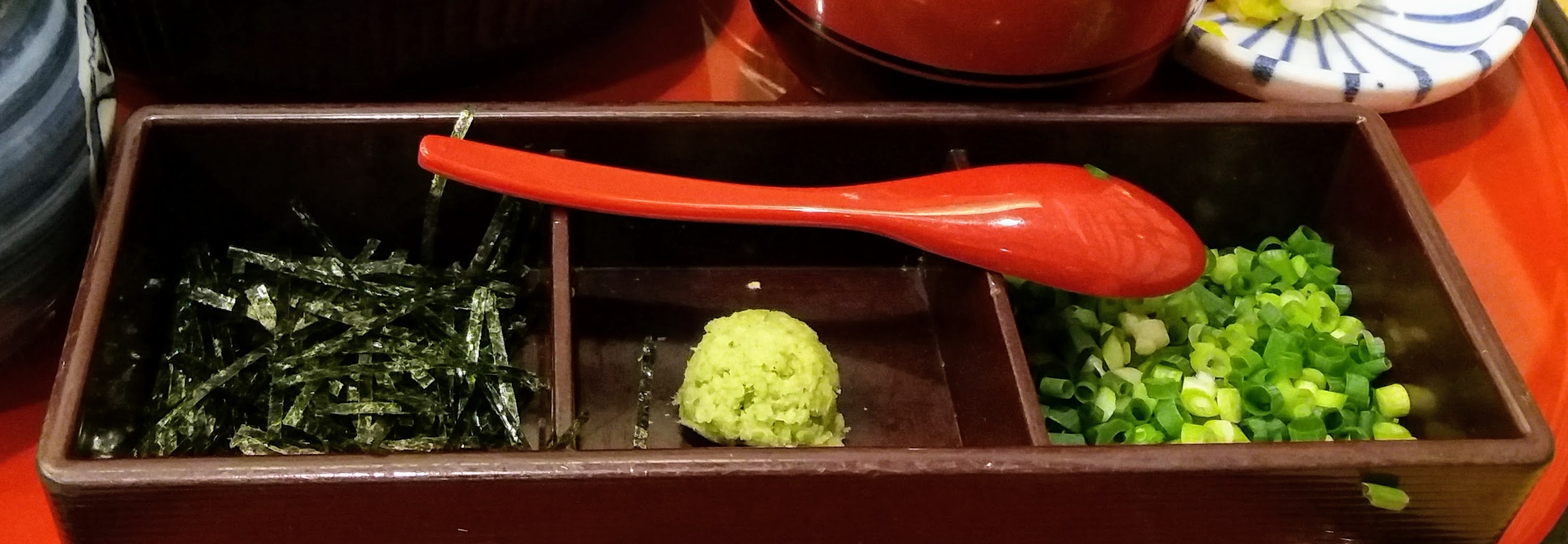
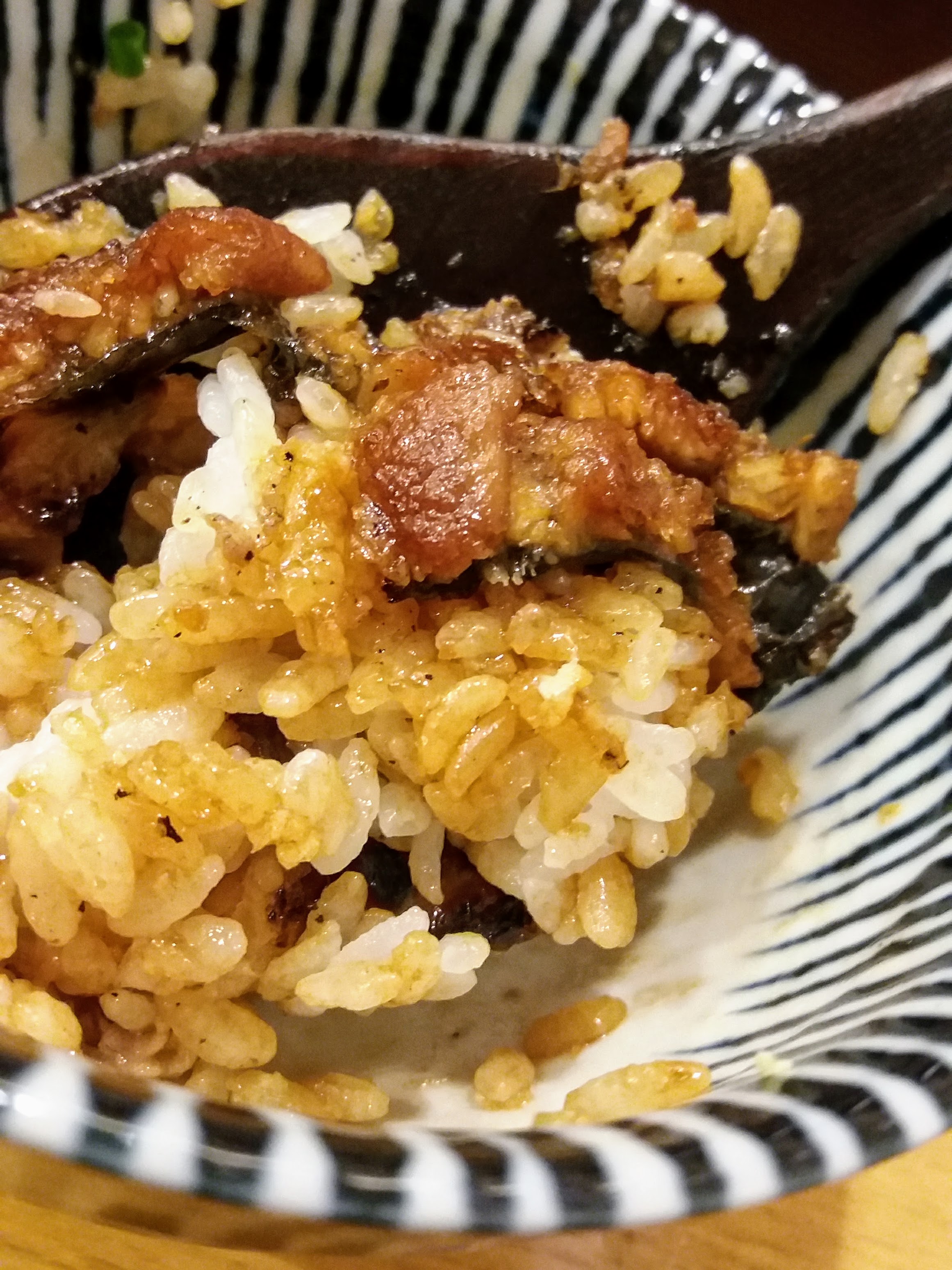 Round 3 we were instructed to replicate round 2 and then add broth. I don’t really know how to describe the flavor of the broth. It was also a little smoky, a little umami. I suspected there were some dried shitake involved in the flavor as well as some konbu dashi. It was nice, but for my taste it didn’t really add to the flavors the way that the spices alone had. Additionally, it drastically changed the texture of the dish, turning crispy eel and rice into a wetter soup. It was still delicious, and I’m glad that I was able to try all the different styles of eating hitsumabushi, but I was grateful for that final ¼ serving where we were instructed to return to whichever of the first three we had liked best and do it again!






 Gallivantrix