The Châteaux of Loire Valley

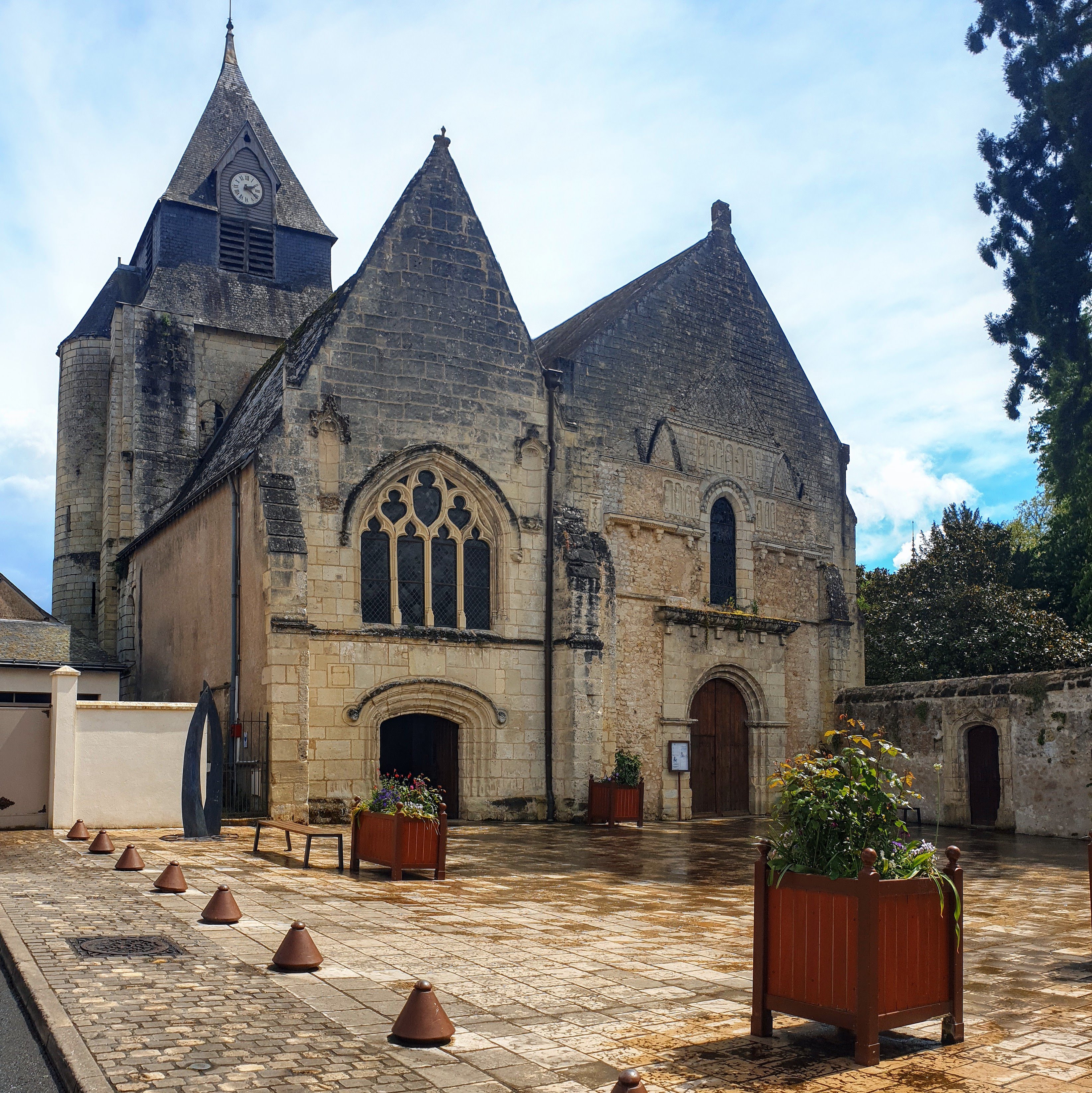
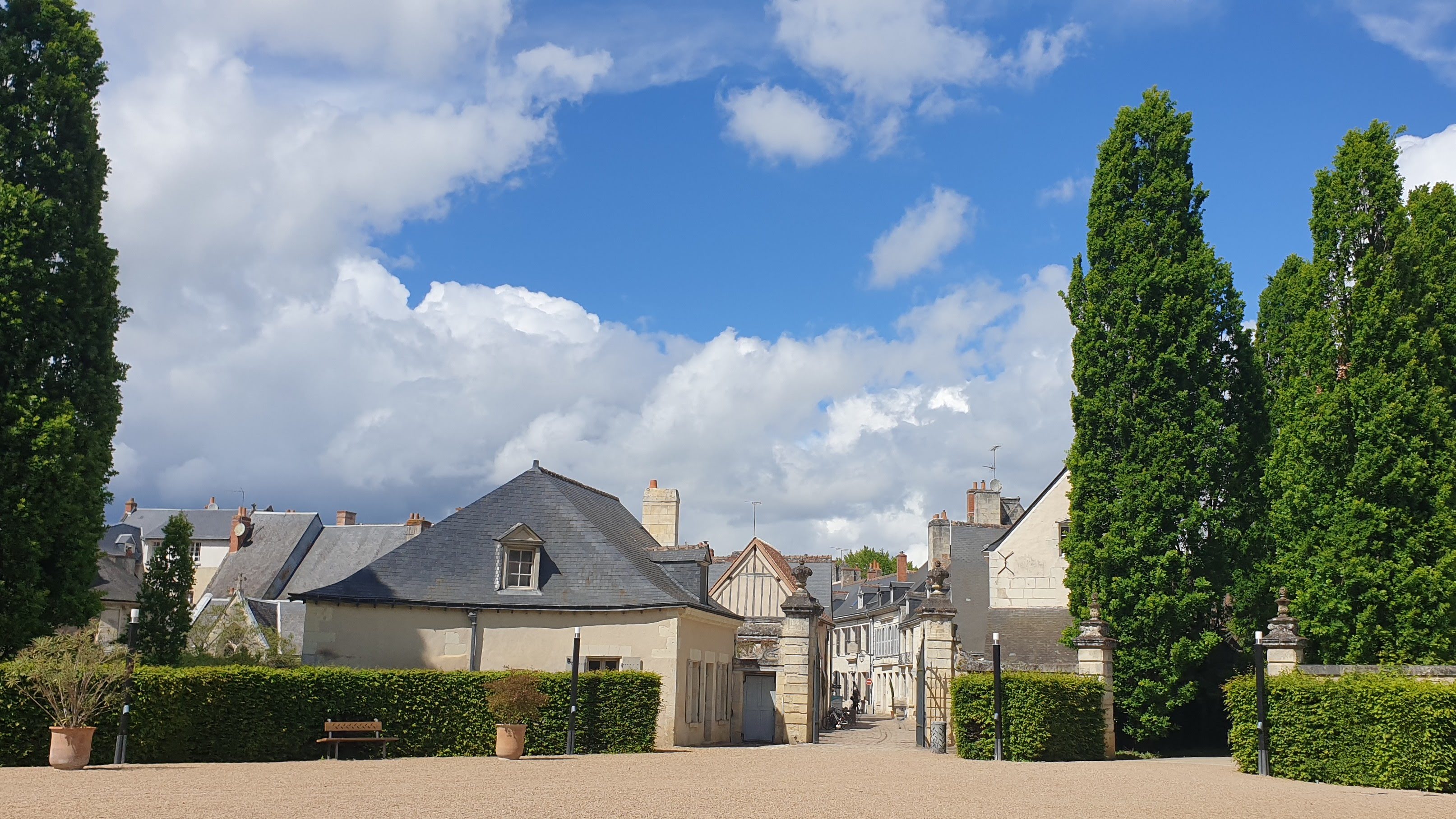
In an attempt to organize my adventures in Tours, this is the 3rd of 4 posts about the city, and it features three of the châteaux in the Loire Valley. There are so many châteaux that there are top ten best châteaux near Tours listicles. Tragically, most of them are not especially convenient to public transit as they were all originally designed to be exclusive country estates. Happily, my school arranged some field trips.

One thing I’m learning while doing follow up research on my visits is that many of these historical sites now have extremely thorough virtual tours with professionally taken photographs where each plant is in peak season and the weather is ideal. There is no way that my photos can objectively compare, and while I may treasure my own photos more than those on a website because they come to me with the memory of me physically being there, I can’t actually think of a reason for any reader to prefer my photos to those professionally taken at the site. My story may be unique because I will not simply tell you the history of a place, but rather my experience of being there and learning that history, but unlike many places I’ve been where I can find little if any information, or even in contrast to when I first came to France in 2015, the museums and historical monuments in France are extremely well documented. 

So, if you’re here and you want to read about my personal experience with these places, then thank you, but also, if you want to know more or see the locations at their absolute best, then I recommend the virtual tours (links below).

Château de Villandry (virtual tour link)

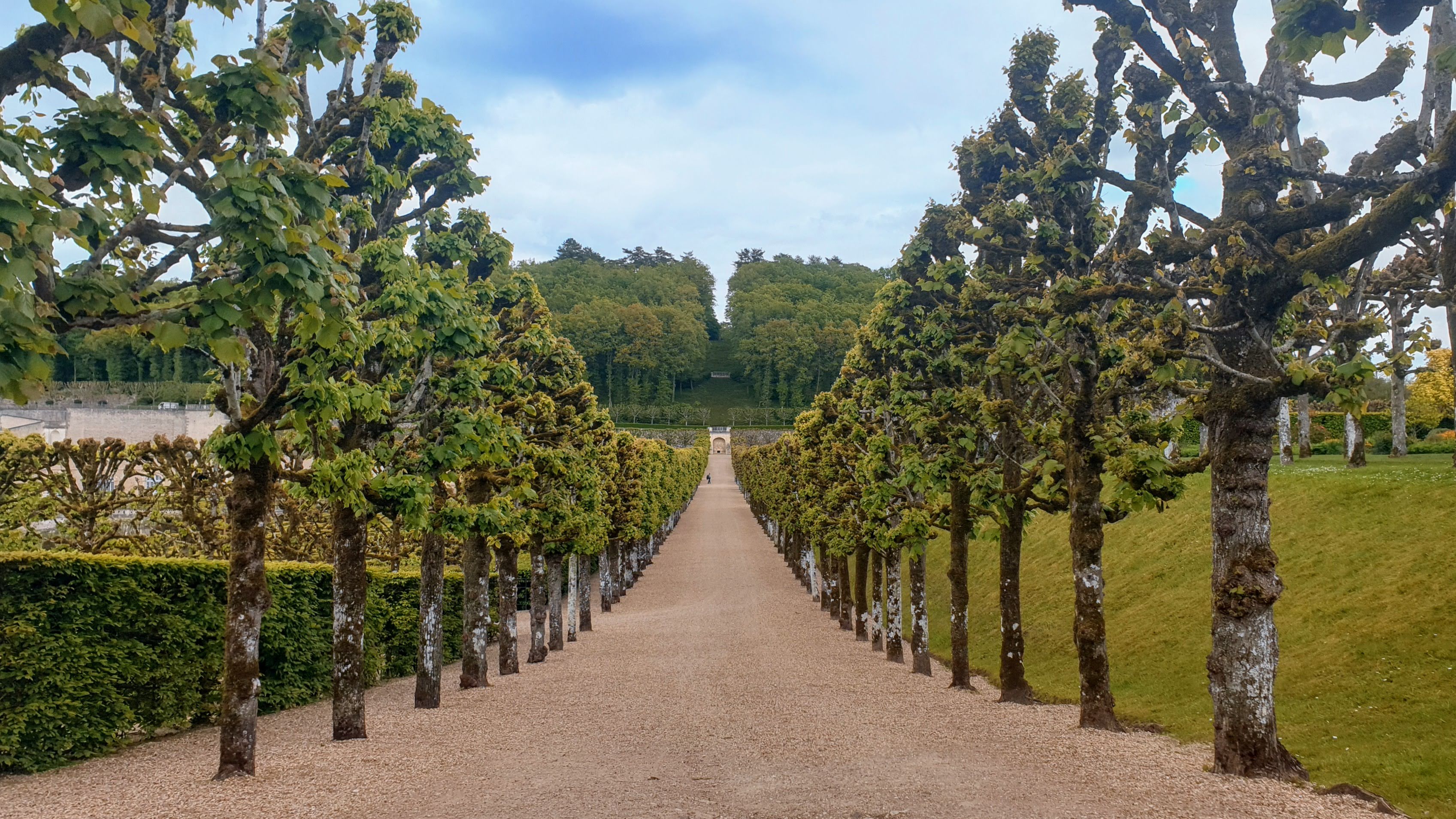
My school host and ersatz guide advised us that the interior of the château is nothing special, and we all agreed we would focus our trip on the gardens. To begin, we actually went up inside the château to climb a creaky staircase to the upper wall and get our first panoramic view of the gardens below. I was quite grateful for this since the website features some very stunning drone photos of the grounds which are planted in elaborate patterns best observed from above.

My guide explained briefly about the history of the design of the gardens below (and since he’s also the of our French language school, he did it in French (albeit very simple French) to help us learn. I double checked my understanding by taking photos of the informative signs and reading the website, but I actually caught most of it. Yay, learning!

Villandry traces it’s origins to the 11th century Colombiers Fortress, but the modern edifice and grounds bears little resemblance to it’s ancestral lineage. The current château is of Renaissance architecture, which means around the mid 1500s. It looks like the first major attempt at decorative gardening was in the 1750s. At that time it was done in the style of a French garden. Then in the 1840s it was changed to the style of an English park. All this time, the property keeps changing hands as well. In December of 1906, a rich American heiress bought the property for her husband, Joachim Carvallo who is responsible for the current structure of the gardens. Later additions were made by their children, and finally the sun garden was added last in 2008.

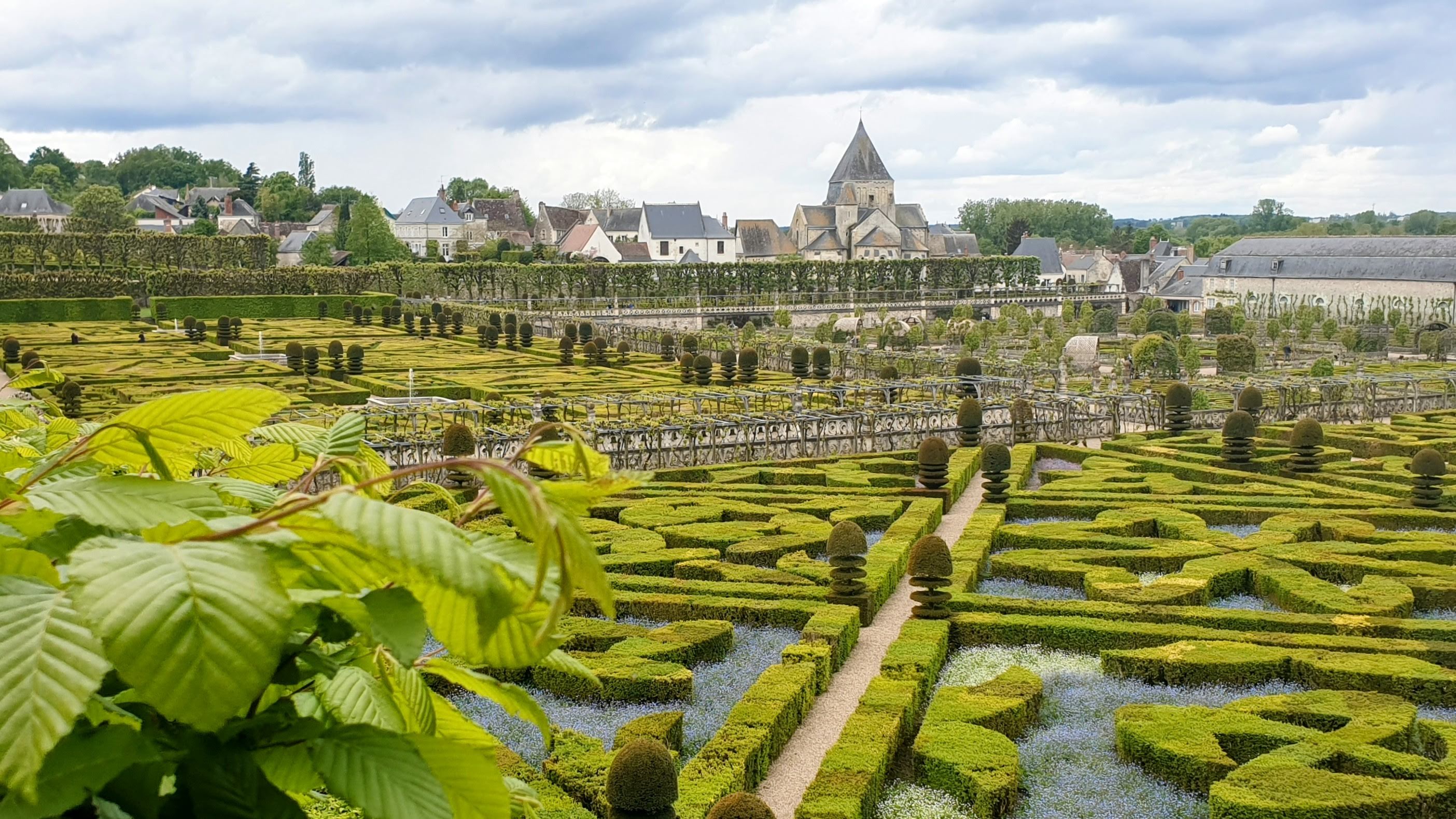
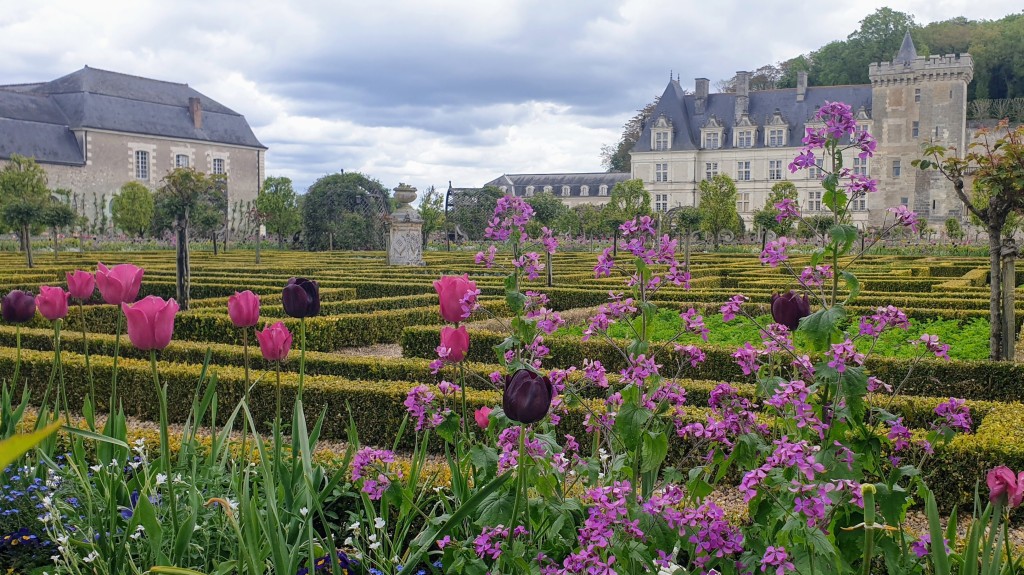
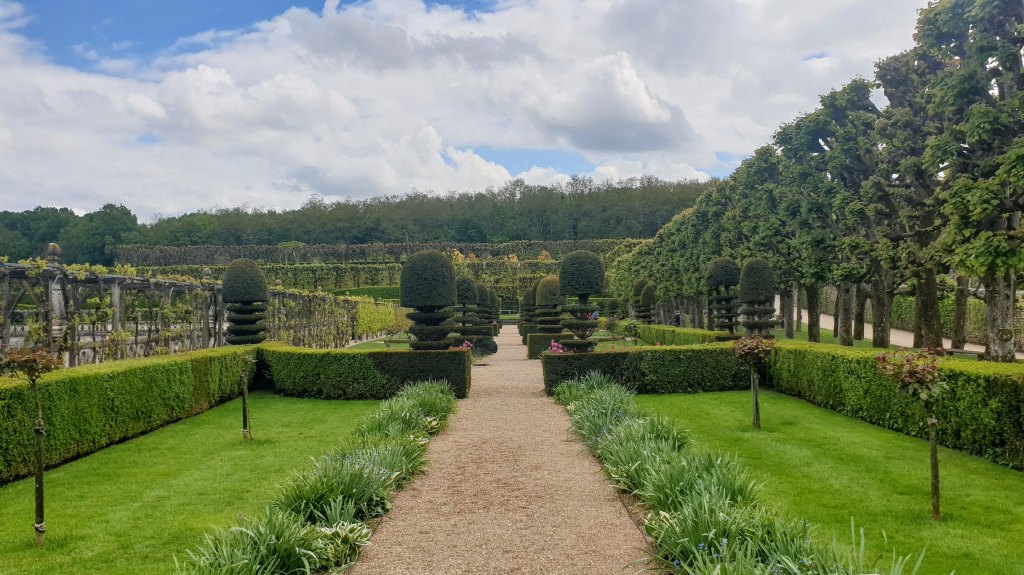
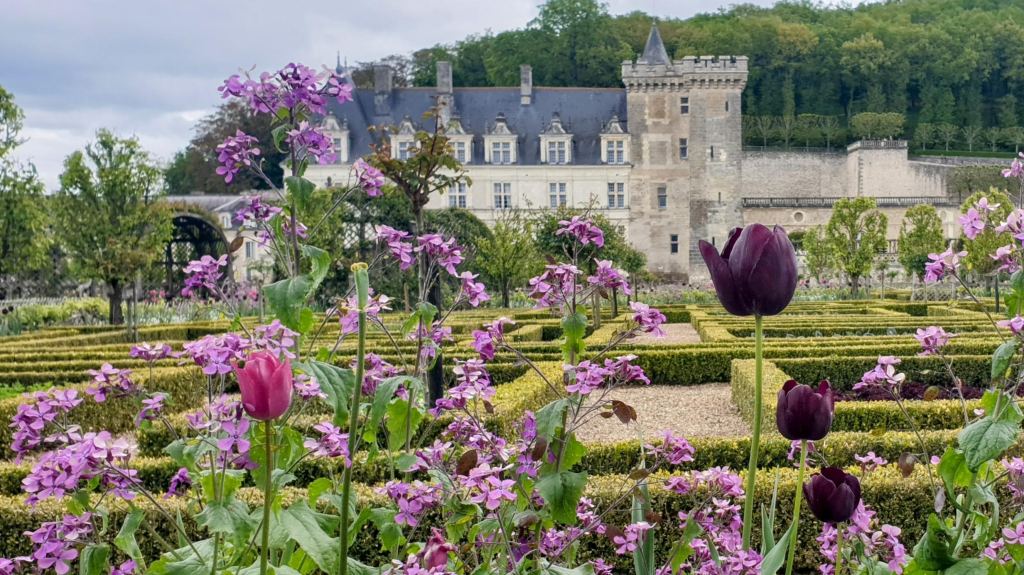
The gardens are immense. The first division splits the area into three sections: the Kitchen Garden, the Water Garden and the Ornamental Garden. The main view from above and the most striking panoramic view is of the Ornamental Garden. The Love Garden represents 4 types of love: Tender Love: hearts separated by flames of love in the corners of the square with masquerade masks in the center. Passionate Love: broken hearts and a tangled maze. Flighty Love: four fans in the corners for fickleness, horns representing betrayed love, love letters. Tragic Love: blades of daggers and swords used in duels between those fighting over a shared love. To the left is the Garden of Crosses with Maltese Cross, the Cross of Languedoc, and the Basque Cross along with highly stylized fleur-de-lis.
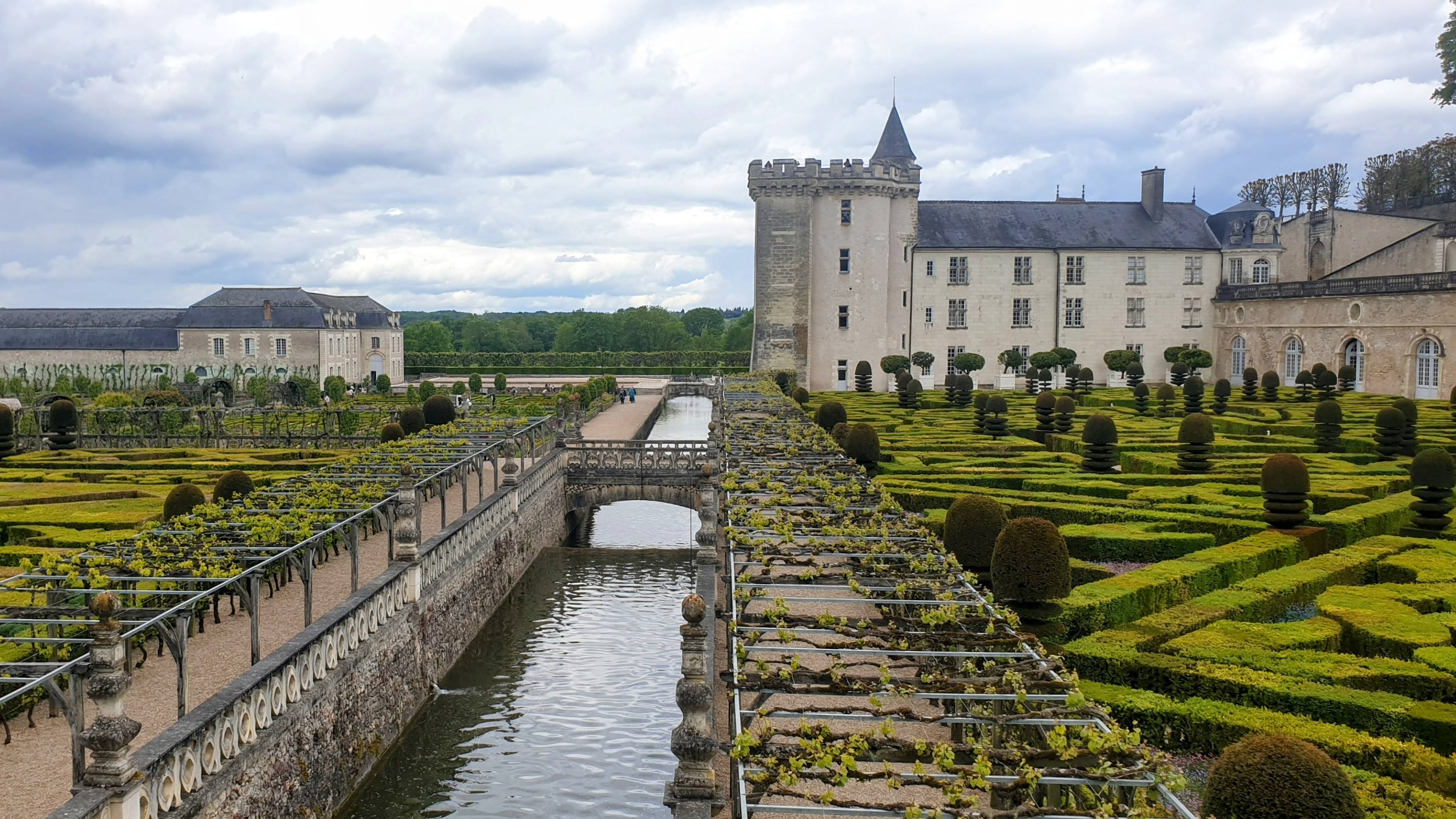
I was quite captivated by this entire notion as it was explained to me, and it made me think of the sort of Regency Era period dramas that show high society engaging in all manner of romantic hijinks. I’ve read histories about the way that fans were used to flirt, about the affairs at court, and about the duels. Then I found out the garden was not installed like this until the early 1900s and I realized that rather than a representation of courtly romantic drama by those who lived it, it was a recreation by a historical fan from a later era. I don’t think that makes the gardens less beautiful in any way, but it is interesting to think of the layers of history that go into famous monuments and tourist attractions. Villandry as a property certainly predated, hosted and then survived after the period of courtly intrigue that dominated the century between 1750-1850, yet the current historical restoration and preservations were not replicas of anything that existed at that time, instead created as tributes or memorials.
We moved rather quickly through the so called Water Garden, as it’s main feature is a reflecting pool. The next area we entered on our way was full of flowers hued in shades of purple, blue, and white. When I caught up with my group in the next area, one staged in shades of red, orange, and yellow, my guide explained that these were the moon and sun gardens respectively. I found the sun garden on the website, but no evidence of the moon garden. It was clearly there, but I can’t find it on the webpage. Instead, there’s a whole other space called the Music Room that I have no memory of seeing, nor any photos of it in my cloud. 

The next main space we walked through was the herbs and medicinal garden, followed by the kitchen gardens. Since it was still early spring, these were a bit sparse, but I was nonetheless enchanted by the geometrical patterns created by the beds for herbs and vegetables. I took a great many photos of the château itself from this angle as well since it looked quite lovely as a backdrop to the gardens. At the time, I felt like we had explored every nook and cranny, but looking a the website afterward I can see there are aspects we did not discover, nor may they have been much worth seeing when not in bloom or harvest.

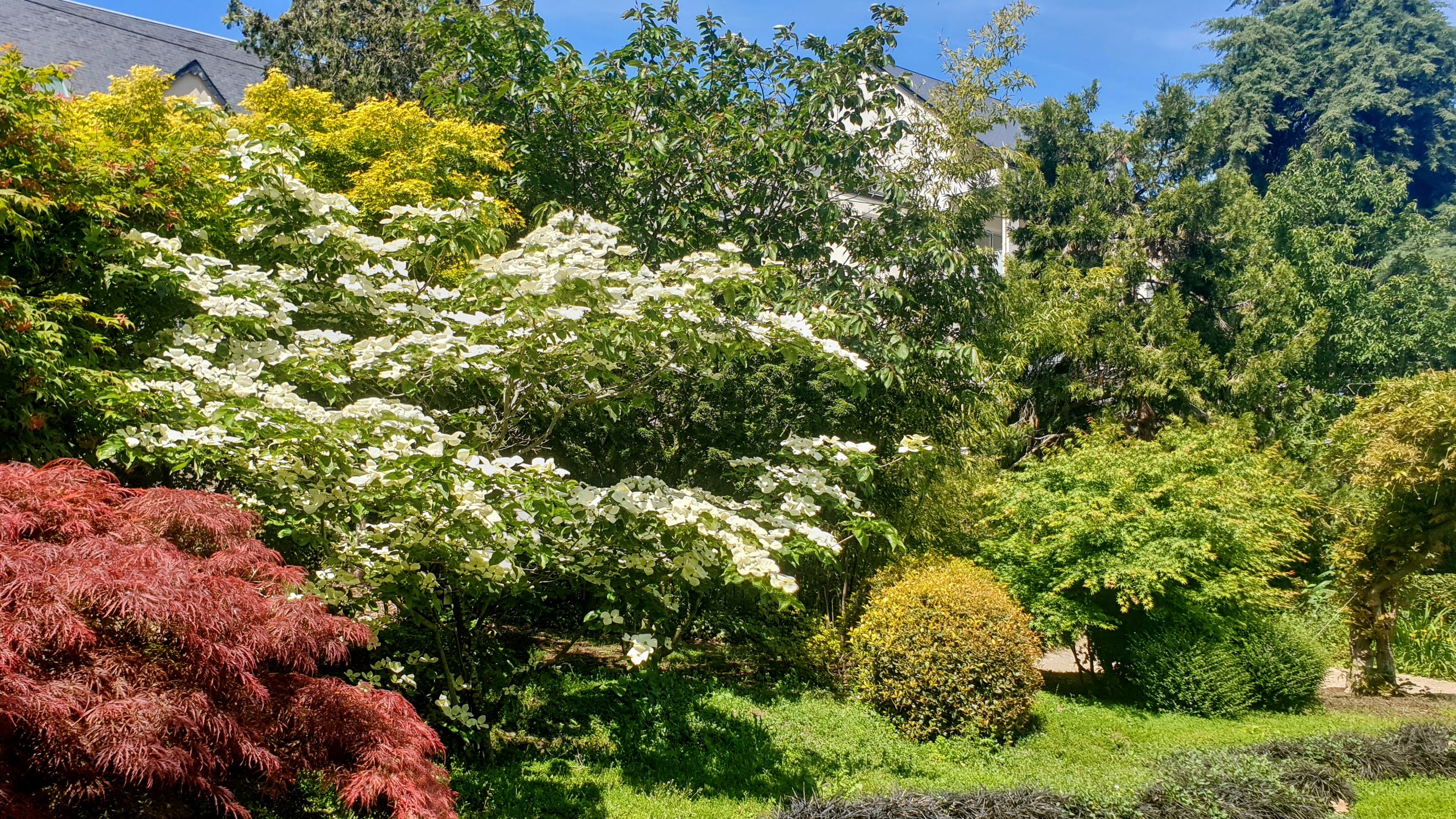
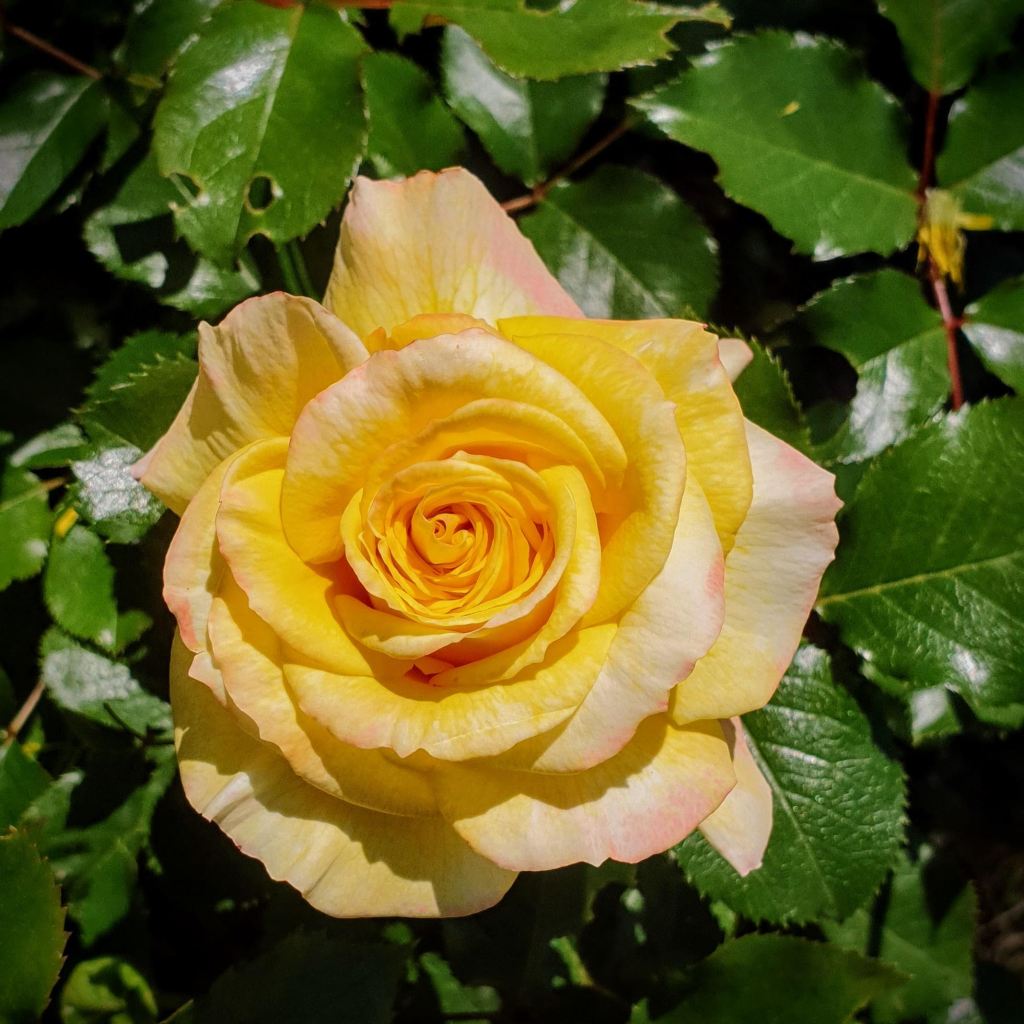
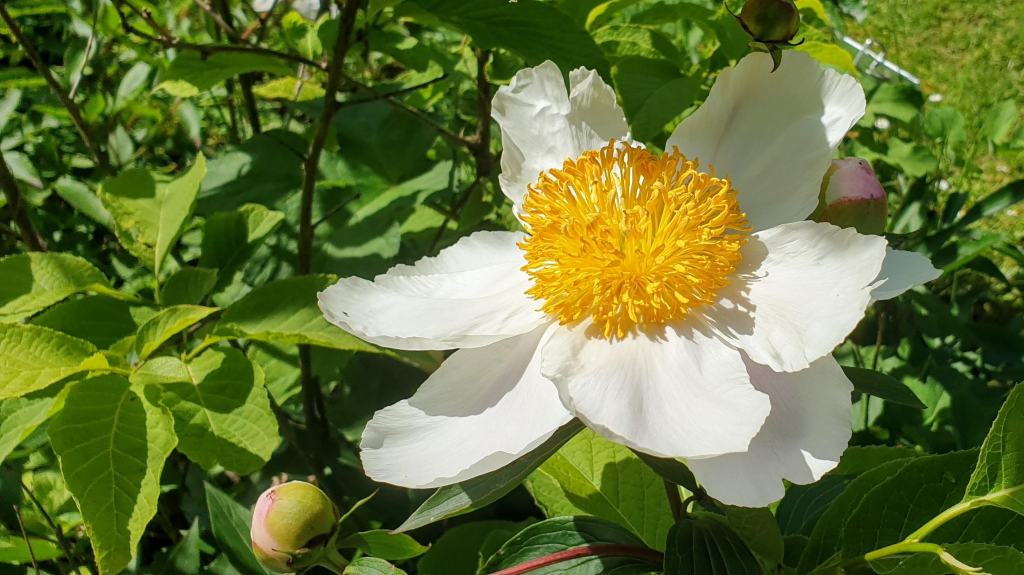
As with many things here in the Loire Valley, an afternoon at the château gardens isn’t about rushing through to see as many sights as you can; it’s about a stroll through a beautiful environment on a lovely day to enjoy the views and the take the air. Though the courtly days are long gone (and truly, I am grateful to live in modern times), there’s something to be said for “taking a turn around the gardens” as though I were a heroine in a Jane Austen novel. I took many photos of the flowers in bloom, so if you love flowers, check out the slide show below!
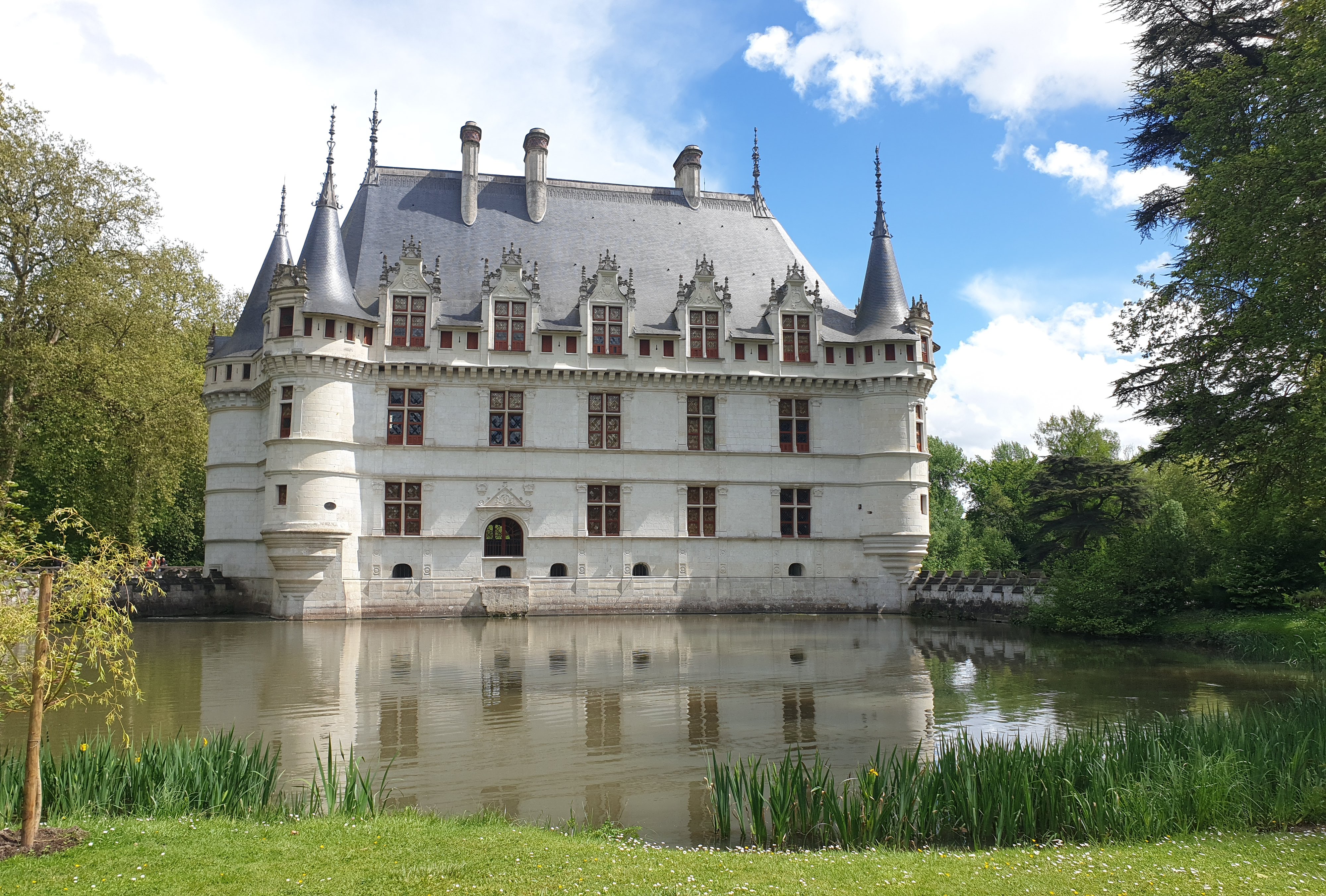
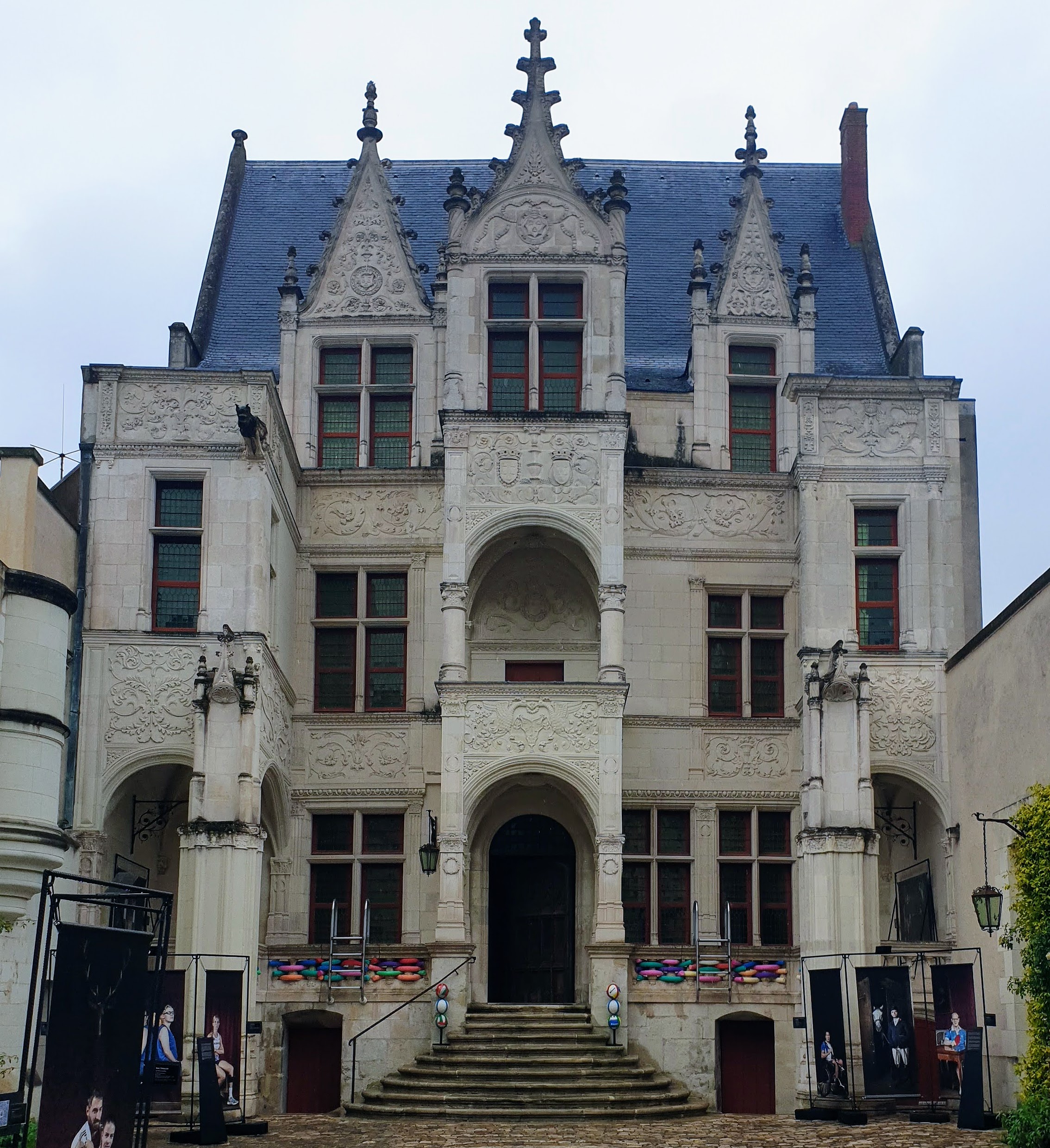
Château d’Azay-le-Rideau Castle (the virtual tour link)

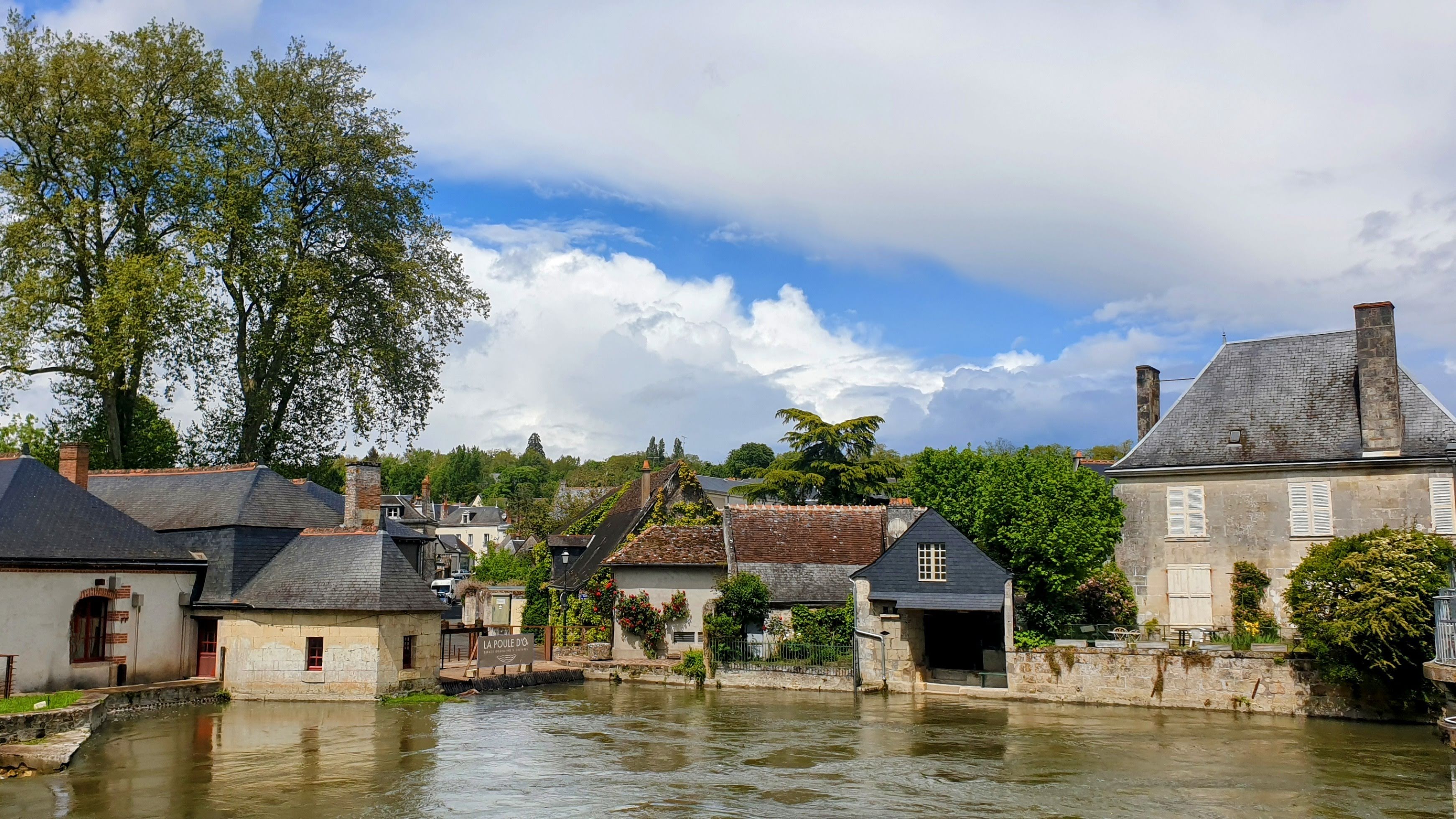
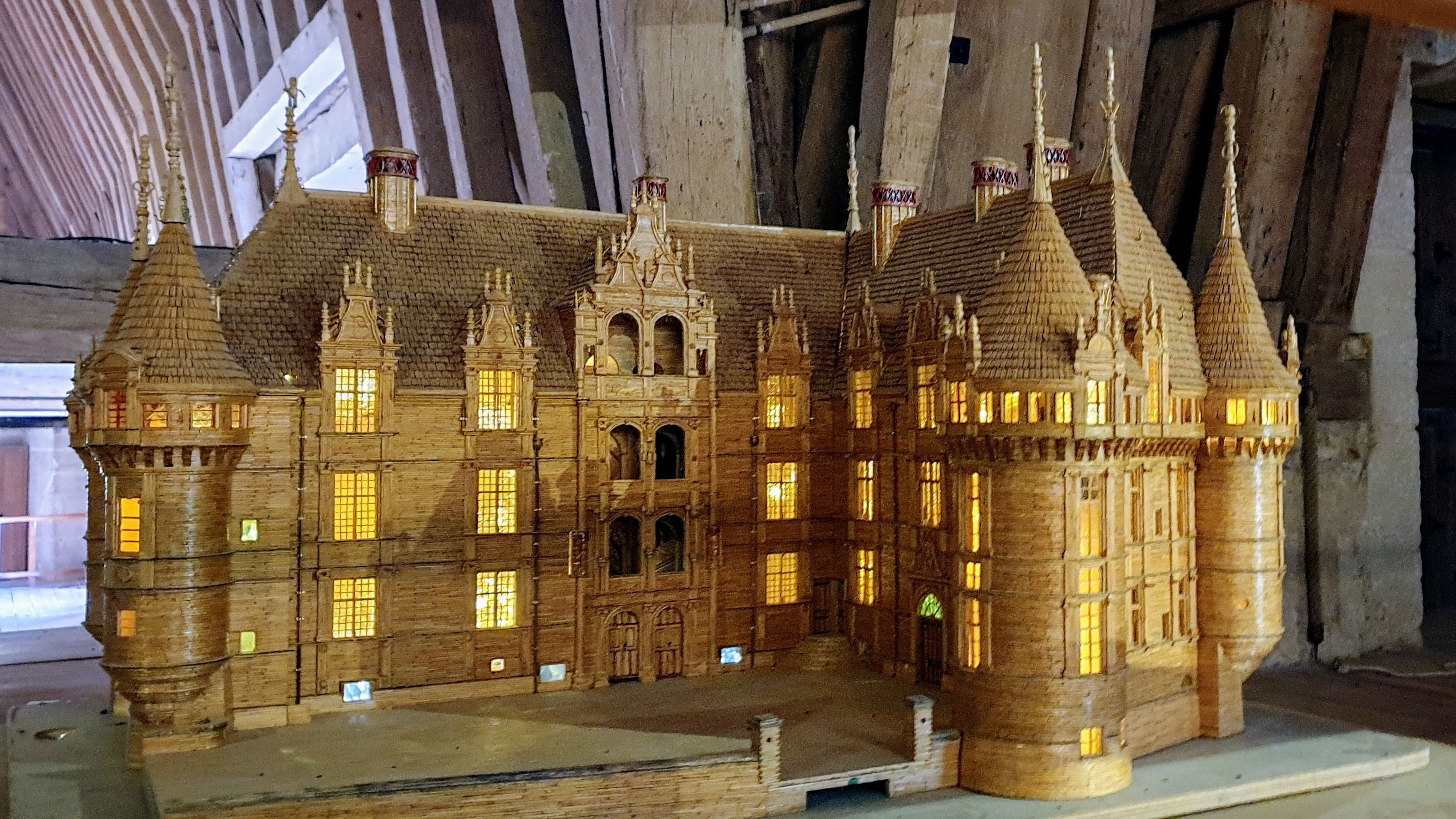
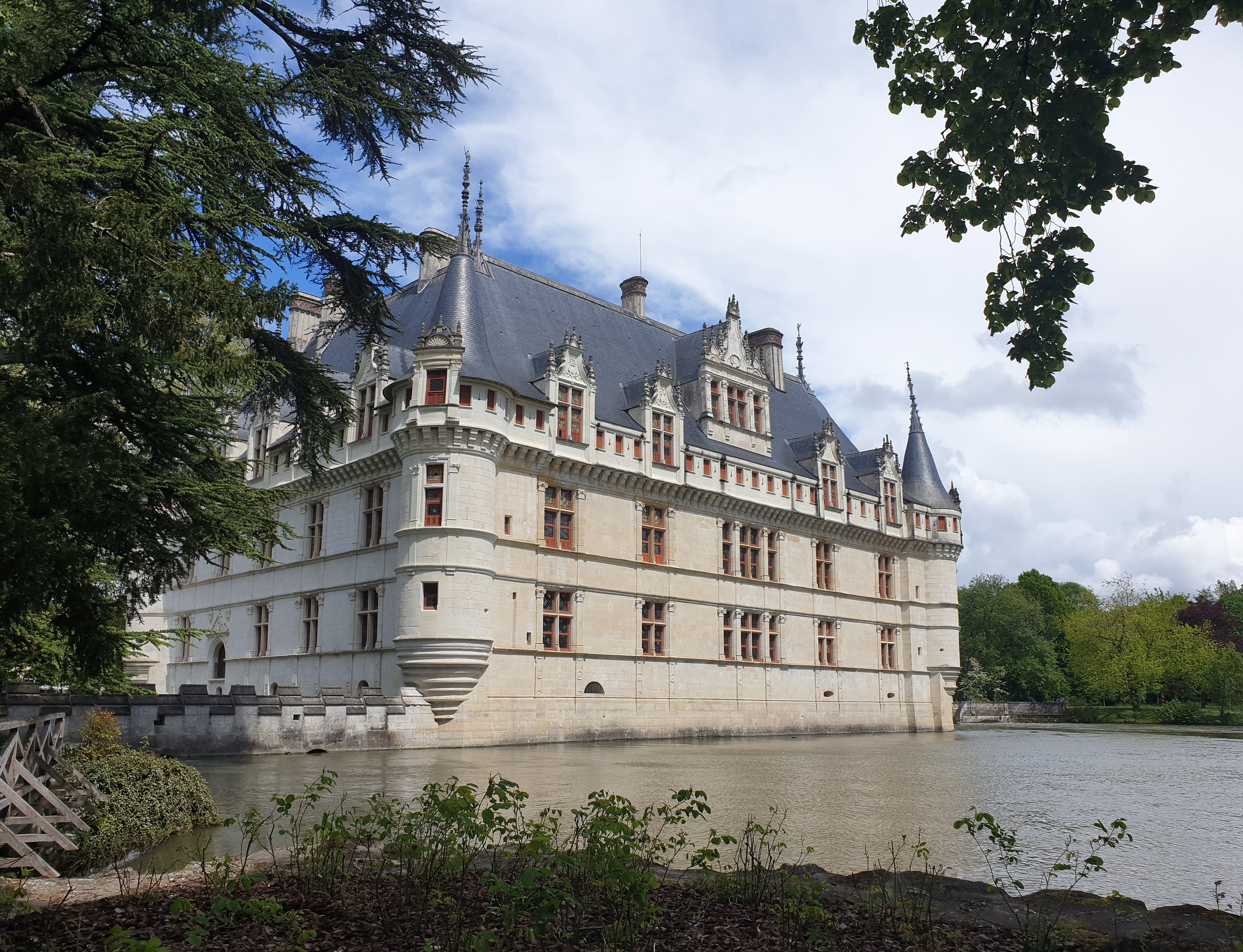
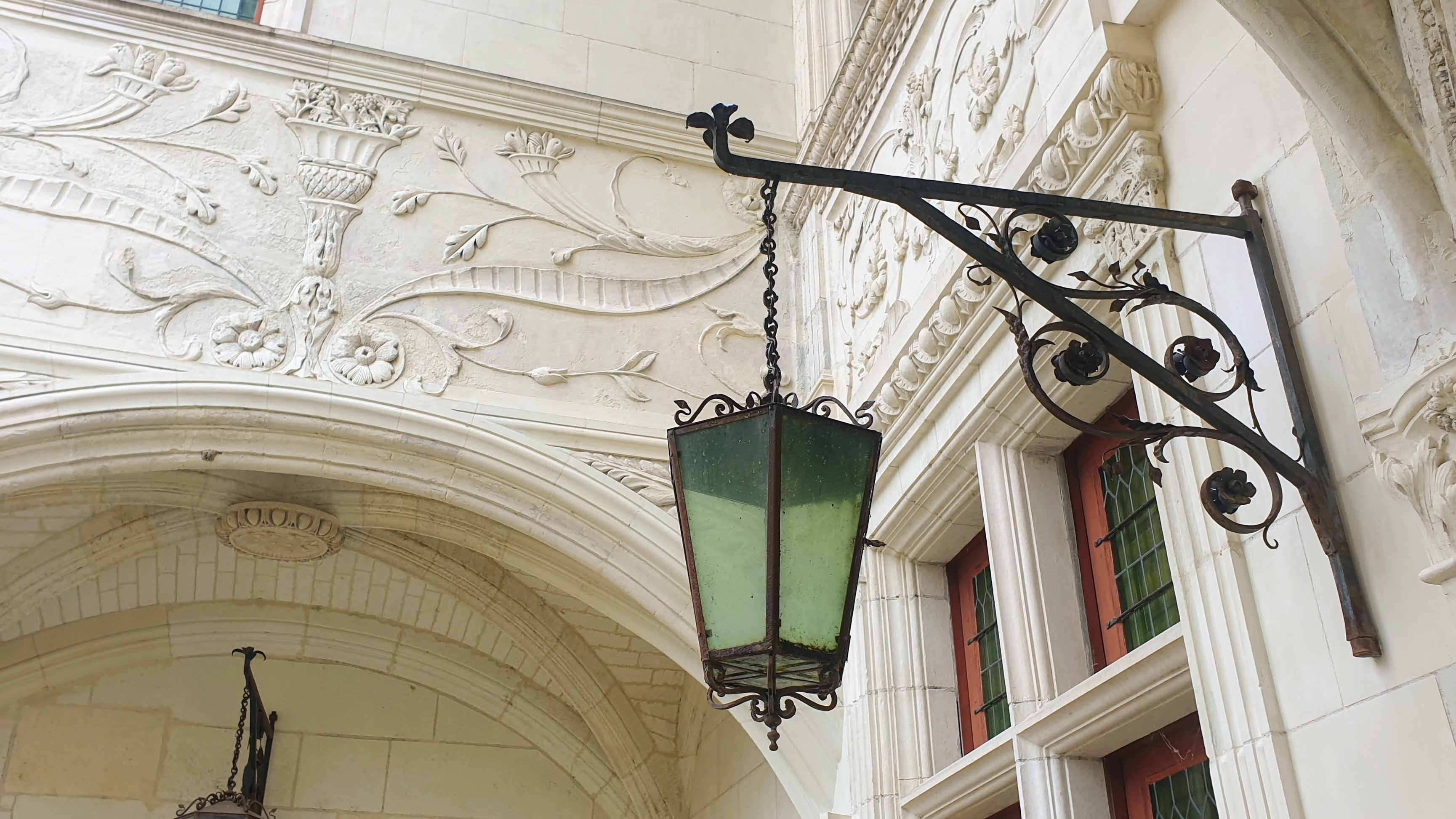
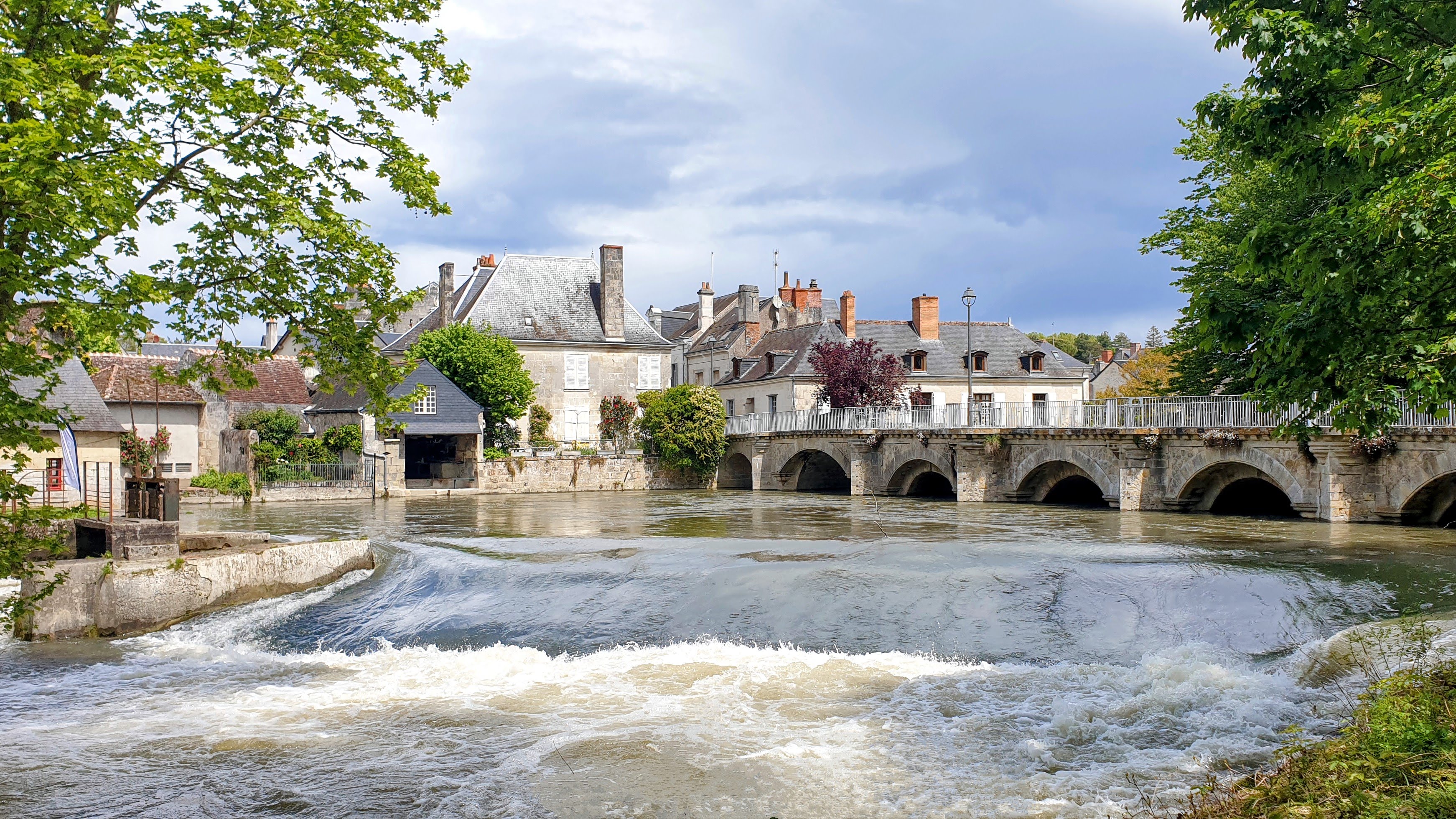
While Villandry was all about the gardens, the Château d’Azay has excellent interiors. The grounds are nothing to sneeze at, but they are considerably simpler than the elaborate gardens of Villandry. D’Azay is not quite as old, but has many architectural themes in common since it was also constructed during the renaissance. The French Renaissance King Francis the First established the Loire Valley as his seat of government, and the château was built to honor his reign. The interior was remodeled in the 19th century and eventually acquired by the state in 1905. The walk from the parking lot to the château was through a charming little village.
We started our tour by climbing all the way to the top and getting a view of the architectural engineering from the inside. The roof itself contains 75 tons of slate! A lot of structural work goes into holding up that much weight. The current exhibition is a reconstruction, but it’s done in the same style as the original to preserve the craftsmanship.
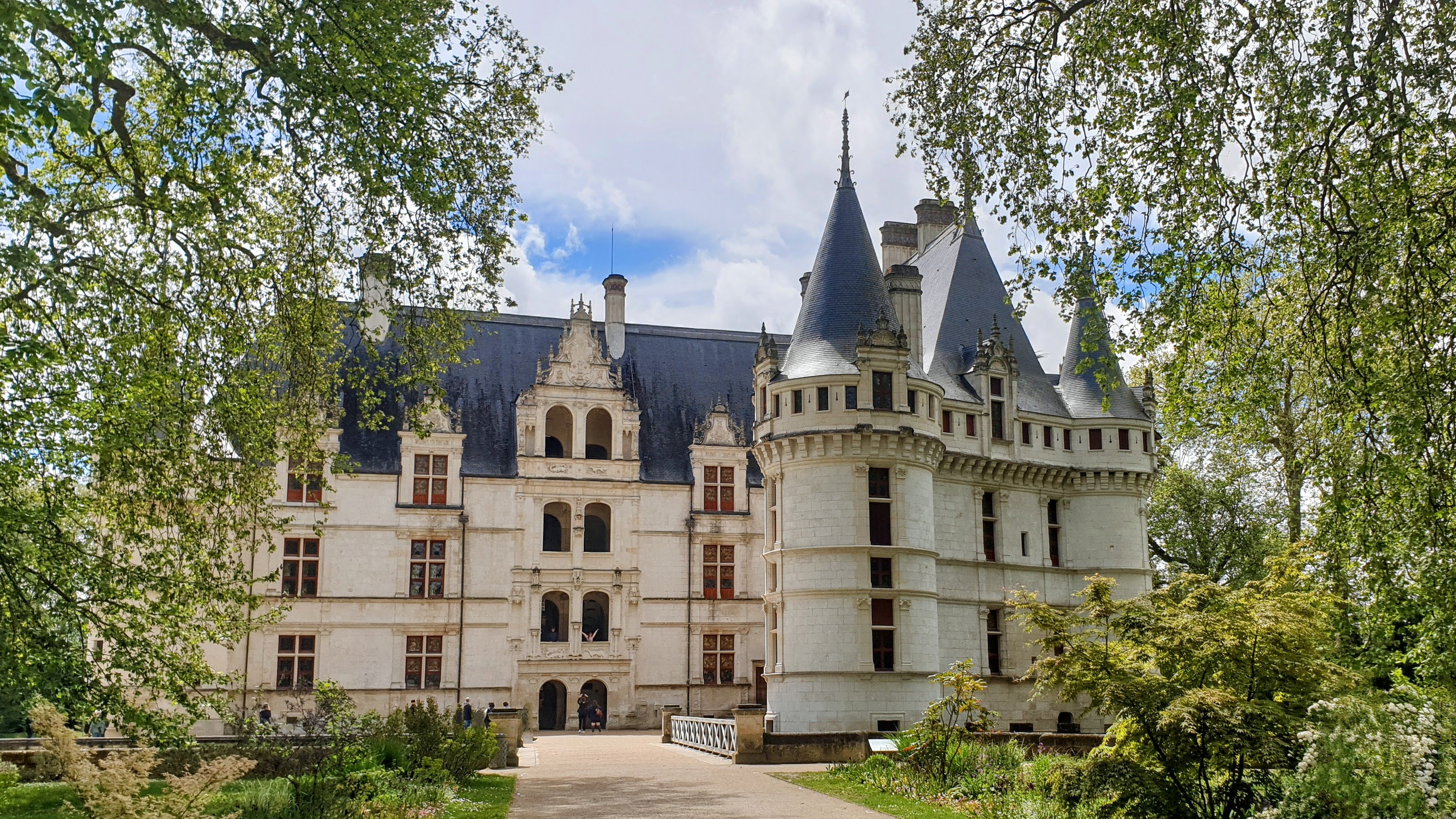
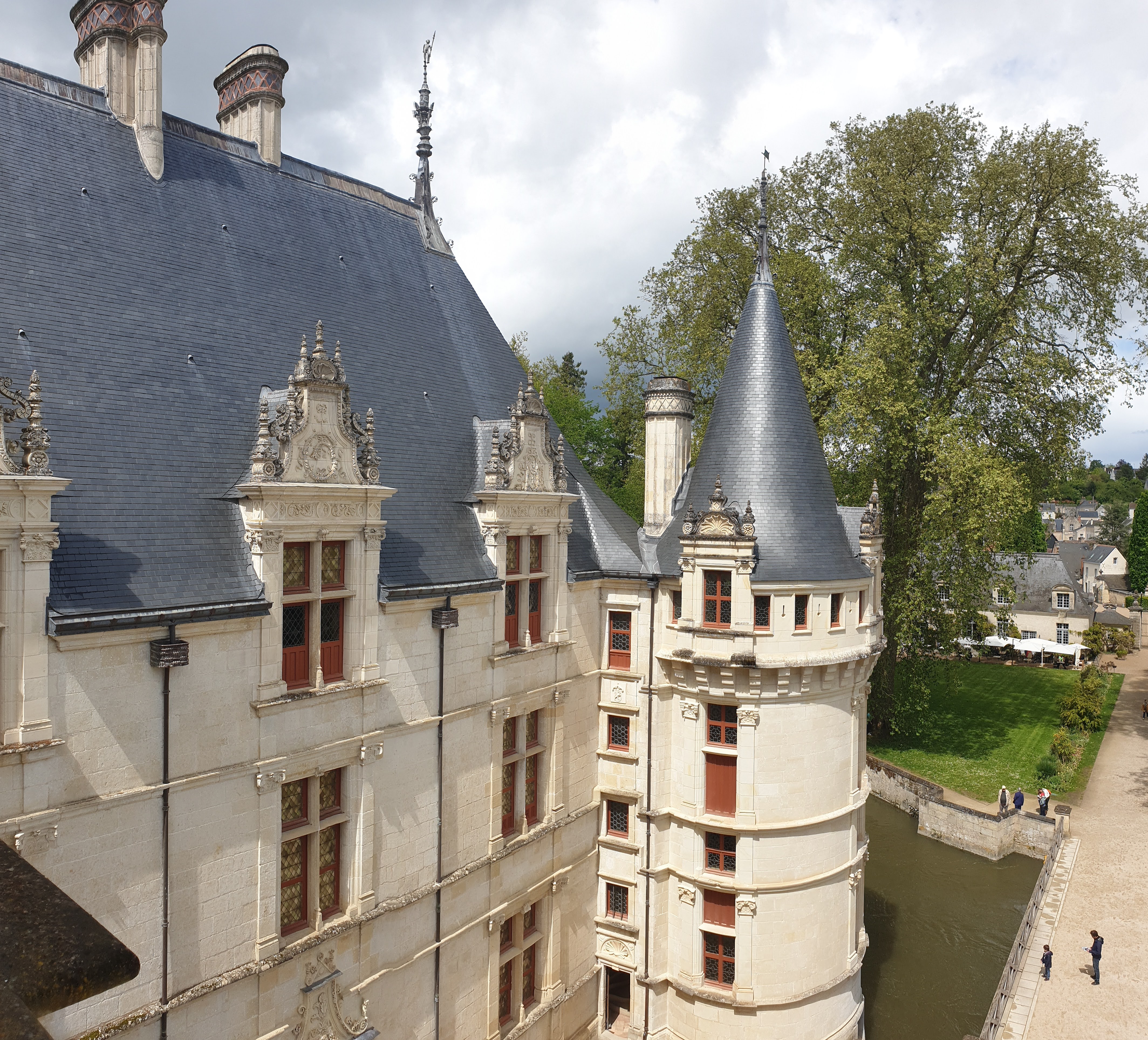
As we descended, we entered room after room decorated in the styles of the different eras that the château has existed throughout. The first being the Renaissance room, a faithful replica of the room of the architect’s wife. Although it is fairly simple compared to later rooms, it’s still interesting to see the way people lived. Additionally, at that time, bedrooms were not just for sleeping, but also for socializing and entertaining. Mats made of reeds lined the walls to keep the chill of the stone from overwhelming the room, and there was a small alcove off to one side in which sits a secretary’s desk.

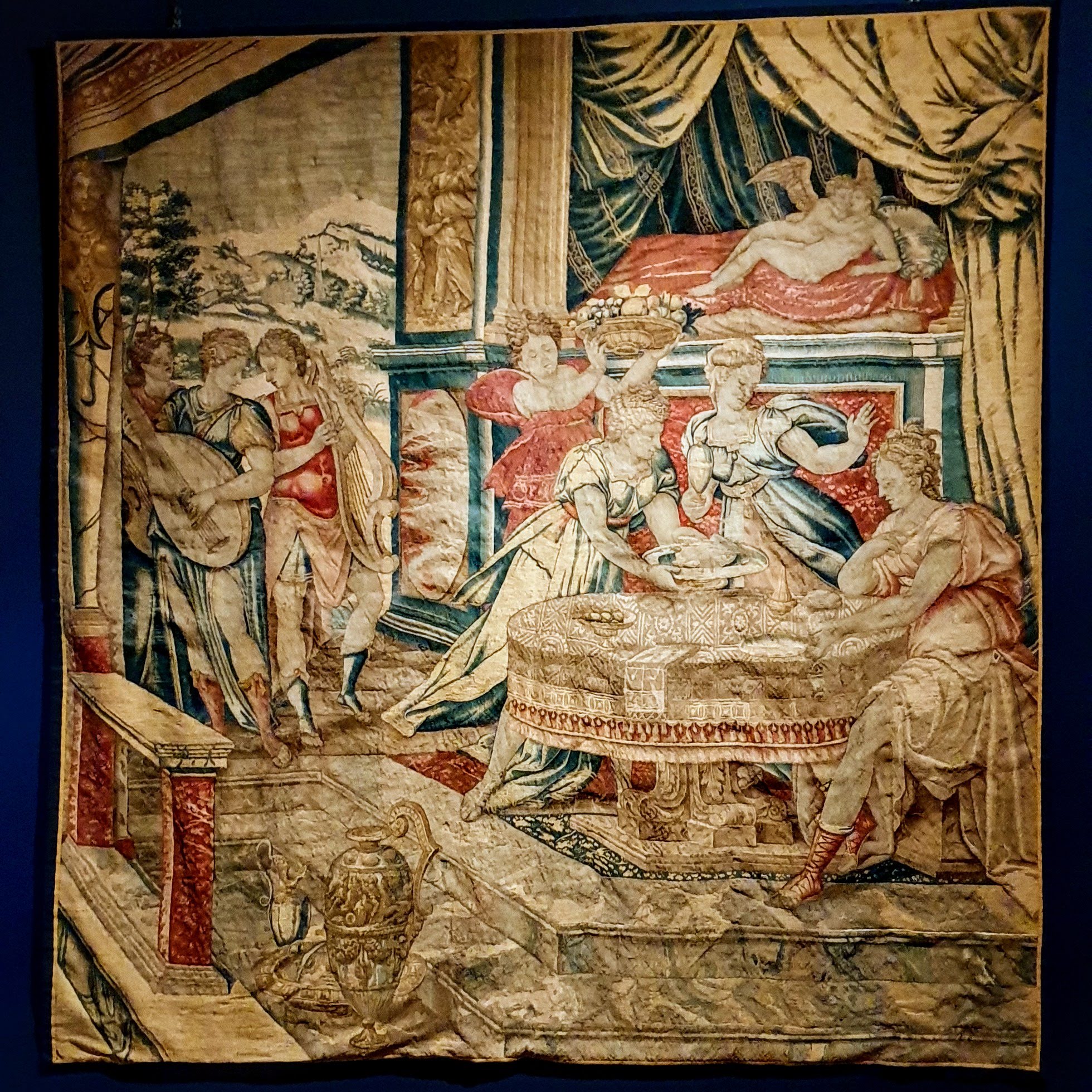
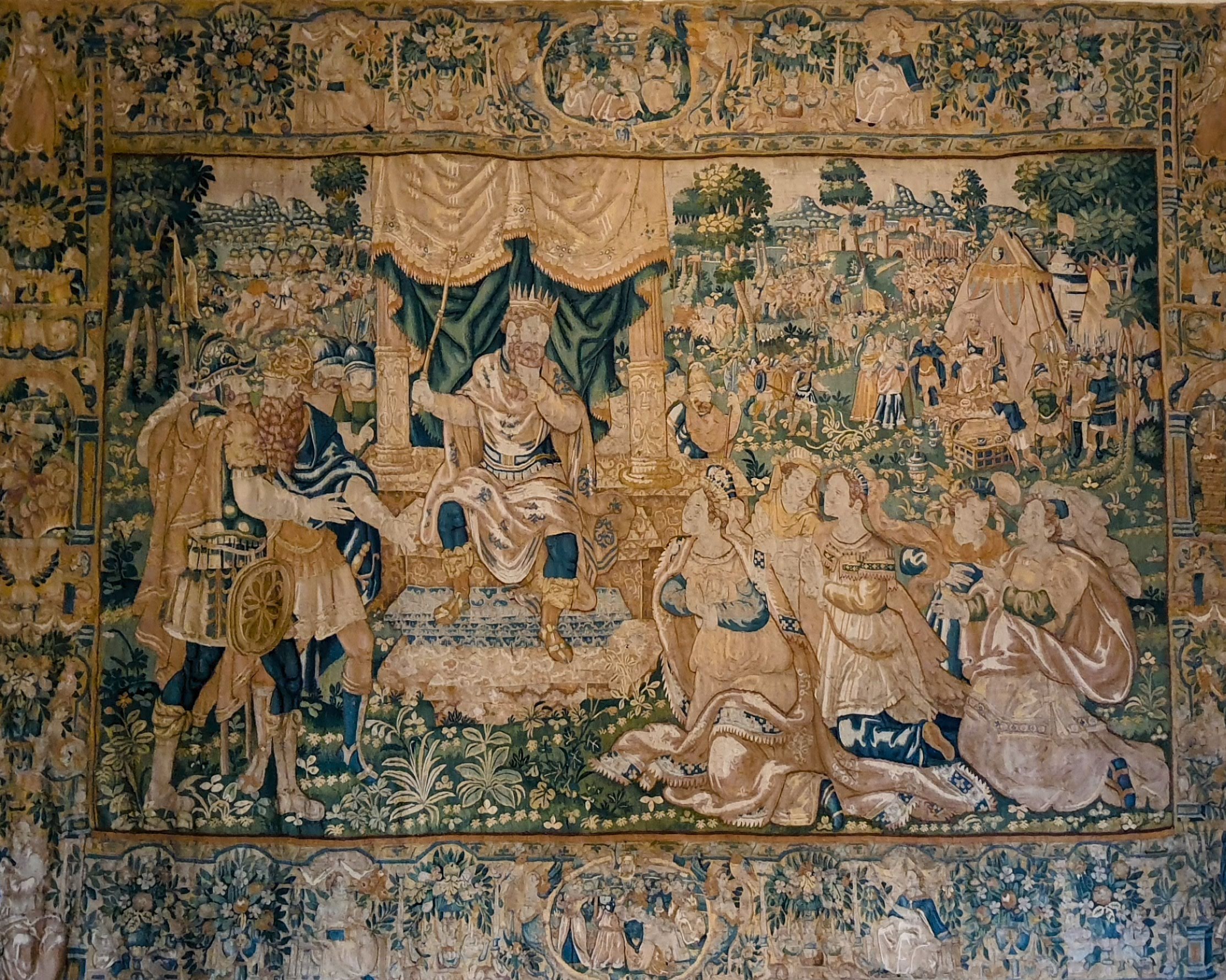
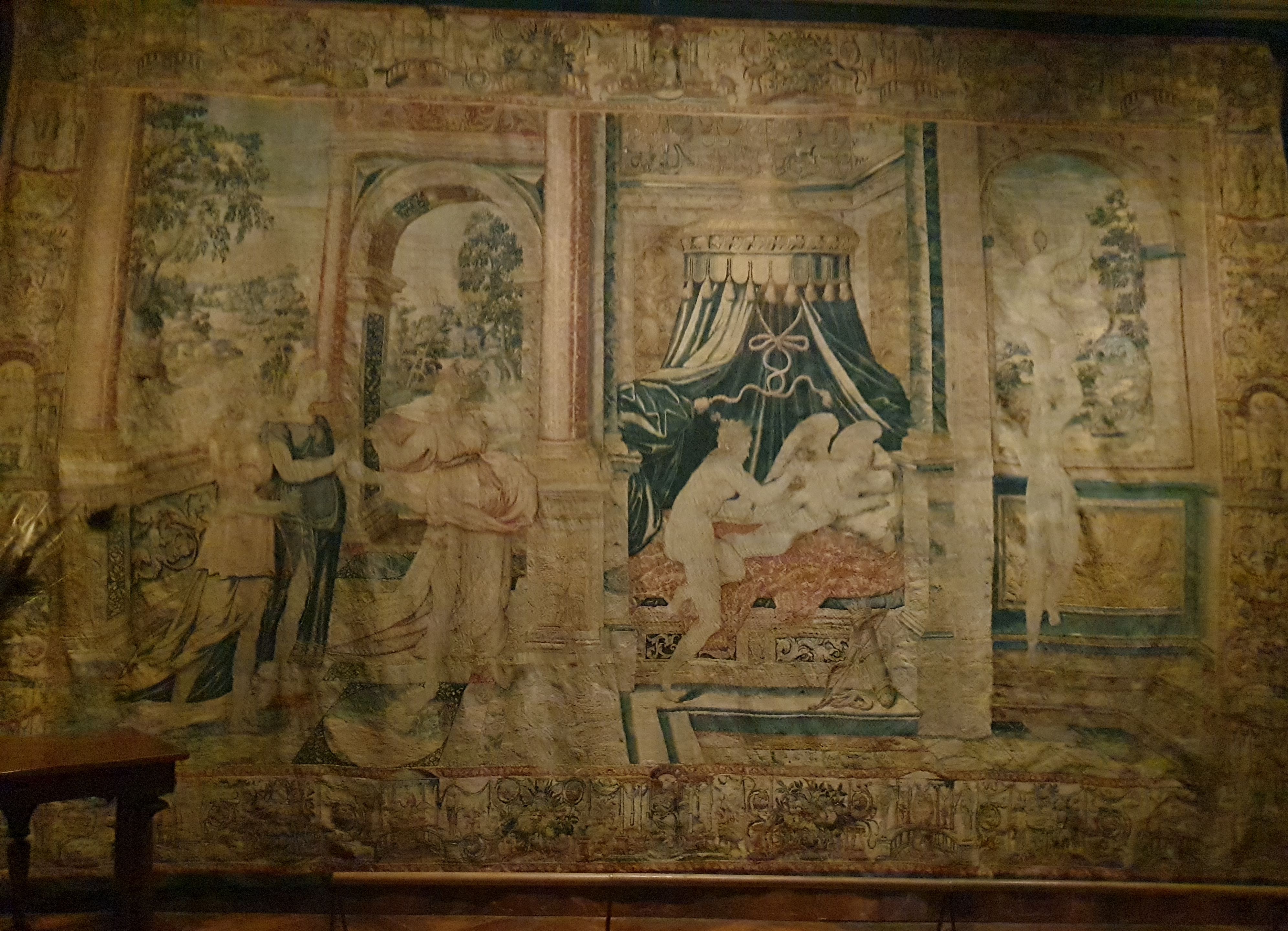
The next room is called Psyche’s Chamber because the ornate tapestries along the walls depict the Greek myth of Psyche which was all the rage at the time. This is followed by the Great Hall. This room was used for hosting feasts and dances, and to be honest, after watching far too many period dramas in film and television, I was surprised at how small it seemed, even when mostly empty.
Following that we crossed through the ante-chamber where visitors wishing to see the King could wait, and the King’s Chamber. A royal suite had to be maintained by pretty much all the nobles since the King could drop by with very little notice and expect to be hosted in style. Apparently Louis XIII stayed there for just two nights in 1619, and yet the room was kept ready for a royal visit at any time.

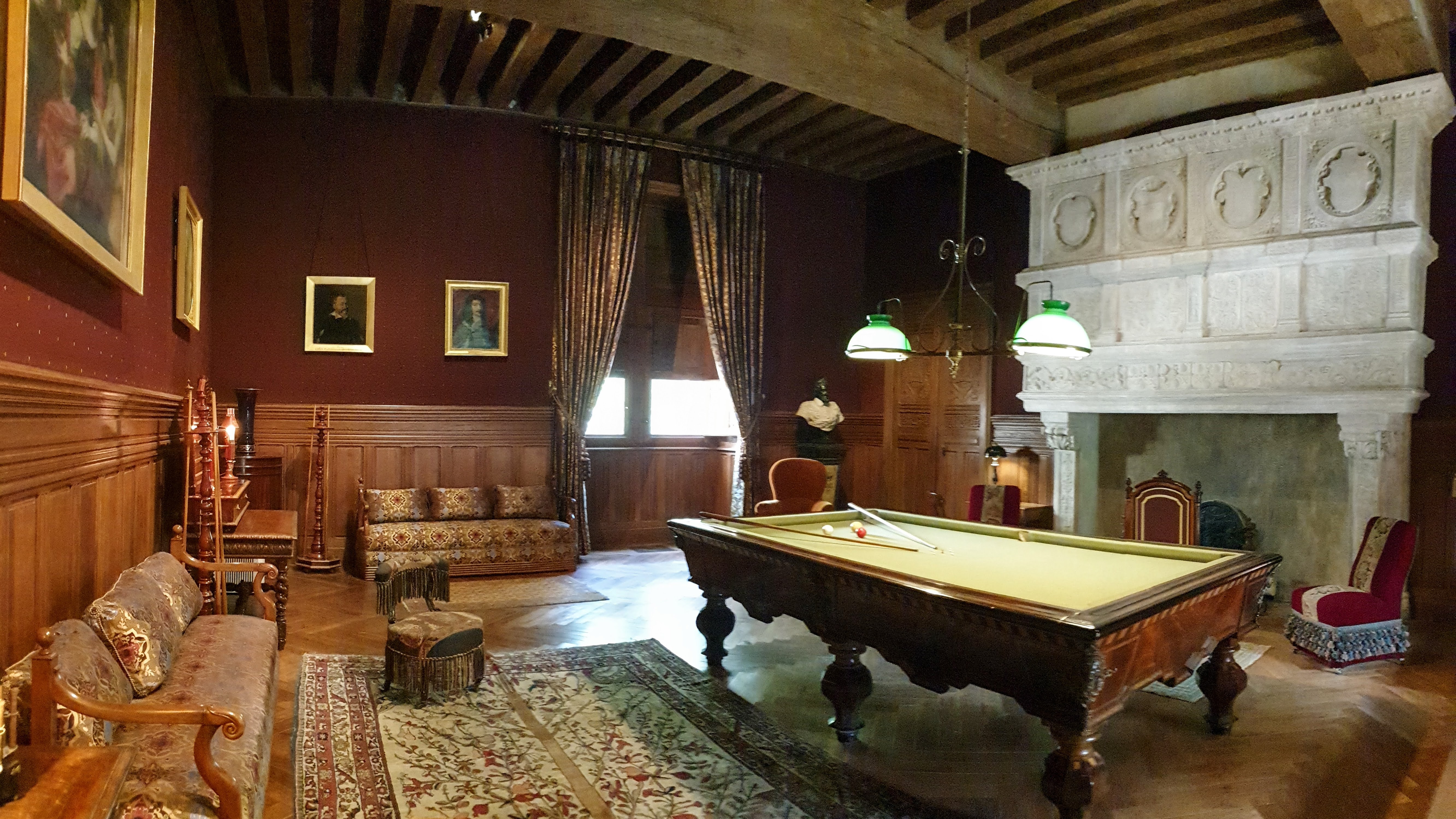
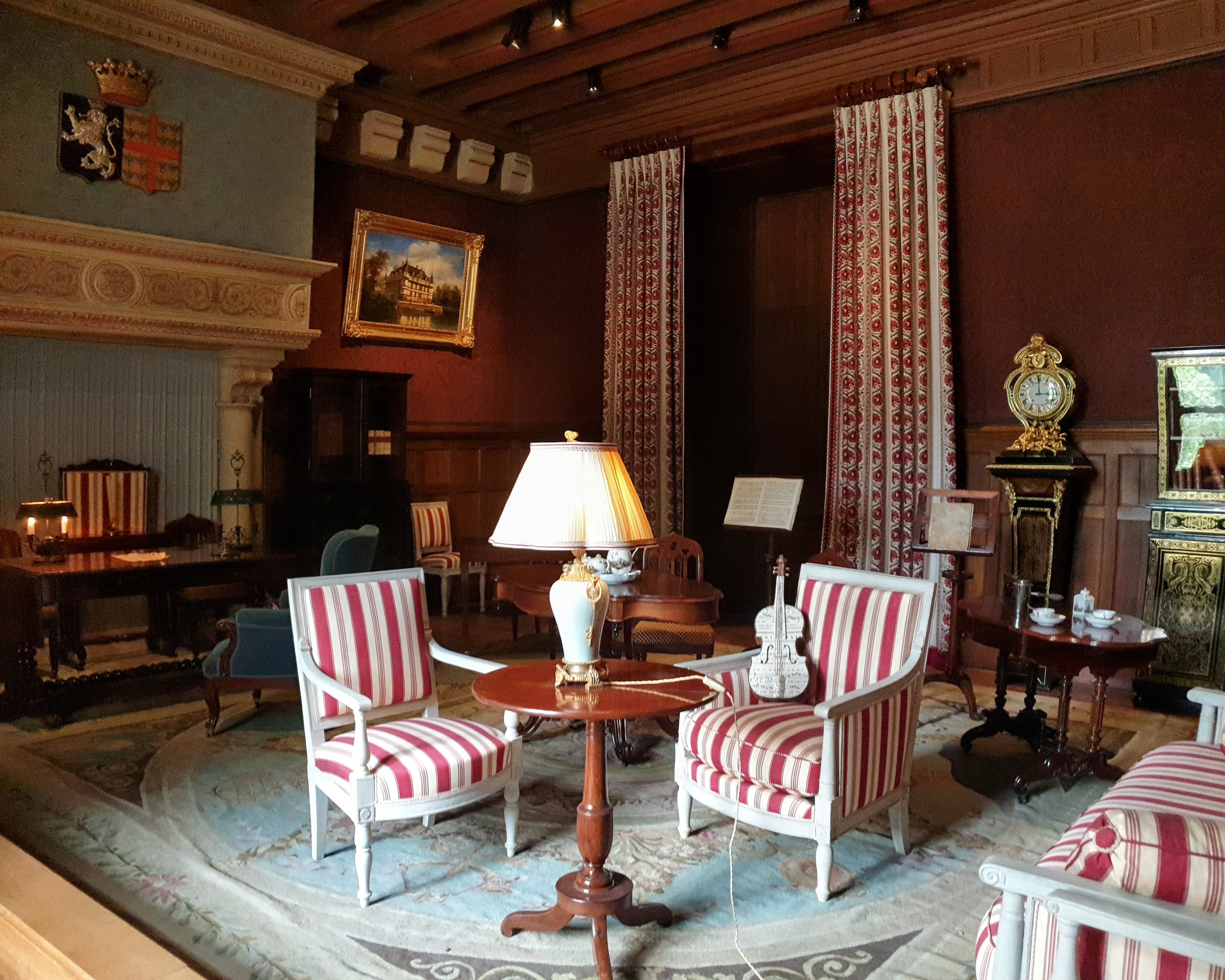
Jumping starkly forward in time, the next suite of rooms reflect the fashions of the 19th century. The Biencourt Salon was a room for people to relax, talk, and maybe take some light refreshments. The Billiard Room was more of an informal space, featuring a billiard table.

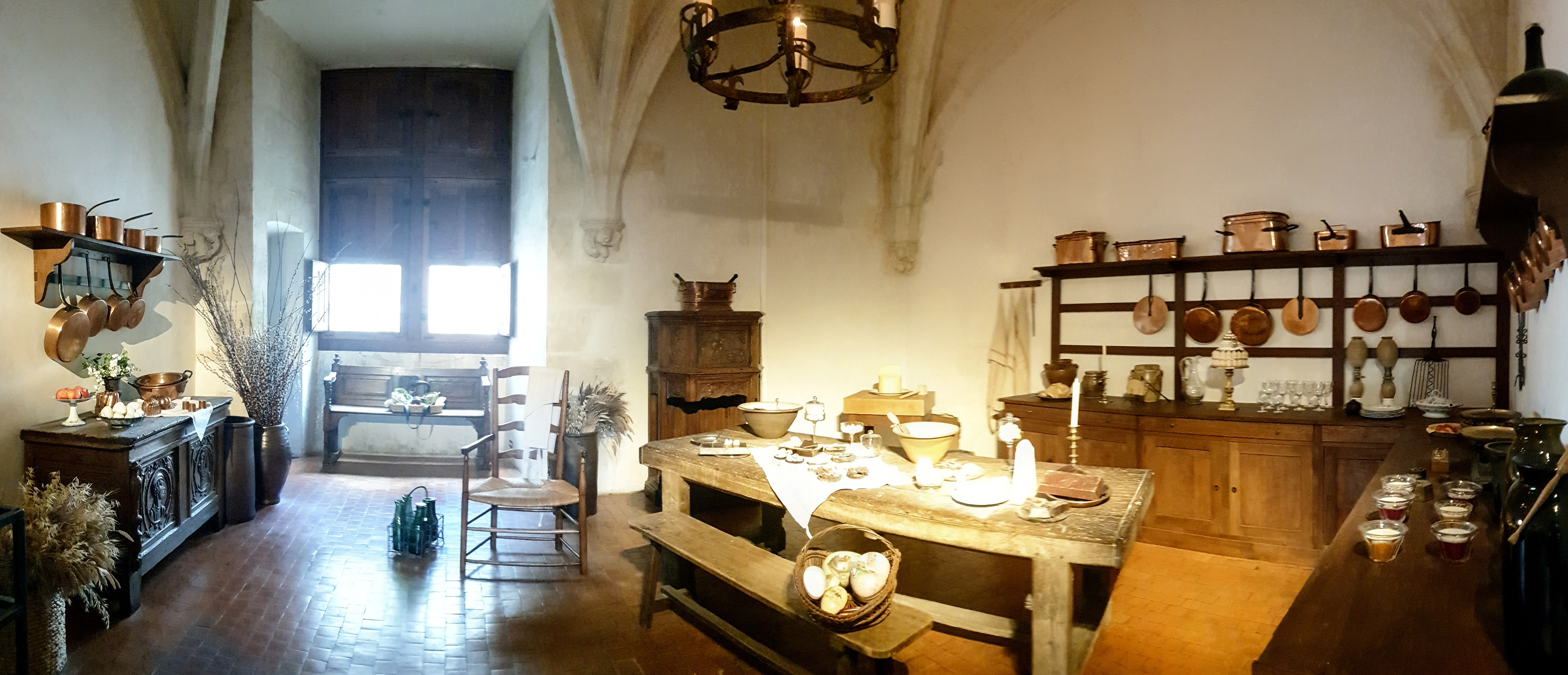
From there we had a peak into the “below stairs” (though not physically below) of the larder and the kitchen. These were quite close to a 19th century style dining room (a contrast to the Great Hall of the Renaissance style). After the dinning room, a final salon-library shows comfortable furniture, musical instruments, and a small collection of books.
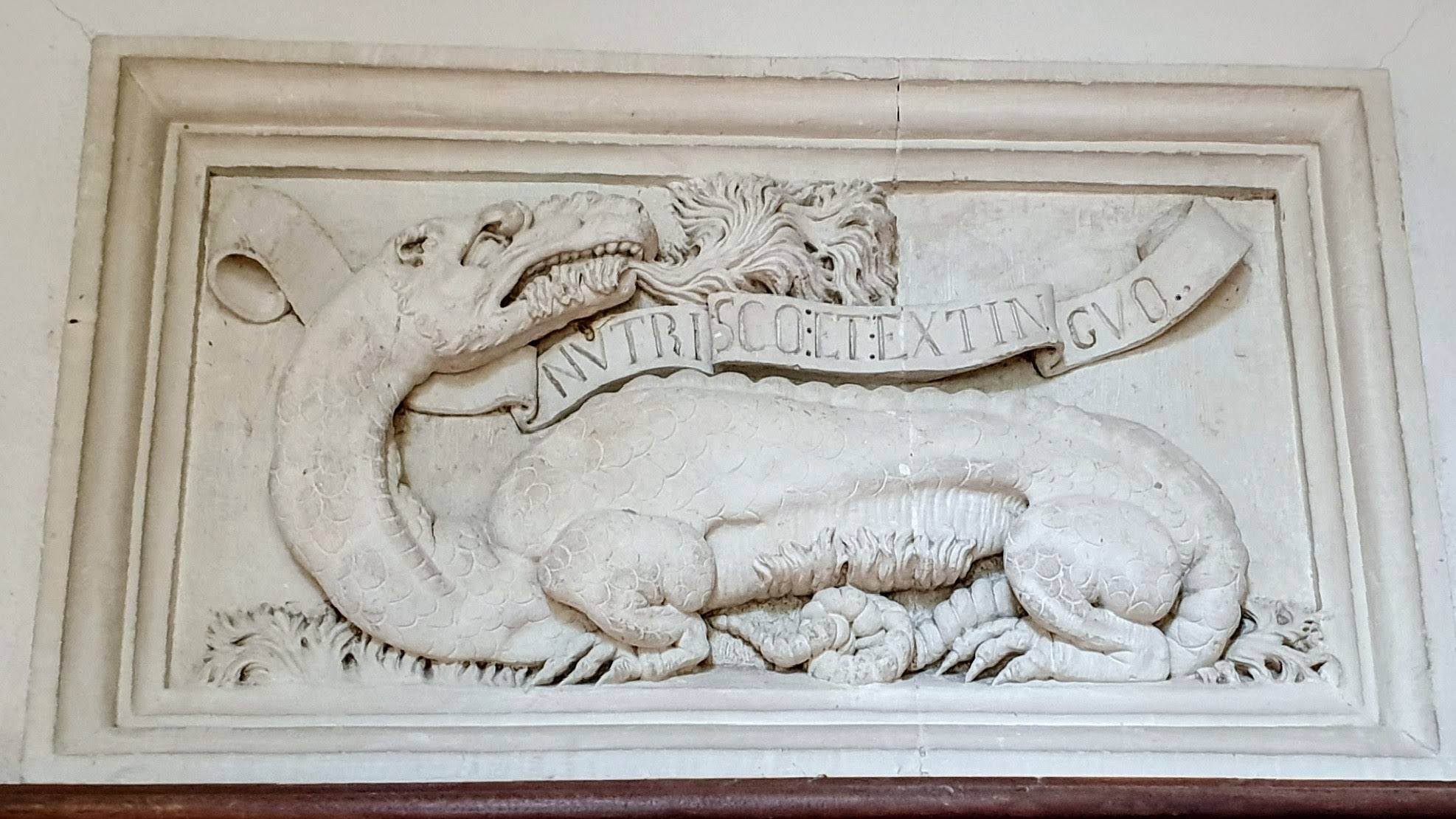
A repeating motif in the stonework of the château is the fire-breathing salamander. This was a motif of King Francis I whose motto was “Nutrisco and Extingo” (translated: I feed on the good fire and I extinguish the bad) – a metaphor for pursuing justice and weeding out injustice.

Château du Clos Luce (link)

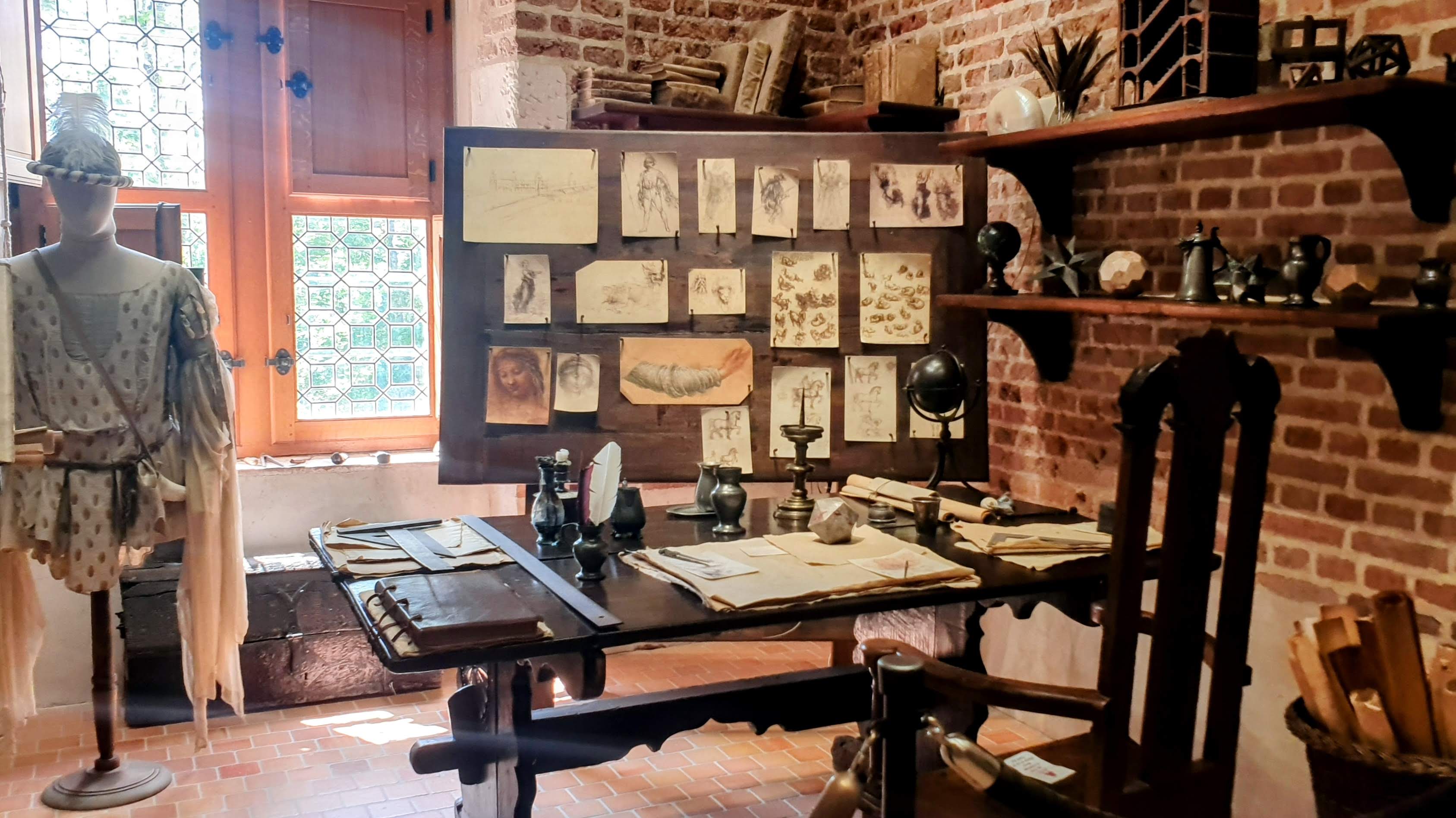
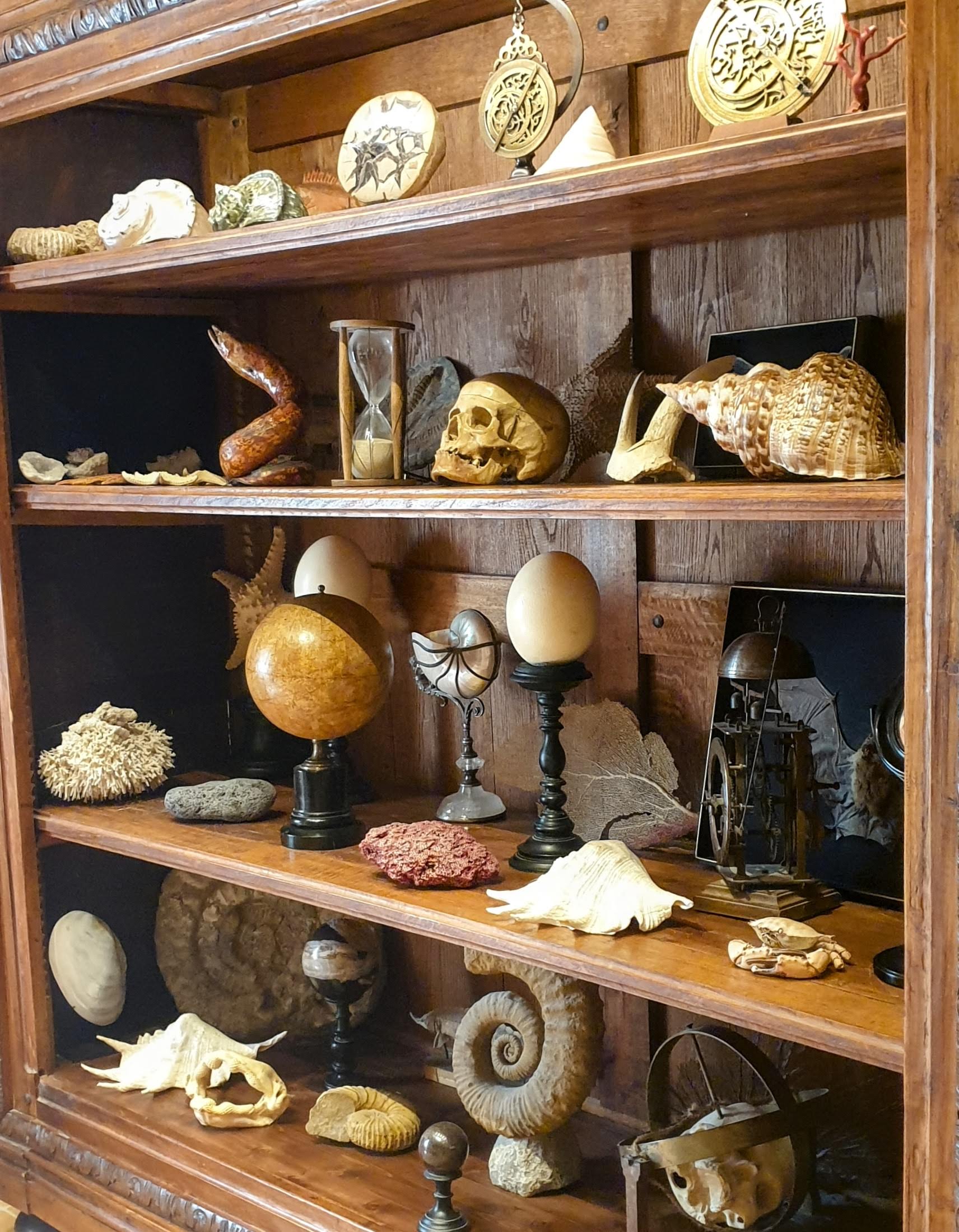
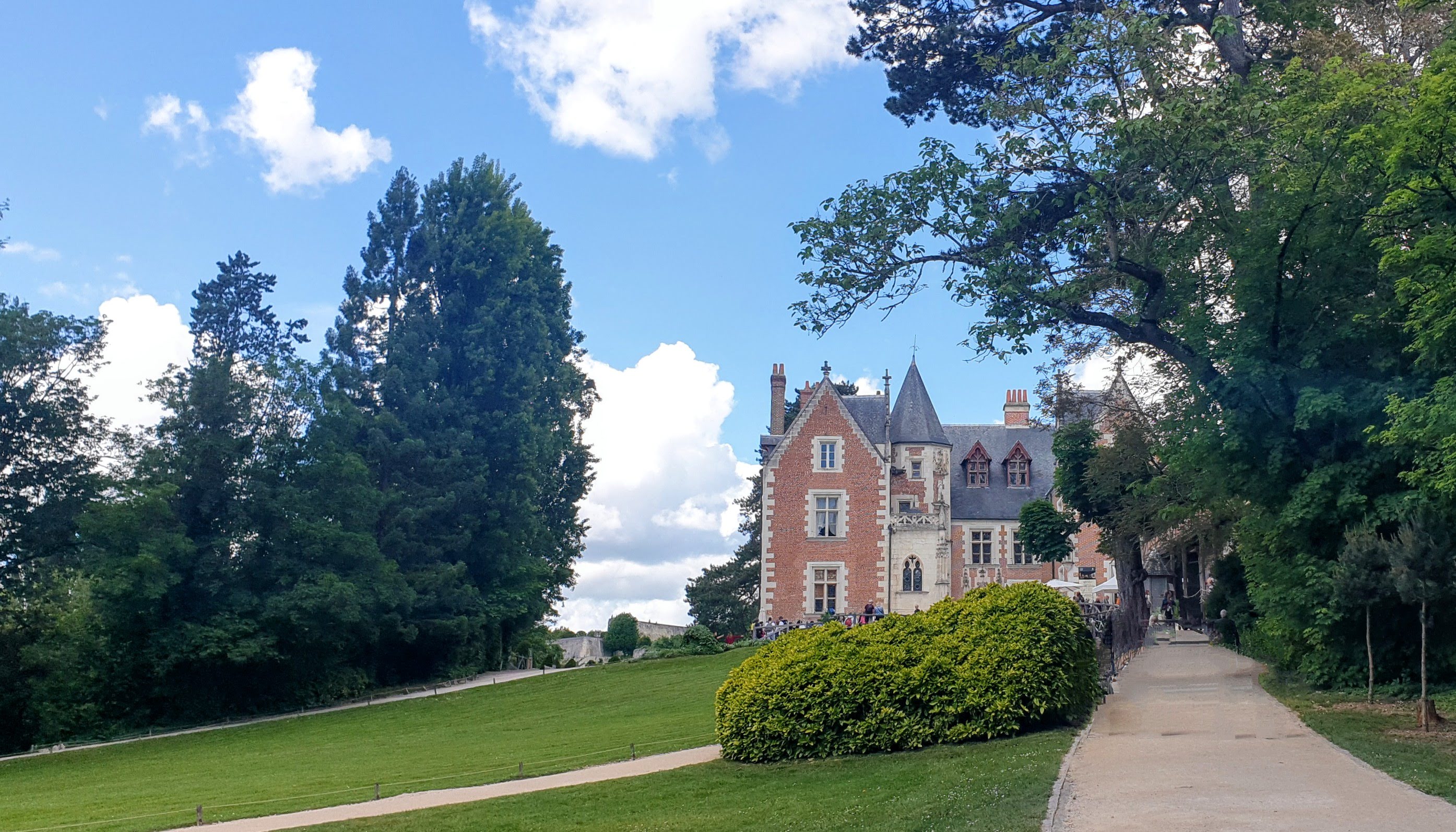
This was my final excursion in Tours, and I once again went with the language school. Perhaps because of that, we didn’t get to see everything there was to see at this, the final dwelling of Leonardo Da Vinci. The château itself was built in the 1200s, and after a few changes in ownership, it was offered to Leonardo in 1516. Despite his advanced age, he continued to work on projects for the King and to entertain students. He also had a secret tunnel that led to the King’s palace next door which allowed him to meet with fellow artist Domenico da Cortona all the time… in secret… underground… but I’m sure they were just friends.
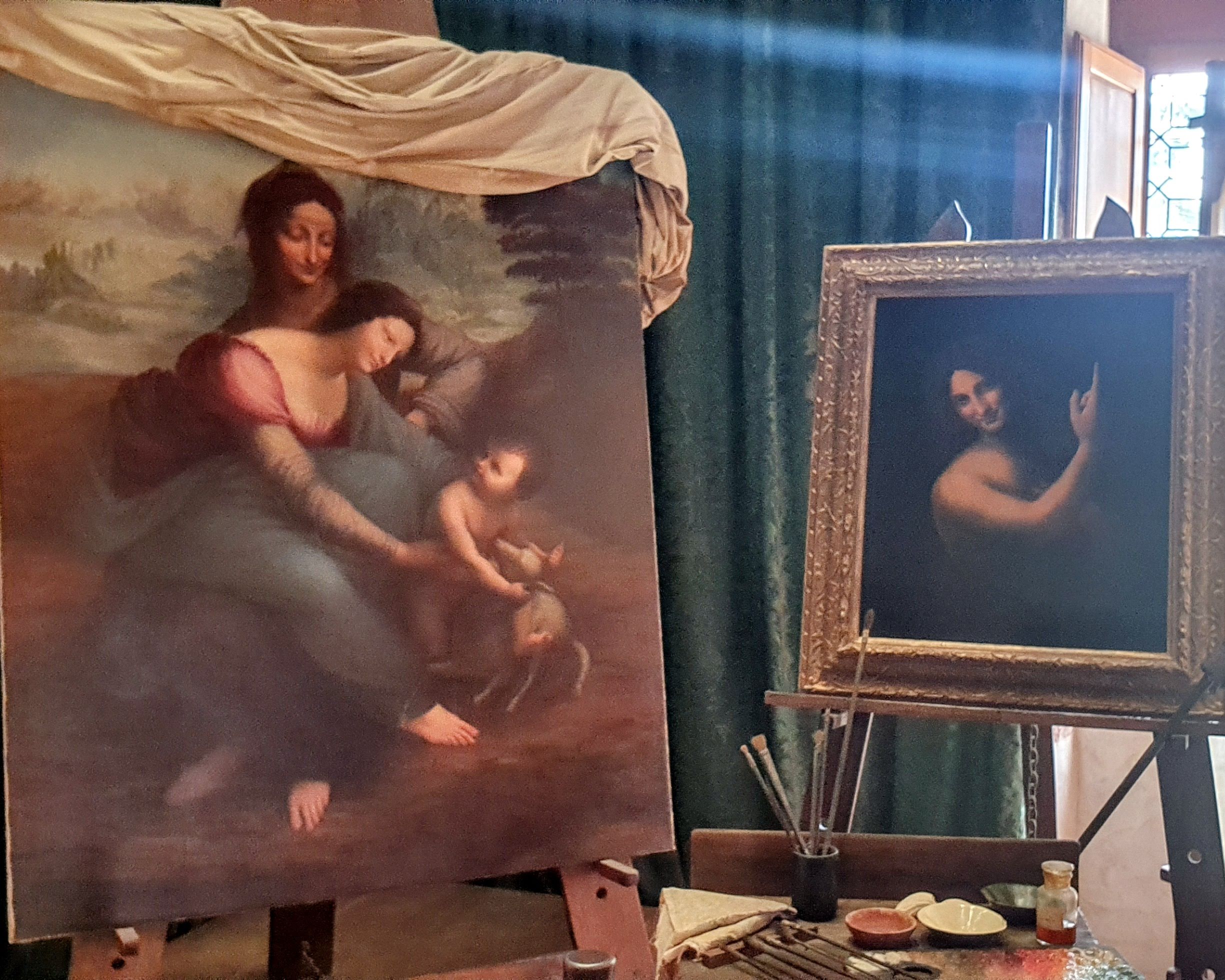
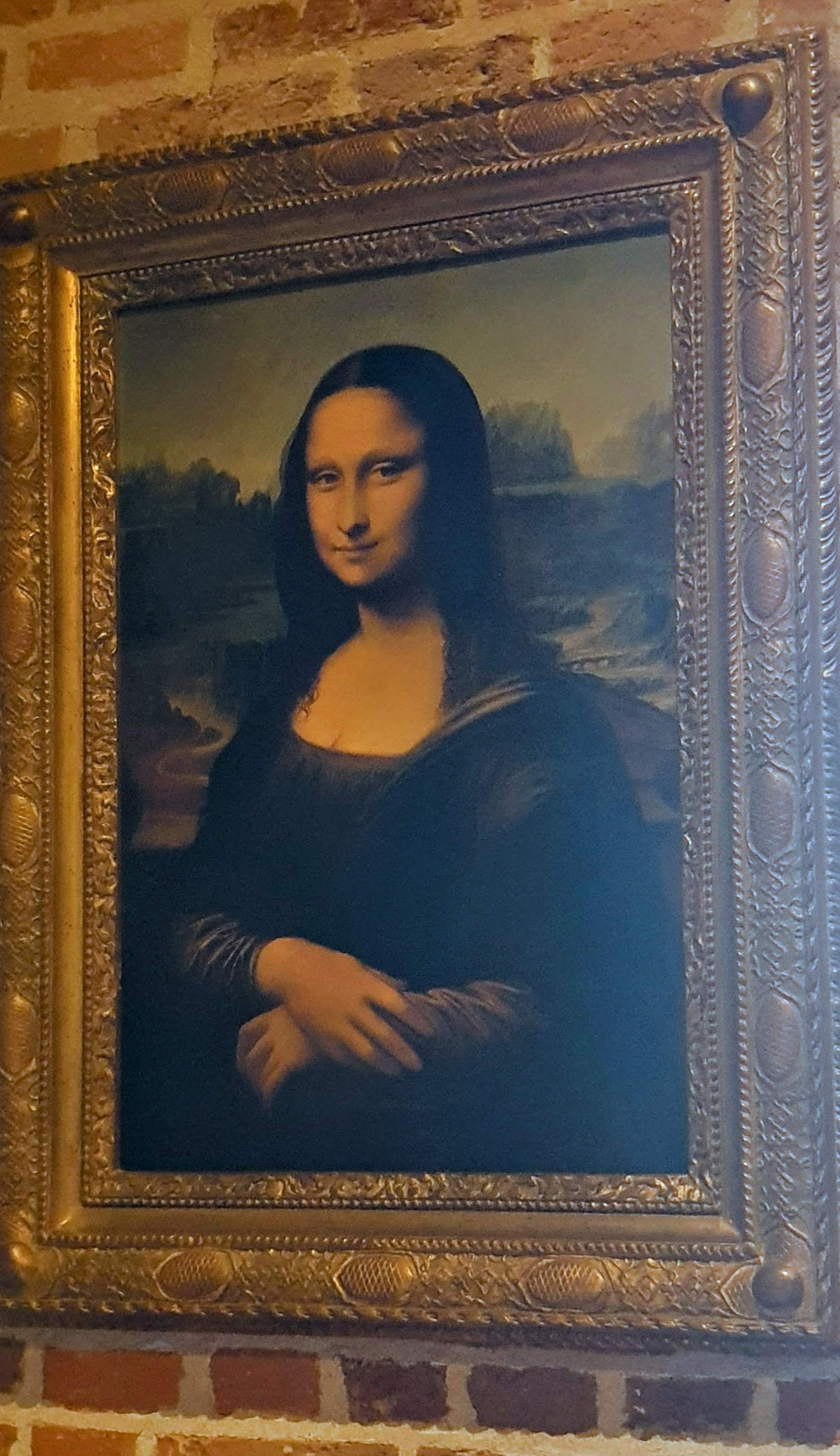
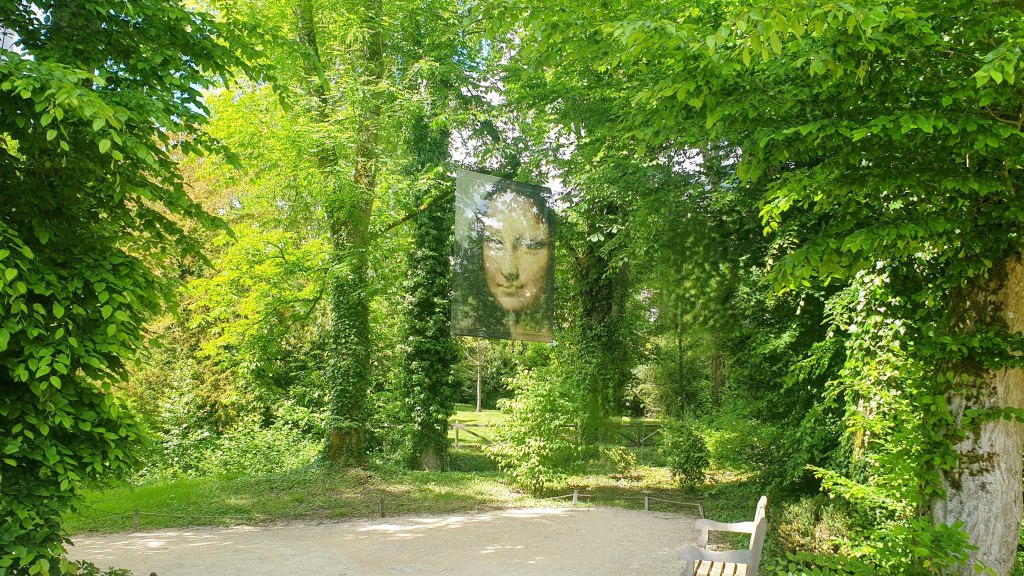
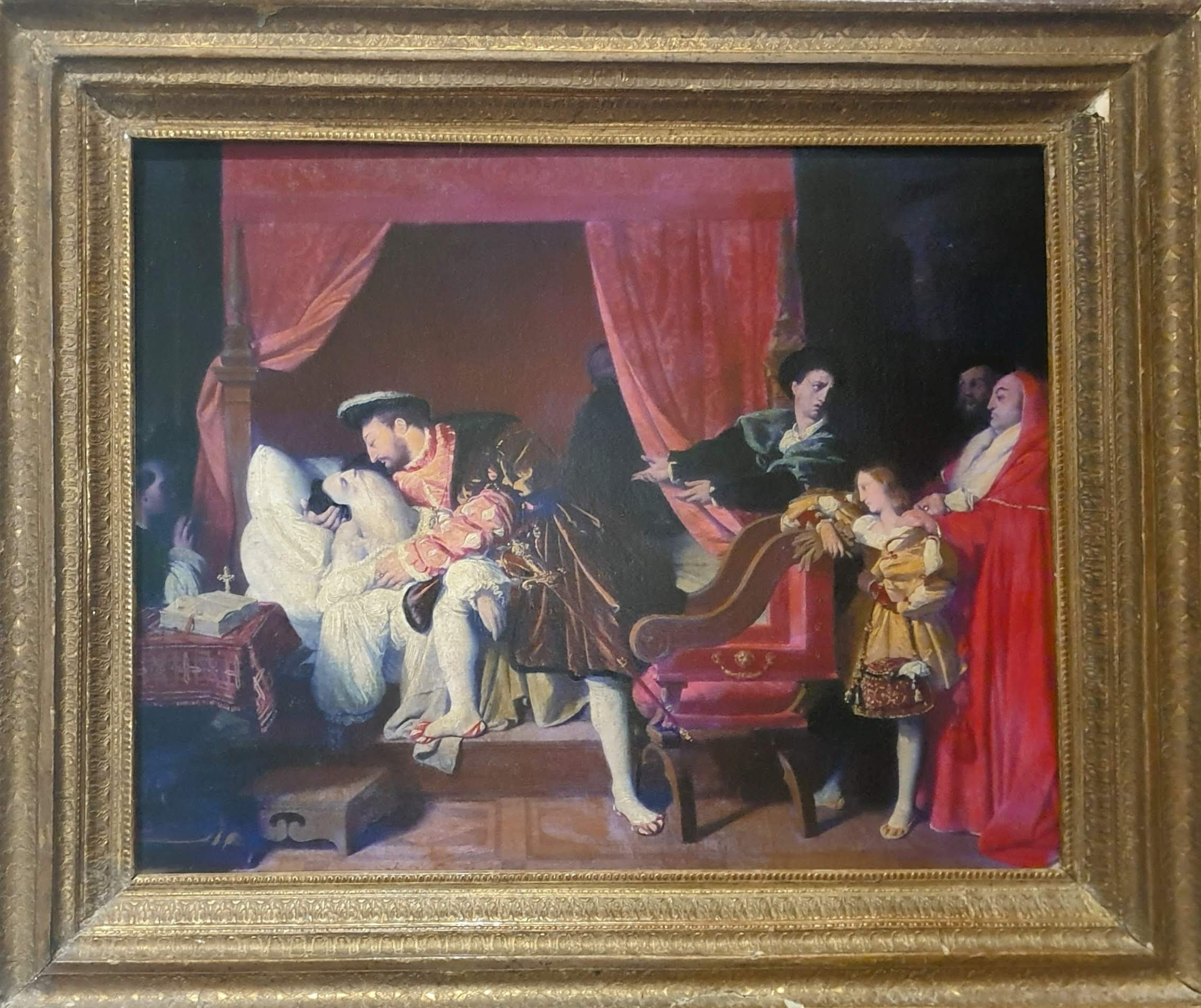
It’s also interesting to note that when Leonardo finally accepted the King’s invitation to move to France, he brought several of his paintings with him, including the Mona Lisa, which is why that painting resides in the Louvre in Paris rather than in any museum in Italy. The interior of the château is decorated to resemble the time Leonardo lived and died there, and includes replica paintings of the Mona Lisa and The Death of Leonardo da Vinci or Francis I Receives the Last Breaths of Leonardo da Vinci  which depicts the King of France embracing the genius to breathe in the last breath that Leonardo breathes out. It’s worth noting that nothing other than the house itself is likely from the time of Leonardo, and that this is a reproduction for historical and educational purposes, but it’s still interesting to go and see the way that historians think Leonardo was living in the last few years of his life.
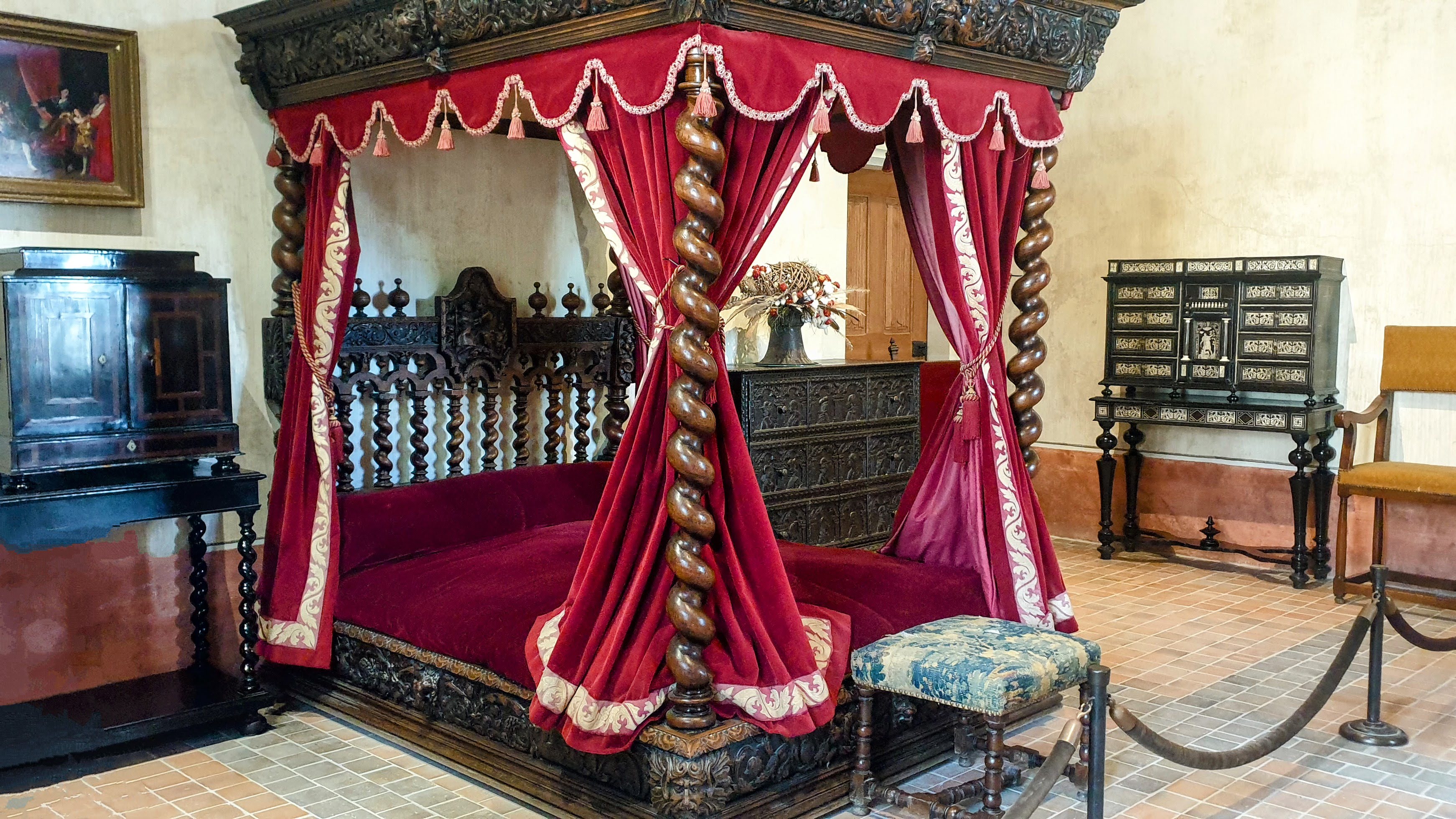
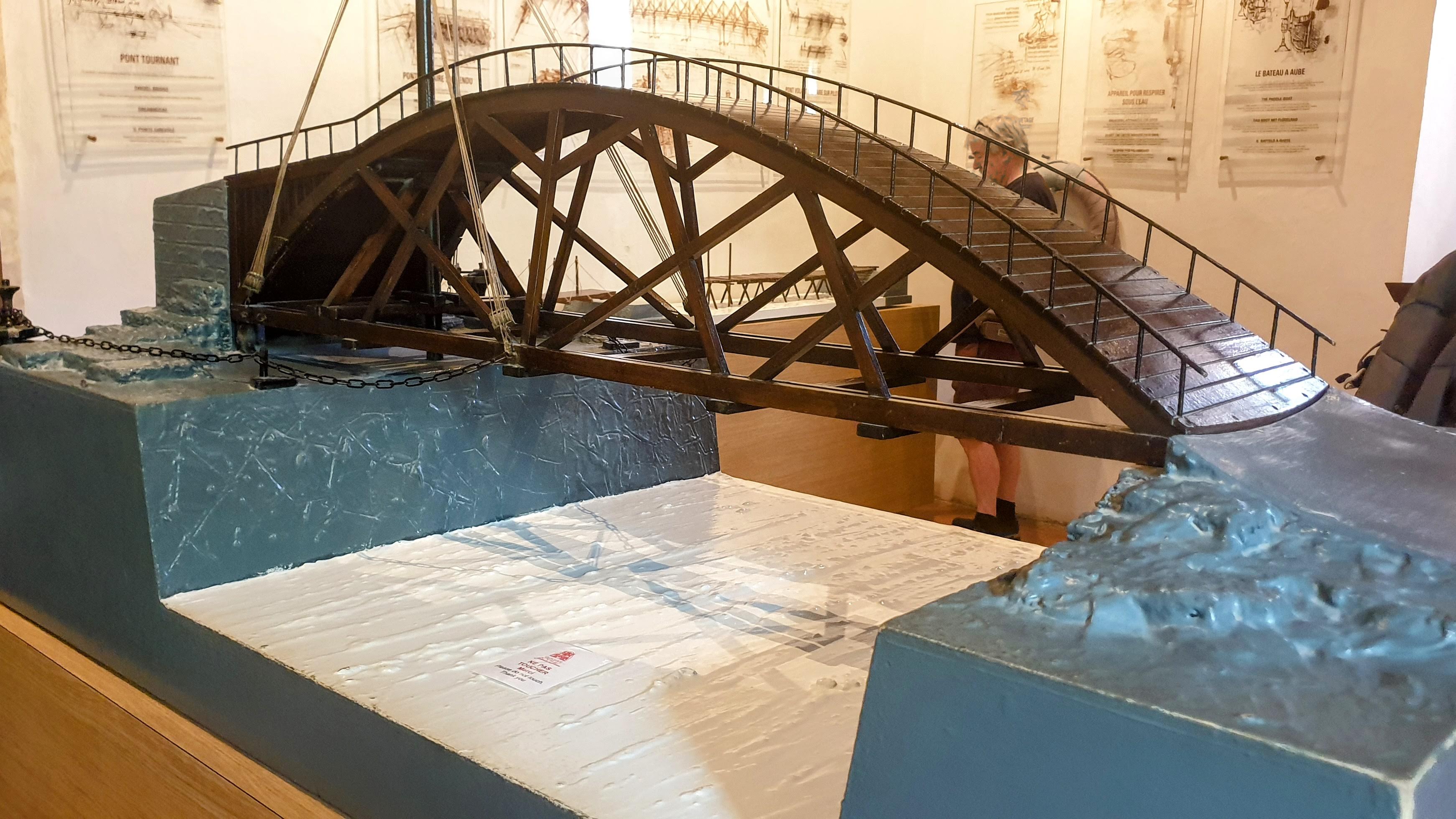
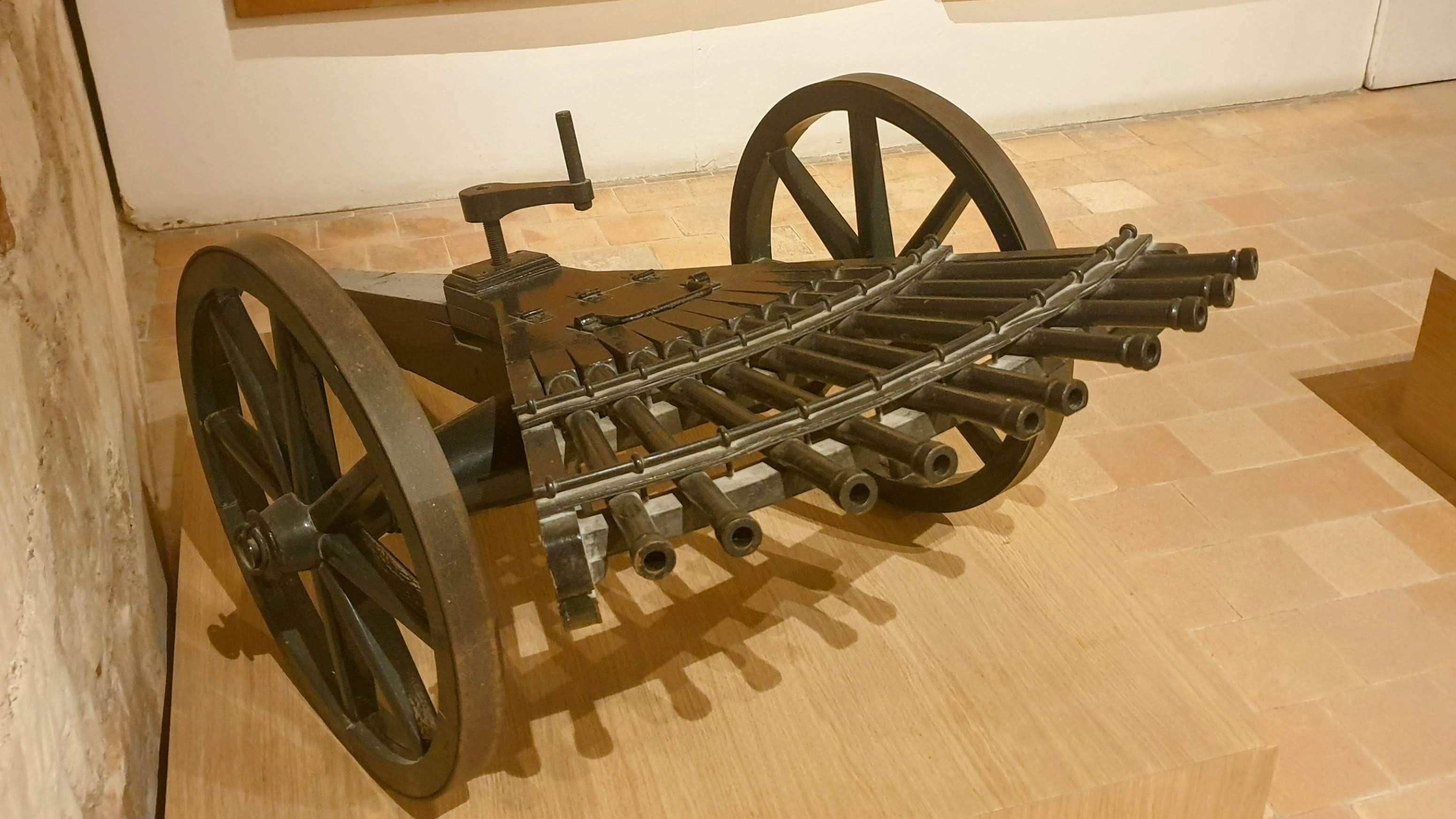
The basement of the château is a museum dedicated to the practical and military inventions of da Vinci with small models and detailed explanations of how each worked in theory if not in actual practice.
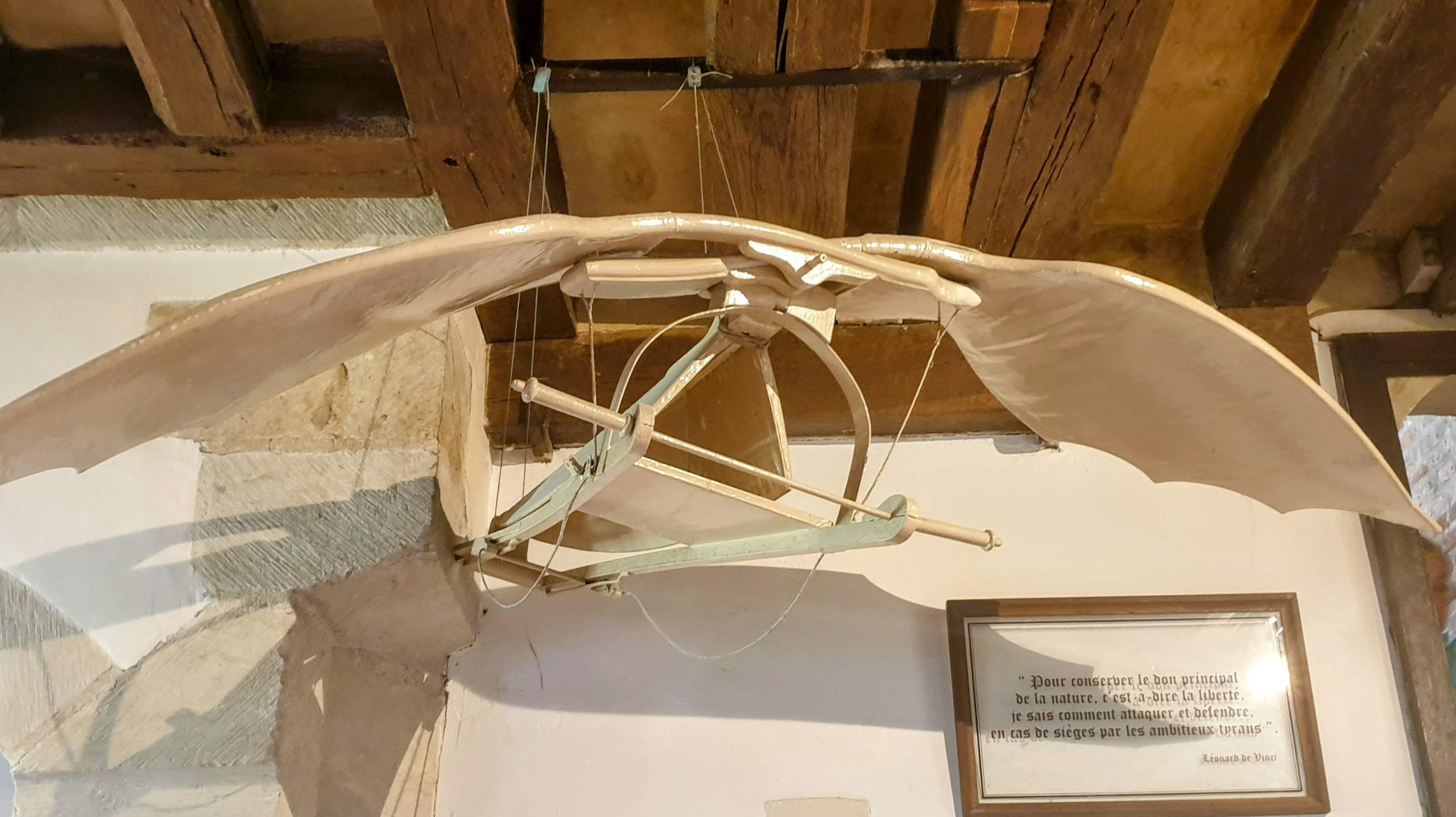
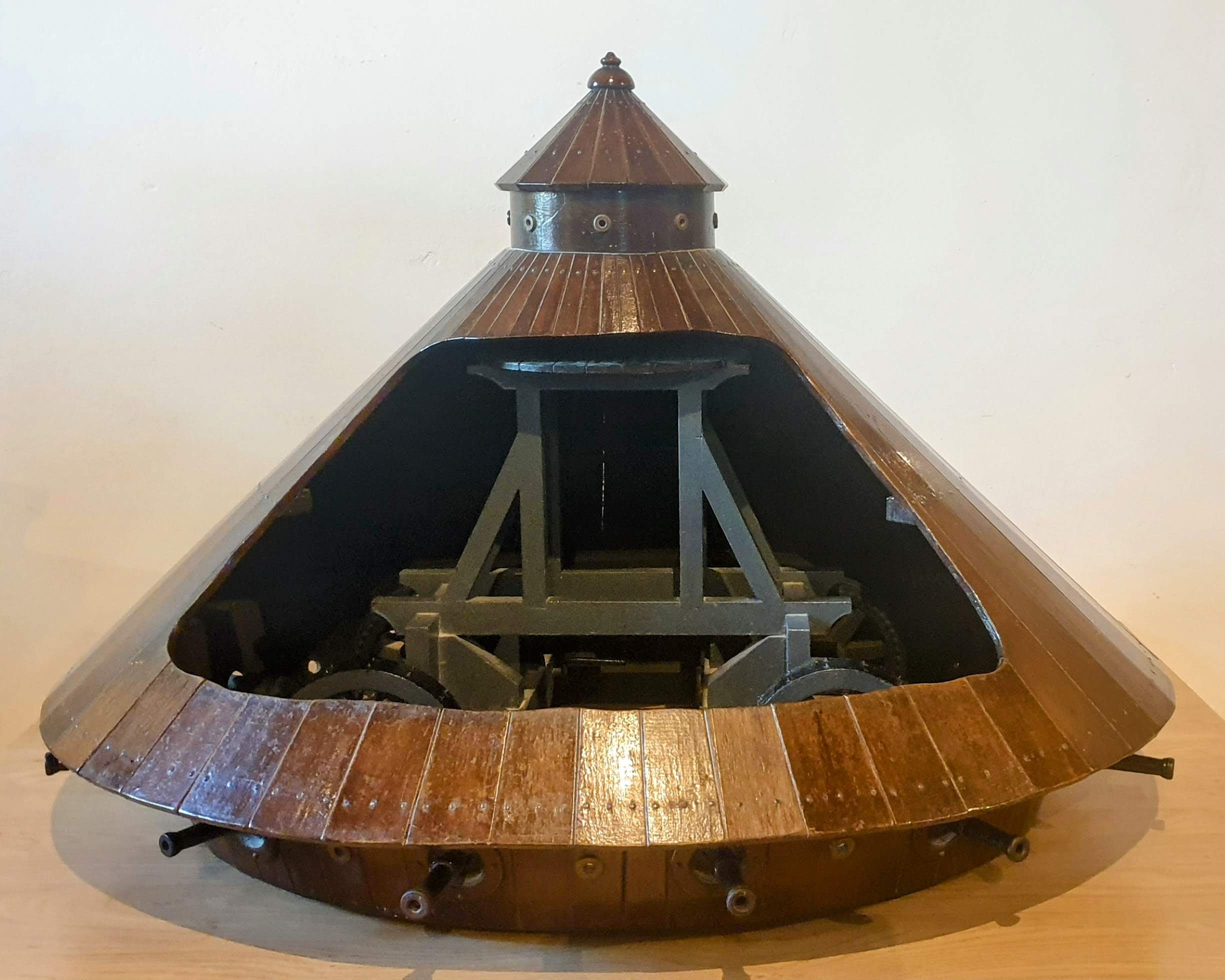
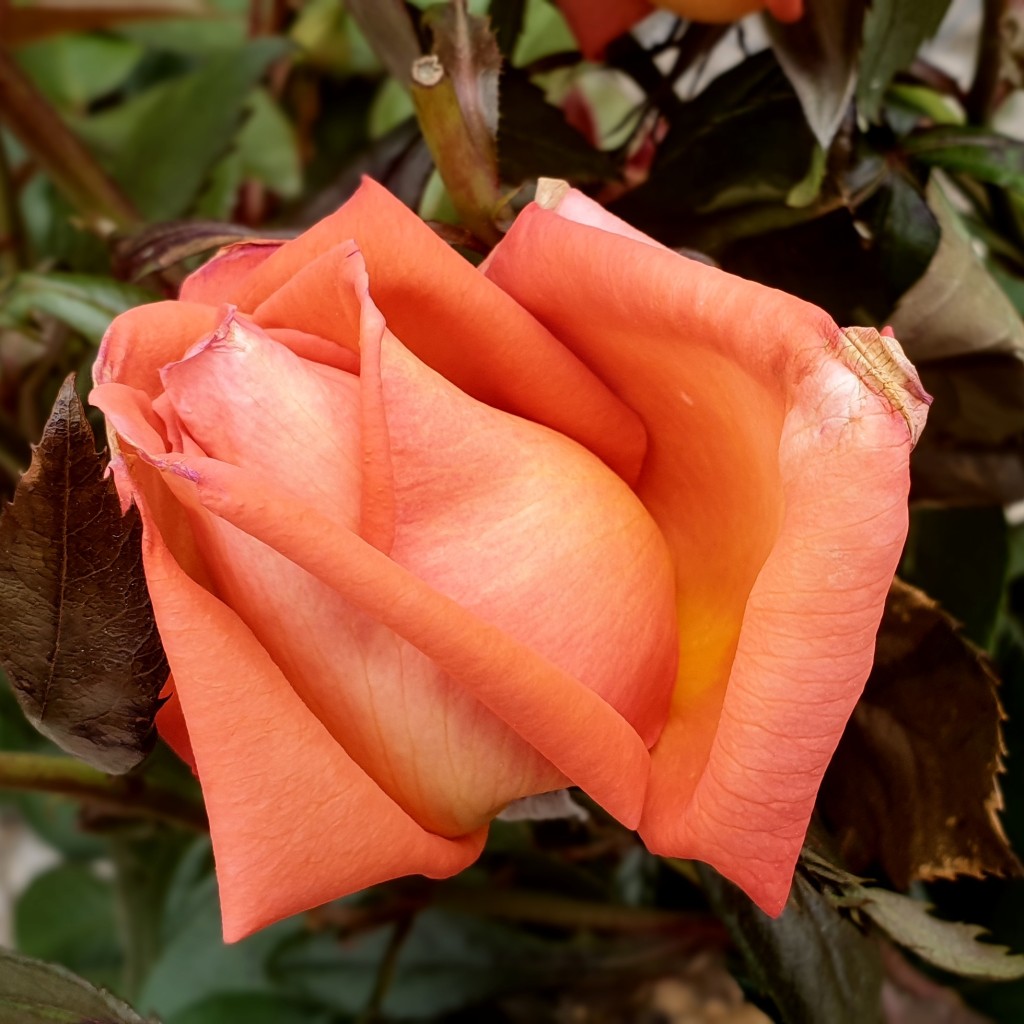
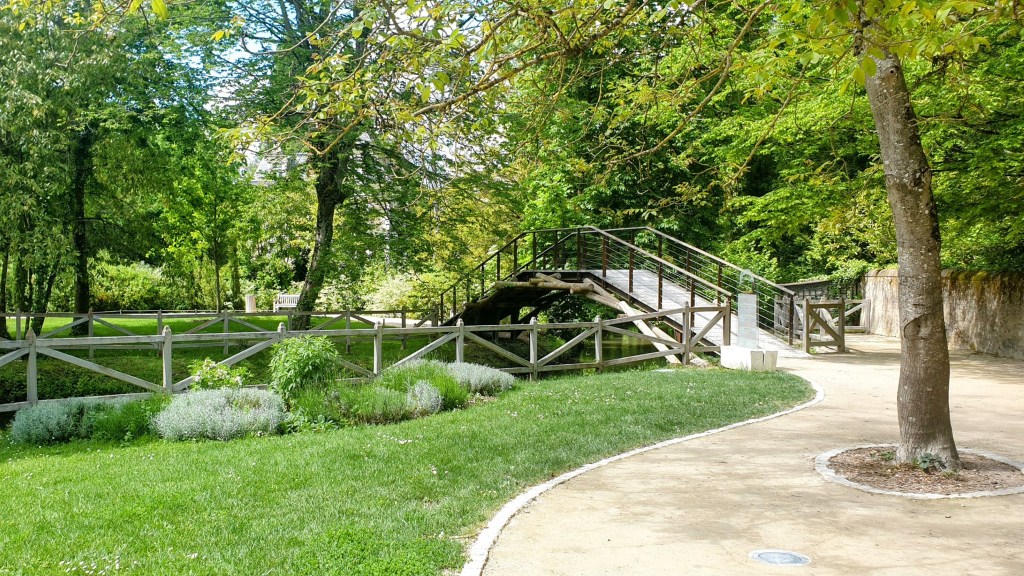
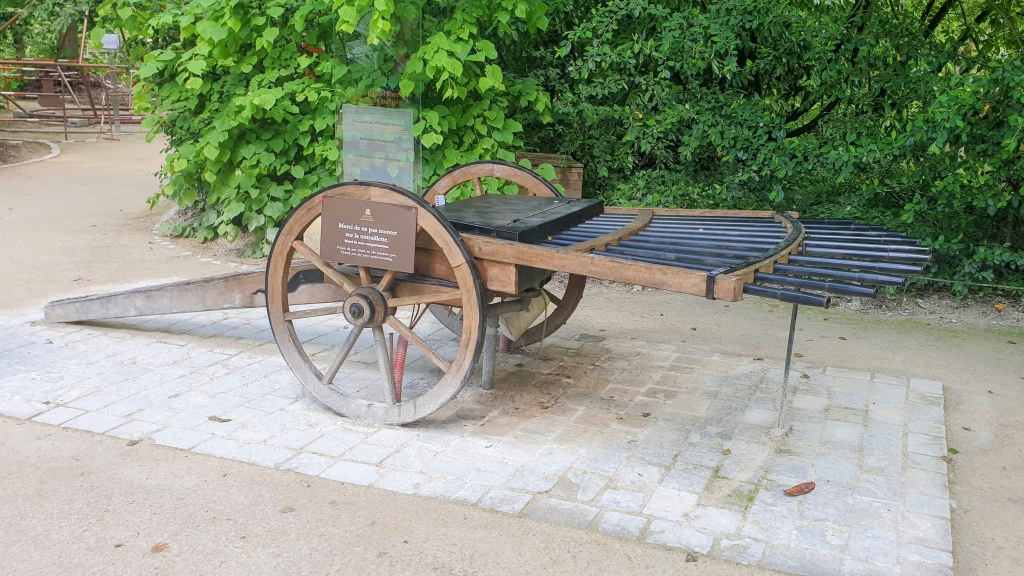
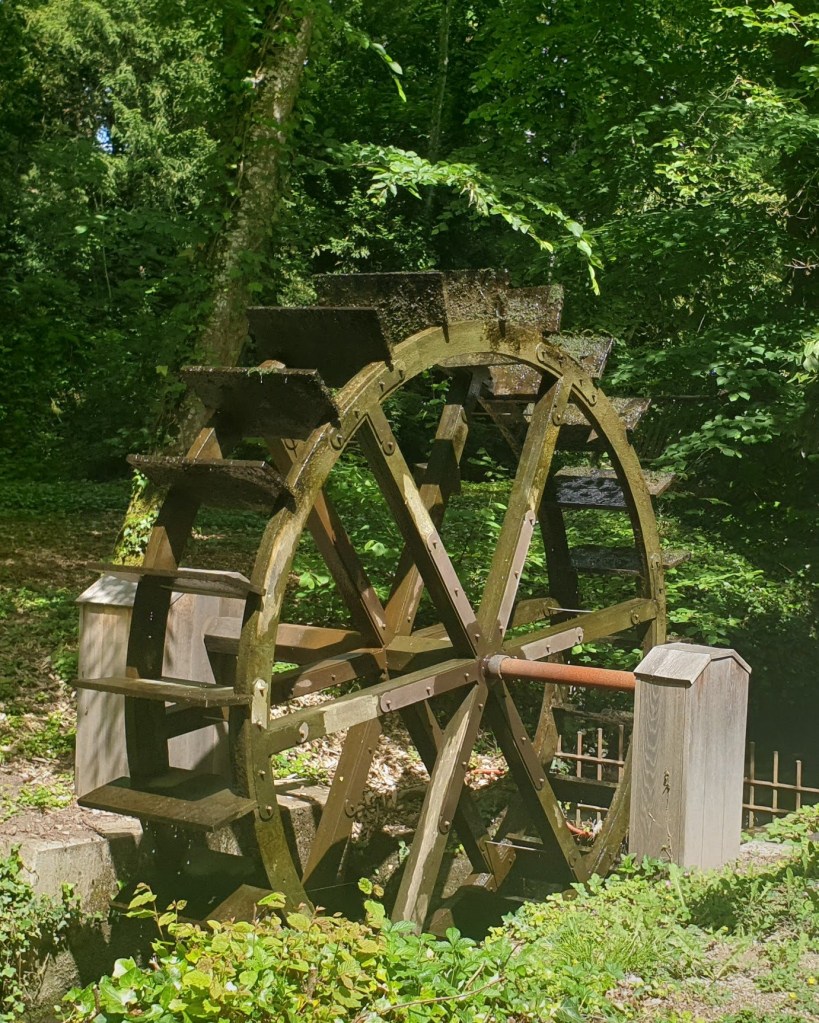
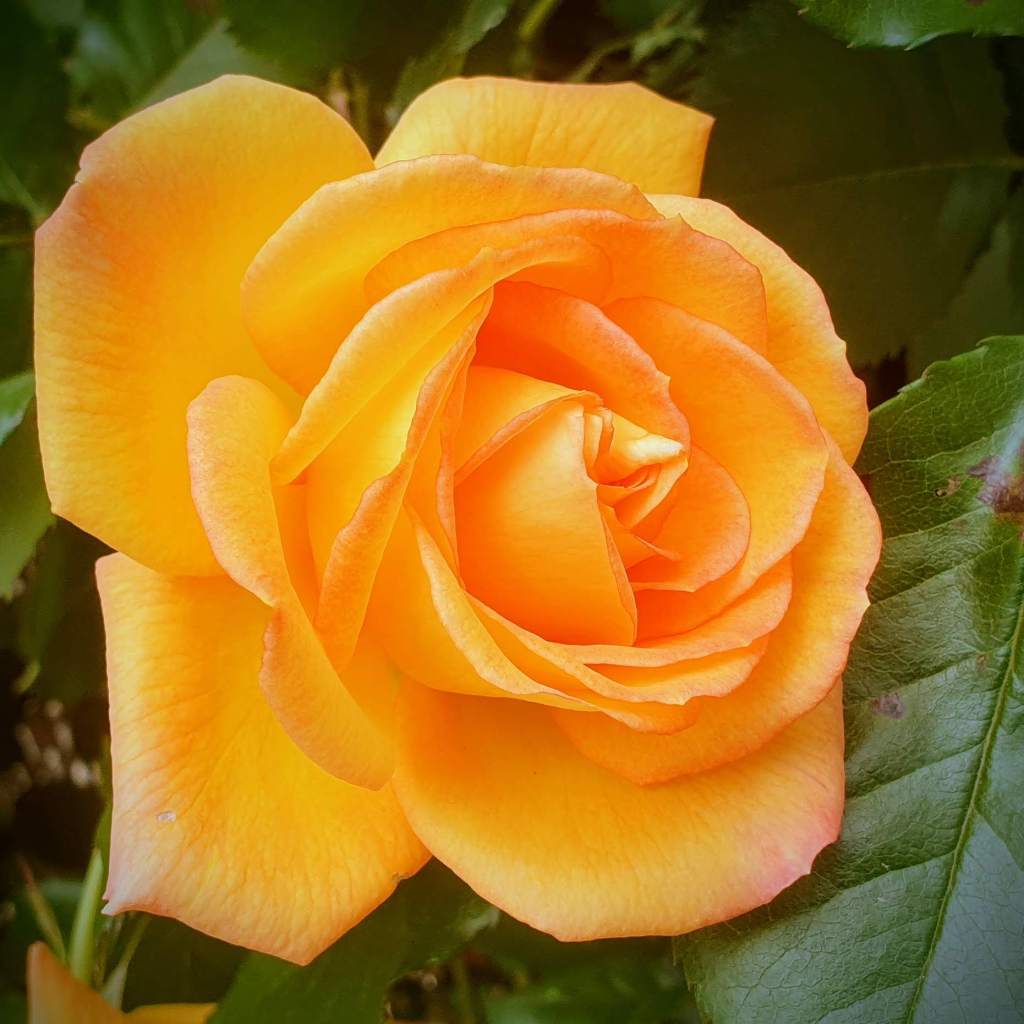
The grounds outside are beautifully designed to preserve a natural aesthetic with paths and waterworks connecting interactive models of several of da Vinci’s inventions, allowing visitors to see the natural world that inspired him, and to have a hands on experience with his engineering genius. Also, the last photo in the slide show is a breed of rose named “Mona Lisa” which I loved.

When I heard about the variety of château around the Loire Valley, this is the one I wanted to visit most, because I have personally been fascinated with da Vinci since I found out about him as a child. He was so clearly unique, intellectually and socially different from the culture and times that he was born into. As a person who often felt like I didn’t particularly belong, I enjoy seeing others like that in history. Although, over time, I came to understand that the combination of being born male and the patronage system that supported artists allowed people like Leonardo (if anyone can be said to be like Leonardo) to stay economically afloat and pursue their art and invention without the need to worry about where to live or what to eat.

In many ways, he and others like him are nearly mythological, and being able to stand in a room where they slept, or scribbled sketches or ate soup makes them more real, and it’s an experience I am glad to have had before leaving Tours.

The Sights of Tours

Although I only spent 5 weeks in the city of Tours, France, I feel like I managed to squeeze in quite a lot of sightseeing around my French classes and cheese eating. In an attempt to organize my adventures there, this is the 2nd of 4 posts about Tours and it features attractions which are close to the city center, such as museums, gardens and interesting tourist attractions.

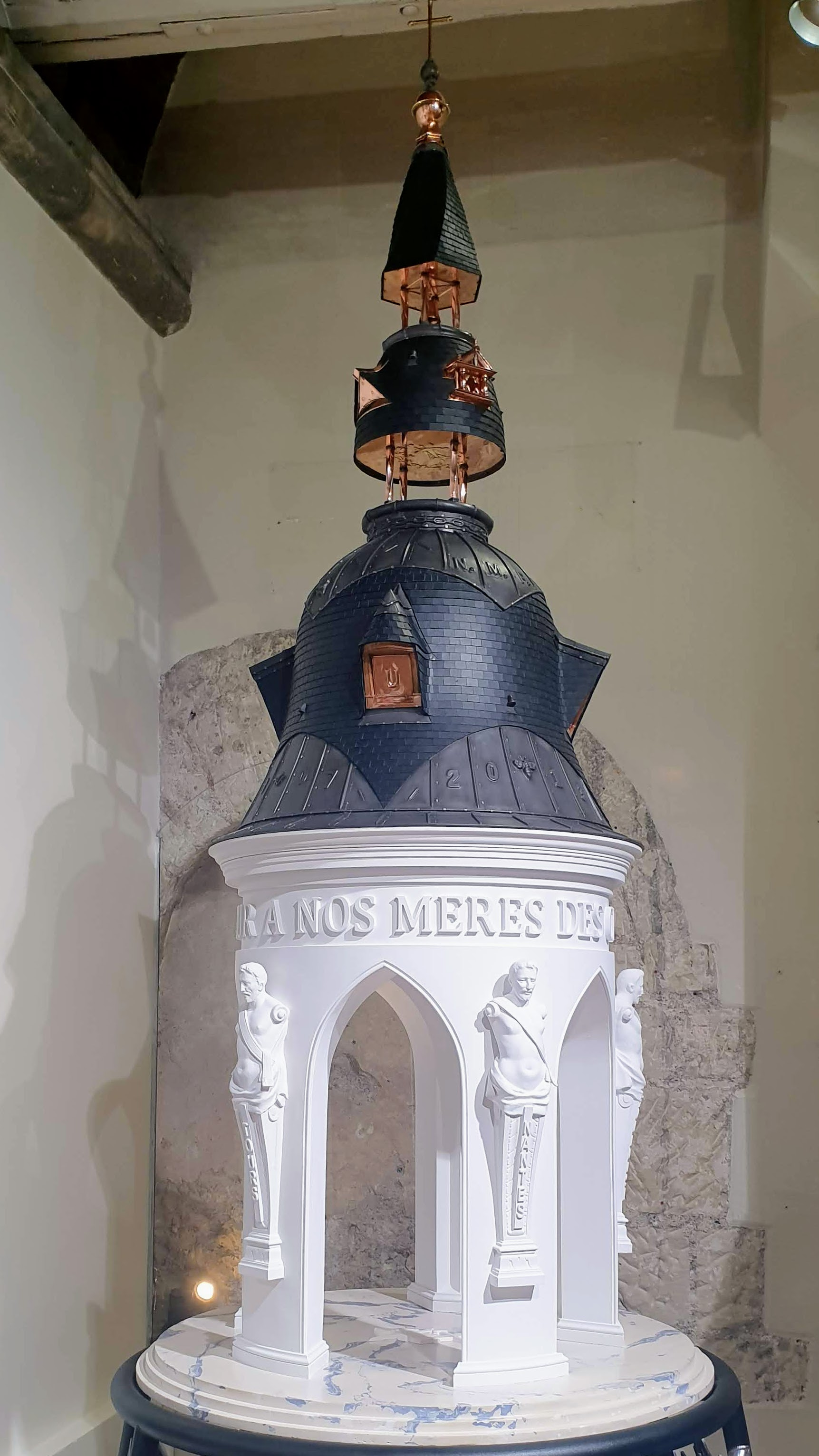
Musée Compagnonnage (The Companion Museum)

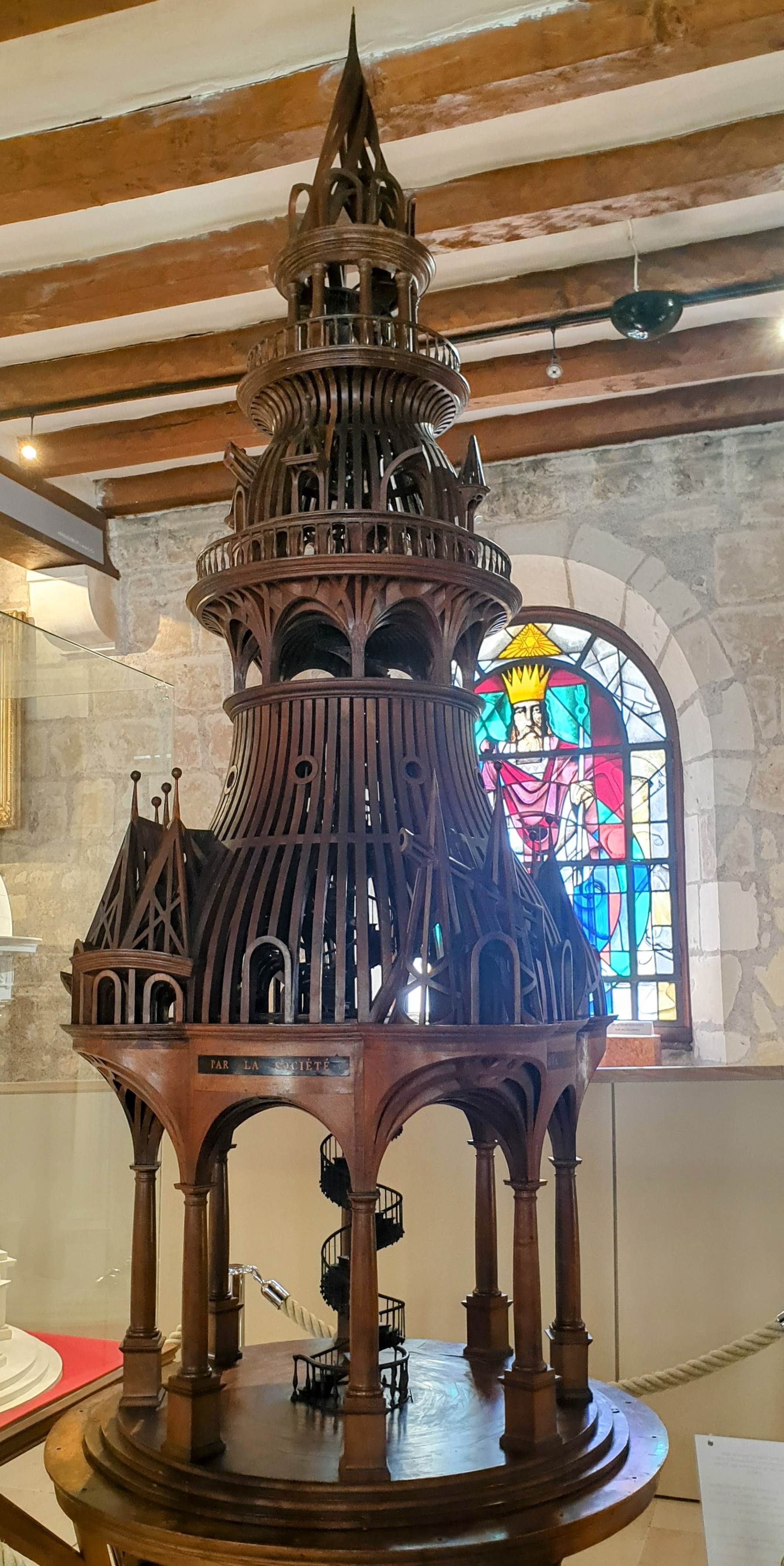
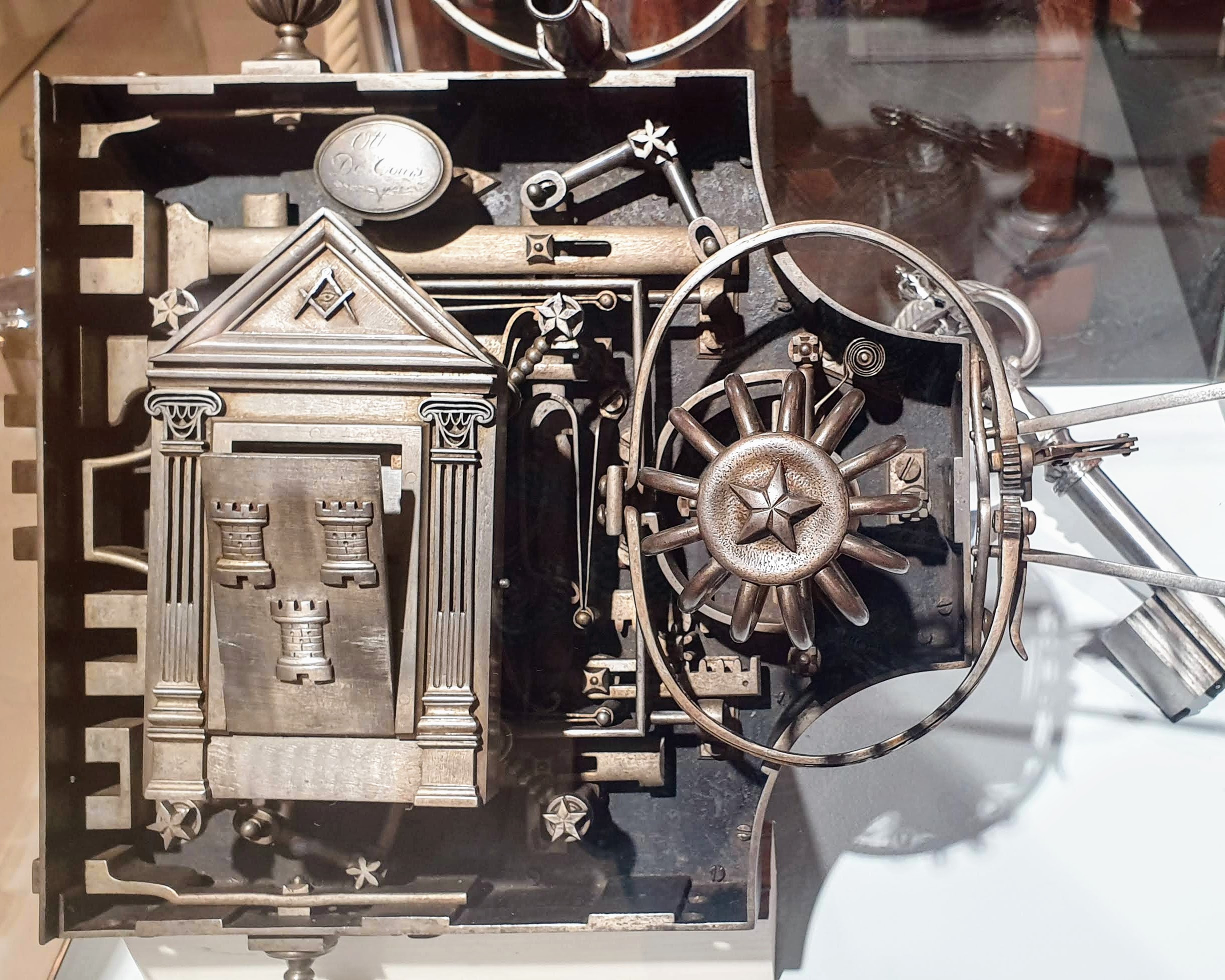
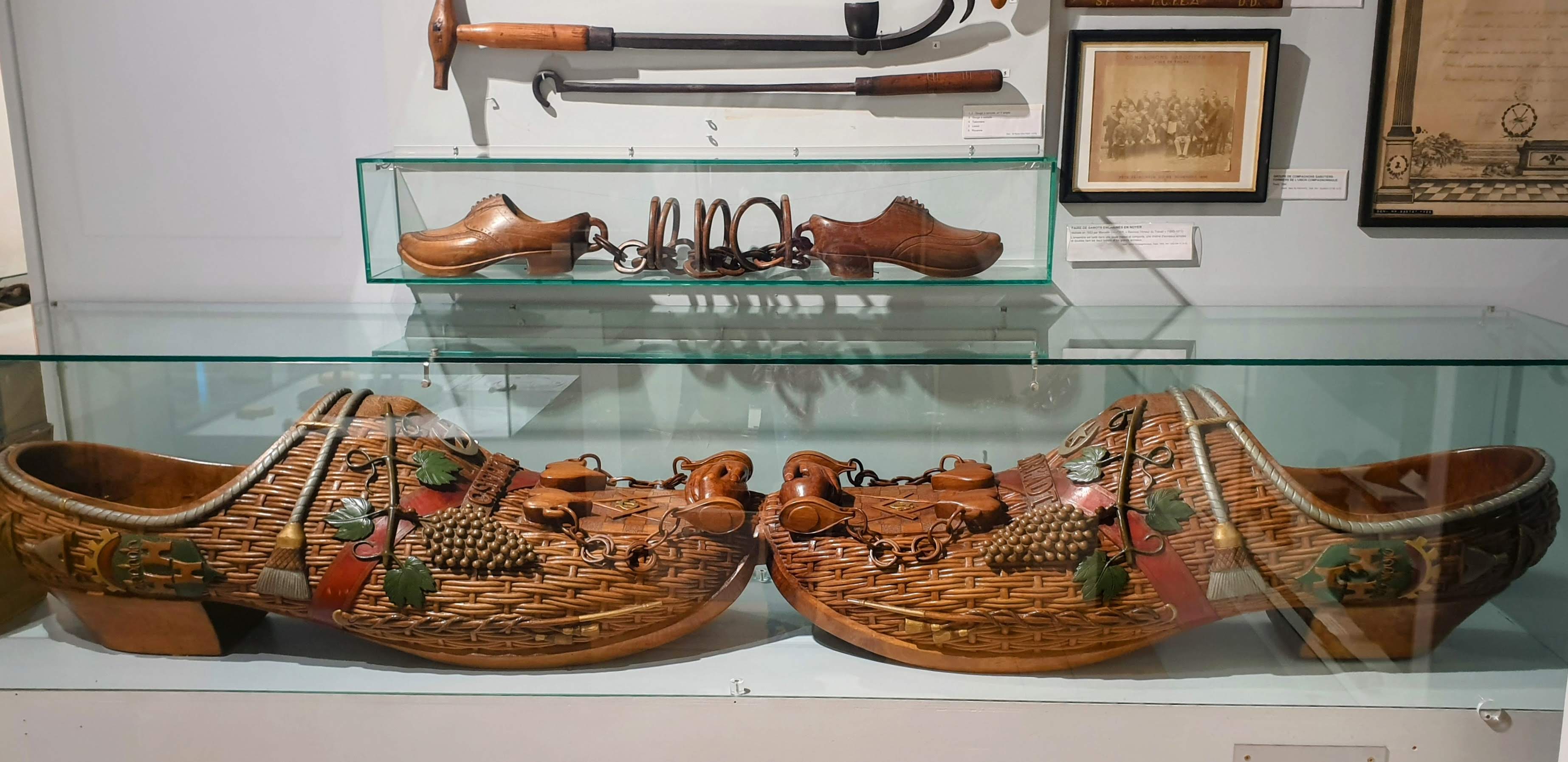
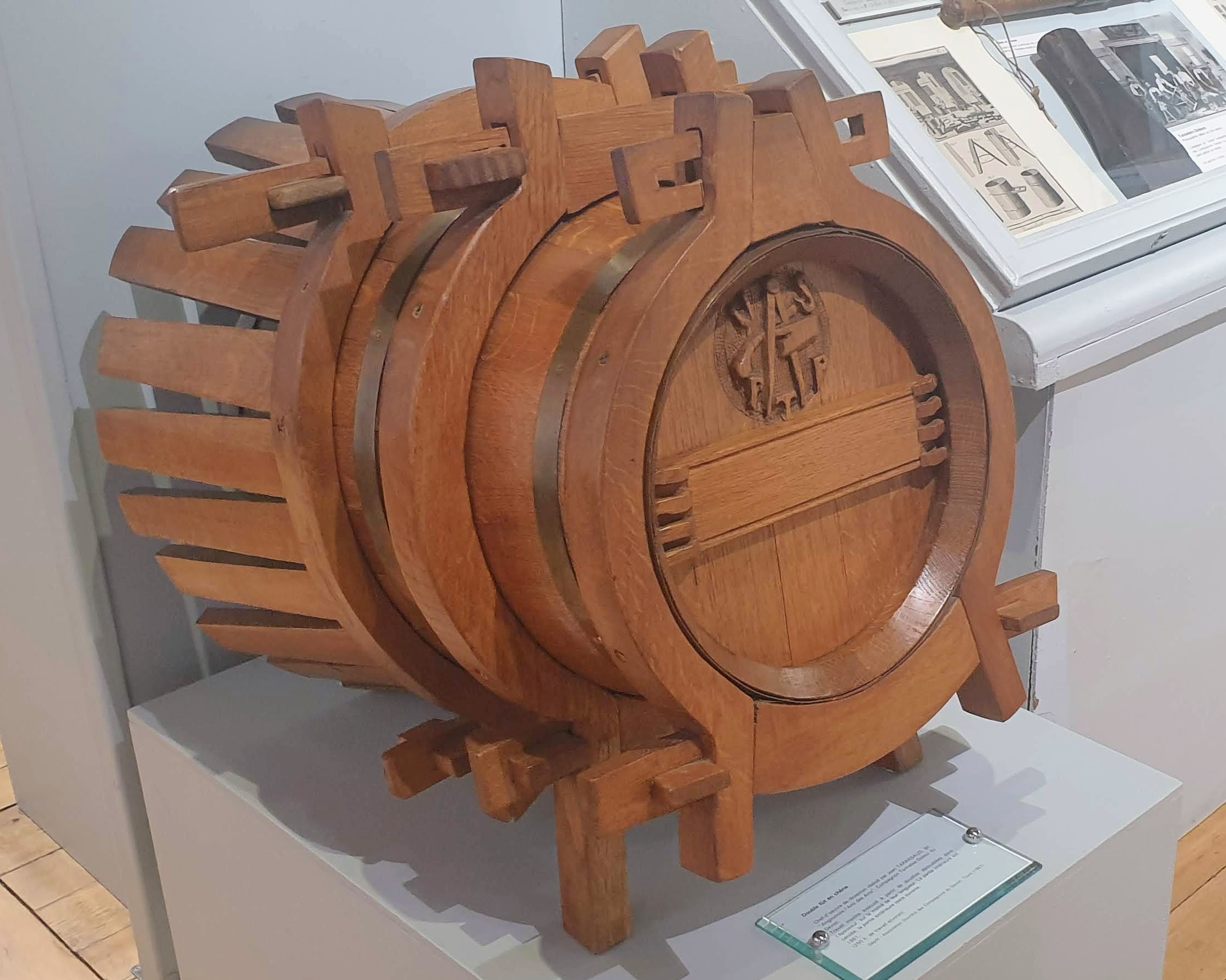
This was the first museum I visited in Tours because it was right next to my tram stop. I don’t know what I expected from a place called the Companion Museum, but this was not it. The Companionship (Compagnonnage) were any and all artisans and craftsmen who made things with their hands and then passed the knowledge of their crafts through apprenticeships. As you may imagine, that’s most of professions. It’s something between a secret society and a very strong union. In fact, given the amount of masonic imagery, I’m surprised to find that the museum denies any connection beyond the coincidence of the compass and square.

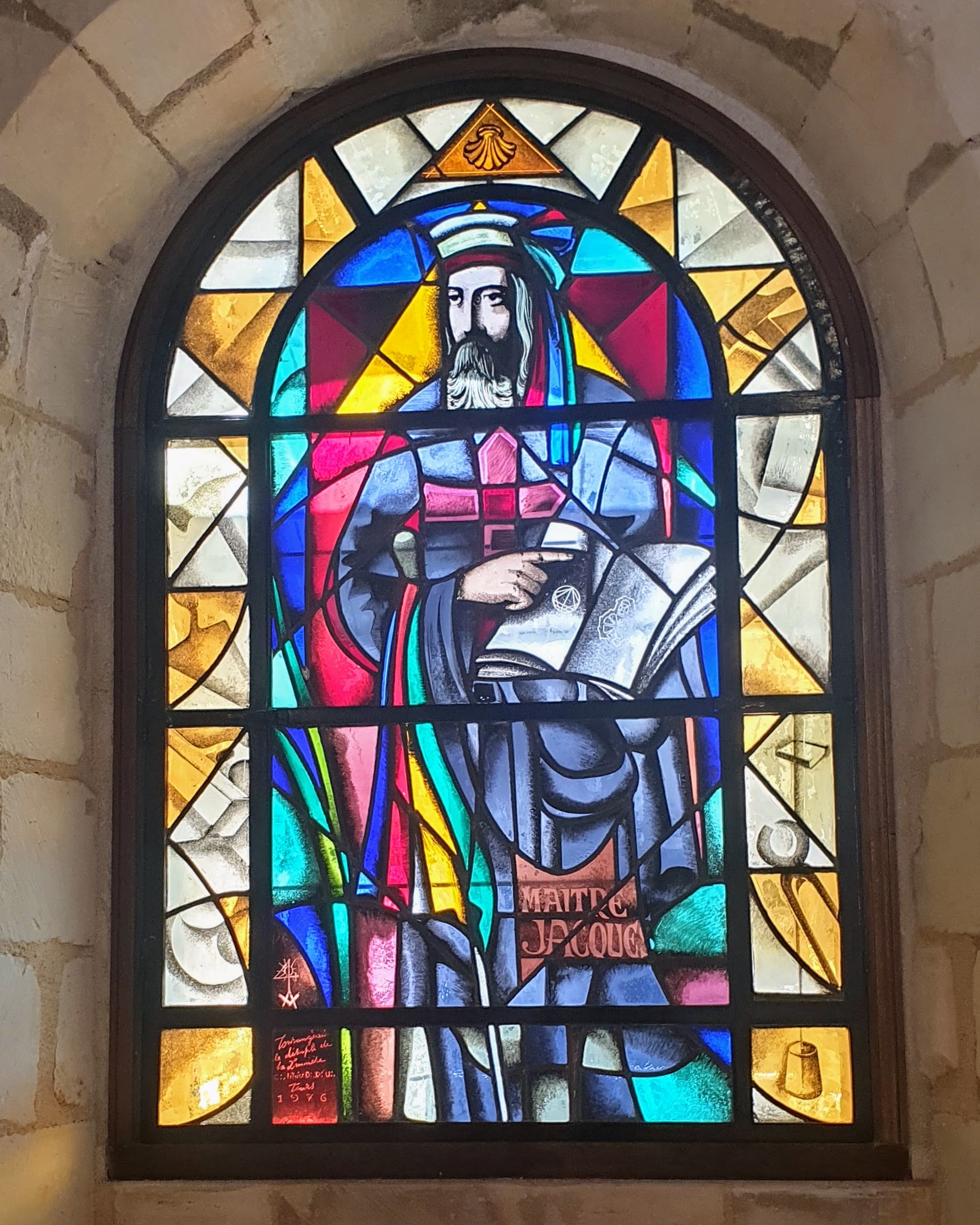
According to their own legends, the Compagnonnage dates back to the construction of the temple in Jerusalem, known as the “Temple of Solomon”, in the 10th century BC. The colossal project, under the direction of the architect Hiram, would have been led by Soubise and Jacques. Different legends also make these last two monastic and chivalrous characters. Salomon, Father Soubise and Maître Jacques are the 3 legendary founders of the Compagnonnage. However, there’s no archaeological evidence of the Compagnonnage until the 13th century. Incidentally, the Free Masons are not found until the 18th century so if they are linked, the French did it first.

The Compagnonnage includes any industry in which people work with their hands directly to produce things. I was going to try to list them, but the museum website takes a whole page to do so. It’s… a lot. Excluded careers were things like merchants, academics, doctors, architects and engineers (presumably the later because they design things rather than build them. Carpenters and stonemasons, people who implemented architectural and engineering designs, were absolutely included in the Compagnonnage.)

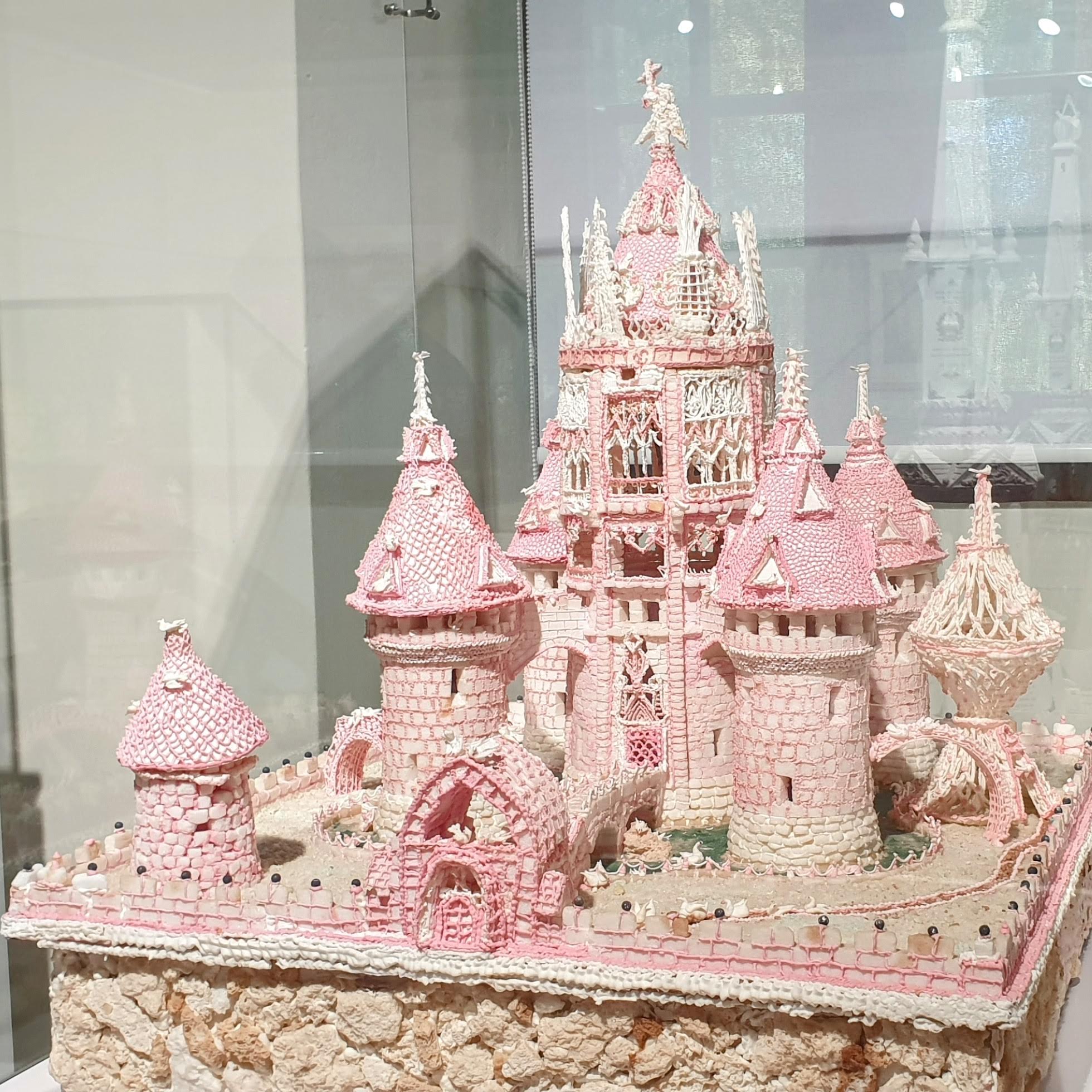
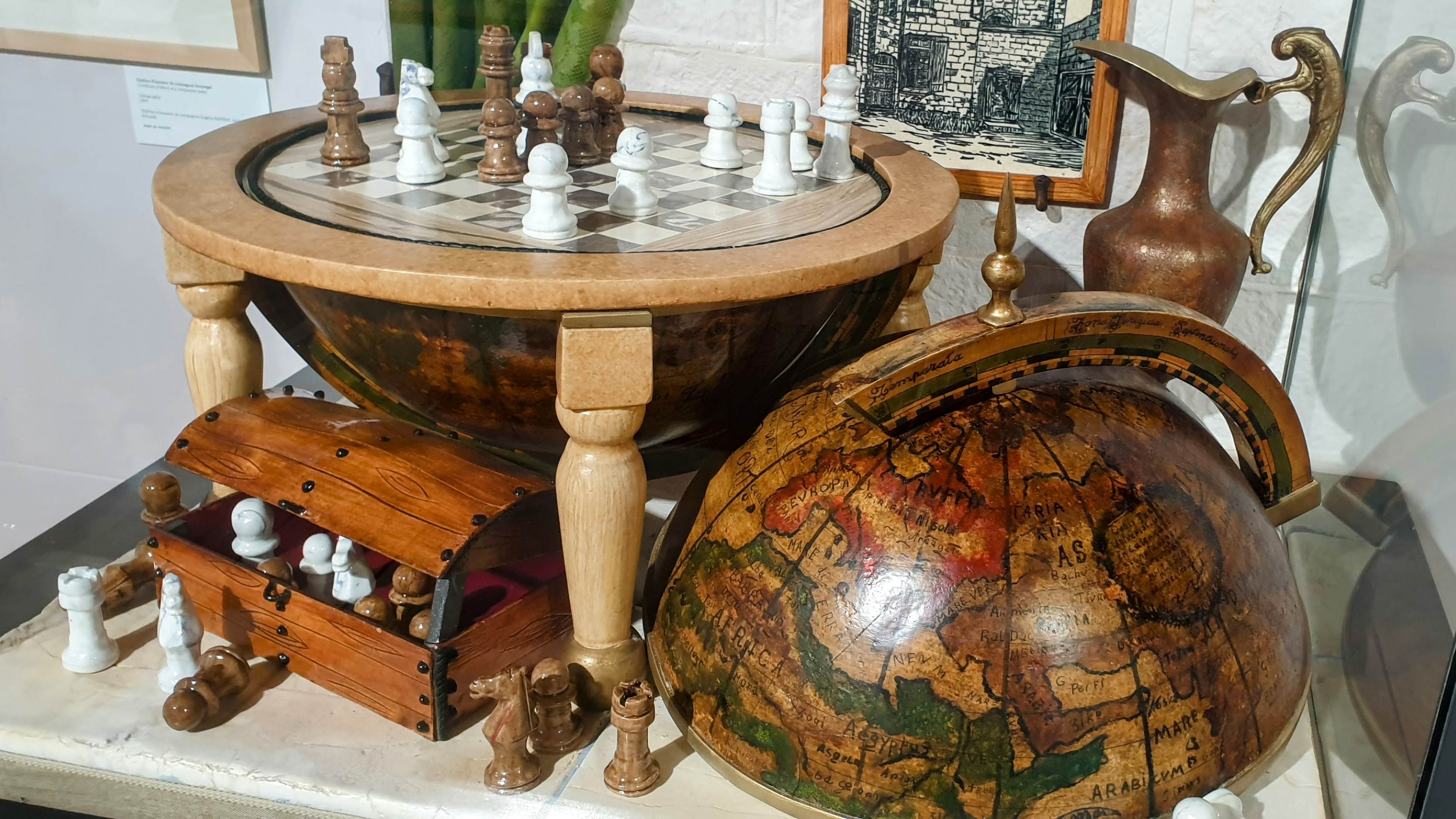
You can read more about the historical ups and downs on the museum website (thanks Google Chrome for auto-translate), but it went fairly strong until WW1 dealt it a near fatal blow. It didn’t really recover until after WW2, and it’s worth mentioning that although they claimed to welcome anyone wishing to improve in their profession, they didn’t agree to admit women until 2004(!) and didn’t actually accept one until 2006. Even though many of the trades historically included into the Compagnonnage were industries which had many women workers including sewing, weaving, laundry, and baking, it seems the society was about more than just teaching skills and protecting workers. Quelle surprise! (by the way, all of the art pieces below are sugar and pastry!)

Despite the overwhelming presence of misogyny throughout the history of Western civilization, I still enjoyed seeing the craftworks and tools of the various trades included in the Compagnonnes. I also believe that the centuries-long tradition of protecting the rights and wages of these workers has likely influenced the French cultural value of workers’ rights and collective bargaining. Did you know that striking is protected under their constitution? That not only can they not lose their jobs for striking, their employers must continue to pay them during the strike? That’s a big accomplishment for the same culture that produced Versailles.

The Hôtel Goüin

This is what happens when you don’t plan in advance and just wing it. You get weird stuff. This hotel is on my walk from the tram stop to my school and I got curious about it, and noticed it’s opening hours were only on Wednesdays and Saturdays. I looked at it very very briefly online and saw that inside was an art gallery with rotating exhibitions. I thought, well I like art galleries, and it’s free, so why not? 

First, let me say, I do think it’s worth it to poke your nose into any free museum in your vicinity. Heck, even any museum under 10$ is likely to be worth a stop to me. I have gone into unexpected museums before, things I ran across that were adjacent to another stop on my journey, and it’s roulette. Also, since I had totally failed in the planning phase of my stay in Tours, I was eventually bound to suffer the slings of ‘wing it”, and only not mind too much because a) it’s 5 weeks, and b) my goal in Tours was not sightseeing – it was French Living.

If you or someone you know is headed to Tours and you happen to be in Old Tours on a Wednesday or Saturday, sure, drop in. However, there’s no need to put it on your bucket list. This summer, the Olympics are being held in Paris, so all of France is in Olympic fever. The Hôtel Goüin being no exception, they decided to offer an exhibition on the Paralympics. In large part, the exhibition was mostly very beautiful and inspiring photographs of paralympic athletes, but the upstairs (no elevator, btw, way to accommodate the athletes being celebrated!) contained not only documentaries, but interactive displays where visitors could “try on” a disability and attempt a sport. … I don’t even know what to write about that, other than, yes, I’m sure that’s what they were for because a museum employee told me about it and smilingly encouraged me to try.

If you are not cringing with me, or are wondering why I am, please check out some videos on YouTube by following this link.

The Musée des Beaux Arts

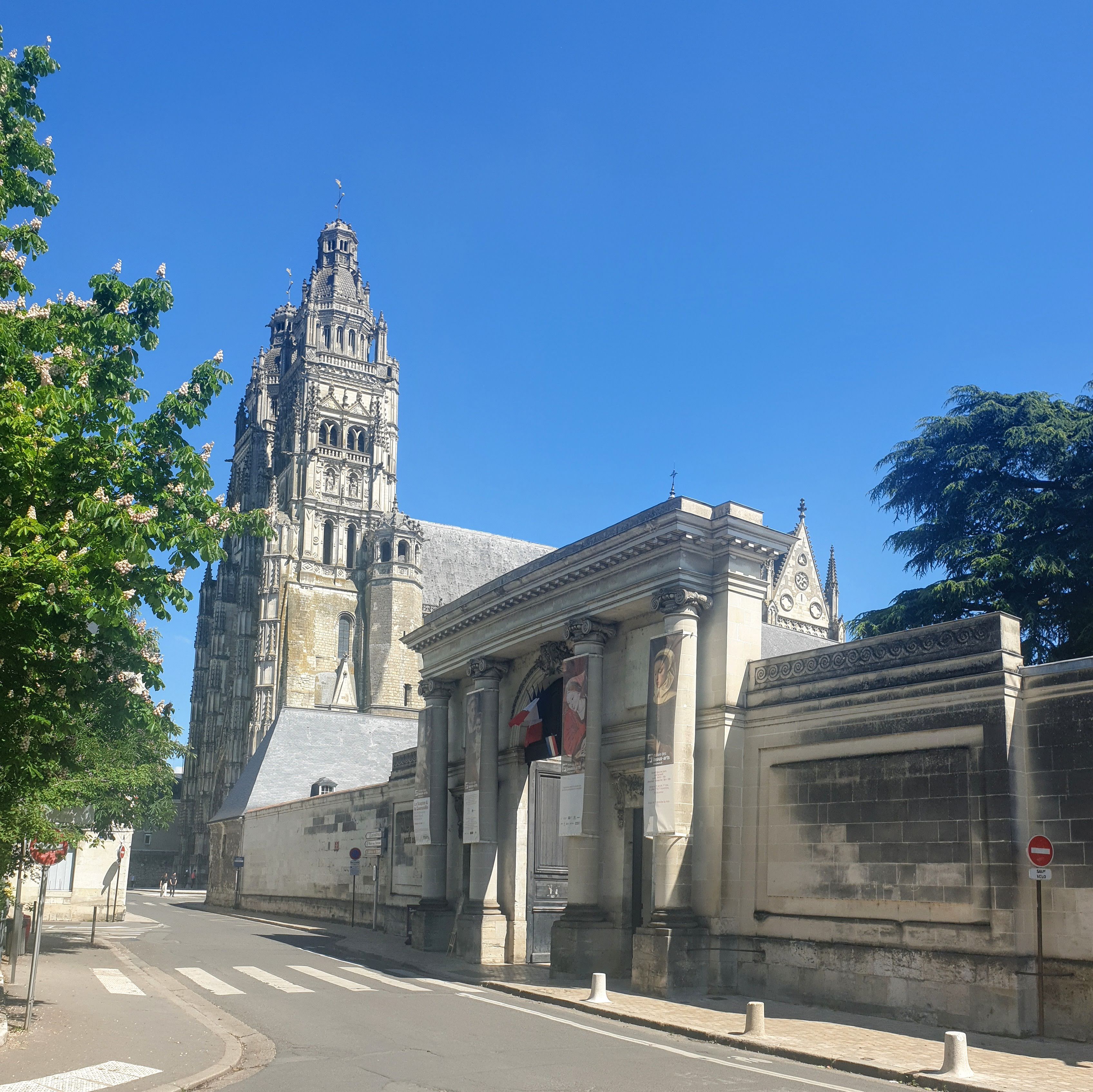
The third and easily most impressive museum I visited was the Tours Museum of Fine Arts. You can go to France and not visit an art museum, but why would you? I spent about 2.5 hours inside the museum of fine arts. I only took photos of things that struck me in particular, but it was room after room of beautiful stuff. I love looking at oil paintings up close. There’s some things that no photograph can ever capture, the quality of light, the ability for a part of a painting to seem like it’s glowing, the way the brush strokes move the eye, the size (both the enormous paintings and the tiny details). Seriously, even gallery-pro photos rarely do them justice, but if you want to see the museum’s own photographic collection, click here

Nonetheless, I cannot paint a picture of a gallery with only words, so I hope you enjoy the pictures I took and that maybe it can inspire you to visit an art gallery in or near your own town. Galleries often have wide collections, and even trade around highly desirable artists so that everyone can get a chance. The Tours museum is not anything so grand as is found in Paris, Lyon, London, or New York, but it still had a Rubens, a Rodin, a Rembrandt, and a Monet alongside many lesser known but still very talented artists from the 14th to 21st centuries.

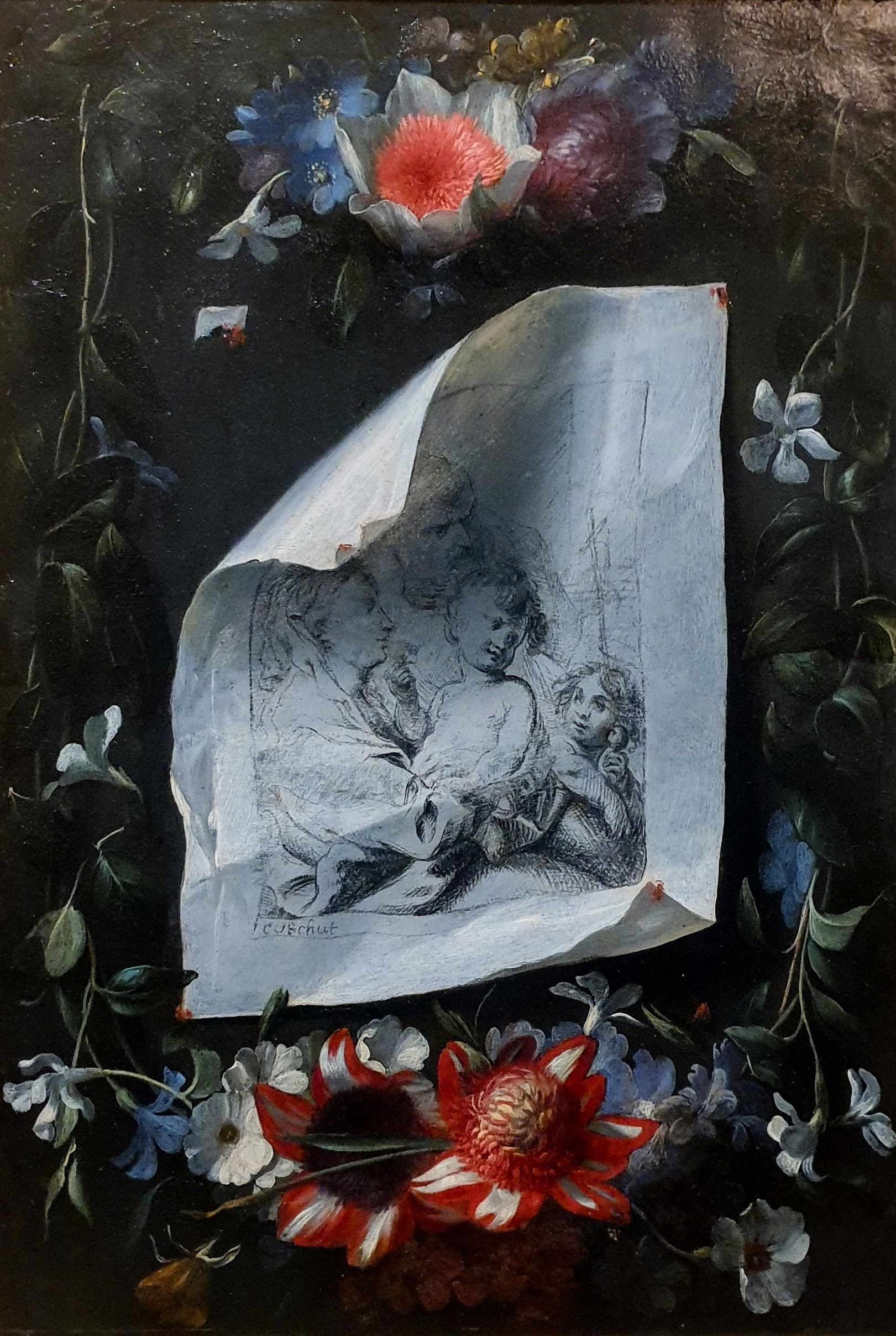
Garland of flowers and trompe l’oeil, Jan-Philips van THIELEN, mid 1600s
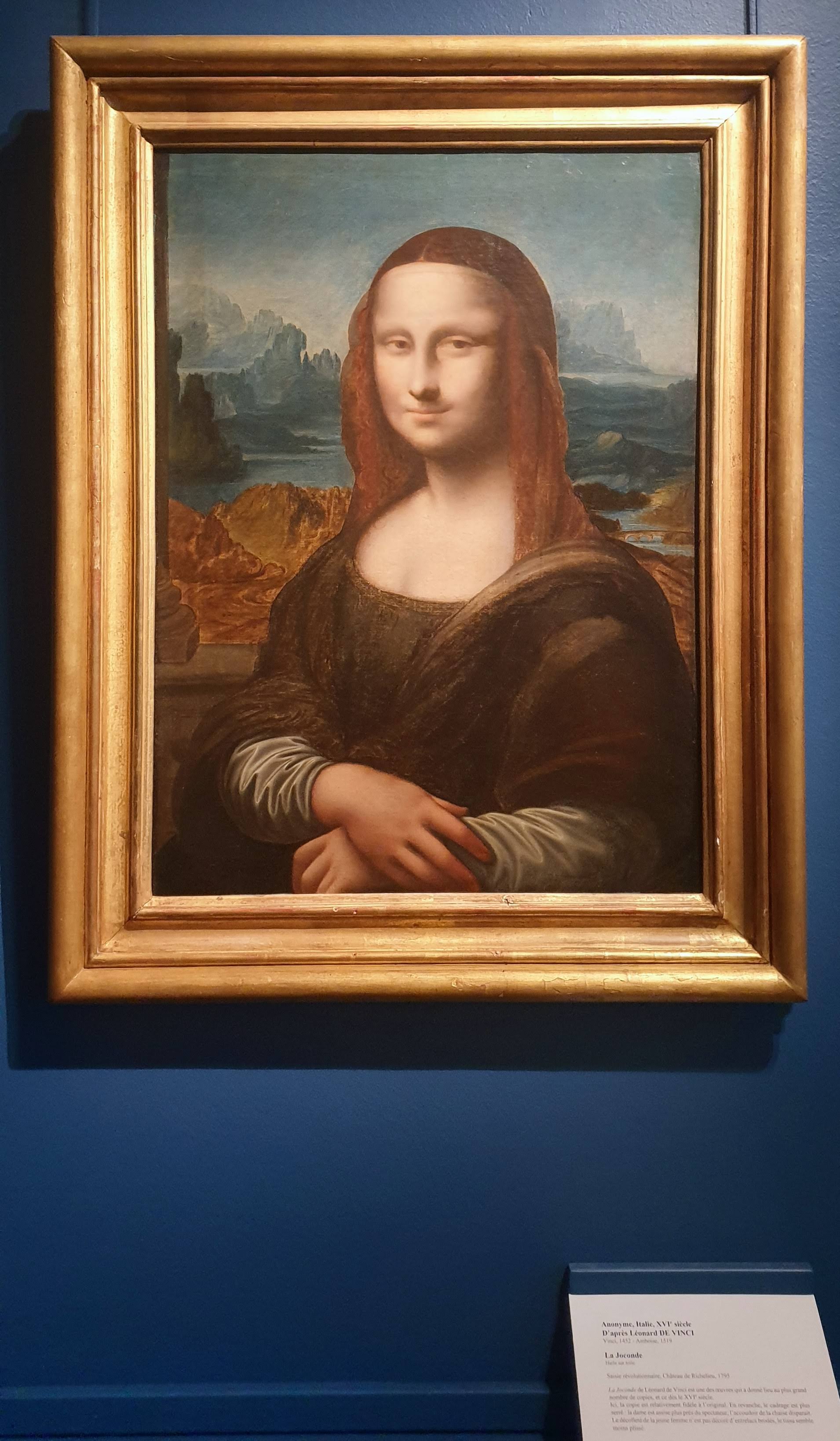
Anonymous copy of the Mona Lisa painted mid 1500s
Mary Magdalene, Matthieu FREDEAU 1642
The Virgin, the Child Jesus and Saint John the Baptist, Eustache LE SUEUR, early 1600s
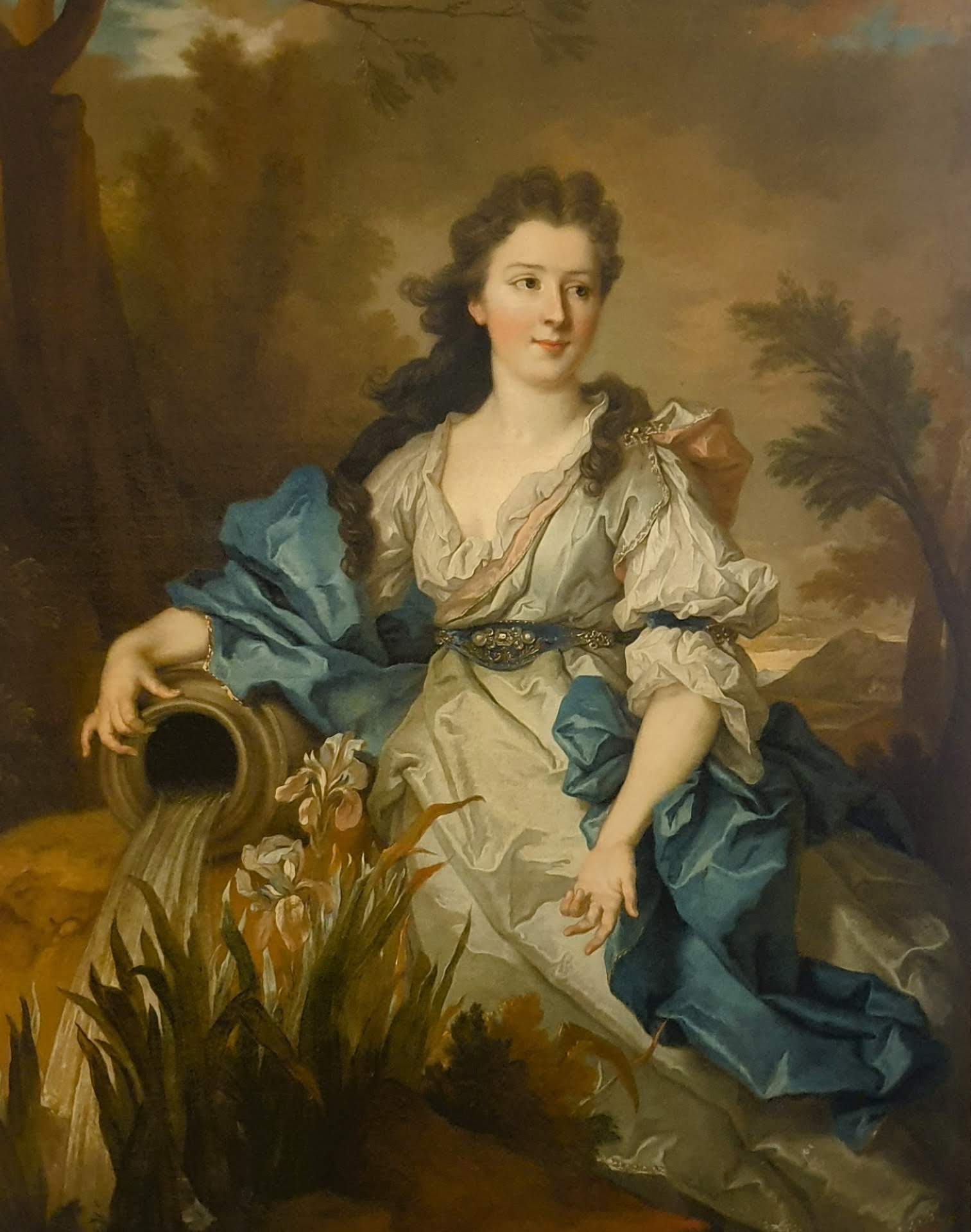
Portrait of a woman in spring, Workshop of Nicolas de LARGILLIERRE, early 1700s
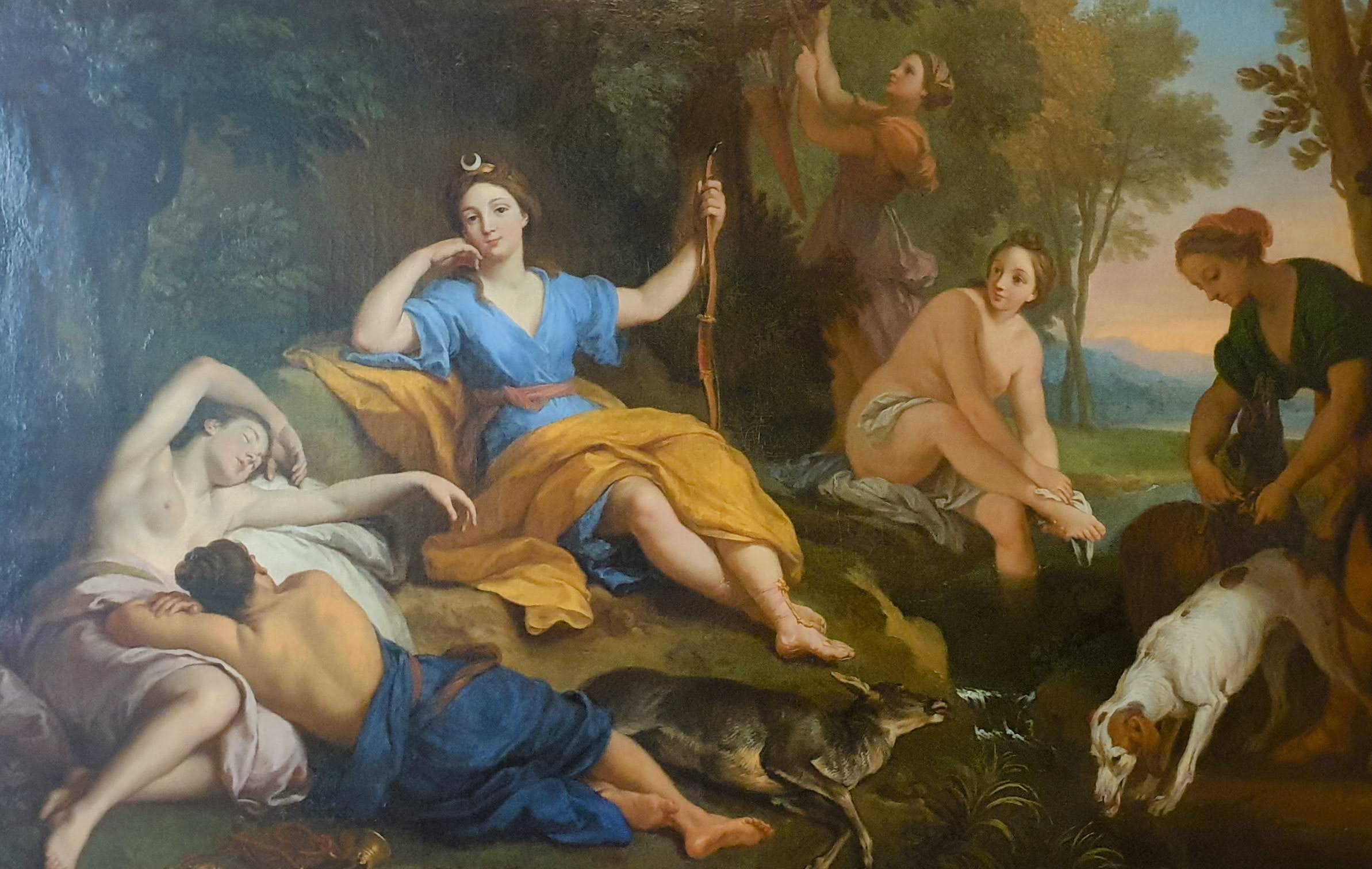
Diana and her companions resting after hunting, Louis of BOULOGNE 1707
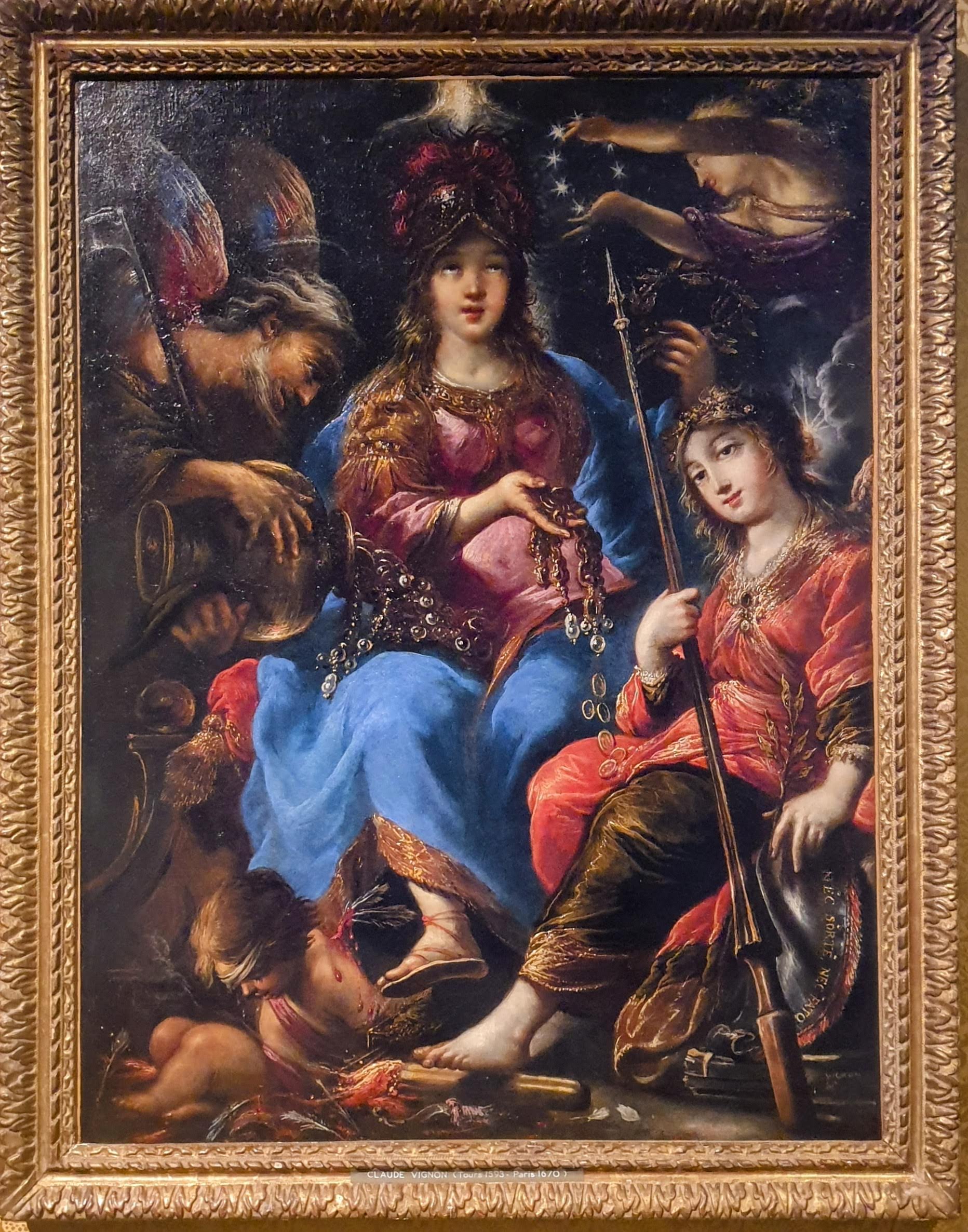
Allegory of the Times, Wealth, Power and Love; Claude VIGNON, mid 1600s
Nude study, Léon BELLY, 1857
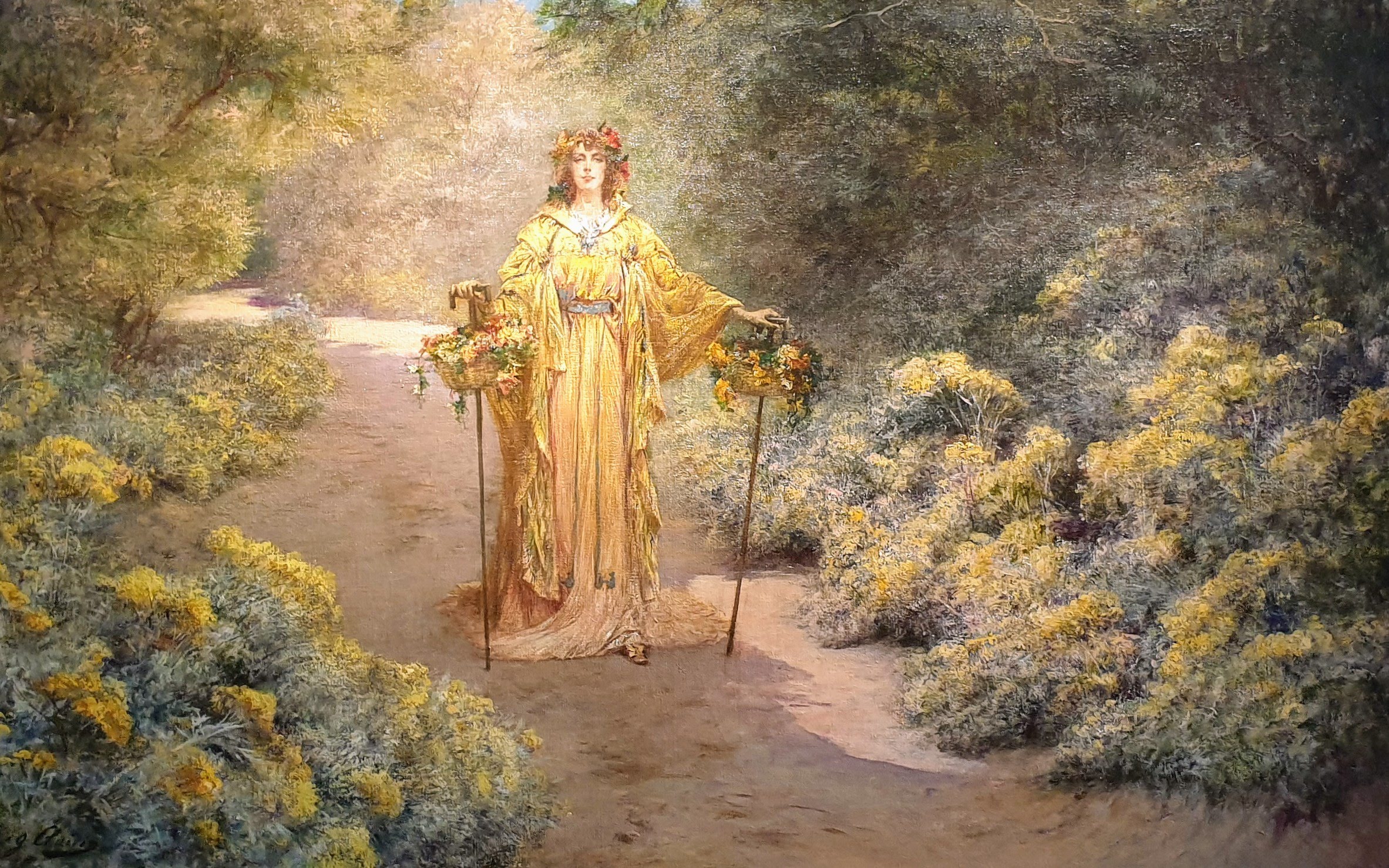
Sarah Bernhardt in her Belle-Ilea garden, Georges CLAIRIN, late 1800s
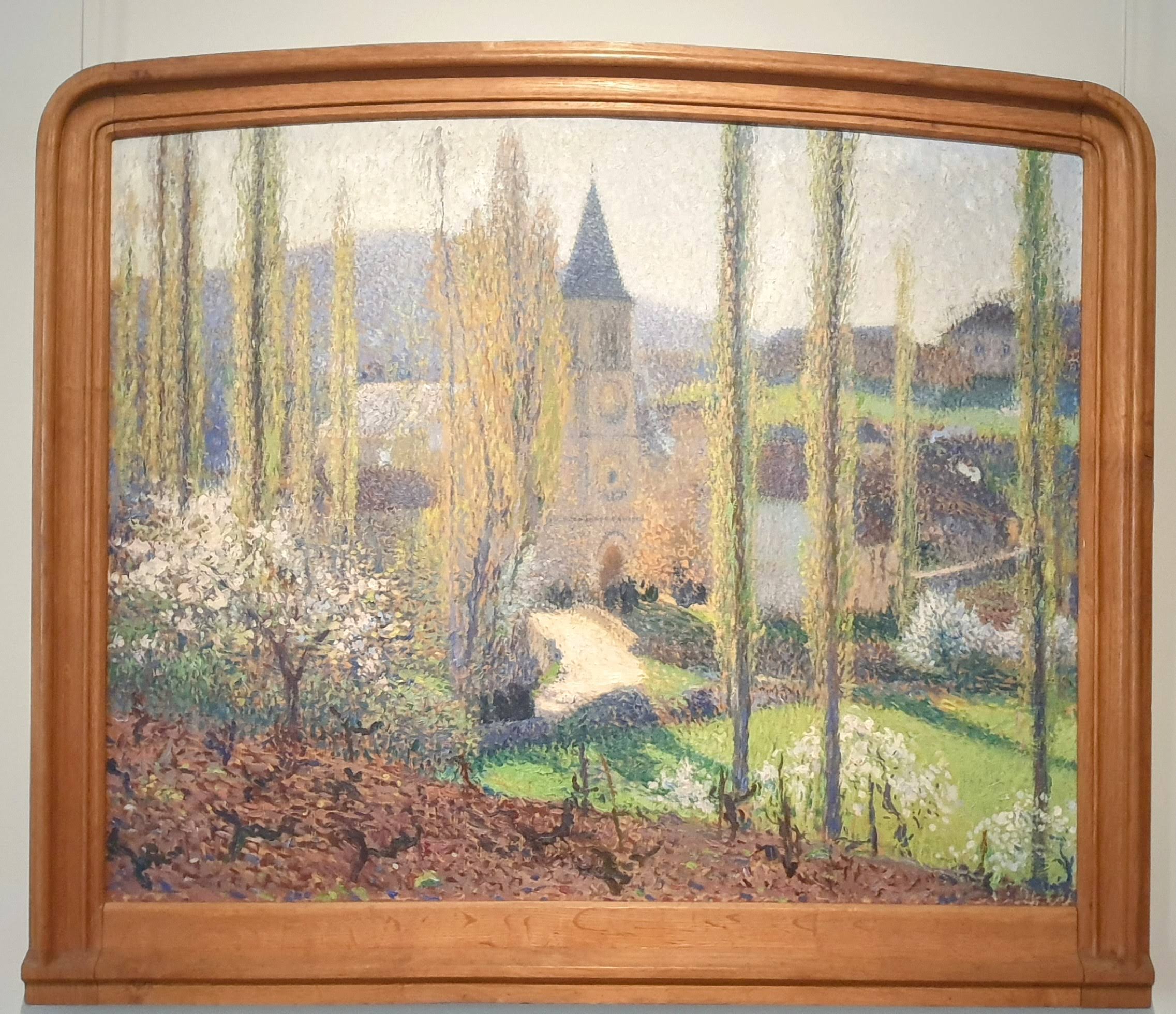
Leaving mass on Easter Day in Labastide-du-Vert, Henri MARTIN, 1915

I recently had to try and explain Queer Coding to some folks and I found myself returning to YouTube to shore up my own understanding and references. One of the videos I watched pointed out that a lot of artists who painted under the totalitarian glare of the capital “C” Church used secret signs in their paintings of religious icons, and imagery out of Greco-Roman mythology to be able to portray scenes of queer love, romance, and eroticism that they could otherwise have been turned over to the Inquisition for. It was a perspective that made looking at many of these paintings from the 14-17th centuries much more entertaining.

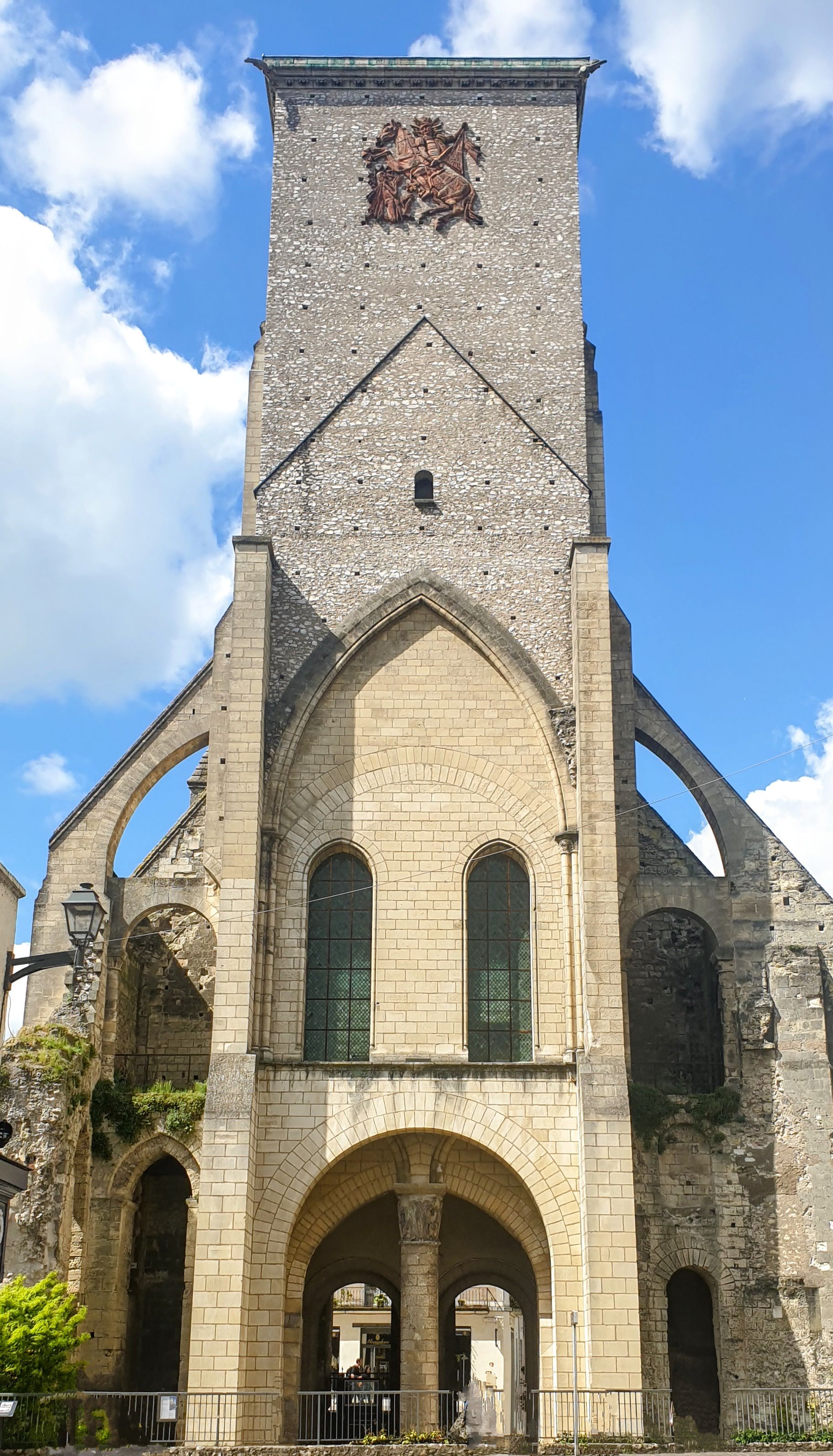
I had to put this painting on its own. This is “Panoramic view of Tours in 1787” by Pierre-Antoine Demachy. When I turned a corner and saw this view, I was absolutely stunned because that’s the bridge I ride the tram over every day too and from school and my apartment. It’s actually fairly easy to regognize the major landmarks like the Cathedral on the left, the large white buildings with black roofs along side the road which is the Rue National (those are still holding shops today), and the Tower of Charlemagne as the tallest structure on the right. The artist was able to make the buildings in the distance look larger than they really are, and there are too many trees and new buildings for me to exactly replicate this view with my camera, but I gave it a go.

The lower floor of the museum is where the rotating and seasonal exhibits live. When I visited, it was an exhibit about the history of women called “THE SCEPTER & THE DISTAFF. BEING A WOMAN BETWEEN THE MIDDLE AGES AND THE RENAISSANCE“. Although it did have some generalizations, it mainly focused on France and it’s neighboring European countries and offered examples of illuminated manuscripts and artistic renditions of women as visual aids to the historical records. Anyone who has studied the history of women in the West will be well aware of the issues, but for those who are not, may I recommend the recent re-translation of Simone de Beauvoir’s eminent work, The Second Sex. If you’re on this website, I assume you like to read and so recommend the book, but there are plenty of YouTube videos reviewing and analyzing it. I don’t claim it’s the authoritative book of feminism (it’s got issues), but she does a very good job of assessing the historical condition of women in Western culture.

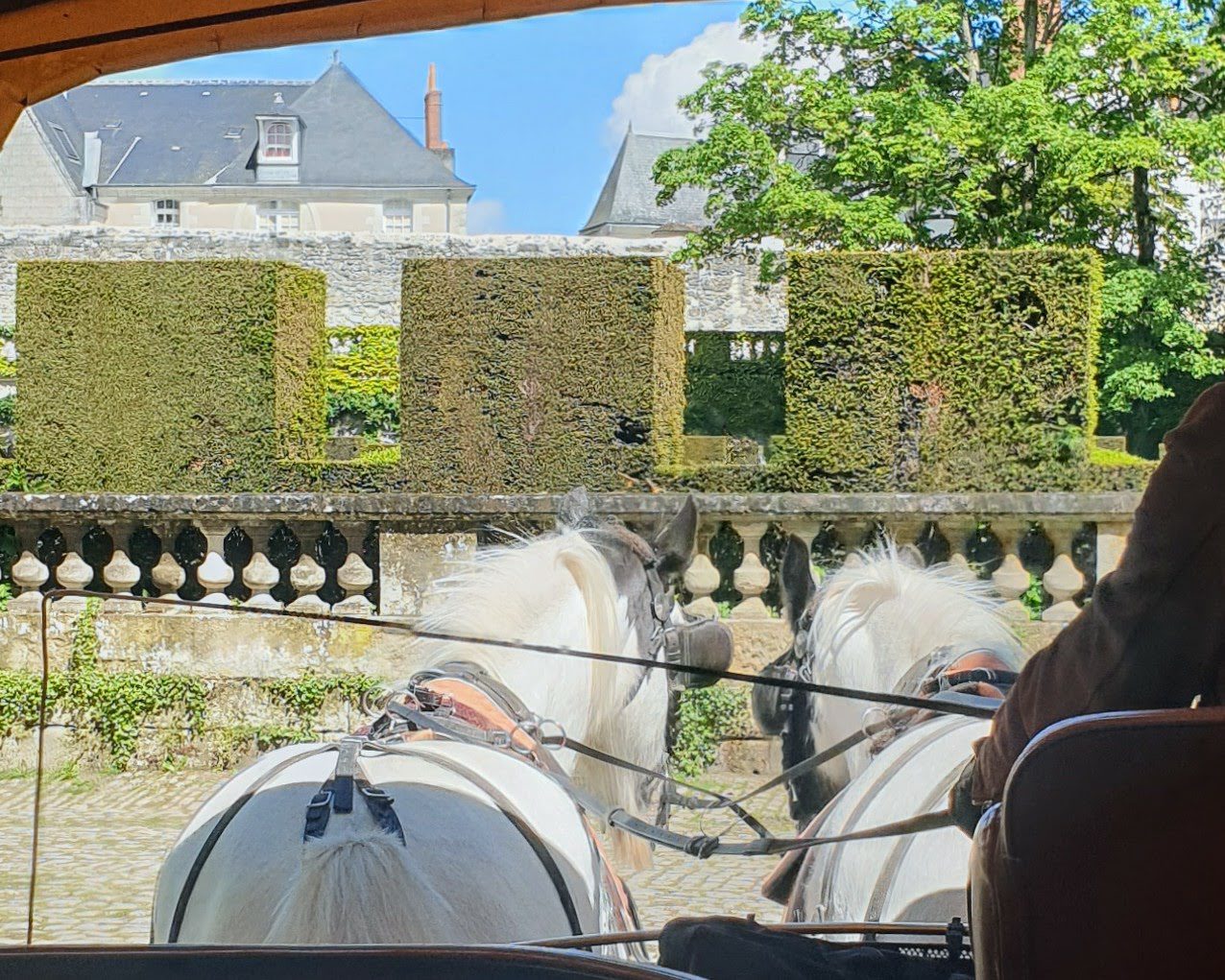
After I finished inside the museum, I headed outside to look for the pickup spot of the hippomobile. I didn’t make up that word. “Hippo” isn’t just a big African water mammal, it’s actually the ancient Greek word for “horse”. “Potamus” is Greek for “river”, which is how the hippopotamus got it’s name – river horse. Thus, the hippomobile is simply an ancient Greek way of saying horse-car, or horse drawn carriage. I don’t know why the one in Tours uses this name instead of the wildly more common French word “calèche“, but the first time I saw it on the website, I fell in love with the word and I refuse to relinquish it.

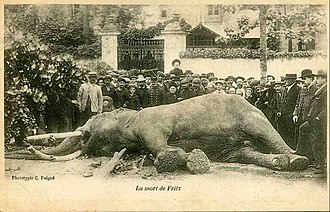
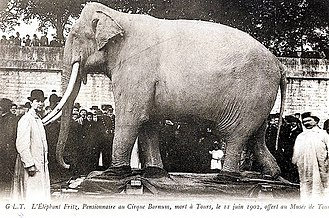
The internet further told me that I should catch this wonderful ride in front of “Fritz the Elephant” outside the Musée des Beaux Arts. When I arrived at the museum, a sign outside advertised the ride as picking people up at Fritz the Elephant as well, yet by the time I finished my museum tour, I still had no idea where (or really what) Fritz the Elephant was.

The Story of Fritz the Elephant

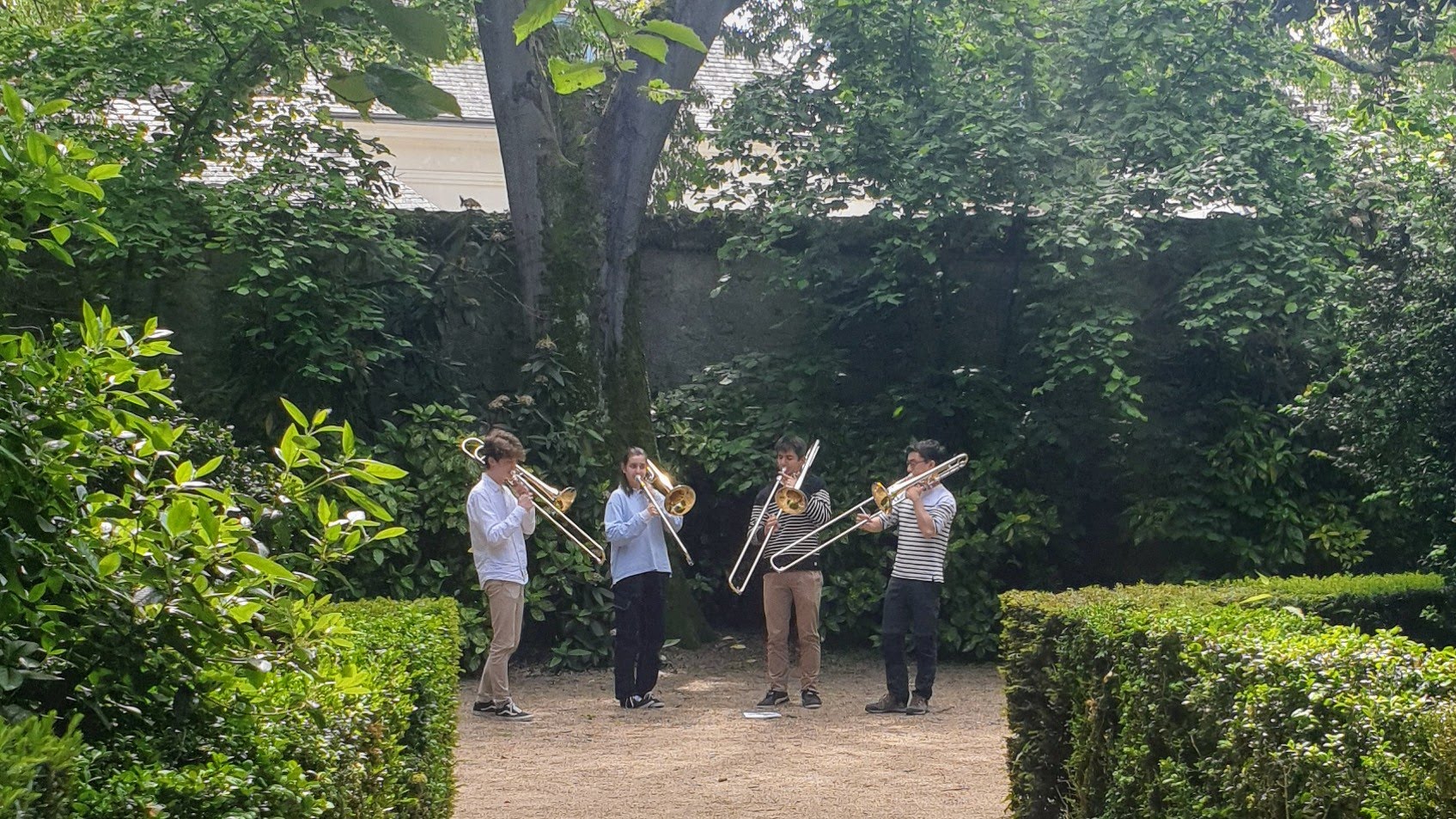
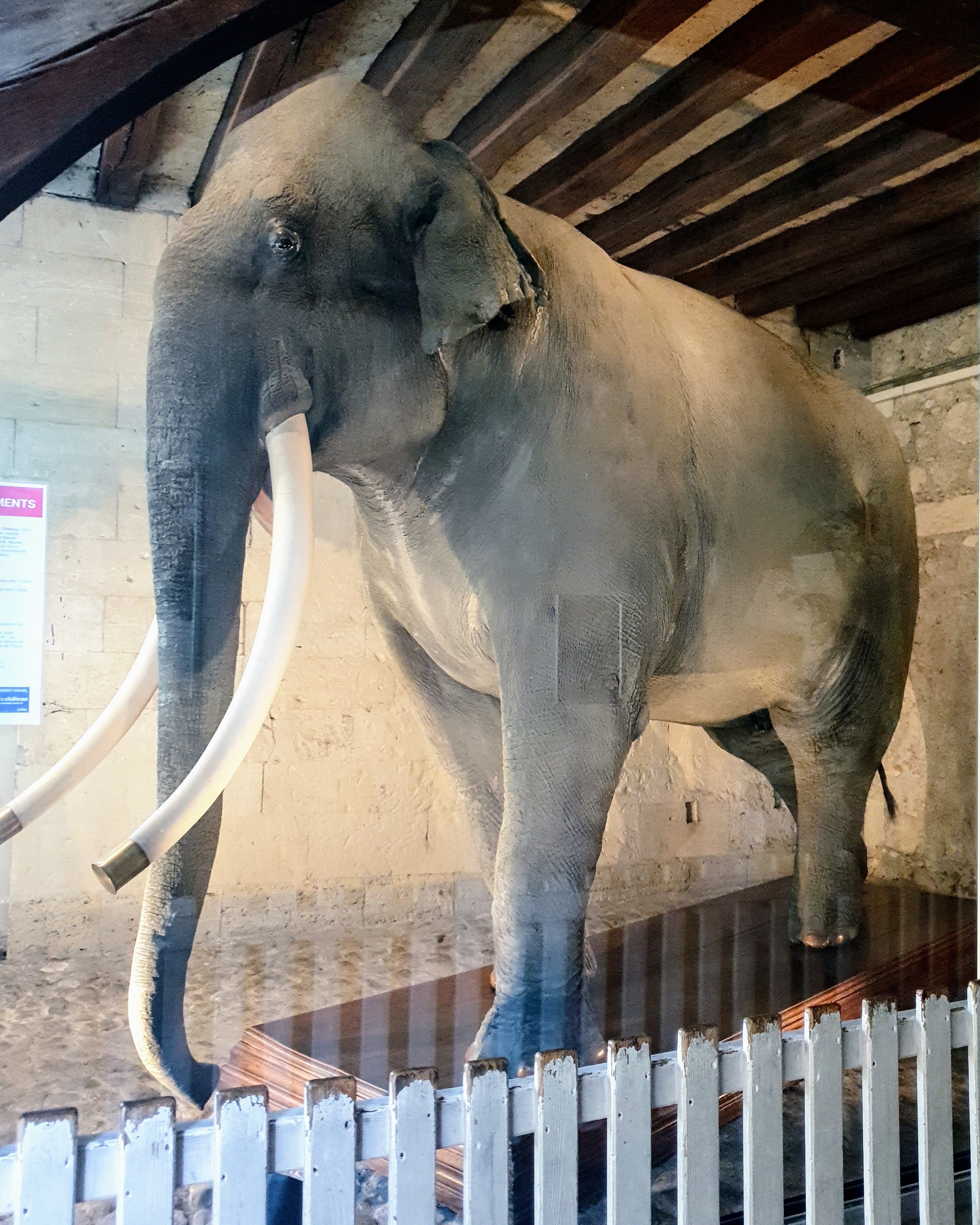
In my mind, Fritz would be a statue, or maybe a mural, adjacent to and clearly visible from the museum. Upon exiting the museum, I took a quick walk around the gardens (lord do I love the way the French put gardens everywhere). I found a little food stall, and a playground, and a trombone quartet (very unexpected), but still no elephant. Finally, I went over to a building off to one side that looked like it had been (or might still be) a stable. Lo and behold, there was Fritz in all his taxidermized glory, sheltered from the elements by a roof and plexiglass.

TW animal cruelty: because western civilization didn’t figure out animals had feelings until really recently and this is a story out of history. But also, there’s a silver lining at the end? If you want to avoid it, skip to the Hippomobile section where the animals are treated with kindness and respect.

Around the turn of the 20th century, the Barnum and Baily’s Circus was at its height. You may have been exposed to a glorified version of this with a singing Hugh Jackman, but the real circuses relied heavily on exotic animal shows, and the treatment and training for those animals, including elephants, was cruel and violent. Fritz was in captivity for 35 years, which would have been most of his life considering Asian elephants only live into their late 40s. He was purchased by Barnum in Germany in 1873 and shipped by sea to the US. Sea voyages were especially hard on animals then, since they took a long time, had terrible conditions, and there was no medication available to help the animals with anxiety or seasickness. Many elephants died on such voyages, including several of Fritz’s companions. 

In 1901, the B&B circus headed over to Europe for a continental tour. While in Bordeaux in May of 1902, Fritz began to show signs of agitation and aggression, and so was chained to two other elephants to keep him in check. When the circus reached Tours in June of the same year, the circus offered a parade through town as a way of attracting visitors to the shows. Though the parades were difficult, they were also often the only time the animals had any real freedom of movement. 

For reasons unknown to history, Fritz became enraged during this parade. 35 years of captivity and violent treatment cannot have been without consequences, and whatever the reason, Fritz freaked out and terrified all the local parade attendees. The handler was able to get Fritz under control and on the ground (laying down), but director on site still ordered the elephant put down. As horrible as that is, the method of execution was worse, and yet it’s inhumanity may have been the reason why Fritz became such an important historical symbol. The method used was strangulation with chains and rope. It took more than three hours for Fritz to pass. 

The remains of Fritz were sent off to a naturalist for preservation, and within 8 months the skeleton was installed at the natural history museum, and the taxidermized hide was placed in the former stables at the Musée des Beaux Arts. The press latched on to the story, framing Fritz as a gentle giant and a victim. Wild speculation abounded as to the cause of his rage. Some posited it must have been a lit cigarette burning him, but there is no evidence to support this claim. Regardless, Fritz became a beloved mascot of the city of Tours, and the tragic incident became a pivotal talking point for a growing movement acknowledging animal suffering and animal rights. 

As of my visit, more than 100 French cities ban the use of wild animals in circus shows, and the French government at the federal level has decided to completely ban all use of wild animals in travelling circuses by 2028. If that sounds like a small and late change, you aren’t wrong, but France isn’t behind the times. Most developed (rich) nations are still in the process of passing similar laws, often in patchwork and piecemeal ways, and of course developing nations are struggling enough with human rights, that it is difficult to get them onboard with eliminating animal exploitation which can mean the difference between feeding their own children or not.

I have talked about ethical animal tourism before and how important it is to patronize businesses that prioritize animal welfare because that needs to be seen as a viable economic model in order for more people to follow suit. 122 years have passed since Fritz was strangled to death on the streets of Tours for simply being a wild animal, and that seems like a long time, but we were still going to circuses with mistreated elephants when I was a kid. As short a time ago as 2008 I watched a tiger jump through a ring of fire in China (I didn’t know that would happen when I sat down for the show). Kids on the streets in Africa and SE Asia use baby monkeys they took from the mothers in order to lure tourists into taking and paying for cute selfies. There are still plentiful places that offer swims with captive dolphins or rides on captive elephants as tourist attractions. We love looking at and interacting with animals, but all too often that love is toxic.

Horse-drawn carriages are another great example. I’ve been to developing countries where the horses are near starved, dehydrated, and forced to work without a break in the scorching sun. I recall at one point in Egypt seeing a sign near an area with shade and water troughs that an animal welfare organization had fought to have installed for the horses which carried tourists around the ruins. It’s hard to convince a person who lives in a state of desperate poverty that they need to prioritize an animal when their own children may not have enough. A shorter work-day means less money, and is a big barrier to enforcing any kind of animal rights. Thus it’s up to tourists who take the rides to express a firm requirement that the animals be treated well. Stop paying for rides with badly treated animals and the drivers will change.

Please check your sources. Look for the zoos that have habitats of comfort and preservation (lots of zoos these days are changing their habitats to protect and serve the animals, and they rely more on rescuing animals that wouldn’t have survived in the wild or breeding programs rather than capturing healthy wild animals). Look for animal interactions that protect the animal ambassadors. They exist. Animals that for one reason or another don’t mind interacting with humans on their own terms can be great species ambassadors and inspire humans to better protect the environment, but we have to respect their boundaries and needs. Even the pet cafes can have better treatment of their animals, such as creating spaces where the animals can retreat when they want to, and having highly trained staff around to make sure the animals are safe and comfortable at all times, even if that means disappointing a customer.

We may be past the era of such tragedies as happened to Fritz, but we still have a long way to go to restore the balance between our love for interacting with animals and our ability to respect them.

The Hippomobile

Thankfully, in France, the labor rights are strong, even for horses, and these chevaux have restricted work hours, mandated breaks, days off for extreme weather, and nice digs.

“Our equine friends are given a day off every Monday. The horses that draw carriages in the morning are replaced by another set in the afternoon. The animals take breaks in the shade of the magnificent cedar tree outside the Museum of Fine Arts. The carriage driver decides which route to take depending on the time of day, weather conditions and/or the horses’ energy levels. When the weather is unfavorable to horses, the timetable may be modified or suspended.” — quote from the Filbleu website regarding this service

I joined the first afternoon tour (3:30pm) and although I was a bit disappointed that the weather plastic remained down (it had rained heavily a few days before), I was seated right at the back and could look out the open rear for clear views. I didn’t see a lot of new things because by this time, I’d lived in Tours for over 3 weeks and had done a lot of exploring on my own. However, Old Tours is endlessly charming and the weather that day was simply stunning, so for the price of transit ticket, I happily enjoyed the clip clop of horses hooves while I admired the scenery. 

The Cathedral of Saint-Gatien

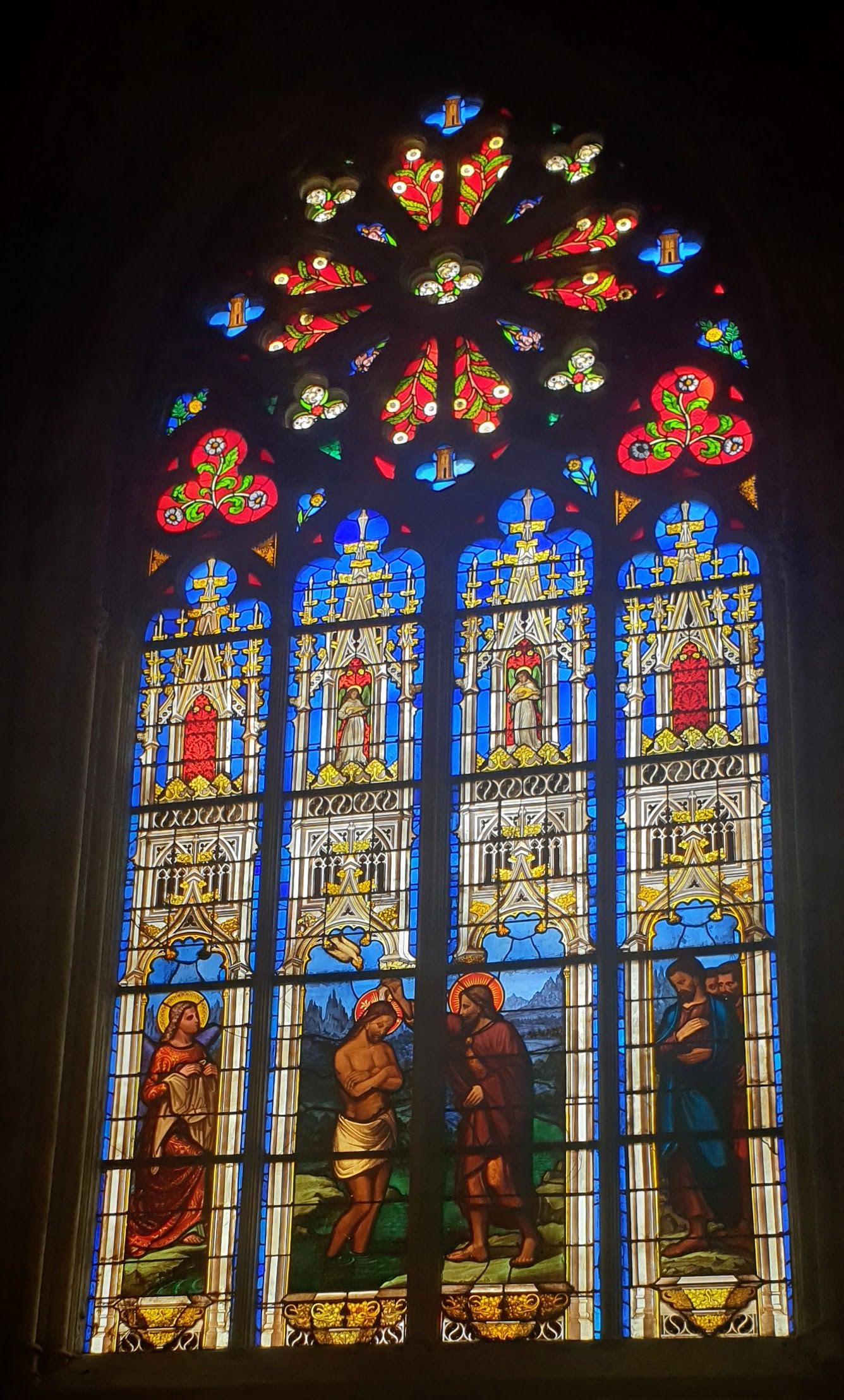
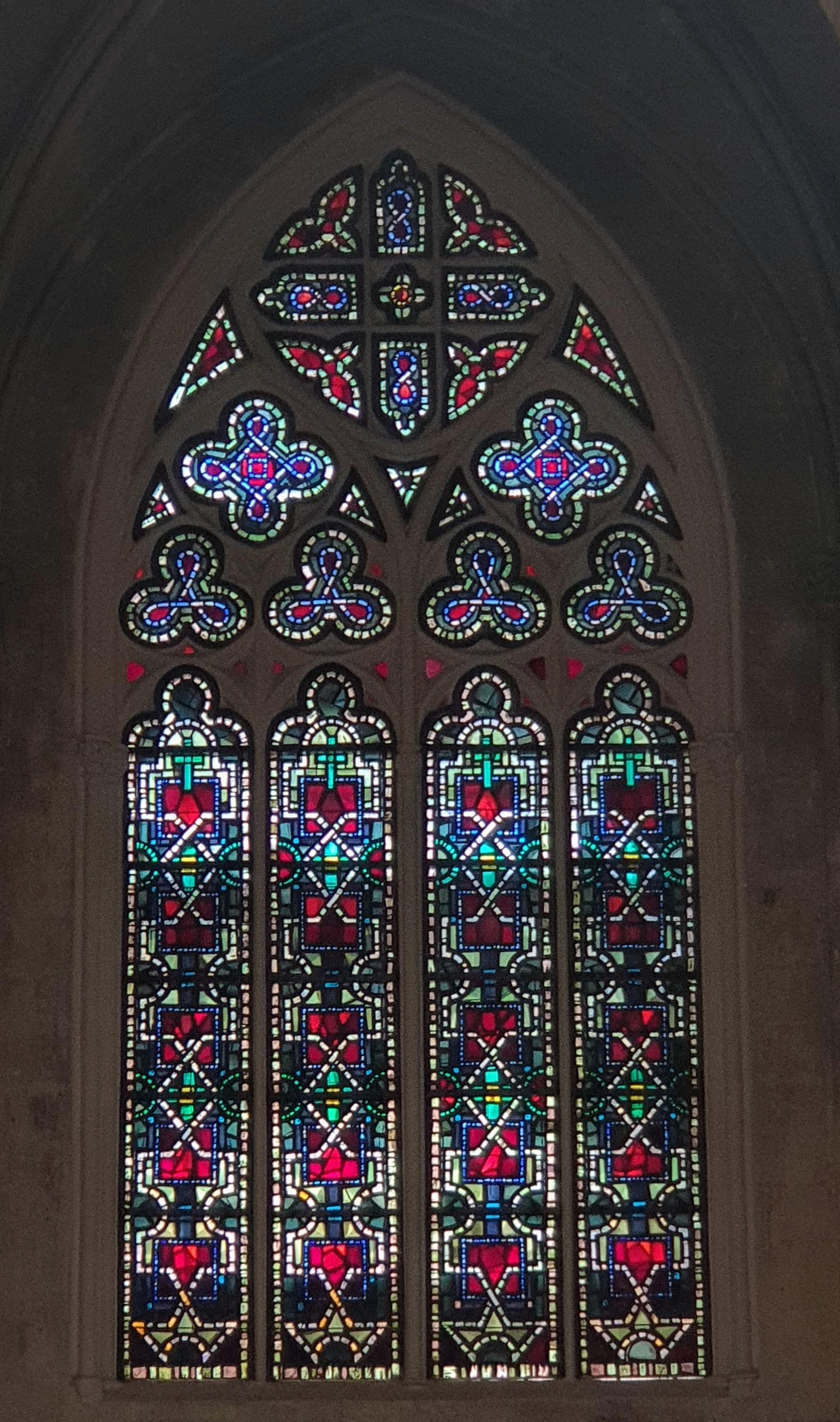
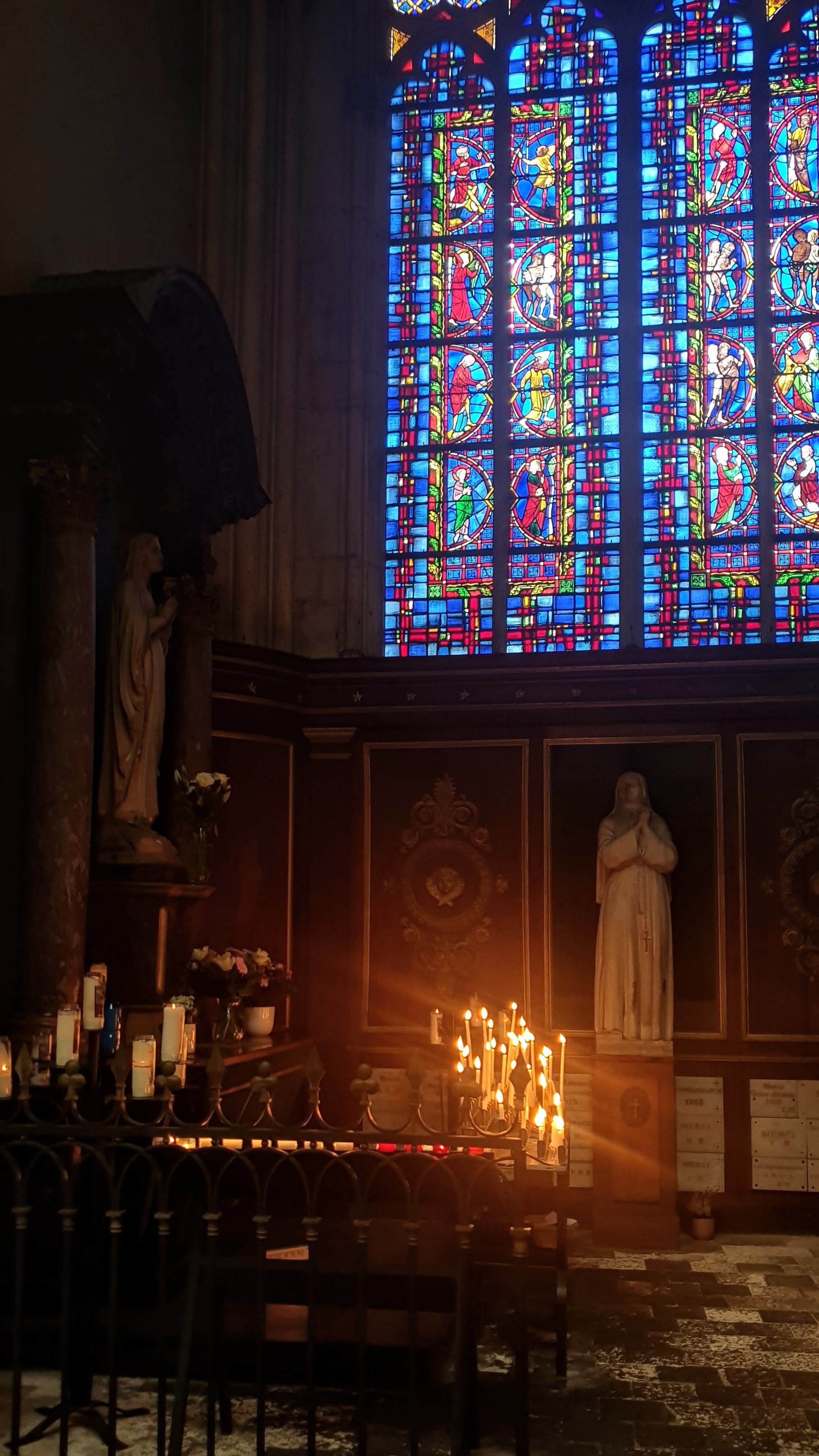
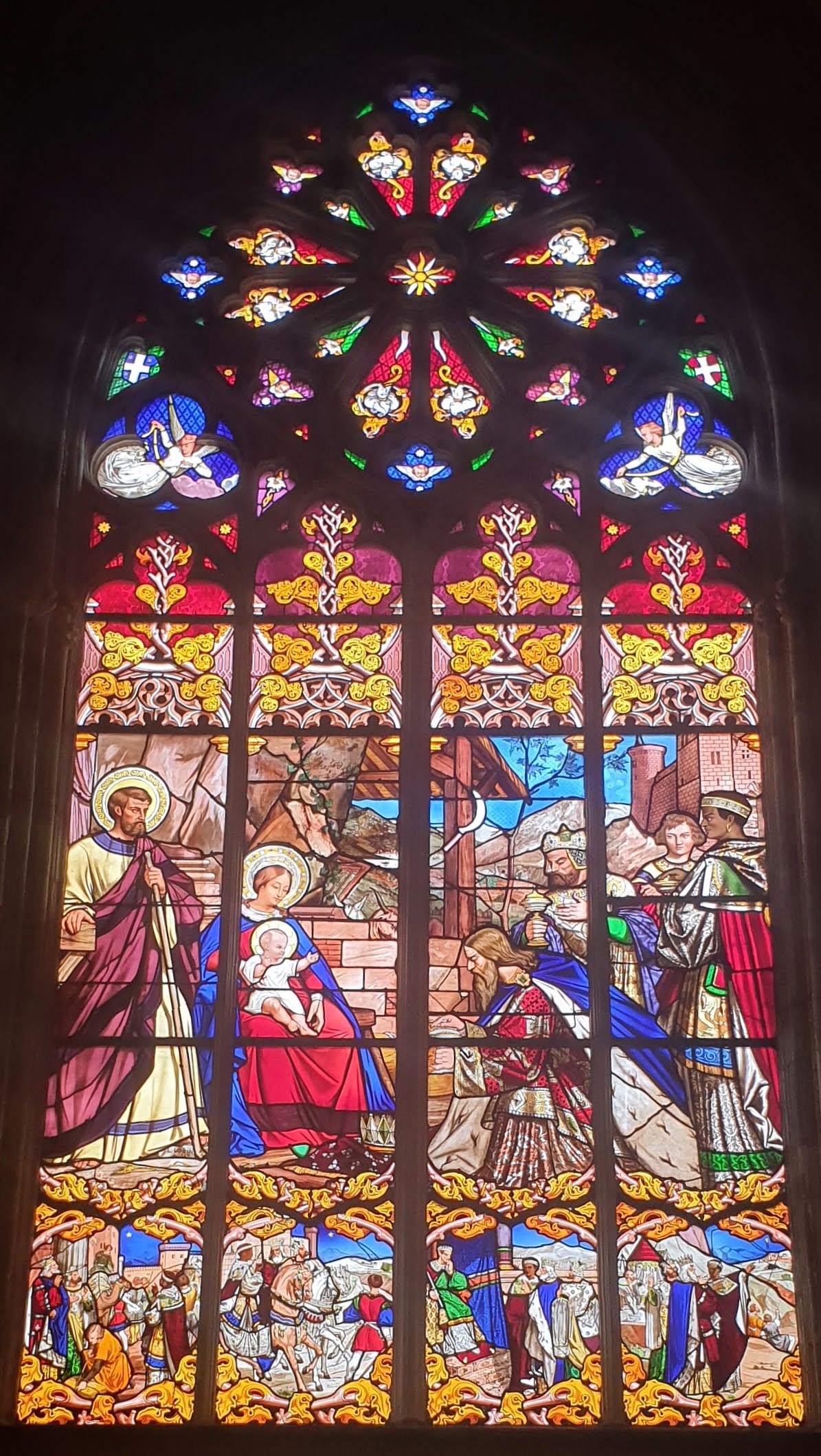
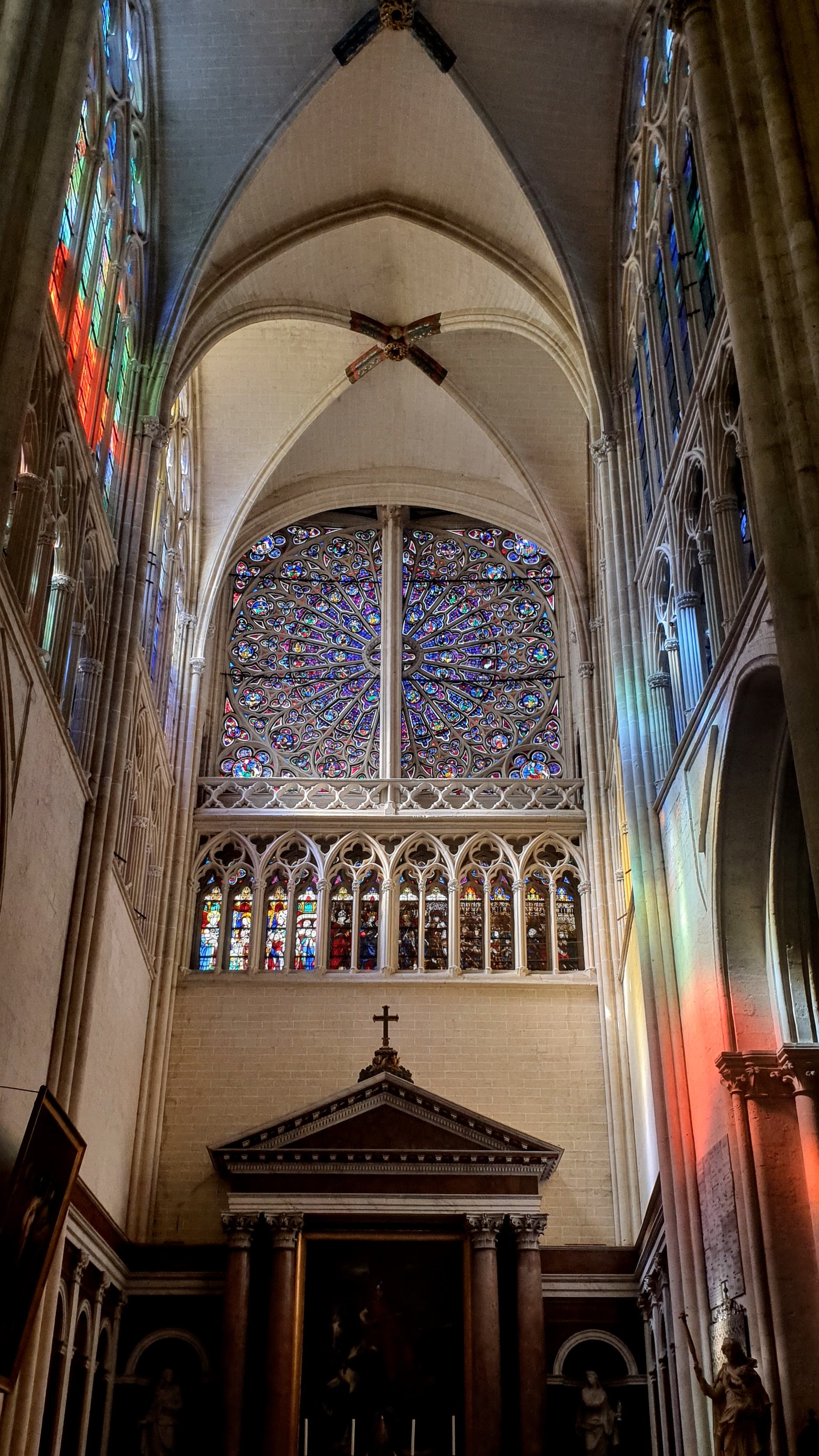
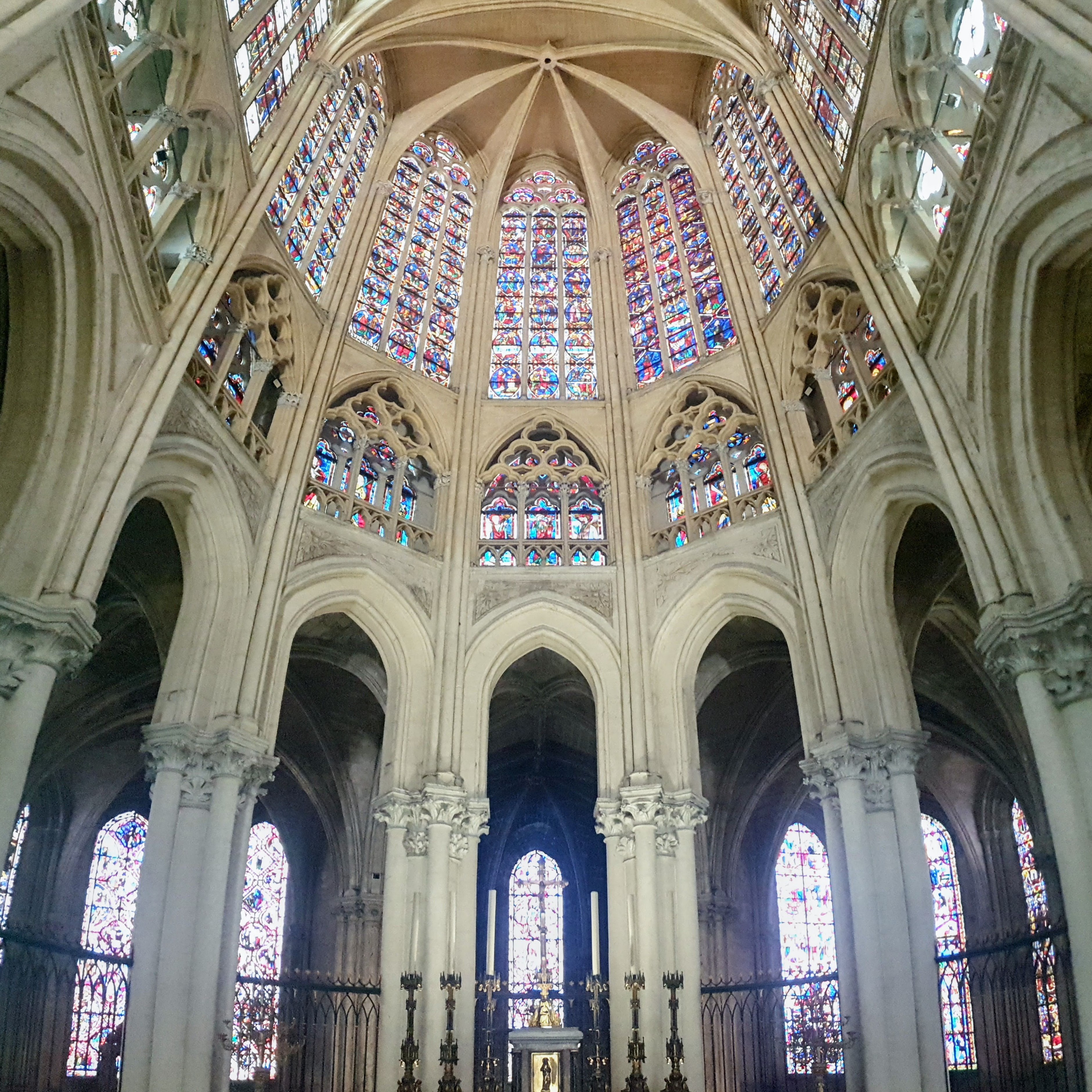
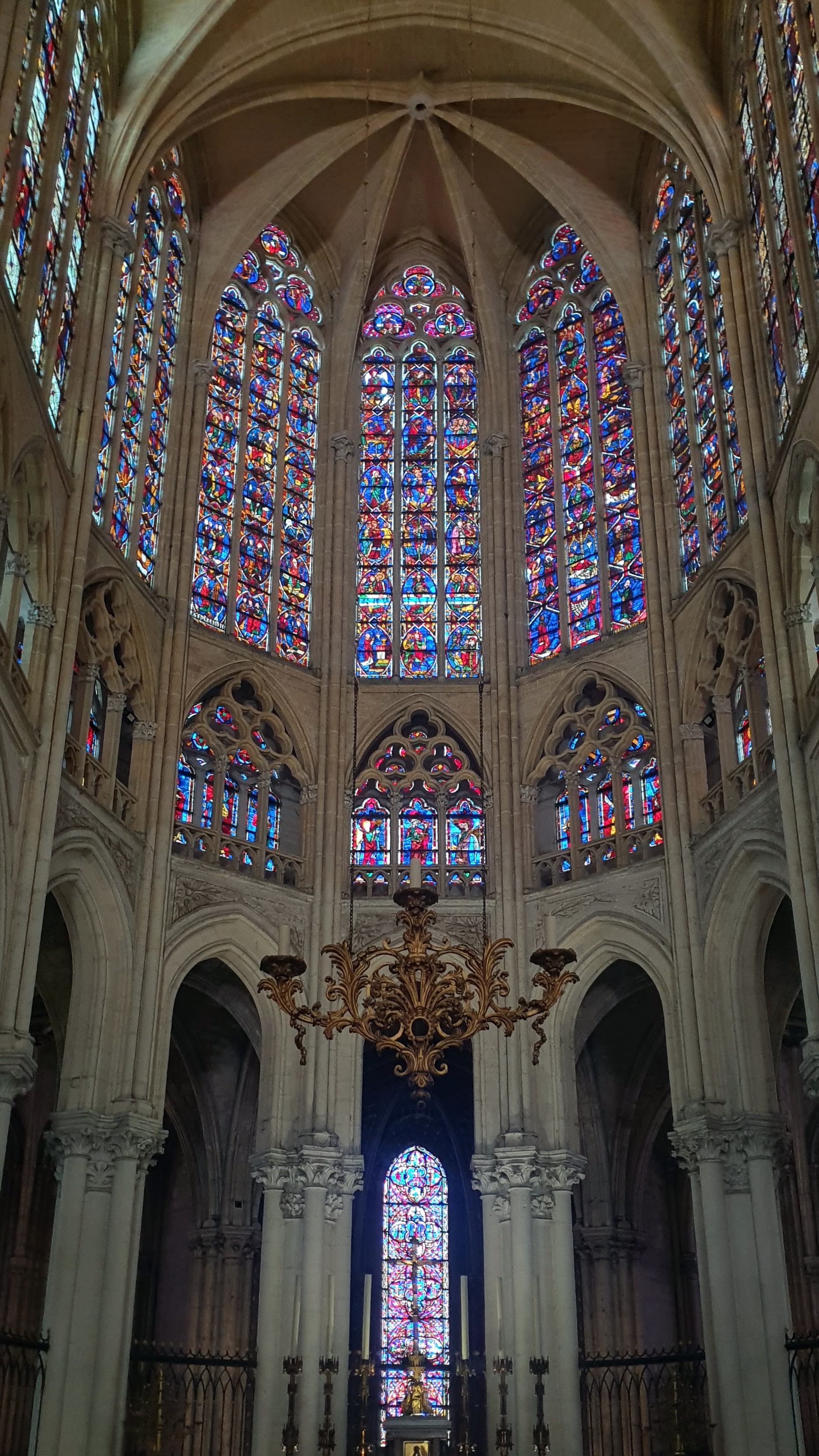
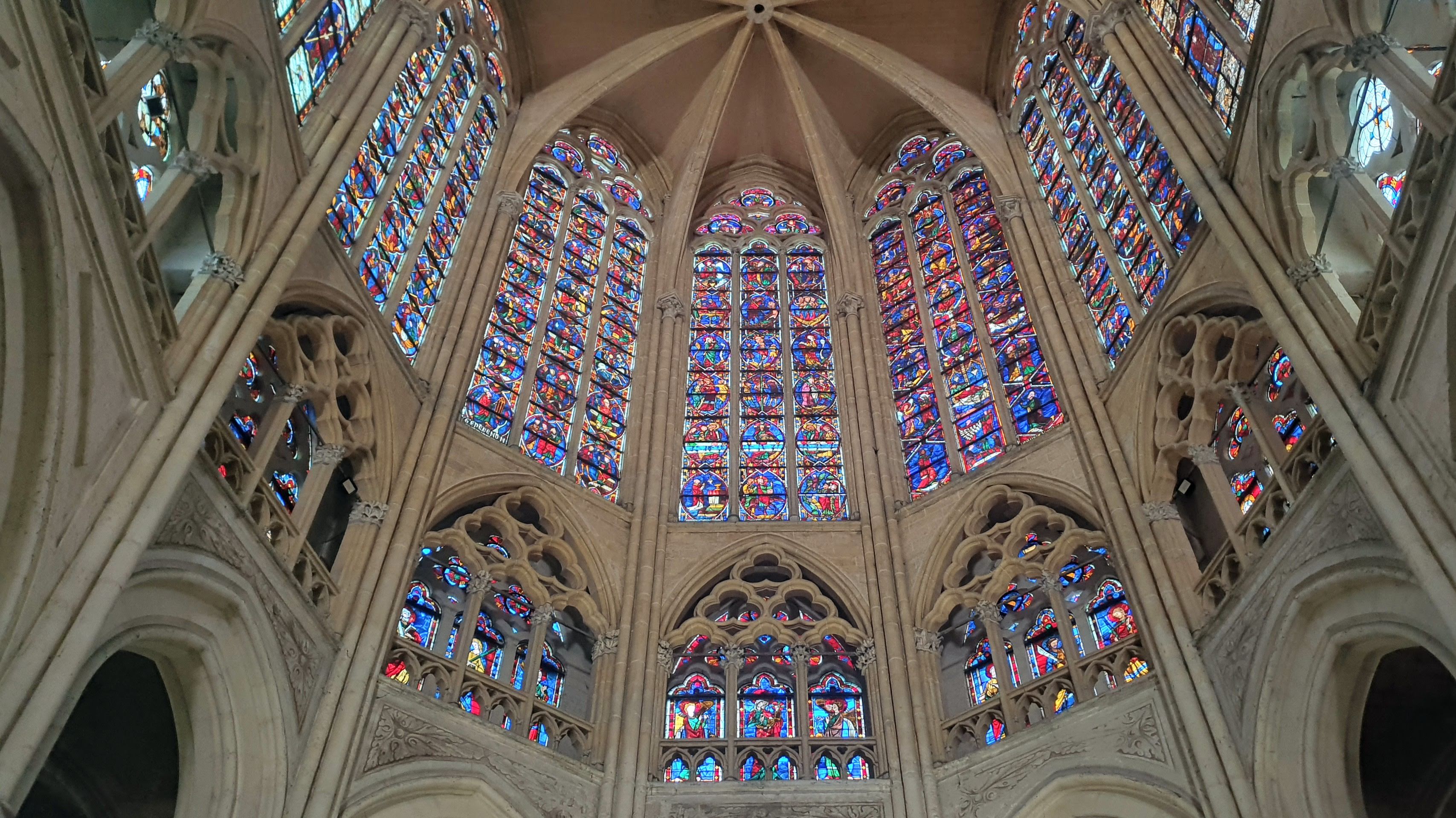
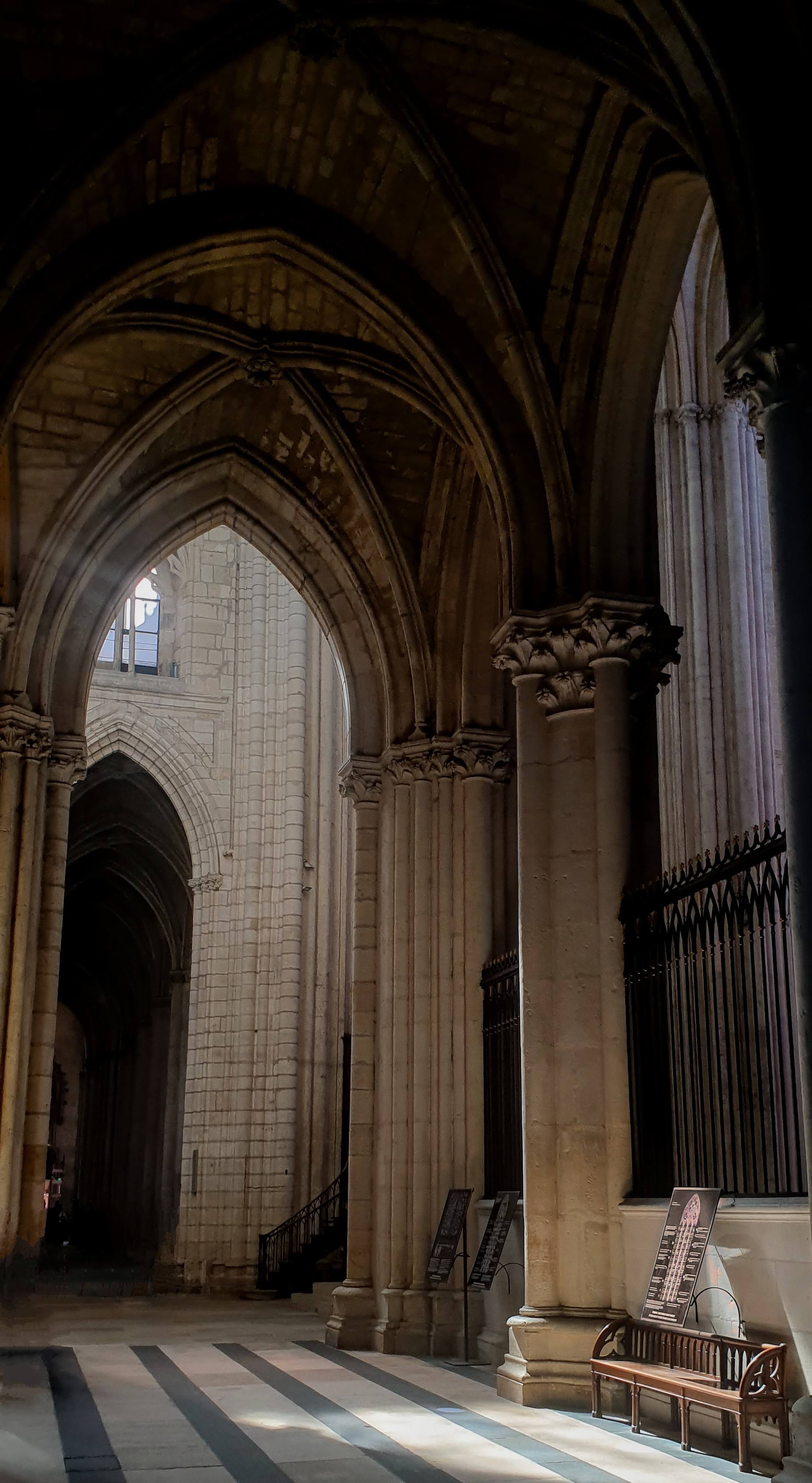
This stunning cathedral is right next door to the museum and makes an easy side trip. I may have a love affair with gothic architecture and stained glass. I can’t seem to stop going into cathedrals which are all generally of a similar blueprint, and staring in wonder at the scale and scope of human achievement in terms of really big, really complex, and emotionally moving buildings. I took far too many photos of the different types of stained glass, but I admit that I’m more interested in the colors and shapes than I am in the catechism represented therein, so I can’t tell you what they are supposed to be depicting (though there were dozens of signs explaining each window inside the church).

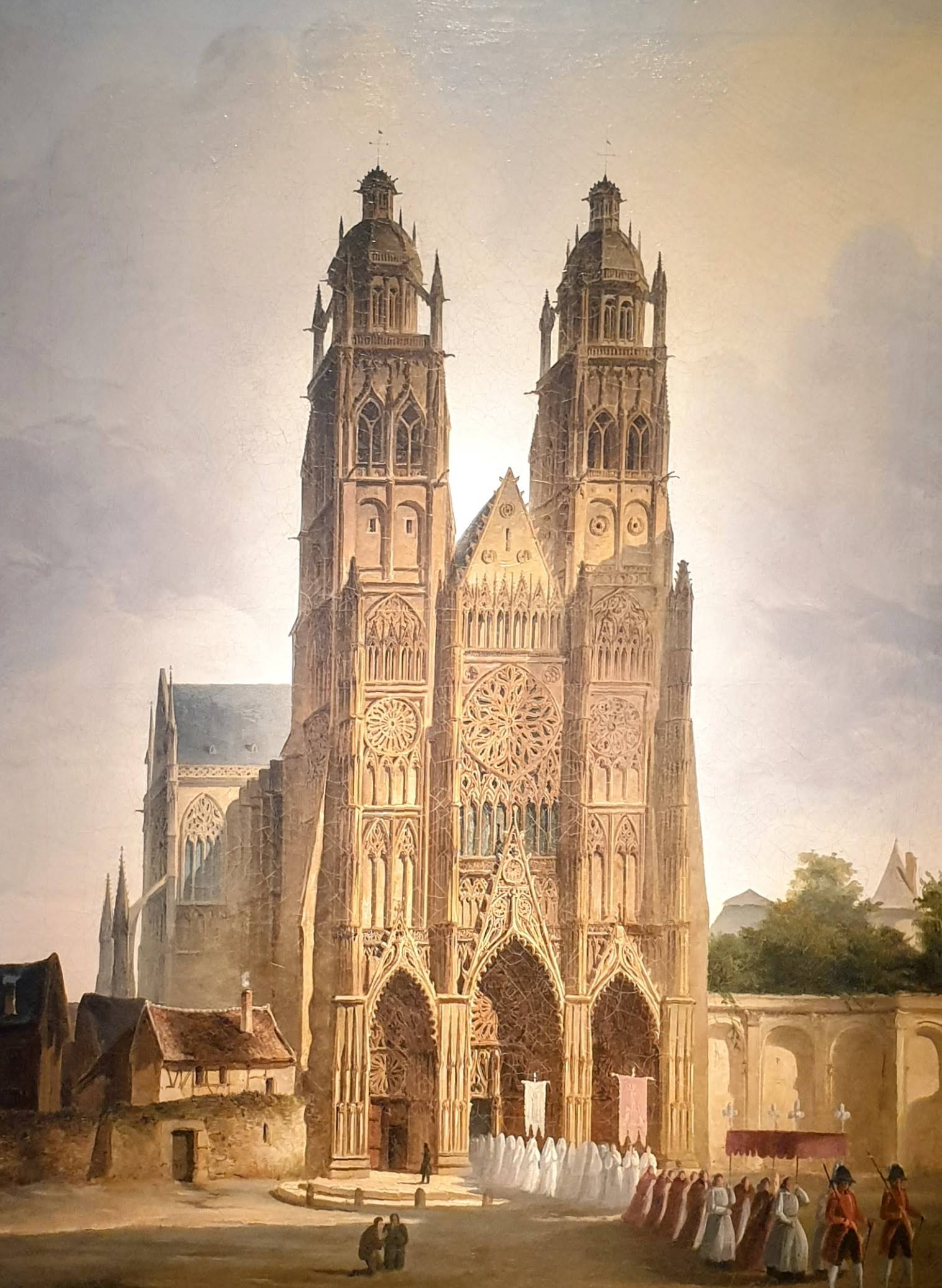
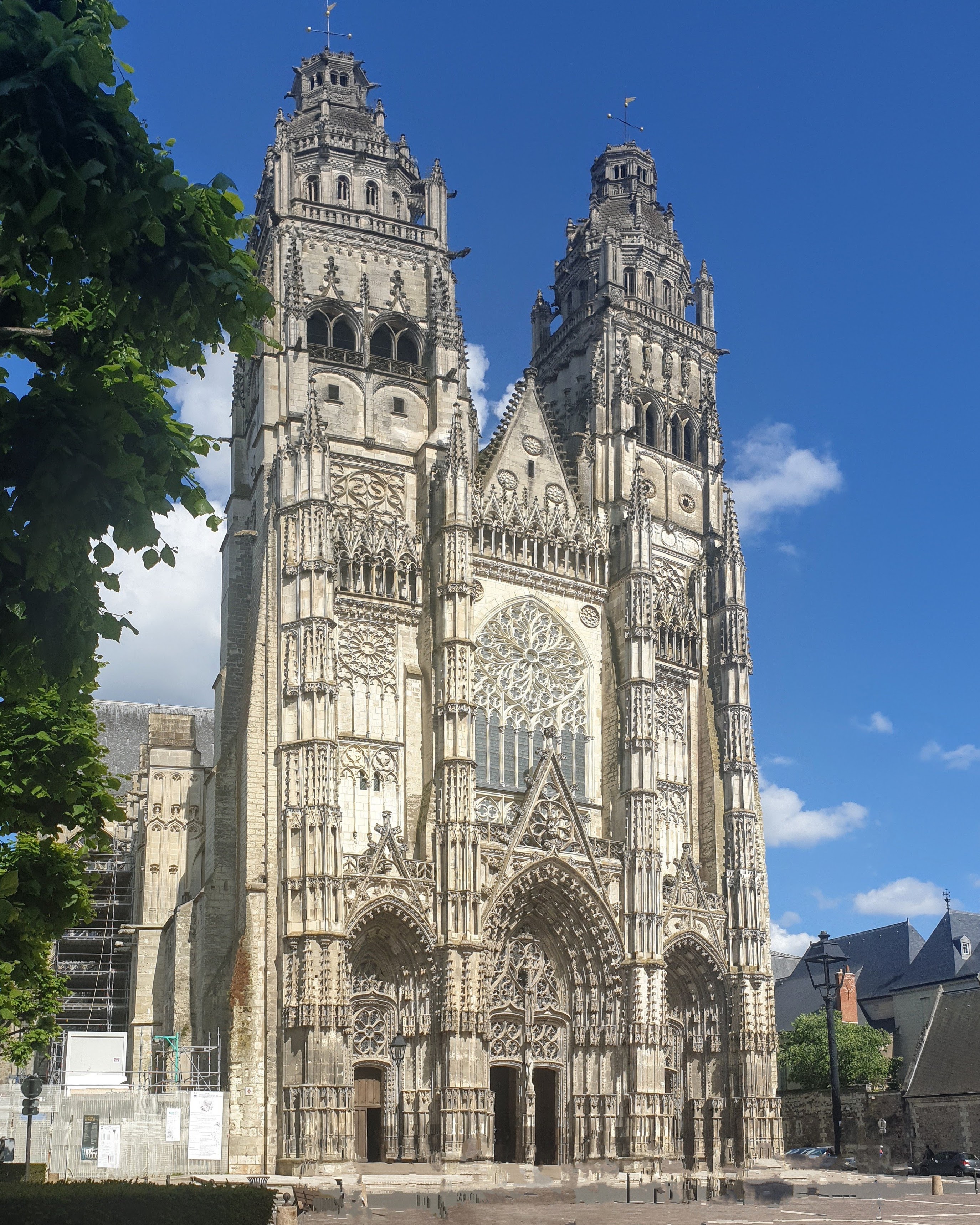
When I was in the Fine Arts Museum, I found a painting of the cathedral, and did my best to replicate the angle in modern photo form. It may be a silly American thing, but we simply aren’t used to buildings which have stood for centuries, and despite knowing how old the building is (800 years), seeing a 200+ year old painting of the cathedral made it’s age somehow more real.

While I was in the church, the trombone quartet that I had found in the gardens outside the museum showed up to practice with the organist. I love listening to the giant pipe organs! It started out quiet enough so you could hear the trombones, then the organist pulled the stops out (that’s where that phrase comes from, right?) and wham!

The Botanical Gardens

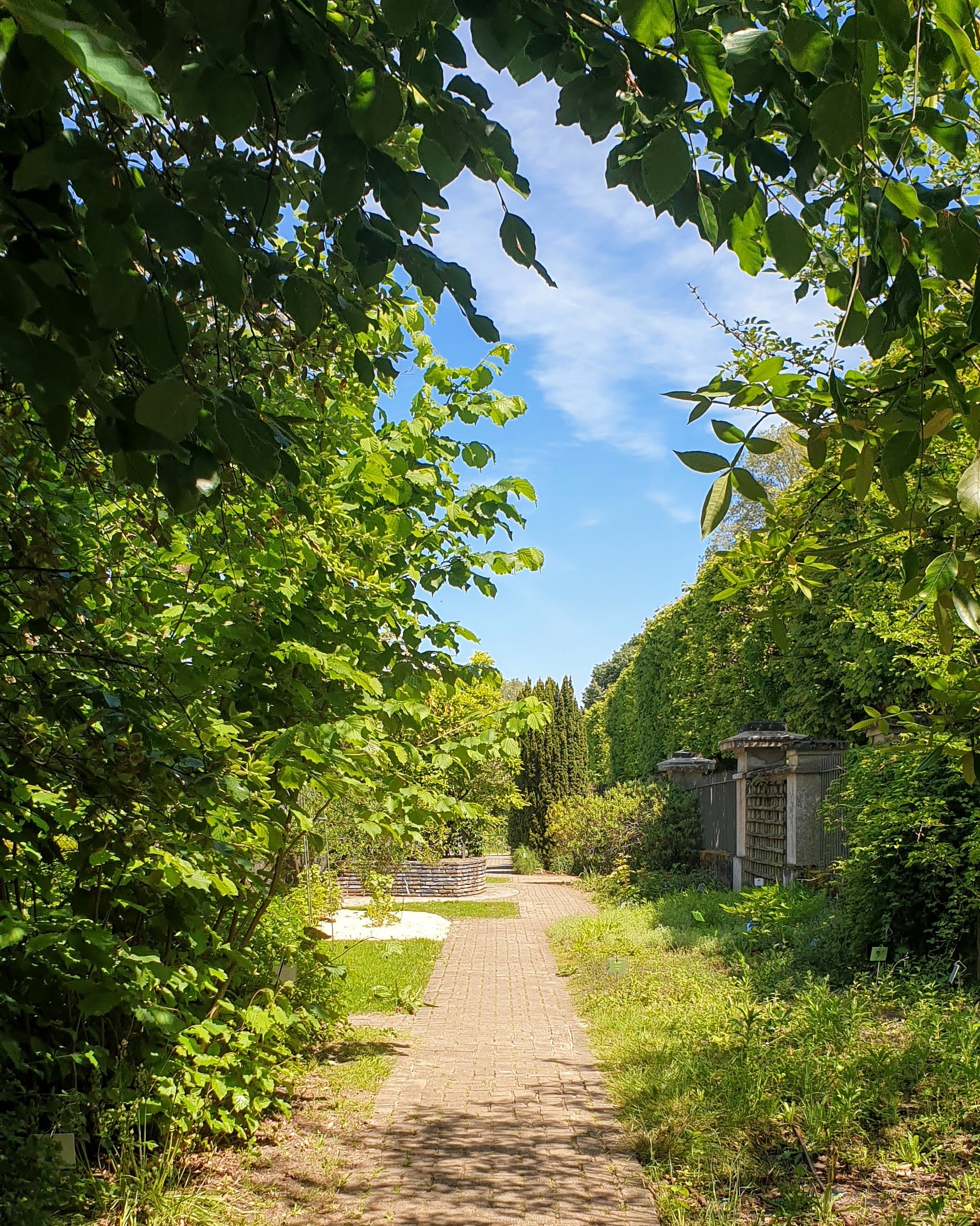
Another thing to love about France is the ubiquitous nature of nature. I mean the public gardens. Although what the French call a garden may be anything from a highly cultivated botanical display to an asthetically designed artistic movement, to a grassy place with a water feature, they are all clean, safe, and well maintained, and above all free to the public.

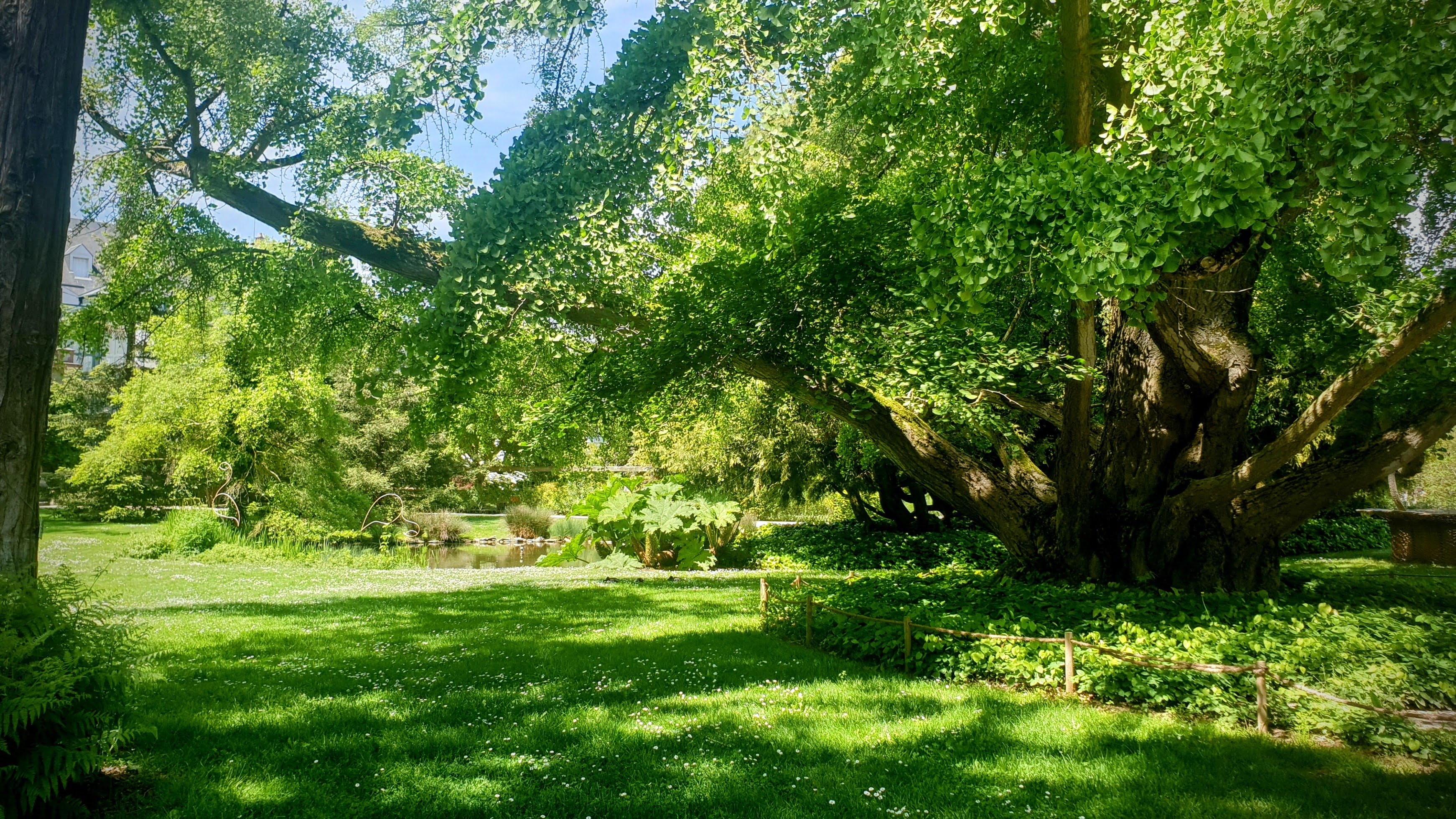
I wrote about my three gardens in Paris earlier this spring, so while experiencing the long weekend and excellent weather in Tours, I decided to pop in to the Botanical Gardens. I was not disappointed. The bus lets passengers off right at the main entrance to the gardens (although there are multiple entrances because it is such a huge area of land). I started by walking to my right into a maze of botanical specimens. The plants are arranged in pleasing beds and trellises and I suspect at least part of it is in bloom in every season except winter. There were three paths with three different points of view and experiences, and at the far end sat a grand glass greenhouse. Unfortunately, that was closed during my visit, but it was a fairly small part of the overall parc.

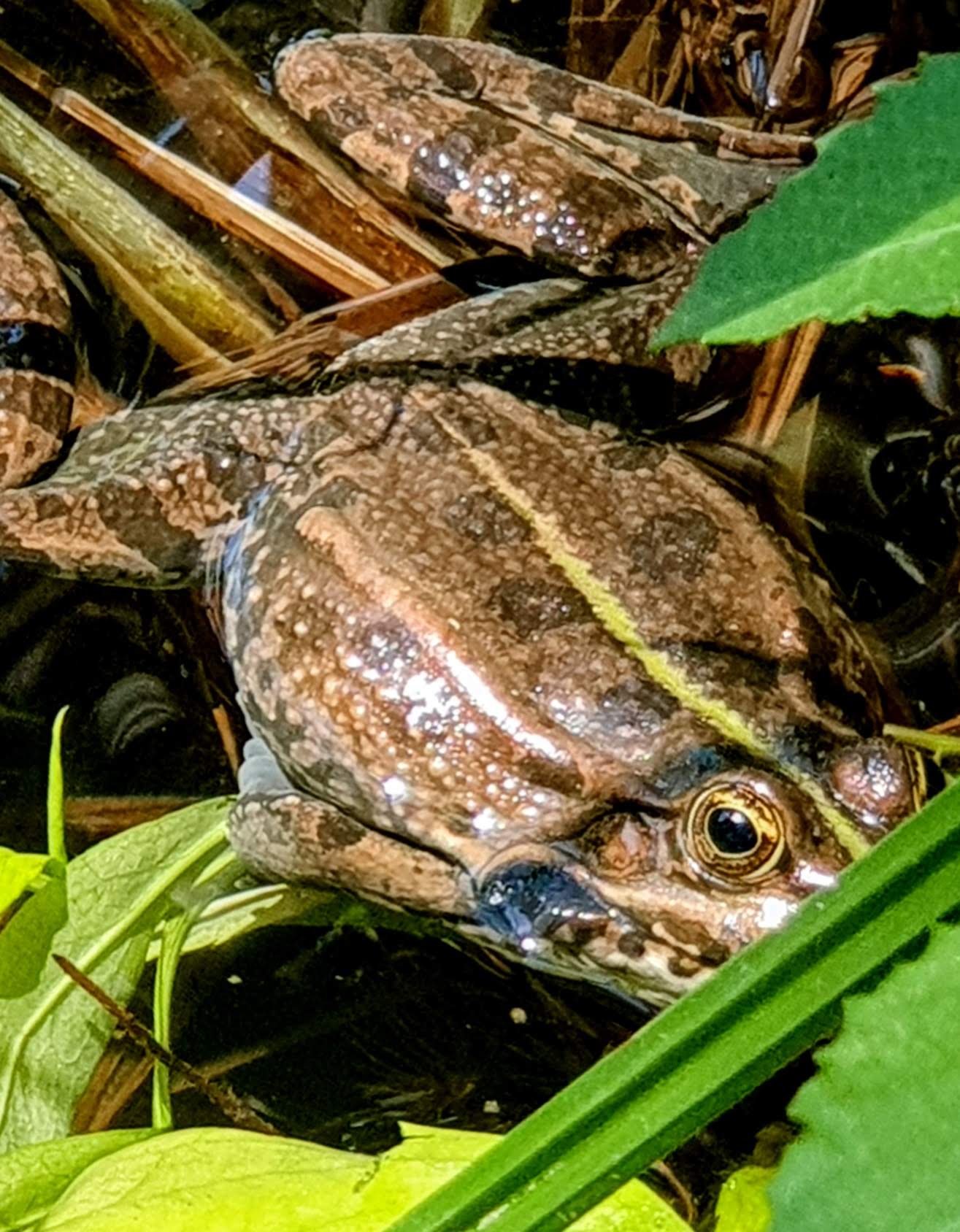
As I turned around and headed back towards my entry point along a different pathway, I was treated to entirely different scenery and the sounds of very vocal frogs. I managed to sneak up on one in the water feature and snap a photo before he plonked into the depths. I walked for a while simply admiring the plants and small streams, watching families and couples enjoying picnics in the grass, and then suddenly I came upon the menagerie. Here in the middle of this garden were a small number of animal habitats. I recall seeing the same thing in the Jardin des Plants in Paris and being generally surprised that any free-to-all style park could afford the staff and upkeep for that. 

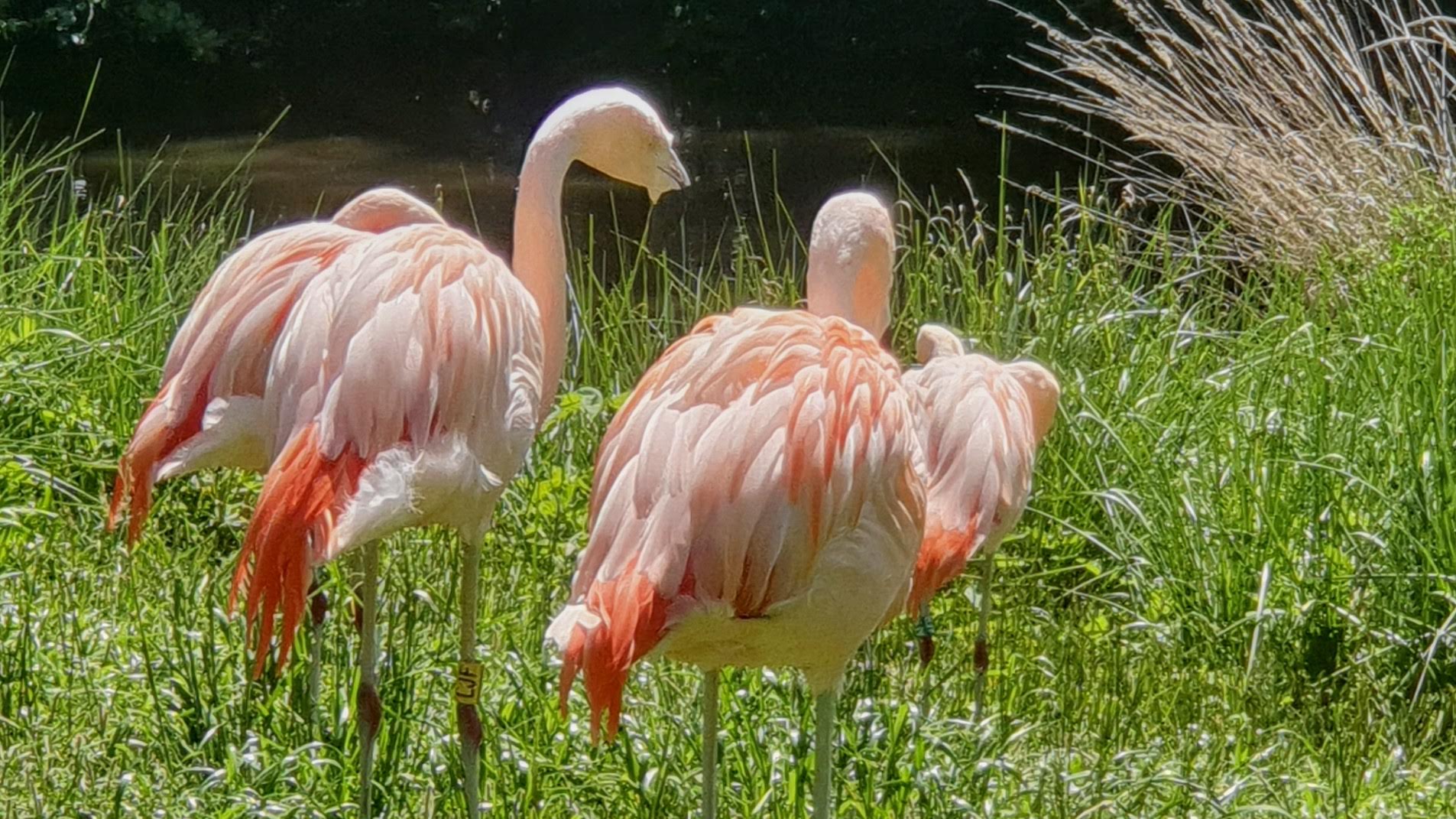
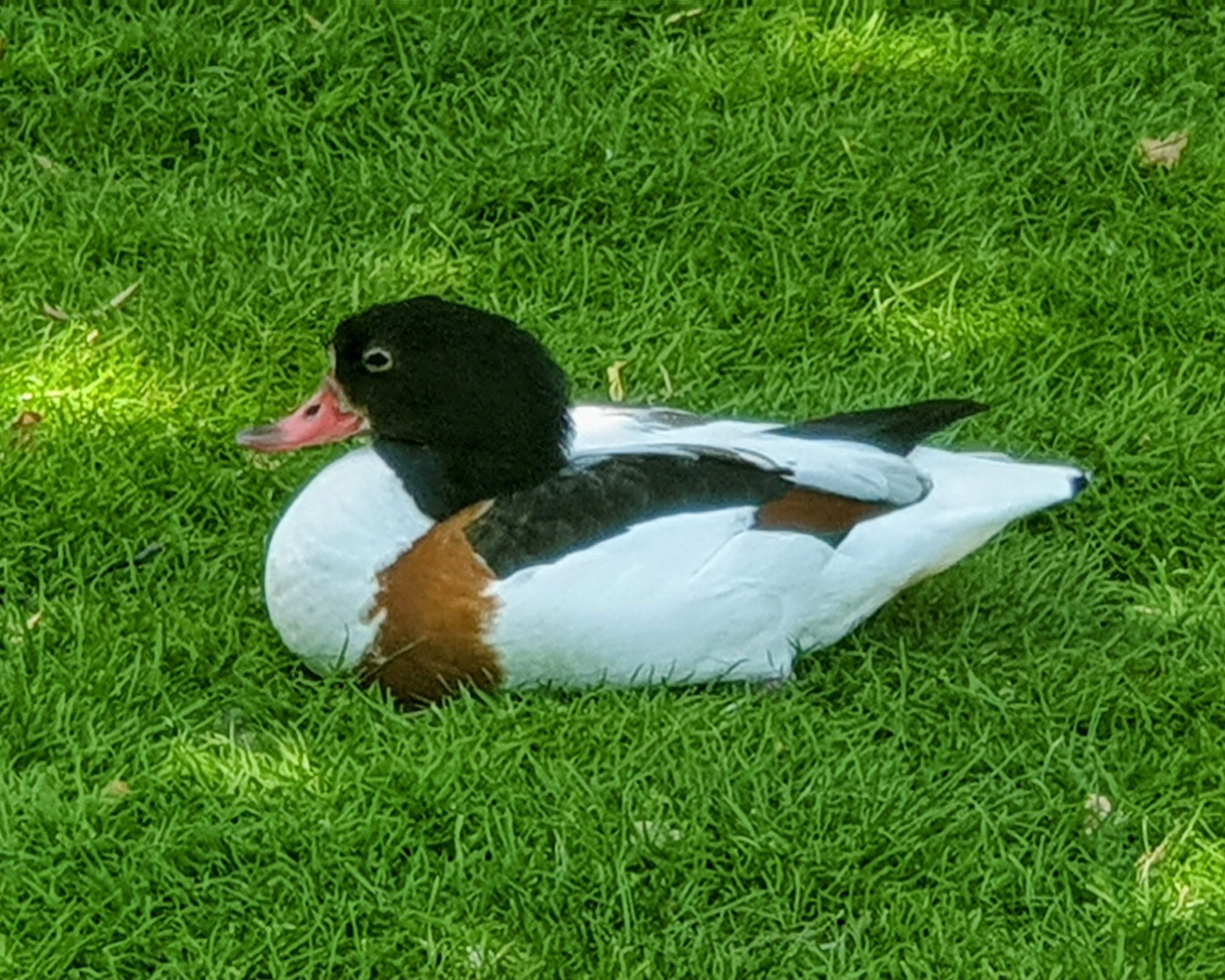
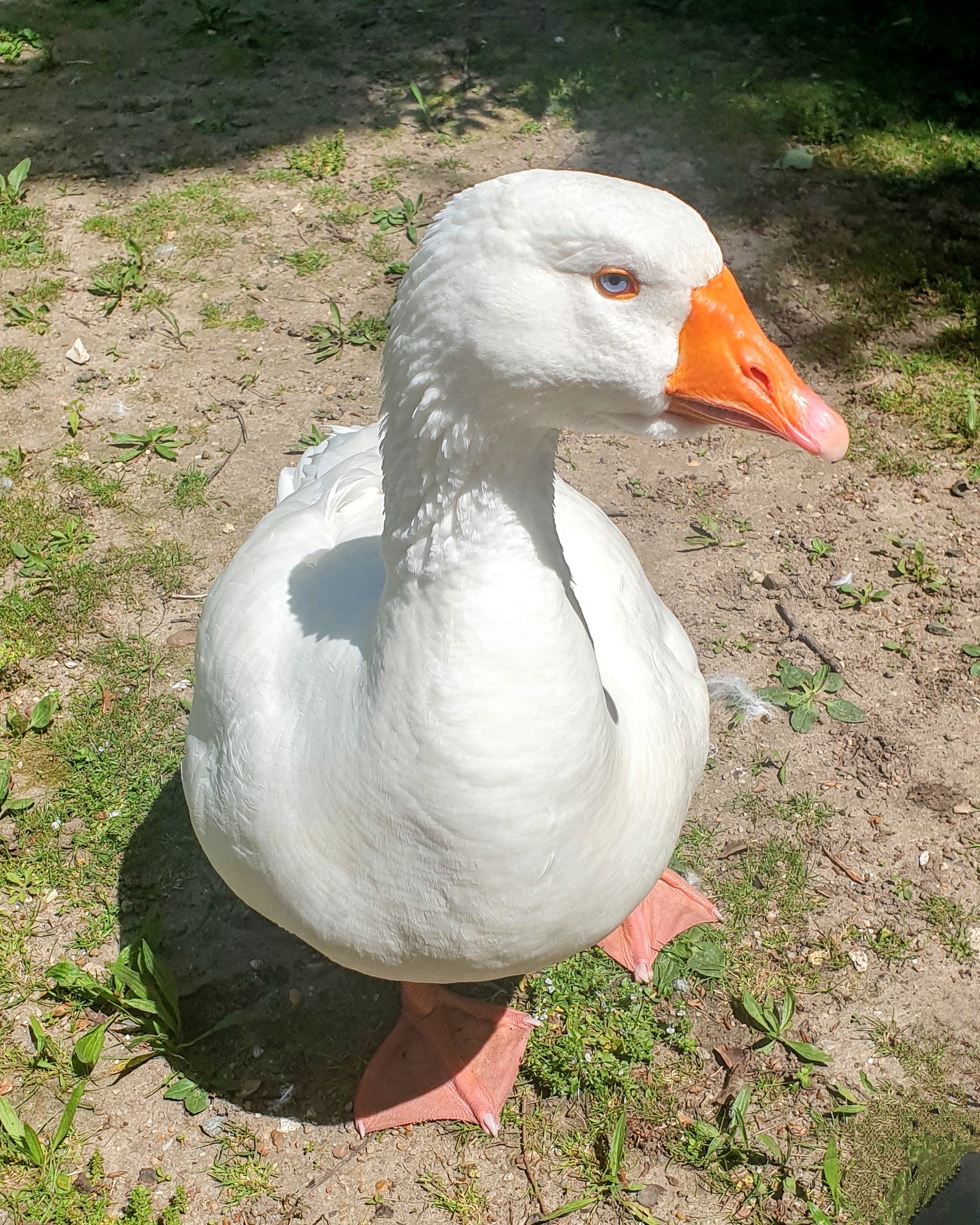
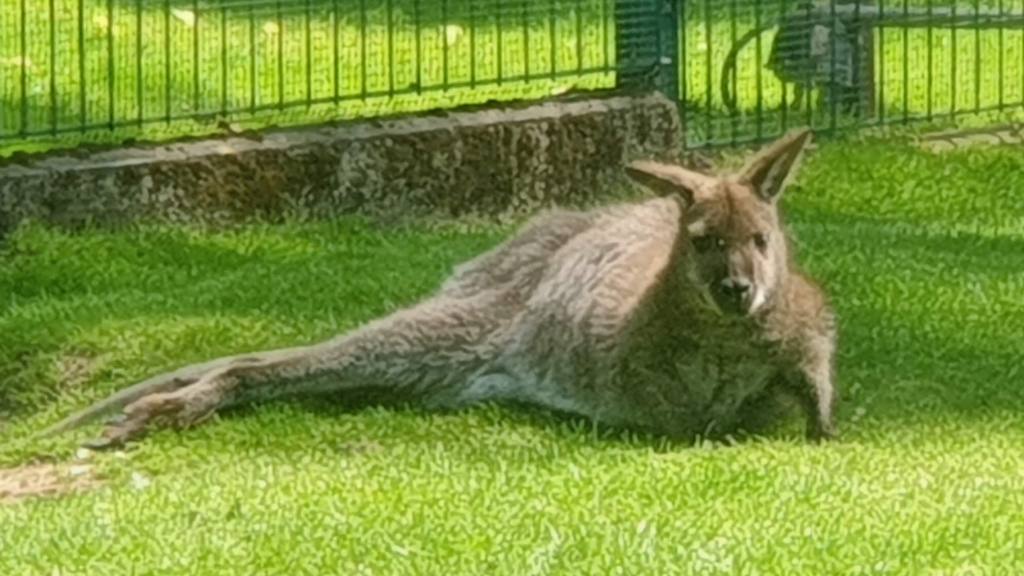
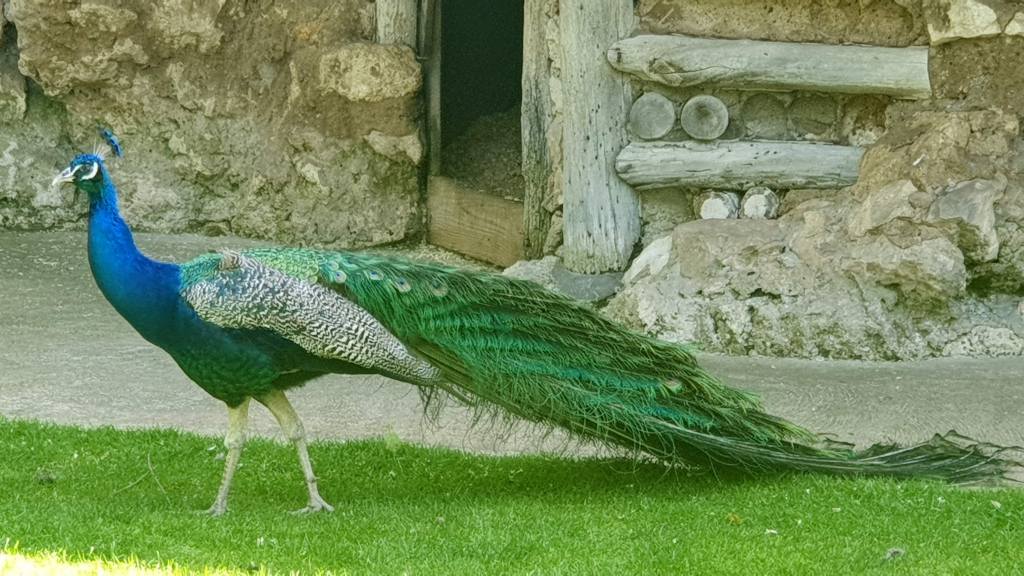
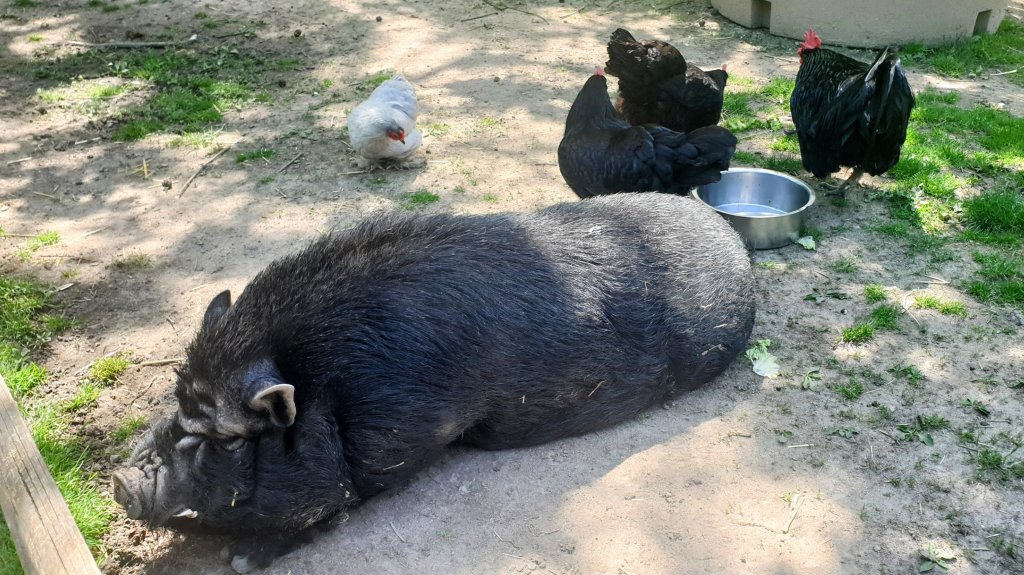
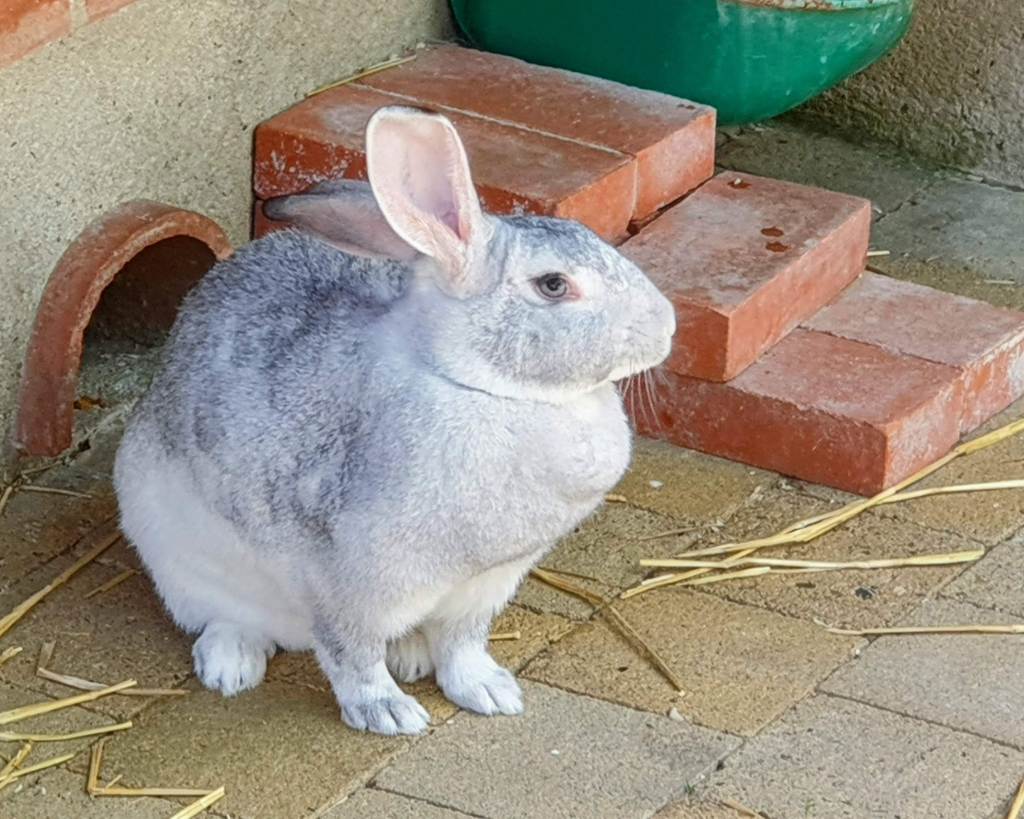
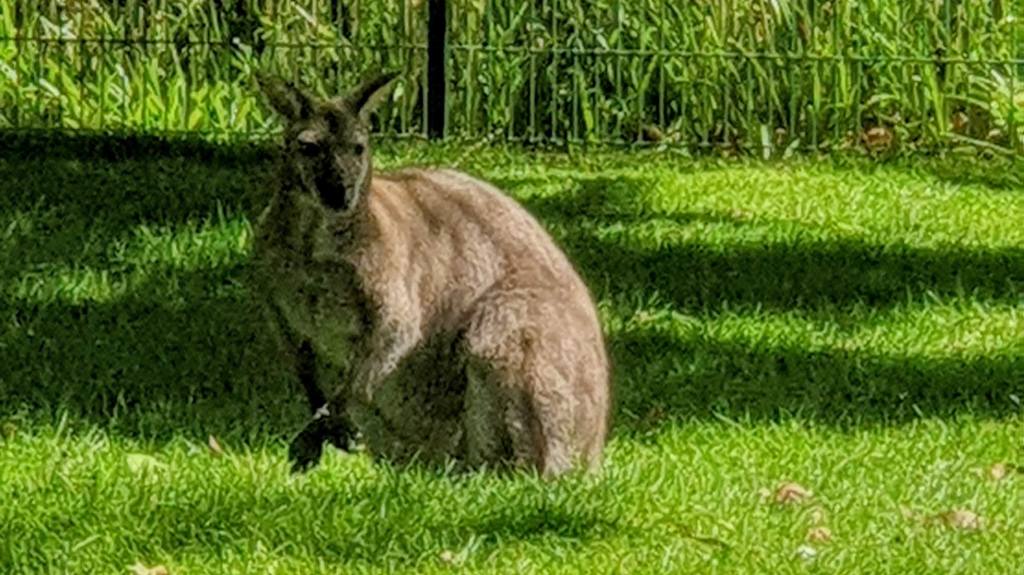
It is by no means a full zoo, but I feel like it added a layer of beauty but also entertainment and diversion (especially for children). There were some wallabies, peacocks, flamingos, turtles, tortoises, and a lot of farm type critters (chickens, geese, ducks goats, rabbits, and even a pig). Most of the animals were fenced away, but there was a mini-farm where people could go in and get a bit closer. 

At the opposite end, there were two playgrounds with equipment for children to climb and play on, and still more beautiful lawns of grass for people to picnic and nap on underneath the enormous sprawling trees. I left the park feeling tranquil and refreshed with the satisfied feeling that my last weekend in Tours was extremely well-spent.

Fall in Korea

During my first two years in Korea, I took almost every opportunity to go to a festival or event. In large part, it was because as an EPIK teacher, I had very short holidays, so I spent my weekends seeking fun. Now that I have great big holidays, I find I’m saving my money for those long trips abroad. Plus, it is a bit repetitive to go to the same festivals and events each year. This year, my favorite tour group, Enjoy Korea, changed up the line-up on their fall foliage trip, so instead of going to the DMZ and Seoraksan, we would visit a famous penis park, a coastal railway, and Seoraksan- a mountain that’s quite large enough to visit twice and see totally different sights. I decided to sign up, and as luck would have it, some other ladies I know from around the country also signed up so we got to hang out together. Although it was a lot of riding in buses, the weather was everything we could have asked for, and I had a lovely time.


Haesingdang Penis Park (해신당 공원)

It is a constant source of curiosity and amusement among the foreigners that in such a conservative country as Korea there are multiple overtly sexual and outright pornographic sculpture parks. I visited the famous Love Land on Jeju Island a few years ago, and so I was curious to see the similarities and differences with that very modern invention and what was ostensibly a more historical park at Haesingdang.

20191019_143947

The legend of Haesingdang has some inconsistencies, but basically there was a young maiden who’s fiancee (new husband? she’s supposed to be a virgin, though so they can’t have been married long) is a fisherman and through a series of unfortunate events he ends up leaving her on a large rock rather far from the shore (perhaps to harvest the edible seaweed?) while he takes the boat to fish, promising to return for her at the end of the day. However, a horrible storm arises and he is unable to fetch her and she drowns.  The next day, there are no fish to be had, nor any the day after that. The people believed that the spirit of the drowned maiden was ruining the fishing.

Here’s where it gets extra confusing. There’s a group of three statues up on the hill overlooking the ocean that are supposed to be a part of the legend. The are very… um… priapic. I’m unclear as to whether they were masturbating into the sea, or simply showing this poor virgin girl what a good dick looks like. Many versions of the myth also state that it was a man urinating into the ocean that caused the spirit to be appeased and the fish to return, and anyone who knows the function of a prostate knows you can’t urinate when you’re .. um.

20191019_152713.jpg

All the legends agree that it was the sight of a penis that made this virgin maiden relent and bring back the fish… I guess she was really horny? I don’t really know. Since then, the locals carved several wooden phalluses to put along the seashore and twice a year they have a religious festival to show big wooden penises to the maiden in the sea.

It’s really hard to get any hard data about this park or the statues in it. It’s likely that the myth and the rituals are hundreds of years old, but given the near total destruction of everything in that region during the Korean War, it is highly unlikely that those are genuine historical statues. More than likely they are modern reproductions and best guesses combined with truly modern art pieces like the golden penis on the stairs that was made in 2006, and a row of new statues that seems to be growing one penis a year down the path (the latest one was dated 2019).

Most of the museum looks like it was either made in the 70s or by someone aesthetically stuck there. The fishing village museum included a series of arrows leading nowhere past some large fake aquariums (plastic fish, no water) and a large diorama of a historical fishing village, plus some interactive video games and “fishing” toys.

There are plenty of photo ops where you can sit on a giant penis, or sit on a bench and look like a large erect penis and hanging balls are sprouting from between your legs. There’s a small temple dedicated to the maiden who drowned in the legend. And there’s about 50 or so wooden carvings of exaggerated penis shapes, or people with penises for heads, or penis totem poles. A star attraction is the 12 zodiac animals in penis pillars.

Aside from the overwhelming collection of dick, there is a stunning view of the sea from the top of the stairs which is in my opinion, one of the best parts of the whole park. You can actually see the rock from the legend in this photo. There’s a statue of the maiden on the rock you can see with binoculars.

20191019_143044

Normally conservative and reserved Koreans take these kind of parks as a place to cut loose. Although no one did anything inappropriate like public exposure, there’s plenty of lewd gestures and old ladies laughing while their husbands look a bit uncomfortable. It’s not all bad for the guys, though, they get to pose next to unrealistic dicks and dream.

Yonghwa Coastal Rail Bike (삼척 해양레일바이크)

Also known as Samcheok Costal Rail Bike, it’s the same thing because there is only one rail bike in all of Korea.

“the one and only coastal rail bike in Korea and it runs on 5.4km-long double tracks through beautiful rocks and special type of pine trees called Gomsol (Bear Pine)”

I love the coast. Sandy beaches, rocky shores, sweeping cliffs, I don’t care I love it all. So when I heard this trip was going to include a leisurely hour long rail bike up the coast, I was pretty stoked. Now, I won’t say that this wasn’t hilarious fun, but if you’re expecting an hour of beautiful ocean views you will be disappointed.

A rail bike is basically a little car that is mounted on rail tracks and powered by pedaling. Thankfully, these cars had real seats and we were not mounted on bicycle style seating. Myself and the other short person had a very hard time both sitting and reaching the pedals, but with 4 people working on it, and some motorized assistance, the trip is not especially exerting.

20191019_161448.jpg

The beach that we left from (Yonghwa) is quite pretty, but it is dominated by the rail bike station, and by the time we pedaled out of the building we only had a few moments of beach before we were leaving it behind. The beautiful view of the sweeping coastline is also partially obscured by those special pine trees and a fence. I had hopes that with the better part of an hour still to go, we would get more sea views, but the next part of the ride took us into a tunnel.

There was some distinctly Korean attempt to make the tunnels more interesting by adding colored lights and some neon underwater scenes, all set to strange 80s music in English. I think it would have been ok for a short tunnel, but it soon became droning and repetitive. My peaceful, sunny, seaside bike ride had turned into some hellscape of neon, concrete and bad club music. I didn’t even think about taking video at the time, so I’m borrowing my friend’s which is unforgivably shot vertical… sorry! I did at least replace the horrible 80s music with something less aggressive.

I know there’s probably no way we could have stayed outside in the mountainous terrain, but I feel like there is much more they could have done to make the tunnel more enjoyable. I was so relieved when it ended… only to have us go into a second tunnel! In the end, I’d say we spent at least 1/3 of the “coastal” ride underground.

Another 1/3 was spent outside with little to no view of the sea. We saw some cute pensions (a kind of Korean hotel), and a few resort attractions, and even a large sculpture of a battleship covered in some found art objects (I was moving to fast for a decent pic). The woods were randomly dotted with the leftover remains of the summer glamping (glam+camping) season, a few heavy machines, and a LOT of debris.

20191019_165024.jpg

I know we had like 3 typhoons in three weeks and the coast did get a bit messed up, but it really seemed like zero effort had been made to collect the rubbish. There was a brief stop at a little “rest area” after the tunnels and the beach there was pretty and clean, but we had only a few minutes to enjoy it before we were rushed back to the rail bikes and sent on our way.

20191019_164103-ANIMATION

Although you and your group pedal yourselves, there’s not any wiggle room to slow down to see nice things or speed up to get past boring things because it seemed like 50 cars were on the tracks at the same time and although we’d been told to keep 10m between cars, it was often closer to 2. On the plus side, when we passed a group coming the other way, it was a lot of fun because they were excited to see a large group of foreigners and we got lots of greetings, big smiles, and high fives in passing.

Overall, I’d say it’s a fun but silly way to spend an hour, and not a calm bike by the sea. As long as you go into it knowing what you’ll get, it’s worth it.

Seorak Mountain and the Fall Foliage

Also known as Seoraksan, san simply means “mountain”, Seorak is one of the premier places in Korea to take in the fall foliage. It’s pretty far north, and close enough to the sea that you can see the ocean from the peak on a clear day. Plus, it’s elevated. This means that the conditions for beautiful leaf colors are really promising. It’s a little like driving up to Connecticut for Americans.

I went once three years ago and had a gray drizzly day which made the leaf colors really pop, but made the sweeping views pretty much a misty, uh, mystery… I also struggled a lot with the ajuma and ajoshi (Korean’s of a certain age) who all showed up in their special hiking clothes and walking sticks and charged up the path like it was a race to the top. I personally wanted to meander and enjoy the trees, take some pictures, admire the little details. They wanted to walk. Quickly. I was elbowed so frequently that it made it almost impossible to enjoy anything, let alone obtain any sense of serenity. I was almost knocked off the mountain (down a steep ravine) and when I slipped and fell on some wet rocks, people just shoved past me instead of giving me room to stand up or heaven forbid, helping. I did not want a repeat of this experience this year.

20161023_140752

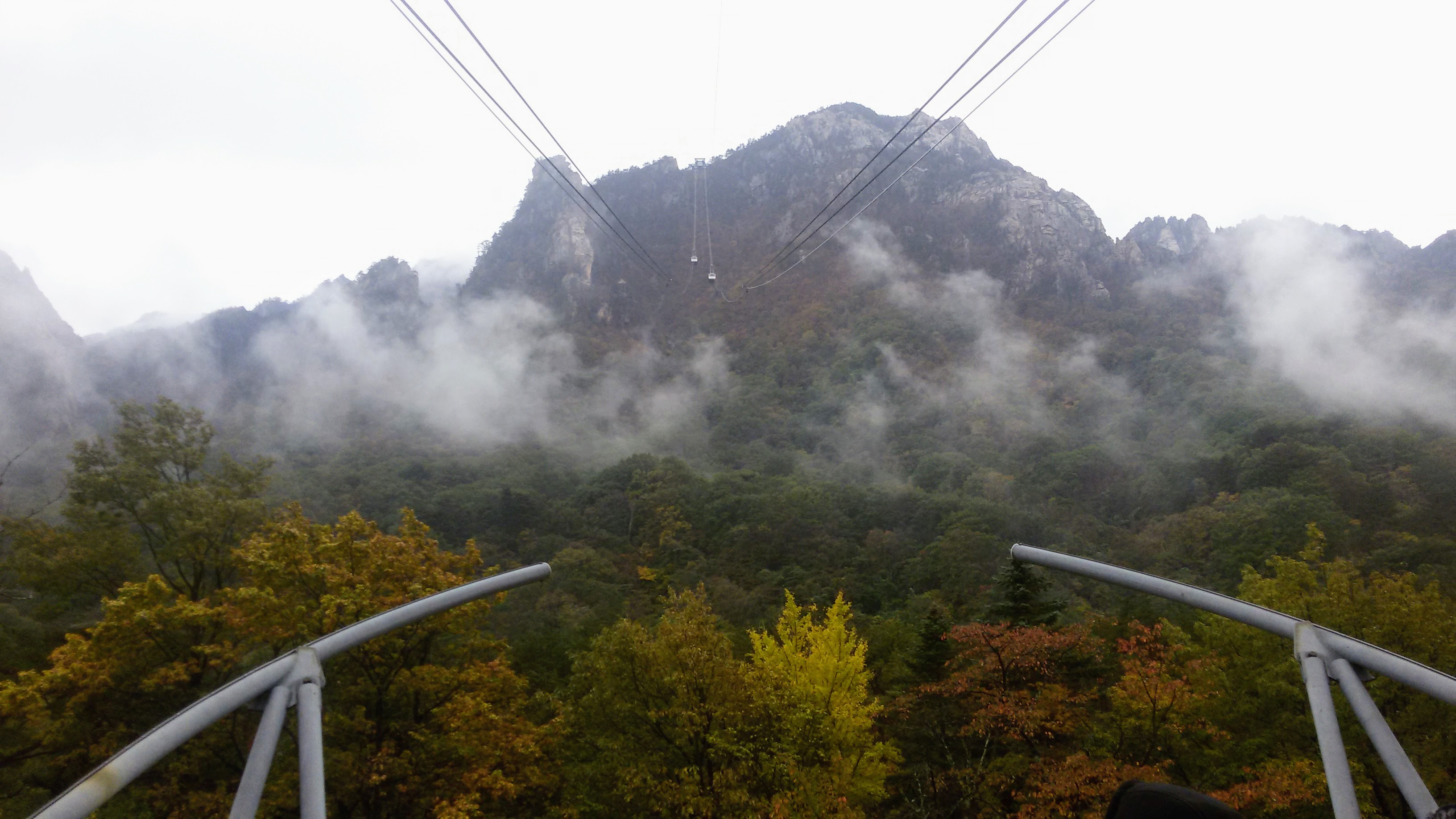
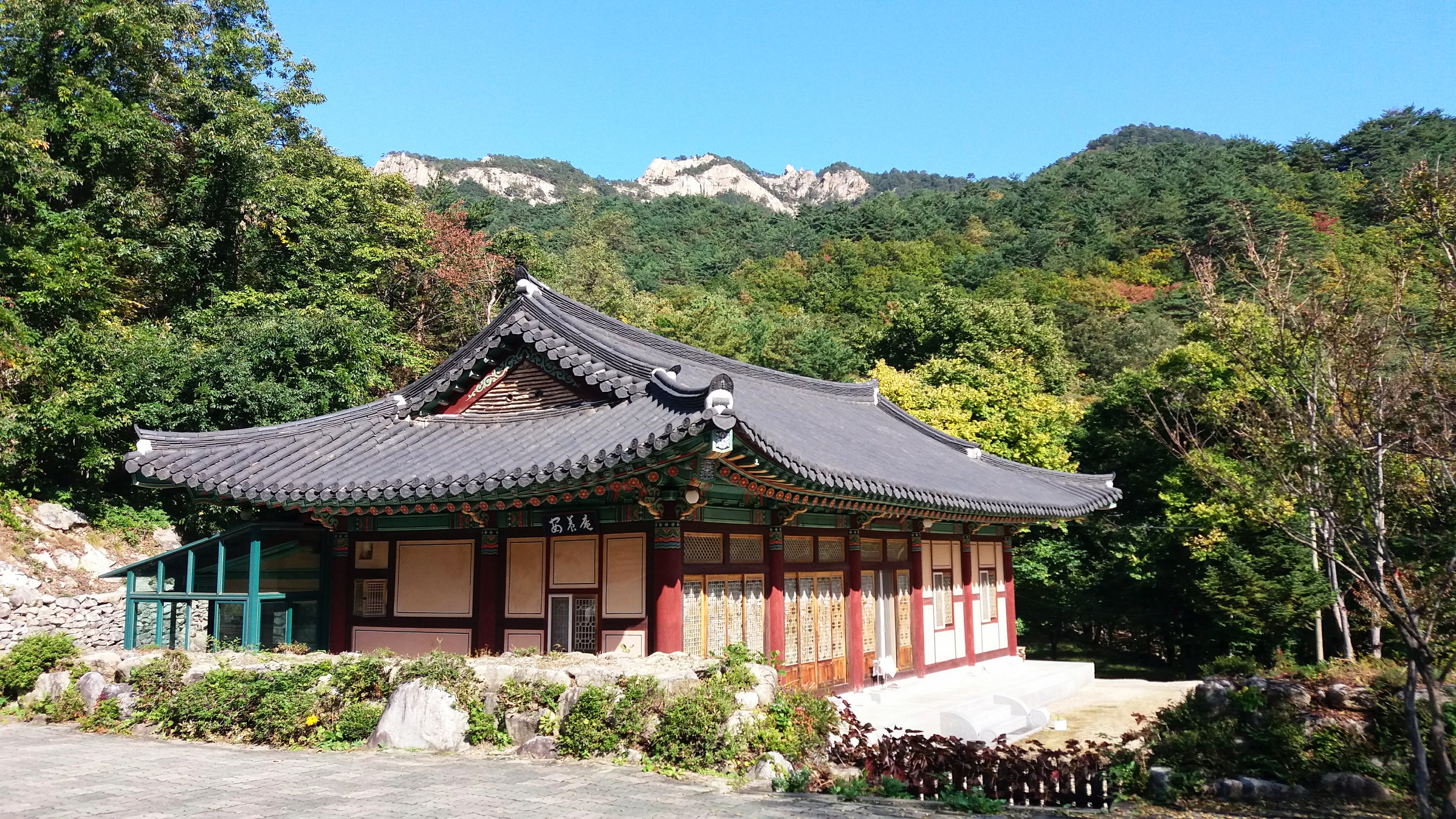
I am spoiled by the PNW mountain hikes which are quiet and often very private. I love forest bathing in Japan, and the peaceful mountainside temples. There is a temple at Seoraksan, but it’s a bit tricky to find. On my first visit, I managed to get a ticket to ride the cable car up and from the crowded platform, I followed a small trail with signs I recognized from the Chinese characters up and around to a small temple. There was no one else around, and I finally got some of the peace and serenity I was looking for. I was very much looking forward to visiting that place again.

20161023_150117.jpg

This year, we had amazing weather. The sun was shining, the sky was blue, and it was just warm enough not to need a jacket but not hot enough to make us sweat. Upon arrival, we charged straight for the cable car ticket office only to find that everything was sold out until 3pm. Our bus was leaving at 4, and we couldn’t reasonably expect to get up and get back unless we rushed, which was counterproductive to my reason for going -eg to relax and meditate in that beautiful temple. I suppose we could have tried to race up for the chance to see the clear weather view, but neither my friend nor I were particularly interested in stress or speed that day.

20191020_155218.jpg

I think that the park is gorgeous in any weather, but I’m glad I got to see it in the sun. I’d like the chance to hike it one day, but clearly the fall foliage isn’t the right time for me. It makes me think of the mountains I climbed in China, Tai Shan and Hua Shan. There were certainly other people climbing those days, and I was inevitably the slowest, but the Chinese were so much more relaxed about going around me, some liked to stop for a chat or a photo, but even those in a hurry didn’t run me down. It’s been a recurring issue for me in Korea that I feel like the frog in Frogger any time I’m anywhere crowded. I really don’t think it’s only crowds as other large cities, even mega cities like Beijing and Tokyo do not have these problems. It can make it a struggle to go to an event here knowing that being shoved around all day will definitely be part of it.

My goal for this trip was to try and find the part of the park that wasn’t going to make me play elbow dodge-em. We decided to stick to the less popular paths that wandered the foot of the mountains and just to enjoy ourselves and take a million photos. It was lovely. There were still a lot of people on the “boring” trails, but with only one or two hiking-gear clad racing groups it was easy to step aside and let them by. The rest of the people on our path seemed to share my idea that it was a lovely day for a stroll. Plus the walkways were smooth and wide, so there was plenty of space to go around / step aside and no risk of being knocked off a steep slope!

20191020_142717.jpg

I got to spend a long time with the giant Buddha and even go to the small temple beneath it which had not been open the first time I visited. It wasn’t quite the same as my mountain peak temple, but it was nice to soak in the beautiful chanting and just still my breath and mind for a while. There was a monk inside performing a ceremony. It seemed like visitors could donate to the temple to have a prayer recited for them. I hadn’t realized it while I was above ground, but the chanting we were hearing all around the statue wasn’t a recording. It was the monk below chanting live. If you’ve never had a chance to hear a Korean Buddhist chanting, here’s a sample:

Most of the colors were higher up the mountains, we could see them from where we were, but still declined to hike up. Instead, I scampered off the path after the lone red tree or orange branch and ended up with a lot of close up photos. The effect of the sunlight streaming through the colored leaves was so stunning that I really didn’t mind that being my primary subject.

We came upon a clearing near the river about the time we were ready for a break. I sat down on the rocks overlooking a beautiful little valley view and just enjoyed life for a while, the trees made a perfect picture frame for the mountains beyond. When I had a bit of energy back, we climbed a little down to into the river bed. My friend actually went out on a huge rock in the middle of the river for photos, but I settled with a rock that was a bit closer to shore.

20191020_115139

Next we explored the large (aka main) temple in the park. It had beautiful carvings of flowers on the buildings and bright blue ceramic tiles on the roofs. I think that my best overall landscape photo of the day came from a small grassy knoll just behind the temple compound. Bonus, I got to refill my water cup at the sacred mineral spring! Along the way, I also found several balanced rock towers left by previous tourists, any number of glittering spiderwebs, a few really beautiful spiders that hadn’t given up for the fall yet (they hibernate in the cold, I think because I never see them), and even a stray mushroom patch.

20191020_132029.jpg

We walked a short way past the main temple toward the base of another arduous uphill hike. We had no intention of going up, but we thought it might be nice to walk along and see what else was on ground level. I’m glad I did because we found the Legend of Ulsanbawi Rock. The hike we were avoiding would have taken us up to this famous rock, but we could see it pretty well from the ground that day.

20191020_135130.jpg

According to the legend, a looooong time ago, the gods ordered all of the rocks to gather together to create the 12,000 peaks of Geumgangsan. Also sometimes spelled “Kumgang”, this is the most famous mountain in North Korea. Obviously the myth predates the 38th parallel. However, it’s only about 50km (30 miles) north of Seoraksan. Ulsanbawi was a very large and heavy rock, travelling from Ulsan, about 350km (217 miles) from Kumgang. He had only got as far as Seoraksan when it became dark and he laid down to have a rest. The next day when he awoke, he learned that Kumgang was all finished being made, and he was no longer needed there. However, he was too ashamed and embarrassed to return home to Ulsan, so he curled up on Seoraksan and has remained there until this day.

20191020_134610

On the way back from our low ground view point of Ulsanbawi, we found yet another small temple, and passed a number of beautiful bridges criss-crossing the rivers. Lunch was only slightly challenging as we looked for a keto-option. I had hoped for the famous seafood pajeon for myself, but there was such a large back order at the restaurant, they said it would take over 30 minutes. I ate bibimbap instead, and it was still delicious sitting on the patio staring out at the mountains as a backdrop.

20191020_152909.jpg

We rushed to grab more last minute photos of the park entrance we had raced by on our arrival (hoping to get those cable car tickets), and made it back to our tour buses with about 1 minute to spare. It wasn’t an action packed adventure, but it was almost everything I could have hoped for. I was still a little sad about the cable car situation, but I saw so many other beautiful things, and I didn’t get run into by a speeding ajuma even once.

Back in the USSR? This time with a visa!

I am falling right behind on my goal of 1 blog post a week. In a desperate effort to get moving, I went and found the most complete draft on file, also the only one I wrote AFTER vacation instead of quick notes on a bus this summer. Maybe there’s a reason Dostoevsky and Tolstoy wrote such long novels. I was also inspired toward verbosity by my brief visit to mother Russia and I have had to split up the story into 2 parts. In part one: explore the bureaucracy of communism, the truth behind the soviet stereotypes, and an encounter at the Metropol Hotel.


Airports Are Ugly

I have flown through the Moscow SVO airport before. It’s not especially exciting, but their primary state run airline is dirt cheap so I find myself having layovers lasting on average 3-4 hours there. This time I had a 20 hour layover on the return flight. I can’t imagine many airports I would willingly spend 20 hours inside. As Douglas Adams once famously wrote, “There is a reason why no language on earth has ever produced the phrase ‘as pretty as an airport’.” Since the first time I read this I have had the singular experience to be in some of the best and worst airports in the world, and I can say with certainty that the Moscow International Airport is not a place to linger.

There are few places you can sleep inside the airport, like hourly rental sleeping pods, or even the airport’s very own hotel (the one Snowden hid out in). I looked into these and discovered that the prices are almost as much as the plane tickets. Even if you’re willing to camp out on the crowded and uncomfortable airport seats, there is no way to get WiFi unless you have a Russian phone number, so be prepared to be both uncomfortable and bored. In order to take advantage of any less expensive hotel (or WiFi) option, you have leave the airport, but unless you are from a very narrow list of close Russian allied countries, you can’t leave the airport without a visa. And you can’t get a visa at the door, you have to apply for and pay for that visa well in advance of your arrival.

You Need a Visa To Get In

Tourist visas to Russia require a letter of invitation. These are usually arranged by tour guides which seems like a giant scam, but that’s a whole other rant. Transit visas can bypass the letter requirement if you have proof of your ongoing flight. The transit visa can be used for up to 3 days if you’re flying and 10 if you are travelling by train.

Thus, my trip to Moscow actually started in June with the Russian Consulate in Busan, South Korea. Since they weren’t open on my day off, I got up very early in the morning on a Friday and bused into Busan to file my paperwork. I was able to fill out and download the application online and print it at my office, however the application took several hours to fill out because in addition to all the normal information, they wanted the exact dates of all my international travel for the last 10 years. They also wanted complete information on all my secondary education, and on my parents, and to know if I had any education whatsoever about nuclear weapons (I do!). I felt like I was filling out a background check for the CIA.

I nervously handed over the painstakingly researched application form and paid the 100$ fee, hoping that nothing would disqualify me from going and returned to my home to wait a week for the results. I shouldn’t have been worried. Communism loves bureaucracy and to make people jump the hoops and I have become an expert form filler. A week later I made the trek back to the consulate and my passport was returned to me with a shiny new 1 day visa inside. I booked a hostel and an airport shuttle and more or less forgot about it for 2 months.

Midnight Arrival

When I landed in Moscow, it was just after midnight and amid a flood of Chinese tourists, but it didn’t actually take all that long to go through customs and immigration. Since I was technically on a layover with a connecting flight, I had checked one bag through and was only carrying my day pack and a basic change of clothes with me. My visa was scrutinized intensely. This guy busted out a jeweler’s lens to stare at it in minute detail. Eventually, finding nothing wrong, they allowed me to pass out of the international terminal and onto Russian soil.

There is an oddity about the Moscow airport in that the WiFi requires you to give a phone number where they will send you a code to log on. It’s “free WiFi” but you can’t access it if you don’t have a Russian phone number. It’s frustrated me every time I’ve flown through, and I’ve never been able to get it to work. Really, it’s free if you’re Russian, but it’s a taunting WiFi dream to international travelers. Knowing this, while still in Norway, I had downloaded the offline version of the Moscow map in Google maps (which is a lie), and the Russian language on Google translate (which I never actually used) as well as information about my hostel, just in case.

I got some money changed to Rubles, and I found my driver. If my flight had landed during the day, I might have tried out the public transit, but at midnight thirty I was happy to see a man holding a sign with my name on it and ready to take me directly to the hostel, even if the ride did cost more than the room. It was a long and empty ride through Moscow. I’m not sure if it was just the late hour but the roads were empty. And they were huge! City roads, with business and sidewalks, not like highways, just roads that were 10 lanes across, 5 lanes in each direction. I stared at them wondering how people crossed the roads on foot and even more if these behemoths aided in the flow of traffic. Do enough people in Moscow own cars for this to be actually useful or is it just for show?

Hostile Hostel?

Checking into the hostel was another long rigmarole of paperwork: fill this out, sign this, make a copy of my passport and visa, etc. I chose a cheapish hostel thinking since I only was going to get maybe 6 hours of sleep, I didn’t need much but I also carefully selected one that was highly rated with plenty of good reviews and a location that would make it easy to get to Red Square in the morning.

One day… the lesson is going to stick. When travelling in less affluent countries: spend the money on a private room! The hostel bed was around 10$ and a private room would have been about 30$. It’s a big difference and at the time I was thinking about every little penny because I wanted to keep my budget down and Moscow was already costing me 100$ just for stepping out of the airport. I had spent a single night in Paris in a dorm and slept pretty well, but that was Paris.

Gallery image of this property

The hostel itself did not live up to my expectations based on ratings and photos. Looking back I can see those are real photos, but they were clearly taken when the interiors were brand new or at least recently deep cleaned. In reality the place was much more dark, dank, cramped and dirty than the photos represent. Even by the light of day. Now, I’m not saying it was a shithole… it did meet my minimum standards of clean and the staff were very polite in a cold sort of way, but I did not rest well.

Like many hostels in Europe, I was expected to make my own bed. The staff do not consider it their responsibility to put sheets on the bed, nor to remove them. I struggled with this as it was almost 1am and I had a top bunk and everyone else was asleep, so I couldn’t turn on the light. Also, the bedroom door seemed to have no lock at all. The bathrooms were very tiny and when you’re sharing a single bathroom with all the other women in a large hostel, that’s a challenge.  One of my roomies snored so loudly that it made my bed actually vibrate. I could feel her snores. I put in earplugs, headphones, and squashed pillows, blankets and towels around my ears to no avail. When I got up to get dressed, there was no place private to do so.

The hostel included WiFi, which did work well, yay, and a free “breakfast”. In the morning I discovered this meant a choice of two sugar cereals, luke-warm milk, watery coffee, and packets of what I really think were yogurt powder. I couldn’t read the Russian labels and I didn’t try to eat it, but they were packets filled with what felt like a powder with pictures of bowls of yogurt and fruit on the front. And somehow this breakfast is rated 7.7 on Booking.com. In fairness, that is the lowest internal rating and every other criteria is rated 8.4 or higher. I don’t know what your life has to be like for this to be a 7.7/10 breakfast, but I never want to live it.
Gallery image of this property

Just, please, if you see me talking about booking a hostel dorm in a developing country or a current/previous communist country STOP ME. I’m not trying to be a snob, but sleeping properly is so important to my well-being and my ability to enjoy waking activities and I just can’t sleep properly in those conditions. I envy the people who can.

Metro Mishaps

Despite these setbacks and the severe lack of sleep, I was still determined to make the most of my day in Moscow. I had a detailed and timed itinerary that I hoped would allow me to see everything I wanted to before it was time to go back to the airport. The first thing I discovered is that the Google Map of Moscow isn’t great, and the offline function doesn’t really do anything. Here’s a pretty building I found while searching for the metro.

20180821_091840It took me ages to find the Metro station that was meant to be a 5 minute walk from my hostel in part because Google, and in other part because the Metro stations in Moscow don’t have any helpful signs with pictures or symbols to identify them. Maybe they say the name of the station on the outside, but I was looking for a big “M” or an icon of a subway train which has been a constant in every other metro system I’ve used. This is actually the logo for the Moscow metro and it was not on any of the buildings or any signs nearby.Image result for moscow metro

When I finally realized that the big square beige building was the metro station, I had walked past it at least 7 times because I thought it was a government building like a post office or police station. It was much easier every other time because at least they all look the same. Of course I didn’t take a picture at the time, and now looking at stock photos of the building I see that it clearly has a big red M on top and a sign out front, so I can’t explain why it eluded me so. I blame sleep deprivation.

Once I found the entrance, I was happy to learn that the metro system itself is actually very easy to use, and cheap too. Rather than go through the hassle of buying a ticket for every trip, I just bought a 24hr pass for about 3$ US. That’s a whole day pass for less than the cost of a single trip in most EU countries, by the way, and goes a long way to explaining the powdered yogurt situation.

On top of its ease of use and affordability, the Moscow metro is famous for it’s unique and beautiful (on the inside) metro stations . At some point in the soviet era, it was a gift to the people to make each public transit station a work of public art. No one could visit them all in one day, but I tried to get some pictures inside the ones I did use. They are very very Soviet, but amazing works of art nonetheless.

Red Square Obscured

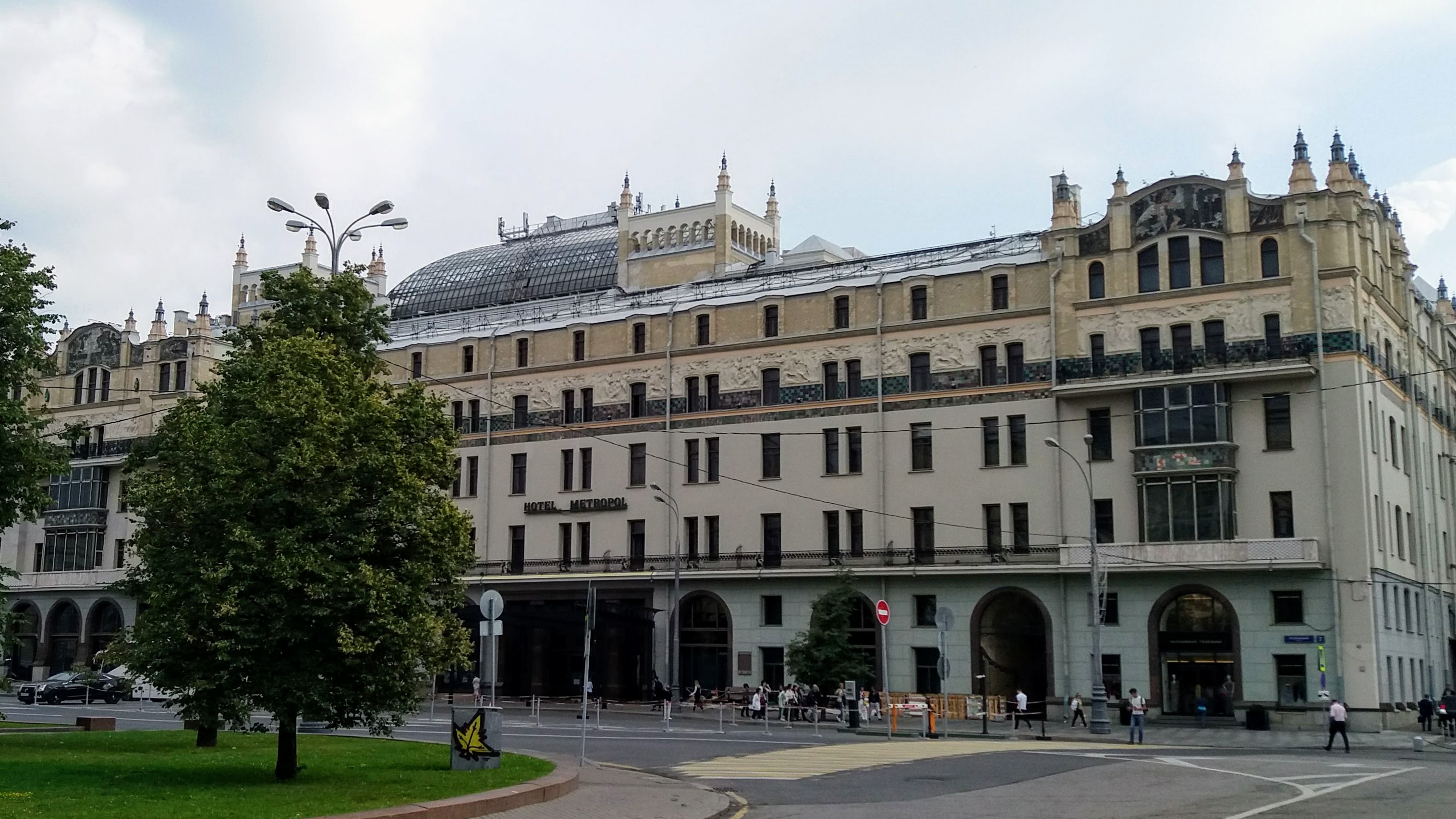
When I emerged from the station at Red Square I was instantly lost. I had expected the world’s largest public square to be visible from the metro station that shared it’s name, silly me. I adopted the time honored method of picking a direction and watching where my GPS dot went on the map. The first landmarks I ran across were actually the Metropol Hotel and the Statue of Marx. I recognized them from my plans as places I had intended to go later in the day, but it did help orient me to find Red Square and St. Basil’s Cathedral which was the top of my list for the day.

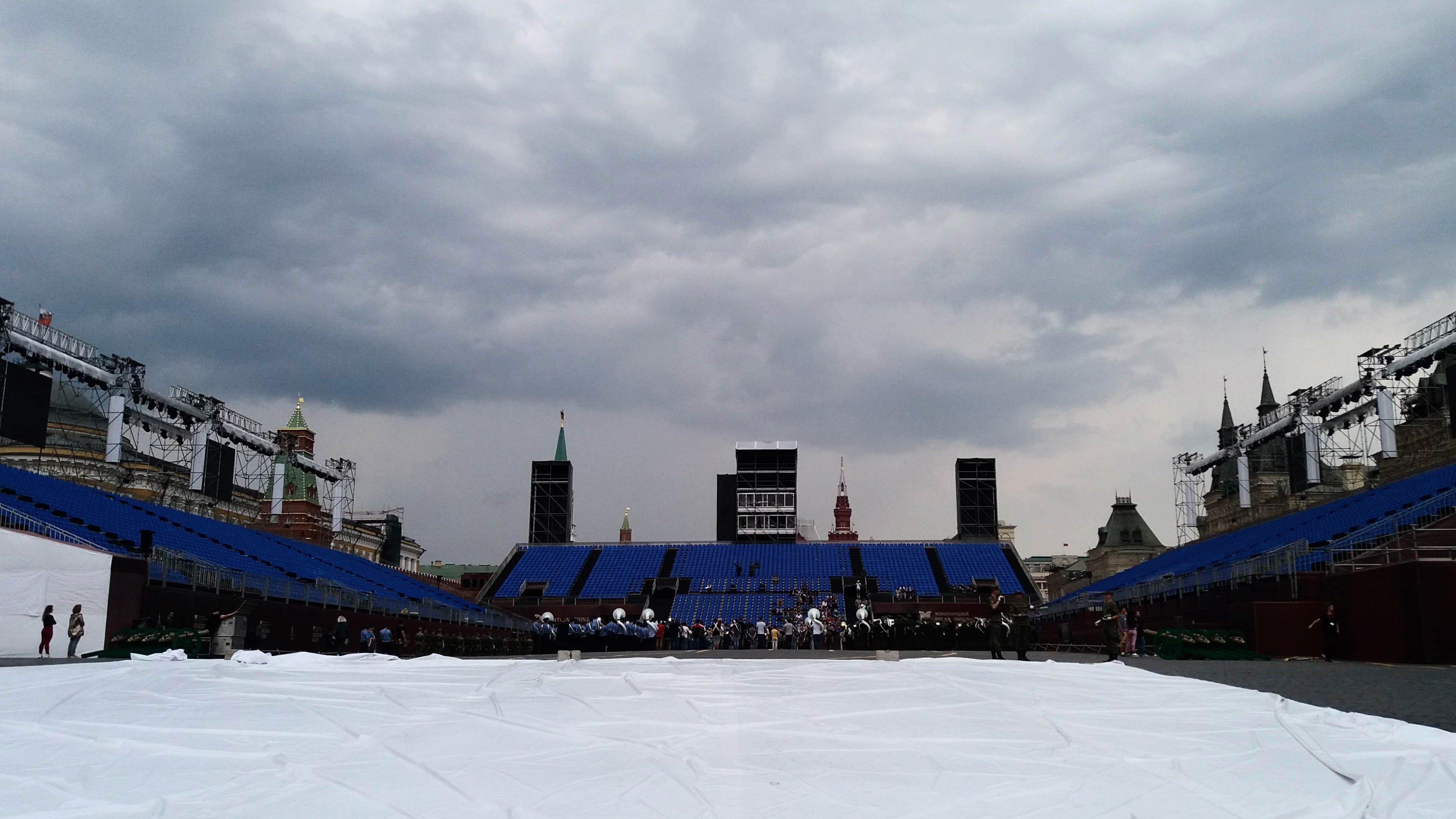
20180821_100129Sadly, I still don’t know what Red Square looks like, since there were about a million white tents set up and a large area blocked off and converted into a stadium for an upcoming festival. I walked slowly and perused the kiosks selling a narrow but colorful array of Russian souvenirs. I didn’t stop to buy, however because it looked mostly mass produced.

I also walked past the line to Lenin’s tomb, where he is preserved and laid out in a rather grotesque honorarium. Entrance to the monument is free, but there is no way to reserve an entry time, so people queue for hours for a chance to gawk at the dead body. I told myself it would be interesting if the line was short enough, but by the time I arrived around 10am, it was already all the way down the block and didn’t seem to be moving very fast.

20180821_095746

Tourist Stuff

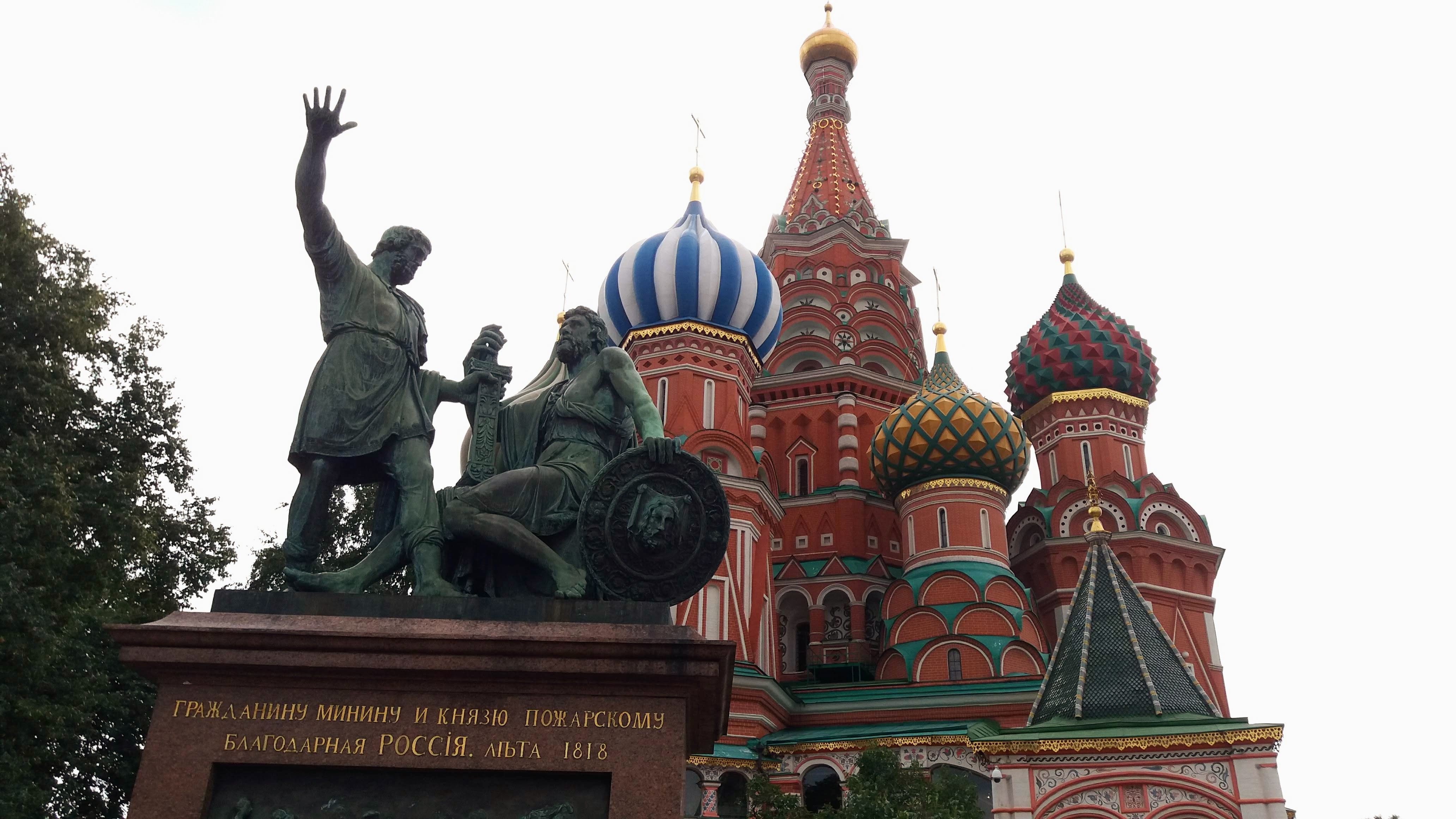
St. Basil’s did not disappoint. It was crowded as heck, but it is a fun building. Everyone has seen at least one picture of the iconic colorful onion turrets and it was definitely a treat to see it in person. I wandered around trying to find the best angle for a photo, but since large swaths of the surrounding area were blocked off for the upcoming festival, it was a little challenging.

20180821_101349It’s possible to go inside for a fee, but online reviews all agreed that the cool part is on the outside. Bonus, there was a marching band practicing in the temporary stadium field nearby, so I got to watch a little bit of counter-marching through the fence and experience some serious cognitive dissonance as they played the 1812 Overture (for non-Americans, that’s because it’s a staple of our own Independence Day celebrations).

20180821_103628

Checking the clock, I realized it was time to head over to the gardens and try to find the entrance to the Kremlin. Only, because the entire breadth of Red Square was fenced off with a giant temporary stadium and lots of souvenir booths, I couldn’t follow my pre-planned route and Google maps was turning out to be f*ing useless. Once more I adopted the “pick a direction and walk” method, which resulted in me walking nearly all the way around the Kremlin, which is not a small building. In the middle of my walk, the sky went from a bit overcast to “wrath of Neptune”.

I always have my travel umbrella but it would not have withstood the torrential downpour that issued forth from the skies. Lucky me, at that precise moment, I happened to be passing under the only cover for several blocks in either direction, a bit of scaffolding along one corner of the Kremlin’s outer wall. Even standing under the scaffold with my back to the wall, I could feel the spray from the force of the rain around me. I sat there as other pedestrians scurried to the shelter and wondered if my plans to explore outdoors would be totally rained out, and what I could possibly do instead with no working internet. But before I could even really start to work it out, the rain slowed to a drizzle and I felt confident in resuming my walk armed with my little umbrella.

When I did reach the entrance, I found another huge line for the people who already had tickets, and I continued on through the gardens in search of the ticket office.

What’s With All These Lines?

I know there is a stereotype about lines in Russia. Or at least there was when I grew up in the cold war in America. We were told about how people had to just stand in long lines for hours to get bread, or sometimes not even knowing what was being passed out at the head of the line or if there would still be any by the time you got to the front of the line. They were communism horror stories told to show us how terrible the USSR was and how great America and capitalism were by contrast. I know it was propaganda, but I’m not sure it was untrue. I had already seen the huge line for Lenin’s tomb, but I knew that was a free event, and no way to buy tickets in advance.

Looking at the line to buy tickets to stand in the line to get in at the Kremiln was just insane. I freely admit that I ignored my note to myself in my calendar to book those tickets online in advance. Everything else in Europe I booked before I even left Korea, but Russia only takes reservations for the Kremlin 2 weeks in advance. While I was in Sweden. I made a note to do it, and I saw the note, and I ignored the note. My own fault. However, looking at the lines, I am not sure I would have made it through the “advance ticket line” even with enough time to really see anything.

I am a bit sad I didn’t get to see the Kremlin and especially the museum with the historical art and artifacts of pre-communist Russia. However, if I do make it back to Moscow, I will dedicate a whole day to the Kremiln alone, knowing what I know now.

20180821_112822_000-ANIMATION

Fun With Costumes

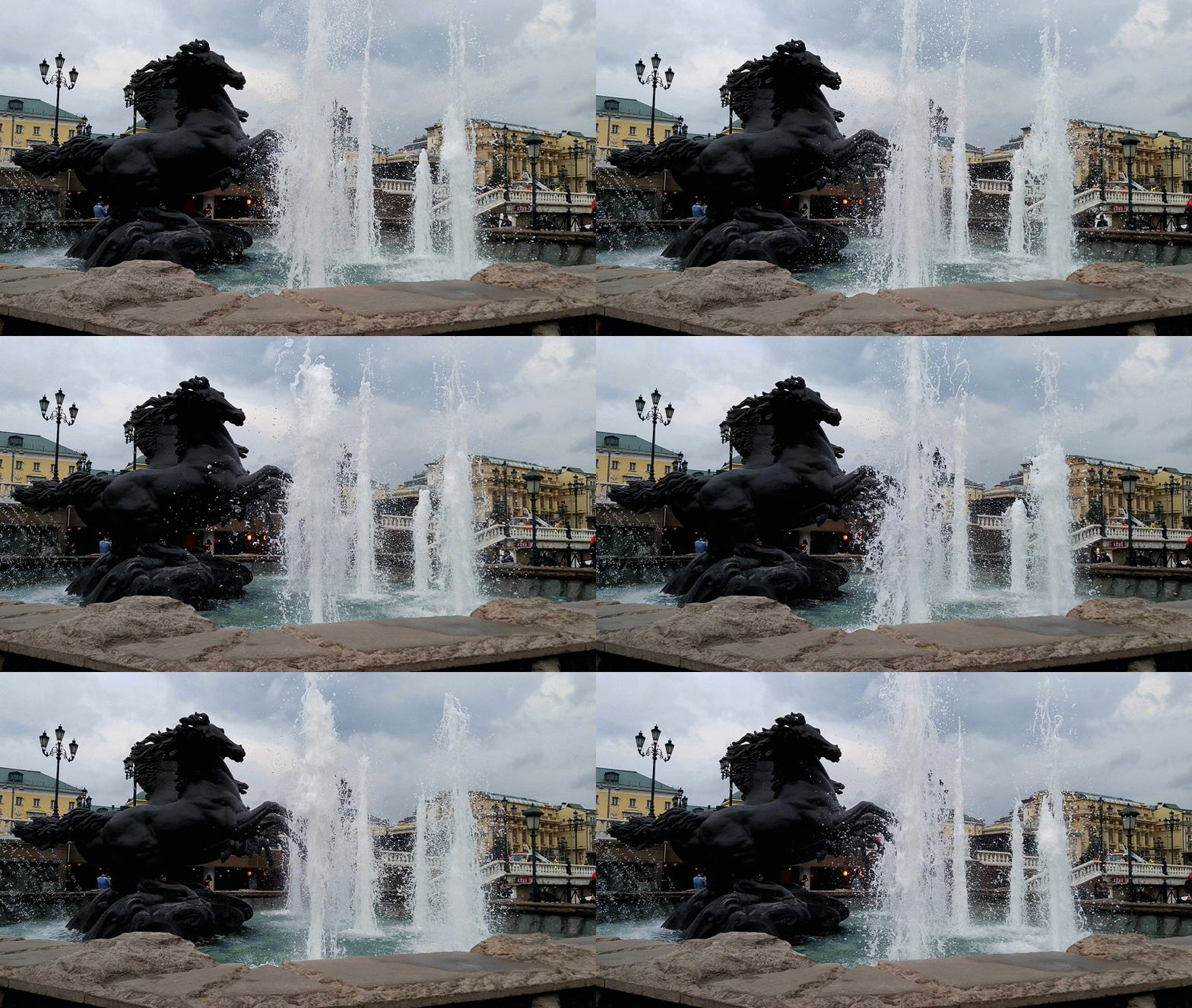
Instead of sulking about it, I decided to move on and see what other fun things I could find. I was not disappointed. Shortly past the ticket office, the scenery livens up and I found some more public gardens, statues, fountains, and a quite charming pair of street entertainers dressed up in “historical” costumes and posing with tourists for tips. They made me smile and so I probably gave them more money than I should have, even though it was less than they asked for.

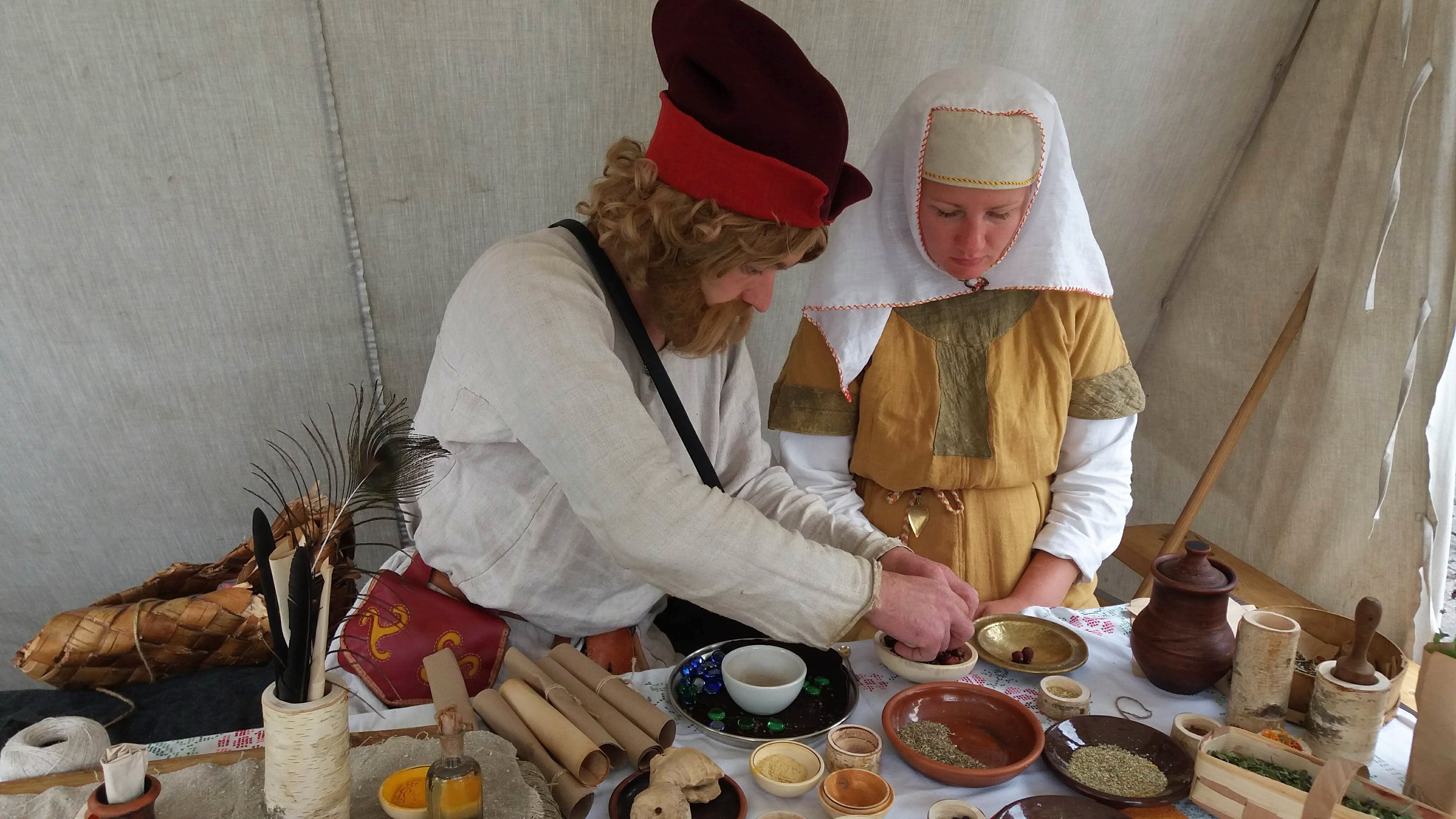
Continuing on I managed to find a slightly more accurate historical costume depiction where it seemed like a professional group was showing off the history of Russia and perhaps it’s trade partners with booths showing different herbs and spices, old astronomical tools and charts, paints and dyes, and other medieval type crafts and pursuits. It was all in Russian, though, so I wasn’t able to glean much from the informative talks the costumed historians were giving to the other folks in the park.

20180821_114933

Thwarted at Every Turn

After a quick gander at the statue of Karl Marx and the Bolshoi ballet because I was standing right there,

 
I headed up to the Metropol Hotel to see what I could find in the way of a fancy lunch. I had found a few places on line that seemed to indicate there was a high tea available, and while the website of the hotel still had it displayed in some places, the actual “high tea” page was not working. Still, I had seen the restaurant menu and knew it would be ok even if I just had lunch.

20180821_094706

The very first thing I saw was a bunch of construction and a sign saying the restaurant was CLOSED for repairs and upgrades. My optimism and adventurousness was wearing thin at the edges around now. So far, all of the things I’d set out to do with my very limited time in Moscow had either been harder than expected or totally impossible. I was also VERY hungry since the last meal I ate was a deli sandwich I got in Oslo the night before. I am not counting the bowl of sugar coated flakes at the hostel as a “meal”.

Clinging to the very last shreds of my “lets have a good time anyway” thoughts, I found the main entrance to the hotel to see if they were serving anything anywhere because I really didn’t know what else to do or where else I could go for a much needed lunch.

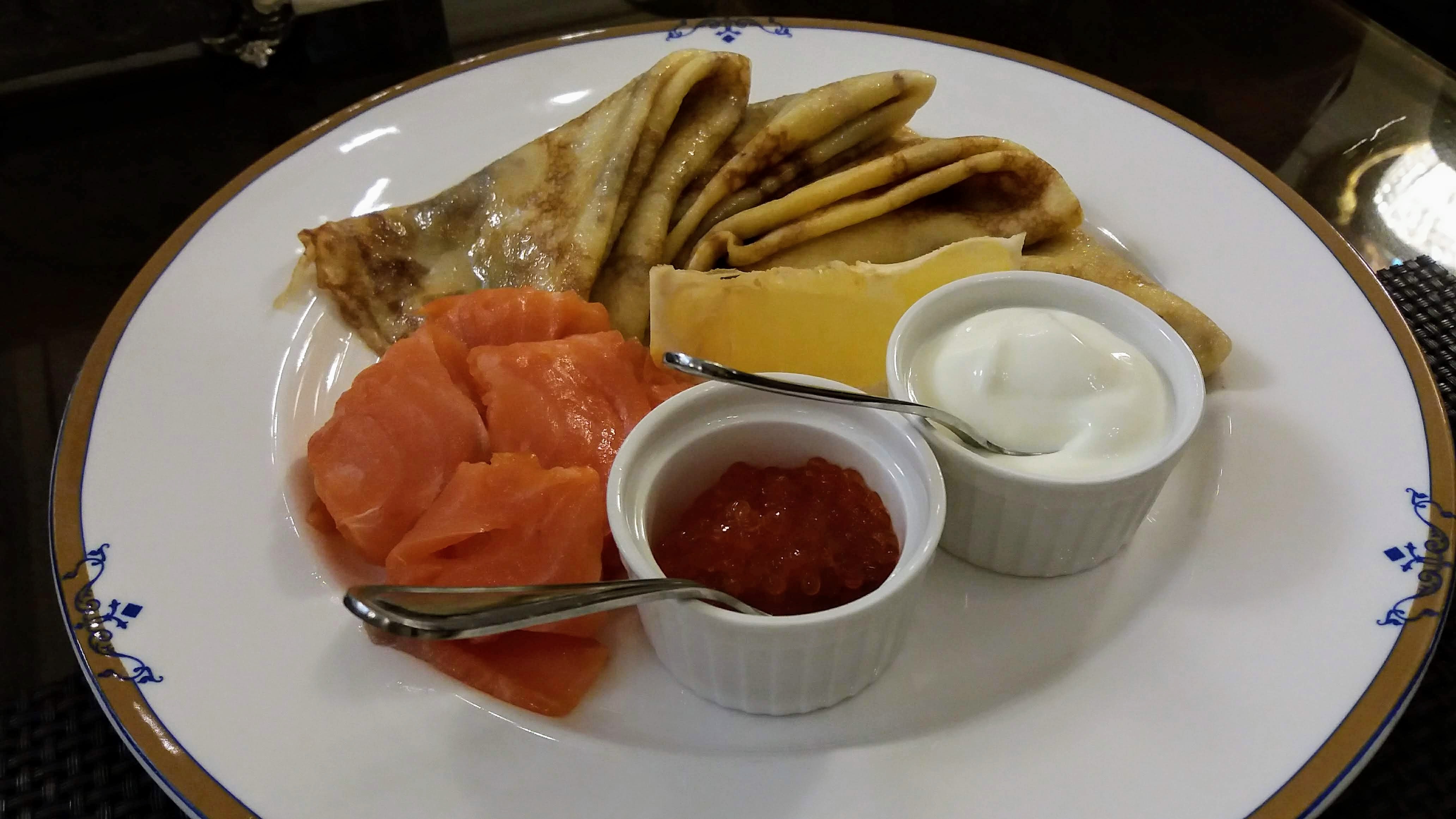
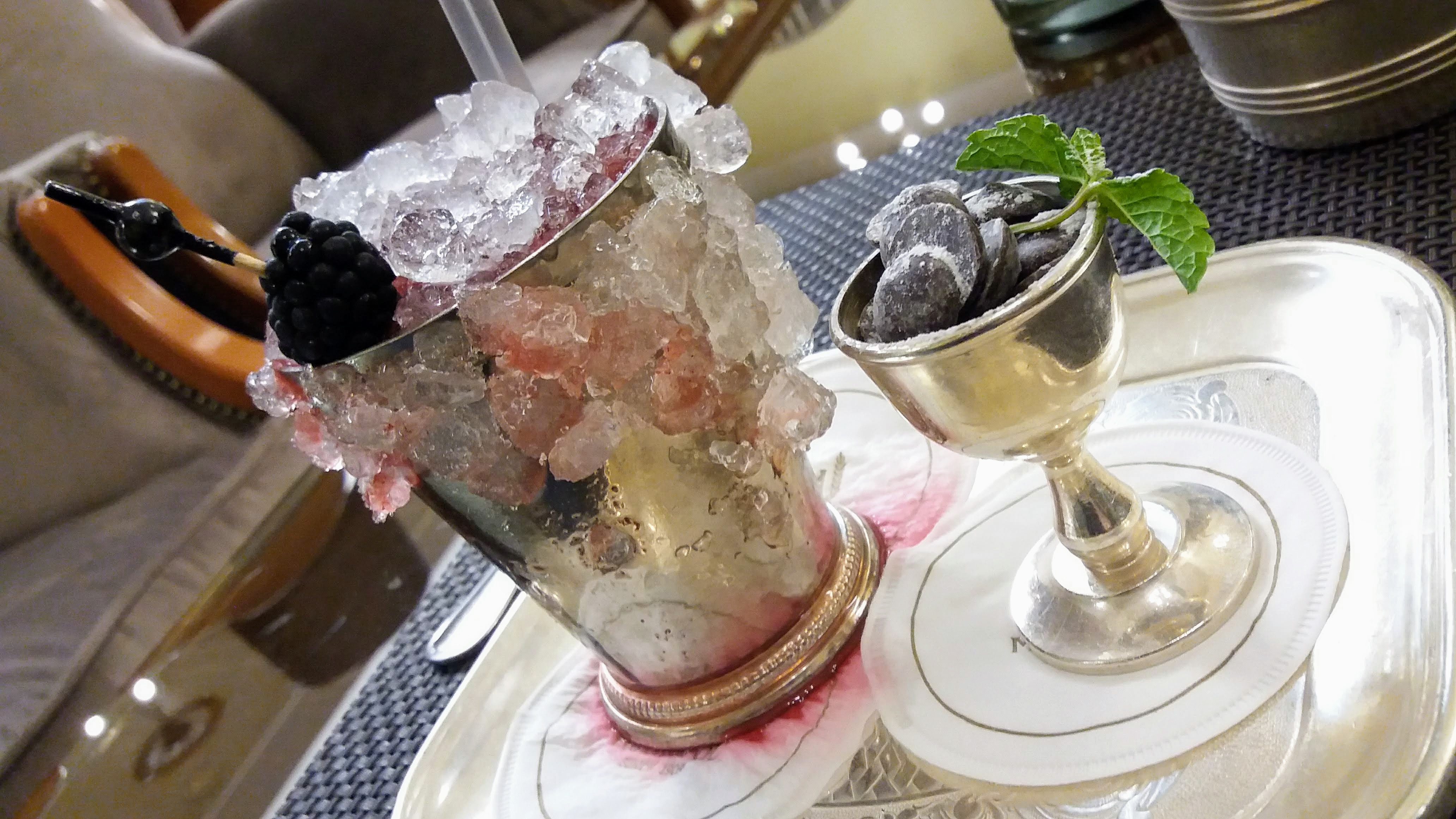
Although the staff at the hotel bar had no idea what tea ceremony I was talking about, (even though it’s on their website!) they were happy to seat me at a comfy chair in the lobby and bring me a menu. I ordered a “Stranger in Moscow” to drink, and salmon blinis for lunch.

The WiFi Is a Lie

When I went to explore the WiFi options, I discovered that the special nature of the Moscow airport WiFi was actually the rule of thumb for all Russian WiFi. I asked the staff if there was any way to log on, but without a room number or Russian phone number it was impossible. They didn’t even have a guest account available for customers of the bar or restaurant.

The more places I went, the more I realized this is just the way it works. Even Starbucks, a place famous for it’s free WiFi was inaccessible to anyone without a Russian phone number. So, if someone tells you not to bother with a SIM card because there’s plenty of free WiFi, well, they are both right and wrong. The WiFi is free, but you can’t use it without that SIM + Russian phone number. If I had known, I would have made the SIM a higher priority since it seems they are not too hard to find, but by the time I realized that WiFi was going to be impossible, I was more than halfway through my day and had no way to look up where to buy a SIM!

This obstacle was suddenly one straw too many in a morning full of them and I slowly began to leak from the eyes. I try really hard not to sink into despair or self pity when things don’t go my way on a trip, but everyone has a wall, and it gets closer with things like lack of sleep and low blood sugar, both of which I was suffering from at the time. It’s likely that I would have recovered after a some food and a rest, but that day I didn’t have to do it alone. A very kind fellow solo-female traveler sitting one chair over asked if I was ok and invited me to join her. She let me vent a little about my morning and then we quickly moved on to talking about our travels and experiences.

Lunch is Saved!

It did so much to lift my spirits and we chatted all through a leisurely lunch. The blinis were nice, a little sweeter than I was expecting for a seafood pairing, but not really much different from crepes.. maybe a little more oily? but not unpleasantly so. Out of curiosity I looked up the difference, and it’s yeast. Blinis have it, crepes don’t. The smoked salmon was delicious, and even though I had eaten lots of it in Sweden, I don’t think I’ll ever get tired of it. Plus it was served with sour cream and salmon caviar so there was a nice blend of textures and flavors.20180821_122655

The Stranger in Moscow was a vodka drink made with Campari, ginger, and blackberry syrup. The presentation was stunning. The drink was quite different from the cocktails I have had before. It was more bitter than sweet which is usually a good thing for me and I attribute that to a healthy portion of the Campari, but there was a slight “cough syrup” aftertaste that I associate with Jagermeister or almost any cherry liquor. My best guess is that the type of blackberry syrup they used carried that flavor, which many people find appealing in drinks. It was also served with a tiny bowl of dark chocolate chips which made an excellent compliment to the drink. Quite a unique cocktail experience overall.

20180821_122240

My lunch companion told me about the book “Gentleman in Moscow” which is set in the Metropol Hotel and I am now on the wait list to check that out of the library. In case you’re curious, a standard room at the Metropol runs close to 150$ US/night, but my drink and lunch were a much more reasonable yet still high for Russia $27 US together. I still wish I could have found that tea ceremony, but I am happy with the experience I had, especially with company to make it better.


Here’s a little slideshow with more photos from the first half of my day in Moscow. Please pardon the lack of music. I’ve been using YouTube Editor, and recently it’s decided to delete everything good and useful from it’s online service and I haven’t found a replacement yet. Stay tuned for part 2 where I go “off the beaten path”.

Fairground Museum Paris

My travel tastes tend to range from the classic bucket list items to the hipster “you went where?” items. On my first trip to Paris, I visited the major must-dos like the Eiffel Tower, Notre Dame Cathedral, the Arc de Triomphe, the Champs-Élysées, the Sacre-Coeur, and the Père Lachaise Cemetery. At that time my “off the beaten track” experience was going to see my friend perform Burlesque at La Féline Bar. Sadly, I never had the chance to write this trip as my life in 2015 became rather hectic shortly afterward. I did upload my photo albums, however, so you can still see those on the Facebook Page by following the links on each location above.

20150521_150427

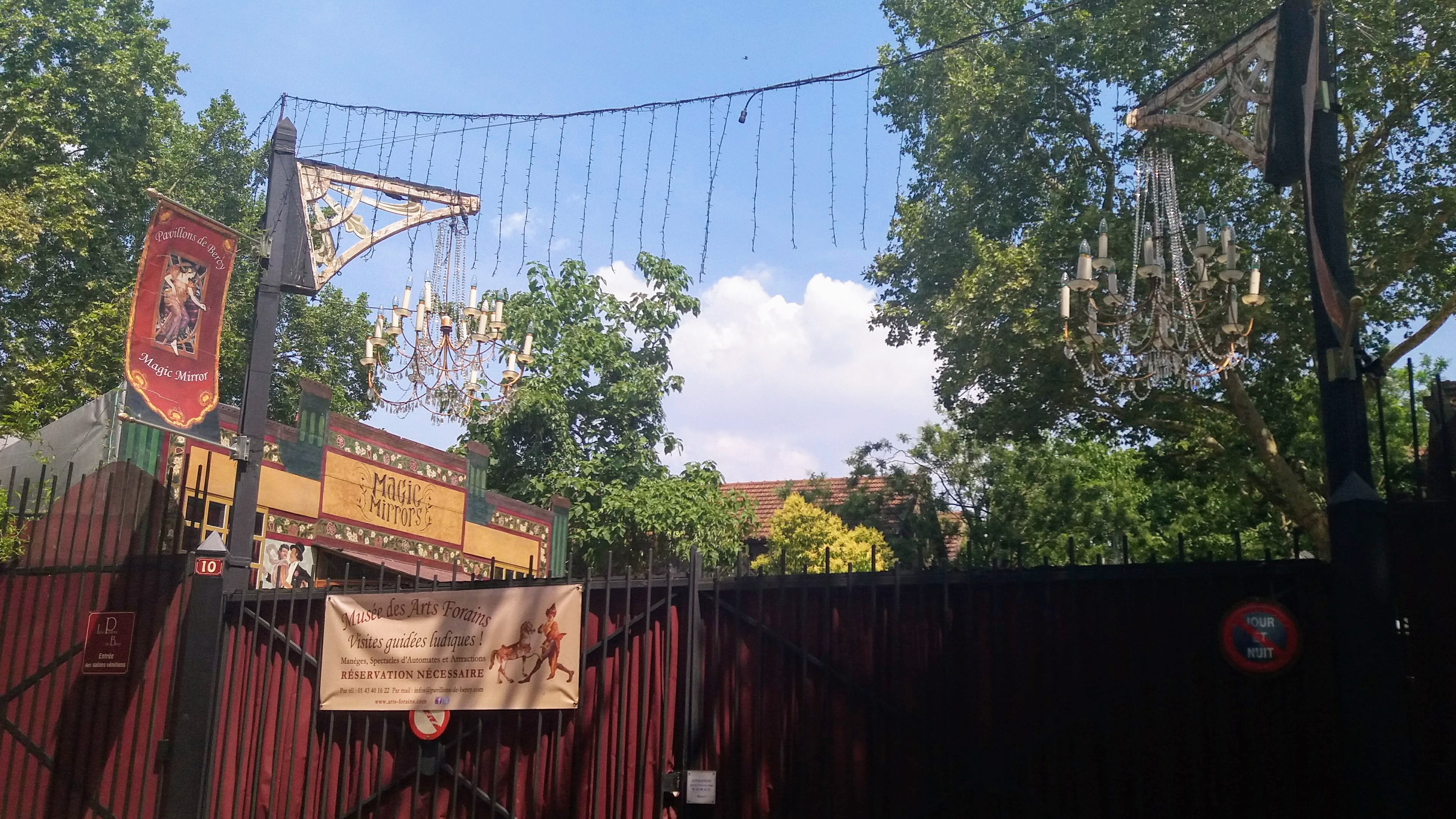
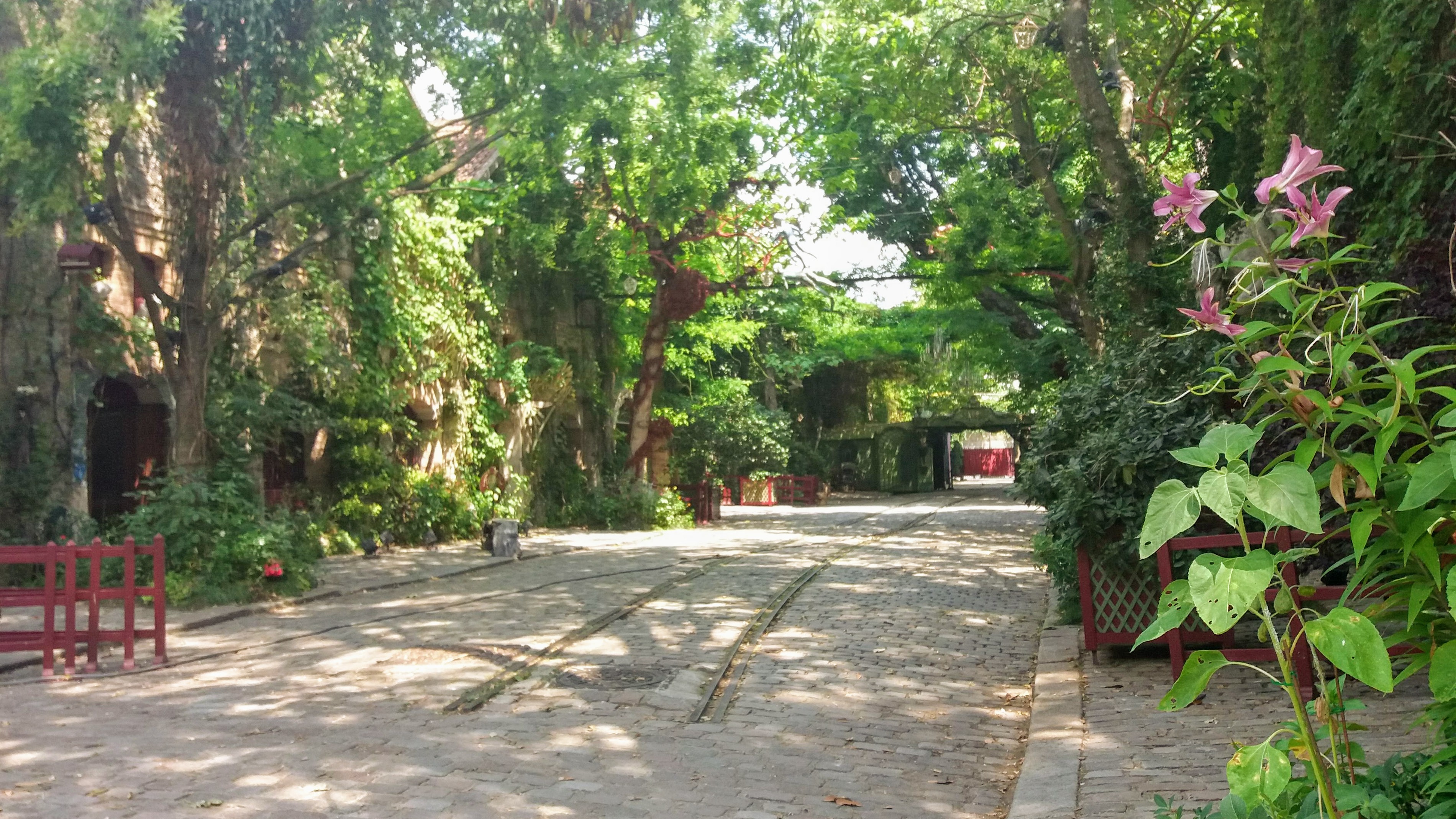
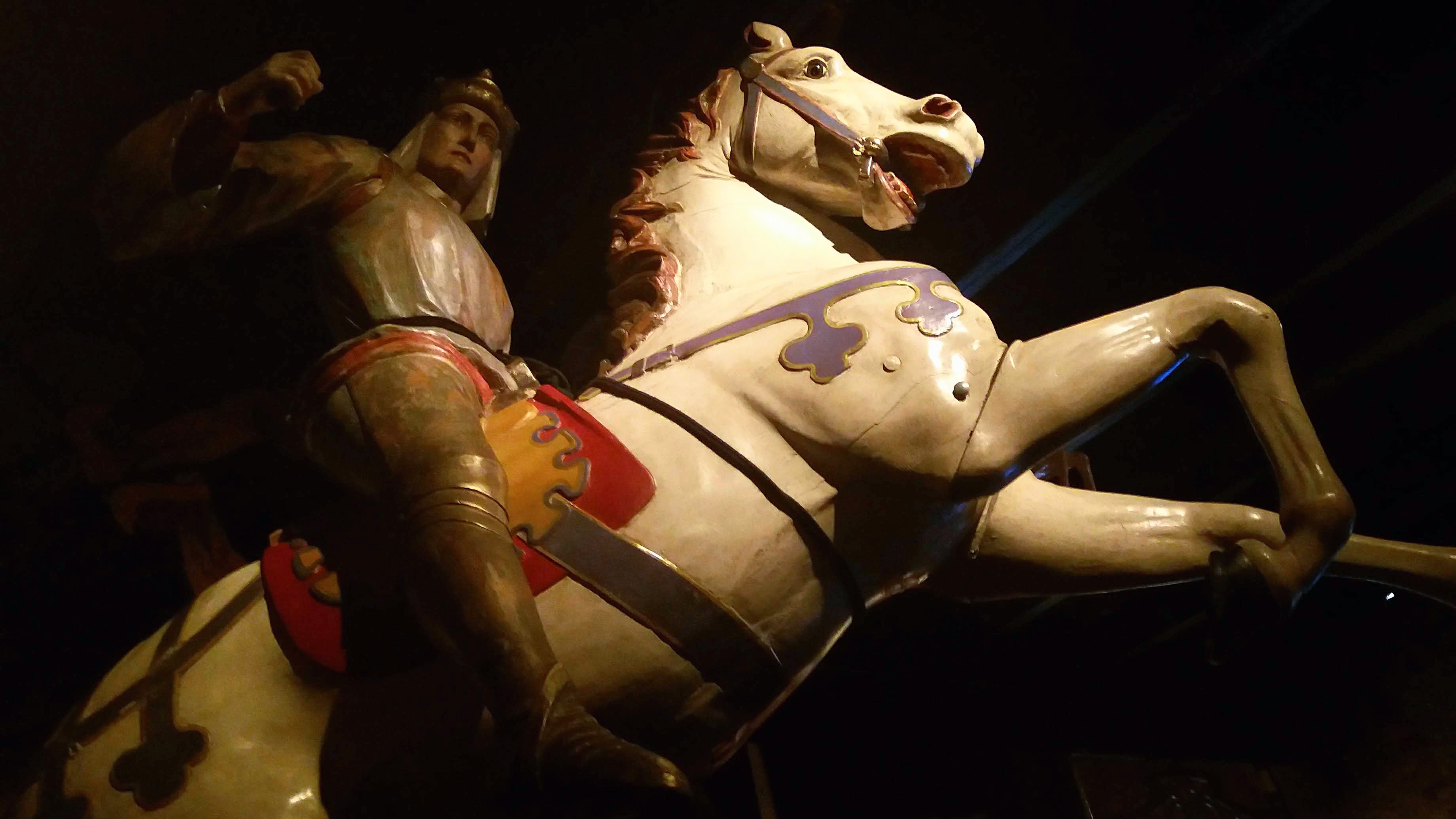
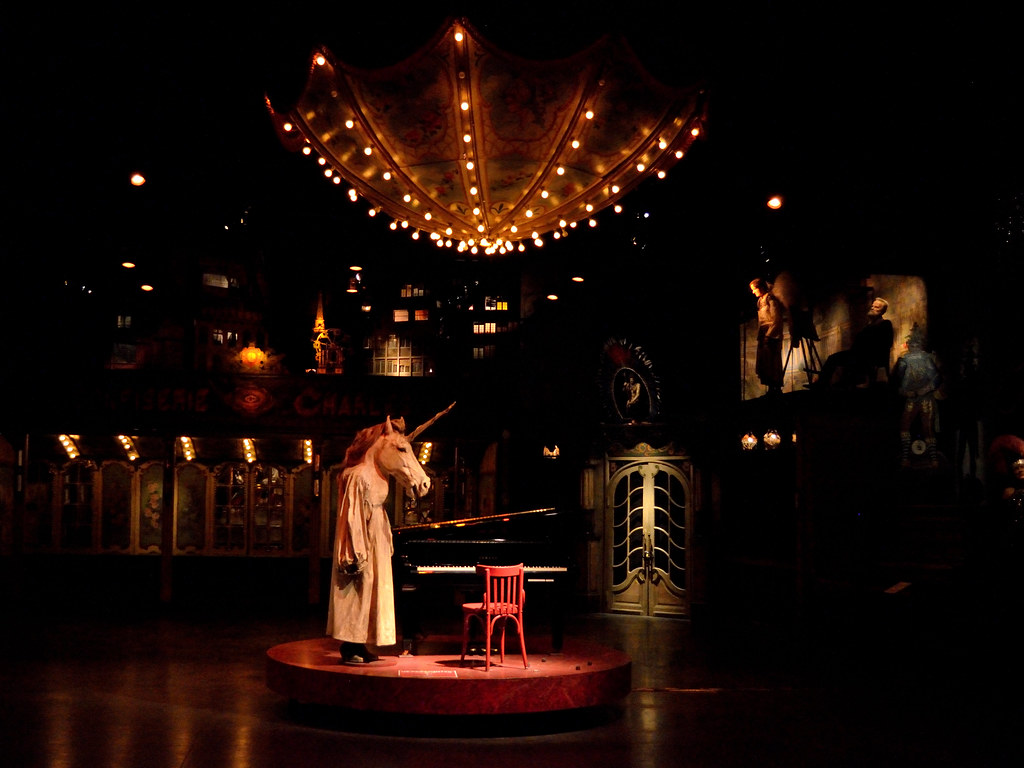
For my second trip to the city of lights, I made it to the Catecombs, a couple art museums, and a bike tour of the hot spots, which I’ll be writing about later. My more obscure find was a tiny museum of Fairground Arts, the Musée de Arts Forains. It’s actually not a public museum, but the private collection of Jean Paul Favand. It includes object d’art from fairgrounds around Europe in the 19th century. The museum has done extensive restoration on the artworks, and patrons are free to ride and play many of the “exhibits” on display. It was enchanting beyond all expectations and lasted just under 2 hours.
No Bag Storage? Starbucks!

Since the collection is private, the museum doesn’t keep regular opening hours, and tours are by appointment only. I was slightly desperate to go, but the only time a tour was available during my 6 days in Paris was the afternoon of my very last day, the day I was planning to catch a bus onward to Brussels. I had no choice but to choose that day, and move my bus to a later time. I’m so glad I did.

20180701_133424.jpgI had to check out of my Airbnb by 10am, and my host did not offer any variety of luggage storage. Neither does the museum offer any sort of cloak room or bag-check room. I checked a few websites for storage options, but it turns out that there are only a few places around town where it’s even possible and they are mightily expensive. I was travelling light (backpack only, yes, that is my actual luggage for the whole 7 week trip), but it was still at least 10-12 kilos, which can become tiresome to carry for many hours.
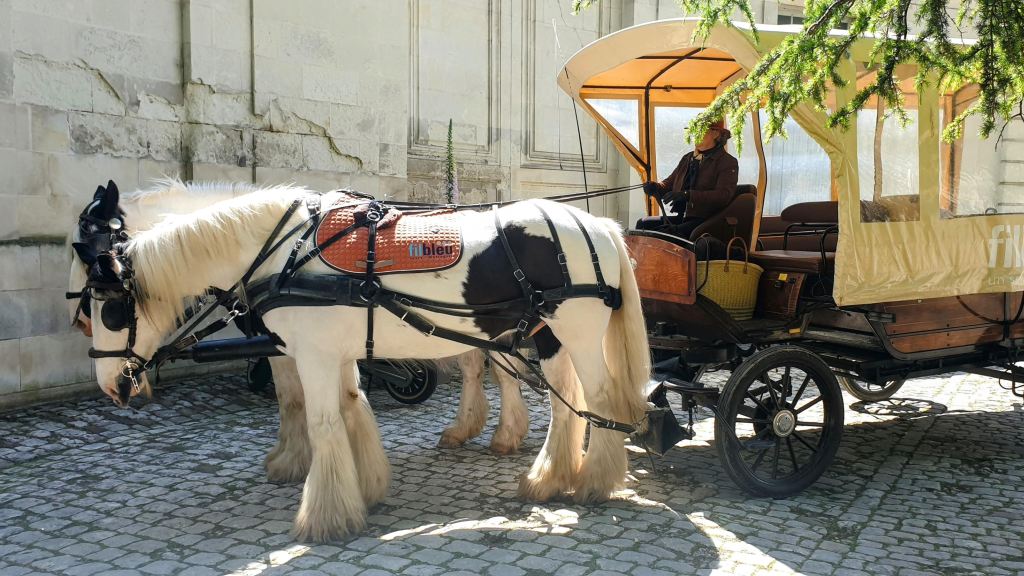
My tour was at 2pm, and I didn’t want to walk around Paris with all my luggage, so I headed straight to Bercy where both the museum and the bus would be found. I zeroed in on Starbucks for a clean bathroom, an iced latte, and a place to sit while waiting. This long haul travel is giving me some new appreciation for the use of American stand-bys. I’ve become addicted to iced lattes in hot weather, and the French seem to think that ice in coffee is anethema. Even McDonald’s McCafe failed at providing iced coffee options, but Starbucks is the same world wide with a few exceptions for seasonal specials.

20170401_130156

I love French coffee, and I could have sat at a cafe the whole time I was waiting. No one kicks you out of a restaurant in Paris. Oddly Starbucks was a cheaper option since a coffee here is a tiny shot of espresso for 2€ or maybe a small cafe creme for 3.5-4€. At Starbucks, I got a Venti iced latte for 4.65€. I don’t want to be the tourist who goes abroad and only visits American chain stores, but sometimes, especially on a long trip, it’s nice to have the choice. Free clean bathrooms, cheaper large (iced) coffee, air-con, and free wifi do make it an ideal place to kill time if you have to.

Getting There

The museum was easy to find, although it looked a little foreboding from the outside. The grounds are covered in fences and the buildings all have shuttered windows. The tour guides only speak French, but they were kind enough to make an English language pamphlet that contained the pertinent information about each area of the museum we would visit. I read through it while waiting for the group to assemble, hoping that it might help me follow along.

20180707_135137.jpg

When we finally assembled and began the tour, my feelings were primarily childlike glee. My joy wasn’t the only childlike feeling I had. Standing in the courtyard listening to the guide talk in French I had a sudden flash of understanding of how every kid must feel when tour guides talk and there’s nothing to look at or do. I tried to listen, but he talked so fast I couldn’t catch much. Fortunately, as he pointed out to us, it’s really a visual tour. The courtyard was pretty and I enjoyed the gargoyles and decorations amid the trees and flowers, but I was impatient to get inside.

20180707_140335.jpg

The Giant of Bercy

This is the story he was telling while we were standing outside. I found the English version later. According to legend, Kind Louis XIV came to Bercy to attend mass at a nearby cathedral. Of course, all of his subjects were expected to kneel before their king during his royal visit, but when the time came for this obeisance, one man remained standing. When the guard were sent to investigate, it turned out the man was kneeling after all, but he was a giant who loomed above the crowd even in genuflection. The giant was a vintner named Martin, who used this unique chance to meet the king to talk about the taxes on wine merchants in Paris.

20180707_140405

Charmed by the giant and amused by his complaints, the capricious king decided to grant the Pavilions of Bercy a tax exemption. The 106 acre region became closed off behind walls and ware houses with railroad tracks leading to the Seine where wine shipments could be transferred by boat. The buildings that now house the Musée d’Arts Forains were at one point warehouses and market buildings.

20180707_141302.jpg

It wasn’t all wholesale business, however, and Bercy was also known for it’s wine bars and guiguettes where patrons could sip by the glass or by the bottle in convivial company.  Such an atmosphere prompted festivals, fireworks and other fun, giving Bercy it’s reputation as a joyful place.

The Venetian Rooms

As soon as we stepped inside I realized the photos I found online do not come close to representing the atmosphere of this place. Beautiful pieces of art displayed around a centerpiece of a merry go round from a classic Venetian style carnival. There was no roof, as a modern carousel might have, and most of the seats were elaborate gondolas and carriages with a few ornate animals with saddles. Our guide invited us to hop in for a ride and we whirled around to a recording of the original music.


After the ride, we stayed seated but turned to face a wall which was decorated as the Grand Canal. The lights dimmed and we were treated to a beautiful light show that had clearly been made just to fit the size and shape of the room. We went from outer space, to under water, to a cityscape, a gondola ride on the river, a ballroom and a theater as the lights and sounds created this beautiful illusion.1377478_584720024920209_317152709_n

The adjacent room was an animatronic opera with singers mounted around the room on the walls just below the ceiling. The lights and speakers moved as different characters (including Columbine, Harlequin, and Cassanova) sang and the robots moved. It was like Disneyland’s tiki room or hall of presidents.

It was easy for me to wander away from the group or start behind as they moved on and get photos of the rooms with no people. Since I couldn’t really understand, I didn’t feel like I was missing out. Sadly, the rooms were so dark that most of my photos are only any good for jogging my memory of the experience.

The Carousel-Salon

20180707_144819.jpg

In the 19th century, the Fairground was quite popular, and the Carousel-Salon was a style of fairground that included the pipe organ, the carousel, a ballroom for dancing, and of course, a bar.

Our guide cranked up the pipe organ, which was stunningly loud, and I took the time to get a closer look at some of the statues and carvings around the room. The detail of craftsmanship in these pieces was impressive. It was clear that the fair or carnival was much more than it is today. When I think of the clunky state-fairs of my childhood covered in bare bulb blinking lights and cheaply airbrushed panels on easily disassembled rides and booths, I can see how much we’ve lost in the last century of fairgrounds.

20180707_144234

Once the pipe organ ended it’s song, we were invited to ride again. This time, a more familiar carousel with the faux tent roof and a few horses that trotted up and down as the ride goes around. My only complaint is the the tours allow more people than there are seats. The guide ran the ride twice but I didn’t get to ride a moving horse either time. Despite this small disappointment, I had tremendous fun riding the antique carousel inside a room filled with similarly antique carnival rides, games, and decorations.

Vue d'ensemble du manège de chevaux de bois du Musée des Arts Forains

We rode a pedal powered carousel as well. It was made up of a circle of large brass bicycles. This carousel was all about the thrill of speed. When the device was in use, warnings had to be issued that if a patron should lose their footing, they should not try to catch the pedals. Apparently the speed and force of the pedals resulted in more than one lost foot. The cycle carousel was capable of reaching 40mph (65kph) which in 1861 was dizzyingly fast! Once upon a time it also ran on electricity or steam, but the museum’s ride was purely pedal-powered. Don’t think that makes it less impressive. With every seat filled, the cycles seem more like a roller coaster ride than a carousel.

Vue d'ensemble du Manège de Vélocipèdes du Musée des Arts Forains

There were many other oddities, pieces from other rides, and classic fairground games to look at as well. German swing boats, card tables, shooting galleries, and exotic animals lined the walls around us. Electric lights and moving pictures will still a novelty often found only at such public shows. One of the most famous shooting games is the French Waiters. I’ve seen similar racing games in most modern carnivals and fairgrounds. Shooting at your target advances your waiter and the first one to the finish is the winner.
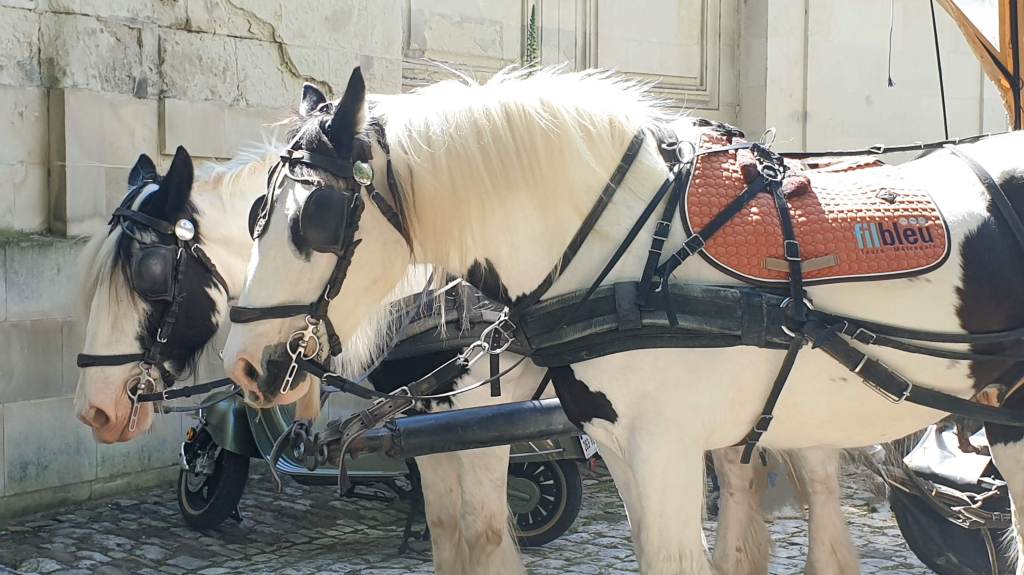
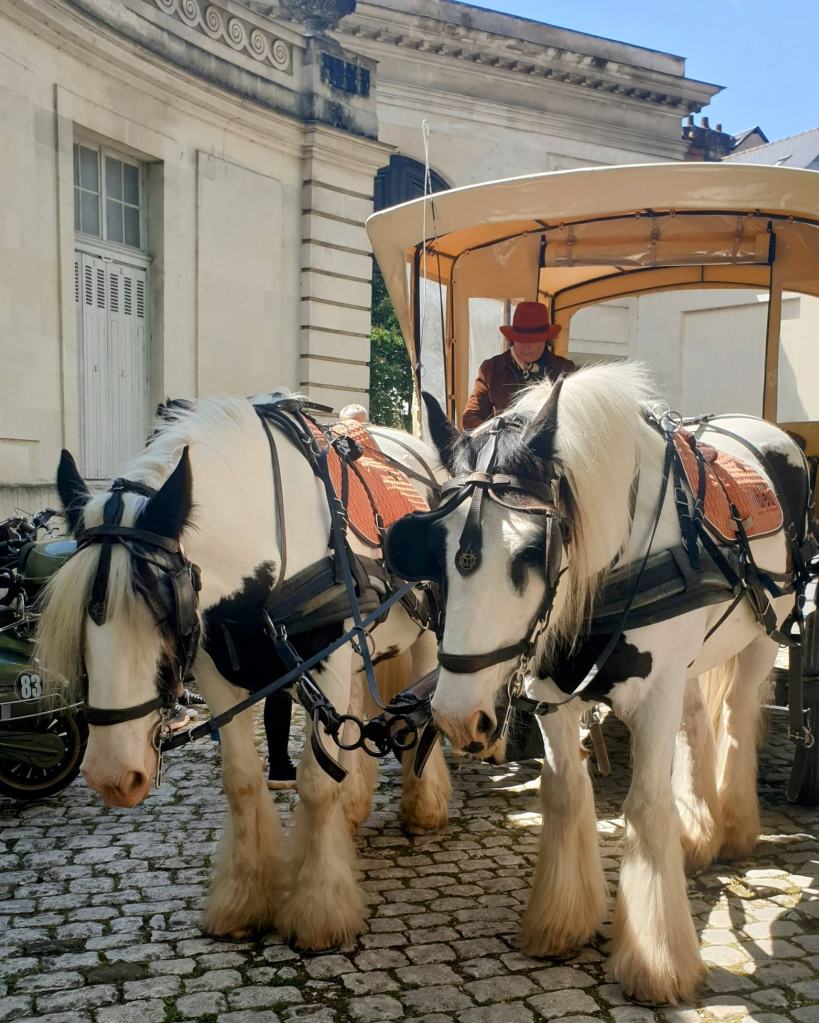
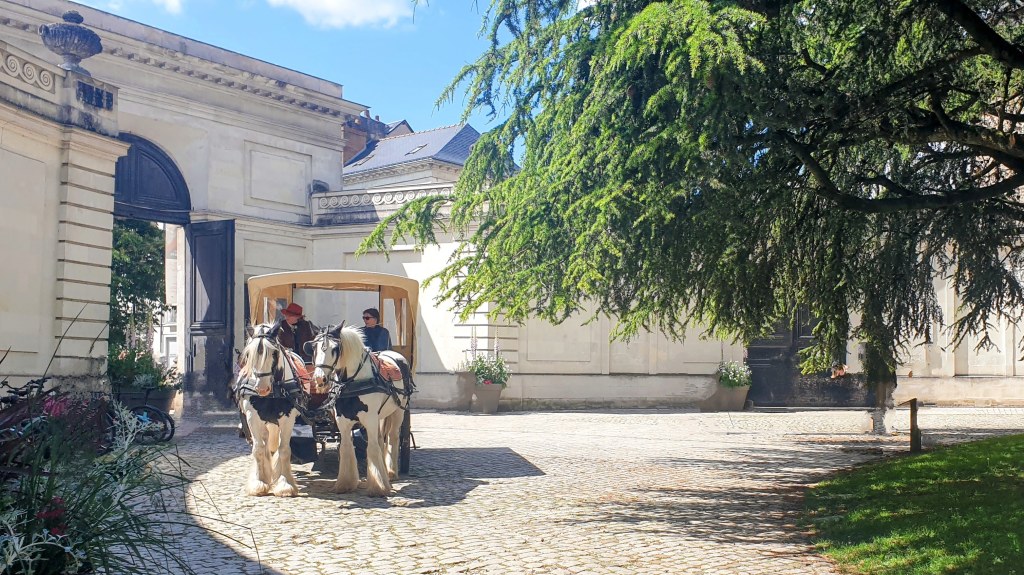
The Theater of MarvelsMusée des Arts Forains (2015-07-30 02.59.30 by Laika ac)

Next we entered a room full of oddities and treasures. It was Jean Favand’s own Cabinet of Curiosities including oddities such as a tree that could grow a leg and a dwarf in a boot. The center piece was made to look like the balloon of Baron Munchausen made by the collector himself. Esmerelda, the patroness of the funfair is depicted dancing. There was a huge papier-mâché elephant with a glamorously dressed rider, and Unicorn Cave is made from petrified wood, preserved plants, and mythical creatures.

Musée des Arts Forains (2015-07-30 03.03.52 by Laika ac)                         Musée des Arts Forains (2015-07-30 03.34.26 by Laika ac)
Our guide showed us a game called Palio di Sienna that was played by spinning a top through arches to hit a bell,and we all got to participate in a racing game that seemed like a combination of skee-ball and the shooting racer. Instead of hitting a target, you roll a ball into numbered holes for points, and your racehorse advances a little or a lot depending on how many points you got. The group played four times and I sat only one. It was very popular!

20180707_152222.jpg

We ended the tour with a waltz in a music room. A self playing orchestra like the ones I would later see in Utrecht played a waltz comprised of 12 different musical instruments. Members of the tour group paired off and danced joyously around the dance floor while waxwork oddities looked on. Great historical figures like Victor Hugo and Thomas Edison stared down, dressed in disguise, and an unimaginably queer unicornitaur (like a minotaur, but the head of a unicorn?) stood by a grand piano ready to deliver a song that would never play.

Image result for musee des arts forains


The fall in Korea has been keeping me busy. I volunteered to teach a debate club this semester and I’ve been trying to get out to a few more local social groups, maybe join a book club or two. We’ve also had a lot of school holidays. Last year, the three main fall holidays came together for one glorious 10 day vacation, but this year they’re spread out across three weeks. Counter-intuitively, this has actually made more work for me, and given me less time at my desk to work on this blog.  I would also like to shout out to the beautiful photogs who donate to Creative Commons because they saved my bacon from my tragically dark-derpy camera, and provided beautiful royalty free images for me to share. As always, thanks for reading, and I hope you enjoyed this hidden gem of Paris.

Nagoya Castle: Now with 10% more Ninja!

If there is one famous place that exemplifies Nagoya, it is the sprawling grounds of the reconstructed Nagoya Castle. I couldn’t possibly visit Japan’s fourth largest city without spending some time at it’s most famous historical monument! I was hoping to get a sunny day and take some sweeping landscape photos of this majestic structure, but the weather was not on my side. Even without the sun, Nagoya Castle was beautiful, fun and educational to visit. Plus, there were Ninjas!


I woke up Tuesday to the sodden realization that the weather forecast had changed again, and the rain was not going to stop until I was back in Korea. It wasn’t as bad as Monday, however, mostly cloud cover and the occasional sprinkle. I had forgotten my umbrella at the katsu restaurant the night before, but I wasn’t worried since umbrellas are for sale in every subway station and convenience store (right next to a huge steaming pile of foreshadowing).

Golden Bus or Subway?

I looked into the possibility of doing the Golden Tour Bus day pass. The Me-Guru is a kind of hop on hop off bus that runs around the most popular places in Nagoya. You can get a Me-Guru day pass for 500 yen which is great if you are planning to hit up several tourist hot spots in one day. Unfortunately for me, there wasn’t a stop anywhere near my friend’s house, so I was going to have to take the subway at least 2 times (out and back) making the 500 yen ticket less attractive to me. If the Me-Guru isn’t getting you where you want to go, you can also get a city day pass for subways for 740 yen, or subway bus combo for 850 yen.

Nagoya Subway ticket machines

Photo Credit: Nagoya Station.com

The main attraction of the Me-Guru Golden Bus is that it drops you very close to tourist attractions that might otherwise be a hefty walk from the nearest regular bus or subway stop. Atsuta Jingu is very central and easy to access, but the Nagoya Castle and Tokugawa Gardens are rather out of the way. Lucky for me, the Me-Guru bus also offers single ride tickets for 210 yen which you can buy on the bus just like any other city bus. I would recommend the Me-Guru day pass if you happen to be staying anywhere near one of the bus’s stops, however I opted to take the subway (270 yen trip) to Nagoya Castle, then the Me-Guru to Tokugawa (210 yen), and finally the subway again (270 yen) back to my ersatz home base for a grand total of 750 yen.

I mention all this because it’s acutely important to figure out transit in Japan before you go unless you are made of money and time. Since most of us aren’t… Data plans and mobile WiFi hot spots are expensive and not really necessary given the proliferation of free WiFi, but it does mean you can’t to a Google search any time anywhere, you have to find the WiFi first. I like to research my routes over breakfast and take screenshots of the map and directions to reference later when I’m out of WiFi range. So, Tuesday morning, while I was enjoying my “morning service” again, I pulled up a million maps to see where I would go and how far I would have to walk/wait between each one. The public transit options between the Castle and the garden are dreadful. Hence the one stop Me-Guru ride.

screenshot_20180619-191133

If you don’t plan ahead, you may not know where the next bus stop/subway station you need is (it might not be the one you came out of or the closest one may not go where you want to go). You could find yourself walking farther than you want, which doesn’t sound like much, but we tracked our walking on Sunday and got almost 10 km in one day of aimless tourist meandering. It adds up fast, and while I don’t mind walking for health or enjoyment, I don’t want to waste vacation time and energy walking extra to the bus stop when I could be using it to walk through something cool! Plus, if you suddenly find yourself knackered from unexpected heat, humidity, and ridiculous amounts of walking (this happens to me at least once per vacation), taking a taxi back to your hotel in Japan could cost 50-100$, that’s US dollars, folks. Taxis are EXPENSIVE in Japan. Ubers are not better.

Let Them Eat Gold

From the nearest subway station, the walk into the Castle compound is down a little restaurant corridor that sells everything from Nagoya specialties to the Castle’s very own gold plated ice cream. Yes, gold plated ice cream. It’s not actually very expensive, and it’s highly Instagramable, but I couldn’t bring myself to buy one as I have recently been complaining about the out-of-touch rich people in America eating gold plated tacos while children can’t get fed in school… soooooooo…. no gold ice cream for me.

The ice cream isn’t trying to be Richie Rich, it’s actually meant to imitate the golden tiger-fish that is the symbol of the castle. During my post vacation research phase, I got curious about how they could afford to sell these golden ice creams for 6-9$ a pop, and I discovered that you can buy edible gold sheets for surprisingly cheap. One seller on Amazon is selling 10 sheets for 7$. The gold taco I was upset about? 25,000$… US….At 0.70 per sheet, it may be silly to eat a golden ice cream cone, but it’s not actually Louis XVI levels of decadence and class warfare. Eat the rich.

Fire Bombing Damage

Nagoya Castle is the number one tourist stop in Nagoya and it’s not even finished! Almost everything you see there was destroyed by Americans in WW2 during the fire bombings. A fact the informative signs will not let you forget since everything you read will tell you how the original was destroyed and whether what you’re looking at is a transplant or a reconstruction.

20180508_133330

Traveling around Asia, you inevitably see signs like this because nearly every temple, castle and historical site has been sacked during one war or another. In China and Korea, you find things that were destroyed by the Japanese. In Japan, you find things that were destroyed by the Americans.

The castle and grounds were still heavily under construction during my visit, but I’m told with some degree of excitement by the locals that the reconstruction should be finished this (2018) summer.

20180508_132446

Hommaru Palace

The first sight that greeted me walking in the gate was the tower of Hommaru Palace. The tower is done in a similar style to the main castle, but is much smaller. Once you get around the corner and over the moat, there is a beautiful brand new palace. According to the literature I was given to take home, the Nagoya Castle was declared a National Treasure back in 1930, but sadly destroyed in the 1945 air raids… ok they don’t call out America by name, but we all know. The palace compound has been undergoing reconstruction on and off since 1959, but the Hommaru palace reconstruction only started in 2009!20180508_134013

I am not an architecture buff, but I do enjoy a beautiful building. I especially appreciate that Nagoyans decided to use all traditional materials and craft techniques to remake the structure. It doesn’t just look like the original, it preserves the artistry and history of Japanese culture — not only the woodwork, but also the fittings, metalwork, and paintings. There was an intense research project designed to microscopically and chemically analyze the original scraps that survived the fire bombing (have we mentioned that recently, because Nagoya Castle does not want you to forget) so that the paintings could be replicated as authentically as possible.

Despite the chronic reminders of our history of conflict, the restoration process is fairly interesting. If you want to see more details, they’ve got a lovely website.

As I approached the palace proper, there was a group of Japanese businessmen having a chat in front of a very photogenic area. However, my faith in Japanese politeness was rewarded. As soon as one noticed me holding my camera (phone) nearby, they gestured to the others to move out of the way and we all smiled and bowed to each other before I went on to take the photo. So much politeness!

20180508_120144

Following the path, I noticed an area where a few other visitors were lining up and entering the building so I paused to check it out. The staff were sooooo excited to share with me. They showed me a little video of how to tour the building correctly (no touching, no flash photos, etc) and explained the character in costume stopping all the bad behavior on screen was the father of the famous king who had ruled from this palace and a famous general.

20180508_123652

I was asked to wear my backpack on my front to avoid bumping anything, and all of us were asked to remove our shoes before going inside. Slippers were available, of course, and there were free shoe lockers as well. For an extra 100yen, an audio tour of the palace was availble in several languages. I thought about getting the English one, but it was taking the staff 10+ minutes to set up the couple at the front of the line, and I wasn’t second in line. I decided to risk moving on less informed.

The palace itself is bright and open. Although the day was cloudy, the inside of the palace somehow still managed to feel sunny with the warm wood halls, paper windows, and gold accents. Drifting sock footed through the hallways, I felt a sense of what visiting the royal palace might be like. Everything was hushed and clean. The halls were made of the same pale wood on all 4 sides creating an effect of being inside a tree. Every few meters, the interior hall wall would open up into an opulent room. The 3 visible walls inside each room were covered with the ornate and painstaking replicas of the Edo period paintings.

In practice, each of the rooms would have had a specific ceremonially significant purpose. A room for receiving guests of a certain social standing or another. A room for dining, one for tea, one for drinking sake and listening to music. One room had a fire pit built gracefully into the floor and a hidden vent in the ceiling to carry the smoke of roasting meat and fish up and out. The low wooden bars are just to keep people from walking into it, not an actual part of the function. Indoor fire pit is now added to my list of things I want in my imaginary dream house of the future.

20180508_123034

The palace doesn’t take long to explore and it’s included in the park entry fee. I highly recommend a walk through. On my way out, I ran into the very helpful staffer again. It turns out she had lived in America a while ago and was happy to practice English with me (although I don’t think she really needed “practice”) She told me some more about the restoration process and said I really needed to come back after the construction was complete to see it at it’s best. It made me happy that the people working there take so much pride and interest in the history and culture of the site. Enthusiasm is highly contagious and just talking with her made me more excited to be there.

Surprise! Ninjas!

Just after leaving Hommaru, the path turns a slight corner and suddenly there’s the first real view of the Castle proper. This was the real moment I was sad about the weather. Nagoya Castle is elevated, and huge, so any photo will have plenty of sky in the background. My cloudy, rainy day resulted in a very plain light gray sky instead of a fluffy cloud filled azure backdrop. Is it cheating to use filters?

Did I mention there are ambulatory ninja on the castle grounds? It’s part of a cultural and historical show. According to the ninja website, two words I never thought I would string together in a non-hyperbolic fashion, there are performances every weekend, but weekdays are listed as “hospitality”, a kind of meet and greet.  I was there on a Tuesday, so I only met the two posing for photos and promoting their future shows.

20180508_124042

No Nagoya Castle for Me

Sadly, the castle was closed for the finishing touches of construction, so I couldn’t go inside, but I’ve heard there’s an excellent view from the top. Looking at other people’s photos online, it seems the decoration style is very similar to that of Hommaru palace. The only truly distinctive thing I missed out on seems to be the huge Shachihoko (the tiger fish) that you can sit on and pose with, and the tall geometric stairwell. Next time.

nagoyajo_20160113_e

photo credit: Matcha Magazine

Since the castle proper and some of the other areas were closed off for construction, I was encouraged to wander a little off the beaten path. In addition to stopping for teeny tiny flowers which earned me some very strange looks. (Why is she looking at the grass when the castle is right there?) I also wandered off into a little forest grove filled with large, semi-flat stones. It was not cordoned off, but also not really connected to the main walkway either. After some assistance from the Google oracle, it seems I discovered a stone tomb of unique historical properties.

20180508_125002

I’m still unclear if it’s an original or a replica given the whole bombing debacle, and I don’t know why it was over there all by itself in an extremely unmaintained state in the middle of what were otherwise meticulously maintained grounds. The only informative sign was in Japanese and it mostly focused on the description of the architectural style, geography and time period with no mention as to its context near the castle. Still, it was pretty, and from inside the trees, I got some fun new perspective angles on the castle itself that don’t look identical to every other tourist shot on the web, so yay!

20180508_130642

A large chunk of the grounds were completely blocked off during my visit. I found a few more interesting goodies like ancient gates and the working tea house where you can stop and have a traditional cup of matcha green tea and a sweet. Of course the souvenir shop would never be closed for construction, but I found the gardens to be a bit lackluster, as though they had not been tended to yet this year, so even though they were not blocked off, they weren’t exactly visitor ready.

Samurai and Shachihoko

20180508_131428On my way back toward the main gates, I happened to run into the Samurai. Ninjas AND Samurai. It’s like cosplay meets museum, so very Japanese. Much like the ninja, the Samurai pace the palace grounds daily for photo ops and perform shows on weekends and holidays. My desire to avoid weekend/holiday crowds may have backfired here, but the guys I met were pretty cool nonetheless.
The last important sight before my path led me outward was the Shachihoko – the fish tiger. What’s up with that? Well, it’s a mythological creature that is half fish (specifically a carp) and half tiger. The Japanese characters that make up the name of the creature is also a combination of “fish” and “tiger”. 鯱 (shachi) = 魚 (sakana, fish)+ 虎 (tora, tiger) Some argue that the fish is really an orca because “shachi” also translates as “orca” in Japanese.  I love language.

It’s often put on temples and palaces to ward off fires, but in Nagoya it has become the special symbol of Nagoya Castle due to the two large golden Shachihoko on the roof. Most of the souvenirs, or omiyage, of the castle involve this magical creature in some way, and of course, so does the golden ice cream.

20180508_132024


I do hope that I’ll have the opportunity to return to Nagoya again after the construction is complete. I would not only enjoy seeing the inside of the Castle proper, I suspect I would greatly enjoy the gardens and side buildings that were inaccessible during my visit. What little I could see through the scaffolding looked intriguing. Plus, next time I won’t feel guilty about trying that glittery frozen treat now that I know more about the edible gold market.

Due to the weather, there is no accompanying photo album to this trip, but I hope you’re enjoying the Instagram photos in the mean time. As always, thanks for reading ❤

Oh, and the umbrella foreshadowing? I’m afraid you’ll have to read the next post to find out about that adventure. 🙂