I’ve been in Senegal for 2 weeks. I’m about to lay down some solid developing nation meets first world privilege complaining, but despite all that, I’m still glad I came here. It’s been a REALLY long time since I had to adjust to a new country to live in (vacation is not the same, because you get to stay in temporary housing and explore and have fun while knowing your safe and comfy bed is waiting for you at the end of the trip), and besides – no vacations during COVID! More than that, adjusting to Korea was very different than here, it was almost all culture and language barrier based because the standard quality of life in Korea is overall quite high. This reminds me more of learning to adjust to China or Saudi, the main 2 differences now are: I’m over 40 and I crave a basic level of creature comforts that younger me was more willing to do without in the name of sparkly new adventure – and this is objectively less developed than either of those places. It may in fact be the least developed part of the world I’ve traveled to, and that’s not an insult, it just means as a white American lady I didn’t have this perspective. It’s good for me, stretching me outside of my complacency and comfort zone (again), so I don’t regret it. I’m not mad about the conditions here, nor am I demanding unreasonable levels of comfort (clean, safe & accommodating my health). I just want to be honest about what I’m experiencing here, and how it makes me feel.
Getting There Is Half the Battle?
Arriving was not actually difficult. A long flight – 3 flights – but nothing a regular international traveler can’t handle. Flying in over the Sahara was fascinating. I could see the landscape change from endless sand to green farmland. There’s the jet lag package (fatigue, dehydration, swollen feet, etc), but I had a whole day in my hotel to rest before orientation. I had arranged an airport pickup with the hotel as well. So far, so good. The program is covering all those costs (assuming my expense report is accepted). The drive from the airport was looooooong, almost 2 hours. The main highways here are fairly well kept, but once you get off the main drag, the roads are not just dirt, but the dirt that remains after badly laid asphalt has cracked and eroded from flooding. There were potholes that could be kiddie pools on the road my hotel was on and I have to say it surprised me to see that this was the norm in the ritzy part of town, and made me wonder what the rest of the city looked like.



The hotel was nice, but I had forgotten to think about things like a mini fridge or a kettle, and there were no shops nearby anyway, just beachfront restaurants and an American imported goods store because I was staying in the fancy part of town near the Embassy. I thankfully have had experience with finding and using local delivery apps and quickly got my first meal delivered to my room (Dakar Food Delivery if anyone needs it). I was also a bit sticker shocked by the prices, but it seems only the expensive restaurants can afford to do delivery. A meal was costing me 10,000-13,000 CFA or 15-20$ USD. I know Americans think that’s a good deal for delivery food, but it’s wildly cognitively dissonant to be in a place that is so underdeveloped and also costs that much. Plus, I have a lingering “former poor” brain function that gets activated when I’m under stress so it feels insanely opulent to eat delivery food 2x a day for a week, which is basically what I did minus 2 lunches at the Embassy. For comparison, my Embassy cafeteria lunch was 4,000 CFA about 6$ US. I survived by reassuring myself that I was still well within the average daily food/transit allowance that is included in my budget, though I now better understand that a person eating at Western style restaurants and taking a taxi (buses are not recommended for expats for safety as well as comfort reasons) could actually use the full budget allotted to us. I expect when I’m comfortable enough to actually start taking taxis to explore other parts of the city, I’ll need that budget, too.
Post Arrival Orientation
We were hosted at the US Embassy for a 3 day orientation from Wednesday Oct 18-Friday 19. The orientation was a good way to introduce us to Senegalese culture because nothing started on time or went according to plan. (I said there would be complaining, but it’s not helpful to think of cultural differences like this as better or worse. I honestly think the number of cultures that place a high value on timetables and deadlines is much smaller than those that are more … flexible. It’s just frustrating to be raised in one style and have to live and work in the other). The policy on Embassy provided drivers changed but no one told our coordinator until the first morning, so while I could have easily walked the distance to the Embassy from my hotel, she had me ask the hotel to call a taxi and then also called the hotel herself to confirm. I have to say that while I found the whole process frustrating and confusing at the time, I do appreciate the lengths she went to that morning to make sure we were all safe and comfortable. It’s not her fault that my comfort level is directly linked to my ability to control my own environment (yay trauma responses!) so waiting around for ages and relying on other people to tell me what to do or how to do it or even do it for me is deeply anxiety inducing to me. I walked the remaining 2 days.
Getting into the Embassy is an ordeal if you don’t work there. One at a time, we handed over our passports in a little secure bank teller style window and got a visitor badge in return. Then again one at a time, we entered the security screening room where we handed over all electronics (including charging cables!) and for some reason also my nail clippers and umbrella. Even the TSA lets umbrellas through security. All our banned things were placed in a numbered box, we were given a token with the number on it and then a fairly standard x-ray for the bags and metal detector portal for us. Then we walked across a courtyard into another building where we again had to pass through a metal detector, have our bags visually examined and record the number from our token on a visitor log. We were also limited to only the front area (the American Center, the meeting room, and the restrooms) unless we had an escort, and our coordinator could only escort 4 people at a time, so had to get help when it was time to take us to the cafeteria. Somehow the free English language program that they run here is inside all this security, and local Senegalese people who want to participate have to go through an application process and pass through this kind of security every time they want to come to a class or event. It does make me kind of glad that it’s not my primary base of operations, though I am sure I’ll go back to do a guest lesson or something.

I enjoyed meeting everyone in the orientation. There were only 2 of us Fellows (we are the older, more experienced teachers… grizzled veterans of expat life) and 6 Fulbright English Teaching Assistants (ETAs) who are all adorable 22 year old Gifted Children™ that just graduated from their BAs and all speak fluent French. Only myself and 2 of the ETAs are stationed here in Dakar, the rest are scattered around St. Louis and Thies. There were also a metric ton of presenters, but since there was zero printed or electronic materials (beyond the schedule which as I mentioned was not followed), I don’t really know who all of them were and remember even less about the details of the programs they talked about. I’m trying to get it in written form, but it’s hard especially as our full time Regional English Language Officer (RELO) isn’t here yet and the deputy (our faithful coordinator) is trying to do all the work on her own.
People I remember well – the press officer and cultural officer were both fun to talk with mostly because they were also new to Senegal and more relatable to me in terms of common background and interests; the HR person who gave us our cultural lesson was awesome (Betty Hubbard, which sounds SO white, but she’s really an African woman with a lot of experience in the US and several African countries, and was delightful, I wish I had a good photo of her, but I only have what the embassy emailed me, which is mostly us). The guy who runs the largest English Club network made a good impression simply by virtue of his enthusiasm, but I was a bit sad that I probably won’t do much with their organization (although he has ‘threatened’ to invite me to come and give a guest lesson) since it is for k-12 ages and I’m going to be spending most of my time with the University. Other presenters were … not used to presenting. Several had classic “read the slides verbatim” or monotone voices. Almost all the Senegalese spoke so quietly that even at the other end of a small conference table, I struggled to hear them. It made me want to create a workshop just for them to be better presenters, an idea I may pitch to the Embassy later on.

Health & Safety
There was a security briefing, which we also got in the EPIK orientation in Korea, and those are almost always extreme, but here I’m not so sure. Things like ‘motorcycle thieves’ people who ride double on a motorcycle so the passenger can snatch bags off pedestrians and the driver speeds away are apparently very real here, such that even locals have warned me to wear my backpack on both arms or at very least, move it to the side away from the road. Don’t carry more than your money and empty shopping back into open air markets (regular brick and mortar shops are ok). Don’t walk after dark alone. Don’t hold your cell phone too loosely or someone might snatch it (motorcycle thief style). Don’t use ATMs on the street, only inside a guarded building. But also, say hello to everyone in your neighborhood, greetings and inquiring after wellbeing are crucial to being recognized by the people who might help you if you’re ever in trouble. People who keep to themselves are left that way.
There was also a health briefing from a nurse who instilled in us the very real fear of Senegalese water if nothing else. They also talked about soaking any fruits or veg you don’t peel in a diluted bleach solution and rinsing with bottled or boiled water. I’m actually not sure what her policy on dish washing is, but I’m using the tap so far, just make sure it’s all the way dry before I put food on it? I have already mentioned my extensive vaccination regimen and of course my weekly anti-malaria pills, so I was fairly well prepared. I figured out how to get smaller (1.5L) water bottles delivered to my hotel, but I’m still working on proper water delivery. I’m going through 2-3 liters of water a day here, so it’s thing. Maybe when I get my “real” housing I’ll be able to do a night boil for the next day’s water, but so far that’s been fairly impossible. The nurse also said that we would all definitely get diarrhea (yeah ok, gross, but this is a very real issue travelling to places with massively different bacteria). The ETAs kind of laughed it off until the older of us were like, no, she’s right, this isn’t a thing you avoid, it’s a thing you minimize and prepare for.
I hoped my globe trotting stomach was well equipped but I still had some antibiotics my pharmacist prescribed to me before I left the US for this exact reason. I have only had bad travelers diarrhea once in my adult life, and that was my first visit to Egypt when I got so sick I could not even keep down water. I remain hopeful that was a once in a lifetime event. My issues in Dakar were comparatively very mild. The first bout passed in a day, and I thought I was free and clear, but then it came back and lasted and lasted. Part of the problem was a lack of ability to eat gentle food. I tried to order things like a labneh (similar to yogurt) on pide (like a pizza dough but oblong) and plain rice or plain chicken, but it was difficult. I only got to go to a grocery store when I moved to a new “hotel” after my first week. Then I ate yogurt, bread, bananas, rice and oatmeal for 2 days before I gave up and went to the pharmacy for some Imodium.
Phone: Connection, Translation, Maps and More
I don’t know how I lived in China and Saudi without a smartphone. I know I did it, but for the life of me, I am baffled. I walked literally everywhere in China with my little pocket dictionary and took months to learn how to properly use the public transit system on my own. I used Wi-Fi on a tablet to pull up maps in Saudi, but mostly I only had a company driver to take me places. During my travels from 2015 on, it seems like having access to a local Sim card and internet was essential to getting around, navigating language barriers, public transit, shopping and everything else really. I like having data as soon as I land. I often get it in the airport or at a shop near my accommodation on the very first day. In this case I had deliberately not taken care of getting my own SIM card because it was on the schedule for the first day of orientation that we would do it as a group. I decided to go with the group because maybe they will be more help than I could have been on my own. No.
First we went to an Orange kiosk (Orange is a telecommunications company in this part of the world), which did not sell SIM cards (I feel like this could have been ascertained ahead of time). When we finally got to the store itself, they collected all our passports and had us wait. The store actually closed with us inside it, and finally they said that they had no SIM cards that day, and we should come back tomorrow. When we returned the following day, we had a better idea of what to expect, but we still got a bit of runaround, being told to go out to a different location to get the SIMs. I suspect they simply didn’t want to deal with a large group at the end of the day. Which, I sympathize with. I can think of several ways to have done this which would have made life easier for everyone including the shop employees, but it’s a learning experience.
In addition to our fearless deputy RELO (a local who has worked at the Embassy for many many years), several of the French speaking ETAs got involved in trying to solve the issue, which also resulted in crossed wires. We went out, we came back, we waited. Finally they began to issue us SIM cards. They cost 500CFA (75cents US) and are connected to our passports, but that’s normal in most countries that aren’t America. It took a while to get everything sorted out, finding our numbers, loading the Orange app, etc. It was hot (no AC in the store) and stressful (language barrier and multiple mixed messages), but once I got back to my hotel and could examine the system on my own in cool air, it was easy enough. We also went back the kiosk from day 1 to learn how to add money to an Orange account. Phones are all pay as you go and there’s no way to add money online, so you have to physically take cash to an Orange kiosk. Fortunately they are everywhere. The minutes and data that came with my SIM expired after one week after which I found that the minimum purchase for a 30 day period was 2200CFA or about 3.30$. I chose a flex plan and started with 2 hours of talk time, 500 text messages, and 1.5G of data at that price point. I don’t know how much of that I’ll actually use in 30 days. Since I’m on Wi-Fi at the hotel and at school, and I only use the phone to talk to delivery drivers, I think it will last. All this could change if I go somewhere without decent Wi-Fi, but for now, it seems like the phone plans (unlike the housing and restaurants) are DEAD CHEAP, which is nice because it means more locals (students) are likely to have access.
Home Is Where You Hang Your Hat?
Housing has been a source of some great stress. I discovered as I was preparing to leave Korea that having safe stable comfortable home base is very critical to managing my anxiety levels and my willingness to do new adventurous things. My friends in the US did a magnificent job of making me feel safe stable and comfortable while I was in their home, but it’s their home. Here in Senegal, I knew that we would search for apartments after I arrived (frustrating but ok it’s probably better to see them in person), but I did not expect the reality. No amount of looking at apartments online could even slightly prepare a person for the reality. The day after our orientation finished (Saturday) my social sponsor (the only professor at my uni who speaks English and therefore got stuck with this job) picked me up to go house hunting. I had spoken with him at length in advance about the budget needs (monthly rent + finding a pre-furnished apartment) & my health requirements which include the need for air-conditioning & my inability to navigate stairs. He said he understood, but when the day came, it was obvious he did not.
Side note about stairs and health: a lot of people judge me because I’m overweight, they assume it’s laziness, and that if I’d just eat less and exercise more I’d be healthy! Nope. I’m a member of the invisible disability club “But You Don’t Look Sick”. Sometimes I am well enough to climb multiple flights of stairs, but not always. Heat makes it worse. If I’ve already walked a lot, it will be harder. It’s hot AF here and I walk everywhere. I’m going to be hoarding my spoons the whole time I’m here. (spoon theory) I don’t believe that people with chronic illness or disabilities should just NOT do things. We know what we need to accommodate ourselves. I can’t do as much. I need to rest more. I need AC for my health not just my comfort. And I need stairs to be a choice as often as possible.
The first apartment we stopped at was inside a restaurant. I mean, the entrance was at least. There were 2 ways to access it, but fundamentally the stairwell was inside a restaurant. Ok, hey, easy access to prepared food at least? However after we completed the first flight of stairs and began the second, I stopped and reminded my sponsor that I could not live in a place with that many stairs. I think he thought I was just being a lazy American when I told him about it in email, but thankfully(?) my edema was bad enough on that day that I could show him the physical effects. I hate that people have to see a health problem before they believe it’s real, but here we are.
The second place we went to was under construction and slightly underground. They told me things could be cleared away and cleaned up, but there was no AC, no kitchen, and very little in the way of natural light. Plus it was under some stairs and had a canted ceiling which gave the whole thing a Harry-Potter-at-the-Dursley’s feeling. In that case, not only would I have had to wait until it was finished and cleaned up, but I would have had to arrange to furnish it with literally every appliance and stick of furniture. I’m only here for 10 months! And even if I was up for all that, the place was tiny and dim, and I remembered how depressed I was in my shoebox in Gyeongju vs how much better I was with a more open space and a view. Another no.
The third place had a ground floor entrance, but only the living room was on the ground floor. The bedroom and kitchen were up a flight of stairs. Having to continuously explain your needs and not be listened to over and over is exhausting and demoralizing. They showed me another room in the same complex that was so tiny that the bed almost completely blocked the entrance to the kitchen. Like, you had to side scoot around the bed to get into the kitchen. Plus, no place to do any work besides the bed (again, a thing I knew from my first Gyeongju apartment during COVID was a recipe for depression). I began to suspect that they deliberately took me to some sketchy places so that the mediocre place they actually wanted me to live would seem great by comparison.
The 4th place we visited was actually a very nice building. Concierge at the front desk, and an elevator! The unit we viewed was only one floor up, but still, not having to do stairs with heavy groceries or on a bad day is always wonderful. The unit however, was unfurnished (though at least had AC installed already). I do have a budget that would allow for buying necessary furnishings, but it takes time and expense reports, and then what do I do with it when I leave? Despite all this, I almost went with this unit because it was the nicest by far. However, they demanded 4 months rent up front, and it became apparent that 3 of those months would never be returned. 1 was just an agency fee, and 2 were a security deposit that by all accounts would vanish and I would have no real recourse after leaving the country to get it back.
The 5th place, and the place they clearly want me to end up living, is the building I’m staying in now. It’s called a hotel, but is in reality a series of furnished apartments rented out by the day. My social sponsor has negotiated a monthly rate, but the apartment we viewed will not be ready until November 5 or 6, so I’m in a different room paying the day rate for 2 weeks, I guess. More expense reports.
This room is … unideal. It had a lot of flies when I moved in, but it seems since I killed them, no new ones have appeared. It only has AC in the bedroom, so I’m not inclined to use the other room. The TVs don’t work so I’m back to watching Netflix on my laptop. There was a washing machine which I was able to get the staff to help me use, and that was nice, being able to do laundry after a week of sweating. However, the shower was 80% broken, water came out of the seams around the shower head, and there was some kind of a leak around the toilet that made the floor always wet. I was not supposed to be in that room at all. I was supposed to go to a different room while we figured out the long term housing, but the person leaving that room hadn’t left by the time we arrived. Then I was supposed to be in this room for only one day, and I waited around the entire second day for someone to tell me where I was moving to, only to learn at the end of the day that I’d be there until Saturday (29th). Now I know I’m staying in this room until my monthly room is ready. I got the bathroom fixed at least.
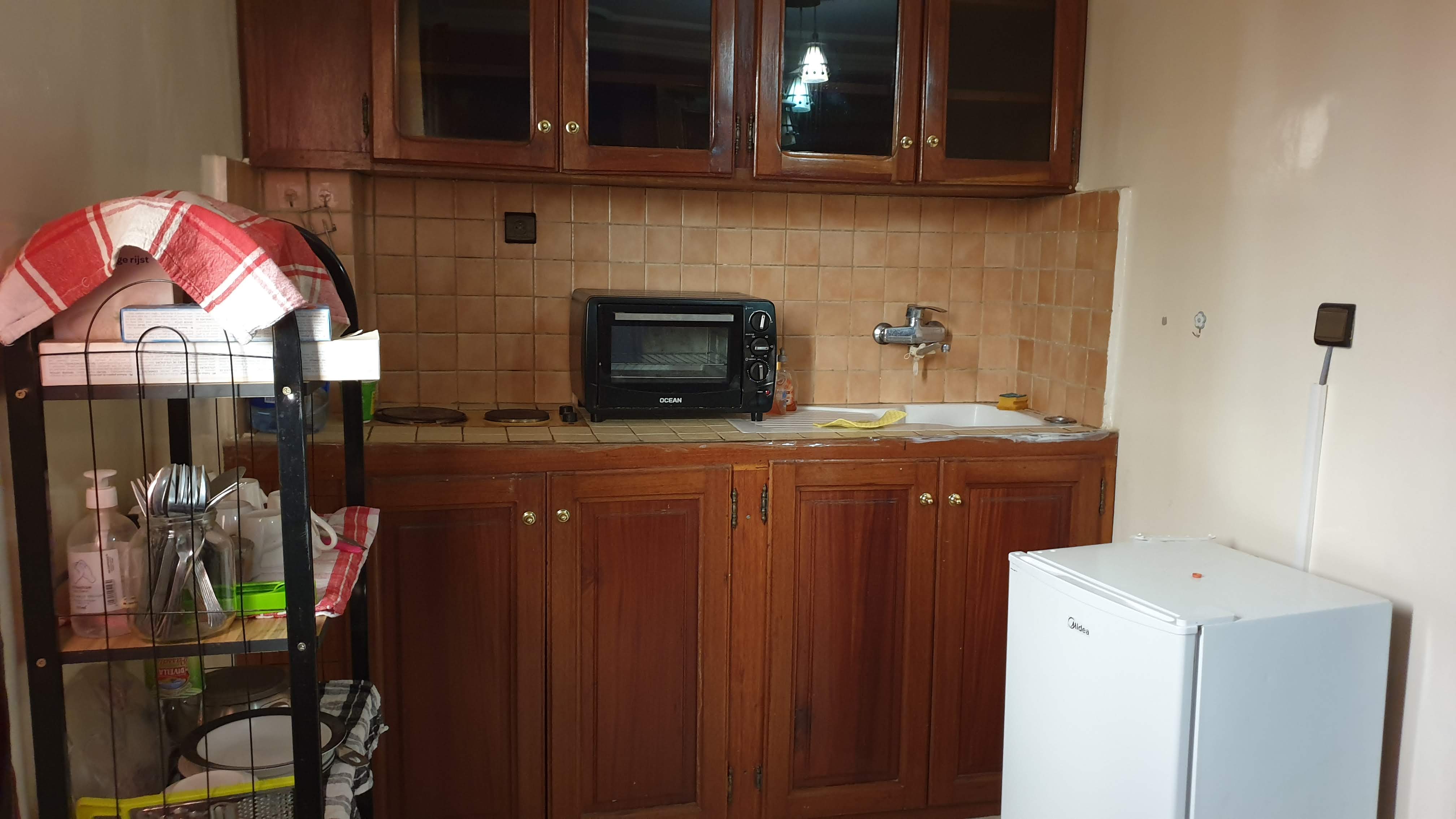


I desperately want a room that I can know will be mine for at least a few months. I need to unpack, and settle .Twice now, I’ve woken up at 4am to discover the power in ONLY my room is out and had to get dressed enough (Alhamdulillah I still have my abaya, socially suitable to put over PJs in any country) to go the front desk to ask (in sleepy French) for the power to come back. By then, I’m too hot and agitated to go back to sleep well. The weekend brought the exciting discovery that somewhere above me someone is trying to run a nightclub from 1-5am with extreme bass. I mostly can’t hear it with my headphones in, but it was not conducive to good sleep. Aside from my comfort level, there’s finances to consider. My contract covers RENT, not hotels (it does cover hotels for a short while at the beginning, but at one point one of the people helping us look for apartments thought it would be reasonable to stay in a hotel for a whole month while we figured out housing!) And the even crazier part is that my “moving in” budget comes from the same pool of money for any projects I want to do that benefit my host country, so the longer they make me stay in hotels, the less money I have to spend on materials, supplies, or even micro-scholarships for them. I need to be in a monthly rent agreement place for so many reasons both personal and project based.
In a very recent development, a new option appears. One of the other ladies here on the Fulbright program had already done a homestay last spring, and her host mother turned out to be a realtor. In many countries, realtors help you find and rent apartments. I had that arrangement in Korea, too. The realtor my social sponsor arranged was the one who picked out all the sketchy apartments. Anyway, they got her in touch with me, so now I have a thread of hope that a better apartment may be forthcoming.
The School – Veterinarians
Ah, my “job”. I keep telling people this isn’t a job like other jobs. It’s a fellowship (yeah like Frodo!, no not really) and a project. My primary goal is the university I’m assigned to, but I’m also supposed to have side projects and other cultural whatsits to be involved in. I’ve already put out some good feelers for a side project which I’ll write more about if anything comes of it, and I’ve been invited to come and speak at some nebulous future date at at least 2 venues. Secondary projects abound, and I can take, leave or redefine them fairly easily. The challenge is my host university.
I was placed with the Ecole Inter-Etats des Sciences et Médecine Vétérinaires, and even if you don’t speak French, some of those words will be familiar science, medicine, veterinary… It is a veterinary school located inside the Cheik Anta Diop Univeristy here in Dakar. They aren’t into the humanities. They don’t have an existing English department, and for reasons I’m not clear on, they can’t just send their students over to the school of foreign languages next door to take some English, they are in fact trying to create their very own curriculum.

There is really only one guy who speaks English well enough to be comfortable talking to me, and he’s (self described) low on the totem pole, so doesn’t have a lot of the answers to my questions about the details of what they want and what resources they have for this. I finally got their curriculum proposal (in French, but Google Translate is better than nothing) which is only half written and clearly by people who have no clue how language acquisition works. I also had a brief meeting with the gentleman in charge of scheduling details, but can’t get any answers about things like instruction hours. I clearly don’t know how the semesters are structured here. It’s been explained that it’s not like a liberal arts style class where you go at the same time every week for 10-16 weeks (quarter vs semester), but that students rotate through very short and very intensive courses of study (2-3 weeks at a time?). I’m still trying to figure out if I need to design English classes on that time scale or if it’s even possible to have students regularly show up 2x a week. So far I’ve written a 4 page counter memo explaining the overambitious nature of their dream and the crushing weight of compromising with reality, but I don’t know who to give it to.

They also want clinic workshops which are much easier to create and run, but less effective for overall language acquisition. Since I have next to no data or guidance, and everyone who could speak to me about it is apparently out of town or busy for the next two weeks, I’ve decided to spend some time on YouTube and TikTok looking for videos by vets that are: a) educational, b) funny, c) both — in order to design some short one-shot workshops around those. However, since I can’t design anything until I have some idea of the students actual English level, implementing a widespread level assessment test is the first goal.
But that’s not all! They want the faculty, admin, and IT staff to have English lessons relevant to their needs! While I was cleaning 3 years of dust off the pre-COVID Fellow’s desk (now my desk) I found a schedule which had him doing 18 hours of classes a week! That is a high amount even if it’s your only job because on average, 2 hours outside of class for every hour in class is a good balance for adequate lesson prep and homework/assessment grading and feedback on a new course. Once you’ve done a course a time or two, you can drop that down to 1:1 because the lessons are basically made and you’ve developed some tricks to grading the assignments, but considering I’ll be designing the curriculum and either finding or creating all the materials, and I’m expected to have outside projects, that’s INSANE.

What Am I Doing Here?
So, here I am, wandering between my shabby hotel apartment and the local café, writing in my blog and diving down a veterinary rabbit hole on YouTube because I have no qwerty keyboard at my office and no access to the curriculum material or student information, and my social sponsor is out of town.
I wish I could tell you about the city, and the food, and culture, but honestly, I’ve been fairly mono-focused on my base level Maslow’s needs here, contending with vaguely poor health while having to negotiate in a foreign language daily for things like food, water, and shelter. I’ve talked before about culture shock, and the fact that even simple tasks take more energy in a foreign place/language. It’s no joke, and it hasn’t left me with much energy for adventure type exploring. I’ve walked around some. The sidewalks are used for parked cars leaving pedestrians to walk in traffic (yay). There are lots of vendors on the street that I look forward to investigating soon. I have downloaded the recommended ride share apps that should allow me to avoid haggling with taxi drivers, but I probably won’t do much “touristing” until December when the weather is less aggressive and I can be outside for more than an hour or two without getting dizzy.
Welcome to Senegal.


 Gallivantrix