I have been told over and over by native Taiwanese and twitterpated Taiwanese tourists that I simply HAVE to go to Taiwan, that it is nothing like China, or possibly it was everything I love about China with none of the Communism. It’s so close to Korea, the flights are easy, but the weather is hard. In January 2019 I had a spare 2 weeks before I would meet my friend for our whirlwind Middle East tour. It seemed like a great chance to finally see the Ilha Formosa. The rest of the holiday that winter was so much, I forgot I didn’t write about Taiwan until my Facebook Memories started popping up this January. Faced with an unexpected rainy week on my holidays in “sunny” Spain, it seems like an opportunity to fix that.
I went to three main cities: Taipei, Taichung, and Kaohsiung. I ate more delicious food than I thought could exist on such a tiny island, and I enjoyed local sightseeing, temples, and natural wonders. In the first post, I’m going to give a little historical context and then talk about the natural beauty and the temples I visited. In the second post, I’ll share my more urban tourist experiences and saving the best for last, the food.
A Very Very Brief History
I used to live and work in mainland China (in Jinan, and later Yanjiao, a small town outside Beijing), plus I studied Chinese history, culture and language in university. I knew Taiwan was different, but I didn’t really understand how much.
Taiwan separated from China when the Kuo Min Tang fled there after Mao and the Communists took over mainland China in 1949. China under the KMT government was part of the Allies in WWII. We gave them money to fight the Japanese, but they ended up using it to fight the communists, and still lost. Most of the Western World didn’t recognize the communist government of China until the 1970’s. We were busily still supporting the Taiwanese government as the rightful government of all China.
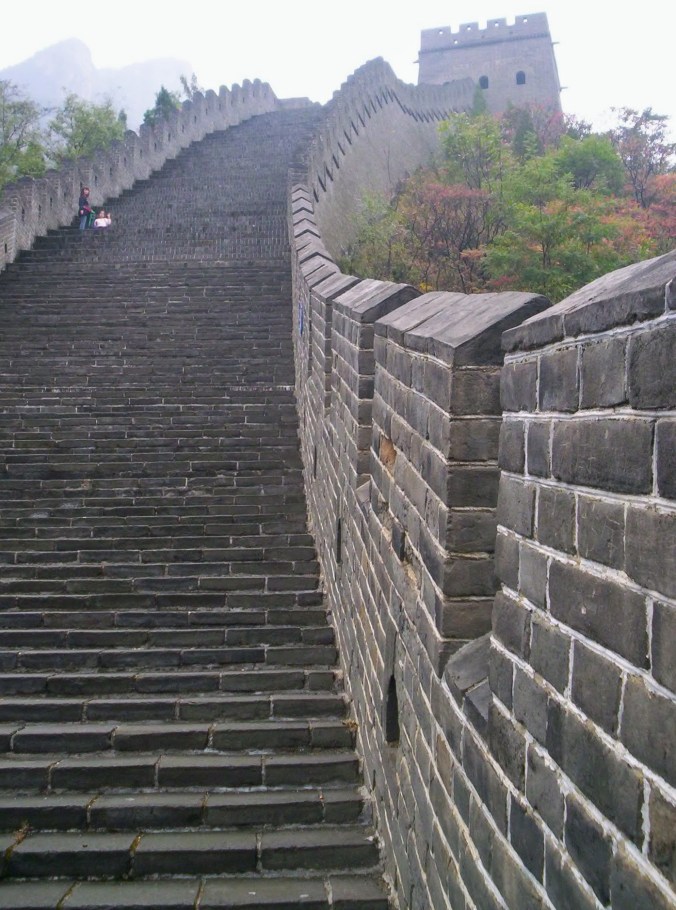
A few countries at a time slowly came to realize that the communists weren’t going anywhere, and then Nixon had his famous visit to Beijing to stand on the fake Great Wall and show solidarity and that was pretty much it. Since then, China insists that Taiwan is a part of China and everyone just sort of humors them. We make separate treaties and trade agreements, plus Taiwan has a different language, flag, currency, government and legal system from mainland China…. but, ONE COUNTRY! (says China)… Taiwan is starting to disagree.
Of course Taiwan has a strong Chinese identity and history, but it diverges sharply at 1949. At the end of the Civil War, the KMT retreated to Taiwan and the Communist (Mao) government claimed the mainland. Mao’s government worked hard to erase a lot of history in order to position the Party at the top and center of all life in China. It was huge disaster and tens of millions of people died from persecution and starvation. Plus temples and relics were destroyed or stripped of decoration and re-purposed as Party business community halls. Some time in the 80s, the government went “oops” maybe we need history after all, and started rebuilding both physically and narratively. Therefore almost everything you see nowadays in China is a reconstruction, and the few practicing monks and nuns in the temples are there under very strict observation because someone told China that civilized countries don’t murder all their religious leaders. (most of the literature on this is academic research and NOT readily accessible in Wikipedia, you can take my word or you can go ask a Chinese Studies scholar). Although, now with Hu… who knows?
Taiwan, on the other hand, continued the Nationalist traditions that were started in the 1911 Xinhai Revolution that finally eliminated the monarchy and established a “people’s” government… although arguably back to the Boxer Rebellion because everyone was so fed up at those Royals supplanting Traditional Chinese Culture™ with Western European goods and values… and opium…The point is that the KMT were basically in favor of traditional Chinese culture, where the Communists were pretty opposed. So while mainland China went through this holocaust level cultural purge (The “Great Leap Forward” followed by what is still referred to as the “Cultural Revolution” which makes it sounds like hippies dropping acid and doing free love), Taiwan and other Chinese communities in Asia (Malaysia makes this super ovbs, too) were continuing to move forward with a more normal level of cultural changes influenced by post colonialism, globalization, and technology just like everyone else.
2000 years of shared history, followed by 60 very divergent years brings us to the ‘same but different’ cultures of mainland China and Taiwan. So while China firewalls out anything it doesn’t like and creates its own online reality, arrests anyone who dissents, and sends religious or sexual minorities to reeducation camps, prisons, or organ harvesting factories, Taiwan is a proud democracy that legalized same sex marriage last year. While that sounds a little behind to most westerners, its stunningly progressive for Asia. They were actually the first country to do it.
Lastly, a quick note on the spelling. Mainland China adopted a variety of romanization (“roman” letters, like the ones you are reading now) called “pinyin” while Taiwan used the older form Wade-Giles. Some brief examples (minus tone marker): Beijing /Peiking, Gaoxiong /Kaohsiung, Deng Xiaoping /Teng Hsiao-p’ing, Guomindang /Kuomintang. Although now-a-days a lot of things in Taiwan are romanized in Pinyin, those places which were internationally codified with Wade-Giles spelling still remain. Pronunciation remains a challenge for those who have not studied the language because neither system is intuitive for English speakers. (try typing the pinyin spelling into Google translate to listen).
Natural Wonders:
Taipei:
Yehliu Geopark 野柳地質公園
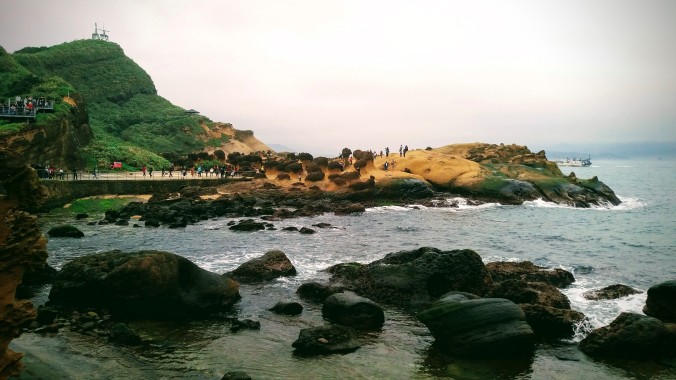
This was part of a package bus tour I took, but honestly, if I ever go back to Taipei, I want to take the public bus out here and spend a whole day at this park. This website has some very nice English language explanations about the rock formations and erosion patters, if you’re curious.
I do love the science, but I have to say that I, like most of the visitors, was more enchanted by the fairy-tale like shapes that these rocks have come to embody. When I arrived, I got a little pamphlet showing the most famous formations. It was a little bit like a scavenger hunt trying to find them all, and I kept getting distracted by not at all famous, but still amazingly beautiful rock formations like joints and fossils all around.


The most famous rock is the Queen’s Head, which you may have seen on listicles of “cool things to visit”. The line to get a photo from the best angle was insane, and because I was in a tour group, I had to choose between standing in line for the famous rock, or going to see all the others. Still, I got a glimpse of Queens Head rock from the queen angle by wheedling past the line creatively (really the line is for people who want to pose with it, you are allowed to take a picture from anywhere). In case you can’t tell, it’s the one in the background that looks sort of like woman’s head with an updo or royal headdress.
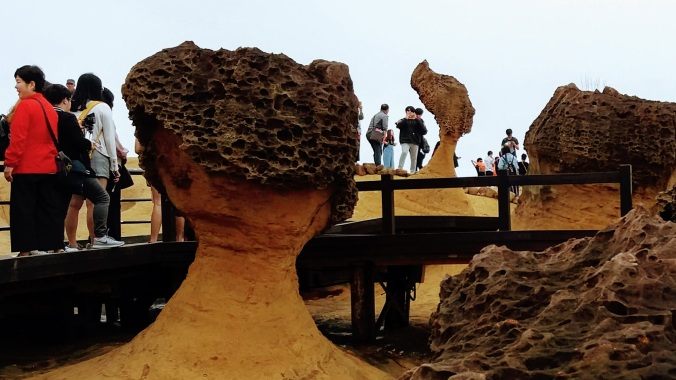
The park is well aware the Queen is their biggest draw, and that it is eroding a little more every year. It won’t be long before her neck erodes entirely and she becomes Marie Antoinette instead. To maintain tourism, the park has named a new “Cute Princess Rock” which is shaping up to become the main attraction when the old queen dies.
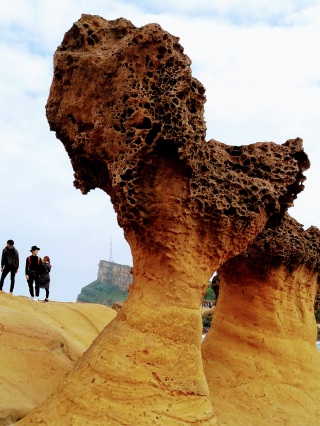
Other rock formations I found include the Elephant Rock & The Pineapple Bread Rock. Pineapple bread is just cut to look like a pineapple.It doesn’t taste like and isn’t made with pineapple (unlike pineapple cake which is, but looks like tofu squares).


One little island turned out to contain at least 3 of the targets: the peanut rock (far left), the fairy shoe (about 3/4 on the upper right, kind of looks like a sandal) and the pearl, or globe (far right, the lower sphere, yeah, I know there’s like 4).
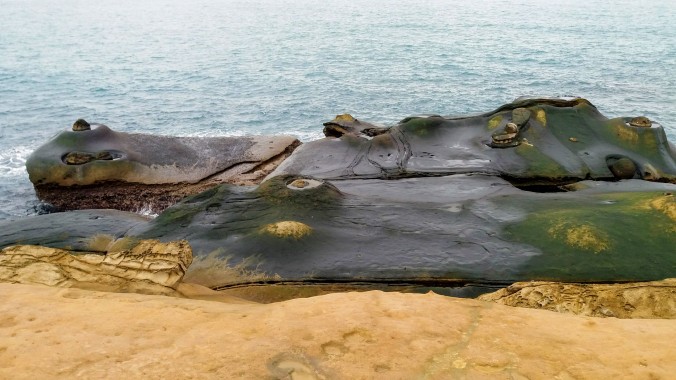
Our tour guide challenged us to find a particular rock and take a photo of it that matched the angle in the brochure. The angles of these rock formations matters quite a bit. The queen doesn’t look like a queen from any other angle (see below). In this case it was a gorilla, and you had to walk all the way around to the side facing away from the path to see the illusion. Most people were taking photos through the hole in the rock without ever realizing they were at the gorilla! (I won the scavenger hunt).


Looking at the brochure and the website, it’s painfully obvious I saw only a tiny part of the park, and I had a very limited time to try and find and appreciate these unique formations. I’m glad I had the opportunity, but a full day return is on the top of my list for a second visit to Taipei (right behind the food).
Shifen Waterfall 十分大瀑布
This was a short stop on the same all day bus tour. To be honest, I’m not sure it would be easy to get here on public transit, so a tour to Shifen might be the only way if you aren’t renting a car. We were pretty rushed at this stop, and the waterfall itself is a medium length walk from the car park with lots of stairs and long bridge.
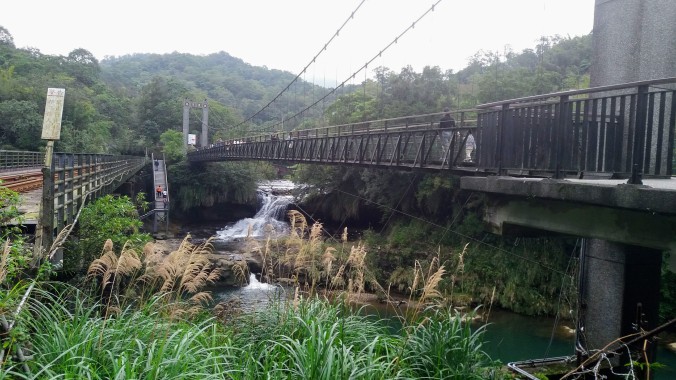
I felt a little like I was playing tag with the scenery. I just about had time to get there take some pics, stare longingly at the cool water for a couple minutes and hike back to the bus. There is nothing “cold” about winter in Taipei. I saw pictures online of people in the snow, but I think it must be a real rarity. Locals did tell me the weather on my visit was unseasonably warm, but rushing around the geopark and speeding through the countryside to see the waterfall had me soaked in sweat.
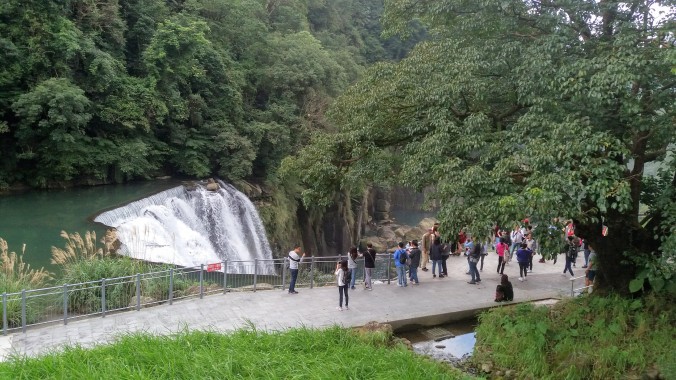
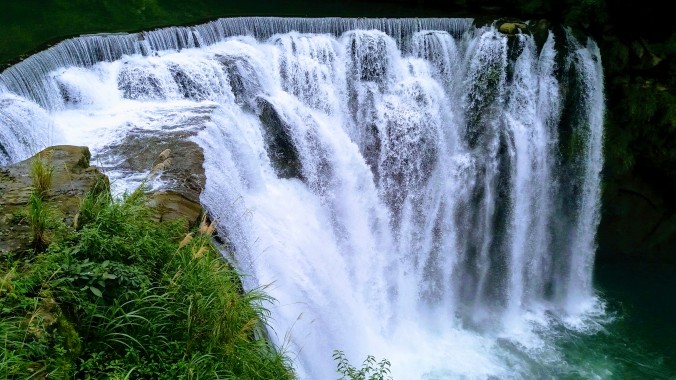
Nonetheless, it is a remarkable waterfall. No mere trickle through the rocks as far too many advertised waterfalls can turn out to be, this was a broad and strong roaring fall. If you are lucky enough to have more than 20 minutes here, there are also several restaurants and picnic tables where you can enjoy the waterfall over lunch.
Kaohsiung:
I actually only included Kaohsiung in my travel plans after I read that one of the only sites of mass butterfly migration was near there and was going to be happening during January (when I was traveling). Like waterfalls, butterflies are an irresistible draw for me. I do enjoy a butterfly park, where many species are raised for ecological conservation or just because they’re pretty, and visitors can walk through a mesh enclosed garden to see them, but I also treasure butterflies in the wild. It always feels like a tiny little brush with magic when they pose for me.
Maolin Butterfly Trail 茂林賞蝶步道
Thus, when I read about the mass migration of the purple crow butterflies I was very excited. There are only two species in the world that overwinter en masse in a valley like this, and the other is the monarch. I’d seen beautiful footage of the monarch masses in Mexico (not open to tourists, btw, to protect the butterflies) and while the articles I read warned me not to expect anything so profuse, it is still the second largest natural gathering of butterflies in the world. I had to go.
I did a lot of research to prepare. Optimal butterfly viewing is 8-11am, but the buses don’t run that early. I actually emailed with the park about this. The best public transit option from Kaohsiung is to take Kaohsiung Bus E25 & E28 (Kaoqi Express) to Qishan and then change to H31 (Qishan-Maolin-Duona) (website link) The problem is the distance and time. The E25 takes just over 3 hours, and then you wait for one of the 6 daily buses to Maolin park entrance and ride another 45-60 minutes. Both E25&28 don’t run before 7am. Nothing gets you to Qishan early enough to reach the park entrance before noon. I also looked into hostel, b&bs or other options closer to the park, but even searching in Chinese with my not entirely terrible language skills, information was scarce. The few places I found online couldn’t take reservations online and were not on the shuttle bus route in any case.
To make matters even more complicated, there was an earthquake in 2005 which decimated a lot of that area, but there’s not a lot of information on what is or isn’t still functional post quake.
I could have just bused in and arrived at noon, and taken my chances the butterflies were not all having their afternoon nap, but I wanted masses of butterflies. I looked at videos as recently as two days before my arrival in Kaohsiung and saw them fluttering all over the roads. In some places, roads were even being shut down to protect the butterflies! So, I booked myself a car to drive me there at the very crack of dawn. I used a company called Tripool, and instead of a 4-5 hour bus trip for 5$, I had a 1 hour car ride for 35$. If it had worked as planned, I still say it would have been worth it.
I had been watching the weather forecast like a hawk, but it was barely reliable in the city and there was next to no data about the mountains. Several days of weather patterns led me to hope that a gray misty early morning would burn off into a sunny mid-morning, so I bundled myself in the car at 7am and headed to the Taiwanese countryside.
When I arrived, the weather was still terrible. The car I hired dropped me off here.
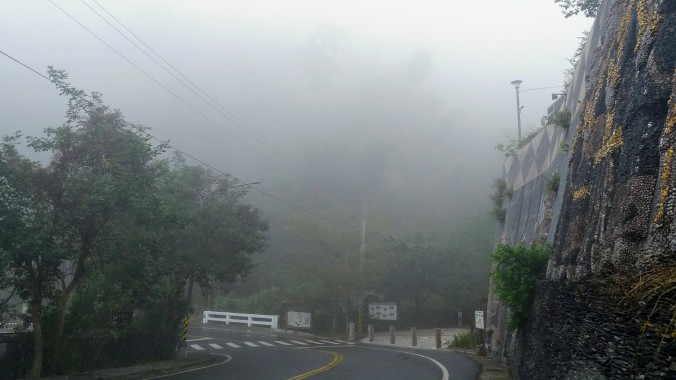
I found what looked like the trail head which had lots of signs about trails and how to spot the butterflies, but they were old and dirty, like no one had used them in years. You don’t know how unsettling it is to be in this kind of fog filled emptiness and see signs that are obviously new (it has a QR code for heavens-sake) but look like they’re from some kind of post-apocalyptic survival film.

It turns out the reason is that no one HAD used them in years. The original structures from before the earthquake had just been abandoned. Eventually, I found the actual visitors center, which made me feel a lot better. The people there said there wouldn’t be any butterfly activity that day, but the weather outlook for the rest of my time in Taiwan didn’t look any better. Plus, it was 4 hours until the next bus out of town.
I watched a movie about the butterflies with a group of school children on a school educational trip. I didn’t understand that much, but it was mostly fun to watch the kids react to the video (and to me). After that, I decided to hike the trail despite the weather.
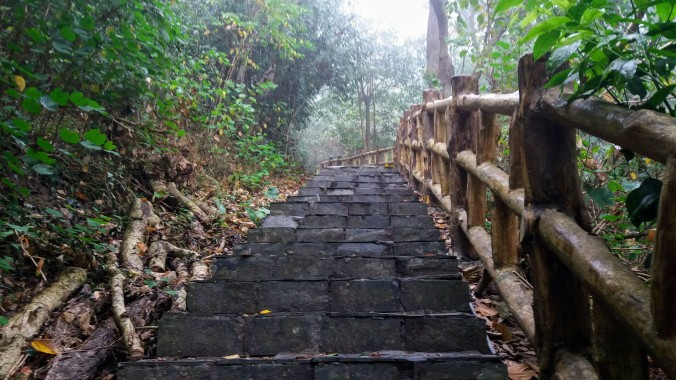
I climbed stairs for hours and saw zero signs of butterfly presence. My photos from the hike look like they should be eerily silent, but the music from the cafe could be heard pretty much all over the trail, and despite the terrible weather, there were a significant number of other tourists out here chattering away.


Although I found no butterflies for most of my hiking time, I did find plenty of interesting things. There were adorable snails who thought the rainy atmosphere was perfect. There were beautiful tropical flowers, flourishing in the warm winter air. And, there was an army of giant spiders. I experienced the summer spiders in mainland China, and to a lesser extent in Korea. These are monsters who build webs that are several meters across. I am not kidding or exaggerating. These suckers are like 5cm not counting legs.


Honestly, I rarely see them quite that big in Korea… at least in the cities, and they are really good about not ever coming inside houses, and about building their webs where people aren’t likely to walk. I don’t think they’re considerate, just that it’s a lot of effort to make an enormous web, and they don’t want us to smash it.
The spiders in Maolin think 5cm body length is scrawny. If I was not familiar with the species behavior, I would have totally freaked out. Luckily I know from experience, they are not interested in me. They don’t want to put a web across a path. They will not drop on you from above. That last one is really relevant since, to avoid the humans, a lot of them just built their webs about 10ft up. Where they can catch birds.
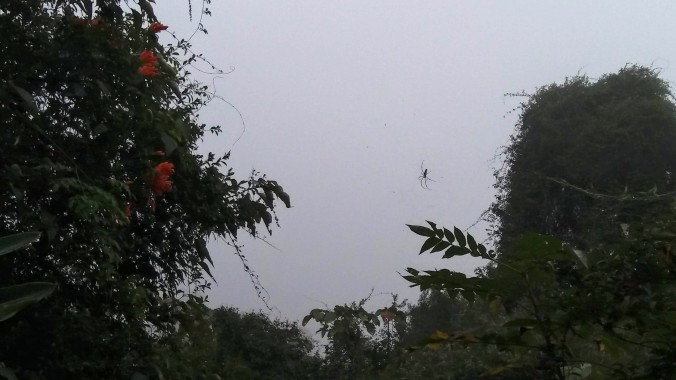
To be honest, I was really surprised there were no butterfly corpses in these webs. And, however intimidating these spiders can look, the webs in the mist and rain were beautiful jeweled works of art.


After a couple hours of meandering, I finally found some butterflies. I saw maybe 20-30 the whole day, and only one close enough to photo. It was a far cry from the hundreds or thousands I had been hoping to see.
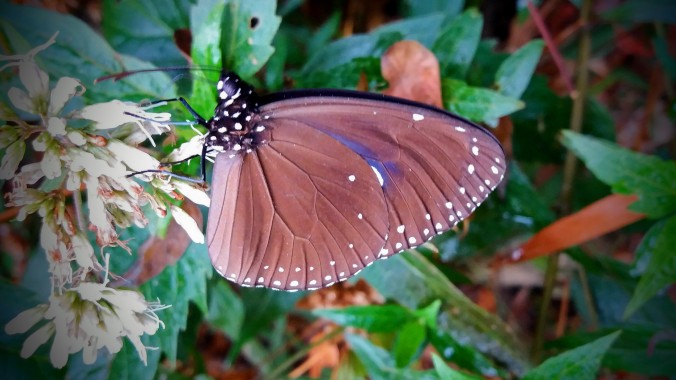
It is awfully beautiful there, but I really wish I could have seen it in action. Just in case the Taiwanese government was exaggerating, I did check the live video feed and some Instagram filters from sunnier days, and it looks like it really is a little fairy land. Next time, I will have to watch the weather more carefully and be ready to rush to Kaohsiung at short notice. The good news is, it’s only a couple hours from Taipei to Kaohsiung, so I won’t have to stay there waiting (Taipei has better food, sorry Kaohsiung), but I will have to have a more flexible plan.
Temples
Taoism (pinyin: Daoism), Confucianism and Buddhism are considered the three main “religions” of China. Taoism is mainly a mix of local folk practices that consolidated after the introduction of Buddhism. It has a LOT of gods and spirits and ancestors and immortals and magic animals. The main goal of Taoism is immortality (although there is a split on whether that means corporeal or spiritual), but you can pray to any of the gods for help with more mundane stuff like health, marriage, or passing your driving test.
Buddhism, often heard of but rarely understood, is a spiritual practice without any gods. Buddhists search for Enlightenment and subsequent freedom from this world which is both an illusion and full of suffering. This takes a few hundred (thousand) lifetimes, so in the mean time a lot of people pray to the boddhisattvas (a little like saints?) for the same mundane stuff they ask the Taoist gods for.
Confucianism is more a total package social structure than a “religion” but it does incorporate a certain amount of ritual and spirit oriented behavior and a very clear “how to live” guide, though not a lot of praying for mundane stuff. To be even further removed from the Western traditions, a lot of people don’t choose just one, but rather go to whichever will serve an specific purpose at a time. They simply aren’t viewed as exclusive “truths”. Honestly, almost nothing we associate with “religion” in the western traditions applies to any of these, but until we have a better word, here we are.
Taipei:
Dadaocheng Cisheng Temple 大稻埕慈聖宮天上聖母 (Taoist) is dedicated to the Tianshang Shengmu (Heavenly Holy Mother), the guardian of sailors and also known as Mazu or Tianhou (Empress of Heaven). It is in the midst of an “eat street” and even has a dining area in the temple courtyard. Far from being serene and heavenly, it is quite lively and bustling.


Taipei Confucius Temple 臺北市孔廟 is more of an interactive educational experience than a holy place. It’s not surprising as Confucianism isn’t really a religion. The scholar Confucius (Kongfuzi 孔夫子) was more interested in the smooth running of things on the earthly plane than the spiritual one. Rituals were an important part of a social order for him, but he didn’t spend much time speculating on any gods or spirits.
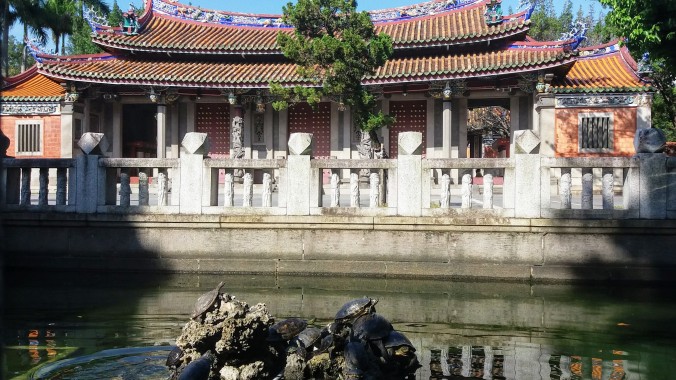
The entire compound is beautiful, but more that that, you get a wonderful English language detailed explanation of the meaning and purpose of each hall (which, under other circumstances I might have transcribed off the brochure, but I feel like you’ve had enough education for one post), a truly early-tech 3D film explaining the history of Confucianism and it’s modern interpretation (it was so campy it was fun) and interactive displays for the six Confucian Arts that Confucius considered vital for any civilized person in a civilized society: Calligraphy, Music, Archery, Charioteering, Computation (math), and Rites (religious, political, and social ceremonies).
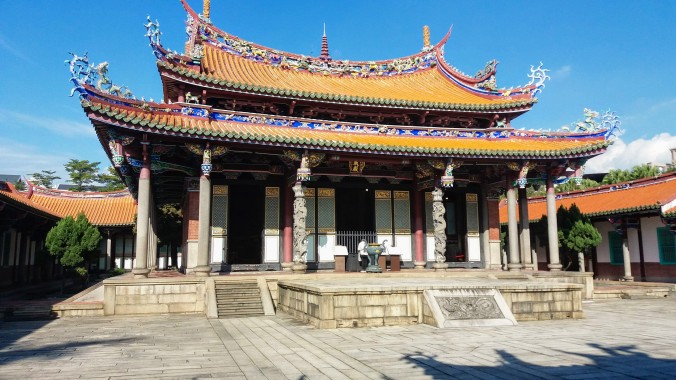
It was a big contrast to the Confucian temple I visited in Beijing which was a beautiful monument with little to no explanation as to it’s historical function. Plus, where Taiwan still teaches pieces of the 6 arts in schools and even holds some public Confucian rites today, the mainland has subsumed Confucian values into the Communist Party Line.

Dalongdong Baoan Temple 大龍峒保安宮 (Taoist) is dedicated to Baosheng Dadi (Great Emperor Protecting Life). It claims to be the oldest temple in Taiwan, or at least the oldest Chinese temple. (Yes, there were indigenous people living in Taiwan before the Han ethnicity mainland Chinese people arrived many centuries ago). It’s been restored many times over the years and is now an important heritage site. There’s several stunningly decorated buildings, as well as beautiful gardens with statues of famous Taoist stories, and a dragon in the lake. I especially enjoyed the tile work of the roof dragons on these temples which is distinct in both color and style from the mainland.


Kaohsiung:
Fo Guang Shan Buddha Museum 佛光山佛陀紀念館 was disturbingly hard to get to, but thankfully I can read bus timetables in Chinese. It probably would have been easier if I’d been coming direct from the city, but I was coming on my way back from the Maolin Butterfly Park. I also missed the last buses returning to the city, but it was ok because I was able to share a car with some other travelers. I don’t think it’s necessary to do this with a tour company, but if you aren’t at least “survival” level in Mandarin, then perhaps plan better than I did.

Fo Guang Shan is a global sect of Buddhism which started there in Taiwan at the largest monastery in Taiwan. It really is huge, and not only the enormous statue of the Buddha, but the sprawling grounds filled with gardens, exotic birds, and more beautiful statues than you can count.


The grounds are divided reflect the three treasures: sangha (community) where the monks and nuns live, study and work; dharma (teachings) where scriptures (sutras) are housed and ceremonies held; and the Buddha (the teacher) where the famously enormous statue rests at the end of the majestic walkway.
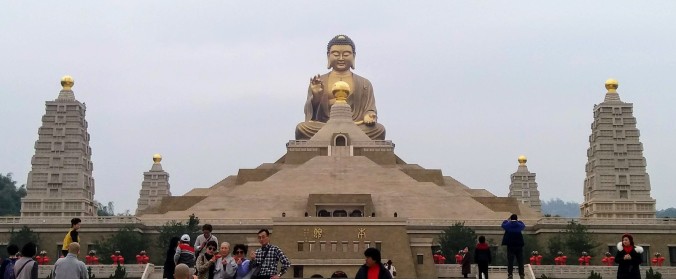

I think most people come for the third part, and honestly, that’s why I was there. I just took a “wrong” turn at the entrance and found myself walking all the way over to the Sangha, and then meandering back through the Dharma, before finally getting to the Buddha in time to for most of the tourists to leave and for the lights to come on.
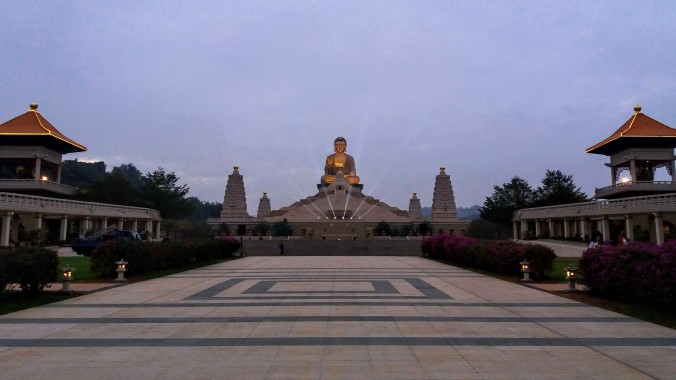
Their website is everything you would expect elderly monks to have created, but if you want to learn more about Fo Guang you can visit. Also, the museum’s website reflects a more worldly involvement and may be more palatable to the modern internet consumer as well as more helpful to the hopeful visitor.
That’s all for part 1. Thanks for reading! I hope you enjoyed the historical and natural side of my Taiwan trip. Next time, I’ll write about the more modern aspects including the “old streets” for tourists, a medieval style castle made by an eccentric millionaire, flowers, light shows, street art, and of course what Taiwan is best known for: the food.




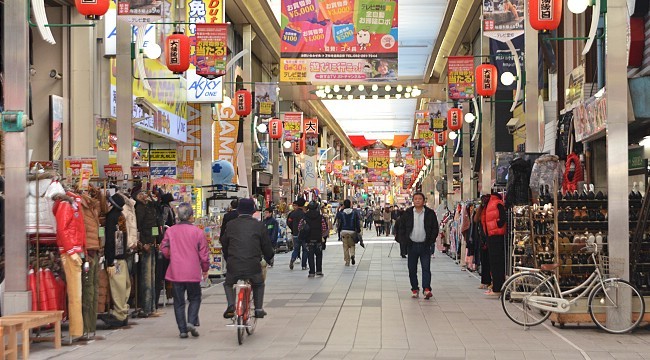
 Sakae was my first non-airport sight in Nagoya where I disembarked the airport shuttle bus and met up with my friend. It’s a large and bustling neighborhood in Nagoya with lots of trendy shops and restaurants. While waiting for our dinner restaurant to open, we decided to do a little shopping.




 The shops in Yokohama and Tokyo had a huge array of Ghibli goodies and I wanted to go back and see if I could get something unique for my niblings (gender neutral for the children of siblings, I did not make it up but I love this word). I’ve been sending them one Ghibli movie a year along with a few themed toys. Every other family member is drowning them in Disney, so I claimed Miyazaki. So far they’ve gotten Totoro, Kiki, and Ponyo (they are still quite young). My niece especially loves the lace bracelet I got at the shop, but mine is from Mononoke which they are not old enough for yet. I did manage to find a Totoro online, but it was twice as pricey as mine had been, so I figured I’d hit up the shop in Japan and have extra prezzies. Cool Auntie!


 The other shop is at a place called Oasis 21 which is ostensibly a bus station, but is really a shopping center. It’s much easier to find and less crowded than Takashimaya. It’s part of the lovely greenbelt in Sakae and it has a great view of the Nagoya TV tower which Nagoya loves to brag about like it’s the Tokyo Tower. It’s a little adorable. The Donguri in Oasis 21 isn’t as decked out in plush petable Totoro characters, however, so if riding the Catbus is on your bucket list, you better go to Nagoya Sta instead. I didn’t really have much time to see the other stores in Oasis 21, but it looked cute. It’s a big oval with an open center and covered shops on two stories around the outer rings.
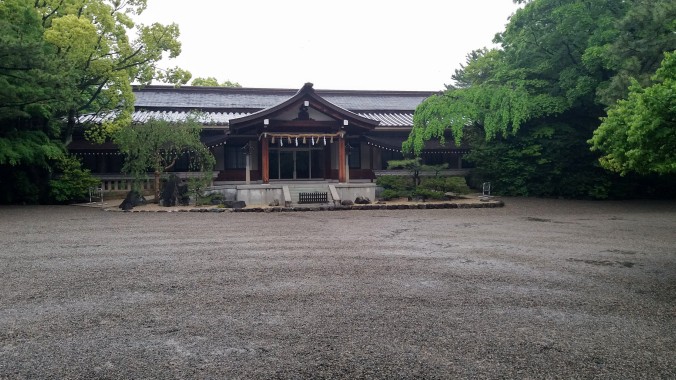
 is Shinto, while a “temple”
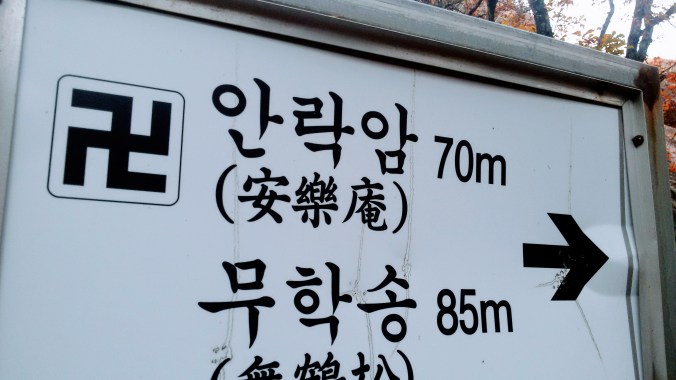
  is Buddhist. The map icons help to distinguish, and no, that’s not a Nazi swastika, it’s a traditional Buddhist symbol that is much much older than Hitler. The Shinto tales of kami (kind of like gods and spirits) are every bit as long and sordid as the Greek or Egyptian myths and involve lots of improbable births, sibling marriages, and explanations for how the world got so messed up. I do not know the whole thing as well as I know Greek gods because I wasn’t raised on a steady diet of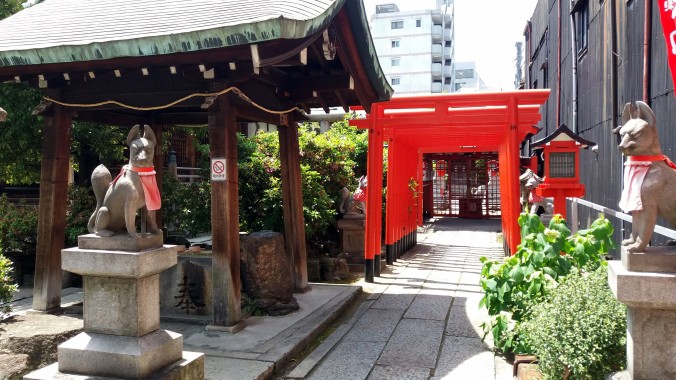






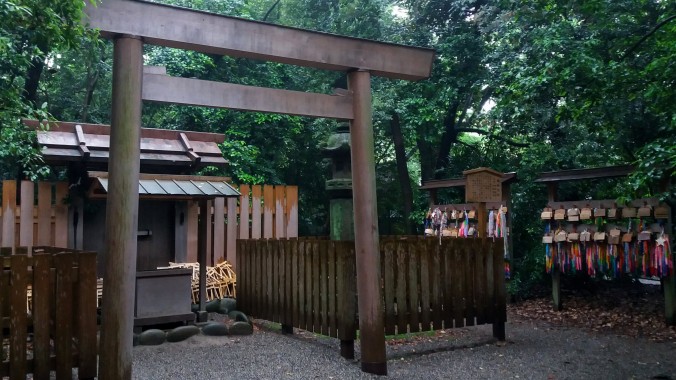 At first I didn’t know what they were. I only saw the bright colors from a distance and was drawn closer with curiosity. As I examined the strings of color, it became clear that these were chains of paper cranes folded and strung together in a way that most Westerners are familiar with from the story of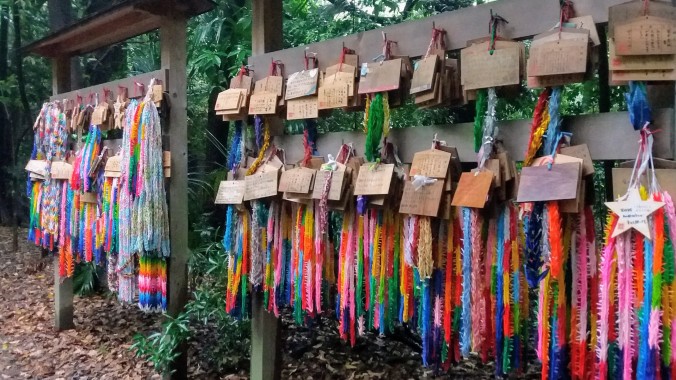


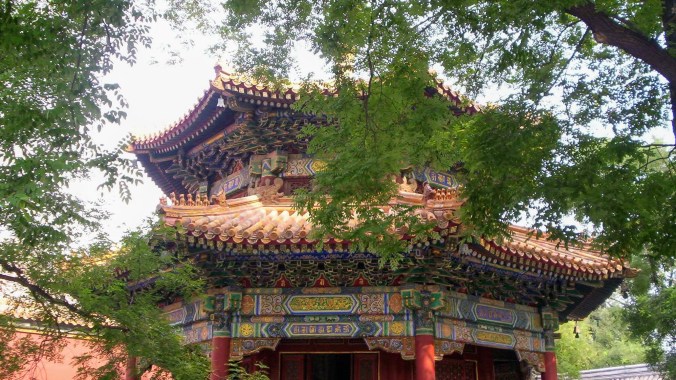








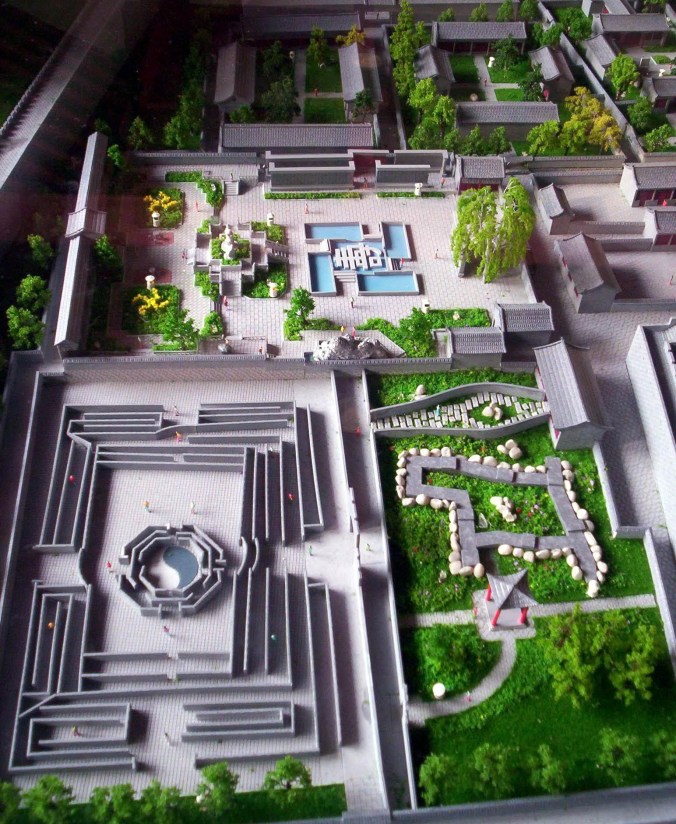 Lastly is the Longevity Garden, which you can see in the second layout model above. It has a nice waterfall, and a reflecting pool in the shape of what may appear to be a swastika, but it really a sacred symbol of Buddhism. And while I’ve seen this figure in a statue before, I’m still not sure who it is, other than it seems to be someone important in Buddhist history.





 Turning to my trusted friend, Google, I found that Thailand (of all places) sells my drug of choice over the counter! For a few dollars. And yes, I have heard every argument about buying off market drugs in countries without enough regulations, but what are you supposed to do when the country you live in doesn’t have the drug? Also, as an expat, I’ve been to doctors and pharmacies around the world because that’s where I was when I needed the medicine. Egypt, Saudi, and France were all places I had to visit pharmacists. I take other medicines here in Korea that, when I look them up, are not on the US market by the same name or even manufactured by the same company. Were I to take a job in Thailand, as people in my career do from time to time, that is the medicine I would take. Maybe the drugs are actually less well regulated or maybe the US pays too much for pharmaceuticals. Not sayin’, just sayin’.
 I managed to order something by playing a sort of 20 questions with the waitstaff, and enjoyed my noodles and mystery meat in a not yet too hot outdoor dining area with views of the neighborhood. There were a startling number of funeral homes nearby and plenty of evidence of the British colonial architecture, although much of it was in disrepair.
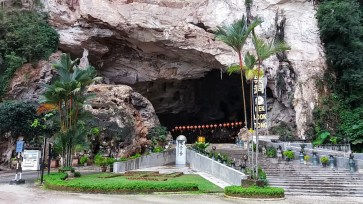


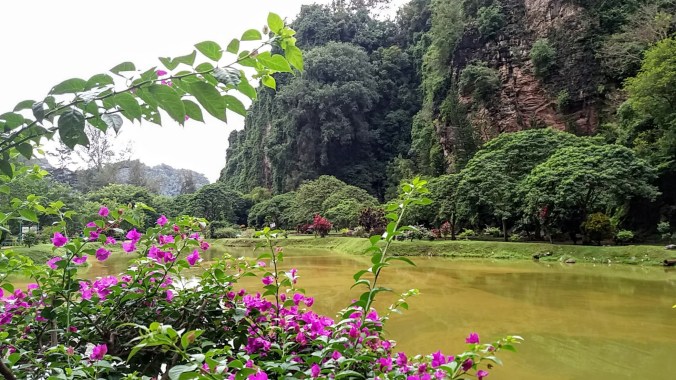


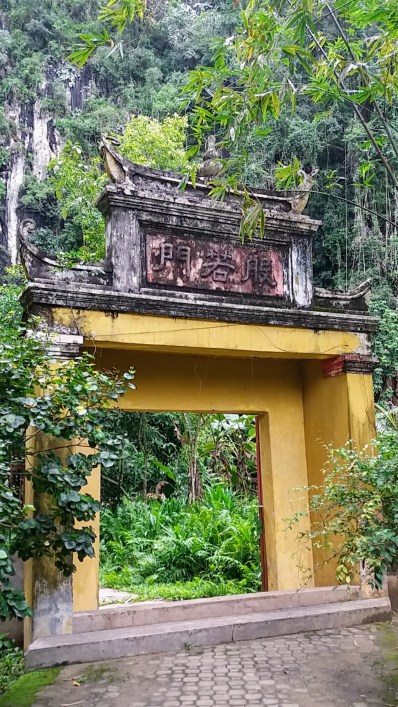 Sam Poh Tong is also a Buddhist temple and is said to be one of the busiest and most popular in Ipoh. I could tell it was an active temple from the freshly lit incense, but little else gave evidence that it was maintained or cared for. Even so close to such a large holiday, the grounds looked unkempt and abandoned. The huge numbers of underfed and skittish stray dogs was off-putting, but they were not aggressive. The garden in the front was a small lake with tiny “islands” that became miniature mountains holding tiny temples. As I walked around one side of the temple compound, I came upon a building that seemed long empty, covered in dust and bereft of occupation, yet there was incense burning at the dusty altars, observed it seemed only by me and some monkeys on the fence nearby.
 The walls were painted and florescent lights were on the ceiling, while piles of furniture and other stored items crowded the rooms. The floors were finished and there were windows and doors installed into the stone. It felt less like a cave and more like a basement.
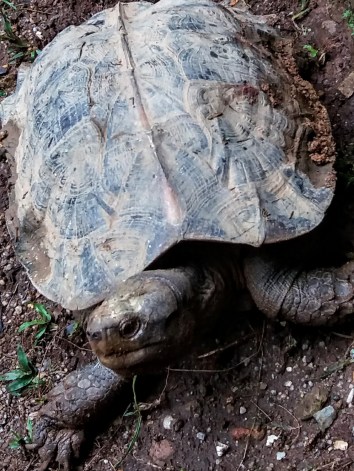
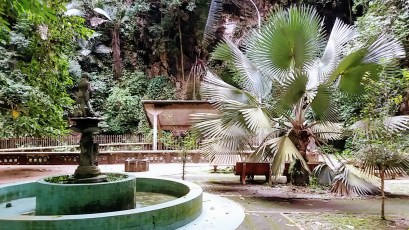 n the other side of the cave was a small enclosed garden. The walls of the garden were more towering limestone formations and the greenery within was Jurassic in scale and seemed to be overgrown with no concern for trimming or arranging, dead leaves carpeting the ground. There was a small turtle pond behind a fence filled with turtles of all sizes that could be fed fresh greens and veggies bought from a
  stand inside the cave. The stand and it’s sales person were some of the only signs of tending I saw. At the back of the garden behind a locked a fence and a forest of unkempt branches was a bright red pagoda that seemed more like something in an abandoned jungle than in a living temple.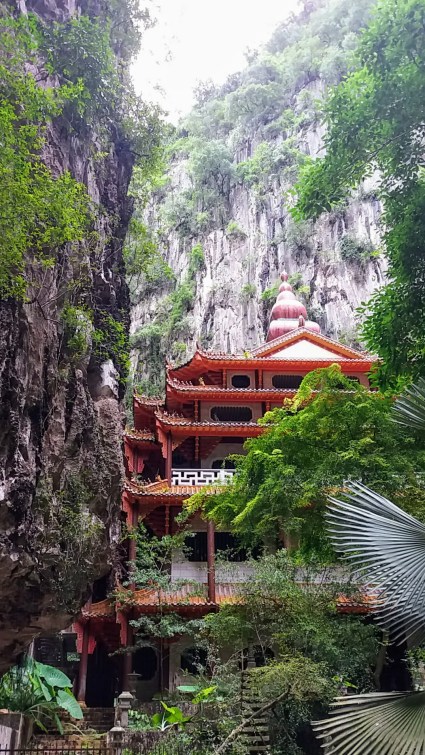
 I crept around the cave rooms from one altar to another, plastic cups and cleaning materials lay scattered around, the tile floor was cracked and uneven. I followed a treacherous staircase up a flight, but it ended only in a tiny window and more dust. It was so easy imagine that I was exploring a temple long forgotten, and then I would find a lit candle, or a smoldering joss stick or even a lone employee selling souvenirs. Outside once more, I continued on to the cemetery. In Buddhism, cremation is the norm, so there were small buildings in another alcove that housed the remains. Despite signs requesting that no incense be burned, there were sticks shoved around all the doors and soot marks as well. The buildings were grown over with moss and leaves, the paint peeling and the ground cracking under the pressure of new roots, yet the incense showed me that human presence was recent.
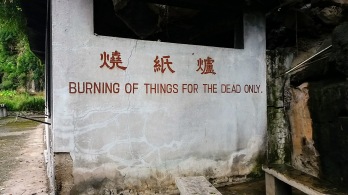 The farthest end of the compound was an area designated for ritual burning and another weedy and overgrown garden that seemed to be turning into a dumping ground. As I made my way past more dogs and tourists, I couldn’t help wondering at how this temple had been so highly rated by so many visitors when Kek Lok Tong was so clean and well cared for. I enjoyed visiting Sam Poh Tong, but it felt like an archaeological excavation rather than a place of worship.

 I looked it up to make sure it wasn’t something too scary, then ordered myself a bowl for lunch. Rojak just means “mixture” but fruit rojak is a common dish made of crisp (less than fully ripe and therefore slightly tart) fruits and veggies. Jicama, cucumber, mango, and apple are standard ingredients. The sauce is the magical part. The recipe gurus of the internet assure me it’s made with shrimp paste, hot chilies, sugar, soy sauce, and lime juice (with some regional variance). To me it tasted for all the world like molasses with chili, ginger and lime. I don’t know if mine was made with molasses or if that’s just what it tastes like when you mix soy sauce, shrimp paste and sugar together, but it was yummy!


 Just one gate over is the third and final temple on this street, Ling Sen Tong. This temple mixes Taoist and Buddhist imagery along with other folklore in a big colorful Chinese melting pot. It is an all singing all dancing color fiesta. There are beautiful facades of buildings and temples, giant statues in fresh bright colors, elaborate scenes of mythology played out, and everything was touchable/climbable so visitors were having a blast posing for photos. There was only one small, dark cave. The ceiling had turned black from years of candle and incense soot, and it was chaperoned by a figure whose offerings exclusively included alcohol (for some reason, especially Guiness…) I enjoyed exploring the many statues and hidden rooms. I even found this one guy who looks like he’s checking his phone in the bath! I’m sure there’s a better explanation for it, but along one wall was a series of statues in sunken pits that had all filled with water. I don’t know if it was meant to be a kind of wishing well or something else entirely, but this one in particular stood out to me.


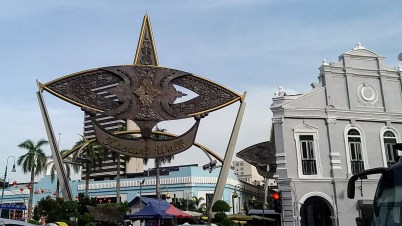 The morning after my late night and less than welcoming arrival, I woke up early, scarfed down my leftover convenience store sweet buns and took off to find the train station that would lead me to the Batu Caves. In recent years, the Malaysian government has added a train stop at this popular tourist attraction, and now it’s much easier to get to. The train itself was a new experience. When you purchase a ticket, you are given a plastic token with an RF chip inside. When entering the platform, you hold the token up to a pad to be read and it opens the gate, but hold on to that chip! When you disembark, you need to feed the chip into a slot to pass through the exit gate.
 I met a tour group on the train platform and we chatted during the train ride. I hung around with them and their guide to hear a few of the explanations offered about the caves. The guide rushed us past the dozens of sales stalls (saving us from souvenir swindles), gave a brief presentation under the statue of Hanuman (the Monkey King) and landed us in the main square at the base of the stairs and the giant golden statue of Murugan (a god of war, made of concrete and painted gold colored). There was a tremendous flock of pigeons in the main square and it seemed to be a major tourist attraction to stand in the flock and have them hop onto your hand to get some food. Occasionally construction in the background caused a loud boom that set all the birds a flutter, which was surprisingly pretty.


 After a few obligatory photos with the tour group and the giant statue, we began the climb. The stairwell is not insanely long, a mere 272 steps. They were so popular as a form of exercise that the government had to ban fitness use of the staircase to keep it clear for tourists and worshipers. With my kryptonite-like response to humid heat, the staircase became a long haul obstacle, but there were plenty of interesting things to stop and look at on the way up, like the expanding view of the courtyard and city below, the rock formations on the cliffs along side, and of course the hordes of monkeys roaming freely through the grounds. Given that the monkeys are wild, I was totally happy to keep my distance, but they were not shy and enjoyed coming right up to tourists or even forcing a showdown over who got to use the hand rails. At one point there were two monkeys perched on twin posts on either side of me and I managed to get a cute double monkey selfie, checking off a bonus square in the Batu Caves tourist bingo.
 When I finally got to the top, I was greeted with a large cave mouth opening that led to an even larger cavern. The entrance of the cave had small buildings installed for souvenirs and police. Once all the way inside, I could see that although this huge open space was graced with a few decorative statues around the edges, it was largely left in its natural state. The cave mouth was wide and there was a natural sky light further on, so the cavern was well lit. There were a few artificial lights in strategic places and an area of worship off to the left. Finally, there was another short staircase leading through to the open area beyond. At the top of those stairs was the rearmost chamber of the cavern, another broad space; however, the roof had long since fallen in and the walls soared up into open air, creating a round room with no roof.


 As I exited the temple section to descend the stairs again, I detoured off to the right to investigate a “dark cave”. The Malaysian government has taken this side section of limestone cave and created a conservation space. The limestone quarries and careless unregulated tourism of the recent past had wiped out a lot of the cave ecosystems. Efforts to restore the guano based ecosystem of living limestone caves are now underway in many parts of Malaysia and this cave was for both preservation and education.
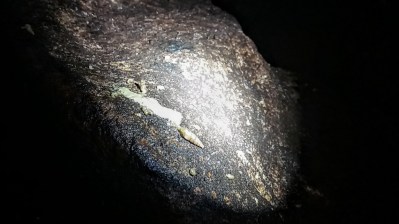 Nearly everything that lives in the cave is so tiny you wouldn’t even notice it if no one stopped to show you. When we see nature documentaries, there’s often nothing for scale, so it’s easy to imagine the animals as being similarly sized to their daylight counterparts. When our guide showed us a picture of the little white snail that lives on the rocks, I imagined a tiny snail, but not nearly as tiny as the ones we found! The biggest of the snails was about the size of a grain of rice, but there were smaller ones dotted around.


 As I descended back to ground level, I passed still more monkeys, several sets of mother and baby wandered around, and some tourists were feeding them peanuts (despite the do not feed signs). I noticed that the dominant males were very protective of their snacking rights and would drive off the mothers aggressively. Of course, no trip to a monkey colony would be complete without a little fornication. I happened to be standing right next to a female when a male walked up, took her butt in both hands and peered at it closely, then proceeded to mount her, much to the shock and amusement of tourists from 6-7 different countries. No, I did not take monkey porn pics.
 Farther on, beneath the looming statue of Hanuman we passed at the beginnging, was the Ramayana Cave. This attraction was much more highly reviewed and was only 5 ringgits to enter, so I decided to give it a shot. There is a stream inside the mountain that comes out and is used as part of a beautiful fountain depicting the chariot of Rama and Sita. If you’re not familiar with the


 but the main floor had a few shops and restaurants. I pulled into the first one I saw and confessed my massive ignorance of Malaysian cuisine, asking the staff for a recommendation. Moments later I had a heaping plate of some kind of fried rice dish that was smokey and pleasantly but not overwhelmingly spicy. Sometimes you just gotta walk on the road that looks more interesting.
 After an incredibly full first day in Singapore, I had a much lighter day of temple viewing planned before I hopped on the bus to Kuala Lumpur in the afternoon. It’s never hard to wake up in a dorm hostel, since everyone else is waking up, too. After packing up and enjoying another cup of teh tarik, I headed out to catch the sights. The night before, I’d run across a giant rooster in the street (in anticipation of the impending lunar new year holiday), so I did a quick rerouting to pass back by in the light of day. Chinatown was already putting on a decorative show two weeks before the holiday; I can only imagine how crazy it was on the actual holiday weekend.
  In addition to the stunning decorations, I passed by a street artist sitting in the shade of an overpass and working on the beginning of a painting of the festivities. He was kind enough to let me take a photo and we wished each other a happy new year in parting.
 After breakfast, I headed into the temple. I generally don’t wear short shorts, and while I go wear sleeveless in heat sometimes, since my plan for the day was temples, I was dressed appropriately. However, for the tourists who weren’t, a staff of firm but polite people arranged for them to wear long skirts or shoulder wraps from a shared bin. Once past the main entrance, I walked into a smaller room where two monks were performing a blessing on a couple donating to the temple in a red envelope (traditional for money gifting at the new year). As I watched, I realized people around me were taking photos and video and I was surprised. I looked around for any signs about cameras, but there were none. It seemed that the temple allowed visitors to take pictures. It felt very strange taking pictures in a temple, and in the end I could only take a few before my sense of unease overcame me.
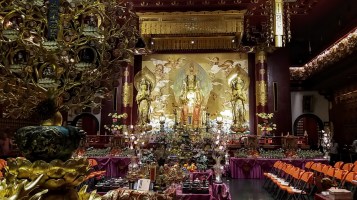 The main hall on the ground floor was an ode to opulence. I’m used to Buddhist temples being ornate. Wood and stone carvings with intricate detail are common (though never boring). Paintings or works in colorful semi-precious stones, and even the occasional gold paint or gilt covering to add some shine. The point is, that I’m used to temples being about effort and time and skill, rather than about blatant displays of wealth. In fact, a common art form is the sand mandala, which is made over weeks or months of painstaking hand work, then wiped out to represent the impermanence of reality. I don’t have an issue with beauty in a temple, I go to temples in part because they are beautiful, but something about this temple and it’s over the top gold, it’s donation jars every few feet, and it’s designated VIP seating for supplicants just did not sit well with me.
 I found the elevator and went all the way to the roof to see the orchid garden. That at least was in keeping with temple life as I think of it. Although orchids are rare in the world, they are common in Singapore and the difficulty of their cultivation reflects the work that monks and nuns put in as part of their practice. Below the gardens, the top floor contained the relic for which the temple is named, a fragment of the Buddha’s tooth. It was also the only room in the building where shoes and cameras were prohibited. There were dedicated meditation mats along the windows where a few people were sitting in silent contemplation, and there was another large gold display.
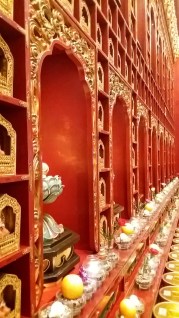 I’ve seen American “mega-churches” that have gold plated elevators and preachers with 5 cars and 3 houses and a minimum annual income requirement for membership. These also disgust me and I often wondered how any Christian could justify that kind of obvious money-grubbing and wealth favoring within their doctrine. This was the first time I’d ever seen a Buddhist “mega-temple”, and it was awful. It made me feel ashamed to be associated with the faith. It made me want to run around to tourists and exclaim “that’s not what Buddhism is about!”. It made me want to drag out some scripture and ask the people praying there if they’d even read it. And for just a moment, it made me think about Terry Pratchett’s Yen Buddhists, whose main theological argument is that:
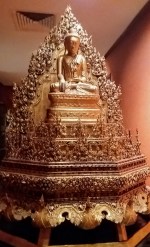 I headed down to the third floor to see the museum, which was a worthwhile collection. It was a nice museum of Buddhist art and man-made relics that included a sort of “intro to the Buddha” story on signs around the displays. Like the rooftop garden, it felt far more authentic and enjoyable. The relics were primarily stone, clay, bronze or wooden and had clearly been the result of effort and craftsmanship. Although the extraordinary focus on Guan Yin and the Maitreya was a little overwhelming, it did point to the fact that the temple’s own branch of Buddhism was a salvific form that relies on Bodhisattvas and future Buddha’s to save the world, rather than on the practice of self cultivation for individual enlightenment.
 The second floor had a nice place to rest, which I desperately needed. Adjusting to the heat and extra walking was taking a toll. It was such a great contrast to my energy level in New Zealand where the weather was cool. Just minimum exertion in a hot humid climate seems to drain me like a marathon! After a rest and a look through the last floor of displays, I made my way back to the ground floor, once more shaking my head at the ostentation, this time walking past the VIP seats they were filled with supplicants who had paid I’m not sure what to get past the velvet ropes. All in all, I’m still glad I went to see it, because I learned something about the corrupting properties of money. All temples ask for donations to help feed the monastic population, pay the basic bills, and to provide services to the community. Money is, in this world, unavoidable. However, when a house of faith relies on wealth or doles out blessings for cash or claims that the donation of great wealth is a higher holy act than living a good life, that’s corruption.
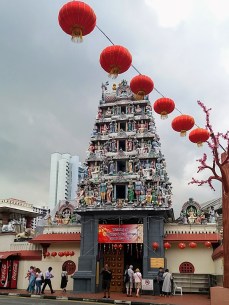 After the Buddhist temple, I took the short walk two streets over to see the oldest Hindu temple in Singapore: Sri Mariamman. This humble wooden structure was not a display of wealth, but was still anything but plain. Wooden carvings covered every inch of the outer facade and were brightly painted besides. Anyone was welcome to enter, leaving their shoes behind on racks on the sidewalk. There were saris for anyone who felt inadequately dressed, and while we were free to wander around the grounds barefoot, the main areas of worship were cordoned off, not for a fee, but for the faithful. I am not a Hindu, so I contented myself with observing from behind the lines. The interior of the temple is a large courtyard with smaller buildings, each one dedicated to a different divinity. There are over 330 million gods in the umbrella of Hindu faith, and while only a couple dozen are among the most popular, it can
  be hard for a layperson to know which altar is for who. I found 10 names of deities for this temple on it’s
 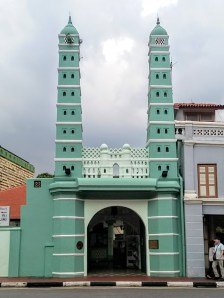 couple city blocks, I had passed 3 major religious buildings, and I knew from the map that a Christian church was not far off. Curious, I looked around the map for a synagogue and found one a little over 3km away, and it was neighbored with another church, Hindu temple, and Buddhist temple. It seemed that it wasn’t hard to find a spot in Singapore where at least 4 out of the 5 major world religions shared a small space and yet no one was getting blown up, shot or even harassed on the street! While I’m sure that Singapore’s strict legal code has something to do with the lack of violence, I like to think that pluralism in the culture helps everyone to get along. People of other faiths or cultures seem less scary when they are our neighbors and not “those others”.
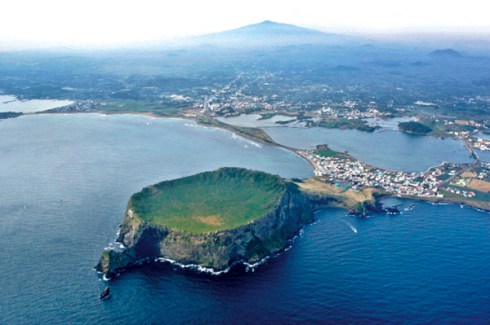 The weather was once more gray and drizzly, hot and humid, but with some sleep, breakfast and coffee behind us, we were enthusiastic to hit the road. I had done a bit of research on the crater that morning because of how the walk around the waterfalls turned out. I found some bloggers who claimed it was a 20 min walk if you just went straight up and about 40 minutes if you were a slow hiker. (it still took me about 45 that day). I felt better prepared for the hike ahead, but then we arrived late due to heavy traffic.



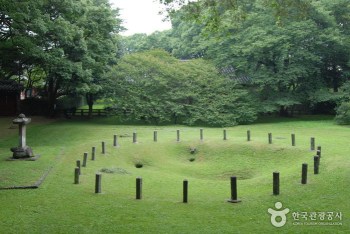 According to the legend told at the temple, the first inhabitants of Jeju Island were three demi-gods who came to earth in a great flash of light and energy, and emerged from three holes in the ground. The temple is built on the site of these three holes, and no matter how much it rains, the holes never fill up with water. The demi-gods were named Go (
 After watching an informative film about the history and mythology of the shrine and the island, we wandered through the paths in the quiet woods. There are almost 1000 trees in Samseolhyeong. The other buildings included the museum where dioramas of the myth were displayed along with some of the original writings and ceremonial clothing from the earliest rituals performed starting in 1562. Additional alters, shrines, dormitories and halls were added over the years, but most were destroyed during Japanese occupation. Although the site of teh three holes is the same, the modern temple complex was rebuilt here in 1970. The walk through the trees was a refreshing break from the hot and humid weather. We admired many bangsatap (small stone towers built for luck) and more than a few dol hareubang (the stone grandfather statues that are the iconic image of Jeju).


 There were 3 special rooms along one wall of the second floor: the red clay room, the amythest room, and the gardenia room. The rooms had little doorways and were quiet and dark inside. Places where people sat on mats or lay with their heads on wooden blocks to relax or nap while enjoying the atmosphere. The red clay room was warm, but not quite sauna warm. The walls were red clay and it resembled the inside of a clay oven. I don’t think I could have stayed for long in the heat anyway, but we were driven out by one man’s snores before that. The gardenia room was a truly sauna level of hot. There was a stong floral (presumably gardenia) smell in the air, but the heat was too oppressive. My bare feet singed on the floor as I hopped to a reed mat for protection. There were many women sitting on the mats but the air was too hard for me to breath for long and I hopped back out without even sitting down.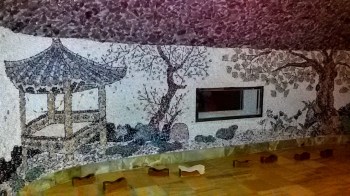
 Gallivantrix