Although the adventure in the Malay Peninsula was finished, I had one more obstacle to overcome before I could return home. Vietnam. In this tragic comedy of errors, I learned about the only airport in the world that doesn’t have a fly through policy, and I managed to check one more item off my bucket list. Never underestimate the stopping power of Communist bureaucracy or the healing power of pho. Don’t want to read about airports? Check out the end for some heartwarming life lessons about challenge and gratitude.
The Airports
Normally, I would not write about an airport, but it seemed that Thailand just could not let me go without a fight. Surat Thani was no trouble. A giant double decker plush AC bus (the kind I wish I’d been in on every other occasion in Thailand) pulled up to the hotel at 11am to whisk me off to the airport for a small fee. The airport was miniscule, but the staff were helpful. Nothing was labeled, but it was small enough that didn’t matter. Instead of posting about delays, they just told us.
I met a fun person in the airport, because I magnetize them to me. After our introductions, she gave me one of the nicest compliments I’ve ever gotten: “You’re way more interesting than looking at my phone!” So we pocketed our devices and talked until the late plane arrived to take us to Bangkok. And so it was, in this pleasant lackadaisical mood that I arrived in Bangkok with a several hour layover and plans to do some last minute shopping and get a nice meal.
I wandered out of domestic and over to the international terminal with only a mild case of being lost twice, and finally found my check in counter amid the totally not at all labeled rows of counters by the simple expedient of going up to a person and asking. However, here’s where the regular international airport challenges start to level up. While going through the check in process, I was informed that I cannot be issued my boarding pass without a visa. I don’t need a visa, I tell her, I have a residence card, showing my Korean ID. No, she says, for Vietnam.
You Need A Visa to Get In
Now, my flight, which I booked on the amazing and cheap website kiwi.com, took me from Surat Thani, through Bangkok, through Hanoi, and finally to Busan (where I live). In normal reality, catching a connecting flight in a country does not require a visa unless you plan to leave the airport for some layover sightseeing. This is standard operating procedure around the world. China (which up until recently had a monstrously complicated tourist visa application with huge fees and wait times) has lots of people fly through without visas. Even Saudi Arabia which does not issue tourist visas will let people catch connecting flights in Jeddah on their way to some more touristy section of the Gulf. You don’t need visas to catch connecting flights. It’s like an immutable law of reality.
“I’m not going to Vietnam, I’m just catching a connecting flight.”, I say. “I don’t need a visa because I’m not leaving the airport.”
“No,” she says. “You need a visa. I can’t give you a boarding pass without a visa.”
Call Your Embassy
I search the internet frantically looking for supporting documentation, and while it is true that every single web search I get back tells me this immutable fact over and over, they do not care. They will not issue me a boarding pass without a visa. I’m having nightmare flashes of being stranded in Thailand, of missing work, of non-refundable tickets I’ve paid for… Unable to find anything on the US State Department travel site OR the Vietnam Embassy sight about airport transit, I finally called the US Embassy to see if they could confirm or deny this situation and maybe point me at some official document that supported my not needing a visa. The on call staffer at the Embassy agreed, this is bizarre, and he’s never heard of an airport where you need a visa to change planes, but they are also unable to find any official statements anywhere online. Then I run out of minutes and the call is disconnected.
I try to talk to the airline to see if I can get the flight changed, but that’s going to take a day or more because there are no flights that day with room. The Vietnam Embassy website has an online visa application, but it takes 5 days. Expidited forms won’t load on my phone, I need a real computer. I’m losing my mind. The check in counter staff show me a website that’s a private business (vietnam e-visa) who I can pay to get my visa quickly, but my flight is in less than 2 hours now. 30 minutes, they promise. The fee for the visa was only 19$ US, BUT, since I needed it in 30 minutes, and it was a Sunday, AND it was Tet (the very famous Vietnamese holiday that is in literally every Vietnam war movie), it was going to cost me an extra 190$ in processing fees. Before plunking down 200$ on a visa, I wanted to vet the website, and found that there are apparently a large number of fraudulent websites that advertise Vietnamese visas and don’t deliver. Finally, I found a traveler who had used the site I was on and had reported success, but advised us all to spring for the “airport fast check in” option for an extra 25$. Her story of waiting around the airport for hours to get approval was convincing, and so it came to pass that I paid 234 American dollars to buy a visa into Vietnam for the privilege of changing planes in the Hanoi airport also known as “the Story of the Most Expensive Bowl of Pho Ever”.
Getting to Hanoi
I didn’t have time to eat or shop. I managed to buy an overpriced sandwich from a cafe by the gate before boarding because I hadn’t eaten since breakfast at my hotel and it was now after 6pm. Between the delayed flight in Surat Thani and the visa ordeal, I had used up all my layover hours. I got several emails from the visa service with instructions, very dire and specific instructions, as well as a pdf of a letter of visa application (not even a real visa yet).
When I got to Hanoi, the staff from the visa company was thankfully waiting for me with a sign. She ushered me into a waiting area and took my letter and passport away for processing. I was expecting to have to take some passport sized photos there for the paperwork, but I guess somehow they copied the photo from my actual passport instead and used that. Less than 15 minutes later she came back and handed me my passport with Vietnamese visa inside, while other people were still standing in line at the visa counter. At least that “fast check in” option paid off.
From there, I was able to go through immigration. For reasons unknown to any but the arcane inner circle of the Vietnamese bureaucracy, there is not an international waiting area. I’m told that if you’re travelling through Hanoi with both flights on the same airline, that it is possible to bypass the visa and customs rigamarole, but since many ticket sellers and even airlines use partners to get you from one leg of your journey to the next, buying your ticket from one place, doesn’t guarantee all your flights are on the same airline.
The Most Expensive Bowl of Pho
I had to go through customs and immigration. There was no need for me to leave the airport, mind you, since once through immigration, I could simply turn around and re-enter the security screening and boarding areas. But, since I’d spent so much on a visa, I did step outside and breathe the external Vietnamese air, just to say I did. I also fulfilled one of my long time bucket list items, to eat pho in Vietnam.
If you don’t know pho, you are missing out. This magical Vietnamese noodle soup took Seattle by storm more than a decade ago and it’s a staple cheap and delicious food for all occasions. Sick? Eat pho. Celebrating? Eat pho. Too busy to cook? Eat pho. Having a first date? Than Brothers it is. I even had my grad school graduation dinner there. You can get a fairly large bowl of it for 5-6$ which is dirt cheap when you realize that it’s actually good homemade food and not the McProcessed value menu. I love pho. I idolize pho. And typically, when people ask me what food I miss from America the most, I answer pho, because even though it’s not “American” that’s often the only country I can find it in with regularity. So of course, being in Asia is a big opportunity to have pho in the land of it’s origin. Bucket list, check.
The moral of the story is, if you have a connecting flight in Vietnam, call the airlines, ask, and even if they say you don’t need a visa, it might be worth it to drop the 20$ a week before your flight and get that paperwork rolling. Otherwise you could end up with a very expensive bowl of pho, too.
The Lesson of the Malay Adventure
This vacation was very different from what I have experienced recently and from what I expected. In many ways, I am grateful that my boundaries were pushed and my comfort zone was challenged. It’s easy to fall into a “new normal” and for me that meant more travel, more maps and trekking and becoming comfortable with navigating new cities, new modes of transportation and multiple languages. Which used to be challenging and exciting and even a little scary, but has become normal. It never ceases to amaze me what the human mind can adapt to.
I learned some very practical lessons about the balance between knowing your limits and being confined by them. I spent so long learning how to say “yes, I can do that” that I kind of forgot how or when to say, “no, that’s too much”. Plus, those goalposts move throughout our lives. As a teenager, staying up for 3 days and sleeping in a car on a road trip was fine. And no matter how many people told me that my body would not let me do those things as I got older, it’s hard to accept being “older”. The list of things I have to do with modification is getting longer, and my ability to function on less than 8 solid hours of sleep is greatly diminished.
Part of me wishes for every holiday to be as perfect as the New Zealand holiday, but there are two reasons I am glad they aren’t. One, I don’t want perfect to ever be my “new normal”. I would stop appreciating it if there were nothing to contrast it with. I would no longer feel the same amount of joy and gratitude for amazing things if they were regular. And two, I think we need adversity to know ourselves and to grow. I never want to stop growing and learning, so I need obstacles and challenges to help me achieve that. I don’t want to live in a constant state of challenge, I like it when my day to day life is quiet and enjoyable, but I value being pushed beyond my “normal”. I value expanding my comfort zone. I even value learning there’s a place my comfort zone is never going be.
Finally, every time we overcome, we become more capable. With each obstacle conquered, we look at lesser challenges more serenely. In 2012, I climbed a huge mountain in China. We were fat, out of shape Americans, and even though we took the bus and gondola as high up as we could, we still climbed stairs for 7.5 hours to get to the top. I’m sure fit people do it faster, but it wasn’t a race or even a comparison. It was about us, in our state at that time conquering something that many people (probably even ourselves) would have considered too hard for us. We made it to the top, we slept up there overnight and we watched the sunrise because that’s what you do on this particular mountain. And for years afterward, when one of us was struggling with something in life, we said, ‘remember the mountain’.
Something was harder than I thought, but I did it anyway. That’s what builds confidence, what encourages healthy risk taking, and ultimately those lead to a more interesting and more fulfilling life. So keep it up world. Bring me your stunning beaches and awe-inspiring caves. Bring me your mind-mindbogglingly beautiful flowers and butterflies. Bring me your humans full of welcoming and their delicious food. But don’t let me leave behind your scungy alleyways, or your hotel invading rats, or your foot scarring coral reefs. I’ll take the whole package deal and know that each new wonder or obstacle lives with me forever, shaping the person I will be tomorrow.
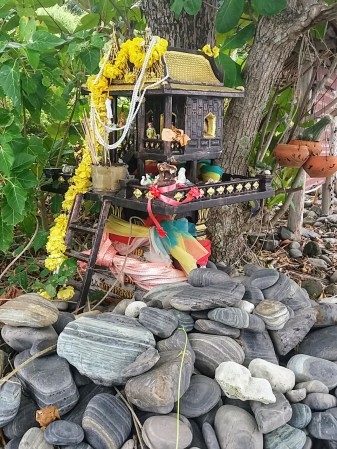 Since arriving in Thailand via Koh Lipe I had seen these tiny ornate houses on posts everywhere. I saw them on the remote islands around Lipe, near the caves of Bor Tor, in the cities, at gas stations, and in the front yard of homes we passed on the road. Some were simple, others like miniature mansions. Some had tiny model occupants while others were uninhabited. Nearly all of them had offerings of food, sweets, alcohol, or incense.


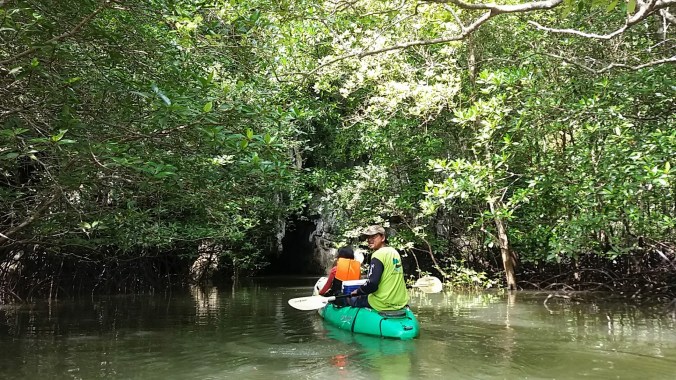
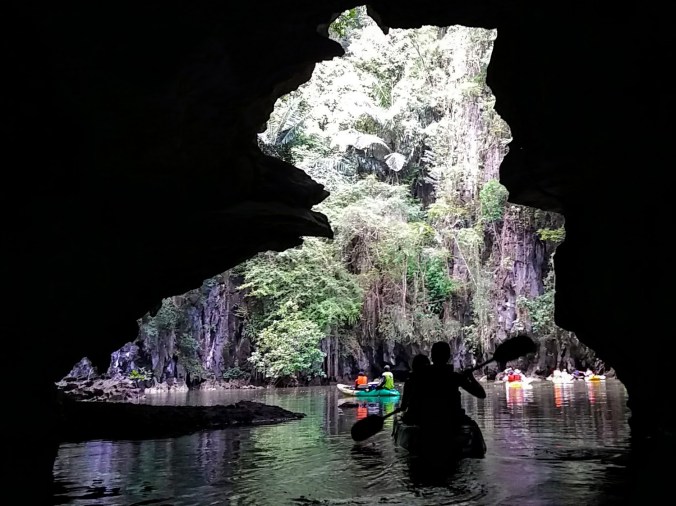 Approaching the cave via the water was a special experience all by itself, but gliding through the dark tunnel was wondrously beautiful. First watching the boat ahead of me disappear into the gloom and then watching the silhouettes against the bright background of the other side. We emerged into a closed canyon, the high walls of the limestone mountain surrounding us with lush jungle growth. The guide told us that depending on the tide, sometimes the water was so high, they had to lay down flat and pull themselves through the cave by the ceiling, and other times so low they could not bring boats in at all. The little body of water was like an island in reverse, not land rising from the sea, but a patch of the sea sunken deep within the land around it. I could understand why people would go through the difficulty involved in getting to these places as the price for experiencing the splendor.







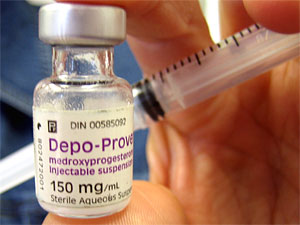 Turning to my trusted friend, Google, I found that Thailand (of all places) sells my drug of choice over the counter! For a few dollars. And yes, I have heard every argument about buying off market drugs in countries without enough regulations, but what are you supposed to do when the country you live in doesn’t have the drug? Also, as an expat, I’ve been to doctors and pharmacies around the world because that’s where I was when I needed the medicine. Egypt, Saudi, and France were all places I had to visit pharmacists. I take other medicines here in Korea that, when I look them up, are not on the US market by the same name or even manufactured by the same company. Were I to take a job in Thailand, as people in my career do from time to time, that is the medicine I would take. Maybe the drugs are actually less well regulated or maybe the US pays too much for pharmaceuticals. Not sayin’, just sayin’.


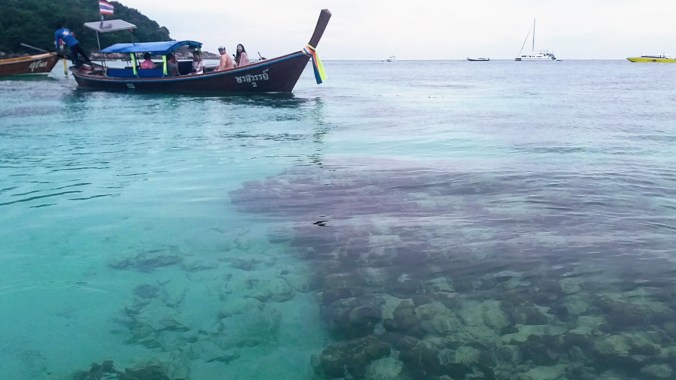
 We went to three different snorkeling spots around Koh Lipe, all of them a part of the Tarutao National Park chain of islands and each one even tinier than Lipe: Jabang, Hin Ngam, and Koh Yang. It may have struck you by now how many places start with Koh, which is because เกาะ (koh) means “island”, so saying “Koh Lipe” is the same as saying “Lipe Island”. You can see from the map that there are two larger islands, which I gather are the main part of the national park and are nature preserves where the only accommodation is camping by government approval. Thus even though it is much smaller, Lipe is the place people stay when they want to explore the islands.


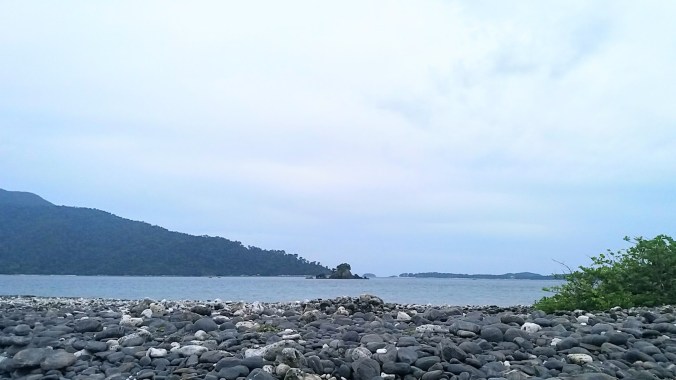


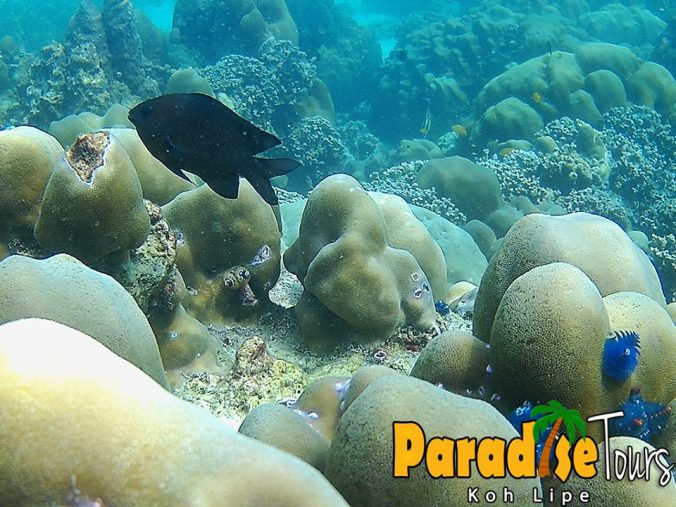
 When it was time to get back in the boat, I got a better look at my foot, which bled for about a minute, then stopped. I rinsed it out with fresh water and the scrapes seemed shallow and sparse. I think I’ve had worse carpet burns. I knew the complications that are possible with coral scrapes from my last run in with the sharp sharp critters, but at the time, I thought it looked ok and had been rinsed sufficiently. (this is what we call “foreshadowing”)


 The only way to get to the small island of Koh Lipe is by boat. I booked online in advance because I didn’t want to worry about tickets selling out. The only reason I was in Langkawi in the first place was to catch this boat to Koh Lipe. After the walking fiasco of the day before, I opted to get one of the islands fixed rate taxis back to the port and arrived 2 hours before the ferry’s departure time, as I was advised to do.
 There are no piers on the island. Instead, the ferries anchor a ways out either at floating piers or just in open water. The one I arrived on docked with a patch of floating platform where we could transfer ourselves and our luggage from the speedboat to the smaller longtail boats that would take us to the island. I was amazed to see people arriving with massive piles of baggage considering the situation and was once more grateful for my decision to keep my luggage under 7kg.
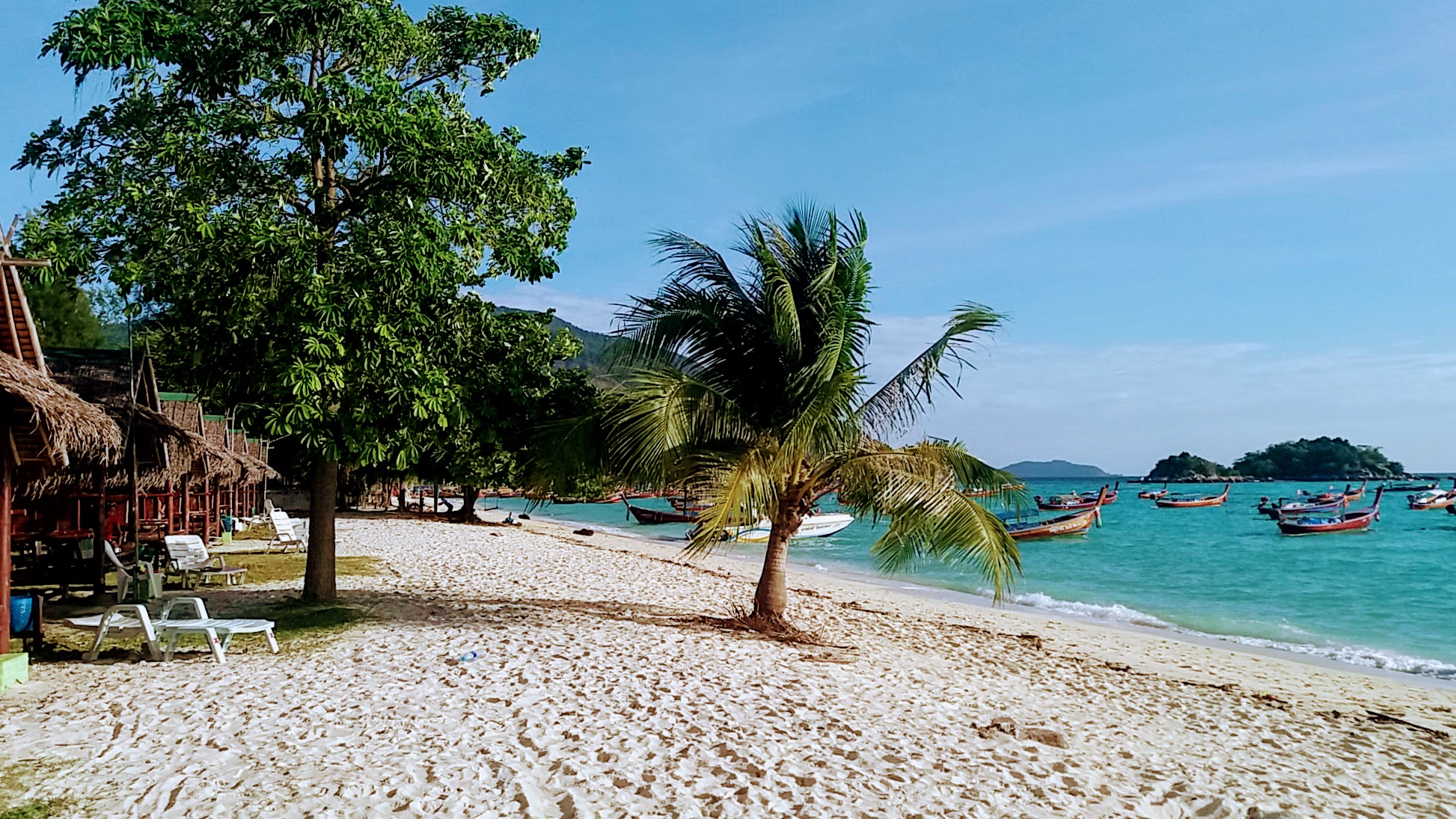
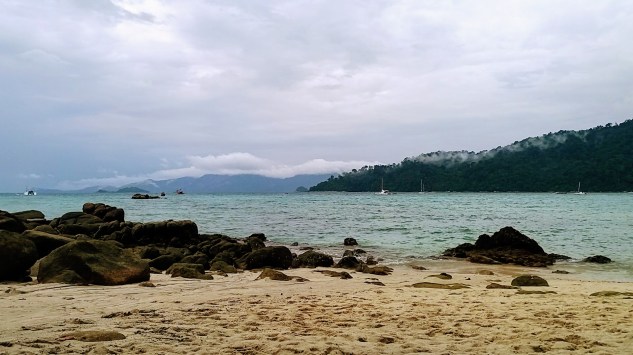
 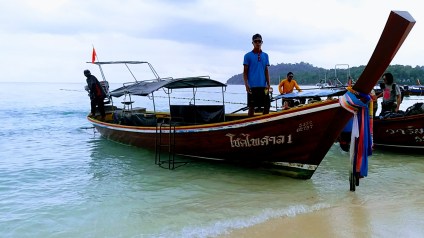 The longtails are small boats, named for the motor at the end of a long pole that juts from the stern and into the water. No more than a dozen people can board a longtail together, so the ferry passengers broke up into smaller clusters. Once the longtail arrived at on land, the local operators would hop out and drag the bow a little way up the beach and tie it to a mooring anchor there. The only way for us to get out was to take a splash in the sea. I quickly shed my socks and shoes and tied the laces to my bag, then rolled up my pants and took my first steps into Thailand through the sparkling turquoise water.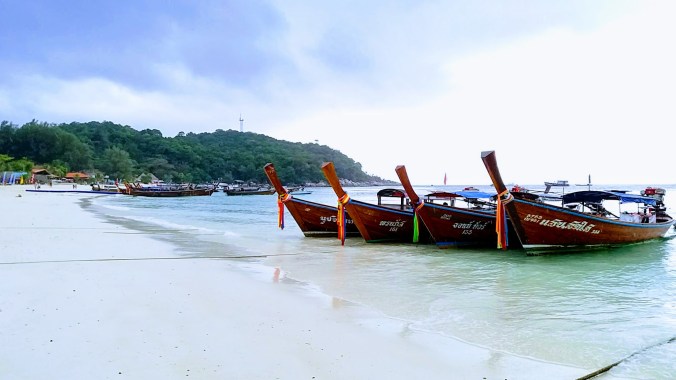

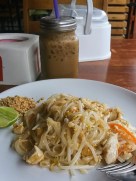

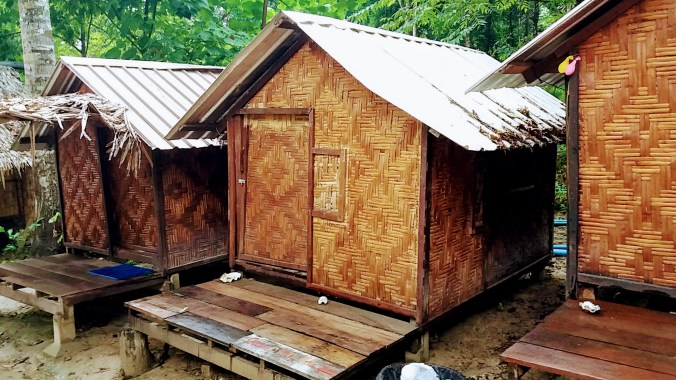
 The hostess was wonderful and kind. She brought out some repellent for me even before we finished checking in and got me settled into my cabin. Walking past the tents on the ground, I was extra glad I hadn’t made that choice given the rain. There were no real walkways in the campsite, so I was picking my way carefully down steep slopes and muddy banks. The cabin was equipped with a sort of futon on the floor, a mosquito net, and a fan. While I settled down to check the dryness of my bag and sort out my belongings, the rain began again in earnest. The path in front of my cabin turned into a river. Knowing that tropical rains are often breif, I decided to wait it out. My main activity for the day was written on my itinerary as “beach bum”, so I wasn’t in a particular rush.

 Gallivantrix