Hello Bohol: Historical Sites & History

When I was in high school I thought history was the most boring subject ever. Now I know it was just that history had the most boring teachers… and textbooks. Seriously, I don’t know how hard they have to work to make something so interesting seem so boring. However, since I know the secret these days, I love using my travels as an excuse to learn about the history of each place I visit. Bohol is far richer in history than I can fully explore here, but I enjoyed learning more about it, and I hope you will too.


Mostly Catholic Churches

I visited many of the large cathedrals left over from Spanish occupation that had distinctive stone architecture and European influenced art, but driving around I saw a great many smaller centers of worship. Most of the small churches around the island are a single “room”, wall-less or lattice walled affairs where the neighborhood can gather to worship. I took that picture on the right from the street. It’s not under construction, it just doesn’t have a wall there.

They are very devout Catholics over there. One evening on the way to dinner from the hotel, I drove past a procession of some kind, a mixture of genders and ages, but 4 men were carrying a liter with a statue of (probably) the Virgin Mary and a mountain of colorful flowers. They walked down our small street singing Ave Maria as they trailed after the statue. I didn’t take any pictures in part because I was driving, but also I felt it would have been a bit rude. These people weren’t worshiping in a place that was heavy with tourists and I felt as though I’d been allowed to witness something very personal.

The large historical cathedrals are well marked tourist spots however, so I have plenty of photos of those.

Panglao Watchtower & St. Augustine Parish

Before visiting,  I didn’t know much about the history of the island other than a little bit about the Spanish colonization. However, the watchtowers are listed on a great many “to do” collections, so when I noticed one nearby on Google Maps, I decided to stop and check it out. As I pulled in, several young men asked if I was there for an island hopping tour. This was one major tourist attraction I decided against before arriving simply because the descriptions I read online made it sound like a horrible hassle for little reward. I politely declined and found a shady tree to park under near the church of San Augustine. Some nearby cows who wandered over to see if I had anything interesting, but soon realized there were no treats.20171001_114802.jpg

The Panglao Watchtower is located on the south end of the island. It is 5 stories high, making it the tallest structure on the island. It was built in 1851 by the Spanish, and is in serious disrepair. I know almost nothing else about it, because it’s not a popular enough historical site to have much published about it online. I did find that around that time the Spanish and Filipinos were having a bit of a tiff over things like government control and secularization, so I suppose the watchtower built next to the church may have been out of a concern that the church could be attacked by secularists?

20171001_120055.jpg

I wandered around taking photos of the tower and the mangroves nearby before moving to the church. There were people inside, it was a Sunday after all, but it seemed to be a small meeting and not a full congregation and they were confined to one section of the church, so I quietly stepped in to an empty area to look around and take a few more pictures inside. As I stood looking at the art and architecture, I was struck by the very Spanish style before remembering that colonization of the Philippines was Spanish and not British.

20171001_115859.jpg

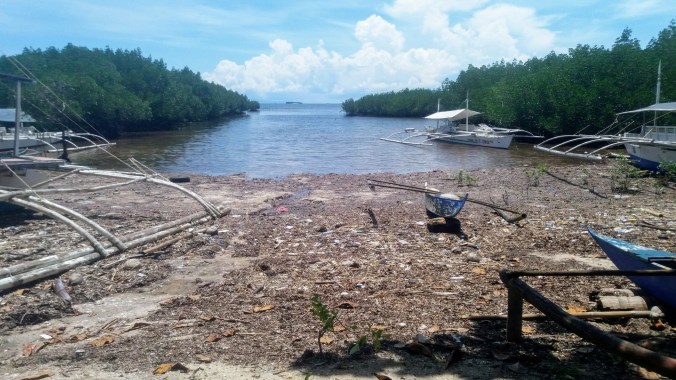
Finally, I walked out along the end of the pier all those island hoppers were using to see the ocean view. I didn’t know it at the time, I only found out days later when a restaurant owner told me, but apparently a local church runs a free ferry to the nearby Virgin Island (a stop on the island hopping tour), and if you want to know more, you’ll have to go to Nikita’s Coffee Shop and ask the old British guy who runs the joint, as I never had the chance to find that particular boat.
20171001_115159.jpg

Dauis Watchtower, Our Lady of the Assumption Parish, & The Miracle Well

My next goal was to find the Miracle Well, which is located at the Our Lady of the Assumption church on the north end of the island. There is a little matching cathedral and watchtower at both north and south, although the northern watchtower was so much shorter that I almost didn’t see it at all.

The church is just next to the bridge that leads over to Bohol. It’s easy to find parking, and the grounds are lovely. I wandered slowly around taking photos of the exterior of the church, some of the statues and grottoes around, the sea nearby, and a little brood of baby chicks because they were insanely cute. The watchtower is so low that I have no idea what one would be watching from it’s second story window, but it seemed to be a part of the set. Unfortunately, by the time I finished exploring the exterior, they were just closing up for lunch and I didn’t get inside (don’t worry, I came back another day).

Our Lady of Assumption is so close to the bridge to Bohol that I was able to pause there again on my way elsewhere for another shot at getting inside the church and finding the Miracle Well, but it wasn’t until my third stop at the church that I finally succeeded. At long last, the church was both open and unoccupied, so I was able to get inside without interrupting services.
20171006_145434.jpg

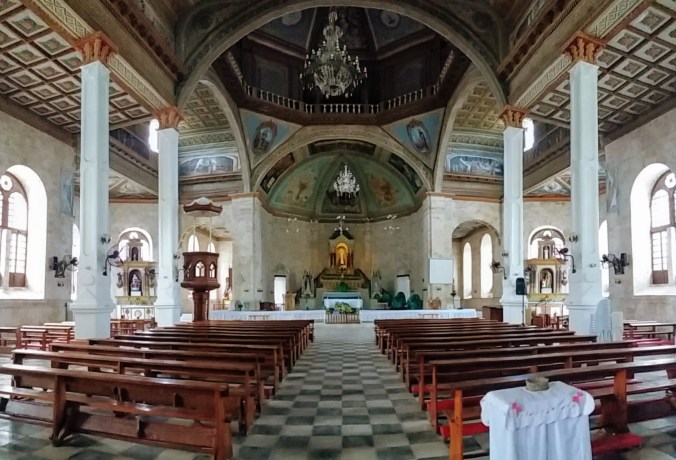
It is an open and intricately decorated church. Either it had been untouched by the earthquake or had been lucky enough to earn a full restoration because the inside was in excellent repair. The large sanctuary had stone walls, but also large windows to let in light and air. It was an interesting combination of the European style and island style. I wandered around taking pictures and looking for the well, which is supposed to be near the altar.

According to myth, the town was under attack by pirates (a thing which did happen regularly), and all the townsfolk locked themselves in the church (big stone building, makes sense). However, the pirates were determined and began a siege, trapping the townsfolk inside with no water! Then, miraculously, a fresh water well sprang forth at the foot of the altar and saved the people inside, allowing them to wait out the pirates who I suppose either got bored or were driven off by the Spanish navy. The well remains a source of fresh water to this day, despite the fact that it is a stone’s throw from the sea. The church offers bottles of this miraculous water for a donation of your choice.

20171006_144333.jpg

I searched everywhere. I saw no well. I looked online for images that might give me a clue where the well was, but the interior seemed to have undergone a remodel, and the few photos of the well I found were such close ups that I could not tell where in the church they were. Was I even in the right church? There were no signs, no informative plaques to tell visitors about this amazing miracle. Had I really come to the wrong church three times looking for a well that either didn’t exist or had been destroyed in the earthquake?

Finally, on my way out, I saw a small office with some people who looked at least a little bit like they were affiliated with the church and asked. A very kind lady not only assured me that this was the correct church, but led me over to the well, which was hiding unobtrusively amid a low wooden railing that separated the parishioner’s pews from the priest’s area.

I had seen the railing and the signs on it that said “no entry”, and had looked no further, but in one little section, the railing goes from being a single line, to being a square and there is enclosed the well, covered with Plexiglas to keep anything or anyone from falling in. 20171006_150623She took up a nearby lamp and shone it into the depths so that I could see the water below.

Once I’d taken a few photos, she walked me back over to the office and fetched a bottle of the “miracle water” for me to try. Of course I left a donation, don’t be silly. And since tourists are advised against drinking the tap water here, you’ll be happy to hear that I suffered no ill health from the miracle well water. Maybe that’s the miracle?

More photos of the St. Augustine & Lady of Assumption Churches.

St. Peter the Apostle Parish Ruins

After the river cruise, I headed across the street to see the Loboc Church, aka Saint Peter the Apostle Parish Church. The full history of the Spanish colonization here is for a later time. For now, suffice it to note that this church was the second built on Bohol by the Jesuits. The Parish was done in 1602, but the coral-stone building that (mostly) stands today was finished in 1734. Then in 1768 the Jesuits were tossed out and another Catholic group called the Order of the Augustinian Recollects took over. I’m not going to try to explain Catholic orders here, feel free to wiki that if you have a burning desire to know. It’s also been declared a National Treasure by the Philippine government, and is under consideration for UNESCO heritage sites. It was absofrickinloutly beautiful (judging from photos) before the 2013 earthquake and now it is a stunning ruin.

20171006_130547.jpg

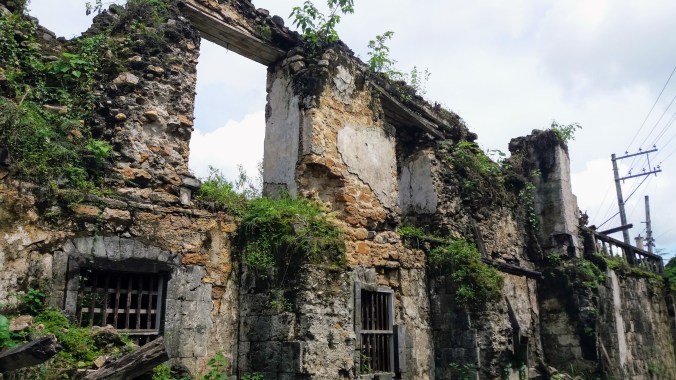
I had spotted the ruins when driving to and from the Chocolate Hills earlier in the week, but at the time I was  hurrying to get there or exhausted and ready for bed, so I was pleased to have carved out some time just to go and ogle the ruins. I know it’s tragic that the earthquake destroyed so much, and I’m sure I would have enjoyed seeing the church in it’s glory, because photos really do look lovely, but there is something about ruins being reclaimed by nature that just draws me right in. Even though it’s only been 4 years since the earthquake, the locals have just not been able to raise enough money to complete repairs and other than some scaffolding and a few gates to keep people out, the structure has been left to the onrush of jungle foliage.

20171006_131842.jpg

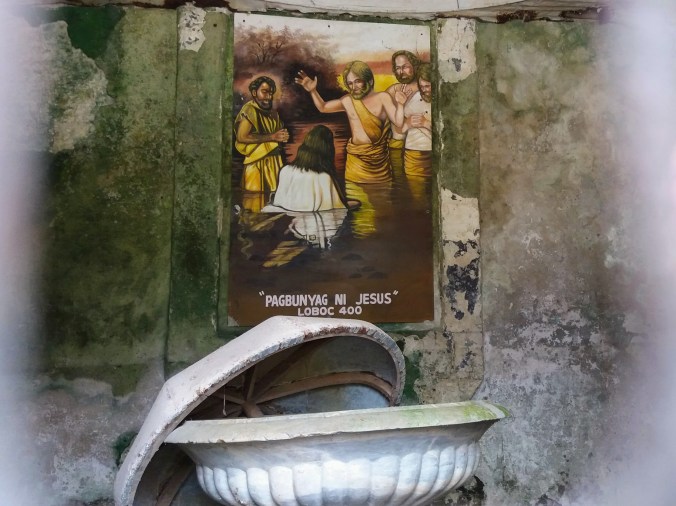
Trees have sprouted in the walls. Ferns and mosses creep across the stone carvings. I peeked in barred windows to see the remains of a baptismal font, and peered through gated doorways to see the interior filled only with more layers of scaffolding. It’s clear that they do not wish to simply leave the church to decay, but very little has been done in the 4 years following the destruction. To me it was the perfect combination of man-made beauty and natural power.
20171006_130930.jpg

At one point, I moved up close to get a good photo of some carving and I noticed the odd texture of some of the stones in the wall. They seemed to be organic. I know there are some crystalline structures that can appear organic, but these struck me as being especially sea-like and I wondered at the time if the stones may have come from a once-upon-a-time sea floor limestone quarry. I saw more of the same stones in other ruins once I knew what I was looking for, and vowed to find out when I got back. It turns out the answer is fairly simple, and I wasn’t far wrong. It’s not so much an ancient sea bed quarry, as a coral quarry. I had no idea coral could be quarried for building materials, but this happens in several islands in the Caribbean and South Pacific. Sometimes the coral is sliced into roof tiles, sometimes it’s mixed in with other ingredients to make a kind of concrete, and sometimes it’s big enough to hew whole building stones from, leaving some of the churches of Bohol with fascinating fossil structures in their walls.

I spent close to an hour circling around the crumbling church. The detail in the stones, the tiny plants and the hidden carvings and grottoes were entrancing, but eventually the heat and sunshine drove me back to my bike and back on the road where a welcome travel breeze cooled me off once more.
20171006_132633.jpg

Baclayon Church

I will admit that my itineraries were largely informed by picking a single destination based on interest or reviews, and then examining the map to see what else was labeled on the roads I would be driving. I mean, if you’re in control of your own transportation, there’s no reason not to pull off to at least have a look when passing by landmarks, right? I don’t think I would have gone on a church tour in the Philippines for it’s own sake (although I did go to several in Europe because architecture!), but I’m glad I had the chance to see the buildings.

20171006_140527.jpg

I had a suspicion by this time that I’d actually seen the Baclayon Church before, but not stopped at it. Looking at the map that day, I was sure it was the church that was visible from the market I’d stopped at for snacks on that first drive up to Bohol while going to the Chocolate Hills. And lo, I was correct. It was a little tricky to find the entrance, but fortunately Bohol is not a heavy traffic place, so if you get lost its easy enough to pull over or turn around.

The Baclayon Church (also The Immaculate Conception of the Virgin Mary Parish Church)  is the oldest Christian settlement in Bohol, established by the same Jesuit group that had set up the Loboc Church. It was first colonized in 1596, and the finished coral stone building that stands now was completed in 1727. It was also taken over by the Augustinians. It was also declared a national treasure. And it was also a short-lister for UNESCO world heritage sites before the earthquake hit. However, unlike the Loboc church which is nearly untouched, the Baclayon Church is well under way with repairs. I ran into a construction crew on the far side actively working.20171006_141117.jpgThere is very little sign of damage on the exterior. This is not because the damage was minimal, but because the effort has been great. There was a before and after photo out front as well, showing what the damage looked like just after the quake and it’s much closer to what Loboc Church still looks like. I wandered around the exterior taking more photos and found several more blocks with that organic sea-life look that I now know to be coral stone. It seemed that the sanctuary proper was still under construction, but it is scheduled to re-open this year.
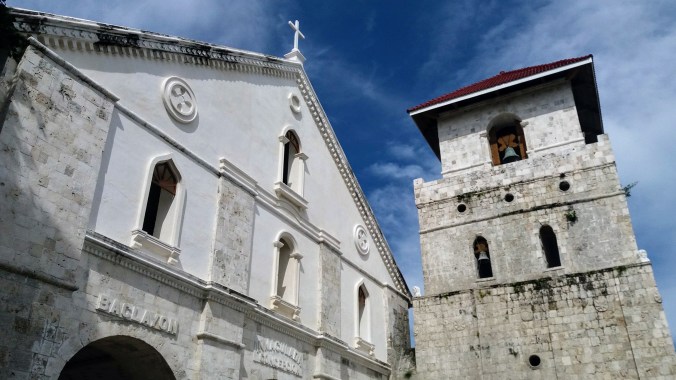
The museum, reliquary and gift shop are all open to the public. I have never seen so many rosary based trinkets in one place as that gift shop, I think some may have been several meters in length while others appeared to be made of glow in the dark materials. The reliquary is at this point in time simply a loose collection of the relics and art that adorned the church and (mostly) survived the damage: statues, a few rather terrifying mannequins and a version of the Pieta with some loose wigs. Still, it’s clear that these were all valuable historical displays and they were gathered together with care. I’m afraid I declined to enter the museum proper that day.

More photos of the Loboc and Baclayon Churches.

The Blood Compact Memorial

One of my favorite travel techniques is to look at a map or a tour to-do list, see a thing with an interesting name, visit it, realize I have no idea what it is about, take a ton of pictures, and look it up when I get home. The Blood Compact is a perfect example of this formula.

When I programmed my map app to take me there, the destination was a place I had driven past at least 3 times during the last week, yet unlike the Baclayon Church which I was confident of having seen while driving past, I could not recall anything at all where the map was pointing me. Confused, I pulled up the street view, hoping to get a better idea of what that stretch of road looked like, and Google insisted on pointing me to a patch of grass on the side of the road with nothing around it. This is not the first time that happened on this trip since some things are set back off the road, either down a slope or behind trees where the cameras missed it. Since I had to drive that way to get back to the hotel anyway, I decided to give it a whirl.

20171006_143543.jpg

I only realized I’d driven past when my app dinged in my earbuds. When I pulled over to look around, I spotted a tiny little monument set back from the road back the way I’d come. I turned around to get a better vantage point and took my “I was here photos”, but there didn’t seem to be anything other than this small wall, explanatory plaque, and a trio of wayward goats.

“About the middle of March, 1565, Captain General Miguel Lopez de Legaspi’s fleet anchored along this shore. Shortly thereafter, Legaspi, manifesting trust and confidence in the islanders, entered into a blood compact with Datu Sikatuna, for the purpose of insuring friendly relations between the Spaniards and the natives. A few drops of blood drawn from a small incision in the arm of each of the two chiefs were placed in separate cups containing wine, and in the presence of the followers of both, each chief drank the potion containing the blood of the other. Thus, during this period of colonization, a bond was sealed in accordance with native practice, the first treaty of friendship and alliance between Spaniards and Filipinos. –1941”

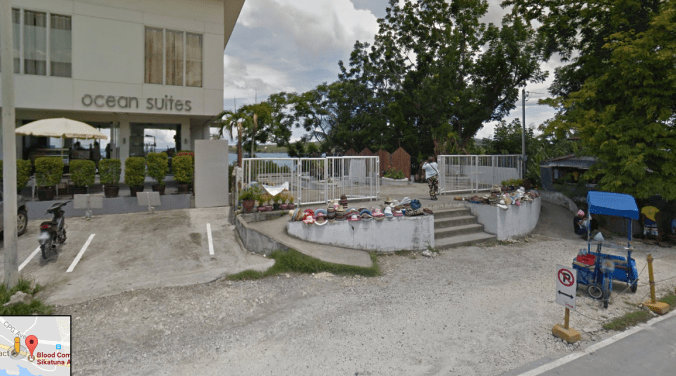
Later, while doing my “now what did I just see” research, I found all these cool pictures of a bronze statue of the ceremony! Where even was that? There are two places on that road labeled “Blood Compact” on Google, and I’m willing to bet that a lot of the people posting photos of the statue were part of a tour group with a guide who knew where to go. Looking at Google Street View in retrospect, I found both the plaque and the bronze statue in different places. The plaque is next to a convenience store and somewhat down a slope from the roadside. The statue is next to “Ocean Suites”,  on a raised dais, behind a white metal fence. I may have driven past it and thought it was part of the hotel. *sigh.
street view.png

How About That History?

I am not going to write a comprehensive history of the Philippines, or even come close. This is a highlights reel to put the current socio-political and economical issues the Philippines is facing into context for those of you who, like me, found your history books mysteriously silent on the fate of small island nations.

Colonialism

A whole bunch of countries were scrambling to get to the East and get the precious SPICES! The Portuguese, Dutch, Spanish, British, Ottoman, and even the Chinese and Japanese were all out to expaaaaaaand. That’s how I got a country, and how lots and lots of indigenous people lost theirs. The Portuguese and the Ottomans were being a bit rude in the Philippine Islands, so when the Spaniards showed up on Bohol and were like, “oh no we are not like those silly Portuguese!” The natives were happy to make this treaty with them, and the Boholano people are still quite proud that their ancestors made the first friendship treaty with their eventual oppressors… Yeah, I don’t like colonialism.

colonialism

Image – Front National SA

Which makes this next part extra sad.

A few hundred years of all those empires competing over SE Asia and South Pacific islands of military strategic value meant that even though the Spanish held the Philippines officially until 1898, there were plenty of battles, skirmishes and invasions where someone else took control of Manila or other islands. Basically all the rich kids fighting over the land and the native people getting boned. Sometimes the natives did rebel, I think the longest single rebellion lasted almost a hundred years in one part of the country, but none succeeded at driving their European overlords out. The part that came as a complete and total shock to me is that Spanish rule of the Philippines did NOT end with independence in 1898, but rather with the sale of the island nation to …(dun, dun, dun) THE USA! …at the end of the Spanish American war.

The Philippine American War

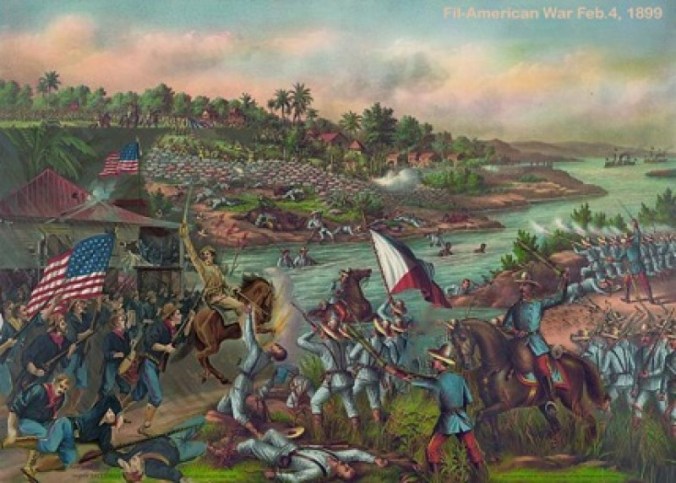
Mere days after the transfer of ownership, the Filipinos tried to declare their independence once more. While we (Americans) were busy fighting the Spanish American War, the native Filipinos were simultaneously fighting Spain for their independence. Was the democracy loving US *helping* little Philippines? No, because we were still pretty darn isolationist in 1898 and hadn’t gotten into the habit of having the giant standing army we like to send around on “peacekeeping missions”. We were actually fighting Spain for control of their islands like Cuba. By the end of the war, they signed over Cuba, Guam, Puerto Rico, and the Philippine Islands, although apparently the US paid 20$ million for the last one to cover infrastructure costs.
philippine american war.jpg

By the way, we still own Guam and Puerto Rico, but won’t let them be states (have representation) or apparently get decent federal aid after a devastating hurricane.

Having been engaged with the Spanish for their freedom, the Filipinos were not actually on board with the sale, and declared themselves independent and published a lovely constitution. The US, on the other hand felt it had paid some hard earned money for the territory and so began the Philippine American War, which I had actually never heard of until now. The Filipinos lost, and America continued to OWN the country until after WWII when we were generally making everyone (mostly Britain) give back all their colonies and decided to use the Philippines as our “set a good example” colony.

Military Dictatorship

Shortly after WWII, we get to Ferdinand Marcos who started his career in the House in 1949 (just a few years after officially free Philippines happened) and eventually became the President who implemented strict martial law from 1972-1981. It was a military dictatorship, and a seriously brutal time, and why am I telling you about it here? Because although the was finally ousted by a revolution in 1986, his rule was a major threat to democracy there and rife with cronyism, favoritism, extortion, and flat out ignoring the constitution. And the guy in power now is making a lot of people draw comparisons.

10 interesting facts about president ferdinand marcos | tenminutes.ph on Ferdinand Marcos Background

image tenminutes.ph

Like many countries, the Philippines was not proud of that time in it’s history and as a new generation grew up in the light of the revolution and the restoration of democracy, they weren’t always well educated on the dark side of Marcos’ reign. Too soon, people began to think that stricter measures and even martial law could be good tools to help the country.

Democracy and Death Squads

Enter Duterte. Another lifelong politician, he has risen to popularity and power with the aid of DEATH SQUADS. I’m not kidding. In order to “clean up” the country, he has repeatedly and publicly declared that it’s ok to kill criminals without trial. This includes drug dealers, drug users, petty criminals, and “street children”. If you aren’t gagging in horror, you may need to get checked for your humanity.

Philippine President Rodrigo Duterte inspects firearms together with Eduardo Ano, Chief of Staff of the Armed Forces of the Philippines, during his visit at the military camp in Marawi city

image Reuters

He’s also said unbelievably horrible things about wanting to rape women, wanting to kill people who cause problems with extreme violence, and pardoning everyone under his command who committed human rights abuses while carrying out his orders… if this sounds like any other world leader you may have seen on tv in the last year, you are not alone in thinking this.

Responsible Tourism

This left me in a tricky position vis a vis being a tourist. I did not feel in danger in Duterte’s bloody cleanup because they are in no way targeting foreign nationals in this death squad round up. But economically, it was a tough choice. I know that my tiny vacation budget is not going to have an impact on the national economy of the Philippines, but it just might have an impact on the lives of the small business owners, guides, and environmental preservation programs that I do want to support and that I desperately hope survive until the next era of democratic sanity is restored. So, yes, I went and I feel ok about that.

Winter Wonderland 2018

This winter was full of cold and confusion. My hunt for a new job has been incredibly time consuming, and the uncertainty about my future led me to forgo an out of country winter holiday. Instead I decided to head north (not across the border or anything) to visit the Hwacheon Ice Festival and other snow filled winter activities in case it was my last chance to play in the snow in Korea. It looks like things are working out, and I will be staying in Korea next year after all, but I’ll tell that story after all the details are wrapped up. For now, walk with me into a winter wonderland weekend.


I like going on tour trips with the group Enjoy Korea. They’re by far my favorite organized tour group in Korea: polite, well-organized, helpful, responsive, and fun (without being a total party bus). I highly recommend traveling with them if you’re looking for more things to see in Korea while you’re here. No, they aren’t paying me to say that, or even giving me a discount, I just think they’re cool and deserve more business.

When I realized I wasn’t leaving Korea for the winter holidays, I turned to the upcoming events page of their website and looked for something fun that didn’t involve skiing. Don’t get me wrong, I’d love to learn how to ski, but stress and health concerns over the fall just made it seem like this winter was not going to be the one. Instead, I found the Winter Wonderland Weekender.

Image may contain: text

Naminara Republic

While we were on the multi-hour drive up from Busan, our guide handed out pamphlets about our 3 weekend destinations, and being me, I actually read them. Imagine my surprise when I discovered that the tiny river island of Nami was it’s own country! Nami is a small island within the North Han River. Not that long ago, it was only an island for part of the year when the waters ran high. However, when the Cheongpyeong Dam was built in the 1940s, the river level became higher permanently, and Nami was cut off from the mainland year round.

20180113_132120.jpg

It was said to be the grave-site of General Nami, and the grave was gradually built up and around, turning the island into a nature reserve and kind of amusement park/garden. In 2006 they declared their independence from Korea to become a “fairy-tale nation”. I’m not making that up, it’s in their declaration of independence. They have an immigration office. I didn’t bring my passport because I didn’t know this ahead of time, but apparently they will stamp your passport if you like. Because of their friendly relations with Korea, it’s not required for visitors to do so.

I cannot help but look at this and think of Nami as a precocious 5 year old who really wants to be a grown up. Nami: “We’re independent and we’re gonna have our own country made of fairy tales!” Korea: “Ok, honey, you have fun and make sure to be home in time for dinner.”

It’s cute.

There are 2 ways onto the island of Nami: the ferry and the zipline. I wanted to try the zipline since our guide said it was actually rather slow and more of a scenic experience than an adrenaline rush, but the wait time was over an hour and we only had a few hours to explore that afternoon.

20180113_133832.jpg

The ferry is not disappointing. It’s small, and mostly standing room, but it’s only about 6 minutes from shore to shore and gives beautiful views of the river on the way over. The water wasn’t frozen solid, but there were floating chunks of ice like green glass floating along the shore where the water was shallower. As we approached the island, we were first greeted with a giant ice formation overshadowing the maid of Nami.

20180113_134512.jpg

The maid of Nami is a famous statue of a woman standing in the water, but she was nearly obscured and entirely overshadowed by the mountain of ice that had formed from the freezing spray of the nearby fountain. Instead of turning the fountains off for the winter, the Naminarians decided to let their fountains run and turn into fairy-tale castles of long white and blue ice stalactites. Although at first the beautiful structure was overrun with ferry passengers queuing up to take photos, it didn’t take long before they all moved on and I had a chance to get a few of my own.

20180113_135420.jpg

The island has a multitude of walking trails as well as a “train” (think kiddie ride). I spotted the post office on my way in where a telephone allowed visitors to make international calls or send post cards from the micronation.

At first, I was feeling a little disappointed by the lack of snow. After all, it had snowed in Busan just a few days before, a place that sees snow every 2-3 years, surely Nami which is famous for it’s snow clad beauty would be white from edge to edge. The main entrance and pathways were simply brown, perhaps from lack of snowfall but more likely from an excess of foot traffic. I determined to seek out more frozen fountains and whatever patches of snow I could nonetheless, and soon found a frozen pond which remained snowcovered and I began to feel more in the mood.20180113_140124.jpg

My spirits were lifted completely when I encountered the sledding hill. Snow from all over had been piled together in a large hill that was decorated with ice-men (like snowmen, but made of ice). There was a line to borrow a sled but it wasn’t long and within a few moments I was lugging my luge up the snowy slope. I think it hadn’t snowed in a few days at least because the snow was quite packed and hard. Many sledders fell over sideways the first time their sled hit a bump. I watched as the line grew shorter, determining my best strategy for not suffering a wipe out and when it was my turn, I tried to center myself as much as possible and took a firm hold of the rope that formed the handle at the front of the sled.

When the countdown ended and the whistle blew, 3 of us took off at once. The slope wasn’t too high, but I soon picked up speed and when I hit the first bump my sled and I were launched into the air. I managed to land without falling over and kept my seat all the way down, whooping in a very American way at the thrill of speed and snow and winter wind whipping my skin.

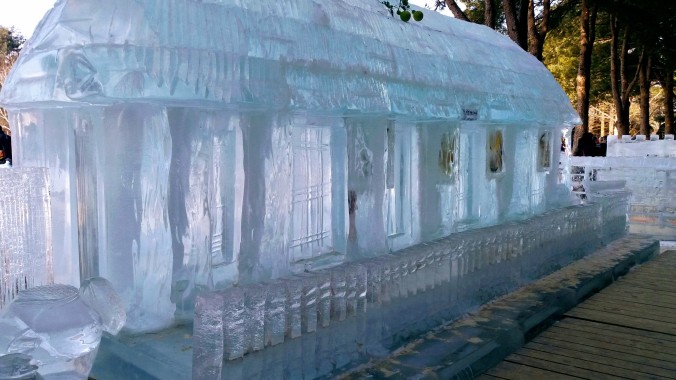
Next to the snow hill was an ice village. There were sculptures of animals and fish, but also houses and castles built from carved ice blocks where visitors could climb around and take silly photos. I was impressed by the size and scope of these ice constructions, but oh wait until tomorrow.

20180113_141722.jpg

While I was finishing up my photos of the ice sculptures at a particularly large ice shark, I looked up and noticed there were ostriches running around in a field across the road. Nami island is very proud of it’s animal population, but apparently the ostriches are the stars of the show. It was a bit surprising to me how curious of visitors the birds were, spending most of their time right up at the fences despite having plenty of roaming room. I bet there’s food involved somewhere. Still it was odd to see these African savanna birds in the snow.

After the arctic ostrich experience, I meandered to the far bank of the island where the river was completely frozen over and dusted white with snow. It was quiet and serene. The emptiness was a stark contrast to the crowds I had left behind only 5 minutes before. It is a function of Korea that will never cease to amaze me, but no matter how crowded it is at an event, all you have to do is walk away for 5-10 minutes to be totally alone.

20180113_144230.jpgNext I headed back towards the center of the island to the arts and crafts village where handmade goods can be viewed, created, and purchased. My favorite was a metal tree dripping glass globes that caught the winter afternoon sunlight. There were also plenty of places to grab a hot drink, a snack or a meal.
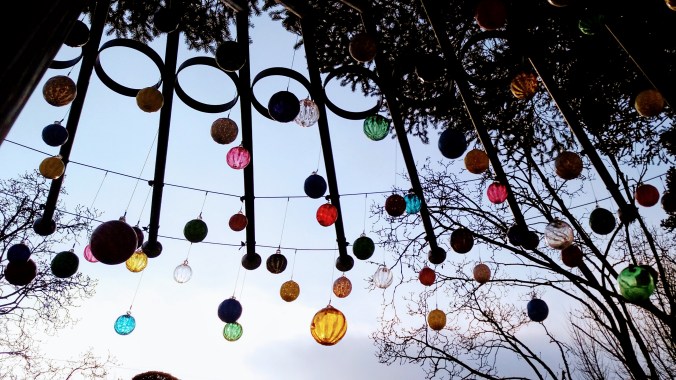
20180113_145649.jpg

I went on a search for the glass blowing studio because I’d read in the pamphlet that there was an activity where visitors could make a small ornament, but alas it was only for groups of 8 or more who had booked in advance. My foray into molten glass will have to wait for another time.

While I was meandering around the statues and shops, I found a pottery shop with two peacocks perched on the rooftop, and I found a lone snow bunny hopping around on one of the frozen ponds. Great place for him since humans were kept back by the fear of falling in the ice. Great spot for me since I got to take photos of him against the snow. He was pretty fearless though and didn’t seem to mind when even more visitors noticed him and rushed over to take photos.

The weather was so cold that my phone battery was struggling more than normal and my phone actually shut down right in the middle of this bunny photo shoot, but it was still special. I suppose I’ll always have a soft spot for bunnies after having one of my own as a furbaby.

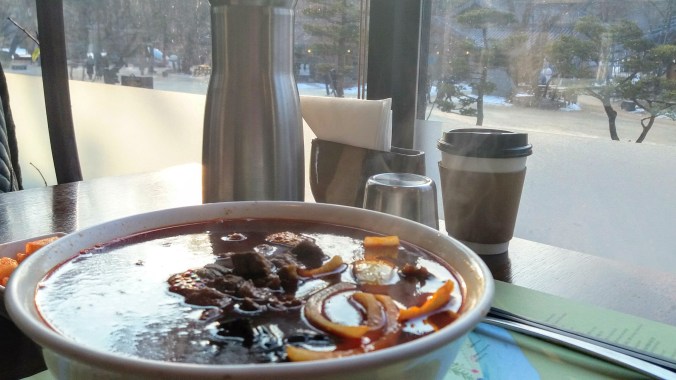
I found that while many of the restaurants were quite expensive (surprise, we’re on an island) there was a place called the Asian Family Restaurant that had decent prices and a wide range of foods. I ended up with a giant bowl of hot and spicy soup in a Chinese style, and by the time I was full, I was warm enough to head back into the snow.

20180113_154425

I decided to walk around the other side of the island on my way back toward the ferries to see what I hadn’t seen, I found more frozen ponds, sculptures, trees covered in a light snow, and the further I went, the fewer people I had to share it with. Coming out of a small birch grove, I spotted the oddest piece of art adorning an unused picnic area. Alone with this, the sounds of distant tourists muffled to silence by the blanket of snow around me, it felt more than a little creepy.

20180113_163651

Heading back to the riverside path, I found some other members of the Enjoy Korea group who were skipping stones on the frozen water to hear the odd laser blaster sound that it makes. I tried it myself, there’s literally no technique involved, just toss a rock on a frozen body of water and pew pew pew! Lot’s of people saw that guy on YouTube be very dude-bro about it, but here’s another guy who actually explains it.

IMG_20180126_152910_010.jpg

Finally, the short winter day began to wind down and my last bit of trail gave the ice, river and sky some beautiful twilight colors. I got back to the bus just a few minutes early and discovered that someone had participated in the ice carving craft. She made a hefty stein from ice, and since it couldn’t possibly last in the heat of the bus, she was offering to let anyone who liked have a shot of Korean soju from the frozen chalice. I think it was probably the best soju I’ve ever had, even though it was the same stuff that’s in every convenience store. Bonus, I can safely say in retrospect that either I got in on it early enough or the combo of ice and alcohol did the trick, but I didn’t get anyone else’s cold!

20180113_172350.jpg

Go check out the rest of the photos on Facebook.

Garden of the Morning Calm

After dark, we headed over to view a special winter lights show at a nearby botanical garden. The Koreans are, as always, just spectacular at light displays. This large garden usually makes it’s living showing off plants and flowers, but in the dead of winter when everything is brown and brittle, it opens up at night for a whole other color spectacle.

My first few months in Korea, I saw the biggest and most amazing light show when I went to the Taean Tulip Festival, and while I enjoyed every other light show I’ve been to since then, none have been able to take the title from Tulips until now. I did not realize what I was getting myself into. The entry way had trees and bushes wrapped in lights and the almost obligatory tunnel of lights (still not tired of those). I expected it to be similar to the one at Boseong, and I was happy with that idea.

I especially liked the lights glowing on the snow and ice, creating fun reflections and pastel color splashes. I dawdled far more than I should have, but the maps in Korean parks are notoriously bad for scale, and I just did not understand how BIG this place really is. I got to the (also obligatory) suspension bridge and noticed it led back to the entrance, so I turned to head down another path, even though it appeared to lead into darkness. Just to check.

I found another tunnel of light. I found a frozen pond that had been covered entirely in blue lights with a glowing sailboat and dolphins frolicking in the blue. I found a path covered in umbrellas made of tiny lights. I found giant vines and leaves of light that made me feel like Alice when she shrank small and talked to the flowers.

Then I turned a corner and saw the stars.

20180113_200813.jpg

Not really the stars, but huge balls made from clusters of tiny lights high in the tall trees looking like the night stars in the blackness. Fiber-optic cables flowed down from the branches like willow trees and waterfalls. Giant leaves wrapped around the trunks of trees climbing to meet the falling fronds of light above. Silhouettes of animals were picked out in life size golden glowing sculptures: reindeer which made sense, and a giraffe I suppose because why not? At the far end of this wonderland was a neon pink church that the King would have been pleased to see in his Vegas days, fronted by two pure white glowing angels. I could have probably done without the extra religion, but as I headed down the hill toward the next display, the church shrank into the background and I was left with a final stunning view of the immersive forest of light.

The theme of over sized plants continued a bit with giant mushrooms and trees wrapped in lights to an almost fractal level of detail. Faced with another fork in the road to go on into darkness or return to the glow of lights at the entrance, I checked the time and decided to forge ahead. I pondered what could be left after that wonderful wood. I took some photos of creative path lanterns and more trees draped in shifting colors, casting a glow on the snow beneath them, content and not expecting very much more when…

A viewing platform is always a good sign. Korean tourism departments everywhere have thoughtfully created a viewing platform at the optimum viewing place. They are hardly ever wrong, and everyone knows the etiquette, so you might have to wait a few moments, but you will get your turn. And when I did…

Usually, I like to describe things I see and experience, but in this instance, it might just be better to shut up and show you. You can see the whole roll on the Facebook album.

This slideshow requires JavaScript.


Stay tuned for part 2 when I get to spend Sunday at the Hwacheon Seoncheoneo Ice Fishing Festival… I know, a festival for ice fishing? but it turns out the city of Hwacheon, and really Korea in general, knows how to turn anything into a great time. They can even do up an anchovy festival right, so something as exotic as ice fishing should be no problem! And if for some reason the prospect of catching trout through a hole in the ice isn’t your cup of soju, it’s also the home to the world’s largest indoor ice sculpture, so there’s more photos of beautiful lights to come as well. Thanks for reading!

Hello Bohol: Food

My food post has expanded into two more bite-sized posts. In this one, I take a look at the everyday eats, markets, convenience stores, roadside chicken stands, unique food experiences, and lower cost restaurants. Just because it’s not gourmet doesn’t mean it’s not delicious! Interesting foods discovered include: not-milk but still dairy “fresh”, the lakatan banana, mulungway, water buffalo ice-cream, and maja blanca. Hope you’re hungry!


Don’t Drink the Milk

After discovering our limited food options upon arrival, I asked my trip buddy to stop at a store on the way from the airport. The taxi had to take her to a store on Bohol, because there is not a single “grocery store” on the island of Panglao. There are a plethora of tiny marts and open air markets, however. The next morning at breakfast, I noticed that the milk tasted a little odd. Not off, just strange, and I looked at the carton to find out what was going on. It turned out that the “Fresh Milk” for sale in the store was actually a reconstituted combination of milk products. I know that in some island countries, dairy is hard to come by in liquid form, because shipping it over is expensive, so they ship in powder and reconstitute it in local factories for distribution, but this was the first time I’d actually had any. It wasn’t … bad? It just didn’t really taste like milk.

The yogurt also had a slightly terrifying list of ingredients. I’ve tried to get less picky about my food since leaving Seattle, I know lots of places aren’t going to be up to the Bo-bo standards of organic/local/minimal processing, but yogurt has been one of the foods that has more often than not been wonderful, fresh, and local when I travel. It seems despite the huge number of cows I saw on the island, the dairy industry is still a few decades behind. So, no real coffee, and no real milk products… but the seafood, the pork, and the fresh fruit are outta sight.

Markets

20171001_112654.jpgI went to the Alona Market on the first day. It was a permanent structure where things like clothes and gadgets seemed to be on sale, but there were a riot of colored tents and awnings set up outdoors as well where vendors sold everything you could need on the island. Eggs, fish, meat… the smells assured me they were fresh. Fruits and vegetables. An infinity of flip flops and heaps of clothes. Electronics, swimming gear, DVDs, decorations, and although this was clearly a market for locals, there were a few souvenir type things as well. If I were staying long term on the island and needed to cook more than breakfasts or needed to replace a t-shirt or pair of sandals, it would be a great place to know about (especially in the absence of grocery stores), but for time it was mostly a curiosity, a fun thing to see as I explored my holiday surroundings.

On the way over to Chocolate Hills, I took a rest stop at another market in Baclayon, very similar to the Alona market, and got some pastries at a little bake shop. The Bohol pastries aren’t a patch on the Korean ones, but they were fresh and good, and extremely cheap. I never bought only one, but it seemed like one could fill a bag for less than a dollar. And it was nice to have something to munch on when felt hungry. Days later I realized that the market was next to one of the many churches on my to-see list, so I ended up going there more than once.

Sari Sari

This is the basic economic unit of Bohol. They are everywhere. Tiny shacks that sell snacks, drinks, and other things a household might need. It’s almost impossible to tell if they’re open because they have bars and grates on the windows. I had been avoiding them for that reason alone. I didn’t want to stop, get off the bike, walk over, then find out they were closed and try again at the next one. I’d been stopping at larger more obvious shops for snacks and drinks but way out here, I didn’t have the option. I’m also not sure how many of these are simply a shack in someone’s front yard where they sell random stuff to their neighbors.

Post holiday research reveals that these tiny ubiquitous shacks are known as sari sari (Tagalog for “sundry”), that the bars and grating look is normal, that they are generally family owned and operated from the family property, and that they make up 70% of the sale of manufactured consumer food products and account for about 13% of the GDP. They don’t all look like the little roadside shacks, some are larger or in conjunction with other vendors in the market areas. I’m not sure how many sari-sari I shopped at while I was there, but it’s nice to know I was contributing to the local economy when I did.

La Familia

One day of island exploring we found this little gem. It was getting on in the day and the weather in Panglao is hot and humid year round, so we decided it was time to find a place for lunch. After a little bit of being lost looking for a restaurant by sight, we finally consulted Google. It turns out there are a plethora of eateries along the roadside, but it’s hard to tell which ones are convenience stores, or take-aways, or sit down eateries, or even open just by looking while you’re driving by. I love trying local shops and restaurants, but I definitely wanted a sit down place to rest after our morning adventures.

We settled on a place called La Familia on the south end, quite near the church and watchtower. It’s not gourmet, but I ate there more than once because it was good food at a reasonable price, and while not air conditioned, it was comfortable. On my first visit, I got some watermelon juice and had to ask for no sugar. I learned that in the Philippines, all fruit juice will be mixed generously with sugar unless you ask for it not to be. This drink seemed to be fresh watermelon blended with ice into a kind of slushy, and I thought it was wonderful and refreshing without the extra sweetness. I also tried a satay burger, which was a regular hamburger served with satay sauce, and instead of ketchup, the fries came with a kind of sweet chili sauce that I was skeptical of at first, but soon devoured.

The second time I went we were too exhausted and hungry to research restaurant options so we went back to La Familia, knowing it was close to the hotel, good and well priced. I was still in my “try all the Filipino food” phase and after Googling a few new words on the menu, I settled on a chicken Tinola, which is a fairly famous Filipino ginger soup and could readily give pho a run for it’s money as my go to sick soup of preference if it existed where I live. A rich bone broth infused with ginger. My only complaint was that the soup was served so hot I couldn’t just guzzle the broth. I also ordered a club sandwiches for lunch the next day out on the boat.

The third time I popped over to La Familia for a refresher and decided to give the house milkshake a try. I don’t normally go in for banana flavored things. Artificial banana flavor terrifies me and I’m picky enough about real bananas to not risk it if there are options. However, after my run in with the Latakan (explanation further down), I was feeling very optimistic about a banana based drink here in Panglao. Not just a regular banana shake, it was made with graham crumbs and a touch of cinnamon. It was delightful, light, fluffy and a great blend of that creamy banana and other flavors that made me feel like I was drinking a pie.

While I was waiting for my shake, another expat struck up a conversation. I’d almost forgotten how that worked, since this was one of the few occasions on this trip I was on my own. It seems that people in pairs or groups just don’t get approached as much, but I love meeting new people, so I joined him for a chat and learned that he was called Bob, he was from the UK, and that he ran a local bar (the Ging Ging), which I never did get to try out. We talked about how we each came to be living abroad, and then we talked about the best food around. He also shared with me the best places from which to watch the sunset which led me to my second dinner at the Pearl.

Tres Ninas

After getting more accustomed to the bike, I decided to have another stab finding a roadside food stand to take something back to the room. In this endeavor, the night was my friend since only open places were lit up. I pulled into one of the larger lit up areas at what seemed to be a cluster of shops. One was selling meat on a stick, another seemed to be a place to sit and eat with drinks, and a third was selling beautiful rotisserie chickens. In less than two days on the island, I had seen dozens of chickens wandering around. Some totally free, some bound to a tree or hutch by a length of string. Either way, I felt confident the chicken I was looking at was local and free range, with no added hormones or chemicals… it went a long way in making up for the milk.

Tres Ninas is a chain of chicken stands. The one I went to is on the circumferential road on the east side just south of South Palms, but I spotted several others by the same name around the island.

Chocolate Hills

Initially we didn’t think that lunch at a major tourist stop was a good idea. These kinds of restaurants are often over priced and not even very good. Boy howdy I’ve rarely been so happy to be wrong.

Although the service and the food were slow (this is a fact of Bohol that we eventually came to accept, it’s a good idea to get to the restaurant, any restaurant, a good while before you’re too hungry) both turned out to be of excellent quality. Our server happily recommended dishes which turned out to be wonderful. We had bam-i (a kind of noodle dish) and lechon kawali (a crispy fried pork belly), with corn soup, and I had a calamansi iced tea which was strong, sweet and tart. We ate every bite, and it was the perfect amount. The whole lunch was less than 15$ (most of our meals were between 10-15$ for two, a couple splurges were in the 20-25 range. That’s not per person, that’s the whole thing and we ate good food).

The main advantage of the slow lunch service this day was that by the time we were finishing off the last bites, the rain had passed by and the sun had returned. The restaurant has large picture windows, so we watched the progress of the dark clouds the entire time we were eating. It was interesting to see them moving by so quickly.

The Dairy Box

On the way out of the adventure park, where the bumpy dirt road hit the highway, I spotted some signs for ice cream that led us just a few meters down the road to the Dairy Box.

20171002_154539.jpg

After my experience with the “fresh” milk the other morning, I wasn’t sure what to expect by way of any place called the Dairy Box, but I stopped to look and discovered to my delight a local sustainable livelihood program participant. The little shop was part of a movement by the government to help local businesses flourish, and so they partnered with nearby farmers to use the milk from the water buffalo nearby. There were signs showcasing the local small farmers and inside there was a plethora of dairy based treats. The ice cream was the main focus, but there were biscuits, milk candy, and snacks as well as flavored milk, yogurt and cheeses. Ok, yes, water buffalo milk, but I assure you it was delicious.

Dumaluan Beach Resort & the Lakatan Banana

There is a little grill and cocktail bar at Dumaluan which makes it especially appealing as a lazy hangout beach. I had made jokes with my sister before going that I would be on a beach with coconut drinks, but somehow I hadn’t had a single coconut based concoction up to this point. When I ordered my simple breakfast at the grill, I also got a coconut smoothie. The breakfast was simple: egg, sausage and rice, but cheap and filling. The smoothie was very clearly made from fresh coconut.

As the day wore on and we continued to nibble on snacks, I tried the fresh fruit plate. Normally I wouldn’t dedicate pages to a fruit place, but it was my first exposure to the unique Philippine banana: the lakatan.

20171004_132855.jpg

What I did not know about bananas… and to be honest, I probably still barely know anything. I’m used to the standard grocery store banana: the Cavendish. This type makes up something like 95% of the world’s bananas. I have always preferred to eat bananas when they’re a bright yellow with hints of green at the edges, and no brown at all. Everyone has a preference, but in my house, when the bananas got brown spots it’s time to make banana bread. I have a decades long aversion to golden yellow and brown bananas. I do not enjoy the mushy texture or the sickly sweet flavor at that stage in a Cavendish’s life. But, I do like banana bread, so there’s that. Based on my lifetime of banana monoculture, when I saw this little yellow and brown buddy on the fruit plate I was not at all interested… until it was peeled.

My expectation of a banana, even a very ripe one, is kind of off white inside, not unlike vanilla ice cream. This banana was a much deeper shade of cream, like “french vanilla” ice cream, or even custard. The only other time I’d seen that shade in a banana-like shape was in plantains, but it was clear from the easy peel and the total lack of cooking that this was no plantain. In addition to it’s beautiful color, the flesh of the fruit was bruise free. A Cavendish banana in that stage of ripening could be expected to have a light bruise or two and be very soft, but this banana was in perfect shape and still pleasantly firm. I decided to try a taste and was rewarded with the most and best in all that is banana. It was sweet, but not too sweet, and had little hints of tartness that I crave in my slightly green Cavendishes, but with a bonus creamy texture that I feel unable to describe without referencing dairy products. Why are these amazing fruits not the market standard? Probably something about shipping or they aren’t pretty enough. *sigh. If you’re ever in the Philippines, eat them.

River Cruise Lunch & Maja Blanca

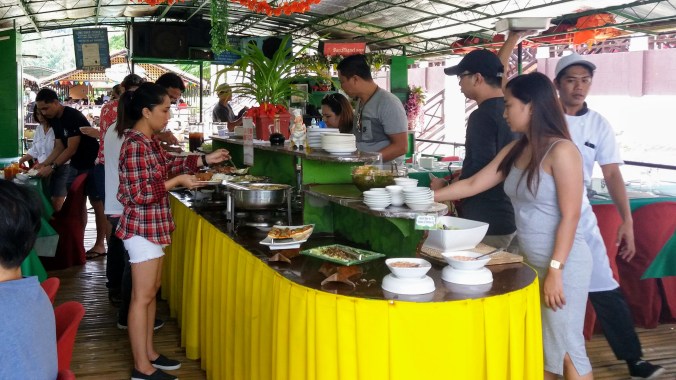
20171006_111213 - CopyIt was not the best meal I had on the trip, but everything was good and it’s a buffet so you can eat as much as you like, as long as you don’t leave food on your plate (they charge 50p for leftovers to discourage food waste).
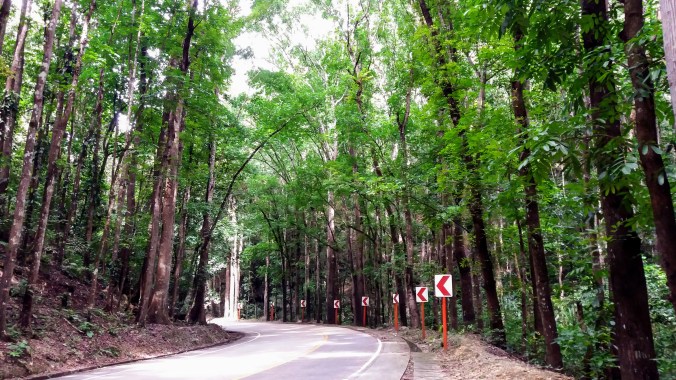
20171006_111229 - Copy

I had more delicious pork adobo and an assortment of veggies and side dishes, but the star of the whole show was a little square of heaven called maja blanca. I had never seen or heard of this before, but I put one on my plate anyway, guessing it was a dessert, and so saving it for the end of my meal. It was easily the most amazing coconut cream anything I’ve ever had. So plain and unassuming, it was a white square that jiggled a little, which almost made me leave it behind as I’m not a huge gelatin fan. Instead I got three more squares! It’s just a coconut pudding, it’s thickened with cornstarch instead of gelatin, and maybe that made all the difference? It may also be made with condensed milk in addition to the coconut cream, and has a little sprinkling of toasted coconut on top. 10/10 would eat again.

Nikita’s Coffee Shop and Cafe

It is listed as being Western (esp British) breakfast food, well priced, and close to Alona without being on the main drag. Perfect for an early morning breakfast on my last day.

There’s not really “breakfast food” in Korea. The Koreans eat things like kimbap, or soup and rice, and that’s fine, but sometimes you just miss the heck outta bacon and eggs. I am very nearly ashamed to admit that I get breakfast at McDonald’s here, but it’s that or bus an hour to the expat bars on the beach. Anywho, there I was, enjoying my bacon and eggs and toast and coffee. It was already the fastest restaurant service I’d experienced in Bohol, and I was well satisfied with the price and portions of the morning’s special, when a middle aged British gentleman came out to apologize to me for how long the order had taken. This was David, the owner, and I hurried to reassure him that the wait had hardly been anything at all (especially in comparison to every other restaurant in Bohol). He was only slightly mollified and it was obvious that he felt his short-staffed cafe wasn’t living up to his own personal standards.

We chatted a bit more and he asked me if I’d made it out to the “virgin island” (the name of one of the island tour stops). I hadn’t, nor had I any real plans to because my research on the island hopping tours had turned me off of that option. He then told me that a nearby church runs free shuttle boats out to the island, since it’s a religious monument, and that it was a very lovely half day trip. I was both excited to hear the news, but also a bit sad, since my day plans were already spoken for, and it was my last day. Of course I could have changed, but … well, waterfalls. Plus, I hadn’t really gotten dressed or sun screened for another boat ride that might finish cooking me. The choices we make. Nonetheless, since I also wish I’d found Nikita’s Cafe earlier in my meal options, I can heartily recommend anyone to stop by for a meal and get the details on the free church boat trip.

Be Patient, Be Kind

Every time I said please or thank you with a smile, the people serving me seemed both surprised and happy. It made me think about the way that tourists I’d seen were treating the locals in the service industry. I know in many places I’ve lived that Filipinos are 3rd class workers, given the worst jobs and little to no protections. I thought of the woman I met in the Madina airport, of the nurses in Saudi hospitals who were getting yelled at for doing their jobs. Of the men who do back breaking labor and live in curfew controlled dorms and the women who clean rich people’s homes while trying not to get raped by their teenage sons (or grown fathers). Even expat restaurant owners were being treated with a level of ingratitude by the tourists here, and the locals had it worse, but no one could complain or stop serving because their livelihood depends on visitors.

I try my best to be gracious and polite wherever I can, but it struck me that here in the Philippines, my pleases and thank yous were really truly appreciated by people who were so often being at best tersely given orders and at worst being yelled at or demeaned. I did not find anyone here to be lazy, rude, or anything less than gracious and helpful. There’s no excuse for the way they are treated. Follow the golden rule, be patient, be kind, and enjoy some of the warmest people and best food you can find.


Panglao has an amazing array of food, including gourmet quality restaurants with very low price tags. In part two of Bohol: Food, I’ve compiled all the fancier restaurants I visited, but don’t worry, the dress code is still beach casual. 

Hello Bohol: Chocolate Hills & Tarsiers

Two of the most famous sites in Bohol are the Chocolate Hills and the adorable miniature primates, the tarsiers. No trip to the island is complete without a stop to see these unique wonders. In this post, I explore not only the famous hills, and two different tarsier sanctuaries, but also a few nearby stops like the mahogany forest, and one of the many adventure parks. As a bonus, I’ve included some native pre-Catholic mythology about the hills and the tiny monkeys.


Bilar Manmade Forest

Monday (day 3) was the longest drive of the trip, all the way from the southern tip of Panglao to the Chocolate Hills in the center of Bohol. We rode through rice fields, palm jungles, and tiny villages where dogs and chickens meandered freely and residents laid the recently harvested rice on plastic sheets on the side of the road to dry.

As the road turned inland, it passed suddenly into a strange and out of place landscape. Everything in Bohol is tropical: beaches, mangroves, jungles, rice fields. All at once we were in a temperate zone forest of mahogany trees. The sunlight was cut more than half, and the air was cool and dim. We pulled over to marvel at the view, and I realized that we must be in the Manmade Mahogany Forest.

20171002_094047.jpg

The Bilar Manmade Mahogany Forest is listed as a stop on many Bohol tours, and I saw on the map that it was on the road to the Chocolate Hills, so I planned to see it on the same day. I have since learned that there is no park-like infrastructure at all. The forest is simply planted around the road, and even the tour groups just pull over on the side like we did to look around and take pictures. I suppose there’s nothing stopping someone from walking up into the woods and hiking around, but there are no trails or interpretive signs. Nonetheless, it was a beautiful forest, and I enjoyed the drive through it in both directions.

20171002_094417

Later, I learned that part of the reason this forest is so silent and peaceful compared with the buzzing, squawking jungle around it is that the local birds and insects have not adopted the non-native mahogany trees as a habitat. The trees were planted as a way to reforest the island after some slash and burn farming tactics, and now there is a bit of a controversy from Filipino biodiversity specialists about the best way to keep doing that. As stunning as the forest is, it does explain why it felt so alien in comparison with the rest of the landscape, and highlights the reasons why environmentalism is about more than just planting trees.

Chocolate Hills

20171002_103406.jpgAfter 2 and a half hours of driving, we finally made it to the Chocolate Hills Lookout (sometimes called the Chocolate Hills Complex). There was a line of cars and vans stopping at something on the way, but they all looked like tourist groups and there were no clear signs, so we just drove around them and on up to the parking lot at the top. Motorbikes always have a separate parking area from cars here, so we pulled in and were asked for our tickets… which we didn’t have. I’m not sure if that was what we should have done in that long line of cars or not, but it didn’t seem to bother anyone, we just gave an attendant the money for the parking and tickets and she returned with our passes and receipt. We left the bikes there, and although we had to leave them unlocked, the lot was watched so we weren’t too worried.

The Chocolate Hills are a unique geographical formation found nowhere else on earth. There are well over 1,000 of these mounds in this one area of Bohol and none elsewhere in the world. The hills are soft, conical mounds covered in grass that dies and turns brown in the dry season making them look like chocolate kisses and giving them their flavorful name. No one knows how the mounds were formed, but everyone agrees it is a natural rather than manmade phenomenon.

Once Upon a Time

The mythology of the Chocolate Hills is a bit richer than the geology. There are three main myths to explain the hills among the people of Bohol. I have paraphrased them here for you.

20171002_110640.jpg

1) Long long ago when the land was always either baking dry, or slippery with mud and only the harvest time had green growth, there was a fight between two giants. No one seems to remember what the fight was about, only that it started to rain, and they soon began to hurl huge balls of mud at one another. The fight went on for days until both giants were exhausted. Some say they were so worn out from fighting, they simply lay down and died, but others more optimistically say that once they were worn out, the giants also forgot what they had been fighting about and resolved to be friends, leaving the field of battle strewn with their giant mud balls which became the hills.

2) Also long long ago, a giant named Arogo fell in love with a mortal woman named Aloya. In some versions, they marry and live together, but in all versions Aloya falls desperately ill and dies, leaving Arogo in terrible grief. For his love and loss of Aloya, he cried giant’s tears and where they fell, they became the hills.

3) This legend is a great deal more scatalogical, but it seems to be a favorite among children, as such stories often are. One day, a long time ago, a giant water buffalo wandered Bohol eating all the crops. The people became frustrated and so they laid a trap, piling all the spoiled food where the water buffalo could not help but see it. However, once he consumed the spoiled food, he had terrible stomach pains and… well… you can imagine what happened next? When the buffalo’s business dried out, there were the hills.

Getting the High Ground

20171002_105544.jpgWhen going to view the Chocolate Hills, there are two main scenic points, the one I went to, and another on the opposite side called Sagbayan Peak. The descriptions I’d read online make Sagbayan seem like a great place to go with kids, with a water park and giant animal sculptures and other places to play, but after a 2.5 hour drive to the Complex in Carmen, I opted not to drive to Sagbayan as well. There are other places to get a view, and there are some ATV rental places you can do an off road drive in the area, but it seems like the best way to be sure of getting a nice look is to go to one of these two peaks for a high ground advantage.
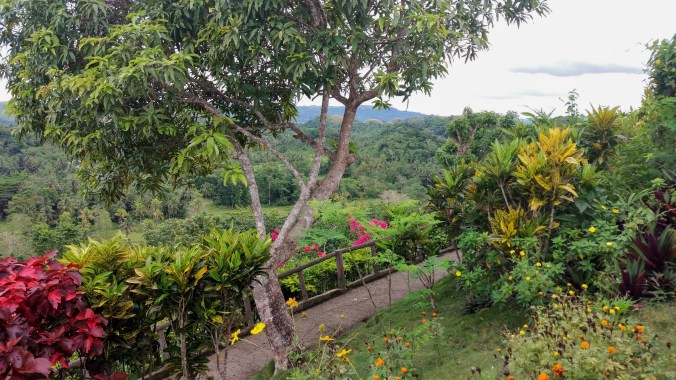
The Carmen location where I went had ample motorbike parking, and a little building with a restaurant, snack shop, restrooms and some souvenir stands, and a little off to one side, a giant staircase leading up to the highest peak for the best view. First, I took a circuit of the main building, looking out at the vistas below and peering casually at the souvenir stalls. I have given up souvenirs with my nomadic lifestyle and rely almost exclusively on photos and this blog to help me remember my travels with fondness, but I still like to see what’s on offer. Every now and then I find something I will actually use or wear.

20171002_104853.jpgOnce we completed the survey of the base level, we headed over to the stairs. I’m not a champion stair climber, but there were lots of places to stop, and a few side paths for extra sights. It’s not too much of a climb for all that it’s the tallest of the hills. Part way up is the turn off to see the “Our Lady of Lourdes” Grotto. The Philippines are mostly Catholic, a holdover from the Spanish colonization. There are churches and shrines everywhere, but I don’t mind too much as Catholic art tends to be beautiful, and no one was trying to convert me.
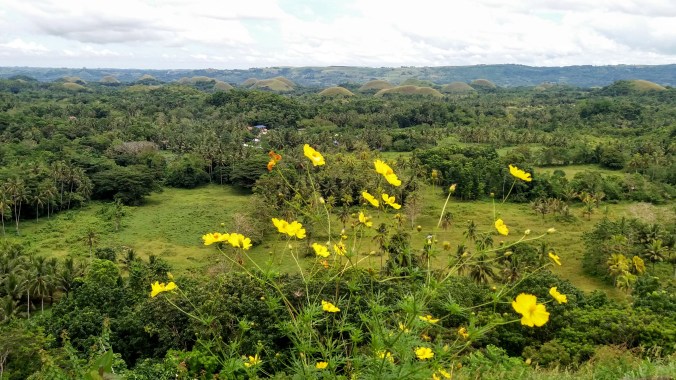
20171002_105639.jpgI took about a million pictures of beautiful flowers and the shifting view on our way to the top. And when I finally reached the peak,  took obligatory selfies from the viewing platform. I also went to find the not-actually-famous-at-all well with a a bell to ring the bell and make a wish. There was also a cute little backdrop on one side for people who like to pose with man-made scenery. I liked it despite or perhaps because of it’s total kitsch, but I’m glad it was off to one side and not covering the whole viewing platform.

20171002_111753.jpg

Why Do They Call It the ‘Rainy Season’

Standing atop this highest peak and taking in the view and the breeze, I noticed some dark clouds moving toward us. The weather in Bohol is still a mystery to me. October was supposed to be the “rainy season” and yet I’d only seen lightning from a long distance (and that close to the equator you can see a long way), our skies had been sunny.

20171002_111127-PANO.jpg Even as the week continued, we experienced very little rain. I am told that the rainy season is short but  has strong showers every day, and the hotel hostess did say that the weather was a little unusually dry for my visit, so maybe I just got lucky? Anyway, not wanting to be caught on the very top of the highest peak around if a thunderstorm hit,  we began to descend the stairs.
20171002_112353.jpg

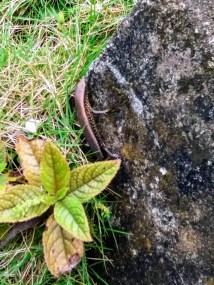
On the way down, there was a family looking at something off to the side of the path and I stopped to see what it was. It turned out to be a little salamander! The diversity of wildlife, plant animal, insect, fungi, in Bohol is just stunning, but so much of it is tiny. It’s just proof that seeing the best things means being open to looking.

During the ensuing downpour, we got some lunch in the restaurant. I’ve included this meal experience in the food post, so I’m not going to describe it here, but I will say I was pleasantly surprised.

Just Another Adventure Park

With full bellies and sunny skies, we hopped back on our bikes to descend to our next stop. The parking lot attendants asked us where we were headed and advised us to be extra careful because the roads would be slippery. It seemed everywhere we went, the local people were quick to watch out for our safety and well-being.

12274756_10154324072564838_1412251690201222453_n.jpgOne of the many things I found online about Bohol was the prevalence of adventure parks. We have these in Korea too, and for some reason I still haven’t ziplined. The Chocolate Hills Adventure Park advertised a kind of zip bike, where you pedal a special bike (with a safety harness) along a zip line between two chocolate peaks. I have nothing against ziplining, it just doesn’t seem like a great way to actually see anything, so I keep putting it off in favor of taking in sights until I manage to find one in a place I’ve thoroughly explored. But this bike thing seemed unique and slow enough to get a great view with plenty of time to look around and admire the scenery instead of zipping through it.

I found the park at the end of my first, but not last, bumpy dirt road. I decided that driving on that road was the first test for any ambitious adrenaline junkie, after all, if you couldn’t navigate a dirt and rock road with uneven levels, shifting gravel, and post rain mud puddles, how could you possibly do the real adventure at the park? You can’t buy tickets to the individual rides at the front but must pay a 60p entrance fee, although they did offer to hold our helmets at the ticket office while we were inside.

20171002_145050.jpgI read online that the park had a weight limit, but we decided try anyway and see how much they actually meant it and how much was just a liability disclaimer. It turned out to be sort of both. We were each a few kilos over the weight limit, but instead of telling us straight up “no”, the staff advised us to head on up to the zip bike area and try on the harness with the safety guide to see if it would fit anyway. In retrospect, I’m not sure if this was their way of shifting the responsibility or not. I think if we’d been WAY over the limit they would have turned us away, but since we were close?
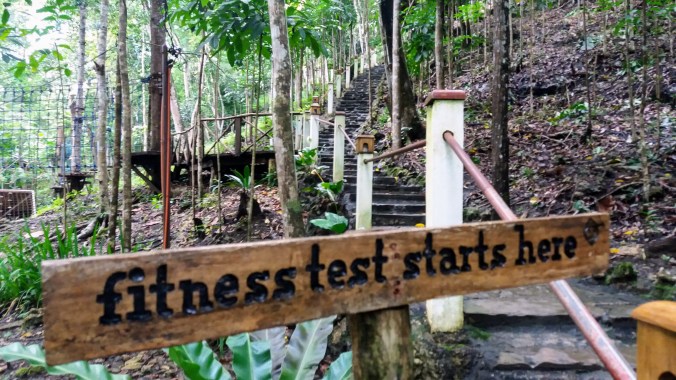
20171002_145135.jpgWe headed further in, following signs to the zip bike and were led to a steep stone stairway with the sign “fitness test starts here” at the bottom. I theorized that anyone who couldn’t climb the stairs to the starting point wasn’t fit enough for the activity, and we began the ascent. Whatever your opinions of stairs are, know that the jungle makes it harder. Humidity. Nonetheless, we persevered and made it to the top and were rewarded with a breathtaking view and a less than stellar ride attendant. I do try to give people the benefit of the doube, and maybe she was annoyed with her coworker on the radio or something else we couldn’t even see and not with us at all, but it was clear she was annoyed with something.
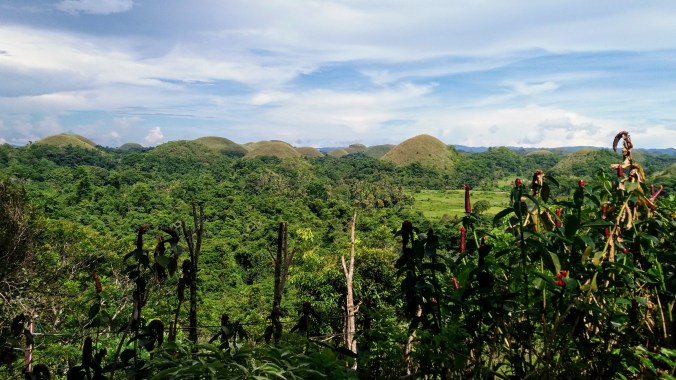
20171002_134923.jpgWe waited on the viewing platform, and I have to say that even though we’d just come from the tallest peak in the hills, the Adventure Park’s view was stunning. I don’t think I would have gone there only for the view, but it was certainly a nice perk. We also watched a few more tourists take the bikes out and back on the lines from the tower above us to the hill next door. The attendant at first told us that we had to wait due to lightning (the storm that had just passed us?), but then we saw people riding anyway? I’m not sure what was the deal there. I also accidentally got doused in ants trying to take a picture of the hanging trellis flowers. The ants really liked the flowers too, and when I bumped into one, they transferred from the petals to me. Thankfully, they were just small black ones, and I was able to brush them off with no bites, but it reminded me to keep an eye out for what I touch or lean on in the jungle.

Finally enough riders returned that the safety guide was able to have us try on the harnesses for size. I thought it fit. It went over my thighs and around my waist, and while there wasn’t much slack, I was starting to feel optimistic when the safety guy shook his head sadly. Although his English was not as good as the attendant’s, his attitude toward us was much kinder, and he seemed genuinely sad to have to break the news. Although the park employees were not speaking to each other in English, I finally figured out the problem was not merely the harness fitting, but where the straps landed on our bodies, especially our legs. It was disappointing, but understanding the reason wasn’t just fatphobia helped me to accept the results.

On the way back down the stairs, I enjoyed seeking out tiny treasures along the trail. Little bitty flowers, fluttering butterflies, a wee fuzzy caterpillar, an odd sideways snail and a mini mushroom. I love taking photos of tiny things sooo much.

Park for the Less Adventurous

There are a lot of opportunities to visit butterfly enclosures on Bohol as well. Initially, I planned to see the conservatory nearby, but the adventure park had their own and we were already there. It’s impossible not to compare, but I may have been spoiled by the one in Kuala Lumpur.

20171002_143134.jpgIf you’re going to the Adventure Park anyway, go ahead and visit their butterflies, but don’t go out of your way for this display. We were accompanied by a guide who had been trained to take lots of pictures for us (with our phones, they weren’t trying to sell them back to us or anything, but Asian tourists especially love appearing in their own travel photos in a way I never will) and move people through. She showed us a display on the life-cycle of a butterfly, and we got to hold a caterpillar. Then we walked through a path in a netted off part of the forest. We only saw a couple butterflies and at one point our guide threw a rock in an attempt to get on up on the top net to fly. We quickly stopped her from continuing that and said we were fine with the way things were. She said the butterflies were inactive because of the rain, but I felt like I’d seen half a dozen just climbing down the stairs from the zip bike.
There was a dead butterfly on the side of the trail which she picked up and repositioned so we could take photos. It was a little macabre, but I could tell she had been instructed to make sure that the visitors had as many photo opportunities as possible. On the way out, we posed behind butterfly wings in transparent cases to create a “trick photo” of ourselves as butterflies. It was, like many other things here, quite kitschy, but harmless fun. I’d definitely prefer a trick photo to mistreatment of living butterflies.

The experience was strange. It was small and a little dingy, and I think designed by someone who had heard tourists loved butterflies but didn’t really know how to do a butterfly garden. We never did go to the main conservatory down the road, but from everything I read on Trip Advisor, it’s almost exactly the same from the holding of the caterpillar to the trick photo at the end. I’m not saying don’t go. It’s super cheap and you might see more butterflies than we did. However, I saw a million beautiful butterflies in the wild, just wandering around Bohol and watching the flowers.

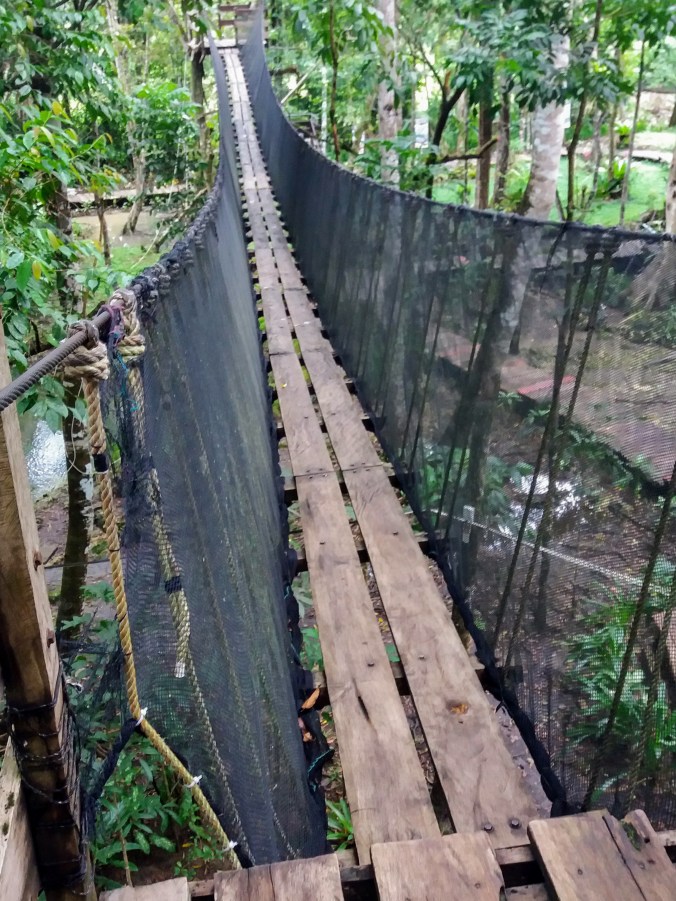
20171002_144552.jpgAfter the butterfly enclosure, we were guided over to the suspension bridge which is included in the park entrance fee already. This kind of bridge through the canopy is another very common tourist must do in Bohol, available at multiple locations. Even though I may not deliberately go looking for the silliest touristy things to do, I’m hardly going to turn it down if it’s right there in front of me. We had fun, and got a nice view of the park from the air before descending the stairs on the far side and heading back to the bikes.
Tarsier Conservation Area

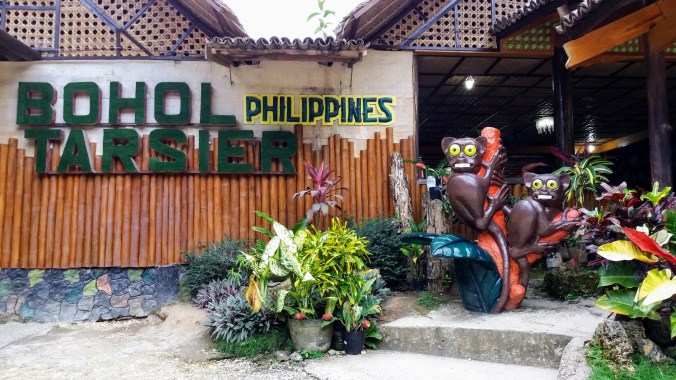
20171002_164035.jpgFollowing a delightful and refreshing stop for some locally sourced buffalo milk ice cream, we headed back down the main road where were would be able to find the Tarsier Conservation Area (not to be confused with the “Philippine Tarsier Sanctuary”). Bohol is also famous as the home of the world’s smallest primate, the tarsier. There are two tarsier spots near the Chocolate Hills, and it was worth it to me to visit both, since I was already planning other road trips near each one. I’ll say now, if you can only do one, do the Sanctuary, but seeing both was nice.
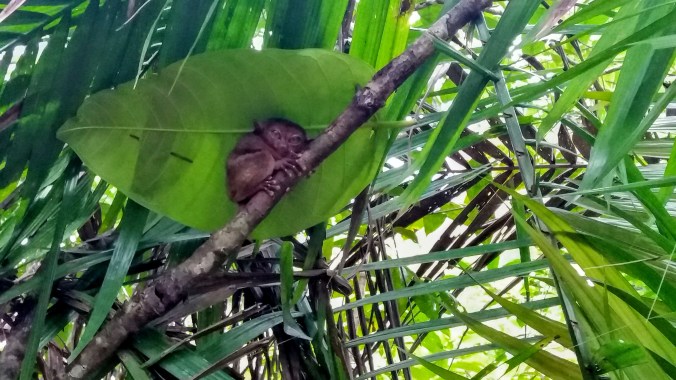
The Conservation Area has a bad rap online for being too zoo-like, and I’ve seen some of the zoos in Asia, so I was wary of going at first. I had visions of tarsiers in tiny cages where people could take close up photos, or worse of them being passed from patron to patron as the reptiles so often are. I was pleasantly surprised to find no such thing going on. Make no mistake, the tarsiers here are captive, not wild, and they are part of a breeding program to restore the native population. But their everyday environment is nowhere near what I feared.

Visitors were encouraged to follow a concrete path through the enclosed forest. I saw a lot of paths that were blocked off with temporary barriers or signs which makes me think that sometimes the walking path changes when the critters need to move. There were park staff positioned along the path to help us spot the tiny tarsiers in the trees. Although photos are allowed, there is a no flash and no selfie stick rule, as well as signs all around reminding patrons to keep quiet for the little sleepy monkeys. Tarsiers are nocturnal, and so visiting hours are also sleeping hours. Each one was clinging to his or her tree under a clearly man-made roof of leaves and branches.

20171002_162736.jpgI can’t be sure if they are placed at these viewing stations or if the park simply made attractive bowers in good places and hoped. I did see one little guy hanging out in a not great viewing spot with no guide to point him out, so at least a few must be slightly rogue. We were also told they are territorial, and tend to stay in or near one tree as adults.
While it is clear that this park is an animal enclosure, a zoo for one species, I felt that it was still a pretty decent life for the critters who, while yes, had to be ogled by tourists, were at least kept a reasonable distance from the path and protected from invasive hands and cameras.

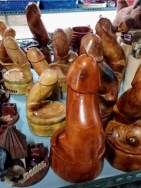
20171002_163905Whether we like it or not, tourism is the main reason species like these will survive. In fact, the growing interest in ecotourism is a big part of what’s paying for conservation in developing countries. It can be hard to draw the line between exploitation and preservation, but I think the Conservatory is leaning on the right side. Of course, the park dumps you back into a souvenir shop between the exit and the parking lot which was full of tarsier themed everything, and one shelf of wooden phallus ashtrays for no discernible reason at all.

Philippine Tarsier Sanctuary

20171006_093344.jpgSeveral days later on my way to a lunch cruise on the Loboc river, I started out extra early to make time for the Philippine Tarsier Sanctuary to see how it compared to the Conservation Area. I tried to get there as close to opening as possible to beat the crowds of tourists, and I think I very well may have been the first customer of the day since cashiers had to be found, then change had to be found. It’s not an expensive tour, but like every little adventure in Bohol, it does cost a small amount to go in. I got a personal guide who walked me through a kind of netting air lock into the forest beyond.
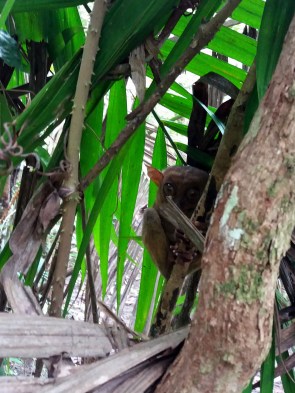
20171006_093938While the Conservation center had been paved paths with guides stationed at each Tarsier, the Sanctuary was much more a natural jungle with mud paths through the trees. I doubt I would have gotten lost in the small area behind the building, but I certainly wouldn’t have seen as many tarsiers without my guide. The Sanctuary is closed in, but the fence and netting are very unobtrusive, designed more to keep predators out than to restrict the tarsiers. I also felt like the tarsier perches here were probably man made to encourage the critters to good viewing sites, and to make sure they were visible from the paths while being sheltered from the sun. However, where the Conservatory perches were obviously man-made, the Sanctuary perches looked far more natural, drawing less attention to themselves and who knows, maybe being more comfortable.
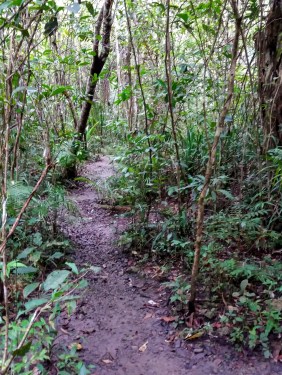
20171006_094314My guide quietly and confidently led me through the tangle of muddy paths, stopping every few minutes to point out a tiny sleeping primate. I was surprised at how close they were to the path after my experience at the Conservation center. While I’d been hard pressed to get any decent photos at the Conservation center, I had merely to hold up my phone to be close enough for great detail here at the sanctuary. I was worried about disturbing the little critters, so I tried to keep a reasonable distance, although more than once they were close enough for me to have reached out and touched, I know that would have been dangerous and damaging for them, so I resisted the urge. My guide was in no rush, and was happy to stand by while I got a good look at each one, and until I was satisfied with my photos. I can’t say I always had a good photo before I decided to move on, since I was keenly aware that simply by watching me back, I was keeping them awake and didn’t want to become a source of greater stress. I probably stayed at each spot between 2-5 minutes before moving on.
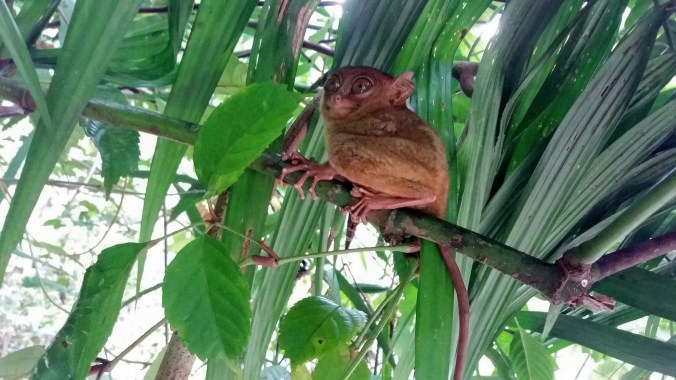
20171006_094405The Sanctuary jungle was also the hottest thing I did on this vacation. The trees were so close together and the netting caught the breezes, so even at 9:30 am it was sweltering hot and I was drenched in sweat the whole time. It was entirely worth it.
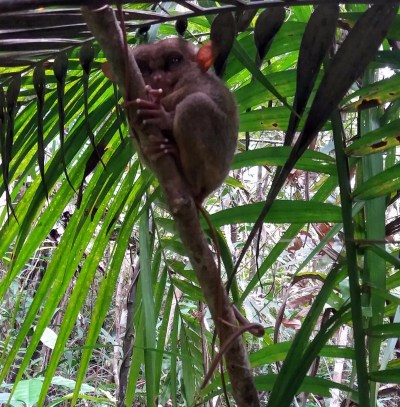
Tarsier Mythology and Preservation

20171006_094201.jpgIt was so peacefully quiet and there were no other visitors in the park so I felt very special getting to have this beautiful jungle and adorable creatures all to myself. I talked to them in soft reassuring tones like I was trying to sooth a scared kitten, and I have no idea if that was effective at all or just my own human oddness, but it was so obvious that they were watching me back, I couldn’t help but wonder how many myths of goblins or fairies these peculiarly shaped animals inspired. Their eyes are so large in comparison with their heads and yet the gaze is penetrating. Their hands are smaller than a newborn, but their fingers long and deft with large pads at the tips like a lizard or a frog.
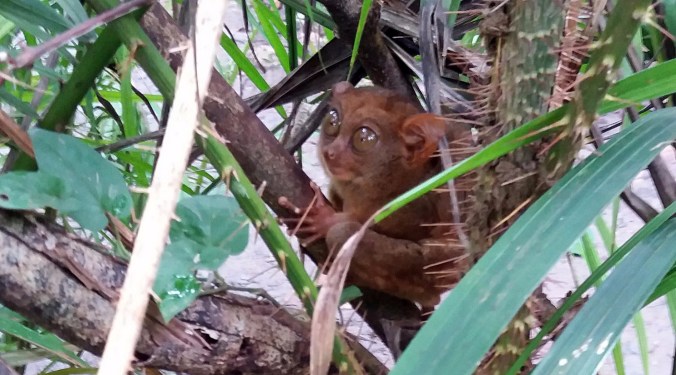
In the west, these creatures have inspired fictional characters like Yoda, Gizmo (the Mowgwai), and the very popular Furbies. But in the Philippines, a deep superstition that pre-dates the Spanish colonization (and has never been fully eradicated by Catholic conversion) holds that forest spirits who dwell in the Balete Tree keep the Tarsier as beloved pets. Although there are very few of these trees left, the superstition has not wholly passed out of practice, and some of the early conservationists mentioned this myth in concerns over the mass capture and killing of the Tarsier that until recently had become normal in Bohol.

Thankfully, they are now a protected species, no longer for sale in every market, and where they are on display to the public, their environment is protected from two and four legged predators while raising money for increased preservation efforts.

20171006_094628

Feel free to check out the full albums of the Chocolate Hills and the adorable tarsiers over on my Facebook page 🙂


It’s December in “real time” here in Korea and I’m mostly occupying my time with end of year chores and dentistry. Looking over my photos, it’s clear I didn’t do nearly as much exploring inside Korea as my first year, and so I’m looking into some winter festivals that I missed out on before. And although January is our holiday time, I may be postponing my next out of country trip depending on what my next contract holds. While things are up in the air, I’m going to be a bit of a money saving homebody, but I have no doubt that some kind of adventure will come my way soon. Until then, I’ll keep publishing the Bohol stories and the China throwbacks. Thanks for reading! ❤

Letters From China (First Month 2007)

As September 2007 continued I began to find my feet in China, getting the swing of things in the classroom and learning to navigate Beijing on my own. These letters include my trips into town, my adventures in coffee, my first bout of homesickness (maybe ever), and some glimpses into the lives of my Chinese students.


Sep 13, 2007 at 10:08pm

Sooo, today was kinda interesting. It started off with early morning downpours, and me having no umbrella. By the time I got to class I was totally soaked. Not too bad tho, it cleaned out the air a bit and cooled down a lot.

The power went out this afternoon.

And… drumroll please… I found a place that serves COFFEE here in Yanjiao! It took me a while to get across that I just wanted black coffee, since it was like a dessert shop and they did mochas and cappuccinos and the like, but in the end, I did get a real cup of coffee… not great, but real. I still intend to try to get some beans in the city so I can make my own, but it is nice to know there’s somewhere I can go nearby.

Sep 14, 2007 at 7:34pm

I’m sitting here grading homework, and I want to share what one of my students wrote. The assignment was to describe a person.

“When I am happy, I like a person who is of medium build, a little chubby. I think she is very optimistic, stoic and conservative. She likes reading, listening to music and so on. Sometimes she would write a very good passage.

But when I am sad, very sad, I begin to hate her. I think she is very pessimistic, stingy and grumpy. She always does something wrong which made a lot of person even her friends misunderstood her and dislike her.

I eagerly hope she can do everything carefully and become excellent. Because that person is me.”

The English is a little rough, but I think the message is amazing, so I had to share.

Sep 15, 2007 at 11:25pm

Today I finally felt well enough to do some exploring. We decided to go into Beijing. The bus ride takes about 40 minutes, but its reasonably comfortable, and really cheap, about 5 yuan¹ as opposed to say a taxi which would cost over 100. This lets us out at Dawanglu. There we discovered a Super Walmart center and a guy in a penguin suit.

After Walmart, where I was able to find actual coffee, though its very finely ground and a little acidic for my tastes (I may however have over-brewed it, due to its completely wrong grind for a french press, and since I have a whole bunch, I’ll keep trying to get the timing right), we got on the subway (3 yuan) http://www.urbanrail.net/as/beij/beijing.htm and went on the red line (see the link for a map²) from Dawanglu to Xidan where we found a huge mall and some interesting architecture.

100_0051

This mall looks a little like an American mall, but of course there’s lots of room for bargaining. We also found a Starbucks where I was able to purchase the aforementioned french press. We didn’t stay long because one of the guys was looking for a winter coat and we didn’t see many clothing stores there, but I want to go back and explore more… one of the nicest things about it was that no one was trying to sell me stuff actively, and later I’ll explain why that’s so nice³.

We then took the subway back to Yong’anli and the infamous Silk Market. The silk market is a huge multistory shopping complex made up of hundreds of stalls selling goods.

silk market 053

Its a heavy bargaining experience. Erwin found a jacket he liked and argued the price from 2300 to 450 (300usd to 60). While this market has plenty of nice stuff for cheap if you argue well, the sales girls are really grabby, literally, they kept grabbing my arm to stop me and try to drag me to look at their stuff. Not all were like this, but enough that it got on my nerves. I’m sure I’ll go shopping there myself when I need winter things, but its really a high impact shopping experience.

We stopped at a cafe to refresh ourselves before the long trek home. Kevin had a sort of duh experience today. His water supply† at home ran out like 2 days ago and for whatever reason a new jug never arrived, so he basically stopped drinking water, and of course today, he got pretty sick… he’s fine now, and its probably just as well we had to come home early, cause I am totally wiped out. In the end, we took the subway back to Dawanglu, then the bus back home. So I shall leave this post with the final picture from the window of our bus.

100_0052

¹ Chinese currency has a lot of names… I was not consistent in how I called it because the Chinese themselves are not. RMB, Yuan, and Kuai (remember back then it was 7.5 RMB to 1USD)

² That link doesn’t work. Try this one. TheBeijing subway has gotten SO much bigger since then. There were 4 active lines and they were building the 5th for the Olympics… today there are 15. But you can still see the red line on the map.

³ I did not ever explain that. In China (and oh so many places in the developing world) visiting (white) people are assumed to be richy richersons and someone always has a hand out or is trying to sell you something useless and overpriced. Often a simple “no thanks” in the local language is enough, but I’ve had people on the street grab my bags or even my arm before trying to get me to buy. It was very overwhelming before I learned how to deal with it.

†Do not drink the tap water. 

Sep 16, 2007 at 10:56pm

To paraphrase Rob, I finally hit the wall. It really hit me where I am and how long I’m going to be here, and the fact that I sat in my apartment today and couldn’t talk to any of you because you were all gone, just made it that much harder. Don’t get me wrong, I know it was Saturday night and all, but I went out to Beijing yesterday instead of chatting with ppl, and I’ve been kind of scarce on contact this last week anyway, and I keep looking at this board hoping someone will have put up something while I was asleep or away, and its happening less and less…

I realise you’re all going on with your lives and that I’m not as much a part of them as I was 3 weeks ago, and there’s a definite tendency for “out of sight out of mind” but when I was talking to you all, at least someone, every day, I wasn’t lonely, and I felt like I could DO this. But today, for the first time, I began to wonder if I really can.

So, I guess I’m just asking that you try not to let me be out of mind, just because I’m out of sight. I don’t think I can do this without your help, all of you. I’m gonna try to shift the Beijing outings to Sundays (your Saturdays), to make it easier. Google Talk has a free voice talk function that all you need is a cheap mic to use, and I can’t tell you how much it helps to hear your voices.

I’ve never really been “homesick” before, because having moved so much as a kid, I never really felt like I had a home, and when I left Memphis, I was only leaving a few people behind, and I could always just call them if I missed them. But I’m homesick now, for Seattle, and while I can’t be there, and you can’t be here, if we can meet out in Cyberspace its not as bad.

P.S. Its not really the city I’m homesick for, but the people who made it a home, the ability to walk down the street to hang out at Belinda’s or drive over the water to Toni’s or just hang out and shoot the breeze after game. The closest I can get to that here is talking online, and that I need more than coffee or pine scent or home-cooking. I think its important for me to be ok with the accommodations, food and entertainment that China has to offer, because trying to make my life here like Seattle not only defeats the purpose of being here, but just highlights the differences and reminds me how hard it is to bring that here. Things are just things, but people are irreplaceable.

Post by Ross on Sep 19, 2007 at 7:09am

Weeeeee’re off to see the Chairman, the most respectable Chairman of OZ!

We hear he has some wonderful Chi, if ever some Chi there waaaas!

If ever oh ever a respectable worker there was, the Chairman of OZ is one because. Because, because, because, because, becaaaaause!

Because of the glorious wealth and respect in common effort to the workers he does!(doo da da da dum da doom, da!)¹

¹Nearly everything here is something I wrote, but I just couldn’t leave this creative comment out.

Sep 19, 2007 at 6:11pm

As part of teaching conversational English, I give the kids¹ little activities to do. Today was a talk show, the topic of which was “teens and their parents”. While several of the skits were standard fare: “dad won’t let me date”, “mom treats me like a child” etc. One group had a fantastically Jerry Springer-like show.

It started out with the “mother” bursting into tears (real ham acting sobs) and relating the deep tragedy of her husband disappearing from their life when her daughter was only 6 and their mother/daughter relationship is now suffering.

The “daughter” then breaks in to tell her side, the relationship isn’t bad because the father left, its bad because she is a lesbian and her mother refuses to let her marry the woman she loves!

It further develops that, although she has become a lesbian because of her deep distrust and hatred for men (causing the male “host” to back up a bit), she truly loves the woman she is with.

The only un-Springer-like action is that after the psychologist has told the mother that her daughter’s sexual preference is a result of a combination of genetics and environment, and she must support her daughter (nice and liberal), the mother and daughter make up in another flood of hamitup tears.

The skit was funny and socially relevant and very creative. It really is amazing to watch these young people grow and change.

¹ “kids” = university students, ages 18-22

Sep 21, 2007 at 1:27pm

With my cold finally gone (well mostly) and the beautiful weather, I finally got off my butt and took some pictures of the campus. Be warned, there are a lot of them¹.

We begin our virtual tour today with an aerial view of campus in order to give you a big picture from which to put the details in perspective. I went to the ninth floor of a teaching building in the middle of campus and took pics starting from the south, moving west, north,  and east.

This slideshow requires JavaScript.

Now you have the 180 aerial tour, lets move onto the ground. From the south view, you can see the zigzag looking bushes, the red potted flowers and the cactus garden.

21 cactus garden.jpg

Next, we’ll take a look inside the class building from which I took the pics. First is the view of the building from the south, standing on the same road bordered by the zigzag bushes, then some classrooms and the stairwell.

100_0135.jpg

…a public toilet and some chalkboard art.

Next we shall move to the north, and see the basketball courts, the fantastic concrete pingpong tables and some more chalkboard art.

Now to the east, a sight not easily visible in the tall view because of trees, but nice nonetheless: A fountain (not currently flowing) and some student dorms.

38 fountain.jpg

And as we move to the southeast, we find a lovey garden path and gazeebo.

44 gazeebo.jpg

Interesting architecture, well sort of, I have no idea what this smokestack thing is for, but hey, its a feature.

56 flower and chimney.jpg

The main south gate into campus (the one I come in thru every day).

70 main south gate.jpg

this garden is near my apt. on south campus

100_0139.jpg

Now for the entertaining bits. I’ve mentioned to a few people the amazingly big and architecturally inclined spiders here, and while I can’t get a web to show up on my camera, I thought these pics might give you some idea of what I’m talking about. The spiders themselves are about 2 inches (including legs) and the webs are usually 3-4 feet in diameter. The webs are not as patterned as say an orb spider, but they tend to be three dimensional, being a few inches deep in addition to the many feet wide. Thankfully, there are enough regular cleaning staff that no webs ever wind up on the paths, but they can be seen from the road. The pictures below are of a spider perched in his web (not one dangling in midair). You can just see the edges of the trees he has built his web between, and these are TREES not bushes, the whole thing was about 8 feet in the air. The thumbnails do not do it justice, since the spider is a little black dot, so I suggest to those who really want the full effect to go get the full size pics.

73 freaky spider 3.jpgAnd last but not least, the army kids. Some of you may be aware that military participation is mandatory in China. So all the freshmen, rather than starting their classes, are participating in military training, which seems to consist mostly of learning how to march in formation. They have been shouting outside the classrooms all week, and I often have to yell to be heard over them in class. I took some pictures of their drilling practices, and tonight I’m going to some kind of show which is being held in the football field (apparently that they’ve been preparing for, hence the yelling), that thing that looks like a bunch of colored squared on the north west corner of campus is actually a football field that they’ve covered with a plastic tarp and chairs. Ladies and Gentlemen, I give you, the People’s Army…

Peace out!

¹ So many more pictures. If you want to see more, check out the album on Facebook (where picture storage is free).

Sep 28, 2007 at 2:40pm

I’m a little behind in posts this week, but I finally got the pics off my camera, so here we go. I moved my weekly exploration outing to Sunday (rather than Sat) to better coincide with chatting and game times in Seattle.

After my last trip into Beijing being so hectic, I was planning a nice relaxing day of browsing through one of the quieter shopping centers, however, this did not turn out to be the case. Adam, the anime fanboy foreign teacher here, heard of my planned outing and asked to come along. I agreed and expressed my desires for a quiet shopping trip, alas, it was not to be. After only a few minutes at the shopping center I scouted out last time (the one under the big glass cone in the previous pics), Adam wanted to show me a nearby center he’d been to before… OK… so we hit the streets. Where I saw some interesting signs, and a few examples of native wildlife.

This slideshow requires JavaScript.

When we finally found his shopping center, he decided he was hungry, and asked if I’d rather go to MacDonald’s or KFC. Grrr. After waiting for him to get American junk food, I finally found a street vendor and got some REALLY tasty squid in a sauce that tasted a bit like bbq and cocktail sauce mixed together, and some grilled mutton with what tasted like cumin and cinnamon for spices.

We went into the shopping center. I found a nice Tiffany knock off chain for the pendant Miriam gave me (BTW I get compliments on that pendant, and one of the other teachers wants to know if that company has a website). I captured an interesting example of Chinese fashion, and spent a lot of time waiting around the geek area of the mall while Adam perused the entire anime toys/keepsakes collection.

Finally nearing the end of my energy and my patience, we sojourned to Starbucks and had a short break before getting back on the subway to head to a bar where one of Adam’s “friends” was DJing. The bar is called Club Obiwan, and I didn’t get any pics of the interior, cause I was tired and grumpy when we showed up, in no small part because the directions were vague and we got a little lost looking for it. But it turned out to be a really neat place, most of the clientele were ex-pats, westerners living in Beijing. I had a Mojito which was very refreshing and had a basil undertone to it, and there was free BBQ. The theme of the evening being reggae; it was not Chinese bbq. I think it was supposed to be Jamaican, but it was very mild, and oh so tasty. The music was also very nice, being that breed of reggae that is more chill out than rock out. Here is the view from the rooftop dining area.

100_0150

We totally cheated and took a taxi back to the bus stop, but it was worth it not to have to face the subway at the end of such a long day.

On Tuesday, all the teachers had to go back into Beijing to file for our residence permits, which ordinarily would not bear a place in a post, but on the way home we passed a mule drawn cart, and I had to share.

100_0155.jpg


Reflections?

I can see how much my approach to photos and descriptions has changed in 10 years. Clearly, I used to rely on the photos to tell the story, only explaining enough for context. These days I find I really enjoy describing what I see, as so often my experiences simply can’t be captured on camera, but are a blend of all the senses and of my feelings. Subsequently, I write much longer posts, but then the photos can support my story rather than the other way around.

I can also see how what I look for first in a new country hasn’t changed too much: coffee, a good place to shop for the necessities, and the best places to get local food. I haven’t focused as much on my school here in Korea, but I think that has more to do with the fact that it’s not ok to put other people’s children online without permission and I’m teaching actual kids instead of young adult “kids”. But, if it’s something you’d like to hear about, I could certainly work on a school/work post for Korea, too.

Finally, I’ve become much more self conscious about taking photos of people, no matter what age. I suspect that living in Saudi and travelling in the Middle East made me this way, since there is is at best rude and at worst illegal to take or post pictures with faces in them without permission. I don’t know if that’s something I want to change or not, yet, but it’s interesting to think about. As always, thanks for reading! 🙂

Malay Peninsula 16: Surat Thani- Floating Market & Fireflies

Given the events leading up to my final day in Thailand, it could easily have been a wash, however, the small non-tourist town of Surat Thani still had some surprises up it’s sleeve, and I managed to end this holiday on a beautiful high note. It’s my goal to publish all the stories from one holiday before I take another, and I’m barely achieving that by finishing off this post with three days to spare before I hop on a plane to visit the US for the first time in 18 months. I hope you’ve enjoyed reading about the journey as much as I enjoyed writing about it.


Adventure Hangover

Although the Wangtai had transport out to Khao Sok, I couldn’t bear the idea of waking again in only 6 hours and vowed to sleep until about an hour before breakfast ended, then eat and sleep some more. It was sad to give up on my elephant excursion, but when I woke up the next morning I realized how important that decision really was. I felt weak, as though I had just come through a severe illness or fever. My limbs shook as I walked and even as I held my phone. I had no strength and no speed, but found my way down to the breakfast buffet where I positively stuffed my face after days of light or missed meals.

Mentally, I felt clearer for the sleep and food and I began to realize based on the way my body felt that I had pushed myself a good deal farther than I had known. It was likely not any one thing, but a combination of poor sleep, poor diet, excessive heat, lack of water, physical exertion and the coral injury (which can be known to cause fatigue and other symptoms). I had hoped that I could make it just one more day, just one more activity and then sleep on the plane and of course back in my flat in Korea, but my body was just finished. If I’d tried to force myself to rise early and head to the elephant, I would likely not have had a pleasant day, but only another day of crammed vans, heat, dirt, hunger and dehydration, worried about what standing around in muddy water with an elephant was going to do to the probably already infected open wound on my foot.

Instead, I slept some more, watched some movies, ate lunch, admired the view of the river, took a nap, and read up more on Thai culture.

Spirit Houses

20170125_150240Since arriving in Thailand via Koh Lipe I had seen these tiny ornate houses on posts everywhere. I saw them on the remote islands around Lipe, near the caves of Bor Tor, in the cities, at gas stations, and in the front yard of homes we passed on the road. Some were simple, others like miniature mansions. Some had tiny model occupants while others were uninhabited. Nearly all of them had offerings of food, sweets, alcohol, or incense.

The houses are a throwback to Thai folk beliefs in spirits of nature and the land. The tiny houses are built to be homes for these spirits. They may be built near special trees, bodies of water, mountains or natural formations to house the spirits of the land. And they may be built by homes to attract spirits who will inhabit the house and aid the family in exchange for lodgings and gifts.

I have seen similar spirit houses in Japan, but at the time I completely failed to make the connection because the architecture is so different.

Night Market

The clerk who had checked me in the night before had mentioned the floating market was within walking distance, and I had also read online that one of the few cool things worth doing in Surat Thani was the firefly boat ride. Around 5pm, I set out on the short walk down to the river where the maps indicated I would find the market and the boat rides.

20170128_173609
The river front park is small, however there is a large island in the middle of the river called Ko Lamphu that does not allow cars past the carpark near the bridge. Under better circumstances, I would have loved to explore it, but I was still a bit woozy wobbly and didn’t want to push myself into illness or another breakdown, so I stayed on the near bank and enjoyed the small corniche.

I read some articles about the floating market that seemed to indicate it was only open on Sundays. Surat Thani is not a tourism hub, so there is a limited amount of information, but what I can gather is that there is a night market more often than a “floating market”. The floating part is supposed to be where some pontoons are set up on the quay side and vendors sell wares on these ersatz rafts. When I went, nothing was on the water, but there were plenty of stalls selling all kinds of tasty treats and some live music at the far end. If you’re in Surat Thani and Google says the floating market is closed, ask a local about it because there’s nice stuff in Si Tapi Park.

Street Food

20170128_174920
I first browsed the whole selection of stalls, checking out the food on offer. I passed a woman making fresh juice (very common in Thailand), and at first thought she was using limes because the peels were so green, but the juice was a bright almost neon orange! I don’t mean like a little tinge of green that you get on your organic oranges, seriously lime green. It turns out that this is what oranges look like in Thailand and Vietnam. And a glass of that fresh squeezed neon was a delicious treat. I passed some foods I was familiar with and others I was not. I was briefly tempted by a stall selling horseshoe crabs, but in the end I chickened out and got a serving of pad thai served up fresh on a banana leaf.

There were carpeted areas with low tables where people could doff their shoes and sit down on a clean patch of ground to eat. To westerners it’s a picnic style, but sitting on the floor is common all over Asia. I had a great view of the river and the large island park. And although the sunset was a little obscured, it was still a beautiful night.

20170128_182247

OK That’s Creepy

One especially strange thing that happened while I was wandering around: there was a PA system that had been piping out a low volume background music. This is not too weird because it’s nice for public gardens or parks to have a little ambient music and I hadn’t been paying too much attention to what was playing because it was in Thai and low key. Then suddenly as I was walking back toward the food stalls from the far end of the park, I noticed that everyone around me was standing up and not moving. Up until now, the park had been a bustling active place with people strolling along, taking selfies with the statues, kids running around and everyone munching on snacks. Now, it was like some kind of internal evil robot switch was activated and the whole human population stopped and stood straight, staring ahead, gazes fixed but not on anything. I drifted to a halt as I realized I was the only one moving, not wanting to cause offense but also deeply creeped out.

When the song came to an end, everyone began going about their business once again, resuming their casual chats and picnic dinners. I realize of course that robot overlords is not the real story, but it was very eerie. I’d been in Thailand for a few days and hadn’t seen anything like it before.

Language Barrier

I spend most of my time living, working and traveling in countries where English is not the native language. I’m used to working through a language barrier, but Thailand was the most challenging linguistic obstacle I have ever faced. (That includes Chinese, Japanese, Arabic, French, German, and Czech). The rest of the Malay Peninsula had been far easier for me to manage. In Singapore, everyone speaks English (national education tests are administered in English). In Malaysia, most people spoke English or Chinese (which I’m not fluent in, but can get around). Nearly everyone there is bi- or tri-lingual, speaking their native Malay and at least one of the other two. Plus, even though I can’t speak Malay, it’s written using the Roman alphabet (the one we use in English), so I could sound things out, and got good at recognizing the words for “bathroom” and “coffee” (priorities). However, Thai is written in it’s own special alphabet. It’s beautiful. It’s arcing graceful curves and swirls. But it has 6 different letters for the sound //, and I can’t read it.

main-qimg-e5a2293e8a1b0de569a2616461fb6c7e

I imagined as I wandered around the less touristy parts of Thailand that this must be how my friends felt exploring China with me, or how the teachers here in Korea who can’t read Hangul must feel every day. It also makes me appreciate how much of a difference having even a tiny understanding of the language can make.

Firefly Boat

20170128_185014
As the sun went down, the sign I’d been looking for appeared. Near a tiny dock, a young lady set up a folding table and a cute sign advertising for the firefly boat tours. If you have read my blog up till now you will know that I am a sucker for glowing lifeforms, so the idea of taking a nice riverboat trip and watching the fireflies was enticing, especially at the bargain price of 50 Baht (less than 2$ US). The boats don’t leave on a schedule, they leave when they have enough people, so I did my best to express my desire to go to the ticket seller, and then pulled up a nearby bench to wait.

After a number of people wandered over to look at the sign and wandered away, a group in matching t-shirts expressed some interest and stood off to one side while a single member of the group approached the ticket seller. This looked hopeful to me, because they were obviously a group, and after some back and forth, they decided to go, at which point the ticket seller gestured to me and made sure that I could take my trip with them. One of the group, the designated talker, happened to speak excellent English, so we were able to chat along the way. She told me she was from Surat Thani, but now lived in Phuket and had come back to see her family (the other members of the group).

As the longtail boat pulled away from the dock, we sped down the river passing the buildings of the city and toward a forested area of the delta. Looking at a map of Surat Thani, you can see that the city is built along the main part of the Ta Pi river. Just east of the dock, there is a little fork in the river and while the main branch continues along the urban areas, the side branch goes off into a green and verdant delta.

st map

Local Knowledge

Along the way, as I was chatting with the English speaking girl who asked me to call her Monica, I ventured to explore the bizzare robot occurance I’d seen earlier in the evening. Trying my best to be tactful and circumspect, I described what I had seen without the cyberman elements, and she told me that it had been the national anthem playing. Is that something that happens often or is today some kind of holiday? (It was Lunar New Year, but I understand that’s not often celebrated in Thailand outside of Chinatowns). She told me that it happens every day, twice at day at 8am and 6pm.

I thought about the ostentatious displays of portraits of the recently deceased king that I had seen around town. In Koh Lipe and Krabi, I had seen these only in government buildings, like the immigration office and police stations. But in Surat Thani, they were everywhere. And more than just paintings, they were like shrines with ornate decoration, bunting, flowers and other accouterments of borderline worship. Even taking into account that the mourning period for his death will extend until October of 2017, there was a marked difference in the way that residents of Surat Thani were carrying out that mourning from how the more tourist oriented towns I had seen before were.

The King and I?

photo credit: BlossomFlowerGirl

Thailand was a military dictatorship with a figurehead monarch, but the late king was instrumental in moving the country into a constitutional monarchy (some say democracy, but … king, so I disagree). It’s been shaky, but he was enormously popular, and has apparently left in his wake a movement of “ultra-royalists” and there is some concern that populist nationalism / military dictatorship will return (which is funny cause you’d think the ultra-royalists would respect the king’s wishes to create a constitutionally run society, but hey). This political struggle will never be in the western news because Thailand is poor and can’t really impact life and economics in the West. *sigh.

My best guess is that tourist towns tone it down to protect the revenue stream, and that there is almost surely a regional difference in how much the population supports royalism or democracy. Surat Thani is clearly royalist. It probably also explains why in place of a Gideon Bible, my hotel had this book of Buddhist teachings in the night stand.

20170128_215221

Magic on the River

Once we turned away from the main river course, it didn’t take long for the lights of the city to fade behind us and for me to start feeling like I’d stepped into a ride at Disneyland. The river was wide and slow running. The night air was a perfect temperature that could not have been achieved better with climate control. We passed by some houses on stilts that was surely the Surat Thani version of the suburbs, but they were so picturesque with bright lanterns hanging from the porches and architectural flourishes on the rooftops, they looked like life-sized versions of the spirit houses. Don’t get me wrong, reality is often an amazing place and I will take the real thing to a theme park replica any day, but this boat ride was so perfect that it seemed like there must be a secret team of imaginieers behind the scenes making it work.

As we approached the first firefly spot, the guide slowed the boat down and directed our attention to a shadow just ahead. I did not know what to expect. I had read blogs that touted the tour as amazing, and seen about a hundred descriptions of the experience as being “like Christmas lights”. As a child, in Maryland, the fireflies came out on summer nights and let us chase them around the yard, and put them in jars for an hour or so before going on their merry way. My childhood may have been excessively Norman Rockwell from time to time. Nevertheless, my image of fireflies is a couple dozen in a field or meadow flying around and looking for a mate. I imagined something similar, but on the banks of the river amid the dark sillhouettes of the brush and trees. Nope.

I don’t know if it happens elsewhere, or to what degree, but in Surat Thani, the river fireflies occupy trees.

As we drew closer to the shadow our guide was pointing to, the shape of the tree became more distinct and just after, the glow from hundreds of fireflies reached my eyes. Although every bush and tree around it was dark, this one tree was home to a firefly colony of massive proportions. I didn’t even know fireflies lived in colonies. But I now know that the berembang (also known as the mangrove apple, or crabapple mangrove) is a big hit with the firefly population. Because the delta near Surat Thani is abundant in these trees, they get more than their fair share of firefly light shows.

There is no hope of a photo or a video. The light emitted by these little bugs is just too faint. But to the naked eye, far from the city lights, the twinkling of hundreds of little bodies against the lacy black outline of the tree is a sublime experience. I could understand why so many people described the flashing as Christmas lights, becuase in addition to their huge numbers and single tree occupation, the fireflies blinked in unison. Ok, not every single one, but I’d say 65-75% of a tree would blink on and off together in perfect synchonicity. I was able to find a few more examples of species that do that, but not a single explaination for the behavior. I had always been taught that the light show was a mating display, and it seems counterintuitive to blend in with the crowd when trying to get a potential mate to notice you. Whatever their evolutionary imperitive, the synchronized twinkling was amazing to watch.

And it was not just one tree. Our boat was out for around an hour, and close to 40 minutes of that was spent in the dark mangroves drifting along from apple to apple, each tree laden with it’s own colony and sparkling like a glitter bomb under a disco ball. We passed tree after tree of glowing glimmering lights, up one side of the river banks and back down the other and I will never get tired of looking at that. No one goes to Surat Thani except to go somewhere else, and I very much understand why, because the town is not a tourist easy place, but if you find yourself there, take a night out to do this tour.

Let the Good Things Happen

Despite the fact that the night before I had been at the lowest imaginable point in this trip, the fact is, I had a lovely and unique experience on Saturday. I rested, gave myself permission to “miss out” on the elephant, and found a small local activity that was suited to my tastes and my energy level. Bad things happen on holidays. People get sick or injured or run into culture shock mood swings, but it’s important not to let it ruin everything. I’ll say it over and over, the key to maximizing a good vacation is to do something great at the beginning and the end, and I’m glad that my final memory of Thailand was something so beautiful.

tumblr_nefnbgFfOp1s6eu18o1_500


And so ends my final day of this all too brief foray into the three countries of the Malay Peninsula. Will I go back? Well, it’s hard to resist the siren call of Koh Lipe, and I still have some ethically treated elephants to visit, so I’m sure I’ll go back one day. On top of that, I think Singapore will make a great destination to bring my niblings to get them adjusted to traveling abroad. As always, thanks for reading and don’t forget to check out the Instagram and Facebook for daily slices of the life of a Gallivantrix. ❤

Malay Peninsula 5: Kuala Lumpur & The Batu Caves

I’ve totally given up trying to predict my work life. It seems chaos and uncertainty are this year’s watchwords. In an attempt to retain sanity, gratitude, and joy, I’m going to focus more on things I can influence and enjoy. This week that means cherry blossom soda, cherry blossom beer, cherry blossom frappuccino and of course cherry blossom viewing. So until I can write about all those blooms in Korea, here’s another tale from Malaysia, and a much happier one since Kuala Lumpur is less scary by daylight.


Batu Caves

20170119_100407The morning after my late night and less than welcoming arrival, I woke up early, scarfed down my leftover convenience store sweet buns and took off to find the train station that would lead me to the Batu Caves. In recent years, the Malaysian government has added a train stop at this popular tourist attraction, and now it’s much easier to get to. The train itself was a new experience. When you purchase a ticket, you are given a plastic token with an RF chip inside. When entering the platform, you hold the token up to a pad to be read and it opens the gate, but hold on to that chip! When you disembark, you need to feed the chip into a slot to pass through the exit gate.

20170119_105910I met a tour group on the train platform and we chatted during the train ride. I hung around with them and their guide to hear a few of the explanations offered about the caves. The guide rushed us past the dozens of sales stalls (saving us from souvenir swindles), gave a brief presentation under the statue of Hanuman (the Monkey King) and landed us in the main square at the base of the stairs and the giant golden statue of Murugan (a god of war, made of concrete and painted gold colored). There was a tremendous flock of pigeons in the main square and it seemed to be a major tourist attraction to stand in the flock and have them hop onto your hand to get some food. Occasionally construction in the background caused a loud boom that set all the birds a flutter, which was surprisingly pretty.

20170119_111631After a few obligatory photos with the tour group and the giant statue, we began the climb. The stairwell is not insanely long, a mere 272 steps. They were so popular as a form of exercise that the government had to ban fitness use of the staircase to keep it clear for tourists and worshipers. With my kryptonite-like response to humid heat, the staircase became a long haul obstacle, but there were plenty of interesting things to stop and look at on the way up, like the expanding view of the courtyard and city below, the rock formations on the cliffs along side, and of course the hordes of monkeys roaming freely through the grounds. Given that the monkeys are wild, I was totally happy to keep my distance, but they were not shy and enjoyed coming right up to tourists or even forcing a showdown over who got to use the hand rails. At one point there were two monkeys perched on twin posts on either side of me and I managed to get a cute double monkey selfie, checking off a bonus square in the Batu Caves tourist bingo.

20170119_113054When I finally got to the top, I was greeted with a large cave mouth opening that led to an even larger cavern. The entrance of the cave had small buildings installed for souvenirs and police. Once all the way inside, I could see that although this huge open space was graced with a few decorative statues around the edges, it was largely left in its natural state. The cave mouth was wide and there was a natural sky light further on, so the cavern was well lit. There were a few artificial lights in strategic places and an area of worship off to the left. Finally, there was another short staircase leading through to the open area beyond. At the top of those stairs was the rearmost chamber of the cavern, another broad space; however, the roof had long since fallen in and the walls soared up into open air, creating a round room with no roof.

Here a few more monkeys wandered around the main area of worship and some wild roosters serenaded us with late morning greetings to the sun. While the monkeys weren’t looking to steal any watches or cell phones, they were out to grab any food or drinks they could find, and had no problem at all photobombing everyone. I decided to step into the little shrine in the center of the chamber, donating a small amount and lighting a candle in gratitude. I am not Hindu, but I like to donate to historical sites and there is no entrance fee to the Batu cavern. The symbolic gesture of the candle was a good way for me to donate to the preservation of the site and to solidify my own expression of gratitude for getting to live a life where I can have experiences like this one.

I spent a little more time in the cave, just enjoying the surroundings and watching other tourists interact with the monkeys. Responses ranged from the insanely forward to the blatantly cowardly, but the monkeys themselves were so bold that they would simply walk where they wanted to go, trusting the humans to get out of the way.

Dark Cave

20170119_135901As I exited the temple section to descend the stairs again, I detoured off to the right to investigate a “dark cave”. The Malaysian government has taken this side section of limestone cave and created a conservation space. The limestone quarries and careless unregulated tourism of the recent past had wiped out a lot of the cave ecosystems. Efforts to restore the guano based ecosystem of living limestone caves are now underway in many parts of Malaysia and this cave was for both preservation and education.
I couldn’t pass up a chance like that. The cost of entry was 35myr (less than 8$US) and while it was the most expensive thing there, the entry fees all went into the environmental conservation efforts, so I don’t mind. I signed up for the next tour and sat down to wait in the cool cave mouth.

The cave has 3 chambers, but only 2 are open to view. The third is closed off as part of The Science (micro-climate study). The Dark Cave is the most studied cave in the world (they claim). People are only allowed in with a tour guide to prevent damage to the cave and it’s creatures. There are no lights inside. We were each equipped with a flashlight and helmet before entering, but the lights were not needed for most of the tour because of the amount of sunlight that makes its way far into the cave. Our guide was very knowledgeable, talking to us about the history of the cave, the near extinction of the ecosystem and the restoration projects. She then taught us about the ecosystem which is based almost entirely on the bat guano. Bats are the only thing that leaves the cave to bring nutrients in from the outside, so their droppings become the source of a tiny but thriving pile of life.

20170119_125933Nearly everything that lives in the cave is so tiny you wouldn’t even notice it if no one stopped to show you. When we see nature documentaries, there’s often nothing for scale, so it’s easy to imagine the animals as being similarly sized to their daylight counterparts. When our guide showed us a picture of the little white snail that lives on the rocks, I imagined a tiny snail, but not nearly as tiny as the ones we found! The biggest of the snails was about the size of a grain of rice, but there were smaller ones dotted around.

On our journey through the dark, we got to see a number of beautiful cave formations as well. These are similar enough to the limestone formations found just about anywhere there are limestone caves, but they were 4-5x bigger. Photos do not do a good job with scale, and my photos in the dark are a little meh, but if you think you don’t need to go because you’ve seen it before, can I just say, no.  We passed some adorable spiders (although we didn’t get to see the trapdoor guy who is superfamous there), and met the Godzilla of the cave ecosystem. Nearly every creature in there was ultra teeny (even the spider really only had a pea sized body), but this cave centipede was massive. An average currency bill would have covered his body but not his legs. In comparison with his rice grain sized prey, he was a leviathan. Our last fauna sighting was a nearly microscopic troglobite that was about 2mm, but still had a distinctive spiky pattern that made it stand out from the rock on which it sat.


Our entire trip was serenaded by bats. The bats were mostly resting, hanging from the ceiling above us, but they were not silent sleepers. Because of the need to preserve the bats’ environment, we were asked as a group never to point our lights above our own eye level. If you go late in the afternoon, you may even get to see the bats waking up for dinner, but I was there around 1ish, so it was a purely aural experience.

20170119_133356
At the end of the path, the cave had another skylight, revealing the bats’ back door and creating a stunning lighting effect as a single beam of light pierced the blackness of the cave from high above. With just a little light, photosynthesizing algae had coated the rocks and gave the entire area a soft green glow.

The walk back out was much faster, since we were simply retracing our steps. If I spent more time talking about the Dark Cave than the temple, it might be because I was greatly impressed. It has not been long since developing economies were not able to give resources to research and preservation that didn’t directly lead to feeding more humans. In the recent past, these caves were unprotected and used as places for who-knows-what, leaving the land covered in litter, cigarette butts and graffiti. Not that long ago that the monkeys were fed potato chips and soda, while today they are given nuts, fruits and flowers. It’s amazing to me what a society can achieve toward a relationship with nature and our past when we make it a priority. As I watch the power and funding of US national parks and the EPA come under fire, it gives me some hope that other countries will take up the stewardship.

Other Attractions

20170119_140630.jpgAs I descended back to ground level, I passed still more monkeys, several sets of mother and baby wandered around, and some tourists were feeding them peanuts (despite the do not feed signs). I noticed that the dominant males were very protective of their snacking rights and would drive off the mothers aggressively. Of course, no trip to a monkey colony would be complete without a little fornication. I happened to be standing right next to a female when a male walked up, took her butt in both hands and peered at it closely, then proceeded to mount her, much to the shock and amusement of tourists from 6-7 different countries. No, I did not take monkey porn pics.

At the base of the stairs, I detoured into a little shopping area where I was able to get some much needed water (bring more than you think you need!) and a little snack. I wandered through a shop selling Malay and Indian styles of clothing that was just to die for. It was all overpriced because Batu is such a tourist location, but it was still fun to look, and gave me a strong desire to return to Malaysia one day with a bigger suitcase!

20170119_150442.jpg
There were more attractions along the walkway between the stairs and the train station. I passed the “Cave Villa”, but a short search on Google advised me that this area (which had once been an art gallery and museum) was now hosting a sad number of mistreated animals for paid photo ops. I wish this were outdated information, but I found another one while writing this that was written since I got back. It’s very disappointing, considering everything I just wrote about the good steps that Malaysia is taking toward environmental preservation, but sadly, animal rights and animal welfare are another area that humans at large have only recently started to be concerned with. Animals often have a link to one or more deities in Hinduism and may be involved in rituals or (as in the case of the monkeys) given free reign at a temple. However, it is NOT a tenant of Hinduism to mistreat animals, and this display is likely merely a tourist attraction since visitors toss money into the small cages and pay to pose with the snakes and birds. I didn’t go in, and I hope if enough tourists reject this treatment of animals, the government will upgrade the Villa to a cruelty-free art gallery.

Ramayana Cave

20170119_151445Farther on, beneath the looming statue of Hanuman we passed at the beginnging, was the Ramayana Cave. This attraction was much more highly reviewed and was only 5 ringgits to enter, so I decided to give it a shot. There is a stream inside the mountain that comes out and is used as part of a beautiful fountain depicting the chariot of Rama and Sita. If you’re not familiar with the Ramayana, it’s a very popular dramatic tale from the Mahabharata (one of the most important Hindu religious texts). In addition to being a big part of the faith, the Ramayana is a soap-opera-esque tale of love and betrayal that is to this day one of the most popular television series ever aired in India. Kind of like if the Iliad were still relevant and cool today.

20170119_151916.jpg
The cave had two entrances (or more probably one entrance and one exit, but there were so few visitors that it wasn’t enforced). I first found myself in a section of the cave that appeared to be preserving the graffiti of the recent past or maybe even inviting new graffiti, giving visitors a place to scrawl to spare the other areas? Escaping the graffiti tunnel, I discovered the main chamber of the cave to be filled with larger than life depictions of scenes from the story. I’m ashamed to say I’ve forgotten most of the plot, since I read it longer ago than I want to admit and only once, but there were a few informative signs to help out.

20170119_152654.jpg
There was a stone arch leading up some stairs that gave a closer view of the cave’s internal waterfall, as well as a bird’s eye view of the main cavern, complete with birds. There was a LOT of graffiti in the cave, but most of it seemed to be on smooth walls rather than on the cave formations, and it was clear in any case that with all the electric lights and colorful statues that the cave was not likely to grow any further (all the more reason to be supportive of that Dark Cave!). I can’t hold the modern Malaysians totally responsible though, because evidence suggests that humans had been using these caves for centuries, and the modern laws prohibit building or excavating in living ecosystems. All in all, I consider the Ramayana cave worth the visit for both the cave and the man-made additions.

Batu Cave is often depicted as the giant golden statue and sweeping staircase, but there are plenty of other things to do there. I visited 3 of the 4 “attractions” at Batu. Only the main temple cave is truly free; however, I think it is worth the less than 10$ I spent to visit the Dark Cave and Ramayana Cave. On the other hand, the prices of souvenirs is high and the quality is low, so unless you really need something from Batu, it’s best to do your shopping elsewhere. On the way out, climbing the train station up a couple stories, there’s a nice view of the temple complex from the air as well.

20170119_154852.jpg

MORE KL

20170119_165307.jpg
There are times in a journey when the universe just opens a path. I was ridiculously hungry by the time the train got back to KL but didn’t know where to get food because I’d only eaten at convenience stores since arriving. Instead of taking the same path out of the station that I’d come in by, I followed a beautiful sky-walk that lead out and around, giving me a nice view of the city and of the river swollen with rain that had fallen while I was coming back from Batu. The sky-walk ended in a large, clean, and above all air conditioned building of indeterminate function. I think it may have been an office building, 20170119_170032but the main floor had a few shops and restaurants. I pulled into the first one I saw and confessed my massive ignorance of Malaysian cuisine, asking the staff for a recommendation. Moments later I had a heaping plate of some kind of fried rice dish that was smokey and pleasantly but not overwhelmingly spicy. Sometimes you just gotta walk on the road that looks more interesting.


Having discovered that Kuala Lumpur was not actually a rat-infested cess-pit, I had a very nice time. I wish the heat did not affect me so adversely because Malaysian cuisine is unique and delicious and I too often had mild heat exhaustion related nausea that kept me from properly enjoying it. If this trip taught me one thing about travelling in tropical climates it’s to plan an indoor/air-con activity every other day. For more photos, please check out the full album on Facebook, and stay tuned for the next chapter which includes some up close and personal with animals in the city’s wildlife sanctuaries/gardens. As always, I hope you enjoyed and thanks for reading!