It’s popular for people on social media and blogs to focus exclusively on the best experiences (unless it’s Yelp, then complain away). Sometimes I look at other people’s travel blogs or photos and think they must have the most perfect lives. And, then I wonder if anyone thinks that about me. My life *is* fairly magical, and I think the vacation to New Zealand was supernaturally blessed, but I would hate for anyone to think that it’s all perfect. Stuff goes wrong, sometimes catastrophically, and how we deal with that will impact the days, months and years that follow.
A Good Start
In the morning, I headed out extra early to catch that next bus and managed to get a few snaps of the famous street art on my way to the ferry terminal.


Amid the ferry terminal’s endless tiny shops selling convenience food and cheap souvenirs, my eye was drawn to one stall that had what appeared to be handmade goodies displayed on a table. The stand was run by a husband and wife team, and the husband happily talked about his wife’s cooking until I picked out three goodies to try for breakfast. One was a flavorful potato pastry with delectable spices and what could have been pieces of dried fruit. 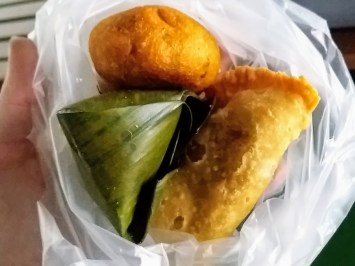 One was a glutinous rice ball wrapped in a leaf and filled with some kind of sweet coconut. The golden brown goodie was the one the husband most highly recommended: a spicy coconut bun in a wheat pastry (as opposed to rice) with a coconut filling similar in texture to the rice bun, but with a spicy kick. The coconut fillings were unique to my palate. It seemed like the coconut had gone through a ricer instead of a shredder. It was similar to vermicelli but also dried enough to be chewy without being crispy. The entire experience was delightful and I wish I’d bought 3 more!
A Scorpion in my Cocoapuffs
I left myself extra time to get to the bus station. Missing the bus would have entirely spoiled my day (although now that just seems ironic). As a consequence, I had nothing to do for about 45 minutes. The bus station in Butterworth seems well organized, but I suspect it’s a cleverly crafted illusion. As the time for my bus drew closer and closer with no sign of the bus anywhere, I began to get worried. When a bus pulled into the gate that I had been told by the ticket counter was my departure point, I got excited until the driver told me it was a bus to Kuala Lumpur. Definitely not where I was trying to go. The departure time on my ticket crept up and then past. I kept trying to get anyone to help me find my bus, but no one seemed fussed and said it should show up eventually. I spotted another traveler (the skin tone and giant backpack were clues) with a ticket that looked like mine. Trying to be friendly, I asked if she was trying to get to Kuala Perlis (my destination) too.
Allow me to do an aside on the expat/backpacker community for those who have not experienced it. It’s a tribe. And like all tribes, when we see each other out in the world there is a feeling of “ah, one of mine”. The extent to which we aid one another or spend time with one another can vary from person to person, but most of the time when I greet another traveler, the response is friendly. Maybe they need help, maybe they can give it, maybe we’re just going to play a game of Uno or chat over a beer. Everywhere I’ve been, I’ve taken great joy in meeting both locals and fellow travelers. I’ve shared meals, cabs, directions, taken and given tips on what to do or how to get places, translated or been translated for, exchanged stories and when one or the other of us is ready to part, there’s no pressure, we just wish each other well because we all know that’s how it goes. So when I met a backpacker who was angry and mean it was like finding a scorpion in my cocoa-puffs. I was expecting something nice and got stung instead.
She looked at me sharply and asked in clipped tones where I was going. I replied that I was headed to Kuala Perlis, but before I could finish my sentence, she pointed back at the building and snapped, “ticket office”. Yes, I said, I already have a ticket, I just — again she cut me off with the single invective, “information” pointing once more at the main building. This was no linguistic barrier, her accent was natural and her tone and body language adequately communicated hostility. I was completely shocked and decided to stop trying and walked as far away from her as I could while still being able to see the bus stops to watch for mine.
I want to believe that something was going on with this woman that made her so grumpy, but the fact is, I approached her to share information (namely that the bus she was standing in front of was not the one listed on her ticket, and that the gate we wanted had changed, but was not announced yet) and she shut me down like…I have trouble even finding a metaphor of when it’s appropriate to treat another person like that. Everything I can think of is some kind of gtfo response to racism or misogyny. Even knowing now what I do about the trials and frustrations involved in traveling SE Asia, and having lived through my own travel induced emotional meltdown, it’s still hard for me to imagine what put her in the mindset that caused her to treat me so. Regardless of whether her mood was justified, it was demeaning and hurtful to be treated like that by another human being. It was made worse by the fact that I had no defenses up at all when it happened. It completely destroyed my emotional well being in that moment and for possibly the rest of the day.
The Transportation Worsens
The bus was nothing like the nice buses I’d taken up to this point. The seats were narrow and much less comfortable. The front of the bus was “normal” two seats on each side of the central aisle, but the back was divided into three single seats with two aisles between them so that passengers travelling alone didn’t have to rub elbows with strangers. I sat in my middle single seat and tried to bring my emotions back to center.
My destination that day was the island of Langkawi. I had decided after much reading on the internet that I was better off taking a bus to Kuala Perlis followed by the shorter (90min) boat ride from there rather than trying to take the 3hr boat from Penang. Initially, the idea of a 3 hr boat ride was appealing to me because I like the ocean and boats. But it turns out that all the boats here are kind of enlarged speed boats where passengers sit in assigned seating rather like an airplane and there is no access to the deck or other outdoor spaces. Since going out on deck is the number one thing to do if you get seasick, that didn’t sound great. Instead I think I just learned that the only comfortable way to travel north of Penang is airplane.
Bad Decision for a Good Reason
Nevertheless, when I got off the bus I met a couple more backpackers who made some headway toward restoring my faith in the tribe. They had opted for the bus/ferry route to save money. They were out for the whole summer taking a break from university and needed to stretch every cent. We got some lunch together and had some nice conversation, shared the ferry ride, and I was enjoying their company so I let them talk me into walking from the ferry port to our respective hotels in Langkawi. I have to say, I admire the packers who can walk themselves around with all the gear especially in that weather. I am not one of you. I should not have tried. It’s not that I can’t walk or carry gear even, but there is something horrible that happens to me in hot/humid weather. One day I will learn my lesson, and surely this experience was some very compelling evidence.
My feet were swelling from the weather, my clothes were drenched in sweat and I simply could not keep up the pace of my lunchtime companions. They never once complained about my slowness, but I still felt guilty. Then it started raining. You would think rain would be a relief in hot weather, but that is a lie. The rain doesn’t cool things down, it only increases the general humidity and makes you damper. Could this whole experience have been better if I had a different attitude? No doubt. It can be hard to maintain positivity in the face of certain obstacles – the angry lady in the morning had set my nerves on edge. The heat, humidity, and pain in my feet was eating away at what goodwill I had left. When the rain began and I realized that the ONLY event in Langkawi that I had planned to do would not be accessible, it pushed me straight over the edge into genuine misery and self-pity.
This Isn’t Fun Anymore
Google lied about the distance to my hotel. When my GPS indicated I had arrived, yet I could not see the hotel, it suddenly reset to a location another 15 minutes away. This was after I’d already been walking for 45, which was longer than the original Google estimate of 30. When I decided to go on foot, I figured I could just about tolerate 30 minutes of walking to the hotel in the heat. What I got was an hour in the heat and rain. When I finally arrived at the hotel, I discovered a man sleeping on the only bench in the tiny lobby, so I couldn’t even sit down while I waited for the clerk to show up and check me in. And he was snoring so loudly! It seemed to take forever to get checked in and get to my room where I promptly rid myself of my soaked clothes and basked in the air conditioning while I had a serious think about my options.
The Langkawi Taxi Lockdown
I do not like giving in to despair. I do not like nurturing negative emotions. I did not want to sit there and feel sorry for myself, damnit. I only planned to spend a half day in Langkawi in any case. The very next morning I was scheduled to take another boat out to the tiny tropical paradise island of Koh Lipe in Thailand. I had looked at how to avoid Langkawi altogether but it seemed like any way to go from Penang or even Ipoh directly to Koh Lipe would have involved a very long overland travel and another land border crossing, I thought at the time that shorter journeys would be better and that every place I was stopping at must have something interesting. However, I failed to take into account that Langkawi has the most bizarre taxi lock out in the world. There is not only no Uber or any other rideshare on the island, the taxis don’t stop on the street, or use meters, or bargain. They all have a set rate chart that tells them the fare from one place to another. And unlike Georgetown with it’s free bus and easily walkable areas of interest, Langkawi seems designed for package tours and resort dwellers. In my first plan I was going to spend 2 days in Langkawi and only overnight in Koh Lipe but research led me to a different notion and I had decided the most interesting thing to me was the cable car and skywalk, which being high in the mountains and made of metal would not be accessible or safe in a thunderstorm.
Give in to Self Care
As I lay in the hotel, resting and cooling off, I looked on the web to see if there was anything near by that seemed interesting, or anything even within a reasonable distance. I had wasted all my energy walking to the hotel when I didn’t need to and could not bring myself to be excited about any of the hiking or cycling options. I had no desire to go shopping since I’d taken care of my needs the day before. I didn’t want to visit a zoo or aquarium. In fact, nothing at all sounded fun, and while I was grumpy about the fact that I’d just “lost” a day of vacation, it struck me that the best thing I could do for myself was nothing at all.
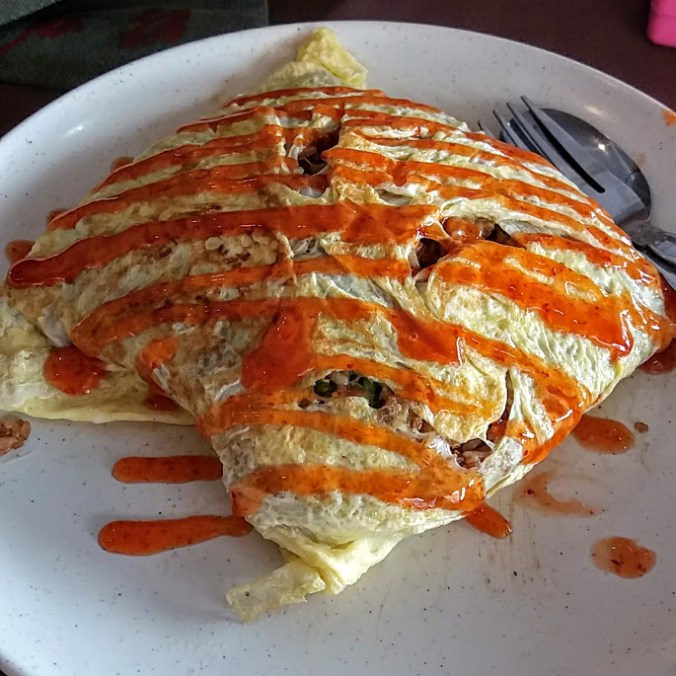
Sometimes stuff happens to us on holiday and we just have to stop. I remember in Egypt I got horrible food poisoning that completely took me out of commission for about a day and half and left me weak for a long while even after I returned home. It’s not fun when you get sick on vacation, but it’s still important to practice self care. Sick doesn’t always look like a cold or an upset stomach, sometimes it can be an overdose of culture shock, heat edema, and physical exhaustion. So I took a shower, put on some clean clothes and walked all the way to next door to have some dinner and then spent the rest of the night reading in bed. I have only one picture from my entire time on Langkawi, and that was a food pic I took of that dinner for Instagram.
Worst Day?
I told myself that every vacation has to have a “worst day” and that I was on my way to a tiny island paradise where I would see coral reefs and swim with glowing plankton and sleep on a hut on the beach and at least two of those things turned out to be true.
When I look back on my time on the Malay Peninsula, this is not one of the stories that stands out to me. At the time, it was horrible, and potentially vacation ruining, but Daniel Khaneman talks about “the remembering self” in his research, and using memory to create happiness. I choose to memorialize this day not to focus on the suffering, but as a way of reminding myself that what seemed so horrible at the time, cannot evoke strong emotion in me even 4 months later when I review and revise the experience, yet my positive experiences still bring a smile to my face. Plus, now I know what not to do the next time I travel to Koh Lipe.
 The train from Ipoh to Butterworth was a delightful piece of transportation, and in retrospect, the last clean and comfortable transit option I would get on this trip. The train was spacious, sparkly clean and climate controlled with a nice view of the Malaysian countryside out the window. The train station in Butterworth is easy walking distance from the ferry terminal and bus station allowing me to take a quick detour and buy my bus ticket to Kuala Perlis. (there were only two running each day so I didn’t want to miss the morning bus!) Then I headed over to the ferry terminal to catch the quick boat over to the island of Penang. The ferry ride was brief yet delightful, with beautiful views of the cities and a cooling breeze.


 Laundry complete, I set off on a walking self-tour of the cheap clothes district. I am not normally a fan of shopping, but I have decided that if I am ever going back there, I need to do it with an extra suitcase. So many beautiful clothes, many inspired by Indian fashions, glorious batik fabrics and wildly reasonable prices compared to what similar fashions cost in the US. Skirts, shirts and dresses abounded, but pants were a little challenging. Free size is really a misnomer because it only applies to a size range from about 6-12 (US). the most popular pants seemed to be the Ali Baba style which are big billowy and flowy, but cinch around the ankle, looking not unlike the pants Aladdin wears.

 Eventually, I found some black pants that were a lightweight material and had a beautiful blue pattern around the cuffs. They were about 7$US, so I wasn’t overly concerned with the durability and I was delighted with the way they fit. Of course they were from India (I’m starting to believe all my favorite clothes are), but unfortunately, they are made of a material called “viscose”. I did not know what this meant at the time. I had never heard the word and I was so desperate for pants at this point, I didn’t really care. But later, while laying in the AC of my hotel room, I looked up the word and discovered the world’s most temperamental fabric.
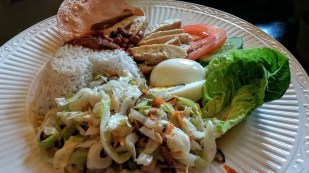 I tried to find some local-ish dinner food, but my travel weariness led me in the end to a little boutique restaurant near my hotel that was more expensive but also vastly more comfortable. Amid the offers of western sandwiches and pasta, I found a lone offering of the national dish: nasi lemak. Omnomnom.
 out for a beer in my new tropical get up. I got the impression that Georgetown is so popular among backpackers and expats for a combination of it’s strong western influence and plethora of cheap bars. (many places have a regular “ladies night” menu which are totally free or insanely cheap) I wasn’t particularly sad to leave it after only a short time, but I can see how it would be a refreshing break if I were on a multi-month trek of SE Asia, and I’d definitely love to go back for more clothes when I’m not backpacking.
 We set off from Busan (blue dot) in the morning to drive all the way across the southern end of the Korean peninsula to Jindo (red dot). Although Korea is small compared to, say, the US, it was still almost 5 hours of driving with the occasional pit stop. (By the way, in case you’re curious, you can see Daegu on this map as well). Fortunately, I went with a tour group (my stand by
  The Jindo festival had at least one feature I’ve never seen before: a traditional Korean wrestling ring. A pile of sand was placed in a large circle where two contestants could wrestle in the traditional style.
  Even more bizarrely, after the color throwing was over, the festival organizers gave each participant a “toga” to wear. The togas were long white robes with red sashes that could have evoked a Roman senate or Jesus. Considering we were about to “part the seas” it was hard not to see it with Judeo-Christian overtones, but the rather drunk person I asked about it just said “toga party!” The entire thing seemed like the festival organizers were trying to find a way to appeal to the expat crowd. I’m glad they had fun, but I would have preferred some more traditional activities, like someone to teach us about collecting clams and seaweed the way the locals were doing as the tide went out. It’s hard to go do local culture festivals when the locals are busy trying to white-wash everything for cash.
 Finally, the real “reason for the season” was upon us and we muddled our way down the road to the rainbow steps beneath the watchful eye of the grandmother and the tiger. We paused at a bench to don our thigh high rubber boots and got some advice from the locals on how to attach the rubber garters through belt loops to hold up the boots, or failing that, to wrap them tight around our thighs and snap them in place. Thus clad in bright orange and yellow wellies, we made our way down the steps and into the shallow tide pools to wait for the tide to recede.
 If you look at the area on Google Maps you will simply see the beach and the islands, but on Korea’s own Naver Maps, there is a thin line connecting the rainbow steps to the island of Modo. Although this path is only usable twice a year (at most), the Korean map makers consider it important enough to draw in.
 The history of tidal prediction starts with Kepler (total nobody) in 1609 to theorize that the moon’s gravity caused the ocean tides. He was followed by other such no-ones as Galileo and Newton. It was in 1776 that the first big complex equations came from a man called Laplace. Harmonic analysis was added in the 1860s and polished off by 1921 in the form that Navies all over the world still use today. Although the math hasn’t changed in almost a hundred years, computers make the math easier and the information more widespread so now instead of just ships in harbor– surfers, beachcombers, and clam hunters can
  On a more mystical note, the local legend of the tigers explains why there’s a statue of a grandmother and a tiger overlooking the sea. Long long ago, the villagers who lived on Jindo were plagued by man-eating tigers. The whole village packed up and sailed over to the neighboring island of Modo to escape the threat, but one woman was left behind. The woman was Grandmother Bbyong, and she prayed to the Dragon King, the god of the sea, to help her. Finally the Dragon King came to her in a dream and told her he would build a rainbow brigde across the sea for her. The next day when Bbyong went down to the sea, the waters parted to let her cross and her family came out from Modo to meet her. This also explains the rainbow stairs that lead down to the landbridge, but not why her family couldn’t have just sailed back for her in the first place.
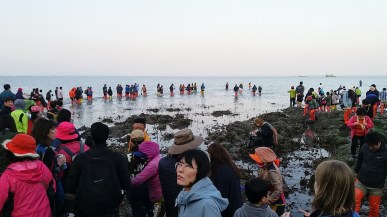 While math can now easily tell us the time of the lowest tides, it does not yet advance to tell us what the actual lowest level of the water will be. Not that it couldn’t, but there are more variables involved, so it’s not a thing now. While we can say with certainty, the lowest tide of the year on this beach will occur at 18:38 on April 29 (or whatever), we can’t say for sure if that will expose the land bridge or simply be lower than every other tide around it.
 We tromped along the path, watching parasailers overhead and rainbow colored lanterns being released in to the air from the beach behind us. It was clear the path was quite narrow because going too far from the group to one side or the other to get a picture resulted in a severe deepening of water level. At the time, my friends and I theorized it might be man-made, or at least man-maintained, however, I have since then found that the build up of rock and sand in this twisty line is a natural result of the currents around the islands.
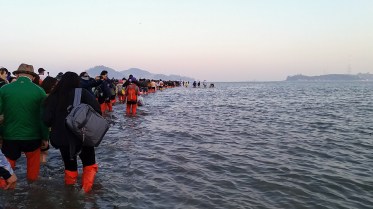 Before long the golden light of the sunset combined with the swish-swishing of hundreds of feet through water to create a trance-like state. I could not judge how far the island was, nor tell which way the path twisted. The rocks below us rose and fell, bringing the waves treacherously close to the top of my boots and then back down to barely splash over my toes. The whole path is nearly 3km long. I suspect a determined person could make it out to the island and back in the hour or so the path is clear to walk, but I wasn’t racing, and soon we were greeted by the sounds of Korean drums and the distant flags waving as the procession from Modo came out to greet us.
 The walk outward had been slow, trepedatious, as though we were nervous the land could drop away at any moment, but the trip back was much more celebratory as well as much more damp. The parade of drum bangers, cymbal crashers, gong ringers and flag bearers danced merrily in their traditional garb, urging us all back to the larger island of Jindo. Our pace quickened and our legs swung to the rhythm causing much larger splashes. Waves came in from both sides of the path making us nervous, but excited. The water finally breached the top of my boots and sent an icy chill down my shins, but I found I did not mind.
 Before heading to the fields, we walked up a long road past the area of the light festival where a few wire frames from reindeer and dragons could still be seen. The road up the hill was painted with fun perspective illustrations of a stream, complete with little camera icons to show the best places to stand to see the visual effect. Optical illusions are fun.
 At the top of the hill, far beyond the little pagoda that had marked the highest point of the lights, we finally came upon the green tea museum where we were treated to a special showing of the Korean green tea ceremony (complete with English translation by our awesome guide). The ceremony involves a process of several containers: a water pot, a cooling bowl, a tea pot, and the drinking cup. The hot water pot is filled with boiling water, which is then poured into the bowl, and from the bowl into the tea pot and finally into the cups. The instruments are warmed up in this way. Then more boiling water is poured into the cooling bowl. Tea leaves are scooped into the warm but empty tea pot and the ideal temperature water is poured from the bowl over the leaves. While the tea steeps, each cup is emptied of it’s hot water into another bowl on the floor and wiped dry on the outside. The tea is then poured into the pre-warmed cups by pouring only a half a portion into each and the other half in reverse order on the way back. The tea is then served, 4 cups to the guest and one to the host.
 The hostess tried to tell us a bit about green tea, red tea and black tea but her translated explainations seemed off to me, since she said it had to do with the age of the leaf when it was picked from the plant. I don’t know if this was her or the translation, but the real story follows: In any country with Chinese roots in it’s culture and language, the three colors of tea are a bit different in meaning that in the West. Red tea is not Rooibos, in fact all three come from the same plant. And it’s not the age of the leaf at picking that determines the difference, but rather the post picking, pre-drying process. (although especially young and tender tea leaves are sometimes referred to as “monkey picked” and do make a delightful tea).
 After we conducted our own tea ceremonies, I drifted lazily back down the hill, examining the spring flowers and the grounds that had been lit up beautifully last December. When I finally got back to the tea fields, I took off on the same route I’d walked before and was happily greeted by many blooming apple trees and a small army of busy bees who were so focused on the brief blossoms that they paid no mind to all the humans fussing around. In fact, I think it was the only time I’ve seen Koreans in the presence of a bee not totally freaking out. I guess the selfie with the tree is worth it.
 In addition to the blooming fruit trees, there were cascades of purple flowers covering the rocks wherever tea was not growing. It made the whole place feel like a still frame of a rushing river in shades of pink, purple and green. Besides the tourists, there were also tea pickers at work. Each ajuma looking lady had her sun guards on, gloves and a mesh basket to place the leaves. They were not picking the bushes bare, but selecting only some growth. It seemed to me to be the newer, brighter green leaves that they were after, but I couldn’t tell for sure. In the age of automation it was strange to see people picking by hand. I know that it’s still the way for many crops in the world, but sometimes it gets driven home that there’s a human on the other end of my tea or strawberries or carrots, and then I’m carried off by sociological musings on how we came to value people who sit at desks manipulating imaginary money so much more than people who make our food.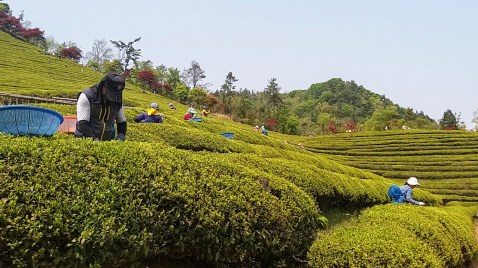


 When I wanted art for my calling cards (left), I paid the asking price to Seth of
  Gallivantrix