This beautiful, glorious day was all I could have asked for in a tropical island vacation. After several days of mediocre or downright unpleasant experiences, the holiday gods smiled upon me once more. This day is the reason why Koh Lipe has made it to the top of the return destinations list. I’d be worried about singing it’s praises, but since this post isn’t going to be seen by more than 200 people, I don’t expect that I’ll spur a tourist revolution.
What I’ve read about Thailand seems to indicate that it was full of island paradises 30 years ago, but the tourism industry has turned nearly everything into a marketing scheme and the trash tourists bring with them has destroyed once pristine beaches and coral reefs. Koh Lipe is the only island in a national park where permanent (non-government) structures are allowed. It has no big roads and limited access to any transportation other than the small longtail boats and scooters. Boat access to the other islands in the park is relatively easy from Koh Lipe and it makes for a cleaner and less crowded experience than other Thai island destinations.
Good Morning Koh Lipe

I booked a snorkeling tour package ahead of time. I needn’t have bothered, however, since a stroll down walking street showed dozens of companies doing boat tours, snorkeling tours, and scuba instruction. Plus, most hotels and hostels rent out basic snorkel equipment, and one can simply walk out into the water from any beach and see cool stuff. I booked with a company called Paradise Tours. The tour I chose had access to multiple reefs across several islands and the absolute coup de grâce, glowing plankton!

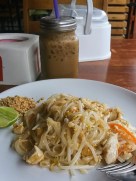
The boat wasn’t set to leave until 1pm , so I took myself down to Pataya for breakfast. I found a little shaded cafe overlooking the beach which was dazzling in the early morning sunshine. I was relieved to see that the storm clouds had passed since rain can cloud up the water and make snorkeling less fun. I ordered scrambled eggs and got served a massive portion and a complimentary slice of sweet fruity bread that they made on site. My Thai iced coffee came in a tall thin glass that made me feel posh and decadent. I took a food pic but only later realized that the plate and glass were both large enough that it’s impossible to tell the scale, but trust me it was generous.

After breakfast I headed out to find a beach bag. Well, a waterproof bag anyway. These are sold in abundance on walking street in many sizes. The idea is that it’s a bag you can put your phone and wallet in (or even towel and change of clothes) then take it in the water (no diving, but surface swimming is ok) and your stuff will still be dry. This was great for me since I had no one to watch my things on the beach if I went swimming (one more reason for beachfront accommodation next time), and I definitely wanted to make sure that my phone stayed dry on the afternoon’s snorkel excursion. I’d already had to replace my Korean sandals that came apart in the rain, I wasn’t risking anything else. The shops on walking street have everything you could need on the island. Swimsuits, sandals, diving gear, beach wear, even pharmacies and a hospital are all available. It was easy as pie to pick out my water bag and head back into the jungle once more to fill it up and leave the non-essentials behind.
I went through more sunscreen on the island of Koh Lipe than anywhere else, but when you are a pasty, porcelain skinned, melanin deficient, sun wimp, the main line of defense tends to be clothes, hats and sunbrellas, none of which work well when swimming. Ergo, beaches mean the all over application of sunscreen. Follow that up with a liberal dose of mosquito repellent and while you may smell a little odd, you’ll be more comfortable in the long run. I managed not to burn at all and only sustained one mosquito bite that left any lasting impact. Better living through chemistry!
Snorkeling Adventure
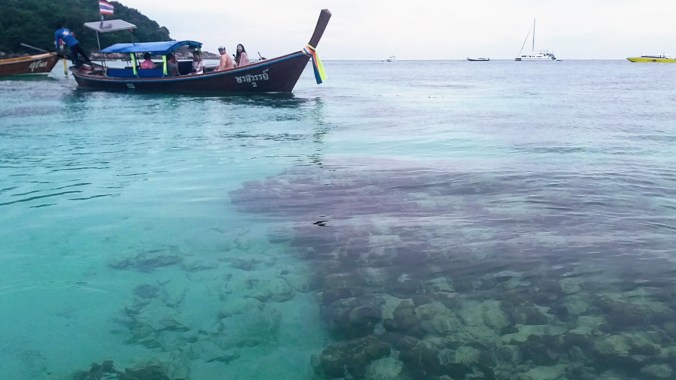
Wearing my swimsuit and new sarong, armed with my waterproof bag, I joined the expedition at the headquarters on walking street. Once our party was assembled, we headed down to the beach to board our boats. They split us up, and I ended up with a group of 4 young westerners who were quite happy to include me in their day. It was a pleasant surprise because they clearly had a group vibe, but still worked hard to make sure I felt included in the activities when we were above water. The early morning insanely bright sun had gone behind a light gray cloud cover for which I was relieved. I know that UV can still be dangerous on a cloudy day, but it’s easier on the eyes and it’s less hot. The downside is that all those photos you see online of the crystal turquoise water are a result of the intense direct sunlight and my photos are a little less stunning. But I’ll take a comfortable experience over a stunning photo, since my adventures are about memory and I am not a paid photographer.
I don’t have a large number of photos of that day anyway, since I still haven’t managed to do a fundraiser to get a go-pro or other underwater camera in my life, the underwater pictures here are all from the Paradise Tours page to give you an idea of what I experienced. For whatever reason, they didn’t take any photos the day I went, even though it’s supposed to be part of the package. All the other photos are, as usual, mine unless otherwise noted.
Tarutao National Park
 We went to three different snorkeling spots around Koh Lipe, all of them a part of the Tarutao National Park chain of islands and each one even tinier than Lipe: Jabang, Hin Ngam, and Koh Yang. It may have struck you by now how many places start with Koh, which is because เกาะ (koh) means “island”, so saying “Koh Lipe” is the same as saying “Lipe Island”. You can see from the map that there are two larger islands, which I gather are the main part of the national park and are nature preserves where the only accommodation is camping by government approval. Thus even though it is much smaller, Lipe is the place people stay when they want to explore the islands.
Underwater Life

I guess that people who dive all the time get disappointed on dives when only the plain fish come out. I didn’t see any giant sea turtles or whale sharks or anything rare, but that didn’t make the experience less stunning to me. Coral reefs are like giant underwater gardens filled with multicolored life at all levels. Just enjoying the rock and coral formations is a treat as you feel like you’re flying above the ocean floor. The sea is teeming with tropical fish that most of us only ever see in an aquarium or “Finding Nemo”.

Not counting the myriad of fish I could not hope to identify, I know for certain that I saw clown fish, angel fish, parrot fish, trigger fish, fusilier fish, sea cucumbers, anemone, starfish, giant clams, sea urchins, bright blue christmas tree worms, stunningly enormous moorish idols everywhere (that’s Gill from Finding Nemo, btw), a wide variety of rainbow hued wrasse, balloon and box fish, and a thing called a cornet fish. The coronet fish totally weirded me out. At the third reef of the day I encountered this odd looking fish, but unlike the other fish that day, the coronet froze and stared at me. I froze and stared back as we both tried to decide if the other was dangerous. At the time, I only knew the names of maybe half a dozen of these, but i was able to identify the rest using my trusty friend “Google”. All these links lead to pictures of the creatures on Florent’s Guide.
Three Reefs and a Rock Island

Jabang is famous for it’s red coral. It was our first stop and we arrived about the same time as another tour group. It was amazing to me how many people on the tours didn’t know how to swim. Everyone in my boat was a strong swimmer, but I observed a large number of people from other boats in life vests and clinging to the buoy lines that had been put up to mark the reef’s location. I didn’t realize that the snorkeling equipment listed didn’t include fins, and I didn’t do much downward exploration because I am a natural flotation device. People in Asia seem to use life vests for everything, even shallow water or narrow, slow running rivers. Of course I wear them if I’m going too far from shore to swim, icy water, or otherwise dangerous situations, but it’s still a bit of a shock to see them while snorkeling!
The current was strong and I found that I had to work hard just to stay in one place. But we were surrounded by boats, each one with a dive captain assigned to it, so I wasn’t worried about getting lost. It had been almost two years since my last coral reef swim in Aqaba. I was excited just to be there. The reefs are huge and filled with fish at all levels, including some that will come right up to you to see if you have anything interesting. Toward the end of our time there, it got a little crowded, but since more than half the people were glued to the buoy lines, it didn’t take much effort to swim a short distance and get space to myself.

The swimming site on the south side of Hin Ngam was less crowded, had much less of a current, and I felt more comfortable exploring. I drifted around and finally started to get used to swimming without fins. Normally when snorkeling, you keep your arms to your side and use gentle foot motions to glide forward. Without fins, I started out splashing way to much while kicking my feet, but I eventually settled into a reverse style where I left my feet still and used a variant on breast stroke to pull myself forward through the water. With less of a crowd and feeling more at home in the water, I soon found myself immersed in the rhythmic breathing of the snorkel and the entrancing experience that is a coral reef. Before I knew it, the guide was waving me back to the boat and it was time to move on to the next spot.
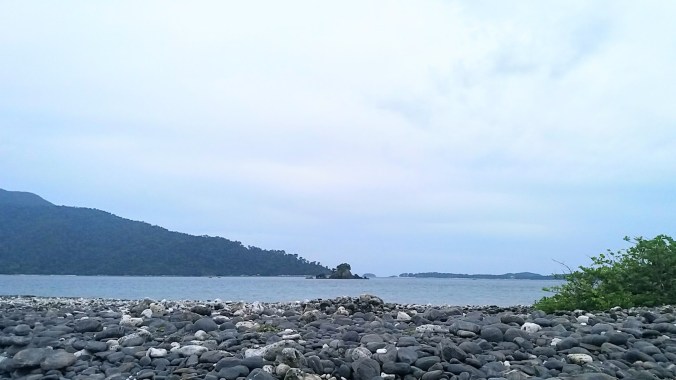
We took a break from swimming to go check out the north side Hin Ngam itself. The island is not accessible all year, but is a unique attraction because its north beach is made entirely of smooth rounded rocks. Every other beach is smooth white or pale sand, but here the shore is mounds of round rocks of all sizes. There is a myth that whoever removes a rock from the island will be cursed, and another that says whoever can make a stack of 12 rocks will have their wish come true. The Thai government is all for supporting the first myth as the island would soon vanish if tourists removed rocks; however, the tradition of stone stacking is also frowned upon. There were more signs warning us not to stack stones than there were warning us not to steal them. I could not figure out the logic behind this at the time and have since been entirely unable to find any other reference to the stone stacking ban online. There is only blog after blog inviting visitors to stack their own. I am trying to imagine what damage could be done to the park. Could the stones be breaking when they fall over? Could the human rearranging of small and large stones be interfering with the structural integrity of the island? Why does the Thai government object?

Who knows. But I’m sure you can predict that our group did not honor the signs, and at least two of them set about constructing a lucky tower. It’s harder than it sounds. Because the stones are round and smooth, there is no way to efficiently stack them. The trick is to start with the largest stone and get progressively smaller, and to find stones that are more elliptical than round. While my boat-mates were constructing, I wandered a little further inland to see a small display that showed the curse for removing stones in several languages and a small shrine that I didn’t quite recognize. (I would see several dozen more like it while in Thailand, but more on that in a later post). The stones were beautiful, a muted gray color and banded with stripes of yellow, white, blue and green. Their soft shape is caused by the unique way the water has pounded them over the millennia.


Our next stop, and our final coral reef, was at Koh Yang. This was the shallowest of the reefs we visited, which was a mixed blessing. Although in shallower water, it is easier to see the bottom dwelling fish without free-diving, it also means the coral are much closer. Much much closer. It was not as shallow as the reef I went to in Jeddah which had barely enough water to swim in without touching the corals below; however, while I was treading water and talking to people still on the boat, I managed to whack my foot into a boulder sized coral growth resulting in one of the worst types of injuries you can get for its size. At the time, I was in the water, and full of adrenaline and endorphins, so I glanced quickly at it to make sure I wasn’t gushing blood and then promptly got distracted by the coral reef. This place was much emptier than the other spots we’d visited as far as people, and the crystal clear water gave me plenty to look at. Of course it’s fun to see the stars of the ocean, but even an ordinary neighborhood coral reef is a feast for the eyes filled with tiny, intricate creatures and the wonderful illusion of flight as you soar over them.
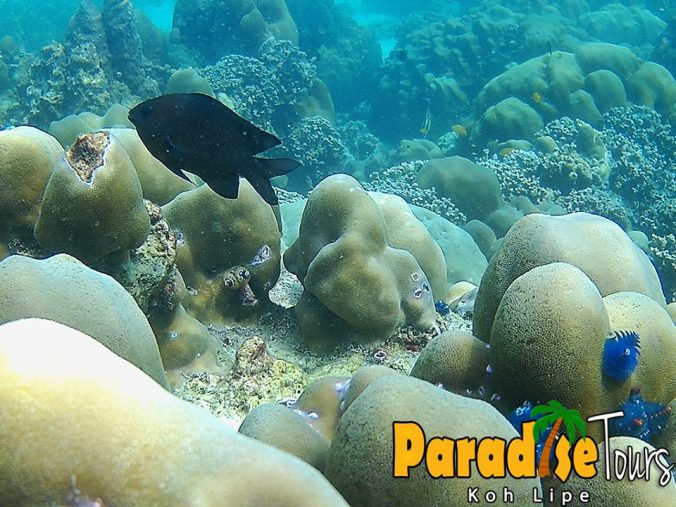
Counting my coral injury, 3 of the most interesting things happened at this reef. The other two were 1) my encounter with the coronet fish, which was odd both because I had no idea what he was and because he spent a good long while watching me, when other fish simply ignored me or glanced in my direction momentarily. When all ocean life is just going about it’s business and one fish pauses to watch you, it’s memorable. And 2) the parrot fish feeding. I had seen the odd parrot fish at the other two reefs, but they were everywhere here and multiple sub-species/color patterns.
Parrot fish are named for their “beaks” because they eat coral. Some reserves even worry that they may be endangering what’s left of the reefs and work to limit the population. Thailand doesn’t seem to be on that list because “don’t eat the parrot fish” signs dotted the beaches. Nonetheless, the fish eat coral, crunching it with strong beak-like mouths and digesting out all the nutritious bits before excreting the remainder as sand (sorry if I just ruined your barefoot beach walk). At first I was confused by the sound i heard underwater, but soon realized that it correlated to each mouthful the fish took from the reef and I remembered that documentary (because I adore ocean documentaries) and realized I must be hearing the chomp chomp of parrot fish jaws. The reef here was shallow enough and the parrot fish plentiful enough that I could hear them crunching away on their dinner.
 When it was time to get back in the boat, I got a better look at my foot, which bled for about a minute, then stopped. I rinsed it out with fresh water and the scrapes seemed shallow and sparse. I think I’ve had worse carpet burns. I knew the complications that are possible with coral scrapes from my last run in with the sharp sharp critters, but at the time, I thought it looked ok and had been rinsed sufficiently. (this is what we call “foreshadowing”)
Sunset BBQ on the Beach

We boated over to an isolated beach on Adang for dinner and sunset. The beach looked like the set of Lost and we joked that the black smoke monster or possibly a maniac wearing a Dharma Initiative jumpsuit would burst from the jungle behind us at any minute. While the guides were cooking our barbecue, we wandered up and down the beach, found a little freshwater stream that was ice cold in comparison with the warm sea water, took an endless number of photos of and for each other (including a little Dirty Dancing reenactment), and generally splashed around on the amazing paradisaical beach.


Dinner was simple grilled chicken and salad, but it was plentiful and we were hungry after all that swimming. Afterward we were treated to an amazing sunset. The cloud cover from the day provided a dramatic outline for beams of sun to play hide and seek and for the dying day to cast a golden crown along the edge of the sky. We watched until the last glimmer of glow had sunk and in the purple twilight, we re-boarded the boats for our final stop of the tour.

To Neverland
I have an addiction to bio-luminescence, maybe to pretty lights in general because I find myself drawn to every lantern festival and fireworks display I can find, but there’s something magical about living things that glow. I was lucky enough to live in a part of the country with fireflies as a child, but I haven’t in years. The glowworms of NZ were one of the highlights of my trip there. Glowing living things are awesome.
You know those lists on Facebook that say, “50 amazing things to see before you die” or “20 beautiful places you didn’t know existed”? Most people look at them and go, “ooooh aaaah”, and then forget about it because we’re never going to get there. One such list I looked at years ago included the bio-luminescent plankton in the Maldives. I made grabby hands motions at my computer before realizing at that time in my life, there was just no way to make it happen. Years later, when I was researching Thailand and what to do in the tiny slice of it that shares the Malay peninsula, I ran across repeated mentions of glowing plankton. My dreams rekindled. I had to put that on the itinerary, no excuses.
I had no idea what to expect. The photos of the glowworms had been dramatically different from the reality (not at all a let down, but not accurate either), and I knew that most of the pictures and video of the plankton was from the famous beach in the Maldives where the glow is especially strong or simply time lapsed or otherwise enhanced. Understandably, looking at tiny specks of light on a black background is not a great photo. Pictures show a beach at night where the normally white foam glows blue, or people wading/floating in water that seems to have a diffuse blue LED glow. Maybe those things exist somewhere I haven’t been yet, but they weren’t here.

Our glowing spot was just off a boat access only beach back on Lipe. As we sped across the water, the sunset diminished and the stars began to come out. We pulled up to our beach a little early, and the guides said we had to wait for full dark. One of the girls on our boat had done a tour in Australia with glowing plankton, but she said they only put their feet over the side of the boat and kicked at the water, creating a soft blue glow. I looked at the water and at the surf on the beach for any sign of light, but could only detect reflections. Finally, they told us that the plankton were present and it was time to get in. We still couldn’t see anything and our guide swished his hand around in the black water, trying to show us. I thought I saw a tiny sparkle, but couldn’t be sure. You have to look under the water, he said.
I fixed my mask in place and descended into the ocean carefully because it was now too dark to see the bottom and I didn’t want another collision with rock or coral. Knowing that the plankton’s glow was activated by motion, I put my face down and waved a hand tentatively in front of my eyes. I nearly swallowed seawater in my utter shock at the response I received. As I drew my hand through the clear water, tiny sparkles emerged and trailed behind my fingertips. I was the first in the water. Everyone else was still on the boat, nervous because they couldn’t see anything. To catch my breath and get my bearings, I popped my head up long enough to exclaim my delight and wonderment to the other passengers before returning to the underwater marvel.

I wasn’t angry Tinkerbell, but this gif shows via fairy cartoon the way the sparkles trailed from my hands and feet when I moved.
Despite not being able to see anything from the surface, once looking underwater, there was enough light to make out the large rocks and corals on the bottom. Similar in many ways to a meadow by moonlight, the detail was vague and the shadows intense, but it was far from a black abyss. While observing the reefs, the strategy was to move as little as possible, here we thrashed, flailed and spun with vigor. At one point, without any communication, we formed a ring and kicked our feet in the middle to summon the largest glow we could manage and then broke apart to revel in our private magical flights. Each movement of hand or foot brought a new ribbon of sparkles, exactly like CGI magic effects, but made of living light. As I looked down at the nightscape beneath me, fairy lights trailing from my toes, I felt an overwhelming sensation of being in Neverland, dusted by Tinkerbell and flying with my happiest thoughts.
This tour – boat, equipment, guide, snacks, dinner all included came to about 25$ US and there are way more than 3 places in the National Park to find good coral reefs. I long to go back and spend a week or more alternating between lazy beach days, snorkeling, night diving, and maybe a night of camping on one of the uninhabited islands. I hope you’ll check out the rest of my photos of Koh Lipe on Facebook and stay tuned for further adventures in Thailand. Thanks for reading!

 Skipping ahead to the first century CE, we get what is known as the Three Kingdoms Period. The three kingdoms were Goguryeo (purple) controlled huge swaths of the north including what is now North Korea and parts of China (it is also where we get the English word “Korea” from, since their word for their own country is hanguk) The south was divided between Baekje (yellow) on the west, and Silla (blue) on the east. Except, there were more than three. The Gaya confederacy wedged it’s way between Baekje and Silla for almost 500 years. And let’s not forget
  Between it’s mythic founding 42 CE and it’s surrender to Silla in 562 CE, the Gaya confederate existed in the south central area of the Korean peninsula, just barely missing Busan (where I live) but keeping it’s capital in the nearby Gimhae (where our airport lives). They did some fishing and agriculture, but were most famous for their ironwork. It was a rough confederation of 6-12 different Gayas. When they Japanese invaded Korea in 1910, they claimed that Gaya had been a Japanese military outpost from 300-710 to justify their “return”, but no scholars take this claim seriously today.
 As we entered the park, the first statue was of a giant golden egg with 5 smaller eggs around it’s base. I was taking pictures of absolutely everything, hoping to figure it out later, so I snapped a shot and kept walking with the group. My co-teacher saw me take the picture and told me that the egg was there because the founding king of Gaya was hatched from an egg that fell from the sky. She also referred to this as “history” although I’m hopeful the last part was just a linguistics flub and that no one here seriously thinks that kings really hatched from sky eggs in the good old days. I could not figure out how to ask this without sounding rude, tho, so I let it go.
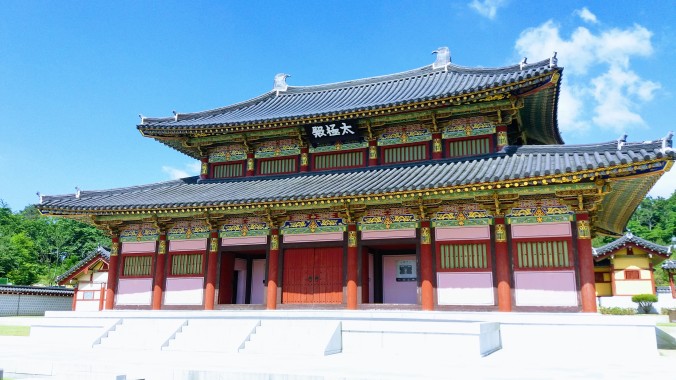 We made our way deeper into the park heading directly for the palace. It’s a replica palace. Very little archaeological evidence of Gaya has been found, although the tomb of Suro (first king of Gaya) is maintained in Gimhae as well. The palace grounds are reminiscent of Chinese palace architecture with familiar canted roofs and wide open courtyards between buildings. The colors and designs are quite unique to Korea, being less the scarlet and gold of China and more earth toned versions of dusty rose, pink, taupe yellow and pea green.


 One room had a huge map along a wall showing the queen’s “romance road of Asia”, paths from India to Korea picked out in red and blue. Another sign seemed to imply that the queen had brought Buddhism into Korea, however that is highly unlikely. I suppose she may have brought hers to Gaya (assuming that she was actually Indian) but the northern Kingdom of Goguryeo got it from their Chinese neighbors. I question her Indian origin story because the myth (written originally in the Samguk Yusa in the 13th century, it’s a kind of history/mythology mashup of the Three Kingdoms period) refers to her as being from Ayuta, a “distant kingdom across the sea”, but the name doesn’t correspond to the name of any country or city from that time period in India or any other country.
 We took our time around the palace complex, letting the kids run off some of their excitement after the long bus ride. There were plenty of historical things of interest, but no teachers tried to make the kids focus on learning, nor was there a guided tour where kids were shuffled from one room to another while someone explained things. They did separate out the grades so that no one building became too full, but on the whole, the kids were on their own to enjoy the space.
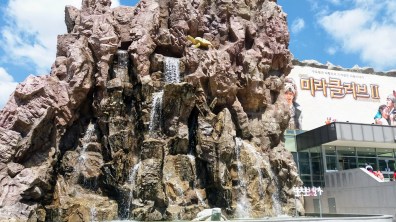 After a while, we headed out of the palace complex and back toward the main entrance to the theater. Turtle imagery was everywhere. A large mountain with an artificial waterfall towered over the theater building. A gray stone turtle lurked in the pond below and another golden one perched precariously on an outcropping halfway up the mountain! I asked about the turtles, but my co-teacher didn’t know (don’t worry, there’s an answer later).
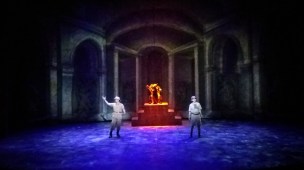 The story began with two archaeologists stumbling onto a large cache of relics from the Gaya period. Their song explained with some lament how little was known of Gaya before this discovery. Then a cave in knocked our archaeologists unconscious and a hazy dream fantasy of the mythstory of King Suro began in earnest. Dancers dressed as the zodiac animals performed intricate dances on stage as some kind of high priest or shaman character sang of the strife, war and drought in the land, praying to the heavens for deliverance which arrived in the form of 6 eggs. (although all 6 eggs hatched out kings, 5 of them were elsewhere being kings of other parts of Gaya, so aren’t in this story)
 The glowing egg hatched to reveal the full grown form of Suro who is proclaimed king on the spot and is expected to wield the power to heal the land. Yay! But it’s not easy being king. The drought continues and his people begin to resent him for not living up to the promise of his celestial birth.
 Meanwhile in Ayuta (India?), the princess Heo has a dream that her destined love is in a land far away, and that she must set sail to reach him and fulfill her destiny (lots of destiny). The dancers costumes were reminiscent of saris and there were certainly hints of Indian Bollywood style music and dance moves that were obviously meant to place the princess and her handmaidens in India.
 But OH! The villain! Satal, a god of war and a gleefully over the top villain dressed in a skull mask and rough furs and accompanied by evil temptresses dressed in black and red gauzy costumes came on to sing his number about how he would defeat Suro and become the king of Gaya, keeping the kingdom forever in a state of greed, hate, and famine. His musical style was that of classic hard rock and the stage was lit by enormous flames as he and his minions sang and danced.
 The princess’s ship is caught in a deadly storm and she is washed ashore in the wreck. It seems the moon itself has saved her just in time to be found by king Suro and they sing a touching love duet in the style of popular Korean ballads. But their happiness cannot last. Satal and his minions kidnap the princess and beat Suro nearly to death in battle. He wants to give up. He didn’t expect this to be so difficult. Where are the heavenly powers he’s supposed to have, after all? But his loyal servant reminds him of the plight of his people and the love of his princess and his resolve is bolstered.
 During a rallying all cast dance number, new armor is forged for the king, turning him from a dandy to a warrior. He is told he can receive the remainder of his heavenly powers upon the mountaintop and so newly armored he ascends to greet the powers of heaven, represented on stage as a white dragon flying around Suro to strengthen him. However Suro fights, Satal holds his own and the soaring duet of hero and villain waxes lyrical about the evils of greed, selfishness and divisiveness being defeated by the power of love. In the end, it is not the armor or the power of heaven that gives Suro the strength to defeat Satal, it is the love of Heo, her voice joining the song to call back to their duet and the fact that their love was made in heaven.
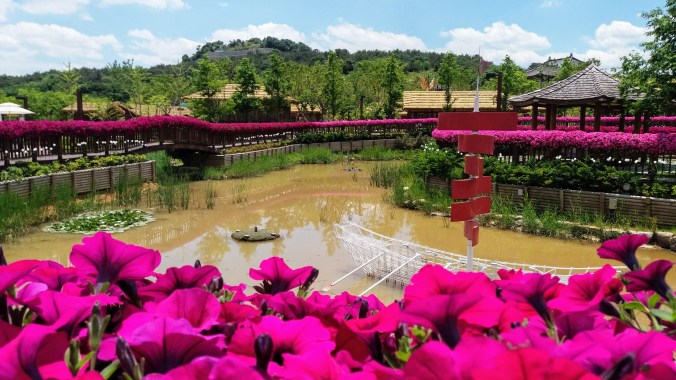 After the musical, we escorted the kids back over to the palace where they unpacked tiny picnic blankets and box lunches under the watchful eye of the staff while we enjoyed the cool, fresh mountain air. When the kids were all done eating, they were turned loose in the playground section of the park while the grownups had a lazy lunch of fried chicken next to the lake surrounded by heaps of purple pansies.
 On our way out of the park, I spotted a turtle garden with empty shells that kids could climb in and around, as well as a happy, smiling gray stone turtle overlooking the scene. The sign near the stone turtle informed us that the mountain where King Suro’s egg landed and hatched looked so much like a laying turtle that it was named Gujibong (gu meaning “turtle” in Korean). Which explained the mystery of why there were so many turtles around the park.

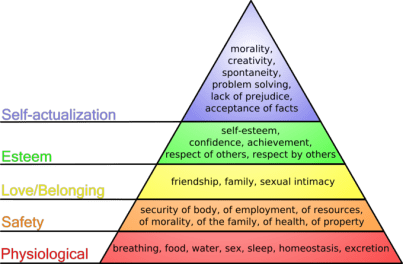 Love and belonging are the third tier of Maslow’s hierarchy, only overshadowed by the need for food and safety and integral to achieving esteem and self-actualization. They are NOT OPTIONAL for humans.
 America is fascinated, hypnotized, enslaved to the idea that every issue has two and only two sides which are so opposed to one another that any form of compromise or middle ground is simply unthinkable. I don’t mean uncomfortable to think about, I mean, people’s brains are actually incapable of thinking the thought. Thought rejected. This is known as the “
 Even in this way, Americans are dichotomous. You love it
  And while we’re at it, a side note on false equivalencies. , such as this lovely comparison of Obama to Hitler. Both were in favor of a policy, therefore they are the same? No. Obama =/= Hitler.
  We need to stop buying into A or B. We need to ask “why” about everything over
 In America, when someone says something insulting (about your faith, your lifestyle, your weight, appearance, gender, orientation, skin color, etc) the result is all too often “You’re an adult, suck it up”. The expectation is that adults should just be able to deal with being insulted or having their feelings hurt (even though arguably many of these insults are signs of bigotry and oppression and not just about hurt feelings).


 America is overly negative. I definitely feel like America is turning (has turned?) into one big crab bucket. People tell me all the time “every place has problems” as a way of minimizing the problems in America or somehow trying to equate them with problems in other places. People tell me all the time, “not everyone can just leave” as a way of reasoning out why they can’t.
 The only way to get to the small island of Koh Lipe is by boat. I booked online in advance because I didn’t want to worry about tickets selling out. The only reason I was in Langkawi in the first place was to catch this boat to Koh Lipe. After the walking fiasco of the day before, I opted to get one of the islands fixed rate taxis back to the port and arrived 2 hours before the ferry’s departure time, as I was advised to do.
 There are no piers on the island. Instead, the ferries anchor a ways out either at floating piers or just in open water. The one I arrived on docked with a patch of floating platform where we could transfer ourselves and our luggage from the speedboat to the smaller longtail boats that would take us to the island. I was amazed to see people arriving with massive piles of baggage considering the situation and was once more grateful for my decision to keep my luggage under 7kg.
 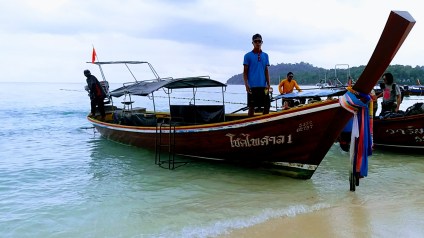 The longtails are small boats, named for the motor at the end of a long pole that juts from the stern and into the water. No more than a dozen people can board a longtail together, so the ferry passengers broke up into smaller clusters. Once the longtail arrived at on land, the local operators would hop out and drag the bow a little way up the beach and tie it to a mooring anchor there. The only way for us to get out was to take a splash in the sea. I quickly shed my socks and shoes and tied the laces to my bag, then rolled up my pants and took my first steps into Thailand through the sparkling turquoise water.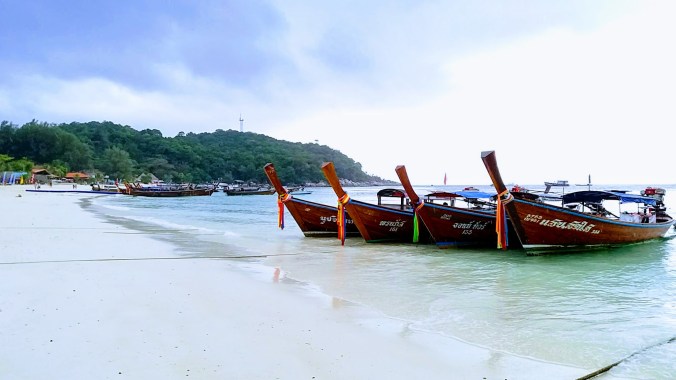


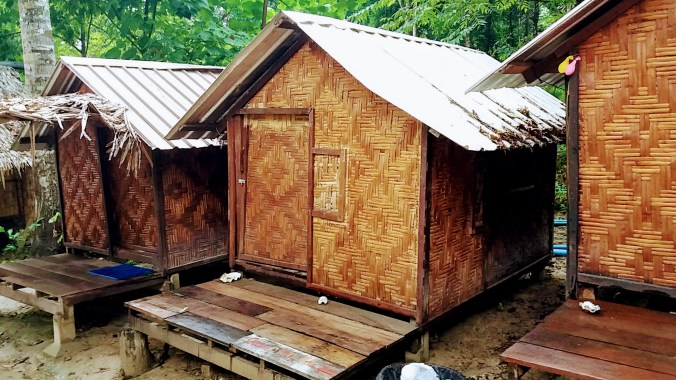
 The hostess was wonderful and kind. She brought out some repellent for me even before we finished checking in and got me settled into my cabin. Walking past the tents on the ground, I was extra glad I hadn’t made that choice given the rain. There were no real walkways in the campsite, so I was picking my way carefully down steep slopes and muddy banks. The cabin was equipped with a sort of futon on the floor, a mosquito net, and a fan. While I settled down to check the dryness of my bag and sort out my belongings, the rain began again in earnest. The path in front of my cabin turned into a river. Knowing that tropical rains are often breif, I decided to wait it out. My main activity for the day was written on my itinerary as “beach bum”, so I wasn’t in a particular rush.

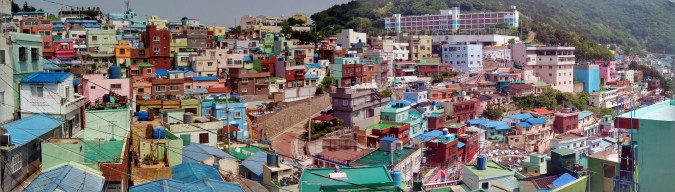
 During the war, Busan was the only city in Korea that was not taken over at some point by the invading northern army. While elsewhere all over the peninsula, whole towns were being leveled to the ground, Busan was becoming a haven for refugees as well as US and other foreign aid troops. The population crisis caused the unique housing style of Busan, which involves building houses and apartments right up the side of the mountains that weave in and out of the city.
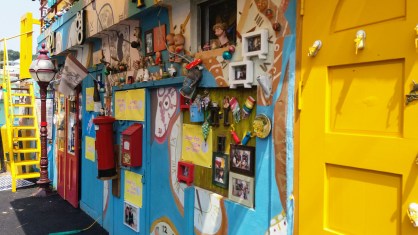 The houses are painted a cheerful array of bright colors that make for a stunning view from the ridge above. However, once you descend into the neighborhood, there is no end of quaint surprises in the form of beautiful murals, surprising statues, and wandering flower planters. The neighborhood is not only adorable, it’s become a hot spot for bohemian culture, local artists, musicians and other experimental creations.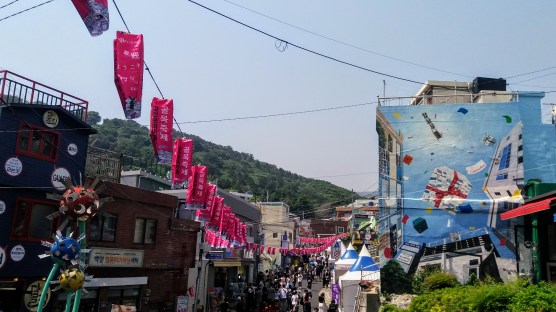


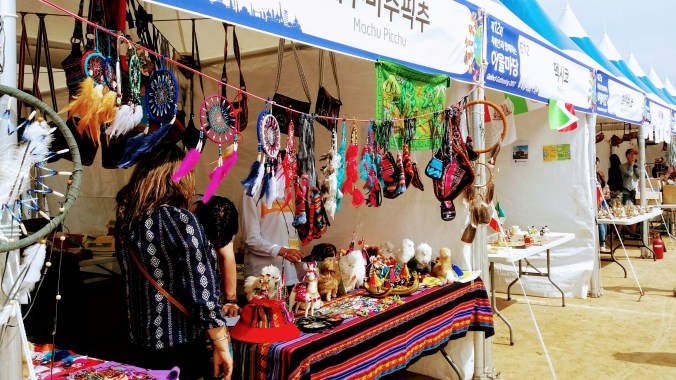
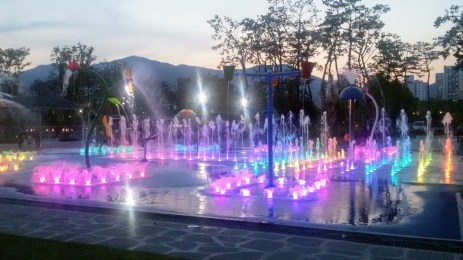 I went to this festival last year when it was held at the citizen’s park, which a beautiful grassy park with trees, a beach, and a big fountain. I had a great time visiting all the booths from other countries and sampling goodies they brought. There was a large space in the middle of all the tents where we could flop down in the grass when we needed a rest and I ran into lots of fun people (most of whom have since returned to their own countries) and sat on the lawn drinking the German beer and Spanish sangria until the sun went down.


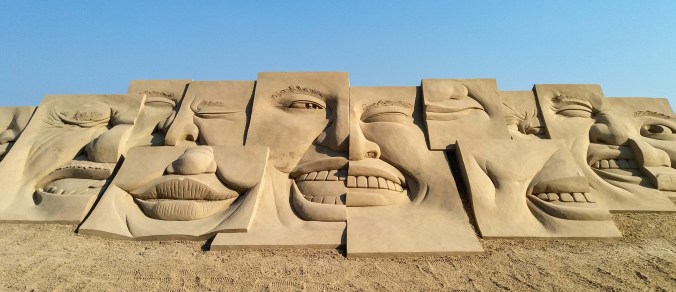

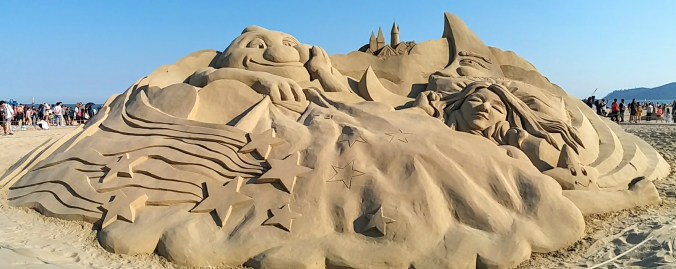
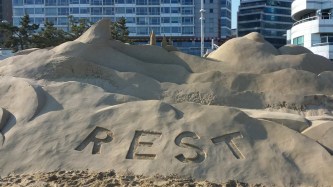 This year… I’m not really sure what the theme was. Each mound only had art on one side, yet despite the fact that there was a temporary walkway between the two rows of mounds (because walking in sand is hard), the art all faced the shorefront buildings, leaving only half facing the walkway and the other half showing their backs. The backs of the mounds remained smooth but for a single word that was presumably the inspiration for the art on the front.



 of the festivals I go to are Korean, I’m still in the minority almost wherever I go. Almost. I don’t know what Haeundae looks like on a regular day because it’s so far from me that I usually go to Gwangan when I need a beach fix. On this day, it was like that scene from Lilo and Stitch where Lilo goes down to the beach to stare at pale tourists. Only most of them were fairly fit being recent college grads or military folks on leave. But so much white people!
 us the wait ahead of time, and we agreed. That should be enough, but part of me was still, “how did they not staff more people on a festival day, the restaurant should be doing something to make up for this inconvenience”… Woah, ‘Murica brain. You didn’t have to come here. They did everything reasonable to make sure you knew what was going on. Check your entitlement! PS. There’s no tipping here, so when waitstaff are nice to you it’s just their job and not because they’re livelihood depends on the whims of customer satisfaction.
 After dinner, we headed over to The Back Room, a secret speakeasy style bar that I visited last year and loved. I had an old favorite (real whiskey sour), and tried a brand new concoction tried an Aviation, which is gin based cocktail with creme de violet, lemon and cherry. Fancy and delicious. We stayed out way too late drinking and chatting, which only served to remind me that every event can be made special with friends.
 Gallivantrix