As the weather cools down, so begins the annual reddening of the leaves. Busan is a very warm part of Korea and our trees were still mostly green going into November, so my other two musketeers and I joined the Enjoy Korea group once more to head to the northernmost regions of South Korea, known best for the Demilitarized Zone and the most beautiful Fall Foliage. It seemed like an odd conjunction of activities: the DMZ and a temple in a mountainous national park, but when you live at the southern tip of the peninsula it pays to combine the northern activities.
A little history
I hope that most of my readers are aware at least in outline of the Korean War and the resultant division of North and South Korea. For those who would like a refresher, here’s a very brief recap:
Japan had been controlling Korea for a while, but was forced to give it back at the end of WWII. Unfortunately, the Allies couldn’t agree on who would replace Japan as the dominant colonial power, so a line was drawn at the 38th parallel and Russia got the North while America got the South. Yeah, they sort of had thier own governments, but it was heavily infulenced by communist and capitalist ideas (and money). In 1950, the North swept over the border in huge numbers and descimated the South… flattened… destroyed and took over nearly everything in only a few days. A few DAYS. The UN decided to get involved and America sent the majority of troops into a war no one was prepared for. It dragged on for 3 years (which seems so fast and efficient nowadays, right?) and finally the Northern armies were pushed back behind the 38th. The DMZ was established as a boundary between North and South to protect the South from further surprise attacks and it is heavily guarded at all times.

Our group was not heading to the Joint Security Area (JSA) where official government buildings and occasional meetings between the two countries exist, but rather to a less well developed part of the border that was only recently opened to the public. It’s one of the least developed areas in South Korea; apparently sometimes there are even deer. The Korean Board of Tourism refers to the area of Yanggu as “the natural side of the DMZ.
It was a long drive from Busan all the way to Yanggu. We left at 5 o’clock in the morning, but I did manage to get to bed early the night before so it wasn’t too bad. When we arrived in Yanggu, we first stopped off in town for a late breakfast. It was surreal walking through a town so close to the Northern border. There were far more military personel around than in other Korean cities, and it seemed somehow more subdued, although there were still cute street decorations and a wide variety of bakeries and cafes to choose from. We had some delicious waffles made with a Belgian style resting dough recipe.
 After eating and stretching our legs, the buses moved on to Dutayeon. The area of Dutayeon is beyond the Civilian Control Line, was closed to civilians after the Korean War and was only recently reopened to the public in 2006. It’s still necessary for us to register ahead of time with the government in order to visit the area, and for some of our group to wear GPS tracking necklaces around while in the park. Of course I volunteered to wear one for our group. Are you kidding? The Dutayeon Park area also includes the warning: “Not all landmines have been found, so stay within the permitted areas.” It’s not your average hike in the woods.
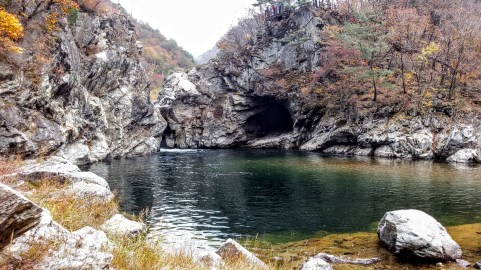 That being said, it is a beautiful area. The river that runs through it ends in a small but powerful waterfall that is the crown jewel of the park, visible across from the pond and from viewing platforms on both sides. There is a loop trail around the park, so it doesn’t matter which way you go from the pond. We headed right and passed by quite a large number of unexploded mine signs on our way toward an outdoor exhibit of mines used in the war,
  as well as other security measures and a mock explosion that demonstrated the sensitivity of the mines by blowing foam bits around in a ball while playing a low volume explosion sound whenever hikers came too close. There were also many happier decorations including party banners between trees, wooden deer and pigs, and a whole wall of paper prayers and wishes.
As the path veered toward the river, we came to a suspension bridge which the Koreans took great delight in bouncing and swaying on as we crossed. Our group of westerners was several hundred from all over Korea, and there were many more busloads of Korean tourists visiting the park that day as well. I know that normally you can get away from the crowds here by taking a side trail or going to a less popular part of the park/beach/etc. However, given the security issues at the DMZ, it simply wasn’t an option. The good news is that everyone was polite and took turns at all the best photo spots.
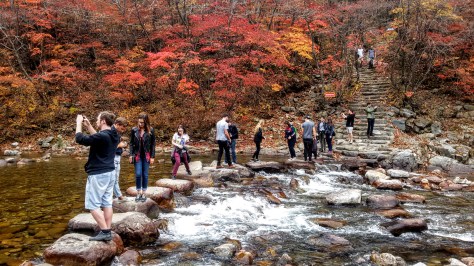 After crossing the brigde, we followed more winding forest paths through beautiful red trees. We climbed up some stairs to get to a viewing platform just above the falls and then continued on further upriver. When it came time to cross again, there was no bridge, but instead a trail of stones that required us to hop across. Most stones were large enough to allow two people at a time, but not all. Some stones could be easily stepped between and others required jumping. Plus, everyone wanted to stop in midstream for a geourgous photo-op. The end result was a long and patient crossing while trying not to get bumped into the water by people crossing the other way. This was mostly acheivable, except for when the Ajuma needed to pass. These are the ladies who wait for no one and push everyone aside to pass. Behavior that is just rude and annoying on the subway suddenly becomes hazardous when trying to balance on river rocks. Oh, Korea.
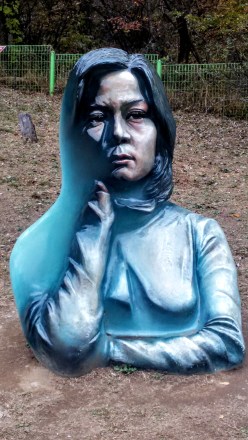 Back on the near bank, we followed the trail up to a gazebo/pagoda hybrid that overlooked the waterfall once more, before following a side trail up and over to a sculpure garden that included various works of outdoor art inspired by the war or the peace as well, as a missile and several tanks that were leftovers from the fighting. One of the most fascinating pieces was a painted sculpture that blended 2d and 3d art. The sculpture was the bust of a young woman, but only half of it was painted realistically, the other half had been painted blue. In addition, the depth was unrealisitc as well. The combination created an illusion of a different perspective of portrait from each angle as you walk around it. There was also a kitchy photo frame where we took a group shot, and a copse of giant eyeballs which was meant to show the sourse of all the tears shed for those lost. There were art pieces made from the objects of war, such as the barbed wire dandilion, and other shapes made from reforged metal. All in all, it was a surreal yet emotional tribute to the history and tragedy.
 From the park, we wended our way over to a small war memorial. Mostly we stopped here because it was necessary to file more paperwork for the Eulji Observatory. The memorial was very artistic and very sad. There were nine pillars representing the nine big battlefields in the area (Dolosan, Daeusan, Bloody Ridge, Baekseoksan Mountain, Punch Bowl, Gachilbong, Danjang Ridge, 949 Hill, and Christmas Hill), as well as statues of soldiers, displays of weapons and a whole room the floor of which was covered in shell casings from the war. Growing amid the barbed wire and destruction were small and beautiful flowers. There was a poem there ending in the stanza:
The Land of Guardians
A leaf of grass, a flower, don’t look at them as usual
And please don’t forget
Freedom today is stained with blood
Tears of sublime sacrifice underneath the smiling Peace.
When you pass by Yangu, the land of myth,
Stop at the sight of flowers red as blood,
Regard them as souls bloomed,
And please take your hats off, brooding awhile
Slowing down your busy pace.
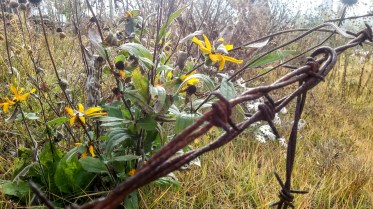 While reading these lines, I stood over the discarded shell casings, and under the helmets of dead soldiers, my camera filled with photos of beautiful flowers growing around the site. Although small and far less grand than the UN Memorial in Busan, the closeness of things these men had touched or died in amid the natural beauty of wildflowers and creeping red ivy brought the tragedy of war far closer to my heart than a cemetery or a statue ever could.
Euliji Observatory
(I don’t have many photos from the day, but thankfully, the South Korean board of tourism has published a few from the area that show the Northern side and interior of the Observatory so you can see them, too.)
The drive up to Eulji Observatory was interesting because for large parts of the ride, we rode with the border fence directly to our right, staring though it toward North Korea, which looked bleak and empty compared to the Southern side of the border. The day had been partly cloudy but with decent sunshine and fluffy white clouds, but as we drove up the mountain, it became gray and misty. Perhpas it was just the elevation, but it did give an aura of doom, gloom and Mordor to our encounter with the border of violent and secretive North Korea. Armed soldiers came on to the bus several times to count us. The Americans were notably less disturbed by the sight of military weapons close up and it was easy to tell which expats were from countries where such things are still uncommon. We were told that photos at the observatory were somewhat tricky, since we were allowed to photograph South Korea and the outside of the observatory, but *not* North Korea or anything inside the Observatory.
Several people tried to take photos of a memorial pillar against the fence, but even though the fence was blacked out, they were asked to delete the photos. The Korean soldiers guarding the area were very polite and respectful, but did ask to see phones if they spotted anyone pointing a phone toward the Northern side. I put my phone in my pocket and went up to the fence to peer through the cracks and get a glimpse of the forbidden North. The mountains and valleys beyond were bereft of signs of human occupation. Behind me on the South Korean side lay the famous Punch Bowl, once a bloody battlefield and now a well developed agricultural area, the land divided into neat geometric shapes for crop management and dotted with low wide buildings. In front of me, through the narrow slat where the tarp covered wire fence met the concrete base, 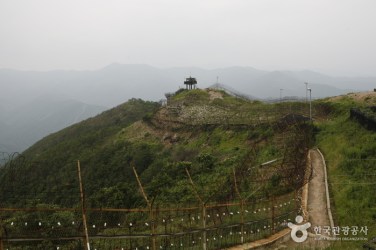 I could see one winding dirt road, some tires stacked and filled with dirt or sand to create a barrier, and a lone watchtower surrounded by more barbed wire fencing. Beyond these decrepit signs of occupation, the land seemed as wild and untouched as though looking back in time to before humans even arrived. Coming from South Korea, where all the land is so thoroughly occupied that wildlife is all but vanished, it was a stunning contrast.
 Inside the observatory, there is an enclosed viewing platform that overlooks the North. A brave soldier who spoke some English decided to read an English presentation to our large group. He was very nervous, but it was a great gesture that he wanted to share information with us, so we filled the small auditorium and listened politiely while staring at the mist shrouded emptiness behind him. He told us about famous battle sites around the observatory including Stalin Hill, where the South lost some land that is now part of North Korea, a radio tower used to block signals traveling into the North, and a distant waterfall called Fairy Waterfall where beautiful North Korean women used to bathe nude to entice South Korean soldiers. He also indicated that North Koreans did use the area nearby for agriculture, although to my eyes it looked completely natural and I cannot imagine that the food they harvested there would be anything more than wild gathering.
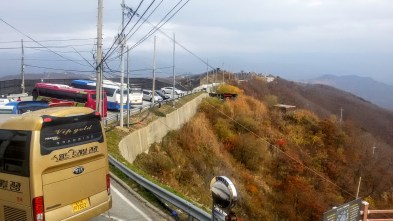 I stepped back outside, feeling disoriented from the whole experience, looking back and forth across the narrow fence from a high vantange point where I could easily see North and South at the same time. (hint, the South is on the right, the North is on the left) Large ravens swooped around the peak, effortlessly gliding between the two countries gripped in cold war, alighting on the Northern watchtower, then returning to our parking lot to scavenge for crumbs left by tourists.
4th tunnel
 Our last stop for the DMZ day was the 4th Tunnel. This sounds fairly ominous, because it also implies there are at least 3 other tunnels, which there are. The North has tried on at least 4 occasions to literally tunnel into South Korea to get troops behind the border for a massive attack. Before heading over to the tunnel entrance, we scooted inside the nearby museum for a quick propaganda film. The film was in Korean, but had English subtitiles. They were long, small and hard to read over the video, as well as not being the most accurate gramatically, but I got the gist: North bad, South good, Threat onging. The idea that the Korean War is over is not something that really exists up near the border. To be honest, it doesn’t really exist in Korea at all, but most of the time Korean citizens can ignore their war with the North the same way Americans don’t let the 7 wars their country is involved in affect them on a daily basis. This film was a little startling however, because it didn’t even make an attempt at looking like an “unbiased documentary” and was more in a tone in keeping with propaganda material from the 1950s-60s during the cold war with Russia, or the modern Chinese government propaganda films. I’m not sure how old the film was, but it certainly felt out of time.
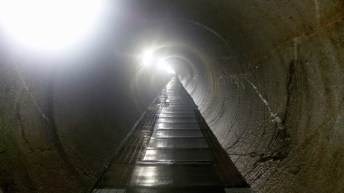 After the film, we filed into a large round tunnel. The tunnel we were walking into was dug with a serious drill by the South Koreans in order to reach the less sophisticated North Korean tunnel. It was a long walk, less than 1km I’m sure, but the tunnel was dim and damp and nearly perfectly circular thanks to the diamond tipped drill the Koreans had used to make it. Hard hats were available at the front, but there were nowhere near enough to accomodate our group size, so we simply left them behind. Inside the tunnel was another no photos zone. Fortunately, the internet provides, so you can see some photos that other people (including authorized tour guides) have taken of the tunnel and equipment.
As we stood in line in the dank underground tube watching water drizzle down through a crack in the rock above, someone in the queue pointed out how much like waiting in line at Disney Land’s Pirates of the Caribbean ride it felt. I couldn’t disagree; it was underground, dark, dripping water, although the armed soldiers were real instead of animatronic pirates. In a moment I can only blame on the sheer absurity of our situation, we decided as a group that the experience would hereafter be known as DMZney Land, where the atrocities of war are wrapped up in neat little display packets for visitors to line up and experience by the busload.
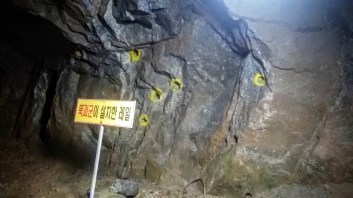 Where the modern and sleek South Korean tunnel ended, there were clear toolmarks in the rock, concentric circles left by the drill. Intersecting our tunnel was a much smaller one, no more than 2 sqare meteres, and rough hewn, carved out with picks and dynamite. A small train awaited us, one seat behind the next as the tunnel was too narrow for two abreast. The seats were low and a transparent panel protected us from the threat of falling rocks above, but the sides remained open. We climbed in, feeling even more like boarding a ride in a theme park, expecting a trek through the rugged rock. After a mere 100 meters, the train came to a stop. We could see tool marks, and holes that had been prepared for the next round of dynamite. I forgot for a moment about the photo ban, but when I snapped a few, the soldiers only politely reminded me not to and I put my phone away again.
After a few minutes, the train moved us backward along the rail to our point of embarkation. I wasn’t sure what had happened, so I asked one of our guides to find out why the trip had been so short. Once the next trainful of tourists was on its way, she was able to ask the guard there more about the tunnel and the train. It turns out the reason we stopped is because we had gone right up to the border underground. I don’t think it was actually the border of North Korea, I think it was more likely the border of the non-civillian section of the DMZ, but it was still chilling to realize how close we’d come, or rather, how close the North had come to succeeding in their infiltration plan.
Outside the tunnel is a memorial statue to a military dog named Hunt who died while helping to rid the area of landmines. The tunnel was only discovered in 1990, and although North Korea claims it was for coal mining, there is no sign of any coal in the granite through which the tunnel was dug. American and South Korean forces are maintaining a look out for possible 5th or even 6th tunnels to this day.
Hotel in Sokcho
By the time we emerged from the tunnel, the sun had set, and the mountains were wreathed in the last glimmer of twilight. We boarded our buses in the dark and headed over to our hotels for the night. The only real reason this is of any blogworthy interest is because our hotel had both indoor and outdoor spas and pools. My experience at the jimjilbang in Jeju was great, but highly segregated. Here, we got the chance to sit around in our swimsuits in mixed company with some cans of beer and feel the contrast of the warm spa water and the cold mountain night air. The whole experience started like a jimjilbang, and we had to clean off in the showers before heading outside. The pools closest to the door were cooler, and by the time we got all the way to the upper levels and warmest pools, I was shivering intensely, but it was worth it to enjoy the wonderful outdoor spa.
I try not to dwell on the sleeping arrangements for these trips, because we go in for economy. This time we ended up on the floor again, and I gather no one slept terribly well, all of us relying on our excitement of travel to keep us going one more day.
Seoraksan
Early in the morning, after a buffet breakfast, we headed out to the famous national park for some hiking and autumn leaf viewing. The weather was still rather damp, but that just made the colors of the trees and rocks around us stand out more. Seoraksan is quite famous among Koreans for it’s natural beauty, it’s giant bronze Buddha, and it’s fall foliage. Even wih the drizzly weather, the park was still packed to the gills when we arrived. I’m so used to hiking in the woods being a quiet escape from humanity, so this was a very big contrast. Even when climbing the famous Mt. Hua and Mt. Tai in China, I didn’t feel this crowded.
 The parking lot had more tour buses than Disney Land, and when we passed through the main entrance, we were greeted with a wide stone road lined with restaurants, cafes and other businesses catering to park-goers. There are several trails that can take over 12 hours, but we didn’t have that much time. After doing some research, my companions and I decided we would see the big Buddha, then walk the short (2 hr) waterfall trail, and finally take the cable car up to the highest peak for a look around.
Our very first task was to buy cable car tickets, since the tickets are sold by time and sell out early in the day. In fact, even though we;d decided to do the cable car last, nearly all the tickets before 1pm were already sold out by the time we found the ticket office. I gather that most of the year the cars run every 15 minutes, but during the weekend we were there, they had cars running every 5, holding 50 people each, and all of them were sold out by the end of the day. That’s 600 people an hour or about 4,000 people in a single day. And that’s just for the cable car. I really have no idea how many were in the park, but when I say it was full, I’m not joking.
 Our tickets in had, we followed the signs toward the temple, passing more and more restaurants, cafes and other buildings of unknown purpose. We rounded a corner and spotted the giant statue from a distance and made a bee line straight for it. The first thing that struck me was how similar it was to the Buddha at Kamakura I’d seen last year (and totally forgot to write about but follow the link for pics). Both large metal stautes had hidden entrances as well. We took our photos and wandered around the area, watching as other visitors engaged in prayer or selfies or some combination of the two. For me, visiting famous temples is more often an act of tourism even though I call call myself a Buddhist. I imagine it’s the same way that many Christians visit Notre Dame or other famous churches to appreciate the art and history rather than to attend service. I did take a moment to find my center and become mindful of my experience, and my friend made a votive candle offering as well, so we weren’t total gawkers.
The Sinheungsa Temple was burned down in 699 and rebuilt in 710, and many believe it to be the oldest standing Seon (Zen / Chan) Temple in the world. The statue (built in 1992) is 16.9m tall (not counting the nimbus around/above his head) and contains within some pieces of the Buddha’s sari recovered after cremation, and a copy of the Tripitika (the Buddhist “bible”). The Kamakura Buddha is a bit shorter at only 13.5m, but much older, having been around since 1252, and represents a different branch of Buddhism, being a statue of Amida Buddha from the Pure Land sect, while the Seoraksan Buddha or Tongil Daebul (Great Unification Buddha) is from the Seon school and represents the sincere desire for Korean reunification.
Biryong Falls Course
 Trying to keep ourselves on a decent timeline, we said our farewells to the stunning statue and set off in search of the trail-head to Biryong Falls. We soon joined a stream of Koreans dressed to the nines in their special hiking clothes. For many Koreans, espeically the older ones, outdoor activities are a serious glamour show. All the clothes are brightly colored and brand new looking. Meanwhile, my friends and I were dressed in jeans and hoodies because that’s usually how we walk in the woods at home.
 The path involved some beautiful views of the surrounding mountains. Unlike the Busan mountains which are low and covered in a softening green layer of trees, the Seoraksan mountains burst from the treeline with jagged teeth of bare rock, and this day, the whole thing was wreathed in clouds and mist making it even more haunting. We took a wide bridge over a river and ambled joyfully along the forest path, stopping to admire the trees on a regular basis. The Koreans around us took some pictures, but only at designated picturesque spots. The rest of the time they were in a hurry to get moving. So much of a hurry that we were jostled, bumped and even shoved if we were deemed to not be going fast enough. It was like being in the subway… for several km. We tried to walk on the side of the path, or even just step OFF the path when the hordes of ajuma came barrelling down on us, but it didn’t always work.
Eventually the trail thinned out and it became harder to get out of the way. The ground left soil behind and became a wet and slippery ascent of natural stones that were precarious and challenging to hike up. The Koreans all had special hiking shoes and one or two walking poles apiece for balance and had zero patience with us for hiking in only trainers and not having sticks to balance with. More than once, I was worried that one of the shovers was going to knock me down or even knock me off the edge! It was a big contrast to the DMZ park where everyone had been patient and taken turns on the river rocks. At one point I moved as far off the path as was safe to stop and take my coat off. I got bumped into by people coming from behind 4 times. More than once they looked at me as though it were my fault for not getting out of the way. Heaven forfend we should want to stop on a bridge to admire the view or take a photo. There’s nothing so nerve wracking as having ajuma shove you while you’re balanced on a thin rail of metal over a pounding white water river below.
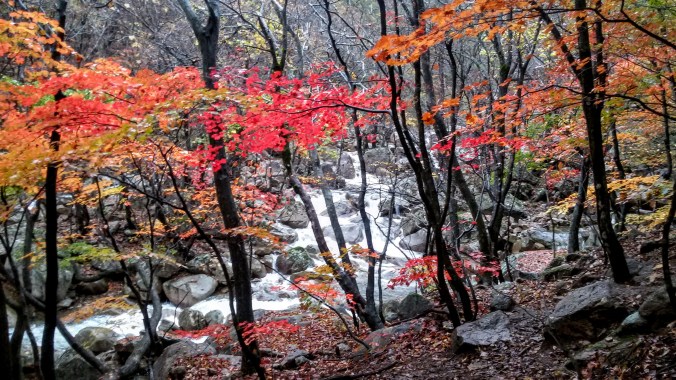
However, despite the nerve jangling crowds, the hike was absolutely stunning. There were still quite a few trees dressed in green, but that only served as a better backdrop for the fiery reds and golds that permeated the woods. 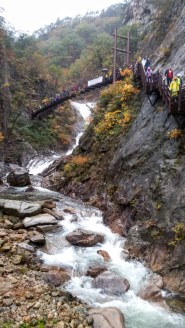 As our path ascended beside the river, we were treated to the kind of views normally reserved for high class calendars and natural beauty screen savers. My computer randomly shows me stunning nature pics every time I log in, and I swear that one of them was actually from Seoraksan. We climbed up the slippery rocks, clinging to the railing and nearby trees until we reached two more bridges crossing the lower Yukdam Falls. The maps and pamphlets all say it’s just a 40 minute hike from the main entrance to these falls, but it had taken us close to 90, proving that 40 minutes was measured by ajuma walking standards rather than beautiful day in the woods standards. I understand that Biryong Falls was only a little farther up the mountain, but in order to make our cable car time, we had to turn back early.
Cable Car & Tiny Temple
 Our last adventure for the day was to take the cable car up to Gwongeumseong. This particular peak is only accesible by cable car and can’t be hiked up to. We’d gotten our tickets as soon as we arrived at the park, so all we had to do was wait for the sign to show our boarding time and file on. These are decently large cable cars, and hold 50 passengers at a go, all standing and no personal space. My friend decided to play elbows for us and wrangled some spaces right along the rear window so we could watch the ground disappearing beneath us as we ascended into the clouds. We were able to see the main park entrance laid out below us, including the giant Buddha off to one side.
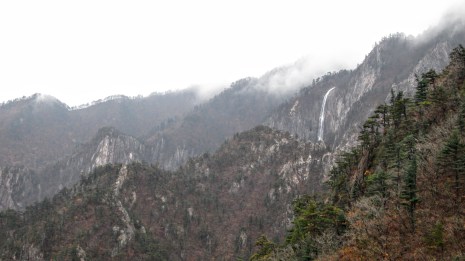 As we rose, the clouds soon fell below us, covering the view of the ground and the sea became visible off to one side. I had known Seoraksan was near the coast, but I had not realized how close to the ocean we actually were until that moment. The cable car stand at the top had more amenities, food and restrooms and coffee shops, but we swept past them and onto the viewing platform. I had read ahead of time that one could walk all the way to the tippy top from here and see an old castle, but after my experience on the waterfall path earlier, I was reticent to follow another stream of hundreds of hikers. We walked around the viewing area and found a distant waterfall, a long streak of white amid the green and brown of the mountains, visible even at this distance it must have been enormous up close.
 While searching for more and better angles to take majestic photos of the panorama around us, we stumbled upon a small path leading downward that no one else was on. The small sign indicated there was a temple (templ-ette? I’m not honestly sure how to translate this word in English) about 70m downward. We carefully balanced on uneven, wet and slippery rocks, clinging at times to the chain along one side of the path. 70m isn’t far on flat ground, but it took us a while to cover it on the mountainside. We also stopped to admire the views often. When the path leveled out, we were greeted with a tiny hut, decorated in Buddhist style. We doffed our shoes and went inside. The warm interior was a welcome contrast to the chilly outside air. The ceiling was covered with lotus lanterns and small candles burned on the altar. The air was so still, I had to stare at the candles for a few minutes before I decided they were flame and not electric.
Our whole day had been so hectic and crowded, it was bliss to sit on the plush carpet and just enjoy the calming music playing on the sound system. While we were meditating, the monk came back inside and seemed a bit surprised to see us there. I don’t know if I want to go too far into what I experienced internally, but I definitely received the answer to a question that had been bothering me. My friend also found some answers in her meditation that helped her to find her way again after some troubling times. Buddha isn’t a god, he doesn’t answer prayers or give us things, but quiet reflection is hard to come by and can make a space for us to hear the answers we already knew. This temple, however small and remote, had a sense of peace and purpose. Even it’s name reflected this, translating in English as the “love and happiness temple”.
When I stood to offer a respectful bow to the altar, the priest caught my eye as I straightened up and smiled broadly, bowing to me and greeting me in Korean. My friend was still meditating, so we were quiet and did not speak much beyond greetings, but I could tell he was happy that we had come in with intent and respect.
Once both of us completed our meditations, we headed back up to the cable car feeling cleansed and refreshed. Some other expat tourists asked us what was down the path and I told them. Then they asked if it was “worth it” and we had a small discussion on what that meant. The temple-ette was tiny and not very architecturally or artistically stunning, but spiritually, mentally, emotionally, the peace we found there was priceless to us.
As the fall moves on, I treasure the memory of this temple most from the weekend experience. Things are not getting calmer or easier for me as an American or for everyone living in Korea dealing with the political uncertainty here. Religion and spirituality are tricky topics, and I’m not out to preach or convert, but the core Buddhist tenant of loving-kindness is something I think we can all use a little more of in our lives.
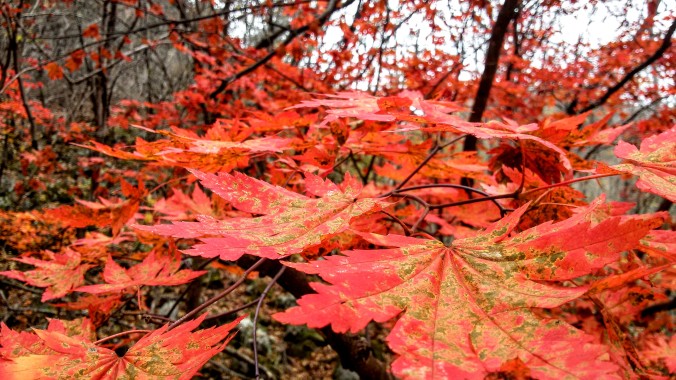
I met with some other Americans after the election and someone reminded me that one of the most important roles of the expat is “soft diplomacy”. We go out and show the face of the people, instead of the government, and when we come back, we can tell stories of the people and places we’ve seen, sharing things the news and the movies miss out on. I hope that my travels, stories and experiences can serve to help show the value in diversity, in natural preservation, and in open-mindedness. Thanks for reading, and please be sure to see all the photos from the DMZ and Seoraksan over on Facebook! ❤

 They told me that’s the normal price for SPAM, it was just in gift boxes this time of year. This led to a whole side discussion about the cultural dissemination of
 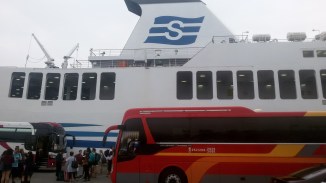 The only real hitch was that we were taking the ferry from Mokpo instead of a plane. This meant a 4+ hour bus ride
 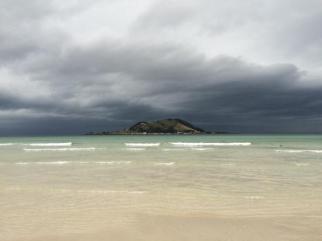 After we ate, we headed down to the water to frolic! The weather was gray, but warm. At first the water seemed chilly, but as I waded in further, I quickly adjusted. This beach was wide and shallow. We walked out for ages from the shore but the water didn’t even come to our hips. There were some Koreans playing in the water as well, but it seemed that only the Westerners wore swimsuits, everyone else went in the water in clothes. I’ve seen this at the beaches in Busan as well, and I’m still not sure what the cultural aversion to swimwear in the ocean is.


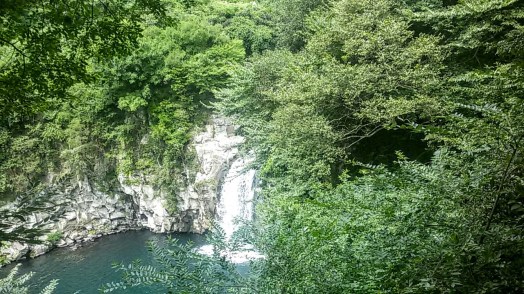 The best view of the falls was obscured by the trees and vines growing around us and was from quite a great distance. I felt cheated. I think it may have been a beautiful waterfall, but the fact that we weren’t able to find out after so many stairs just felt like a bad con. And unlike waterfall 2 which was relatively easy to hop the fence and get closer to, this platform was high above the pool with a very steep and overgrown hillside, making navigation any closer dangerous and difficult.
 We went first to Chocolate Land because, well, chocolate. For some reason there was a giant statue of the Incredible Hulk outside. I don’t know what I was expecting, maybe giant chocolate sculptures or the world’s biggest M&M, possibly a history of chocolate exhibit, or a making of chocolate section. What the ‘museum’ turned out to be was a room (just one) sparsely populated with display cases showing off packaged candy from various countries. Even this could have been cool if they’d said something about it, why is the Arabian chocolate this way and the British chocolate this way… I tried the Kazakhstan chocolate my friend brought me from her visit home after all and was fascinated to learn the pride that the country takes in it’s national brand. But no, these cases just held boxes of chocolates. Some cases made an attempt at silly displays, like a taxidermied chicken with Cadbury eggs or a Nativity Scene made with chocolate coins, but it was incredibly grandma’s yardsale chincy.
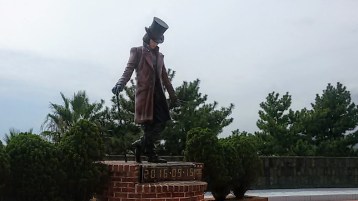 Half the room was filled with what seemed like Christmas themed facades that were, I assume, photo ops as well as a cafe where one could get some coffee, soft drinks, ice cream or candy and relax from the arduous walk through the musem. There was a chocolate making “class”, where for 12,000W you could pour some melted chocolate into molds. Outside there was a statue of Willy Wonka, but the Depp version, not the Wilder one. The final room was divided between more odd displays that seemed to have even less to do with chocolate than the ones before and the gift shop where one could redeem the 3000W entrance ticket toward the price of a sovenier. It turns out Jeju chocolate is quite tasty. They make it in fruit flavors that are unique to the island like Hallabang, Jeju Mandarin and Jeju cactus. The same boxes of chocolates are on sale all over, so it was basically like getting a 3000W discount on some chocolate I would have bought anyway for walking through a weird display room.
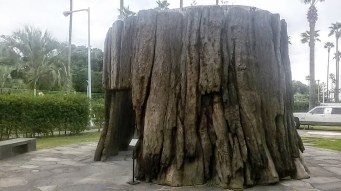 The trunk of a California redwood had been taken apart, transported and reassembled there so that the Koreans could see the stunning size of the redwood trees and experience walking inside the hollow trunk. It struck me that this was as close as most of them would ever get to a redwood and reminded me that museums aren’t just for history, but for the exchange of personal experiences. The most ridiculous thing there was the map of all the places in the world that Ripley had travelled. The map was covered in numbered blue dots with a key below. As we started to try to identify some of the places in the US, we realized that the geography was woefully inaccurate since Siam, Yugoslavia and Burma were all listed as being in the continental 48. Yugo-Slavia [sic] is in Florida.

 On our way past the beach restrooms we reached a point where the floor and walls seemed to move and I realized with horror that the whole path and retaining walls were COVERED in cockroaches. Horror movie levels of roaches. I am not afraid of most bugs. I can be startled by unexpected bug and I have a healthy respect for things that can hurt me, but there is something deeply lizard brain *ACK* about realizing that a good portion of your surrounding landscape is made of bugs. Fortunately, they didn’t want anything to do with us and moved clear of the path as we approached.
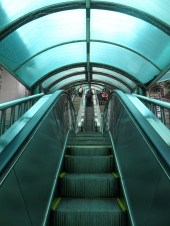 This park in the Nampo neighborhood is up on a bit of a mountain, but there’s no need to climb up exhausting stairs because there’s an outdoor escalator installed to let you ride up in comfort! When we got to the top, we were already blown away by the great views of the city below and we hadn’t even gotten to the highest points yet. As we passed by the stage area, it was clear that a performance was about to get underway. There were plenty of people dressed in the standard white garb trimmed with bright colors and fun hats and the parents hadn’t gotten to see any traditional dances, so we pulled up a seat. I have since found out that cultural performances happen here every Saturday at 3pm between March and November.
  The MC for the day was excited to see so many foreigners (not just us) in the audience and brought out a poor young Korean lady who was nervous and not particularly fluent to try and translate for us. Representatives from each visiting country in the audience were invited to come up on the stage and play a traditional Korean game of trying to toss a stick through one of 5 rings attached to a jar. My friend’s mom went up and they let her stand extra close because she was over 60 and she brought us honor by scoring the center ring! We didn’t sit for the whole performance, but it was a kind of musical story. From what I could follow, some performers arrived at a lord’s house and were invited in to party, but there were some rascals around who may have been trying to steal away or marry off the lord’s daughter? The language barrier was a bit of an obstacle to the plot, but it was fun to watch and clap along with.
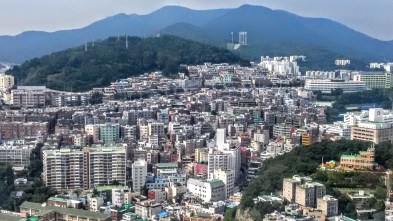 We snuck out during a lull and headed to the main attraction of the Park, Busan Tower. The tower stands 118m high, but it’s also on a mountain so, it seems to be rather higher than that when you look down. For 5,000won you can get a ticket to ride up to the top of the tower where you can enjoy a stunning 360 degree view of Busan. There are helpful decals on the windows that identify major landmarks and there;s a little cafe where you can enjoy a snack with your view.

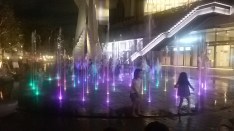 Sky Tree (left) where the small fountain lights are coordinated with the tower lights high above. These shows are fun, awesome, wonderful, and sparkly, so when my friend told me he wanted to take his parents down to Busan’s own choreographed fountain show, I was all in favor.
 There are some permanent concrete bleacher type seats along one side, but the rest of the area around the fountain had been filled up with plastic chairs to accommodate the higher number of spectators on the warm weekend nights. We arrived early and laid claim to seats in the front row, hoping that we wouldn’t have to worry about the crowd standing in front of us when the show started. Refreshingly, the Korean audience stayed in their seats during the show and we had a first class view. In both China and Dubai, the spectators jostled for the best standing spots and to get my video, I had to start standing in my spot almost 30 minutes before the show started to get an unobstructed view.
  This is 2,519 sq m fountain is listed as the largest fountain in the world by Guinness. I suppose that the show at Dubai is not considered a single fountain and is therefore only the largest fountain
 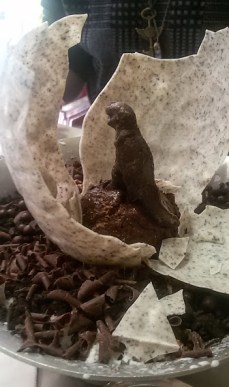 I’m not a food blogger, but sometimes food is just too good not to write about. I’ve done some basic coverage of these things elsewhere, but it doesn’t get old. Dala 100% Chocolate is this tiny hole in the wall chocolate cafe in my neighborhood in Seomyeon. The first time I went there, I had to try their signature dish, the dinosaur egg. This was an amazing concoction of shaved milk ice topped with crushed chocolate cookies and chocolate shavings with a giant egg made of cookies and cream candy. When smashed with the provided hammer, the egg reveals a scoop of truly decadent chocolate ice cream and a tiny chocolate dinosaur. If that’s not enough chocolate, you can pour chocolate sauce over it too. It takes at least two people to eat this dessert. Since that time, we’ve also tried the chocolate pizza (nutella spread, banana slices and toasted marshmallows for toppings, scoop of vanilla ice cream and chocolate sauce again), and for the two separate parental visits this summer, I also managed to try the fruit fondue (kiwi, grape, orange, grapefruit and banana… turns out grapefruit in chocolate is awesome), the “special brownie” (molten chocolate inside!), and the chocolate churros (churros you dip in chocolate). Let us not forget the milkshakes, which come in a variety of chocolate compliment flavors and can be made white, milk or dark. I don’t just love this place for it’s chocolate, but because it’s good chocolate. It’s not too sweet and they do a good balance of flavors in each dish so you don’t get tired (as if that were possible) of a single chocolate flavor. I think we’re about halfway through the menu now, and if the weather keeps cooling off, I’ll get to try their hot drinks soon!
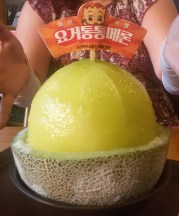 The melon special was not just using frozen milk, but frozen yogurt… and not the kind you’re thinking. Imagine you mix some yogurt with milk or water until it’s all liquidy, then freeze it solid, then shave it off into teeny tiny snowflakes. Ok. Now, take a honeydew melon (the green ones) and cut it in half. Hollow it out and freeze the shell. That frozen melon rind is now our bowl, filled with the snowflake texture frozen yogurt and topped with some cubes of what I can only describe as cheesecake filling.
  Now, over the whole thing, put the melon you removed from the rind, the hemisphere of melon, all of it. The dish was served with a big plastic knife so we could cut up the melon for ourselves. It was the perfect combination of sweet, tart and creamy to refresh us in the summer heat.
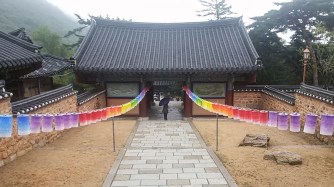 When we arrived, a very nice older Korean lady offered to explain a little bit about the main gate to us in English and we got to hear a little history of the naming of the temple and the unique four pillar style that makes this era of architecture distinctive. As we ascended the stairs and passed through several gates decorated with bright lanterns and beautiful paintings we moved through a hall of fearsome statues and finally emerged into the main courtyard. The temple was originally built about 1,300 years ago, but was destroyed during a Japanese invasion in 1592 and later rebuilt in 1713, but a few stone remnants and one stone pagoda left from the original still stand in the wide open square. The temple is dedicated to the practice of Seon Buddhism, which is the Korean descendant of Chan Buddhism the same way Zen in Japan is.


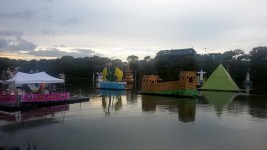 Also called the Jinju Namgang Yudeong Festival, it is held in honor of the fallen during the seiges by Japanese soldiers in the Imjin War in 1592-3 (the same time frame the orginal Beomeosa Temple was destroyed). During the war, lanterns were used as military signals, a means of communicating with reserve forces, and as a way to keep in touch with family members outside of Jinjuseong Fortress. Even after the war, people continued the tradition of floating lanterns down the river to pay tribute to the brave souls that had been lost during battle. Today, the festival is far more than a few lanterns on the river and instead is a whole palisade of life size and larger than life lanterns floating on the river and filling the riverside park where the fortress once stood.
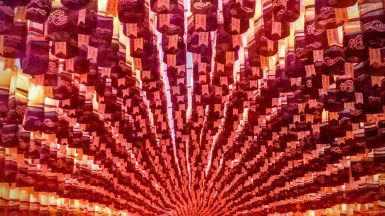 When we entered the display area, we were given arm stamps so we could come and go as many times as we liked, then we began our stroll down the riverside. The water was covered in giant lanterns in shapes of mythical animals and heroes as well as famous landmarks like Stonehenge, the leaning tower of Pisa, and the Statue of Liberty. There were floating restaurants, boat rides, and yet more tents offering delicious snacks.There were giant tunnels of red lanterns where couples walked hand in hand in the twilight.
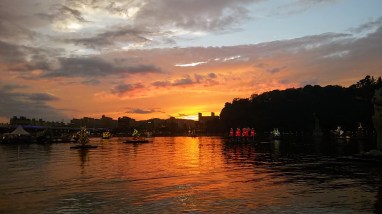 Two floating bridges at either end of the display allowed visitors to pass from side to side without returning to the street level. The day had been rainy, but as the rain dried up, the sunset lit the clouds in shades of brilliant gold and scarlet.We crossed the river and ascended into the wooded area to be greeted with the most amazing forest of light. Unlike the


 all over their website, Facebook and the internet in general. It’s on the beach as well, which is always a winning proposition.
 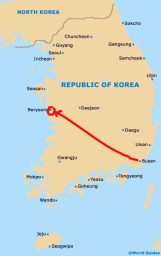 Boryeong is on the opposite side of the country, a little south on the coast of Taean, where we went to see the tulips. It took us about 5 hours to get there, but it was nice because we were on one bus the whole time and didn’t have to think about anything. We got there around 2pm, and quickly went to drop our stuff off in the room and change. We also had to go hunt down booze and waterproof pouches for our phones and wallets. So, it was probably after 3pm by the time we got TO the festival. This may be the only real complaint that I have about the tour trip. The main festival attractions closed down at 6pm, so we didn’t have a lot of time to try all the activities before they were done.
 It turns out that the main festival is on Daecheon Beach, which is a beautiful sandy beach, and the mud has to be trucked in for the array of water slides and inflatable games. No wonder it was watered down. Several of the photos I’d seen online were not actually from Daecheon at all, but from the actual mud flats themselves in Namgok-dong, where smaller events, including a 5k mud run, are held. The mud festival lasts about 2 weeks and we were just arriving in town for the last weekend. I didn’t even learn about the mud flats until after we got back, but we wouldn’t have had enough time to visit them that day anyway. Don’t take this map as gospel, because all I could find was the name of the mud flats, so this is just a rough idea of how far the mud beaches are from where the big party is. And while the mud beach looks totally like everything I was promised, the Mud festival itself looks like this.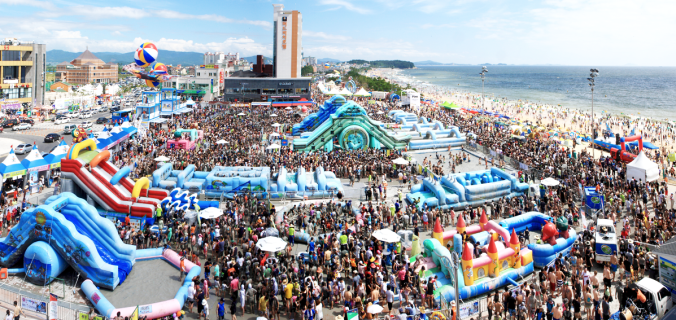
 The line we were in was for the football (soccer) arena. It was an inflated pool with inflated goals on either end. The muddy water was about mid-calf depth and the ball was an inflatable beach ball. It did look fun, but after the first 30 minutes of standing in line, we were seriously questioning our life decisions . We took turns holding the group place in the queue so people could get out and go pee, and finally it was our turn to get in the arena. We lined up against a group of Koreans and began to chase the beach ball around the pool.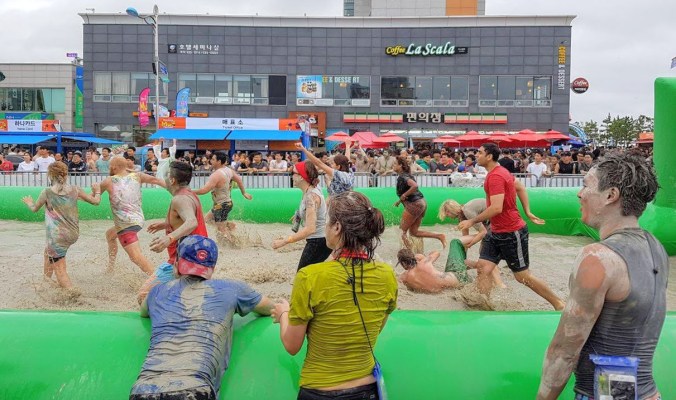
 but my top goal was the giant slide. My friend described it later as “
 I was surprised to find that the giant slide dumped me outside the fenced in area, especially since my shoes were back on the other side at the entrance where I’d been asked to leave them. I reconnected with some of the group and managed to get back inside right before they closed down. We got in one more line for the floating hamster wheel (which is a serious upper body work out, by the way, especially when it’s slippery!) but alas when we got out, the other attractions were closing down.
 Returning from the beach to find the eerily abandoned mud park, it didn’t take me long to get to my other favorite travel activity: talking to new people! I ran into someone I’d met briefly in one of the lines who had also ended up separated from his group. We wandered around the waterfront chatting, and ended up having a great conversation about our lives and travels which was totally unmarred by any awkward flirting. Why I love A-spectrum folks: you can dive straight into a deep and meaningful conversation without all that useless weather-sports-job chit chat.
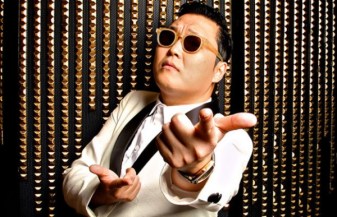 While we were talking, I found out that the K-pop sensation Psy was scheduled to perform on the beach. Which, again, just goes to highlight how bizzaro Korea is about promoting events, because there had been no mention in anything I read about this. In case you’ve been living under a box, Psy is the singer of the international sensation “Gangnam Style”, so he’s not just famous here in Korea, but nearly everywhere. I mean, imagine if you went to a festival and then halfway through someone was like oh yeah, Beyonce is gonna perform, too.
 I like the notion of the pension, but the number of nights per year I’m willing to sleep on the floor is shrinking as I age. Just one more reason I really need a TARDIS. Anyway, thanks to alcohol and exhaustion, I did manage to sleep. And woke up the next day with only a mild hangover and several more hours to explore the festival grounds. I hadn’t known that we would still be at the festival for so long, and only had one set of clean clothes. It turned out that the water attractions were closed anyway, so while there were still people getting muddy, it was limited to the mud water jars placed around the plaza.
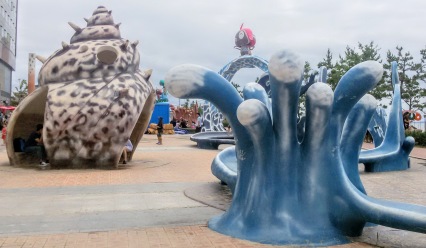
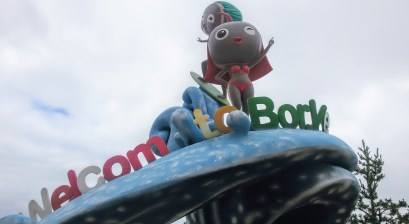 We managed to stay clean and took the time to better explore the area. As it turns out, the Boryeong mud is famous for it’s mineral composition and use in cosmetic products. The festival was once an advertising campaign for the cosmetics and has since become an epic party. There were several things that seemed to be permanent beachfront statues that were all about the mud, but since the mud itself is a major commercial export for the town, it wasn’t so surprising that they had statues devoted to it.
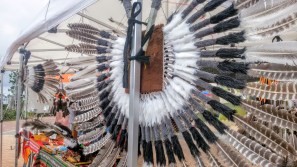 We also found the performing native Americans again. I feel like it’s starting to become some kind of David Lynch-esque running gag for my time in Korea that there are always guys dressed in intense and often highly mixed Native American garb playing flutes and pan pipes and selling dream catchers. One of them had bright neon fringe this time. And I saw more of them playing at a rest stop on our drive home! What is the deal Korea, seriously?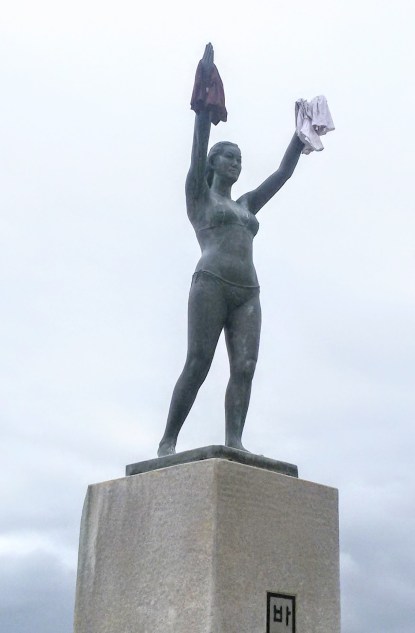

 When I first found out about the festival in March, I was excited to see it. When I found out it was the 17th annual one, I was blown away. Try as I might to keep up with real news and world events, I still had a solid perception that LGBTQ+ rights platforms were the domain of the West (and that America might actually be the farthest behind in that race) while the rest of the world lagged far behind in tackling this important civil rights issue. I saw things like Russia banning LGBTQ+ at the Olympics and China striking down gay marriage as signs that the East just wasn’t doing that much.
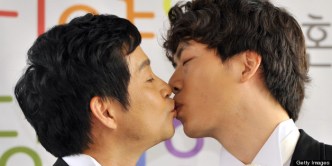 Korea just recently had, for the first time, two (famous) men
  Previous years’ festivals have seen large groups of protesters who have screamed at, spat at, taken pictures of, and occasionally engaged in greater displays of violence and harassment toward the festival goers. They’ve reportedly lay in the street to block the march, and even engaged in physical violence against the police to try to get at the Pride participants. Protesters have tried to shut out Pride by booking up the space, nearby spaces, and hotels to keep people out. This year, the conservative anti-gay Christians tried to petition the courts to shut down the festival on the basis of public indecency, but they were denied. However the Korean culture may feel about LGBTQ+ currently, at least the government respects everyone’s right to peaceful assembly, which is awesome. More than merely respecting it, the government issued stern warnings to the protesters to refrain from violence, because violent protests are illegal.
 My Busan Bestie and I headed to Seoul Friday after work, arriving after midnight and experiencing the very beginning of the Seoul public transportation headache. We managed to find the right bus, but missed our stop and got stuck on the wrong side of the bridge, which I guess technically people walk across, but it was the middle of the night and we had luggage, so we thought, oh hey, we’ll just take a taxi… nope. Scarcely any to be had and none for us. We finally found another bus and got back on the right side of the bridge but didn’t make it to our hotel for almost 2 hours after our train arrived. Why didn’t we take a taxi from the train station? Well, the line for real taxis was 30 people deep and no taxis were coming, the bus ride was only supposed to be 30 minutes, and as we found out later, there are plenty of fake-out taxis waiting to charge you an arm and a leg for a 15 minute drive.
 When we finally emerged from the station, we were greeted by a huge wall of police. I saw the protesters well before I saw the festival. They were set up across the street with a giant stage where they were having speeches, performances, and blasting Christian music in an attempt to drown out the Pride music. The streets around Seoul Plaza were lined with police standing shoulder to shoulder. When the light changed, they parted to allow us access to the crosswalk by which we entered the park. I have to admit, I was becoming anxious, and not in a good way. My heart was aflutter and my adrenaline was definitely going. I’m in no way anti-police. My sister is a police officer, and I have a lot of respect for the men and women who do a necessary and often thankless job. In the US, if I get pulled over or approached by an officer in public, it does not make me nervous. But something about seeing thousands of officers creating a human wall made me more than a little twitchy.
 Speaking of being free to be themselves, the festival also went out of it’s way to make the space especially safe. In the past, protesters used pictures of festival goers to publicly shame them, or get them fired, or even disowned by family. It’s no laughing matter to be Out here. Homosexuality can’t get you arrested, but there are no laws protecting employment yet. Many families feel it’s shameful and will disown children who come out. LGBTQ+ Koreans mostly have to pretend to be cis-het to get by. A few have managed to make enough money that they aren’t afraid to come out, like the filmmaker who petitioned for a marriage to his lover, like the small community of drag queens that simply make their living as performers. But the average person is hiding. This festival is a chance to be among people who accept and understand, but the attendees probably have to go back to homes and offices where they have to pretend again, and thus, having their pictures plastered on the internet can be scary and damaging.
 The festival made it clear that anyone taking pictures for anything other than strictly personal use (eg, keep it on your phone and never show it to anyone) must get a press pass and sign the agreement. I like sharing my pictures, so my first stop upon entering the park was to the press booth. I read a multi page contract that stated the rules for taking and sharing photos. It was heavy on permission. (yay consent!), and very strict about not posting anyone’s face you didn’t get permission from. I asked people all day, and handed out cards to the site so they really understood where the image was going. They also collected our IDs, so they can hold us accountable should someone take issue with my following the rules. I told my school where I was going that weekend because I don’t like lying, so I personally am not worried about it ‘getting back’ to my employer, but I know it’s a real issue for many Koreans and I’m glad the festival took such pains to protect them.
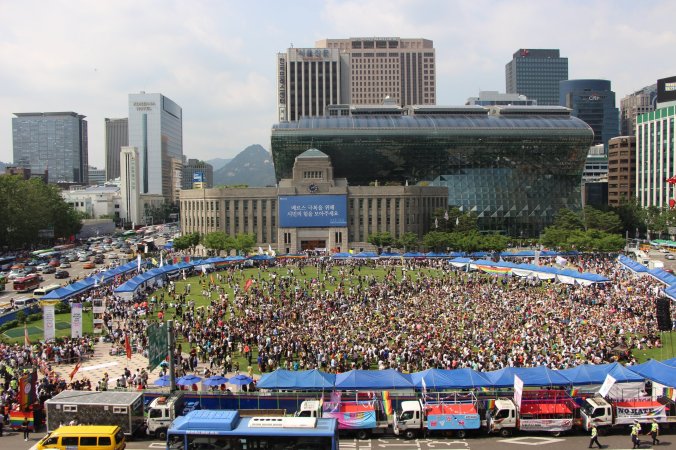
 After securing our press passes and verifying our reservations for the after party, we slowly started to explore the booths that lined the plaza. Unlike events in the US, there was very little corporate representation. And unlike events in Korea, there was a lot more than endlessly repetitive booths of food and trinkets. Most of the booths were operated by groups trying to raise awareness and understanding for some aspect of the LGBTQ+ community. There was a group called “Dignity for Soldiers”, another booth was from the first (and only) NPO that does outreach and support for at-risk LGBTQ+ youth in Korea. There were booths for just about every shade of the rainbow including Trans, Poly, Pan, Ace, Bi, BDSM… I think maybe the only sexual type not represented were Furries. But it’s ok, I found one in the parade later on.


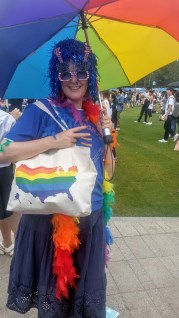 ady in rainbows and feathers who, when I asked if I could take a photo, told me she was with the US Embassy. It turned out there was a whole row of Embassy booths there, each country sending official representatives to support LGBTQ+ rights (and promote tourism, let’s be honest). And for just a few hours, I was really proud of my country for making this public, overt, international, diplomatic, and above all enthusiastic statement of support for LGBTQ+ and gentle pressure for Korea to catch up. (
 rain, they dancers just put on some plastic ponchos and kept right on dancing. I heard later that some of the protesters had apparently been praying for rain to ruin our day. I can only imagine their frustration when we didn’t let it dampen our spirits. If anything, it was a refreshing cool down during the summer heat!


 The “parade” did have some “floats”, but it was not what we tend to think of as parades these days. There were a few trucks out in front with banners and people in costume on display in the truck beds, but the majority of the affair was much more akin to a political march than a celebratory parade. The walking area had us leaving the plaza, going up several blocks and around a big loop before returning to the plaza. It was around 3km, so not a huge hike, but definitely enough to attract attention, which was the point after all. The trucks out front
  had a few decorations, mostly pink triangles and rainbows, and the people on the trucks were holding pro-love signs and dancing to encourage the crowd. There was nothing like a “parade float” in sight. Actually, that’s not totally true, the protesters had some pretty swanked up gear on the side of the road, but they didn’t march with us.


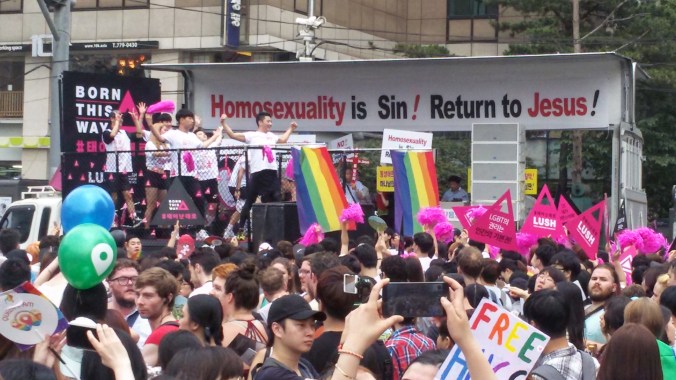 There were plenty of protesters right at the start of the route near the plaza, but as we went on, their number dwindled and the amount of supportive bystanders increased. I’m so incredibly proud of the marchers that day.
 marchers yelled back “I love you”. We echoed their “hallelujah”s and smiled at them and blew them kisses. I’m personally a big fan of meeting hate with love, but it’s
 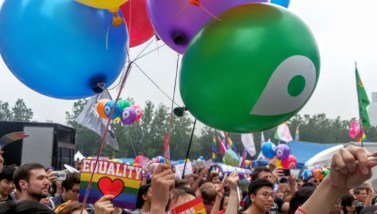 As the protesters fell away, we began to notice people on the sidewalk holding signs of support or waving and smiling and giving us thumbs up signs. Restaurant owners leaned out of their second and third story windows to wave down at us. A group at Starbucks had clearly planned ahead, because not only had they gotten seats right by the window, but they all held up rainbow signs reading “support equality”.
 The location for the party was stunning: a man-made island in the river. The buildings were huge and fun to look at with sweeping shapes and color changing windows. The party itself was a little lackluster for my tastes, but the one great thing about it was that it was about 98% Koreans. I sound like a broken record, but a lot of events I’ve gone to have had a large expat attendance and that’s fine for fun fun festivals, but this is more than that, it’s a civil rights movement with some party trappings and there can’t be a movement if the people of the country aren’t behind it, so it made me really happy to see so many Koreans there being openly gay in a way they can’t be in their day to day lives yet.
 There were some vendors in the main hall selling snacks and t shirts. The VIP lounge was quite classy, but the line for the bar was insane. The mojitos were outstanding, however, and there was a classical quartet performance as well. The dance floor was roomy and the DJs were fun, but he dancing was very Korean. This meant that groups of people got up on the stage and danced the moves to K-pop songs while the audience/dance floor did their best to keep up with the same moves… that they all knew… to all the songs. This is an aspect of Korean culture I may just never get used to.
 That lasted until Monday morning when I opened my Facebook.
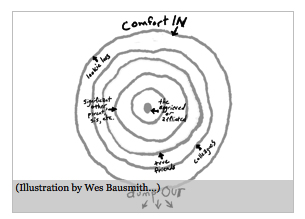 This Monday was the same way. I read the news, several times. I even went to google to find an actual journalistic report or 20 and not just some Facebook posts. I got dressed, cooked breakfast, went to work. Explained to my co-teachers that I might be a bit emotional that day because there was a horrible mass shooting in my home country and proceeded to get ready to teach classes. I think I made it through 2 classes before I actually started crying. I didn’t know anyone involved. I’m somewhere beyond “colleagues” yet well inside of “lookie loos” on circle of tragedy in
 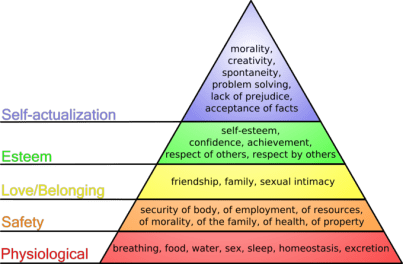 Love and belonging are the third tier of Maslow’s hierarchy, only overshadowed by the need for food and safety and integral to achieving esteem and self-actualization. They are NOT OPTIONAL for humans.
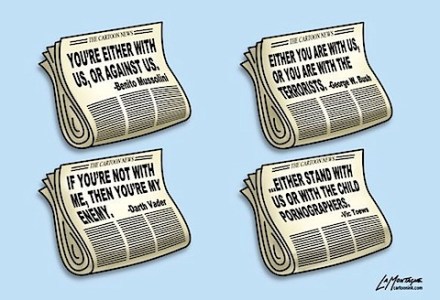 America is fascinated, hypnotized, enslaved to the idea that every issue has two and only two sides which are so opposed to one another that any form of compromise or middle ground is simply unthinkable. I don’t mean uncomfortable to think about, I mean, people’s brains are actually incapable of thinking the thought. Thought rejected. This is known as the “
 Even in this way, Americans are dichotomous. You love it
  And while we’re at it, a side note on false equivalencies. , such as this lovely comparison of Obama to Hitler. Both were in favor of a policy, therefore they are the same? No. Obama =/= Hitler.
  We need to stop buying into A or B. We need to ask “why” about everything over
 In America, when someone says something insulting (about your faith, your lifestyle, your weight, appearance, gender, orientation, skin color, etc) the result is all too often “You’re an adult, suck it up”. The expectation is that adults should just be able to deal with being insulted or having their feelings hurt (even though arguably many of these insults are signs of bigotry and oppression and not just about hurt feelings).


 America is overly negative. I definitely feel like America is turning (has turned?) into one big crab bucket. People tell me all the time “every place has problems” as a way of minimizing the problems in America or somehow trying to equate them with problems in other places. People tell me all the time, “not everyone can just leave” as a way of reasoning out why they can’t.

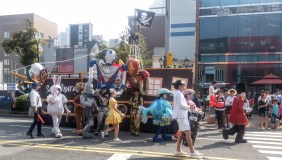 As soon as we stepped off the subway, we were greeted by a parade. This is the second one I’ve seen at Haeundae and I’ve only gone down there a few times. I’m not sure if it was for the sand sculpture festival or the Port Festival, but it was fun to watch. There was a pirate ship, some movie characters, dragon dancers and plenty of people in random costumes.
 When we arrived at the beach we were greeted with banners, flags, a crazy fish/car/bike, a giant cat bounce-house and some para-sailors with giant fan propellers. The first few sand sculptures were smaller, about the size of a car, and were clearly propaganda or advertising rather than part of the art display. Nonetheless, the skill involved in creating a sculpture from sand that had such precise shapes and lines was awe inspiring. I’ve worked with clay before, and it holds a shape well. It has tools that you can use to create super flat surfaces or precise curves and lines. But anyone who has tried to build a sandcastle knows that sand is treacherous, crumbly and not easy to shape.


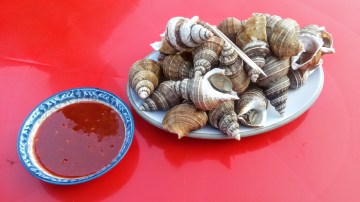 We spotted some mussels, of which I am a big fan, but then right next to them I saw some beautiful spiral shelled mollusks that I’d never tried before. I was hopeful that they would be a similar taste experience to the mussels nearby, and I proposed that we split a plate of new experience instead of going for the safe bet. This was not a disappointing choice. I understand that for some, the concept of oysters, mussels, and other sea mollusks is not an appetizing one. For me, well, there’s a reason I loved eating in Japan so much. Most of the animals in the sea are flipping delicious. Especially fresh. These little morsels were no exception. The plate of shells was served with wooden picks for us to pull the flesh from the shell. The fascinating part was that the shape of the meat was the same as the spiral shape of the shell, maintaining it’s spring-like appearance even after it was removed. Instead of garlic butter, the Koreans enjoy their shellfish with a spicy yet piquant chili sauce. So yum. The shells were too beautiful to just trash, so I tucked one away in my bag and now it lives on my souvenir table.


 The FB ad said the show started at 10pm, and that cover was free from 9-11pm, so we decided to head over to the bar in time to get in free and get a table before the show. In this endeavor we were wholly successful. The Yaman Joint turned out to be a Jamacian/Rastafarian themed bar with a small stage and tiny dance floor. We were shown to a table and left with a tablet menu. The drinks were a little more expensive than I was used to at our neighborhood dive bar, but not crazy. Plus, they had shisha on the menu. For those of you who don’t remember, I fell in love with the flavored tobacco served in hookahs while living in Saudi Arabia. (I know, smoking is bad. Don’t smoke kids.) It’s not something you find much outside the Middle East, and often it’s not very well made when it is. The Shisha here was a very reasonable price, so we ordered some double apple flavor and a couple of tri-colored frozen rum drinks and settled down to wait for the show in abject happiness.
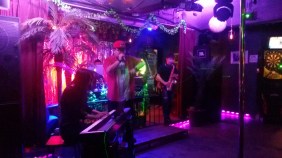 Around 10pm, a young lady came out and started doing a little light jazz on a piano keyboard. Soon she was joined by a saxophonist and we were treated to a mellow improv performance. Next a tiny little Korean woman dressed in plain black slacks and a white blouse came on stage and channeled the soul of a pop diva. Just when we thought it couldn’t get any better, a big guy came out with a mike and started beatboxing. I’m not a huge fan of this activity unless it’s done well. This man was talented. Not only was he good, but he became the third “instrument” along with the piano and saxophone. If you’ve never heard anyone do a jazz/hip-hop improv with piano, sax and beatbox, I recommend you make that happen.


 My eye was drawn instantly to the Whisky Sour which included fresh lemon, sugar and egg whites. Sour mix is a sad abomination of citric acid and corn syrup that can only fool someone who has never tasted the real thing. Aside from the difference that fresh fruit juice can make, the egg white makes the whole beverage rich and a little creamy. I’ve had only a couple in my life, and I was never able to order a “regular” whisky sour again afterward.
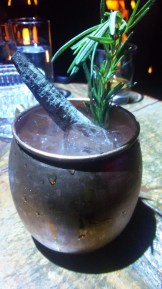 We stepped out onto the balcony between rounds and were treated to a wonderful city view and the pleasant summer night air. For my second, I chose the TBR (the Back Room) Mule. A twist on the Moscow Mule, it was made with ginger syrup (not just ginger ale) and came with a sprig of fresh rosemary and a rough stick of cinnamon bark that was charred briefly to activate the oils. It was served iced in a copper mug and had a light smokey smell from the cinnamon that was deep and savory along with the copper tang and hint of rosemary.
 I don’t know if it was actually bigger in square meters, but it was definitely a better show. Not only were the paths lined with labeled examples of countless species of tulip, there were also beautiful scenes created by planting the flowers by color to paint a picture on the ground that we could view from a central platform on a hill. Not quite as intense as the
  Our original plan had been to depart before sunset (well, I thought it closed at 6pm after all) making any challenges to get to our (second) hotel slightly easier, but remembering the awesome difference at Jinhae from day to night, I began to lay the groundwork for our staying after dark. Throwing caution to the wind, I carelessly suggested that we didn’t need to worry about transportation yet, and that we would never forgive ourselves if we came all this way and then missed the night light show.


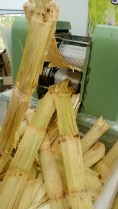 We found an international food tent where we got some doner kebab (which is apparently the Turkish word for Shawarma). They had booths from several different countries, although the food was not always what I consider representative. Italy had some kind of deep fried “pizza” wrap. England was corn dogs and fried potatoes. Argentina had some serious meat kebabs (the kind on skewers), Japan had takoyaki, and I think America had coconuts. We found some ladies making fresh squeezed sugar cane juice at the Vietnam stand and in a fit of childhood nostalgia I got us a couple of these breezy decadent treats.
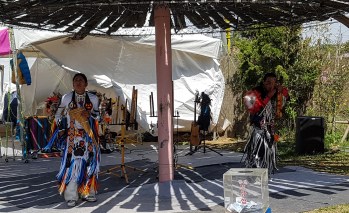 There were also several areas selling random stuff, not necessarily souvenirs, but just random stuff. The native Americans from Jinhae (or more likely a totally different group of native Americans, since they didn’t really look the same) were there performing. We stopped and listened for a while before I realized they were singing in Spanish, which just about made my head explode from culture clash. They were selling dream catchers, CDs of their performance, and other knickknacks that were a mishmash of native American jewelry styles. There were also some booths from Peru, India, and maybe Senegal with their vendors, clearly as foreign as we were, selling goods that must have seemed exotic to the local Koreans that made up 99.9% of the festival goers.
 On one side of the festival, we came across a small menagerie with goats the kids could feed, an aviary with peacocks, geese and chickens, and a few adorable bunnies that reminded me of my own China-born furball of yore. Next to the animals, there was a tent filled with orchids and antiques. I’m not really sure why these two things went together, but we admired the antique armoirs and old-timey farming equipment alongside the beautiful hothouse orchids, including a room where the orchid pots had been artfully arranged to create a heart shape on one wall.


 Convenience stores in Korea not only sell cup noodles, but supply hot water, disposable chopsticks and a place to munch your snack/meal. So we bought some ramen and sat down at the picnic table out front to have breakfast. I was starting to feel like we were the only white people in town… maybe ever, the way people stared at us. In Busan, I can go my whole work week without seeing another foreigner, but the Koreans here in Busan are more urbane about it, either simply not caring or being much more subtle with their staring. On top of that, there’s some serious stereotypes about how white folks eat, travel, go on vacation and sitting out front of this convenience store eating ramen broke them all.


 bubbles floating in a pool. Two of our own retinue eventually tried it out, and while they looked like fun devices, they weren’t available on the ocean. We watched young and old try to catch fish by hand in a similar large but shallow pool. They were impressively large fish too, we’re talking a good meal, not a pet goldie. t At one end of the festival, there was a large stage set up a with an array of entertainment and the focus of the festival was, of course, the food!
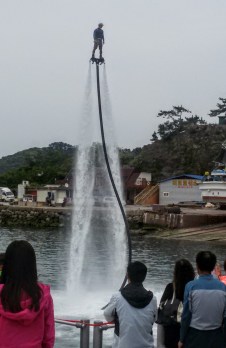 There was a brief display of some kind of water board device (not the torturing one) that basically allowed it’s wearer to fly on jets of water. It looked like nothing so much as a classic Aquaman move and the audience was suitably impressed. There was some jazz improv saxophone music, and a dance performance that seemed to be an imitation of some kind of ancient ritual. Folks were dressed in traditional clothes and made offerings to an actor in a straw beast costume until the offerings were accepted. As they danced around the made up village square, a man in an old fashioned clown costume capered around the performers and audience making ribald jokes and gestures. He encouraged the male audience members to stuff money in the bra and panties he had on over a white shirt and pants set, but under his clown costume, and then he got the ladies attention and made an… amusing shape at his crotch with his wrinkled hands. It was nice to see the Koreans around me laughing along and not being too embarrassed. We took our time walking up and down the seaside, checking out the wares and goodies, listening to the music and generally being relaxed.


 the government runs a nifty
 Gallivantrix