Clash of the Bureaucracies

Its been a while since I’ve written. I started this blog in an attempt to get used to blogging before my Middle Eastern adventure began. I thought I’d be further into the process by now, but it seems that I underestimated the true nature of the Bureaucracy I’m facing. I wasn’t originally planning on posting about the boring steps of getting ready to go, but it’s now reached a level of absurdity, that I feel I should share. So for anyone who is planning on travelling to a country that requires paperwork to get in or get employed, enjoy the horror story and learn from my pain.

The last time I was employed overseas it was in pre-Olympics China, and all I had to do was apply for a tourist visa to get in, and then my employment visa was done in person once I arrived. The Saudi visa process for employment is especially painful, but it isn’t just Saudi Arabian Bureaucracy, its the US as well.

Let’s go back to the beginning.

I was interviewed and hired in early May. They sent over a contract which I signed and returned in mid-May. The school sent me a list of things to do to get ready, stressing how very important it was to be able to send off my visa application BEFORE June 3rd.

Things included:

1) Verifying my academic credentials – for which I had to gather official transcripts from three schools, notarized copies of my degrees, and letters from the registrar’s offices verifying my attendance to the school. The first two are a pain, but the schools and notaries are used to these requests, so still fairly standard. However, registrar’s offices are not accustomed to being asked for letters of verification that inlcued the student’s social security number. There is an online service called the Student Clearinghouse where employers or schools are supposed to go to verify attendance or degrees. So there were a couple weeks of emails and faxes trying to get these registrars to understand that I could not use this service and needed this very specific letter that someone was actually going to have to compose rather than automate.

But wait, there’s more. These then must be sent to a separate office in Virginia to be authenticated by the Saudi Cultural Mission before they can be used as part of the visa application! The Cultural Mission’s instructions say to include a pre-paid return envelope. They specifically say no FedEx account numbers, but an envelope with the official words “pre-paid” on it. By the way, FedEx doesn’t do this. UPS does pre-paid envelopes, but they don’t say “pre-paid” they just say “return label” and when dealing with language barriers and bureaucracy, I wasn’t sure that would cut it, so the poor lady at UPS and I had to come up with a way to incorporate the words “pre-paid” into the label with the very limited options the software provided, and ended up putting it on part of the address line.

2) Police report of my (lack of) arrest record – which should be simple enough: fill out and print this form and mail it in with a check. But Seattle PD sent my form and check back to me because I missed an instruction, and I had to start all over again, adding more weeks to the process. And you thought I was being paranoid about the details.

3) Medical Exam – this was the most extensive exam I’ve ever had. Not all of the materials needed could be gathered on my single visit to the office, and I had to take home a sample kit and go to another facility for a chest x-ray. I could also only get to the Dr’s office one day a week, so a week after my appointment, I drop off the sample kit. And a few days later get a call saying it was the wrong one. So the next week I go back for the right one, and a week later return that. The final results were then sent to the wrong doctor… it took a month to get the form after my initial appointment.
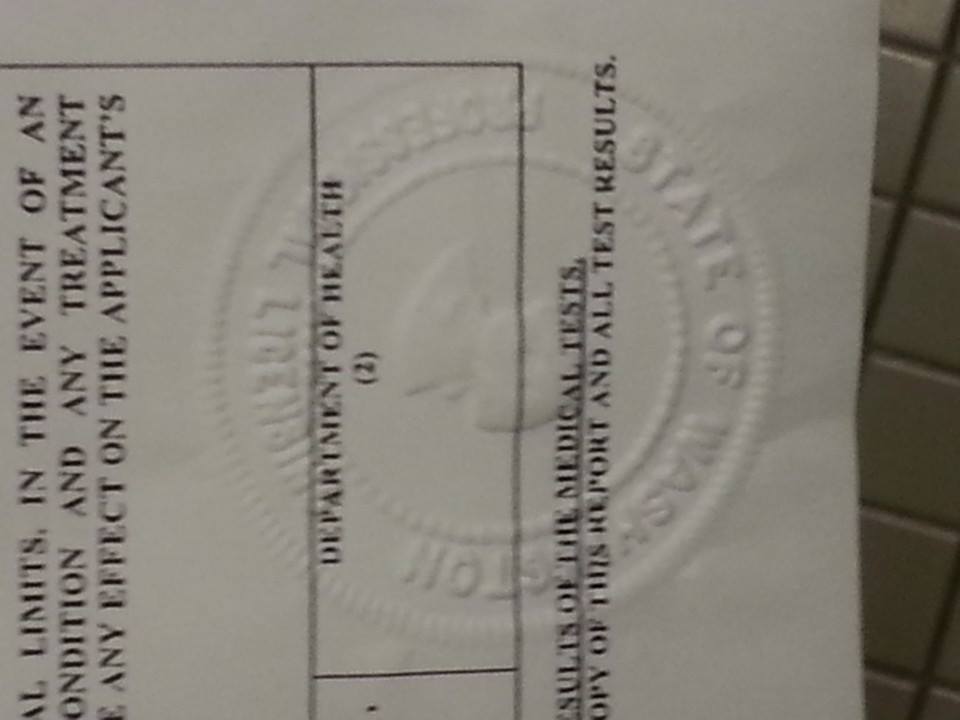
DoH sealBut wait, there’s more. It isn’t enough that a doctor has filled out this form in triplicate and I have two copies of the 15 pg lab report. I must get these forms stamped by the Department of Health, and this means a drive to the state capitol. This involved three hours of driving and 5 minutes of standing in an office to get three pieces of paper stamped.

I should mention here, this part of the paperwork is only valid for 90 days, in this case from the date of my initial visit on May 28th to August 26th. I have to enter the Kingdom before August 26th or this paperwork expires, and I have to do it all over again.

4) Finally, the original letter of invitation from the company itself. There are other fairly simple things involved, like the actual visa application form, and a copy of my employment contract, but those are soooo simple, I’m not going into them here. The letter of invitation is issued from Riyadh, and is a document primarily in Arabic that includes (among many other things) my name and the visa block number that the company has obtained for my use. I cannot tell you why I do not have this yet, only that it is possibly the most vexing part of the whole process.

At the end of June, I got an email from the Riyadh office confirming my address because they had a package to send me. Hooray! I thought, finally the letter. But, our FedEx delivery guy doesn’t think his job includes using the apartment buzzer on the front of the building, and instead just leaves the little note saying I wasn’t home (even though I was). This is July 3rd, so there is no way for me to get this again until after the holiday. I try to go online and request the package be taken to a drop off location instead of my apartment, but the website tells me that my address doesn’t match the address they have on file. What? So I end up sitting in the FedEx hub at 630 Monday evening waiting for the driver who won’t even try to deliver my package to bring it back so I can get it.

20140708_135334I go through all of this, open the package and find a badly photocopied document in Arabic and the original employment contract. Now, I don’t need the original contract for anything, but I thought maybe they were just sending it along with a necessary document. But as I reviewed the visa application process on the Saudi Embassy website, I noticed a couple of problems. This document was a photocopy, not an original, and it had no sign of my name anywhere on it. Just to be meticulous, I searched all the Arabic numbers (Eastern Arabic is quite different looking than “Western Arabic” numbers we use here) to see if I could find my passport number anywhere, no luck.

A couple more days of emailing with the school and I find out this is the company’s commercial registration certificate: a document I do not even need!

Now, I know I won’t loose this job over a late start that is brought on by the lack of proper paperwork, because every other teacher is in the exact same boat. In fact, the school tells me I’m well ahead of most other teachers in processing my paperwork. What? But here I am, 42 days from the expiration of my medical paperwork, 38 days from the supposed start of my job, and I haven’t even been able to apply for the visa yet, let alone make any plans for departure including flights, when my last day of work in the states should be, when I can tell my roommate I’m moving out, when I can cancel my car insurance and cell phone service, and when I can throw the all important going away party.

What’s the take-away here?

Well, first off, do your own research when planning to travel. I saw so many websites that assured me that my employer would take the lead in helping me process my visa paperwork, and while they have hired an agent to manage getting my application and fee to the embassy, they have pretty much been useless for everything else, and downright misleading in timing, since they told me to do my medical exam on or shortly after May 27th. From now on, reaearch employment visa procedures before or during job hunts rather than waiting until you’re hired and relying on the company to help.

Secondly, appreciate the lesson in patience. There is nothing like conflicting bureaucratic and corporate systems to create a seemingly endless and unnavigable obstacle course, but you are not the first person, nor even the only person right now, trying to navigate it. Your plans and dreams will only fail if you give up.

Finally, hold on to the story so that when you’ve finally made it to the destination you can look back and laugh, because it will be as nothing compared to all the new challenges you face while living and working in a new country. A little adversity makes the adventure more vibrant.

Book Review: “Girls of Riyadh” by Rajaa Alsanea

I know there’s a lot of book reviews in a row, and I promise this isn’t a book review blog, it really is a travel blog. But right now, since I’m only getting ready to travel to Saudi Arabia, I’m sharing my preparations, which include reading a lot of books, watching a lot of films and documentaries, and filing a tremendous amount of official paperwork.

I finished this book in a single day because I could not put it down. I read it in my office between phone calls, at my regular Tuesday karaoke outing between songs (don’t judge). Only skipping reading while at the gym because I couldn’t hold the book steady while working out, I finished the last few chapters in bed.

This book is hailed by many reviewers as being “Sex in the City” in Riyadh, but I’ve never watched that show, so I have no idea how accurate that comparison is. All in all, I think I’m grateful for that, because I may have missed the deeper messages in the book if I was just looking for a sordid tale of Saudi sex life.

I am a little bit confused as to why my Saudi employers recommended this book to me as preparation for my move to the Kingdom a) because the book is banned in Saudi Arabia, and b) because it shows parts of life there that Saudis do not (as a rule) like to admit exists in public. The girls in the book are all upper class, and quite well off, so this isn’t necessarily a reflection of all economic strata of Saudi life. So I wonder, will my students be like these girls?

I found myself having imaginary conversations with Saudi women (and men) about my own values for love, dating, and marriage. I am a spinster in their eyes, an anathema or at very least an enigma. Yet, we are not so very different, for all that women’s lib has brought me. Perhaps this book can be a launch point for many real discussions once I settle in and make some Saudi friends.

On to the book.

downloadI’d like to recommend that anyone who wants to read this book get a good and thorough (mis) conception of Saudi life. Many things discussed in the book are only titillating in the context of a society that entirely bans the social interaction of men and women who are not family. In America, these kinds of romantic stories are common enough among middle school girls: texting or talking on the phone until dawn, showing off gifts from an admirer, even a timid first kiss!

The girls may be catty, shallow, brainless and hopelessly in love, but they are loyal to one another in a way rarely seen in the West. What does this say about the way we compete for men? Is it that cultivating male friends makes women in the West less trusting of one another? Or is the Arabic language so ill equipped to express jealousy? I certainly do not know the answer, but if there’s a way to restore strong female bonds, cooperation, and genuinely being happy for each other when fortune comes our way without sacrificing our hard earned civil rights, I’m all for it.

In the beginning of the story, I found myself marveling at the daring and audacity of these young people, the way that they cleverly pursued romance in the face of their cultural restrictions. Then I became disgusted with the school girl crushes being described (not the least because they reminded me a bit of my own adolescence). And finally I came to see the beautiful subtlety that Alsanea used to create four (or 5 if you count the narrator) stunning avatars of women’s love.

They are Lamees: a model of blissful marriage to a first love, Gamrah: a cheating husband, and a tragic divorce resulting in single motherhood, Sadeem: who loves a man more than he loves her, and settles in the end for something safe, and Mashael (who I personally most identify with) who upon finding her first love not strong enough to fight his family to be with her, determines that she will not settle at all, and instead lives her life for herself.

I may be biased, after all, I am a “liberated Western woman”. Divorce is common in my family, and dependence on men has never been. I sometimes feel that the amount of time and effort women put into the pursuit of a husband is insane. However, I don’t think it is unique to Saudi culture. They are reflections of women everywhere, and I think women of any cultural background would find themselves and their friends echoed in the Girls of Riyadh.

Book Review: “Understanding Arabs” by Margaret K. Nydell

As I continue to work my way through my recommended reading materials in preparation for the move to Saudi Arabia, I bring you another review.

ua_5This is a simple and easy to read book. The writing style is not overly academic, and the pictures Nydel paints of the Arabic people and culture are quite vivid in the imagination. However, the depth of understanding of Arabic culture and history leaves something to be desired.

The first 10 chapters are almost like a step by step guide on how to understand, communicate with and even integrate into Arab culture. Behaviors and customs are explained clearly, and a solid list of do’s and don’t’s is presented. Nydel is clearly enamored of the Arabic cultures, and it shows in the unapologetic positivity of these chapters.

Chapter 11 addresses the differences between Islamism (extreme fundamentalists) and mainstream Islam, leading into  chapters 12-13 where Nydel takes up the task of explaining the anger and violence between Arabs and the West from both sides. She relies heavily on quotes from media outlets and statistics to demonstrate the points in as non-emotional a way as possible. While this is a stark contrast to the joy of the first 10 chapters, and did make this section more difficult to read, I can understand why she would handle such a delicate matter this way.

Chapters 14-16 are a breakdown of Arabic culture by region, and country. Wikipedia articles can tell you more about these countries history and current economic, social and political climate than the brief 1-2 page whitewashed versions presented by Nydell. I was really disappointed in the elementary school social studies approach to the region, especially after the first ten chapters of beautiful cultural presentation.

She finishes off with an Appendix on the Arabic Language, but again, much like her country by country analysis, the linguistic introduction does not tell you much that would be useful if you do not intend to study the language, and doesn’t tell you anything that a first year language book would not cover. Her information does not appear to be incorrect, merely superfluous.

Overall, the first ten chapters are great for anyone seeking to better understand the (pan-)Arabic culture in a positive light. I really enjoyed reading about the cultures and customs from the perspective of someone so clearly in love with them. If made a nice contrast to the negativity so often presented in Western media. However, the remainder of the book is really only useful to those who are complete newcomers to the study and understanding of the Middle East.

I especially do not understand why this book was recommended to me as a preparation to go to Saudi Arabia, as Nydell routinely reminds the reader that her descriptions of delightful Arabic culture exclude Saudi Arabia without being able to say what the culture is like there instead, and moreover that the brief section on Saudi Arabia in Chapter 16 demonstrates further her lack of knowledge, experience and enthusiasm for that country.

So, enjoy the book for what it is; give it to someone you know who needs a little mind opening about the region, but I wouldn’t rely on it for a guide to Saudi life, or deep political understanding of the current conflicts.

Book Review: “Saudi Arabia Exposed” by John R. Bradley

As a part of my preparation to move to Saudi Arabia this August, I have a reading list. I thought I might share my thoughts on these books as I finish them.

8466c060ada0d12b0946a110.LJohn R. Bradley’s Saudi Arabia Exposed has a very “expose” feel. There is a lot of focus on what goes on beneath the surface, both good and bad. You may feel like you need a map and a genealogical chart to make sense of some of what he says, but it is definitely a unique perspective, combining personal experience with historical/political journalism. Bradley himself is a journalist, and was the first Western journalist to be offered a residency in Saudi Arabia (instead of just a visitor’s visa).

I found myself on an emotional roller coaster of hope and despair as I read about improvements in education and minority rights, while at the same time seeing the violence, drug use, and oppression present; learning about the presence of gay clubs alongside the absolute absence of heterosexual dating opportunities; and observing the pure schizophrenia of the Saudi desire for fundamentalist Islam to provide meaning to their lives along side the prolific use of “western” vices such as alcohol and pornography.

One striking thing to bear in mind while reading this book is that it was researched, written and published in the years just after the September 11 attacks. Many of the events, policies, and social climates described are a decade old. This may not seem like much time, but consider how much has changed in these last 10 years. The book is still well worth reading for the recent history and the first hand stories of life in the Kingdom, one must simply bear in mind that the current state of KSA may be different from the “current” shown by Bradley.

Part One is primarily a background and introduction to the social and political landscape of modern day Saudi Arabia. Chapter one covers mainly Jeddah and the history of the Hijaz. Chapter two focuses mainly on Al-Jouf. Chapter three on Asir and fringe social groups/customs. Chapter four is dedicated mainly to the Shia minority. Chapter five focuses on the younger generation, and the issues of being raised by foreign servants, taught Wahhabism in school, and Western consumerism at home.

In each chapter there is a reasonable balance of the depiction of hope and violence as he examines the turbulent history of the Al-Saud/Wahabi regime. The liberal Saudis who wish to depart from Wahhabi religious rule into a more moderate and modern form of Islam are not made to seem like heroes, nor are those more conservative factions painted as villains, but rather Bradley shows the (recent) historical and political motivations behind the factions in KSA in such a way that make their actions comprehensible to outsiders.

There is even an analysis of the history of the bin-Laden family, and the impact of the September 11 attacks on the socio-cultural landscape of Saudi Arabia, which I found really nice, because American media tends to be very mono-focused about this incident, forgetting that the kinsmen and countrymen of the perpetrators were also devastated by what occurred.

Part One finishes off with a more bleak examination of the younger generation, exposing the contradictions in Wahabist teaching and Western indulgence present in the wealthy, as well as the general lack of preparedness by the youth for a global society. Bradley fears that such internal contradictions, paired with a lack of education in how to deal with them are leading the Saudi youth toward renewed fundamentalism, rather than liberty.

Part Two is a bit more of what is going on “right now”, being the early 2000’s. Chapter six is a stark look at the expat situation, including violence against Westerners and the exploitation of Asian and other “third world” blue collar workers. Chapter seven is an even darker look at the crime statistics including public beheadings, corruption, drug use and violent crimes. Chapter eight discusses the gender divide, delving into homosexual culture among men, and the struggle for women’s rights. Chapter nine is mainly about the media and journalism’s fight for free reporting. And chapter ten is a wrap up and forward look.

As I mentioned before, the immediacy of Part Two is somewhat diminished by the passage of the years since it’s publication, but still an interesting, albeit disturbing insight into the evolving Saudi landscape. Part Two is not for the faint of heart. Where Part One offered a fair balance of hope and cynicism, Part Two is exceptionally dark. I found myself turning to the internet frequently to see what if any changes for the better might have occurred since the 2005 publication, such as last year (2013)’s passage of the anti-domestic violence laws in Saudi, offering some relief to battered women where none had existed before. It is important not to overlook the problems within any society; however it is equally necessary to look at the progress, so don’t be afraid to scour the news or go to an expat forum and ask the people living there now how these things are playing out in the Kingdom today.

Bureaucracy and Paperwork for All

Certificate_Attestation_for_Saudi_Consulate_Document_AttestationAs I prepare for my journey to Saudi Arabia, I am confronted with the giant mountain of paperwork required to get the residency/employment visa. Understand that Saudi Arabia has been closed of to Westerners and/or non-Muslims for most of forever, and I understand that the government is interested in fostering tourism soon, however, to live and work with privileges of residency, one must still go through the gauntlet.

If you care to, please  see for yourself , but bear in mind that several of these steps are deceptive. Academic Verification, for example, is a whole other list which requires (among other things) official sealed transcripts, notarized copies of degrees, and a letter from the registrar verifying your attendance. I’m almost done with this, finally. Waiting on the mail man to bring me the transcripts and the last letter after a mere two weeks of ordering forms and frantic emails to the 3 educational institutions that have graced me with instruction. Once these are obtained, they must be sent to the Cultural Mission, where they will be further verified for another 2-4 weeks, and your approval will be mailed back in your pre-paid fed-ex envelope.

The delay might be a good thing however, because I finally opened up the medical exam form that my doctor has to fill out in triplicate and have certified by the board of health or the college of physicians. At least I’ll have time to get all the lab work done and stamps collected while I’m waiting for my degrees to be verified.

Oh, and lets not forget that Ramadan is in July this year, so right when I’ll be submitting this whole steaming pile of red tape, the embassy will be closed most of the day for a month. Its a snail race to see if I’ll get my visa before the August 22 start date of my employment offer. Ready, set, CRAWL!