For those who have just joined my Malay adventure, be warned that this is not an idyllic tropical vacation. I didn’t book a package tour and the consequence of managing all my own transportation was an increasing series of unfortunate events that at best forced me to learn and grow as a person, and at worst made me want to drop Thailand off the edge of the galaxy (it’s a disc, it totally has an edge). Koh Lipe is a tropical paradise. It came so close to being the real blue ocean, beach bumming, umbrella drink having vacation that I’m dreaming about. Maybe next year.
The Langkawi Ferry Terminal
 The only way to get to the small island of Koh Lipe is by boat. I booked online in advance because I didn’t want to worry about tickets selling out. The only reason I was in Langkawi in the first place was to catch this boat to Koh Lipe. After the walking fiasco of the day before, I opted to get one of the islands fixed rate taxis back to the port and arrived 2 hours before the ferry’s departure time, as I was advised to do.
The ferry terminal on Langkawi is like most transportation terminals in Malaysia in that there are a million teeny tiny travel agency booths selling tickets for all the same things. All I had to do was find the agency I booked with and check in. After going around the entire block without spotting it, I was forced to approach another booth for directions to one of their rivals. The first people I asked tried to tell me that it had closed down.
Trying not to freak out on anyone, I pointed out that I’d already bought my tickets online and once they realized that I wasn’t looking to buy tickets (read not a prospective customer) they pointed me in the right direction. This turned out to be nowhere near the other offices and in a totally different building on the second floor “above the Baskin Robbins” (information that could have been included in the email, thanks not thanks Tigerline).
When I found the office it was not open. The email said it would be open 2 hours before and it was now 90 min before. I was told 10 minutes (this is never true, it’s a mythical number that people in developing countries have learned to say to people from first world countries because it’s short enough to keep us from complaining or going someplace else). I sat down to wait, and about 20 minutes later someone came by to have us fill out paperwork and collect our passports.
I had not had breakfast or even coffee yet, as my base plan had been to check in and get my ticket, then to eat at the terminal where I had seen many restaurants the day before. I also had to change my Malay ringits to Thai baht because we would have to pay the longtail boat fare and national park fee in cash as soon as we got to the island. However, when Tigerline told us to show up an hour before departure, they really meant show up and wait around in their tiny waiting room. The staff (when they showed up) were helpful and friendly, however, and I was able to get away when I explained my predicament with the promise I would be back at the meeting point on time. I was in such a hurry that I did things out of order, changing my money before buying food. Since most places in Malaysia only take cash, I ended up at Starbucks for a breakfast I could buy with a card. This is my sadface. Especially since I loved the Malaysian coffee so much.
Where Are You From?
When your skin color doesn’t match the local population it’s a little obvious you’re a foreigner. The “good news” (no, not really) is that white privilege exists everywhere and that the worst thing that’s likely to mean for me is getting overcharged. More often than not it results in people going out of their way to be gracious hosts and good representatives of their country to me. The question I get asked most often is “where are you from?”.
I have hated this question my whole life because my parents are military and we moved for the first time in my life before I was even a year old out of the US and to a foreign country. With my family I lived in 3 countries and six states within the US. I’m not even sure how the word “from” applies to me. Now that I live abroad it’s even more complicated. While I’m in Korea (where I live right now) it’s easy enough to tell people I’m from America, but taking vacations I’m like “uh, well, I’m American, but I don’t live there anymore”, or “I’m American, but I live in…” whichever country I happen to be calling home these days. It’s not just about distancing myself from the negative perceptions of American tourists (although that is a part of it). It’s an attempt to give an honest answer. I may be an American and a tourist but I’m not going back to America at the end of the holiday, and I think my cultural perceptions are at least bit broader than the average tourist.
That morning in my tired, rushed state I just said, “Korea” when I was asked and then watched the look of confusion spread on the baristos face. “You don’t really look…”, he started, but was clearly unsure of how to finish the sentence without sounding offensive. I realized my mistake and came to an awkward rescue with my patented “English teacher abroad” explanation. The poor guy looked so relieved I couldn’t help but laugh.
Entering Thailand by Sea
 There are no piers on the island. Instead, the ferries anchor a ways out either at floating piers or just in open water. The one I arrived on docked with a patch of floating platform where we could transfer ourselves and our luggage from the speedboat to the smaller longtail boats that would take us to the island. I was amazed to see people arriving with massive piles of baggage considering the situation and was once more grateful for my decision to keep my luggage under 7kg.
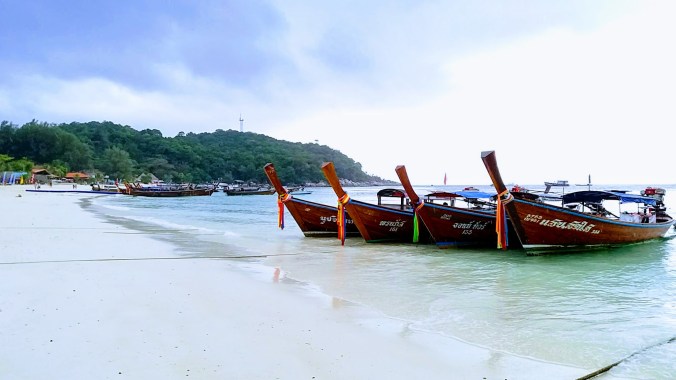
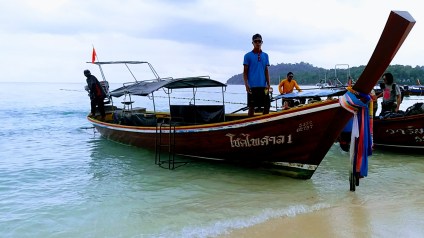 The longtails are small boats, named for the motor at the end of a long pole that juts from the stern and into the water. No more than a dozen people can board a longtail together, so the ferry passengers broke up into smaller clusters. Once the longtail arrived at on land, the local operators would hop out and drag the bow a little way up the beach and tie it to a mooring anchor there. The only way for us to get out was to take a splash in the sea. I quickly shed my socks and shoes and tied the laces to my bag, then rolled up my pants and took my first steps into Thailand through the sparkling turquoise water.
The immigration and national park offices are on Pataya beach, and I trod barefoot through the pale sand to join the queue. Best immigration line ever.
Getting Settled In
 Koh Lipe is 2km long and 1km wide. There are no cars, although it does boast a fair number of scooters which are the only taxis and freight transit around. The bright blue pavement of the main street, nicknamed “walking street”, is perfectly friendly to bare feet and most of people walking around were wearing some version of swimwear plus a light cover. Even outside the rainy season, SE Asia is subject to plenty of rain. I had arrived in sparkling sunshine, but shortly after I began to explore there was a brief but intense shower. It was strange that so many people dressed in swimsuits still ran for cover from the warm rain. I was still carrying my backpack and didn’t want every piece of clothing inside to wind up wet, so I huddled under my umbrella.
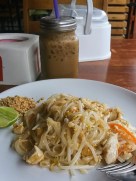 Getting a SIM card on Koh Lipe was so easy and cheap I only mention it so anyone looking for advice won’t be worried. Just follow the blue street till you see a sign for SIM cards and inquire within. After getting back online, I stopped in at a cute restaurant for my first pad thai in Thailand (but not my last, I love that stuff). The rain came and went a couple more times while I was eating but finally dried up enough for me to feel safe heading out to try and find my cabin.

Lipe Camping Zone
Google maps is not the most functional thing on a roadless island. It doesn’t do walking trails. Following the paved roads toward my cabin’s GPS co-ordinates took me the long way around the island. Eventually, I ran out of paved road and walked cautiously down a muddy path that had deep chasms cut by the rainwater making the walk a little more like a hike. Finally I found the campground deep in the jungle. Ok, you can’t get that deep on a 2x1km island, but it was halfway between two popular beaches on a muddy path surrounded by trees. It felt deep in the jungle. As I stopped moving a cloud of mosquitoes descended on my sweaty ankles.
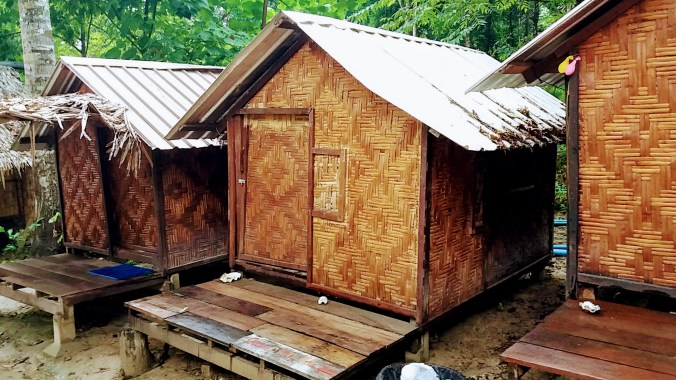
 The hostess was wonderful and kind. She brought out some repellent for me even before we finished checking in and got me settled into my cabin. Walking past the tents on the ground, I was extra glad I hadn’t made that choice given the rain. There were no real walkways in the campsite, so I was picking my way carefully down steep slopes and muddy banks. The cabin was equipped with a sort of futon on the floor, a mosquito net, and a fan. While I settled down to check the dryness of my bag and sort out my belongings, the rain began again in earnest. The path in front of my cabin turned into a river. Knowing that tropical rains are often breif, I decided to wait it out. My main activity for the day was written on my itinerary as “beach bum”, so I wasn’t in a particular rush.
Sunset Beach

When the skies finally stopped falling, it was late afternoon and I emerged from the cabin to head over to Sunset beach and find out if there was any sunset to be had. Koh Lipe is stunning. Even in the rain it is beautiful. I followed another tiny mud path to the far side of the island where I enjoyed taking gray sky pictures of the beach and mountains until the rain drove me into the shelter of a nearby cafe/bar. As I sat there enjoying my happy hour mojito and watching the rain, I was awestruck by the trees across the bay where white clouds rose from the canopy like the breath of hidden dragons. I once saw a documentary on rain-forests that explained how the moisture from a jungle would evaporate in great plumes, but this was the first time I got to see it in action.
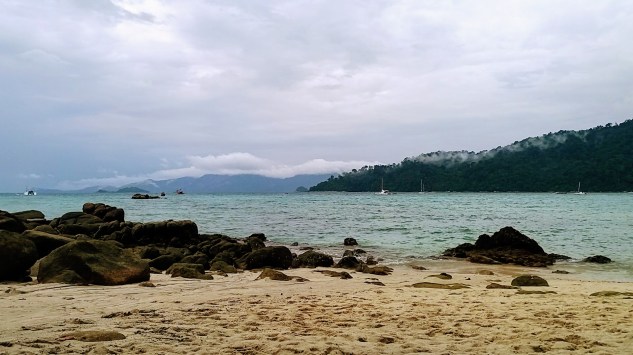
The rain eased up, but the cloud cover prevented any sunset light from reaching the shore. When it became apparent that the night was closing in, I headed through the jungle path to back to Pataya beach. I had hoped to spend the evening on sunset beach watching the famous sunset and seeing the stars come out in a low light pollution zone, but mother nature had other plans. Despite the rain, I enjoyed my first day on Koh Lipe. I liked the cozy atmosphere of the island and the ease with which I could go from a nearly empty beach to a bright nightlife spot. I have to say that while there was no sunshine, “beach bum” accurately describes me for the day, since I spent as much time as I could in site of the shore or with my feet in the surf. I finished off at a fancy restaurant which made me really appreciate the contrast between my own accommodations and what else was available on the island.

About the Accommodation
SE Asia is so cheap. So. Cheap. My cheapest room was in Ipoh and was less than 5$ (US). My average price was about 13$ per night. The cheapest thing I found on Koh Lipe (besides a tent) was cabin for 25$ a night. I looked at other places that were 5-10 times what I was paying elsewhere on the trip and went “oh no!” because somehow I lost perspective. Learn from my mistake. Spend the money. Hostels can be great, and I don’t mind shared bathroom facilities if it’s a clean place. I’ve been camping before. I’m usually ok with it. This is because I had never done so in a humid jungle before.
Did I mention I love Koh Lipe? I had a nice time in many other places on this trip, but Koh Lipe is a place I’m plotting how to get back to. One of the things I’m plotting is biting the bullet and paying for some lux accommodation. Why?
- Bathrooms. Most of Koh Lipe not only can’t handle paper (ok no problem. I’m used to putting my paper in the bin from China and Korea) but doesn’t even flush. Next to the toilet is a big tub of water and a ladle or small bowl that you use to transfer water from the tub into the toilet allowing gravity to swish away the waste with the added water. It’s not unusable, but getting to use the fancy toilet in the restaurant made me appreciate real plumbing. Plus, campsites or cabins with detached toilet facilities mean you have to get up and walk through mud and mosquitoes if you have to pee in the middle of the night.
- Mosquitoes. My cabin gave me a net, but by night two there were mosquitoes inside the net. There are fewer of the critters on the beach than the jungle, but fewer still in a solid room than a bamboo cabin.
- Sand. It sticks to you. You bring it home with you, and if there’s no way to rinse it off before you get in bed, or if your room is so small that bed covers ¾ of the floor, then you have a sandy bed. Ugh.
- Wet. It’s humid and it rains. By night two, everything in my room was damp and sandy. Having a separate space for changing out of sandy clothes and an air conditioner which dehumidifies the room are crucial to comfort.
- Soundproofing. Not only did I get to hear every word of the conversation my neighbors in the next cabin were having, I got to hear the guy on the other side hoarking up everything he drank that day.
Spend. The. Money. The most expensive luxury hotel on Koh Lipe is still only about 200$ a night. When you think about it like a 20$ a day backpacker, it’s impossible, but if you think of this in comparison with, say, Hawaii, it’s amazingly cheap.
Avoid the inland accommodations unless you just like jungles. They are cheaper than the beach front, but there’s reasons for that. I imagine with the right accommodation, Koh Lipe would be a 2km wide slice of heaven. Even with my cabin, it was quite possibly my favorite stop on this trip.
Cabin in the Woods: Night 2
My second night in the cabin was even worse. I had an amazing day full of snorkeling (which I will tell you all about in the next chapter) and finished off with dessert in the fancy restaurant again. When the whole day of exertion and excitement finally caught up with me, I meandered back inland to my tiny jungle hut. I couldn’t put on my shoes without the sandal straps rubbing the tender area on the top of my foot that had scraped some coral earlier in the day. My cabin had not dried out in the slightest during the day, resulting in a muggy, damp experience. While fighting to reassemble the mosquito net, I managed to spread more sand around the damp and lumpy mattress.
I also found a tiny frog and had to chase him around the bed for a while before he took off. I’m not scared of frogs, but I didn’t want to roll over on him in my sleep and hurt him. The campground shower was just enough to rinse most of the seawater out of my hair. I struggled to clean my injuries with inadequate facilities, tried unsuccessfully to sweep the sand off the damp mattress, sprayed for the mosquitoes that made it inside the net, and fantasized about staying in just about any other hotel on the island. Indeed, if I had stayed any longer on Koh Lipe, I would have booked a new place, but I decided I could rough it one more night and lulled myself to sleep with the memories of my amazing day.
The moral of this story is that Koh Lipe is a magical place, but I am not rough-it enough for jungle camping. Fortunately, there are other options for next time. And if the dour tone of the last few posts has got you down, stay tuned for Koh Lipe part 2, where I share the wonderful 4 island snorkeling trip and my first experience with glowing plankton!


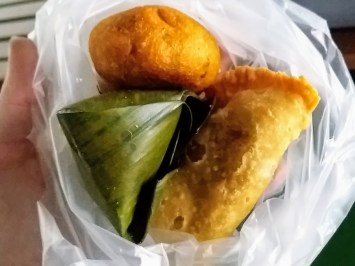 One was a glutinous rice ball wrapped in a leaf and filled with some kind of sweet coconut. The golden brown goodie was the one the husband most highly recommended: a spicy coconut bun in a wheat pastry (as opposed to rice) with a coconut filling similar in texture to the rice bun, but with a spicy kick. The coconut fillings were unique to my palate. It seemed like the coconut had gone through a ricer instead of a shredder. It was similar to vermicelli but also dried enough to be chewy without being crispy. The entire experience was delightful and I wish I’d bought 3 more!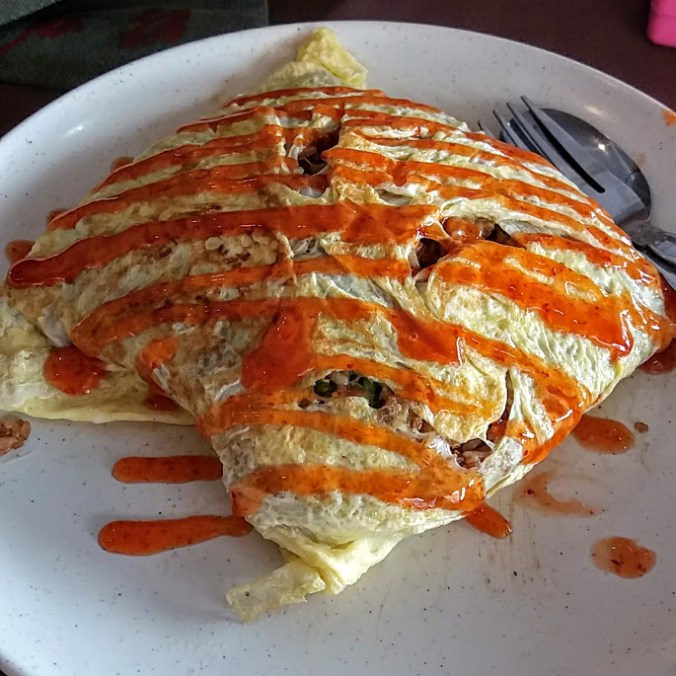
 The train from Ipoh to Butterworth was a delightful piece of transportation, and in retrospect, the last clean and comfortable transit option I would get on this trip. The train was spacious, sparkly clean and climate controlled with a nice view of the Malaysian countryside out the window. The train station in Butterworth is easy walking distance from the ferry terminal and bus station allowing me to take a quick detour and buy my bus ticket to Kuala Perlis. (there were only two running each day so I didn’t want to miss the morning bus!) Then I headed over to the ferry terminal to catch the quick boat over to the island of Penang. The ferry ride was brief yet delightful, with beautiful views of the cities and a cooling breeze.


 Laundry complete, I set off on a walking self-tour of the cheap clothes district. I am not normally a fan of shopping, but I have decided that if I am ever going back there, I need to do it with an extra suitcase. So many beautiful clothes, many inspired by Indian fashions, glorious batik fabrics and wildly reasonable prices compared to what similar fashions cost in the US. Skirts, shirts and dresses abounded, but pants were a little challenging. Free size is really a misnomer because it only applies to a size range from about 6-12 (US). the most popular pants seemed to be the Ali Baba style which are big billowy and flowy, but cinch around the ankle, looking not unlike the pants Aladdin wears.

 Eventually, I found some black pants that were a lightweight material and had a beautiful blue pattern around the cuffs. They were about 7$US, so I wasn’t overly concerned with the durability and I was delighted with the way they fit. Of course they were from India (I’m starting to believe all my favorite clothes are), but unfortunately, they are made of a material called “viscose”. I did not know what this meant at the time. I had never heard the word and I was so desperate for pants at this point, I didn’t really care. But later, while laying in the AC of my hotel room, I looked up the word and discovered the world’s most temperamental fabric.
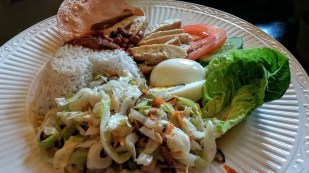 I tried to find some local-ish dinner food, but my travel weariness led me in the end to a little boutique restaurant near my hotel that was more expensive but also vastly more comfortable. Amid the offers of western sandwiches and pasta, I found a lone offering of the national dish: nasi lemak. Omnomnom.
 out for a beer in my new tropical get up. I got the impression that Georgetown is so popular among backpackers and expats for a combination of it’s strong western influence and plethora of cheap bars. (many places have a regular “ladies night” menu which are totally free or insanely cheap) I wasn’t particularly sad to leave it after only a short time, but I can see how it would be a refreshing break if I were on a multi-month trek of SE Asia, and I’d definitely love to go back for more clothes when I’m not backpacking.
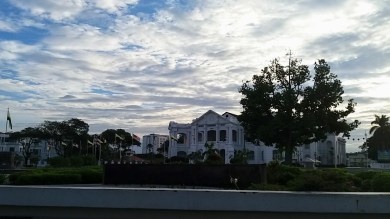 When I woke early that morning, I had only two main goals: to catch the morning train out of town and to track down the famous Ipoh “white coffee”. While chatting with the hostess the night before, she’d recommended a smaller coffee shop for me to try out instead of the main tourist one. She said that the Old Town white coffee shop had become too “Starbucks”, which as a Seattleite, I can totally relate to. (shout out to the
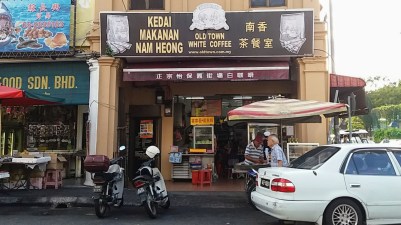 The town was very quiet early Sunday morning, so I enjoyed a leisurely stroll past some beautiful architecture and into the quaint “old town”. I had been advised to seek out a place called Nam Heong. When I found it, I discovered they sell the same brand of coffee as the high tourist cafe, which is simply called “Old Town White Coffee”. I have to infer that my hostess of the night before was referencing the atmosphere of the cafes rather than the coffee itself. Pictures I found online of the famous “Old Town White Coffee” restaurant show that it is a spacious and rather upscale looking place, geared toward the bougie and the Western tourist, while my experience in Nam Heong was a crowded hole in the wall filled with scurrying locals where I was the only white person. There probably is some difference in the drinks, since the brand itself was just the roasted beans, there’s almost certainly a difference in the price tag, and there’s a huge difference in local flavor. I don’t regret my choice for a minute.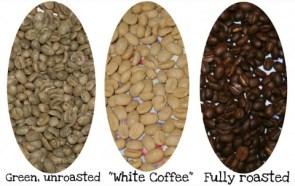


 (a side note on palm oil: don’t buy it. Seriously, I work pretty hard to be a responsible consumer. Palm oil is a product of major controversy right now because of the elephant exploitation in Thailand as well as the deforestation in Indonesia and Malaysia. It’s hard to exclude because it’s often improperly labeled, but please try to buy more sustainable and ethically sourced oils if you can. I was a little put out by eating it there, but in the end, my “locovore senses” took over and reminded me that if the Malaysians just grew enough palm oil for their own needs, then everything would be fine. It’s not an evil crop, but the high demand for it internationally has led farmers to damaging and unsustainable practices that harm the environment, and just so you don’t deride me for valuing orangutans over humans, the unsustainable farming practices are damaging the land and water those farmers and their families rely on, making the human future dim as well.
  My coffee and tart arrived promptly and were very inexpensive. The coffee was smooth and extra creamy (more than just because it was made with milk, I believe the palm oil roasting made the flavor smoother). While other coffee I’d had in Malaysia was aggressive in it’s “coffeeness”, slightly if pleasantly bitter, and coffee I’ve had in the US and Europe tends to have an acidic tang, the Ipoh white coffee was as smooth as coffee ice cream, but not quite as sweet. Also the tart was warm, flaky and not too sweet either. As a recovering HFCS addict, it can be challenging for me to find the balance of sweet that tingles my taste-buds without overloading my synapses, but I was left very satisfied by the experience at Nam Heong that morning. I shall think fondly of the coffee until one day I start my own tour company and make it a stop on the “Coffee of the World” tour package.
 I managed to order something by playing a sort of 20 questions with the waitstaff, and enjoyed my noodles and mystery meat in a not yet too hot outdoor dining area with views of the neighborhood. There were a startling number of funeral homes nearby and plenty of evidence of the British colonial architecture, although much of it was in disrepair.
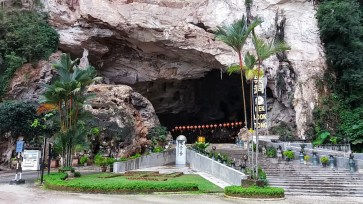


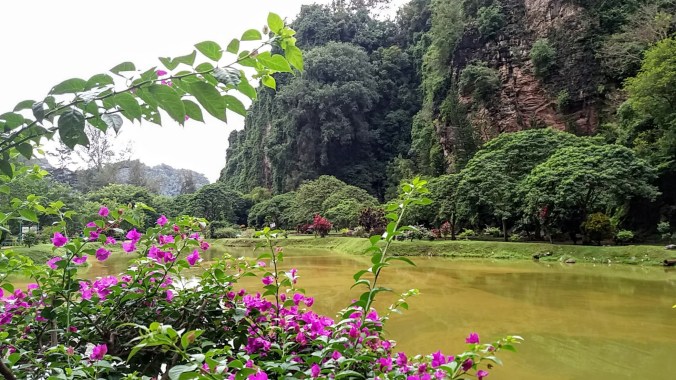


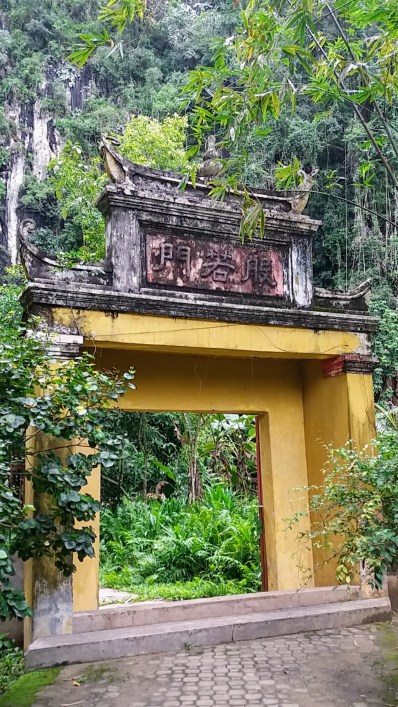 Sam Poh Tong is also a Buddhist temple and is said to be one of the busiest and most popular in Ipoh. I could tell it was an active temple from the freshly lit incense, but little else gave evidence that it was maintained or cared for. Even so close to such a large holiday, the grounds looked unkempt and abandoned. The huge numbers of underfed and skittish stray dogs was off-putting, but they were not aggressive. The garden in the front was a small lake with tiny “islands” that became miniature mountains holding tiny temples. As I walked around one side of the temple compound, I came upon a building that seemed long empty, covered in dust and bereft of occupation, yet there was incense burning at the dusty altars, observed it seemed only by me and some monkeys on the fence nearby.
 The walls were painted and florescent lights were on the ceiling, while piles of furniture and other stored items crowded the rooms. The floors were finished and there were windows and doors installed into the stone. It felt less like a cave and more like a basement.
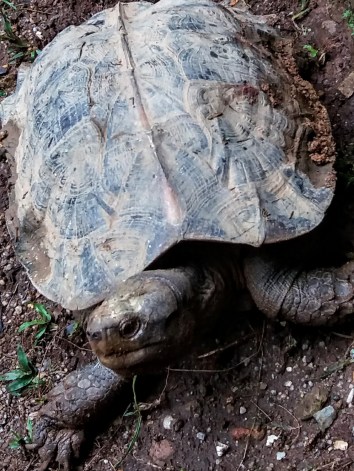
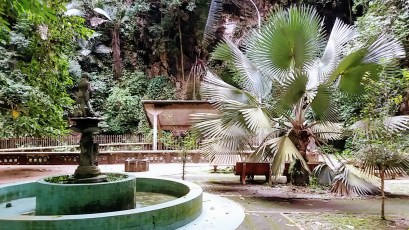 n the other side of the cave was a small enclosed garden. The walls of the garden were more towering limestone formations and the greenery within was Jurassic in scale and seemed to be overgrown with no concern for trimming or arranging, dead leaves carpeting the ground. There was a small turtle pond behind a fence filled with turtles of all sizes that could be fed fresh greens and veggies bought from a
  stand inside the cave. The stand and it’s sales person were some of the only signs of tending I saw. At the back of the garden behind a locked a fence and a forest of unkempt branches was a bright red pagoda that seemed more like something in an abandoned jungle than in a living temple.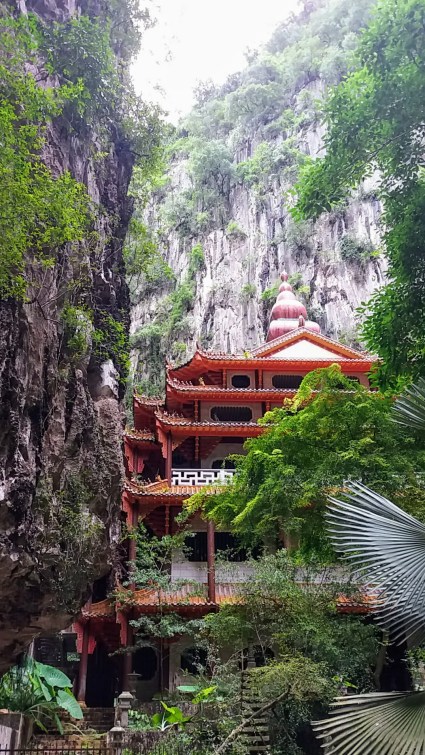
 I crept around the cave rooms from one altar to another, plastic cups and cleaning materials lay scattered around, the tile floor was cracked and uneven. I followed a treacherous staircase up a flight, but it ended only in a tiny window and more dust. It was so easy imagine that I was exploring a temple long forgotten, and then I would find a lit candle, or a smoldering joss stick or even a lone employee selling souvenirs. Outside once more, I continued on to the cemetery. In Buddhism, cremation is the norm, so there were small buildings in another alcove that housed the remains. Despite signs requesting that no incense be burned, there were sticks shoved around all the doors and soot marks as well. The buildings were grown over with moss and leaves, the paint peeling and the ground cracking under the pressure of new roots, yet the incense showed me that human presence was recent.
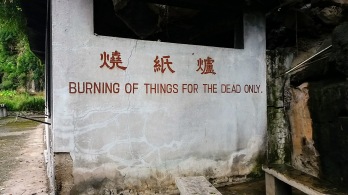 The farthest end of the compound was an area designated for ritual burning and another weedy and overgrown garden that seemed to be turning into a dumping ground. As I made my way past more dogs and tourists, I couldn’t help wondering at how this temple had been so highly rated by so many visitors when Kek Lok Tong was so clean and well cared for. I enjoyed visiting Sam Poh Tong, but it felt like an archaeological excavation rather than a place of worship.

 I looked it up to make sure it wasn’t something too scary, then ordered myself a bowl for lunch. Rojak just means “mixture” but fruit rojak is a common dish made of crisp (less than fully ripe and therefore slightly tart) fruits and veggies. Jicama, cucumber, mango, and apple are standard ingredients. The sauce is the magical part. The recipe gurus of the internet assure me it’s made with shrimp paste, hot chilies, sugar, soy sauce, and lime juice (with some regional variance). To me it tasted for all the world like molasses with chili, ginger and lime. I don’t know if mine was made with molasses or if that’s just what it tastes like when you mix soy sauce, shrimp paste and sugar together, but it was yummy!


 Just one gate over is the third and final temple on this street, Ling Sen Tong. This temple mixes Taoist and Buddhist imagery along with other folklore in a big colorful Chinese melting pot. It is an all singing all dancing color fiesta. There are beautiful facades of buildings and temples, giant statues in fresh bright colors, elaborate scenes of mythology played out, and everything was touchable/climbable so visitors were having a blast posing for photos. There was only one small, dark cave. The ceiling had turned black from years of candle and incense soot, and it was chaperoned by a figure whose offerings exclusively included alcohol (for some reason, especially Guiness…) I enjoyed exploring the many statues and hidden rooms. I even found this one guy who looks like he’s checking his phone in the bath! I’m sure there’s a better explanation for it, but along one wall was a series of statues in sunken pits that had all filled with water. I don’t know if it was meant to be a kind of wishing well or something else entirely, but this one in particular stood out to me.






 The morning after my late night and less than welcoming arrival, I woke up early, scarfed down my leftover convenience store sweet buns and took off to find the train station that would lead me to the Batu Caves. In recent years, the Malaysian government has added a train stop at this popular tourist attraction, and now it’s much easier to get to. The train itself was a new experience. When you purchase a ticket, you are given a plastic token with an RF chip inside. When entering the platform, you hold the token up to a pad to be read and it opens the gate, but hold on to that chip! When you disembark, you need to feed the chip into a slot to pass through the exit gate.
 I met a tour group on the train platform and we chatted during the train ride. I hung around with them and their guide to hear a few of the explanations offered about the caves. The guide rushed us past the dozens of sales stalls (saving us from souvenir swindles), gave a brief presentation under the statue of Hanuman (the Monkey King) and landed us in the main square at the base of the stairs and the giant golden statue of Murugan (a god of war, made of concrete and painted gold colored). There was a tremendous flock of pigeons in the main square and it seemed to be a major tourist attraction to stand in the flock and have them hop onto your hand to get some food. Occasionally construction in the background caused a loud boom that set all the birds a flutter, which was surprisingly pretty.


 After a few obligatory photos with the tour group and the giant statue, we began the climb. The stairwell is not insanely long, a mere 272 steps. They were so popular as a form of exercise that the government had to ban fitness use of the staircase to keep it clear for tourists and worshipers. With my kryptonite-like response to humid heat, the staircase became a long haul obstacle, but there were plenty of interesting things to stop and look at on the way up, like the expanding view of the courtyard and city below, the rock formations on the cliffs along side, and of course the hordes of monkeys roaming freely through the grounds. Given that the monkeys are wild, I was totally happy to keep my distance, but they were not shy and enjoyed coming right up to tourists or even forcing a showdown over who got to use the hand rails. At one point there were two monkeys perched on twin posts on either side of me and I managed to get a cute double monkey selfie, checking off a bonus square in the Batu Caves tourist bingo.
 When I finally got to the top, I was greeted with a large cave mouth opening that led to an even larger cavern. The entrance of the cave had small buildings installed for souvenirs and police. Once all the way inside, I could see that although this huge open space was graced with a few decorative statues around the edges, it was largely left in its natural state. The cave mouth was wide and there was a natural sky light further on, so the cavern was well lit. There were a few artificial lights in strategic places and an area of worship off to the left. Finally, there was another short staircase leading through to the open area beyond. At the top of those stairs was the rearmost chamber of the cavern, another broad space; however, the roof had long since fallen in and the walls soared up into open air, creating a round room with no roof.


 As I exited the temple section to descend the stairs again, I detoured off to the right to investigate a “dark cave”. The Malaysian government has taken this side section of limestone cave and created a conservation space. The limestone quarries and careless unregulated tourism of the recent past had wiped out a lot of the cave ecosystems. Efforts to restore the guano based ecosystem of living limestone caves are now underway in many parts of Malaysia and this cave was for both preservation and education.
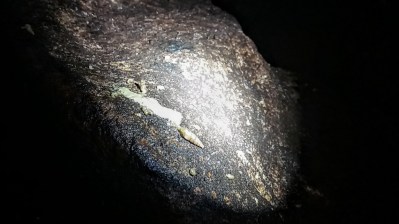 Nearly everything that lives in the cave is so tiny you wouldn’t even notice it if no one stopped to show you. When we see nature documentaries, there’s often nothing for scale, so it’s easy to imagine the animals as being similarly sized to their daylight counterparts. When our guide showed us a picture of the little white snail that lives on the rocks, I imagined a tiny snail, but not nearly as tiny as the ones we found! The biggest of the snails was about the size of a grain of rice, but there were smaller ones dotted around.


 As I descended back to ground level, I passed still more monkeys, several sets of mother and baby wandered around, and some tourists were feeding them peanuts (despite the do not feed signs). I noticed that the dominant males were very protective of their snacking rights and would drive off the mothers aggressively. Of course, no trip to a monkey colony would be complete without a little fornication. I happened to be standing right next to a female when a male walked up, took her butt in both hands and peered at it closely, then proceeded to mount her, much to the shock and amusement of tourists from 6-7 different countries. No, I did not take monkey porn pics.
 Farther on, beneath the looming statue of Hanuman we passed at the beginnging, was the Ramayana Cave. This attraction was much more highly reviewed and was only 5 ringgits to enter, so I decided to give it a shot. There is a stream inside the mountain that comes out and is used as part of a beautiful fountain depicting the chariot of Rama and Sita. If you’re not familiar with the


 but the main floor had a few shops and restaurants. I pulled into the first one I saw and confessed my massive ignorance of Malaysian cuisine, asking the staff for a recommendation. Moments later I had a heaping plate of some kind of fried rice dish that was smokey and pleasantly but not overwhelmingly spicy. Sometimes you just gotta walk on the road that looks more interesting.
 The hallway with the rooms was brushing my shoulders on either side as I walked through and was not wide enough to open the room doors all the way. It was also painted red and gave me a very eerie Twin Peaks vibe. The room was dirty, a soaking wet bath mat on the floor by the door and some kind of horrible mildew meets sewage smell coming from god knows where. I dropped my bags and went back out to the street to find food, but the street stalls were only selling fried things of a questionable nature and I couldn’t see any restaurants nearby. The midnight streets were dark, crowded and very dirty and also had rats scuttling around in the rubbish. I finally just got some yogurt and bread from the convenience store and went upstairs to sleep.
 After an incredibly full first day in Singapore, I had a much lighter day of temple viewing planned before I hopped on the bus to Kuala Lumpur in the afternoon. It’s never hard to wake up in a dorm hostel, since everyone else is waking up, too. After packing up and enjoying another cup of teh tarik, I headed out to catch the sights. The night before, I’d run across a giant rooster in the street (in anticipation of the impending lunar new year holiday), so I did a quick rerouting to pass back by in the light of day. Chinatown was already putting on a decorative show two weeks before the holiday; I can only imagine how crazy it was on the actual holiday weekend.
  In addition to the stunning decorations, I passed by a street artist sitting in the shade of an overpass and working on the beginning of a painting of the festivities. He was kind enough to let me take a photo and we wished each other a happy new year in parting.
 After breakfast, I headed into the temple. I generally don’t wear short shorts, and while I go wear sleeveless in heat sometimes, since my plan for the day was temples, I was dressed appropriately. However, for the tourists who weren’t, a staff of firm but polite people arranged for them to wear long skirts or shoulder wraps from a shared bin. Once past the main entrance, I walked into a smaller room where two monks were performing a blessing on a couple donating to the temple in a red envelope (traditional for money gifting at the new year). As I watched, I realized people around me were taking photos and video and I was surprised. I looked around for any signs about cameras, but there were none. It seemed that the temple allowed visitors to take pictures. It felt very strange taking pictures in a temple, and in the end I could only take a few before my sense of unease overcame me.
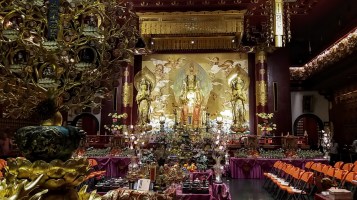 The main hall on the ground floor was an ode to opulence. I’m used to Buddhist temples being ornate. Wood and stone carvings with intricate detail are common (though never boring). Paintings or works in colorful semi-precious stones, and even the occasional gold paint or gilt covering to add some shine. The point is, that I’m used to temples being about effort and time and skill, rather than about blatant displays of wealth. In fact, a common art form is the sand mandala, which is made over weeks or months of painstaking hand work, then wiped out to represent the impermanence of reality. I don’t have an issue with beauty in a temple, I go to temples in part because they are beautiful, but something about this temple and it’s over the top gold, it’s donation jars every few feet, and it’s designated VIP seating for supplicants just did not sit well with me.
 I found the elevator and went all the way to the roof to see the orchid garden. That at least was in keeping with temple life as I think of it. Although orchids are rare in the world, they are common in Singapore and the difficulty of their cultivation reflects the work that monks and nuns put in as part of their practice. Below the gardens, the top floor contained the relic for which the temple is named, a fragment of the Buddha’s tooth. It was also the only room in the building where shoes and cameras were prohibited. There were dedicated meditation mats along the windows where a few people were sitting in silent contemplation, and there was another large gold display.
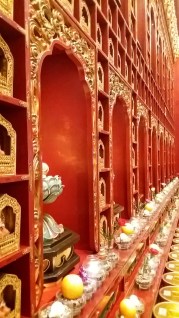 I’ve seen American “mega-churches” that have gold plated elevators and preachers with 5 cars and 3 houses and a minimum annual income requirement for membership. These also disgust me and I often wondered how any Christian could justify that kind of obvious money-grubbing and wealth favoring within their doctrine. This was the first time I’d ever seen a Buddhist “mega-temple”, and it was awful. It made me feel ashamed to be associated with the faith. It made me want to run around to tourists and exclaim “that’s not what Buddhism is about!”. It made me want to drag out some scripture and ask the people praying there if they’d even read it. And for just a moment, it made me think about Terry Pratchett’s Yen Buddhists, whose main theological argument is that:
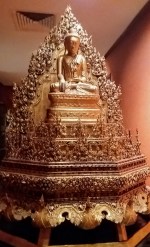 I headed down to the third floor to see the museum, which was a worthwhile collection. It was a nice museum of Buddhist art and man-made relics that included a sort of “intro to the Buddha” story on signs around the displays. Like the rooftop garden, it felt far more authentic and enjoyable. The relics were primarily stone, clay, bronze or wooden and had clearly been the result of effort and craftsmanship. Although the extraordinary focus on Guan Yin and the Maitreya was a little overwhelming, it did point to the fact that the temple’s own branch of Buddhism was a salvific form that relies on Bodhisattvas and future Buddha’s to save the world, rather than on the practice of self cultivation for individual enlightenment.
 The second floor had a nice place to rest, which I desperately needed. Adjusting to the heat and extra walking was taking a toll. It was such a great contrast to my energy level in New Zealand where the weather was cool. Just minimum exertion in a hot humid climate seems to drain me like a marathon! After a rest and a look through the last floor of displays, I made my way back to the ground floor, once more shaking my head at the ostentation, this time walking past the VIP seats they were filled with supplicants who had paid I’m not sure what to get past the velvet ropes. All in all, I’m still glad I went to see it, because I learned something about the corrupting properties of money. All temples ask for donations to help feed the monastic population, pay the basic bills, and to provide services to the community. Money is, in this world, unavoidable. However, when a house of faith relies on wealth or doles out blessings for cash or claims that the donation of great wealth is a higher holy act than living a good life, that’s corruption.
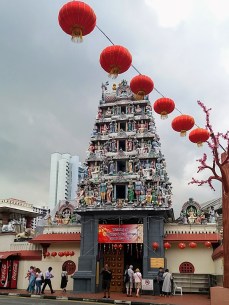 After the Buddhist temple, I took the short walk two streets over to see the oldest Hindu temple in Singapore: Sri Mariamman. This humble wooden structure was not a display of wealth, but was still anything but plain. Wooden carvings covered every inch of the outer facade and were brightly painted besides. Anyone was welcome to enter, leaving their shoes behind on racks on the sidewalk. There were saris for anyone who felt inadequately dressed, and while we were free to wander around the grounds barefoot, the main areas of worship were cordoned off, not for a fee, but for the faithful. I am not a Hindu, so I contented myself with observing from behind the lines. The interior of the temple is a large courtyard with smaller buildings, each one dedicated to a different divinity. There are over 330 million gods in the umbrella of Hindu faith, and while only a couple dozen are among the most popular, it can
  be hard for a layperson to know which altar is for who. I found 10 names of deities for this temple on it’s
 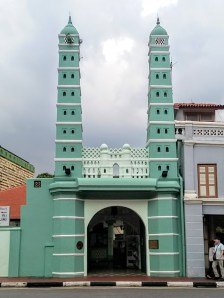 couple city blocks, I had passed 3 major religious buildings, and I knew from the map that a Christian church was not far off. Curious, I looked around the map for a synagogue and found one a little over 3km away, and it was neighbored with another church, Hindu temple, and Buddhist temple. It seemed that it wasn’t hard to find a spot in Singapore where at least 4 out of the 5 major world religions shared a small space and yet no one was getting blown up, shot or even harassed on the street! While I’m sure that Singapore’s strict legal code has something to do with the lack of violence, I like to think that pluralism in the culture helps everyone to get along. People of other faiths or cultures seem less scary when they are our neighbors and not “those others”.
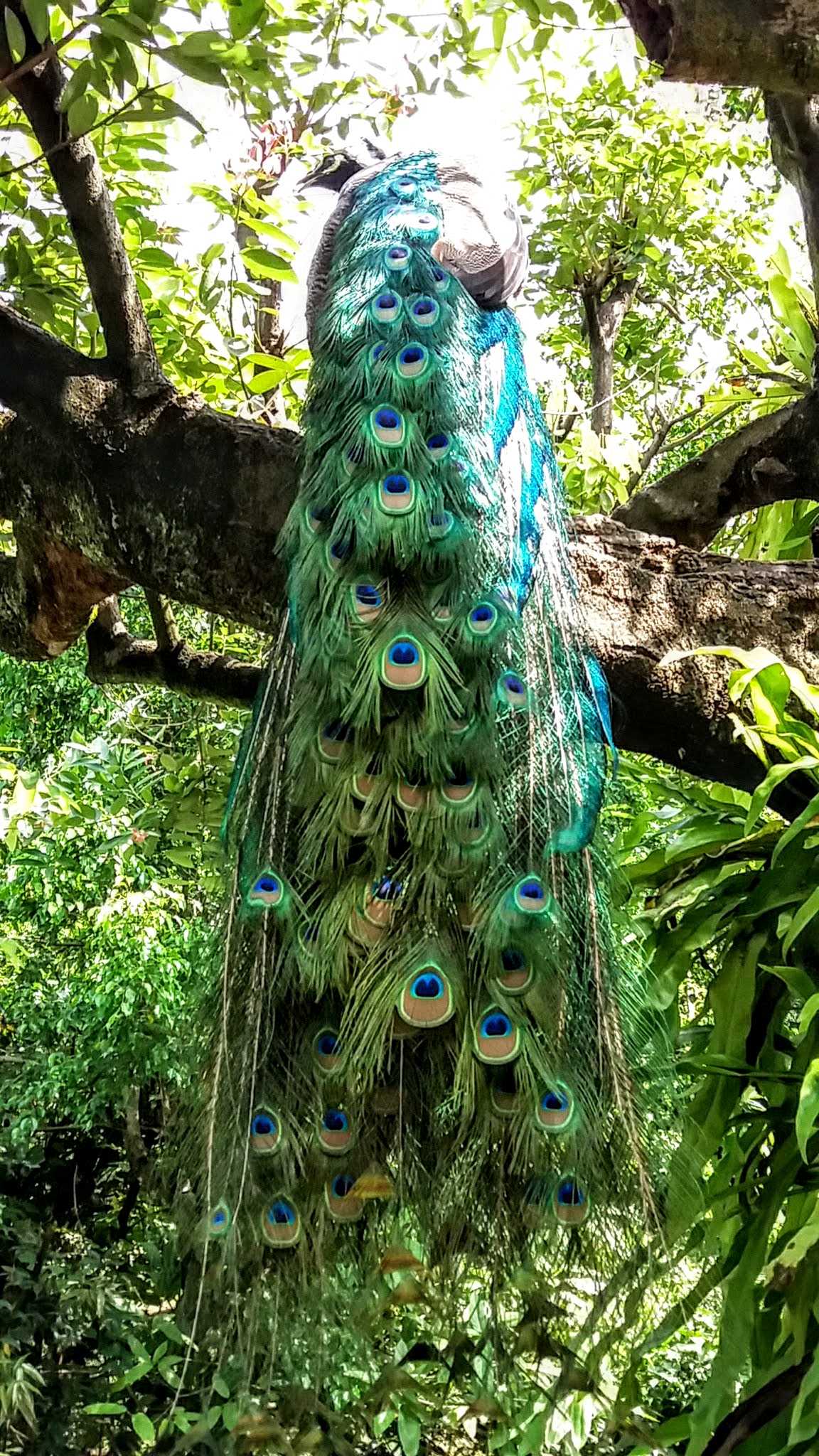
 As I got out of the taxi, I walked past a peacock that had either escaped, or was deliberately placed at the entrance for effect. The bird seemed unperturbed by the traffic. Even though I was a little early, the courtyard was packed full of tour groups and I had trouble pushing my way through to an info counter just to find out where to go. I stood in a long line as we all had our tickets scanned and everyone streamed into the Night Safari like the opening bell at Disney.
 I had missed the first fire show at the opening, but since it happened every hour until 9pm, I wasn’t too worried. I headed instead for the animal show at the advice of one of the zoo staff. This was just as well because the lines for the tram were insane. Being a lone traveler is sometimes advantageous, like when trying to find a seat in a crowded theater. I wedged myself in between two families in a fairly good spot and sat down to watch what I fervently hoped would not be an exploitative performing animal show. I was not disappointed. The “show” was largely animals being brought forward while the main announcer talked about the species being shown. There was humor and a few animal tricks, but these involved a large cat leaping, a raccoon going through a “garbage can”, and an otter doing some recycling (which may be one of the cutest things I’ve ever seen). The last one led into a great discussion of what happens when urbanization encroaches on
  animals habitat and on what we as humans can do to help better preserve the environment. I know some people might think it’s a little preachy, but I was personally gratified to see the zoo using it’s platform of animal entertainment to help educate visitors on conservation and preservation.
 ake in the fire show. Although the zoo website makes it seem as though this is some kind of traditional tribal fire dance, in reality it is a modern dance with a totally made up tribal sounding name. It was still fun and pretty, just not particularly traditional or historically accurate.


 Gallivantrix