There’s been some radio silence on the blog since the New Year began. I thought setting 2016 free would herald the great and wonderful 2017, but like many of you, I am discovering the sad reality that the change in date does not magically change the world. I don’t want to be the writer who complains, but I would be lying if this blog was all sweetness and light. I saw an article online the other day that said that our overall unhappiness is greatly contributed to by watching only the most perfect parts of others’ lives online. The fact is, everyone has bad patches, but most social media mavens only show the sunshiny parts, leaving the rest of us thinking that there is something wrong with us if we can’t achieve that level of perfection and happiness. Well, I am going to dispel that illusion. It’s only the Ides of March, and yet I am fully ready for another, more actual, holiday.
January
The first half of January was the bi-annual English Camp. Actually, these are pretty fun because for two weeks, I get a tiny class of kids who volunteered to be there, and I get to run the whole curriculum without the textbook or school goals. This winter, I did superhero camp. The kids got to choose superpowers (from a list), design their superhero costumes (paper dolls), and make their superhero names using a handy 5 point chart I made up of titles, colors, powers, animals, and gender endings. I took pictures of them and added superpower effects, and made a video of them singing and introducing their superhero alter-egos (which I unfortunately cannot share with you because of my teacher confidentiality agreement). It was fun, it was all in English, and I only had to call the Korean teacher once when some boys decided to draw penises on their superhero paper dolls(*sigh). On the last day we made chocolate cake in paper cups in the microwave and had balloon races. Overall, it was a good start to the new year.
The second half of January was my 2 week winter vacation. I decided to go to the Malay Peninsula and do a whirlwind tour of Singapore, Malaysia, and Thailand (but only the peninsular parts). I’m working my way through writing, editing and adding photos to the whole 12 day adventure which will go out to the blog and FB page soon, so I won’t try to summarize it here. Suffice it to say that the vacation may have foreshadowed more ominous things, since it too started out with so much promise and enjoyment, yet ended in a total emotional breakdown of epic proportions.
February
…was boring. So boring. I got back from my holiday wounded and limping (yes, literally) just in time to come back for the most useless time in the Korean school calendar. The kids all took their end of year exams before the winter break began on Jan. 1. Although my co-teachers had saved some material from the book to stretch out over the remaining few classes, the students were entirely uninterested. As subject teachers we had maybe 7 days of these lessons, although I had even less because the 6th graders did High School Musical marathons for the last few days. The Graduation ceremony was on the 17th and then there was another week of “spring break”, during which I got to sit in my office doing very little. I couldn’t do anything to plan for the lessons starting in March because no one knew what anyone would be doing!
I enjoyed my first year in Korea and working in the public school system. There were a few hiccups to be sure, but overall, it was probably the best (maybe second best) teaching gig I’ve had. Plus, there’s so much going on in Korea, I felt like I missed out on at least half the events last year. So, I decided to renew my contract here rather than seeking out a new country to work in and explore. But February brought me back to shades of Saudi Arabia. No answers, everything changing all the time, and a sense of hopeless isolation that brought on existential dread. With no students to brighten my day, and no future to plan for, the days at the office became a long, cold, gray stream of Dostoyevskian blah.
I decided to take advantage of the lack of students to visit a dentist and see about the slight occasional pain in one molar. I don’t love dentists, but I know ignoring problems in your teeth never makes them go away on their own, so off I went. Only to be told I needed a root canal and an inlay in two different teeth, and that the root canal would take 4-5 visits to the dentist to complete. Thus began my endless dentist torment.
On top of that, Korea flat up failed me in providing it’s normal endless stream of festivals and activities. There was one lone festival to celebrate the first full moon of the new lunar year, which was marked by the building of a massive bonfire on the beach where people could toss their complaints and woes of 2016 to be burned as well as their wishes and hopes for the next year to rise up to the heavens. I’m not sure how the gods/ancestors tell the difference, but it was a big beautiful fire on the beach and that was fun.
I had my first experiment with “crazy color” hair dye in Korea in February (probably inspired by the endless boredom and need for color in my life). I managed to negotiate a conversation in a beauty supply shop to get myself some bleach and a shade of purple that was pretty if somewhat pastel. I should have known better, but hair dyeing is a source of rebirth and stress relief for me, so I charged ahead. The end result was.. subtle. The lightest parts were indeed a pale purple-ish, but nearly everything else turned brown. Not even a pretty brown, just ashy. This led to my first experiment ordering from the infamous G-Market, a sort of Amazon/Ebay website for Korea. Although I had seen many Koreans around downtown (and even a few students at the school) with colors in their hair as ombre or even whole hair dyes, it seems that the only thing available in most shops are the very pastel colors, including a shade of green called “khaki”, which I can imagine no westerner ever saying, yes, please, let’s dye my hair khaki.
February also brought home the reality that most of the people I know, including my besties, were leaving Korea. International life is full of the tides of expats moving in and out with the job market. I think many seasoned expats avoid making close friends among the first years because of this very thing. But since I was a first year last year, that meant that most of my friend pool were other first years. I had thought they were going to stick around, but events conspired in such a way that meant I spent the end of February going to/throwing farewell events and helping my friend pack/get rid of stuff.
I spent the whole second half of February feeling somehow both bored and exhausted, telling myself over and over that things would get better in March when the students came back, when the festival season began again with cherry blossoms, and when the weather was finally nice enough for me to play Pokemon Go without wearing 3 layers of clothes and freezing my fingers solid.
March
As March drew near, I was finally given some slight insight into the shape of my new school year. I was to get a second school, splitting my time between two schools. Plus, it turns out no one in the whole city wants to teach at my main school, so in the complex bidding war that the Korean teachers engage in to switch schools every 3 years, someone who had the horrible misfortune of not getting any of their top 10 choices was to replace my wonderful and amazing first ever Korean co-teacher. Plus, she doesn’t speak much English and hasn’t taught English in a decade. Plus the new school isn’t just going to have me for a day or two, but one and a half days a week. Every Thursday I get to start at one school and move to another. Plus plus, that teacher has also never taught English before. Oh goody.
I had barely an opportunity to say hello to the new teacher at my main school and none at all to visit the second school. Despite the fact that classes would commence March 2, the new teachers avoided talking with me about lessons, or goals, or expectations. I began to get anxious, and reminded myself that newly arrived EPIK teachers wouldn’t meet their co-teachers until the new school year began, but I also had to wonder how many fresh off the boat foreign teachers would be paired with inexperienced Korean teachers. Was I getting extra newbies because of my experience or was it really random?
School finally started, but I found myself with a lot more nothing for a while while we waited for subject classes to start and while we waded through the first day of class orientation lessons to help the new students and teachers meet one another. Finally getting started I began to realize the daunting task ahead of me that involves balancing a crazy schedule and teaching 2 new teachers how to do the job. I mean, I guess I could just sit back and let them flail around until they work it out, but I can’t really let the students suffer like that, so this is me, doing my best to manage. It’s somehow harder than if I just had a class myself, because I have little to no influence over what happens in the classroom on the days I’m not with a given group of students (since I’m spread thin over 2 schools and 4 classes of 4 grades, I basically see each class 1 time a week, except for the 6th graders I see twice). I now understand why it is that so many Koreans can study English from the third grade and yet not be able to speak it.
Then at long last, a much anticipated event which I had spotted back in January finally arrived. A glorious yoga retreat at a spa resort in the mountains! What could be a better way to ease my stress and restore my resilience than such a wondrous weekend. The day before the retreat, I woke up with a cold… sore throat, stuffed sinuses, whole 9 yards. With little sleep and much mucus, I arose early Saturday and set off anyway, hoping that some meditation and spa therapy would at least help a little. And it might have, had not absolutely everything been a crazy misrepresentation, mistake, flake, or flat out disappointment. I haven’t even decided if I want to blog about this trip because it was so awful, I can’t find a way to spin it for the “life lesson” or “silver lining” even though that was the name of the organization that presented the event.
Amid the highlights were the totally not delivered as promised vegetarian Indian buffet (the vegetarians were served Korean food, and a tofu steak that had pork in it); the 4 hour/seven instructor yoga and meditation session that was missing one instructor and also completely failed to do things like adequately warm up the participants for challenging poses or to present alternate poses or instructions for beginners (many of whom had their first and possibly last exposure to yoga that weekend); and the 2 drunk male staff members (one shirtless) showing up in my hotel room at 2am waking me up and trying to touch me even after I asked them to go (still not sure why they were there in the first place).
Did I mention that during all this time, my tooth, the one that I’m getting this infernally long root canal done on, is in pain? The dentist has twice left me in pain for over a week with no medication, leaving me to struggle on through life with a dull throbbing ache in my left lower jaw and the total inability to chew anything on that side. Even now that the root canal is supposedly “over” (4 sessions later) and the process to install a crown can begin (minimum 3 sessions), my tooth hurts day and night and I have to wait to find out if it will be treated or not until my next appointment. But hey, my hair dye arrived, and it’s a smash hit.
And Holi Hai is coming, which is the Indian festival of colors where we all dance around and throw colored powder and paint on our white clothes while rocking out to Boli-rock or Indo-pop on the beach. I did it last year and it was awesome, so I was really excited to go again this year. And yet somehow, people are trying to ruin that too. Two factions of the local Indian expat community have started a turf war over the holiday and who gets to throw the party. They’re trashing each other on social media and trying to drag all of us as well as the local Korean government into their feud. I’m still planning to go, but I will have an escape plan in case they start physically fighting over the microphone or DJ station. I don’t know what they were trying to do, but all they’ve really succeeded in doing is demonstrating their total lack of Holi spirit. Festival of love, guys.
Next?
So there it is. My life is not lollipops and rainbows all the time, despite the fact that I am so amazingly lucky to be able to live abroad and travel to exotic destinations and meet new people and try new things. And I am amazingly lucky. And I do have gratitude for the opportunities in my life. I sometimes describe culture shock as living on a roller coaster, and by and large what I share with the world is the highs, but when you don’t hear from me for a while, it’s not because I’ve forgotten to write, it’s because I keep trying to live up to the maternal advice, “If you can’t say something nice, don’t say anything at all.”
I release my sadness, woe and frustration. I do not want to carry it with me, so I give it a home here. I bid farewell to the winter within and without. I welcome the arrival of Spring and the rebirth of the year and it’s promise of new growth. I strive each day to find the beauty and wonder that keeps me going in the dark times.
Happy Pi Day Happy White Day (it’s about candy, not race) Happy St. Patrick’s Day Happy Holi Hai Bless
As the year drew to an end (finally), I found myself in the land of festivals (Korea) for some super holiday times. While nothing on Earth is likely to oust the Dubai December for birthday/Christmas spectaculars, I have to say that I had a pretty good December here in Busan. Commence countdown to 2017: T minus 2 weeks.
Two Weeks Till 2017: Boseong Tea Fields
Starting with my birthday (also known as Saturnalia), we decided to take a day trip down to the Boseong Tea Feilds. I personally didn’t put tea fields high on my to do list but there was a big ol’ light festival going on and that sounded like fun. So we piled onto the bus around noon for a three hour drive. It’s not as agonizing as it sounds. I had good company and the seats are comfy. When we arrived, it was still light and although we could see the framework of part of the light show, it wasn’t quite time yet, so we headed into the tea field area first. This area is a small farm that was about half shut down for the winter (the fountains were drained and many of the shops were closed), but once we got past the tourist buildings and onto the path, it was far more beautiful than I ever could have expected. Green tea looks like very well kept English hedge,.
and because Korea is 70% mountains, the tea bushes are grown up the side of steep hills, creating a beautiful terraced landscape. As we wandered up one side of the hill, I had the chance to munch a tea leaf right off the branch. It was a robust flavor and while different from the drink that it makes, still pleasant. I even found one lone tea flower to admire in the winter greenery. We found a small waterfall on the way up, but the winter dry season meant it was barely a trickle. The best part turned out to be that since we’d gone up the opposite side from nearly everyone else we had the shaded little path to ourselves. A rare treat in Korea! When we emerged onto the main path across the hill, I was totally swept away by the view of the tea around us. I admit that from the bottom looking up, it had been.. well ok, but not spectacular, and even from the high points looking down it was only so-so, but right there in the middle of the hill, with the winding, whirling rows of green tea hedges making patterns all around us, the sun barely above the line of trees and mountains to the west casting long golden rays into the valley, it was breathtaking.
Of course we took our turn to stand on the picture spot (which did have an amazing view), but it wasn’t too crowded. We had plenty of time to admire the scenery and take lots of silly selfies. We passed a wide variety of blossoming fruit trees (that is to say, fruit trees with beautiful blossoms in the spring), so I can only imagine how beautiful the scene is when both the trees and the tea are in bloom. In addition, we were surrounded by tall evergreens similar to the cedars of the PNW makingj us feel a little more like we were in the Cascades and a little more Christmassy, since pines and firs are scarce in Busan. We stopped in at the local Green Tea restaurant, where every dish is made with green tea in some way. I had a bowl of jajangmyeon with green tea noodles, and a friend got some bibimbap with green tea rice, but my other poor companion is allergic to caffeine and couldn’t eat anything there! (don’t worry, she didn’t starve).Even though it was cold, and even though I’ve had it more times than I could count, I still got myself some green tea ice cream, cause why not?
On our way back to the main entrance we took a quick side detour to the bamboo forest. After a short walk through some more evergreens, we emerged into an open space facing a dark and mysterious bamboo forest. The sun was low and the shadows were long so we couldn’t see far into the mass of stalks. Once we entered, it was as though a twilight had encompassed us, the lush leaves cutting out nearly all the late afternoon sunlight. The birds went bananas, screaming like jabber jays, making us feel as though we were in an arena from the Hunger Games or at very least in an ominous Korean horror movie. I wasn’t sure if we should expect kung fu masters or monsters. (click for more pictures of Boseong tea fields and lights)
A Beam of Hope
We left the tea fields behind and headed back down to the main parking lot that would lead to the lights. There were plenty of stalls with a wide variety of food (green tea added and regular) so my allergic friend was able to find something tasty, too. The light show wasn’t quite as spectacular as Taean (seriously that light show), but it was loads of fun. There were animal shapes, dragons and dinosaurs. There were scenes depicted on the hillside. There was a cupid’s arrow that when “fired” by guests shot a beam of light up the wires to the distant target. There was a beautiful rainbow display of that year’s theme, “A Beam of Hope”, and my favorite was the tunnel of lights that went from the bottom to the top of the whole shebang. We wandered up through the smaller displays, posing with dragons and hatching out of giant glowing eggs along the way. Like most lantern displays here, everything was meant to be posed with and interacted with, so it was easy to walk up to any set and play around. It’s a small and childlike pleasure, but after so long in the US being forced to stay behind the railing, it is fun to get a little more hands on. On the way back down, we took the tunnel of lights, pausing every time the colors shifted to take more pictures and pose in the rainbow glows. We didn’t feel rushed at all, and got back to the bottom in time to grab a hot drink and warm up by the fire before hopping on the bus to our third location. A word on keeping warm in Korea in the winter. It gets cold, not Canada cold, but often around freezing temperatures. The buses and subways are super warm, but office buildings and of course outdoor festivals don’t get so much heat. Koreans rely on the “hot-pak” to solve this problem. This is a chemical warmer that last for about 15 hours once activated. There are small ones you can tuck in a pocket (I like to slip one in a glove or under a sleeve just over my wrist where all the blood flowing to my fingers gets warm), and there are ones you can put in your shoes, or stick to your inner layer of clothing. I bought a 6 pack for about 5$, it was an absolute life saver for enjoying the wintry outdoors after dark.
Our third and final location was near the beach where another tunnel of lights and light decorations had been put up. One large tree had been colored in white and green to make it look like it still had leaves. There were reindeer and Christmas trees, but also a giant chicken floating just off shore. I’m not sure why a chicken, but I saw another similar giant chicken in the sea back in Busan the next day.
(Eventually I realized that the next animal on the zodiac is Rooster, so it’s less a Christmas Chicken and more a New Year’s Cock.)
We oohed and aaaahed some more, posing with giant glowing horses, and peeking out from between light wrapped branches. There was a light maze, but it was only about a foot off the ground, so we didn’t get lost. Finally we popped back into the food tents one last time before calling it a night and heading back. One Week Till 2017: Christmas Eve
The next Saturday was Christmas Eve, and we decided we needed to do a blending of American and Korean activities. We spent the afternoon inside making eggnog and gingerbread houses. I have never made eggnog before. I thought about it a lot, especially when I wasn’t doing dairy. I thought there had to be a better tasting nog than Silknog. But somehow, I never got around to it. This year, although I seem to have no health issues with milk here, there was a complete absence of nog… everywhere… Koreans either have never heard of it, or they are all in the hate eggnog camp.
I turned to Alton Brown, my culinary hero, who provided me with a super simple recipe. It took me about 15 minutes to make, and I added a leeetle bit more brandy, but it was quite possibly the best nog I have ever put in my face. The secret is separating the eggs and beating the yolks and whites separately, then adding the whites at the very end to a cold mixture.
Btw, based on past non-dairy culinary experiments, I’d say if you’re a dairy free nog fan go with unsweetened almond milk and coconut milk– the stuff in the can that is dense and creamy, not the stuff that is a regular milk sub.– Use 2c almond milk to 1 c coconut milk, otherwise just follow Alton’s instructions. If you’re a vegan who wants eggnog… well, one of us is confused about what those words mean. May I suggest a Brandy Alexander made with non-dairy milk or some vegan Irish Cream? (I have some recipes for those if you ask).
Anyway, eggnog which is fresh, creamy, rich and frothy is my new best thing about Christmas Eve.
While we imbibed our culinary delight, we worked on assembling a gingerbread house. Every month here in Busan there is a foreigner’s market where expats sell things they make (or sometimes import) to give us all a taste of “home”. During November and December, one lovely lass was selling her homemade gingerbread cookies and gingerbread house kits. That’s right, no factory made house kit for us, but a local small business! #supportlocal #smallbusinesssaturdays The kit was originally meant to be just a house, but my friend decided to turn the foil wrapped base into a frozen lake and make some green corn-flake treat trees to decorate the grounds, so our house turned into a cabin by the lake before we knew it. Who says you need kids to do fun Christmas crafts?
Christmas Dinner
After our crafting, we headed out to find the French restaurant we’d made dinner plans for. Both of us looooove French food (still trying to figure out how to live there!), and decided that we were ok bypassing “traditional” Christmas dinner (which was exactly the same as Thanksgiving dinner) in favor of a nice restaurant. We opted for Le Jardin which is a small French place near KSU. They had some extra set menus for the holiday and were very accommodating about my friend’s allergies. They were quick to respond to emails and both the service and the food were excellent. We also splurged on a bottle of Viognier since there were 3 of us. I got to try this nice little white for the first time in a French restaurant in NZ this summer and fell in love. I’m not a sommelier or anything. I’m not going to try to describe it, but it’s distinctive and delicious. I recommend if you have a chance to try it. In addition to our delightful wine, I enjoyed pumpkin soup, a goat cheese/bacon/honey pastry for entree, a superbly well cooked slice of salmon with a light lemon flavor and a unique mushroom risotto which had been made into a breaded patty and lightly fried, and finally a chocolate pear cake that tasted more like it was a ganache or very dense ice cream rather than a cake, too decadent! Nothing will compare to the food in France, but Le Jardin made an admirable effort and gave us all a taste of Western flavors with just a hint of haute cuisine that was perfect for a holiday feast.
More Lights! Although we lingered perhaps too long over the meal, we made it out in time to get to our final Holiday outing: the Busan Christmas Tree Festival. This year’s theme was the Three Wise Men, and many in Korea felt it turned the holiday tradition “too religious”, which is a marked contrast from the US’s annual war on the Starbuck’s holiday cup not being religious enough. The highlight of the tree festival is a tiered wedding cake looking tree made of thousands of LED lights changing to different colors and patterns as we watched. The main streets were overhung with a veritable river of lights and fun Christmas themed decorations adorned the street waiting for passersby to pose for photos or tie paper wishes for the coming year on them.
Toward one end of the festival, I found an old man with a traditional candy game called ppopgi. It’s a simple candy made from sugar and baking soda, but a shape is pressed into the candy. Kids (and a few adults) can use a little pin to try to break the candy around the shape without shattering the brittle sugar. If they succeed, they win a prize (often more candy). The vendor was using a tiny copper pot to melt sugar over an open flame, adeptly pouring out the steaming satiny brown concoction, pressing it flat onto a popsicle stick and letting his fares choose their shape before pressing a cookie cutter down on the hot surface. I noticed that while adults had to be perfect to win, the little kids were often awarded a prize for a good effort.
After a few hours of glowing fun, we made our way home and fell asleep to the less spectacular but still very holidayesque glow of my own modest 2d Christmas tree. (click here for more pictures of the Busan Christmas Tree Festival)
Christmas day abroad is always an interesting challenge. Traditions that hinge around friends and family must be abandoned or at least altered, but this year I was fortunate to have one friend from home here with me and our Christmas adventures enabled us to both enjoy some of the traditions our host country had to offer while still enjoying our own cultural holiday.
One Day to 2017: New Year’s Eve A mere week later, the New Year celebrations were upon us. I had done some research and found that here in Busan there is a bell ringing ceremony in Yongdusan Park at the large bell at the foot of the Busan Tower. It’s a big event with musical performers and guest speakers that is televised much the way that the New York Time’s Square ball drop is. Yongdusan park is nowhere near as big as Time’s Square, and the majority of people don’t ascend the multiple flights of stairs until 11pm. Knowing we had plenty of time, we spent the day reveling in some seasonal sulbing, a screening of Rogue One, and a totally accidental Japanese dinner.
Nonetheless, it was a wonderful day and at 5 minutes before 11, we found ourselves in a long line of people patiently trudging up the stairs to the peak of Yongdu Mountain. Normally, this pathway has a series of escalators going up so that anyone can access the park, but tonight the escalator had been closed down and reserved as a dedicated emergency access stairwell. When we arrived at the top, we saw many TV vans and we shuffled with the crowd into the standing space behind the VIP seating. To my surprise, through crowd motion, we soon found ourselves close enough to the bell to get a decent view of the proceedings, and there was a jumbo-tron screen off to one side that allowed us to view the performances.
Despite the bitter cold of the night air, the press of bodies meant that I was soon warm enough to take off my jacket, and we joined in the crowd enjoyment of the music. Koreans are a very reserved people and it was strange to be in such a large crowd that greeted each song with polite applause rather than raucus cheering, but as the musical numbers progressed from Annie’s “Tomorrow” through some Korean favorites and the ever popular “Uptown Funk”, more of the people around us began dancing in place and singing along while holding up phones to snap pictures of the bell and of course lots of selfies. As the minutes drew to a close, the announcer came back to guide the crowd in the traditional countdown (which I almost managed in Korean, it’s hard to count backwards in a foreign language). At the stroke of midnight, the crowd erupted in cheers and hundreds of golden balloons with wishes written on them were released into the night sky. The bell began it’s 33 tolls, 11 strikes for each of the 3 blessings. As we quite literally rang in the new year, confetti cannons blasted the crowd with fluttering white squares, reminiscent at once of snow and cherry blossoms. My compatriots popped a bottle of bubbly (the benefits of an open container country) and we toasted the New Year with pink ‘champagne’, the cheers of the crowd ringing in our ears even louder than the blessing bell. When the tolling finally fell silent, the MC directed our attention behind us where we were treated to a stunning fireworks display.
Welcome to 2017
The final Korean tradition we decided to indulge in was to head down to the beach to watch the first sunrise of the new year over the eastern sea. After a few hours of sleep, we woke in the pre-dawn dark and walked down to the shore where tents and stages had been set up for the sunrise celebrations. Although the beach was crowded, we managed to get down to the water line where we could sit in the chilly sand and watch the sky redden behind the beautiful Gwangan Bridge. Many in the crowd were holding colorful balloons in anticipation of the first sign of the sun, and several floating lanterns already drifted through the blue and pink sky out over the ocean. ( I know that releasing balloons results in an unfortunate amount of damage to animals and birds as well as litter in the environment. I myself did not partake in the release and I hope that one day soon Korea will find a way to celebrate these events with less environmental impact)
All eyes were on the horizon when I heard a series of ooohs and gasps ripple through the crowd. The first deep red sliver of light had crested the sea and as we watched the rising orb, the sky was flooded with the colorful array of wishes for the new year floating on hundreds of multi-colored orbs. We scampered along the shoreline following the arcing rise of the sun as it bloomed into a full sphere and soon laced through the steel cables of the gracefully arching bridge. A drum performance welcomed the new day and the crowd surged from the sea to long and twisting lines to partake of the traditional Korean new year soup. (click here for more pictures of the first sunrise)
My first year in Korea has been full of adventure, lights, festivals and new experiences. Although I didn’t expect it, and despite the country’s recent political upheaval, I am not ready leave. With the signing of my new contract, I look forward to another year of adventure in “Creative Korea”. Happy New Year, and may your 2017 be full of hope, peace and joy.
Wasn’t that in September? Yes, it was. Beleagured by work and play, by deadlines and soul crushing political discourse, it’s taken me a little while to get everything put together. The good news is that the second half of my Jeju trip was much better than the first half and includes a glimpse into Korea’s kinkiest theme park. My Loveland photos may be NSFW for you, I know they were for me!
Seongsan Ilchulbong Crater
The weather was once more gray and drizzly, hot and humid, but with some sleep, breakfast and coffee behind us, we were enthusiastic to hit the road. I had done a bit of research on the crater that morning because of how the walk around the waterfalls turned out. I found some bloggers who claimed it was a 20 min walk if you just went straight up and about 40 minutes if you were a slow hiker. (it still took me about 45 that day). I felt better prepared for the hike ahead, but then we arrived late due to heavy traffic.
Our original schedule would have allowed us to get up to the top and come back down in plenty of time to see the famous “diving women”. However, the delay meant that the only way to climb to the top and see the divers was to race up. I decided that it wasn’t worth making myself ill, so I chose to climb at my own pace. It was another one of those hikes that should have been fairly easy but was made challenging by the weather. I soon realized that it wasn’t just us pudgy white girls that were having to stop and take breathers regularly. The Koreans, who so often zip by on mountain climbs, were also struggling in the humidity, and people of all ages and shapes were taking frequent breaks along the way as well as showing signs of being out of breath.
PS, the humidity was so bad that nearly all of my photos from the trip were adversely affected by the moisture, creating blurry and haloed pictures that I’m ashamed to put online. I tried to pick the best for the full album on Facebook, but I’m borrowing some tourist advert pics here. Sorry!
When we finally reached the top, it was clear the effort was worthwhile. The crater was formed by a volcanic eruption about 5,000 years ago. Since then, the wind and water erosion have moved the vocanic soil around and connected the crater with the mainland by a narrow land bridge. The view from the highest segment of the ring overlooks the deep bowl and surrounding stone ring. The crater itself was filled with green and the sea spread blue-gray in the distance. We bounced around the viewing platforms, which were made as giant steps to allow people to stand above those in front of them and not have to jostle for the front line. We took photos for ourselves, for random strangers, and had strangers take photos for us as well. Everyone at the summit was in a celebratory mood and it was exhilarating to be at such a beautiful natural display while shoulder to shoulder with a hundred or so happy and excited people.
As I predicted, we missed out on the diving women, but further research shows that it’s not actually that much to see, since all the action takes place under water. We managed to find some pure Hallabang juice (which I was very curious about since it’s famous and unique to Jeju, it’s a variant on the orange/tangerine theme, sweet and light, not at all tart) and a place selling chicken skewers in time to scarf down lunch before the bus headed off to the next locale.
Lava Caves
The lava caves at Manjang Gul are a unique kind of cave formed by flowing lava rather than by water erosion. We have some in North America. In fact, I got to hike the Ape Caves’s by Mt. St. Helens a few years ago and those are the longest congigous lava caves in North America (Hawaii boasts the longest in the world, btw). I was interested to see the ones in Jeju, but was a little sad to find out only a 1km stretch of the tubes is open to the public. Safety, safety, safety. In Oregon, we hiked the Ape Caves alone with only our own flashlights for guidance, scrambling over piles of rocks and at one point navigating an 8ft wall with only a short length of rope secured to the rock to aid us. In New Zealand, there were limestone caves that would require special gear and plenty of squeezing through narrow gaps and were still open and unguarded. But in Korea, the cave was carefully lit with color changing lights and each rock formation that might have been even the teeniest bit not-flat was cordoned off to protect people from climbing on it. It certainly helped me to understand why my students thought my trip to NZ was so dangerous.
Nonetheless, as we descended into the cave opening, the cool underground air was a welcome change from the stifling late summer humidity above. It was also fun seeing sections of the cave fully lit. The last time I’d explored a lava cave, I could only see a small portion of it at a time. There were signs and infographics explaining various formations, and there were certainly better photo opportunities than in any of the unlit caves I’ve been in. I really appreciate the fact that Korea has made so many interesting things so accessible to people with small children or physical limitations. My only complaint? You can guess by now, not enough time. I hear there’s a pillar of sorts at the very end of the tunnel, but we never made it because about ¾ of the way down, we realized we had to turn back if we hoped to make it to the bus on time. And I wanted to be on the bus on time, because our final stop for the day was Korea’s kinkiest theme park:
Loveland (NSFW pics)
When I first saw Loveland on the tour itinerary, I thought, oh it’s probably some romantic couples oriented thing with tunnel of love rides and romantic couples cafes and two person everything. Then I did a Google Image search, and channeled the voice of George Takei.
Coming as I do from Seattle, where 50 Shades of Gray was dissected in minute detail for it’s many inaccuracies and misrepresentations, I might have a culturally different idea of “kinky” from most of the rest of the world, so, just to be clear, Loveland is really Sexland, but not anything wild. Pornography is not legal to make or own in Korea yet, so the park is a much more unique experience for Korean visitors than it is for those from countries with a thriving pornography industry. It’s mostly vanilla with the occasional nod toward the existence of other flavors. However, if artistic renditions of naked sexy parts offend thine eyes, scroll past quickly to the next section.
The park is filled with larger than life statues of erotic and sexual poses. Full bodies, body parts, foreplay and coitus. There is a giant hand stroking a giant vulva on the ground, as though someone is trying to bring mother earth to orgasm. There are several climbable giant penises. There are no “do not touch” signs, so basically everything is interactive for all the photo ops you want and several statues are designed to be only part of a picture and are clearly in need of a partner. There are a couple of gift stores and a sort of museum of smaller sexual art depicting vibrators and masturbation aids from around the world, wooden carvings of penises, and miniature dioramas of sexy scenes in ancient and modern Korean cultural settings.
The best part about the park, however, was the fact that once inside it, all the people seemed to be totally free from sexual embarrassment. People who, in normal life, would blush or stutter to talk about sex were suddenly giving full belly laughs at the little clockwork couples who you could make fuck with the crank of a handle, they were grabbing statues’ breasts and butts, gender roles mattered less and less as people posed with sexual statues the same gender as themselves without fear or homophobia, they asked total strangers to take pictures of themselves in compromising poses, and even when I squeezed my breasts into the outstretched statue-hands of a woman in ecstasy, I got no rude glares, but only smiles and thumbs ups. It was like some unspoken agreement that hey, we’re all adults, we all do this stuff or wish we could, so there’s no point pretending today. Oh, and not once did anyone of any national background try to use the freeing atmosphere of the park to skeeze on or harass another live person.
Rain Rain and more Rain
By the time we got back to the hotel, we knew 2 things: 1) there was no way on Gaia’s Green Face we were climbing Mt. Halla for 7 hours in that weather, and 2) we were definitely having a good vacation. We stayed up far too late, sitting by the pool and chatting while watching other groups around the courtyard play a variety of drinking games, and even got to help one lucky girl ring in her birthday by joining the sing-song. We went to sleep hapy in our decision to skip out on the mountain and to spend our last day of vacation on the beach, enjoying the water even if it rained and maybe even finding a secret hidden cove on our own. The next morning brought a slightly different reality. Some time while we had slept, the weather turned for the worse, from merely rainy to outright typhoony. The main difference is of course the wind. For beach going, we weren’t too bothered by rain, since you get wet when you swim anyway, but the experience at Jungmun told us how bad the riptides here could really be, and we didn’t want to sit on the beach all day and not be able to swim again. During breakfast I watched the palm trees blow sideways. Our day’s buses were scheduled to leave late, so my friend and I tried to go sit outside under a canopy for a while to see what it might be like. Even under the canopy, we quickly became soaked and we had to hold on to everything we brought with us lest it be blown away by the wind. Finally, we had to admit defeat and start looking for a rain plan. The tour group decided they would run an extra bus to the downtown area, so we started our search there. Downtown Jeju City is not terribly different from other large Korean cities, but we still wanted to do something unique to Jeju. The main obstacle here is that Jeju is famous for it’s outdoors. No one comes to Jeju to stay inside. All the activities are outside, even many of the museums are combination museum and park. Finally, I located the Yongduam Seawater Sauna and Jimjilbang. Jimjilbang are all over Korea, but I hadn’t actually made it in to one at the time of this trip, and on top of that I gathered that this one is unique because it pumps in water from the sea for some of it’s bathing pools.
Samseonghyeol Temple
When the bus dropped us off, we spotted a sign for a museum and headed toward it, but before we arrived, we passed by the gates of a temple. I’m a sucker for temples. I expected it to be Buddhist, because so far that’s what every temple I’ve been to here in Korea has been. In Japan, there were Buddhist and Shinto temples, sometimes side by side. In China, there were Budhhist, Daoist and Confucian temples. Since arriving in Korea, I’ve realized how little I actually know about Korean religion pre-Buddhism, despite the fact that I actually minored in East Asian Indigenous Religions at school. It’s not from a lack of interest, but I realize I haven’t read a single book on Korean religious history. As a result, I was surprised and delighted to discover that the Samseonghyeol Temple in Jeju city is not Buddhist at all, but rather it is a temple to honor the three gods of Jeju Island. (side note, this doesn’t mean I know more about Korean religious history, since as it turns out, Jeju history and culture is separate from mainland Korea. Mainland Korean shamanism is calledMuism or 무교 and I’ll be reading about that for while.)
According to the legend told at the temple, the first inhabitants of Jeju Island were three demi-gods who came to earth in a great flash of light and energy, and emerged from three holes in the ground. The temple is built on the site of these three holes, and no matter how much it rains, the holes never fill up with water. The demi-gods were named Go (고 / 高), Yang (양 / 良), and Bu (부 / 夫). They wore animal skins and hunted for food. They were of great strength and cunning, but they were alone. One day, a ship arrived on the coast and an old man came out to meet them. The old man said that he was a king of a distant land and that when they had seen the great flash of light, he knew that he must travel there with his three daughters to find husbands worthy of them. The demi-gods accepted the women as their wives and their new father-in-law gifted them with the five grain plants and several livestock animals including cows and horses. In fact the last horse to leave the ship landed so hard that it’s hoof left an impression in the rock that can still be seen today.
The marriage service was held at what is known today on the island as Honinji (literally “marriage pond”). Before the wedding ceremony, the young demi-gods bathed in this pond. Neaby there is also a cave called Sinbanggul that has three rooms and where the brides readied themselves beforehand, and the newlyweds spent their honeymoons afterward. Both the pond and the cave are landmarks preserved as the three holes are.
The couples used the gifts of grain and livestock to establish the first farms of Jeju. They began to trade with other countries including China, Japan and mainland Korea (which historical records support). Once the farms were well established, they decided to each create their own separate governments. In order to decide where each family would begin their own districts, the three demi-gods each shot a single arrow into the sky. The arrows landed on three different parts of the island: one in Il-do, another in I-do, and the third in Sam-do. These names are still in use today.
I find it interesting that the founding demi-gods were effectively hunter-gatherers. The descriptions of their animal skin clothing and hunting lifestyle indicates that they were very similar to our own understanding of pre-agrarian human cultures. Typically, gods and demi-gods in origin myths have all the trappings of civilization which they then bestow upon the humans as gifts (or sometimes have stolen from them). When the king and his daughters arrive, they are depicted as wearing beautiful clothing of woven and embroidered cloth, and bring gifts of grains and livestock. This is an obvious transition from hunter-gatherer to agricultural civilization. The transition is often told in myths, but this one was unique to me because the roles of human and divine were reversed.
The Tamna Kingdom remained a separate country until the 1400’s when it was absorbed into the Jeoson Dynasty of Korea. Even after this, the people of Jeju were still treated as foreigners and travel was restricted so there were many conflicts and more than one uprising. In 1910, Japan annexed Jeju along with the rest of Korea. And finally, today, the Island of Jeju is the first and only self-governing province of Korea.
After watching an informative film about the history and mythology of the shrine and the island, we wandered through the paths in the quiet woods. There are almost 1000 trees in Samseolhyeong. The other buildings included the museum where dioramas of the myth were displayed along with some of the original writings and ceremonial clothing from the earliest rituals performed starting in 1562. Additional alters, shrines, dormitories and halls were added over the years, but most were destroyed during Japanese occupation. Although the site of teh three holes is the same, the modern temple complex was rebuilt here in 1970. The walk through the trees was a refreshing break from the hot and humid weather. We admired many bangsatap (small stone towers built for luck) and more than a few dol hareubang (the stone grandfather statues that are the iconic image of Jeju).
We emereged feeling newly educated and refreshed and ready to enjoy our afternoon plans at the spa.
Jimjilbang at Yongduam
Just about every blog I’ve read about Korean jimjilbang starts off with “eeeek! Nakedness!” or some equivalent. I’ve seen people refuse to even try to go for fear of nakedness, and I’ve seen people talk about how they plucked up their courage and averted their eyes and tried it anyway. But pretty much everyone feels the need to talk about how scary it is to have to get naked, be seen naked, or see other people naked. It seems a great many westerners are well and truly freaked out by the prospect of being naked in a non-sexual setting. This may tell you some things about western culture?
The jimjilbangs are not unlike the Japanese onsen. These are strictly gender segregated, and they are about enjoying the baths. Nakedness is not shameful, scary, or sexual here, it’s just how you bathe. When we got to the front counter, I managed to communicate to the woman there that we wanted to do the baths and the saunas (it’s a different price point, but only by about 2$). We were given pink T-shirts and shorts (the men had blue) and a few small towels then directed to the women’s entrance. This place seemed to be owned or at least operated by and for Chinese tourists because the vast majority of the signs were in Chinese and Korean (not much English around). We put our shoes in lockers in one room and headed further in. In the main changing area, there were more lockers where people were able to change and store clothes and bags. I wasn’t sure yet what our pink clothes were for, but as we tried to change into them, a somewhat beleagured staff member patiently explained in Korean and then again in Chinese that we only needed the pink clothes to go up to the second floor. We quickly stowed everything in our lockers and headed, yes naked, into the bathing area. This room had 6 pools of different temperatures and mixtures as well as a dry sauna and a wet sauna. But before we could start soaking, we had to scrub. About a third of the room was dedicated to getting clean. It’s important when sharing a bath with strangers that everyone cleans up first, so we got some soap and scrubbed down with the rest of the ladies. We were the only non-Asians in the place, but people mostly ignored us. The scrubbing process is not a shy rinsing off. Think about everything you do in the shower to get really clean and know that that’s what everyone was doing here. It seemed it was also possible to hire someone to give you a massage, or even give you a good scrubbing while you sat at one of the cleaning stations.
Once we were scrubbed, we headed over to investigate the pools. There were several sea water pools, as wells as some fresh water, and some herbal infused. Some pools were still and others had jacuzzi jets. One pool even had a jet in the ceiling that when you pressed a button, sprayed an intensive force of water downward, letting you stand under it to pound away at the muscles of your back and shoulders. We started in a marginally hot sea water pool that was filled with volcanic rocks along one edge. When we got too hot, we moved to the cool water pool. We tried the super jet. We wandered in and out of the jacuzzi pools. We even tried the iciest pool to maximize the hot cold contrast. Gradually, my stiff muscles from days of bus rides and hiking began to unwind. The dry sauna smelled intensely of cedar and was too hot and dry for me, but my companion enjoyed it. I visited the wet sauna which was hot and steamy, but the walls of the room were made of a mosaic of semiprecious stones like amythest and rose quartz in geometric patterns.
After a couple hours of this, we decided it was time to investigate the mysterious “second floor”. We dried off and put on our pink clothes and followed the signs to the stairwell. The second floor turned out to be a clothed co-ed area where people could relax, eat, watch tv, and sleep. Jimjilbang are a popular overnight destination for people traveling on the cheap because they are open all night and offer these communal sleeping areas. (It turned out the basement had even more sleeping areas and a dedicated DVD room!) We got a simple meal from the small restaurant there, enjoyed the coin operated massage chairs, ate some ice cream while admiring the view of the sea, and finally decided to explore the unique jimjilbang rooms.
There were 3 special rooms along one wall of the second floor: the red clay room, the amythest room, and the gardenia room. The rooms had little doorways and were quiet and dark inside. Places where people sat on mats or lay with their heads on wooden blocks to relax or nap while enjoying the atmosphere. The red clay room was warm, but not quite sauna warm. The walls were red clay and it resembled the inside of a clay oven. I don’t think I could have stayed for long in the heat anyway, but we were driven out by one man’s snores before that. The gardenia room was a truly sauna level of hot. There was a stong floral (presumably gardenia) smell in the air, but the heat was too oppressive. My bare feet singed on the floor as I hopped to a reed mat for protection. There were many women sitting on the mats but the air was too hard for me to breath for long and I hopped back out without even sitting down.
The amethyst room is by far my favorite. I had fallen in love with the beautiful stone mosaics in the wet sauna below, but this room put them to shame. Jasper, quartz, amythest, and many others were used to create beautiful scenes of village life and cherry blossoms. The temperature in the room was Goldilocks level’s of “just right” and I lay on the floor there for a good 20 minutes enjoying the play of the low light on the colored stones, feeling like I had crawled inside a geode. With only an hour left, we headed back down for one more round of soaking in the baths and it was with some reluctance that we took our final shower and donned our street clothes to make our way to the bus rendevous. Even leaving ourselves 45 minutes to travel what should have been 10, we almost didn’t make it. There were no taxis anywhere to be seen and the city bus stop had no timetable to show us if another bus would even come. We asked some clerks at a convenience store to call a taxi for us, which they did attempt to do, but we were told no taxis were available! Just as it seemed all hope was lost, we finally flagged one down and made it back to the group with minutes to spare.
The Moral of the Story
This trip taught me a couple very important things.
One is that even if I’m going with a group, don’t rely on anyone else to know what’s going on. By the third day, I had no choice but to do my own research because our entire primary and secondary plans for that day were scratched. I skimped on researching Jeju because I spend so much energy researching New Zealand (and then speeding through my rough drafts to get them done before leaving for Jeju) and because I thought a tour group of locals who had done the annual island trip more than once were likely to know what they were doing. I basically looked at a few pictures on google enough to know that I wanted to go to the places they listed on the itinerary and left it at that. I know now, based on my experiences and research that I would have chosen a different plan for myself even if I’d still ended up going to nearly all the same places.
The other is the value of traveling with a good friend. Experiences that would have been a big fat bummer if I’d been alone became endurable or even fun and silly because of the company. I like travelling alone, too, but just like Taean’s many travel disasters were mitigated by the presence of my Busan Buddy, the Jeju trials were made well by my Seattle Sister. We took turns managing each obstacle and when one of us got overwhelmed, the other was there to pick up the slack. I really do believe that it turned what could have been a mediocre holiday into a great memory.
There were hours of bus rides and long evenings by the pool and crazy mornings trying to pack everything we needed for the day in tiny bags and that made up at least as much time as the beaches, museums and parks. I’m not dedicating a lot of blog space to the story of how I got irrationally upset my towel wasn’t dry overnight and she busted out a hair dryer to get it dry for me, or how she got super seasick and I spend a couple hours of ferry ride dashing around the boat to bring her things to help her feel better, or how we stayed up late into the night philosophizing about the better angels of our nature or the etymology of the suffix -izzle, but that does not mean that these were less meaningful and impactful portions of my holiday experience.
Sometimes the company and the journey are the destination.
As the weather cools down, so begins the annual reddening of the leaves. Busan is a very warm part of Korea and our trees were still mostly green going into November, so my other two musketeers and I joined the Enjoy Korea group once more to head to the northernmost regions of South Korea, known best for the Demilitarized Zone and the most beautiful Fall Foliage. It seemed like an odd conjunction of activities: the DMZ and a temple in a mountainous national park, but when you live at the southern tip of the peninsula it pays to combine the northern activities.
A little history
I hope that most of my readers are aware at least in outline of the Korean War and the resultant division of North and South Korea. For those who would like a refresher, here’s a very brief recap:
Japan had been controlling Korea for a while, but was forced to give it back at the end of WWII. Unfortunately, the Allies couldn’t agree on who would replace Japan as the dominant colonial power, so a line was drawn at the 38th parallel and Russia got the North while America got the South. Yeah, they sort of had thier own governments, but it was heavily infulenced by communist and capitalist ideas (and money). In 1950, the North swept over the border in huge numbers and descimated the South… flattened… destroyed and took over nearly everything in only a few days. A few DAYS. The UN decided to get involved and America sent the majority of troops into a war no one was prepared for. It dragged on for 3 years (which seems so fast and efficient nowadays, right?) and finally the Northern armies were pushed back behind the 38th. The DMZ was established as a boundary between North and South to protect the South from further surprise attacks and it is heavily guarded at all times.
Our group was not heading to the Joint Security Area (JSA) where official government buildings and occasional meetings between the two countries exist, but rather to a less well developed part of the border that was only recently opened to the public. It’s one of the least developed areas in South Korea; apparently sometimes there are even deer. The Korean Board of Tourism refers to the area of Yanggu as “the natural side of the DMZ.
It was a long drive from Busan all the way to Yanggu. We left at 5 o’clock in the morning, but I did manage to get to bed early the night before so it wasn’t too bad. When we arrived in Yanggu, we first stopped off in town for a late breakfast. It was surreal walking through a town so close to the Northern border. There were far more military personel around than in other Korean cities, and it seemed somehow more subdued, although there were still cute street decorations and a wide variety of bakeries and cafes to choose from. We had some delicious waffles made with a Belgian style resting dough recipe.
After eating and stretching our legs, the buses moved on to Dutayeon. The area of Dutayeon is beyond the Civilian Control Line, was closed to civilians after the Korean War and was only recently reopened to the public in 2006. It’s still necessary for us to register ahead of time with the government in order to visit the area, and for some of our group to wear GPS tracking necklaces around while in the park. Of course I volunteered to wear one for our group. Are you kidding? The Dutayeon Park area also includes the warning: “Not all landmines have been found, so stay within the permitted areas.” It’s not your average hike in the woods.
That being said, it is a beautiful area. The river that runs through it ends in a small but powerful waterfall that is the crown jewel of the park, visible across from the pond and from viewing platforms on both sides. There is a loop trail around the park, so it doesn’t matter which way you go from the pond. We headed right and passed by quite a large number of unexploded mine signs on our way toward an outdoor exhibit of mines used in the war, as well as other security measures and a mock explosion that demonstrated the sensitivity of the mines by blowing foam bits around in a ball while playing a low volume explosion sound whenever hikers came too close. There were also many happier decorations including party banners between trees, wooden deer and pigs, and a whole wall of paper prayers and wishes.
As the path veered toward the river, we came to a suspension bridge which the Koreans took great delight in bouncing and swaying on as we crossed. Our group of westerners was several hundred from all over Korea, and there were many more busloads of Korean tourists visiting the park that day as well. I know that normally you can get away from the crowds here by taking a side trail or going to a less popular part of the park/beach/etc. However, given the security issues at the DMZ, it simply wasn’t an option. The good news is that everyone was polite and took turns at all the best photo spots.
After crossing the brigde, we followed more winding forest paths through beautiful red trees. We climbed up some stairs to get to a viewing platform just above the falls and then continued on further upriver. When it came time to cross again, there was no bridge, but instead a trail of stones that required us to hop across. Most stones were large enough to allow two people at a time, but not all. Some stones could be easily stepped between and others required jumping. Plus, everyone wanted to stop in midstream for a geourgous photo-op. The end result was a long and patient crossing while trying not to get bumped into the water by people crossing the other way. This was mostly acheivable, except for when the Ajuma needed to pass. These are the ladies who wait for no one and push everyone aside to pass. Behavior that is just rude and annoying on the subway suddenly becomes hazardous when trying to balance on river rocks. Oh, Korea.
Back on the near bank, we followed the trail up to a gazebo/pagoda hybrid that overlooked the waterfall once more, before following a side trail up and over to a sculpure garden that included various works of outdoor art inspired by the war or the peace as well, as a missile and several tanks that were leftovers from the fighting. One of the most fascinating pieces was a painted sculpture that blended 2d and 3d art. The sculpture was the bust of a young woman, but only half of it was painted realistically, the other half had been painted blue. In addition, the depth was unrealisitc as well. The combination created an illusion of a different perspective of portrait from each angle as you walk around it. There was also a kitchy photo frame where we took a group shot, and a copse of giant eyeballs which was meant to show the sourse of all the tears shed for those lost. There were art pieces made from the objects of war, such as the barbed wire dandilion, and other shapes made from reforged metal. All in all, it was a surreal yet emotional tribute to the history and tragedy.
From the park, we wended our way over to a small war memorial. Mostly we stopped here because it was necessary to file more paperwork for the Eulji Observatory. The memorial was very artistic and very sad. There were nine pillars representing the nine big battlefields in the area (Dolosan, Daeusan, Bloody Ridge, Baekseoksan Mountain, Punch Bowl, Gachilbong, Danjang Ridge, 949 Hill, and Christmas Hill), as well as statues of soldiers, displays of weapons and a whole room the floor of which was covered in shell casings from the war. Growing amid the barbed wire and destruction were small and beautiful flowers. There was a poem there ending in the stanza:
The Land of Guardians
A leaf of grass, a flower, don’t look at them as usual
And please don’t forget
Freedom today is stained with blood
Tears of sublime sacrifice underneath the smiling Peace.
When you pass by Yangu, the land of myth,
Stop at the sight of flowers red as blood,
Regard them as souls bloomed,
And please take your hats off, brooding awhile
Slowing down your busy pace.
While reading these lines, I stood over the discarded shell casings, and under the helmets of dead soldiers, my camera filled with photos of beautiful flowers growing around the site. Although small and far less grand than the UN Memorial in Busan, the closeness of things these men had touched or died in amid the natural beauty of wildflowers and creeping red ivy brought the tragedy of war far closer to my heart than a cemetery or a statue ever could.
Euliji Observatory
(I don’t have many photos from the day, but thankfully, the South Korean board of tourism has published a few from the area that show the Northern side and interior of the Observatory so you can see them, too.)
The drive up to Eulji Observatory was interesting because for large parts of the ride, we rode with the border fence directly to our right, staring though it toward North Korea, which looked bleak and empty compared to the Southern side of the border. The day had been partly cloudy but with decent sunshine and fluffy white clouds, but as we drove up the mountain, it became gray and misty. Perhpas it was just the elevation, but it did give an aura of doom, gloom and Mordor to our encounter with the border of violent and secretive North Korea. Armed soldiers came on to the bus several times to count us. The Americans were notably less disturbed by the sight of military weapons close up and it was easy to tell which expats were from countries where such things are still uncommon. We were told that photos at the observatory were somewhat tricky, since we were allowed to photograph South Korea and the outside of the observatory, but *not* North Korea or anything inside the Observatory.
Several people tried to take photos of a memorial pillar against the fence, but even though the fence was blacked out, they were asked to delete the photos. The Korean soldiers guarding the area were very polite and respectful, but did ask to see phones if they spotted anyone pointing a phone toward the Northern side. I put my phone in my pocket and went up to the fence to peer through the cracks and get a glimpse of the forbidden North. The mountains and valleys beyond were bereft of signs of human occupation. Behind me on the South Korean side lay the famous Punch Bowl, once a bloody battlefield and now a well developed agricultural area, the land divided into neat geometric shapes for crop management and dotted with low wide buildings. In front of me, through the narrow slat where the tarp covered wire fence met the concrete base, I could see one winding dirt road, some tires stacked and filled with dirt or sand to create a barrier, and a lone watchtower surrounded by more barbed wire fencing. Beyond these decrepit signs of occupation, the land seemed as wild and untouched as though looking back in time to before humans even arrived. Coming from South Korea, where all the land is so thoroughly occupied that wildlife is all but vanished, it was a stunning contrast.
Inside the observatory, there is an enclosed viewing platform that overlooks the North. A brave soldier who spoke some English decided to read an English presentation to our large group. He was very nervous, but it was a great gesture that he wanted to share information with us, so we filled the small auditorium and listened politiely while staring at the mist shrouded emptiness behind him. He told us about famous battle sites around the observatory including Stalin Hill, where the South lost some land that is now part of North Korea, a radio tower used to block signals traveling into the North, and a distant waterfall called Fairy Waterfall where beautiful North Korean women used to bathe nude to entice South Korean soldiers. He also indicated that North Koreans did use the area nearby for agriculture, although to my eyes it looked completely natural and I cannot imagine that the food they harvested there would be anything more than wild gathering.
I stepped back outside, feeling disoriented from the whole experience, looking back and forth across the narrow fence from a high vantange point where I could easily see North and South at the same time. (hint, the South is on the right, the North is on the left) Large ravens swooped around the peak, effortlessly gliding between the two countries gripped in cold war, alighting on the Northern watchtower, then returning to our parking lot to scavenge for crumbs left by tourists.
4th tunnel
Our last stop for the DMZ day was the 4th Tunnel. This sounds fairly ominous, because it also implies there are at least 3 other tunnels, which there are. The North has tried on at least 4 occasions to literally tunnel into South Korea to get troops behind the border for a massive attack. Before heading over to the tunnel entrance, we scooted inside the nearby museum for a quick propaganda film. The film was in Korean, but had English subtitiles. They were long, small and hard to read over the video, as well as not being the most accurate gramatically, but I got the gist: North bad, South good, Threat onging. The idea that the Korean War is over is not something that really exists up near the border. To be honest, it doesn’t really exist in Korea at all, but most of the time Korean citizens can ignore their war with the North the same way Americans don’t let the 7 wars their country is involved in affect them on a daily basis. This film was a little startling however, because it didn’t even make an attempt at looking like an “unbiased documentary” and was more in a tone in keeping with propaganda material from the 1950s-60s during the cold war with Russia, or the modern Chinese government propaganda films. I’m not sure how old the film was, but it certainly felt out of time.
After the film, we filed into a large round tunnel. The tunnel we were walking into was dug with a serious drill by the South Koreans in order to reach the less sophisticated North Korean tunnel. It was a long walk, less than 1km I’m sure, but the tunnel was dim and damp and nearly perfectly circular thanks to the diamond tipped drill the Koreans had used to make it. Hard hats were available at the front, but there were nowhere near enough to accomodate our group size, so we simply left them behind. Inside the tunnel was another no photos zone. Fortunately, the internet provides, so you can see some photos that other people (including authorized tour guides) have taken of the tunnel and equipment.
As we stood in line in the dank underground tube watching water drizzle down through a crack in the rock above, someone in the queue pointed out how much like waiting in line at Disney Land’s Pirates of the Caribbean ride it felt. I couldn’t disagree; it was underground, dark, dripping water, although the armed soldiers were real instead of animatronic pirates. In a moment I can only blame on the sheer absurity of our situation, we decided as a group that the experience would hereafter be known as DMZney Land, where the atrocities of war are wrapped up in neat little display packets for visitors to line up and experience by the busload.
Where the modern and sleek South Korean tunnel ended, there were clear toolmarks in the rock, concentric circles left by the drill. Intersecting our tunnel was a much smaller one, no more than 2 sqare meteres, and rough hewn, carved out with picks and dynamite. A small train awaited us, one seat behind the next as the tunnel was too narrow for two abreast. The seats were low and a transparent panel protected us from the threat of falling rocks above, but the sides remained open. We climbed in, feeling even more like boarding a ride in a theme park, expecting a trek through the rugged rock. After a mere 100 meters, the train came to a stop. We could see tool marks, and holes that had been prepared for the next round of dynamite. I forgot for a moment about the photo ban, but when I snapped a few, the soldiers only politely reminded me not to and I put my phone away again.
After a few minutes, the train moved us backward along the rail to our point of embarkation. I wasn’t sure what had happened, so I asked one of our guides to find out why the trip had been so short. Once the next trainful of tourists was on its way, she was able to ask the guard there more about the tunnel and the train. It turns out the reason we stopped is because we had gone right up to the border underground. I don’t think it was actually the border of North Korea, I think it was more likely the border of the non-civillian section of the DMZ, but it was still chilling to realize how close we’d come, or rather, how close the North had come to succeeding in their infiltration plan.
Outside the tunnel is a memorial statue to a military dog named Hunt who died while helping to rid the area of landmines. The tunnel was only discovered in 1990, and although North Korea claims it was for coal mining, there is no sign of any coal in the granite through which the tunnel was dug. American and South Korean forces are maintaining a look out for possible 5th or even 6th tunnels to this day.
Hotel in Sokcho
By the time we emerged from the tunnel, the sun had set, and the mountains were wreathed in the last glimmer of twilight. We boarded our buses in the dark and headed over to our hotels for the night. The only real reason this is of any blogworthy interest is because our hotel had both indoor and outdoor spas and pools. My experience at the jimjilbang in Jeju was great, but highly segregated. Here, we got the chance to sit around in our swimsuits in mixed company with some cans of beer and feel the contrast of the warm spa water and the cold mountain night air. The whole experience started like a jimjilbang, and we had to clean off in the showers before heading outside. The pools closest to the door were cooler, and by the time we got all the way to the upper levels and warmest pools, I was shivering intensely, but it was worth it to enjoy the wonderful outdoor spa.
I try not to dwell on the sleeping arrangements for these trips, because we go in for economy. This time we ended up on the floor again, and I gather no one slept terribly well, all of us relying on our excitement of travel to keep us going one more day.
Seoraksan
Early in the morning, after a buffet breakfast, we headed out to the famous national park for some hiking and autumn leaf viewing. The weather was still rather damp, but that just made the colors of the trees and rocks around us stand out more. Seoraksan is quite famous among Koreans for it’s natural beauty, it’s giant bronze Buddha, and it’s fall foliage. Even wih the drizzly weather, the park was still packed to the gills when we arrived. I’m so used to hiking in the woods being a quiet escape from humanity, so this was a very big contrast. Even when climbing the famous Mt. Hua and Mt. Tai in China, I didn’t feel this crowded. The parking lot had more tour buses than Disney Land, and when we passed through the main entrance, we were greeted with a wide stone road lined with restaurants, cafes and other businesses catering to park-goers. There are several trails that can take over 12 hours, but we didn’t have that much time. After doing some research, my companions and I decided we would see the big Buddha, then walk the short (2 hr) waterfall trail, and finally take the cable car up to the highest peak for a look around. Our very first task was to buy cable car tickets, since the tickets are sold by time and sell out early in the day. In fact, even though we;d decided to do the cable car last, nearly all the tickets before 1pm were already sold out by the time we found the ticket office. I gather that most of the year the cars run every 15 minutes, but during the weekend we were there, they had cars running every 5, holding 50 people each, and all of them were sold out by the end of the day. That’s 600 people an hour or about 4,000 people in a single day. And that’s just for the cable car. I really have no idea how many were in the park, but when I say it was full, I’m not joking. Our tickets in had, we followed the signs toward the temple, passing more and more restaurants, cafes and other buildings of unknown purpose. We rounded a corner and spotted the giant statue from a distance and made a bee line straight for it. The first thing that struck me was how similar it was to the Buddha at Kamakura I’d seen last year (and totally forgot to write about but follow the link for pics). Both large metal stautes had hidden entrances as well. We took our photos and wandered around the area, watching as other visitors engaged in prayer or selfies or some combination of the two. For me, visiting famous temples is more often an act of tourism even though I call call myself a Buddhist. I imagine it’s the same way that many Christians visit Notre Dame or other famous churches to appreciate the art and history rather than to attend service. I did take a moment to find my center and become mindful of my experience, and my friend made a votive candle offering as well, so we weren’t total gawkers.
The Sinheungsa Temple was burned down in 699 and rebuilt in 710, and many believe it to be the oldest standing Seon (Zen / Chan) Temple in the world. The statue (built in 1992) is 16.9m tall (not counting the nimbus around/above his head) and contains within some pieces of the Buddha’s sari recovered after cremation, and a copy of the Tripitika (the Buddhist “bible”). The Kamakura Buddha is a bit shorter at only 13.5m, but much older, having been around since 1252, and represents a different branch of Buddhism, being a statue of Amida Buddha from the Pure Land sect, while the Seoraksan Buddha or Tongil Daebul (Great Unification Buddha) is from the Seon school and represents the sincere desire for Korean reunification.
Biryong Falls Course
Trying to keep ourselves on a decent timeline, we said our farewells to the stunning statue and set off in search of the trail-head to Biryong Falls. We soon joined a stream of Koreans dressed to the nines in their special hiking clothes. For many Koreans, espeically the older ones, outdoor activities are a serious glamour show. All the clothes are brightly colored and brand new looking. Meanwhile, my friends and I were dressed in jeans and hoodies because that’s usually how we walk in the woods at home.
The path involved some beautiful views of the surrounding mountains. Unlike the Busan mountains which are low and covered in a softening green layer of trees, the Seoraksan mountains burst from the treeline with jagged teeth of bare rock, and this day, the whole thing was wreathed in clouds and mist making it even more haunting. We took a wide bridge over a river and ambled joyfully along the forest path, stopping to admire the trees on a regular basis. The Koreans around us took some pictures, but only at designated picturesque spots. The rest of the time they were in a hurry to get moving. So much of a hurry that we were jostled, bumped and even shoved if we were deemed to not be going fast enough. It was like being in the subway… for several km. We tried to walk on the side of the path, or even just step OFF the path when the hordes of ajuma came barrelling down on us, but it didn’t always work. Eventually the trail thinned out and it became harder to get out of the way. The ground left soil behind and became a wet and slippery ascent of natural stones that were precarious and challenging to hike up. The Koreans all had special hiking shoes and one or two walking poles apiece for balance and had zero patience with us for hiking in only trainers and not having sticks to balance with. More than once, I was worried that one of the shovers was going to knock me down or even knock me off the edge! It was a big contrast to the DMZ park where everyone had been patient and taken turns on the river rocks. At one point I moved as far off the path as was safe to stop and take my coat off. I got bumped into by people coming from behind 4 times. More than once they looked at me as though it were my fault for not getting out of the way. Heaven forfend we should want to stop on a bridge to admire the view or take a photo. There’s nothing so nerve wracking as having ajuma shove you while you’re balanced on a thin rail of metal over a pounding white water river below.
However, despite the nerve jangling crowds, the hike was absolutely stunning. There were still quite a few trees dressed in green, but that only served as a better backdrop for the fiery reds and golds that permeated the woods. As our path ascended beside the river, we were treated to the kind of views normally reserved for high class calendars and natural beauty screen savers. My computer randomly shows me stunning nature pics every time I log in, and I swear that one of them was actually from Seoraksan. We climbed up the slippery rocks, clinging to the railing and nearby trees until we reached two more bridges crossing the lower Yukdam Falls. The maps and pamphlets all say it’s just a 40 minute hike from the main entrance to these falls, but it had taken us close to 90, proving that 40 minutes was measured by ajuma walking standards rather than beautiful day in the woods standards. I understand that Biryong Falls was only a little farther up the mountain, but in order to make our cable car time, we had to turn back early.
Cable Car & Tiny Temple
Our last adventure for the day was to take the cable car up to Gwongeumseong. This particular peak is only accesible by cable car and can’t be hiked up to. We’d gotten our tickets as soon as we arrived at the park, so all we had to do was wait for the sign to show our boarding time and file on. These are decently large cable cars, and hold 50 passengers at a go, all standing and no personal space. My friend decided to play elbows for us and wrangled some spaces right along the rear window so we could watch the ground disappearing beneath us as we ascended into the clouds. We were able to see the main park entrance laid out below us, including the giant Buddha off to one side. As we rose, the clouds soon fell below us, covering the view of the ground and the sea became visible off to one side. I had known Seoraksan was near the coast, but I had not realized how close to the ocean we actually were until that moment. The cable car stand at the top had more amenities, food and restrooms and coffee shops, but we swept past them and onto the viewing platform. I had read ahead of time that one could walk all the way to the tippy top from here and see an old castle, but after my experience on the waterfall path earlier, I was reticent to follow another stream of hundreds of hikers. We walked around the viewing area and found a distant waterfall, a long streak of white amid the green and brown of the mountains, visible even at this distance it must have been enormous up close. While searching for more and better angles to take majestic photos of the panorama around us, we stumbled upon a small path leading downward that no one else was on. The small sign indicated there was a temple (templ-ette? I’m not honestly sure how to translate this word in English) about 70m downward. We carefully balanced on uneven, wet and slippery rocks, clinging at times to the chain along one side of the path. 70m isn’t far on flat ground, but it took us a while to cover it on the mountainside. We also stopped to admire the views often. When the path leveled out, we were greeted with a tiny hut, decorated in Buddhist style. We doffed our shoes and went inside. The warm interior was a welcome contrast to the chilly outside air. The ceiling was covered with lotus lanterns and small candles burned on the altar. The air was so still, I had to stare at the candles for a few minutes before I decided they were flame and not electric.
Our whole day had been so hectic and crowded, it was bliss to sit on the plush carpet and just enjoy the calming music playing on the sound system. While we were meditating, the monk came back inside and seemed a bit surprised to see us there. I don’t know if I want to go too far into what I experienced internally, but I definitely received the answer to a question that had been bothering me. My friend also found some answers in her meditation that helped her to find her way again after some troubling times. Buddha isn’t a god, he doesn’t answer prayers or give us things, but quiet reflection is hard to come by and can make a space for us to hear the answers we already knew. This temple, however small and remote, had a sense of peace and purpose. Even it’s name reflected this, translating in English as the “love and happiness temple”. When I stood to offer a respectful bow to the altar, the priest caught my eye as I straightened up and smiled broadly, bowing to me and greeting me in Korean. My friend was still meditating, so we were quiet and did not speak much beyond greetings, but I could tell he was happy that we had come in with intent and respect. Once both of us completed our meditations, we headed back up to the cable car feeling cleansed and refreshed. Some other expat tourists asked us what was down the path and I told them. Then they asked if it was “worth it” and we had a small discussion on what that meant. The temple-ette was tiny and not very architecturally or artistically stunning, but spiritually, mentally, emotionally, the peace we found there was priceless to us.
As the fall moves on, I treasure the memory of this temple most from the weekend experience. Things are not getting calmer or easier for me as an American or for everyone living in Korea dealing with the political uncertainty here. Religion and spirituality are tricky topics, and I’m not out to preach or convert, but the core Buddhist tenant of loving-kindness is something I think we can all use a little more of in our lives.
I met with some other Americans after the election and someone reminded me that one of the most important roles of the expat is “soft diplomacy”. We go out and show the face of the people, instead of the government, and when we come back, we can tell stories of the people and places we’ve seen, sharing things the news and the movies miss out on. I hope that my travels, stories and experiences can serve to help show the value in diversity, in natural preservation, and in open-mindedness. Thanks for reading, and please be sure to see all the photos from the DMZ and Seoraksan over on Facebook! ❤
Just two weeks after returning from the southern hemisphere and still trying frantically to write all my adventures in New Zealand, I had the opportunity to visit one of my South Korea bucket list destinations: Jeju Island. Even though October is nearly over as I publish this, the story itself takes place back in early September. Korea is just so darn full of adventure that I often don’t have the time to sit down to write, polish, and publish between each one. Don’t be jealous, just come to Korea for your next holiday and enjoy it all for yourself!
Chuseok 추석
Chuseok is a Korean holiday. Some people say it is like Thanksgiving, and I thought that seemed inaccurate. I always thought Thanksgiving arose in the US out of our near starvation in the New World because we couldn’t grow anything there. The Natives saved our butts and we later repaid them by nearly wiping them all out and confining the survivors to the worst land in the continent. Then I read the Wikipedia article and learned about the strange Puritan fasting holidays, Guy Fawkes, and Martin Frobisher. Let’s just say we’re better off removing the comparison between Chuseok and Thanksgiving altogether. It is a harvest festival, however, so there’s lots food around. It’s also a time when Korean families honor their ancestors and clean the graves. For weeks before Chuseok, the stores were filled with gift boxes. Common items were apples, fish and SPAM. I saw boxes of 9 apples sell for 130,000 krw (that’s $113 US) and one box of fish for 1,500,000 krw (just over $1,300 US)! I asked my co-teachers why these boxes were so expensive and they told me that it was important to offer the very best of the harvest to the ancestors during the ritual. In addition, certain foods, like the special fish, were not common anymore but could not be replaced or substituted if one wanted to perform the ritual correctly. It seemed exploitative to me, but at least it made some sense. What about the expensive boxes of SPAM? They told me that’s the normal price for SPAM, it was just in gift boxes this time of year. This led to a whole side discussion about the cultural dissemination of SPAM, it’s various levels of value from trailer trash food on up to gift box delicacy, the etymology of the current spam email concept, and my discovery that South Korea out consumes everyone else except the US in SPAM purchasing (which is staggering considering the population difference). And if you’re not singing the Monty Python SPAM song in your head by now, it’s only because you’ve never seen it.
Getting There
Needless to say, this very important holiday entails several days off work. Since I and most of the other expats here have no family or ancestors in Korea, we are free to take this time to travel and relax. With 5 days out of the classroom, it seemed like the perfect chance to explore Jeju. All summer long, any time I mentioned I was going to Jeju for Chuseok, Korean people would go wide eyed with worry and ask, as though inquiring the health of a sick pet, “did you make all your bookings yet?”. In this way, and perhaps this way alone, it is like Thanksgiving: the dreaded Travel Blackout. Lucky for me, Enjoy Korea made all their arrangements well in advance, and I snatched up the last two seats on the Busan bus way back in June. The price tag seemed unbeatable. The trip included all our transportation, not just to and from Jeju, but around the island to various sightseeing highlights, our accommodation (breakfast buffet included), and the entrance fee to the various attractions we were scheduled to see for around $370USD.
The only real hitch was that we were taking the ferry from Mokpo instead of a plane. This meant a 4+ hour bus ride and a 4+ hour ferry ride, plus all the time in the ferry terminal on either end… we had close to 12 hours from when we left Busan at 3am Wednesday morning to when we arrived at the hotel in Jeju Wednesday afternoon. I dozed on the bus and slept better on the ferry where we could actually lay down. After checking in, the tour bus drove us up to nearby Hyupjae beach. I’m not sure if everything was closed because it was Chuseok or because it was 4 in the afternoon, but we were greeted with lots of interesting looking restaurants that were shuttered and dark. Finally we found a Tonkatsu place where I confused the heck out of the staff by ordering in Korean instead of English. We had a little view of the sea from our table and the food was tasty enough for me, since I hadn’t eaten anything but cookies and a latte all day.
After we ate, we headed down to the water to frolic! The weather was gray, but warm. At first the water seemed chilly, but as I waded in further, I quickly adjusted. This beach was wide and shallow. We walked out for ages from the shore but the water didn’t even come to our hips. There were some Koreans playing in the water as well, but it seemed that only the Westerners wore swimsuits, everyone else went in the water in clothes. I’ve seen this at the beaches in Busan as well, and I’m still not sure what the cultural aversion to swimwear in the ocean is. When we noticed all the expats leaving the beach, we came inland and rushed back to the buses. It became obvious we were the only ones to have taken a dip and our bus driver gave us an enthusiastic double thumbs up when he saw us come in dripping with our towels wrapped around us and our bare feet caked with sand.
After a quick rinse off in the room, we got down to the poolside in time for a beautifully colored sunset. We finished off our first night in Jeju with a pitcher and some nice conversation by the pool before collapsing into actual beds (instead of the floor mats I had anticipated).
Waterfalls with a Side of Disappointment Breakfast was served starting at 7:30 each morning for 2 hours. I was fearing/expecting a sad continential breakfast of weak coffee and dry pastries, but it turned out to be a long buffet table with Korean and Western foods both hot and cold. The coffee was still weak, but there was a tiny cafe in the lobby, so I figured I could buy a cup after eating. I got in line for the coffee well before bus departure time, but sadly, never made it to the front, so my very full day of waterfalls and museums would have to be done sans caffeine. Our first stop that day was Cheonjiyeon where we would walk through the woods and see the most beautiful waterfall on Jeju. Heavens help me, I’m writing the segment about waterfalls from New Zealand elsewhere at this moment and it’s just not a fair comparison. One must take one’s waterfalls each as special and unique without trying to measure any one up. My decision to visit Jeju in September was motivated by the Chuseok special, but also by the idea that September temperatures should be back in the tolerable range. Two small problems with that. One, this was the hottest summer anyone remembers in Korea for a long while, temperatures in Busan regularly went over 30 and reached 35 several days while I was away in the wintery southern hemisphere. This is compared to the highs in previous weather data being something like 28. Second, I failed entirely to account for exactly how much worse humidity makes everything. Weather that says 24 on the thermometer, suddenly feels like 29. Everything in your body swells with fluid retention and it seriously feels like someone’s sucked all the oxygen out of the air. For a while, I was worried this was just me. I knew from my recent trip to New Zealand that I wasn’t just “out of shape”, and that my exhaustion and fatigue in Korea had to be something else. During this holiday, I heard from many other expats (several in as good or better shape than me) how tired they were, how hard the hikes were and other physical complaints. The combination of heat, humidity and low pressure (typhoons a comin’) made many of us feel uncharacteristically bad.
When we arrived at the park, we had limited information on what there was to see along the trails, and I didn’t want to miss this “best waterfall”. We decided to walk straight to the farthest point and then work our way back in so we didn’t end up far away from the parking lot without time to get back to the bus. We chose this because the maps made it look like there was only one access to the parking lot, at the main entrance… this turns out not to be true.. I also failed in doing my pre-research because I was just relying on the tour group to fill me in on what I needed to know. Ooops. The retrospective research shows that there are 3 “stages” of this waterfall at three points along the river. The first is not usually falling unless there is heavy rain. It is also not clearly marked, but it IS a beautiful blue pool that is seriously worth spending some time at. We walked past it thinking we’d come back, but only had a few minutes when we did return. Path onward to the second waterfall is beautiful. There are many unique trees which have informative signs in Korean and English in case you’re into botany. There are some slopes and stairs, but they aren’t onerous. The second waterfall is the most visible. The viewing platform is in a good place and it’s not too hard to slip past the ropes and onto the rocks for a photo op or even to dip your toes in the water. Sadly, we didn’t have time for these things either and only managed to snap a few pictures around the one white guy who decided to go swimming and be in everyone’s vacation photos that day. On the way to the 3rd waterfall is a BRIDGE. I use all caps because this thing is massive. It’s beautiful and very much worth going to see, waiting in the line for the photo op spot, and schlepping across. Because of our go-far-first plan, we got to the bridge while it was still largely unoccupied and the line for the best photo spot was short. There were some people setting up vending stands and what seemed like a camp site nearby. There was also another short path to the parking lot.(facepalm) From here, hikers can go across the bridge or continue straight toward waterfall 3. The bridge arches high above the river below, offering some stunning views even in the misty weather. In a small courtyard on the other side is a wishing fountain with 5 animals, each representing a blessing. You stand in front of the one you wish to recieve blessings from and throw your coin. If it lands in the jar in the middle, you get your wish. There was also a pagoda and a viewing platform that provided a long distance view of the falls.
Feeling a bit rushed, we didn’t have time to explore the other trails that led away from this side of the bridge and headed back to the waterfall 3 trail. This trail is all stairs. I’m not unwilling to hike some stairs. I’ve done some stair-a-thons in my time, but never in such soul-sucking humidity. You know how when you get the flu, just getting from your bedroom to the kitchen to make a cup of tea seems like a Hurculean task? It’s like that, but without the other flu symptoms and sauna levels of sweat. I think if I’d gone in the spring or fall these stairs would not have phased me, but being limited on time and trying to hike in the late summer weather made this the most unpleasant section of the walk. Nevertheless, I persevered because I love waterfalls. The final set of stairs passed under an arch of vines and flowers and I was just starting to feel like it was all worth it when we emerged onto the viewing platform. I keep saying viewing platform. This is because Koreans don’t like getting involved with their nature too close. While in New Zealand I had been able to climb all over the waterfalls that were right off the main roads, and even in WA I was able to climb off the path and explore the falls that were hiking distance from the road, here in Korea the waterfalls are for looking only. Not in a Niagara Falls, you could die if you get caught in this water kind of way either. These waterfalls and pools were not a safety hazard by NZ or US waterfall standards, so it was more than a little disappointing when we trudged down all those stairs (knowing we would have to climb them again) to get to a viewing platform from which the waterfall was not wholly visible. The best view of the falls was obscured by the trees and vines growing around us and was from quite a great distance. I felt cheated. I think it may have been a beautiful waterfall, but the fact that we weren’t able to find out after so many stairs just felt like a bad con. And unlike waterfall 2 which was relatively easy to hop the fence and get closer to, this platform was high above the pool with a very steep and overgrown hillside, making navigation any closer dangerous and difficult.
On top of this, we were running out of time so we felt like we had to push back up all the stairs as quickly as possible. We made it back to the trailhead for waterfall two and decided to go for it. The walk down to the platform was much shorter and easier than three had been and when we arrived on the platform, we breathed a sigh of relief to see a truly stunning waterfall. There was a dude-bro swimming in the pool. I don’t really blame him, the day was hot and the water looked cool and inviting. If we’d had time, I might have gone down to at least wade in the pool with my shoes and socks off. The only real problem was that everyone (Koreans and expats alike) who was following the rules was stuck taking our postcard photos with this guy in them, and again (I won’t say it enough) we were pressed for time so we couldn’t just wait around for him to get out. I ended up snapping a couple picks when he went behind a large rock.
I don’t feel like I had this kind of problem in NZ even when lots of people were around because we could all move around the falls at will and get different angles as needed. Maybe I’d feel different if I’d gone in summer and the water was full of people, I can’t say for sure. I also have to admit, I’m not the strongest advocate for always following rules just because they are rules, but there is an issue of courtesy when someplace is popular and crowded. If you need to go illicit swimming, come back on a day or during a time when there aren’t so many people hoping to take nice pictures.
We had a breif debate about whether it would be faster to go to the parking lot via the direction of falls 1 or the bridge, but we hadn’t seen falls 1 so we scurried back up the path we’d first come down. With less than 10 minutes before our scheduled bus departure, I only went partway down the path to the pool. The falls were not falling, but the pool itself was a stunning deep clear blue and it seemed that unlike the other stops, there was very little barrier to visitors walking right up to the waters edge, and maybe even swimming legally. I saw some signs warning that swimming could cause a heart attack, but there wasn’t much English on how or why.. Perhaps it was in reference to the water being cold enough to cause a cold-shock response, at least that’s the best explaination my Korean friends have for it. Either way, a warning about the consequences of swimming seems more promising than a “no swimming” sign. My heart was once more crushed by our lack of time and the poor representation of the map provided resulting in only the briefest of glimpses of this serene azure expanse.
In summary, I recommend visiting this place, but leave at least half your day to do it. Bring swim gear or at least wading gear and comfortable walking shoes. Spend your time at falls 1 & 2 and the bridge, but really don’t bother with 3 unless you just feel like extra stairs that day. I personally plan to go back to Jeju at some point while I’m living here in better weather and I will be returning to Cheonjiyeon to follow my own advice.
Museums: Believe It or Not
Our next stop was Jungmun Beach. This is a famous surfing beach and also has many museums just inland. I’ve been trying to find a comprehensive list of the museums on Jeju, but it’s not so easy. Despite the fact that these unique niche museums are a cornerstone of Jeju tourism, there isn’t a comprehensive list or a map (in English) showing where they are in relation to one another and other main points of interest. Maybe some day, someone will offer to pay me to make one, but it’s just too much research to do for free. Our tour group told us about 4 near Jungmun: Chocolate Land, the Teddy Bear Museum, Ripley’s Believe It or Not, and “an African Safari themed museum”. I saw one about K-Pop while there, but I didn’t go in, so I have no idea what it was like. We thought about taking a taxi to the Hello Kitty Island museum or to the Mini Land which is full of tiny scale models of famous architecture from around the world, but my old enemy TIME kept getting in the way.
We went first to Chocolate Land because, well, chocolate. For some reason there was a giant statue of the Incredible Hulk outside. I don’t know what I was expecting, maybe giant chocolate sculptures or the world’s biggest M&M, possibly a history of chocolate exhibit, or a making of chocolate section. What the ‘museum’ turned out to be was a room (just one) sparsely populated with display cases showing off packaged candy from various countries. Even this could have been cool if they’d said something about it, why is the Arabian chocolate this way and the British chocolate this way… I tried the Kazakhstan chocolate my friend brought me from her visit home after all and was fascinated to learn the pride that the country takes in it’s national brand. But no, these cases just held boxes of chocolates. Some cases made an attempt at silly displays, like a taxidermied chicken with Cadbury eggs or a Nativity Scene made with chocolate coins, but it was incredibly grandma’s yardsale chincy.
Half the room was filled with what seemed like Christmas themed facades that were, I assume, photo ops as well as a cafe where one could get some coffee, soft drinks, ice cream or candy and relax from the arduous walk through the musem. There was a chocolate making “class”, where for 12,000W you could pour some melted chocolate into molds. Outside there was a statue of Willy Wonka, but the Depp version, not the Wilder one. The final room was divided between more odd displays that seemed to have even less to do with chocolate than the ones before and the gift shop where one could redeem the 3000W entrance ticket toward the price of a sovenier. It turns out Jeju chocolate is quite tasty. They make it in fruit flavors that are unique to the island like Hallabang, Jeju Mandarin and Jeju cactus. The same boxes of chocolates are on sale all over, so it was basically like getting a 3000W discount on some chocolate I would have bought anyway for walking through a weird display room. We bypassed the Teddy Bear Museum and headed next to Ripley’s. I watched the show as a kid and it might be one of the reasons I love travel and weird stuff and also fact checking. I think I went to a Ripley’s museum in California eons ago, but it still seemed like a fun thing to do. It was a much better museum than Chocolate Land. It was stuffed full of interesting things to see and informative blurbs about each item. The walls contained copies of the Ripley’s newsprint in 4 languages. Where original artifacts were unavailable, models and photographs were supplied. Perhaps my favorite thing was outside. The trunk of a California redwood had been taken apart, transported and reassembled there so that the Koreans could see the stunning size of the redwood trees and experience walking inside the hollow trunk. It struck me that this was as close as most of them would ever get to a redwood and reminded me that museums aren’t just for history, but for the exchange of personal experiences. The most ridiculous thing there was the map of all the places in the world that Ripley had travelled. The map was covered in numbered blue dots with a key below. As we started to try to identify some of the places in the US, we realized that the geography was woefully inaccurate since Siam, Yugoslavia and Burma were all listed as being in the continental 48. Yugo-Slavia [sic] is in Florida.
Roaches and Riptide: the Beach is Closed
After lunch we finally headed down to the beach. There were plenty more types of entertainment on the waterfront including (sadly) a dolphin show, and more happily some boat tours, diving experiences and submarine rides. Unfortunately, either because of the weather (stormy) or the holiday, everything looked non-operational. As we made our way closer to the water, more and more attractions and restaurants were obviously closed, but we were there for the water and sand, so that wasn’t too discouraging. The waves were coming in heavily and it was obvious from a distance that we were dealing with riptide conditions and would not be able to swim safely. We decided to go down to the beach anyway and dabble our toes in the surf. There was a sign on the way down the hill that advised us the beach had closed at the end of August. I know our beaches in Busan technically “close” for much of the year also, but it usually just means don’t go too far out. On our way past the beach restrooms we reached a point where the floor and walls seemed to move and I realized with horror that the whole path and retaining walls were COVERED in cockroaches. Horror movie levels of roaches. I am not afraid of most bugs. I can be startled by unexpected bug and I have a healthy respect for things that can hurt me, but there is something deeply lizard brain *ACK* about realizing that a good portion of your surrounding landscape is made of bugs. Fortunately, they didn’t want anything to do with us and moved clear of the path as we approached. The beach wasn’t clean, and not just from the flotsam of a high wind, there was a lot of litter and broken beach furniture. The cliffs surrounding the cove were nice and I could imagine if it were cared for, the beach would have been quite pretty, but between the cockroaches and the garbage I was seriously confused as to why our tour group had chosen this location for “chilling at the beach all day”. We found a leaning canopy to hide our bags under so they didn’t get rained on and headed down to the water. The ocean is a good remedy for a lot of things and as I watched the stupendous waves breaking just beyond the shore, and felt the salty foam on my toes I just wasn’t worried about the state of the beach anymore. There was plenty of seaweed catching on our legs and the powerful tide buried our feet in the sand it dragged back in.
At one point an especially large wave knocked me over, which while a little scary, was probably a good thing because having my center of gravity lower and more in contact with the ground prevented the current from pulling me out to sea. I know better than to go far into a rip tide, and most of the waves didn’t come even to my knees, this one was just that big. I heard later from some of the group who had hit the beach earlier that a couple of guys had gone out too far and gotten stuck and had to be rescued by the surfers. My own fall had resulted in a swimsuit full of sand, but it was impossible to rinse it out in the ocean, since each wave just carried more swirling sand. As the tide got higher, it became obvious that the path up to the road could wind up underwater soon, so we gathered our things and headed back. The public bathrooms had showers, but since the beach was “closed” the doors to the shower rooms were locked and we had to walk sand covered all the way back up the hill to the parking lot restroom where we found a cold water only place to rinse off. It took me a loooong time to get all the sand off, but finally I got clean and mostly dry. We found the only open restaurant which was serving an overpriced buffet style dinner. Finally around 9pm the bus came to take us all back to the hotel. Our best intentions were to enjoy a couple beers at the pool, but by the time we got back, the walking, the heat and the ‘swimming’ had all caught up with us and we crashed out right away.
It does look like I’m complaining a lot here. Not every adventure is perfect or amazing. It was a challenging day and not part of a typical island getaway vacation, there were parts of the day where I was upset, disappointed and even angry, but I had a good friend with me and we were able to help each other remember to take a deep breath, release our expectations and enjoy what was in front of us. I didn’t do any research going into this trip so I didn’t know what was available at each tour stop beyond what our guides told us. I was prepared for rainy weather. I understand a bunch of people got so put out by the rain they went back earlier in the afternoon. Certainly the chocolate museum and the beach weren’t what I might have expected but I don’t feel like it was a waste of time to have seen them. Even the swarm of cockroaches makes a cool story, after all.
Enjoy the remaining photos on my Facebook page and stay tuned for Part II where things stay rainy but looking up gets better. Plus, the kinkiest theme park in Korea and my first Jimjilbang experience.
I know many people think that summer starts around May or June, but here in Busan the weather didn’t get ugly until July and it’s only just starting to get nice again now that October is half over. I have already shared my early summer adventures, June with the sand sculpture festival, drag show and Pride Festival in Seoul, July with the Mud Festival in Boryeong, and I’ve started to share the August adventure in New Zealand. Oh, and the Jeju September trip is in second draft… but, things in Korea happen faster than I can write about it and I’ve been getting behind on some of my smaller weekend adventures. So, what’s fallen through the cracks this summer? I got some parental visits (other people’s not mine) and had a chance to play tour guide around the Busan Tower, Yongdusan Park, Dadaepo Sunset Fountain of Dream, UN War Memorial Park, more Dala & Sulbing, and Beomeosa Temple. Plus, I took myself down to the amazing lantern festival in Jinju. Let’s check it out.
Busan Tower & Yongdusan Park
This park in the Nampo neighborhood is up on a bit of a mountain, but there’s no need to climb up exhausting stairs because there’s an outdoor escalator installed to let you ride up in comfort! When we got to the top, we were already blown away by the great views of the city below and we hadn’t even gotten to the highest points yet. As we passed by the stage area, it was clear that a performance was about to get underway. There were plenty of people dressed in the standard white garb trimmed with bright colors and fun hats and the parents hadn’t gotten to see any traditional dances, so we pulled up a seat. I have since found out that cultural performances happen here every Saturday at 3pm between March and November.
The MC for the day was excited to see so many foreigners (not just us) in the audience and brought out a poor young Korean lady who was nervous and not particularly fluent to try and translate for us. Representatives from each visiting country in the audience were invited to come up on the stage and play a traditional Korean game of trying to toss a stick through one of 5 rings attached to a jar. My friend’s mom went up and they let her stand extra close because she was over 60 and she brought us honor by scoring the center ring! We didn’t sit for the whole performance, but it was a kind of musical story. From what I could follow, some performers arrived at a lord’s house and were invited in to party, but there were some rascals around who may have been trying to steal away or marry off the lord’s daughter? The language barrier was a bit of an obstacle to the plot, but it was fun to watch and clap along with.
We snuck out during a lull and headed to the main attraction of the Park, Busan Tower. The tower stands 118m high, but it’s also on a mountain so, it seems to be rather higher than that when you look down. For 5,000won you can get a ticket to ride up to the top of the tower where you can enjoy a stunning 360 degree view of Busan. There are helpful decals on the windows that identify major landmarks and there;s a little cafe where you can enjoy a snack with your view.
UN Memorial Park & Busan Museum
I went here in February with the EPIK orientation team and I meant to go back in the summer for the roses and azaleas, but it seems that I missed them because by September, all that was left of the flowers were a few fading blooms. One stunning contrast was this tree which went from a brown lace of twigs in winter to a full brush of vibrant color in summer.
The little streams that had flowed in February were dry, but there were beautiful dragonflies all around the pool and grounds. I think the UN Memorial is a beautiful park, but it’s also a sad one. My trip this time was enjoyable because I was hanging out with some military history buffs who were tickled pink to look at all the markers and statues for different nationalities. I’m not really sure what else to say about it, other than war is horrible.
The Busan Museum is just a short walk away from the Memorial park, so we decided to stop in afterward. Unfortunately, a large part of the museum is under construction this year, so we were only able to access the second gallery, but it was worth the visit, especially since they gave us free tickets to enter. It’s largely a history museum, but it focuses narrowly on Busan and the history of this particular region of Korea. Since I’m still learning the big picture of Korean history, it was occasionally hard to place things on a timeline in my head, but there was a timeline on one wall that lined up Korean history with Chinese and Japanese histories (which I’m much more familiar with) and that was a useful comparison.
Dadaepo Sunset Fountain of Dream
Who doesn’t love giant bursts of water and light choreographed to music on a summer night? Waaaay back in 2008 I went to Xi’an China for the first time and in addition to getting to see the Terra Cotta Warriors which the city is famous for, I managed to catch both the day time and night time editions of the Xi’an North Square Fountain Show (someone else’s video).
Later in 2015, I made it to the Dubai Fountain show (my video).
Both are astonishing and huge. The Xi’an Northern Square is 168,000 square meters (1 ½ football fields) and the fountain show covers most of it. There are dry spaces around the edges to stand, but the whole middle is full of moving, glowing, colored fountains. The largest one, the Fire Fountain, can shoot water 60m high. The Dubai Fountain show is in the man-made lake (121,400 sq m, a little more than 1 football field) at the base of the Burj Khalifa and it’s highest water spout reaches 140m high. It also claims to be the largest choreographed fountain show in the world. I’ve seen tiny versions of choreographed fountain shows in a few other places, including the Tokyo Sky Tree (left) where the small fountain lights are coordinated with the tower lights high above. These shows are fun, awesome, wonderful, and sparkly, so when my friend told me he wanted to take his parents down to Busan’s own choreographed fountain show, I was all in favor.
I have to be honest, I expected something small, colorful and cute. I was completely blown away. Dadaepo is far out at the south western corner of the city, so you have to ride the subway line all the way to the end and then take a bus the rest of the way. And then walk several blocks. The fountain and lights are all flush with the ground, so before the show starts it just looks like a flat open space. There are some permanent concrete bleacher type seats along one side, but the rest of the area around the fountain had been filled up with plastic chairs to accommodate the higher number of spectators on the warm weekend nights. We arrived early and laid claim to seats in the front row, hoping that we wouldn’t have to worry about the crowd standing in front of us when the show started. Refreshingly, the Korean audience stayed in their seats during the show and we had a first class view. In both China and Dubai, the spectators jostled for the best standing spots and to get my video, I had to start standing in my spot almost 30 minutes before the show started to get an unobstructed view. This is 2,519 sq m fountain is listed as the largest fountain in the world by Guinness. I suppose that the show at Dubai is not considered a single fountain and is therefore only the largest fountain show. The tallest jet of water at Dadaepo is a mere 55m.
In case you’re wondering, the world’s tallest fountain goes to the King Fahd Fountain (right) in Jeddah, Saudi Arabia at 260m (which I visited in 2014, it’s tall, but not much else). While the sheer square meterage of the event isn’t 3% of a football field, the show more than makes up for it in quality. The tempo at which the water and lights shift and change to keep pace with the music is astonishing. The colors come and go, making the water seem to appear and disappear, lighting up only a portion of the water’s path or changing partway through it to take advantage of the new shape to make a different effect. The fountain heads move. Water comes out at different speeds and volumes. There is such a wide variety present that I felt more like I was watching a special effects music video than a choreographed fountain show. This video on youtube is better than what I was able to capture.
I understand they change songs on a regular basis, so although this was my friend’s second time to the show, the songs were totally different. After the final song, the fountain and lights are turned on a bit more sedately to allow people to come in to the water to pose for pictures in front of the lighted shapes or to run through the cool streams in the warm summer air. There is only one show on weekdays, but two on weekends, so you can see the second one if you’re late or just stick around and watch both because it’s amazing.
Dala & Sulbing
I’m not a food blogger, but sometimes food is just too good not to write about. I’ve done some basic coverage of these things elsewhere, but it doesn’t get old. Dala 100% Chocolate is this tiny hole in the wall chocolate cafe in my neighborhood in Seomyeon. The first time I went there, I had to try their signature dish, the dinosaur egg. This was an amazing concoction of shaved milk ice topped with crushed chocolate cookies and chocolate shavings with a giant egg made of cookies and cream candy. When smashed with the provided hammer, the egg reveals a scoop of truly decadent chocolate ice cream and a tiny chocolate dinosaur. If that’s not enough chocolate, you can pour chocolate sauce over it too. It takes at least two people to eat this dessert. Since that time, we’ve also tried the chocolate pizza (nutella spread, banana slices and toasted marshmallows for toppings, scoop of vanilla ice cream and chocolate sauce again), and for the two separate parental visits this summer, I also managed to try the fruit fondue (kiwi, grape, orange, grapefruit and banana… turns out grapefruit in chocolate is awesome), the “special brownie” (molten chocolate inside!), and the chocolate churros (churros you dip in chocolate). Let us not forget the milkshakes, which come in a variety of chocolate compliment flavors and can be made white, milk or dark. I don’t just love this place for it’s chocolate, but because it’s good chocolate. It’s not too sweet and they do a good balance of flavors in each dish so you don’t get tired (as if that were possible) of a single chocolate flavor. I think we’re about halfway through the menu now, and if the weather keeps cooling off, I’ll get to try their hot drinks soon! My first encounter with sulbing was during my first week at work when my co-teachers took me out for dessert after our first staff dinner. It pretty much blew my mind and I’ve been trying to drag everyone I know there ever since. The season fresh fruit flavor that was there in March was the strawberry cheesecake, and while they have strawberry on the menu year round, it’s just frozen berries out of season. However, the summer seasonal flavor was in full force and we got to indulge in the melon-cheese-yogurt madness. The uniqueness of sulbing as opposed to bingsu is what the ice is made of. The traditional shaved ice desserts just use water ice. The Korean Dessert Cafe (a chain by the way, look for it if you’re here) and a few other places make a different dessert using frozen milk for a richer taste. The melon special was not just using frozen milk, but frozen yogurt… and not the kind you’re thinking. Imagine you mix some yogurt with milk or water until it’s all liquidy, then freeze it solid, then shave it off into teeny tiny snowflakes. Ok. Now, take a honeydew melon (the green ones) and cut it in half. Hollow it out and freeze the shell. That frozen melon rind is now our bowl, filled with the snowflake texture frozen yogurt and topped with some cubes of what I can only describe as cheesecake filling. Now, over the whole thing, put the melon you removed from the rind, the hemisphere of melon, all of it. The dish was served with a big plastic knife so we could cut up the melon for ourselves. It was the perfect combination of sweet, tart and creamy to refresh us in the summer heat.
That’s really redundant, since “sa” means temple, but for the ease of transliteration, that’s what people tend to call it. It literally means “heavenly fish temple”. According to tradition, there is a well on the top of Mt. Geumjeongsan and the water of that well is gold. The golden fish in the well rode the colorful clouds and came down from the sky. This is why the mountain is named Geumsaem (gold well) and the temple is named ‘fish from heaven’. Its one of the most unique temples I’ve had the opportunity to visit. It wasn’t even high on my list of temples to see in Busan, but one of the visiting parentals had read about in Lonely Planet and was dead set on going so we set off to the northern edge of the city to ascend the mountains on a warm and misty Saturday.
We took the subway to the Beomeosa stop then decided to hire a taxi to take us up the mountain rather than wait for the bus. The driver didn’t turn on the meter, but helpfully explained his fare to us. We were 4 people and the bus would cost us 1.3 each, totalling 5.2 and he was going to charge us 6. Compared to the meterless taxis in China, it was truly refreshing to have a driver not try to take advantage of four foreigners at a tourist site. As we were driving up the mountain, he pointed out a spot where lots of taxis were stopping and said we could easily catch one back down from there and expect to pay a little less going back, but he drove us all the way to the highest car park so we didn’t have to trek up the mountainside.
When we arrived, a very nice older Korean lady offered to explain a little bit about the main gate to us in English and we got to hear a little history of the naming of the temple and the unique four pillar style that makes this era of architecture distinctive. As we ascended the stairs and passed through several gates decorated with bright lanterns and beautiful paintings we moved through a hall of fearsome statues and finally emerged into the main courtyard. The temple was originally built about 1,300 years ago, but was destroyed during a Japanese invasion in 1592 and later rebuilt in 1713, but a few stone remnants and one stone pagoda left from the original still stand in the wide open square. The temple is dedicated to the practice of Seon Buddhism, which is the Korean descendant of Chan Buddhism the same way Zen in Japan is.
Buildings for various types of study, practice and prayer surrounded the square and monks and supplicants came in and out about their business. We heard chanting, drums and bells and the smell of incense was faint but pervasive. There was a spring near a large rock, presumably the ‘golden well’, where we could drink fresh clean water from the ground with no worries of pollution or infections. There was a hidden path that led around behind the main grounds to a smaller hall of prayer and some living quarters where we found piles of tiny rocks and beautiful blooming flowers.
After exploring the main temple grounds, we wanted to visit one of the eleven hermitages nearby. I’d read online that the Blue Lotus Hermitage was both the easiest to get to and the prettiest, so I asked for directions at the souvenir stand and we headed further up the mountain road. Within a few minutes of walking, we spotted a giant golden Buddha in the distance and soon we came to the Hermitage itself. There were hardly any people there, but the courtyard was a stepped platform covered in statues of sages and Bodhisattvas with the golden Buddha at the peak and center. The entire day was gray and the mountains were wreathed in mist, giving our temple visit a quiet and magical feeling. I hope I can find time to go back in another season to see the mountain foliage in different phases (especially in May for the famous wisteria blooms) or maybe even try my hand at one of the overnight “temple stay” opportunities that allow visitors to experience the monastic life for just one day.
Also called the Jinju Namgang Yudeong Festival, it is held in honor of the fallen during the seiges by Japanese soldiers in the Imjin War in 1592-3 (the same time frame the orginal Beomeosa Temple was destroyed). During the war, lanterns were used as military signals, a means of communicating with reserve forces, and as a way to keep in touch with family members outside of Jinjuseong Fortress. Even after the war, people continued the tradition of floating lanterns down the river to pay tribute to the brave souls that had been lost during battle. Today, the festival is far more than a few lanterns on the river and instead is a whole palisade of life size and larger than life lanterns floating on the river and filling the riverside park where the fortress once stood.
It took us about 2 hours to get there in total, although the intercity bus is less than 90 minutes. We were able to walk down to the river from the bus station and get a daylight preview of the lanterns. We also walked around the festival tents and enjoyed a local specialty of Jinju bibimbap. It’s supposed to be made with a type of spiced raw beef, but sadly our tent dinner stop used the sunny side up egg instead. It was very good, though, so we didn’t mind too much.
When we entered the display area, we were given arm stamps so we could come and go as many times as we liked, then we began our stroll down the riverside. The water was covered in giant lanterns in shapes of mythical animals and heroes as well as famous landmarks like Stonehenge, the leaning tower of Pisa, and the Statue of Liberty. There were floating restaurants, boat rides, and yet more tents offering delicious snacks.There were giant tunnels of red lanterns where couples walked hand in hand in the twilight.
Two floating bridges at either end of the display allowed visitors to pass from side to side without returning to the street level. The day had been rainy, but as the rain dried up, the sunset lit the clouds in shades of brilliant gold and scarlet.We crossed the river and ascended into the wooded area to be greeted with the most amazing forest of light. Unlike the Taean light festival where everything was wrapped in LEDs, the park grounds had become friezes of the battles done in light and cloth. Japanese and Korean soldiers filled the grounds attacking and defending glowing battlements. As we moved along the scenes became festivals, crowds watching bulls in an arena, people at work in the village doing daily crafts.
There was a section of small, delicate lanterns on display like a gallery. More soldiers stood guard at every gate and wall. A landscape of giant mushrooms and insects took up one hillside. Enormous saxophones arched over a performance stage with live musicians. Glowing globes hung from the trees like ripe fruit. Overgrown flowers sprouted from the grass. Tigers wearing top-hats and smoking pipes smiled at us from behind trees. There were no gates or guardrails, and we were free to walk among the lanterns at will. There were tunnels of love and fields of snowmen. There were more lanterns than we could ever hope to see in just a few hours and we wandered back and forth through the park following winding trails and making our way from one scene to the next until we were forced to start looking for the exit in order to catch our bus home in time.
We got back down to the river and walked along more floating paths all the way to the far end of the park. My friend described it as “drunk walking” because the floating panels would occasionally shift to one side with no warning causing us all to lurch and stumble. The bamboo forest growing along the waterfront was filled with glowing cranes, frozen in the act of taking flight or catching fish. When we reached land again, we were greeted with the largest lantern structure of all: a giant castle with a dragon and phoenix on either wall and a crowd of lantern people celebrating below. Above the castle walls, large poles held LED fireworks that burst over and over again. I don’t think I’ve ever seen a lantern festival on such a scale.
I feel like every time I think Korea can’t show me something even more amazing, it does, and yet before coming here I knew almost nothing about this country, it’s people or it’s culture. Plain old “weekends” become magical adventures in a land of light or a sea of flowers. Misty mountains redolent with the odor of incense and the chanting of monks are just a bus-ride away from beachfront karaoke bars. Dancing fountains are down the street from skyscrapers that hide forests of cherry trees between their towering walls. Hidden gems wait around every corner and there is always something to celebrate. Thanks for reading, I hope you’re enjoying my stories at least half as much as I enjoy making them. Don’t forget to check out the Facebook page or Instagram for updates and pictures. ❤
Yes, I’m working on the much more fun New Zealand stories, but they aren’t ready to publish, so here’s a little thought for the 15th “anniversary”.
Two years ago (2014) I was in Saudi Arabia for 9/11 but I had only arrived a few days before. I didn’t know enough to feel comfortable asking too many questions and I was assured that discussing it on any form of public social media would be grounds for reprisal. Were there people in Saudi who celebrated 9/11? Yes. But that just makes those people immature jerks who enjoy schadenfreude and every culture has some of those. Please don’t judge a whole country or religion by it’s worst representatives (Westboro Baptist, anyone?) Were there people in Saudi who grieved for the loss of life and for the perversion of their faith? Absolutely. I’m a little sad I didn’t get the chance to write about it at the time, because it was a surreal and thought provoking experience to be American in the country that spawned Osama-bin-Ladin during that time.
For most people outside the US, 9/11 is just another day. For most Muslims this year, 9/11 isn’t about terrorism, but the biggest holiday of their calendar, Eid al Adha, that only coincides with September 11th every so often because it is decided by a lunar event. While it’s important to remember our own history, it’s also good for us to be able to see through the eyes of those who are different from time to time.
I spent my September 11th this year with a family of Canadians at a UN Memorial for the Korean War here in Busan. It didn’t even occur to me that it was 9/11 because, living on the other side of the date line, my Facebook feed was still set to “normal” instead of “super patriotic reminder day”. It wasn’t until I woke up on Sept. 12 that I saw the flood of memes telling me to “never forget” that I realized the actual date.
Sometimes, I get a little frustrated with America for being so sensitive about 9/11, but then I have to remind myself, everyone’s trauma is valid. There is no scale of objective judgement for how a traumatic event affects someone. One of the worst things you can do to a victim is to diminish their pain by telling them how much worse someone else has it. So, it’s not helpful to tell America to get over 9/11 because other countries have more terror attacks or more deaths.
However, when I look at the Korean War Memorial here and realize that I am living in a country that was 90% flattened 60 years ago and is now one of the most technologically advanced democracies in the world, I am astonished. Korea did not forget what happened to them by any means, but nor do they treat their aggressors with spite and hatred. Even though the North decimated the south, leaving a landscape of ash and rubble, South Korea does not seek retribution and instead implemented things like the Sunshine Policy. Even after that policy ended due to continued rejection and aggression from the North, South Korea has refused to use force or invasion to punish the North or bring them back into the fold.
What is the point I’m getting at? Well, victims of trauma have a choice. Do we collapse in on ourselves with self-pity while lashing out at the world in anger, or do we learn to be strong and use that strength to practice compassion towards others who have suffered in a way we now uniquely understand?
After 9/11, America lashed out hardcore, starting a war in a country that had nothing to do with our trauma because we were so hurt and angry and scared. But it’s been 15 years. Kids in high school don’t know what it felt like to watch the towers collapse in flames, to stare at the devastation played over and over on every TV and try to reconcile the fact that it wasn’t a movie effect, to wonder if your loved ones in New York and DC were alive but not be able to get through because the phone lines and cell towers were so overloaded. In a few more years those kids will be adults, old enough to enlist or even be drafted into the military that is still fighting in the aftermath of that lashing out.
So by all means, never forget, but think carefully about what you want to do with that memory. When we look at countries, including Muslim ones, who are devastated by ISIS or other terrorist attacks, do we ignore their plight in order to nurture our own homegrown grievance, or can we say, “Yeah, I know how that feels, let’s help each other get through this.”?
After a month of a bad news fueled fug, I finally got back out. All due respect to the horrors, the death, the downward spiral of the election cycle, but nobody can stay in that headspace for long without going crazy. We all need a balance. It’s also important to remember why we are going through all the hardship, and why we have to keep fighting for what’s right. So I headed over to Boryeong for the big famous Mud Festival. This post is about 30% a report on the festival and the rest is focused on the great things that happened to me there to help me recharge all my joy batteries.
One of the tour groups here (Enjoy Korea) which had taken me to the Namhae Anchovy Festival decided to offer a trip to this muddy event and after some research I decided that it would be overall better to take their chartered bus and let them deal with the pension than to try to do it myself. I saw amazing pictures like this oneall over their website, Facebook and the internet in general. It’s on the beach as well, which is always a winning proposition. So I got all packed up, bathing suit, all the sunscreen, extra clothes and of course my towel, and set off for an adventure.
It’s becoming stunningly clear to me that Korea has a subtle disconnect between expectation and reality. Historically, reality has shown me that if you read a great description, but show up and it’s not true that you’re in for a disappointing time. In Korea, however, I’ll read a great description, show up to find it isn’t true, expect to be disappointed, then actually have a great time and walk away wondering why they didn’t just describe the real awesomeness in the first place. This trip was no exception.
The Expectation vs The Reality
Boryeong is on the opposite side of the country, a little south on the coast of Taean, where we went to see the tulips. It took us about 5 hours to get there, but it was nice because we were on one bus the whole time and didn’t have to think about anything. We got there around 2pm, and quickly went to drop our stuff off in the room and change. We also had to go hunt down booze and waterproof pouches for our phones and wallets. So, it was probably after 3pm by the time we got TO the festival. This may be the only real complaint that I have about the tour trip. The main festival attractions closed down at 6pm, so we didn’t have a lot of time to try all the activities before they were done.
Our group (right) expectations were all pretty much the same. We had been led to believe that there would be a giant mud pit on the beach where people went crazy with mud wrestling and mud chicken, and mud races, and that off to the side there would be some pools and water slides. When we arrived, we kept looking past all the inflatable slides, trying to find the mud pit without success. Finally, I stopped a couple of caucasian dudes who were reasonably muddy and asked where it was. I was informed to my shock and dismay that people were basically getting muddy by going over to one of the large pots of mud and splashing it on each other. … Wut.
It turns out that the main festival is on Daecheon Beach, which is a beautiful sandy beach, and the mud has to be trucked in for the array of water slides and inflatable games. No wonder it was watered down. Several of the photos I’d seen online were not actually from Daecheon at all, but from the actual mud flats themselves in Namgok-dong, where smaller events, including a 5k mud run, are held. The mud festival lasts about 2 weeks and we were just arriving in town for the last weekend. I didn’t even learn about the mud flats until after we got back, but we wouldn’t have had enough time to visit them that day anyway. Don’t take this map as gospel, because all I could find was the name of the mud flats, so this is just a rough idea of how far the mud beaches are from where the big party is. And while the mud beach looks totally like everything I was promised, the Mud festival itself looks like this.
At Daecheon Beach, the only way to access the mud was to go inside the fenced in area, which also meant abandoning our booze and shoes. So we chugged our soju and headed in to see what there was to see. What there was to see were lines (or queues depending on where you’re from). Queues forever. As we selected a line to stand in, we looked around with a great deal of skepticism. The mud wasn’t mud, it was more like pottery slip (grayish brown water with some clay dissolved in it). All the activities were filled with this muddy water and people are mostly clean (if wet) because going into an activity means you wash off any of the thicker “mud” you may have acquired being splashed while in line.
The line we were in was for the football (soccer) arena. It was an inflated pool with inflated goals on either end. The muddy water was about mid-calf depth and the ball was an inflatable beach ball. It did look fun, but after the first 30 minutes of standing in line, we were seriously questioning our life decisions . We took turns holding the group place in the queue so people could get out and go pee, and finally it was our turn to get in the arena. We lined up against a group of Koreans and began to chase the beach ball around the pool.
So. Much. Fun.
Something magical happened in the moment we began to play. All of my adult cares suddenly drifted away and the whole world was splooshing through the slippery not-quite-mud with a bunch of other grown ups who were all busily engaged in reviving their inner children. I don’t know how many times I fell down, trying to take a kick at the ball and loosing my footing, but I couldn’t stop smiling. I don’t know what the rules were supposed to be, or how many points were scored, but eventually, a referee came by to stop the game and pronounced the Korean team the winner. We lined up across from each other and we bowed to them and promptly got splashed to oblivion by the winning team.
My jaw hurt from laughing and smiling so hard. I felt like the Joker (pre-Heath Ledger), a permanent huge grin stuck in place. All I wanted to do was get in line for every other game available, but my top goal was the giant slide. My friend described it later as “a dirty inflatable playground for drunk adults. It was all my dreams come true.” And the best part is that there was a dirty inflatable playground for kids in a separate area, so we didn’t have to worry about any rugrats underfoot!
The line for the tall slide wasn’t too bad, but we lost a few people to the short slide and to the bathroom line. Korea has figured out that women need more bathrooms than men, so there’s been a standard 3:1 portapotty ratio at nearly every festival I’ve been to. This has usually been successful, but for some reason, the lines for the men’s bathrooms here were awful.
The weather was also being (at least for me) amazing. I was expecting to spend a day blistering under the sun and worrying about my sunscreen washing off, while using mud like an African elephant to cool my head and shoulders. Instead it was cloudy and barely warm with a lovely breeze. I don’t think it could have been more than 24 C, and I was blissing out on the total absence of heat and humidity, but some people were cold. North Americans formed heat barriers around South Africans while standing in line in an attempt to keep them warm.
I was surprised to find that the giant slide dumped me outside the fenced in area, especially since my shoes were back on the other side at the entrance where I’d been asked to leave them. I reconnected with some of the group and managed to get back inside right before they closed down. We got in one more line for the floating hamster wheel (which is a serious upper body work out, by the way, especially when it’s slippery!) but alas when we got out, the other attractions were closing down.
This is not to say the festivities were over, just that the inflatable pools and slides were no longer open and we had to rely on the simple pleasures of booze, beach and interesting people. The cool weather was also accompanied by some rough seas, so the “no swimming” signs were up and we were limited to wading in the fierce waves. The sea water was surprisingly warm, however, and we lingered around the surf for quite a while.
Your Moment of (Femini)Zen
The girl I was hanging out with is quite pretty and was approached several times by very flirty guys. One very determined guy came over to us in the waves and started chatting. His body language was very much “hey baby” and she was clearly interested in return. It looked like they were off to a good start, but then it got neggy. For those of you who don’t know, “negging” is the tactic of using subtle insults to break down a woman’s self esteem and raise a man’s own social value by comparison, thus making her feel vulnerable and perceive him as desirable. It is widely advocated by pick up artists.
First, he started talking about his sister. How can this possibly go well? Because “you remind me of my sister” is already not a sexy pickup line and he decided to go with “My sister is hotter than you” instead. She was staring at him like, did you really just say that? But she was also doing the thing we’ve been trained to do as women, and not making a big deal about it. She did point out how weird it was, but in a kind of lighthearted “ha-ha” way. I flat up called him Jamie Lannister, but it didn’t even make a dent. He tried to deny saying it, but never actually retracted it even when we both insisted he had said it more than once.
At this point I was not happy about the situation, but I didn’t want to make her more uncomfortable, so I leaned over and whispered to her that if she wanted help ditching this guy to let me know. She was still into him, I guess because she wasn’t looking for a long term relationship here, she was willing to overlook some drunken weirdness. Then he busts out telling her she looks old! Now, I don’t think old people are necessarily unattractive, but in the patois of courtship, telling a woman she looks old is a crazy insult. I can tell she’s still trying to keep it all fun and funny even though it’s bothering her. Finally, she asked me what I thought about going back to this guy’s room. You don’t really want me to say, I told her. (because I’m going to drop a feminism bomb and generally people at parties don’t groove on that) But she insisted.
So, I let it go in the kindest way possible. I point out that he’s using these destructive techniques of insulting her to break down her self esteem and make her a more vulnerable target for the hook up. I also point out how crazy and unnecessary it was because she was into him before he started doing it. I even tried to give him the benefit of the doubt and told him he probably wasn’t even aware he was doing it, but had just been trained to treat women that way in order to fulfill the equally toxic version of masculinity he’d been taught he had to live up to. (the alternative being to accuse him of actively engaging in pick up chicanery) I told him I didn’t think it was his fault, but that he could start changing by being nice to the girls he wanted to be with instead of breaking them down.
I’m not telling this story to toot my own femism horn. I was really nervous to say these things out loud. I was scared the guy would get hostile. Worse, I was scared the girl I was trying to help would reject me, tell me I was overreacting or reading too much into it, or that it was “just a joke”. I’m telling this story because it was scary and hard. So if you think these things and are scared to say them out loud, know you aren’t alone, but also know this:
I watched her face as I was talking and it was like this gargantuan wave of relief that someone else was saying what she was thinking. She instantly agreed with me and after the guy gave up and wandered off (yay no agro), she thanked me for saying those things. And the nice part is, later in the evening, when she eventually found the guy she wanted to hook up with, I felt confident wishing her well because I believe that she’d been reminded of her own self worth and had found a guy that would make her feel good.
Oppan Gangnam Style
Returning from the beach to find the eerily abandoned mud park, it didn’t take me long to get to my other favorite travel activity: talking to new people! I ran into someone I’d met briefly in one of the lines who had also ended up separated from his group. We wandered around the waterfront chatting, and ended up having a great conversation about our lives and travels which was totally unmarred by any awkward flirting. Why I love A-spectrum folks: you can dive straight into a deep and meaningful conversation without all that useless weather-sports-job chit chat.
While we were talking, I found out that the K-pop sensation Psy was scheduled to perform on the beach. Which, again, just goes to highlight how bizzaro Korea is about promoting events, because there had been no mention in anything I read about this. In case you’ve been living under a box, Psy is the singer of the international sensation “Gangnam Style”, so he’s not just famous here in Korea, but nearly everywhere. I mean, imagine if you went to a festival and then halfway through someone was like oh yeah, Beyonce is gonna perform, too.
My newfound conversation buddy had a bus out that night, so was anxious about getting to see the show, and of course, whether or not the number one hit would be performed before he had to take off. When the music started, we were up on the street. The whole bluff overlooking the sea was packed with people, most of them holding up phones to see the stage. Maybe they were recording, but generally they were using the phone screen as a kind of remote lens so they could see over the heads of the crowd.
It was impossible to get close to the railing and get a view, but I noticed through the throng that the beach near the water was almost completely empty. The stage was set up on the beach as close to the bluffs as possible, but it’s not a deep beach and the performance area was less than 30 meters from the ocean. We started walking away from the stage to find a place to break through the crowds and get down onto the sand, and by following the shoreline back up, we got very close to the stage indeed.
I don’t get star-struck too much, but I have to say that it was a highly surreal and awesome experience to be standing in the sand with the waves crashing a few meters to my left and Psy performing a few meters to my right. There’s something intoxicating and fulfilling about a huge crowd of happy people, and I will never get tired of looking around and going, “This is really my life! Wow!” And, in case you were wondering, my conversation companion did get to see Gangnam Style and we danced like idiots in the sand.
Serendipity
After the music, I drifted back to the sea to do some more wading. It didn’t occur to me to take my shoes off since they were waterproof sandals. Unfortunately, the tide was dangerously strong, and in addition to taking the sand out from under my feet, one particularly intense wave took the shoe right off of my foot! After a few minutes of feeling around in the sand with my toes to see if it was buried there, I gave up on the shoe and headed inland where I promptly met some more friendly people who chatted with me and shared their beer, while I looked for a cheap pair of beach sandals to replace the ones I’d lost to the sea.
When they set off, i found myself alone once again with zero idea where any of my original group had gotten to, but I was entirely sanguine about it. As I walked up to the bathrooms before beginning a quest for food, I looked over and spotted my Busan Bestie standing in front of the convenience store chatting with a group of blondes. I can’t even tell you how many thousands of people were there that night, but we found each other without the aid of any social media. My bestie and went down to sit in the sand and one more of our starting troupe wandered up to join us. With our core group reassembled, we chatted about our experiences from the day and generally enjoyed ourselves. After a while of holding still on the waterfront, I finally started to feel the chill everyone was talking about and we got up to try to find food.
It’s not that food is absent from Korean festivals, but they don’t have food stalls the way we might see in the West which are full of food that’s meant to be eaten while walking. Korean food is a very social event, so even at festivals, they serve food alongside a place to sit down with big group and eat it. As a consequence, the mud festival did not have much food on offer because there was nowhere to sit and eat it. Most of us hadn’t eaten since before leaving Busan and had a hefty appetite by midnight.
We found a chicken and pizza shop on the main road, but then because there were no tables, we joined a couple more military guys at their booth and they promptly shared their chicken and beer with us. We had ordered the cheese chicken, which is not like chicken Parmesan, and is instead a sort of fried chicken coated in the kind of cheese powder more often associated with cheese flavored popcorn. It’s actually not bad, and when you’re starving from a long day of drinking and playing on the beach it’s practically food of the gods. Of course we shared back with the Army guys, and they left us most of a pitcher of beer when it was time for them to take off.
The chicken was really filling and the pizza took foreeeever. Just as I was starting to think it might be worth taking the loss just to get out of there, they finally brought it to us in a box. I figured I’d eat it for breakfast, but then we became the bearers of serendipity rather than the receivers. On the way back to our pension, I ran into some more revelers who were super eager to find out where we got the pizza. Since it was still hot and untouched, I offered to sell it to them for what I bought it for (no pizza profiteering). I think the Korean girlfriend was going to cry she was so happy, and just couldn’t believe that a pizza fell into their laps. It makes me happy to know that somewhere, someone is telling the story of how they were drunk and starving at the Mud Festival when this white chick came outta nowhere with a hot pizza for them.
Ondol Again, Off Again
Sleeping arrangements were sparse but adequate. At least this time, I knew I was going to be sleeping on the floor, so it wasn’t a shock. To cut down on costs, the tour group had assigned us all roomies, and we stumbled in sometime after 1am, waking ours up with many apologies. The Korean Ondol is the magical heated floor that I was so grateful for in February and March. However, this has led to adoption of a sleeping “mat” that is quickly becoming one of the great cultural mysteries to me. When I lived in China, I was struck by how hard the mattresses were, and one of my Chinese coworkers even complained about how the mattresses in American hotels were too soft for her to sleep on. In Japan, I had a futon on a tatami frame. The futon was thin, maybe 6-7cm, but it was cushy enough to take the edge off, and the tatami underneath was also a little springy. So, both of these Asian cultures certainly liked harder sleeping surfaces than we do in the West. Fair enough. But the Ondol mat is really just a blanket on the floor. Not even a thick blanket. You could almost imagine that being ok with like a squishy fluffy comforter, but no. It’s a thin quilt. In the winter I can understand not putting much between you and the heated floor, but in the summer all it does is protect you from sticking to the hardwood.
I like the notion of the pension, but the number of nights per year I’m willing to sleep on the floor is shrinking as I age. Just one more reason I really need a TARDIS. Anyway, thanks to alcohol and exhaustion, I did manage to sleep. And woke up the next day with only a mild hangover and several more hours to explore the festival grounds. I hadn’t known that we would still be at the festival for so long, and only had one set of clean clothes. It turned out that the water attractions were closed anyway, so while there were still people getting muddy, it was limited to the mud water jars placed around the plaza.
We managed to stay clean and took the time to better explore the area. As it turns out, the Boryeong mud is famous for it’s mineral composition and use in cosmetic products. The festival was once an advertising campaign for the cosmetics and has since become an epic party. There were several things that seemed to be permanent beachfront statues that were all about the mud, but since the mud itself is a major commercial export for the town, it wasn’t so surprising that they had statues devoted to it.
We also found the performing native Americans again. I feel like it’s starting to become some kind of David Lynch-esque running gag for my time in Korea that there are always guys dressed in intense and often highly mixed Native American garb playing flutes and pan pipes and selling dream catchers. One of them had bright neon fringe this time. And I saw more of them playing at a rest stop on our drive home! What is the deal Korea, seriously?
The Verdict?
Overall, the Mud Festival was a stunning success for me. I still think it could more accurately be called the muddy waters festival, but once I got over the initial shock of how different it was from my expectations, I had an amazing, endorphin fueled, oxytocin generating, dopamine flooding time. (Which is big brain chemistry talk for “AMAZEBALLZ!”) If I go back next year, I’ll make an effort to arrive Friday night or at very least earlier on Saturday so that I have some more time to play on the mud toys before they close down, and I’ll try to find a group that is hitting up the mud flats proper as well. I might also recommend getting a camel pack for water in addition to the waterproof pack for your phone and money. There were convenience stores everywhere, but most of us didn’t drink enough water, and it took me a couple days to fully re-hydrate. As far as fun things to do in Korea, I wouldn’t make a special trip to the country just for this one, but it was definitely a great reminder of love, friendliness, and joy that I really needed. And since there’s no bad time for love friendliness and joy, I absolutely recommend the festival to anyone who happens to be in Korea in July.
As the first semester draws to a close, I find that I’m still completely enjoying myself in Korea and at this job. I’m looking forward to some more fun adventures this summer including a vacation to New Zealand! I’m being joined soon by a dear friend and fellow globetrotter Jane Meets World, who is finally moving to Asia for the first time, so I get to use her arrival as an excuse to do even more fun things in Busan. And I’m already planning our “Korean Thanksgiving” holiday weekend trip in September. As much as I hope that things in the US make a turnaround for the sane, and as hard as it is to watch my friends and family to live there endure the hatred and vitriol that is being propagated, it’s important for us.. for me to remember that most of the things in life have the potential to be great, and that most of the world (including large parts of the US where the cameras aren’t always pointing) is a beautiful place filled with amazing people who can be your friend for a minute or a lifetime if you just open your eyes and your heart. Love is quieter than gunshots, but there is more of it.
It’s taken me a long time to put this post together. The events I’m talking about happened 3 weeks ago which is a lifetime in social media terms. And yet, I feel like for once, it’s good that it took so long. I feel like it gave me and others time to absorb and process, but I don’t think any amount of time will cause this to stop being relevant until civil rights and gun-violence are solved. In the first week after the events, I was riding the emotional roller-coaster and nothing I wrote was worth reading. In the second week, I settled down to some serious writing, but before I could publish, the third week brought me low with that child-borne plague — the common cold. It’s finally done, however. It’s much longer than my usual posts because I just couldn’t bring myself to break this experience up into smaller pieces. I do hope you’ll give it the extra time and read all the way to the end. There’s a love “crust” down there waiting for you… like with pie.
When I first found out about the festival in March, I was excited to see it. When I found out it was the 17th annual one, I was blown away. Try as I might to keep up with real news and world events, I still had a solid perception that LGBTQ+ rights platforms were the domain of the West (and that America might actually be the farthest behind in that race) while the rest of the world lagged far behind in tackling this important civil rights issue. I saw things like Russia banning LGBTQ+ at the Olympics and China striking down gay marriage as signs that the East just wasn’t doing that much.
And, to a certain extent, the East still has a long way to go. These are cultures that haven’t had to deal with the different and the other that often in their history. Or, when they have, they’ve dealt with it by employing the classical Asian two-level system: above-what is acknowledged, seen and talked about; below- what everyone knows is really going on but never vocalizes. It’s a kind of national “don’t ask, don’t tell” policy on all kinds of things from gambling and drugs, to porn and alternate sexuality. The Japanese actually have words for this (“honne” and “tatemae”), but I’ve witnessed it in other Asian cultures as well.
Korea just recently had, for the first time, two (famous) men petition the courts for legal marriage. The case was rejected, but there was some room in the language for future laws to be added to the books that would allow it. Considering it was the very first time that anyone in Korea tried, it’s not really a surprise that it was struck down. But it’s definitely becoming more and more of a public issue, thanks in no small part to a 17 year tradition of publicly celebrating LGBTQ+ pride in the nation’s capital every summer.
Previous years’ festivals have seen large groups of protesters who have screamed at, spat at, taken pictures of, and occasionally engaged in greater displays of violence and harassment toward the festival goers. They’ve reportedly lay in the street to block the march, and even engaged in physical violence against the police to try to get at the Pride participants. Protesters have tried to shut out Pride by booking up the space, nearby spaces, and hotels to keep people out. This year, the conservative anti-gay Christians tried to petition the courts to shut down the festival on the basis of public indecency, but they were denied. However the Korean culture may feel about LGBTQ+ currently, at least the government respects everyone’s right to peaceful assembly, which is awesome. More than merely respecting it, the government issued stern warnings to the protesters to refrain from violence, because violent protests are illegal.
I’m from Seattle, where being LGBTQ+ is more often the assumed state than being straight. Where it’s so normal for people to see gay couples in public that my BFF was often mistaken for my GF, and *not* in the “you’re going to hell” way that happened to me in Memphis. Pride in places like Seattle is no longer a civil rights issue (plenty of places in the US it is, keep marching guys). In Seattle, Pride is one big party with corporate sponsorship. It’s a fun party, don’t get me wrong, but it’s not a civil rights movement, it’s a victory celebration. And worse, because of the division within the LGBTQ+ community, the G (and to a lesser extent the L) tend to drown out the BTQ+. The people who still need protection and help even in a culture like Seattle are the ones being most ignored by their own supposed community.
Because of all of this and more, I was very excited to see what a Pride festival would look like in a country where LGBTQ+ is legal but not common or (to most people here) socially acceptable. I knew it could get ugly because I’d read about the protesters in previous years. I knew it might be small and underfunded because it doesn’t get a lot of support here. I knew it might be full of foreigners who just wanted to bring their own culture into Korea. I knew it might just be a marketplace full of cheap souvenirs and magkoli stands because it was a festival in Korea. But I didn’t care, I wanted to see it. And I’m so glad I did because it was none of those things.
(Ok, one magkoli stand.)
Getting There
My Busan Bestie and I headed to Seoul Friday after work, arriving after midnight and experiencing the very beginning of the Seoul public transportation headache. We managed to find the right bus, but missed our stop and got stuck on the wrong side of the bridge, which I guess technically people walk across, but it was the middle of the night and we had luggage, so we thought, oh hey, we’ll just take a taxi… nope. Scarcely any to be had and none for us. We finally found another bus and got back on the right side of the bridge but didn’t make it to our hotel for almost 2 hours after our train arrived. Why didn’t we take a taxi from the train station? Well, the line for real taxis was 30 people deep and no taxis were coming, the bus ride was only supposed to be 30 minutes, and as we found out later, there are plenty of fake-out taxis waiting to charge you an arm and a leg for a 15 minute drive.
The hostel was nice. I’d sent them a note after the Taean pension disaster to let them know we would be arriving quite late, so they left me a note on the whiteboard telling my my room, and they left the key in the door as well so we didn’t have any trouble getting into the room. I’m torn about this hostel, because they did nice stuff like that, and they helped drive another patron to a place he could catch the airport bus, but they had some advertising issues that could have been handled better, like “air conditioning” which was only central and kept at an uncomfortably warm temperature, and “continental breakfast” which was cook your own eggs and toast in the rooftop kitchen. I think I could have been ok with these things had I not been expecting something else, so it’s hard to say.
Due to the lack of AC, I didn’t sleep especially well, but my excitement woke me up well enough and after a leisurely breakfast that I cooked myself, we headed back out into the city to find City Hall and Seoul Plaza, the site of the Festival.
I have been entirely spoiled by Busan public transportation. I was a little frustrated when I first arrived in Korea that Google Maps didn’t really work here, but I learned how to use the local version (Naver Maps) and have had an easy time getting to most places. For some reason, I thought that the transportation in Seoul would be better than it is in Busan. I’m not sure why. I’ve used the Beijing and Tokyo subway/train systems and so I’m not a novice at complex rail maps. I looked up the plaza on my app and saw it was a short two trains away and we were right next to the station. Lies.
We managed to get on our first train with minimal fuss, our national transportation cards work everywhere (which is so nice). But in trying to transfer to the second train, we somehow wound up going the wrong way. Then waiting at a platform where no train was coming (no signs about this either), then waiting at a platform where trains only arrived to, but didn’t depart from, then finally getting on a train heading the right way, only to find out we had to get off it and move to another train to continue going the right way. I wanted to take the train instead of a bus because train stops are usually well announced in advance while the buses tend to be a mystery and you might not know it was your stop until it’s too late. Buses are great if you know where you want to get off, but subway/train things tend to be easier for the first time traveler. Plus, the directions on the festival website explicitly said to use the metro exit 6 to get into the festival because access was being controlled to keep out the protesters.
Maybe it’s a great train system once you get to learn its idiosyncrasies. But considering the dearth of taxis and the intensely confusing blend of intra/inter city trains and subways, I’m going to say Seoul is definitely a bus town.
Safety First
When we finally emerged from the station, we were greeted by a huge wall of police. I saw the protesters well before I saw the festival. They were set up across the street with a giant stage where they were having speeches, performances, and blasting Christian music in an attempt to drown out the Pride music. The streets around Seoul Plaza were lined with police standing shoulder to shoulder. When the light changed, they parted to allow us access to the crosswalk by which we entered the park. I have to admit, I was becoming anxious, and not in a good way. My heart was aflutter and my adrenaline was definitely going. I’m in no way anti-police. My sister is a police officer, and I have a lot of respect for the men and women who do a necessary and often thankless job. In the US, if I get pulled over or approached by an officer in public, it does not make me nervous. But something about seeing thousands of officers creating a human wall made me more than a little twitchy.
Later, I realized that the police were there to protect us. They recognized the protesters as the threat, not the LGBTQ+ folks. They were keeping an eye on them, and were nothing but courteous to us. It was an amazing feeling. I expect many of the officers did not personally approve of the festival or the LGBTQ+ lifestyle, but they didn’t let it show in their faces that day. They stood around us through rain and scorching sun with no tents to shelter them. They stood facing the protesters so we didn’t have to. During the march, they ran ahead of us to maintain that protection at all times, which was good because protesters followed us too. By the end of the day, I just wanted to give them all hugs and say thank you, because they did so much to make the day possible, whether they agreed with it or not. This is what it means to do your job well and to respect the freedoms of others. Without them, the protesters surely would have entered and berated us up close, ruining what was otherwise a beautiful occasion. Because they were there, festival goers and marchers felt safe to be themselves in a city where that can often be so hard.
Speaking of being free to be themselves, the festival also went out of it’s way to make the space especially safe. In the past, protesters used pictures of festival goers to publicly shame them, or get them fired, or even disowned by family. It’s no laughing matter to be Out here. Homosexuality can’t get you arrested, but there are no laws protecting employment yet. Many families feel it’s shameful and will disown children who come out. LGBTQ+ Koreans mostly have to pretend to be cis-het to get by. A few have managed to make enough money that they aren’t afraid to come out, like the filmmaker who petitioned for a marriage to his lover, like the small community of drag queens that simply make their living as performers. But the average person is hiding. This festival is a chance to be among people who accept and understand, but the attendees probably have to go back to homes and offices where they have to pretend again, and thus, having their pictures plastered on the internet can be scary and damaging.
The festival made it clear that anyone taking pictures for anything other than strictly personal use (eg, keep it on your phone and never show it to anyone) must get a press pass and sign the agreement. I like sharing my pictures, so my first stop upon entering the park was to the press booth. I read a multi page contract that stated the rules for taking and sharing photos. It was heavy on permission. (yay consent!), and very strict about not posting anyone’s face you didn’t get permission from. I asked people all day, and handed out cards to the site so they really understood where the image was going. They also collected our IDs, so they can hold us accountable should someone take issue with my following the rules. I told my school where I was going that weekend because I don’t like lying, so I personally am not worried about it ‘getting back’ to my employer, but I know it’s a real issue for many Koreans and I’m glad the festival took such pains to protect them.
Maybe it’s just me (doubt it), but when I see the US paying lip service to equal rights then doing less than nothing to protect endangered minorities (people targeted for violence, discrimination, etc), it makes it really hard for me to accept that whole “land of the free” shtick. I sure as Sherlock wasn’t pleased about the protesters, but everyone there respected their right to peacefully speak their piece. Not everyone in the government involved in protecting the rights (assembly, speech) and safety of the LGBTQ+s like it as a lifestyle, but they respect us as people. It was more important to maintain the core values of respect, safety, and peaceful assembly than it was for them to express their personal opinions on the subject. America, please take notes.
The Festivities
Seoul Plaza is this big oval lawn in front of city hall.
On the day we arrived, it did not look like that. It looked more like this.
This photo is from 2015, however, so imagine it with 20,000 more people. The main stage is just off the lower right corner and the protesters are on both the left and right on the other side of the street.
After securing our press passes and verifying our reservations for the after party, we slowly started to explore the booths that lined the plaza. Unlike events in the US, there was very little corporate representation. And unlike events in Korea, there was a lot more than endlessly repetitive booths of food and trinkets. Most of the booths were operated by groups trying to raise awareness and understanding for some aspect of the LGBTQ+ community. There was a group called “Dignity for Soldiers”, another booth was from the first (and only) NPO that does outreach and support for at-risk LGBTQ+ youth in Korea. There were booths for just about every shade of the rainbow including Trans, Poly, Pan, Ace, Bi, BDSM… I think maybe the only sexual type not represented were Furries. But it’s ok, I found one in the parade later on.
There were also plenty of booths promoting general sexual awareness through sex toys, masturbation tools and positive attitudes. Koreans are often reticent to talk about sex, even when it’s cis-het, so getting out there to help people take some initiative in their own sexuality is still a big deal.
I was really on the verge of tears to see this. Many booths were selling things, pins or flags, erotic books and drawings, non-erotic books and drawings featuring LGBTQ+s, jewelry, booze, snacks, and so on. But making money wasn’t the point for anyone. For most of these booths, they were simply covering the cost of being there and making the materials that they were handing out for free to raise awareness. I have a stack of literature. Every booth was so full of friendly excited people. Any time we bought anything they cheered. Even just a little 50 cent postcard. Everything was a victory in their goals of increasing the awareness of their cause.
I kept getting distracted from the booths by people in fun costumes. Asking permission to take a picture is not as much a hardship after I got used to the Middle East photo culture. I can’t put all the pictures in the blog, but they are all in the Facebook album. You’ll probably notice that a lot of the people I snagged photos of are Westerners. This does not mean that the festival was all expats. Actually, of the 50,000 people who showed up (record breaking by the way), I’d say less than 10% were expats. However, the Koreans tended to be a bit more conservative in their costuming, and so there is a disproportionate photo representation.
I found this fun lady in rainbows and feathers who, when I asked if I could take a photo, told me she was with the US Embassy. It turned out there was a whole row of Embassy booths there, each country sending official representatives to support LGBTQ+ rights (and promote tourism, let’s be honest). And for just a few hours, I was really proud of my country for making this public, overt, international, diplomatic, and above all enthusiastic statement of support for LGBTQ+ and gentle pressure for Korea to catch up. (Spoilers: This feeling does not get to live long.)
We wandered around the booths looking at the huge array of inclusiveness and outreach. We watched some of the shows on the stage- so very Korean, people doing K-pop dances and such. It rained on us a couple times, but it didn’t slow anything down; everyone just popped open umbrellas or put on raincoats. Even the performances didn’t stop in the rain, they dancers just put on some plastic ponchos and kept right on dancing. I heard later that some of the protesters had apparently been praying for rain to ruin our day. I can only imagine their frustration when we didn’t let it dampen our spirits. If anything, it was a refreshing cool down during the summer heat!
Lest you think that all the churchy-folks were on the wrong side of the police line, we also found a couple of religious booths there embracing LGBTQ+ with signs and slogans about love, acceptance and Jesus. There was at least one Methodist group, and another group of Anglicans. Before you go on thinking that Archbishop Tutu is a crazy Drag Queen stage name, no. He’s a real Archbishop from South Africa whose daughter gave up the ministry to marry her girlfriend. He’s totally a real ally.
We got some mojitos in a bag, took silly pictures with the folks from Lush (maybe the only non-sex related corporate sponsor there, but I really like them as a company so I’m OK with them supporting the Festival to promote their stuff). They had this giant pink triangle people could hold and take selfies in. We took lots of other photos too. There was a girl with a beautiful bird who, when I tried to ask if I could take her picture, instead put her bird on my shoulder and took my phone to take a picture of me instead. There was a giant Kiwi at the New Zealand booth. And there were countless people in fun and adorable costumes.
Among the performers too numerous to count, I recognized one of the Queens from the show I went to here in Busan the weekend before. This time she had a set of 4 hunky dancers in fun costumes with her. I enjoyed the show, but I think even more impressive was the massive audience enthusiasm. The crowds on the lawn came hurtling toward the stage for her performances and fans were screaming and waving hands and signs in the air like a Beatles concert.
It took us over 2 hours to make a full circuit of the plaza and then we realized we’d missed some stuff! I cannot talk enough about how inclusive this festival was. So much representation, everyone sharing love and information. Smiles everywhere. There were also more disabled Koreans there in one day than I’ve seen in the 4 months I’ve lived here. Folks with mobility issues that left them in motorized wheelchairs, and not just old people, young people with a variety of disabilities. Everyone was welcome.
Another big thing here was the sheer volume of Koreans. Yes, it’s Korea, there *should* be more Koreans, but a lot of people, both Korean and expat, seem to think that events like this are led by and dominated by expats. There’s a horrible myth among the anti-LGBTQ people here that Korean’s actually can’t be gay and that any Korean who thinks they are has been infected by outsiders. Many of the protester signs that weren’t telling us that Homosexuality is a sin were telling the gays to get out because they believe it’s a foreign infection and not a domestic issue. The more Koreans co-ordinate events like KQCF, the more who operate awareness booths and distribute information to their countrymen in Korean, the more who show up to support and learn, the better off LGBTQ+ is in Korea. Expats can show up, but we’re like allies here, we can’t change the country from the outside, we can only tell our Korean bros & sis’s that we support them and love them.
The March
The “parade” did have some “floats”, but it was not what we tend to think of as parades these days. There were a few trucks out in front with banners and people in costume on display in the truck beds, but the majority of the affair was much more akin to a political march than a celebratory parade. The walking area had us leaving the plaza, going up several blocks and around a big loop before returning to the plaza. It was around 3km, so not a huge hike, but definitely enough to attract attention, which was the point after all. The trucks out front had a few decorations, mostly pink triangles and rainbows, and the people on the trucks were holding pro-love signs and dancing to encourage the crowd. There was nothing like a “parade float” in sight. Actually, that’s not totally true, the protesters had some pretty swanked up gear on the side of the road, but they didn’t march with us.
The majority of people in costumes (as I mentioned before) were foreigners who are more used to the out and proud attitude of Pride parades in the West. There were a few lovely Korean drag queens and a couple others in interesting get ups, but most were wearing fairly every day clothes. Some had on T-shirts with slogans for their cause, some wore various pride flags as capes, a few dressed in traditional Korean historical garb, lots had little signs or buttons, many people had rainbow umbrellas up to shield them from the sun, some waved giant flags high overhead and one couple even put some rainbow dusters in their packs to look like wings! Just because they weren’t going “all out” Western Pride style didn’t mean they hadn’t put thought and effort into their appearance that day.
I could have speculated that a percentage of those 50,000 in the plaza just turned up to stare and had little idea of what was going on, but nobody marches 3km in the June Seoul heat for a lookie loo. So, I’m sure that everyone marching that day was dedicated. I personally felt incredibly lucky to be involved because it felt more like a march than a parade. I felt like here was a thing that people still need to see. There are no “victory” signs at Pride in Korea yet.
The police continued to be amazing. They flanked the streets, blocking traffic as well as guarding us from the protesters along the route. The march was quite long and there weren’t enough police to line it all from start to finish, so as the tail end passed one group of police, they had to run ahead of us to take their place at the next phase of the route. Dedication!
There were plenty of protesters right at the start of the route near the plaza, but as we went on, their number dwindled and the amount of supportive bystanders increased. I’m so incredibly proud of the marchers that day.
The protesters constantly screamed at us, often with megaphones, words of hate and fear and rejection. However, not once did anyone in the festival or parade retaliate with anything other than words of love. As the protesters screamed “homosexuality is a sin” the marchers yelled back “I love you”. We echoed their “hallelujah”s and smiled at them and blew them kisses. I’m personally a big fan of meeting hate with love, but it’s hard and I’ve never before seen such a huge crowd so determinedly return love while receiving so much hate. I think Jesus would be proud.
As the protesters fell away, we began to notice people on the sidewalk holding signs of support or waving and smiling and giving us thumbs up signs. Restaurant owners leaned out of their second and third story windows to wave down at us. A group at Starbucks had clearly planned ahead, because not only had they gotten seats right by the window, but they all held up rainbow signs reading “support equality”.
I know it’s not up to me, as an outsider, to tell a country how it should be. I didn’t march because I thought my presence would change someone’s mind. I admit, I went to the festival to see what it would be like here, and it completely blew me away.
The After Party
We sat around the plaza until things wound down because we were pooped after the march and we were more than slightly terrified of the public transport while the place was emptying out. The after party we chose to go to was the “official” Korea Queer Culture Festival one, although there were several around and I might choose a different one if I’m able to go again next year.
We bused back to the hostel for a shower and some dinner, but the location of the party was not conducive to public transport, so we had to try for another taxi (where are all the taxis, Seoul?). The nice young man in the convenience store called a taxi for us, but the driver refused to come because it wasn’t a big enough fare. It was pouring down rain and after 10pm, and the poor guy trying to help us is like, oh you can walk there in 20 minutes. No, thanks. Eventually we got a taxi to stop for us and made it to our goal.
The location for the party was stunning: a man-made island in the river. The buildings were huge and fun to look at with sweeping shapes and color changing windows. The party itself was a little lackluster for my tastes, but the one great thing about it was that it was about 98% Koreans. I sound like a broken record, but a lot of events I’ve gone to have had a large expat attendance and that’s fine for fun fun festivals, but this is more than that, it’s a civil rights movement with some party trappings and there can’t be a movement if the people of the country aren’t behind it, so it made me really happy to see so many Koreans there being openly gay in a way they can’t be in their day to day lives yet.
There were some vendors in the main hall selling snacks and t shirts. The VIP lounge was quite classy, but the line for the bar was insane. The mojitos were outstanding, however, and there was a classical quartet performance as well. The dance floor was roomy and the DJs were fun, but he dancing was very Korean. This meant that groups of people got up on the stage and danced the moves to K-pop songs while the audience/dance floor did their best to keep up with the same moves… that they all knew… to all the songs. This is an aspect of Korean culture I may just never get used to.
We danced a while (not the right moves, but it was fun anyway), had some drinks, chatted with the few other English speakers we found and finally headed back out sometime around 2am. The next day was all buses and trains again. I got home Sunday afternoon thanks to the speedy KTX train and went to bed that night with a head and heart full of love and hope.That lasted until Monday morning when I opened my Facebook.
This next part is going to be the sad part. It will be followed by the rant part, and finally the bottom layer in the love pie as previously promised. If you want to skip all or any of it, I won’t be offended. I thought a lot about what to say and while I don’t feel comfortable just ignoring it, I know many people have been over-saturated by the events in Orlando. That being said, I hope you read it.
Monday (the Sad Part)
I think everyone knows about the stages of grief, but I think there is one missing at the beginning: empty. I place it before denial because going “no no no, that’s not real” is a distinct and separate phase from “empty”. It’s happened to me only a few other times, typically when the news hits me first thing in the morning. I remember feeling it on September 11th, because I woke up to 14 messages on my answering machine from my mother making sure I was OK (no, I didn’t live anywhere near NY or DC at the time, but moms). She told me what happened and I was like … “what?” There were no feelings at all for a while. Same thing on November 30th (you can read that post if you want). It was several hours before it started to have an impact.
This Monday was the same way. I read the news, several times. I even went to google to find an actual journalistic report or 20 and not just some Facebook posts. I got dressed, cooked breakfast, went to work. Explained to my co-teachers that I might be a bit emotional that day because there was a horrible mass shooting in my home country and proceeded to get ready to teach classes. I think I made it through 2 classes before I actually started crying. I didn’t know anyone involved. I’m somewhere beyond “colleagues” yet well inside of “lookie loos” on circle of tragedy in the ring theory. After experiencing the love and warmth of the Korean Pride Festival, it was devastating to me to see what my own country had been up to.
Over the next week I went through plenty of ups and downs. I had an upset stomach from the feelings, so I was nauseous even when I was hungry. I randomly started crying, or talking way too loudly as I try to avoid screaming. I tried to explain the situation to Koreans, but things I take as givens about American culture are so confusing to them, I had to back up and give mini-history lessons just to catch up to how f*d up things were before this shooting. Phrases like “so they buy a politician” send my Korean co-workers reeling. When they asked me why we don’t just vote against pro-gun legislators, I had to explain the NRA, lobbying and gerrymandering. But even with that said, I’m incredibly lucky to have co-workers who will listen, discuss and sympathize because I’ve read other teachers here are forced to avoid it entirely at work.
The next day, a gunman was arrested in my hometown before (thankfully) he could shoot up a mosque just 2 blocks from a dear friend’s home. The internet is covered from head to toe with stuff about this event, and yeah, we should be talking up a storm. We should be shocked, angry, hurt, outraged. Stuff like this should not be normal. I started and deleted about a million posts because I couldn’t focus on anything without swaying wildly all over the emotional spectrum and ending up with some all caps version of “wtfbbq stop killing ppl!!!”.
I’ve gotten some thoughts condensed now. There’s plenty of stuff that’s been hashed and rehashed about anti-discrimination laws, gun control laws, immigration, religion, and so on. I’m not going to do those again because so many people on the internet have already said things more eloquently than I ever will (such as John Oliver on the NRA:Part 1, Part 2)
Instead, I’m going to talk about connection, the “or” problem, can vs should as it applies to free speech, and the crab bucket.
The “Rant” in 4 Sets
It’s not a traditional rant, but I’m not soft-balling it either. I’m not going to curse and yell and insult people. That doesn’t help. But I’m not pulling punches and guarding every turn of phrase. I’m pretty sure if you’re reading this, you have an open mind (I don’t have a big enough following for trolls yet) so I’m hoping you’ll be open to some different perspectives on the issues this has brought up and won’t nitpick every detail or metaphor to death in an attempt to avoid the message.
Disclaimer: I have employed the word “you” here as a general term for “a person” or “a group of people” because it’s shorter and more convenient than those phrases, and because it sounds less awkward than “one”. If you (actually you) don’t feel like you fall into those thought patterns, please feel free to observe how other humans do. If you (personally) think it applies to you, then please do the awesome thing and admit your past errors and strive for personal improvement.
Connection
The problem of mass shootings in America has no quick fix. It’s not one type of problem. It’s a gun problem, and a mental health problem, and a male problem, and a sexual entitlement problem, and a loneliness problem, and a homophobia problem, and and and….
The fact that I can’t remember which shooting this came after is a horrible sign, but someone pointed out that socially well connected humans don’t go off and kill a bunch of fellow humans. I don’t mean socially acceptable people, by the way. Not the kind of person everyone says “he seemed so nice” about. I’m talking about connection. Genuine meaningful social connection is possibly the most important thing we can do for another human being. Love and belonging are the third tier of Maslow’s hierarchy, only overshadowed by the need for food and safety and integral to achieving esteem and self-actualization. They are NOT OPTIONAL for humans.
In order to make the connections that provide us with the sense of love and belonging we need so much, we have to feel safe (second tier) and have our physical needs met (first tier). This means things like jobs, minimum wage, enough to eat and no fear the power will be cut off soon are important not just for the person at risk of snapping and being violent, but for all the people around him (yes, him, they’ve all been men) who need to be in a safe place in their lives in order to be available for social connections. It’s not about handouts and food stamps for the lazy or entitled. It’s about creating an environment where people are capable of achieving love and belonging, because only then can they start investing back in that environment in a positive way.
To make social connections we need to be mentally and emotionally healthy too. Mental health care availability and removal of mental health care stigma are a big part of making that happen. Plus, it has the side benefit that people who are really struggling can get some extra help before they feel the need to lash out violently.
We need a social value of peer care. This whole “every man for himself”, “not my circus, not my monkeys” attitude is destructive. A society is dependent on co-operation and co-care for success. It’s supported by science and religion. But I don’t even know how to get this idea off the ground in the US. Rugged individualism (aka “selfishness”) is deeply ingrained in the American identity these days, but it hasn’t always been. Once upon a time, there was a horrible war against some evil men and our country banded together. I don’t know if it takes Nazis to make us help each other, but it does prove that we’re capable.
The “Or” Problem
America is fascinated, hypnotized, enslaved to the idea that every issue has two and only two sides which are so opposed to one another that any form of compromise or middle ground is simply unthinkable. I don’t mean uncomfortable to think about, I mean, people’s brains are actually incapable of thinking the thought. Thought rejected. This is known as the “false dichotomy”.
Example: All the guns or none of the guns. If you are for gun rights, you must be in favor of all the guns. If you are for gun control, surely you want to destroy all the guns. Many of you say, no no, we don’t think that way. BUT, when you tell a die-hard NRA conservative you want gun legislation, all they hear is “‘Bama wants to take our guns” and the next thing you know we’re being moved at state owned gunpoint into UN appointed Orwellian style living blocs. Madness! (I’m not making this up, I wish I were.)
Ugh. I said I didn’t want to have a conversation about guns. Sorry. You can look at many aspects of American life and see that you’ve been sold on an idea that something must be A or B and there simply is no alternative or middle ground. Political parties and candidates are another great example. Republican or Democrat… anyone heard of the Green Party? Many people seem to think that the alternative to hating LGBTQ+ is embracing it wholeheartedly. And, while I wish you would, I also know that it’s totally possible to disagree with a person’s life choices and still not hate them. I do it every day.
Even in this way, Americans are dichotomous. You love it or you hate it. Well, you know what? I don’t love or hate pistachio ice cream. I bet there’s a lot of that stuff in your life and you don’t even think about it. But, when it comes to a hot button issue, you must choose a side. Team Tony, Team Cap. Team Edward, Team Jacob. Team Coke, Team Pepsi… really, that’s what you’re reducing complex social issues like religion and sexuality to when you do this.
And while we’re at it, a side note on false equivalencies. , such as this lovely comparison of Obama to Hitler. Both were in favor of a policy, therefore they are the same? No. Obama =/= Hitler. I could spend the rest of the year finding examples of how this is used in all these polemical arguments, but the ones I want to bring up are: anger =/= hate, and dislike =/= hate.
I’m angry at my sister for staying in a crappy city, but I still love her. I’m angry with my friends when they are stubbornly stupid about writing in a vote that won’t count in their state, but I still love them. I’m angry with my students when they don’t do their homework, but … you get the idea.
I don’t like Donald Trump. I don’t like the creepy homeless guy on the street corner who smells funny. I don’t like Kanye West. But, I still think they all deserve fundamental human rights and that old American goodie: “life, liberty, and the pursuit of happiness”.
But Kaine, that kind of anger/dislike isn’t the same as what I feel toward (insert group here… oh, let’s say Westboro Baptist, but pick your own if it helps). Yeah, it’s smaller maybe. WB makes me want to pull my hair out. Makes me want to scream. Makes me want to go to a junkyard and smash things. BUT, it doesn’t make me want to kill them. It doesn’t make me want to take away their right to free speech. It also kind of makes me want to make them some tea and say, hey do you need a hug cause you’re clearly very upset about something (though in the case of the homeless guy, maybe not a hug until he’s showered).
We need to stop buying into A or B. We need to ask “why” about everything over and over until we discover the root issues. We need to remember it’s “liberty and justice for all” full stop, not “all white Christians” or “all men” or “all heterosexuals”. And then we need to take a long hard look at “life, liberty, and the pursuit of happiness” as it applies to everyone. We’ve already decided that taking someone else’s life (murder) or property (stealing) is not a liberty anyone is permitted no matter how happy it will make them. We’ve decided that absolute freedom to do whatever you want is not the path to a healthy society. We already curtail certain actions deemed destructive to the well-being of our nation and its people. Of course we must be careful about what we choose to curtail, but we cannot act like it is an anathema to do so. Ben Franklin said that a person who would surrender freedom in exchange for security deserves neither, but that’s become another “or”: freedom or security. Why? Why can’t it be and?
Freedom and security.
Dislike and respect.
Disagreement and compassion.
Can v Should: As It Applies to Free Speech
When I was living in the Middle East, I learned some very valuable lessons about free speech. I’ve been working on a separate post about that, but the core of it I think is important to this issue as well. But let me be clear: I am in NO WAY advocating for the government control of speech or expression. I am talking about social and civic responsibility that comes with having that freedom. Abraham Lincoln once said that “we should be too big to take offense and too noble to give it.” There are some people out there who are just easily offended by things that are genuinely not damaging to others. There are things that need to be said that will be hard to hear. I will support the legal right to free speech forever. But, the second part of that quote is damn important.
In America, when someone says something insulting (about your faith, your lifestyle, your weight, appearance, gender, orientation, skin color, etc) the result is all too often “You’re an adult, suck it up”. The expectation is that adults should just be able to deal with being insulted or having their feelings hurt (even though arguably many of these insults are signs of bigotry and oppression and not just about hurt feelings).
In the Middle East, when I had conversations about such insults, I explained that we didn’t want the government to police what we could say about religion or anything else for that matter. This is the core of our free speech amendment, that the government can’t punish you for the insult. People understood that part, but what they couldn’t wrap their heads around was why anyone would want to be so insulting in the first place.
Sometimes I get to explain about how important it is to be able to speak out against powerful institutions that may be corrupt or have a corrupting influence, that may be stealing or hurting people. That’s the reason we have the first amendment, after all, not simply to protect the Westboro Baptist Church screaming insults at a funeral, but to protect people like Edward Snowden who tell us when our government is breaking laws, or in a less controversial light, people like Neil Degrasse Tyson who speaks out about climate change and evolution despite how unpopular those things are in the US.
In other words, the right to free speech is protected so we can punch up at those in power who are ostensibly abusing it. Using your words to hurt, bully, intimidate, threaten, marginalize or oppress other people isn’t exercising your first amendment rights, it’s just being an asshole.
When you tell the story of someone who is insulted for their race, religion, gender, orientation, etc and the reply is “You’re an adult” the follow up shouldn’t be “suck it up”, the comment isn’t directed at the victim, it’s directed at the attacker. “You’re an adult. You should know better”. Kids insult each other, bully each other, and call each other names because they are learning. As adults we tell them it’s wrong. We ask them to think of how they would feel if someone called them that name. You’re an adult, you should know better than to insult someone that way for no reason other than to prove you can. What are you 6? Like two kids in the backseat of the car, one sibling holding a finger just millimeters away from the other’s skin. “I’m not touching you! There’s no law against it. I have free speech.”
Just because you can, doesn’t mean you have to.
You’re an adult. You should know better.
The Crab Bucket
When I was learning how to be happy (another one of those things I keep meaning to write about in more detail), I read a lot of studies, and listened to a lot of psychiatrists, therapists, sociologists and neuroscientists. One day, I’ll make a comprehensive list with links and you can all take the shortcut to the searching I did, but until then, it gets doled out piecemeal.
Today’s piece: toxic relationships & crab bucket tribes. I had to learn about vulnerability from Brene Brown. I had been hurt so much that for part of my life it was easier not to feel. But Brene reminded me that is not a sustainable model for happiness, it’s only a barrier to pain and the absence of pain is not the same as the presence of joy.
Being vulnerable is the only way to experience love, and love is key to happiness. Don’t just take my word for it, watch her TED talks, read her research. Being vulnerable means you open up to people and experiences. You let them in. That means people can hurt you. As a result, it’s really important to back away from the people who will hurt you often and badly. They may have the best intentions. They are certainly worthy of love, but that is not your job.
Additionally, I learned that our mental tracks, our personal narratives if you will, are greatly influenced by the people we spend time with. If we hang out with people who have no ambition, who are negative and critical all the time, who always find something to complain about or some reason not to try, then it becomes harder for us to break out of those thought patterns.
Even worse is the “crab bucket”. I learned this word from Sir Terry Pratchett, but I don’t think he made it up. Basically, there is no need to put a lid on a bucket of live crabs because as soon as one tries to climb out, it’s bucket-mates grab on and pull it back down. People do this too. People who are in bad situations for whatever reason, people who have had to learn to accept those situations (bad job, too many kids, crappy apartment, bad relationship, wrong career, etc), people who are unhappy but unwilling (or unable without great effort) to change it. They are comfortable in their discomfort. Seeing someone else get out, “make it”, improve their lives should be a cause for celebration, but too often it simply reminds them that their own lives are less than they want and it breeds resentment. They will attempt to keep those around them in the crab-bucket for all kinds of reasons besides flat up jealousy or resentment. It could be because they like you and want you around, they want to have things in common with you, or because they don’t want to be alone, but it’s still not good for you.
Whether someone is actively toxic in the sense of abuse and chronic negativity or passively crab-bucket in the best meaning friendly way, they are still an obstacle to your happiness and you can’t be vulnerable to them, you can’t invest your time in them without expecting them to have a commensurate impact on your life.
Excising toxic and crab-bucket people from my life was not easy. It was a deeply painful process. I admit, I didn’t confront many people. I let most of them quietly drift away. Moving out of country helped that a bit. Only the ones I truly deeply cared about did I try to talk to. Sometimes it worked and we improved our relationship. Sometimes it didn’t and it blew up in my face.
Now I’m getting better at making non-toxic friends up front, so hopefully I won’t have to do that again. But I’m encountering a new toxic, crab-bucket relationship in my life that I didn’t really see before: my country.
Your country is a lot like your family. You don’t get to choose where you’re born. I’ve often thought I was lucky to be born in the US. So much privilege and wealth. Such a wonderful history of freedom and innovation. Anything was possible… the American dream.
I learned the hard way that’s not real, but I was still hoping America was going to pull through. I admire people who work tirelessly to improve it, who don’t give up. I said before that even toxic people are worthy of love and I meant it. Just because I can’t be the person who gives it to them doesn’t make them unworthy. I guess I feel the same way about America. I’m starting to feel like hanging around America is overly negative. I definitely feel like America is turning (has turned?) into one big crab bucket. People tell me all the time “every place has problems” as a way of minimizing the problems in America or somehow trying to equate them with problems in other places. People tell me all the time, “not everyone can just leave” as a way of reasoning out why they can’t.
Every place does have problems, just like every relationship has problems. You don’t stop talking to all humans because of it. You don’t give up on vulnerability or love. But you don’t stay in an abusive or toxic relationship either. Yes, in case it wasn’t clear, I’m comparing the US to an abusive or toxic friend/partner. I hear people in bad relationships say things like “no one’s perfect” and that’s what I hear when people say “every place has problems” in the wake of the Orlando shooting. Places that have problems like that are the national equivalent of abusive spouses. If you’re comparing yourself to central Africa to find something worse, it’s like saying yeah, he slaps me around sometimes, but at least he doesn’t cut me up or break any bones like Betty and Paul down the street. Neither one is ok!
And yes, it’s probably true that not everyone can leave the way I have. But more people could leave than are doing so. Countries like Germany are struggling with record low population growth and are desperate for immigrants who can contribute to their society as well as their population numbers. Places like Korea are giving away scholarships (transportation and living expenses included) to people who want to come here and commit to a multi-year study of Korean language. Furthermore, the people who are going to stay should be doing so because they want to fight for America, to work and toil and loose sleep and gain gray hairs to rebuild a place worth living in. That’s worth doing, oh gods yes.
Not every bullied LGBTQ+ leaves the bigoted southern towns they were raised in as soon as they turn 18. Some because they don’t know how, can’t afford it, think they have no place to go. But some because they want to stay to work to improve conditions for the next generation and that’s work worth doing. I met an amazingly bright young lady while I was teaching in China. She could have easily used her intelligence and education to get a job and move to a great city, or even leave China which is the dream of so many there. Instead, she told me her dream was to go back to her tiny village where people don’t even have indoor plumbing and teach at the local elementary school to give the next generation a better chance. Wow.
There are people in my life I thought were worth fighting for. I haven’t abandoned every relationship that was damaging. But I’ve made choices and worked for the ones I wanted in spite of the risk.
I’m looking really hard at America right now, because I don’t think I can passively live in the crab-bucket anymore. Right now, I’m taking a “break”, travelling around the world, but before I go back for anything longer than a vacation, I have to decide if this is a toxic relationship I have to cut loose, or if it’s a painful relationship I want to work to fix.
Ghandi said we have to be the change we want to see in the world, but only you can decide what that means for you.
The Bottom Layer of Love
Penny: “Sometimes people are layered like that. There’s something totally different underneath than what’s on the surface.”
Billy: “And sometimes there’s a third… even deeper level… and that one is the same as the top surface one…Like with pie.”
-Dr. Horrible’s Sing Along Blog
I promised in my preview that I would end the blog post on a positive note because it’s important to emotional health. I admit I’m not feeling super positive about the situation myself, but I’m going to do my best.
For me and others here in Korea, we experienced the love of the Pride festival before the shock of Orlando, but as the hours and days passed I began to see that in the US, they experienced news of the Korea Queer Culture Festival after learning about Orlando. So let’s start with a recap of the beautiful day. I found this great video on YouTube made by an English speaking Korean vlogger. Enjoy!
It’s the 1 year anniversary of legalized gay marriage in all 50 states.
The Pentagon has lifted the ban on transgenders serving in the military.
Kim Davis’ acts are now officially illegal and court clerks have to issue marriage licenses whether they like it or not.
Despite how dark it may seem in the wake of tragedies like this one, we need to remember the singular rallying cry “love conquers hate”. After the shooting, one friend still in the US sent a link to me of a news article about Korean parents who came to the festival to give out hugs and tell the festival goers that they were loved just as they were. She told me it gave her great hope after reading about the news in the US to see that love was still fighting around the world, so I’ll just leave you with this message of love.. like with pie.
This weekend, I went up to Seoul for the first time in order to attend the Korean Queer Culture Festival, better known as Pride. Sunday night I made it home, exhausted but happy and full of love and optimism. Monday morning, however, was a different story. While I slept, dreaming dreams of love, equality and inclusiveness, a young man so full of hate he could no longer contain it took two substantial killing machines and a bomb into a nightclub known to be friendly to LGBTQ+ people, held them hostage in a standoff with police for about 3 hours, shot more than 100 of them, killing 49 in the single largest mass shooting in America by nearly double the body toll.
I thought I would spend this week going through my photos, writing down my memories and feelings about the amazing gift that was participating in KQCF, and sharing them with you. But instead, I woke up to a Facebook feed full of sadness, anger and grief, and I can’t pretend it didn’t happen.
I still want to share everything about this weekend because, as the most common slogan I saw there says, “love conquers hate”. I want to remember what love looks like and I want you to remember, too. It’s so important that we do not retreat into fear or fall prey to the temptation to hate back.
I want to share my thoughts about the tragedy because I need to process it. I need to work through it and get it out there. Many people are angry and confused. If reading my thoughts helps you process your own, please do so. If you aren’t ready to read it, or don’t want to read any more negative news, that’s ok too. I’ll be clearly labeling each section so you can read only the parts you’re into.
I’m not a journalist. I’ve never been great at responding at the speed of social media. I rely on real journalists for my facts and statistics, so I’m often behind the curve when it comes to posting about any big event because I’m waiting for the real journalists to do the heavy lifting. I’ll be spending at least the rest of this week working on the full post because I’m physically exhausted from the joy of the festival, and I’m emotionally and mentally exhausted from the sadness of the shooting. This post is all I can muster on short notice, so I hope you’ll come back and read the whole thing when it’s ready.
Best of all, I’m planning to write this as a “love sandwich” because the first and the last thing we read leave the biggest impression. So I’m going to start and end with stories of love, pride, freedom and hope because that is the world I want. That is the change I want.
A friend of mine in America messaged me to tell me that the news of the outpouring of support in Seoul at the Korean Queer Culture Festival helped her to see that there was still love and hope after the Orlando shooting. Although many of us in Korea felt the news in the opposite direction, the festival did have a positive impact, not just here, but abroad as well. It’s so important for us to remember too keep showing up, to keep loving and smiling and sharing in the face of these tragedies because our love is the only thing that can heal the mental and emotional wounds the violence causes.
So please remember: you are not broken, you are not alone, you are loved — always.
 costumes (paper dolls), and make their superhero names using a handy 5 point chart I made up of titles, colors, powers, animals, and gender endings. I took pictures of them and added superpower effects, and made a video of them singing and introducing their superhero alter-egos (which I unfortunately cannot share with you because of my teacher confidentiality agreement). It was fun, it was all in English, and I only had to call the Korean teacher once when some boys decided to draw penises on their superhero paper dolls(*sigh). On the last day we made chocolate cake in paper cups in the microwave and had balloon races. Overall, it was a good start to the new year.
 The second half of January was my 2 week winter vacation. I decided to go to the Malay Peninsula and do a whirlwind tour of Singapore, Malaysia, and Thailand (but only the peninsular parts). I’m working my way through writing, editing and adding photos to the whole 12 day adventure which will go out to the blog and FB page soon, so I won’t try to summarize it here. Suffice it to say that the vacation may have foreshadowed more ominous things, since it too started out with so much promise and enjoyment, yet ended in a total emotional breakdown of epic proportions.
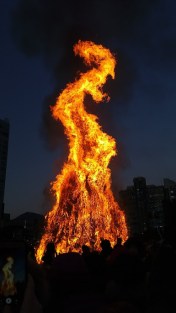 nd an inlay in two different teeth, and that the root canal would take 4-5 visits to the dentist to complete. Thus began my endless dentist torment.
 year, that meant that most of my friend pool were other first years. I had thought they were going to stick around, but events conspired in such a way that meant I spent the end of February going to/throwing farewell events and helping my friend pack/get rid of stuff.
 I had barely an opportunity to say hello to the new teacher at my main school and none at all to visit the second school. Despite the fact that classes would commence March 2, the new teachers avoided talking with me about lessons, or goals, or expectations. I began to get anxious, and reminded myself that newly arrived EPIK teachers wouldn’t meet their co-teachers until the new school year began, but I also had to wonder how many fresh off the boat foreign teachers would be paired with inexperienced Korean teachers. Was I getting extra newbies because of my experience or was it really random?
 Then at long last, a much anticipated event which I had spotted back in January finally arrived. A glorious yoga retreat at a spa resort in the mountains! What could be a better way to ease my stress and restore my resilience than such a wondrous weekend. The day before the retreat, I woke up with a cold… sore throat, stuffed sinuses, whole 9 yards. With little sleep and much mucus, I arose early Saturday and set off anyway, hoping that some meditation and spa therapy would at least help a little. And it might have, had not absolutely everything been a crazy misrepresentation, mistake, flake, or flat out disappointment. I haven’t even decided if I want to blog about this trip because it was so awful, I can’t find a way to spin it for the “life lesson” or “silver lining” even though that was the name of the organization that presented the event.
 Did I mention that during all this time, my tooth, the one that I’m getting this infernally long root canal done on, is in pain? The dentist has twice left me in pain for over a week with no medication, leaving me to struggle on through life with a dull throbbing ache in my left lower jaw and the total inability to chew anything on that side. Even now that the root canal is supposedly “over” (4 sessions later) and the process to install a crown can begin (minimum 3 sessions), my tooth hurts day and night and I have to wait to find out if it will be treated or not until my next appointment. But hey, my hair dye arrived, and it’s a smash hit.
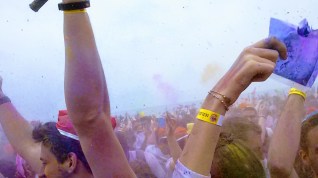 And Holi Hai is coming, which is the Indian festival of colors where we all dance around and throw colored powder and paint on our white clothes while rocking out to Boli-rock or Indo-pop on the beach. I did it last year and it was awesome, so I was really excited to go again this year. And yet somehow, people are trying to ruin that too. Two factions of the local Indian expat community have started a turf war over the holiday and who gets to throw the party. They’re trashing each other on social media and trying to drag all of us as well as the local Korean government into their feud. I’m still planning to go, but I will have an escape plan in case they start physically fighting over the microphone or DJ station. I don’t know what they were trying to do, but all they’ve really succeeded in doing is demonstrating their total lack of Holi spirit. Festival of love, guys.
 Green tea looks like very well kept English hedge,.
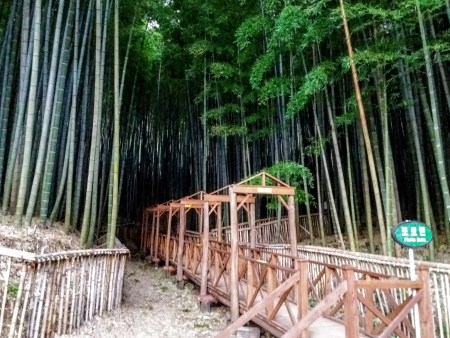 On our way back to the main entrance we took a quick side detour to the bamboo forest. After a short walk through some more evergreens, we emerged into an open space facing a dark and mysterious bamboo forest. The sun was low and the shadows were long so we couldn’t see far into the mass of stalks. Once we entered, it was as though a twilight had encompassed us, the lush leaves cutting out nearly all the late afternoon sunlight. The birds went bananas, screaming like jabber jays, making us feel as though we were in an arena from the Hunger Games or at very least in an ominous Korean horror movie. I wasn’t sure if we should expect kung fu masters or monsters. (click for more pictures of Boseong
  We left the tea fields behind and headed back down to the main parking lot that would lead to the lights. There were plenty of stalls with a wide variety of food (green tea added and regular) so my allergic friend was able to find something tasty, too. The light show wasn’t quite as spectacular as
  dragons and hatching out of giant glowing eggs along the way. Like most lantern displays here, everything was meant to be posed with and interacted with, so it was easy to walk up to any set and play around. It’s a small and childlike pleasure, but after so long in the US being forced to stay behind the railing, it is fun to get a little more hands on. On the way back down, we took the tunnel of lights, pausing every time the colors shifted to take more pictures and pose in the rainbow glows.
 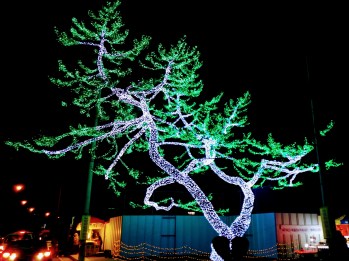 Our third and final location was near the beach where another tunnel of lights and light decorations had been put up. One large tree had been colored in white and green to make it look like it still had leaves. There were reindeer and Christmas trees, but also a giant chicken floating just off shore. I’m not sure why a chicken, but I saw another similar giant chicken in the sea back in Busan the next day.
 The next Saturday was Christmas Eve, and we decided we needed to do a blending of American and Korean activities. We spent the afternoon inside making eggnog and gingerbread houses. I have never made eggnog before. I thought about it a lot, especially when I wasn’t doing dairy. I thought there had to be a better tasting nog than Silknog. But somehow, I never got around to it. This year, although I seem to have no health issues with milk here, there was a complete absence of nog… everywhere… Koreans either have never heard of it, or they are all in the hate eggnog camp.
 based on past non-dairy culinary experiments, I’d say if you’re a dairy free nog fan go with unsweetened almond milk and coconut milk– the stuff in the can that is dense and creamy, not the stuff that is a regular milk sub.– Use 2c almond milk to 1 c coconut milk, otherwise just follow Alton’s instructions. If you’re a vegan who wants
  While we imbibed our culinary delight, we worked on assembling a gingerbread house. Every month here in Busan there is a
  In addition to our delightful wine, I enjoyed pumpkin soup, a goat cheese/bacon/honey pastry for entree, a superbly well cooked slice of salmon with a light lemon flavor and a unique mushroom risotto which had been made into a breaded patty and lightly fried, and finally a chocolate pear cake that tasted more like it was a ganache or very dense ice cream rather than a cake, too decadent! Nothing will compare to the food in France, but Le Jardin made an admirable effort and gave us all a taste of Western flavors with just a hint of haute cuisine that was perfect for a holiday feast.
 Toward one end of the festival, I found an old man with a traditional candy game called ppopgi. It’s a simple candy made from sugar and baking soda, but a shape is pressed into the candy. Kids (and a few adults) can use a little pin to try to break the candy around the shape without shattering the brittle sugar. If they succeed, they win a prize (often more candy). The vendor was using a tiny copper pot to melt sugar over an open flame, adeptly pouring out the steaming satiny brown concoction, pressing it flat onto a popsicle stick and letting his fares choose their shape before pressing a cookie cutter down on the hot surface. I noticed that while adults had to be perfect to win, the little kids were often awarded a prize for a good effort.
 A mere week later, the New Year celebrations were upon us. I had done some research and found that here in Busan there is a bell ringing ceremony in Yongdusan Park at the large bell at the foot of the Busan Tower. It’s a big event with musical performers and guest speakers that is televised much the way that the New York Time’s Square ball drop is. Yongdusan park is nowhere near as big as Time’s Square, and the majority of people don’t ascend the multiple flights of stairs until 11pm. Knowing we had plenty of time, we spent the day reveling in some seasonal sulbing, a screening of Rogue One, and a totally accidental Japanese dinner.
  Nonetheless, it was a wonderful day and at 5 minutes before 11, we found ourselves in a long line of people patiently trudging up the stairs to the peak of Yongdu Mountain. Normally, this pathway has a series of escalators going up so that anyone can access the park, but tonight the escalator had been closed down and reserved as a dedicated emergency access stairwell. When we arrived at the top, we saw many TV vans and we shuffled with the crowd into the standing space behind the VIP seating. To my surprise, through crowd motion, we soon found ourselves close enough to the bell to get a decent view of the proceedings, and there was a jumbo-tron screen off to one side that allowed us to view the performances.


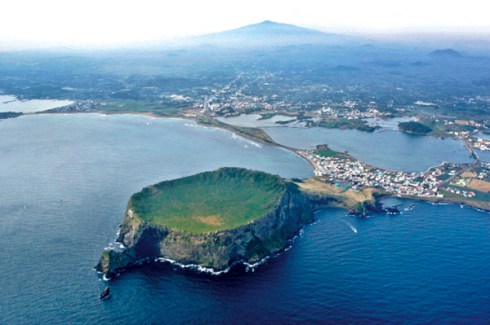 The weather was once more gray and drizzly, hot and humid, but with some sleep, breakfast and coffee behind us, we were enthusiastic to hit the road. I had done a bit of research on the crater that morning because of how the walk around the waterfalls turned out. I found some bloggers who claimed it was a 20 min walk if you just went straight up and about 40 minutes if you were a slow hiker. (it still took me about 45 that day). I felt better prepared for the hike ahead, but then we arrived late due to heavy traffic.

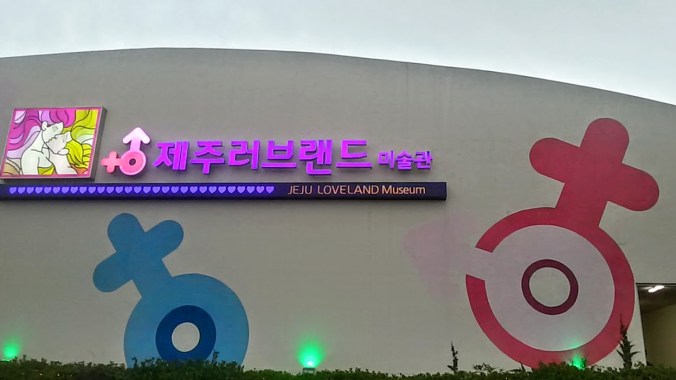


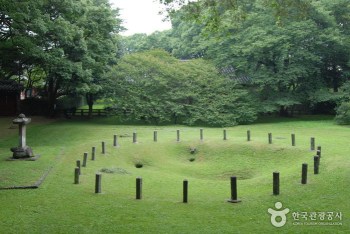 According to the legend told at the temple, the first inhabitants of Jeju Island were three demi-gods who came to earth in a great flash of light and energy, and emerged from three holes in the ground. The temple is built on the site of these three holes, and no matter how much it rains, the holes never fill up with water. The demi-gods were named Go (
 After watching an informative film about the history and mythology of the shrine and the island, we wandered through the paths in the quiet woods. There are almost 1000 trees in Samseolhyeong. The other buildings included the museum where dioramas of the myth were displayed along with some of the original writings and ceremonial clothing from the earliest rituals performed starting in 1562. Additional alters, shrines, dormitories and halls were added over the years, but most were destroyed during Japanese occupation. Although the site of teh three holes is the same, the modern temple complex was rebuilt here in 1970. The walk through the trees was a refreshing break from the hot and humid weather. We admired many bangsatap (small stone towers built for luck) and more than a few dol hareubang (the stone grandfather statues that are the iconic image of Jeju).


 There were 3 special rooms along one wall of the second floor: the red clay room, the amythest room, and the gardenia room. The rooms had little doorways and were quiet and dark inside. Places where people sat on mats or lay with their heads on wooden blocks to relax or nap while enjoying the atmosphere. The red clay room was warm, but not quite sauna warm. The walls were red clay and it resembled the inside of a clay oven. I don’t think I could have stayed for long in the heat anyway, but we were driven out by one man’s snores before that. The gardenia room was a truly sauna level of hot. There was a stong floral (presumably gardenia) smell in the air, but the heat was too oppressive. My bare feet singed on the floor as I hopped to a reed mat for protection. There were many women sitting on the mats but the air was too hard for me to breath for long and I hopped back out without even sitting down.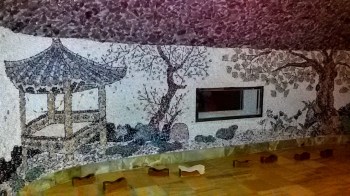


 After eating and stretching our legs, the buses moved on to Dutayeon. The area of Dutayeon is beyond the Civilian Control Line, was closed to civilians after the Korean War and was only recently reopened to the public in 2006. It’s still necessary for us to register ahead of time with the government in order to visit the area, and for some of our group to wear GPS tracking necklaces around while in the park. Of course I volunteered to wear one for our group. Are you kidding? The Dutayeon Park area also includes the warning: “Not all landmines have been found, so stay within the permitted areas.” It’s not your average hike in the woods.
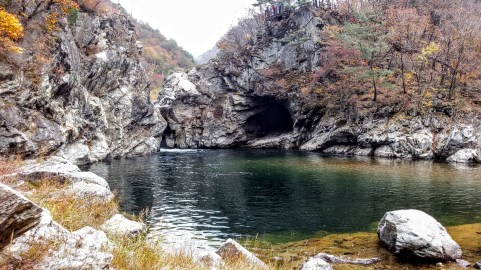 That being said, it is a beautiful area. The river that runs through it ends in a small but powerful waterfall that is the crown jewel of the park, visible across from the pond and from viewing platforms on both sides. There is a loop trail around the park, so it doesn’t matter which way you go from the pond. We headed right and passed by quite a large number of unexploded mine signs on our way toward an outdoor exhibit of mines used in the war,
  as well as other security measures and a mock explosion that demonstrated the sensitivity of the mines by blowing foam bits around in a ball while playing a low volume explosion sound whenever hikers came too close. There were also many happier decorations including party banners between trees, wooden deer and pigs, and a whole wall of paper prayers and wishes.
 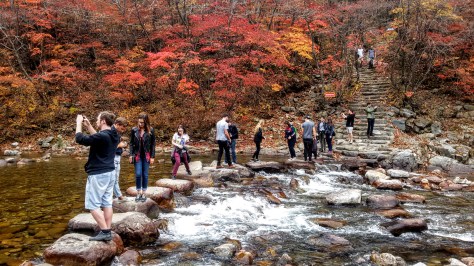 After crossing the brigde, we followed more winding forest paths through beautiful red trees. We climbed up some stairs to get to a viewing platform just above the falls and then continued on further upriver. When it came time to cross again, there was no bridge, but instead a trail of stones that required us to hop across. Most stones were large enough to allow two people at a time, but not all. Some stones could be easily stepped between and others required jumping. Plus, everyone wanted to stop in midstream for a geourgous photo-op. The end result was a long and patient crossing while trying not to get bumped into the water by people crossing the other way. This was mostly acheivable, except for when the Ajuma needed to pass. These are the ladies who wait for no one and push everyone aside to pass. Behavior that is just rude and annoying on the subway suddenly becomes hazardous when trying to balance on river rocks. Oh, Korea.
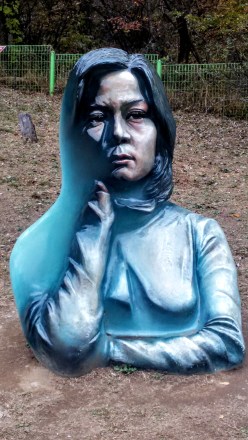 Back on the near bank, we followed the trail up to a gazebo/pagoda hybrid that overlooked the waterfall once more, before following a side trail up and over to a sculpure garden that included various works of outdoor art inspired by the war or the peace as well, as a missile and several tanks that were leftovers from the fighting. One of the most fascinating pieces was a painted sculpture that blended 2d and 3d art. The sculpture was the bust of a young woman, but only half of it was painted realistically, the other half had been painted blue. In addition, the depth was unrealisitc as well. The combination created an illusion of a different perspective of portrait from each angle as you walk around it. There was also a kitchy photo frame where we took a group shot, and a copse of giant eyeballs which was meant to show the sourse of all the tears shed for those lost. There were art pieces made from the objects of war, such as the barbed wire dandilion, and other shapes made from reforged metal. All in all, it was a surreal yet emotional tribute to the history and tragedy.
 From the park, we wended our way over to a small war memorial. Mostly we stopped here because it was necessary to file more paperwork for the Eulji Observatory. The memorial was very artistic and very sad. There were nine pillars representing the nine big battlefields in the area (Dolosan, Daeusan, Bloody Ridge, Baekseoksan Mountain, Punch Bowl, Gachilbong, Danjang Ridge, 949 Hill, and Christmas Hill), as well as statues of soldiers, displays of weapons and a whole room the floor of which was covered in shell casings from the war. Growing amid the barbed wire and destruction were small and beautiful flowers. There was a poem there ending in the stanza:
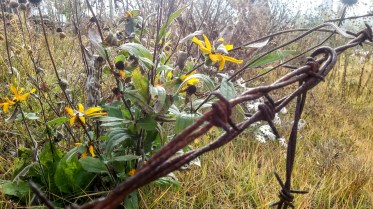 While reading these lines, I stood over the discarded shell casings, and under the helmets of dead soldiers, my camera filled with photos of beautiful flowers growing around the site. Although small and far less grand than the UN Memorial in Busan, the closeness of things these men had touched or died in amid the natural beauty of wildflowers and creeping red ivy brought the tragedy of war far closer to my heart than a cemetery or a statue ever could.
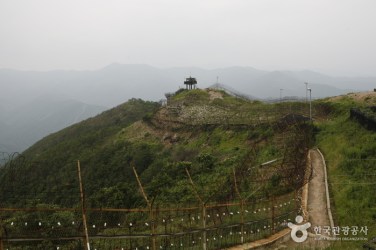 I could see one winding dirt road, some tires stacked and filled with dirt or sand to create a barrier, and a lone watchtower surrounded by more barbed wire fencing. Beyond these decrepit signs of occupation, the land seemed as wild and untouched as though looking back in time to before humans even arrived. Coming from South Korea, where all the land is so thoroughly occupied that wildlife is all but vanished, it was a stunning contrast.
 Inside the observatory, there is an enclosed viewing platform that overlooks the North. A brave soldier who spoke some English decided to read an English presentation to our large group. He was very nervous, but it was a great gesture that he wanted to share information with us, so we filled the small auditorium and listened politiely while staring at the mist shrouded emptiness behind him. He told us about famous battle sites around the observatory including Stalin Hill, where the South lost some land that is now part of North Korea, a radio tower used to block signals traveling into the North, and a distant waterfall called Fairy Waterfall where beautiful North Korean women used to bathe nude to entice South Korean soldiers. He also indicated that North Koreans did use the area nearby for agriculture, although to my eyes it looked completely natural and I cannot imagine that the food they harvested there would be anything more than wild gathering.
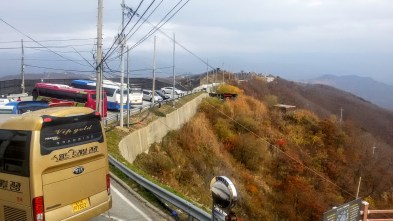 I stepped back outside, feeling disoriented from the whole experience, looking back and forth across the narrow fence from a high vantange point where I could easily see North and South at the same time. (hint, the South is on the right, the North is on the left) Large ravens swooped around the peak, effortlessly gliding between the two countries gripped in cold war, alighting on the Northern watchtower, then returning to our parking lot to scavenge for crumbs left by tourists.
 Our last stop for the DMZ day was the 4th Tunnel. This sounds fairly ominous, because it also implies there are at least 3 other tunnels, which there are. The North has tried on at least 4 occasions to literally tunnel into South Korea to get troops behind the border for a massive attack. Before heading over to the tunnel entrance, we scooted inside the nearby museum for a quick propaganda film. The film was in Korean, but had English subtitiles. They were long, small and hard to read over the video, as well as not being the most accurate gramatically, but I got the gist: North bad, South good, Threat onging. The idea that the Korean War is over is not something that really exists up near the border. To be honest, it doesn’t really exist in Korea at all, but most of the time Korean citizens can ignore their war with the North the same way Americans don’t let the 7 wars their country is involved in affect them on a daily basis. This film was a little startling however, because it didn’t even make an attempt at looking like an “unbiased documentary” and was more in a tone in keeping with propaganda material from the 1950s-60s during the cold war with Russia, or the modern Chinese government propaganda films. I’m not sure how old the film was, but it certainly felt out of time.
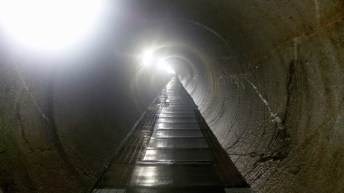 After the film, we filed into a large round tunnel. The tunnel we were walking into was dug with a serious drill by the South Koreans in order to reach the less sophisticated North Korean tunnel. It was a long walk, less than 1km I’m sure, but the tunnel was dim and damp and nearly perfectly circular thanks to the diamond tipped drill the Koreans had used to make it. Hard hats were available at the front, but there were nowhere near enough to accomodate our group size, so we simply left them behind. Inside the tunnel was another no photos zone. Fortunately, the internet provides, so you can see some photos that other people (including authorized tour guides) have taken of the tunnel and equipment.
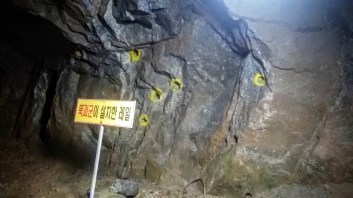 Where the modern and sleek South Korean tunnel ended, there were clear toolmarks in the rock, concentric circles left by the drill. Intersecting our tunnel was a much smaller one, no more than 2 sqare meteres, and rough hewn, carved out with picks and dynamite. A small train awaited us, one seat behind the next as the tunnel was too narrow for two abreast. The seats were low and a transparent panel protected us from the threat of falling rocks above, but the sides remained open. We climbed in, feeling even more like boarding a ride in a theme park, expecting a trek through the rugged rock. After a mere 100 meters, the train came to a stop. We could see tool marks, and holes that had been prepared for the next round of dynamite. I forgot for a moment about the photo ban, but when I snapped a few, the soldiers only politely reminded me not to and I put my phone away again.
 The parking lot had more tour buses than Disney Land, and when we passed through the main entrance, we were greeted with a wide stone road lined with restaurants, cafes and other businesses catering to park-goers. There are several trails that can take over 12 hours, but we didn’t have that much time. After doing some research, my companions and I decided we would see the big Buddha, then walk the short (2 hr) waterfall trail, and finally take the cable car up to the highest peak for a look around.
 Our tickets in had, we followed the signs toward the temple, passing more and more restaurants, cafes and other buildings of unknown purpose. We rounded a corner and spotted the giant statue from a distance and made a bee line straight for it. The first thing that struck me was how similar it was to the
  Trying to keep ourselves on a decent timeline, we said our farewells to the stunning statue and set off in search of the trail-head to Biryong Falls. We soon joined a stream of Koreans dressed to the nines in their special hiking clothes. For many Koreans, espeically the older ones, outdoor activities are a serious glamour show. All the clothes are brightly colored and brand new looking. Meanwhile, my friends and I were dressed in jeans and hoodies because that’s usually how we walk in the woods at home.
 The path involved some beautiful views of the surrounding mountains. Unlike the Busan mountains which are low and covered in a softening green layer of trees, the Seoraksan mountains burst from the treeline with jagged teeth of bare rock, and this day, the whole thing was wreathed in clouds and mist making it even more haunting. We took a wide bridge over a river and ambled joyfully along the forest path, stopping to admire the trees on a regular basis. The Koreans around us took some pictures, but only at designated picturesque spots. The rest of the time they were in a hurry to get moving. So much of a hurry that we were jostled, bumped and even shoved if we were deemed to not be going fast enough. It was like being in the subway… for several km. We tried to walk on the side of the path, or even just step OFF the path when the hordes of ajuma came barrelling down on us, but it didn’t always work.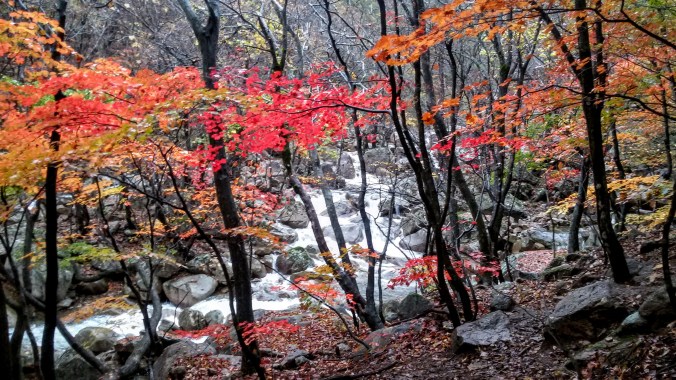
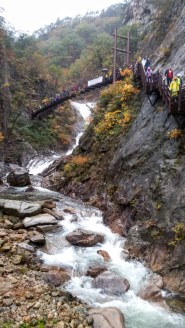 As our path ascended beside the river, we were treated to the kind of views normally reserved for high class calendars and natural beauty screen savers. My computer randomly shows me stunning nature pics every time I log in, and I swear that one of them was actually from Seoraksan. We climbed up the slippery rocks, clinging to the railing and nearby trees until we reached two more bridges crossing the lower Yukdam Falls. The maps and pamphlets all say it’s just a 40 minute hike from the main entrance to these falls, but it had taken us close to 90, proving that 40 minutes was measured by ajuma walking standards rather than beautiful day in the woods standards. I understand that Biryong Falls was only a little farther up the mountain, but in order to make our cable car time, we had to turn back early.
 Our last adventure for the day was to take the cable car up to
 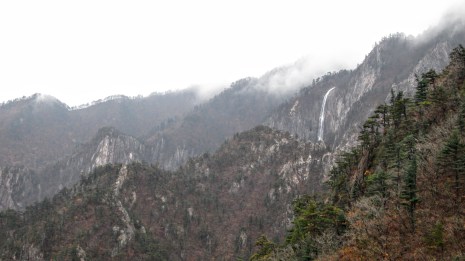 As we rose, the clouds soon fell below us, covering the view of the ground and the sea became visible off to one side. I had known Seoraksan was near the coast, but I had not realized how close to the ocean we actually were until that moment. The cable car stand at the top had more amenities, food and restrooms and coffee shops, but we swept past them and onto the viewing platform. I had read ahead of time that one could walk all the way to the tippy top from here and see an old castle, but after my experience on the waterfall path earlier, I was reticent to follow another stream of hundreds of hikers. We walked around the viewing area and found a distant waterfall, a long streak of white amid the green and brown of the mountains, visible even at this distance it must have been enormous up close.
 While searching for more and better angles to take majestic photos of the panorama around us, we stumbled upon a small path leading downward that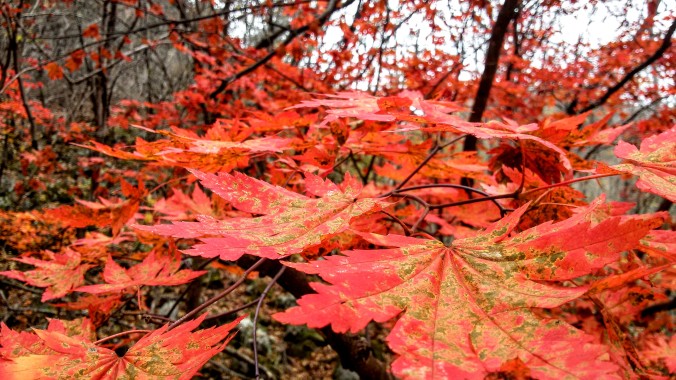

 They told me that’s the normal price for SPAM, it was just in gift boxes this time of year. This led to a whole side discussion about the cultural dissemination of
 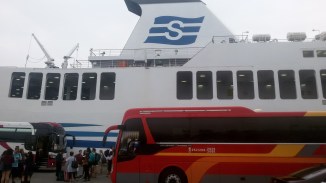 The only real hitch was that we were taking the ferry from Mokpo instead of a plane. This meant a 4+ hour bus ride
 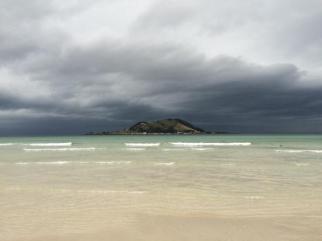 After we ate, we headed down to the water to frolic! The weather was gray, but warm. At first the water seemed chilly, but as I waded in further, I quickly adjusted. This beach was wide and shallow. We walked out for ages from the shore but the water didn’t even come to our hips. There were some Koreans playing in the water as well, but it seemed that only the Westerners wore swimsuits, everyone else went in the water in clothes. I’ve seen this at the beaches in Busan as well, and I’m still not sure what the cultural aversion to swimwear in the ocean is.


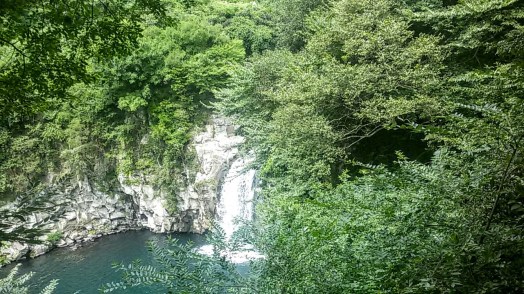 The best view of the falls was obscured by the trees and vines growing around us and was from quite a great distance. I felt cheated. I think it may have been a beautiful waterfall, but the fact that we weren’t able to find out after so many stairs just felt like a bad con. And unlike waterfall 2 which was relatively easy to hop the fence and get closer to, this platform was high above the pool with a very steep and overgrown hillside, making navigation any closer dangerous and difficult.
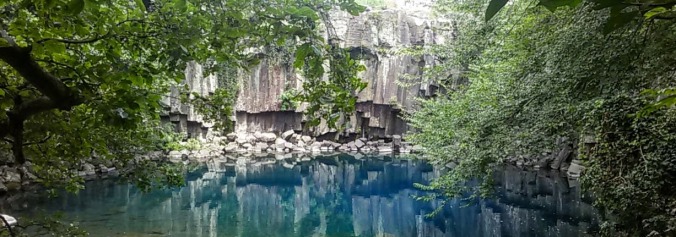
 We went first to Chocolate Land because, well, chocolate. For some reason there was a giant statue of the Incredible Hulk outside. I don’t know what I was expecting, maybe giant chocolate sculptures or the world’s biggest M&M, possibly a history of chocolate exhibit, or a making of chocolate section. What the ‘museum’ turned out to be was a room (just one) sparsely populated with display cases showing off packaged candy from various countries. Even this could have been cool if they’d said something about it, why is the Arabian chocolate this way and the British chocolate this way… I tried the Kazakhstan chocolate my friend brought me from her visit home after all and was fascinated to learn the pride that the country takes in it’s national brand. But no, these cases just held boxes of chocolates. Some cases made an attempt at silly displays, like a taxidermied chicken with Cadbury eggs or a Nativity Scene made with chocolate coins, but it was incredibly grandma’s yardsale chincy.
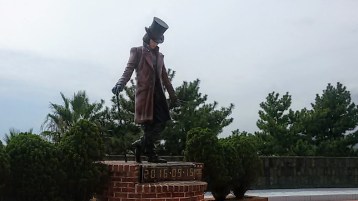 Half the room was filled with what seemed like Christmas themed facades that were, I assume, photo ops as well as a cafe where one could get some coffee, soft drinks, ice cream or candy and relax from the arduous walk through the musem. There was a chocolate making “class”, where for 12,000W you could pour some melted chocolate into molds. Outside there was a statue of Willy Wonka, but the Depp version, not the Wilder one. The final room was divided between more odd displays that seemed to have even less to do with chocolate than the ones before and the gift shop where one could redeem the 3000W entrance ticket toward the price of a sovenier. It turns out Jeju chocolate is quite tasty. They make it in fruit flavors that are unique to the island like Hallabang, Jeju Mandarin and Jeju cactus. The same boxes of chocolates are on sale all over, so it was basically like getting a 3000W discount on some chocolate I would have bought anyway for walking through a weird display room.
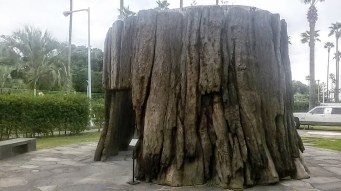 The trunk of a California redwood had been taken apart, transported and reassembled there so that the Koreans could see the stunning size of the redwood trees and experience walking inside the hollow trunk. It struck me that this was as close as most of them would ever get to a redwood and reminded me that museums aren’t just for history, but for the exchange of personal experiences. The most ridiculous thing there was the map of all the places in the world that Ripley had travelled. The map was covered in numbered blue dots with a key below. As we started to try to identify some of the places in the US, we realized that the geography was woefully inaccurate since Siam, Yugoslavia and Burma were all listed as being in the continental 48. Yugo-Slavia [sic] is in Florida.

 On our way past the beach restrooms we reached a point where the floor and walls seemed to move and I realized with horror that the whole path and retaining walls were COVERED in cockroaches. Horror movie levels of roaches. I am not afraid of most bugs. I can be startled by unexpected bug and I have a healthy respect for things that can hurt me, but there is something deeply lizard brain *ACK* about realizing that a good portion of your surrounding landscape is made of bugs. Fortunately, they didn’t want anything to do with us and moved clear of the path as we approached.
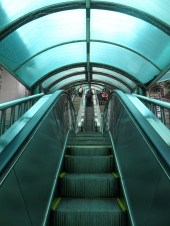 This park in the Nampo neighborhood is up on a bit of a mountain, but there’s no need to climb up exhausting stairs because there’s an outdoor escalator installed to let you ride up in comfort! When we got to the top, we were already blown away by the great views of the city below and we hadn’t even gotten to the highest points yet. As we passed by the stage area, it was clear that a performance was about to get underway. There were plenty of people dressed in the standard white garb trimmed with bright colors and fun hats and the parents hadn’t gotten to see any traditional dances, so we pulled up a seat. I have since found out that cultural performances happen here every Saturday at 3pm between March and November.
  The MC for the day was excited to see so many foreigners (not just us) in the audience and brought out a poor young Korean lady who was nervous and not particularly fluent to try and translate for us. Representatives from each visiting country in the audience were invited to come up on the stage and play a traditional Korean game of trying to toss a stick through one of 5 rings attached to a jar. My friend’s mom went up and they let her stand extra close because she was over 60 and she brought us honor by scoring the center ring! We didn’t sit for the whole performance, but it was a kind of musical story. From what I could follow, some performers arrived at a lord’s house and were invited in to party, but there were some rascals around who may have been trying to steal away or marry off the lord’s daughter? The language barrier was a bit of an obstacle to the plot, but it was fun to watch and clap along with.
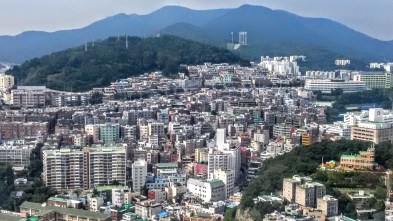 We snuck out during a lull and headed to the main attraction of the Park, Busan Tower. The tower stands 118m high, but it’s also on a mountain so, it seems to be rather higher than that when you look down. For 5,000won you can get a ticket to ride up to the top of the tower where you can enjoy a stunning 360 degree view of Busan. There are helpful decals on the windows that identify major landmarks and there;s a little cafe where you can enjoy a snack with your view.

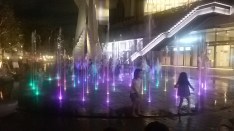 Sky Tree (left) where the small fountain lights are coordinated with the tower lights high above. These shows are fun, awesome, wonderful, and sparkly, so when my friend told me he wanted to take his parents down to Busan’s own choreographed fountain show, I was all in favor.
 There are some permanent concrete bleacher type seats along one side, but the rest of the area around the fountain had been filled up with plastic chairs to accommodate the higher number of spectators on the warm weekend nights. We arrived early and laid claim to seats in the front row, hoping that we wouldn’t have to worry about the crowd standing in front of us when the show started. Refreshingly, the Korean audience stayed in their seats during the show and we had a first class view. In both China and Dubai, the spectators jostled for the best standing spots and to get my video, I had to start standing in my spot almost 30 minutes before the show started to get an unobstructed view.
  This is 2,519 sq m fountain is listed as the largest fountain in the world by Guinness. I suppose that the show at Dubai is not considered a single fountain and is therefore only the largest fountain
  I’m not a food blogger, but sometimes food is just too good not to write about. I’ve done some basic coverage of these things elsewhere, but it doesn’t get old. Dala 100% Chocolate is this tiny hole in the wall chocolate cafe in my neighborhood in Seomyeon. The first time I went there, I had to try their signature dish, the dinosaur egg. This was an amazing concoction of shaved milk ice topped with crushed chocolate cookies and chocolate shavings with a giant egg made of cookies and cream candy. When smashed with the provided hammer, the egg reveals a scoop of truly decadent chocolate ice cream and a tiny chocolate dinosaur. If that’s not enough chocolate, you can pour chocolate sauce over it too. It takes at least two people to eat this dessert. Since that time, we’ve also tried the chocolate pizza (nutella spread, banana slices and toasted marshmallows for toppings, scoop of vanilla ice cream and chocolate sauce again), and for the two separate parental visits this summer, I also managed to try the fruit fondue (kiwi, grape, orange, grapefruit and banana… turns out grapefruit in chocolate is awesome), the “special brownie” (molten chocolate inside!), and the chocolate churros (churros you dip in chocolate). Let us not forget the milkshakes, which come in a variety of chocolate compliment flavors and can be made white, milk or dark. I don’t just love this place for it’s chocolate, but because it’s good chocolate. It’s not too sweet and they do a good balance of flavors in each dish so you don’t get tired (as if that were possible) of a single chocolate flavor. I think we’re about halfway through the menu now, and if the weather keeps cooling off, I’ll get to try their hot drinks soon!
 The melon special was not just using frozen milk, but frozen yogurt… and not the kind you’re thinking. Imagine you mix some yogurt with milk or water until it’s all liquidy, then freeze it solid, then shave it off into teeny tiny snowflakes. Ok. Now, take a honeydew melon (the green ones) and cut it in half. Hollow it out and freeze the shell. That frozen melon rind is now our bowl, filled with the snowflake texture frozen yogurt and topped with some cubes of what I can only describe as cheesecake filling.
  Now, over the whole thing, put the melon you removed from the rind, the hemisphere of melon, all of it. The dish was served with a big plastic knife so we could cut up the melon for ourselves. It was the perfect combination of sweet, tart and creamy to refresh us in the summer heat.
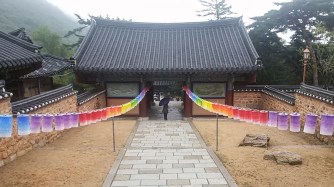 When we arrived, a very nice older Korean lady offered to explain a little bit about the main gate to us in English and we got to hear a little history of the naming of the temple and the unique four pillar style that makes this era of architecture distinctive. As we ascended the stairs and passed through several gates decorated with bright lanterns and beautiful paintings we moved through a hall of fearsome statues and finally emerged into the main courtyard. The temple was originally built about 1,300 years ago, but was destroyed during a Japanese invasion in 1592 and later rebuilt in 1713, but a few stone remnants and one stone pagoda left from the original still stand in the wide open square. The temple is dedicated to the practice of Seon Buddhism, which is the Korean descendant of Chan Buddhism the same way Zen in Japan is.


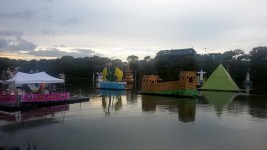 Also called the Jinju Namgang Yudeong Festival, it is held in honor of the fallen during the seiges by Japanese soldiers in the Imjin War in 1592-3 (the same time frame the orginal Beomeosa Temple was destroyed). During the war, lanterns were used as military signals, a means of communicating with reserve forces, and as a way to keep in touch with family members outside of Jinjuseong Fortress. Even after the war, people continued the tradition of floating lanterns down the river to pay tribute to the brave souls that had been lost during battle. Today, the festival is far more than a few lanterns on the river and instead is a whole palisade of life size and larger than life lanterns floating on the river and filling the riverside park where the fortress once stood.
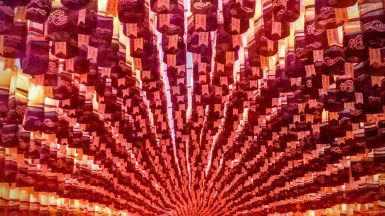 When we entered the display area, we were given arm stamps so we could come and go as many times as we liked, then we began our stroll down the riverside. The water was covered in giant lanterns in shapes of mythical animals and heroes as well as famous landmarks like Stonehenge, the leaning tower of Pisa, and the Statue of Liberty. There were floating restaurants, boat rides, and yet more tents offering delicious snacks.There were giant tunnels of red lanterns where couples walked hand in hand in the twilight.
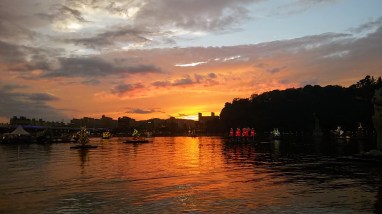 Two floating bridges at either end of the display allowed visitors to pass from side to side without returning to the street level. The day had been rainy, but as the rain dried up, the sunset lit the clouds in shades of brilliant gold and scarlet.We crossed the river and ascended into the wooded area to be greeted with the most amazing forest of light. Unlike the


 all over their website, Facebook and the internet in general. It’s on the beach as well, which is always a winning proposition.
 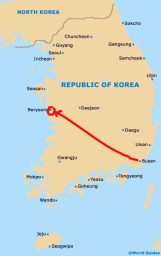 Boryeong is on the opposite side of the country, a little south on the coast of Taean, where we went to see the tulips. It took us about 5 hours to get there, but it was nice because we were on one bus the whole time and didn’t have to think about anything. We got there around 2pm, and quickly went to drop our stuff off in the room and change. We also had to go hunt down booze and waterproof pouches for our phones and wallets. So, it was probably after 3pm by the time we got TO the festival. This may be the only real complaint that I have about the tour trip. The main festival attractions closed down at 6pm, so we didn’t have a lot of time to try all the activities before they were done.
 It turns out that the main festival is on Daecheon Beach, which is a beautiful sandy beach, and the mud has to be trucked in for the array of water slides and inflatable games. No wonder it was watered down. Several of the photos I’d seen online were not actually from Daecheon at all, but from the actual mud flats themselves in Namgok-dong, where smaller events, including a 5k mud run, are held. The mud festival lasts about 2 weeks and we were just arriving in town for the last weekend. I didn’t even learn about the mud flats until after we got back, but we wouldn’t have had enough time to visit them that day anyway. Don’t take this map as gospel, because all I could find was the name of the mud flats, so this is just a rough idea of how far the mud beaches are from where the big party is. And while the mud beach looks totally like everything I was promised, the Mud festival itself looks like this.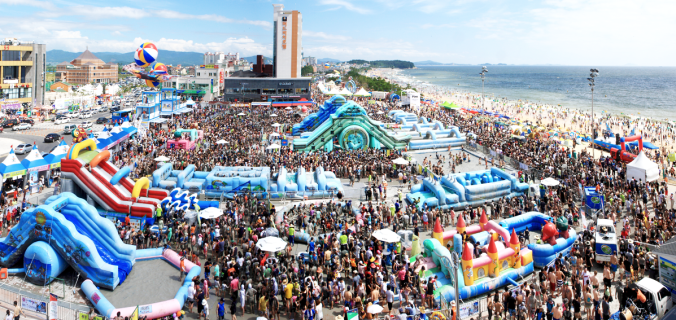
 The line we were in was for the football (soccer) arena. It was an inflated pool with inflated goals on either end. The muddy water was about mid-calf depth and the ball was an inflatable beach ball. It did look fun, but after the first 30 minutes of standing in line, we were seriously questioning our life decisions . We took turns holding the group place in the queue so people could get out and go pee, and finally it was our turn to get in the arena. We lined up against a group of Koreans and began to chase the beach ball around the pool.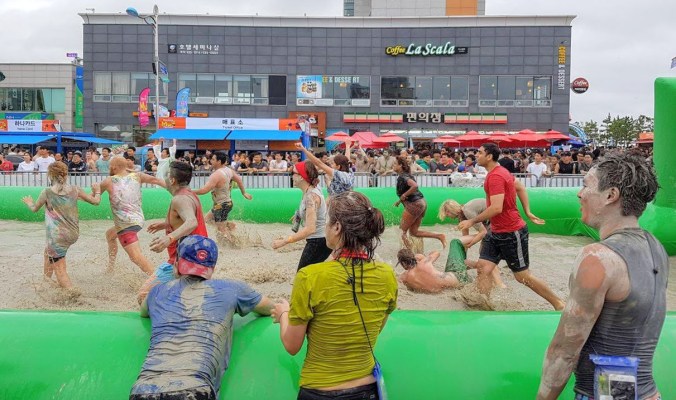
 but my top goal was the giant slide. My friend described it later as “
 I was surprised to find that the giant slide dumped me outside the fenced in area, especially since my shoes were back on the other side at the entrance where I’d been asked to leave them. I reconnected with some of the group and managed to get back inside right before they closed down. We got in one more line for the floating hamster wheel (which is a serious upper body work out, by the way, especially when it’s slippery!) but alas when we got out, the other attractions were closing down.
 Returning from the beach to find the eerily abandoned mud park, it didn’t take me long to get to my other favorite travel activity: talking to new people! I ran into someone I’d met briefly in one of the lines who had also ended up separated from his group. We wandered around the waterfront chatting, and ended up having a great conversation about our lives and travels which was totally unmarred by any awkward flirting. Why I love A-spectrum folks: you can dive straight into a deep and meaningful conversation without all that useless weather-sports-job chit chat.
 While we were talking, I found out that the K-pop sensation Psy was scheduled to perform on the beach. Which, again, just goes to highlight how bizzaro Korea is about promoting events, because there had been no mention in anything I read about this. In case you’ve been living under a box, Psy is the singer of the international sensation “Gangnam Style”, so he’s not just famous here in Korea, but nearly everywhere. I mean, imagine if you went to a festival and then halfway through someone was like oh yeah, Beyonce is gonna perform, too.
 I like the notion of the pension, but the number of nights per year I’m willing to sleep on the floor is shrinking as I age. Just one more reason I really need a TARDIS. Anyway, thanks to alcohol and exhaustion, I did manage to sleep. And woke up the next day with only a mild hangover and several more hours to explore the festival grounds. I hadn’t known that we would still be at the festival for so long, and only had one set of clean clothes. It turned out that the water attractions were closed anyway, so while there were still people getting muddy, it was limited to the mud water jars placed around the plaza.
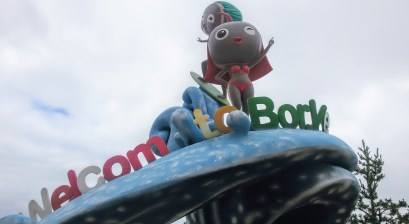 We managed to stay clean and took the time to better explore the area. As it turns out, the Boryeong mud is famous for it’s mineral composition and use in cosmetic products. The festival was once an advertising campaign for the cosmetics and has since become an epic party. There were several things that seemed to be permanent beachfront statues that were all about the mud, but since the mud itself is a major commercial export for the town, it wasn’t so surprising that they had statues devoted to it.
 We also found the performing native Americans again. I feel like it’s starting to become some kind of David Lynch-esque running gag for my time in Korea that there are always guys dressed in intense and often highly mixed Native American garb playing flutes and pan pipes and selling dream catchers. One of them had bright neon fringe this time. And I saw more of them playing at a rest stop on our drive home! What is the deal Korea, seriously?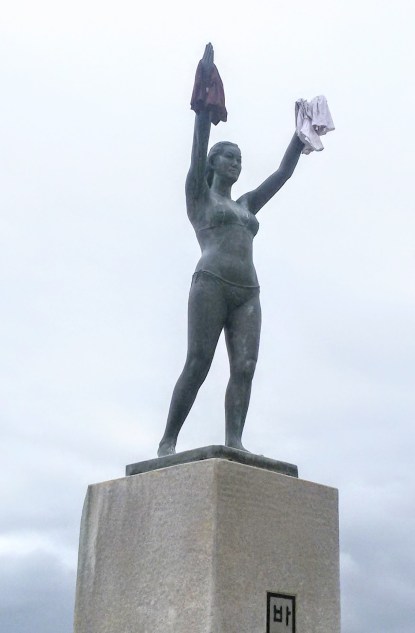

 When I first found out about the festival in March, I was excited to see it. When I found out it was the 17th annual one, I was blown away. Try as I might to keep up with real news and world events, I still had a solid perception that LGBTQ+ rights platforms were the domain of the West (and that America might actually be the farthest behind in that race) while the rest of the world lagged far behind in tackling this important civil rights issue. I saw things like Russia banning LGBTQ+ at the Olympics and China striking down gay marriage as signs that the East just wasn’t doing that much.
 Korea just recently had, for the first time, two (famous) men
  Previous years’ festivals have seen large groups of protesters who have screamed at, spat at, taken pictures of, and occasionally engaged in greater displays of violence and harassment toward the festival goers. They’ve reportedly lay in the street to block the march, and even engaged in physical violence against the police to try to get at the Pride participants. Protesters have tried to shut out Pride by booking up the space, nearby spaces, and hotels to keep people out. This year, the conservative anti-gay Christians tried to petition the courts to shut down the festival on the basis of public indecency, but they were denied. However the Korean culture may feel about LGBTQ+ currently, at least the government respects everyone’s right to peaceful assembly, which is awesome. More than merely respecting it, the government issued stern warnings to the protesters to refrain from violence, because violent protests are illegal.
 My Busan Bestie and I headed to Seoul Friday after work, arriving after midnight and experiencing the very beginning of the Seoul public transportation headache. We managed to find the right bus, but missed our stop and got stuck on the wrong side of the bridge, which I guess technically people walk across, but it was the middle of the night and we had luggage, so we thought, oh hey, we’ll just take a taxi… nope. Scarcely any to be had and none for us. We finally found another bus and got back on the right side of the bridge but didn’t make it to our hotel for almost 2 hours after our train arrived. Why didn’t we take a taxi from the train station? Well, the line for real taxis was 30 people deep and no taxis were coming, the bus ride was only supposed to be 30 minutes, and as we found out later, there are plenty of fake-out taxis waiting to charge you an arm and a leg for a 15 minute drive.
 When we finally emerged from the station, we were greeted by a huge wall of police. I saw the protesters well before I saw the festival. They were set up across the street with a giant stage where they were having speeches, performances, and blasting Christian music in an attempt to drown out the Pride music. The streets around Seoul Plaza were lined with police standing shoulder to shoulder. When the light changed, they parted to allow us access to the crosswalk by which we entered the park. I have to admit, I was becoming anxious, and not in a good way. My heart was aflutter and my adrenaline was definitely going. I’m in no way anti-police. My sister is a police officer, and I have a lot of respect for the men and women who do a necessary and often thankless job. In the US, if I get pulled over or approached by an officer in public, it does not make me nervous. But something about seeing thousands of officers creating a human wall made me more than a little twitchy.
 Speaking of being free to be themselves, the festival also went out of it’s way to make the space especially safe. In the past, protesters used pictures of festival goers to publicly shame them, or get them fired, or even disowned by family. It’s no laughing matter to be Out here. Homosexuality can’t get you arrested, but there are no laws protecting employment yet. Many families feel it’s shameful and will disown children who come out. LGBTQ+ Koreans mostly have to pretend to be cis-het to get by. A few have managed to make enough money that they aren’t afraid to come out, like the filmmaker who petitioned for a marriage to his lover, like the small community of drag queens that simply make their living as performers. But the average person is hiding. This festival is a chance to be among people who accept and understand, but the attendees probably have to go back to homes and offices where they have to pretend again, and thus, having their pictures plastered on the internet can be scary and damaging.
 The festival made it clear that anyone taking pictures for anything other than strictly personal use (eg, keep it on your phone and never show it to anyone) must get a press pass and sign the agreement. I like sharing my pictures, so my first stop upon entering the park was to the press booth. I read a multi page contract that stated the rules for taking and sharing photos. It was heavy on permission. (yay consent!), and very strict about not posting anyone’s face you didn’t get permission from. I asked people all day, and handed out cards to the site so they really understood where the image was going. They also collected our IDs, so they can hold us accountable should someone take issue with my following the rules. I told my school where I was going that weekend because I don’t like lying, so I personally am not worried about it ‘getting back’ to my employer, but I know it’s a real issue for many Koreans and I’m glad the festival took such pains to protect them.
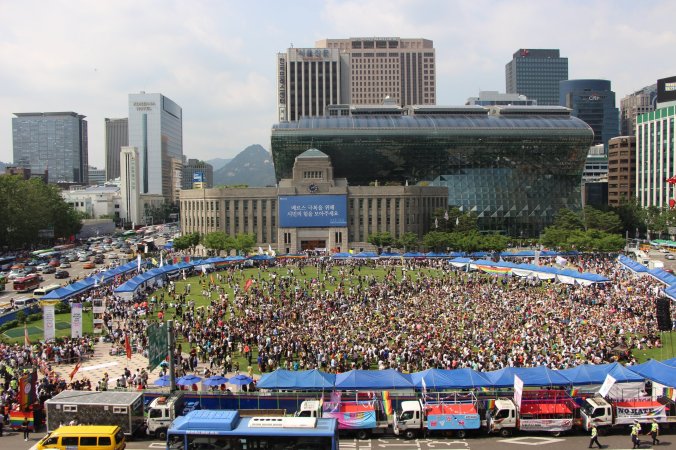
 After securing our press passes and verifying our reservations for the after party, we slowly started to explore the booths that lined the plaza. Unlike events in the US, there was very little corporate representation. And unlike events in Korea, there was a lot more than endlessly repetitive booths of food and trinkets. Most of the booths were operated by groups trying to raise awareness and understanding for some aspect of the LGBTQ+ community. There was a group called “Dignity for Soldiers”, another booth was from the first (and only) NPO that does outreach and support for at-risk LGBTQ+ youth in Korea. There were booths for just about every shade of the rainbow including Trans, Poly, Pan, Ace, Bi, BDSM… I think maybe the only sexual type not represented were Furries. But it’s ok, I found one in the parade later on.


 ady in rainbows and feathers who, when I asked if I could take a photo, told me she was with the US Embassy. It turned out there was a whole row of Embassy booths there, each country sending official representatives to support LGBTQ+ rights (and promote tourism, let’s be honest). And for just a few hours, I was really proud of my country for making this public, overt, international, diplomatic, and above all enthusiastic statement of support for LGBTQ+ and gentle pressure for Korea to catch up. (
 rain, they dancers just put on some plastic ponchos and kept right on dancing. I heard later that some of the protesters had apparently been praying for rain to ruin our day. I can only imagine their frustration when we didn’t let it dampen our spirits. If anything, it was a refreshing cool down during the summer heat!


 The “parade” did have some “floats”, but it was not what we tend to think of as parades these days. There were a few trucks out in front with banners and people in costume on display in the truck beds, but the majority of the affair was much more akin to a political march than a celebratory parade. The walking area had us leaving the plaza, going up several blocks and around a big loop before returning to the plaza. It was around 3km, so not a huge hike, but definitely enough to attract attention, which was the point after all. The trucks out front
  had a few decorations, mostly pink triangles and rainbows, and the people on the trucks were holding pro-love signs and dancing to encourage the crowd. There was nothing like a “parade float” in sight. Actually, that’s not totally true, the protesters had some pretty swanked up gear on the side of the road, but they didn’t march with us.


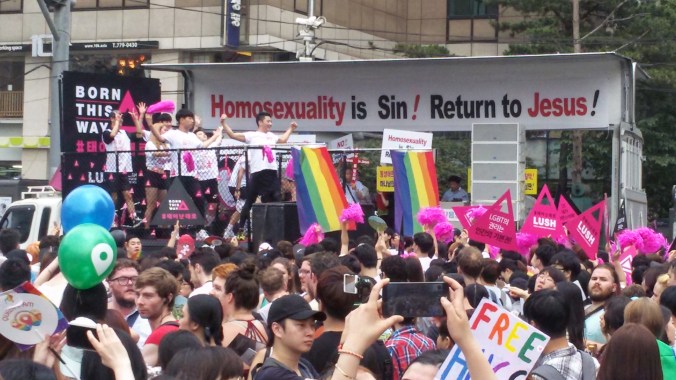 There were plenty of protesters right at the start of the route near the plaza, but as we went on, their number dwindled and the amount of supportive bystanders increased. I’m so incredibly proud of the marchers that day.
 marchers yelled back “I love you”. We echoed their “hallelujah”s and smiled at them and blew them kisses. I’m personally a big fan of meeting hate with love, but it’s
  As the protesters fell away, we began to notice people on the sidewalk holding signs of support or waving and smiling and giving us thumbs up signs. Restaurant owners leaned out of their second and third story windows to wave down at us. A group at Starbucks had clearly planned ahead, because not only had they gotten seats right by the window, but they all held up rainbow signs reading “support equality”.
 The location for the party was stunning: a man-made island in the river. The buildings were huge and fun to look at with sweeping shapes and color changing windows. The party itself was a little lackluster for my tastes, but the one great thing about it was that it was about 98% Koreans. I sound like a broken record, but a lot of events I’ve gone to have had a large expat attendance and that’s fine for fun fun festivals, but this is more than that, it’s a civil rights movement with some party trappings and there can’t be a movement if the people of the country aren’t behind it, so it made me really happy to see so many Koreans there being openly gay in a way they can’t be in their day to day lives yet.
 There were some vendors in the main hall selling snacks and t shirts. The VIP lounge was quite classy, but the line for the bar was insane. The mojitos were outstanding, however, and there was a classical quartet performance as well. The dance floor was roomy and the DJs were fun, but he dancing was very Korean. This meant that groups of people got up on the stage and danced the moves to K-pop songs while the audience/dance floor did their best to keep up with the same moves… that they all knew… to all the songs. This is an aspect of Korean culture I may just never get used to.
 That lasted until Monday morning when I opened my Facebook.
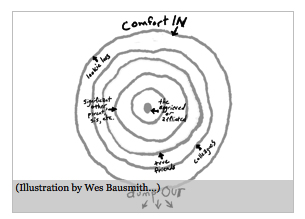 This Monday was the same way. I read the news, several times. I even went to google to find an actual journalistic report or 20 and not just some Facebook posts. I got dressed, cooked breakfast, went to work. Explained to my co-teachers that I might be a bit emotional that day because there was a horrible mass shooting in my home country and proceeded to get ready to teach classes. I think I made it through 2 classes before I actually started crying. I didn’t know anyone involved. I’m somewhere beyond “colleagues” yet well inside of “lookie loos” on circle of tragedy in
 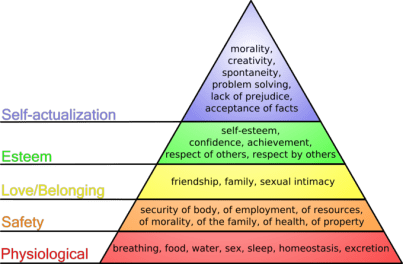 Love and belonging are the third tier of Maslow’s hierarchy, only overshadowed by the need for food and safety and integral to achieving esteem and self-actualization. They are NOT OPTIONAL for humans.
 America is fascinated, hypnotized, enslaved to the idea that every issue has two and only two sides which are so opposed to one another that any form of compromise or middle ground is simply unthinkable. I don’t mean uncomfortable to think about, I mean, people’s brains are actually incapable of thinking the thought. Thought rejected. This is known as the “
 Even in this way, Americans are dichotomous. You love it
  And while we’re at it, a side note on false equivalencies. , such as this lovely comparison of Obama to Hitler. Both were in favor of a policy, therefore they are the same? No. Obama =/= Hitler.
  We need to stop buying into A or B. We need to ask “why” about everything over
 In America, when someone says something insulting (about your faith, your lifestyle, your weight, appearance, gender, orientation, skin color, etc) the result is all too often “You’re an adult, suck it up”. The expectation is that adults should just be able to deal with being insulted or having their feelings hurt (even though arguably many of these insults are signs of bigotry and oppression and not just about hurt feelings).


 America is overly negative. I definitely feel like America is turning (has turned?) into one big crab bucket. People tell me all the time “every place has problems” as a way of minimizing the problems in America or somehow trying to equate them with problems in other places. People tell me all the time, “not everyone can just leave” as a way of reasoning out why they can’t.

 Gallivantrix