Spring marches on, and Korea is filling up with colorful lanterns to celebrate the Buddah’s birthday. While I work on assembling my lantern festival stories, what better time to take a look at the temples of Ipoh? Despite the fact that Ipoh is not a tourist hotspot, there are certainly some stunning things to see. Just remember to take plenty of water!
Ipoh Caves
The Reggae House was a typical late night backpacker’s party hostel and so everyone was still asleep when I got up in the early morning to start exploring. After figuring out the padlock and iron door trick to lock up behind me, I set off in search of breakfast to discover that Ipoh is a very sleepy town. Only a couple places were open at 9am on a Saturday and these were offering a traditional Malay dish called “mee” (which just means “noodles”). I managed to order something by playing a sort of 20 questions with the waitstaff, and enjoyed my noodles and mystery meat in a not yet too hot outdoor dining area with views of the neighborhood. There were a startling number of funeral homes nearby and plenty of evidence of the British colonial architecture, although much of it was in disrepair.

Kek Lok Tong
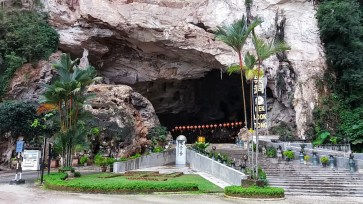 After breakfast, I caught another Uber to the Kek Lok Tong Cave Temple. Ipoh is probably most famous for it’s caves, and there are many of them around the city, and by around I don’t mean inside, I mean in a ring out and around. Unfortunately, the public transportation in Ipoh is somewhat lacking and it would have taken over 2 hours to get to my target by bus, but less than 20 minutes by car. Online advice suggested that I should negotiate with a taxi driver for a day rate, and I’ve done this before when I wanted to travel to remote places and be assured of a ride back, but I looked at the costs other travelers were paying for half and full day taxi hires and decided that I’d take my chances with ride-sharing.

 The temple is the star of Ipoh tourism and it’s not hard to see why it’s on the top of everyone’s list. Batu Caves in Kuala Lumpur is a Hindu temple, but this is Buddhist. There were extra decorations in preparation for the Lunar New Year and a very short stairwell up to the main entrance. There is no admission fee for the temple. The limestone cave is open at either end, making it a lovely wind tunnel and a cool place to get away from the heat. It was still early enough in the day that I wasn’t uncomfortable yet. The wide cavern is completely day-lit, but does have a few artificial lights to show off exceptional formations. There are stairs to help access different levels, and the main areas of worship house large golden statues on plinths with the natural art of the cave as a backdrop. It was breathtaking.

 The back opening leads down to a lake and garden that is nearly completely enclosed by sheer towering limestone cliffs dripping with lush greenery. Although there was a quarry in the distance, it was far enough away not to disturb the tranquility of the garden. I was surprised to see it so empty on a Saturday morning, but I have no doubt that on the weekend of the New Year it was packed to the gills. I took my time walking around the garden in the relatively cool morning air. I enjoyed the sweeping grandeur of the cliffs, the bright tropical flowers, the miniature landscape art, and even the company of a few geese. In those hours I spent between the cave and the gardens it seemed like all the dirt and grime and inconvenience of Malaysia faded away, focusing my attention on only the calm beauty around me.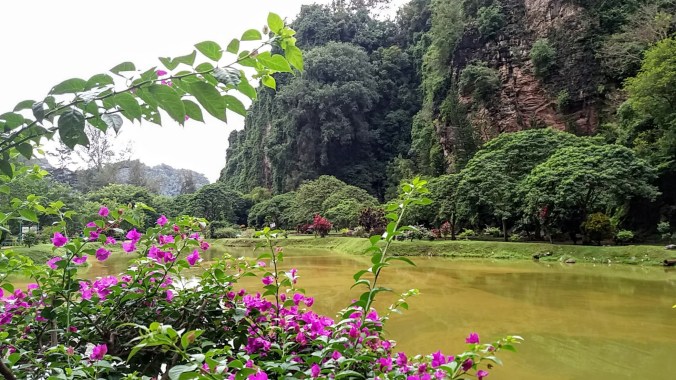
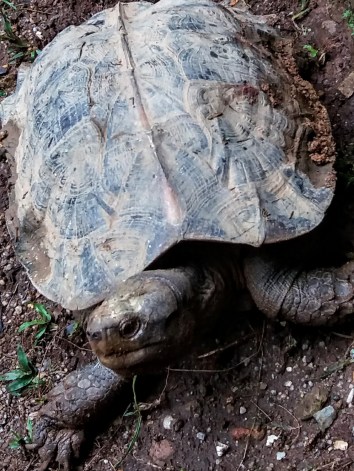
 On my way out, I climbed up a few more staircases to get a closer look at the cave formations. Much like Batu caves, the limestone was in familiar shapes, but so much larger in scale than I was used to. I had no trouble getting another Uber to come out for me, and while I was waiting, I took a tour around a little turtle pond on one side of the parking lot. Most of the turtles were quite shy, plopping into the water to escape as soon as I got within a couple meters, but one large guy was holding his ground and I managed to get a few cute pictures.
Sam Poh Tong
The next cave temple I wanted to visit wasn’t very far away and turned out to actually have 3 temples all along a single short road, so while the other two weren’t on my list it seemed a waste not to at least peak at them while I was there.
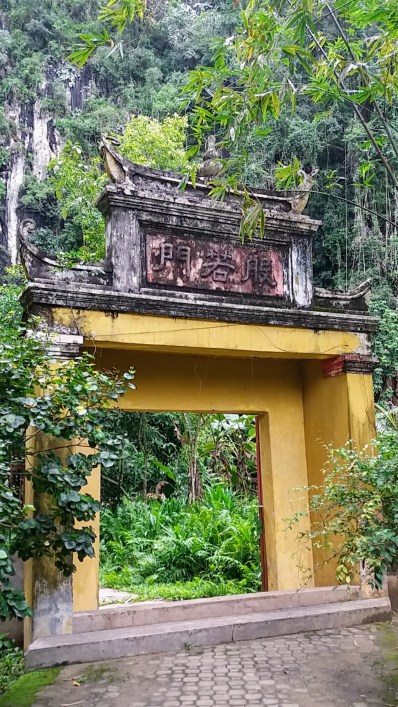 Sam Poh Tong is also a Buddhist temple and is said to be one of the busiest and most popular in Ipoh. I could tell it was an active temple from the freshly lit incense, but little else gave evidence that it was maintained or cared for. Even so close to such a large holiday, the grounds looked unkempt and abandoned. The huge numbers of underfed and skittish stray dogs was off-putting, but they were not aggressive. The garden in the front was a small lake with tiny “islands” that became miniature mountains holding tiny temples. As I walked around one side of the temple compound, I came upon a building that seemed long empty, covered in dust and bereft of occupation, yet there was incense burning at the dusty altars, observed it seemed only by me and some monkeys on the fence nearby.
I went back to the main gate and into the cave itself. The differences were striking. Where Kek Lok Tong had been left mostly natural and had only a few additions of statues and stairs, Sam Poh Tong looked almost like a building inside the cave.
 The walls were painted and florescent lights were on the ceiling, while piles of furniture and other stored items crowded the rooms. The floors were finished and there were windows and doors installed into the stone. It felt less like a cave and more like a basement.
O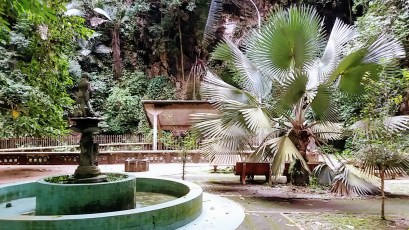 n the other side of the cave was a small enclosed garden. The walls of the garden were more towering limestone formations and the greenery within was Jurassic in scale and seemed to be overgrown with no concern for trimming or arranging, dead leaves carpeting the ground. There was a small turtle pond behind a fence filled with turtles of all sizes that could be fed fresh greens and veggies bought from a
  stand inside the cave. The stand and it’s sales person were some of the only signs of tending I saw. At the back of the garden behind a locked a fence and a forest of unkempt branches was a bright red pagoda that seemed more like something in an abandoned jungle than in a living temple.
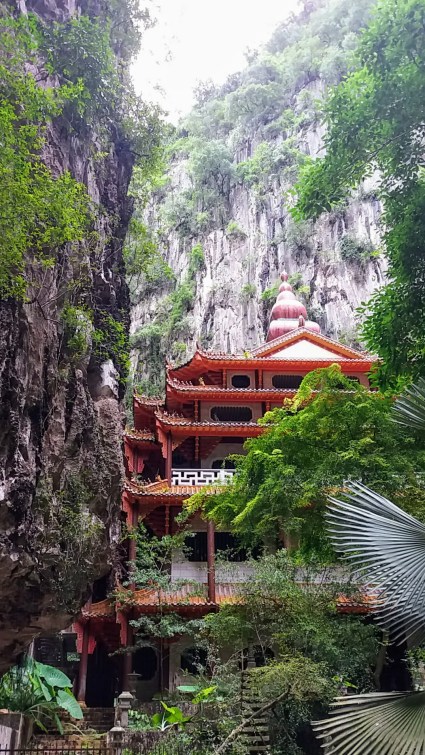
 I crept around the cave rooms from one altar to another, plastic cups and cleaning materials lay scattered around, the tile floor was cracked and uneven. I followed a treacherous staircase up a flight, but it ended only in a tiny window and more dust. It was so easy imagine that I was exploring a temple long forgotten, and then I would find a lit candle, or a smoldering joss stick or even a lone employee selling souvenirs. Outside once more, I continued on to the cemetery. In Buddhism, cremation is the norm, so there were small buildings in another alcove that housed the remains. Despite signs requesting that no incense be burned, there were sticks shoved around all the doors and soot marks as well. The buildings were grown over with moss and leaves, the paint peeling and the ground cracking under the pressure of new roots, yet the incense showed me that human presence was recent.
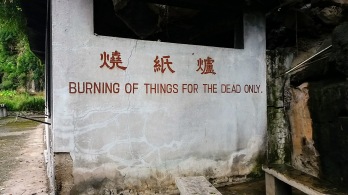 The farthest end of the compound was an area designated for ritual burning and another weedy and overgrown garden that seemed to be turning into a dumping ground. As I made my way past more dogs and tourists, I couldn’t help wondering at how this temple had been so highly rated by so many visitors when Kek Lok Tong was so clean and well cared for. I enjoyed visiting Sam Poh Tong, but it felt like an archaeological excavation rather than a place of worship.
On my way out, an elderly gentleman on a bicycle greeted me in excellent English and as we chatted he told me that this was his regular temple. He was not looking forward to the coming new year celebrations because he said the temple would be overrun by traffic. Scalpers would charge for street parking and people would come just to show off. I was torn between hoping the extra income would help the temple recover and being bewildered as to how it could still be so shabby when expecting the year’s biggest visiting weekend in less than two weeks.
Nam Thean Tong
 Next door is Nam Thean Tong, which turns out to be a Taoist temple. It was sparkling clean and in excellent repair if somewhat empty. The floors were also finished tile, but the rooms felt more like natural cave than basement room and the altars were small but beautiful and well cared for. In front of the main altar was a place to do a fortune telling by a traditional method that involves a cup filled with sticks. The supplicant shakes the cup in a rhythmic way until one stick comes up and out and then the meaning is interpreted. I didn’t partake myself, but I watched another do so. There were carvings and paintings on the walls and lanterns hung around for the coming celebration. Another staircase led me to a viewing platform and a small bridge where wishes were tied to the chain railings. When I came across a steep stairwell leading into darkness, I paused for a moment to consult my own oracle: Google. It transpires that the top few floors of this temple are in total darkness and are rumored to have a haunted house combination of cobwebs, unsteady floors and ghosts. Yet even the most avid ghost hunters seemed to think the climb was a little unrewarding, so I decided to save my energy.

Although the beautiful artwork and unique architecture was a treat, it’s hard not to think the best part of these cave temples were the wind tunnels created by the rock formations that allowed visitors to have a seat in a naturally cool and breezy spot, gaining some respite from the oppressive heat outside.
Rojak
I was finally drawn back outdoors by hunger. The afternoon was getting on and my noodle breakfast had long since worn off. There were some little shops along the outside, mostly selling souvenirs like a local tea and charms, a few selling drinks and ice cream, and one had a handwritten sign advertising a food called “rojak”.  I looked it up to make sure it wasn’t something too scary, then ordered myself a bowl for lunch. Rojak just means “mixture” but fruit rojak is a common dish made of crisp (less than fully ripe and therefore slightly tart) fruits and veggies. Jicama, cucumber, mango, and apple are standard ingredients. The sauce is the magical part. The recipe gurus of the internet assure me it’s made with shrimp paste, hot chilies, sugar, soy sauce, and lime juice (with some regional variance). To me it tasted for all the world like molasses with chili, ginger and lime. I don’t know if mine was made with molasses or if that’s just what it tastes like when you mix soy sauce, shrimp paste and sugar together, but it was yummy!


The outside area was under some reconstruction, but it was a spacious courtyard with plenty of trees and benches, a giant golden statue of what was probably Lao Tsu, and a brownish pond with a moon bridge.
Ling Sen Tong

 Just one gate over is the third and final temple on this street, Ling Sen Tong. This temple mixes Taoist and Buddhist imagery along with other folklore in a big colorful Chinese melting pot. It is an all singing all dancing color fiesta. There are beautiful facades of buildings and temples, giant statues in fresh bright colors, elaborate scenes of mythology played out, and everything was touchable/climbable so visitors were having a blast posing for photos. There was only one small, dark cave. The ceiling had turned black from years of candle and incense soot, and it was chaperoned by a figure whose offerings exclusively included alcohol (for some reason, especially Guiness…) I enjoyed exploring the many statues and hidden rooms. I even found this one guy who looks like he’s checking his phone in the bath! I’m sure there’s a better explanation for it, but along one wall was a series of statues in sunken pits that had all filled with water. I don’t know if it was meant to be a kind of wishing well or something else entirely, but this one in particular stood out to me.


Hostel Hangouts
Finally, I couldn’t take the late afternoon heat anymore and had to call a car to come and rescue me. It was my intention to have a meal and a rest in the hostel before heading out in the evening (and cooler air) to check out “old town Ipoh”. However, I ended up meeting a trio of backpackers from Europe who dealt me into their game of Uno and chatted for a few hours. Then when they went upstairs, I ended up talking to the wifely part of the duo who runs the hostel for quite a while more. She is a Japanese lady who had spent so much of her young adult years in Malaysia that it just seemed natural to her to find a husband and move there. So it was that I spent my whole evening happily in the hostel chatting with new and interesting people from around the world until I was too tired to stay awake any longer and headed up to try and sleep.
As kind and wonderful and gracious as the hosts were, the Reggae House was a little hard to sleep in. The lack of full walls meant that light and sound easily came in from the spaces around my room, and the visiting rat didn’t really set my mind at ease, but I was settling in to the “roughing it” mindset and managed to persevere.
Stay tuned for the next installment of adventures in the Malay Peninsula wherein I go hunting for Ipoh White Coffee and learn more about my favorite bean on the way. Don’t forget to check out all the photos of Kek Long Tong and the other three temples on Facebook and keep an eye out for more spring colors in Korea coming soon! Thanks for reading ❤
 After an incredibly full first day in Singapore, I had a much lighter day of temple viewing planned before I hopped on the bus to Kuala Lumpur in the afternoon. It’s never hard to wake up in a dorm hostel, since everyone else is waking up, too. After packing up and enjoying another cup of teh tarik, I headed out to catch the sights. The night before, I’d run across a giant rooster in the street (in anticipation of the impending lunar new year holiday), so I did a quick rerouting to pass back by in the light of day. Chinatown was already putting on a decorative show two weeks before the holiday; I can only imagine how crazy it was on the actual holiday weekend.
  In addition to the stunning decorations, I passed by a street artist sitting in the shade of an overpass and working on the beginning of a painting of the festivities. He was kind enough to let me take a photo and we wished each other a happy new year in parting.
 After breakfast, I headed into the temple. I generally don’t wear short shorts, and while I go wear sleeveless in heat sometimes, since my plan for the day was temples, I was dressed appropriately. However, for the tourists who weren’t, a staff of firm but polite people arranged for them to wear long skirts or shoulder wraps from a shared bin. Once past the main entrance, I walked into a smaller room where two monks were performing a blessing on a couple donating to the temple in a red envelope (traditional for money gifting at the new year). As I watched, I realized people around me were taking photos and video and I was surprised. I looked around for any signs about cameras, but there were none. It seemed that the temple allowed visitors to take pictures. It felt very strange taking pictures in a temple, and in the end I could only take a few before my sense of unease overcame me.
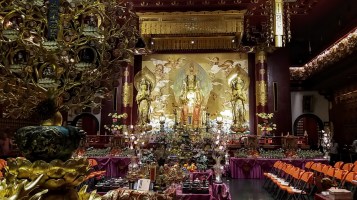 The main hall on the ground floor was an ode to opulence. I’m used to Buddhist temples being ornate. Wood and stone carvings with intricate detail are common (though never boring). Paintings or works in colorful semi-precious stones, and even the occasional gold paint or gilt covering to add some shine. The point is, that I’m used to temples being about effort and time and skill, rather than about blatant displays of wealth. In fact, a common art form is the sand mandala, which is made over weeks or months of painstaking hand work, then wiped out to represent the impermanence of reality. I don’t have an issue with beauty in a temple, I go to temples in part because they are beautiful, but something about this temple and it’s over the top gold, it’s donation jars every few feet, and it’s designated VIP seating for supplicants just did not sit well with me.
 I found the elevator and went all the way to the roof to see the orchid garden. That at least was in keeping with temple life as I think of it. Although orchids are rare in the world, they are common in Singapore and the difficulty of their cultivation reflects the work that monks and nuns put in as part of their practice. Below the gardens, the top floor contained the relic for which the temple is named, a fragment of the Buddha’s tooth. It was also the only room in the building where shoes and cameras were prohibited. There were dedicated meditation mats along the windows where a few people were sitting in silent contemplation, and there was another large gold display.
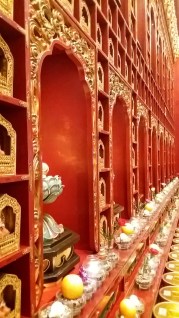 I’ve seen American “mega-churches” that have gold plated elevators and preachers with 5 cars and 3 houses and a minimum annual income requirement for membership. These also disgust me and I often wondered how any Christian could justify that kind of obvious money-grubbing and wealth favoring within their doctrine. This was the first time I’d ever seen a Buddhist “mega-temple”, and it was awful. It made me feel ashamed to be associated with the faith. It made me want to run around to tourists and exclaim “that’s not what Buddhism is about!”. It made me want to drag out some scripture and ask the people praying there if they’d even read it. And for just a moment, it made me think about Terry Pratchett’s Yen Buddhists, whose main theological argument is that:
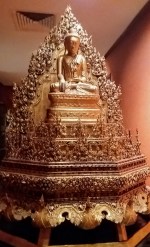 I headed down to the third floor to see the museum, which was a worthwhile collection. It was a nice museum of Buddhist art and man-made relics that included a sort of “intro to the Buddha” story on signs around the displays. Like the rooftop garden, it felt far more authentic and enjoyable. The relics were primarily stone, clay, bronze or wooden and had clearly been the result of effort and craftsmanship. Although the extraordinary focus on Guan Yin and the Maitreya was a little overwhelming, it did point to the fact that the temple’s own branch of Buddhism was a salvific form that relies on Bodhisattvas and future Buddha’s to save the world, rather than on the practice of self cultivation for individual enlightenment.
 The second floor had a nice place to rest, which I desperately needed. Adjusting to the heat and extra walking was taking a toll. It was such a great contrast to my energy level in New Zealand where the weather was cool. Just minimum exertion in a hot humid climate seems to drain me like a marathon! After a rest and a look through the last floor of displays, I made my way back to the ground floor, once more shaking my head at the ostentation, this time walking past the VIP seats they were filled with supplicants who had paid I’m not sure what to get past the velvet ropes. All in all, I’m still glad I went to see it, because I learned something about the corrupting properties of money. All temples ask for donations to help feed the monastic population, pay the basic bills, and to provide services to the community. Money is, in this world, unavoidable. However, when a house of faith relies on wealth or doles out blessings for cash or claims that the donation of great wealth is a higher holy act than living a good life, that’s corruption.
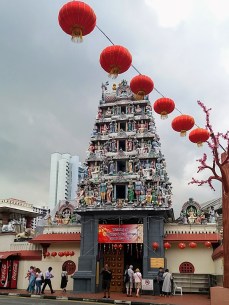 After the Buddhist temple, I took the short walk two streets over to see the oldest Hindu temple in Singapore: Sri Mariamman. This humble wooden structure was not a display of wealth, but was still anything but plain. Wooden carvings covered every inch of the outer facade and were brightly painted besides. Anyone was welcome to enter, leaving their shoes behind on racks on the sidewalk. There were saris for anyone who felt inadequately dressed, and while we were free to wander around the grounds barefoot, the main areas of worship were cordoned off, not for a fee, but for the faithful. I am not a Hindu, so I contented myself with observing from behind the lines. The interior of the temple is a large courtyard with smaller buildings, each one dedicated to a different divinity. There are over 330 million gods in the umbrella of Hindu faith, and while only a couple dozen are among the most popular, it can
  be hard for a layperson to know which altar is for who. I found 10 names of deities for this temple on it’s
 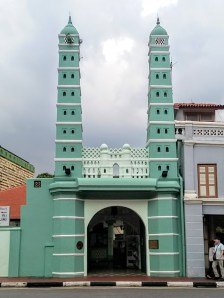 couple city blocks, I had passed 3 major religious buildings, and I knew from the map that a Christian church was not far off. Curious, I looked around the map for a synagogue and found one a little over 3km away, and it was neighbored with another church, Hindu temple, and Buddhist temple. It seemed that it wasn’t hard to find a spot in Singapore where at least 4 out of the 5 major world religions shared a small space and yet no one was getting blown up, shot or even harassed on the street! While I’m sure that Singapore’s strict legal code has something to do with the lack of violence, I like to think that pluralism in the culture helps everyone to get along. People of other faiths or cultures seem less scary when they are our neighbors and not “those others”.
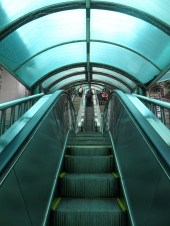 This park in the Nampo neighborhood is up on a bit of a mountain, but there’s no need to climb up exhausting stairs because there’s an outdoor escalator installed to let you ride up in comfort! When we got to the top, we were already blown away by the great views of the city below and we hadn’t even gotten to the highest points yet. As we passed by the stage area, it was clear that a performance was about to get underway. There were plenty of people dressed in the standard white garb trimmed with bright colors and fun hats and the parents hadn’t gotten to see any traditional dances, so we pulled up a seat. I have since found out that cultural performances happen here every Saturday at 3pm between March and November.
  The MC for the day was excited to see so many foreigners (not just us) in the audience and brought out a poor young Korean lady who was nervous and not particularly fluent to try and translate for us. Representatives from each visiting country in the audience were invited to come up on the stage and play a traditional Korean game of trying to toss a stick through one of 5 rings attached to a jar. My friend’s mom went up and they let her stand extra close because she was over 60 and she brought us honor by scoring the center ring! We didn’t sit for the whole performance, but it was a kind of musical story. From what I could follow, some performers arrived at a lord’s house and were invited in to party, but there were some rascals around who may have been trying to steal away or marry off the lord’s daughter? The language barrier was a bit of an obstacle to the plot, but it was fun to watch and clap along with.
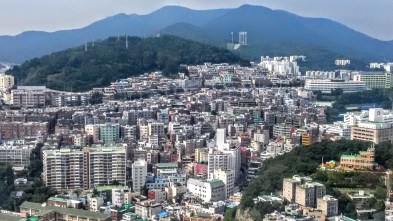 We snuck out during a lull and headed to the main attraction of the Park, Busan Tower. The tower stands 118m high, but it’s also on a mountain so, it seems to be rather higher than that when you look down. For 5,000won you can get a ticket to ride up to the top of the tower where you can enjoy a stunning 360 degree view of Busan. There are helpful decals on the windows that identify major landmarks and there;s a little cafe where you can enjoy a snack with your view.

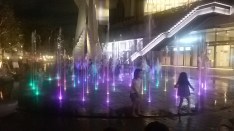 Sky Tree (left) where the small fountain lights are coordinated with the tower lights high above. These shows are fun, awesome, wonderful, and sparkly, so when my friend told me he wanted to take his parents down to Busan’s own choreographed fountain show, I was all in favor.
 There are some permanent concrete bleacher type seats along one side, but the rest of the area around the fountain had been filled up with plastic chairs to accommodate the higher number of spectators on the warm weekend nights. We arrived early and laid claim to seats in the front row, hoping that we wouldn’t have to worry about the crowd standing in front of us when the show started. Refreshingly, the Korean audience stayed in their seats during the show and we had a first class view. In both China and Dubai, the spectators jostled for the best standing spots and to get my video, I had to start standing in my spot almost 30 minutes before the show started to get an unobstructed view.
  This is 2,519 sq m fountain is listed as the largest fountain in the world by Guinness. I suppose that the show at Dubai is not considered a single fountain and is therefore only the largest fountain
 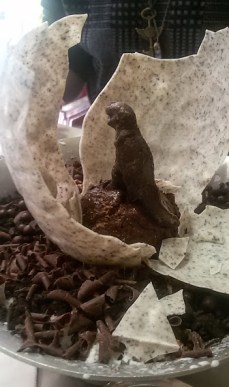 I’m not a food blogger, but sometimes food is just too good not to write about. I’ve done some basic coverage of these things elsewhere, but it doesn’t get old. Dala 100% Chocolate is this tiny hole in the wall chocolate cafe in my neighborhood in Seomyeon. The first time I went there, I had to try their signature dish, the dinosaur egg. This was an amazing concoction of shaved milk ice topped with crushed chocolate cookies and chocolate shavings with a giant egg made of cookies and cream candy. When smashed with the provided hammer, the egg reveals a scoop of truly decadent chocolate ice cream and a tiny chocolate dinosaur. If that’s not enough chocolate, you can pour chocolate sauce over it too. It takes at least two people to eat this dessert. Since that time, we’ve also tried the chocolate pizza (nutella spread, banana slices and toasted marshmallows for toppings, scoop of vanilla ice cream and chocolate sauce again), and for the two separate parental visits this summer, I also managed to try the fruit fondue (kiwi, grape, orange, grapefruit and banana… turns out grapefruit in chocolate is awesome), the “special brownie” (molten chocolate inside!), and the chocolate churros (churros you dip in chocolate). Let us not forget the milkshakes, which come in a variety of chocolate compliment flavors and can be made white, milk or dark. I don’t just love this place for it’s chocolate, but because it’s good chocolate. It’s not too sweet and they do a good balance of flavors in each dish so you don’t get tired (as if that were possible) of a single chocolate flavor. I think we’re about halfway through the menu now, and if the weather keeps cooling off, I’ll get to try their hot drinks soon!
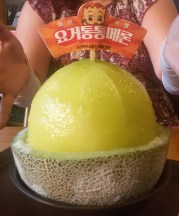 The melon special was not just using frozen milk, but frozen yogurt… and not the kind you’re thinking. Imagine you mix some yogurt with milk or water until it’s all liquidy, then freeze it solid, then shave it off into teeny tiny snowflakes. Ok. Now, take a honeydew melon (the green ones) and cut it in half. Hollow it out and freeze the shell. That frozen melon rind is now our bowl, filled with the snowflake texture frozen yogurt and topped with some cubes of what I can only describe as cheesecake filling.
  Now, over the whole thing, put the melon you removed from the rind, the hemisphere of melon, all of it. The dish was served with a big plastic knife so we could cut up the melon for ourselves. It was the perfect combination of sweet, tart and creamy to refresh us in the summer heat.
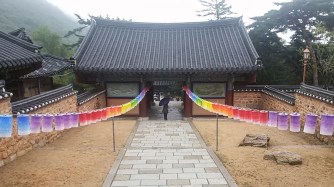 When we arrived, a very nice older Korean lady offered to explain a little bit about the main gate to us in English and we got to hear a little history of the naming of the temple and the unique four pillar style that makes this era of architecture distinctive. As we ascended the stairs and passed through several gates decorated with bright lanterns and beautiful paintings we moved through a hall of fearsome statues and finally emerged into the main courtyard. The temple was originally built about 1,300 years ago, but was destroyed during a Japanese invasion in 1592 and later rebuilt in 1713, but a few stone remnants and one stone pagoda left from the original still stand in the wide open square. The temple is dedicated to the practice of Seon Buddhism, which is the Korean descendant of Chan Buddhism the same way Zen in Japan is.


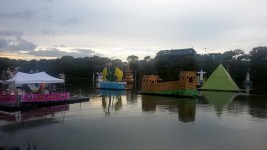 Also called the Jinju Namgang Yudeong Festival, it is held in honor of the fallen during the seiges by Japanese soldiers in the Imjin War in 1592-3 (the same time frame the orginal Beomeosa Temple was destroyed). During the war, lanterns were used as military signals, a means of communicating with reserve forces, and as a way to keep in touch with family members outside of Jinjuseong Fortress. Even after the war, people continued the tradition of floating lanterns down the river to pay tribute to the brave souls that had been lost during battle. Today, the festival is far more than a few lanterns on the river and instead is a whole palisade of life size and larger than life lanterns floating on the river and filling the riverside park where the fortress once stood.
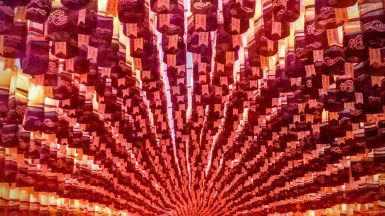 When we entered the display area, we were given arm stamps so we could come and go as many times as we liked, then we began our stroll down the riverside. The water was covered in giant lanterns in shapes of mythical animals and heroes as well as famous landmarks like Stonehenge, the leaning tower of Pisa, and the Statue of Liberty. There were floating restaurants, boat rides, and yet more tents offering delicious snacks.There were giant tunnels of red lanterns where couples walked hand in hand in the twilight.
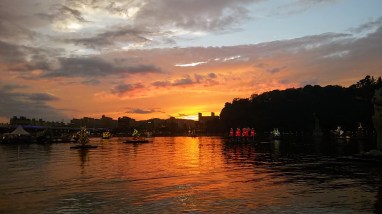 Two floating bridges at either end of the display allowed visitors to pass from side to side without returning to the street level. The day had been rainy, but as the rain dried up, the sunset lit the clouds in shades of brilliant gold and scarlet.We crossed the river and ascended into the wooded area to be greeted with the most amazing forest of light. Unlike the


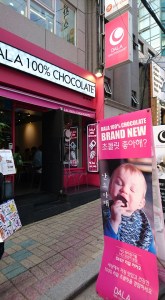 When we found the shop, it was a small space tucked in between yet more small boutique style eateries, but we were saving our appetite for chocolate! We stood outside for a moment admiring the menu and realizing that we would have to come back several times to sample all the amazing goodies on offer. Our timing was also great as we didn’t have to wait at all for a table.
 The drinks arrived first, giant frosty metal cups with straws and chocolate spoons! My mocha was a perfect blend of coffee and chocolate, and not at all too sweet like mochas can often be. The choco waffle ball came with tiny little chocolate dipped balls of waffle batter sprinkled on top and was likewise a luscious bitter-sweet. Plus, the napkins were printed with the Korean Sign Language alphabet! Too cute! We gushed over the deliciousness for a while, taking some obligatory food photos and then the main event arrived.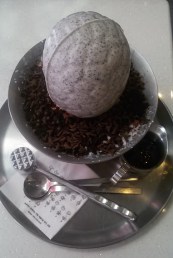


 Much like the temples in China, there was a large, odd shaped rock set out front with the name of the temple in Chinese characters (白楊山三光寺 – bai yang shan san guang si, which roughly translated as “poplar mountain heavenly Temple” and you can clearly see the “san guang si” became the Korean “sam gwang sa”). There was also a long stairwell with a numerically significant 108 steps. The stairs were lined with lanterns, flowers and statues of various sages famous in the history of the sect, although please don’t ask me to identify them because it can be more complicated than spot the Catholic Saint. We got our first glimpses of the lantern coated buildings from the stairs and began to get giddy at the thought of being surrounded by so many beautiful colored lights!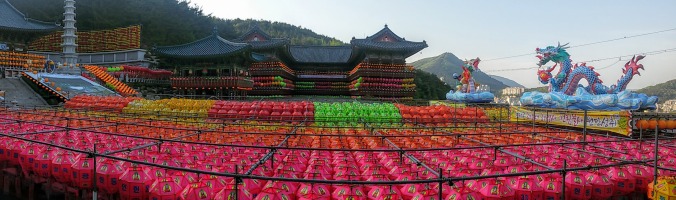
 We traipsed around the temple grounds in awe, randomly bursting into the


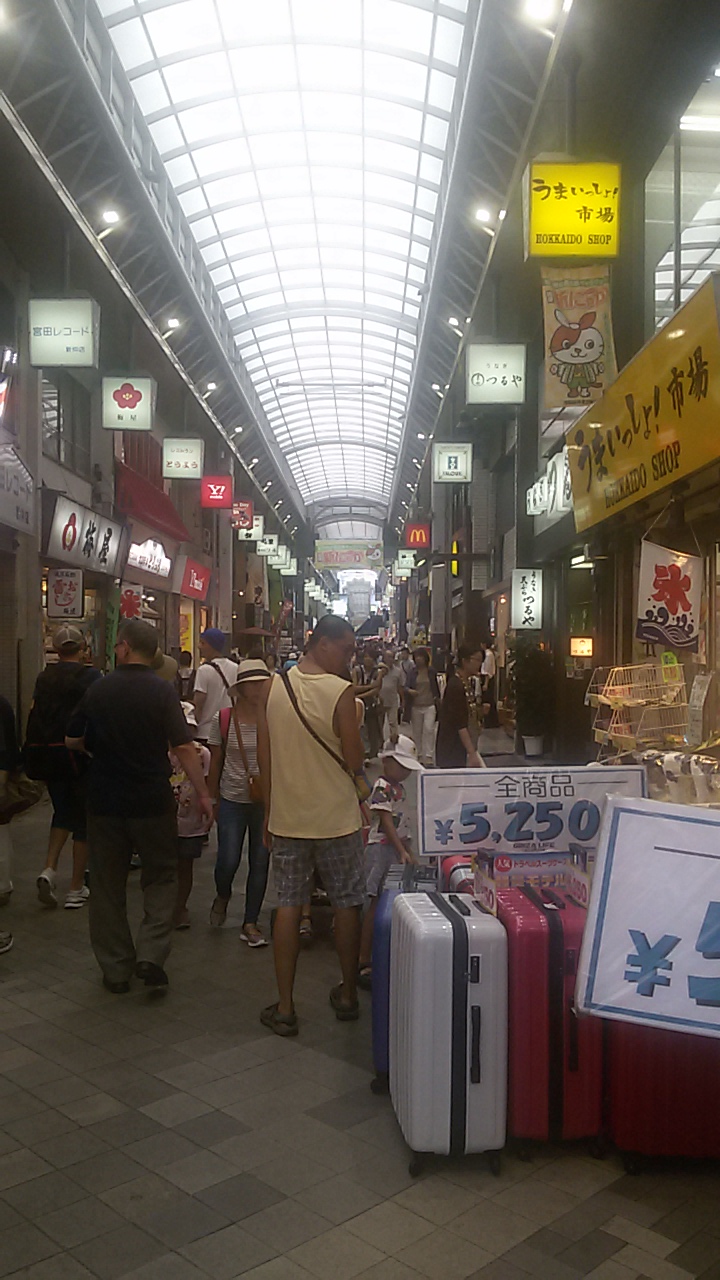
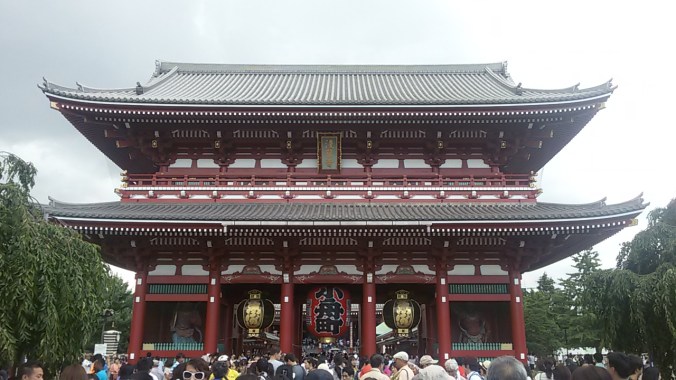
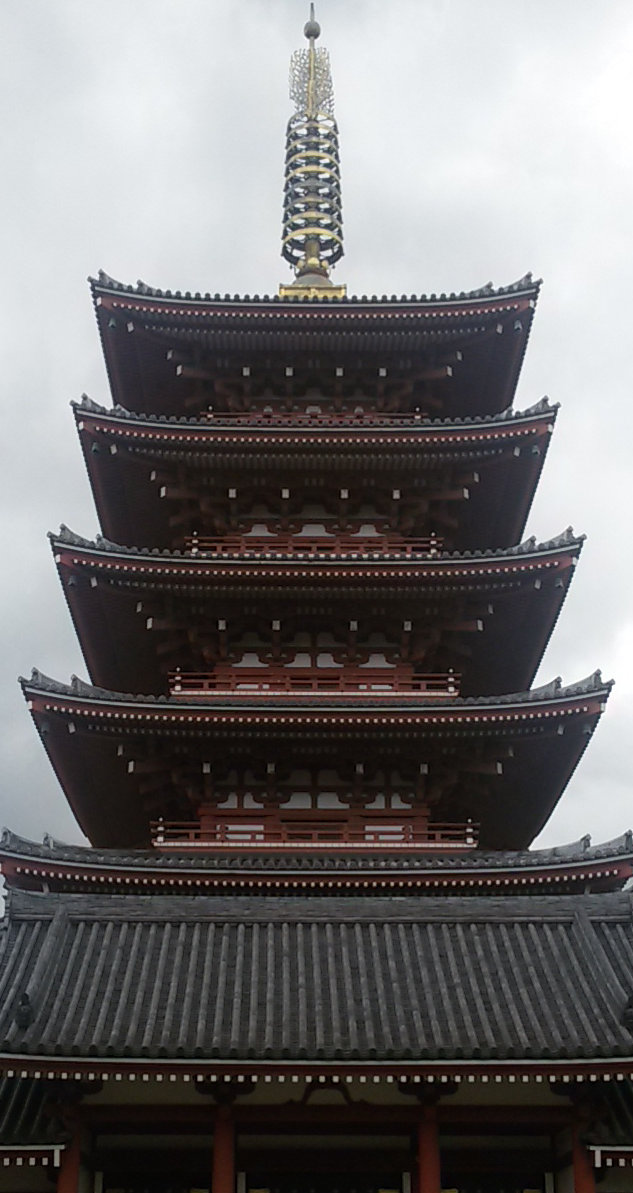

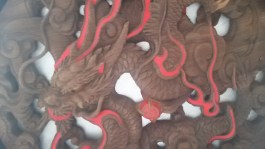 dragon with red painted highlights. Stalls selling tourist kitsch give way to stalls selling prayer scrolls, medallions, and beads for the supplicants of Kannon.
 it’s common to see them at Buddhist temples here. This one was quite different from the others I have seen in Japan, consisting of a statue of (what appeared to be) a historical figure. The dragon headed fountains/ faucets are pretty common, but these were quite detailed and beautiful.
 I could hear the clanking of coins long before I saw the donation box at the entrance. No fee is required to enter, yet most of the people who passed by tossed some coins into the huge box. There were bars across the top that the coins bounced around before dropping causing the constant sound of tinkling metal.
 The main altar was behind protective glass because it was a delicate lacework of gold and precious jewels. There was another less giant donation box as well as places to light votive candles or attach prayer scrolls. There were hundreds of people waiting to enter, so I didn’t linger too long at the front. I managed to find a side area to really scope out the room from one side. Lavish does not begin to express.


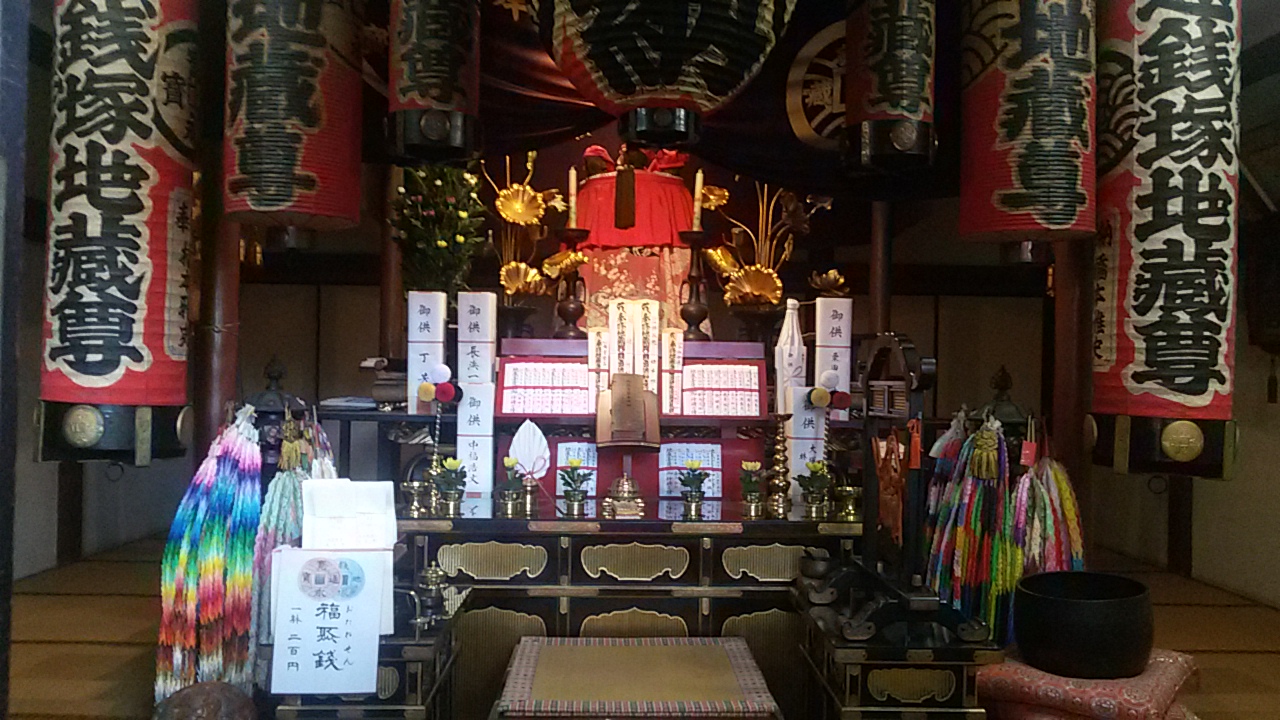
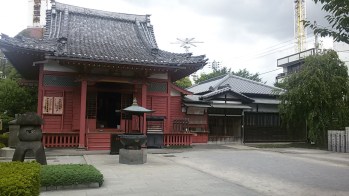 I walked into another empty shrine area, this one dedicated to Sukunahikonao-mikoto (yeah, the Japanese kami all have really loooong names). The sign informed me that he is a protector of women, and honored by women bringing used sewing needles and sticking them into tofu as an offering.
 which historically was one of the main bells that marked the time for the citizens of Edo (old Tokyo). The other bell was at Ueno, and resulted in a famous Haiku by poet Matsuo Basho: “Sounding through clouds of flowers — it is the bell of Ueno or Asakusa?”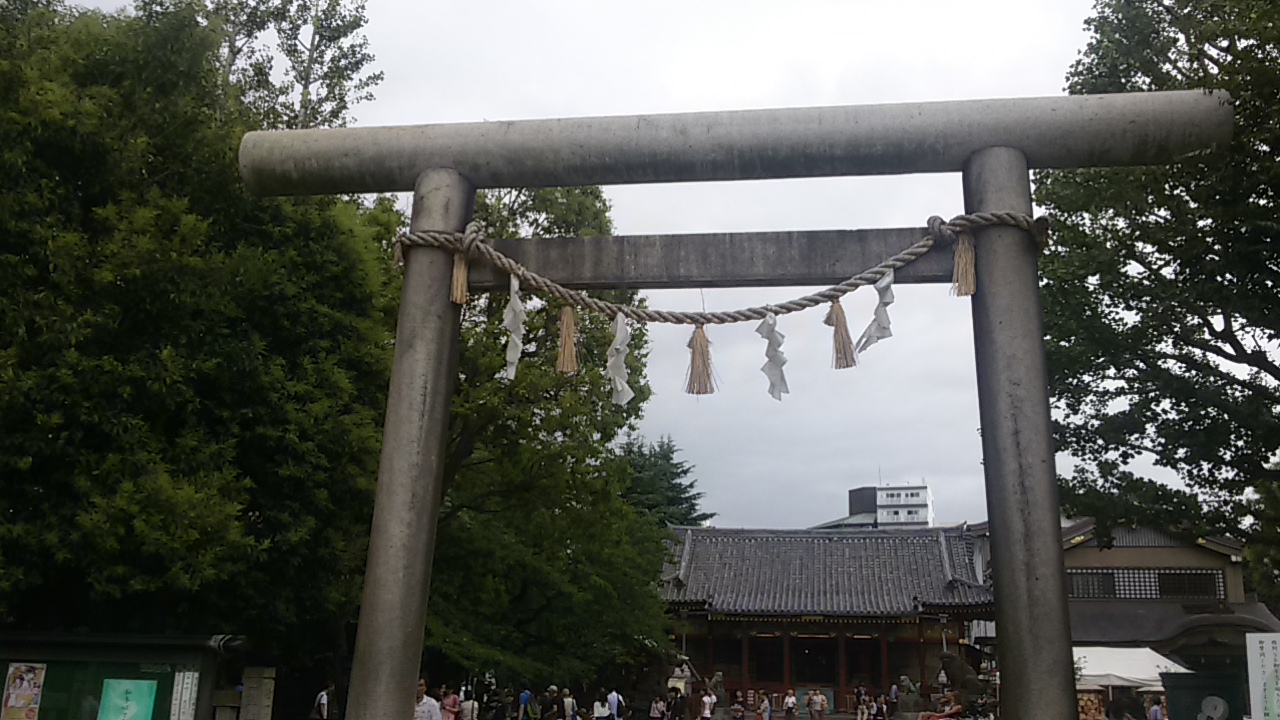
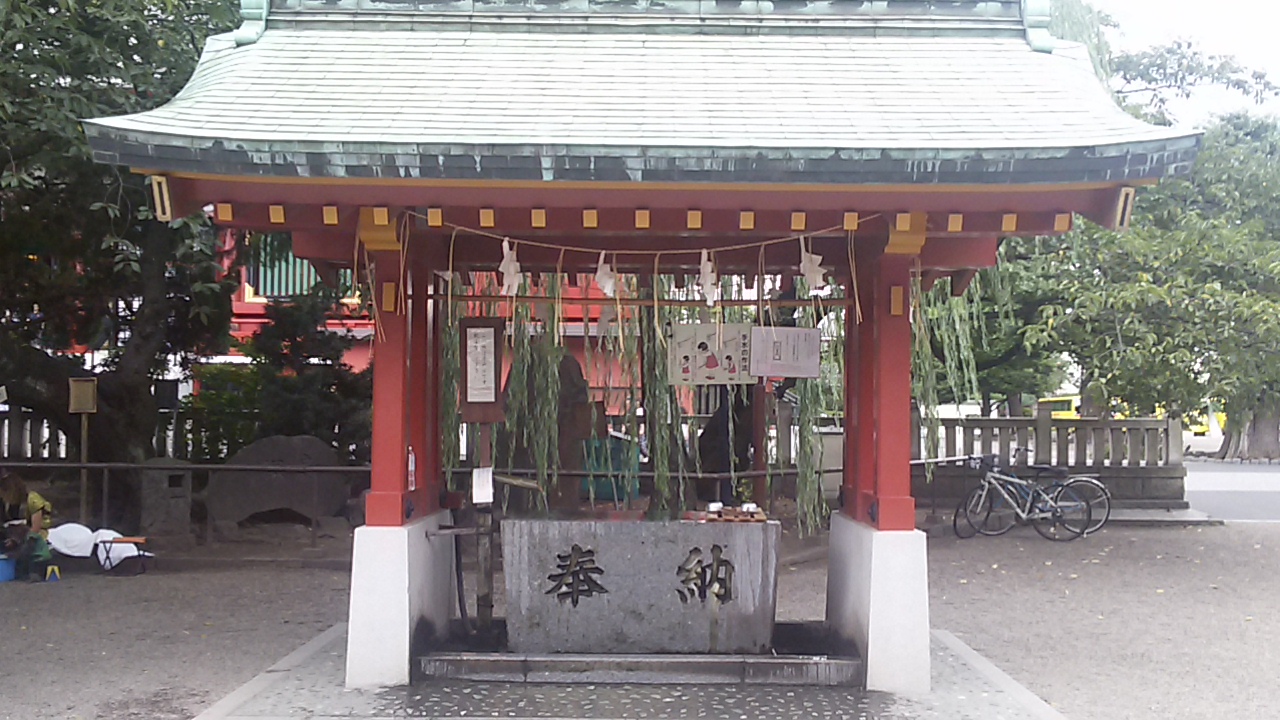


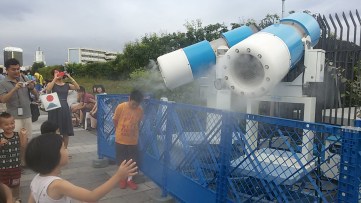 All around the outdoor patio were places that vented a cooling mist onto visitors to help combat the summer heat, and some that attracted scores of little kids who played in the wet fog blasting out of giant fans.


 Feeling full and satisfied, it was far enough past the evening rush that I felt like it was safe to get on the train. Luckily since I got on at the end of one line and rode it all the way to the end of a second, I got a seat the whole way, and was hardly ever too crowded.
 Gallivantrix