I don’t think that I ever truly appreciated food tourism for most of my life. Of course I like to eat locally, to try new foods, to sample the regional cuisine, but I’ve never made it a goal. It was always more of a side quest, a “since I’m here anyway, I might as well”. I thought I was doing quite well given the (not inaccurate) stereotype about American (and British) tourists who like to go to exotic places and then eat familiar foods. I thought my willingness to try was good enough. What did I know?
I have noticed since living in Korea that there is a strong feeling bordering on obsession with the famous foods of any given tourist destination. Not only outside of Korea, but regionally within the country as well. If you go to a certain place, it was taken as given that you MUST get some of the locally famous food. To do otherwise was simply unthinkable.
As my friend and I sat waiting for our food, I shared this observation with her and she made a politely stiffled “wtf whypipo” sound and tried not to look completely aghast. Her family is from Mexico (yes, she’s American) and she explained to me that as a Latina, for her and her family (and her culture as far as she is aware) it’s always about the food. I have to admit, I did feel a little abashed, but I have no reason to cling to my old ideas. I usually enjoy the hell out of eating locally, so why NOT make it part of my to-do list rather than merely adjacent to it?
Tebasaki
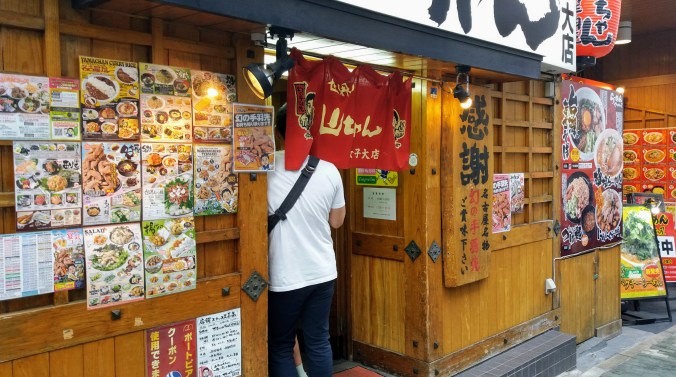 Our first famous food sight was Yamachan, a chicken joint that is usually so popular that wait times can be over an hour. Yamachan is famous for chicken wings. Initially, I was very skeptical since I get plenty of chicken in Korea, but when we arrived we were sufficiently early as to be able to get a table. We had to take the smoking section, but it was still clear air when we were seated.
Smoking sections? Yeah, Japan has relegated smoking to a few small designated areas. You can’t just smoke anywhere, even outdoors. There are designated smoking spots with ashtrays. Some are open air, while others are actually a glass booth to protect passersby from the second hand fumes. Since people can’t just step onto the sidewalk for a smoke, restaurants have smoking sections. These are also cordoned off with floor to ceiling walls and sometimes even a double door airlock system to keep the smell from entering the non-smoking section.
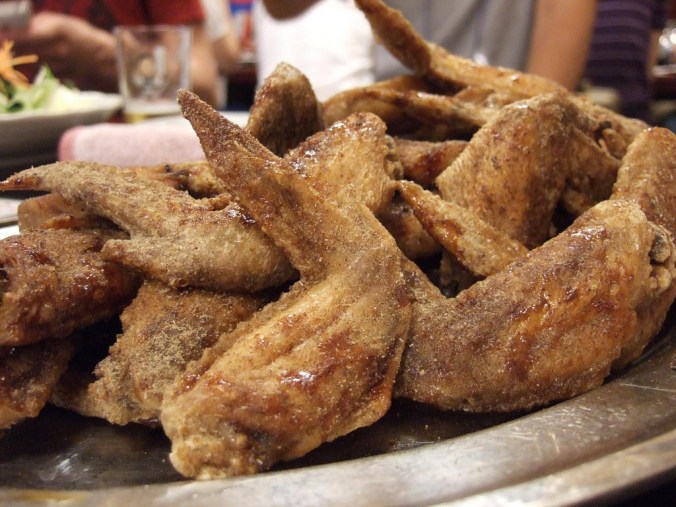
photo credit: Yusuke Kawasaki
Back to the chicken wings. Nagoya is famous for tebasaki, a crispy fried pepper spiced chicken wing. There’s no batter, so the wings are just fried nice and crispy on the outside, but moist on the inside. They are coated with a lightly spicy salt and pepper flavor that was zingy and enjoyable. Plus, each order comes with instructions on how to eat the wings Nagoya style (and get all the meat off in one swipe!). I found later that a lot of people consider these wings to be “quite spicy” so Korean cuisine might have impacted my spice meter, as I only found it pleasantly zingy.
Conveyor Belt Sushi
As we finished our plate of wings, the restaurant was filling up and the smoke was getting thicker so it was time to move on. After the tebasaki appetizer, our main course was to be conveyor belt sushi.
We arrived at Sushiro, the famous 100yen restaurant, only to discover that going to a popular restaurant on a Saturday night that is also a holiday means a long wait. Quelle suprise! The good news was that we’d already had some chicken wings, and it was our first time to catch up since parting ways in February, so the waiting area was just a place to sit down and chat by then.
photo credit: アジロウ
This was a true dollar menu style conveyor belt place. Any dish that came by on a plain yellow plate was up for grabs and only 100 yen. If you wanted something specific, you could use the little computer at each table to place an order. I got some of my favorites (unagi, fatty tuna, salmon roe and more) and proceeded to stuff my face with sushi. It’s amazing to me that even though Korea and Japan are separated by only a narrow strip of ocean and both are heavy seafood consumers, the difference in ingredients and flavors is mind-blowing. Even in Japanese sushi restaurants in Korea, I have trouble finding things like tuna and eel. Salmon roe? Forget about it. I was in sushi heaven until I thought my tummy would explode and then the waitress came by to calculate our bill. She did this by measuring our stack of plates! They don’t even have to count, since each plate is the same height, they just hold up a special ruler and then type up the bill.
Two of us stuffing ourselves was still less than 12$. Japan doesn’t have to be expensive.
Morning Service
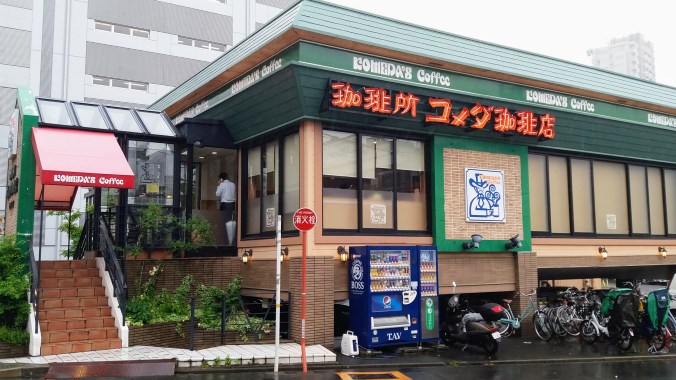 Amid the many things that I found to try while in Nagoya is the “morning service”. Many of the cafes around town have begun to offer a light breakfast (egg and toast or ogura toast) for free (“service” in Japanese) with any order of coffee. Sunday morning my friend and I headed over to Komeda Coffee. This cute little coffee shop is a chain restaurant famous for it’s special morning service of thick, fluffy, buttery toast and red bean paste, also known locally as “ogura toast”. While lots of places in east Asia love sweet red bean paste in pastry (I eat it in Korea all the time), Nagoya got famous for ogura toast by adding… wait for it… margarine! The sweet thick red bean spread with creamy salty margarine creates a unique Nagoya flavor that should definitely be on your “to eat” list. Plus, their coffee is pretty good.
In the spirit of being on vacation, and fondly remembering my childhood year in Japan I ordered a “cream coffee”, the picture of which looked like iced coffee with a generous twist of whipped cream on top. Vacation calories don’t count right? When I received my mega sized coffee drink, it turned out not to be whipped cream, but ice cream! Smooth, rich, vanilla soft serve floating on a small iceberg inside the cup. I am especially fond of red bean and cream, so I dolloped some ice cream on my toast for extra decadence. So good. And all for less than a Starbucks’s latte!


I went back to Komeda every morning of my holiday because it was a) close to my friend’s house and the subway, b) very reasonably priced breakfast, and c) SO DELICIOUS! Free WiFi and friendly, patient staff helped a lot, too.
Hitsumabushi
The evening highlight of Sunday was a visit to one of Nagoya’s most famous restaurants, Atsuta Horaiken, to enjoy this local specialty. I know eel isn’t everyone’s cup of tea, but I’ve been in love with Japanese grilled eel since the first time I tried it. It’s flaky, smokey, sweet and savory. It’s everything a grilled fish should be plus some undefinable extra flavor that comes from the eel and it’s special sauce. Unagi sauce is actually sold in stores because it’s such a unique blend. I bought some once to make eel at home and had so much leftover sauce I started eating it with eggs, which turns out to also be good. Anyway, when I found out that one of my favorite Japanese foods was ALSO one of the most famous local dishes of Nagoya, I immediately put it on my to do list.
Bear in mind that Japan was just finishing a holiday weekend on Sunday, so for many folks it was the last fling before going back to work on Monday. To make matters worse, this famous and delicious restaurant doesn’t take reservations on holidays or weekends, it’s first come first serve. We tried to make a reservation for one of the weekdays I was in town, but they were booked solid. Instead we planned to head over about 30 minutes before opening and get a good place in line. When we showed up, the restaurant had workers stationed all the way down to the elevator to show visitors where to go, and very polite hostesses were arranging guests on a looooooong line of chairs in the open space in front of the restaurant.

photo credit: hattrick0129 via TripAdvisor
We were only about 20 people down the line and were honestly quite excited about it, since we were originally prepared to wait an hour or more for a table. Even better, the restaurant started seating people well before the posted opening hours. I’m not sure if it was because of the holiday or because it was the last weekend this particular location would be open before prolonged remodeling. Whatever the reason, we found ourselves playing musical chairs for a remarkably short time. I love the fact that the restaurant had seating in the waiting area. While I think pagers might have been a better way of alerting guests that a table was ready, it was a little exciting to be in line and to shuffle seats every time someone ahead of us went inside.

photo credit Ray C via TripAdvisor
They also brought us an English language menu while we were waiting so that we could peruse the options, and the hostess did her best to make recommendations and give explanations in English for us as well. I really appreciate this because although my Japanese isn’t half bad, I am terrible at the super polite version of Japanese. Especially fancy shops and restaurants will often use a version of Japanese that is so formal I can’t understand it anymore, and then I just end up feeling embarrassed.
Hitsumabushi is NOT cheap. A single order is almost 40$. Both of us wanted to have some, but we were also eyeing an appetizer on the menu that was tamago (egg) with eel filling. In the end we decided to order the 1 ½ size hitsumabushi and one of the egg eel omelettes to share. The omelette arrived first and was quite delicious. The egg was light and fluffy and the eel inside was rich and savory. I think if it had been my dinner choice I would have been a little sad, but it was a perfect appetizer experience.
Finally, the star of the show arrived. Hitsumabushi is served in a huge wooden bowl with a tray full of fixings. We were issued careful instructions on the proper way to eat this delightful dish. On the surface, it looks like unagi-don, a bowl of rice with eel on top. However, the Nagoya style eel is thinner sliced and has a crispier exterior than regular unagi. Also, it’s not drenched in eel sauce.

We ate according to the instructions, spooning ¼ of the large bowl’s contents into our smaller personal bowls and eating it plain at first. I was impressed straight away.
 Even in normal restaurants, eel is one of the more expensive dishes. I tend to avoid buying it here in Korea because it’s often not prepared well. Nonetheless, it is one of my all time favorite Japanese foods. The “plain” hitsumabushi still had plenty of flavor. Of course the smokey, fishy unique flavor of the eel itself, but also a lighter version of the sauce it’s cooked with, as well as the vinegar in the rice. It had so much of what I look for in a good meal, I instantly knew the price was well worth it.
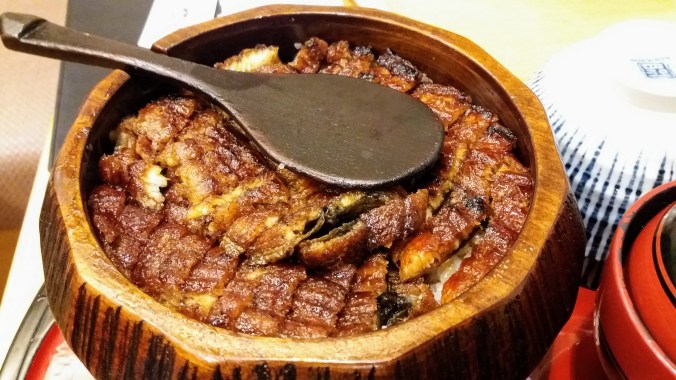 The second ¼ of the dish is meant to be served with the dry fixings provided in the little side box. In our case, we were given small slices of spring onions, thinly shredded nori (seaweed), and what very well may have been fresh wasabi. Most wasabi in the world is fake, sadly, it’s just green horseradish. Now, I love horseradish too, so that doesn’t usually bother me. I’ve learned a little about fresh wasabi from watching cooking shows and documentaries, but I’ve never had any. When I looked at this wasabi, I noticed the texture was very different from what I’m used to. Instead of a smooth paste, it had little shredded bits of plant matter.
Real wasabi is a root that is grated to get wasabi paste. I thought that the texture could be an indication of fresh grated wasabi. I tasted it on it’s own as well before adding it to my bowl and found that it was lighter, fresher and less “bitey” than what I’m used to in wasabi paste. It didn’t even try to get up my nose. Again, it lines up with everything I’ve read about the flavor of real/fresh wasabi. Excited by this prospect, I added some of each ingredient to my bowl and lightly mixed them together.

Whatever I thought of the wonderful flavor and texture qualities of the first unaltered bowl were blown straight out of my mind. Everything wonderful about the plain hitsumabushi was suddenly illuminated by fireworks-like bursts of green umami jumping out of the simple yet high quality spices I had added in round two. Sometimes, I go too long between truly spectacular life changing meals. I lose sight of the artistic heights of food that were so poetically expressed by a cartoon rat. Worse, I may even come to look at food as a burden, simply fuel for my body with no other reward, if I am kept in sub-par food land for too long. But then a restaurant like this comes up and gives my taste receptors and limbic system something to scream about and I remember what is possible. This isn’t just food tourism, it’s heaven in a bowl.
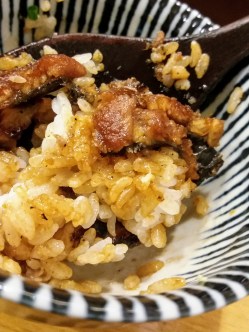 Round 3 we were instructed to replicate round 2 and then add broth. I don’t really know how to describe the flavor of the broth. It was also a little smoky, a little umami. I suspected there were some dried shitake involved in the flavor as well as some konbu dashi. It was nice, but for my taste it didn’t really add to the flavors the way that the spices alone had. Additionally, it drastically changed the texture of the dish, turning crispy eel and rice into a wetter soup. It was still delicious, and I’m glad that I was able to try all the different styles of eating hitsumabushi, but I was grateful for that final ¼ serving where we were instructed to return to whichever of the first three we had liked best and do it again!
By the time we finished, I was on an insane food flavor high and I thought my stomach might explode. If this experience sounds like something you want to try, don’t worry, although the Sakae location is closing, there are other branches of Atsuta Horaiken around Nagoya you can visit.
What flavor is that?
Our last stop before going back to the apartment was a kind of bargain grocery store. Advantage of shopping with someone who lives there is that they’ve found and vetted all the cheap places before you got there. My friend was actually just stopping in for some toilet paper, but I decided to wander the candy section to see if I could find some unique chocolates to bring back to friends in Korea. This is more challenging than it sounds since most Japanese brands of candy are sold here in regular shops. What I found was a wall of every flavor of kit-kat imaginable.
I don’t even really like KitKat as a candy bar. It’s always tasted a little like sweet cardboard to me. But the Japanese are obsessed with it. I love finding new flavors of standard “American” candy in other countries. I found the all-caramel milky way in Saudi, I found an infinity of Dove flavors in China, I found the hazelnut Snickers here in Korea (omg like nutella and snickers had a baby, whaaaat?), but Japan has outdone everyone on variations of KitKat.
I have seen several in the past, most notably green tea, and white chocolate raspberry. This wall… had…. everything…. I took photos only of the most bizarre flavors, but there were local apple flavors, Hokkaido creme flavors, 2-3 different versions of redbean including regular and ogura toast at least, but the winners of the unique flavor awards go to: sweet potato, rum raisin, sake (yes the rice wine), and (drumroll please)…. Wasabi.


I have no idea what any of them taste like because they were only sold in huge boxes and I could not really justify spending 8-10$ on a giant box of candy just to know what it tasted like. I promise if I ever see them on sale individually packaged, I’ll report back on the flavor.
What I did buy that evening was no less a flavor twist than green tea flavored Khalua liquor. I found a tiny bottle for 6$ and decided that was a very reasonable price to sample this experimental flavor and get an evening cocktail, too! My first time to have green tea and coffee together was a green tea ice cream affogato at the Boseong tea fields last year. Basically green tea ice cream with a shot of espresso poured over it. It was insanely delicious so I had high hopes for the Khalua. We grabbed some milk at the convenience store and settled in to experiment.
The actual liquor is not a color/texture that you really think of for drinking. It’s thick and a mixture of dark green and dark brown… yeah… appetizing. I tasted a little straight for science and it was, unsurprisingly, very sweet and very strong. Once we added ice and milk, the liquid became the appealing green color of a green tea latte and the flavors had more room to play. I think a little vodka would have rounded the whole thing off nicely, as it was still very sweet for my tastes even with the milk, but I liked the play of green tea and coffee together.
Kishimen
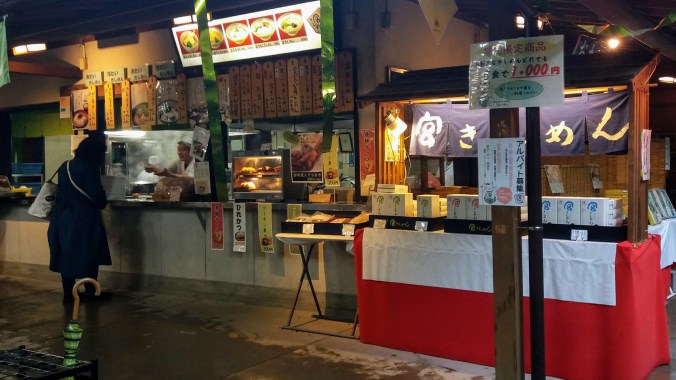
One of Nagoya’s other famous foods is kishimen. I had heard there was some near Atsuta Jingu but I didn’t realize that it was inside. Following the signs and my nose I discovered a small kitchen and covered picnic table area where the famous soup could be ordered in several styles.
Side note: It is so important to carry cash in Japan. I don’t even understand how one of the most high tech countries in the world that invented paying for things by tapping your mobile phone on them still has so many places that are cash only, but it does. Temples especially and tourist facilities in general, just about any smaller shop or restaurant (not convenience stores of course, they take cards), and all the machines you use to charge the transit cards also only take cash. It is one of the great mysteries of our age.
I was running low on cash because I’d spend some to make donations earlier in the day, so I was just able to get the basic Miya Kishimen, also the name of the shop, for 650Yen.
Kishimen is similar to udon, but the noodles are wider and flatter than a typical udon noodle. I also found the flavor of the broth to be quite distinct with a very smokey aspect as well as undertones of salty and sour for a very piquant profile. Maybe it was the experience of eating in the picnic pavilion in the middle of the beautiful forest, but I thought the noodles were definitely worth it, far above the average udon eatery. There was a self service tea station with lovely tea, and several signs warning patrons to beware the crows. I assume the greedy little scavengers… I mean clever sacred corvids… will hop over and steal any unattended food. The sign and the crows did little to dispel the vague aura of haunting I was experiencing that day, but I think that just added to the fun.


Miso Katsu
Dinner Monday night was one more Nagoya specialty, Miso Katsu. Katsu is a panko fried pork cutlet that is pervasive throughout Japan. It is also one of 3 Japanese foods that can reliably found at “Japanese” restaurants in Korea, so while I like it fine, I was not initially excited about going out for katsu. But, all of my local food finds so far had been better than expected so I agreed to give it a whirl. My friend got off work and met me down at one of the famous chains, Yabaton.
photo credit: Yabaton via Tabelog
Regular katsu is delicious when cooked well. It’s essentially fried pork, so it is hard to go wrong, but the best versions are very tender cuts of meat and crisp flaky fried exteriors. Bad versions are tough and greasy, obviously. What makes Nagoya’s miso katsu so special is that they pour a red miso sauce over the katsu just before you eat it (so as not to make things soggy). Miso is a common ingredient in Japanese cooking, and most foreigners are at least familiar with Miso soup, which is typically made from white miso. White miso is soy beans fermented with mainly rice. The flavor is fairly light and mild. It’s pleasantly tart and goes well with seaweed and green onions. Red miso on the other hand is made of soy beans fermented with barley or other dark grains. The flavor is quite pungent and may be an acquired taste. It’s not like “stinky cheese” pungent or anything, so don’t be scared to try it, but it is a good deal stronger and darker than what you may have experienced in the past with miso soup.

The pork at Yabaton is excellent all by itself. Tender and juicy cuts of pork, fried in fluffy panko breadcrumbs with little to no extra grease. When the waiter brought our bowls to the table, he also brought a container of thick, dark red miso sauce which he poured over the katsu with a flourish. I was impressed at how well the flavors went together and how much I enjoyed the red miso. It may be the most unique katsu experience I’ve ever had and I’m so glad I didn’t skip it just because katsu is “common”.
Conbini Food!
Japanese convenience stores are called colloquially by the Japanglish word “conbini” short for “convenience” in a language without “v”s. By my friend’s request I popped into the local convenience store on my last night as her guest to get dinner. When I lived in Yokohama for a summer, I often made meals from the conbini. There’s bento (lunch boxes), onigiri (amazing rice triangles stuffed with yum and wrapped in seaweed), and a plethora of random foods to pick and choose from.

photo credit: via kamonavi
Conbini food is almost always fresh. It’s a stark contrast to gas station foods in America that are filled with preservatives and have a shelf life sometime past the nuclear apocalypse. You can actually eat healthy from a Japanese convenience store. After days of dining out, my friend was craving a simple salad, a bag of greens costing about a dollar. I had been grabbing onigiri (one of my fav snacks) for lunches and afternoon pick me ups all through the vacation so far, so I looked to see what else was available for eats and I found a conbini food I had entirely forgotten the existence of!
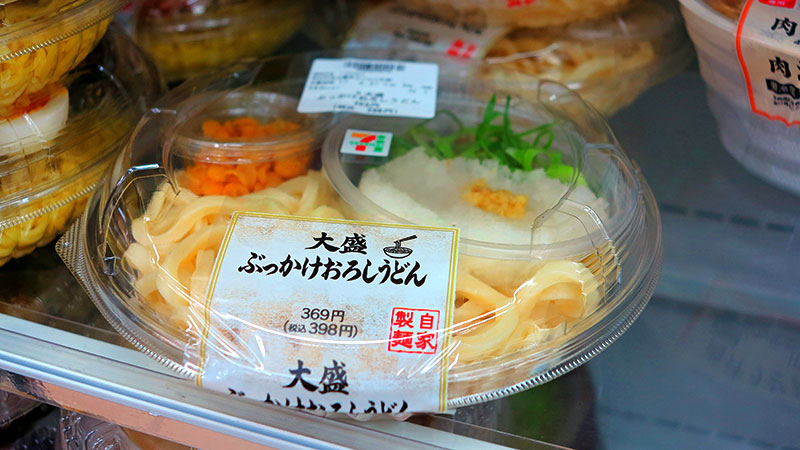
photo credit: intrepidtravel.com
During my summer stay, I ate these cold noodle bowls ALL THE TIME. It’s in the refrigerated section, and has a plastic bowl with fresh udon noodles and packets of sauces and toppings. Back in 2015 the ones I got had a fresh egg, but the one I found this time had what I think was dehydrated egg? Maybe a new health law? Anyway, I found the flavor that was my favorite and was very excited to get to have it again after almost 3 years. I also got myself a “long day” reward: juice box sake! That’s right, you can buy sake in a cardboard box with a straw. Your inner kindergartner and your outer adult can both be happy as you sip booze from a tiny box.


Travel and food are such a huge part of my life. Although I had previously taken my responsibilities as a food tourist lightly, I’m vowing not to do so in future and thus my summer plans involve ever growing lists of “famous foods” I have to seek out in each place. I’m not turning this into a food blog full time, but I think I’m going to take a cue from Mr. Bourdain and let my belly lead the way in a few more adventures.
In fond memory of Anthony Bourdain, who’s shows about exploration and food contributed to the desire I have to travel and share what I find. Thank you.
 We set off from Busan (blue dot) in the morning to drive all the way across the southern end of the Korean peninsula to Jindo (red dot). Although Korea is small compared to, say, the US, it was still almost 5 hours of driving with the occasional pit stop. (By the way, in case you’re curious, you can see Daegu on this map as well). Fortunately, I went with a tour group (my stand by
  The Jindo festival had at least one feature I’ve never seen before: a traditional Korean wrestling ring. A pile of sand was placed in a large circle where two contestants could wrestle in the traditional style.
  Even more bizarrely, after the color throwing was over, the festival organizers gave each participant a “toga” to wear. The togas were long white robes with red sashes that could have evoked a Roman senate or Jesus. Considering we were about to “part the seas” it was hard not to see it with Judeo-Christian overtones, but the rather drunk person I asked about it just said “toga party!” The entire thing seemed like the festival organizers were trying to find a way to appeal to the expat crowd. I’m glad they had fun, but I would have preferred some more traditional activities, like someone to teach us about collecting clams and seaweed the way the locals were doing as the tide went out. It’s hard to go do local culture festivals when the locals are busy trying to white-wash everything for cash.
 Finally, the real “reason for the season” was upon us and we muddled our way down the road to the rainbow steps beneath the watchful eye of the grandmother and the tiger. We paused at a bench to don our thigh high rubber boots and got some advice from the locals on how to attach the rubber garters through belt loops to hold up the boots, or failing that, to wrap them tight around our thighs and snap them in place. Thus clad in bright orange and yellow wellies, we made our way down the steps and into the shallow tide pools to wait for the tide to recede.
 If you look at the area on Google Maps you will simply see the beach and the islands, but on Korea’s own Naver Maps, there is a thin line connecting the rainbow steps to the island of Modo. Although this path is only usable twice a year (at most), the Korean map makers consider it important enough to draw in.
 The history of tidal prediction starts with Kepler (total nobody) in 1609 to theorize that the moon’s gravity caused the ocean tides. He was followed by other such no-ones as Galileo and Newton. It was in 1776 that the first big complex equations came from a man called Laplace. Harmonic analysis was added in the 1860s and polished off by 1921 in the form that Navies all over the world still use today. Although the math hasn’t changed in almost a hundred years, computers make the math easier and the information more widespread so now instead of just ships in harbor– surfers, beachcombers, and clam hunters can
  On a more mystical note, the local legend of the tigers explains why there’s a statue of a grandmother and a tiger overlooking the sea. Long long ago, the villagers who lived on Jindo were plagued by man-eating tigers. The whole village packed up and sailed over to the neighboring island of Modo to escape the threat, but one woman was left behind. The woman was Grandmother Bbyong, and she prayed to the Dragon King, the god of the sea, to help her. Finally the Dragon King came to her in a dream and told her he would build a rainbow brigde across the sea for her. The next day when Bbyong went down to the sea, the waters parted to let her cross and her family came out from Modo to meet her. This also explains the rainbow stairs that lead down to the landbridge, but not why her family couldn’t have just sailed back for her in the first place.
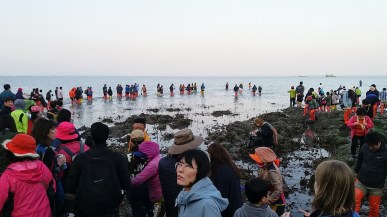 While math can now easily tell us the time of the lowest tides, it does not yet advance to tell us what the actual lowest level of the water will be. Not that it couldn’t, but there are more variables involved, so it’s not a thing now. While we can say with certainty, the lowest tide of the year on this beach will occur at 18:38 on April 29 (or whatever), we can’t say for sure if that will expose the land bridge or simply be lower than every other tide around it.
 We tromped along the path, watching parasailers overhead and rainbow colored lanterns being released in to the air from the beach behind us. It was clear the path was quite narrow because going too far from the group to one side or the other to get a picture resulted in a severe deepening of water level. At the time, my friends and I theorized it might be man-made, or at least man-maintained, however, I have since then found that the build up of rock and sand in this twisty line is a natural result of the currents around the islands.
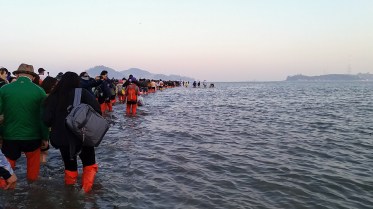 Before long the golden light of the sunset combined with the swish-swishing of hundreds of feet through water to create a trance-like state. I could not judge how far the island was, nor tell which way the path twisted. The rocks below us rose and fell, bringing the waves treacherously close to the top of my boots and then back down to barely splash over my toes. The whole path is nearly 3km long. I suspect a determined person could make it out to the island and back in the hour or so the path is clear to walk, but I wasn’t racing, and soon we were greeted by the sounds of Korean drums and the distant flags waving as the procession from Modo came out to greet us.
 The walk outward had been slow, trepedatious, as though we were nervous the land could drop away at any moment, but the trip back was much more celebratory as well as much more damp. The parade of drum bangers, cymbal crashers, gong ringers and flag bearers danced merrily in their traditional garb, urging us all back to the larger island of Jindo. Our pace quickened and our legs swung to the rhythm causing much larger splashes. Waves came in from both sides of the path making us nervous, but excited. The water finally breached the top of my boots and sent an icy chill down my shins, but I found I did not mind.
 Before heading to the fields, we walked up a long road past the area of the light festival where a few wire frames from reindeer and dragons could still be seen. The road up the hill was painted with fun perspective illustrations of a stream, complete with little camera icons to show the best places to stand to see the visual effect. Optical illusions are fun.
 At the top of the hill, far beyond the little pagoda that had marked the highest point of the lights, we finally came upon the green tea museum where we were treated to a special showing of the Korean green tea ceremony (complete with English translation by our awesome guide). The ceremony involves a process of several containers: a water pot, a cooling bowl, a tea pot, and the drinking cup. The hot water pot is filled with boiling water, which is then poured into the bowl, and from the bowl into the tea pot and finally into the cups. The instruments are warmed up in this way. Then more boiling water is poured into the cooling bowl. Tea leaves are scooped into the warm but empty tea pot and the ideal temperature water is poured from the bowl over the leaves. While the tea steeps, each cup is emptied of it’s hot water into another bowl on the floor and wiped dry on the outside. The tea is then poured into the pre-warmed cups by pouring only a half a portion into each and the other half in reverse order on the way back. The tea is then served, 4 cups to the guest and one to the host.
 The hostess tried to tell us a bit about green tea, red tea and black tea but her translated explainations seemed off to me, since she said it had to do with the age of the leaf when it was picked from the plant. I don’t know if this was her or the translation, but the real story follows: In any country with Chinese roots in it’s culture and language, the three colors of tea are a bit different in meaning that in the West. Red tea is not Rooibos, in fact all three come from the same plant. And it’s not the age of the leaf at picking that determines the difference, but rather the post picking, pre-drying process. (although especially young and tender tea leaves are sometimes referred to as “monkey picked” and do make a delightful tea).
 After we conducted our own tea ceremonies, I drifted lazily back down the hill, examining the spring flowers and the grounds that had been lit up beautifully last December. When I finally got back to the tea fields, I took off on the same route I’d walked before and was happily greeted by many blooming apple trees and a small army of busy bees who were so focused on the brief blossoms that they paid no mind to all the humans fussing around. In fact, I think it was the only time I’ve seen Koreans in the presence of a bee not totally freaking out. I guess the selfie with the tree is worth it.
 In addition to the blooming fruit trees, there were cascades of purple flowers covering the rocks wherever tea was not growing. It made the whole place feel like a still frame of a rushing river in shades of pink, purple and green. Besides the tourists, there were also tea pickers at work. Each ajuma looking lady had her sun guards on, gloves and a mesh basket to place the leaves. They were not picking the bushes bare, but selecting only some growth. It seemed to me to be the newer, brighter green leaves that they were after, but I couldn’t tell for sure. In the age of automation it was strange to see people picking by hand. I know that it’s still the way for many crops in the world, but sometimes it gets driven home that there’s a human on the other end of my tea or strawberries or carrots, and then I’m carried off by sociological musings on how we came to value people who sit at desks manipulating imaginary money so much more than people who make our food.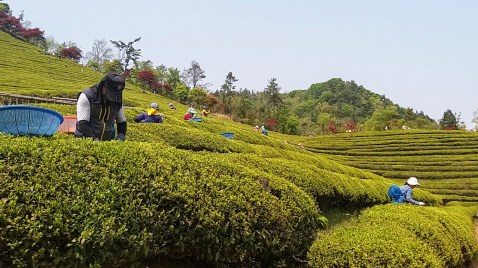

 Green tea looks like very well kept English hedge,.
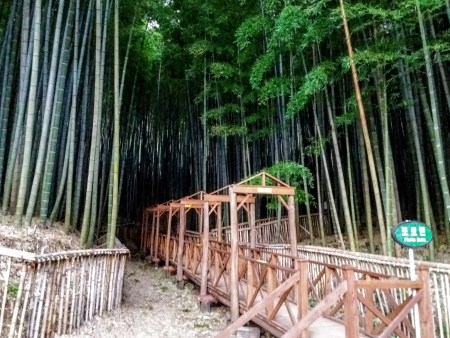 On our way back to the main entrance we took a quick side detour to the bamboo forest. After a short walk through some more evergreens, we emerged into an open space facing a dark and mysterious bamboo forest. The sun was low and the shadows were long so we couldn’t see far into the mass of stalks. Once we entered, it was as though a twilight had encompassed us, the lush leaves cutting out nearly all the late afternoon sunlight. The birds went bananas, screaming like jabber jays, making us feel as though we were in an arena from the Hunger Games or at very least in an ominous Korean horror movie. I wasn’t sure if we should expect kung fu masters or monsters. (click for more pictures of Boseong
  We left the tea fields behind and headed back down to the main parking lot that would lead to the lights. There were plenty of stalls with a wide variety of food (green tea added and regular) so my allergic friend was able to find something tasty, too. The light show wasn’t quite as spectacular as
  dragons and hatching out of giant glowing eggs along the way. Like most lantern displays here, everything was meant to be posed with and interacted with, so it was easy to walk up to any set and play around. It’s a small and childlike pleasure, but after so long in the US being forced to stay behind the railing, it is fun to get a little more hands on. On the way back down, we took the tunnel of lights, pausing every time the colors shifted to take more pictures and pose in the rainbow glows.
 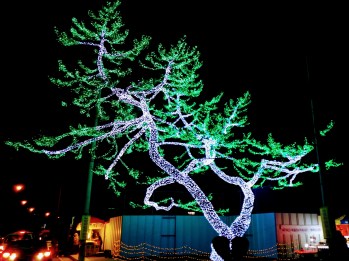 Our third and final location was near the beach where another tunnel of lights and light decorations had been put up. One large tree had been colored in white and green to make it look like it still had leaves. There were reindeer and Christmas trees, but also a giant chicken floating just off shore. I’m not sure why a chicken, but I saw another similar giant chicken in the sea back in Busan the next day.
 The next Saturday was Christmas Eve, and we decided we needed to do a blending of American and Korean activities. We spent the afternoon inside making eggnog and gingerbread houses. I have never made eggnog before. I thought about it a lot, especially when I wasn’t doing dairy. I thought there had to be a better tasting nog than Silknog. But somehow, I never got around to it. This year, although I seem to have no health issues with milk here, there was a complete absence of nog… everywhere… Koreans either have never heard of it, or they are all in the hate eggnog camp.
 based on past non-dairy culinary experiments, I’d say if you’re a dairy free nog fan go with unsweetened almond milk and coconut milk– the stuff in the can that is dense and creamy, not the stuff that is a regular milk sub.– Use 2c almond milk to 1 c coconut milk, otherwise just follow Alton’s instructions. If you’re a vegan who wants
  While we imbibed our culinary delight, we worked on assembling a gingerbread house. Every month here in Busan there is a
  In addition to our delightful wine, I enjoyed pumpkin soup, a goat cheese/bacon/honey pastry for entree, a superbly well cooked slice of salmon with a light lemon flavor and a unique mushroom risotto which had been made into a breaded patty and lightly fried, and finally a chocolate pear cake that tasted more like it was a ganache or very dense ice cream rather than a cake, too decadent! Nothing will compare to the food in France, but Le Jardin made an admirable effort and gave us all a taste of Western flavors with just a hint of haute cuisine that was perfect for a holiday feast.
 Toward one end of the festival, I found an old man with a traditional candy game called ppopgi. It’s a simple candy made from sugar and baking soda, but a shape is pressed into the candy. Kids (and a few adults) can use a little pin to try to break the candy around the shape without shattering the brittle sugar. If they succeed, they win a prize (often more candy). The vendor was using a tiny copper pot to melt sugar over an open flame, adeptly pouring out the steaming satiny brown concoction, pressing it flat onto a popsicle stick and letting his fares choose their shape before pressing a cookie cutter down on the hot surface. I noticed that while adults had to be perfect to win, the little kids were often awarded a prize for a good effort.
 A mere week later, the New Year celebrations were upon us. I had done some research and found that here in Busan there is a bell ringing ceremony in Yongdusan Park at the large bell at the foot of the Busan Tower. It’s a big event with musical performers and guest speakers that is televised much the way that the New York Time’s Square ball drop is. Yongdusan park is nowhere near as big as Time’s Square, and the majority of people don’t ascend the multiple flights of stairs until 11pm. Knowing we had plenty of time, we spent the day reveling in some seasonal sulbing, a screening of Rogue One, and a totally accidental Japanese dinner.
  Nonetheless, it was a wonderful day and at 5 minutes before 11, we found ourselves in a long line of people patiently trudging up the stairs to the peak of Yongdu Mountain. Normally, this pathway has a series of escalators going up so that anyone can access the park, but tonight the escalator had been closed down and reserved as a dedicated emergency access stairwell. When we arrived at the top, we saw many TV vans and we shuffled with the crowd into the standing space behind the VIP seating. To my surprise, through crowd motion, we soon found ourselves close enough to the bell to get a decent view of the proceedings, and there was a jumbo-tron screen off to one side that allowed us to view the performances.


 Gallivantrix