Happy 2023 and year of the Rabbit! I am sad to say my holidays were marred by an illness of unknown cause, a risk of travelling to any new geography where one’s own immune system is naïve to the local microbes. However, I’m bouncing back and getting my new year groove. My first tourist visit for the year was to Le Musée des civilisations noires, and now I’m here to share it with you.
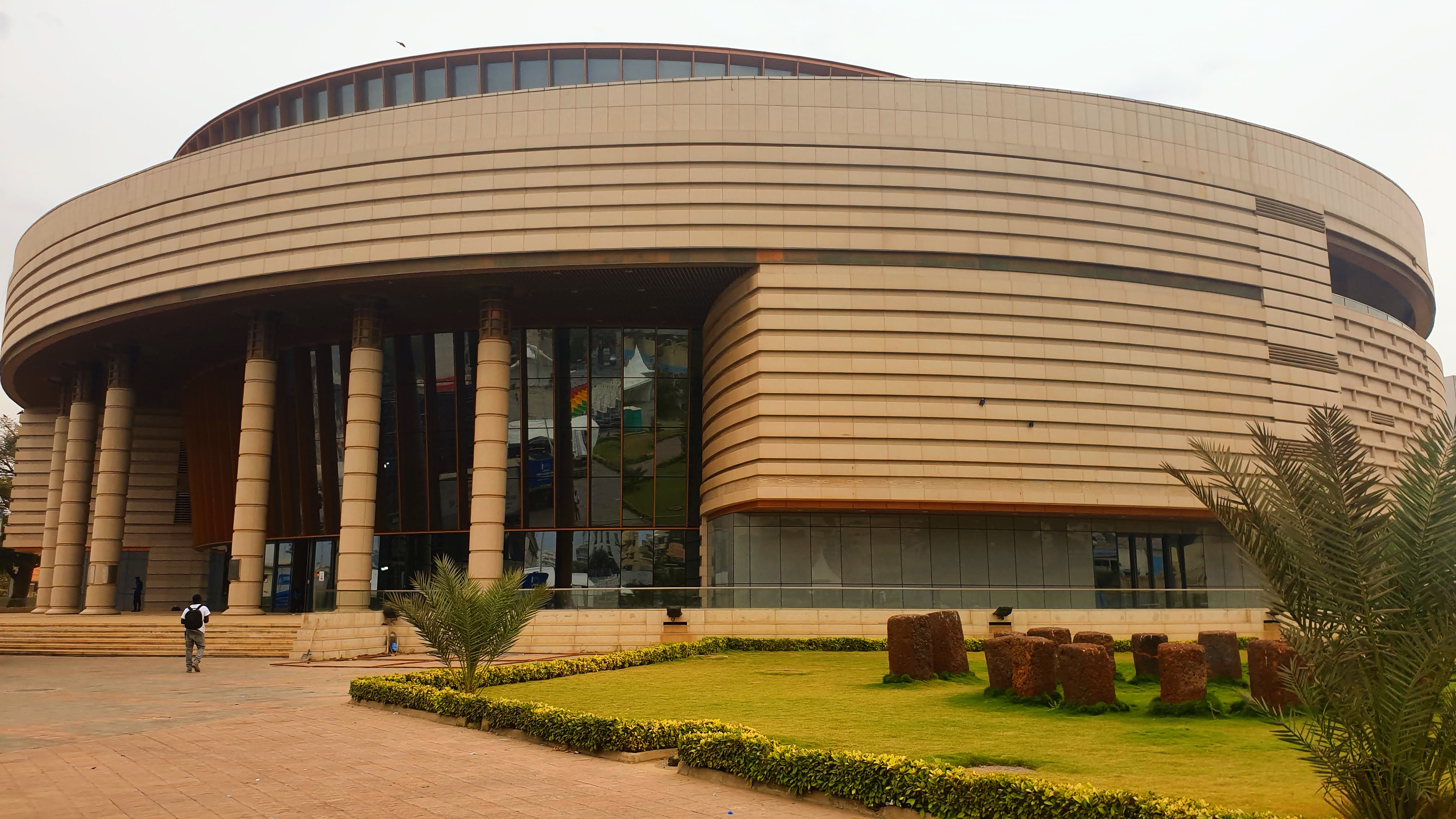
If I could describe the Museum of Black Civilizations after my visit in one word, it would be: aspirational. The museum itself is an enormous building with — as one might say to a child who’s pants need to be rolled up — room to grow. I was initially disappointed with the experience because it has so much hype, but after doing some follow up research online about the history, I’m a little more impressed, and a lot more sad.
It opened in late 2018 with a substantial contribution from China to the tune of $34 million (an especially revealing number since the estimated construction costs were 30mil?) and was built with over 150,000 ft2 (14,000m2) of space over 4 floors to display more than 18,000 exhibits (I have no idea how they reach that number given the varity of size and display needs, but that’s what they say). In 2019 it was hailed on TIME’s list of the World’s 100 Greatest Places.
The museum was built in large part to give a big middle finger to the French (and other colonial countries that … I tried to find a nicer word, but … r*ped the continent). For context, there’s a lot of pushback from European museums about returning the looted treasures and artworks of colonized African cultures. They argue that without sufficient quality display areas like climate controlled museums that it would be irresponsible to return the fragile artworks to the countries they were stolen from. This is a real hot-button issue with lots of discussion about what constitutes ownership and stewardship, especially when discussing artifacts that affect all of humanity like early hominid remains or artifacts that were looted by rival tribes/kingdoms well before they were stolen by colonial masters, but the way I see it, if you just took that thing from someone’s great-grandpa less than 200 years ago and his family is still there, it really should not be a debate.
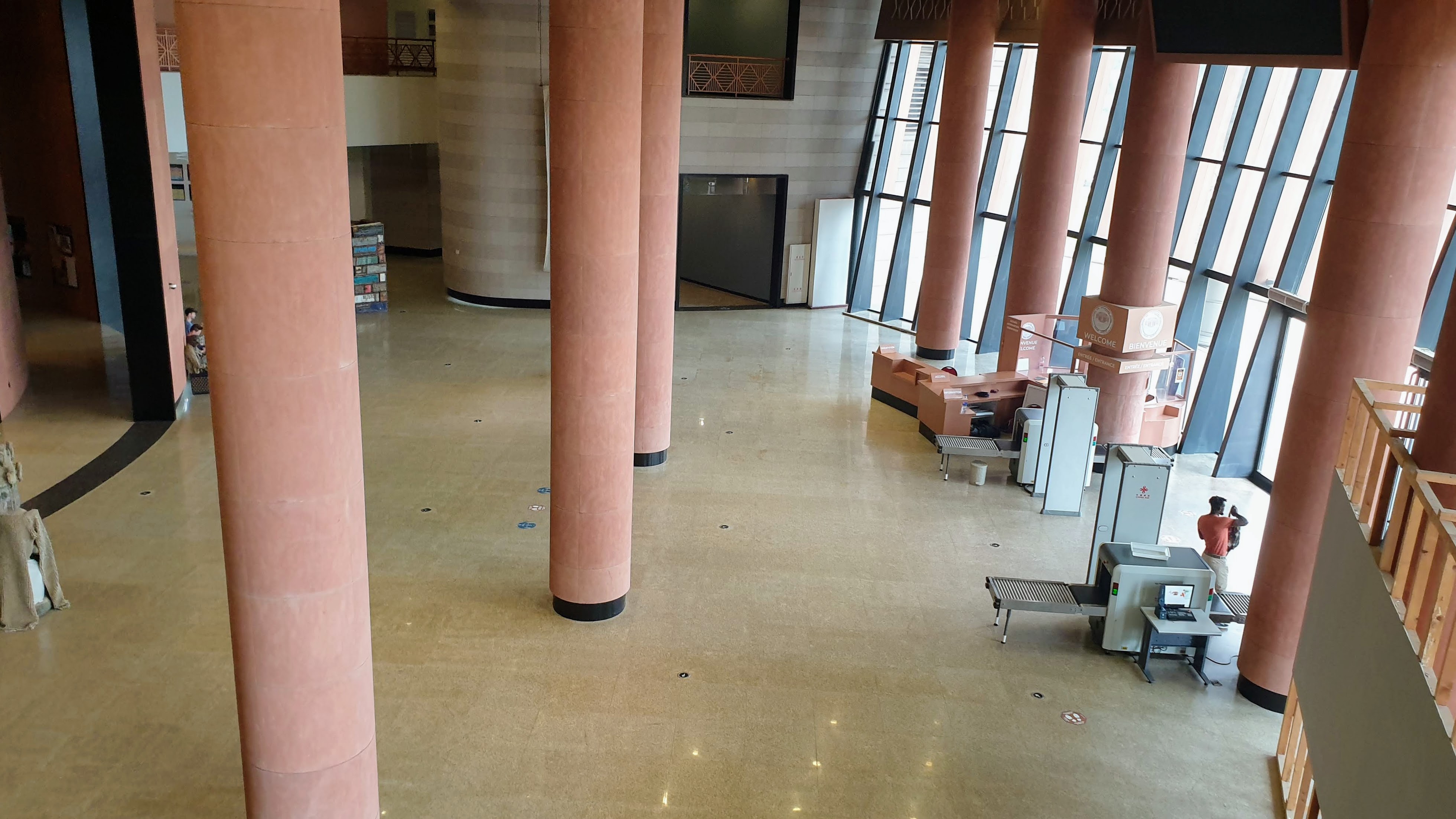
Regardless, the construction of Museum of Black Civilizations was meant to allay all the concerns that the artifacts would not be properly cared for or displayed in Senegalese stewardship, and France made some conciliatory noises that they would work on giving stuff back. Then before that could be finalized, “ohhhh global pandemic, hands are tied, guess we can’t now”. Fast forward to 2023 and that museum is like a grocery store after a storm alert – empty.
The Ground Floor
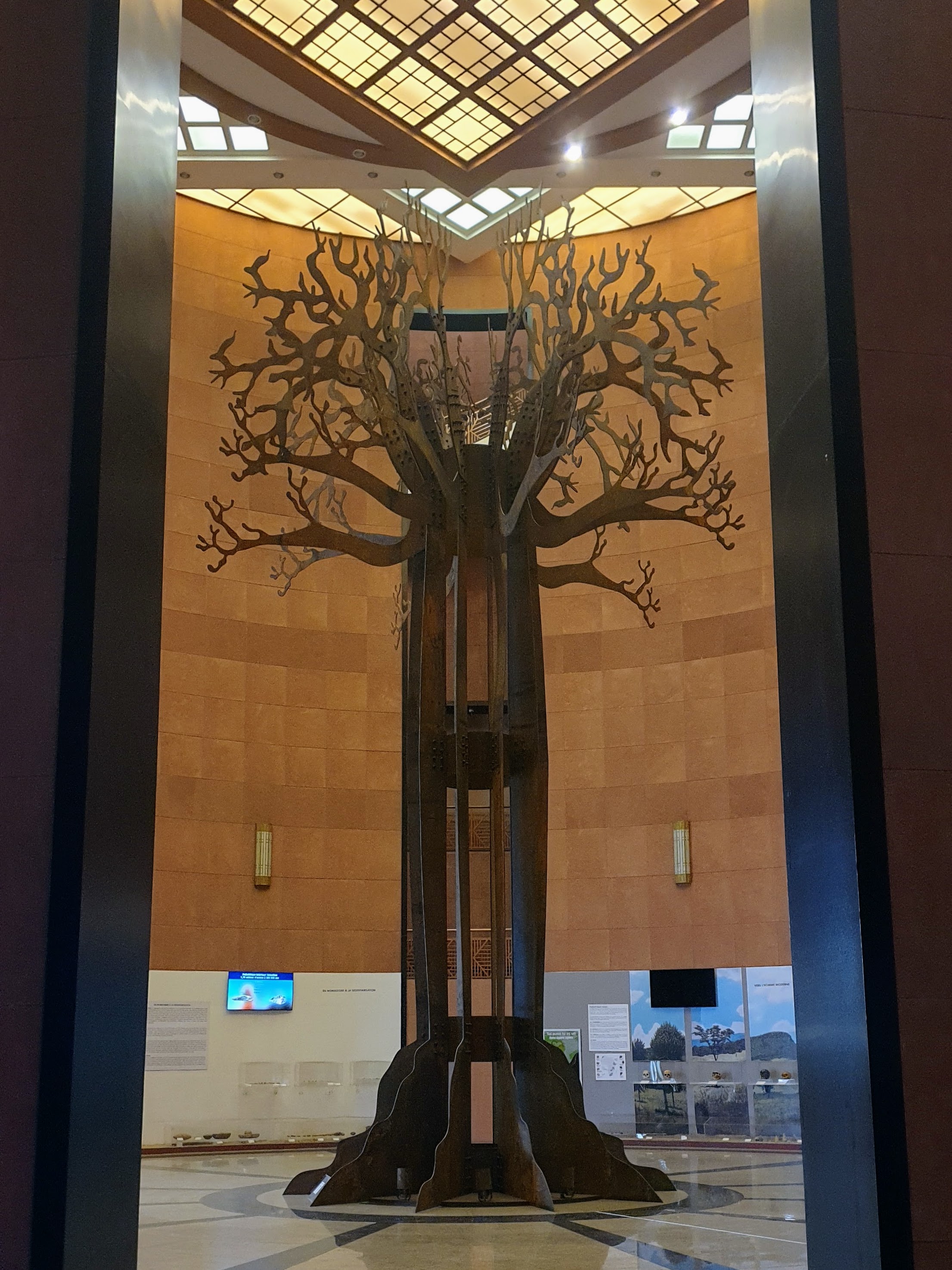
The first thing you see (aside from the vast empty space) is “The Saga of the Baobab,” a metallic tree by the Haitian artist Edouard Duval-Carrié in the center of a display about the cradle of humanity aka the “Out of Africa” hypothesis which shows strong evidence that modern day humans evolved in and migrated from the African continent something like 300,000 years ago. There’s debate about this too (I don’t mean creationism) because some fossil evidence has been shown that other versions of humans existed in other places around the world as much as 1.8m years ago. I get a headache when I try to follow the scientific debate because all the versions of hominid are based on bone fragments and mitochondrial DNA. I don’t blame the museum for sticking to a single scientific hypothesis in their presentation, but I was a little let down by the presentation itself.

The vast majority of the exhibit is printouts and blocks of text (French only!) on the walls with a few scraps of skeletal remains under glass. I strongly doubt that these are actual remains since it is the standard practice of museums everywhere to put replicas on display because of the delicate nature of the bones. It’s a cool story to tell, from the origin of the first bipedal apes through “Lucy” and on to the Neanderthal and Cro-Magnon, but it didn’t seem especially unique. One thing I was really fascinated by was this Neanderthal skull because it clearly shows that the front teeth are rounded instead of edged. I remember being taught that our front teeth were made for cutting (cone shaped teeth are for puncturing, gripping, tearing hence why all the carnivores have them) and our molars which are more square are for grinding. It made me really curious about the unique tooth shape of the Neanderthal and what that means about their diet. It was neat to see up close.


The other feature(?) of the first floor was the contribution of African cultures to science and technology. When the greeter at the door told me about this I was really excited. I feel like this is a very under-taught area of global history, and I strongly hoped to learn some things. Even after this, I still hope there are things to learn. However, the exhibit was a real let down. While the cradle of humanity section was maybe 60% wall of text and photos, the “science and technology” section was easily 99%. In addition, other than the origin of smelting iron (a huge contribution to human culture, no doubt) most of the rest of it was limited to Egyptian contributions which could be argued to be a part of the Greek Classical world. I stan negritude and black excellence, but I want to see more than “Egypt did a lot of cool stuff” when we talk about the history of African contributions! Also a museum heralded as one of the best in the world and maybe the best on the continent needs more 3d models. Printing a Wikipedia page on the wall does not a museum exhibit make.
The Next Floor
The elevator lets you out at a room full of recovered pan-African artifacts. Which is… cool? I guess? I know it’s the museum of “black civilizations” so all of Africa and the diaspora included, but I am curious as to how many of the countries whose artifacts are on display gave them willingly? With all the controversy about France putting stolen Senegalese artifacts on display in their museums, I expected more Senegalese focus here. I also would have liked to see some “graciously donated by…” or “on loan from…” signs on those foreign artifacts to reflect the value of only displaying other culture’s property with permission. I was also let down by the lack of context for the items on display. Most of them only came with a card saying something like “mask from Nigeria” with the materials and size listed. Nothing about when it was made, what it was used for, how it related to the culture at the time or now or anything. It was fun to look at, but it left me with a bit of an empty feeling.
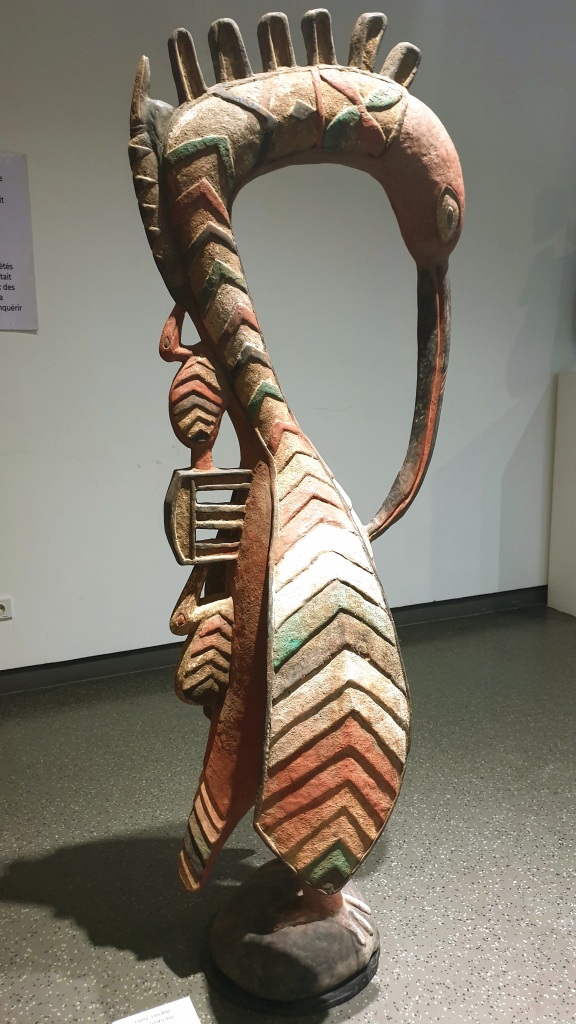
A-bamp (Baga bird) Guinea Conakry, Baga wood, lime, black, red, white pigment Height: 176cm 
Botchio, fon fetish Benin, Porto-Novo Various materials (leather, iron, cowries, fabrics, clay, cow tails, etc.) Height: 70cm 
Nkisi Nkondi Mayombe Region Democratic Republic of the Congo wood, horns, iron, nails, glass, fabric, and vegetable fiber rope Height: 245cm 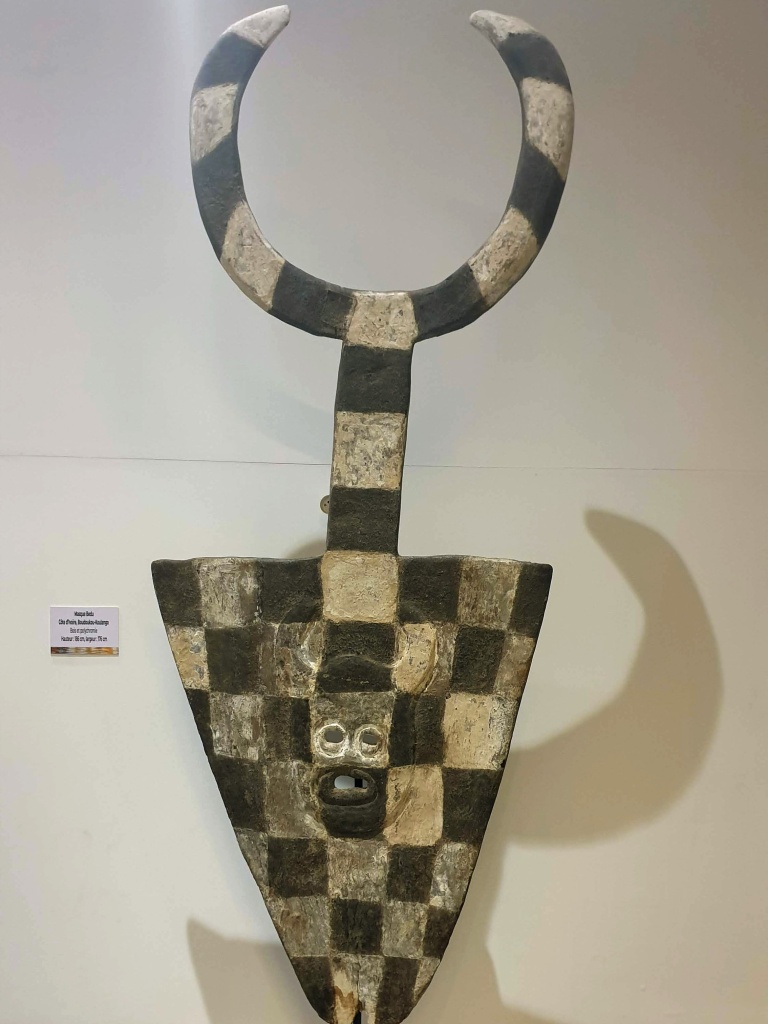
Bedu Mask Ivory Coast, Boudoukou-Koulango wood and polychromy Height: 186cm, width 176cm 
Traditional “Dozo” hunter outfits Mali, bambara Cotton (bogolan), mirror, pearls, skins, charms, horns and cowries Variable size 
Traditional “Dozo” hunter outfits Mali, bambara Cotton (bogolan), mirror, pearls, skins, charms, horns and cowries Variable size 
Traditional “Dozo” hunter outfits Mali, bambara Cotton (bogolan), mirror, pearls, skins, charms, horns and cowries Variable size 
dance crest; Chiwara Mali, bambara wood and iron variable size 
buffalo helmet-mask Cameroon, Bamileke wood, white and red pigments Height: 30cm, length 75cm, width 43cm 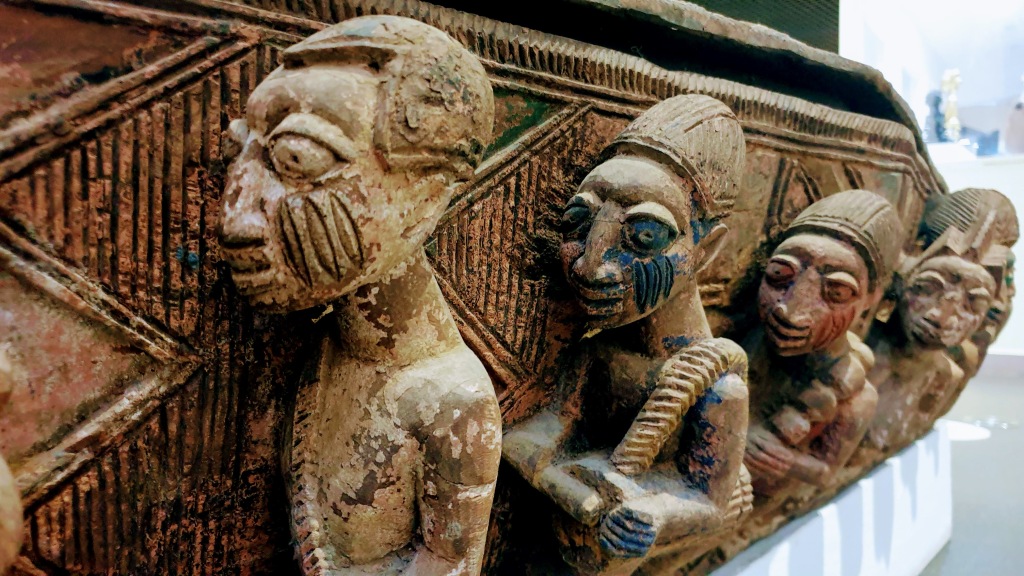
Yoruba coffin Nigeria Wood, lime, black pigment Height 67cm, width 190cm 
Idiok Ibibio Mask Nigeria wood, imported pigments yellow, green, red ocher
The next section was called “Les Appropriations 2022-2023” and was about the presence of monotheism (Judaism, Christianity and Islam) in Africa. I am interested in this kind of thing, but it was hard for me to get through when again 70%+ of the display is a printed a Wikipedia article on the wall in French. The most interesting part of the exhibit on Judaism was a photo of African (black) men in yarmulkes. Christianity was mostly about Egypt (the Coptics) with a few references to the African officiants appointed by the Catholic Church. I was most interested in the Islam section since I know sub-Saharan Islam is quite different from Arabic/North African Islam. I even captured all the French text to peruse at my leisure later with Translate to help me, but it was still really basic. I actually think the Wikipedia entry on Sufism has more information. Also, since Islam is pretty iconoclastic there was an even higher ratio of wall-text to object display in that section. There was a whole wall dedicated to the teachings of Sheik Ahmadou Bamba who is a really fascinating historical figure in the fight for Senegalese independence, but if I had not known that about him before going to the museum, I wouldn’t have figured it out from the display.

ART
The next section was the highlight of my experience at the museum. However disappointing the first floor was, the modern art section made up for it in spades. The “Africa Now 2022-2023” exhibit was stunning. Everything I dreamed of for a beautiful modern African art exhibit was turning it out. Art that really made me feel things and think things and go WOOOOOW.
The very first painting at the entry was just a punch in the gut, but so beautifully done.

I enjoyed a range of colors, materials, styles and subject matters, and as with all modern art, I didn’t “get” all of it. I tried to capture a few of the ones that either reached out to me or just were photogenic. The huge wall mural was only ‘meh’ to me until I got up close and realized it was made of a mix of African print fabric scraps and garbage, which made it suddenly a huge statement about the trash problem I’ve been noticing literally every time I walk outside. Trash isn’t only a local problem. A lot of the “developed” aka rich countries in the world export their trash to poor countries, so basically there are places around the world being paid (not much) to become our landfills. The practice is slowing down mostly because the countries receiving the garbage are saying “no more”.
There was also a field of oversized cotton made of metal and … cotton. I know it’s oversized because I used to live in a place where I drove through cotton fields on the regular, I know how tall it grows. This cotton was enormous and I think the choice of size and material really spoke to the impact of the cotton industry on the slave trade and the decimation of Africa as well as to the diaspora.


“Oldies and Goodies” Olanrewaju TEJUOSO mixed medium encouragement prize from the Minister of Culture Dak’Art 2018 
“Oldies and Goodies” Olanrewaju TEJUOSO mixed medium encouragement prize from the Minister of Culture Dak’Art 2018 
Cotton Field Soly CISSÉ installation (iron and cotton) 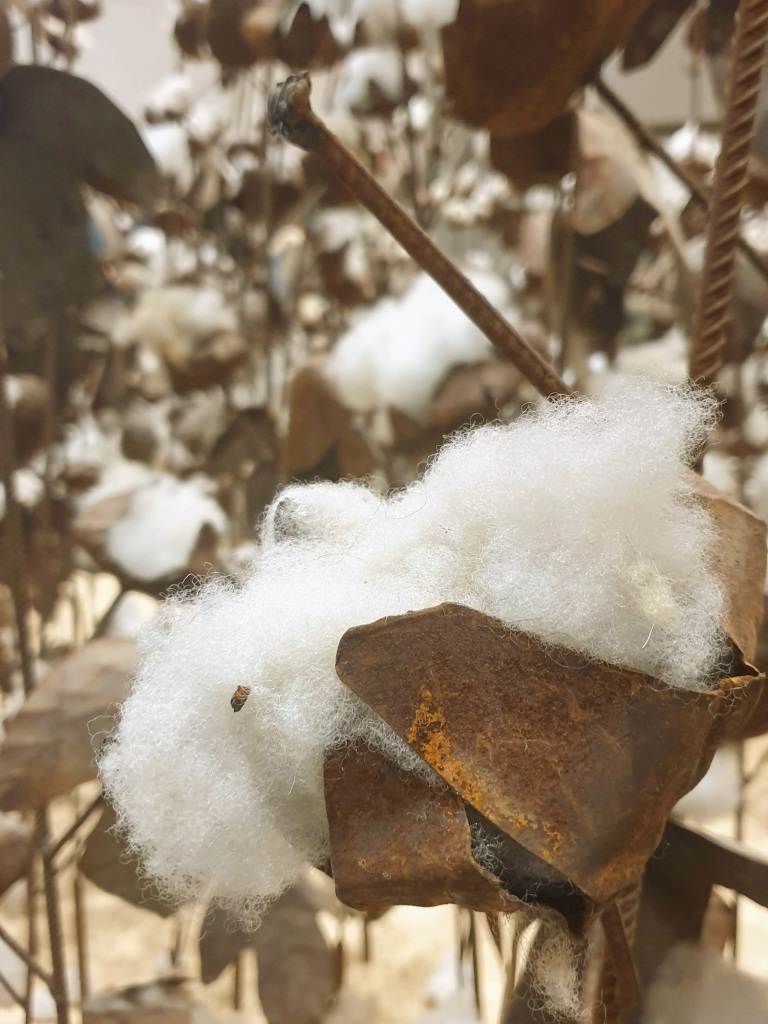
Cotton Field Soly CISSÉ installation (iron and cotton)
If there is ONE artist you look up after reading this let it be Malaika Dotou Sankofa. I don’t know why these jumped into my soul the way they did, but these photographs are amazing. The juxtaposition of African prints and western clothes, the angel in broken and shabby environments, and sure the model is easy on the eyes too.

Environmental Awareness
The last section of the museum was a corner dedicated to environmental awareness called l’incivisme or “incivility” that opened in December of 2022. It had informative displays and photos about environmental preservation projects like the great green wall (a multinational effort to plant trees and ground cover along the border of the Sahara desert to keep it from expanding). There were displays about pollution, garbage, over harvesting lumber, lack of clean water, traffic congestion, noise pollution, and public hygiene. It suggested a strong sense of self-reflection and a desire to improve living conditions in Senegal and on the continent in general. It makes me happy to know that there’s a local movement about it, but also a bit sad that it’s relegated to a tiny space at the top corner of the displays.


I also went up to the third floor just to see if I could. It looked like maybe it was used for meetings or celebrations. It was quite empty, but I could see a stage and risers as well as a lot of blank walls that hoped to receive more art someday. There was a nice balcony with a cute view, but it felt very surreal being in this vast space that remained totally unused 4+ years after the museum opened.

Like most of Dakar, Senegal, and West Africa that I’ve experienced so far, the museum of black civilizations was a mixed bag – I’m glad to have the experience, but most of the feelings I come away with are difficult and heavy. I’ve been to a lot of museums in my life from the Smithsonian to tiny hole-in-the-wall unairconditioned rooms in the backwaters. I know that money can go a long way, but in the end the displays need to be unique, interesting, and educational. I am glad that Dakar has this building because it’s the first step in the reclamation of their historical treasures, but right now, the museum is more a testament about what black civilizations have lost rather than a display of their achievements. Hopefully it will live up to it’s aspirations someday.
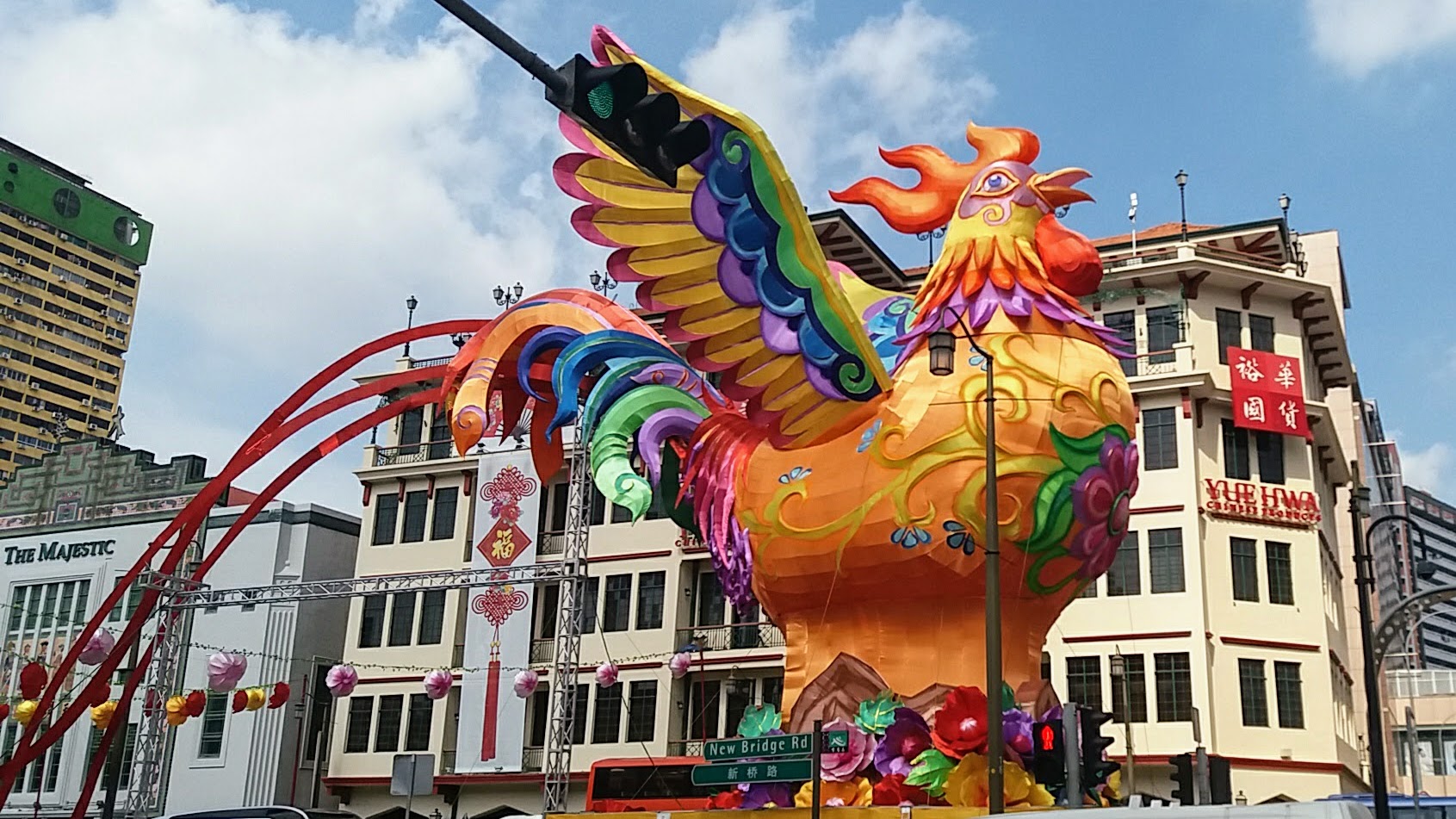 After an incredibly full first day in Singapore, I had a much lighter day of temple viewing planned before I hopped on the bus to Kuala Lumpur in the afternoon. It’s never hard to wake up in a dorm hostel, since everyone else is waking up, too. After packing up and enjoying another cup of teh tarik, I headed out to catch the sights. The night before, I’d run across a giant rooster in the street (in anticipation of the impending lunar new year holiday), so I did a quick rerouting to pass back by in the light of day. Chinatown was already putting on a decorative show two weeks before the holiday; I can only imagine how crazy it was on the actual holiday weekend.
  In addition to the stunning decorations, I passed by a street artist sitting in the shade of an overpass and working on the beginning of a painting of the festivities. He was kind enough to let me take a photo and we wished each other a happy new year in parting.
 After breakfast, I headed into the temple. I generally don’t wear short shorts, and while I go wear sleeveless in heat sometimes, since my plan for the day was temples, I was dressed appropriately. However, for the tourists who weren’t, a staff of firm but polite people arranged for them to wear long skirts or shoulder wraps from a shared bin. Once past the main entrance, I walked into a smaller room where two monks were performing a blessing on a couple donating to the temple in a red envelope (traditional for money gifting at the new year). As I watched, I realized people around me were taking photos and video and I was surprised. I looked around for any signs about cameras, but there were none. It seemed that the temple allowed visitors to take pictures. It felt very strange taking pictures in a temple, and in the end I could only take a few before my sense of unease overcame me.
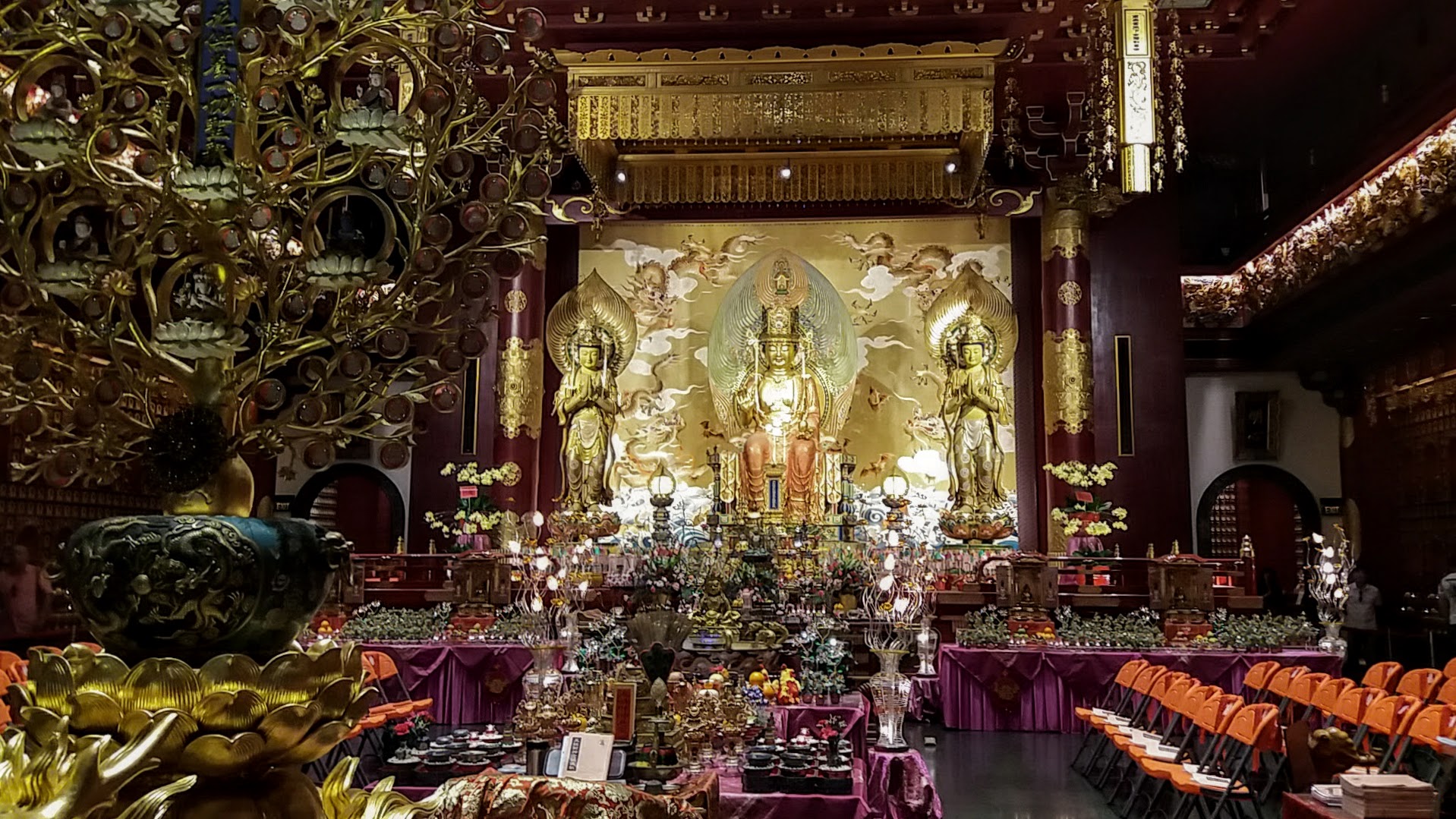 The main hall on the ground floor was an ode to opulence. I’m used to Buddhist temples being ornate. Wood and stone carvings with intricate detail are common (though never boring). Paintings or works in colorful semi-precious stones, and even the occasional gold paint or gilt covering to add some shine. The point is, that I’m used to temples being about effort and time and skill, rather than about blatant displays of wealth. In fact, a common art form is the sand mandala, which is made over weeks or months of painstaking hand work, then wiped out to represent the impermanence of reality. I don’t have an issue with beauty in a temple, I go to temples in part because they are beautiful, but something about this temple and it’s over the top gold, it’s donation jars every few feet, and it’s designated VIP seating for supplicants just did not sit well with me.
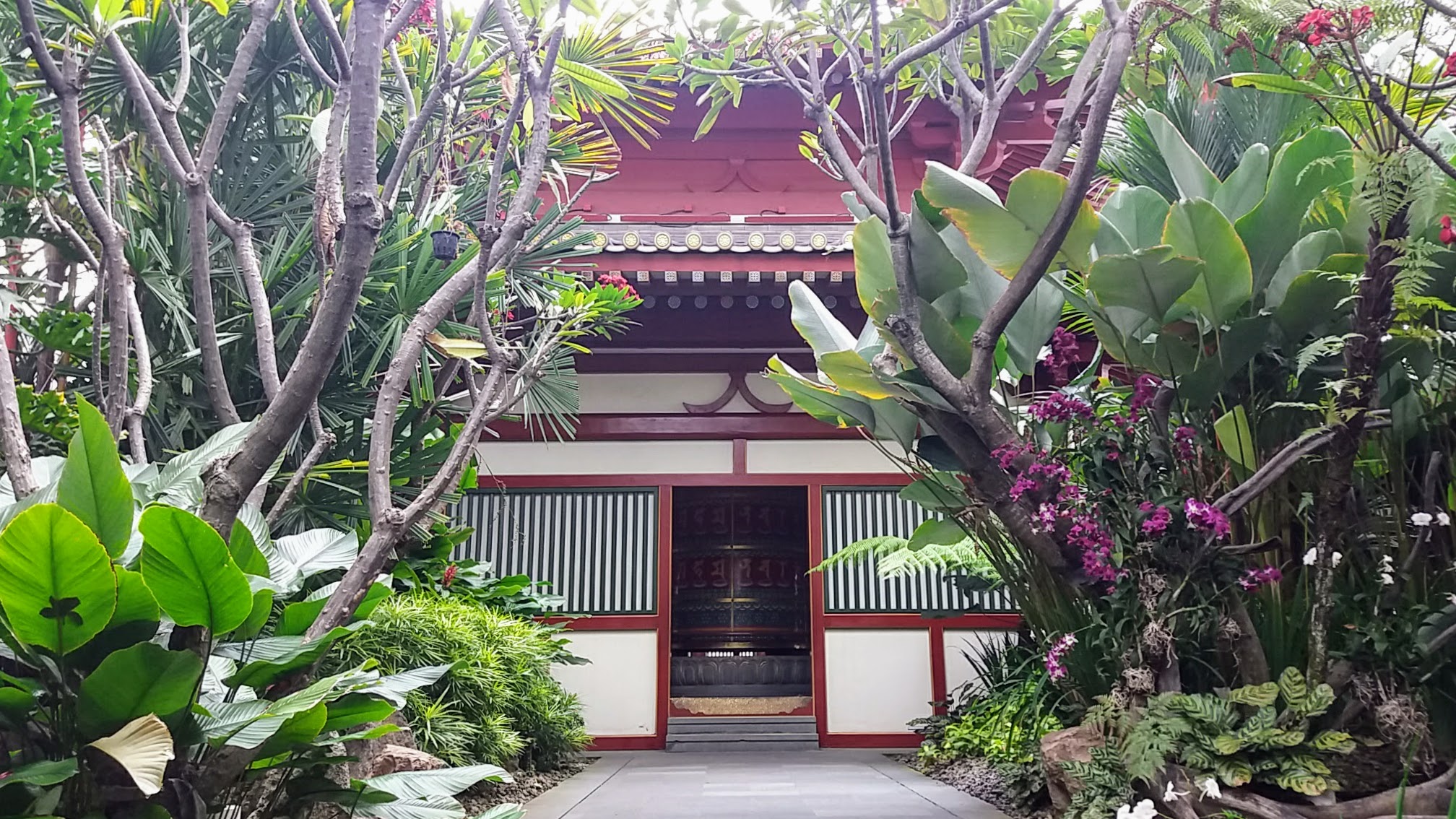 I found the elevator and went all the way to the roof to see the orchid garden. That at least was in keeping with temple life as I think of it. Although orchids are rare in the world, they are common in Singapore and the difficulty of their cultivation reflects the work that monks and nuns put in as part of their practice. Below the gardens, the top floor contained the relic for which the temple is named, a fragment of the Buddha’s tooth. It was also the only room in the building where shoes and cameras were prohibited. There were dedicated meditation mats along the windows where a few people were sitting in silent contemplation, and there was another large gold display.
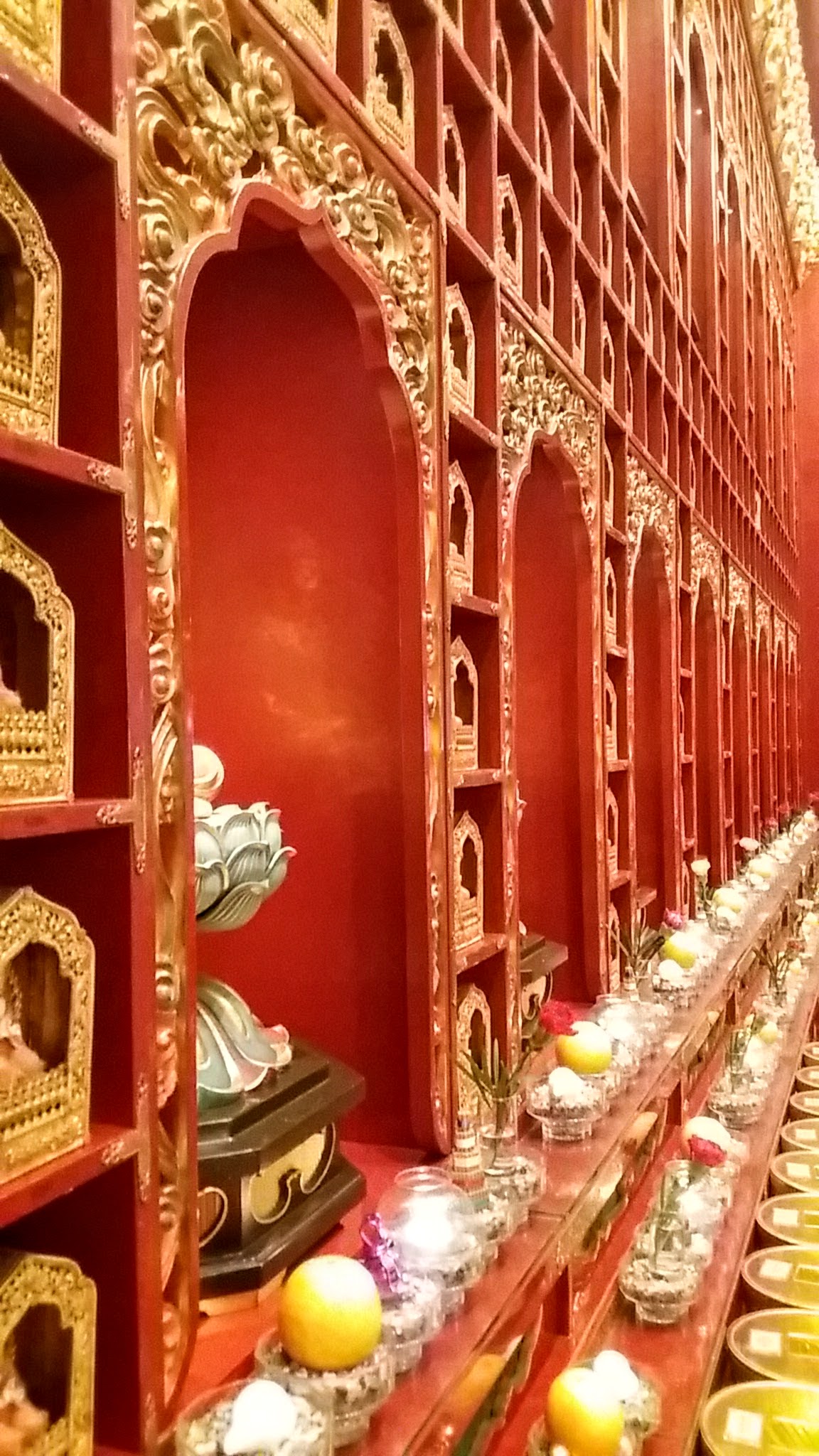 I’ve seen American “mega-churches” that have gold plated elevators and preachers with 5 cars and 3 houses and a minimum annual income requirement for membership. These also disgust me and I often wondered how any Christian could justify that kind of obvious money-grubbing and wealth favoring within their doctrine. This was the first time I’d ever seen a Buddhist “mega-temple”, and it was awful. It made me feel ashamed to be associated with the faith. It made me want to run around to tourists and exclaim “that’s not what Buddhism is about!”. It made me want to drag out some scripture and ask the people praying there if they’d even read it. And for just a moment, it made me think about Terry Pratchett’s Yen Buddhists, whose main theological argument is that:
 I headed down to the third floor to see the museum, which was a worthwhile collection. It was a nice museum of Buddhist art and man-made relics that included a sort of “intro to the Buddha” story on signs around the displays. Like the rooftop garden, it felt far more authentic and enjoyable. The relics were primarily stone, clay, bronze or wooden and had clearly been the result of effort and craftsmanship. Although the extraordinary focus on Guan Yin and the Maitreya was a little overwhelming, it did point to the fact that the temple’s own branch of Buddhism was a salvific form that relies on Bodhisattvas and future Buddha’s to save the world, rather than on the practice of self cultivation for individual enlightenment.
 The second floor had a nice place to rest, which I desperately needed. Adjusting to the heat and extra walking was taking a toll. It was such a great contrast to my energy level in New Zealand where the weather was cool. Just minimum exertion in a hot humid climate seems to drain me like a marathon! After a rest and a look through the last floor of displays, I made my way back to the ground floor, once more shaking my head at the ostentation, this time walking past the VIP seats they were filled with supplicants who had paid I’m not sure what to get past the velvet ropes. All in all, I’m still glad I went to see it, because I learned something about the corrupting properties of money. All temples ask for donations to help feed the monastic population, pay the basic bills, and to provide services to the community. Money is, in this world, unavoidable. However, when a house of faith relies on wealth or doles out blessings for cash or claims that the donation of great wealth is a higher holy act than living a good life, that’s corruption.
 After the Buddhist temple, I took the short walk two streets over to see the oldest Hindu temple in Singapore: Sri Mariamman. This humble wooden structure was not a display of wealth, but was still anything but plain. Wooden carvings covered every inch of the outer facade and were brightly painted besides. Anyone was welcome to enter, leaving their shoes behind on racks on the sidewalk. There were saris for anyone who felt inadequately dressed, and while we were free to wander around the grounds barefoot, the main areas of worship were cordoned off, not for a fee, but for the faithful. I am not a Hindu, so I contented myself with observing from behind the lines. The interior of the temple is a large courtyard with smaller buildings, each one dedicated to a different divinity. There are over 330 million gods in the umbrella of Hindu faith, and while only a couple dozen are among the most popular, it can
  be hard for a layperson to know which altar is for who. I found 10 names of deities for this temple on it’s
  couple city blocks, I had passed 3 major religious buildings, and I knew from the map that a Christian church was not far off. Curious, I looked around the map for a synagogue and found one a little over 3km away, and it was neighbored with another church, Hindu temple, and Buddhist temple. It seemed that it wasn’t hard to find a spot in Singapore where at least 4 out of the 5 major world religions shared a small space and yet no one was getting blown up, shot or even harassed on the street! While I’m sure that Singapore’s strict legal code has something to do with the lack of violence, I like to think that pluralism in the culture helps everyone to get along. People of other faiths or cultures seem less scary when they are our neighbors and not “those others”.
 The museum is one of many buildings set inside a sprawling park. Even with three hours set aside, I only got to see two sections of park and the museum. Its huge.
 And this is a mammoth indigenous to the Arabian Peninsula. The entire prehistoric display was pretty cool. Culminating in the connection to the oil that has made Saudi rich.


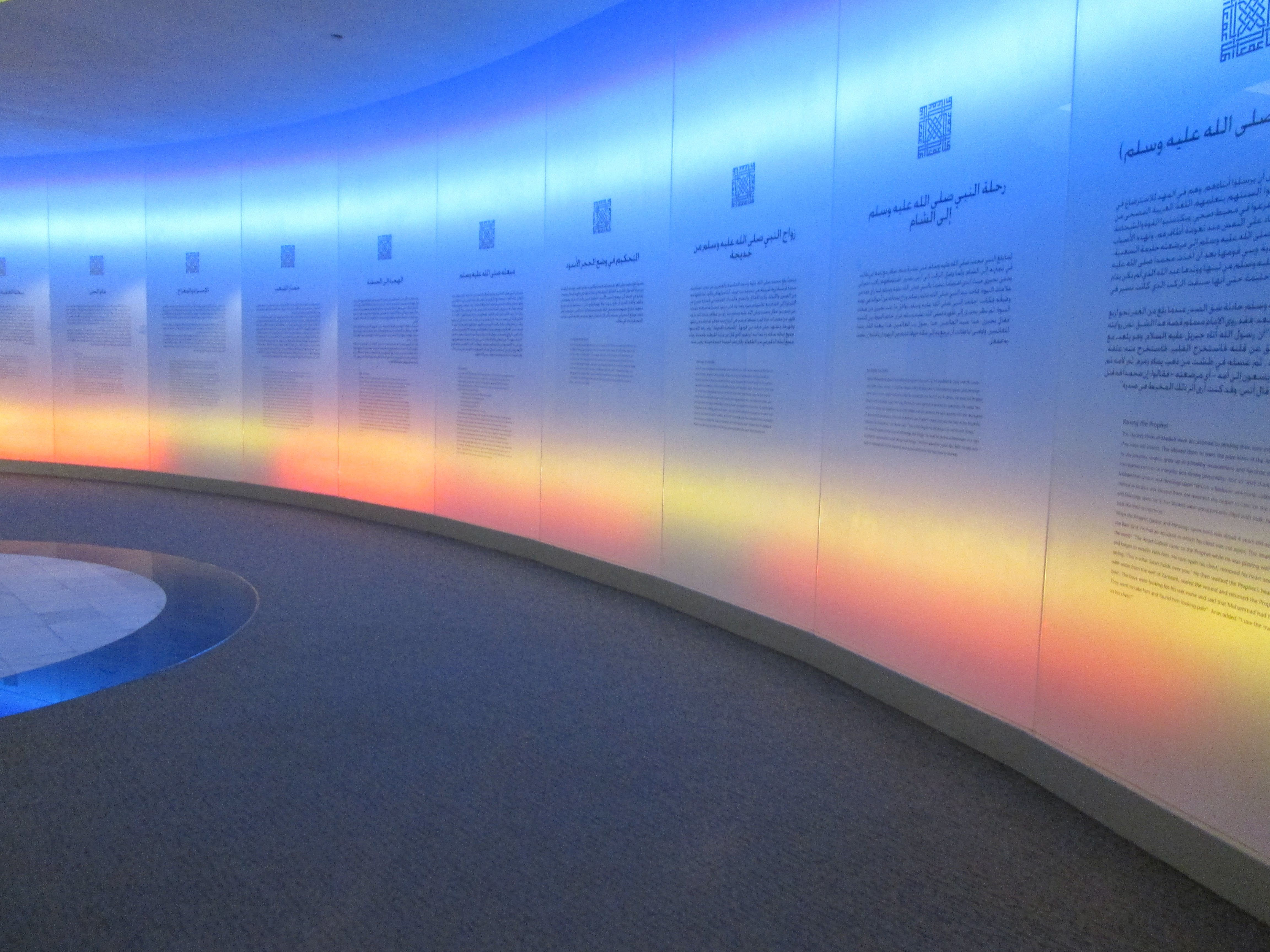 In contrast to the ancient desert feel of the previous sections, this section was almost sci-fi. This long wall tells the story of the Prophet Muhammad (PBUH) in Arabic and English. It really is a good story, it explains many things about the conflicts within Islam as well as the attraction so many find in it. I’m still not converting, but I enjoyed the display.
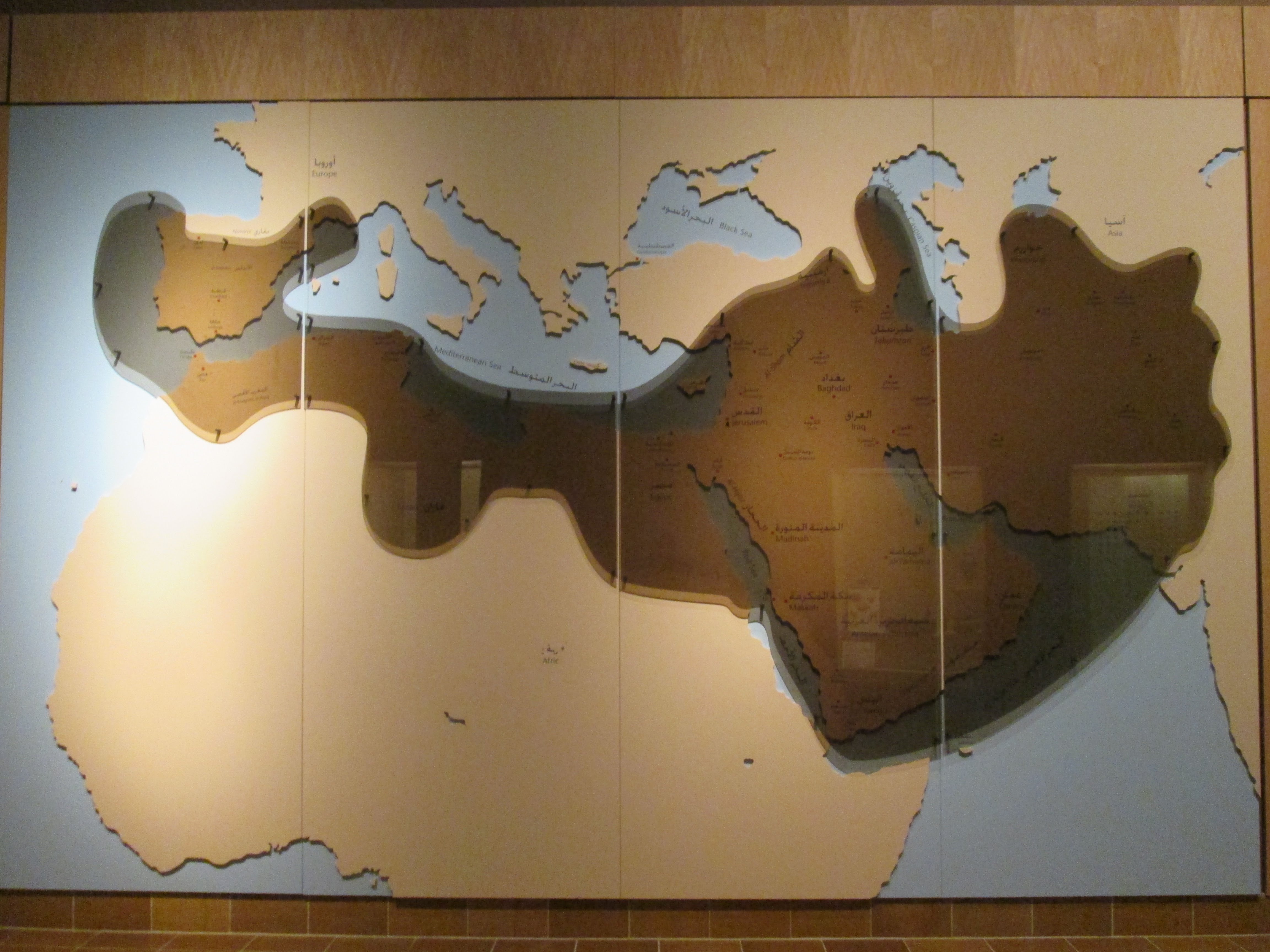 The display tells about the “rightly guided Caliphs” referring to the Sunni side, and focuses exclusively on that version of historical events. (If you’re not up to date on that one, the


 Saud managed to take over a swath of the peninsula by graft and force, and while the museum certainly couches his actions in terms of righteousness and purity, the displays in this section are pretty much all weapons. Gone are the beautiful jewelry, pottery, art and science of former ages of Arabia, replaced by guns, swords and spears.


 Gallivantrix