They say travel should expand your horizons and change your way of thinking about the world and while I had other experiences like that this summer, for some reason, the Speelklok Museum stands out among them. Do you ever think about how recent changes in technology are impacting your generation differently than people in the past? Well, it may not be as different as you think. Turns out we’ve been having a music technology revolution for at least 150 years, maybe longer.
When I arrived to buy my tickets, I was told about all three different options for exploring the museum that were included in my entry fee: the music tour, solo exploration, and the “Expedition”. I didn’t really know what to expect out of the museum and I could only see a few exhibits in the waiting area. One was this blatantly-racist-but-normal-at-the-time automaton duet. Insert a coin in the slot and the show begins as the robots play a little jazz tune. It’s not a recording with puppets, the machine actually creates the music.
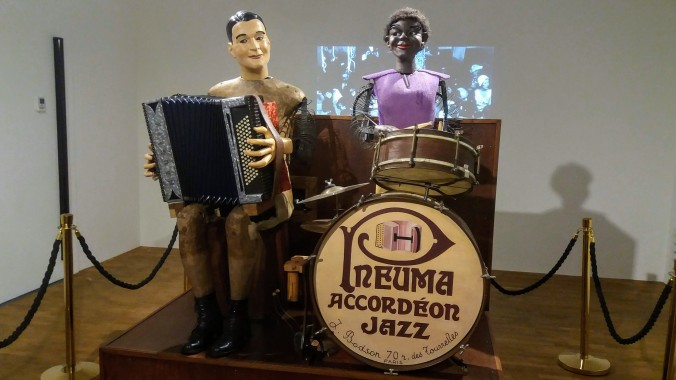
This is a museum dedicated to self playing instruments and music machines that pre-date the gramophone and other recording devices invention and rise to musical dominance. The museum roughly covers the time from 1750-1950, but focuses mainly on the Victorian and Edwardian periods (1840-1910). For reference, the phonograph was invented in 1877 and the first commercial record player was released in 1895.
The Music Tour: Hearing History
The music tour is unique not only because you get a guide to explain things, but because that guide will also activate several of the devices that are otherwise stationary and silent in the museum. Since it’s all about the music, hearing is believing. Music may be a universal language, but Dutch is not. Thankfully our guide was gracious enough to give the relevant information in both Dutch and English.
Speelklock means “musical clock” and that is where the tour began. Although the earliest example of a musical clock is from 1598, the ones we looked at were very advanced members of the species popular in the 1750s. We visited first a white room with many such elaborate clocks on display.
 The guide explained a bit about the history of early self playing music starting with bells and pipes. Bells were the first and “easiest”, if that can be applied to such complex machinery. A metal cylinder like that in a music box was used to orchestrate a series of springs and levers to tap small bells of different tones. There was only one length of note and it resulted in some very un-nuanced music, but the Victorians loved gadgets sooo much that owning such a marvel in one’s home was a real status symbol. They were incredibly expensive and very fine. The only way to change the song was to change the cylinder inside.
Pipes were close behind bells, although they were even more expensive and complicated, since they relied on a vacuum seal and bellows system to pump air through the pipes. It did allow for a slightly nicer sound since the length of individual notes could be shortened and lengthened in the program.
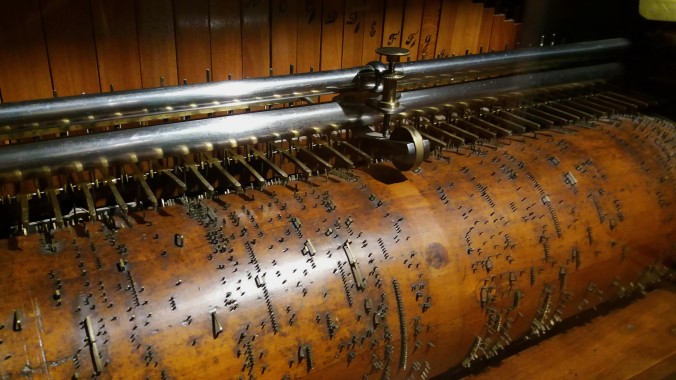
I’m going to keep calling these “programs” because that is the word the museum used to describe the different types of devices used to impart the directions to the machines. Over the decades they changed form, but always used a series of bumps and holes rather like early computer punch-cards.. The first use of such a cylinder used to program music was in the church carillons in the mid 1500’s. I sure as heck didn’t know that the idea of programming music was that old, did you?
Many of these early musical clocks also included some simple form of animation. The one we watched had a progression of figures parading through the fields showing the phases of life and inevitability of death… there’s a reason it’s called “Victorian Gothic”.
Kids and Their Newfangled Gadgets
My first real clue that I have spent my life seeing time and history all wrong came a few steps to the left as our guide began to explain the rapid change in music technology. The cylinder, which had been used consistently since 1550 to create musical programs was suddenly replaced by the disc in 1885. Cylinders were heavy, difficult to make, and expensive. Plus, most people had to have them professionally changed out in order to listen to new songs. With a disc, much less material was needed and production could be streamlined by simply stamping each flat disc with it’s musical program. Much cheaper, more efficient, and easier to use.
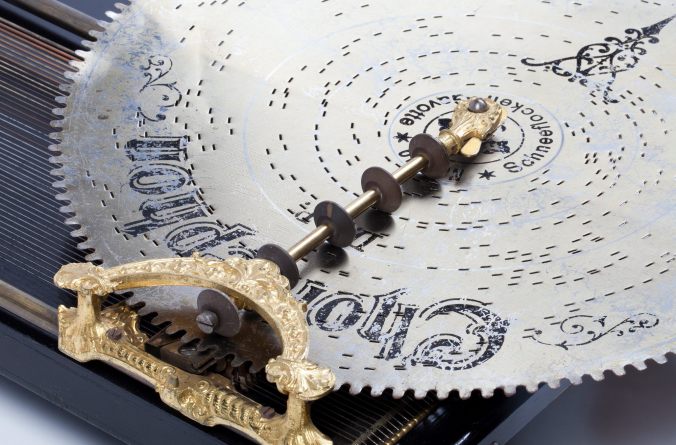
But what do you do with your cylinder collection? No worries! The modern wonder of technology created a crossover player with a space for both! What about that new gramophone recording? No problem! Your technological crossover music machine comes equipped with a clockwork organ and a gramophone speaker! Maybe you had a similar device? I know we had a record player with a tape deck… and later a boom box with a tape deck and CD player… and later a CD walk-man that played both .wav and Mp3 discs. And now, a Bluetooth Gramophone? Turns out that fad is more than 100 years older than I realized.
Much like the record to tape to CD to MP3 transition, the musical programme revolution of the 1800’s wasn’t over. The next step? PAPER! The lightest, cheapest and above all longest musical program yet. With paper, you could have a much larger music collection and you could play longer pieces of music, or multiple pieces on a single program. Plus you could print words on paper, giving rise not only to the player piano, but to the world’s first “karaoke”. Friends and family could gather round the player piano and modern favorites would play from the paper program which would display the lyrics in a moving scroll as the music played, allowing those with imperfect memories to sing along. Yes, that’s really how they used it back in 1925. Although it started in early 1900, the paper roll player piano was the height of home entertainment from about 1920-1930 when the stock market crash combined with the rise of other musical technology wiped it out. Talk about a fast fad.

During this time, our old friend the cylinder program achieved some continued use in miniature. Not only in the form of teeny tiny pocket sized music boxes, but most especially inside automata cleverly shaped like people or animals that would come to life and perform to some piece of music. These automata captivated the people of the Edwardian era and were almost as short lived as Edward himself. We got to see a nightingale in a cage (yes, made of real nightingale), an acrobat atop a ladder, a rabbit emerging from a paper cabbage, and a rather singularly Dutch representation of the painter Van Gogh painting his famous “Sunflowers”.
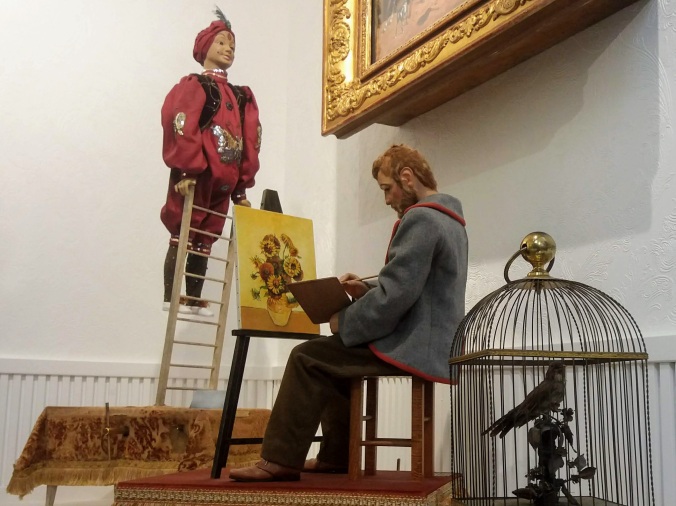
The guide kindly led me back after the tour so that I could see it in action and as Vincent’s arm moves the brush across the canvas to the music, the sunflowers begin to spin as his eyes go wide in representation of the hallucinations he was thought to have.
Clockwork Organs & Orchestrions

The music tour continued into pipe organs and dance hall organs. Starting in the late 1800s, the pipe organs used the cylinder method, though often wooden instead of metal. Organ grinders were so called because they had to turn a crank to operate a kind of bellows to keep the cylinder turning and the air passing through the pipes. Earlier pipe organs were displayed on the street and at festivals and often involved theatrical stories and sing-a-long musical numbers to keep the audience engaged with the limited cylinder length.
By 1892, the pipe organs too had converted to paper, although instead of a paper roll, they used a “book” made of cardboard and folded in a zig-zag fashion so that it unfolded into one long piece with all the convenience of a paper roll, but made of a far sturdier material that would withstand the abuse of outdoor performances and travel better than flimsy paper.
Street organs remained popular in the Netherlands until the street organ ban in WWII. They have never really made a comeback, but are still enjoyed as a novelty from time to time. Many of the most fantastic designs were made between 1910 and 1925 including the “Gouden Limonarie” and “The Arab”.


The final segment of the music tour was the orchestrions. These were not merely seeking to produce music from a single instrument, but rather to imitate an entire orchestra. The earliest of these machines was created in 1805. They were fairly limited to the number and type of instruments at first, but quickly expanded to encompass brass, woodwind, and percussion, delighting and astonishing audiences everywhere.
The final and most challenging orchestral section to make self-playing was the strings. In 1910 at the world’s Fair, the first self-player with a string section had it’s debut and was hailed as the 8th wonder of the world. It included three sets of violin strings which could be set to different pitches with different levers acting as mechanical fingers of the left hand and used a “bow” made of continuously circling horsehair that could be lowered and raised to play notes as the “right hand”. It was so inconceivable an achievement that some believed it to be magic until they could see the inner workings for themselves.
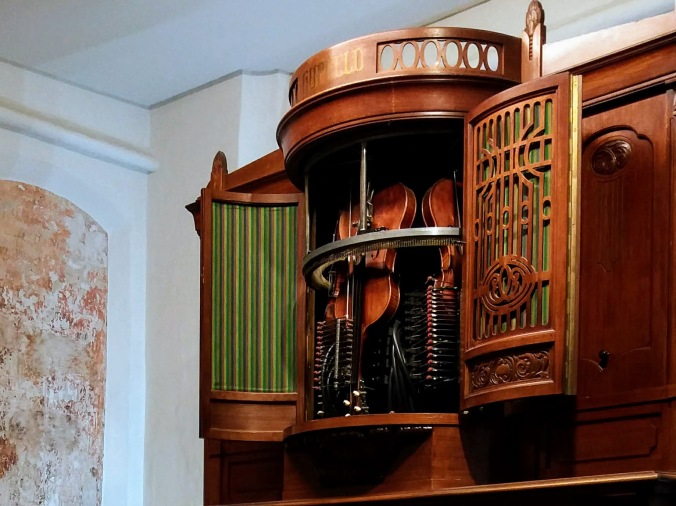 While the musical clock and player piano might find their way into any reasonably affluent household, the larger organs and orchestral players were reserved for the ultra wealthy and of course, the dance halls. During their height (again an incredibly brief time ending abruptly in 1930) these orchestrions were the darling of the day, drawing large crowds to dance halls to cut a rug to the mechanical orchestras and marvel at the wonders of modern technology. Because of the limited amount of musical numbers available to each machine, and because of the stunning but stationary artwork on the outside, audiences became bored with a single orchestrion quite quickly. (no, our attention spans weren’t any better a century ago no matter what your grandmother says) To keep the crowds coming, these huge machines were often built to be easily disassembled and moved to play a new dance hall every week. Early 20th century DJs played the precursor to EDM– MDM: Mechanical Dance Music.

The Whitewashing of Buurkirk
When the music tour ended, I was left in a very thoughtful state as I set off to find the rest of the museum’s displays. After returning to some of the machines for a longer look, I found a staircase and went up. It was immediately clear that the museum was actually built into a disused cathedral. Post-travel research tells me this is the Buurkirk and is the largest and wealthiest of the parish cathedrals in Utrecht, having been built in the mid 10th century and suffering from 4 fires and rebuilds in less than 300 years.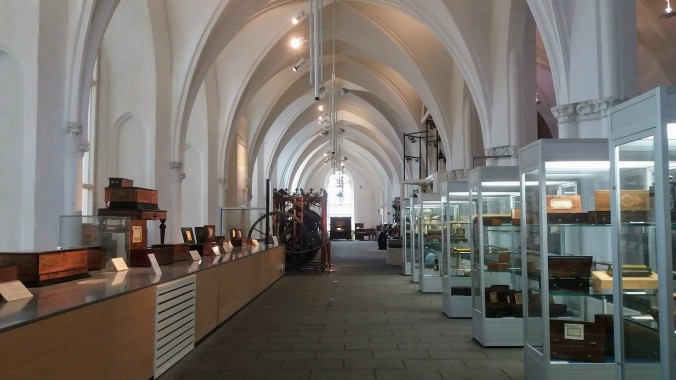
It’s only a couple blocks away from St. Martin’s Cathedral, and you may wonder why any town needs so many churches so close together, but I believe St. Martin’s was at the time mainly operating as a monastic center (and a royal palace). Perhaps folks in town could come for masses, but parish churches would have been a bit less formal and also often offered the church space for use in the community during non-church times. I suspect that Buurkirk and the other nearby parish churches were a bit more like community centers and St. Martin’s was a bit more like a place you go for Easter and Christmas but otherwise leave to the clergy and nobility.
 The walls, columns, arches, and decorative carvings are painted a crisp clean white except a few places where the original church artwork has been preserved and painted around. The whitewashing isn’t a result of secularism, however, but rather the work of the Protestant reformation which took over the church in 1586 and just hated all that ostentatious Catholic art. Buurkirk was actively used as a church until 1975 and it became the Speelklok Museum in 1984. Wandering among the displays and whitewashed arches, my mind was occupied with the impending massive shift in my perception of humans, time, and technology.

The Expedition
At last, I found the “expedition” part I had been so curious from the moment I bought my ticket. I had been given a card and told it would be used for this segment of the museum. It was not the first time I encountered the idea and I’m still not sure why it exists since it would be just as easy for visitors to press a button to activate whatever the card does. It’s just one more thing to hold in my hands, or more accurately, fish out of my pocket every time I found one of the small silver slots in the wall with a little speaker on cord.

Holding the palm sized speaker up to my ear, I could use the card to activate audio recordings (sadly, not the music machines themselves). The recordings included samples of the music as well as narration about the pieces on display. While some were a bit dry, there was a fun section where I seemed to be visiting a wealthy Victorian gentleman who had the very latest in musical clocks and self playing instruments he eagerly wanted to show off to me. Maybe I liked it so much because it reminded me of a friend who would talk about historical clocks and clockwork with almost the same level of enthusiasm.


Several of the expedition displays included information that the guide on the music tour had given, but I didn’t mind since often it was able to go into greater detail. For example, the fad of “player” instruments stretched well past the piano. The urge to amaze your friends with your musical talents extended to a number of other instruments like this “player trumpet”. Just blow?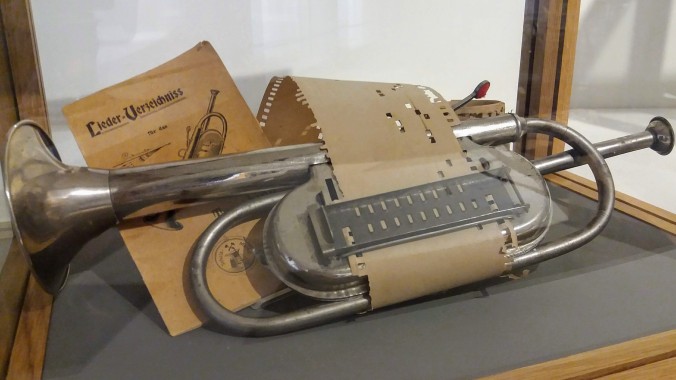
Composing for Machines
Room after room of intricate, detailed clocks and devices ended in a small theater. While the card-activated recordings were played for me in English (the choice of language determined by the placement of holes in your card, haha, how clever, just like a music program) the theater had only one soundtrack and it was Dutch. Thankfully, a film of the English words played on a display that I could easily read.
The stage was occupied by a large number and variety of self playing instruments which were highlighted as the story moved to cover them. While some of the information was familiar from my guided tour, I was rather astonished to learn that composers like Mozart, Hadyn, Handel, and even Beethoven had composed music expressly for these wonderful self playing machines.

Wait wait, I hear the music history majors cry, they were alive in the 18th century, late 1700’s composers. I thought you said these machines were popular in the 19th and 20th century! Yes, I did and the museum did mainly focus on these later inventions, but remember the original carillon use of the cylinder program is from 1550. The human operated pipe organ was a popular instrument for composition during the Baroque era. Although Classical era composers like those mentioned above rarely wrote for the traditional pipe organ, some were interested in the abilities of the clockwork organ which was becoming more and more available by the mid 1700’s. Available at least to the reasonably affluent, and that’s who paid composers after all.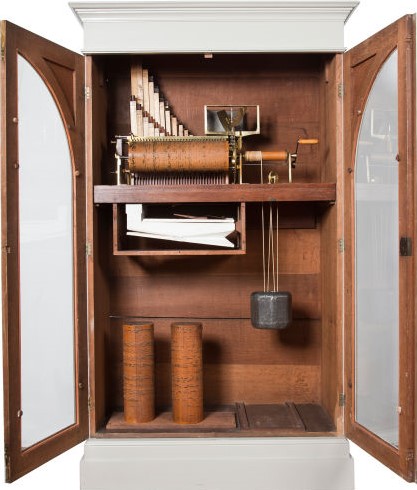
The film at the museum said that because the clockwork organ could play combinations of notes not possible by human hands, the composers of the day felt drawn to compose unique and challenging works. Other sources I have since found seem to think that some of the composers disdained the tinny sounding miniature organs and only accepted the commissions for composition out of economic necessity. Either way, I was captivated by the notion because not only were these unique works designed exclusively for a machine to do what a human could not, the composers were actually present during the creation of the cylinder programs and could make adjustments to the timing and length of notes (the most nuance possible for the machines at the time) giving us the most accurate representation of the musical result they themselves envisioned for each piece.
Below is one of the pieces by Hadyn composed for the mechanical organ. Although it was recorded at the Speelklock Museum, it’s not my recording, I found it on Youtube by a Swedish Instrumental Band called Wintergaten. I especially like this video because you can see the organ working as it plays. You can find recordings of other compositions for clockwork organs on Youtube as well: here are a few for Handel, Mozart, and Beethoven. Although most of the videos are not as visually captivating as Wintergaten’s, it’s still interesting to hear these unique mechanical compositions
What Is New Under the Sun?
What started out as a mildly amusing side trip turned into one of the most eye-opening experiences of my summer. Before the invention of self-playing instruments there was no way to hear music without a musician, just as before the invention of the motion picture, there was no way to see a play without actors. It was a revolution in human culture and it happened a lot earlier than I realized.
In a very short amount of time from roughly 1750 to 1930 the culture is constantly demanding and creating new and improved technology. From about 1850-1920, the changes were happening so fast that your home music player would become obsolete almost as soon as you bought it. Meanwhile, in my head, I always pictured the fast transition of music playback to be the one from LP to MP3 that took place between 1965 (the release of the 8-track cassette deck) and 2001 (the release of the iPod). And just like our parents (maybe grandparents), people living in the 1860-1930 range complained that each new development was destroying music, culture, and maybe even the very fabric of society. However will we maintain social standards when people can just listen to music in their home instead of getting dressed up and attending a performance in polite society!?
I admit, I am a little flummoxed trying to imagine a world where music isn’t just there when I want it (and when I don’t, elevators everywhere). We are hardly ever without music. In our earbuds, in our cars, in every shop and most restaurants there is music. I’m listening to music while I write this. I struggle to imagine a world where the only music is that you can make yourself or pay a large number of people with expensive instruments to make for you. The invention of musicianless music is, I believe, an actual moment of deep cultural change on par with the printing press or the assembly line. However, past that huge conceptual change in our relationship with music, the trappings, the delivery systems, those are only small changes, and not as significant or original as we like to believe.

The mechanics might be different, but none of it is new: karaoke, the drum machine, samplers, auto-tuning. It was all there 100-400 years ago in a different form. The more I learn about history, the more it looks like we’ve been reliving the same cycles over and over with smaller and faster machines each time. I don’t find this thought depressing. It makes me look at the progression of time as more of a gradually progressing spiral than a straight line. Yes, it’s a repetitive cycle, but each cycle changes slightly. We’re still moving forward just not at the breakneck speed that the “get off my lawn” crowd would have us believe. Every so often we get a really big “ah-ha” change that sweeps us on to the next series of small change cycles.
So the next time someone says something like “kids these days” or heaven forfend “Millenials are killing everything”, just remember that Mozart programmed music in binary code for a machine to play over 200 years ago. Change is the only constant.
The Speelklok Museum in Utrecht was not the only place this summer that made me reach inside my brain and rearrange the way I look at things, but it was undoubtedly one of the biggest and most compact of such experiences. As I stated my intention is that these stories have no order or thematic relationship to my experiences this summer. Non-linear felt intuitively like a good way to go and after reconstructing these memories and thoughts I start to see why. Sometimes we have to step away from the linear narrative to see the bigger picture. As always, thanks for reading, and I hope you’ll return for more stories as they come.





 Gallivantrix