 The last two years of living in Korea has been cherry blossom heaven. I had amazing experiences at the nation’s biggest cherry blossom festival in Jinhae both years (2016, 2017) and didn’t see the same thing twice. When I announced my move to Gyeongju, the museum without walls, everyone said “oh what a beautiful place! you’re going to love the spring”. And I was. I was excited to love spring until it turned out to be the bipolar spring from hell. It’s late April still vacillating back and forth from 10C with rain 30C with sun. Neither the flowers nor I know what to do.
I was so ready for a couple weeks of stunning cherry blossoms and sunny afternoons by the lake and river, but instead I got about two days (both of which I was working during) and then the rain drove all the blossoms away.
Since I couldn’t attend a cherry blossom festival this spring, I’ve decided to focus on the other bounty of cherry blossom season: the themed food and drink. Bearing in mind I’m not in Seoul where the trendy boutique cafes all live, I decided to try and find as many cherry blossom themed consumables as possible in my small town of Gyeongju.
This is by no means a comprehensive list. Every town has a few local variants, and who knows how many tiny cafes and bakeries were selling their own seasonal specials that I never even encountered. Nonetheless, it should be obvious that cherry blossom season isn’t only a feast for the eyes.
Coffee:
 Starbucks Cherry Blossom Frappuccino: This one is available in several countries. It’s a seasonal milkshake style beverage. I like that it wasn’t too sweet. I don’t feel like it tastes especially floral, but it’s pink and festive and fun, so why not?
3 stars
Ediya Cherry Blossom Latte: As a result of the Starbucks trend, every other cafe here offers some variation on the cherry blossom latte/frappe. Ediya is probably the most famous, but I found it to taste like strawberry milk. The iced latte version was thicker than flavored milk, but not all the way to frappe/milkshake status.
1 star
Bliss Blooming Latte: The one coffee shop I really wanted to visit this year and didn’t get to try was the cafe Bliss out by Bomun Lake. They have a latte with a “blooming” blossom. A confectionery of some sort that expands in the coffee. No other branch offers this cherry blossom special. I saw the video online and was instantly captivated. However the lake is rather far away and I never made it out there a second time after learning about it. I’ll put it on the list for next year.
(not rated)
Kanu Spring Blend: This is my go to instant coffee brand, a phrase I never would have believed I could have uttered 5 years ago. I admit, I did try it at first because of the ads, but it’s so much better than most of the other packet coffees in Korea that it soon became a staple at my office desk for emergency pick me ups. I was so excited to see it show up in the seasonal line up, but I haven’t seen it in any of Gyeongju’s shops.
(not rated)
Drinks:
 Cherry Blossom Soda: GS25 is a major convenience store brand here in Korea and they also have their own line of drinks and snacks. In the spring, they offer a couple of cans decked out in cherry blossom art. The pink can is a bright pink bubbly soda pop that wins hands down for the most floral flavor. It reminded me of drinking sweetened rose or orange blossom drinks in the middle east. I don’t know if it’s made from real cherry blossoms or if they use a more common flower to get the flavor, but it’s legit. My only complaint was that it was so insanely sweet I had to dilute it. I wanted to mix it with gin, but I haven’t found a local supply since moving here. I tried it with water, but that didn’t work well. Finally, I mixed it with milk, Italian soda style, and that was delicious.
4 stars
 Cherry Blossom Grape Juice: The green can was actually my favorite drink of the season. Instead of a soda, it’s green grape juice with the same intensely floral flavor as the soda. It doesn’t have the crazy pink dye, or the bubbles. It’s a bit less sweet, and it has some tasty fruit jelly bits in the bottom. It was still strong, but I diluted it with just water and it was perfect. I’m thinking of buying a bunch to stash for the summer.
5 stars
Cherry Blossom Milk: Koreans love flavored milk. Banana is the most popular flavor here, but I’ve seen several others including green grape and apple. While perusing at a local 7-11 I noticed a single serving milk container with pink blossoms on it. Upon closer inspection, it was indeed cherry blossom milk. It wasn’t bad, only mildly too sweet and somewhere between floral and fruity. Worth drinking once, more than once if you love sweet milk.
2 stars
Alcohol:


Hoegaarden Cherry Beer: It’s technically cherry flavored and cherry blossom scented, but it was released seasonally and decorated with pink blossoms. I was expecting it to be similar to a lambic, but it ended up tasting more like a shandy made with cherry-ade. Not too sweet, and certainly not bad.
3 stars
Kirin Sakura Viewing Can: This beer is decorated with the signature unicorn dancing amid the sakura. Kirin is a Japanese beer company and sakura viewing is an important part of spring. The seasonal can is decorated to put you in the mood for spring, but the inside is the same classic Kirin taste. I happen to like Kirin beer, so this wasn’t a big disappointment.
3 stars
Soju: I saw posters around town for soju (the Korean distilled rice wine) that had cherry blossoms on the label, and usually when there’s something on the soju label other than bamboo it signifies flavor, so I was very hopeful when I finally found some. Sadly, it turned out to be regular soju, which I don’t care for as much as the cheongju (like soju, but smoother with less of that nail-polish-remover aftertaste).
1 star
Foods:
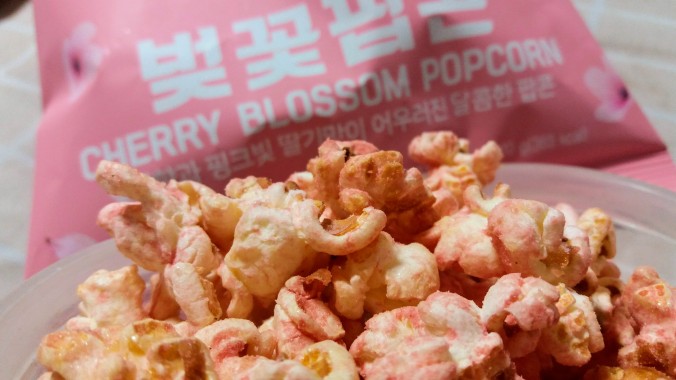 Cherry blossom popcorn: GS25 is a chain of local 24 hour convenience stores. The same brand that created my favorite floral soda and juice, as a matter of fact, and they didn’t stop at drinks. Amid the food offerings was a light pink bag of cherry blossom popcorn. This was my first find of the season this year and I wasn’t sure what to make of it. When I opened the bag, I was hit by a powerful and pleasant perfume making it clear that this was not merely pink popcorn, but genuinely floral. It was sweet and tart, with a base coat of kettle corn and a top note of something like Smarties. I didn’t realize at the time, but I suspect it was made with actual cherry blossoms. More later.
4 stars

Cherry blossom Pepero sticks: By now the world knows Japan’s famous Pocky sticks: crisp shortbread sticks dipped in chocolate and other flavors. When my family lived in Japan in the 80s (yeah… old) the iconic treats weren’t available in the US and I spent years pining for them after we moved back to America. Although Korea has gotten past it’s hatred of all things Japanese enough to import Pocky, they also have their own national brand of the delicious snacks called “Pepero”. There’s even a national holiday for Pepero where all the stores sell huge boxes and decorated gift sets and we all buy and exchange boxes of Pepero. Not Pocky. The Lotte brand of short, double dipped pepero are delicious anyway, but then I spotted this special pink package and had to try it. The first dip was white chocolate and the top coat had the same sweet/tart taste that I’m coming to realize is the ‘authentic’ cherry powder flavor. It was more creamy than sweet, which was refreshing. It’s not going to replace chocolate as my favorite Pepero flavor, but still enjoyable.
3 stars

Cherry blossom frozen yogurt: Since many coffee shops here are also dessert cafes, it wasn’t only coffee drinks that came in exciting cherry blossom themes. Yogurpresso is a dessert cafe that specializes in, as you can imagine by the name, frozen yogurt and espresso drinks! Unlike American fro-yo, this is quite tart, like actual yogurt instead of ice cream with an identity crisis. The large “blossoms” are crisp meringue and the sprinkles are some kind of candy. It might be one of the preserved cherry blossom additives. I’ve seen them mostly advertised out of Japan. More likely they are random berry flavored sugar bits. However, the little carafe of pink milk down there is the cherry blossom flavor. A tiny pour over to add floral goodness to the sundae. It was tart and refreshing with a variety of flavors and textures to keep it interesting.
4 stars
Cherry blossom pastries & snack cakes:


Once again in a convenience store (they are truly ubiquitous) I found a rack of blossom themed snack cakes. I’m not a huge fan of the packaged pastries here in Korea. Although they are super cheap, they are far inferior to the fresh pastries offered on every other street at the cafe/bakery combos like Tous le Jous and Paris Baguette. I got one bun to try, but it turned out to be strawberry creme. The darker red is red bean (a common bun filling and one I actually quite like), but I prefer my red bean filling with fresh cream. The strawberry was too sweet and there wasn’t anything cherry blossom about it other than the pinkness. The other snack you see here is a variant on the ever present snack cakes. I read this one before grabbing it and it’s also just strawberry and cream cheese. I didn’t bother to buy it after all.
1 star
Festival food:
I didn’t go to any festivals this year, but I decided to throw in my festival food observations from previous years. Every festival in Korea has shaped and colored cotton candy. I’ve seen cartoon charaters, animals, and abstract art created in spun sugar. Cherry blossom festivals of course bring out cherry blossom shaped cotton candy. I didn’t eat any because I figure it’s all cotton candy flavored when we’re talking about festival street carts.
(not rated)


I did eat the cherry blossom fried ice cream at last year’s festival, however. It’s not very pretty, and it’s hard to tell in the paper cup that it is blossom shaped, but you can sort of make out the petals at the top? The best part of this treat is watching them make it. The vendor removes a super frozen blossom of ice cream and dips it in batter before dropping it in boiling oil right before your eyes! When it’s done, the outside is warm and crispy and the inside is cold and creamy. It was vanilla, and I loved it anyway.
4 stars
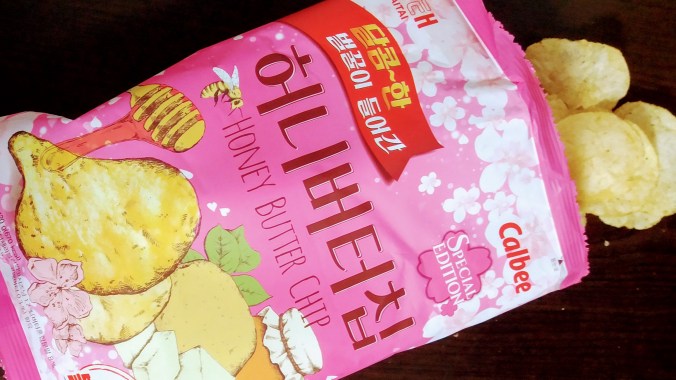
Honey Butter Cherry Blossom Potato Chips: I was not going to eat this. I saw it early in the season and turned away. This is because when I first arrived in Korea I tried the Honey Butter Chip. I do not know what the obsession with honey butter flavor here is, but you can get WAY too much stuff in honey butter. The problem was it was awful. It was cloyingly sweet and the butter was really potent (maybe because they use French fermented butter?) I was glad to have the experience once, but had no desire to repeat it.
Then I read another blog about Korean snacks and discovered that the limited edition seasonal flavor is actually made with domestic cherry blossoms, harvested from Chilgok County in north Gyeongsang. That’s really close to where I live!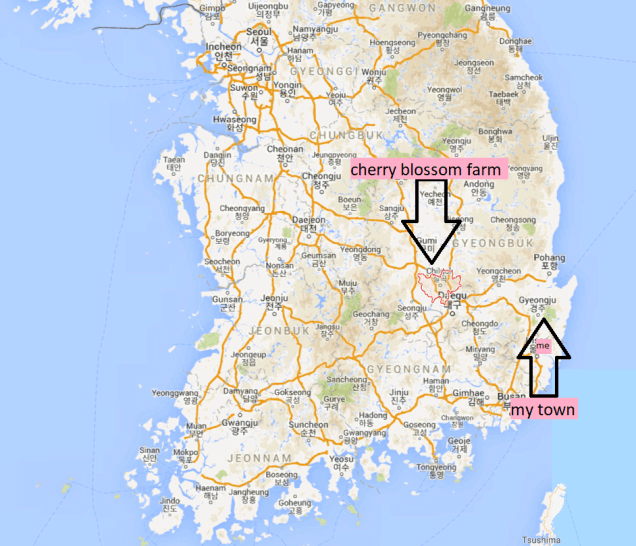
Only 1.4 million bags were released, by the way. That sounds like a lot, but there are more than 51 million people in Korea, soooo I guess we’re sharing. As you can see, the chips are not pink. I’m fine with that since it means no dyes. The smell of cherry blossoms is the first thing that hits you when you open the bag, which is saying something, since potato chips have a fairly strong smell of their own. I tasted a crisp and was pleased to find that the cloying sweetness I’d disliked in my first honey butter experience was dampened significantly by a gentle floral tartness. I became extremely curious at this point. So many of the things I’d tasted had been more tart than floral, and I’d just been assuming it was a matter of artificial flavors, but this was made with real flowers!
4.5 stars
The Last Word on Cherry Blossom Flavor:
I looked it up, because that’s me. I found that in Japan, there’s an ages old culinary tradition of salt pickling cherry blossoms in plum vinegar. But, Haitai Corp. was very clear about the Korean origin of the flowers they used (equally proud of the French origin of the butter they use, by the way). I broke down and worked on translating the package and ingredients list to try and get more information, but all I could gather was that it’s domestic Korean flowers and not artificial flavors.
My only conclusion is that cherry blossoms are actually tart in taste. This explains why every cherry blossom treat I tried was either a little sour or way too sweet. The flavor has to be treated more like lemon or green plum in contrast to sweeter flowers like jasmine or lavender. Considering how many times I was surprised by sourness, maybe I ate a lot more real cherry blossoms this year than I realized.
Happy spring and happy snacking!
 We set off from Busan (blue dot) in the morning to drive all the way across the southern end of the Korean peninsula to Jindo (red dot). Although Korea is small compared to, say, the US, it was still almost 5 hours of driving with the occasional pit stop. (By the way, in case you’re curious, you can see Daegu on this map as well). Fortunately, I went with a tour group (my stand by
  The Jindo festival had at least one feature I’ve never seen before: a traditional Korean wrestling ring. A pile of sand was placed in a large circle where two contestants could wrestle in the traditional style.
  Even more bizarrely, after the color throwing was over, the festival organizers gave each participant a “toga” to wear. The togas were long white robes with red sashes that could have evoked a Roman senate or Jesus. Considering we were about to “part the seas” it was hard not to see it with Judeo-Christian overtones, but the rather drunk person I asked about it just said “toga party!” The entire thing seemed like the festival organizers were trying to find a way to appeal to the expat crowd. I’m glad they had fun, but I would have preferred some more traditional activities, like someone to teach us about collecting clams and seaweed the way the locals were doing as the tide went out. It’s hard to go do local culture festivals when the locals are busy trying to white-wash everything for cash.
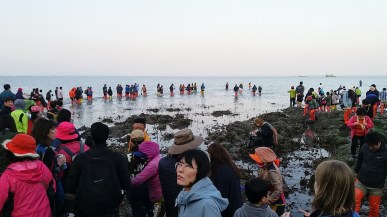
 Finally, the real “reason for the season” was upon us and we muddled our way down the road to the rainbow steps beneath the watchful eye of the grandmother and the tiger. We paused at a bench to don our thigh high rubber boots and got some advice from the locals on how to attach the rubber garters through belt loops to hold up the boots, or failing that, to wrap them tight around our thighs and snap them in place. Thus clad in bright orange and yellow wellies, we made our way down the steps and into the shallow tide pools to wait for the tide to recede.
 If you look at the area on Google Maps you will simply see the beach and the islands, but on Korea’s own Naver Maps, there is a thin line connecting the rainbow steps to the island of Modo. Although this path is only usable twice a year (at most), the Korean map makers consider it important enough to draw in.
 The history of tidal prediction starts with Kepler (total nobody) in 1609 to theorize that the moon’s gravity caused the ocean tides. He was followed by other such no-ones as Galileo and Newton. It was in 1776 that the first big complex equations came from a man called Laplace. Harmonic analysis was added in the 1860s and polished off by 1921 in the form that Navies all over the world still use today. Although the math hasn’t changed in almost a hundred years, computers make the math easier and the information more widespread so now instead of just ships in harbor– surfers, beachcombers, and clam hunters can
  On a more mystical note, the local legend of the tigers explains why there’s a statue of a grandmother and a tiger overlooking the sea. Long long ago, the villagers who lived on Jindo were plagued by man-eating tigers. The whole village packed up and sailed over to the neighboring island of Modo to escape the threat, but one woman was left behind. The woman was Grandmother Bbyong, and she prayed to the Dragon King, the god of the sea, to help her. Finally the Dragon King came to her in a dream and told her he would build a rainbow brigde across the sea for her. The next day when Bbyong went down to the sea, the waters parted to let her cross and her family came out from Modo to meet her. This also explains the rainbow stairs that lead down to the landbridge, but not why her family couldn’t have just sailed back for her in the first place.
 While math can now easily tell us the time of the lowest tides, it does not yet advance to tell us what the actual lowest level of the water will be. Not that it couldn’t, but there are more variables involved, so it’s not a thing now. While we can say with certainty, the lowest tide of the year on this beach will occur at 18:38 on April 29 (or whatever), we can’t say for sure if that will expose the land bridge or simply be lower than every other tide around it.
 We tromped along the path, watching parasailers overhead and rainbow colored lanterns being released in to the air from the beach behind us. It was clear the path was quite narrow because going too far from the group to one side or the other to get a picture resulted in a severe deepening of water level. At the time, my friends and I theorized it might be man-made, or at least man-maintained, however, I have since then found that the build up of rock and sand in this twisty line is a natural result of the currents around the islands.
 Before long the golden light of the sunset combined with the swish-swishing of hundreds of feet through water to create a trance-like state. I could not judge how far the island was, nor tell which way the path twisted. The rocks below us rose and fell, bringing the waves treacherously close to the top of my boots and then back down to barely splash over my toes. The whole path is nearly 3km long. I suspect a determined person could make it out to the island and back in the hour or so the path is clear to walk, but I wasn’t racing, and soon we were greeted by the sounds of Korean drums and the distant flags waving as the procession from Modo came out to greet us.
 The walk outward had been slow, trepedatious, as though we were nervous the land could drop away at any moment, but the trip back was much more celebratory as well as much more damp. The parade of drum bangers, cymbal crashers, gong ringers and flag bearers danced merrily in their traditional garb, urging us all back to the larger island of Jindo. Our pace quickened and our legs swung to the rhythm causing much larger splashes. Waves came in from both sides of the path making us nervous, but excited. The water finally breached the top of my boots and sent an icy chill down my shins, but I found I did not mind.
 Before heading to the fields, we walked up a long road past the area of the light festival where a few wire frames from reindeer and dragons could still be seen. The road up the hill was painted with fun perspective illustrations of a stream, complete with little camera icons to show the best places to stand to see the visual effect. Optical illusions are fun.
 At the top of the hill, far beyond the little pagoda that had marked the highest point of the lights, we finally came upon the green tea museum where we were treated to a special showing of the Korean green tea ceremony (complete with English translation by our awesome guide). The ceremony involves a process of several containers: a water pot, a cooling bowl, a tea pot, and the drinking cup. The hot water pot is filled with boiling water, which is then poured into the bowl, and from the bowl into the tea pot and finally into the cups. The instruments are warmed up in this way. Then more boiling water is poured into the cooling bowl. Tea leaves are scooped into the warm but empty tea pot and the ideal temperature water is poured from the bowl over the leaves. While the tea steeps, each cup is emptied of it’s hot water into another bowl on the floor and wiped dry on the outside. The tea is then poured into the pre-warmed cups by pouring only a half a portion into each and the other half in reverse order on the way back. The tea is then served, 4 cups to the guest and one to the host.
 The hostess tried to tell us a bit about green tea, red tea and black tea but her translated explainations seemed off to me, since she said it had to do with the age of the leaf when it was picked from the plant. I don’t know if this was her or the translation, but the real story follows: In any country with Chinese roots in it’s culture and language, the three colors of tea are a bit different in meaning that in the West. Red tea is not Rooibos, in fact all three come from the same plant. And it’s not the age of the leaf at picking that determines the difference, but rather the post picking, pre-drying process. (although especially young and tender tea leaves are sometimes referred to as “monkey picked” and do make a delightful tea).
 After we conducted our own tea ceremonies, I drifted lazily back down the hill, examining the spring flowers and the grounds that had been lit up beautifully last December. When I finally got back to the tea fields, I took off on the same route I’d walked before and was happily greeted by many blooming apple trees and a small army of busy bees who were so focused on the brief blossoms that they paid no mind to all the humans fussing around. In fact, I think it was the only time I’ve seen Koreans in the presence of a bee not totally freaking out. I guess the selfie with the tree is worth it.
 In addition to the blooming fruit trees, there were cascades of purple flowers covering the rocks wherever tea was not growing. It made the whole place feel like a still frame of a rushing river in shades of pink, purple and green. Besides the tourists, there were also tea pickers at work. Each ajuma looking lady had her sun guards on, gloves and a mesh basket to place the leaves. They were not picking the bushes bare, but selecting only some growth. It seemed to me to be the newer, brighter green leaves that they were after, but I couldn’t tell for sure. In the age of automation it was strange to see people picking by hand. I know that it’s still the way for many crops in the world, but sometimes it gets driven home that there’s a human on the other end of my tea or strawberries or carrots, and then I’m carried off by sociological musings on how we came to value people who sit at desks manipulating imaginary money so much more than people who make our food.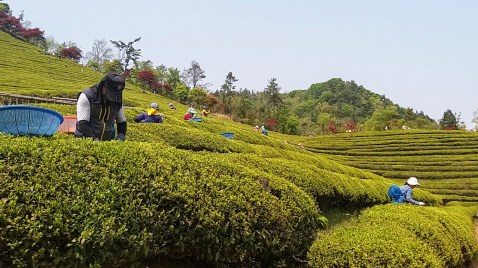


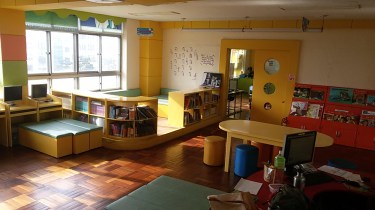
 In the morning, I wake up before 7 am to get ready. My neighborhood is still quiet then, and when I step out onto the cold spring sidewalk, everything except the 24hr stores are closed up tight. Because I live in a pretty ritzy neighborhood, I have a bit of a bus ride to school, but it’s a nice time to wake up and see what’s in the city through the windows.
 Because it’s still so early, the bus isn’t too crowded and I can usually get a seat.
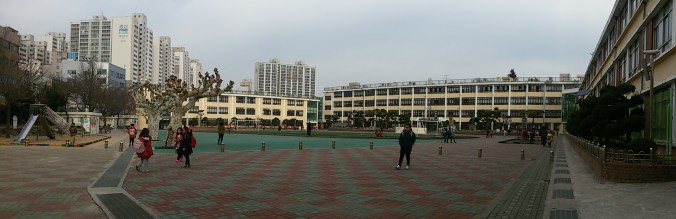 My first week was actually the second week of school because I spent the first week in quarantine, so you can imagine the kids were surprised to see me after their first week with no native English speaker. There were lots of curious glances and furtive shy peeking in the window. Some brave students even came up to ask what day I would be in their class. Monday wasn’t especially a typical day, but I made it through my classes with minimal technical difficulties, and learned that there are three other teachers I’ll be spending most of my time with. The other two English teachers, who I will refer to as co-teacher 1 and co-teacher 2, as well as a music teacher that is in our hallway. They’re all really sweet ladies, and did their best to make me feel included, sitting with me at lunch and chatting with me in the hallways or after class.
 This one was our year start dinner, and we went to a traditional Korean barbecue place. Every 4 people shared a table with it’s own grill and assortment of banchan (반찬 : the side dishes served at every Korean meal). It was the duty of the youngest at the table to cook, which is our music teacher, so she set to grilling the pork belly (


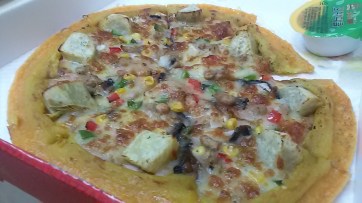 My pizza was cold by the time I got home, but my apartment has a microwave, so that was ok. It turns out that sweet potato pizza is one of the ones without tomato sauce. The box declared proudly that the crust was made from organic flour (kind of surprised that’s a thing here) and Korean rice. There are small diced vegetables like onions, green peppers and roasted corn, as well as some kind of sausage reminiscent of Italian. Then, placed like a crowning jewel on each slice, is a single chunk of roasted sweet potato (or possibly yam), and the whole thing was covered in mozzarella cheese. The “gold” crust turned out to be a satellite rim of mashed sweet potatoes, topped with cheddar cheese that had toasted in the oven. Not really like anything I’d have described as “pizza”, but quite delicious nonetheless.
 Gallivantrix