The Indian Ocean off the coast of Zanzibar is of a deep, brilliant blue that one suspects has been altered in brochure photographs, but is in fact that blue (not every beach every day, but often enough that you are likely to see it at least a few times on a visit). Lounging at a beachfront restaurant while enjoying the sea breeze and insane blueness of it all, is among the top 10 activities recommended to tourists on the island. Snorkeling, diving, surfing, and kitesurfing are also all on offer. I looked into each one, and discovered that three of the four activities were multi-hundred dollar investments (since I am not PADI certified and do not yet have any kind of surfing experience at all). Snorkeling it is, then. Given my lack of planning for this trip, my wishlist simply contained the keyword “snorkeling” and something called “Safari Blue”.
On my first day in town, I happened to spot a PADI certified dive shop that also advertised snorkeling which put me in mind of the trip I’d taken in Bohol where the snorkelers and divers shared a boat. One Ocean Diving is the only PADI certified center in Stone Town and they have a few other boat trips on offer as well. The day I wanted to go was too close for online booking, so I simply walked in and booked an excursion in person.
Safari Blue is on every list of what to do in Zanzibar. Although there is a company by that name, the tour simply refers to the route: a boat trip that departs from Fumba and incorporates the south-western region off the coast with mangrove swimming, snorkeling, a sandbar, (maybe dolphins), and a seafood lunch. I searched online for a good way to take this famous trip without the necessity of being crammed in with heaps of tourists and finally landed on an Airbnb experience with decent ratings.
This is the tale of two sea trips which could not be less alike and still be on the same island.
Safari Blue

When I saw a version listed on Airbnb Experiences, I was excited because I thought I might get a unique local twist on this tourism staple. I was so wrong. The “host” was a tour operator who simply arranged the driver and booked the boat tour for me and the other unsuspecting suckers who thought they were getting a personal experience. It’s normal to join a group on an Airbnb excursion. I recall my Grenada hot springs experience fondly where my hostess drove a group of travelers out to a spring in the mountains and served us a picnic. The whole point of the Airbnb experience is to meet other travelers while a local shows you around in a unique way. This was like booking an Airbnb and discovering it was actually the Best Western all along. It’s not that I wouldn’t stay in a Best Western, I just want to know that’s what I’m signing up for.
Though I would have been happy to meet at the fort, the “host” said the driver would meet me at my hotel and walk me over to the parking lot (Stone Town doesn’t let cars in), which resulted in the driver getting lost, because Stone Town is a maze, and being more than 20 minutes late. There were two other tourists along, which initially, I was pleased about since I had done my previous Zanzibar Airbnb experiences solo. The driver explained he would hand us off to the boat operators at the docks. There we discovered we were joining a group of 6 more on a dhow operated by what seemed to be a very large and well logo’d tour company called Johari.
The boat workers were in a big hurry to get going, and I’m not sure if we were actually late or if it was just the timing of the tides that day, but for the first time in Africa, I felt rushed. We had to get swim fins at the dock and two of the people in my excursion also had to use the tiny brick building to change. This is the location from which all Safari Blue boats leave regardless of which company actually owns one, so it was crowded and busy even in the off season. Once on the boat, we sailed out for a while under scorching sun and finally arrived at the “blue lagoon”. The tour companies definitely put their absolute best photos online for you to view, but what no one tells you about Zanzibar is the way the tides can make or break your experience. Tides don’t happen at the same time every day, but they are predictable. As I learned when visiting the hot spring beaches in New Zealand, tide charts are easy to access online. If you want the brochure photo experience, it’s important to visit Zanzibar at a time of year when the tides are in your favor.

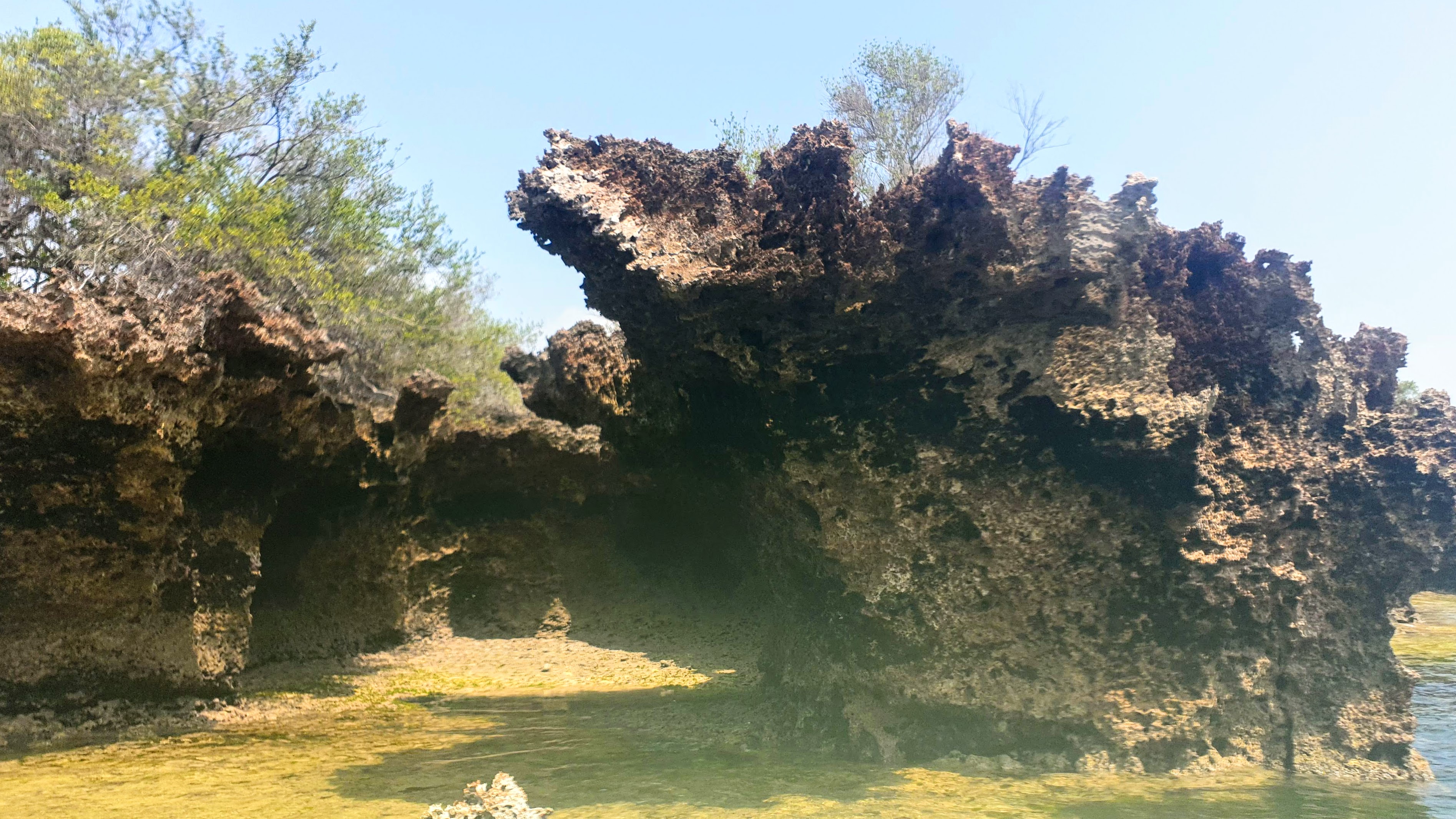
The blue lagoon is advertised as being a refreshing swim in the crystal blue waters of a mangrove pool. Due to the tide being out, it was more like the beige lagoon, and the dhow wasn’t able to get close in the shallow water. We took a smaller motor boat closer to the lagoon entrance where we could see the rocks and mangrove roots laid bare. I imagine it is beautiful at high tide with the lagoon is full to the brim with turquoise blue water, and this was definitely an interesting artistic landscape, but all of us were hot and sweaty and now we were being told we couldn’t even swim, but would get just a few moments for photos before moving on.


By the time we got back to the dhow, they had put the sail away and erected a shade canopy which was most welcome, even if it meant we would be motoring the rest of the way. They also served a plethora of delicious fresh fruit including young coconut, watermelon, mango, red banana, passion fruit, grapefruit, and the biggest pineapple I have ever seen. Truly nothing compares to eating tropical fruit in the land where it was grown. (or at least the neighboring island).

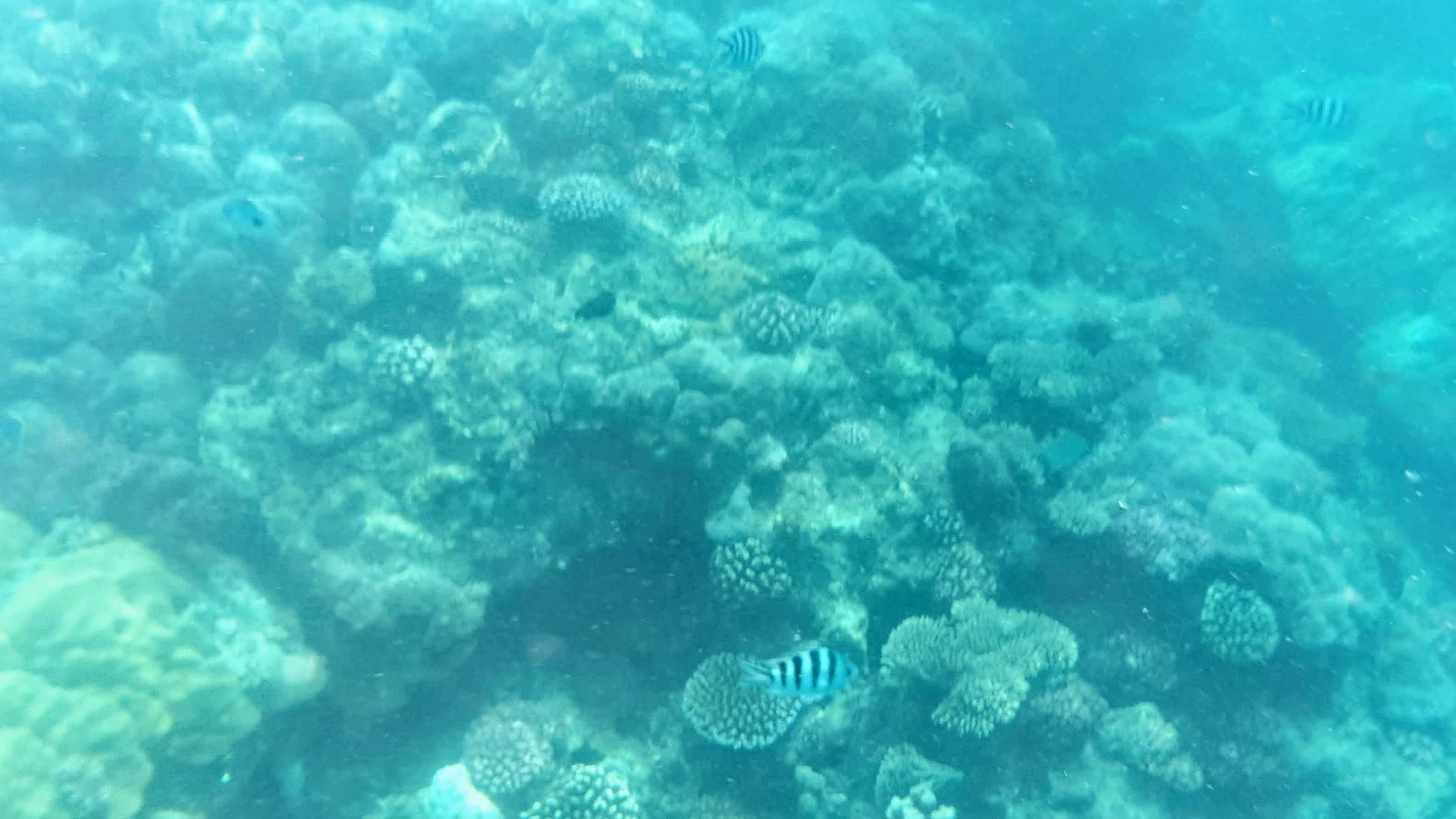
When we arrived at the snorkeling spot, they handed out life vests, masks and snorkels. I was the only one to pass on the life vest partially because I’m a strong swimmer, but mostly because I am a flotation device. I struggled getting settled in the water, which is no surprise since it has been 4+ years since my last snorkel trip. The strap on my first mask broke. The replacement had a leak that meant I had to surface to drain the water every couple of minutes, and by the time I got the third mask, I was loosing my enthusiasm for the experience. There were a decent number of fish in the water, small tropical standard breeds, but no less beautiful for being common (I like dandelions too). The coral, however, was in a sad state. The cloudy water made it difficult to tell at first. With all the other tour boats in the area running motors and dozens of tourists splashing around, the water was not particularly clear. It was also only partly sunny, which is normally my preferred level of sunny, but clouds cut down on underwater visibility.
When I got the mask situation sorted and was able to swim around the corals with better control and direction, it was really clear that they were close to 70% bleached. The vast majority of the coral was the dead, lunar surface texture and color of coral which no longer hosts any life. I got the impression that the industry relies on the fact that most of the snorkelers who take this tour are amateurs and don’t know what living healthy reefs look like, because many of the other people in my boat were totally thrilled with the view. Only one other traveler who was just as much of a globe trotter as me agreed, though she said it was still better than the condition of the reefs she’d seen in Egypt. Since my first reef exposure was on a private beach in Jeddah, I may be spoiled. I have seen a healthy reef in full bloom and although there were fish and an anemone or two, the biodiversity was scarce and the coral itself was in bad shape. I left the water early because it was just sad to look at.

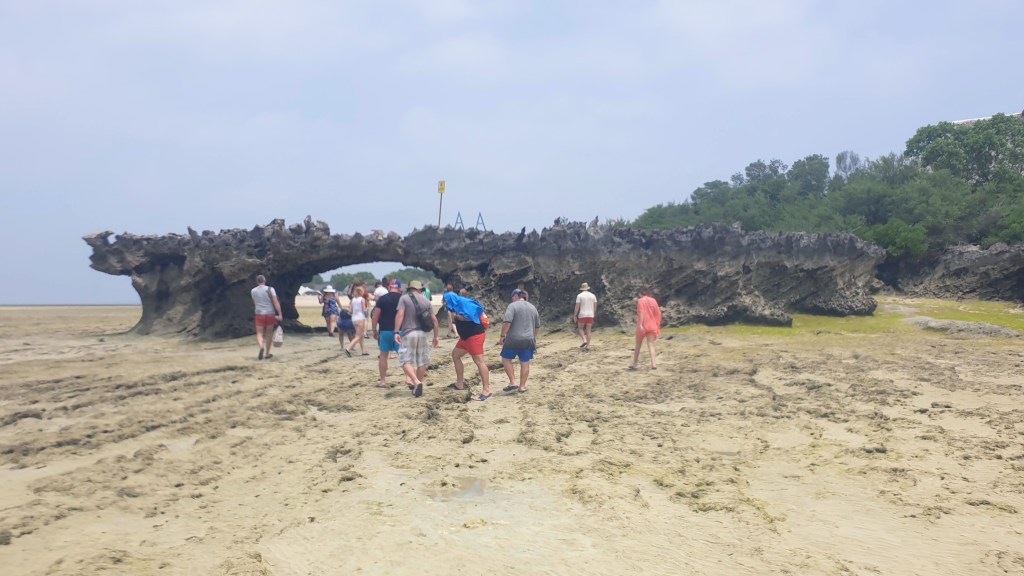
I had been under the impression there would be two snorkel stops, but they claimed our gear as we re-boarded and said we were heading to the Kwale sand bar. There are several sandbars around Zanzibar which are visible only at low tide, and get swallowed up as the tide comes in. I think tidal events are cool, but a sandbar at low tide is a kind of goopy beach. When we arrived, the sand bar actually connected to the more stable small island of Kwale to the south, reminding me of the Jindo sea parting I went to in Korea where the land bridge becomes walkable only once a year at the lowest of low tide. I love the ocean, I was happy to be swimming in that gorgeous blue, I just… don’t understand the point of taking the boat all the way over to a piece of sand that doesn’t actually look that different from other pieces of sand. At least in Koh Lipe, the island we stopped at was totally unique being made of ocean polished rocks.
The sand bar was also a parking lot of dozens of dhows taking all the other tourists on the exact same trip. Quite possibly hundreds of white tourist bodies on this little strip of sand made me think of Lilo taking photos of the tourists in Hawaii. I walked across the sand bar just for the experience, and then I sat in the sea contemplating my life choices and being rather sad about the chunks of dead coral mired in the silt and the dead starfish a group of Russian tourists were taking turns posing with behind me. Then we were bundled back into the boat and taken to the Kwale Island, which again because of low tide was a long walk through a bizarre post apocalyptic moonscape under the blazing sun trying not to trip on rocks, slip on algae, or step on sea urchins left exposed by the retreating ocean.


The wild thing about this is that I also love tidal pools. I adore going to the coast at low tide and looking at the life revealed there. I have done this up and down the west coast of the US. One of my very first blog posts was about Thor’s Well where we admired the natural phenomenon of the low tide creating the illusion of a hole in the ocean. It’s not “low tide” that I dislike, but the contrast of expectations and reality being miles apart. The photos of these places are high-medium high tide and there’s just zero warning about how insanely different it is at low tide. With the high tide, you get the beautiful crystal blue water coming right up to the sparkling sandy beach. At low tide, you get a sort of salty swamp with slippery and pointy bits that no one’s water shoes are really prepared to walk through. We were not there to admire the sea-life or the interestingly shaped rocks, however, and were once more rushed along since we had so much farther to walk at low tide than those who visit at high tide, and the tour guides were anxious to get us to the destination so they could have their break.



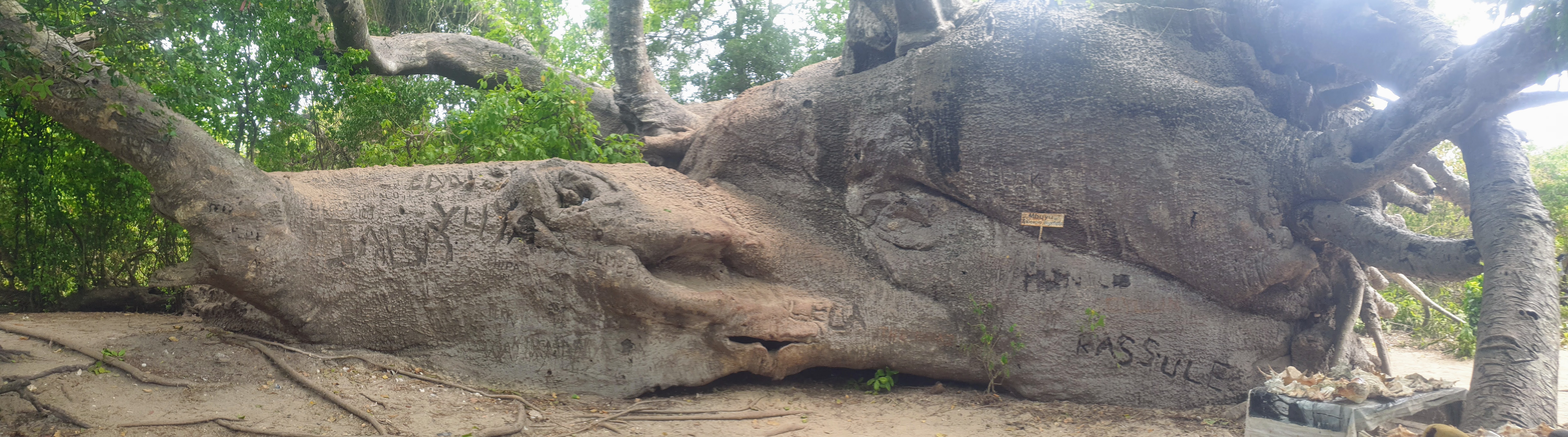
When we reached the small tourist village that nestled above the tide line, we continued on past shops and covered seating areas. I thought perhaps each boat had a designated spot where they took their passengers to avoid confusion, but as we passed the last picnic area and continued into the forested interior, I began to suspect something else was going on. This trek into the brush eventually led to a giant baobab tree fallen on it’s side and still growing. There was a short presentation about the baobab, a taste of baobab candy in an attempt to sell some, and then back we trooped to the eating area. The guide was impatient with those who wanted to take photos after the presentation (you know when the guides weren’t in the way anymore). Then we had a very plain but generous seafood buffet. The entire experience was a study in mismanaged expectations.
After lunch we motored directly back to Fumba, the day was over after three largely disappointing stops and a lunch that was in no way superior to the seafood available on the main island. I lost a flip flop, my sunglasses broke, and somehow also my phone case (which was empty in the waterproof bag because my phone itself was it its waterproof case) also cracked. I spent 20$ to replace the sunglasses and shoes, which is probably about what I’d pay at a Walgreens, but it just felt like an extra cost on top of an already overpriced (100$ USD!) and underwhelming experience.
I think if I’d known what I was getting into it could have been enjoyable. I know that if I hadn’t had a far superior snorkel and island tour at Koh Lipe for ¼ the cost I would not have been so let down. Tourist trap experiences aren’t bad in and of themselves, but once you have done them a few (dozen) times, the novelty wears thin. I’m tired of seeing the same junk in every shop – some of it was literally the same junk I saw in Thailand, Malaysia, and the Philippines (complete with made in Thailand tags!) I’m tired of hordes of tourists crowding the same beach or swimming hole because it was at one time photographed as a paradise and has become entrenched as the go to spot, the name of the destination meaning more than it’s faded commercialized beauty. I thought that Airbnb would be a different take on the standard tour, not merely a different gateway to it. After all, there are a lot of small reefs, islands and sandbars in the area that could easily be reached by boat. Live and learn.
One Ocean Dive
The next day a very different and much more enjoyable experience. To start with, One Ocean Dive asks people to show up to the shop early enough to leave time for a cup of coffee, picking out equipment, and getting dressed, so I never felt rushed. The cost of the excursion was less than half that of the Safari Blue and guaranteed 2 snorkel spots while skipping the mucky low tide islands and sand bars. The equipment on offer even to me as a snorkeler was immensely superior quality, and in addition to fins, mask and snorkel, they offer each swimmer a springsuit wetsuit (stops above elbows and knees) to help prevent sunburn.
They also request swimmers to only use reef friendly sunscreen. The chemicals in regular sunscreen kill reef life, and it’s probably one of the reasons why the coral I had seen the day before was in such sorry shape. I declined the wetsuit because I have a rather full coverage swimsuit and my own UV blocking rash guard that fully covers my top when closed, a necessary purchase after the last snorkeling induced sunburn, but it was a thoughtful touch since many tourists arrive in skimpy swimsuits which are entirely inadequate protection from the African sun. (sidenote: I was not spared the sunburn despite all my precautions, but the suit would not have covered the area I was burned on, the lower back of my calves, so I guess the next time I go to a tropical paradise, I’ll be bringing swim pants in addition to my long sleeved rash guard)

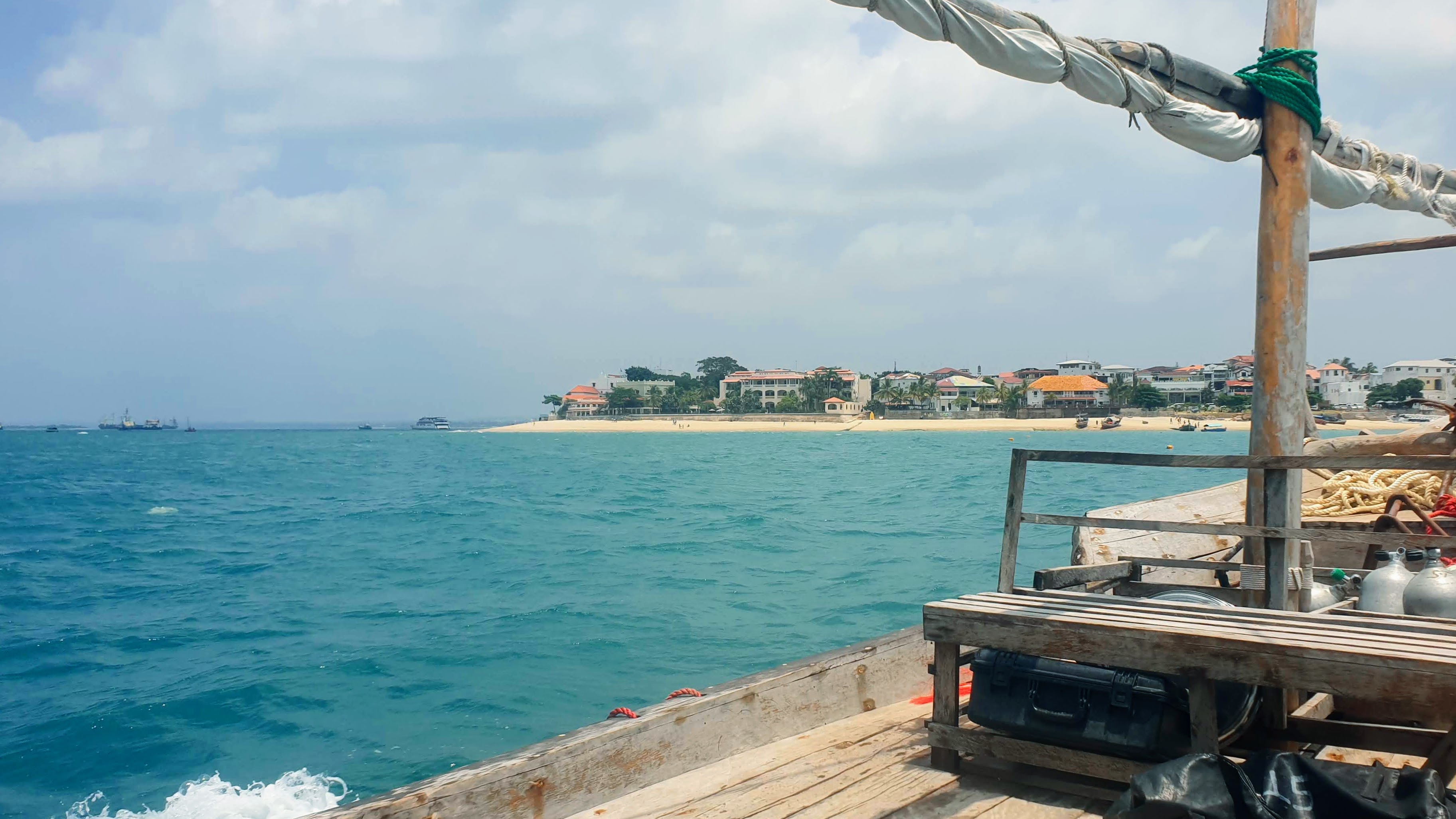
We had a bit of a walk along the beach to get to the boat. Although initially annoying, I realized this was in our favor since we were leaving the hordes of tourists behind. There were three of us on the boat, myself and another snorkeler, an older gentleman from Germany, and one scuba diver, a younger American man who was deep into the action-adventure life, but not a jerk about it, which was refreshing. We traded stories of our adventures as the boat motored out to the first dive site and I was even able to recommend a hike to him (Goldmeyer, if you’re curious) since his next trip would be Seattle, my home stomping grounds. The water was picture blue, and when we arrived at our first dive site off Bawe Island, we were the only boat in sight.
One of the guides stayed with the boat, one went with the diver, and one came with us snorkelers. He carried a bright orange life ring which made him easy to find and provided an emergency rest stop should a swimmer get tired, cramped or otherwise need a break. We were not in easy swimming distance of land, but I could still see the thin strip of sand and trees on the horizon. The guide led us to the reef and my heart swelled with the waves to see that here the reefs were bright, diverse, and alive! I had feared so much that the damaged reef at Kwale was indicative that climate change and tourism had destroyed enough of the environment that half-dead reefs would be the normal experience in Zanzibar, but this area proved that the impact of tourism (chemicals from motors and sunscreen as well as the churning of water, litter and other human contributions) was the main culprit since just a few miles away the reefs were healthy and thriving.

I struggled a bit with the waves, as we were far enough from land that we weren’t sheltered. What may seem like a gentle swell from the boat can easily roll right over the top of your snorkel if you’re not paying attention because you are gawping in awe at the scenes of natural nautical beauty beneath and around you. I also struggled more with the camera. My previous snorkel excursions had all been in fairly shallow, calm waters. Even in Bohol where we had a strong current, it wasn’t something you felt until you tried to swim against it. In those places, I was able to simply relax and let my natural buoyancy keep me close enough to the surface to breathe while admiring the view. This meant that navigating the stubborn button pushing and touchscreen touchiness of my underwater phone case was the only thing I had to concentrate on. Now, however, I had to kick my fins almost constantly just to stay in place (necessary for taking photos) and I was trying to time my breaths to the waves above so that I didn’t accidentally inhale at the same time a wave was cresting over my snorkel.
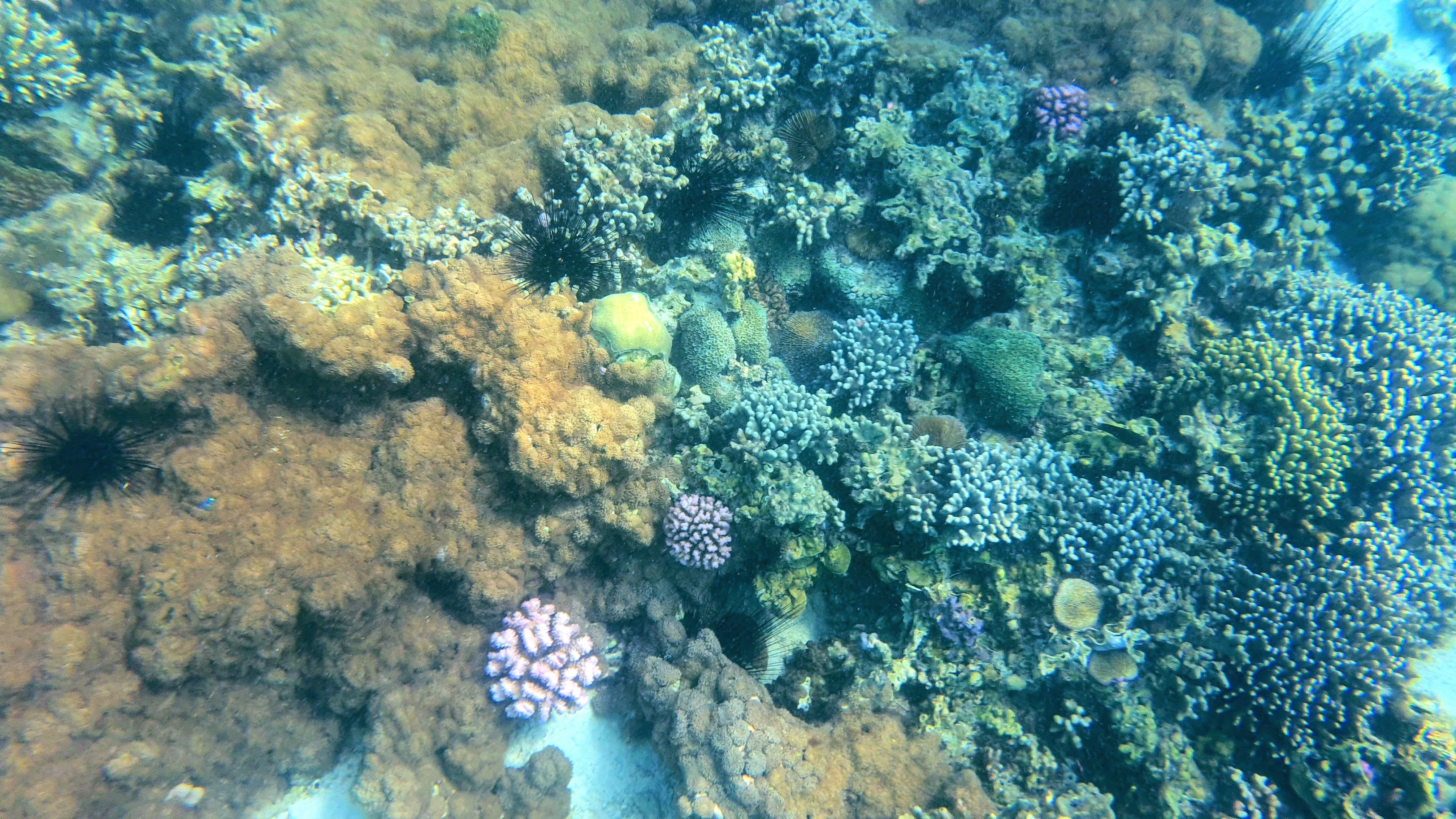

I took turns wrestling with the camera and just enjoying the experience because we need both to be mindfully present in the moment and to preserve memories for our future selves. When you view the photos of this day, bear in mind this was taken on my 4+ year old phone in a 10$ waterproof “case” that was basically a plastic bag with an industrial watertight seal. I do not have anything like a high quality underwater rig, but I still really enjoy being able to capture a few random moments of these magical underwater gardens. I thought 45 minutes might be too much given the paucity of life in my earlier swim, but this reef was so expansive and diverse that I was still engrossed with the guide caught my attention and said it was time to head back to the boat.


On the way to the second site, we had a generous snack of samosas, pastries, and fruits. It wasn’t a “meal” in the traditional sense, but it was delicious and plentiful, and allowed us to refuel without diverting away from the focus or getting too full to swim in open water safely. We talked about the life we’d seen below, and I got only slightly jealous of the diver since he’d spotted an eel, but I was thrilled with the variety of sea life, color, and shapes that my own swim contained and I finally felt like I’d found what I had been promised on this island paradise.

The second site was even further from land, the water was a deep dark blue, and the waves even higher. The site wasn’t just a reef, it was a sunken ship which had been overgrown with corals and other sea life. Despite the depth of the water around us, the boat itself was on a raised part of the sea floor, which made it easy to dive to. I wondered at first if the water was simply clear enough that the boat looked closer to the surface than it was, but when I saw the scuba divers below me it provided excellent scale. The ship is the Great Northern which was a British cable laying ship that sank in 1902. If you’re a boat enthusiast, you can see more about it here. Only a small part of the boat remains after extensive salvage operations, but it was absolutely enchanting to see the outlines of the hull and the mast rising from the sea floor towards me at the surface, colonized by it’s own coral and school of fish.


Despite the physical difficulty of the swim, my spirits were not dimmed by mouthfuls of seawater that came down my snorkel whenever an especially high swell coincided with my attention being diverted by the beauty around me. I saw more species than I know the names of including several giant clams and a small school of squid bobbing along near the surface reminiscent of the ones I had cooked on my spice farm tour.
After many years of not being able to travel due to COVID, and having such a terrible experience landing in Dakar and being unable to rekindle my joy of travel, adventure, and new places, I was genuinely starting to fear that I had lost it. That I had become too soft, too indoorsy, too sedate, or worst of all, too old to continue the kind of adventures which I felt I had only just begun to have in the few years before the pandemic took it all away. My experience with Safari Blue had made me even more uncertain — maybe I had become jaded? Was comparing each new place to a better place from my past adventures stopping me from enjoying what was in front of me the way the other tourists certainly appeared to be?
I emerged from the Indian Ocean that day, breathless, sunburnt, and missing my eyebrow ring, sacrificed to the secure grip of the mask and the pressure applied by the waves. I emerged all these and yet grinning ear to ear. My sense of wonder and my ability to ignore discomfort in the pursuit of adventure were intact! My spirit was not broken by isolation, stagnation, or even terrible heat. I radiated a gratitude that buoyed me for the rest of my stay in Zanzibar and refused to fade even as the sunburn became one of the most epic of my life. The blue of the Indian Ocean is the blue I’ve been dying my hair for the last 6 years without knowing. It is the blue that feeds my soul.
Back in West Africa
Since returning to Senegal, I have not been able to parlay this sense of adventure to Dakar or even it’s neighboring region. Before Zanzibar, I was truly worried that the pandemic had taken my joy and adventure away, but knowing that wasn’t the case, I started trying to understand what it was about Dakar that was keeping me from finding it. Some is definitely a result of the infrastructure and culture. Zanzibar was safe to walk in even after dark with cameras all around and locals who had a strong interest in maintaining that safety because tourism is such a huge part of the economy. Dakar remains a place I can only walk at night if I’m in a group and we are walking a short distance on well lit streets. The beach in Zanzibar is full of restaurants, cafes, boats, and walking areas all of which are within walking distance of the hotels. If I want to go to the beach in Dakar I need to take a taxi; I will stand out as a lone foreigner, and should I walk along the corniche, I’ll be walking next to one of the largest arterial roads of the city, which almost cancels out the joy of walking near the ocean. Zanzibar wants people to explore, so there is a a fleet of tourist taxis made of identical and easy to spot Japanese minivans and yes it’s more expensive for one than for a group to split the fare, but it’s easy and not outrageously costly. Whereas I cannot for the life of me find a safe and affordable option to go on my own from Dakar to Pink Lake or Saly.
But more than the differences between the two places, I also thought about the difference between living in a place and traveling to a place. I spent two of my three weeks in Zanzibar just being a tourist. I let myself sit in the hotel AC watching Netflix when I needed a rest from the relentless heat and trinket sellers, but my focus was on having a good experience in the short term. In Dakar, my focus is on a comfortable life in a longer term which means making sure my home is safe and relaxing, making sure I can do my job without going crazy (both are still a moving target 6 months in), and making friends or at least people I am happy to see on a regular basis. These are all the things we do in daily life which are so different from what we do when we are on holiday. Those things take so much of my time and energy in Dakar that I have none leftover to be a tourist here.
I have emerged from the deep dark depths of “rejection” culture shock that I wrote about here a few months ago. I’m slowly learning to enjoy things here, but I’m more likely to play video games in my apartment or go to the local expat bar to see my new friends than I am to go out looking for some “Dakar” experience. A part of me feels like I’m wasting this opportunity, but another part is speaking softly that maybe I can’t be a tourist if I don’t have a home. Dakar cannot be my home, however much I’m adjusting to it’s idiosyncrasies and cultural differences. Korea had become my home while I wasn’t looking by dint of time and familiarity. I could go out and do touristy things while living there and feel confident that there was a comfortable and safe “home” to go back to. For the last 4-5 years, when I said I was going home, I meant my apartment in Korea, not my friend’s houses in Seattle where I stay when I’m visiting. Perhaps a few years in Dakar would make it feel like home, too, but I’m not going to be around long enough to find out. Most of the people participating in this fellowship around the world have a home to go back to, but I left my Korea home for good and I will be moving to a new situation at the end of my 10 months. I’m in home limbo.
I have 4 months left here, and I think that the best thing for me now is to stop trying to “make the most ” of Dakar and find some stillness where I can listen to what I am thinking, feeling, and experiencing by being in this place which is so far from my comfort zone that I cannot hit it with an ICMB. However much I desperately wanted my time here to be all the adventure which was denied to me for 3 years by the pandemic, the reality is different. I found my sense of adventure again in the blue of the Indian Ocean, and that will have to be enough for now.
 We set off from Busan (blue dot) in the morning to drive all the way across the southern end of the Korean peninsula to Jindo (red dot). Although Korea is small compared to, say, the US, it was still almost 5 hours of driving with the occasional pit stop. (By the way, in case you’re curious, you can see Daegu on this map as well). Fortunately, I went with a tour group (my stand by
 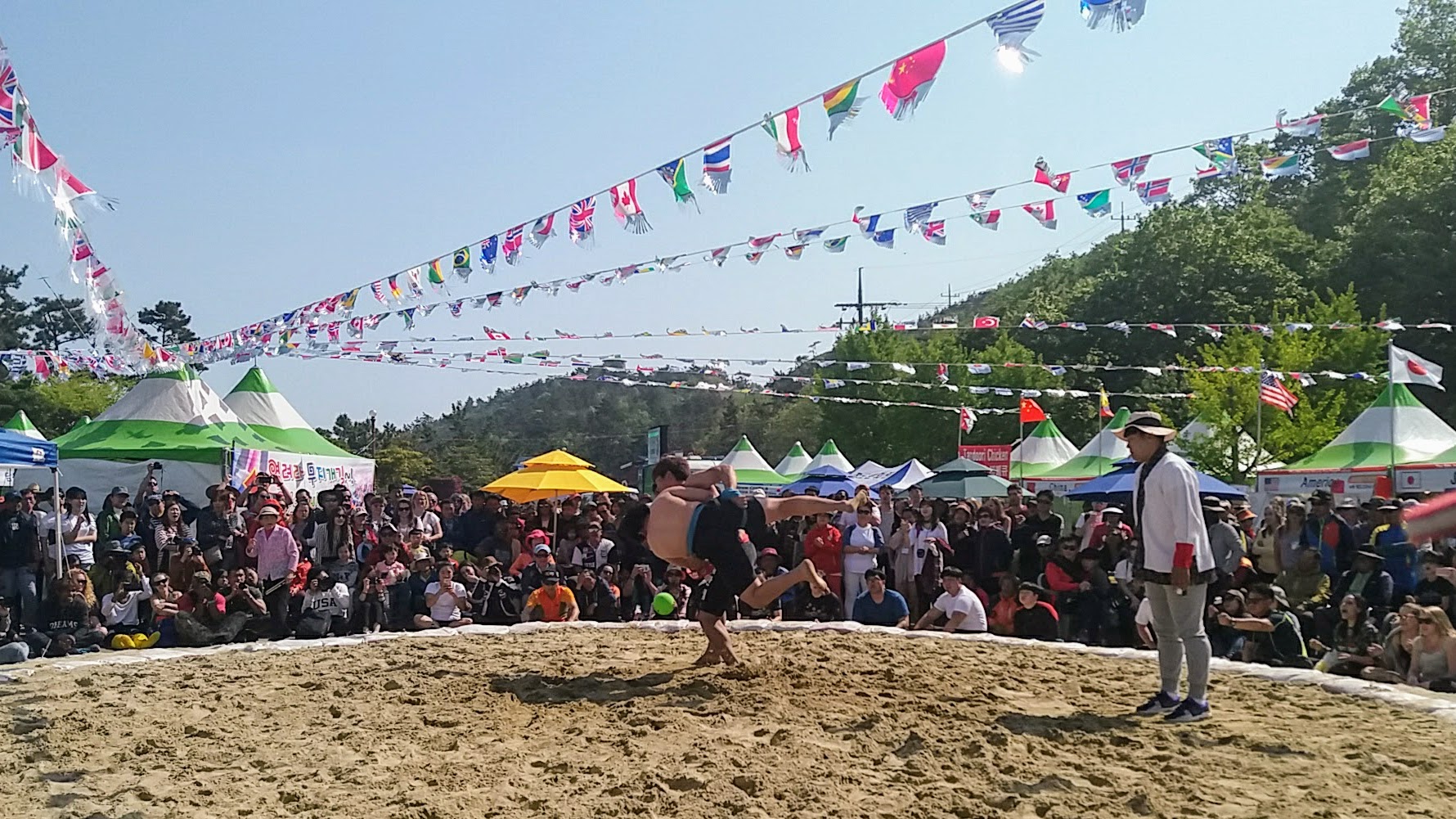 The Jindo festival had at least one feature I’ve never seen before: a traditional Korean wrestling ring. A pile of sand was placed in a large circle where two contestants could wrestle in the traditional style.
 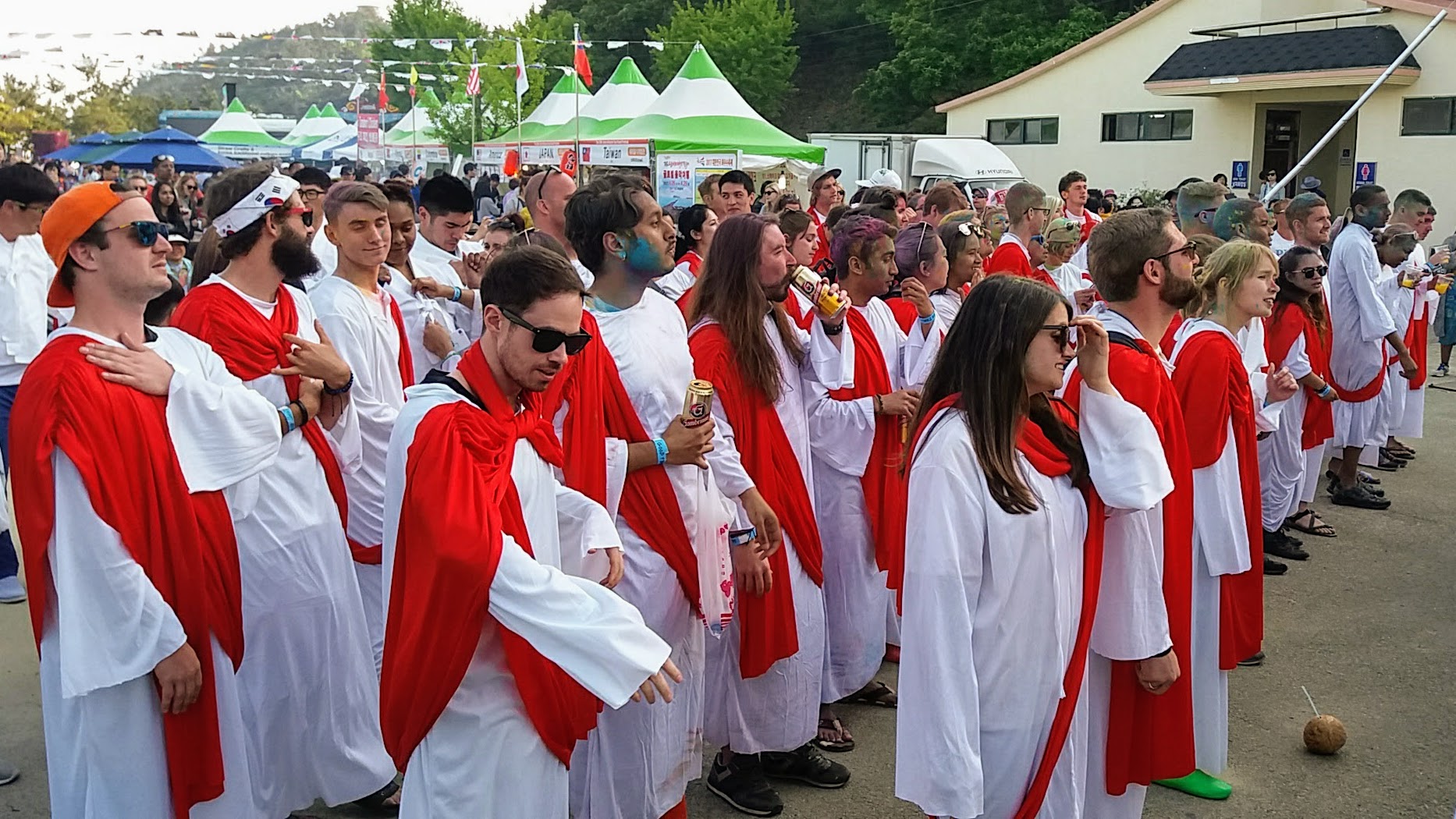 Even more bizarrely, after the color throwing was over, the festival organizers gave each participant a “toga” to wear. The togas were long white robes with red sashes that could have evoked a Roman senate or Jesus. Considering we were about to “part the seas” it was hard not to see it with Judeo-Christian overtones, but the rather drunk person I asked about it just said “toga party!” The entire thing seemed like the festival organizers were trying to find a way to appeal to the expat crowd. I’m glad they had fun, but I would have preferred some more traditional activities, like someone to teach us about collecting clams and seaweed the way the locals were doing as the tide went out. It’s hard to go do local culture festivals when the locals are busy trying to white-wash everything for cash.
 Finally, the real “reason for the season” was upon us and we muddled our way down the road to the rainbow steps beneath the watchful eye of the grandmother and the tiger. We paused at a bench to don our thigh high rubber boots and got some advice from the locals on how to attach the rubber garters through belt loops to hold up the boots, or failing that, to wrap them tight around our thighs and snap them in place. Thus clad in bright orange and yellow wellies, we made our way down the steps and into the shallow tide pools to wait for the tide to recede.
 If you look at the area on Google Maps you will simply see the beach and the islands, but on Korea’s own Naver Maps, there is a thin line connecting the rainbow steps to the island of Modo. Although this path is only usable twice a year (at most), the Korean map makers consider it important enough to draw in.
 The history of tidal prediction starts with Kepler (total nobody) in 1609 to theorize that the moon’s gravity caused the ocean tides. He was followed by other such no-ones as Galileo and Newton. It was in 1776 that the first big complex equations came from a man called Laplace. Harmonic analysis was added in the 1860s and polished off by 1921 in the form that Navies all over the world still use today. Although the math hasn’t changed in almost a hundred years, computers make the math easier and the information more widespread so now instead of just ships in harbor– surfers, beachcombers, and clam hunters can
  On a more mystical note, the local legend of the tigers explains why there’s a statue of a grandmother and a tiger overlooking the sea. Long long ago, the villagers who lived on Jindo were plagued by man-eating tigers. The whole village packed up and sailed over to the neighboring island of Modo to escape the threat, but one woman was left behind. The woman was Grandmother Bbyong, and she prayed to the Dragon King, the god of the sea, to help her. Finally the Dragon King came to her in a dream and told her he would build a rainbow brigde across the sea for her. The next day when Bbyong went down to the sea, the waters parted to let her cross and her family came out from Modo to meet her. This also explains the rainbow stairs that lead down to the landbridge, but not why her family couldn’t have just sailed back for her in the first place.
 While math can now easily tell us the time of the lowest tides, it does not yet advance to tell us what the actual lowest level of the water will be. Not that it couldn’t, but there are more variables involved, so it’s not a thing now. While we can say with certainty, the lowest tide of the year on this beach will occur at 18:38 on April 29 (or whatever), we can’t say for sure if that will expose the land bridge or simply be lower than every other tide around it.
 We tromped along the path, watching parasailers overhead and rainbow colored lanterns being released in to the air from the beach behind us. It was clear the path was quite narrow because going too far from the group to one side or the other to get a picture resulted in a severe deepening of water level. At the time, my friends and I theorized it might be man-made, or at least man-maintained, however, I have since then found that the build up of rock and sand in this twisty line is a natural result of the currents around the islands.
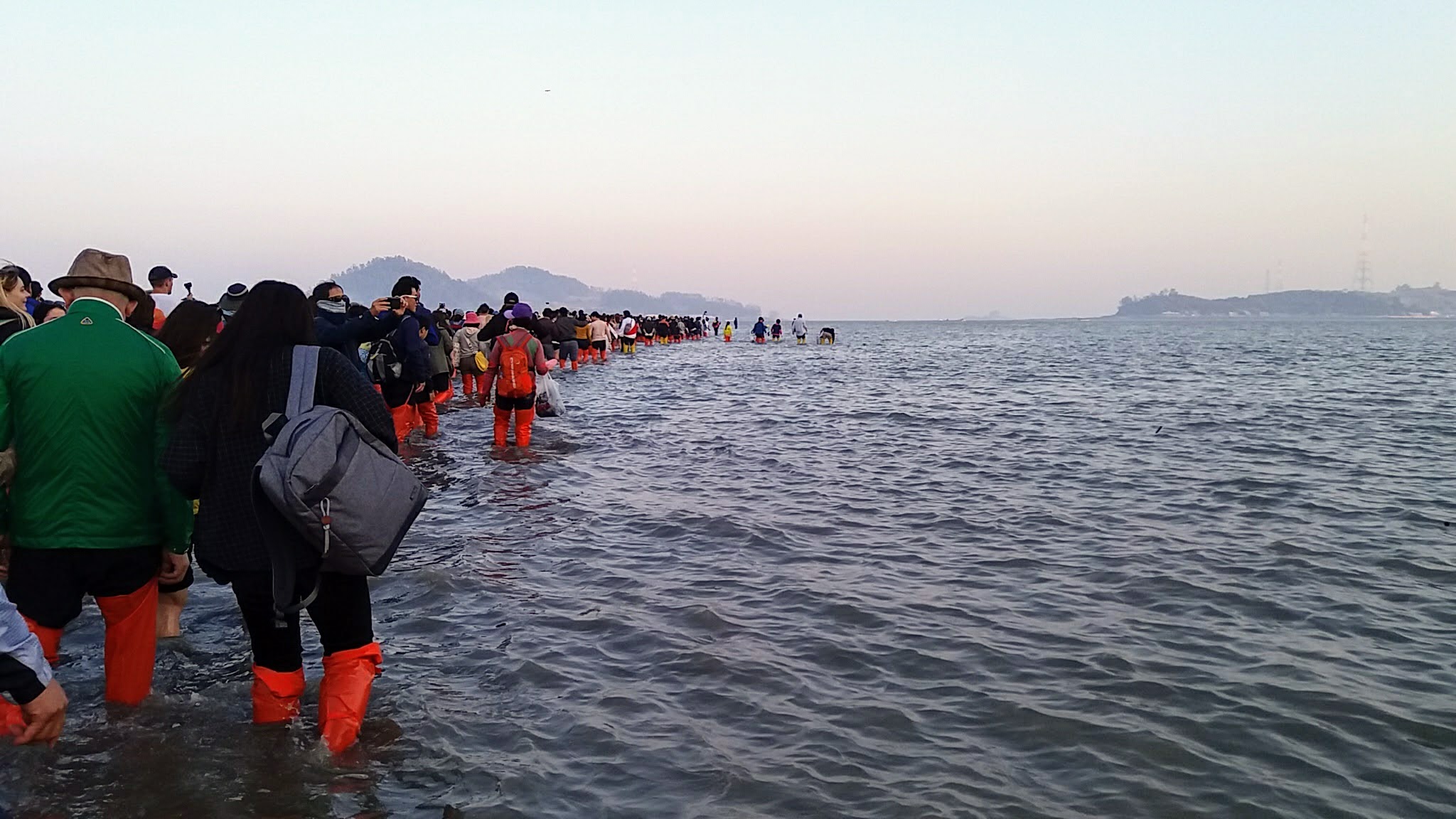 Before long the golden light of the sunset combined with the swish-swishing of hundreds of feet through water to create a trance-like state. I could not judge how far the island was, nor tell which way the path twisted. The rocks below us rose and fell, bringing the waves treacherously close to the top of my boots and then back down to barely splash over my toes. The whole path is nearly 3km long. I suspect a determined person could make it out to the island and back in the hour or so the path is clear to walk, but I wasn’t racing, and soon we were greeted by the sounds of Korean drums and the distant flags waving as the procession from Modo came out to greet us.
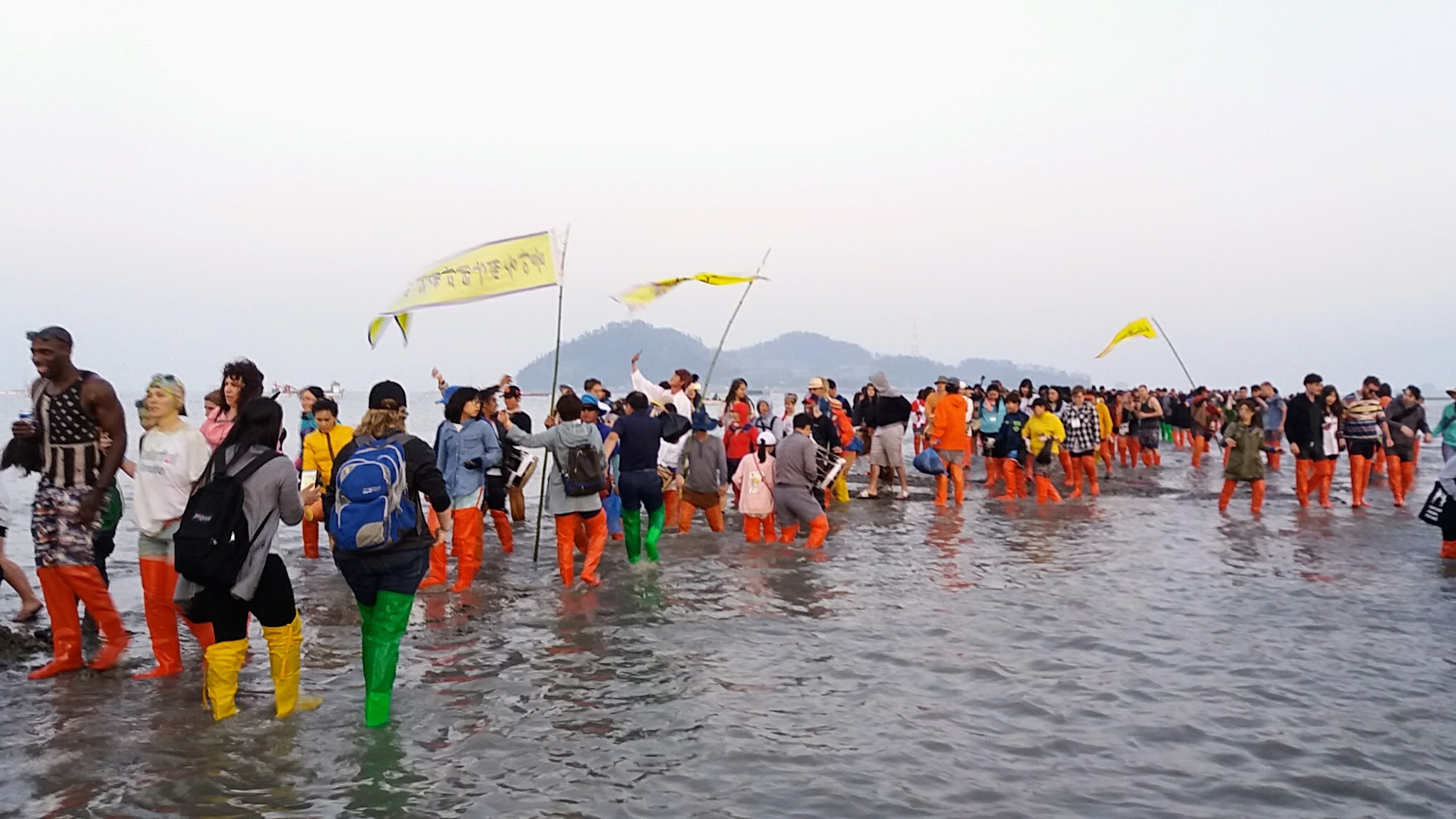 The walk outward had been slow, trepedatious, as though we were nervous the land could drop away at any moment, but the trip back was much more celebratory as well as much more damp. The parade of drum bangers, cymbal crashers, gong ringers and flag bearers danced merrily in their traditional garb, urging us all back to the larger island of Jindo. Our pace quickened and our legs swung to the rhythm causing much larger splashes. Waves came in from both sides of the path making us nervous, but excited. The water finally breached the top of my boots and sent an icy chill down my shins, but I found I did not mind.
 Before heading to the fields, we walked up a long road past the area of the light festival where a few wire frames from reindeer and dragons could still be seen. The road up the hill was painted with fun perspective illustrations of a stream, complete with little camera icons to show the best places to stand to see the visual effect. Optical illusions are fun.
 At the top of the hill, far beyond the little pagoda that had marked the highest point of the lights, we finally came upon the green tea museum where we were treated to a special showing of the Korean green tea ceremony (complete with English translation by our awesome guide). The ceremony involves a process of several containers: a water pot, a cooling bowl, a tea pot, and the drinking cup. The hot water pot is filled with boiling water, which is then poured into the bowl, and from the bowl into the tea pot and finally into the cups. The instruments are warmed up in this way. Then more boiling water is poured into the cooling bowl. Tea leaves are scooped into the warm but empty tea pot and the ideal temperature water is poured from the bowl over the leaves. While the tea steeps, each cup is emptied of it’s hot water into another bowl on the floor and wiped dry on the outside. The tea is then poured into the pre-warmed cups by pouring only a half a portion into each and the other half in reverse order on the way back. The tea is then served, 4 cups to the guest and one to the host.
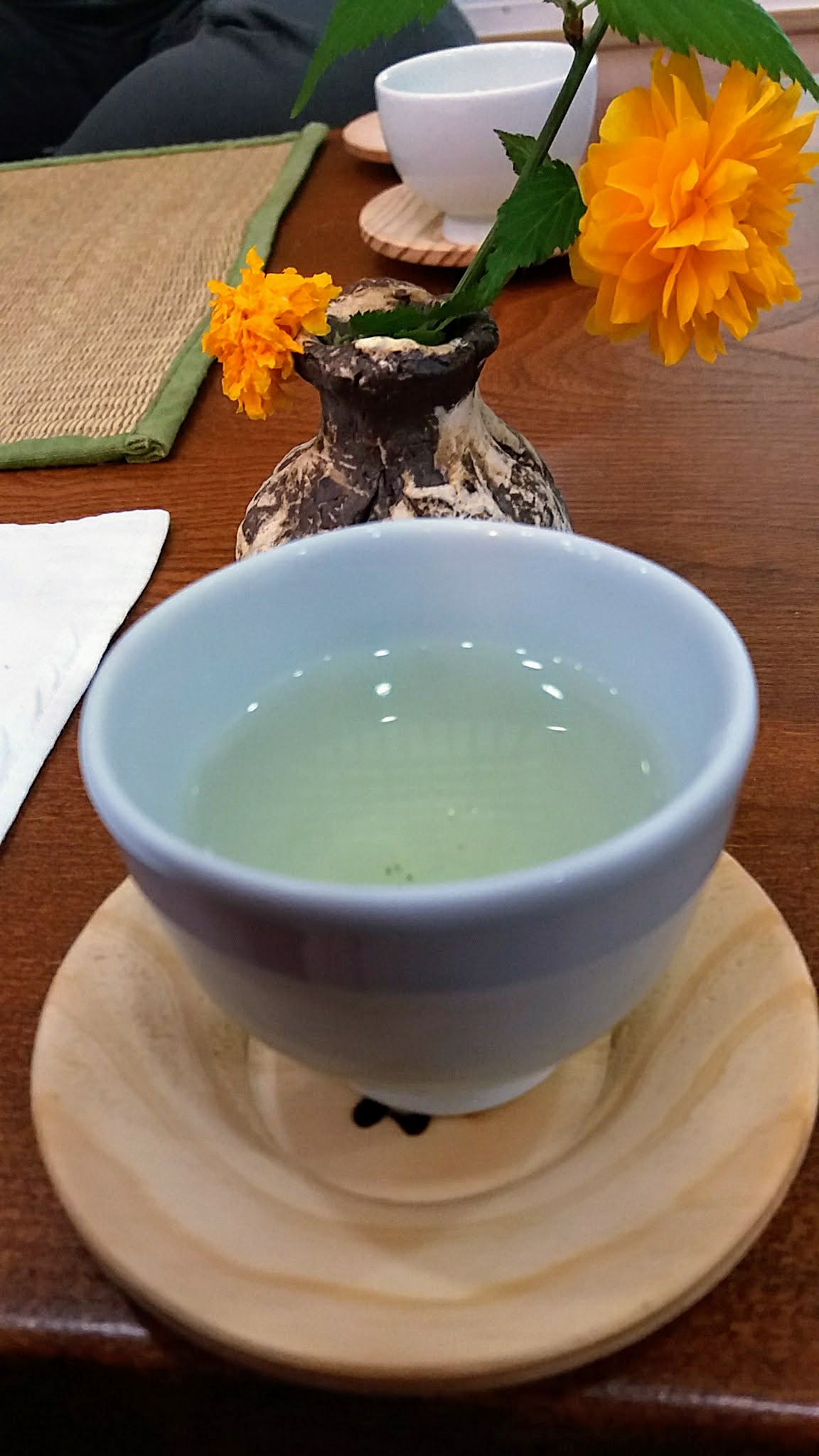 The hostess tried to tell us a bit about green tea, red tea and black tea but her translated explainations seemed off to me, since she said it had to do with the age of the leaf when it was picked from the plant. I don’t know if this was her or the translation, but the real story follows: In any country with Chinese roots in it’s culture and language, the three colors of tea are a bit different in meaning that in the West. Red tea is not Rooibos, in fact all three come from the same plant. And it’s not the age of the leaf at picking that determines the difference, but rather the post picking, pre-drying process. (although especially young and tender tea leaves are sometimes referred to as “monkey picked” and do make a delightful tea).
 After we conducted our own tea ceremonies, I drifted lazily back down the hill, examining the spring flowers and the grounds that had been lit up beautifully last December. When I finally got back to the tea fields, I took off on the same route I’d walked before and was happily greeted by many blooming apple trees and a small army of busy bees who were so focused on the brief blossoms that they paid no mind to all the humans fussing around. In fact, I think it was the only time I’ve seen Koreans in the presence of a bee not totally freaking out. I guess the selfie with the tree is worth it.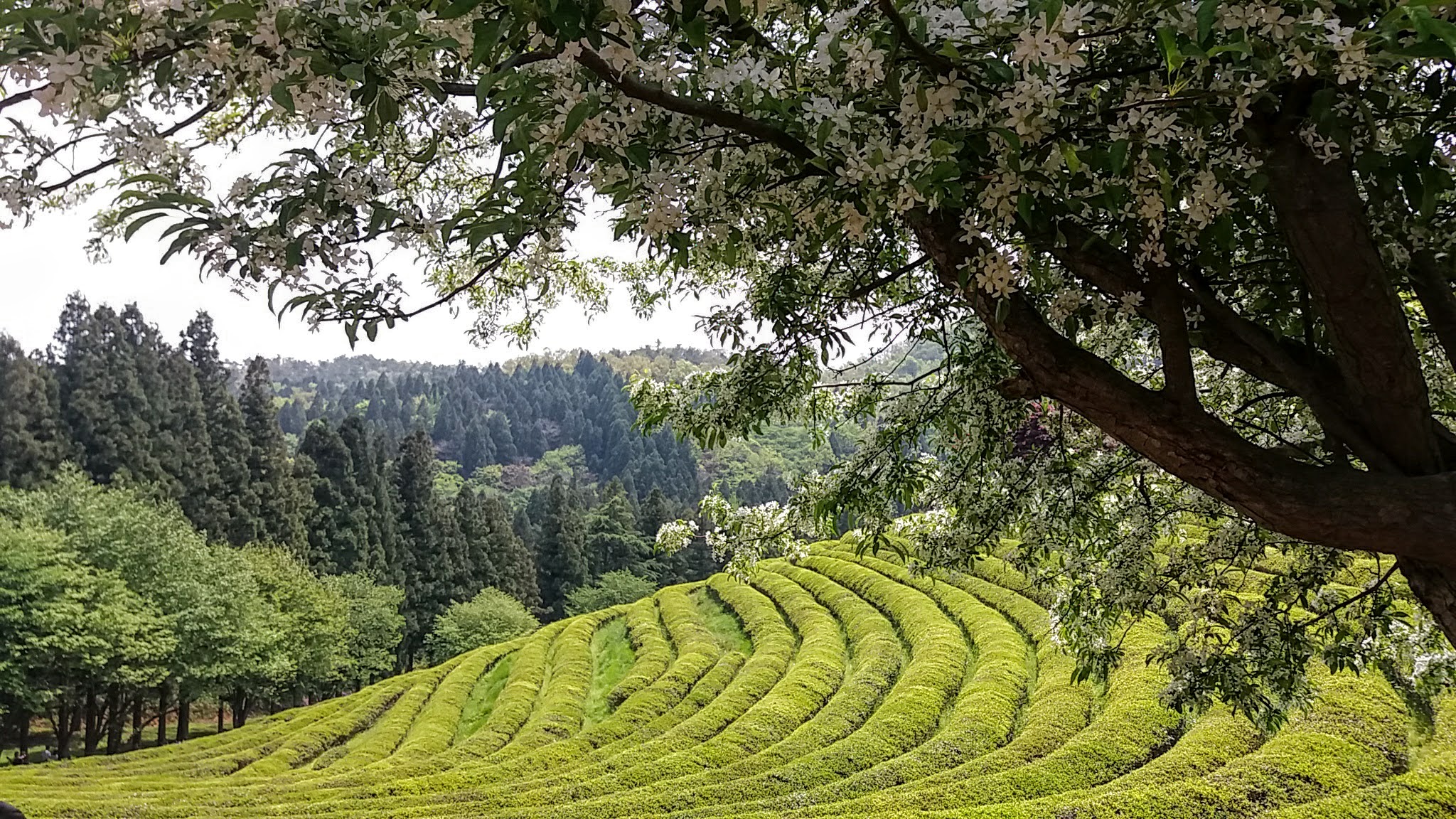
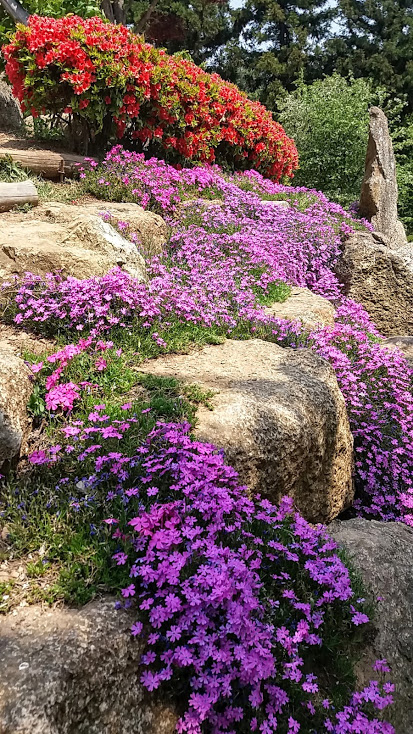 In addition to the blooming fruit trees, there were cascades of purple flowers covering the rocks wherever tea was not growing. It made the whole place feel like a still frame of a rushing river in shades of pink, purple and green. Besides the tourists, there were also tea pickers at work. Each ajuma looking lady had her sun guards on, gloves and a mesh basket to place the leaves. They were not picking the bushes bare, but selecting only some growth. It seemed to me to be the newer, brighter green leaves that they were after, but I couldn’t tell for sure. In the age of automation it was strange to see people picking by hand. I know that it’s still the way for many crops in the world, but sometimes it gets driven home that there’s a human on the other end of my tea or strawberries or carrots, and then I’m carried off by sociological musings on how we came to value people who sit at desks manipulating imaginary money so much more than people who make our food.

 Gallivantrix