Although the adventure in the Malay Peninsula was finished, I had one more obstacle to overcome before I could return home. Vietnam. In this tragic comedy of errors, I learned about the only airport in the world that doesn’t have a fly through policy, and I managed to check one more item off my bucket list. Never underestimate the stopping power of Communist bureaucracy or the healing power of pho. Don’t want to read about airports? Check out the end for some heartwarming life lessons about challenge and gratitude.
The Airports
Normally, I would not write about an airport, but it seemed that Thailand just could not let me go without a fight. Surat Thani was no trouble. A giant double decker plush AC bus (the kind I wish I’d been in on every other occasion in Thailand) pulled up to the hotel at 11am to whisk me off to the airport for a small fee. The airport was miniscule, but the staff were helpful. Nothing was labeled, but it was small enough that didn’t matter. Instead of posting about delays, they just told us.
I met a fun person in the airport, because I magnetize them to me. After our introductions, she gave me one of the nicest compliments I’ve ever gotten: “You’re way more interesting than looking at my phone!” So we pocketed our devices and talked until the late plane arrived to take us to Bangkok. And so it was, in this pleasant lackadaisical mood that I arrived in Bangkok with a several hour layover and plans to do some last minute shopping and get a nice meal.
I wandered out of domestic and over to the international terminal with only a mild case of being lost twice, and finally found my check in counter amid the totally not at all labeled rows of counters by the simple expedient of going up to a person and asking. However, here’s where the regular international airport challenges start to level up. While going through the check in process, I was informed that I cannot be issued my boarding pass without a visa. I don’t need a visa, I tell her, I have a residence card, showing my Korean ID. No, she says, for Vietnam.
You Need A Visa to Get In
Now, my flight, which I booked on the amazing and cheap website kiwi.com, took me from Surat Thani, through Bangkok, through Hanoi, and finally to Busan (where I live). In normal reality, catching a connecting flight in a country does not require a visa unless you plan to leave the airport for some layover sightseeing. This is standard operating procedure around the world. China (which up until recently had a monstrously complicated tourist visa application with huge fees and wait times) has lots of people fly through without visas. Even Saudi Arabia which does not issue tourist visas will let people catch connecting flights in Jeddah on their way to some more touristy section of the Gulf. You don’t need visas to catch connecting flights. It’s like an immutable law of reality.
“I’m not going to Vietnam, I’m just catching a connecting flight.”, I say. “I don’t need a visa because I’m not leaving the airport.”
“No,” she says. “You need a visa. I can’t give you a boarding pass without a visa.”
Call Your Embassy
I search the internet frantically looking for supporting documentation, and while it is true that every single web search I get back tells me this immutable fact over and over, they do not care. They will not issue me a boarding pass without a visa. I’m having nightmare flashes of being stranded in Thailand, of missing work, of non-refundable tickets I’ve paid for… Unable to find anything on the US State Department travel site OR the Vietnam Embassy sight about airport transit, I finally called the US Embassy to see if they could confirm or deny this situation and maybe point me at some official document that supported my not needing a visa. The on call staffer at the Embassy agreed, this is bizarre, and he’s never heard of an airport where you need a visa to change planes, but they are also unable to find any official statements anywhere online. Then I run out of minutes and the call is disconnected.
I try to talk to the airline to see if I can get the flight changed, but that’s going to take a day or more because there are no flights that day with room. The Vietnam Embassy website has an online visa application, but it takes 5 days. Expidited forms won’t load on my phone, I need a real computer. I’m losing my mind. The check in counter staff show me a website that’s a private business (vietnam e-visa) who I can pay to get my visa quickly, but my flight is in less than 2 hours now. 30 minutes, they promise. The fee for the visa was only 19$ US, BUT, since I needed it in 30 minutes, and it was a Sunday, AND it was Tet (the very famous Vietnamese holiday that is in literally every Vietnam war movie), it was going to cost me an extra 190$ in processing fees. Before plunking down 200$ on a visa, I wanted to vet the website, and found that there are apparently a large number of fraudulent websites that advertise Vietnamese visas and don’t deliver. Finally, I found a traveler who had used the site I was on and had reported success, but advised us all to spring for the “airport fast check in” option for an extra 25$. Her story of waiting around the airport for hours to get approval was convincing, and so it came to pass that I paid 234 American dollars to buy a visa into Vietnam for the privilege of changing planes in the Hanoi airport also known as “the Story of the Most Expensive Bowl of Pho Ever”.
Getting to Hanoi
I didn’t have time to eat or shop. I managed to buy an overpriced sandwich from a cafe by the gate before boarding because I hadn’t eaten since breakfast at my hotel and it was now after 6pm. Between the delayed flight in Surat Thani and the visa ordeal, I had used up all my layover hours. I got several emails from the visa service with instructions, very dire and specific instructions, as well as a pdf of a letter of visa application (not even a real visa yet).
When I got to Hanoi, the staff from the visa company was thankfully waiting for me with a sign. She ushered me into a waiting area and took my letter and passport away for processing. I was expecting to have to take some passport sized photos there for the paperwork, but I guess somehow they copied the photo from my actual passport instead and used that. Less than 15 minutes later she came back and handed me my passport with Vietnamese visa inside, while other people were still standing in line at the visa counter. At least that “fast check in” option paid off.
From there, I was able to go through immigration. For reasons unknown to any but the arcane inner circle of the Vietnamese bureaucracy, there is not an international waiting area. I’m told that if you’re travelling through Hanoi with both flights on the same airline, that it is possible to bypass the visa and customs rigamarole, but since many ticket sellers and even airlines use partners to get you from one leg of your journey to the next, buying your ticket from one place, doesn’t guarantee all your flights are on the same airline.
The Most Expensive Bowl of Pho
I had to go through customs and immigration. There was no need for me to leave the airport, mind you, since once through immigration, I could simply turn around and re-enter the security screening and boarding areas. But, since I’d spent so much on a visa, I did step outside and breathe the external Vietnamese air, just to say I did. I also fulfilled one of my long time bucket list items, to eat pho in Vietnam.
If you don’t know pho, you are missing out. This magical Vietnamese noodle soup took Seattle by storm more than a decade ago and it’s a staple cheap and delicious food for all occasions. Sick? Eat pho. Celebrating? Eat pho. Too busy to cook? Eat pho. Having a first date? Than Brothers it is. I even had my grad school graduation dinner there. You can get a fairly large bowl of it for 5-6$ which is dirt cheap when you realize that it’s actually good homemade food and not the McProcessed value menu. I love pho. I idolize pho. And typically, when people ask me what food I miss from America the most, I answer pho, because even though it’s not “American” that’s often the only country I can find it in with regularity. So of course, being in Asia is a big opportunity to have pho in the land of it’s origin. Bucket list, check.
The moral of the story is, if you have a connecting flight in Vietnam, call the airlines, ask, and even if they say you don’t need a visa, it might be worth it to drop the 20$ a week before your flight and get that paperwork rolling. Otherwise you could end up with a very expensive bowl of pho, too.
The Lesson of the Malay Adventure
This vacation was very different from what I have experienced recently and from what I expected. In many ways, I am grateful that my boundaries were pushed and my comfort zone was challenged. It’s easy to fall into a “new normal” and for me that meant more travel, more maps and trekking and becoming comfortable with navigating new cities, new modes of transportation and multiple languages. Which used to be challenging and exciting and even a little scary, but has become normal. It never ceases to amaze me what the human mind can adapt to.
I learned some very practical lessons about the balance between knowing your limits and being confined by them. I spent so long learning how to say “yes, I can do that” that I kind of forgot how or when to say, “no, that’s too much”. Plus, those goalposts move throughout our lives. As a teenager, staying up for 3 days and sleeping in a car on a road trip was fine. And no matter how many people told me that my body would not let me do those things as I got older, it’s hard to accept being “older”. The list of things I have to do with modification is getting longer, and my ability to function on less than 8 solid hours of sleep is greatly diminished.
Part of me wishes for every holiday to be as perfect as the New Zealand holiday, but there are two reasons I am glad they aren’t. One, I don’t want perfect to ever be my “new normal”. I would stop appreciating it if there were nothing to contrast it with. I would no longer feel the same amount of joy and gratitude for amazing things if they were regular. And two, I think we need adversity to know ourselves and to grow. I never want to stop growing and learning, so I need obstacles and challenges to help me achieve that. I don’t want to live in a constant state of challenge, I like it when my day to day life is quiet and enjoyable, but I value being pushed beyond my “normal”. I value expanding my comfort zone. I even value learning there’s a place my comfort zone is never going be.
Finally, every time we overcome, we become more capable. With each obstacle conquered, we look at lesser challenges more serenely. In 2012, I climbed a huge mountain in China. We were fat, out of shape Americans, and even though we took the bus and gondola as high up as we could, we still climbed stairs for 7.5 hours to get to the top. I’m sure fit people do it faster, but it wasn’t a race or even a comparison. It was about us, in our state at that time conquering something that many people (probably even ourselves) would have considered too hard for us. We made it to the top, we slept up there overnight and we watched the sunrise because that’s what you do on this particular mountain. And for years afterward, when one of us was struggling with something in life, we said, ‘remember the mountain’.
Something was harder than I thought, but I did it anyway. That’s what builds confidence, what encourages healthy risk taking, and ultimately those lead to a more interesting and more fulfilling life. So keep it up world. Bring me your stunning beaches and awe-inspiring caves. Bring me your mind-mindbogglingly beautiful flowers and butterflies. Bring me your humans full of welcoming and their delicious food. But don’t let me leave behind your scungy alleyways, or your hotel invading rats, or your foot scarring coral reefs. I’ll take the whole package deal and know that each new wonder or obstacle lives with me forever, shaping the person I will be tomorrow.
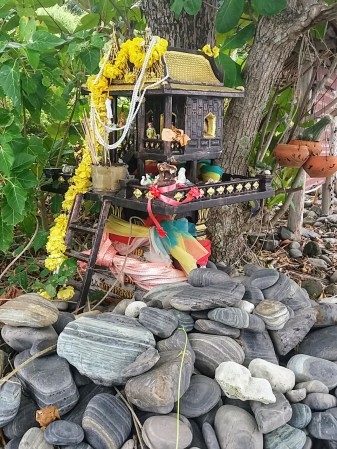 Since arriving in Thailand via Koh Lipe I had seen these tiny ornate houses on posts everywhere. I saw them on the remote islands around Lipe, near the caves of Bor Tor, in the cities, at gas stations, and in the front yard of homes we passed on the road. Some were simple, others like miniature mansions. Some had tiny model occupants while others were uninhabited. Nearly all of them had offerings of food, sweets, alcohol, or incense.


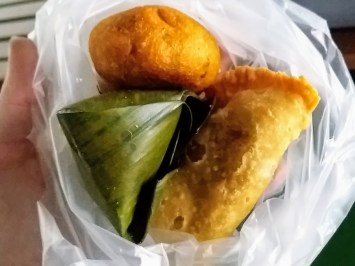 One was a glutinous rice ball wrapped in a leaf and filled with some kind of sweet coconut. The golden brown goodie was the one the husband most highly recommended: a spicy coconut bun in a wheat pastry (as opposed to rice) with a coconut filling similar in texture to the rice bun, but with a spicy kick. The coconut fillings were unique to my palate. It seemed like the coconut had gone through a ricer instead of a shredder. It was similar to vermicelli but also dried enough to be chewy without being crispy. The entire experience was delightful and I wish I’d bought 3 more!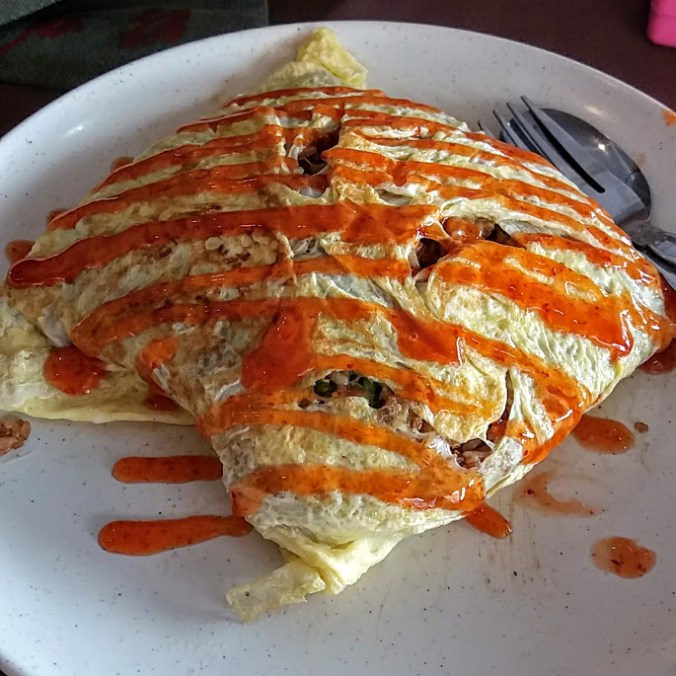
 The train from Ipoh to Butterworth was a delightful piece of transportation, and in retrospect, the last clean and comfortable transit option I would get on this trip. The train was spacious, sparkly clean and climate controlled with a nice view of the Malaysian countryside out the window. The train station in Butterworth is easy walking distance from the ferry terminal and bus station allowing me to take a quick detour and buy my bus ticket to Kuala Perlis. (there were only two running each day so I didn’t want to miss the morning bus!) Then I headed over to the ferry terminal to catch the quick boat over to the island of Penang. The ferry ride was brief yet delightful, with beautiful views of the cities and a cooling breeze.


 Laundry complete, I set off on a walking self-tour of the cheap clothes district. I am not normally a fan of shopping, but I have decided that if I am ever going back there, I need to do it with an extra suitcase. So many beautiful clothes, many inspired by Indian fashions, glorious batik fabrics and wildly reasonable prices compared to what similar fashions cost in the US. Skirts, shirts and dresses abounded, but pants were a little challenging. Free size is really a misnomer because it only applies to a size range from about 6-12 (US). the most popular pants seemed to be the Ali Baba style which are big billowy and flowy, but cinch around the ankle, looking not unlike the pants Aladdin wears.

 Eventually, I found some black pants that were a lightweight material and had a beautiful blue pattern around the cuffs. They were about 7$US, so I wasn’t overly concerned with the durability and I was delighted with the way they fit. Of course they were from India (I’m starting to believe all my favorite clothes are), but unfortunately, they are made of a material called “viscose”. I did not know what this meant at the time. I had never heard the word and I was so desperate for pants at this point, I didn’t really care. But later, while laying in the AC of my hotel room, I looked up the word and discovered the world’s most temperamental fabric.
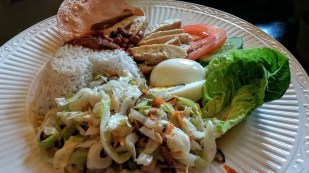 I tried to find some local-ish dinner food, but my travel weariness led me in the end to a little boutique restaurant near my hotel that was more expensive but also vastly more comfortable. Amid the offers of western sandwiches and pasta, I found a lone offering of the national dish: nasi lemak. Omnomnom.
 out for a beer in my new tropical get up. I got the impression that Georgetown is so popular among backpackers and expats for a combination of it’s strong western influence and plethora of cheap bars. (many places have a regular “ladies night” menu which are totally free or insanely cheap) I wasn’t particularly sad to leave it after only a short time, but I can see how it would be a refreshing break if I were on a multi-month trek of SE Asia, and I’d definitely love to go back for more clothes when I’m not backpacking.
 When I woke early that morning, I had only two main goals: to catch the morning train out of town and to track down the famous Ipoh “white coffee”. While chatting with the hostess the night before, she’d recommended a smaller coffee shop for me to try out instead of the main tourist one. She said that the Old Town white coffee shop had become too “Starbucks”, which as a Seattleite, I can totally relate to. (shout out to the
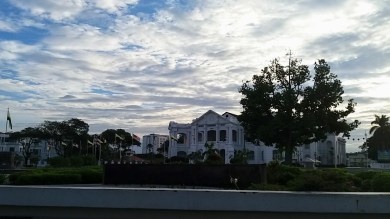
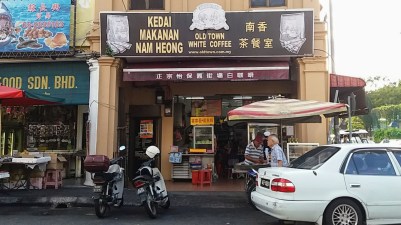 The town was very quiet early Sunday morning, so I enjoyed a leisurely stroll past some beautiful architecture and into the quaint “old town”. I had been advised to seek out a place called Nam Heong. When I found it, I discovered they sell the same brand of coffee as the high tourist cafe, which is simply called “Old Town White Coffee”. I have to infer that my hostess of the night before was referencing the atmosphere of the cafes rather than the coffee itself. Pictures I found online of the famous “Old Town White Coffee” restaurant show that it is a spacious and rather upscale looking place, geared toward the bougie and the Western tourist, while my experience in Nam Heong was a crowded hole in the wall filled with scurrying locals where I was the only white person. There probably is some difference in the drinks, since the brand itself was just the roasted beans, there’s almost certainly a difference in the price tag, and there’s a huge difference in local flavor. I don’t regret my choice for a minute.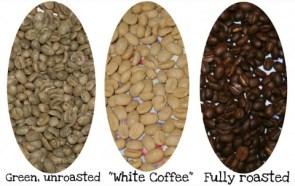


 (a side note on palm oil: don’t buy it. Seriously, I work pretty hard to be a responsible consumer. Palm oil is a product of major controversy right now because of the elephant exploitation in Thailand as well as the deforestation in Indonesia and Malaysia. It’s hard to exclude because it’s often improperly labeled, but please try to buy more sustainable and ethically sourced oils if you can. I was a little put out by eating it there, but in the end, my “locovore senses” took over and reminded me that if the Malaysians just grew enough palm oil for their own needs, then everything would be fine. It’s not an evil crop, but the high demand for it internationally has led farmers to damaging and unsustainable practices that harm the environment, and just so you don’t deride me for valuing orangutans over humans, the unsustainable farming practices are damaging the land and water those farmers and their families rely on, making the human future dim as well.
  My coffee and tart arrived promptly and were very inexpensive. The coffee was smooth and extra creamy (more than just because it was made with milk, I believe the palm oil roasting made the flavor smoother). While other coffee I’d had in Malaysia was aggressive in it’s “coffeeness”, slightly if pleasantly bitter, and coffee I’ve had in the US and Europe tends to have an acidic tang, the Ipoh white coffee was as smooth as coffee ice cream, but not quite as sweet. Also the tart was warm, flaky and not too sweet either. As a recovering HFCS addict, it can be challenging for me to find the balance of sweet that tingles my taste-buds without overloading my synapses, but I was left very satisfied by the experience at Nam Heong that morning. I shall think fondly of the coffee until one day I start my own tour company and make it a stop on the “Coffee of the World” tour package.
 I managed to order something by playing a sort of 20 questions with the waitstaff, and enjoyed my noodles and mystery meat in a not yet too hot outdoor dining area with views of the neighborhood. There were a startling number of funeral homes nearby and plenty of evidence of the British colonial architecture, although much of it was in disrepair.
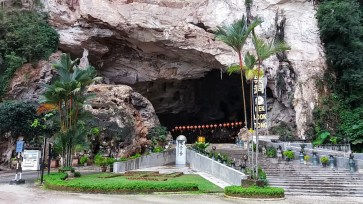


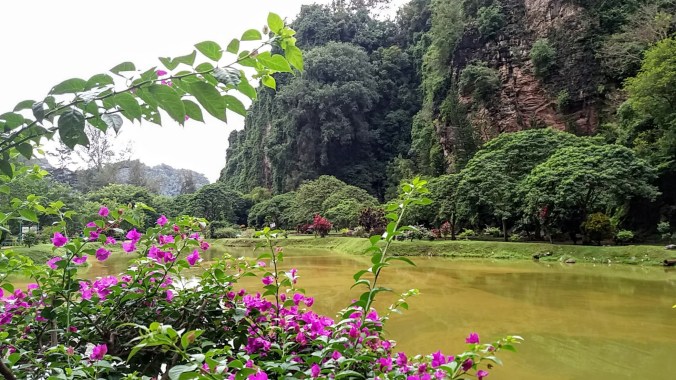


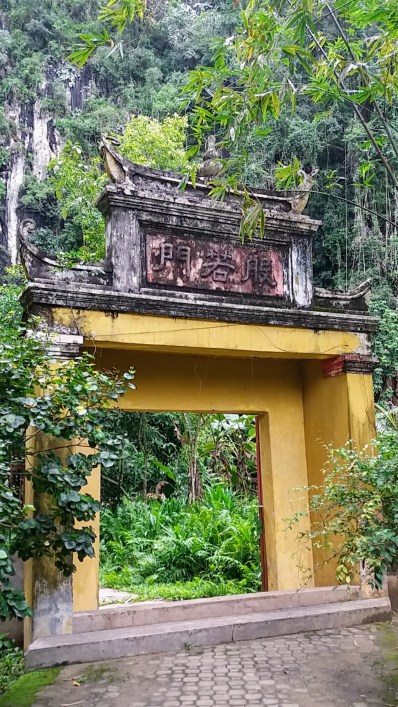 Sam Poh Tong is also a Buddhist temple and is said to be one of the busiest and most popular in Ipoh. I could tell it was an active temple from the freshly lit incense, but little else gave evidence that it was maintained or cared for. Even so close to such a large holiday, the grounds looked unkempt and abandoned. The huge numbers of underfed and skittish stray dogs was off-putting, but they were not aggressive. The garden in the front was a small lake with tiny “islands” that became miniature mountains holding tiny temples. As I walked around one side of the temple compound, I came upon a building that seemed long empty, covered in dust and bereft of occupation, yet there was incense burning at the dusty altars, observed it seemed only by me and some monkeys on the fence nearby.
 The walls were painted and florescent lights were on the ceiling, while piles of furniture and other stored items crowded the rooms. The floors were finished and there were windows and doors installed into the stone. It felt less like a cave and more like a basement.
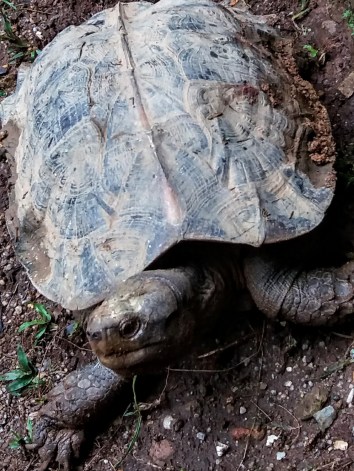
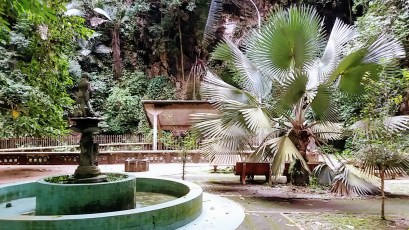 n the other side of the cave was a small enclosed garden. The walls of the garden were more towering limestone formations and the greenery within was Jurassic in scale and seemed to be overgrown with no concern for trimming or arranging, dead leaves carpeting the ground. There was a small turtle pond behind a fence filled with turtles of all sizes that could be fed fresh greens and veggies bought from a
  stand inside the cave. The stand and it’s sales person were some of the only signs of tending I saw. At the back of the garden behind a locked a fence and a forest of unkempt branches was a bright red pagoda that seemed more like something in an abandoned jungle than in a living temple.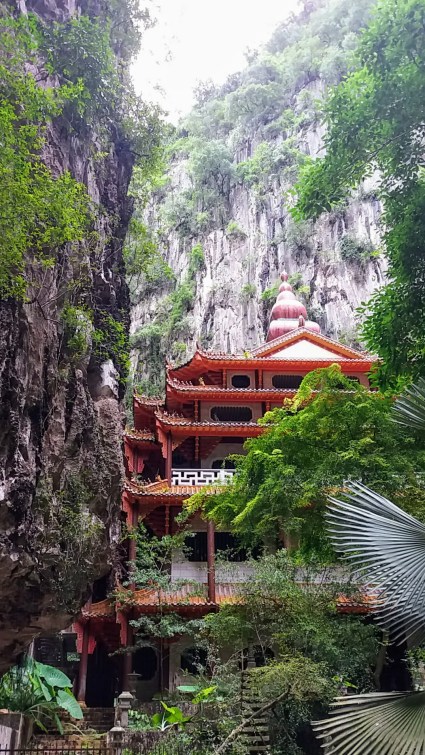
 I crept around the cave rooms from one altar to another, plastic cups and cleaning materials lay scattered around, the tile floor was cracked and uneven. I followed a treacherous staircase up a flight, but it ended only in a tiny window and more dust. It was so easy imagine that I was exploring a temple long forgotten, and then I would find a lit candle, or a smoldering joss stick or even a lone employee selling souvenirs. Outside once more, I continued on to the cemetery. In Buddhism, cremation is the norm, so there were small buildings in another alcove that housed the remains. Despite signs requesting that no incense be burned, there were sticks shoved around all the doors and soot marks as well. The buildings were grown over with moss and leaves, the paint peeling and the ground cracking under the pressure of new roots, yet the incense showed me that human presence was recent.
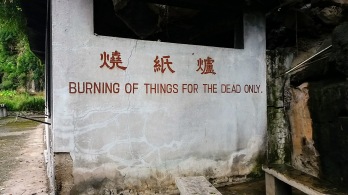 The farthest end of the compound was an area designated for ritual burning and another weedy and overgrown garden that seemed to be turning into a dumping ground. As I made my way past more dogs and tourists, I couldn’t help wondering at how this temple had been so highly rated by so many visitors when Kek Lok Tong was so clean and well cared for. I enjoyed visiting Sam Poh Tong, but it felt like an archaeological excavation rather than a place of worship.

 I looked it up to make sure it wasn’t something too scary, then ordered myself a bowl for lunch. Rojak just means “mixture” but fruit rojak is a common dish made of crisp (less than fully ripe and therefore slightly tart) fruits and veggies. Jicama, cucumber, mango, and apple are standard ingredients. The sauce is the magical part. The recipe gurus of the internet assure me it’s made with shrimp paste, hot chilies, sugar, soy sauce, and lime juice (with some regional variance). To me it tasted for all the world like molasses with chili, ginger and lime. I don’t know if mine was made with molasses or if that’s just what it tastes like when you mix soy sauce, shrimp paste and sugar together, but it was yummy!


 Just one gate over is the third and final temple on this street, Ling Sen Tong. This temple mixes Taoist and Buddhist imagery along with other folklore in a big colorful Chinese melting pot. It is an all singing all dancing color fiesta. There are beautiful facades of buildings and temples, giant statues in fresh bright colors, elaborate scenes of mythology played out, and everything was touchable/climbable so visitors were having a blast posing for photos. There was only one small, dark cave. The ceiling had turned black from years of candle and incense soot, and it was chaperoned by a figure whose offerings exclusively included alcohol (for some reason, especially Guiness…) I enjoyed exploring the many statues and hidden rooms. I even found this one guy who looks like he’s checking his phone in the bath! I’m sure there’s a better explanation for it, but along one wall was a series of statues in sunken pits that had all filled with water. I don’t know if it was meant to be a kind of wishing well or something else entirely, but this one in particular stood out to me.






 The morning after my late night and less than welcoming arrival, I woke up early, scarfed down my leftover convenience store sweet buns and took off to find the train station that would lead me to the Batu Caves. In recent years, the Malaysian government has added a train stop at this popular tourist attraction, and now it’s much easier to get to. The train itself was a new experience. When you purchase a ticket, you are given a plastic token with an RF chip inside. When entering the platform, you hold the token up to a pad to be read and it opens the gate, but hold on to that chip! When you disembark, you need to feed the chip into a slot to pass through the exit gate.
 I met a tour group on the train platform and we chatted during the train ride. I hung around with them and their guide to hear a few of the explanations offered about the caves. The guide rushed us past the dozens of sales stalls (saving us from souvenir swindles), gave a brief presentation under the statue of Hanuman (the Monkey King) and landed us in the main square at the base of the stairs and the giant golden statue of Murugan (a god of war, made of concrete and painted gold colored). There was a tremendous flock of pigeons in the main square and it seemed to be a major tourist attraction to stand in the flock and have them hop onto your hand to get some food. Occasionally construction in the background caused a loud boom that set all the birds a flutter, which was surprisingly pretty.


 After a few obligatory photos with the tour group and the giant statue, we began the climb. The stairwell is not insanely long, a mere 272 steps. They were so popular as a form of exercise that the government had to ban fitness use of the staircase to keep it clear for tourists and worshipers. With my kryptonite-like response to humid heat, the staircase became a long haul obstacle, but there were plenty of interesting things to stop and look at on the way up, like the expanding view of the courtyard and city below, the rock formations on the cliffs along side, and of course the hordes of monkeys roaming freely through the grounds. Given that the monkeys are wild, I was totally happy to keep my distance, but they were not shy and enjoyed coming right up to tourists or even forcing a showdown over who got to use the hand rails. At one point there were two monkeys perched on twin posts on either side of me and I managed to get a cute double monkey selfie, checking off a bonus square in the Batu Caves tourist bingo.
 When I finally got to the top, I was greeted with a large cave mouth opening that led to an even larger cavern. The entrance of the cave had small buildings installed for souvenirs and police. Once all the way inside, I could see that although this huge open space was graced with a few decorative statues around the edges, it was largely left in its natural state. The cave mouth was wide and there was a natural sky light further on, so the cavern was well lit. There were a few artificial lights in strategic places and an area of worship off to the left. Finally, there was another short staircase leading through to the open area beyond. At the top of those stairs was the rearmost chamber of the cavern, another broad space; however, the roof had long since fallen in and the walls soared up into open air, creating a round room with no roof.


 As I exited the temple section to descend the stairs again, I detoured off to the right to investigate a “dark cave”. The Malaysian government has taken this side section of limestone cave and created a conservation space. The limestone quarries and careless unregulated tourism of the recent past had wiped out a lot of the cave ecosystems. Efforts to restore the guano based ecosystem of living limestone caves are now underway in many parts of Malaysia and this cave was for both preservation and education.
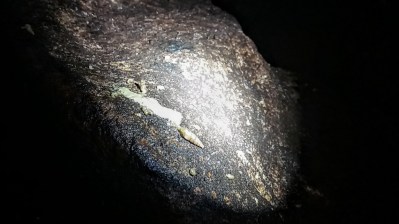 Nearly everything that lives in the cave is so tiny you wouldn’t even notice it if no one stopped to show you. When we see nature documentaries, there’s often nothing for scale, so it’s easy to imagine the animals as being similarly sized to their daylight counterparts. When our guide showed us a picture of the little white snail that lives on the rocks, I imagined a tiny snail, but not nearly as tiny as the ones we found! The biggest of the snails was about the size of a grain of rice, but there were smaller ones dotted around.


 As I descended back to ground level, I passed still more monkeys, several sets of mother and baby wandered around, and some tourists were feeding them peanuts (despite the do not feed signs). I noticed that the dominant males were very protective of their snacking rights and would drive off the mothers aggressively. Of course, no trip to a monkey colony would be complete without a little fornication. I happened to be standing right next to a female when a male walked up, took her butt in both hands and peered at it closely, then proceeded to mount her, much to the shock and amusement of tourists from 6-7 different countries. No, I did not take monkey porn pics.
 Farther on, beneath the looming statue of Hanuman we passed at the beginnging, was the Ramayana Cave. This attraction was much more highly reviewed and was only 5 ringgits to enter, so I decided to give it a shot. There is a stream inside the mountain that comes out and is used as part of a beautiful fountain depicting the chariot of Rama and Sita. If you’re not familiar with the


 but the main floor had a few shops and restaurants. I pulled into the first one I saw and confessed my massive ignorance of Malaysian cuisine, asking the staff for a recommendation. Moments later I had a heaping plate of some kind of fried rice dish that was smokey and pleasantly but not overwhelmingly spicy. Sometimes you just gotta walk on the road that looks more interesting.
 The hallway with the rooms was brushing my shoulders on either side as I walked through and was not wide enough to open the room doors all the way. It was also painted red and gave me a very eerie Twin Peaks vibe. The room was dirty, a soaking wet bath mat on the floor by the door and some kind of horrible mildew meets sewage smell coming from god knows where. I dropped my bags and went back out to the street to find food, but the street stalls were only selling fried things of a questionable nature and I couldn’t see any restaurants nearby. The midnight streets were dark, crowded and very dirty and also had rats scuttling around in the rubbish. I finally just got some yogurt and bread from the convenience store and went upstairs to sleep.
 Shortly after parting ways with the helpful Nigerian, I walked past what appeared to be a large open air food court. There was a roof and fans circulating air, but the entryways were wide open. There were dozens of food stalls from different nationalities, and tables to sit at between them. I went to one stall to get a fried oyster omelette and another for an iced coffee, then sat down to enjoy them. The omelette was a bit odd. In addition to eggs, vegetables and oysters, it turns out this dish is cooked with a variable amount of tapioca, potato, and/or rice starch. This just goes to prove I should have read more about the food before going, because the gooey texture combined with the heavy oil meant that I only ate about ¼ of the dish before I couldn’t eat any more. The coffee, on the other hand, was intense and amazing. I didn’t know it at the time, but Malaysian style coffee is different from other coffees around the world. I’ll explain more when I get to Ipoh, but for now, suffice it to say I was pleasantly surprised.
 After breakfast, I passed by all the tall financial buildings and came to the Marina. This beautiful stretch of waterfront goes on for ages with a wide and clean walking path. I came across a shopping mall on my way and decided to head inside for the AC and maybe a restroom. The Nigerian man I’d met advised me that if I ever felt too hot in Singapore, I could just walk inside any building to get some cold air. The mall was nearly empty, which is not surprising for a weekday morning, and I managed to find a 7-11 to get a cheap sim card (less than half of the airport prices). I also got called in to have a sample at two separate skin care shops. The first was a supernaturally charming young man who probably got nearly every woman he met to spend too much money on his skin care products. We chatted and tried out the product and eventually I had to demure from purchase, but he was gracious about it and said he’d had fun talking with me. The second shop was a Malaysian woman who was wonderful and gracious and kind until it became clear to her that I had really meant it when I said I wasn’t buying anything, and then she turned rather sour. Both shops products were in the hundreds of dollars range. It was somewhere around here that Singapore started to remind me of Dubai.
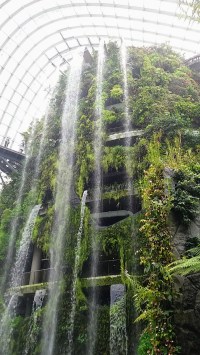 I walked more dockside paths and came across a science museum, more flowers than you can sneeze at, and finally some signs pointing to the garden path that was lined with sculpture, topiary and colorful blossoms. Although the Super Trees were my main goal, by the time I arrived at the park’s center, I was hot and tired. I noticed a cool breeze coming from the doors of one particular building and resolved to go inside that. The building was one of the two indoor gardens, this one called Cloud Forest (the other was closed for renovations). It was a massive greenhouse designed to house the ecosystem of a cloud forest, and so not only had pathways winding through beautiful flowers at ground level, it had a miniature mountain in the center that one could ascend and walk around via a series of skywalks that simulated viewing the forest from cloud level and treetop level.
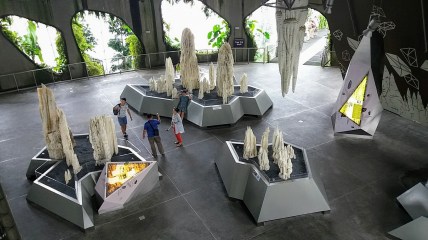
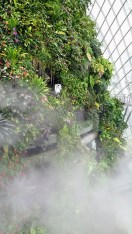 The time of clouding was approaching by then, and although the main path did not lead back upward, it wasn’t crowded, so I hopped into the elevator and rode back to the top. I get the impression that in more crowded times, the elevators might be more strictly regulated for the disabled, and the paths through the greenhouse lead firmly one way, but it wasn’t crowded and no one seemed to care if we went the opposite direction. Shortly after 2pm, the skywalk began to issue forth a mist as I set out for my second walk on the sky bridge and was able to enjoy the altogether different view as the fog enshrouded the walkway and the mountainside below.
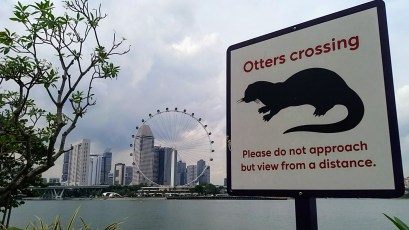 Nonetheless, the entire area of the marina is beautiful to walk through. I spotted some otter crossing signs, which are apparently no joke. The environmental reconstruction along the marina has enabled the local otter population to bounce back and they are often seen on the shores near the walking paths in the evenings. Sadly, I didn’t get to see any that day.
 After lunch, I decided i should go find the super trees. It was getting on in the afternoon, and I still had to get across town to the Night Safari for my 7:15 ticket. Although the tall and unique structures can be seen from nearly anywhere in the park, it took a little effort to find the right walking paths to get to them. There are two groves of supertrees, the smaller has only three, which at the time were undergoing a pre-lunar new year makeover.
 Eventually, I found the main grove and purchased my ticket for the sky walk. This is a little walkway that is accessed through an elevator in the “trunk” of the trees and lets you walk around the super trees at a good height to both admire them and the overall view of the gardens below. I had a nice walk and an even better view as well as some pleasant conversation with another traveler. No matter how nice the view is, I think my favorite part of traveling is meeting cool people.
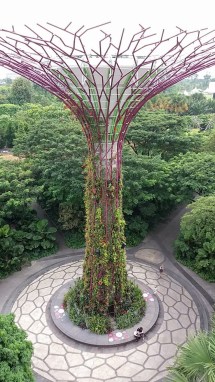 The super trees aren’t really trees. They’re man-made structures that sort of look like giant alien trees. They run on solar power and support a large amount of plant and animal life. Plus they light up at night, which is pretty. The super trees are urban art, but more than that, they are a way of combining city and nature and of providing a space for the plants and animals that would otherwise have been disrupted, or even endangered by the urbanization of their homes to have a place. The super tree grove helps to act as a greenspace, cooling and cleaning the air naturally, as well as collecting solar energy and rainwater that are used in running the indoor gardens. It’s basically a big experiment to see if a city can be a modern urban environment AND maintain a natural ecosystem in an economically sustainable way. I hope it catches on. More cities should have giant trees, beautiful flowers, and river otters.
 Gallivantrix