It’s no secret that my tenure in Senegal has been a challenge. I got back from Zanzibar at the end of February feeling like I might have a chance at emerging from the blackest depths of culture shock rejection into the somewhat calmer waters of acclimation. I found some new friends; I met some local teachers who wanted to involve me in their professional development activities; I enjoyed the spring weather; I was excited about finally having real classes at the vet school where I might see the same students on a regular basis and be able to develop rapport enough to learn about their lives, and I was really looking forward to the new project my RELO said she would help me start doing more teacher training at the Embassy. My new outlook was to be short lived, however, as just two weeks after returning to Dakar, the troubles started.
Some Context: 2000-2022
Senegal is considered to be West Africa’s Most Stable Democracy(TM), and has been enjoying the very relative peace and prosperity that comes with that honor for about 23 years give or take. The first “free and fair” election held in an independent Senegal was in the year 2000. Before that, elections were limited with by things like bans on any kind of opposition to the sitting president, limited voting rights, etc. Before that they were French occupied, so… Anyway, that first president freely and fairly elected from an opposition party, and peacefully transitioned into power held his office from 2000 to 2012, when the current president, Mackey Sall took over. Cue the drama.
Senegal has an electoral system in which if no candidate wins a clear majority, a second round of voting (a run-off) happens between the top two. Sall was #2 with 26.5% and the incumbent was #1 with 34.8%. Then Sall went around to all the other candidates who lost and said ‘hey, if you tell your supporters to vote for me, I’ll change the presidential term from 7 years to 5 years, and implement a 2 term limit’ (things a lot of people wanted). It worked, he won. Then he decided maybe his first term wasn’t the best time to change the term length, so he served 7 years and won the 2019 elections, in which his biggest opposition was barred from running over some legal trouble. Sall won that largely uncontested election with 58% of the vote.
In 2020 Sall suggested he might run for a third term after all, just six months after signing a law which abolished the post of Prime Minister of Senegal, (consolidating his power as president) and this made people understandably upset. Ousmane Sonko had already gained some popularity in the 2019 elections, and was making a lot of noise about the trend of power abuses going on. In 2021, Sonko was arrested for alleged rape, sparking the first wave of the current protest movement. Clashes broke out again in June 2022 after authorities invalidated the opposition party’s candidate list for the legislative elections, and that unrest also resulted in several deaths.
Spring 2023: The Trial & The Appeal
Fast forward to 2023, Sall was accused of defamation for talking about corrupt officials and brought to trial. The new charges were seen as an attempt to once again remove Sall’s biggest opposition from the race, and a third wave of protests erupted in mid-March (just two weeks after I got back to Dakar).
March 14: My teacher’s meeting was postponed from the 15th to the 22nd to make room for the protests. Email alerts started coming in from the Embassy describing the unrest and cautioning Americans to be extra careful.
March 15: The email alerts become more serious as the day wore on, warning of road closures, looting, and tear gas.
March 16: A “stay home” stern request from the Embassy was issued, and the University cancelled classes. Updates of the situation described burning tires, shop looting, police shooting tear gas, protestors setting up barricades, fires set on state owned buses, and shops burning. The trial was postponed two weeks because Sonko was injured while getting to court
March 17: Amnesty International published an article explaining the key issues and human rights violations
March 20-22: A teachers’ strike called for the release of the teachers who had been detained and arrested at the protests.
This experience was a little scary and disruptive. My classes were cancelled, the professional development events were put on hold, and I chose to skip out on social events because I didn’t know how bad it might be in some areas of town. The local pub owner (a long term expat) gave me a bit of a hard time about it, saying it was really blown out of proportion, but it was hard to get accurate news because journalists were being arrested. Eventually, my school and many others simply decided to start spring break early rather than deal with the uncertainty of safety, road closures, or online learning.
(Do not even get me started on the crazy privilege that is telework/tele-education in a country like Senegal with limited access to the internet and technology, rolling blackouts, service cuts, and overall poverty. People tell me they did it during COVID, but given how awful that was in Korea which has the wealth, technology and free public Wi-Fi all over the place, I do not imagine it was a success here.)
In the rescheduled trial, Sonko was found guilty of defamation, but his sentence was basically a slap on the wrist that would not prevent him from running in the upcoming elections, and things settled down for a couple weeks until the appeal trial started in mid-April, resulting in more protests and more cancelled classes.
Meanwhile, I was still trying my best to live a happier and more well adjusted life in Senegal, clinging to my post-Zanzibar mood renewal. I had a few classes that weren’t cancelled where I really enjoyed the students cheerful attitudes and learned a small but treasured amount about their own lives and cultures (not all my students are Senegalese). I went out for meals with friends and returned to the pub for trivia and karaoke. One especially memorable night when karaoke was suspended for Ramadan (out of respect for the neighbors) we gathered around the pub owner and a band mate with a couple of acoustic guitars and sang for hours. I struggled still with the school resources (not enough) and the overall quality of life in Dakar with it’s rolling blackouts, random water cuts, and rampant indoor insect population, but I was getting better at finding balance.
Ramadan ends in the holiday of Eid al-Fitr, called Korité in Senegal, which started on April 21st this year, and there was a 5 day celebration, so protests were less intense and people were in a better mood for a while, but it also meant that instead of my classes being cancelled for protests they were not scheduled because of the holiday. It went: protests, spring break, protests, Ramadan, protests, Eid — meaning that I only saw students a couple of times during the spring if at all. In some cases I went as much as 6 weeks between meeting with a group of students from one class to the next.
May 2023: the Next Trial
Sonko was next facing the trial for the rape allegations laid against him back in 2021. This is a touchy subject because it is important to believe women and hold sexual predators accountable, but also, it does look quite shady when there is a pattern of Sall’s political opponents being subjected to legal attacks that removed them from the elections. That trial date was set for the end of May. In the run-up, we saw smaller protests and demonstrations around the city. Classes were cancelled yet again as more and more students attended demonstrations on campus, attracting police responses in some cases.
What I now know is that Sonko was tried in absentia and although acquitted (found not guilty) of rape, he was found guilty of “corrupting the youth” and sentenced to 2 years in prison. I am not a lawyer, and even if I were, Senegalese law is different from the laws of my home country. However, there are some elements of the story that cast doubt on the legitimacy and legality of the proceedings.
In absentia assumes the defendant chose not to come, but Sonko has been prevented from leaving his home by government forces surrounding and blockading him in. These same forces are also keeping all visitors out and restricting his access to phone and internet connections, including his with his lawyer. Is right to council not a thing here? Is this not a textbook example of unlawful detention? Also, he was convicted of a charge that he wasn’t on trial for, which again, just seems like poor jurisprudence to me, but I’m not an expert. I look forward to a time when I can read a detailed explanation filtered through some legal experts to clarify it all.
At the time, however, I was oblivious to all of it, barely paying attention to the reason behind the clashes beyond “more election stuff”. Social events continued even when classes were cancelled. We had a really great turnout at the Embassy when we reopened the American Center to the public and had over 450 Senegalese in attendance. I thought it was all just small demonstrations localized to the campus and a couple neighborhoods. Even when my scheduled Embassy event for May 31st was moved online, I just thought it was an abundance of caution. I was so tuned out of the social climate that the day after this very controversial court ruling, I went out for my regular Thursday night on June 1st.
June 2023 : Dakar is Burning
The ride up from my apartment to the pub that evening was eerily devoid of traffic, and the usually bustling business strip where my pub lives was almost empty. It was deeply freaky and made me question my life choices. I had drinks with two New Yorkers and one Saudi diplomat (the only other customers in the place so we sat together). We noticed that social media was not loading, but chalked it up to spotty service. When it was time to go home, I realized there were zero cars on either ride share app, so I overpaid for a taxi home along more eerily empty roads.
Once home and on my Wi-Fi network, I got error messages from Facebook until I turned on my VPN. Further poking around showed me that not only Facebook and Messenger, but also Instagram, TikTok, Twitter and WhatsApp (the primary method of communication here) were not working from Senegalese IP addresses, but I had no way to know the details until the next day when I found confirmation that the government had initiated a social media blackout.
The next few days were intense. The streets were empty; the shops were closed; motorcycles were banned on the streets; the police, gendarmes and military were out in force. I saw videos of SWAT clad police holding children in front of them while they hurled rocks and tear gas canisters from behind their human shields. At least 16 people died, many due to the use of live ammunition by police and government forces against protestors who were armed with nothing more than rocks and boards. More than 500 people were arrested, many in arbitrary arrests which further violates human rights.
The internet blackouts went from social media to all mobile phone data access, meaning that once I set foot outside of my Wi-Fi range, I was cut off. Most Senegalese didn’t even have Wi-Fi access. Students were fleeing the burned and ravaged campus, trying desperately to get buses back to their family homes, but many didn’t have the money for tickets and were cut off from receiving digital money transfers or crowdfunding options. The university closed indefinitely. This CNN One World video may be the best English language video coverage I have seen about the situation.
It was scary to be in the city knowing all this was going on outside my apartment walls, and yet I was objectively safe. I live in a quiet neighborhood with no banks or large shops nearby. We are not a target area. I had Wi-Fi and VPN access to the internet and social media. I had been on a grocery run a few days before and was well stocked upon food and bottled water. My friends asked if I could leave and it was hard to explain that I was safer inside than trying to get to the airport (that road being one of the target and occupied areas). I spent the days alternating between numbness and panic attacks, trying to follow the story in case it changed and I needed to get out suddenly, but also trying not to let the flood of news and images send me into a spiral.
Although the main campus had closed, the veterinary college where I teach (English) tried valiantly to remain functional, sending out schedules and announcements through the weekend. They tried to move classes online, but the government shut down of mobile internet made it impossible, so they suspended classes for the remainder of the week. I worried about my students, where they would live without access to student housing, or what they would eat with the campus cafeteria closed. Especially I worried about my foreign students from neighboring West African countries who might be more accustomed to violence and instability, but are far from their families and support networks.
The mass arrests and extreme crackdowns did result in quieter streets, but as more and more foreign news agencies and human rights watchdogs were able to sort out the details, international pressure mounted. On Monday the 5th, I ventured outside to visit my local boulangerie and supermarche and I was encouraged to see traffic, including taxis and horse cards, street vendors, and construction workers. By Wednesday June 7th, the mobile data was restored, but social media remained blocked for another day. That Thursday, the Anglophonic expat community gathered for trivia night at the pub and generally tried our best to shake it off, knowing that the troubles were far from over, but finding relief in the breath of normal we could take in the moment.
There were planned gatherings for that weekend, but the government officials denied them permits, citing improper paperwork and public welfare, finally resulting in a general ban on all public demonstrations.
During the worst of the violence (June 1-3) the main university campus was ravaged. Buildings including the library and archives were burned, and the campus remains closed. My vet school is physically very close to the UCAD main campus, but isn’t large enough to have attracted any of the destruction. So, while the university remains closed with courses suspended, my school resumed online functions, reserving in person meetings on campus as deemed necessary for practical courses and oral exams, but limiting it to the hours of 8am to noon. We are now in the final week of the semester, and my English classes were bumped from the schedule entirely to make way for the make up courses of core curriculum, which is honestly just as well because I was really struggling with how to make the content viable online to students with limited access to technology and internet.
Waiting for the Other Shoe
We are fast approaching the holiday of Eid al-Adha, called Tabaski in Senegal, which is a big one. I read an article that sheep and goat farmers were considering not bringing their livestock to Dakar if they didn’t get some assurances that the violence would stop. Sacrificing a sheep or goat is a big part of the holiday celebrations, so they’ve been breeding extra stock and rely on the income to survive the leaner months. I don’t blame them for not wanting to risk all that; however, I’ve seen a LOT of extra goats around town in the last couple days, so I’m guessing they worked it out.
The population may have settled on a decrease in tensions for the holiday (June 26-July 1), but everyone knows it can’t last. Sonko is still under unofficial (illegal?) house arrest, having not yet been arrested officially nor officially presented with his sentence. The administration is under investigation internationally for human rights violations and the use of excessive force against it’s own population, and Macky Sall has floated the idea of pushing the election back a further 2 years (giving himself a second 7 year term instead of the newer 5 year limit) all while refusing to adhere to the 2 term limit he himself helped to establish (claiming that his first 7 year term shouldn’t count towards the limit because that law was not in place when he took office). This space opera is far from over, and as far as I and many others living in Senegal are concerned, this temporary and fragile peace is just waiting for the drop.
Going into Northern Ireland I was not really sure what to expect. When I was growing up, the North was known for it’s hard life and angry militant (terrorist?) political movements: The Troubles. There are three great reasons to visit the North: the stunning natural beauty, the unique and historical culture, and Game of Thrones. That last one seems a lot less important after the series finale aired disappointing literally every fan, but dragons are always cool. Today’s post focuses on the culture and more recent history. I wrote a much more detailed account of the two Irelands what seems like an eon ago (before the Plague), and while I prefer to focus on my experiences while traveling, sometimes those experiences include some painful history and deep thinking.
Belleek Pottery
The first stop on my road trip after crossing the unimposing border (marked mainly by the sudden change from Euros to Pounds at the petrol stations) was the Belleek Pottery factory. I didn’t know anything about Belleek Pottery. I know we had some in the house growing up, but I guess it went with my stepfather when he did.
Founded in 1857, it is the oldest pottery factory in Ireland (either of them), and was initially started because of the availability of special mineral ingredients locally. Eventually, it became more common to source materials from Cornwall or Norway, but the unique Belleek style has continued to make the pottery famous and sought after.
The factory was in holiday mode during our tour so there were only a few employees on site. Perhaps this made for an emptier experience, but I thought it was nice to be able to focus on a single work table or look closely at the pottery without being rushed or in someone’s way. Our tour guide walked us through the process of making the beautiful and unique ceramics from the artistic conceptualization to the making of molds and refining of pieces. We had the chance to see workers attaching separate pieces and refining the details from the mold by hand. We were also offered the chance to break the rejects, since the factory will never allow “seconds” or flawed pieces out into the world.
However lovely the molded pieces are, they are as nothing compared to the beautiful hand crafted flowers and lacy woven baskets that represent iconic Belleek. We had the chance to see some of the craftspeople at work on these fine details. The flowers and detailed add ons are simply stunning tiny craftsmanship, but the weaving was simply the most unique. The clay used for the basket strands is blended in such a way to make it slightly elastic and so less likely to break when manipulated over and over. Don’t try this with your regular clay in pottery class, kids.
The painting center was no less beautiful. Each finished piece is painted by hand to give a unique finish to every piece and to make sure that the little green shamrocks are just right. At the end of our tour we were let out into a small museum showcasing the evolution of Belleek styles over the years. The special pieces showed even more detail in the handmade flowers, but my absolute favorite was a pearl glaze that was only in fashion for a few brief years.
I doubt I would have chosen to tour Belleek on my own, but nonetheless, I did enjoy the trip. Non-solo trips can be a mix of “well, I wouldn’t have picked that myself, but cool”, and “yes, please!” kinds of stops. While Belleek was the former, Bushmills was definitely the later.
Bushmills
Bushmills has been in my family and house for as long as I can recall. It was my grandmother’s whisky of choice and hers was the immigrant family with some deep dies to the Irish diaspora culture in America. She passed when I was 17. It was a very sudden turn from being old and chronically ill, but lively – to hospitalized, comatose and gone. I know, morbid, but it was about a week of me sleeping on the hospital room floor and then it was over. Her children (my mom, aunt and uncles) and I shared out the remains of her last bottle of Bushmills while we told stories about our memories of her. Bushmills holds a place in my heart as well as my tastebuds.
There is no photography allowed inside the distillery to protect their trade secrets, but we had a fun tour that took us from mash to cask. It was very interesting to me to do this after my lovely brewery tours in Belgium since the basic process to start both beer and whisky is very similar. The malting, mashing, and fermenting is more or less the same (a great deal more similar than to wine-making), the shiny and hot copper stills is where spirits take a hard (pun intended) left turn from beer.
The still room in Bushmills felt like walking into a sauna. The entire room was warmed and steamed as the low alcohol “wash” is heated and pressurized into boiling at about 78C (much less than the boiling point of water). This causes the alcohol to evaporate where it is caught in the tubes and condensed back into liquid form in a new reservoir while the water remains in liquid state below.
Amid the giant copper contraptions was a small and extremely climate controlled glass walled room where a further refinement process took place in small batches under intense supervision. Neither the large copper nor the smaller stills can be left unattended, so a highly trained employee has to spend hours a day in that hot and sweaty room just to make sure that the resultant distilled spirits are correctly balanced and purified.
The main method of distillation is well known and basic still kits can be assembled fairly easily (that’s where moonshine comes from after all), but each of the worlds best distilleries has a few proprietary methods and Bushmills is no exception. The tour guide did an excellent job answering all my questions about the science without giving away any trade secrets.
(The photo is an old copper still on display in the tasting room.)
After the stills, it’s still not whiskey. The magic that turns white lighting into that dark amber ambrosia is cask ageing. This might be my favorite part of any alcohol tour (ok, except for the tasting) when we get to enter the cool and dark rooms filled floor to ceiling with dark barrels and simply redolent with the luxurious smells. Our guide explained the different types of casks used to flavor and age the whisky and showed us examples of the changes in color and volume over time. Not only does the wood of the cask color and flavor the alcohol, but the alcohol leaks out through the porous wood over the years. This loss is referred to as the Angel’s Share (I guess Irish Angels like a wee dram, too) and in areas like Ireland accounts to 2-3% loss per year. A 50 gallon barrel can be reduced to less than 15 gallons in a 25 year age! Those heavy price tags are not only taking into account the amount of time the whisky must be stored before sold, but also the sheer volume of alcohol lost to the angels.
However, the longer it ages, the more the sharp and harsh flavors of the distilled moonshine soften and the more of the flavors of the wood become absorbed. Mostly 10-12 years is enough to get a good mellow flavor for the non-aficionado. Less if you’re planning to mix it with (shudder) coke. In addition, some of what evaporates is yet more water and the finished product of maturation can be between 115-150 proof. But wait, Kaine, I’ve had Bushmills and it’s only 80 proof, what gives? Well, the factory puts some lovely fresh Irish spring water (honestly I don’t know where the water comes from, but it sounds nice?) into the mix before bottling to create a consistent and ideal proofing. This is for two reasons: product consistency is super important to a brand, so they do need to be sure that all bottles are the same. Second, and to my mind more importantly, you simply cannot enjoy the taste of the whisky at 150 proof! Even 100 proof is pushing it.
The great debate about whether you should add water to your whisky is almost hilarious in this context, knowing that the distillery did it for you. However, 80 proof is simply their best guess where most people would be able to enjoy the flavors ideally, so if you wanna add a little water to enhance your own flavor experience, go for it. Bushmills itself served a small pitcher of water along side the whisky in the tasting room for just that purpose, so obviously they don’t mind.
I really enjoyed the 12 year distillery reserve (lower right, sky blue label), a unique flavor profile and of course not sold anywhere but the distillery… literally, not even in the duty free shops. I heavily debated buying a bottle but there were no small sizes and I knew that without the duty free sealed bags, I’d have to try and lug it in the checked bag, not to mention lugging it around the rest of my Ireland trip (not even half over yet), and the fact that if you want to bring more than 1L of booze over borders you have to figure out how to pay them taxes (not a huge burden, but …). A smaller bottle would have meant easier packing or just enjoying it in Ireland, but alas. I did end up with a bottle of the fantastic Dingle Peninsula Gin from the duty free, which almost makes up for this loss.
Derry
Also known as Londonderry, it is the second largest city in Northern Ireland and home of The Troubles. I am going to have to get political/historical again because almost all of the major landmarks in Derry are related to the Troubles in some way or another.
The first big one we came upon was the Peace Bridge: a beautiful bridge that eases pedestrian traffic and makes for a lovely riverside view. It’s easy to think of the clashes in Ireland as being in the distant past, but they are not. The Peace Bridge was only built in 2011 and it’s construction was an attempt to ease communication and interaction between the unionists (stay in the UK) ‘Waterside’ on the east bank and the nationalists (join Southern Ireland) ‘Cityside’ on the west bank.
Mere steps from the riverside is the Guildhall. This is an iconic work of architecture built originally in 1890 to be a ceremonial government house / town hall. It’s been destroyed a couple times in fires or bombings, but the restoration project of 2012 has been very successful. To be honest, I thought it was a restructured church given it’s beautiful stained glass windows and enormous pipe organ, but I’m told it’s intention has always been secular in nature. There were several memorials inside dedicated to those who fought (and died) during various stages of revolution against the British occupation. Since at the moment of writing this, the unionists still outnumber the nationalists, that occupation is ongoing, and while the conflict hardly ever results in whole historic buildings being bombed these days, it is far from over.
However, even if you aren’t interested in Irish history or politics, the Guildhall is worth a visit for the exquisite stained glass in every available window.
Bogside Murals
From the Guildhall, we headed over to the Bogside neighborhood to see the murals. Bogside is … perhaps more politically relevant in 2020 (as I write this) than it was when I visited a year ago. The global Black Lives Matter protests against police brutality have highlighted clashes between state sponsored police and citizens who are tired of being treated as less than.
I gave my own detailed account of the IRA in the Two Irelands post before, and then as now, I ask people to remember that any comparisons between the Troubles in Ireland and the BLM protests in America should only be examined as “shitty police state problems” and NOT used as a way to compare white (Irish) struggles to black (African American) struggles. Just. Don’t.
For those less familiar with American culture, it is a common white supremacist tactic to argue that white Irish immigrants in America had it just as bad or worse than black slaves (lol). Lots of really well meaning white people get caught up in this because at first blush it sounds very reasonable. It isn’t. (You can find more details here,here, and here as a starting place.)
In this case, the discriminated against minority were the Catholics who had all manner of extremely bigoted laws passed to keep them down including limiting their employment, education, marriage and property access. It was only marginally a religious issue, as the lines of unionist and nationalist were also generally drawn along church lines. The nationalist Catholics were understandably pissed about it. When protest marches were banned, some marched anyway and were brutally attacked by the police. This was in 1968 so the actions of the police were filmed and shown on television, prompting demonstrations of solidarity at the Guildhall and elsewhere.
As the civil unrest went on, off duty police officers in plain clothes attacked protesters who were involved in marches or demonstrations. Uniformed on duty officers refused to protect the protesters from the assault. By January of 1969, police were breaking into protesters homes to assault them and the residents of Bogside erected barricades to keep the police out, declaring a “Free Derry”.
Enter “The Apprentice Boys”. I cannot make this stuff up. No, they aren’t an obviously white nationalist group like the Proud Boys, but… come on. They are a Protestant fraternal (men only -read: patriarchal) order, however, and at the time in 1969, they enjoyed keeping those dirty Catholics “in their place”. Something something shoe fits.
The annual Apprentice Boys parade in August 1969 came so close to Free Derry that a fight erupted. Guess which side the police took. The police effectively dismantled the barricades, letting the Apprentice Boys into the neighborhood and leading the Catholic residents of Bogside to include the police in their targets.
A three day riot ensued. The neighborhood was flooded with tear gas and well over 1,000 residents were injured in some way. Police from neighboring areas were brought in, but due to a severe lack of training, they only made it worse. On the third day, the British Army came in and basically separated the three sides: Apprentice Boys (Protestant), Bogside residents (Catholic) and police (Protestant) — while allowing the Bogside residents to maintain their barricades (probably the only reason it worked).
Free Derry was maintained for three years by armed IRA soldiers patrolling to keep British soldiers and Irish police out. This was not a time of peace, but of intensified armed conflict between the British state and the IRA. Free Derry was eventually dismantled after the massacre of Bloody Sunday where 14 people (13 outright and one later from injuries) were shot down by British soldiers during a protest march against the practice of imprisonment without trial. The soldiers were exonerated on the basis that they claimed to be shooting at armed targets.
If I took out the names and dates, these details could be from any number of American cities in 2020. I will not apologize for the comparison, or for getting political in my blog. We are repeating historical mistakes by continuing to find those among us to “other” and diminish based on pseudo-science and hate-fueled religious arguments. Derry may be a lovely place to have a holiday now, covered with boutique shopping and delectable cafe eateries and pubs, but 50 years ago it was a bloodbath as those who strove for equal rights were murdered by those who valued the status quo.
Do I like the bombings, the riots, the violence employed by the IRA? No… but I understand it – why it happened and why it was necessary to achieve equality under the law. What you would do if your country made it so you and your family always have less, are always be behind or under someone “preferred”, and allowed to be beaten or murdered without consequence after decades of peaceful protests and political marches were systematically ignored or criminalized?
I hope that America listens to BLM before it gets any worse because the result of these kinds of clashes are decades of pain and destruction. There is no question that the history being remembered here is one of state sponsored oppression and violence. You cannot visit and be unaffected by the striking contrast between the now peaceful streets and the murals dedicated to the fallen.
History kept alive in the neighborhoods affected serves to remind us what we are capable of as a species, best and worst. If you travel the world and you skip the hard parts, you’re missing out on a magical opportunity to open your mind and grow your heart. Thanks for coming with me. Stay safe, wear a mask, wash your hands, destroy systemic forms of oppression and end police brutality.
When I was in China in 2008 and teaching this class on American Newspapers and Magazines, I walked a fine line balancing between American concepts of free press and Chinese, uh, absence of these thoughts. I generally stuck to fluffy topics like sports and fashion and celebrity, but then in March there was a riot in Tibet. It was on the state sponsored Chinese news. It’s also the reason I didn’t get to visit Tibet that spring. However, in my naivete, I thought that anything on Chinese news was fair game and I brought it up in this newspaper class only to run straight into a giant red wall and my first hard lesson in government censorship.
Mar 24, 2008 at 8:39pm
Tibet in the News
First of all, I’m fine, the whole thing is happening on the other side of the continent. I may not be able to travel there like I wanted, but I’m in no danger here.
DO NOT PUT YOUR OPINIONS ABOUT TIBET ON MY WEBSITE. (this is not for my sensibilities but because the internet police are a real thing here)
I thought it would be ok to discuss with my students, since I saw it on the Chinese news, but apparently not.
I am not able to go into the history of Tibet on this page, but I what want to share here is…
The Chinese Perspective
Tibet has ALWAYS been a part of China.
I asked my students to tell me when it had first been, and they could not give a date, even though we discussed China from the Qin dynasty forward.
The brown area is the Qin territory. It is the first time China was unified under a single government, and it doesn’t even share a border with Tibet. The Chinese government teaches this map as history… but Tibet has always been a part of China.
In 1950, the Chinese army liberated the people of Tibet from an oppressive and cruel imperial regime under which they suffered greatly. The Tibetans welcomed their Chinese liberators and the REUNIFICATION of China.
The people who are rioting are:
1) under the orders of the Dali Lama
2) not really protesting over religion or independence, but only want to disrupt social order and make China look bad.
3) are using the Olympic timing to capture the attention of the world (they don’t say for what, but rather emphasize that they are trying to destroy the image of the Olympics with violent behavior, and distract the world from the Olympics)
4) possibly PAID to inflict violence as mercenaries in a political conspiracy.
This is a Tibetan man burning himself to death in protest of China’s policy toward Tibet. It’s from 2012, in New Delhi. There are no pictures from inside Tibet during the March 2008 riot except those released by the Chinese media to uphold the official story, but things like this, as well as massive police brutality, and government sanctioned executions are rumored to have taken place.
These riots should be ignored. We should not let ourselves be distracted from the true spirit of the Olympics by their behavior.
The Chinese government has provided tremendous aid and relief to the people of Tibet, raising their standards of living, freeing them from oppression, etc. and the Tibetan people are surely grateful. These riots do not represent the will of the people.
And finally, MIND YOUR OWN BUSINESS. Foreign travelers and reporters have been asked to leave the provinces of Tibet, Sichuan, Gansu and possibly others because its no one else’s concern, but an internal Chinese affair.
East vs West
If your brain is in knots, don’t worry, its hard to see things from the other side. But in trying to understand it, I reached a fundamental conclusion.
The Chinese say that there can be no freedom without peace, and the Americans say there can be no peace without freedom.
This may not seem like a big difference, but I assure you, it is HUGE.
One student told me that they will accept a lack of freedom because the most important thing is survival, and that only once economic prosperity was assured and the survival of the people was no longer at stake could they worry about thier freedoms.
I said that for Americans, survival without freedom isn’t worthwhile.
Another student told me that the Chinese were just waiting for the people of Tibet and Taiwan to accept the One China policy, because only when there is one unified China can there be peace. She referenced the ideology of Emperor Qin who fought like crazy to unite China (for the first time, 2200 years ago) because he believed that only if the warring states were united could there be peace, and he was willing to spend his own life fighting so that there would be peace in the future. (Check out the movie ‘Hero’ if you haven’t seen it).
This idea, that we must fight now for peace later is close to the American one, but the root of it is submission.
I believe both our cultures value peace, and both will fight to create and defend it, but what we are willing to sacrifice to get it, and what we believe makes life worth living are diametricly opposed.
“Gentlemen may cry, Peace, Peace– but there is no peace… Is life so dear, or peace so sweet, as to be purchased at the price of chains and slavery?… I know not what course others may take; but as for me, give me liberty or give me death!” — Patrick Henry, 1775
My brain had some hardcore cognitive dissonance reading this post today in 2018. On the one hand, I’ve certainly become less mono-focused on American cultural values (although I’m sure they will always be a part of me). On the other, I read the line about violent protesters being paid to incite riots and went… Fox News says what?
I look at the current American sentiment and it seems like the assessment I wrote here has somehow been taken to the absolute extreme. While the Chinese are gradually becoming less willing to sacrifice the freedom of today for the security of tomorrow, the Americans seem to be willing to sacrifice everything at the altar of absolute freedom. And yet, despite this, we are burdened with a spin cycle that paints protesters who claim to be “against fascism” as paid inciters of violence rather than actually dissatisfied citizens just the way that Xinhua news did with the protesting Tibetans.
I saw then what it looks like when citizens believe the “alternative facts” presented by their government so fiercely they cannot see the holes in the story, and dismiss any contradictory evidence as fake propaganda. I saw it then, and now I realize why it looks so familiar.
August 19, 2017. Boston. According to ABC News where I found this picture, these brave police are protecting free speech advocates from violent socialist counter-protesters. Has anyone seen my dog whistle?
This week more than usual it is apparent to me how much I am not like journalists. I came back from Seoul feeling happy but tired and spent Sunday resting and doing laundry so I could go back to work Monday morning. I watched article after article come out online about the event while my own writing languished in rough draft state and my photos sat unedited. I sometimes wish I could be more timely, but then I remind myself that this is my hobby. No one pays me, and no one sets the deadlines but me. So, here it is, a week later: Queer Pride in Korea. Don’t forget to check out the full photo album on Facebook!
Late For a Very Important Date
I wasn’t sure I was going to make it this year. Some people weren’t sure there was even going to be a Pride this year. Of course, every single year since the first festival/march in Seoul in 2000 the conservative religious zealots have tried to stop the Korean Queen Culture Festival (KQCF aka Pride) from happening. They try to file legal objections. They try to file use of space applications for the same day. They throw temper tantrums and accuse foreigners of bringing homosexuality and AIDS into Korea (because there would of course never be any gay Koreans if we hadn’t infected them!). This year, the issue was with the grass. During the impeachment of former president Park, a small but dedicated group of her supporters camped out illegally on the lawn at Seoul Plaza to protest the totally unanimous vote to oust her from office. They were mostly old people, so the government didn’t want to force them out. There is a serious cultural value of respecting the elderly here and no one in power wanted the optics of police forcing old folks to move along. Although they did eventually leave after 4 months, they ruined the grass on the plaza and it had to be replanted and allowed to grow before another group could use the area.
Thus KQCF was turned down for the usual June date. The community waited anxiously to see if a new date could be agreed upon or if the grass was going to be the final straw. So to speak. As you can guess by the existence of this post, they did secure July 15th as this years festival date, and I marked my calendar with mixed feelings.
Examine Your Feelings
Part of my feelings were of course excitement; however, I could not help but remember the rise and crash emotions of my first Seoul Pride last year when I woke up the next day to the news of the Pulse shooting in Florida. Additionally, the two people I had most looked forward to attending with left Korea in March. And finally, I was worried that the postponement and battle would dampen participation (boy, was I wrong about that one). Finally, I found a friend to invite who had never been to a Pride in any country, and her excitement reinvigorated me.
Demarcation
We woke up in our slightly fancy downtown hotel, lounged around, had a leisurely breakfast and finally headed over to the plaza a little after the 11am start time. We passed rows and rows of police buses parked along the side streets. Last year, I came up from the subway and the first sight that greeted me was a veritable army of uniformed officers lining the street and crosswalk. This year, we walked in from another direction and saw a little of the behind the scenes police preparation as well as walking through some of the protesters who were stationed next to the festival exit and a subway station. I knew what to expect going in from last year, but my friend said that walking past all the police and protesters made her feel anxious about the day. The reported police presence was about 6,000 officers.
Booths For Everyone!
Once inside the temporary walls, we hit up the press booth first. Even though I don’t work for a press outlet, the sensitive nature of the KQCF means that everyone who wants to publish pictures has to register with the press booth and sign an agreement about respecting the sexual minorities present. Especially not taking pictures without permission and about not showing any faces that might out someone who isn’t ready. You might think that being at Pride is already outing, but many people here can’t come out to family or employers without being disowned and unemployed, so coming to Pride is one of the few times they can really be themselves without having to worry about the anti-queer culture ruining their lives. Many people even wore masks (fun and fancy masks, but still) to protect themselves while marching.
The booths, much like last year, were marvelous. There is almost no corporate sponsorship for KQCF. Most of the booths were run by charities or other small organizations with some funding from small local businesses. The only big companies I saw there were Google and LUSH. There were several embassies representing their countries as well. Although last year the US had great representation, I wasn’t able to find them on “embassy row” this time around. I read another article that said they were there, but I visited every booth and never saw them. (I did see Australia, The Netherlands, Ireland, Canada, Germany, U.K., and “the Nordic countries” 4 together as a group).
The Issues
In the absence of corporate sponsorship, each booth was run by a small organization raising money for LGBTQIA awareness and rights in Korea. And that umbrella was generously huge. In addition to lesbian, gay, bi, trans, queer, intersex, and asexual I also found a wealth of other issues: AIDS/HIV health, at risk youth, abortion rights, toxic masculinity, gender discrimination in the workplace, sexual awareness/pleasure/safety, children’s sex education, parents of sexual minority children, feminism, gender non-conformity, and even armpit hair. (this group of ladies spent the day holding up their posters to show their unshaven underarms, and when they prompted me to show my armpit too, they seemed a little sad it was bare. However, I apologized in Korean and they quickly burst into smiles and told me it was ok)
This sign held by a smiling grey haired older man (who I cropped out to protect his identity) is calling for parents meetings for parents of sexual minority youth. Another sign holding group had one in Korean I was struggling to read, when a young man came to my rescue with an English translation. They told me to imagine that the sign was “mansplaining” and hit it with their huge toy hammer. I made such a face posing for their photos I think I scared the guy holding the sign! Later on I tried to read the poster and got the gist it was about workplace discrimination as well.
Another woman had made a cut out sign simulating a newspaper headline, but since she didn’t speak English we had to wait until later on to find out what it said. Unsurprisingly, it was an issue we could get behind, that of improving sex education in school and to stop treating children so differently based on gender roles.
binary gender: students are not divided into boys and girls
The organization is a teachers group committed to a wide array of educational issue in Korea. The complaint is about sexual and gender minorities being excluded in school education programs. The headline calling for the elimination of school sex education does not mean they don’t want any, it’s a reference to the government policy that excludes education on sexual minorities and has been criticized by the UN and Human Right’s Watch. The issue of students being divided is that in Korean schools, kids are divided by gender for everything, which could be very painful for trans or genderqueer students, as well as reinforcing damaging gender stereotypes for cisgendered kids.
Come to Jesus
The protesters outside are entirely Christian, but there are plenty of Korean Christian churches that came inside too, eager to point out their own perspective on the Bible and love (hint: it’s about inclusion, acceptance, and more love!). One group had even made a pamphlet that deconstructed the most common biblical arguments against homosexuality and explained the verses in historical context. But mostly they just wanted to show that the church can be accepting too. There was more than one Jesus costume at the event as well, and while the one making the rounds in the media seems to be a white guy (*sigh), I found this Korean one first. His sign is surprisingly excellent when you look closely at the comparison of Christianity hope.ver and armageddon.ver.
Whypipo Speaking of white people at Seoul Pride. I noticed that looking over the media in the days afterward, there are way more pics of white people than Koreans. Don’t be fooled into thinking this means there were more white people actually there. It’s just that foreigners tend to be more open about being in the Queer Community and are far less likely to lose friends, family or jobs for appearing in a news article supporting gay rights in Korea. Plus, they (we?) are way more exhibitionist and while there were plenty of Koreans in costumes, a larger percentage of the white people were dressed up in visually interesting (read photographer’s dream) clothing. These things combined mean that more pictures of white people get published. I probably had more foreigners in my photo roll last year than Koreans, and this year I tried to focus more on the Korean attendees and promoters. After all, this is their fight and I’m just an ally and supporter since I don’t get to vote here.
Buddhist Queer Dogma and the Dancing Monk
There was also spiritual representation from the Buddhists! I accepted a pamphlet from one nun, which after some time spent translating seems to give the following basic message: while Buddhism condemns sex in general as being one of the things that ties you to the material world (monks and nuns are supposed to refrain entirely, but lay people are expected to do it in moderation, like alcohol consumption or meat eating) that there is no specific teaching about who you have have sex with or what type of sex you have (they listed 3 choices: vaginal, anal, and oral). The takeaway for me was that Buddhists should not condemn queer sex because of it’s queerness. One should regard all types of sex equally (while still bearing in mind things like adultery and unchecked lust are bad for everyone, too). If you’re going to accept that regular folks get into loving relationships and have sex while straight, you have to accept the same for all other flavors too. This was the first year a representation from any Buddhist temple came to the festival. It was glorious.
One the one hand, it was heartwarming to see monks and nuns there smiling, dancing and sharing love, but one monk in particular completely stole the show. Dressed in gauzy flowing ivory robes, he danced ecstatically while the rock music was blasting from the stage during Kucia Diamant’s performance. Kucia is possibly the most famous Drag performer in Korea (Hurricane Kimchi gets love too but the art styles are very different). I’ve seen Kucia twice in Korea and enjoyed her shows, but I don’t mind at all that I missed her performance for this wonderful dancing Buddhist gay monk. Sometime during the second song, he was joined by a member of the press. The interloper tried to bow out after his aide had taken some video, but the monk wouldn’t let him leave and they danced wildly in a circle of cheering admirers.
More On Stage
Later on, we spotted Wonder Woman and a jedi (maybe young Aniken?) facing off on the stage, but I only made it close enough for a couple pictures at the end. I’m still not sure what they were doing, because that’s a serious genre clash. Once I was up near the stage, surrounded by people with much nicer cameras than mine, I got lumped in with the more official press (since our press badges weren’t different) and was ushered right up to the edge of a small clearing where I got a front row seat to watch the LGBTQIA traditional Korean drum performance. This is the classic drum and cymbal parade that accompanies every event and festival in Korea and it’s great to see the traditional cultural arts merging into the new cultural milieu.
Get Your March On Shortly after the performance ended, we took a break to get some lunch, missing out on the worst of the rain that the day had. Mostly, it had been cloudy with some occasional showers that caused every Korean to pop an umbrella at the first drop. More than once I was afraid of loosing an eye to an umbrella spike as the press of bodies and umbrellas became impassable. I often didn’t need to open my own umbrella since I could shelter under those around me! The lunchtime rains were a serious downpour and when we returned to the plaza, the grass that the festival had been postponed to regrow was a big muddy squish.
This slideshow requires JavaScript.
We herded over to the far side where the march would soon begin. Like all events in Korea, nothing starts quite on time and we waited for a while watching the decorated trucks over the fence and speculating on how many people would try to squeeze past us while there was still nowhere to go. Between us and the main stage was a field of flags, ready to take to the streets. Outside the begining of the parade route was lined with protestors, signs in Korean and English to tell us off.
Nonetheless, the rain seemed to have worn itself out and we marched the 4km around downtown Seoul in rainless if humid conditions. It was the first time I actually needed the little rechargeable hand fan I bought for the summer. I took lots of pictures of people at the parade. Korean drag queens, camping and vamping every time a lens was pointed at them. Floats from various organizations. Random sights around Seoul, and one really adorable international couple (US/Korean) with the sign “Seoul mate” because they met in Seoul.
This slideshow requires JavaScript.
Military Entrapment It was hot hot hot and I was starting to lose my drive toward the last km. We were walking slower than the procession as a whole and were gradually passed by more floats and people, but that was ok because it just meant I got to see more. At the finish, we found ourselves directly behind a truck displaying against the military ban. Military participation is not optional for young men in Korea, and yet it is illegal to be gay while in the military. A high ranking military officer started a sting operation recently to entrap soldiers with Grindr (popular gay dating app) and several were arrested. I am personally outraged by this situation because there is literally no way for the men to avoid breaking the law. Of course I want it to be ok to be openly gay, but I was a fairly socially aware teen when “don’t ask don’t tell” passed in the US and although eventually we found that to be not enough, it was a huge step at the time… and the US doesn’t have mandatory military service. So, I’m not expecting Korea to do it all in one giant leap, but the current situation boils my blood.
Unlike the other floats we’d marched behind that were dancing and cheering, the young people on this float were wearing uniforms and speaking passionately about the political injustice. It looked like something out of a revolutionary film plot. Every so often the speaker would pause in his oration and do a call and response with the crowd where we would repeat his last word three times while hammering the air with our fists. It was very powerful and a strong reminder that Korea hasn’t reached a point where Pride can truly be a celebration, but instead must continue to be a protest.
Wrap Up
With the plaza in sight, we pulled off to one side and took shelter from the sweltering heat in the cool air conditioning of a Starbucks. Not usually my place of choice, but I promised a friend I’d pick her up a Starbucks mug in Seoul and it seemed like this would make a fun story.
Last year the KQCF had 50,000 attendees and beat all previous records. This year there were an estimated 85,000. I read elsewhere that the Korean police estimated the attendance to only be 9,000 and had to go searching for an explanation of this discrepancy.
“Police count heads at the festival by calculating the size of the land used and a density of eight people per 3.3 square-meters (35.5 square-feet). Organizers do the same, but also acknowledge the population density could rise up to 20 people per 3.3 square-meter space during peak hours.” (source)
I don’t know what event police were attending, but there were WAY more than 8 people per 3.3 m². That place was so packed at times we could hardly move. I didn’t need to open my umbrella because I was protected by the umbrellas of those around me. On the other hand, I saw a photo of the same location during a Psy concert with 80,000 attending and it looked more packed than the plaza felt. It’s hard to take an accurate head count when there are no tickets, no registration, people coming and going throughout the day, a 4km long march, and a strong political adgenda.
Regardless, it was obvious to me that the event was much more crowded than last year, even with the delays and heavy rains. Every year the attendance grows, the media coverage grows and the protesters voices are heard less. The new president, although a moderate, was cornered into denouncing homosexuality during the debates and no one knows if he’ll feel more pressured by the conservative voices or by keeping Korea’s international good standing. Taiwan became the first Asian country to legalize gay marriage and now we all wait to see if Korea will become a leader in human rights, or fall behind.
It’s taken me a long time to put this post together. The events I’m talking about happened 3 weeks ago which is a lifetime in social media terms. And yet, I feel like for once, it’s good that it took so long. I feel like it gave me and others time to absorb and process, but I don’t think any amount of time will cause this to stop being relevant until civil rights and gun-violence are solved. In the first week after the events, I was riding the emotional roller-coaster and nothing I wrote was worth reading. In the second week, I settled down to some serious writing, but before I could publish, the third week brought me low with that child-borne plague — the common cold. It’s finally done, however. It’s much longer than my usual posts because I just couldn’t bring myself to break this experience up into smaller pieces. I do hope you’ll give it the extra time and read all the way to the end. There’s a love “crust” down there waiting for you… like with pie.
When I first found out about the festival in March, I was excited to see it. When I found out it was the 17th annual one, I was blown away. Try as I might to keep up with real news and world events, I still had a solid perception that LGBTQ+ rights platforms were the domain of the West (and that America might actually be the farthest behind in that race) while the rest of the world lagged far behind in tackling this important civil rights issue. I saw things like Russia banning LGBTQ+ at the Olympics and China striking down gay marriage as signs that the East just wasn’t doing that much.
And, to a certain extent, the East still has a long way to go. These are cultures that haven’t had to deal with the different and the other that often in their history. Or, when they have, they’ve dealt with it by employing the classical Asian two-level system: above-what is acknowledged, seen and talked about; below- what everyone knows is really going on but never vocalizes. It’s a kind of national “don’t ask, don’t tell” policy on all kinds of things from gambling and drugs, to porn and alternate sexuality. The Japanese actually have words for this (“honne” and “tatemae”), but I’ve witnessed it in other Asian cultures as well.
Korea just recently had, for the first time, two (famous) men petition the courts for legal marriage. The case was rejected, but there was some room in the language for future laws to be added to the books that would allow it. Considering it was the very first time that anyone in Korea tried, it’s not really a surprise that it was struck down. But it’s definitely becoming more and more of a public issue, thanks in no small part to a 17 year tradition of publicly celebrating LGBTQ+ pride in the nation’s capital every summer.
Previous years’ festivals have seen large groups of protesters who have screamed at, spat at, taken pictures of, and occasionally engaged in greater displays of violence and harassment toward the festival goers. They’ve reportedly lay in the street to block the march, and even engaged in physical violence against the police to try to get at the Pride participants. Protesters have tried to shut out Pride by booking up the space, nearby spaces, and hotels to keep people out. This year, the conservative anti-gay Christians tried to petition the courts to shut down the festival on the basis of public indecency, but they were denied. However the Korean culture may feel about LGBTQ+ currently, at least the government respects everyone’s right to peaceful assembly, which is awesome. More than merely respecting it, the government issued stern warnings to the protesters to refrain from violence, because violent protests are illegal.
I’m from Seattle, where being LGBTQ+ is more often the assumed state than being straight. Where it’s so normal for people to see gay couples in public that my BFF was often mistaken for my GF, and *not* in the “you’re going to hell” way that happened to me in Memphis. Pride in places like Seattle is no longer a civil rights issue (plenty of places in the US it is, keep marching guys). In Seattle, Pride is one big party with corporate sponsorship. It’s a fun party, don’t get me wrong, but it’s not a civil rights movement, it’s a victory celebration. And worse, because of the division within the LGBTQ+ community, the G (and to a lesser extent the L) tend to drown out the BTQ+. The people who still need protection and help even in a culture like Seattle are the ones being most ignored by their own supposed community.
Because of all of this and more, I was very excited to see what a Pride festival would look like in a country where LGBTQ+ is legal but not common or (to most people here) socially acceptable. I knew it could get ugly because I’d read about the protesters in previous years. I knew it might be small and underfunded because it doesn’t get a lot of support here. I knew it might be full of foreigners who just wanted to bring their own culture into Korea. I knew it might just be a marketplace full of cheap souvenirs and magkoli stands because it was a festival in Korea. But I didn’t care, I wanted to see it. And I’m so glad I did because it was none of those things.
(Ok, one magkoli stand.)
Getting There
My Busan Bestie and I headed to Seoul Friday after work, arriving after midnight and experiencing the very beginning of the Seoul public transportation headache. We managed to find the right bus, but missed our stop and got stuck on the wrong side of the bridge, which I guess technically people walk across, but it was the middle of the night and we had luggage, so we thought, oh hey, we’ll just take a taxi… nope. Scarcely any to be had and none for us. We finally found another bus and got back on the right side of the bridge but didn’t make it to our hotel for almost 2 hours after our train arrived. Why didn’t we take a taxi from the train station? Well, the line for real taxis was 30 people deep and no taxis were coming, the bus ride was only supposed to be 30 minutes, and as we found out later, there are plenty of fake-out taxis waiting to charge you an arm and a leg for a 15 minute drive.
The hostel was nice. I’d sent them a note after the Taean pension disaster to let them know we would be arriving quite late, so they left me a note on the whiteboard telling my my room, and they left the key in the door as well so we didn’t have any trouble getting into the room. I’m torn about this hostel, because they did nice stuff like that, and they helped drive another patron to a place he could catch the airport bus, but they had some advertising issues that could have been handled better, like “air conditioning” which was only central and kept at an uncomfortably warm temperature, and “continental breakfast” which was cook your own eggs and toast in the rooftop kitchen. I think I could have been ok with these things had I not been expecting something else, so it’s hard to say.
Due to the lack of AC, I didn’t sleep especially well, but my excitement woke me up well enough and after a leisurely breakfast that I cooked myself, we headed back out into the city to find City Hall and Seoul Plaza, the site of the Festival.
I have been entirely spoiled by Busan public transportation. I was a little frustrated when I first arrived in Korea that Google Maps didn’t really work here, but I learned how to use the local version (Naver Maps) and have had an easy time getting to most places. For some reason, I thought that the transportation in Seoul would be better than it is in Busan. I’m not sure why. I’ve used the Beijing and Tokyo subway/train systems and so I’m not a novice at complex rail maps. I looked up the plaza on my app and saw it was a short two trains away and we were right next to the station. Lies.
We managed to get on our first train with minimal fuss, our national transportation cards work everywhere (which is so nice). But in trying to transfer to the second train, we somehow wound up going the wrong way. Then waiting at a platform where no train was coming (no signs about this either), then waiting at a platform where trains only arrived to, but didn’t depart from, then finally getting on a train heading the right way, only to find out we had to get off it and move to another train to continue going the right way. I wanted to take the train instead of a bus because train stops are usually well announced in advance while the buses tend to be a mystery and you might not know it was your stop until it’s too late. Buses are great if you know where you want to get off, but subway/train things tend to be easier for the first time traveler. Plus, the directions on the festival website explicitly said to use the metro exit 6 to get into the festival because access was being controlled to keep out the protesters.
Maybe it’s a great train system once you get to learn its idiosyncrasies. But considering the dearth of taxis and the intensely confusing blend of intra/inter city trains and subways, I’m going to say Seoul is definitely a bus town.
Safety First
When we finally emerged from the station, we were greeted by a huge wall of police. I saw the protesters well before I saw the festival. They were set up across the street with a giant stage where they were having speeches, performances, and blasting Christian music in an attempt to drown out the Pride music. The streets around Seoul Plaza were lined with police standing shoulder to shoulder. When the light changed, they parted to allow us access to the crosswalk by which we entered the park. I have to admit, I was becoming anxious, and not in a good way. My heart was aflutter and my adrenaline was definitely going. I’m in no way anti-police. My sister is a police officer, and I have a lot of respect for the men and women who do a necessary and often thankless job. In the US, if I get pulled over or approached by an officer in public, it does not make me nervous. But something about seeing thousands of officers creating a human wall made me more than a little twitchy.
Later, I realized that the police were there to protect us. They recognized the protesters as the threat, not the LGBTQ+ folks. They were keeping an eye on them, and were nothing but courteous to us. It was an amazing feeling. I expect many of the officers did not personally approve of the festival or the LGBTQ+ lifestyle, but they didn’t let it show in their faces that day. They stood around us through rain and scorching sun with no tents to shelter them. They stood facing the protesters so we didn’t have to. During the march, they ran ahead of us to maintain that protection at all times, which was good because protesters followed us too. By the end of the day, I just wanted to give them all hugs and say thank you, because they did so much to make the day possible, whether they agreed with it or not. This is what it means to do your job well and to respect the freedoms of others. Without them, the protesters surely would have entered and berated us up close, ruining what was otherwise a beautiful occasion. Because they were there, festival goers and marchers felt safe to be themselves in a city where that can often be so hard.
Speaking of being free to be themselves, the festival also went out of it’s way to make the space especially safe. In the past, protesters used pictures of festival goers to publicly shame them, or get them fired, or even disowned by family. It’s no laughing matter to be Out here. Homosexuality can’t get you arrested, but there are no laws protecting employment yet. Many families feel it’s shameful and will disown children who come out. LGBTQ+ Koreans mostly have to pretend to be cis-het to get by. A few have managed to make enough money that they aren’t afraid to come out, like the filmmaker who petitioned for a marriage to his lover, like the small community of drag queens that simply make their living as performers. But the average person is hiding. This festival is a chance to be among people who accept and understand, but the attendees probably have to go back to homes and offices where they have to pretend again, and thus, having their pictures plastered on the internet can be scary and damaging.
The festival made it clear that anyone taking pictures for anything other than strictly personal use (eg, keep it on your phone and never show it to anyone) must get a press pass and sign the agreement. I like sharing my pictures, so my first stop upon entering the park was to the press booth. I read a multi page contract that stated the rules for taking and sharing photos. It was heavy on permission. (yay consent!), and very strict about not posting anyone’s face you didn’t get permission from. I asked people all day, and handed out cards to the site so they really understood where the image was going. They also collected our IDs, so they can hold us accountable should someone take issue with my following the rules. I told my school where I was going that weekend because I don’t like lying, so I personally am not worried about it ‘getting back’ to my employer, but I know it’s a real issue for many Koreans and I’m glad the festival took such pains to protect them.
Maybe it’s just me (doubt it), but when I see the US paying lip service to equal rights then doing less than nothing to protect endangered minorities (people targeted for violence, discrimination, etc), it makes it really hard for me to accept that whole “land of the free” shtick. I sure as Sherlock wasn’t pleased about the protesters, but everyone there respected their right to peacefully speak their piece. Not everyone in the government involved in protecting the rights (assembly, speech) and safety of the LGBTQ+s like it as a lifestyle, but they respect us as people. It was more important to maintain the core values of respect, safety, and peaceful assembly than it was for them to express their personal opinions on the subject. America, please take notes.
The Festivities
Seoul Plaza is this big oval lawn in front of city hall.
On the day we arrived, it did not look like that. It looked more like this.
This photo is from 2015, however, so imagine it with 20,000 more people. The main stage is just off the lower right corner and the protesters are on both the left and right on the other side of the street.
After securing our press passes and verifying our reservations for the after party, we slowly started to explore the booths that lined the plaza. Unlike events in the US, there was very little corporate representation. And unlike events in Korea, there was a lot more than endlessly repetitive booths of food and trinkets. Most of the booths were operated by groups trying to raise awareness and understanding for some aspect of the LGBTQ+ community. There was a group called “Dignity for Soldiers”, another booth was from the first (and only) NPO that does outreach and support for at-risk LGBTQ+ youth in Korea. There were booths for just about every shade of the rainbow including Trans, Poly, Pan, Ace, Bi, BDSM… I think maybe the only sexual type not represented were Furries. But it’s ok, I found one in the parade later on.
There were also plenty of booths promoting general sexual awareness through sex toys, masturbation tools and positive attitudes. Koreans are often reticent to talk about sex, even when it’s cis-het, so getting out there to help people take some initiative in their own sexuality is still a big deal.
I was really on the verge of tears to see this. Many booths were selling things, pins or flags, erotic books and drawings, non-erotic books and drawings featuring LGBTQ+s, jewelry, booze, snacks, and so on. But making money wasn’t the point for anyone. For most of these booths, they were simply covering the cost of being there and making the materials that they were handing out for free to raise awareness. I have a stack of literature. Every booth was so full of friendly excited people. Any time we bought anything they cheered. Even just a little 50 cent postcard. Everything was a victory in their goals of increasing the awareness of their cause.
I kept getting distracted from the booths by people in fun costumes. Asking permission to take a picture is not as much a hardship after I got used to the Middle East photo culture. I can’t put all the pictures in the blog, but they are all in the Facebook album. You’ll probably notice that a lot of the people I snagged photos of are Westerners. This does not mean that the festival was all expats. Actually, of the 50,000 people who showed up (record breaking by the way), I’d say less than 10% were expats. However, the Koreans tended to be a bit more conservative in their costuming, and so there is a disproportionate photo representation.
I found this fun lady in rainbows and feathers who, when I asked if I could take a photo, told me she was with the US Embassy. It turned out there was a whole row of Embassy booths there, each country sending official representatives to support LGBTQ+ rights (and promote tourism, let’s be honest). And for just a few hours, I was really proud of my country for making this public, overt, international, diplomatic, and above all enthusiastic statement of support for LGBTQ+ and gentle pressure for Korea to catch up. (Spoilers: This feeling does not get to live long.)
We wandered around the booths looking at the huge array of inclusiveness and outreach. We watched some of the shows on the stage- so very Korean, people doing K-pop dances and such. It rained on us a couple times, but it didn’t slow anything down; everyone just popped open umbrellas or put on raincoats. Even the performances didn’t stop in the rain, they dancers just put on some plastic ponchos and kept right on dancing. I heard later that some of the protesters had apparently been praying for rain to ruin our day. I can only imagine their frustration when we didn’t let it dampen our spirits. If anything, it was a refreshing cool down during the summer heat!
Lest you think that all the churchy-folks were on the wrong side of the police line, we also found a couple of religious booths there embracing LGBTQ+ with signs and slogans about love, acceptance and Jesus. There was at least one Methodist group, and another group of Anglicans. Before you go on thinking that Archbishop Tutu is a crazy Drag Queen stage name, no. He’s a real Archbishop from South Africa whose daughter gave up the ministry to marry her girlfriend. He’s totally a real ally.
We got some mojitos in a bag, took silly pictures with the folks from Lush (maybe the only non-sex related corporate sponsor there, but I really like them as a company so I’m OK with them supporting the Festival to promote their stuff). They had this giant pink triangle people could hold and take selfies in. We took lots of other photos too. There was a girl with a beautiful bird who, when I tried to ask if I could take her picture, instead put her bird on my shoulder and took my phone to take a picture of me instead. There was a giant Kiwi at the New Zealand booth. And there were countless people in fun and adorable costumes.
Among the performers too numerous to count, I recognized one of the Queens from the show I went to here in Busan the weekend before. This time she had a set of 4 hunky dancers in fun costumes with her. I enjoyed the show, but I think even more impressive was the massive audience enthusiasm. The crowds on the lawn came hurtling toward the stage for her performances and fans were screaming and waving hands and signs in the air like a Beatles concert.
It took us over 2 hours to make a full circuit of the plaza and then we realized we’d missed some stuff! I cannot talk enough about how inclusive this festival was. So much representation, everyone sharing love and information. Smiles everywhere. There were also more disabled Koreans there in one day than I’ve seen in the 4 months I’ve lived here. Folks with mobility issues that left them in motorized wheelchairs, and not just old people, young people with a variety of disabilities. Everyone was welcome.
Another big thing here was the sheer volume of Koreans. Yes, it’s Korea, there *should* be more Koreans, but a lot of people, both Korean and expat, seem to think that events like this are led by and dominated by expats. There’s a horrible myth among the anti-LGBTQ people here that Korean’s actually can’t be gay and that any Korean who thinks they are has been infected by outsiders. Many of the protester signs that weren’t telling us that Homosexuality is a sin were telling the gays to get out because they believe it’s a foreign infection and not a domestic issue. The more Koreans co-ordinate events like KQCF, the more who operate awareness booths and distribute information to their countrymen in Korean, the more who show up to support and learn, the better off LGBTQ+ is in Korea. Expats can show up, but we’re like allies here, we can’t change the country from the outside, we can only tell our Korean bros & sis’s that we support them and love them.
The March
The “parade” did have some “floats”, but it was not what we tend to think of as parades these days. There were a few trucks out in front with banners and people in costume on display in the truck beds, but the majority of the affair was much more akin to a political march than a celebratory parade. The walking area had us leaving the plaza, going up several blocks and around a big loop before returning to the plaza. It was around 3km, so not a huge hike, but definitely enough to attract attention, which was the point after all. The trucks out front had a few decorations, mostly pink triangles and rainbows, and the people on the trucks were holding pro-love signs and dancing to encourage the crowd. There was nothing like a “parade float” in sight. Actually, that’s not totally true, the protesters had some pretty swanked up gear on the side of the road, but they didn’t march with us.
The majority of people in costumes (as I mentioned before) were foreigners who are more used to the out and proud attitude of Pride parades in the West. There were a few lovely Korean drag queens and a couple others in interesting get ups, but most were wearing fairly every day clothes. Some had on T-shirts with slogans for their cause, some wore various pride flags as capes, a few dressed in traditional Korean historical garb, lots had little signs or buttons, many people had rainbow umbrellas up to shield them from the sun, some waved giant flags high overhead and one couple even put some rainbow dusters in their packs to look like wings! Just because they weren’t going “all out” Western Pride style didn’t mean they hadn’t put thought and effort into their appearance that day.
I could have speculated that a percentage of those 50,000 in the plaza just turned up to stare and had little idea of what was going on, but nobody marches 3km in the June Seoul heat for a lookie loo. So, I’m sure that everyone marching that day was dedicated. I personally felt incredibly lucky to be involved because it felt more like a march than a parade. I felt like here was a thing that people still need to see. There are no “victory” signs at Pride in Korea yet.
The police continued to be amazing. They flanked the streets, blocking traffic as well as guarding us from the protesters along the route. The march was quite long and there weren’t enough police to line it all from start to finish, so as the tail end passed one group of police, they had to run ahead of us to take their place at the next phase of the route. Dedication!
There were plenty of protesters right at the start of the route near the plaza, but as we went on, their number dwindled and the amount of supportive bystanders increased. I’m so incredibly proud of the marchers that day.
The protesters constantly screamed at us, often with megaphones, words of hate and fear and rejection. However, not once did anyone in the festival or parade retaliate with anything other than words of love. As the protesters screamed “homosexuality is a sin” the marchers yelled back “I love you”. We echoed their “hallelujah”s and smiled at them and blew them kisses. I’m personally a big fan of meeting hate with love, but it’s hard and I’ve never before seen such a huge crowd so determinedly return love while receiving so much hate. I think Jesus would be proud.
As the protesters fell away, we began to notice people on the sidewalk holding signs of support or waving and smiling and giving us thumbs up signs. Restaurant owners leaned out of their second and third story windows to wave down at us. A group at Starbucks had clearly planned ahead, because not only had they gotten seats right by the window, but they all held up rainbow signs reading “support equality”.
I know it’s not up to me, as an outsider, to tell a country how it should be. I didn’t march because I thought my presence would change someone’s mind. I admit, I went to the festival to see what it would be like here, and it completely blew me away.
The After Party
We sat around the plaza until things wound down because we were pooped after the march and we were more than slightly terrified of the public transport while the place was emptying out. The after party we chose to go to was the “official” Korea Queer Culture Festival one, although there were several around and I might choose a different one if I’m able to go again next year.
We bused back to the hostel for a shower and some dinner, but the location of the party was not conducive to public transport, so we had to try for another taxi (where are all the taxis, Seoul?). The nice young man in the convenience store called a taxi for us, but the driver refused to come because it wasn’t a big enough fare. It was pouring down rain and after 10pm, and the poor guy trying to help us is like, oh you can walk there in 20 minutes. No, thanks. Eventually we got a taxi to stop for us and made it to our goal.
The location for the party was stunning: a man-made island in the river. The buildings were huge and fun to look at with sweeping shapes and color changing windows. The party itself was a little lackluster for my tastes, but the one great thing about it was that it was about 98% Koreans. I sound like a broken record, but a lot of events I’ve gone to have had a large expat attendance and that’s fine for fun fun festivals, but this is more than that, it’s a civil rights movement with some party trappings and there can’t be a movement if the people of the country aren’t behind it, so it made me really happy to see so many Koreans there being openly gay in a way they can’t be in their day to day lives yet.
There were some vendors in the main hall selling snacks and t shirts. The VIP lounge was quite classy, but the line for the bar was insane. The mojitos were outstanding, however, and there was a classical quartet performance as well. The dance floor was roomy and the DJs were fun, but he dancing was very Korean. This meant that groups of people got up on the stage and danced the moves to K-pop songs while the audience/dance floor did their best to keep up with the same moves… that they all knew… to all the songs. This is an aspect of Korean culture I may just never get used to.
We danced a while (not the right moves, but it was fun anyway), had some drinks, chatted with the few other English speakers we found and finally headed back out sometime around 2am. The next day was all buses and trains again. I got home Sunday afternoon thanks to the speedy KTX train and went to bed that night with a head and heart full of love and hope.That lasted until Monday morning when I opened my Facebook.
This next part is going to be the sad part. It will be followed by the rant part, and finally the bottom layer in the love pie as previously promised. If you want to skip all or any of it, I won’t be offended. I thought a lot about what to say and while I don’t feel comfortable just ignoring it, I know many people have been over-saturated by the events in Orlando. That being said, I hope you read it.
Monday (the Sad Part)
I think everyone knows about the stages of grief, but I think there is one missing at the beginning: empty. I place it before denial because going “no no no, that’s not real” is a distinct and separate phase from “empty”. It’s happened to me only a few other times, typically when the news hits me first thing in the morning. I remember feeling it on September 11th, because I woke up to 14 messages on my answering machine from my mother making sure I was OK (no, I didn’t live anywhere near NY or DC at the time, but moms). She told me what happened and I was like … “what?” There were no feelings at all for a while. Same thing on November 30th (you can read that post if you want). It was several hours before it started to have an impact.
This Monday was the same way. I read the news, several times. I even went to google to find an actual journalistic report or 20 and not just some Facebook posts. I got dressed, cooked breakfast, went to work. Explained to my co-teachers that I might be a bit emotional that day because there was a horrible mass shooting in my home country and proceeded to get ready to teach classes. I think I made it through 2 classes before I actually started crying. I didn’t know anyone involved. I’m somewhere beyond “colleagues” yet well inside of “lookie loos” on circle of tragedy in the ring theory. After experiencing the love and warmth of the Korean Pride Festival, it was devastating to me to see what my own country had been up to.
Over the next week I went through plenty of ups and downs. I had an upset stomach from the feelings, so I was nauseous even when I was hungry. I randomly started crying, or talking way too loudly as I try to avoid screaming. I tried to explain the situation to Koreans, but things I take as givens about American culture are so confusing to them, I had to back up and give mini-history lessons just to catch up to how f*d up things were before this shooting. Phrases like “so they buy a politician” send my Korean co-workers reeling. When they asked me why we don’t just vote against pro-gun legislators, I had to explain the NRA, lobbying and gerrymandering. But even with that said, I’m incredibly lucky to have co-workers who will listen, discuss and sympathize because I’ve read other teachers here are forced to avoid it entirely at work.
The next day, a gunman was arrested in my hometown before (thankfully) he could shoot up a mosque just 2 blocks from a dear friend’s home. The internet is covered from head to toe with stuff about this event, and yeah, we should be talking up a storm. We should be shocked, angry, hurt, outraged. Stuff like this should not be normal. I started and deleted about a million posts because I couldn’t focus on anything without swaying wildly all over the emotional spectrum and ending up with some all caps version of “wtfbbq stop killing ppl!!!”.
I’ve gotten some thoughts condensed now. There’s plenty of stuff that’s been hashed and rehashed about anti-discrimination laws, gun control laws, immigration, religion, and so on. I’m not going to do those again because so many people on the internet have already said things more eloquently than I ever will (such as John Oliver on the NRA:Part 1, Part 2)
Instead, I’m going to talk about connection, the “or” problem, can vs should as it applies to free speech, and the crab bucket.
The “Rant” in 4 Sets
It’s not a traditional rant, but I’m not soft-balling it either. I’m not going to curse and yell and insult people. That doesn’t help. But I’m not pulling punches and guarding every turn of phrase. I’m pretty sure if you’re reading this, you have an open mind (I don’t have a big enough following for trolls yet) so I’m hoping you’ll be open to some different perspectives on the issues this has brought up and won’t nitpick every detail or metaphor to death in an attempt to avoid the message.
Disclaimer: I have employed the word “you” here as a general term for “a person” or “a group of people” because it’s shorter and more convenient than those phrases, and because it sounds less awkward than “one”. If you (actually you) don’t feel like you fall into those thought patterns, please feel free to observe how other humans do. If you (personally) think it applies to you, then please do the awesome thing and admit your past errors and strive for personal improvement.
Connection
The problem of mass shootings in America has no quick fix. It’s not one type of problem. It’s a gun problem, and a mental health problem, and a male problem, and a sexual entitlement problem, and a loneliness problem, and a homophobia problem, and and and….
The fact that I can’t remember which shooting this came after is a horrible sign, but someone pointed out that socially well connected humans don’t go off and kill a bunch of fellow humans. I don’t mean socially acceptable people, by the way. Not the kind of person everyone says “he seemed so nice” about. I’m talking about connection. Genuine meaningful social connection is possibly the most important thing we can do for another human being. Love and belonging are the third tier of Maslow’s hierarchy, only overshadowed by the need for food and safety and integral to achieving esteem and self-actualization. They are NOT OPTIONAL for humans.
In order to make the connections that provide us with the sense of love and belonging we need so much, we have to feel safe (second tier) and have our physical needs met (first tier). This means things like jobs, minimum wage, enough to eat and no fear the power will be cut off soon are important not just for the person at risk of snapping and being violent, but for all the people around him (yes, him, they’ve all been men) who need to be in a safe place in their lives in order to be available for social connections. It’s not about handouts and food stamps for the lazy or entitled. It’s about creating an environment where people are capable of achieving love and belonging, because only then can they start investing back in that environment in a positive way.
To make social connections we need to be mentally and emotionally healthy too. Mental health care availability and removal of mental health care stigma are a big part of making that happen. Plus, it has the side benefit that people who are really struggling can get some extra help before they feel the need to lash out violently.
We need a social value of peer care. This whole “every man for himself”, “not my circus, not my monkeys” attitude is destructive. A society is dependent on co-operation and co-care for success. It’s supported by science and religion. But I don’t even know how to get this idea off the ground in the US. Rugged individualism (aka “selfishness”) is deeply ingrained in the American identity these days, but it hasn’t always been. Once upon a time, there was a horrible war against some evil men and our country banded together. I don’t know if it takes Nazis to make us help each other, but it does prove that we’re capable.
The “Or” Problem
America is fascinated, hypnotized, enslaved to the idea that every issue has two and only two sides which are so opposed to one another that any form of compromise or middle ground is simply unthinkable. I don’t mean uncomfortable to think about, I mean, people’s brains are actually incapable of thinking the thought. Thought rejected. This is known as the “false dichotomy”.
Example: All the guns or none of the guns. If you are for gun rights, you must be in favor of all the guns. If you are for gun control, surely you want to destroy all the guns. Many of you say, no no, we don’t think that way. BUT, when you tell a die-hard NRA conservative you want gun legislation, all they hear is “‘Bama wants to take our guns” and the next thing you know we’re being moved at state owned gunpoint into UN appointed Orwellian style living blocs. Madness! (I’m not making this up, I wish I were.)
Ugh. I said I didn’t want to have a conversation about guns. Sorry. You can look at many aspects of American life and see that you’ve been sold on an idea that something must be A or B and there simply is no alternative or middle ground. Political parties and candidates are another great example. Republican or Democrat… anyone heard of the Green Party? Many people seem to think that the alternative to hating LGBTQ+ is embracing it wholeheartedly. And, while I wish you would, I also know that it’s totally possible to disagree with a person’s life choices and still not hate them. I do it every day.
Even in this way, Americans are dichotomous. You love it or you hate it. Well, you know what? I don’t love or hate pistachio ice cream. I bet there’s a lot of that stuff in your life and you don’t even think about it. But, when it comes to a hot button issue, you must choose a side. Team Tony, Team Cap. Team Edward, Team Jacob. Team Coke, Team Pepsi… really, that’s what you’re reducing complex social issues like religion and sexuality to when you do this.
And while we’re at it, a side note on false equivalencies. , such as this lovely comparison of Obama to Hitler. Both were in favor of a policy, therefore they are the same? No. Obama =/= Hitler. I could spend the rest of the year finding examples of how this is used in all these polemical arguments, but the ones I want to bring up are: anger =/= hate, and dislike =/= hate.
I’m angry at my sister for staying in a crappy city, but I still love her. I’m angry with my friends when they are stubbornly stupid about writing in a vote that won’t count in their state, but I still love them. I’m angry with my students when they don’t do their homework, but … you get the idea.
I don’t like Donald Trump. I don’t like the creepy homeless guy on the street corner who smells funny. I don’t like Kanye West. But, I still think they all deserve fundamental human rights and that old American goodie: “life, liberty, and the pursuit of happiness”.
But Kaine, that kind of anger/dislike isn’t the same as what I feel toward (insert group here… oh, let’s say Westboro Baptist, but pick your own if it helps). Yeah, it’s smaller maybe. WB makes me want to pull my hair out. Makes me want to scream. Makes me want to go to a junkyard and smash things. BUT, it doesn’t make me want to kill them. It doesn’t make me want to take away their right to free speech. It also kind of makes me want to make them some tea and say, hey do you need a hug cause you’re clearly very upset about something (though in the case of the homeless guy, maybe not a hug until he’s showered).
We need to stop buying into A or B. We need to ask “why” about everything over and over until we discover the root issues. We need to remember it’s “liberty and justice for all” full stop, not “all white Christians” or “all men” or “all heterosexuals”. And then we need to take a long hard look at “life, liberty, and the pursuit of happiness” as it applies to everyone. We’ve already decided that taking someone else’s life (murder) or property (stealing) is not a liberty anyone is permitted no matter how happy it will make them. We’ve decided that absolute freedom to do whatever you want is not the path to a healthy society. We already curtail certain actions deemed destructive to the well-being of our nation and its people. Of course we must be careful about what we choose to curtail, but we cannot act like it is an anathema to do so. Ben Franklin said that a person who would surrender freedom in exchange for security deserves neither, but that’s become another “or”: freedom or security. Why? Why can’t it be and?
Freedom and security.
Dislike and respect.
Disagreement and compassion.
Can v Should: As It Applies to Free Speech
When I was living in the Middle East, I learned some very valuable lessons about free speech. I’ve been working on a separate post about that, but the core of it I think is important to this issue as well. But let me be clear: I am in NO WAY advocating for the government control of speech or expression. I am talking about social and civic responsibility that comes with having that freedom. Abraham Lincoln once said that “we should be too big to take offense and too noble to give it.” There are some people out there who are just easily offended by things that are genuinely not damaging to others. There are things that need to be said that will be hard to hear. I will support the legal right to free speech forever. But, the second part of that quote is damn important.
In America, when someone says something insulting (about your faith, your lifestyle, your weight, appearance, gender, orientation, skin color, etc) the result is all too often “You’re an adult, suck it up”. The expectation is that adults should just be able to deal with being insulted or having their feelings hurt (even though arguably many of these insults are signs of bigotry and oppression and not just about hurt feelings).
In the Middle East, when I had conversations about such insults, I explained that we didn’t want the government to police what we could say about religion or anything else for that matter. This is the core of our free speech amendment, that the government can’t punish you for the insult. People understood that part, but what they couldn’t wrap their heads around was why anyone would want to be so insulting in the first place.
Sometimes I get to explain about how important it is to be able to speak out against powerful institutions that may be corrupt or have a corrupting influence, that may be stealing or hurting people. That’s the reason we have the first amendment, after all, not simply to protect the Westboro Baptist Church screaming insults at a funeral, but to protect people like Edward Snowden who tell us when our government is breaking laws, or in a less controversial light, people like Neil Degrasse Tyson who speaks out about climate change and evolution despite how unpopular those things are in the US.
In other words, the right to free speech is protected so we can punch up at those in power who are ostensibly abusing it. Using your words to hurt, bully, intimidate, threaten, marginalize or oppress other people isn’t exercising your first amendment rights, it’s just being an asshole.
When you tell the story of someone who is insulted for their race, religion, gender, orientation, etc and the reply is “You’re an adult” the follow up shouldn’t be “suck it up”, the comment isn’t directed at the victim, it’s directed at the attacker. “You’re an adult. You should know better”. Kids insult each other, bully each other, and call each other names because they are learning. As adults we tell them it’s wrong. We ask them to think of how they would feel if someone called them that name. You’re an adult, you should know better than to insult someone that way for no reason other than to prove you can. What are you 6? Like two kids in the backseat of the car, one sibling holding a finger just millimeters away from the other’s skin. “I’m not touching you! There’s no law against it. I have free speech.”
Just because you can, doesn’t mean you have to.
You’re an adult. You should know better.
The Crab Bucket
When I was learning how to be happy (another one of those things I keep meaning to write about in more detail), I read a lot of studies, and listened to a lot of psychiatrists, therapists, sociologists and neuroscientists. One day, I’ll make a comprehensive list with links and you can all take the shortcut to the searching I did, but until then, it gets doled out piecemeal.
Today’s piece: toxic relationships & crab bucket tribes. I had to learn about vulnerability from Brene Brown. I had been hurt so much that for part of my life it was easier not to feel. But Brene reminded me that is not a sustainable model for happiness, it’s only a barrier to pain and the absence of pain is not the same as the presence of joy.
Being vulnerable is the only way to experience love, and love is key to happiness. Don’t just take my word for it, watch her TED talks, read her research. Being vulnerable means you open up to people and experiences. You let them in. That means people can hurt you. As a result, it’s really important to back away from the people who will hurt you often and badly. They may have the best intentions. They are certainly worthy of love, but that is not your job.
Additionally, I learned that our mental tracks, our personal narratives if you will, are greatly influenced by the people we spend time with. If we hang out with people who have no ambition, who are negative and critical all the time, who always find something to complain about or some reason not to try, then it becomes harder for us to break out of those thought patterns.
Even worse is the “crab bucket”. I learned this word from Sir Terry Pratchett, but I don’t think he made it up. Basically, there is no need to put a lid on a bucket of live crabs because as soon as one tries to climb out, it’s bucket-mates grab on and pull it back down. People do this too. People who are in bad situations for whatever reason, people who have had to learn to accept those situations (bad job, too many kids, crappy apartment, bad relationship, wrong career, etc), people who are unhappy but unwilling (or unable without great effort) to change it. They are comfortable in their discomfort. Seeing someone else get out, “make it”, improve their lives should be a cause for celebration, but too often it simply reminds them that their own lives are less than they want and it breeds resentment. They will attempt to keep those around them in the crab-bucket for all kinds of reasons besides flat up jealousy or resentment. It could be because they like you and want you around, they want to have things in common with you, or because they don’t want to be alone, but it’s still not good for you.
Whether someone is actively toxic in the sense of abuse and chronic negativity or passively crab-bucket in the best meaning friendly way, they are still an obstacle to your happiness and you can’t be vulnerable to them, you can’t invest your time in them without expecting them to have a commensurate impact on your life.
Excising toxic and crab-bucket people from my life was not easy. It was a deeply painful process. I admit, I didn’t confront many people. I let most of them quietly drift away. Moving out of country helped that a bit. Only the ones I truly deeply cared about did I try to talk to. Sometimes it worked and we improved our relationship. Sometimes it didn’t and it blew up in my face.
Now I’m getting better at making non-toxic friends up front, so hopefully I won’t have to do that again. But I’m encountering a new toxic, crab-bucket relationship in my life that I didn’t really see before: my country.
Your country is a lot like your family. You don’t get to choose where you’re born. I’ve often thought I was lucky to be born in the US. So much privilege and wealth. Such a wonderful history of freedom and innovation. Anything was possible… the American dream.
I learned the hard way that’s not real, but I was still hoping America was going to pull through. I admire people who work tirelessly to improve it, who don’t give up. I said before that even toxic people are worthy of love and I meant it. Just because I can’t be the person who gives it to them doesn’t make them unworthy. I guess I feel the same way about America. I’m starting to feel like hanging around America is overly negative. I definitely feel like America is turning (has turned?) into one big crab bucket. People tell me all the time “every place has problems” as a way of minimizing the problems in America or somehow trying to equate them with problems in other places. People tell me all the time, “not everyone can just leave” as a way of reasoning out why they can’t.
Every place does have problems, just like every relationship has problems. You don’t stop talking to all humans because of it. You don’t give up on vulnerability or love. But you don’t stay in an abusive or toxic relationship either. Yes, in case it wasn’t clear, I’m comparing the US to an abusive or toxic friend/partner. I hear people in bad relationships say things like “no one’s perfect” and that’s what I hear when people say “every place has problems” in the wake of the Orlando shooting. Places that have problems like that are the national equivalent of abusive spouses. If you’re comparing yourself to central Africa to find something worse, it’s like saying yeah, he slaps me around sometimes, but at least he doesn’t cut me up or break any bones like Betty and Paul down the street. Neither one is ok!
And yes, it’s probably true that not everyone can leave the way I have. But more people could leave than are doing so. Countries like Germany are struggling with record low population growth and are desperate for immigrants who can contribute to their society as well as their population numbers. Places like Korea are giving away scholarships (transportation and living expenses included) to people who want to come here and commit to a multi-year study of Korean language. Furthermore, the people who are going to stay should be doing so because they want to fight for America, to work and toil and loose sleep and gain gray hairs to rebuild a place worth living in. That’s worth doing, oh gods yes.
Not every bullied LGBTQ+ leaves the bigoted southern towns they were raised in as soon as they turn 18. Some because they don’t know how, can’t afford it, think they have no place to go. But some because they want to stay to work to improve conditions for the next generation and that’s work worth doing. I met an amazingly bright young lady while I was teaching in China. She could have easily used her intelligence and education to get a job and move to a great city, or even leave China which is the dream of so many there. Instead, she told me her dream was to go back to her tiny village where people don’t even have indoor plumbing and teach at the local elementary school to give the next generation a better chance. Wow.
There are people in my life I thought were worth fighting for. I haven’t abandoned every relationship that was damaging. But I’ve made choices and worked for the ones I wanted in spite of the risk.
I’m looking really hard at America right now, because I don’t think I can passively live in the crab-bucket anymore. Right now, I’m taking a “break”, travelling around the world, but before I go back for anything longer than a vacation, I have to decide if this is a toxic relationship I have to cut loose, or if it’s a painful relationship I want to work to fix.
Ghandi said we have to be the change we want to see in the world, but only you can decide what that means for you.
The Bottom Layer of Love
Penny: “Sometimes people are layered like that. There’s something totally different underneath than what’s on the surface.”
Billy: “And sometimes there’s a third… even deeper level… and that one is the same as the top surface one…Like with pie.”
-Dr. Horrible’s Sing Along Blog
I promised in my preview that I would end the blog post on a positive note because it’s important to emotional health. I admit I’m not feeling super positive about the situation myself, but I’m going to do my best.
For me and others here in Korea, we experienced the love of the Pride festival before the shock of Orlando, but as the hours and days passed I began to see that in the US, they experienced news of the Korea Queer Culture Festival after learning about Orlando. So let’s start with a recap of the beautiful day. I found this great video on YouTube made by an English speaking Korean vlogger. Enjoy!
It’s the 1 year anniversary of legalized gay marriage in all 50 states.
The Pentagon has lifted the ban on transgenders serving in the military.
Kim Davis’ acts are now officially illegal and court clerks have to issue marriage licenses whether they like it or not.
Despite how dark it may seem in the wake of tragedies like this one, we need to remember the singular rallying cry “love conquers hate”. After the shooting, one friend still in the US sent a link to me of a news article about Korean parents who came to the festival to give out hugs and tell the festival goers that they were loved just as they were. She told me it gave her great hope after reading about the news in the US to see that love was still fighting around the world, so I’ll just leave you with this message of love.. like with pie.
No that’s not a typo in the title. I’m talking about June 4th using the oblique reference some Chinese satirically use to avoid drawing unwanted government attention to their discussion of the pro-democracy protests on that day 25 years ago. Also with a little nod to Terry Pratchett’s Night Watch thrown in for good measure. Also, yes I know I’m a few days late, but the last several days have been so full of thoughts and news and reflections that it took me some time to get my own in order.
The iconic image of the young man standing in front of the oncoming tanks is known to many, but the details of what happened that day are not often focused on. This post is just my own musings on the situation, and not really meant to be a history lesson. Fortunately, there are a ton of retrospectives out there right now, so google to your hearts content for the official history or just click here for a short sweet version with videos.
My Impressions of the Square
The first time I went to China, I visited the square on my last week there in the summer of 2005. The square was very open, ringed by government buildings, the tomb of Mao, and the Forbidden City, the giant expanse of red brick was scarcely broken up at all. The streets around the square are major roads, and there were only a few places where one could cross them, but the important thing here is, one could cross the roads and enter the square at pretty much any point. There were underground passages into the square. I actually thought at the time that these were kind of cool, because it seemed safer for the huge mass of pedestrian traffic to not have to deal with street lights and cross walks.Oh, I can’t forget to mention the Olympic countdown clocks, which were counting down the subsequent three years until the Beijing Olympics.
My last visit was in 2012, after the Olympic updates and security increases, and now the square is entirely enclosed by a permanent fence and can only be entered via the underground tunnels which now include security guards and x-ray machines that make TSA look wimpy. Additionally, food trucks, extra architecture and gardening, and huge giant massive televisions screens have been installed in the square, breaking up the previously wide open space, and pretty much destroying the awesome impact of standing in the world’s largest public square. Here’s the same statue in 2005 and 2012, you can see the added fences and hedges, and the two television screens that break the whole square up.
2005
2012, notice the gates and gardens?
giant huge tvs?
All of this increased security and breaking up of the landscape is designed specifically to prevent the use of the square as a platform for public protest, while keeping it a bustling tourist attraction.
So What About the Massacre?
This is a little trickier. I don’t actually remember when I learned about it first. I think we talked about it in school when it happened, but Chinese culture and history is not widely taught in America, so it was never more than mentioned. I did spend some time studying in grad school while I was researching the Falun Gong, because the 10th anniversary played a role in the 1999 crackdown on that group. What I do remember, is that I never for a moment doubted that this was a stunning act of violence that resulted in thousands of deaths and arrests of those who wanted to bring democracy to their country.
On the 4th, one of my former professors from the UW who is still on my FB posted some of his own pictures and journal entries from the event. You see, he had been there. Seeing someone I know in the midst of all that was really quite surreal. And his journal entries gave an extremely personal view of the violence, speaking of the rusted skeletons of army trucks on fire, the bullet holes in the glass of the subway station, and bicycles pancake-flattened like cartoons after having been run over by the tanks.
This made me think about my own experience with the youth of China while I was teaching at a college near Beijing in 2007. I have no idea how the topic came up, maybe we were discussing rights and freedoms. The Chinese students were very proud of all the rights they have as Chinese citizens, but the right to assembly and peaceful protest still don’t exist there. Then all of a sudden, we’re talking about the pro-democracy protests in 1989. I’m curious what the students think of it, do they even know it happened? Because of the internet, it is difficult to keep certain things from the tech-savvy Chinese youth, and they had all seen the iconic tank-man photo. However, they argued, since the tanks had stopped and not run the man over, it was a peaceful protest and no one died.
Relying on the notion that few Chinese would take the time and energy to go through proxy websites (circumventing the Great Firewall of China) to read English language historical accounts, the government acknowledged the photo, but changed the narrative around it. I was completely stunned. I couldn’t formulate a response to this argument, which was probably just as well, because trying to convince my class of the real history could have gotten me fired or even deported. Yeah, free speech is totally a thing there.
The 25th Anniversary
All over the news, all over the net, trending in social media in Hong Kong, Taiwan and all over the world except in China. Back to the Great Firewall of China, the government actually banned the use of certain words for the day, including the word “today”. The internet police (yeah that’s a thing) managed to get each offensive reference to the date off the net in about ten minutes. However, according to the BBC China Trending Editor (how do you get this job title?) the Chinese who wanted to commemorate the event did so by referencing the musical Les Miserables, specifically the Finale.
That’s right, the modern Chinese pro-democracy movement is looking to the French struggle for democracy as a means of discussing their own plight. And while I am sad that my students didn’t seem to know what had happened in their country less than two decades before, I am heartened by the number of people in China and around the world that have taken the time to remember what happens when people stand up for a government that they want, instead of one that is forced on them. We are seeing this every day in the Arab Spring, in Thailand, and other places where the quest for self-governance becomes violent, and now we know we’re seeing it on a quieter scale through the global community on the internet.
This afternoon, while listening to NPR, I heard the story of Ko Jimmy and Nilar Thein. They were pro-democracy activists in Myanmar (nee Burma) who started protesting in 1988, and were arrested and spent many years in prison. The military dictatorship they were fighting against finally ended in 2011, and they (along with hundreds of other political prisoners) were freed in 2012. Ko and Nilar were greeted as heroes. Maybe one day, the thousands who lost their lives and freedom at Tiananmen 25 years ago will be remembered by everyone as fondly.

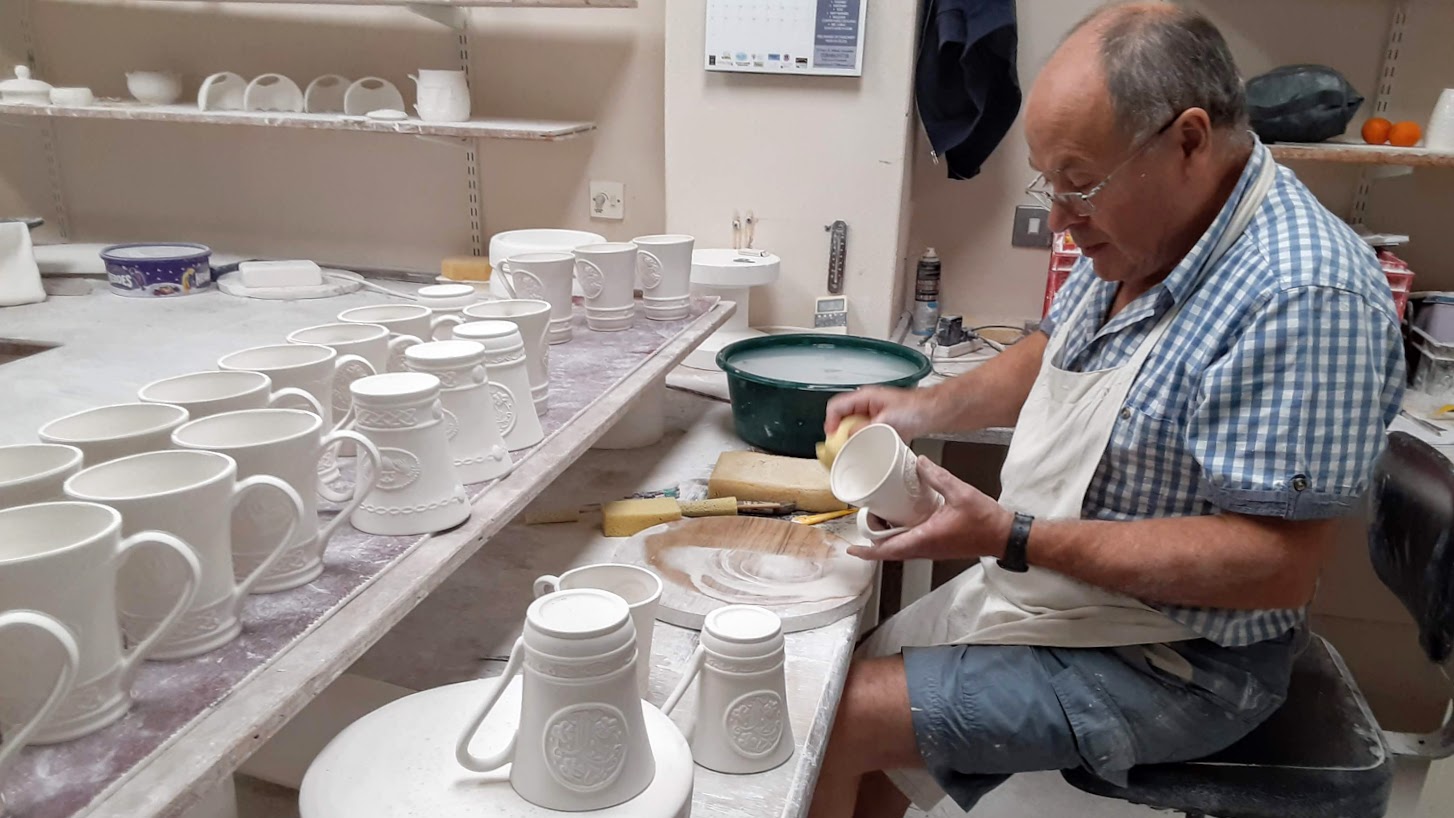





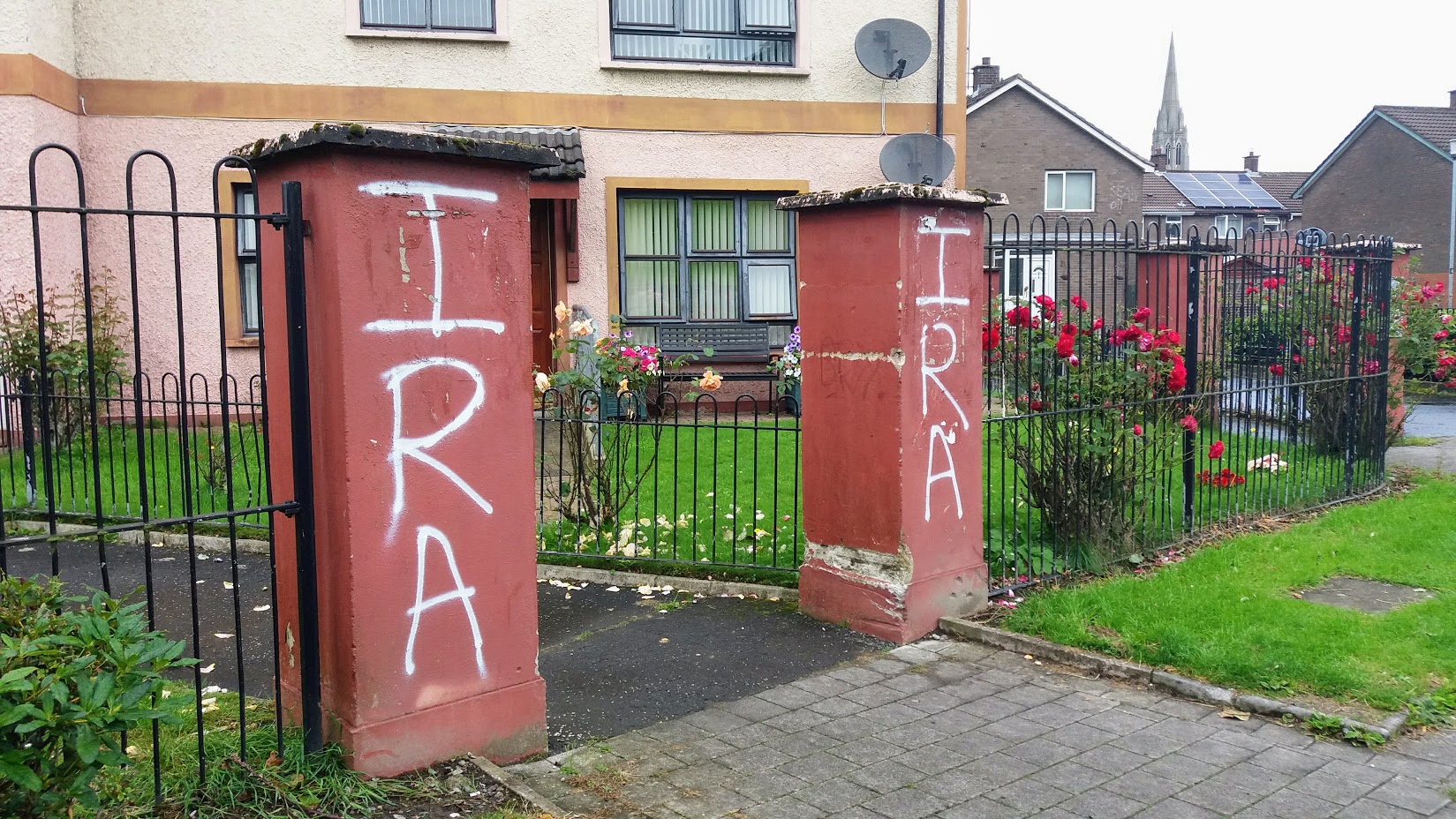

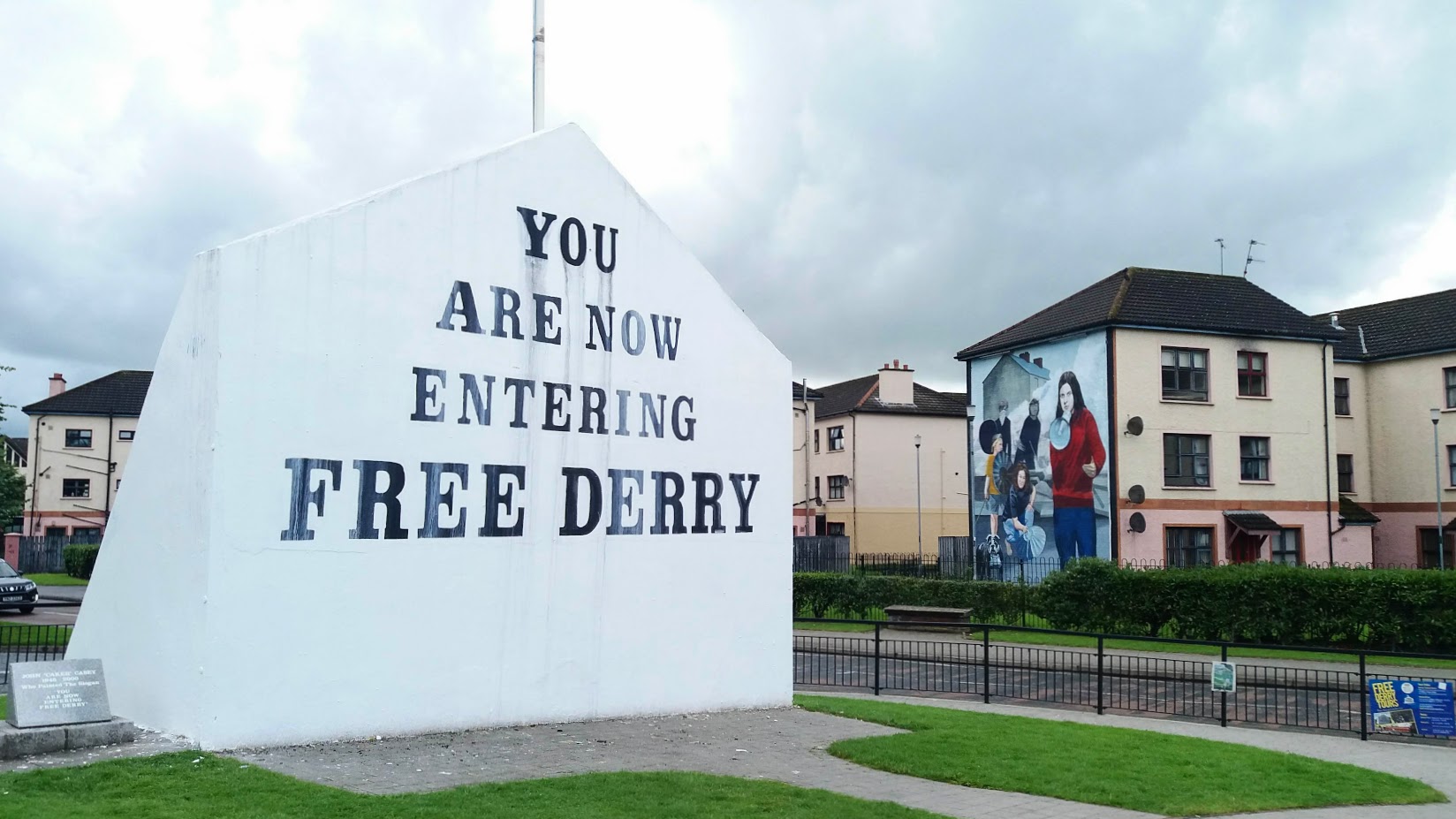


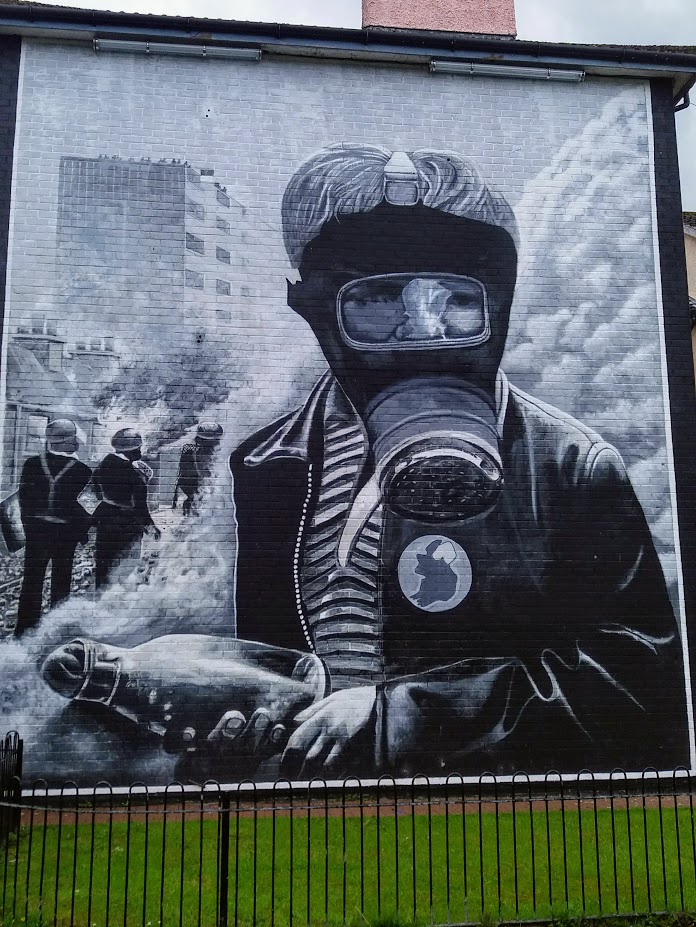

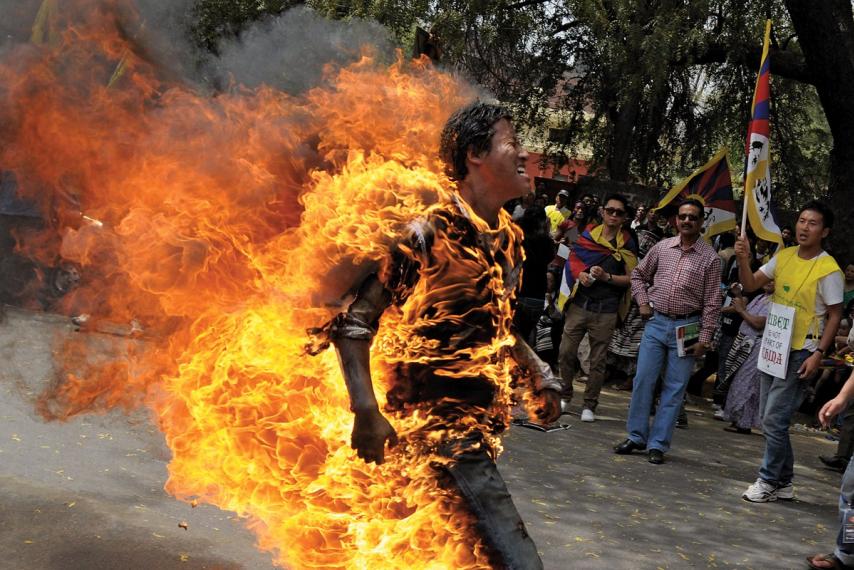

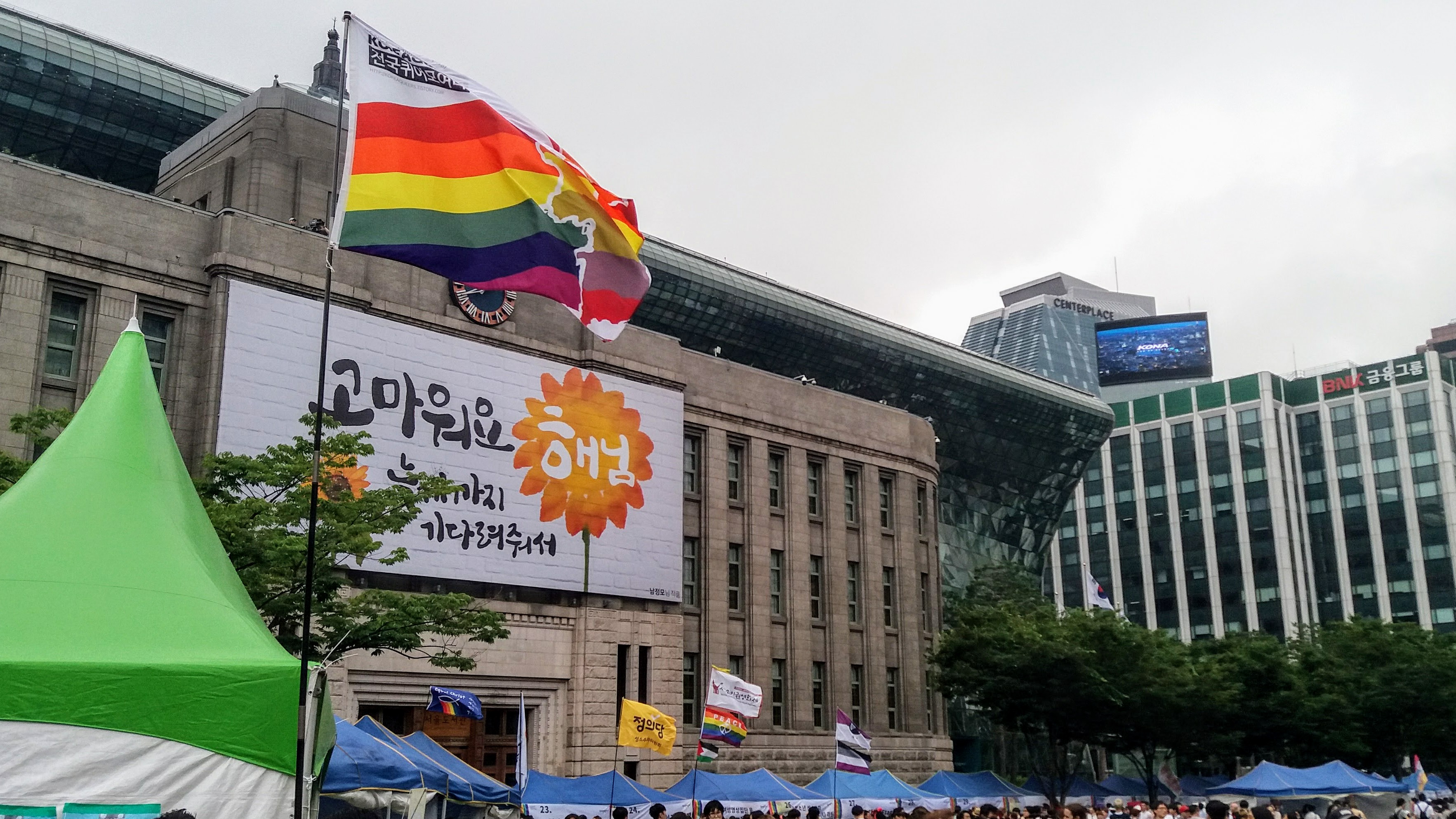 I wasn’t sure I was going to make it this year. Some people weren’t sure there was even going to be a Pride this year. Of course, every single year since the first festival/march in Seoul in 2000 the conservative religious zealots have tried to stop the Korean Queen Culture Festival (KQCF aka Pride) from happening. They try to file legal objections. They try to file use of space applications for the same day. They throw temper tantrums and accuse foreigners of bringing homosexuality and AIDS into Korea (because there would of course never be any gay Koreans if we hadn’t infected them!). This year, the issue was with the grass.
 We woke up in our slightly fancy downtown hotel, lounged around, had a leisurely breakfast and finally headed over to the plaza a little after the 11am start time. We passed rows and rows of police buses parked along the side streets. Last year, I came up from the subway and the first sight that greeted me was a veritable army of uniformed officers lining the street and crosswalk. This year, we walked in from another direction and saw a little of the behind the scenes police preparation as well as walking through some of the protesters who were stationed next to the festival exit and a subway station. I knew what to expect going in from last year, but my friend said that walking past all the police and protesters made her feel anxious about the day. The reported police presence was about 6,000 officers.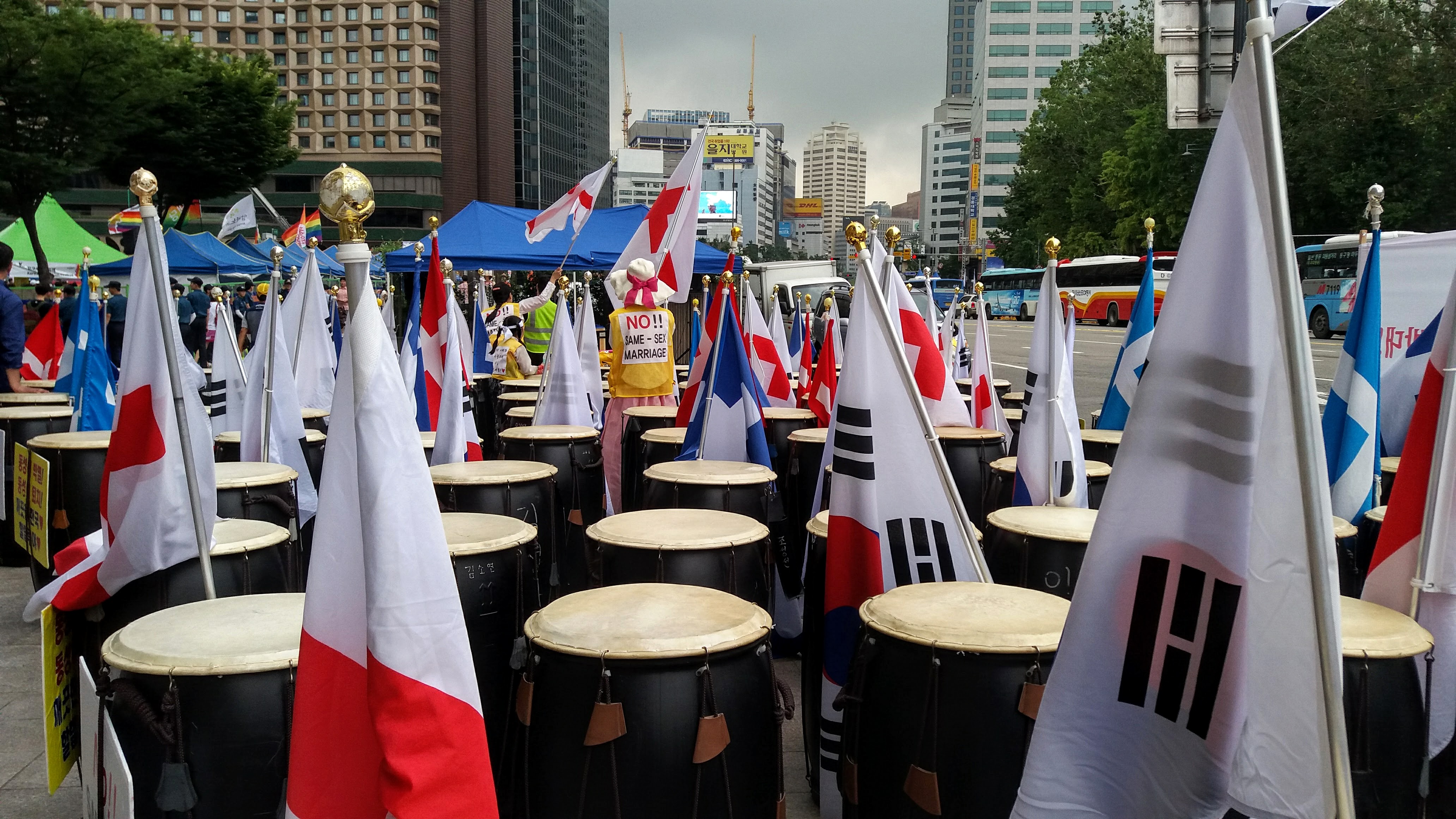

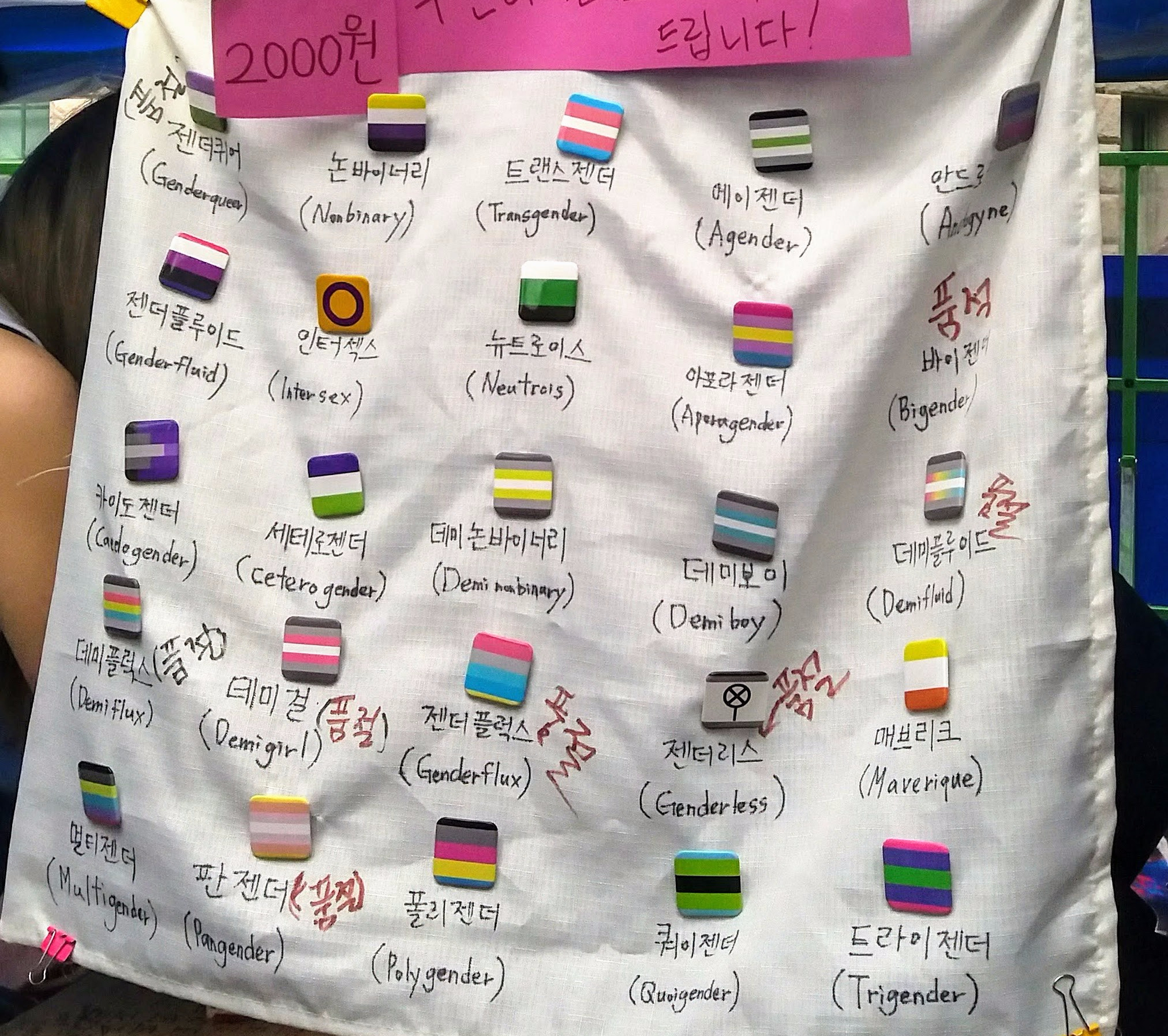
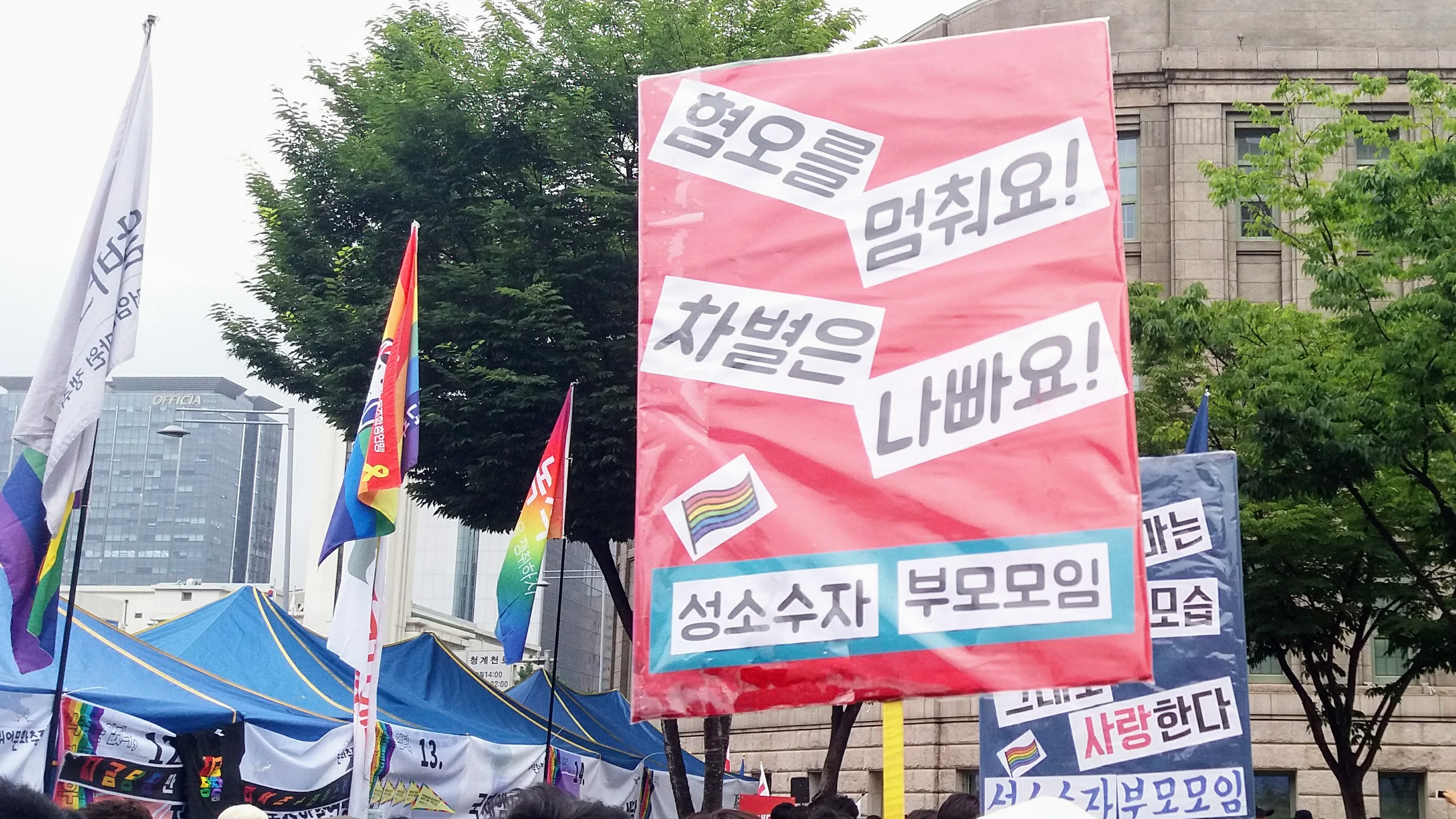


 The protesters outside are entirely Christian, but there are plenty of Korean Christian churches that came inside too, eager to point out their own perspective on the Bible and love (hint: it’s about inclusion, acceptance, and more love!). One group had even made a pamphlet that deconstructed the most common biblical arguments against homosexuality and explained the verses in historical context. But mostly they just wanted to show that the church can be accepting too. There was more than one Jesus costume at the event as well, and while the one making the rounds in the media seems to be a white guy (*sigh), I found this Korean one first. His sign is surprisingly excellent when you look closely at the comparison of Christianity hope.ver and armageddon.ver.


 There was also spiritual representation from the Buddhists! I accepted a pamphlet from one nun, which after some time spent translating seems to give the following basic message: while Buddhism condemns sex in general as being one of the things that ties you to the material world (monks and nuns are supposed to refrain entirely, but lay people are expected to do it in moderation, like alcohol consumption or meat eating) that there is no specific teaching about who you have have sex with or what type of sex you have (they listed 3 choices: vaginal, anal, and oral). The takeaway for me was that Buddhists should not condemn queer sex because of it’s queerness. One should regard all types of sex equally (while still bearing in mind things like adultery and unchecked lust are bad for everyone, too). If you’re going to accept that regular folks get into loving relationships and have sex while straight, you have to accept the same for all other flavors too. This was the first year a representation from any Buddhist temple came to the festival. It was glorious.

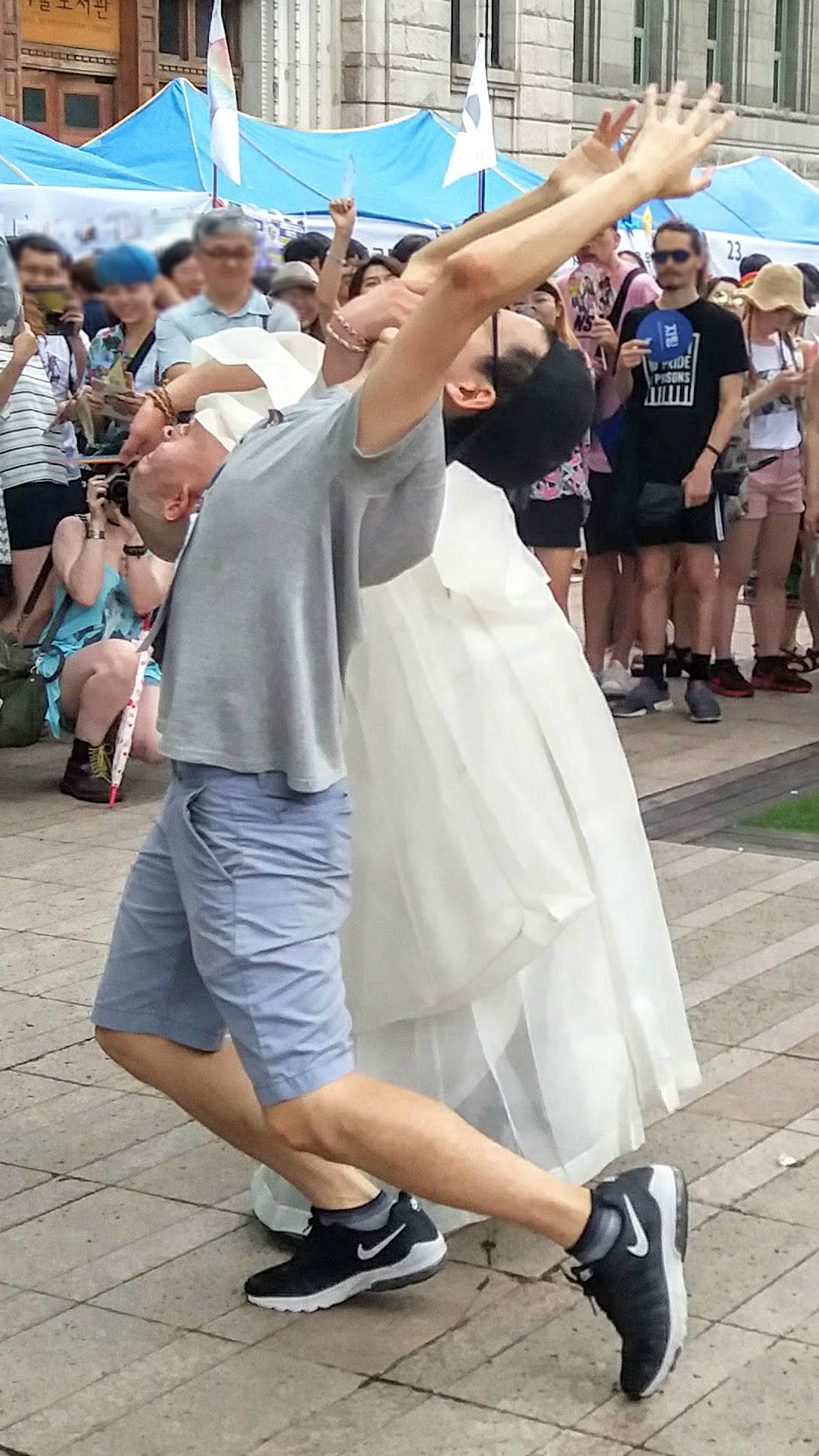
 Later on, we spotted Wonder Woman and a jedi (maybe young Aniken?) facing off on the stage, but I only made it close enough for a couple pictures at the end. I’m still not sure what they were doing, because that’s a serious genre clash. Once I was up near the stage, surrounded by people with much nicer cameras than mine, I got lumped in with the more official press (since our press badges weren’t different) and was ushered right up to the edge of a small clearing where I got a front row seat to watch the LGBTQIA traditional Korean drum performance. This is the classic drum and cymbal parade that accompanies every event and festival in Korea and it’s great to see the traditional cultural arts merging into the new cultural milieu.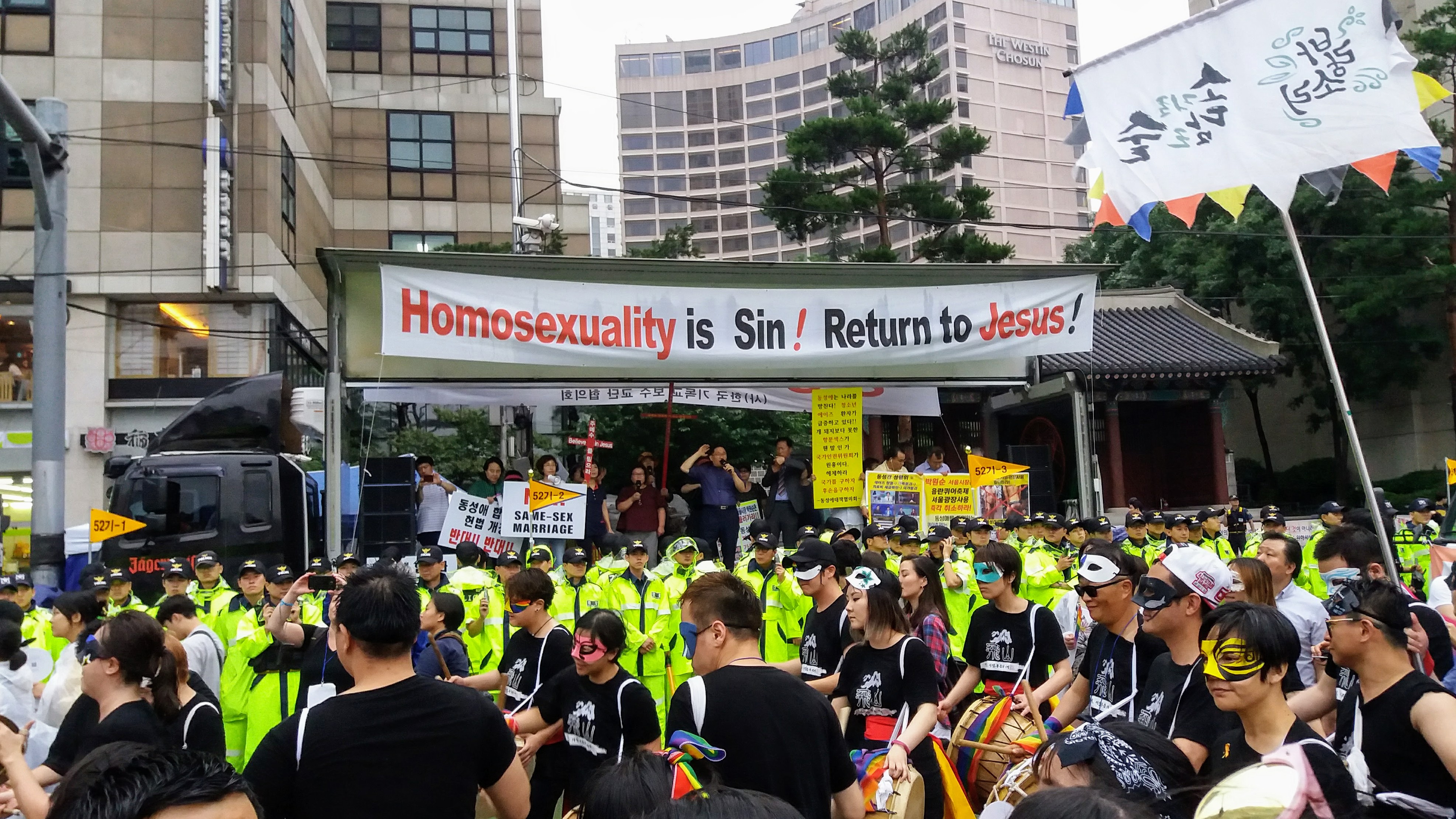
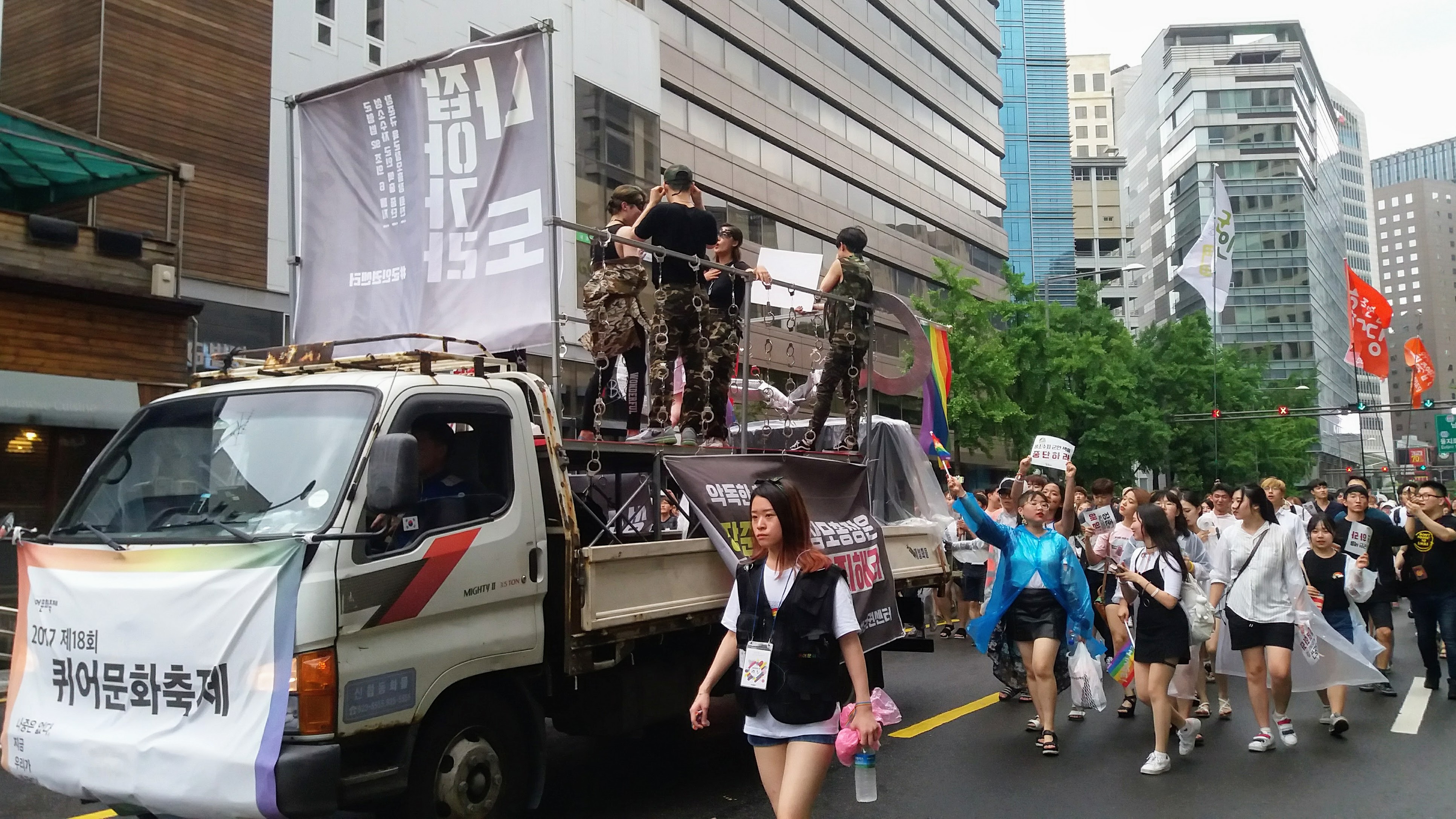
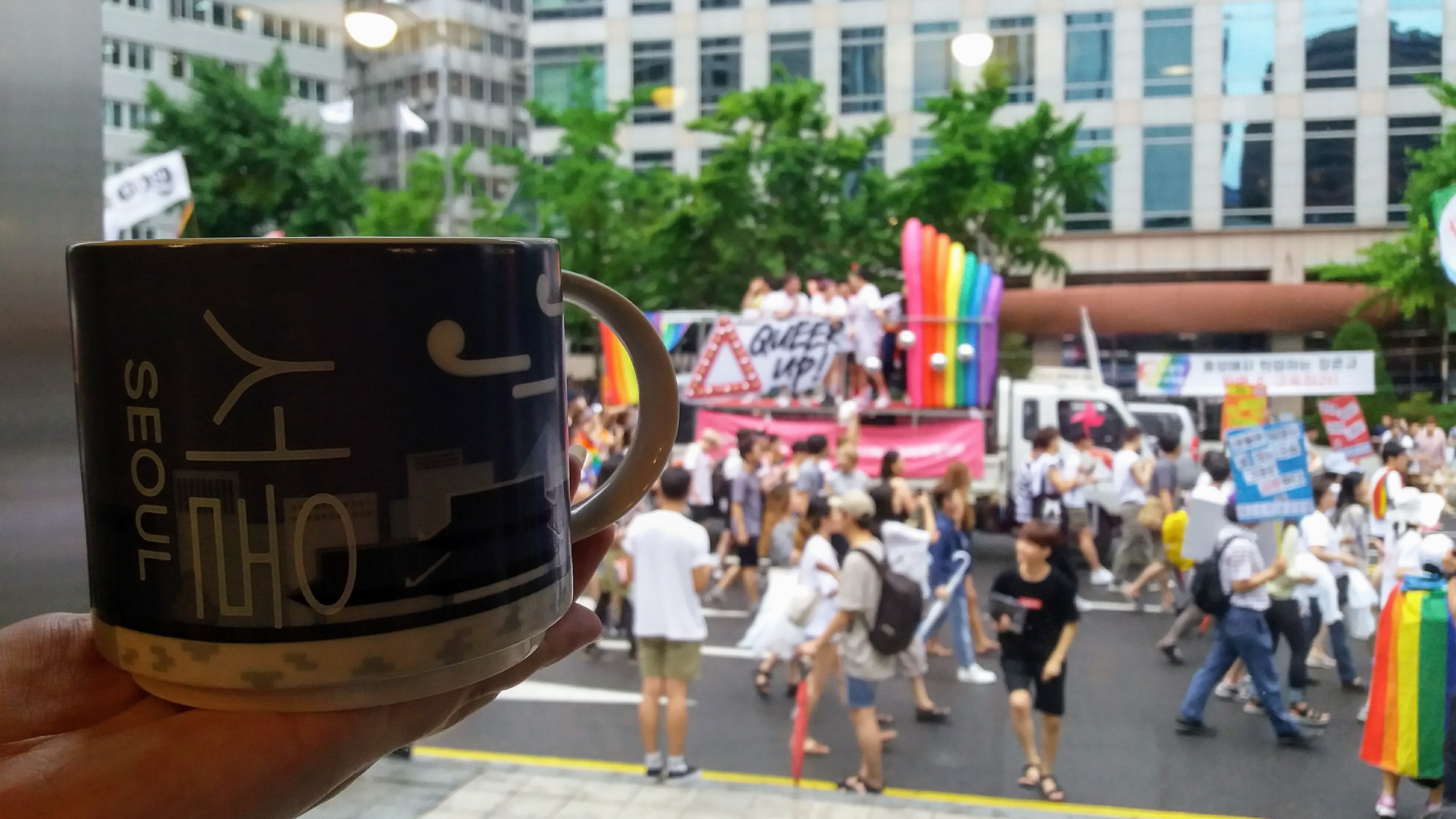
 When I first found out about the festival in March, I was excited to see it. When I found out it was the 17th annual one, I was blown away. Try as I might to keep up with real news and world events, I still had a solid perception that LGBTQ+ rights platforms were the domain of the West (and that America might actually be the farthest behind in that race) while the rest of the world lagged far behind in tackling this important civil rights issue. I saw things like Russia banning LGBTQ+ at the Olympics and China striking down gay marriage as signs that the East just wasn’t doing that much.
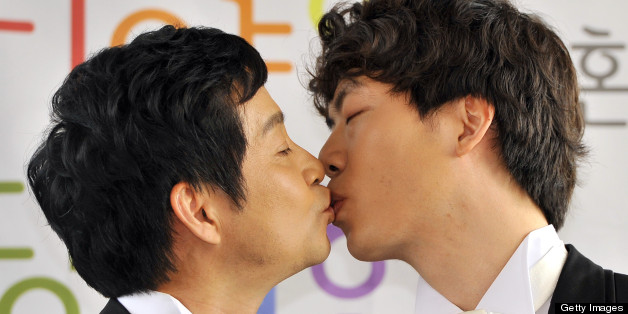 Korea just recently had, for the first time, two (famous) men
  Previous years’ festivals have seen large groups of protesters who have screamed at, spat at, taken pictures of, and occasionally engaged in greater displays of violence and harassment toward the festival goers. They’ve reportedly lay in the street to block the march, and even engaged in physical violence against the police to try to get at the Pride participants. Protesters have tried to shut out Pride by booking up the space, nearby spaces, and hotels to keep people out. This year, the conservative anti-gay Christians tried to petition the courts to shut down the festival on the basis of public indecency, but they were denied. However the Korean culture may feel about LGBTQ+ currently, at least the government respects everyone’s right to peaceful assembly, which is awesome. More than merely respecting it, the government issued stern warnings to the protesters to refrain from violence, because violent protests are illegal.
 My Busan Bestie and I headed to Seoul Friday after work, arriving after midnight and experiencing the very beginning of the Seoul public transportation headache. We managed to find the right bus, but missed our stop and got stuck on the wrong side of the bridge, which I guess technically people walk across, but it was the middle of the night and we had luggage, so we thought, oh hey, we’ll just take a taxi… nope. Scarcely any to be had and none for us. We finally found another bus and got back on the right side of the bridge but didn’t make it to our hotel for almost 2 hours after our train arrived. Why didn’t we take a taxi from the train station? Well, the line for real taxis was 30 people deep and no taxis were coming, the bus ride was only supposed to be 30 minutes, and as we found out later, there are plenty of fake-out taxis waiting to charge you an arm and a leg for a 15 minute drive.
 When we finally emerged from the station, we were greeted by a huge wall of police. I saw the protesters well before I saw the festival. They were set up across the street with a giant stage where they were having speeches, performances, and blasting Christian music in an attempt to drown out the Pride music. The streets around Seoul Plaza were lined with police standing shoulder to shoulder. When the light changed, they parted to allow us access to the crosswalk by which we entered the park. I have to admit, I was becoming anxious, and not in a good way. My heart was aflutter and my adrenaline was definitely going. I’m in no way anti-police. My sister is a police officer, and I have a lot of respect for the men and women who do a necessary and often thankless job. In the US, if I get pulled over or approached by an officer in public, it does not make me nervous. But something about seeing thousands of officers creating a human wall made me more than a little twitchy.
 Speaking of being free to be themselves, the festival also went out of it’s way to make the space especially safe. In the past, protesters used pictures of festival goers to publicly shame them, or get them fired, or even disowned by family. It’s no laughing matter to be Out here. Homosexuality can’t get you arrested, but there are no laws protecting employment yet. Many families feel it’s shameful and will disown children who come out. LGBTQ+ Koreans mostly have to pretend to be cis-het to get by. A few have managed to make enough money that they aren’t afraid to come out, like the filmmaker who petitioned for a marriage to his lover, like the small community of drag queens that simply make their living as performers. But the average person is hiding. This festival is a chance to be among people who accept and understand, but the attendees probably have to go back to homes and offices where they have to pretend again, and thus, having their pictures plastered on the internet can be scary and damaging.
 The festival made it clear that anyone taking pictures for anything other than strictly personal use (eg, keep it on your phone and never show it to anyone) must get a press pass and sign the agreement. I like sharing my pictures, so my first stop upon entering the park was to the press booth. I read a multi page contract that stated the rules for taking and sharing photos. It was heavy on permission. (yay consent!), and very strict about not posting anyone’s face you didn’t get permission from. I asked people all day, and handed out cards to the site so they really understood where the image was going. They also collected our IDs, so they can hold us accountable should someone take issue with my following the rules. I told my school where I was going that weekend because I don’t like lying, so I personally am not worried about it ‘getting back’ to my employer, but I know it’s a real issue for many Koreans and I’m glad the festival took such pains to protect them.

 After securing our press passes and verifying our reservations for the after party, we slowly started to explore the booths that lined the plaza. Unlike events in the US, there was very little corporate representation. And unlike events in Korea, there was a lot more than endlessly repetitive booths of food and trinkets. Most of the booths were operated by groups trying to raise awareness and understanding for some aspect of the LGBTQ+ community. There was a group called “Dignity for Soldiers”, another booth was from the first (and only) NPO that does outreach and support for at-risk LGBTQ+ youth in Korea. There were booths for just about every shade of the rainbow including Trans, Poly, Pan, Ace, Bi, BDSM… I think maybe the only sexual type not represented were Furries. But it’s ok, I found one in the parade later on.


 ady in rainbows and feathers who, when I asked if I could take a photo, told me she was with the US Embassy. It turned out there was a whole row of Embassy booths there, each country sending official representatives to support LGBTQ+ rights (and promote tourism, let’s be honest). And for just a few hours, I was really proud of my country for making this public, overt, international, diplomatic, and above all enthusiastic statement of support for LGBTQ+ and gentle pressure for Korea to catch up. (
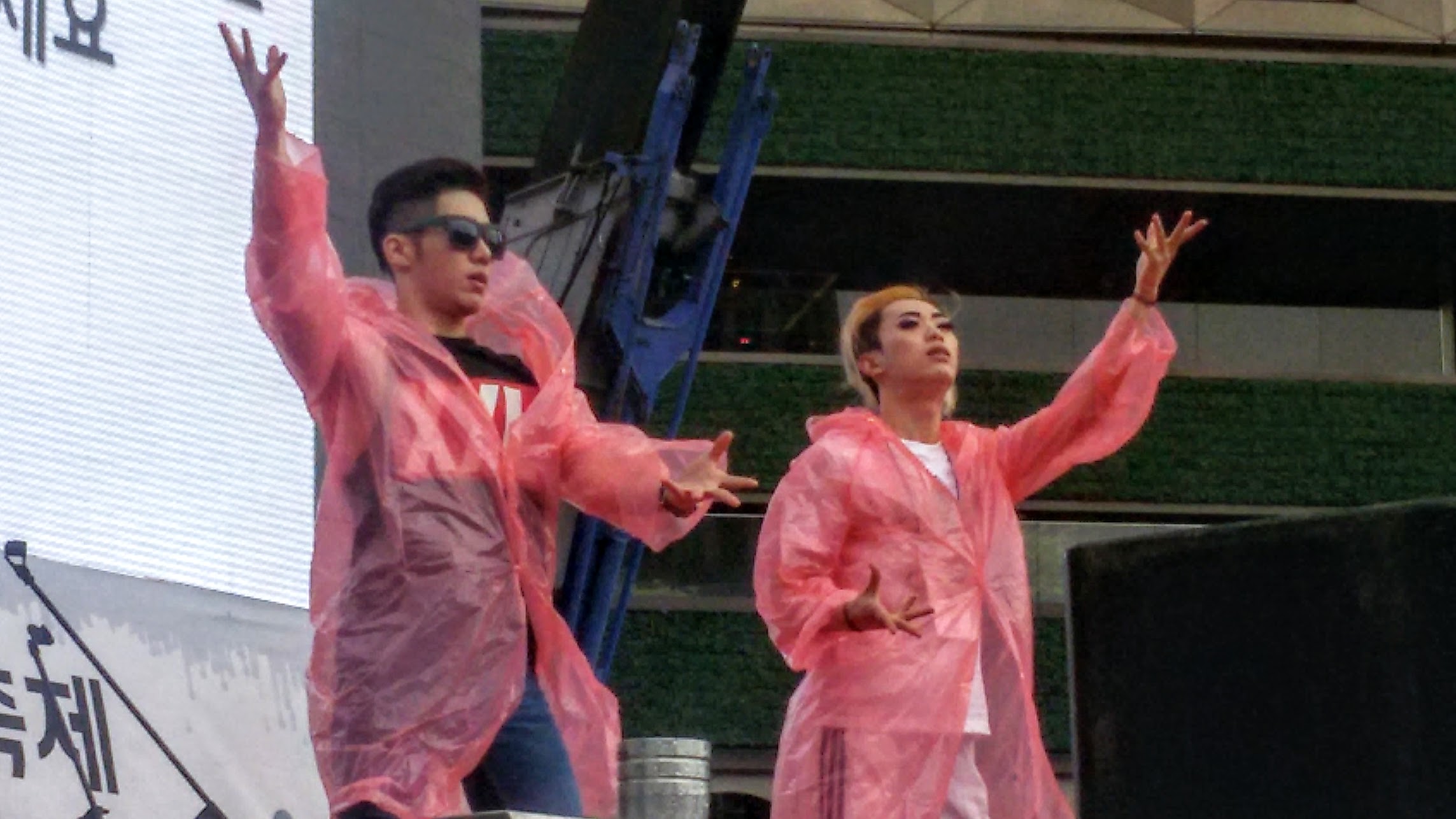 rain, they dancers just put on some plastic ponchos and kept right on dancing. I heard later that some of the protesters had apparently been praying for rain to ruin our day. I can only imagine their frustration when we didn’t let it dampen our spirits. If anything, it was a refreshing cool down during the summer heat!


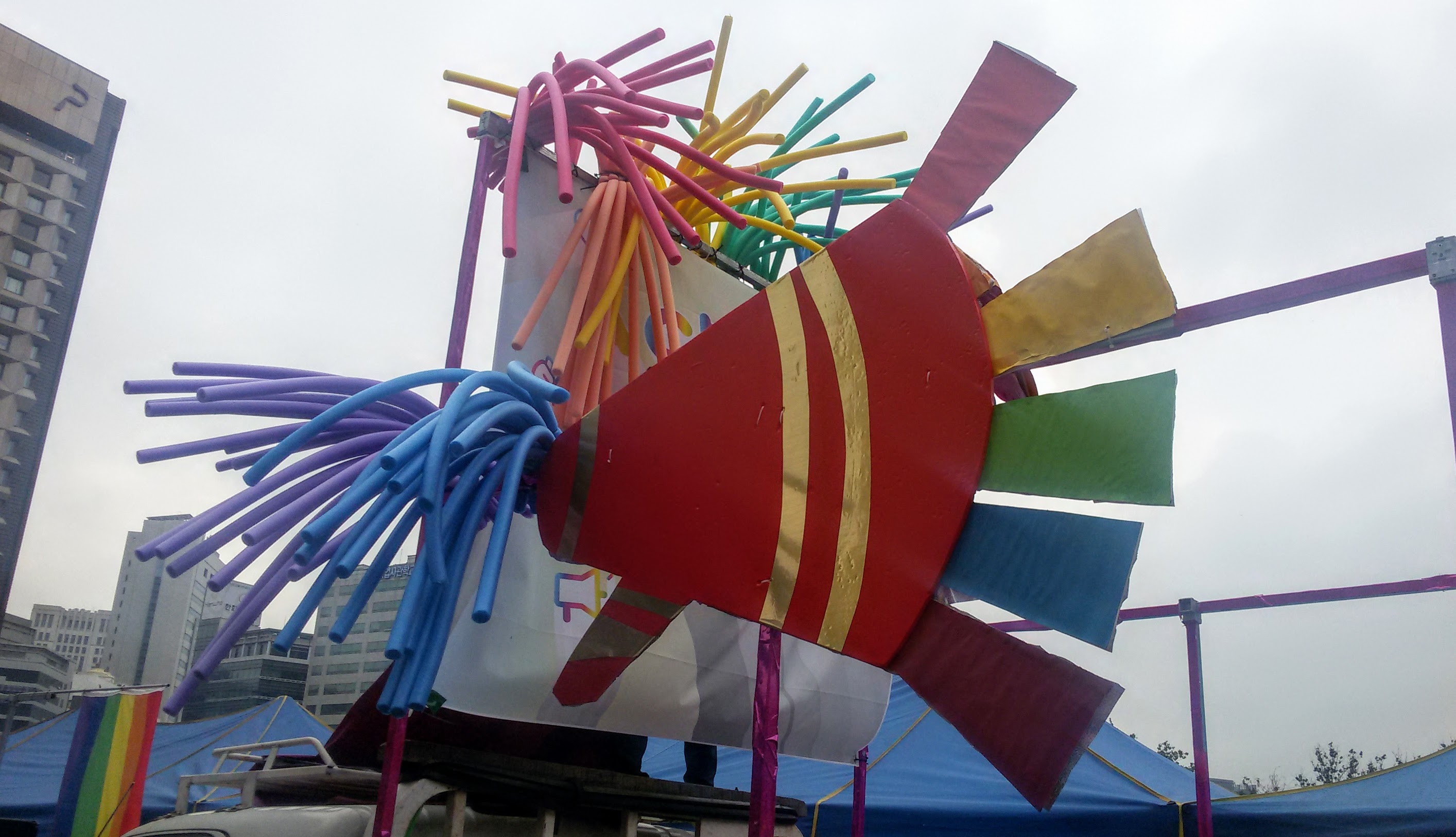 The “parade” did have some “floats”, but it was not what we tend to think of as parades these days. There were a few trucks out in front with banners and people in costume on display in the truck beds, but the majority of the affair was much more akin to a political march than a celebratory parade. The walking area had us leaving the plaza, going up several blocks and around a big loop before returning to the plaza. It was around 3km, so not a huge hike, but definitely enough to attract attention, which was the point after all. The trucks out front
  had a few decorations, mostly pink triangles and rainbows, and the people on the trucks were holding pro-love signs and dancing to encourage the crowd. There was nothing like a “parade float” in sight. Actually, that’s not totally true, the protesters had some pretty swanked up gear on the side of the road, but they didn’t march with us.


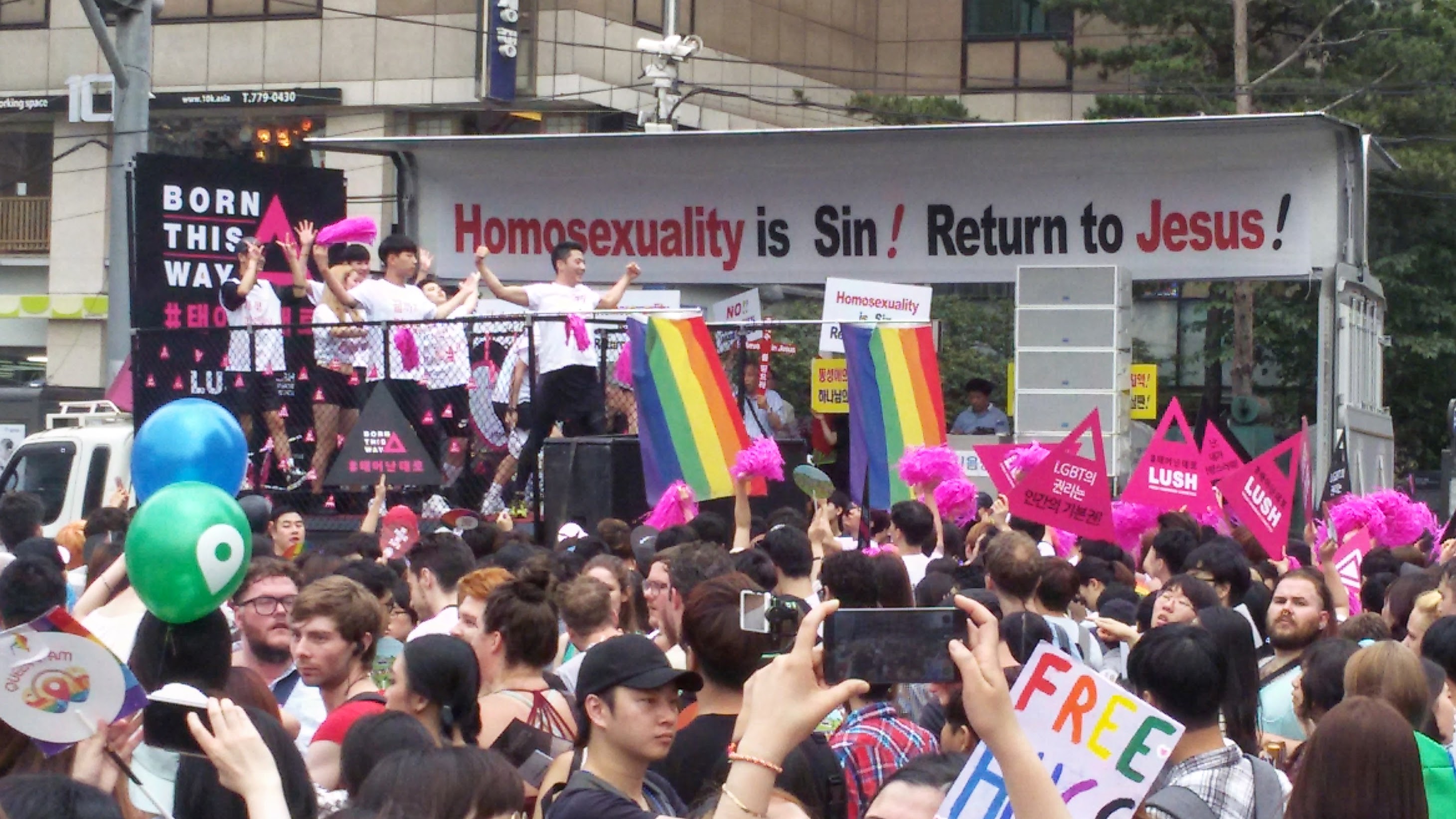 There were plenty of protesters right at the start of the route near the plaza, but as we went on, their number dwindled and the amount of supportive bystanders increased. I’m so incredibly proud of the marchers that day.
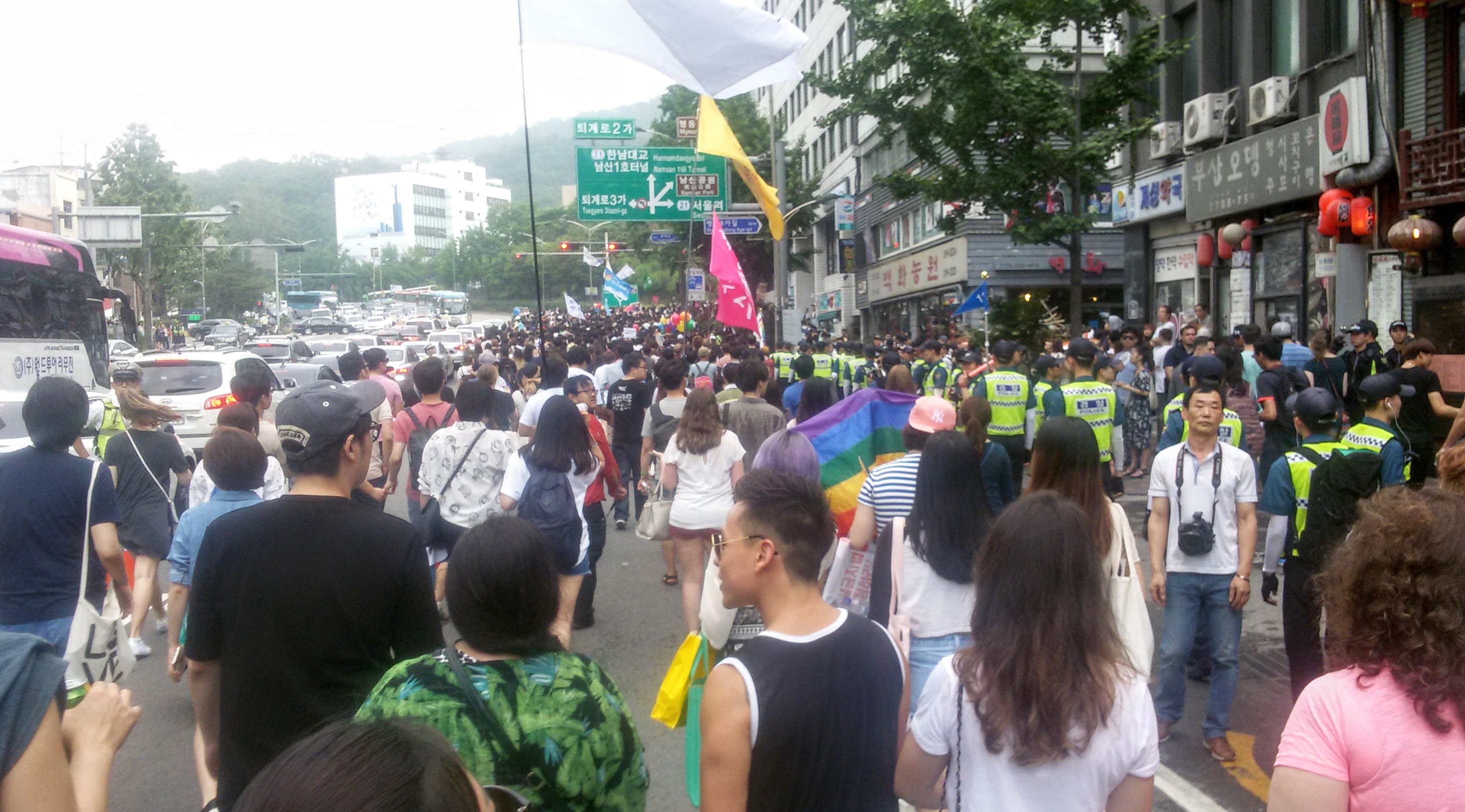 marchers yelled back “I love you”. We echoed their “hallelujah”s and smiled at them and blew them kisses. I’m personally a big fan of meeting hate with love, but it’s
  As the protesters fell away, we began to notice people on the sidewalk holding signs of support or waving and smiling and giving us thumbs up signs. Restaurant owners leaned out of their second and third story windows to wave down at us. A group at Starbucks had clearly planned ahead, because not only had they gotten seats right by the window, but they all held up rainbow signs reading “support equality”.
 The location for the party was stunning: a man-made island in the river. The buildings were huge and fun to look at with sweeping shapes and color changing windows. The party itself was a little lackluster for my tastes, but the one great thing about it was that it was about 98% Koreans. I sound like a broken record, but a lot of events I’ve gone to have had a large expat attendance and that’s fine for fun fun festivals, but this is more than that, it’s a civil rights movement with some party trappings and there can’t be a movement if the people of the country aren’t behind it, so it made me really happy to see so many Koreans there being openly gay in a way they can’t be in their day to day lives yet.
 There were some vendors in the main hall selling snacks and t shirts. The VIP lounge was quite classy, but the line for the bar was insane. The mojitos were outstanding, however, and there was a classical quartet performance as well. The dance floor was roomy and the DJs were fun, but he dancing was very Korean. This meant that groups of people got up on the stage and danced the moves to K-pop songs while the audience/dance floor did their best to keep up with the same moves… that they all knew… to all the songs. This is an aspect of Korean culture I may just never get used to.
 That lasted until Monday morning when I opened my Facebook.
 This Monday was the same way. I read the news, several times. I even went to google to find an actual journalistic report or 20 and not just some Facebook posts. I got dressed, cooked breakfast, went to work. Explained to my co-teachers that I might be a bit emotional that day because there was a horrible mass shooting in my home country and proceeded to get ready to teach classes. I think I made it through 2 classes before I actually started crying. I didn’t know anyone involved. I’m somewhere beyond “colleagues” yet well inside of “lookie loos” on circle of tragedy in
 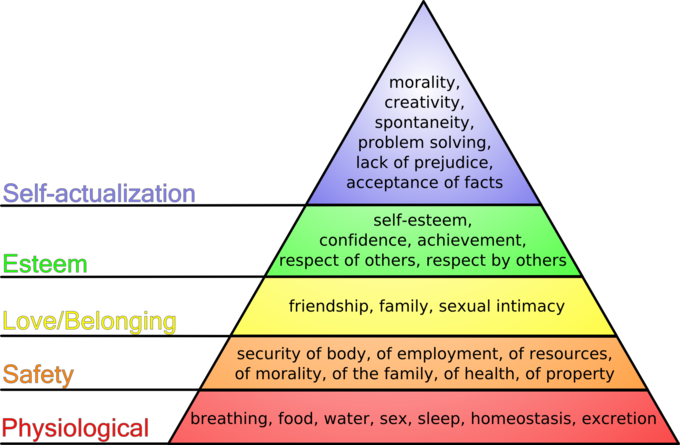 Love and belonging are the third tier of Maslow’s hierarchy, only overshadowed by the need for food and safety and integral to achieving esteem and self-actualization. They are NOT OPTIONAL for humans.
 America is fascinated, hypnotized, enslaved to the idea that every issue has two and only two sides which are so opposed to one another that any form of compromise or middle ground is simply unthinkable. I don’t mean uncomfortable to think about, I mean, people’s brains are actually incapable of thinking the thought. Thought rejected. This is known as the “
 Even in this way, Americans are dichotomous. You love it
  And while we’re at it, a side note on false equivalencies. , such as this lovely comparison of Obama to Hitler. Both were in favor of a policy, therefore they are the same? No. Obama =/= Hitler.
  We need to stop buying into A or B. We need to ask “why” about everything over
 In America, when someone says something insulting (about your faith, your lifestyle, your weight, appearance, gender, orientation, skin color, etc) the result is all too often “You’re an adult, suck it up”. The expectation is that adults should just be able to deal with being insulted or having their feelings hurt (even though arguably many of these insults are signs of bigotry and oppression and not just about hurt feelings).


 America is overly negative. I definitely feel like America is turning (has turned?) into one big crab bucket. People tell me all the time “every place has problems” as a way of minimizing the problems in America or somehow trying to equate them with problems in other places. People tell me all the time, “not everyone can just leave” as a way of reasoning out why they can’t.


 Gallivantrix