Manifestation Dakar

It’s no secret that my tenure in Senegal has been a challenge. I got back from Zanzibar at the end of February feeling like I might have a chance at emerging from the blackest depths of culture shock rejection into the somewhat calmer waters of acclimation. I found some new friends; I met some local teachers who wanted to involve me in their professional development activities; I enjoyed the spring weather; I was excited about finally having real classes at the vet school where I might see the same students on a regular basis and be able to develop rapport enough to learn about their lives, and I was really looking forward to the new project my RELO said she would help me start doing more teacher training at the Embassy. My new outlook was to be short lived, however, as just two weeks after returning to Dakar, the troubles started.

Some Context: 2000-2022

Senegal is considered to be West Africa’s Most Stable Democracy(TM), and has been enjoying the very relative peace and prosperity that comes with that honor for about 23 years give or take. The first “free and fair” election held in an independent Senegal was in the year 2000. Before that, elections were limited with by things like bans on any kind of opposition to the sitting president, limited voting rights, etc. Before that they were French occupied, so… Anyway, that first president freely and fairly elected from an opposition party, and peacefully transitioned into power held his office from 2000 to 2012, when the current president, Mackey Sall took over. Cue the drama.

Senegal has an electoral system in which if no candidate wins a clear majority, a second round of voting (a run-off) happens between the top two. Sall was #2 with 26.5% and the incumbent was #1 with 34.8%. Then Sall went around to all the other candidates who lost and said ‘hey, if you tell your supporters to vote for me, I’ll change the presidential term from 7 years to 5 years, and implement a 2 term limit’ (things a lot of people wanted). It worked, he won. Then he decided maybe his first term wasn’t the best time to change the term length, so he served 7 years and won the 2019 elections, in which his biggest opposition was barred from running over some legal trouble. Sall won that largely uncontested election with 58% of the vote.

In 2020 Sall suggested he might run for a third term after all, just six months after signing a law which abolished the post of Prime Minister of Senegal, (consolidating his power as president) and this made people understandably upset. Ousmane Sonko had already gained some popularity in the 2019 elections, and was making a lot of noise about the trend of power abuses going on. In 2021, Sonko was arrested for alleged rape, sparking the first wave of the current protest movement. Clashes broke out again in June 2022 after authorities invalidated the opposition party’s candidate list for the legislative elections, and that unrest also resulted in several deaths.

Spring 2023: The Trial & The Appeal

Fast forward to 2023, Sall was accused of defamation for talking about corrupt officials and brought to trial. The new charges were seen as an attempt to once again remove Sall’s biggest opposition from the race, and a third wave of protests erupted in mid-March (just two weeks after I got back to Dakar).

  • March 14: My teacher’s meeting was postponed from the 15th to the 22nd to make room for the protests. Email alerts started coming in from the Embassy describing the unrest and cautioning Americans to be extra careful.
  • March 15: The email alerts become more serious as the day wore on, warning of road closures, looting, and tear gas.
  • March 16: A “stay home” stern request from the Embassy was issued, and the University cancelled classes. Updates of the situation described burning tires, shop looting, police shooting tear gas, protestors setting up barricades, fires set on state owned buses, and shops burning. The trial was postponed two weeks because Sonko was injured while getting to court
  • March 17: Amnesty International published an article explaining the key issues and human rights violations
  • March 20-22: A teachers’ strike called for the release of the teachers who had been detained and arrested at the protests.

This experience was a little scary and disruptive. My classes were cancelled, the professional development events were put on hold, and I chose to skip out on social events because I didn’t know how bad it might be in some areas of town. The local pub owner (a long term expat) gave me a bit of a hard time about it, saying it was really blown out of proportion, but it was hard to get accurate news because journalists were being arrested. Eventually, my school and many others simply decided to start spring break early rather than deal with the uncertainty of safety, road closures, or online learning.

(Do not even get me started on the crazy privilege that is telework/tele-education in a country like Senegal with limited access to the internet and technology, rolling blackouts, service cuts, and overall poverty. People tell me they did it during COVID, but given how awful that was in Korea which has the wealth, technology and free public Wi-Fi all over the place, I do not imagine it was a success here.)

In the rescheduled trial, Sonko was found guilty of defamation, but his sentence was basically a slap on the wrist that would not prevent him from running in the upcoming elections, and things settled down for a couple weeks until the appeal trial started in mid-April, resulting in more protests and more cancelled classes.

Meanwhile, I was still trying my best to live a happier and more well adjusted life in Senegal, clinging to my post-Zanzibar mood renewal. I had a few classes that weren’t cancelled where I really enjoyed the students cheerful attitudes and learned a small but treasured amount about their own lives and cultures (not all my students are Senegalese). I went out for meals with friends and returned to the pub for trivia and karaoke. One especially memorable night when karaoke was suspended for Ramadan (out of respect for the neighbors) we gathered around the pub owner and a band mate with a couple of acoustic guitars and sang for hours. I struggled still with the school resources (not enough) and the overall quality of life in Dakar with it’s rolling blackouts, random water cuts, and rampant indoor insect population, but I was getting better at finding balance.

Ramadan ends in the holiday of Eid al-Fitr, called KoritΓ© in Senegal, which started on April 21st this year, and there was a 5 day celebration, so protests were less intense and people were in a better mood for a while, but it also meant that instead of my classes being cancelled for protests they were not scheduled because of the holiday. It went: protests, spring break, protests, Ramadan, protests, Eid — meaning that I only saw students a couple of times during the spring if at all. In some cases I went as much as 6 weeks between meeting with a group of students from one class to the next.

May 2023: the Next Trial

Sonko was next facing the trial for the rape allegations laid against him back in 2021. This is a touchy subject because it is important to believe women and hold sexual predators accountable, but also, it does look quite shady when there is a pattern of Sall’s political opponents being subjected to legal attacks that removed them from the elections. That trial date was set for the end of May. In the run-up, we saw smaller protests and demonstrations around the city. Classes were cancelled yet again as more and more students attended demonstrations on campus, attracting police responses in some cases.

What I now know is that Sonko was tried in absentia and although acquitted (found not guilty) of rape, he was found guilty of “corrupting the youth” and sentenced to 2 years in prison. I am not a lawyer, and even if I were, Senegalese law is different from the laws of my home country. However, there are some elements of the story that cast doubt on the legitimacy and legality of the proceedings.

In absentia assumes the defendant chose not to come, but Sonko has been prevented from leaving his home by government forces surrounding and blockading him in. These same forces are also keeping all visitors out and restricting his access to phone and internet connections, including his with his lawyer. Is right to council not a thing here? Is this not a textbook example of unlawful detention? Also, he was convicted of a charge that he wasn’t on trial for, which again, just seems like poor jurisprudence to me, but I’m not an expert. I look forward to a time when I can read a detailed explanation filtered through some legal experts to clarify it all.

At the time, however, I was oblivious to all of it, barely paying attention to the reason behind the clashes beyond “more election stuff”. Social events continued even when classes were cancelled. We had a really great turnout at the Embassy when we reopened the American Center to the public and had over 450 Senegalese in attendance. I thought it was all just small demonstrations localized to the campus and a couple neighborhoods. Even when my scheduled Embassy event for May 31st was moved online, I just thought it was an abundance of caution. I was so tuned out of the social climate that the day after this very controversial court ruling, I went out for my regular Thursday night on June 1st.

June 2023 : Dakar is Burning

The ride up from my apartment to the pub that evening was eerily devoid of traffic, and the usually bustling business strip where my pub lives was almost empty. It was deeply freaky and made me question my life choices. I had drinks with two New Yorkers and one Saudi diplomat (the only other customers in the place so we sat together). We noticed that social media was not loading, but chalked it up to spotty service. When it was time to go home, I realized there were zero cars on either ride share app, so I overpaid for a taxi home along more eerily empty roads.

Once home and on my Wi-Fi network, I got error messages from Facebook until I turned on my VPN. Further poking around showed me that not only Facebook and Messenger, but also Instagram, TikTok, Twitter and WhatsApp (the primary method of communication here) were not working from Senegalese IP addresses, but I had no way to know the details until the next day when I found confirmation that the government had initiated a social media blackout.

The next few days were intense. The streets were empty; the shops were closed; motorcycles were banned on the streets; the police, gendarmes and military were out in force. I saw videos of SWAT clad police holding children in front of them while they hurled rocks and tear gas canisters from behind their human shields. At least 16 people died, many due to the use of live ammunition by police and government forces against protestors who were armed with nothing more than rocks and boards. More than 500 people were arrested, many in arbitrary arrests which further violates human rights.

The internet blackouts went from social media to all mobile phone data access, meaning that once I set foot outside of my Wi-Fi range, I was cut off. Most Senegalese didn’t even have Wi-Fi access. Students were fleeing the burned and ravaged campus, trying desperately to get buses back to their family homes, but many didn’t have the money for tickets and were cut off from receiving digital money transfers or crowdfunding options. The university closed indefinitely. This CNN One World video may be the best English language video coverage I have seen about the situation.

It was scary to be in the city knowing all this was going on outside my apartment walls, and yet I was objectively safe. I live in a quiet neighborhood with no banks or large shops nearby. We are not a target area. I had Wi-Fi and VPN access to the internet and social media. I had been on a grocery run a few days before and was well stocked upon food and bottled water. My friends asked if I could leave and it was hard to explain that I was safer inside than trying to get to the airport (that road being one of the target and occupied areas). I spent the days alternating between numbness and panic attacks, trying to follow the story in case it changed and I needed to get out suddenly, but also trying not to let the flood of news and images send me into a spiral.

Although the main campus had closed, the veterinary college where I teach (English) tried valiantly to remain functional, sending out schedules and announcements through the weekend. They tried to move classes online, but the government shut down of mobile internet made it impossible, so they suspended classes for the remainder of the week. I worried about my students, where they would live without access to student housing, or what they would eat with the campus cafeteria closed. Especially I worried about my foreign students from neighboring West African countries who might be more accustomed to violence and instability, but are far from their families and support networks.

The mass arrests and extreme crackdowns did result in quieter streets, but as more and more foreign news agencies and human rights watchdogs were able to sort out the details, international pressure mounted. On Monday the 5th, I ventured outside to visit my local boulangerie and supermarche and I was encouraged to see traffic, including taxis and horse cards, street vendors, and construction workers. By Wednesday June 7th, the mobile data was restored, but social media remained blocked for another day. That Thursday, the Anglophonic expat community gathered for trivia night at the pub and generally tried our best to shake it off, knowing that the troubles were far from over, but finding relief in the breath of normal we could take in the moment.

There were planned gatherings for that weekend, but the government officials denied them permits, citing improper paperwork and public welfare, finally resulting in a general ban on all public demonstrations.

During the worst of the violence (June 1-3) the main university campus was ravaged. Buildings including the library and archives were burned, and the campus remains closed. My vet school is physically very close to the UCAD main campus, but isn’t large enough to have attracted any of the destruction. So, while the university remains closed with courses suspended, my school resumed online functions, reserving in person meetings on campus as deemed necessary for practical courses and oral exams, but limiting it to the hours of 8am to noon. We are now in the final week of the semester, and my English classes were bumped from the schedule entirely to make way for the make up courses of core curriculum, which is honestly just as well because I was really struggling with how to make the content viable online to students with limited access to technology and internet.

Waiting for the Other Shoe

We are fast approaching the holiday of Eid al-Adha, called Tabaski in Senegal, which is a big one. I read an article that sheep and goat farmers were considering not bringing their livestock to Dakar if they didn’t get some assurances that the violence would stop. Sacrificing a sheep or goat is a big part of the holiday celebrations, so they’ve been breeding extra stock and rely on the income to survive the leaner months. I don’t blame them for not wanting to risk all that; however, I’ve seen a LOT of extra goats around town in the last couple days, so I’m guessing they worked it out.

The population may have settled on a decrease in tensions for the holiday (June 26-July 1), but everyone knows it can’t last. Sonko is still under unofficial (illegal?) house arrest, having not yet been arrested officially nor officially presented with his sentence. The administration is under investigation internationally for human rights violations and the use of excessive force against it’s own population, and Macky Sall has floated the idea of pushing the election back a further 2 years (giving himself a second 7 year term instead of the newer 5 year limit) all while refusing to adhere to the 2 term limit he himself helped to establish (claiming that his first 7 year term shouldn’t count towards the limit because that law was not in place when he took office). This space opera is far from over, and as far as I and many others living in Senegal are concerned, this temporary and fragile peace is just waiting for the drop.

More Resources & Articles:

Nine dead as protests rock Senegal after Sonko jail sentence, Al Jazeera
Ousmane Sonko sentenced: Why are tensions flaring in Senegal?, Al Jazeera
In Dakar, “it’s the intifada” after the conviction of Ousmane Sonko, AfriqueXXI
Thread for a better understanding of the current situation in my country, Senegal, @UsseynuTAAL
Demonstrations: “The situation is under control”, Agence de Presse Senegalaise
Senegal: Violent Crackdown On Opposition, Dissent, Human Rights Watch
Their marches banned by the prefect of Dakar, Seneweb.com

Northern Ireland: Cultural Legacy

Going into Northern Ireland I was not really sure what to expect. When I was growing up, the North was known for it’s hard life and angry militant (terrorist?) political movements: The Troubles. There are three great reasons to visit the North: the stunning natural beauty, the unique and historical culture, and Game of Thrones. That last one seems a lot less important after the series finale aired disappointing literally every fan, but dragons are always cool. Today’s post focuses on the culture and more recent history. I wrote a much more detailed account of the two Irelands what seems like an eon ago (before the Plague), and while I prefer to focus on my experiences while traveling, sometimes those experiences include some painful history and deep thinking.Β 


Belleek Pottery

20190807_095751

The first stop on my road trip after crossing the unimposing border (marked mainly by the sudden change from Euros to Pounds at the petrol stations) was the Belleek Pottery factory. I didn’t know anything about Belleek Pottery. I know we had some in the house growing up, but I guess it went with my stepfather when he did.

Founded in 1857, it is the oldest pottery factory in Ireland (either of them), and was initially started because of the availability of special mineral ingredients locally. Eventually, it became more common to source materials from Cornwall or Norway, but the unique Belleek style has continued to make the pottery famous and sought after.

20190807_102500

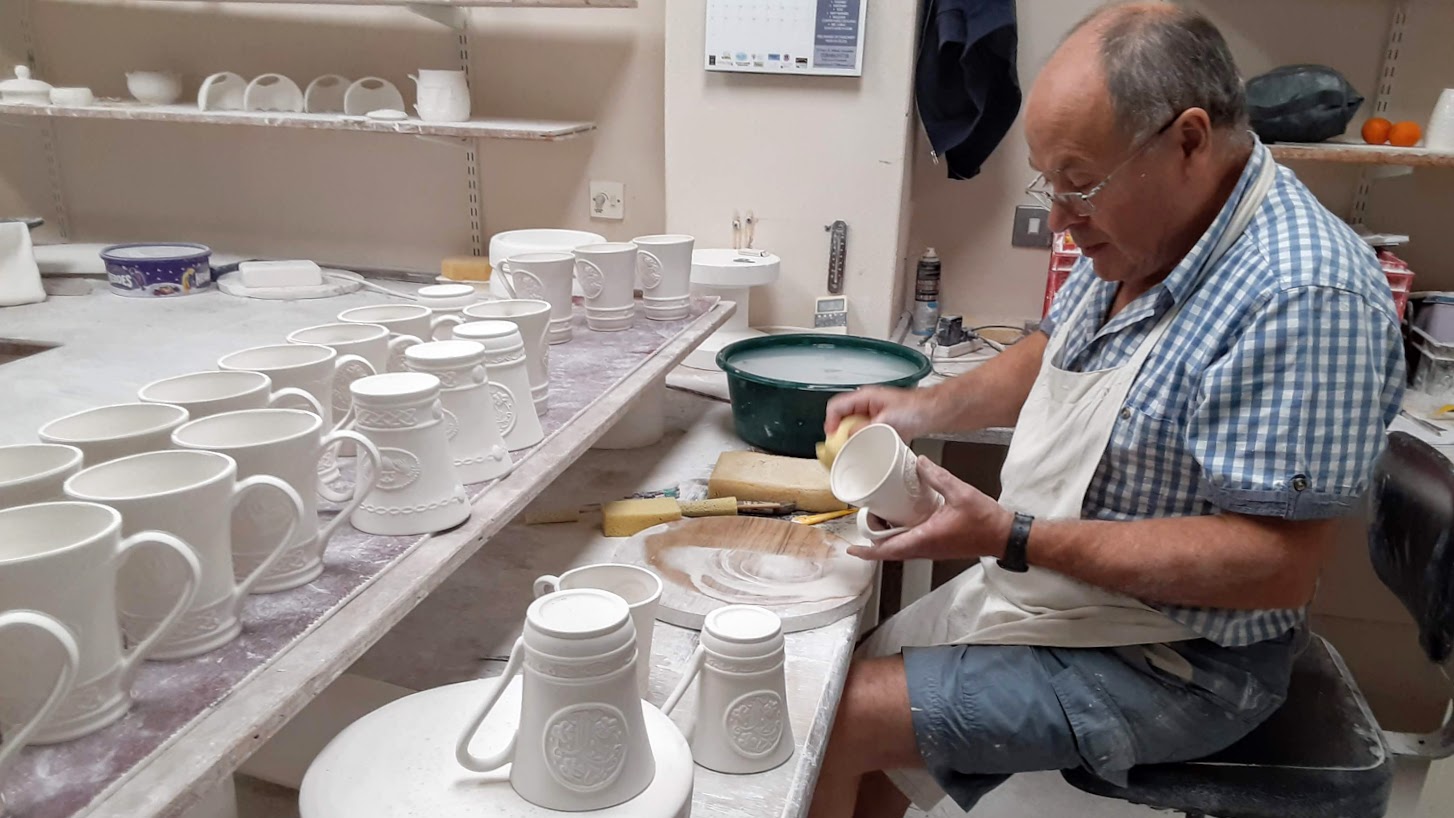
The factory was in holiday mode during our tour so there were only a few employees on site. Perhaps this made for an emptier experience, but I thought it was nice to be able to focus on a single work table or look closely at the pottery without being rushed or in someone’s way. Our tour guide walked us through the process of making the beautiful and unique ceramics from the artistic conceptualization to the making of molds and refining of pieces. We had the chance to see workers attaching separate pieces and refining the details from the mold by hand. We were also offered the chance to break the rejects, since the factory will never allow “seconds” or flawed pieces out into the world.

20190807_104335

However lovely the molded pieces are, they are as nothing compared to the beautiful hand crafted flowers and lacy woven baskets that represent iconic Belleek. We had the chance to see some of the craftspeople at work on these fine details. The flowers and detailed add ons are simply stunning tiny craftsmanship, but the weaving was simply the most unique. The clay used for the basket strands is blended in such a way to make it slightly elastic and so less likely to break when manipulated over and over. Don’t try this with your regular clay in pottery class, kids.

The painting center was no less beautiful. Each finished piece is painted by hand to give a unique finish to every piece and to make sure that the little green shamrocks are just right. At the end of our tour we were let out into a small museum showcasing the evolution of Belleek styles over the years. The special pieces showed even more detail in the handmade flowers, but my absolute favorite was a pearl glaze that was only in fashion for a few brief years.

I doubt I would have chosen to tour Belleek on my own, but nonetheless, I did enjoy the trip. Non-solo trips can be a mix of “well, I wouldn’t have picked that myself, but cool”, and “yes, please!” kinds of stops. While Belleek was the former, Bushmills was definitely the later.

Bushmills

Bushmills has been in my family and house for as long as I can recall. It was my grandmother’s whisky of choice and hers was the immigrant family with some deep dies to the Irish diaspora culture in America. She passed when I was 17. It was a very sudden turn from being old and chronically ill, but lively – to hospitalized, comatose and gone. I know, morbid, but it was about a week of me sleeping on the hospital room floor and then it was over. Her children (my mom, aunt and uncles) and I shared out the remains of her last bottle of Bushmills while we told stories about our memories of her. Bushmills holds a place in my heart as well as my tastebuds.

20190809_110030

There is no photography allowed inside the distillery to protect their trade secrets, but we had a fun tour that took us from mash to cask. It was very interesting to me to do this after my lovely brewery tours in Belgium since the basic process to start both beer and whisky is very similar. The malting, mashing, and fermenting is more or less the same (a great deal more similar than to wine-making), the shiny and hot copper stills is where spirits take a hard (pun intended) left turn from beer.

The still room in Bushmills felt like walking into a sauna. The entire room was warmed and steamed as the low alcohol “wash” is heated and pressurized into boiling at about 78C (much less than the boiling point of water). This causes the alcohol to evaporate where it is caught in the tubes and condensed back into liquid form in a new reservoir while the water remains in liquid state below.

Amid the giant copper contraptions was a small and extremely climate controlled glass walled room where a further refinement process took place in small batches under intense supervision. Neither the large copper nor the smaller stills can be left unattended, so a highly trained employee has to spend hours a day in that hot and sweaty room just to make sure that the resultant distilled spirits are correctly balanced and purified.

The main method of distillation is well known and basic still kits can be assembled fairly easily (that’s where moonshine comes from after all), but each of the worlds best distilleries has a few proprietary methods and Bushmills is no exception. The tour guide did an excellent job answering all my questions about the science without giving away any trade secrets.

(The photo is an old copper still on display in the tasting room.)

20190809_125317

After the stills, it’s still not whiskey. The magic that turns white lighting into that dark amber ambrosia is cask ageing. This might be my favorite part of any alcohol tour (ok, except for the tasting) when we get to enter the cool and dark rooms filled floor to ceiling with dark barrels and simply redolent with the luxurious smells. Our guide explained the different types of casks used to flavor and age the whisky and showed us examples of the changes in color and volume over time. Not only does the wood of the cask color and flavor the alcohol, but the alcohol leaks out through the porous wood over the years. This loss is referred to as the Angel’s Share (I guess Irish Angels like a wee dram, too) and in areas like Ireland accounts to 2-3% loss per year. A 50 gallon barrel can be reduced to less than 15 gallons in a 25 year age! Those heavy price tags are not only taking into account the amount of time the whisky must be stored before sold, but also the sheer volume of alcohol lost to the angels.

20190809_110648

However, the longer it ages, the more the sharp and harsh flavors of the distilled moonshine soften and the more of the flavors of the wood become absorbed. Mostly 10-12 years is enough to get a good mellow flavor for the non-aficionado. Less if you’re planning to mix it with (shudder) coke. In addition, some of what evaporates is yet more water and the finished product of maturation can be between 115-150 proof. But wait, Kaine, I’ve had Bushmills and it’s only 80 proof, what gives? Well, the factory puts some lovely fresh Irish spring water (honestly I don’t know where the water comes from, but it sounds nice?) into the mix before bottling to create a consistent and ideal proofing. This is for two reasons: product consistency is super important to a brand, so they do need to be sure that all bottles are the same. Second, and to my mind more importantly, you simply cannot enjoy the taste of the whisky at 150 proof! Even 100 proof is pushing it.

The great debate about whether you should add water to your whisky is almost hilarious in this context, knowing that the distillery did it for you. However, 80 proof is simply their best guess where most people would be able to enjoy the flavors ideally, so if you wanna add a little water to enhance your own flavor experience, go for it. Bushmills itself served a small pitcher of water along side the whisky in the tasting room for just that purpose, so obviously they don’t mind.

20190809_110441

I really enjoyed the 12 year distillery reserve (lower right, sky blue label), a unique flavor profile and of course not sold anywhere but the distillery… literally, not even in the duty free shops. I heavily debated buying a bottle but there were no small sizes and I knew that without the duty free sealed bags, I’d have to try and lug it in the checked bag, not to mention lugging it around the rest of my Ireland trip (not even half over yet), and the fact that if you want to bring more than 1L of booze over borders you have to figure out how to pay them taxes (not a huge burden, but …). A smaller bottle would have meant easier packing or just enjoying it in Ireland, but alas. I did end up with a bottle of the fantastic Dingle Peninsula Gin from the duty free, which almost makes up for this loss.

Derry

Also known as Londonderry, it is the second largest city in Northern Ireland and home of The Troubles. I am going to have to get political/historical again because almost all of the major landmarks in Derry are related to the Troubles in some way or another.

20190807_135127

The first big one we came upon was the Peace Bridge: a beautiful bridge that eases pedestrian traffic and makes for a lovely riverside view. It’s easy to think of the clashes in Ireland as being in the distant past, but they are not.Β  The Peace Bridge was only built in 2011 and it’s construction was an attempt to ease communication and interaction between the unionists (stay in the UK) ‘Waterside’ on the east bank and the nationalists (join Southern Ireland) ‘Cityside’ on the west bank.

20190807_145911

Mere steps from the riverside is the Guildhall. This is an iconic work of architecture built originally in 1890 to be a ceremonial government house / town hall. It’s been destroyed a couple times in fires or bombings, but the restoration project of 2012 has been very successful. To be honest, I thought it was a restructured church given it’s beautiful stained glass windows and enormous pipe organ, but I’m told it’s intention has always been secular in nature. There were several memorials inside dedicated to those who fought (and died) during various stages of revolution against the British occupation. Since at the moment of writing this, the unionists still outnumber the nationalists, that occupation isΒ ongoing, and while the conflict hardly ever results in whole historic buildings being bombed these days, it is far from over.

However, even if you aren’t interested in Irish history or politics, the Guildhall is worth a visit for the exquisite stained glass in every available window.

Bogside Murals

From the Guildhall, we headed over to the Bogside neighborhood to see the murals. Bogside is … perhaps more politically relevant in 2020 (as I write this) than it was when I visited a year ago. The global Black Lives Matter protests against police brutality have highlighted clashes between state sponsored police and citizens who are tired of being treated as less than.

20190807_151813

I gave my own detailed account of the IRA in the Two Irelands post before, and then as now, I ask people to remember that any comparisons between the Troubles in Ireland and the BLM protests in America should only be examined as “shitty police state problems” and NOT used as a way to compare white (Irish) struggles to black (African American) struggles. Just. Don’t.

For those less familiar with American culture, it is a common white supremacist tactic to argue that white Irish immigrants in America had it just as bad or worse than black slaves (lol). Lots of really well meaning white people get caught up in this because at first blush it sounds very reasonable. It isn’t. (You can find more details here,here, and here as a starting place.)

20190807_152105

In this case, the discriminated against minority were the Catholics who had all manner of extremely bigoted laws passed to keep them down including limiting their employment, education, marriage and property access. It was only marginally a religious issue, as the lines of unionist and nationalist were also generally drawn along church lines. The nationalist Catholics were understandably pissed about it. When protest marches were banned, some marched anyway and were brutally attacked by the police. This was in 1968 so the actions of the police were filmed and shown on television, prompting demonstrations of solidarity at the Guildhall and elsewhere.

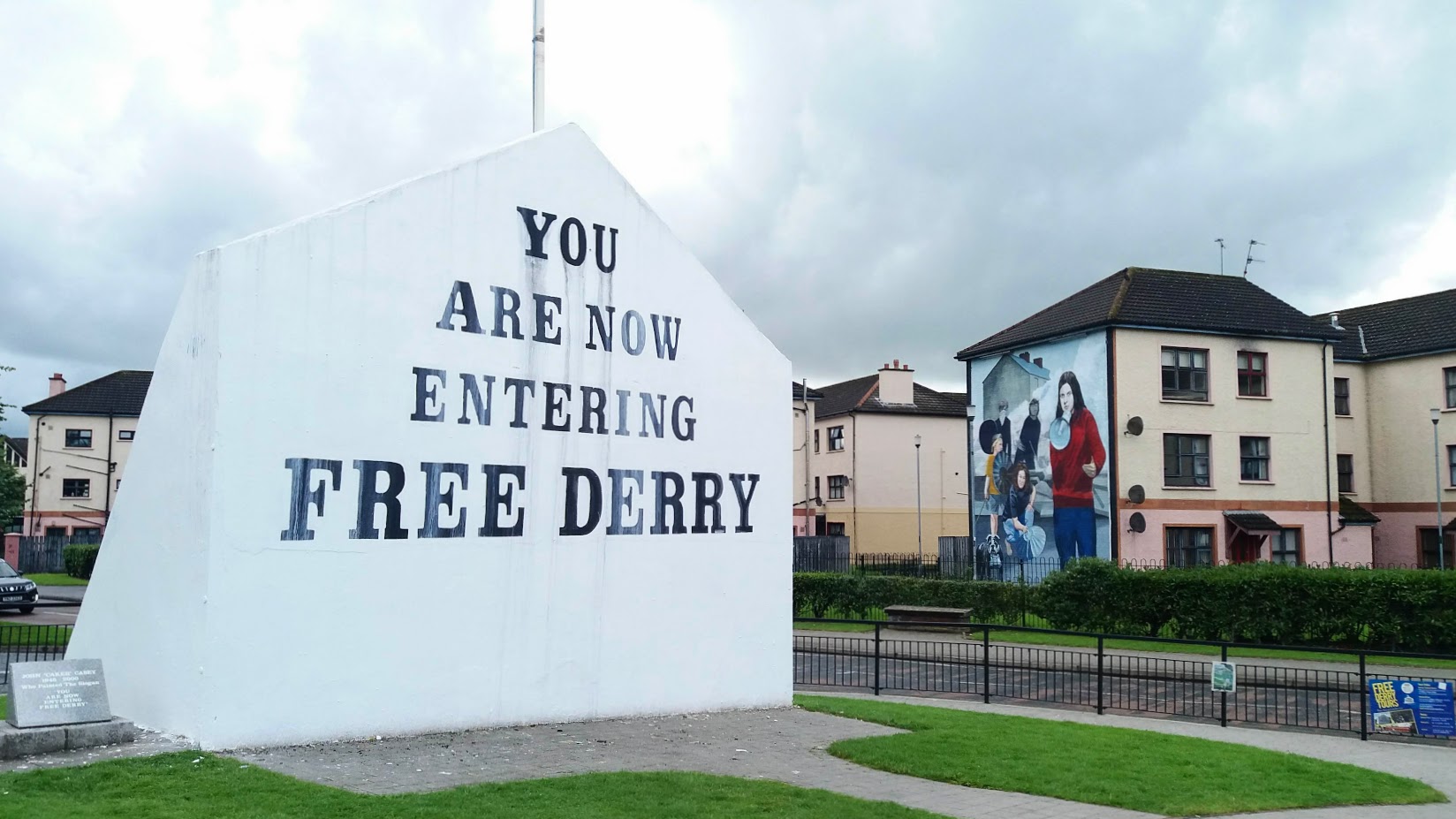
As the civil unrest went on, off duty police officers in plain clothes attacked protesters who were involved in marches or demonstrations. Uniformed on duty officers refused to protect the protesters from the assault. By January of 1969, police were breaking into protesters homes to assault them and the residents of Bogside erected barricades to keep the police out, declaring a “Free Derry”.

20190807_151726

Enter “The Apprentice Boys”. I cannot make this stuff up. No, they aren’t an obviously white nationalist group like the Proud Boys, but… come on. They are a Protestant fraternal (men only -read: patriarchal) order, however, and at the time in 1969, they enjoyed keeping those dirty Catholics “in their place”. Something something shoe fits.

The annual Apprentice Boys parade in August 1969 came so close to Free Derry that a fight erupted. Guess which side the police took. The police effectively dismantled the barricades, letting the Apprentice Boys into the neighborhood and leading the Catholic residents of Bogside to include the police in their targets.

20190807_151923

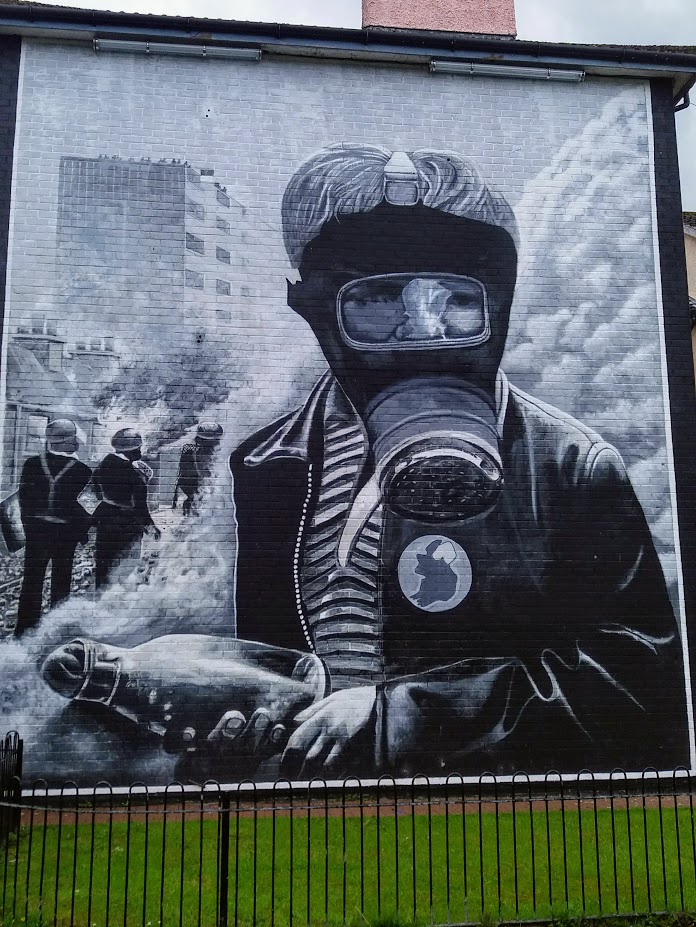
A three day riot ensued. The neighborhood was flooded with tear gas and well over 1,000 residents were injured in some way. Police from neighboring areas were brought in, but due to a severe lack of training, they only made it worse. On the third day, the British Army came in and basically separated the three sides: Apprentice Boys (Protestant), Bogside residents (Catholic) and police (Protestant) — while allowing the Bogside residents to maintain their barricades (probably the only reason it worked).

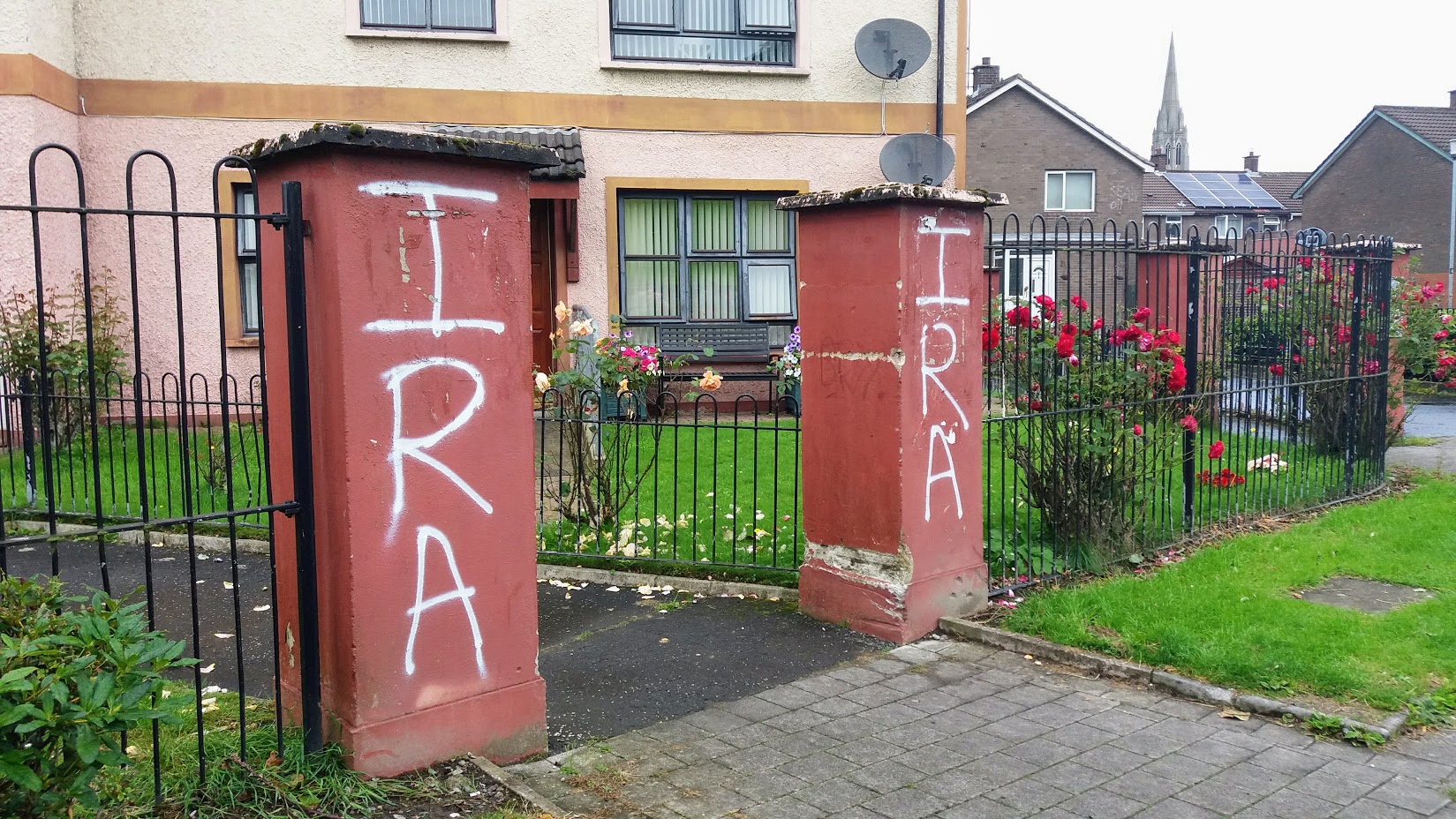
Free Derry was maintained for three years by armed IRA soldiers patrolling to keep British soldiers andΒ  Irish police out. This was not a time of peace, but of intensified armed conflict between the British state and the IRA. Free Derry was eventually dismantled after the massacre of Bloody Sunday where 14 people (13 outright and one later from injuries) were shot down by British soldiers during a protest march against the practice of imprisonment without trial. The soldiers were exonerated on the basis that they claimed to be shooting at armed targets.

If I took out the names and dates, these details could be from any number of American cities in 2020. I will not apologize for the comparison, or for getting political in my blog. We are repeating historical mistakes by continuing to find those among us to “other” and diminish based on pseudo-science and hate-fueled religious arguments. Derry may be a lovely place to have a holiday now, covered with boutique shopping and delectable cafe eateries and pubs, but 50 years ago it was a bloodbath as those who strove for equal rights were murdered by those who valued the status quo.

Do I like the bombings, the riots, the violence employed by the IRA? No… but I understand it – why it happened and why it was necessary to achieve equality under the law. What you would do if your country made it so you and your family always have less, are always be behind or under someone “preferred”, and allowed to be beaten or murdered without consequence after decades of peaceful protests and political marches were systematically ignored or criminalized?

I hope that America listens to BLM before it gets any worse because the result of these kinds of clashes are decades of pain and destruction. There is no question that the history being remembered here is one of state sponsored oppression and violence. You cannot visit and be unaffected by the striking contrast between the now peaceful streets and the murals dedicated to the fallen.

20190807_151903


History kept alive in the neighborhoods affected serves to remind us what we are capable of as a species, best and worst. If you travel the world and you skip the hard parts, you’re missing out on a magical opportunity to open your mind and grow your heart. Thanks for coming with me. Stay safe, wear a mask, wash your hands, destroy systemic forms of oppression and end police brutality.

Letters From China (About Tibet 2008)

When I was in China in 2008 and teaching this class on American Newspapers and Magazines, I walked a fine line balancing between American concepts of free press and Chinese, uh, absence of these thoughts. I generally stuck to fluffy topics like sports and fashion and celebrity, but then in March there was a riot in Tibet. It was on the state sponsored Chinese news. It’s also the reason I didn’t get to visit Tibet that spring. However, in my naivete, I thought that anything on Chinese news was fair game and I brought it up in this newspaper class only to run straight into a giant red wall and my first hard lesson in government censorship.


Mar 24, 2008 at 8:39pm

Tibet in the News

First of all, I’m fine, the whole thing is happening on the other side of the continent. I may not be able to travel there like I wanted, but I’m in no danger here.

DO NOT PUT YOUR OPINIONS ABOUT TIBET ON MY WEBSITE. (this is not for my sensibilitiesΒ but because the internet police are a real thing here)

I thought it would be ok to discuss with my students, since I saw it on the Chinese news, but apparently not.

I am not able to go into the history of Tibet on this page, but I what want to share here is…

TheΒ Chinese Perspective

Tibet has ALWAYS been a part of China.

I asked my students to tell me when it had first been, and they could not give a date, even though we discussed China from the Qin dynasty forward.

The brown area is the Qin territory. It is the first time China was unified under a single government, and it doesn’t even share a border with Tibet. The Chinese government teaches this map as history… but Tibet has always been a part of China.

In 1950, the Chinese army liberated the people of Tibet from an oppressive and cruel imperial regime under which they suffered greatly. The Tibetans welcomed their Chinese liberators and the REUNIFICATION of China.

The people who are rioting are:

1) under the orders of the Dali Lama

2) not really protesting over religion or independence, but only want to disrupt social order and make China look bad.

3) are using the Olympic timing to capture the attention of the world (they don’t say for what, but rather emphasize that they are trying to destroy the image of the Olympics with violent behavior, and distract the world from the Olympics)

4) possibly PAID to inflict violence as mercenaries in a political conspiracy.

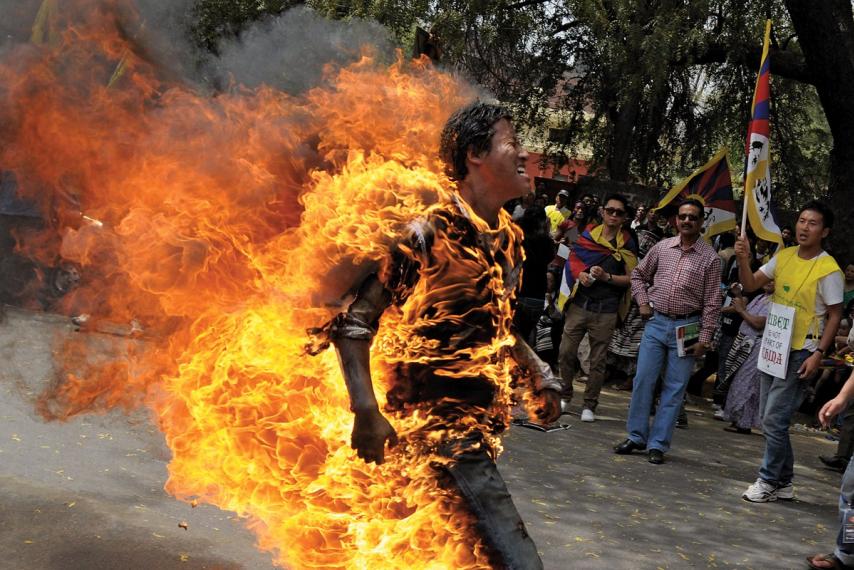
This is a Tibetan man burning himself to death in protest of China’s policy toward Tibet. It’s from 2012, in New Delhi. There are no pictures from inside Tibet during the March 2008 riot except those released by the Chinese media to uphold the official story, but things like this, as well as massive police brutality, and government sanctioned executions are rumored to have taken place.

These riots should be ignored. We should not let ourselves be distracted from the true spirit of the Olympics by their behavior.

The Chinese government has provided tremendous aid and relief to the people of Tibet, raising their standards of living, freeing them from oppression, etc. and the Tibetan people are surely grateful. These riots do not represent the will of the people.

And finally, MIND YOUR OWN BUSINESS. Foreign travelers and reporters have been asked to leave the provinces of Tibet, Sichuan, Gansu and possibly others because its no one else’s concern, but an internal Chinese affair.

East vs West

If your brain is in knots, don’t worry, its hard to see things from the other side. But in trying to understand it, I reached a fundamental conclusion.

The Chinese say that there can be no freedom without peace, and the Americans say there can be no peace without freedom.

This may not seem like a big difference, but I assure you, it is HUGE.

One student told me that they will accept a lack of freedom because the most important thing is survival, and that only once economic prosperity was assured and the survival of the people was no longer at stake could they worry about thier freedoms.

I said that for Americans, survival without freedom isn’t worthwhile.

Another student told me that the Chinese were just waiting for the people of Tibet and Taiwan to accept the One China policy, because only when there is one unified China can there be peace. She referenced the ideology of Emperor Qin who fought like crazy to unite China (for the first time, 2200 years ago) because he believed that only if the warring states were united could there be peace, and he was willing to spend his own life fighting so that there would be peace in the future. (Check out the movie ‘Hero’ if you haven’t seen it).

This idea, that we must fight now for peace later is close to the American one, but the root of it is submission.

I believe both our cultures value peace, and both will fight to create and defend it, but what we are willing to sacrifice to get it, and what we believe makes life worth living are diametricly opposed.

“Gentlemen may cry, Peace, Peace– but there is no peace… Is life so dear, or peace so sweet, as to be purchased at the price of chains and slavery?… I know not what course others may take; but as for me, give me liberty or give me death!” — Patrick Henry, 1775


My brain had some hardcore cognitive dissonance reading this post today in 2018. On the one hand, I’ve certainly become less mono-focused on American cultural values (although I’m sure they will always be a part of me). On the other, I read the line about violent protestersΒ being paid to incite riots and went… Fox News says what?Β 

I look at the current American sentiment and it seems like the assessment I wrote here has somehow been taken to the absolute extreme. While the Chinese are gradually becoming less willing to sacrifice the freedom of today for the security of tomorrow, the Americans seem to be willing to sacrifice everything at the altar of absolute freedom. And yet, despite this, we are burdened with a spin cycle that paints protesters who claim to be “against fascism” as paid inciters of violence rather than actually dissatisfied citizens just the way that Xinhua news did with the protesting Tibetans.

I saw then what it looks like when citizens believe the “alternative facts” presented by their government so fiercely they cannot see the holes in the story, and dismiss any contradictory evidence as fake propaganda. I saw it then, and now I realize why it looks so familiar.

August 19, 2017. Boston. According to ABC News where I found this picture, these brave police are protecting free speech advocates from violent socialist counter-protesters. Has anyone seen my dog whistle?