If there is one famous place that exemplifies Nagoya, it is the sprawling grounds of the reconstructed Nagoya Castle. I couldn’t possibly visit Japan’s fourth largest city without spending some time at it’s most famous historical monument! I was hoping to get a sunny day and take some sweeping landscape photos of this majestic structure, but the weather was not on my side. Even without the sun, Nagoya Castle was beautiful, fun and educational to visit. Plus, there were Ninjas!
I woke up Tuesday to the sodden realization that the weather forecast had changed again, and the rain was not going to stop until I was back in Korea. It wasn’t as bad as Monday, however, mostly cloud cover and the occasional sprinkle. I had forgotten my umbrella at the katsu restaurant the night before, but I wasn’t worried since umbrellas are for sale in every subway station and convenience store (right next to a huge steaming pile of foreshadowing).
Golden Bus or Subway?
I looked into the possibility of doing the Golden Tour Bus day pass. The Me-Guru is a kind of hop on hop off bus that runs around the most popular places in Nagoya. You can get a Me-Guru day pass for 500 yen which is great if you are planning to hit up several tourist hot spots in one day. Unfortunately for me, there wasn’t a stop anywhere near my friend’s house, so I was going to have to take the subway at least 2 times (out and back) making the 500 yen ticket less attractive to me. If the Me-Guru isn’t getting you where you want to go, you can also get a city day pass for subways for 740 yen, or subway bus combo for 850 yen.

Photo Credit: Nagoya Station.com
The main attraction of the Me-Guru Golden Bus is that it drops you very close to tourist attractions that might otherwise be a hefty walk from the nearest regular bus or subway stop. Atsuta Jingu is very central and easy to access, but the Nagoya Castle and Tokugawa Gardens are rather out of the way. Lucky for me, the Me-Guru bus also offers single ride tickets for 210 yen which you can buy on the bus just like any other city bus. I would recommend the Me-Guru day pass if you happen to be staying anywhere near one of the bus’s stops, however I opted to take the subway (270 yen trip) to Nagoya Castle, then the Me-Guru to Tokugawa (210 yen), and finally the subway again (270 yen) back to my ersatz home base for a grand total of 750 yen.

Photo By Comyu [CC BY-SA 4.0], from Wikimedia Commons

If you don’t plan ahead, you may not know where the next bus stop/subway station you need is (it might not be the one you came out of or the closest one may not go where you want to go). You could find yourself walking farther than you want, which doesn’t sound like much, but we tracked our walking on Sunday and got almost 10 km in one day of aimless tourist meandering. It adds up fast, and while I don’t mind walking for health or enjoyment, I don’t want to waste vacation time and energy walking extra to the bus stop when I could be using it to walk through something cool! Plus, if you suddenly find yourself knackered from unexpected heat, humidity, and ridiculous amounts of walking (this happens to me at least once per vacation), taking a taxi back to your hotel in Japan could cost 50-100$, that’s US dollars, folks. Taxis are EXPENSIVE in Japan. Ubers are not better.
Let Them Eat Gold
From the nearest subway station, the walk into the Castle compound is down a little restaurant corridor that sells everything from Nagoya specialties to the Castle’s very own gold plated ice cream. Yes, gold plated ice cream. It’s not actually very expensive, and it’s highly Instagramable, but I couldn’t bring myself to buy one as I have recently been complaining about the out-of-touch rich people in America eating gold plated tacos while children can’t get fed in school… soooooooo…. no gold ice cream for me.

Photo credit: Park SuJin via Instagram
The ice cream isn’t trying to be Richie Rich, it’s actually meant to imitate the golden tiger-fish that is the symbol of the castle. During my post vacation research phase, I got curious about how they could afford to sell these golden ice creams for 6-9$ a pop, and I discovered that you can buy edible gold sheets for surprisingly cheap. One seller on Amazon is selling 10 sheets for 7$. The gold taco I was upset about? 25,000$… US….At 0.70 per sheet, it may be silly to eat a golden ice cream cone, but it’s not actually Louis XVI levels of decadence and class warfare. Eat the rich.
Fire Bombing Damage
Nagoya Castle is the number one tourist stop in Nagoya and it’s not even finished! Almost everything you see there was destroyed by Americans in WW2 during the fire bombings. A fact the informative signs will not let you forget since everything you read will tell you how the original was destroyed and whether what you’re looking at is a transplant or a reconstruction.

Traveling around Asia, you inevitably see signs like this because nearly every temple, castle and historical site has been sacked during one war or another. In China and Korea, you find things that were destroyed by the Japanese. In Japan, you find things that were destroyed by the Americans.
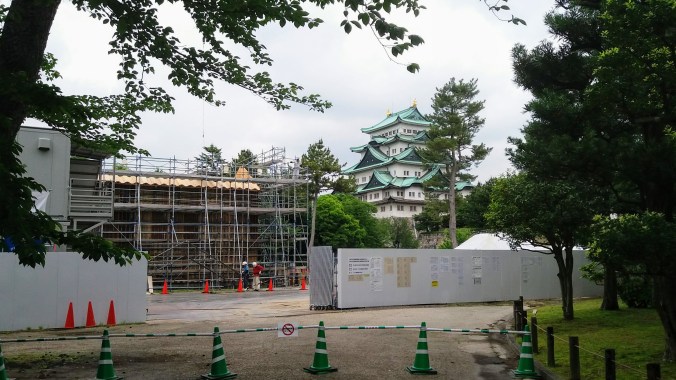
The castle and grounds were still heavily under construction during my visit, but I’m told with some degree of excitement by the locals that the reconstruction should be finished this (2018) summer.
Hommaru Palace
The first sight that greeted me walking in the gate was the tower of Hommaru Palace. The tower is done in a similar style to the main castle, but is much smaller. Once you get around the corner and over the moat, there is a beautiful brand new palace. According to the literature I was given to take home, the Nagoya Castle was declared a National Treasure back in 1930, but sadly destroyed in the 1945 air raids… ok they don’t call out America by name, but we all know. The palace compound has been undergoing reconstruction on and off since 1959, but the Hommaru palace reconstruction only started in 2009!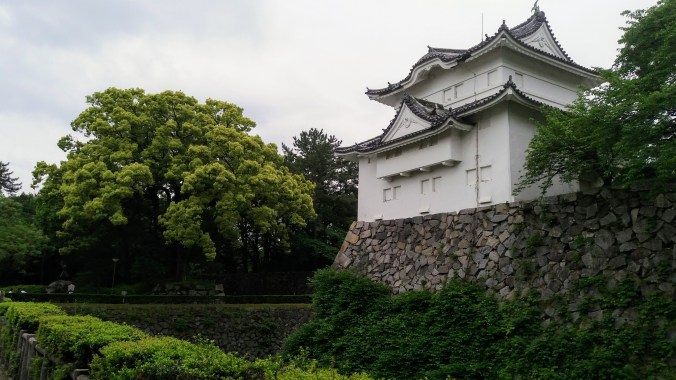
I am not an architecture buff, but I do enjoy a beautiful building. I especially appreciate that Nagoyans decided to use all traditional materials and craft techniques to remake the structure. It doesn’t just look like the original, it preserves the artistry and history of Japanese culture — not only the woodwork, but also the fittings, metalwork, and paintings. There was an intense research project designed to microscopically and chemically analyze the original scraps that survived the fire bombing (have we mentioned that recently, because Nagoya Castle does not want you to forget) so that the paintings could be replicated as authentically as possible.


Despite the chronic reminders of our history of conflict, the restoration process is fairly interesting. If you want to see more details, they’ve got a lovely website.
As I approached the palace proper, there was a group of Japanese businessmen having a chat in front of a very photogenic area. However, my faith in Japanese politeness was rewarded. As soon as one noticed me holding my camera (phone) nearby, they gestured to the others to move out of the way and we all smiled and bowed to each other before I went on to take the photo. So much politeness!
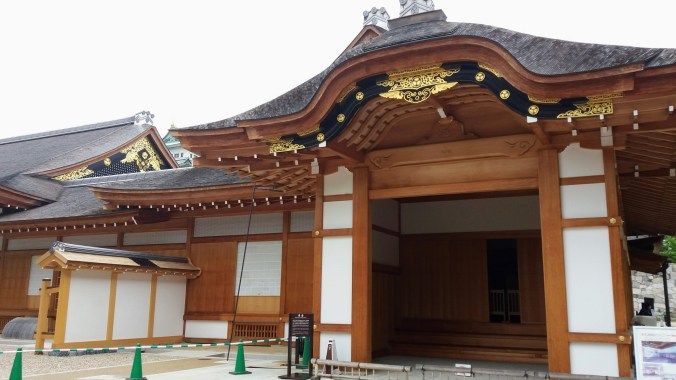
Following the path, I noticed an area where a few other visitors were lining up and entering the building so I paused to check it out. The staff were sooooo excited to share with me. They showed me a little video of how to tour the building correctly (no touching, no flash photos, etc) and explained the character in costume stopping all the bad behavior on screen was the father of the famous king who had ruled from this palace and a famous general.
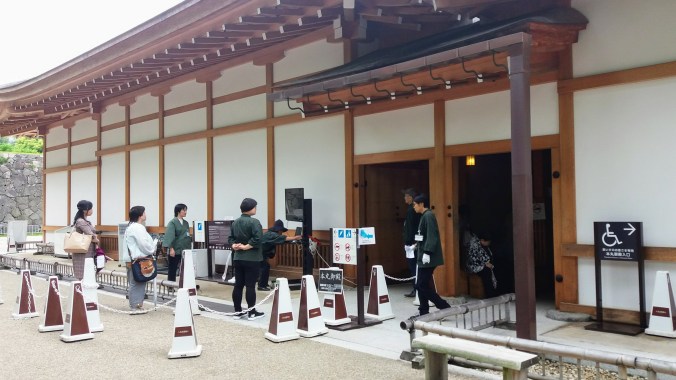
I was asked to wear my backpack on my front to avoid bumping anything, and all of us were asked to remove our shoes before going inside. Slippers were available, of course, and there were free shoe lockers as well. For an extra 100yen, an audio tour of the palace was availble in several languages. I thought about getting the English one, but it was taking the staff 10+ minutes to set up the couple at the front of the line, and I wasn’t second in line. I decided to risk moving on less informed.
The palace itself is bright and open. Although the day was cloudy, the inside of the palace somehow still managed to feel sunny with the warm wood halls, paper windows, and gold accents. Drifting sock footed through the hallways, I felt a sense of what visiting the royal palace might be like. Everything was hushed and clean. The halls were made of the same pale wood on all 4 sides creating an effect of being inside a tree. Every few meters, the interior hall wall would open up into an opulent room. The 3 visible walls inside each room were covered with the ornate and painstaking replicas of the Edo period paintings.


In practice, each of the rooms would have had a specific ceremonially significant purpose. A room for receiving guests of a certain social standing or another. A room for dining, one for tea, one for drinking sake and listening to music. One room had a fire pit built gracefully into the floor and a hidden vent in the ceiling to carry the smoke of roasting meat and fish up and out. The low wooden bars are just to keep people from walking into it, not an actual part of the function. Indoor fire pit is now added to my list of things I want in my imaginary dream house of the future.

The palace doesn’t take long to explore and it’s included in the park entry fee. I highly recommend a walk through. On my way out, I ran into the very helpful staffer again. It turns out she had lived in America a while ago and was happy to practice English with me (although I don’t think she really needed “practice”) She told me some more about the restoration process and said I really needed to come back after the construction was complete to see it at it’s best. It made me happy that the people working there take so much pride and interest in the history and culture of the site. Enthusiasm is highly contagious and just talking with her made me more excited to be there.
Surprise! Ninjas!
Just after leaving Hommaru, the path turns a slight corner and suddenly there’s the first real view of the Castle proper. This was the real moment I was sad about the weather. Nagoya Castle is elevated, and huge, so any photo will have plenty of sky in the background. My cloudy, rainy day resulted in a very plain light gray sky instead of a fluffy cloud filled azure backdrop. Is it cheating to use filters?


Did I mention there are ambulatory ninja on the castle grounds? It’s part of a cultural and historical show. According to the ninja website, two words I never thought I would string together in a non-hyperbolic fashion, there are performances every weekend, but weekdays are listed as “hospitality”, a kind of meet and greet. I was there on a Tuesday, so I only met the two posing for photos and promoting their future shows.

No Nagoya Castle for Me
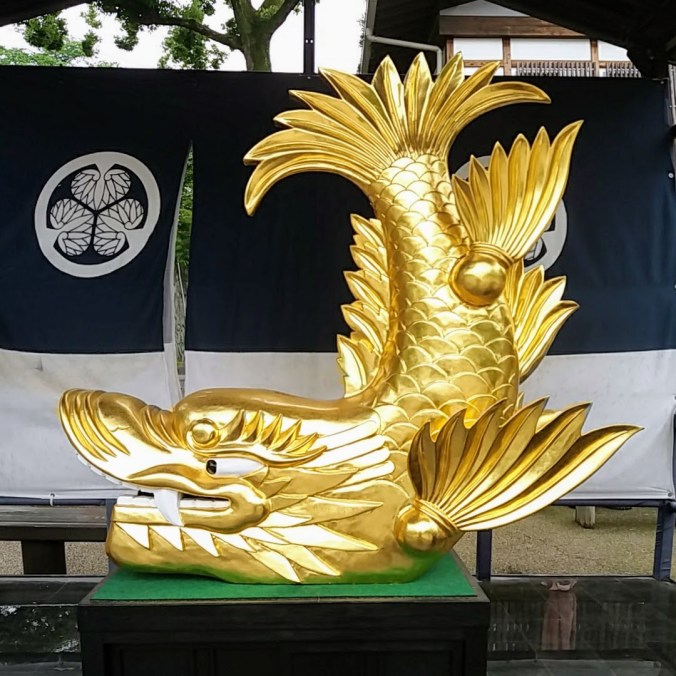
Sadly, the castle was closed for the finishing touches of construction, so I couldn’t go inside, but I’ve heard there’s an excellent view from the top. Looking at other people’s photos online, it seems the decoration style is very similar to that of Hommaru palace. The only truly distinctive thing I missed out on seems to be the huge Shachihoko (the tiger fish) that you can sit on and pose with, and the tall geometric stairwell. Next time.

photo credit: Matcha Magazine
Since the castle proper and some of the other areas were closed off for construction, I was encouraged to wander a little off the beaten path. In addition to stopping for teeny tiny flowers which earned me some very strange looks. (Why is she looking at the grass when the castle is right there?) I also wandered off into a little forest grove filled with large, semi-flat stones. It was not cordoned off, but also not really connected to the main walkway either. After some assistance from the Google oracle, it seems I discovered a stone tomb of unique historical properties.
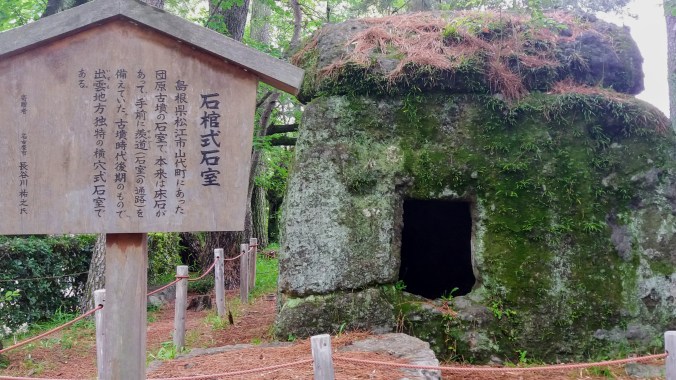
I’m still unclear if it’s an original or a replica given the whole bombing debacle, and I don’t know why it was over there all by itself in an extremely unmaintained state in the middle of what were otherwise meticulously maintained grounds. The only informative sign was in Japanese and it mostly focused on the description of the architectural style, geography and time period with no mention as to its context near the castle. Still, it was pretty, and from inside the trees, I got some fun new perspective angles on the castle itself that don’t look identical to every other tourist shot on the web, so yay!
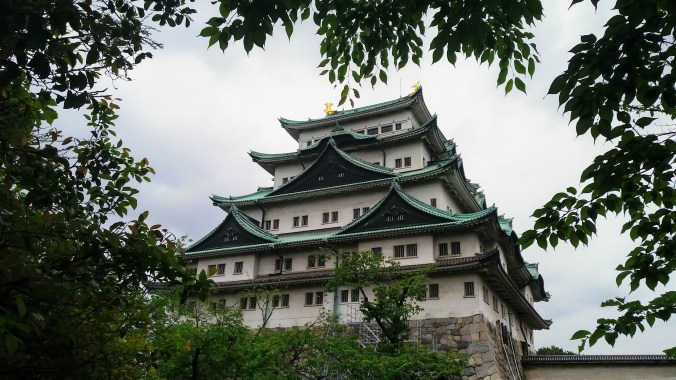
A large chunk of the grounds were completely blocked off during my visit. I found a few more interesting goodies like ancient gates and the working tea house where you can stop and have a traditional cup of matcha green tea and a sweet. Of course the souvenir shop would never be closed for construction, but I found the gardens to be a bit lackluster, as though they had not been tended to yet this year, so even though they were not blocked off, they weren’t exactly visitor ready.
Samurai and Shachihoko
 On my way back toward the main gates, I happened to run into the Samurai. Ninjas AND Samurai. It’s like cosplay meets museum, so very Japanese. Much like the ninja, the Samurai pace the palace grounds daily for photo ops and perform shows on weekends and holidays. My desire to avoid weekend/holiday crowds may have backfired here, but the guys I met were pretty cool nonetheless.
The last important sight before my path led me outward was the Shachihoko – the fish tiger. What’s up with that? Well, it’s a mythological creature that is half fish (specifically a carp) and half tiger. The Japanese characters that make up the name of the creature is also a combination of “fish” and “tiger”. 鯱 (shachi) = 魚 (sakana, fish)+ 虎 (tora, tiger) Some argue that the fish is really an orca because “shachi” also translates as “orca” in Japanese. I love language.
It’s often put on temples and palaces to ward off fires, but in Nagoya it has become the special symbol of Nagoya Castle due to the two large golden Shachihoko on the roof. Most of the souvenirs, or omiyage, of the castle involve this magical creature in some way, and of course, so does the golden ice cream.
I do hope that I’ll have the opportunity to return to Nagoya again after the construction is complete. I would not only enjoy seeing the inside of the Castle proper, I suspect I would greatly enjoy the gardens and side buildings that were inaccessible during my visit. What little I could see through the scaffolding looked intriguing. Plus, next time I won’t feel guilty about trying that glittery frozen treat now that I know more about the edible gold market.
Due to the weather, there is no accompanying photo album to this trip, but I hope you’re enjoying the Instagram photos in the mean time. As always, thanks for reading ❤
Oh, and the umbrella foreshadowing? I’m afraid you’ll have to read the next post to find out about that adventure. 🙂












 We set off from Busan (blue dot) in the morning to drive all the way across the southern end of the Korean peninsula to Jindo (red dot). Although Korea is small compared to, say, the US, it was still almost 5 hours of driving with the occasional pit stop. (By the way, in case you’re curious, you can see Daegu on this map as well). Fortunately, I went with a tour group (my stand by
  The Jindo festival had at least one feature I’ve never seen before: a traditional Korean wrestling ring. A pile of sand was placed in a large circle where two contestants could wrestle in the traditional style.
  Even more bizarrely, after the color throwing was over, the festival organizers gave each participant a “toga” to wear. The togas were long white robes with red sashes that could have evoked a Roman senate or Jesus. Considering we were about to “part the seas” it was hard not to see it with Judeo-Christian overtones, but the rather drunk person I asked about it just said “toga party!” The entire thing seemed like the festival organizers were trying to find a way to appeal to the expat crowd. I’m glad they had fun, but I would have preferred some more traditional activities, like someone to teach us about collecting clams and seaweed the way the locals were doing as the tide went out. It’s hard to go do local culture festivals when the locals are busy trying to white-wash everything for cash.
 Finally, the real “reason for the season” was upon us and we muddled our way down the road to the rainbow steps beneath the watchful eye of the grandmother and the tiger. We paused at a bench to don our thigh high rubber boots and got some advice from the locals on how to attach the rubber garters through belt loops to hold up the boots, or failing that, to wrap them tight around our thighs and snap them in place. Thus clad in bright orange and yellow wellies, we made our way down the steps and into the shallow tide pools to wait for the tide to recede.
 If you look at the area on Google Maps you will simply see the beach and the islands, but on Korea’s own Naver Maps, there is a thin line connecting the rainbow steps to the island of Modo. Although this path is only usable twice a year (at most), the Korean map makers consider it important enough to draw in.
 The history of tidal prediction starts with Kepler (total nobody) in 1609 to theorize that the moon’s gravity caused the ocean tides. He was followed by other such no-ones as Galileo and Newton. It was in 1776 that the first big complex equations came from a man called Laplace. Harmonic analysis was added in the 1860s and polished off by 1921 in the form that Navies all over the world still use today. Although the math hasn’t changed in almost a hundred years, computers make the math easier and the information more widespread so now instead of just ships in harbor– surfers, beachcombers, and clam hunters can
  On a more mystical note, the local legend of the tigers explains why there’s a statue of a grandmother and a tiger overlooking the sea. Long long ago, the villagers who lived on Jindo were plagued by man-eating tigers. The whole village packed up and sailed over to the neighboring island of Modo to escape the threat, but one woman was left behind. The woman was Grandmother Bbyong, and she prayed to the Dragon King, the god of the sea, to help her. Finally the Dragon King came to her in a dream and told her he would build a rainbow brigde across the sea for her. The next day when Bbyong went down to the sea, the waters parted to let her cross and her family came out from Modo to meet her. This also explains the rainbow stairs that lead down to the landbridge, but not why her family couldn’t have just sailed back for her in the first place.
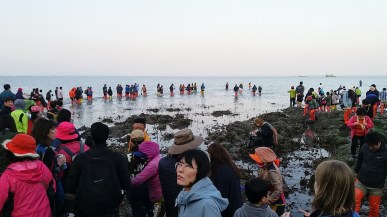 While math can now easily tell us the time of the lowest tides, it does not yet advance to tell us what the actual lowest level of the water will be. Not that it couldn’t, but there are more variables involved, so it’s not a thing now. While we can say with certainty, the lowest tide of the year on this beach will occur at 18:38 on April 29 (or whatever), we can’t say for sure if that will expose the land bridge or simply be lower than every other tide around it.
 We tromped along the path, watching parasailers overhead and rainbow colored lanterns being released in to the air from the beach behind us. It was clear the path was quite narrow because going too far from the group to one side or the other to get a picture resulted in a severe deepening of water level. At the time, my friends and I theorized it might be man-made, or at least man-maintained, however, I have since then found that the build up of rock and sand in this twisty line is a natural result of the currents around the islands.
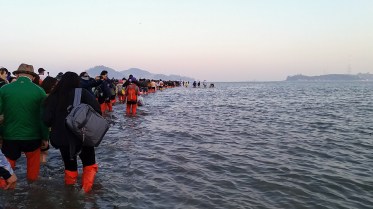 Before long the golden light of the sunset combined with the swish-swishing of hundreds of feet through water to create a trance-like state. I could not judge how far the island was, nor tell which way the path twisted. The rocks below us rose and fell, bringing the waves treacherously close to the top of my boots and then back down to barely splash over my toes. The whole path is nearly 3km long. I suspect a determined person could make it out to the island and back in the hour or so the path is clear to walk, but I wasn’t racing, and soon we were greeted by the sounds of Korean drums and the distant flags waving as the procession from Modo came out to greet us.
 The walk outward had been slow, trepedatious, as though we were nervous the land could drop away at any moment, but the trip back was much more celebratory as well as much more damp. The parade of drum bangers, cymbal crashers, gong ringers and flag bearers danced merrily in their traditional garb, urging us all back to the larger island of Jindo. Our pace quickened and our legs swung to the rhythm causing much larger splashes. Waves came in from both sides of the path making us nervous, but excited. The water finally breached the top of my boots and sent an icy chill down my shins, but I found I did not mind.
 Before heading to the fields, we walked up a long road past the area of the light festival where a few wire frames from reindeer and dragons could still be seen. The road up the hill was painted with fun perspective illustrations of a stream, complete with little camera icons to show the best places to stand to see the visual effect. Optical illusions are fun.
 At the top of the hill, far beyond the little pagoda that had marked the highest point of the lights, we finally came upon the green tea museum where we were treated to a special showing of the Korean green tea ceremony (complete with English translation by our awesome guide). The ceremony involves a process of several containers: a water pot, a cooling bowl, a tea pot, and the drinking cup. The hot water pot is filled with boiling water, which is then poured into the bowl, and from the bowl into the tea pot and finally into the cups. The instruments are warmed up in this way. Then more boiling water is poured into the cooling bowl. Tea leaves are scooped into the warm but empty tea pot and the ideal temperature water is poured from the bowl over the leaves. While the tea steeps, each cup is emptied of it’s hot water into another bowl on the floor and wiped dry on the outside. The tea is then poured into the pre-warmed cups by pouring only a half a portion into each and the other half in reverse order on the way back. The tea is then served, 4 cups to the guest and one to the host.
 The hostess tried to tell us a bit about green tea, red tea and black tea but her translated explainations seemed off to me, since she said it had to do with the age of the leaf when it was picked from the plant. I don’t know if this was her or the translation, but the real story follows: In any country with Chinese roots in it’s culture and language, the three colors of tea are a bit different in meaning that in the West. Red tea is not Rooibos, in fact all three come from the same plant. And it’s not the age of the leaf at picking that determines the difference, but rather the post picking, pre-drying process. (although especially young and tender tea leaves are sometimes referred to as “monkey picked” and do make a delightful tea).
 After we conducted our own tea ceremonies, I drifted lazily back down the hill, examining the spring flowers and the grounds that had been lit up beautifully last December. When I finally got back to the tea fields, I took off on the same route I’d walked before and was happily greeted by many blooming apple trees and a small army of busy bees who were so focused on the brief blossoms that they paid no mind to all the humans fussing around. In fact, I think it was the only time I’ve seen Koreans in the presence of a bee not totally freaking out. I guess the selfie with the tree is worth it.
 In addition to the blooming fruit trees, there were cascades of purple flowers covering the rocks wherever tea was not growing. It made the whole place feel like a still frame of a rushing river in shades of pink, purple and green. Besides the tourists, there were also tea pickers at work. Each ajuma looking lady had her sun guards on, gloves and a mesh basket to place the leaves. They were not picking the bushes bare, but selecting only some growth. It seemed to me to be the newer, brighter green leaves that they were after, but I couldn’t tell for sure. In the age of automation it was strange to see people picking by hand. I know that it’s still the way for many crops in the world, but sometimes it gets driven home that there’s a human on the other end of my tea or strawberries or carrots, and then I’m carried off by sociological musings on how we came to value people who sit at desks manipulating imaginary money so much more than people who make our food.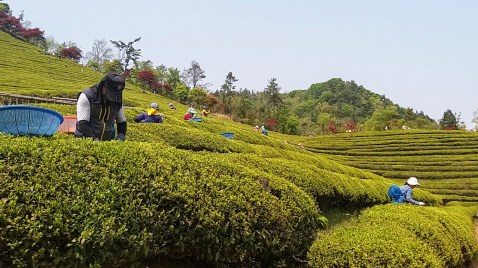

 Gallivantrix
