Paris in the Spring

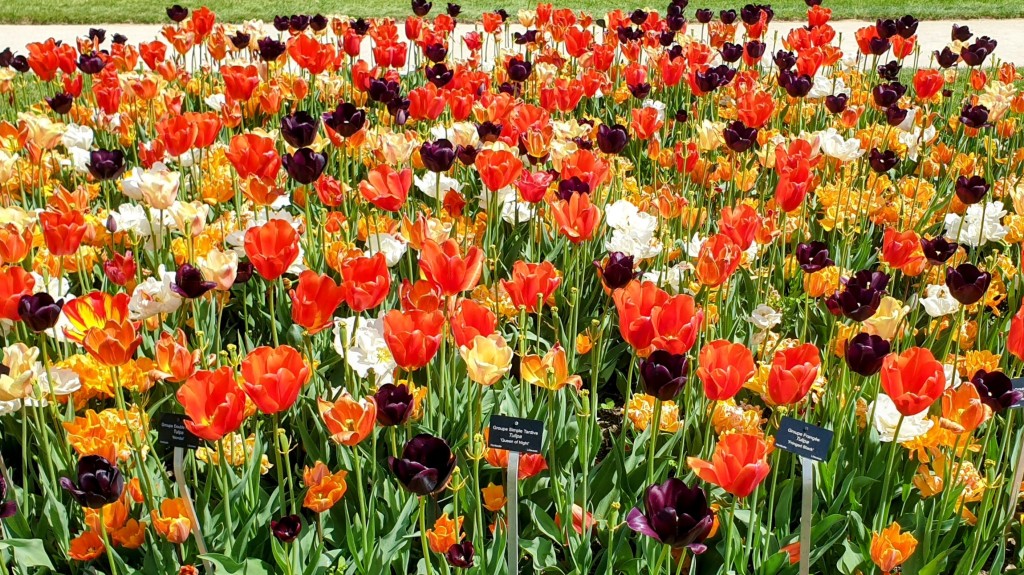
Despite the detour, this is still mainly a travel blog, so without further ado, I bring you a sunny day in April exploring Paris. The romantic ideal of Paris in the spring is perhaps more marketed to lovers, but having been to Paris both in spring and in summer, I can say I have a definite preference. The weather is better, the crowds are fewer, and if you go early enough in the spring, you get cherry blossoms! (For those looking for tips and advice, specific details about transportation and accommodation are at the end).

When I decided that I would spend a couple months in France, I knew I didn’t want to have Paris as my home base for a few reasons. The top being “oh my god it’s expensive”. The next being “it’s full of tourists”, and the last and perhaps most important: I wanted to see other parts of France. Nonetheless, every international flight into France lands in Paris, so although I would start classes in Tours on April 15th, the best price to fly was April 11th (several hundred dollars cheaper than the 12-14th). I decided that I’d rather spend the money in Paris, so I booked a dorm and planned a laid back day of viewing the gardens and eating delicious food.

Breakfast

Refreshed from my flight by a good night’s sleep, I headed into the city center to my favorite breakfast place in Paris: Angelina’s. I have gone to Angelina’s every time I’ve visited Paris for their amazing hot chocolate, even in the worst summer heat wave. For people who have only had packet hot chocolate, I can’t express my sympathies deeply enough. Some of you have been lucky enough to have real hot chocolate made from milk and chocolate (not a powder) and you begin to know the heights to which this beverage can soar. Those of us who have been graced by the chocolat chaud at Angelina’s know the celestial chocolate experience.

The last time I was in Paris in 2019, I made breakfast reservations because we had tickets to the museum and I wanted to make sure we were not rushed to finish eating. It turned out we didn’t need the reservations since most tables were still empty when we arrived. This year, Angelina’s website says they are no longer accepting reservations, and when I arrived, I discovered the otherwise totally empty sidewalk to be teeming with a crowd in line at my favorite breakfast spot. I queued up while I looked on my phone to see if there was some explanation. I was informed by my neighbors in line that the restaurant had recently become TikTok famous, which is why they themselves where there.

I’m never sure how to feel when a restaurant gets influencer famous. Many restaurants have actually been destroyed by fame induced crowds flocking in numbers that their small scale production process simply could not handle. Others have had to reduce the quality of their once famous dishes in order to keep up with the demand. I stood in line thinking that there must be another restaurant in Paris that had really good hot chocolate, and maybe it was time for me to try a new thing, when the line started moving. It only took perhaps 15-20 minutes before I was at my own table. The wait was considerably shorter than I would have expected at a restaurant in Paris. It may be that foreigners are accustomed to eating quickly, and tourists who had made Angelina’s a stop on an otherwise full day of activities were eager to get on.

I was fully prepared to order my breakfast in French (knowing I didn’t need to), and the server was very kind about it. Then I realized that about half the patrons in the dining room were Asian, and were all using English to communicate with the staff. I told my Korean students over and over again that English was the key to world travel, but it strange to see it in action here in Paris after struggling though my bad French on previous visits. Stereotypes about the Parisians persist, yet I have never known them to be anything but kind. It’s possible they appreciate the attempt to speak French more from native English speakers because of the stereotypes about English speakers being monolingual, but they seemed quite content to speak English with me and with every other tourist around.

When my order arrived, I was delighted to discover that despite the newfound TikTok fame, the quality of Angelina’s hot chocolate had not diminished in any way, and that the French cultural value of never rushing a diner at the end of a meal was still going strong. Regardless of the line at the door, everyone seated was fully welcome to spend as long as they liked savoring the thick chocolatey goodness and rich pastries. Bliss!

Jardin des Tuileries

An online search for cherry blossoms in Paris revealed that the largest grove of cherry trees was about 90 minutes on transit from my hostel, and after viewing the blossoms at some of Asia’s biggest collections, I doubted at the mere volume of trees would be a top draw for me in France. Instead, I opted for closer gardens with fewer trees where I could have a lovely stroll with less time in the Metro. My first stop was Jardin des Tuileries, right across the street from Angelina’s.
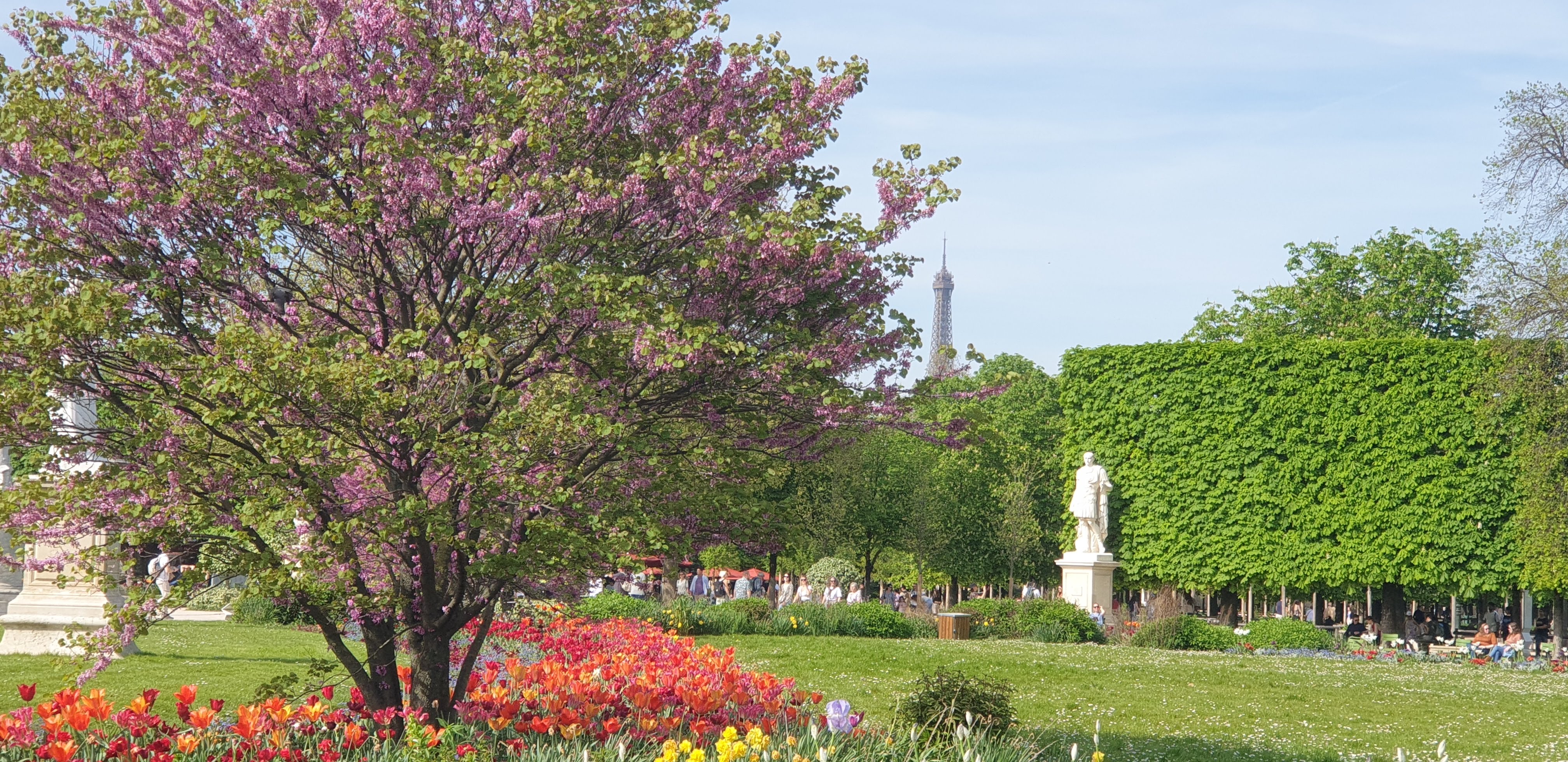
I like to come to this garden when I’m in Paris no matter what else I’m doing. My first time in Paris (2015), I ended up in Tuileries purely by accident, and ate a glorious sandwich next to a fountain with a view of the Eiffel Tower. It’s a memory that sticks in my mind because I felt in that moment that I had “made it”, that all my repeated struggles towards my dream of global travel and daydream freedom had landed me in this garden, with the best sandwich I’d ever eaten, basking in the sun and watching the Eiffel tower in the distance. I like to come and visit the park and relieve that memory whenever possible.

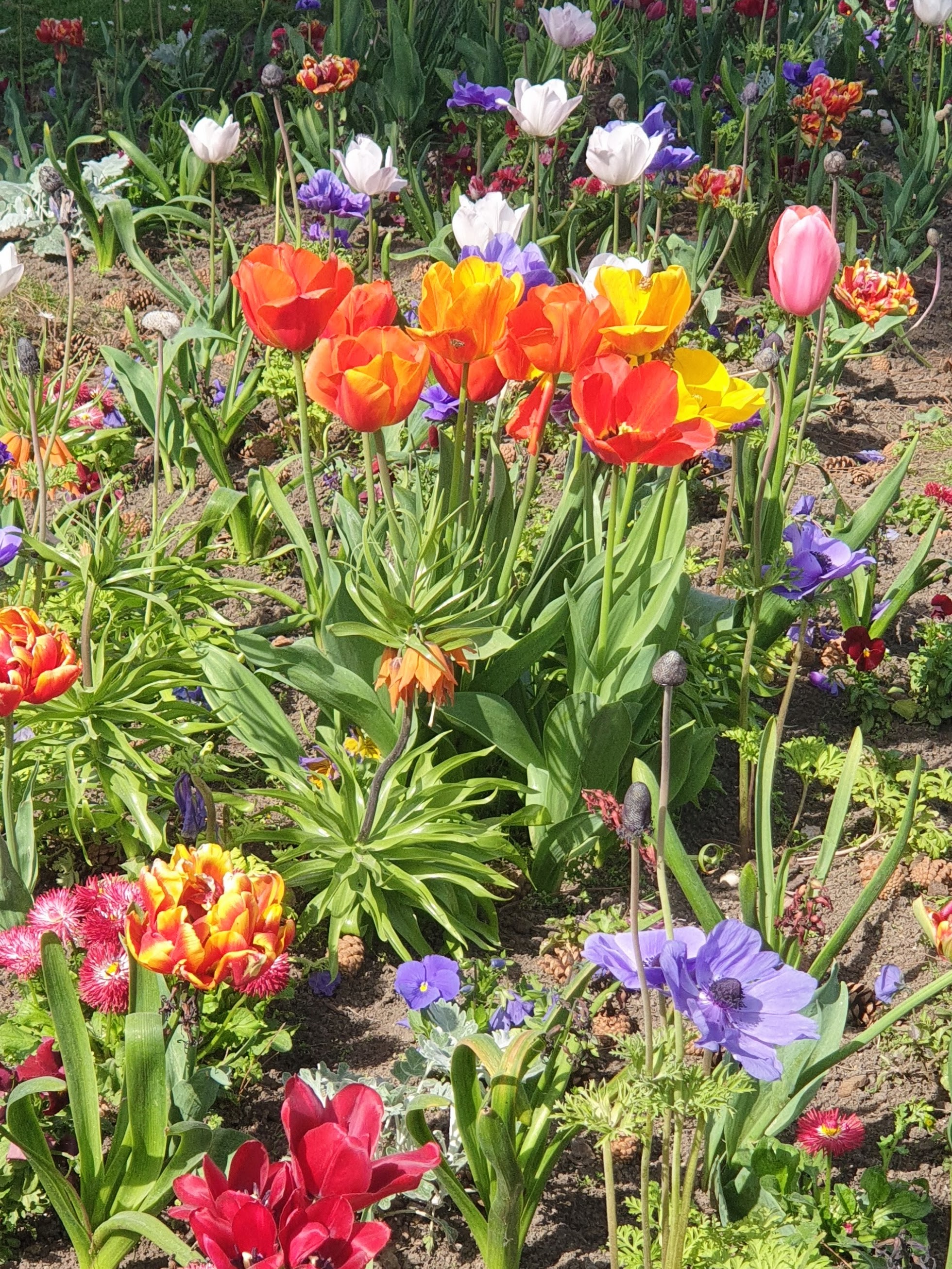
There were plenty of people, both locals and tourists, enjoying the unseasonably warm sunny spring day in the park. I ambled around and taking photos of the pink blossomed trees, stopping occasionally to take photos for groups who were struggling to use the timer on their phones or get everyone into one selfie. My feet were still swollen from the flight and my back hurt, but none of that could impact the growing sense of ease and contentment I experienced just discovering that I had once again “made it”. I survived the COVID induced lockdowns, I took my years of isolation and I packed them up in a box in the closet and I once again embraced travel for joy.

Jardin des Plantes

The next garden I visited was the Jardin des Plantes, a botanical garden that I had not been to before. It also houses a small zoo, and some indoor exhibits, but I was there for cherry blossoms! Priorities.

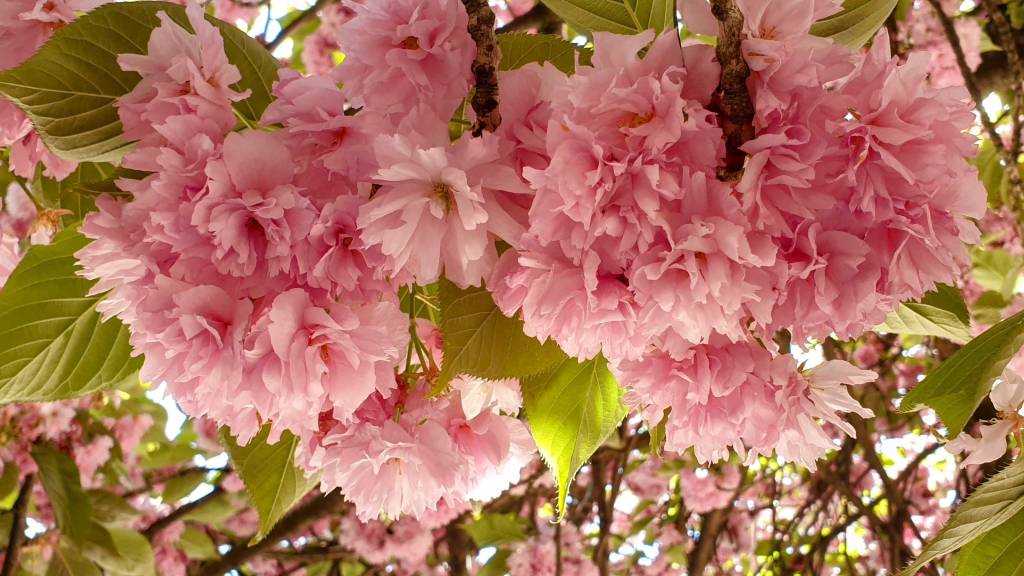
When I found the area where the park’s cherry trees grow, I was initially disappointed. It seemed that all the “white” (very pale pink) trees had finished blooming the week before I arrived. There were four darker pink blossomed trees of prodigious size, but they too seemed to be at season’s end. Thankfully, that was an illusion. These enormous trees look full of fading blossoms from a distance, but once you step under the sprawling canopy, you have entered the bower of a magical fairy land. Queen Titania herself might set up a divan there and feel entirely appropriately decorated. 

It was like stepping into a snow globe of pink petals. The branches swept from high above all the way down to the ground, cutting off the view of the outside world. Fallen petals covered the ground as well, resulting in a 360° sphere of pink. I lost track of how much time I spent under just one tree, discovering new delights at every angle I looked or aimed my camera. When the spring breeze came by and the petals fluttered around us like pink snow, everyone stopped their photo posing and gasped in awe.

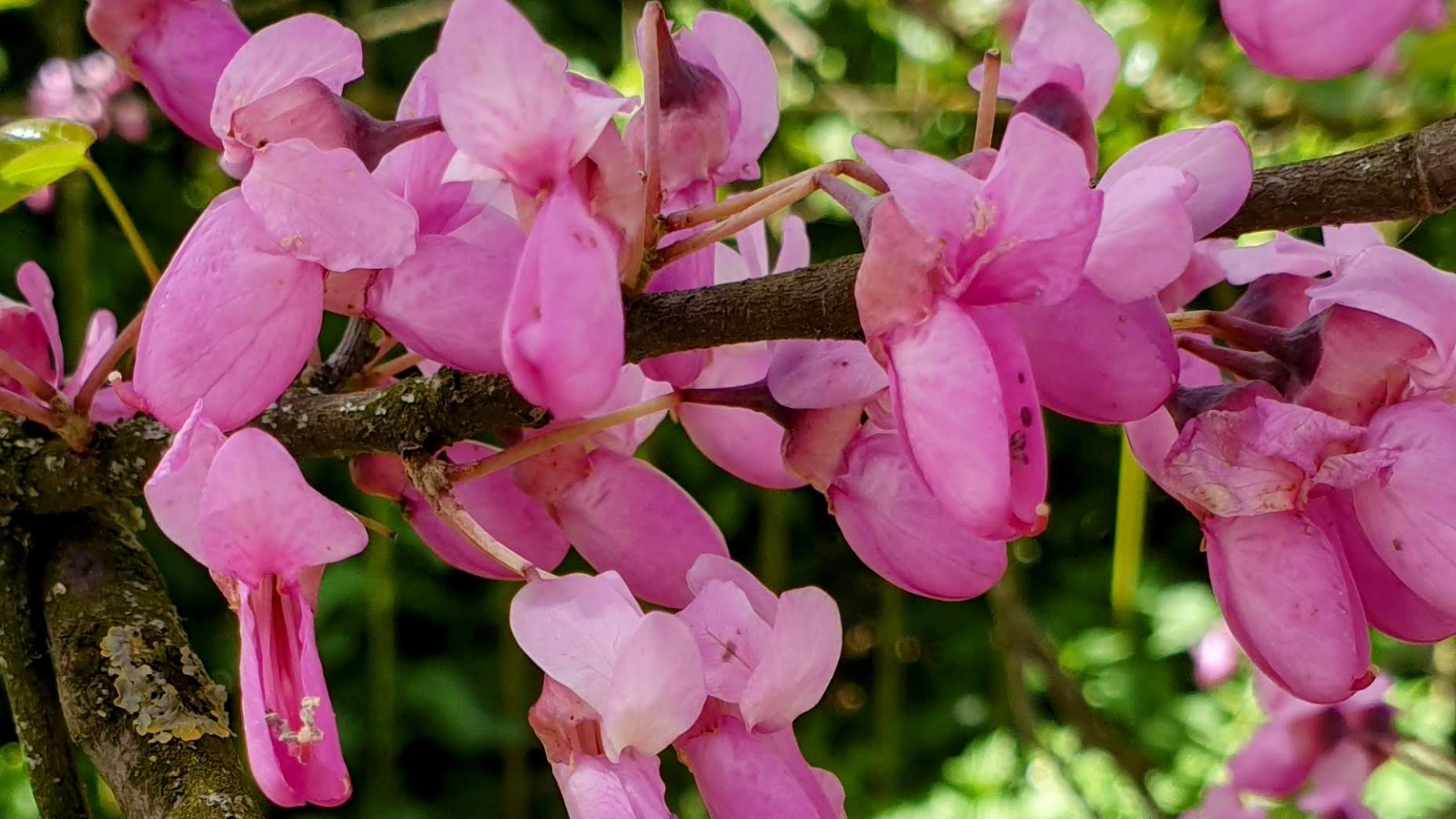
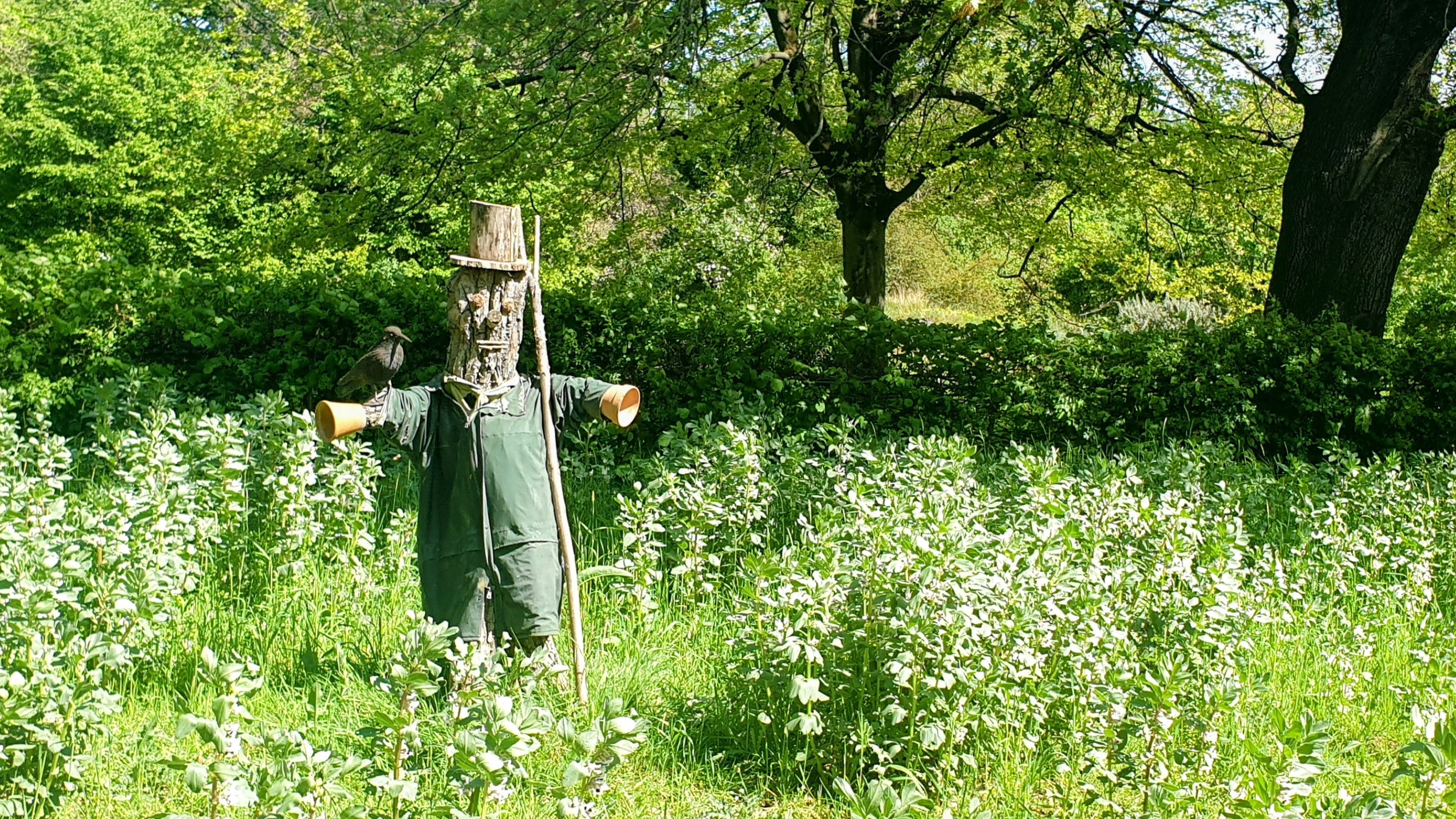
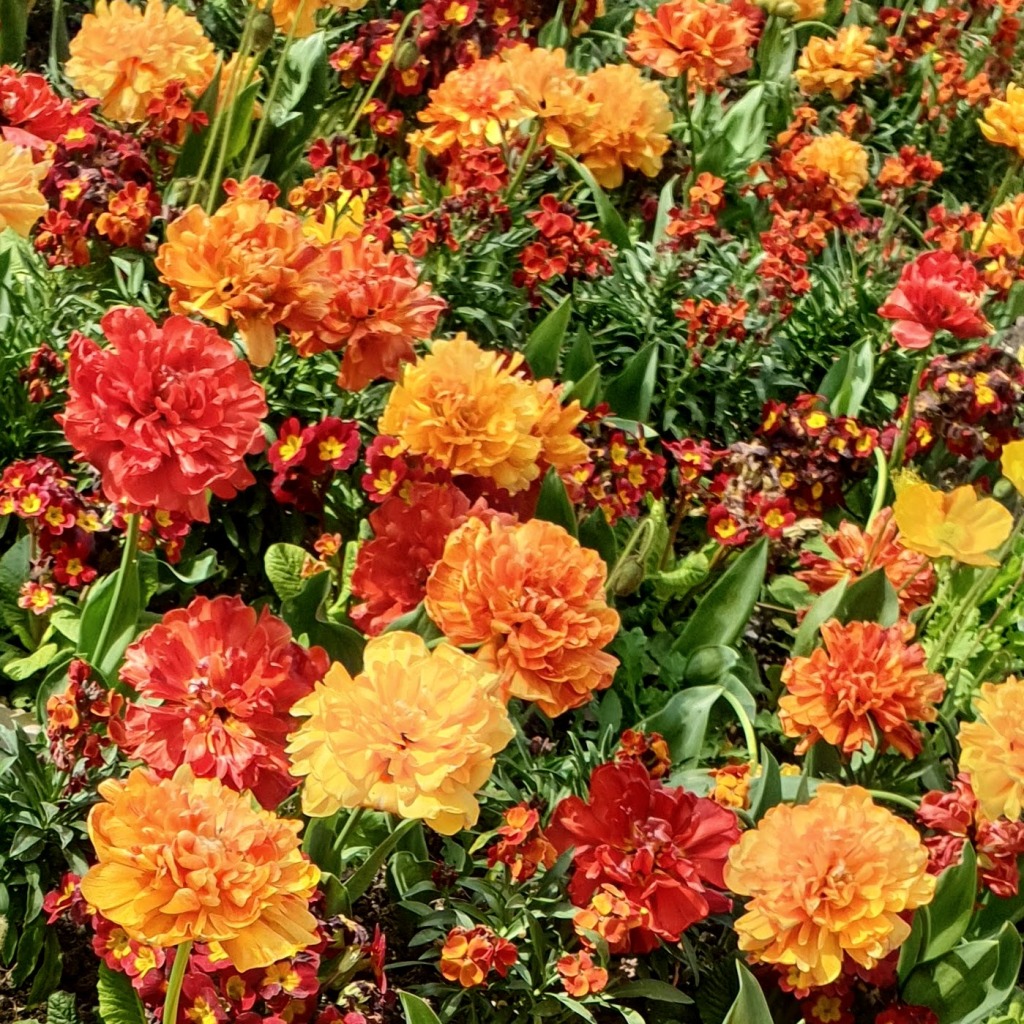
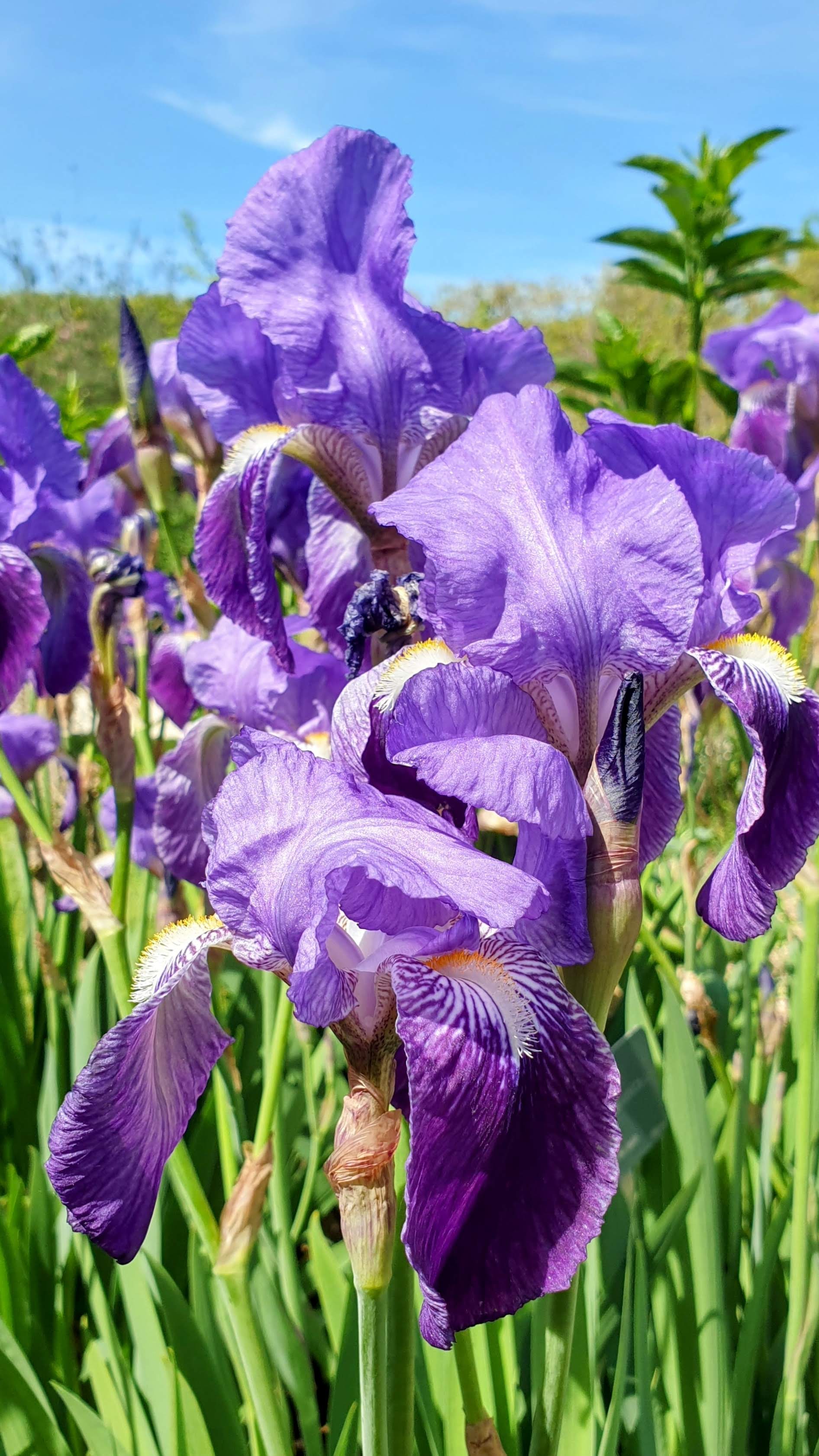
I visited the other three cherry trees and then branched (haha) outward to look at other plants and flowers. In early spring, there aren’t as many blooming, but I found some other pink trees, some purple irises and a garden with enormous blooms I do not know the name of.
Un Pause

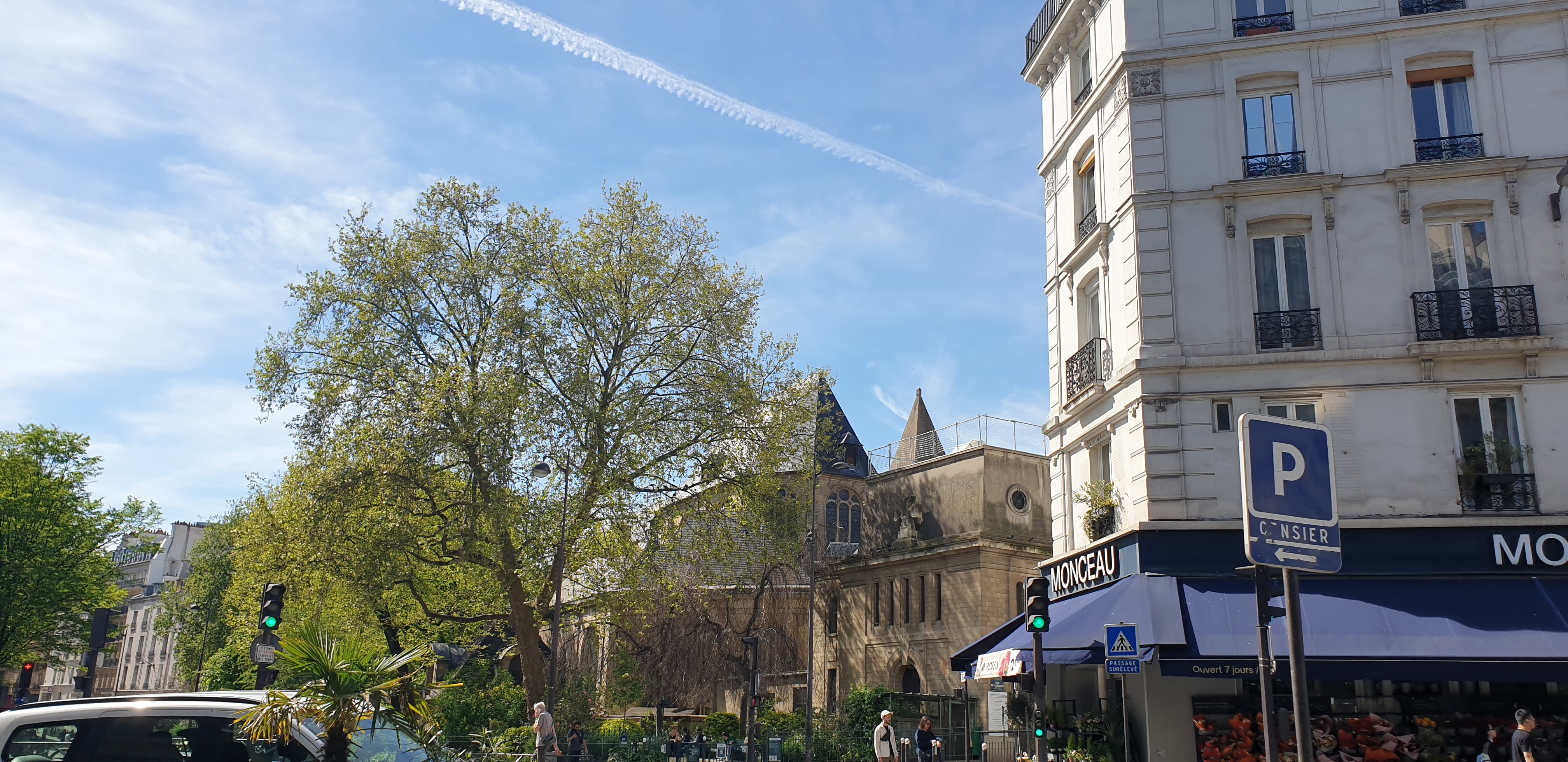
Still jetlagged and walking for hours, I decided to stop at a sidewalk cafe. I couldn’t find any coffee places with seating near the gardens, but I did find a little bistro from which I ordered a delightful craft cocktail. As I sat in the shade of the awning with my drink and watched the daily life of Paris around me, a quote from Anthony Bourdain came to my mind:

“Most of us are lucky to see Paris once in a lifetime. Make the most of it by doing as little as possible. Walk a little, get lost a bit, eat, catch a breakfast buzz, have a nap…Eat again. Lounge around drinking coffee. Maybe read a book. Drink some wine, walk around a bit more, eat, repeat. See? It’s easy.”

― Anthony Bourdain, World Travel: An Irreverent Guide

However much I wish it had not taken me 4 visits to Paris to learn this, I don’t think anyone could have convinced me on my first trip that I shouldn’t be running around trying to see the Arc de Triomphe, the Eiffel Tower, the art museums, the catacombs, the cemeteries, Montmartre, and every other cool thing in Paris. The tourists I talked to in line at Angelina’s and whose photos I helped take in the garden were just as eager to squeeze in as many sights as possible. I can’t blame them, but I’m very grateful that I finally reached a point where I can just enjoy sitting at a sidewalk table with a drink.

Jardin du Luxembourg

My last stop on the way back to my hotel, Jardin du Luxembourg, was also a garden that I had not previously visited. I found it to be much more like a park than a garden with plenty of places to walk and sit and play sports, but fewer flowerbeds or decorative trees. Most of the gardens in Paris have lawns (tapis vert, or green carpets) that are cultivated to within an inch of their lives that no one is permitted to walk or sit on (thank you, Louis XIV). It creates a beautiful landscape, but leaves one yearning to run barefoot in the grass. Luxembourg had many sweeping no-touch lawns, but added a sitting lawn! (There is another good sitting lawn just in front of the Eiffel Tower). Large blocks of soft dark green grass just for lounging around or having picnics on.

Given the beautiful weather that day, all the parks were full, but it was not hard to find a spot to plop down and enjoy the cool green lawn. I watched the people and the pigeons. Every pigeon I had seen all day seemed to be unusually plump and healthy. I’ve seen pictures and videos of show pigeons, but street pigeons are so often sickly and deformed that it’s become a trope, people calling them “rats with wings” or “cooing plague pits”. And yet an animal is only as healthy as it’s ecosystem. If pigeons in New York are malnourished, diseased, and deformed, it is not a result of the natural state of pigeons, but rather a reflection of the life they are forced to live. It really made me think about how much healthier Paris must be as an ecosystem than the vast majority of other dense urban cities I’ve visited. It also gave me a new appreciation for the presence of squab in French cuisine.

La Fin

As the day drew to a close, I realized I had made no plans for dinner, and that the combination of Saturday plus glorious weather meant more people than usual would be going out to eat. From my seat in the grass, I searched online for nearby options and snagged a last minute reservation at a restaurant across the street. Once more, the staff were very friendly and happy to speak in English (where does the stereotype of rude Parisians come from?) I ordered the daily special of duck confit, with a bière picon (a beer mixed with picon, a sweet orange liquor, not available in the US, I’m afraid), and for dessert, a chocolate cake and coffee with bailey’s and Chantilly. I may have gone a little overboard, but it was delightful to sit on the indoor balcony and look out the restaurant’s giant picture window at the garden across the road while dining on top notch food and drink. Not an everyday occurrence, and I think a worthwhile treat to end my day in Paris.

The next day, I repacked my bags and caught the bus to Tours, the small city in the Loire Valley that was to become my home and my school for the next 5 weeks. Stay tuned for more on life in the Loire!

Planes, Trains, & Hotels

If you are interested in the practical side of this trip, this Post Script is for you. Here I have attempted to include some useful information and links about airfare, public transit, and accomodation.

When searching for airfare, I was lucky enough to find an off brand company that didn’t suck called French Bee. Their cheapest package is very similar to Spirit or Ryan (no luggage, no meals, etc.), but the price difference for the upgrade to a more inclusive fare was only about 40$. I ended up with a normal international luggage allowance, an inflight meal, the ability to choose my seats, and the no-fee change policy.

The Paris public transit system is good, but confusing to outsiders. I have an old Navigo card which was still valid and could be topped up, but my research revealed there is now an app which allows you to buy tickets online and scan your phone via RF/NFC rather than having to carry a card and top it up at ticket kiosks. The app for local Paris transit is My Navigo Tickets, and the intercity train system is Bonjour RATP. It is a big improvement since my previous visit. The Navigo app also offers a good trip planner, showing the best transit routes to get from where you are to where you want to be. Sadly, after you find your route, and press the “buy ticket” button, it just takes you to the general ticket page with no indication of what you need for the journey you have planned.

Why does this matter? Paris has 5 zones, and transit tickets are sold in groups of zones. The more zones, the higher the price. I want there to be a way to easily see what zone you and your destination are in, but I haven’t found it. The last time I was in Paris, I just talked to the ticket seller about the places we wanted to go, and she knew what zones I needed. In general, if you’re sticking to the city center, 1-2 is enough, but there are some high demand tourist spots in zone 3. And if you’re staying further out to save on hotels, you may even be in 4-5. Transit to and from the airports and Disney Paris have their own special rates.

Additionally, passes are available by day, week, or month, but the week is Saturday to Sunday, no matter when you purchase it (not 7 days from the day of purchase). Is your head spinning yet? Do you suddenly want a taxi? Well, just remember the taxi rates from the airport are 50$+, but the bus rate is about 12$. Taxis in the city traffic can be difficult to catch, drivers may not speak English, and they may rely on your poor knowledge of fees and laws to overcharge you (this happens everywhere, it’s not unique to Paris). Transit trips cost about 2 each or a day pass of unlimited rides for about 8. I like the unlimited rides because I never have to worry about transfers or having to take extra transit if I get lost (which happens at least once a trip).

On to hotels! Paris is definitely one of the top most expensive places to spend a night. Before COVID, my usual travel budget was 100$ a day split 30/30/30 (hotel/food/entertainment) with a small extra cushion. Even then, I couldn’t find a room in Paris for 30$, I couldn’t find a bed in a dorm for 30$! There are a few youth hostels where, if you happen to be a young man, you can bunk down in a 12-16 bed dorm with other young men for around 35$ a night. If you would like a female-only dorm, be prepared for the pink-tax. All-girls dorms cost on average 10$ more than the male or mixed dorms. I stayed in a mixed dorm in Paris once, and it was fine. I was safe. No one was skeezy or anything. But, the older I get the harder it is for me to spend time in dorms. I find I need a private space to decompress at the end of a long day.

In post-COVID inflation-land, room prices in Paris seem to have risen (although to their credit, not as much as US based inflation). The best deal I found was a bed in an all-girls dorm for 50$ a night. (are there cheaper? Yes, but then you start getting issues with cleanliness, quality, safety, and distance from the transit stations). Hotels and hostels are getting better at tricking the algorithms to promote their place in search engines and reservation websites. It’s important to read real reviews (good and bad), see what people liked and didn’t (it might be things that don’t matter to you), and look at a good map to see not just how far the hotel is from a landmark or transit station, but also, how you can get there. 

It can take hours of searching to find a good price, a good location, and a good quality, but the time you spend in advance is worth it not to have unexpected unpleasant surprises after you arrive. My decision to take a dorm bed at the Eklo also related to factors like the photos of the dorm rooms, the reviews by other guests, and the closeness of the bus stop. I knew it would be hard to be really comfortable in a dorm, but I was willing to take it for just two nights.

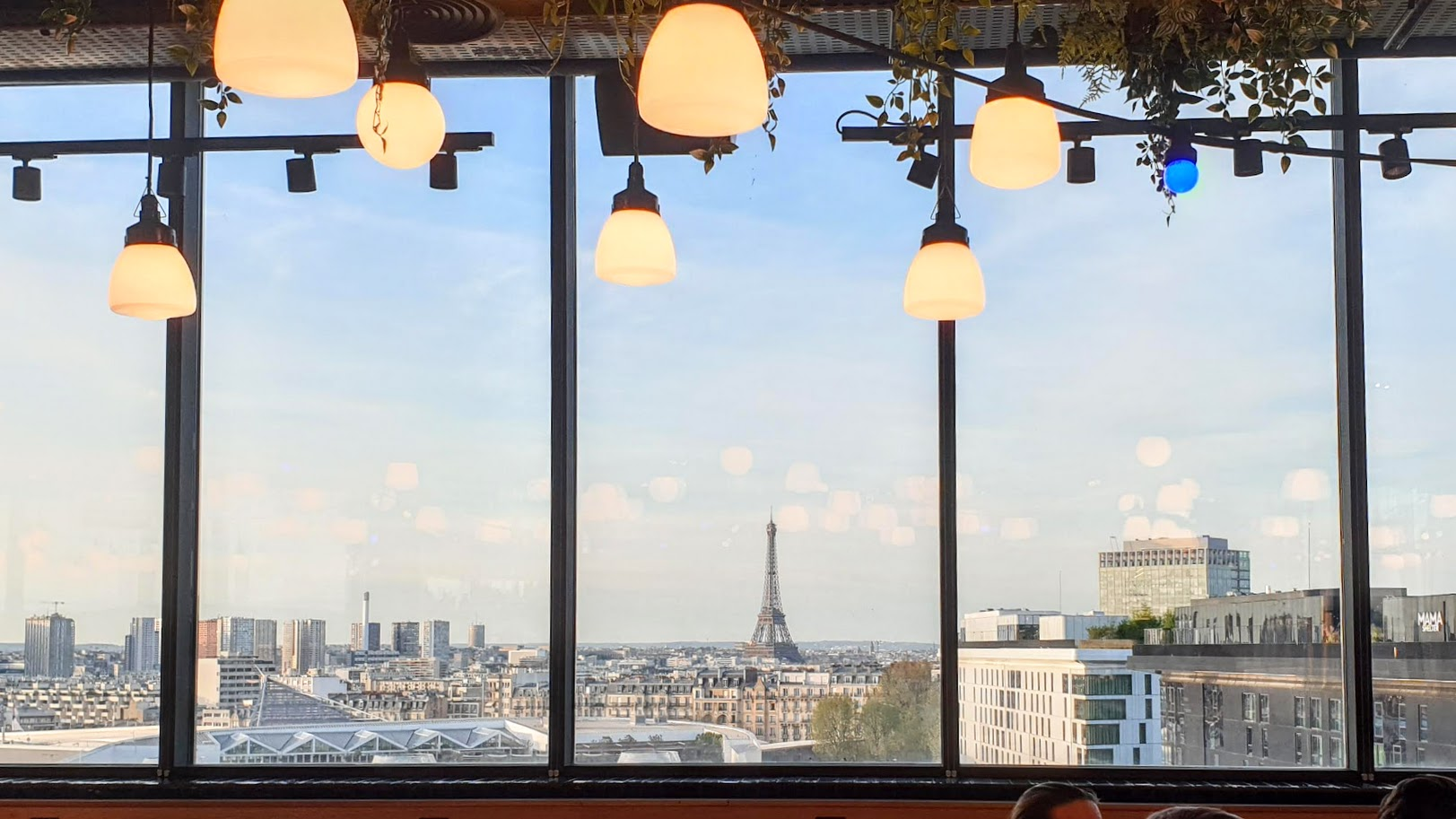
I ended up eating at the rooftop restaurant for dinner the night I arrived. I am always skeptical of eating in a place so clearly designed to cater to tourists. High end hotels have amazing restaurants, but hostels tend to focus on alcohol and cheap food. The Eklo partners with a small chain restaurant called French Kiss which had a good looking website, and I was too worn out from the flight to go anywhere else. The view was stunning, and the food surpassed my expectations for hostel restaurant fare, and the staff were all friendly and quite fluent in English.
So Long and Thanks for All the Thieboudienne

This is not a “fun” story of joyous tourism exploits and happy expat life. I had a lot of fun in Zanzibar, and I even had quite a few memorable good times in Senegal, even if most of them never made it into the blog. However, living and traveling in both places, I confronted some things that were hard to see, hear, think about, and know. I am personally both deeply pained and extremely grateful to have been smacked so far out of my comfort zone that it took me most of the year to process through denial, anger, sadness, and bargaining to reach a place of fragile acceptance. I travel to experience and learn, not just to have a good time. Though it is difficult, these aspects of a globetrotting life are just as treasured as my fun memories because they help me to understand the complex world we are all a part of in and to be a more compassionate human being to those around me.

The Stone Town Slave Museum 

Just as every historical tour in Europe has a section about WW2, every historical tour in Africa has a section about the slave trade. Zanzibar was the center of the East African slave trade, where slavers from the interior brought their captives by forced marches overland and a short boat trip to the slave market in Stone Town. The city where I live (Dakar, Senegal) has a similar historical site on Gorée Island, which is the center of the West African slave trade, and has a similar legacy of gathering slaves from the interior in one place to board on ships. Slaves went not only to the new world to work sugar, tobacco, and cotton plantations, but also to the Arabic world. These sites which commemorate the worst of humanity are not fun tourist attractions, but they are worth visiting because they instill a sense of reality that no amount of textbooks and documentary films can convey. You are standing where the people stood, both the boot and the neck. The blood is soaked into the earth and stones.

In the case of the Zanzibari slave trade, there existed a type of slavery before the growth of new world plantations exploded demand for free labor. Intertribal slavery between African (and indeed First Nations people in many parts of the world) was not uncommon, but it was a much smaller part of the economy. Prisoners of war were taken as slaves and although some were treated badly, some were integrated into the new tribe over a period of years. No version of slavery is “nice”, but I think it’s relevant to acknowledge how different slavery was in Africa before the foreigners got involved. Not only my guide, but a few other locals I spoke to there tried to excuse the West saying we wouldn’t have bought slaves if Africans weren’t selling them, and this is a level of internalized shame that I’m not ok with.

The increased demand for millions more slaves to serve in the Arabic peninsula and the new world colonies changed the entire dynamic of slavery and the economy of many places in Africa. The slaves that had previously been taken as prisoners of tribal skirmishes weren’t enough to meet the export demand and so a new industry emerged: to wage wars for the sole purpose of taking slaves. Government leaders also captured and sold their own people when they couldn’t get enough from “enemy” tribes. Slaves were forced on long marches with little to no food or water, and those who fell sick were left to die.

By contrast, the free people in Zanzibar prospered by collecting fees from the inland slavers as well as the foreign traders for every slave sold in their markets. When the West abolished slavery, the leaders in Zanzibar didn’t want to stop because it was too lucrative, even without the Euro-American market! The modern attitudes of hakuna matata and pole pole (no worries, and take it slow) on the island are likely a direct result of the fact that for centuries the islanders had to do very little work for the passive income of slave taxes to make them comfortable. Although they no longer sell anyone directly into slavery, the local governments in many places in Africa continue to exploit their own people in extreme ways in order to preserve the legacy of easy money their ancestors had in the slave trade days.

The slave museum in Stone Town tells not only of the horrors of slavery, but also of Livingstone’s mission of abolition. While some in the West may see Livingstone as an embodiment of the “white man’s burden”, many in Africa still praise his abolitionist efforts. Although it was the British government and navy that did most of the work of stamping out the slave trade, Livingstone’s published accounts of the atrocities of the slave trade in Africa helped spread discontent with the continuation of the practice. In American education, the end of slavery is often taught as something that just happened one day upon the signing of the Emancipation Declaration. Few white Americans know the history of the holiday Juneteenth (June 19th) celebrating the day the last group of confederate forces in Texas were finally uprooted, freeing the remaining slaves almost 2 1/2 years later. Even fewer know that the last slaves weren’t actually freed until 6 months after that with the 13th amendment. Almost no one I talk to knows that the 13th amendment didn’t end slavery for all – it’s still legal as a form of punishment for criminals in the United States.

The museum in Stone Town makes no bones about the lengthy process of eliminating slavery and the challenges newly freed slaves faced with no homes, no money, no family ties, and nowhere to go. Even after the Sultan finally caved to the pressure to stop the practice of selling slaves, he didn’t banish the owning of slaves for some time after. The women were the last to be freed because owners tried to claim them as wives rather than slaves, and the difference wasn’t easy to spot. Freed slaves were taken to “apprentice” at plantations where their lives were little different from they had been before; the only difference being their backbreaking labor was rewarded with meager wages and their food and housing came at a price. Freed children were sent to Christian missionary schools which molded them into “good” colonial citizens and converts. Slowly, the freed slaves were able to use their meager wages to move away from the plantations and missions, some to uncultivated land and others to the city for urban work. The legacy of the slave trade is long lasting for Africans everywhere, and museums like this help us understand not only our history, but our present — and hopefully help us to shape a better future.

The abolishment of slavery in the 19th century only made slavery illegal, yet it still continues to this day. Slavery exists in every country of the world and has dramatically increased in the 21st century. There are more slaves today than were seized during the entire African slave trade. While some countries have larger numbers than others, it is an issue that affects all of us.

Modern day slavery is defined as a relationship in which one person is controlled and exploited by another, usually by the use or threat of violence, for the purpose of profit, sex, servitude or the thrill of domination-deprived of free will, restricted in movement and paid nothing beyond subsistence. A slave may be kidnapped, captured, tricked or born into slavery.

Modern slavery is a hidden crime The International Labor Organization (ILO) estimates the illicit profits of forced labor to be $US150 billion a year. From the Thai fisherman trawling fishmeal, to the Congolese boy mining diamonds, from the Uzbeki child picking cotton, to the Indian girl stitching footballs, from the women who sew dresses, to the cocoa pod pickers, their forced labor is what we consume. Modern slavery is big business.

TYPES OF MODERN DAY SLAVERY

BONDED LABOUR
Workers who have received or are tricked into taking a loan and are unable to leave until their debt is repaid. Often times, children of bonded laborers must continue to work off the debts, leading to generations of enslaved families. It is the most common type of slavery today.

FORCED LABOUR
Any work or services which people are forced to do against their will under the threat of some form of punishment. Almost all slavery practices, including trafficking in people and bonded labor, contain some element of forced labor.

CHILD SLAVERY
Children who are used by others for profit. For example in forced marriage, prostitution pornography begging petty theft, drug tracing, labour, armed fighting or wives’ for soldiers. Usually, child slavery is accompanied with violence, abuse and threats.

EARLY AND FORCED MARRIAGE
Women and girls entering marriage without choice, forced to live a life of servitude often accompanied by physical violence and with no realistic choice of leaving the marriage.

DESCENT-BASED SLAVERY
The legal ownership of a person by another person or state, including the legal right to buy and sell them as any common object.

Products made by modern day slaves flow into the global supply chain and eventually into our homes leaving most of us unaware of our contribution in supporting it.

From the Slave Museum, Stone Town Zanzibar

A Talk With A Zanzibari Guide

My guide around Stone Town was a young man of mixed Arab and Swahili heritage (his mother is Arabic and his father Swahili) and I think had a unique perspective on Zanzibari culture as a result of living with one foot in two worlds while belonging to neither. When we reached the church at the slave museum, we sat down for a break from all the walking in 33C/UV11 weather and he opened up to me about his life. As with any personal account, I know that it’s his perspective and opinion, and not an objective truth, but I found it to be a fascinating conversation, and I’d like to share some of what he told me.

What he described to me was a life of codependency. I know Americans are extremely independent, and I’ve seen how extended family structures can bind young people in other countries often making them feel like they have no choice in what they study or who they marry. Yet what my guide explained to me of the family networks here, it is not only impossible to survive outside of one, the parents (especially fathers) can be very harsh, and abuse is normal. He shared his opinion that children need to have things explained to them because just hitting them makes them live in fear, so I hope that when he has his own children he will practice this. His parents are less bound by their own families. Both families disapproved of the mixed marriage, so they had to go it more independently. He feels very lucky to not be bound by the familial codependence he sees his peers trapped in.

Women have little freedom. He said most men have 2 wives (though they are allowed up to 4) because the first wife will be who his parents want him to marry, and the second will be who he wants to marry, which seems critically unfair to everyone involved. Women are encouraged to stay at home. Though young girls here are in school, many don’t pursue a degree after high school or have any desire to work outside the home. Parents pressure young women to prepare for marriage and think men will not want a woman who works (or possibly that a woman who earns her own money will put up with less BS from a husband?) My guide told me that many young women watch romantic dramas from around the world and get the impression that marriage will be a better life than getting a job, and are later very disappointed that it’s not true. My guide said hopes to find a wife who wants to work, not because they need more money, but because she wants something for herself.

Men are also trapped into a life decided by others. They must go into the career their fathers choose, marry the woman their parents select, and spend their salary to support their own parents, their wives’ parents, their wives, and their children, meaning a single salary supports up to 7 adults and possibly more than 7 children. Zanzibar is even more economically challenging because people from the mainland come over and do jobs for dirt cheap (140$ a month!). Mainlanders can send home 20$ and it goes a long way to support the family living there, while families that live in Zanzibar need 350$ or more a month just to scrape by. A gift of 100$ from a hardworking son may be seen as a trifle on the island but a fortune on the mainland.

Despite the fact that tourists are paying 100$/night for a hotel room, 100$+/ day on tours and god knows how much on food and trinkets, the average salary for the workers here is around 250-300$/month USD. Where is all this money going? The government takes big cuts in the form of double income taxes (Tanzania and Zanzibar each have taxes that islanders must pay while mainlanders only pay Tanzanian taxes), and licensing fees for anyone who wants to sell, make, display, tour, drive, etc. I saw an actual paddy wagon loaded up with unlicensed street vendors on their way to jail, and my guide said they’ll be right back on the street selling souvenirs as soon as they can. Once the government takes their cut, the owners take the rest, and the owners are mostly foreigners. Several guides throughout my stay told me with bitterness edging their voices about the new development on one of the small islands that was bought up by Indians. Locals never get enough money to invest in property or larger businesses which is a big part of what keeps them trapped in the codependent and often abusive family structures for survival their whole lives.

It reminded me also of a conversation I had with an aid worker who had recently returned from the Congo. The warlords there keep everyone in a state of fear and violence and poverty while reaping the rewards of the mining operations. The mining work gets priority even over subsistence farming, leaving the population without enough food to live on. Many African countries are rich in resources, minerals, fertile land, skilled labor, and yet so often it is mismanaged to benefit only a few while leaving the rest to struggle for less than scraps. There should be enough to go around; the scarcity is artificial. The greed is real.

Final Thoughts in Dakar

As I prepare this post, I am 4 days from leaving Senegal to return to the US. Although I would prefer to end my journey on a high note, I feel that would be disingenuous. Living, working, and traveling in sub-Saharan Africa has been one of the most challenging experience of my life so far, but as such, one that will have a large and lasting impact. In addition to the quality of life challenges, it has been an unending revelation of my own biases and privilege, which is a hard pill to swallow. My friends and family, in a well meaning attempt to offer comfort when I’m so obviously discomforted, have used phrases like “living nightmare” to describe the conditions here while saying they simply can’t imagine how anyone could live this way, and telling me how brave and resilient I am. But. These words are not comforting. I am a guest in a place that may be objectively lower on the international quality of life index (yes that’s a real thing), but millions of people still call it home.

People in Africa are struggling with the legacy of colonial war and exploitation that still colors the culture, language, economy, and even religion today. There is no doubt that centuries of foreign rule and resource theft has left deep wounds and little with which to heal them. However, the human spirit is indominable. The people born into this reality are aware of what they don’t have because one thing they do have is enough TV and internet to see the literal and metaphorical greener grass of the northern hemisphere. Yet, every day, they get up and live.

They collect water from a centralized source when the infrastructure fails. They wash clothes in buckets on the front stoop because washing machines are an expensive luxury. There are orphans begging in the streets who will become adults selling peanuts and candy on the roadside. Families struggle to pay high fees for substandard services offered by corrupt politicians and businesses resulting in unreliable electricity, water, and healthcare in even the most developed and cosmopolitan cities. Schools cram 100 students into a room with 20 desks where they learn without computers or enough books. The government of the most stable democracy in the region violates the human rights of its citizens when they complain too much.

But also. They cook delicious food which they share with friends and family when they celebrate holidays, marriages and births. They create music and art in any available space. They stay out late partying and take naps in the heat of the day. Christians and Muslims exchange gifts of food across faiths on their respective high holy days. People gather at public screenings to cheer wildly for their favorite football (soccer) teams and set up casual matches in any open lot or field. They love their children and help their neighbors. They march and protest for better conditions while carrying their national flags because they have national pride and believe their country is capable of more. They open salons on every street and work out in the evenings along the corniche because they take pride in their appearance and wellbeing. They splash in the ocean and laugh with the sheer joy of it. They bring color to the dry and dusty land with bright fabric prints and billowing swathes of bougainvillea that climb every wall and patio.

It is not a tribute to the bravery or resilience of visitors who temporarily partake in a life which so different from the one we were raised to. It is not a fairy tale of the “noble savage” that lets us imagine some kind of mythical innate goodness and moral superiority of the people who have less, and are making the best of it. It is not a whipping post for white guilt where we come to cry and wring our hands about the horrors of the past in order to feel better when we shop fair trade and have someone tell us how good we are for not being racists. It’s just people. The traumas of life affect everyone: individuals, societies, generations. I want to be able to acknowledge the past and honor the pain of another without turning it into inspiration porn or a hairshirt self-flagellation. What do you see when you look at someone who is living a life that you imagine would break you? What are you living with that might break someone else?

In Wolof, the greeting expression often translated as How are you? is “Nanga def?”, but it literally means Where are you?. In English, we have to answer that question with an adjective of value: fine, ok, great, not good, etc. In Wolof, you answer, “Mangi fi.” I am here. I am here.

Zanzibar East: Paje & Jozani

I spent a full week in Stone Town which might have been too much. It is where almost every tour leaves from, but after day 5 I was starting to feel like I had hit all the highlights. I missed out on Prison Island (where the giant turtles live) because the weather wasn’t good for the boat trip on the day I’d booked and I was too tired to navigate booking another day. Nevertheless, I was ready to move on. My second stop was at Paje Beach on the east coast of the island.

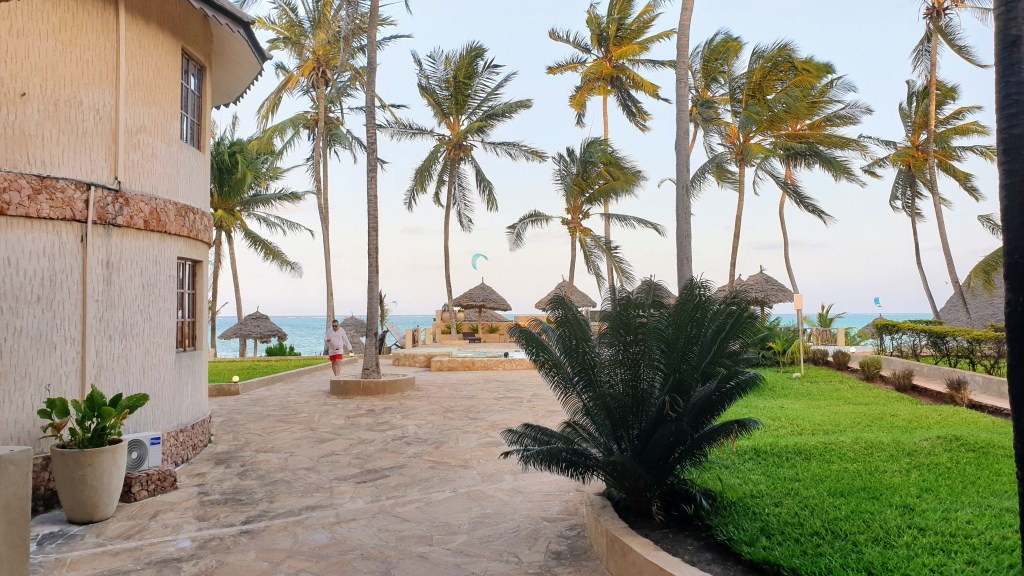
Paje is described as being more low key, less resorts and more backpacking beach bums. I booked a private room in a hostel that was less than 500m from the beach. The hostel itself was very cute with a courtyard filled with greenery and comfortable places to lounge. The art in the room was really strange, but the room was clean and sometimes that’s enough. There’s a single main road that goes through the town that’s lined with a mix of shops that serve locals and tourists. The roundabout has the town’s 3 ATMs only, one of which was working when I went. I met another traveler who said all three were out of cash the day before, so they had to taxi back to Stone Town just to get money since no one outside the resorts takes cards in Zanzibar (my hostel was cash only, too).

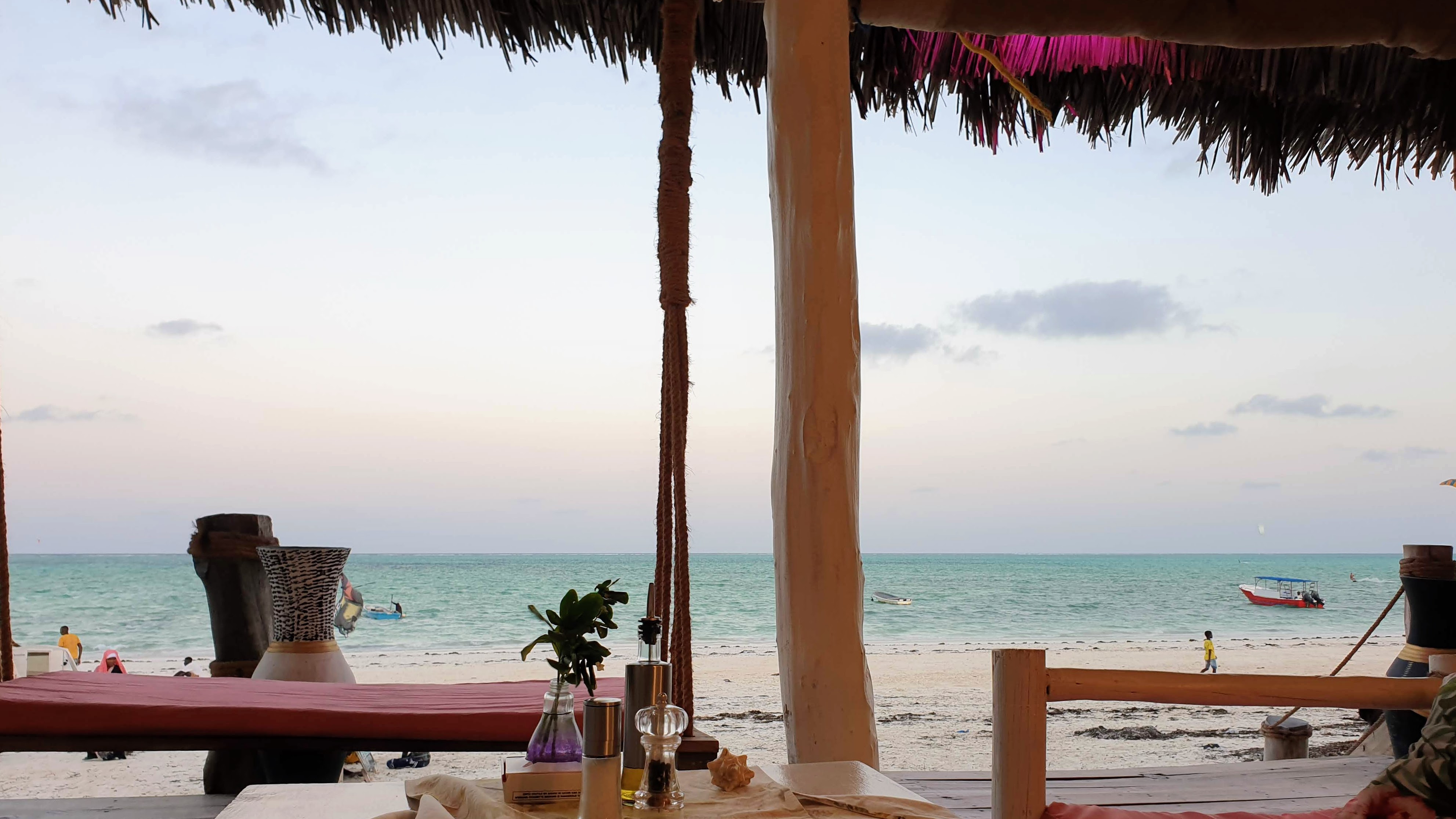
The town layout of Paje is very open compared to Stone Town and is consequently hotter. The afternoon I arrived, I had to hide inside until it cooled off because the walk to the ATM and back almost baked me. As dusk brought cooler air, I headed down to the beach for dinner and was surprised that the short walk was through a local neighborhood (the part not for tourists). It was heart wrenching to see the contrast of how the people who live in this paradise island live so close to the luxury beachfront resorts. Unlike some resort towns, at least the beach at Paje is open to all, and I saw plenty of local kids playing and a mix of abaya clad ladies amid the western beachwear. 

At the restaurant, I accidentally brushed my leg against the leg of the chair and opened a few dozen micro-blisters that I didn’t even know I had. I knew that the burn I got on the back of my calves while snorkeling was not great, but I had spent several days keeping that area carefully out of the sun and applying aloe and shea lotion many many times each day (and night). I thought it was getting better and didn’t realize that there was a layer of blister basically on the whole thing. The casual bump against the chair leg started a cascade event where my skin decided it was time to peeeeeel.

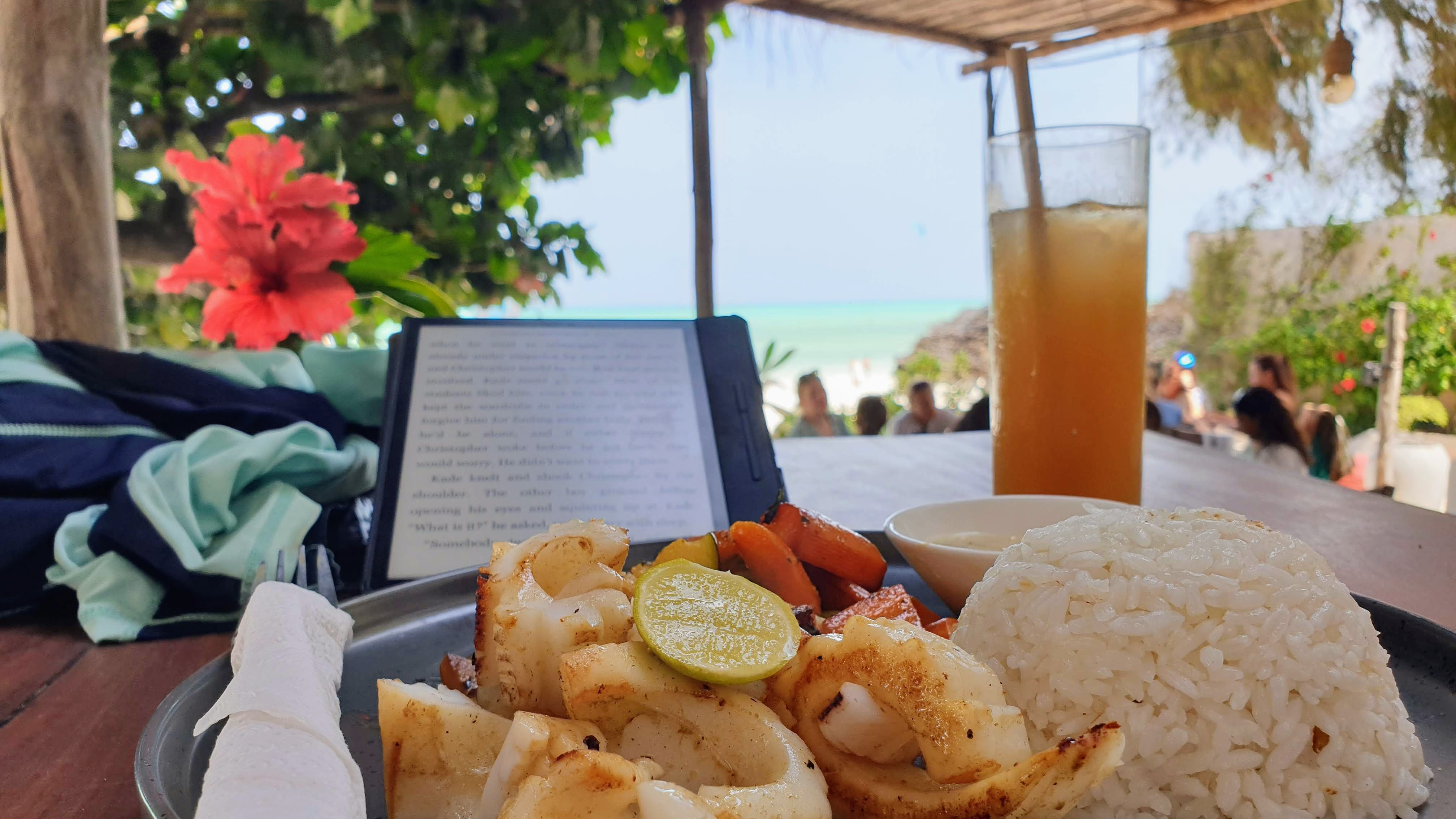
The whole next day I felt like a molting reptile. I knew for sure I couldn’t go swimming until they had some time to heal or else I’d be risking infection. Can I just reiterate how horrible sunburns are, and that with the UV index of OMG sunscreen isn’t always enough? Long sleeves and pants may not be the most fashionable swimwear, but they save not only your skin, but your vacation as well. I spent all that day lounging in a beachfront café ordering drinks and snacks every so often while reading my eBook and watching the ocean. I won’t say that it was a waste of time, because I don’t think any time spent with that view can be wasted, but it would have been more fun if I could have done some of the water activities.

Paje is famous for the beach and the kite surfing. I was interested to try it out. I went parasailing in Mexico. I was able to do a scuba dive in a single day in Aqaba, and I’ve gone caving with guides and minimal training in the US and New Zealand. All those activities can take years of training and practice to master, but can also be done in an afternoon at the beginner level. So when my skin recovered enough for me to be willing to go in the sea again, I sought out the local instructors thinking it would be similar. Nope! The school offered classes that cost 60$/hour or more and said that it usually took students 10-12 hours of training on land before they were even ready to get in the water! There was simply no “try it out for beginners” option available.

Kite surfing is like wakeboarding with a parasail. You have a wakeboard which is a shorter, wider version of a surfboard, and you are harnessed into a thing that looks like a parachute (all those kite looking things in the photo). The wind then pulls you across the water. Some of the windsurfers were even lifted into the air by the strength of the wind. The water at Paje is extremely shallow, so for the most part the kite surfers were skimming over water that was no more than knee deep. However, the kites and lines are pretty expensive, so I imagine that the schools and rental shops don’t want to risk the inexperienced dropping on and having it fly off or get drenched.

The sales pitches on the beach were different from those in Stone Town. There were two main groups of people on the beach selling stuff and they were strongly divided by gender. The men were all dressed as traditional Masai from the mainland. I know at least some were because they also had the body scarring that goes with the Masai cultural milestones, but there’s a portion of locals who adopt the dress code to play on tourists. They are referred to as “Fa-sai”, btw. Real or Fake, the men are gregarious but polite. They would greet me and start walking along with me. The conversation would begin with small talk, asking where I was from and how long I’d been there, then slowly it would move into the sales pitch. The things they had on offer were very much the same as the Masai themed shops in Stone Town. The ladies were almost all in conservative abaya and hijab coverings, and were less likely to follow tourists or engage in small talk. They were peddling massages, hair braiding, and henna tattoos.

Jozani National Park

Jozani is the only national park on the island. It’s part of an environmental conservation movement to preserve the local ecosystem and rare species. Plenty of locals would happily tear it all up for lumber and farm land, so paying for tours helps fund the park as well as the economic projects that run in tandem with it to provide other means of earning a living for those who are being asked not to use the land. It was on my wish list for Zanzibar from the beginning, but I had been on the fence about it since discovering my sunburn. Then, one morning at my hostel’s breakfast, I started talking to a young man about his AbFab phone case (so rare I find a fellow fan these days, sweetie darling). He turned out to be working on his PhD at the Jozani forest. Hearing him talk about the forest and his work gave me the push I needed to get up off my beach bum and go do the thing.

I learned from some folks who’d been in town a while that I could get to the park via the local bus (called Dala Dala) which would stop at the nearby roundabout. There was no bus stop or any signs, so I waited in some shade and watched the locals. Before long a minivan pulled up in front of a small shop and people started rushing to board. It wasn’t hard for me to get in line and verify with the driver that he was heading the right way. The driver and money man were absolutely able to communicate with me in English, though mostly used Swahili in general. The men on board moved around so I could have a seat. There are plastic jugs that can be moved around the aisle to make extra seats, and with the windows down there’s a good road breeze that keeps it from being too hot.

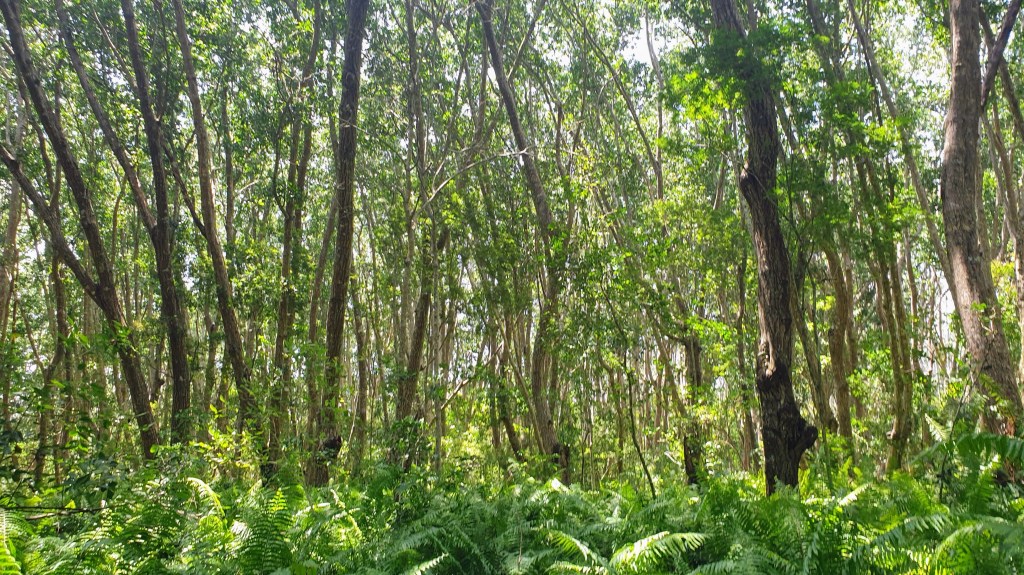
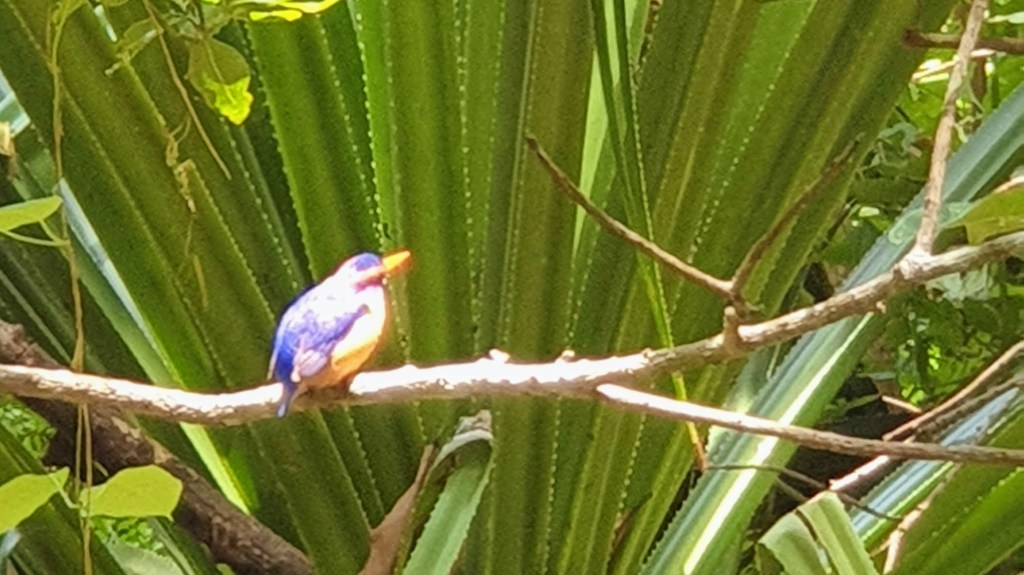
The entry fee to the park is 10.70$ (25,000tzs) and the price includes a mandatory guide. I got a guide all to myself because the only other people coming in at the same time as me were in a hurry and didn’t want to do the whole walk. Their loss. My guide explained things, and helped me avoid looming roots and branches, but didn’t feel the need to fill all the space with talking. Being alone in the beautiful forest with my guide gave me lots of chances to enjoy the silence and see interesting critters. These are photos of the forest itself (some native trees and the remnants of a colonial mahogany plantation) and 3 of the 4 wildlife species I got to see on this part of the walk: millipede, skink, and kingfisher (the larger lizards were too fast to photograph).

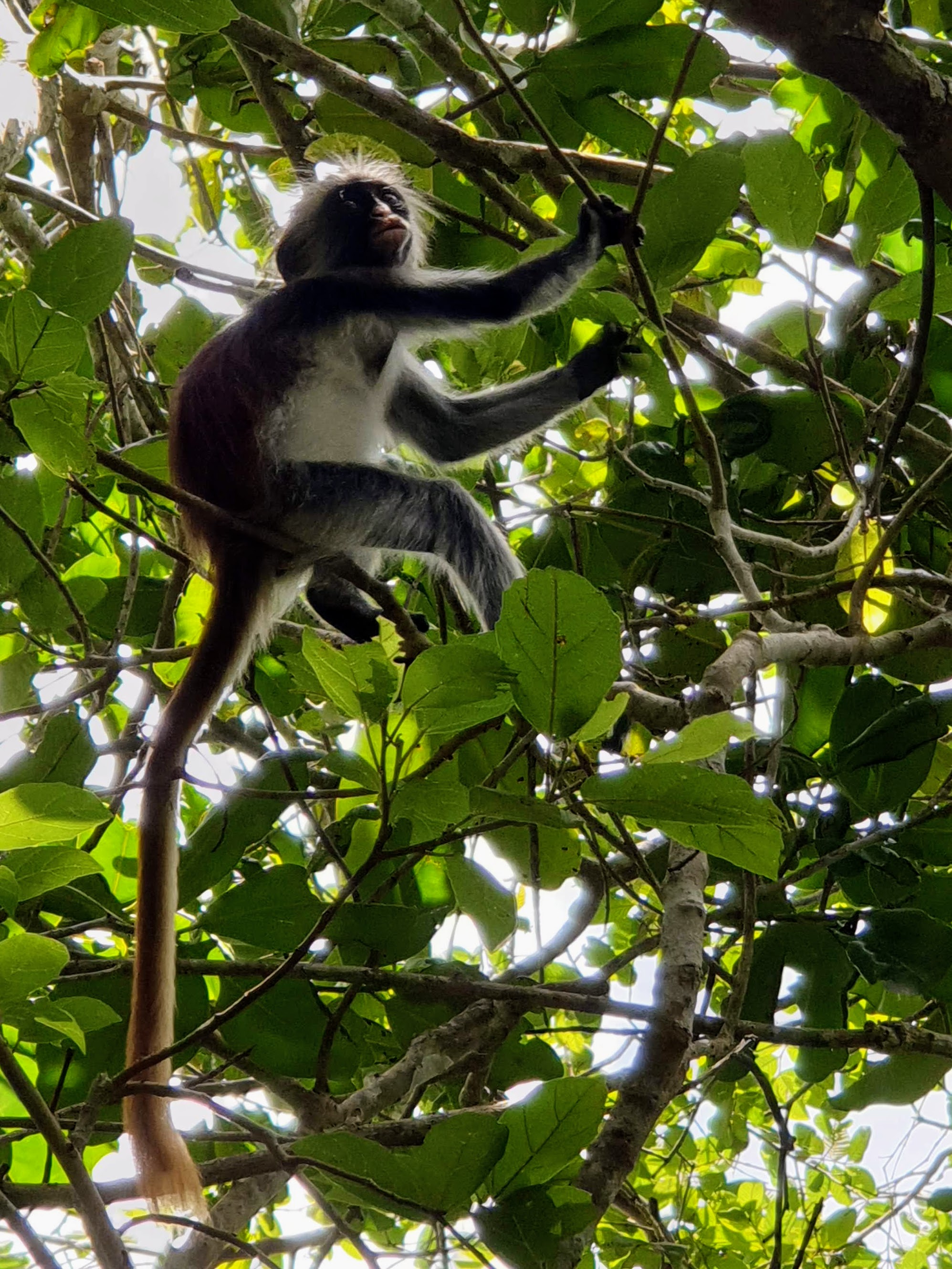
The forest is home to two species of monkey: the more common Sykes and the totally rare unique-to-this-one-island-in-the-whole-world Red Colobus. After we walked around the forest for a while, we went to the area inhabited by the monkeys. The Sykes are very un-shy and enjoy coming down to the ground or low branches to look at the tourists. There are signs warning visitors to stay several meters away from the monkeys at all times, and the monkeys clearly do not wish to obey. It was actually impossible to keep my distance from the curious critters, but they never came so close that I was worried about having my phone snatched.

The Red Colobus on the other hand are more reclusive, more arboreal, and just generally harder to find. The guides text each other with location updates so visitors won’t miss out. When we came upon the tribe that had been located for that day, there was another rather large group of tourists being loud and shoving selfie sticks towards the upper branches. I did see one guide gently push a tourist back who got too invasive, but overall, the animals were far enough above us that they could have run off if they were really annoyed. Maybe human tourists are not more annoying than baby monkeys? I didn’t have a selfie stick for phone extension, but I think I got a couple cute photos anyway.

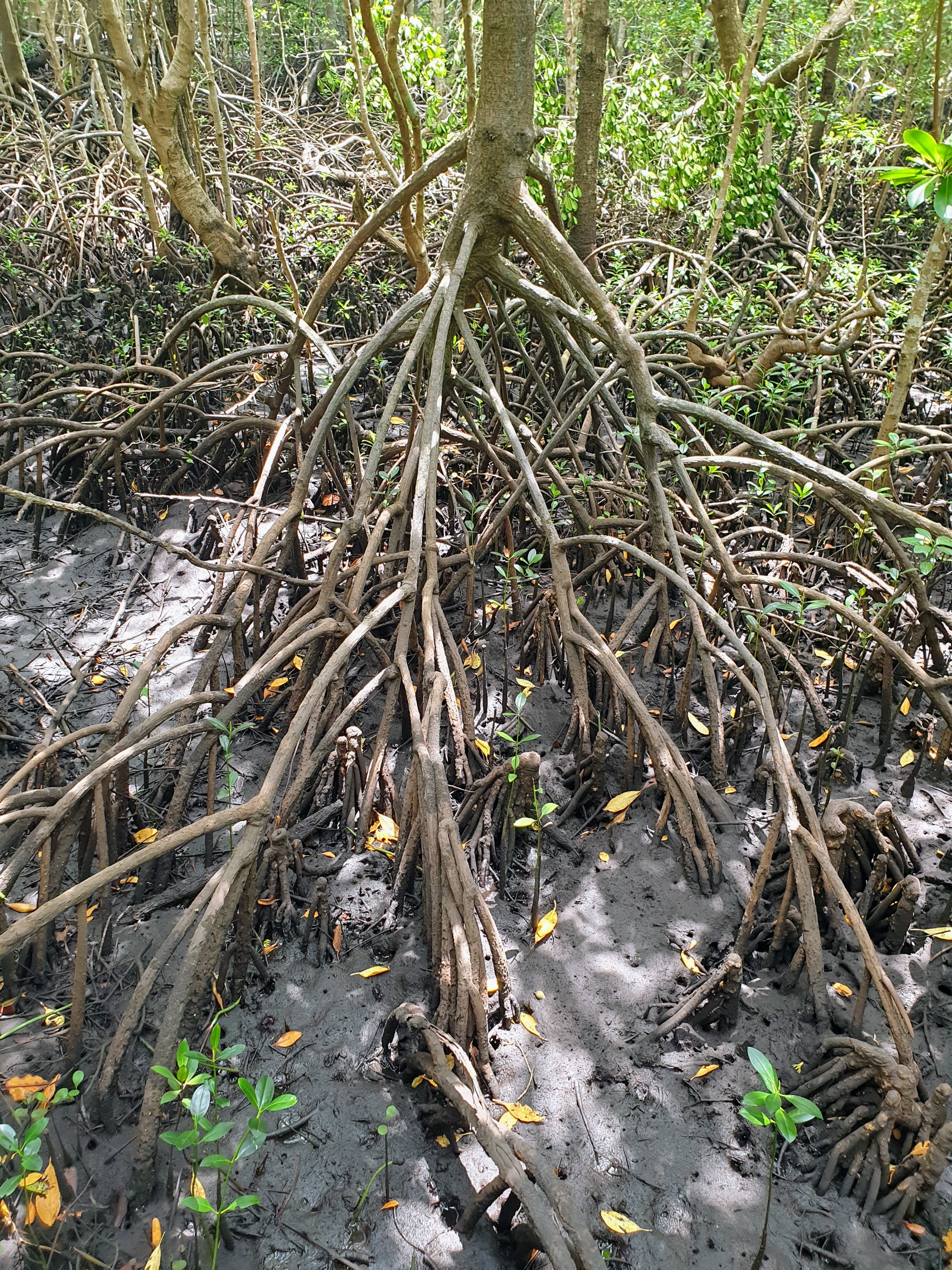
The Jozani mangroves are a little more than a mile away from the main entrance, and my guide seemed flummoxed when I said I’d used the public transit and didn’t have a car or driver waiting to take us over. Quick on his feet, he went to get his own motorcycle to drive us there. Nothing like riding helmetless on the back roads! We made it safely, though, and I got to see the mangroves at low tide (a recurring issue of this visit) which is actually kind of cool because all the roots and crabs that would normally be underwater are visible. I’d like to suggest “low tide mangrove” as someone’s next Halloween theme.

The Butterfly Park isn’t technically part of Jozani, but the entrance is quite close to the mangroves and my guide offered to drive me over and wait while I looked around (very kind offer). It’s another conservation area that’s also working to help employ and educate nearby villagers to help them have income that comes from environmental preservation rather than income that destroys the environment. They breed and release several native species including the bush babies, many butterflies, and chameleons. The cost for tourists is 18,000 TZS (about 7.50 USD), but locals can enjoy it at a hefty discount.

The butterfly guide told me about the work they are doing with the nearby village, the local school, and the forest before giving me the chance to hold some infant bush babies. Squeeee! I don’t normally go in for handling wild animals, but these are a domesticated pair they’re using for education and promoting the conservation. They were entirely comfortable climbing on me (yeah, that’s my pasty white arm in the photo) and were so cute!! As a species, bush babies are usually asleep during the day (the adult pair sure were) so tourists don’t get to see them in the forest and don’t realize there’s more than monkeys being protected there. These fuzzy lil’ ambassadors help raise awareness of the breeding program and need for environmental conservation.

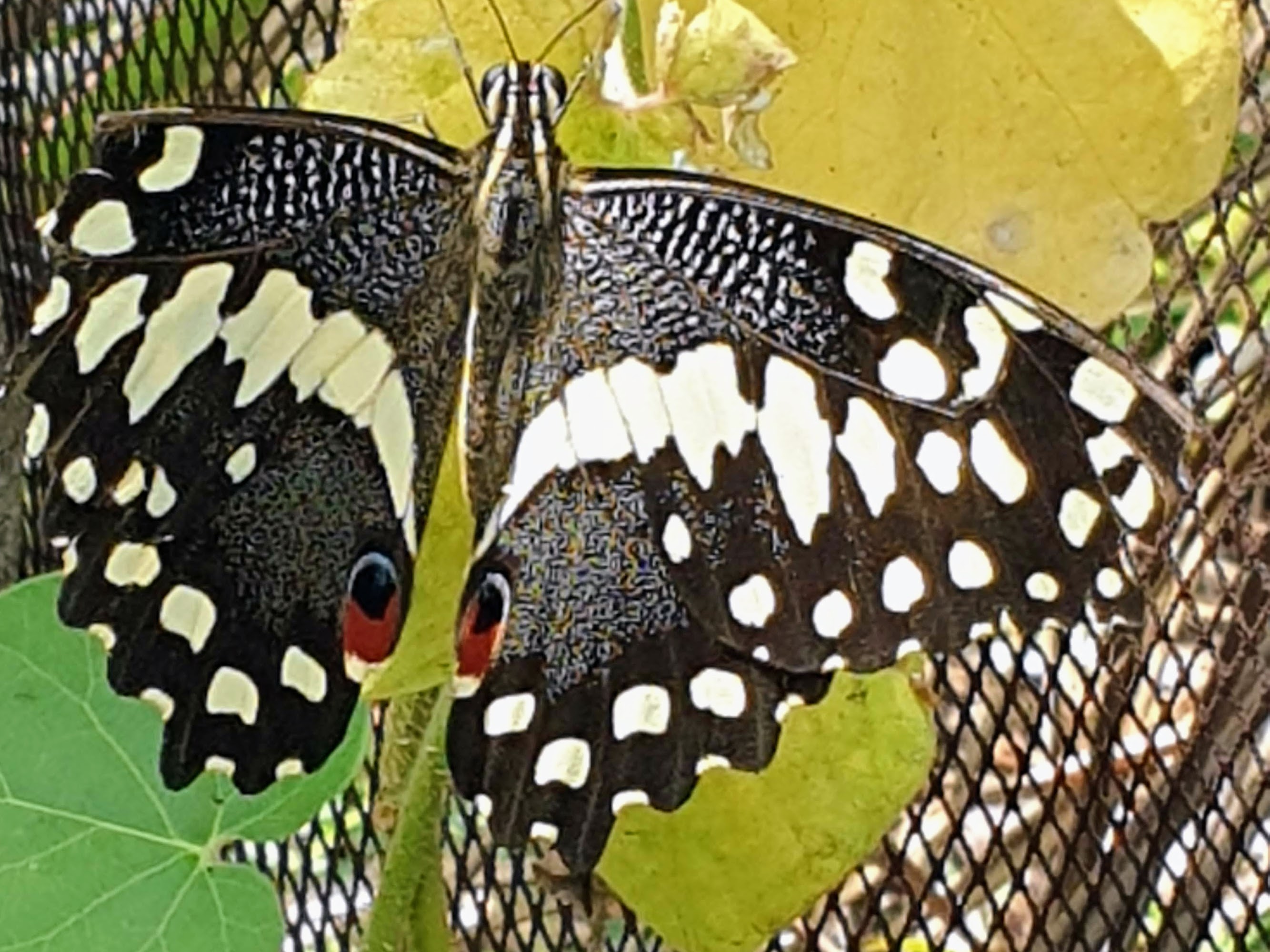
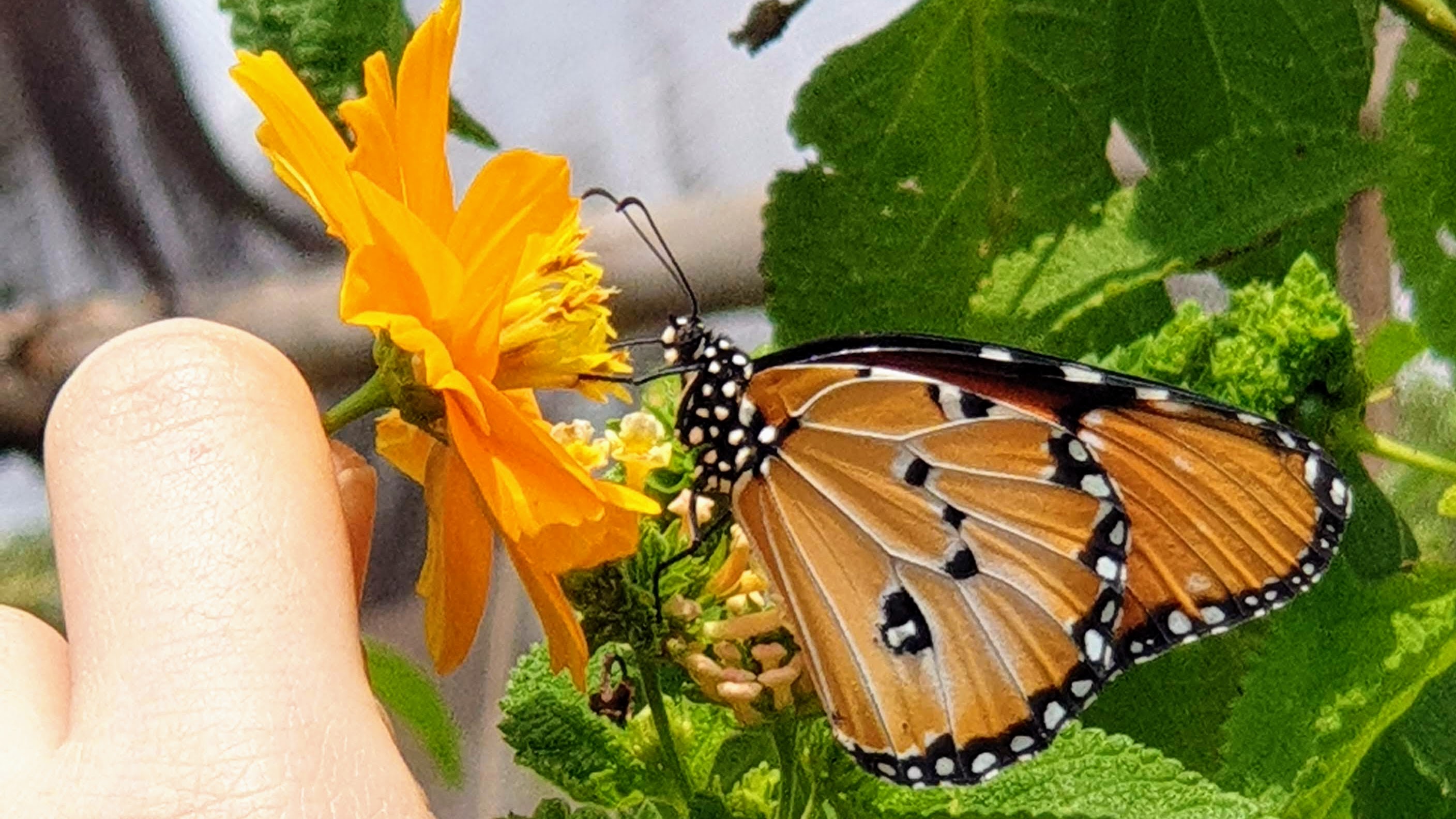
Next we moved on to the butterfly breeding program. In addition to helping the furry species, they are helping the flutters as well. They are much needed pollinators and beautiful as well, but their breeding environments are often under siege by human development or by displaced predators. This park helps breed pollinators year round. As an ongoing part of the hands-on education, I got a handful of caterpillars as he showed me the 4 species they have this time of year (it changes seasonally) at egg, caterpillar and chrysalis stages. We then entered a small enclosure where the butterflies are safe from predators and breeding efforts continue.

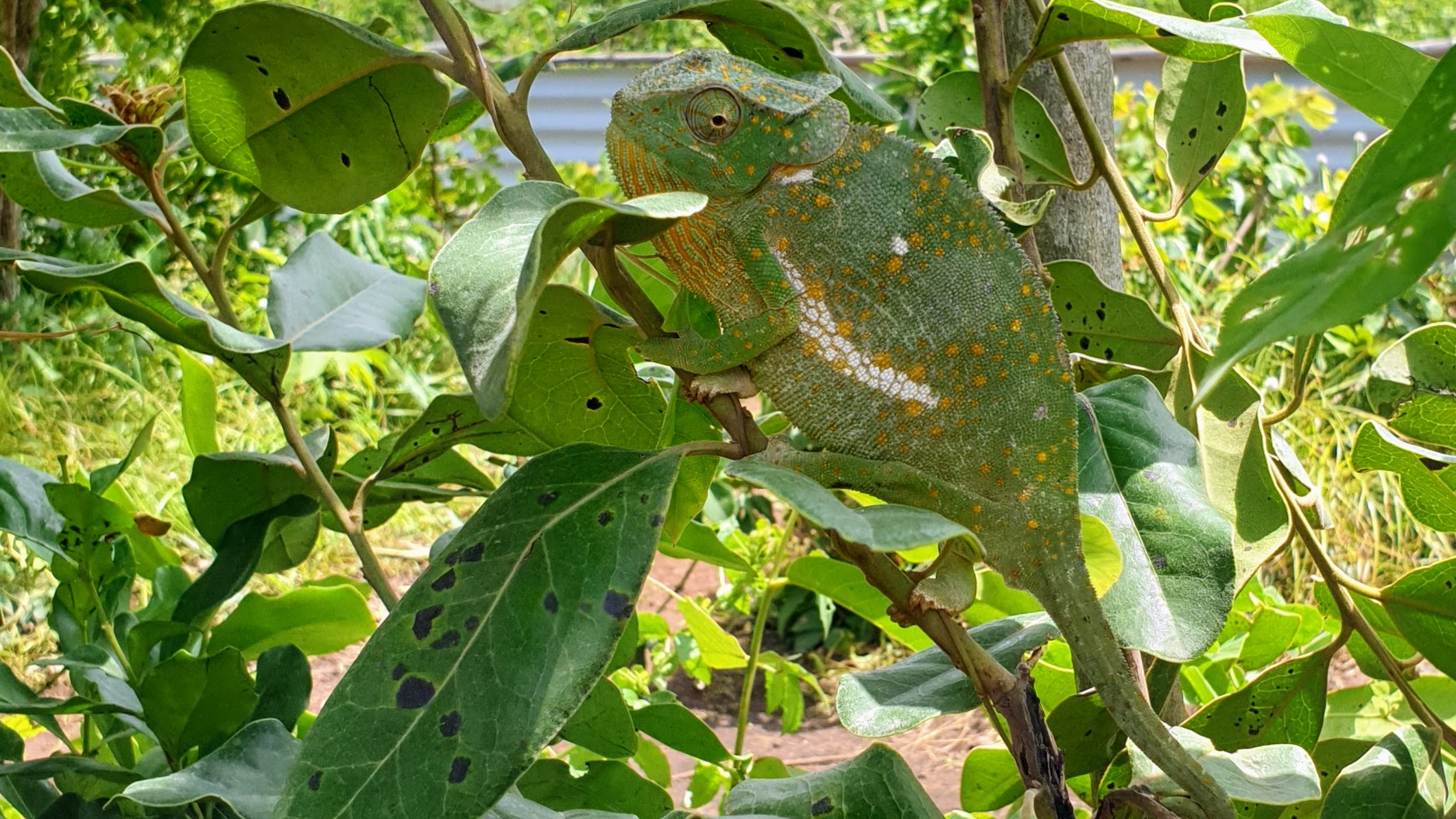
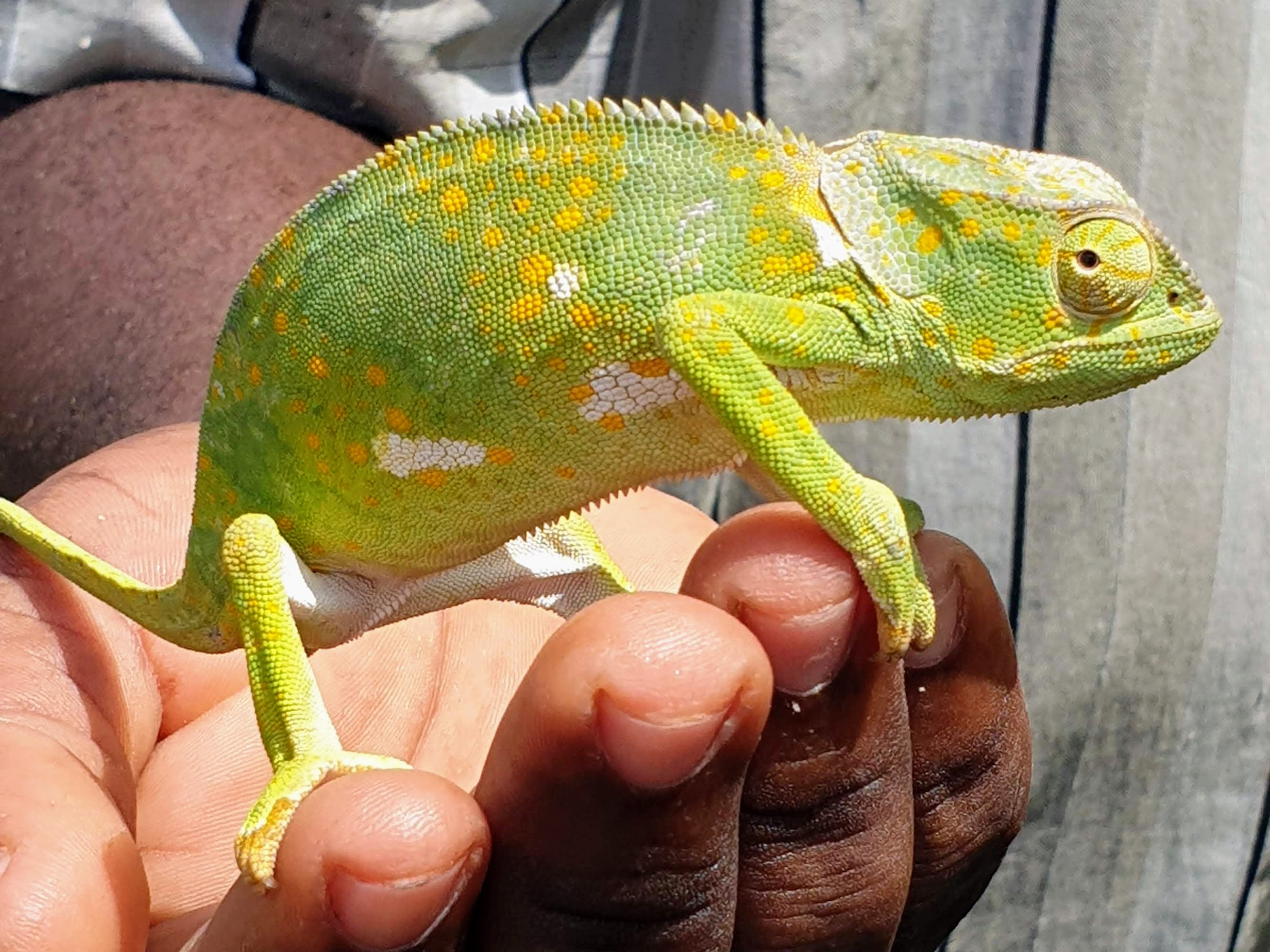
The tour concluded with the chameleon enclosure, although they didn’t need any netting, and were content to hang out on some trees which were roughly segregated by a low fence. I love the way they always seem to be giving a disdainful side-eye.

The Local Economy vs The Tourist Economy

The whole time I was in Zanzibar, I was in shock at how expensive everything is yet how little the average person lives on there ($150-350USD/month). Walking though the local village to get to the resorts in the beach was a real eye opener. The homes don’t have running water, there’s a well and I saw young girls walking to and fro with large buckets. People are cooking on fire. Plenty of cows, goats, and chickens around. Tiny fruit stands and dry goods shops. Places that look like ruins but are actually houses. Then the beach 300m away with luxury resorts.

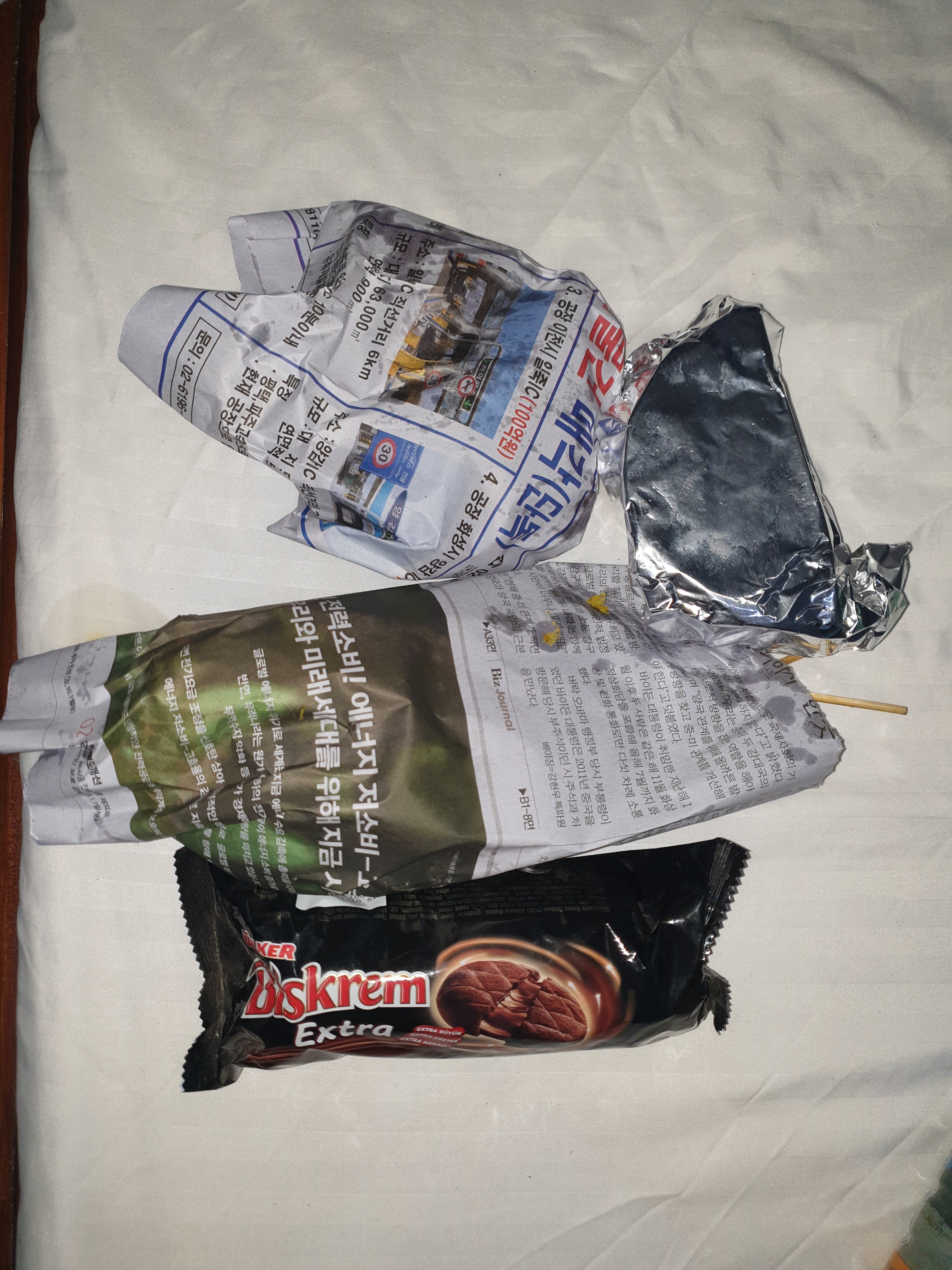
I ate about one meal a day at tourist restaurants and the quality was nice. Tourist and especially beach restaurants are known to be expensive, but most were less than 25$US for a nice meal and drink, which is not a bank breaker. One night in Paje I decided to try the local street food up on the main road. I got grilled meat skewers, samosas and fresh pineapple slices (all wrapped inexplicably in Korean newspaper for takeaway) for about 2$. Filling and tasty at 1/10 the cost of a meal at a restaurant. I’m used to street food being less, but woah! It’s not just beachfront vs main road either. There’s a place less than 30 feet from the actual street food that calls itself “The Street Food Court” which has several takeaway windows and a common seating area. I tried to go there for lunch earlier and saw that most of the dishes were still in the 10-15$ rangeY yes less than the beach but still 5+ times more than the actual street food!

Then there’s the taxis. There’s no “taxis” in the drop fare charge per mile sense. There’s drivers with vans and special licenses who will take you to places around the island but rates are negotiable. 15-20$ to get from the airport to Stone Town (7-8km), 30$ to go from Stone Town to Paje (50km), 25$ to go from my hotel in Paje to my next one in Menai Bay (27km). The driver at the hotel wanted 40$ round trip to go to Jozani, and the ones out in the taxi lot wanted 50$! For 43¢ each way, I was able to use the public transit. 1/100th the cost of the taxi? I’m used to buses being cheaper but that was next level. (My view from the back of the bus)

Maluum Cave Spring

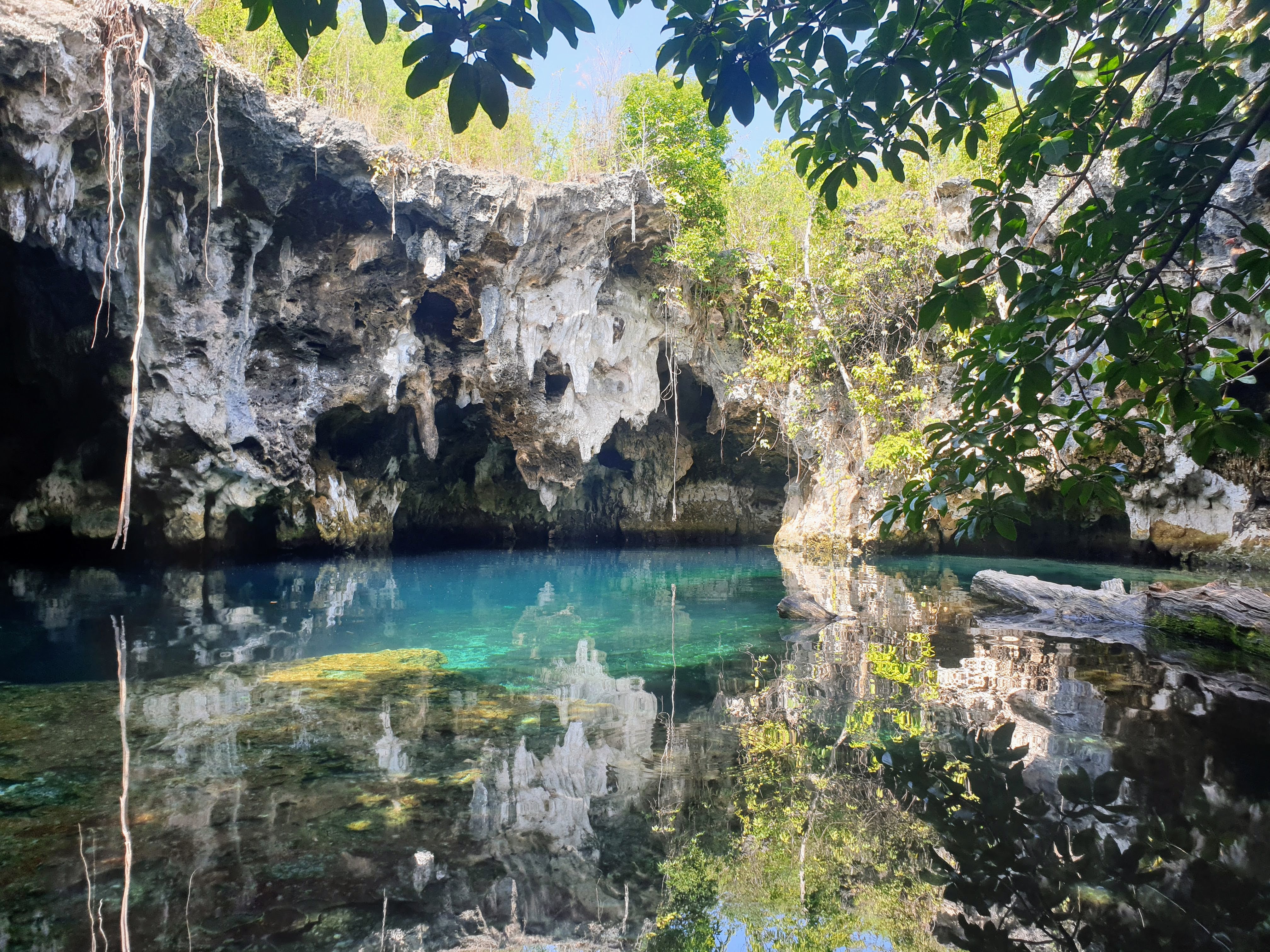
Another wish list item was the cave pools. I visited one of those in Bohol after my terrible sunburn there and it was ah-maze-ing, so I knew I wanted to do that again with my new sunburn. There are a few caves around the island with natural swimming pools, including one rather famous one about a 10 minute drive from my hostel called Kuza. It was highly reviewed online, and I was trying to figure out how to get there what with all the taxis nearby wanting 30$ to go a few kilometers. Then I met yet another traveler over breakfast who told me about a hidden gem: a little cave pool just one kilometer away that was almost unknown!

This sounded appealing both because of the shorter distance and the potential lack of extreme tourism that had been slowly eating my brain since my arrival on Zanzibar. I looked up the place online and noticed that they had time slots and only allowed a limited number of people into the pool at a time. They also banned sunscreen and other skin/hair products that could harm the ecosystem and provided showers for people to clean off before swimming. It was a level of dedication to ecological preservation that I appreciate everywhere, but had come to see as rare on the island where tourist money was a bigger priority for most than the environment.

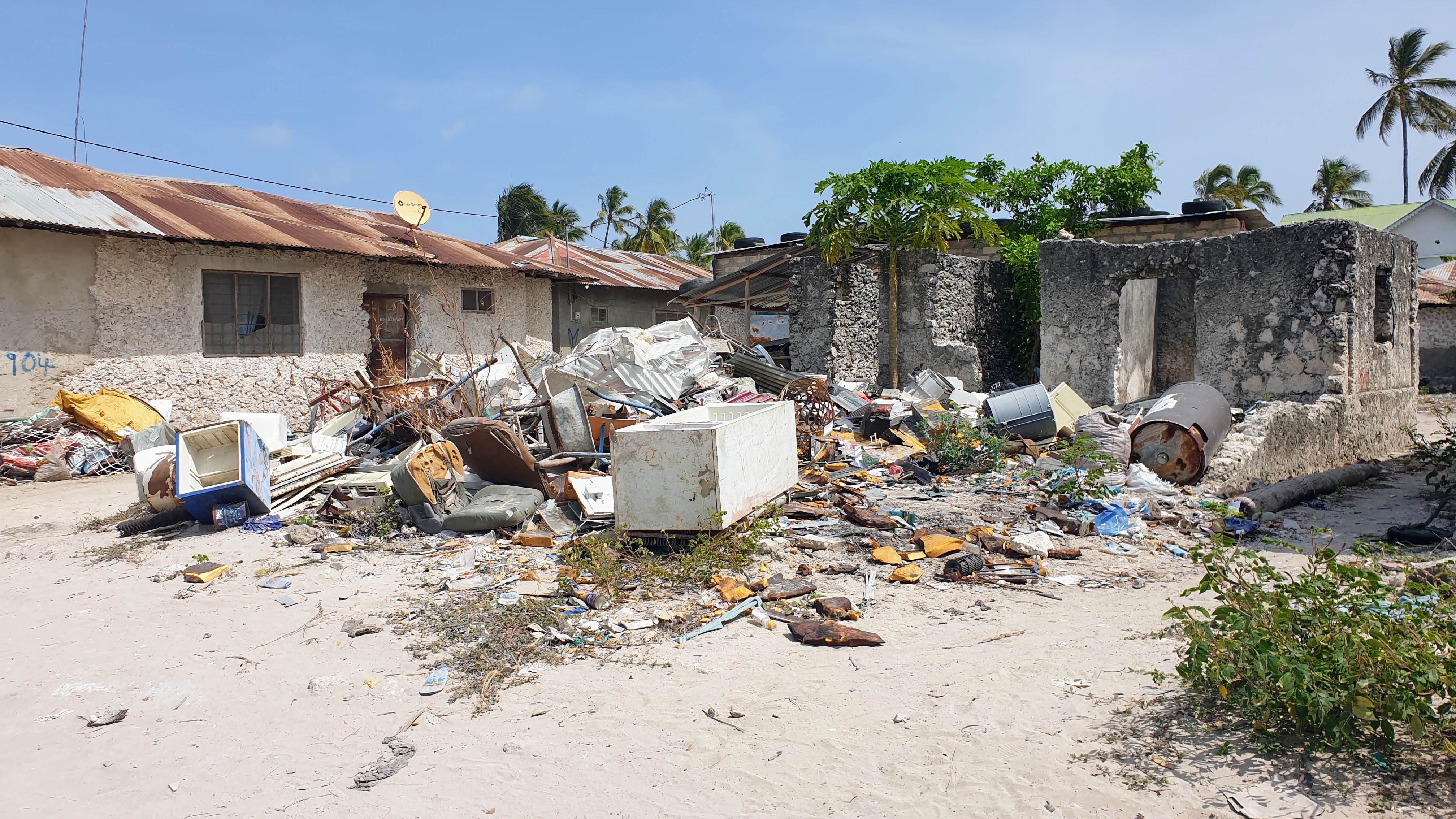
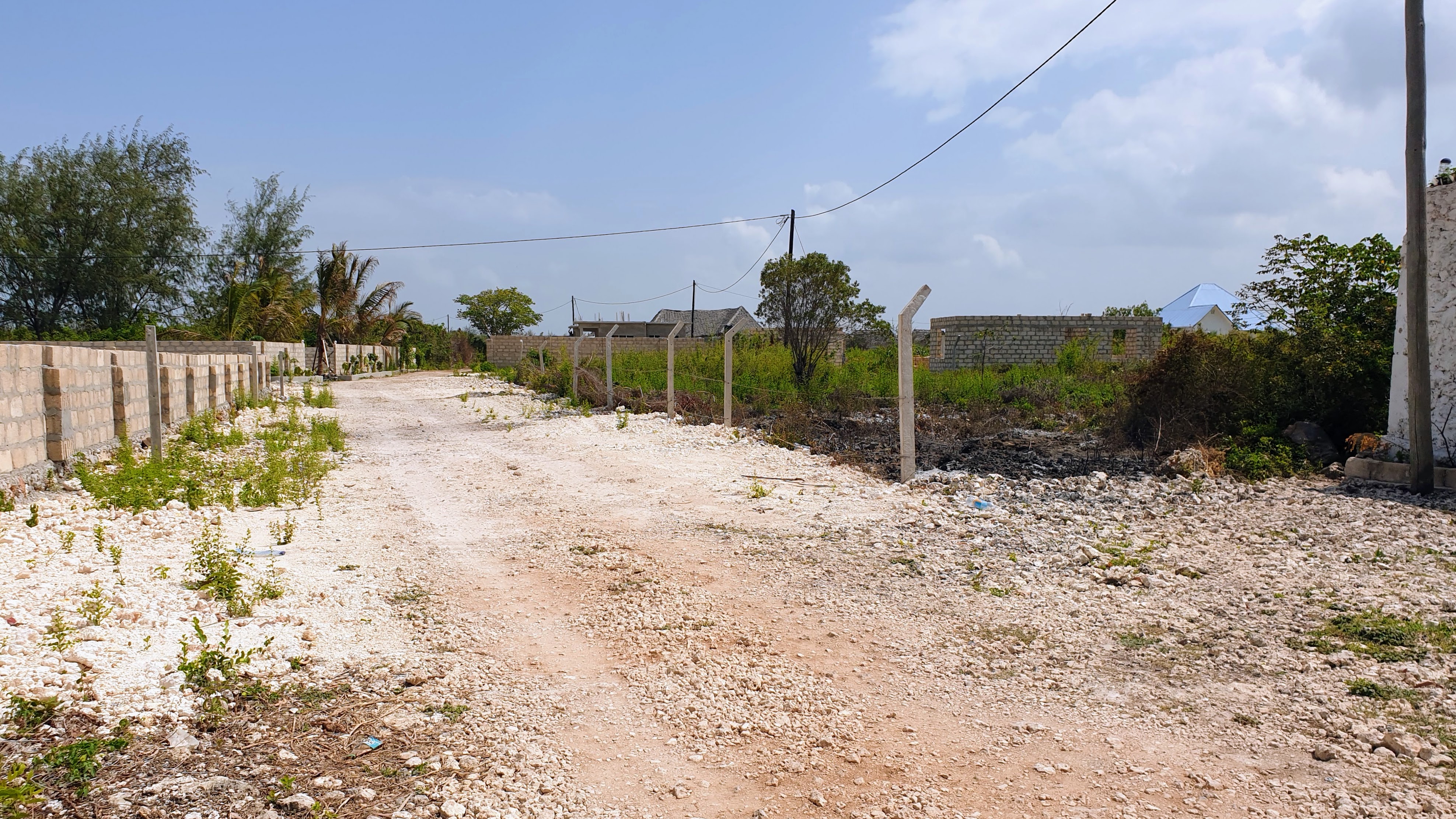
I walked the 1.3km rather than trying to navigate the local bus. I’m sure it could have been an option, but the walk was interesting because it gave me a chance to see more of the area that isn’t curated for tourists. Maluum cave is set back a bit from the main road, so the last bit of the walk took me through undeveloped lots on back roads through fields alternately overgrown and filled with construction debris. Like so many things in Africa, the outsides tend to look somewhere between “plain”, “run down”, and “oh god oh god we’re all gonna die”, but the insides can be quite luxurious.

I was greeted at the gate by some young men in Masai garb and checked in at the registration desk. There was a big group that arrived at the same time I did, and I was disappointed when I realized that we’d be sharing the pool because they were very loud and energetic and I was riding the quiet forest & beach bum vibe of the last few days. Thankfully, they were also running late on whatever tour they were doing, so they basically got into the water long enough to take some selfies and then trundled back out leaving me in the pristine natural beauty all by myself.

I didn’t have it to myself for long, but I saw a purple crab, several little fish, and had a short staring contest with a hornbill. Unfortunately, the waterproof case I’ve been using since 2017 finally died that day, so I was only able to take photos while out of the water. The next group that came through shared my calm vibes and I had gotten some time to commune with the nature on my own, so I was happy to share and enjoy the company until the staff signaled my reserved time was up.

They have a restaurant on site as well, so I headed over there for dinner and to air dry before changing back into my street clothes for the return walk. I had green banana curry for the first time. I have had dishes made with green plantains (a banana cousin) which cook a lot like potatoes, but I had never thought of using actual bananas while green. It was delicious and the banana flavor was not at all overwhelming. The weather had cooled somewhat by the time I left, and I had a leisurely walk back to my hostel for my final night in Paje. Here are some cows I passed on the way.

Aside: Due to the current situation in Dakar (where I’m living), I’m adding a little note to let you all know I’m safe. I plan on writing a full post on experiencing this historic unrest in West Africa’s most stable democracy first hand, which I’ll likely publish after my triumphant return to America in August. Until then, I am in a quieter neighborhood with no strategic targets. I have food, water, electricity and a working VPN. If you’re curious about what’s going on, you may have trouble finding details in English, but there’s a lot French resources available and Google Translate is good enough. I recommend searching terms like “manifestation” (French for protest or demonstration), Sonko (the political candidate at the center of the controversy), and of course the popular hashtag “Free Senegal”.

Zanzibar: Stone Town

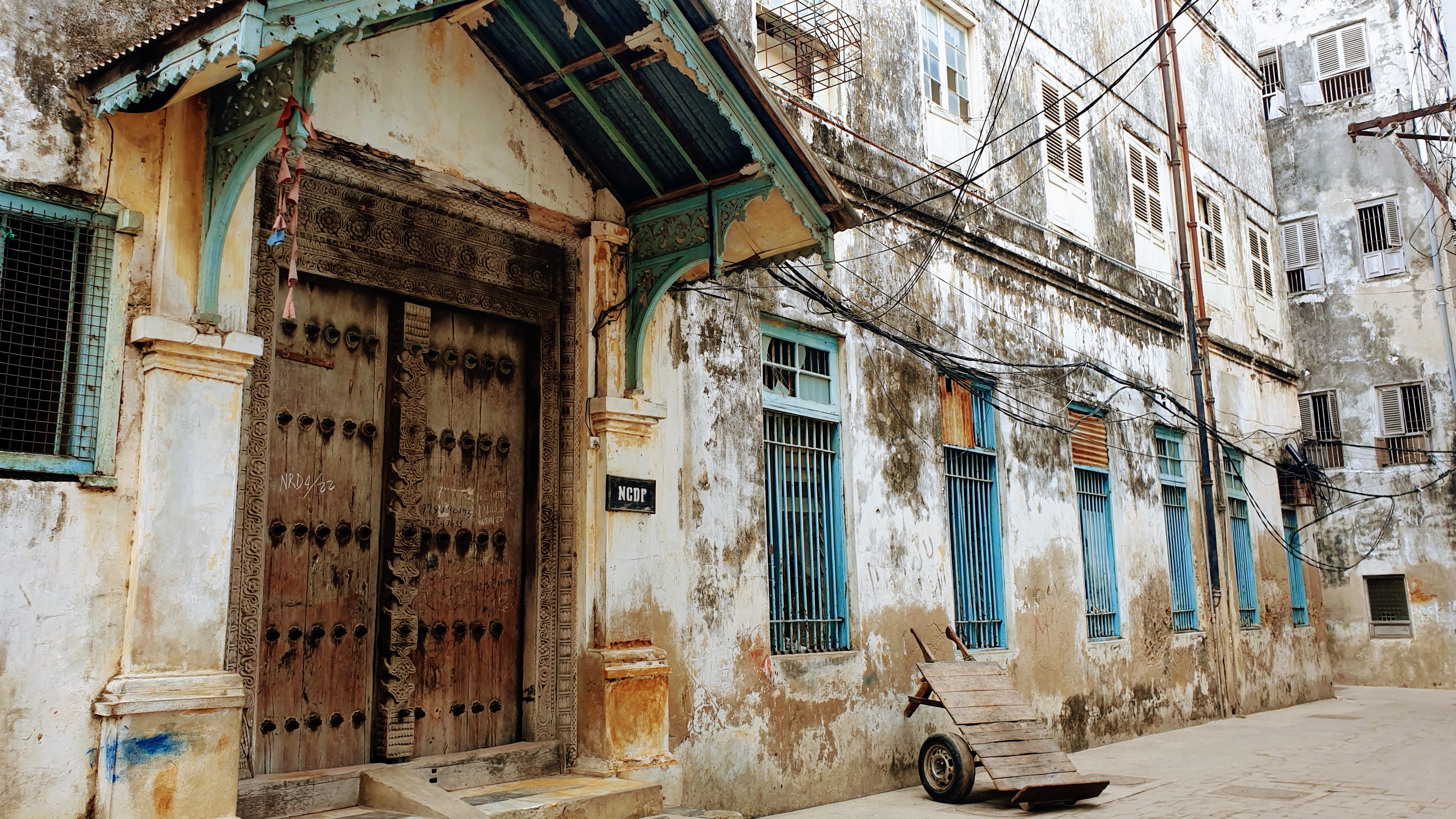
Stone Town is an architectural love child of Indian, Arabic and Swahili cultures. The narrow maze-like streets car-free (though not cart-free) and stuffed from end to end with life. “Get lost in Stone Town” is another top 10 Zanzibar activity. The whole neighborhood is less than 2km2, bordered by the sea on the west, the Darajani Market on the east, and some fairly uninspiring highways on the north and south. GPS sort of works, but because the streets are so close together and none of them are clearly labeled (or possibly even named) you can only get a general idea of where your destination is. You will get lost trying to get there.

A Brief Historical Context

Zanzibar is an interesting and unique geographical gateway between central Africa and the Arabic and Indian cultures. The trade winds carried ships from India and Arabia then trapped ships on the islands for about 6 months at a time before they were able to sail back. Unlike many other trade centers, where the sailors and foreign merchants were in and out of port in days or weeks, the Indian and Arab merchants who came to the islands of Zanzibar were obligated by the wind to stay for half a year at a time, and so they often married local women, built homes, and had families. Though there is archaeological evidence that the island of Zanzibar was involved in trade with other mainland African cultures, the intercontinental trade seems to have started around the 9th century. There was about 600 years of cultural mixing between the Indian, Arabic, and Swahili people that had ups and downs of who was in charge and who was converting who and who was selling who into slavery, but this is the brief history, so we fast forward to roughly 1500 when Portugal hit the scene.

The 1490s are a bit famous for that trip Columbus took, but he was far from the only European out to find wealth in “unexplored” parts of the world. Vasco de Gama was the first European to reach India by sea, a trade route that required stops along the eastern African coast. Portugal was one of the big European colonial powers and they had their fingers in pretty much every exploited continent. Zanzibar was not only a good resting stop en route to Calcutta, but a source of rare spices and human slaves from the African mainland, which were the big moneymakers in those days. The Portuguese ran Zanzibar for about 200 years, until the late 1690s when the Omani Sultanate took it (possibly at the request of the local Swahili people who thought an Arabic overlord would be better than a European one). Somewhere between 1830-40, the Sultan of Oman moved the capital city from Muscat to Stone Town, and when he died in 1856, he split the empire between his two sons, giving Zanzibar to one and Oman to the other. In a move that surprises no one, they fought about it, but then in a shocking twist, they allowed the will to be arbitrated by the British general protector of India. The Age of Empires remains confusing.

Zanzibar continued as a separate Sultanate until the British decided that actually, slavery was morally reprehensible after all, and that everyone should stop now that they had decided to stop. This didn’t happen all at once, but from about 1822-1873 the British put increasing economic and military pressure on the Sultanate to stop trading in slaves, including trade embargos and the raiding of slave ships. Freetown in Sierra Leone was created to rehome the slaves who were liberated by the British during this time. By 1890, Germany and Britain decided between them that Zanzibar would be a “protectorate” of Britain (which is like colony lite). Finally, in 1963, around the time Britain was being forced to give up on the whole Empire idea, Zanzibar got full independence as a constitutional monarchy. They promptly had a revolution to oust the royals in favor of a representative government, and one year later, merged with the mainland country of Tanganyika to form the modern nation of Tanzania. Despite this unification, Zanzibar remains a separate autonomous region (like Hong Kong and China) with it’s own flag, president and taxes.

First Impressions

My first week in Zanzibar, I decided to stay at a hostel in the heart of Stone Town since it seems to be where a lot of the action on the island is. My ride from the airport (a comedy of errors) tried to just leave me in a random parking lot with a random guy. It felt very sketchy, but I have since learned this is pretty normal and that Stone Town is actually very safe for tourists. In Stone Town, “lost” is a relative term. The streets are close and narrow, but there’s a fair amount of order. There’s the main arterial market streets which are loaded with shops, there are the quiet side streets where locals hang laundry and kids play after school, and there’s the waterfront. You’re only really going to get “lost” in the quiet side streets, and even then only for a few blocks until you’re spit back out to one of the main areas or reach the edge.

I was initially overwhelmed by the number of people talking to me. Unlike Senegal where French is the colonial language, English is the colonial language in Tanzania, and they love greeting tourists with spatterings of friendly Swahili as well. The shopkeepers call out as you pass by, inviting you to look, asking where you’re from, and generally being friendly. Of course they want to sell things, but they don’t physically invade your space and they don’t get mean or angry when you say “no thanks”, they just say “hakuna matata, maybe next time”. There are free range sales people who are arranging tours and excursions and they’ll just walk with you and chat. I got some advice about what to avoid doing and eating while in town, and although I never ended up booking with any of the street tour guides, I quickly came to not mind their chatty presence in my walks through Stone Town the rest of the week.

A Guided Tour

I opted for an Airbnb Experience, again hoping that a more personalized touch would be better than a company tour. It seems like Airbnb in Zanzibar is really just a front for businesses. This may also be related to the rules about tourism and taxi licensing. My spice tour guide explained that it takes a couple years minimum to get the licensing to drive tourists around. Walking tour operators don’t have that concern, but they still have to be able to produce papers if they’re questioned by authorities while leading a group of tourists around. The result is that Airbnb isn’t random locals sharing their culture for a small fee, it’s actual real businesses, and you just have to hope they’re not shady. Reading the reviews helps, but as I learned with my Blue Safari trip is not a guarantee. Thankfully, my Stone Town tour was a win. The other person/people who had booked it never showed up, so I had a totally private tour. The friendly guide was happy to adjust the pace, the amount of time spent at each place, and even the places we went to my personal tastes. He also relaxed and opened up a lot more about the details of life in Zanzibar and Tanzania.

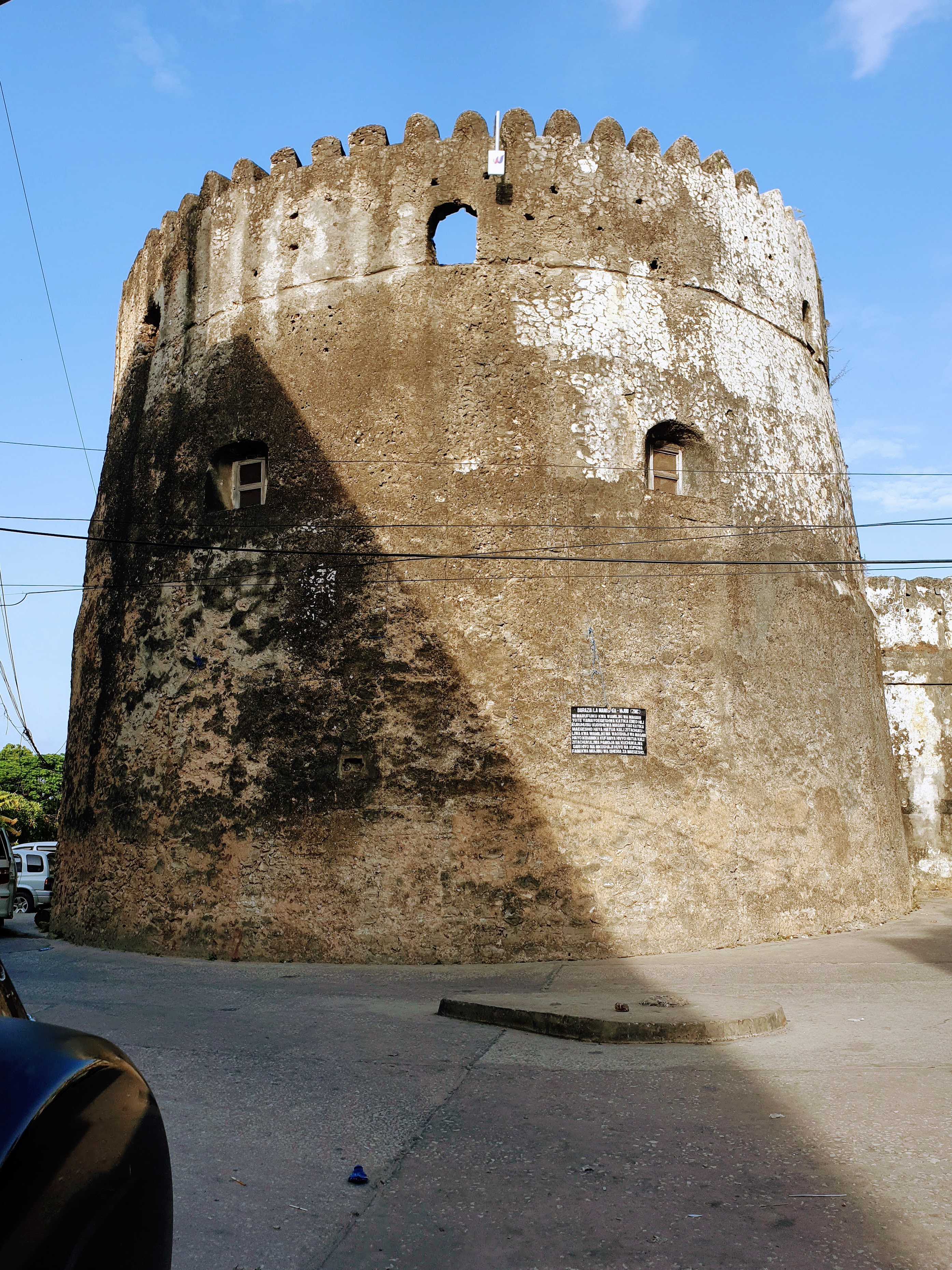
The entirety of Stone Town is a UNESCO Heritage site, and there are a couple buildings in particular (like the House of Wonders) that have their own special status. As a result, everything is always under restorative construction, all the time. UNESCO standards require that repairs must be done in the original work methods with the original construction materials in order to receive funding. This is great in lots of parts of the world, and keeps ancient cultural heritage styles of art and construction alive in places where the local economy might have driven them to extinction. However, in Zanzibar, the original construction was often quick and cheap, and the regular monsoons erode the limestone and coral structures. Walls made of old coral are constantly being replaced and the House of Wonders has been closed for more of the last decade than it’s been open.

In addition to the issue of materials and labor, the currency exchange and corruption are eating away at restoration efforts. The UNESCO funds are issued in Euro but the materials and labor must be purchased in Tanzanian Shillings, so exchange rates affect budgets and cost estimations. In addition, the government officials skim way more than what most countries would consider acceptable graft. My guide expressed a tolerance for “reasonable government corruption” by saying that out of a 20million Euro repair budget, the officials can take up to 2million, but should leave 18 for the work. This 10% skim was his idea of good corruption, but he clarified that in reality the take is much much higher, meaning that most of the UNESCO money goes to lining bureaucratic pockets rather than actually restoring the historical heritage sites.

Doors, Windows, & Walls

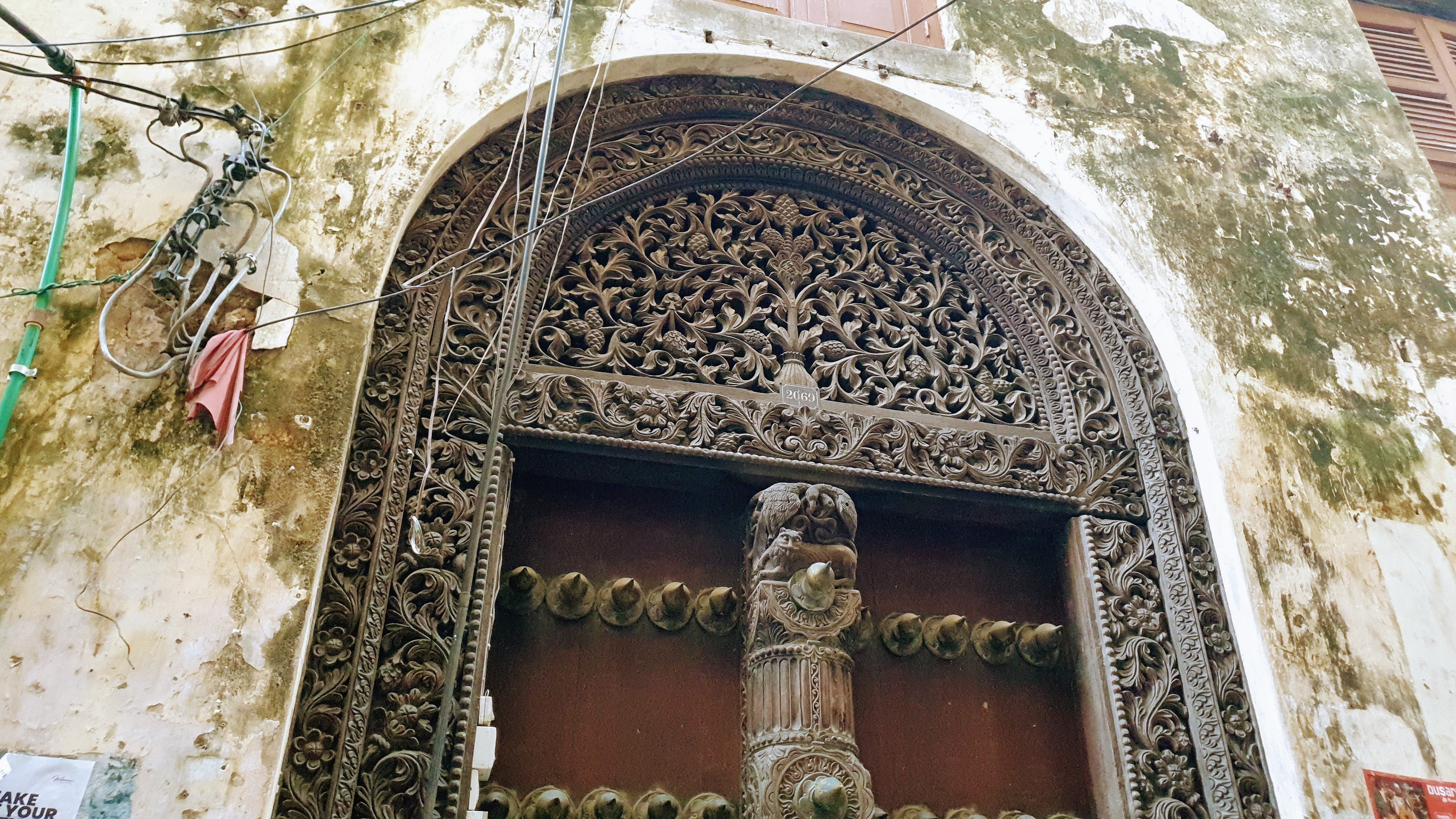
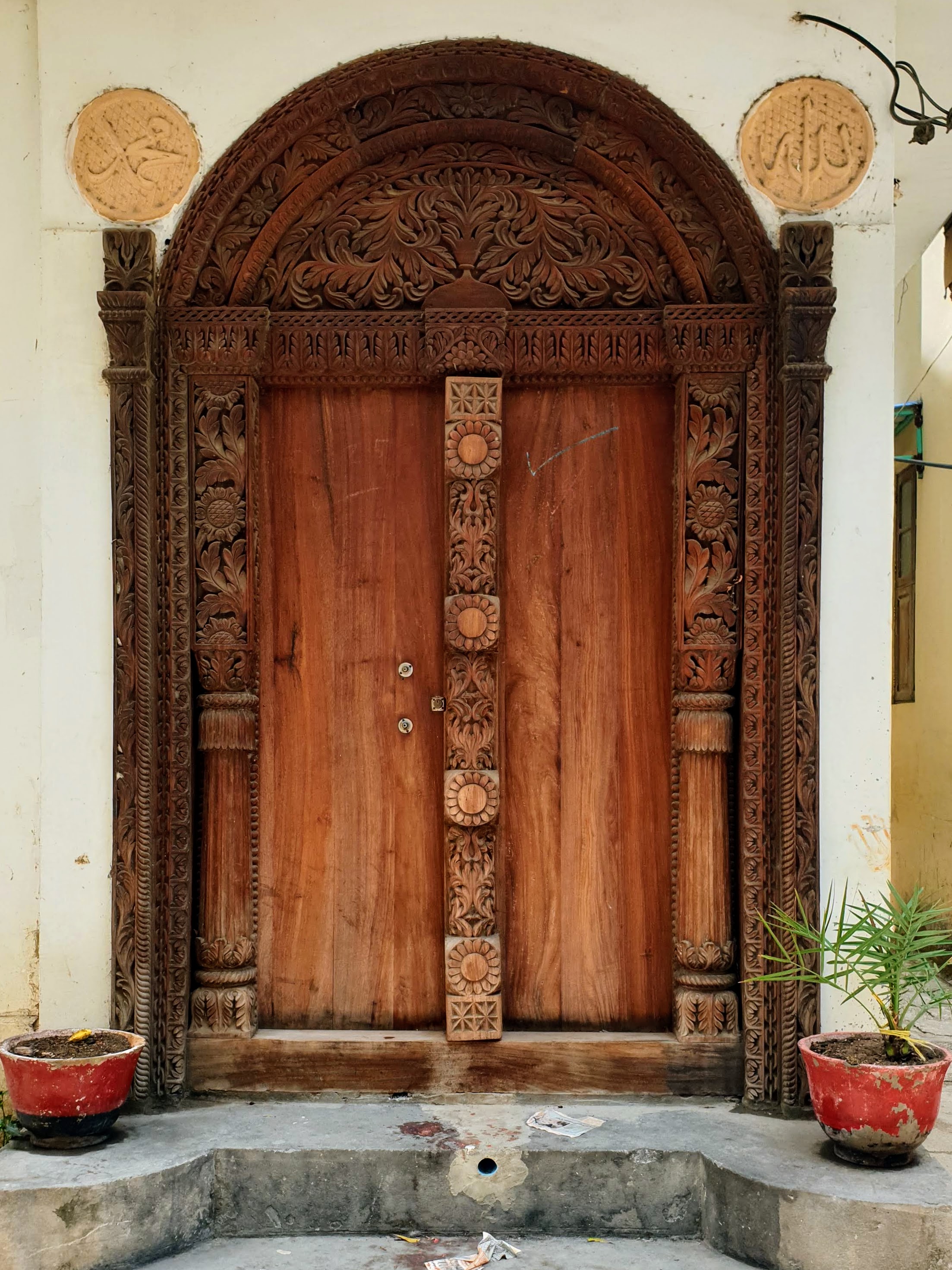
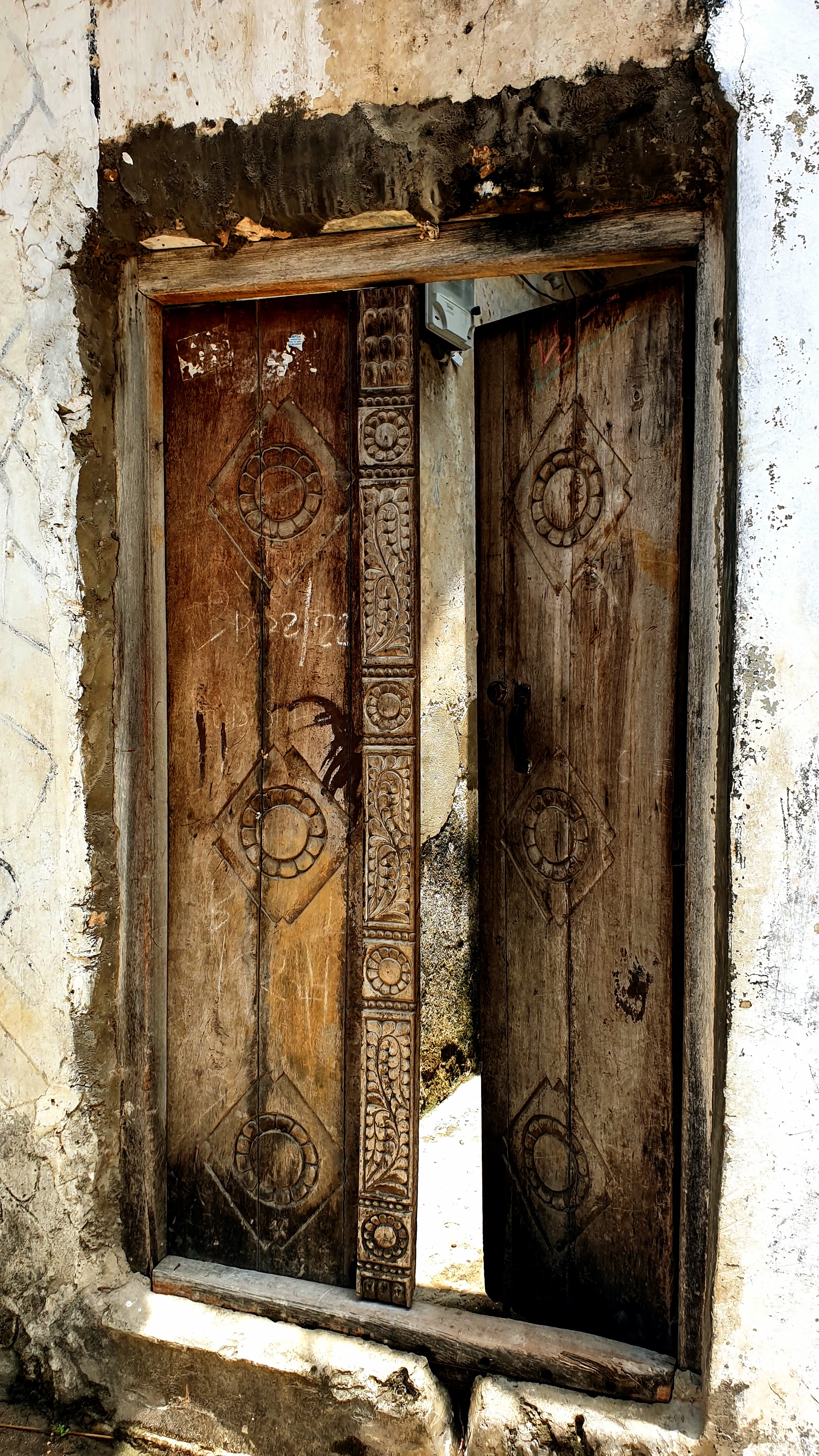
The Zanzibari Doors are one of the most famous and easiest things to see on your own while wandering around. Each one is hand carved and unique. They seem to have been a Swahili tradition that was adopted and embellished by the Indian and Arab traders. Most of the accounts of Zanzibari doors I found online seem to have been written by people like myself, visitors who went on the tour, so I’m not sure how historically accurate the information is in details. There’s a serious lack of accessible written history of African cultures. Almost all written records were made by colonizers and traders, and those were generally taken away to live in the basement of libraries and archives in the home countries of those colonizers and traders where they remain in dusty obscurity to this day until a few scholars (also likely not from Africa for economic reasons) decide to sort through them for a PhD dissertation which is itself read only by their peers and advisors, never reaching the general public. Is there a dissertation somewhere on the details of the symbolism of Zanzibari Doors? Possibly? But I can’t find it.

The main differences that everyone knows about are: the Indian style doors which may have round arches and usually have brass spikes, originally used in the Punjab as elephant deterrents, later evolved to a status symbol. The Arabic style doors may have a peaked arch or be square topped, and generally also have some stylized Arabic script, protective prayers from the Quran, engraved on the lintel. The Swahili designs include vines, fish, flowers, and later coffee beans and cloves. My guide told me that pineapples and grapes were a later addition, somewhere around the 1850s, which tracks as 1856 being the year that Zanzibar became a separate Sultanate from Oman.

Though everyone used the doors to signify wealth, each culture had different decorative values otherwise. Arab Muslims were (and in many parts of the world still are) not into external displays of wealth on the home. Exteriors of Arab built homes in Zanzibar are very plain. Windows and balconies are built to protect those inside from the eyes of passersby, and there were even covered bridges between homes to allow the secluded women and children to visit one another without stepping into the public view. The Indians, in contrast, loved to be seen. The exteriors of Indian built homes have flourishes and colors, windows and balconies allow the homeowners to show off their wealth and fashion to the public without going outside.

Modern day buildings and newer doors often incorporate traits from all three main cultural influences for both aesthetic and blended heritage reasons. Architecture isn’t the only thing that blends in Zanzibar. Although Islam is an import from the Arabian peninsula, Zanzibar is currently majority Muslim (while mainland Tanzania seems to be majority Christian). However, the cultural blending of Zanzibari history means that in addition to all the major branches of Islam being represented, Zanzibar also hosts Hindu and Jain temples (of Indian descent) as well as a variety of Christian churches including Catholic, Anglican, Lutheran, Adventist, and Pentecostal. I enjoy this photo op of the mosque and cathedral sharing the skyline.

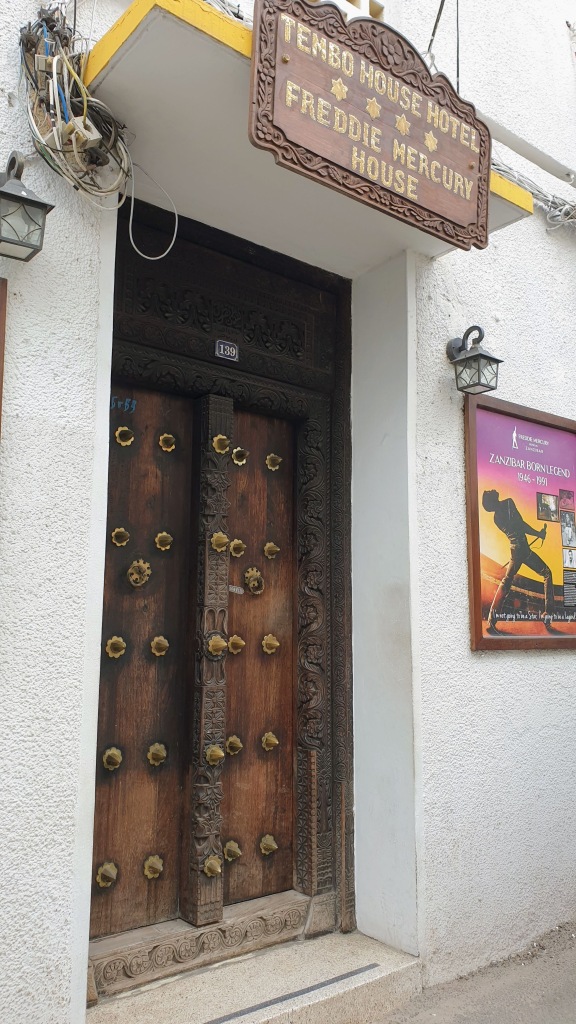
The Freddie Mercury Museum

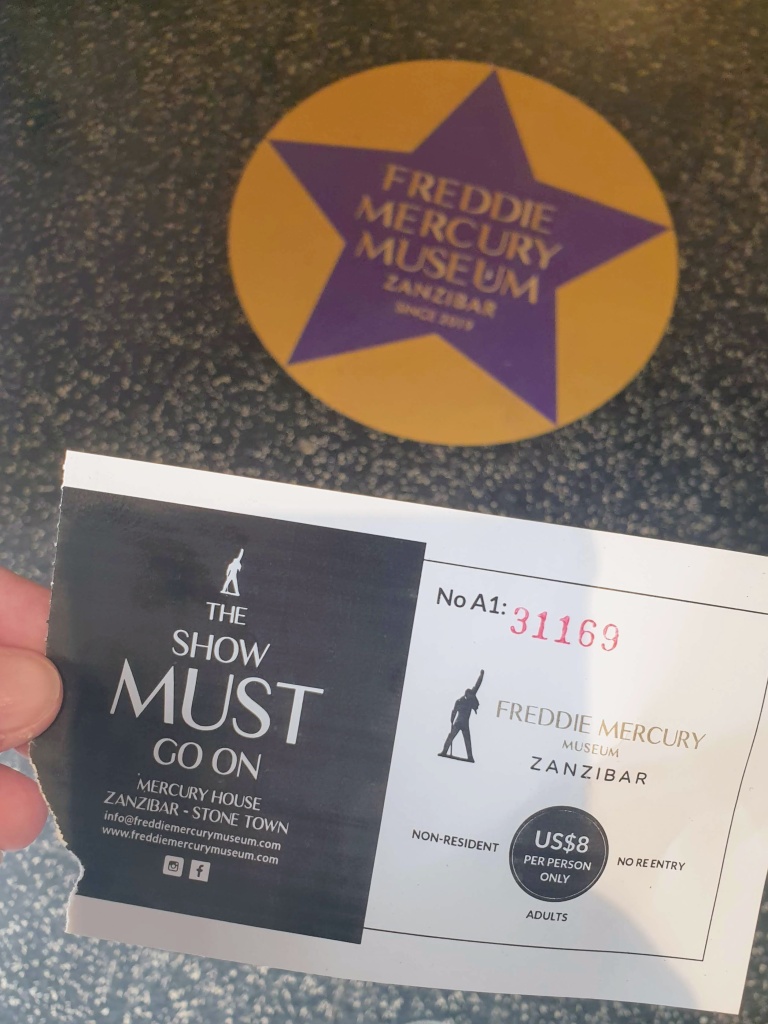
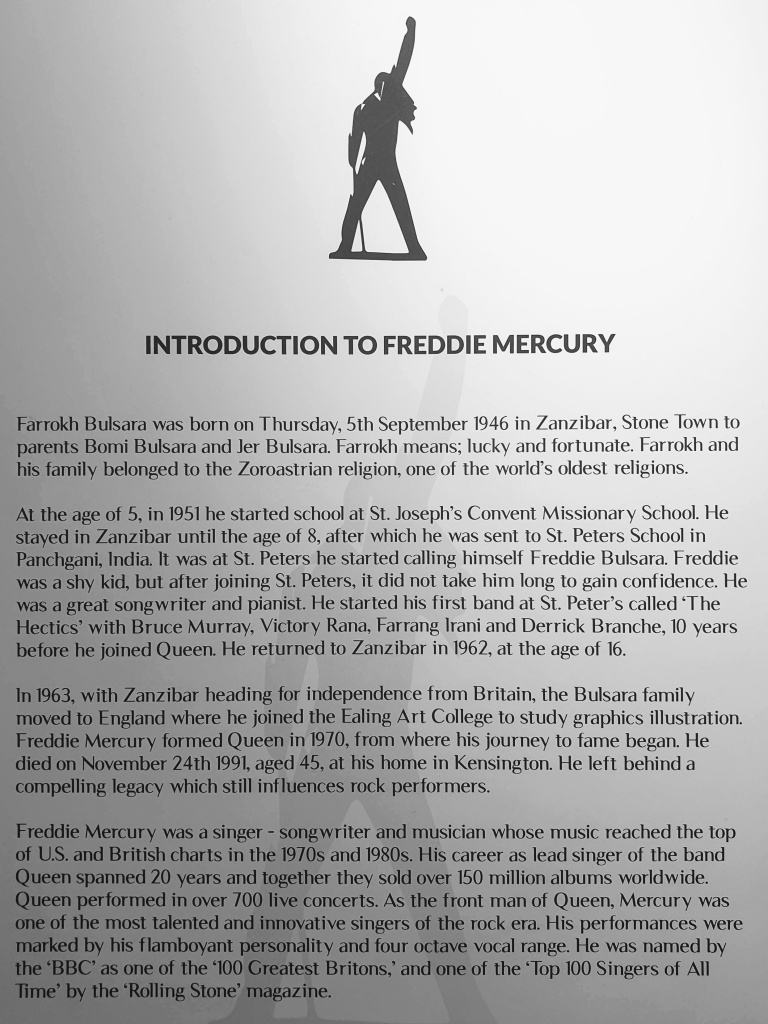
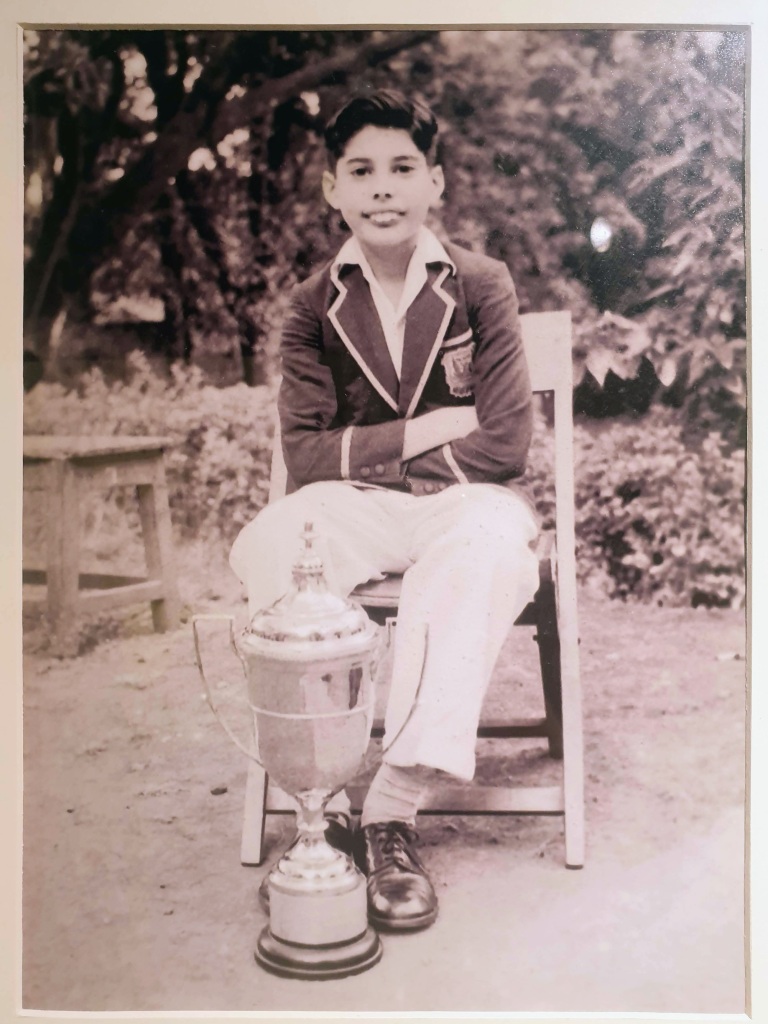
The tour stops out front of the the Freddie Mercury Museum. This is one of the big hot-spots of Stone Town. They are really excited to have a globally famous rock star trace his origin to their town. Freddie was born in Stone Town to Persi-Indian parents. He didn’t actually live there much, since he was in India as a small child, then England for boarding school, but Stone Town claims his birthright. This tiny little museum costs 8$US to enter and takes 15-45 minutes to view depending on how much you want to read and how slow a reader you are. The displays are mostly childhood and family photos as well as album covers. They have an impressive collection of lyric notes, which is kind of cool. There is also a tiny side room that has his famous Wembley concert jackets (the yellow as well as the white with red buckles). I have no idea if anything in the museum is authentic since replicas of these items are pretty easy to get online.

The museum is not what you’d call impressive. I’m biased because I lived with the Seattle EMP (now Mo-Pop) for decades, but even diehard Queen fans would likely feel underwhelmed. Nevertheless, I am happy I spent my money there and I hope more people do because Tanzania is still a place where being queer is illegal, punishable with fines and prison time (up to a life sentence). Freddie is a queer icon. As a bisexual man, his sexuality is often subject to erasure. In the West people tend to forget that he was BI and not GAY, ignoring his relationships with women. In the museum in Zanzibar, there is no mention of his relationships with men, and his relationship with Mary Austin is the only romantic reference. Despite this erasure, I think their pride in Freddie can act as a wedge to allow a discussion of LGBTQ+ rights to take place in Zanzibar and eventually on the mainland, so they can have my tourist money.

“[Queen is] just a name…It had a lot of visual potential and was open to all sorts of interpretations. I was certainly aware of the gay connotations, but that was just one facet of it.”

“I’m as gay as a daffodil, my dear!”

-Freddie Mercury

Zanzibar: The Indian Ocean

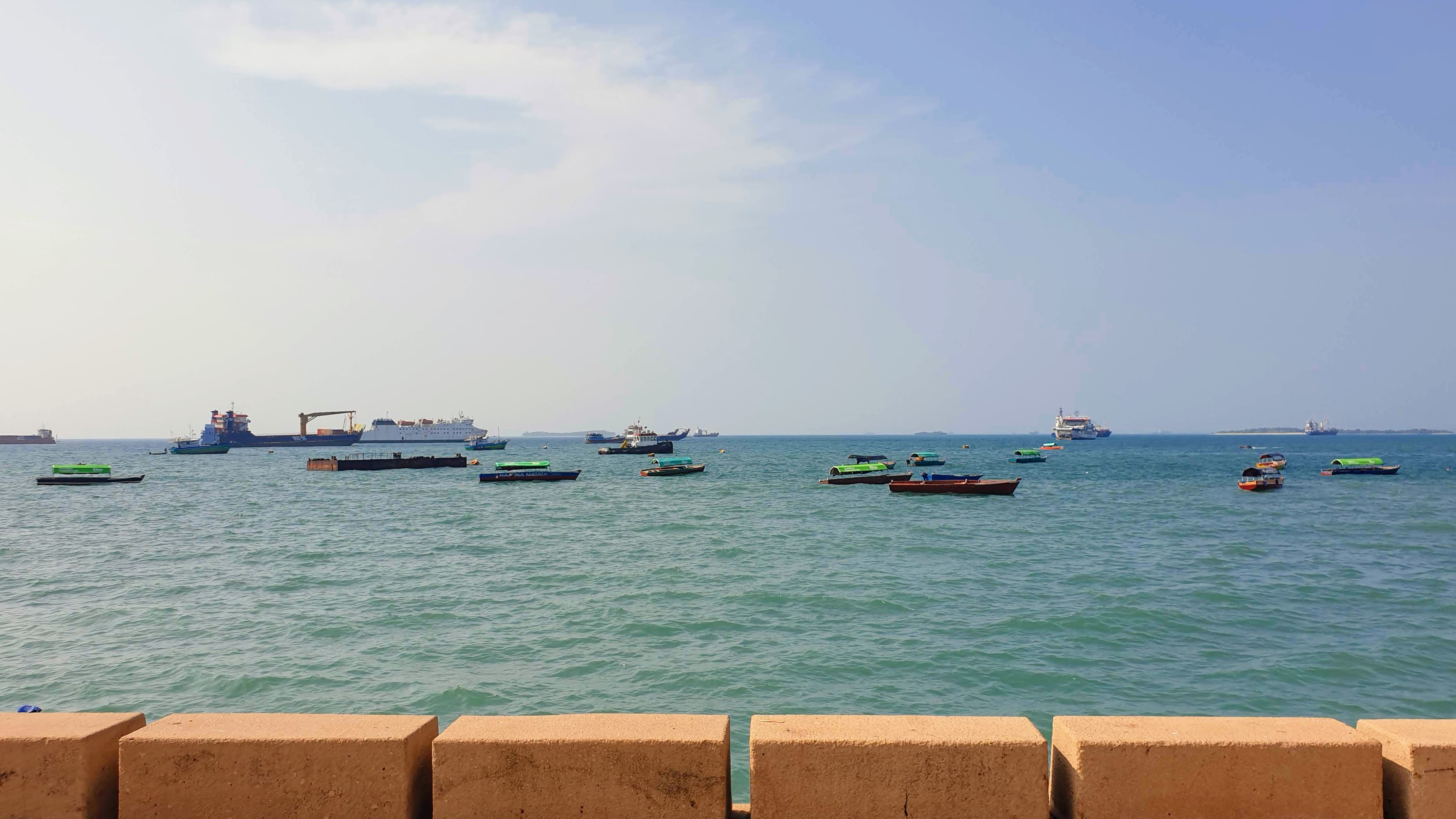
The Indian Ocean off the coast of Zanzibar is of a deep, brilliant blue that one suspects has been altered in brochure photographs, but is in fact that blue (not every beach every day, but often enough that you are likely to see it at least a few times on a visit). Lounging at a beachfront restaurant while enjoying the sea breeze and insane blueness of it all, is among the top 10 activities recommended to tourists on the island. Snorkeling, diving, surfing, and kitesurfing are also all on offer. I looked into each one, and discovered that three of the four activities were multi-hundred dollar investments (since I am not PADI certified and do not yet have any kind of surfing experience at all). Snorkeling it is, then. Given my lack of planning for this trip, my wishlist simply contained the keyword “snorkeling” and something called “Safari Blue”.

On my first day in town, I happened to spot a PADI certified dive shop that also advertised snorkeling which put me in mind of the trip I’d taken in Bohol where the snorkelers and divers shared a boat. One Ocean Diving is the only PADI certified center in Stone Town and they have a few other boat trips on offer as well. The day I wanted to go was too close for online booking, so I simply walked in and booked an excursion in person.

Safari Blue is on every list of what to do in Zanzibar. Although there is a company by that name, the tour simply refers to the route: a boat trip that departs from Fumba and incorporates the south-western region off the coast with mangrove swimming, snorkeling, a sandbar, (maybe dolphins), and a seafood lunch. I searched online for a good way to take this famous trip without the necessity of being crammed in with heaps of tourists and finally landed on an Airbnb experience with decent ratings.

This is the tale of two sea trips which could not be less alike and still be on the same island.

Safari Blue

When I saw a version listed on Airbnb Experiences, I was excited because I thought I might get a unique local twist on this tourism staple. I was so wrong. The “host” was a tour operator who simply arranged the driver and booked the boat tour for me and the other unsuspecting suckers who thought they were getting a personal experience. It’s normal to join a group on an Airbnb excursion. I recall my Grenada hot springs experience fondly where my hostess drove a group of travelers out to a spring in the mountains and served us a picnic. The whole point of the Airbnb experience is to meet other travelers while a local shows you around in a unique way. This was like booking an Airbnb and discovering it was actually the Best Western all along. It’s not that I wouldn’t stay in a Best Western, I just want to know that’s what I’m signing up for.

Though I would have been happy to meet at the fort, the “host” said the driver would meet me at my hotel and walk me over to the parking lot (Stone Town doesn’t let cars in), which resulted in the driver getting lost, because Stone Town is a maze, and being more than 20 minutes late. There were two other tourists along, which initially, I was pleased about since I had done my previous Zanzibar Airbnb experiences solo. The driver explained he would hand us off to the boat operators at the docks. There we discovered we were joining a group of 6 more on a dhow operated by what seemed to be a very large and well logo’d tour company called Johari.

The boat workers were in a big hurry to get going, and I’m not sure if we were actually late or if it was just the timing of the tides that day, but for the first time in Africa, I felt rushed. We had to get swim fins at the dock and two of the people in my excursion also had to use the tiny brick building to change. This is the location from which all Safari Blue boats leave regardless of which company actually owns one, so it was crowded and busy even in the off season. Once on the boat, we sailed out for a while under scorching sun and finally arrived at the “blue lagoon”. The tour companies definitely put their absolute best photos online for you to view, but what no one tells you about Zanzibar is the way the tides can make or break your experience. Tides don’t happen at the same time every day, but they are predictable. As I learned when visiting the hot spring beaches in New Zealand, tide charts are easy to access online. If you want the brochure photo experience, it’s important to visit Zanzibar at a time of year when the tides are in your favor.

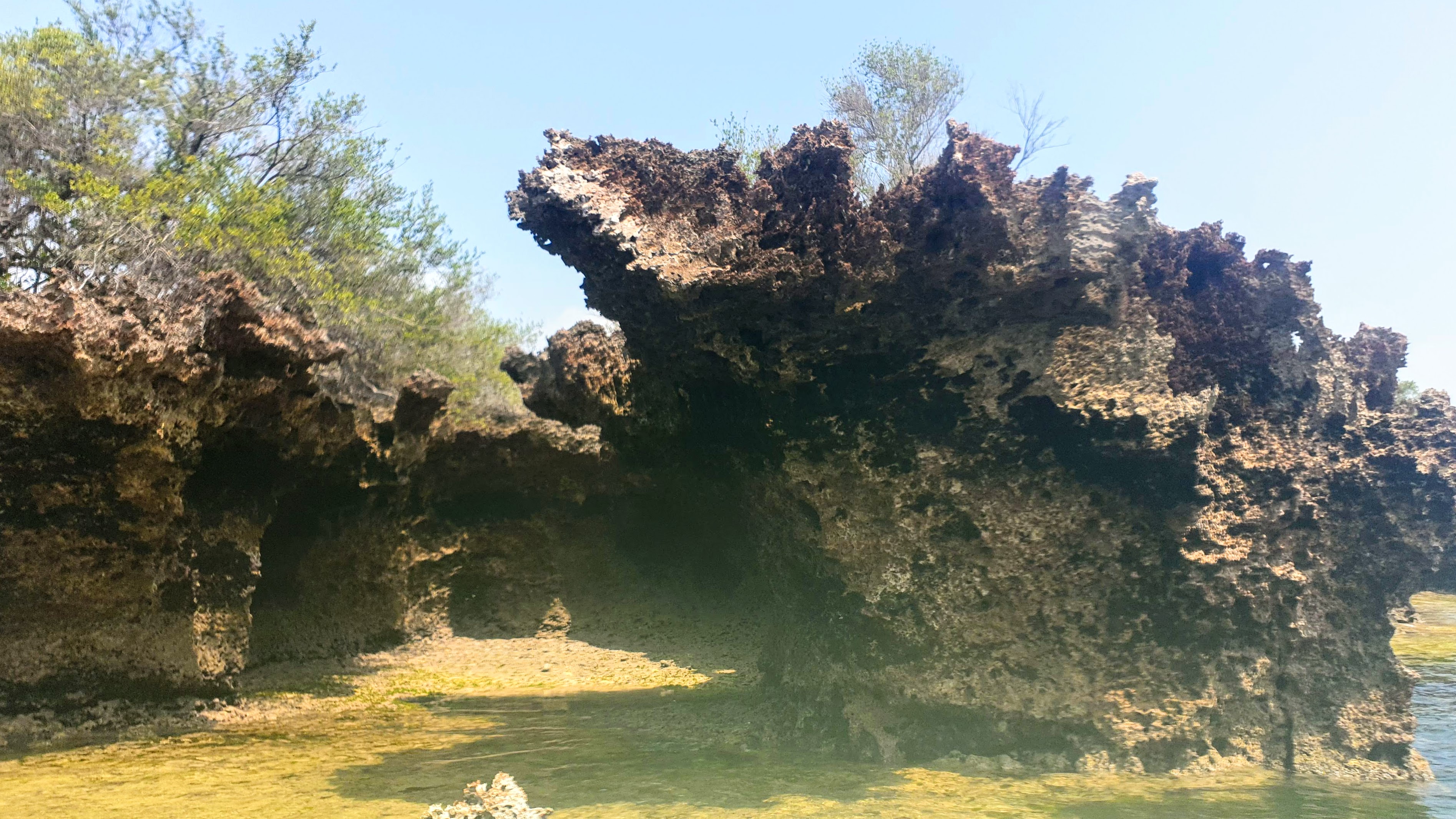
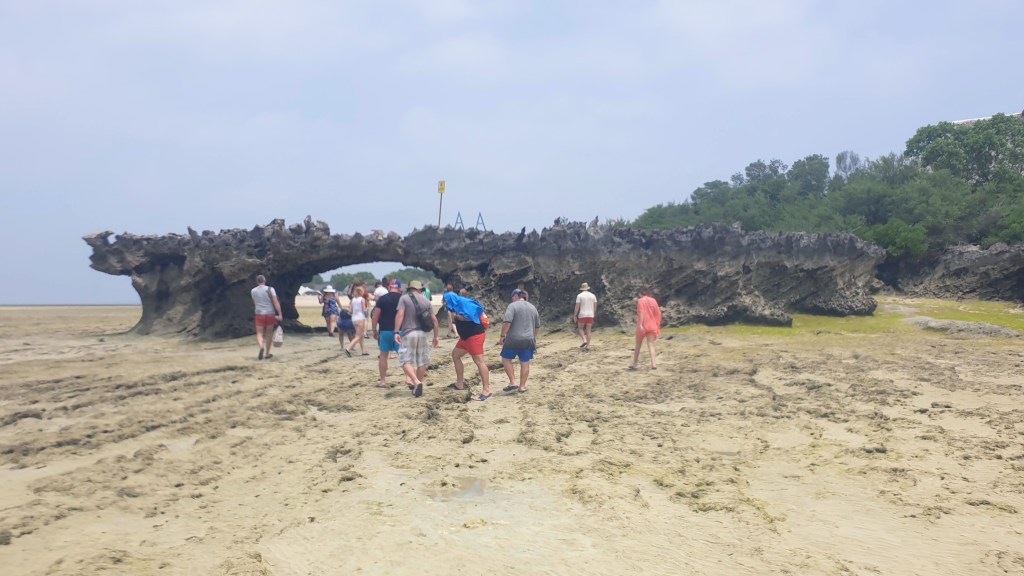
The blue lagoon is advertised as being a refreshing swim in the crystal blue waters of a mangrove pool. Due to the tide being out, it was more like the beige lagoon, and the dhow wasn’t able to get close in the shallow water. We took a smaller motor boat closer to the lagoon entrance where we could see the rocks and mangrove roots laid bare. I imagine it is beautiful at high tide with the lagoon is full to the brim with turquoise blue water, and this was definitely an interesting artistic landscape, but all of us were hot and sweaty and now we were being told we couldn’t even swim, but would get just a few moments for photos before moving on. 

By the time we got back to the dhow, they had put the sail away and erected a shade canopy which was most welcome, even if it meant we would be motoring the rest of the way. They also served a plethora of delicious fresh fruit including young coconut, watermelon, mango, red banana, passion fruit, grapefruit, and the biggest pineapple I have ever seen. Truly nothing compares to eating tropical fruit in the land where it was grown. (or at least the neighboring island).

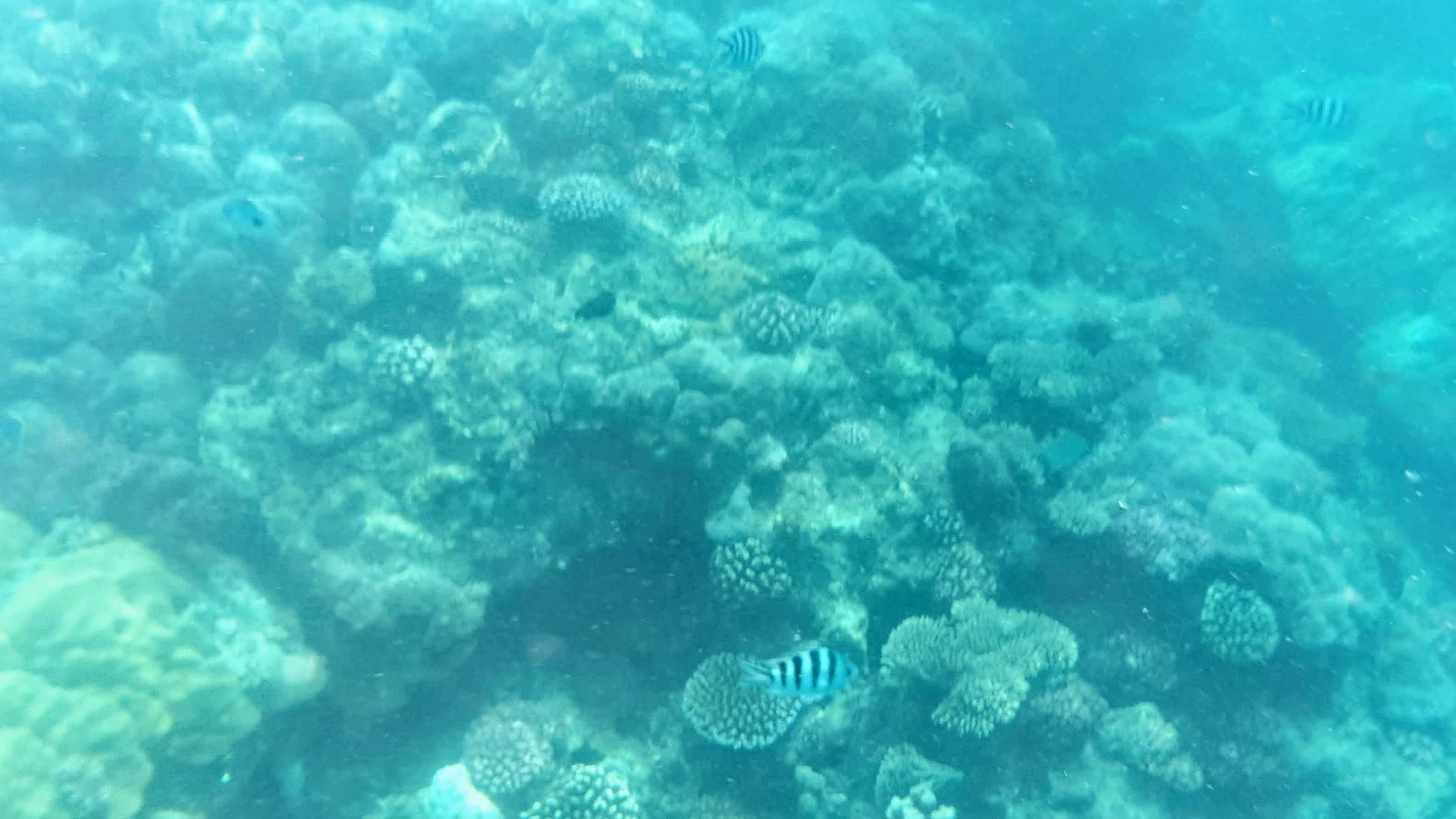
When we arrived at the snorkeling spot, they handed out life vests, masks and snorkels. I was the only one to pass on the life vest partially because I’m a strong swimmer, but mostly because I am a flotation device. I struggled getting settled in the water, which is no surprise since it has been 4+ years since my last snorkel trip. The strap on my first mask broke. The replacement had a leak that meant I had to surface to drain the water every couple of minutes, and by the time I got the third mask, I was loosing my enthusiasm for the experience. There were a decent number of fish in the water, small tropical standard breeds, but no less beautiful for being common (I like dandelions too). The coral, however, was in a sad state. The cloudy water made it difficult to tell at first. With all the other tour boats in the area running motors and dozens of tourists splashing around, the water was not particularly clear. It was also only partly sunny, which is normally my preferred level of sunny, but clouds cut down on underwater visibility.

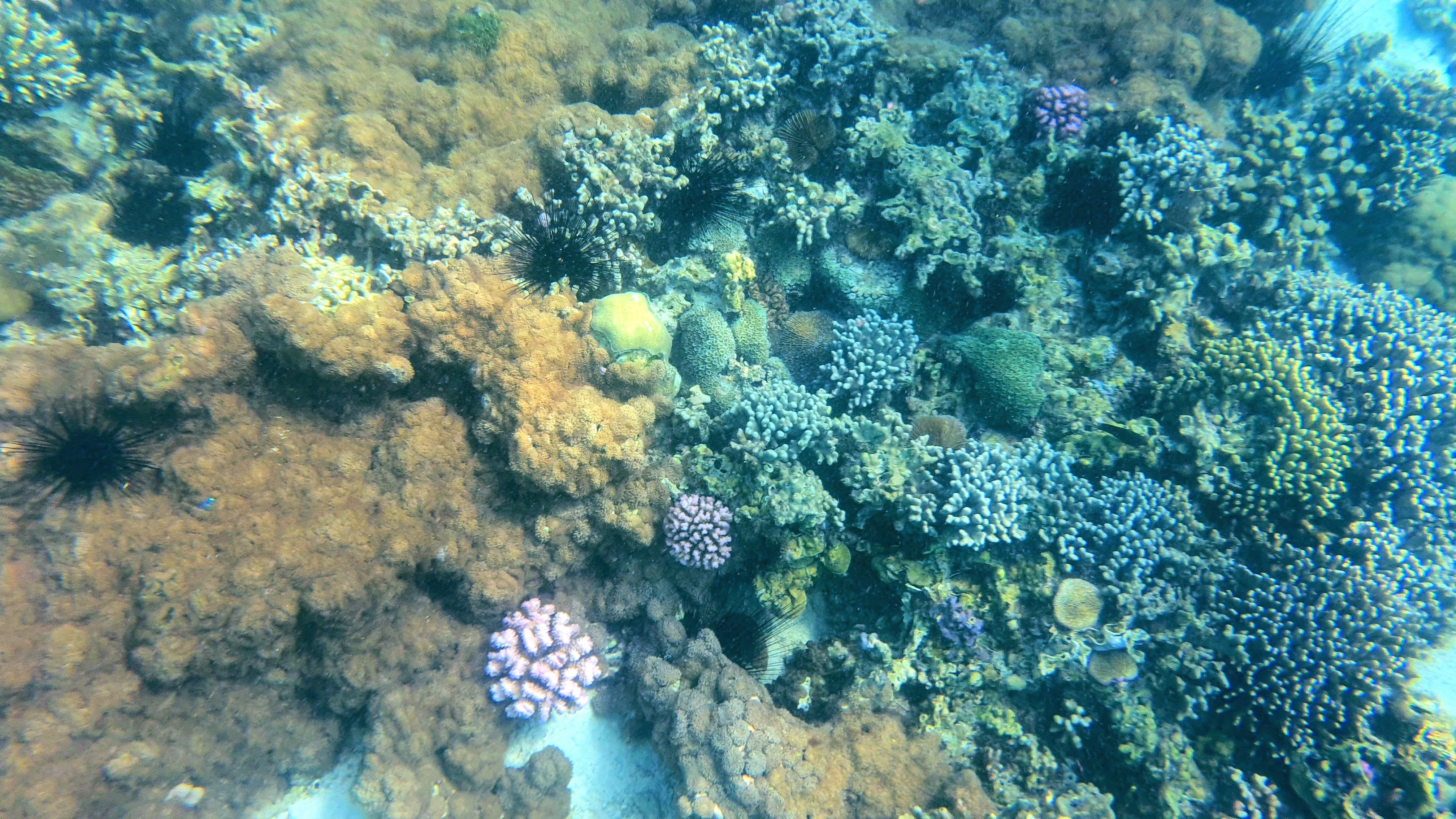
When I got the mask situation sorted and was able to swim around the corals with better control and direction, it was really clear that they were close to 70% bleached. The vast majority of the coral was the dead, lunar surface texture and color of coral which no longer hosts any life. I got the impression that the industry relies on the fact that most of the snorkelers who take this tour are amateurs and don’t know what living healthy reefs look like, because many of the other people in my boat were totally thrilled with the view. Only one other traveler who was just as much of a globe trotter as me agreed, though she said it was still better than the condition of the reefs she’d seen in Egypt. Since my first reef exposure was on a private beach in Jeddah, I may be spoiled. I have seen a healthy reef in full bloom and although there were fish and an anemone or two, the biodiversity was scarce and the coral itself was in bad shape. I left the water early because it was just sad to look at.

I had been under the impression there would be two snorkel stops, but they claimed our gear as we re-boarded and said we were heading to the Kwale sand bar. There are several sandbars around Zanzibar which are visible only at low tide, and get swallowed up as the tide comes in. I think tidal events are cool, but a sandbar at low tide is a kind of goopy beach. When we arrived, the sand bar actually connected to the more stable small island of Kwale to the south, reminding me of the Jindo sea parting I went to in Korea where the land bridge becomes walkable only once a year at the lowest of low tide. I love the ocean, I was happy to be swimming in that gorgeous blue, I just… don’t understand the point of taking the boat all the way over to a piece of sand that doesn’t actually look that different from other pieces of sand. At least in Koh Lipe, the island we stopped at was totally unique being made of ocean polished rocks.

The sand bar was also a parking lot of dozens of dhows taking all the other tourists on the exact same trip. Quite possibly hundreds of white tourist bodies on this little strip of sand made me think of Lilo taking photos of the tourists in Hawaii. I walked across the sand bar just for the experience, and then I sat in the sea contemplating my life choices and being rather sad about the chunks of dead coral mired in the silt and the dead starfish a group of Russian tourists were taking turns posing with behind me. Then we were bundled back into the boat and taken to the Kwale Island, which again because of low tide was a long walk through a bizarre post apocalyptic moonscape under the blazing sun trying not to trip on rocks, slip on algae, or step on sea urchins left exposed by the retreating ocean. 

The wild thing about this is that I also love tidal pools. I adore going to the coast at low tide and looking at the life revealed there. I have done this up and down the west coast of the US. One of my very first blog posts was about Thor’s Well where we admired the natural phenomenon of the low tide creating the illusion of a hole in the ocean. It’s not “low tide” that I dislike, but the contrast of expectations and reality being miles apart. The photos of these places are high-medium high tide and there’s just zero warning about how insanely different it is at low tide. With the high tide, you get the beautiful crystal blue water coming right up to the sparkling sandy beach. At low tide, you get a sort of salty swamp with slippery and pointy bits that no one’s water shoes are really prepared to walk through. We were not there to admire the sea-life or the interestingly shaped rocks, however, and were once more rushed along since we had so much farther to walk at low tide than those who visit at high tide, and the tour guides were anxious to get us to the destination so they could have their break.

When we reached the small tourist village that nestled above the tide line, we continued on past shops and covered seating areas. I thought perhaps each boat had a designated spot where they took their passengers to avoid confusion, but as we passed the last picnic area and continued into the forested interior, I began to suspect something else was going on. This trek into the brush eventually led to a giant baobab tree fallen on it’s side and still growing. There was a short presentation about the baobab, a taste of baobab candy in an attempt to sell some, and then back we trooped to the eating area. The guide was impatient with those who wanted to take photos after the presentation (you know when the guides weren’t in the way anymore). Then we had a very plain but generous seafood buffet. The entire experience was a study in mismanaged expectations.

After lunch we motored directly back to Fumba, the day was over after three largely disappointing stops and a lunch that was in no way superior to the seafood available on the main island. I lost a flip flop, my sunglasses broke, and somehow also my phone case (which was empty in the waterproof bag because my phone itself was it its waterproof case) also cracked. I spent 20$ to replace the sunglasses and shoes, which is probably about what I’d pay at a Walgreens, but it just felt like an extra cost on top of an already overpriced (100$ USD!) and underwhelming experience. 

I think if I’d known what I was getting into it could have been enjoyable. I know that if I hadn’t had a far superior snorkel and island tour at Koh Lipe for ¼ the cost I would not have been so let down. Tourist trap experiences aren’t bad in and of themselves, but once you have done them a few (dozen) times, the novelty wears thin. I’m tired of seeing the same junk in every shop – some of it was literally the same junk I saw in Thailand, Malaysia, and the Philippines (complete with made in Thailand tags!) I’m tired of hordes of tourists crowding the same beach or swimming hole because it was at one time photographed as a paradise and has become entrenched as the go to spot, the name of the destination meaning more than it’s faded commercialized beauty. I thought that Airbnb would be a different take on the standard tour, not merely a different gateway to it. After all, there are a lot of small reefs, islands and sandbars in the area that could easily be reached by boat. Live and learn. 

One Ocean Dive

The next day a very different and much more enjoyable experience. To start with, One Ocean Dive asks people to show up to the shop early enough to leave time for a cup of coffee, picking out equipment, and getting dressed, so I never felt rushed. The cost of the excursion was less than half that of the Safari Blue and guaranteed 2 snorkel spots while skipping the mucky low tide islands and sand bars. The equipment on offer even to me as a snorkeler was immensely superior quality, and in addition to fins, mask and snorkel, they offer each swimmer a springsuit wetsuit (stops above elbows and knees) to help prevent sunburn.

They also request swimmers to only use reef friendly sunscreen. The chemicals in regular sunscreen kill reef life, and it’s probably one of the reasons why the coral I had seen the day before was in such sorry shape. I declined the wetsuit because I have a rather full coverage swimsuit and my own UV blocking rash guard that fully covers my top when closed, a necessary purchase after the last snorkeling induced sunburn, but it was a thoughtful touch since many tourists arrive in skimpy swimsuits which are entirely inadequate protection from the African sun. (sidenote: I was not spared the sunburn despite all my precautions, but the suit would not have covered the area I was burned on, the lower back of my calves, so I guess the next time I go to a tropical paradise, I’ll be bringing swim pants in addition to my long sleeved rash guard)

We had a bit of a walk along the beach to get to the boat. Although initially annoying, I realized this was in our favor since we were leaving the hordes of tourists behind. There were three of us on the boat, myself and another snorkeler, an older gentleman from Germany, and one scuba diver, a younger American man who was deep into the action-adventure life, but not a jerk about it, which was refreshing. We traded stories of our adventures as the boat motored out to the first dive site and I was even able to recommend a hike to him (Goldmeyer, if you’re curious) since his next trip would be Seattle, my home stomping grounds. The water was picture blue, and when we arrived at our first dive site off Bawe Island, we were the only boat in sight.

One of the guides stayed with the boat, one went with the diver, and one came with us snorkelers. He carried a bright orange life ring which made him easy to find and provided an emergency rest stop should a swimmer get tired, cramped or otherwise need a break. We were not in easy swimming distance of land, but I could still see the thin strip of sand and trees on the horizon. The guide led us to the reef and my heart swelled with the waves to see that here the reefs were bright, diverse, and alive! I had feared so much that the damaged reef at Kwale was indicative that climate change and tourism had destroyed enough of the environment that half-dead reefs would be the normal experience in Zanzibar, but this area proved that the impact of tourism (chemicals from motors and sunscreen as well as the churning of water, litter and other human contributions) was the main culprit since just a few miles away the reefs were healthy and thriving.

I struggled a bit with the waves, as we were far enough from land that we weren’t sheltered. What may seem like a gentle swell from the boat can easily roll right over the top of your snorkel if you’re not paying attention because you are gawping in awe at the scenes of natural nautical beauty beneath and around you. I also struggled more with the camera. My previous snorkel excursions had all been in fairly shallow, calm waters. Even in Bohol where we had a strong current, it wasn’t something you felt until you tried to swim against it. In those places, I was able to simply relax and let my natural buoyancy keep me close enough to the surface to breathe while admiring the view. This meant that navigating the stubborn button pushing and touchscreen touchiness of my underwater phone case was the only thing I had to concentrate on. Now, however, I had to kick my fins almost constantly just to stay in place (necessary for taking photos) and I was trying to time my breaths to the waves above so that I didn’t accidentally inhale at the same time a wave was cresting over my snorkel.

I took turns wrestling with the camera and just enjoying the experience because we need both to be mindfully present in the moment and to preserve memories for our future selves. When you view the photos of this day, bear in mind this was taken on my 4+ year old phone in a 10$ waterproof “case” that was basically a plastic bag with an industrial watertight seal. I do not have anything like a high quality underwater rig, but I still really enjoy being able to capture a few random moments of these magical underwater gardens. I thought 45 minutes might be too much given the paucity of life in my earlier swim, but this reef was so expansive and diverse that I was still engrossed with the guide caught my attention and said it was time to head back to the boat.

On the way to the second site, we had a generous snack of samosas, pastries, and fruits. It wasn’t a “meal” in the traditional sense, but it was delicious and plentiful, and allowed us to refuel without diverting away from the focus or getting too full to swim in open water safely. We talked about the life we’d seen below, and I got only slightly jealous of the diver since he’d spotted an eel, but I was thrilled with the variety of sea life, color, and shapes that my own swim contained and I finally felt like I’d found what I had been promised on this island paradise.

The second site was even further from land, the water was a deep dark blue, and the waves even higher. The site wasn’t just a reef, it was a sunken ship which had been overgrown with corals and other sea life. Despite the depth of the water around us, the boat itself was on a raised part of the sea floor, which made it easy to dive to. I wondered at first if the water was simply clear enough that the boat looked closer to the surface than it was, but when I saw the scuba divers below me it provided excellent scale. The ship is the Great Northern which was a British cable laying ship that sank in 1902. If you’re a boat enthusiast, you can see more about it here. Only a small part of the boat remains after extensive salvage operations, but it was absolutely enchanting to see the outlines of the hull and the mast rising from the sea floor towards me at the surface, colonized by it’s own coral and school of fish.

Despite the physical difficulty of the swim, my spirits were not dimmed by mouthfuls of seawater that came down my snorkel whenever an especially high swell coincided with my attention being diverted by the beauty around me. I saw more species than I know the names of including several giant clams and a small school of squid bobbing along near the surface reminiscent of the ones I had cooked on my spice farm tour.

After many years of not being able to travel due to COVID, and having such a terrible experience landing in Dakar and being unable to rekindle my joy of travel, adventure, and new places, I was genuinely starting to fear that I had lost it. That I had become too soft, too indoorsy, too sedate, or worst of all, too old to continue the kind of adventures which I felt I had only just begun to have in the few years before the pandemic took it all away. My experience with Safari Blue had made me even more uncertain — maybe I had become jaded? Was comparing each new place to a better place from my past adventures stopping me from enjoying what was in front of me the way the other tourists certainly appeared to be?

I emerged from the Indian Ocean that day, breathless, sunburnt, and missing my eyebrow ring, sacrificed to the secure grip of the mask and the pressure applied by the waves. I emerged all these and yet grinning ear to ear. My sense of wonder and my ability to ignore discomfort in the pursuit of adventure were intact! My spirit was not broken by isolation, stagnation, or even terrible heat. I radiated a gratitude that buoyed me for the rest of my stay in Zanzibar and refused to fade even as the sunburn became one of the most epic of my life. The blue of the Indian Ocean is the blue I’ve been dying my hair for the last 6 years without knowing. It is the blue that feeds my soul.

Back in West Africa

Since returning to Senegal, I have not been able to parlay this sense of adventure to Dakar or even it’s neighboring region. Before Zanzibar, I was truly worried that the pandemic had taken my joy and adventure away, but knowing that wasn’t the case, I started trying to understand what it was about Dakar that was keeping me from finding it. Some is definitely a result of the infrastructure and culture. Zanzibar was safe to walk in even after dark with cameras all around and locals who had a strong interest in maintaining that safety because tourism is such a huge part of the economy. Dakar remains a place I can only walk at night if I’m in a group and we are walking a short distance on well lit streets. The beach in Zanzibar is full of restaurants, cafes, boats, and walking areas all of which are within walking distance of the hotels. If I want to go to the beach in Dakar I need to take a taxi; I will stand out as a lone foreigner, and should I walk along the corniche, I’ll be walking next to one of the largest arterial roads of the city, which almost cancels out the joy of walking near the ocean. Zanzibar wants people to explore, so there is a a fleet of tourist taxis made of identical and easy to spot Japanese minivans and yes it’s more expensive for one than for a group to split the fare, but it’s easy and not outrageously costly. Whereas I cannot for the life of me find a safe and affordable option to go on my own from Dakar to Pink Lake or Saly.

But more than the differences between the two places, I also thought about the difference between living in a place and traveling to a place. I spent two of my three weeks in Zanzibar just being a tourist. I let myself sit in the hotel AC watching Netflix when I needed a rest from the relentless heat and trinket sellers, but my focus was on having a good experience in the short term. In Dakar, my focus is on a comfortable life in a longer term which means making sure my home is safe and relaxing, making sure I can do my job without going crazy (both are still a moving target 6 months in), and making friends or at least people I am happy to see on a regular basis. These are all the things we do in daily life which are so different from what we do when we are on holiday. Those things take so much of my time and energy in Dakar that I have none leftover to be a tourist here.

I have emerged from the deep dark depths of “rejection” culture shock that I wrote about here a few months ago. I’m slowly learning to enjoy things here, but I’m more likely to play video games in my apartment or go to the local expat bar to see my new friends than I am to go out looking for some “Dakar” experience. A part of me feels like I’m wasting this opportunity, but another part is speaking softly that maybe I can’t be a tourist if I don’t have a home. Dakar cannot be my home, however much I’m adjusting to it’s idiosyncrasies and cultural differences. Korea had become my home while I wasn’t looking by dint of time and familiarity. I could go out and do touristy things while living there and feel confident that there was a comfortable and safe “home” to go back to. For the last 4-5 years, when I said I was going home, I meant my apartment in Korea, not my friend’s houses in Seattle where I stay when I’m visiting. Perhaps a few years in Dakar would make it feel like home, too, but I’m not going to be around long enough to find out. Most of the people participating in this fellowship around the world have a home to go back to, but I left my Korea home for good and I will be moving to a new situation at the end of my 10 months. I’m in home limbo.

I have 4 months left here, and I think that the best thing for me now is to stop trying to “make the most ” of Dakar and find some stillness where I can listen to what I am thinking, feeling, and experiencing by being in this place which is so far from my comfort zone that I cannot hit it with an ICMB. However much I desperately wanted my time here to be all the adventure which was denied to me for 3 years by the pandemic, the reality is different. I found my sense of adventure again in the blue of the Indian Ocean, and that will have to be enough for now.

Zanzibar Spice Farm & Cooking Class

It took me two days to fly from Dakar to Zanzibar in part because Africa is so much bigger than you’d believe and also because there just aren’t as many flights running every day. I will tell the transit tale of my experience with Ethiopian Airlines in another post, but the result of this travel style was that I arrived in Zanzibar in the early afternoon and had the better part of half a day to explore and think about what I would do during my stay. Stone Town is a winding, alley-filled neighborhood where no cars are allowed to enter. It’s easy to get lost, but also easy to get found again because it’s not that big.

While I was wandering, I was approached by at least half a dozen of the local tour sellers. Usually, I find this sort of thing particularly annoying and intrusive, but these men seem to have refined the art of having a pleasant conversation while mentioning but not pressuring a sale. It gave me a chance to get some ideas about what to do, where to go, and how much I might expect to pay for things. Although I declined to book at the time because I was still worried about being pressured into a bad deal by lack of knowledge or experience, I didn’t feel overwhelmed the same way I have in other tourist cities. In hindsight, I think booking with the “captains” on the beach rather than a tour guide or hotel is perfectly fine as long as you are interested in what they are offering.

I also learned the two Swahili phrases that would echo in my ears for the next 3 weeks: “pole pole” which means “go slowly” and “hakuna matata” of Lion King fame. Despite the extreme popularity of the Lion King, locals seemed surprised that I knew the phrase as a first time visitor. It really does mean “no worries”.

Wishlist in hand, back in my blissfully airconditioned room, I hopped online to start booking the next few days adventures. The first thing I decided to do was an Airbnb experience for a spice tour/cooking class. The “spice farm tour” is one of the staples of Zanzibar tourism. There are possibly several dozen spice farms in the island’s interior. I’m sure they all have some unique qualities, but my pre-arrival research did not seem to make any distinction about which one(s) were recommended / avoided, just “go on a spice tour!”. Most bookings include the ride and the tour and possibly a snack. The Airbnb experience appealed to me because it included a trip to the market and a cooking class by a local. I was a bit worried that the night before was not enough time to book, but the hostess was up for it and I went to sleep content that I had a plan.

The Darajani Market

Lutfia met me with her driver at 9:30 am in front of the fortress, which turns out to be the meeting place for almost all tours that drive out of Stone Town because it’s one of the only places that has car access. The hostess was very kind, but also I think she’s more used to taking groups because she and the driver chatted a lot in Swahili all day, checking in with me from time to time to make sure I was ok, hakuna matata. The one thing they did talk with me about on our first drive was what I wanted to cook. They had a list of choices from a set menu, and we agreed on a menu of coconut rice, vegetable curry, fried squid, and coconut candy.

Our first stop was the Darajani Market, a large open air market like many I’ve seen in SE Asia with almost as much Chinese writing randomly scattered around. The market is at the opposite side of Stone Town from the Fortress where we met, and it’s quite easy to walk to from anywhere in Stone Town, but it was a circuitous drive as we had to go out to the main road and around the car-free zone.

Once at the market, we started at the seafood stalls to get the squid. Zanzibar is famous for it’s fresh local seafood and everything on display had been brought in early that morning by local fishermen. It is, however, an outdoor market in a very hot climate so I was glad our recipe called for a very thorough high heat cooking. They took me through the rest of the fish and meat markets for a photo op and then we went on to get our produce. The veggies were easy enough, but the coconut seemed to be a kind of ritual where two men and my driver took turns holding up coconuts and shaking them. I’m vaguely aware this is a way to test the quality, but they were really into it. The coconut seller was a mute, so all the bargaining took place in sign… I can’t say for sure if it was a type of African sign language or just gestures, but the man was good natured and it seemed that everyone in the market was on board with accommodating his disability which is always nice to see. Finally we got our rice and oil and headed out.

The Drive

It isn’t far from Stone Town on the west coast to the spice farms in the interior, but the drive is “pole pole” because the roads are not in great condition. There were some jokes about the “Zanzibar Ferrari” (a cow drawn cart) which I remarked was similar to the “Senegal Ferrari” (a horse drawn cart) which got a bit of a laugh. Additionally, the driver informed me as we went onto particularly rough patches of roads that I was getting a “Zanzibar massage” – it was both reassuring and a little sad that the jokes made about poverty and lack of infrastructure are standard in the 3 out of 4 regions of the continent I’ve now visited because Egypt and Senegal also have drivers who reference a variation on “African massage” while driving over the roads which are more pothole than pavement.

Lutfia also told me a little about herself, her experiences growing up in Tanzania and being sent away to boarding school in Uganda where she had to learn English by a sink or swim method since the language of instruction there was English (but no English as a foreign language classes were offered) and only a few fellow Tanzanian classmates spoke any Swahili. She also told me that her own children were going to a boarding school, though at their request because they wanted to be around more kids their own age than their home village offered. She has one of the most successful tour experiences in Zanzibar with high ratings on Airbnb and TripAdvisor, but she still wants more. It’s always a joy for me to see women succeeding in the world. Life is still a big struggle for many women in Africa where women’s’ rights and roles are lagging behind the West. Women like Lutfia are perhaps more like my grandmother than myself or my mother in terms of bucking traditions and trailblazing, but it gives me hope that the girls of today are moving towards a better future.

The Spice Farm

Lutfia didn’t conduct the actual spice tour herself, instead leaving me with the farm tour guide while she went off to get the “kitchen” ready. I was the only tourist on that particular tour, although I did see a glimpses of a couple other groups through the trees as we walked. Normally private tours are expensive, but you roll the dice when you book on Airbnb as to whether anyone else has signed up. I almost think I would have preferred a few other visitors with me because being the sole focus of the guide’s attention was daunting at times. It was clear he’d given the tour often enough to have his patter down… pat. Although to my eyes the farm itself was often indistinguishable from a regular forest, he had no trouble identifying all the spices and fruits and finding ripe samples for me to examine and taste.

Spices & Fruits in Order of Appearance:

Turmeric: The bright orange spice is sometimes called the poor man’s saffron and is the backbone of almost every curry. I have had the chance to cook with fresh turmeric maybe once in my life before so I know it looks slightly like ginger or galangal, a twisted root, but this was the first time I got to see the plant in the ground. The guide cut a small slice off of a root for me to see and taste. It instantly stained my fingers orange and was both milder and sweeter than I’m used to in the dried version.

Pepper: Did you know pepper was a parasitic plant? I didn’t. Pepper grows on vines that can only live by climbing a tree and drawing nutrients from it. There weren’t many bunches of pepper berries at this time of year but we found a few and he explained about the 4 colors of pepper and how they happen (black, white, red, green – not to be confused with chili peppers which are a totally different type of plant, but the colonizers who named the spices in European languages basically called anything with a kick “pepper” no matter anything else about it) All 4 are the same plant at different stages of growth and processing. Green is under ripe, red is ripe, black is the sundried version of the red berries, and white – which I found most interesting – is the blanched kernel of the ripe berry, the fleshy red part is boiled away leaving the white hard center which still has a peppery flavor but is much more mild. This explains why white pepper is both more expensive and milder. I ate one of the fresh ripe red ones and honestly, I am amazed that’s not a thing somewhere in haute cuisine. It was like a pepper flavored pomegranate seed. The flesh of the berry has the pop of a pomegranate seed, and there’s a “red berry” flavor essence about it with the unmistakable but still milder and sweeter taste of black pepper.

Cinnamon: The guide informed me it is “the queen of spices” because there is no part of the cinnamon tree that can’t be used. The leaves are used to suppress appetite during the fasting season. The bark of course is the well known cinnamon that dries into the famous curled sticks and is ground for baking all over the world, And the roots are used medicinally to treat cold and flu by grating and boiling then inhaling the steam. I also saw cinnamon seeds for the first time and they are quite pretty. Cinnamon is also a hearty plant. The bark when peeled will grow back in about 2 weeks, and if the trunk is cut, the tree will send out fresh shoots that grow large enough to harvest in a few months!

Clove: This is another plant whose fresh form is close to it’s dried. The clove tree bears bundles of tiny pink buds that will pop off when ripe and be ready for drying as is. The whole cloves you can buy in any supermarket bear the same distinctive shape as their fresh origins.

In quick succession: Ginger was one of the few crops growing in any kind of organized way. I’ve prepared loads of fresh ginger, but it was interesting to see the leafy green part, too! There were chilis (in addition to the pepper) and I was informed that in Swahili the name is “pili pili hoho”, “pilipili” being the name of the type of plant and “hoho” being the sound you make when you eat a spicy one. Aloe plants were growing the next plot over but didn’t hold as much interest for me since I used to grow it myself at home. A small plot of pineapples was the next stop. I knew about pineapple plants from the internet and cooking shows, but it was my first time to see them in person. They only produce one fruit per plant per year! Think about that the next time you complain about the price of pineapples.

Anato (alt spelling annatto) not to be confused with the Japanese fermented dish “natto”. This is a bright red-orange condiment / coloring. My guide said in the past it was used for cosmetics, but now it’s used to add color to certain foods. His faithful assistant, fruit fetcher, and flower weaver also demonstrated the cosmetic use of the seeds for me. Isn’t he cute?

Passion Fruit: I am ashamed to admit that I had never tried a fresh passion fruit before this day. I had passion fruit in sauces, salads, mixed juices and the like, but had no recognition of the small pale green orb that my guide pulled down from the tree. The insides look disgusting, but taste so good! I imagine it ends up mixed into things because it’s texture is basically a gel with (edible) seeds in. I am sure that imported versions won’t be nearly as flavorful as one right off the tree, but if you ever get the chance to try a nice ripe one whole, do it!

Mystery “hair gel” fruit: I can’t find it’s real name and I had never heard of it before, so this is a bit tricky. The fruit was maybe the size of a large grapefruit, it was vaguely reminiscent of quince being green, lumpy and hard. My guide explained that there was a gel around the seeds that was good for cleaning hair, and that it would be mixed with aloe and other perfumes to make a kind of shampoo. If and when I ever figure out what it was, I’ll update this. Until then it remains a mystery.

Starfruit: This is a classic “exotic fruit” that has become more popular in the US in my lifetime. I won’t say we had it often, but I’ve had it often enough to recognize it’s shape and flavor. These were a little under ripe, so tart but still tasty.

Cardamom: I am a sucker for this spice. I would put it in almost anything. I had experience with the pods before as they are sometimes sold whole in the US and of course commonly seen whole in curry dishes. I also love them in desserts and coffee. It was very interesting to see the plant in person. I had imagined the pods being seeds of a sort that maybe came with a flower or in groups like grapes or peas. Turns out they grow along the exposed root system and the majority of the above ground plant has nothing to do with their production beyond photosynthesis.

Vanilla: It is the second most expensive spice in the world. It takes 3 years to grow a vanilla bean and the plant is extremely picky in terms of light and water. It’s also a parasite like pepper and needs to grow on an existing tree. I had hoped to see a flower since I’ve seen pictures and they are gorgeous, but it was still cool to see the bunch of green pods clustered on the vine.

Surprise! The next fruit my guide pulled down looked like a pale yellow-green apricot. It was similar in size and color to the passion fruit, but where the passion fruit had been smooth all around, this had the characteristic divot found in peaches, nectarines and apricots. What could it be? He went on to explain that it was not a fruit at all, and was instead prized for the seed inside. Even more curious, I watched as he opened it to reveal a beautiful seed similar to the pit of the aforementioned fruits, but emblazoned with a flame red pattern. I was captivated. The red portion, he explained, was used to make a kind of local perfume when blended with flowers like ylang ylang, rose, and jasmine, but when I smelled it, it didn’t smell either fruity or floral. Finally, he cut into the seed and offered the flesh for me to taste. It was naggingly familiar, but the fresh spices are just different enough from the dried ones I know that I still couldn’t place it. Then he finally revealed it to me: nutmeg. Mind blown. He gave a rather long explanation of the many uses of nutmeg including its rather infamous drug-like effects (used to conquer shyness, he said) and it’s powers of inciting the female libido. (later research reveals that the red flame-like membrane is also dried and powdered to create the spice “mace” which again, not to be confused, this time with the brand name of a pepper-spray)

The Fruit Section: I tried mangosteen (another supplement fruit we see as an ingredient all the time, but it was a delight to eat fresh), something I didn’t quite hear the name of, and had never seen before which looked like small white pears and had a taste not unlike the starfruit. I think it may be a water apple (syzygium aqueum)? I tried a sour green skinned, but orange fleshed orange (it seems that lemons, limes and oranges all have green skin in Zanzibar), some jackfruit with tasted almost exactly like a banana and a pineapple got caught in a matter transmitter accident, and finally some young coconut.

The coconut tasting was preceded by a show where a young man demonstrated the traditional coconut tree climbing method and sang “jambo bwana” (a song I heard almost every day while in Zanzibar). I suspect he is used to performing this show for a whole crowd and by this time I was very hot and tired, so although I tried to be an appreciative audience, it was probably less rewarding for him than the big groups. He prepared the young coconut for me to have  refreshing drink (much needed) and then to eat the flesh which is not unlike coconut pudding/jello without the artificial ingredients. The assistant guide had been weaving queenly arraignment for me the whole way and I was appointed with a bracelet, necklace and crown decorated with bright red hibiscus to go with the handbag they’d given me at the start to collect my spice samples in. I tipped the young men for their efforts because they really were trying hard, and I could see they were sweating as much if not more than me entertaining tourists all day. I felt a bit bad because they put almost as much effort into my solo tour as they would a whole group, but I couldn’t afford to tip them more than a single person’s worth.

The last stop on the tour was the gift shop of course where I picked up some lemongrass coffee because I can add most any of the other spices like cardamom, cinnamon, ginger or vanilla on offer to my own coffee (and often do, PSL) but the idea of lemongrass coffee was intriguing and not something I’m likely to make at home. I also got a masala mix for tea, which I know I like, but also almost never make at home. I thought it would be supporting the local farm, but later I realized that identical spice packets are sold all over the island. I was also very disappointed in the “coffee” when I finally got home to taste it. The masala mix was nice though. I think if you want to buy spices in Zanzibar, you’re better of at Darajani than at a spice farm, but the farm experience of seeing, smelling and tasting the fresh spices is one hundred percent worth it.

Swahili Cooking

The “kitchen” was a palm thatch shack with half walls that kept the sun out but still let in a fair breeze (a relief in the sweltering heat of the island interior). The only furniture was a shelf where dishes were stacked and the coal burning “stove”. We sat on the floor to do all the food preparation and later for the eating as well. As I was the only tourist and there were 3 locals in the team, they all pitched in to do a lot of prep work while making sure I had a turn to try each station at least once. I was struck most of all by the extremely different methods of preparation. Of course everything was well washed, but the similarities to previous kitchens I’ve cooked in ended there.

I was instructed on how to cut the vegetables “freestyle”, which involved holding the vegetable (tomato, okra, eggplant, etc) in my left hand and slicing random bits off with the knife in my right hand. I’ve never been a huge stickler for uniformity of chop in the French sense of the word, and friends of mine who have taken one or more western style culinary class often cringe at how uneven my mirepoix is, but tend to relent when they taste the end result since stews, curries and casseroles are not all that picky about uniformity of cook. However, I still cut in the general style of the western chef with cutting board and knife, making regular geometric cuts which are only irregular as a lack of refinement of skill rather than a lack of intention of technique. Zanzibar vegetable cutting is just anything goes, hakuna matata. 

The garlic and ginger were peeled and freestyle cut into a large wooden mortar. I tried my hand at the smash, but my hands were just to small to grip the pestle effectively, and I had to switch jobs. When the young man working on it finished, the end result was something that could have come out of a Cuisinart.

They also had a unique tool for shredding the coconut flesh. I had spend my whole life foolishly chipping coconut out of the shell with paring knives or even flathead screwdrivers, then either chopping the result or tossing it in a food processor/blender. This clever device is a stool with a scraper/grater attached so that your body weight as you sit provides the counter to the pressure you exert on the coconut to shred it. I cut myself twice (papercut style not bad) trying to use it, and I still think it’s better than any method I’ve ever tried before. It was one part of food prep that definitely benefited from a traditional rather than modern method. I completely forgot to take a photo of the stool/shredder device while I was there, so here’s one from the Minneapolis Institute of Art that looks remarkably similar.

We took the shredded coconut flesh and mixed it with water. I got to massage the coconut around which was a surprisingly satisfying textural experience. We dumped out the coconut enriched water into a very fine mesh sieve and squeezed the pulp allowing the fresh coconut milk to join our chopped veg and spices. Two turns at that and we moved on to creating a weaker version to cook the rice in. I thought that was dead clever since coconut milk is too rich to just cook rice in it, but the pulp still had more flavor to give, two dishes for the price of one.

The stove was 4 coal burning braziers along one wall. Real coal, not the bricks you find in suburban backyard barbeques, but made from wood cooked down into coal. The pots and pans were placed directly onto the coals with a few metal prongs to keep them from totally falling over. When the coals were piled too high for the pots to sit straight, my hostess just jammed them down until the coals broke up and the pile was more level. I’m sure you can imagine there is but one heat setting in this kitchen.

The vegetables were mixed with a standard range of curry spices like turmeric, cumin, etc. but we used dry spices despite the proximity to the farm. The cooking method was a one pot boil in the fresh made coconut milk with only occasional stirring. It cooked the longest of any dish, and had reduced in size to less than half it’s starting point, all water lost from the vegetables and coconut milk, reducing it down to a stew that went well on the rice. I felt that the miniature white and green eggplants used were perhaps too bitter, that the dish needed more tomato (acid) or more salt, or both to compensate, but the rice ended up oversalted, so together, they worked out fine.

The rice had to be sorted by hand before it could be cooked. I intellectually know that rice has to be winnowed and sorted between the field and the dinner plate, but everywhere I’ve ever bought uncooked rice this process was handled before it came to market. The rice we bought in Darajani was not “ready to cook” and one of my hosts meticulously sorted through the grains a small handful at a time to remove bad grains, small stones, and possibly bugs. When it was clean and sorted, the rice was put in the weaker coconut milk with some salt. When it was about half cooked, the hostess put a lid on it and transferred the coals from the brazier to the lid of the pot to create an “oven” to finish cooking it. This is definitely a rice recipe I’d like to adapt to use at home, perhaps by mixing store-bought coconut milk into the water and finishing the rice in an oven.

I chose squid for the meat dish, though I was basically free to choose anything at the market. Zanzibar is famous for it’s seafood and I try not to eat octopus because they may be smarter than some humans. Squid is safely chicken level smart, which may not be cucumber level, but at least it’s a level I’ve already morally accepted. Also, I happen to like it. I have had it a variety of ways, but this was a new one for me. The meat was mixed with the garlic/ginger mash, pepper, paprika, and cumin, and a generous portion of fresh lime. When it was ready to go, the hostess heated up at least 2 inches of oil over one of the coal braziers and warned me to stand back as she added the squid. She called it deep frying, but I don’t know if I agree. The meat was never totally submerged, nor was it breaded (not technically a requirement, but fried calamari is a familiar dish). It was left to cook in the boiling oil a good long time ensuring excellent food safety. Nothing lives through boiling in oil. I was not sure how this would turn out but it ended up being my favorite dish. The meat was well flavored and since squid is very lean, the oil cooking didn’t make it greasy, it just kept it moist. It was ever so slightly chewy, but far from the rubbery texture of badly cooked squid. I had seconds. 

The coconut candy was made by boiling sugar, water and cardamom pods. Once the syrup was boiling we added the the grated coconut that had been set aside before we made the coconut milk, so it still had all it’s fat and flavor. Like all the dishes, it was boiled with occasional stirring. She told me it would cook until dry and I was doubtful, having made both hard candy and caramel in the past, but she wasn’t kidding. She cooked it with occasional stirring until the water was all boiled off then cooked it with a more constant stirring until the coconut was nice and brown. The whole thing was turned out onto a greased plate and patted down (not unlike the rice crispy treat process), finally it was cut while still warm because I suspect it would be too difficult to cut when cool. The final result was a kind of coconut candy that reminded me of what happened to my peanut brittle when it seized, good on the flavor side, but texturally in a gray area between hard candy and chewy caramel that we are not accustomed to in the west. I have since learned that this is the intentional texture of this particular candy and not a result of unintended sugar seizure but it made me think of how to create a cardamom-coconut caramel which would carry the flavor of this dish with a texture more suited to my palate.

The only dish I played no role in preparing was a fresh salad made by one of the assistants by cutting some leftover vegetables in a fine mince and mixing it with lime. Like an African Pico de Gallo almost.

When everything was ready, Lutfia arranged the dishes on a floor table and passed around plates and flatware to myself and the rest of the hosts. All in all, it was a joyful experience. We worked together while listening to music and dancing. We chopped vegetables in bowls sitting on the floor, and we cooked everything by boiling it over coal, but otherwise it was like any happy kitchen memory I have of family events with multiple dishes and everyone helping out. I don’t think that a spice tour alone or a cooking class alone could have lived up to this combined experience, and I’m happy I chose it.

Lutfia’s Spice Tour & Cooking Class

Zanzibar: the No-Plan (Working) Holiday

My sojourn in Africa has been challenging to say the least, so when it was announced that our annual mid-year professional development conference would be held on the tropical paradise island of Zanzibar, I was hyped to get a chance to travel. Since the school was on break, I was able to get two extra weeks before the conference to spend being a frivolous tourist. Anyone who knows me, or has been reading this blog, also knows that travel for me is a well planned affair with color-coded spreadsheets and back up plans. Africa scoffs at my plans.

One of my regular pre-holiday activities is online research, reading websites like TripAdvisor but also smaller blogs like my own to see what people enjoy and why. There seems to be a lot out there about Zanzibar, and I quickly assembled a wish list of things to do and see, but the more I tried to find out details of quality, transportation, dates, and costs, the more it became apparent there was no easy way to turn my wish list into a plan.

The Wishlist

NORTH: Nungwi Beach

  • Baraka Natural Aquarium, swim with sea turtles
  • Zanzibar Horse Club, swim with horses
  • Mnemba Island – snorkeling, diving, swim with dolphins

SOUTH:

  • Kizimkazi, swim with dolphins
  • Menai Bay, swim with dolphins

EAST: Paje Beach

  • Jozani Forest + Butterfly Center
  • Cuza Cave at Jambiani village*
  • The Rock restaurant

WEST: Stone Town

  • Nakupenda Sankbank
  • Prison Island/Changuu Island- giant tortoises
  • Safari Blue*
  • Spice Farm tour
  • Cheetah’s Rock
  • Forodhani Night Market
  • Anglican Cathedral
  • Freddie Mercury House
  • Zanzibar Doors
  • House of Wonders
  • a rooftop restaurant in Stone Town
  • Sultan’s Palace
  • Old dispensary

The Nope-List:

Swimming with Sea Turtles: The Baraka Natural Aquarium has a lot of reviews which indicate the turtles are not well cared for, and that swimmers are not really monitored, resulting in injuries to both animals and humans. It was further suggested that although the area may have started as a way to encourage fishermen to bring turtles caught in nets by offering a financial incentive, it has turned into a reason for fisherment to hunt and capture sea turtles for the reward. If all that isn’t enough to turn you off, these are not free wild turtles, they are stuck in the enclosed lagoon and have no way to get away from the humans when they need a break. To me, this was both unsafe and exploitative, so I crossed it off the list.

Swimming with Dolphins: I really enjoyed being able to do this in New Zealand, and meeting Fungie in Ireland, but one of the main reasons I was able to enjoy it was the environmental responsibility. Much like with the turtles, the tour guides and boat operators in Zanzibar are more interested in money than in environmental preservation, and there are reports all over the internet of boats with loud motors aggressively following pods of dolphins which can disrupt their feeding cycles and endanger any young present. In addition, there’s no regulations on the tourists behavior, so they enter the water in droves. Although the dolphins can arguably outswim these boats if they want to get away, it’s damaging to their feeding, breeding, and childrearing cycles to be chased around. And if for some reason you don’t care about that (yes, I’m judging), then beware that most tours don’t go out early enough in the day to actually see the dolphins during their most active time, so you may end up disappointed. Dolphins are magical, but they are more magical when they are treated with dignity and respect, so I crossed this off too.

Swimming with Horses: This sounded like such a cool activity, riding bareback through the surf of Zanzibar’s most picturesque beach on a beautiful horse, what could be better? An end to fat-phobia, that’s what. The Zanzibar Horse Club has a very strict weight limit for riders which I do not meet. I am a big proponent of treating the animals well, but I’ve gone horse-riding many times and often seen dudes bigger than me riding as well, so I was confused. Has new animal welfare information come to light that horses (which used to carry knights in full armor weighing in excess of 180kg) cannot manage 95kg tourists? No, nothing like that, although there are some good mathematical formulas to help people know what size of horse they should be riding based on weight. I could understand needing to know the weight of each rider to make sure the horses were a good match, but with a hard weight limit, it seems like the Horse Club simply doesn’t want to do the work of accommodating heavier clients and just picked the weight limit that their smallest horses are safe at. I’m torn between being happy they won’t overload their animals and being mad that they won’t do the extra math to let me ride on one that’s big enough for my size. Either way, it was no-go for me.

The House of Wonders: this building looks like it could be really cool, but it’s been closed for reconstruction more than it’s been open over the last many years. One of the big problems is that UNESCO sites must be restored using the materials and techniques they were originally built with and this house wasn’t built well the first time. Another issue is that most of the money for restoration comes in Euros, but the shifting exchange rates mean the purchasing power for materials and labor is a moving target. There’s nothing wrong with it other than the fact that you just can’t view it, so don’t bother including it in any plans.

Go With the Flow

With these things in mind, I decided against the northern area and booked hotels in Stone Town, Paje, and Menai Bay. I didn’t make any other reservations in advance because the online ticket prices are astronomical for solo travelers and every blog I read said there were better prices to be had upon arrival since lots of tours are happy to pick up an extra one person if they have room on the boat/bus. This advice was borne out on my first evening in town when I was approached by at least half a dozen guides who were very friendly and only slightly pushy. I was invited to schedule a snorkeling trip , a trip to Prison Island, and a sunset cruise while being advised that it’s cheaper to schedule with the boat operators directly because the hotels just charge extra for arranging the boat ride anyway.

There was only one place on my list that I ended really feeling like I missed out on because of lack of advance scheduling – Cheetah’s Rock. This place may be one of the only true animal sanctuaries on the island, and they are very protective of their charges which mainly consist of rescues. There is a strict limit of the number of visitors daily and visitors are monitored carefully by guides for everyone’s safety. They even have an otter swim experience which is booked out months in advance due to the extreme limits placed on the activity for the otter’s health. I could have gotten in for the regular animal visit, but I didn’t have the kind of clothes they wanted visitors to wear (again, safety of animals and humans in mind) and I wasn’t really in a place to take out all my piercings (a requirement since many of the animals love shiny things). I really appreciate the limits in place there and respect what they are trying to do. It was my own fault for giving up on advance planning for this trip before I discovered this one.

There were some other things from my wish list I didn’t get around to, but I’m not terribly upset to have missed, and there were two things I did that I wish someone had told me not to, but for the most part, I managed to have a nice time in Zanzibar by following the local advice of “Pole Pole” and “Hakuna Matata” – take it slowly and no worries!

The Zanzibar Series: coming soon!

Spice Tour & Swahili Cooking Class

On A Boat: Safari Blue vs One Ocean Dive

Stone Town: History, Culture, & Architecture

Paje: Beach Bum & Maalum Cave Pool

Jozani Forest: Monkeys, Mangroves & Butterflies

Menai Bay: Tides & Sunsets

Zanzibar: The Darker Side

Northern Ireland: Game of Thrones

Regardless of your feelings about the series finale, one cannot argue that Game of Thrones failed to leave a lasting mark on the collective TV viewing audience around the world. Even if you are not a Game of Thrones fan, I think you can still enjoy the photos and descriptions here since I’m telling my story, not JRR Martin’s. I enjoyed the books a lot (wish he’d finish!) and I like most of the TV show as well, even many parts that diverged greatly from the books. However, this is not a blog about a TV show, it is about Ireland: the museum exhibit in Belfast, and the outdoor landmarks which would are enjoyable on their own, minus the CGI and regardless of their attachment to the show.


Game of Thrones Touring Exhibition: Belfast

At the time I was in Ireland, the GoT Touring Exhibition was in the TEC in Belfast. I understand that it was in Belfast from April – September of 2019. I was told that there will be some part of the exhibit which will permanently stay in Belfast due to it size, but as I write this, there’s zero information on the TEC website because it’s all closed due to Covid-19. Additionally, the exhibition’s tour schedule is currently suspended for the same reason. I’d love to be able to tell you where to go to see it, but I can’t.

Warning: there are SPOILERS. If for some reason you are living under a rock and haven’t seen season 8 (or already had it spoiled for you) and still want to experience that… uh, experience, then maybe just look at the pictures or skip to the outdoor part of the GoT sightseeing.

I booked tickets well in advance because I was warned it might be sold out and we were on a bit of a schedule. There’s plenty of parking at the TEC and a place to get a cup of coffee and a snack in the lobby. It was such a relief to have an indoor activity on a rainy day. I got there before opening because I wanted to be in the door before the crowds arrived. There weren’t actually that many people there, but I’m still glad I went early because it was filling up by the time we left about 3 hours later.

The exhibit hall was enormous. It was divided into smaller rooms by theme and there was a suggested path to follow. There was a plethora of information about every item on display as well as knowledgeable staff everywhere, most of whom had worked on the show when it was being filmed and had personal on set anecdotes to share about the actors or scenes. Generally all of them were happy to have had the experience which made it nice to have the staff share fandom and enthusiasm.

Photos were allowed everywhere, but flash photography was forbidden and the lighting was very low, so most of my photos did not turn out terribly well, I’m afraid. Honestly, you can see wide shots of the costumes and props in the show, so the impressive part of the exhibit is being able to look at the close up details involved in the dresses, jewelry, weapons and other props that are never seen on screen, or shown for only fractions of a second. There are so many more things in the exhibit than I can show here, in part because no one wants to see that many photos and the rest because so many of my photos turned out blurry or dark or both.


The display starts by introducing the houses of Westeros and their relationships and fealty with a dazzling array of flowcharts accompanied by a variety of common or popular character costumes for the main houses.


It moves next into an area that replicates the Stark family crypt at Winterfell. I was told by the guide for this portion that these statues would not be moving on with the exhibition tour since they were too large and fragile. The room was dark and the statues lit moodily as though by torch light. It was a fun effect to walk through, but a frustrating one to photograph.


The third module gets into the further houses such as those of Dorne and the Iron Islands as well as Stannis Baratheon’s unholy union with Melisandre.

The fourth section is arguably the best. It’s a room full of dragon skulls, the very same ones Tyrion finds while under the palace in Kings Landing that belonged to the Targaryans of days past. I have rarely been so sad about low lighting, but it did make the skulls feel a little creepy and alive, and lived experience is always better than a photo. The skulls are seriously dinosaur sized. The smallest one could probably bite me in half, and the largest could swallow me whole. Standing up. Without opening it’s jaw all the way. So incredibly cool.


Following the dragon skulls were all things Mother of Dragons. Daenerys’ most iconic costumes and jewelry as well as models of the dragon eggs and baby dragons.


There’s an interactive display of the temple of the Faceless Men. Arya trained there, learning deep ancient secrets of how to assassinate people and then NEVER USED THEM. *sigh The display is still cool. You can pose for a photo and have your face digitally added to the wall of faces.


Next up is the Wall where John Snow joins the Night Watch to protect the realms against the coming of the Night King and his horde of walking dead that kill all the Dothraki and then… shatter?… when Arya stabs him, not using her Girl Has No Name skills in any way… ugh. Look at the shiny costumes!


The final display is the Iron Throne in King’s Landing with some of the later season costumes arrayed around it. In addition to all the beautiful set pieces and costumes, there are several interactive stations where you can pose with Arya’s sword Needle, John’s sword Longclaw, the Wall (a cute trick with mirrors to make it look like you’re holding on to a rope for dear life), and the Iron Throne itself. You can walk both forward and backward through the display, so I was able to double back and have a closer look at a few things. All in all, a lovely experience combining museum quality displays and fantastical world building.


On the way out, one of the staff told us to keep an eye out in the parking lot for the King’s Landing set. He implied that one day it might be open to the public as part of a permanent exhibit, but not yet. I tried to find any information about it online, but again, since tourism is closed, there’s no telling if or when the full size set that was used to film the burning of King’s Landing in season 8 will ever be a public attraction or not.
20190810_131838

The Film Locations

A large number of the stunning landscapes of the show are part of Northern Ireland. There are scads of websites dedicated to helping people find and enjoy GoT filming locations. Many of the locations are empty fields where this or that battle was filmed, while others had significant CGI added in post production. There are specialized tours where you can play dress up and act out scenes from the show. There’s even a very expensive opportunity to spend some time with the actual animals who played the Stark children’s direwolves.

*The photos that follow are a mix of screenshots from Game of Thrones and my own photos of the locations I visited for comparison and contrast.*

Dark Hedges

This was probably the shortest stop and yet the most beautiful. The Dark Hedges were a popular site in Northern Ireland even before the show. They also have the honor of being one of the only locations that was not CGI enhanced and are therefore quite recognizable as the King’s Road in seasons 1 and 2, as well as the place where Arya Stark escaped from King’s Landing.

game-of-thrones-dark-hedges

From the outside, the dark hedges just look like a little stand of trees in between two large fields. The short stretch of road runs through a private farm, and although the patient farmer has to put up with tourists on the public road, he also seems to have a good sense of humor about the situation. Busloads of tourists come through both on Game of Thrones themed tours and on regular tours of the area because it’s famous for more than just it’s show appearance. As a result, parking is scarce. There was supposedly a parking lot some distance away, but everyone simply parked on the side of the road that ran perpendicular to the hedges. There’s not supposed to be any cars on the hedge road itself, but of course there are always people who think the rules don’t apply to them.


It’s a short stop for most tours, so if photography is your goal, you might want to go on your own. I only spent about 30 minutes there and took a lot of photos which I was eventually able to parlay into a version that makes it look totally empty! Yay, photoshop? Otherwise, it’s very easy to see how true to life this set is between the show and the reality.

20190809_140954 (1)

Downhill Demesne & Mussenden Temple

Here is the filming location of Dragonstone in Season 2. Downhill Strand is the place where the seven gods of Westeros were sacrificed by Lady Melisandre. Dragonstone was the ancestral home of House Targaryen and current stronghold of the Stannis Baratheon. The scene in question is filmed at night on the beach below, so there’s no real way to see it in the show. Nonetheless, it seems that the tourism board has installed statues of the seven on the beach for eager fans to see. I didn’t make it down to the beach, but rather came through the Downhill Demesne gardens and grounds. If you want to see the beach, I think the A2 road goes there pretty directly.

maxresdefault

We entered via Bishop’s Gate and enjoyed the gardens with a variety of flowering bushes and trees, water features and stonework. Following the trail, we came upon an open area where the ruins of the old manor stood. Finally, walking all the way to the cliff edge, I found Mussenden Temple. Contrary to it’s name, it was never a temple, merely modeled after one. It was in fact a library. It is possible to enter the “temple” during the day, but by the time we arrived it was locked up for the night.

Dunluce (again)

I did not actually realize it at the time, since it didn’t show up on my initial searches for GoT locations, but Dunluce Castle was also Pyke Castle of House Grayjoy on the Iron Islands. I had to look it up and it turns out this is one of the locations that was extreme CGI. I would say more that Dunluce was the inspiration rather than the location, but hey, you gotta start somewhere. I wrote more about Dunluce in my description of the Causeway Route.

Castle Ward

This was one of the places I was most looking forward to seeing, and turned into the greatest disappointment. It’s advertised as “the real life Winterfell” and while it was technically the place where Winterfell was filmed… CGI.

In all fairness, one of the reasons I did not enjoy the stop was that we were experiencing some of the hardest and most vicious rain of the entire trip that day. Ireland kind of always rains. For some reason, I thought that was like Seattle rain which is really just heavy mist and no native Seattlite owns an umbrella (at least not for rain). I had a travel umbrella and I had rain booties to keep my shoes dry and I thought that would be enough. Mostly it was. There was one terrible soaking I got while on a ferry, but other than that, I’d been mostly dry or at least only merely damp.

20190810_143551

Not so this day. The rain was opaque. It was as though the sky was trying to be the sea. In addition, the signage for where to go and park in the sprawling acreage of Castle Ward is not clear. I followed the signs for Winterfell and wound up in a very small parking lot which in retrospect might have been staff parking, but we were so lost by then that I just gave up and parked anyway. (Now I know we should have parked at the Shore Parking Lot, but it was not obvious in any way when we drove in that day) It turned out to still be a long walk from the trail head to the actual “Winterfell” area, and on a beautiful day, or even a merely drizzly day it probably would have been a lovely walk through the National Trust. It’s still very pretty, but it was harder to appreciate while wet.

Another reason I think I was disappointed is that I’ve been to Hobbiton in New Zealand. There are plenty of LOTR locations you can visit there that are just unchanged landscape and like Northern Ireland, they are beautiful and worth seeing, just… not like the movies. Hobbiton, on the other hand, was purpose built (twice) for the LOTR and Hobbit movies. Although the farmer who owned the land originally didn’t want permanent structures, after seeing the huge influx of tourism money, he decided to keep them after all.

20160821_141728

Thus, walking around Hobbiton, you feel like you are THERE. I knew that most of the locations I visited for GoT were not altered for the show or for tourism, but Winterfell was so highly advertised as this great experience, like being in Winterfell, stepping into the show, that I imagined it would be at least a little like Hobbiton, and give me a sense of being at the Stark family home.

20190810_151536

When I finally arrived at “Winterfell” I felt very let down. It looked like a reconstructed historical village, the kind that kids take school field trips to see. I expect that it was meant to be a replica of the original Castle Ward. It wasn’t ugly or anything, it just wasn’t at all like Winterfell.

20190810_151843

There are a ton of pay to play style activities at the Winterfell center. You can take an archery class, an axe throwing class, rent a bicycle and tour the park while wearing a cape and a special GoT messenger bag that purportedly takes you to 20 different filming locations within the grounds, most of which are “this tree” or “that field”. I don’t want to diminish from anyone who enjoys this kind of experience. If that is your jam, rock on. For me, a place has to be cool for more than just being the canvas on which CGI was painted. In addition, I was traveling with an older person who simply wasn’t up for lots of hikes or bikes.

20190810_151656 (1)

I wanted to simply see the grounds and enjoy the castle. The thing is… it’s not really there. The closest you come is one short tower and part of a wall that kind of look like Winterfell if you squint. In the courtyard there were a dozen or so cars and a huge tent, which made getting decent photos of the type that are shown on the website nearly impossible. This is the closest angle of any building that I found to resemble the castle on the show (show: top, reality: bottom). The resemblance is there, but the feel was lacking.

9aed55f2b0383a745b545fbe1483b26920190810_150944

In addition to the experience selling shops, there was a small art gallery and a gift shop. I spent a long time hiding in the replica ruins of an old mill waiting for another torrent to pass long enough to walk again. The rain was so extensive that the ground was almost entirely underwater.

20190810_151926

It just goes to show that managing expectations is extremely important. I think I would have been able to overlook the disappointment of either the weather or the failure to be anything like Winterfell, but I wasn’t able to overcome them both and I left feeling profoundly damp in shoes and spirits.

Inch Abbey

Thankfully, that day I had one more GoT location to visit, and it was the ruins of an old abby, which it’s almost impossible for me to feel let down by. The scene is where Robb Stark’s bannermen rallied to their leader after taking victory (and Jaime Lannister prisoner) at the Battle of the Whispering Wood. While Winterfell had made the cut onto my list because of my (mistaken) belief that it would be a grand immersive experience, Inch Abbey made the list just for being old ruins.

unnamed (3)
The first traces of a sacred building on this site go all the way back to 800 C.E., although it is thought that the monestary of Inis Cumhscraigh (as it was called at the time) was mainly earth and wood, so little of it remains today. The beautiful stonework remains that makes this site stand out were not built until 1180-88. It remained an active catholic monastery until 1542 when Henry the Eighth left the Catholic church because he wanted a divorce and then forced everyone under his rule to become Church of England.

The rain had eased back significantly, and one of the local tour bus drivers even offered us spare ponchos as his passengers were offloading. The tour group was rather amusing, and seemed to be having an absolute blast. They were equipped with cloaks and replica swords which appeared to be blunt steel, not plastic or wood. The tour guide, like many of those working on GoT tourist sites, had been an extra on the show and enjoyed telling stories from being on set.

20190810_164651

They all gathered together and, at the guide’s prompting, everyone bent the knee to one lady, swords aloft and shouted “the queen in the north!”, echoing the original scene in which Robb was named such for the first time, but with a nod to the fact that Sansa (at that time) had taken up her brother’s title. I didn’t reach the group in time to catch that pose, but I did happen to get another that shows off their costumes and props. Once the group photos were over, they had a few minutes to go and take individual poses around the ruins before being herded back onto the bus.

20190810_164717

At one point the guide expressed a thought that had not occured to me as a fan, and I want to share that as well. I think a lot of fans were disappointed by the final battle of Winterfell because it was SO DARK (among other things, so many other things). The guide for the group that was at Inch Abbey that day had been an extra in the final battle and talked about the extreme conditions that the cast and crew worked in: not sleeping, being wet and cold all the time, running up and down over and over again until they were just physically wrecked. It was something he put a lot of work into and it was really hard for him to turn around and face the criticism online.


I still think the shows writers, producers, and cinematographers FAILED in every way for that scene, but I now I also think about all the people who didn’t have any creative control, or any idea what the final product would look like who were just excited to work on such a popular and groundbreaking show. In addition, the tragedy that is season 8 has not stopped most fans from continuing to love the series, the characters, and the world of Westeros. We complain a lot online, but I think it’s important to use fan voices to say thanks as well. So, thanks to all the cast and crew who worked their asses off and had no control over what happened in the scripting and editing process.


The group didn’t stay long, and soon we had the ruins to ourselves and I was able to tramp around with impunity, my umbrella enough to keep the now light rain off. The ruins themselves are stunning, and I think that the rain brought out the beautiful contrast of the stones and the grass that would not have been as strong on a sunny day. The stones themselves are fascinating as you can see the remnants of interior structures long since crumbled and it was exactly the kind of film location I had been hoping to see combining real life beauty with my fandom.

20190810_171334


Inch Abbey was the final stop on both my Game of Thrones self-tour, and the Northern Ireland portion of the road trip. We tried to go to Newgrange on the way back to Dublin, but there was a series of unfortunate events involving Germans and cars (why is it always Germans I have car problems with?) that only Lemony Snicket could possibly narrate which prevented us from doing so. I did learn that you have to go there and put your name on the wait list in person. You can’t make reservations ahead of time and you can’t go without signing up… so. This seems like an event that it might be easier to do with a tour group than on your own. Maybe next time? Meanwhile, I hope you enjoyed my sojourn through Northern Ireland, and I hope you’ll continue to join me as the story takes me back into the south.


Northern Ireland: Cultural Legacy

Going into Northern Ireland I was not really sure what to expect. When I was growing up, the North was known for it’s hard life and angry militant (terrorist?) political movements: The Troubles. There are three great reasons to visit the North: the stunning natural beauty, the unique and historical culture, and Game of Thrones. That last one seems a lot less important after the series finale aired disappointing literally every fan, but dragons are always cool. Today’s post focuses on the culture and more recent history. I wrote a much more detailed account of the two Irelands what seems like an eon ago (before the Plague), and while I prefer to focus on my experiences while traveling, sometimes those experiences include some painful history and deep thinking. 


Belleek Pottery

20190807_095751

The first stop on my road trip after crossing the unimposing border (marked mainly by the sudden change from Euros to Pounds at the petrol stations) was the Belleek Pottery factory. I didn’t know anything about Belleek Pottery. I know we had some in the house growing up, but I guess it went with my stepfather when he did.

Founded in 1857, it is the oldest pottery factory in Ireland (either of them), and was initially started because of the availability of special mineral ingredients locally. Eventually, it became more common to source materials from Cornwall or Norway, but the unique Belleek style has continued to make the pottery famous and sought after.

20190807_102500

The factory was in holiday mode during our tour so there were only a few employees on site. Perhaps this made for an emptier experience, but I thought it was nice to be able to focus on a single work table or look closely at the pottery without being rushed or in someone’s way. Our tour guide walked us through the process of making the beautiful and unique ceramics from the artistic conceptualization to the making of molds and refining of pieces. We had the chance to see workers attaching separate pieces and refining the details from the mold by hand. We were also offered the chance to break the rejects, since the factory will never allow “seconds” or flawed pieces out into the world.

20190807_104335

However lovely the molded pieces are, they are as nothing compared to the beautiful hand crafted flowers and lacy woven baskets that represent iconic Belleek. We had the chance to see some of the craftspeople at work on these fine details. The flowers and detailed add ons are simply stunning tiny craftsmanship, but the weaving was simply the most unique. The clay used for the basket strands is blended in such a way to make it slightly elastic and so less likely to break when manipulated over and over. Don’t try this with your regular clay in pottery class, kids.

The painting center was no less beautiful. Each finished piece is painted by hand to give a unique finish to every piece and to make sure that the little green shamrocks are just right. At the end of our tour we were let out into a small museum showcasing the evolution of Belleek styles over the years. The special pieces showed even more detail in the handmade flowers, but my absolute favorite was a pearl glaze that was only in fashion for a few brief years.

I doubt I would have chosen to tour Belleek on my own, but nonetheless, I did enjoy the trip. Non-solo trips can be a mix of “well, I wouldn’t have picked that myself, but cool”, and “yes, please!” kinds of stops. While Belleek was the former, Bushmills was definitely the later.

Bushmills

Bushmills has been in my family and house for as long as I can recall. It was my grandmother’s whisky of choice and hers was the immigrant family with some deep dies to the Irish diaspora culture in America. She passed when I was 17. It was a very sudden turn from being old and chronically ill, but lively – to hospitalized, comatose and gone. I know, morbid, but it was about a week of me sleeping on the hospital room floor and then it was over. Her children (my mom, aunt and uncles) and I shared out the remains of her last bottle of Bushmills while we told stories about our memories of her. Bushmills holds a place in my heart as well as my tastebuds.

20190809_110030

There is no photography allowed inside the distillery to protect their trade secrets, but we had a fun tour that took us from mash to cask. It was very interesting to me to do this after my lovely brewery tours in Belgium since the basic process to start both beer and whisky is very similar. The malting, mashing, and fermenting is more or less the same (a great deal more similar than to wine-making), the shiny and hot copper stills is where spirits take a hard (pun intended) left turn from beer.

The still room in Bushmills felt like walking into a sauna. The entire room was warmed and steamed as the low alcohol “wash” is heated and pressurized into boiling at about 78C (much less than the boiling point of water). This causes the alcohol to evaporate where it is caught in the tubes and condensed back into liquid form in a new reservoir while the water remains in liquid state below.

Amid the giant copper contraptions was a small and extremely climate controlled glass walled room where a further refinement process took place in small batches under intense supervision. Neither the large copper nor the smaller stills can be left unattended, so a highly trained employee has to spend hours a day in that hot and sweaty room just to make sure that the resultant distilled spirits are correctly balanced and purified.

The main method of distillation is well known and basic still kits can be assembled fairly easily (that’s where moonshine comes from after all), but each of the worlds best distilleries has a few proprietary methods and Bushmills is no exception. The tour guide did an excellent job answering all my questions about the science without giving away any trade secrets.

(The photo is an old copper still on display in the tasting room.)

20190809_125317

After the stills, it’s still not whiskey. The magic that turns white lighting into that dark amber ambrosia is cask ageing. This might be my favorite part of any alcohol tour (ok, except for the tasting) when we get to enter the cool and dark rooms filled floor to ceiling with dark barrels and simply redolent with the luxurious smells. Our guide explained the different types of casks used to flavor and age the whisky and showed us examples of the changes in color and volume over time. Not only does the wood of the cask color and flavor the alcohol, but the alcohol leaks out through the porous wood over the years. This loss is referred to as the Angel’s Share (I guess Irish Angels like a wee dram, too) and in areas like Ireland accounts to 2-3% loss per year. A 50 gallon barrel can be reduced to less than 15 gallons in a 25 year age! Those heavy price tags are not only taking into account the amount of time the whisky must be stored before sold, but also the sheer volume of alcohol lost to the angels.

20190809_110648

However, the longer it ages, the more the sharp and harsh flavors of the distilled moonshine soften and the more of the flavors of the wood become absorbed. Mostly 10-12 years is enough to get a good mellow flavor for the non-aficionado. Less if you’re planning to mix it with (shudder) coke. In addition, some of what evaporates is yet more water and the finished product of maturation can be between 115-150 proof. But wait, Kaine, I’ve had Bushmills and it’s only 80 proof, what gives? Well, the factory puts some lovely fresh Irish spring water (honestly I don’t know where the water comes from, but it sounds nice?) into the mix before bottling to create a consistent and ideal proofing. This is for two reasons: product consistency is super important to a brand, so they do need to be sure that all bottles are the same. Second, and to my mind more importantly, you simply cannot enjoy the taste of the whisky at 150 proof! Even 100 proof is pushing it.

The great debate about whether you should add water to your whisky is almost hilarious in this context, knowing that the distillery did it for you. However, 80 proof is simply their best guess where most people would be able to enjoy the flavors ideally, so if you wanna add a little water to enhance your own flavor experience, go for it. Bushmills itself served a small pitcher of water along side the whisky in the tasting room for just that purpose, so obviously they don’t mind.

20190809_110441

I really enjoyed the 12 year distillery reserve (lower right, sky blue label), a unique flavor profile and of course not sold anywhere but the distillery… literally, not even in the duty free shops. I heavily debated buying a bottle but there were no small sizes and I knew that without the duty free sealed bags, I’d have to try and lug it in the checked bag, not to mention lugging it around the rest of my Ireland trip (not even half over yet), and the fact that if you want to bring more than 1L of booze over borders you have to figure out how to pay them taxes (not a huge burden, but …). A smaller bottle would have meant easier packing or just enjoying it in Ireland, but alas. I did end up with a bottle of the fantastic Dingle Peninsula Gin from the duty free, which almost makes up for this loss.

Derry

Also known as Londonderry, it is the second largest city in Northern Ireland and home of The Troubles. I am going to have to get political/historical again because almost all of the major landmarks in Derry are related to the Troubles in some way or another.

20190807_135127

The first big one we came upon was the Peace Bridge: a beautiful bridge that eases pedestrian traffic and makes for a lovely riverside view. It’s easy to think of the clashes in Ireland as being in the distant past, but they are not.  The Peace Bridge was only built in 2011 and it’s construction was an attempt to ease communication and interaction between the unionists (stay in the UK) ‘Waterside’ on the east bank and the nationalists (join Southern Ireland) ‘Cityside’ on the west bank.

20190807_145911

Mere steps from the riverside is the Guildhall. This is an iconic work of architecture built originally in 1890 to be a ceremonial government house / town hall. It’s been destroyed a couple times in fires or bombings, but the restoration project of 2012 has been very successful. To be honest, I thought it was a restructured church given it’s beautiful stained glass windows and enormous pipe organ, but I’m told it’s intention has always been secular in nature. There were several memorials inside dedicated to those who fought (and died) during various stages of revolution against the British occupation. Since at the moment of writing this, the unionists still outnumber the nationalists, that occupation is ongoing, and while the conflict hardly ever results in whole historic buildings being bombed these days, it is far from over.

However, even if you aren’t interested in Irish history or politics, the Guildhall is worth a visit for the exquisite stained glass in every available window.

Bogside Murals

From the Guildhall, we headed over to the Bogside neighborhood to see the murals. Bogside is … perhaps more politically relevant in 2020 (as I write this) than it was when I visited a year ago. The global Black Lives Matter protests against police brutality have highlighted clashes between state sponsored police and citizens who are tired of being treated as less than.

20190807_151813

I gave my own detailed account of the IRA in the Two Irelands post before, and then as now, I ask people to remember that any comparisons between the Troubles in Ireland and the BLM protests in America should only be examined as “shitty police state problems” and NOT used as a way to compare white (Irish) struggles to black (African American) struggles. Just. Don’t.

For those less familiar with American culture, it is a common white supremacist tactic to argue that white Irish immigrants in America had it just as bad or worse than black slaves (lol). Lots of really well meaning white people get caught up in this because at first blush it sounds very reasonable. It isn’t. (You can find more details here,here, and here as a starting place.)

20190807_152105

In this case, the discriminated against minority were the Catholics who had all manner of extremely bigoted laws passed to keep them down including limiting their employment, education, marriage and property access. It was only marginally a religious issue, as the lines of unionist and nationalist were also generally drawn along church lines. The nationalist Catholics were understandably pissed about it. When protest marches were banned, some marched anyway and were brutally attacked by the police. This was in 1968 so the actions of the police were filmed and shown on television, prompting demonstrations of solidarity at the Guildhall and elsewhere.

As the civil unrest went on, off duty police officers in plain clothes attacked protesters who were involved in marches or demonstrations. Uniformed on duty officers refused to protect the protesters from the assault. By January of 1969, police were breaking into protesters homes to assault them and the residents of Bogside erected barricades to keep the police out, declaring a “Free Derry”.

20190807_151726

Enter “The Apprentice Boys”. I cannot make this stuff up. No, they aren’t an obviously white nationalist group like the Proud Boys, but… come on. They are a Protestant fraternal (men only -read: patriarchal) order, however, and at the time in 1969, they enjoyed keeping those dirty Catholics “in their place”. Something something shoe fits.

The annual Apprentice Boys parade in August 1969 came so close to Free Derry that a fight erupted. Guess which side the police took. The police effectively dismantled the barricades, letting the Apprentice Boys into the neighborhood and leading the Catholic residents of Bogside to include the police in their targets.

20190807_151923

A three day riot ensued. The neighborhood was flooded with tear gas and well over 1,000 residents were injured in some way. Police from neighboring areas were brought in, but due to a severe lack of training, they only made it worse. On the third day, the British Army came in and basically separated the three sides: Apprentice Boys (Protestant), Bogside residents (Catholic) and police (Protestant) — while allowing the Bogside residents to maintain their barricades (probably the only reason it worked).

Free Derry was maintained for three years by armed IRA soldiers patrolling to keep British soldiers and  Irish police out. This was not a time of peace, but of intensified armed conflict between the British state and the IRA. Free Derry was eventually dismantled after the massacre of Bloody Sunday where 14 people (13 outright and one later from injuries) were shot down by British soldiers during a protest march against the practice of imprisonment without trial. The soldiers were exonerated on the basis that they claimed to be shooting at armed targets.

If I took out the names and dates, these details could be from any number of American cities in 2020. I will not apologize for the comparison, or for getting political in my blog. We are repeating historical mistakes by continuing to find those among us to “other” and diminish based on pseudo-science and hate-fueled religious arguments. Derry may be a lovely place to have a holiday now, covered with boutique shopping and delectable cafe eateries and pubs, but 50 years ago it was a bloodbath as those who strove for equal rights were murdered by those who valued the status quo.

Do I like the bombings, the riots, the violence employed by the IRA? No… but I understand it – why it happened and why it was necessary to achieve equality under the law. What you would do if your country made it so you and your family always have less, are always be behind or under someone “preferred”, and allowed to be beaten or murdered without consequence after decades of peaceful protests and political marches were systematically ignored or criminalized?

I hope that America listens to BLM before it gets any worse because the result of these kinds of clashes are decades of pain and destruction. There is no question that the history being remembered here is one of state sponsored oppression and violence. You cannot visit and be unaffected by the striking contrast between the now peaceful streets and the murals dedicated to the fallen.

20190807_151903


History kept alive in the neighborhoods affected serves to remind us what we are capable of as a species, best and worst. If you travel the world and you skip the hard parts, you’re missing out on a magical opportunity to open your mind and grow your heart. Thanks for coming with me. Stay safe, wear a mask, wash your hands, destroy systemic forms of oppression and end police brutality.

9 Days in Taiwan 1/2: GeoParks, Butterflies & Temples

I have been told over and over by native Taiwanese and twitterpated Taiwanese tourists that I simply HAVE to go to Taiwan, that it is nothing like China, or possibly it was everything I love about China with none of the Communism. It’s so close to Korea, the flights are easy, but the weather is hard. In January 2019 I had a spare 2 weeks before I would meet my friend for our whirlwind Middle East tour. It seemed like a great chance to finally see the Ilha Formosa. The rest of the holiday that winter was so much, I forgot I didn’t write about Taiwan until my Facebook Memories started popping up this January. Faced with an unexpected rainy week on my holidays in “sunny” Spain, it seems like an opportunity to fix that.

I went to three main cities: Taipei, Taichung, and Kaohsiung. I ate more delicious food than I thought could exist on such a tiny island, and I enjoyed local sightseeing, temples, and natural wonders. In the first post, I’m going to give a little historical context and then talk about the natural beauty and the temples I visited. In the second post, I’ll share my more urban tourist experiences and saving the best for last, the food.


A Very Very Brief History

I used to live and work in mainland China (in Jinan, and later Yanjiao, a small town outside Beijing), plus I studied Chinese history, culture and language in university. I knew Taiwan was different, but I didn’t really understand how much.

Taiwan separated from China when the Kuo Min Tang fled there after Mao and the Communists took over mainland China in 1949. China under the KMT government was part of the Allies in WWII. We gave them money to fight the Japanese, but they ended up using it to fight the communists, and still lost. Most of the Western World didn’t recognize the communist government of China until the 1970’s. We were busily still supporting the Taiwanese government as the rightful government of all China.

A few countries at a time slowly came to realize that the communists weren’t going anywhere, and then Nixon had his famous visit to Beijing to stand on the fake Great Wall and show solidarity and that was pretty much it. Since then, China insists that Taiwan is a part of China and everyone just sort of humors them. We make separate treaties and trade agreements, plus Taiwan has a different language, flag, currency, government and legal system from mainland China…. but, ONE COUNTRY! (says China)… Taiwan is starting to disagree.

Of course Taiwan has a strong Chinese identity and history, but it diverges sharply at 1949. At the end of the Civil War, the KMT retreated to Taiwan and the Communist (Mao) government claimed the mainland. Mao’s government worked hard to erase a lot of history in order to position the Party at the top and center of all life in China. It was huge disaster and tens of millions of people died from persecution and starvation. Plus temples and relics were destroyed or stripped of decoration and re-purposed as Party business community halls. Some time in the 80s, the government went “oops” maybe we need history after all, and started rebuilding both physically and narratively. Therefore almost everything you see nowadays in China is a reconstruction, and the few practicing monks and nuns in the temples are there under very strict observation because someone told China that civilized countries don’t murder all their religious leaders. (most of the literature on this is academic research and NOT readily accessible in Wikipedia, you can take my word or you can go ask a Chinese Studies scholar). Although, now with Hu… who knows?

Taiwan, on the other hand, continued the Nationalist traditions that were started in the 1911 Xinhai Revolution that finally eliminated the monarchy and established a “people’s” government… although arguably back to the Boxer Rebellion because everyone was so fed up at those Royals supplanting Traditional Chinese Culture™ with Western European goods and values… and opium…The point is that the KMT were basically in favor of traditional Chinese culture, where the Communists were pretty opposed. So while mainland China went through this holocaust level cultural purge (The “Great Leap Forward” followed by what is still referred to as the “Cultural Revolution” which makes it sounds like hippies dropping acid and doing free love), Taiwan and other Chinese communities in Asia (Malaysia makes this super ovbs, too) were continuing to move forward with a more normal level of cultural changes influenced by post colonialism, globalization, and technology just like everyone else.

2000 years of shared history, followed by 60 very divergent years brings us to the ‘same but different’ cultures of mainland China and Taiwan. So while China firewalls out anything it doesn’t like and creates its own online reality, arrests anyone who dissents, and sends religious or sexual minorities to reeducation camps, prisons, or organ harvesting factories, Taiwan is a proud democracy that legalized same sex marriage last year. While that sounds a little behind to most westerners, its stunningly progressive for Asia. They were actually the first country to do it.

Lastly, a quick note on the spelling. Mainland China adopted a variety of romanization (“roman” letters, like the ones you are reading now) called “pinyin” while Taiwan used the older form Wade-Giles. Some brief examples (minus tone marker): Beijing /Peiking, Gaoxiong /Kaohsiung, Deng Xiaoping /Teng Hsiao-p’ing, Guomindang /Kuomintang. Although now-a-days a lot of things in Taiwan are romanized in Pinyin, those places which were internationally codified with Wade-Giles spelling still remain. Pronunciation remains a challenge for those who have not studied the language because neither system is intuitive for English speakers. (try typing the pinyin spelling into Google translate to listen).

Natural Wonders:

Taipei:

Yehliu Geopark 野柳地質公園

20190111_100303-EFFECTS

This was part of a package bus tour I took, but honestly, if I ever go back to Taipei, I want to take the public bus out here and spend a whole day at this park. This website has some very nice English language explanations about the rock formations and erosion patters, if you’re curious.

I do love the science, but I have to say that I, like most of the visitors, was more enchanted by the fairy-tale like shapes that these rocks have come to embody. When I arrived, I got a little pamphlet showing the most famous formations. It was a little bit like a scavenger hunt trying to find them all, and I kept getting distracted by not at all famous, but still amazingly beautiful rock formations like joints and fossils all around.

The most famous rock is the Queen’s Head, which you may have seen on listicles of “cool things to visit”. The line to get a photo from the best angle was insane, and because I was in a tour group, I had to choose between standing in line for the famous rock, or going to see all the others. Still, I got a glimpse of Queens Head rock from the queen angle by wheedling past the line creatively (really the line is for people who want to pose with it, you are allowed to take a picture from anywhere). In case you can’t tell, it’s the one in the background that looks sort of like woman’s head with an updo or royal headdress.

20190111_101008

The park is well aware the Queen is their biggest draw, and that it is eroding a little more every year. It won’t be long before her neck erodes entirely and she becomes Marie Antoinette instead. To maintain tourism, the park has named a new “Cute Princess Rock” which is shaping up to become the main attraction when the old queen dies.

20190111_104150

Other rock formations I found include the Elephant Rock & The Pineapple Bread Rock. Pineapple bread is just cut to look like a pineapple.It doesn’t taste like and isn’t made with pineapple (unlike pineapple cake which is, but looks like tofu squares).

One little island turned out to contain at least 3 of the targets: the peanut rock (far left), the fairy shoe (about 3/4 on the upper right, kind of looks like a sandal) and the pearl, or globe (far right, the lower sphere, yeah, I know there’s like 4).

20190111_102124

Our tour guide challenged us to find a particular rock and take a photo of it that matched the angle in the brochure. The angles of these rock formations matters quite a bit. The queen doesn’t look like a queen from any other angle (see below). In this case it was a gorilla, and you had to walk all the way around to the side facing away from the path to see the illusion. Most people were taking photos through the hole in the rock without ever realizing they were at the gorilla! (I won the scavenger hunt).

Looking at the brochure and the website, it’s painfully obvious I saw only a tiny part of the park, and I had a very limited time to try and find and appreciate these unique formations. I’m glad I had the opportunity, but a full day return is on the top of my list for a second visit to Taipei (right behind the food).

Shifen Waterfall 十分大瀑布

This was a short stop on the same all day bus tour. To be honest, I’m not sure it would be easy to get here on public transit, so a tour to Shifen might be the only way if you aren’t renting a car. We were pretty rushed at this stop, and the waterfall itself is a medium length walk from the car park with lots of stairs and long bridge.

20190111_124749

I felt a little like I was playing tag with the scenery. I just about had time to get there take some pics, stare longingly at the cool water for a couple minutes and hike back to the bus. There is nothing “cold” about winter in Taipei. I saw pictures online of people in the snow, but I think it must be a real rarity. Locals did tell me the weather on my visit was unseasonably warm, but rushing around the geopark and speeding through the countryside to see the waterfall had me soaked in sweat.

20190111_125304

Nonetheless, it is a remarkable waterfall. No mere trickle through the rocks as far too many advertised waterfalls can turn out to be, this was a broad and strong roaring fall. If you are lucky enough to have more than 20 minutes here, there are also several restaurants and picnic tables where you can enjoy the waterfall over lunch.

20190111_125534-EFFECTS

Kaohsiung:

I actually only included Kaohsiung in my travel plans after I read that one of the only sites of mass butterfly migration was near there and was going to be happening during January (when I was traveling). Like waterfalls, butterflies are an irresistible draw for me. I do enjoy a butterfly park, where many species are raised for ecological conservation or just because they’re pretty, and visitors can walk through a mesh enclosed garden to see them, but I also treasure butterflies in the wild. It always feels like a tiny little brush with magic when they pose for me.

Maolin Butterfly Trail 茂林賞蝶步道

Thus, when I read about the mass migration of the purple crow butterflies I was very excited. There are only two species in the world that overwinter en masse in a valley like this, and the other is the monarch. I’d seen beautiful footage of the monarch masses in Mexico (not open to tourists, btw, to protect the butterflies) and while the articles I read warned me not to expect anything so profuse, it is still the second largest natural gathering of butterflies in the world. I had to go.

I did a lot of research to prepare. Optimal butterfly viewing is 8-11am, but the buses don’t run that early. I actually emailed with the park about this. The best public transit option from Kaohsiung is to take Kaohsiung Bus E25 & E28 (Kaoqi Express) to Qishan and then change to H31 (Qishan-Maolin-Duona) (website link) The problem is the distance and time. The E25 takes just over 3 hours, and then you wait for one of the 6 daily buses to Maolin park entrance and ride another 45-60 minutes. Both E25&28 don’t run before 7am. Nothing gets you to Qishan early enough to reach the park entrance before noon. I also looked into hostel, b&bs or other options closer to the park, but even searching in Chinese with my not entirely terrible language skills, information was scarce. The few places I found online couldn’t take reservations online and were not on the shuttle bus route in any case.

To make matters even more complicated, there was an earthquake in 2005 which decimated a lot of that area, but there’s not a lot of information on what is or isn’t still functional post quake.

I could have just bused in and arrived at noon, and taken my chances the butterflies were not all having their afternoon nap, but I wanted masses of butterflies. I looked at videos as recently as two days before my arrival in Kaohsiung and saw them fluttering all over the roads. In some places, roads were even being shut down to protect the butterflies! So, I booked myself a car to drive me there at the very crack of dawn. I used a company called Tripool, and instead of a 4-5 hour bus trip for 5$, I had a 1 hour car ride for 35$. If it had worked as planned, I still say it would have been worth it.

I had been watching the weather forecast like a hawk, but it was barely reliable in the city and there was next to no data about the mountains. Several days of weather patterns led me to hope that a gray misty early morning would burn off into a sunny mid-morning, so I bundled myself in the car at 7am and headed to the Taiwanese countryside.

When I arrived, the weather was still terrible. The car I hired dropped me off here.

20190116_081239

I found what looked like the trail head which had lots of signs about trails and how to spot the butterflies, but they were old and dirty, like no one had used them in years. You don’t know how unsettling it is to be in this kind of fog filled emptiness and see signs that are obviously new (it has a QR code for heavens-sake) but look like they’re from some kind of post-apocalyptic survival film.

20190116_081443

It turns out the reason is that no one HAD used them in years. The original structures from before the earthquake had just been abandoned. Eventually, I found the actual visitors center, which made me feel a lot better. The people there said there wouldn’t be any butterfly activity that day, but the weather outlook for the rest of my time in Taiwan didn’t look any better. Plus, it was 4 hours until the next bus out of town.

I watched a movie about the butterflies with a group of school children on a school educational trip. I didn’t understand that much, but it was mostly fun to watch the kids react to the video (and to me). After that, I decided to hike the trail despite the weather.

20190116_092716

I climbed stairs for hours and saw zero signs of butterfly presence. My photos from the hike look like they should be eerily silent, but the music from the cafe could be heard pretty much all over the trail, and despite the terrible weather, there were a significant number of other tourists out here chattering away. 

Although I found no butterflies for most of my hiking time, I did find plenty of interesting things. There were adorable snails who thought the rainy atmosphere was perfect. There were beautiful tropical flowers, flourishing in the warm winter air. And,  there was an army of giant spiders. I experienced the summer spiders in mainland China, and to a lesser extent in Korea. These are monsters who build webs that are several meters across. I am not kidding or exaggerating. These suckers are like 5cm not counting legs.

Honestly, I rarely see them quite that big in Korea… at least in the cities, and they are really good about not ever coming inside houses, and about building their webs where people aren’t likely to walk. I don’t think they’re considerate, just that it’s a lot of effort to make an enormous web, and they don’t want us to smash it.

The spiders in Maolin think 5cm body length is scrawny. If I was not familiar with the species behavior, I would have totally freaked out. Luckily I know from experience, they are not interested in me. They don’t want to put a web across a path. They will not drop on you from above. That last one is really relevant since, to avoid the humans, a lot of them just built their webs about 10ft up. Where they can catch birds.

20190116_105939

To be honest, I was really surprised there were no butterfly corpses in these webs. And, however intimidating these spiders can look, the webs in the mist and rain were beautiful jeweled works of art.

After a couple hours of meandering, I finally found some butterflies. I saw maybe 20-30 the whole day, and only one close enough to photo. It was a far cry from the hundreds or thousands I had been hoping to see.

20190116_105231

It is awfully beautiful there, but I really wish I could have seen it in action. Just in case the Taiwanese government was exaggerating, I did check the live video feed and some Instagram filters from sunnier days, and it looks like it really is a little fairy land. Next time, I will have to watch the weather more carefully and be ready to rush to Kaohsiung at short notice. The good news is, it’s only a couple hours from Taipei to Kaohsiung, so I won’t have to stay there waiting (Taipei has better food, sorry Kaohsiung), but I will have to have a more flexible plan.

Temples

Taoism (pinyin: Daoism), Confucianism and Buddhism are considered the three main “religions” of China. Taoism is mainly a mix of local folk practices that consolidated after the introduction of Buddhism. It has a LOT of gods and spirits and ancestors and immortals and magic animals. The main goal of Taoism is immortality (although there is a split on whether that means corporeal or spiritual), but you can pray to any of the gods for help with more mundane stuff like health, marriage, or passing your driving test.

Buddhism, often heard of but rarely understood, is a spiritual practice without any gods. Buddhists search for Enlightenment and subsequent freedom from this world which is both an illusion and full of suffering. This takes a few hundred (thousand) lifetimes, so in the mean time a lot of people pray to the boddhisattvas (a little like saints?) for the same mundane stuff they ask the Taoist gods for.

Confucianism is more a total package social structure than a “religion” but it does incorporate a certain amount of ritual and spirit oriented behavior and a very clear “how to live” guide, though not a lot of praying for mundane stuff. To be even further removed from the Western traditions, a lot of people don’t choose just one, but rather go to whichever will serve an specific purpose at a time. They simply aren’t viewed as exclusive “truths”. Honestly, almost nothing we associate with “religion” in the western traditions applies to any of these, but until we have a better word, here we are.

Taipei:

Dadaocheng Cisheng Temple 大稻埕慈聖宮天上聖母 (Taoist) is dedicated to the Tianshang Shengmu (Heavenly Holy Mother), the guardian of sailors and also known as Mazu or Tianhou (Empress of Heaven). It is in the midst of an “eat street” and even has a dining area in the temple courtyard. Far from being serene and heavenly, it is quite lively and bustling.

Taipei Confucius Temple 臺北市孔廟 is more of an interactive educational experience than a holy place. It’s not surprising as Confucianism isn’t really a religion. The scholar Confucius (Kongfuzi 孔夫子) was more interested in the smooth running of things on the earthly plane than the spiritual one. Rituals were an important part of a social order for him, but he didn’t spend much time speculating on any gods or spirits.

20190110_134100

The entire compound is beautiful, but more that that, you get a wonderful English language detailed explanation of the meaning and purpose of each hall (which, under other circumstances I might have transcribed off the brochure, but I feel like you’ve had enough education for one post), a truly early-tech 3D film explaining the history of Confucianism and it’s modern interpretation (it was so campy it was fun) and interactive displays for the six Confucian Arts that Confucius considered vital for any civilized person in a civilized society: Calligraphy, Music, Archery, Charioteering, Computation (math), and Rites (religious, political, and social ceremonies).

20190110_134708

It was a big contrast to the Confucian temple I visited in Beijing which was a beautiful monument with little to no explanation as to it’s historical function. Plus, where Taiwan still teaches pieces of the 6 arts in schools and even holds some public Confucian rites today, the mainland has subsumed Confucian values into the Communist Party Line.

20190110_133831

Dalongdong Baoan Temple 大龍峒保安宮 (Taoist) is dedicated to Baosheng Dadi (Great Emperor Protecting Life). It claims to be the oldest temple in Taiwan, or at least the oldest Chinese temple. (Yes, there were indigenous people living in Taiwan before the Han ethnicity mainland Chinese people arrived many centuries ago). It’s been restored many times over the years and is now an important heritage site. There’s several stunningly decorated buildings, as well as beautiful gardens with statues of famous Taoist stories, and a dragon in the lake. I especially enjoyed the tile work of the roof dragons on these temples which is distinct in both color and style from the mainland.

Kaohsiung:

Fo Guang Shan Buddha Museum 佛光山佛陀紀念館 was disturbingly hard to get to, but thankfully I can read bus timetables in Chinese. It probably would have been easier if I’d been coming direct from the city, but I was coming on my way back from the Maolin Butterfly Park. I also missed the last buses returning to the city, but it was ok because I was able to share a car with some other travelers. I don’t think it’s necessary to do this with a tour company, but if you aren’t at least “survival” level in Mandarin, then perhaps plan better than I did.

20190116_154719

Fo Guang Shan is a global sect of Buddhism which started there in Taiwan at the largest monastery in Taiwan. It really is huge, and not only the enormous statue of the Buddha, but the sprawling grounds filled with gardens, exotic birds, and more beautiful statues than you can count.

The grounds are divided reflect the three treasures: sangha (community) where the monks and nuns live, study and work; dharma (teachings) where scriptures (sutras) are housed and ceremonies held; and the Buddha (the teacher) where the famously enormous statue rests at the end of the majestic walkway.

20190116_164527

20190116_152053-PANO

I think most people come for the third part, and honestly, that’s why I was there. I just took a “wrong” turn at the entrance and found myself walking all the way over to the Sangha, and then meandering back through the Dharma, before finally getting to the Buddha in time to for most of the tourists to leave and for the lights to come on.

20190116_173639

Their website is everything you would expect elderly monks to have created, but if you want to learn more about Fo Guang you can visit. Also, the museum’s website reflects a more worldly involvement and may be more palatable to the modern internet consumer as well as more helpful to the hopeful visitor.


That’s all for part 1. Thanks for reading! I hope you enjoyed the historical and natural side of my Taiwan trip. Next time, I’ll write about the more modern aspects including the “old streets” for tourists, a medieval style castle made by an eccentric millionaire, flowers, light shows, street art, and of course what Taiwan is best known for: the food.