Bohol is especially well known for the excellent diving spots, including Balicasag and it’s famous sea turtle conclave. I had hoped to take a diving certification course while there this year, but alas, my root canals ate that budget and I had to settle for some stunning snorkeling instead. Join me on a little sailing jaunt under deep blue skies to a world of magical coral reefs, tiny territory defenders, and lazy giants. Bonus: this time I managed to actually take some of my own photos underwater!
Choose Wisely
When I was planning this trip, an old high school buddy who now lives in Manila told me, “you have to go to Balicasag, it’s like a sea turtle old boys club down there”. I love snorkeling, and the chance to meet amazing and rare sea creatures in their home turf is not to be missed. However, it can be tricky to make sure you’re doing the responsible thing. I had already made the decision not to see the whale sharks at Oslob because of the environmental impact on the animals, but I was excited about Balicasag. As far as I could find, there are no damaging practices that draw the turtles there, they just like it.
While trying to make my plan of attack, I read a few dozen similarly disappointing stories of snorkeling and island hopping around Panglao online, most of which shared three basic themes:
- You’re rushed when you don’t want to be and sitting around doing nothing other times
- You’re stuck haggling over prices and then dealing with hidden fees and expectations of tips even with lousy service
- The standard island hopping tour is not a good way to do snorkeling
The best experiences came from people who were lucky enough to find a private boat owner to drive them for the day where and when they wanted to go (very hit or miss), or from the people who went as tag-a-longs with a diving group.
This advice led me to Sierra Madre divers (the people who published that article on the whale sharks I linked to and teachers of marine preservation diving classes). Sadly, they were booked solid for the whole week with Chinese tourists in for the holiday. The guide was very kind, despite his overfilled schedule, and introduced us to his neighbor Rafi at Valm Dive with whom we made a verbal reservation.
 Regardless of who you choose to go with, make sure you ask about any extra fees for Balicasag. Some activities do require paying the national park fee and others don’t. It’s never fun to be caught by surprise once your in the ocean. Valm Dive wasn’t planning to go to any of the pay areas, and so we were only on the hook for our ride and equipment (mask and snorkel only, no fins. I think they would have let us use them if they had extra, but they had to supply the divers first and ran out). Total cost: 500p or about 10$ USD.
A Three Hour Tour?
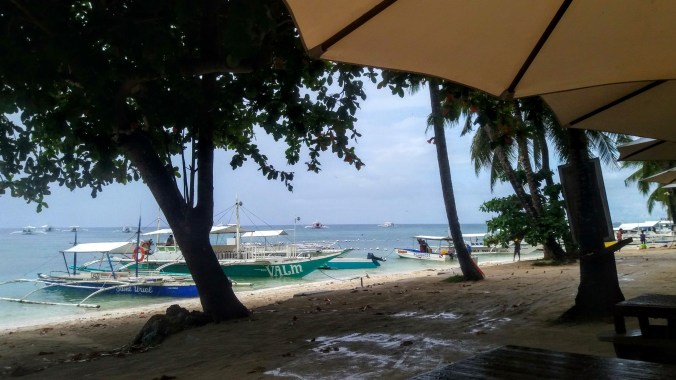 That morning was one of the few rains that happened during our active times. On any other morning, we could have just waited for it to stop, but Rafi had told us to be at the dive shop at 8:30 and we didn’t want to be late and run the risk of losing our spot on the boat. We waited as long as possible, and it didn’t take long for the downpour to become a drizzle. Driving on the wet roads wasn’t nearly as difficult as I feared, but getting a face full of rain made seeing a little challenging. I thought again about what kind of gear to use to prevent that if I ever had to drive a real distance in the rain, but it seemed like all the locals, in addition to shunning helmets, only wore ponchos while driving in the rain, leaving their faces, and eyes, open to the wet.
Despite the rain, we showed up at the shop at 8:30 as we’d been told, and although Rafi was running around like a nut getting things ready, he spotted us eventually and gave us a friendly good morning and made sure things were set for us too.
Nothing starts on time here, and there’s no point in worrying about it. While we waited, the rain cleared up and the sky began its transition from gray to a deep vault-of-heaven blue filled with towering, crisp edged cumulus clouds. It wasn’t long after that when we all boarded the boat. This involved walking through the shallow water to a ladder on the side. I underestimated the depth and rolling up my pants was not enough to keep them dry.
Our boat mates included a very serious Japanese man who seemed to have a personal assistant with him taking care of his every need, but not diving herself (she was Filipina and had a tourism badge on, so I feel safe calling this as an employer/employee interaction). There was a Chinese couple who had some intense underwater photography rigs. It made me wonder if they were professional photographers on assignment. And finally and Australian couple who seemed just to be out to have fun. None of them were beginners.
A word about the boats
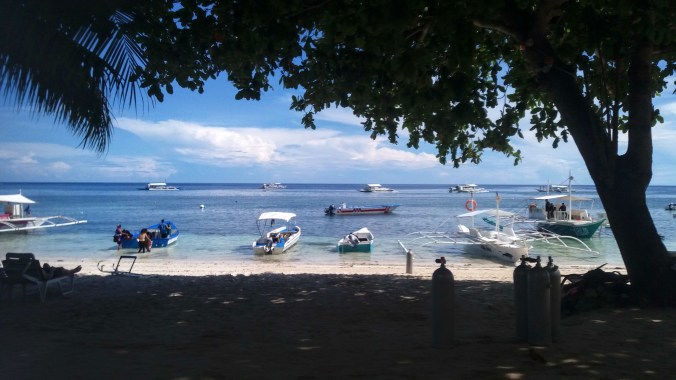
In Thailand we rode on the longtails nearly everywhere, and by now you’ve probably seen a few boats in my beach photos and have noticed that these boats are quite unique. The Filipino outrigger canoe style, called bangka or bangcas, is distinguished by the two slender bamboo poles on either side called katig. They help to balance the boat, and also mean the main boat needs less keel and can be lighter weight while still being ocean stable. Sailing versions are called paraw or parao. The outrigger canoe plan is most used by Filipino, Malay, Micronesian, Melanesian and Polynesian people today.
 The Wall
Balicasag is tiny island some 40 minutes to the south of Alona Beach. I never set foot on it, so I can’t tell you how it is. Our dive boat stopped first at a reef called “the wall” because there was a goodly stretch of shallow reef and a sharp drop off that for the divers below was actually a rising wall. We were asked to wait until all the divers were in the water and then given about 45 minutes to do all the snorkeling we liked. They pointed out some Chinese snorkelers a little bit away, and warned us about the current before turning us loose.
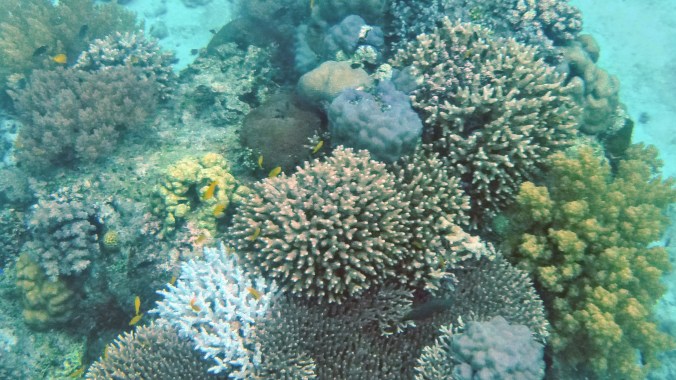 The corals were lovely, and I wasn’t in a hurry to get anywhere in particular. It was my first real chance to play around with my new underwater photo taking capability. Almost as soon as we got in the water, I spotted my first turtle hugging the edge of the drop off. I did my best to keep pace with him, but especially swimming against the current, I had no real hope of catching up to a turtle, no matter how lazily he seemed to be swimming. Finally, I had to give up. I swam using as little energy as possible, but it was hard going because the current was much stronger than I was used to and it was impossible to hold still while taking a picture.
 I wove back and forth above the stunning coral shapes, trying to get my camera to focus when I was spotted by a little rainbow wrasse, maybe 5 inches long. It was clearly watching me, swimming back and forth in front of me in quick zipping lines, and once it was sure it had my attention too, it swam straight at my face. I was honestly worried it was going to hit my mask, not for my safety, it was a small harmless fish, but worried that it might hurt itself bashing into the plastic. Fortunately at the last moment it turned aside.
 It seemed like a strange behavioral anomaly, but the fish came back and did it several more times. As I got used to the pattern I tried to get a picture. I wish I could have done a video, but I hadn’t quite figured out the trick I needed for that with the waterproof cover.
Eventually I let it chase me away and went on exploring more beautiful coral shapes. I got so focused on getting a working photo that I drifted into a whole shoal of fish without realizing, and at one point when I looked up I was entirely surrounded by tiny flashing fish bodies, not unlike being in a blizzard. I saw larger fish in the hazy waters just past the drop off, fading in and out of the misty darkness. At one point there was a school of silver fish that were more round than narrow and as they passed between me and the dark open ocean beyond, they reminded me of nothing so much as cherry blossoms falling in the wind at night.

Less Coral, More Turtles
All too soon it was time to swim back to the boat, a healthy challenge in the current without fins, but we made it and the boat moved off to the pick up point for the divers. They had to spend an hour on the boat between dives, but the snorkelers have no such restrictions. We were invited to head back into the water while they waited. The pick up point was not as interesting as the drop off had been, but the water was cool and refreshing and it was nice to just float around and watch the few fish that were braving the desert landscape between reefs. I saw a few more turtles there as well. Despite the poor quality of my pictures, the in person experience was captivating. The water was so clear that I could see the patterns on their shells and fins. I watched each one that passed through as they dug in the sand or chewed plant life growing on the bottom. We also saw a couple turtles surface for a breath once we were back on board.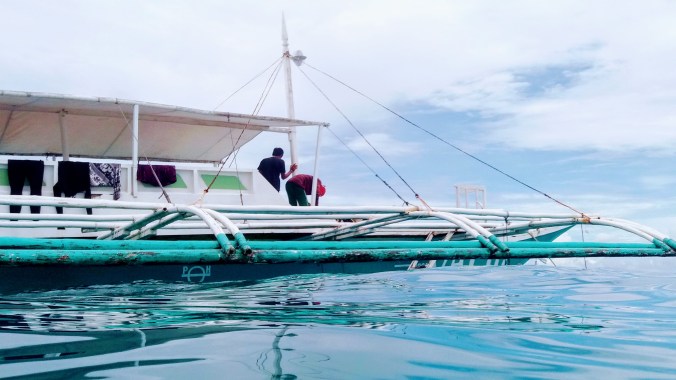
The second dive site for the day was all about the turtles. The divers started getting ready well before their hour was up so they could hop back in the sea as soon as it was safe. Once more, we waited for everyone to get in and head off to the goal. Apparently, there is a sort of sea turtle metropolis down there, and we were parked over in turtle exurbs. I’d already seen more sea turtles in the first two stops than I’ve ever seen in the wild before, so I didn’t mind too much.
At first I was a little disappointed because there were still no corals like we’d seen at the first stop. I didn’t want to head too far from the boat, as my last two trips had resulted in very tiring swims against a strong current to get back and I didn’t want to risk getting too worn out in the ocean. However one of the boat hands came in the water while I was swimming and began helping me spot turtles. The first one was chased avidly by a nearby boat of Chinese tourists. A couple others passed by too far for a good look, but then a giant beauty showed up right beneath us. The guide held my elbow to keep me steady so I could try for a better photo, and then when the turtle began to swim away, he motioned me to follow and we swam under the boat to keep the turtle in sight.
Unlike the turtle the Chinese tourists were chasing which was close to the surface, this one was on the bottom and I was not about to try to free dive to reach it, so I don’t think we were being invasive. We followed it for a few minutes and I managed to get some of the best photos of the day as well as a short video clip. Of course, my phone in a plastic waterproof bag has an upper limit on quality, but I was excited about it.
Finally, I put the camera down and just watched. When the turtle swam on again we didn’t follow but returned to the boat where we motored over to the final pick up point of the day.
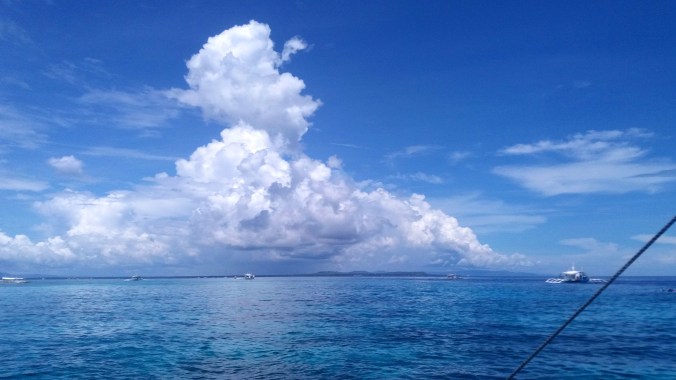
With the divers back on board, we made the return journey to Panglao. I happily gazed into the horizon watching the monumental cloud formations and being totally oblivious to the horrendous sunburn I was developing.
If I Could Change One Thing?
Ideally, if I went back it would be with the time, money, and intention of actually getting my PADI certification and going on those dives, but if it turns out that snorkeling is on the table, then just two main changes: wear a shirt! No amount of sunscreen is enough. I think the reason I didn’t burn on the snorkel trip in Thailand is that it was overcast (and yes, UV happens on overcast days) which meant there was no reflection off the water as there is on sunny days which massively magnifies the cooking power. And get fins. Again in Thailand although it was tricky at first, it was not a hindrance to go without fins because the water was calm. But the current around Balicasag was intense, almost like swimming in one of those resistance pools, I had to swim as hard as I could just to make any forward progress at all, even gentle swimming could result in me drifting backwards.
The massive burn did teach me one interesting fact about fashion. I now know the only valid excuse for a tube top. I don’t own any, but I had to fold down a regular tank top to wear in tube top style for the next several days in order to avoid horrible pain. Thanks mom, for always making us wear shirts over our swimsuits at the beach!
Don’t miss out on the photo album over on the book of faces.
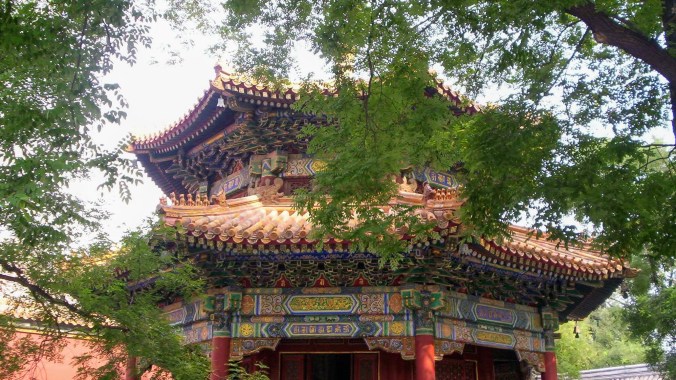








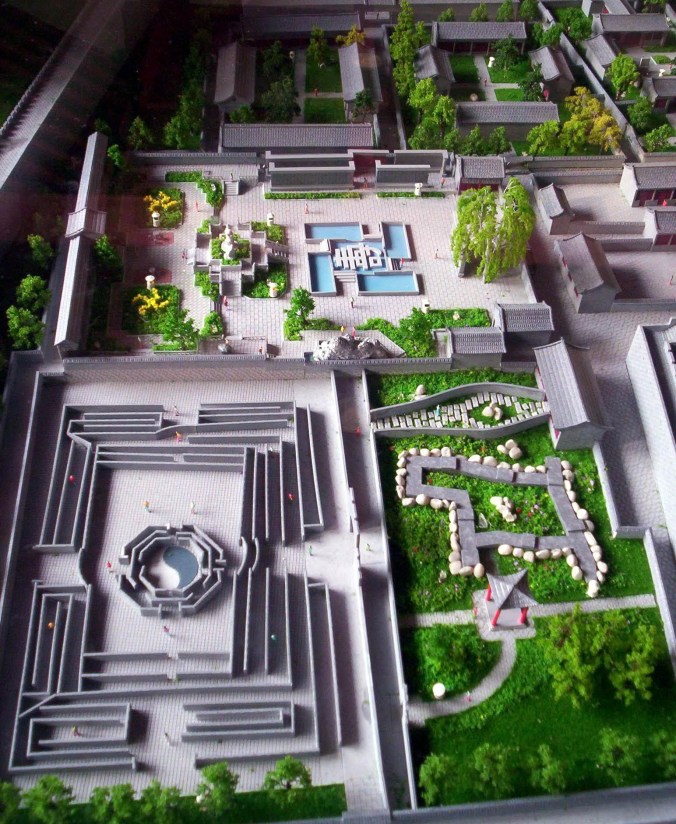 Lastly is the Longevity Garden, which you can see in the second layout model above. It has a nice waterfall, and a reflecting pool in the shape of what may appear to be a swastika, but it really a sacred symbol of Buddhism. And while I’ve seen this figure in a statue before, I’m still not sure who it is, other than it seems to be someone important in Buddhist history.
 Skipping ahead to the first century CE, we get what is known as the Three Kingdoms Period. The three kingdoms were Goguryeo (purple) controlled huge swaths of the north including what is now North Korea and parts of China (it is also where we get the English word “Korea” from, since their word for their own country is hanguk) The south was divided between Baekje (yellow) on the west, and Silla (blue) on the east. Except, there were more than three. The Gaya confederacy wedged it’s way between Baekje and Silla for almost 500 years. And let’s not forget
  Between it’s mythic founding 42 CE and it’s surrender to Silla in 562 CE, the Gaya confederate existed in the south central area of the Korean peninsula, just barely missing Busan (where I live) but keeping it’s capital in the nearby Gimhae (where our airport lives). They did some fishing and agriculture, but were most famous for their ironwork. It was a rough confederation of 6-12 different Gayas. When they Japanese invaded Korea in 1910, they claimed that Gaya had been a Japanese military outpost from 300-710 to justify their “return”, but no scholars take this claim seriously today.
 As we entered the park, the first statue was of a giant golden egg with 5 smaller eggs around it’s base. I was taking pictures of absolutely everything, hoping to figure it out later, so I snapped a shot and kept walking with the group. My co-teacher saw me take the picture and told me that the egg was there because the founding king of Gaya was hatched from an egg that fell from the sky. She also referred to this as “history” although I’m hopeful the last part was just a linguistics flub and that no one here seriously thinks that kings really hatched from sky eggs in the good old days. I could not figure out how to ask this without sounding rude, tho, so I let it go.
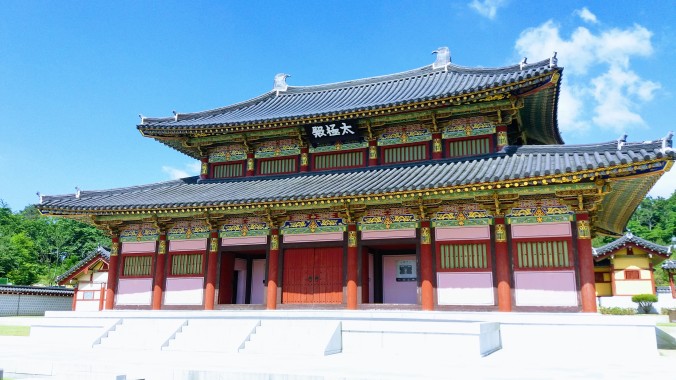 We made our way deeper into the park heading directly for the palace. It’s a replica palace. Very little archaeological evidence of Gaya has been found, although the tomb of Suro (first king of Gaya) is maintained in Gimhae as well. The palace grounds are reminiscent of Chinese palace architecture with familiar canted roofs and wide open courtyards between buildings. The colors and designs are quite unique to Korea, being less the scarlet and gold of China and more earth toned versions of dusty rose, pink, taupe yellow and pea green.


 One room had a huge map along a wall showing the queen’s “romance road of Asia”, paths from India to Korea picked out in red and blue. Another sign seemed to imply that the queen had brought Buddhism into Korea, however that is highly unlikely. I suppose she may have brought hers to Gaya (assuming that she was actually Indian) but the northern Kingdom of Goguryeo got it from their Chinese neighbors. I question her Indian origin story because the myth (written originally in the Samguk Yusa in the 13th century, it’s a kind of history/mythology mashup of the Three Kingdoms period) refers to her as being from Ayuta, a “distant kingdom across the sea”, but the name doesn’t correspond to the name of any country or city from that time period in India or any other country.
 We took our time around the palace complex, letting the kids run off some of their excitement after the long bus ride. There were plenty of historical things of interest, but no teachers tried to make the kids focus on learning, nor was there a guided tour where kids were shuffled from one room to another while someone explained things. They did separate out the grades so that no one building became too full, but on the whole, the kids were on their own to enjoy the space.
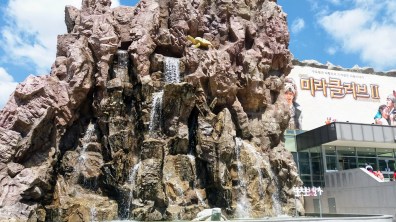 After a while, we headed out of the palace complex and back toward the main entrance to the theater. Turtle imagery was everywhere. A large mountain with an artificial waterfall towered over the theater building. A gray stone turtle lurked in the pond below and another golden one perched precariously on an outcropping halfway up the mountain! I asked about the turtles, but my co-teacher didn’t know (don’t worry, there’s an answer later).
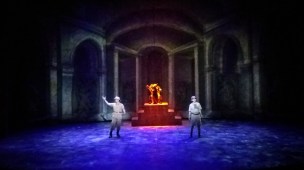 The story began with two archaeologists stumbling onto a large cache of relics from the Gaya period. Their song explained with some lament how little was known of Gaya before this discovery. Then a cave in knocked our archaeologists unconscious and a hazy dream fantasy of the mythstory of King Suro began in earnest. Dancers dressed as the zodiac animals performed intricate dances on stage as some kind of high priest or shaman character sang of the strife, war and drought in the land, praying to the heavens for deliverance which arrived in the form of 6 eggs. (although all 6 eggs hatched out kings, 5 of them were elsewhere being kings of other parts of Gaya, so aren’t in this story)
 The glowing egg hatched to reveal the full grown form of Suro who is proclaimed king on the spot and is expected to wield the power to heal the land. Yay! But it’s not easy being king. The drought continues and his people begin to resent him for not living up to the promise of his celestial birth.
 Meanwhile in Ayuta (India?), the princess Heo has a dream that her destined love is in a land far away, and that she must set sail to reach him and fulfill her destiny (lots of destiny). The dancers costumes were reminiscent of saris and there were certainly hints of Indian Bollywood style music and dance moves that were obviously meant to place the princess and her handmaidens in India.
 But OH! The villain! Satal, a god of war and a gleefully over the top villain dressed in a skull mask and rough furs and accompanied by evil temptresses dressed in black and red gauzy costumes came on to sing his number about how he would defeat Suro and become the king of Gaya, keeping the kingdom forever in a state of greed, hate, and famine. His musical style was that of classic hard rock and the stage was lit by enormous flames as he and his minions sang and danced.
 The princess’s ship is caught in a deadly storm and she is washed ashore in the wreck. It seems the moon itself has saved her just in time to be found by king Suro and they sing a touching love duet in the style of popular Korean ballads. But their happiness cannot last. Satal and his minions kidnap the princess and beat Suro nearly to death in battle. He wants to give up. He didn’t expect this to be so difficult. Where are the heavenly powers he’s supposed to have, after all? But his loyal servant reminds him of the plight of his people and the love of his princess and his resolve is bolstered.
 During a rallying all cast dance number, new armor is forged for the king, turning him from a dandy to a warrior. He is told he can receive the remainder of his heavenly powers upon the mountaintop and so newly armored he ascends to greet the powers of heaven, represented on stage as a white dragon flying around Suro to strengthen him. However Suro fights, Satal holds his own and the soaring duet of hero and villain waxes lyrical about the evils of greed, selfishness and divisiveness being defeated by the power of love. In the end, it is not the armor or the power of heaven that gives Suro the strength to defeat Satal, it is the love of Heo, her voice joining the song to call back to their duet and the fact that their love was made in heaven.
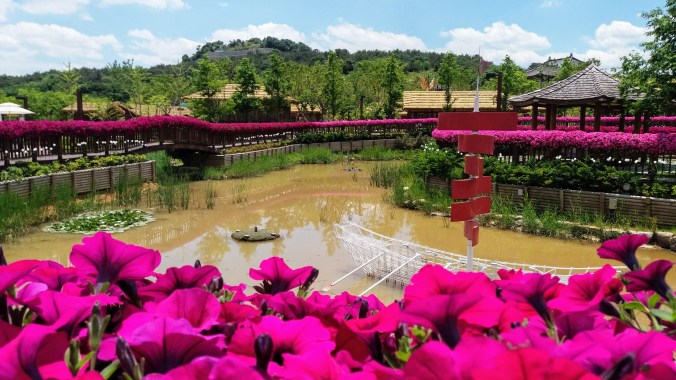 After the musical, we escorted the kids back over to the palace where they unpacked tiny picnic blankets and box lunches under the watchful eye of the staff while we enjoyed the cool, fresh mountain air. When the kids were all done eating, they were turned loose in the playground section of the park while the grownups had a lazy lunch of fried chicken next to the lake surrounded by heaps of purple pansies.
 On our way out of the park, I spotted a turtle garden with empty shells that kids could climb in and around, as well as a happy, smiling gray stone turtle overlooking the scene. The sign near the stone turtle informed us that the mountain where King Suro’s egg landed and hatched looked so much like a laying turtle that it was named Gujibong (gu meaning “turtle” in Korean). Which explained the mystery of why there were so many turtles around the park.

 Gallivantrix