My entire winter holiday is a zig zag of mental processes, and my random story hopping here is a great reflection of that! Ireland! Taiwan! Ancient Chinese Fairy Tales! It’s all humming around in my head with my real life plans, worries, hopes, and anxieties. Since writing this blog is really a kind of hobby/therapy for me, that means you get whatever topic I find most therapeutic at a given time. It’s a grab-bag. Today, more Dragon King myths, well Dragon King adjacent?
Gao Liang’s Race for Water
Legend has it that Beijing was once a part of the Bitter Sea, and not until later was there dry land.
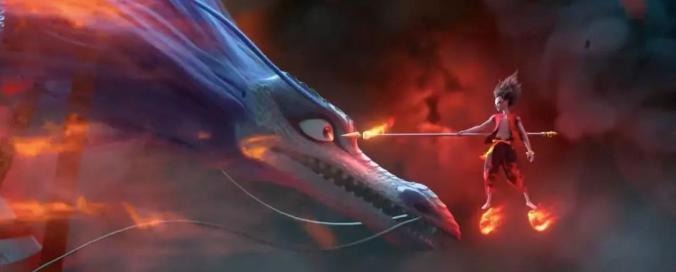
Many years ago Beijing was called Youzhou. It was part of the Bitter Sea and was held by the Dragon King. People could only live on the mountains of the western side and northern side. One day, Nezha came to the Bitter Sea Youzhou and began to fight the Dragon King. Finally, he captured the Dragon King and Queen, but he let the Dragon Prince escape. From that time on, the water the water receded and slowly the dry land was revealed.
In the time following, this piece of dry land had households; villages and towns gradually took shape. Moreover, the escaped Dragon Prince had also changed and become Dragon Duke, and along with (his wife) Dragon Mother, (and their children) Dragon Son and Dragon Daughter, they hid in a lake at the foot of the western mountains, passing their days in total silence. One day, Dragon Duke heard some news: Youzhou would build Beijing City. He indignantly shouted out, “It goes without saying that our Dragon Palace gave people peace, and now they also want to build a city there. its just too much!” Later he also heard it said that Imperial Chancellor Liu Bowen and Yao Guangxiao drew the plans for Beijing Eight-Armed Nezha City and would build Eight-Armed Nezha City. This time he was even more angry, and said to Dragon Mother, “This is horrible. If they build Eight-Armed Nezha City then we have no hope of a change in our fortunes. We should take advantage while it is not yet built and reclaim all the water in the town, then they will die of thirst.”
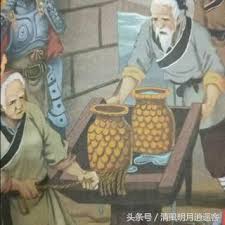 First thing in the morning the next day, the Dragon Duke disguised himself in the appearance of a rural person going into town to sell vegetables. He pushed a small cart; Dragon Mother pulled a small yoke; Dragon Son and Dragon Daughter followed some distance behind. In this way, the whole family snuck into the town. Inside the town, they walked in a circle. Dragon Son drank dry all the sweet water; Dragon Daughter drank up all the bitter water. Then they both transformed into fish-scaled water baskets, each laying down on one side of the small cart. Dragon Duke pushed the cart, and Dragon Mother pulled the small yoke. They exited Xizhimen (the main NW gate of Beijing) and abruptly turned to leave.
Just then, Liu Bowen was leading the artisans to build the Imperial Palace when suddenly someone ran up to report saying that all the water in the capitol city, large and small, had all dried up! Liu Bowen heard this and panicked, then he thought about it: certainly it was that Eight-Armed Nezha City had invoked the Dragon Duke’s revenge. Quickly he dispatched individuals to go to each gate and make inquiries: had any strange people been seen entering or leaving the city that day. Not long after, a scout returned to report: a little while before, two people pulling water baskets had left at Xizhimen. Liu Bowen heard this and then all was clear.
He said, “That repulsive, evil dragon! I must dispatch some men to reclaim the stolen water and bring it back.” “How will it be reclaimed?”, everyone asked him. Liu Bowen said, “We send one person to overtake them; two spear jabs will break the water baskets, and the water will bubble forth and run back. No matter what happens behind him, he must not look back. Just enter Xizhimen then everything will be safe and sound. Which brave person will dare to go?” Upon hearing this, everyone shook their heads repeatedly. Liu Bowen anxiously stamped his foot, “If we wait until the foul dragon gets it to the Lake, we’ll never get it back!” At that moment, a young artisan named Gao Liang stood forward and said in a loud voice, “I will go!” Liu Bowen picked up a red-tassled spear, gave it to Gao Liang and said, “Be very careful!” Gao Liang accepted the red-tassled spear, turned around, mounted his horse and headed straight for Xizhimen.
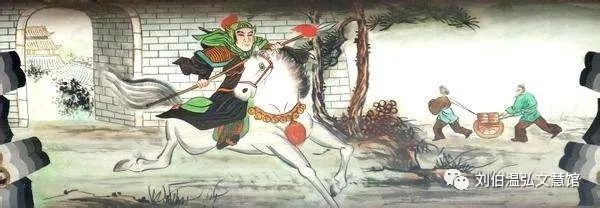
As soon as he left Xizhimen, Gao Liang hit a problem: should he go North or West? He figured the evil dragon would plan to put the water in the lake, but in this region, only Jade Spring Hill had a lake. Right! To the Northwest! Gao Liang spurred his horse on, pursuing them into the Northwest, pursuing straight up to Jade Spring Hill. He could see the Dragon Duke far off; the Dragon Mother had stopped for a rest to wipe away some sweat, and close by was the small cart loaded with fish-scaled water baskets.
Gao Liang dismounted and stealthily moved around the Dragon Duke, behind the Dragon Mother. He abruptly straightened up, lifted the spear, then jabbed. One jab broke one fish-scaled water basket and the water flowed out with a crashing sound. Gao Liang was just about to strike the second one when that basket turned into a strong-stomached young man. He giggled as he slipped away into the Jade Spring Hill’s lake. Dragon Mother quickly picked up the water basket that had been struck by the spear, leapt past the north side of the mountain top and straight into the Black Dragon Pool. Then the Dragon Duke shouted loudly, “Smelly boy! You think you can just walk away?” Gao Liang turned and ran. Behind him a huge wave like the surging of the tide chased after him. Gao Liang ran with urgency; he could just see Xishimen. His heart soared, and he could not help but turn and look behind, but as a result he was swept away at once by the giant wave.
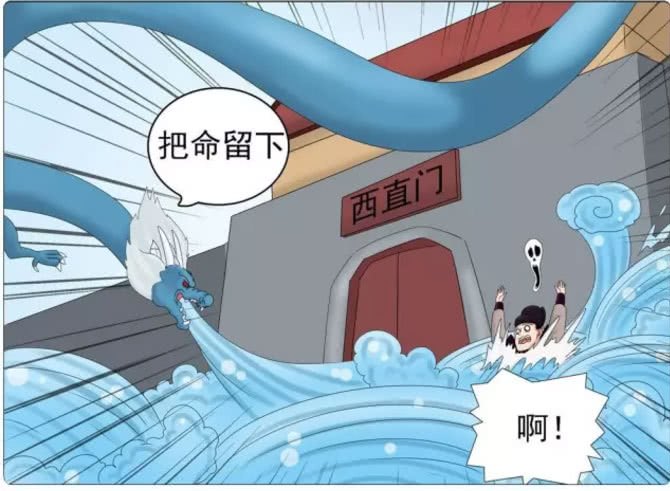
From then on, Beijing City’s wells once more had water, but it mostly bitter water. The sweet water was taken to the lake at Jade Spring Hill by the Dragon Son. Later, people built a bridge at the place where Gao Liang sacrificed himself and called it “Gao Liang Bridge”. Now it is known as “Gao Liang Qiao”.
Note: In the last blog where I talked about Nezha, I linked to the old animated video of his adventures. While finding fun photos for this one, I discovered a new high quality animated movie was released in 2019. You can see the trailer on IMDB. Plus, there appears to be a comic. These stories are a very vibrant part of modern Chinese pop culture.
Hunter Hai Libu
Long ago there was a hunter named Hai Libu. He was an extremely warmhearted person. Every time he returned from hunting, he would always share his game with everyone, only keeping a small portion for himself, so everyone loved and respected him a great deal.
One day Hai Libu went into the deep woods to hunt, when all of a sudden he heard from up in the air a cry of “save me”. He looked up and saw an eagle flying by with a small white snake which it had grasped by the head. He promptly loaded an arrow into his bow, took aim and fired at the eagle. The eagle was injured, and allowed the little white snake to escape.
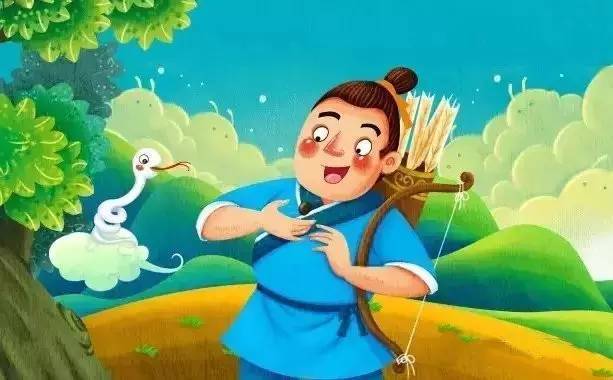
Hai Libu said to the little white snake, “Pitiable little thing, hurry and return home!” The little white snake said, “You are my benefactor who saved my life, I wish to repay you. I speak the truth to you: I am really the Dragon King’s daughter, return with me, my father will certainly thank you with a mighty gift. My father’s treasury holds many treasures, whatever you want you can have. If you don’t like anything there, you can ask my father for the small gem he keeps in his mouth. If only you have this gemstone, and keep it in your mouth, you can then understand the speech of all the animals of the world.”
Hai Libu thought to himself, “I don’t really care for treasure, but understanding the speech of animals, that could be very useful to a hunter.” He then asked, “There really is such a thing as this gemstone?” Little White Snake said, “There really is. But when an animal says something, only you can know. If you tell another person, you will change into a block of hard stone.”
Hai Libu followed Little White Snake back to the Dragon Palace. The Dragon King was entirely grateful that Hai Libu had saved Little White Snake and wanted to thank him with a great gift, so led him into the treasure hall and allowed him to chose a treasure, whatever he liked he could have. Hai Libu didn’t pick up any of the treasures, instead he said to the Dragon King, “If you truly wish to give me something to remember this by, then please give me the precious gem you keep in your mouth.” The Dragon King lowered his head a moment and thought, then he spat out the precious gem in his mouth and gave it to Hai Libu.
As Hai Libu was leaving, Little White Snake went out with him, and repeated to him over and over, “You must remember, whatever an animal says, you must not tell other people. If you tell them, you will instantly turn into stone, and can never again be brought back to life!” Hai Libu thanked Little White Snake and returned home.
With this gemstone, Hai Libu hunted very easily. He kept the gem in his mouth and could understand the language of the birds of the air and beasts of the field; he knew which mountains had which animals. From then on, every time he returned from hunting he shared even more game with everyone.
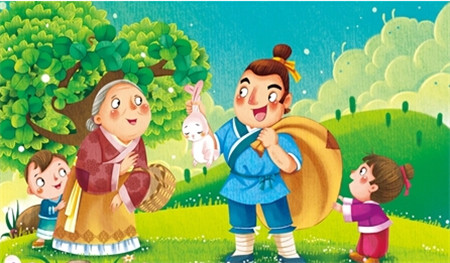
Things went on this way for many years. One day while Hai Libu was hunting deep in the mountains, he suddenly heard a flock of birds discussing something. He leaned in to listen attentively. The first bird said, “We should quickly fly to somewhere else! Tonight this mountain will crumble and the ground will be submerged by a flood, who knows how many people will drown!”
Hai Libu heard this and was shocked. He hastily ran back home and said to his fellow villagers, “We should quickly move to somewhere else! This place isn’t habitable!” Everyone who heard this found it strange, it was a fine place to live, why should they move their homes? Despite the fact that Hai Libu anxiously urged everyone, no one believed him. Hai Libu shed worried tears and said, “Believe me, we must move quickly! Once night comes it will be too late!” An old man spoke up, “Hai Libu, we all know you would never lie, but you want us to move our homes. You need to explain clearly why this is. We have lived at the foot of this mountain for many generations, there are many old people and young children, moving would not be easy!”
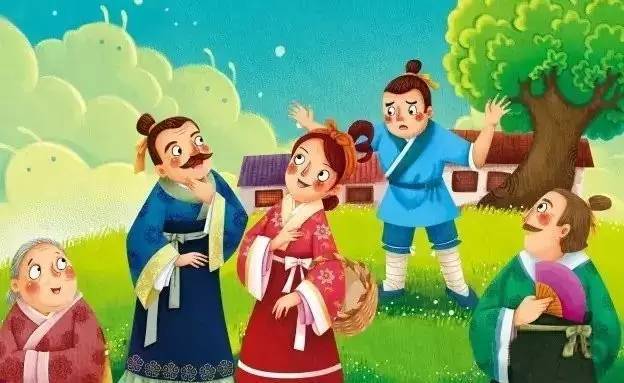
Hai Libu knew being worried was no use, he couldn’t give a reason for the move, and everyone was skeptical. If he wanted to rescue his fellow countrymen, he could only speak the actual truth! Arriving at this realization, he calmly said to everyone, “Tonight, this mountain will collapse, and a deluge will flood the ground.” He went on to explain how he had gotten the gemstone, and how he had overheard a flock of birds discussing taking refuge, as well as why he could not tell anyone else the information he heard, he told them the whole story. Just as Hai Libu finished speaking, he turned into a lump of hardened stone.
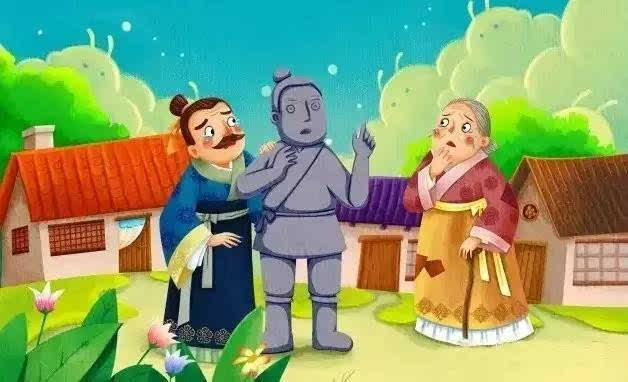
Everyone was very remorseful, holding in tears, and remembering Hai Libu’s name, helping the elderly and leading the children, driving the livestock, they left for a far away place. While they were walking on the road, suddenly black clouds densely filled the sky, a fierce gale roared, and after that it rained a downpour. At midnight, there was a sound that shook heaven and earth, and the mountain had a landslide, and the rushing flood waters inundated the village where they lived. Hai Libu sacrificed himself in order to save his fellow villagers, and the people from generation to generation cherish his memory.
Once again, if you’d like to watch an animated short of this story, I have found a link! You can see it’s a different animation style than the pictures I chose, and that’s because there a a lot of different renditions of these famous stories.
The Eight Immortals Cross the Sea
Legend has it that a very long time ago there were eight Daoist Immortals. Separately, they are Tieguai Li, Han Zhongli, Zhang Guolao, Lan Caihe, Lu Dongbin, Han Xiangzi, He Xian’gu, and Cao Guojiu; together they are Ba Xian, the Eight Immortals. They behead goblins and drive out monsters; they eliminate evil and promote good; and they left behind many touching stories.
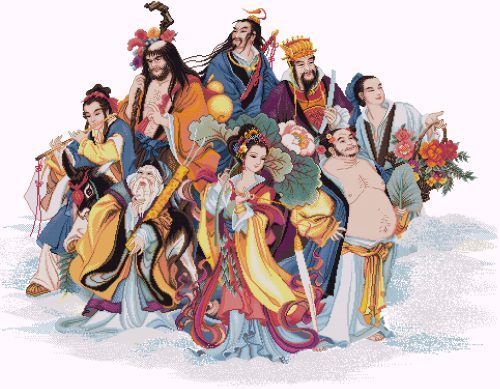
Tieguai Li used to be called Li Xuan and he was a Daoist. Originally he was tall and sturdy, with a majestic appearance, he practiced Dao in the caves of Mt. Dang. One time, he sent his spirit out to go to Mt. Hua and visit the great teachers Laojun and Wanqiu, but when he returned to his body it was unexpectedly destroyed, and he had no choice but to use the body of a recently dead beggar brought back from the grave. He didn’t expect that the beggar would have an ugly face or a lame leg. He had to carry around an iron crutch and rest his leg on a cloud while travelling the four seas. He came to be called “Tieguai Li” or Iron-Crutch Li.
During the days of the Eight Immortals, Zhang Guolao would always ride around on a donkey. It is said that his donkey could walk thousands of miles in a day, and when they stopped, he could fold it up like paper. Han Zhongli was originally a general in the army, but since he lost in battle, he went into hiding deep in the mountains to practice austerity and become a Daoist Immortal. He always bares the the skin of his belly, waves a fan in his hand, and is smiling and laughing with an expression of good fortune. Pure Yang Master Lu Dongbin looks like a scholar and carries a double edged sword on his back. The sword gives off a bolt of divine light that can scare monsters away.
He Xian’gu is the only female immortal among the Ba Xian. She carries a Lotus in her hand, and is slender and elegant. Lan Caihe often carries a flower basket which is overflowing with sweet smelling flowers in all seasons of the year. Han Xiangzi is the grand-nephew of the great Tang Dynasty poet laureate, Han Yu and carries a reed flute in his hand. Cao Guojiu’s device is a jade tablet. Legend has it that the sound of the jade tablet can make all things between Heaven and Earth peaceful and calm.
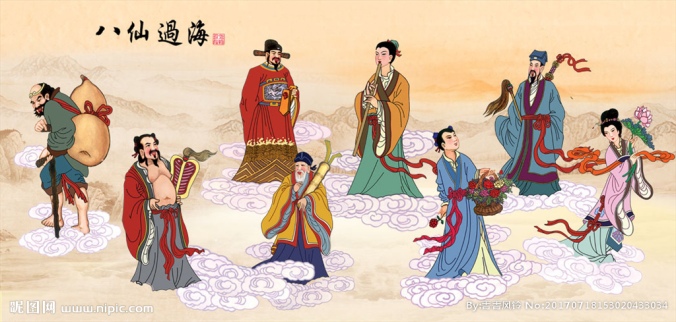
Left to right: Tieguai Li, Han Zhongli, Cao Guojiu, Zhang Guolao, Han Xiangzi, Lan Caihe, Lu Dongbin, He Xian’gu
One day, the Eight Immortals were riding on the clouds to go to take part in an assembly of immortals across the Eastern Sea. Lu Dongbin said, “Riding clouds across the sea isn’t really considered a skill of the Immortal School, it would be better if we each used our own special abilities, tread the waves across the sea, and show off our magical power. Do you all agree?” The remaining Immortals voted in favor.
Iron Crutch Li was the first to cross the ocean. He simply threw the crutch in his hand into the Eastern Sea. The crutch resembled a small boat floating on the surface of the water and carried Tieguai Li safe and sound to the opposite bank. Next, Han Zhongli slapped the drum in his hands said, “Watch mine.”, then threw the drum into the sea. He crossed his legs and sat down on the drum and crossed nice and secure across the Eastern Sea.
Zhang Guolao grinned and said, “My move is the most brilliant”, then he took out a piece of paper and unfolded it into a donkey. Once its four hooves touched the ground it looked to the sky and let out a bray, then carrying the seated Zhang Guolao on its back, trotted across the waves. He Xian’gu threw her lotus flower into the water, stood patiently on its face and drifted along the waves across the sea. Soon after, Lu Dongbin, Cao Guojiu, Han Xiangzi, and Lan Caihe one by one tossed their treasures into the sea, and with the aid of those treasures they each showed off their special abilities and crossed the sea.
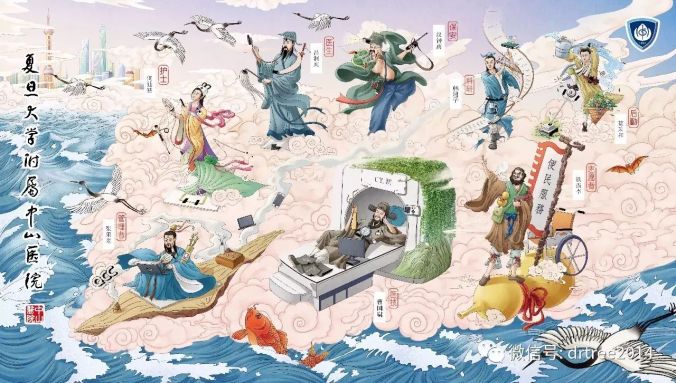
Seven Immortals arrived on the opposite shore, to the left and to the right, there was no sign of Lan Caihe. As it turned out, when the Eight Immortals crossed the sea just then, it disturbed the crown prince, son of the Dragon King of the Eastern Sea. He dispatched the shrimp soldiers and crab generals out to sea to look around. Taking advantage of the Ba Xian being caught off guard, they captured Lan Caihe and took his flower basket.
Lu Dongbin couldn’t find Lan Caihe, he became worried and upset. He hollered in a loud voice toward the Eastern Sea, “Dragon King, listen up, hand over Lan Caihe right now or else you will feel my wrath!” The Dragon Prince heard this and became excited and angry and rushed up to the surface of the sea to let Lu Dongbin really have it. Lu Dongbin drew his double-edged sword and sliced the air. Afraid, the Dragon Prince sank back down to the sea bed.
Lu Dongbin was unwilling to let him go. He pulled his fire gourd from his pocket and burned the Eastern Sea into a sea of fire. After that, the seven immortals each made use of their powers, going forward to fight, cutting down two of the Dragon King’s sons. The shrimp soldiers and crab generals were unable to hold them off, and one by one were defeated and hid in the seabed. The Dragon King of the Eastern Sea saw his own sons die, flew into a rage, and called on the Dragon Kings of the South, North and West Seas to work together to overturn all of the water in the world into one huge tidal wave and crash it onto the Immortals.
At that critical moment, Cao Guojiu used his cherished Jade Tablet to open a path before them and the giant tidal wave went around them on both sides and receded. The other Immortals followed Cao Guojiu precisely and arrived unharmed. The Dragon Kings of the four seas quickly gathered their armies for war. They were about to launch a fight to the death. But just then, the Bodhisatva Guan Yin passed through the South Sea and yelled at both sides to stop. She then helped them to settle their differences. Before long, the Dragon King of the Eastern Sea released Lan Caihe and both sides stopped fighting and made peace. The Eight Immortals then bid farewell and went freely and leisurely on to the meeting of Immortals.
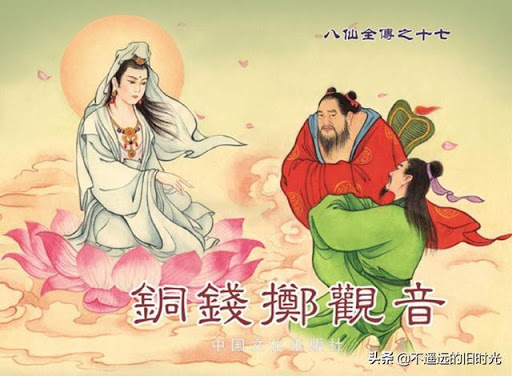
Note: This is a great example of the syncretism in East Asian religious faiths. Guan Yin is a Buddhist figure, a Bodhisattva is one who came to the edge of true enlightenment, but instead of choosing Nirvana, they chose to stay in the world to help others. On the other hand, the Eight Immortals are Taoist figures. It’s common to see the characters from each religion interacting in stories, and for people to practice rituals and prayers from both.













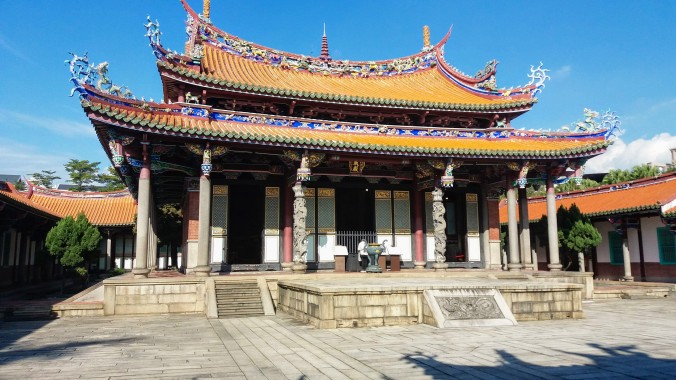


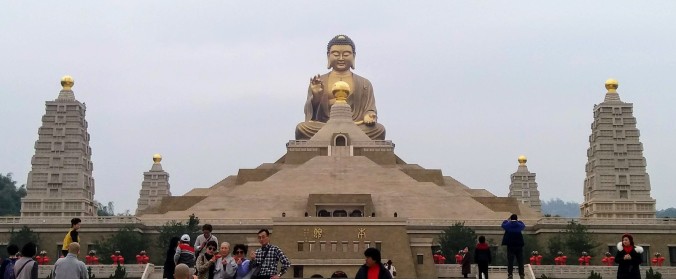

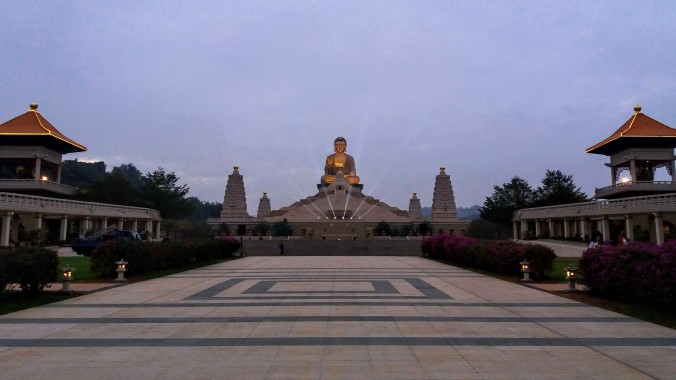




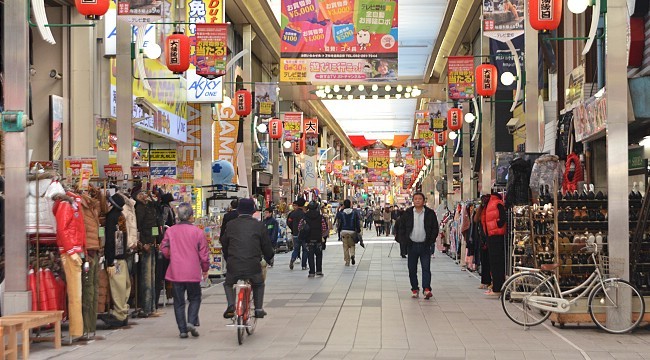
 Sakae was my first non-airport sight in Nagoya where I disembarked the airport shuttle bus and met up with my friend. It’s a large and bustling neighborhood in Nagoya with lots of trendy shops and restaurants. While waiting for our dinner restaurant to open, we decided to do a little shopping.


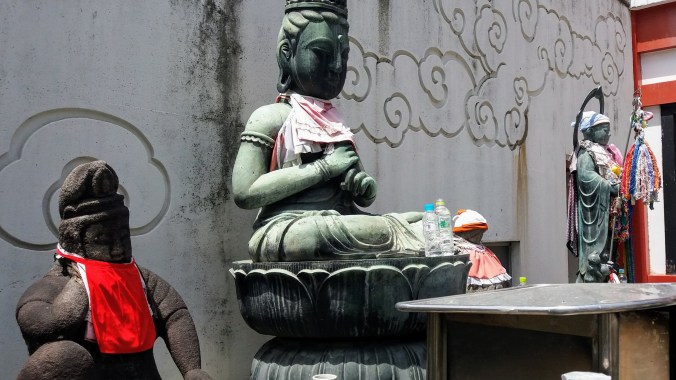


 The shops in Yokohama and Tokyo had a huge array of Ghibli goodies and I wanted to go back and see if I could get something unique for my niblings (gender neutral for the children of siblings, I did not make it up but I love this word). I’ve been sending them one Ghibli movie a year along with a few themed toys. Every other family member is drowning them in Disney, so I claimed Miyazaki. So far they’ve gotten Totoro, Kiki, and Ponyo (they are still quite young). My niece especially loves the lace bracelet I got at the shop, but mine is from Mononoke which they are not old enough for yet. I did manage to find a Totoro online, but it was twice as pricey as mine had been, so I figured I’d hit up the shop in Japan and have extra prezzies. Cool Auntie!


 The other shop is at a place called Oasis 21 which is ostensibly a bus station, but is really a shopping center. It’s much easier to find and less crowded than Takashimaya. It’s part of the lovely greenbelt in Sakae and it has a great view of the Nagoya TV tower which Nagoya loves to brag about like it’s the Tokyo Tower. It’s a little adorable. The Donguri in Oasis 21 isn’t as decked out in plush petable Totoro characters, however, so if riding the Catbus is on your bucket list, you better go to Nagoya Sta instead. I didn’t really have much time to see the other stores in Oasis 21, but it looked cute. It’s a big oval with an open center and covered shops on two stories around the outer rings.




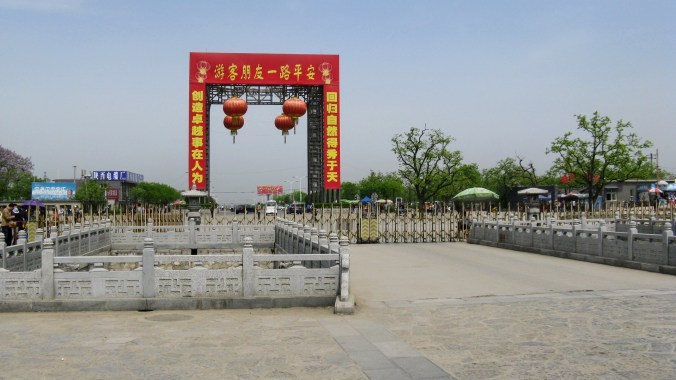




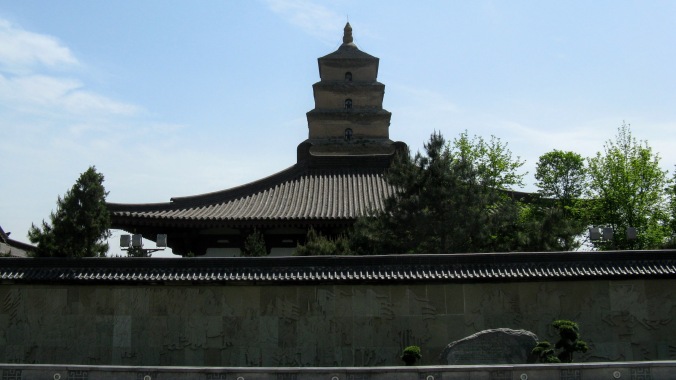

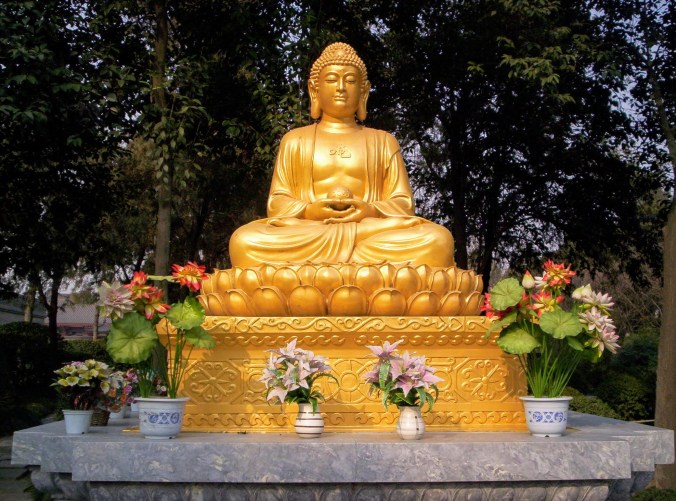

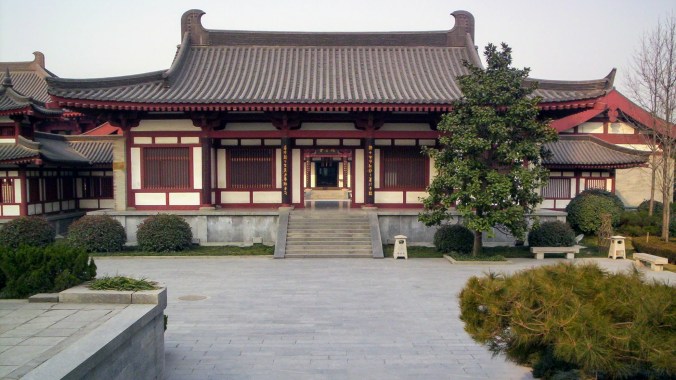


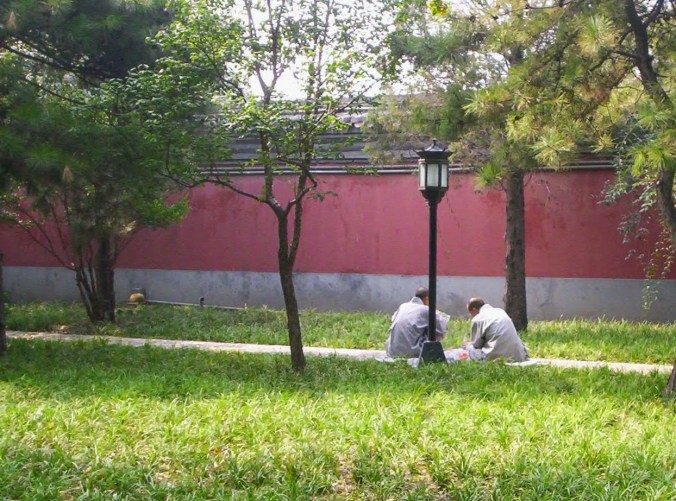
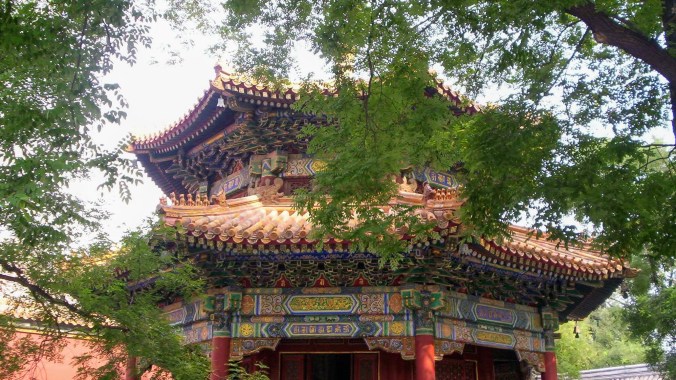








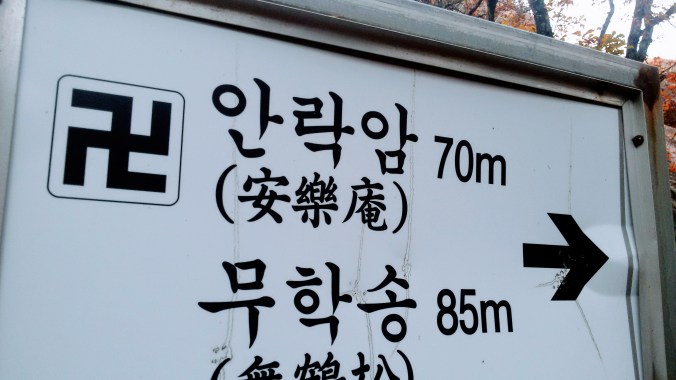
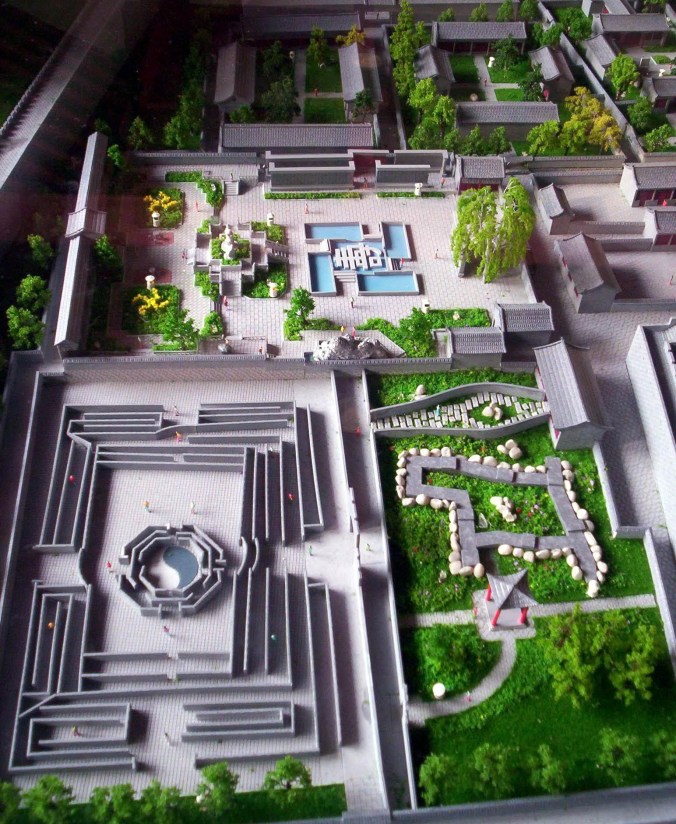 Lastly is the Longevity Garden, which you can see in the second layout model above. It has a nice waterfall, and a reflecting pool in the shape of what may appear to be a swastika, but it really a sacred symbol of Buddhism. And while I’ve seen this figure in a statue before, I’m still not sure who it is, other than it seems to be someone important in Buddhist history.
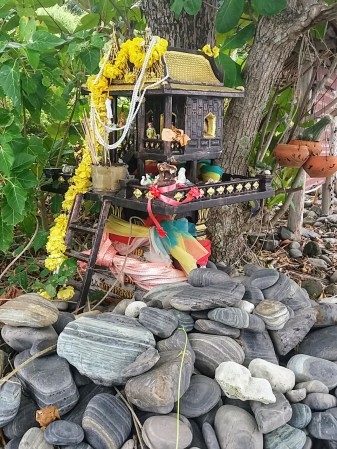 Since arriving in Thailand via Koh Lipe I had seen these tiny ornate houses on posts everywhere. I saw them on the remote islands around Lipe, near the caves of Bor Tor, in the cities, at gas stations, and in the front yard of homes we passed on the road. Some were simple, others like miniature mansions. Some had tiny model occupants while others were uninhabited. Nearly all of them had offerings of food, sweets, alcohol, or incense.


 I wasn’t sure I was going to make it this year. Some people weren’t sure there was even going to be a Pride this year. Of course, every single year since the first festival/march in Seoul in 2000 the conservative religious zealots have tried to stop the Korean Queen Culture Festival (KQCF aka Pride) from happening. They try to file legal objections. They try to file use of space applications for the same day. They throw temper tantrums and accuse foreigners of bringing homosexuality and AIDS into Korea (because there would of course never be any gay Koreans if we hadn’t infected them!). This year, the issue was with the grass.
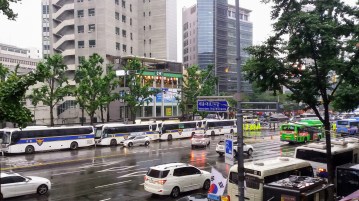 We woke up in our slightly fancy downtown hotel, lounged around, had a leisurely breakfast and finally headed over to the plaza a little after the 11am start time. We passed rows and rows of police buses parked along the side streets. Last year, I came up from the subway and the first sight that greeted me was a veritable army of uniformed officers lining the street and crosswalk. This year, we walked in from another direction and saw a little of the behind the scenes police preparation as well as walking through some of the protesters who were stationed next to the festival exit and a subway station. I knew what to expect going in from last year, but my friend said that walking past all the police and protesters made her feel anxious about the day. The reported police presence was about 6,000 officers.

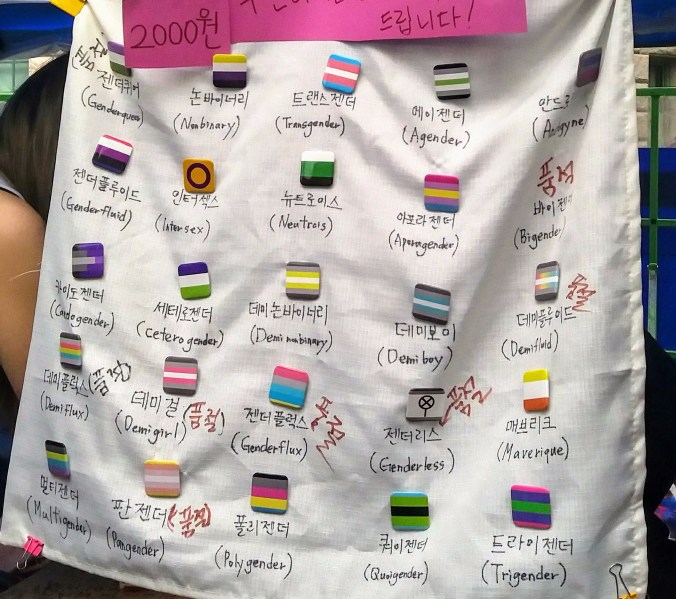



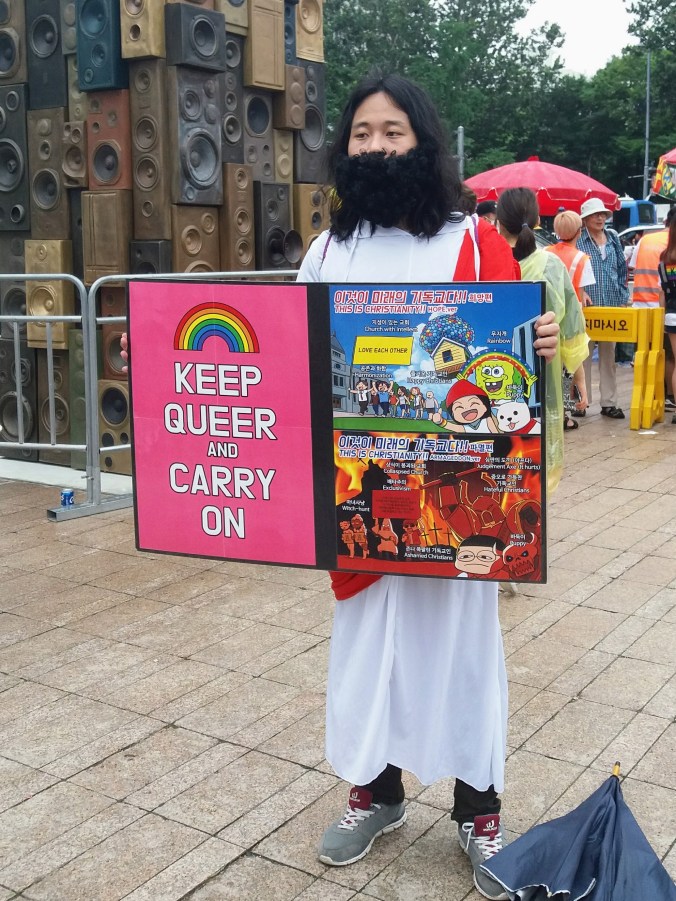 The protesters outside are entirely Christian, but there are plenty of Korean Christian churches that came inside too, eager to point out their own perspective on the Bible and love (hint: it’s about inclusion, acceptance, and more love!). One group had even made a pamphlet that deconstructed the most common biblical arguments against homosexuality and explained the verses in historical context. But mostly they just wanted to show that the church can be accepting too. There was more than one Jesus costume at the event as well, and while the one making the rounds in the media seems to be a white guy (*sigh), I found this Korean one first. His sign is surprisingly excellent when you look closely at the comparison of Christianity hope.ver and armageddon.ver.


 There was also spiritual representation from the Buddhists! I accepted a pamphlet from one nun, which after some time spent translating seems to give the following basic message: while Buddhism condemns sex in general as being one of the things that ties you to the material world (monks and nuns are supposed to refrain entirely, but lay people are expected to do it in moderation, like alcohol consumption or meat eating) that there is no specific teaching about who you have have sex with or what type of sex you have (they listed 3 choices: vaginal, anal, and oral). The takeaway for me was that Buddhists should not condemn queer sex because of it’s queerness. One should regard all types of sex equally (while still bearing in mind things like adultery and unchecked lust are bad for everyone, too). If you’re going to accept that regular folks get into loving relationships and have sex while straight, you have to accept the same for all other flavors too. This was the first year a representation from any Buddhist temple came to the festival. It was glorious.

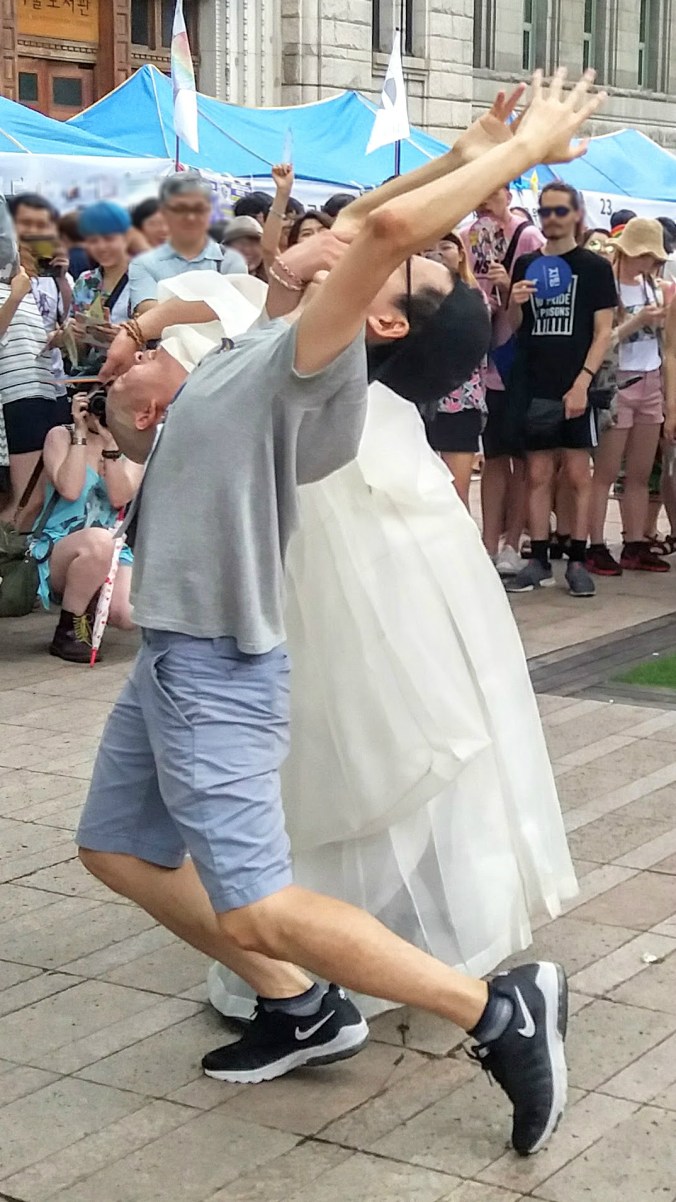
 Later on, we spotted Wonder Woman and a jedi (maybe young Aniken?) facing off on the stage, but I only made it close enough for a couple pictures at the end. I’m still not sure what they were doing, because that’s a serious genre clash. Once I was up near the stage, surrounded by people with much nicer cameras than mine, I got lumped in with the more official press (since our press badges weren’t different) and was ushered right up to the edge of a small clearing where I got a front row seat to watch the LGBTQIA traditional Korean drum performance. This is the classic drum and cymbal parade that accompanies every event and festival in Korea and it’s great to see the traditional cultural arts merging into the new cultural milieu.







 Turning to my trusted friend, Google, I found that Thailand (of all places) sells my drug of choice over the counter! For a few dollars. And yes, I have heard every argument about buying off market drugs in countries without enough regulations, but what are you supposed to do when the country you live in doesn’t have the drug? Also, as an expat, I’ve been to doctors and pharmacies around the world because that’s where I was when I needed the medicine. Egypt, Saudi, and France were all places I had to visit pharmacists. I take other medicines here in Korea that, when I look them up, are not on the US market by the same name or even manufactured by the same company. Were I to take a job in Thailand, as people in my career do from time to time, that is the medicine I would take. Maybe the drugs are actually less well regulated or maybe the US pays too much for pharmaceuticals. Not sayin’, just sayin’.

 The festivities were set to start around 6pm, so we left in the afternoon and had a lazy, but comfortable ride into Daegu where we had to relearn bus navigation. One wrong bus and two right ones later, we got off in the general vicinity of


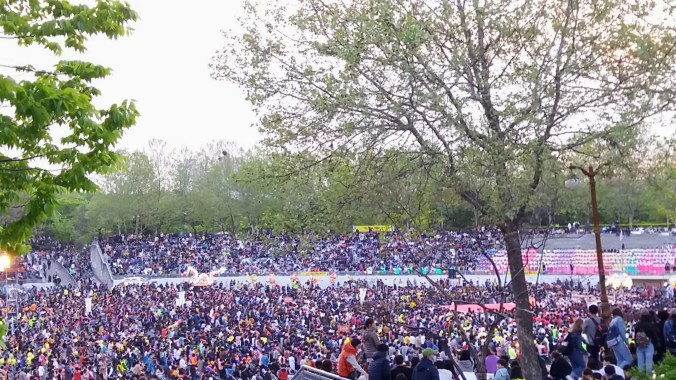
 For those who don’t know, these words used to be terms of respect for middle aged women and men, but have come to be less flattering terms used to describe a particularly rude class/age group of Koreans. Ajuma (women) tend to shove… a lot, and cut in line. Ajoshi (men) will join in on the shoving if their wives are around, but are perceived as perverts who peer into ladies bathrooms otherwise. I know that at least some of the younger Koreans use the words this way, and definitely all the expats I’ve met do. There is a culture of respect for age, so actually old frail people are often given seats and ushered to the front for views (and are usually super sweet about it, every one I’ve given a seat to has said thank you and offered to hold my bag in her lap), but these ajuma are just bitter middle agers who don’t want to stand in line like everyone else. Think of them like the entitled soccer moms of Korea. And yeah, they pretty much all look like that picture, too.
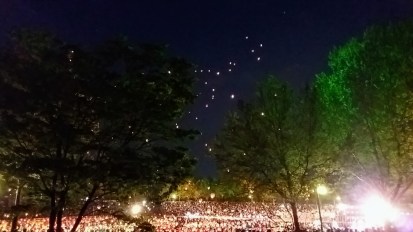 Lanterns Aloft
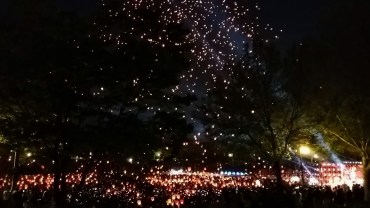 At long last, the moment we had waited for, the lanterns were released in earnest. They did not rise swiftly like balloons, but in a slow and drifting manner as the tiny flames inside each one warmed the air contained by the colorful paper dome. 1,000 globes of light ascended into the blue and black night sky, and I knew no matter how hard I tried, my camera could never capture that moment. It was what we were all here for. People from many cities and even many countries, gathered in the soft night air to witness the magic of fire in the night, lanterns becoming stars, and wishes rising to the heavens.
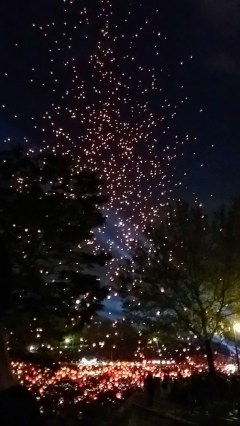 Shortly after the main release was over, people around us began filtering back out of the park. They had seen what they’d come for and were eager to move on to the next attraction or to beat the traffic. This meant that we suddenly found ourselves at the fence with an unobstructed view of the field below, and enough elbow room to turn around and attempt selfies (which were less impressive due to the low light).
 Finally the last twinkling lights above became no bigger than pinpricks of stars and we joined the crowd shuffling out of the park. We had 3 hours left before our return train and sat down for a moment to check the internet for a restaurant serving anything Daegu local. While we were seated, a family carrying armloads of paper lotus lanterns came by, and the young boy gave us each one, nervously testing out his English with as few words as possible.
 With our gifts in tow, we set off toward our restaurant of choice, but quickly became sidetracked by the parade. The floats we’d seen before were now all lit up, but the parade itself was stopped again. We dodged in and out, taking more pictures and pausing to watch a monk’s drum performance. Back in front of E-World once more, we spotted a street vendor selling flying lanterns as fast as he could light them up, and we were able to get a closer look at the lights that had filled the sky less than an hour before.


 Moments later, I had a humongous bowl of seafood and spicy broth in front of me. Mussels, clams, shrimp, crab and octopus crowded the bowl and heaped up atop a generous portion of noodles. (octopus is not something I order knowingly, but I didn’t want to waste it’s life once it was on the table) The broth was rich and spicy, causing me to reach for the ice water more than once and leaving my lips pleasantly tingly by the end of the meal. I think 2 hungry people would have had trouble eating the whole thing, and my day companion was not a seafood fan, so it was all me.
 Gallivantrix