Myths & Tales from China 07

My entire winter holiday is a zig zag of mental processes, and my random story hopping here is a great reflection of that! Ireland! Taiwan! Ancient Chinese Fairy Tales! It’s all humming around in my head with my real life plans, worries, hopes, and anxieties. Since writing this blog is really a kind of hobby/therapy for me, that means you get whatever topic I find most therapeutic at a given time. It’s a grab-bag. Today, more Dragon King myths, well Dragon King adjacent?


Gao Liang’s Race for Water

Legend has it that Beijing was once a part of the Bitter Sea, and not until later was there dry land. 

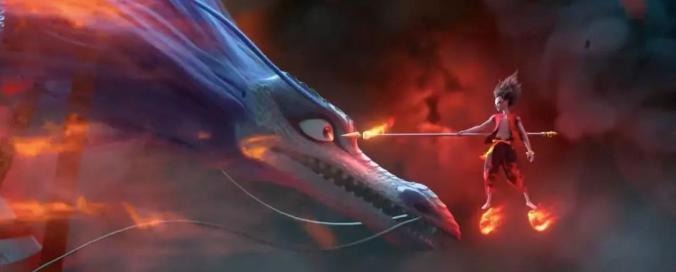
Many years ago Beijing was called Youzhou. It was part of the Bitter Sea and was held by the Dragon King. People could only live on the mountains of the western side and northern side. One day, Nezha came to the Bitter Sea Youzhou and began to fight the Dragon King. Finally, he captured the Dragon King and Queen, but he let the Dragon Prince escape. From that time on, the water the water receded and slowly the dry land was revealed.
931d8cfc9e1142649213646aa6bdcbba

In the time following, this piece of dry land had households; villages and towns gradually took shape. Moreover, the escaped Dragon Prince had also changed and become Dragon Duke, and along with (his wife) Dragon Mother, (and their children) Dragon Son and Dragon Daughter, they hid in a lake at the foot of the western mountains, passing their days in total silence. One day, Dragon Duke heard some news: Youzhou would build Beijing City. He indignantly shouted out, “It goes without saying that our Dragon Palace gave people peace, and now they also want to build a city there. its just too much!” Later he also heard it said that Imperial Chancellor Liu Bowen and Yao Guangxiao drew the plans for Beijing Eight-Armed Nezha City and would build Eight-Armed Nezha City. This time he was even more angry, and said to Dragon Mother, “This is horrible. If they build Eight-Armed Nezha City then we have no hope of a change in our fortunes. We should take advantage while it is not yet built and reclaim all the water in the town, then they will die of thirst.”
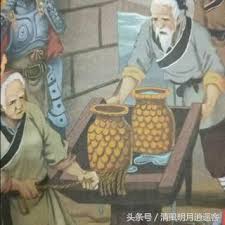
imagesFirst thing in the morning the next day, the Dragon Duke disguised himself in the appearance of a rural person going into town to sell vegetables. He pushed a small cart; Dragon Mother pulled a small yoke; Dragon Son and Dragon Daughter followed some distance behind. In this way, the whole family snuck into the town. Inside the town, they walked in a circle. Dragon Son drank dry all the sweet water; Dragon Daughter drank up all the bitter water. Then they both transformed into fish-scaled water baskets, each laying down on one side of the small cart. Dragon Duke pushed the cart, and Dragon Mother pulled the small yoke. They exited Xizhimen (the main NW gate of Beijing) and abruptly turned to leave.

Just then, Liu Bowen was leading the artisans to build the Imperial Palace when suddenly someone ran up to report saying that all the water in the capitol city, large and small, had all dried up! Liu Bowen heard this and panicked, then  he thought about it: certainly it was that Eight-Armed Nezha City had invoked the Dragon Duke’s revenge. Quickly he dispatched individuals to go to each gate and make inquiries: had any strange people been seen entering or leaving the city that day. Not long after, a scout returned to report: a little while before, two people pulling water baskets had left at Xizhimen. Liu Bowen heard this and then all was clear.

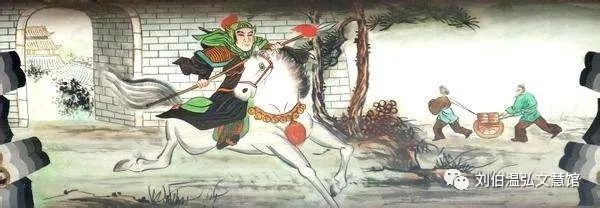
He said, “That repulsive, evil dragon! I must dispatch some men to reclaim the stolen water and bring it back.” “How will it be reclaimed?”, everyone asked him. Liu Bowen said, “We send one person to overtake them; two spear jabs will break the water baskets, and the water will bubble forth and run back. No matter what happens behind him, he must not look back. Just enter Xizhimen then everything will be safe and sound. Which brave person will dare to go?” Upon hearing this, everyone shook their heads repeatedly. Liu Bowen anxiously stamped his foot, “If we wait until the foul dragon gets it to the Lake, we’ll never get it back!” At that moment, a young artisan named Gao Liang stood forward and said in a loud voice, “I will go!” Liu Bowen picked up a red-tassled spear, gave it to Gao Liang and said, “Be very careful!” Gao Liang accepted the red-tassled spear, turned around, mounted his horse and headed straight for Xizhimen.
3abff9d83b664d1c9c24d6248bc52834

As soon as he left Xizhimen, Gao Liang hit a problem: should he go North or West? He figured the evil dragon would plan to put the water in the lake, but in this region, only Jade Spring Hill had a lake. Right! To the Northwest! Gao Liang spurred his horse on, pursuing them into the Northwest, pursuing straight up to Jade Spring Hill. He could see the Dragon Duke far off; the Dragon Mother had stopped for a rest to wipe away some sweat, and close by was the small cart loaded with fish-scaled water baskets.

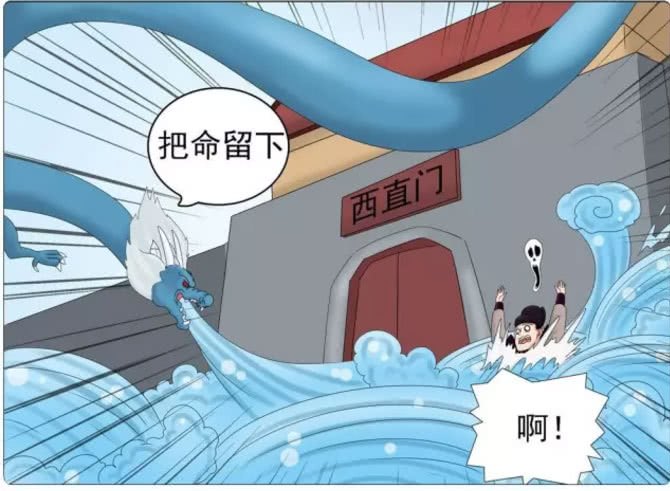
Gao Liang dismounted and stealthily moved around the Dragon Duke, behind the Dragon Mother. He abruptly straightened up, lifted the spear, then jabbed. One jab broke one fish-scaled water basket and the water flowed out with a crashing sound. Gao Liang was just about to strike the second one when that basket turned into a strong-stomached young man. He giggled as he slipped away into the Jade Spring Hill’s lake. Dragon Mother quickly picked up the water basket that had been struck by the spear, leapt past the north side of the mountain top and straight into the Black Dragon Pool. Then the Dragon Duke shouted loudly, “Smelly boy! You think you can just walk away?” Gao Liang turned and ran. Behind him a huge wave like the surging of the tide chased after him. Gao Liang ran with urgency; he could just see Xishimen. His heart soared, and he could not help but turn and look behind, but as a result he was swept away at once by the giant wave.
21efa8e96c36420d95a26e5202ea9b96

From then on, Beijing City’s wells once more had water, but it mostly bitter water. The sweet water was taken to the lake at Jade Spring Hill by the Dragon Son. Later, people built a bridge at the place where Gao Liang sacrificed himself and called it “Gao Liang Bridge”. Now it is known as “Gao Liang Qiao”.

Note: In the last blog where I talked about Nezha, I linked to the old animated video of his adventures. While finding fun photos for this one, I discovered a new high quality animated movie was released in 2019. You can see the trailer on IMDB. Plus, there appears to be a comic. These stories are a very vibrant part of modern Chinese pop culture.


Hunter Hai Libu

Long ago there was a hunter named Hai Libu. He was an extremely warmhearted person. Every time he returned from hunting, he would always share his game with everyone, only keeping a small portion for himself, so everyone loved and respected him a great deal.

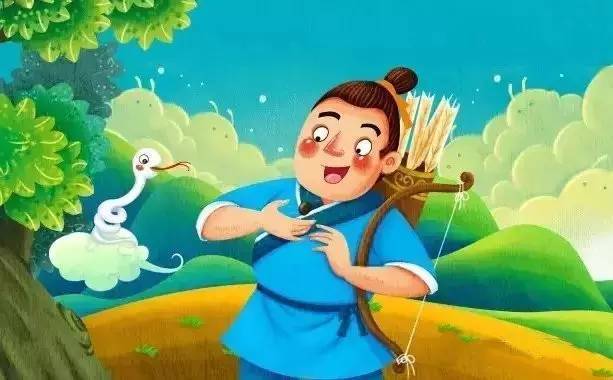
One day Hai Libu went into the deep woods to hunt, when all of a sudden he heard from up in the air a cry of “save me”. He looked up and saw an eagle flying by with a small white snake which it had grasped by the head. He promptly loaded an arrow into his bow, took aim and fired at the eagle. The eagle was injured, and allowed the little white snake to escape.
146752685131441474

Hai Libu said to the little white snake, “Pitiable little thing, hurry and return home!” The little white snake said, “You are my benefactor who saved my life, I wish to repay you. I speak the truth to you: I am really the Dragon King’s daughter, return with me, my father will certainly thank you with a mighty gift. My father’s treasury holds many treasures, whatever you want you can have. If you don’t like anything there, you can ask my father for the small gem he keeps in his mouth. If only you have this gemstone, and keep it in your mouth, you can then understand the speech of all the animals of the world.”

Hai Libu thought to himself, “I don’t really care for treasure, but understanding the speech of animals, that could be very useful to a hunter.” He then asked, “There really is such a thing as this gemstone?” Little White Snake said, “There really is. But when an animal says something, only you can know. If you tell another person, you will change into a block of hard stone.”

Hai Libu followed Little White Snake back to the Dragon Palace. The Dragon King was entirely grateful that Hai Libu had saved Little White Snake and wanted to thank him with a great gift, so led him into the treasure hall and allowed him to chose a treasure, whatever he liked he could have. Hai Libu didn’t pick up any of the treasures, instead he said to the Dragon King, “If you truly wish to give me something to remember this by, then please give me the precious gem you keep in your mouth.” The Dragon King lowered his head a moment and thought, then he spat out the precious gem in his mouth and gave it to Hai Libu.

As Hai Libu was leaving, Little White Snake went out with him, and repeated to him over and over, “You must remember, whatever an animal says, you must not tell other people. If you tell them, you will instantly turn into stone, and can never again be brought back to life!” Hai Libu thanked Little White Snake and returned home.

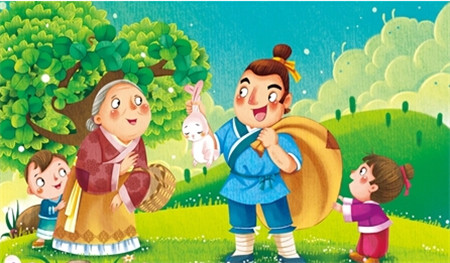
With this gemstone, Hai Libu hunted very easily. He kept the gem in his mouth and could understand the language of the birds of the air and beasts of the field; he knew which mountains had which animals. From then on, every time he returned from hunting he shared even more game with everyone.
13_

Things went on this way for many years. One day while Hai Libu was hunting deep in the mountains, he suddenly heard a flock of birds discussing something. He leaned in to listen attentively. The first bird said, “We should quickly fly to somewhere else! Tonight this mountain will crumble and the ground will be submerged by a flood, who knows how many people will drown!”

Hai Libu heard this and was shocked. He hastily ran back home and said to his fellow villagers, “We should quickly move to somewhere else! This place isn’t habitable!” Everyone who heard this found it strange, it was a fine place to live, why should they move their homes? Despite the fact that Hai Libu anxiously urged everyone, no one believed him. Hai Libu shed worried tears and said, “Believe me, we must move quickly! Once night comes it will be too late!” An old man spoke up, “Hai Libu, we all know you would never lie, but you want us to move our homes. You need to explain clearly why this is. We have lived at the foot of this mountain for many generations, there are many old people and young children, moving would not be easy!”
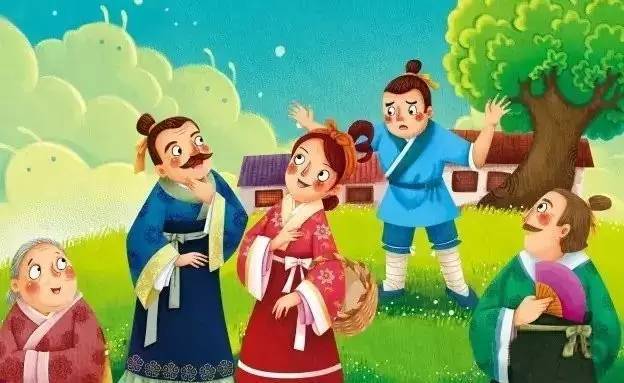
146752685150102788 (1)

Hai Libu knew being worried was no use, he couldn’t give a reason for the move, and everyone was skeptical. If he wanted to rescue his fellow countrymen, he could only speak the actual truth! Arriving at this realization, he calmly said to everyone, “Tonight, this mountain will collapse, and a deluge will flood the ground.” He went on to explain how he had gotten the gemstone, and how he had overheard a flock of birds discussing taking refuge, as well as why he could not tell anyone else the information he heard, he told them the whole story. Just as Hai Libu finished speaking, he turned into a lump of hardened stone.
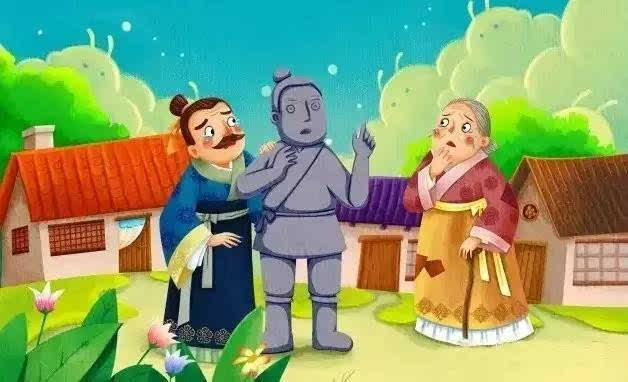
146752685157148760

Everyone was very remorseful, holding in tears, and remembering Hai Libu’s name, helping the elderly and leading the children, driving the livestock, they left for a far away place. While they were walking on the road, suddenly black clouds densely filled the sky, a fierce gale roared, and after that it rained a downpour. At midnight, there was a sound that shook heaven and earth, and the mountain had a landslide, and the rushing flood waters inundated the village where they lived. Hai Libu sacrificed himself in order to save his fellow villagers, and the people from generation to generation cherish his memory.

Once again, if you’d like to watch an animated short of this story, I have found a link! You can see it’s a different animation style than the pictures I chose, and that’s because there a a lot of different renditions of these famous stories.


The Eight Immortals Cross the Sea

Legend has it that a very long time ago there were eight Daoist Immortals. Separately, they are Tieguai Li, Han Zhongli, Zhang Guolao, Lan Caihe, Lu Dongbin, Han Xiangzi, He Xian’gu, and Cao Guojiu; together they are Ba Xian, the Eight Immortals. They behead goblins and drive out monsters; they eliminate evil and promote good; and they left behind many touching stories.
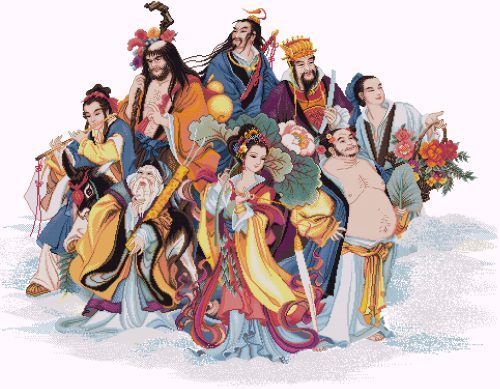
eight-immortals1

Tieguai Li used to be called Li Xuan and he was a Daoist. Originally he was tall and sturdy, with a majestic appearance, he practiced Dao in the caves of Mt. Dang. One time, he sent his spirit out to go to Mt. Hua and visit the great teachers Laojun and Wanqiu, but when he returned to his body it was unexpectedly destroyed, and he had no choice but to use the body of a recently dead beggar brought back from the grave. He didn’t expect that the beggar would have an ugly face or a lame leg. He had to carry around an iron crutch and rest his leg on a cloud while travelling the four seas. He came to be called “Tieguai Li” or Iron-Crutch Li.

During the days of the Eight Immortals, Zhang Guolao would always ride around on a donkey. It is said that his donkey could walk thousands of miles in a day, and when they stopped, he could fold it up like paper. Han Zhongli was originally a general in the army, but since he lost in battle, he went into hiding deep in the mountains to practice austerity and become a Daoist Immortal. He always bares the the skin of his belly, waves a fan in his hand, and is smiling and laughing with an expression of good fortune. Pure Yang Master Lu Dongbin looks like a scholar and carries a double edged sword on his back. The sword gives off a bolt of divine light that can scare monsters away. 

He Xian’gu is the only female immortal among the Ba Xian. She carries a Lotus in her hand, and is slender and elegant. Lan Caihe often carries a flower basket which is overflowing with sweet smelling flowers in all seasons of the year. Han Xiangzi is the grand-nephew of the great Tang Dynasty poet laureate, Han Yu and carries a reed flute in his hand. Cao Guojiu’s device is a jade tablet. Legend has it that the sound of the jade tablet can make all things between Heaven and Earth peaceful and calm.
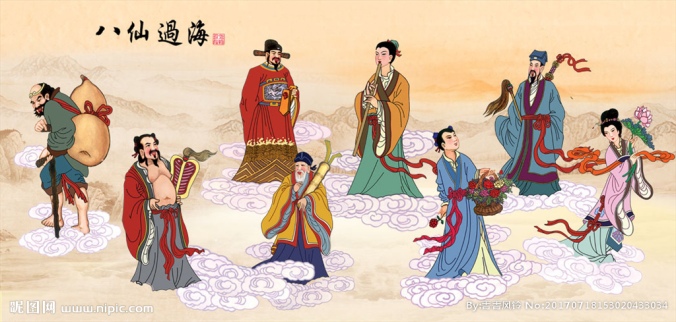
11042765_153020433034_2

Left to right: Tieguai Li, Han Zhongli, Cao Guojiu, Zhang Guolao, Han Xiangzi, Lan Caihe, Lu Dongbin, He Xian’gu

One day, the Eight Immortals were riding on the clouds to go to take part in an assembly of immortals across the Eastern Sea. Lu Dongbin said, “Riding clouds across the sea isn’t really considered a skill of the Immortal School, it would be better if we each used our own special abilities, tread the waves across the sea, and show off our magical power. Do you all agree?” The remaining Immortals voted in favor.

Iron Crutch Li was the first to cross the ocean. He simply threw the crutch in his hand into the Eastern Sea. The crutch resembled a small boat floating on the surface of the water and carried Tieguai Li safe and sound to the opposite bank. Next, Han Zhongli slapped the drum in his hands said, “Watch mine.”, then threw the drum into the sea. He crossed his legs and sat down on the drum and crossed nice and secure across the Eastern Sea.

Zhang Guolao grinned and said, “My move is the most brilliant”, then he took out a piece of paper and unfolded it into a donkey. Once its four hooves touched the ground it looked to the sky and let out a bray, then carrying the seated Zhang Guolao on its back, trotted across the waves. He Xian’gu threw her lotus flower into the water, stood patiently on its face and drifted along the waves across the sea. Soon after, Lu Dongbin, Cao Guojiu, Han Xiangzi, and Lan Caihe one by one tossed their treasures into the sea, and with the aid of those treasures they each showed off their special abilities and crossed the sea.
0

Seven Immortals arrived on the opposite shore, to the left and to the right, there was no sign of Lan Caihe. As it turned out, when the Eight Immortals crossed the sea just then, it disturbed the crown prince, son of the Dragon King of the Eastern Sea. He dispatched the shrimp soldiers and crab generals out to sea to look around. Taking advantage of the Ba Xian being caught off guard, they captured Lan Caihe and took his flower basket.

Lu Dongbin couldn’t find Lan Caihe, he became worried and upset. He hollered in a loud voice toward the Eastern Sea, “Dragon King, listen up, hand over Lan Caihe right now or else you will feel my wrath!” The Dragon Prince heard this and became excited and angry and rushed up to the surface of the sea to let Lu Dongbin really have it. Lu Dongbin drew his double-edged sword and sliced the air. Afraid, the Dragon Prince sank back down to the sea bed.

Lu Dongbin was unwilling to let him go. He pulled his fire gourd from his pocket and burned the Eastern Sea into a sea of fire. After that, the seven immortals each made use of their powers, going forward to fight, cutting down two of the Dragon King’s sons. The shrimp soldiers and crab generals were unable to hold them off, and one by one were defeated and hid in the seabed. The Dragon King of the Eastern Sea saw his own sons die, flew into a rage, and called on the Dragon Kings of the South, North and West Seas to work together to overturn all of the water in the world into one huge tidal wave and crash it onto the Immortals.

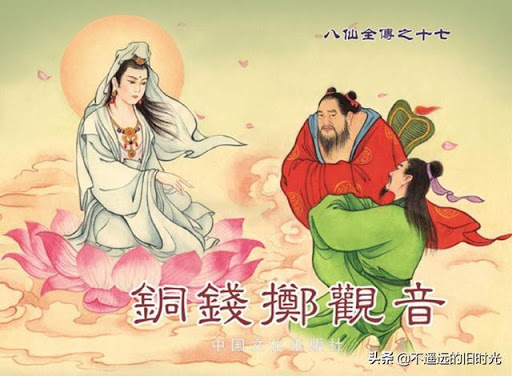
At that critical moment, Cao Guojiu used his cherished Jade Tablet to open a path before them and the giant tidal wave went around them on both sides and receded. The other Immortals followed Cao Guojiu precisely and arrived unharmed. The Dragon Kings of the four seas quickly gathered their armies for war. They were about to launch a fight to the death. But just then, the Bodhisatva Guan Yin passed through the South Sea and yelled at both sides to stop. She then helped them to settle their differences. Before long, the Dragon King of the Eastern Sea released Lan Caihe and both sides stopped fighting and made peace. The Eight Immortals then bid farewell and went freely and leisurely on to the meeting of Immortals.
unnamed (1)

Note: This is a great example of the syncretism in East Asian religious faiths. Guan Yin is a Buddhist figure, a Bodhisattva is one who came to the edge of true enlightenment, but instead of choosing Nirvana, they chose to stay in the world to help others. On the other hand, the Eight Immortals are Taoist figures. It’s common to see the characters from each religion interacting in stories, and for people to practice rituals and prayers from both.
9 Days in Taiwan 1/2: GeoParks, Butterflies & Temples

I have been told over and over by native Taiwanese and twitterpated Taiwanese tourists that I simply HAVE to go to Taiwan, that it is nothing like China, or possibly it was everything I love about China with none of the Communism. It’s so close to Korea, the flights are easy, but the weather is hard. In January 2019 I had a spare 2 weeks before I would meet my friend for our whirlwind Middle East tour. It seemed like a great chance to finally see the Ilha Formosa. The rest of the holiday that winter was so much, I forgot I didn’t write about Taiwan until my Facebook Memories started popping up this January. Faced with an unexpected rainy week on my holidays in “sunny” Spain, it seems like an opportunity to fix that.

I went to three main cities: Taipei, Taichung, and Kaohsiung. I ate more delicious food than I thought could exist on such a tiny island, and I enjoyed local sightseeing, temples, and natural wonders. In the first post, I’m going to give a little historical context and then talk about the natural beauty and the temples I visited. In the second post, I’ll share my more urban tourist experiences and saving the best for last, the food.


A Very Very Brief History

I used to live and work in mainland China (in Jinan, and later Yanjiao, a small town outside Beijing), plus I studied Chinese history, culture and language in university. I knew Taiwan was different, but I didn’t really understand how much.

Taiwan separated from China when the Kuo Min Tang fled there after Mao and the Communists took over mainland China in 1949. China under the KMT government was part of the Allies in WWII. We gave them money to fight the Japanese, but they ended up using it to fight the communists, and still lost. Most of the Western World didn’t recognize the communist government of China until the 1970’s. We were busily still supporting the Taiwanese government as the rightful government of all China.

A few countries at a time slowly came to realize that the communists weren’t going anywhere, and then Nixon had his famous visit to Beijing to stand on the fake Great Wall and show solidarity and that was pretty much it. Since then, China insists that Taiwan is a part of China and everyone just sort of humors them. We make separate treaties and trade agreements, plus Taiwan has a different language, flag, currency, government and legal system from mainland China…. but, ONE COUNTRY! (says China)… Taiwan is starting to disagree.

Of course Taiwan has a strong Chinese identity and history, but it diverges sharply at 1949. At the end of the Civil War, the KMT retreated to Taiwan and the Communist (Mao) government claimed the mainland. Mao’s government worked hard to erase a lot of history in order to position the Party at the top and center of all life in China. It was huge disaster and tens of millions of people died from persecution and starvation. Plus temples and relics were destroyed or stripped of decoration and re-purposed as Party business community halls. Some time in the 80s, the government went “oops” maybe we need history after all, and started rebuilding both physically and narratively. Therefore almost everything you see nowadays in China is a reconstruction, and the few practicing monks and nuns in the temples are there under very strict observation because someone told China that civilized countries don’t murder all their religious leaders. (most of the literature on this is academic research and NOT readily accessible in Wikipedia, you can take my word or you can go ask a Chinese Studies scholar). Although, now with Hu… who knows?

Taiwan, on the other hand, continued the Nationalist traditions that were started in the 1911 Xinhai Revolution that finally eliminated the monarchy and established a “people’s” government… although arguably back to the Boxer Rebellion because everyone was so fed up at those Royals supplanting Traditional Chinese Culture™ with Western European goods and values… and opium…The point is that the KMT were basically in favor of traditional Chinese culture, where the Communists were pretty opposed. So while mainland China went through this holocaust level cultural purge (The “Great Leap Forward” followed by what is still referred to as the “Cultural Revolution” which makes it sounds like hippies dropping acid and doing free love), Taiwan and other Chinese communities in Asia (Malaysia makes this super ovbs, too) were continuing to move forward with a more normal level of cultural changes influenced by post colonialism, globalization, and technology just like everyone else.

2000 years of shared history, followed by 60 very divergent years brings us to the ‘same but different’ cultures of mainland China and Taiwan. So while China firewalls out anything it doesn’t like and creates its own online reality, arrests anyone who dissents, and sends religious or sexual minorities to reeducation camps, prisons, or organ harvesting factories, Taiwan is a proud democracy that legalized same sex marriage last year. While that sounds a little behind to most westerners, its stunningly progressive for Asia. They were actually the first country to do it.

Lastly, a quick note on the spelling. Mainland China adopted a variety of romanization (“roman” letters, like the ones you are reading now) called “pinyin” while Taiwan used the older form Wade-Giles. Some brief examples (minus tone marker): Beijing /Peiking, Gaoxiong /Kaohsiung, Deng Xiaoping /Teng Hsiao-p’ing, Guomindang /Kuomintang. Although now-a-days a lot of things in Taiwan are romanized in Pinyin, those places which were internationally codified with Wade-Giles spelling still remain. Pronunciation remains a challenge for those who have not studied the language because neither system is intuitive for English speakers. (try typing the pinyin spelling into Google translate to listen).

Natural Wonders:

Taipei:

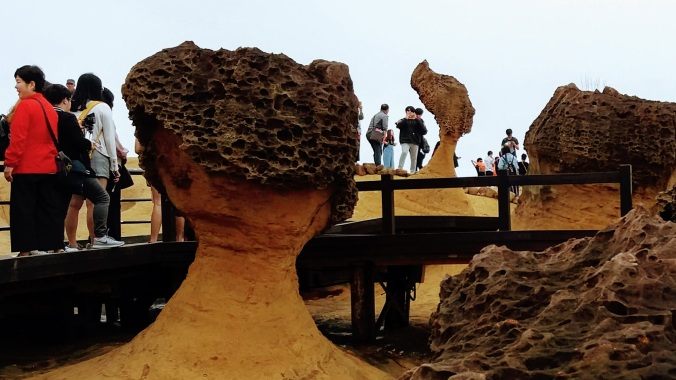
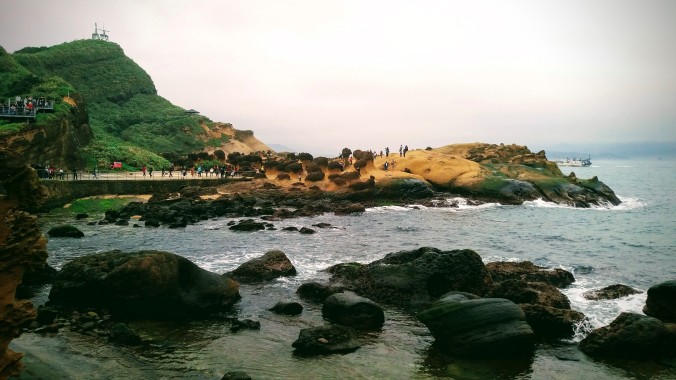
Yehliu Geopark 野柳地質公園

20190111_100303-EFFECTS

This was part of a package bus tour I took, but honestly, if I ever go back to Taipei, I want to take the public bus out here and spend a whole day at this park. This website has some very nice English language explanations about the rock formations and erosion patters, if you’re curious.

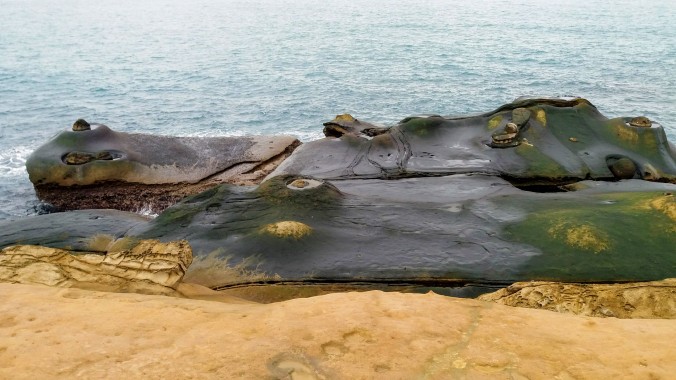
I do love the science, but I have to say that I, like most of the visitors, was more enchanted by the fairy-tale like shapes that these rocks have come to embody. When I arrived, I got a little pamphlet showing the most famous formations. It was a little bit like a scavenger hunt trying to find them all, and I kept getting distracted by not at all famous, but still amazingly beautiful rock formations like joints and fossils all around.

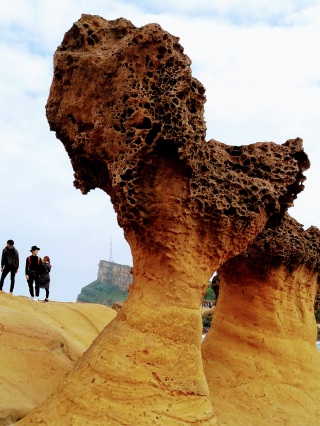
The most famous rock is the Queen’s Head, which you may have seen on listicles of “cool things to visit”. The line to get a photo from the best angle was insane, and because I was in a tour group, I had to choose between standing in line for the famous rock, or going to see all the others. Still, I got a glimpse of Queens Head rock from the queen angle by wheedling past the line creatively (really the line is for people who want to pose with it, you are allowed to take a picture from anywhere). In case you can’t tell, it’s the one in the background that looks sort of like woman’s head with an updo or royal headdress.

20190111_101008

The park is well aware the Queen is their biggest draw, and that it is eroding a little more every year. It won’t be long before her neck erodes entirely and she becomes Marie Antoinette instead. To maintain tourism, the park has named a new “Cute Princess Rock” which is shaping up to become the main attraction when the old queen dies.

20190111_104150

Other rock formations I found include the Elephant Rock & The Pineapple Bread Rock. Pineapple bread is just cut to look like a pineapple.It doesn’t taste like and isn’t made with pineapple (unlike pineapple cake which is, but looks like tofu squares).

One little island turned out to contain at least 3 of the targets: the peanut rock (far left), the fairy shoe (about 3/4 on the upper right, kind of looks like a sandal) and the pearl, or globe (far right, the lower sphere, yeah, I know there’s like 4).

20190111_102124

Our tour guide challenged us to find a particular rock and take a photo of it that matched the angle in the brochure. The angles of these rock formations matters quite a bit. The queen doesn’t look like a queen from any other angle (see below). In this case it was a gorilla, and you had to walk all the way around to the side facing away from the path to see the illusion. Most people were taking photos through the hole in the rock without ever realizing they were at the gorilla! (I won the scavenger hunt).

Looking at the brochure and the website, it’s painfully obvious I saw only a tiny part of the park, and I had a very limited time to try and find and appreciate these unique formations. I’m glad I had the opportunity, but a full day return is on the top of my list for a second visit to Taipei (right behind the food).

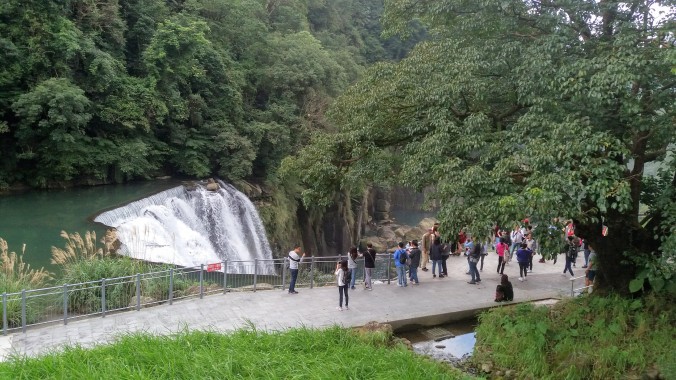
Shifen Waterfall 十分大瀑布

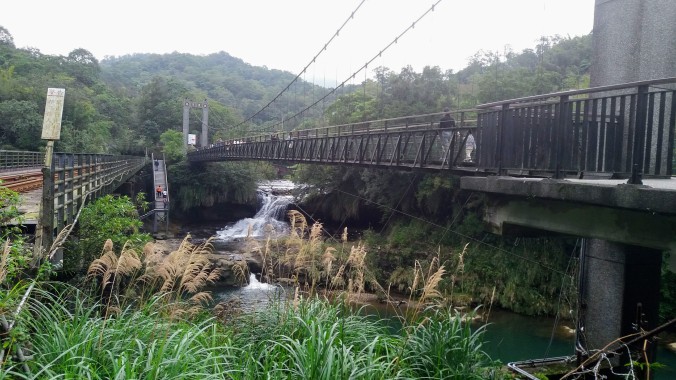
This was a short stop on the same all day bus tour. To be honest, I’m not sure it would be easy to get here on public transit, so a tour to Shifen might be the only way if you aren’t renting a car. We were pretty rushed at this stop, and the waterfall itself is a medium length walk from the car park with lots of stairs and long bridge.

20190111_124749

I felt a little like I was playing tag with the scenery. I just about had time to get there take some pics, stare longingly at the cool water for a couple minutes and hike back to the bus. There is nothing “cold” about winter in Taipei. I saw pictures online of people in the snow, but I think it must be a real rarity. Locals did tell me the weather on my visit was unseasonably warm, but rushing around the geopark and speeding through the countryside to see the waterfall had me soaked in sweat.

20190111_125304

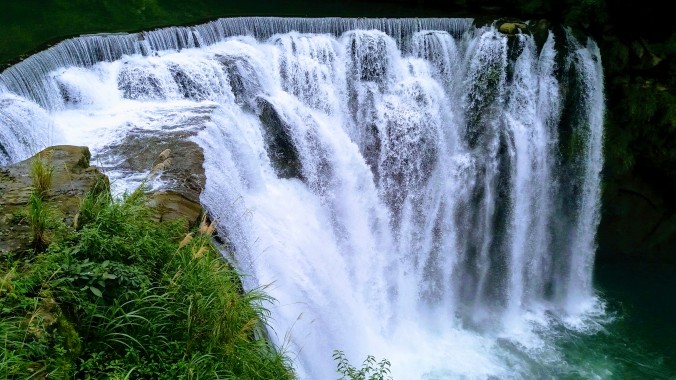
Nonetheless, it is a remarkable waterfall. No mere trickle through the rocks as far too many advertised waterfalls can turn out to be, this was a broad and strong roaring fall. If you are lucky enough to have more than 20 minutes here, there are also several restaurants and picnic tables where you can enjoy the waterfall over lunch.

20190111_125534-EFFECTS

Kaohsiung:

I actually only included Kaohsiung in my travel plans after I read that one of the only sites of mass butterfly migration was near there and was going to be happening during January (when I was traveling). Like waterfalls, butterflies are an irresistible draw for me. I do enjoy a butterfly park, where many species are raised for ecological conservation or just because they’re pretty, and visitors can walk through a mesh enclosed garden to see them, but I also treasure butterflies in the wild. It always feels like a tiny little brush with magic when they pose for me.

Maolin Butterfly Trail 茂林賞蝶步道

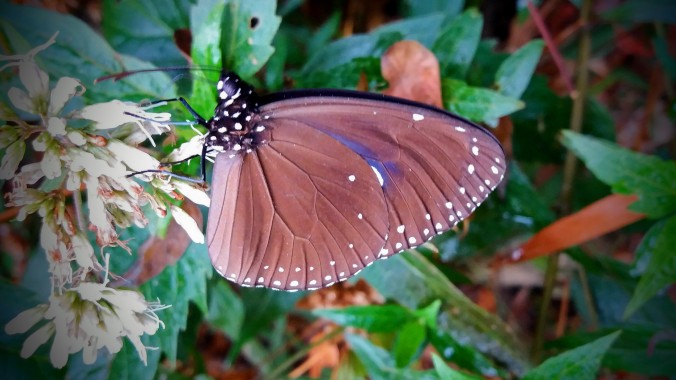
Thus, when I read about the mass migration of the purple crow butterflies I was very excited. There are only two species in the world that overwinter en masse in a valley like this, and the other is the monarch. I’d seen beautiful footage of the monarch masses in Mexico (not open to tourists, btw, to protect the butterflies) and while the articles I read warned me not to expect anything so profuse, it is still the second largest natural gathering of butterflies in the world. I had to go.

I did a lot of research to prepare. Optimal butterfly viewing is 8-11am, but the buses don’t run that early. I actually emailed with the park about this. The best public transit option from Kaohsiung is to take Kaohsiung Bus E25 & E28 (Kaoqi Express) to Qishan and then change to H31 (Qishan-Maolin-Duona) (website link) The problem is the distance and time. The E25 takes just over 3 hours, and then you wait for one of the 6 daily buses to Maolin park entrance and ride another 45-60 minutes. Both E25&28 don’t run before 7am. Nothing gets you to Qishan early enough to reach the park entrance before noon. I also looked into hostel, b&bs or other options closer to the park, but even searching in Chinese with my not entirely terrible language skills, information was scarce. The few places I found online couldn’t take reservations online and were not on the shuttle bus route in any case.

To make matters even more complicated, there was an earthquake in 2005 which decimated a lot of that area, but there’s not a lot of information on what is or isn’t still functional post quake.

I could have just bused in and arrived at noon, and taken my chances the butterflies were not all having their afternoon nap, but I wanted masses of butterflies. I looked at videos as recently as two days before my arrival in Kaohsiung and saw them fluttering all over the roads. In some places, roads were even being shut down to protect the butterflies! So, I booked myself a car to drive me there at the very crack of dawn. I used a company called Tripool, and instead of a 4-5 hour bus trip for 5$, I had a 1 hour car ride for 35$. If it had worked as planned, I still say it would have been worth it.

I had been watching the weather forecast like a hawk, but it was barely reliable in the city and there was next to no data about the mountains. Several days of weather patterns led me to hope that a gray misty early morning would burn off into a sunny mid-morning, so I bundled myself in the car at 7am and headed to the Taiwanese countryside.

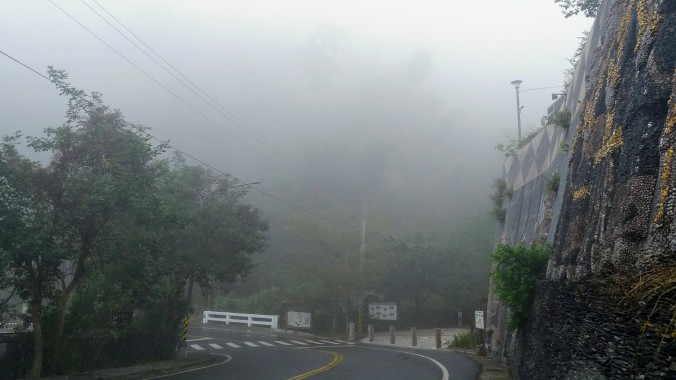
When I arrived, the weather was still terrible. The car I hired dropped me off here.

20190116_081239

I found what looked like the trail head which had lots of signs about trails and how to spot the butterflies, but they were old and dirty, like no one had used them in years. You don’t know how unsettling it is to be in this kind of fog filled emptiness and see signs that are obviously new (it has a QR code for heavens-sake) but look like they’re from some kind of post-apocalyptic survival film.

20190116_081443

It turns out the reason is that no one HAD used them in years. The original structures from before the earthquake had just been abandoned. Eventually, I found the actual visitors center, which made me feel a lot better. The people there said there wouldn’t be any butterfly activity that day, but the weather outlook for the rest of my time in Taiwan didn’t look any better. Plus, it was 4 hours until the next bus out of town.

I watched a movie about the butterflies with a group of school children on a school educational trip. I didn’t understand that much, but it was mostly fun to watch the kids react to the video (and to me). After that, I decided to hike the trail despite the weather.

20190116_092716

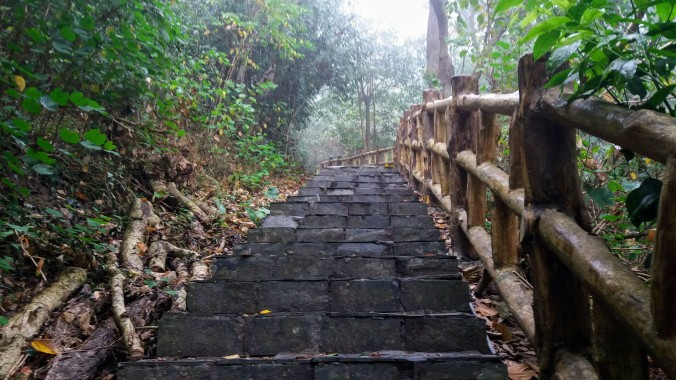
I climbed stairs for hours and saw zero signs of butterfly presence. My photos from the hike look like they should be eerily silent, but the music from the cafe could be heard pretty much all over the trail, and despite the terrible weather, there were a significant number of other tourists out here chattering away. 

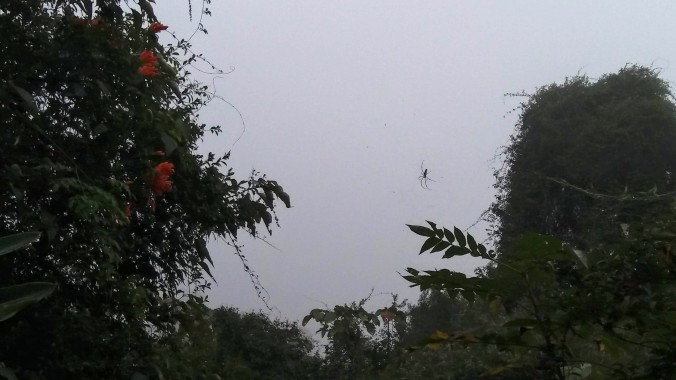
Although I found no butterflies for most of my hiking time, I did find plenty of interesting things. There were adorable snails who thought the rainy atmosphere was perfect. There were beautiful tropical flowers, flourishing in the warm winter air. And,  there was an army of giant spiders. I experienced the summer spiders in mainland China, and to a lesser extent in Korea. These are monsters who build webs that are several meters across. I am not kidding or exaggerating. These suckers are like 5cm not counting legs.

Honestly, I rarely see them quite that big in Korea… at least in the cities, and they are really good about not ever coming inside houses, and about building their webs where people aren’t likely to walk. I don’t think they’re considerate, just that it’s a lot of effort to make an enormous web, and they don’t want us to smash it.

The spiders in Maolin think 5cm body length is scrawny. If I was not familiar with the species behavior, I would have totally freaked out. Luckily I know from experience, they are not interested in me. They don’t want to put a web across a path. They will not drop on you from above. That last one is really relevant since, to avoid the humans, a lot of them just built their webs about 10ft up. Where they can catch birds.

20190116_105939

To be honest, I was really surprised there were no butterfly corpses in these webs. And, however intimidating these spiders can look, the webs in the mist and rain were beautiful jeweled works of art.

After a couple hours of meandering, I finally found some butterflies. I saw maybe 20-30 the whole day, and only one close enough to photo. It was a far cry from the hundreds or thousands I had been hoping to see.

20190116_105231

It is awfully beautiful there, but I really wish I could have seen it in action. Just in case the Taiwanese government was exaggerating, I did check the live video feed and some Instagram filters from sunnier days, and it looks like it really is a little fairy land. Next time, I will have to watch the weather more carefully and be ready to rush to Kaohsiung at short notice. The good news is, it’s only a couple hours from Taipei to Kaohsiung, so I won’t have to stay there waiting (Taipei has better food, sorry Kaohsiung), but I will have to have a more flexible plan.

Temples

Taoism (pinyin: Daoism), Confucianism and Buddhism are considered the three main “religions” of China. Taoism is mainly a mix of local folk practices that consolidated after the introduction of Buddhism. It has a LOT of gods and spirits and ancestors and immortals and magic animals. The main goal of Taoism is immortality (although there is a split on whether that means corporeal or spiritual), but you can pray to any of the gods for help with more mundane stuff like health, marriage, or passing your driving test.

Buddhism, often heard of but rarely understood, is a spiritual practice without any gods. Buddhists search for Enlightenment and subsequent freedom from this world which is both an illusion and full of suffering. This takes a few hundred (thousand) lifetimes, so in the mean time a lot of people pray to the boddhisattvas (a little like saints?) for the same mundane stuff they ask the Taoist gods for.

Confucianism is more a total package social structure than a “religion” but it does incorporate a certain amount of ritual and spirit oriented behavior and a very clear “how to live” guide, though not a lot of praying for mundane stuff. To be even further removed from the Western traditions, a lot of people don’t choose just one, but rather go to whichever will serve an specific purpose at a time. They simply aren’t viewed as exclusive “truths”. Honestly, almost nothing we associate with “religion” in the western traditions applies to any of these, but until we have a better word, here we are.

Taipei:

Dadaocheng Cisheng Temple 大稻埕慈聖宮天上聖母 (Taoist) is dedicated to the Tianshang Shengmu (Heavenly Holy Mother), the guardian of sailors and also known as Mazu or Tianhou (Empress of Heaven). It is in the midst of an “eat street” and even has a dining area in the temple courtyard. Far from being serene and heavenly, it is quite lively and bustling.

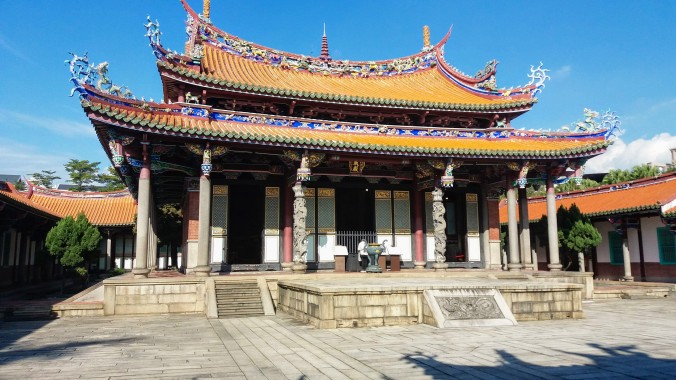
Taipei Confucius Temple 臺北市孔廟 is more of an interactive educational experience than a holy place. It’s not surprising as Confucianism isn’t really a religion. The scholar Confucius (Kongfuzi 孔夫子) was more interested in the smooth running of things on the earthly plane than the spiritual one. Rituals were an important part of a social order for him, but he didn’t spend much time speculating on any gods or spirits.

20190110_134100

The entire compound is beautiful, but more that that, you get a wonderful English language detailed explanation of the meaning and purpose of each hall (which, under other circumstances I might have transcribed off the brochure, but I feel like you’ve had enough education for one post), a truly early-tech 3D film explaining the history of Confucianism and it’s modern interpretation (it was so campy it was fun) and interactive displays for the six Confucian Arts that Confucius considered vital for any civilized person in a civilized society: Calligraphy, Music, Archery, Charioteering, Computation (math), and Rites (religious, political, and social ceremonies).

20190110_134708

It was a big contrast to the Confucian temple I visited in Beijing which was a beautiful monument with little to no explanation as to it’s historical function. Plus, where Taiwan still teaches pieces of the 6 arts in schools and even holds some public Confucian rites today, the mainland has subsumed Confucian values into the Communist Party Line.

20190110_133831

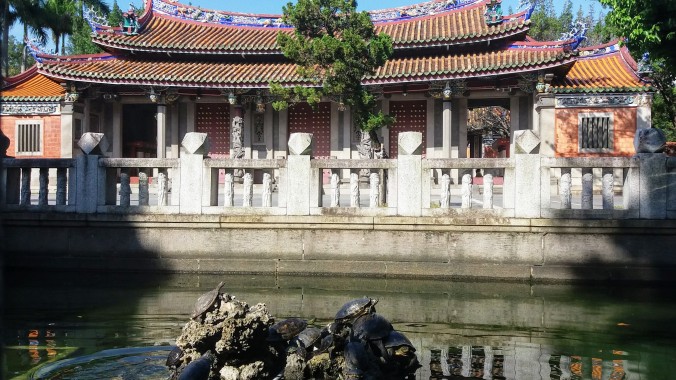
Dalongdong Baoan Temple 大龍峒保安宮 (Taoist) is dedicated to Baosheng Dadi (Great Emperor Protecting Life). It claims to be the oldest temple in Taiwan, or at least the oldest Chinese temple. (Yes, there were indigenous people living in Taiwan before the Han ethnicity mainland Chinese people arrived many centuries ago). It’s been restored many times over the years and is now an important heritage site. There’s several stunningly decorated buildings, as well as beautiful gardens with statues of famous Taoist stories, and a dragon in the lake. I especially enjoyed the tile work of the roof dragons on these temples which is distinct in both color and style from the mainland.

Kaohsiung:

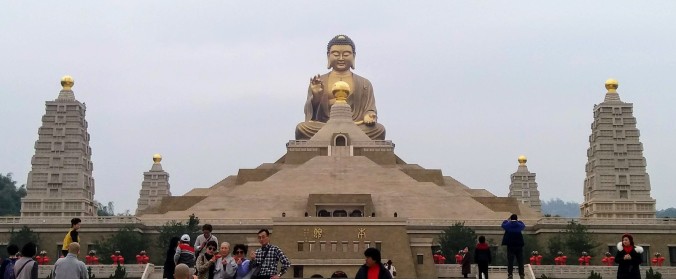
Fo Guang Shan Buddha Museum 佛光山佛陀紀念館 was disturbingly hard to get to, but thankfully I can read bus timetables in Chinese. It probably would have been easier if I’d been coming direct from the city, but I was coming on my way back from the Maolin Butterfly Park. I also missed the last buses returning to the city, but it was ok because I was able to share a car with some other travelers. I don’t think it’s necessary to do this with a tour company, but if you aren’t at least “survival” level in Mandarin, then perhaps plan better than I did.

20190116_154719

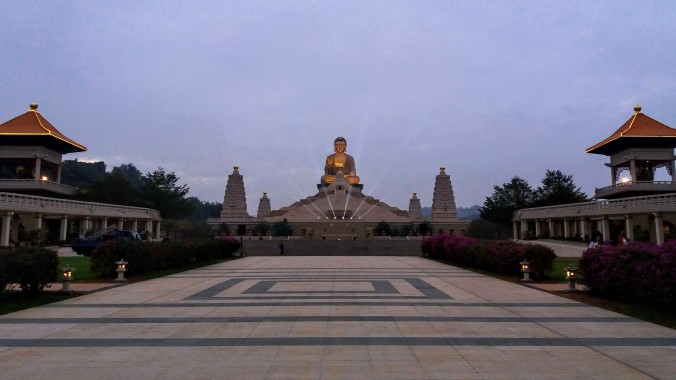
Fo Guang Shan is a global sect of Buddhism which started there in Taiwan at the largest monastery in Taiwan. It really is huge, and not only the enormous statue of the Buddha, but the sprawling grounds filled with gardens, exotic birds, and more beautiful statues than you can count.

The grounds are divided reflect the three treasures: sangha (community) where the monks and nuns live, study and work; dharma (teachings) where scriptures (sutras) are housed and ceremonies held; and the Buddha (the teacher) where the famously enormous statue rests at the end of the majestic walkway.

20190116_164527

20190116_152053-PANO

I think most people come for the third part, and honestly, that’s why I was there. I just took a “wrong” turn at the entrance and found myself walking all the way over to the Sangha, and then meandering back through the Dharma, before finally getting to the Buddha in time to for most of the tourists to leave and for the lights to come on.

20190116_173639

Their website is everything you would expect elderly monks to have created, but if you want to learn more about Fo Guang you can visit. Also, the museum’s website reflects a more worldly involvement and may be more palatable to the modern internet consumer as well as more helpful to the hopeful visitor.


That’s all for part 1. Thanks for reading! I hope you enjoyed the historical and natural side of my Taiwan trip. Next time, I’ll write about the more modern aspects including the “old streets” for tourists, a medieval style castle made by an eccentric millionaire, flowers, light shows, street art, and of course what Taiwan is best known for: the food.