In an attempt to organize my adventures in Tours, this is the 3rd of 4 posts about the city, and it features three of the châteaux in the Loire Valley. There are so many châteaux that there are top ten best châteaux near Tours listicles. Tragically, most of them are not especially convenient to public transit as they were all originally designed to be exclusive country estates. Happily, my school arranged some field trips.
One thing I’m learning while doing follow up research on my visits is that many of these historical sites now have extremely thorough virtual tours with professionally taken photographs where each plant is in peak season and the weather is ideal. There is no way that my photos can objectively compare, and while I may treasure my own photos more than those on a website because they come to me with the memory of me physically being there, I can’t actually think of a reason for any reader to prefer my photos to those professionally taken at the site. My story may be unique because I will not simply tell you the history of a place, but rather my experience of being there and learning that history, but unlike many places I’ve been where I can find little if any information, or even in contrast to when I first came to France in 2015, the museums and historical monuments in France are extremely well documented.
So, if you’re here and you want to read about my personal experience with these places, then thank you, but also, if you want to know more or see the locations at their absolute best, then I recommend the virtual tours (links below).
Château de Villandry (virtual tour link)
My school host and ersatz guide advised us that the interior of the château is nothing special, and we all agreed we would focus our trip on the gardens. To begin, we actually went up inside the château to climb a creaky staircase to the upper wall and get our first panoramic view of the gardens below. I was quite grateful for this since the website features some very stunning drone photos of the grounds which are planted in elaborate patterns best observed from above.


My guide explained briefly about the history of the design of the gardens below (and since he’s also the of our French language school, he did it in French (albeit very simple French) to help us learn. I double checked my understanding by taking photos of the informative signs and reading the website, but I actually caught most of it. Yay, learning!
Villandry traces it’s origins to the 11th century Colombiers Fortress, but the modern edifice and grounds bears little resemblance to it’s ancestral lineage. The current château is of Renaissance architecture, which means around the mid 1500s. It looks like the first major attempt at decorative gardening was in the 1750s. At that time it was done in the style of a French garden. Then in the 1840s it was changed to the style of an English park. All this time, the property keeps changing hands as well. In December of 1906, a rich American heiress bought the property for her husband, Joachim Carvallo who is responsible for the current structure of the gardens. Later additions were made by their children, and finally the sun garden was added last in 2008.

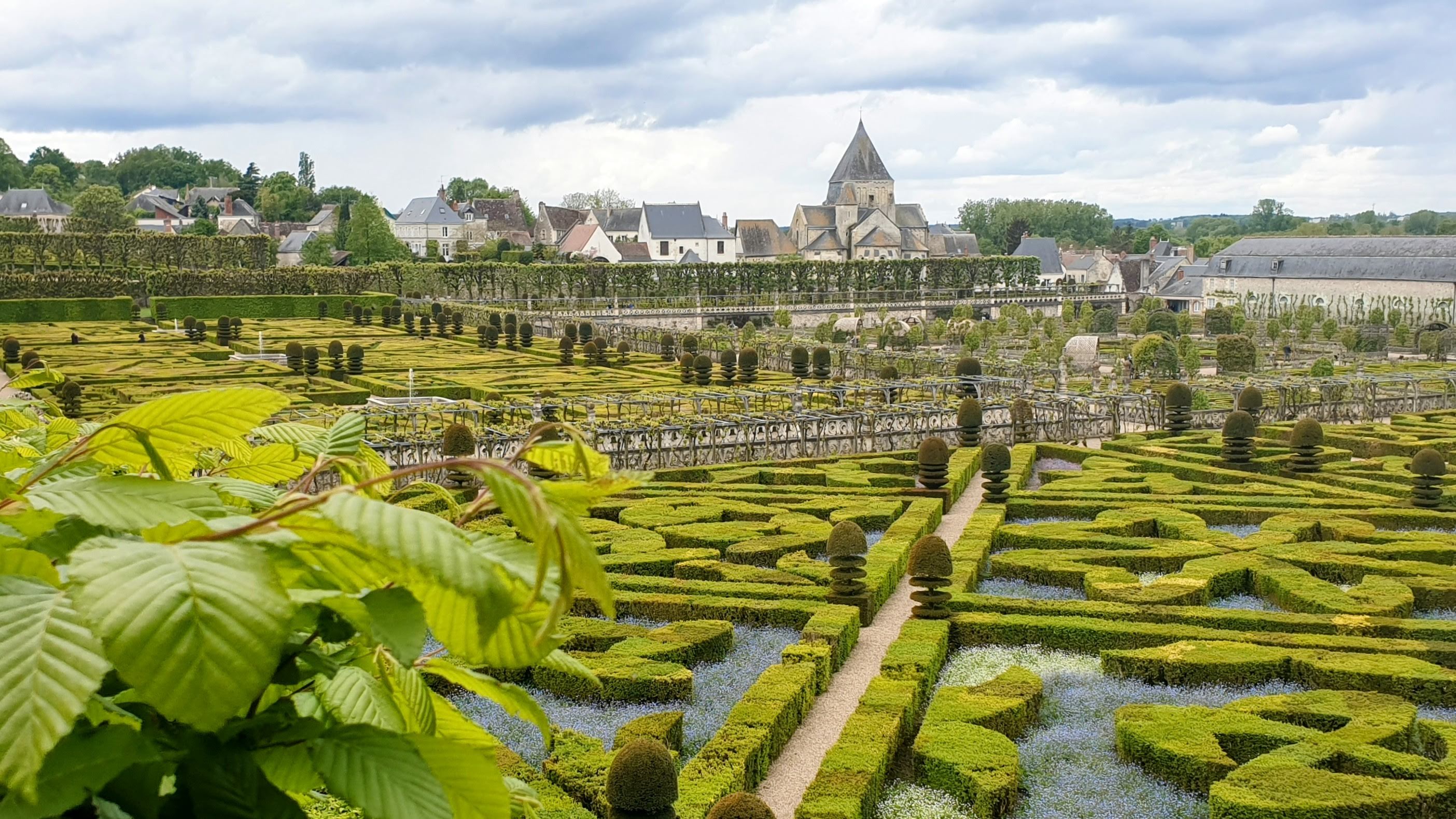
The gardens are immense. The first division splits the area into three sections: the Kitchen Garden, the Water Garden and the Ornamental Garden. The main view from above and the most striking panoramic view is of the Ornamental Garden. The Love Garden represents 4 types of love: Tender Love: hearts separated by flames of love in the corners of the square with masquerade masks in the center. Passionate Love: broken hearts and a tangled maze. Flighty Love: four fans in the corners for fickleness, horns representing betrayed love, love letters. Tragic Love: blades of daggers and swords used in duels between those fighting over a shared love. To the left is the Garden of Crosses with Maltese Cross, the Cross of Languedoc, and the Basque Cross along with highly stylized fleur-de-lis.

I was quite captivated by this entire notion as it was explained to me, and it made me think of the sort of Regency Era period dramas that show high society engaging in all manner of romantic hijinks. I’ve read histories about the way that fans were used to flirt, about the affairs at court, and about the duels. Then I found out the garden was not installed like this until the early 1900s and I realized that rather than a representation of courtly romantic drama by those who lived it, it was a recreation by a historical fan from a later era. I don’t think that makes the gardens less beautiful in any way, but it is interesting to think of the layers of history that go into famous monuments and tourist attractions. Villandry as a property certainly predated, hosted and then survived after the period of courtly intrigue that dominated the century between 1750-1850, yet the current historical restoration and preservations were not replicas of anything that existed at that time, instead created as tributes or memorials.
We moved rather quickly through the so called Water Garden, as it’s main feature is a reflecting pool. The next area we entered on our way was full of flowers hued in shades of purple, blue, and white. When I caught up with my group in the next area, one staged in shades of red, orange, and yellow, my guide explained that these were the moon and sun gardens respectively. I found the sun garden on the website, but no evidence of the moon garden. It was clearly there, but I can’t find it on the webpage. Instead, there’s a whole other space called the Music Room that I have no memory of seeing, nor any photos of it in my cloud.


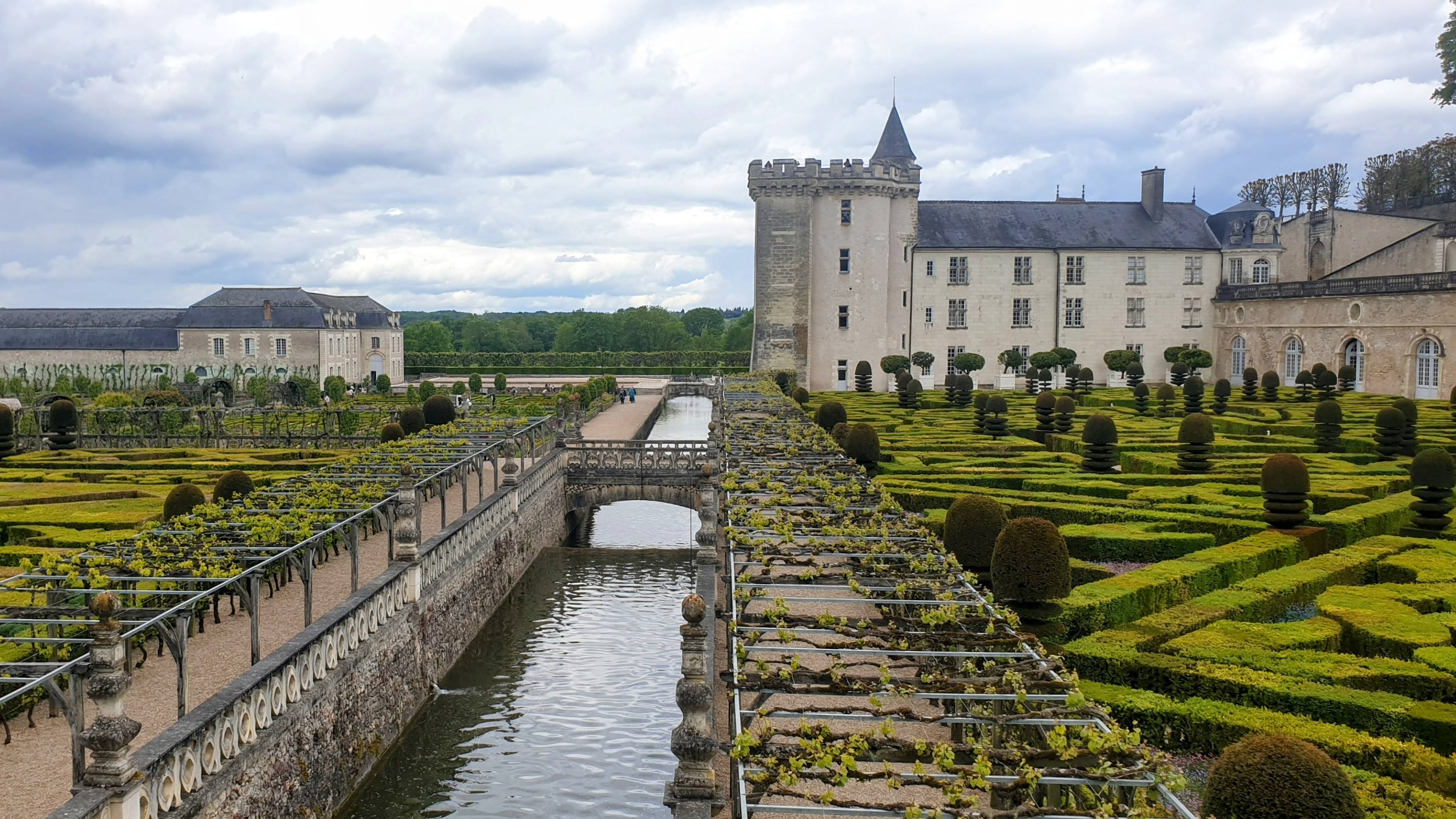
The next main space we walked through was the herbs and medicinal garden, followed by the kitchen gardens. Since it was still early spring, these were a bit sparse, but I was nonetheless enchanted by the geometrical patterns created by the beds for herbs and vegetables. I took a great many photos of the château itself from this angle as well since it looked quite lovely as a backdrop to the gardens. At the time, I felt like we had explored every nook and cranny, but looking a the website afterward I can see there are aspects we did not discover, nor may they have been much worth seeing when not in bloom or harvest.


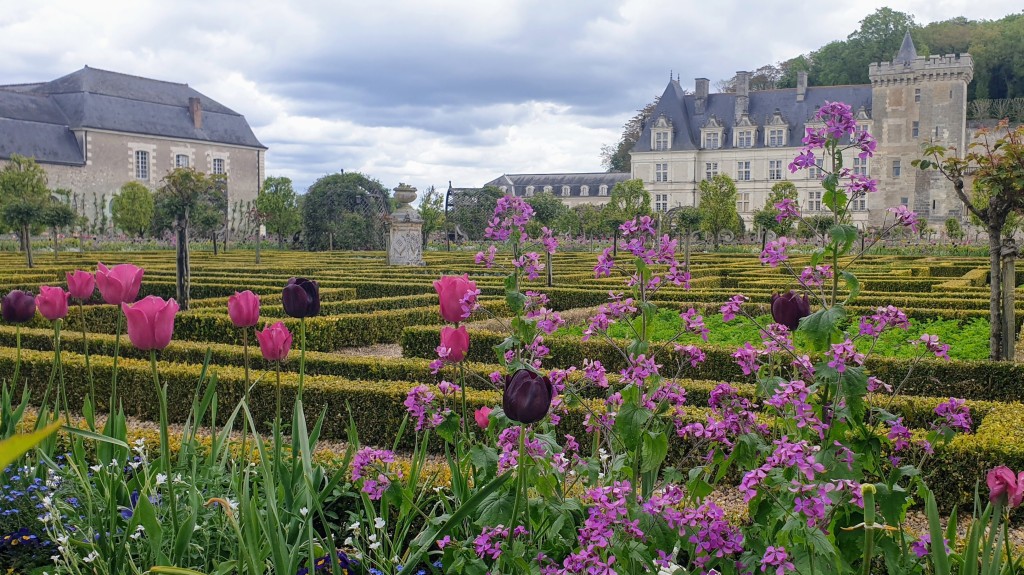

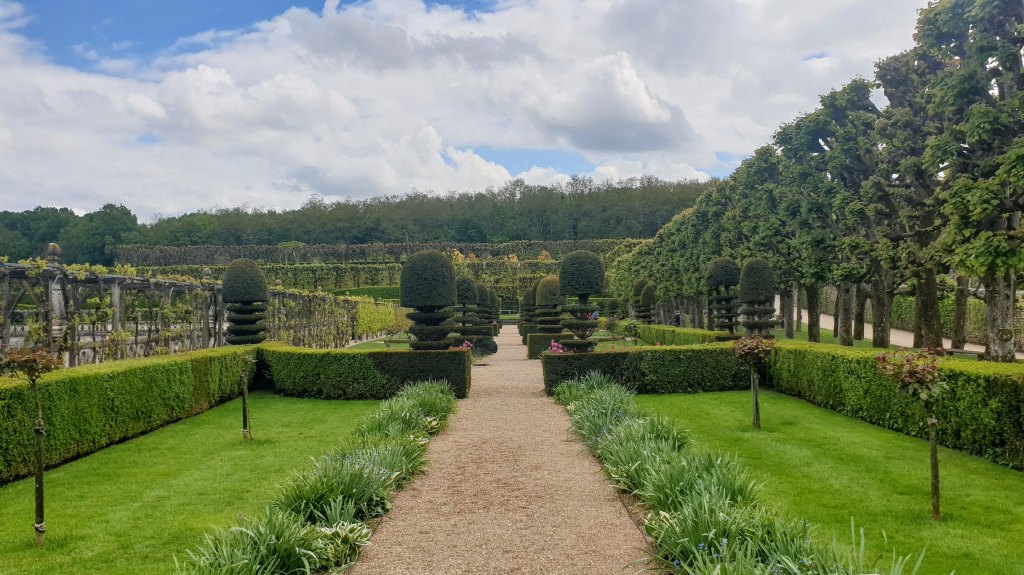
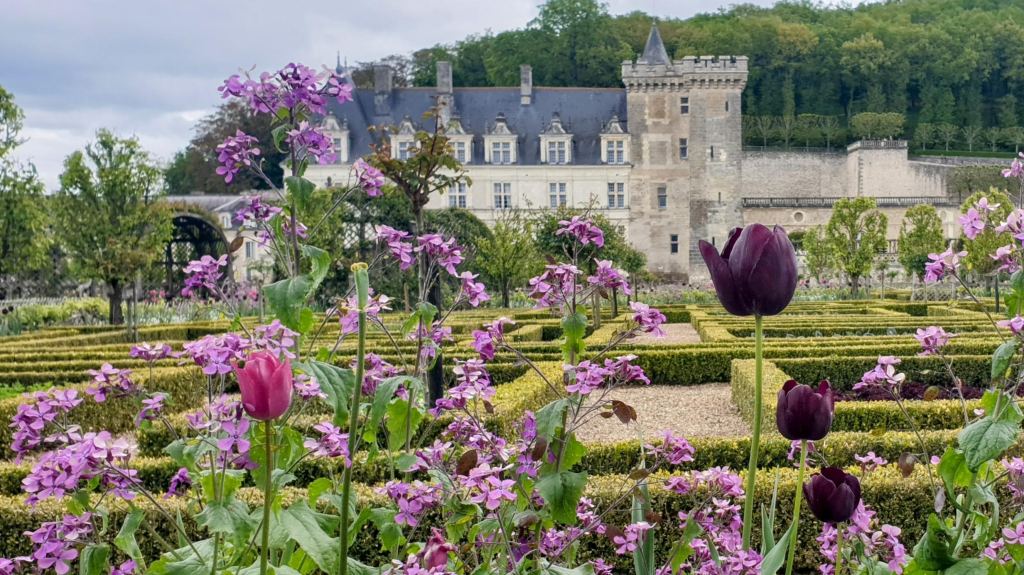


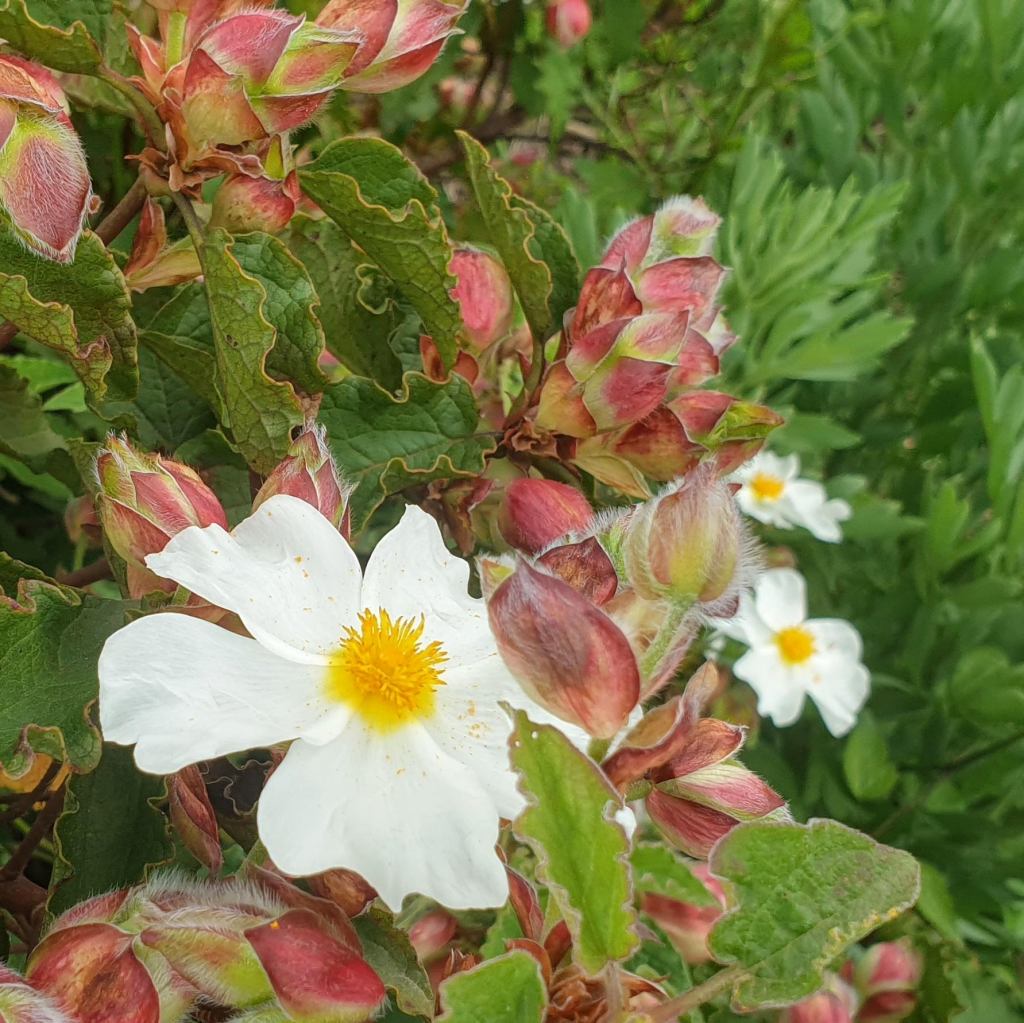
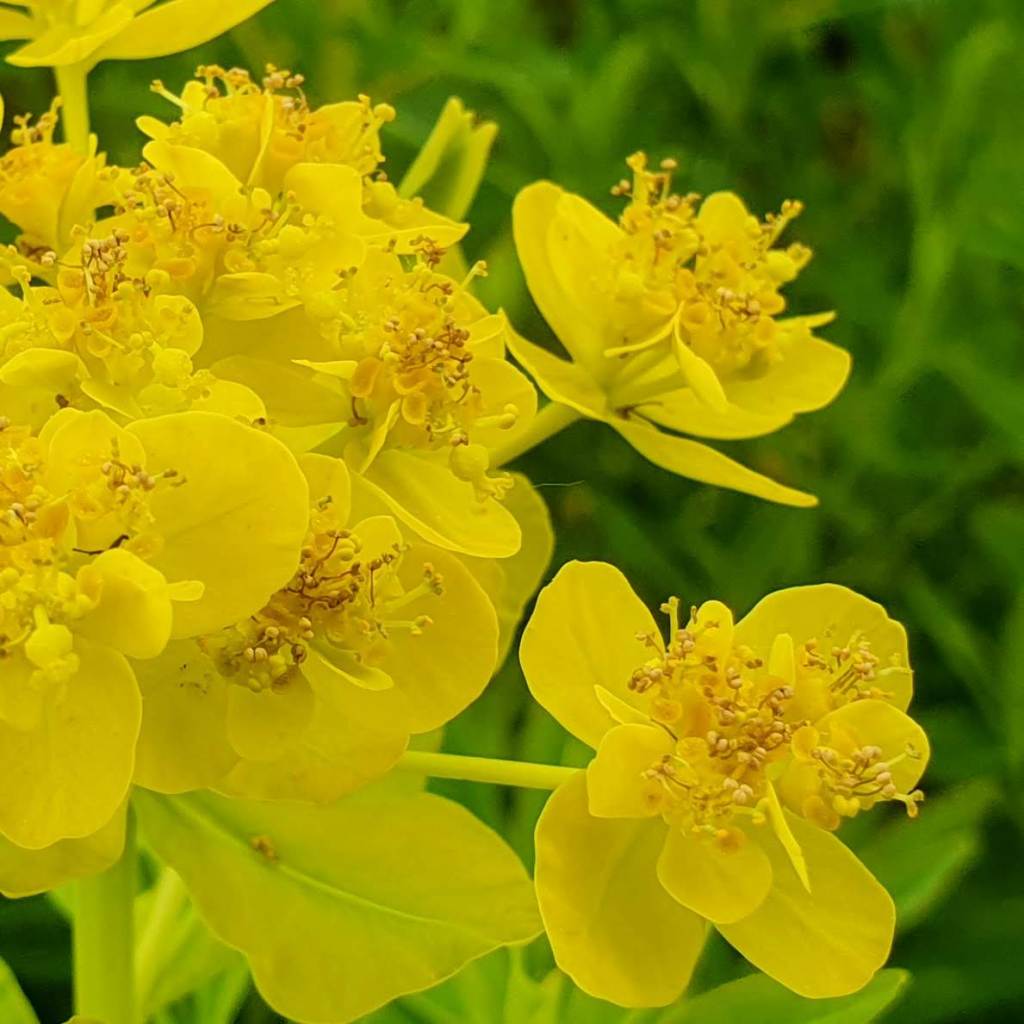
As with many things here in the Loire Valley, an afternoon at the château gardens isn’t about rushing through to see as many sights as you can; it’s about a stroll through a beautiful environment on a lovely day to enjoy the views and the take the air. Though the courtly days are long gone (and truly, I am grateful to live in modern times), there’s something to be said for “taking a turn around the gardens” as though I were a heroine in a Jane Austen novel. I took many photos of the flowers in bloom, so if you love flowers, check out the slide show below!




Château d’Azay-le-Rideau Castle (the virtual tour link)
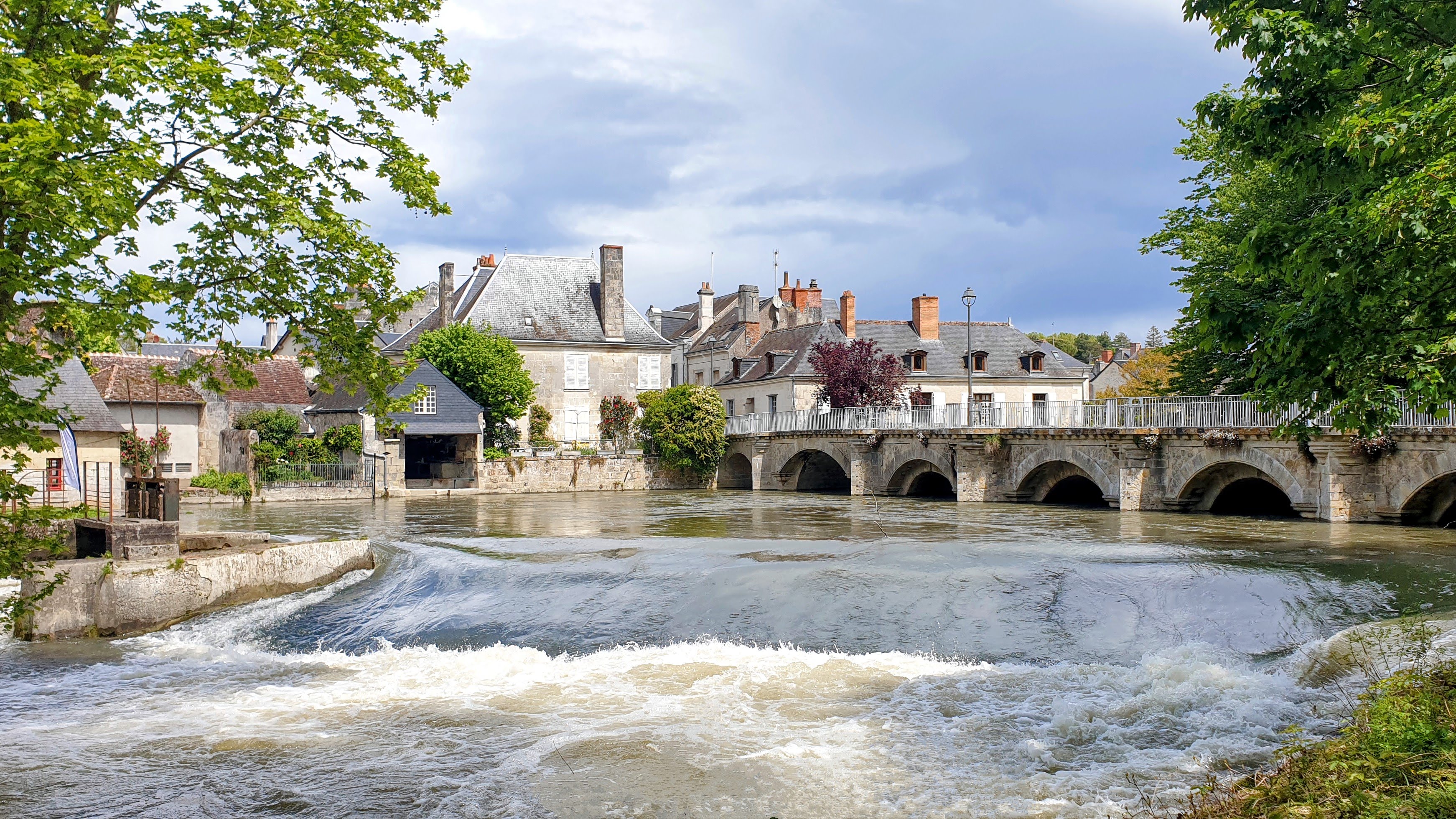
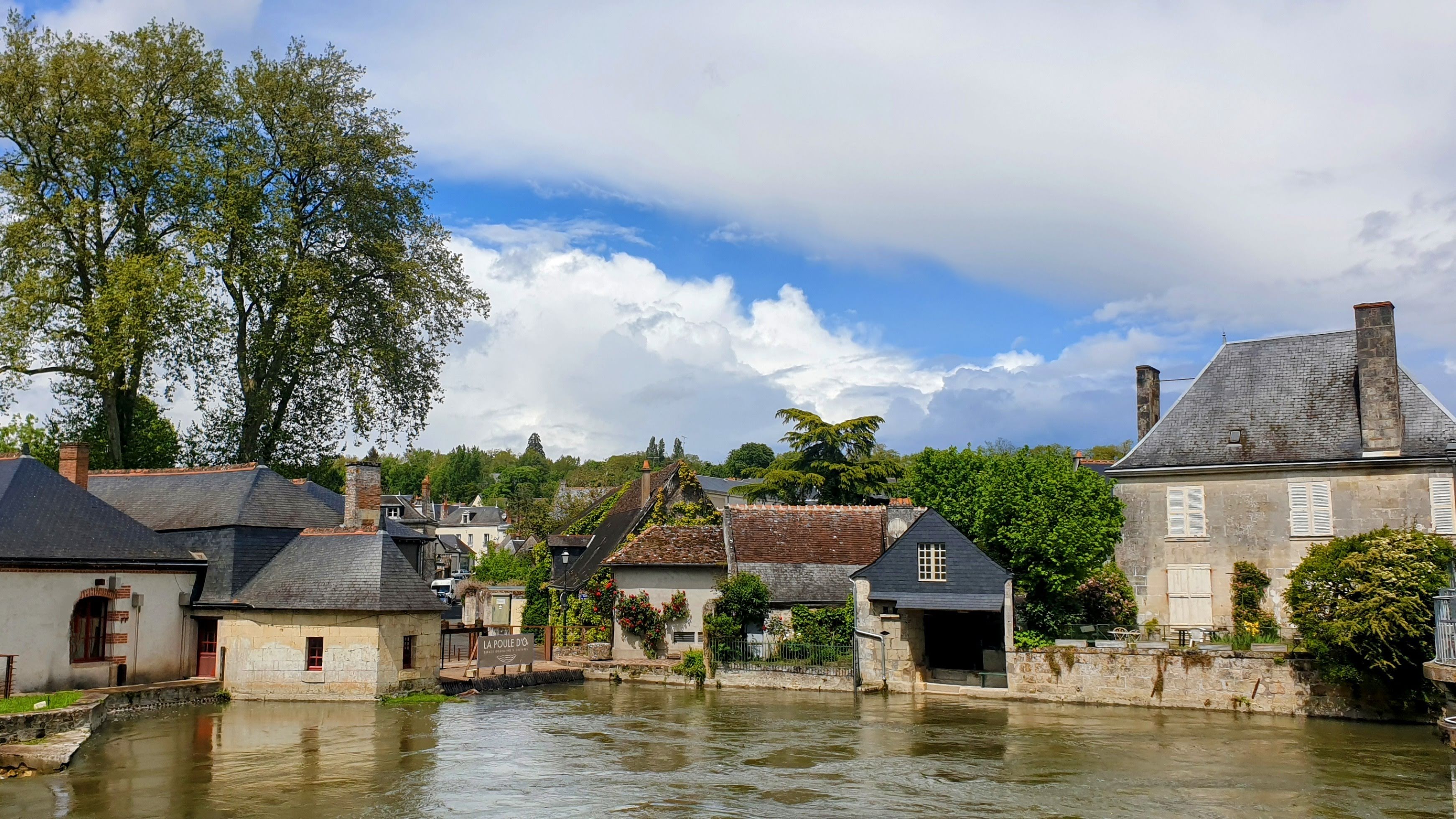
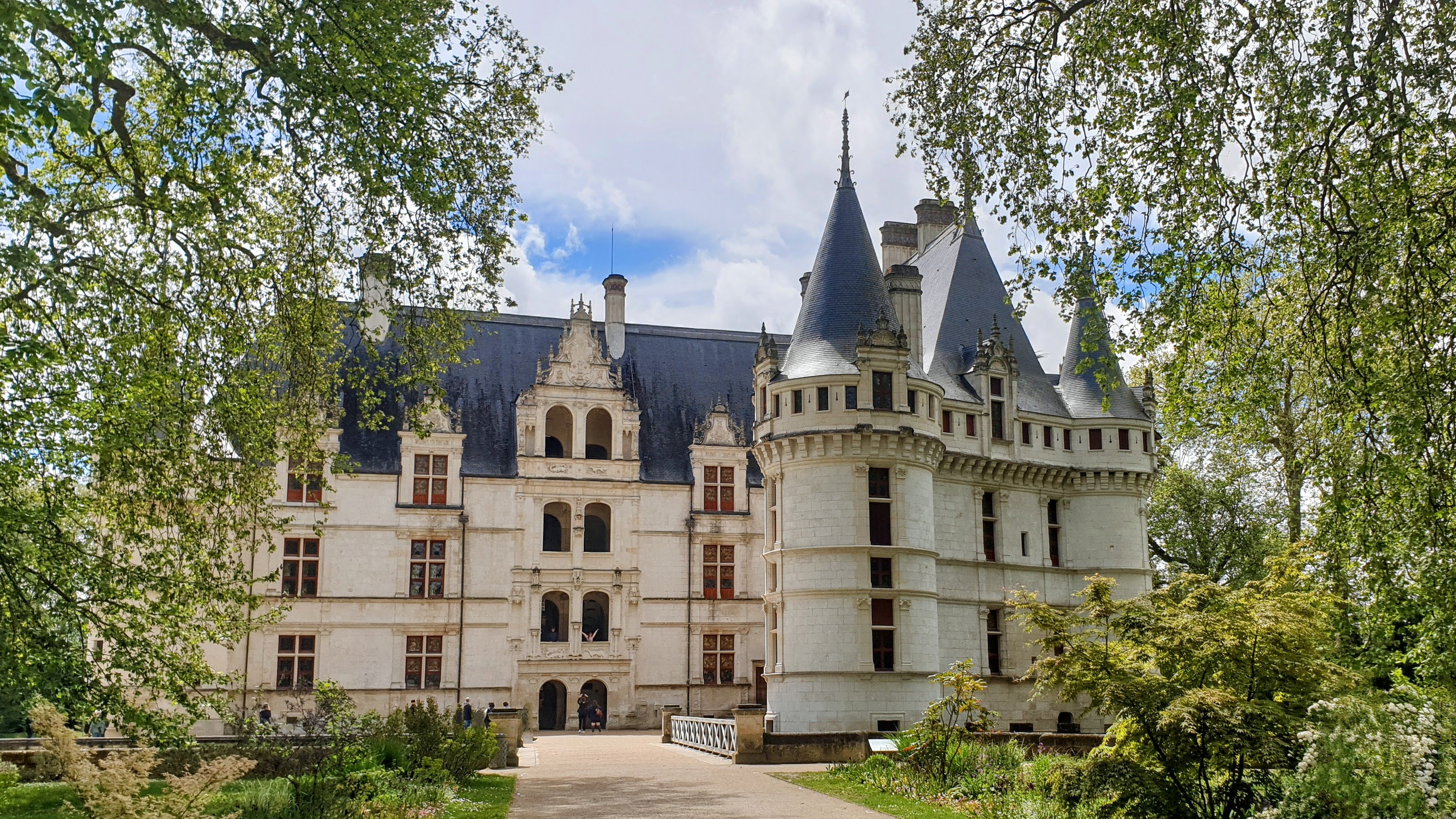
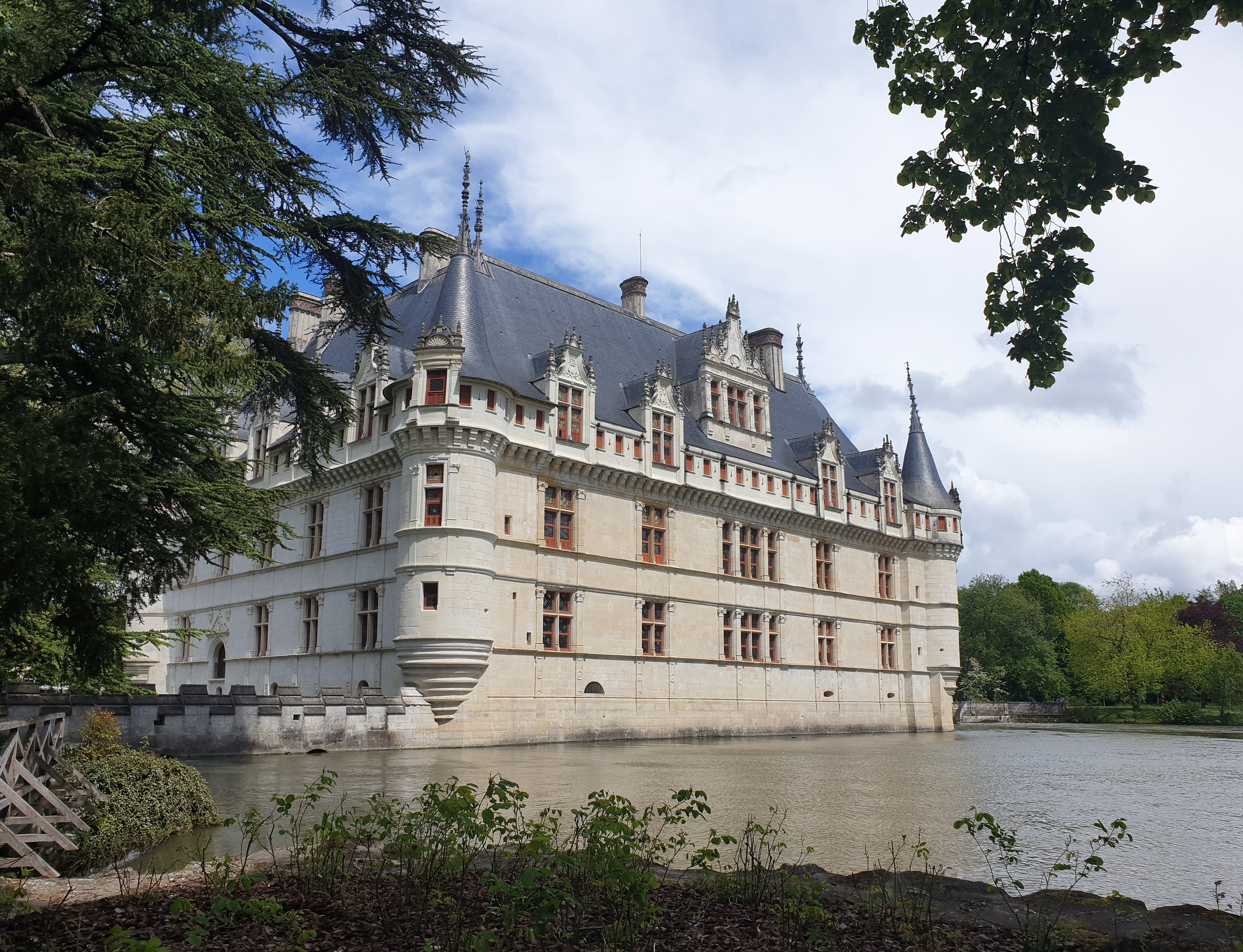
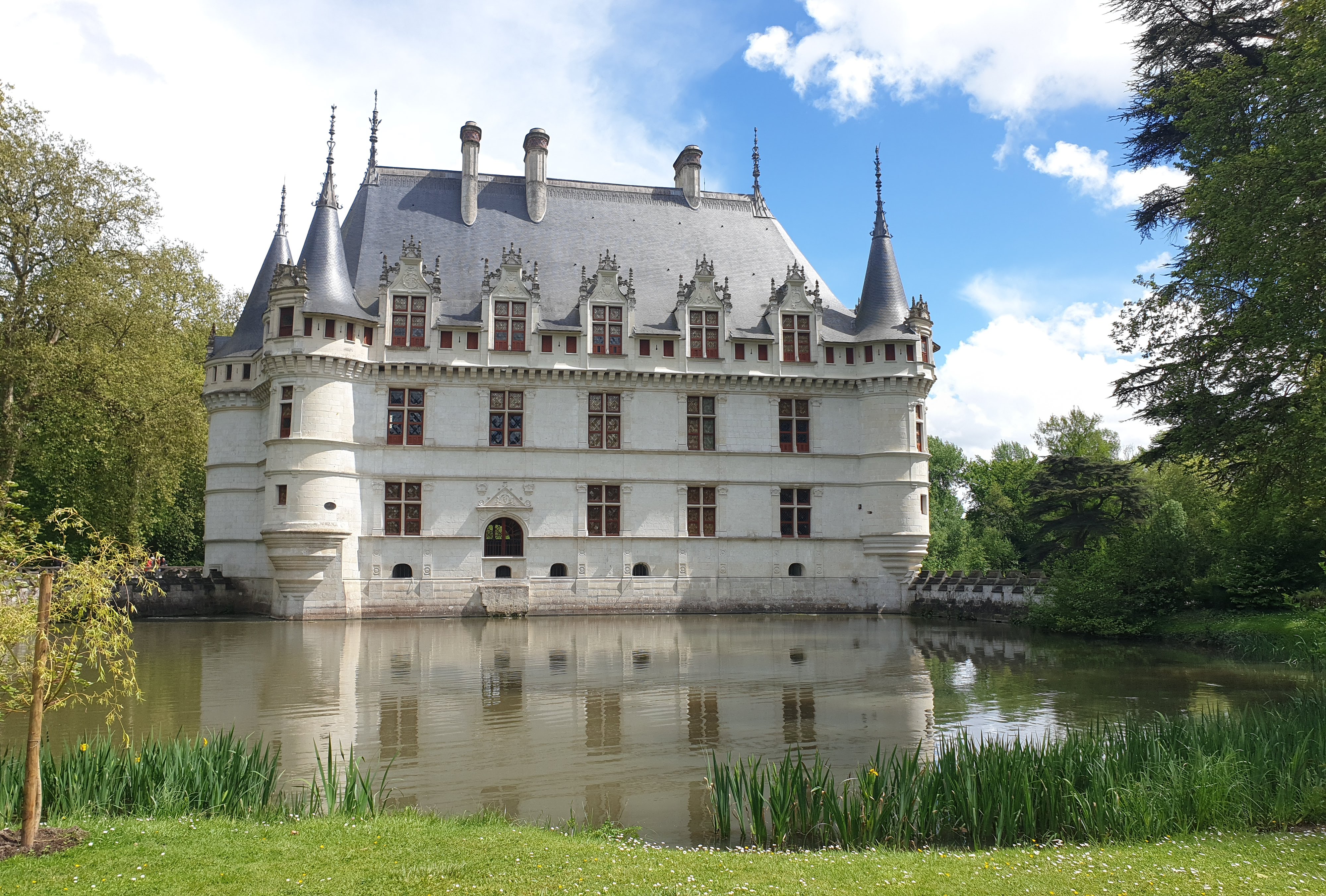
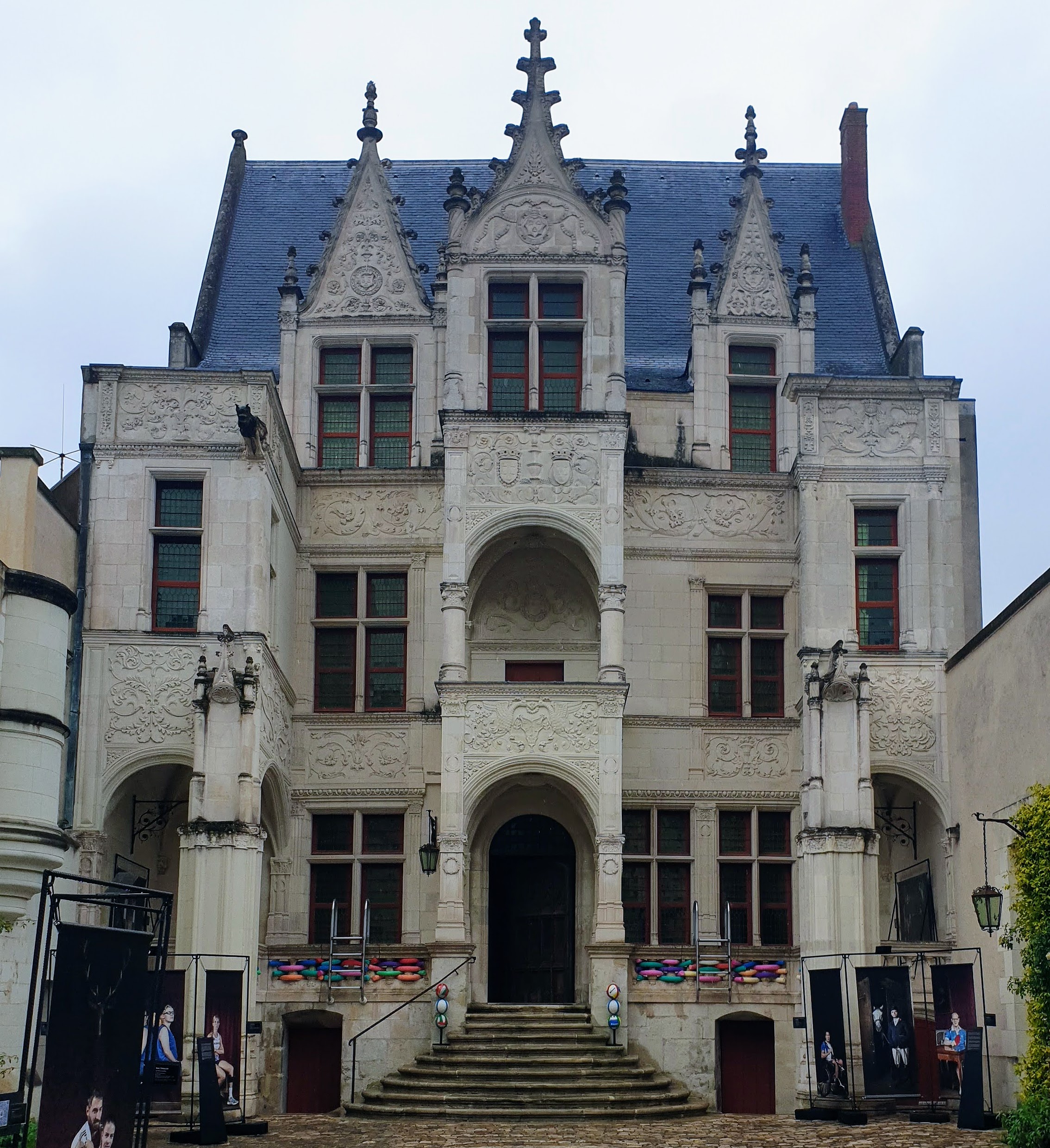
While Villandry was all about the gardens, the Château d’Azay has excellent interiors. The grounds are nothing to sneeze at, but they are considerably simpler than the elaborate gardens of Villandry. D’Azay is not quite as old, but has many architectural themes in common since it was also constructed during the renaissance. The French Renaissance King Francis the First established the Loire Valley as his seat of government, and the château was built to honor his reign. The interior was remodeled in the 19th century and eventually acquired by the state in 1905. The walk from the parking lot to the château was through a charming little village.
We started our tour by climbing all the way to the top and getting a view of the architectural engineering from the inside. The roof itself contains 75 tons of slate! A lot of structural work goes into holding up that much weight. The current exhibition is a reconstruction, but it’s done in the same style as the original to preserve the craftsmanship.
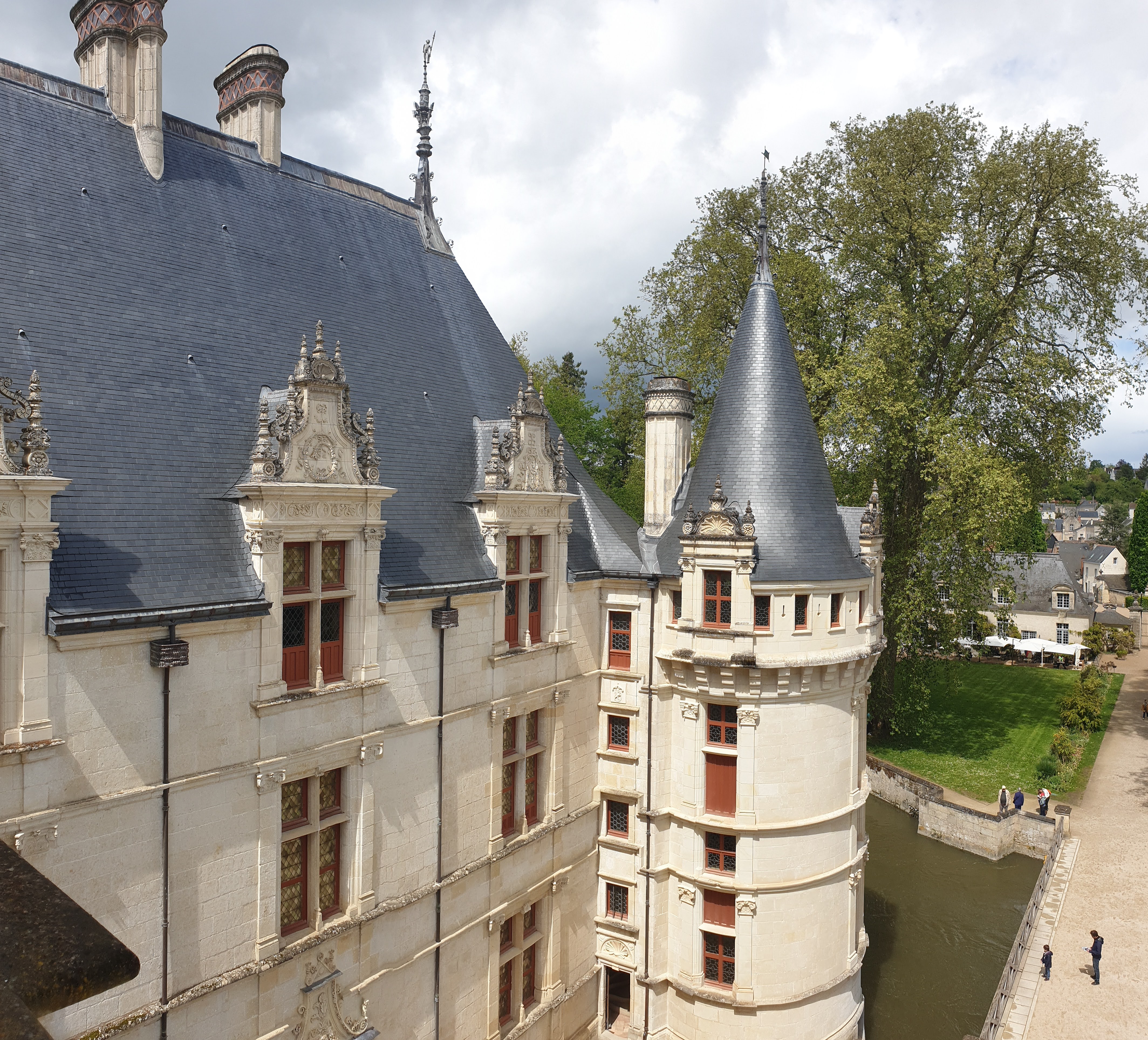

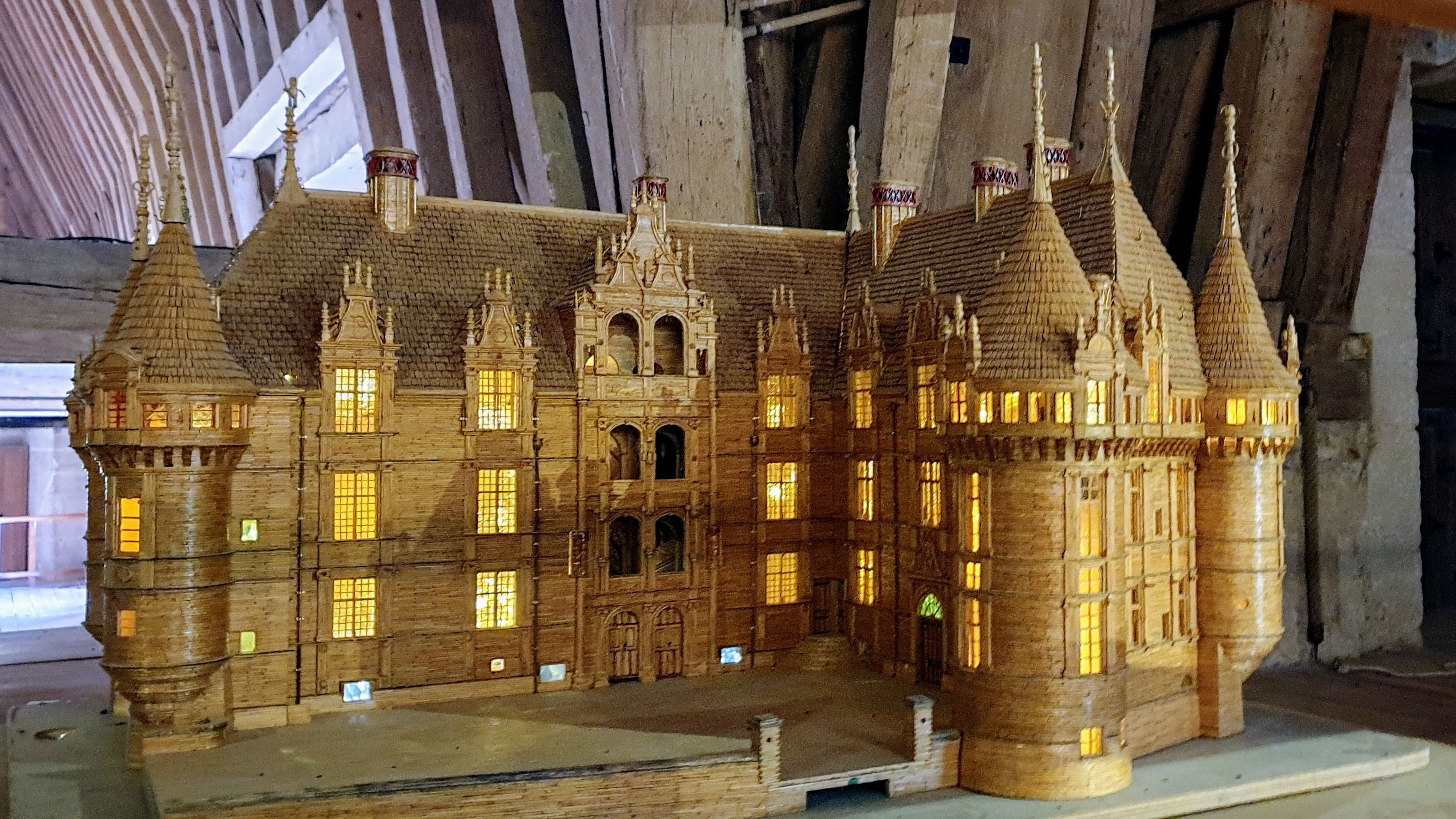

As we descended, we entered room after room decorated in the styles of the different eras that the château has existed throughout. The first being the Renaissance room, a faithful replica of the room of the architect’s wife. Although it is fairly simple compared to later rooms, it’s still interesting to see the way people lived. Additionally, at that time, bedrooms were not just for sleeping, but also for socializing and entertaining. Mats made of reeds lined the walls to keep the chill of the stone from overwhelming the room, and there was a small alcove off to one side in which sits a secretary’s desk.


The next room is called Psyche’s Chamber because the ornate tapestries along the walls depict the Greek myth of Psyche which was all the rage at the time. This is followed by the Great Hall. This room was used for hosting feasts and dances, and to be honest, after watching far too many period dramas in film and television, I was surprised at how small it seemed, even when mostly empty.
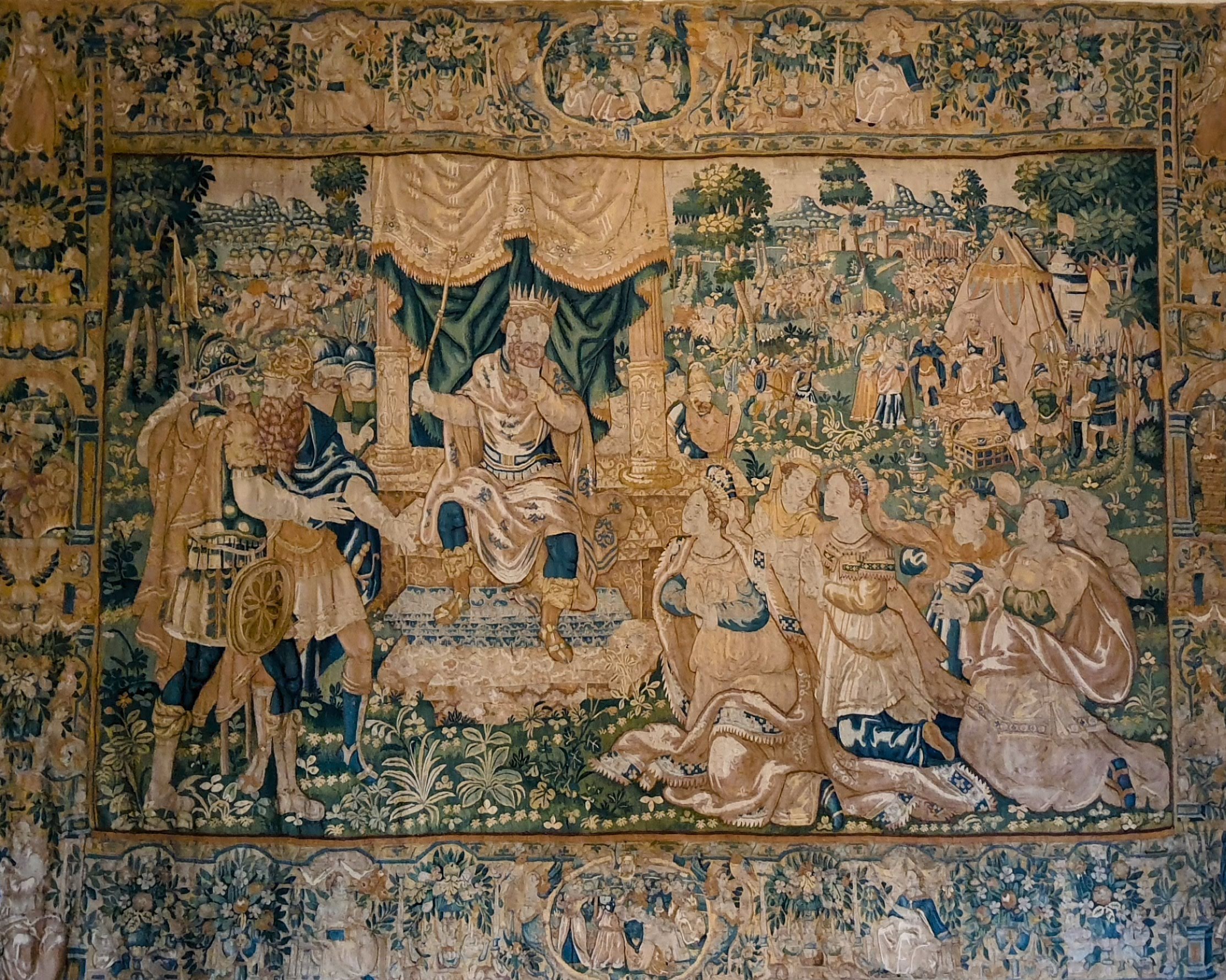
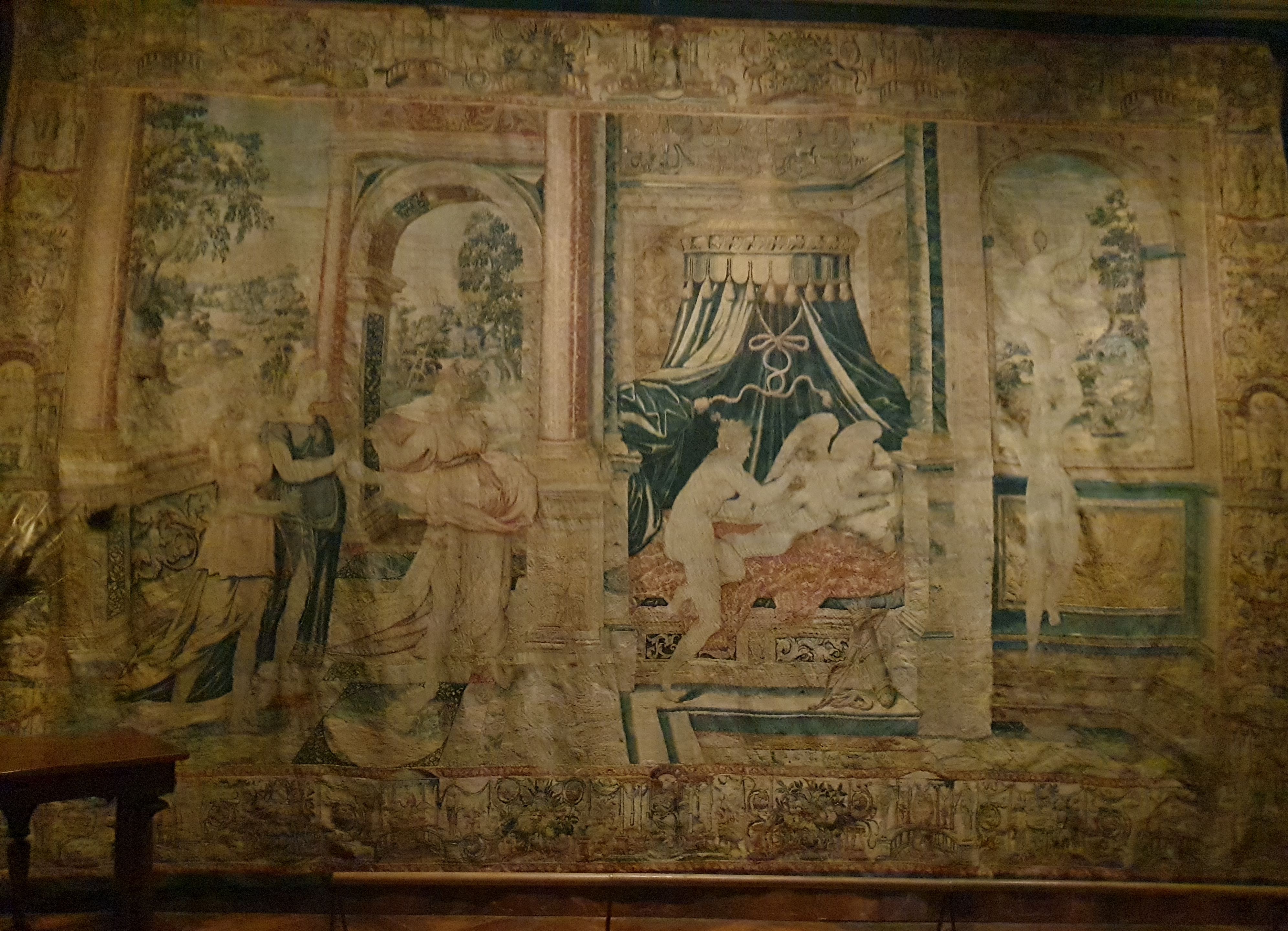
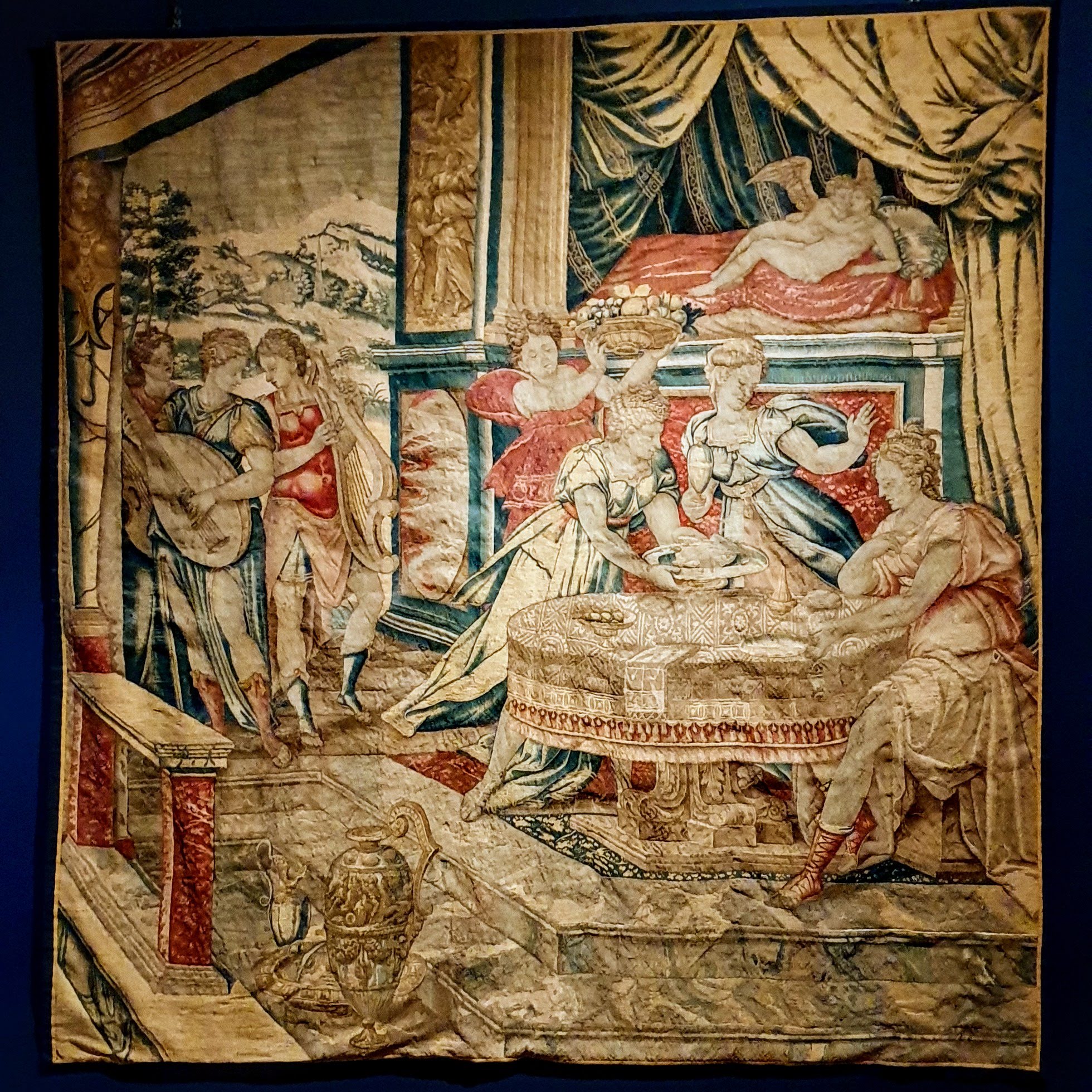
Following that we crossed through the ante-chamber where visitors wishing to see the King could wait, and the King’s Chamber. A royal suite had to be maintained by pretty much all the nobles since the King could drop by with very little notice and expect to be hosted in style. Apparently Louis XIII stayed there for just two nights in 1619, and yet the room was kept ready for a royal visit at any time.
Jumping starkly forward in time, the next suite of rooms reflect the fashions of the 19th century. The Biencourt Salon was a room for people to relax, talk, and maybe take some light refreshments. The Billiard Room was more of an informal space, featuring a billiard table.


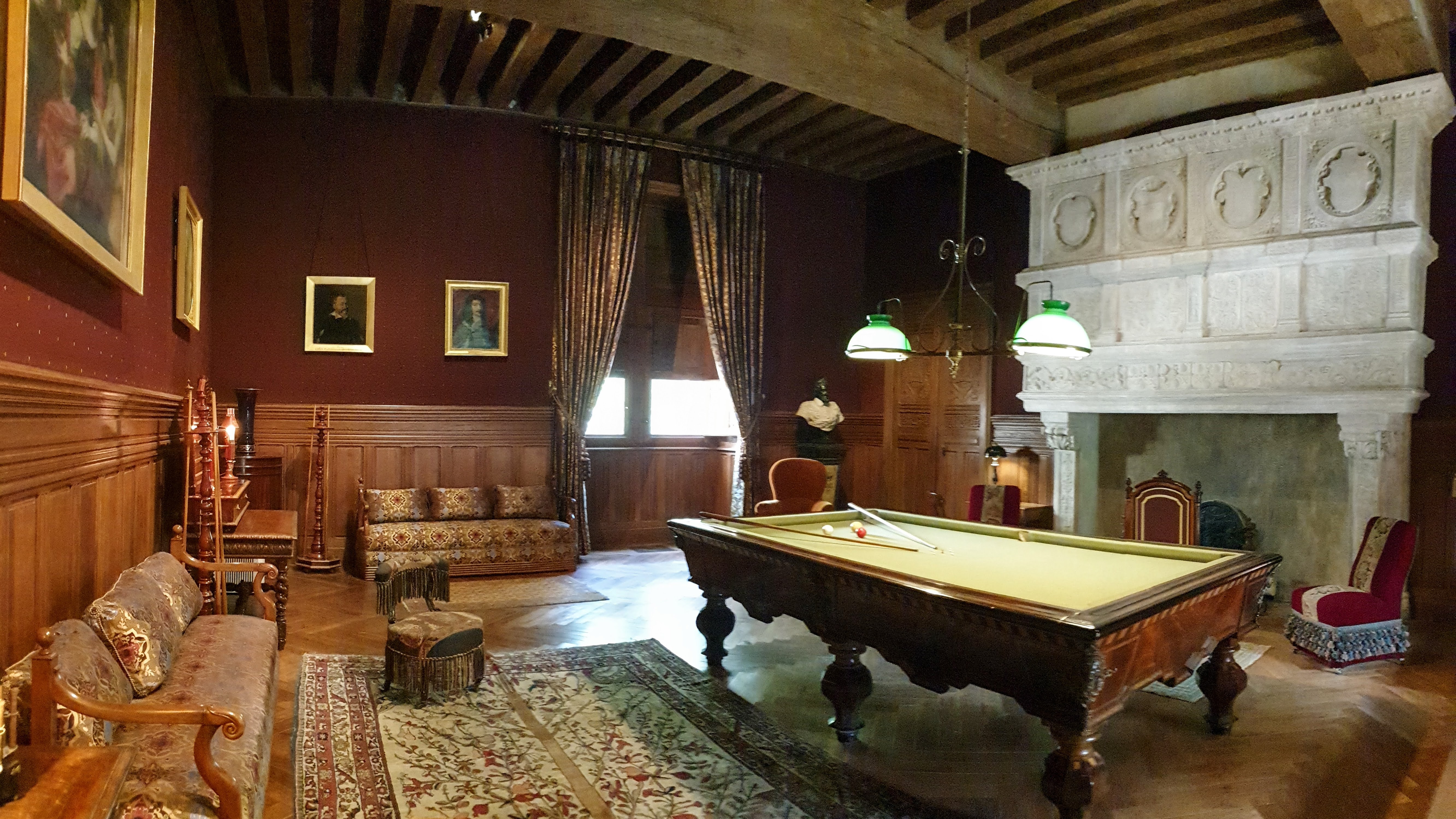
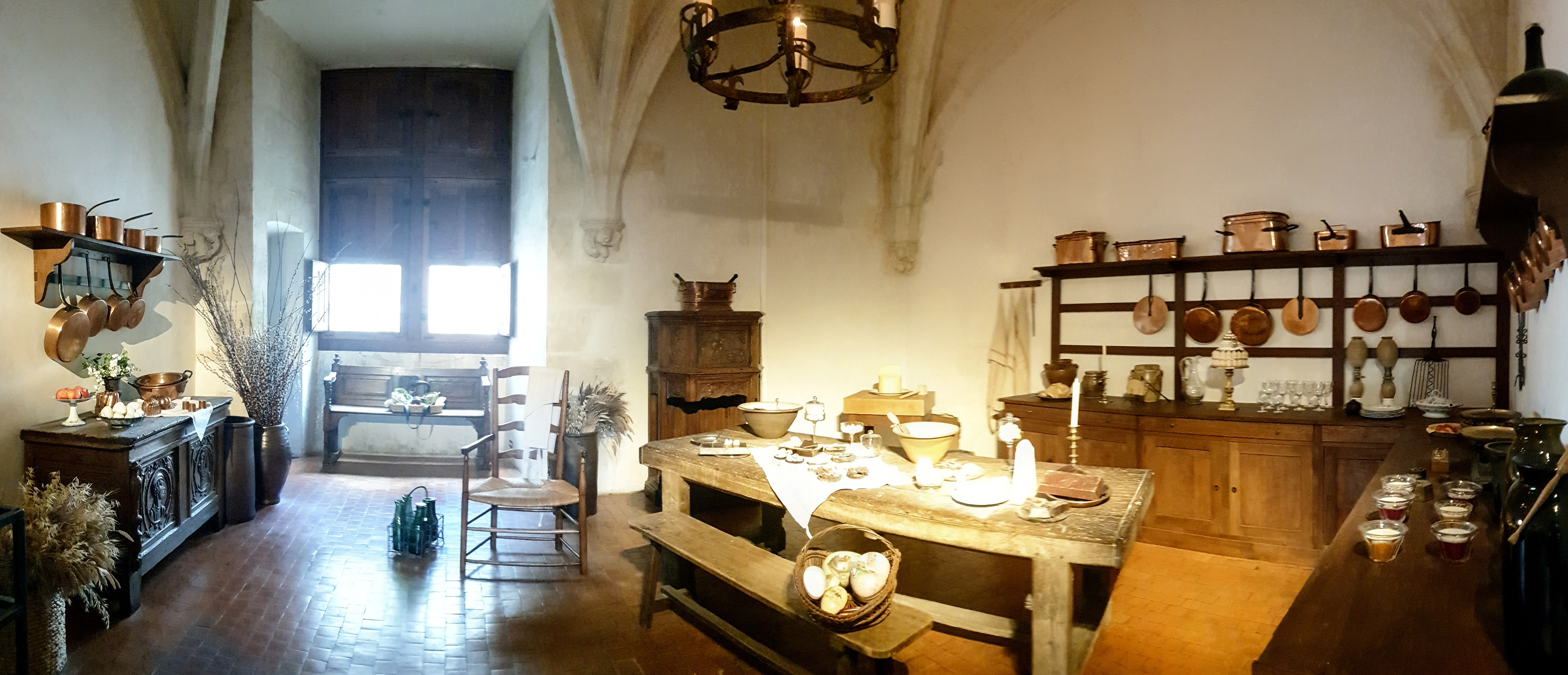
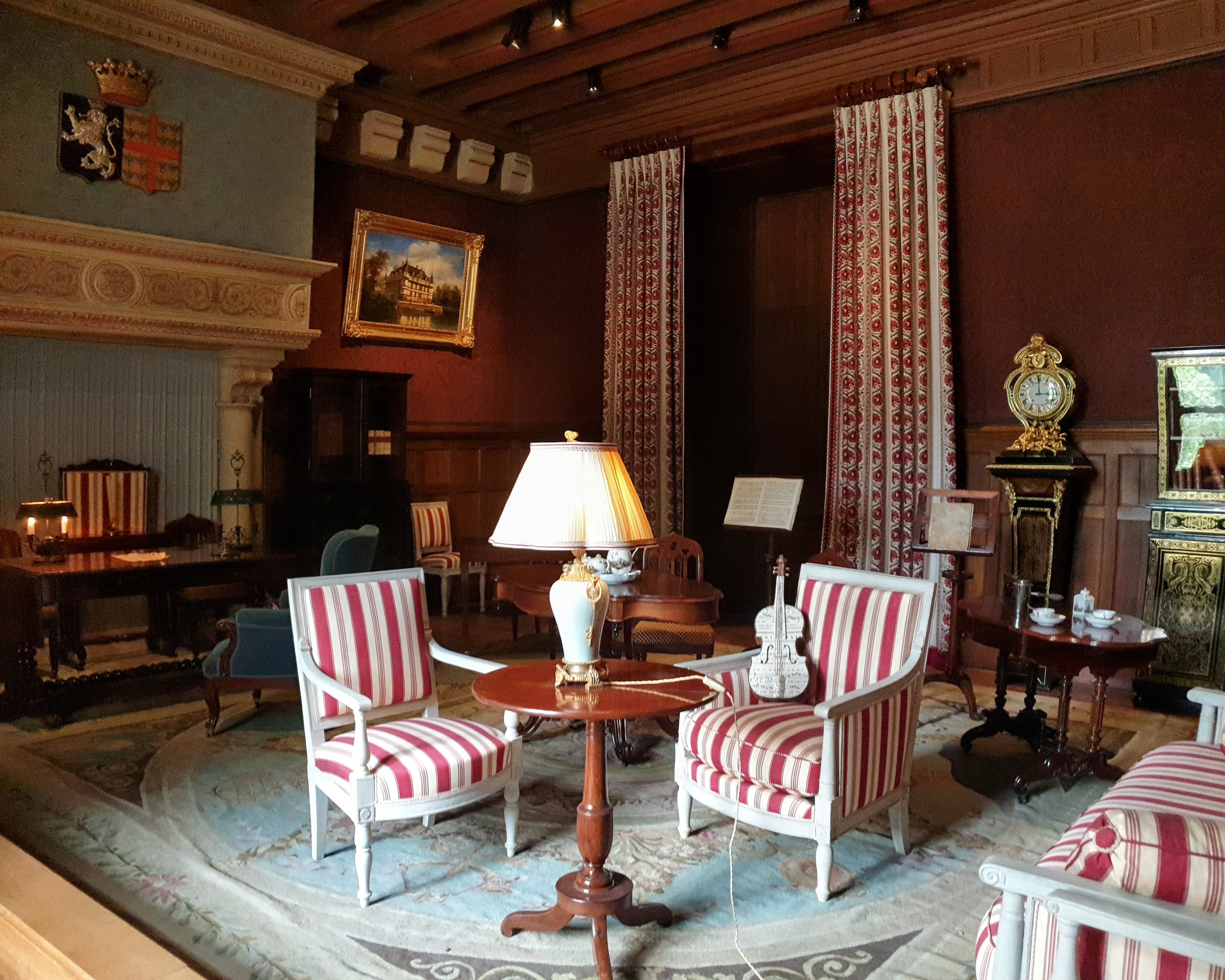
From there we had a peak into the “below stairs” (though not physically below) of the larder and the kitchen. These were quite close to a 19th century style dining room (a contrast to the Great Hall of the Renaissance style). After the dinning room, a final salon-library shows comfortable furniture, musical instruments, and a small collection of books.

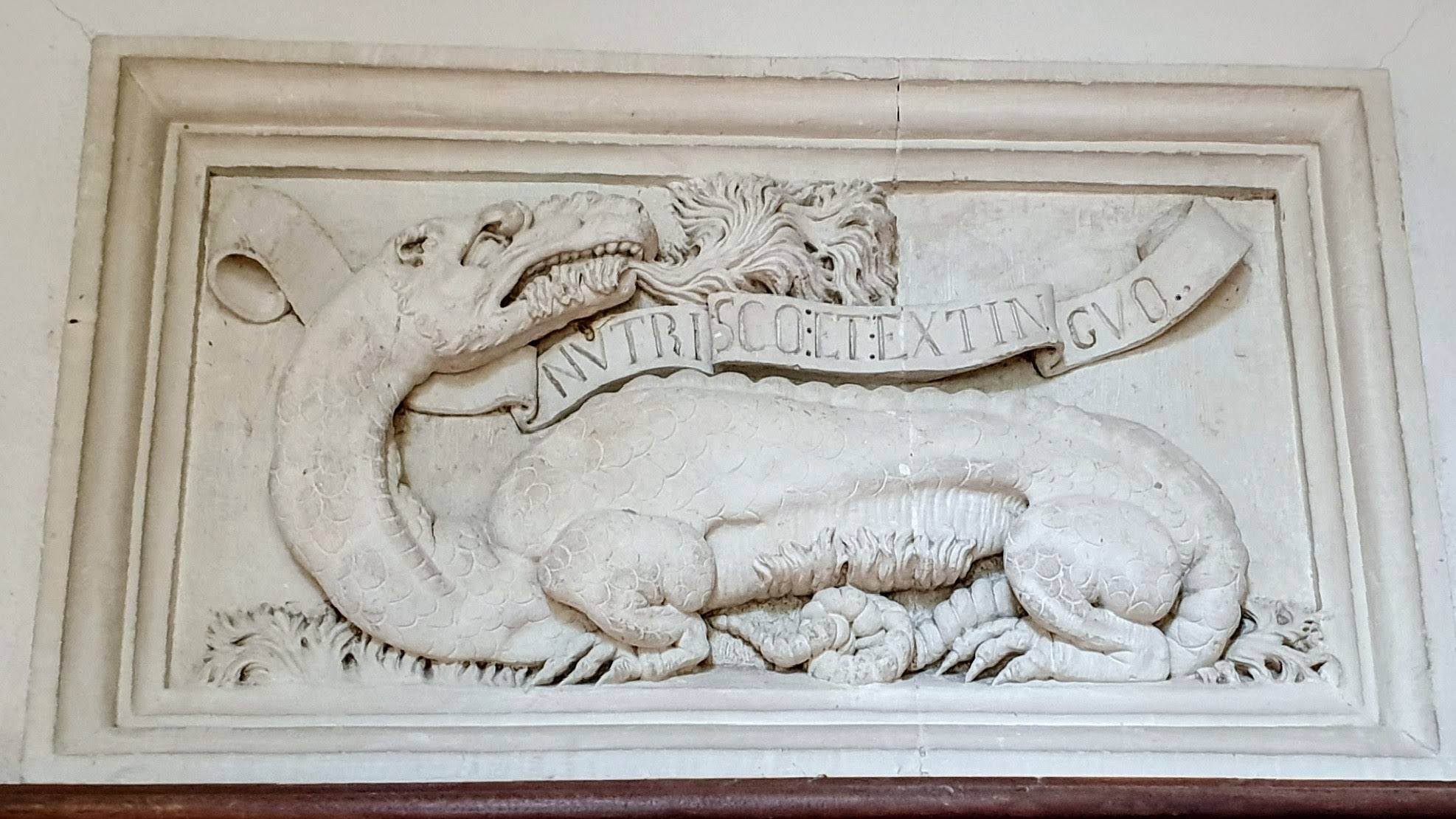
A repeating motif in the stonework of the château is the fire-breathing salamander. This was a motif of King Francis I whose motto was “Nutrisco and Extingo” (translated: I feed on the good fire and I extinguish the bad) – a metaphor for pursuing justice and weeding out injustice.



Château du Clos Luce (link)
This was my final excursion in Tours, and I once again went with the language school. Perhaps because of that, we didn’t get to see everything there was to see at this, the final dwelling of Leonardo Da Vinci. The château itself was built in the 1200s, and after a few changes in ownership, it was offered to Leonardo in 1516. Despite his advanced age, he continued to work on projects for the King and to entertain students. He also had a secret tunnel that led to the King’s palace next door which allowed him to meet with fellow artist Domenico da Cortona all the time… in secret… underground… but I’m sure they were just friends.
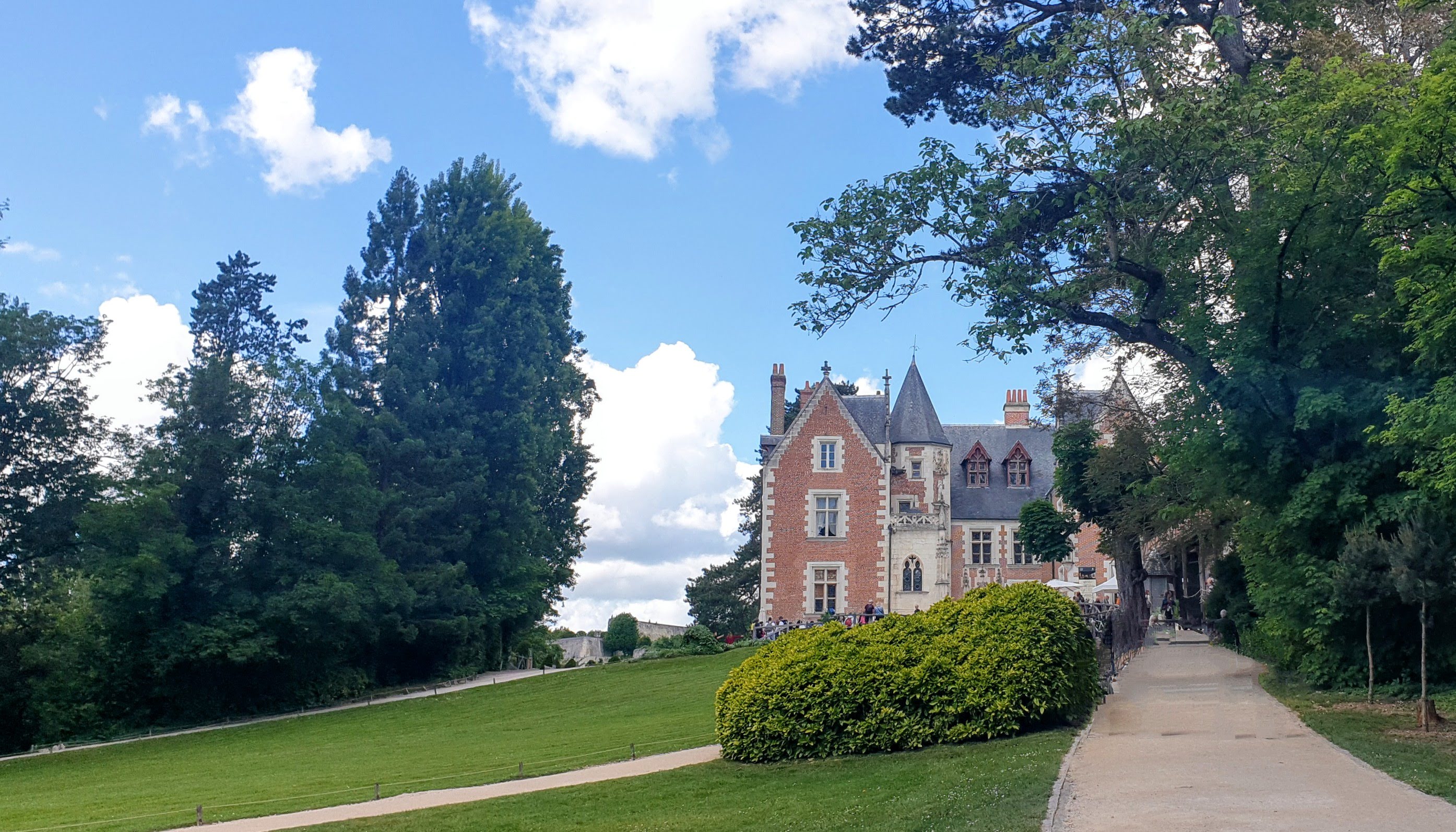


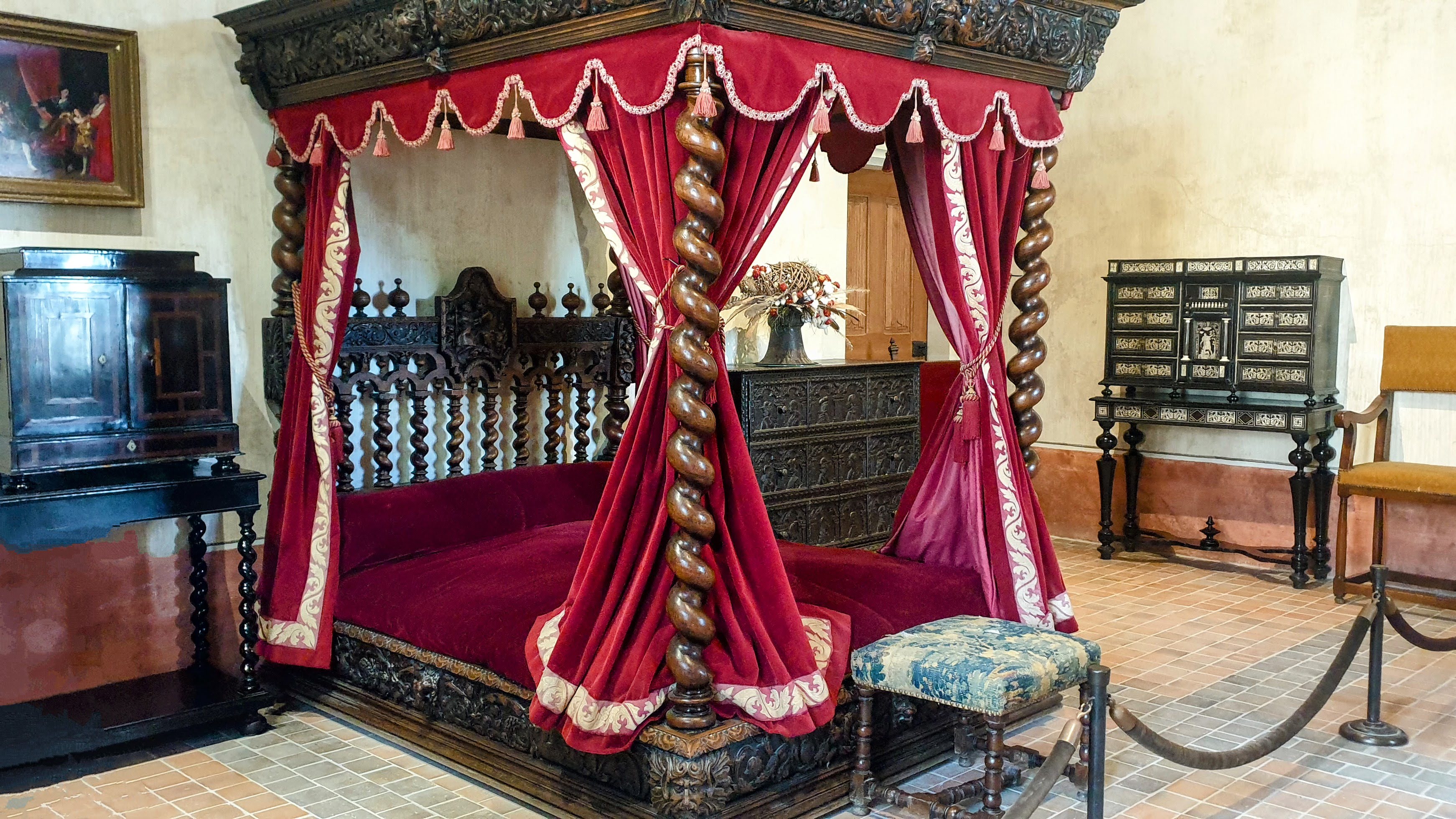
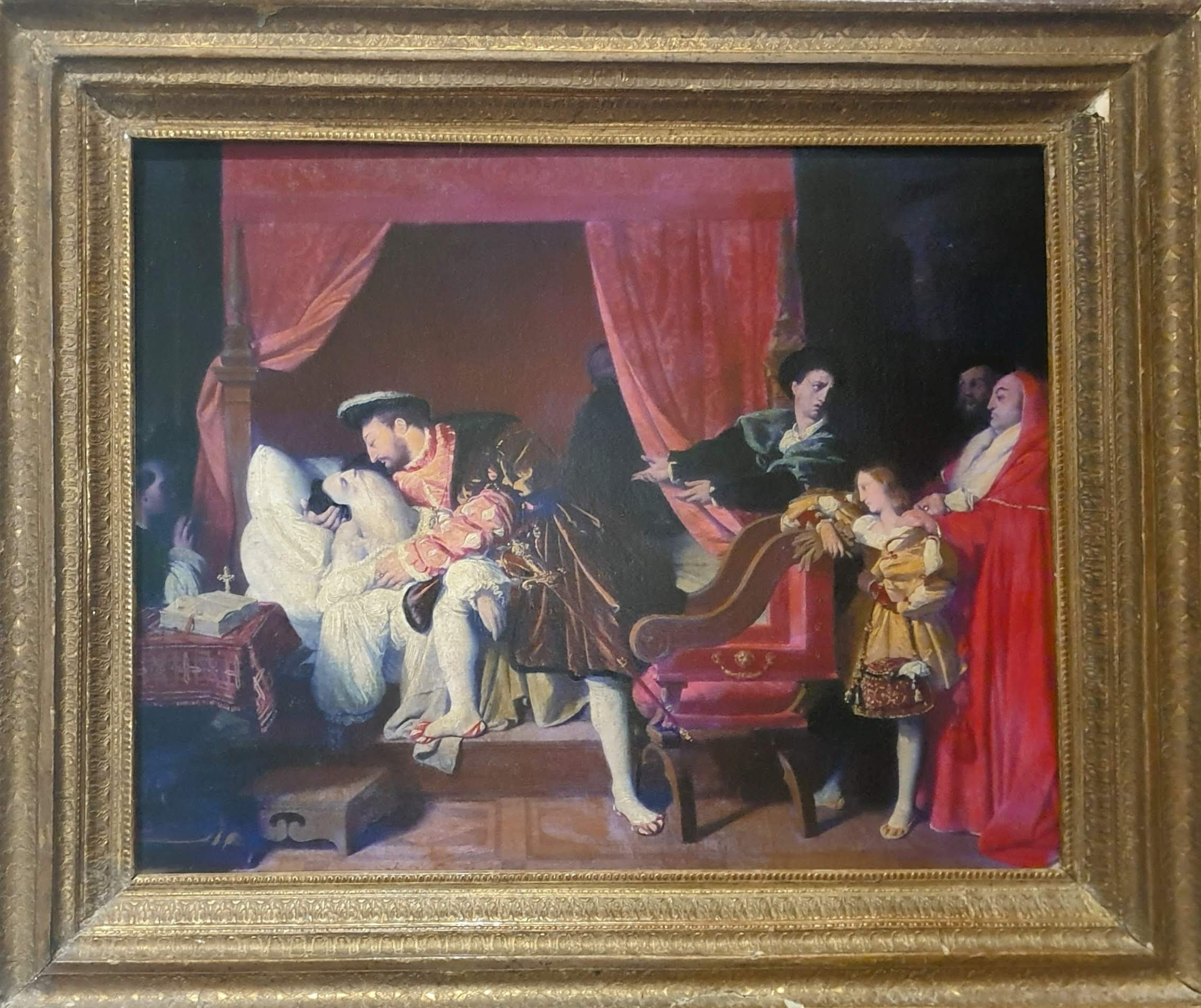
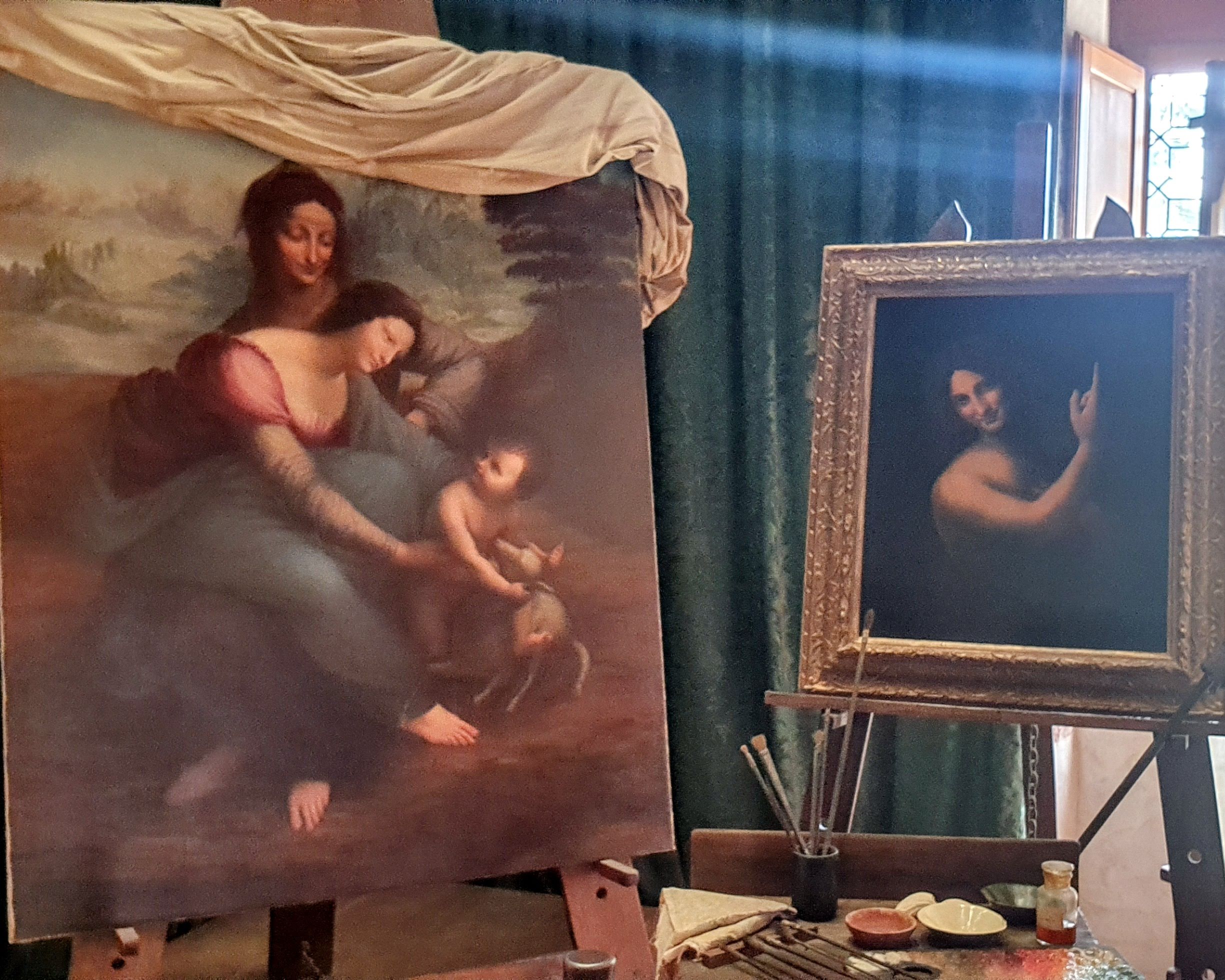
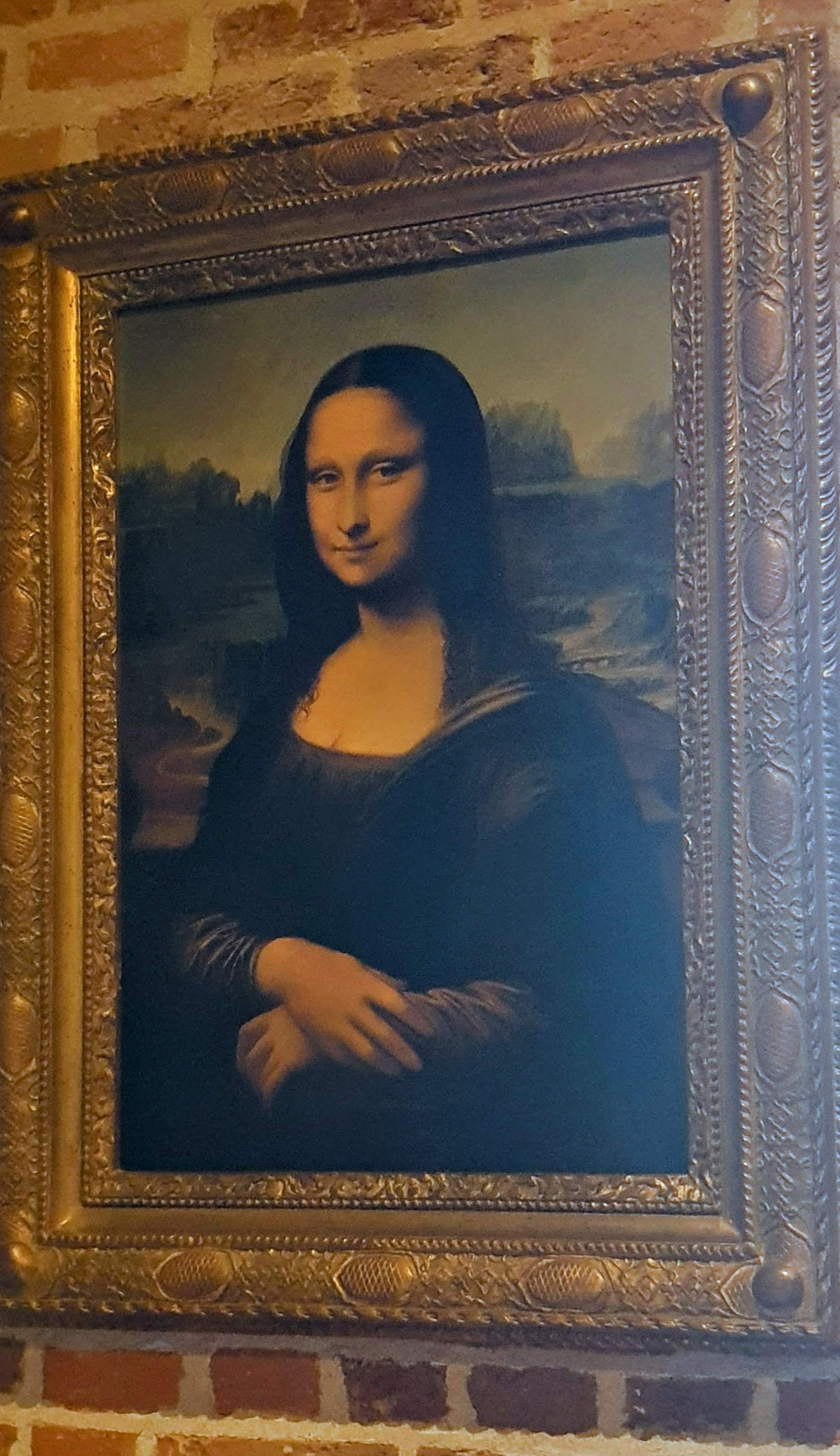
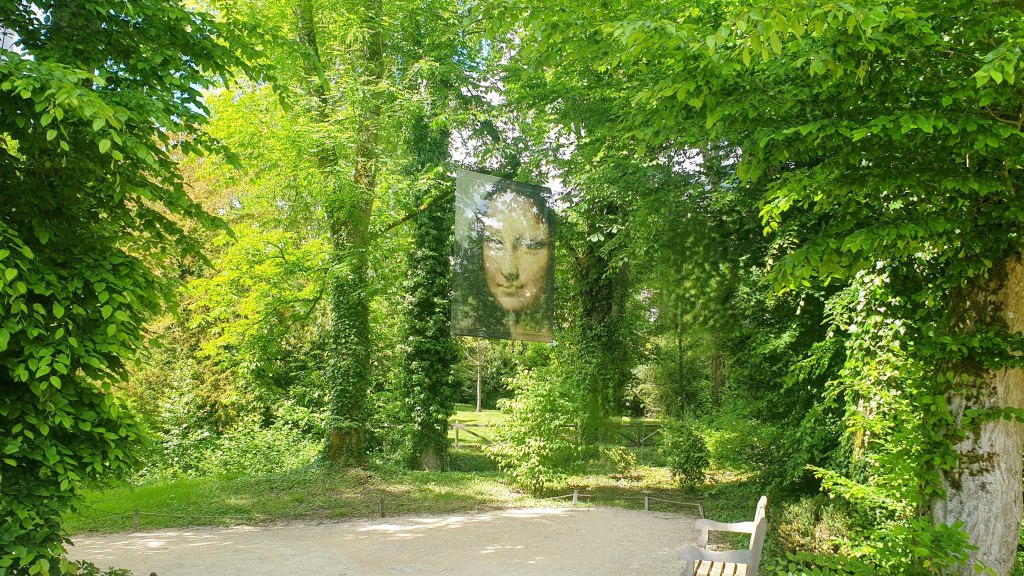
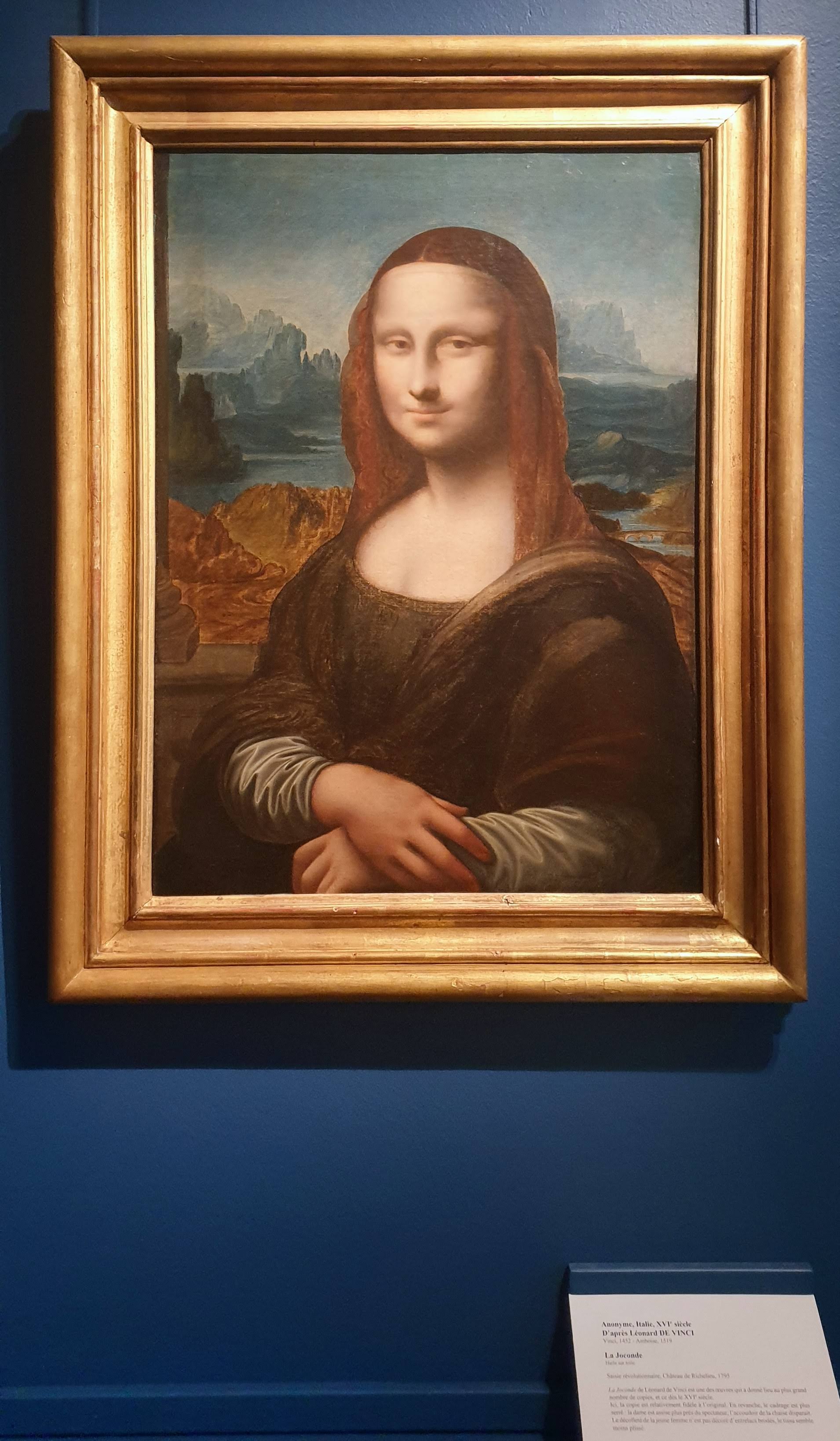
It’s also interesting to note that when Leonardo finally accepted the King’s invitation to move to France, he brought several of his paintings with him, including the Mona Lisa, which is why that painting resides in the Louvre in Paris rather than in any museum in Italy. The interior of the château is decorated to resemble the time Leonardo lived and died there, and includes replica paintings of the Mona Lisa and The Death of Leonardo da Vinci or Francis I Receives the Last Breaths of Leonardo da Vinci which depicts the King of France embracing the genius to breathe in the last breath that Leonardo breathes out. It’s worth noting that nothing other than the house itself is likely from the time of Leonardo, and that this is a reproduction for historical and educational purposes, but it’s still interesting to go and see the way that historians think Leonardo was living in the last few years of his life.


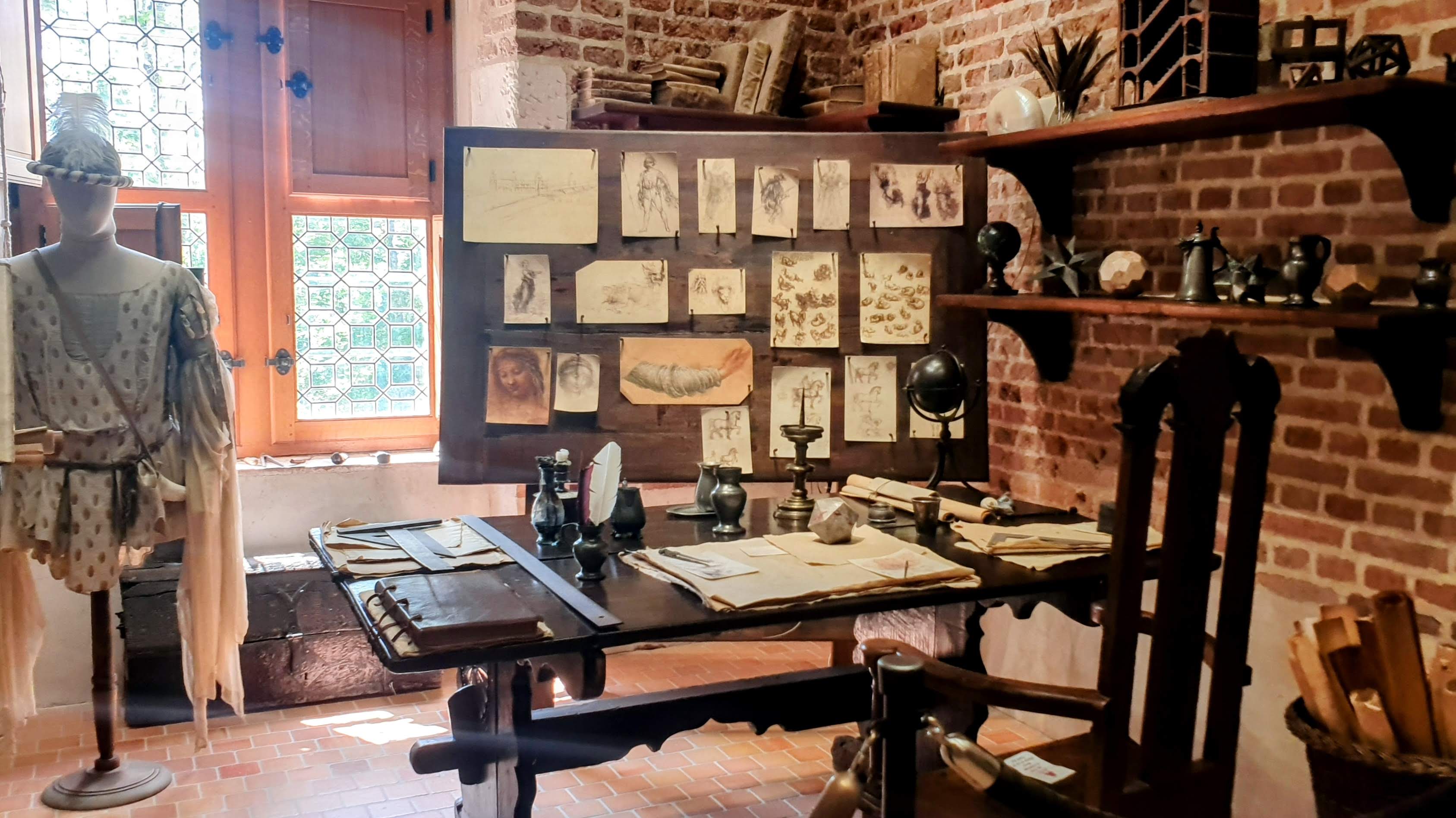
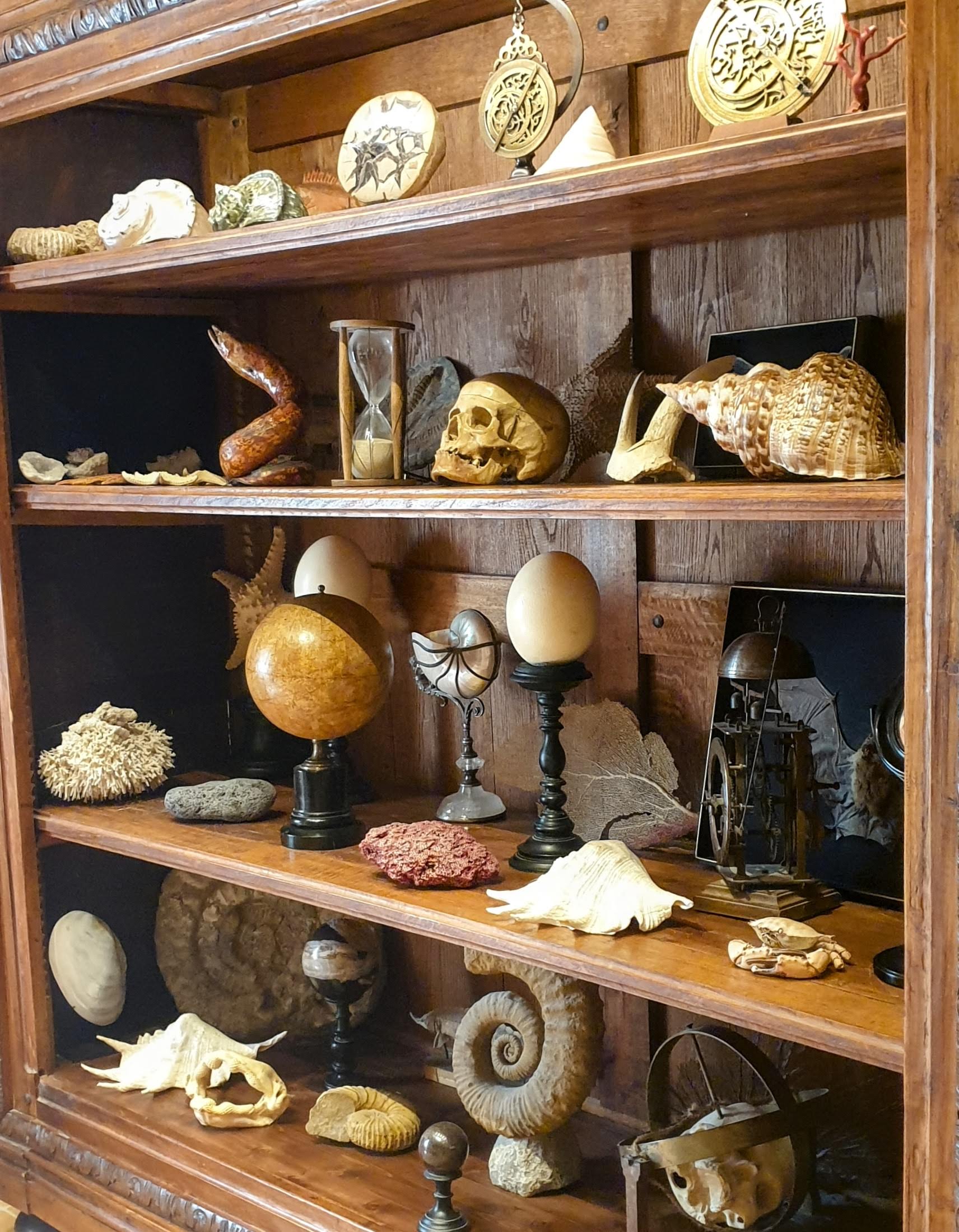



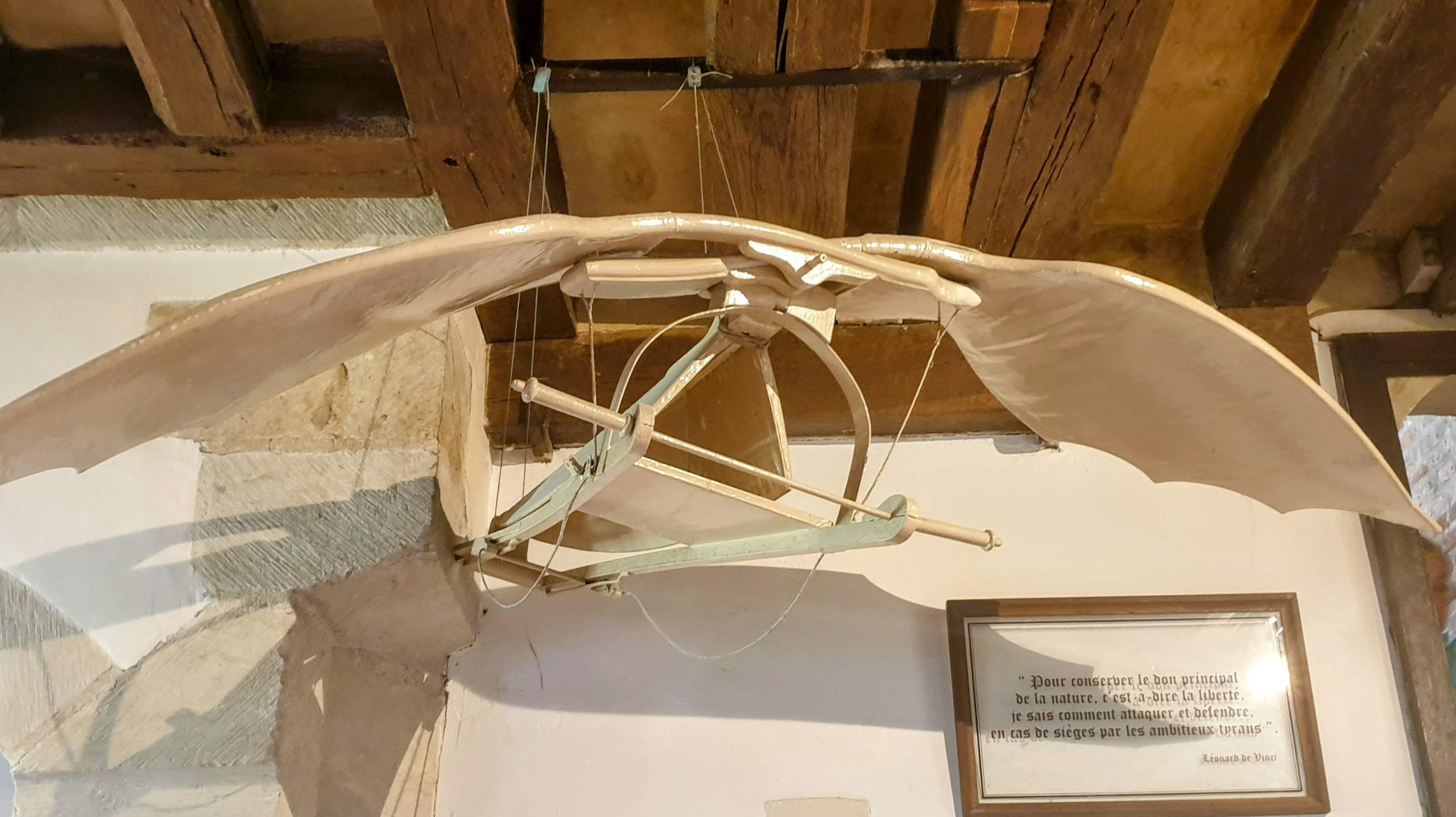
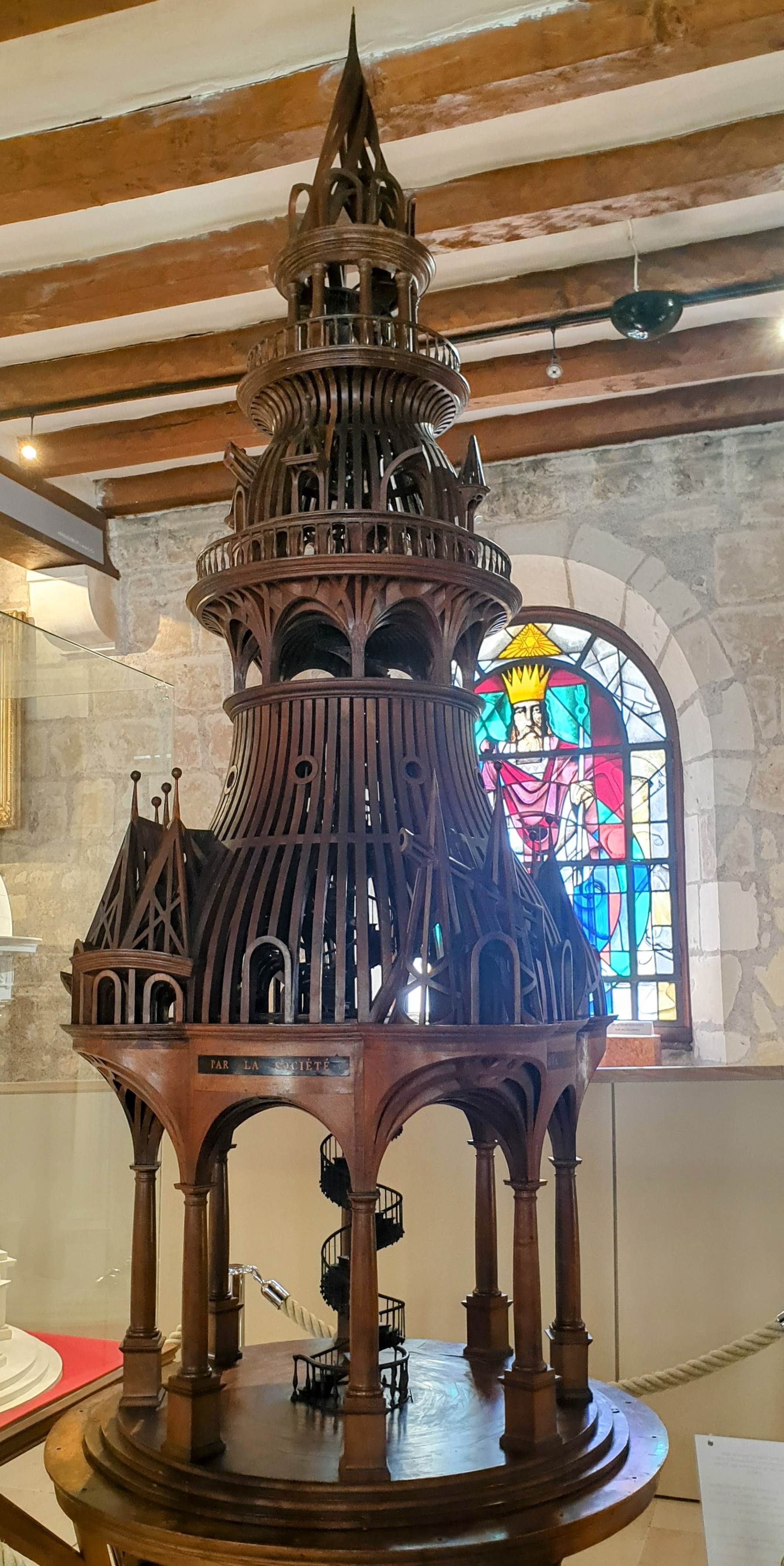
The basement of the château is a museum dedicated to the practical and military inventions of da Vinci with small models and detailed explanations of how each worked in theory if not in actual practice.
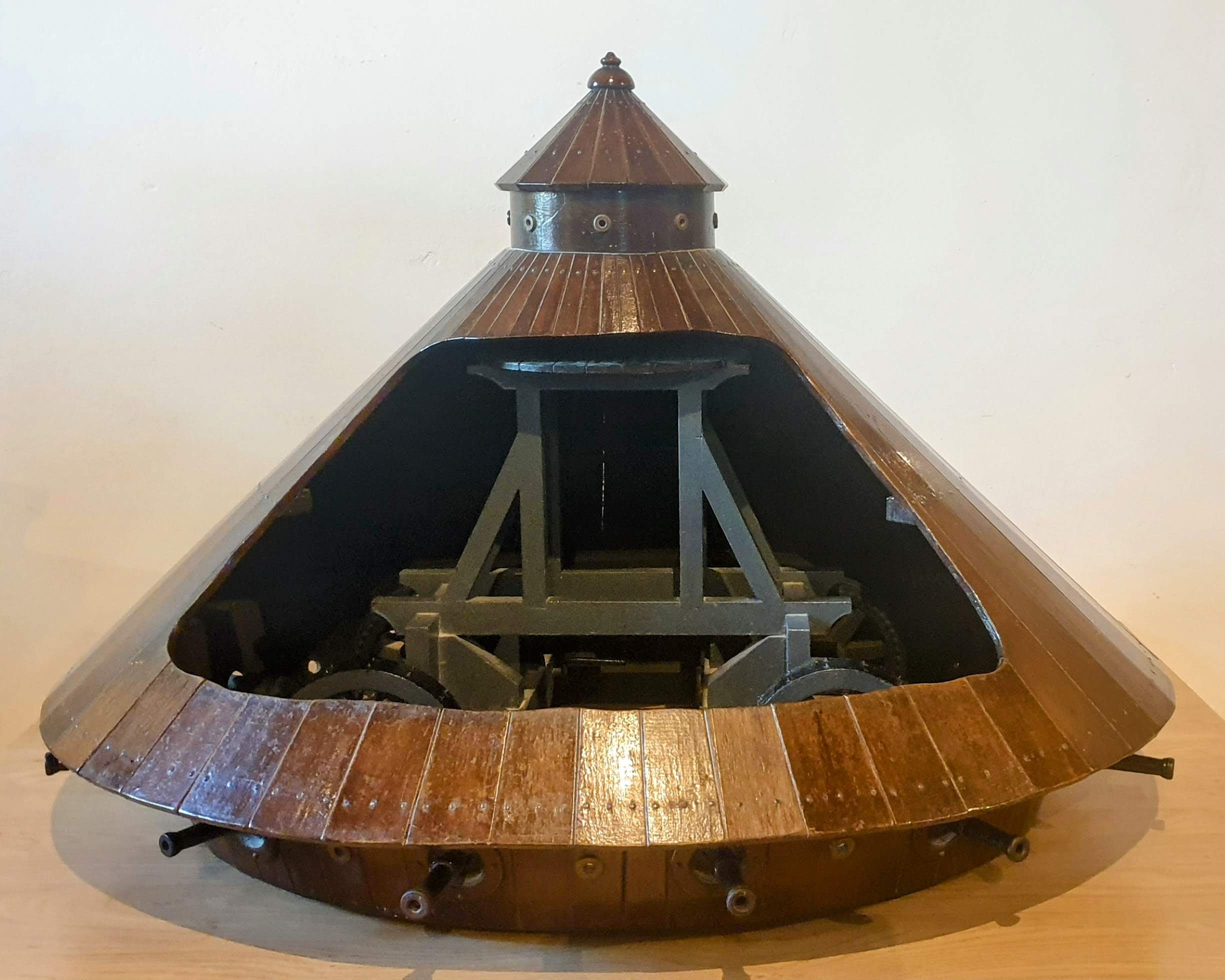


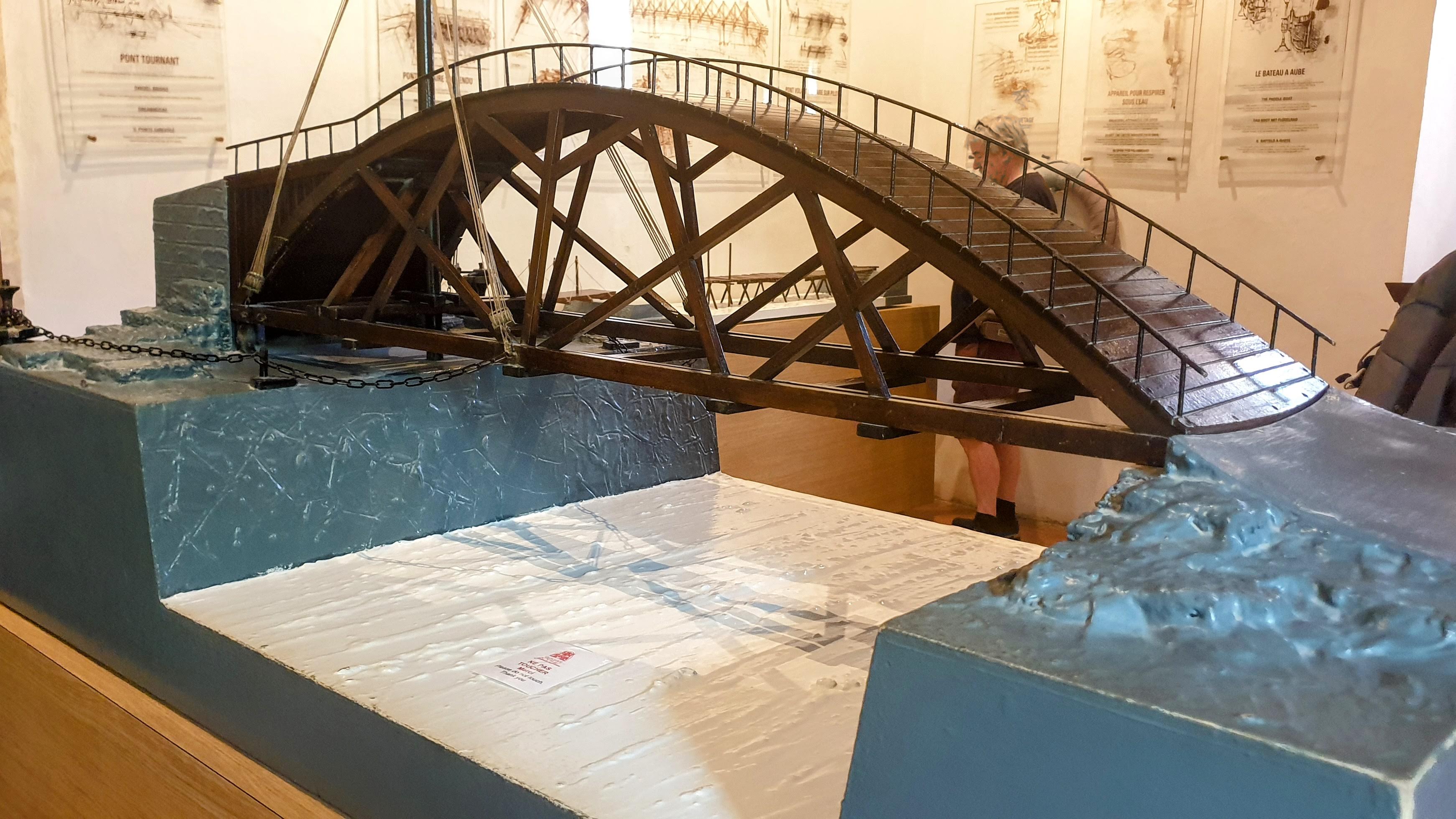
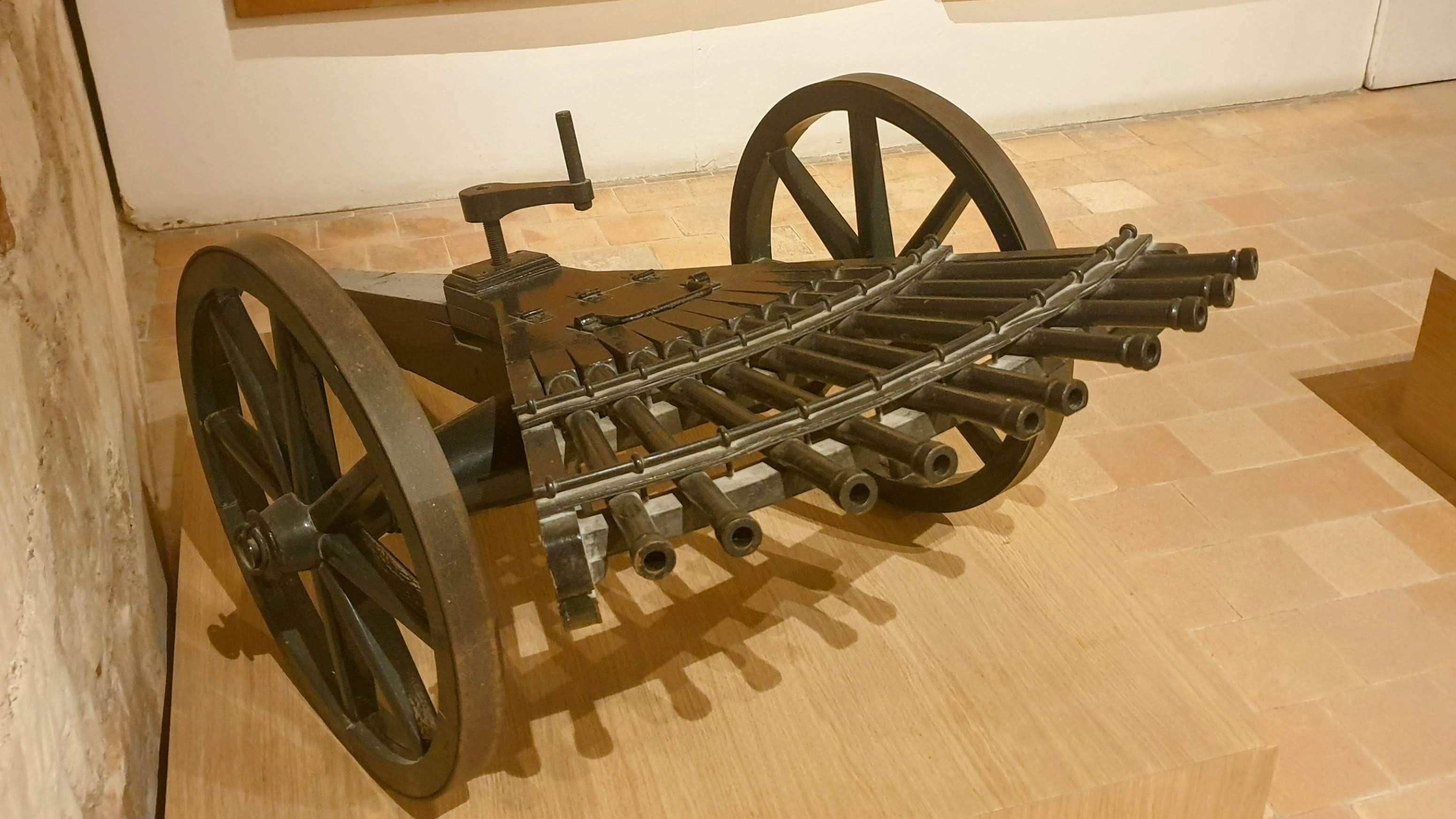
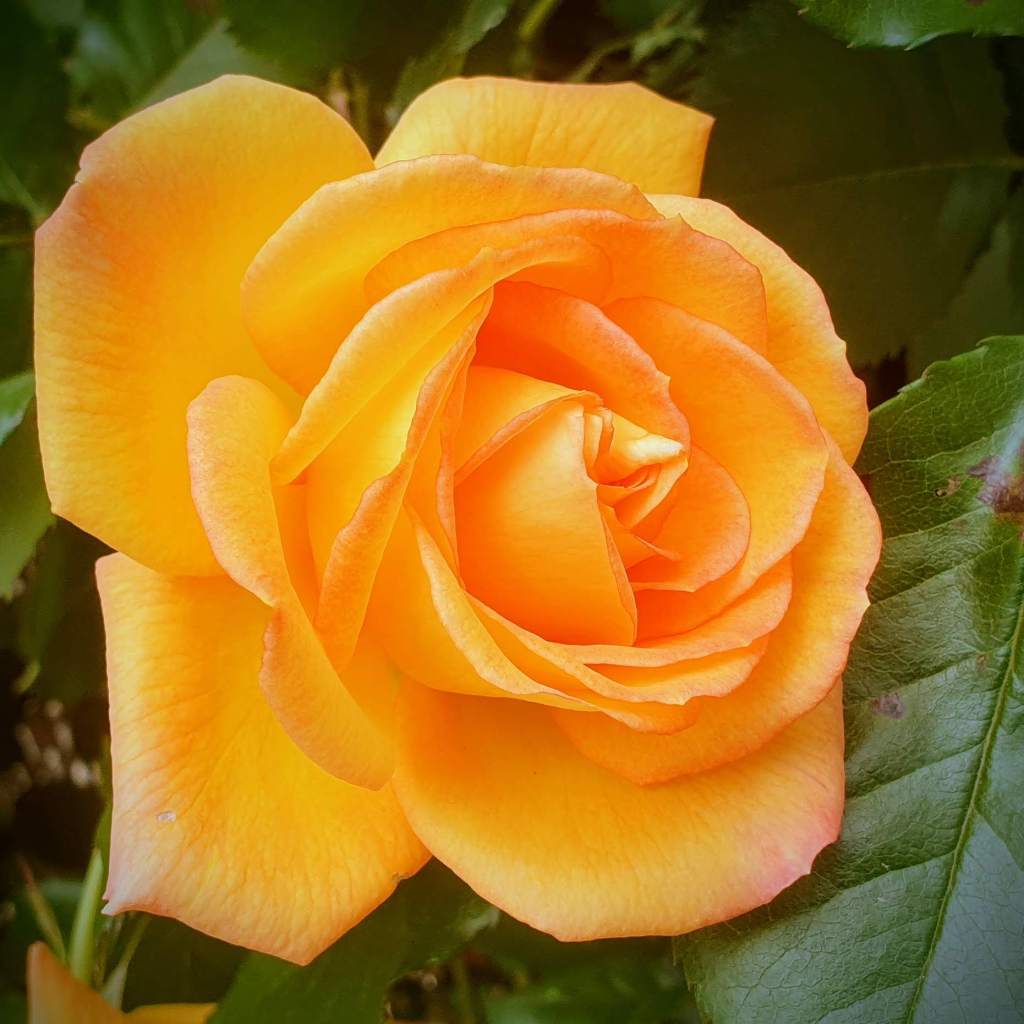
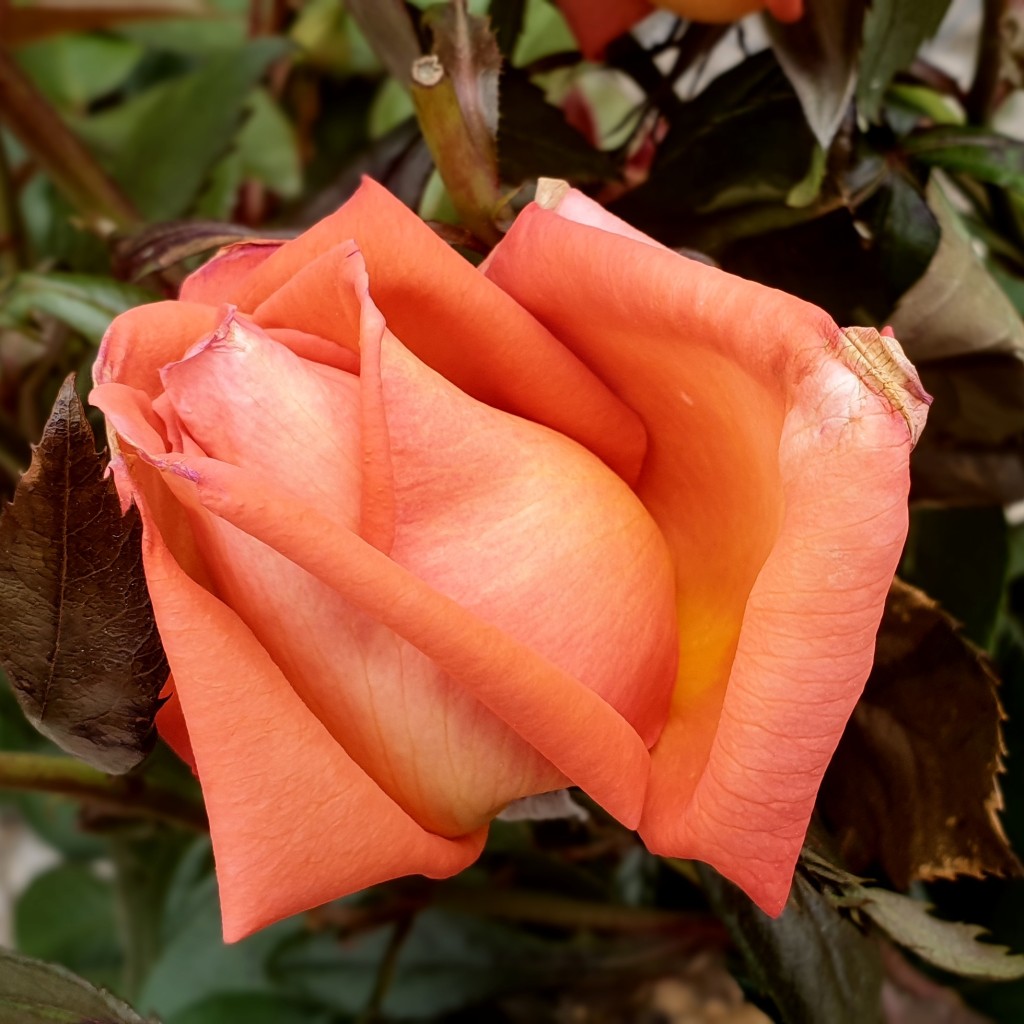
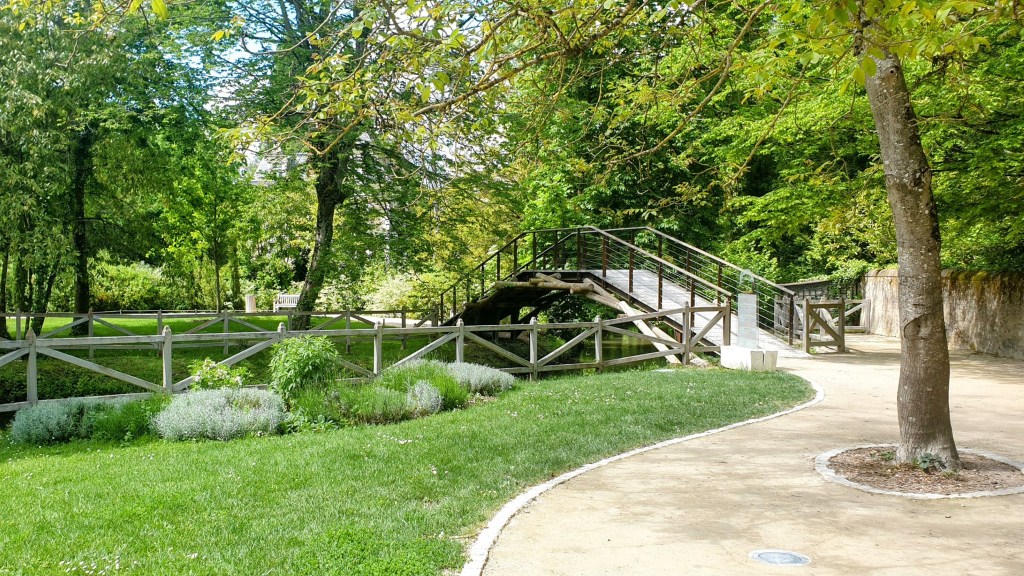
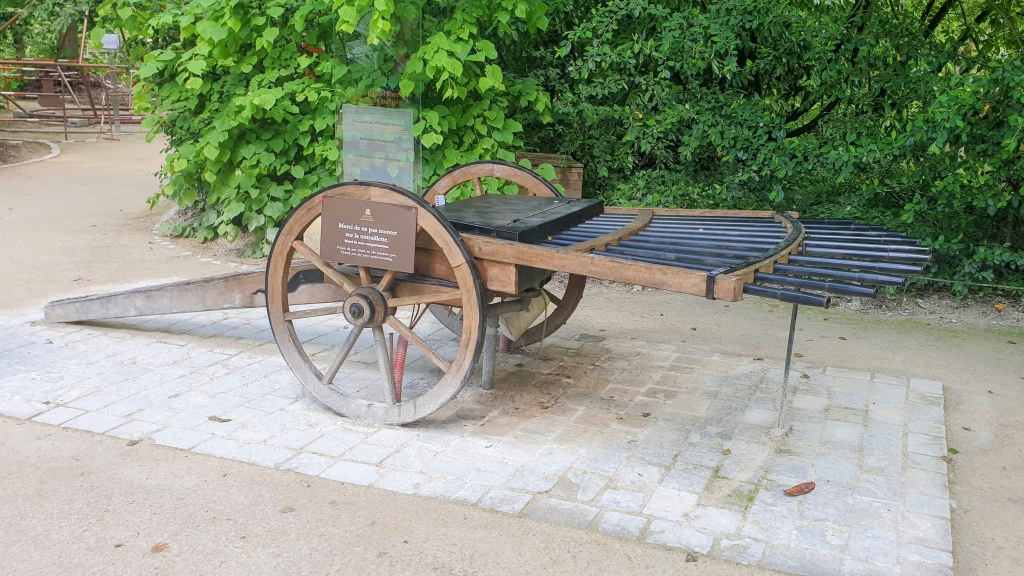
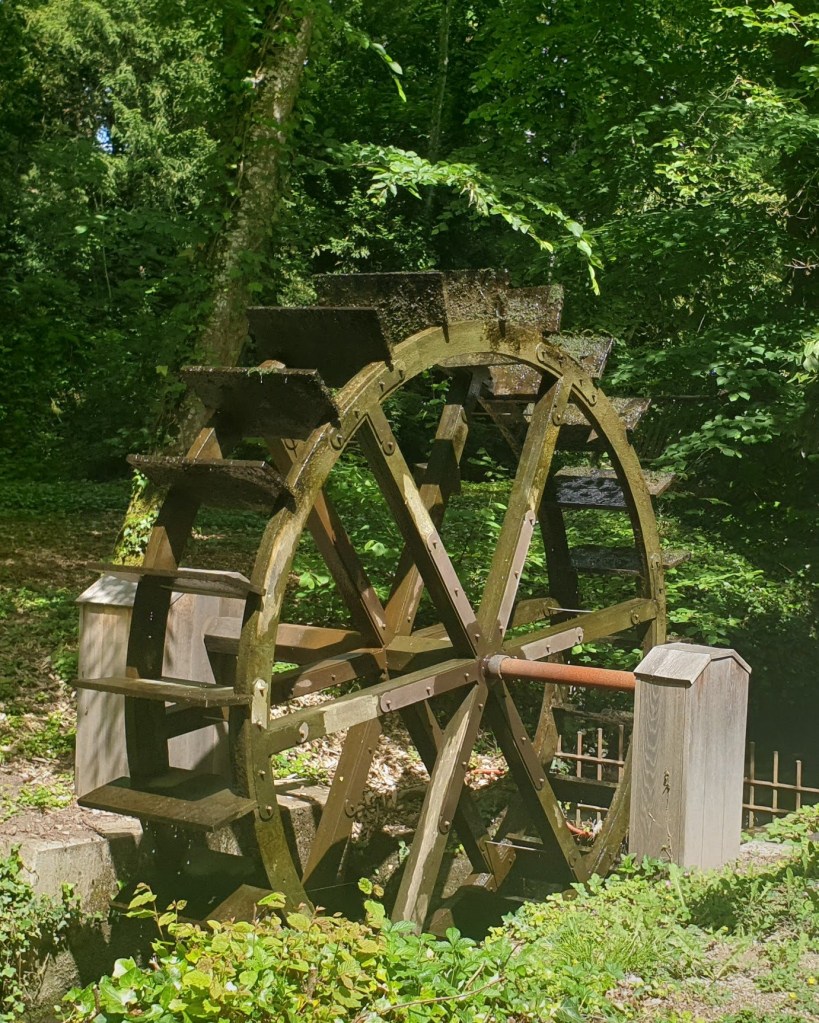
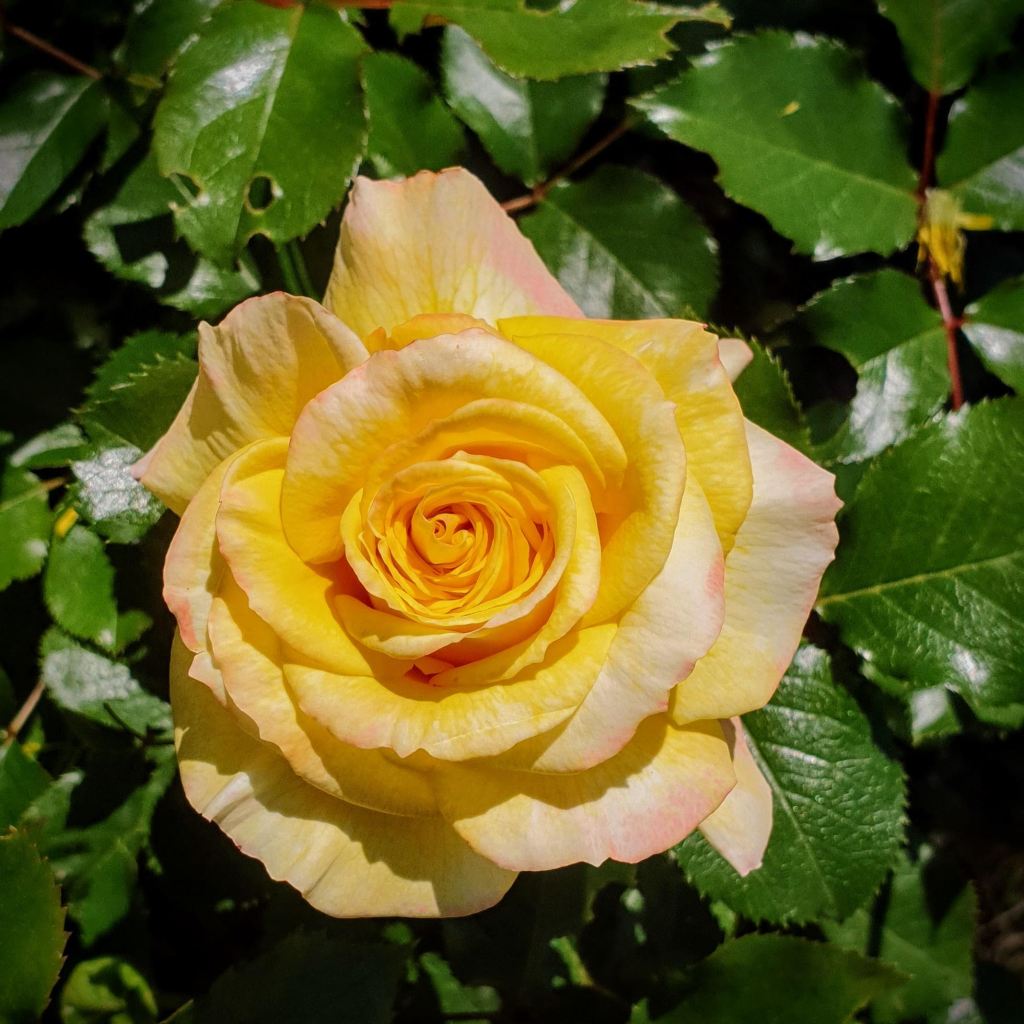
The grounds outside are beautifully designed to preserve a natural aesthetic with paths and waterworks connecting interactive models of several of da Vinci’s inventions, allowing visitors to see the natural world that inspired him, and to have a hands on experience with his engineering genius. Also, the last photo in the slide show is a breed of rose named “Mona Lisa” which I loved.





When I heard about the variety of château around the Loire Valley, this is the one I wanted to visit most, because I have personally been fascinated with da Vinci since I found out about him as a child. He was so clearly unique, intellectually and socially different from the culture and times that he was born into. As a person who often felt like I didn’t particularly belong, I enjoy seeing others like that in history. Although, over time, I came to understand that the combination of being born male and the patronage system that supported artists allowed people like Leonardo (if anyone can be said to be like Leonardo) to stay economically afloat and pursue their art and invention without the need to worry about where to live or what to eat.
In many ways, he and others like him are nearly mythological, and being able to stand in a room where they slept, or scribbled sketches or ate soup makes them more real, and it’s an experience I am glad to have had before leaving Tours.














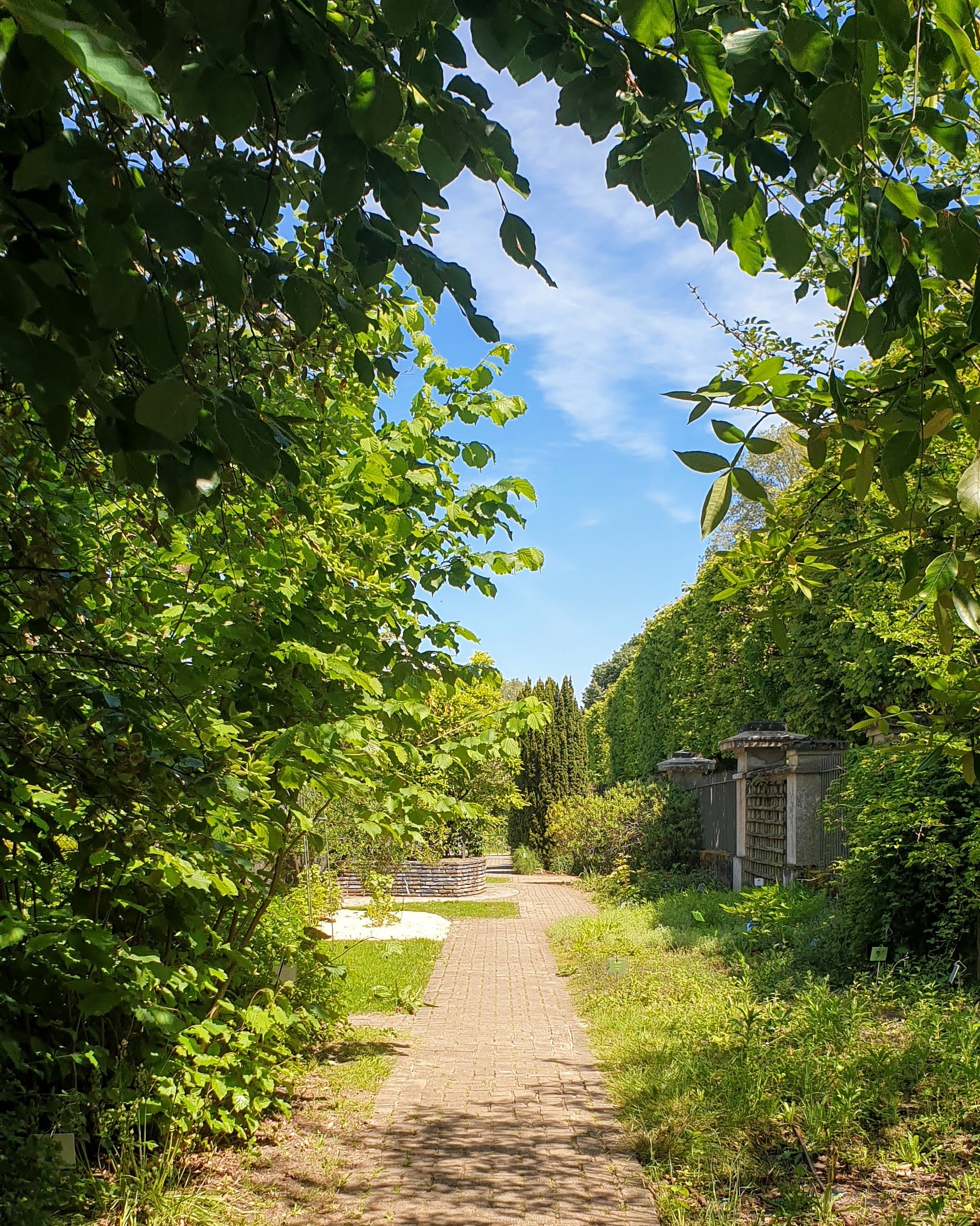
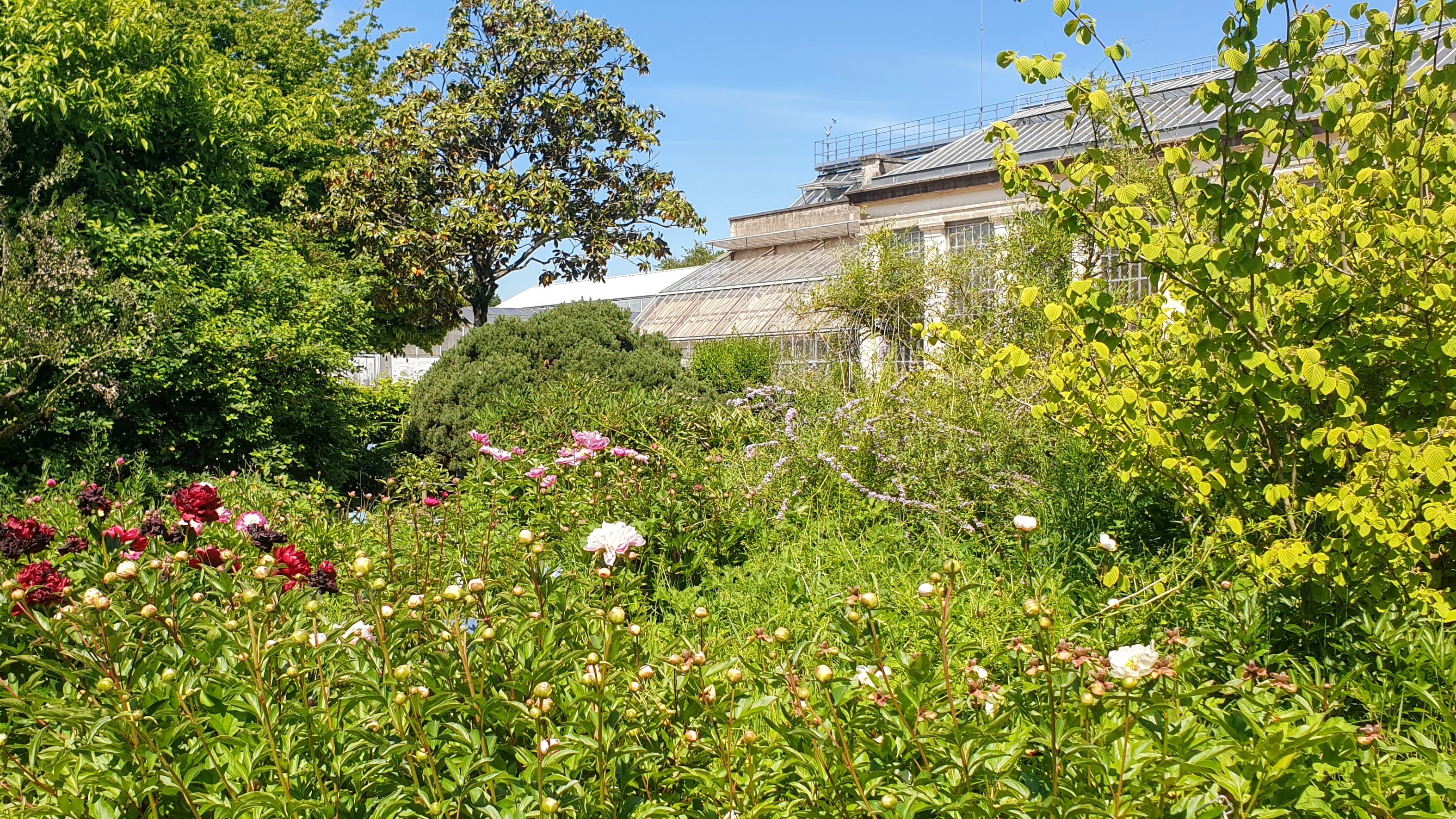
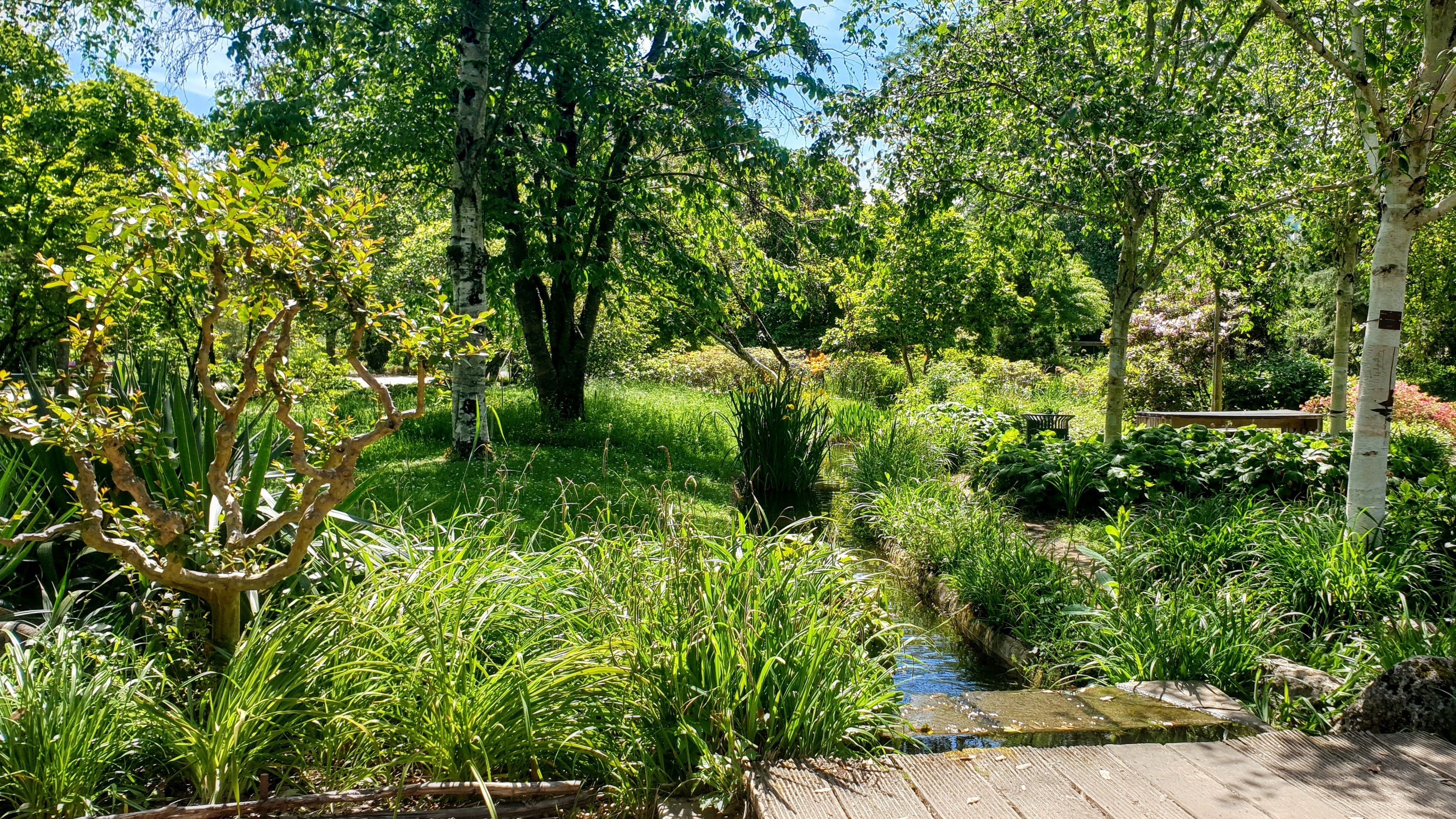
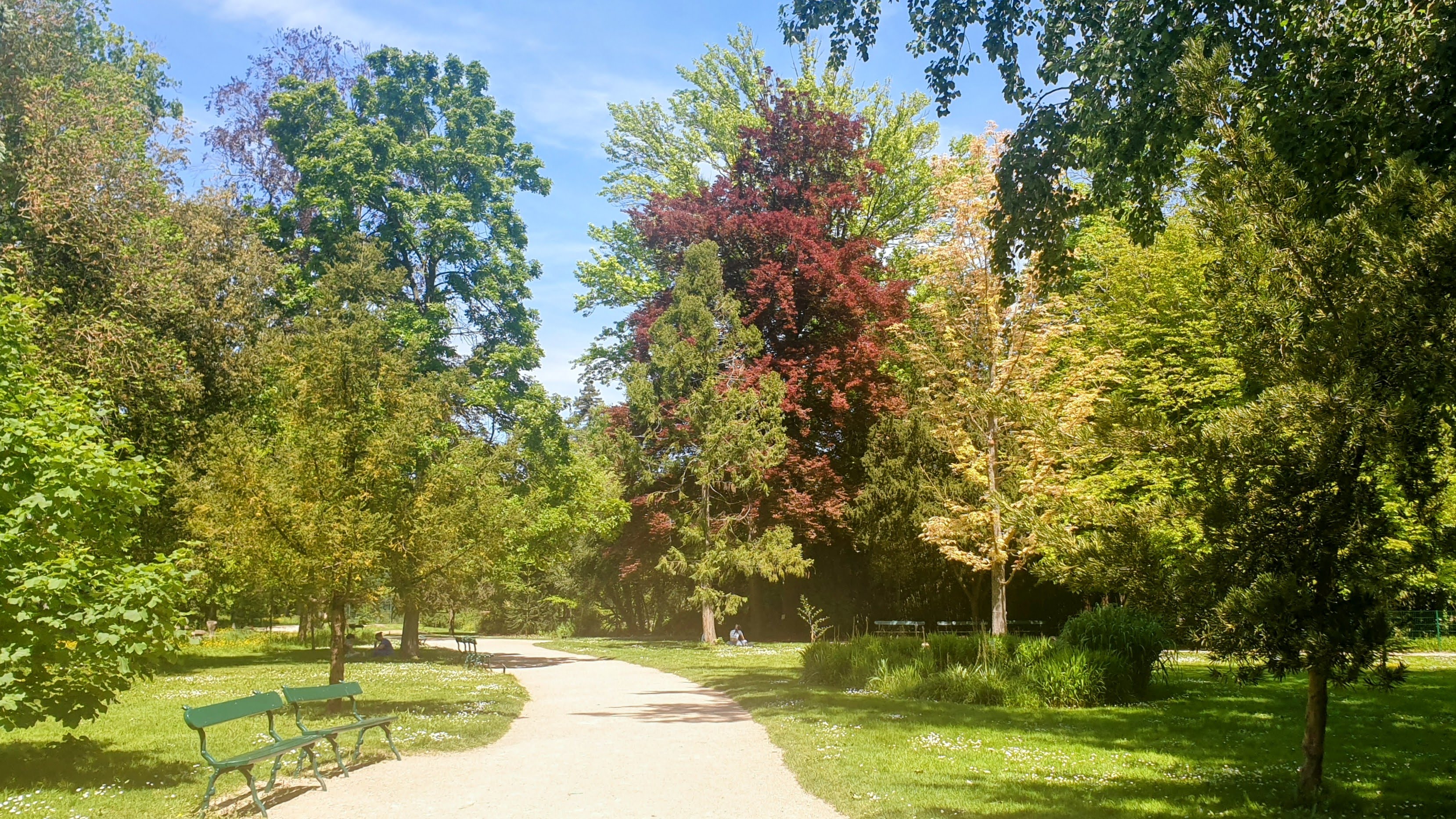
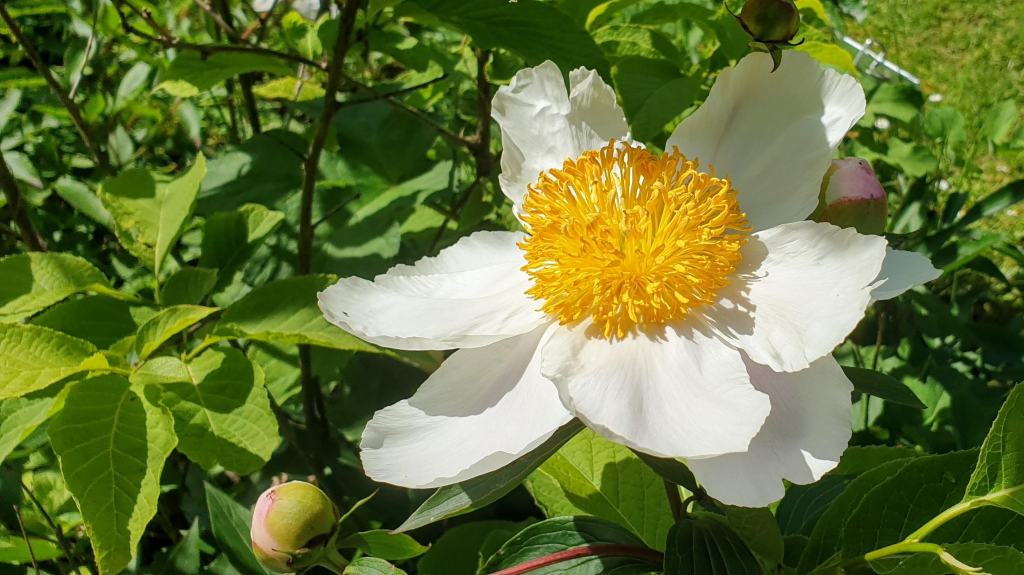
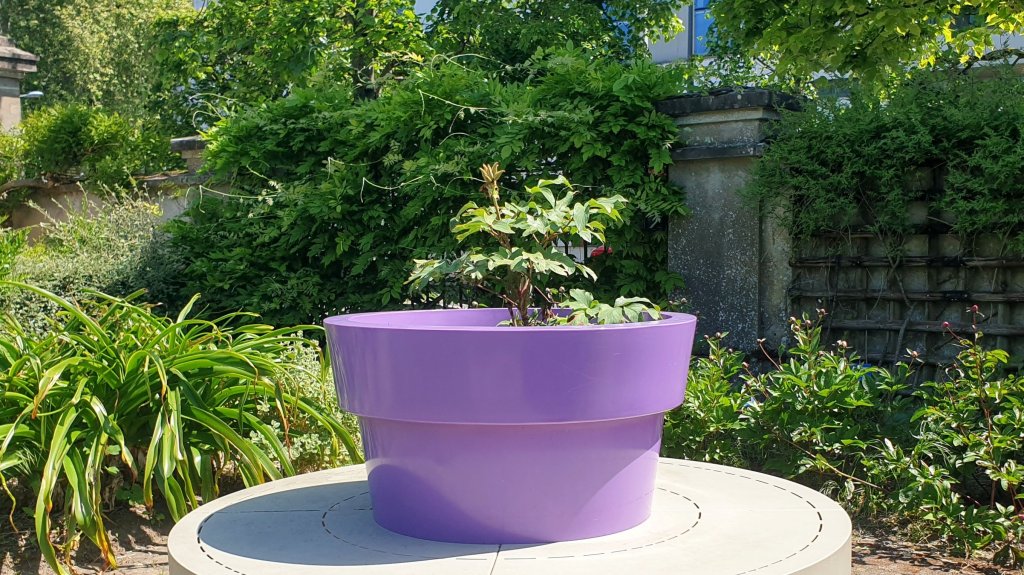
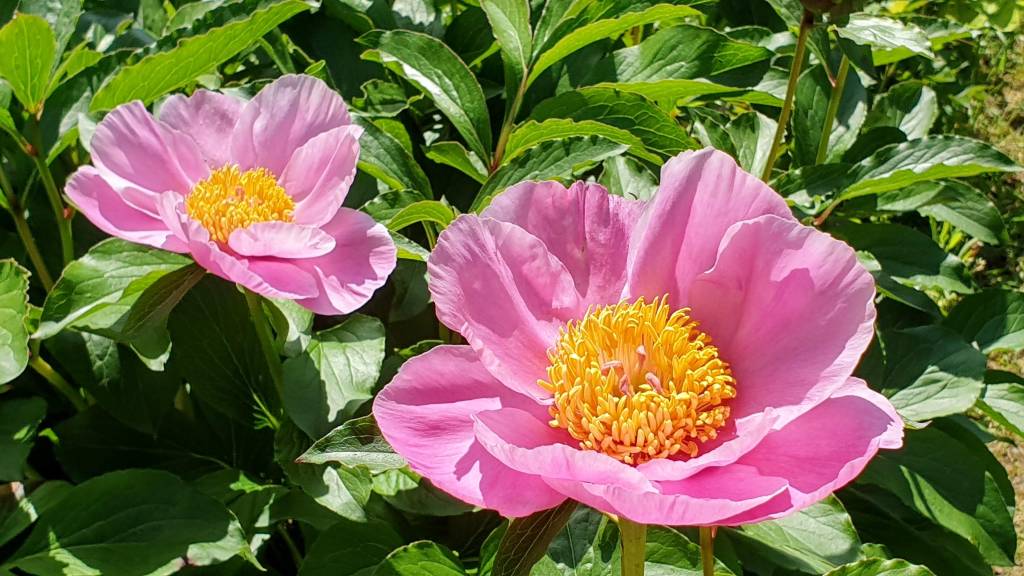
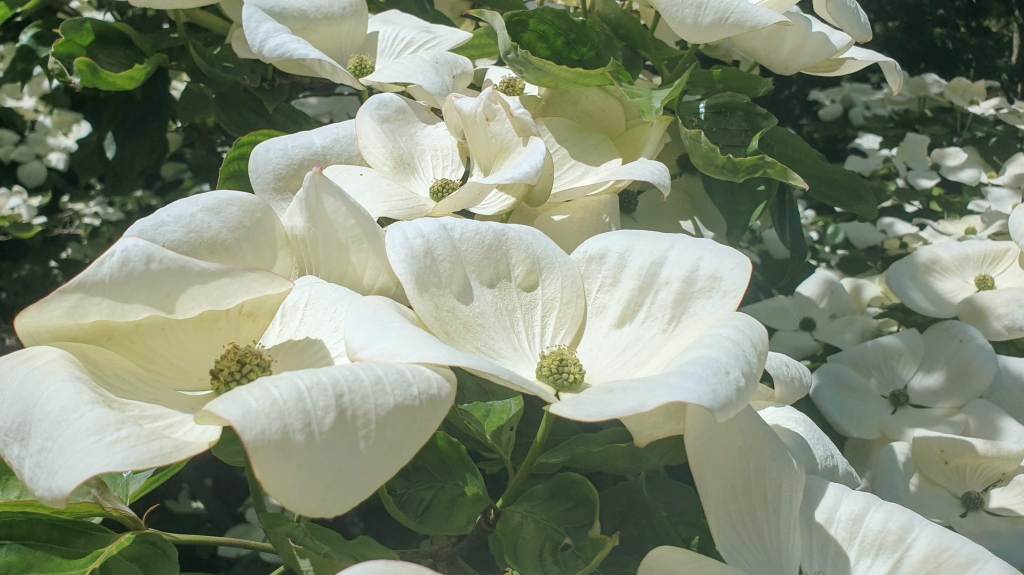
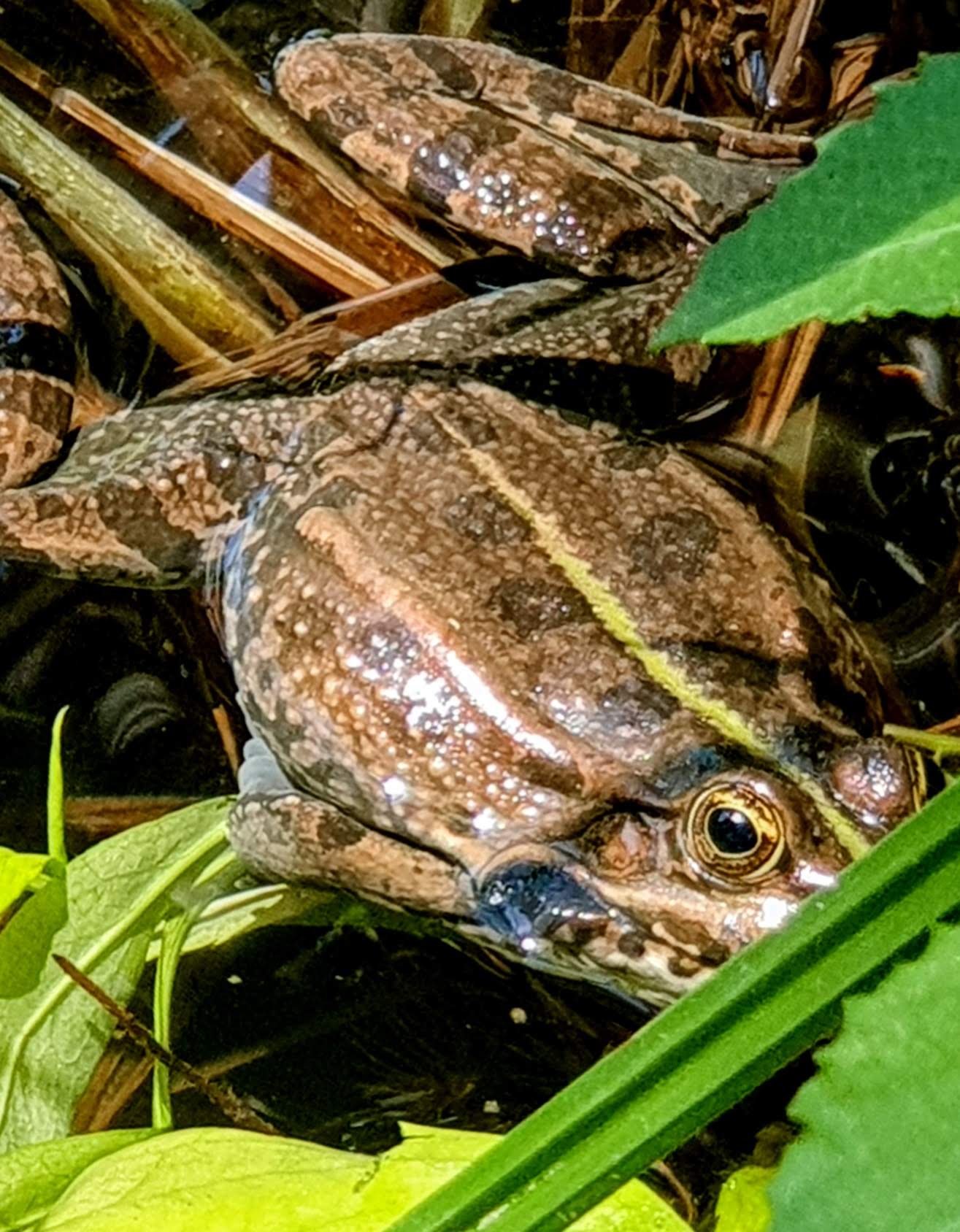
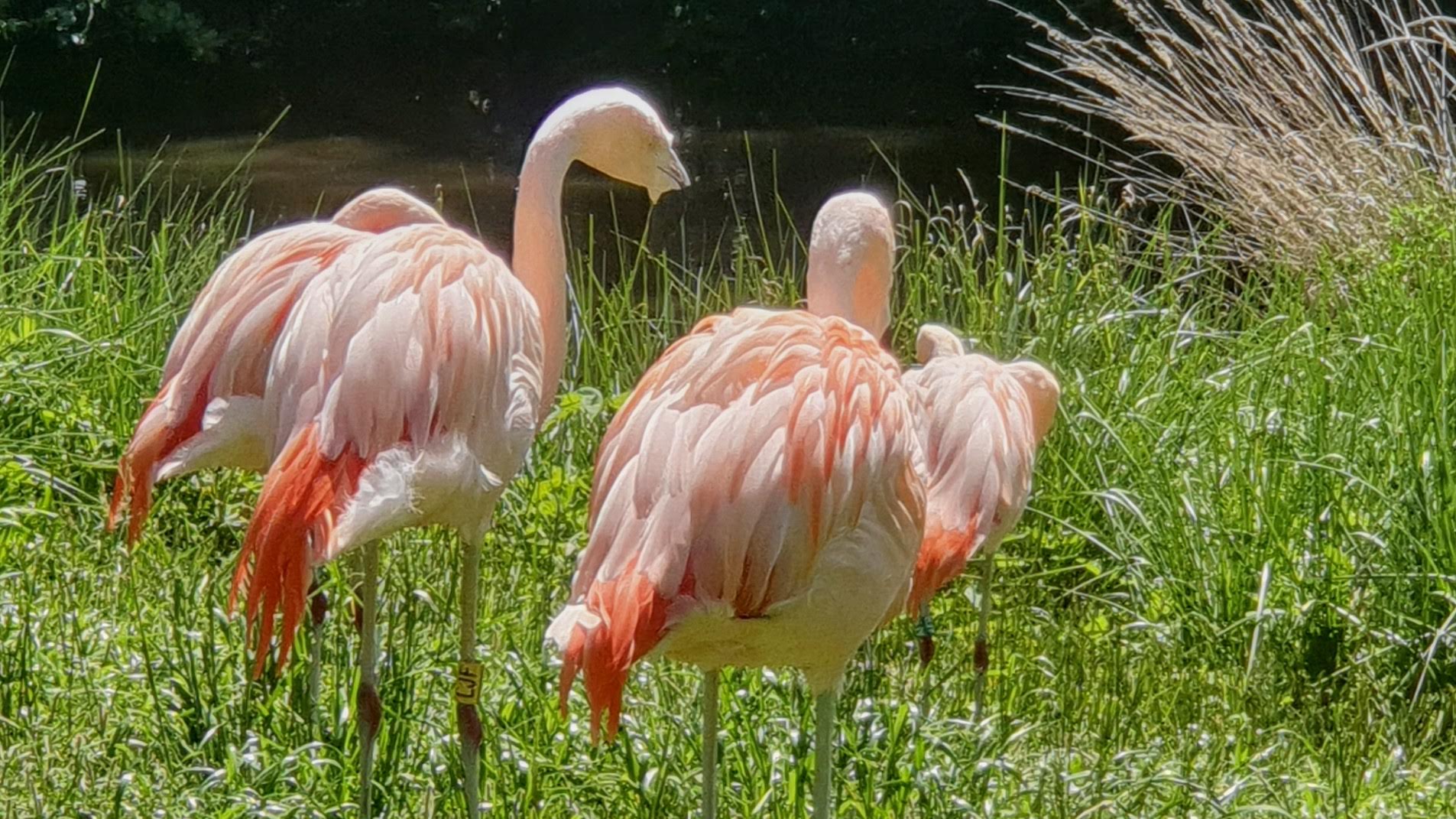

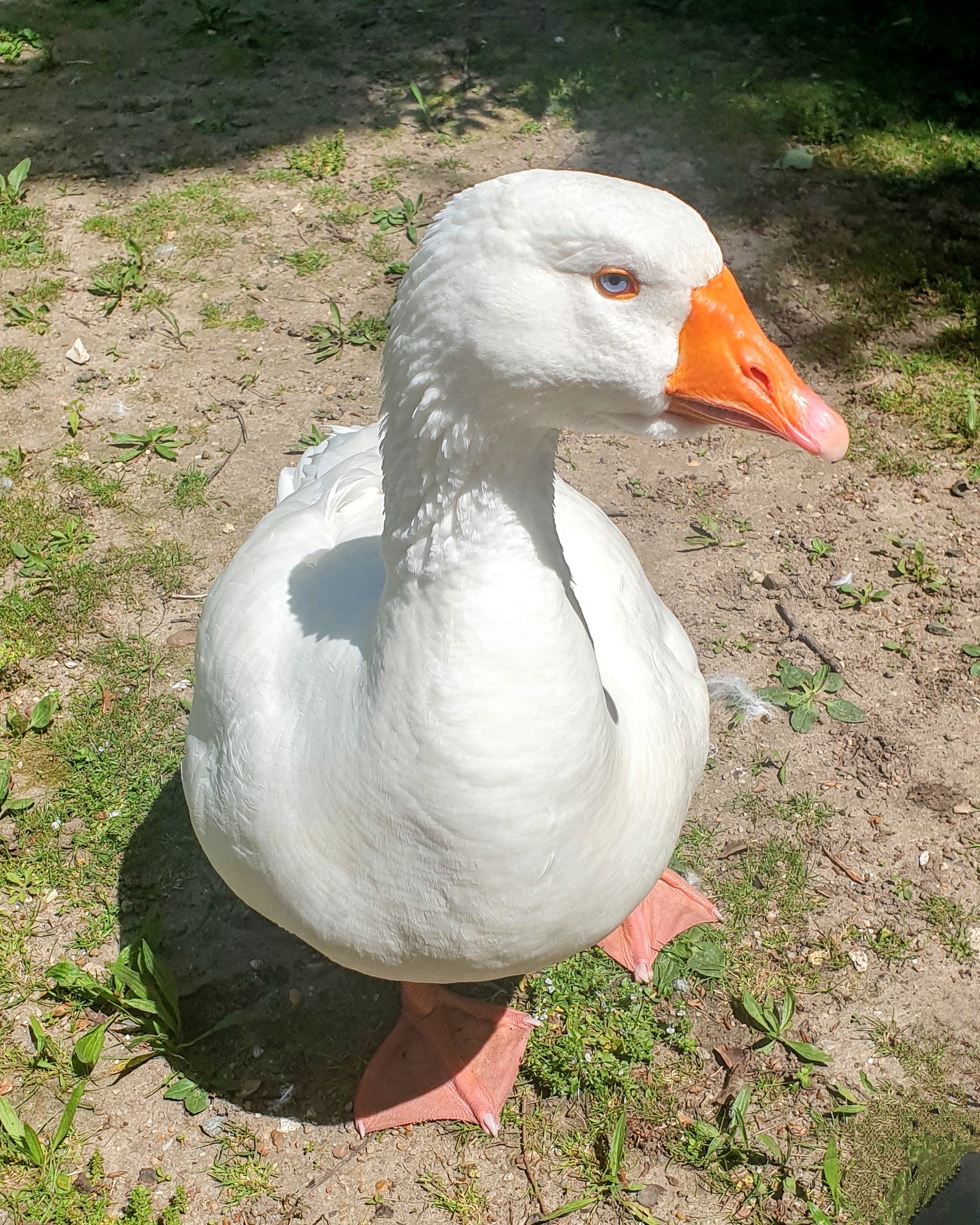


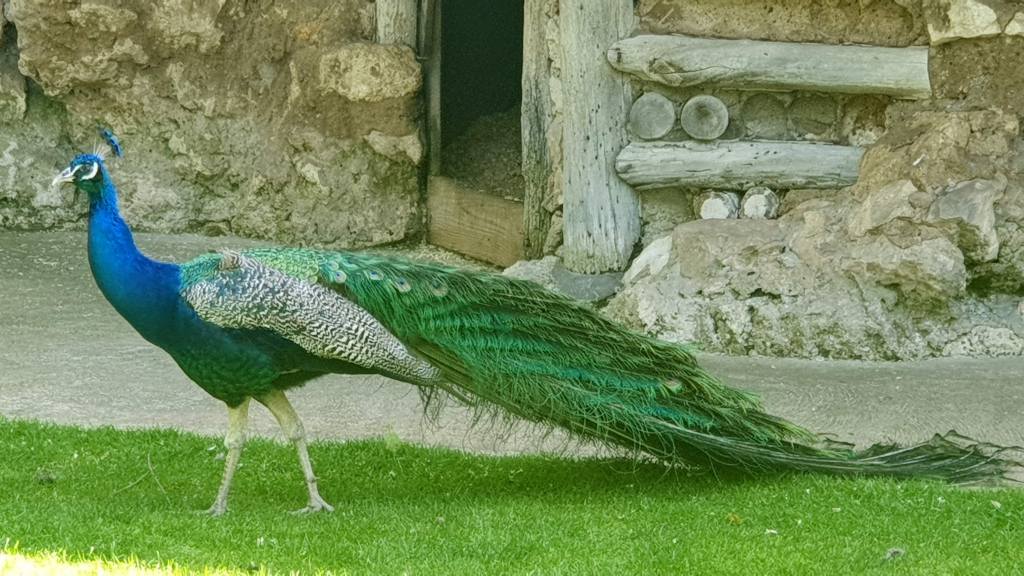

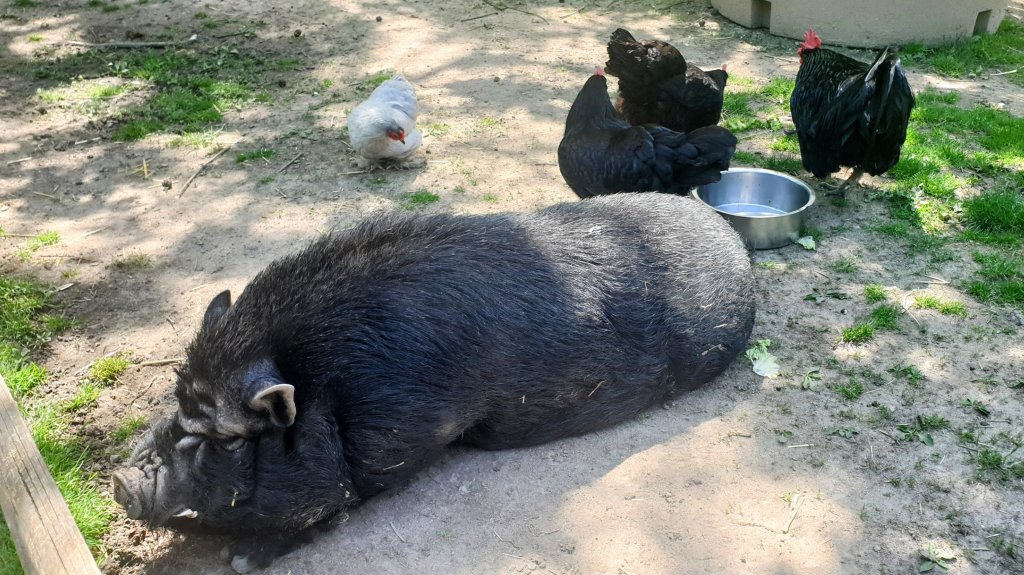

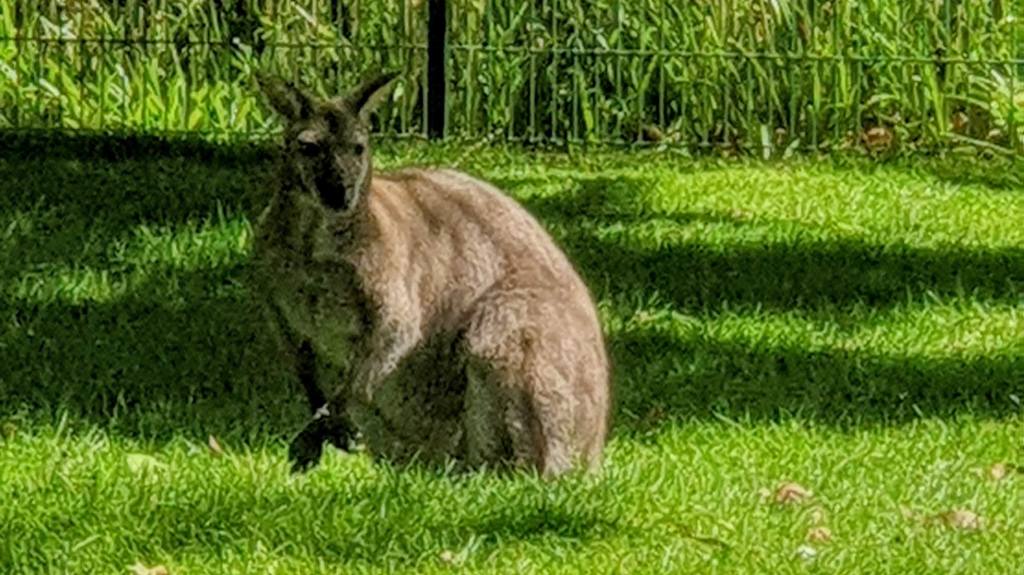
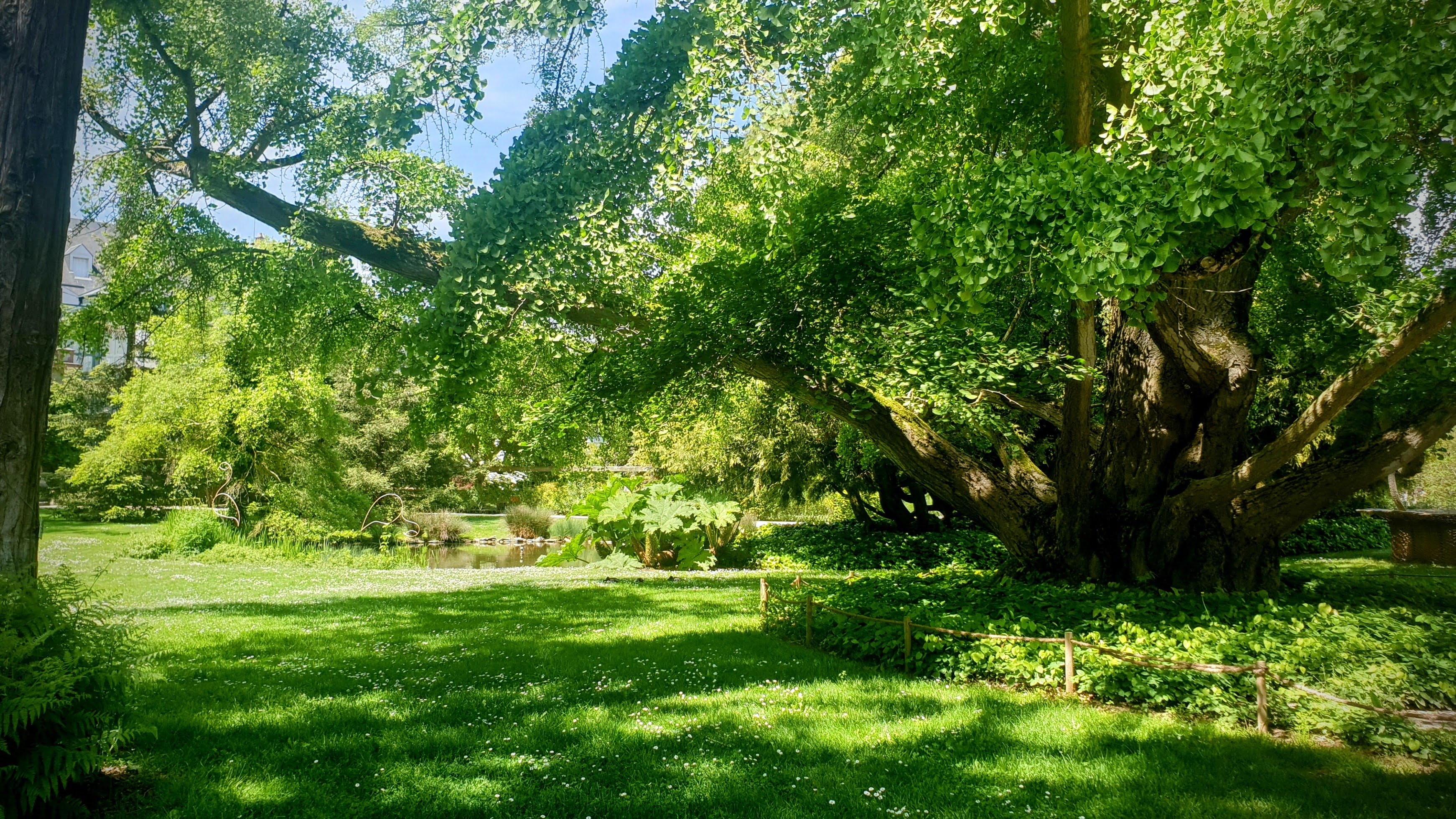
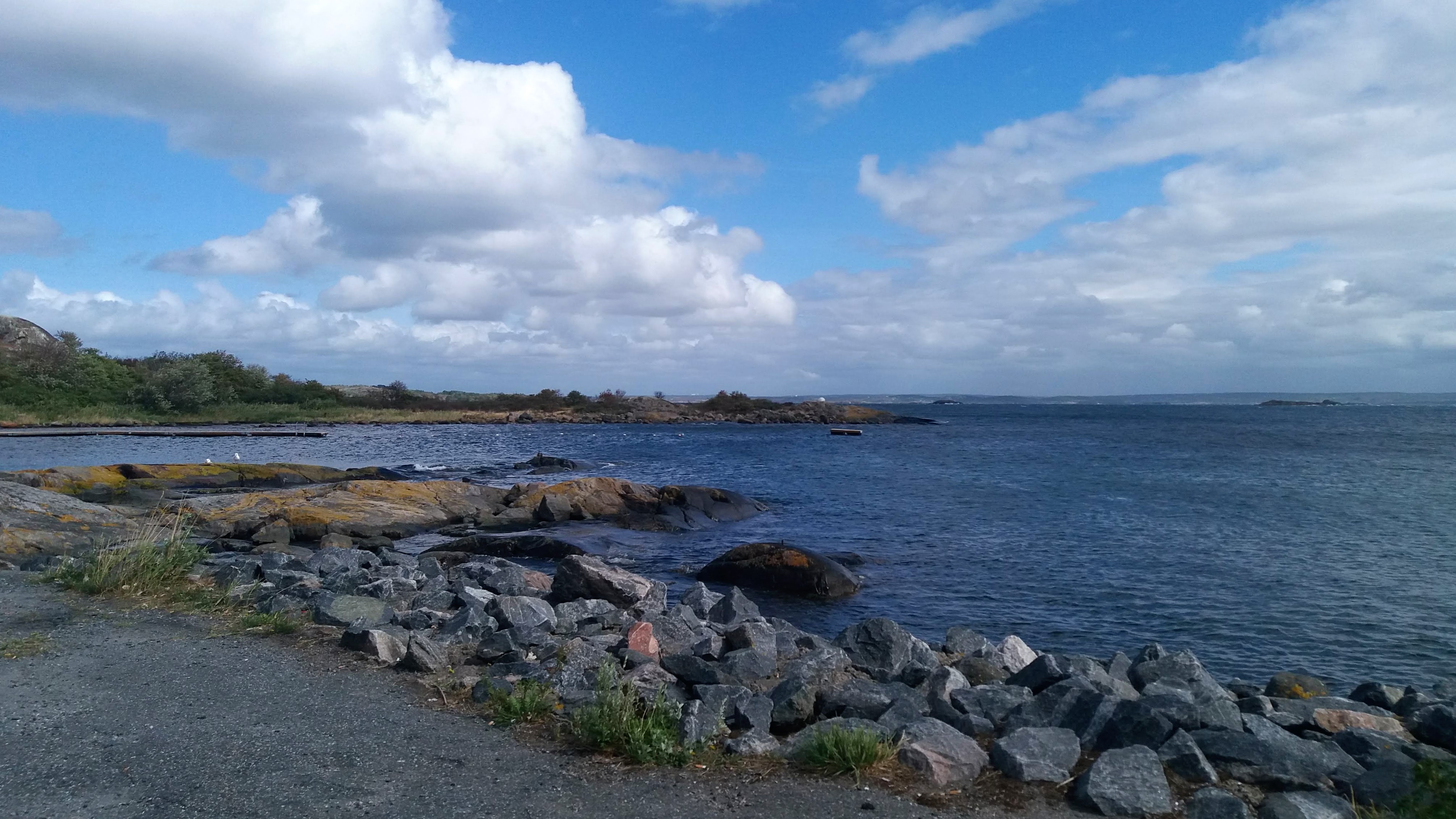
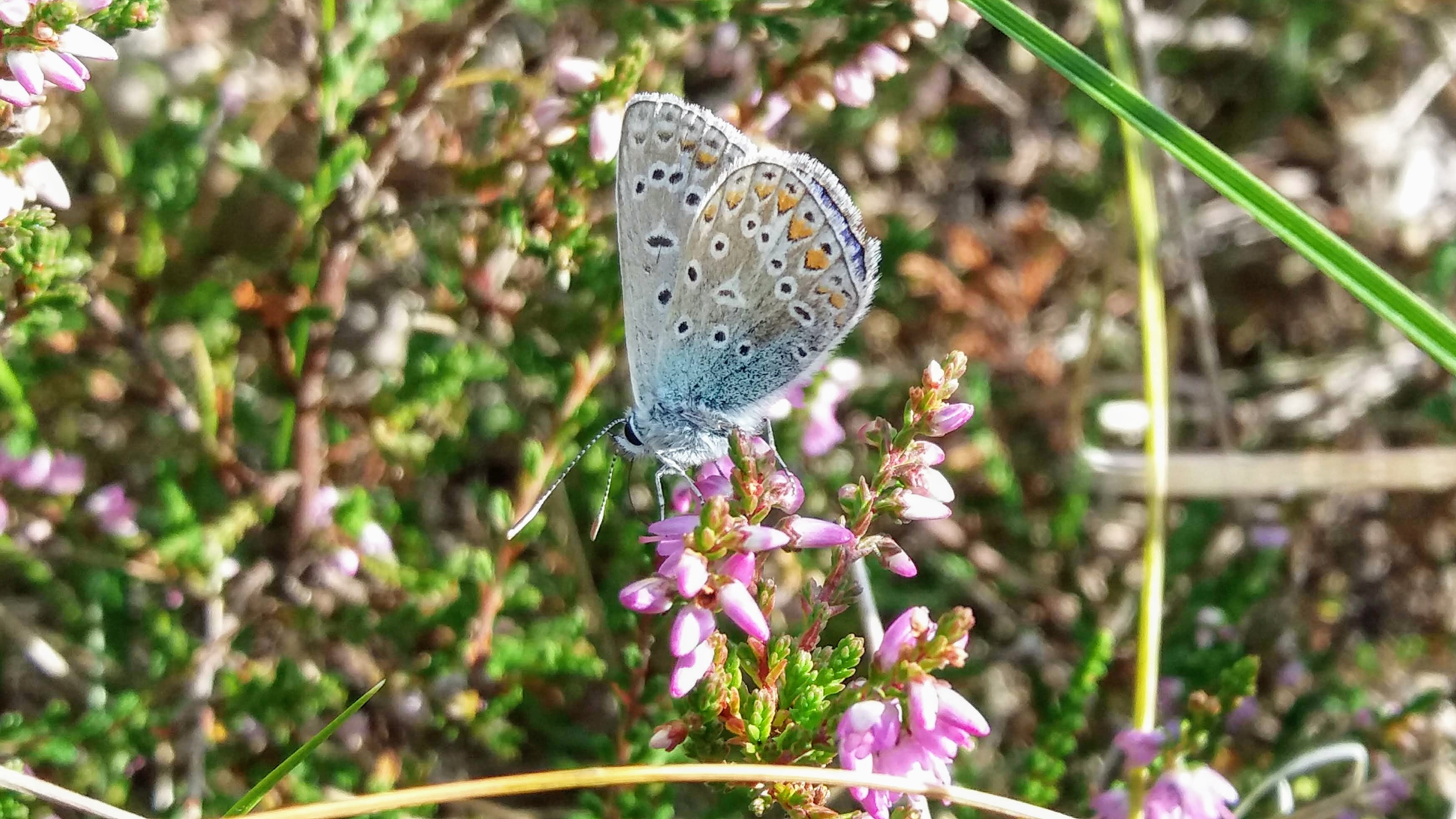
















 This is the gigantic park that has over 2000 cherry trees. I went today to check it out, since some of the cherries are blooming elsewhere. There weren’t a lot in bloom, and I walked around for about 3 hrs (it’s huge). I took over 100 pics (and this is without most stuff in bloom). I think these are the best of today’s. I’ll be going back in 10-14 days when I expect it to be really much fuller. A lot of the pics are closeups because the trees are still pretty bare, and most of the grass is brown, so the wider shots just don’t look very nice yet. This one is my favorite from the whole day. Unexpected bee!


 We set off from Busan (blue dot) in the morning to drive all the way across the southern end of the Korean peninsula to Jindo (red dot). Although Korea is small compared to, say, the US, it was still almost 5 hours of driving with the occasional pit stop. (By the way, in case you’re curious, you can see Daegu on this map as well). Fortunately, I went with a tour group (my stand by
 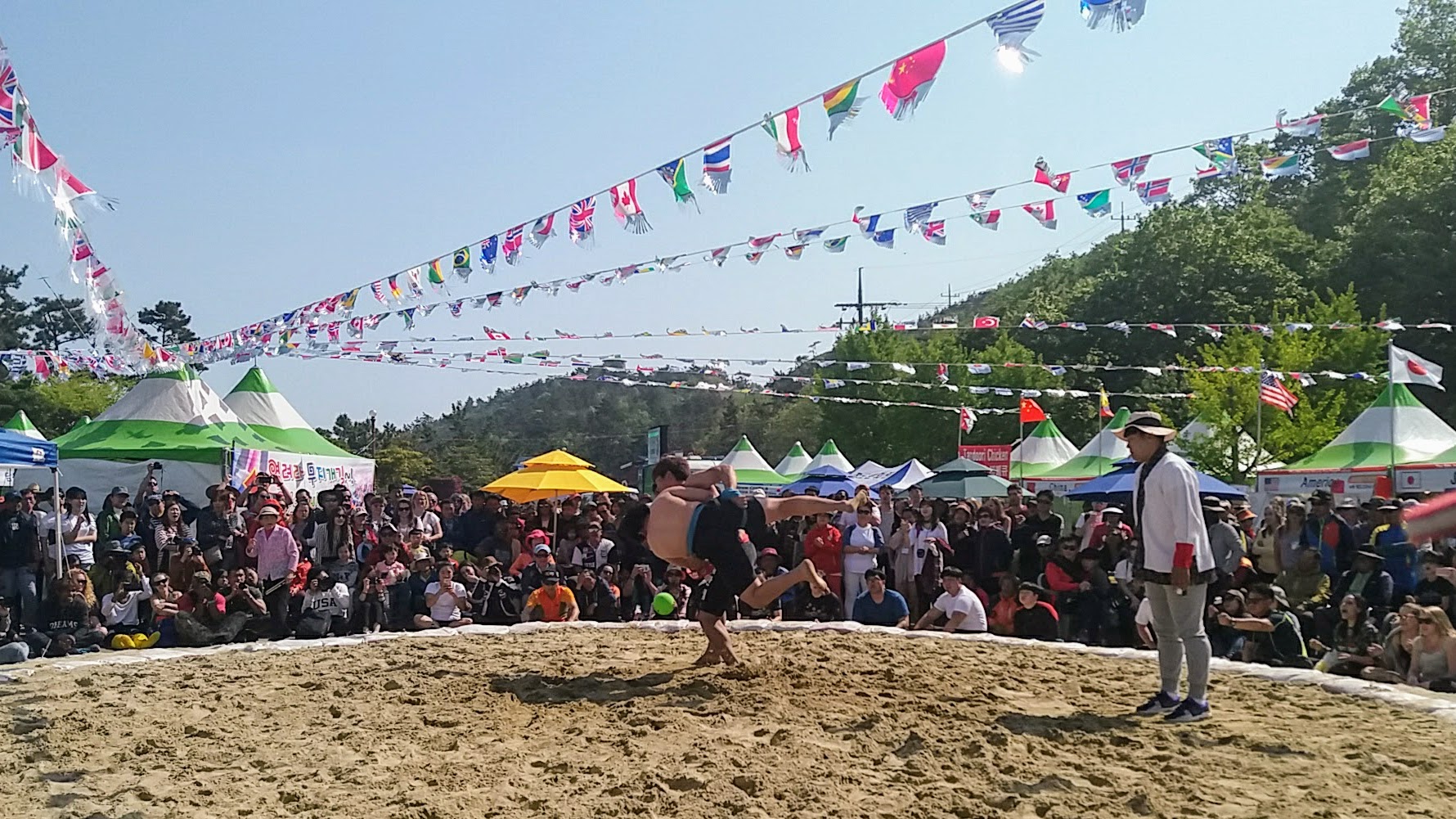 The Jindo festival had at least one feature I’ve never seen before: a traditional Korean wrestling ring. A pile of sand was placed in a large circle where two contestants could wrestle in the traditional style.
 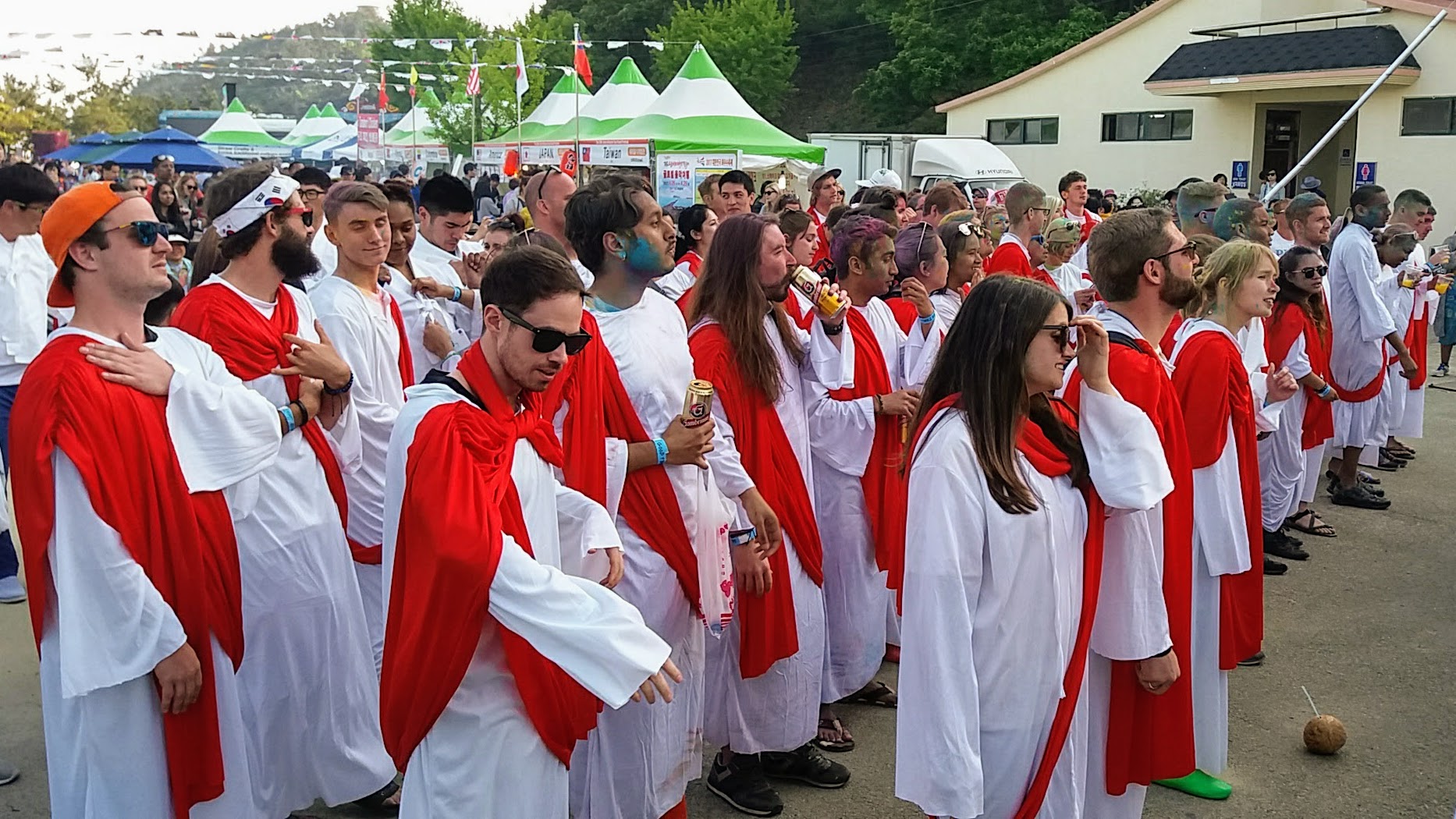 Even more bizarrely, after the color throwing was over, the festival organizers gave each participant a “toga” to wear. The togas were long white robes with red sashes that could have evoked a Roman senate or Jesus. Considering we were about to “part the seas” it was hard not to see it with Judeo-Christian overtones, but the rather drunk person I asked about it just said “toga party!” The entire thing seemed like the festival organizers were trying to find a way to appeal to the expat crowd. I’m glad they had fun, but I would have preferred some more traditional activities, like someone to teach us about collecting clams and seaweed the way the locals were doing as the tide went out. It’s hard to go do local culture festivals when the locals are busy trying to white-wash everything for cash.
 Finally, the real “reason for the season” was upon us and we muddled our way down the road to the rainbow steps beneath the watchful eye of the grandmother and the tiger. We paused at a bench to don our thigh high rubber boots and got some advice from the locals on how to attach the rubber garters through belt loops to hold up the boots, or failing that, to wrap them tight around our thighs and snap them in place. Thus clad in bright orange and yellow wellies, we made our way down the steps and into the shallow tide pools to wait for the tide to recede.
 If you look at the area on Google Maps you will simply see the beach and the islands, but on Korea’s own Naver Maps, there is a thin line connecting the rainbow steps to the island of Modo. Although this path is only usable twice a year (at most), the Korean map makers consider it important enough to draw in.
 The history of tidal prediction starts with Kepler (total nobody) in 1609 to theorize that the moon’s gravity caused the ocean tides. He was followed by other such no-ones as Galileo and Newton. It was in 1776 that the first big complex equations came from a man called Laplace. Harmonic analysis was added in the 1860s and polished off by 1921 in the form that Navies all over the world still use today. Although the math hasn’t changed in almost a hundred years, computers make the math easier and the information more widespread so now instead of just ships in harbor– surfers, beachcombers, and clam hunters can
  On a more mystical note, the local legend of the tigers explains why there’s a statue of a grandmother and a tiger overlooking the sea. Long long ago, the villagers who lived on Jindo were plagued by man-eating tigers. The whole village packed up and sailed over to the neighboring island of Modo to escape the threat, but one woman was left behind. The woman was Grandmother Bbyong, and she prayed to the Dragon King, the god of the sea, to help her. Finally the Dragon King came to her in a dream and told her he would build a rainbow brigde across the sea for her. The next day when Bbyong went down to the sea, the waters parted to let her cross and her family came out from Modo to meet her. This also explains the rainbow stairs that lead down to the landbridge, but not why her family couldn’t have just sailed back for her in the first place.
 While math can now easily tell us the time of the lowest tides, it does not yet advance to tell us what the actual lowest level of the water will be. Not that it couldn’t, but there are more variables involved, so it’s not a thing now. While we can say with certainty, the lowest tide of the year on this beach will occur at 18:38 on April 29 (or whatever), we can’t say for sure if that will expose the land bridge or simply be lower than every other tide around it.
 We tromped along the path, watching parasailers overhead and rainbow colored lanterns being released in to the air from the beach behind us. It was clear the path was quite narrow because going too far from the group to one side or the other to get a picture resulted in a severe deepening of water level. At the time, my friends and I theorized it might be man-made, or at least man-maintained, however, I have since then found that the build up of rock and sand in this twisty line is a natural result of the currents around the islands.
 Before long the golden light of the sunset combined with the swish-swishing of hundreds of feet through water to create a trance-like state. I could not judge how far the island was, nor tell which way the path twisted. The rocks below us rose and fell, bringing the waves treacherously close to the top of my boots and then back down to barely splash over my toes. The whole path is nearly 3km long. I suspect a determined person could make it out to the island and back in the hour or so the path is clear to walk, but I wasn’t racing, and soon we were greeted by the sounds of Korean drums and the distant flags waving as the procession from Modo came out to greet us.
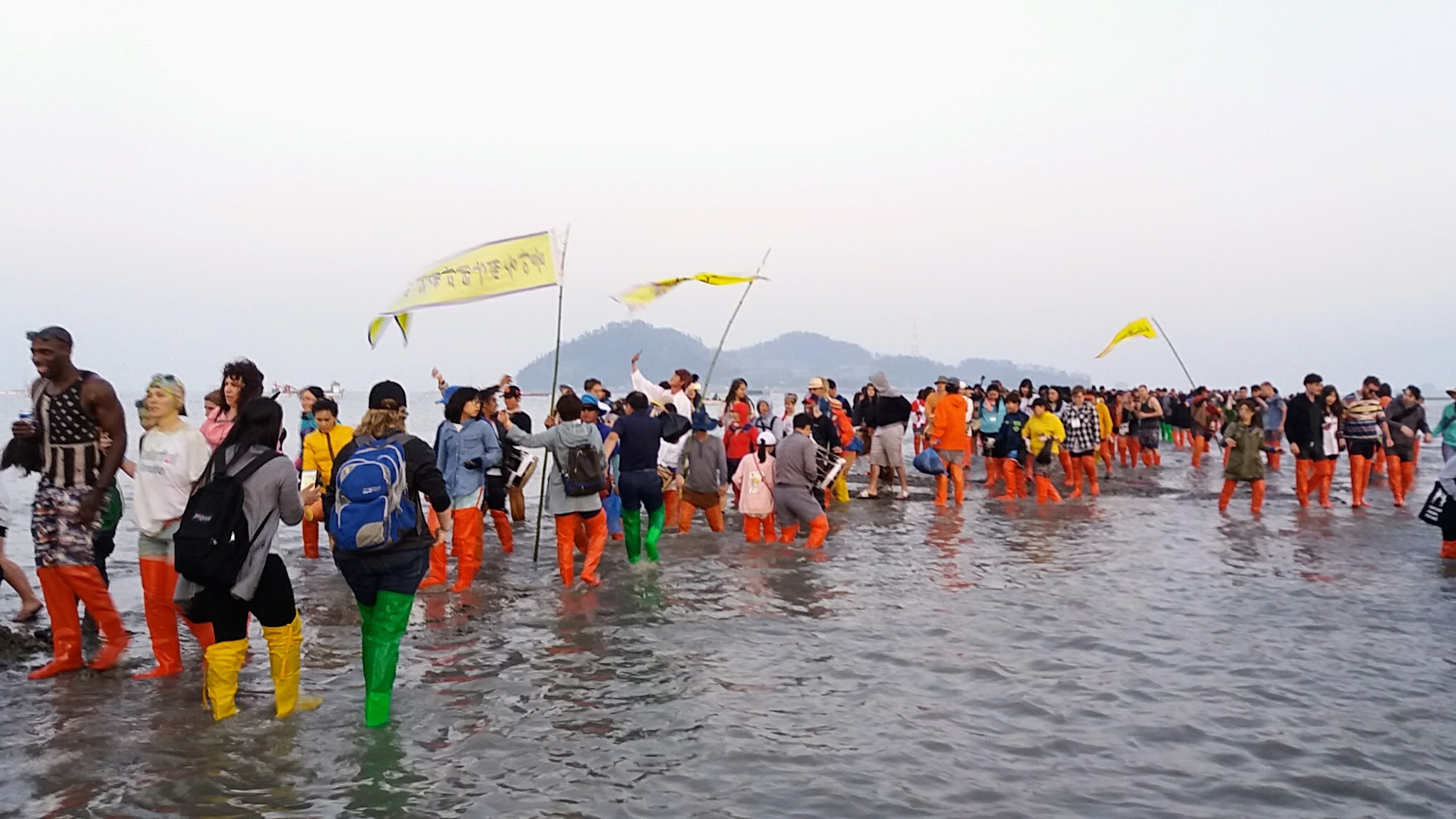 The walk outward had been slow, trepedatious, as though we were nervous the land could drop away at any moment, but the trip back was much more celebratory as well as much more damp. The parade of drum bangers, cymbal crashers, gong ringers and flag bearers danced merrily in their traditional garb, urging us all back to the larger island of Jindo. Our pace quickened and our legs swung to the rhythm causing much larger splashes. Waves came in from both sides of the path making us nervous, but excited. The water finally breached the top of my boots and sent an icy chill down my shins, but I found I did not mind.
 Before heading to the fields, we walked up a long road past the area of the light festival where a few wire frames from reindeer and dragons could still be seen. The road up the hill was painted with fun perspective illustrations of a stream, complete with little camera icons to show the best places to stand to see the visual effect. Optical illusions are fun.
 At the top of the hill, far beyond the little pagoda that had marked the highest point of the lights, we finally came upon the green tea museum where we were treated to a special showing of the Korean green tea ceremony (complete with English translation by our awesome guide). The ceremony involves a process of several containers: a water pot, a cooling bowl, a tea pot, and the drinking cup. The hot water pot is filled with boiling water, which is then poured into the bowl, and from the bowl into the tea pot and finally into the cups. The instruments are warmed up in this way. Then more boiling water is poured into the cooling bowl. Tea leaves are scooped into the warm but empty tea pot and the ideal temperature water is poured from the bowl over the leaves. While the tea steeps, each cup is emptied of it’s hot water into another bowl on the floor and wiped dry on the outside. The tea is then poured into the pre-warmed cups by pouring only a half a portion into each and the other half in reverse order on the way back. The tea is then served, 4 cups to the guest and one to the host.
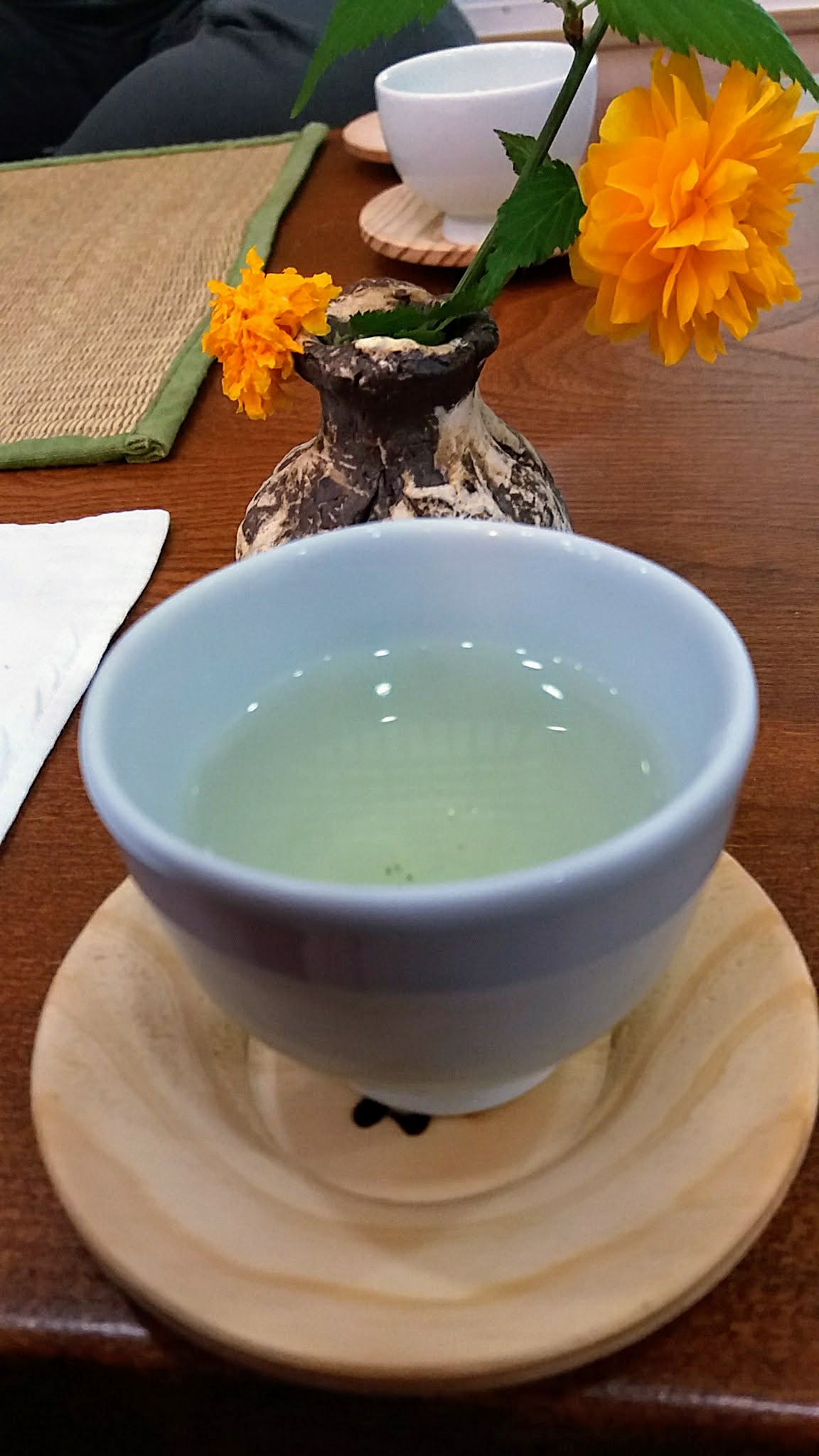 The hostess tried to tell us a bit about green tea, red tea and black tea but her translated explainations seemed off to me, since she said it had to do with the age of the leaf when it was picked from the plant. I don’t know if this was her or the translation, but the real story follows: In any country with Chinese roots in it’s culture and language, the three colors of tea are a bit different in meaning that in the West. Red tea is not Rooibos, in fact all three come from the same plant. And it’s not the age of the leaf at picking that determines the difference, but rather the post picking, pre-drying process. (although especially young and tender tea leaves are sometimes referred to as “monkey picked” and do make a delightful tea).
 After we conducted our own tea ceremonies, I drifted lazily back down the hill, examining the spring flowers and the grounds that had been lit up beautifully last December. When I finally got back to the tea fields, I took off on the same route I’d walked before and was happily greeted by many blooming apple trees and a small army of busy bees who were so focused on the brief blossoms that they paid no mind to all the humans fussing around. In fact, I think it was the only time I’ve seen Koreans in the presence of a bee not totally freaking out. I guess the selfie with the tree is worth it.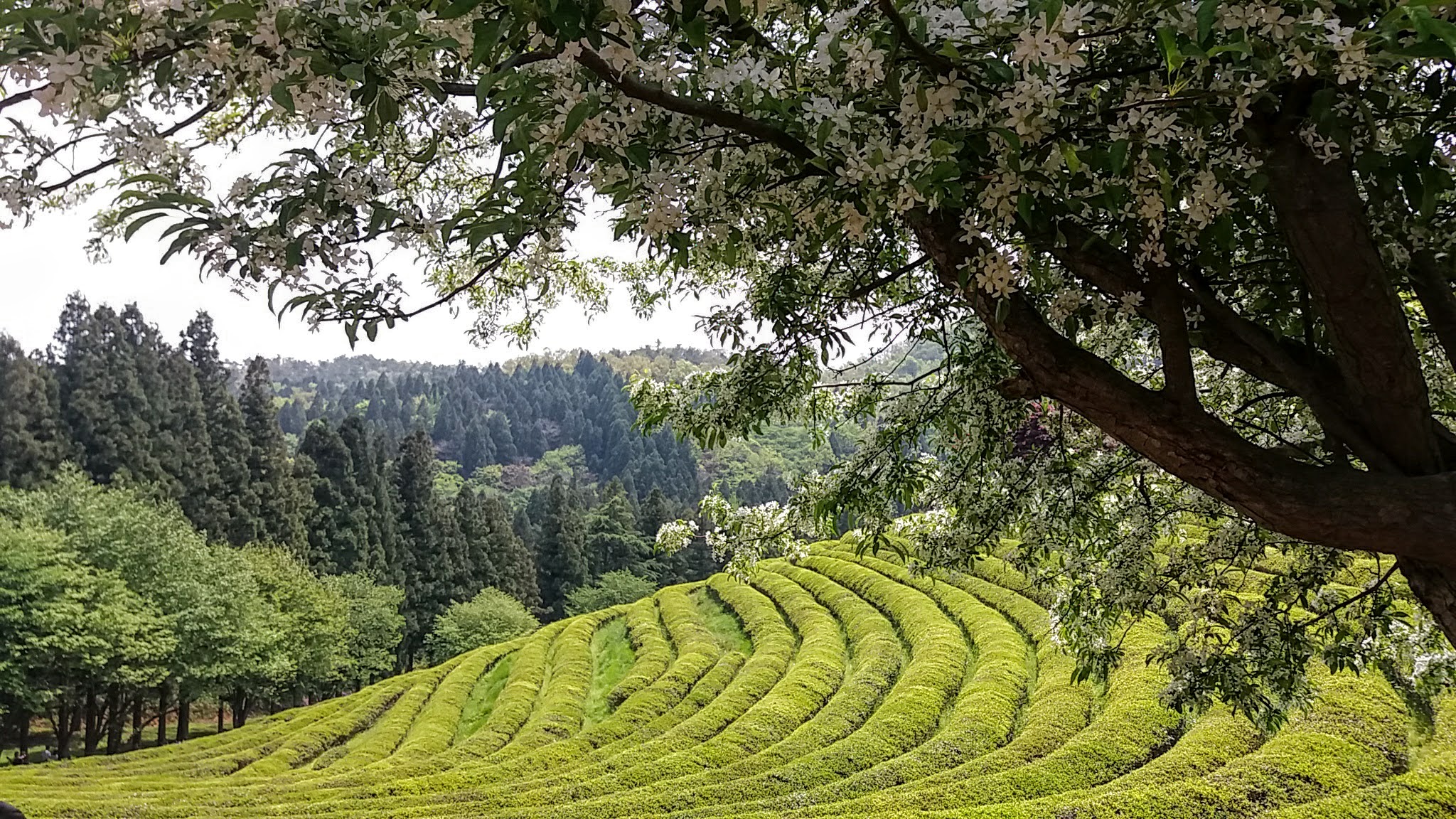
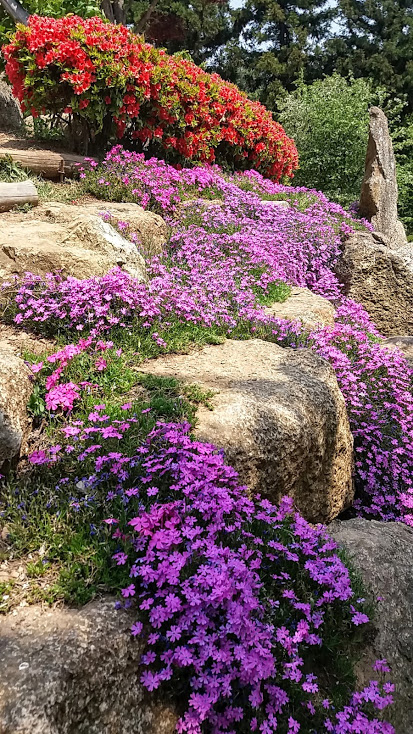 In addition to the blooming fruit trees, there were cascades of purple flowers covering the rocks wherever tea was not growing. It made the whole place feel like a still frame of a rushing river in shades of pink, purple and green. Besides the tourists, there were also tea pickers at work. Each ajuma looking lady had her sun guards on, gloves and a mesh basket to place the leaves. They were not picking the bushes bare, but selecting only some growth. It seemed to me to be the newer, brighter green leaves that they were after, but I couldn’t tell for sure. In the age of automation it was strange to see people picking by hand. I know that it’s still the way for many crops in the world, but sometimes it gets driven home that there’s a human on the other end of my tea or strawberries or carrots, and then I’m carried off by sociological musings on how we came to value people who sit at desks manipulating imaginary money so much more than people who make our food.

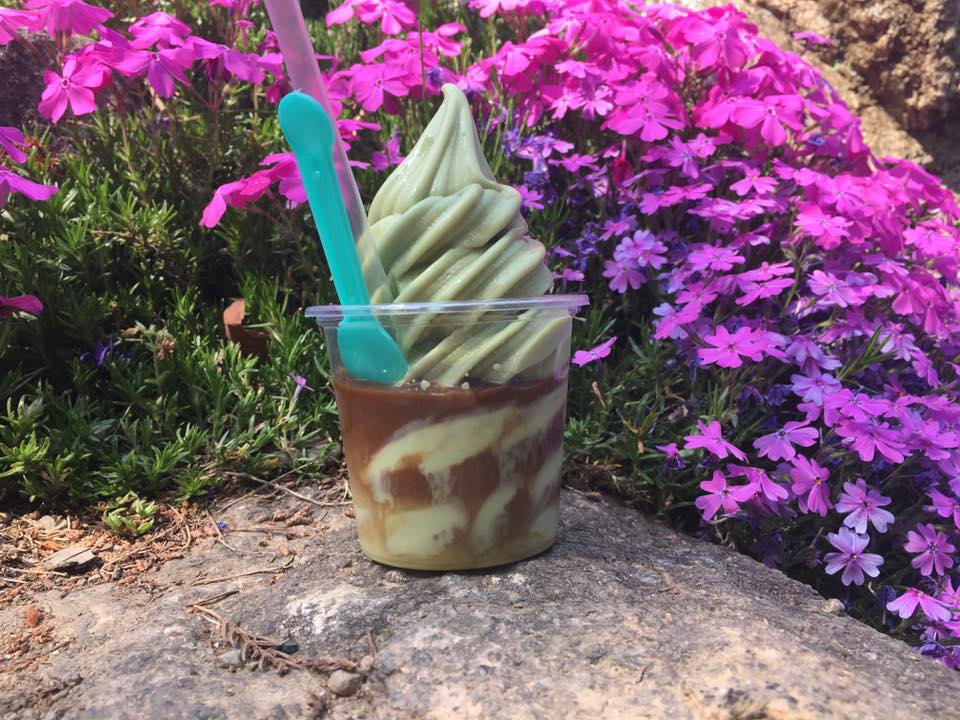
 Shortly after parting ways with the helpful Nigerian, I walked past what appeared to be a large open air food court. There was a roof and fans circulating air, but the entryways were wide open. There were dozens of food stalls from different nationalities, and tables to sit at between them. I went to one stall to get a fried oyster omelette and another for an iced coffee, then sat down to enjoy them. The omelette was a bit odd. In addition to eggs, vegetables and oysters, it turns out this dish is cooked with a variable amount of tapioca, potato, and/or rice starch. This just goes to prove I should have read more about the food before going, because the gooey texture combined with the heavy oil meant that I only ate about ¼ of the dish before I couldn’t eat any more. The coffee, on the other hand, was intense and amazing. I didn’t know it at the time, but Malaysian style coffee is different from other coffees around the world. I’ll explain more when I get to Ipoh, but for now, suffice it to say I was pleasantly surprised.
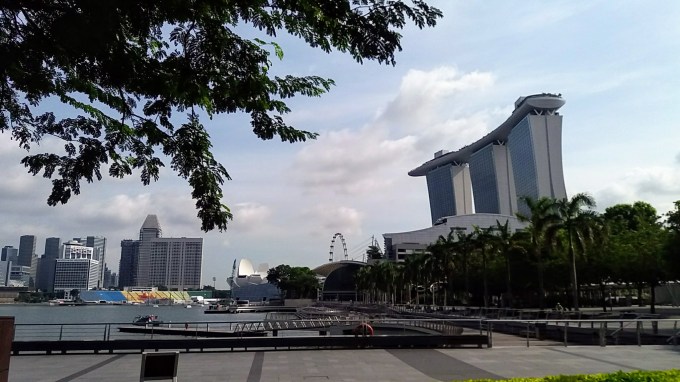 After breakfast, I passed by all the tall financial buildings and came to the Marina. This beautiful stretch of waterfront goes on for ages with a wide and clean walking path. I came across a shopping mall on my way and decided to head inside for the AC and maybe a restroom. The Nigerian man I’d met advised me that if I ever felt too hot in Singapore, I could just walk inside any building to get some cold air. The mall was nearly empty, which is not surprising for a weekday morning, and I managed to find a 7-11 to get a cheap sim card (less than half of the airport prices). I also got called in to have a sample at two separate skin care shops. The first was a supernaturally charming young man who probably got nearly every woman he met to spend too much money on his skin care products. We chatted and tried out the product and eventually I had to demure from purchase, but he was gracious about it and said he’d had fun talking with me. The second shop was a Malaysian woman who was wonderful and gracious and kind until it became clear to her that I had really meant it when I said I wasn’t buying anything, and then she turned rather sour. Both shops products were in the hundreds of dollars range. It was somewhere around here that Singapore started to remind me of Dubai.
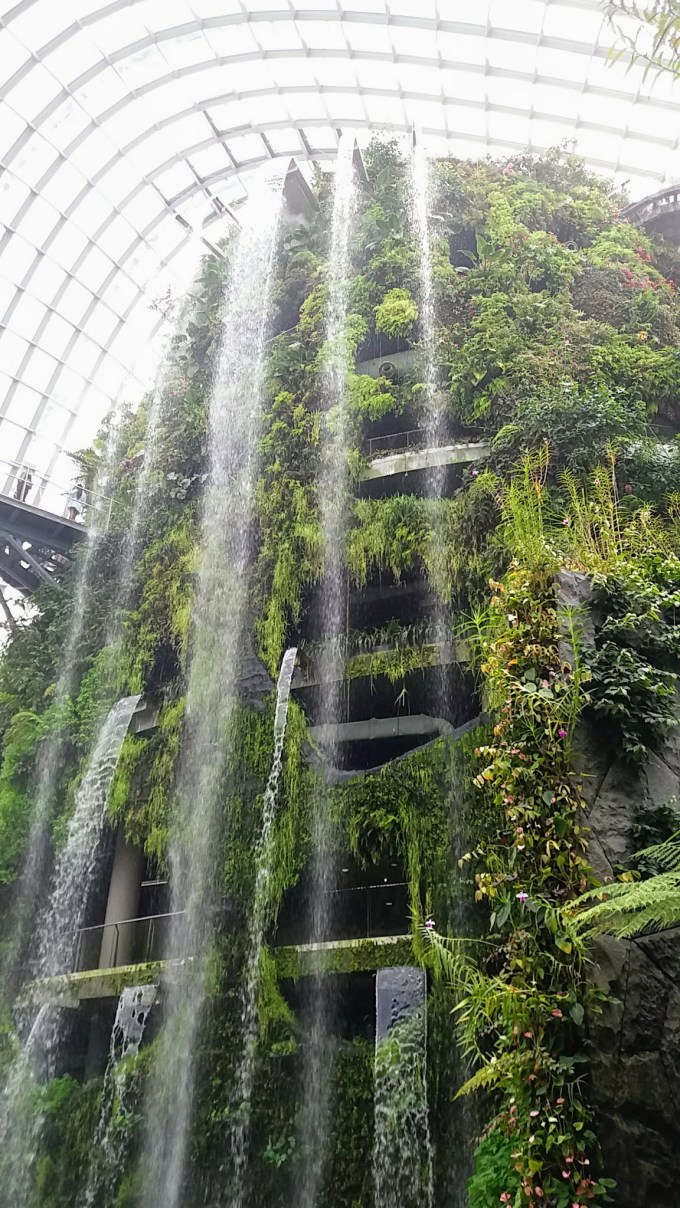 I walked more dockside paths and came across a science museum, more flowers than you can sneeze at, and finally some signs pointing to the garden path that was lined with sculpture, topiary and colorful blossoms. Although the Super Trees were my main goal, by the time I arrived at the park’s center, I was hot and tired. I noticed a cool breeze coming from the doors of one particular building and resolved to go inside that. The building was one of the two indoor gardens, this one called Cloud Forest (the other was closed for renovations). It was a massive greenhouse designed to house the ecosystem of a cloud forest, and so not only had pathways winding through beautiful flowers at ground level, it had a miniature mountain in the center that one could ascend and walk around via a series of skywalks that simulated viewing the forest from cloud level and treetop level.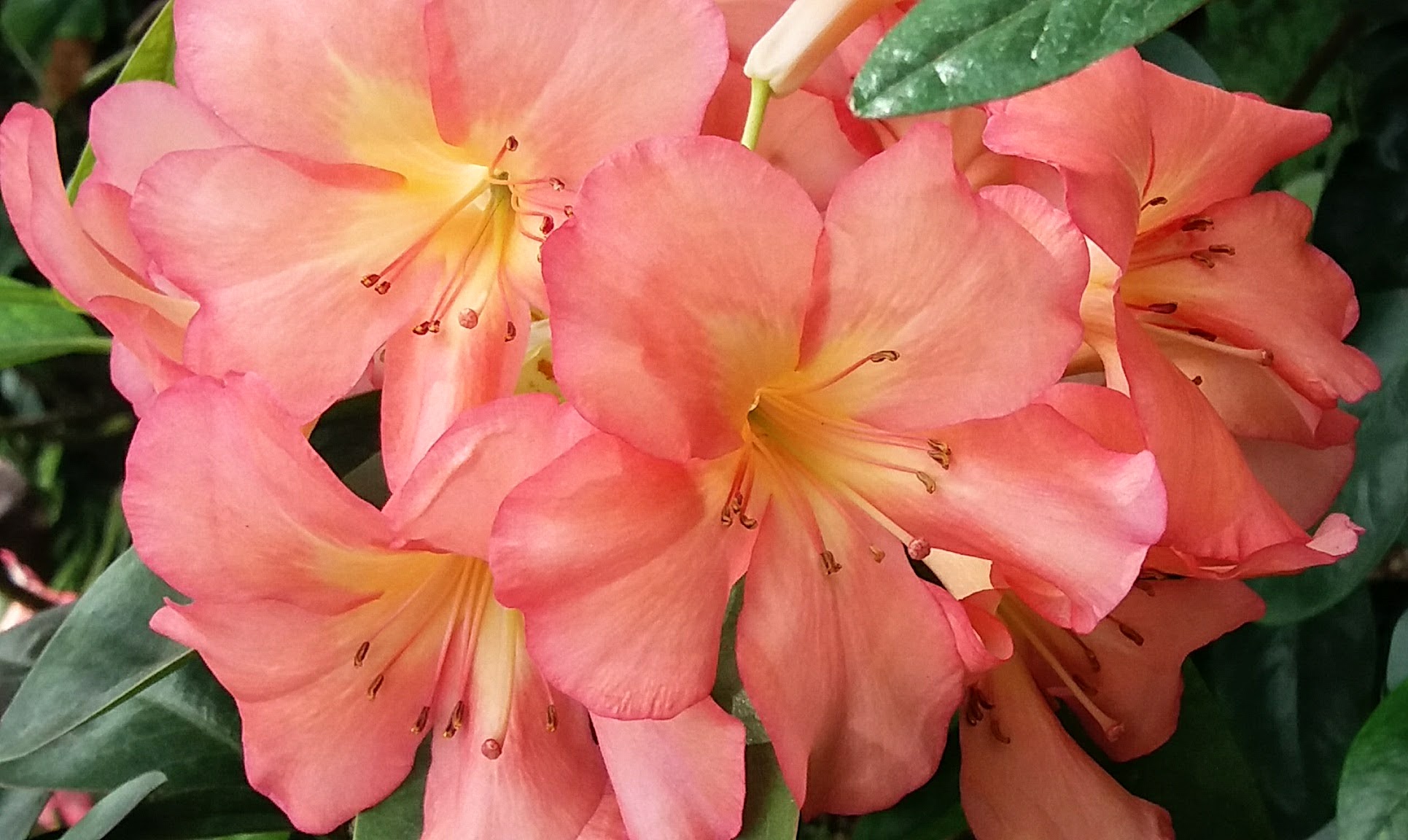

 The time of clouding was approaching by then, and although the main path did not lead back upward, it wasn’t crowded, so I hopped into the elevator and rode back to the top. I get the impression that in more crowded times, the elevators might be more strictly regulated for the disabled, and the paths through the greenhouse lead firmly one way, but it wasn’t crowded and no one seemed to care if we went the opposite direction. Shortly after 2pm, the skywalk began to issue forth a mist as I set out for my second walk on the sky bridge and was able to enjoy the altogether different view as the fog enshrouded the walkway and the mountainside below.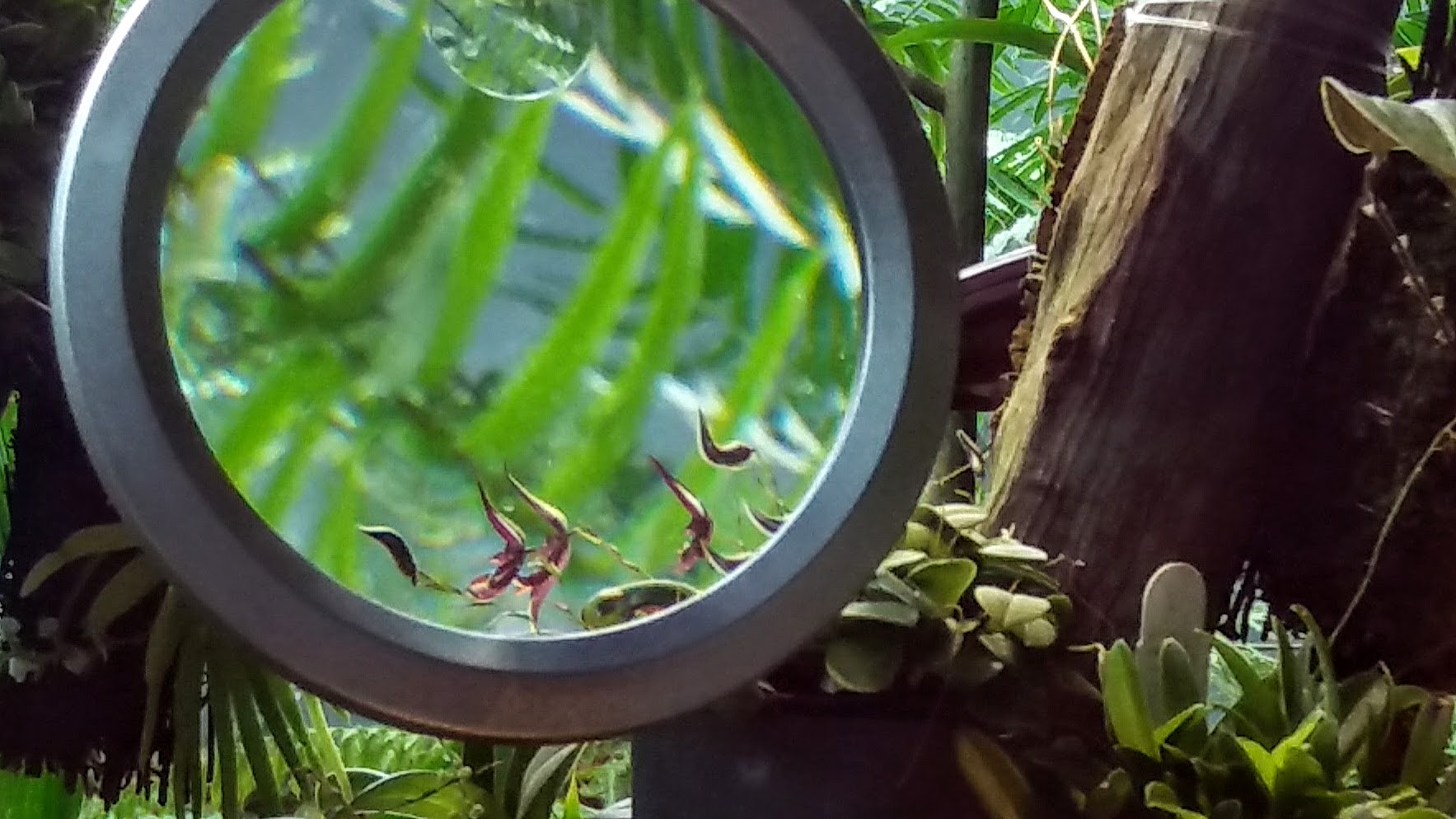
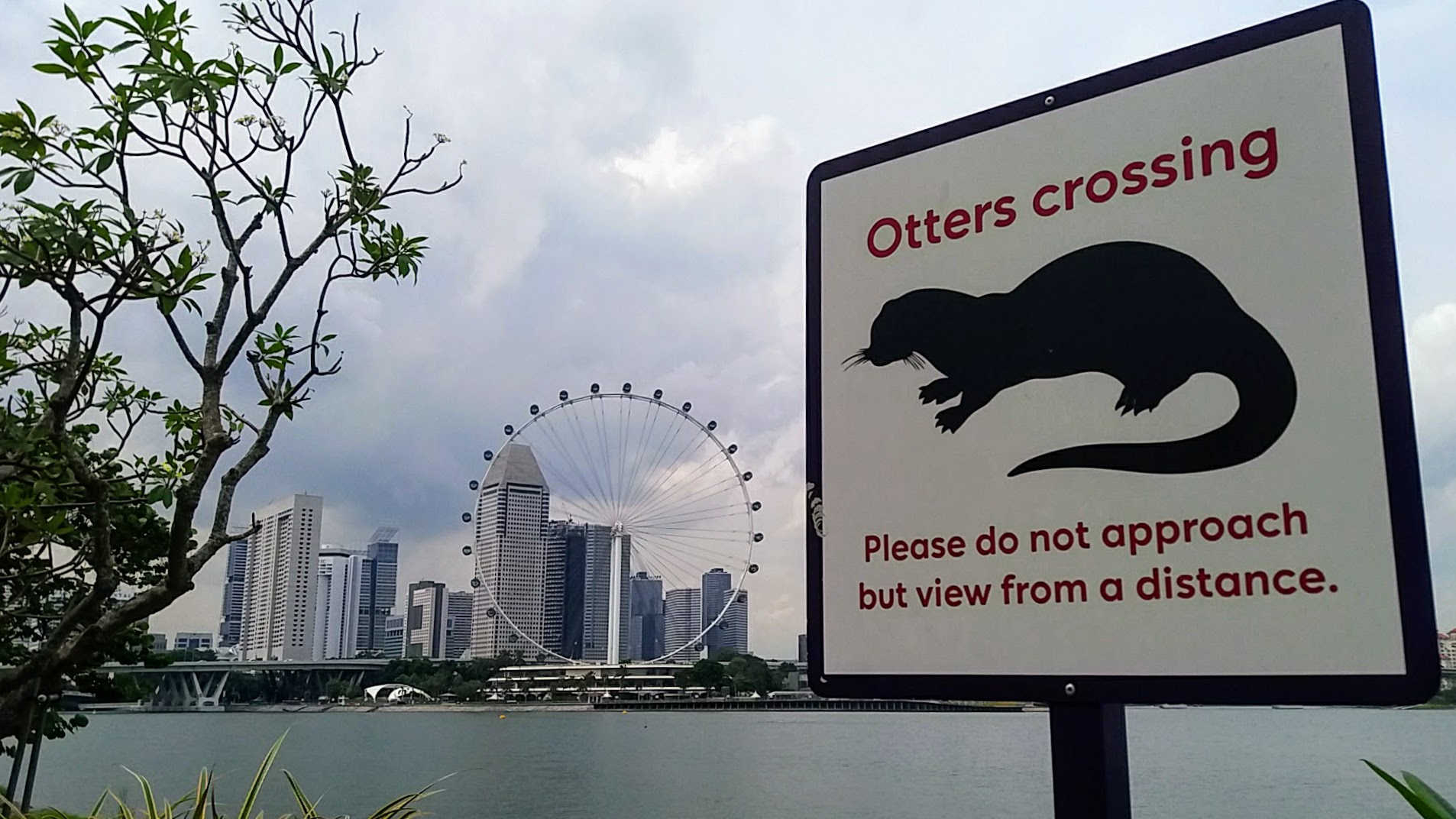 Nonetheless, the entire area of the marina is beautiful to walk through. I spotted some otter crossing signs, which are apparently no joke. The environmental reconstruction along the marina has enabled the local otter population to bounce back and they are often seen on the shores near the walking paths in the evenings. Sadly, I didn’t get to see any that day.
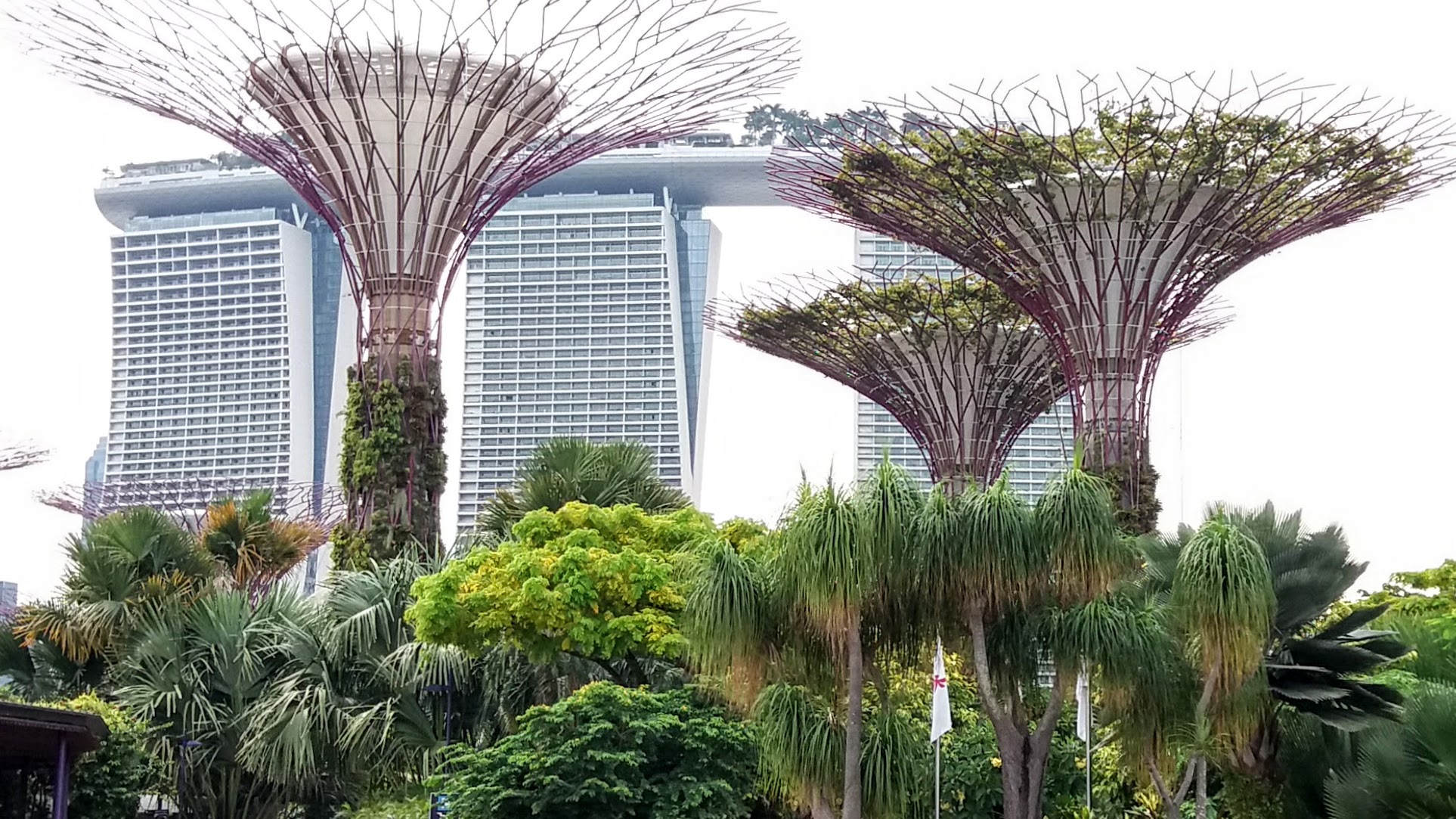 After lunch, I decided i should go find the super trees. It was getting on in the afternoon, and I still had to get across town to the Night Safari for my 7:15 ticket. Although the tall and unique structures can be seen from nearly anywhere in the park, it took a little effort to find the right walking paths to get to them. There are two groves of supertrees, the smaller has only three, which at the time were undergoing a pre-lunar new year makeover.
 Eventually, I found the main grove and purchased my ticket for the sky walk. This is a little walkway that is accessed through an elevator in the “trunk” of the trees and lets you walk around the super trees at a good height to both admire them and the overall view of the gardens below. I had a nice walk and an even better view as well as some pleasant conversation with another traveler. No matter how nice the view is, I think my favorite part of traveling is meeting cool people.
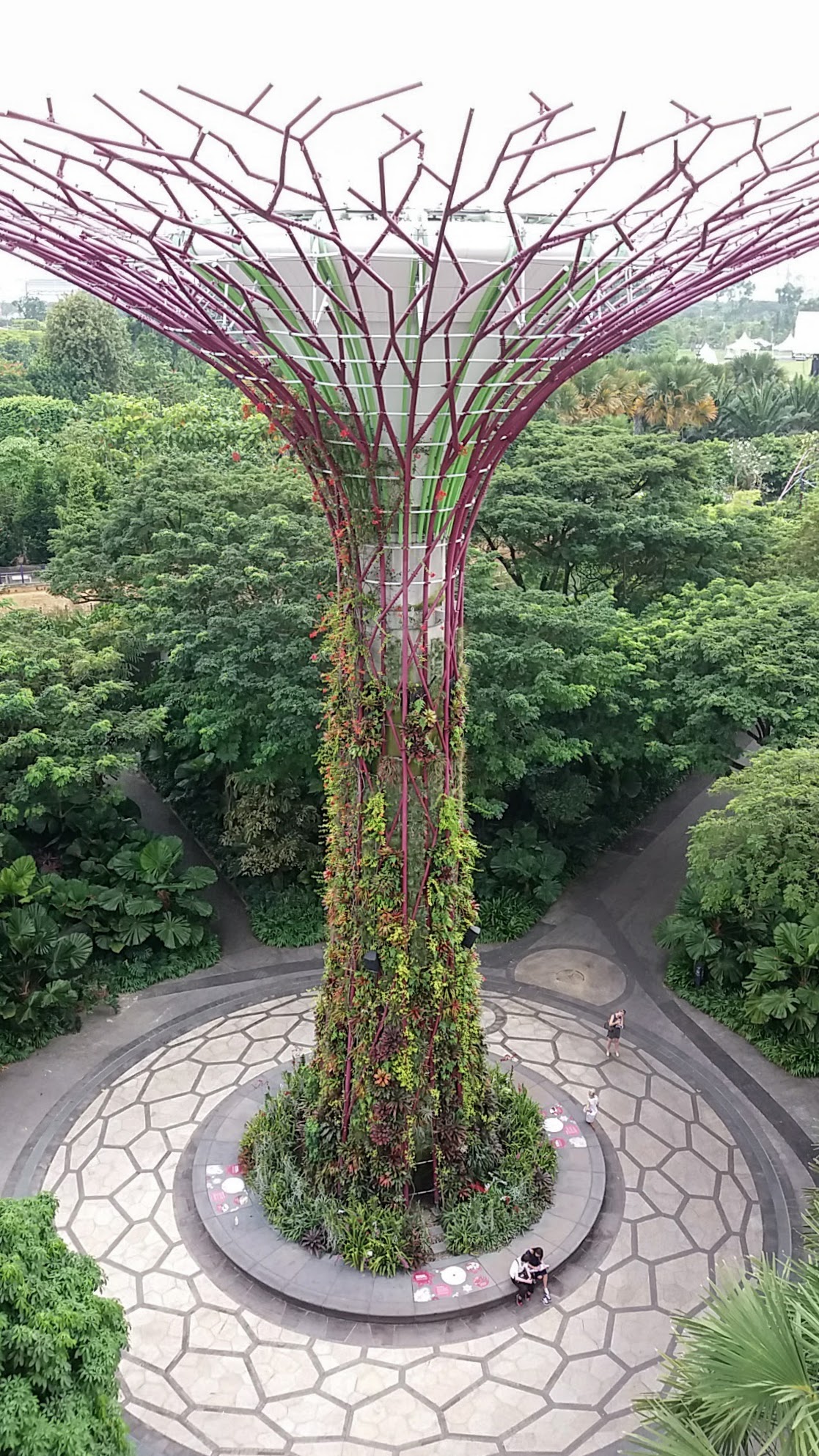 The super trees aren’t really trees. They’re man-made structures that sort of look like giant alien trees. They run on solar power and support a large amount of plant and animal life. Plus they light up at night, which is pretty. The super trees are urban art, but more than that, they are a way of combining city and nature and of providing a space for the plants and animals that would otherwise have been disrupted, or even endangered by the urbanization of their homes to have a place. The super tree grove helps to act as a greenspace, cooling and cleaning the air naturally, as well as collecting solar energy and rainwater that are used in running the indoor gardens. It’s basically a big experiment to see if a city can be a modern urban environment AND maintain a natural ecosystem in an economically sustainable way. I hope it catches on. More cities should have giant trees, beautiful flowers, and river otters.

 Gallivantrix