Hello Bohol: Fancy Restaurants

Fancy might be a misnomer, since it’s perfectly acceptable to turn up in beachwear, but the quality of the food and range of the menus places these restaurants several stars over the average lunch stop. Panglao is full of amazing restaurants where most meals come to under 10$ US, but have the quality of a 40-50$ meal. I managed to visit the Pearl at Linaw, the Bohol Bee Farm, The Personal Che’f, and The Bougainvillea. At least two of them are places I’d happily go to again and again.


Pearl @ Linaw

I ended up here twice. The first time on my very first night in Panglao because it was the closest thing to the hotel. The second time to get a spectacular view of the beach at sunset, because this is one of the best places on the island to do it from.

If you’re looking for the Pearl restaurant, be sure to search for the Linaw Resort because the restaurant doesn’t have it’s own Google pin. We got lost, asked directions, parked in the wrong place and were generally silly tourists until we finally got settled down at a table near the water. I wanted to start my vacation off with some Filipino specialties, and ordered a kind of tomato and eggplant salad, a pork belly adobo, and finally halo halo for dessert, all while watching a stunning lightning show over the black ocean beyond our little pool of light.

20170930_203456.jpg

The second time I went, the very ocean most tables were all reserved for the top paying guests at the Linaw Resort, but we got a fairly good table on the west edge where we had a nearly unobstructed view of the impending sunset. We ordered early on, knowing it would take a while for the food to arrive. I tried again to order the kinilaw which had been unavailable the last time we came (and while I am eternally grateful they decided to tell me the fish was off rather than try to serve it, I was disappointed). The waiter asked me if I was ok with spicy, and because of my excessive spice exposure in Korea I promptly replied that I love spicy. I won’t say this was a terrible mistake, but it was the first tourist place I’ve been to where anyone took me seriously and didn’t give me “white girl spicy”.

20171006_171740.jpg

Kinilaw is a raw fish “salad” (just a mixture, not really any lettuce involved). It’s more like ceviche than poké, since the fish is soaked in vinegar to help tenderize the fish flesh. Even though it was an appetizer, it was all I could eat. The portion was so generous and the flavor so intense, I had no room for a main dish, and only took in a few bites of rice when the spice build up got too strong. The waiter came out to check on us (perhaps thinking that it would be too spicy), and I told the story of missing out on the kinalaw before and how happy I was to get to try it. They told me they were glad too, since it is one of their signature dishes. Even if you don’t like it as spicy as I do, I highly recommend this to any seafood lover.

20171006_174307.jpg

When all the beautiful colors of sunset were gone, we finally gave up on the sand, chased away by ants at our feet. It’s the only disappointment in this particular restaurant, choosing between a view and ant free feet. But once we were inside (and the staff were gracious about relocating us), we had a pleasant ant-free dessert of mango crepe supreme and blended ice coffee. And if you’re worried about being too full from dinner to order dessert, that could be the only time the long wait for food is a boon, since you’ll have plenty of time to digest your meal while you wait. In fact, after several such experiences, I’ve decided that should I return to Panglao another time, I’ll be sure to order *all* my food choices at the beginning of a meal, and simply ask for the desserts to come last.

Bohol Bee Farm

Bee farm? For dinner? Yeah, I know, I thought it was weird too, but I read so many reviews of this place and blogs that included it as a must do at least for the ice cream, if not for the restaurant and tour, so I figured it was at least worth checking into. The restaurant features dishes that are made with organic ingredients, and as many of them from the farm itself as possible. A variety of fruits, vegetables, herbs and edible flowers are grown on the farm and used in the restaurant, plus of course the honey from their bees which is the only sweetener they use.

20171003_170246

There was no listing for tour times on their website, but knowing the sun set around 6, we hoped to get there in time to do the 30 minute tour before settling in for dinner. Sadly, we didn’t make it. The tours end at 4:30, but we did get a nice table overlooking the sea. The fresh juice menu is not to be missed. I got a ginger watermelon juice with no extra sugar (you have to ask or they’ll add it). The reviews I read indicated the top things to try here (other than the ice cream) are the floral salad and the pizza. I know, so very American, go to another country and order pizza, but 1) good pizza is an art no matter what country you’re in and 2) I don’t actually get pizza that often in Korea. Although the recommendations had been in favor of the plain cheese, I decided to brave the spicy honey pizza, made with honey from the local bees.20171003_170318.jpg

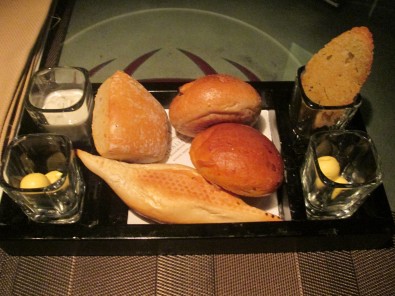
While waiting for the food, a bread plate with some fresh house made squash bread and cassava chips was brought out. The spreads were honey mango, basil pesto, and some kind of pico/chuntey thing. They were all divine, but my favorite was the honey mango on the squash bread. They sell it in the gift shop, and only my tiny backpack luggage kept me from bringing jars of that stuff back here.

20171003_172633

When the salad arrived it was clear that this was one of the most instagramable foods imaginable, a salad like a floral bouquet! But don’t be fooled, this was not simply lettuce and petals, there were plenty of generous chunks of cucumber, pineapple and other goodies buried beneath the presentation. And the dressing? Honey mustard, of course.

20171003_172910

The pizza was a much simpler presentation, but every bit as much of a taste explosion. The crust was thin and made from some mix of whole grains that gave it a rich flavor and appealing texture. The sauce and cheese were well made and generously spread without being overwhelming. The “spice” was reminicient of spicy italian sausage without actually being sausage. I think that the more Asian chili spice combined with the pizza herbs like basil and oregano created this gustatory illusion. And the honey was a little drizzle, a mere hint that served to counterpoint the spice and compliment the grains of the crust. I have never had anything like it before and I can honestly say that while I would never have thought to put honey on a pizza, it’s now one of my favorite flavor experiences.

Finally, for dessert I knew we had to have some of the ice cream that appears on every Google search for “things to do in Bohol” and find out what all the fuss was about. The Bee Farm keeps a wide array of flavors on hand, some are annual standbys and others are seasonal or even du jour.

The Bee Farm makes all their ice cream using coconut milk so it’s dairy free, and they serve it in casava cones which are gluten free. Organic, vegan, and GF trends aren’t yet a big thing in most of SE Asia, but the Farm’s success is very promising. In addition, coconut milk is a local product, coconut palms were everywhere, but dairy cows are still scarce. The Dairy Box project is a small dent in the issue, but most milk there is the processed and recombined variety we got at the store. The ice cream flavors are all based on the fruits, vegetables and herbs that they grow at the farm (except the chocolate), and it’s all only sweetened with the honey they harvest from their own bees.

The most famous flavor is the mulangguy, but I wasn’t up for a total mystery and decided to put that off for another day and instead ordered the salted honey, imagining (correctly) that it would be similar to a salted caramel. My dinner partner decided to try the flavor of the day: tomato.

The salted honey flavor was rich, creamy, and intensely flavored. I found it to be a good balance of salt and sweet, and also that my single scoop was quite satisfying. I had a small taste of the tomato ice cream out of pure curiosity. I have to say that I think it would have been an amazing soup, the coconut cream and tomato flavors were good together, but somehow the chilled temperature and ice cream texture were just too much dissonance for me to enjoy it as a dessert.

20171003_170111

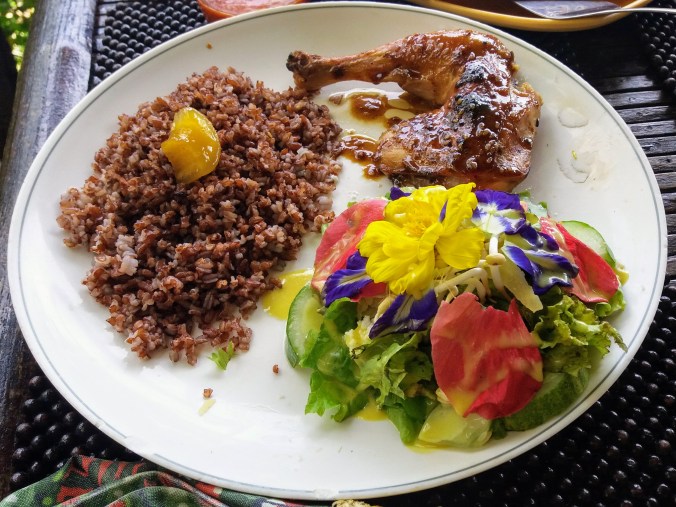
Since we missed a chance at the tour the first time (and because any excuse to eat there again), I headed back to the Bohol Bee Farm on anther occasion. I switched up to a lemon ginger juice (I might have a ginger addiction) which was strong and delicious, then got the spicy honey pizza again (yes, it is that good). We tried the honey glazed chicken as well, which was also excellent, and came with a mini floral salad and a grain I always knew as “kasha” as a child. Kasha is buckwheat grains cooked kind of like rice, and it’s dominant in Eastern European or Russian culture, but not known well in SE Asia, so I was surprised to see it there.
20171005_123730

I also went on the tour, and I finally tried the mulungway ice cream. Mulungway, or malunggay, is a medicinal herb that is very popular in the Philippines, especially made into sweets. I found the flavor to be a fresh green experience and enjoyed the ice cream, but some people think it tastes too much like vegetables. Either way, it’s a quintessential Philippine flavor that’s worth the taste.

Personal Che’f

20171004_172231

No, that’s not a typo version of “Chéf”, that’s how it’s written, I looked several places. The Personal Che’f is run by a Russian couple and serves unbelievably good super fancy food. I had a little trouble finding it because there’s only a small sign on the side of the road in front of what looks like a patch of woods. I finally found the entrance to a path through the trees that led us on a lovely walk back to the restaurant.

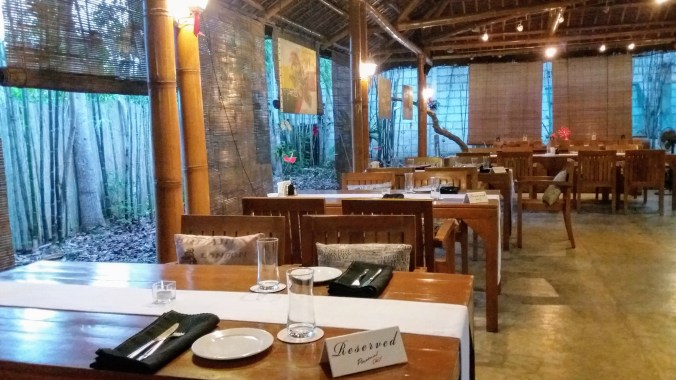
Like almost every restaurant here, it had no walls except for the kitchen. It was empty when we arrived but nearly every table had a “reserved” sign. Lucky for us, there was one unclaimed and we were able to be seated. I say lucky, because quite a few people showed up after us only to be turned away. My feelings on this restaurant are both strong and mixed.

I liked the set up, it was simple and elegant, and the contrast of the stunning food, artistic plating and upscale prices with the rustic bamboo thatch and the occasional lizard on the furniture was fun. The huge volume of mosquitos brought on by the fact that we were embedded in the jungle was not. They seemed to be aware of the issue because our waitress brought us mosquito spray to use, but it would have been nice to have more effort. Maybe citronella would conflict with the flavors of the food, but there has to be something, bug repelling tiki torches, candles, electric zappers? Almost anything would have been better than being dined on while dining.
20171004_172555

The chef was an amazing, kind and extremely talented person. He came out to talk to us, checked on my travel buddy’s allergies, told us a story about how he’d made something off menu just the other day for a woman with serious dietary restrictions. The chef was great. The rest of the staff was… less so? There was only one waitress and she became quickly overwhelmed, especially when a huge group showed up without a reservation and insisted on talking to her for 15 minutes about it. There were only maybe 7 tables seated, but it was more than this poor server could manage. Her only real help was the barback/busser, a guy who repeatedly took food to the wrong table, or made other mistakes she had to correct when she asked him for help, and otherwise just stood behind the bar looking lost. Any time we asked about anything (like, hey does this dish have any xyz in it) she had to go get the chef, who was gracious about it and wanted to help, but he was clearly doing too much trying to both cook and do things in the front.

20171004_180144.jpg

The food is the only part I have no mixed feelings on. It was hands down amazing. We ordered a gazpacho soup with strawberry for a starter and the chef kindly put it in two bowls, even though that meant extra time in plating. We received wide white dishes with beautiful curls of cucumber and a little spattering of diced herbs and vegetables. The gazpacho was pureed and served in a carafe that we would then pour over the display. I have to say I would never have thought of adding strawberries to a tomato based soup, but it was truly a flavor revelation. I historically prefer my gazpacho a little on the chunky side, but I don’t think that would have worked with the berries. The puree mixed the flavors so thoroughly they became something new. It also did make me wonder about making a strawberry salsa someday.

For the main dish, I gravitated to the mushroom risotto and was not disappointed. The flavors of the cheese, the shrimp, the broth and the mushrooms were each distinct and outstanding and yet blended so well. It made me think of the instruments in a string quartet, it is easy to hear each one as they play, but together they are a concert. And it made me feel a little like Ratatouille (the cartoon rat, yes) which was also fun. Sadly, the main dish was not a success for my companion, who had an allergic reaction despite the chef’s precautions and decided head back to the hotel to take some medicine.

I had thought to stay behind and have a dessert, but the waitress brought out our check at once. It took me ages to get her attention, and in the meantime, I managed to get the bar back to come deal with the fly that was swimming in the wine… one more reason to get those bug zappers. He took the glass away but didn’t bring a replacement or it seems tell anyone. So when I finally got the waitress to stop at my table again, I told her that I wanted to order dessert and about the wine issue. Over the course of the next hour, I kid you not, I managed to get a dessert menu and to find out that they would take the wine off the bill. When I did order a dessert, I was told it would be another HOUR to prepare… and no it was not a souffle. I declined.

It was such a difficult experience to evaluate. It was some of the most amazing food I’ve ever eaten, and the chef himself was so kind and gracious about everything. But the service was terrible, the bugs were a major enjoyment killer, and while I value the quality time that goes into creating the kind of amazing food we were enjoying, it seems like if it’s going to take an hour or more to make a simple dessert, you should warn people to order ahead, or accept fewer customers. I really hope they manage to find a solution, because that kind of talent with food deserves success, but I chose not to return a second time.

Bougainvillea

I still can’t get over how much astonishing food is available on Panglao. Of course traditional Filipino food is delicious and worth perusing, but the quality of restaurants on the island makes many nationalities dishes a must dine experience. For my final dinner, the restaurant of choice was a relatively new (and hopefully long lived) tapas restaurant that Bob had enthused about called Bougainvillea, next to but not to be confused with the resort of the same name.

I was negligent in every instance of making reservations, and it’s pure luck that I was ever able to get a table, so if you’re going to any of these places I suggest calling ahead because I regularly saw people get turned away. The fancy restaurants are stunning but very small and intimate with limited seating. The Bougainvillea was no exception. We arrived a little after dark and we’re lucky to find that some diners were just about to leave and that their table had not yet been claimed, so we only had to wait perhaps 10 minutes for a table and a kind young man from the resort kept us company while we waited. I suspect that the garden we waited in was beautiful and even at night I could tell it was filled with the flower that both the resort and restaurant took their name from.

The restaurant was elevated, which at first seemed odd to me, but once we were on the second floor I began to understand the choice. One was the view, which we had also missed out on by showing up after dark, because one wall opened out toward the sea. I say wall, but like most of the places we’d been, it was a roof and open sides (except around the kitchen). The other main reason for the elevation was the avoidance of insects. By lifting the restaurant out of the jungle flora, we were blissfully free of ants, mosquitoes, and flies that had plagued nearly all of our previous dining experiences.

20171007_193953.jpg

I ordered some of the house made sangria, for which they use their own mix of spices in syrup, red wine, and fresh apples and oranges. It was amazing, refreshing and light while not being too sweet and carrying a wonderful tendril of cinnamon. The bread arrived as well, served with whole garlic cloves and olive oil so rich you wouldn’t miss the butter. We noticed that extra bread portions were 30p and were hardly surprised they felt the need to charge for this delectable dish after the first serving.

While I was perusing the descriptions, I noticed they had a few dishes with manchego. I cannot express my joy. Manchego is a Spanish cheese that holds a special place in my cheese loving heart. I had not had any for several years because I’m pretty sure that the Koreans have never heard of it, and even when I can find it in the US, it’s expensive. I asked our server how in the world they managed to get it on the tiny island of Panglao and he seemed quite pleased that I recognized the difficulty involved and the dedication it represented.

20171007_195639.jpg

Although I was tempted by the paella, the minimum order was 2 people and my companion was unable to eat seafood, so instead I tried a smaller appetizer of “Calamares a la andaluza” described as flour coated baby squids, deep fried and served with honey mustard sauce. My dining companion ordered the Patatas Bravas (deep fried potato cubes with spicy “bravas” sauce). We were both well pleased with these choices. I had a bite of her potatoes and was pleased as punch to find that they had perfected the crispy outside, squishy inside of a truly excellent home fry. The sauce was creamy and spicy. My squids were stellar, maybe even interstellar. I have never imagined in my life that I would have a tender squid. They’re just always chewy. Maybe it’s the “baby” squid or maybe it’s just the chef, but the squid was actually tender. The flour fried coating was light and not oily, and the honey mustard sauce rivaled that at the Bee Farm. Plus, both appetizers were served with tiny crispy bread sticks that we could use to clear our palettes between dishes or just to scoop up extra sauce with.

20171007_200107

Next we had some Mondaditos, described on the menu as an Andelusian style bun. Starting to guess where the chef is from? I ordered the “Catalan” because it was manchego, fresh tomato and olive oil. She got the Don Quijote [sic] which was chorizo, sweet red pepper sauce, and manchego. Of course we traded tastes, and although I preferred the simple fresh flavors in the Catalan (I was out for the manchego), I was blown away by the sweet pepper sauce. The saucier at this place is clearly blessed by some kind of culinary deity, or maybe Dionysus. In addition to their own simple yet elegant awesomeness, the mondaditos were served with “veggie crisps” which turned out to be thin sliced and fried vegetables, rather like potato crisps (or chips), but with an array of other vegetables.
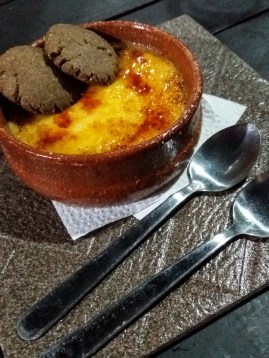
20171007_210815

For dessert I settled on the crema Catalana, which looked to me like a Spanish version of a creme brulee (a dessert I have loved since I met it). Looking later, I find it is quite similar, but is traditionally flavored with cinnamon and orange peel. I haven’t had the chance to try this dish more than once, but I would happily try it many more times. While in my experience creme brulee is always a rather thick custard, the crema Catalana at Bougainvillea was much softer, almost as if it were the sweet love child of a creme brulee and a zabaglione. It was a wonderful finish to an excellent meal, and my only regret was that I only found it on the last day and I didn’t get to taste more of the menu!

Unexpected Joy

I planned to enjoy great food on this trip, learn more about Filipino food and do some proper local dining. I did do those things, but it was a surprise and delight to find such a plethora of fine dining options with considerations for organic, dietary restrictions, allergies, and of course quality food. I never thought Panglao would be a foodie haven, but it’s full of local delicacies and so much more. Bon Appetit!


I’m writing this a week or more before the publish date because I finally have some free time between the end of school and the beginning of winter camp, and I don’t want to dump all my polished posts on the internet at once. Who knows what news will come by the time this is online, but for now I’m slowly coming to terms with the fact that I’m leaving Korea and still wondering if I’m going to find that next job before May. I’m hoping to get the rest of these stories out before my moving day (Feb 25), and I’ll have some new adventures to write then. Whether it’s  a new job, a new country, or something wholly unknown, there’s no doubt it will be a good story. Thanks for sticking with me! Happy New Year!


Hello Bohol: Food

My food post has expanded into two more bite-sized posts. In this one, I take a look at the everyday eats, markets, convenience stores, roadside chicken stands, unique food experiences, and lower cost restaurants. Just because it’s not gourmet doesn’t mean it’s not delicious! Interesting foods discovered include: not-milk but still dairy “fresh”, the lakatan banana, mulungway, water buffalo ice-cream, and maja blanca. Hope you’re hungry!


Don’t Drink the Milk

After discovering our limited food options upon arrival, I asked my trip buddy to stop at a store on the way from the airport. The taxi had to take her to a store on Bohol, because there is not a single “grocery store” on the island of Panglao. There are a plethora of tiny marts and open air markets, however. The next morning at breakfast, I noticed that the milk tasted a little odd. Not off, just strange, and I looked at the carton to find out what was going on. It turned out that the “Fresh Milk” for sale in the store was actually a reconstituted combination of milk products. I know that in some island countries, dairy is hard to come by in liquid form, because shipping it over is expensive, so they ship in powder and reconstitute it in local factories for distribution, but this was the first time I’d actually had any. It wasn’t … bad? It just didn’t really taste like milk.

The yogurt also had a slightly terrifying list of ingredients. I’ve tried to get less picky about my food since leaving Seattle, I know lots of places aren’t going to be up to the Bo-bo standards of organic/local/minimal processing, but yogurt has been one of the foods that has more often than not been wonderful, fresh, and local when I travel. It seems despite the huge number of cows I saw on the island, the dairy industry is still a few decades behind. So, no real coffee, and no real milk products… but the seafood, the pork, and the fresh fruit are outta sight.

Markets

20171001_112654.jpgI went to the Alona Market on the first day. It was a permanent structure where things like clothes and gadgets seemed to be on sale, but there were a riot of colored tents and awnings set up outdoors as well where vendors sold everything you could need on the island. Eggs, fish, meat… the smells assured me they were fresh. Fruits and vegetables. An infinity of flip flops and heaps of clothes. Electronics, swimming gear, DVDs, decorations, and although this was clearly a market for locals, there were a few souvenir type things as well. If I were staying long term on the island and needed to cook more than breakfasts or needed to replace a t-shirt or pair of sandals, it would be a great place to know about (especially in the absence of grocery stores), but for time it was mostly a curiosity, a fun thing to see as I explored my holiday surroundings.

On the way over to Chocolate Hills, I took a rest stop at another market in Baclayon, very similar to the Alona market, and got some pastries at a little bake shop. The Bohol pastries aren’t a patch on the Korean ones, but they were fresh and good, and extremely cheap. I never bought only one, but it seemed like one could fill a bag for less than a dollar. And it was nice to have something to munch on when felt hungry. Days later I realized that the market was next to one of the many churches on my to-see list, so I ended up going there more than once.

Sari Sari

This is the basic economic unit of Bohol. They are everywhere. Tiny shacks that sell snacks, drinks, and other things a household might need. It’s almost impossible to tell if they’re open because they have bars and grates on the windows. I had been avoiding them for that reason alone. I didn’t want to stop, get off the bike, walk over, then find out they were closed and try again at the next one. I’d been stopping at larger more obvious shops for snacks and drinks but way out here, I didn’t have the option. I’m also not sure how many of these are simply a shack in someone’s front yard where they sell random stuff to their neighbors.

Post holiday research reveals that these tiny ubiquitous shacks are known as sari sari (Tagalog for “sundry”), that the bars and grating look is normal, that they are generally family owned and operated from the family property, and that they make up 70% of the sale of manufactured consumer food products and account for about 13% of the GDP. They don’t all look like the little roadside shacks, some are larger or in conjunction with other vendors in the market areas. I’m not sure how many sari-sari I shopped at while I was there, but it’s nice to know I was contributing to the local economy when I did.

La Familia

One day of island exploring we found this little gem. It was getting on in the day and the weather in Panglao is hot and humid year round, so we decided it was time to find a place for lunch. After a little bit of being lost looking for a restaurant by sight, we finally consulted Google. It turns out there are a plethora of eateries along the roadside, but it’s hard to tell which ones are convenience stores, or take-aways, or sit down eateries, or even open just by looking while you’re driving by. I love trying local shops and restaurants, but I definitely wanted a sit down place to rest after our morning adventures.

We settled on a place called La Familia on the south end, quite near the church and watchtower. It’s not gourmet, but I ate there more than once because it was good food at a reasonable price, and while not air conditioned, it was comfortable. On my first visit, I got some watermelon juice and had to ask for no sugar. I learned that in the Philippines, all fruit juice will be mixed generously with sugar unless you ask for it not to be. This drink seemed to be fresh watermelon blended with ice into a kind of slushy, and I thought it was wonderful and refreshing without the extra sweetness. I also tried a satay burger, which was a regular hamburger served with satay sauce, and instead of ketchup, the fries came with a kind of sweet chili sauce that I was skeptical of at first, but soon devoured.

The second time I went we were too exhausted and hungry to research restaurant options so we went back to La Familia, knowing it was close to the hotel, good and well priced. I was still in my “try all the Filipino food” phase and after Googling a few new words on the menu, I settled on a chicken Tinola, which is a fairly famous Filipino ginger soup and could readily give pho a run for it’s money as my go to sick soup of preference if it existed where I live. A rich bone broth infused with ginger. My only complaint was that the soup was served so hot I couldn’t just guzzle the broth. I also ordered a club sandwiches for lunch the next day out on the boat.

The third time I popped over to La Familia for a refresher and decided to give the house milkshake a try. I don’t normally go in for banana flavored things. Artificial banana flavor terrifies me and I’m picky enough about real bananas to not risk it if there are options. However, after my run in with the Latakan (explanation further down), I was feeling very optimistic about a banana based drink here in Panglao. Not just a regular banana shake, it was made with graham crumbs and a touch of cinnamon. It was delightful, light, fluffy and a great blend of that creamy banana and other flavors that made me feel like I was drinking a pie.

While I was waiting for my shake, another expat struck up a conversation. I’d almost forgotten how that worked, since this was one of the few occasions on this trip I was on my own. It seems that people in pairs or groups just don’t get approached as much, but I love meeting new people, so I joined him for a chat and learned that he was called Bob, he was from the UK, and that he ran a local bar (the Ging Ging), which I never did get to try out. We talked about how we each came to be living abroad, and then we talked about the best food around. He also shared with me the best places from which to watch the sunset which led me to my second dinner at the Pearl.

Tres Ninas

After getting more accustomed to the bike, I decided to have another stab finding a roadside food stand to take something back to the room. In this endeavor, the night was my friend since only open places were lit up. I pulled into one of the larger lit up areas at what seemed to be a cluster of shops. One was selling meat on a stick, another seemed to be a place to sit and eat with drinks, and a third was selling beautiful rotisserie chickens. In less than two days on the island, I had seen dozens of chickens wandering around. Some totally free, some bound to a tree or hutch by a length of string. Either way, I felt confident the chicken I was looking at was local and free range, with no added hormones or chemicals… it went a long way in making up for the milk.

Tres Ninas is a chain of chicken stands. The one I went to is on the circumferential road on the east side just south of South Palms, but I spotted several others by the same name around the island.

Chocolate Hills

Initially we didn’t think that lunch at a major tourist stop was a good idea. These kinds of restaurants are often over priced and not even very good. Boy howdy I’ve rarely been so happy to be wrong.

Although the service and the food were slow (this is a fact of Bohol that we eventually came to accept, it’s a good idea to get to the restaurant, any restaurant, a good while before you’re too hungry) both turned out to be of excellent quality. Our server happily recommended dishes which turned out to be wonderful. We had bam-i (a kind of noodle dish) and lechon kawali (a crispy fried pork belly), with corn soup, and I had a calamansi iced tea which was strong, sweet and tart. We ate every bite, and it was the perfect amount. The whole lunch was less than 15$ (most of our meals were between 10-15$ for two, a couple splurges were in the 20-25 range. That’s not per person, that’s the whole thing and we ate good food).

The main advantage of the slow lunch service this day was that by the time we were finishing off the last bites, the rain had passed by and the sun had returned. The restaurant has large picture windows, so we watched the progress of the dark clouds the entire time we were eating. It was interesting to see them moving by so quickly.

The Dairy Box

On the way out of the adventure park, where the bumpy dirt road hit the highway, I spotted some signs for ice cream that led us just a few meters down the road to the Dairy Box.

20171002_154539.jpg

After my experience with the “fresh” milk the other morning, I wasn’t sure what to expect by way of any place called the Dairy Box, but I stopped to look and discovered to my delight a local sustainable livelihood program participant. The little shop was part of a movement by the government to help local businesses flourish, and so they partnered with nearby farmers to use the milk from the water buffalo nearby. There were signs showcasing the local small farmers and inside there was a plethora of dairy based treats. The ice cream was the main focus, but there were biscuits, milk candy, and snacks as well as flavored milk, yogurt and cheeses. Ok, yes, water buffalo milk, but I assure you it was delicious.

Dumaluan Beach Resort & the Lakatan Banana

There is a little grill and cocktail bar at Dumaluan which makes it especially appealing as a lazy hangout beach. I had made jokes with my sister before going that I would be on a beach with coconut drinks, but somehow I hadn’t had a single coconut based concoction up to this point. When I ordered my simple breakfast at the grill, I also got a coconut smoothie. The breakfast was simple: egg, sausage and rice, but cheap and filling. The smoothie was very clearly made from fresh coconut.

As the day wore on and we continued to nibble on snacks, I tried the fresh fruit plate. Normally I wouldn’t dedicate pages to a fruit place, but it was my first exposure to the unique Philippine banana: the lakatan.

20171004_132855.jpg

What I did not know about bananas… and to be honest, I probably still barely know anything. I’m used to the standard grocery store banana: the Cavendish. This type makes up something like 95% of the world’s bananas. I have always preferred to eat bananas when they’re a bright yellow with hints of green at the edges, and no brown at all. Everyone has a preference, but in my house, when the bananas got brown spots it’s time to make banana bread. I have a decades long aversion to golden yellow and brown bananas. I do not enjoy the mushy texture or the sickly sweet flavor at that stage in a Cavendish’s life. But, I do like banana bread, so there’s that. Based on my lifetime of banana monoculture, when I saw this little yellow and brown buddy on the fruit plate I was not at all interested… until it was peeled.

My expectation of a banana, even a very ripe one, is kind of off white inside, not unlike vanilla ice cream. This banana was a much deeper shade of cream, like “french vanilla” ice cream, or even custard. The only other time I’d seen that shade in a banana-like shape was in plantains, but it was clear from the easy peel and the total lack of cooking that this was no plantain. In addition to it’s beautiful color, the flesh of the fruit was bruise free. A Cavendish banana in that stage of ripening could be expected to have a light bruise or two and be very soft, but this banana was in perfect shape and still pleasantly firm. I decided to try a taste and was rewarded with the most and best in all that is banana. It was sweet, but not too sweet, and had little hints of tartness that I crave in my slightly green Cavendishes, but with a bonus creamy texture that I feel unable to describe without referencing dairy products. Why are these amazing fruits not the market standard? Probably something about shipping or they aren’t pretty enough. *sigh. If you’re ever in the Philippines, eat them.

River Cruise Lunch & Maja Blanca

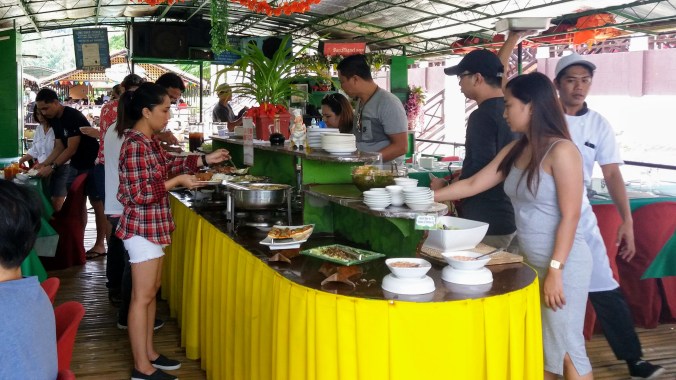
20171006_111213 - CopyIt was not the best meal I had on the trip, but everything was good and it’s a buffet so you can eat as much as you like, as long as you don’t leave food on your plate (they charge 50p for leftovers to discourage food waste).

20171006_111229 - Copy

I had more delicious pork adobo and an assortment of veggies and side dishes, but the star of the whole show was a little square of heaven called maja blanca. I had never seen or heard of this before, but I put one on my plate anyway, guessing it was a dessert, and so saving it for the end of my meal. It was easily the most amazing coconut cream anything I’ve ever had. So plain and unassuming, it was a white square that jiggled a little, which almost made me leave it behind as I’m not a huge gelatin fan. Instead I got three more squares! It’s just a coconut pudding, it’s thickened with cornstarch instead of gelatin, and maybe that made all the difference? It may also be made with condensed milk in addition to the coconut cream, and has a little sprinkling of toasted coconut on top. 10/10 would eat again.

Nikita’s Coffee Shop and Cafe

It is listed as being Western (esp British) breakfast food, well priced, and close to Alona without being on the main drag. Perfect for an early morning breakfast on my last day.

There’s not really “breakfast food” in Korea. The Koreans eat things like kimbap, or soup and rice, and that’s fine, but sometimes you just miss the heck outta bacon and eggs. I am very nearly ashamed to admit that I get breakfast at McDonald’s here, but it’s that or bus an hour to the expat bars on the beach. Anywho, there I was, enjoying my bacon and eggs and toast and coffee. It was already the fastest restaurant service I’d experienced in Bohol, and I was well satisfied with the price and portions of the morning’s special, when a middle aged British gentleman came out to apologize to me for how long the order had taken. This was David, the owner, and I hurried to reassure him that the wait had hardly been anything at all (especially in comparison to every other restaurant in Bohol). He was only slightly mollified and it was obvious that he felt his short-staffed cafe wasn’t living up to his own personal standards.

We chatted a bit more and he asked me if I’d made it out to the “virgin island” (the name of one of the island tour stops). I hadn’t, nor had I any real plans to because my research on the island hopping tours had turned me off of that option. He then told me that a nearby church runs free shuttle boats out to the island, since it’s a religious monument, and that it was a very lovely half day trip. I was both excited to hear the news, but also a bit sad, since my day plans were already spoken for, and it was my last day. Of course I could have changed, but … well, waterfalls. Plus, I hadn’t really gotten dressed or sun screened for another boat ride that might finish cooking me. The choices we make. Nonetheless, since I also wish I’d found Nikita’s Cafe earlier in my meal options, I can heartily recommend anyone to stop by for a meal and get the details on the free church boat trip.

Be Patient, Be Kind

Every time I said please or thank you with a smile, the people serving me seemed both surprised and happy. It made me think about the way that tourists I’d seen were treating the locals in the service industry. I know in many places I’ve lived that Filipinos are 3rd class workers, given the worst jobs and little to no protections. I thought of the woman I met in the Madina airport, of the nurses in Saudi hospitals who were getting yelled at for doing their jobs. Of the men who do back breaking labor and live in curfew controlled dorms and the women who clean rich people’s homes while trying not to get raped by their teenage sons (or grown fathers). Even expat restaurant owners were being treated with a level of ingratitude by the tourists here, and the locals had it worse, but no one could complain or stop serving because their livelihood depends on visitors.

I try my best to be gracious and polite wherever I can, but it struck me that here in the Philippines, my pleases and thank yous were really truly appreciated by people who were so often being at best tersely given orders and at worst being yelled at or demeaned. I did not find anyone here to be lazy, rude, or anything less than gracious and helpful. There’s no excuse for the way they are treated. Follow the golden rule, be patient, be kind, and enjoy some of the warmest people and best food you can find.


Panglao has an amazing array of food, including gourmet quality restaurants with very low price tags. In part two of Bohol: Food, I’ve compiled all the fancier restaurants I visited, but don’t worry, the dress code is still beach casual. 

Letters From China (Fall 2007)

Looking at these entries from my time in China, I’m struck by the extremes of emotion that living abroad can engender. “I hate this!”, “I love this!”, “I’m dying!”, “I feel awesome!” It seems some things don’t change even after 10 years. I’m no longer surprised by these swings, but they certainly still happen. Despite this, I wouldn’t trade my life for another, and even on the downfalls I am grateful I got back up and kept on trying. Sadly, there are no beautiful photos accompanying these letters, but I hope the stories of the Best Pizza Ever and the Amazing Coat Bargain will nonetheless amuse.


Oct 29, 2007 at 6:35pm

Today my class read a chapter called “East Meets West” and it dealt in part with culture shock, and described 4 phases, honeymoon, hostility, humor and home. I’m not really sure I had a honeymoon phase this trip, mainly cause I think my entire 2 months in China in 2005 was that phase, I was just so excited to be there, nothing else mattered. I was still happy to be here when I arrived, but nothing so over the top giddy as my first trip.

I think I was mostly in a humor phase, just finding my feet and being more amused than angry at the differences. Plus I was meeting the new teachers and in many ways helping them to adjust to China for the first time, I was getting instruction about my job and how to get about town, so I was occupied and involved.

Recently I’ve been pretty depressed, and trying to figure out why. I know that at least part of it is a frustration with the culture. The fact that it took me WEEKS to get the bank stuff sorted out even though I had the help of one of the school administrators, the fact that I feel like i’m on display half the time I’m in public and the fact that people keep bugging me to teach their kids or practice with them in the guise of friendship have all been really aggravating. There are things I know are just cultural differences, but knowing is not keeping me from being upset.

I tried looking up different ways to deal with this kind of thing, and a lot of it hinges on stuff like arts and crafts, exploring the area or reading about the culture, stuff you do alone… and I don’t think that’s really going to help me much. I need more interaction.

I love my classes, often they’re the best part of my day, well the part I feel best during, anyway, but because of the student teacher relationship, the age difference and more importantly because of the cultural differences, I don’t feel like I can have more than casual conversations and interactions with them outside of class, and hardly anyone who’s not a student speaks any English and my Chinese is just about enough to get around and buy stuff, but not to have deep conversations in.

Even the other Chinese people closer to my age who work here don’t really fit in the peer group category, I often feel like I have to avoid them or they will ask me to do more work, tutor someone else’s kid or something…

There’s other foriegn teachers, but I don’t see them all that often because our schedules are at such odds.

Its getting really cold, so going out wandering is getting unpleasant for more reasons than just being stared at, talked over or pawed at.

I was trying to watch some Buffy while grading papers and the disc stopped working and it was just too much. It’s so stupid, and I hate that its affecting me like this. This is why I wanted someone to come with me. I think I could deal with the culture shock OR the isolation, but I don’t know what to do with both. I haven’t had a hug since I left Seattle and I think all the one’s you gave me at the party wore off finally.

I’m sorry, I guess, for unloading here, but I’m lost. I’m supposed to be tougher than this, but so much of my strength comes from the support of others and I feel so cut off from that now.

I’ve tried to talk to a few people individually about it, but I don’t feel like I’m really getting it across well enough, or fast enough or whatever enough.

We don’t have to have anything specific to talk about, but there’s this whole free talking thing with gtalk, and just being able to hear your voices, even if we’re just on while surfing the web or whatever to be able to talk like we’re in the same room…. I told you all before that you would be my life line here, and while I believe what you’ve told me, that I’ve not been forgotten, thinking about me doesn’t help if you don’t say something too.

I have 10 more weeks till the break, and then another 25 after it. (hopefully there’s still a may trip to China in the offing for some of you at least).

I don’t even know how many people read this anymore, only a handful respond. I can’t do this alone.

*2017 update* Culture shock and homesickness are the bane of the expat life. Over the years I’ve found more ways of dealing with culture shock, but the things I identified here stayed true. Social interaction is a big deal for me, even though I’ve gotten good at going out and exploring alone, I still do best when I can share my life with other people. On the other hand, I’m not sure I have anything like “homesickness” left after so long. I miss some feelings, or the ability to just head over to a friend’s house, but when I think of “going home” it just means my cozy little apartment here in Busan, and I think when I move, my sense of home will move with me.

Of course, as you keep reading you’ll see why I call culture shock an emotional roller coaster… that still hasn’t changed.

Nov 4, 2007 at 9:24pm

I’ve been posting a lot about feeling bad, and I want to let you all know, that there are good times too. Today, in fact, was a really nice day.

First I slept in, which is always a good way to start a day. Plus since my lil bedroom space heater had done its thing it was nice and toasty.

I needed to get food for the bunny, so I got dressed and set out for the pet store. The weather was wonderful, sunny and not too smoggy and actually not too cold. The walking street was packed, and there were so many kinds of foods. I had to pass thru the whole street to get to the pet shop, so I took note of all the foodses and picked up several tasties on the way back home.

I got a cool breakfasty thing, there’s a thin crepe with an egg cracked onto it and also spread thin, with sauce and green onions and some kind of crackly pork rind thing all folded up together. I got a kind of fried sweet potato pankakey thing. And I got what looked alot like rice crispy treats, but turn out to have less flavor.

I came back and watched some tv and surfed the web for good ecards for my mom’s bday (which is today by the way, so wish mom a happy bday).

Around 3pm 4 of us got together to go to Beijing to check out a Pizza restaurant, and oh my god, I didn’t think it was possible to enjoy pizza and beer so much. I may pay for it tomorrow with the wheat thing, but OOOOHHHHH it was SOOOOOO good.

Just walking into the restaurant was amazing, it was like we’d left China. The decor was all dark hardwoods and stone, it had a pizzaria atmosphere without being faux Italian. There was American rock music playing in the background and the SMELL was wonderful.

We ordered 3 pizzas, since I really only intended to have a small taste. Everyone ordered mediums, which turned out to be 15 inches across! They got a veggie, a meat, and a supreme (called Garbage Pail) and they were seriously the best pizzas I think I’ve ever had.

I’ve always known food was linked to the limbic system, but I don’t think there have been very many occasions when food has caused that much enjoyment.

We told the waitress to compliment the cook for us, and he turned out to be the owner. He came up to see us. The owner is an American, looked very west coast, bleach blonde, lots of tattoos (kinda cute too), and very nice.

There was, of course, much good conversation over dinner, and a general happiness that infused the whole group. Pizza, beer and rock music… it was a little piece of American heaven… and I hope I’ll never take these wonderful things for granted again.

We headed home somewhat reluctantly, but the bus was warm and we all found seats (not as common as you might think), and I got to have a nice birthday morning convo with mom, and now I’m off to a warm shower and a soft bed.

It was a good day.

*2017 update* Although I no longer rely on pizza to alleviate my need for Western food (which still happens, but I think I just like variety), that little crepe thing I found in the street market remains my all time favorite street food to this day. I can’t find it anywhere but China and so haven’t had it in 5 years, but if you ever get the chance, eat one.

Nov 9, 2007 at 10:12pm

So, I went shopping today at the Silk Market. I tell you three hours of shopping should not be so tiring but wow I’m pooped.

I got some nice things, gifts for some of you and a new winter jacket for myself. But I want to share the joy of shopping in China.

So for hair clips, the starting price was usually about 120, followed by me laughing and saying no way. Then they ask for a price, and I say 15 (followed by common humorous 50/15 confusion), followed by them laughing and saying ‘no way’. Then they offer 80, I say no and begin to wander away slowly. They say 60, and I just shake my head and wander a little further (the trick is not to get out of range too fast), they say give me a better offer, and I say 20, they try in vain for 40, and I leave the stall (still moving slow) then they call me back and say ‘ok ok your price’.

This varies some, but seemed to be the standard.

The COAT was hilarious. I went looking for a coat last for just this reason. By the time I found a nice coat, I only had 300 left in my purse. And here’s the fun. She says, normally I charge this (showing me a calculator reading 4800) but since you live in China of course I give you special price (shows calculator with 2200). Now the coat is nice, but there’s no way I’d pay that even if I had it, and she knows that, there is the art of lying in that we know we’re lying to each other, but since we both know, its like a little ritual act.

So I say, no I can’t do that price, and she says give me your best price, and I type in 200. She whines a while, oh my factory doesn’t even sell it to me for this! I can’t sell it for 200. She counters with 1800. I counter with 400 (I honestly thought I still had 400 on me). And the ‘oh its too low’ begins again, whereupon I tell her that’s all I’ve got. She says I can use a Visa card, I tell her I don’t have one, which took some convincing, but was true at the time, no way I’d bring a credit card in that place. Then to prove I only have 400, I open my purse to show her, and it turns out I only have 300. Now, she really doesn’t want to believe me, so I end up basically emptying out my purse to show her its all the money I have on me. I’m sorry, I say, but i just don’t have any more. And as I collect my things to leave the stall, she breaks down and says, ok since you only have 300, I will sell it to you for that, protesting all the way that she shouldn’t and what a deal I’m getting and I have to tell my friends to come back, but tell them I paid more so they won’t expect such a low price, etc. which of course I promise to do (remember the lying ritual), and we go away happy.

Of course all prices are RMB, so for USD divide by 7.5…. I love this place!

Dec 3, 2007 at 3:37pm

Some of you know by now that I’ve been sick for a while. Last Wed. I woke up and felt like crap, and I’ve kinda been icky ever since.

Its a lovely nausea, which is mostly gone if I hold still with an empty stomach, it rises with a vengeance if I move too much or eat.

I missed class Wed and Thurs morning. Thursday evening I told one of the people in the dept that I might need to go to a doctor, and she went with me to a pharmacy and picked out some Chinese medicine for me, which not only didn’t really help the nausea, but made me horribly gassy.

Friday I went to the hospital, there is no other way to see a doctor here. Wow.

We got there by taxi, I had to check in and pay a 3 kuai registration fee. Then I went to the doctor who asked some questions, mostly about diarrhea, and decided it was probably food poisoning (translated as “dirty food”), but that he wanted me to have a blood test anyway.

I take the doctors paper to the cashier to pay for the blood test (20 kuai) then go to have my blood taken in a whole other part of the building, by nurses who use iodine as a sterilizer, and the tubes for blood collection weren’t vacuum sealed, so they drew my blood with a syringe then squirted it into an open plastic test tube (did i mention they weren’t wearing gloves?)… GAH!

Anyway the test turns out to be a general blood analysis and the results sheet shows my levels and the acceptable range for each level, thus ensuring that the doctor doesn’t actually have to know how to interpret the results, only to see if they’re in the right range.

They are, and I take the results BACK to the doctor who says that my illness is not serious, and offers me amoxicillin. Well, first he says an IV transfusion of “medicine”, and it was only after lots of asking on my part that they finally admitted what the medicine was.

Amoxicillin is an antibiotic, a pretty strong one, the main side effects of which are nausea and diarrhea… so not to good for an upset tummy. They also tried to tell me the “medicine” would kill a virus, which is not possible.

After lots of arguing in which I tried to explain that I was not going to take amoxicillin unless I was MUCH sicker, they finally offered to give me “something to protect the stomach lining”, my best guess is an antacid of some kind. And they all thought I was crazy for refusing the antibiotics.

Now, just to be clear, an IV of amoxicillin is standard for any illness here. My students told me that an IV transfusion of medicine is what’s done regardless of what you have, so I not only don’t have any great feeling that I’m missing something the doctor knows about mysterious Chinese stomach ailments, I left the hospital feeling like I knew more than the doctor.

Oh, the mystery alternate medicine turned out to be 75 kuai and I didn’t end up buying it, so we’ll see if I can kick this on my own.

I’m slowly able to eat more, now, and I got a cheap blender to be able to make tofu banana smoothies. I’ll be doing ginger infusions and generally taking it easy, and avoiding Chinese medicine.

I haven’t found a place to buy western medicine yet, Wal-Mart proved a bust.

*2017 update* That mystery stomach ailment lasted a while.  I survived on tofu smoothies, orange juice and snickers bars… I think it might have been a reaction to the oil in the Chinese food (sooooo much oil) and even when the nausea passed I still had to take regular breaks from Chinese food or it would come back.


It’s fall here in Korea these days too, and it seems that health issues are the theme. It’s nothing serious (I think), but I’m going to a doctor or dentist 1-3 times a week and it’s taking all my time, energy, and spare income. Looking at my photo journals, I feel like I am doing so little adventuring in comparison to last year or years before, but sometimes we just have to buckle down and take care of the necessities. Currently that’s teeth, body, and a new job hunt (which will likely mean a new country, or at least a new city after February).

There’s still plenty I love about Korea, but right now I’m loving the affordable and efficient health care system more than the festivals. Less fun, but whenever I see one of my US friends post a gofundme for medical bills or complain about fighting an insurance company for coverage they paid for, I get seriously grateful that if I have to spend the better part of a year getting poked and prodded by medical/dental professionals, at least I can afford it and never have to argue over my national health coverage. Meanwhile, I hope you’ll enjoy more stories from my very first year abroad in China! Thanks for reading ❤

Letters from China (Queen’s Village 2007)

In October of 2007 I was invited to visit a small village near the university where I was teaching. This remains on of the most unique experiences I’ve had while living and traveling abroad. I was able to see parts of China that foreigners simply don’t visit. I was welcomed into their homes, and allowed not only to observe their way of life, but live it myself for a couple of days. I don’t where Queen is right now, and I don’t even know the name of her hometown, but I hope that she and they are doing well and can understand the impact they had on my life as an early traveler.


Oct 26, 2007 at 3:36pm

This weekend (Oct. 19-21) I went to a small farming village at the invitation of one of my students. Her English name is Queen. She is a sophomore (second year at university). She is 20 years old, and she is one of only 4 people in her generation from her village to go to college. She is also the first person in her family to pursue higher education. Her older brother didn’t even go to high school, and is now the only veterinarian for the whole area. Her family farm grows mainly corn which brings in about 1000$ USD per year. Her family grows its own vegetables and fruits in their yards, things like potatoes, turnips, cabbage, apples, pears, grapes and a kind of date called a jujube, mostly foods that can be stored, dried, pickled etc. There is only one store in the village to buy other goods, and most people simply eat what they produce or buy from each other what they need. They also have their own goats for milk and chickens for eggs, and one of her grandmothers even has bees for honey (they sent me home with coke bottle full).

15momshouse1.jpg

The Plumbing

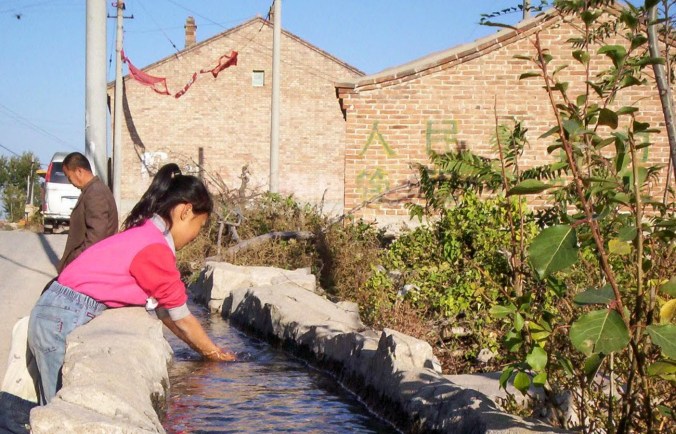
The village does not have indoor plumbing, and while this may seem entertaining in an outhouse kind of way, they also don’t have running water indoors. There is a spigot in the yard that only works for one hour a day, since the government is restricting the water in the name of conservation. The northeast of China is very dry. So her family has to collect all the water they will use for the day during that hour. They collect it in a large basin and several buckets, and if they run out there is no way to get more. This means any cooking, washing or drinking they want to do requires them to get a measured amount of water from the daily store to use, heat it over a wood stove (more on that later), use for whatever purpose and then carry it out (no drains in the house either) to dump in the yard (don’t waste water that can help the crops).

In the summer they have a building in the yard they can take showers in (see picture below, its the building next to the doghouse), but since there is no way to heat the water for the shower, they don’t take showers in the winter, but rather heat up some water and use a basin to wash their hands, face and feet. There is a hotel in the village (apparently owned by one of her cousins, it specializes in offering city folk a real rural experience: Dude Ranch Chinese style), and every so often they go there to use the hot water showers in the winter, but it’s a special occasion.

100_0468.jpg

The lack of indoor plumbing extends to toilets as well, in the northwest corner of the yard (the least auspicious area in accordance with feng shui, I kid you not, and so the best place for a toilet). The building is brick (left), and the toilet is a rectangular hole in the ground (right), no porcelain here, that drains into a hole beside the building where the waste is collected for use as fertilizer. We stayed in two different houses the two nights I was there, and the first (her mother’s) had a nice clean toilet area, which I have a picture of, and the second (one of her grandmother’s) was pretty gross, covered in fecal matter and obviously not regularly cleaned (I have spared the world this image and have no photos of it).

The Electricity

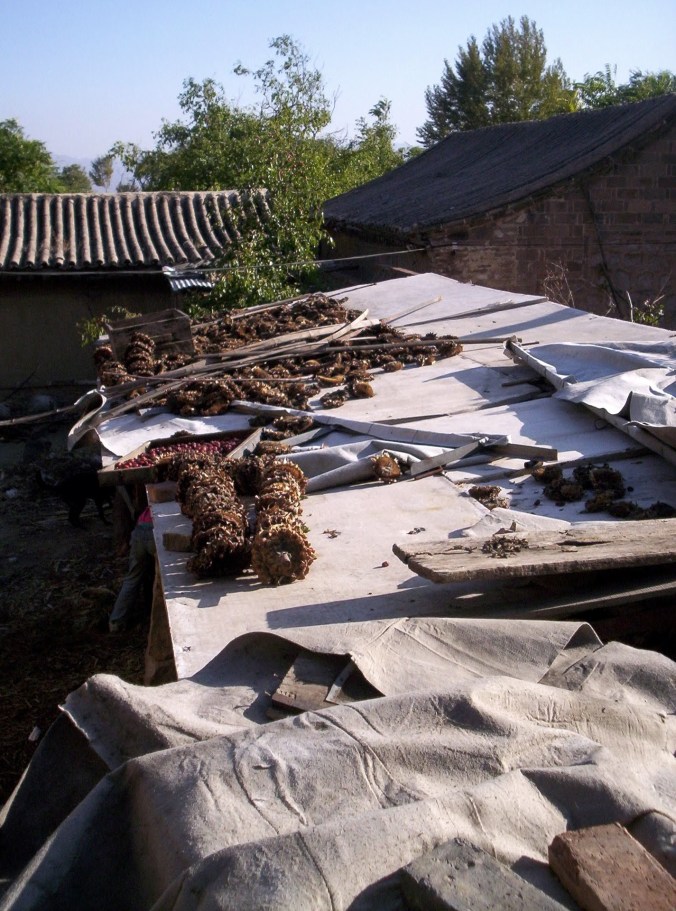
There is some, but like the water it is limited. There is power for the lights, and they have TVs, satellite dishes, DVD players etc that they can run. Some of them also have a few electric cooking devices, like a rice cooker or hot plate. However, there are no stoves and no electric heating. The houses have large glass windows that collect and focus sunlight during the winter. People live on the sunny side of the house in the winter and move to the shady side in the summer, so the houses are built in mirror images. The main beds are made of brick. They run from one wall to the other and basically act as a horizontal chimney carrying heat from the wood stove to the real chimney in the outer wall. The bed stays very warm this way, and the whole family gathers in this room in the evening to eat dinner, watch TV, play cards etc where its warm. I was given this room to sleep in as the honored guest, and the family all slept together in another room. The stoves are fire, the fuel is whatever they can find, sticks and twigs from the orchard trees, dried chaff and stalks from the corn or other crops, etc.

100_0496.jpg

The climate in the northeast of China is very dry and very cold. It’s not the Gobi desert or anything, but it is very dry. The natural vegetation and the rock formations are very similar to the scrub-lands of southwest America, but its not as warm. If you could take a small rural town from the poorest part of Mississippi or Louisiana and move it out of the wetlands into the arid high plateaus of Arizona you might have an idea of what this place was like.

The Journey

We left Yanjiao about 1030 am. We took the 930 bus to the main terminal at Dawanglu, which is in the southeast corner of Beijing, out around the 3rd ring road¹. This is my normal route into Beijing and it takes about 40 minutes. We picked up some breakfast there, something a little like an egg mcmuffin, but fried. Then we got on the subway to go to Jishuitan, which is on the northwest corner of the second line (also the second ring road). This took about 30 minutes. Then we walked over to the bus station, passing one of the many old city gates, and got on the 919 to go to Yan Qiao. The mountains are apparently called the Yan Mountains, so many of the small towns start with “Yan”.

01jishuitan gate1.jpg

We passed by many sites of the Great Wall, including Badaling, which is the most famous, and we paused for a brief rest stop and I think to change drivers, and I took some more photos of the wall.

05wall pit stop3.jpg

After about an hour and a half we arrived at the town, we took a little ride around the town square and went to the park.

09yanqiao2.jpg

Then we flagged down a private cab (a guy with a van who doesn’t work for any taxi company) and my student negotiated a price for him to drive us to her village. The driver initially offered to take us for 13 Yuan, but later changed his mind, charging us only 3 and telling Queen to “take good care of the foreigner”. It took us about another 20-30 minutes to get to her village gate. As long as we remained in the Beijing zone, the roads were good, but as soon as we crossed the border into Hebei province, the roads became a mess of potholes and bad roadwork.

¹Beijing is an autonomous zone, a city without a province, like Washington D.C. is a city without a state. The city is zoned by the “ring roads“, which are just what they sound like. I only knew 5 at the time, apparently there are 7 now. It basically tells you how far from the city center you are.

Queen’s Family Home

We were dropped off at the gate and walked from there to her mother’s home. The streets within the village were more like dirt alleys, filled with rubble and trash. The homes were fairly old, most having an outer wall, a large yard used as a vegetable garden and a reasonably large home, which often housed 3 generations.

10village gate.jpg

Queen was very eager to show off the brick bed I described earlier, which was in the main bedroom.

17brickbed2.jpg

There were bright posters in many rooms which I was told are renewed at the spring festival and symbolize good fortune and fertility. I also took a look at the kitchens (both) to see the wood stoves that fed heat into the beds.

100_0467.jpg

Her mother was quite gracious. I was offered grapes and jujubes (the fruit not the candy, it’s a little like a date, but drier) from their garden as well as tea to drink. After a while, Queen wanted to wander over to her Grandmother’s house (for the sake of argument, since I honestly lost track of relatives, we’l just call this one Grandmother 1). It was a short walk, during which I was stared at by everyone we passed. Her grandmother, grandfather, aunt and uncle greeted us and I was plied with apples and haw fruit from their garden. Haw is a small red fruit with soft tart flesh; you might be able to find some candy or tea of that flavor in an Asian import store.

The people in Queen’s village don’t speak “putonghua” the common standard Mandarin Chinese, but rather a local dialect that I couldn’t understand at all. However, she’s a good student and was able to act as a translator for her family and me.

After a visit there, we headed back to her mother’s, stopping at the general store on the way back to pick up some snacks and packaged meat (kind of like Spam, but not in a can). Her mother prepared a nice dinner for us. We had sweet potato and rice porridge, a dish of potatoes and turnips, some candied almonds, and some mild pickled peppers her grandmother had sent back with us. Everything we ate except the meat was grown in her family’s gardens. Oh, and there was fresh goat’s milk from the goats in the back yard as well as a kind of strong clear alcohol that her mother soaked fruit in to make a tasty drink. I swear I ate until I was stuffed and her mother complained that I didn’t eat anything!

100_0478.jpg

Two of her young cousins came over after dinner and we all sat on the brick bed chatting and watching TV. Queen made her cousins speak slowly in putonghua to see if I could translate for myself. This seemed to amuse them for a while. I saw a beautiful show on TV of a troupe of dancers, all deaf and mute, doing a tribute to Guan Yin. They lined up behind one another and made elaborate patterns with their arms to imitate the multi armed statues of the goddess.

When it was time for bed, they set me up with plenty of blankets, made sure I had food and water in case I got hungry or thirsty in the middle of the night, and left a bucket so I wouldn’t have to brave the freezing outdoors to get to the outhouse.

Despite the bitter cold outside, the bed stayed warm, if terribly hard. I slept fairly well, though I woke up a little stiff. Breakfast was more fresh goats milk, some steamed eggs (which by the way had green shells, a nice pale sea-foam green, which I can only attribute to the breed of chicken, since I know the eggs were fresh since the chickens were also in the backyard)…anyway, this means I ate green eggs and spam for breakfast, I told Queen about Dr. Seuss and recited what I could remember of the poem which she seemed very interested in. There was also a nice pickled cabbage dish, almonds leftover from dinner and possibly some other things, it kind of blurs together.

35chickens2.jpg

Local Schools

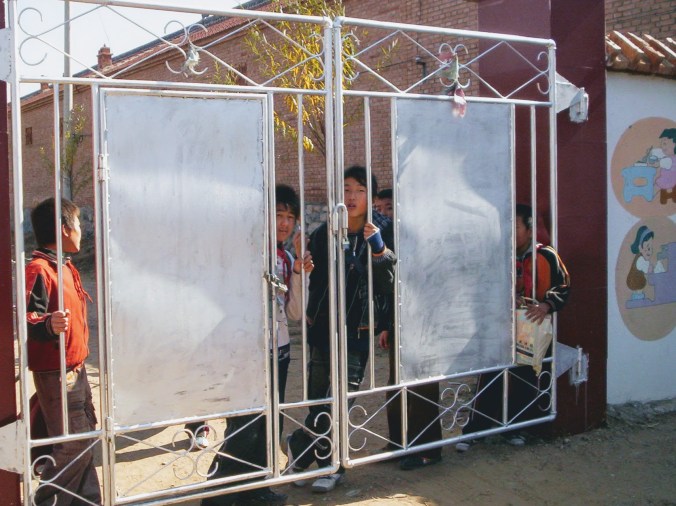
After breakfast we took a walk to the local schools. Queen told me that very few of the students finish middle school. The classes are too crowded and all the good teachers have left for better jobs. Many of the boys wander the streets during the day rather than going to school. Their parents don’t want them to get outside jobs at that age, but don’t make them go to class. When they grow up they will be manual laborers, working in the fields or building roads, earning only a few hundred Yuan a month.

39school2

The children in the school were excited to see me, I may not have mentioned, but I was the first foreigner to ever visit this village. Queen herself was bursting with pride to be walking beside me and translating for me. The head of the kindergarten wanted to take pictures of me in his school, I hesitate to imagine that soon there will be pictures of me proudly displayed there, although I did nothing more than walk through it.

It was so strange to see all those bright and curious faces and know that most of them would never leave the 50 mile radius of their increasingly poor and dry county; would never see the world; would never even finish a basic education, and that for many of them, the few minutes that I was in their school was the only time they might ever see someone from another country not on TV.

100_0486.jpg

We returned to her mother’s house where an uncle picked us up in his truck to drive us to grandmother 2’s house a ways away. I will continue the story in another post, since there’s a character limit here. Tune in next time for the continuation of the Village Excusion!

Oct 26, 2007 at 3:57pm

When we left off, an uncle picked us up in his truck to drive us to grandmother 2’s house a ways away. I do believe that the truck had no shocks at all, the roads were bumpy beyond belief, and sometimes there wasn’t a road, at least not what we would call one. There were certainly no traffic laws, and people simply drove wherever they could.

100_0489.jpg

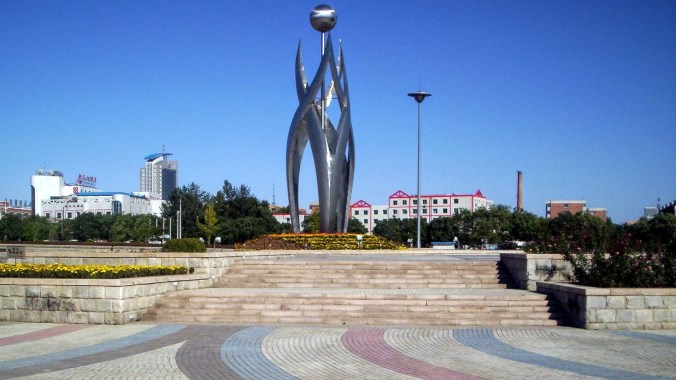
This turned out to be quite a distance. On the way we drove past an interstate under construction, where I was informed that the government had taken up farmland to build a highway for the Olympics. We also passed a large metal statue of a hand holding a wine bottle, seemingly in triumph, a tribute to the wine of the region, which I have still never tried.

The Other Grandparents

Grandmother 2 lived in an older and less orderly village. The amenities were a good deal dirtier. The number of times I silently thanked my mother for teaching me how to be a gracious guest were countless. The yard was sort of a garden, and of course there were goats, fruit trees and even some beehives, well boxes of bees anyway.

100_0492.jpg

We walked around the village a bit, saw the main streets and the aqueduct which also doubles as a washing machine.

09village4.jpg

Then her cousin came to pick us up and take us to some of the “sights”. There was a stage that the Beijing (Peiking) Opera apparently performs on during the spring festival.

100_0498.jpg

Is That a Town or a Film Set?

We went next to an old ruined village near the lake that has become a popular site for film directors. Apparently about half the ruin is authentic and the other half has been built over time by various film crews. I walked over a very rickety bridge, and was reassured that in the film, soldiers had run over it, but given what I know about film, this is not actually reassuring.

100_0508.jpg

Hostessing: Chinese Grandmother Style

We returned to her grandmother 2’s house, and the family picked up a chicken to serve with dinner, another nod to the guest of honor, as meat does not usually feature in their diet very much. A small swarm of relatives joined us, and I was ushered in to eat, at first alone, but I expressed they should join me; Queen said they were too shy to, but got them in anyway. They were also constantly pressing food on me, since both before and after dinner they made sure there were always snacks of fruit and bread nearby, and at dinner they constantly urged me to eat more.

They were also constantly worried I was too cold. They were amazed that I could use chopsticks. They were worried that Queen wouldn’t think of things I might need. They were generally very kind if somewhat fussy hosts.

After dinner, we gathered again on the brick bed, the kids worked on homework, I got a chance to look at some of their books. A few more people came and went, including her brother. As I became sleepy, they decided to evacuate to let me sleep. Queen told me that her family thought it might be rude to leave me to sleep alone, since the custom there is for the family to sleep together for warmth, but thankfully she was able to assure them that I would not be offended.

Again, they made sure I had food, tea, blankets and a bucket before leaving, and I headed into a fitful night’s sleep, punctuated by a nocturnal goat and a lonely puppy. I had no idea up until this point that goats were the least bit nocturnal, nor was I aware that any animal not in some kind of serious distress could make noise that constantly for that long.

A Sunday Morning Stroll

I gave up on sleeping around 7am, got dressed and found a corner of the garden to brush my teeth in (remember, no sinks), had a cup of tea and headed out for a pre-breakfast stroll thru the village. On the way we passed a sign, which I was told was put there by the government to entreat people not to follow Falun Gong, and those of you who have talked to me at all in the last 3 years know that this has been a bit of an interest of mine¹, so I was unable to resist the temptation to engage in conversation when I discovered that all the tales I had read of Chinese propaganda were true.

100_0524.jpg

They were told that FLG followers committed suicide and killed people. She was angry that the US wouldn’t turn over Li Hongzhi (the leader) to the Chinese government, and simply seemed to have a block on the idea that the facts might have been distorted. I tried to explain the concept of independent studies, and that thus far the Chinese had not allowed us to conduct one. I told her that FLG practitioners in other countries were peaceful (if a little noisy), and she was amazed there were practitioners in other countries, which just goes to highlight the lack of information available, since in America, one only has to do a google search to find thousands of mentions in the news².

She also told me that prior to the ban, her mother had been a member, though they had renounced it when the government turned against it. All in all, it was illuminating. It took me a long time to convince her that I didn’t like or agree with Li or FLG, but that I respected their right to believe as they wanted. She argued that China had plenty of religious choices; I said 5 is not plenty. She said more religions cause more conflict, I said, no, pluralism decreases violence. It was interesting.

Anywho. There was a lovely breakfast, egg fried rice, more veggies and a kind of spicy mutton stew. Afterward we set out to climb the small mountain behind the house. There was a ladder going partway up the wall in the back, from which you could reach the road at the base of the mountain, and I was much mocked for not wanting to climb the wall, steep and without secure footing as it was, so we walked around.

The mountain had some goat trails, but for the main part, we picked our way upwards thru steep shifting gravel and spiky scrub plants. The view from the top, however, was expansive. It’s hard to tell from the photos, but you could make out the main mountain range, the lake and the railroad. Queen told me that when she was a little girl she could often see the Great Wall on those mountains clearly, but the pollution has now become such that you can only occasionally see the mountains at all.

100_0530.jpg

¹When this was written, I had only just finished my MA and my thesis was on the Falun Gong. The upshot is that any of my friends who held still for more than a minute over the last 18 months had been regaled with my research findings. Short version: it’s a cult based in Qi Gong practice (like Tai Chi) started in China in the 90’s, first embraced by the government, but banned in ’99. The leader lives in New York and directs his followers from there. Most people around the world who practice it are only aware of the exercise aspect, not too many people read far enough to get to the aliens with bone noses, the demons who want our bodies, and the leader’s determined efforts to take down the Communist government of China. It’s a major controversy in China. Followers are imprisoned, allegedly tortured and possibly even used as unwilling organ donors for transplant tourism. It’s a mess. You can start with Wikipedia, but the rabbit hole is deep.

²Still. I just looked and there are news articles as recent as a few days old. It looks like the controversy is still on.

Getting Back

Her cousin came back to get us, and drove us to a place where we could catch a ride back to the bus stop. This ride included driving on the still under construction highway, battling non-paved roads and trying to get around construction crews. We stuffed into a van with 8 other people and wended our way on the back roads to avoid the traffic jam caused by the fact that due to some visiting dignitaries in Beijing, trucks were not allowed into the city (makes a motorcade block seem like nothing).

The rest of the trip back was uneventful. I would like to add, however, that throughout the whole weekend, Queen and I had a number of very deep discussions on the differences between China and America. I not only learned a great deal, as she was pleased to tell me the history and conditions of the many places and people we saw, but I was deeply impressed with her mind. It was obvious that even though she had been taught how to feel about certain things by the message of the party, that did not stop her from thinking about other things once they were presented to her.

*(please take a moment to go and look at the photo album, as this is an environment most people will never see in person or even in a National Geographic. My photos may not be travel magazine quality, but this village is off the map, and only seems only to be known to the families who live there. I store my albums on Facebook because the free storage space is limited on WordPress.)

Reflections *(2007)

All in all, the trip had a profound affect on me. What I saw, what I learned, there is nothing to compare with it in all my other experiences and I hope I will never forget it. I know its impossible to relay the depth of the experience, there is nothing you can read or even see in a photograph that compares to being there, but I hope that in some way this sharing of my experience has impacted some of you as well.

That I am living in a country where less than 100 miles from a city that rivals New York there is such amazing poverty, devastatingly poor education and tragically low standards of living is so mind blowing I still don’t think I get it, and this wasn’t anywhere NEAR the poorest part of China. And yet, despite these conditions, the people are kind to foreigners, proud of their achievements and their nation, and hopeful for the future of their children and it was able to produce this girl I met, who is brilliant and motivated. And not only does this girl have the desire and ability to go to college, to get a master’s degree and even to study overseas, her greatest ambition is not to flee to a big city and a high salary job, but to return to her village after all that and help the next generation to produce more people like her.

There is so much I could not include here, and already its 6 pages long, so I’m stopping, but I’ll be putting up the pen pal lists soon, and all I can say is that I encourage you to meet one of these students, not just to enrich their lives, but to enrich your own, because they are amazing.


Reflections 2017

It was and still is one of the best experiences. It opened my eyes to things going on not only in China, but around the world and in my own country too. It’s so easy for people in the cities (or in moderately well-off rural areas) to forget that millions or even billions of people on Earth still live in these conditions or worse. I have seen people around the world struggling to make a living, struggling to get an education, struggling to make a better life for the generation after them. And yet, most of those people have been the kindest and most generous. 

As much as I love gaping at the wonders of nature, or history, or even of the modern world, nothing in my travels can ever compare to the simple experience of sharing time with another person, whether it is an hour, a day, or a year. I never want to give up seeking out the wonders of the world, but I never want to forget that one of those wonders is human beings themselves.

Food Fight

Trigger Warning: Eating Disorders. This post is not fun. It’s not about travel or adventure. It is relevant to these because by living in other cultures, and experiencing culture shock, we uncover things about our own culture and about ourselves that may have otherwise never come to light. This is about how food culture in Korea made me face a tiny portion of my own food wars and the treatment of food in American culture. I thought about making it private, but aside from the fact that I just don’t have that many readers, I think that there are others who have their own food fights who need to know they aren’t alone.


I don’t want to say I have an eating disorder, but I think that it’s reasonable to say I have a very good view of eating disorders from where I stand. As a child, my father made it clear to me that my grandmother (his mother) was morbidly obese, diabetic and wheelchair bound because she ate her feelings. I saw this trope in movies and TV shows, as well as in PSA style warnings in health class, so it sunk in pretty deep. So deep that when faced with feelings of sadness, grief, anger, shame, guilt, etc. my throat closes down making swallowing nigh impossible and my stomach rejects everything with a vicious roiling nausea. There are some negative emotions like insecurity, stress and anxiety which do not trigger this response, so I still stress eat from time to time, but far more common for me to fail to eat while emotional and then eat too much when I recover and realize how hungry I am.

When I lost a close friend to suicide, I was so sad for so long that I couldn’t eat anything other than plain crackers and chicken broth with white rice for about a month. Most of the time, this isn’t actually a problem, since I’ve gotten decent at being able to take some time out and bring the emotions back around and postpone the healthy meal until I finish crying myself clear. (oh, yeah, I also believe we have to experience our sadness rather than suppress it). I haven’t actually gagged or thrown up over food from emotion since I was a kid. Which is probably the source of this whole mess.

Korea has been a battle ground over this usually innocuous problem. In the US and a lot of other places, if a fat girl turns down food in public, no one really pushes. Heck, even skinny girls are nervous to be seen eating too much or the wrong thing. A lot fat shaming is placed on overweight people eating anything in public, like they’re supposed to just hide from the world and never visit restaurants. America is like one giant overbearing parent criticizing all your food choices while also being the worst frat boy bro and offering deep fried everything and sandwiches made of fried chicken “buns” with bacon in the middle. Do you want fries with that?

Korea is not the only country I’ve lived in or traveled to where eating is a social activity, but it is the only one I’ve lived in where I felt so pressured to eat more. I sit at lunch with my skinny Korean coworkers and watch them shovel mounds of food in record time. I cannot eat that fast. I think maybe when I was in high school we had to eat that fast because there was no time, but I’ve become a slow eater since then. It’s better for you. It gives you time to enjoy the food, and gives your body the time it needs for the messages to get from the stomach to the brain that you’re satisfied. Not only can I not eat as fast as these women, I can’t eat as much as they do.

Last summer, I found myself in the very awkward situation of sharing an office with a group of administrative staffers that I otherwise never see. They brought treats basically every day to share and would insist that I come away from my desk to the table to join them. Even if I wasn’t hungry. Even if I was right in the middle of working on something and didn’t want to break my train of thought. I felt like I had no choice. And that made me feel a stinging combination of anger and shame that caused my throat to close against the swallowing of the snack.

I know, it sounds silly, why have such a strong emotional response to someone offering you food? It’s not about the food. It’s about the agency. It’s about food as weapon of control. If I can’t politely decline, it’s not my choice anymore, and there is nothing that flips all my trigger switches like having my agency over my own body removed.

I made it through the awkward summer often by simply holding onto a single piece of something to make it look like I was eating more. When school started and I was once again back in the company of my regulars who were all on diets all the time. One ate a huge lunch because she planned to eat nothing else that day, while another did so because she’d skipped breakfast. I survived lunch awkwardness by simply taking less food on to my tray, but this year with the new cafeteria, the very kind lunch staff love giving me big portions. And this year there are new teachers around me who are not on diets and love bringing and sharing snacks morning and afternoon.

When the substitute had her last day with us, the music teacher ordered a whole bunch of “Mom’s Touch”, a fast food fried chicken and burgers kind of place I ate at once and only once because there was nothing else around where I was at the time I was hungover and starving. But she ordered this smorgasbord after lunch, and everyone just kept eating! Even though I’d just had lunch, even though I really don’t like Mom’s Touch, and even though fried fast food is so unhealthy, I felt solidly pressured to eat some of it.

A few weeks ago, one brought me an ice cream right after lunch. Usually when people bring me snacks, I can politely accept and just say, oh I’m still full from lunch but I’ll enjoy this later. But ice cream melts… so I ate that. And that just runs counter to everything I ever learned about food. Eating ice cream just to be polite and not because I wanted it? What!?

After a whole puberty of diets and exercise plans, calorie counting and measuring ( and an early 20s rebellion of eating all the worst things, and part of the 30s doing fad diets and more measuring), I finally came to terms with listening to my body. Eat when hungry, stop -not when full, but when no longer hungry. When craving food, think about why. Go in craving steps where you try the healthy option and wait 10-15 minutes: water, protein, fiber, fruits/veggies, lastly chocolate. This has done basically zero for my scale, but I think it makes me feel better, and it’s certainly not unhealthy.

This chronic battle with food and emotion is unlikely to ever stop entirely in my life, but I felt like it was more of a cold war in the last few years. And then today, at lunch, one of my coworkers explained that the school was doing a “food waste awareness” program and that everyone was supposed to clean their plates.

Food waste is terrible. People in wealthy countries throw away so much food, it’s insane. I am sure Korea’s waste is less than it is in America. I remember learning the weight-loss mantra “Better to waste than to waist.”, meaning better to throw it away than get fat. But of course, really it’s better to not buy it, not cook it, not put it on your plate.

The point is, I am all for food waste awareness. But here we all are in a setting with very little control over how much of what food is put on the tray (I suppose kids can ask for less of something, but I don’t think I’ve ever seen it happen) and this “clean your plate” suggestion (not even a mandate, since of course I am an adult and they aren’t actually forcing me to finish, only asking me to set a good example for the kids) this suggestion reaches all the way back into my psyche and flips every last food autonomy switch I’ve got.

I’m sitting at the table in my dad’s kitchen in California. I don’t remember exactly when, but I’m not more than 10 years old. His wife has made some kind of Hawaiian stir fry for dinner, and I’ve been told I have to clear my plate to earn a slice of the delectable chocolate layer cake resting under glass atop the fridge. I try, I eat everything but the onions, which I hated back then. But it’s not good enough. No onions, no cake. I struggle to choke down the onions I hate so much, the cake taunting me from across the kitchen. My father is going to have his piece in front of me. I force onions in sweet and sour sauce into my mouth, trying to chew and swallow, trying to hold back tears. But my throat closes and my stomach rebels and the onions, peppers, beef, and pineapple comeback up and onto my plate.

Now there is no dinner in my stomach, and I am scolded and shamed for vomiting, for wasting, for making a mess. Dinner, cake and dignity all revoked.

This is far from the only time that food was used as a weapon or a reward, but it is the one that came back to me today when my co-teacher innocently asked me to set a good example to the students during this food waste awareness campaign. And suddenly, my stomach turns upside-down. Food is repellent and I can feel the beginnings of the clenching throat that will make swallowing impossible.

I was hungry when I sat down and we were having curry rice for lunch which I particularly enjoy.  And yet, after that I picked listlessly at my food, waiting for the others to finish first, which they always do, and to leave me alone at the table where I could nibble until nearly everyone was gone and I could dispose of the rest of my lunch as unobserved as possible. Now I am ashamed to waste food and to let the children see me do so.

I love food. I don’t understand how it is that we create in ourselves this kind of conflict, guilt and shame over food. Shame over eating, shame over not eating. I can’t help but think back to my brief time in France, a country that takes pride in food preparation and spends time to eat and enjoy it. Maybe I’m being wishful in believing that somewhere there is a culture that does not have the complex love-hate relationship with food that I grew up into. Until I find it, though, I just have to keep digging the shrapnel out of the scars of my past, hoping they’ll heal more completely each time.

Golden Week: Jindo Miracle Sea Parting, Beoseong & Staycations?

The beginning of May where holidays like Labor Day, Buddha’s Day, and Children’s day come close is often referred to as Golden week because of all the days off work/school together. Last year, I got a long weekend and went to the Namhae Anchovy Festival and Taean Tulip Festival. Spring is the time of endless festivals in Korea, and last year I wasn’t able to catch them all. This has been a chance for me to go back and get the highlights I missed last time. Of course the Daegu Lanterns were a part of that, but I also finally made it to the “miraculous” sea parting at Jindo in time to walk across the narrow land bridge that leads to the island of Modo (jokingly now referred to as Mordor after the LOTR movies because the Korean pronunciation is so similar).


Busan to JindoWe set off from Busan (blue dot) in the morning to drive all the way across the southern end of the Korean peninsula to Jindo (red dot). Although Korea is small compared to, say, the US, it was still almost 5 hours of driving with the occasional pit stop. (By the way, in case you’re curious, you can see Daegu on this map as well).  Fortunately, I went with a tour group (my stand by Enjoy Korea) and the bus ride was comfortable. I even got mostly through a Vonnegut audiobook, which is the only way I can consume books on a bus.

The Festival & Traditions

We arrived at the tiny festival grounds in the early afternoon and had the chance to wander around, take in the sights and enjoy the beach. The weather was lovely, and we spent about an hour just sitting in the grass above the sea enjoying some 막걸리 (makgeoli). Although many Korean festivals now have a sameness about them to me, it’s become something to look forward to rather than to be curious about. Favorite festival foods that are hard to find elsewhere, like 동동주 (dong dong ju) or fresh 해물파전 (seafood pajeon). I couldn’t find anyone selling 동동주 in Jindo. Vendors there insisted it was the same as 막걸리, but I didn’t believe them, and did more research. If you’re curious, this blog does a great English language explanation of the two. Koreans also love to invite international vendors to even the smallest festival, and this was no exception. I saw booths selling food from at least 10 other countries, including one doing the cumin spiced mutton skewers from China that I love so much.

20170429_152224The Jindo festival had at least one feature I’ve never seen before: a traditional Korean wrestling ring. A pile of sand was placed in a large circle where two contestants could wrestle in the traditional style. 씨름 (ssireum) is Korea’s wrestling, just like sumo is Japan’s. Each wrestler had a sash of cloth wrapped in a specific pattern around their waist and one thigh. The wrestlers would kneel and lean in to each other for a moment before the bout started to give them a chance to get a good firm grip on the cloth. Then they would stand up together and the referee would call start, whereupon they attempted to dump their opponent in the sand. The holds never changed. Each wrestler maintained their grip on the sashes at the designated waist and thigh position. Working to topple the proponent meant pulling and pushing and moving the center of gravity around. It was different from any other style of wrestling I’ve ever seen. Both men and women participated, though not against each other.

Cultural appropriation or good old fun?

There was also a “festival of color”, similar to Holi Hai. Only, unlike the one at Haeundae beach which was held by the Indian expat community in honor of their holy day, this was a totally Korean run secular affair. I start getting really tangled up in cultural appropriation when two post-colonial cultures are involved. I suspect the Koreans had no real idea about the religious significance and just thought it would attract more tourists. In the end, the only people covered in colored powders were young, party-driven Westerners. As far as I can tell, a group of Koreans cottoned on to the fact that white kids like this dancing with colored powder thing and did it for the fun and the money.

20170429_172837Even more bizarrely, after the color throwing was over, the festival organizers gave each participant a “toga” to wear. The togas were long white robes with red sashes that could have evoked a Roman senate or Jesus. Considering we were about to “part the seas” it was hard not to see it with Judeo-Christian overtones, but the rather drunk person I asked about it just said “toga party!” The entire thing seemed like the festival organizers were trying to find a way to appeal to the expat crowd. I’m glad they had fun, but I would have preferred some more traditional activities, like someone to teach us about collecting clams and seaweed the way the locals were doing as the tide went out. It’s hard to go do local culture festivals when the locals are busy trying to white-wash everything for cash.

The Magic Math of Tides

20170429_175222Finally, the real “reason for the season” was upon us and we muddled our way down the road to the rainbow steps beneath the watchful eye of the grandmother and the tiger. We paused at a bench to don our thigh high rubber boots and got some advice from the locals on how to attach the rubber garters through belt loops to hold up the boots, or failing that, to wrap them tight around our thighs and snap them in place. Thus clad in bright orange and yellow wellies, we made our way down the steps and into the shallow tide pools to wait for the tide to recede.

ModoIf you look at the area on Google Maps you will simply see the beach and the islands, but on Korea’s own Naver Maps, there is a thin line connecting the rainbow steps to the island of Modo. Although this path is only usable twice a year (at most), the Korean map makers consider it important enough to draw in.

The effect is caused by an extreme low tide. Tides are caused by the relative position of the Earth, Moon and Sun and are fairly regular and predictable because astronomy is math. Despite this, I heard no less than five people declare knowingly that “no one could predict” when the low tide would occur. I guess these are the same body of “no ones” that could have known health care is complicated? Science education is important, people. In fact, here’s some now. This cute little website does a basic introduction to tidal prediction methods, with pictures and everything.

laplaceThe history of tidal prediction starts with Kepler (total nobody) in 1609 to theorize that the moon’s gravity caused the ocean tides. He was followed by other such no-ones as Galileo and Newton. It was in 1776 that the first big complex equations came from a man called Laplace. Harmonic analysis was added in the 1860s and polished off by 1921 in the form that Navies all over the world still use today. Although the math hasn’t changed in almost a hundred years, computers make the math easier and the information more widespread so now instead of just ships in harbor– surfers, beachcombers, and clam hunters can go online to see the local low and high tides at their favorite beach.

Tidal harmonics are the reason why low tide gets extra low once or twice a year (if someone reading this is a scientist with a better way of explaining it, PLEASE chime in) All the different factors that affect tides are like a ‘lil wave pattern (think sound amplitude). When the ups and downs of different factors are opposite, they can cancel each other out, but when they align, they can magnify the effect. Because they’re all beating at different tempos, they interact differently over a cycle (year), but in a totally mathematically predictable way, line up all at once and create this “super tide”. Thus it is that the seas part, and we can walk over to the island. Sufficiently advanced math really is indistinguishable from magic.

The Legend of the Tigers

20170429_180517On a more mystical note, the local legend of the tigers explains why there’s a statue of a grandmother and a tiger overlooking the sea. Long long ago, the villagers who lived on Jindo were plagued by man-eating tigers. The whole village packed up and sailed over to the neighboring island of Modo to escape the threat, but one woman was left behind. The woman was Grandmother Bbyong, and she prayed to the Dragon King, the god of the sea, to help her. Finally the Dragon King came to her in a dream and told her he would build a rainbow brigde across the sea for her.  The next day when Bbyong went down to the sea, the waters parted to let her cross and her family came out from Modo to meet her. This also explains the rainbow stairs that lead down to the landbridge, but not why her family couldn’t have just sailed back for her in the first place.
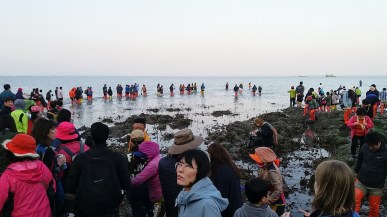
Walk on the Ocean

20170429_181523

Finally, the event saftey team declared it was safe to head out into the water and we began to wade as a huge human conga-line through the shallow waves. I’m told that in some years, the bridge rises completely above the water, and indeed the most famous picture used in every promotional website in Korea is one of a wide and distinct stone pathway through the sea. My experience was a bit more damp.

20170429_183234While math can now easily tell us the time of the lowest tides, it does not yet advance to tell us what the actual lowest level of the water will be. Not that it couldn’t, but there are more variables involved, so it’s not a thing now. While we can say with certainty, the lowest tide of the year on this beach will occur at 18:38 on April 29 (or whatever), we can’t say for sure if that will expose the land bridge or simply be lower than every other tide around it.

20170429_185231We tromped along the path, watching parasailers overhead and rainbow colored lanterns being released in to the air from the beach behind us. It was clear the path was quite narrow because going too far from the group to one side or the other to get a picture resulted in a severe deepening of water level. At the time, my friends and I theorized it might be man-made, or at least man-maintained, however, I have since then found that the build up of rock and sand in this twisty line is a natural result of the currents around the islands.
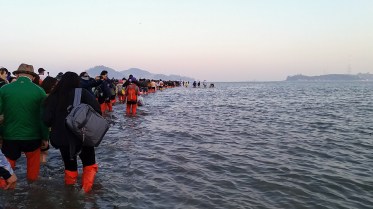
20170429_184104Before long the golden light of the sunset combined with the swish-swishing of hundreds of feet through water to create a trance-like state. I could not judge how far the island was, nor tell which way the path twisted. The rocks below us rose and fell, bringing the waves treacherously close to the top of my boots and then back down to barely splash over my toes. The whole path is nearly 3km long. I suspect a determined person could make it out to the island and back in the hour or so the path is clear to walk, but I wasn’t racing, and soon we were greeted by the sounds of Korean drums and the distant flags waving as the procession from Modo came out to greet us.

Get Back

Tides are bonkers. When we went to Thor’s Well in Oregon, we had to check the tide charts to see the show, yet practically had to run to get back when the tide turned on us. In New Zealand, my lovely soak in the hot water beach went from peaceful to sea-soaked in minutes. Once the tide is returning, there is not a lot of time to get out of the way before the ocean reclaims what is hers. We had been told, when the big parade starts heading back to Jindo, go with them or you’ll be swimming back.

20170429_191328The walk outward had been slow, trepedatious, as though we were nervous the land could drop away at any moment, but the trip back was much more celebratory as well as much more damp. The parade of drum bangers, cymbal crashers, gong ringers and flag bearers danced merrily in their traditional garb, urging us all back to the larger island of Jindo. Our pace quickened and our legs swung to the rhythm causing much larger splashes. Waves came in from both sides of the path making us nervous, but excited. The water finally breached the top of my boots and sent an icy chill down my shins, but I found I did not mind.

By the time we returned to land, the sun was long gone and we picked our way up the tidal flats to the main road by the bright halogen lights of the festival. Desptite wet knees and sore legs, I felt elated. Participating in huge group rituals does interesting things to the human brain, but a big one is bonding. It raises hormones like oxytocin and dopamine which make you feel good about life and the people around you. I especially like doing them in huge anonymous groups because it fills me with the love and connectedness but there’s no social group to attach it to, so I get this big whole-world love.

20170429_191432

We doffed our boots and made our weary way back to the buses, pausing long enough to scrounge some dinner. Practically everyone fell asleep on the bus ride to our hotel, and I don’t think I stayed concious more than a few minutes after laying down on my little floor mat, content and sleepy and looking forward to the next day’s adventure.

Jimjilbang

Why every white-anglo blogger I’ve read is scared of these is a giant tragedy. I’d say mystery, but I think I understand it. They are terrified of nudity. Prudish Victorian and Puritanical values passed down from our anglo ancestors have made us associate all nudity with sex, which is itself an activity with much shame, blame and whispered scandal about it. But, oh my god, strangers (of the same gender) might see my naked body in a non-sexual context while they are equally naked… this is scary to the anglo-mind.

I too held this prohibition for part of my life. Theater and dance classes took some away, because you can only be so modest while changing in the dressing room. At some time, I fell in with a group of rabid exhibitionists in St. Louis who were often non-sexually naked around each other. I went to public hot springs in the mountains of Washington where total strangers stripped down to soak, but it was never awkward. Over many years of various levels of friendships, intimate relationships, and gym memberships in multi-cultural parts of town, I eventually unhooked my nakedness=sexuality link and can now comfortably enjoy the jimjilbang experience.

This particular morning, at 7am, I headed downstairs to get a bracing shower and some good soaking in after my muscle straining ocean walk and never-as-fun-as-it-looks sleeping on the floor. After washing up in the shower, I got into the mid-warm pool and enjoyed the hard water massages to pound out my stiff back. I graduated up in heat until I was able to get into the super hot pool which was made of an herbal infusion that turned the water a deep smokey topaz black. For the next hour, I bounced between the super hot and super cold, bringing all the inflammation in my unhappy muscles back down and getting me all set for the next adventure. Why anyone would let a little nudity interfere with such glorious bathing, I will never know.

Boseong and the Green Tea

I visited Boseong last winter for a midwinter lights festival. We spent some time in the green tea fields and I was surprised at the time how beautiful they were, even in the bleak austerity of winter. Now at the end of April, I had the chance to see the fields in their spring colors.

20170430_115224Before heading to the fields, we walked up a long road past the area of the light festival where a few wire frames from reindeer and dragons could still be seen. The road up the hill was painted with fun perspective illustrations of a stream, complete with little camera icons to show the best places to stand to see the visual effect. Optical illusions are fun.

20170430_105220At the top of the hill, far beyond the little pagoda that had marked the highest point of the lights, we finally came upon the green tea museum where we were treated to a special showing of the Korean green tea ceremony (complete with English translation by our awesome guide). The ceremony involves a process of several containers: a water pot, a cooling bowl, a tea pot, and the drinking cup. The hot water pot is filled with boiling water, which is then poured into the bowl, and from the bowl into the tea pot and finally into the cups. The instruments are warmed up in this way. Then more boiling water is poured into the cooling bowl. Tea leaves are scooped into the warm but empty tea pot and the ideal temperature water is poured from the bowl over the leaves. While the tea steeps, each cup is emptied of it’s hot water into another bowl on the floor and wiped dry on the outside. The tea is then poured into the pre-warmed cups by pouring only a half a portion into each and the other half in reverse order on the way back. The tea is then served, 4 cups to the guest and one to the host.

20170430_110142The hostess tried to tell us a bit about green tea, red tea and black tea but her translated explainations seemed off to me, since she said it had to do with the age of the leaf when it was picked from the plant. I don’t know if this was her or the translation, but the real story follows: In any country with Chinese roots in it’s culture and language, the three colors of tea are a bit different in meaning that in the West. Red tea is not Rooibos, in fact all three come from the same plant. And it’s not the age of the leaf at picking that determines the difference, but rather the post picking, pre-drying process. (although especially young and tender tea leaves are sometimes referred to as “monkey picked” and do make a delightful tea).

Green tea is picked, cut and dried. It doesn’t stay fresh long (no more than 2 years) so don’t let it sit around in your cupboard forever. 紅茶 Red tea is how Chinese and their linguistic relatives refer to what the British call “black tea” (confusing, yeah?). It is also picked from the same tea plant and cut, but then it is oxidized, which I am not going to try to explain the chemical process of, but you’ve all seen it because rust is what happens when iron oxidizes. Red tea is what happens when tea oxidizes. When the desired level of oxidation is achieved, the tea is dried and the oxidation stops in the absence of moisture. This is your standard English teatime tea and when stored properly stays good for a loooong time (making it ideal for trade and trans continental shipping in the days before FedEx). 黑茶 Black tea is fermented or post-fermented tea that is both oxidized and fermented over a period of months or even years. Pu-erh is the most widely known of these. There is a lot more about tea, but I’m stopping here.

20170430_130215After we conducted our own tea ceremonies, I drifted lazily back down the hill, examining the spring flowers and the grounds that had been lit up beautifully last December. When I finally got back to the tea fields, I took off on the same route I’d walked before and was happily greeted by many blooming apple trees and a small army of busy bees who were so focused on the brief blossoms that they paid no mind to all the humans fussing around. In fact, I think it was the only time I’ve seen Koreans in the presence of a bee not totally freaking out. I guess the selfie with the tree is worth it.

20170430_132033

The tea fields were much more crowded than in the winter, but people were still fairly polite about taking turns at the best view spots. One kind man noticed I had been framing up a photo of an especially stunning tree with the tea as a background when some more photo seekers stepped in front of me. I had been prepared to simply wait them out, but the gentleman spoke to them in Korean and pointed out they were in my way. 감사합니다!

20170430_131911In addition to the blooming fruit trees, there were cascades of purple flowers covering the rocks wherever tea was not growing. It made the whole place feel like a still frame of a rushing river in shades of pink, purple and green. Besides the tourists, there were also tea pickers at work. Each ajuma looking lady had her sun guards on, gloves and a mesh basket to place the leaves. They were not picking the bushes bare, but selecting only some growth. It seemed to me to be the newer, brighter green leaves that they were after, but I couldn’t tell for sure. In the age of automation it was strange to see people picking by hand. I know that it’s still the way for many crops in the world, but sometimes it gets driven home that there’s a human on the other end of my tea or strawberries or carrots, and then I’m carried off by sociological musings on how we came to value people who sit at desks manipulating imaginary money so much more than people who make our food.
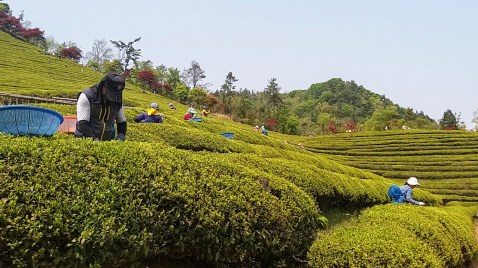
20170430_131217

Speaking of food

green-tea-noodles

photo credit: honjatravel

Of course I had to go back to the everything green tea cafe. It was a warm day, and walking for hours in the sun (even with my sunbrella) meant that I was all set to try some cold green tea noodles. Cold noodle soup is one of the best ways to survive the summer in Korea because it’s served with chunks of ice floating in the broth along with the filling noodles and crisp pickled veggies. I managed to pick up a lunch companion from a whole other tour group, too. Boseong was a target of opportunity following the Jindo festival, so multiple tour agencies were out in force.

I pilfered the gift shop for more green tea latte packets that had gone over well as gifts then impulse purchased a bag of green tea caramels to share with my co-teachers too. I think they remind me more of green tea salt water taffy than caramel, but still delicious.

My last treat was over at the ice cream shop. No visit is complete without some green tea ice cream, but this time I opted for the green tea affogato. I have to admit, I did not know what an affogato was before I came to Korea. I guess it’s just not popular in the parts of the US I lived, and I’ve never been to Italy. But it is on the menu of nearly every cafe in Korea. In case you, like me, spent your life in an affogato black hole, it’s a scoop of vanilla gelato (or ice cream) topped with espresso. Yum!

18195080_10101177909332080_7560252973513082033_n

photo credit: Annemone

I somehow expected the green tea affogato to be vanilla or green tea ice cream topped with a shot of green tea. Makes sense? Not what happened. It was green tea ice cream topped with espresso. Don’t make an ick face. It was insanely delicious. Even one South African girl who hated green tea said that it was nice. I’ve had the tea/coffee blended drink that’s popular in Asia and enjoyed it, so it shouldn’t surprise me that this was delightful, too. Now I’m on the hunt to bring home some green tea ice cream and some espresso to reproduce the experience.

On the way back, I discovered my unintentional link to @shmaymee and her art, bringing the whole weekend around into one small world ride of awesome fun.

Golden Week

This beautiful conflagration of holidays that resulted in me only working 2 days out of 10 during the end of April/beginning of May was the first time in over a year that I spent any real time off just relaxing at home. Of course, some weekends I don’t make it out on an adventure, and some adventures are just going down to the beach for a market or karaoke night. I’m not a non-stop sightseeing extravaganza, but I realized I haven’t had more than one day in a row of slothing at home in over a year. I pounded thru the entire Magician’s trilogy, fixed my friend’s computer, celebrated another friend’s birthday, watched the new Guardians movie and finished Iron Fist. I can’t say I want to binge watch Netflix and read fantasy trilogies with all my free time, but it felt good. I love traveling, but if my latest trip to Thailand taught me anything it’s that rest is important too. Even when my job is easy, it’s not restful and even when my adventures are amazing (or perhaps especially when they are amazing), they are not restful.

Life can be full of wonder or dull as dirt almost no matter where you live (I admit it’s easier to be wonderful when you live in someplace like Busan as opposed to any small town where Wal-Mart is the most interesting store), but I’ve seen so many expats who go abroad and after a year or less they become blasé, falling into habits of the same bar, same hobbies, same expat friends, and no more magic about the experience of living abroad. I saw those people from the very first time I went out and I could NOT understand how it happens. I fought against it and fought hard. I didn’t join the expat gaming group or theater troupe, I spent at least one weekend a month but usually more going out and doing something unique. I sometimes wore myself out doing that. And while I still don’t want to become one of the blasé, I think I’ve come to peace with the idea of a middle ground. So, maybe once or twice a year, in addition to my big out of town adventures, I can have an around the house staycation, too.


Yesterday was the first instance of air conditioning on the bus this year. It heralds the end of so brief spring and the beginning of … the Hot. It will probably be ok for another month, but soon, too soon, the summer will be upon us. Hopefully I’ll get in a few more good adventures before the heat becomes unbearable, but I have at least finally purchased my tickets for the Philippines this October. Whatever else happens, I have that to look forward to. In the mean time, I’ll be pumping out some more of the Malay adventures as the emotional and experiential roller coaster gets revved for some serious ups and downs. Don’t forget to check out all the photos from Jindo and Boseong. Thanks for reading!

A Weekend in Riyadh: The Globe Restaurant

The Atmosphere

img_0516After my wonderful spa treatment downstairs, I headed up to the very tippy top of the Al Faisaliah Tower. The tower is supposed to look like a giant ball-point pen (I dunno who thought that was cool for a skyline), and the “ball” part of the “pen” is a huge silver globe in which sits a gourmet restaurant called (originally) The Globe.

This place is super fancy and has a 300 riyal minimum for dinner. There’s also a cigar lounge with a 200 riyal minimum, and supposedly they do a High Tea in the afternoons, which I didn’t get to do because I opted for the Museum, having only one day, but really hope to do if I find myself with an afternoon free in Riyadh again.

The picture on the left is from the restaurant’s own website, since it was too dark and full of people for me to get a good picture when I was there.

As you can hopefully see, the entire wall is part of the glass ball. There is also a glass barrier between the tables and the globe itself, so the floor stops short of the outside wall, creating the fantastic sense of having the city spanning out under and around you. Not as vertigo inducing as you might think, however. To the right is the view from my own table.

They have seasonal rotating menus, and to make this easier, the menu is on a tablet rather than printed. My water (45 riyals) was in a beautiful glass bottle that was kept in a champagne chiller next to my table. The bread was actually a bread sampler platter with five different types of bread as well as butter and a tangy dipping sauce.

But Kaine, you don’t eat wheat! My friends exclaim… turns out that may be limited to America.

The Bread Basket

img_0535The crispy baguette (long and pointy at both ends) was my favorite. A super crispy outside with a soft fluffy interior. I finished that one. Moving to the right there are two brown bread buns, the one on the bottom was a little sweet with dried fruit pieces with a softer, chewier texture, and the one above was herby and savory with a slightly crisper crust (nothing like the baguette). Only one bite each for those. The bread in the glass at the top right was actually fried in some kind of herbed oil. It is what croutons want to be when they grow up. Alone it was delightful, crunchy but thin enough to be flakey, the oil was pleasant rather than greasy. In the dipping sauce it was outta this world. I didn’t polish it off, but it did get a second bite as well as second place. Finally the ciabatta, the square bread in the upper left. Also very nice, a crust that maintained a balance of crispy and chewy with a white interior, only slightly less fluffy than the baguette. Two bites and third place.

The Appetizer

img_0537Next, the waiter brought out a sample appetizer (or possibly a palette cleanser) that I hadn’t ordered, but was happy to try. If you could sort of imagine a guacamole ice-cream cone… which doesn’t do this justice. The “cone” was made from corn meal, but not just any tortilla, it was impressed with the crosshatch marks of an ice-cream cone and either made with a sweet corn (most likely) or a little extra sugar because it was just slightly sweeter than a regular tortilla. It was also delicately thin, like a wafer cookie. The guacamole filling was very creamy and mild. Totally smooth with a good blend of avocado and lime, but not enough garlic or chili to cling in the mouth or ruin the main course.

The Main Dish

I ordered lamb. I’ve heard really wonderful things about the quality of seafood in Riyadh’s high end restaurants, but I have a long standing aversion to ordering seafood in a land-locked place. Chicken is for safe bets when you’re not sure about the chef. And given a choice between beef and lamb, I’m partial to lamb, although I know the flavor isn’t for everyone.

img_0538I ordered mine rare. I’d read that Saudi restaurants often have trouble with this, but the Globe chef clearly knew what he was doing. I know rare is supposed to be cold in the middle and red all the way through, but I prefer the much more elusive warm and red center. He nailed it. The lamb was not only tender, juicy and cooked to perfection, it was topped with an herbed bread crumb crust and feta crumble which complimented the meat beautifully. Served on a bed of rosemary risotto and porcini mushrooms. Framed by tart grape tomatoes, lightly roasted and drizzled with a tomato reduction. I really enjoyed going back and forth between the flavors, trying different combinations of the savory risotto, earthy mushrooms, salty feta and tart tomato with the wonderful umame of the meat and each other. This was also a very generous portion, making me glad I’d skipped lunch.
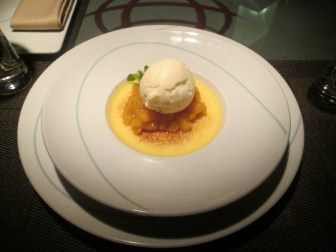
For Afters

After a long slow savoring of dinner, it was time for desert and coffee. While I am an eternal chocoholic, there is one dessert I can never pass up at a fancy restaurant: the crème brûlée. I can still remember discovering this amazing custard treat, this creamy yet crunchy, cold yet caramelized culinary coup de grace…. my alliteration ran away with me there, but I really love crème brûlée.

img_0542This particular brûlée was served, beautifully plated in this chilled shallow dish. I have a deep appreciation for appropriately sized desserts that pack a huge flavor punch. I’ll take a tiny slice of mouth-gasm over a giant pile of meh any day.
The crispy caramelized top coat was, as you can see, not even slightly burnt, and yet it was a perfect hard crack with that ever so slightly bitter note that offsets the sweet creamy custard beneath. Atop this candied crust is a mango compote and a tiny scoop of finest vanilla ice cream.

Normally, I have strawberry or raspberry with my crème brûlée if I have any fruit at all. I would not have considered mango. Nor had I ever previously considered making a compote from mangoes. Salsa, sure, but a compote? The flavor was fascinating, and I wouldn’t be surprised to learn there was some peach mixed in. It wasn’t anywhere near as sweet as fresh mangoes or what I would expect from any kind of fruit compote, but it clearly wasn’t made from the tarter, less ripe mango because there was no hint of sour flavors. There was a hint of pleasant bitterness that echoed the mildly bitter flavor in the caramelized sugar topping.

I also would never have considered adding ice cream to a crème brûlée. After all, the brûlée is so creamy and delicious already, right? But as it turns out, I was wrong. If you add really good vanilla ice cream to really good crème brûlée you get really really good frozen custard. As with the main course, I enjoyed mixing and matching the different flavors and textures in different bites as I slowly devoured my dessert course. The final bite included a tiny sprig of mint. I think a good chef will try to make the garnish a flavor pair with the dish, and not simply something pretty to be discarded (maybe I watch too much cooking channel). But in this case, my faith was rewarded, and the tiny fresh mint leaves gave me one last burst of new flavors, blending with the final mouthful of custard, caramelized sugar, mango compote and vanilla ice cream. Heaven.

I finished my meal with a double Turkish coffee while looking out at the view and revelling in my day of total pampering. Just when I thought it was coming to a close, the bill paid and heading to the elevator, the maitre d’ asked if I had been to “the Experience” yet.

The Experience

img_0543The Experience, as it turns out, is the viewing platform just beneath the Globe restaurant. This my view while standing just under where I was eating a few moments before, the city below reflected in the mirrored windows. If you choose to come here without dinner, the ride to the viewing platform is 40 riyals. It’s pretty freakin’ amazing. I admit, I was full of happy hormones from the spa and dinner (yay dopamine!), but wow.

The clear glass walls that surround the viewing platform keep one totally safe while presenting the illusion that one is on the edge of the top floor of the building. However, there is no ceiling. The winds that blow 30 floors up are dampened somewhat by the sheer height of the glass walls (about 10 feet), but are still a presence to be reckoned with. Riyadh is also a very hot city, and even at night its still quite warm, so the wind whipping my abaya and hijab around was not in the least bit chilly despite the elevation.

The Globe restaurant is listed as one of Riyadh’s most romantic dining spots, and the Experience viewing platform was testimony to this. Several couples came out while I was ogling the view. Ladies were carrying roses their husbands had liberated from the tables inside. Couples looked very happy and stood very close, even holding hands, which was more PDA than I’d seen anywhere else. Definitely a romantic locale! The women’s outter garments were clearly a step up from the daily black and showed a lot more color and bling than I’d seen in the rest of Riyadh. Moreover, they had not covered their faces! All the better to enchant their husbands with their beauty. I was asked to take pictures for more than one such couple, but always approached by the woman as her husband stood well back from me, respectfully.

img_0546I circled the platform a few times, taking pictures, admiring the view of the city below and the moon above, and pausing one final time to relish the long road to the Kingdom Tower, to imagine the eye of Saruman poised between those tines and myself on the windswept tower of Isengard looking for giant eagles in the night sky. Then, spa pampered and gourmet food filled, I rode the languid elevator back to ground level where my driver awaited me by the front door to take me back to my own considerably less fantastical and less expensive hotel and sleep.


Food in the US and Abroad: Wheat Gluten

I like food. I like to try different foods while travelling and write about them. I also have food sensitivities and allergies. While I’m in America, I’m very picky about what I eat because the American processed food is so horrible. Most of what I avoid are artificial ingredients. I think of myself as a “real foodist”. In America, that means doing most of my own cooking and reading labels scrupulously.

Normally, I also avoid wheat. I know its really trendy now, but about 14-15 years ago as a last ditch effort to deal with a chronic pain and fatigue diagnosis, I tried cutting wheat and dairy from my diet and it had a positive effect, reducing my pain and increasing my energy. I don’t care if I’m allergic, intolerant or celiac. I just like not being in pain. Every couple years, I try something again to see if its still a problem (or sometimes accidentally eat something).

However, I’ve found that travelling outside the US changes my food options very significantly. Not only do most other countries offer real food for cheaper than processed food (opposite of the US), but the candy, sweets, bread, and restaurant foods all tend to be made of more real ingredients than not. Plus the processes for preparing pre-made food are more likely to be recognizable as cooking instead of chemistry.

When I lived in China in 2007 I got homesick once and we went to an expat pizza joint. They imported their flour (this is relevant) because Chinese wheat has less gluten and makes bad pizza. I ate it anyway, and of course felt icky for days afterward. A few months later, in another homesick slump, I thought, to hell with it, I want a slice of chocolate cake. There was a bakery in my neighborhood that I passed all the time. I expected to feel sick, but didn’t care. Imagine my surprise when I didn’t feel sick!

I continued to be able to eat Chinese wheat products with no problem, but imported products were not ok. I even tried wheat again once I returned to the US and it was no go. I chalked it up to Chinese low gluten wheat and moved on.

A few years ago, I read some new research about the fermentation process of bread products no longer being used in the US. Back before huge factories made our food, bread dough was left to sit for hours (often 12-16) while it rose and was kneaded and the little yeast monsters broke down the sugars (and proteins) and made little air bubbles. Turns out the yeast also made the hard to digest wheat easier on the human gut, allowing us to extract more nutrients with fewer problems.

We stopped this process in the name of efficiency, and now can make a loaf of bread from start to finish in 40 minutes! We bleach and strip the flour then add nutrients back in so that it still comes out soft and tasty without the fermentation time, but gluten intolerance in the US is on the rise.

There isn’t yet any conclusive evidence as to why, or what can be done about it, which is why I don’t really care what my “diagnosis” is, and only how my body responds to the food I put in it.

When I first got here to Saudi, I went next door to get some shawarma and the guys brought us some complimentary baked bread thingies with like a chicken spinach filling. Not wanting to be rude, and not feeling able to explain the food sensitivity, I ate one. Again, no ill effects the next day. So I tried a few more wheat items with no problems.

Then I looked up wheat in Saudi and found that the government both claims great exports of wheat and is eliminating home grown wheat by 2016 in favor of importing wheat from a bunch of different countries (including the US, but I’m not sure what their stance on GMO’s is yet). No logic.

At some point I hope to experiment with baguettes in France, too.

I don’t avoid wheat to be trendy. When I quit wheat there were no alternatives on the market, no one had heard of gluten intolerance, waitresses offered me pancakes when I asked about wheat free breakfast options, and co-workers were astonished to learn there was wheat in birthday cake. I appreciate the new trend because it makes my options in the US broader, although I still read labels relentlessly because many companies use other ingredients I object to while claiming gluten free status.

The fact that I can enjoy bread products while overseas is pretty cool. Even nicer is the fact that I’ve grown accustomed to a largely bread free diet means that its still a treat rather than a staple. I don’t understand why I have problems with wheat products only in America. I’ve started to believe the problem for me isn’t the wheat (or at least if it is, then its a particular American mono-culture of wheat), but rather the processing. Until I find the answer, I just tell people I’m allergic to America. ;P