The beginning of May where holidays like Labor Day, Buddha’s Day, and Children’s day come close is often referred to as Golden week because of all the days off work/school together. Last year, I got a long weekend and went to the Namhae Anchovy Festival and Taean Tulip Festival. Spring is the time of endless festivals in Korea, and last year I wasn’t able to catch them all. This has been a chance for me to go back and get the highlights I missed last time. Of course the Daegu Lanterns were a part of that, but I also finally made it to the “miraculous” sea parting at Jindo in time to walk across the narrow land bridge that leads to the island of Modo (jokingly now referred to as Mordor after the LOTR movies because the Korean pronunciation is so similar).
 We set off from Busan (blue dot) in the morning to drive all the way across the southern end of the Korean peninsula to Jindo (red dot). Although Korea is small compared to, say, the US, it was still almost 5 hours of driving with the occasional pit stop. (By the way, in case you’re curious, you can see Daegu on this map as well). Fortunately, I went with a tour group (my stand by Enjoy Korea) and the bus ride was comfortable. I even got mostly through a Vonnegut audiobook, which is the only way I can consume books on a bus.
The Festival & Traditions
We arrived at the tiny festival grounds in the early afternoon and had the chance to wander around, take in the sights and enjoy the beach. The weather was lovely, and we spent about an hour just sitting in the grass above the sea enjoying some 막걸리 (makgeoli). Although many Korean festivals now have a sameness about them to me, it’s become something to look forward to rather than to be curious about. Favorite festival foods that are hard to find elsewhere, like 동동주 (dong dong ju) or fresh 해물파전 (seafood pajeon). I couldn’t find anyone selling 동동주 in Jindo. Vendors there insisted it was the same as 막걸리, but I didn’t believe them, and did more research. If you’re curious, this blog does a great English language explanation of the two. Koreans also love to invite international vendors to even the smallest festival, and this was no exception. I saw booths selling food from at least 10 other countries, including one doing the cumin spiced mutton skewers from China that I love so much.
 The Jindo festival had at least one feature I’ve never seen before: a traditional Korean wrestling ring. A pile of sand was placed in a large circle where two contestants could wrestle in the traditional style. 씨름 (ssireum) is Korea’s wrestling, just like sumo is Japan’s. Each wrestler had a sash of cloth wrapped in a specific pattern around their waist and one thigh. The wrestlers would kneel and lean in to each other for a moment before the bout started to give them a chance to get a good firm grip on the cloth. Then they would stand up together and the referee would call start, whereupon they attempted to dump their opponent in the sand. The holds never changed. Each wrestler maintained their grip on the sashes at the designated waist and thigh position. Working to topple the proponent meant pulling and pushing and moving the center of gravity around. It was different from any other style of wrestling I’ve ever seen. Both men and women participated, though not against each other.
Cultural appropriation or good old fun?
There was also a “festival of color”, similar to Holi Hai. Only, unlike the one at Haeundae beach which was held by the Indian expat community in honor of their holy day, this was a totally Korean run secular affair. I start getting really tangled up in cultural appropriation when two post-colonial cultures are involved. I suspect the Koreans had no real idea about the religious significance and just thought it would attract more tourists. In the end, the only people covered in colored powders were young, party-driven Westerners. As far as I can tell, a group of Koreans cottoned on to the fact that white kids like this dancing with colored powder thing and did it for the fun and the money.
 Even more bizarrely, after the color throwing was over, the festival organizers gave each participant a “toga” to wear. The togas were long white robes with red sashes that could have evoked a Roman senate or Jesus. Considering we were about to “part the seas” it was hard not to see it with Judeo-Christian overtones, but the rather drunk person I asked about it just said “toga party!” The entire thing seemed like the festival organizers were trying to find a way to appeal to the expat crowd. I’m glad they had fun, but I would have preferred some more traditional activities, like someone to teach us about collecting clams and seaweed the way the locals were doing as the tide went out. It’s hard to go do local culture festivals when the locals are busy trying to white-wash everything for cash.
The Magic Math of Tides
 Finally, the real “reason for the season” was upon us and we muddled our way down the road to the rainbow steps beneath the watchful eye of the grandmother and the tiger. We paused at a bench to don our thigh high rubber boots and got some advice from the locals on how to attach the rubber garters through belt loops to hold up the boots, or failing that, to wrap them tight around our thighs and snap them in place. Thus clad in bright orange and yellow wellies, we made our way down the steps and into the shallow tide pools to wait for the tide to recede.
 If you look at the area on Google Maps you will simply see the beach and the islands, but on Korea’s own Naver Maps, there is a thin line connecting the rainbow steps to the island of Modo. Although this path is only usable twice a year (at most), the Korean map makers consider it important enough to draw in.
The effect is caused by an extreme low tide. Tides are caused by the relative position of the Earth, Moon and Sun and are fairly regular and predictable because astronomy is math. Despite this, I heard no less than five people declare knowingly that “no one could predict” when the low tide would occur. I guess these are the same body of “no ones” that could have known health care is complicated? Science education is important, people. In fact, here’s some now. This cute little website does a basic introduction to tidal prediction methods, with pictures and everything.
 The history of tidal prediction starts with Kepler (total nobody) in 1609 to theorize that the moon’s gravity caused the ocean tides. He was followed by other such no-ones as Galileo and Newton. It was in 1776 that the first big complex equations came from a man called Laplace. Harmonic analysis was added in the 1860s and polished off by 1921 in the form that Navies all over the world still use today. Although the math hasn’t changed in almost a hundred years, computers make the math easier and the information more widespread so now instead of just ships in harbor– surfers, beachcombers, and clam hunters can go online to see the local low and high tides at their favorite beach.
Tidal harmonics are the reason why low tide gets extra low once or twice a year (if someone reading this is a scientist with a better way of explaining it, PLEASE chime in) All the different factors that affect tides are like a ‘lil wave pattern (think sound amplitude). When the ups and downs of different factors are opposite, they can cancel each other out, but when they align, they can magnify the effect. Because they’re all beating at different tempos, they interact differently over a cycle (year), but in a totally mathematically predictable way, line up all at once and create this “super tide”. Thus it is that the seas part, and we can walk over to the island. Sufficiently advanced math really is indistinguishable from magic.
The Legend of the Tigers
 On a more mystical note, the local legend of the tigers explains why there’s a statue of a grandmother and a tiger overlooking the sea. Long long ago, the villagers who lived on Jindo were plagued by man-eating tigers. The whole village packed up and sailed over to the neighboring island of Modo to escape the threat, but one woman was left behind. The woman was Grandmother Bbyong, and she prayed to the Dragon King, the god of the sea, to help her. Finally the Dragon King came to her in a dream and told her he would build a rainbow brigde across the sea for her. The next day when Bbyong went down to the sea, the waters parted to let her cross and her family came out from Modo to meet her. This also explains the rainbow stairs that lead down to the landbridge, but not why her family couldn’t have just sailed back for her in the first place.
Walk on the Ocean

Finally, the event saftey team declared it was safe to head out into the water and we began to wade as a huge human conga-line through the shallow waves. I’m told that in some years, the bridge rises completely above the water, and indeed the most famous picture used in every promotional website in Korea is one of a wide and distinct stone pathway through the sea. My experience was a bit more damp.
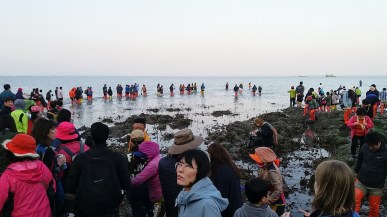 While math can now easily tell us the time of the lowest tides, it does not yet advance to tell us what the actual lowest level of the water will be. Not that it couldn’t, but there are more variables involved, so it’s not a thing now. While we can say with certainty, the lowest tide of the year on this beach will occur at 18:38 on April 29 (or whatever), we can’t say for sure if that will expose the land bridge or simply be lower than every other tide around it.
 We tromped along the path, watching parasailers overhead and rainbow colored lanterns being released in to the air from the beach behind us. It was clear the path was quite narrow because going too far from the group to one side or the other to get a picture resulted in a severe deepening of water level. At the time, my friends and I theorized it might be man-made, or at least man-maintained, however, I have since then found that the build up of rock and sand in this twisty line is a natural result of the currents around the islands.
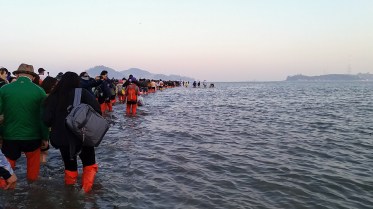 Before long the golden light of the sunset combined with the swish-swishing of hundreds of feet through water to create a trance-like state. I could not judge how far the island was, nor tell which way the path twisted. The rocks below us rose and fell, bringing the waves treacherously close to the top of my boots and then back down to barely splash over my toes. The whole path is nearly 3km long. I suspect a determined person could make it out to the island and back in the hour or so the path is clear to walk, but I wasn’t racing, and soon we were greeted by the sounds of Korean drums and the distant flags waving as the procession from Modo came out to greet us.
Get Back
Tides are bonkers. When we went to Thor’s Well in Oregon, we had to check the tide charts to see the show, yet practically had to run to get back when the tide turned on us. In New Zealand, my lovely soak in the hot water beach went from peaceful to sea-soaked in minutes. Once the tide is returning, there is not a lot of time to get out of the way before the ocean reclaims what is hers. We had been told, when the big parade starts heading back to Jindo, go with them or you’ll be swimming back.
 The walk outward had been slow, trepedatious, as though we were nervous the land could drop away at any moment, but the trip back was much more celebratory as well as much more damp. The parade of drum bangers, cymbal crashers, gong ringers and flag bearers danced merrily in their traditional garb, urging us all back to the larger island of Jindo. Our pace quickened and our legs swung to the rhythm causing much larger splashes. Waves came in from both sides of the path making us nervous, but excited. The water finally breached the top of my boots and sent an icy chill down my shins, but I found I did not mind.
By the time we returned to land, the sun was long gone and we picked our way up the tidal flats to the main road by the bright halogen lights of the festival. Desptite wet knees and sore legs, I felt elated. Participating in huge group rituals does interesting things to the human brain, but a big one is bonding. It raises hormones like oxytocin and dopamine which make you feel good about life and the people around you. I especially like doing them in huge anonymous groups because it fills me with the love and connectedness but there’s no social group to attach it to, so I get this big whole-world love.

We doffed our boots and made our weary way back to the buses, pausing long enough to scrounge some dinner. Practically everyone fell asleep on the bus ride to our hotel, and I don’t think I stayed concious more than a few minutes after laying down on my little floor mat, content and sleepy and looking forward to the next day’s adventure.
Jimjilbang
Why every white-anglo blogger I’ve read is scared of these is a giant tragedy. I’d say mystery, but I think I understand it. They are terrified of nudity. Prudish Victorian and Puritanical values passed down from our anglo ancestors have made us associate all nudity with sex, which is itself an activity with much shame, blame and whispered scandal about it. But, oh my god, strangers (of the same gender) might see my naked body in a non-sexual context while they are equally naked… this is scary to the anglo-mind.
I too held this prohibition for part of my life. Theater and dance classes took some away, because you can only be so modest while changing in the dressing room. At some time, I fell in with a group of rabid exhibitionists in St. Louis who were often non-sexually naked around each other. I went to public hot springs in the mountains of Washington where total strangers stripped down to soak, but it was never awkward. Over many years of various levels of friendships, intimate relationships, and gym memberships in multi-cultural parts of town, I eventually unhooked my nakedness=sexuality link and can now comfortably enjoy the jimjilbang experience.
This particular morning, at 7am, I headed downstairs to get a bracing shower and some good soaking in after my muscle straining ocean walk and never-as-fun-as-it-looks sleeping on the floor. After washing up in the shower, I got into the mid-warm pool and enjoyed the hard water massages to pound out my stiff back. I graduated up in heat until I was able to get into the super hot pool which was made of an herbal infusion that turned the water a deep smokey topaz black. For the next hour, I bounced between the super hot and super cold, bringing all the inflammation in my unhappy muscles back down and getting me all set for the next adventure. Why anyone would let a little nudity interfere with such glorious bathing, I will never know.
Boseong and the Green Tea
I visited Boseong last winter for a midwinter lights festival. We spent some time in the green tea fields and I was surprised at the time how beautiful they were, even in the bleak austerity of winter. Now at the end of April, I had the chance to see the fields in their spring colors.
 Before heading to the fields, we walked up a long road past the area of the light festival where a few wire frames from reindeer and dragons could still be seen. The road up the hill was painted with fun perspective illustrations of a stream, complete with little camera icons to show the best places to stand to see the visual effect. Optical illusions are fun.
 At the top of the hill, far beyond the little pagoda that had marked the highest point of the lights, we finally came upon the green tea museum where we were treated to a special showing of the Korean green tea ceremony (complete with English translation by our awesome guide). The ceremony involves a process of several containers: a water pot, a cooling bowl, a tea pot, and the drinking cup. The hot water pot is filled with boiling water, which is then poured into the bowl, and from the bowl into the tea pot and finally into the cups. The instruments are warmed up in this way. Then more boiling water is poured into the cooling bowl. Tea leaves are scooped into the warm but empty tea pot and the ideal temperature water is poured from the bowl over the leaves. While the tea steeps, each cup is emptied of it’s hot water into another bowl on the floor and wiped dry on the outside. The tea is then poured into the pre-warmed cups by pouring only a half a portion into each and the other half in reverse order on the way back. The tea is then served, 4 cups to the guest and one to the host.
 The hostess tried to tell us a bit about green tea, red tea and black tea but her translated explainations seemed off to me, since she said it had to do with the age of the leaf when it was picked from the plant. I don’t know if this was her or the translation, but the real story follows: In any country with Chinese roots in it’s culture and language, the three colors of tea are a bit different in meaning that in the West. Red tea is not Rooibos, in fact all three come from the same plant. And it’s not the age of the leaf at picking that determines the difference, but rather the post picking, pre-drying process. (although especially young and tender tea leaves are sometimes referred to as “monkey picked” and do make a delightful tea).
Green tea is picked, cut and dried. It doesn’t stay fresh long (no more than 2 years) so don’t let it sit around in your cupboard forever. 紅茶 Red tea is how Chinese and their linguistic relatives refer to what the British call “black tea” (confusing, yeah?). It is also picked from the same tea plant and cut, but then it is oxidized, which I am not going to try to explain the chemical process of, but you’ve all seen it because rust is what happens when iron oxidizes. Red tea is what happens when tea oxidizes. When the desired level of oxidation is achieved, the tea is dried and the oxidation stops in the absence of moisture. This is your standard English teatime tea and when stored properly stays good for a loooong time (making it ideal for trade and trans continental shipping in the days before FedEx). 黑茶 Black tea is fermented or post-fermented tea that is both oxidized and fermented over a period of months or even years. Pu-erh is the most widely known of these. There is a lot more about tea, but I’m stopping here.
 After we conducted our own tea ceremonies, I drifted lazily back down the hill, examining the spring flowers and the grounds that had been lit up beautifully last December. When I finally got back to the tea fields, I took off on the same route I’d walked before and was happily greeted by many blooming apple trees and a small army of busy bees who were so focused on the brief blossoms that they paid no mind to all the humans fussing around. In fact, I think it was the only time I’ve seen Koreans in the presence of a bee not totally freaking out. I guess the selfie with the tree is worth it.

The tea fields were much more crowded than in the winter, but people were still fairly polite about taking turns at the best view spots. One kind man noticed I had been framing up a photo of an especially stunning tree with the tea as a background when some more photo seekers stepped in front of me. I had been prepared to simply wait them out, but the gentleman spoke to them in Korean and pointed out they were in my way. 감사합니다!
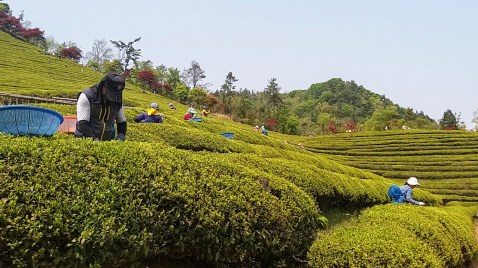
 In addition to the blooming fruit trees, there were cascades of purple flowers covering the rocks wherever tea was not growing. It made the whole place feel like a still frame of a rushing river in shades of pink, purple and green. Besides the tourists, there were also tea pickers at work. Each ajuma looking lady had her sun guards on, gloves and a mesh basket to place the leaves. They were not picking the bushes bare, but selecting only some growth. It seemed to me to be the newer, brighter green leaves that they were after, but I couldn’t tell for sure. In the age of automation it was strange to see people picking by hand. I know that it’s still the way for many crops in the world, but sometimes it gets driven home that there’s a human on the other end of my tea or strawberries or carrots, and then I’m carried off by sociological musings on how we came to value people who sit at desks manipulating imaginary money so much more than people who make our food.
Speaking of food
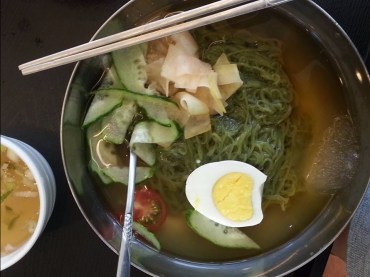
photo credit: honjatravel
Of course I had to go back to the everything green tea cafe. It was a warm day, and walking for hours in the sun (even with my sunbrella) meant that I was all set to try some cold green tea noodles. Cold noodle soup is one of the best ways to survive the summer in Korea because it’s served with chunks of ice floating in the broth along with the filling noodles and crisp pickled veggies. I managed to pick up a lunch companion from a whole other tour group, too. Boseong was a target of opportunity following the Jindo festival, so multiple tour agencies were out in force.
I pilfered the gift shop for more green tea latte packets that had gone over well as gifts then impulse purchased a bag of green tea caramels to share with my co-teachers too. I think they remind me more of green tea salt water taffy than caramel, but still delicious.
My last treat was over at the ice cream shop. No visit is complete without some green tea ice cream, but this time I opted for the green tea affogato. I have to admit, I did not know what an affogato was before I came to Korea. I guess it’s just not popular in the parts of the US I lived, and I’ve never been to Italy. But it is on the menu of nearly every cafe in Korea. In case you, like me, spent your life in an affogato black hole, it’s a scoop of vanilla gelato (or ice cream) topped with espresso. Yum!

photo credit: Annemone
I somehow expected the green tea affogato to be vanilla or green tea ice cream topped with a shot of green tea. Makes sense? Not what happened. It was green tea ice cream topped with espresso. Don’t make an ick face. It was insanely delicious. Even one South African girl who hated green tea said that it was nice. I’ve had the tea/coffee blended drink that’s popular in Asia and enjoyed it, so it shouldn’t surprise me that this was delightful, too. Now I’m on the hunt to bring home some green tea ice cream and some espresso to reproduce the experience.
On the way back, I discovered my unintentional link to @shmaymee and her art, bringing the whole weekend around into one small world ride of awesome fun.
Golden Week
This beautiful conflagration of holidays that resulted in me only working 2 days out of 10 during the end of April/beginning of May was the first time in over a year that I spent any real time off just relaxing at home. Of course, some weekends I don’t make it out on an adventure, and some adventures are just going down to the beach for a market or karaoke night. I’m not a non-stop sightseeing extravaganza, but I realized I haven’t had more than one day in a row of slothing at home in over a year. I pounded thru the entire Magician’s trilogy, fixed my friend’s computer, celebrated another friend’s birthday, watched the new Guardians movie and finished Iron Fist. I can’t say I want to binge watch Netflix and read fantasy trilogies with all my free time, but it felt good. I love traveling, but if my latest trip to Thailand taught me anything it’s that rest is important too. Even when my job is easy, it’s not restful and even when my adventures are amazing (or perhaps especially when they are amazing), they are not restful.
Life can be full of wonder or dull as dirt almost no matter where you live (I admit it’s easier to be wonderful when you live in someplace like Busan as opposed to any small town where Wal-Mart is the most interesting store), but I’ve seen so many expats who go abroad and after a year or less they become blasé, falling into habits of the same bar, same hobbies, same expat friends, and no more magic about the experience of living abroad. I saw those people from the very first time I went out and I could NOT understand how it happens. I fought against it and fought hard. I didn’t join the expat gaming group or theater troupe, I spent at least one weekend a month but usually more going out and doing something unique. I sometimes wore myself out doing that. And while I still don’t want to become one of the blasé, I think I’ve come to peace with the idea of a middle ground. So, maybe once or twice a year, in addition to my big out of town adventures, I can have an around the house staycation, too.
Yesterday was the first instance of air conditioning on the bus this year. It heralds the end of so brief spring and the beginning of … the Hot. It will probably be ok for another month, but soon, too soon, the summer will be upon us. Hopefully I’ll get in a few more good adventures before the heat becomes unbearable, but I have at least finally purchased my tickets for the Philippines this October. Whatever else happens, I have that to look forward to. In the mean time, I’ll be pumping out some more of the Malay adventures as the emotional and experiential roller coaster gets revved for some serious ups and downs. Don’t forget to check out all the photos from Jindo and Boseong. Thanks for reading!
 When I woke early that morning, I had only two main goals: to catch the morning train out of town and to track down the famous Ipoh “white coffee”. While chatting with the hostess the night before, she’d recommended a smaller coffee shop for me to try out instead of the main tourist one. She said that the Old Town white coffee shop had become too “Starbucks”, which as a Seattleite, I can totally relate to. (shout out to the
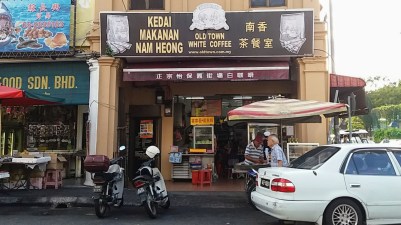 The town was very quiet early Sunday morning, so I enjoyed a leisurely stroll past some beautiful architecture and into the quaint “old town”. I had been advised to seek out a place called Nam Heong. When I found it, I discovered they sell the same brand of coffee as the high tourist cafe, which is simply called “Old Town White Coffee”. I have to infer that my hostess of the night before was referencing the atmosphere of the cafes rather than the coffee itself. Pictures I found online of the famous “Old Town White Coffee” restaurant show that it is a spacious and rather upscale looking place, geared toward the bougie and the Western tourist, while my experience in Nam Heong was a crowded hole in the wall filled with scurrying locals where I was the only white person. There probably is some difference in the drinks, since the brand itself was just the roasted beans, there’s almost certainly a difference in the price tag, and there’s a huge difference in local flavor. I don’t regret my choice for a minute.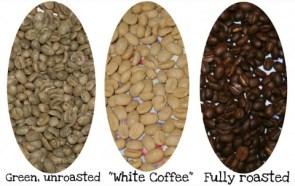


 (a side note on palm oil: don’t buy it. Seriously, I work pretty hard to be a responsible consumer. Palm oil is a product of major controversy right now because of the elephant exploitation in Thailand as well as the deforestation in Indonesia and Malaysia. It’s hard to exclude because it’s often improperly labeled, but please try to buy more sustainable and ethically sourced oils if you can. I was a little put out by eating it there, but in the end, my “locovore senses” took over and reminded me that if the Malaysians just grew enough palm oil for their own needs, then everything would be fine. It’s not an evil crop, but the high demand for it internationally has led farmers to damaging and unsustainable practices that harm the environment, and just so you don’t deride me for valuing orangutans over humans, the unsustainable farming practices are damaging the land and water those farmers and their families rely on, making the human future dim as well.
  My coffee and tart arrived promptly and were very inexpensive. The coffee was smooth and extra creamy (more than just because it was made with milk, I believe the palm oil roasting made the flavor smoother). While other coffee I’d had in Malaysia was aggressive in it’s “coffeeness”, slightly if pleasantly bitter, and coffee I’ve had in the US and Europe tends to have an acidic tang, the Ipoh white coffee was as smooth as coffee ice cream, but not quite as sweet. Also the tart was warm, flaky and not too sweet either. As a recovering HFCS addict, it can be challenging for me to find the balance of sweet that tingles my taste-buds without overloading my synapses, but I was left very satisfied by the experience at Nam Heong that morning. I shall think fondly of the coffee until one day I start my own tour company and make it a stop on the “Coffee of the World” tour package.

 The festivities were set to start around 6pm, so we left in the afternoon and had a lazy, but comfortable ride into Daegu where we had to relearn bus navigation. One wrong bus and two right ones later, we got off in the general vicinity of


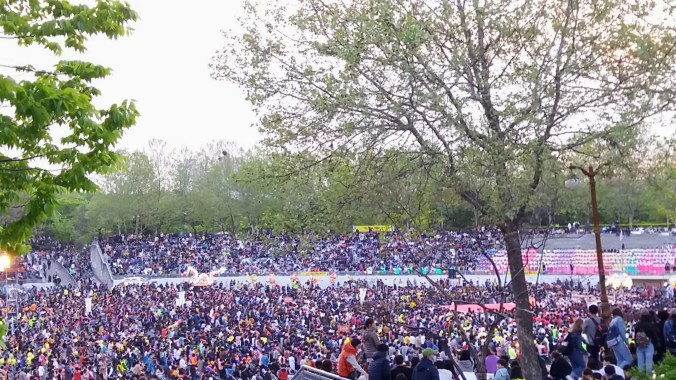
 For those who don’t know, these words used to be terms of respect for middle aged women and men, but have come to be less flattering terms used to describe a particularly rude class/age group of Koreans. Ajuma (women) tend to shove… a lot, and cut in line. Ajoshi (men) will join in on the shoving if their wives are around, but are perceived as perverts who peer into ladies bathrooms otherwise. I know that at least some of the younger Koreans use the words this way, and definitely all the expats I’ve met do. There is a culture of respect for age, so actually old frail people are often given seats and ushered to the front for views (and are usually super sweet about it, every one I’ve given a seat to has said thank you and offered to hold my bag in her lap), but these ajuma are just bitter middle agers who don’t want to stand in line like everyone else. Think of them like the entitled soccer moms of Korea. And yeah, they pretty much all look like that picture, too.
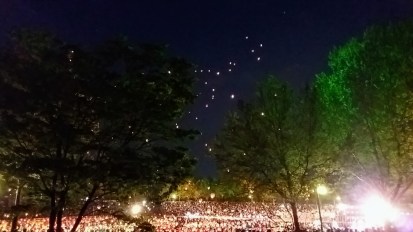 Lanterns Aloft
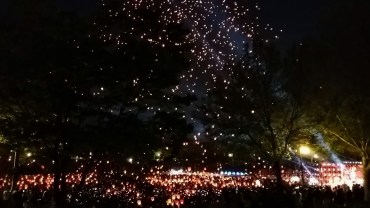 At long last, the moment we had waited for, the lanterns were released in earnest. They did not rise swiftly like balloons, but in a slow and drifting manner as the tiny flames inside each one warmed the air contained by the colorful paper dome. 1,000 globes of light ascended into the blue and black night sky, and I knew no matter how hard I tried, my camera could never capture that moment. It was what we were all here for. People from many cities and even many countries, gathered in the soft night air to witness the magic of fire in the night, lanterns becoming stars, and wishes rising to the heavens.
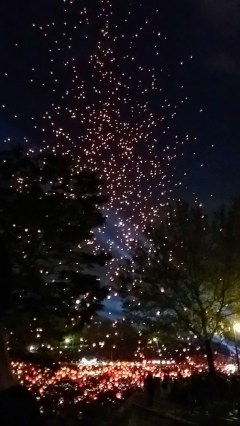 Shortly after the main release was over, people around us began filtering back out of the park. They had seen what they’d come for and were eager to move on to the next attraction or to beat the traffic. This meant that we suddenly found ourselves at the fence with an unobstructed view of the field below, and enough elbow room to turn around and attempt selfies (which were less impressive due to the low light).
 Finally the last twinkling lights above became no bigger than pinpricks of stars and we joined the crowd shuffling out of the park. We had 3 hours left before our return train and sat down for a moment to check the internet for a restaurant serving anything Daegu local. While we were seated, a family carrying armloads of paper lotus lanterns came by, and the young boy gave us each one, nervously testing out his English with as few words as possible.
 With our gifts in tow, we set off toward our restaurant of choice, but quickly became sidetracked by the parade. The floats we’d seen before were now all lit up, but the parade itself was stopped again. We dodged in and out, taking more pictures and pausing to watch a monk’s drum performance. Back in front of E-World once more, we spotted a street vendor selling flying lanterns as fast as he could light them up, and we were able to get a closer look at the lights that had filled the sky less than an hour before.


 Moments later, I had a humongous bowl of seafood and spicy broth in front of me. Mussels, clams, shrimp, crab and octopus crowded the bowl and heaped up atop a generous portion of noodles. (octopus is not something I order knowingly, but I didn’t want to waste it’s life once it was on the table) The broth was rich and spicy, causing me to reach for the ice water more than once and leaving my lips pleasantly tingly by the end of the meal. I think 2 hungry people would have had trouble eating the whole thing, and my day companion was not a seafood fan, so it was all me.
 I managed to order something by playing a sort of 20 questions with the waitstaff, and enjoyed my noodles and mystery meat in a not yet too hot outdoor dining area with views of the neighborhood. There were a startling number of funeral homes nearby and plenty of evidence of the British colonial architecture, although much of it was in disrepair.
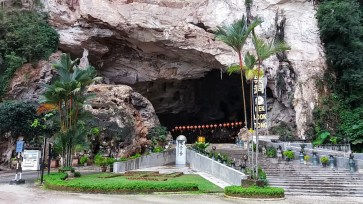


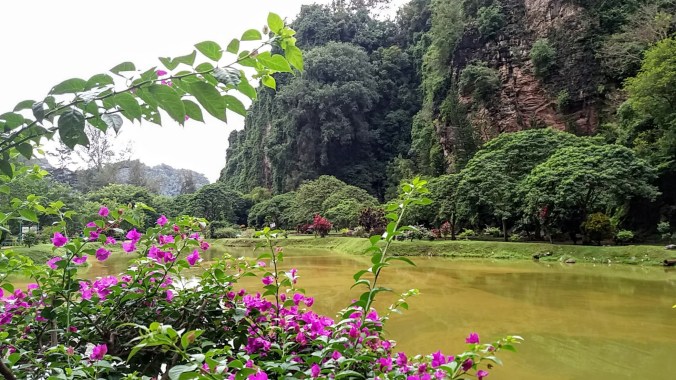


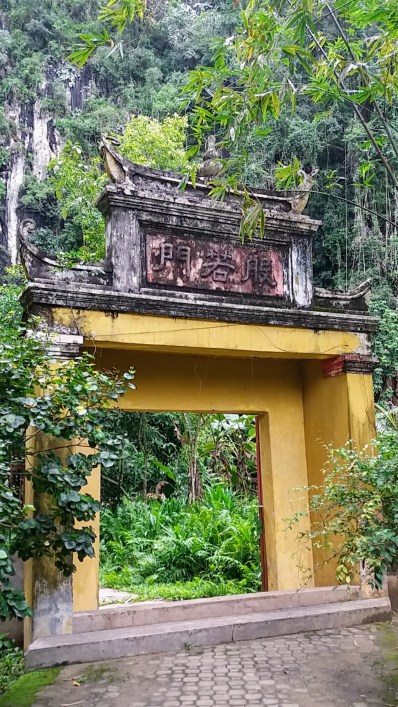 Sam Poh Tong is also a Buddhist temple and is said to be one of the busiest and most popular in Ipoh. I could tell it was an active temple from the freshly lit incense, but little else gave evidence that it was maintained or cared for. Even so close to such a large holiday, the grounds looked unkempt and abandoned. The huge numbers of underfed and skittish stray dogs was off-putting, but they were not aggressive. The garden in the front was a small lake with tiny “islands” that became miniature mountains holding tiny temples. As I walked around one side of the temple compound, I came upon a building that seemed long empty, covered in dust and bereft of occupation, yet there was incense burning at the dusty altars, observed it seemed only by me and some monkeys on the fence nearby.
 The walls were painted and florescent lights were on the ceiling, while piles of furniture and other stored items crowded the rooms. The floors were finished and there were windows and doors installed into the stone. It felt less like a cave and more like a basement.
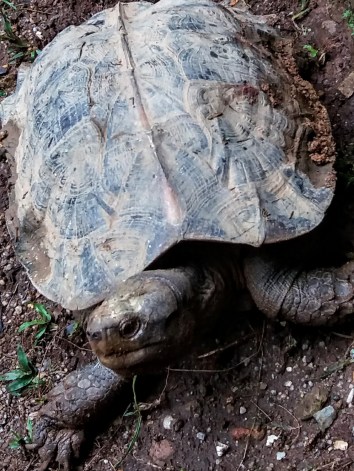
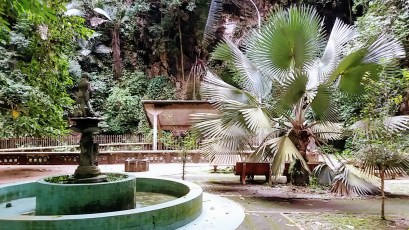 n the other side of the cave was a small enclosed garden. The walls of the garden were more towering limestone formations and the greenery within was Jurassic in scale and seemed to be overgrown with no concern for trimming or arranging, dead leaves carpeting the ground. There was a small turtle pond behind a fence filled with turtles of all sizes that could be fed fresh greens and veggies bought from a
  stand inside the cave. The stand and it’s sales person were some of the only signs of tending I saw. At the back of the garden behind a locked a fence and a forest of unkempt branches was a bright red pagoda that seemed more like something in an abandoned jungle than in a living temple.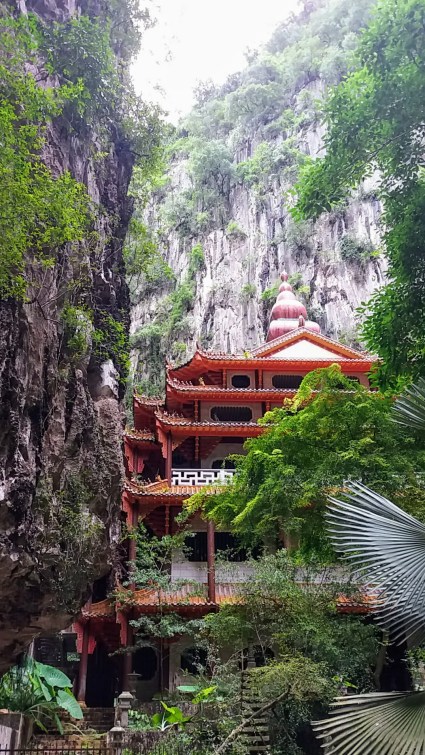
 I crept around the cave rooms from one altar to another, plastic cups and cleaning materials lay scattered around, the tile floor was cracked and uneven. I followed a treacherous staircase up a flight, but it ended only in a tiny window and more dust. It was so easy imagine that I was exploring a temple long forgotten, and then I would find a lit candle, or a smoldering joss stick or even a lone employee selling souvenirs. Outside once more, I continued on to the cemetery. In Buddhism, cremation is the norm, so there were small buildings in another alcove that housed the remains. Despite signs requesting that no incense be burned, there were sticks shoved around all the doors and soot marks as well. The buildings were grown over with moss and leaves, the paint peeling and the ground cracking under the pressure of new roots, yet the incense showed me that human presence was recent.
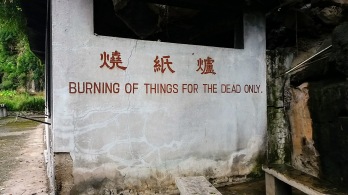 The farthest end of the compound was an area designated for ritual burning and another weedy and overgrown garden that seemed to be turning into a dumping ground. As I made my way past more dogs and tourists, I couldn’t help wondering at how this temple had been so highly rated by so many visitors when Kek Lok Tong was so clean and well cared for. I enjoyed visiting Sam Poh Tong, but it felt like an archaeological excavation rather than a place of worship.

 I looked it up to make sure it wasn’t something too scary, then ordered myself a bowl for lunch. Rojak just means “mixture” but fruit rojak is a common dish made of crisp (less than fully ripe and therefore slightly tart) fruits and veggies. Jicama, cucumber, mango, and apple are standard ingredients. The sauce is the magical part. The recipe gurus of the internet assure me it’s made with shrimp paste, hot chilies, sugar, soy sauce, and lime juice (with some regional variance). To me it tasted for all the world like molasses with chili, ginger and lime. I don’t know if mine was made with molasses or if that’s just what it tastes like when you mix soy sauce, shrimp paste and sugar together, but it was yummy!


 Just one gate over is the third and final temple on this street, Ling Sen Tong. This temple mixes Taoist and Buddhist imagery along with other folklore in a big colorful Chinese melting pot. It is an all singing all dancing color fiesta. There are beautiful facades of buildings and temples, giant statues in fresh bright colors, elaborate scenes of mythology played out, and everything was touchable/climbable so visitors were having a blast posing for photos. There was only one small, dark cave. The ceiling had turned black from years of candle and incense soot, and it was chaperoned by a figure whose offerings exclusively included alcohol (for some reason, especially Guiness…) I enjoyed exploring the many statues and hidden rooms. I even found this one guy who looks like he’s checking his phone in the bath! I’m sure there’s a better explanation for it, but along one wall was a series of statues in sunken pits that had all filled with water. I don’t know if it was meant to be a kind of wishing well or something else entirely, but this one in particular stood out to me.


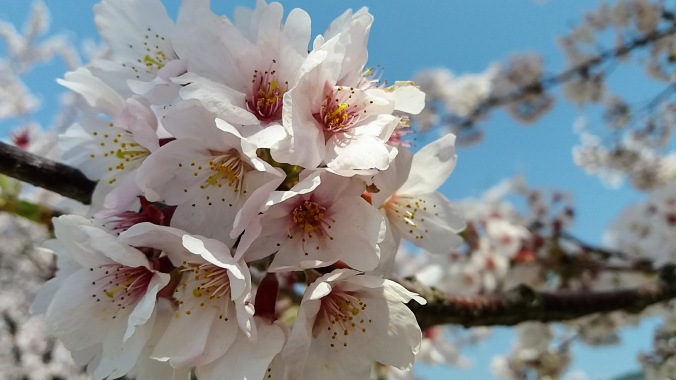
 My school is the first exposure I get to the flowers in spring since I pass by a stately line of a dozen or so trees every morning on my way in. I watched with growing anticipation in late March as the buds swelled on the branches and finally burst onto the scene on the particularly gray and chilly afternoon of March 27th.


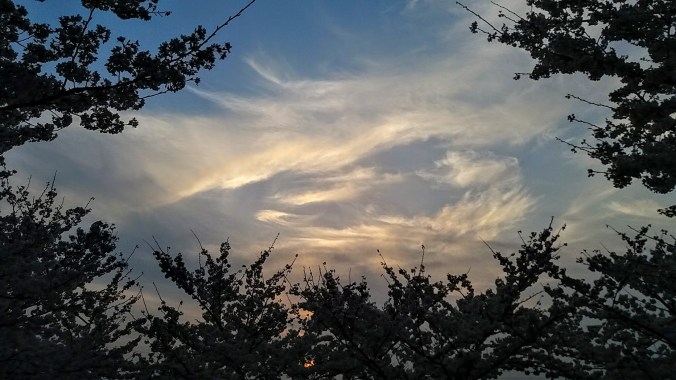
 glorious afternoon in the park.
 Food bonus: Last year I got to try the Starbucks Cherry Blossom Frapuccino, but this year I tried the McD’s cherry blossom soda and the Hoegaarden Cherry Blossom beer. I’m still not sure what cherry blossoms are supposed to taste like, but it’s fun to try all the seasonal attempts to capture such an ephemeral experience in flavor.
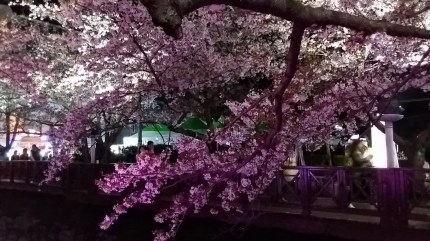 Jinhae is the country’s largest cherry blossom festival. I went
 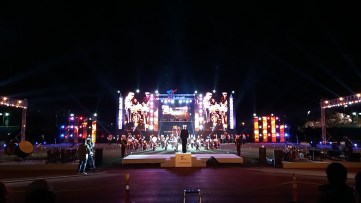 We left on Friday April 7th. Knowing that the storms might have wrecked the blossoms, we still wanted to go to see the lights, shows, and food. It’s not a long bus ride from Busan and we found
  We were too late to get a seat in the stands, but we watched from the sidelines and enjoyed the music. I had spotted a group of dancers wearing the distinctive hat of my favorite style of Korean traditional dancing. I fell in love with the spinning ribbon hats the first time I watched them
  Next, we headed off for dinner, where I got a repeat of my delicious meal from last year’s festival- whole pig BBQ and dong dong ju (delicious local boozy drink). Once our bellies were full, we moved on to our evening goal of night-time light displays along the river. Along the way, we found more amazing treats: fresh strawberry “latte” (made with homemade strawberry syrup and fresh strawberries in milk, it is what strawberry Nesquick becomes
  when it dies and goes to heaven), and “cherry blossom” fried ice cream. I think it was really vanilla ice cream, but it was shaped like a cherry blossom. When I ordered it, the man took one out of the freezer behind him and dropped it into the hot oil. A minute or so later I had the crispy desert in my hand. The outside was crunchy and a little bit salty, providing a wonderful compliment to the sweet, creamy ice cream inside.
 The most famous part of Jinhae is the narrow “river” that runs through town and is lined with cherry trees the same way the path at Samlak is. Mind you, just about every street in Jinhae is lined with cherry trees, and the mountains around it are dotted with fluffy pink clusters of them, but the river is famous for the density of the trees and the stunning beauty of the blossoms over the water. Plus the decorations. Last year my favorite were the




 The turtle ships were famous for their ability to deflect the arrows and flaming arrows shot by the Japanese that so easily destroyed wooden boats. The shell of the “turtle” is a spiked metal carapace at a gentle sloping angle that was fireproof and arrow shedding. Yi’s
  Guests were invited aboard to explore the ship. Inside it was warm, golden wood. The main deck, which would have been open to the sky on a regular ship, was well lit by a series of cannon ports and arrow slits that allowed the crew to point weapons out while minimizing exposure. There were two small state rooms on the main floor as well, but the captain’s quarters were clearly utilitarian and not anything like the luxury we see in replicas of British ships. The head (toilet) was a series of holes at the aft (back) which opened over the sea for swift disposal.
 Through narrow openings in the deck floor we could see below to the crew quarters and galley. There was a ladder leading up to a small space storage above. Decorative spears and battle drums were dotted around the deck. Cannons pointed outward and oars the length of 2 grown men or more were shipped in racks along the ceiling.
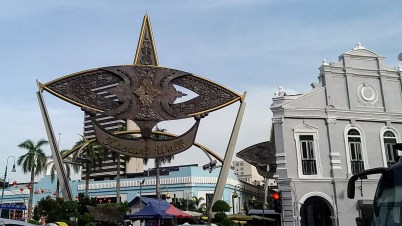 The morning after my late night and less than welcoming arrival, I woke up early, scarfed down my leftover convenience store sweet buns and took off to find the train station that would lead me to the Batu Caves. In recent years, the Malaysian government has added a train stop at this popular tourist attraction, and now it’s much easier to get to. The train itself was a new experience. When you purchase a ticket, you are given a plastic token with an RF chip inside. When entering the platform, you hold the token up to a pad to be read and it opens the gate, but hold on to that chip! When you disembark, you need to feed the chip into a slot to pass through the exit gate.
 I met a tour group on the train platform and we chatted during the train ride. I hung around with them and their guide to hear a few of the explanations offered about the caves. The guide rushed us past the dozens of sales stalls (saving us from souvenir swindles), gave a brief presentation under the statue of Hanuman (the Monkey King) and landed us in the main square at the base of the stairs and the giant golden statue of Murugan (a god of war, made of concrete and painted gold colored). There was a tremendous flock of pigeons in the main square and it seemed to be a major tourist attraction to stand in the flock and have them hop onto your hand to get some food. Occasionally construction in the background caused a loud boom that set all the birds a flutter, which was surprisingly pretty.


 After a few obligatory photos with the tour group and the giant statue, we began the climb. The stairwell is not insanely long, a mere 272 steps. They were so popular as a form of exercise that the government had to ban fitness use of the staircase to keep it clear for tourists and worshipers. With my kryptonite-like response to humid heat, the staircase became a long haul obstacle, but there were plenty of interesting things to stop and look at on the way up, like the expanding view of the courtyard and city below, the rock formations on the cliffs along side, and of course the hordes of monkeys roaming freely through the grounds. Given that the monkeys are wild, I was totally happy to keep my distance, but they were not shy and enjoyed coming right up to tourists or even forcing a showdown over who got to use the hand rails. At one point there were two monkeys perched on twin posts on either side of me and I managed to get a cute double monkey selfie, checking off a bonus square in the Batu Caves tourist bingo.
 When I finally got to the top, I was greeted with a large cave mouth opening that led to an even larger cavern. The entrance of the cave had small buildings installed for souvenirs and police. Once all the way inside, I could see that although this huge open space was graced with a few decorative statues around the edges, it was largely left in its natural state. The cave mouth was wide and there was a natural sky light further on, so the cavern was well lit. There were a few artificial lights in strategic places and an area of worship off to the left. Finally, there was another short staircase leading through to the open area beyond. At the top of those stairs was the rearmost chamber of the cavern, another broad space; however, the roof had long since fallen in and the walls soared up into open air, creating a round room with no roof.


 As I exited the temple section to descend the stairs again, I detoured off to the right to investigate a “dark cave”. The Malaysian government has taken this side section of limestone cave and created a conservation space. The limestone quarries and careless unregulated tourism of the recent past had wiped out a lot of the cave ecosystems. Efforts to restore the guano based ecosystem of living limestone caves are now underway in many parts of Malaysia and this cave was for both preservation and education.
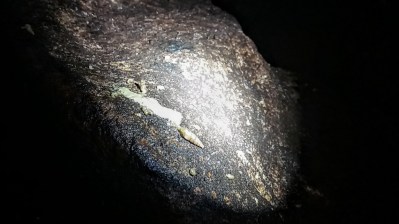 Nearly everything that lives in the cave is so tiny you wouldn’t even notice it if no one stopped to show you. When we see nature documentaries, there’s often nothing for scale, so it’s easy to imagine the animals as being similarly sized to their daylight counterparts. When our guide showed us a picture of the little white snail that lives on the rocks, I imagined a tiny snail, but not nearly as tiny as the ones we found! The biggest of the snails was about the size of a grain of rice, but there were smaller ones dotted around.


 As I descended back to ground level, I passed still more monkeys, several sets of mother and baby wandered around, and some tourists were feeding them peanuts (despite the do not feed signs). I noticed that the dominant males were very protective of their snacking rights and would drive off the mothers aggressively. Of course, no trip to a monkey colony would be complete without a little fornication. I happened to be standing right next to a female when a male walked up, took her butt in both hands and peered at it closely, then proceeded to mount her, much to the shock and amusement of tourists from 6-7 different countries. No, I did not take monkey porn pics.
 Farther on, beneath the looming statue of Hanuman we passed at the beginnging, was the Ramayana Cave. This attraction was much more highly reviewed and was only 5 ringgits to enter, so I decided to give it a shot. There is a stream inside the mountain that comes out and is used as part of a beautiful fountain depicting the chariot of Rama and Sita. If you’re not familiar with the


 but the main floor had a few shops and restaurants. I pulled into the first one I saw and confessed my massive ignorance of Malaysian cuisine, asking the staff for a recommendation. Moments later I had a heaping plate of some kind of fried rice dish that was smokey and pleasantly but not overwhelmingly spicy. Sometimes you just gotta walk on the road that looks more interesting.
 The hallway with the rooms was brushing my shoulders on either side as I walked through and was not wide enough to open the room doors all the way. It was also painted red and gave me a very eerie Twin Peaks vibe. The room was dirty, a soaking wet bath mat on the floor by the door and some kind of horrible mildew meets sewage smell coming from god knows where. I dropped my bags and went back out to the street to find food, but the street stalls were only selling fried things of a questionable nature and I couldn’t see any restaurants nearby. The midnight streets were dark, crowded and very dirty and also had rats scuttling around in the rubbish. I finally just got some yogurt and bread from the convenience store and went upstairs to sleep.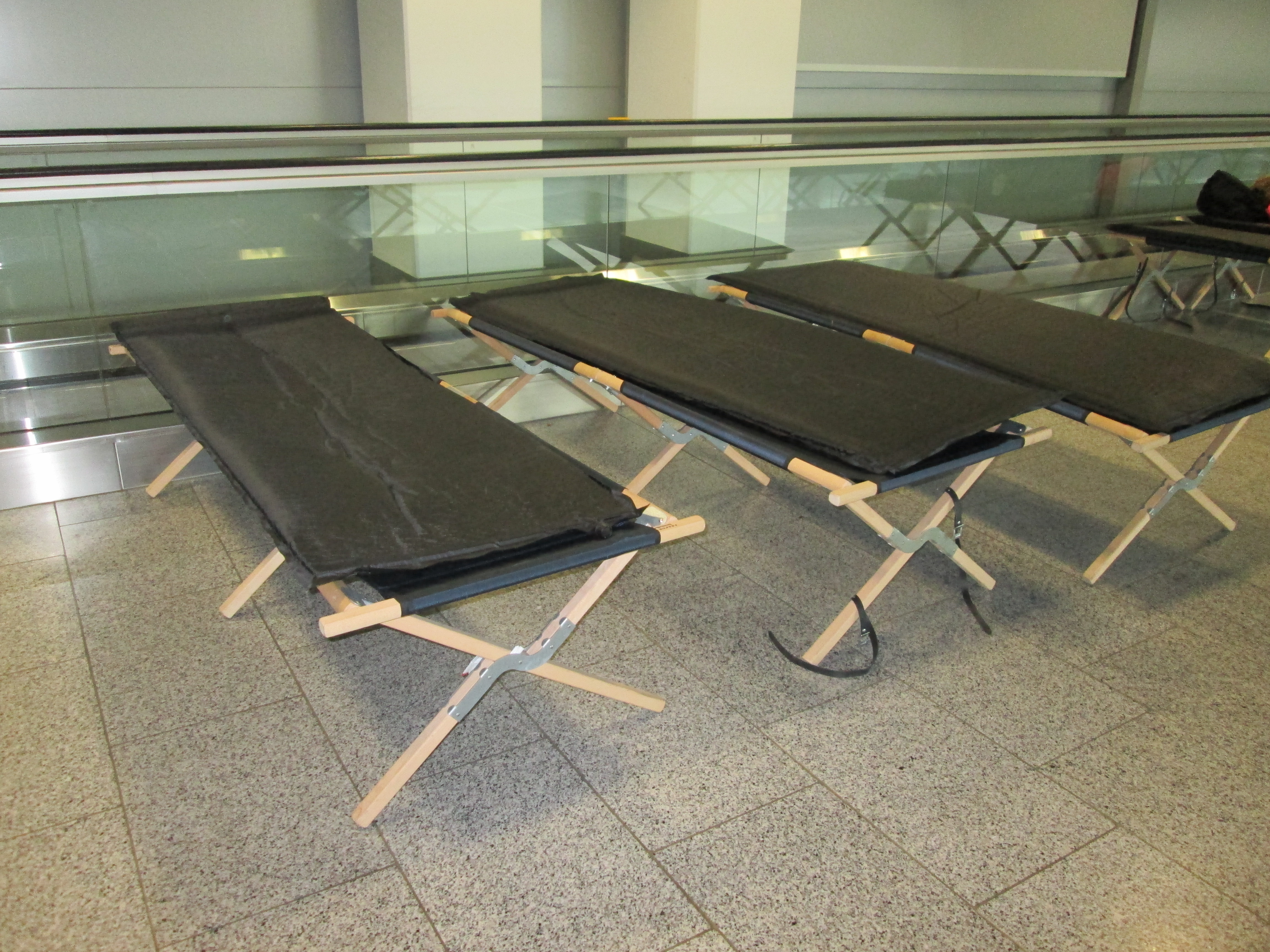


 Gallivantrix