10 Years of Being The Gallivantrix:

At the time of writing, Gallivantrix has 290 posts which average 4000 words each. That’s over a million words or two copies of War and Peace. 

In 2024, I watched as my 10 year achievement flew by. It’s hard to mark a life of gradual change with anniversaries, but a decade is a good amount of time to take stock. I started the blog in May of 2014 while I was preparing to re-launch my international ESL teaching life by heading to Saudi Arabia that September.  As I noticed both of those decade markers fly by in 2024, I thought to myself how nice it would be to sit down and quietly reflect on what the last 10 years has brought and how it has changed me. It is only now, staring down the barrel of the New Year that I finally feel like a quiet sit-down is possible. Still, better late than never. 

A Life Dedicated to Travel

In the last 10 years I have lived and worked in 4 foreign countries, and visited an additional 27. That’s more than ¾ of the international travel I’ve done in my lifetime so far and nearly all of the travel I have done as an adult. But what does it mean to live a life that nomadically?

One of the big things that I encounter when I tell people how I live is envy. I have no illusions about how amazing the experiences of my life have been, nor do I think I live in a way that is accessible to everyone. It can be a bit strange to remind people that I’m not rich, and in fact, have spent chunks of my life being poor, eating from food-banks (charities), and relying on friends for a roof over my head. And, no, I didn’t win the lottery or get an inheritance. Luck, circumstances, and the support of others have played a big role, but also I made a conscious choice to prioritize travel over almost everything else in my life, and then I worked very hard to make that happen.

I found a career that allowed me to work in a variety of countries. I took extra education to gain the necessary credentials. I took terrible jobs to build experience. I reduced my life’s possessions to what would fit in 2 large suitcases and a carry-on. I had no home, no car, no bed, no books, no dishes, no spouse, no children, no pets, no musical instruments, no garden, I gave all my art away, and my sister is keeping the few family heirlooms we treasure. I ate cheaply, used public transit, and wore free, thrifted, or clearance bin clothes. I bought second-hand phones and cheap laptops and used them until they died, relying on my office computer for any big projects. I only got a portable video game system during COVID because I couldn’t go anywhere.

I don’t feel like I’m missing out on these things because I don’t have them, but I think it’s helpful to remember that no one actually “has it all”. The people who envy me usually have stable, local jobs, a lease or a mortgage, a car (and payments), kids and pets, a multi-seasonal wardrobe, hobbies and crafts, new phones and complex computer set-ups, and a lifetime of memories in the form of stuff that has to have a place to exist. They can’t afford all of those things AND prolific travel, but neither can I. I didn’t make that choice all in one go, either. It took years of gradual change to reach a point where I have a 2-suitcase life. I had plenty of chances to change my mind and back out, but I *like* my life. I just want others to understand it isn’t a traditional life + travel, it is a life purpose-built for travel.

From the Inside

10 years is a long time no matter what lifestyle you have, and I hope that everyone grows and changes in that amount of time. It is a well-studied phenomenon that travel has a big impact on the human brain, and sustained travel with its joys, challenges, and culture shocks has forced me to look more closely at myself and my place in the world.

Although therapy didn’t take a starring role in the blog until COVID-times, it’s been an on and off part of my personal journey for a while. In the 2 years leading up to the launch of Gallivantrix and my international life, I dedicated a lot of my free time to researching and practicing positive psychology. TED has a wonderful series of talks on the subject and several practical resources that I still recommend to people like Superbetter and AuthenticHappiness.

I believe it was a direct result of this work that I was able to embark on the journey, but it did more than give me the strength to adventure. From 2015-2019, I gradually changed the way I approached interactions with others. Some of this work resulted in stronger, healthier relationships and some resulted in the end of years-long ties. The people who remain in my life are strong communicators & loyal friends. Those who left were, for the most part, not “bad people”, they simply had their own struggles with trauma and healing that left us incompatible. Perhaps the hardest of all of these was with my mother.

From 2020-2022 I dove back into the world of mental and emotional health, this time with a focus on childhood experiences and generational trauma. You can read through my book list in the archives if you’re interested. Even though I made good progress using these tools, the circumstances of the pandemic meant that by the end of 2021 I needed to make plans to leave Korea and get out in the world around other people in order to keep improving. 

Bouncing off to Senegal after years of isolation may have been a bit like trying to ski black diamond right after recovering from a compound fracture. It hit me hard, and you can see most of it in the essays I wrote during that time. I will be forever grateful for the experience, for what I learned and how it changed me, but it was not the joyful return to global travel that I had been craving. It took me 9 more months of trying various things and eventually moving to France to finally find what I was looking for in myself that I thought I had lost in 2020.

10 years of international living, a global pandemic, and a deep commitment to emotional healing later, and I am now a much more emotionally mature person than I was in the past, capable of identifying and sitting with my feelings to understand what is reasonable, and what is reactionary. I am able to approach conflict resolution with an eye toward responsibility and solution instead of blame. I know my limits mentally and physically and I plan my life, work and travel in such a way as to protect the hard limits while pushing soft ones. I want to make the world around me a better place, and while I’m ok doing that one person at a time, I’m also interested in how I might do more. I have learned so much about the world and the human race, that I will never be able to look at it without that knowledge seeping in. At some times that is beautiful, and at others it is profoundly painful. I have flaws, just like every human, but I am learning to love myself, and to extend grace and compassion inward and outward for flawed humans everywhere. I don’t want to look away.

Accommodating My Needs

Whether you want to call it chronic illness, invisible disability or anything else, there is a growing awareness of this category of health issues that limit what people can do without making us unable to work, travel, and live independently. I received my first couple diagnoses as a late-teen/young adult, so it isn’t new to me, but as I age, not only does the list get longer, my ability to simply push through my limits is sharply diminishing.

Back in 2018, I had a real “come to Jesus” moment during a long summer holiday backpacking across Europe. It made me start rethinking my priorities and what tools I could use to make the most of my travels without destroying my physical and mental health in the process. Over the next three trips, and the pandemic induced therapy-work, I slowly built not only a list of practical tools to make travel easier and more enjoyable, but also the ability to accept my limitations. The second one means I don’t get so tempted to do things which will result in burnout later on, and I get to enjoy things I am able to do without dwelling on regrets, missed opportunities, or generally hating my body.

I am more likely to book larger seats on long haul flights because I know the difference it makes in my recovery time and pain levels. I always check the accessibility options for places I will stay, including distance from transit, number of required stairs, and how far the toilet is from the bed. I take extra time when walking everywhere, usually planning at least double the Google Maps estimate. I carry snacks, meds, and water everywhere. I keep a little extra in the budget for when I need to catch a taxi or ride-share because the walk/transit is too much. I accept that hot weather means I’ll need extra rest and extra painkillers, and I must plan to do very few things. 

That last one continues to boggle the mind. Spending spring in France, I was able to walk longer distances and do things for hours, even spending 12+ hours a day walking around some places! I’m never going to be up for a 5k run, but when the weather is mild-cold, I have so much more energy and mental focus and so much less pain. It has become important for me to keep notes when I am in different climates because it’s easy to forget how dramatically the heat affects me, and I need to be able to reference daily and weekly records of my experiences to hold onto the fact that it’s real and not a trick of memory.

Even knowing this, I still choose to go to hot places sometimes, like India… in August. But I made sure to always keep water and NSAIDs on hand, to walk very slowly, use a sun-shielding umbrella, and crank the AC in the car and the hotels. I was exhausted by the end of it, but I got to see some very amazing cultural and historical sites. I also went to Taiwan for 3 months starting at the tail end of August, knowing that the weather would be too hot until October. For the first 5 weeks, I did almost nothing besides go to class and get food. I knew heading into Taiwan that I would not be able to do a bunch of touristy things, but I still wanted the language study and cultural experience, so it was worth it.

Accepting my limits doesn’t keep me from going places, but it changes the way I go and what I expect to get out of it. I may not get as much out of my trip to India or Taiwan as a more healthy and fit person, but I definitely get more out of it than someone who never goes at all.

From the Outside

When I started the blog, I harkened back to the early days of social networking (Live Journal, My Space, and even bulletin boards!) where everyone who was online in those days was producing what we now call “content”. I know I sound like a get-off-my-lawn antique (and I am GenX), but objectively, it’s not just me that’s changed in the last decade. The internet / blog-o-sphere and the world at large have also undergone some dramatic makeovers in that time, too.

Demographics

It’s always hard to compare the present to memories of childhood, so I can’t say how much of what I recall about the travel I did with my family as a child is accurate, but one thing I think is objectively measurable is just the sheer number of people flooding popular travel destinations.

When we lived near the beautiful white sand beaches of Panama City, Florida, my mom and I joked about buying shirts that said, “I’m not a tourist, I live here.” because we felt like we could hardly go near a beach without being accosted by cheap seashell trinkets (made overseas) and green key-lime pie (it’s supposed to be yellow!). Perhaps because of this formative childhood experience, I have never enjoyed a tourist trap even though I have not always been able to avoid them. Yet, when I lived in Florida, the population of the US was 107 million fewer people than it is today. Not all of them visit Floridian beaches, but it stands to reason that the population rise alone will result in more humans per beach.

This NYT headline said in 1984, 27 million Americans travelled abroad, a new record at the time. By 2014 that number was 68 million, and by 2023 it was 98.5 million. Data on 2024 isn’t out yet, but I would bet it breaks 100 million. And that’s just Americans!

The global population has risen by almost a billion (that’s B) in the last decade, and more and more of them are living higher wage, higher quality lives which include international travel. Over 1.1 billion tourists (15% of the global population) travelled internationally in 2014, in 2019 (just before the pandemic) it rose to 1.5 billion (roughly 19-20% of the global population). Obviously, the pandemic saw a lapse in travel, but most statistical analyses agree that in 2024, international travel levels caught up with and then exceeded 2019 levels.

Also, there’s more people living in most of the popular locations. Only a few countries have been experiencing declining populations. Meanwhile, swift urban development and technological advances mean that a smaller percentage of people are living a rural/agricultural life, choosing instead to flock to cities and suburbs for better schools and higher paying jobs. In many places, migrant workers who come in to do things like drive taxis, work in kitchens, clean homes, and do construction do not show up on official statistics of urban populations, yet they certainly contribute to the body count.

When I arrived in Senegal, many people told me that the city had nearly doubled in size since the start of the pandemic, and that the cost of living was skyrocketing as migrant labor from the villages flooded in. Although official statistics show about a 3% yearly rise in population for that city, that is still much faster than the infrastructure can keep up with. Senegalese citizens and immigrants from less stable West African countries want to live in the city because they can earn more money to send home to their families. The flood of people coming in has resulted in overcrowding, lack of adequate sanitation, lack of housing, lack of food, and lack of employment. 

Dakar isn’t a hotspot for tourism, but many developing countries that rely on tourist dollars are experiencing a similar trend, meaning more locals are in the cities we travel to and more of them are struggling to get by. My foray to Zanzibar in East Africa highlighted this most dramatically where I would walk through a neighborhood with no running water to reach the high end resort hotels on the beachfront. As hard as it might be to live in a developing country and see first world lives on TV and the internet, how much harder must it be to see them across the street when you must carry water from the well and dig a hole for a toilet?

Among the expat communities, people who live and work abroad, not just traveling for fun, we have anecdotally noticed an upturn in the tendency to be treated as a “walking ATM”. The rise in the number of locals living in cities but struggling financially has led to a (totally understandable) level of desperation in the competition for foreign dollars that hasn’t always existed. And don’t get me wrong, I feel an enormous amount of compassion for those less fortunate than I who have not had the chances and support or even the citizenship that give me my advantages. However, I cannot singlehandedly change the fortunes of a developing economy with my few thousand dollars. 

Then, when I come back to the US, I am shocked at prices and poverty here, too. 100 million of us may be able to travel internationally this year, but how many of those scrimped and saved to do so? How many are using airline miles they earned buying groceries and gas? How many only go once a decade or once in a lifetime? How many are taking on debt to do it? And of the remaining 235 million, how many are food insecure (47 million), how many are one paycheck away from homelessness (200 million). People shouldn’t travel if they can’t afford it. Please, do not travel on credit! But regardless of how we pay for it, most people can’t afford to go over a carefully planned budget while on holiday.

I want to spend my money on local small businesses when I travel, but it isn’t fair to be treated like a bottomless money pit because we were born in affluent countries. What’s more, it makes for a very unpleasant experience which will only damage the future of their tourist economy. I work hard to avoid these kinds of situations, and have developed tactics over time to deter scammers and hawkers, but it’s exhausting and demoralizing to be walking around a beautiful historical and/or sacred monument only to have to fend off junk-sellers every 5 ft. Many take “no thank you” and move on, but others will follow you around telling sad stories about their kids to try and guilt you into buying some cheap trinket you don’t want.

This experience isn’t new in and of itself, as I recall having had it in China back in 2005, but it feels like the number of such “sellers” and their persistence, willingness to invade personal space, and leverage emotional manipulation has dramatically increased. I think it was one of the big reasons Senegal was so hard for me, as well as the main reason why in places like India and Egypt, I opted to hire local drivers and guides who I can budget a gratuity for in advance, and expect them to act in part as a barrier to the other hands being held out for cash.

The upshot of all of this population growth, demographic change, and economic inequity is that many places are more crowded and fighting harder to extract every penny from the visitors that they can. There are still places in the world that do not have this problem, or at least do not have it in excess, but I feel like it’s much harder now to plan a trip that avoids them, especially if you have any bucket list items that include major historical sites, world-class museums, or unique natural wonders. Maybe it’s easy for me to say because I’ve already gotten to visit quite a few of these, but now when I give travel advice, I tell people to focus on small local experiences rather than grand bucket list ones since you’ll be more likely to have the space and peace to enjoy it.

Going Viral

In addition to the population and economy, there’s one more very large factor that’s changing the face of travel and travel-blogging: the social media revolution. My 5 week stay in Tours France was relaxing, idyllic, and felt almost nothing like tourism at all, but when I left Tours and went on my color-coded-spreadsheet trip of tourist highlights including Disney, Lyon, Marseille, and all the big bucket list spots in Paris I had somehow never gotten around to like the Louvre and Versailles. Although almost every place I went was new to me, the experiences of being a tourist all seemed eerily familiar.

Authors and researchers like Jonathan Haidt have been studying the changes in social media over the last 10-15 years, and there are some fairly strong conclusions about the manner in which content is created and consumed. Other old-fashioned travel bloggers like me who want to share personal content over rubber-stamped listicles are also expressing frustration.

As social media drives attention to ever more similar short-form bucket lists and glam photos, tourist attractions have also started to become homogenized. This isn’t all bad, nor is it fully ubiquitous. I have written before about the fact that cathedrals in western Europe are all kinda the same in the way that roses are all kinda the same, and I still like them both every time. Huge enough attractions like Disney and Versailles don’t need to change too much to keep attracting visitors, and they will always be tourist processing machines filled with photo-happy crowds and overpriced souvenirs. Yet, everything in between seems to be riding a post-Instagram, post-COVID wave of striving to provide travellers with photo-ready experiences that exactly mimic what they have already seen online. Stand in this line to get the perfect photo, order this dish at the restaurant, look for this “hidden gem” that’s now overrun with tourists, and always post your best photos!

I have been going to Angelina’s in Paris since 2015 (that makes it sound like I go a lot. I do go at least once every time I visit, but it’s only like 6-7 times total) and yet sometime between 2019 and 2024 it got internet famous, and for the first time ever, when I went this year, there was a LINE out the door and they were no longer accepting reservations. My patience was rewarded in the end, and when I went back a few weeks later at a better time, there was no line at all. Despite Angelina’s appearing to have handled their newfound fame well, many local restaurants that receive viral treatment do not.

Internet fame can send tourists in droves to small businesses that are unprepared for the volume of new customers which ends up leading to disappointing experiences and bad reviews. Some businesses overextend themselves financially trying to keep up, only to be left with debt when the viral spotlight turns elsewhere. Very few small-scale restaurants survive viral fame, and even fewer benefit from it. Additionally, the desire to have a replica of the online experience leads to long lines at one location while those around it languish. This is bad for both local businesses and for the tourists themselves. The joy of a hidden gem or hole in the wall is that it is unique, different, likely thriving off of local and seasonal ingredients meaning that the dining experience is different from day to day. Meanwhile, viral sensation seekers want to experience what they have seen online and nothing else.

Jerusalem Demas famously wrote, “Tourists are like bees. I don’t want a bunch of them circling around me, but I also don’t want them to disappear.” Developing countries are not the only ones that are both economically dependent on, and simultaneously damaged by increasing tourism. Many large cities in affluent developed nations are experiencing an overdose of tourists that is causing chaos and unhappiness among the locals. This Forbes article goes into more detail of the struggle between reliance on tourism for economic success and the damage that over-tourism brings.

Viral fame hasn’t just damaged food experiences, but also art, music, and nature. One beautiful Mediterranean beach may be edge to edge bodies while a few villages over, a pristine beach boasts only a few locals. The government of the Philippines had to shut down some extremely popular tourist beaches because the sheer number of tourists was damaging the environment, yet there are hundreds of practically empty beaches around the Philippines that no one is going to. Is it because they don’t know about them or because they want to recreate that experience they saw online?

Imitate and Recreate

When “influencer” first became a job, they would try to use clout or ad space to get free meals and accommodations. A very small number of extremely successful ones still can, but remember a billion+ people are traveling every year, so an influencer with a million followers is only 0.1% of the potential market, and most of their followers aren’t actually going to travel, because travel lifestyle influencers are largely aspirational.

Now the issue is less influencers trying to get free stuff and more that a small number of tourists with influencer dreams have their hearts set on recreating a viral photo or video on location. Surveys and polls vary a bit, but generally speaking somewhere between 50-80% of Gen Z consider influencer a desirable and realistic career option, with more than 40% of adults overall feeling the same.

As a result of this, you get people doing choreographed dances in the middle of a UNESCO World Heritage site, or self-employed ‘models’ posing over and over in front of the thing that literally every other tourist there wants a photo of. This has gotten so bad that in many places, the government or local businesses have posted signs banning tripods and costume changes.

I am not criticizing dancing nor taking photos. Normal polite people usually spend a few minutes taking photos, arranging poses, and checking to make sure no one was making funny faces before moving on. On the rare occasion I indulge in a selfie, I tend to take a handful before I get one I don’t hate. I think it’s fair to want to look your best in your photos. But these people will stay for 30 minutes to an hour, taking pose after pose or restarting their dance 17 times, all while blocking everyone else from being able to take photos of the site. Tourists are often on a tight schedule, and will end up missing out on their photo ops for their own memories because a wanna-be influencer can’t share.

Even when they aren’t taking photos, they will often sit or stand in desirable photo-op spots to scroll their phones instead of moving off to the side to allow others a chance. And again, I’m not criticizing wanting to check your phone while at a famous landmark or museum or whatever. They might want to make sure photos turned out; they might be checking their itinerary for the day; they might be reading about the site they are visiting to learn more; they might be trying to contact their group; they might even just be scrolling because it’s so crowded and overwhelming that they need a break. All of these are fine and valid reasons to be on your phone. None of them are reasons to block the view while you do it.

AI photo editing has made it easier to cut out unwanted hordes of tourists, but it can only do so much. Plus, my photos are primarily a gateway to my memory. I can wait for the perfect shot or edit out a stray person in the background, but if I look at the photo and remember the obnoxious influencers and pushy junk-sellers more than I remember the awe and beauty of the place I came to see, then what am I even doing?

What Am I Even Doing?

In 2014 when I started this website, there were (according to Google) hundreds of thousands of travel bloggers across several platforms. Now in 2024, those same estimates place the number of travel bloggers in the millions. Far and away the vast majority of them are just in it for the money. There’s nothing wrong with wanting to a bit of extra cash to support an already expensive hobby, but the current monetization model of social media pays for eyes, for attention, for engagement, and so using keywords and creating short 1 min or less content allows social media influencers to maximize money while minimizing effort. Millions of travel content creators exist, yet the format for a travel blog has been trimmed down to those few most monetizable models on platforms like Instagram and TikTok, meaning everything is starting to look the same while containing less and less original or unique information. 

I have never thought of Gallivantrix as something to monetize, no matter how many times well-meaning people suggest that I turn this hobby into a side hustle. I hoped my blog would primarily serve as a way to connect with my loved ones while I was abroad, give people a deeper perspective of the world, and maybe add a soupçon of helping other travelers. 5 years ago when I checked in about my motivations for writing, I stood by my long-form and intermittent style and I am still drawn to long form essays with no particular schedule, but the content of my writing is changing.

I have always been an essay writer, tending mainly towards narrative essays. I used to call my writing style “narrative nonfiction”. Sometimes, I write descriptively, giving detailed accounts of what an experience is like, to paint a picture that my readers can imagine. Sometimes I involve research and write more informatively to talk about the history or broader context of an experience. Since COVID, my writing has taken a more personal bent, with liberal doses of expository and reflective writing.

Writing narrative essays about my experiences not only allows me to share my adventures, it gives me good motivation to go out and do things and to live mindfully while experiencing those things. By setting myself up to notice things “for the blog”, I’m more likely to have a deeper and richer experience and remain mindfully present. Later, writing the memory allows me to review all the photos and relive the experience vividly in order to record it. I may not want to do this for every single place I visit, but it’s a great tool to have in the box.

During my France holiday, I wrote narratively about Tours, and I meant to do the same for the other places I visited, but over and over I came up against the idea that I could not say anything that was not already said both more succinctly and more informatively. 

It seems now when I’m travelling in places that are inevitably viral, I no longer have any interest in publicizing my journey. I still take photos and share them with my friends, and I write little highlights for myself, things that in the past would be the notes I used to write blog posts from later, but I don’t have any interest in spending hours creating content that a million other people have already created. I found that when I am already in a good headspace mentally and emotionally, I am able to be mindful and present in the experience. It isn’t necessary to try to find ways to make yet another blog about Disney, I could just enjoy it.

When I went to South Asia, I was surprised and inspired by Sri Lanka in part because since the civil war and the earthquake, not a lot of people have focused on tourism and travel there. I never have time to write while travelling, so I tucked it away for later, only to be confronted with the contrasting experience of India, and capping off my South Asian odyssey with a visit to a third wildly different environment in Nepal.

I knew I didn’t want to write a bunch of blogs about sightseeing and history at places which have been endlessly blogged about, but I started to think about how I would like to write about South Asia. Nestled in between my May and September decade markers, the trip made me think about who I want to be in my next decade as Gallivantrix. I thought about the essays I wrote in the pandemic about deep emotional issues, those that I wrote while in Senegal about the social, political and economic impacts of colonialism and white supremacy, and about the essay I wrote in France about finding joy in the everyday. I want to combine my experiences as an expat and tourist with what I have learned about the world, historically, politically, and economically, and how the countries I visit fit within that broader understanding. I don’t intend to fully discard narrative or informative writing, but I want to embrace the personal and the reflective.

Is anyone even interested in reading something like that? Wouldn’t it do better as a podcast? A video-essay? Is my approach too old-fashioned, too long, too nuanced, or just not cute enough? Eeehhhh. There’s millions of travel bloggers out there, but I don’t need an audience of millions. I hope there are a few people in the world who will read and think and share those thoughts with others. In the end, I write what I most need to say in order to process my experiences and ideas in a flow of words that may be only for the void.

If you happen to be here in the void with me, Happy New Year.
Myths & Tales from China 04

Last time we read about Shen’nong dedicating his life to identifying all the plants in the world to help humanity grow and thrive. Now Shen’nong has won the title of Flame Emporer and changed his name to Yan Di. He must fight for the fate of his kingdom against a newcomer, Huang Di. Make no mistake, the outcome of this battle will determine the history of all China!


Huang Di Battles Chi You

Around at the same time as Flame Emporer Yan Di there was another ruler called Huang Di, the Yellow Emperor. Because he was born on the shore of the Ji waters and lived on Xuan Yuan Hill, he used Ji for his family name and Xuan Yuan as his given name, so he is also called Yuan Huang Di. While they fought over territory, the tribes of Huang Di and Yan Di had three great battles at Banquan near Zhuolu (in Hebei). In the end, Yan Di was defeated; he retreated to the South and ruled there.

There was a Tribal Chief under Yan Di’s command with a cruel and warlike nature named Chi You. Under his command were eighty-one brothers. Each one had the head of a man and the body of a beast. They had copper heads and iron foreheads, and four eyes and six arms each. They were not only good at making weapons, but their magical power was also very strong. Chi You often tried to persuade Yan Di to face Huang Di again in battle and take back the land they had lost. However, Yan Di did not have the heart to make the common people suffer such calamity so he did not listen to Chi You’s suggestions. Chi You became angry; he ordered his people to craft a large number of weapons, and to gather Feng Bo (wind god), Yu Shi (rain god), and the Kuafu Tribes-people and go immediately to challenge Huang Di.

Huang Di had a kind nature, and was unwilling to fight. He pleaded with Chi You for a truce, but Chi You didn’t listen at all and attacked the border again and again. Having no other choice, Huang Di personally led his soldiers into battle and prepared to fight Chi You.

download (1)

Huang Di first ordered his Great General, the Dragon Ying Long to attack. Ying Long could fly and spray water from his mouth. When he entered the battle, he flew up into the air, then, occupying the high ground, he sprayed water. In the blink of an eye, a huge flood surged forth and crashed in great waves towards Chi You. Chi You quickly sent out Feng Bo and Yu Shi. Feng Bo blew up a fierce wind that filled the sky, Yu Shi gathered up all the water that Ying Long sprayed and sent it crashing back down on Huang Di’s own troops. Ying Long could only spray water, he couldn’t collect it, so as a result of this attack, Huang Di was defeated and had to surrender.

Before long, Huang Di once again lined up his troops to fight Chi You. Huang Di lead his soldiers from the front, rushing into Chi You’s lines. This time, Chi You used magic. He spat out billows of smoke and fog so that Huang Di and his troops were completely covered. Huang Di’s men could not tell one direction from another. Trapped this way in the smoke and fog, they could not get out to fight again. At this critical moment, Huang Di looked up and saw the Big Dipper in the sky and was inspired. That same night he quickly made a device that would face Southward no matter what. Then he was able to lead his army out and rejoin the fight.

In order to inspire his army to their full strength, Huang Di decided to use the beat of an army drum to raise morale. He heard that in the East China Sea there was a floating mountain, and on this mountain lived a beast called Kui, the one legged demon of the mountain, whose howling voice was like a peal of thunder. Huang Di sent some men to go and capture Kui and use its hide to make the drum. Huang Di further sent people to go and capture the Thunder Beast of Thunder Pond and take his big bones to make a drumstick. When this Kui-hide drum was struck, its trembling sound would reach five hundred miles, and several hits in a row could make the sound reach three thousand and eight hundred miles. Huang Di also used eighty cow-hide drums, and greatly roused his army’s strength. In order to completely defeat Chi You, Huang Di called specially on his daughter Nu Ba to help fight. Nu Ba is the goddess of drought; she specializes in collecting clouds and stopping rain.

9922720e0cf3d7ca2e84ead2fe1fbe096b63a920

Huang Di gathered his troops, and once more entered into battle with Chi You. Both armies were poised for battle when Huang Di gave the order to beat the war drums. Immediately the sound shook Heaven and Earth. When Huang Di’s soldiers heard the drums, their courage doubled, but Chi You’s soldiers were frightened by the sound and their spirits sank. Chi You saw the circumstances were grave, so together with his own 81 brothers they began to unleash their magic powers, and fought ferociously in front of the troops. 

Huang Di saw that Chi You truly could not be dealt with in this way, so he had Ying Long spew forth water. Chi You had no way to defend against it and was knocked off his horse by the blast. He hastily dispatched Feng Bo and Yu Shi to fire up a campaign of fierce wind and torrential rain right in the middle of Huang Di’s forces. The face of the earth was suddenly flooded, the situation was desperate. Just then, Nu Ba entered the battle. She cast a spell, and from her body radiated a wave of heat. Wherever she went, the wind stopped and the rain vanished; her head was like a scorching sun. Feng Bo and Yu Shi had no strategy left, and ran away in a great hurry. Huang Di lead his troops forward into a huge battle. Chi You was defeated and ran away.

Chi You could fly through the air, and also could run so fast over sheer cliffs and rock faces that it was just like flying. Huang Di seemed unable to capture him. He chased Chi You into the middle of Jizhou. There, Huang Di had a sudden insight, and ordered his men to beat the Kui-hide drum with all their might nine times in a row. Chi You’s spirits sank immediately. He could no longer move and was captured by Huang Di.

Huang Di ordered his men to put a wooden collar and shackles on Chi You, and then let them cut off his head. After Chi You died, his shackled body was thrown onto a desolate mountain top, where it transformed into a grove of maple trees. Each leaf was covered with the spots, just like the blood spattered on the collar and shackles.

After Huang Di defeated Chi You, the vassals all venerated him as the Emperor, son of Heaven. Huang Di lead the common people, turned wild lands into farmland, settled the lands of Central China, and established the foundation of the Cathay peoples.


NOTES:

Cathay may refer to all of China, or simply the northern parts of China.

Huang Di is also known as the Yellow Emperor and is credited with being the first true Emperor of China (there is no historical evidence he existed, but he is mythologized as a human and not a god). He is credited with inventing most of the trappings of complex civilization including writing, mathematics, and astronomy.


Xing Tian Dances the Ganqi

Among Yan Di’s troops was a man called Xing Tian. He greatly revered Yan Di and followed him everywhere. Xing Tian and Chi You were alike. After Yan Di retreated to the South he tried his best to persuade Yan Di to send the army for revenge; however, Yan Di remained unmoved. When Chi You was fighting Huang Di in the North, Yan Di would not allow Xing Tian to help him, and Xing Tian became very depressed.

Later, Xing Tian heard that Chi You was defeated and had his head cut off. He was unable to hold back the grief in his heart and decided to kill Huang Di in order to avenge all of Yan Di’s people. He secretly left Yan Di. In his left hand he carried a shield and in his right hand he wielded a broad ax, then he ran like the wind to Xuan Yuan Hill. The whole way, he crashed through the mountain passes set up by Huang Di one after another and went straight to launch an attack on the front gate of Huang Di’s palace.

65ef6f3f-ca20-4b06-878a-18b27103fc07

When Huang Di heard that Xing Tian had broken through his mountain passes one after another and was rushing in to kill them all, he was very surprised. He picked up his double edged sword at once and went out to personally face Xing Tian in single combat. Just as he came out of the palace gate, Xing Tian’s broad ax rushed down at him, Huang Di barely dodged to avoid it. Xian Tian hurled insults at Huang Di while ferociously brandishing his broad ax. Huang Di also brandished his sword back. They clashed sword against ax high in the clouds, back and forth, fighting with all their might, fighting so hard that black clouds rolled forth making a dusky patch between Heaven and Earth.

They fought for three days and three night and still could not determine a winner. Huang Di gradually began to weaken, but Xing Tian was young and vigorous, and while brandishing his broad ax, the more he fought, the braver he became. Huang Di knew that this kind of bravado could be a disadvantage, so when he saw an opening, he sliced his sword at Xing Tian’s neck. There was a snapping sound — Ka Cha! — and Xing Tian’s head was chopped off, fell to the ground and bounced up three feet, then rolled — gu-lu-lu — to the foot of the mountain.

Xing Tian felt the base of his neck where his head no longer was and panicked. He crouched down and felt around on the ground with his hands. As a result, the trees that reached into the sky and the towering rocks were swept aside by his giant hands. They all snapped off and shattered one after another, filling the air with smoke and dust and sending fragments in all directions.

When Huang Di saw that Xing Tian had lost his head but had not died he stared dumbstruck. He worried that Xing Tian would find his head and reattach it to his neck, so he raised up his sword and split open Changyang Mountain with all his might. With a loud rumbling sound –hong-long-long — Changyang Mountain was split in two, Xing Tian’s head rolled — gu-lu-lu — into the opening, and the big mountain immediately closed back up.

3527328949_6b0cbfba2b

Xing Tian stopped and crouched there blankly. He knew his own head was already buried in the mountain and could not be brought out again. But he was not resigned to defeat in this manner, he felt angry beyond compare, and suddenly erupted in astonishing power. He sprang up fiercely, used the two nipples on his chest for eyes and his bellybutton for a mouth, gripped his broad ax and raised his shield, and proceeded to slash wildly at the air.

Who knows how long this went on before Xing Tian finally used up all his energy and collapsed like a mountain, his hands still tightly gripping his ax and shield. Huang Di was so moved by his loyalty and perseverance that he commanded that Xing Tian would be buried under Changyang Mountain.


Chinese onomatopoeia or 象声词 (xiàng shēng cí):

You may have noticed some sound effects in the last story. I didn’t make them up, they came that way in the original text. If you’re curious –

咔嚓一 ka chaaaa!
gu-lu-lu
隆隆 hong-long-long

Why I’ll Never Really Be a Blogger

I have come to the realization recently that I am not now, nor am I ever likely to be “a blogger”. Despite the fact that I have been writing in this format for over 5 years, I still feel more like a BBC television series than a social media trend-setter.

According to this study, most bloggers write less than 1000 words per post and get the best results when they publish multiple times a day. There’s a lot more involving  writing times (usually short), research work (usually minimal), editing (rare), and marketing strategies (very common), all of which points to the fact that my style is the direct opposite of what everyone in the blog-o-shpere is doing these days.

DCIM100MEDIA

Scuba diving with some Bedouin dudes in Aqaba, Jordan. 2015.

I am not going against the pack because I dislike modern social media trends, or short form articles. I read lots of content like that and enjoy it. However, when it comes to my own blog, it’s not about what I want to read, it’s about what I want to create.

Word Count

I like to write long winding narratives. My average post is 3,500-4000 words. I rarely write less than 1,500 and try to cap myself around 5,000. I recently read an article about the way that the rise of quality cell phone cameras has led more people to live through their photos than through their bodies. I love photography, and you can pry my Instagram from my cold dead hands, but I always take some time to put the phone away and be present in a moment. By writing a longer story, I can include these physical sensations that are often forgotten and certainly not visible in a photo.

IMG_1905

First visit to the Great Pyramids. 2015

I could theoretically turn one 5,000 word article into 5 1,000 word posts? I already break my stories up into “chapters” to prevent a text overload. I feel like making them too short would destroy the flow. Somewhere my high school creative writing teacher just got the chills. Since I pretty much never get feedback about the article length or frequency from my hypothetical readers, it’s just up to me to decide where to start and end a single post to get the best narrative arc.

Hours Per Article

Writing long narratives also takes more time and mental energy. Those 1k word max bloggers spend an average of 3.6 hours per post. I need to be in a head space where I can put myself back in time and recall all those feelings. I’ve noticed that when I jot off a post too quickly it tends to feel shallow later on. I have a full time job, and a host of mental plates to keep spinning, so I can’t actually write every day, no matter how much I’d like to.

20160821_135942

Pretending to be a hobbit in New Zealand. 2016

On top of writing, I take time to edit my words and my photos. I re-read and revise. I choose the best photos to fit the story. It can take a solid week of working 2-3 hours each day to get one post ready to publish. The math tracks, because 5x 3.6 is 18. I may have a similar words/hour rate, but since my articles are all so much longer my hours/article is really high.

Frequency

I feel like there’s a perception that social media content creators are obligated to produce and produce and produce. If you don’t put something out regularly, people will forget you. We waited 2 years for the last season of Game of Thrones. We are still waiting for the last book. When I said I felt more like a BBC television show, I was thinking of shows like Sherlock, Luther, or Dr Who: shows that often only release 5-10 episodes a year.

20180508_131428

Hanging out with some ninjas at Nagoya Castle, Japan. 2018

I’ve published an average of 44 posts a year for the last 5 years, which is a very respectable number! The problem is, I am terrible at managing the release of content. When I’m on a roll, I publish as often as once a week, but when I’m busy or traveling I might not publish for months at a time.

Despite the fact that the statistics say that those who publish most get the “best results” (measured in clicks = money), most bloggers (60+%) fall into the range of 2-6 / week to 3-4/ month. A mere 15% fall into the “irregular” publishing schedule, which is more my speed.

Marketing

I like having an audience, but this is really something I do for myself. People often ask me why I don’t monetize and I’ve looked into it. The amount of work required to cultivate and maintain a following, pursue ads or influencer opportunities is a LOT. It only looks easy because of the “grass is greener” mentality. Additionally, I find that having to do something almost instantly sucks the joy out of it. I think part of the reason I’ve sustained this for 5 years is that it still brings me much more joy than stress.

20180812_164523

Napping in Sweden. Summer 2018

On top of the work (whether you do it yourself or pay a social media manager to do it for you), there’s the comments section. I honestly do not know how public personalities do it. Every time I think “gee it would be nice to have more followers”, I see some horrible re-tweet of trolls and sub-Reddit forum dwellers destroying some poor woman for existing in a way that isn’t instantly sexually submissive and pleasing. As an opinionated, fat feminist, I feel like I would not go unscathed.

I made a Facebook post about the absurd new laws in Alabama and allowed some friends to share it. Within a day, I had some rando I don’t know in any way telling me that I must like ripping arms off babies. I blocked him. I don’t feel any need whatsoever to engage with that kind of rhetoric on my personal page, but I wonder how I would deal with it if I were more well known? I don’t think I really want to find out.

What’s My Point?

As I am embarking on another summer travel sesh, I realized that I haven’t finished writing last summer or even begun to write last winter’s adventures which covered Taiwan, Jordan, Egypt and Malaysia.

I’m far far behind in academic writing as well, since I’m trying desperately to embark on the next stage of my so-called career which involves trying to wrangle myself a PhD.

In fact, I have so much writing I want to do that I’m thinking of taking the majority of my next winter break to pull a Hemingway: go to a hotel in some other town and write for a month. Maybe then I’ll catch up with myself?

20190123_162037

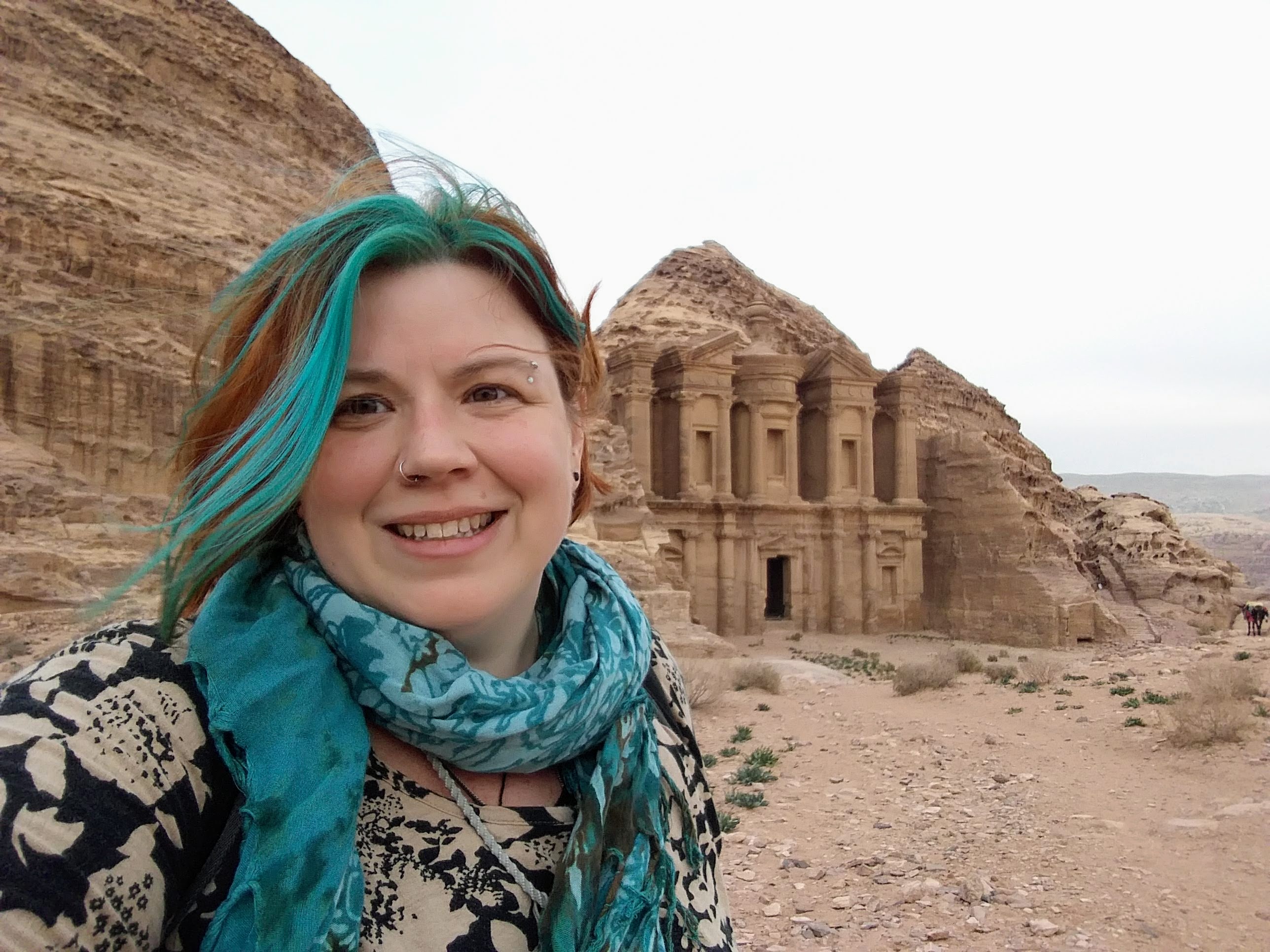
Second visit to the Monastery, Petra, Jordan. January 2019

As if this weren’t enough, I have a deep sense of social anxiety that constantly tells me no one likes me, no one cares, no one reads this, I don’t matter. On the internet, follows, likes and comments are the way that people get validation. I rarely look at my statistics because I have a hard time not comparing myself to more popular online presences. I have a friend (IRL friend) who gets 75-200 likes on practically everything she posts on her personal Facebook account. My most liked post had like 14. I don’t want to get that in my art-space too. It’s one of the reasons I love Instagram so much: nature photographers are really a supportive community and it feels good.

Sometimes I just have to tell myself I’m not doing it for the likes, I’m doing it for me and anyone who wants to come along for the ride is more than welcome, but not required.

That’s a policy I try to apply to more than just this blog, but sometimes it bears repeating.

So, that’s me: the irregularly publishing, long-form article writing, Gallivantrix.

See you when I see you.

Bcard1


This is the forerunner of another long-ish dry spell interspersed with some of my iconic travel selfies. Usually I post photos of the places I’m talking about, but since I’m talking about myself, why not?

I’ll be visiting America this summer, which makes me very uneasy. I’ve been thinking more and more of writing about moral philosophy in addition to my travel stories but I think I’ll wait until I’m safely in and out of the Border Patrol jurisdiction. I have to show up in person to renew my driving license (not again for 12 years after this) which is what I use to prove I can vote so it’s kind of important. Additionally, my mother is finally semi-retired so after a visit with her and my niblings, we’re heading over to Ireland for a couple weeks.

Naturally, I won’t be able to write or publish while I’m on the road, and probably not for the first few weeks I’m back in Korea starting the new semester with yet another class I’ve never taught before and have to make materials for. So, no new articles until the fall. However, I’ll do my best to update the Instagram regularly with views and fun times in Seattle, Memphis, Paris, and Ireland.

Enjoy the summer!

Down Keyboard, Up Brush

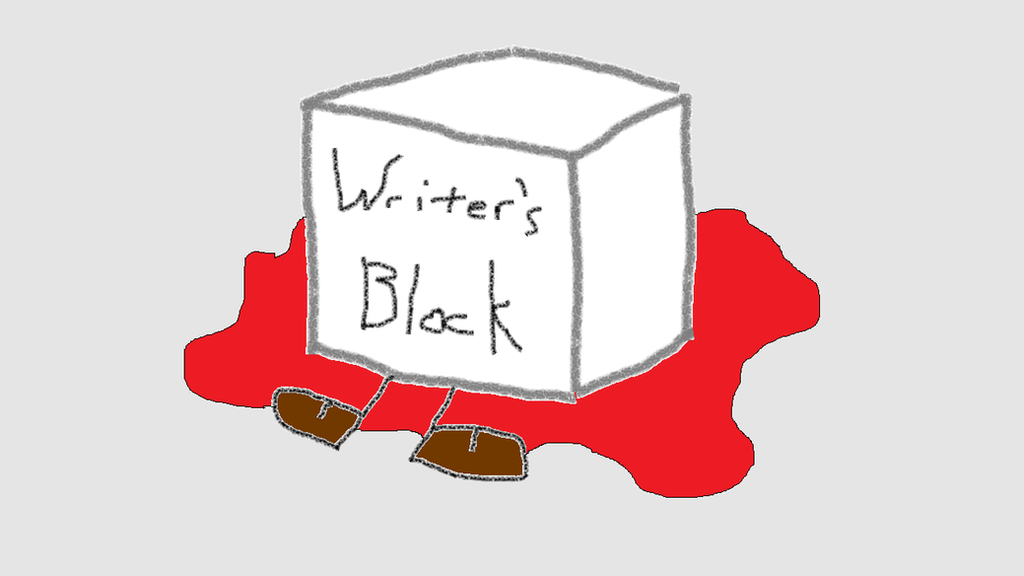
I am not keeping up with the blog recently. Apologies. Realistically, I’ve gone dark for longer before. That whole 5 months I lived in Seattle between Japan and Korea I wrote maybe one post, but I also didn’t have much to write about back then. Now I have 33 drafts sitting waiting for me to work on them, and yet when I open them I just sigh. I did not do a good job taking notes on my summer holidays. I don’t have 4 hours of  enforced desk warming at work every day anymore. I have these lovely three day weekends and I can’t bring myself to spend even one of them writing in here. Nanowri-no-mo. The writers block is strong.

Writer's Block by Pyre-Vulpimorph

I’ve been working on my winter travel plans, which involves reading a lot of other people’s travel blogs. I see a lot of blogs that will do an entire 10-12 day trip in a single post of no more than 2,500 words. It is a great way to summarize a trip and pass on the most vital information to future travelers, so I’m not dissing those folks at all. In many ways I envy them, because my task would no doubt be easier were I to adopt a similar approach. I might even have more fans since “in depth” reading requires an attention span that is not popular in the world of click and scroll. Which, I’m also not dissing. I love scrolling thru my FB feed as much as the next person. However, when it comes to my own content, I want to be able to tell a story. I like telling stories.

It does not help that this semester’s schedule has been a little extra brain taxing, leaving me with less mental spoon-power at the end of each teaching day to sit down and organize a blog post. Three more weeks! I’m staying at this job, don’t worry. I worked way to hard to get it to leave, but I am looking forward to having a chance to get a new schedule for spring semester.

Art History

The good news (for me anyway) is that I haven’t merely crawled into a cave to binge watch Netflix (although I have done some of that as well… like maybe the entire Star Trek catalogue except for Enterprise causethatonesucksfiteme). I have finally reopened my artistic cabinet. Before moving to Saudi Arabia (and thus before starting this blog) I went through a few art binges in my life. In high school and undergrad I was massively prolific. Reams and reams of sketch pads filled, art given as gifts to everyone I knew, and even occasionally sold to strangers for profit!

0013.jpg


Then I stopped. For years.

After finishing my MA and getting back from China, I finally picked up the brush again. It helped that I had some peers to do art with. Going over to a friend’s house to paint and drink tea (or wine) is a lot of fun, and it took the pressure off me to PRODUCE. I finished paintings that had been half done for years. I started new ones. I updated older artwork from my high school days to reflect my new style. I was feeling it.

Then I moved, and all the art went into storage. Saudi was… well, you can read the blogs, but I did my last real piece of art there when I made the life size paper Christmas tree to adorn my hotel room. I made every piece of that from paper and foam because Christmas decorations are forbidden in Saudi. That was in 2014. Since then I’ve had art supplies laying around. At least a sketch pad and pencil. People who knew I liked to make art would give me things as gifts and slowly I accrued watercolors, acrylics, brushes and canvas and they just sat on a shelf.20141206_183852


Returning from Europe this August, all my Korea friends were finally gone. Those who didn’t leave in February (the end of the school year) left over the summer. I knew I had to make myself get out and be social in order to avoid the cave-dwelling-Netflix-binge fate. Public “foreigner” events are the best way to go since we all show up expecting to mix and mingle, but I live over an hour away from the two nearest cities with decent expat populations and I knew I needed more than just “socialize” as a motive to travel so far. So I joined some art classes.

clone tag: 2275714863150458950

Specifically, watercolor. These are much more social than educational, but I did end up learning some new techniques as well as just getting a chance to chat with people. The first one I went to in Busan and everyone pretty much split as soon as it was over. The second one was in Daegu where I ended up spending several hours after the class hanging out and chatting. So far, no lasting friendships have been formed, but I had a good time regardless.

Art Spark

I also triggered my art spark. During the last couple of months I’ve delved much more into making art than into doing photography or writing. As a result, my Instagram and Blog are feeling a little neglected. The first piece I started was a simple mandala pattern on acrylic. I spent about an hour looking at mandalas on Google Image search and then sat down to draw my own. Once the pencil sketch was done, I transferred it over to a canvas by carefully measuring over and over. It’s much easier to make a mandala in a computer where you can just copy and paste for symmetry. I also used a black marker to show the main lines. I basically created an adult coloring book page on a canvas and then started using acrylic paint to “color” it.

I wish I could say I was finished, but it turns out that coloring in acrylic isn’t as fun as coloring with pencils, crayons or markers. I also struggled with color. I repainted part of the outer ring twice, and the middle ring 3 times. I have since taken a digital version into Pixlr and experimented with color schemes for the middle ring. At least now I know what I want to paint there… One day, I might even do it.

One day when I was tired of meticulously painting inside the lines, I decided to pick up the sketch pad again. I liked the idea of the mandala, of the adult coloring book style, and decided to try to make a mandala animal pattern. Back to Google Image search. I scrolled through a few hundred designs before realizing my favorites were the jellyfish. I have no idea why. Not wanting to copy the poor unattributed artist whose work I was seeing plastered all over cheap t-shirts, Etsy pages and Pinterest boards, I decided to make my own!

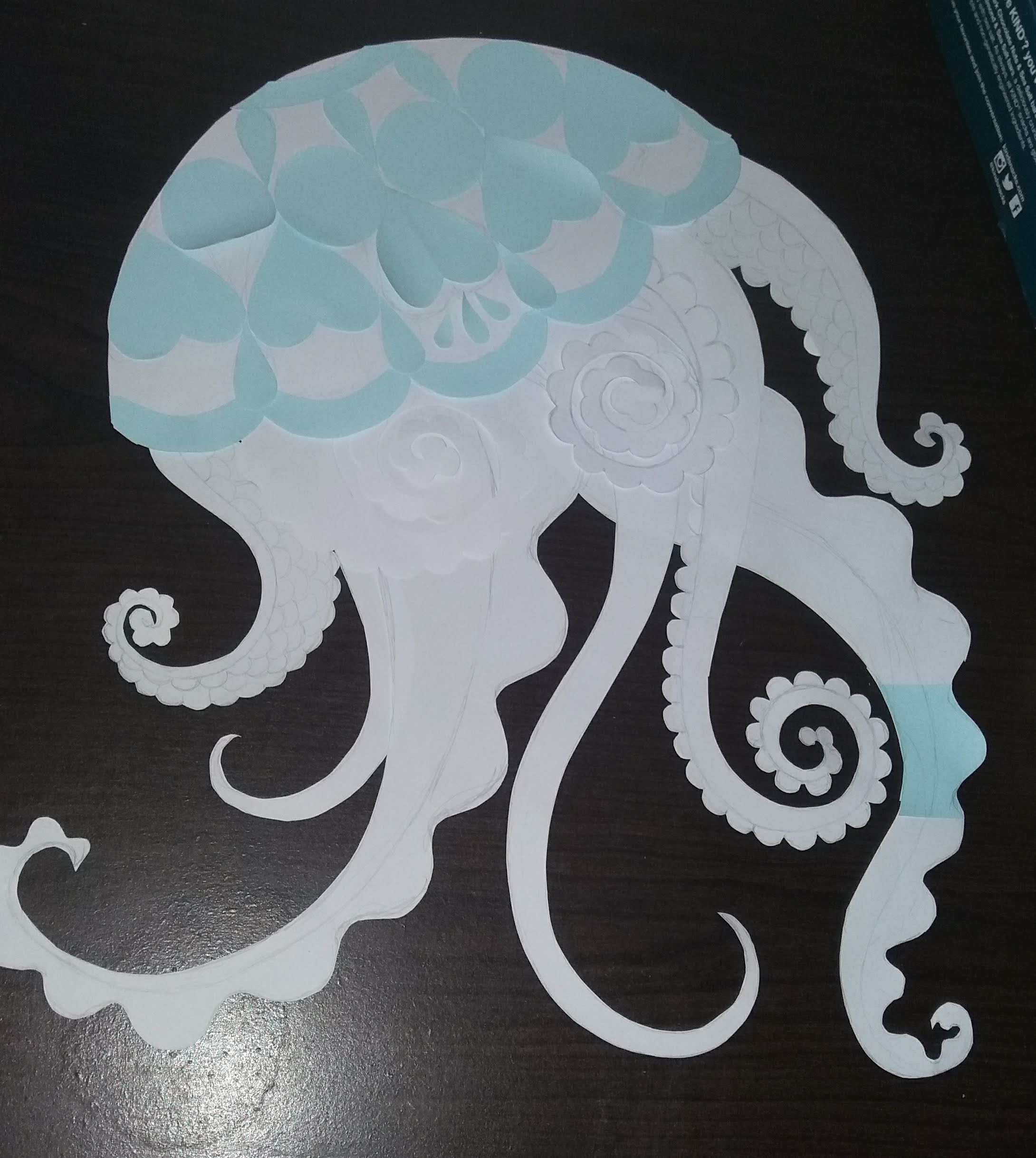
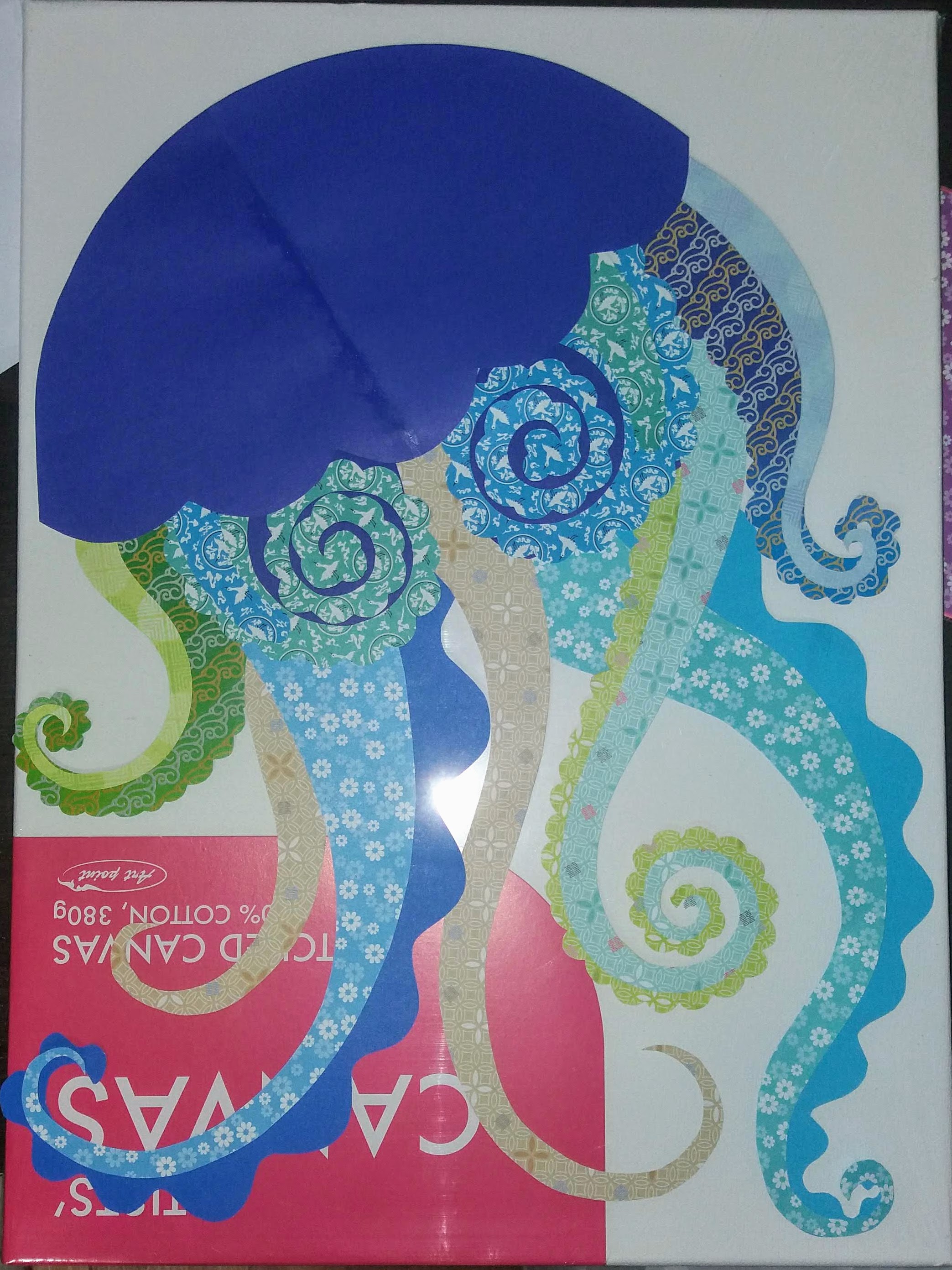
I stuck the Star Trek on auto-play and went to work on my sketch-pad. A while later I had the finished design. Most people will recognize it’s extreme similarity to the adult coloring book fad. That is totally on purpose. However, when it came time for me to imagine how to colorize my drawing, I didn’t like the idea of repeating my mandala with acrylic paint experience. Visualizing a few mediums while I lay in bed cradling my chronic insomnia, I hit upon the idea of using colored paper to bring my creation to life!20181105_215322

The next day I found a local art store which was overrun with paints and painter supplies as well as the standard Korean “stationary store” supplies like colored pens, and poster board paper. I was never able to find things like wrapping paper, brown paper lunch bags, construction paper, tissue paper or any of the other staple craft supplies I grew up with in America, let alone any of the new craft supplies that my niblings get to play with. Maybe in Seoul there is a shop that has them, but not here. The only patterned and colored paper I could find was for origami. I bought a half a dozen different design packs and a decent sized canvas. There was also no such thing as decoupage glue or mod-podge, so I got plain white glue and made my own by mixing it with water. Old school.

I didn’t want my bright colored jellyfish alone on a white canvas, though. What do do for a background? Paint it blue with acrylics? No… I really wanted a watercolor effect, but I didn’t have confidence in my ability to do it, especially not on a canvas. I decided to make the watercolor on paper and decoupage the background as well as the foreground.

Paper-cut Redux

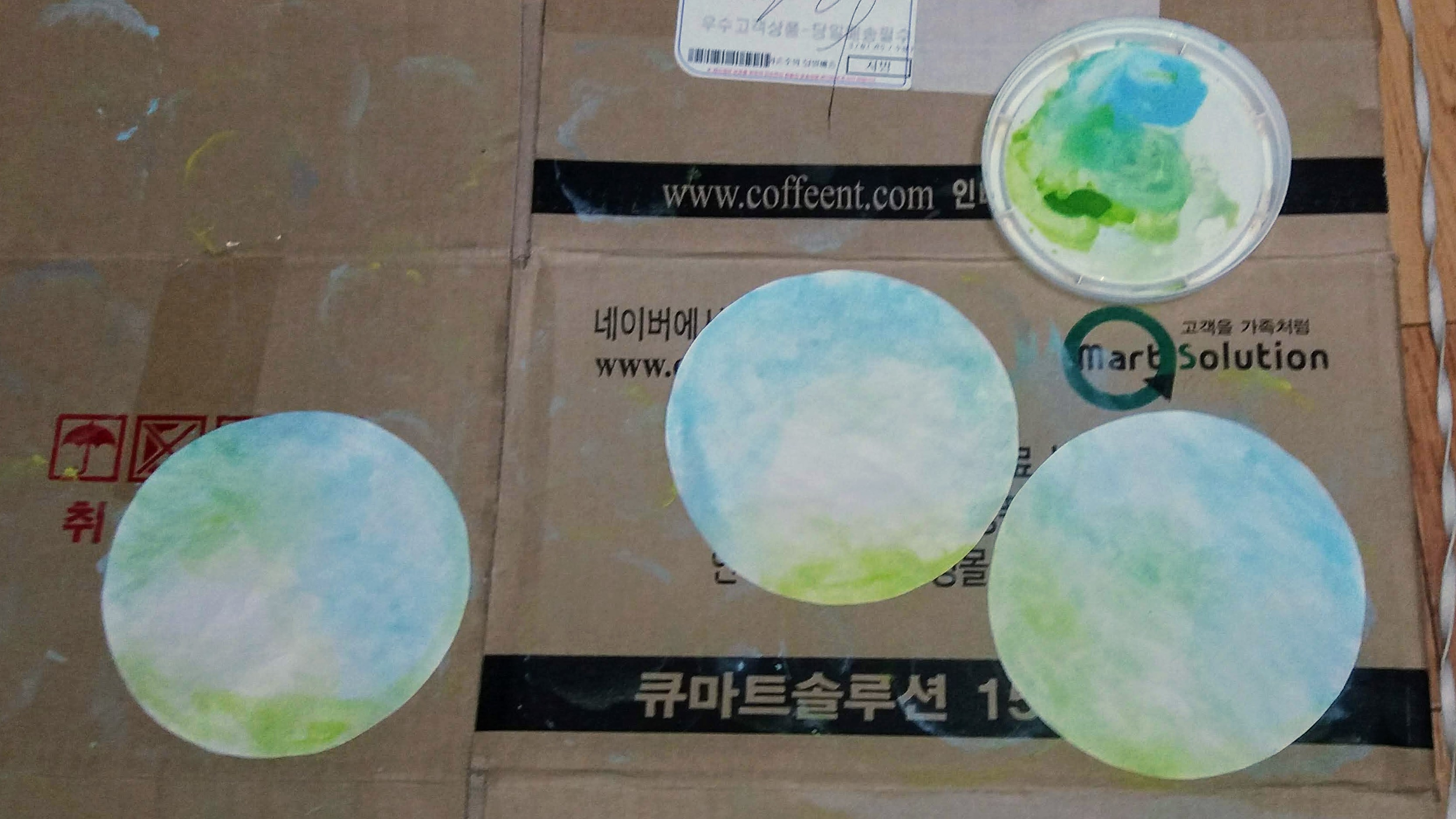
I cut circles in various sizes, hoping to evoke a “bubble” feeling. I then spent hours (more Trek bingeing) painting them in pale shades of blue and green.

20181111_202236It was worth it. When I finally was ready to create the background, I placed the different sized circles around the canvas. I painted them in layers, mixing a little white paint into my glue/water mix so that the bottom layers would fade a little compared to the top layers and give it some depth. Originally, I thought there would be distinct bubbles against a white background. In the end, the whole canvas was covered and it reminded me of Monet. I tell you, I loved that background so much I almost didn’t want to put anything on it. I will definitely be using that technique again.

For the jelly itself, I started off by cutting the pattern from plain white printer paper (abundant at my office). I used the canvas to make sure the pieces fit and I had to make some changes from the original drawing to accommodate the new size and materials.20181111_202246

When I had the tentacles and body shape done, I used post-it note paper to measure and cut the patterns on the body. It was much better than plain paper because I could make sure they stayed in place while I added other shapes. I had to change the size of the heart shapes because the first attempt was too small. Being able to stick them to the body let me clearly see how the shapes would look glued down.20181112_161715

Finally I was ready to cut the colored origami paper. Sort of. First I had to decide which pieces got which colors and patterns. I had a limited amount, no more than two sheets of each type and remember origami paper isn’t exactly big, so for larger chunks, I had to line up the two sheets along their pattern to make it seem, well, seamless. I also had to balance the colors and shapes in my head.

20181119_164501When I made my final color decisions, the last of the cutting was ahead of me. I had to trace the white paper stencils onto the origami paper and faithfully cut each shape and each layer. The tentacles were actually fairly easy, but the accents on the body were the most challenging. Here again the sticky paper came in handy since I could just stick my stencil to the colored paper rather than try to hold it down. I also enjoyed using the designs on the paper like using the pink circles on dark green to make the circle centers, or using those same patterns on the purple to accent the hearts. Not only cutting the shapes I needed, but cutting them around the patterns.

20181119_194723

In the end, the gluing required more patience than I could have imagined! I had to be very gentle with the wet paper. It wasn’t just gluing pieces down, but using the watered down glue like a paper mache. The paper would be wet and tear easily. However, if I didn’t soak the paper evenly, it would pucker and wrinkle badly in response to the areas touched by glue. I added only one or two pieces at a time and had to wait (more Star Trek) for them to dry at least most of the way before applying the next.

20181125_172820

Damp pieces were adjustable, but only a little. If I hadn’t planned and checked everything while it was dry, I don’t think I could have assembled it wet. It was a whole new experience. I’ve done paper mache and decoupage but never to create a 2d art of my own design, and on a canvas no less. It took me 3 weeks of working on it in my spare time.img_20181126_215130_406

And that’s why I haven’t been writing…

The No-Travel Blog?

I feel like I’ve been absent from writing for months. I set up a schedule of publication in anticipation of having more new things to write by now and it simply hasn’t manifested. What happens to a travel blogger when they aren’t traveling? No one but the independently wealthy and the corporately sponsored can maintain a year-round travel lifestyle, so chances are, all your favorite travel bloggers have downtime, too. In an effort to keep my story alive, I’m here to look at this question and hopefully figure out how to fill time and pages until the next time I get on a plane.


In 2015 when I headed back to Seattle for 5 months, I tried to write about my life there, but it was so much “go to work, look for work, hang out with friends” that I couldn’t think of anything to say for 3 of those 5 months. Winter makes it even harder since the local adventures that one could otherwise undertake to find writing inspiration are out of reach (especially if you don’t ski).

Image result for bored in winter

2017 presented similar adventure writing challenges. My whole summer holiday was spent amid friends and family, mostly in their homes. I did take photos when we went on outings, but to be honest, I was much more focused on catching up with them than in the scenery. I suppose it’s just possible that the blogosphere would enjoy such personal details, but I doubt my friends and family would appreciate being aired in public. Plus, inside jokes are really hard to narrate. Thus, the summer trip got exactly one blog post, while a typical holiday may have 10-20 stories!

I did take a trip in the fall which is the main new content I’ve been able to publish, but I had no winter holiday at all, just a brief weekend trip. Leaving me to reach back into archives and scramble for even small details to bring to the page.

It’s not just the writing either. Traveling is my hobby and my greatest source of joy. The thrill of planning a trip, reading other blogs on my destination and looking for the best hidden gems while designing the most efficient color-coded itinerary (ok yes that makes me a little weird, but I love it). Then going on the trip and seeing all the things I looked forward to plus finding things I didn’t even know about. Then coming back and sorting through my memories and photos and researching all the things I saw but didn’t know about (still a nerd). Then finally posting my story here. It’s a whole process that keeps me engaged and productive and most of all happy.

Image result for twilight sparkle vacation plan

Finding Your Happy

Like a lot of people in the modern world, I struggle with happiness. I spent a long time not having it, and a long time learning how to change that. There’s all kinds of stuff out there about positivity and manifesting, most of which is quite frankly bunk, but it does have a root in real science.

Surely you’ve noticed that when you’re in a good mood, everything seems wonderful. Conversely, when you’re feeling low, even really great things can barely make a dent in the depression. Happy brains focus on the positive without effort. Unhappy brains focus on the negative, often way more than we want them to. Cognitive behavioral therapy and positive psychology are ways to help train your brain to focus on good things more often. As with any other form of training, it takes hours and hours of practice and effort and as soon as you stop, you lose ground.

Like playing the piano or working out, happiness requires daily practice. For me, the anticipation, experience and reflection cycle of travel is my happiness workout routine. 2017 was like a broken ankle in my happiness marathon training. I knew it was a legitimate (non-imaginary) problem, and I tried hard to take it easy and give myself time to deal with the things that were presenting as obstacles, knowing that one day soon it would get better again. Well, now it’s April of 2018 and I’m stretching out those “muscles” for the first time in months and boy are they rusty.

No, It’s Not Out There

When the stress of the job hunt was finally over and spring was on the horizon, I thought, “ok, this is where it gets awesome again!”

Image result for skipping through flowers julie andrews gif

Wrong. Instead of sunny 17 degree weather, I got sleet and ice. Instead of 2 weeks of beautiful blooms and festivals, I got one day of getting lost trying to find a few trees that hadn’t quite gotten there yet, followed by enough rain to destroy them all. 

Image result for being rained on

Instead of going to see a traditional Korean bullfight (no animals harmed!) and persimmon wine tasting, I’m going back to the dentist because the festival was canceled due to concerns of, I’m not kidding, foot in mouth disease… which I guess is a cow thing. Every external goal that I pinned my happiness on fell through and my emotional resilience took hit after hit as I faded into a potato chip munching Netflix binge-watching funk.

I was relying on the spring warm weather, the cherry blossoms, and the resumption of the Korean festival bonanza to lift me back into mental shape and that was a critical mistake. Happiness doesn’t come from outside. Of course, mindfulness and gratitude practices are easy when the world outside is giving you a lot of beauty to be mindful of and grateful for, but relying on the external for that boost can only last so long.

All The Small Things

Thus sitting in my small room, staring at the gloomy gray skies and listening to the rain that was ruining everything and huddling with my heating pad to fight off the winter that wouldn’t leave, I found myself asking the question, “How can I even write a travel blog if I’m not DOING ANYTHING?”

Which, a few days later I realized is a tremendously silly way of looking at this. I’m doing a helluva lot. I moved to a new city (in Korea), rented a foreign apartment all by myself for the first time, started teaching in a totally new educational environment, started exploring my new neighborhood and meeting new people. Ok, so I haven’t had any “big” adventures, but I’m not in a coma.I didn’t get cherry blossoms, but I tried every cherry blossom themed food I could find. I may not have any sweeping vistas of the mountains without smog or rain, but I’ve been focusing on the small flowers and building a bigger photo journal on Instagram. Sometimes small stuff is where we have to look for joy. The point is, never stop looking. Join me as I reflect on the tiny adventures of daily life in Gyeongju, South Korea. 

20180412_112145.jpg


Don’t worry. This isn’t going to permanently turn into a daily life blog. I have a trip planned to Japan in May and I’m going to Europe for the summer holidays so there will be plenty of travel stories coming soon. Until then, try to enjoy this “slice of life” time, and check out the Instagram for my spring flower collection. Thanks for hanging in there with me. ❤

Hello Bohol: Introductions & Disclaimers

During the Chuseok holiday this October, I took a 9 day trip to Bohol in the Philippines. It’s taken me a long time to get the rough draft out of my head, and it’s going to take even longer to devote time to polishing the words and photos. I’ve broken up the story into small, and hopefully joyful vignettes rather than a continuous narrative. This post is a little introduction to Bohol, and a little explanation about why this story is being told differently. Yeah, it’s another post with no photos… it’s been that kind of fall. If you’re really craving photos, you can go look at the chrysanthemums I found here in Korea last weekend.


I usually take holidays by going to all the places. I can look at my color coded spreadsheets of past holidays and it’s a little bit non-stop. I think the last time I stayed in one place more than a couple nights on holiday (not counting family visits) was in that resort in Egypt, and even then I did a day flight into Cairo and may have done more if not for the food poisoning of doom. Every other holiday has been a whirlwind of exploration, and I love that. I love seeing all the things. But, considering it’s been 2.5 years since I last did a “relaxing” holiday, and considering how I drove myself into the ground in Thailand, I decided Chuseok was going to be a single destination vacation.

Even in the spring when I started to look at plane tickets, the holiday prices were already sky high, and my decision to go to the Philippines was influenced by the fact that they were some of the cheapest flights left. After asking a friend who has lived in Manila decades where to go, I decided to spend my time in Panglao. Panglao is a tiny island that’s off the coast of tiny Bohol.

bohol map.png

Some people may look at the tiny island of Panglao and say, really 9 days? What did you do? Especially when you consider I don’t really DO laying on the beach all day, nor do I have my diving certification (the two main reasons to go there). It turns out that there is a LOT of amazing stuff over there, most especially if you can control your own transportation. I didn’t make a spreadsheet for this holiday either (to be honest, I was a little focused on the US trip, and the dental work). I did make some tentative itineraries based on interesting things and geographic proximity, but I did not have a day to day PLAN. I made fewer itineraries than there were days, so that there would be resting time and I would avoid the kind of burnout that happened in January. I was also meeting a friend there and wanted her to feel like she had some room to suggest things and not be railroaded by color coded schedules.

Researching Bohol ahead of the visit was a little tricky since it’s not a real popular stop on the backpacker routes and the tourists listed the same few “must-do’s” over and over without a whole lot of information on them since it seemed nearly everyone who went joined a tour group or hired a guide to make these tried and true tourism routes. I was largely content with the idea of doing the same things, but on my own time and without an awkward guide trying to make conversation, take silly photos, or rush me on to the next thing (it turned out I couldn’t avoid this altogether, but the few times I was forced into it, it made me grateful for the self touring I did the rest of the time).

The posts in the “Hello Bohol” series are not strictly chronological, but more organized into categories:

First and Last – I thought about calling this one “airports and hotels” but I thought, who’s going to want to read that? It’s the story of getting to Bohol, and a rather special experience on my last morning there.

My Own Two Wheels – After Thailand, I realized that I needed to learn how to ride a motorbike to get around SE Asia. With it’s small size and lack of cities, Panglao seemed like the perfect time to try. These are the stories of learning to ride a motorbike and how it felt.

Chocolate Hills & Tarsiers – Two of the most famous tourism attractions on the larger island of Bohol. I visited the Chocolate Hills, two tarsier parks, and a few other attractions nearby.

Balicasag with the Turtles – I got a spot on a diving boat heading out to the minuscule island of Balicasag, best known as a serious gathering place of giant sea turtles. I didn’t join the divers, but I had excellent snorkel experiences and finally got my own underwater photos!

Beaches – There are so many beaches on Panglao. I didn’t have a chance to visit them all, but I managed to get in quite a variety.

Food & Fancy Restaurants– There is an amazing plethora of gourmet food on Panglao. Everybody has to eat, and vacation is the time to indulge. Vacation calories don’t count, right?

Panglao – things to do and see on Panglao besides beaches and restaurants

Loboc River – a lunch cruise by day and a firefly cruise by night, the Loboc river is another tourism hotspot in Bohol that’s worth the visit.

History & Historical Sites – For anyone who likes history as much as I do, this post includes several old churches, military fortifications, and other historical points of interest, as well as some backstory about the Philippines I didn’t know about before.

Waterfalls – My last full day of the trip I went on a three waterfall adventure quest that took me to muddy back roads and some of the most beautiful places I’ve ever seen.

What’s going on with me this holiday?

Every time I write, it’s a work of balancing the best story with the actual reality. This is not to say that I make things up, but sometimes I leave things out. Like any good storyteller, I leave out boring details. You don’t want to read about what movie I watched on the airplane or every time I had cup noodles as a snack or how often I brushed my teeth or what book I’m listening to when I fall asleep. These are pedantic details that do not add to the story. Likewise in life, there are small discomforts and dissatisfactions that happen but do not serve to advance the story or to entertain the reader.

Facebook and Instagram have been accused repeatedly of creating false narratives of our lives wherein all our friends look so happy and successful all the time, while we feel like useless failures. Of course, the irony is that everyone experiences the same distortion because we all post our best selves online, right? I mean, who wants to look bad? Well, me, sometimes. I mean, I don’t want to look bad per se, but I don’t want to create a fantasy version of myself that I won’t recognize in 20 years.

So how to decide what bad things to include and which ones to leave out? I have no idea. I’m totally faking it. Mostly, it’s about how much of an impact did that have on me (did I forget it and move on in less than an hour or did it alter the course of the day/week/year?). And the rest is how good of a story does it make? I mean, let’s face it, we love tragedy and schadenfreude so yes suffering makes good stories sometimes.

In many ways, I think of this blog as a journal. I hate diaries and always have, but every therapist ever says that journaling is a very important part of mental health. I do have some blog posts that will never see the light of day because they are just for me. But mostly, I don’t mind sharing, and there’s something about pretending I have an audience that makes me more attentive to the quality and content and frequency of my writing. But times like this I have to remember that it’s not my diary. It’s one thing for me to tell stories of people I’ve met on my journey who will almost assuredly never be identified by this blog, or even to tell stories of people who are identified as long as the story is the kind that makes them happy.

This time it’s harder because something happened on this holiday that is having a profound and lasting effect on me, and it might even be a good story from an external perspective. But it’s not my story alone. A person I care for quite deeply is involved, and I don’t want to hurt or embarrass her by telling this story in a public forum. But there’s no denying that her presence, her actions, and her choices had an impact on the holiday, on me, and on my writing afterward. Re-creating this adventure was an emotional roller-coaster as memories unfolded taking me from happy times to “oh, and then that happened…”. Photos show us smiling and laughing and I cannot help but remember my joy in sharing those moments with someone so close to me, but the gaps between photos speak to tears and hurt and confusion.

At the time of writing this, it seems that this trip spelled the end of our friendship, so this is my compromise. I won’t tell her stories, but I won’t pretend that everything was great. As you read, if there seems to be a gap where the plot jumps irrationally, or where details are less than they might be then those are the scars left by removing each unpleasant yet wholly private instance of conflict.

Once while talking about death, she asked how I would cope with losing her, and I told her that I would be sad, and I would feel grief, but that those would fade and in the end, it would be the good memories we made together that would last and define my feelings. She’s not dead, but it seems that she is lost to me just the same, so I’m hoping that telling these stories will help me process my sadness and cement the good memories that I want to keep forever.