Every job overseas I’ve had so far has provided housing. One of them didn’t technically provide, but did everything besides sign the lease and pay the bills. Despite having lived and worked abroad for several years, I’ve never had to deal with this particular aspect of expat life. Moving to Gyeongju was more than a little nervewracking because I didn’t know anyone here, the school was not going to provide an apartment or even help in finding one, and my apartment in Busan would be unavailable by February 25 (2 days after my last day at that job). Not every adventure is a holiday.
In the US, when I had to look for an apartment, I would go online (or in the old days, open a newspaper) and look at ads, then go visit the apartment manager and view the unit. The one time I moved across the country as an adult, I chickened out and signed up for student housing so I could put off apartment hunting until I was in the same city. How did I get to this point in my life without having this skill?
I managed to find some online sources for rentals in Korea and was preparing to try to navigate them despite the language barrier, but reviews online revealed that they were just ads for real estate agents and that the listings and photos shown were almost never real. Housing in Korea is usually brokered with a real estate agent, budongsan. Like every other critical service here, they operate during the same hours I was required to be at work in EPIK. Plus, Gyeongju is an hour away from Busan, making a quick afternoon apartment hunt completely impossible.
One of the teachers at the University said her friend who spoke Korean well had volunteered to help me hunt down a place after the staff meeting on Feb 22 (remember, I was getting booted from my existing place on the 25th), and I gratefully accepted, and asked what I could do to prepare because I literally had no idea about the town or about renting apartments in Korea. “No, no, it’s so easy, we’ll just walk into an agent’s office and they’ll find you a place that’s ready to go.”
I did some research anyway.
In Korea, most people rent their apartments jeolsei style by paying for a whole year of rent up front at once. Weirdest part? They get it all back when they move out! I still have no idea how this financial arrangement works for the property owners, but by and large, I think it sheds some light on the crazy world that is “money”. Sadly, I had no idea I was going to have to rent my own place so I hadn’t had time to save up that much. Ironically, I was going to get enough in severance pay and contract bonuses to bring me up to enough, but I wouldn’t get the money in time. Which says more things about how the rich stay rich and the poor loose money, because if you have the money to rent a whole year at once, then you don’t actually have to spend it, you just have to let someone else use it for a year. But if you don’t have that lump sum, you’re stuck actually paying a monthly rent.
 Monthly rent in Korea, or wolsei, is still miles lower than it is in the US, and my salary includes a housing stipend so it’s not actually something to complain about. I am, however, trying to put aside the cash to change to the lump sum system when I renew the lease next year.
If you can’t do jeolsei lump sum, then a large deposit of key money is still required in addition to the monthly rent. The larger the deposit, the smaller your monthly payments, and you get the deposit back at the end (minus damages). That was what I had to do. I read that the key money could range anywhere from 2-5,000 US and I was already worried that the upper range of that could clean me out if I had to pay it before my February payday (which happened to be the same day they were kicking me out).
I tried getting advice about where to live in Gyeongju but as with every Facebook page in the history of Facebook, no two people can agree and at least 60% of the comments will be random, useless, wrong, or cruel. I tried looking at the map to get an idea of where the university was, where the bus routes were and where the good amenities were, but it was really difficult to make sense of the map when I had only been to the bus terminal and university once for the job interview and nowhere else.
Confusion and Disappointment
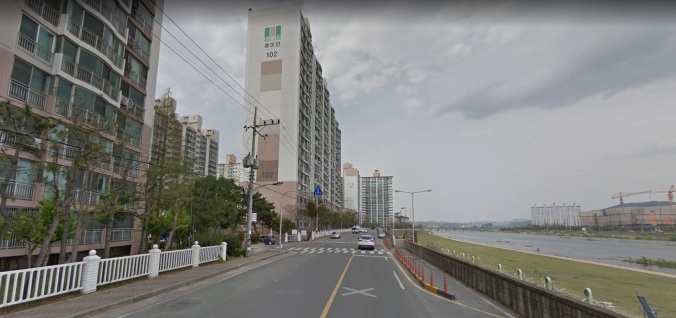
The day of the staff meeting, I headed out in the afternoon with two other teachers to look for my apartment. First, they went to their own apartments to drop off things and get ready for the march around town. They lived in a more recent development with an elevator and nice view of the river, but as I asked more about what was around them, it turned out to be a whole lot of other apartments. The nearest corner shop was a 5-minute walk and there were no nearby restaurants, cafes or bars. I was trying to be as polite as possible because they clearly liked their neighborhood and thought I would too, but as we walked out looking for the real estate agent, the office of which my guide could not remember the location of, I was getting very disappointed very fast.
Google Maps
The first agent was super confusing. He wrote down a bunch of numbers and my “translator” had no idea what he was saying. Later we realized it was the price difference between the two types of rental agreement, but at the time I didn’t really feel comfortable about it and his price points were a little high. We wandered aimlessly around the neighborhood as they tried to remember ‘that one really helpful lady”. I never want to sound ungrateful when someone has offered to help, but it seemed to me as though they had no plan whatsoever, but neither had they given me any guidance on what I should plan. Agent after agent, we visited. Some had no one rooms apartments, others had only unfurnished units (which in Korea also means no a/c unit, no refrigerator, and no washing machine).
We finally found someone who had a furnished apartment in my price range and we headed off on foot to take a look. The day was unseasonably warm for February, and I had been walking a lot already. I was so hopeful about the apartment, but by the time I mounted the stairs between the third and fourth floor, I realized there was no way I could do that every day. (yeah, I’m out of shape, but unless there’s a temple or a stunning view at the top, 3 flights of stairs is my limit). On top of that when the agent opened the door to reveal the room it was so tiny I felt claustrophobic. Trying to stay kind and polite yet be firm, I had to reject it.
Finding an Agent
However frustrating it was, it became clear that I had to get really specific with these agents if I didn’t want a top floor shoebox. The list of what I wanted was getting longer with every agent, and predictably, more of them said, no way. Eventually, my guides realized that their neighborhood was really made for families and multi-person housing and that we should go to a different area to find more singles. We called a taxi and while we waited the volunteer apartment finder told me that there were never any taxis on the road in that area but they always showed up quickly when called. As we drove away, I felt intensely grateful that I had escaped that area, bereft of shops, food, and transportation options. It was a lot like the American suburbs, except all apartments and no McMansions.
When we arrived in Seonggeon-dong, I instantly felt better. I could see the plethora of tiny shops, and shops stacked on top of shops that I had become accustomed to in Busan. I knew nothing here would compare to Seomyeon, a bustling shopping, party and medical tourism hub, but it was a solid relief to see that not all of Gyeongju was built on the soccer mom model.

Google Maps
We asked the driver to stop as soon as we spotted a real estate agent (the green one) and headed in. She was the very answer to my prayers. With the mild exception that she did not speak any English, she was perfect. Kind, attentive, and very good at explaining in Korean in such a way that us poor waygook (foreigners) could understand. I realize in retrospect that there are a lot of waygook in this area. Most are not native English speakers, but they can speak a modicum of Korean, so that makes more sense as to how she got so good at explaining things to non-Koreans.
We rattled off the long list of things I wanted and lowballed the price tag (having had some price issues with every previous agent) and she didn’t look even slightly phased, but instead nodded confidently and opened up her bright pink planner and began flipping pages and texting on her phone. Within a few minutes, she had gotten in touch with a nearby apartment that was fully furnished and on the second floor, close to the bus lines and the university, with internet included in rent, and well within my price range.
Finding a Room
As we walked over, I was pleased to see a wide range of restaurants and cafes. She pointed out the CCTV cameras and the high school at the end of the road. The presence of the all-girls high school meant extra police presence and security cameras so the neighborhood would be safe for me.

Google Maps
The Facebook group of longer-term Gyeongju expats had advised against this particular neighborhood because it was “too dangerous”, so it was clear to see that word was getting around. As far as I can tell, some Thai folks got drunk and had an argument that ended with knives, but it was personal. Additionally, some of the blue-collar expats were creeping on the white-collar expat ladies. Being American, it takes rather more than this for me to be worried, but it was nice to see that the police were taking the issue seriously and I spotted several bright yellow signs about making it a safe alley, as well as plenty of cameras and even some police call buttons on telephone poles.
The building was small with a hair salon occupying the ground floor. We headed up, hoping that the apartment itself would not be a grand disappointment. Looking inside I was instantly pleased. Perhaps my standards had been lowered by the other places we’d visited, but I felt like the layout of the room, and the provided furniture was ample for my comfort. Although it is a “one room” the kitchen, bathroom, and balcony/laundry room all have doors. The main room had not only a bed but also a desk, dresser, armoire, and bookshelf. The only odd part was that the refrigerator lived in the main room instead of the kitchen.

moving day, it will never be this clean again
I was fairly sure I was not going to find anything significantly better, and my guides were starting to lose patience with me. I would not have settled for something that had problems just to wrap up earlier, but I didn’t feel the need to go on searching with the evening coming on.
Legal Paperwork
We headed back to the office to draw up the paperwork. In Korea, it’s standard to pay a 10% deposit on the day the contract is signed and then pay the remainder of the key money on the day of move in, which was going to be a huge help to me since I could then get my February paycheck in the bank before having to pay the large deposit. The agent was kind and patient and helpful the whole way through. Even when mistranslations popped up, she worked at it until we were all on the same page. Then she had myself and the building owner sign three copies of the lease (one for each of the three of us) and I transferred the deposit and her agent’s fee via my mobile app. No sooner were we back out on the street than my guides departed in a rush. I was left with the impression that they had expected this chore to take an hour or so at most and that they somewhat regretted having made the offer of help.
 If I had to do this kind of thing again, knowing what I know now, I would have hired one of the professional expat aides. There are bilingual people here who hire out services not only as translators but to find things too. I think I would have been more comfortable discussing my exact needs with someone who was being paid to help me that I had been with someone who volunteered to help. Additionally, she might have been able to have a list of agents and apartments ready for me on the day we met in Gyeongju so there was less aimless wandering involved. Live and learn. This isn’t an ad. It’s the person I wish I’d called. In case you live here and need her, too.
Here to There
The only thing that remained was to get my crap from Busan to Gyeongju, about an hour away. I had not done any packing prior to getting the job offer because I didn’t know if I was going to be moving to a new place in Korea (taking most of my stuff with me) or moving to another country (reducing life to a maximum of 3 suitcases and a carry on). Once I knew I was going to Gyeongju, I thought of the idea of spending a day going back and forth with my 2 existing suitcases until everything was moved, but that would not work for my toaster oven and small shelves. My next choice was to hire a moving company. I knew that one of the other teachers had recently moved from Busan to Gyeongju and asked who she had used. It turned out not to be a company or anything, but just some guy with a van. She called him while we were waiting for the lease to be ready to sign and made arrangements for him to come and collect me and my things that Saturday.
 Moving out of my place in Seomyeon wasn’t too hard. There was a garage so he was able to pull in and be quite near the elevator. We loaded my awkwardly packed boxes (which I had scavenged from the cardboard recycling piles of nearby apartment buildings) and headed off. It strikes me now that the things we take as normal are constantly changing, because I’m reasonably sure that if someone told me I would be in a minivan with a Korean guy I was paying in cash to move me and all my worldly possessions (pictured here) I would have at very least felt that was a sketchy situation, and yet, there I was, half listening to music in one earbud and half conversing with the mover in broken English. Totally normal.
He was a bit flustered that we had to stop off at the agent’s office first, but I had no access to the building yet. I had to make the final payment and get the door codes before we could unload the van. The agent was with another couple at the time we arrived so she offered us tea and we waited in the office while looking at a wall-sized map of the town and discussed the various historical parks. Finally we bustled over to the apartment where I had a rollicking rush of a time trying to get all the information about door codes, gas, electricity, heating, a/c, hot water, and other apartment amenities while trying to haul my boxes and suitcases from the main entryway and up the stairs to my new place. There was no one at all to help me translate that day, and while the driver did speak some English, he took off as soon as the van was empty.
Haphazards of Not Being Fluent

I noticed at once that there didn’t seem to be any internet. As this was meant to be included in the price of rent, I was understandably concerned. Additionally, I could not seem to get the heater panel to work properly. It was decently warm that day, and I had a heating pad for the bed, but I knew I would need more than that. They tried to tell me that the phone jack was the internet port and I should simply plug my computer into it, and I’m like, no that’s the wrong kind of port. I know that ethernet cables and phone jacks look similar, but they are really not interchangeable. I had to show them an ethernet cable and the port on my computer before they got the point.
The agent wasn’t able to get the internet figured out, but I was told if I needed it urgently I could use the computer in the hair salon… which was… very… kind? But ultimately didn’t solve my desire to get online and stream shows. My phone kept me connected to email and social media, but a girl wants to unwind with some Netflix after a long stressful move. The agent did manage to get the heat on, but then we couldn’t seem to change the temperature at all. The apartment manager was busy and would be for several hours, so I was left on my own until then.
 A bit later, the manager (the owner’s wife I think) came by and tried to call her daughter to translate for us, but her daughter didn’t really speak English either, so things just got more confusing. Eventually, it came down to the fact that they had not installed a router prior to my arrival even though we had agreed on a move-in day, and that it was too late to do anything about it until Monday. I wondered idly if I would have been better off going a block up the road to the nearest mobile shop and buying a wifi egg, but I decided to try and stick it out. She fiddled some with the heater and it became obvious she had no idea how it worked either, and then she left.
I should be clear, I don’t expect the people here to speak English well (ok, maybe I expect my students to, but that’s my job). I know I live in a country where English is not the norm and I am ok with that. I was able to make my issues clear enough with my broken Korean and simply showing the agent and manager the problem. I don’t expect the world to cater to me in English, but I DO expect to have functional heating and other utilities included in my lease (and this one included internet). The language barrier just made that one step further into the absurd and frustrating.
The Internet of Life
 I did get internet on Monday, sort of. Some dudes showed up and plugged in a router. The whole internet thing works differently in the US than really anywhere else. In the US, cable guys show up and plug the router into a special cable port in the wall and then activate your internet through that, but the router is just a way to route info from the cable port to Ethernet or WiFi. In Saudi, it was literally just a box you plugged into the power outlet only. I could take the router from my office at school home on the weekends and use it to connect to the internet. In my apartment in Busan, it was wired directly into the wall in a very flimsy connection, but there was no port. Here, the router is apparently plugged into that phone jack they wanted me to plug my computer into in the first place. Maybe that’s why it’s crappy internet? I don’t really know.
I spent several hours fighting with it that Monday, however, trying to first set up the WiFi and a WiFi password since I did NOT want everyone in the building all up in my WiFi and the dudes who “installed” (took it out of the box and plugged it into the wall) also had no idea how to do that part. I was using my phone to look up expat blogs about the WiFi router to see if anyone could explain it in English. Finally, I found one, but I ended up having to go through the steps multiple times because the connection was so shabby and the websites kept timing out.
Again, it’s not so much that I expect my Korean router to come with English instructions as it is that I expect the two experts who came into my home to install it would know how to set up the wi-fi and password. That’s set-up guy stuff, right? Otherwise, why are there two of you in my house? I also read the Korean instructions and they did NOT contain the necessary information either. I suspect this is the cheapest company on the market.
Eventually, I got it set up and was all ready to go with my security and passwords and wifi, but then I realized it wasn’t strong enough to stream, which is about 90% of what I do with my computer at home. (I write at the office or in cafes). Thankfully, I purchased a loooong ethernet cable back in Japan when I was living in an apartment that only had wifi in the public rooms, but needed wires for the bedrooms. It’s a little awkward, but it works more often than not and I haven’t felt the need to throw the router out the window since that first day (at least, not more than once or twice).
The Mystery of Ondol Heating
The heater is still a bit of a mystery. I think there are some loose wires and that the reason we couldn’t move the temperature is simply that sometimes you have to push the button 10-20 times before it registers you’re trying to do something. I’ve thought about trying to take this up with the management to see if they’ll replace the panel, but I just haven’t had that much energy. I’m also working on understanding the mode which turns the hot water on without heating the whole room.
In Korea, apartments are heated by hot water in the floor (ondol). If you look that up, you get these great old images of fire heated homes.  However, modern Korean homes do not rely on open flames for heating, and instead make the floor warm by means of pipes filled with hot water. The same hot water you use to bathe or wash dishes in. If you want a hot shower, you have to turn on the water heater, but if it’s not winter, you may not want to turn on the floor. Of course, all the buttons are done up in some kind of shorthand, so Translate is no help, and thus I’m back to exploring the wide world of longterm Korean expat blogs to see who was helpful enough to post the meanings.
Why am I not posting the meanings here, you ask? Because I’m less than 40% sure of my interpretation and I just can’t put out information that sketchy. Plus, every place has a different dang way of doing it. I left detailed instructions for the next person in my old apartment because I knew what all those buttons did after 2 years of living there. I still have no idea what the words next to the buttons were saying because of the whole shorthand issue, but at least I knew what they DID.
There are three lights on my new heating panel. I have so far figured out that one of them is everything is hot (floor, water, etc), and that one of them is hot water only, but I still have no idea what the third light is for. It seems to be an “away mode” that is designed to keep pipes from freezing in the winter if you’re gone, but I don’t know how that’s different from doing either of the other 2 modes and just setting the temp at something low. Hopefully, I’ll figure it out before I go on holiday next winter.
Home Sweet Home
However much I miss my floor to ceiling windows and two different places to sit in my last apartment, I am happy beyond reason to have a shower that is capable of both pressure and heat simultaneously and understands that there is a temperature range between scalding and freezing.
There isn’t a security guy downstairs 24/7, but the salon ladies are nice and there’s a code access to the stairwell and garage, so people can’t just wander in. I’ve had a few packages delivered and the postman has no trouble leaving them at my door, safe from the weather and the traffic.
In the meantime, I’ve visited Daiso to get a few extra doodads for the kitchen, I’ve moved the old tube style tv out to the balcony and converted the tv stand to a nightstand. It took a couple of weeks for me to make it all the way through the final boxes, but I have managed to decorate the room with all my little pretties so it feels more like “home” every day.
Have some more spring flowers from campus 🙂 And, as always, thanks for reading ❤


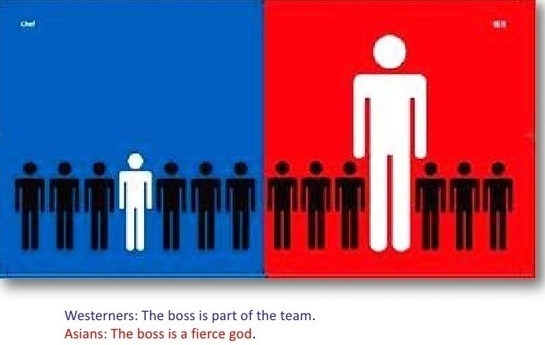 Not only are the schools massively different depending on if it’s A-D, elementary, middle, or high, all the schools have drastically different policies that come from the principal. Many of them will push to see how much extra work they can get you to do. You could try to force the letter of the contract (although it’s best to do that only as a very last resort because people will resent it), but it’s wiser to find culturally sensitive ways to stand up for yourself at work. Politeness will go a long way to smoothing the trail, but how you’re treated is going to be wildly different from everyone else in your intake because the principals make 70% of the rules, and the CTs make another 10-20%.
 Respect flows in order from job title to age to nationality. You are pretty much at the bottom of this. (you’re lower down than the Koreans who are younger than you… ) You shouldn’t object, or say no, or in any way be direct about any negative feedback. You get a little latitude because most of them know you don’t know the Korean WAY, but it’s easy to step on a cultural landmine or simply be confused as to why things are done this way.
 Your CT is the most important person to have a good relationship with at your school, and possibly in Korea. This is the difference between a good work life and a shitty one.

 The schedule is never what it says it will be. Ever. You will be told about events when they happen, or if you’re lucky, the day before.
 There is an expectation in Korean culture about your body being at work = you are working. Public schools are actually better than private companies because most of the time the Korean staff can actually show up and leave at designated times instead of trying to beat the boss in and wait until the boss leaves to go. As the foreigner teacher, you have a strict time in and time out and if they ask you to do more they have to agree to OT. Don’t agree to stay late until you get that OT approved, because they WILL try to get you to “volunteer”, and according to your contract, if you volunteer, they don’t have to pay you more.
 Your holidays and sick leave aren’t exactly what you think they are. EPIK teachers get 11 sick days, and it says in your contract that for more than 3 days you need a doctor’s note. BUT. That actually means any non-consecutive 24 hours.
 The school computers are all awful. Get a VPN. I can only erratically access my Google Drive from school because of the network’s security features. Sometimes, I can’t even copy images off the internet which is bad when you’re trying to make a PowerPoint and need that clip art. Sometimes one program will only work with the VPN and another will only work without it, so I have to keep turning it off and on. One day Drive needs the VPN, but the next day it won’t work with the VPN on. Some days, I have to turn the VPN off and on again every few minutes because the school’s network keeps blocking me… I swear I’m not trying to watch porn, I’m usually just trying to get to a picture of a cat eating a hamburger.
 There will be a lot of cultural misunderstandings. And just because one Korean person explains Korean culture a certain way, doesn’t mean it’s that way for every Korean. I mean, does everyone in your culture represent it the same way? If you feel confused or upset, try to find the specific reason for those feelings, and after you’re calm, ask to talk with your CT about it. Ask about the Korean perspective, and let them know your cultural perspective, not to try to get them to change, but so you can understand each other better and find something that works. One CT does not think a teacher should ever have their hands in their pockets in class. Another CT might have her hands in her pockets regularly. Is that Korean culture? No, but they might tell you it is.
 Most of this is EPIK specific, but that “K” does stand for Korea, so…
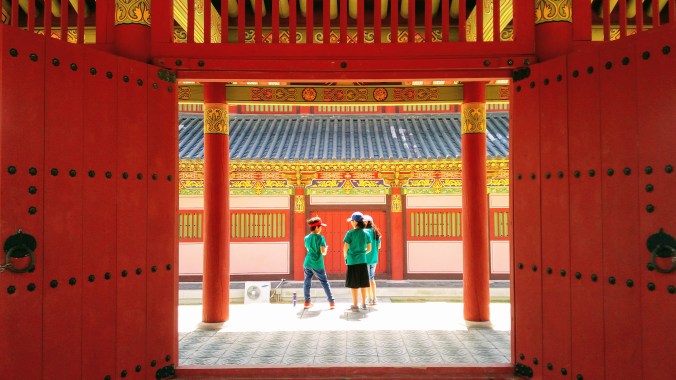 I know I wrote some discouraging words, but trust me I’ve written far more about my wonderful experiences here. Korea, like every country on earth, is not perfect, but it’s got a lot going for it, and EPIK public school teaching is a great way to get to experience it all. I hope those of you reading this looking for advice or in anticipation of your upcoming trip to Korea will learn from my experiences, good and bad, and make your own great adventures in the upcoming school years.


 There were no food delivery options nor any restaurants in walking distance and although it was my plan to rent a motor bike (scooter) for the week, I was waiting until my travel companion arrived on a her flight 4 hours behind me so we could handle both rentals at once. However, my breakfast had been a long time ago, and I needed something to quiet the growling tummy. As we reviewed our options, she mentioned hesitantly that there was a small convenience store just down the street where I could get some ramen. Done! She said she’d show me where it was and I expected it to be hidden or at least farther, but when we got to the gate of the hotel drive, she pointed at a sign barely down the street, less than 2 minutes walk.
 As the sun set, the lizards came out, and when I went back to the room, I was greeted on the porch by a gecko. It was maybe 6 inches long, not huge, but so unexpected I let out a little yelp, and Becca sent someone to save me. I insisted they did not need to shoo the little lizard away with a broom, but Becca said sometimes they bite. She also pointed out the tiny 1-2 inch lizards elsewhere that were totally safe. I asked if the gecko was poisonous, but it’s not, and it wasn’t even slightly aggressive, but I still kept a distance from the others I saw so as not to add gecko bite to my list of minor travel injuries.
 In the weeks leading up to the event, Facebook groups circulated ads, support, rumors and questions as it became murky as to whether the festival’s organizers were in fact granted the required permits to host vendors, performers and the ever important march through the crowded streets of Haeundae. There was some fear that the vendors would be denied a permit and a rallying cry for them to show up anyway and risk arrest for the cause. (Thankfully, that didn’t seem to be necessary).
 We passed booths promoting awareness, selling pride pins, flags, t-shirts, art and books. We bought a few small things, more to support the vendors than anything else. One booth was just for birth control awareness, which is a major issue in Korea since it is still very stigmatized and difficult for women to use it regularly without facing harsh judgement from friends, family and even medical professionals.
 While the booth selection was not as big as the Seoul event, the protesters weren’t as bad as their Seoul counterparts. There were far fewer of them, and they didn’t have any giant trailers with loudspeakers or competing musical performances. Most of them simply held their signs quietly. A few shouted slogans, but the only one shouted at me was “Jesus is love” which is not bad as protest slogans go… I mean, really it’s the same reason why enlightened Christians think marriage equality is right… love is love, man.
 When the sign wavers got too close, the police gently moved them back. There was no force or violence, but the police would form a blockade and firmly move the problem folks back out of range. One man was so transported by his prayer, he knelt as close to the event as he could get, clutching his sign and praying feverishly, eyes screwed shut and knuckles white.
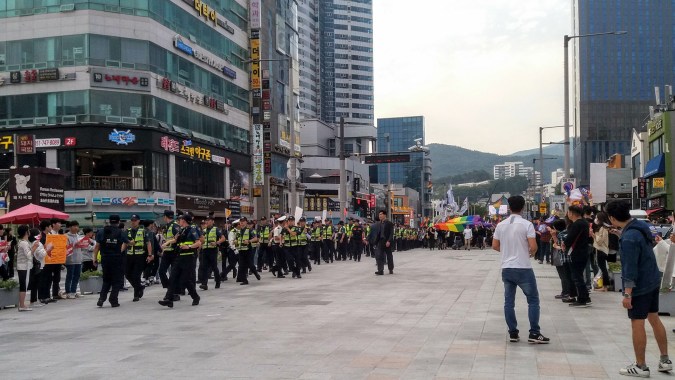 Frantically trying to IM another friend in the parade to figure out which way to go, we walked up and down the street lined with protesters holding signs about sin and Jesus and homosexuals out out out. When the marchers finally arrived, we found ourselves on the wrong side of the police line! We stood among the protesters who waved their fists and signs and chanted their message of opposition. From this vantage point we saw the giant rainbow flag at the head of the procession and we cheered as loud as we could to drown the voices of those around us and support the marchers we had been unable to join in time.
 As the parade moved closer to us, the police moved the line of protesters further and further back to prevent clashes. We pointed somewhat frantically at our own rainbow pins and flags as we asked the officers if we could cross the line and join the group inside. Finally, realizing we were not a threat, they let us through and we joined the group of hundreds (possibly thousands) dancing and singing along to the K-Pop blaring from the backs of the trucks that had lead them on the brief march around the block.
 I’m not sure what the actual parade route was, but I know it must have been short for it was scheduled to start at 4, and was more or less over by 4:30. By 4:45 everyone had dissipated and the plaza was being swiftly converted for whatever event had reserved the space for the evening hours. I also cannot report on the turn out at this time, as there has not been any English language media follow-up reporting on the numbers of attendees, counter-protesters, or police. If I get some information later, I’ll update it here.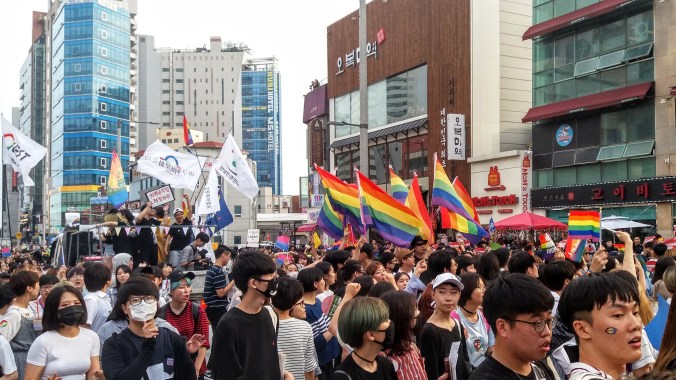


 Skipping ahead to the first century CE, we get what is known as the Three Kingdoms Period. The three kingdoms were Goguryeo (purple) controlled huge swaths of the north including what is now North Korea and parts of China (it is also where we get the English word “Korea” from, since their word for their own country is hanguk) The south was divided between Baekje (yellow) on the west, and Silla (blue) on the east. Except, there were more than three. The Gaya confederacy wedged it’s way between Baekje and Silla for almost 500 years. And let’s not forget
  Between it’s mythic founding 42 CE and it’s surrender to Silla in 562 CE, the Gaya confederate existed in the south central area of the Korean peninsula, just barely missing Busan (where I live) but keeping it’s capital in the nearby Gimhae (where our airport lives). They did some fishing and agriculture, but were most famous for their ironwork. It was a rough confederation of 6-12 different Gayas. When they Japanese invaded Korea in 1910, they claimed that Gaya had been a Japanese military outpost from 300-710 to justify their “return”, but no scholars take this claim seriously today.
 As we entered the park, the first statue was of a giant golden egg with 5 smaller eggs around it’s base. I was taking pictures of absolutely everything, hoping to figure it out later, so I snapped a shot and kept walking with the group. My co-teacher saw me take the picture and told me that the egg was there because the founding king of Gaya was hatched from an egg that fell from the sky. She also referred to this as “history” although I’m hopeful the last part was just a linguistics flub and that no one here seriously thinks that kings really hatched from sky eggs in the good old days. I could not figure out how to ask this without sounding rude, tho, so I let it go.
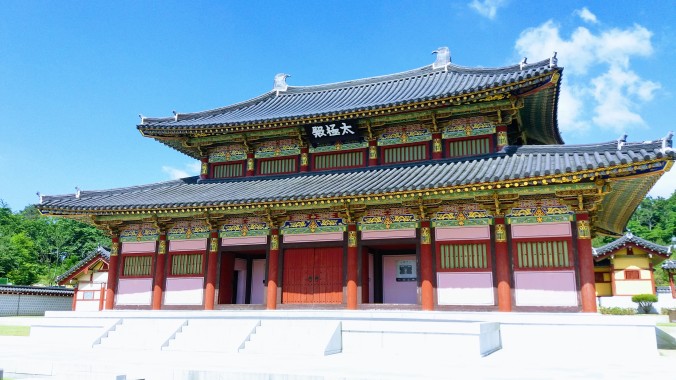 We made our way deeper into the park heading directly for the palace. It’s a replica palace. Very little archaeological evidence of Gaya has been found, although the tomb of Suro (first king of Gaya) is maintained in Gimhae as well. The palace grounds are reminiscent of Chinese palace architecture with familiar canted roofs and wide open courtyards between buildings. The colors and designs are quite unique to Korea, being less the scarlet and gold of China and more earth toned versions of dusty rose, pink, taupe yellow and pea green.


 One room had a huge map along a wall showing the queen’s “romance road of Asia”, paths from India to Korea picked out in red and blue. Another sign seemed to imply that the queen had brought Buddhism into Korea, however that is highly unlikely. I suppose she may have brought hers to Gaya (assuming that she was actually Indian) but the northern Kingdom of Goguryeo got it from their Chinese neighbors. I question her Indian origin story because the myth (written originally in the Samguk Yusa in the 13th century, it’s a kind of history/mythology mashup of the Three Kingdoms period) refers to her as being from Ayuta, a “distant kingdom across the sea”, but the name doesn’t correspond to the name of any country or city from that time period in India or any other country.
 We took our time around the palace complex, letting the kids run off some of their excitement after the long bus ride. There were plenty of historical things of interest, but no teachers tried to make the kids focus on learning, nor was there a guided tour where kids were shuffled from one room to another while someone explained things. They did separate out the grades so that no one building became too full, but on the whole, the kids were on their own to enjoy the space.
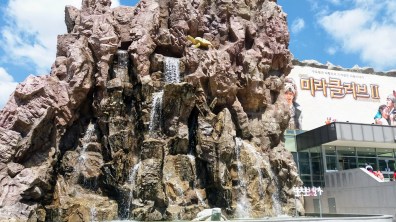 After a while, we headed out of the palace complex and back toward the main entrance to the theater. Turtle imagery was everywhere. A large mountain with an artificial waterfall towered over the theater building. A gray stone turtle lurked in the pond below and another golden one perched precariously on an outcropping halfway up the mountain! I asked about the turtles, but my co-teacher didn’t know (don’t worry, there’s an answer later).
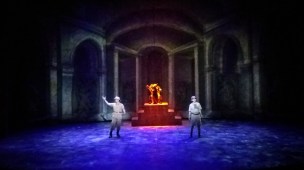 The story began with two archaeologists stumbling onto a large cache of relics from the Gaya period. Their song explained with some lament how little was known of Gaya before this discovery. Then a cave in knocked our archaeologists unconscious and a hazy dream fantasy of the mythstory of King Suro began in earnest. Dancers dressed as the zodiac animals performed intricate dances on stage as some kind of high priest or shaman character sang of the strife, war and drought in the land, praying to the heavens for deliverance which arrived in the form of 6 eggs. (although all 6 eggs hatched out kings, 5 of them were elsewhere being kings of other parts of Gaya, so aren’t in this story)
 The glowing egg hatched to reveal the full grown form of Suro who is proclaimed king on the spot and is expected to wield the power to heal the land. Yay! But it’s not easy being king. The drought continues and his people begin to resent him for not living up to the promise of his celestial birth.
 Meanwhile in Ayuta (India?), the princess Heo has a dream that her destined love is in a land far away, and that she must set sail to reach him and fulfill her destiny (lots of destiny). The dancers costumes were reminiscent of saris and there were certainly hints of Indian Bollywood style music and dance moves that were obviously meant to place the princess and her handmaidens in India.
 But OH! The villain! Satal, a god of war and a gleefully over the top villain dressed in a skull mask and rough furs and accompanied by evil temptresses dressed in black and red gauzy costumes came on to sing his number about how he would defeat Suro and become the king of Gaya, keeping the kingdom forever in a state of greed, hate, and famine. His musical style was that of classic hard rock and the stage was lit by enormous flames as he and his minions sang and danced.
 The princess’s ship is caught in a deadly storm and she is washed ashore in the wreck. It seems the moon itself has saved her just in time to be found by king Suro and they sing a touching love duet in the style of popular Korean ballads. But their happiness cannot last. Satal and his minions kidnap the princess and beat Suro nearly to death in battle. He wants to give up. He didn’t expect this to be so difficult. Where are the heavenly powers he’s supposed to have, after all? But his loyal servant reminds him of the plight of his people and the love of his princess and his resolve is bolstered.
 During a rallying all cast dance number, new armor is forged for the king, turning him from a dandy to a warrior. He is told he can receive the remainder of his heavenly powers upon the mountaintop and so newly armored he ascends to greet the powers of heaven, represented on stage as a white dragon flying around Suro to strengthen him. However Suro fights, Satal holds his own and the soaring duet of hero and villain waxes lyrical about the evils of greed, selfishness and divisiveness being defeated by the power of love. In the end, it is not the armor or the power of heaven that gives Suro the strength to defeat Satal, it is the love of Heo, her voice joining the song to call back to their duet and the fact that their love was made in heaven.
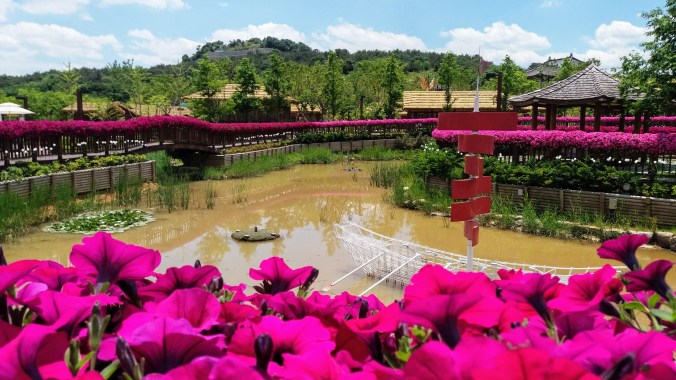 After the musical, we escorted the kids back over to the palace where they unpacked tiny picnic blankets and box lunches under the watchful eye of the staff while we enjoyed the cool, fresh mountain air. When the kids were all done eating, they were turned loose in the playground section of the park while the grownups had a lazy lunch of fried chicken next to the lake surrounded by heaps of purple pansies.
 On our way out of the park, I spotted a turtle garden with empty shells that kids could climb in and around, as well as a happy, smiling gray stone turtle overlooking the scene. The sign near the stone turtle informed us that the mountain where King Suro’s egg landed and hatched looked so much like a laying turtle that it was named Gujibong (gu meaning “turtle” in Korean). Which explained the mystery of why there were so many turtles around the park.

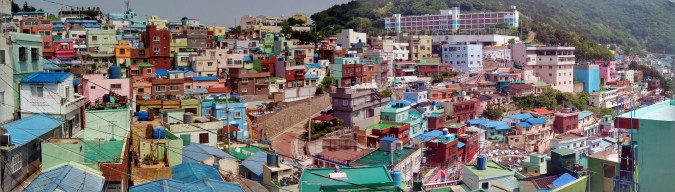
 During the war, Busan was the only city in Korea that was not taken over at some point by the invading northern army. While elsewhere all over the peninsula, whole towns were being leveled to the ground, Busan was becoming a haven for refugees as well as US and other foreign aid troops. The population crisis caused the unique housing style of Busan, which involves building houses and apartments right up the side of the mountains that weave in and out of the city.
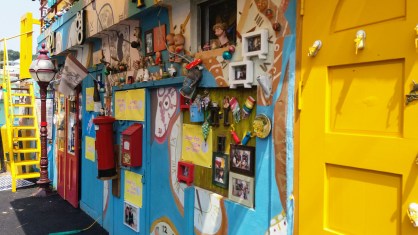 The houses are painted a cheerful array of bright colors that make for a stunning view from the ridge above. However, once you descend into the neighborhood, there is no end of quaint surprises in the form of beautiful murals, surprising statues, and wandering flower planters. The neighborhood is not only adorable, it’s become a hot spot for bohemian culture, local artists, musicians and other experimental creations.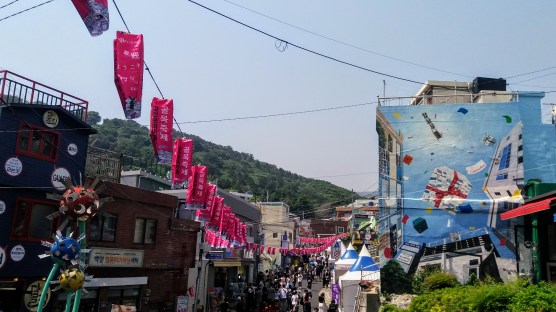


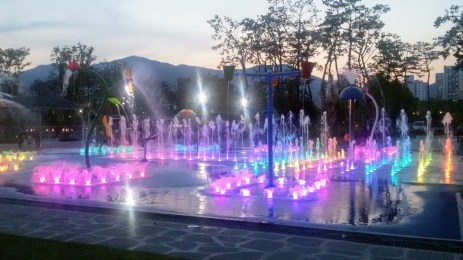 I went to this festival last year when it was held at the citizen’s park, which a beautiful grassy park with trees, a beach, and a big fountain. I had a great time visiting all the booths from other countries and sampling goodies they brought. There was a large space in the middle of all the tents where we could flop down in the grass when we needed a rest and I ran into lots of fun people (most of whom have since returned to their own countries) and sat on the lawn drinking the German beer and Spanish sangria until the sun went down.


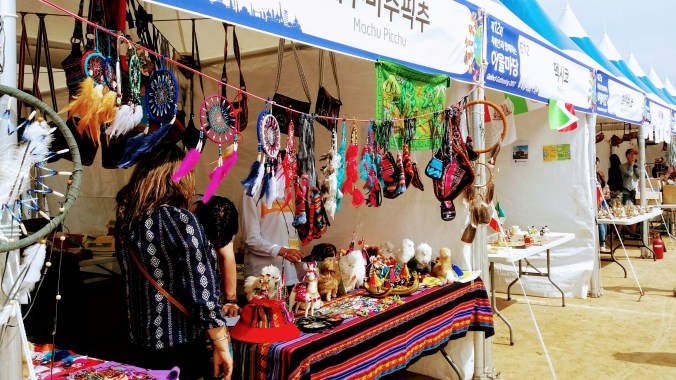
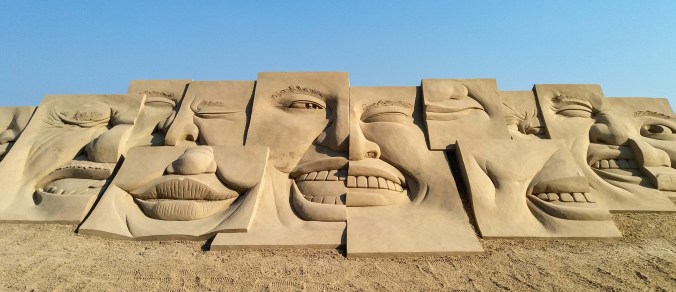

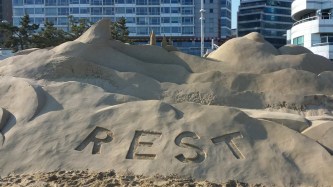 This year… I’m not really sure what the theme was. Each mound only had art on one side, yet despite the fact that there was a temporary walkway between the two rows of mounds (because walking in sand is hard), the art all faced the shorefront buildings, leaving only half facing the walkway and the other half showing their backs. The backs of the mounds remained smooth but for a single word that was presumably the inspiration for the art on the front.


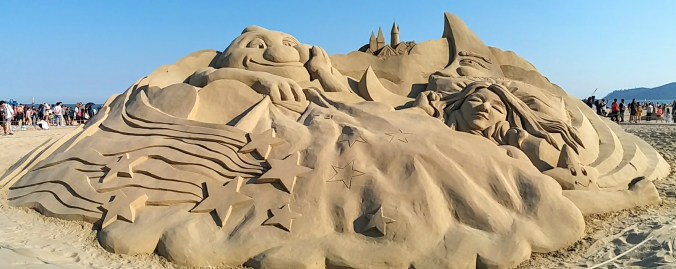

 of the festivals I go to are Korean, I’m still in the minority almost wherever I go. Almost. I don’t know what Haeundae looks like on a regular day because it’s so far from me that I usually go to Gwangan when I need a beach fix. On this day, it was like that scene from Lilo and Stitch where Lilo goes down to the beach to stare at pale tourists. Only most of them were fairly fit being recent college grads or military folks on leave. But so much white people!
 us the wait ahead of time, and we agreed. That should be enough, but part of me was still, “how did they not staff more people on a festival day, the restaurant should be doing something to make up for this inconvenience”… Woah, ‘Murica brain. You didn’t have to come here. They did everything reasonable to make sure you knew what was going on. Check your entitlement! PS. There’s no tipping here, so when waitstaff are nice to you it’s just their job and not because they’re livelihood depends on the whims of customer satisfaction.
 After dinner, we headed over to The Back Room, a secret speakeasy style bar that I visited last year and loved. I had an old favorite (real whiskey sour), and tried a brand new concoction tried an Aviation, which is gin based cocktail with creme de violet, lemon and cherry. Fancy and delicious. We stayed out way too late drinking and chatting, which only served to remind me that every event can be made special with friends.
 Green tea looks like very well kept English hedge,.
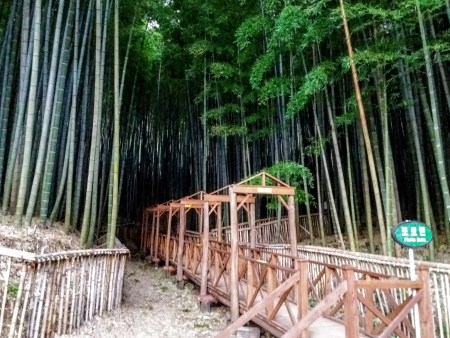 On our way back to the main entrance we took a quick side detour to the bamboo forest. After a short walk through some more evergreens, we emerged into an open space facing a dark and mysterious bamboo forest. The sun was low and the shadows were long so we couldn’t see far into the mass of stalks. Once we entered, it was as though a twilight had encompassed us, the lush leaves cutting out nearly all the late afternoon sunlight. The birds went bananas, screaming like jabber jays, making us feel as though we were in an arena from the Hunger Games or at very least in an ominous Korean horror movie. I wasn’t sure if we should expect kung fu masters or monsters. (click for more pictures of Boseong
  We left the tea fields behind and headed back down to the main parking lot that would lead to the lights. There were plenty of stalls with a wide variety of food (green tea added and regular) so my allergic friend was able to find something tasty, too. The light show wasn’t quite as spectacular as
  dragons and hatching out of giant glowing eggs along the way. Like most lantern displays here, everything was meant to be posed with and interacted with, so it was easy to walk up to any set and play around. It’s a small and childlike pleasure, but after so long in the US being forced to stay behind the railing, it is fun to get a little more hands on. On the way back down, we took the tunnel of lights, pausing every time the colors shifted to take more pictures and pose in the rainbow glows.
 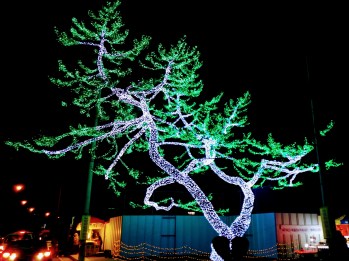 Our third and final location was near the beach where another tunnel of lights and light decorations had been put up. One large tree had been colored in white and green to make it look like it still had leaves. There were reindeer and Christmas trees, but also a giant chicken floating just off shore. I’m not sure why a chicken, but I saw another similar giant chicken in the sea back in Busan the next day.
 The next Saturday was Christmas Eve, and we decided we needed to do a blending of American and Korean activities. We spent the afternoon inside making eggnog and gingerbread houses. I have never made eggnog before. I thought about it a lot, especially when I wasn’t doing dairy. I thought there had to be a better tasting nog than Silknog. But somehow, I never got around to it. This year, although I seem to have no health issues with milk here, there was a complete absence of nog… everywhere… Koreans either have never heard of it, or they are all in the hate eggnog camp.
 based on past non-dairy culinary experiments, I’d say if you’re a dairy free nog fan go with unsweetened almond milk and coconut milk– the stuff in the can that is dense and creamy, not the stuff that is a regular milk sub.– Use 2c almond milk to 1 c coconut milk, otherwise just follow Alton’s instructions. If you’re a vegan who wants
  While we imbibed our culinary delight, we worked on assembling a gingerbread house. Every month here in Busan there is a
  In addition to our delightful wine, I enjoyed pumpkin soup, a goat cheese/bacon/honey pastry for entree, a superbly well cooked slice of salmon with a light lemon flavor and a unique mushroom risotto which had been made into a breaded patty and lightly fried, and finally a chocolate pear cake that tasted more like it was a ganache or very dense ice cream rather than a cake, too decadent! Nothing will compare to the food in France, but Le Jardin made an admirable effort and gave us all a taste of Western flavors with just a hint of haute cuisine that was perfect for a holiday feast.
 Toward one end of the festival, I found an old man with a traditional candy game called ppopgi. It’s a simple candy made from sugar and baking soda, but a shape is pressed into the candy. Kids (and a few adults) can use a little pin to try to break the candy around the shape without shattering the brittle sugar. If they succeed, they win a prize (often more candy). The vendor was using a tiny copper pot to melt sugar over an open flame, adeptly pouring out the steaming satiny brown concoction, pressing it flat onto a popsicle stick and letting his fares choose their shape before pressing a cookie cutter down on the hot surface. I noticed that while adults had to be perfect to win, the little kids were often awarded a prize for a good effort.
 A mere week later, the New Year celebrations were upon us. I had done some research and found that here in Busan there is a bell ringing ceremony in Yongdusan Park at the large bell at the foot of the Busan Tower. It’s a big event with musical performers and guest speakers that is televised much the way that the New York Time’s Square ball drop is. Yongdusan park is nowhere near as big as Time’s Square, and the majority of people don’t ascend the multiple flights of stairs until 11pm. Knowing we had plenty of time, we spent the day reveling in some seasonal sulbing, a screening of Rogue One, and a totally accidental Japanese dinner.
  Nonetheless, it was a wonderful day and at 5 minutes before 11, we found ourselves in a long line of people patiently trudging up the stairs to the peak of Yongdu Mountain. Normally, this pathway has a series of escalators going up so that anyone can access the park, but tonight the escalator had been closed down and reserved as a dedicated emergency access stairwell. When we arrived at the top, we saw many TV vans and we shuffled with the crowd into the standing space behind the VIP seating. To my surprise, through crowd motion, we soon found ourselves close enough to the bell to get a decent view of the proceedings, and there was a jumbo-tron screen off to one side that allowed us to view the performances.


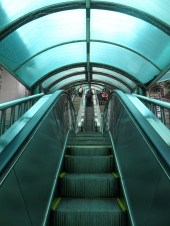 This park in the Nampo neighborhood is up on a bit of a mountain, but there’s no need to climb up exhausting stairs because there’s an outdoor escalator installed to let you ride up in comfort! When we got to the top, we were already blown away by the great views of the city below and we hadn’t even gotten to the highest points yet. As we passed by the stage area, it was clear that a performance was about to get underway. There were plenty of people dressed in the standard white garb trimmed with bright colors and fun hats and the parents hadn’t gotten to see any traditional dances, so we pulled up a seat. I have since found out that cultural performances happen here every Saturday at 3pm between March and November.
  The MC for the day was excited to see so many foreigners (not just us) in the audience and brought out a poor young Korean lady who was nervous and not particularly fluent to try and translate for us. Representatives from each visiting country in the audience were invited to come up on the stage and play a traditional Korean game of trying to toss a stick through one of 5 rings attached to a jar. My friend’s mom went up and they let her stand extra close because she was over 60 and she brought us honor by scoring the center ring! We didn’t sit for the whole performance, but it was a kind of musical story. From what I could follow, some performers arrived at a lord’s house and were invited in to party, but there were some rascals around who may have been trying to steal away or marry off the lord’s daughter? The language barrier was a bit of an obstacle to the plot, but it was fun to watch and clap along with.
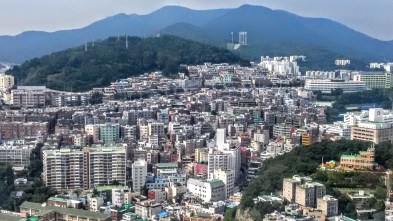 We snuck out during a lull and headed to the main attraction of the Park, Busan Tower. The tower stands 118m high, but it’s also on a mountain so, it seems to be rather higher than that when you look down. For 5,000won you can get a ticket to ride up to the top of the tower where you can enjoy a stunning 360 degree view of Busan. There are helpful decals on the windows that identify major landmarks and there;s a little cafe where you can enjoy a snack with your view.

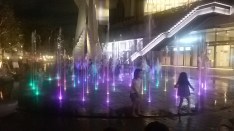 Sky Tree (left) where the small fountain lights are coordinated with the tower lights high above. These shows are fun, awesome, wonderful, and sparkly, so when my friend told me he wanted to take his parents down to Busan’s own choreographed fountain show, I was all in favor.
 There are some permanent concrete bleacher type seats along one side, but the rest of the area around the fountain had been filled up with plastic chairs to accommodate the higher number of spectators on the warm weekend nights. We arrived early and laid claim to seats in the front row, hoping that we wouldn’t have to worry about the crowd standing in front of us when the show started. Refreshingly, the Korean audience stayed in their seats during the show and we had a first class view. In both China and Dubai, the spectators jostled for the best standing spots and to get my video, I had to start standing in my spot almost 30 minutes before the show started to get an unobstructed view.
  This is 2,519 sq m fountain is listed as the largest fountain in the world by Guinness. I suppose that the show at Dubai is not considered a single fountain and is therefore only the largest fountain
 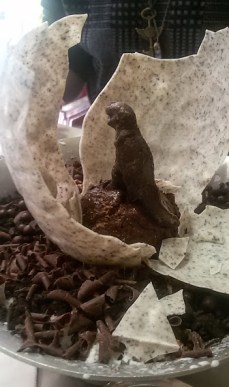 I’m not a food blogger, but sometimes food is just too good not to write about. I’ve done some basic coverage of these things elsewhere, but it doesn’t get old. Dala 100% Chocolate is this tiny hole in the wall chocolate cafe in my neighborhood in Seomyeon. The first time I went there, I had to try their signature dish, the dinosaur egg. This was an amazing concoction of shaved milk ice topped with crushed chocolate cookies and chocolate shavings with a giant egg made of cookies and cream candy. When smashed with the provided hammer, the egg reveals a scoop of truly decadent chocolate ice cream and a tiny chocolate dinosaur. If that’s not enough chocolate, you can pour chocolate sauce over it too. It takes at least two people to eat this dessert. Since that time, we’ve also tried the chocolate pizza (nutella spread, banana slices and toasted marshmallows for toppings, scoop of vanilla ice cream and chocolate sauce again), and for the two separate parental visits this summer, I also managed to try the fruit fondue (kiwi, grape, orange, grapefruit and banana… turns out grapefruit in chocolate is awesome), the “special brownie” (molten chocolate inside!), and the chocolate churros (churros you dip in chocolate). Let us not forget the milkshakes, which come in a variety of chocolate compliment flavors and can be made white, milk or dark. I don’t just love this place for it’s chocolate, but because it’s good chocolate. It’s not too sweet and they do a good balance of flavors in each dish so you don’t get tired (as if that were possible) of a single chocolate flavor. I think we’re about halfway through the menu now, and if the weather keeps cooling off, I’ll get to try their hot drinks soon!
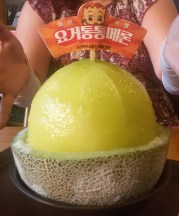 The melon special was not just using frozen milk, but frozen yogurt… and not the kind you’re thinking. Imagine you mix some yogurt with milk or water until it’s all liquidy, then freeze it solid, then shave it off into teeny tiny snowflakes. Ok. Now, take a honeydew melon (the green ones) and cut it in half. Hollow it out and freeze the shell. That frozen melon rind is now our bowl, filled with the snowflake texture frozen yogurt and topped with some cubes of what I can only describe as cheesecake filling.
  Now, over the whole thing, put the melon you removed from the rind, the hemisphere of melon, all of it. The dish was served with a big plastic knife so we could cut up the melon for ourselves. It was the perfect combination of sweet, tart and creamy to refresh us in the summer heat.
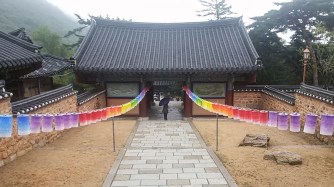 When we arrived, a very nice older Korean lady offered to explain a little bit about the main gate to us in English and we got to hear a little history of the naming of the temple and the unique four pillar style that makes this era of architecture distinctive. As we ascended the stairs and passed through several gates decorated with bright lanterns and beautiful paintings we moved through a hall of fearsome statues and finally emerged into the main courtyard. The temple was originally built about 1,300 years ago, but was destroyed during a Japanese invasion in 1592 and later rebuilt in 1713, but a few stone remnants and one stone pagoda left from the original still stand in the wide open square. The temple is dedicated to the practice of Seon Buddhism, which is the Korean descendant of Chan Buddhism the same way Zen in Japan is.


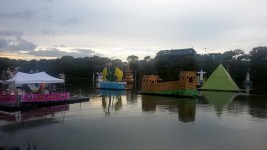 Also called the Jinju Namgang Yudeong Festival, it is held in honor of the fallen during the seiges by Japanese soldiers in the Imjin War in 1592-3 (the same time frame the orginal Beomeosa Temple was destroyed). During the war, lanterns were used as military signals, a means of communicating with reserve forces, and as a way to keep in touch with family members outside of Jinjuseong Fortress. Even after the war, people continued the tradition of floating lanterns down the river to pay tribute to the brave souls that had been lost during battle. Today, the festival is far more than a few lanterns on the river and instead is a whole palisade of life size and larger than life lanterns floating on the river and filling the riverside park where the fortress once stood.
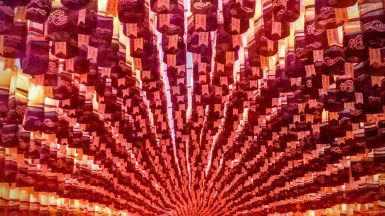 When we entered the display area, we were given arm stamps so we could come and go as many times as we liked, then we began our stroll down the riverside. The water was covered in giant lanterns in shapes of mythical animals and heroes as well as famous landmarks like Stonehenge, the leaning tower of Pisa, and the Statue of Liberty. There were floating restaurants, boat rides, and yet more tents offering delicious snacks.There were giant tunnels of red lanterns where couples walked hand in hand in the twilight.
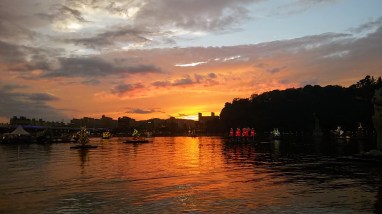 Two floating bridges at either end of the display allowed visitors to pass from side to side without returning to the street level. The day had been rainy, but as the rain dried up, the sunset lit the clouds in shades of brilliant gold and scarlet.We crossed the river and ascended into the wooded area to be greeted with the most amazing forest of light. Unlike the


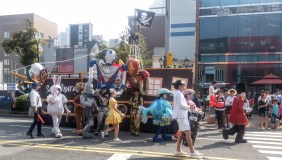 As soon as we stepped off the subway, we were greeted by a parade. This is the second one I’ve seen at Haeundae and I’ve only gone down there a few times. I’m not sure if it was for the sand sculpture festival or the Port Festival, but it was fun to watch. There was a pirate ship, some movie characters, dragon dancers and plenty of people in random costumes.
 When we arrived at the beach we were greeted with banners, flags, a crazy fish/car/bike, a giant cat bounce-house and some para-sailors with giant fan propellers. The first few sand sculptures were smaller, about the size of a car, and were clearly propaganda or advertising rather than part of the art display. Nonetheless, the skill involved in creating a sculpture from sand that had such precise shapes and lines was awe inspiring. I’ve worked with clay before, and it holds a shape well. It has tools that you can use to create super flat surfaces or precise curves and lines. But anyone who has tried to build a sandcastle knows that sand is treacherous, crumbly and not easy to shape.


 We spotted some mussels, of which I am a big fan, but then right next to them I saw some beautiful spiral shelled mollusks that I’d never tried before. I was hopeful that they would be a similar taste experience to the mussels nearby, and I proposed that we split a plate of new experience instead of going for the safe bet. This was not a disappointing choice. I understand that for some, the concept of oysters, mussels, and other sea mollusks is not an appetizing one. For me, well, there’s a reason I loved eating in Japan so much. Most of the animals in the sea are flipping delicious. Especially fresh. These little morsels were no exception. The plate of shells was served with wooden picks for us to pull the flesh from the shell. The fascinating part was that the shape of the meat was the same as the spiral shape of the shell, maintaining it’s spring-like appearance even after it was removed. Instead of garlic butter, the Koreans enjoy their shellfish with a spicy yet piquant chili sauce. So yum. The shells were too beautiful to just trash, so I tucked one away in my bag and now it lives on my souvenir table.


 The FB ad said the show started at 10pm, and that cover was free from 9-11pm, so we decided to head over to the bar in time to get in free and get a table before the show. In this endeavor we were wholly successful. The Yaman Joint turned out to be a Jamacian/Rastafarian themed bar with a small stage and tiny dance floor. We were shown to a table and left with a tablet menu. The drinks were a little more expensive than I was used to at our neighborhood dive bar, but not crazy. Plus, they had shisha on the menu. For those of you who don’t remember, I fell in love with the flavored tobacco served in hookahs while living in Saudi Arabia. (I know, smoking is bad. Don’t smoke kids.) It’s not something you find much outside the Middle East, and often it’s not very well made when it is. The Shisha here was a very reasonable price, so we ordered some double apple flavor and a couple of tri-colored frozen rum drinks and settled down to wait for the show in abject happiness.
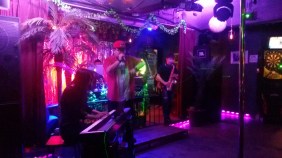 Around 10pm, a young lady came out and started doing a little light jazz on a piano keyboard. Soon she was joined by a saxophonist and we were treated to a mellow improv performance. Next a tiny little Korean woman dressed in plain black slacks and a white blouse came on stage and channeled the soul of a pop diva. Just when we thought it couldn’t get any better, a big guy came out with a mike and started beatboxing. I’m not a huge fan of this activity unless it’s done well. This man was talented. Not only was he good, but he became the third “instrument” along with the piano and saxophone. If you’ve never heard anyone do a jazz/hip-hop improv with piano, sax and beatbox, I recommend you make that happen.


 My eye was drawn instantly to the Whisky Sour which included fresh lemon, sugar and egg whites. Sour mix is a sad abomination of citric acid and corn syrup that can only fool someone who has never tasted the real thing. Aside from the difference that fresh fruit juice can make, the egg white makes the whole beverage rich and a little creamy. I’ve had only a couple in my life, and I was never able to order a “regular” whisky sour again afterward.
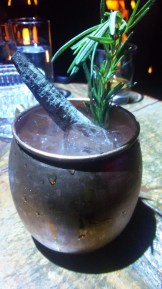 We stepped out onto the balcony between rounds and were treated to a wonderful city view and the pleasant summer night air. For my second, I chose the TBR (the Back Room) Mule. A twist on the Moscow Mule, it was made with ginger syrup (not just ginger ale) and came with a sprig of fresh rosemary and a rough stick of cinnamon bark that was charred briefly to activate the oils. It was served iced in a copper mug and had a light smokey smell from the cinnamon that was deep and savory along with the copper tang and hint of rosemary.
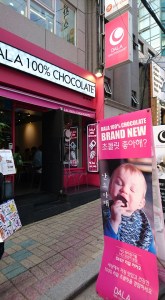 When we found the shop, it was a small space tucked in between yet more small boutique style eateries, but we were saving our appetite for chocolate! We stood outside for a moment admiring the menu and realizing that we would have to come back several times to sample all the amazing goodies on offer. Our timing was also great as we didn’t have to wait at all for a table.
 The drinks arrived first, giant frosty metal cups with straws and chocolate spoons! My mocha was a perfect blend of coffee and chocolate, and not at all too sweet like mochas can often be. The choco waffle ball came with tiny little chocolate dipped balls of waffle batter sprinkled on top and was likewise a luscious bitter-sweet. Plus, the napkins were printed with the Korean Sign Language alphabet! Too cute! We gushed over the deliciousness for a while, taking some obligatory food photos and then the main event arrived.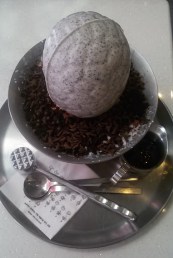


 Much like the temples in China, there was a large, odd shaped rock set out front with the name of the temple in Chinese characters (白楊山三光寺 – bai yang shan san guang si, which roughly translated as “poplar mountain heavenly Temple” and you can clearly see the “san guang si” became the Korean “sam gwang sa”). There was also a long stairwell with a numerically significant 108 steps. The stairs were lined with lanterns, flowers and statues of various sages famous in the history of the sect, although please don’t ask me to identify them because it can be more complicated than spot the Catholic Saint. We got our first glimpses of the lantern coated buildings from the stairs and began to get giddy at the thought of being surrounded by so many beautiful colored lights!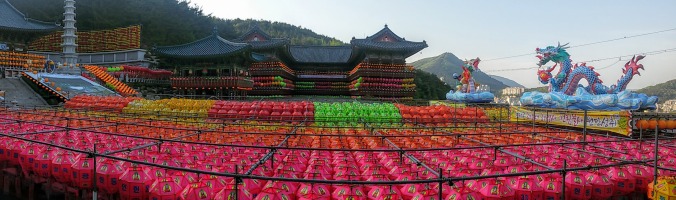
 We traipsed around the temple grounds in awe, randomly bursting into the


 Gallivantrix