The three places in today’s stories are real live places in China (and Taiwan) that people visit as modern day tourist attractions. Although, no one is visiting them just now, thanks Covid, there are a plethora of photographs, Wikipedia articles, and travel blogs about all of them. I didn’t get the chance to go to any landmarks myself, but I still think it’s cool that these traditional folk tales were inspired by stunning natural landscapes that still exist today.
The Goddess of Mt. Wu
The Immortal Maiden Yao Ji was Queen Mother Wang Mu’s twenty-third daughter. Not only did she grow up to be beautiful, but also kind-hearted. Wang Mu loved her especially dearly. Yao Ji’s natural disposition was vivacious, and she was never able to remain idle. Every day she would sneak out to go and play. Wang Mu had no way to catch her.
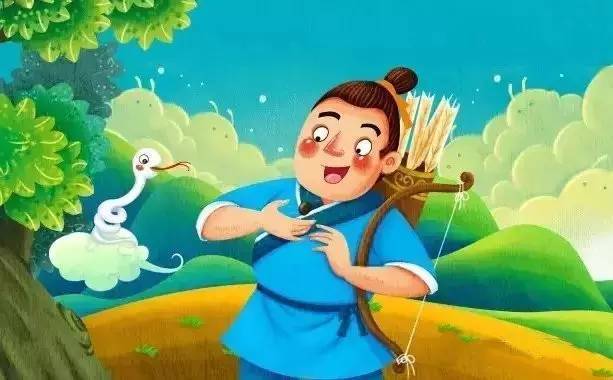
One day, Queen Mother Wang Mu came out to relieve her boredom and saw that Yao Ji looking right into the mortal world. Angrily she said, “Even if Heaven has tasked you to play, what are you looking at the mortal world for, that place can corrupt your eyes!” Yao Ji didn’t believe it, she pointed to a red-crowned crane and said, “That crane is pure white like jade, how could that corrupt my eyes? I want to be like that, to fly everywhere and finally see what the mortal world is like.”
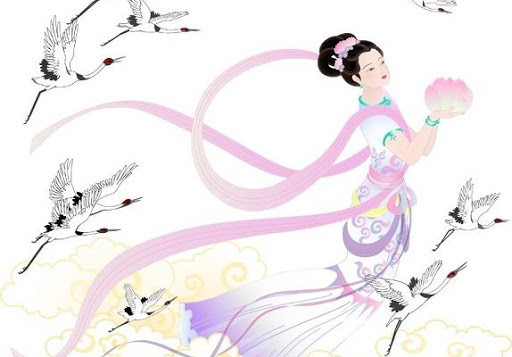
Wang Mu hastily tried to talk her out of it, saying, “The mortal world is a sea of bitterness without end, and you are a royal princess, a golden branch with jade leaves, you simply must not go no matter what!” Yao Ji didn’t listen, she simply sat atop her cloud looking down. She saw many people’s houses were just thatched cottages, their food vegetable husks, and their clothes were damaged and rotten cloth. With a sigh she said, “Oh, truly bitter!” Wang Mu heard this and smiled to herself, then she said, “Still, Heaven is good, we have exotic food without end, and unlimited fine silks and lace to wear…”, but the more Wang Mu talked, the more disgusted Yao Ji became, she resolved to go to the mortal world for a time! Queen Mother Wang Mu defied her, and sent her instead to the Dragon Palace of the Eastern Sea.
The Dragon King of the Eastern Sea had a plan for Yao Ji from an earlier time, only at that time she was still young. Now she came as a guest, the Dragon King received her with special attention. He poured the wine himself, and said happily, “Beautiful maiden, our social position and economic status are in harmony, we are a match made in Heaven!” Yao Ji heard this and her face splotched red. She left the palace in less than the space of one breath, and simply went straight to the human world.
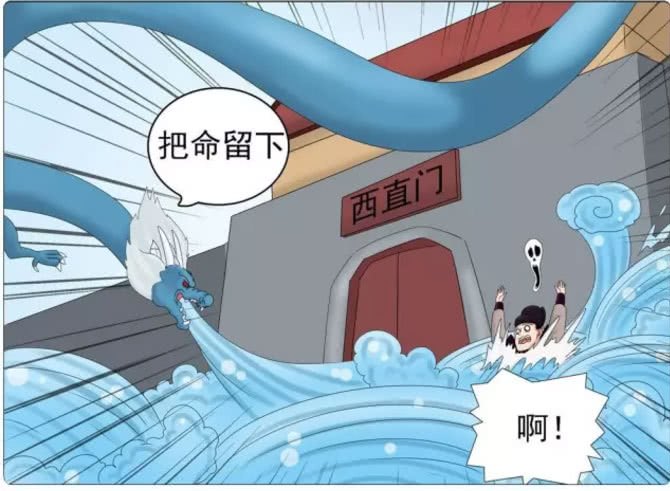
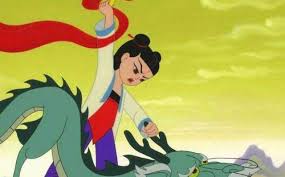
On the road, Yao Ji encountered many people fleeing trouble, leaning on beggars sticks and carrying worn out baskets, pulling along the elderly, carrying the young on their backs, and weeping endlessly. Yao Ji saw this and felt extremely sad. She just wanted to rush forward and ask what happened, so she failed to see the black clouds gathering in the sky. A fierce wind whistled by; twelve evil dragons were in the process of stirring up trouble. Yao Ji hurriedly started steering her rosy clouds. She approached the evil dragons and used sweet words and gracious language to persuade them to not work any more evil deeds. But the evil dragons paid no heed, going so far as to make even more of a ruckus. Yao Ji couldn’t take it anymore. She pulled a jade hairpin from her head, and brandished it at the twelve evil dragons. A ribbon of golden light flashed past, and the evil dragons all dropped dead.
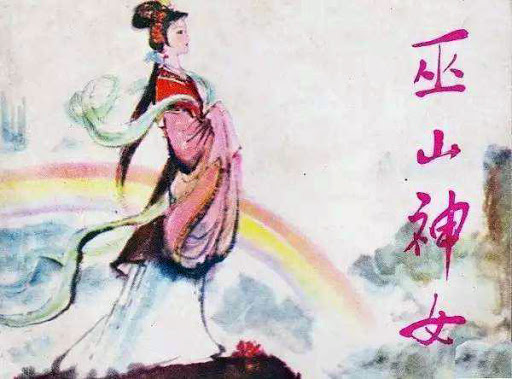
When Queen Mother Wang Mu found out that Yao Ji had gone to the human world and killed twelve dragon princes she became angry and resentful, however when she heard she was staying in the wild mountains, she also felt the pain of love and ordered her other twenty-two daughters to find Yao Ji and bring her back.
The twenty-two Immortal Maidens went down to the human world where they encountered many setbacks and finally found Yao Ji. They said to her, “Little Sister, our mother misses you day and night, with no thought for tea or rice, come back to Heaven with us.” “It isn’t that I heartlessly do not go back. Elder Sisters look, the common people are suffering hardship, how can I not care about that?” Yao Ji said this and at the same time pointed into the distance. There on the mountainside was a wild tiger in the middle of chasing a person, it overtook the person while they watched.
 Elder Sister Cui Ping hurriedly caught up some silt and cast it out. The silt became dozens of arrows that shot the tiger down. Before long, at the foot of the mountain an old grandmother was climbing up, her complexion was pale and wan, she was weak and looked like she had a serious illness. Elder Sister Chao Yun immediately plucked out several hairs from her head, and cast them in front of her. The hairs changed into the reishi mushroom that grants miraculous recovery and saved the old woman’s life. Then, everyone heard a burst of work chanting, and turned their heads to look. In the river, passing by, was a boat floating on the water. The backs of the barge haulers pulling the boat were all almost bent to the ground, but the boat’s progress was still quite slow. Elder Sister Song Luan faced west and blew out a breath, the blow started a favorable sailing wind that pushed the boat forward. The barge haulers straightened up their backs and smiled. Everyone had just heaved a sigh of relief when suddenly they saw in a far off field a patch of dried up yellow, a drought had caused this severe damage, how would the farmers earn their daily living? The Immortal sisters thought and thought; they felt sad and cried. Their tears turned into rain that began to fall with a sound like hua-la-la. Very soon, the field had become a lush green.
When they had finished these things, the Immortal sisters had a contradiction in their hearts: their mother needed to be taken care of, but the common people also should receive blessing and protection, what to do? Finally, everyone made a unanimous decision, one half would return to Heaven, and the other half would remain in the human world. The eleven elder sisters who stayed behind plus Yao Ji blessed and protected the ordinary people of the human world day and night. Later, they transformed into the twelve mystical and beautiful peaks of Mt. Wu. Included among these, closely overlooking the Yangtze River, reaching through the clouds is the transformed Yao Jin Xian Nu Peak.
Split the Mountain to Rescue the Mother
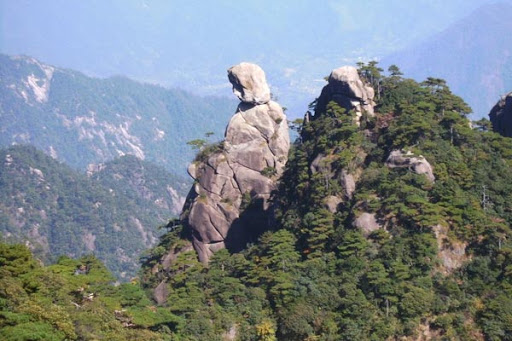
At the very top of the Western Peak of Mt. Hua there is a giant stone a hundred feet high that has been cut neatly into three parts. In the side of this giant stone is a 7 foot high, 300 pound Crescent Moon Iron Ax. Legend has it that this is the historic place where Chen Xiang split the mountain to rescue his mother. That giant stone is called “Ax Splitting Rock” and the axe is called “Mountain Opening Ax”.

It is said that one year a scholar by the name of Liu Yan Chang went to Chang’an (the ancient city of Xi’an) to take the Imperial examinations. When he passed through Tong Guan (a county in Wei nan, Shan’xi) he climbed Mt. Hua to go sightseeing. He had heard that the goddess San Sheng Mu of the West Peak Temple was absolutely accurate, so he went into the temple to request a Qian bamboo stick to have his fortune told. He wanted to ask about his future prospects. However, that day San Sheng Mu just happened to be away from home attending a feast, and the boy watching the door did not dare to casually grant a Qian fortune stick. Liu Yan Chang even drew three Qian, but they were all blank and he became very angry. He took up his brush and wrote a poem on the wall of the temple reproaching San Sheng Mu.
When San Sheng Mu returned home, she saw the inscribed poem and became ashamed and angry. She found Liu Yan Chang and saw that his appearance was stately and grand, and immediately came to feel admiration towards him. She transformed into a mortal woman and came to Liu Yan Chang’s side. Liu Yan Chang also liked the dignified and elegant San Sheng Mu. The pair of lovers soon became parents. Not long after, Liu Yan Chang passed his exam and became eligible for the highest imperial civil service. San Sheng Mu gave him a son called Chen Xiang, and the whole family lived on blessed and happy.
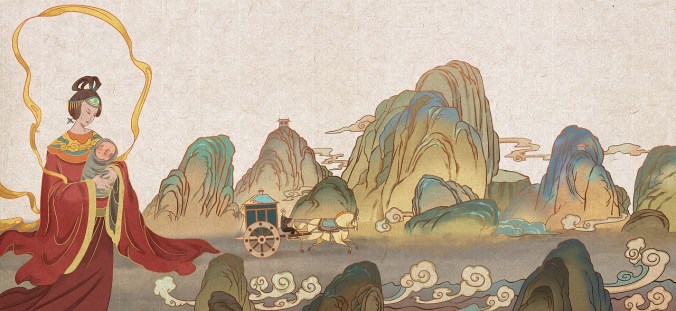
Time flew by, in the blink of an eye Chen Xiang was six years old. One day San Shang Mu’s elder brother Er Lang Shen Yang Jian found out that San Sheng Mu was living a mortal life, even going so far as to bear a son. He was furious. He sent out his spirit eagle to capture little Chen Xiang. Then, in a rage, Yang Jian found San Sheng Mu and yelled at her for having no shame, for violating the law of Heaven, and forced her to hand over her jeweled lotus lantern. The Jeweled Lotus Lantern was her Mountain Guardian Treasure, but in order to save Chen Xiang, San Sheng Mu had no choice but to give it over to Yang Jian.. After Yang Jian took the lantern, he released Chen Xiang, however he pushed San Sheng Mu down under the giant stone at the top of the Western Peak of Mt. Hua.
After nine years Chen Xiang had gradually grown up into a thoughtful young man. One day, his father explained what had happened to his mother. Chen Xiang heard this and was filled with grief and indignation, but at the same time was determined to go to Mt. Hua and rescue his mother.
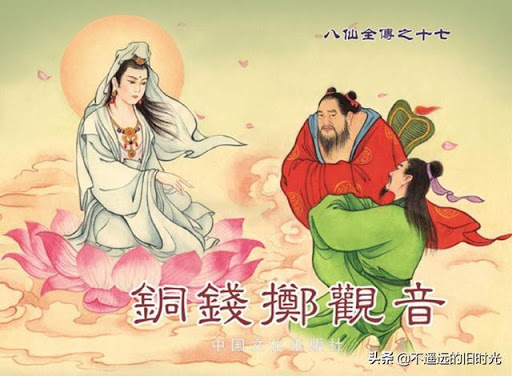
At that time, one of the Eight Immortals, Lu Dongbin clutched his finger in contemplation, realized that Chen Xiang was going to Mt. Hua to rescue his mother, wanted to help him. He turned into a Daoist Priest and went to the foot of Mt. Hua. When Chen Xiang came to the base of the mountain he ran across the Daoist priest, explained his reason for coming, and asked about the road up the mountain. Lu Dongbin said, “If you go up the mountain like this, you cannot succeed. It would be better to first train with me.”

Chen Xian honored Lu Dongbin as a teacher. Every day he rose early and went to bed late, practicing martial arts, and quickly became proficient in all eighteen styles of martial art. Lu Dongbin saw this and was very pleased, saying, “Very good! Your martial arts training is already complete, you can go up the mountain. The key to open the mountain is at your Uncle Yang Jian’s place. He has a dog and an eagle; they are very fierce. I will give you two small pills, the round one can subdue the spirit dog, and the long one can tame the spirit eagle. I hope you and your mother can be reunited soon.”
Chen Xiang took leave of his master, and carried an iron pestle up the mountain to find Yang Jian. When he got to the Gate of Heaven, he saw a bunch of Celestial Generals escorting a haughty and pure god. Chen Xiang knew that must be Yang Jian, he went firmly up to him and saluted, only to hear Yang Jian sneer and say, “Heh heh, you really came!” saying this he raised a three pointed two edged knife and struck at Chen Xiang’s head. Chen Xiang raised the iron pestle and did his best to resist, there was a sound – ka-cha, and the knife snapped into two pieces. Yang Jian was angry and surprised, he let out a bellow and called forth Xiao Tian Quan, the Barking Celestial Dog. Xiao Tian Quan opened his bloody mouth wide like a sacrificial bowl, rose into the air and pounced. Chen Xiang tossed the round pill, Xiao Tian Quan swallowed it in one bite, and suddenly his jaw was tightly shut, it lay down on the ground in pain and began rolling around. Yang Jian then called forth the spirit eagle. The spirit eagle spread both wings, hid the sky and covered the earth, it spread its talons like knives and pounced. Chen Xiang tossed the long pill, the spirit eagle ate it in one bite, both wings froze in midair. Er Lang Shen saw that the spirit dog and spirit eagle had been defeated, he had no choice but to order the Heavenly Generals to fetch the key to open the mountain — a glittering, shining, crescent moon ax.

Chen Xiang took the crescent moon ax and went up Mt. Hua calling loudly as he went, “Mother! Mother!” Chen Xiang called from the North Peak to the East Peak, he called from the East Peak to the South Peak, but from beginning to end he could not find her in those places, worried he cried out loud. A mountain spirit was moved by this, and said to him, “Oh filial child, your mother is in the West Peak.” Chen Xiang heard this and stopped crying, climbed the Western Peak as if he were flying, soaring into the air with each jump, raised the crescent moon ax high, and did his best to split the peak. There was a loud, earth shattering noise, the peak was split open, San Sheng Mu slowly came out. Mother and son saw one another at last, they embraced one another excitedly and cried bitterly together.
Chen Xiang welcomed his mother back home and the family of three at last resumed their happy and blessed life together.
Notes: I actually climbed Mt. Hua on my 2012 visit to China, but I climbed the Eastern Peak because we wanted to stay the night a the peak and watch the sunrise as is the custom. I say climbed because we did spend about 7-8 hours walking up the endless stairs (no switchbacks here), but only after we took the bus up to the gondola. People in better shape than me climb the whole thing! No matter which peak you visit, it’s a stunning experience and I highly recommend it if you’re going to be in the Xi’an area. This was one of my lovely views.
The Legend of Sun and Moon Lake
In the jewel island of Taiwan, there is a beautiful scenic lake called Sun and Moon Lake. Beside the lake are two towering mountains, one is called Mt. Da Jian, and one is called Mt. Shui She. This is the origin of these names and a beautiful story about them.

A very long time ago, there lived in a large lake, two evil dragons, a male and a female. One day, at noon, when the sun arrived in the sky over the lake, male dragon suddenly leapt up and in one gulp he swallowed the sun into his belly. At night when the moon rose into the sky, the female dragon also flew up and swallowed the moon into her belly. This pair of evil dragons swam to and swam fro in the lake, sometimes swallowing the sun and moon down and sometimes spitting them back out, playing by batting them around. It was as if they were in the middle of a performance, a pair of dragons with trick pearls. They only pursued their own pleasure. They didn’t consider that because the human world had no sun or moon, everywhere was dark. The threes all wilted, birds in the branches no longer sang, nearly ripe sugar cane dried out, cows and sheep couldn’t find grass to eat and nearly all starved to death. Days became unbearable, and the people all cried out in a wailing sigh.
In the village there were a pair of clever and courageous young people – Elder Brother Da Jian and Elder Sister Shui She, they saw this state of affairs and their hearts were filled with worry. They pledged to seize and return the sun and moon. But how could they fight the evil dragons? Brother Da Jian and Sister Shui She arrived outside of the evil dragon’s cliff cave dwelling, and eavesdropped on the two dragons’ conversation. Actually the things that they were most afraid of were the golden ax and golden scissors buried at the foot of Mt. Ali
Having found a way to subdue the evil dragons, Brother Da Jian and Sister Shui She climbed mountains and waded rivers, and arrived at the base of Mt. Ali. With no thought for tiredness they dug and dug until they couldn’t tell how long they dug. A crack in the rock finally showed a ribbon of golden light, they dug again a bit more down, and sure enough they dug out the golden hatchet and golden scissors buried under the mountain.
Carrying these treasures and full of confidence they returned to the side of the big lake. The two evil dragons were in the middle of playing by swallowing and spitting up the sun and moon. Brother Da Jian dashed forward bravely with no personal concern and jumped down into the lake, brandishing the golden axe and chopping fiercely at the evil dragons. Suddenly he chopped the male dragon’s head right off. Sister Shui She saw a timely opportunity, raised the golden scissors in both hands and ka-cha, sheared off the female dragon’s head.
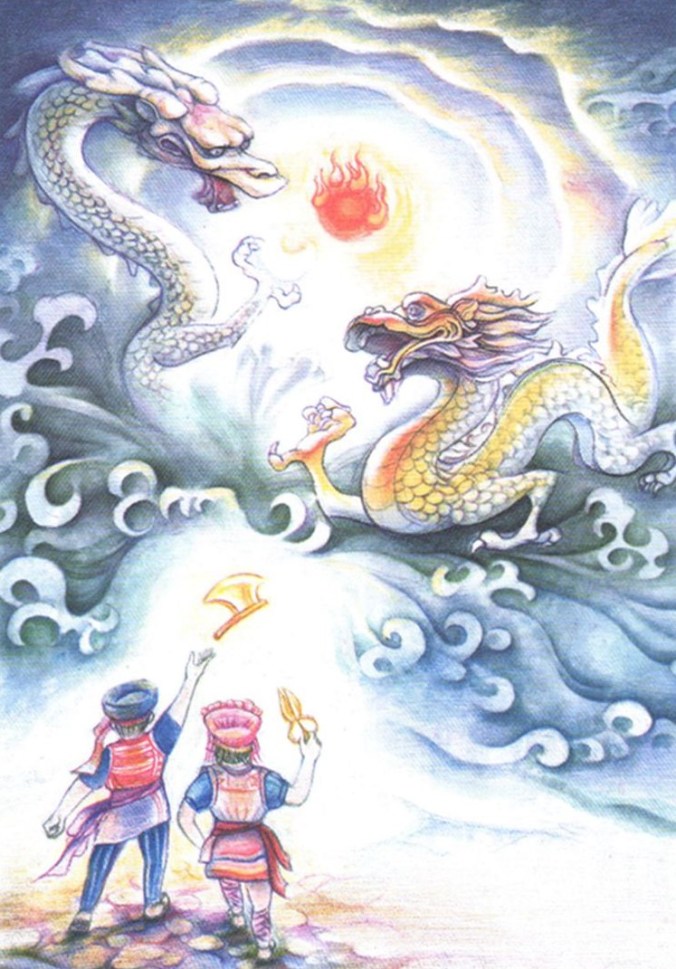
Both dragons were dead; however, the sun and moon were immersed at the bottom of the lake. Brother Da Jian tore down the male dragon’s eyeball and swallowed it; Sister Shui She swallowed female dragon’s eye; and both people instantly turned into giants. Brother Da Jian dredged the sun up from the lake bed, and Sister Shui She pulled up a palm tree from the lakeside propping it upward, and pushed the sun back up to the sky. The sun was once again joyfully hanging high in the blue sky. All living things also glowed with vitality; the people cheered and frolicked with joy. After the sun set behind the mountain, Sister Shui She dredged up the moon from the lake bed, and Brother Da Jian used the palm tree again to push the moon back into the sky. The gentle radiance of the moon once more spilled fully across the earth. The people were extremely happy. They wanted to show their appreciation for Brother Da Jian and Sister Shui She, but it was discovered the two had already transformed into two majestic mountains.
The people arrived at the lakeside where the sun and moon were previously swallowed, they found that the island in the center of the lake had divided it into two halves: one half was like a round sun, and the other half was like a crescent moon, so they named the lake Sun and Moon Lake. In order to commemorate the selfless devotion of Elder Brother Da Jian and Elder Sister Shui She, they named the two mountains separately as Mt. Da Jian and Mr. Shui She.
Notes: I didn’t go to Sun Moon Lake on my 2019 visit to Taiwan. It is a very popular destination, but I was worried it was just going to be a crowded tour group and I also had limited time. I don’t regret my choices, but I may go to the lake if I ever get to go back to Taichung. I was curious about the shape and the mountains so I did some Google Mapping. I found the Shuishe mountain and the trailhead is quite near the lake, but I can’t pin down where Dajian Mountain is (the only one I found was much farther north near Taipei?). I’m not really sold on the idea that the lake looks like a sun and moon. The island is super tiny, I almost missed it because I didn’t zoom in enough on the map! This helpful satellite view from a Chinese source shows us where the sun (right) and moon (left) “shapes” of the lake are, with the line running through the small island of Lalu (拉魯島).

 First thing in the morning the next day, the Dragon Duke disguised himself in the




 We set off from Busan (blue dot) in the morning to drive all the way across the southern end of the Korean peninsula to Jindo (red dot). Although Korea is small compared to, say, the US, it was still almost 5 hours of driving with the occasional pit stop. (By the way, in case you’re curious, you can see Daegu on this map as well). Fortunately, I went with a tour group (my stand by
  The Jindo festival had at least one feature I’ve never seen before: a traditional Korean wrestling ring. A pile of sand was placed in a large circle where two contestants could wrestle in the traditional style.
  Even more bizarrely, after the color throwing was over, the festival organizers gave each participant a “toga” to wear. The togas were long white robes with red sashes that could have evoked a Roman senate or Jesus. Considering we were about to “part the seas” it was hard not to see it with Judeo-Christian overtones, but the rather drunk person I asked about it just said “toga party!” The entire thing seemed like the festival organizers were trying to find a way to appeal to the expat crowd. I’m glad they had fun, but I would have preferred some more traditional activities, like someone to teach us about collecting clams and seaweed the way the locals were doing as the tide went out. It’s hard to go do local culture festivals when the locals are busy trying to white-wash everything for cash.
 Finally, the real “reason for the season” was upon us and we muddled our way down the road to the rainbow steps beneath the watchful eye of the grandmother and the tiger. We paused at a bench to don our thigh high rubber boots and got some advice from the locals on how to attach the rubber garters through belt loops to hold up the boots, or failing that, to wrap them tight around our thighs and snap them in place. Thus clad in bright orange and yellow wellies, we made our way down the steps and into the shallow tide pools to wait for the tide to recede.
 If you look at the area on Google Maps you will simply see the beach and the islands, but on Korea’s own Naver Maps, there is a thin line connecting the rainbow steps to the island of Modo. Although this path is only usable twice a year (at most), the Korean map makers consider it important enough to draw in.
 The history of tidal prediction starts with Kepler (total nobody) in 1609 to theorize that the moon’s gravity caused the ocean tides. He was followed by other such no-ones as Galileo and Newton. It was in 1776 that the first big complex equations came from a man called Laplace. Harmonic analysis was added in the 1860s and polished off by 1921 in the form that Navies all over the world still use today. Although the math hasn’t changed in almost a hundred years, computers make the math easier and the information more widespread so now instead of just ships in harbor– surfers, beachcombers, and clam hunters can
  On a more mystical note, the local legend of the tigers explains why there’s a statue of a grandmother and a tiger overlooking the sea. Long long ago, the villagers who lived on Jindo were plagued by man-eating tigers. The whole village packed up and sailed over to the neighboring island of Modo to escape the threat, but one woman was left behind. The woman was Grandmother Bbyong, and she prayed to the Dragon King, the god of the sea, to help her. Finally the Dragon King came to her in a dream and told her he would build a rainbow brigde across the sea for her. The next day when Bbyong went down to the sea, the waters parted to let her cross and her family came out from Modo to meet her. This also explains the rainbow stairs that lead down to the landbridge, but not why her family couldn’t have just sailed back for her in the first place.
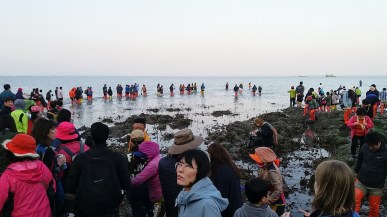 While math can now easily tell us the time of the lowest tides, it does not yet advance to tell us what the actual lowest level of the water will be. Not that it couldn’t, but there are more variables involved, so it’s not a thing now. While we can say with certainty, the lowest tide of the year on this beach will occur at 18:38 on April 29 (or whatever), we can’t say for sure if that will expose the land bridge or simply be lower than every other tide around it.
 We tromped along the path, watching parasailers overhead and rainbow colored lanterns being released in to the air from the beach behind us. It was clear the path was quite narrow because going too far from the group to one side or the other to get a picture resulted in a severe deepening of water level. At the time, my friends and I theorized it might be man-made, or at least man-maintained, however, I have since then found that the build up of rock and sand in this twisty line is a natural result of the currents around the islands.
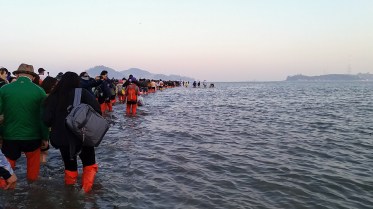 Before long the golden light of the sunset combined with the swish-swishing of hundreds of feet through water to create a trance-like state. I could not judge how far the island was, nor tell which way the path twisted. The rocks below us rose and fell, bringing the waves treacherously close to the top of my boots and then back down to barely splash over my toes. The whole path is nearly 3km long. I suspect a determined person could make it out to the island and back in the hour or so the path is clear to walk, but I wasn’t racing, and soon we were greeted by the sounds of Korean drums and the distant flags waving as the procession from Modo came out to greet us.
 The walk outward had been slow, trepedatious, as though we were nervous the land could drop away at any moment, but the trip back was much more celebratory as well as much more damp. The parade of drum bangers, cymbal crashers, gong ringers and flag bearers danced merrily in their traditional garb, urging us all back to the larger island of Jindo. Our pace quickened and our legs swung to the rhythm causing much larger splashes. Waves came in from both sides of the path making us nervous, but excited. The water finally breached the top of my boots and sent an icy chill down my shins, but I found I did not mind.
 Before heading to the fields, we walked up a long road past the area of the light festival where a few wire frames from reindeer and dragons could still be seen. The road up the hill was painted with fun perspective illustrations of a stream, complete with little camera icons to show the best places to stand to see the visual effect. Optical illusions are fun.
 At the top of the hill, far beyond the little pagoda that had marked the highest point of the lights, we finally came upon the green tea museum where we were treated to a special showing of the Korean green tea ceremony (complete with English translation by our awesome guide). The ceremony involves a process of several containers: a water pot, a cooling bowl, a tea pot, and the drinking cup. The hot water pot is filled with boiling water, which is then poured into the bowl, and from the bowl into the tea pot and finally into the cups. The instruments are warmed up in this way. Then more boiling water is poured into the cooling bowl. Tea leaves are scooped into the warm but empty tea pot and the ideal temperature water is poured from the bowl over the leaves. While the tea steeps, each cup is emptied of it’s hot water into another bowl on the floor and wiped dry on the outside. The tea is then poured into the pre-warmed cups by pouring only a half a portion into each and the other half in reverse order on the way back. The tea is then served, 4 cups to the guest and one to the host.
 The hostess tried to tell us a bit about green tea, red tea and black tea but her translated explainations seemed off to me, since she said it had to do with the age of the leaf when it was picked from the plant. I don’t know if this was her or the translation, but the real story follows: In any country with Chinese roots in it’s culture and language, the three colors of tea are a bit different in meaning that in the West. Red tea is not Rooibos, in fact all three come from the same plant. And it’s not the age of the leaf at picking that determines the difference, but rather the post picking, pre-drying process. (although especially young and tender tea leaves are sometimes referred to as “monkey picked” and do make a delightful tea).
 After we conducted our own tea ceremonies, I drifted lazily back down the hill, examining the spring flowers and the grounds that had been lit up beautifully last December. When I finally got back to the tea fields, I took off on the same route I’d walked before and was happily greeted by many blooming apple trees and a small army of busy bees who were so focused on the brief blossoms that they paid no mind to all the humans fussing around. In fact, I think it was the only time I’ve seen Koreans in the presence of a bee not totally freaking out. I guess the selfie with the tree is worth it.
 In addition to the blooming fruit trees, there were cascades of purple flowers covering the rocks wherever tea was not growing. It made the whole place feel like a still frame of a rushing river in shades of pink, purple and green. Besides the tourists, there were also tea pickers at work. Each ajuma looking lady had her sun guards on, gloves and a mesh basket to place the leaves. They were not picking the bushes bare, but selecting only some growth. It seemed to me to be the newer, brighter green leaves that they were after, but I couldn’t tell for sure. In the age of automation it was strange to see people picking by hand. I know that it’s still the way for many crops in the world, but sometimes it gets driven home that there’s a human on the other end of my tea or strawberries or carrots, and then I’m carried off by sociological musings on how we came to value people who sit at desks manipulating imaginary money so much more than people who make our food.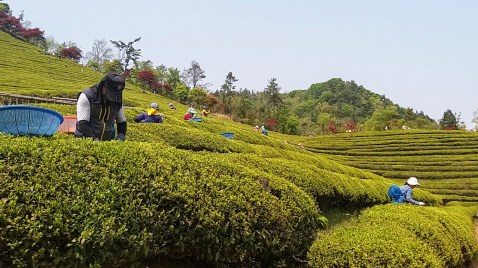

 Gallivantrix